
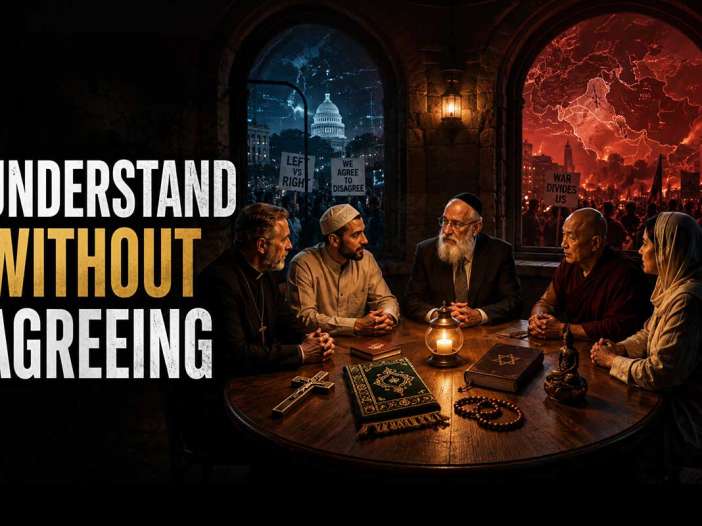
Introduction by Nick Sasaki
Noah Eckstein’s Harvard graduation speech begins with a line that sounds like the opening of a joke:
A Christian, a Muslim, and a Jew walk into a bar.
But he is not inventing a joke.
He is telling the story of his own family.
His Christian grandmother, his Pakistani Muslim grandfather, and his Jewish grandfather were not symbolic figures created for a speech. They were real people, with real faith, real memory, real history, and real convictions. His Jewish grandfather carried the memory of the Holocaust. His Muslim grandfather grew up in the shadow of the 1947 Indo-Pakistani war. His Christian grandmother remained part of the family story that shaped him.
That is what makes the speech so powerful.
Noah’s message does not come from theory. It comes from family.
He stands before Harvard’s graduating class as a proud Jew, yet he speaks with gratitude for Christian and Muslim roots in his own bloodline. He does not treat that as a contradiction. He treats it as proof that difference does not have to become division.
This Imaginary Talks series begins there.
The conversations that follow are imagined. The roundtables are fictional. The guests from history, religion, politics, and public life are brought together creatively to explore the meaning of Noah’s message.
But the family story at the center is real.
That distinction matters.
Noah’s speech is not asking us to pretend every faith is the same. It is not asking us to erase grief, injustice, history, or conviction. It is asking something harder:
Can we understand one another without first agreeing with one another?
That question reaches far beyond one family.
It touches Israel and Palestine. Democrat and Republican division. Holocaust memory. Interfaith families. Forgiveness after atrocity. Religious conviction. Political loyalty. The way people speak to one another online, at the dinner table, in classrooms, and across nations.
We live in a time when many people are trained to ask one question first:
What side are you on?
Sometimes that question matters. There are moments when justice demands a clear answer. There are moments when silence becomes cowardice. There are moments when evil must be named without hesitation.
Yet Noah’s speech warns us about another danger.
When every person becomes a side, the human being can disappear.
The person across the table becomes a symbol. The symbol becomes an obstacle. The obstacle becomes easier to dismiss, mock, fear, or hate.
This series asks what happens when the table is rebuilt.
What happens when people keep their faith, keep their wounds, keep their convictions, and still refuse to erase the humanity of the person across from them?
What happens when listening is not surrender?
What happens when understanding becomes a form of courage?
Noah Eckstein’s real family story gives us the doorway.
The imagined conversations that follow walk through it.
(Note: This is an imaginary conversation, a creative exploration of an idea, and not a real speech or event.)
Topic 1: The Table Where Enemies Become Human Again
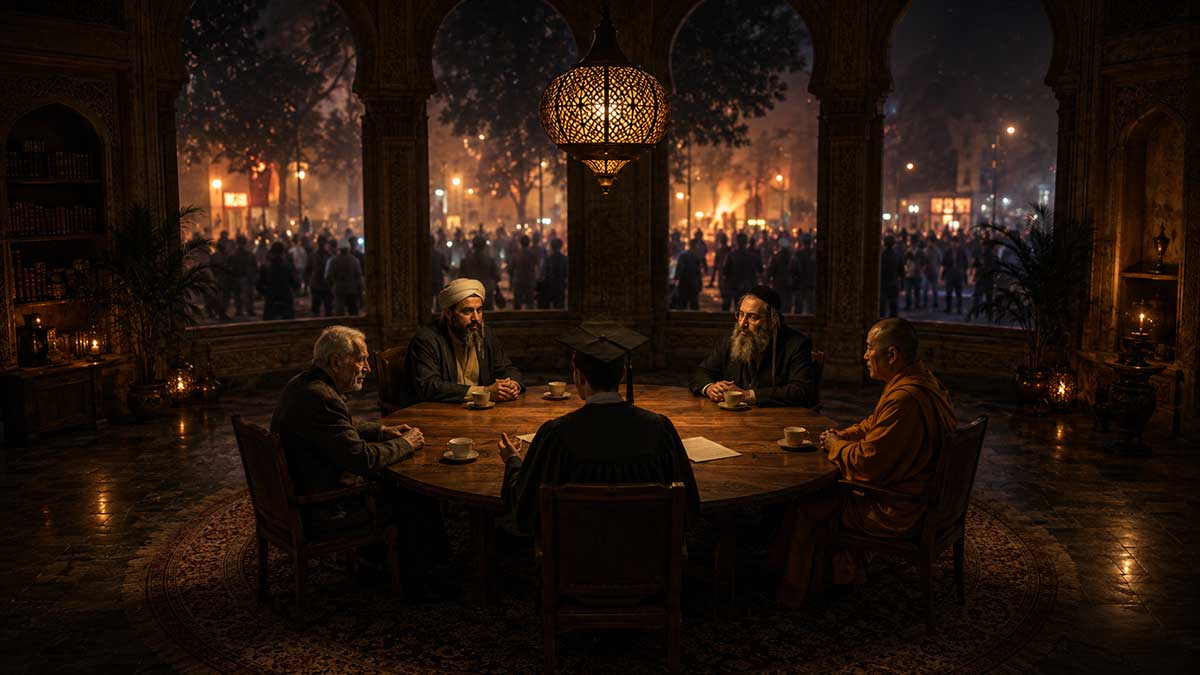
Guests
Noah Eckstein — Harvard speaker whose family story carries Christian, Muslim, and Jewish memory.
Elie Wiesel — Holocaust survivor, writer, witness to memory, suffering, and moral responsibility.
Imam Omar Suleiman — Muslim scholar known for speaking on mercy, justice, grief, and human dignity.
Rabbi Lord Jonathan Sacks — Jewish thinker known for faith, covenant, dialogue, and moral responsibility.
Thich Nhat Hanh — Buddhist teacher of peace, compassion, mindfulness, and deep listening.
Opening
The room is quiet.
There is no stage, no podium, no flags, no side assigned to anyone. Just a round wooden table. Five chairs. Five glasses of water. A single lamp above them.
Outside the room, the world argues.
Inside the room, no one has been asked to surrender their faith, their wounds, or their convictions. They have only been asked to sit close enough to hear one another breathe.
Noah Eckstein looks at the table and smiles faintly.
Noah Eckstein: My life begins like the start of a joke. A Christian, a Muslim, and a Jew walk into a bar. Except the punchline never came. They became family. They disagreed. They stayed themselves. Yet they chose each other. That is the part I keep returning to. How do people remain human to one another when history gives them every reason to pull away?
Elie Wiesel folds his hands.
Elie Wiesel: The question is painful. Yet pain cannot be the end of speech. Silence can protect us for a moment, but silence can also abandon the world.
Imam Omar Suleiman: We must be careful. Some people ask for dialogue when they really want the wounded to become quiet. That is not understanding. That is pressure dressed as peace.
Rabbi Jonathan Sacks: True dialogue does not ask us to erase difference. It asks us to honor the dignity of the one who differs.
Thich Nhat Hanh: To listen deeply is to help suffering speak. When suffering speaks, the enemy begins to change shape.
The table grows still.
Question 1
When does “understanding the other side” become moral courage, and when does it become moral compromise?
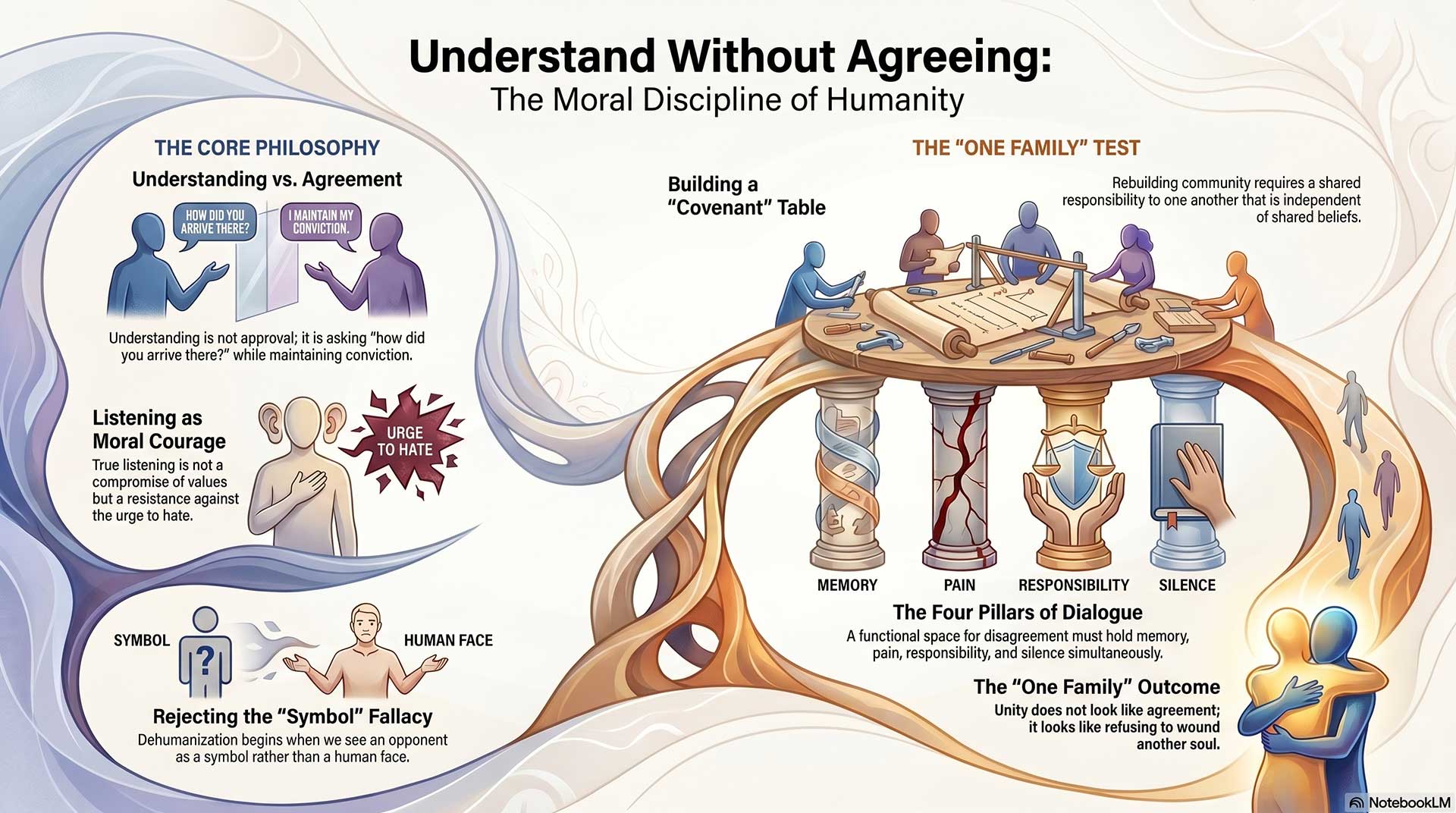
Noah Eckstein: I think about this all the time. People hear the word understanding and think it means agreement. It does not. My grandfathers did not agree on many things. They had histories that could have made them suspicious of one another. Yet they kept talking. To me, moral courage begins when you can ask, “How did you arrive there?” without giving up the right to say, “I believe you are wrong.”
Elie Wiesel: There are things that must never be softened. Murder is murder. Hatred is hatred. Evil must be named. But naming evil does not remove the need to study it. The danger comes when people say, “I understand,” and then stop resisting. That is compromise. Moral courage says, “I understand more, so I must resist more clearly.”
Imam Omar Suleiman: Yes. Understanding cannot become a way to excuse oppression. If someone is crushed, you do not begin by asking them to understand the foot on their neck. You help remove the foot. Then you can ask how such cruelty became possible. Mercy must never be used against the victim.
Rabbi Jonathan Sacks: The Hebrew Bible commands us to remember that we were strangers. That memory is moral training. It does not mean we have no boundaries. It means our boundaries must never erase the humanity of the stranger. Moral compromise begins when compassion becomes indifference to truth. Moral courage begins when truth and compassion refuse to separate.
Thich Nhat Hanh: When we understand, we see causes and conditions. A person full of anger has received anger. A violent person has seeds of violence watered in him. This does not mean we allow harm. We stop harm with firmness. But we do not add hatred to hatred. That is courage.
Noah Eckstein: So maybe the question is not whether understanding is dangerous. The question is whether we are strong enough to understand without collapsing into agreement.
Elie Wiesel: Yes. And whether we are brave enough to judge without becoming cruel.
Imam Omar Suleiman: The wounded need protection first. Then the world needs truth. Then, perhaps, understanding can become part of repair.
Rabbi Jonathan Sacks: A society that cannot tell the difference between forgiveness and forgetfulness will fail at both.
Thich Nhat Hanh: Deep listening is not weakness. It is disciplined love.
Question 2
Can a person truly listen to someone whose beliefs feel dangerous, hateful, or deeply wrong?
Noah Eckstein: I think listening has become confused with approval. On campus, online, in politics, people often feel that if they listen too long, they have betrayed their own side. But if you never listen, you may never learn what you are truly facing. You may only be fighting your own picture of the other person.
Elie Wiesel: I listened to many kinds of people after the war. I did not listen to make evil smaller. I listened to understand how ordinary human beings became capable of extraordinary cruelty. That knowledge is terrifying. But without it, memory becomes ceremony, not warning.
Imam Omar Suleiman: There are moments when the person harmed should not be asked to sit across from the one who harmed them. We should not romanticize dialogue. Some listening must be done by witnesses, scholars, leaders, neighbors, people with enough safety to hold the conversation. The oppressed are not required to educate those who deny their pain.
Rabbi Jonathan Sacks: That is wise. Dialogue must have moral structure. It cannot be a theater where cruelty receives applause. Yet a free society needs spaces where people can speak across difference. Once every disagreement becomes contamination, community dies.
Thich Nhat Hanh: To listen does not mean to let poison enter your heart. You breathe. You know, “This person is suffering. This person is confused. This person may be causing suffering.” You listen with a stable body and a clear mind. If you cannot listen today, you practice until you can listen tomorrow.
Noah Eckstein: That is hard. People say, “Listen like you might be wrong.” But some beliefs are so painful that listening feels like self-betrayal.
Elie Wiesel: Then listen with memory beside you. Memory protects dignity. If you forget who you are, listening becomes surrender. If you remember who you are, listening can become witness.
Imam Omar Suleiman: In Islam, justice and mercy are not enemies. The Prophet showed mercy, but he did not deny injustice. Listening must never erase accountability.
Rabbi Jonathan Sacks: In Judaism, argument can be sacred when it is for the sake of heaven. But argument becomes destructive when victory matters more than truth.
Thich Nhat Hanh: Before you listen, ask yourself: “Am I trying to defeat this person, or am I trying to reduce suffering?” The answer will shape every word.
Noah Eckstein: Maybe that is where my grandfathers taught me something. They debated. They did not melt into one another. They remained themselves. Yet they kept each other within the circle of concern.
Question 3
What kind of table can hold grief, religion, history, anger, and love at the same time?
Noah Eckstein: The table in my memory was small. Coffee. Family voices. Phone calls. My grandfathers asking about each other. It was not symbolic to them. It was normal life. That might be the secret. Peace has to become ordinary enough to survive disagreement.
Elie Wiesel: A true table must have memory. Without memory, the table becomes shallow. People say kind words, but the dead are not present. I need a table where the dead are not forgotten, where grief is not rushed.
Imam Omar Suleiman: I need a table where the grieving are not told to lower their voices for the comfort of others. Anger can be honest. Pain can be sacred. A table that cannot hear pain is not a table of peace.
Rabbi Jonathan Sacks: I need a table with covenant. A covenant says: We are bound to one another, not due to sameness, but due to responsibility. Family is a covenant. Society needs covenant too. Without covenant, difference becomes threat.
Thich Nhat Hanh: I need a table with silence. Many people speak from wounds they have never sat with. Silence gives pain room to breathe. Then speech becomes less sharp.
Noah Eckstein: So the table needs memory, pain, responsibility, silence, and love. That sounds almost impossible.
Elie Wiesel: It is difficult. But the other choice is worse.
Imam Omar Suleiman: And love cannot mean pretending harm did not happen. Love must have courage.
Rabbi Jonathan Sacks: Love without truth becomes sentiment. Truth without love becomes weapon.
Thich Nhat Hanh: At the table, each person can say: “I am here. I suffer. You suffer. Let us not make more suffering.”
Noah Eckstein: The strange thing is that my family never solved the world’s conflicts. My Muslim grandfather was buried facing Mecca. My Jewish grandfather was buried according to Jewish law. My Christian grandmother was buried with a cross. No one became the same. Yet they belonged to one another.
Elie Wiesel: That is not a small thing.
Imam Omar Suleiman: No. That is a mercy.
Rabbi Jonathan Sacks: It is a sign that difference can live inside love.
Thich Nhat Hanh: One family can become a small lamp.
Closing
The lamp above the table glows softly.
No one has changed religions. No one has abandoned grief. No one has won.
Yet something has shifted.
The people at the table have not become less faithful to their own truths. They have become more aware of the human being across from them.
Noah Eckstein: Maybe the table does not fix the world. Maybe it simply keeps us from becoming people who no longer wish the world could be fixed.
Elie Wiesel: Memory must sit there.
Imam Omar Suleiman: Justice must sit there.
Rabbi Jonathan Sacks: Covenant must sit there.
Thich Nhat Hanh: Compassion must sit there.
The room remains quiet.
Outside, the world keeps arguing.
Inside, five people remain seated.
And for now, that is where peace begins.
Topic 2: Israel and Palestine - Can Human Recognition Exist Before Peace?
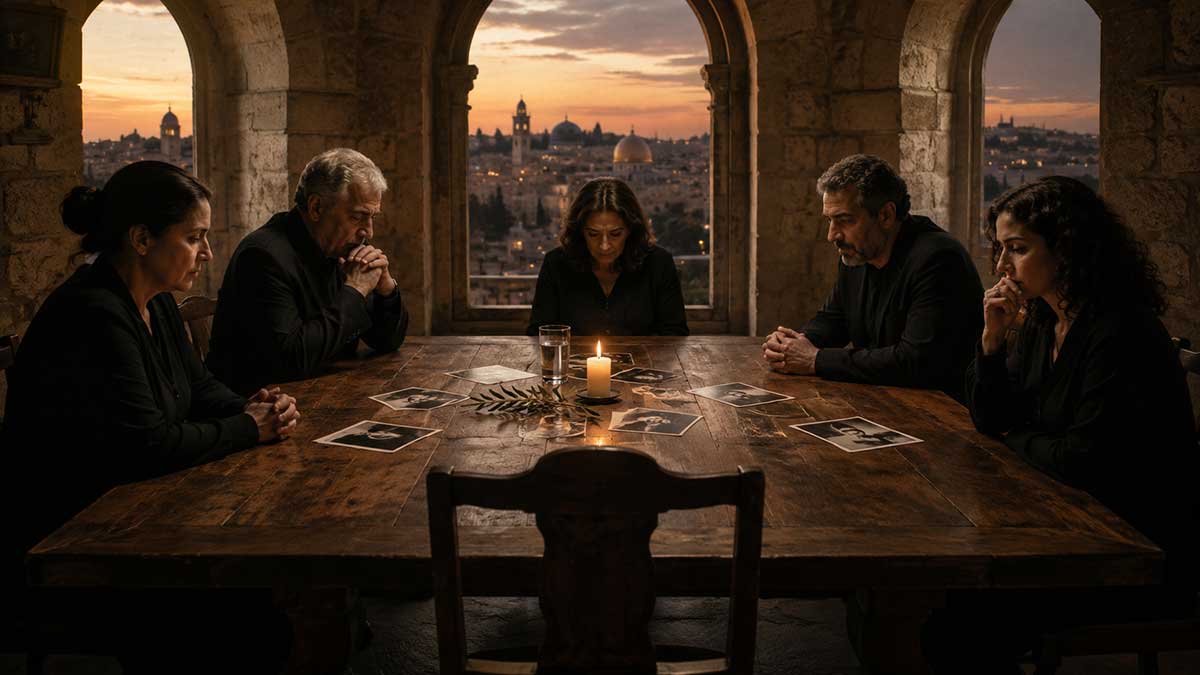
Guests
Noa Tishby — Israeli writer, actor, and advocate who speaks from Jewish history, Israeli fear, and national identity.
Mustafa Barghouti — Palestinian physician and political figure who speaks from occupation, dignity, rights, and nonviolent resistance.
Rabbi Sharon Brous — American rabbi who speaks on grief, moral courage, Jewish responsibility, and shared humanity.
Aziz Abu Sarah — Palestinian peacebuilder whose brother died after being beaten by Israeli soldiers; later chose dialogue work.
Mahmoud Darwish — Palestinian poet whose words carry exile, homeland, memory, longing, and loss.
Opening
The room is quiet again.
This time, the table feels heavier.
No flags are placed on it. No maps. No borders drawn in ink. No one is asked to represent every wound of a people.
Five chairs. Five glasses of water. One empty chair left open for the dead.
Outside the room, the names Israel and Palestine are spoken with anger, fear, loyalty, grief, and accusation.
Inside the room, no one is asked to forget. No one is asked to forgive too soon. No one is asked to make pain smaller.
They are only asked to look across the table and see a human face.
Rabbi Sharon Brous: We are entering a room filled with ghosts. Jewish ghosts. Palestinian ghosts. Children. Parents. Grandparents. Refugees. Hostages. Families. Soldiers. Villagers. Survivors. The first moral act is not speech. It is reverence.
Mustafa Barghouti: Reverence must include the living. Palestinians are asked again and again to prove their pain. A people cannot live forever under control, humiliation, and loss, then be told that peace begins with silence.
Noa Tishby: And Jews cannot be asked to pretend fear came from nowhere. Israeli fear has history. Jewish fear has history. When people speak of safety, they are not speaking in slogans. They are speaking from memory.
Aziz Abu Sarah: I lost my brother. For a long time, anger felt like loyalty. Then I met people I was taught to hate, and I learned something painful: grief can either build a wall around the heart or carve a door into it.
Mahmoud Darwish: A homeland can become a wound. A wound can become a poem. A poem can become a mirror. But a mirror does not heal the body. It only asks us to look.
The table grows still.
Question 1
Is it possible to honor Israeli fear and Palestinian grief without turning one into propaganda?
Noa Tishby: It has to be possible. If Israeli fear is mocked or dismissed, Jews hear an old sound. They hear the world saying, “Your danger is exaggerated.” That sound has followed us through history. Israelis do not want sympathy as decoration. They want the right to live without terror.
Mustafa Barghouti: And Palestinians do not want pity. We want freedom, dignity, equal rights, and an end to daily domination. Our grief is not a public relations tool. It is the life of a people. If someone speaks of Israeli fear but refuses to see Palestinian dispossession, that is not balance. That is blindness.
Rabbi Sharon Brous: The trap is competition. One grief speaks, and another grief feels erased. One fear speaks, and another fear feels denied. The moral question is this: can my people’s pain make me more tender to another people’s pain, not less?
Aziz Abu Sarah: At first, I could not. My brother’s death filled my whole world. Every Israeli face looked like part of the same machine. Then I met Israelis who cried with me. That did not erase what happened. It changed what I thought was possible inside me.
Mahmoud Darwish: Pain becomes propaganda when it is forced to serve a flag before it is allowed to be pain. A mother does not cry in Hebrew or Arabic first. She cries in the language of loss.
Noa Tishby: I agree with the heart of that. Yet I worry when poetry softens the danger Jews face. Israelis are not symbols. They are people who send children to school and wonder if they will come home.
Mustafa Barghouti: Palestinians know that fear too. A child walking past soldiers, a family losing land, a home demolished, a checkpoint, a drone, a prison visit. Fear is not owned by one people.
Rabbi Sharon Brous: Then maybe the first act is to stop saying “only we know fear.”
Aziz Abu Sarah: Yes. And stop saying “your grief is fake until you agree with my politics.”
Mahmoud Darwish: The dead do not ask us to win the argument. They ask us not to betray their humanity.
Question 2
Can peace begin before justice is fully agreed upon, or must justice come first?
Mustafa Barghouti: Justice must not be delayed forever in the name of peace. Palestinians have heard many speeches about peace from people comfortable with our lack of freedom. If peace means calm for one people and control over another, that is not peace. That is management.
Noa Tishby: Security cannot be treated like an excuse either. Israelis need more than promises. After generations of persecution and attack, “trust us” is not enough. Peace without safety will not survive one funeral.
Rabbi Sharon Brous: This is the terrible knot: one people says, “No justice, no peace.” Another says, “No safety, no peace.” The work is to refuse the lie that justice and safety must destroy each other.
Aziz Abu Sarah: I used to think justice meant the other side had to suffer enough to understand us. Then I realized that revenge can wear the mask of justice. Real justice has to create a future. If it only creates another generation of grief, it is incomplete.
Mahmoud Darwish: Justice is not a slogan. It is a child sleeping without fear. It is a key that may no longer open a door, yet still opens memory. It is a name spoken without shame.
Mustafa Barghouti: Beautiful, but justice must become law, rights, movement, land, citizenship, equality. Poetry cannot replace policy.
Mahmoud Darwish: No. Poetry cannot replace policy. But policy without poetry may forget the soul it claims to serve.
Noa Tishby: And safety must be real. Not just emotional. Real protection. Real borders. Real guarantees. Real recognition that Jews have a right to exist in their ancestral home.
Mustafa Barghouti: Palestinians have the same right to exist in theirs.
Rabbi Sharon Brous: The sacred test is this: can I seek my people’s freedom in a way that does not require another people’s erasure?
Aziz Abu Sarah: That question should be written above every negotiating room.
Question 3
What kind of listening can survive sacred pain?
Aziz Abu Sarah: Listening that does not interrupt grief. When my brother died, people wanted to explain. They wanted to contextualize. They wanted to ask whether the story was accurate. I needed someone to say, “Your brother mattered.” Only then could I hear anything else.
Noa Tishby: Israelis need that too. When Jews are killed, kidnapped, threatened, or hated, people too often rush to theory. They explain before they mourn. That is cruel. Mourning has to come first.
Mustafa Barghouti: Palestinians experience that constantly. Our dead are counted, debated, doubted, compared. People ask us to condemn before they allow us to grieve. That order tells us our humanity is conditional.
Rabbi Sharon Brous: Then sacred listening begins with a vow: I will not use your grief as a doorway into my argument. I will let it stand first.
Mahmoud Darwish: Grief is a guest. If you make it stand outside until it proves its passport, you have already failed hospitality.
Noa Tishby: But what happens when grief is used to justify violence?
Mustafa Barghouti: Then we must oppose violence without denying the grief underneath it.
Aziz Abu Sarah: Yes. I can say my brother’s death was wrong. I can say the system that led to his death was wrong. I can still refuse to kill someone else’s brother in his name.
Rabbi Sharon Brous: That may be the highest moral ground: grief that refuses to become permission for cruelty.
Mahmoud Darwish: The wound says, “Remember me.” Hatred says, “Become me.” We must learn the difference.
Noa Tishby: Sacred listening must protect the living too. It cannot become endless emotional exchange with no plan to stop harm.
Mustafa Barghouti: Agreed. Listening that never changes policy becomes theater.
Rabbi Sharon Brous: So the listening must move from tears to responsibility.
Aziz Abu Sarah: From story to action.
Mahmoud Darwish: From memory to mercy.
Closing
The empty chair remains.
No one at the table claims that peace is simple. No one offers a neat ending. No one says, “Now we agree.”
They do not.
Noa still speaks from Jewish fear and Israeli belonging.
Mustafa still speaks from Palestinian freedom and rights.
Rabbi Brous still calls grief sacred but refuses moral numbness.
Aziz still carries his brother into every room.
Darwish still speaks like exile has a voice.
The table does not solve Israel and Palestine.
But for one hour, it refuses to turn the other person into a shadow.
Rabbi Sharon Brous: Maybe peace begins when grief is no longer forced to compete.
Mustafa Barghouti: And when dignity is no longer postponed.
Noa Tishby: And when safety is not treated as selfish.
Aziz Abu Sarah: And when the dead are not used to recruit more death.
Mahmoud Darwish: Then perhaps a homeland can stop being only a wound.
The room stays quiet.
Outside, the world still argues.
Inside, five people remain seated with the empty chair.
And no one dares call that nothing.
Topic 3: Democrat and Republican - Why Did Noah Leave This Out?
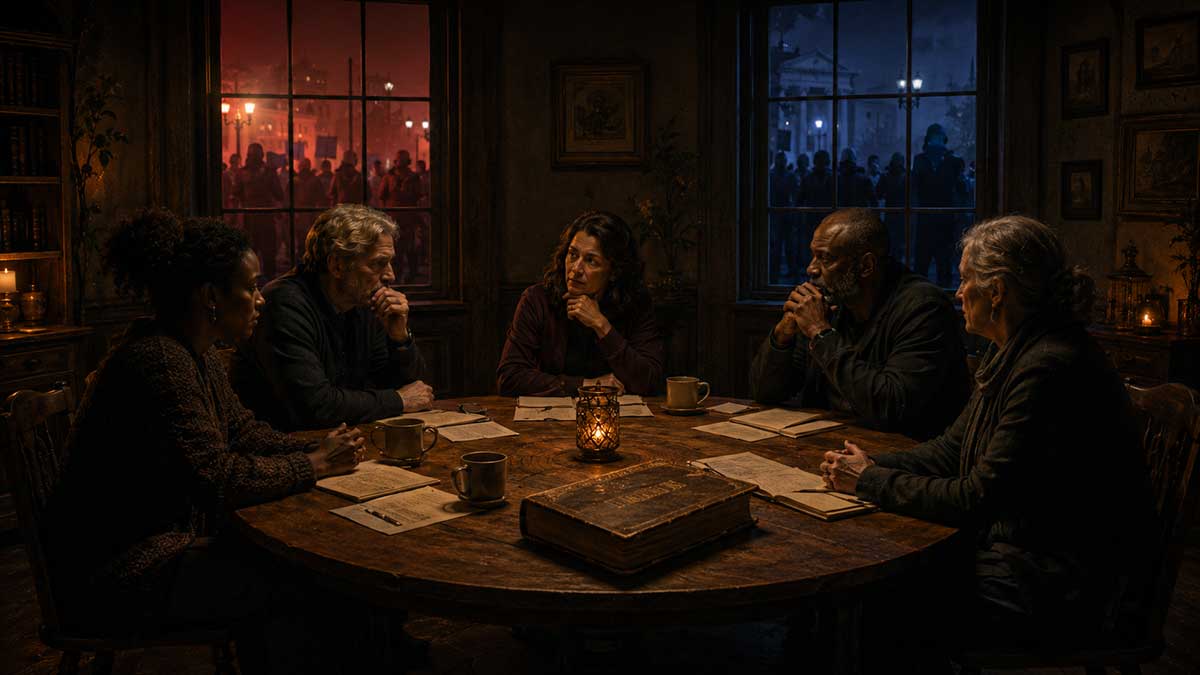
Guests
Barack Obama — Former Democratic president who often speaks about civic trust, disagreement, and national identity.
George W. Bush — Former Republican president who speaks from faith, duty, patriotism, and post-9/11 leadership.
Cornel West — Christian philosopher and public thinker focused on justice, truth, empire, poverty, race, and moral witness.
Russell Moore — Christian theologian and former Southern Baptist leader who has spoken against political idolatry.
Jonathan Haidt — Social psychologist known for moral psychology, polarization, and why good people divide over politics.
Opening
The room is not decorated in red or blue.
There are no campaign signs. No cable news screens. No applause meters. No poll numbers running across the wall.
Just a table.
Five people sit around it, each carrying a different kind of concern for America.
Outside the room, the nation sorts itself into teams.
Inside the room, no one is asked to stop believing what they believe. No one is asked to pretend the stakes are small. They are only asked to speak without turning the person across from them into a symbol.
Barack Obama: In America, politics has become personal in a dangerous way. Disagreement no longer feels like disagreement. It feels like rejection. People hear an opposing view and think, “You don’t just have a different policy. You are against who I am.”
George W. Bush: I agree that something has shifted. I came from a time when people fought hard in politics, then still believed the country belonged to all of us. That shared feeling has weakened.
Cornel West: Brother, the shared feeling was never equally shared by everyone. Some folks were left out from the beginning. Yet the answer cannot be hatred. Truth must be told with love, or it becomes another form of domination.
Russell Moore: Politics has become a false religion for many people. It gives them identity, enemies, rituals, and a sense of salvation. That is spiritually dangerous.
Jonathan Haidt: We are living through moral separation. People do not merely disagree about taxes or borders. They see the other side as wicked, stupid, or dangerous. Once that happens, listening collapses.
The table grows quiet.
Question 1
Why did Noah speak about global conflicts, religion, and family, but not Democrat and Republican?
Barack Obama: I think he was wise. The moment you say Democrat and Republican, many Americans stop listening and start defending. They scan the sentence for threat. He wanted people to hear the deeper principle before they placed it into a party frame.
George W. Bush: That makes sense. Religion, war, and family gave him a bigger canvas. If he had said Democrat and Republican too early, half the room may have thought, “Here we go again.”
Cornel West: Yet we must not avoid the political. Politics is where suffering often gets organized. Poverty is political. War is political. Healthcare is political. Race is political. Avoiding party labels can create room for the soul, but at some point the soul must face policy.
Russell Moore: True. But party identity can swallow moral identity. Many people no longer ask, “Is this good?” They ask, “Did my side say it?” That is why he may have stepped around the party language.
Jonathan Haidt: Party labels trigger team psychology. Once people see a red jersey or blue jersey, reasoning often becomes defense. Noah used family to bypass the alarm system. He made people feel the human issue first.
Barack Obama: That may be the deeper lesson. America needs fewer speeches that tell people which side is stupid and more speeches that ask why we stopped seeing neighbors.
George W. Bush: Patriotism should not mean your party wins. Patriotism should mean the country survives your party losing.
Cornel West: And justice must not be sacrificed to politeness. There are real victims of real policies. A table that cannot speak about that is too comfortable.
Russell Moore: Yes. Peace without truth is just quiet fear.
Jonathan Haidt: The goal is not to erase political difference. The goal is to lower the level of disgust enough for people to think again.
Question 2
Why does political disagreement now feel like betrayal?
Jonathan Haidt: Human beings are tribal. We form groups quickly. In earlier eras, party identity mattered, but it competed with religion, neighborhood, unions, local friendships, and family ties. Now many identities line up under politics. Your party predicts your media, your views on religion, your neighborhood, your friends, your fears, even who you might date. That makes disagreement feel total.
Barack Obama: Social media made that worse. People perform outrage for their own side. They are rewarded for sharpness, not patience. They learn to speak in ways that win attention, then forget how to speak in ways that build trust.
George W. Bush: People need real friendships with people who disagree with them. It is harder to hate a person whose kids you know, whose grief you have seen, whose home you have entered.
Cornel West: But let us be honest. Some betrayal is real. When people support policies that crush the poor, demean immigrants, ignore racism, or feed greed, folks are right to feel wounded. The question is: can we name betrayal without becoming addicted to contempt?
Russell Moore: Contempt is the spiritual drug of our age. It gives quick certainty. It makes people feel righteous without asking them to become holy.
Barack Obama: That is strong. The danger is that contempt feels productive. You feel like you did something just by condemning someone.
George W. Bush: And politics becomes a battlefield with no off-ramp.
Jonathan Haidt: The brain likes simple stories: heroes, victims, villains. Politics now gives each side a complete moral drama. The other side is not merely wrong. They are the villain.
Cornel West: Yet the prophetic tradition must still name evil. The prophets were not polite managers of difference. They cried out.
Russell Moore: Yes, but prophets cry out from love of God and neighbor. Partisans often cry out from love of winning.
Barack Obama: That may be the dividing line. Are we trying to defeat fellow citizens, or call them back into a shared future?
Question 3
Can Americans stand firmly for justice, faith, freedom, and truth without treating half the country as enemies?
George W. Bush: They must. Democracy depends on losing without wanting to burn the house down. You can fight hard for what you believe, but you must leave space for the next election, the next conversation, the next generation.
Barack Obama: The strongest citizens are not the ones who never doubt. They are the ones who can hold conviction and humility at the same time. You can say, “I believe this deeply,” and still ask, “What am I missing?”
Cornel West: Humility cannot mean weakness in the face of injustice. If children are hungry, if people are targeted, if money rules politics, we need moral fire. But moral fire must purify the heart, not burn the neighbor.
Russell Moore: Christians need to recover the difference between kingdom and party. No political movement deserves worship. When faith becomes a mascot for a party, it loses its witness.
Jonathan Haidt: A healthier country would teach people to ask three questions before judging: What is the moral concern on the other side? What fear drives them? What truth might they see that I am missing?
Barack Obama: That would change a lot. Many conservatives fear loss of order, family, faith, national identity. Many liberals fear cruelty, exclusion, inequality, and abuse of authority. Those fears are not imaginary to the people who carry them.
George W. Bush: A good leader speaks to fear without feeding it.
Cornel West: And a good citizen refuses to let fear become hatred.
Russell Moore: A good believer refuses to let politics replace conscience.
Jonathan Haidt: A good society creates contact. Not just online debate. Real encounters. Shared work. Local service. Mixed friendships.
Barack Obama: America will not heal through one perfect speech. It may heal through millions of smaller choices: one dinner, one school board meeting, one church basement, one neighbor deciding not to assume the worst.
Closing
The room is still quiet.
No one has become less Democratic. No one has become less Republican. No one has abandoned justice, faith, freedom, or truth.
But the table has changed the temperature.
The people in the room are not pretending politics is harmless. They know laws matter. Elections matter. Courts matter. Schools matter. Borders matter. Poverty matters. Speech matters.
Yet they have remembered something the country keeps forgetting.
A nation is not held together by agreement alone.
It is held together by citizens who can lose an argument without losing their loyalty to one another.
Barack Obama: Democracy asks us to argue without giving up on each other.
George W. Bush: America is bigger than any election night.
Cornel West: Justice must be fierce, but never loveless.
Russell Moore: No party can save the soul.
Jonathan Haidt: The other side is rarely as simple as your anger wants it to be.
The table remains.
Outside, the red and blue noise continues.
Inside, five people sit for one more moment, not as enemies, but as citizens trying to remember what a country is.
Topic 4: After Atrocity - Should We Try to Comprehend the Unforgivable?
Guests
Viktor Frankl — Holocaust survivor, psychiatrist, and author who searched for meaning after extreme suffering.
Elie Wiesel — Holocaust survivor, writer, and moral witness against hatred and silence.
Simon Wiesenthal — Holocaust survivor and Nazi hunter who pursued justice after the camps.
Desmond Tutu — South African archbishop who helped lead public truth-telling after apartheid.
Miroslav Volf — Christian theologian who writes on memory, forgiveness, exclusion, and embrace.
Opening
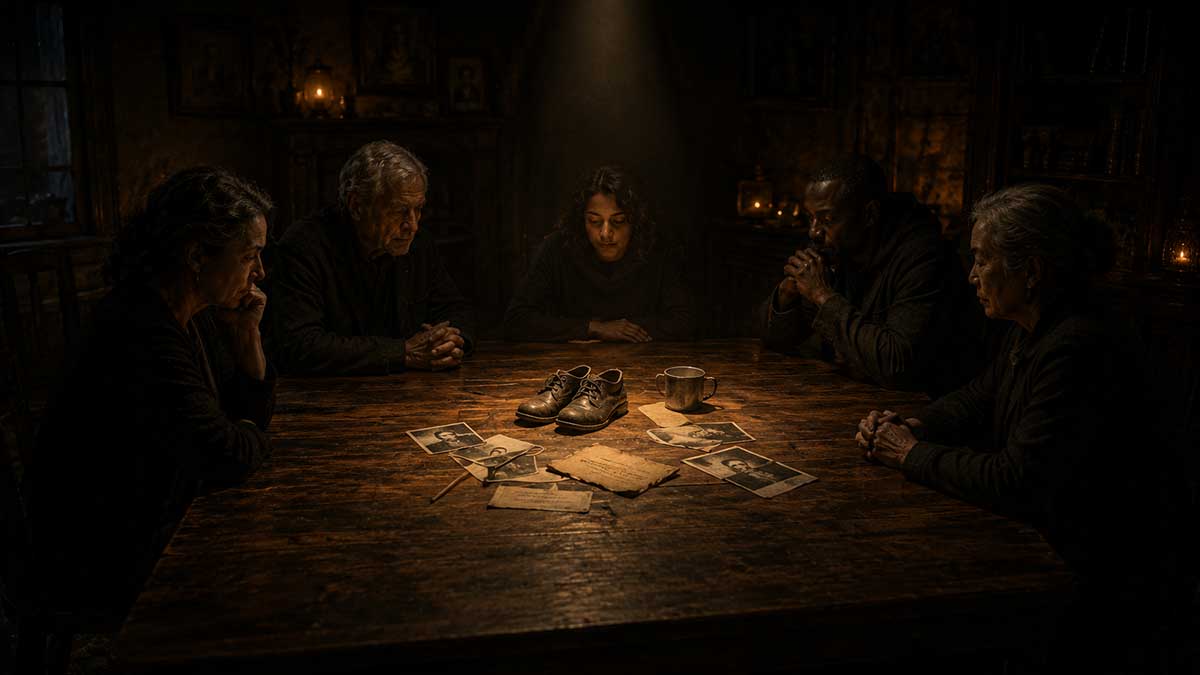
The room is darker than before.
There is still a table, but this time no one sits easily.
There are photographs placed in the center. Empty shoes. A child’s cup. A torn page. A prison number. A name written in pencil.
No one speaks at first.
This is not a room for easy mercy.
It is not a room for sentimental forgiveness.
It is a room for the question people fear asking:
Can we look at evil closely without making it smaller?
Elie Wiesel: Some questions should tremble before they are spoken. This is one of them.
Viktor Frankl: Yes. We must not turn suffering into an idea too quickly. The dead were not lessons. They were lives.
Simon Wiesenthal: And the guilty were not shadows. They had names, addresses, uniforms, families, habits. Justice begins there.
Desmond Tutu: Yet if hatred becomes our permanent home, the victim remains chained to the oppressor.
Miroslav Volf: The wound asks for truth. The soul asks whether hatred will be allowed to become its final language.
The table remains silent for a moment.
Question 1
Is there a difference between comprehending evil and excusing evil?
Elie Wiesel: There must be. To comprehend is to ask how human beings descended into cruelty. To excuse is to remove blame. We must never remove blame. The murdered must never be betrayed by our explanations.
Viktor Frankl: In the camps, I saw men reduced to hunger, terror, and degradation. I saw cruelty, but I saw choice too. A person could still choose a gesture, a word, a refusal. Evil often grows through systems, pressure, obedience, fear. Yet the person remains responsible.
Simon Wiesenthal: I spent my life proving that responsibility does not vanish in a crowd. “I was only following orders” is not innocence. A machine of death is still built from human hands.
Desmond Tutu: In South Africa, we learned that truth had to come before reconciliation. Not vague truth. Named truth. Public truth. Painful truth. Mercy without truth insults the wounded.
Miroslav Volf: Comprehending evil can make judgment sharper. It shows us how lies enter ordinary life, how neighbors become enemies, how fear becomes doctrine. Excusing evil says, “They could not help it.” Moral inquiry says, “How did they let themselves become this?”
Elie Wiesel: Yes. The danger is not asking why. The danger is asking why in a way that makes the dead disappear.
Simon Wiesenthal: Or asking why instead of asking who.
Viktor Frankl: The who matters. The why matters too. Without the why, new cruelty learns from old silence.
Desmond Tutu: And without the who, justice becomes fog.
Miroslav Volf: Truth needs both: the face of the victim and the name of the offender.
Question 2
Can forgiveness be holy when justice has not yet been done?
Simon Wiesenthal: I could not forgive on behalf of the dead. That was not mine to give. A dying Nazi once asked for forgiveness. I listened. Then I left in silence. My silence was not hatred. It was honesty. Some things are not ours to grant.
Elie Wiesel: Forgiveness without the victim can become theft. People like to forgive crimes committed against others. It makes them feel noble. But the dead cannot be consulted.
Desmond Tutu: I hear this deeply. Yet I have seen what happens when a nation refuses every path beyond vengeance. Forgiveness does not cancel justice. True forgiveness names the evil, honors the victim, and calls the offender to confession. Cheap forgiveness is poison.
Viktor Frankl: Forgiveness cannot be commanded from the outside. Meaning can be discovered, but not assigned. No one has the right to tell the wounded what their suffering must produce.
Miroslav Volf: Christian forgiveness is often misunderstood. It is not denial. It is not forgetfulness. It is not the removal of consequence. It is the refusal to let the offender define the full future of the injured soul. Yet justice must not be treated as an enemy of forgiveness.
Simon Wiesenthal: Then we agree on this: no one should demand forgiveness from the wounded.
Desmond Tutu: Yes. Forgiveness forced by outsiders is another violation.
Elie Wiesel: The survivor may forgive. The survivor may refuse. Both choices must be treated with reverence.
Viktor Frankl: Inner freedom includes the freedom not to forgive before the soul is ready.
Miroslav Volf: And perhaps forgiveness, when it comes, is not the closing of a case. It is the freeing of memory from the need to become revenge.
Question 3
What does a survivor know about humanity that comfortable people often forget?
Viktor Frankl: A survivor knows that human beings can be stripped of almost everything and still face one last question: What will I do with the small freedom left to me? The answer may be a prayer, a shared crust of bread, a refusal to curse, a memory of someone loved.
Elie Wiesel: A survivor knows that civilization is thinner than people think. Universities, art, culture, manners, laws—all can fail. The educated can become murderers. The polite can become indifferent. The danger is not only the monster. It is the bystander.
Simon Wiesenthal: A survivor knows that records matter. Names matter. Dates matter. Testimony matters. People lie after atrocities. They deny. They minimize. They say, “It was long ago.” Memory must be disciplined.
Desmond Tutu: A survivor knows tears have work to do. They are not weakness. They are testimony from the body. A society that refuses tears often returns to violence.
Miroslav Volf: A survivor knows memory can heal or imprison. Forgetting may erase justice, but memory without redemption may become a second captivity. The question is not whether to remember. The question is how to remember truthfully without becoming what wounded us.
Elie Wiesel: I would add: a survivor knows silence. Not peaceful silence. The silence after screaming. The silence of those who did not come back. That silence must enter every moral discussion.
Viktor Frankl: And yet, some survivors laugh again. Love again. Pray again. That does not erase suffering. It shows that suffering did not receive the final word.
Simon Wiesenthal: Justice is one form of that final word being denied to evil.
Desmond Tutu: Compassion is another.
Miroslav Volf: Hope is another.
Closing
No one at the table smiles.
This conversation has not made evil smaller.
It has made the responsibility heavier.
To comprehend atrocity is not to forgive it.
To study cruelty is not to excuse it.
To ask how hatred grows is not to honor hatred.
It is to prevent hatred from hiding behind mystery.
Elie Wiesel: The dead ask us to remember.
Simon Wiesenthal: The guilty must be named.
Viktor Frankl: The living must choose meaning.
Desmond Tutu: The wounded must not be forced to heal on someone else’s schedule.
Miroslav Volf: And memory must be guarded from both denial and revenge.
The empty shoes remain on the table.
The child’s cup remains.
The torn page remains.
The name written in pencil remains.
No one calls this peace.
But perhaps it is the beginning of moral seriousness:
to look at the unforgivable,
to refuse every excuse,
and still protect the soul from becoming a mirror of the crime.
Topic 5: The One Family Test - Can Many Faiths Belong Without Becoming the Same?
Guests
Noah Eckstein — Harvard speaker whose family story joins Christian, Muslim, and Jewish roots.
Pope Francis — Christian leader known for mercy, humility, care for the poor, and interfaith friendship.
The Dalai Lama — Buddhist leader known for compassion, nonviolence, and spiritual discipline.
Rabbi Abraham Joshua Heschel — Jewish theologian who joined prayer, prophecy, civil rights, and moral responsibility.
Rumi — Muslim poet and Sufi mystic whose work speaks of divine love, longing, and the human soul.
Opening
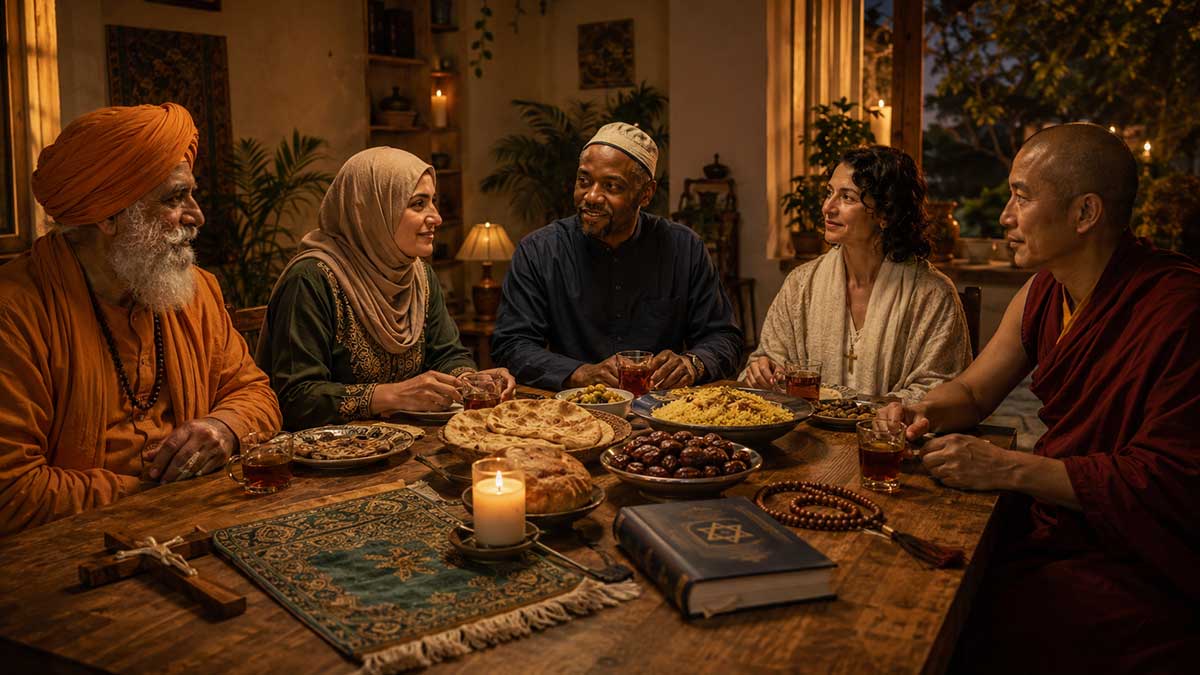
The table is set like a family meal.
There is bread. Tea. Dates. A candle. A bowl of rice. A small wooden cross. A prayer rug folded gently near one chair. A Hebrew book resting near another. A string of Buddhist beads placed near a glass of water.
No one has been asked to blend their faiths into one.
No one has been asked to pretend the differences are small.
The question at the table is more difficult:
Can people hold different visions of God, truth, salvation, prayer, and duty, yet still belong to one another?
Noah Eckstein: My family never became one religion. My Muslim grandfather stayed Muslim. My Jewish grandfather stayed Jewish. My Christian grandmother stayed Christian. The strange miracle was not that they agreed. The miracle was that they remained family.
Pope Francis: A family does not begin with sameness. It begins with mercy. When we look at another person, we must not begin with the label. We begin with the face.
The Dalai Lama: Every person wants happiness and does not want suffering. This is common ground. From there, we can sit together.
Rabbi Abraham Joshua Heschel: Faith is not a decoration of the soul. It is a demand. The question is not whether we can be polite. The question is whether reverence can survive difference.
Rumi: The lamps are many. The light is one. Yet each lamp must be honored in its own form.
The room softens.
Question 1
Can different religions respect one another deeply without pretending their differences do not matter?
Noah Eckstein: I think yes, but only if respect is honest. My family did not avoid difference by acting like everyone believed the same thing. They knew they did not. That honesty gave their love weight.
Pope Francis: Real respect does not say, “Your faith is nothing.” It says, “Your faith is dear to you, and you are dear to God.” We can meet one another with tenderness without dissolving conviction.
The Dalai Lama: If I meet a Christian, I do not need the Christian to become Buddhist. I want the Christian to become a better Christian: more compassionate, more patient, more peaceful. This is enough.
Rabbi Abraham Joshua Heschel: Difference can be sacred. The danger is not difference. The danger is arrogance. When faith becomes self-worship, it loses the awe of God.
Rumi: The heart that truly loves God does not need to break another heart to prove it.
Noah Eckstein: That is the part many people miss. Strong belief does not have to make you cruel. It can make you more responsible.
Pope Francis: Faith without humility becomes a wall.
Rabbi Abraham Joshua Heschel: And humility without truth becomes emptiness.
The Dalai Lama: We need warm-heartedness. Even firm words can be spoken with a gentle mind.
Rumi: Truth is not made greater by anger. The sun does not shout to be seen.
Question 2
Is family stronger when everyone shares one belief, or when love survives many beliefs?
Noah Eckstein: Shared belief can be beautiful. It can give rhythm, language, holidays, prayer, and memory. But my life shows another kind of strength: the strength of people who do not share one creed, yet still ask, “How are you? Are you safe? Did you eat? Are you coming home?”
Pope Francis: Love is tested when the other person is not a mirror. It is easy to love the reflection of yourself. It is harder to love the person who remains other.
The Dalai Lama: In a family, compassion must be practiced daily. It is not enough to speak noble words. Who washes the cup? Who listens? Who forgives small irritations? That is spiritual practice.
Rabbi Abraham Joshua Heschel: The home is a sanctuary when people treat one another as bearing divine dignity. A family with one faith can still become cold. A family with many faiths can still become holy.
Rumi: A house becomes sacred when love enters before pride.
Noah Eckstein: My grandparents were stubborn. They held their traditions until death. My Muslim grandfather was buried facing Mecca. My Jewish grandfather was buried according to Jewish law. My Christian grandmother was buried with a cross. Their love did not erase those endings. It honored them.
Pope Francis: This is beautiful. Love did not ask them to disappear.
Rabbi Abraham Joshua Heschel: Nor did conviction ask them to despise.
The Dalai Lama: This is balance. Strong roots, open heart.
Rumi: The tree with deep roots can offer shade to strangers.
Question 3
What is the line between spiritual openness and losing the truth you stand on?
Rabbi Abraham Joshua Heschel: Openness becomes weakness when it forgets awe. Faith is not merely opinion. It is a response to the divine. We must not treat sacred truth like a polite accessory.
Pope Francis: Yet truth must be carried with love. A Christian does not defend Christ by losing Christlike mercy. When truth is carried with contempt, something has gone wrong.
The Dalai Lama: You can be fully committed to your path and still learn from another path. Learning does not require abandoning. It requires curiosity and respect.
Rumi: The river does not stop being a river when it reflects the moon.
Noah Eckstein: I like that. Maybe the fear is that listening will make us less faithful. But the opposite can happen. Listening can reveal whether our faith is rooted in love or just fear.
Rabbi Abraham Joshua Heschel: Yes. The prophet does not speak from fear of difference. The prophet speaks from nearness to God.
Pope Francis: The test is fruit. Does your faith make you more merciful, more just, more willing to serve?
The Dalai Lama: Does it reduce suffering?
Rumi: Does it make the heart wider?
Noah Eckstein: Then maybe spiritual openness is not saying, “Everything is the same.” It is saying, “You are not the same as me, and I will still treat you as fully human.”
Closing
The meal has ended, but no one rushes to leave.
The candle burns low.
The cross remains a cross.
The prayer rug remains a prayer rug.
The Hebrew book remains a Hebrew book.
The Buddhist beads remain Buddhist beads.
No symbol has been melted into another.
No prayer has been rewritten to make the room more comfortable.
Yet the room feels less afraid.
Noah Eckstein: My family taught me that unity does not always look like agreement. Sometimes it looks like asking about the person you still disagree with.
Pope Francis: Mercy keeps the door open.
The Dalai Lama: Compassion keeps the heart open.
Rabbi Abraham Joshua Heschel: Reverence keeps the soul awake.
Rumi: Love keeps the lamp burning.
The guests stand.
No one has won.
No one has converted the room.
But each person leaves with a quieter certainty:
The sacred does not ask us to become identical.
It asks us to become less willing to wound one another in the name of God.
Final Thoughts by Noah Eckstein
The real power of Noah Eckstein’s Harvard speech is that it does not ask people to become less faithful to what they believe.
It asks whether our beliefs have made us unable to see another person.
That is the test.
His family story matters because it is not an abstract example. It is not a symbolic scene invented to make a point. It is a real story of Christian, Muslim, and Jewish lives connected through family, memory, love, disagreement, and loyalty.
His Muslim grandfather remained Muslim.
His Jewish grandfather remained Jewish.
His Christian grandmother remained Christian.
The miracle was not that everyone became the same.
The miracle was that they still belonged to one another.
In a divided age, that may be one of the rarest forms of courage.
We are often told to choose a side. At times, we must. Justice sometimes demands clarity. Faith sometimes demands conviction. Love sometimes demands a firm line.
But after we choose a side, another question remains:
Can we still see the person on the other side?
Can we still ask how they arrived at what they believe?
Can we still listen without surrendering our conscience?
Can we still speak truth without losing mercy?
Noah’s speech does not offer easy peace. It does not erase evil. It does not ask victims to comfort those who harmed them. It does not turn painful conflict into a soft moral lesson.
It offers something harder.
Stand firm, but do not become cruel.
Remember your people, but do not erase another people.
Carry your faith, but do not use God as a weapon.
Seek justice, but do not let justice become revenge.
Listen, not to agree, but to see more clearly.
The imagined conversations in this series are fictional, yet the question behind them is real.
Can a table hold grief, history, religion, politics, anger, memory, and love?
Maybe not always.
Maybe not easily.
But if no one tries to rebuild that table, the only thing left is distance.
And distance, left alone long enough, can turn neighbors into strangers, strangers into enemies, and enemies into shadows.
Noah Eckstein’s family story reminds us that difference does not have to end there.
A Christian, a Muslim, and a Jew did not become one faith.
They became one family.
That may be the deeper message.
Not agreement.
Not sameness.
Not silence.
A family.
A table.
A willingness to look again.
Short Bios:
Nick Sasaki — Host and creator of Imaginary Talks, guiding this series through faith, politics, grief, memory, and moral recognition.
Noah Eckstein — Harvard 2026 Senior English Address speaker whose real family story joined Christian, Muslim, and Jewish roots into a message about listening across division.
Elie Wiesel — Holocaust survivor, author, Nobel Peace Prize laureate, and witness to memory, suffering, and moral responsibility.
Imam Omar Suleiman — Muslim scholar and public teacher known for mercy, justice, spiritual reflection, and human dignity.
Rabbi Lord Jonathan Sacks — Jewish thinker and former Chief Rabbi of the United Kingdom, known for covenant, responsibility, and dialogue across difference.
Thich Nhat Hanh — Buddhist monk and peace teacher whose life centered on compassion, mindfulness, and deep listening.
Noa Tishby — Israeli writer and advocate who speaks from Jewish memory, Israeli identity, and the fear of erasure.
Mustafa Barghouti — Palestinian physician and political figure focused on human rights, dignity, freedom, and nonviolent resistance.
Rabbi Sharon Brous — American rabbi whose work joins Jewish grief, moral courage, spiritual leadership, and public conscience.
Aziz Abu Sarah — Palestinian peacebuilder whose personal loss led him into dialogue, travel, education, and reconciliation work.
Mahmoud Darwish — Palestinian poet of exile, homeland, longing, and the sorrow carried by a displaced people.
Barack Obama — Former U.S. president whose public voice often returns to democracy, civic responsibility, race, and national belonging.
George W. Bush — Former U.S. president whose voice in this series brings faith, duty, patriotism, and the burden of leadership.
Cornel West — Christian philosopher and public intellectual known for prophetic speech on justice, race, poverty, empire, and love.
Russell Moore — Christian theologian who warns against political idolatry and the loss of moral conscience inside partisan life.
Jonathan Haidt — Social psychologist known for studying moral psychology, polarization, and why good people divide over politics.
Viktor Frankl — Holocaust survivor and psychiatrist who wrote about meaning, suffering, freedom, and the human spirit under extreme conditions.
Simon Wiesenthal — Holocaust survivor and Nazi hunter who devoted his life to memory, evidence, accountability, and justice.
Desmond Tutu — South African Anglican archbishop and Nobel Peace Prize laureate known for truth, reconciliation, anti-apartheid witness, and moral courage.
Miroslav Volf — Christian theologian whose work explores forgiveness, memory, exclusion, embrace, and the wounds of history.
Pope Francis — The late Catholic pontiff remembered for mercy, humility, care for the poor, and interfaith friendship. Vatican News reported that he died on April 21, 2025, at age 88.
The Dalai Lama — Buddhist spiritual leader associated with compassion, nonviolence, discipline, and the shared human wish to avoid suffering.
Rabbi Abraham Joshua Heschel — Jewish theologian and civil rights ally known for prophecy, prayer, awe, and moral responsibility.
Rumi — Muslim poet and Sufi mystic whose words carry longing, divine love, and the soul’s search for union.
Leave a Reply