
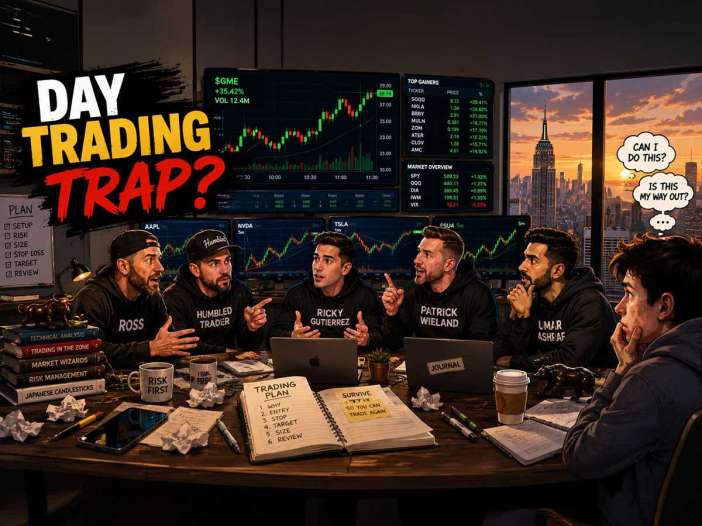
What if the biggest secret in day trading is not finding the perfect setup, but learning how to lose without losing yourself?
A trader sits alone before the market opens.
The room is quiet.
The screen is not.
Green numbers flash.
Red numbers blink.
A scanner begins to sing its morning alarm.
Somewhere, a stock nobody talked about yesterday is suddenly moving like it has been waiting all night to be discovered. Somewhere else, Nasdaq futures are pushing higher, pulling back, testing a level, daring someone to click.
For the beginner, it looks like opportunity.
For the experienced trader, it looks like danger wearing opportunity’s clothes.
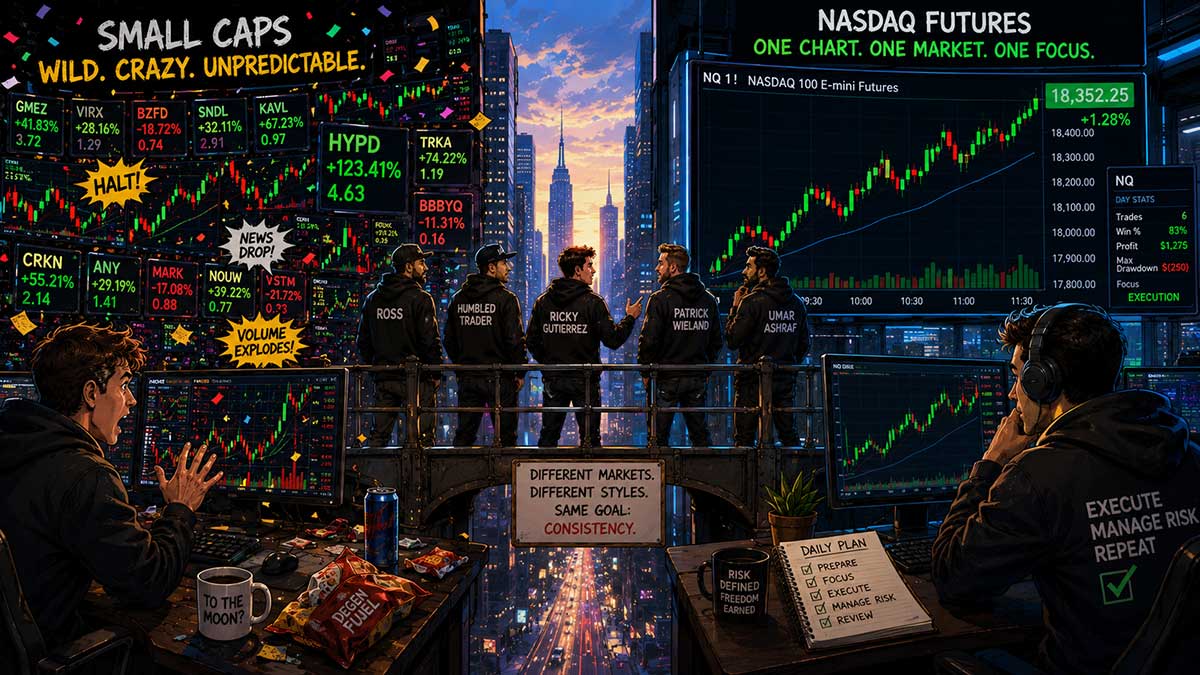
Around one imaginary table sit five of YouTube’s most recognizable trading voices: Ross Cameron, Humbled Trader, Ricky Gutierrez, Patrick Wieland, and Umar Ashraf.
Each built an audience by speaking to people who want to understand the market.
Each represents a different doorway into day trading.
Ross sees small-cap momentum: fast stocks, fresh news, rising volume, and the chance to act before the crowd disappears.
Humbled Trader sees the traps beneath the excitement: fake breakouts, bad spreads, weak planning, and beginners mistaking movement for edge.
Ricky Gutierrez sees the need for clarity: clean patterns, simple rules, and the discipline to avoid forced trades.
Patrick Wieland sees the speed of futures: one chart, one market, fast feedback, and a lesson that arrives the moment risk gets sloppy.
Umar Ashraf sees the trader behind the trade: the journal, the data, the emotional pattern, the revenge trade, the hidden need to be right.
Together, they do not offer one perfect path.
They offer a harder truth.
Day trading is not a shortcut.
It is not a magic skill that turns pressure into freedom overnight.
It is a test of preparation, patience, risk, review, and self-control.
The market does not care about hope.
It does not care about rent, pride, boredom, debt, dreams, fear, or how badly someone wants a new life.
It only responds to orders.
Buy.
Sell.
Hold.
Exit.
Repeat.
And every click asks the same silent question:
Are you trading a plan, or are you trading a feeling?
That question sits beneath every topic in this conversation.
Should you chase the first move, or wait?
Is a setup really a strategy?
Can you lose correctly before you try to win big?
Should a beginner choose stocks, futures, or one market long enough to learn the truth?
And what responsibility does a famous YouTube trader carry when thousands of beginners watch a green trade and think, “Maybe I can do that too”?
This imaginary conversation is not about finding the flashiest trader at the table.
It is about stripping day trading down to the part most people want to skip.
The part where the trader has to slow down.
The part where the chart stops being a fantasy and becomes a mirror.
The part where the biggest question is no longer, “How much can I make?”
It becomes:
“How much can I lose and still remain honest?”
That may be the first real lesson.
Before the perfect entry.
Before the big win.
Before the screenshot.
Before the dream of freedom.
The trader has to face the one thing no strategy can remove:
themselves.
(Note: This is an imaginary conversation, a creative exploration of an idea, and not a real speech or event.)
Topic 1: The First Move — Should You Chase Momentum or Wait?
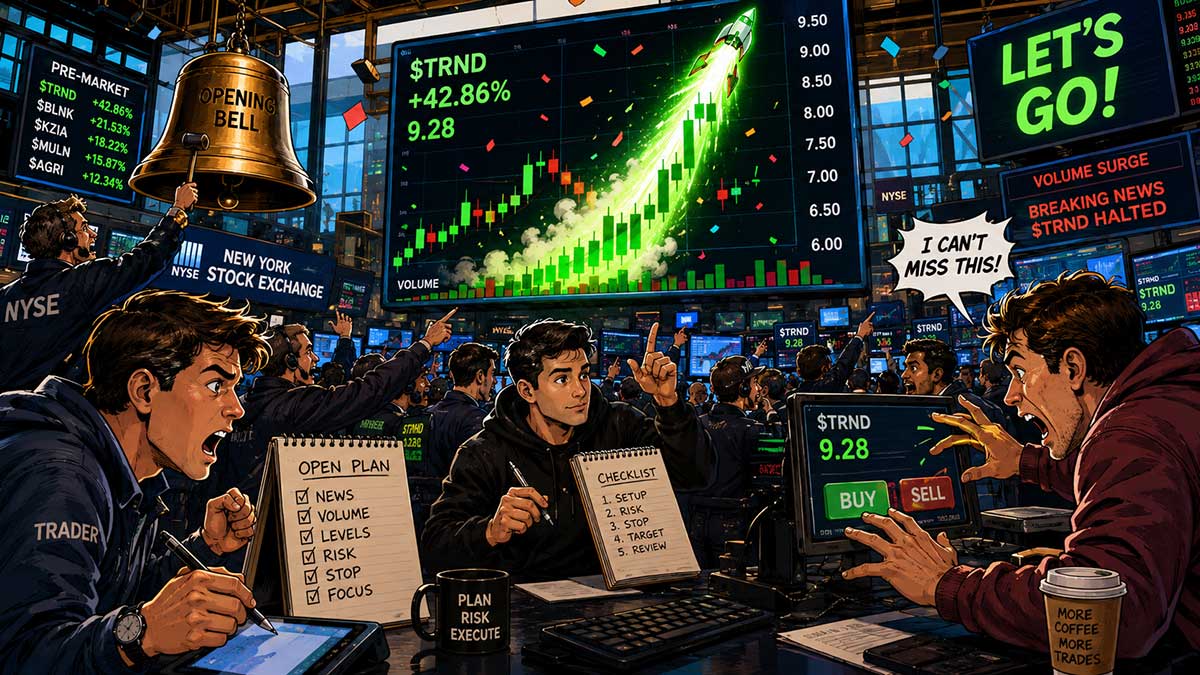
Opening
A bell rings somewhere in New York.
Screens wake up. Candles jump. A stock that nobody cared about yesterday is suddenly moving like it knows a secret. A futures chart climbs fast enough to make a calm person feel late.
Five traders sit around the table.
Ross Cameron sees a small-cap stock with volume pouring in.
Patrick Wieland sees the Nasdaq beginning to run.
Humbled Trader sees beginners leaning too close to the screen.
Ricky Gutierrez sees a pattern, but he wants proof.
Umar Ashraf sees something deeper: the trader’s hand moving before the trader’s mind catches up.
The first move of the day looks like opportunity.
It can be.
It can also be the trap.
The question is not simply whether to enter.
The question is whether the trader is acting from a plan, or from fear of missing out.
Question 1: When a stock or futures contract explodes upward, how do you know the difference between real momentum and emotional chasing?
Ross Cameron:
Real momentum has ingredients. Volume. News. A clean break. A stock making new highs with buyers stepping in again and again. Chasing is when you enter just because the candle is green and your heart rate went up.
Umar Ashraf:
The answer is in your journal before the trade happens. If this setup is already in your playbook, it may be a trade. If you are inventing the reason after the move starts, that is emotion wearing a costume.
Patrick Wieland:
Speed is not the enemy. Hesitation can be expensive too. In futures, the move can happen fast, and if you wait for perfect comfort, the trade is gone. But you need a level. You need a reason. You need an exit.
Humbled Trader:
A lot of new traders call everything momentum. A stock going up is not enough. Where is VWAP? Where is resistance? What did it do premarket? Is this the first breakout or the third fakeout? Context matters.
Ricky Gutierrez:
I want the chart to prove itself. If it is extended, I am not interested. I would rather miss a move than buy the very top. A good trade should feel clear, not forced.
Question 2: Is the first trade of the day the best opportunity, or the most dangerous temptation?
Patrick Wieland:
For Nasdaq futures, the open can be the cleanest move of the day. There is volume, volatility, and direction. But it can humble you fast. If you are not ready, the first five minutes can ruin the next five hours.
Ricky Gutierrez:
For most beginners, the first trade is usually temptation. They want action. They want to feel like traders. I would rather see them wait, watch the trend form, then take something that makes sense.
Ross Cameron:
The open is where I’ve found some of the best opportunities, but preparation starts long before the bell. I already know what I’m watching. I know the float, the news, the levels. The first trade is not random.
Umar Ashraf:
The first trade reveals the trader. Some people are calm at 9:30. Others are desperate to prove something. The question is not only “Is this a good setup?” It is “Am I in the right state to take it?”
Humbled Trader:
The market open is like a truth test. If you did not prepare, it shows. If you did prepare, you still need patience. Sometimes the best first trade is no trade.
Question 3: Should beginners learn momentum trading early, or should they first spend months only watching charts?
Humbled Trader:
They should watch first. Not forever, but long enough to see how stocks trap people. A beginner needs screen time. They need to see fake breakouts, failed VWAP reclaims, halts, reversals, and panic selling before real money is involved.
Ross Cameron:
Paper trading can help, but real trading has emotion. I think beginners can learn momentum early, but with tiny size and strict rules. The goal is not to make money fast. The goal is to survive long enough to learn.
Ricky Gutierrez:
I would start with observation and simple patterns. Build discipline first. A beginner should learn how to say no. That skill may matter more than finding a hot stock.
Patrick Wieland:
You can watch charts for months and still freeze when money is on the line. At some point, you need reps. But start small. If the loss hurts your ego more than your account, that is probably the right size.
Umar Ashraf:
The beginner should earn the right to trade bigger. Track every idea. Screenshot every chart. Review every entry. If they cannot explain the setup after the trade, they probably did not understand it before the trade.
Closing Reflection
The first move is seductive.
It whispers that this is the one.
It tells the trader there is no time.
It makes patience feel like weakness.
But around the table, all five traders return to one quiet truth: the move is not enough.
A candle can rise.
Volume can surge.
A chart can look beautiful.
Still, the real trade begins before the click.
It begins in preparation, in rules, in self-control, and in the humility to miss a move without feeling defeated.
The market will open again tomorrow.
The trader who survives today gets to see it.
Topic 2: The Setup Is Not the Strategy — What Really Makes a Trade Worth Taking?

Opening
A chart can look clean.
A breakout can look perfect.
A line can be drawn so neatly that a beginner feels safe just looking at it.
But the market does not pay traders for pretty drawings.
A setup is only the surface.
Behind every trade sits a harder question: did the trader define the reason, the risk, the exit, and the emotional cost before entering?
Ross Cameron looks for speed, volume, and a reason for buyers to rush in.
Humbled Trader looks at VWAP, premarket behavior, liquidity, and the trap hidden inside the obvious move.
Ricky Gutierrez studies the pattern, but refuses to force the trade.
Patrick Wieland watches the Nasdaq move in real time, knowing that hesitation and impulse can both be expensive.
Umar Ashraf looks past the chart and asks the question most traders avoid:
“Have you proven this setup belongs to you?”
The table gets quiet.
Everyone has seen the same mistake.
A trader finds a pattern online.
They memorize the shape.
They wait for it.
They see it.
They enter.
Then the trade fails, and they say the strategy does not work.
But maybe the problem was never the setup.
Maybe the problem was that the trader never had a strategy at all.
Question 1: What matters more: the chart pattern, the catalyst, the volume, or the trader’s emotional state?
Humbled Trader:
The chart pattern matters, but context matters more. A breakout without volume is weak. A stock with news but no clean level can still trap you. I want to know what happened premarket, where VWAP is, where shorts may be stuck, and where the trade becomes invalid.
Ross Cameron:
For small caps, I need momentum ingredients. The catalyst gets attention. Volume confirms interest. The chart gives me the entry. But emotional state decides position size. A great setup with an emotional trader can turn into a bad trade.
Umar Ashraf:
The trader’s emotional state may be the hidden variable. Two traders can take the same setup and get different results. One follows the plan. One moves the stop, adds out of frustration, and exits from fear. Same chart, different person, different outcome.
Patrick Wieland:
In futures, I care about the level and the reaction. Does price reject? Does it reclaim? Does it hold? The chart is alive. You cannot treat it like a still picture. Your emotional state matters, but you need execution under pressure.
Ricky Gutierrez:
I care most about clarity. If I need to talk myself into the trade, I probably should not take it. A clean pattern, clear risk, and good timing are enough. If one piece is missing, I would rather wait.
Question 2: Can a simple setup become dangerous when the trader has no written rules?
Ricky Gutierrez:
Yes. A simple setup without rules becomes a reason to gamble. People say, “I’m trading a breakout,” but they do not define entry, stop, target, or what makes the breakout fail. That is not trading. That is guessing.
Patrick Wieland:
A simple setup can be powerful, but only if you know what you are doing when it moves against you. The danger is not simplicity. The danger is vague thinking. If you do not know where you are wrong, the market will teach you fast.
Ross Cameron:
Written rules protect you from the heat of the moment. Before the trade, you may say, “I’ll stop out here.” During the trade, you may say, “Maybe I’ll give it more room.” That one sentence can destroy a small account.
Umar Ashraf:
Rules make the trader measurable. Without rules, there is nothing to review. You cannot improve a trade that has no structure. A journal full of random entries only proves that the trader was active, not that the trader was learning.
Humbled Trader:
Beginners love simple setups, and I understand why. But simple does not mean easy. A VWAP reclaim, a red-to-green move, a breakout, all of these need conditions. Time of day, volume, spread, float, market mood. Rules turn a setup into a decision process.
Question 3: How many trades does someone need to review before they can honestly say, “This is my edge”?
Umar Ashraf:
Enough trades to see repeated behavior across different market conditions. Ten trades is emotion. Fifty trades may be a clue. One hundred or more starts to tell a story. But the number alone is not enough. The review has to be honest.
Ross Cameron:
You need enough data to know when the setup works and when it fails. Is it better in the first hour? Better with news? Better with high relative volume? Better under a certain price? That is where real learning starts.
Humbled Trader:
The trader should review winners, losers, and missed trades. Missed trades are important. Sometimes the best setup was there, but the trader froze. Sometimes they avoided a bad trade by waiting. That information matters.
Ricky Gutierrez:
I would rather see someone master one setup slowly than jump from strategy to strategy. If you review your trades and the same mistake keeps appearing, your edge is not ready. Your discipline needs work first.
Patrick Wieland:
The market changes. You may have an edge one month and lose it the next. Review is not something you finish. It is part of the job. The trader who stops reviewing starts drifting.
Closing Reflection
A setup is easy to borrow.
A strategy has to be built.
Anyone can watch a video and copy a pattern.
Anyone can draw VWAP, mark support, chase a breakout, or call a candle strong.
But a real strategy asks more from the trader.
Where is the entry?
Where is the stop?
What confirms the idea?
What cancels it?
What size fits the risk?
What did the last fifty trades teach?
At the table, the five traders disagree about markets, speed, and style.
But they agree on this:
A setup may get you into the trade.
A strategy tells you whether you had any right to take it.
Topic 3: Risk First — Why the Best Traders Think About Losing Before Winning
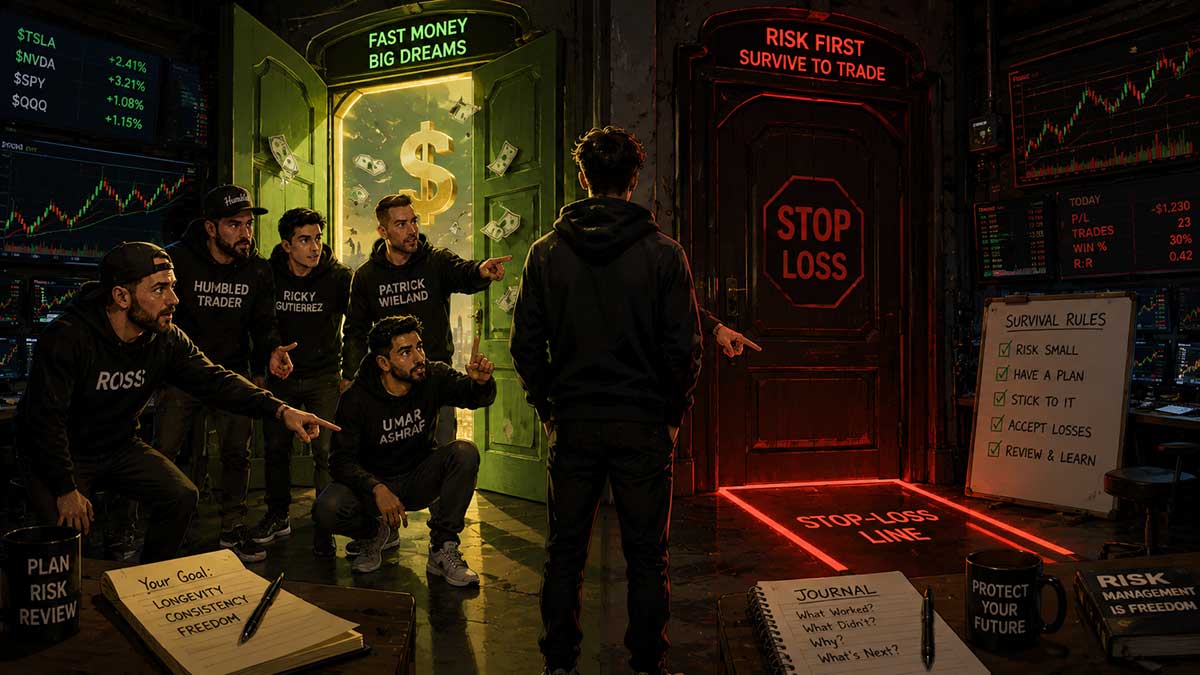
Opening
The trade looks beautiful.
The chart is clean.
The entry is close.
The profit target feels obvious.
A beginner sees what they might make.
A professional sees what they might lose.
That is the difference.
Ross Cameron leans forward and talks about daily max loss, share size, and the moment a trader has to stop pressing buttons.
Humbled Trader watches the same chart and thinks about where the trap begins.
Ricky Gutierrez wants the trade to make sense before money touches it.
Patrick Wieland knows that futures can reward confidence, then punish arrogance in seconds.
Umar Ashraf looks at the trader’s face and asks:
“Did you define the loss before you dreamed about the win?”
At the table, nobody is impressed by a lucky green trade.
They have all seen what happens when a trader wins without discipline.
The account grows.
The ego grows faster.
Then one bad day comes.
One oversized position.
One moved stop.
One revenge trade.
One refusal to accept being wrong.
The market does not need many chances to expose a trader with no risk plan.
Sometimes, it only needs one.
Question 1: Should a trader define the maximum loss before they even think about profit?
Umar Ashraf:
Yes. The loss is the price of admission. If you cannot accept that price before entering, you are not ready for the trade. Most traders fail not from bad ideas, but from refusing to honor the risk they agreed to.
Ross Cameron:
I want the risk defined before the order. Entry, stop, target, share size. If the trade works, great. If it fails, the damage has to be small enough that I can come back tomorrow. Survival comes first.
Patrick Wieland:
In futures, the market moves fast. If you are still deciding where you are wrong after you enter, you are late. You need the level before the trade. No level, no trade.
Ricky Gutierrez:
The maximum loss gives the trade structure. Without that, people start hoping. They say, “It might come back.” That is when a small mistake becomes a big one.
Humbled Trader:
Beginners usually think about the upside first. “How much can I make?” That mindset is dangerous. The better question is, “Where am I wrong, and how much will it cost me?”
Question 2: What is more dangerous: one huge loss, or ten small revenge trades?
Humbled Trader:
Ten revenge trades are scary because the trader may not realize they are losing control. One huge loss is obvious. Revenge trading hides inside little decisions. Each trade feels small, but the emotional damage grows.
Patrick Wieland:
One huge loss can wreck an account. But ten revenge trades can wreck the trader. You start doubting your read, your system, your identity. The screen becomes personal. That is a bad place to trade from.
Umar Ashraf:
Revenge trading is the clearest sign that the trader has left the process. The first loss may be normal. The second, third, and fourth trades may be emotional attempts to erase pain. That is not strategy. That is self-defense.
Ross Cameron:
Both are dangerous, but daily max loss rules exist for this reason. When you hit the number, you stop. The trader who cannot stop needs smaller size, fewer trades, and stronger rules.
Ricky Gutierrez:
I think the repeated revenge trades teach a bad habit. The trader learns to react instead of plan. Once that habit forms, every red trade becomes an invitation to make it worse.
Question 3: Is risk management a technical skill, or a character test?
Ricky Gutierrez:
It is both. You can learn position sizing and stop placement, but discipline decides if you follow it. A trader can know the right thing and still do the wrong thing.
Ross Cameron:
The technical part matters. You need to calculate share size, risk per trade, and max loss. But yes, there is a character side. Can you stop when you are down? Can you avoid forcing trades? That matters.
Humbled Trader:
Risk management reveals personality. Some people hate being wrong. Some people want to win back losses right away. Some people increase size after one good day. The chart exposes what the trader brings to it.
Umar Ashraf:
It is a mirror. Risk management shows whether the trader respects reality. The market does not care about your confidence, your need to be right, or your dream of quitting your job. It only responds to orders.
Patrick Wieland:
You can have the best read and still lose if your risk is wrong. In fast markets, risk is execution. It is not separate from trading. It is trading.
Closing Reflection
Profit gets the attention.
Risk keeps the trader alive.
Every trader at the table knows the strange truth: the best trade may be the one that loses exactly as planned.
A clean loss can be a victory.
A green trade taken with bad risk can be a warning.
The beginner wants proof that they can win.
The experienced trader wants proof that they can lose correctly.
That is where the real education begins.
Not in the perfect entry.
Not in the biggest winner.
Not in the screenshot posted after the close.
It begins when the trader is wrong and still keeps the promise they made before entering.
One small loss.
One stopped trade.
One closed platform.
One calm walk away from the screen.
That may not look exciting.
But it may be the moment a gambler starts becoming a trader.
Topic 4: Stocks vs Futures — Which Market Teaches the Truth Faster?
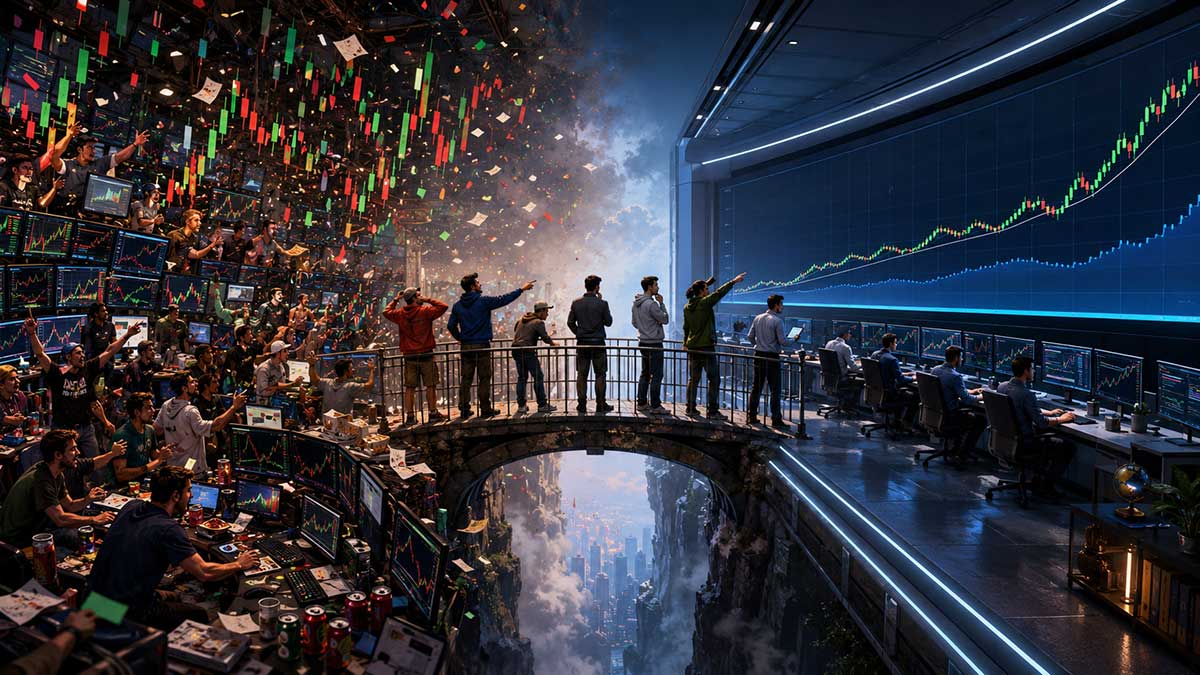
Opening
A stock scanner lights up.
A small-cap name is running on news.
The float is low.
The volume is high.
The spread is wide enough to make a careful trader pause.
Across the table, another screen shows the Nasdaq futures contract.
One chart.
One instrument.
Fast movement.
No press release.
No surprise dilution.
No tiny company nobody heard of yesterday.
Ross Cameron sees the attraction of small-cap momentum: big percentage moves, fresh catalysts, emotional buyers, and room for speed.
Humbled Trader sees both opportunity and danger: halts, fakeouts, spreads, crowded trades, and beginners thinking volatility is the same thing as edge.
Patrick Wieland looks at futures and says the market gives instant feedback.
Ricky Gutierrez wants beginners to choose the market they can understand, not the one that looks exciting.
Umar Ashraf watches all of them and asks the deeper question:
“Which market teaches discipline before it destroys confidence?”
Stocks and futures both promise freedom.
Both can punish arrogance.
Both can make a trader feel smart for one hour and foolish by lunch.
The question is not which market is easier.
The question is which market tells the truth faster.
Question 1: Are small-cap stocks better for opportunity, or do they train beginners to accept too much chaos?
Ross Cameron:
Small caps create real opportunity. A stock can move 50%, 100%, or more in a single day. That kind of movement gives a trader chances. But the trader has to know the risk. Low float, high volume, news, clean levels. Without those filters, small caps become noise.
Humbled Trader:
Small caps can teach speed, but they can teach bad habits too. Beginners see a stock up 80% and think they found the trade. They ignore the spread, the halt risk, the dilution history, and the fact that everyone else sees the same thing. Opportunity is real, but so is the trap.
Ricky Gutierrez:
I think beginners often choose small caps because they want action. That is not a good reason. A better reason would be: “I have studied this market, I know the patterns, I know the risk, and I know when not to trade.” Most beginners are not there yet.
Patrick Wieland:
From a futures perspective, small caps look messy. Different tickers, different news, different behavior. Futures let me focus on one product and one chart. That does not make it easy, but it removes some distractions.
Umar Ashraf:
Small caps reveal a trader’s relationship with excitement. Some people say they want opportunity, but what they really want is adrenaline. If a trader cannot separate those two, the market will do it for them.
Question 2: Do futures create cleaner discipline, or do they punish mistakes too quickly?
Patrick Wieland:
Futures are clean in one sense. You can trade the same market every day. You learn how it moves, how it reacts, how it traps, how it trends. But yes, it punishes mistakes fast. If your size is wrong, the lesson is immediate.
Umar Ashraf:
Fast punishment can be valuable, but only if the trader records the lesson. If someone loses quickly and then gets emotional, futures become a pressure chamber. If they review the loss honestly, futures can teach structure.
Ross Cameron:
The challenge with futures is leverage. A beginner may think they are trading small, but the movement can add up quickly. Stocks have their own risks, but futures require strong respect for size and stops from day one.
Humbled Trader:
Futures may look simpler because there is one main chart, but simpler does not mean safer. A beginner can still overtrade, move stops, revenge trade, and mistake speed for skill. The product changes, but the emotional problem follows.
Ricky Gutierrez:
I like the idea of focusing on one market. That can help. But the beginner still needs rules. Futures will not fix impatience. Stocks will not fix impatience. The trader has to fix impatience.
Question 3: Should a beginner pick one market for six months, or test several before choosing?
Ricky Gutierrez:
I would have them study a few first, then pick one. The mistake is jumping around every week. One week small caps, next week options, next week futures, next week crypto. That becomes confusion. Pick one and give it real time.
Ross Cameron:
Six months on one market can be useful, especially if the trader tracks everything. If you choose small caps, study small caps. Know the leading gappers, the news types, the volume, the float, the failed breakouts. Depth matters.
Patrick Wieland:
I agree with focus. Futures reward familiarity. You start to recognize how the Nasdaq behaves around the open, around key levels, around news, around failed moves. You do not get that if you keep switching markets.
Humbled Trader:
A beginner can explore at first, but once they choose, they should stop shopping for a perfect market. There is no perfect market. Every market has fees, slippage, bad days, and emotional tests. Choose the one you can study calmly.
Umar Ashraf:
The beginner should ask, “Which market lets me collect clean data?” If they cannot track their trades, review screenshots, define setups, and measure mistakes, they are not learning. They are wandering.
Closing Reflection
Stocks and futures speak different languages.
Small caps shout.
Futures snap.
One market tempts the trader with dramatic percentage moves.
The other tempts the trader with speed, leverage, and clean focus.
Neither market saves the undisciplined trader.
Neither market forgives emotional size.
At the table, the five traders do not agree on the perfect instrument.
Ross sees opportunity in small-cap momentum.
Patrick sees clarity in futures.
Humbled Trader sees traps in both.
Ricky wants simplicity with rules.
Umar wants proof through review.
The real answer may be uncomfortable.
The market that teaches the truth fastest is the one where the trader can no longer hide.
No blaming the ticker.
No blaming the open.
No blaming the spread.
No blaming the platform.
Only the trade.
The plan.
The risk.
The review.
And the person who clicked the button.
Topic 5: The YouTube Trader Problem — Education, Entertainment, and Responsibility
Opening
The camera turns on.
The chart is already moving.
A green candle rises.
The title promises a lesson.
The thumbnail promises something bigger.
A beginner clicks.
Maybe they came to learn.
Maybe they came to escape.
Maybe they came with a small account, a tired job, and a quiet hope that one skill could change everything.
On the screen, the trader sounds confident.
The entry looks clean.
The profit appears fast.
The loss, if it appears at all, disappears quickly from memory.
Ross Cameron knows what it feels like when viewers want to see momentum in real time.
Humbled Trader knows the strange pressure of making education honest, funny, and watchable.
Patrick Wieland knows that live trading can look simple from the outside, even when every second is pressure.
Ricky Gutierrez sees the danger of beginners copying trades instead of learning structure.
Umar Ashraf sees the deeper problem:
The viewer may think they are studying.
But they may be feeding a fantasy.
The YouTube trader sits in a strange chair.
Teacher.
Entertainer.
Marketer.
Example.
Warning sign.
The market is already dangerous.
A camera can make it more dangerous if the lesson becomes too clean.
So the question is not whether traders should teach online.
The question is what they owe the person watching alone at midnight, thinking, “Maybe this is my way out.”
Question 1: When does trading education become entertainment that makes risk look too easy?
Humbled Trader:
It becomes dangerous when the viewer remembers the profit, but not the risk. A funny video is fine. A dramatic trade is fine. But if the lesson makes people think trading is mostly excitement, then the education failed.
Umar Ashraf:
The line is crossed when the process gets removed. If viewers see entries and profits, but not planning, journaling, sizing, review, and boredom, they are not seeing trading. They are seeing a highlight reel.
Patrick Wieland:
Live trading is naturally entertaining. The market moves, emotions are real, and people want to see action. The problem starts when viewers think speed equals skill. Fast trades need rules. Without rules, speed is just danger.
Ross Cameron:
A big win gets attention, but the risk disclaimer matters. The process matters. I can show a trade, but people need to know that my results are not typical. Beginners need to understand that one green day does not mean they are ready.
Ricky Gutierrez:
Education becomes entertainment when the viewer leaves wanting to trade right away, instead of wanting to study. A good lesson should slow people down. It should make them ask, “Do I actually know what I am doing?”
Question 2: What should famous YouTube traders show more often: winning trades, losing trades, or boring days with no trade?
Ross Cameron:
Losing trades need to be shown. Not as drama, but as part of the job. A loss with good risk control is a lesson. A beginner has to see that being red is normal. The key is keeping the loss small.
Ricky Gutierrez:
Boring days may be the most valuable. New traders need to learn that no trade can be a smart decision. If every video shows action, viewers start thinking action is the goal. It is not. Consistency is the goal.
Humbled Trader:
I would show all three. Wins teach what a good setup can look like. Losses teach humility. No-trade days teach patience. Most beginners skip the patience part, then wonder why they keep forcing trades.
Patrick Wieland:
People want to watch action, but the boring parts are where traders are made. Waiting for the level. Sitting through chop. Closing the platform after a bad read. That is not exciting, but it is real.
Umar Ashraf:
The best thing to show is the review after the trade. A win can hide a bad decision. A loss can hide a good decision. The journal tells the truth. Show the trade, then show the thinking, the mistake, and the lesson.
Question 3: If most beginners are likely to struggle, what moral responsibility does a trading influencer have before selling hope?
Umar Ashraf:
The responsibility is to tell the truth before selling the dream. Trading can change someone’s life, but it can damage them too. If you sell tools, courses, or community, you must respect the pain of the person buying.
Patrick Wieland:
You cannot control every viewer, but you can be clear. Do not act like this is easy. Do not act like one strategy solves everything. Show the pressure. Show the mistakes. Show that trading can mess with your head.
Ross Cameron:
Transparency matters. Risk matters. People need to know that most traders struggle, and that small size, education, and discipline come before trying to make serious money. Hope without risk control is dangerous.
Humbled Trader:
I think creators have to protect beginners from their own excitement. Many people arrive with unrealistic expectations. The message should be: learn slowly, use small size, paper trade, track everything, and do not believe every screenshot online.
Ricky Gutierrez:
The creator should never make the viewer feel behind. That feeling makes people rush. Trading education should give structure, not pressure. If someone feels desperate after watching your content, something is wrong.
Closing Reflection
The screen goes dark.
The trade is over.
The video ends.
But the viewer is still there.
Maybe they learned something useful.
Maybe they learned the wrong thing beautifully.
That is the danger of trading content.
A chart can teach.
A personality can inspire.
A win can motivate.
But a story told too cleanly can turn risk into fantasy.
The five traders sit with that burden.
They know YouTube rewards excitement.
They know viewers want proof.
They know the market does not care about subscribers, thumbnails, comments, or hope.
A famous trader can show a green day.
A responsible teacher must show the cost of chasing one.
The real measure of trading education may not be how many people click.
It may be how many people pause before they risk money they cannot afford to lose.
Maybe that is the highest responsibility of a trader with an audience:
not to make the market look easy,
but to make the viewer more honest before entering it.
Final Thoughts
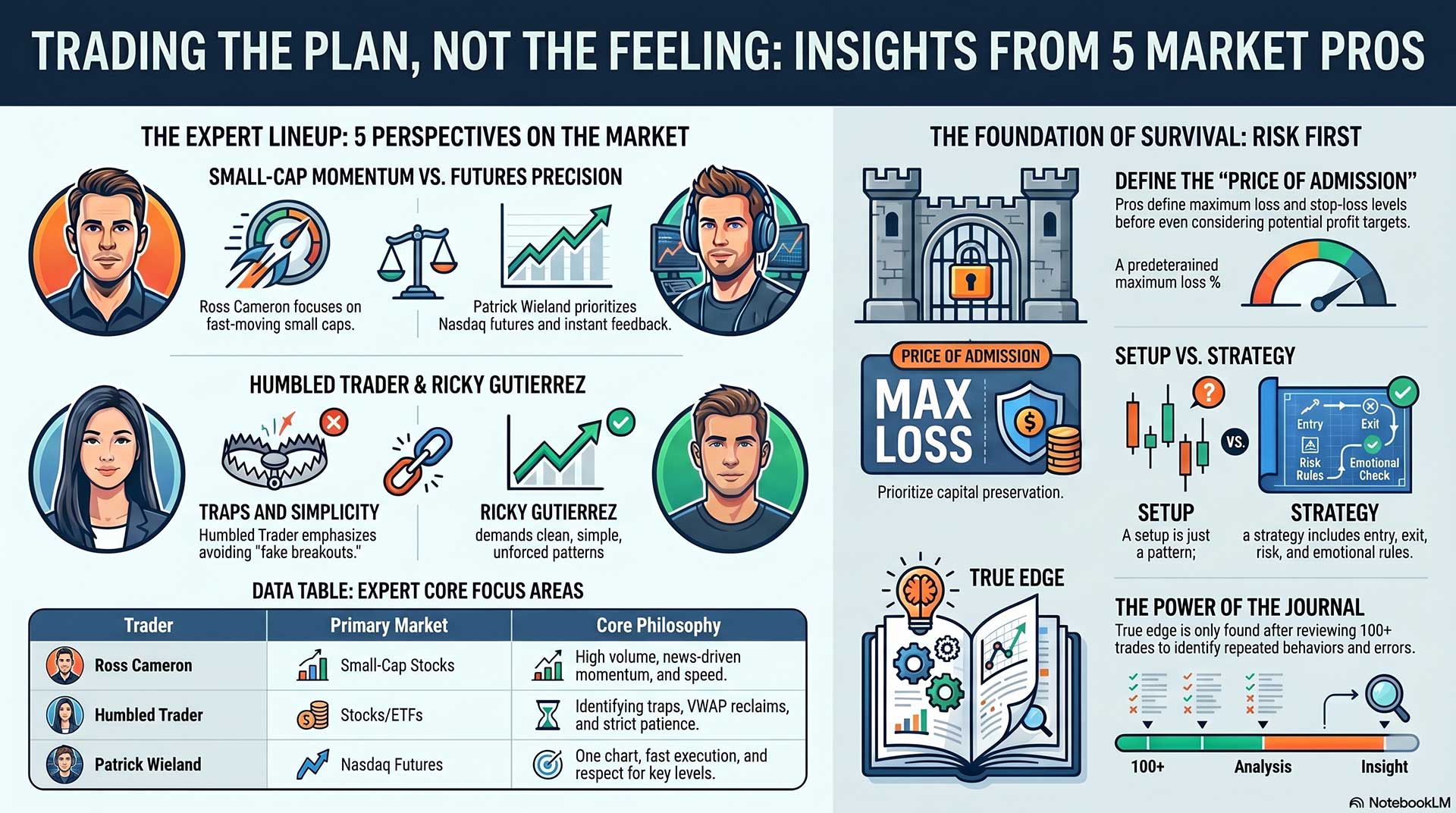
By the end of the conversation, the market feels less like a machine that gives money and more like a room full of mirrors.
Every trader entered through a different door.
Ross entered through momentum.
Humbled Trader entered through preparation and caution.
Ricky entered through simple technical discipline.
Patrick entered through speed, pressure, and futures.
Umar entered through psychology, review, and the truth found after the trade is over.
But all five keep returning to one idea:
The market is not the real opponent.
The untrained self is.
The trader who chases the first move is not fighting the candle.
They are fighting fear of missing out.
The trader who copies a setup from YouTube is not fighting the pattern.
They are fighting the desire for certainty without doing the work.
The trader who refuses to cut a loss is not fighting the market.
They are fighting pride.
The trader who jumps from stocks to futures to options to crypto is not searching for the perfect market.
They may be running from the discomfort of staying with one lesson long enough to be changed by it.
And the viewer watching a trading video at midnight may not be searching for education alone.
They may be searching for hope.
That is where day trading becomes emotionally dangerous.
It touches something deep.
A person does not simply want to learn candlesticks.
They want relief.
They want freedom.
They want proof that the life they have now is not the only life available.
A green trade can look like rescue.
A red trade can feel like rejection.
That is why the five traders, even in disagreement, keep circling back to risk.
Risk is not the boring part of trading.
Risk is the moral center of trading.
It is the place where fantasy meets math.
It is where the trader says, “This is what I am willing to lose, and I will honor that decision.”
That sentence may sound small.
But it separates the trader from the gambler.
The gambler wants the market to save them.
The trader wants the market to teach them.
The gambler hides losses.
The trader reviews them.
The gambler needs action.
The trader can wait.
The gambler changes rules mid-trade.
The trader respects the plan after the emotion arrives.
The gambler wants a new strategy.
The trader wants cleaner behavior.
This is why the YouTube trader problem matters so much.
A creator can make day trading look alive, exciting, and reachable.
That can help people learn.
It can inspire discipline.
It can make a lonely skill feel less lonely.
But it can also make risk look smaller than it is.
A beginner may watch the win and miss the years behind it.
They may see the entry but not the preparation.
They may see the profit but not the restraint.
They may hear confidence but not feel the pressure.
The best trading education does not make the viewer rush to trade.
It makes the viewer pause.
It makes them ask better questions.
Do I have rules?
Do I know my max loss?
Have I reviewed enough trades?
Am I calm enough to enter?
Can I walk away?
Can I be wrong without becoming reckless?
If the answer is no, the market will still be there tomorrow.
That may be the most valuable lesson of all.
The open will come again.
The scanner will light up again.
The Nasdaq will move again.
Another stock will run.
Another setup will appear.
Another chance will arrive.
The trader does not need to catch every move.
The trader needs to remain alive, clear, and honest enough to catch the right ones.
In the end, day trading is less about predicting the next candle and more about building the kind of person who can face the next candle without losing themselves.
That is the deeper trade.
The trade beneath the trade.
The one no platform can execute for you.
Short Bios:
Leave a Reply