
What if the fastest way to lose wealth is trying to get rich too quickly?
Most people do not need another shortcut.
They need a longer time horizon.
They need better judgment.
They need to stop confusing motion with progress.
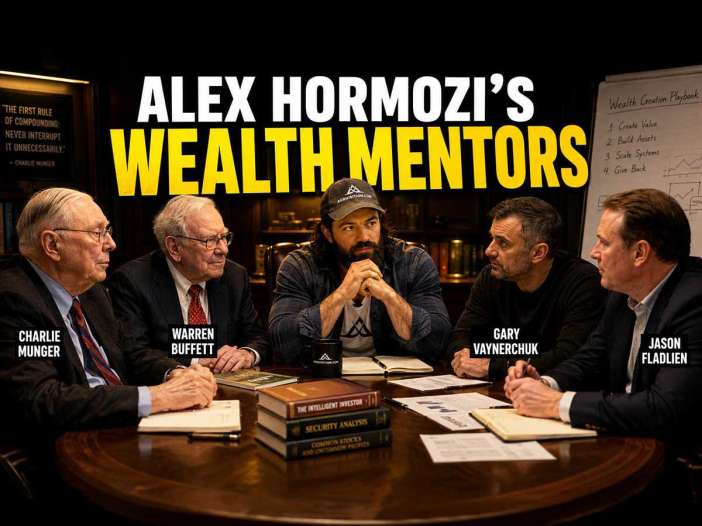
When I look at the people I have learned from, studied, respected, or been influenced by, they usually have one thing in common: they did not get rich by chasing the easiest path. They got rich by staying in the right game long enough for skill, reputation, trust, and capital to compound.
Charlie Munger taught me the value of avoiding stupidity.
Warren Buffett showed what patience and capital allocation can become across a lifetime.
Gary Vaynerchuk proved that attention, trust, and consistency can turn media into enterprise value.
Jason Fladlien showed how clear offers and deep customer insight can turn a message into money.
And the more I study people like them, the more I see the same pattern.
Wealth is not one thing.
It is a sequence.
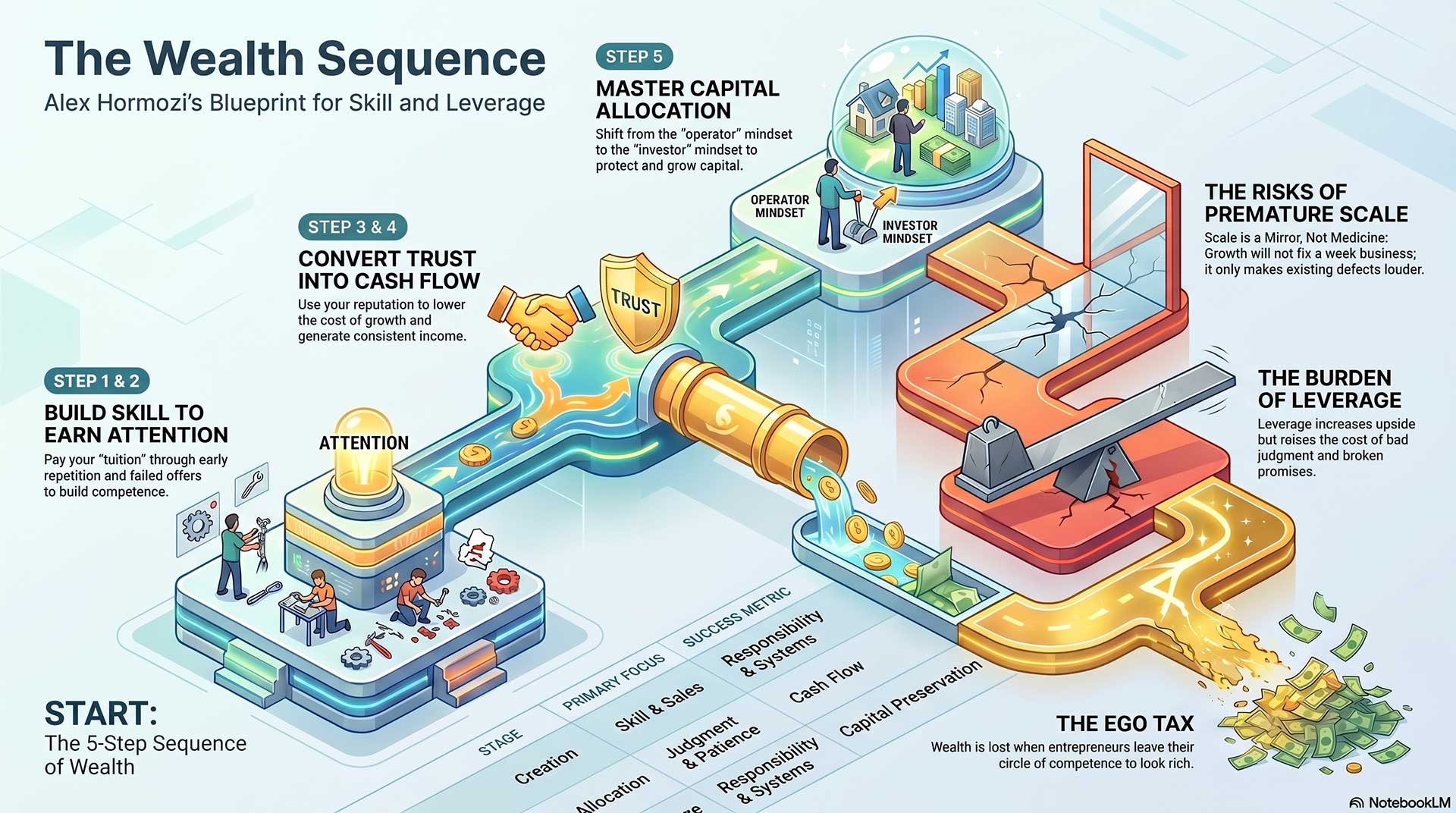
First, you build skill.
Then you earn attention.
Then you convert attention into trust.
Then you turn trust into cash flow.
Then you allocate that cash flow with judgment.
Then, if you earn the right, other people may trust you with capital, companies, deals, and larger responsibilities.
Most people want to skip to the later stages.
They want investor money before they can sell.
They want passive income before they have active income.
They want leverage before they have discipline.
They want scale before they have proof.
That is how people get hurt.
So this conversation is not about getting rich fast.
It is about what it actually takes to become the kind of person who can create wealth, keep wealth, and carry the responsibility that comes with it.
The five topics are simple:
Why shortcuts destroy wealth.
Why the first business is tuition.
Why skill, attention, and distribution must work together.
Why cash flow is only the beginning.
And why leverage becomes dangerous when ambition grows faster than character.
The game is not just making money.
The game is becoming someone money can trust.
(Note: This is an imaginary conversation, a creative exploration of an idea, and not a real speech or event.)
Topic 1: Why Shortcuts Destroy Wealth

Opening
Alex Hormozi:
Poor people are not poor from lack of desire. Most of them want money badly. The trap is that they want money before they want skill.
A shortcut feels kind. It says, “You can skip the pain.” But wealth does not let you skip the pain. It only lets you choose when you pay.
You can pay early with repetition, humility, sales calls, failed offers, ugly first products, and years of skill building.
Or you can pay later with confusion, debt, lost years, and resentment.
The richest people I know are not the ones who found a hidden door. They picked a path, stayed on it longer than most people could tolerate, and let time expose the truth.
So the real question is not, “What is the fastest way to get rich?”
The real question is, “What path am I willing to stay on long enough to deserve the outcome?”
Question 1: Why do beginners keep choosing speed over skill?
Gary Vaynerchuk:
Speed is sexy. Skill is boring. That is the whole problem. People want the screenshot. They want the income claim. They want the public win. But they do not want the invisible years where nobody claps.
A beginner sees someone making millions and thinks, “What is the tactic?” The real question is, “What did that person endure that I have not endured yet?”
Most people are not behind. They are impatient.
Charlie Munger:
The human mind loves mispricing effort. It overvalues the pleasant story and undervalues dull repetition.
A young person sees wealth and assumes there must be one secret. Usually there is no secret. There is arithmetic, incentives, patience, and avoiding foolish behavior.
If you avoid enough stupidity for enough years, you may appear brilliant to people who kept injuring themselves.
Jason Fladlien:
In sales, shortcuts show up as tricks. Magic words. Secret closing lines. Perfect webinar formulas. But the real work is seeing the customer clearly.
People want persuasion before empathy. They want conversion before comprehension. That never lasts.
A real offer is built from listening. You hear the pain, the hesitation, the dream, the objection, and the shame. Then you organize the truth in a way the buyer can finally receive it.
Warren Buffett:
Skill compounds too. People understand money compounding, but they do not respect ability compounding.
The first year may look slow. The fifth year looks different. The twentieth year looks unfair to outsiders.
A person who wants fast money often trades away the one asset that could have made them rich: time applied to one game.
Alex Hormozi:
Beginners choose speed over skill because speed lets them keep their ego.
Skill makes you face the scoreboard. It tells you your offer is weak, your ads are weak, your sales are weak, your product is weak, your discipline is weak.
But that feedback is the gift.
A shortcut protects your feelings today and steals your future tomorrow.
Question 2: How can an entrepreneur tell the difference between a real opportunity and a dopamine hit?
Warren Buffett:
A real opportunity still looks good after you sleep on it. A dopamine hit usually fades when the excitement fades.
I like simple tests. Do I understand it? Can I explain how it makes money? Would I still want it if no one praised me for owning it?
If the answer is no, I pass.
Jason Fladlien:
A dopamine hit creates motion without commitment. You buy the course, join the group, change the niche, rewrite the offer, chase the new funnel, then feel productive.
A real opportunity asks for sacrifice. It asks you to become the person who can execute it.
The question I would ask is: “Would I still do this if it took three years before anyone noticed?”
Charlie Munger:
You can identify many bad opportunities by asking what incentives are present.
Who benefits from your excitement? Who gets paid when you act quickly? Who wants you unable to think?
Good decisions rarely require hysteria.
Gary Vaynerchuk:
If the opportunity depends on you feeling FOMO, be careful.
Real opportunities can handle patience. Real opportunities can handle research. Real opportunities can handle someone saying, “Let me think.”
The internet trains people to mistake stimulation for direction. You have to slow down enough to hear your own judgment.
Alex Hormozi:
A real opportunity makes sense when you remove the hype.
Can I sell this? Can I fulfill it? Can I repeat it? Can I improve it? Can I stay with it when it gets hard?
If the answer is yes, you may have something.
If the only reason you want it is that someone else got rich from it, you are probably buying emotion, not opportunity.
Question 3: What mistake did each of you make early that looked smart at the time?
Charlie Munger:
I underestimated the cost of bad partners. A bad partner can make a good business miserable.
People focus on margins, markets, and growth. They should study character with equal seriousness.
The wrong person near the center of a business can tax every decision.
Gary Vaynerchuk:
I used to think more energy could solve everything. Work harder. Post more. Sell more. Push more.
Energy matters, but self-awareness matters more.
If you do not know what game you are built for, you can win attention and still lose peace.
Alex Hormozi:
One early mistake was thinking growth fixes everything.
Growth exposes everything.
If your product is weak, growth makes refunds louder. If your team is weak, growth creates chaos. If your margins are weak, growth makes you broke faster.
Scale is not medicine. Scale is a mirror.
Warren Buffett:
I bought some things too cheaply. That may sound strange.
A bargain is not always a good business. A poor business at a low price can still consume attention, patience, and capital.
I learned to prefer wonderful businesses at fair prices.
Jason Fladlien:
I thought persuasion was about saying the perfect thing.
Later I learned persuasion is often about removing confusion.
The buyer does not need to be hypnotized. The buyer needs to see the problem, the cost of staying the same, the path forward, and why now matters.
Closing
Alex Hormozi:
Shortcuts are expensive because they make you feel like you are moving when you are really avoiding the work.
Wealth rewards the person who can stay sober in a room full of hype.
Pick the path. Learn the skills. Keep the promises. Track the numbers. Improve the offer. Serve the customer. Let time work.
The shortcut is trying to skip the decade.
The real path is becoming someone who can use the decade better than everyone else.
Topic 2: The First Business as Tuition

Opening
Alex Hormozi:
Your first business is usually not the business that makes you rich.
It is the business that teaches you why you are not rich yet.
That sounds harsh, but it is a gift. The first business shows you the truth. It shows you whether you can sell. Whether you can serve. Whether you can keep promises. Whether you can hear rejection without making it personal.
Most beginners want their first business to be clean, easy, scalable, and impressive.
But the first business is usually messy. It is calls, refunds, bad pricing, awkward offers, weak systems, and customers asking questions you were not ready to answer.
That is tuition.
You can pay it through time, humility, and repetition.
Or you can avoid it, keep studying, and stay poor with better vocabulary.
Question 1: Is the first business meant to make you rich, or to make you less ignorant?
Warren Buffett:
The first business is a teacher.
You learn what customers want, what they ignore, what they pay for, and what they say they want but never buy.
A person who has never sold anything often has many theories. A person who has sold something has scar tissue. Scar tissue is useful.
Gary Vaynerchuk:
I think the first business should humble you.
People want the brand, the followers, the clean website, the perfect offer. But the market does not care how inspired you feel.
Can you get one person to pay you? Can you make that person happy? Can you do it again?
That is where the game starts.
Jason Fladlien:
The first business reveals the gap between what you think is valuable and what the customer feels is valuable.
That gap is painful.
You may think your product is clear. The customer is confused. You may think your offer is generous. The customer is hesitant. You may think your pitch is strong. The customer hears risk.
That feedback is worth more than applause.
Charlie Munger:
Reducing ignorance is a fine first goal.
People dislike admitting ignorance, so they dress it up as strategy. They make complicated plans before proving simple things.
If you can become slightly less foolish each year, you can do quite well.
Alex Hormozi:
The first business makes you less ignorant if you let it.
Most people use failure as evidence that they should quit. Smart people use failure as data.
The first offer fails, and you learn positioning. The first ad fails, and you learn attention. The first customer complains, and you learn fulfillment. The first hire disappoints you, and you learn leadership.
That is how ignorance gets paid down.
Question 2: What kind of pain teaches a founder faster than advice?
Jason Fladlien:
The pain of no one buying.
That pain is clean. It removes fantasy.
You can tell yourself your idea is brilliant for months. Then you make the offer, and silence answers you.
That silence is not cruelty. It is instruction.
Charlie Munger:
Pain tied to clear feedback is useful.
Vague pain produces self-pity. Clear pain produces correction.
If a customer refuses to buy, ask why. If a customer buys and leaves, ask why. If employees keep failing, ask what system allowed it.
Good operators turn discomfort into diagnosis.
Warren Buffett:
Losing a little money early can prevent losing a great deal later.
A small mistake, studied honestly, may save you from a large mistake made with confidence.
I would rather learn discipline in a small room than arrogance in a large one.
Gary Vaynerchuk:
Public embarrassment teaches fast.
You post the thing, no one cares. You launch the offer, no one buys. You say you are building something, then realize you have to keep showing up after the excitement dies.
That is healthy. It strips away performance and leaves work.
Alex Hormozi:
The fastest teacher is a broken promise.
When you sell something and cannot deliver it the way you said you would, you feel it.
That pain changes you.
It makes you price better, scope better, hire better, train better, and sell with more respect for the delivery side.
A founder becomes dangerous in a good way when he stops separating sales from fulfillment.
Question 3: When should a founder stay small and learn, instead of scaling too soon?
Gary Vaynerchuk:
Stay small when you still do not understand your customer.
A lot of people want scale so they can avoid intimacy. They do not want to answer DMs. They do not want to take calls. They do not want to hear objections.
But those conversations are the gold.
Before you reach thousands, learn how to serve ten.
Warren Buffett:
Scale a good business, not a confused one.
More volume will not fix poor economics. More customers will not fix a weak product. More employees will not fix unclear leadership.
Growth should follow proof.
Charlie Munger:
Premature scale is often vanity with expenses attached.
A founder should ask: Do we have repeat purchase? Do we have decent margins? Do customers return? Can an ordinary employee follow the process?
If the answer is no, size may magnify the defect.
Jason Fladlien:
Do not scale until the offer can survive repetition.
One good launch does not mean you have a business. One strong webinar does not mean you have a machine. One lucky month does not mean you have product-market fit.
Repeatability matters.
Can you make the promise, deliver the promise, collect proof, improve the promise, and do it again?
Alex Hormozi:
Stay small when the business still depends on adrenaline.
If every sale requires hero effort, you are not ready to scale.
If every customer needs a custom solution, you are not ready to scale.
If every team member needs you to rescue the process, you are not ready to scale.
Scale should come after clarity.
Closing
Alex Hormozi:
Your first business is tuition.
You pay with awkward sales calls. You pay with bad pricing. You pay with offers no one wants. You pay with customers who teach you what your ego could not.
But if you stay with it, the pain becomes skill.
And skill is the first real asset.
The goal of the first business is not to look rich.
The goal is to become less fragile, less confused, and more useful to the market.
Once you can do that, money has something to attach itself to.
Topic 3: Skill, Attention, and Distribution

Opening
Alex Hormozi:
A lot of entrepreneurs think the best product wins.
It does not.
The best-known product that can keep its promise usually wins.
That is painful for smart people. They want the market to reward depth. They want customers to magically notice quality. They want usefulness to spread by itself.
But the market is noisy. If people do not know you exist, they cannot buy from you. If they do not trust you, they will not buy from you. If your offer is unclear, they will not understand why they should buy from you now.
Skill matters. Attention matters. Distribution matters.
The mistake is separating them.
A skilled person with no attention stays hidden.
A loud person with no skill gets exposed.
A good offer with no distribution dies quietly.
The game is learning how to become good, become seen, and become trusted at the same time.
Question 1: Is attention now a form of capital?
Gary Vaynerchuk:
Attention is absolutely capital.
If you have attention, you can test ideas faster. You can sell faster. You can learn faster. You can recruit faster. You can recover from mistakes faster.
But attention by itself is rented. Trust is owned.
People confuse views with value. Views give you a shot. Trust gives you a business.
Charlie Munger:
Attention is useful, but dangerous.
The person who seeks attention too early may become a performer before becoming competent. That is a bad trade.
Reputation should lag reality. First become useful. Then let the world discover it.
If reputation runs too far ahead of ability, correction may be unpleasant.
Jason Fladlien:
Attention is the doorway. It is not the sale.
A headline can get attention. A story can keep attention. A clear offer can convert attention.
But the customer still asks: “Do I believe this? Do I need this? Do I trust this person? Can I see myself getting the result?”
Attention starts the conversation. Skill completes it.
Warren Buffett:
I would say reputation is a form of capital.
Attention can disappear quickly. Reputation compounds slowly.
If people believe you are honest, capable, and consistent, they give you more chances. They listen more carefully. They forgive honest mistakes more readily.
That is worth more than a crowd that came for a spectacle.
Alex Hormozi:
Attention lowers the cost of growth.
If you have no attention, you pay to get in front of people. If you have attention, people come to you.
But attention without trust is just traffic. Traffic without conversion is noise. Conversion without fulfillment is a refund waiting to happen.
The full stack is attention, trust, offer, delivery, proof.
Question 2: Can a great offer survive without distribution?
Jason Fladlien:
It can survive, but it will not travel far.
A great offer hidden in a drawer is still hidden. Many entrepreneurs think their offer is strong when it has never been tested in front of enough people.
Distribution gives the offer oxygen.
Once enough people see it, the market starts answering. It tells you what is clear, what is confusing, what feels risky, and what feels urgent.
Warren Buffett:
A truly great business has some natural distribution built in.
People return. People refer. People talk. The product or service creates its own quiet momentum.
But even then, early distribution matters. Someone has to bring the first customers through the door.
After that, the business must earn the right to be shared.
Gary Vaynerchuk:
No. Not in the modern market.
You can be amazing and still invisible.
A lot of talented people are mad at the algorithm, mad at the market, mad at people who are louder than them. But being mad does not create awareness.
You have to learn the language of the platform, the customer, and the moment.
Charlie Munger:
The phrase “great offer” may be used too generously.
If an offer cannot find buyers through any channel, perhaps it is not as great as the founder believes.
Reality is the judge. Distribution is one way reality votes.
A wise founder does not resent the vote. He studies it.
Alex Hormozi:
A great offer needs distribution the way fire needs air.
You can have a great promise, great proof, great price, and great delivery. But if no one sees it, nothing happens.
The answer is not to become a clown for attention.
The answer is to make the truth easier to find, easier to understand, and easier to believe.
Question 3: What matters more for a young entrepreneur: being better, being known, or being trusted?
Charlie Munger:
Start with being better.
Trust built on weak ability is fragile. Fame built on weak ability is worse.
Competence is the base layer. Without it, attention becomes a liability.
A young person should work to become the kind of person reality cannot embarrass too easily.
Gary Vaynerchuk:
I would say self-awareness comes before all three.
Some people need to get better. Some need to get louder. Some already have attention but no trust. Some are trusted by ten people and need to reach ten thousand.
But if I had to choose, trust wins.
People buy from people they trust. People forgive people they trust. People follow people they trust through change.
Warren Buffett:
Trust is hard to replace.
You can improve skill. You can gain attention. But once trust is lost, the math becomes difficult.
A young entrepreneur should ask, “Would I want to do business with me for twenty years?”
That question clears away many bad decisions.
Jason Fladlien:
In selling, trust is the bridge between attention and action.
A buyer may notice you. A buyer may admire you. But the buyer acts when the risk feels lower than the reward.
Trust lowers perceived risk.
You build it through clarity, proof, honesty, restraint, and doing what you said you would do.
Alex Hormozi:
The order is: get better, get known, get trusted.
But in real life, they overlap.
You get better by selling. You get known by publishing. You get trusted by fulfilling.
So do all three at a small scale first. Sell to one person. Help that person win. Tell the story. Repeat it.
That is how a nobody becomes somebody without pretending.
Closing
Alex Hormozi:
Skill without distribution is hidden value.
Attention without skill is exposed weakness.
Trust without proof is wishful thinking.
The entrepreneur’s job is to build all three.
Become good enough that customers win. Become clear enough that strangers understand. Become consistent enough that people believe you.
That is when attention stops being vanity and starts becoming enterprise value.
Topic 4: Capital Allocation After Cash Flow

Opening
Alex Hormozi:
The first stage of wealth is making money.
The second stage is not losing it.
That sounds obvious, but it is where many entrepreneurs break.
They learn how to sell. They learn how to grow. They learn how to create cash flow. Then the money starts coming in, and they assume the same confidence that helped them build income will help them invest.
That is not always true.
Making money and allocating money are related, but they are not the same skill.
An operator asks, “How do I grow this?”
An investor asks, “What is the risk, what is the return, what is the time horizon, and what can go wrong?”
A founder who never learns capital allocation can build a big income and still end up fragile.
So the question becomes: once cash flow arrives, where should the money go?
Back into the business?
Into stocks?
Into real estate?
Into other companies?
Or into safety, so you can stop making desperate decisions?
Question 1: When should a founder stop chasing more income and start protecting what they have built?
Warren Buffett:
The moment the money matters to your life, you should protect it.
A young founder may need to take concentrated risk. That is understandable. But once you have enough capital to change your family’s future, permanent loss becomes more serious.
The goal is not to win every game. The goal is to stay in the game long enough for good decisions to compound.
Charlie Munger:
Many people fail after success because success increases confidence faster than judgment.
They think, “I made money in this business, so I must be smart in all money matters.”
That is a dangerous thought.
You should protect capital when losing it would force you back into behavior you worked hard to escape.
Gary Vaynerchuk:
I think people need to be honest about what season they are in.
If you are still fighting for survival, you may need offense. More sales. More content. More customers. More speed.
But if you have real cash flow, and your family is depending on you, you have to stop proving you are fearless.
There is a difference between courage and addiction to pressure.
Jason Fladlien:
I would look at emotional decision-making.
When you are desperate, you sell differently. You invest differently. You negotiate differently. You chase things.
Protection gives you patience.
If your business creates enough cash that you can build reserves, remove debt pressure, and create optionality, that may improve every decision you make afterward.
Alex Hormozi:
You start protecting when your downside becomes more expensive than your upside is useful.
If going from $5 million to $10 million barely changes your life, but losing the $5 million changes everything, the math changed.
That does not mean stop playing.
It means play with a capital stack that lets you survive being wrong.
Question 2: Why do so many entrepreneurs make money, then lose it through bad investing?
Charlie Munger:
They leave their circle of competence.
A man becomes successful in one field and begins making decisions in another field where he has no edge.
He may call it diversification, but it is often ignorance wearing a nice suit.
The cure is simple, not easy: know what you know, know what you do not know, and do not confuse the two.
Jason Fladlien:
Entrepreneurs are used to creating motion.
That can hurt them as investors.
A founder thinks, “I can fix this deal. I can improve this asset. I can make this work.”
Sometimes that is true. Sometimes the founder just bought a problem with a better story attached.
A bad investment often begins with an exciting narrative and weak numbers.
Warren Buffett:
People lose money when they need action more than clarity.
Investing does not reward activity by itself. It rewards correct judgment, patience, and temperament.
A business owner may be used to solving problems daily. In investing, many days the best action is no action.
That is hard for operators.
Gary Vaynerchuk:
A lot of entrepreneurs lose money trying to look rich or feel like insiders.
Private deals. Crypto swings. Restaurants. Friends’ startups. Real estate they do not understand. Things that sound cool at dinner.
The ego tax is expensive.
If you made the money through your craft, do not let someone else’s confidence take it from you.
Alex Hormozi:
Entrepreneurs lose money after making money because they mistake cash for competence.
Money gives you access to deals. It does not give you the ability to judge deals.
That is the trap.
The business made you cash rich. Investing requires you to become judgment rich.
Question 3: How should someone decide between buying stocks, buying businesses, buying real estate, or reinvesting in their own company?
Gary Vaynerchuk:
Start with self-awareness.
Do you want more work, less work, more control, less control, faster upside, steadier income, or peace?
A lot of people copy another person’s asset class without copying that person’s temperament.
Some people should buy the index and keep building. Some people should buy boring businesses. Some people should stay focused on their own company.
Warren Buffett:
The best place for capital is where you understand the economics and can earn the best risk-adjusted return.
For many founders, the best investment may be their own business, if it has good margins, loyal customers, and room to grow.
But concentration has limits. A single business can face surprises. A wise person thinks about survivability.
Jason Fladlien:
I would ask what kind of return you can influence.
If you reinvest in your own offer, your own list, your own sales process, your own fulfillment, you may have control over the result.
If you buy public stocks, you have liquidity and less personal control.
If you buy real estate, you may get cash flow, debt, tax benefits, and headaches.
If you buy businesses, you get upside and operational problems.
Pick the game you are willing to manage after the check clears.
Charlie Munger:
One should prefer simple, understandable opportunities with favorable odds.
If the founder’s own business is wonderful, reinvestment may be rational. If the founder’s own business is fragile, throwing more money into it may be foolish.
Stocks can be excellent. Real estate can be excellent. Private businesses can be excellent.
The question is not the category. The question is price, quality, durability, and your own ability to judge.
Alex Hormozi:
I think the order is simple.
First, buy safety.
Have enough cash that your life and business decisions are not desperate.
Second, reinvest where you have the most control and highest certainty.
For many entrepreneurs, that is the business they already understand.
Third, buy assets that do not require you to be a genius every day.
The goal is not to look diversified.
The goal is to build a life where one bad decision cannot erase ten years of good ones.
Closing
Alex Hormozi:
Cash flow gives you the right to play the next game.
But the next game is different.
You cannot sell your way out of every bad investment. You cannot outwork bad terms. You cannot motivate a broken deal into being good.
Once you have money, the skill changes from creation to allocation.
Make money through skill.
Protect money through judgment.
Grow money through patience.
The founder who learns all three becomes harder to kill.
Topic 5: Leverage, Responsibility, and the Burden of Big Money

Opening
Alex Hormozi:
Everyone wants leverage until they feel the weight of it.
Leverage sounds amazing from the outside.
Use other people’s money. Hire bigger teams. Buy bigger assets. Build faster. Scale harder. Win bigger.
But leverage is never free.
Every form of leverage creates a new promise.
If you raise capital, you owe investors.
If you borrow money, you owe lenders.
If you hire people, you owe leadership.
If you build a big audience, you owe trust.
If you buy companies, you owe stewardship.
That is the part beginners miss.
They think leverage means more upside.
It does.
But it means more people can be hurt by your bad judgment.
So the question is not, “How do I get bigger?”
The question is, “Am I becoming the kind of person who can carry bigger without breaking?”
Question 1: Why does bigger money often create less freedom at first?
Charlie Munger:
Freedom is often confused with size.
A larger enterprise may create wealth, but it may bring more constraints. More obligations. More dependencies. More people watching your behavior.
The foolish person thinks scale means escape.
The wise person knows scale means consequences.
If you want fewer consequences, stay small. If you want greater outcomes, accept greater discipline.
Gary Vaynerchuk:
People think big money means they can finally do whatever they want.
A lot of times, the opposite happens.
Now you have investors. Staff. Customers. A reputation. A calendar full of things you said yes to when you were hungry.
You get the bigger game, but the bigger game owns more of your attention.
That is why self-awareness matters. Some people say they want a billion-dollar company, but what they really want is peace, family, creative control, and enough cash to never panic.
Those are different games.
Warren Buffett:
Money can buy many forms of choice, but responsibility narrows choices.
If people trust you with capital, they expect judgment. If employees trust you with their livelihood, they expect steadiness.
A person with no obligations can act quickly. A person responsible for many people must think carefully.
That is not a bad trade. It is simply a trade.
Jason Fladlien:
The same thing happens in launches.
A small launch feels stressful. Then you run a bigger one, and suddenly the stress has more zeros.
More affiliates. More customers. More refunds if the promise is wrong. More damage if the message is unclear.
The size of the opportunity raises the cost of being sloppy.
That is why a real operator does not just ask, “Can I sell this?”
He asks, “Can I survive what happens if this works?”
Alex Hormozi:
Bigger money creates less freedom at first because you have not built the character, systems, and judgment to hold it comfortably yet.
The money arrives before the identity catches up.
You wanted the bigger room. Now the room has rules.
That is why some people get rich and feel trapped.
They built a machine that feeds them, but they never asked whether they wanted to live inside it.
Question 2: What kind of person should avoid raising capital, even when they can?
Warren Buffett:
A person who does not understand the terms should avoid it.
Money can feel flattering. Someone offers you capital, and it appears to validate your ability.
But bad terms can turn success into disappointment.
If you do not know who gets paid first, who controls decisions, and what happens in a bad case, you may be selling more than you realize.
Charlie Munger:
A person with poor temperament should avoid it.
Capital magnifies character.
If you are impatient, leverage makes impatience expensive. If you are dishonest, leverage creates a larger blast radius. If you are undisciplined, leverage lets you destroy value faster.
Many people do not need more capital.
They need fewer defects.
Gary Vaynerchuk:
If you need total creative control, be careful.
Some founders love making their own calls. They want to move by instinct. They want to change direction. They want to build a culture around their own rhythm.
That can work beautifully in a bootstrapped business.
But once you take money, you invited other opinions into the room.
Do not complain about the room after you sell seats to it.
Jason Fladlien:
A person who has not proven demand should avoid raising capital.
I do not care how good the deck looks.
Can you sell it? Can you fulfill it? Can you retain customers? Can you explain the offer clearly? Can strangers understand it without you holding their hand?
Capital poured onto confusion does not create clarity.
It creates expensive confusion.
Alex Hormozi:
You should avoid raising capital if you are using money to avoid learning the business.
Money can buy speed. It cannot buy competence.
If you cannot sell with constraints, you may waste more with resources.
If you cannot lead five people, raising enough money to hire fifty may just give you a bigger leadership problem.
Raise capital when the bottleneck is truly capital.
Do not raise capital when the bottleneck is you.
Question 3: At what point does wealth stop being about income and start being about judgment?
Jason Fladlien:
It starts when your mistakes become more expensive than your labor is valuable.
Early on, you can work your way out of problems.
You can make more calls. Run another campaign. Write another webinar. Launch again.
But at a certain level, one bad deal can cost more than years of hard work can replace.
At that point, judgment becomes the product.
Charlie Munger:
Wealth becomes judgment very early, though people notice it late.
Most fortunes are harmed less by lack of effort than by foolish decisions.
Bad partners. Bad incentives. Bad debt. Bad acquisitions. Bad ego.
Avoiding obvious stupidity is often more valuable than finding brilliance.
Warren Buffett:
Income is what comes in.
Judgment is what decides where it goes.
A person can have high income and poor judgment, and the result may be fragile. Another person may have modest income and excellent judgment, and the result may compound peacefully.
The shift occurs when capital begins working harder than the person.
Then the person’s main task is selection.
Gary Vaynerchuk:
It stops being about income when you are no longer trying to prove something.
That is a big moment.
A lot of people keep chasing bigger numbers to fix insecurity. More revenue. More status. More headlines. More applause.
But real wealth asks, “What do I actually want?”
If you do not answer that, the game will keep giving you trophies you do not enjoy carrying.
Alex Hormozi:
Wealth becomes judgment when opportunity exceeds capacity.
At the beginning, you need more chances.
Later, you need fewer, better chances.
Every deal looks interesting. Every person wants access. Every idea has upside. Every path has a story.
Your job becomes saying no to almost everything.
That is hard for someone who got rich by saying yes and working harder.
But the next level is not more motion.
It is cleaner judgment.
Closing
Alex Hormozi:
Leverage is not evil.
It is a test.
It tests your discipline.
It tests your honesty.
It tests your systems.
It tests your patience.
It tests whether your ambition has matured into responsibility.
Small money asks, “Can you make income?”
Big money asks, “Can you protect trust?”
That is the shift.
At first, wealth is sales, skill, work, and speed.
Later, wealth is judgment, restraint, capital allocation, and reputation.
The goal is not to become big at any cost.
The goal is to become the kind of person who can be trusted with bigger things.
Final Thoughts by Alex Hormozi
The more I learn from people who have actually built, kept, or multiplied wealth, the more obvious the pattern becomes.
Wealth punishes impatience.
It punishes ego.
It punishes confusion.
It punishes people who want the reward before the skill.
At the beginning, everybody wants the trick.
The hidden funnel.
The secret asset.
The new platform.
The shortcut no one else knows about.
But real wealth is usually much less mysterious.
Can you make something people want?
Can you sell it clearly?
Can you fulfill the promise?
Can you repeat the result?
Can you earn trust?
Can you keep your costs lower than your income?
Can you place capital where it has better odds of growing?
Can you say no when the deal is exciting but wrong?
Can you carry more without becoming reckless?
That is the real test.
Charlie Munger would say, “Avoid the dumb stuff.”
Warren Buffett would say, “Let quality and time do their work.”
Gary Vaynerchuk would say, “Build trust at scale.”
Jason Fladlien would say, “Understand the buyer better than they understand themselves.”
And I would say this:
Pick the path that fits your stage.
If you are new, bootstrap and learn.
If the opportunity truly requires capital, raise it carefully.
If you already have cash flow, invest with humility.
If you have a track record and deal flow, maybe you earn the right to manage other people’s money.
But do not confuse the paths.
Do not use investing to avoid building income.
Do not use fundraising to avoid learning sales.
Do not use leverage to hide weak judgment.
Do not use attention to cover a weak product.
Every path has a price.
Bootstrapping costs time.
Raising capital costs control.
Investing costs patience.
Fund management costs responsibility.
The goal is not to pick the path that sounds richest.
The goal is to pick the path you can survive long enough to win.
That is where most people lose.
They quit too early.
They switch too often.
They chase what looks fast.
They avoid the part that would make them better.
But if you can stay in one game, take feedback, improve the offer, serve the customer, protect your reputation, and let time work, wealth starts to become less random.
Not easy.
Not guaranteed.
But less random.
And that is the part most people miss.
Wealth is not built by wanting money.
Wealth is built by becoming useful, trusted, disciplined, and patient enough for money to stay.
Short Bios:
Alex Hormozi
Alex Hormozi is an entrepreneur, investor, author, and founder of Acquisition.com. He is known for teaching business owners how to build better offers, grow companies, increase cash flow, and think clearly about wealth. In this conversation, he serves as the main voice, reflecting on the mentors, influences, and respected thinkers who shaped his view of money, leverage, and business.
Charlie Munger
Charlie Munger was Warren Buffett’s longtime business partner and one of the most respected minds in investing and decision-making. His thinking centered on mental models, incentives, patience, and avoiding foolish mistakes. In this conversation, he represents the discipline of judgment.
Warren Buffett
Warren Buffett is one of the most successful investors in history and the chairman of Berkshire Hathaway. His philosophy is built on patience, compounding, business quality, trust, and careful capital allocation. In this conversation, he represents the long game of wealth.
Gary Vaynerchuk
Gary Vaynerchuk is an entrepreneur, investor, author, and media figure known for his views on attention, content, branding, patience, and consumer behavior. In this conversation, he represents the modern skill of turning attention into trust.
Jason Fladlien
Jason Fladlien is a sales strategist, webinar expert, marketer, and entrepreneur known for helping businesses turn offers into revenue through clear messaging and customer insight. In this conversation, he represents conversion, persuasion, and the art of making value easy to understand.
Leave a Reply