
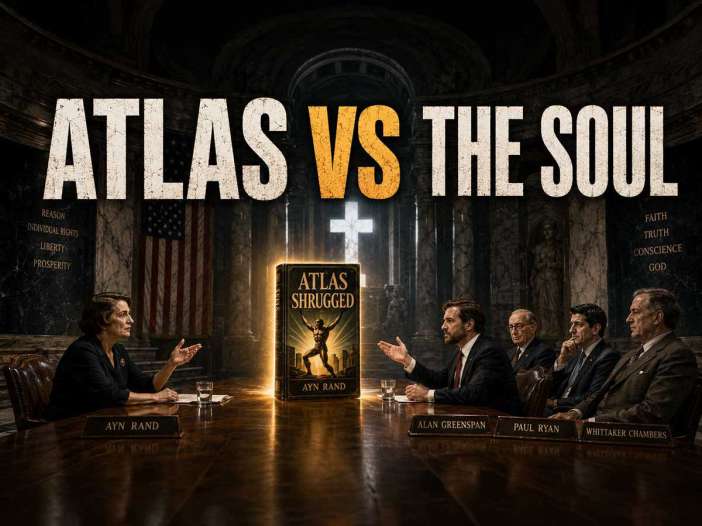
What if Ayn Rand gave conservatism its courage — but Christianity had to give it back its soul?
Introduction by By JD Vance
There are books you read, and there are books that read you.
For many young conservatives, Atlas Shrugged was one of those books.
It looked at ambition and said, “Do not be ashamed.”
It looked at the builder and said, “You are not the villain.”
It looked at government, bureaucracy, envy, and moral guilt, and said, “Be careful. Some people will use compassion as a weapon.”
That message can be very powerful.
For someone trying to rise out of instability, Ayn Rand offers a clean road. Think clearly. Work hard. Refuse self-pity. Do not let others make you feel guilty for wanting to build a life.
There is truth in that.
But truth can become dangerous when it becomes too clean.
A family is not clean. A nation is not clean. Poverty is not clean. Addiction is not clean. Faith is not clean. Love is not clean.
The real human person is mixed: strong and weak, responsible and wounded, proud and dependent, capable of greatness and still in need of grace.
That is why Ayn Rand remains so difficult for modern conservatism.
She gave the right a language of achievement.
She taught people to defend the builder.
She reminded us that freedom matters.
But she could not fully explain why a son owes something to his mother, why a nation owes something to its forgotten towns, why the strong may still be called to kneel, serve, and carry someone weaker.
So the question before us is not simply whether Ayn Rand was right or wrong.
The question is what happens when a movement tries to keep her courage without inheriting her coldness.
Can conservatism honor work without worshiping success?
Can it defend freedom without abandoning duty?
Can it protect the builder without forgetting the broken?
That is where this conversation begins.
(Note: This is an imaginary conversation, a creative exploration of an idea, and not a real speech or event.)
Topic 1: The Spell of Atlas Shrugged

Guests
Ayn Rand
JD Vance
Alan Greenspan
Paul Ryan
Whittaker Chambers
Opening
Moderator:
In 1957, Ayn Rand published Atlas Shrugged, a novel that did something rare.
It did not merely defend capitalism.
It made capitalism feel like a moral drama.
The businessman was not the villain.
The inventor was not greedy.
The ambitious person was not someone to be ashamed of.
In Rand’s story, the builder became the hero.
That is why this book traveled far beyond literature. It entered politics, economics, business, and the private imagination of many young conservatives and libertarians.
But the spell of Atlas Shrugged raises a deeper question:
Did Ayn Rand awaken moral courage in ambitious people?
Or did she teach them to mistake success for virtue?
Tonight, we begin there.
Question 1
Why did Atlas Shrugged make ambition feel morally heroic instead of selfish?
Ayn Rand:
Ambition is called selfish by those who fear greatness. I refused that lie. A man who builds a railroad, invents a metal, creates a company, or risks his mind on an idea is not a parasite. He is a creator. His ambition is not a sin. It is the motion of life itself.
JD Vance:
For someone growing up around instability, Rand can feel like oxygen. She tells you that you are not trapped by your background. You can think. You can build. You can refuse self-pity. That message has real force, especially for young men who feel ashamed of wanting more.
Alan Greenspan:
Rand gave emotional clarity to something economists often discuss in cold terms. Production comes from judgment. Investment comes from confidence. Innovation comes from independent minds. She made readers feel the dignity behind those acts.
Whittaker Chambers:
She made ambition heroic by removing the burden of mercy. That is why her vision is so tempting. It tells the strong that their strength is proof enough. But a society cannot live on admiration for strength alone.
Paul Ryan:
The book resonated because it gave policy ideas a human face. Limited government, property rights, enterprise — those can sound technical. Rand turned them into a story about human dignity. For many conservatives, that mattered.
Question 2
Did Ayn Rand give conservatives a language they were missing — a way to defend capitalism as good, not merely useful?
Paul Ryan:
Yes. Conservatives often defended capitalism by saying it creates growth, jobs, and prosperity. Rand pushed further. She said capitalism is good because it respects the person who works, risks, creates, and earns. That moral framing had real influence.
Ayn Rand:
Capitalism does not need to beg for approval. It is the only system based on voluntary exchange and individual rights. I did not defend capitalism as a tool. I defended it as justice.
Whittaker Chambers:
That is where the danger enters. Capitalism may be better than tyranny. It may protect freedom. But no economic system can become a substitute for moral truth. When the market becomes sacred, man becomes smaller, not greater.
Alan Greenspan:
She gave capitalism a philosophical foundation. Whether one accepts every part of her ethics is another matter. But she saw clearly that economic freedom depends on a certain view of the human mind: rational, choosing, accountable.
JD Vance:
For conservatives, Rand helped explain why resentment against success can become destructive. But her language can become too clean. Real life includes family, addiction, disability, failure, debt, illness, and grace. Capitalism needs moral limits that Rand did not fully honor.
Question 3
Why are young leaders often drawn to Rand before they develop a fuller view of faith, family, country, and duty?
JD Vance:
Rand speaks to the wounded ambitious person. She says, “Your life is yours.” That can be liberating when you come from chaos. But later you may realize your life was never yours alone. You were carried by family, teachers, neighbors, country, and God. That does not erase agency. It deepens it.
Alan Greenspan:
Young minds are often attracted to systems with internal clarity. Rand offered that. She connected ethics, economics, politics, and personal ambition in one structure. That kind of coherence can be very compelling.
Ayn Rand:
They are drawn to me because I do not ask them to apologize for living. I do not tell them their highest moral purpose is to serve others. I tell them to think, to create, to stand upright, and to refuse guilt they have not earned.
Paul Ryan:
For many young conservatives, Rand is a starting point, not a final destination. She teaches responsibility, discipline, and suspicion of state control. But most people later have to reconcile that with faith, community, patriotism, and care for the vulnerable.
Whittaker Chambers:
Youth loves purity. Rand gives purity: the producer against the looter, reason against weakness, greatness against mediocrity. But maturity learns that the human person is mixed. The strong need forgiveness too. The weak may possess wisdom. A politics without tenderness becomes inhuman.
Closing
Moderator:
The spell of Atlas Shrugged begins with a reversal.
The person accused of greed becomes the person holding the world together.
That reversal explains Rand’s lasting appeal.
She gave ambitious people a language of dignity. She told builders that their work was not dirty. She told young conservatives that economics was not merely about numbers, but about justice, courage, and the right to live by one’s own mind.
Yet the tension appears at once.
If ambition is good, what is it for?
If the builder matters, what does he owe the child, the widow, the addict, the disabled, the forgotten?
If capitalism honors freedom, what kind of soul must freedom serve?
Ayn Rand’s answer is fierce: the creator owes the world nothing except creation.
Her critics answer: creation without love is not enough.
That is why Atlas Shrugged still matters.
It does not end the argument.
It starts one.
Topic 2: The Producer, the Bureaucrat, and the Politician

Guests
Ayn Rand
JD Vance
Alan Greenspan
Paul Ryan
Whittaker Chambers
Opening
Moderator:
Ayn Rand’s moral drama depends on a sharp division.
On one side stands the producer: the inventor, entrepreneur, builder, engineer, executive, worker, and risk-taker.
On the other side stands the looter: the official, regulator, political operator, and moral manipulator who takes from the creator under the language of fairness.
This is part of what made Atlas Shrugged so unforgettable.
But real government is harder to judge.
A bridge inspector may prevent death.
A corrupt committee may destroy a business.
A welfare office may rescue a family.
A political class may use need as an excuse for control.
So the question becomes more difficult:
When is government serving the common good?
And when is it quietly feeding on the people who build?
Question 1
Is Rand right that society often punishes its most productive people?
Ayn Rand:
Yes. The productive man is praised in speeches and punished in law. He is told to create, then taxed for creating. He is told to hire, then regulated for hiring. He is told to innovate, then condemned for profit. This is not gratitude. It is moral blackmail.
Alan Greenspan:
There is truth in her warning. When risk is punished and failure is socialized through political favoritism, productive discipline weakens. Capital formation depends on confidence that effort, judgment, and ownership will be respected.
Whittaker Chambers:
Some productive people are punished. Some are protected by the very system they condemn. Large firms often learn to live with regulation and use it against smaller competitors. The moral division is not always producer versus state. Sometimes it is powerful producer with state.
Paul Ryan:
The concern is real. Too much regulation can crush small businesses, slow hiring, and discourage investment. But society must still set rules for safety, fraud, pollution, and fair competition. The task is separating protection from control.
JD Vance:
I think Rand saw something real but made it too clean. The small business owner buried in paperwork is real. The family crushed by medical bills is real too. A serious politics has to care about both the builder and the person who cannot build right now.
Question 2
Where is the line between necessary government and parasitic government?
Paul Ryan:
Necessary government protects rights, enforces contracts, defends the country, and creates basic conditions for freedom. Parasitic government starts when public institutions stop serving citizens and begin protecting themselves, their budgets, and their favored groups.
Ayn Rand:
The line is force. Government exists to protect individual rights. Once it redistributes wealth, directs production, or sacrifices one citizen to another, it has crossed from protection into predation.
JD Vance:
That answer sounds clean, but life is not clean. A child born into addiction, family breakdown, and poverty did not choose that starting point. The state should not replace family or church, but sometimes it has to keep people from being abandoned.
Alan Greenspan:
Markets need legal order. Contracts, property rights, courts, monetary stability — these are not optional. The danger comes when rules become tools of political preference, when government chooses winners and losers.
Whittaker Chambers:
A state becomes parasitic when it forgets the person. But a market can become parasitic too. Any institution that treats human beings as material for its own growth has crossed a moral line.
Question 3
Can a politician admire the private builder without turning every public servant into a villain?
Whittaker Chambers:
He must. A civilization needs builders, but it also needs teachers, soldiers, nurses, judges, and honest clerks. Rand’s danger is that she makes dependence ugly and public service suspicious by nature. That is too narrow.
JD Vance:
A politician should defend the builder, especially the small builder who has no lobbyist. But public servants can be honorable too. A good police officer, firefighter, teacher, or caseworker may carry burdens no market price can measure.
Ayn Rand:
The issue is not whether a public employee can be personally decent. The issue is whether his office rests on voluntary exchange or compulsion. A kind bureaucrat with coercive authority is still dangerous.
Paul Ryan:
Conservatives should criticize bureaucracy without demeaning every person in public service. The real target should be bad incentives, permanent programs that never measure results, and agencies that punish citizens rather than serve them.
Alan Greenspan:
Private enterprise and public institutions both require accountability. Markets punish errors through loss. Government often lacks that feedback. The deeper challenge is building limits so public agencies do not drift away from their stated purpose.
Closing
Moderator:
The second argument begins where the first one sharpened the blade.
Rand gave conservatives a powerful warning: the builder can be exploited by the language of public need.
But Chambers, Vance, Ryan, and Greenspan complicate the picture.
Some rules protect freedom.
Some rules suffocate it.
Some public servants protect the weak.
Some bureaucracies protect themselves.
Some business leaders create value.
Some learn to use government as a shield against competition.
The real conflict may not be producer versus government.
It may be creation versus extraction — wherever extraction hides.
Inside business.
Inside politics.
Inside bureaucracy.
Inside the human heart.
And that leads directly into the next question:
Can a movement inspired by Ayn Rand survive contact with Christianity, humility, sacrifice, and love?
Topic 3: The Christian Problem with Ayn Rand
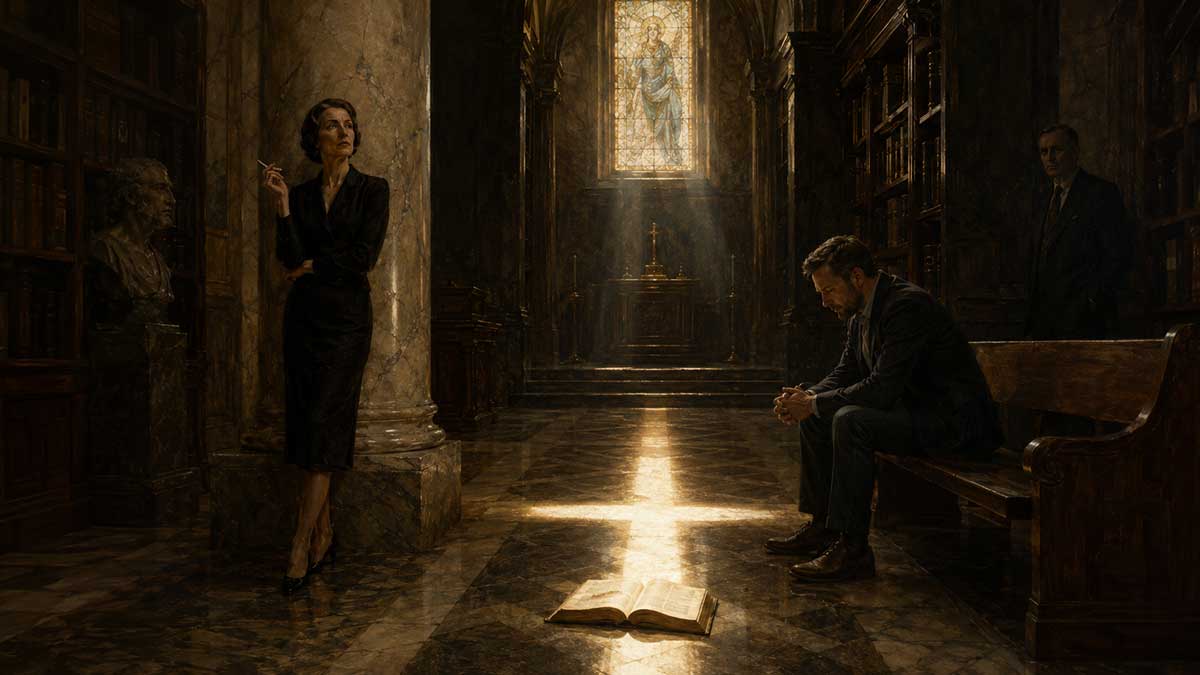
Guests
Ayn Rand
JD Vance
Alan Greenspan
Paul Ryan
Whittaker Chambers
Opening
Moderator:
Here the argument becomes more personal.
Ayn Rand gave many conservatives a language of achievement, freedom, responsibility, and resistance to state control.
But she did not merely defend capitalism.
She attacked sacrifice.
She rejected religious humility.
She saw altruism as a moral trap.
For religious conservatives, this creates a serious conflict.
Can one borrow Rand’s defense of the builder without accepting her rejection of the cross?
Can one admire her hatred of tyranny without absorbing her contempt for dependence?
Can a Christian love Atlas Shrugged without letting it reshape his soul?
Tonight, the question is no longer just political.
It is spiritual.
Question 1
Can a Christian conservative accept Rand’s defense of achievement without accepting her rejection of self-sacrifice?
JD Vance:
Yes, but only with caution. Rand helped me see that guilt can be manipulated. She helped me see that achievement should not be treated as shameful. But Christianity asks a different question: what is achievement for? If success never becomes service, then it becomes a prison of the self.
Ayn Rand:
You cannot keep my defense of achievement and reject the moral foundation beneath it. The creator has a right to live for his own sake. Once you tell him his highest calling is sacrifice, you have placed a chain around his mind.
Whittaker Chambers:
That is precisely the problem. Christianity does not despise achievement. It redeems it. The builder, the artist, the statesman, the mother, the priest, the soldier — all are judged by love. Greatness without charity becomes cold.
Alan Greenspan:
Many readers have taken from Rand a respect for reason, productivity, and independence without adopting her full rejection of religious ethics. Whether that is philosophically consistent is debatable. In political life, people often draw from several sources.
Paul Ryan:
That is how many conservatives read her. They kept the respect for work, ownership, and enterprise. They did not accept the idea that compassion is weakness. In practice, the American right has always mixed free-market thought with religious moral duty.
Question 2
Is charity a moral duty, a private virtue, or a dangerous political excuse?
Whittaker Chambers:
Charity is not a decorative virtue. It is near the center of the Christian life. The danger comes when the state imitates charity without love, or when the rich praise private charity but never practice it. Both errors are real.
Ayn Rand:
Charity may be chosen freely as a private act, but it can never be a moral claim against another person’s life. Need is not a title deed. Suffering does not grant ownership over the productive.
Paul Ryan:
A free society needs private charity, civil society, churches, families, and local institutions. Government may have a limited role, but it should not replace those human bonds. When it does, people become case numbers.
JD Vance:
I agree that state programs can become impersonal. But I also know what it means when families break down and local institutions are too weak. A child in chaos cannot survive on theory. Sometimes society has to step in, then ask how to rebuild the bonds that failed.
Alan Greenspan:
Economically, compulsory redistribution can distort incentives. But social breakdown also carries costs. The question is how to protect liberty and sustain a social order where people do not fall into permanent dependency.
Question 3
What does Christianity see in weakness that Rand’s philosophy cannot fully explain?
Paul Ryan:
Christianity sees dignity before productivity. A person does not gain worth by earning, building, or succeeding. That is one reason many conservatives cannot stop at Rand. The unborn child, the disabled adult, the elderly parent — their dignity is not market-based.
JD Vance:
Weakness is where many people first learn grace. Addiction, poverty, family pain, illness — these are not excuses, but they are real. Rand can speak to the part of you that wants to rise. Christianity speaks to the part of you that knows you had to be carried.
Ayn Rand:
I do not deny that suffering exists. I deny that suffering is a moral standard. To worship weakness is to punish life. A morality fit for man must honor reason, achievement, and joy.
Whittaker Chambers:
Christianity does not worship weakness. It says God entered it. That is something Rand cannot accept. The cross is not an insult to greatness. It is the judgment of greatness by love.
Alan Greenspan:
Rand’s system explains production and independence with great force. It is less equipped to explain vulnerability, forgiveness, and inherited obligation. Those questions belong partly outside economics.
Closing
Moderator:
The Christian problem with Ayn Rand is not small.
It reaches the center of both visions.
Rand says the highest person is the one who stands, creates, and refuses unearned guilt.
Christianity says the highest love may kneel, serve, forgive, and carry another’s burden.
One vision fears that sacrifice will become slavery.
The other fears that self-interest will become idolatry.
And yet the attraction remains.
Rand reminds religious conservatives that guilt can be abused, that success can be demonized, that government can wear the mask of compassion.
Chambers reminds them that a society without mercy becomes spiritually thin.
Vance stands between the two: first drawn to the clean fire of Rand, then pulled back into the messier demands of faith, family, and belonging.
The unresolved question is this:
Can a person be grateful for Rand’s courage without letting her turn love into weakness?
That question carries us into policy — where novels become budgets, taxes, welfare debates, and arguments over what government should be allowed to do.
Topic 4: From Philosophy to Policy
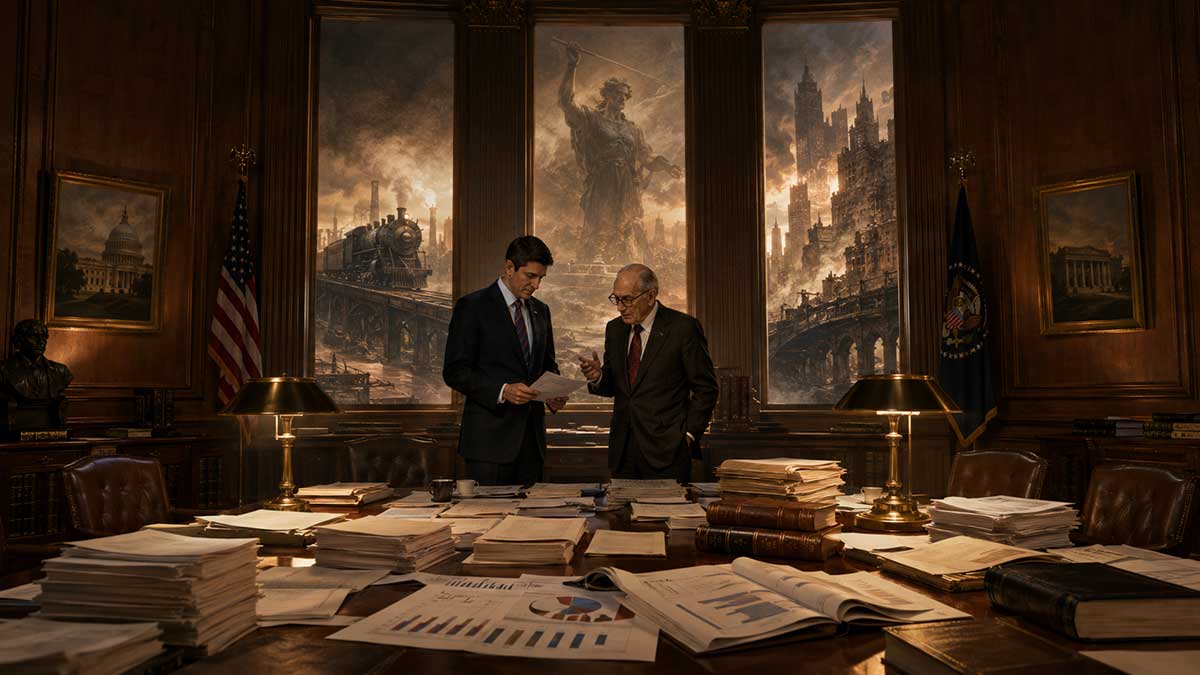
Guests
Ayn Rand
JD Vance
Alan Greenspan
Paul Ryan
Whittaker Chambers
Opening
Moderator:
A novel can enter politics in strange ways.
Most people do not carry policy papers in their imagination.
They carry stories.
Ayn Rand’s Atlas Shrugged gave many readers one unforgettable story:
The producer works.
The state takes.
The public demands.
The politician promises.
The system collapses.
That story shaped how some conservatives thought about taxes, welfare, regulation, budgets, and freedom.
But policy is not a novel.
A budget touches old people, children, veterans, entrepreneurs, teachers, hospitals, debt, taxes, and families under strain.
So tonight’s question is harder:
What happens when the moral fire of Atlas Shrugged enters the gray rooms of government?
Question 1
What happens when a dramatic novel becomes a policy instinct?
Paul Ryan:
It can clarify things, but it can distort them too. Rand made people ask whether government rewards dependency and punishes work. That is a serious question. But policy needs numbers, tradeoffs, and human cases. A novel can awaken you. It cannot write a budget by itself.
Ayn Rand:
A novel can reveal principles more clearly than a committee report. The issue is not whether a child, farmer, worker, or retiree can be named in a bill. The issue is whether one person’s need gives the state a claim over another person’s life.
Alan Greenspan:
Policy requires feedback from reality. A theory may be elegant, but institutions behave unevenly. Incentives matter. So do shocks, fraud, debt, politics, and public trust. Rand supplied a framework of liberty. Governing requires judgment under imperfect conditions.
JD Vance:
For young conservatives, Rand can create suspicion of every social program. Later, life may complicate that. If you have seen addiction, family breakdown, and lost communities, you know people need more than lectures about agency. But you still worry that bad programs can trap people.
Whittaker Chambers:
A novel becomes dangerous when it turns persons into categories. The producer, the looter, the bureaucrat, the dependent — these are dramatic symbols. But Christ does not meet symbols. He meets human beings.
Question 2
Does limited government protect human freedom, or can it leave wounded people behind?
JD Vance:
It can do both. Government can crush freedom when it grows arrogant. But absence of help is not the same as freedom. A child in a broken home is not free in any meaningful sense. The question is how to help without replacing family, church, and local responsibility.
Whittaker Chambers:
Freedom without mercy becomes a desert. But mercy enforced without love becomes machinery. The state cannot love the poor. It can write checks, assign cases, and build offices. That may be needed at times, but it is never the same as human charity.
Ayn Rand:
Limited government is the only moral government. Its task is to protect rights, not distribute compassion. Once the state claims the right to help by force, no citizen is safe from the next moral emergency.
Paul Ryan:
Limited government is not abandonment. It means programs should encourage work, family stability, local problem-solving, and upward movement. The goal should be help that does not become a permanent cage.
Alan Greenspan:
Economic freedom creates growth, and growth gives societies more room to solve social problems. But instability can damage families and institutions. The question is how to preserve incentives and still avoid social collapse.
Question 3
Can a free-market society survive without moral habits that markets themselves cannot create?
Alan Greenspan:
Markets rely on trust. Contracts, honesty, deferred gratification, respect for law, and stable money all matter. These are not generated by price signals alone. They come from culture, family, law, and civic norms.
Paul Ryan:
That is where faith and civil society matter. Markets can reward work, creativity, and service. But they cannot teach every virtue. Families, churches, schools, and local communities have to form people who can use freedom well.
Ayn Rand:
The market does not need mystical virtue. It needs reason, property rights, contract, and voluntary exchange. A rational person dealing with others by trade is already acting morally. The danger comes when duty and sacrifice are used to override rights.
Whittaker Chambers:
Trade is not enough to form a soul. A man may keep contracts and still be cruel. He may create wealth and still worship himself. Civilization needs gratitude, humility, repentance, and love — none of which can be priced.
JD Vance:
This is where Rand runs out of road for me. Free markets need people who can keep promises, raise children, tell the truth, and belong somewhere. If family and faith collapse, the market keeps moving, but people become lonely, angry, and easier to manipulate.
Closing
Moderator:
Policy exposes the limits of every philosophy.
Ayn Rand gives the warning:
Do not let government turn compassion into control.
Whittaker Chambers gives the counter-warning:
Do not let freedom become an excuse for indifference.
Paul Ryan tries to translate ideas into budgets.
Alan Greenspan reminds us that systems need incentives and trust.
JD Vance asks what happens to people who grow up far from order, stability, and inherited strength.
This is where Atlas Shrugged becomes hardest to use.
The novel gives moral clarity.
Government gives tradeoffs.
The novel asks who is being looted.
Life asks who is being forgotten.
A mature politics has to hold both questions without lying about either one.
That leads to the final topic:
What should modern conservatism keep from Ayn Rand — and what should it finally leave behind?
Topic 5: What Should Modern Conservatism Keep from Rand?

Guests
Ayn Rand
JD Vance
Alan Greenspan
Paul Ryan
Whittaker Chambers
Opening
Moderator:
We arrive at the final question.
Ayn Rand cannot be ignored.
She gave many conservatives a fierce defense of the builder, the inventor, the entrepreneur, and the independent mind.
She warned that government can use compassion as a mask for control.
She reminded ambitious people that achievement is not shameful.
Yet she left a problem behind.
If the strong owe nothing, what becomes of the weak?
If freedom means only self-ownership, what becomes of family, faith, country, and sacrifice?
If the builder is heroic, what is the builder for?
Tonight, we ask what modern conservatism should keep from Ayn Rand — and what it must leave behind.
Question 1
What should today’s conservative leaders keep from Ayn Rand’s defense of the creator, builder, and risk-taker?
Paul Ryan:
They should keep her respect for work and enterprise. A society that treats success as suspicious will get less risk, less innovation, and less growth. Rand understood that the person who builds something should not be treated as guilty by default.
Ayn Rand:
They should keep the whole principle. The creator does not live by permission. He does not owe an apology for his mind, his ambition, or his profit. The moral defense of capitalism begins with the right of the individual to live for his own sake.
JD Vance:
They should keep her refusal of learned helplessness. People need to hear that they can act, build, think, and rise. That message matters, especially in broken places. But it must be joined to gratitude. Nobody rises alone.
Alan Greenspan:
They should keep her link between freedom and rational judgment. Markets are not magic. They are the result of millions of choices made by people who bear costs, assess risks, and act on knowledge no central planner can fully possess.
Whittaker Chambers:
They should keep her hatred of tyranny. She knew that collectivist language can become a chain. But they must remember that tyranny can wear many faces, including the worship of the self.
Question 2
What should they reject from her view of selfishness, dependence, and human obligation?
Whittaker Chambers:
They must reject the contempt for dependence. Every infant is dependent. Every aging parent may become dependent. Every sinner needs mercy. A politics that forgets this may call itself free, but it becomes spiritually barren.
JD Vance:
They should reject the idea that obligation is always oppression. Family can burden you, yes. Place can wound you. Country can fail you. But duty can give life shape. It can pull you out of isolation.
Ayn Rand:
I reject the premise. Obligation that is chosen is a value. Obligation imposed by need, guilt, or law is a claim against a man’s life. If conservatives abandon this distinction, they abandon freedom.
Paul Ryan:
They should reject the idea that public need is always manipulation. Some need is real. Some programs fail. Some families are trapped. The question is how to help without creating dependency or destroying responsibility.
Alan Greenspan:
They should reject excessive certainty. Economic freedom matters deeply, but human institutions are fragile. Policy needs humility, data, and feedback. A theory that never listens to reality becomes ideology.
Question 3
Can modern conservatism become pro-achievement, pro-family, anti-tyranny, and compassionate at the same time?
Alan Greenspan:
It can, but it requires limits. Government must protect rights and institutions must preserve trust. Markets need cultural foundations. Without honesty, family stability, and civic restraint, freedom weakens.
Paul Ryan:
Yes. A conservative vision can defend enterprise and still care for the poor. It can cut waste and still protect the vulnerable. It can honor the taxpayer and still ask what kind of society leaves people no path back.
Whittaker Chambers:
It can only do so if it places the person above the system. The worker is more than output. The poor man is more than need. The rich man is more than wealth. Every politics must kneel before the mystery of the human soul.
Ayn Rand:
Compassion must never become a weapon against achievement. If conservatives mean voluntary kindness, they may practice it freely. If they mean sacrifice by force, they have surrendered the moral ground.
JD Vance:
That is the task now. We need ambition without cruelty, mercy without dependency, faith without sentimentality, markets without worship, and patriotism without nostalgia. Rand is a spark, but she cannot be the whole fire.
Closing
Moderator:
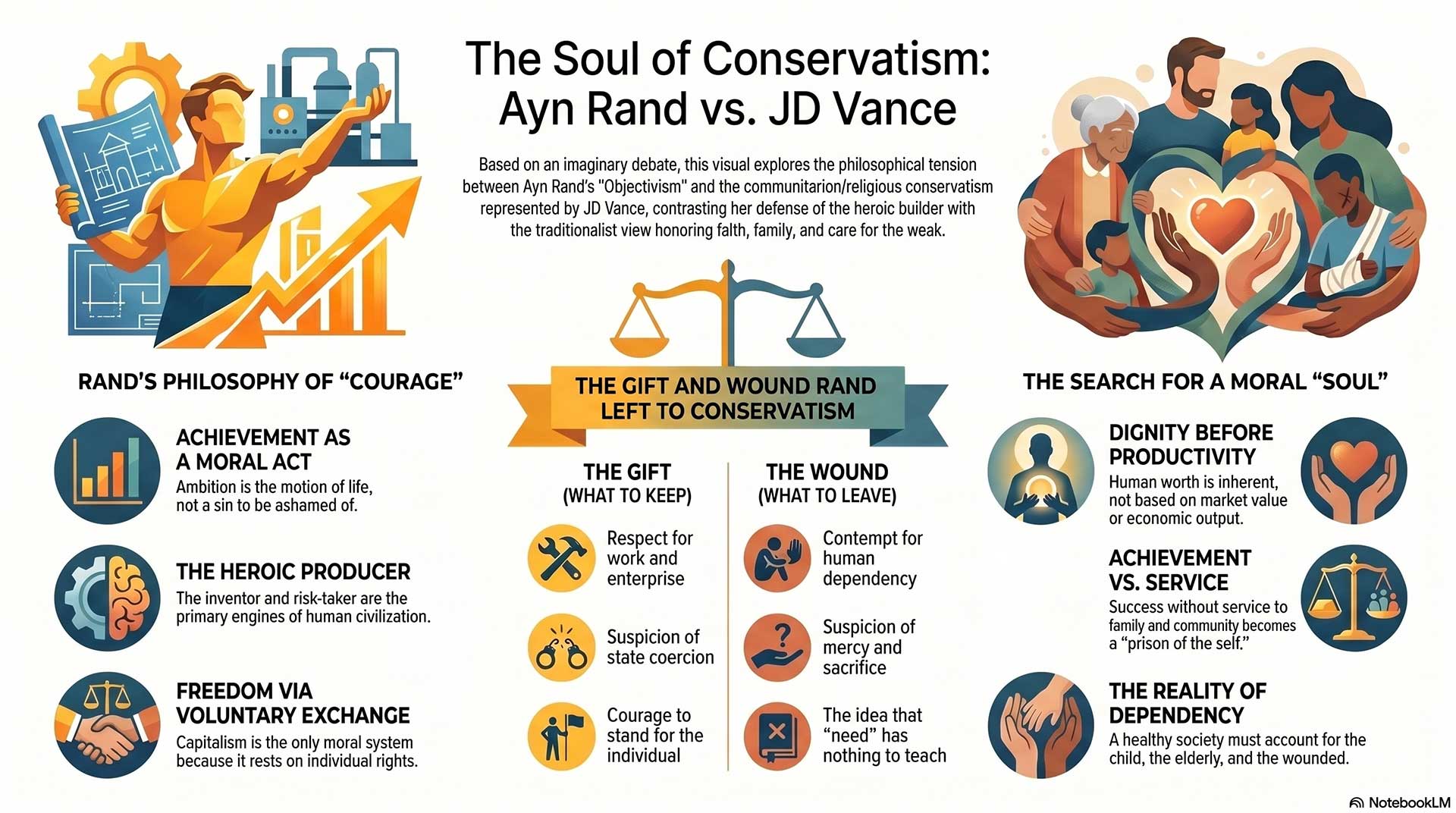
Ayn Rand gave conservatism a gift and a wound.
The gift was courage.
She told the builder to stand upright.
She told the entrepreneur that profit was not shame.
She told the citizen to distrust any state that takes in the name of virtue.
She told the ambitious young person that life could be claimed, shaped, and built.
The wound was colder.
She made dependence look ugly.
She made sacrifice look suspicious.
She made mercy seem like a trap.
She gave too little space to grace.
So perhaps modern conservatism should neither crown Rand nor cancel her.
It should read her as a fire that must be handled carefully.
Take the courage.
Take the defense of work.
Take the suspicion of coercion.
Take the respect for the builder.
Leave the contempt.
Leave the loneliness.
Leave the idea that need has nothing to teach.
The final question is not whether Atlas should shrug.
The final question is whether Atlas can carry the world without losing his soul.
Final Thoughts by Whittaker Chambers
Ayn Rand saw something real.
She saw that collectivist language can become a chain.
She saw that envy can disguise itself as justice.
She saw that the builder, the inventor, the entrepreneur, and the independent mind can be punished by those who depend on them.
For that, she must be taken seriously.
But she saw only part of man.
She saw the will, but not the wound.
She saw the creator, but not the child.
She saw the achievement, but not the mercy that made achievement possible.
She saw the individual standing alone, but not the invisible hands that had carried him there.
Every human life begins in dependence.
Before we speak, someone feeds us.
Before we reason, someone protects us.
Before we earn, someone gives.
Before we stand, someone holds us.
A politics that forgets this may still speak of freedom, but it will no longer know what freedom is for.
The danger of Atlas Shrugged is not that it honors the builder.
The danger is that it may teach the builder to look upon the needy with suspicion before he looks upon them with love.
Conservatism cannot live by resentment against the state alone.
It must defend freedom, yes.
It must honor work, yes.
It must resist tyranny, yes.
But it must do so with a soul large enough to see the elderly parent, the disabled child, the addicted son, the failed worker, the lonely widow, and the person whose dignity cannot be measured by production.
Ayn Rand asked, “What happens if Atlas shrugs?”
The deeper question is this:
What happens if Atlas forgets why the world was worth carrying at all?
Short Bios:
Ayn Rand
Author of Atlas Shrugged and creator of Objectivism. She defends reason, individualism, capitalism, achievement, and the moral right of the creator to live for his own sake.
JD Vance
Modern conservative voice shaped by poverty, family breakdown, ambition, military service, law, politics, and Catholic faith. In this conversation, he represents the tension between Rand’s self-reliance and Christian duty.
Alan Greenspan
Economist and former Federal Reserve chairman. As someone connected to Rand’s intellectual circle, he brings the policy mind: markets, incentives, risk, money, trust, and the limits of theory in government.
Paul Ryan
Former Speaker of the House and Republican policy leader. He represents the political translation of Rand-influenced ideas into budgets, welfare debates, tax policy, and limited-government conservatism.
Whittaker Chambers
Writer, anti-communist witness, and critic of Rand’s worldview. He brings the spiritual warning: a politics that honors strength but forgets mercy may lose the human soul.
Leave a Reply