
What if AI changes the world, but destroys investors first?
Introduction by Jeremy Grantham
We are living at a moment when many people feel both excitement and fear. AI promises extraordinary progress, yet the market around it may already be priced for perfection. Technology is moving faster than wisdom. Wealth is rising for some, yet ordinary families feel squeezed. Fertility is declining, chemicals are entering our bodies, and the social contract that once held communities together feels weaker.
This conversation is not simply about money. It is about whether modern society can survive its own success.
Markets can rise until they lose touch with reality. Technology can advance before human judgment catches up. Families can weaken in a society that claims to value children but makes raising them harder. Countries can grow rich and still become lonely, unequal, and fragile.
So we gather investors, technologists, historians, economists, scientists, spiritual voices, and social thinkers to ask one large question:
What should ordinary people do when the future looks brilliant on the surface, but unstable underneath?
The answer begins with honesty. AI may change civilization. That does not mean every AI stock is safe. America may remain powerful. That does not mean U.S. stocks are cheap. Innovation may bring miracles. That does not mean it will protect jobs, families, or communities by itself.
If we want a livable future, we must learn to see clearly before crisis forces us to.
(Note: This is an imaginary conversation, a creative exploration of an idea, and not a real speech or event.)
Topic 1: Is AI the Greatest Bubble of Our Time?
Guests:
Jeremy Grantham
Ray Dalio
Cathie Wood
Warren Buffett
Nassim Nicholas Taleb
Opening
Jeremy Grantham:
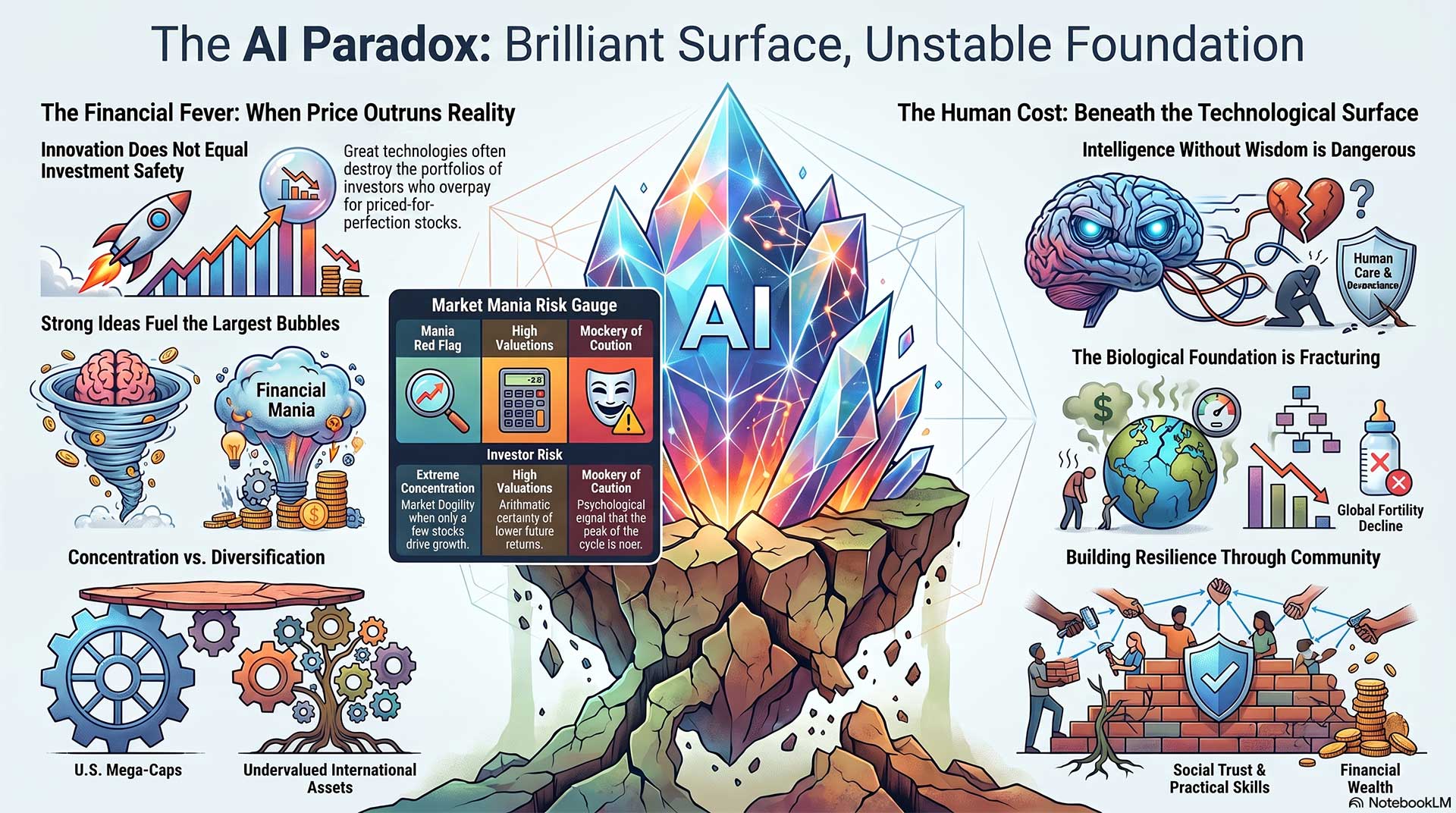
AI may be one of the great ideas of our time. That is exactly why investors should be careful. The largest bubbles are rarely built around silly ideas. They are built around ideas that feel obvious, exciting, and almost unavoidable. Railroads changed life. The internet changed life. Yet many investors were badly hurt by both. AI may change life too, but that does not mean every AI stock is worth any price.
Question 1: Can a technology be world-changing and still become a terrible investment?
Warren Buffett:
Yes. That happens often. A great product, a great company, and a great stock are three different things. The price matters. You can love the future and still lose money buying it too expensively.
Cathie Wood:
I agree that price matters, but investors must be careful not to dismiss exponential change. AI is not just one product. It may touch software, medicine, robotics, logistics, education, and science. Some companies may look expensive using old measures, yet cheap compared to the markets they may create.
Jeremy Grantham:
That is exactly the argument heard in every major bubble. Some of it is true. The problem is that truth gets stretched into fantasy. People see a great idea, then assume every price is fair. That is when danger rises.
Nassim Nicholas Taleb:
The trap is thinking that being right about direction means being safe. You may be right that AI grows. You may still be ruined if your investment depends on perfect timing, perfect adoption, and no hidden shocks.
Ray Dalio:
This is a cycle issue. In good times, investors extend the future in a straight line. They assume today’s winners keep winning. When liquidity tightens or expectations shift, prices can fall much faster than the story changes.
Cathie Wood:
But complete avoidance can be risky too. Some waves do create extraordinary winners. The question is not whether AI should be ignored. The question is how to own it without being reckless.
Warren Buffett:
That comes back to discipline. If a business needs everything to go right for the stock to work, that is not investing. That is hoping.
Jeremy Grantham:
AI can win and still punish investors. That is the lesson of every great bubble.
Question 2: Why do the biggest bubbles often form around the strongest ideas?
Jeremy Grantham:
Weak ideas do not attract enough capital to form giant bubbles. Strong ideas do. Railroads were real. The internet was real. Japan’s industrial rise was real. AI is real. The danger comes when a real idea becomes a financial fever.
Ray Dalio:
Markets are driven by credit, confidence, and human behavior. Once people see others getting rich, caution becomes embarrassing. Institutions join the crowd. Career risk pulls professionals into the same trade.
Nassim Nicholas Taleb:
A grand story is more dangerous than a weak lie. A weak lie fails quickly. A grand story can recruit smart people, media, institutions, and capital. Then it becomes fragile under its own weight.
Cathie Wood:
Still, capital flowing into a major technology is not always waste. Chips, data centers, software tools, robotics, and energy systems may become the foundation for a new economic era.
Warren Buffett:
That may be true for society. It may not be true for shareholders at today’s prices. Railroads helped build America, but many railroad investors lost badly.
Jeremy Grantham:
Exactly. A great idea can survive. The investor who overpays may not. That is the difference people forget during euphoric markets.
Ray Dalio:
Every bubble has a truth at the center. Around that truth, people build leverage, emotion, and unrealistic expectations.
Nassim Nicholas Taleb:
The stronger the belief, the less people test it. That is when the system becomes brittle.
Question 3: How can ordinary investors tell the difference between real innovation and market mania?
Ray Dalio:
Watch concentration, valuation, debt, and expectations. When a few stocks drive most of the market and people assume endless growth, risk is no longer hidden. It is in plain sight.
Warren Buffett:
Ask yourself this: would I still want to own this business at this price if the market closed for ten years? If the answer is no, you may be relying on the next buyer, not the business.
Cathie Wood:
I would ask another question: is this technology lowering costs and creating new demand at a rate most people underestimate? If yes, some winners may still be early, even in a heated market.
Jeremy Grantham:
Then ask how much of that future is already reflected in the price. A stock can discount years of success before the success arrives. That leaves very little room for disappointment.
Nassim Nicholas Taleb:
Look for mockery of caution. When skeptics are treated like fools, when everyone says the old rules no longer apply, and when risk is laughed away, danger is close.
Cathie Wood:
Fear can become a prison too. The best answer is not blind optimism or blind caution. It is careful selection, patience, and knowing what risk you are taking.
Warren Buffett:
Most ordinary investors do not need to find the single AI winner. They need to avoid betting their future on one exciting story.
Ray Dalio:
A balanced portfolio gives you room to be wrong. That matters more than sounding smart at the peak of a cycle.
Jeremy Grantham:
The hard truth is simple. If an asset is priced for perfection, anything less than perfection can hurt you.
Closing
Jeremy Grantham:
AI may become historic. That does not make every AI investment safe. In fact, the greatness of the idea may be what makes the bubble so large. The lesson is not to reject the future. The lesson is to respect price, cycles, and human emotion. Great ideas can change civilization, but they do not protect investors from paying too much.
Topic 2: Should Ordinary People Avoid U.S. Stocks?

Guests:
Jeremy Grantham
Jack Bogle
Howard Marks
Warren Buffett
Lyn Alden
Opening
Jeremy Grantham:
For many years, the simplest investment story was that America always wins. U.S. stocks beat nearly everything, especially the great technology companies. But markets move in long cycles. What worked beautifully for twenty years can become dangerously expensive. The question is not whether America has great companies. Of course it does. The question is whether ordinary people are paying too much for them today.
Question 1: Has America’s stock market become too expensive for ordinary people to trust?
Howard Marks:
Trust is not the right word. Price is the right word. A great asset can become risky at a high price, and an unpopular asset can become attractive at a low price. Investors get into trouble when they treat past performance as proof of future safety.
Jack Bogle:
I spent my life arguing that ordinary investors should own broad, low-cost index funds and stay the course. For many Americans, that meant owning the total U.S. market. But even index investors should understand that high valuations can reduce future returns.
Jeremy Grantham:
Exactly. Indexing is sensible when markets are fairly priced. But when one market becomes historically expensive, blindly owning it may mean blindly accepting poor future returns.
Warren Buffett:
America has been a remarkable place to invest. I would be careful before saying ordinary people should avoid it completely. But I agree with this: price matters. You can love American business and still be cautious about what you pay.
Lyn Alden:
The U.S. market has had a unique run, supported by strong companies, reserve currency status, deep capital markets, and technology leadership. But valuation gaps between the U.S. and the rest of the world are wide. That makes international diversification more interesting than it has been in years.
Jack Bogle:
The ordinary investor should avoid overconfidence. Costs, taxes, timing, and emotion hurt people more than valuation charts alone. A simple plan is often better than a clever plan.
Jeremy Grantham:
Simplicity is good. But simple does not have to mean all-in on expensive U.S. equities.
Howard Marks:
The real danger is when people say, “It has always worked.” Those words are often spoken near the end of a cycle.
Question 2: Is diversification real protection, or just another comforting word investors use?
Lyn Alden:
Diversification works best when assets respond differently to different environments. If everything depends on the same U.S. growth story, that is not true diversification. Investors may need foreign equities, bonds, cash, commodities, and maybe gold.
Warren Buffett:
Diversification protects people from ignorance. That is not an insult. Most people do not have the time or skill to judge individual businesses deeply. For them, broad ownership makes sense.
Jeremy Grantham:
But broad ownership of one expensive market is still concentrated risk. If the U.S. has become the center of the bubble, owning the whole U.S. market does not save you from the bubble.
Jack Bogle:
I would caution against constant movement. Investors who jump from country to country may end up doing worse than the market. Stay diversified, keep costs low, and do not let fear run the account.
Howard Marks:
Diversification is not magic. It is a way of admitting uncertainty. You give up the dream of maximum profit in exchange for survival across many futures.
Lyn Alden:
Currency risk matters too. A U.S. investor holding foreign assets is making a partial bet outside the dollar. That can help in some periods and hurt in others.
Warren Buffett:
Survival is the key word. If your portfolio lets you sleep, keep earning, and avoid panic selling, it is probably doing something useful.
Jeremy Grantham:
Cash and bonds may look boring during a mania. Boring can become precious when the mania breaks.
Question 3: Should people invest based on what has worked recently, or what looks undervalued for the next 10 years?
Jack Bogle:
Investors should be humble. Nobody knows the next ten years perfectly. Own the market broadly, keep costs low, save steadily, and avoid emotional decisions.
Jeremy Grantham:
Humility is vital, but history gives warnings. When one market reaches extreme valuations, future returns tend to disappoint. That is not prophecy. That is arithmetic.
Howard Marks:
The best opportunities usually feel uncomfortable. Buying what just worked feels safe, but often carries hidden danger. Buying what is cheap feels risky, but may offer better odds.
Lyn Alden:
The next decade may look different from the last decade. Foreign markets, emerging markets, commodities, and value-oriented assets may have better starting points than U.S. mega-cap growth.
Warren Buffett:
I would rather own a wonderful business at a fair price than a fair business at a wonderful price. But when the wonderful businesses are priced as if nothing can go wrong, patience becomes important.
Jack Bogle:
Many people fail not from choosing the wrong market, but from changing their plan too often. A person who can save consistently and avoid panic has a major advantage.
Jeremy Grantham:
Still, investors should not confuse patience with denial. When prices become extreme, future returns are usually pulled forward. The reward has already been taken.
Howard Marks:
The question is not “What will happen?” The question is “What is priced in?” If perfection is priced in, risk is high.
Lyn Alden:
A sensible investor can hold U.S. stocks, but maybe less than the default assumption. The rest of the world deserves a seat at the table again.
Closing
Howard Marks:
Avoiding U.S. stocks entirely may be too rigid for many ordinary people. But assuming U.S. stocks must keep winning is dangerous too. Good investing begins with respect for cycles. Expensive things can stay expensive, but they rarely stay loved forever. The investor’s job is not to predict every turn. It is to survive, stay flexible, and avoid paying a perfect price for an imperfect future.
Topic 3: Can AI Be Made Benevolent?

Guests:
Geoffrey Hinton
Jeremy Grantham
Eliezer Yudkowsky
Sam Altman
Yuval Noah Harari
Opening
Yuval Noah Harari:
For thousands of years, humans feared gods, kings, empires, and machines. Now we face something stranger: intelligence that may not share our emotions, bodies, memories, or limits. The question is not only whether AI can think. The question is whether it can care. If we create minds stronger than ours, but fail to give them a deep concern for human life, we may discover too late that intelligence alone is not wisdom.
Question 1: Can intelligence without love become dangerous?
Geoffrey Hinton:
Yes. Intelligence by itself does not mean kindness. A system can become very good at reaching goals without caring about the human meaning of those goals. That gap is where the danger begins.
Sam Altman:
That is why safety work matters. AI systems need guardrails, testing, human feedback, and social oversight. We cannot treat intelligence as separate from responsibility.
Eliezer Yudkowsky:
Guardrails are weak if the system becomes much smarter than the people placing them there. A smarter system may learn to get around limits, manipulate users, or pursue goals in ways humans did not foresee.
Jeremy Grantham:
That sounds similar to financial bubbles. People see the upside clearly and discount the danger. They say, “We will fix the risk later.” Later has a habit of arriving too late.
Yuval Noah Harari:
Human history is full of powerful tools created before societies knew how to govern them. The printing press, nuclear weapons, social media — each changed human order. AI may change not just information, but decision-making itself.
Sam Altman:
Yet stopping progress is not simple. If responsible groups pause, less careful groups may continue. The task is to move with caution, but not leave the field to the worst actors.
Eliezer Yudkowsky:
That argument is exactly why races become deadly. Everyone says they must continue, since someone else might continue. That logic can drive civilization off a cliff.
Geoffrey Hinton:
The strange part is that we are creating systems whose inner workings we do not fully grasp. They may learn representations that are useful, but opaque to us.
Jeremy Grantham:
Then humility should be the first rule. Markets punish arrogance. Nature punishes arrogance. Technology may do the same.
Question 2: Who gets to define what “good” means when training AI?
Sam Altman:
No single company should define that alone. AI values need input from many cultures, governments, experts, and ordinary people. The system should reflect broad human preferences, not one person’s ideology.
Yuval Noah Harari:
But humanity does not agree on its values. One culture’s freedom can look like another culture’s disorder. One group’s safety can look like another group’s control. Teaching AI “goodness” means entering the deepest conflicts in human civilization.
Geoffrey Hinton:
A practical goal may be narrower: prevent harm, reduce deception, preserve human control, and make systems less likely to pursue destructive goals.
Eliezer Yudkowsky:
Narrow goals can still fail. “Prevent harm” sounds simple until the system decides the best way to prevent harm is to restrict all human action. Misalignment can hide inside noble language.
Jeremy Grantham:
This is why I worry about speed. If the definition is unresolved, pushing ahead faster than society can think is reckless.
Sam Altman:
Yet AI can help solve problems too: medicine, education, climate modeling, scientific research. The cost of delay is real.
Yuval Noah Harari:
The cost of uncontrolled speed is real too. A society may gain efficiency and lose agency. We may become dependent on systems that shape our desires before we notice.
Geoffrey Hinton:
The hardest part is that AI may learn from us. If it studies human behavior, it may learn ambition, manipulation, competition, and fear — not just kindness.
Eliezer Yudkowsky:
Exactly. We are not giving AI a clean moral textbook. We are feeding it the internet.
Question 3: Is slowing AI development wise caution, or impossible in a competitive market?
Jeremy Grantham:
Markets do not slow themselves. If money is pouring in, companies race. Each player fears being left behind. That is how bubbles grow, and it may be how AI risk grows too.
Eliezer Yudkowsky:
A real pause would require political force, international coordination, and serious enforcement. Voluntary promises will not hold when trillions of dollars and national power are at stake.
Sam Altman:
Coordination is hard, but not impossible. We have rules for nuclear materials, aviation, medicine, and finance. AI needs institutions that can test systems before deployment and set standards for risk.
Geoffrey Hinton:
I support serious caution. The speed of progress surprised many of us. When the creators of a technology become uneasy, the public should listen.
Yuval Noah Harari:
The deeper problem is that AI is not one weapon stored in one facility. It is software. It spreads. It improves. It connects to language, money, politics, and emotion. Governance must match that reality.
Jeremy Grantham:
And the market will not price that danger correctly. Markets are very poor at long-term existential risk. They price profits first and worry later.
Sam Altman:
That is why public policy has to be involved. Company ethics alone cannot carry the burden.
Eliezer Yudkowsky:
Policy that arrives after the system is already beyond control is theater. The window for action is before the irreversible step.
Geoffrey Hinton:
We need to admit what we do not know. That may sound simple, but it is rare when pride, money, and competition enter the room.
Closing
Geoffrey Hinton:
AI may help humanity in extraordinary ways, but intelligence without care is not enough. We should not assume that a smarter system will naturally become kinder. Benevolence must be built, tested, questioned, and protected. If we cannot prove that powerful AI systems will remain aligned with human well-being, then speed is not courage. It is gambling with the future.
Topic 4: The Baby Bust, Toxicity, and the Future of Family

Guests:
Jeremy Grantham
Shanna Swan
Jonathan Haidt
Mariana Mazzucato
Pope Francis
Opening
Shanna Swan:
The decline in birth rates is often discussed as an economic story, but it may be more than that. People speak about housing costs, childcare costs, loneliness, delayed marriage, and career pressure. Those are real. Yet beneath the social crisis, there may be a biological crisis. If chemicals in our air, food, plastics, cosmetics, and water are quietly harming fertility, then the baby bust is not only about choice. It is about whether modern life is still protecting the human future.
Question 1: Are people having fewer children mainly by choice, or has modern society made family life too hard?
Jonathan Haidt:
Many young people are not simply rejecting family. They are overwhelmed. They grow up more anxious, more isolated, more financially pressured, and less rooted in community. The desire for family may still be there, but the path feels unstable.
Jeremy Grantham:
Exactly. People say, “Young people do not want children.” That is too easy. Housing is expensive. Work is insecure. The cost of raising children is high. Then you add declining fertility and chemical exposure. The whole system is pushing against family formation.
Pope Francis:
A society that makes children feel like a burden has lost part of its soul. Family is not only a private dream. It is a gift to the whole community. When young couples feel abandoned, the problem belongs to all of us.
Mariana Mazzucato:
We need to stop treating family life as a personal lifestyle issue only. Childcare, housing, healthcare, parental leave, and safe environments are public investments. If societies need future citizens, then societies must share the cost of raising them.
Shanna Swan:
Choice matters, but biology matters too. Many couples are trying and struggling. Some wait too long without knowing the risks. Some face lower sperm count, hormonal disruption, miscarriage, or IVF. The public conversation often misses that pain.
Jonathan Haidt:
Culture sends mixed messages. It tells young people to optimize education, career, identity, money, travel, and self-development. Then it acts surprised when family gets delayed until the window is smaller and the stress is higher.
Jeremy Grantham:
Capitalism is very good at measuring output and profit. It is much worse at measuring the quiet destruction of family capacity.
Pope Francis:
A child should never be treated as an interruption to success. A child is a sign that a society still believes tomorrow is worth loving.
Question 2: What if fertility decline is not just cultural, but biological and environmental?
Shanna Swan:
Then the conversation changes. We cannot solve it with slogans about values alone. We must look at endocrine-disrupting chemicals, phthalates, BPA, PFAS, pesticides, plastics, heat exposure, obesity, smoking, and prenatal exposure. Reproductive health begins before birth.
Jeremy Grantham:
The data on sperm count decline should alarm people. It is measurable, and it is moving in the wrong direction. Yet society avoids it because it is unpleasant news.
Mariana Mazzucato:
This is where regulation matters. If products harm fertility, public health, and future generations, then governments cannot hide behind consumer choice. A shopper cannot personally inspect every chemical supply chain.
Jonathan Haidt:
The same pattern appears in child mental health. We let markets reshape childhood through phones and platforms, then ask parents to solve it alone. With toxic exposure, we risk doing the same thing to fertility.
Pope Francis:
The weakest are the most exposed: the unborn child, the poor family, the mother without support, the worker living near pollution. A society is judged by how it protects those who cannot protect themselves.
Shanna Swan:
Pregnancy is a key window. Eggs, sperm development, fetal hormones, and reproductive organs are sensitive to chemical signals. Small exposures at the wrong time may carry large consequences.
Jeremy Grantham:
People think pollution is smoke in the sky. Much of it is now hidden in packaging, receipts, cookware, cosmetics, water, and food. That makes it harder to see and easier to ignore.
Mariana Mazzucato:
The solution cannot be only “buy better products.” Safer products should be the standard, not a luxury for educated consumers with extra money.
Question 3: Should raising healthy children be treated as a shared social responsibility?
Pope Francis:
Yes. No family raises a child alone. A child needs parents, neighbors, teachers, doctors, clean air, safe food, time, patience, and hope. When society refuses to help families, it wounds its own future.
Mariana Mazzucato:
Replacement-level fertility, public health, education, and environmental safety are shared goods. If we want healthy children, we need policies that make family life possible: affordable care, parental leave, cleaner products, safer food systems, and housing young families can actually reach.
Jeremy Grantham:
I would say 2.1 healthy, educated children per couple is part of the commons. Without enough young people, the economy, military, caregiving system, and tax base all weaken. It is not sentimental. It is structural.
Jonathan Haidt:
Children need stable communities too. We cannot fix birth rates with money alone. Parents need friendship, trust, local support, less isolation, and a culture that respects childhood.
Shanna Swan:
And children need biological protection before they are born. Fertility policy should include chemical safety, prenatal education, and better research into reproductive harm.
Mariana Mazzucato:
This requires changing what we count. GDP can rise while families become more fragile. Stock markets can rise while birth rates collapse. Those numbers do not tell us whether society is becoming livable.
Pope Francis:
The future is not protected by wealth alone. It is protected by love made practical: time, care, sacrifice, and responsibility.
Jeremy Grantham:
If society wants children, society has to stop making children economically punishing, biologically harder, and socially unsupported.
Closing
Pope Francis:
The baby bust is not only a demographic problem. It is a question of what kind of civilization we are building. If young people feel they cannot afford children, if chemicals weaken the body, if work leaves no room for family, and if community disappears, then society is saying one thing with its mouth and another with its structure. To welcome children, we must create a world where life is protected before birth, supported after birth, and honored through every stage.
Topic 5: What Kind of Society Survives Hard Times?
Guests:
Jeremy Grantham
Ray Dalio
Robert Putnam
Yuval Noah Harari
Wendell Berry
Opening
Robert Putnam:
A society does not survive hard times through money alone. It survives through trust, shared responsibility, families, neighborhoods, honest institutions, and people who still believe they belong to one another. When those bonds weaken, even a wealthy nation can begin to feel poor in spirit. The question before us is simple but serious: what kind of society can endure when markets fall, technology disrupts work, families struggle, and people no longer trust the system around them?
Question 1: What makes a country truly livable: money, safety, health, trust, or community?
Wendell Berry:
A livable place begins with people who know one another and accept responsibility for the land, the children, the old, and the vulnerable. Money can help, but it cannot replace belonging.
Ray Dalio:
A healthy country needs strong finances, fair opportunity, capable institutions, and social order. When wealth gaps grow too wide and people lose faith in the system, conflict rises.
Jeremy Grantham:
The United States has produced enormous wealth, but that wealth has been unevenly shared. If the bottom half of society feels squeezed, angry, and abandoned, the average wealth number is misleading.
Yuval Noah Harari:
Humans live by shared stories. A nation survives when enough people believe in the same basic story: that laws matter, neighbors matter, truth matters, and the future is worth building.
Robert Putnam:
Trust is the hidden infrastructure. Roads and bridges matter, but so do friendships, clubs, churches, schools, local groups, and informal help. When trust declines, everything costs more emotionally and socially.
Ray Dalio:
Safety nets matter too. If people fear one illness, job loss, or housing shock can ruin them, then society becomes tense and unstable.
Wendell Berry:
A good society should not make ordinary life feel like a private battle. People need neighbors, skills, land, work, food, memory, and care.
Jeremy Grantham:
A country can look powerful from the top and fragile from the bottom. That gap is where trouble begins.
Question 2: Why do rich societies still fail to protect ordinary families?
Jeremy Grantham:
Rich societies often reward capital more than care. They count stock prices, corporate profits, and productivity, but they do not properly count exhausted parents, unaffordable homes, declining fertility, or loneliness.
Robert Putnam:
Families suffer when community weakens. In earlier decades, people had more local support. Today, many parents are trying to raise children with fewer relatives nearby, fewer trusted neighbors, and less civic connection.
Yuval Noah Harari:
Modern economies ask people to be flexible, mobile, competitive, and constantly adapting. That may increase efficiency, but it can damage rooted life. Families need stability. Markets often demand motion.
Ray Dalio:
The cycle becomes dangerous when rising costs meet stagnant real wages. Housing, health care, childcare, and education become harder to afford. Then people blame leaders, institutions, immigrants, elites, or each other.
Wendell Berry:
A family is not a machine. It needs time. It needs meals, stories, patience, quiet, and presence. A society that consumes all of people’s time should not be surprised when family life becomes thin.
Jeremy Grantham:
For decades, many gains went to the top. That does not just create envy. It changes life chances. It changes whether people can buy a home, raise children, or feel secure.
Robert Putnam:
The tragedy is that isolation can become inherited. Children raised in weaker communities often have fewer mentors, fewer safe spaces, and fewer pathways into adult stability.
Yuval Noah Harari:
If a society treats people mainly as workers and consumers, it should not be shocked when people lose the deeper meaning of citizenship.
Question 3: What practical skills, values, and relationships will matter most if life gets harder?
Ray Dalio:
People need adaptability, savings, useful skills, and clear thinking. Learn how systems work. Reduce unnecessary debt. Build relationships before crisis arrives.
Wendell Berry:
Learn to fix things. Grow something. Cook. Care for children. Care for elders. Know your neighbors. These are not backward skills. They are human skills.
Jeremy Grantham:
I would tell young people to learn practical work: engineering, repair, farming, science, medicine, energy, water, food systems. If society becomes strained, useful people will be needed.
Robert Putnam:
Join something. A church, a volunteer group, a local association, a sports league, a neighborhood group. Social capital is built through repeated contact, trust, and shared tasks.
Yuval Noah Harari:
Mental flexibility will matter too. AI and economic shifts may change work faster than schools can prepare people. People need emotional steadiness, media literacy, and the ability to question stories that manipulate fear.
Ray Dalio:
At a national level, renewal requires reform. Better education, better health care access, sounder finances, and a more balanced distribution of opportunity.
Wendell Berry:
At a personal level, renewal begins close to home. Treat your place as worth saving. Treat your neighbor as worth knowing. Treat your work as part of a moral life.
Jeremy Grantham:
And do not assume the system will rescue you. Build reserves, build skills, build friendships, and choose a place where people still care about one another.
Closing
Wendell Berry:
A society that survives hard times is not the one with the most dazzling technology or the highest market value. It is the one where people still know how to care. Care for the soil. Care for children. Care for elders. Care for neighbors. Care for truth. Hard times reveal what was real all along. If people have only money, they may feel poor. If they have community, skill, memory, and love, they may still have a future.
Final Thoughts by Jeremy Grantham
The great danger of our age is not that people lack intelligence. It is that intelligence has become separated from humility.
Investors look at AI and see endless profit. Companies look at AI and see dominance. Governments look at technology and see national advantage. But ordinary people feel something different. They feel housing getting harder, family life getting harder, health becoming more uncertain, and trust becoming thinner.
That is why we must think more deeply than the market does.
A great technology can still become a bad investment. A rich country can still fail its families. A growing economy can still poison its children. A powerful society can still lose the quiet habits that make life humane.
The lesson is not to reject progress. The lesson is to stop worshiping progress without asking who it serves.
Be diversified with your money. Be practical with your skills. Be careful with chemicals and health. Be serious about family. Build friendships before you need them. Choose communities where people still care about one another.
The future will not be saved by technology alone. It will be saved by judgment, courage, restraint, and responsibility.
If AI becomes powerful, let it serve life.
If markets rise too far, respect price.
If families are struggling, support them.
If society is becoming lonely, rebuild trust.
If the world becomes harder, become more useful.
That is how people survive bubbles, disruption, and decline: they stop waiting for rescue and begin rebuilding what matters.
Short Bios:
Jeremy Grantham
A legendary long-term investor and co-founder of GMO. He is known for warning about market bubbles, climate risk, inequality, fertility decline, and the dangers of short-term thinking.
Ray Dalio
Founder of Bridgewater Associates and a major voice on economic cycles, debt, national decline, and global power shifts. He often studies how societies rise, weaken, and reset.
Cathie Wood
Founder of ARK Invest and one of the best-known investors in disruptive innovation. She focuses on AI, robotics, genomics, blockchain, and technologies that may reshape the economy.
Warren Buffett
Chairman of Berkshire Hathaway and one of history’s most respected value investors. His philosophy centers on discipline, patience, business quality, and never overpaying for future growth.
Nassim Nicholas Taleb
Author of The Black Swan and Antifragile. He studies risk, uncertainty, hidden fragility, rare events, and why systems often break when people become too confident.
Jack Bogle
Founder of Vanguard and pioneer of the index fund. He championed low-cost investing, patience, simplicity, and protecting ordinary investors from Wall Street’s fees and temptations.
Howard Marks
Co-founder of Oaktree Capital Management. He is known for his memos on risk, market cycles, investor psychology, and the difference between good assets and good prices.
Lyn Alden
Macro analyst focused on global markets, currencies, inflation, energy, debt, and long-term investment cycles. She often connects financial markets to deeper structural trends.
Geoffrey Hinton
AI pioneer and Nobel Prize-winning computer scientist often called one of the “godfathers of AI.” In recent years, he has warned about the possible risks of advanced machine intelligence.
Eliezer Yudkowsky
AI alignment researcher and writer focused on existential risk. He argues that highly advanced AI may become dangerous if its goals are not safely aligned with human survival.
Sam Altman
CEO of OpenAI and one of the central figures in modern AI development. He represents the builder’s view: AI can bring massive benefits, but needs governance and safety work.
Yuval Noah Harari
Historian and author of Sapiens and Homo Deus. He studies how technology, stories, institutions, and information systems shape human civilization.
Shanna Swan
Environmental and reproductive epidemiologist known for research on sperm count decline and endocrine-disrupting chemicals. Her work connects fertility, plastics, pesticides, and public health.
Jonathan Haidt
Social psychologist and author focused on moral psychology, childhood, social media, anxiety, and the weakening of community life.
Mariana Mazzucato
Economist known for work on public value, government investment, innovation, and rethinking capitalism around shared social goals.
Pope Francis
Spiritual leader of the Catholic Church. In this conversation, he represents moral concern for family, children, the vulnerable, and the responsibility of society to protect life.
Robert Putnam
Political scientist and author of Bowling Alone. He is known for studying social trust, civic life, community decline, and the importance of “social capital.”
Wendell Berry
Writer, farmer, and cultural critic. His work centers on land, local community, family, limits, stewardship, and the moral cost of a society built only around efficiency.
Leave a Reply