
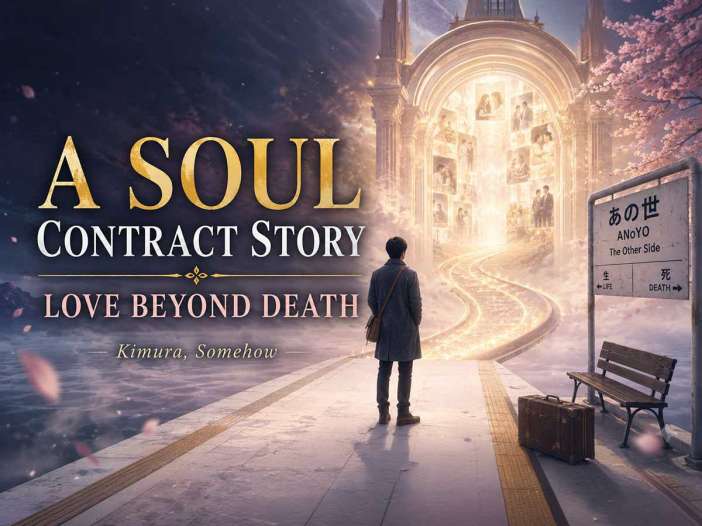
Main Introduction
What if the afterlife is not a courtroom, but a place where the soul finally sees the truth of its own life?
This story was inspired by the emotional heart of a Japanese afterlife tale known as Sanzu River Outlet Park, then reimagined through themes often connected with Dolores Cannon’s work: reincarnation, soul contracts, past life memories, the higher self, and healing after death.
In the original idea, souls prepare for their next life in a strange afterlife shopping place. They can choose beauty, talent, health, or life circumstances for the next incarnation. Yet beneath that unusual setting is a much deeper question:
What does the soul carry forward after death?
Kimura is a man who spent his life being misunderstood. People judged him by his eyes, his face, and his silence. Then one woman finally saw him with kindness. When her life was in danger, he made a desperate choice. He stole money to save her.
But in the afterlife, Kimura learns that the money he took was meant to save a sick child.
His love was real.
His mistake was real too.
This version of the story moves away from reward, punishment, and spiritual accounting. Instead, it asks what happens when a soul is invited to see everything: the pain it carried, the love it gave, the harm it caused, and the healing it still can choose.
There are no simple villains here.
There is a lonely man who wanted to save someone.
There is a sick woman who saw beauty in him.
There is a child who thought death would free his parents from pain.
There are grieving parents whose love remained after loss.
And there is a soul standing before the truth of all of it.
This is a story about reincarnation, karma, soul contracts, and love beyond death. But more than that, it is a story about the difference between choosing from guilt and choosing from love.
Kimura’s final choice is not made as punishment.
It is made as love.
And maybe that is why, many years later, when memory has faded and lives have changed, one name still rises quietly from the soul:
Kimura, somehow.
(Note: This is an imaginary conversation, a creative exploration of an idea, and not a real speech or event.)
A Sanzu River Outlet Park Story Reimagined Through the Eyes of the Soul
When Kimura opened his eyes, the first thing he noticed was the silence.
No pain.
No sirens.
No voices shouting his name.
Only white light.
He sat up slowly.
He was standing on what looked like a train platform. It was clean, quiet, and empty. There were no clocks on the wall. No ads. No schedule board. No sign telling him where the train was going.
Beyond the tracks, a pale mist glowed like morning fog.
Kimura looked down at his hands.
There was no blood.
No bruise.
No broken bones.
A moment ago, he remembered falling. He remembered running. He remembered the cold edge of the stairs beneath his shoes, then the sudden loss of balance.
Then nothing.
“Where am I?”
His voice sounded small in the stillness.
A voice answered from behind him.
“Kimura.”
He turned.
Someone stood there.
Kimura could not tell if the person was young or old, male or female. The face seemed to change whenever he tried to focus on it. Yet the eyes stayed the same.
Calm.
Kind.
Seeing everything.
Condemning nothing.
“Who are you?” Kimura asked.
“A guide.”
“A guide to where?”
“To the place where you can see what your life truly was.”
Kimura felt something tighten in his chest.
“My life?”
The guide gave a gentle nod.
“Am I dead?”
The guide did not speak at first.
The silence was answer enough.
Kimura lowered his eyes.
“So that’s it.”
Then, as memory rushed back, he lifted his head.
“The woman at the hospital. Did she make it?”
The guide looked at him with sorrow, not pity.
Kimura stepped closer.
“I sent the money. Five million yen. I sent it to the hospital. I told them to use it for her surgery. Please tell me she made it.”
The guide held out a hand.
“Come with me.”
Kimura did not want to move.
He wanted one answer.
One word.
Yes.
That was all he wanted.
But the guide only turned and walked into the white mist.
Kimura followed.
The platform faded behind them.
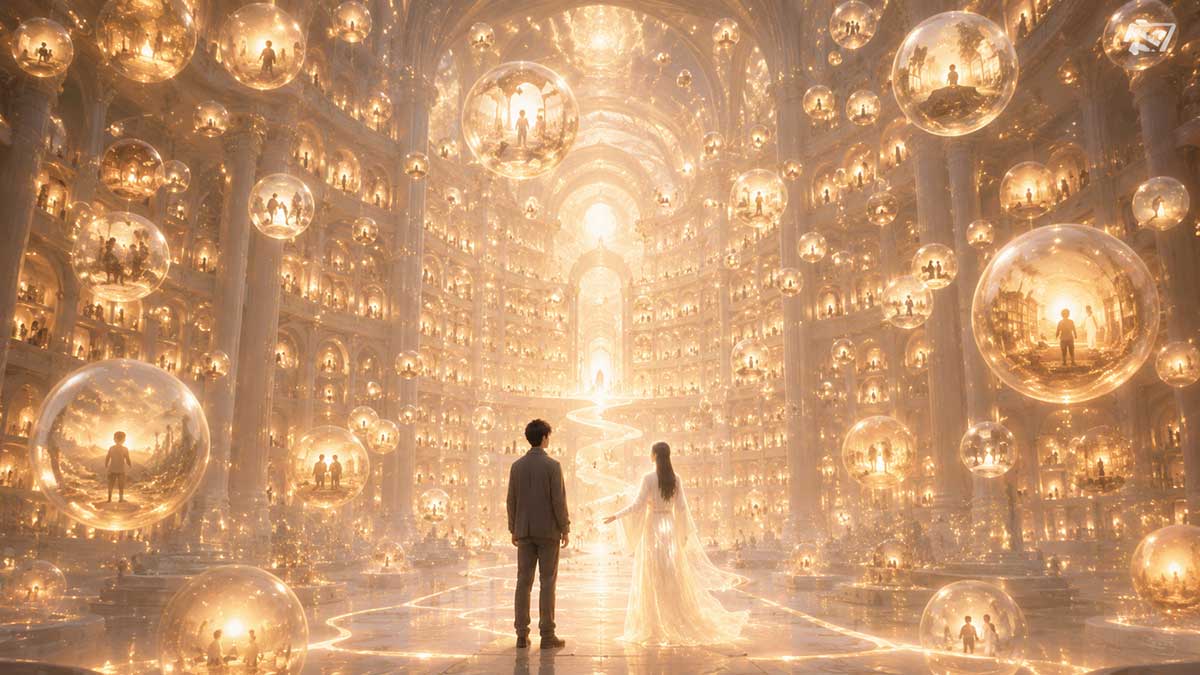
Ahead stood a vast building made of light.
It looked like a library, a chapel, and a hospital all at once. Its walls shimmered, not like stone, but like millions of memories softly breathing together.
Inside, countless glowing spheres floated in the air.
Some were small as fireflies.
Some were large as moons.
Each one pulsed with color and sound.
Kimura stared at them.
“What are these?”
“Lives,” the guide said. “Every soul carries the memory of what it chose, what it feared, what it loved, and what it left unfinished.”
Kimura gave a bitter laugh.
“My life isn’t worth looking at.”
The guide turned to him.
“There is no such thing as a worthless life.”
Kimura looked away.
The guide touched one of the spheres.
The air opened.
Kimura saw a classroom.
A boy sat alone at a desk.
The boy was Kimura.
He was small then. His shoulders were narrow. His hands were folded tightly on the desk as the other children whispered around him.
“Don’t look at me like that.”
“Why are you always mad?”
“His eyes are creepy.”
Little Kimura stared down at his notebook.
He did not argue.
He did not fight.
He simply learned to stop looking at people.
The scene changed.
Now Kimura was older, standing behind a counter at work.
He bowed to a customer.
“I’m sorry. I’ll check that for you right away.”
The customer frowned.
“What’s with that look?”
“I didn’t mean anything by it.”
“You’re staring at me like you want to start something.”
“No, sir. I’m sorry.”
“Get your manager.”
The scene changed again.
A job interview.
A train station.
A sidewalk.
Everywhere, the same thing.
His eyes made people afraid.
His silence made them suspicious.
His face became a crime before he ever committed one.
Kimura watched himself grow smaller year by year.
“I just wanted to live normally,” he whispered.
The guide said nothing.
“I wanted to talk to people. Smile at them. Be liked by someone. Just once.”
Another sphere opened.
A hospital garden appeared.

Kimura stopped breathing, though he no longer needed breath.
There she was.
She sat on a bench beneath pale spring blossoms, wearing soft pink hospital clothes. She was thin, but her smile carried warmth.
The kind of warmth Kimura had never known how to ask for.
“You came,” she said.
“I said I would.”
“You always look at the ground when you talk to me.”
“It’s a habit.”
“Do you hate looking at my face?”
“No.”
Kimura’s younger self panicked.
“No, that’s not it. I just… people say my eyes scare them.”
She leaned forward and looked directly at him.
Kimura turned away, but she smiled.
“I like them.”
He froze.
“What?”
“Your eyes. I think they’re kind.”
“No one’s ever said that to me.”
“Then I’m glad I got to be first.”
She laughed softly.
And in that laugh, something inside Kimura broke open.
Not in pain.
In relief.
For the first time in his life, someone had looked at him and had not turned away.
Kimura watched the memory with tears running down his face.
“She saved me,” he said.
The guide spoke quietly.
“You saved her too.”
“How?”
“Loneliness recognizes loneliness. You found each other in a place where both of you felt unseen.”
The garden faded.
Now Kimura stood in a hospital hallway.
He remembered this day.
A doctor was speaking to the woman’s mother.
“The surgery needs to happen soon.”
Her mother clutched her bag.
“How much?”
The doctor hesitated.
“Five million yen.”
The mother’s knees nearly gave out.
“Five million…”
Kimura stood around the corner, frozen.
He could hear her crying.
He could hear the doctor apologizing.
He could hear the sound of hope leaving the room.
“I had no money,” Kimura said.
His voice shook.
“I couldn’t borrow it. I couldn’t earn it in time. She was going to die, and I couldn’t do anything.”
The guide waited.
The next memory rose.
Night.
Wet streets.
Neon lights reflected in puddles.
Kimura walked alone, fists clenched, heart full of rage at God, at money, at himself.
A woman walked ahead of him, talking on her phone.
“Yes, I withdrew five million yen today. We leave for France tomorrow. I feel better carrying cash.”
Kimura stopped.
His mind split in two.
For her, it was a trip.
For him, it was a life.
His hands shook.
The woman laughed into the phone.
Kimura ran.
He grabbed the bag and kept running.
The woman screamed.
He did not turn back.
“Stop,” Kimura whispered to his own memory.
But memory does not stop.
He saw himself in a phone booth, voice trembling.
“Please use the money for her surgery. I can’t give my name. Just tell them it’s for her. Please.”
He hung up.
He stepped out.
A police officer called to him.
“Hey. You there.”
Kimura ran.
Down the stairs.
One wrong step.
One flash of white.
Then darkness.
Kimura dropped to his knees in the memory hall.
“I don’t regret trying to save her.”
The guide answered softly.
“Your love was real.”
Kimura looked up.
“But love does not erase what it touches.”
The guide placed another sphere before him.
Inside was a small home.
A boy lay in bed.
His arms were thin. His face was pale. On the wall above him was a poster of a baseball player swinging a bat.
The boy’s mother searched through papers on the kitchen table.
His father stood by the window, silent.
The boy spoke weakly.
“Mom, it’s okay.”
She forced a smile.
“What’s okay?”
“You don’t have to try so hard.”
“Don’t say that. We’re almost there. The surgery will happen.”
The boy looked at the baseball poster.
“Do you think I’ll get to play baseball in my next life?”
His mother turned away so he would not see her cry.
The phone rang.
His father answered.
His face changed.
“What do you mean it was stolen?”
The mother stared at him.
The father’s hand dropped.
“The money…”
The mother collapsed.
The boy stared at the ceiling.
Kimura could not move.
“No.”
The word left him like a wound.
“No, that money was for…”
The guide’s voice was gentle, but it cut deeply.
“You heard part of a story. You acted as if it were the whole story.”
Kimura covered his face.
“That was his money?”
“It was his hope.”
Kimura fell forward, shaking.
“I stole his life.”
“You stole the chance his family had been holding onto. His pain, and yours, became tied together that night.”
“I didn’t know.”
The guide did not accuse him.
Kimura wished he would.
“I didn’t know,” Kimura said again, but this time the words sounded useless.
The scene changed.
A white room appeared.
The boy sat alone in the corner, knees pulled to his chest.
He looked lost.
Not punished.
Lost.
Kimura approached him slowly.
“Hey.”
The boy looked up.
“Who are you?”
Kimura could barely answer.
“My name is Kimura.”
“Is this heaven?”
“I don’t know.”
The boy looked down.
“I think I died.”
Kimura sat beside him.
The boy’s voice was small.
“I thought Mom and Dad would be better without me.”
Kimura closed his eyes.
The guide knelt near the boy.
“You felt like a burden.”
The boy nodded.
“They spent everything on me. Mom cried at night. Dad worked all the time. I thought if I left, they could rest.”
The guide reached out.
“Would you like to see what happened after you left?”
The boy shook his head.
“No.”
“Sometimes the truth hurts. Yet love can be found there too.”
The walls of the white room became transparent.
The boy saw his mother holding his empty pillow and crying into it.
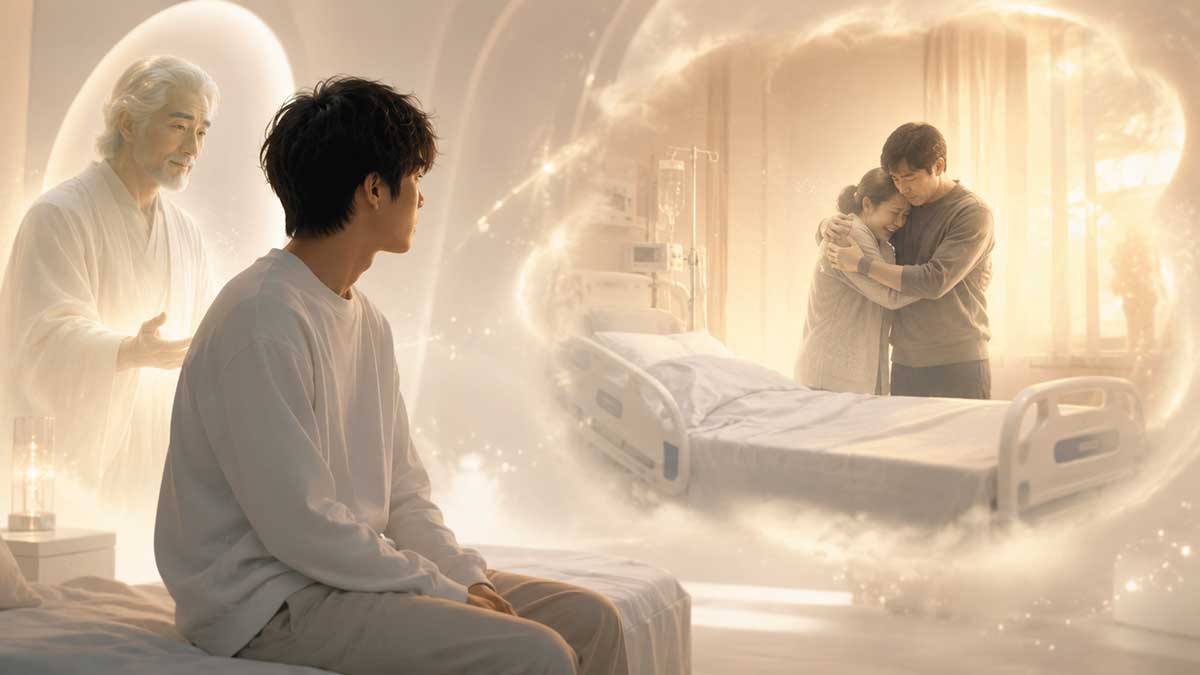
“Why didn’t you tell me? Why did you decide alone?”
His father sat in the hallway with the boy’s baseball glove in his hands.
“I could have found more money,” he whispered. “Money can come back. You can’t.”
The boy’s face twisted in pain.
“No…”
His mother cried his name again and again.
The boy began to sob.
“I thought they’d be free.”
The guide placed a hand on his shoulder.
“You were in pain so deep that you could not see their love clearly. Your death did not end their suffering. It changed its shape.”
The boy covered his face.
“I’m sorry. I’m sorry.”
Kimura could not bear it.
“I’m sorry too.”
The boy looked at him.
Kimura bowed his head to the floor.
“I’m the one who stole the money from your mother.”
The room went still.
The boy stared at him.
Kimura could not lift his face.
“I didn’t know it was for you. I thought it was for a vacation. I used it for someone I loved. I thought I was saving her. But I hurt you. I hurt your parents. I am so sorry.”
The boy was silent for a long time.
Then he asked, “Did she live?”
Kimura swallowed.
“I don’t know.”
The boy looked away.
“Everyone wanted someone to live.”
That sentence broke Kimura.
He had no defense left.
No excuse.
Only sorrow.
Then another voice spoke.
“Kimura.”
He turned.
She stood there.
The woman from the hospital garden.
Not in pink patient clothes now.
She wore white, and light moved around her like dawn.
Kimura stood.
“No.”
She smiled sadly.
“I’m sorry.”
“You were supposed to live.”
“The surgery happened. My body was too tired.”
Kimura stepped back.
“Then I did all that for nothing.”
She came closer.
“Not for nothing.”
“I stole from a sick child. You still died. I ruined everything.”
She took his hand.
“Kimura, you loved me.”
“I loved you wrong.”
“Yes.”
The honesty of that word struck him.
She held his hand tighter.
“But you loved me.”
Kimura shook his head.
“Please hate me.”
“I can’t heal you by hating you.”
“I don’t deserve healing.”
She looked into his eyes, the same eyes the world had feared.
“Who told you that?”
He had no answer.
The boy watched them, tears on his cheeks.
“I want to live again,” the boy said.
Kimura and the woman turned to him.
The boy wiped his face.
“I don’t want to run away next time. I want to ask for help. I want to play baseball. I want to run. I want to know what it feels like to finish a life instead of leaving it.”
The guide smiled softly.
“That is your next lesson.”
The room dissolved into light.
They found themselves standing in a circular space beneath a sky full of stars.
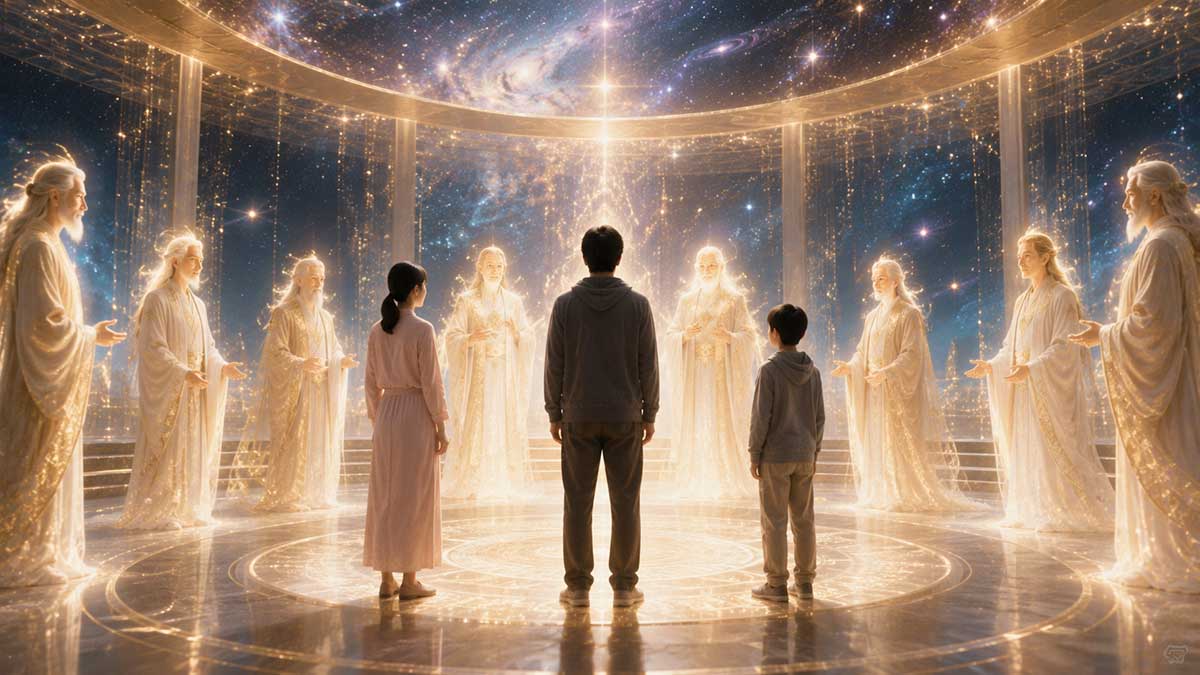
Around them were beings made of light.
No thrones.
No judge’s bench.
No hammer waiting to fall.
Only presence.
Kimura trembled.
“Is this where I’m judged?”
A voice answered from the light.
“You are here to see. Judgment is not needed when truth is fully seen.”
“But I committed a crime.”
“Yes.”
“I hurt people.”
“Yes.”
“I should be punished.”
The light grew warmer.
“Punishment may teach fear. Truth can teach love.”
Kimura’s eyes filled again.
“What am I supposed to do?”
The light answered, “Choose from what you now understand.”
The woman spoke.
“Can we meet again?”
The light turned to her.
“Love creates pathways. Souls find one another in many forms.”
Kimura looked at her.
He wanted to say, Let me be born with you.
He wanted to say, Let us be ordinary.
Let us meet at a grocery store.
Let us sit across from each other at a diner.
Let us live in a world where no one is sick, no one is desperate, no one has to steal time from death.
But then he looked at the boy.
The boy who wanted to run.
The boy who wanted to swing a bat.
The boy whose parents had loved him past exhaustion.
Kimura lowered his head.
“What if my next life could help them?”
The woman’s grip tightened.
“Kimura.”
He looked at the light.
“The boy needs a body that can run. He needs strength. He needs the life he never got to finish.”
The boy stared at him.
“And she…”
Kimura looked at the woman.
“She gave me the only eyes that ever saw me kindly. Give her eyes that bring peace to people. Eyes that can see pain without turning away.”
The woman shook her head.
“No. Don’t do this out of guilt.”
The light asked, “Is this punishment you are choosing?”
Kimura closed his eyes.
He searched himself.
At first, he found self-hatred.
I don’t deserve to be human.
I don’t deserve happiness.
I don’t deserve her.
But beneath that, deeper down, he found something quieter.
Not hatred.
Not escape.
Love.
He opened his eyes.
“No,” he said. “If I choose it as punishment, then I am still thinking only about myself.”
He looked at the woman.
“I choose it as love.”
She began to cry.
“What will happen to you?”
Kimura looked into the light.
“Let me be something small. Something near them. Something that asks for nothing.”
A vision appeared.
A tiny insect on a blade of grass.
Rain above it.
Moonlight around it.
A short life.
A fragile life.
A life no one would praise.
Kimura gazed at it for a long moment.
Then he smiled through tears.
“Even that life has sky.”
The boy began to cry again.
“I don’t know if I can forgive you.”
Kimura knelt before him.
“You don’t have to. Not today.”
“But I feel… thankful too. Is that wrong?”
“No.”
Kimura placed a hand over his heart.
“Live next time. Not for me. Not for your parents. For you. And when it gets hard, say it out loud. Ask for help. Promise me.”
The boy nodded.
“I promise.”
The woman stepped close to Kimura.
“I don’t want to forget you.”
“You might.”
“I don’t want to.”
“Then remember this feeling.”
She touched his face.
“Your eyes,” she whispered. “I still love them.”
Kimura laughed softly through his tears.
“You always were strange.”
She smiled.
“So were you.”
The light around them grew brighter.
The boy’s form began to fade first.
He looked suddenly peaceful.
“I’m going to run,” he said.
Kimura nodded.
“Run hard.”
Then the woman began to fade.
She reached for Kimura, and he reached for her.
“Will I find you?”
Kimura answered, “Maybe not with your mind.”
“With what, then?”
“With whatever part of you knew my name before you heard it.”
She held his gaze.
“Kimura…”
He smiled.
“Somehow.”
The light took them.
Years passed on Earth.
A woman with rare green eyes stood in a small apartment at night, washing dishes after dinner.
The television was on in the living room.
Her husband stood near the window.
“Bug got in.”
He picked up a tissue.
“Wait,” she said.
“It’s just a bug.”
She dried her hands and walked over.
“Let it outside.”
He shrugged.
“If you say so.”
She cupped her hands gently around the tiny insect.
For one second, something moved inside her chest.
Not a memory.
Not exactly.
More like a feeling from a dream she had forgotten.
Tenderness.
Grief.
Gratitude.
On the television, a baseball player was being interviewed after a big game.
The reporter asked, “What kept you going all these years?”
The player laughed shyly.
“This may sound weird, but ever since I was a kid, whenever I ran, I felt like someone was telling me, ‘Live. Keep going.’ I never knew who it was. I just felt it.”
The woman looked at the screen.
Then at the insect in her hands.
Tears came to her eyes.
Her husband frowned.
“Are you okay?”
She nodded.
“I don’t know why I’m crying.”
She opened the window.
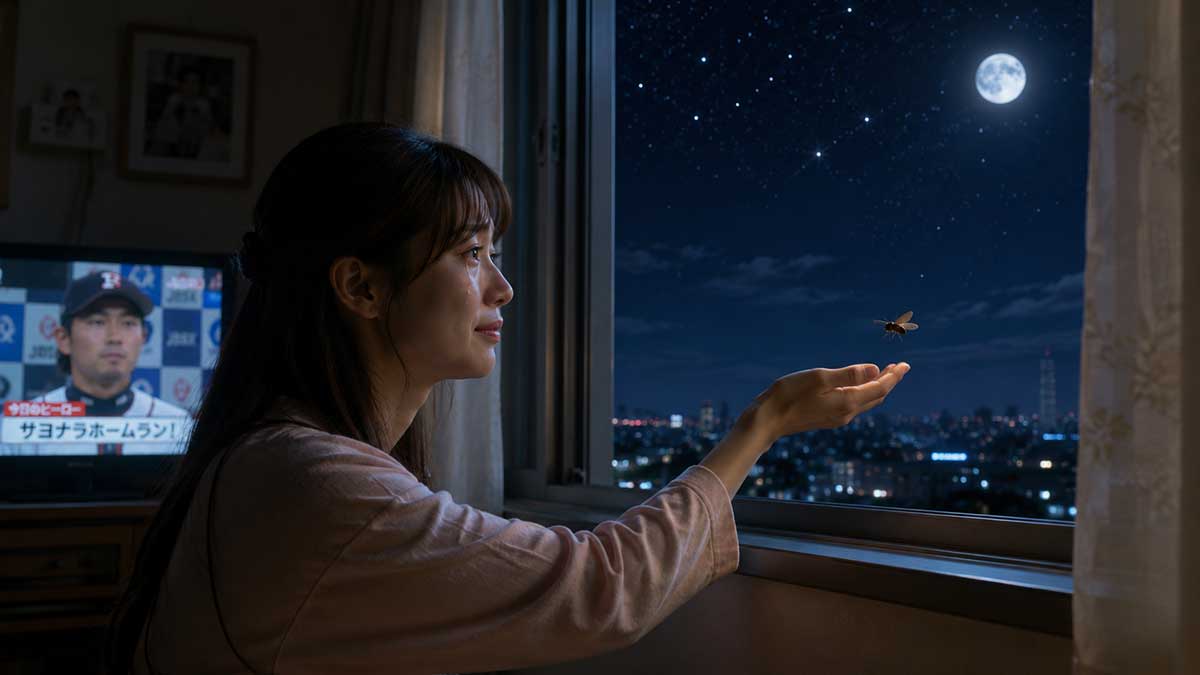
Night air drifted in.
The stars were faint above the city.
She lifted her hands and released the insect into the dark.
It rose, small and almost invisible.
Yet for a moment, under the moonlight, it looked like a spark.
The woman whispered, “Thank you.”
Then, without knowing why, she said another name.
“Kimura.”
Her husband turned.
“What?”
She smiled through tears.
“Nothing. It just came to me.”
Outside, the insect vanished into the night.
The woman stayed by the window a little longer.
She did not remember the white station.
She did not remember the hall of glowing memories.
She did not remember the promise made before birth.
But somewhere deeper than memory, something in her knew.
A life had been given.
A debt had been healed.
A love had kept its shape, even after changing form.
And under the quiet night sky, she whispered once more.
“Kimura… somehow.”
Final Thoughts
Kimura’s story stays with us because it does not offer easy answers.
He did something wrong.
He did it for love.
He caused pain he never meant to cause.
Then, after death, he was asked to see the whole truth.
That is what makes this story feel so human.
Most people want to believe their good intentions are enough. But life is rarely that simple. Love can still wound. Sacrifice can still have consequences. A desperate act can save one person’s hope and destroy another’s.
Yet this story does not leave Kimura trapped in shame.
The afterlife shown here is not cold or mechanical. It is not a place where souls are simply labeled good or bad. It is a place where the soul is asked to see clearly.
The boy’s story may be the most tender part. He believed his death would release his parents from suffering. But in the soul’s healing space, he sees that his parents did not need freedom from him. They needed him. They loved him beyond money, sickness, fear, and exhaustion.
His regret is not treated as condemnation. It becomes the beginning of healing.
The woman’s role is just as deep. She is the first person who looks at Kimura without fear. Her words, “I like your eyes,” become the first mercy he ever receives. In the next life, those eyes return as a gift, not as beauty alone, but as the ability to see pain with compassion.
Kimura’s choice to become a small insect could be read as tragic. But in this version, it is something more sacred. He is not saying, “I deserve less.” He is saying, “Let my life become a gift.”
That is the turning point.
Guilt says, “I should suffer.”
Love says, “Let me serve.”
In the final scene, the woman does not remember everything with her mind. She does not know the white station, the hall of soul memories, or the promise made before birth. But something deeper than memory recognizes the tiny life in her hands.
She releases it into the night.
And without knowing why, she whispers his name.
Kimura.
Somehow.
That is the beauty of this story.
Maybe the soul remembers what the mind forgets.
Maybe love keeps its shape, even after death.
Maybe reincarnation is not just another life, but another chance to heal what love could not finish.
Short Bios:
Kimura
Kimura is a lonely man who spent most of his life being judged by his appearance. His sharp eyes made others fear him, even when his heart was gentle. After falling in love with a sick woman, he steals money to pay for her surgery, only to learn after death that the money had belonged to another sick child’s family. In the afterlife, Kimura faces the full truth of his choice and decides to offer his next life as an act of love.
The Woman
The woman is the first person who sees Kimura without fear. She tells him that she likes his eyes, giving him a kind of healing he had never known. After death, she meets Kimura again and learns both the love and pain behind his final act. In her next life, she carries the gift of gentle green eyes, a symbol of compassion, soul memory, and love that survives beyond one lifetime.
The Boy
The boy is a sick child who dreams of playing baseball. In life, he believes his illness is a burden to his parents, so he ends his own life thinking it will free them. In the afterlife, he sees their grief and realizes that his death did not release them from pain. His next life becomes a chance to learn how to live fully, ask for help, and experience joy through the body he once longed to have.
The Guide
The guide is a compassionate presence who leads Kimura through the afterlife. This figure does not accuse or punish. Instead, the guide shows Kimura the memories, choices, and consequences that shaped his life. Through the guide, Kimura learns that truth can be painful, yet it can open the door to healing when faced with courage.
The Council of Light
The Council of Light represents a higher spiritual presence that helps souls review their lives and choose their next lessons. They do not function as judges. They help each soul see what remains unfinished. Their central question to Kimura is whether his choice comes from punishment or love.
Kimura’s Next Life
Kimura’s next life as a small insect is the quiet final symbol of the story. It is not a demotion or spiritual rejection. It is a humble form chosen through love. In that small life, Kimura stays near the souls he once hurt and loved, carrying a silent promise that healing can continue, even in the smallest forms of life.
Leave a Reply