
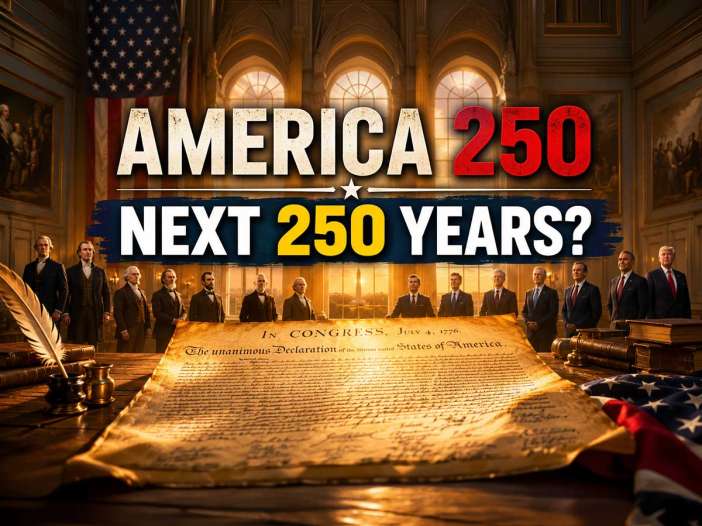
What if America’s next 250 years depend less on perfect presidents and more on citizens who still believe self-government is worth the work?
America’s 250th anniversary is more than a national celebration. It is a question.
Can a republic born from the Declaration of Independence still renew itself after 250 years of conflict, correction, sacrifice, achievement, and unfinished promise?
The Founders did not create a flawless nation. They began an experiment in self-government. They placed a bold claim before history: government receives its just authority from God-given rights and the consent of the governed.
That claim has tested every generation since.
Presidents have carried that test in different ways. Some helped begin the republic. Some held it together through war. Some led through depression, scandal, distrust, reform, prosperity, fear, and global crisis. Some spoke of liberty. Some spoke of justice. Some spoke of service. Some spoke of strength. Some spoke of national renewal.
In this Imaginary Talk, presidents from different eras gather across time to ask one shared question:
What must Americans recover if the next 250 years are to be marked by hope rather than division?
This conversation is not left against right. It is not a courtroom for the past, nor a campaign speech for the present. It is a conversation about self-government, citizen authority, public responsibility, national confidence, and renewal.
It asks how Americans can honor the Declaration without turning it into a museum. It asks how leaders can serve without pride. It asks how disagreement can remain loyal to the republic. It asks how citizens who feel unheard can be respected, and how public concern can become reform rather than resentment.
America’s story has always been larger than one president, one party, one crisis, or one generation. Its future will depend on citizens who still believe self-government is worth the work.
The next 250 years will not write themselves.
They will be written by the courage, accountability, faith, service, confidence, and character of the people who inherit the promise.
(Note: This is an imaginary conversation, a creative exploration of an idea, and not a real speech or event.)
Topic 1: The Courage to Begin Again
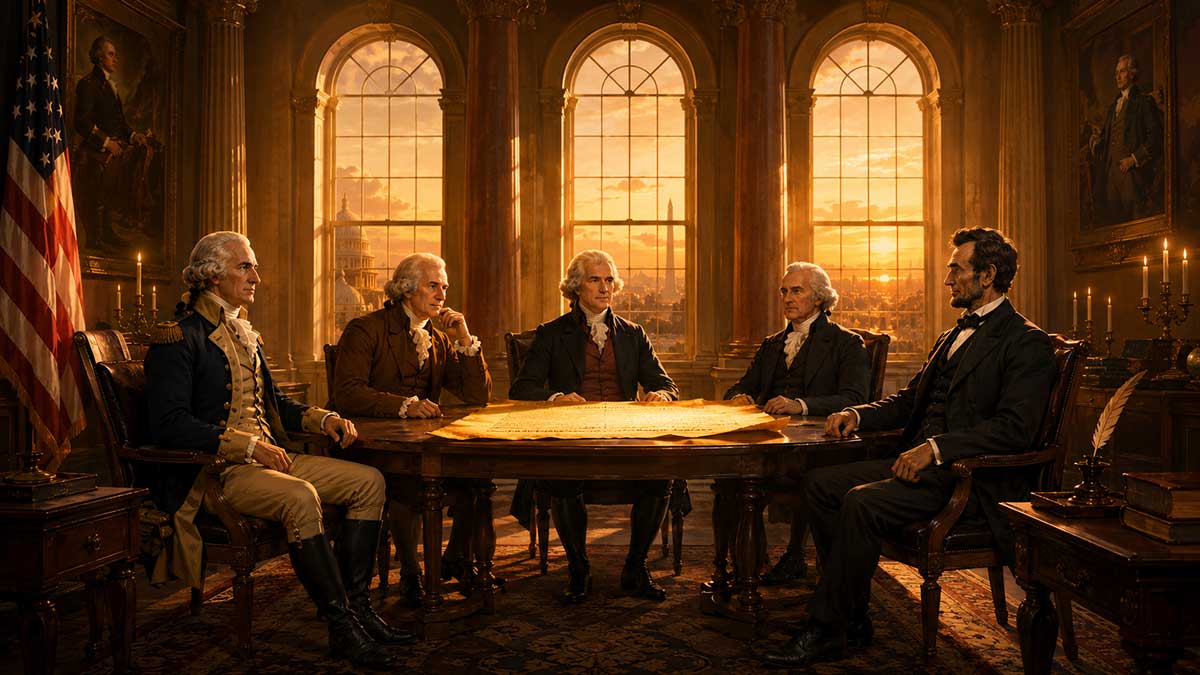
Guests:
George Washington
John Adams
Thomas Jefferson
James Madison
Abraham Lincoln
Opening
Abraham Lincoln:
A nation does not begin only once. It begins again whenever its people return to the promise that gave it birth.
The Declaration was not merely a parchment in Philadelphia. It was a claim about human dignity, government, responsibility, and hope. It said liberty was not a favor granted by rulers. It said the people themselves carry sacred authority.
Yet no generation receives that promise in finished form. The Founders began it. Later generations defended it, corrected it, argued over it, expanded it, and handed it forward.
Tonight, we do not gather to worship the past. We gather to ask whether America still has the courage to renew the promise of self-government.
Can a free people begin again?
Question 1: What kind of courage does a nation need when its future is uncertain?
George Washington:
A nation needs the courage to act before the result is known. In my time, certainty was a luxury we did not possess. We had supplies one month and hunger the next. We had victories that gave hope and defeats that tested the soul.
Courage is not noise. It is steadiness under pressure. It is the citizen who stays faithful to the country when public life becomes hard. It is the leader who turns fear into courage, and public concern into service.
If America wants another 250 years, it must recover calm courage. Not panic. Not despair. Not contempt for fellow citizens. A republic cannot be held together by excitement alone. It needs character strong enough to endure hard seasons.
Thomas Jefferson:
Courage requires imagination. Those who signed the Declaration had to see a country that did not yet exist. They had to believe that people could govern themselves before history had given proof that it would work.
That is the challenge in every age. America must never become a nation that only asks, “What are we losing?” It must ask, “What can still be built?” The future belongs to people who can picture liberty, responsibility, and renewal before those things are fully visible.
Yet imagination must be joined to humility. The words we wrote were greater than the men who wrote them. That should not make the words weaker. It should make each generation more responsible for them.
John Adams:
I would add that courage requires moral seriousness. Liberty is often celebrated as if it were ease. It is not. Liberty requires citizens who read, argue, vote, listen, serve, and restrain themselves.
A frightened people may surrender liberty too quickly. An angry people may use liberty carelessly. A lazy people may forget liberty altogether.
The courage America needs is civic courage. It is the willingness to take part in public life without giving up honesty, faith, gratitude, or respect for the country itself.
James Madison:
The courage of a republic is constitutional, too. People speak warmly of freedom, but freedom needs structure. It needs laws. It needs limits. It needs a system that respects both human dignity and human weakness.
Citizens in every age may be tempted to seek shortcuts when the country feels urgent. The answer is not weakness, but constitutional courage.
A republic must be strong enough to act, and wise enough to restrain itself. It must let the people speak, and it must build institutions that turn public will into lawful action.
Abraham Lincoln:
I learned that a nation may face a question so severe that delay becomes impossible. Yet even then, the purpose must be higher than one election, one argument, or one season of victory.
Courage is not merely refusing to bend. Sometimes it is bending one’s pride so the nation does not break. Sometimes it is speaking hard truths without hatred. Sometimes it is carrying grief without giving up hope.
America’s future will require that kind of courage again.
Question 2: How can Americans recover gratitude for liberty without turning the past into a museum?
John Adams:
Gratitude must be active. If citizens only admire the past, they become spectators. The Founding was not written for spectators. It was written for people willing to govern themselves.
Teach children the cost of liberty, yes. Tell them of sacrifice, argument, risk, faith, and duty. Yet never teach them that the work is finished.
A museum preserves artifacts. A republic preserves responsibility.
The Fourth of July should not merely produce fireworks. It should produce citizens.
James Madison:
Gratitude must become practice. A person may praise the Constitution and still ignore the habits that make constitutional life possible. A people may praise free speech and still refuse to hear one another. They may praise elections and still dismiss citizens who vote differently.
Gratitude for liberty means protecting the rules even when they slow one’s own side. It means accepting that self-government can be slow, frustrating, imperfect, and still worth preserving.
The past should instruct the present, not freeze it.
Thomas Jefferson:
I agree that the past must not become a shrine that forbids correction. Love of country is not denial. It is devotion. A devoted people can say, “This was noble,” and can say, “This was unfinished.”
A nation that cannot confess its failures cannot grow. A nation that cannot honor its achievements cannot stand. America needs both memory and aspiration.
Let the Declaration be read not as a relic, but as a mirror. Let each generation ask, “Do we still believe this? And if we do, what must we build now?”
George Washington:
Gratitude must be tied to conduct. One may salute the flag and still weaken the republic through selfishness, dishonor, or contempt for civic duty. Symbols matter, but symbols must call forth discipline.
When I left office, I hoped the country would learn that personal ambition must yield to the larger good. That lesson remains necessary for every party, every president, every citizen, and every generation.
A grateful citizen does not merely demand rights. A grateful citizen protects the conditions that allow rights to endure.
Abraham Lincoln:
The past becomes a museum when people visit it, admire it, and leave unchanged. The past becomes living memory when it asks something of us.
The Declaration asked my generation whether a nation conceived in liberty could survive. It asks each later generation a related question: Can liberty survive comfort, division, mistrust, and forgetfulness?
Gratitude is not nostalgia. Gratitude is the decision to become worthy of what was handed down.
Question 3: What does the Declaration still ask from ordinary citizens today?
Thomas Jefferson:
It asks them to remember that government is not above them. It is accountable to them. The people are not guests in their own country. They are the source of just authority.
Yet that truth carries duty. The Declaration gives citizens dignity, and dignity carries responsibility. It asks citizens to think, not merely react. It asks them to care for truth, not merely victory. It asks them to see political opponents as fellow citizens, not strangers to the nation.
The consent of the governed is not a slogan. It is a daily test of civic maturity.
Abraham Lincoln:
It asks ordinary citizens to widen the meaning of “all.” The great words of the Declaration have always judged the nation that spoke them. That judgment need not lead to shame alone. It can lead to renewal.
Each generation must ask who has been unseen, unheard, forgotten, or dismissed. Then it must ask how justice can be pursued without breaking the bonds of common life.
The Declaration asks Americans to keep faith with both liberty and union.
George Washington:
It asks citizens to place country above faction. Parties may exist. Arguments may be necessary. Strong views may be honorable. Yet attachment to the republic must remain greater than attachment to any political camp.
Ordinary citizens preserve the country through ordinary virtues: honesty, patience, gratitude, courage, work, restraint, respect for law, and love of country. These do not always make headlines, but they hold the nation together.
America’s next 250 years will not be saved only in capitals. They will be shaped in homes, schools, churches, neighborhoods, local businesses, and communities.
James Madison:
It asks citizens to understand that liberty is protected by both energy and limits. A free people should expect government to act when the people give it lawful direction. Yet they should also respect the guardrails that keep authority answerable.
The genius of the American system is not that it assumes perfect leaders. It assumes human weakness and builds restraints around it. Citizens should not curse those restraints only when they slow their own side. The same guardrails that frustrate us today may protect us tomorrow.
The Declaration gives the purpose. The Constitution gives the structure. Citizens give both life.
John Adams:
It asks for virtue. That word may sound old, but no republic survives without it. If citizens become dishonest, careless, or addicted to resentment, no document can rescue them.
Ordinary citizens must become the kind of people freedom requires. Parents must teach it. Teachers must explain it. Leaders must model it. Neighbors must practice it.
America’s hope is not found only in famous names. It is found in millions of citizens choosing duty when cynicism would be easier.
Closing
Abraham Lincoln:
The courage to begin again is not the courage of forgetting. It is the courage of remembering rightly.
America began with words that reached beyond the men who wrote them. It survived through sacrifice, correction, conflict, mercy, faith, and the stubborn belief that self-government was worth preserving. Its story has never been pure, but it has never been empty. The promise remains, calling each generation to rise.
If the next 250 years are to be marked by hope, citizens must carry more than opinions. They must carry responsibility. They must disagree without losing the country. They must honor liberty without making it selfish. They must seek justice without surrendering union. They must turn public concern into reform, and reform into renewal.
A republic is never kept by memory alone. It is kept by the living.
And so the question returns to us: Will America merely celebrate its beginning, or will it find the courage to begin again?
Topic 2: Self-Government Is a Daily Responsibility
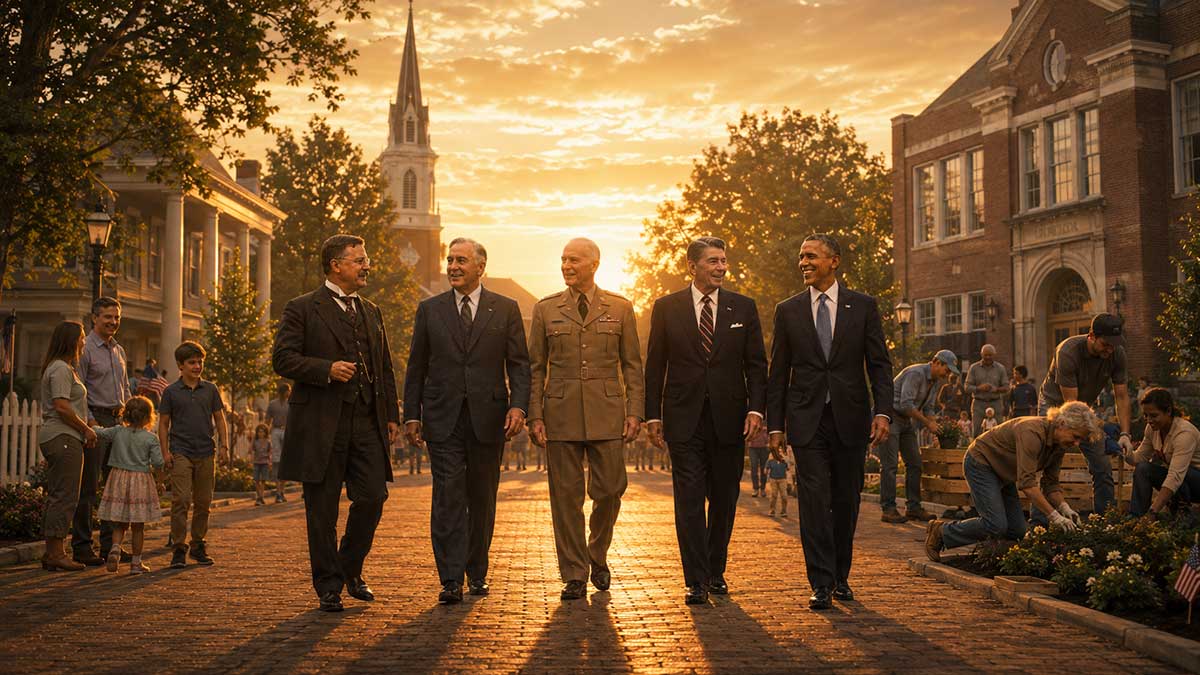
Guests:
Theodore Roosevelt
Franklin D. Roosevelt
Dwight D. Eisenhower
Ronald Reagan
Barack Obama
Opening
Dwight D. Eisenhower:
Self-government is often spoken of as a right, and rightly so. Yet it is also a discipline.
A free nation cannot live by speeches alone. It needs citizens who show up, parents who teach, workers who serve, leaders who listen, neighbors who help, and voters who take their duty seriously.
Across America’s history, each generation has faced a different test. Some faced war. Some faced depression. Some faced distrust. Some faced cultural change. Some faced the fear that ordinary citizens were losing their voice.
Yet the question beneath every test has remained the same: Can free people govern themselves with enough wisdom, courage, and restraint to pass liberty forward?
Tonight, we ask what daily habits can keep America free for another 250 years.
Question 1: What habits must citizens practice if self-government is going to last?
Theodore Roosevelt:
A republic needs citizens with backbone. I do not mean loudness. I mean moral stamina. A free people must be willing to work, serve, sacrifice, and tell the truth.
Citizenship is not a spectator sport. It is not enough to complain about public life from a distance. A citizen must enter the arena in some form: local service, school boards, charities, churches, town meetings, military service, honest work, and the training of young people.
A nation becomes soft when comfort becomes its highest aim. Liberty needs strength. It needs men and women who can master themselves before they demand that others change.
Ronald Reagan:
A habit America must recover is cheerful responsibility. Freedom does not mean waiting for distant authority to solve every problem. It means believing that families, communities, businesses, churches, charities, and local citizens can do remarkable things.
The country is at its best when people say, “What can I do?” rather than, “Who can I blame?”
Citizens who feel forgotten should not be dismissed as dangerous. Their frustration is often a signal that self-government must listen better. A confident republic hears those voices and turns concern into reform.
Hope is not pretending trouble does not exist. Hope is acting as if tomorrow can be improved by what we do today.
Franklin D. Roosevelt:
Citizens must practice courage over fear. Hard times can make people feel alone. They can make families wonder whether anyone in authority sees their struggle.
During crisis, people need confidence from leaders, but they also need confidence in one another. A worker must believe that his labor has dignity. A family must believe that tomorrow can be better. A citizen must believe that public life is not hopeless.
Self-government lasts when people refuse to let hardship rob them of courage.
Barack Obama:
Citizens must practice listening. Democracy asks us to recognize that the person on the other side of an argument may still love the country.
We do not need everyone to agree. We do need enough people willing to hear the human story beneath the political label. A republic weakens when any group of citizens is reduced to a label instead of heard as neighbors.
The habit of listening does not weaken conviction. It deepens wisdom.
Dwight D. Eisenhower:
Citizens must practice patience and teamwork. Great nations are not held together by impulse. They are held together by trust, duty, and institutions that outlast any single moment.
In war, I learned that teamwork can accomplish what pride cannot. The same is true in peace. Citizens must accept that no one person, party, movement, or generation owns the country.
Self-government lasts when citizens think beyond themselves.
Question 2: How can national confidence return without pretending the country has no problems?
Ronald Reagan:
Confidence comes when we remember that America is not just a government. It is a people.
The most hopeful things in the country are often quiet: a father working late, a mother teaching a child, a small business opening its doors, a veteran serving after service, a volunteer helping a stranger, a church feeding a family.
If Americans only look upward to Washington, they may miss the strength around them. National renewal often begins at kitchen tables, in neighborhoods, in local churches, and in small acts of courage.
The future is not built by cynicism. It is built by people who still believe effort matters.
Franklin D. Roosevelt:
Confidence returns when people see action joined to honesty. In a crisis, false comfort fails. People can bear difficult truth when they believe leaders see them, respect them, and are willing to act.
A nation must name its problems clearly: economic fear, loneliness, mistrust, broken communities, lost faith in institutions, and the feeling that many citizens have been ignored.
Yet naming problems is not surrender. America has never been free from trouble. Its greatness has often appeared through its response.
Theodore Roosevelt:
Confidence must be earned through action. I have little patience for empty optimism. A nation that wants confidence must confront corruption, cowardice, and selfishness wherever they appear.
Yet criticism must be tied to service. If you see weakness, strengthen something. If you see injustice, help correct it. If you see decay, build.
The critic who does nothing becomes part of the decay. The citizen who acts becomes part of renewal.
Barack Obama:
Confidence returns when Americans can tell a truer story about themselves. A story that admits pain, honors progress, and invites participation.
Some people fear that acknowledging mistakes weakens national pride. I believe honest memory can make pride more mature. We can love the country, protect its promise, and still repair what needs repair.
Hope is strongest when it has room for gratitude, responsibility, and courage.
Dwight D. Eisenhower:
Confidence requires steadiness. A free nation must resist the habit, on every side, of treating every disagreement as the end of the republic.
The people must learn again how to breathe as a country. Debate fiercely, yes. Vote seriously, yes. Demand accountability, yes. Then continue the work of living together.
A free nation must not exhaust itself with permanent panic.
Question 3: What should presidents teach citizens about duty, service, and sacrifice?
Theodore Roosevelt:
A president should teach that comfort is not the highest American virtue. The country needs citizens who can endure difficulty, take responsibility, and live with honor.
I would tell Americans: do not wait for perfect conditions before doing your duty. Serve where you stand. Begin with your own home, your own street, your own town, your own work.
The republic is strengthened by citizens who take pride in doing hard things well.
Ronald Reagan:
A president should remind citizens that freedom is a gift received from others and a gift owed to the future. We did not create America by ourselves. We inherited it.
That inheritance asks something of us. It asks parents to raise children with gratitude. It asks citizens to defend liberty with good character. It asks leaders to speak in a way that lifts the country rather than shrinks it.
A president should make people believe their own lives matter to the story of America.
Dwight D. Eisenhower:
A president should teach humility. The office is powerful, but the republic is greater than the office. No president should confuse personal success with national renewal.
Service means accepting limits. It means working with people you may not prefer. It means protecting institutions that may frustrate you. It means remembering that the uniform, the office, and the title are never greater than the country.
Duty is doing necessary work without demanding constant praise.
Franklin D. Roosevelt:
A president should teach that sacrifice is shared. In hard times, citizens need to know they are not alone. The wealthy, the poor, the young, the old, the farmer, the worker, the soldier, the teacher — all belong to the same national family.
A country cannot ask sacrifice from only one group and call that unity. It must ask each person to carry what he or she can.
Service becomes noble when it is shared.
Barack Obama:
A president should teach citizens to see themselves in one another. Duty is not only military service or public office. It can be mentoring a child, caring for an elderly parent, voting with care, forgiving a neighbor, or refusing to spread something false.
Sacrifice sometimes means giving up the pleasure of contempt. It means choosing a bigger “we” when a smaller circle feels easier.
That may be one of the quiet sacrifices America needs most.
Closing
Dwight D. Eisenhower:
Self-government is not kept alive by grand anniversaries alone. It is kept alive by daily discipline.
America’s next 250 years will depend on citizens who remember that freedom is both blessing and burden. It will depend on leaders who serve without worshiping themselves. It will depend on families, schools, communities, churches, veterans, workers, and local institutions that teach young people how to be free without becoming selfish.
The presidents gathered here came from different eras, different parties, and different trials. Yet each one learned that a republic cannot run on slogans forever. It must be renewed by habit.
If Americans want hope, they must practice hope. If they want unity, they must practice respect. If they want liberty, they must practice responsibility. If they want government to listen, citizens must speak, organize, vote, build, and serve.
The next 250 years begin not only in Washington, but wherever a citizen chooses duty over despair.
Topic 3: Dialogue Over Chaos
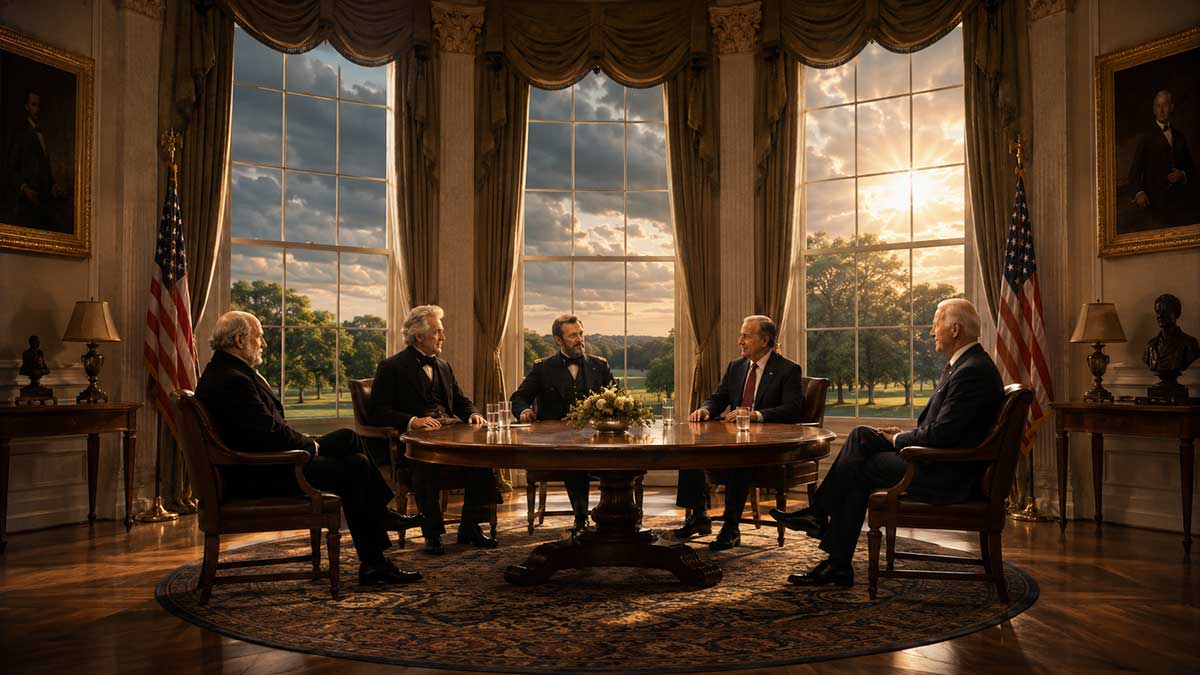
Guests:
John Quincy Adams
Andrew Jackson
Ulysses S. Grant
Gerald Ford
Joe Biden
Opening
Gerald Ford:
A republic is tested not only by war, poverty, or outside enemies. It is tested when citizens feel unheard, wounded, or divided.
America has always argued. The question is whether argument can remain faithful to the country. Can citizens disagree strongly without treating one another as enemies? Can leaders win without forgetting those who did not support them? Can a nation wounded by suspicion find its way back to trust?
I became president at a time when faith in government had been badly shaken. The country needed calm, truth, and a chance to breathe again.
Tonight, we ask whether America can choose dialogue over chaos, not as weakness, but as a deeper form of strength.
Question 1: How can Americans argue with passion but still protect the country they share?
John Quincy Adams:
Americans must remember that speech is not merely a weapon. It is a trust. Free people must be able to speak plainly, yet plain speech should still answer to conscience.
I spent many years in fierce public argument. I knew the sting of opposition, the pride of conviction, and the loneliness of unpopular causes. Yet I came to believe that a citizen must speak with a mind fixed on truth, not applause.
The country is protected when citizens argue as if tomorrow they must still live together. Passion can serve liberty. Contempt poisons it.
Andrew Jackson:
The people have a right to be heard. That must never be forgotten. When ordinary citizens feel ignored, anger grows. That anger can be dangerous, but it can also reveal that something in the system has grown distant.
The answer is not to silence the people. The answer is to listen with respect, then lead with firmness. A republic belongs to its citizens, not to a small circle of insiders.
Yet the people must guard their own hearts, too. Frustration may open the door to reform, but it cannot become the house we live in.
Ulysses S. Grant:
I saw what happens when disagreement turns into war. No argument in a republic is worth losing the republic itself.
The habit Americans need is loyalty to the Union above loyalty to rage. Citizens can disagree over policy, leaders, laws, and direction. Yet they must not forget that the nation itself is the shared inheritance.
A person may speak strongly and still refuse hatred. That refusal is not weakness. It is discipline.
Joe Biden:
Democracy needs ordinary decency. That sounds simple, but it is hard to practice when people are scared, tired, or convinced that the other side does not understand them.
We have to speak with enough decency that the country can keep working together. You can fight for what you believe in and still see the dignity of the person across from you.
The soul of America is tested in those moments: when we disagree, when we lose, when we win, and when we decide what kind of people we will be afterward.
Gerald Ford:
A free country needs argument, but it cannot survive permanent suspicion. Citizens must allow room for good faith.
That does not mean naivety. It means refusing to assume the worst before a person has even spoken. It means letting institutions work, letting facts matter, and letting time cool what anger has heated.
America is strongest when debate is fierce, but the commitment to the republic is fiercer.
Question 2: What helps a divided nation move from resentment back to trust?
Andrew Jackson:
People regain trust when they believe the government still belongs to them. If citizens feel mocked, dismissed, or treated as ignorant, resentment will deepen.
Leaders must speak in language people understand. They must answer real concerns: wages, land, safety, dignity, opportunity, borders, work, family, and fairness. A republic cannot remain healthy if ordinary citizens feel like strangers in their own country.
Respect is not a slogan. It is the first medicine for resentment.
Gerald Ford:
Trust begins when leaders in every party remember that public words can either inflame the country or steady it.
In a time of national exhaustion, people need steadiness. They need to feel that the office is being used to move the country from wound to work.
Trust grows when citizens see restraint from those with authority, and seriousness from those who seek authority.
Ulysses S. Grant:
Trust returns slowly. After civil war, no speech can instantly heal wounds. Reconciliation requires protection, justice, patience, and proof.
A nation cannot simply say, “Let us move on,” when people have suffered. It must show that the law will protect the weak, not merely comfort the strong.
Yet resentment cannot be allowed to become a permanent identity. A country must remember grief, correct wrongs, and still make space for a shared future.
Joe Biden:
Trust returns through relationships before it returns through politics. People who sit with one another, work beside one another, pray together, raise children, help during storms, and show up during grief often remember what politics made them forget.
A divided nation needs more contact, more shared projects, more local service, and more chances to see one another as human.
Washington matters, but America is larger than Washington.
John Quincy Adams:
Trust also requires moral courage from citizens. It is easy to demand virtue from leaders. It is harder to practice it in conversation, in voting, in reading, in listening, and in the private judgment of one’s opponents.
A people that loses respect for truth will struggle to rebuild trust. A people that rewards contempt, from any side, will struggle to recover peace.
The repair of public trust begins with the repair of private character.
Question 3: What does forgiveness look like in public life?
Joe Biden:
Forgiveness in public life does not mean forgetting harm. It means refusing to let harm decide the entire future.
Every family knows this. Every community knows this. People fail each other. They say things they regret. They carry wounds. Yet life has to continue. The question is whether we continue with bitterness or with some opening for grace.
America needs that opening. Not weakness. Grace.
John Quincy Adams:
Forgiveness must be joined to truth. Public life suffers when forgiveness becomes a polite cover for dishonesty. If wrong has been done, it should be named. If trust has been broken, it should be repaired.
Yet truth without mercy can become cold and punitive. Mercy without truth can become empty.
The statesman’s task is to seek both: moral clarity and a path back into common life.
Gerald Ford:
I believed that the country sometimes needs closure before it can heal. That belief was controversial, and I knew it would cost me. Yet I felt the nation could not live forever inside one wound.
Forgiveness in public life is never easy. It will be questioned. It may be misunderstood. Yet there are times when leaders must ask, “What decision gives the country the best chance to recover?”
History may debate the decision. The intention should be national healing.
Ulysses S. Grant:
Forgiveness cannot mean abandoning justice. After war, mercy toward former enemies had to be held together with protection for those newly free. A nation must not ask the vulnerable to pay the price for the comfort of the powerful.
Yet revenge is a poor foundation for peace. Once the law has done its work, the heart must learn how to build again.
Forgiveness is not surrender. It is the decision that the future will not be ruled entirely by the worst day of the past.
Andrew Jackson:
Forgiveness in public life requires strength. Some people speak of forgiveness as if it were softness. I see it as command over oneself.
A leader who cannot forgive may become a prisoner of insult. A citizen who cannot forgive may become useful to every voice that profits from anger.
The people should never be told to forget their dignity. Yet they must be careful that wounded pride does not become a permanent chain.
Closing
Gerald Ford:
America’s next 250 years will not be peaceful because citizens always agree. They will be peaceful if citizens remember how to disagree.
Dialogue is not weakness. It is the hard work of free people who refuse to let anger become their master. It asks patience from the strong, courage from the wounded, honesty from leaders, and humility from citizens.
The presidents gathered here knew conflict in different forms: fierce elections, public distrust, civil war, popular anger, and national division. None of them found an easy path through it. Yet each one reminds us that a republic must keep choosing conversation before chaos.
America does not need citizens without passion. It needs citizens whose passion is disciplined by love of country.
If the next 250 years are to carry hope, Americans must recover the art of speaking across pain, listening across difference, respecting citizens who feel unheard, and forgiving without surrendering truth.
The nation will argue. The question is whether it will still love itself enough to remain one people.
Topic 4: Leaders Work for the People
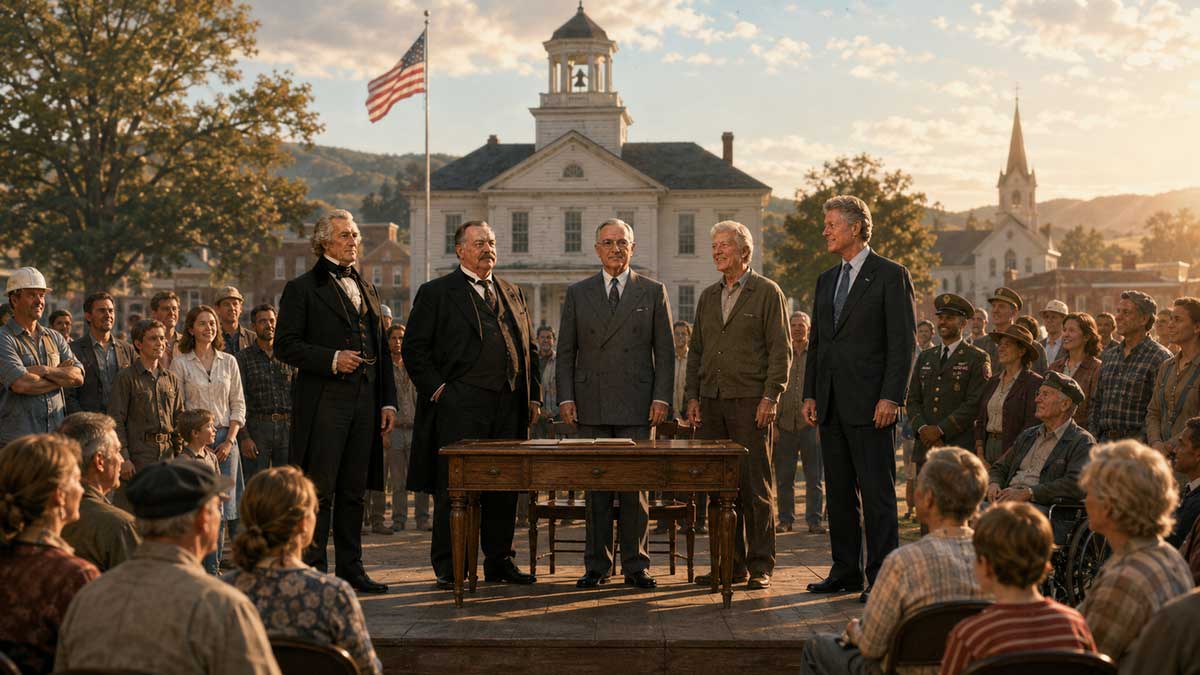
Guests:
James Monroe
Grover Cleveland
Harry S. Truman
Jimmy Carter
Bill Clinton
Opening
Harry S. Truman:
Public office is not a throne. It is a desk.
A president sits at that desk for a little season, signs papers, receives reports, carries burdens, makes decisions, and then leaves. The office remains. The republic remains. The people remain.
That is why humility matters. A leader who forgets the people soon forgets the purpose of leadership itself. Government does not exist so citizens can serve officials. It exists so officials can serve citizens.
The people are not subjects. They are the source of authority. They lend power through elections, law, and consent. Leaders receive that authority as a trust.
Tonight, we ask what public service must become if America is to enter its next 250 years with accountability, reform, confidence, and hope.
Question 1: How can elected leaders remember that the people are the source of their authority?
James Monroe:
Leaders remember the people by refusing to govern only for those nearest to them. A president must see the whole country: towns and cities, farms and factories, border communities and coastal ports, families with influence and families without it.
Unity is not a decoration. It is work. It requires travel, listening, patience, and a sincere desire to know the nation as it truly lives.
Authority comes from the people. It should return to the people in the form of security, fairness, prosperity, and peace.
Grover Cleveland:
A leader remembers the people by practicing restraint. Public authority belongs to the people, and every president from every party must treat it as a trust.
Many officials enjoy praise. Fewer enjoy restraint. Yet restraint is one of the clearest signs that a leader knows he is serving, not possessing.
The people lend authority. They do not disappear after Election Day. Every officeholder should feel that truth each morning.
Jimmy Carter:
A leader must stay close to ordinary life. Too much distance can make human beings look like numbers. Farmers, workers, parents, veterans, teachers, children, the poor, the elderly — they must never become abstractions.
Faith taught me that service is measured by how we treat those with less influence. If leaders remember the face of the person affected by their decisions, authority becomes more humane.
The people are not a crowd to be managed. They are neighbors to be served.
Bill Clinton:
Leaders remember the people by asking what actually helps families live better lives. Can they find work? Can children learn? Can communities grow? Can opportunity reach places left behind?
Politics can become trapped in slogans. Public service should return to results. People want dignity, safety, education, health, work, and a chance to build a better life.
A leader who listens well can turn government from a distant machine into a practical instrument of hope.
Harry S. Truman:
A president must never hide from responsibility. The people deserve plain speech. They deserve to know who made the decision and why.
When a leader says, “The responsibility is mine,” he remembers where authority came from. It came from citizens who trusted him with a hard job.
That trust should make a leader more humble, not more proud.
Question 2: What does honest leadership look like when popularity and principle conflict?
Grover Cleveland:
Honest leadership may be lonely. A president must sometimes disappoint friends, donors, party allies, and voters who expected a different choice.
Principle is tested when it costs something. It is easy to praise honesty when honesty brings applause. The harder test comes when honesty brings criticism.
A leader who listens only to applause, from advisers, crowds, donors, media, or party allies, risks losing his compass. A leader who keeps his compass may lose cheers for a time, but he preserves his honor.
Harry S. Truman:
Honest leadership means making the decision in front of you, then accepting responsibility for it. A president cannot wait for perfect clarity. He must act with the facts he has, the conscience he carries, and the country he serves.
Popularity comes and goes. Duty stays.
If a leader tries to please everyone, he may end up serving no one. The people do not need a president who is always comfortable. They need one who is accountable.
James Monroe:
Principle should never become stubbornness dressed in noble language. A leader must know the difference between conviction and pride.
Honest leadership listens before it decides. It seeks counsel. It studies consequences. It asks whether the decision serves the nation beyond the present mood.
A republic needs leaders who can stand firm, yet still learn.
Bill Clinton:
Honesty in leadership includes adapting when facts change. A leader may enter office with one plan and discover that the country needs another. That is not always betrayal. Sometimes it is maturity.
People need leaders who can solve problems without surrendering values. That means negotiation, reform, and accepting partial progress when total victory is not possible.
The art is to bend on methods without breaking faith with purpose.
Jimmy Carter:
Honest leadership requires moral courage. There are times when telling the truth about limits, sacrifice, or national mistakes will not make a president popular.
Yet citizens deserve leaders who trust them enough to speak honestly. If leaders flatter the people instead of serving them, they weaken the nation.
Truth spoken with humility can plant seeds that bear fruit later.
Question 3: How can citizens hold leaders accountable without losing hope in the system?
Jimmy Carter:
Citizens can hold leaders accountable through participation, not despair. Vote. Volunteer. Read. Question. Serve. Pray. Help your community. Hold leaders to moral standards, but do not give up on the country when leaders fall short.
Public life will always contain disappointment. Human beings are imperfect. That is why citizens must keep their conscience active.
Hope is not trust in perfect leaders. Hope is trust that ordinary people can still choose what is right.
Grover Cleveland:
Citizens must remember that public money and public authority belong to them. When officials misuse either one, citizens should object firmly.
Yet accountability should never become revenge. The goal is clean government, lawful correction, and better service, not endless humiliation.
Accountability should never be selective. The same standards should apply to presidents we admire and presidents we oppose.
Bill Clinton:
Accountability works best when citizens stay engaged after elections. Democracy is not one day every few years. It is a continuing conversation about what kind of country we want to build.
Citizens should ask for results, demand honesty, reject contempt, and reward problem-solving. They should be tough-minded without becoming permanently cynical.
Cynicism feels smart for a season, but it rarely builds schools, heals towns, or creates opportunity.
James Monroe:
A people can hold leaders accountable by guarding national unity. Criticism is needed. Factional obsession is dangerous.
When citizens judge every act by party loyalty alone, accountability weakens. They excuse their friends and condemn their rivals. That is not republican virtue. It is tribal habit.
The country needs citizens willing to praise good conduct from opponents and correct poor conduct from allies.
Harry S. Truman:
The people should expect leaders to take responsibility. They should not accept excuses forever. Yet they should recall that the system is larger than any one president, Congress, court, agency, party, or election.
If a leader fails, citizens have constitutional remedies: elections, oversight, law, peaceful correction, and civic action. If a law fails, revise it. If an institution loses trust, repair it.
Do not burn down the republic to fix a room inside it.
The American system works when citizens refuse both blind trust and total despair.
Closing
Harry S. Truman:
Leaders work for the people. That sentence is simple enough for a schoolchild, yet strong enough to judge every administration.
A president is temporary. The people are the continuing source of authority. No leader should forget it. No citizen should surrender it.
America’s next 250 years will need leaders who speak plainly, act humbly, listen seriously, keep promises when they can, admit limits when they must, and accept responsibility when decisions become hard.
It will need citizens who demand integrity without losing faith, who correct public wrongs without becoming bitter, and who remember that public service begins long before a person reaches high office.
The republic is not renewed by leaders alone. It is renewed whenever citizens insist that authority answer to conscience, promises become action, and government remains accountable to the people.
The desk will pass from one president to another. The duty remains.
May America’s leaders remember whom they serve, and may America’s citizens remember that the future of self-government is still in their hands.
Topic 5: Hope for the Next 250 Years
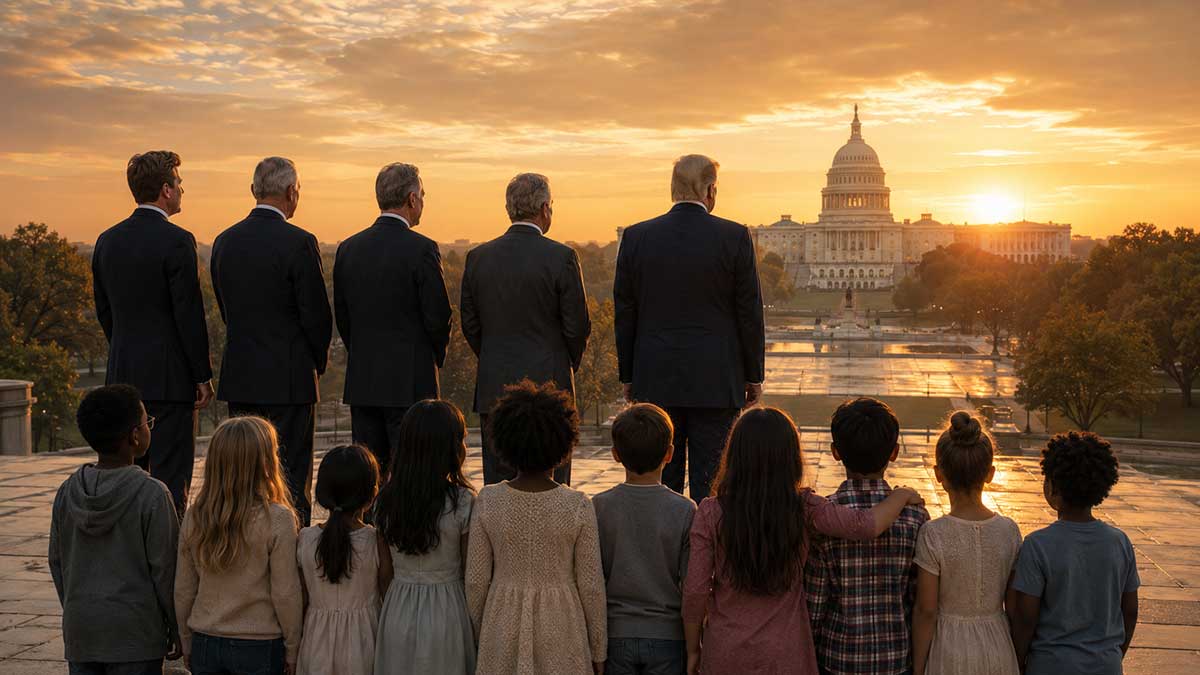
Guests:
John F. Kennedy
Lyndon B. Johnson
George H. W. Bush
George W. Bush
Donald J. Trump
Opening
Donald J. Trump:
Hope is not weakness. Hope is confidence.
America was not built by people who accepted decline. It was built by people who believed they could create something better, protect it, fight for it, and hand it to their children.
The Declaration said that government receives its just authority from God-given rights and the consent of the governed. That means the people are not guests in their own country. They are the source of legitimate government.
A president’s mandate is not personal ownership of the nation. It is the people giving direction to their government. When citizens vote for change, leaders have a duty to act.
The next 250 years will not be saved by nostalgia. They will be built by courage, reform, accountability, strength, faith, and citizens who believe America is still worth the work.
Tonight, we ask how America can turn its anniversary into renewal.
Question 1: What kind of America should we hope to hand to our children and grandchildren?
John F. Kennedy:
We should hand them an America that still calls them to service.
A republic grows weak when its citizens ask only what they can receive. It grows stronger when citizens ask what they can give. The next generation should inherit a country that asks for courage, sacrifice, invention, learning, faith, and duty.
Young people should feel that America needs them. They should be called to build, defend, heal, discover, teach, and serve.
Hope begins when a nation gives its children a mission worthy of their gifts.
Donald J. Trump:
We should hand them an America that believes in itself again.
Children should not be taught that decline is normal, that weakness is wisdom, or that pride in country is shameful. They should know America is rare. They should know it is worth protecting.
The worker matters. The parent matters. The veteran matters. The small-town family matters. The citizen who felt ignored matters.
A hopeful country tells its children, “You are inheriting something great. Make it greater.”
Lyndon B. Johnson:
We should hand them an America where the promise reaches real lives.
A child should not hear grand words about liberty and then find every door closed. Hope must reach schools, farms, neighborhoods, cities, hospitals, roads, families, and work.
The promise of America cannot remain in speeches alone. It must be felt by the child learning to read, the parent trying to provide, the elderly person seeking dignity, and the worker asking for a fair chance.
A country renews itself when its promise becomes practical.
George H. W. Bush:
We should hand them an America marked by service.
The country is at its best when citizens look beyond themselves. A neighbor helps a neighbor. A church feeds the hungry. A veteran mentors a young person. A family teaches gratitude. A community refuses to let people disappear.
Strength matters. So does humility.
The next generation should inherit a country that is confident enough to lead and gentle enough to care.
George W. Bush:
We should hand them an America where freedom forms character.
Liberty gives citizens room to choose. Character teaches them to choose what is right. A nation can have wealth and still lose its way if it forgets conscience.
Children should inherit a country that defends life, honors faith, protects the vulnerable, rewards responsibility, and treats human dignity as sacred.
America’s future depends on the kind of people freedom produces.
Question 2: How can a president turn a national mandate into renewal for the whole country?
Donald J. Trump:
A mandate is a duty to act.
People vote when they want direction. They vote when they feel unheard. They vote when they want jobs protected, borders respected, communities made safer, families strengthened, and national pride restored.
A president must keep faith with the people who sent him. Promises matter. Results matter. If citizens ask for strength, leaders should deliver strength. If citizens ask for change, leaders should not manage decline and call it patience.
Renewal for the whole country means success people can feel. Safer streets help everyone. Better jobs help everyone. Stronger towns help everyone. A respected country helps everyone.
The people give the mandate. The president must turn it into action.
John F. Kennedy:
A mandate should become a summons.
The people may send a president to change policy, but the president should invite citizens to change the spirit of the country with him. Government can lead, but citizens must build.
A president should say to supporters: your victory is a responsibility.
He should say to critics: your citizenship is secure.
He should say to all Americans: the country still needs your best.
Renewal comes when citizens stop watching history and begin making it.
Lyndon B. Johnson:
A mandate becomes renewal when it reaches those who have been waiting.
Votes are counted in one night. The deeper test comes in the years after. Did the child learn? Did the worker rise? Did the family gain security? Did the elderly person find dignity? Did the citizen see government become more answerable?
The people do not lend authority so leaders can celebrate themselves. They lend it so leaders can serve.
A mandate should become roads, schools, safety, opportunity, and justice.
George H. W. Bush:
A mandate must be carried with humility.
Victory gives direction, but humility gives that direction honor. A president must recall that the office belongs to the nation, not to a campaign.
He should keep faith with his promises, yet speak in a way that keeps the country open to repair. He can be firm without being vain. He can be strong without being careless. He can lead without forgetting that many citizens are still watching to see if they belong.
A mandate becomes noble when it becomes stewardship.
George W. Bush:
A mandate must be guided by conscience.
Every president faces the temptation to hear only praise and dismiss every warning. That is dangerous for any leader. A president needs counsel, prayer, humility, family, law, and truth.
Decisive leadership matters. Compassion matters. Character matters. The country needs leaders who can act with strength and still see the human being affected by the decision.
Renewal needs action, but action must answer to conscience.
Question 3: What would it mean for America’s next 250 years to be marked by renewal instead of revenge?
Donald J. Trump:
Renewal means winning for America.
People are tired of being told that America’s best days are behind it. They are tired of seeing their towns ignored, their jobs shipped away, their safety dismissed, their history mocked, and their voices treated like a problem.
But revenge is not renewal. Revenge looks backward. Renewal builds forward.
A renewed America protects citizens, honors work, defends the border, respects families, strengthens communities, and teaches children that the country is worth loving.
The next 250 years should not be about managing decline. They should be about building greatness again.
George H. W. Bush:
Renewal means the winner still sees the neighbor.
A country cannot remain healthy if every victory becomes humiliation for someone else. America needs firmness, but it also needs grace. It needs confidence, but it also needs service.
The republic is larger than any one election. The office passes. The people remain. The duty remains.
A renewed America would ask each citizen, “What light can you bring to the place where you stand?”
Lyndon B. Johnson:
Renewal asks who still needs help.
Revenge asks, “Who should pay?”
Renewal asks, “What must be built?”
Revenge keeps old wounds open.
Renewal repairs homes, schools, roads, hospitals, laws, and trust.
America cannot enter its next 250 years by counting insults alone. It must count children taught, families strengthened, workers lifted, and citizens restored to dignity.
The promise must keep moving.
George W. Bush:
Renewal means courage without cruelty.
A nation must defend itself. It must tell the truth. It must protect its people. Yet it must not let fear or anger become its identity.
Faith teaches mercy. History teaches strength. Public life teaches the need for both.
America’s next 250 years will need leaders and citizens who can stand firm and still make room for grace.
John F. Kennedy:
Renewal means lifting the nation’s eyes.
Every generation has reasons for resentment. Every generation has wounds. Yet the future belongs to citizens who refuse to be trapped by grievance.
The next 250 years will need discovery, defense, industry, faith, science, families, schools, public service, and civic courage. No president can supply all of that. No party can carry it alone.
The nation must ask a larger question: not who can we defeat, but what can we build together that is worthy of America?
Closing
Donald J. Trump:
America’s next 250 years should begin with confidence.
This country has been counted out before. People said the spirit was gone. They said the dream was over. They said ordinary citizens did not matter. But the people keep proving them wrong.
Self-government means the people still have a voice. It means leaders answer to citizens, not citizens to leaders. It means a mandate is not a trophy. It is a responsibility.
If America listens to its people, protects its citizens, honors its history, restores accountability, rewards work, strengthens families, and believes in its future, then the next 250 years can be greater than the last.
Hope does not belong to one party, one president, or one slogan.
Hope belongs to a country that still says: we are not finished.
Let America be strong enough to protect itself, humble enough to correct itself, proud enough to love itself, and generous enough to hand its children a future worthy of them.
The next 250 years begin when citizens believe again that this republic is theirs to renew.
Final Thoughts
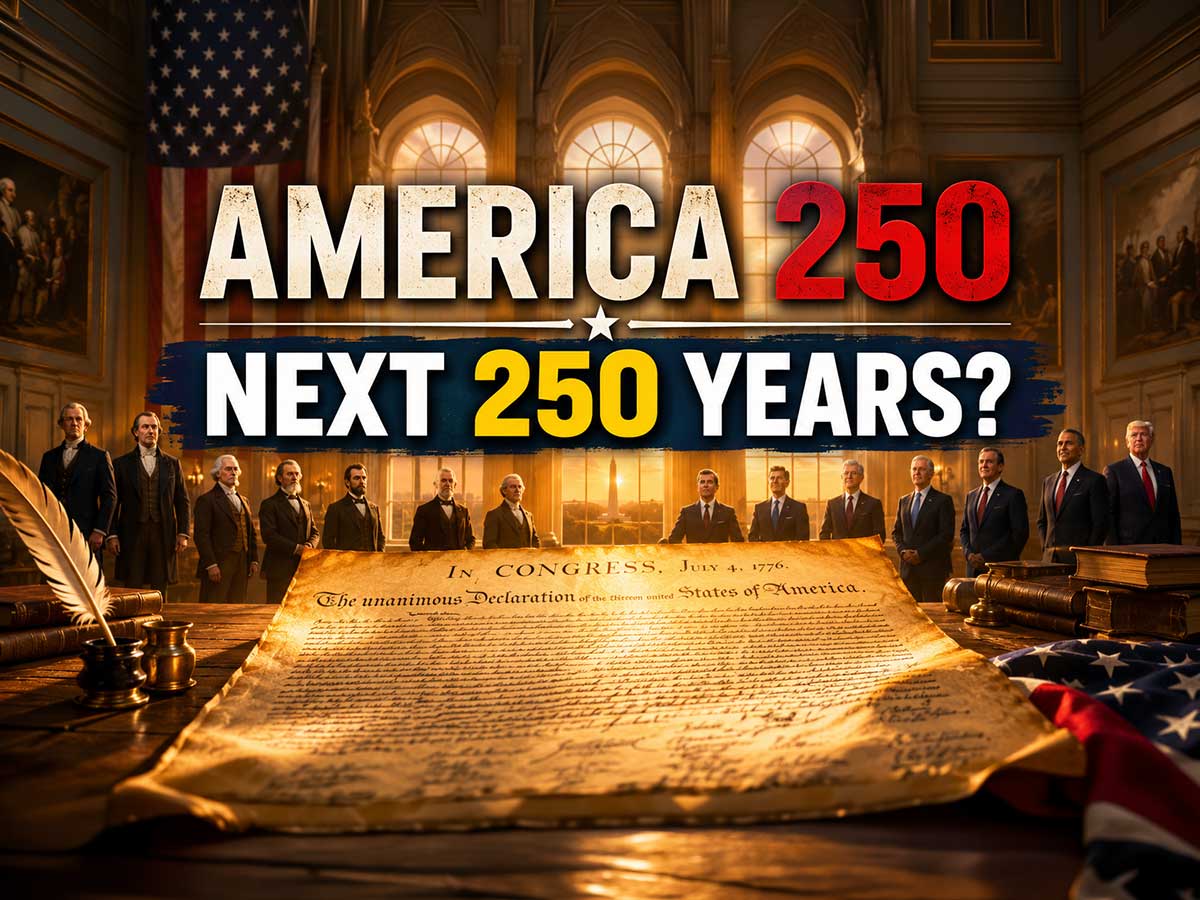
At the end of this conversation, one truth becomes clear: America’s hope is not found in pretending the country has no wounds. It is found in believing the wounds can still be healed, and that citizens still carry the responsibility to heal them.
The Declaration gave America its first great promise. The Constitution gave that promise structure. The people give both of them life.
Presidents can guide, warn, inspire, and serve, but no president can carry the republic alone. The next 250 years will be shaped in homes, schools, churches, neighborhoods, businesses, farms, military posts, town meetings, courtrooms, classrooms, and dinner tables.
The republic survives where citizens practice the virtues freedom requires.
The Founders remind us that liberty begins with courage.
Lincoln reminds us that the nation must keep widening the meaning of its own promise.
The Roosevelts, Eisenhower, Reagan, and Obama remind us that self-government requires responsibility, service, confidence, listening, and daily civic habits.
Adams, Jackson, Grant, Ford, and Biden remind us that disagreement must never become hatred, and that citizens who feel unheard must be listened to with respect.
Monroe, Cleveland, Truman, Carter, and Clinton remind us that leaders are temporary servants of a permanent people.
Kennedy, Johnson, the Bush presidents, and Trump remind us that the future must be handed to the next generation with mission, practical results, stewardship, conscience, strength, national confidence, and renewal.
America does not need a future built on revenge. It needs a future built on reform, accountability, service, and courage.
A renewed America would honor its history without becoming trapped by it. It would tell the truth about its failures without losing gratitude for its blessings. It would expect leaders to serve the people, not rule them. It would teach children that liberty is a gift, but also a duty.
A renewed America would remember that a mandate is not a trophy. It is the people giving direction to their government. It must become action, accountability, and results that strengthen the whole country.
The next 250 years begin with a simple choice.
Will Americans use freedom to tear one another down, or will they use freedom to build a country worthy of their children?
The answer will not come from one speech. It will come from millions of daily acts: listening before judging, serving before blaming, voting with care, speaking with restraint, correcting injustice without hatred, defending the country without arrogance, and loving America enough to improve it.
The American experiment is unfinished.
That is not a reason for despair.
It is the reason hope still has work to do.
Short Bios:
George Washington
The first president of the United States and commander of the Continental Army. In this conversation, he represents discipline, restraint, sacrifice, and the courage needed to hold a fragile republic together.
John Adams
The second president and one of the strongest voices for independence. He represents civic virtue, moral seriousness, and the belief that liberty requires educated, responsible citizens.
Thomas Jefferson
The third president and principal author of the Declaration of Independence. He represents the language of liberty, the power of national imagination, and the unfinished promise of equality.
James Madison
The fourth president, often called the Father of the Constitution. He represents constitutional structure, checks and balances, and the need to protect freedom through wise limits.
Abraham Lincoln
The sixteenth president who led the nation through the Civil War. He represents union, moral renewal, sacrifice, and the question of whether a nation founded on liberty can endure.
Theodore Roosevelt
The twenty-sixth president, known for reform, energy, and civic duty. He represents active citizenship, courage, public service, and the belief that free people must enter the arena.
Franklin D. Roosevelt
The thirty-second president who led through the Great Depression and World War II. He represents courage over fear, shared sacrifice, and national confidence during hardship.
Dwight D. Eisenhower
The thirty-fourth president and Supreme Allied Commander in World War II. He represents steadiness, teamwork, humility, and the discipline needed to preserve peace and freedom.
Ronald Reagan
The fortieth president, remembered for optimism, limited government language, and renewed national confidence. He represents cheerful responsibility, belief in citizens, and faith in America’s capacity to recover.
Barack Obama
The forty-fourth president and the first African American president. He represents civic listening, democratic participation, hope, and the effort to widen the American story.
John Quincy Adams
The sixth president, later a powerful voice in Congress. He represents conscience, free speech, public argument, and the duty to speak truth without surrendering to bitterness.
Andrew Jackson
The seventh president, known for populist energy and fierce conviction. In this conversation, he represents citizens who feel ignored and the need to listen before anger becomes destructive.
Ulysses S. Grant
The eighteenth president and Union general. He represents the cost of division, the need for justice after conflict, and loyalty to the Union above resentment.
Gerald Ford
The thirty-eighth president who took office after Watergate. He represents calm leadership, national healing, institutional trust, and the difficult work of moving a wounded country forward.
Joe Biden
The forty-sixth president. In this conversation, he represents decency, empathy, grief, and the call to lower the national temperature without giving up conviction.
James Monroe
The fifth president, associated with a period remembered for national calm. He represents unity, national belonging, and the need for leaders to see the whole country.
Grover Cleveland
The twenty-second and twenty-fourth president. He represents restraint, honesty, public accountability, and the idea that public office is not private property.
Harry S. Truman
The thirty-third president, known for plain speech and taking responsibility. He represents accountability, decision-making under pressure, and the simple truth that leaders work for the people.
Jimmy Carter
The thirty-ninth president, known for faith, humility, service, and humanitarian work after office. He represents moral leadership, compassion, and care for the overlooked.
Bill Clinton
The forty-second president. In this conversation, he represents practical governing, opportunity, problem-solving, and the need to connect public policy to ordinary families.
John F. Kennedy
The thirty-fifth president, remembered for youth, service, and national aspiration. He represents civic mission, sacrifice, and a future large enough to inspire the next generation.
Lyndon B. Johnson
The thirty-sixth president, known for civil rights legislation and Great Society programs. He represents the effort to turn national promises into practical results for citizens who have waited too long.
George H. W. Bush
The forty-first president, remembered for public service, foreign policy experience, and the phrase “points of light.” He represents humility, stewardship, kindness, strength, and service beyond politics.
George W. Bush
The forty-third president, who led during the September 11 attacks and their aftermath. He represents conscience, faith, responsibility, compassion, and leadership during national trauma.
Donald J. Trump
The forty-fifth and forty-seventh president. In this conversation, he represents national confidence, citizen mandate, forgotten Americans, strength, accountability, pride in country, and the belief that America’s next 250 years should be built through renewal rather than managed decline.
Leave a Reply