

What if “A Perfect Day for Bananafish” was not the whole story, but the middle chapter of a larger tragedy?
In J. D. Salinger’s original story, the reader enters a Florida hotel already late in the emotional history of Seymour Glass. We meet Muriel on the telephone with her worried mother. We see Seymour on the beach with Sybil, speaking in a strange and tender language about bananafish. Then, without warning, the story ends with a devastating act.
This imagined three-chapter version keeps that original center intact, but places it inside a wider frame. Chapter 1 asks what may have happened the day before. Chapter 2 becomes the tragic middle. Chapter 3 asks what remains after the shock has passed through the hotel, the family, and the child who heard Seymour most clearly.
The main purpose is not to explain Seymour completely. It is to show the pain of being unseen.
Seymour is surrounded by comfort: a hotel room, sunshine, meals, a wife, family concern, a beautiful beach. Yet comfort does not mean connection. People speak to him, worry about him, manage him, judge him, and fear him, but few truly hear him. His pain does not arrive in plain language. It arrives through odd remarks, silence, drawings, symbols, and the story of the bananafish.
Muriel is not written as cruel. She is ordinary in a very human way. She wants the trip to be pleasant. She wants Seymour to rest. She wants her mother to stop worrying. She wants public life to remain smooth. Her tragedy is that she treats Seymour’s strange language as inconvenience until it becomes grief.
Sybil, the child on the beach, becomes the one person who receives Seymour without trying to correct him. She does not fully grasp death, trauma, marriage, war, or despair, but she can enter the symbolic world he offers her. She can ask whether bananafish ever get out. That childlike question may be closer to the heart of the story than any adult explanation.
The bananafish symbol holds the entire piece together. They enter holes, eat too much, become trapped, and cannot escape. They may represent appetite, war memory, emotional damage, spiritual loneliness, or the adult world itself. They may represent Seymour. They may represent all people who go too far into something that first looks like pleasure, safety, duty, or survival.
Chapter 1 builds the quiet pressure. Chapter 2 shows the break. Chapter 3 shows how the living attempt to explain what happened, often in ways that make the mystery smaller. The adults gather facts. Sybil keeps the question alive.
This story asks the reader to sit with a painful truth: a person can be surrounded by people and still be alone. A beautiful day can hide a ruined soul. A child may hear a wounded man more clearly than adults who believe they are being practical.
(Note: This is an imaginary conversation, a creative exploration of an idea, and not a real speech or event.)
Chapter 1: The Day Before
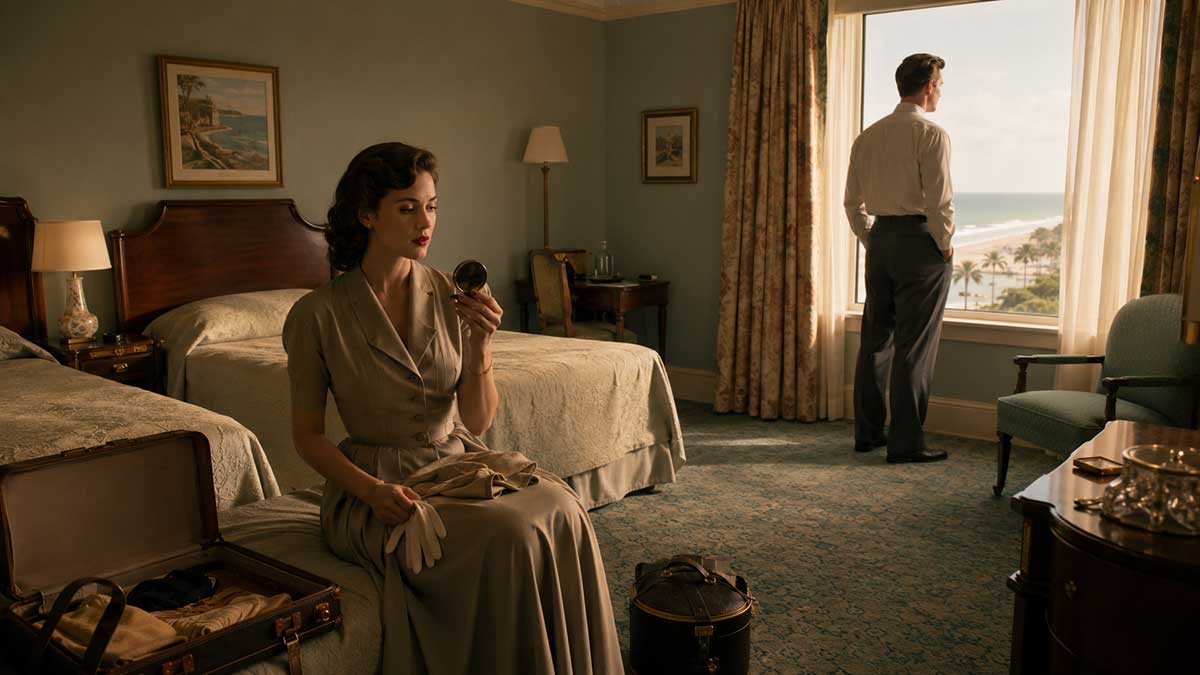
Muriel Glass had packed three pairs of shoes for five days in Florida and had regretted it before the porter put the bags down.
The regret was not moral. It was practical. One pair, the pale blue sandals, had a strap that had begun to rub the wrong place on her ankle. One pair, the white ones, seemed too white now that she had seen the lobby. The third pair, which Seymour said looked like something a nurse might wear on a holiday, had been packed out of fear, and fear, Muriel felt, was almost always unattractive when it showed.
The porter stood near the bed with both hands on the handles of the bags, as though waiting to be forgiven.
“Put them there,” Muriel said.
He put them there.
Seymour was at the window. He had not taken off his hat. He was looking down at the beach, though from the fifth floor the beach looked less like a beach than a large white mistake somebody had made between the hotel and the ocean.
“Tip him,” Muriel said.
Seymour turned, as if he had been called back from a very distant room.
“What?”
“The porter.”
Seymour looked at the porter. Then he took out his wallet and gave him a bill. It was too large. Muriel saw that it was too large and made a small face at the bedspread.
The porter thanked him with feeling.
When the door closed, Muriel said, “You gave him five dollars.”
Seymour removed his hat and put it on the writing desk.
“He had hands,” he said.
Muriel opened her compact and looked into it. She did not apply anything. She only checked to see whether the trip had altered her in any visible way.
“Everybody has hands,” she said.
“No,” Seymour said. “Not everybody.”
Muriel closed the compact.
She wanted, for one second, to ask him what that meant. It was the sort of thing one could ask if one had not been married long enough to know better. She took off her gloves instead and laid them on the dresser. One finger of the left glove curled under itself, making the glove look shy.
The room was cheerful in the way hotel rooms are cheerful when no one has yet lived in them. There were two painted lamps, two narrow beds, a bowl of wax fruit, and a picture of a ship at sea. The ship was leaned over in a permanent storm, but the frame was gold, which helped.
Muriel went into the bathroom and turned on both faucets. She liked the sound of water in a new bathroom. It made the room seem paid for.
“Seymour,” she called.
“Yes.”
“Please don’t say anything strange at dinner.”
There was no answer.
She leaned out of the bathroom doorway. Seymour was still near the window, but now he was looking at the picture of the ship.
“I mean it,” she said. “Mother is worried enough.”
“Your mother worries the way some people knit.”
“That’s not fair.”
“No,” he said. “It’s textile.”
Muriel looked at him. He smiled at her, a quick, delicate smile, one that made him look younger than he had any right to look. It was the smile that had made her forgive things before she knew they were things.
“I’m taking a bath,” she said.
“I approve.”
“You don’t have to approve.”
“I withdraw approval.”
She shut the bathroom door, but not firmly.
At dinner they were seated with the Feddermans from Cleveland, who had a boy at Exeter, a girl with sinus trouble, and a pale leather cigarette case that Mr. Fedderman produced several times with the expression of a man offering proof.
Mrs. Fedderman wore a black dress with a small silver pin in the shape of a bird. The bird had one red eye.
“Isn’t this room divine?” she said.
Muriel said it was.
“It’s the sort of room,” Mrs. Fedderman said, “where you feel you ought to have a better life.”
Mr. Fedderman laughed. Muriel laughed. Seymour looked at the silver bird.
“Do you golf, Mr. Glass?” Mr. Fedderman asked.
“No.”
“Tennis?”
“No.”
“Fish?”
Seymour lifted his eyes.
“Not personally,” he said.
There was a pause. Mr. Fedderman held his cigarette case open, then closed it again.
Muriel touched Seymour’s wrist under the table. She did it lightly, with two fingers, as if testing a peach.
“He reads,” she said.
“Fine thing,” Mr. Fedderman said. “Reading. I always say, a man should read. Gets him away from himself.”
Seymour looked at him for a moment.
“Yes,” he said. “That’s always the danger.”
Mrs. Fedderman smiled in a way that did not use her whole face.
“What line are you in, Mr. Glass?”
Seymour folded his napkin once, carefully.
“I was in several lines,” he said. “Some of them were very straight.”
Muriel moved her foot against his under the table.
“He was in the Army,” she said. “He’s just resting now.”
“Were you overseas?” Mr. Fedderman asked.
Seymour looked past him, toward the open terrace doors. A waiter had dropped a spoon somewhere in the next room. The sound seemed larger than it should have.
“Yes,” Seymour said.
“That must have been something,” Mr. Fedderman said.
“It was,” Seymour said. “Something.”
Muriel began talking quickly about the hotel shop, which had excellent scarves but no decent suntan oil. Mrs. Fedderman said the shop girl had an attitude. Mr. Fedderman said all hotel shops were licensed piracy. They were happy again. Seymour ate one olive and left the rest of his salad untouched.
After dinner, Muriel wanted to dance. Seymour said he would rather walk.
“Walk where?”
“Out.”
“That isn’t a where.”
“It’s often the only where.”
Muriel stood in front of the mirror and adjusted one earring. “You can be exhausting when you’re rested.”
Seymour put on his hat.
They walked along the promenade behind the hotel. The night was soft and a little damp. The hotel windows were lit in rows, so that the building looked like a large machine pretending to be hospitable. Music came from the lounge. Somewhere, a woman laughed too loudly, then stopped as if she had been corrected.
Muriel walked with her arms folded. The strap on her sandal had begun to hurt.
“Do you know what Mother said before we came?” she asked.
“No.”
“She said I should not have let you drive.”
“You didn’t let me. I drove under an old constitutional right.”
“She said you frightened Daddy.”
“Your father is frightened by capers.”
“She said you drove seventy-five.”
“Only when the car was moving.”
Muriel stopped. “Seymour.”
He stopped too.
“I’m trying,” she said.
He looked at her, and for a moment his face was open and terribly tired.
“I know you are,” he said.
That made her feel worse than if he had been sarcastic. She took a cigarette from her bag and waited. He lit it for her. His hands were steady.
They resumed walking. On the sand below them, a little girl in a yellow bathing suit was dragging a pail, though it was too late to use it. Her mother called, “Sybil, come back here,” without much hope.
The child looked up at Seymour. Seymour tipped his hat to her.
She did not smile. She inspected him, then kept dragging the pail.
“Charming,” Muriel said.
“She has jurisdiction,” Seymour said.
“Over what?”
“The wet sand, I think.”
Muriel exhaled smoke through her nose.
They reached the end of the promenade. There was a small service pier, and under it the tide had left a strip of dark weed and shells. Seymour looked down at it with an attention that made Muriel impatient.
“Don’t look at that,” she said. “It’s depressing.”
“It’s only what the ocean didn’t want back.”
“That’s depressing.”
Seymour crouched and picked up something from the sand.
Muriel did not move closer. “What is it?”
“A fish,” he said.
“Dead?”
“Quite.”
“Please put it down.”
He held it in his palm. It was small and silver, with the mouth open. Its eye was clear in the porch light.
“They always look surprised,” he said.
Muriel turned away. “That’s horrible.”
“No. It’s accurate.”
He placed the fish back on the sand, not as one throws something away, but as one returns a borrowed item.
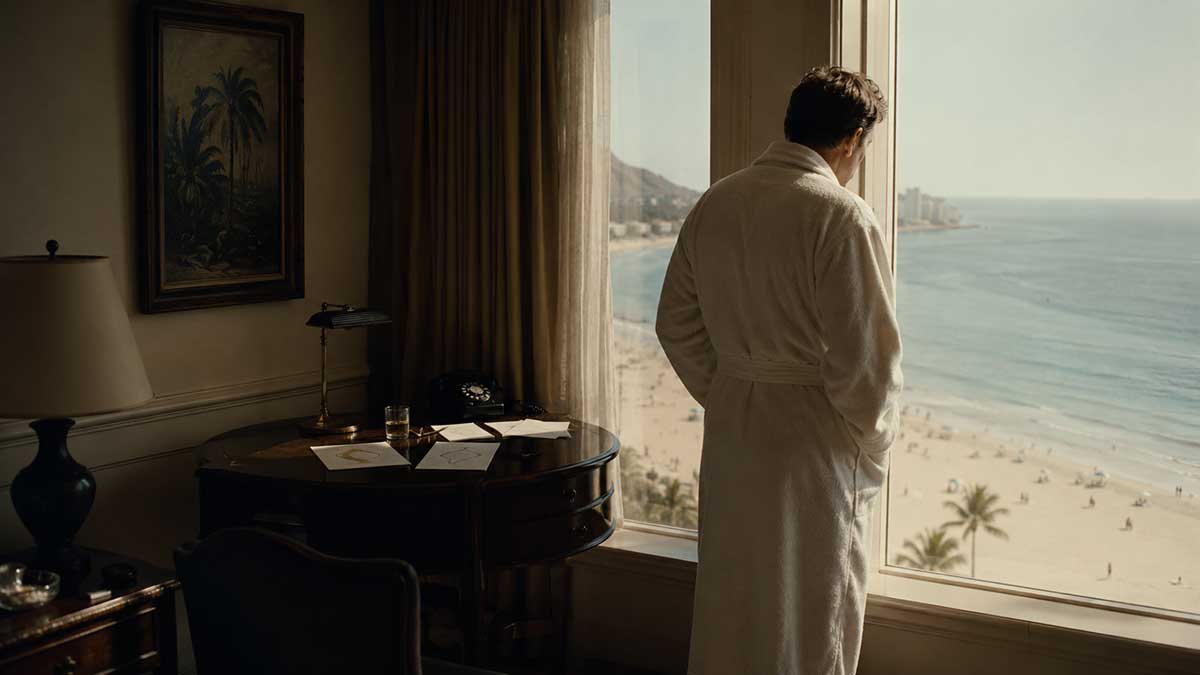
When they went up to the room, Muriel undressed first. She put cold cream on her face and tied her hair back. Seymour sat at the desk with hotel stationery in front of him. He did not write a letter. He drew a small circle. Then another circle inside it. Then a narrow opening.
Muriel watched him in the mirror.
“Who are you writing?”
“No one.”
“That’s economical.”
He drew something long and curved. It might have been a fish.
Muriel got into bed and opened a magazine. The magazine had an article about a woman who had married a count and then learned to make soups. Muriel read three sentences.
“What are you drawing?” she asked.
“A creature.”
“What kind?”
“One that goes in too far.”
She turned a page without reading it.
“Into what?”
Seymour looked at the paper.
“Pleasure,” he said. “Or a hole. Sometimes they’re built the same.”
Muriel put the magazine down.
“You’re being morbid.”
“I’m being zoological.”
She reached for the lamp switch, then stopped.
“Seymour, promise me tomorrow will be nice.”
He looked at her.
“Nice,” he said.
“Yes. Beach. Sun. Lunch. No scenes. No odd remarks to people.”
He placed the pencil on the desk very carefully.
“Do children count as people?”
“Don’t be silly.”
“I never know when they start counting.”
Muriel stared at him. She wanted to cry suddenly, but it seemed both unfair and poorly timed. Instead she turned off the lamp.
In the dark, the ocean could be heard faintly, regular and indifferent. Seymour remained at the desk for a long time. Muriel could tell by the small sounds: pencil, paper, chair, breath.
At some point she said, “Come to bed.”
“In a minute.”
“You always say that.”
“It’s a good minute.”
She slept.
In the morning the room was bright enough to be rude. Muriel woke with one arm out from under the sheet and a line across her cheek from the pillowcase. Seymour’s bed had been slept in but not convincingly. The stationery was gone from the desk.
She found him on the balcony. He had bare feet and a robe over his pajamas. The robe was too large for him. It had belonged to somebody with a richer idea of leisure.
“You’ll burn,” she said.
“Not this early.”
“You burn in elevators.”
He smiled, but she did not.
She ordered breakfast for herself: coffee, toast, grapefruit. Seymour asked for nothing.
“You have to eat,” she said.
“I’m still full.”
“From dinner?”
“From several things.”
She did not answer.
The telephone rang at ten. Muriel let it ring twice. She knew who it was. She picked it up on the third ring and sat on the edge of the bed.
“Yes, Mother,” she said. “We’re here.”
Seymour turned from the balcony and looked at her. Then he went into the bathroom and shut the door.
Muriel crossed one leg over the other and examined the red mark on her ankle.
“No, Mother. He’s fine.”
The bathroom water started running.
“I said he’s fine.”
She reached for her cigarettes, found the case empty, and made a face.
“No, he didn’t do anything.”
She listened. Her eyes moved to the bathroom door.
“Well, naturally he’s tired.”
She listened again, longer this time.
“Mother, please don’t start that.”
In the bathroom, the water stopped.
Muriel lowered her voice.
“No. I’m not going to discuss that on the telephone.”
The door opened. Seymour came out dressed for the beach. He had a towel over one shoulder and no expression that Muriel could use.
He stood near the dresser and picked up the room key.
Muriel covered the receiver.
“Where are you going?”
“Down.”
“Wait for me.”
“I’ll be on the sand.”
“Seymour.”
He looked at her. She wanted to tell him something direct, something that would land where ordinary sentences failed. Nothing came.
He opened the door.
Into the receiver, Muriel said, “No, Mother, he’s right here.”
But Seymour was already gone.
Chapter 2: A Perfect Day for Bananafish
Muriel Glass held the receiver a little away from her ear and looked at the red place on her ankle.
Her mother had been talking for some time. Muriel had learned that there were different kinds of listening. There was listening with the face, listening with the mouth, listening with the hand that held the cigarette, and listening with the part of the mind that was free to think about whether white sandals looked cheap after Labor Day.
“Yes, Mother,” Muriel said.
She reached for the cigarette case again, though it was still empty.
“No. I told you. He went down to the beach.”
She listened.
“By himself, yes.”
She listened longer.
“He is not by himself in that sense. There are hundreds of people down there.”
The hotel room was bright, almost too bright. On one bed, Seymour’s towel had left a little damp moon on the coverlet. His side of the room had no evidence of a man except for absence. Muriel’s side had a comb, a bottle of lotion, a folded scarf, two magazines, and a little hotel card that said the dining room required jackets after six.
Her mother said something about the car.
“Mother, that was days ago.”
Her mother said it had not been days ago. It had been yesterday.
“Well, it feels like days ago,” Muriel said.
She crossed her legs and uncrossed them.
“No, he did not try to hit anyone. He got angry. There is a difference.”
Her mother’s voice became thinner, more urgent.
Muriel looked at the bathroom door. The mirror on it reflected part of the bed, part of the window, and none of Muriel’s face.
“Mother, you must stop saying hospital every five minutes. He was in a hospital. He is not in one now.”
She listened again. Her lips pressed together.
“Yes, I know what the doctor said.”
She picked up the hotel stationery Seymour had not taken and drew one line across the top page with her fingernail.
“No, I am not afraid of him.”
That was not entirely true, but it was true in the way Muriel needed it to be true. She was not afraid he would hurt her. She was afraid he might become impossible in public, or stop talking at dinner, or say something that turned a table of strangers into a room full of witnesses.
Her mother asked about the gun.
Muriel sat up.
“For heaven’s sake, lower your voice. I can hear you through the receiver.”
She glanced at the door.
“It is in the luggage. I suppose. Daddy told him to bring it, did he not? Daddy is the one who thinks every road trip is a western.”
Her mother denied this with deep feeling.
Muriel sighed.
“No, I have not checked.”
She listened.
“I am not going to search my husband’s luggage like a detective in a radio play.”
She listened again.
“I know you love me. That is not the issue.”
Outside, there was a clean blue piece of sea in the window. It looked pasted there.
Muriel leaned back on one elbow.
“Mother, listen to me. We came here so he could rest. He needs sun. He needs quiet. He needs to be treated like a person, not like a cracked vase.”
Her mother became silent for a second. That was worse than talking.
Muriel softened her voice.
“I know.”
She looked down at her nail. The polish on one thumb had chipped at the edge.
“I know you worry.”
Down on the beach, Seymour Glass had rented a blue raft from a boy who smelled of coconut oil and arithmetic. The boy had asked if he wanted it by the hour or the day.
Seymour had said, “I prefer not to own time in large pieces.”
The boy had said, “Then by the hour?”
Seymour had nodded and paid him.
He carried the raft under one arm. He had on a terry-cloth robe that made him look newly escaped from comfort. His feet were bare. The sand was hot enough to argue with him.
Women lay under striped umbrellas with their eyes shut and their mouths open a little. Men sat with newspapers folded into civic shapes. Children dug holes near the wet sand, then abandoned them when the ocean corrected their work.
Seymour stopped near a yellow pail.
The little girl from the night before was sitting beside it. Her hair was tied with a ribbon that had given up early. She had one hand buried in the sand up to the wrist.
“You have jurisdiction today,” Seymour said.
She looked up.
“What?”
“Over the pail. Possibly the shovel. I am uncertain about the shovel.”
“It’s mine,” she said.
“That settles it.”
She studied him. Children often studied Seymour longer than adults did. Adults looked at him, then looked away, as if they had seen a price tag on something they could not afford. Children looked until they were finished.
“My name is Sybil,” she said.
“I had heard.”
“Who told you?”
“The pail.”
She looked at the pail. Then back at him.
“Pails don’t talk.”
“Not to everyone.”
She considered this without smiling.
“Where’s your lady?”
“My lady?”
“The one with the hair.”
“She is upstairs speaking to a larger lady through a telephone.”
“My mother talks on the telephone too much.”
“That is one of the burdens of motherhood,” Seymour said.
Sybil pushed her buried hand deeper into the sand.
“You going in the water?”
“I was invited.”
“By who?”
“The ocean. It wrote a very damp note.”
Sybil stood up and brushed sand from her knees. “I’m coming.”
“I should warn you. I am not a licensed ferry.”
“I can float.”
“I hoped you could.”
She took hold of the raft, though Seymour did not need help carrying it. They walked together to the water. The wet sand accepted their feet, then gave them back.
The ocean was gentle near the shore. Small waves folded over themselves and slid up the beach with a sound like paper being handled by someone careful.
Sybil stopped at the first wash of water.
“It’s cold.”
“It has been through a great deal.”
She stepped in farther. “What?”
“Water gets around.”
They went out until the water reached Sybil’s waist. Seymour placed the raft flat and let her climb on. She lay on her stomach, chin in both hands, looking at him.
“Push me.”
“Command received.”
He pushed the raft out a little, then held it by one corner.
Sybil kicked both feet.
“Do you see any bananafish today?” Seymour asked.
“No.”
“Look harder. They are shy only before breakfast.”
“What are bananafish?”
Seymour looked past her, beyond the light water, beyond the darker place where swimmers became heads.
“They are fish that enter banana holes,” he said.
“There are no banana holes.”
“There are many things you have not yet had the misfortune to rent.”
Sybil frowned. “What do they do in there?”
“They eat bananas.”
“That’s silly.”
“Most fatal habits begin silly.”
“How many do they eat?”
“Some eat four. Some eat seventeen. Some are proud and eat seventy-eight.”
Sybil lifted her chin. “Fish can’t eat seventy-eight bananas.”
“They can in private.”
She stared at the water.
“What happens then?”
Seymour’s hand rested on the raft. The skin across his knuckles looked pale in the sun.
“They get too large,” he said. “At first they are delighted. They think size is proof that life has been generous. Then they try to leave the hole.”
“Can’t they?”
“No. Their bellies will not permit it.”
Sybil looked alarmed, but not unhappy. Children can take in tragedy if it is small enough to fit inside a story.
“What do they do?”
“They remain there.”
“How long?”
“Until they stop requiring bananas.”
Sybil was quiet. A wave lifted the raft. Seymour steadied it.
Then she pointed with a wet finger.
“I saw one.”
Seymour looked where she pointed.
“Did you?”
“Yes. It had six bananas in its mouth.”
“Only six?”
“It was little.”
“That one has a chance,” Seymour said.
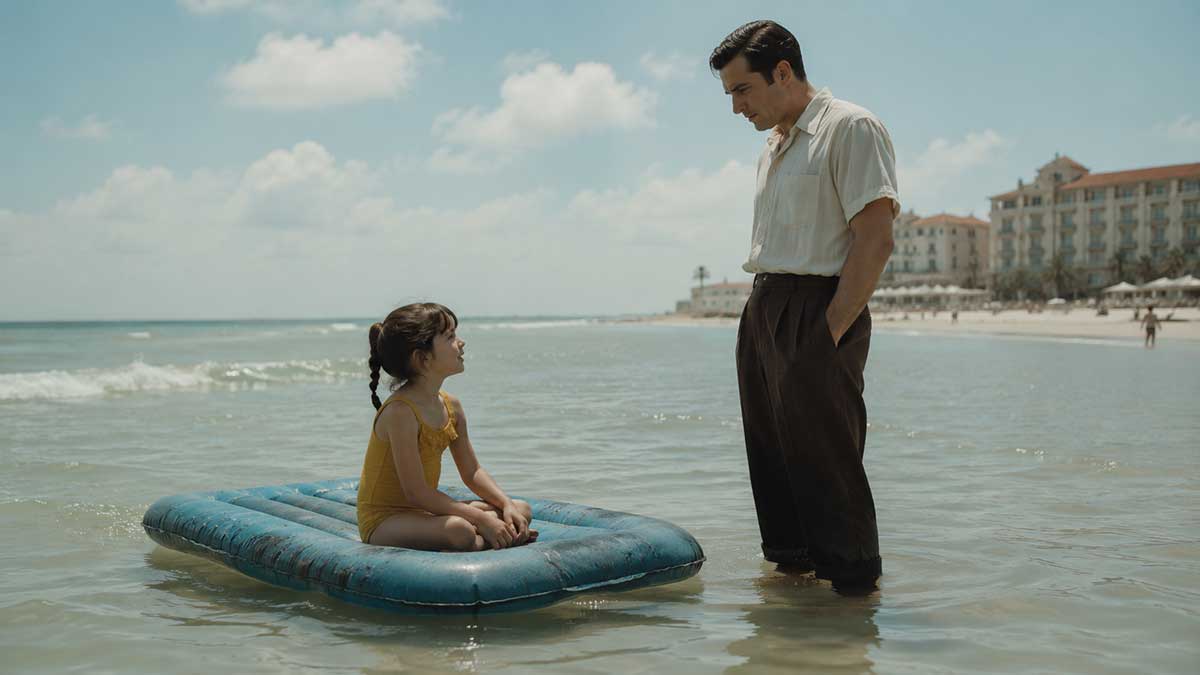
Sybil smiled at him for the first time.
Behind them, her mother called from the beach, “Sybil! Stay where I can see you!”
Sybil turned her head and shouted, “I am!”
Then to Seymour she said, “My mother can see things that are not lost.”
“That is a gift,” he said.
“She says I have to come in soon.”
“Naturally. Land has claims.”
Seymour pushed the raft back toward shore. Sybil jumped off before the water was shallow enough and nearly fell. He caught her by both hands. She laughed, a short bright laugh that seemed to surprise him.
On the sand, she picked up the yellow pail.
“Will you tell me another one tomorrow?”
Seymour looked at her ribbon, her pail, her wet knees.
“I may have no tomorrow stories.”
“Everybody has tomorrow.”
“No,” he said gently. “People say that when they have not counted.”
Sybil squinted at him. “You talk funny.”
“I have been accused.”
She ran to her mother.
Seymour remained near the water. The raft drifted against his leg. He let it go, then remembered it was rented and pulled it back by the rope.
The boy at the stand was eating an orange.
“Done already?” the boy asked.
“Time was brief,” Seymour said.
The boy looked at the raft, then at Seymour. “Still an hour minimum.”
“That seems consistent with the empire.”
The boy shrugged and took the raft.
Seymour walked to the hotel.
Inside, the air changed at once. The lobby smelled of flowers, polish, and people who had been indoors too long. A woman in a pink suit stood near the elevator with a shopping bag from the hotel boutique. Seymour stood beside her.
The elevator doors opened. They entered together.
The woman looked at the floor numbers.
Seymour looked at the brass wall, which returned his face in a bent, yellow version.
The elevator began to rise.
The woman shifted her bag from one hand to the other.
Seymour said, “Madam, there is no need to examine my feet.”
The woman looked at him.
“I beg your pardon?”
“My feet,” Seymour said. “They are at the end of my legs, as expected.”
“I wasn’t looking at your feet.”
“That is a popular defense.”
The woman’s mouth opened, then closed. The elevator stopped at the third floor, but she did not get out. She pressed the button again, harder than needed.
Seymour smiled politely.
“The human foot is no enemy of yours,” he said.
The doors opened at the fifth floor. He stepped out.
The hallway was cool and empty. At the far end, a maid pushed a cart with folded towels. Seymour nodded to her. She nodded back, not quite looking at him.
He unlocked the room.
Muriel was still on the telephone. She had one leg tucked under her and was saying, “Mother, I am hanging up now,” in the tone of a person who had said it many times.
She looked at Seymour and raised her eyebrows, asking where he had been, asking whether he had behaved, asking if he was ready to be ordinary.
He crossed the room quietly.
“Yes,” Muriel said into the phone. “I promise.”
Seymour opened the suitcase near the closet.
Muriel turned away from him and lowered her voice.
“No, I will not ask him that the second he comes in.”
Seymour stood very still. The room was full of sun. Outside, children shouted near the water. Somewhere below, a hotel waiter laughed.
Muriel said, “I love you too, Mother,” and put the receiver down.
She leaned back against the pillow and closed her eyes.
“Seymour?” she said.
He did not answer.
She opened one eye. “Were you swimming?”
He looked at her for a moment. Her hair was spread across the pillow. Her face had become soft with heat and irritation and relief.
“I saw a bananafish,” he said.
“That’s nice.”
She shut her eye again.
Seymour looked at the painted ship on the wall. It remained forever in its storm, held safe by the gold frame.
He moved to the edge of the bed, then stopped.
The room made one sharp sound.
After that, the ocean kept coming in and going out, as if it had not been informed.
Chapter 3: The Question Sybil Asked
The first person who heard the sound was a maid named Louise.
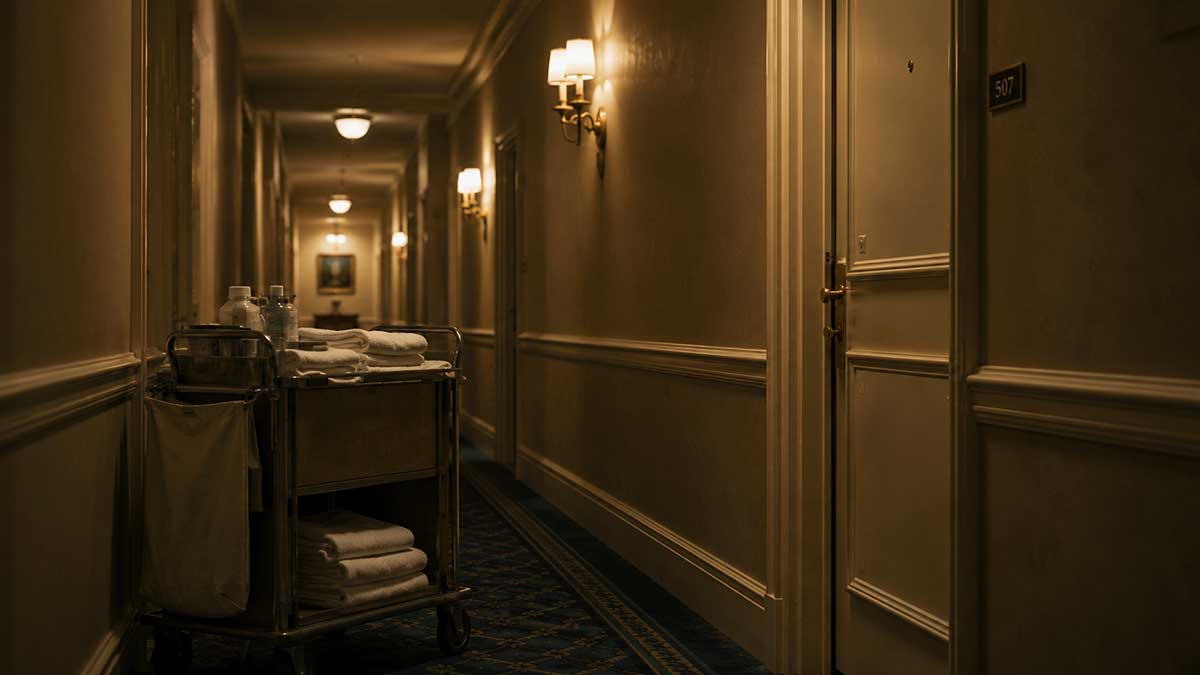
She was in the hall with a cart of clean towels and two small bottles of shampoo in her apron pocket. The cart had one bad wheel, and she had been thinking about that wheel for three days. It made a private little complaint each time she pushed it over the carpet seam.
The sound came from Room 507.
Louise stopped pushing the cart. The bad wheel stopped complaining.
At first she thought a tray had fallen. People dropped trays all the time. They dropped glasses, perfume bottles, telephones, cuff links, pills, rings, children’s toys. In a hotel, a person could break nearly anything and still expect someone in a white jacket to appear with a broom.
She stood there with one hand on the cart handle.
Then Mrs. Glass screamed.
Louise moved to the door and knocked once. She did not know why she knocked.
“Ma’am?” she said.
There was no answer, only the scream again, thinner now, broken at the end.
Louise looked down the hall. The hallway had become longer than it had been a moment before.
She ran to the service telephone.
In the lobby, the assistant manager was explaining to a gentleman from Baltimore why the hotel could not be responsible for the emotional condition of a golf bag.
“I gave it to your man personally,” the gentleman said.
“Yes, sir,” the assistant manager said. “Naturally.”
“It had three woods in it.”
“Yes, sir.”
“One of them is missing.”
“Yes, sir.”
“I don’t think you understand the matter.”
The assistant manager understood the matter completely. A man wanted his club and wanted someone else to become sorry enough to replace it.
The service telephone rang.
The assistant manager lifted one finger to the gentleman from Baltimore and picked up the receiver.
“Yes?”
He listened.
His face changed only once, and only at the mouth.
“Stay there,” he said.
He put the receiver down.
The gentleman from Baltimore said, “Now, as I was saying—”
“I’m afraid you’ll have to excuse me.”
“I have been excused all morning,” the gentleman said.
The assistant manager walked away quickly, not running. Running in a hotel meant fire, death, or very poor training. He took the elevator with a bell captain and a man from maintenance who had been near enough to be chosen.
The elevator passed the third floor, where a woman in a pink suit was standing in the corridor with her hand on her throat. She had gone to the wrong floor first, then to the right one, then to the wrong one again. She pressed the elevator button after the doors had closed.
On the fifth floor, Louise stood near Room 507. The towels on her cart looked indecently white.
The assistant manager knocked, then opened the door with his key.
Muriel Glass was standing beside one bed in her slip. She had one hand at her mouth. Her other hand held nothing, but it was shaped as if it had dropped something and could not forgive itself.
The assistant manager took one step into the room, then stopped.
“Mrs. Glass,” he said.
She looked at him.
“He said he saw one,” she said.
“Ma’am?”
“He said he saw one.”
The assistant manager turned to the bell captain.
“Get Dr. Wheeler. Now.”
The bell captain left.
The maintenance man backed into the hallway and stayed there. He had fixed many things in the hotel, but there was nothing in this room that belonged to him.
The assistant manager went to the telephone and called the front desk. He spoke softly. He said the number of the room twice. He said no guests were to be sent to the fifth floor. He said someone should contact the police. He did not say the word that had entered the room and filled it.
Muriel sat down on the edge of her bed. The bed did not move much. It had been built to receive tired people, not news.
“Mrs. Glass,” the assistant manager said, “is there someone we can call?”
“My mother,” Muriel said.
“May I have the number?”
Muriel looked at the telephone. It was the same telephone. Nothing about it had changed. It sat on the night table with a little card giving the rates for local and long-distance calls.
“She was just on it,” Muriel said.
The assistant manager waited.
“I told her everything was fine.”
He did not answer.
“I told her he was fine.”
“Yes, ma’am.”
“She kept asking me about the gun.”
The assistant manager did not look at the suitcase.
Muriel turned her head toward him with a sudden sharpness.
“Do not look at that,” she said.
“I wasn’t.”
“Yes, you were.”
He had not been. Or he had. He no longer trusted the muscles in his eyes.
Downstairs, the hotel had begun to protect itself.
Two bellboys were told not to discuss anything with guests. One discussed it at once with a waitress named June. June told another waitress that something had happened upstairs to the young couple from New York, the pretty one with all the hair and the husband who never ordered breakfast.
At the pool, a man in green trunks asked why the north elevator was out.
“Repairs,” said the desk clerk.
“What kind of repairs?”
“Elevator repairs,” said the desk clerk.
The man in green trunks accepted this with suspicion.
On the beach, Sybil Carpenter was digging a hole with the seriousness of an engineer. Her mother sat under an umbrella with a magazine open against her knees. She had read the same paragraph five times and had made no acquaintance with it.
“Don’t throw sand,” her mother said.
“I’m not.”
“You are.”
“It’s not at anyone.”
“That isn’t the point.”
Sybil stopped digging. She looked at the water.
“Where’s the man?”
“What man?”
“The man with the raft.”
Her mother turned a page. “I don’t know, darling.”
“He said he saw one.”
“Saw what?”
“A bananafish.”
“Then I’m sure he did.”
Sybil looked at her mother’s face.
“You don’t believe in them.”
“I believe in lunch,” her mother said. “We’re going up soon.”
Sybil pushed sand from the edge of the hole. It slid back in.
“They go in holes,” she said.
“What does?”
“Bananafish.”
Her mother adjusted the umbrella pole. “That sounds sticky.”
“They eat too many.”
“Then they should learn not to.”
Sybil considered this answer. It seemed to her that grown people spoke as if learning were the same as doing.
A boy ran by with a red ball. The ball hit Sybil’s pail and tipped it over.
“Sorry,” the boy said, not stopping.
Sybil set the pail upright.
In Room 507, a doctor with round glasses had arrived. He had been playing bridge in a room off the lobby and still had one card in his breast pocket. It was the seven of clubs.
He spoke to the assistant manager, then to Muriel. His voice was low and professional. He asked her to sit in the other chair. She said she was already sitting. He said yes, she was. He had meant another chair.
This irritated her.
“I don’t want another chair,” she said.
“Of course.”
The doctor looked at her eyes, then at her hands.
“Mrs. Glass, did your husband say anything to you?”
She looked down.
“He said he saw a bananafish.”
The doctor wrote nothing.
“Anything else?”
“I said that was nice.”
The doctor waited.
“That was the last thing I said to him.”
She looked up.
“I said, ‘That’s nice.’”
The doctor nodded.
It was a terrible thing, he thought, the way last words were almost never dressed for the occasion.
The police came next. Two men. One older, one young enough to be careful with his face. They asked questions that sounded as if they had been used before.
Name. Age. Address. Time. History. Medication. Argument. Weapon. Witness. Family.
Muriel answered some of them. The assistant manager answered some. The doctor answered one and refused two. The younger policeman took notes. He wrote “wife states deceased had been nervous.” Then he crossed out nervous and wrote “unstable.” Then he crossed out unstable and wrote nothing.
Muriel watched the pencil.
“He was not unstable all the time,” she said.
The younger policeman looked up.
“No, ma’am.”
“He knew poems.”
“Yes, ma’am.”
“He could make children laugh.”
The older policeman glanced at the younger one, not unkindly, but with the fatigue of a man who had heard grief try to enter evidence before.
Muriel stood up.
“I want my robe.”
Louise, who had remained near the doorway without being asked, picked up Muriel’s robe from the foot of the bed and brought it to her. It was pale blue. Muriel put one arm into it, then the other. Louise tied the belt for her. It was too intimate and not intimate enough.
“Thank you,” Muriel said.
Louise nodded.
“I’m sorry,” Louise said.
Muriel looked at her. “For what?”
Louise did not know. “I don’t know, ma’am.”
Muriel sat again.
The older policeman asked if there was a note.
The assistant manager said they had not searched.
The word searched made Muriel turn toward the desk.
“There was paper,” she said.
The younger policeman went to the desk. He picked up the hotel stationery. There were two blank sheets, a menu card, and an envelope. Nothing else.
“He took it,” Muriel said.
“Took what?”
“The paper.”
The younger policeman opened the top drawer. Inside were a Gideon Bible, a sewing packet, and a pencil with the hotel name stamped in gold.
Muriel stood. “Don’t.”
The policeman stopped.
She walked to Seymour’s suitcase. The assistant manager moved as if to stop her, then did not.
She opened the suitcase and moved one folded shirt, then another. There was a book, a pair of socks, a tie, and a flat envelope. She took the envelope and held it.
Her name was not on it.
No name was on it.
She opened it.
Inside were three sheets of hotel stationery. On the first sheet was a drawing of a fish with an enormous round belly and a tiny surprised mouth. Around it were small bananas, each drawn with absurd care.
On the second sheet were sentences, none finished.
The clean people are the hungriest.
A child can see the door before the fat ones do.
No one believes in holes until he cannot get out.
Tell Sybil six is not too many.
On the third sheet there was only one line.
Forgive me for speaking in the wrong language.
Muriel sat on the floor with the papers in her lap.
The younger policeman said, “Ma’am, we may need those.”
She did not look up.
“No,” she said.
The older policeman touched his partner’s sleeve. “Give her a minute.”
The minute passed. Then another.
At noon, the hotel dining room filled nearly on schedule.
The soup was cream of tomato. The fish was served with lemon and parsley. A woman at table nine complained that the parsley had touched the sauce. A waiter apologized and carried the plate away with the dignity of a priest handling a small failed offering.
At table twelve, Mrs. Fedderman from Cleveland leaned over her roll.
“It was the husband,” she whispered.
Mr. Fedderman said, “Don’t talk.”
“I’m not talking. I’m saying.”
“Same apparatus.”
“He was strange last night.”
Mr. Fedderman buttered his roll. “Lots of men are strange.”
“Not like that.”
He did not answer.
She lowered her voice further.
“That poor girl.”
Mr. Fedderman nodded.
He had asked Seymour about golf. This now seemed both innocent and vulgar. He wished he had asked him nothing.
Muriel’s mother arrived in the afternoon.
She came through the lobby wearing a hat with a veil, though the day did not ask for a veil. Her husband was behind her, carrying nothing. He looked like a man who had left several thoughts in the car and was afraid to go back for them.
Muriel’s mother saw her daughter in a small private sitting room near the manager’s office. Muriel was wearing the pale blue robe over her slip. Someone had found her shoes. She had not put them on.
Her mother crossed the room and held her.
Muriel allowed herself to be held for four seconds. Then she stepped back.
“I know,” her mother said.
Muriel looked at her.
“What do you know?”
Her mother’s face changed. “Darling.”
“What do you know?”
“I know how terrible—”
“No.”
Muriel’s father stood near the door. He looked at his hands.
“I told you,” her mother said, then covered her mouth with her glove as if the words had escaped without papers.
Muriel smiled a little. It was not a good smile.
“Yes,” she said. “You did.”
Her mother began to cry.
Muriel did not. Her crying had gone somewhere private and had not returned.
“He wrote about a child,” Muriel said.
“What child?”
“A girl on the beach.”
Her mother’s eyes sharpened with fear, then with judgment. “What girl?”
“Don’t do that.”
“Do what?”
“Make it dirty so you can understand it.”
Her mother drew back as if struck.
Muriel looked out the window. The lawn beyond the sitting room had two white chairs on it. No one sat in them.
“He could talk to her,” Muriel said. “That’s all. He could talk to a child about fish, and I thought he was being odd.”
Her father cleared his throat.
“Muriel,” he said. “This was an illness.”
She turned to him. “Was it?”
He looked relieved for a second, as if she had agreed. “Yes.”
“Then why does it feel like a sentence I never learned to read?”
Her father had no answer. He had paid many bills for doctors. He had spoken to men who used expensive words. He had signed forms. He had believed action and care were cousins. Now he was not sure they had ever met.
Near four o’clock, Sybil Carpenter was dressed in a white blouse and blue shorts. Her mother had brushed her hair too hard.
“We are not discussing it,” her mother said.
“I only asked.”
“We are not discussing hotel matters.”
“Is he sick?”
Her mother closed the drawer with unnecessary firmness. “Mr. Glass had to go away.”
“Where?”
“Sybil.”
“Where?”
Her mother turned. “He died.”
Sybil looked at her.
Her mother regretted it at once. She had meant to say something gentler. She had meant to say gone. She had meant to say rest. She had meant to say anything people say when they want truth to wear gloves.
Sybil went to the window.
“Did the bananafish die too?”
Her mother stood still.
“What?”
“The one with six bananas.”
“I don’t know anything about bananafish.”
Sybil pressed her forehead against the glass.
“He said six wasn’t too many.”
Her mother came over and put a hand on her shoulder. “Come away from the window.”
Sybil did not move.
“Do bananafish ever get out?”
Her mother closed her eyes.
“I suppose some do,” she said.
Sybil turned. “You don’t know.”
“No.”
“Then don’t suppose.”
Her mother’s hand dropped from her shoulder.
That evening the hotel sent Muriel’s dinner upstairs, though she had not asked for it. The tray had toast, tea, soup, and a little dish of custard with nutmeg on top. Muriel looked at the custard for a long time. It had a skin on it.
Her mother sat in the chair by the window. Her father had gone downstairs to speak with someone about arrangements. Arrangements, Muriel thought, was a word adults used when they wanted grief to sit up straight.
“Eat something,” her mother said.
“No.”
“Just toast.”
“No.”
“You’ll make yourself sick.”
Muriel looked at the bed that had been stripped and remade. Fresh sheets. Fresh pillowcase. Tight corners. The room had become a hotel room again.
“I said ‘that’s nice,’” she said.
Her mother folded her hands.
“You mustn’t punish yourself.”
“I’m not.”
“You are.”
“I’m listening.”
“To what?”
Muriel picked up the three sheets from Seymour’s envelope. She had kept them in her robe pocket. The police had taken them, then returned them after copying the words. Or after pretending they had copied the words. She did not know.
She read the last line again.
Forgive me for speaking in the wrong language.
Her mother said, “What does it mean?”
Muriel held the paper in both hands.
“It means he was talking.”
Her mother waited.
“And I kept answering in English.”
The next morning, the beach looked exactly as it had looked the day before.
That was the offensive part.
The umbrellas opened. The raft boy dragged rafts into a line. A man in green trunks argued about a towel deposit. Mrs. Fedderman walked slowly along the water with her sandals in one hand. Louise changed the towels in 507 and did not look at the picture of the ship.
Muriel came down alone at nine-thirty.
She wore a black dress that was not meant for Florida. Her mother had objected to it, then stopped. Muriel carried no bag and wore no lipstick. The mark on her ankle had darkened overnight.
People saw her. People did not see her. Both were unbearable.
She walked to the edge of the water.
Sybil was there with her yellow pail.
For a moment, neither of them spoke.
Then Sybil said, “You’re his lady.”
Muriel nodded.
“I saw a bananafish,” Sybil said.
Muriel looked out at the water.
“He told me.”
“It had six bananas.”
“Yes.”
“Six isn’t too many.”
Muriel swallowed.
“No,” she said. “I don’t think six is too many.”
Sybil dug the shovel into the wet sand.
“My mother says some get out.”
Muriel looked at her.
“Does she?”
“She was supposing.”
“That’s different.”
Sybil nodded, satisfied to have this confirmed.
Muriel sat on the sand, though the black dress was wrong for it. She took off her shoes and placed them beside her. The ocean came up and wet the hem of her dress. She did not move.
“What happens to the ones that don’t get out?” Sybil asked.
Muriel looked at the place where the water thinned over the sand and disappeared.
“I don’t know,” she said.
Sybil looked at her seriously.
“Then don’t suppose.”
Muriel almost smiled.
“I won’t.”
They sat there together. Sybil dug. Muriel watched the water. Once, far out past the swimmers, a silver shape rose and vanished so quickly that it may have been light.
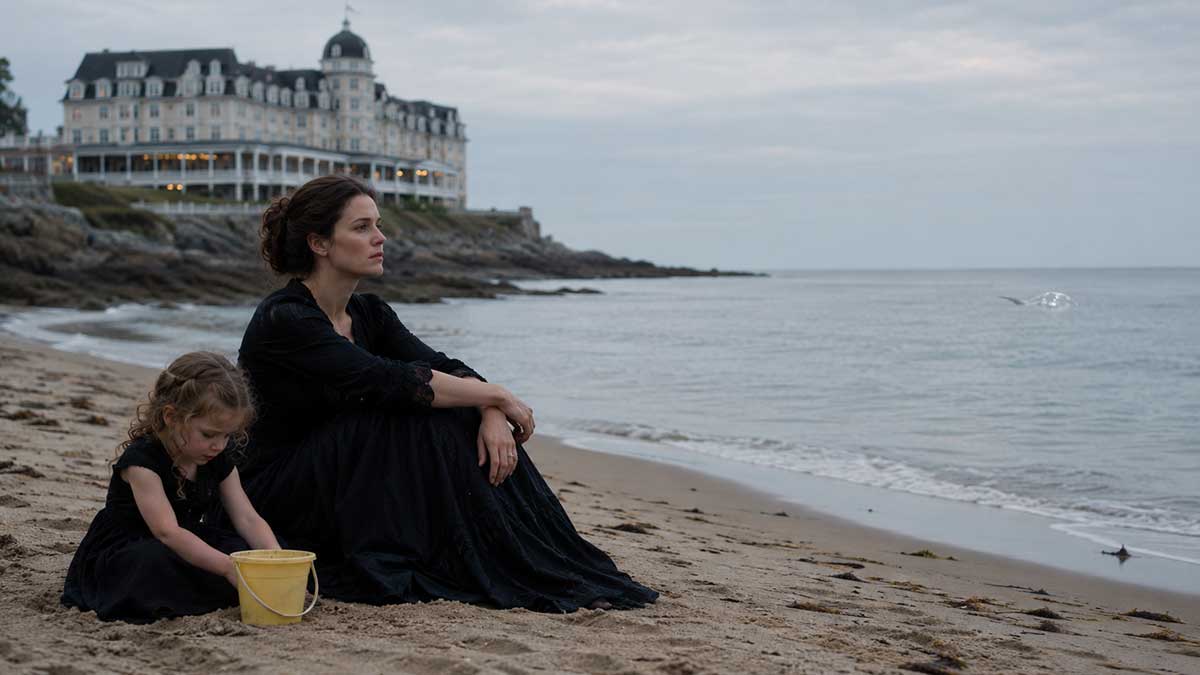
Sybil pointed.
“There.”
Muriel looked.
“I didn’t see it,” she said.
“That’s all right,” Sybil said. “You have to look before it comes.”
The hotel behind them shone in the sun, clean and tall, its windows full of rooms people had paid to forget themselves in. The ocean moved in and out, taking the footprints, returning the shells, erasing the holes and leaving the sand ready for the next child to dig.
Muriel stayed until the tide reached her shoes.
Final Thoughts
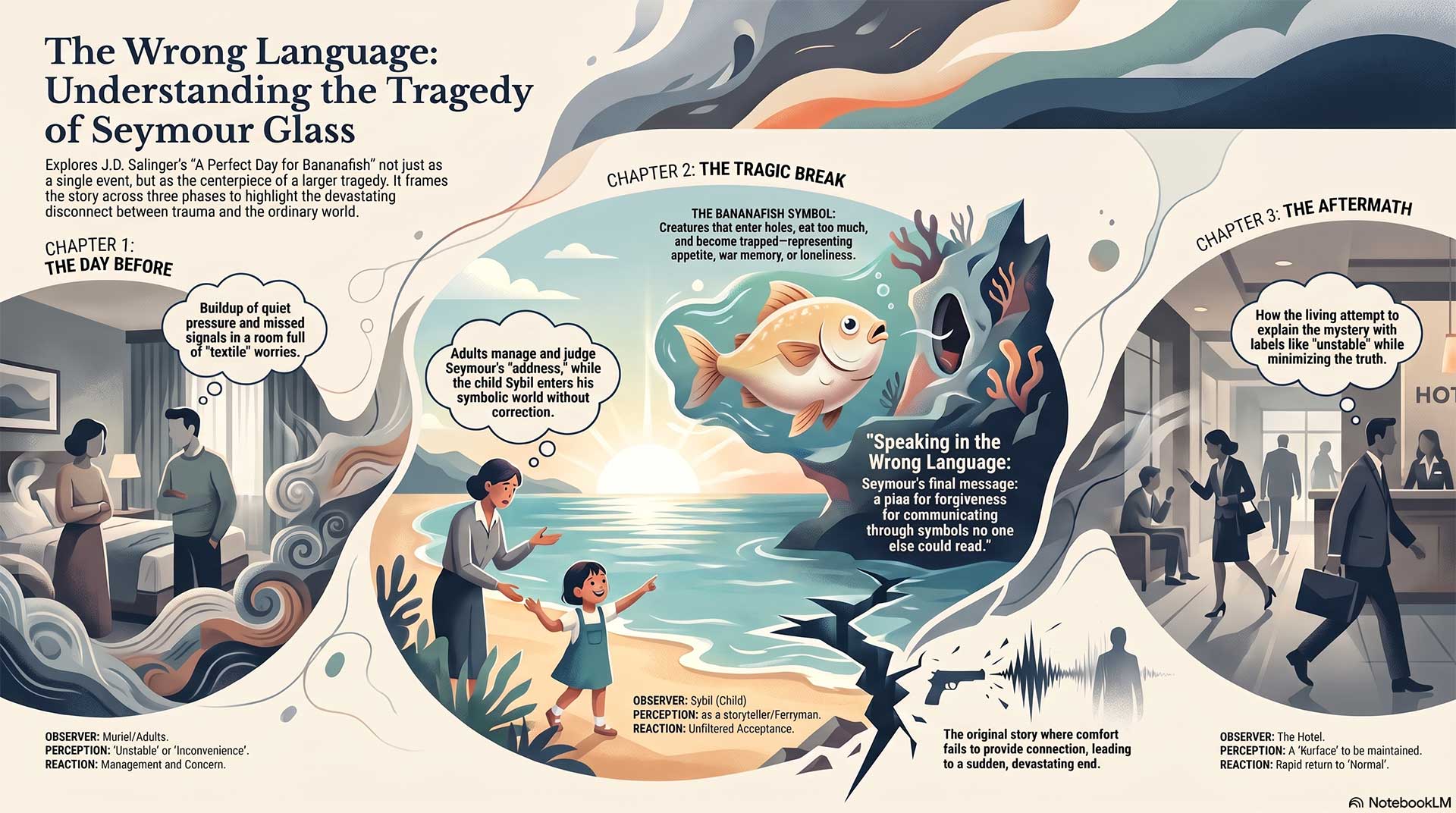
The tragedy of Seymour Glass is not only that he dies. It is that his final language is heard too late.
Muriel remembers that he said he saw a bananafish. At the time, she answers, “That’s nice.” Afterward, those words become unbearable. They show the distance between what Seymour was trying to say and what the people around him were able to receive.
That is the deepest wound of the story.
Many people speak in hidden ways when they are near collapse. They do not always say, “I am in danger.” They may become quiet. They may joke strangely. They may tell stories. They may speak through anger, symbols, dreams, drawings, or sudden tenderness. The people around them may hear the words but miss the message.
This imagined expansion of “Bananafish” is built around that missed message.
Chapter 1 gives us the signs before the tragedy. Chapter 2 gives us the symbol. Chapter 3 gives us the aftermath, where everyone tries to put Seymour into categories: sick man, veteran, husband, problem, case, memory. Each label touches part of him, but none can hold him.
Sybil’s question remains the most honest one:
Do bananafish ever get out?
That question refuses easy comfort. Some may get out. Some may not. Some may need another person to see the hole before it is too late.
The final image of Muriel and Sybil by the water is not a clean healing. It is a quieter kind of awakening. Muriel cannot bring Seymour back. She cannot undo the ordinary words she spoke before the terrible sound. But she can begin to listen differently. She can stop supposing. She can admit that she did not see.
That may be the only honest ending after such a story.
The ocean keeps moving. The hotel keeps running. People still eat lunch, complain about towels, open umbrellas, and speak into telephones. Life resumes its surface. Yet for Muriel and Sybil, the beach will never be only a beach again.
Somewhere beneath the calm water, the bananafish remains.
Short Bios:
Seymour Glass is a wounded man whose inner life no longer fits ordinary conversation. He speaks in jokes, symbols, fragments, and strange tenderness. To adults, he appears unstable or difficult. To Sybil, he becomes a storyteller who reveals a hidden truth through the image of the bananafish.
Muriel Glass is Seymour’s wife. She wants calm, beauty, and normal life, but she does not know how to reach Seymour’s inner pain. Her journey moves from denial to shock, then to a painful recognition that Seymour had been speaking all along in a language she did not know how to hear.
Sybil Carpenter is the child Seymour meets on the beach. She listens to the bananafish story without mocking it or reducing it. Her innocence gives her a kind of clarity the adults lack. In the aftermath, her question about whether bananafish can escape becomes the moral center of the piece.
Muriel’s mother senses danger, but her fear turns Seymour into a problem to be managed. She represents concern without deep recognition. She is not wrong to worry, but her worry cannot enter Seymour’s loneliness.
The hotel is almost a character in itself. It represents polished surface, social order, comfort, routine, and denial. After the tragedy, it quickly tries to return to normal. That return to normal becomes one of the saddest parts of the story.
Leave a Reply