
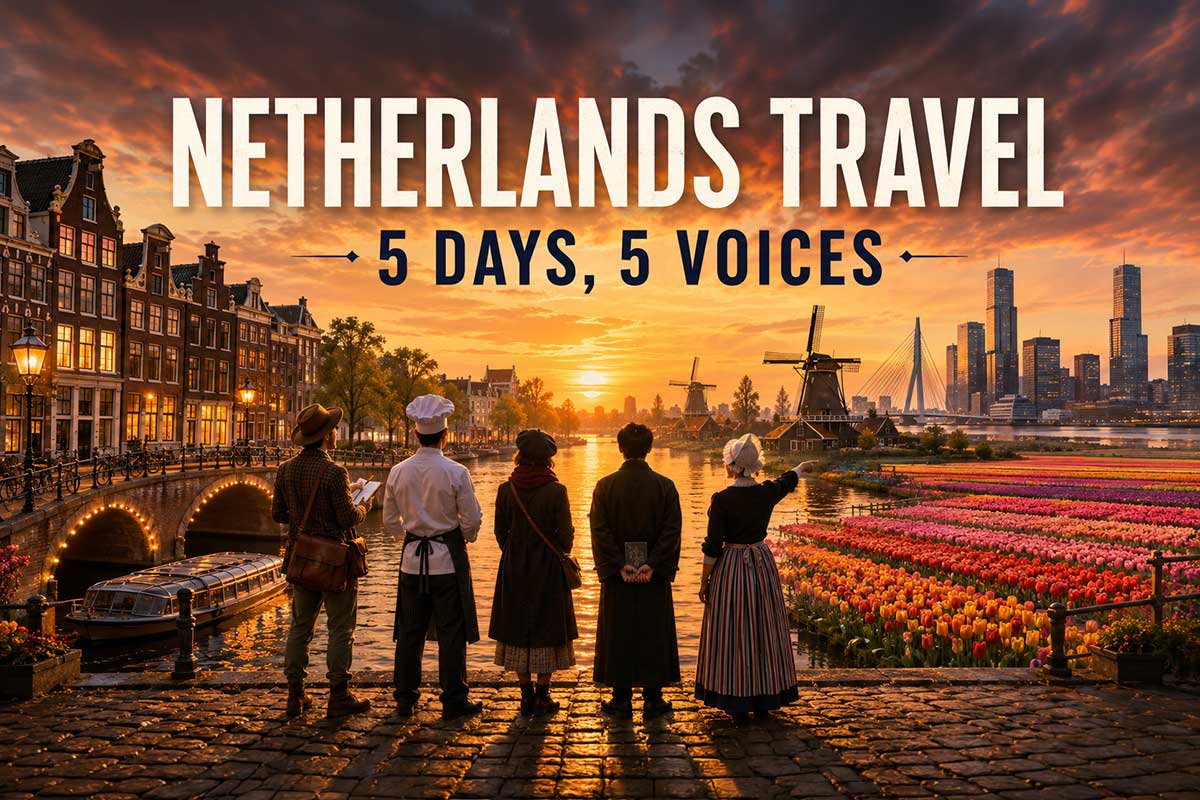
What if five unforgettable voices traveled through the Netherlands and discovered that windmills, canals, and food were hiding a deeper human story?
What if five unforgettable travelers went to the Netherlands together?
Not only to see Amsterdam’s canals, windmills, tulips, museums, and old streets, but to ask a deeper question:
What does this small country reveal about beauty, memory, discipline, survival, and the human spirit?
For five days, Bill Bryson, Anthony Bourdain, Mary Oliver, Haruki Murakami, and Geert Mak travel through the Netherlands, each seeing the country through a different lens.
Bill Bryson brings humor. He notices the leaning houses, the fearless bicycles, the strange charm of Dutch order, and the comedy hidden inside travel confusion.
Anthony Bourdain follows the food. Through bitterballen, cheese, herring, Indonesian rijsttafel, Rotterdam markets, and seaside meals, he reminds the group that no country can be understood through scenery alone. Food carries trade, migration, comfort, memory, and the truth of ordinary people.
Mary Oliver listens to the quiet. She sees the Netherlands through water, wind, flowers, reeds, birds, courtyards, and sky. To her, a canal is never just a canal. A windmill is never just a machine. A flower is never only decoration.
Haruki Murakami sees the dream beneath the visible world. To him, Amsterdam is a city standing on hidden forests, Delft is a room full of mysterious light, and Kinderdijk feels like a place where windmills have been waiting for travelers long before they arrived.
Geert Mak, the Dutch historian and guide, leads them through what many visitors miss. He reveals that the Netherlands is not only a postcard country of windmills and canals. It is a country built through cooperation, memory, law, water management, trade, restraint, and moral seriousness.
Their route begins in Amsterdam, where canals reflect old houses and the city seems to float between water and sky. They visit Dam Square, the Rijksmuseum, the Jordaan, and the evening bridges, discovering that Amsterdam’s beauty was built from practical struggle.
On the second day, they enter the human side of Amsterdam. The Anne Frank House changes the tone of the trip. The city becomes more than beautiful. It becomes a place of memory, fragility, grief, and moral responsibility. Later, the Nine Streets, flower market, Indonesian food, and Vondelpark show how ordinary life returns after sorrow.
On the third day, they leave the city for Zaanse Schans and Haarlem. Windmills turn in the open air. Cheese ages in quiet rooms. Wooden shoes, once comic to outsiders, become symbols of practicality. Inside a windmill, the group realizes that Dutch tradition was never decoration first. It was survival, repeated until it became beautiful.
On the fourth day, Delft and The Hague reveal another side of the Netherlands. Delft teaches them about light, craft, patience, and Vermeer’s mystery. The Hague teaches them about government, law, diplomacy, and peace as difficult labor. At Scheveningen Beach, the North Sea reminds them that every country has an edge where its story meets something larger.
On the fifth day, Rotterdam and Kinderdijk bring past and future together. Rotterdam shows a city rebuilt after devastation, bold enough to become new rather than copy what was lost. Kinderdijk brings them back to wind, water, and old human courage. At sunset beside the windmills, each traveler finally understands that the Netherlands is small only on a map.
This is not only a travel story.
It is a conversation about how people live with forces larger than themselves.
Water.
History.
Memory.
Loss.
Beauty.
Hunger.
Law.
Change.
And the quiet discipline needed to keep a fragile world from sinking.
(Note: This is an imaginary conversation, a creative exploration of an idea, and not a real speech or event.)
Day 1 – Amsterdam: First Impressions
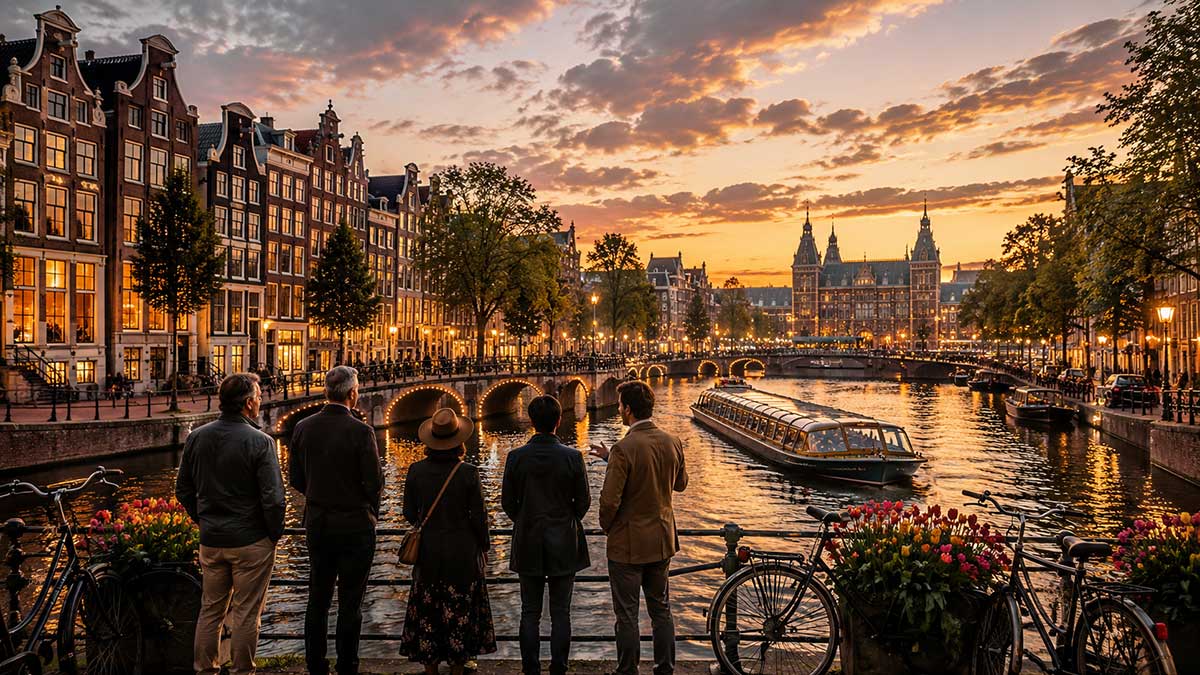
Opening
Amsterdam greeted them not with a grand gate, but with water.
The train slowed into Amsterdam Centraal, and through the station windows the travelers saw bicycles, trams, canal boats, old brick buildings, and a pale sky reflected in the harbor.
Bill Bryson: “I’ve been here seven minutes and already feel underdressed. The bicycles look more confident than I do.”
Anthony Bourdain: “That’s how you know a city is alive. Nobody is posing. They’re just going somewhere.”
Mary Oliver: “The water is already speaking. Softly, but everywhere.”
Haruki Murakami: “A city built on water always feels like a dream that learned how to stand.”
Geert Mak: “Then let us begin there. Amsterdam is not a city that defeated water. It negotiated with it.”
They stepped out of the station, and Day 1 began.
Scene 1 – Arrival at Amsterdam Centraal & Canal Cruise
The first canal boat moved slowly away from the dock, sliding between old houses that leaned slightly, as if listening to secrets across the water.
Bill Bryson: “Are the houses supposed to lean like that, or has everyone agreed not to mention it?”
Geert Mak: “They lean from age, soil, foundations, and sometimes from design. Amsterdam is built on soft ground. Beneath many old buildings are wooden piles driven deep into the earth.”
Anthony Bourdain: “So the city is basically standing on buried trees.”
Geert Mak: “In a way, yes.”
Mary Oliver: “That makes it more beautiful. A forest beneath a city of canals.”
Murakami: “A hidden forest holding up visible water. That sounds like the beginning of a strange novel.”
The boat passed under a bridge. The water darkened for a moment, then brightened again. Bicycles crossed above them, wheels moving like quiet clocks.
Bill Bryson: “I must admit, this is a very polite way to be overwhelmed.”
Anthony Bourdain: “That’s Amsterdam. It doesn’t shout first. It lets you come closer.”
Geert Mak: “Tourists often see canals as scenery. For Amsterdam, they were roads, defenses, business routes, drainage, and status. The canal ring was a practical machine, but it became beautiful.”
Mary Oliver: “Beauty made from necessity.”
Murakami: “Many lives are like that.”
For the first time, the group became quiet. The boat turned into a wider canal, and Amsterdam unfolded slowly in front of them.
Scene 2 – Dam Square & The Royal Palace
By late morning, they reached Dam Square. The space felt open, loud, busy, and old. Pigeons scattered near the stones. Street performers pulled crowds. The Royal Palace stood with calm authority.
Bill Bryson: “Every European city seems to have one square where history, tourists, pigeons, and confused men with maps all collide.”
Anthony Bourdain: “And somehow food carts survive the whole thing.”
Geert Mak: “This square is where Amsterdam began to become Amsterdam. The dam on the Amstel River gave the city its name.”
Mary Oliver: “So the name itself remembers water.”
Geert Mak: “Yes. Amsterdam is a memory of water control. A dam became a settlement. A settlement became a trading city. A trading city became a global force.”
Murakami: “The city’s name is not romantic. It is practical. Maybe that is why it feels honest.”
They looked up at the Royal Palace.
Bill Bryson: “I assume this palace was built so kings could stand inside and feel pleased with themselves.”
Geert Mak: “Funny enough, it was built as a city hall. In the seventeenth century, Amsterdam’s citizens were making a statement. Their city had become rich, confident, and powerful.”
Anthony Bourdain: “So this was civic pride before it was royal pride.”
Geert Mak: “Exactly.”
Mary Oliver: “A palace for citizens. That changes how I see it.”
A street musician began playing nearby. People passed in every direction. Some were tourists. Some were office workers. Some were children chasing pigeons. Amsterdam was not frozen in history. It kept moving through it.
Murakami: “A city square is like a page where every century writes on top of the last one.”
Bill Bryson: “And then someone drops french fries on it.”
Scene 3 – Rijksmuseum & Museumplein
After lunch, they walked to Museumplein. The Rijksmuseum rose before them like a red-brick cathedral of Dutch memory.
Inside, the rooms grew quiet.
They stood before Rembrandt’s The Night Watch. The painting seemed to move, not with motion, but with human energy.
Anthony Bourdain: “This is not polite art. This has muscle.”
Geert Mak: “It shows civic guards, but it also shows Amsterdam’s confidence. These were not kings or saints. They were citizens.”
Bill Bryson: “I do love a painting where everyone looks like they were interrupted during something important.”
Mary Oliver: “The light finds them one by one. No one is entirely hidden.”
Murakami: “In Murakami novels, light often enters from strange places. Here, light enters history.”
They moved from room to room. Ships. Maps. Silver. Portraits. Domestic rooms. Windows. Women reading letters. Men looking out from dark backgrounds.
Geert Mak: “Dutch art often honors ordinary life. Tables, letters, kitchens, fruit, windows, maps. The daily world becomes worthy of attention.”
Mary Oliver: “That is a sacred idea.”
Anthony Bourdain: “A kitchen table can tell you more than a battlefield sometimes.”
Bill Bryson: “That may be the most Dutch thing I’ve heard all day. ‘Let us conquer the sea, then paint a bowl of lemons.’”
Geert Mak: “Both mattered.”
Outside, Museumplein gave them open air again. Cyclists crossed the edge of the green. People sat on the grass. Children ran between museums.
Murakami: “Amsterdam places masterpieces beside bicycles. That feels right.”
Scene 4 – Jordaan District
By afternoon, they entered the Jordaan.
The large streets softened into smaller ones. Narrow canals, brick houses, flower boxes, old bridges, tiny shops, and quiet cafés appeared one after another.
Bill Bryson: “This is where Amsterdam becomes dangerously charming. I’m suspicious of charm at this level.”
Anthony Bourdain: “This is where you stop reading the guidebook and start getting hungry.”
They found a small café with wooden tables and warm lights. Anthony ordered bitterballen, bread, cheese, and small glasses of beer for those who wanted it.
Anthony Bourdain: “Now this is useful food. Hot, simple, dangerous to the roof of your mouth. Every country needs something like this.”
Bill Bryson: “It looks innocent. That’s how it gets you.”
Geert Mak: “The Jordaan was once a working-class neighborhood. Immigrants, laborers, artisans, people living close together. Today it is fashionable, but its older soul is still here if you walk slowly.”
Mary Oliver: “Places change clothes, but not always their heart.”
Murakami: “In a narrow street, time cannot run quickly. It has to walk.”
Geert led them into a quiet courtyard tucked behind a doorway. The noise of the city disappeared almost at once.
Bill Bryson: “Good heavens. Amsterdam has secret pockets.”
Geert Mak: “These courtyards are easy to miss. Many Dutch cities have places like this: private, modest, hidden from the street.”
Mary Oliver: “The city has an inner life.”
Anthony Bourdain: “And it doesn’t advertise it. I respect that.”
They sat for a moment. A few plants moved lightly in the wind. Somewhere outside, a bicycle bell rang, distant and small.
Murakami: “Some doors do not lead to another place. They lead to another speed of time.”
Scene 5 – Evening Canal Walk
Evening settled over the canals. The bridges began to glow. Windows reflected in the water. The day’s noise softened.
They walked without hurry.
Bill Bryson: “I began this morning fearing death by bicycle. Now I feel almost fond of them.”
Anthony Bourdain: “That’s travel. First fear, then appetite.”
Mary Oliver: “First water, then reflection.”
Geert Mak: “First surface, then depth.”
Murakami: “First city, then dream.”
They stopped on a bridge and looked down. The canal held the sky, the houses, the lamps, and the passing boats.
Geert Mak: “Many visitors think Amsterdam is free because it is loose. That is not quite right. It is free because it learned discipline: water boards, trade rules, shared responsibility, compromise. Freedom here was built, not handed down.”
Anthony Bourdain: “That’s a serious lesson for a beautiful city.”
Bill Bryson: “I preferred it when we were discussing snack hazards, but I admit that is rather good.”
Mary Oliver: “A city teaches through what it repeats. Here, water repeats. Bridges repeat. Windows repeat. Bicycles repeat. Maybe the lesson is patience.”
Murakami: “Or balance. Too much water, the city disappears. Too much control, the dream disappears.”
A canal boat passed beneath them, carrying strangers under the bridge and into the night.
For a moment, no one spoke.
Amsterdam had given them beauty, humor, history, food, art, and hidden courtyards in one day. Yet it felt as if the city had only opened its first door.
Geert Mak: “Tomorrow, we visit the human side of Amsterdam. That will not be as easy.”
Bill Bryson: “I was afraid you were going to say that.”
Anthony Bourdain: “Good travel is not supposed to stay comfortable.”
Mary Oliver: “No. It asks us to become more awake.”
Murakami: “Then tomorrow, perhaps, the dream becomes heavier.”
The lights trembled on the canal.
Day 1 ended not with an answer, but with a quiet question:
What does a beautiful city remember after dark?
Day 2 – Amsterdam: The Human Side of the City
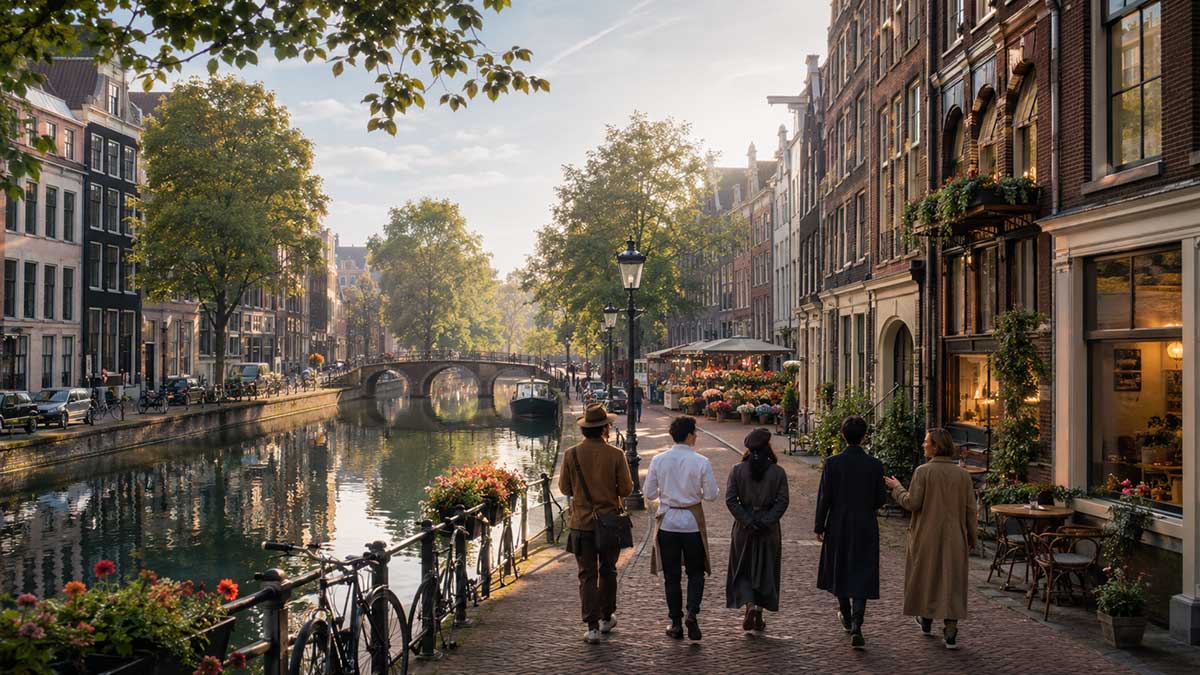
Opening
The next morning, Amsterdam felt different.
On Day 1, the city had shown them canals, paintings, bridges, and beautiful old houses. Day 2 began with a quieter invitation. The same water moved under the same bridges, yet the city seemed to ask for a deeper kind of attention.
Bill Bryson: “Yesterday Amsterdam seemed charming. This morning it looks like it knows things I don’t.”
Anthony Bourdain: “Most good cities do.”
Mary Oliver: “The light is softer today. Maybe we are the ones who changed.”
Haruki Murakami: “A city has many doors. Yesterday we entered through beauty. Today may be another door.”
Geert Mak: “Today we look at the people inside the beauty.”
They crossed a canal, and the morning bells sounded somewhere behind the rooftops.
Scene 1 – Anne Frank House
They stood outside the Anne Frank House in silence.
There was no need for a dramatic entrance. The building itself was quiet. Ordinary. Almost too ordinary.
Bill Bryson: “It is smaller than I expected.”
Geert Mak: “That is part of the shock. History often hides inside ordinary rooms.”
Mary Oliver: “A door. A staircase. A window. A diary. Such small things to hold such sorrow.”
They entered slowly.
Inside, the group moved through narrow rooms and steep stairs. The walls did not shout. They simply remained. The emptiness felt heavier than furniture might have.
Anthony Bourdain: “You can’t really perform here. You just stand there and feel ashamed of how much comfort you take for granted.”
Murakami: “A hidden room changes time. Outside, the city continues. Inside, every sound becomes enormous.”
Geert Mak: “For Amsterdam, this place is not separate from the canal houses and pretty streets. It is inside the same city. That is why memory matters.”
Bill looked at the walls for a long time.
Bill Bryson: “I came ready to make jokes about bicycles, and now I feel like the city has taken away my permission.”
Mary Oliver: “Maybe it has given you another kind of permission. To be still.”
They stood before the diary’s story, and the cheerful Amsterdam of postcards faded for a moment. What remained was a young girl, a family, fear, hope, and words that survived.
Anthony Bourdain: “Food, travel, cities — all of it means nothing if we forget people.”
Geert Mak: “That is the lesson here. Civilization is fragile. Tolerance must be practiced, guarded, and renewed.”
Murakami: “A diary is a small lamp. Yet sometimes a small lamp survives a terrible darkness.”
When they stepped outside again, the canal was still there.
The water had not changed.
They had.
Scene 2 – De 9 Straatjes
From the heaviness of the morning, they walked into De 9 Straatjes, the Nine Streets.
Small shops lined narrow lanes. There were old windows, vintage clothing, tiny cafés, design stores, books, candles, bags, postcards, and quiet corners where Amsterdam seemed to breathe in a more personal rhythm.
Bill Bryson: “This is dangerously pleasant. One could disappear into these shops and emerge three hours later with a scarf, a ceramic duck, and no explanation.”
Anthony Bourdain: “That’s travel shopping at its best. Mild confusion with a receipt.”
Mary Oliver: “The windows feel like little poems. Each one offers a different version of daily life.”
Geert Mak: “These streets connect major canals, but they feel intimate. Amsterdam’s charm often lives in the spaces between famous places.”
Murakami: “The spaces between things are where stories wait.”
They entered a small bookstore. The wooden floor creaked. A cat slept near the back, guarding nothing and everything.
Murakami smiled faintly.
Murakami: “Naturally, there is a cat.”
Bill Bryson: “Of course there is. The cat has probably read more Dutch literature than I have.”
Mary picked up a small notebook with a canal sketch on the cover.
Mary Oliver: “After a place of grief, small shops can feel trivial. Yet maybe they are part of life returning.”
Geert Mak: “Yes. Ordinary life is not shallow after suffering. It is precious.”
Anthony stopped at a bakery window.
Anthony Bourdain: “There it is. The city recovering its appetite.”
Inside, they shared apple pie with cream and strong coffee.
Bill Bryson: “I’m pleased to report that sorrow and pastry can occupy the same day.”
Mary Oliver: “That may be one of the mercies of being human.”
Outside, a bicycle bell rang. A young couple laughed. Someone carried flowers across the bridge. Amsterdam had not erased the morning’s memory. It had placed life next to it.
Scene 3 – Floating Flower Market
They arrived at the flower market, where color spilled from stall to stall.
Tulip bulbs, postcards, magnets, seed packets, wooden tulips, and flower displays filled the walkway. It was touristy, cheerful, commercial, and still strangely lovely.
Bill Bryson: “This is what happens when a country becomes extremely good at flowers and then decides everyone must know.”
Anthony Bourdain: “I respect the hustle. Tulips, cheese, herring, beer, canals. They know their brand.”
Geert Mak: “Tulips came from far away and became deeply linked with Dutch identity. The flower tells a story of trade, desire, beauty, and speculation.”
Murakami: “A flower can become a mirror. People see wealth, romance, memory, spring.”
Mary Oliver: “A tulip is simple until a person wants too much from it.”
Bill picked up a packet of bulbs and studied it.
Bill Bryson: “So this small brown lump is supposed to become elegance.”
Mary Oliver: “Many things begin in an unpromising form.”
Anthony Bourdain: “Including most meals.”
They moved past stalls of color. The market floated beside the canal, though much of its older character had changed over time. Still, the idea remained: flowers sold on water, beauty traded in bundles.
Geert Mak: “Amsterdam always mixed beauty with business. Even the flowers carry that double life.”
Murakami: “A canal city sells dreams in waterproof packaging.”
Bill Bryson: “That sentence alone could empty my wallet.”
Mary watched a woman choose tulips carefully, one stem at a time.
Mary Oliver: “People buy flowers when words are too small.”
For a few moments, they let the colors answer for them.
Scene 4 – Indonesian Rijsttafel Lunch
By early afternoon, Anthony led them to an Indonesian restaurant.
The table filled with small dishes: rice, vegetables, satay, sauces, stews, pickles, sambal, coconut, spices, sweet heat, deep heat, and fragrant steam.
Anthony Bourdain: “Now we’re getting somewhere.”
Bill Bryson: “This is not lunch. This is a conference.”
Geert Mak: “Rijsttafel means rice table. It reflects Dutch colonial history in Indonesia, and it remains part of Amsterdam’s food culture.”
Mary Oliver: “So the meal carries memory too.”
Anthony Bourdain: “Every serious meal does. Some memories taste sweet. Some burn.”
He tasted a spoonful of sambal and nodded.
Anthony Bourdain: “That wakes you up.”
Bill Bryson: “My eyebrows have become independent.”
Murakami watched the table, each small dish like a separate room.
Murakami: “A meal like this is a map. Not a map of streets, but of contact, distance, longing, and return.”
Geert Mak: “The Netherlands cannot be understood only through canals and windmills. Trade connected it to the world. That brought wealth, spices, ideas, injustice, migration, and new identities.”
Mary Oliver: “A country’s beauty is never innocent if we look long enough.”
Anthony leaned back.
Anthony Bourdain: “That’s why food matters. It doesn’t let history stay abstract. You taste the route.”
Bill reached for another dish carefully.
Bill Bryson: “I am approaching this one with diplomatic caution.”
Anthony Bourdain: “Good. Respect the sauce.”
The lunch became lively. Bill joked about spice. Mary asked about rice fields. Murakami imagined a stranger alone in a rainy Amsterdam restaurant, eating satay and remembering an island he had never visited. Geert explained how the Dutch relationship with Indonesia was long, painful, layered, and impossible to reduce.
By the end, the table was almost empty.
Anthony Bourdain: “This is what I wanted. A meal that refuses to be simple.”
Geert Mak: “Amsterdam is like that.”
Scene 5 – Vondelpark at Sunset
In the late afternoon, they walked to Vondelpark.
After museums, markets, and memory, the park felt open and gentle. Families spread blankets on the grass. Cyclists passed in easy lines. Children played. Dogs ran ahead of their owners. The city exhaled.
Bill Bryson: “At last, a place where the bicycles appear less homicidal.”
Anthony Bourdain: “You’re adapting.”
Bill Bryson: “I wouldn’t go that far. I’m merely panicking with greater elegance.”
Mary sat on a bench beneath the trees.
Mary Oliver: “A park is a city’s promise that people still need grass.”
Murakami: “And paths. Every park is a set of choices.”
Geert Mak: “Amsterdam can be intense in the center. Vondelpark gives it softness. A city needs places where people do nothing useful.”
Anthony Bourdain: “Doing nothing useful is underrated.”
They watched the sunset gather through the leaves. The day had moved from tragedy to shops, from flowers to food, from history to ordinary peace.
Bill Bryson: “I’m beginning to see the trick. Amsterdam is beautiful, yes, but it keeps asking you to look behind the beauty.”
Geert Mak: “That is fair.”
Mary Oliver: “The city today showed grief, color, hunger, and rest.”
Anthony Bourdain: “That’s a full day. That’s a human day.”
Murakami: “Yesterday, Amsterdam was water and light. Today, it became memory.”
A child ran past them laughing. Nearby, someone played a soft tune on a guitar. No one in the group spoke for a little while.
Then Geert looked at the others.
Geert Mak: “Tomorrow we leave the city for windmills, crafts, and older Holland. But remember this: the postcard version is never the whole truth.”
Bill Bryson: “I suspected the postcards were holding back.”
Anthony Bourdain: “They always do.”
Mary Oliver: “Still, the windmills may have their own honesty.”
Murakami: “Machines that speak with wind. Yes, tomorrow may become stranger.”
The sky deepened over Vondelpark.
Day 2 did not close the story. It widened it.
Amsterdam was no longer merely a city of canals.
It had become a city of memory, appetite, color, silence, and return.
Day 3 – Windmills & Traditional Holland
Opening
By morning, Amsterdam began to fall behind them.
The train carried the travelers north, past flat fields, low skies, water channels, and small houses that seemed to rest close to the earth. The city’s canals gave way to wider spaces, and the Netherlands began to show another face.
Bill Bryson: “I must say, the Dutch landscape has mastered the art of being extremely flat without becoming dull.”
Anthony Bourdain: “Flat land, big sky, strong coffee. Not a bad start.”
Mary Oliver: “The sky feels nearer here. Maybe the land has made room for it.”
Haruki Murakami: “In a flat country, distance becomes visible. You can see time coming.”
Geert Mak: “Today we enter the older image many people carry in their minds: windmills, cheese, wooden houses, crafts. But we must look past the postcard.”
The train slowed near Zaandam, and soon they were walking into Zaanse Schans.
The wind was waiting for them.
Scene 1 – Zaanse Schans: Windmills Begin Turning
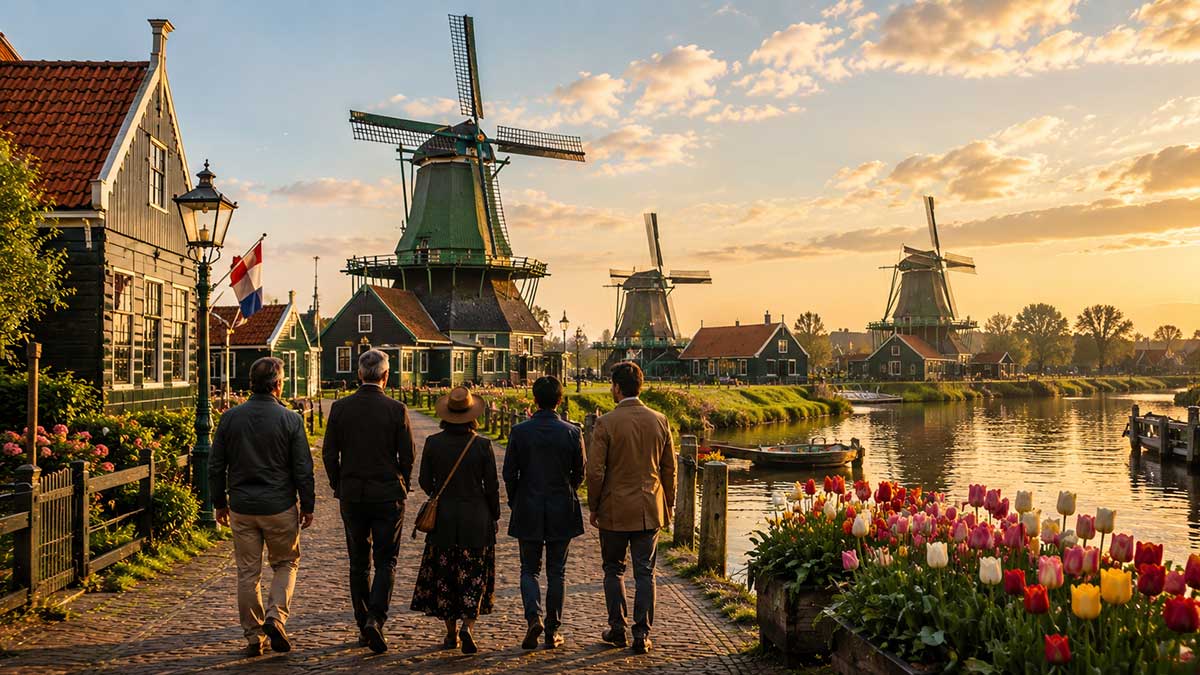
The first windmill appeared above the grass, its dark arms moving slowly against the pale sky.
Then another.
And another.
The village opened like an old painting: green wooden houses, narrow paths, water, reeds, bridges, and windmills turning with patient strength.
Bill Bryson: “This is suspiciously perfect. I feel I have walked into a souvenir tin.”
Anthony Bourdain: “A good souvenir tin, though. The kind with butter cookies inside.”
Mary Oliver: “No. It is not perfect. It is working. That is why it feels alive.”
Geert Mak: “Exactly. These mills were not built to decorate the landscape. They sawed wood, ground spices, made oil, processed pigments, drained land. They were factories before factories became dark.”
Murakami: “Machines with wings.”
They stood beside the water as the windmill sails moved with a soft wooden rhythm.
Bill Bryson: “I find them oddly reassuring. Like giant old men who know what to do.”
Anthony Bourdain: “They look gentle from far away. Up close, I bet they mean business.”
Geert Mak: “They do. The Netherlands survived through cooperation, engineering, labor, and repetition. Romantic images often hide serious work.”
Mary Oliver: “The wind becomes useful here. That feels like wisdom.”
A gust crossed the grass. The mill turned again, steady and calm.
Murakami: “Wind is invisible until something listens to it.”
No one spoke for a moment. The village did not feel like a museum only. It felt like a memory still moving.
Scene 2 – Cheese Farm & Wooden Shoes
Their next stop was a cheese farm, warm with the smell of milk, wood, salt, and aging cheese.
Rounds of cheese sat in careful rows. A guide explained the process. Anthony listened with full attention.
Anthony Bourdain: “Now we’re speaking a language I trust.”
Bill Bryson: “Cheese is one of civilization’s more convincing arguments.”
Geert Mak: “Dutch cheese became famous through farming, trade, and storage. Food here often has a practical origin before it becomes a national symbol.”
Mary Oliver: “Milk changed by time. That is gentle magic.”
Murakami: “A cheese room is like a library. Each wheel is aging into its own story.”
Bill sampled one piece, then another.
Bill Bryson: “I came here prepared to learn. I am now prepared to buy irresponsible amounts of cheese.”
Anthony Bourdain: “That is growth.”
They moved next to a wooden shoe workshop. Clogs lined the walls in rows: plain, painted, carved, tiny, enormous, serious, comic.
Bill Bryson: “I have questions. Many questions. Beginning with how anyone walks quietly in these.”
Geert Mak: “They were practical farm shoes. Strong, dry, easy to clean, protective. Tourists see comedy. Farmers saw usefulness.”
Anthony Bourdain: “That’s true of a lot of old food and clothing. Outsiders laugh, locals survive.”
Mary Oliver: “A wooden shoe remembers mud.”
Murakami picked up a small painted clog.
Murakami: “In Japan, old objects often carry spirit. Here, even a shoe seems to contain weather.”
Bill Bryson: “If shoes can contain weather, mine mostly contain regret.”
The workshop smelled of fresh wood. Outside, the windmills kept turning. The day was becoming playful, yet Geert’s words stayed with them: tradition was not decoration first. It was need, repeated until it became identity.
Scene 3 – Inside a Windmill
They climbed into one of the windmills.
Inside, the air changed. Wood creaked. Gears turned. Shafts moved. The sound was steady, heavy, rhythmic. The whole structure seemed alive.
Anthony Bourdain: “Now this is what I wanted to feel. From outside, it’s charming. Inside, it’s muscle.”
Bill Bryson: “I am suddenly less inclined to call it picturesque. It might hear me.”
Geert Mak: “A windmill is a machine, but it is tied to weather, water, soil, and human judgment. The miller had to read the wind.”
Mary Oliver: “To work with what cannot be held.”
Murakami: “The mill turns only when the invisible agrees.”
They watched the wooden gears moving above them.
Geert Mak: “People often say the Dutch fought the water. That is only partly true. They studied it. They redirected it. They built systems around it. It was struggle, yes, but not blind struggle.”
Anthony Bourdain: “That’s the difference between force and craft.”
Bill Bryson: “And between drowning and having excellent drainage.”
The group laughed, but softly. The machinery was too grand for loud humor.
Mary placed her hand near an old wooden beam without touching it.
Mary Oliver: “So much human life depends on repetition. Turning, grinding, pumping, lifting. A quiet faithfulness.”
Murakami: “If a windmill stopped, water might return. In this country, neglect has weight.”
Geert nodded.
Geert Mak: “That is one hidden lesson of the Netherlands. It looks calm, but calm must be maintained.”
They stepped back outside. The sky seemed larger than before. The wind touched their faces, no longer casual, no longer empty.
It had become part of the story.
Scene 4 – Haarlem: Grote Markt & Hidden Hofjes
By afternoon, they reached Haarlem.
The city felt gentler than Amsterdam: historic streets, small shops, bicycles, church towers, quiet canals, and a central square filled with warmth.
They walked into Grote Markt, where cafés opened onto the square and the great church rose above them.
Bill Bryson: “This is Amsterdam’s calmer cousin. The one who reads books and remembers birthdays.”
Anthony Bourdain: “And probably knows where to get a better lunch.”
Geert Mak: “Haarlem has deep history, art, printing, trade, religious conflict, civic pride. But for many visitors, its best gift is scale. You can feel the city without being swallowed by it.”
Mary Oliver: “Some places invite walking slowly.”
Murakami: “Small cities leave more room for ghosts.”
Geert led them away from the square, through a narrow entrance they might have missed. Suddenly they stood inside a hofje: a quiet courtyard with small houses around a garden.
The city noise vanished.
Bill Bryson: “How do the Dutch keep hiding entire pockets of peace behind ordinary doors?”
Geert Mak: “Hofjes were often charitable housing, usually for older women. Many were built by wealthy citizens seeking both social duty and personal legacy.”
Anthony Bourdain: “So behind the public city, there was a private system of care.”
Mary Oliver: “A garden hidden for the vulnerable.”
Murakami: “A secret room of kindness.”
They stood among plants, stone paths, and windows that watched the garden with calm eyes.
Bill Bryson: “I expected windmills today. I did not expect to be ambushed by tenderness.”
Geert Mak: “That is why Haarlem matters. It shows a quieter Dutch tradition: not only trade and engineering, but restraint, duty, modest charity.”
Mary Oliver: “A country reveals itself in what it hides.”
No one rushed to leave.
Outside, the Grote Markt waited with movement and sound. Inside the hofje, time had folded itself into silence.
Scene 5 – Evening beside a Haarlem Canal
As evening approached, they walked beside a Haarlem canal.
The water reflected old brick houses and a sky turning silver-blue. A few bicycles passed. Someone closed a shop door. A church bell rang in the distance.
Anthony Bourdain: “This is the kind of place where dinner should be simple. Bread, cheese, fish, beer, maybe soup. Nothing trying too hard.”
Bill Bryson: “After today, I feel morally obligated to eat more cheese.”
Mary Oliver: “The day began with wind and ends with water. Both moved through everything.”
Murakami: “Wind turns the mill. Water holds the reflection. People live between them.”
Geert leaned on the bridge rail and looked down at the canal.
Geert Mak: “Many visitors want the Netherlands to be cute. Windmills, clogs, flowers. But the older truth is much stronger. This country is a long conversation between danger and order, need and beauty, private life and public duty.”
Bill Bryson: “That is a lot to ask from a wooden shoe.”
Anthony Bourdain: “But somehow the wooden shoe delivers.”
Mary smiled.
Mary Oliver: “Tradition can become shallow when it is only displayed. Today, it became deep again when we saw what it protected.”
Murakami: “A windmill is not nostalgia if water still waits.”
For a moment, the group looked back at the day: the turning mills, the cheese room, the wooden shoes, the creaking gears, the hidden courtyard, the canal at dusk.
Day 1 had shown them wonder.
Day 2 had shown them memory.
Day 3 had shown them tradition with working hands.
Geert Mak: “Tomorrow we go to Delft and The Hague. There, we will meet another Netherlands: art, law, government, silence, and the sea.”
Bill Bryson: “Splendid. I’ll bring cheese for moral support.”
Anthony Bourdain: “Good. I’ll bring appetite.”
Mary Oliver: “I will bring questions.”
Murakami: “I will bring the door no one notices.”
The canal darkened. The lights began to appear.
And somewhere beyond the city, the windmills kept turning.
Day 4 – Delft & The Hague: Light, Law, and the Sea
Opening
The morning train left Amsterdam and carried them south.
The flat fields returned, crossed by canals, grazing animals, glassy water, and low clouds that moved slowly across the sky. After three days, the travelers had begun to feel the rhythm of the Netherlands: water beside road, bicycle beside train, old brick beside open sky.
Bill Bryson: “I’m starting to recognize the Dutch formula. Flat land, tidy houses, dramatic clouds, and a complete refusal to waste space.”
Anthony Bourdain: “Good formula. Makes people practical. Practical people usually eat well.”
Mary Oliver: “The sky keeps changing, yet the land remains calm.”
Haruki Murakami: “In this country, the horizon is never far away. It waits like a thought you almost remember.”
Geert Mak: “Today we visit Delft and The Hague. Delft will teach us about light. The Hague will teach us about order. The sea will ask what both are worth.”
The train slowed, and Delft appeared.
It did not announce itself loudly. It simply opened, like a quiet blue-and-white page.
Scene 1 – Delft Morning Walk
They walked from the station into the old center of Delft.
The town felt smaller, softer, and more inward than Amsterdam. Narrow canals moved beside brick houses. Bridges crossed the water in graceful lines. Church towers rose above rooftops. The morning light settled on the streets with unusual tenderness.
Mary Oliver: “The light here does not fall. It rests.”
Murakami: “Delft feels like a room with many windows.”
Bill Bryson: “It is almost unfairly pretty. The sort of town that makes you stand up straighter and regret your shoes.”
Anthony Bourdain: “I like it. Quiet places reveal hunger differently.”
Geert Mak: “Delft is known for Vermeer, Delft Blue pottery, canals, and old civic life. Yet its greatest gift may be atmosphere. Nothing here needs to hurry.”
They stopped beside a canal. A small boat passed under a bridge. The water carried the reflection of houses, windows, and a sky broken by pale clouds.
Murakami: “Reflections in canal towns are never exact. They are the world, translated.”
Mary Oliver: “A reflection lets the world become humble. It can tremble.”
Bill Bryson: “Mine usually trembles after lunch.”
Anthony looked into a bakery window.
Anthony Bourdain: “Speaking of lunch, I trust any town that smells like butter before noon.”
Geert smiled and pointed down the street.
Geert Mak: “Vermeer lived here. He did not paint the city as a tourist would see it. He painted quiet rooms, letters, light, and people caught in moments that never quite explain themselves.”
Murakami: “That is why his paintings feel like unanswered questions.”
Mary Oliver: “Or prayers that never ask aloud.”
They continued walking. Delft seemed to ask them to lower their voices, not from fear, but respect.
Scene 2 – Royal Delft
At Royal Delft, the group entered a place where blue became memory.
Shelves displayed plates, vases, tiles, and delicate patterns. In one room, artisans painted by hand, each brush movement careful, steady, and exact.
Bill Bryson: “I would ruin one of these in twelve seconds. Possibly nine.”
Anthony Bourdain: “Same. My hands are better with knives than tiny brushes.”
Geert Mak: “Delft Blue began partly through Dutch trade with Asia. Chinese porcelain inspired European imitation, and over time Delft created its own visual language.”
Murakami: “A borrowed color becomes a local dream.”
Mary Oliver: “Blue is a strange color. It belongs to sky, water, distance, and longing.”
They watched an artisan paint a flower. The brush touched the surface lightly. One small line appeared. Then another. The design slowly came alive.
Bill Bryson: “This is the opposite of my usual approach to life, which is to panic and hope for the best.”
Anthony Bourdain: “This is patience you can hold.”
Geert Mak: “Craft teaches time. A handmade object contains the minutes given to it.”
Mary studied a tile painted with a small Dutch scene: a house, water, a tree, and a tiny figure standing near the edge.
Mary Oliver: “A whole life can fit on a tile.”
Murakami: “Small things are never small when someone has waited inside them.”
Geert nodded.
Geert Mak: “This is one of the Netherlands’ hidden strengths. Restraint. The Dutch often make beauty without excess. A limited palette. A practical object. A useful surface. Yet the result carries grace.”
Anthony Bourdain: “Food can be like that. Bread, butter, cheese, fish. Few elements. No drama. Then suddenly, it works.”
Bill Bryson: “I am becoming emotionally attached to plates. This trip is changing me in unexpected ways.”
They left Royal Delft with the feeling that beauty does not always need gold, marble, or grandeur.
Sometimes it needs only a white surface, blue pigment, and a patient hand.
Scene 3 – Mauritshuis
In The Hague, the mood shifted again.
The city felt more formal than Delft, more official, more composed. They walked to the Mauritshuis, a museum that looked elegant from the outside and intimate within.
Inside, they stood before Vermeer’s Girl with a Pearl Earring.
For a moment, no one joked.
The girl looked back at them from the painting with a gaze that seemed open, distant, innocent, knowing, and impossible to settle.
Bill Bryson: “I had prepared several clever remarks. None seem useful.”
Mary Oliver: “Good. Some faces ask us to stop speaking.”
Anthony Bourdain: “She looks like someone turned around just before leaving.”
Murakami: “Or someone who heard her name in a dream.”
Geert Mak: “That is the mystery. We do not know her story. The painting gives us presence, not explanation.”
They stood longer.
Mary Oliver: “The pearl is small, yet it gathers the room.”
Murakami: “A small light can hold a large silence.”
They moved through other rooms: Rembrandt, Dutch interiors, portraits, still lifes, landscapes of cloud and water. The museum did not overwhelm. It invited closeness.
Anthony Bourdain: “Yesterday, the windmill showed work. Today, these paintings show attention.”
Geert Mak: “Attention is a Dutch virtue too. Trade required it. Water management required it. Painting required it. So did survival.”
Bill Bryson: “I’m beginning to suspect the Dutch were incapable of doing anything casually.”
Geert Mak: “Oh, they can be casual. But the country itself punished carelessness.”
Mary looked at a painting of a table with ordinary objects: fruit, cloth, glass, metal, bread.
Mary Oliver: “The ordinary world keeps asking to be seen.”
Murakami: “Maybe art begins when someone answers.”
The group left the museum quietly. The girl’s face seemed to follow them, not as a haunting, but as a question.
What remains when a person is seen only for one moment?
Scene 4 – Binnenhof & Peace Palace
Outside, The Hague opened into civic space.
They walked past the Binnenhof area, where Dutch political life had gathered across centuries. The buildings looked old, restrained, and serious beside the water.
Bill Bryson: “This is the part of travel where I pretend to understand government architecture.”
Anthony Bourdain: “Government buildings everywhere have one thing in common: people inside arguing about lunch, money, and destiny.”
Geert Mak: “The Hague is not the capital, but it is the seat of government. Amsterdam has the constitutional title. The Hague has the daily work.”
Mary Oliver: “So one city carries the name, another carries the burden.”
Murakami: “Like a person whose public self and working self live in separate rooms.”
Geert led them onward, speaking of law, diplomacy, international courts, and the Dutch belief that order must be built through institutions, not dreams alone.
They reached the Peace Palace exterior.
The building stood with dignity, surrounded by gates and gardens. It seemed both hopeful and severe.
Mary Oliver: “Peace is such a soft word for such a difficult labor.”
Anthony Bourdain: “People talk about peace like it’s a mood. It’s work. Agreements, witnesses, records, consequences.”
Geert Mak: “The Netherlands is a small country with a large international role. Its history of trade, law, negotiation, and survival helped shape that role.”
Bill Bryson: “So far this country has taught me that water, cheese, flowers, art, and peace all require paperwork.”
Murakami: “Perhaps civilization is the paperwork that keeps darkness from entering too easily.”
No one laughed at first.
Then Bill raised a hand.
Bill Bryson: “That may be the most depressing beautiful sentence I’ve heard today.”
Murakami: “Thank you.”
They stood there for a moment, thinking of Anne Frank’s hidden rooms, the windmills’ patient turning, Vermeer’s quiet faces, and now this building devoted to law.
The Netherlands was no longer a collection of charming scenes.
It was becoming a country of systems, memory, restraint, and moral questions.
Scene 5 – Scheveningen Beach Sunset
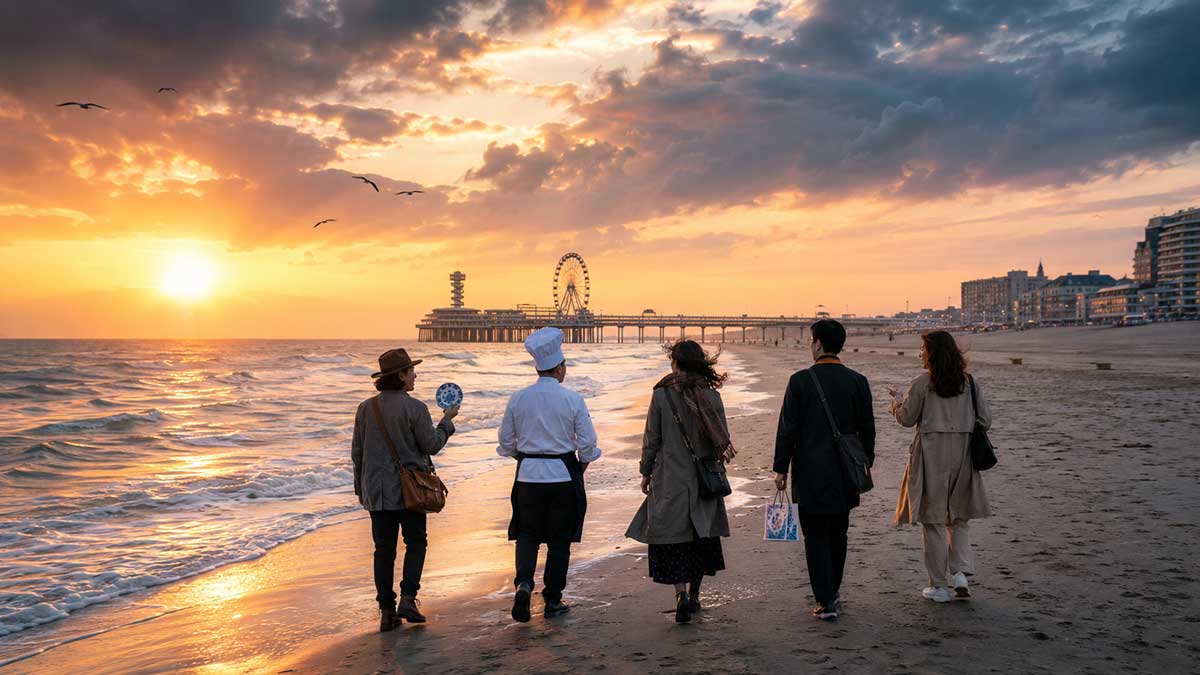
By evening, they reached Scheveningen Beach.
The North Sea stretched before them under a wide sky. The wind was stronger here. Sand moved underfoot. Gulls cried overhead. The waves rolled in with gray-green force.
Bill Bryson: “At last, the Dutch landscape has vertical movement.”
Anthony Bourdain: “Sea air. Fried fish. Wind in your face. This is a proper ending to a day.”
Mary Oliver: “The sea does not flatter anyone. That is one of its gifts.”
Murakami: “A city asks questions with streets. The sea asks without words.”
They walked along the shore. The sound of waves filled the space between them.
Geert looked out at the water.
Geert Mak: “The Dutch have lived with this sea as neighbor, threat, route, and teacher. Much of the country’s character comes from facing water without pretending it is harmless.”
Bill Bryson: “I respect any nation that looks at the sea and says, ‘We can work something out.’”
Anthony Bourdain: “That’s confidence. Or madness. Maybe both.”
Mary Oliver: “Maybe courage is what grows between fear and routine.”
The sun began to lower, staining the clouds with soft gold and rose. The day’s scenes returned in their minds: Delft’s canals, the blue brushstrokes, the girl’s gaze, The Hague’s law, the sea’s wide silence.
Murakami: “Delft showed us light inside rooms. The Hague showed us order inside society. The sea shows us the edge.”
Geert Mak: “Yes. And every country has an edge. A place where its story meets something larger than itself.”
Anthony Bourdain: “Tomorrow we go to Rotterdam and Kinderdijk. Modern city, old windmills. That should be a good argument.”
Bill Bryson: “I look forward to being confused in a new architectural style.”
Mary Oliver: “And I look forward to seeing what the old windmills say after the modern city speaks.”
The waves came in. The waves went out.
Day 4 did not finish the journey.
It carried them to the edge of land, where light, law, memory, and water met under the evening sky.
Day 5 – Rotterdam & Kinderdijk: The Future and the Wind
Opening
On the fifth morning, the train left Amsterdam once more, but this time the feeling was different.
They had seen canals, hidden rooms, windmills, courtyards, paintings, law, and the sea. Now the Netherlands was ready to show them its sharpest contrast: Rotterdam.
The city did not greet them with old canal houses or gentle brick streets. It rose in glass, steel, concrete, bridges, angles, open spaces, and bold shapes.
Bill Bryson: “Ah. So the Netherlands has been hiding an entirely different country down here.”
Anthony Bourdain: “Good. I like a city that refuses to be cute.”
Mary Oliver: “The sky feels different here. More exposed.”
Haruki Murakami: “Amsterdam dreams backward. Rotterdam dreams forward.”
Geert Mak: “Rotterdam had no choice. Much of the old center was destroyed during World War II. The city rebuilt itself, not as a copy of what had been lost, but as an answer to loss.”
They stepped out into the modern city.
Day 5 began with steel, wind, and memory.
Scene 1 – Erasmus Bridge
The Erasmus Bridge stretched across the Maas River like a white blade, graceful and tense against the sky.
Trams moved. Bicycles crossed. Cars passed. Boats moved below. The city seemed to be in motion at every level.
Bill Bryson: “This bridge appears to be doing yoga.”
Anthony Bourdain: “It has attitude. I respect that.”
Mary Oliver: “It looks like a question drawn across water.”
Murakami: “A bridge is never only a bridge. It is a decision not to remain divided.”
Geert looked across the river.
Geert Mak: “Rotterdam is a port city. Its identity comes from movement: ships, trade, workers, migrants, rebuilding, departure, arrival. Amsterdam looks inward through canals. Rotterdam looks outward through the harbor.”
Anthony Bourdain: “That explains the energy. Port cities know hunger. Sailors, workers, immigrants, cooks, markets. Everyone brings something.”
Bill Bryson: “And apparently architects bring rulers, triangles, and a complete lack of fear.”
They walked halfway across the bridge. The wind was strong over the river.
Mary Oliver: “The wind here is not gentle like Zaanse Schans. It pushes.”
Geert Mak: “Rotterdam was pushed by history. The city learned to answer by building.”
Murakami: “Some cities restore what was lost. Others become the scar, but lit from within.”
Bill grew quiet for once.
Bill Bryson: “That is a rather beautiful way to say something painful.”
The river moved below them, wide and gray-blue.
Rotterdam did not ask to be admired for age.
It asked whether courage could take a new shape.
Scene 2 – Cube Houses
The Cube Houses appeared like yellow blocks tilted into an impossible order.
The group stood below them, looking up.
Bill Bryson: “I feel I have entered a place where furniture goes to have a nervous breakdown.”
Anthony Bourdain: “I want to know where the kitchen goes. That’s always the test.”
Geert Mak: “The architect Piet Blom imagined these as a kind of urban forest. Each house is like a tree, with the living space lifted above the ground.”
Mary Oliver: “A forest made of geometry.”
Murakami: “A house tilted away from certainty.”
They entered one of the houses. Inside, the angles changed everything. Walls leaned. Windows opened in unexpected places. Normal movement required fresh attention.
Bill Bryson: “I have never felt judged by a wall before.”
Anthony Bourdain: “Cooking here would either be genius or a cry for help.”
Mary Oliver: “It makes the body notice space.”
Geert Mak: “Rotterdam experiments. That is part of its character. The city lost too much to become merely nostalgic.”
Murakami: “A broken city may become more willing to ask strange questions.”
They stood near a slanted window and looked out at the city.
Bill Bryson: “I keep wanting to laugh, but I can’t dismiss it. It is ridiculous, brave, and oddly serious.”
Anthony Bourdain: “That’s not a bad description of human life.”
Mary smiled.
Mary Oliver: “A tilted house says, ‘There are other ways to stand.’”
Geert nodded.
Geert Mak: “That may be Rotterdam’s lesson.”
Outside again, the Cube Houses seemed less strange than before. They had become part of a larger message: the Netherlands was not trapped inside its postcard image.
It could turn windmills into memory, and houses into questions.
Scene 3 – Markthal
By midday, they entered Markthal.
The building opened around them like a giant food hall under a painted sky. Stalls offered bread, cheese, seafood, spices, sweets, vegetables, meats, and food from many cultures. Voices echoed. Plates moved. Steam rose.
Anthony stopped walking.
Anthony Bourdain: “Now we are in the right place.”
Bill Bryson: “This looks like a cathedral for lunch.”
Mary Oliver: “Color everywhere. After the gray river, this feels like sudden fruit.”
Murakami: “A market is a city speaking with many mouths.”
Anthony led them from stall to stall.
They tasted herring with onions, warm stroopwafels, Dutch cheese, Surinamese snacks, Turkish bread, Indonesian flavors, and seafood from the coast.
Anthony Bourdain: “This is Rotterdam. Not one taste. Many arrivals.”
Geert Mak: “The port brought the city into contact with the wider earth. Workers, traders, sailors, migrants, families. The food tells that story more honestly than a monument sometimes can.”
Bill Bryson: “I support all museums that come with snacks.”
Mary Oliver: “Food is memory that enters the body.”
Anthony nodded.
Anthony Bourdain: “Exactly. You can talk about migration, trade, empire, labor, love, homesickness. Or you can taste a dish and suddenly the idea has weight.”
Murakami watched a young child eating a syrupy waffle, hands sticky, face fully serious.
Murakami: “A child eating sweets in a market understands the present better than philosophers.”
Bill Bryson: “I wish philosophers came with caramel.”
They sat at a table with small plates gathered between them.
Geert Mak: “Yesterday we saw Vermeer’s silence. Today we hear Rotterdam’s noise. Both are Dutch.”
Mary Oliver: “Silence and appetite. Light and steel. Windmill and market.”
Anthony Bourdain: “Now you’re getting it.”
Outside, Rotterdam kept moving. Inside, the table became a map of the city’s many lives.
The Netherlands had widened again.
Scene 4 – Kinderdijk
In the afternoon, they traveled to Kinderdijk.
The city fell away. The modern lines of Rotterdam softened into fields, water, reeds, paths, and sky.
Then the windmills appeared.
Nineteen of them stood across the low land, dark and solemn, facing water and wind like old guardians.
Bill Bryson: “Now that is a dramatic final act.”
Anthony Bourdain: “No tricks. Just wind, water, wood, and survival.”
Mary Oliver: “They look less like buildings and more like watchers.”
Murakami: “Every windmill here seems to have been waiting for us before we were born.”
Geert led them along the path beside the water.
Geert Mak: “Kinderdijk is one of the clearest places to see the Dutch struggle with water. These windmills helped drain the polders and keep the land usable.”
Bill Bryson: “So much of this country exists through constant negotiation with water.”
Geert Mak: “Yes. The land is not passive. It must be held.”
Anthony Bourdain: “That changes how you see everything. Cheese, farms, towns, roads, houses — all of it depends on keeping water in its place.”
Mary Oliver: “Yet the water remains beautiful.”
Geert Mak: “That is the Dutch paradox.”
They paused near one of the mills. The reeds moved. The canal reflected the blades.
Murakami: “A reflection looks peaceful, but beneath it is labor.”
Mary Oliver: “The whole country may be like that.”
Bill looked out at the row of windmills.
Bill Bryson: “I came here prepared for scenery. I did not expect a moral lecture from drainage equipment.”
Anthony Bourdain: “Good travel does that. It humiliates your assumptions.”
The windmill blades turned slowly.
No one hurried.
Kinderdijk felt older than the day, older than tourism, older than their questions.
It was a place where human beings had looked at danger and answered with patience.
Scene 5 – Final Sunset beside the Windmills
Evening came over Kinderdijk.
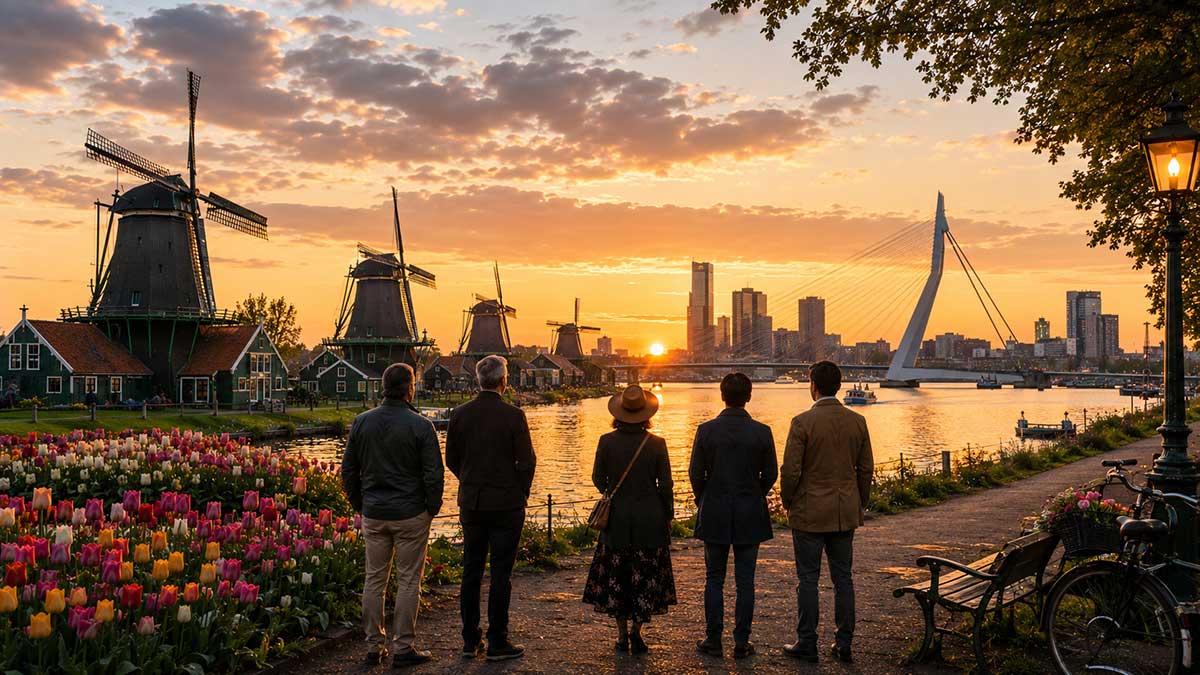
The sky softened into gold, gray, and pale rose. The windmills stood in a long line, their reflections trembling in the water. The travelers stopped on a quiet path and looked back across the five days.
Amsterdam had given them water and memory.
Zaanse Schans and Haarlem had given them tradition and hidden care.
Delft and The Hague had given them light, law, and the sea.
Rotterdam had given them rebuilding and appetite.
Kinderdijk gave them the whole question in one image: how can fragile people live with forces larger than themselves?
Geert turned to the group.
Geert Mak: “Before we leave, I want each of you to say what the Netherlands has taught you.”
Bill looked at the windmills and took a breath.
Bill Bryson: “It taught me that charm is often hard work wearing a pleasant face. I arrived ready to laugh at bicycles, clogs, and leaning houses. I leave with respect for a country that makes danger look tidy.”
Anthony folded his arms and looked across the water.
Anthony Bourdain: “It taught me that food never travels alone. Every meal here carried trade, loss, comfort, migration, pride, and survival. You can taste history if you stop treating lunch like an interruption.”
Mary watched the reeds bend in the wind.
Mary Oliver: “It taught me that beauty can be practical. A bridge, a canal, a windmill, a courtyard, a bowl of soup, a flower, a tile. When human hands serve life carefully, usefulness can become grace.”
Murakami looked at the reflection of the windmill in the canal.
Murakami: “It taught me that a country can have a secret room beneath every visible room. Beneath the city is water. Beneath the water is fear. Beneath fear is discipline. Beneath discipline is a dream that keeps returning.”
Geert listened, then spoke last.
Geert Mak: “It taught me again what I already knew and keep relearning: the Netherlands is not simply small. It is concentrated. Every canal, market, painting, law court, port, and windmill carries more story than it first admits.”
The sun lowered behind the mills.
For a long time, they stood in silence.
Then Bill cleared his throat.
Bill Bryson: “I would like it recorded that I survived five days in the Netherlands without being struck by a bicycle.”
Anthony Bourdain: “A miracle worthy of a chapel.”
Mary Oliver: “Or a poem.”
Murakami: “Or a short story about a man who becomes a bicycle bell.”
Geert Mak: “That may be too Dutch even for me.”
They laughed, and the laughter floated across the water.
The windmills turned slowly in the evening light.
The trip through the Netherlands had begun with canals in Amsterdam, but it ended beside deeper water: the kind that asks what people build, what they protect, what they hide, and what they choose to carry forward.
As they walked away from Kinderdijk, the last light caught the blades of the mills.
And the Netherlands, quiet but never simple, kept turning.
Final Thoughts by Geert Mak
When people visit the Netherlands, they often arrive with pictures already in their minds.
They expect canals, tulips, bicycles, cheese, windmills, narrow houses, and paintings with beautiful light. Those images are not false. They belong here. But they are only the surface of the story.
A canal is beautiful, yes. But it is also planning, labor, drainage, defense, commerce, and shared responsibility.
A windmill is picturesque, yes. But it is also machinery, engineering, weather knowledge, and the refusal to let water decide everything.
A painting by Vermeer is quiet, yes. But inside that quiet is attention so deep that an ordinary room becomes almost eternal.
A meal in Amsterdam or Rotterdam may seem simple, yet it carries the movement of ships, colonies, workers, migrants, families, and memories of homes far away.
A hidden courtyard in Haarlem may seem charming, but it tells us something about care, modesty, age, charity, and the private life of a city.
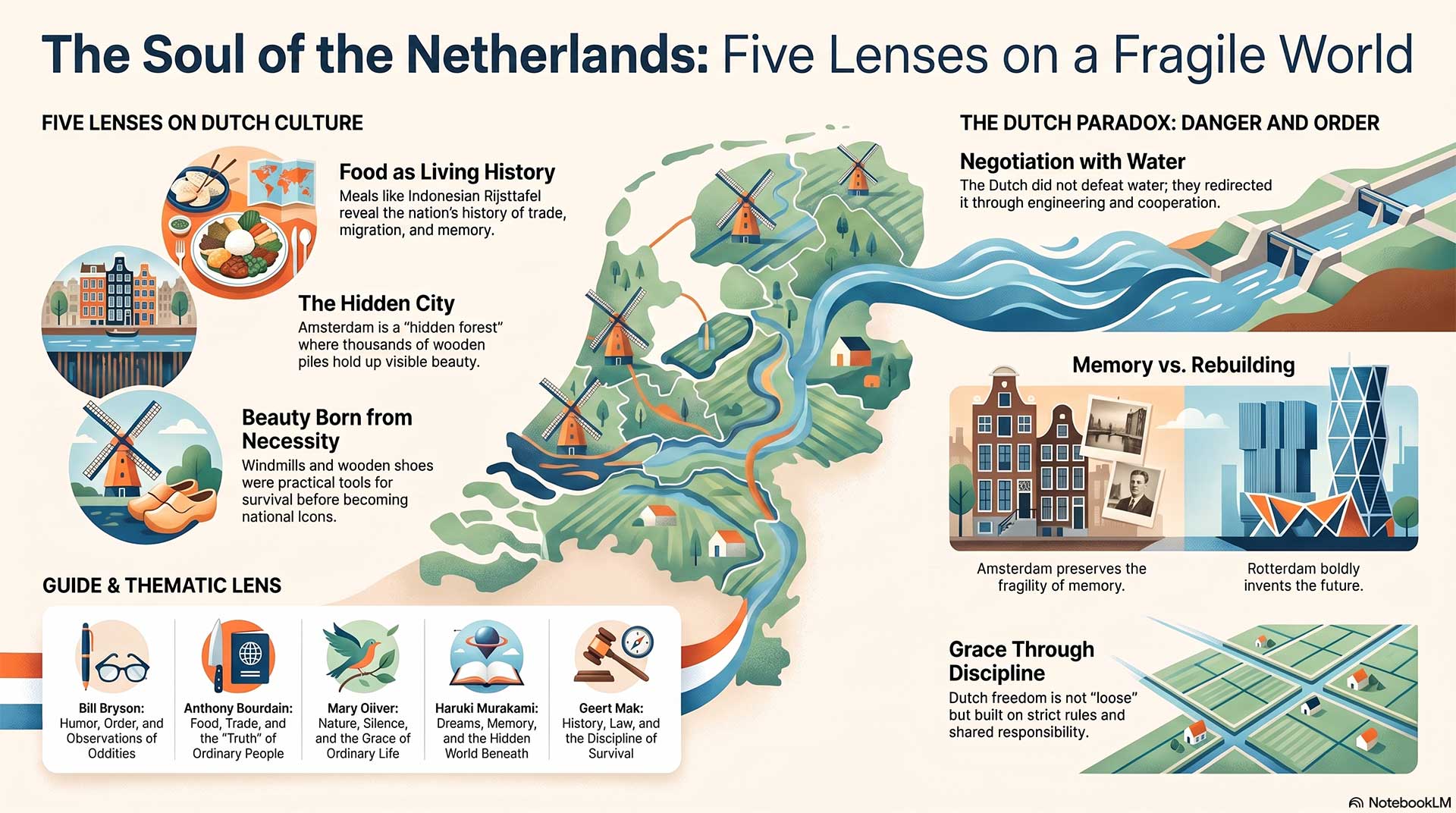
The Netherlands has always lived between danger and order.
Too much water, and the land disappears.
Too much control, and the spirit disappears.
This country survives through balance. It builds systems, but it leaves room for flowers. It values rules, yet it protects private freedom. It remembers suffering, yet it keeps bicycles moving, markets open, children laughing, and dinner tables full.
Our five days were not enough to understand everything. No honest trip ever gives that kind of completion.
But we saw enough to know this:
The Netherlands is not a cute country.
It is a serious country that learned how to make seriousness look graceful.
It is not merely flat.
It is deep in ways that do not announce themselves.
It is not only old.
It is still becoming.
And perhaps that is the final lesson of travel here.
A place does not have to be large to contain great questions.
Sometimes a small country, standing carefully between wind and water, can teach us how fragile life is, how much work beauty requires, and how much hope can be hidden inside ordinary things.
Short Bios:
Bill Bryson is a beloved travel writer and humorist known for his sharp observations, self-deprecating wit, and ability to make ordinary travel moments unforgettable. In this Netherlands conversation, he plays the humorous outsider who notices leaning houses, fearless bicycles, strange architecture, clogs, cheese, and the comic side of being overwhelmed in a new country. His jokes make the trip lighter, but his humor often opens the door to deeper respect.
Anthony Bourdain was a chef, writer, and travel storyteller who believed food reveals the real life of a place. In this journey, he follows the taste of the Netherlands through bitterballen, Dutch cheese, Indonesian rijsttafel, seafood, herring, stroopwafels, and Rotterdam’s international food culture. He reminds the group that every meal carries human history, and that travel becomes honest when it sits down at the table.
Mary Oliver was a poet known for her deep attention to nature, silence, animals, flowers, light, and the sacred quality of ordinary life. In the Netherlands, she sees beauty in canals, reeds, wind, tulips, courtyards, parks, sea air, and the slow turning of windmills. Her voice gives the conversation quiet depth, turning practical Dutch landscapes into reflections on patience, grace, and human tenderness.
Haruki Murakami is a Japanese novelist whose work often blends loneliness, memory, music, mystery, dreams, and hidden worlds beneath everyday life. In this travel conversation, he sees the Netherlands as a country full of secret rooms: hidden forests beneath Amsterdam, mysterious light in Delft, tilted houses in Rotterdam, and windmills that feel older than memory. His role is to make familiar places feel strange again.
Geert Mak is a Dutch journalist, historian, and writer known for explaining European and Dutch history through human stories. In this journey, he serves as the guide who reveals the deeper Netherlands behind the tourist images. He explains water management, civic duty, hidden courtyards, trade, law, memory, Rotterdam’s rebuilding, and the difference between postcard beauty and lived history. Through him, the country becomes not only a destination, but a lesson.
Leave a Reply