
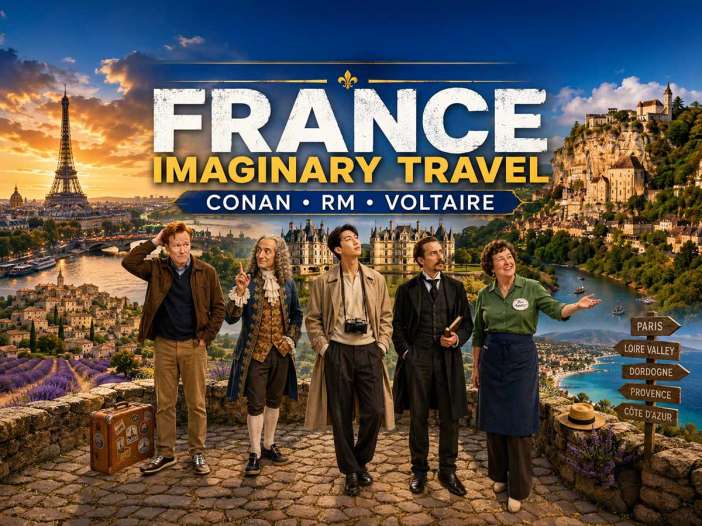
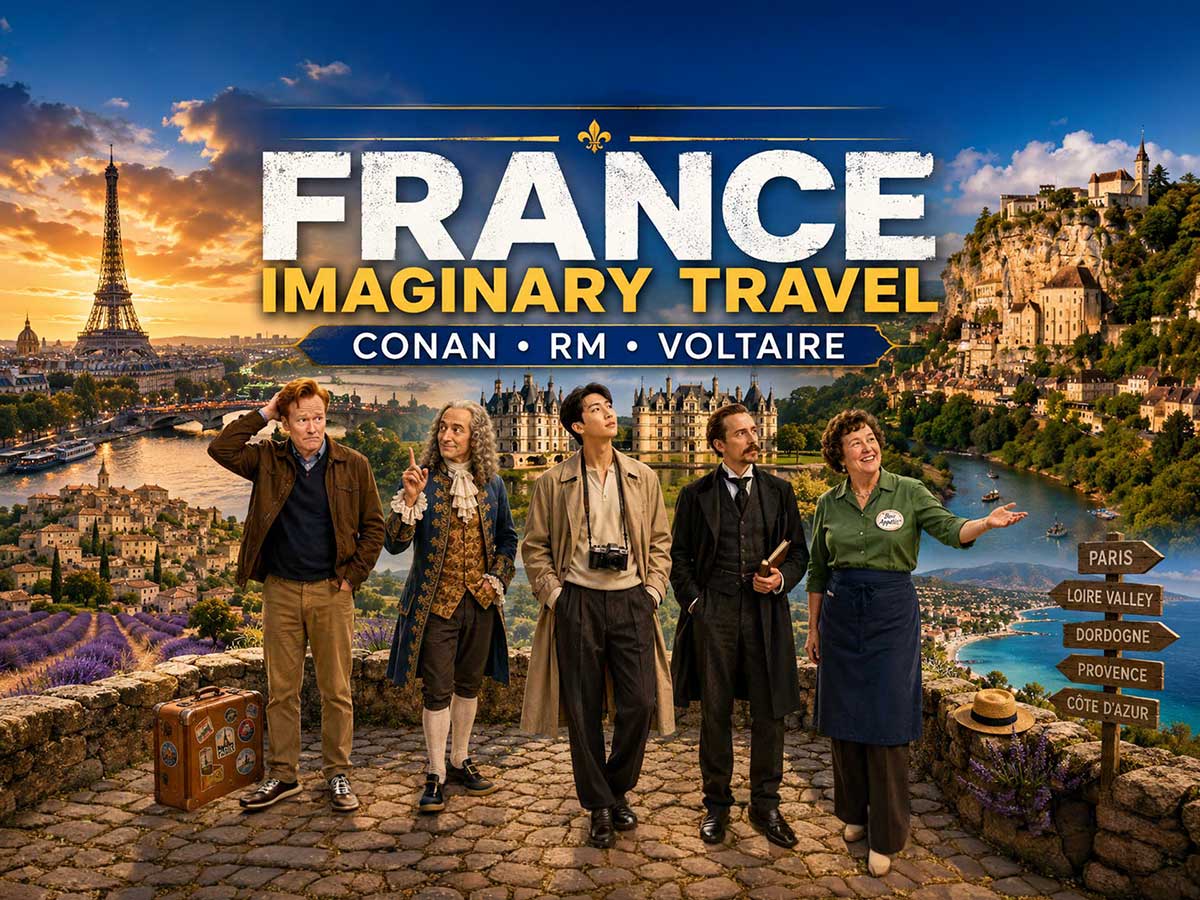
Introduction by Conan O’Brien
I thought I knew what France would be.
I expected bread, wine, museums, people correcting my pronunciation, and at least one waiter who would look at me as if I had personally disappointed Napoleon.
I was right about some of that.
But then France did something rude. It became meaningful.
It started in Paris, where the buildings seemed better dressed than I was. The Seine moved past us like it had heard every love story and every bad tourist question. The Louvre made me feel small, which was uncomfortable, since I usually depend on height and nervous energy. The Eiffel Tower, which I had planned to mock, betrayed me by being magnificent.
Then we left Paris.
That is when France stopped performing and started speaking in older voices.
In the Loire Valley, castles rose out of the countryside like the architectural version of someone saying, “Please remember me forever.” Voltaire, naturally, attacked monarchy before breakfast. Julia Child defended butter with the seriousness of a Supreme Court justice. RM looked at fame and history as if they were mirrors. Rilke saw loneliness in staircases. I mostly tried to survive the stairs.
Then Dordogne changed everything.
Sarlat smelled like garlic, walnuts, duck, smoke, and a kind of happiness my doctor would not approve of. Villages clung to cliffs. Rivers moved as if hurry had never been invented. At Lascaux, ancient animals appeared from the darkness, painted by people whose names were gone, yet whose longing had somehow reached us. I made one joke too many, then apologized to a cave, which was new for me.
Provence arrived with light.
Not normal light. Provence light. The kind that makes stone look forgiven, tomatoes taste philosophical, and a grown man question his relationship with schedules. Gordes rose from the hillside. Roussillon turned the earth red. Sénanque Abbey stood in silence among lavender, and for a terrifying moment, I felt peaceful.
The final day brought Roman arches, Arles sunlight, Marseille salt air, and one last meal by the water. By then, France had stopped being a travel plan. It had become bread, stone, laughter, silence, river light, ancient paint, lavender, and the strange feeling that a place can enter you without asking permission.
This is the story of five unlikely travelers crossing France together:
Voltaire, who doubted everything except wit.
RM, who listened for the music inside places.
Rilke, who could turn a wall into an existential event.
Julia Child, who believed civilization begins when bread arrives.
And me, Conan O’Brien, a man who came to France hoping for jokes and left emotionally defeated by cheese.
Welcome to our imaginary travel through France in 50 scenes.
Please bring comfortable shoes, an open heart, and emergency pastry.
(Note: This is an imaginary conversation, a creative exploration of an idea, and not a real speech or event.)
Day 1 — Paris Arrival: The City That Judges Your Shoes
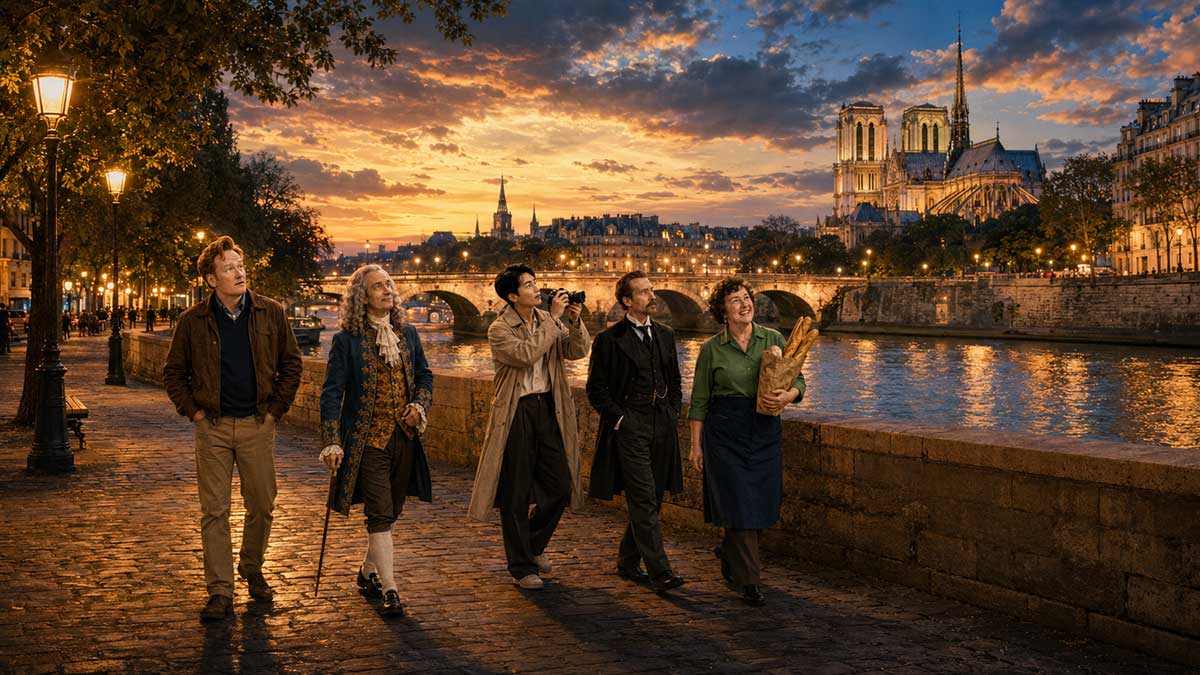
Scene 1 — Charles de Gaulle Airport: The First Breath of France
They arrive at Charles de Gaulle with the dazed expression of people who have crossed an ocean and lost all sense of time. The airport smells of coffee, perfume, rolling luggage, and tired travelers pretending they are fine. Announcements float overhead in French, soft and official, making even baggage delays sound cultured.
Conan stands near the carousel, staring at the luggage belt as if it has personally betrayed him.
Conan: “I’ve been in France for eight minutes, and somehow I already feel underdressed.”
Voltaire: “That is Paris extending its hospitality.”
Julia Child: “Nonsense. You need coffee, bread, and perhaps a little courage.”
RM watches families reunite near the exit. He notices the tiny emotional moments: a hug, a child reaching for a suitcase, a woman laughing into her phone. To him, arrival is never just movement. It is the first page of a new feeling.
Rilke says almost nothing. He looks toward the glass doors, where gray Parisian light waits outside.
Rilke: “Every arrival asks us to become slightly unknown to ourselves.”
Conan turns to him.
Conan: “That’s beautiful. I was going to say my neck pillow smells like regret.”
Voltaire gives him a look.
Voltaire: “Both may be true.”
Outside, the air is cooler than expected. The sound of taxi doors, rolling wheels, and quick French greetings surrounds them. Paris has not appeared yet, but something has shifted. The trip has begun.
Scene 2 — Taxi Into Paris: Gray Light, Stone Buildings, and First Impressions
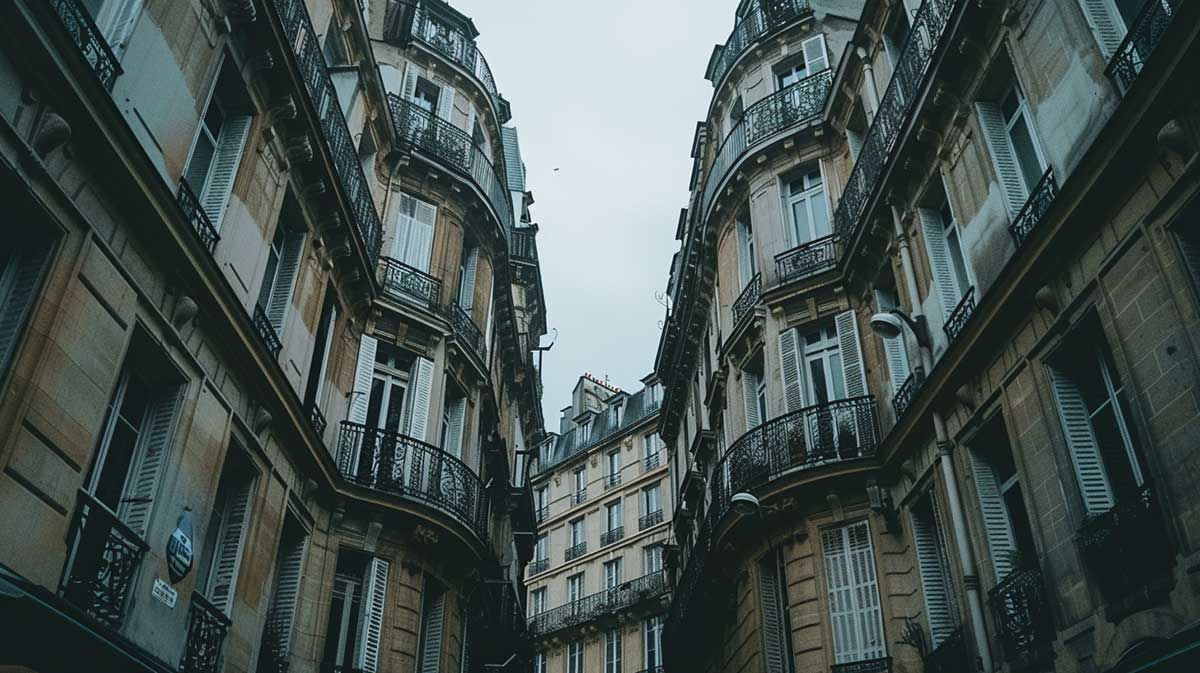
The taxi pulls away from the airport and moves toward the city. Highways, signs, apartment blocks, and sudden flashes of old stone pass by the window. The sky is pale gray, the kind of gray that makes Paris look serious before it becomes beautiful.
The car smells faintly of leather, air freshener, and someone else’s cologne. Conan keeps checking the meter, then checking the driver, then checking Voltaire as if the philosopher might translate money itself.
Conan: “Is this fare normal, or am I funding a small French province?”
Voltaire: “You are paying for the privilege of entering civilization.”
Conan: “Does civilization accept credit cards?”
Julia laughs. RM watches the streets change as they approach central Paris. The buildings become lower, older, more deliberate. Balconies appear. Shutters appear. Cafés begin to gather at corners like small stages.
Rilke leans closer to the window.
Rilke: “A city reveals itself first through its edges.”
RM: “It feels like the city is deciding how much to show us.”
The taxi crosses into Paris proper. Scooters pass too closely. Buses sigh at stops. People walk quickly, but not nervously. Paris seems busy without looking rushed.
Conan looks at a woman walking past in a long coat and scarf.
Conan: “She looks like she knows seven languages and disapproves of four of them.”
Voltaire: “A promising citizen.”
The first glimpse of the Seine appears between buildings. The river is not dramatic at first. It simply exists, calm and old, as if it has seen every arrival before.
For a moment, no one speaks.
Then Julia smiles.
Julia: “There it is. Now we must eat properly.”
Scene 3 — Seine River Walk: Bridges, Water, and the First Touch of Paris
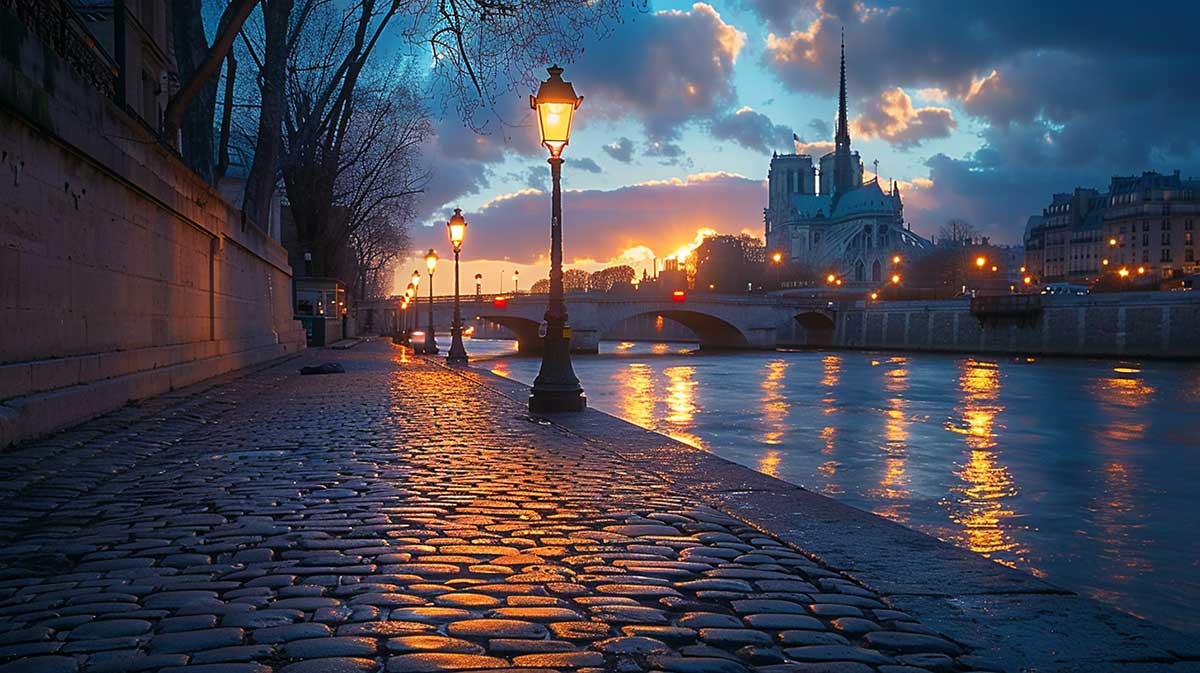
They leave their luggage, step into the city, and walk toward the Seine. The river opens before them like a long ribbon of silver-gray memory. Boats slide beneath the bridges. The water carries small wrinkles of light. Stone walls hold the river in place, but the river seems older than the walls.
The air smells of rain, stone, roasted chestnuts, coffee, and faint cigarette smoke. Their shoes tap against the pavement. Somewhere nearby, a bicycle bell rings twice. A couple argues softly in French, making the argument sound more elegant than it deserves.
Conan stops at the river wall and looks around.
Conan: “I hate to admit this, but Paris is doing a very good job of being Paris.”
Voltaire: “A rare compliment from a man fighting his own scarf.”
Conan: “This scarf has attacked me twice.”
RM smiles and takes a slow photo of the bridge, not for the bridge itself, but for the way people pass over it. Rilke watches the water.
Rilke: “Rivers are the memory of cities.”
RM: “They keep moving, but they keep everything.”
Julia points to a nearby bakery window.
Julia: “And cities with rivers still need butter.”
They walk along the Seine, passing booksellers, tourists, students, and older Parisians who seem to belong to the sidewalks. The stone feels cold when Conan places his hand on the wall. He pulls it back with exaggerated seriousness.
Conan: “This wall has more dignity than I do.”
Voltaire: “Many walls do.”
The group laughs, and the first awkwardness fades. Paris is no longer an idea. It is under their feet, in their noses, in the damp air, in the gray water moving past them.
Scene 4 — Île de la Cité and Notre-Dame: Beauty, Wounds, and Restoration

They cross onto Île de la Cité, where Paris feels older and quieter, even with tourists around them. Notre-Dame rises ahead, solemn and familiar, a cathedral that seems to carry both injury and endurance.
The stone smells damp. The air near the cathedral has the faint scent of dust, river wind, and candle smoke from somewhere nearby. Bells sound in the distance, not loudly, but enough to turn the moment inward.
Conan looks up at the towers.
Conan: “I was prepared to make a joke, but this building is clearly stronger than my personality.”
Voltaire: “At last, architecture has performed a public service.”
Julia folds her hands, not in a formal prayer, but in respect. RM looks at the façade and thinks about restoration, not just of buildings, but of people. Rilke steps back and studies the shape of the cathedral against the sky.
RM: “A damaged place can still welcome people.”
Rilke: “Sometimes the wound becomes part of the form.”
Voltaire, who has criticized churches, kings, priests, and institutions with equal pleasure, grows quieter.
Voltaire: “One may argue with faith and still respect what human hands have made in its name.”
Conan turns to him.
Conan: “That might be the nicest thing you’ve said all day.”
Voltaire: “Do not become dependent on it.”
They stand there for several minutes. Tourists lift phones. Children ask questions. A guide speaks about history. Yet the cathedral does not feel like an attraction. It feels like a survivor.
The group walks away slowly, carrying a different mood than before. Paris has already given them elegance, humor, and beauty. Now it gives them something deeper: the sight of a thing broken, still standing.
Scene 5 — Saint-Germain Dinner: Bread, Butter, and the First Real Conversation
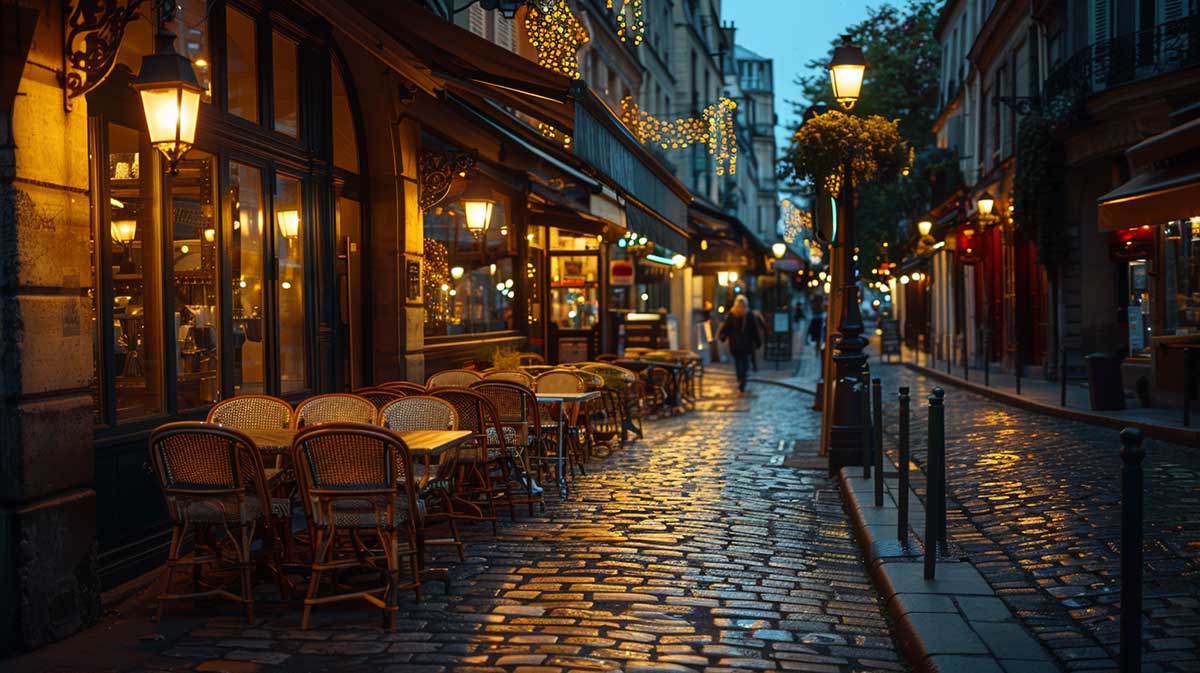
By evening, they reach Saint-Germain. The streets glow under lamps. Café windows shine warmly. The smell of butter, wine, garlic, roasted chicken, and fresh bread drifts from open doors.
They sit at a small table in a restaurant where the chairs are too close together and Conan’s knees seem to offend the furniture. A waiter brings bread. Julia reaches for it with reverence.
Julia: “This is not a side item. This is civilization in a basket.”
Conan: “I was just going to inhale it like a raccoon behind a bakery.”
Voltaire: “Your honesty is vulgar, but useful.”
The first bite changes the table. The crust cracks. The inside is soft and warm. Butter melts into it. The wine arrives. The city noise outside becomes part of dinner: footsteps, scooters, laughter, clinking glasses.
RM looks around the table.
RM: “This is why travel matters. Not only the places. The way strangers become a small group for a little time.”
Rilke nods.
Rilke: “A meal can become a room for the soul.”
Conan looks at him, then at the bread.
Conan: “I want to mock that, but my soul is currently covered in butter.”
Julia laughs so warmly that even Voltaire smiles.
The food arrives: onion soup, roast chicken, salad, potatoes, wine, and dessert too beautiful to eat quickly. Julia explains each dish with joy. Voltaire argues that the French table is one of the few institutions that has justified itself. RM listens. Rilke looks at the candlelight moving across the glasses.
By the end of dinner, jet lag has become softness. The city no longer feels like it is judging them. Or perhaps it still is, but less harshly.
Conan raises his glass.
Conan: “To France. May it forgive my pronunciation.”
Voltaire: “France forgives nothing. But it may feed you.”
Julia: “That is enough for tonight.”
Outside, Paris waits under the lamps, full of stone, water, memory, and bread. Their first day ends not with a grand revelation, but with a table, a laugh, and the quiet feeling that the trip has already begun to change them.
Day 2 — Paris: Art, Ego, and Night Lights
Scene 1 — Morning Bakery: Butter as a National Argument
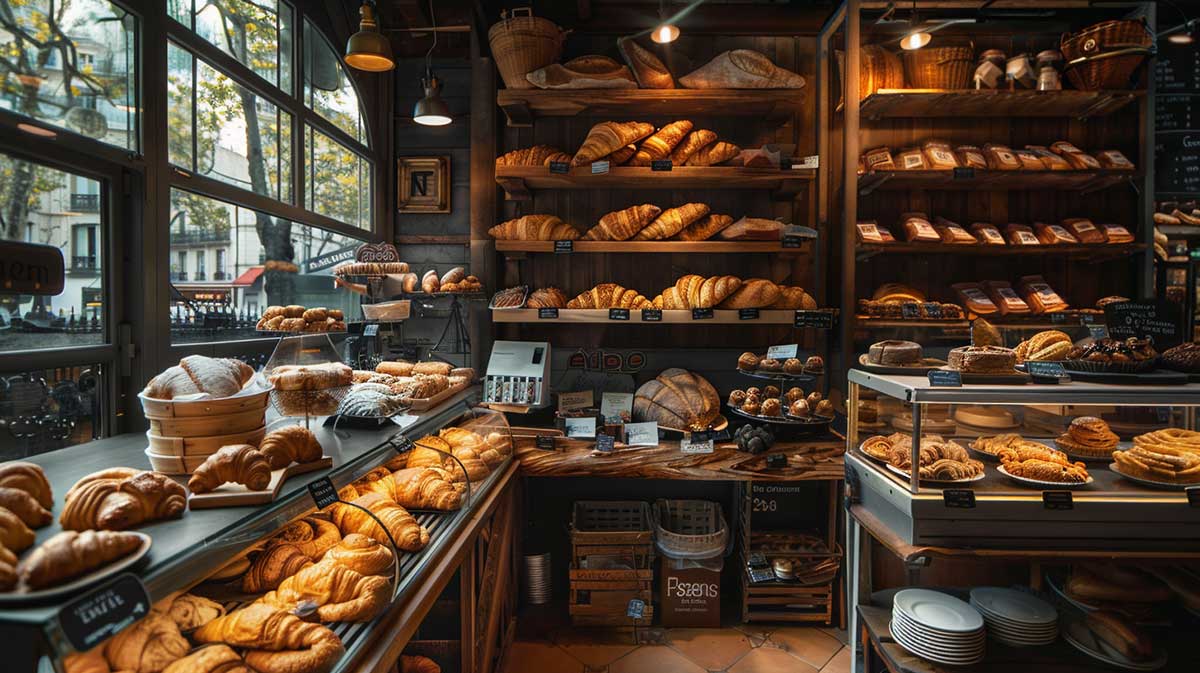
Morning arrives in Paris with pale light on the windows and the low rumble of scooters in the street below. The group steps into a small bakery where warm air touches their faces before anyone says a word. The room smells of butter, yeast, sugar, coffee, toasted almonds, and paper bags.
Behind the counter, croissants rest in rows like golden commas. Baguettes lean from baskets. A tray of pain au chocolat shines with dark stripes of melted promise.
Julia Child clasps her hands together.
Julia Child: “Now this is how a morning should begin.”
Conan stares at the pastry case with moral concern.
Conan: “I need everyone to know that I came here as a responsible adult, and this place has defeated me in under twelve seconds.”
Voltaire: “The French Revolution began with bread. Yours may begin with pastry.”
RM studies the bakery workers moving behind the counter. Their hands are quick, practiced, and calm. He notices the rhythm: folding paper, pouring coffee, slicing bread, calling orders. It feels ordinary, yet filled with care.
RM: “The small things here feel protected.”
Rilke looks at the croissant in front of him.
Rilke: “A thing made with patience asks us to slow down before we touch it.”
Conan raises his croissant.
Conan: “I was going to eat this in three bites, but now I feel like I need written permission.”
Julia smiles, tears off a small piece of bread, adds butter, and hands it to him.
Julia Child: “Permission granted.”
The crust cracks. The inside is warm and soft. Conan closes his eyes, unwillingly moved.
Conan: “I have said many foolish things in my life. Most of them were about breakfast.”
Outside, Paris moves on. Inside, the table grows quiet for a moment. The first lesson of the day is simple: in France, breakfast is not rushed. It is listened to.
Scene 2 — The Louvre: Being Small Before Great Art
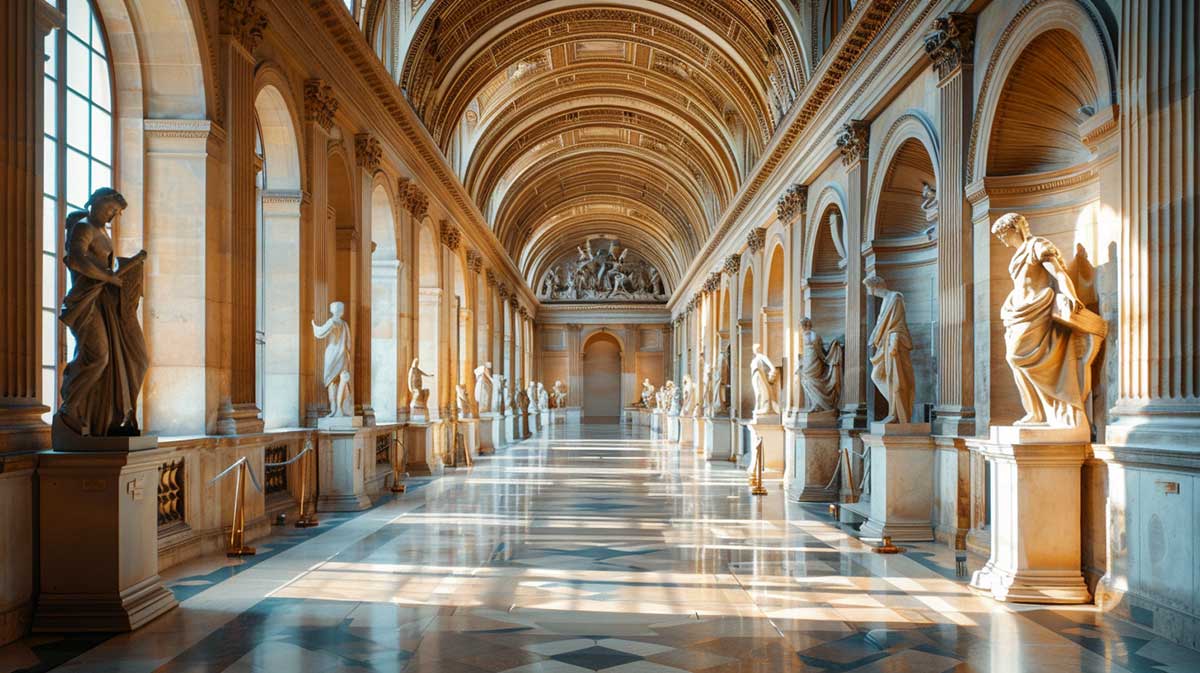
They enter the Louvre through glass and stone, through modern brightness into rooms heavy with centuries. The halls open, stretch, turn, and multiply. Statues stand in white silence. Paintings glow under soft museum light. Footsteps echo against polished floors.
The air smells faintly of marble dust, old wood, clean glass, and the perfume of passing strangers. Conan looks at the map, then at the endless corridors.
Conan: “This museum is so large that I believe I have already aged inside it.”
Voltaire: “Art rewards stamina, confusion, and good shoes.”
Conan: “I brought one of those three.”
RM stops before a painting and does not speak. The face in the frame looks outward with an expression that seems to change each second. He feels the strange pressure of being seen by a person long gone.
Rilke stands beside him.
Rilke: “Great art does not answer us. It deepens the question.”
Conan whispers to Julia.
Conan: “Is that allowed? Can a painting just emotionally follow you around?”
Julia Child: “In Paris, yes.”
They pass marble figures, royal portraits, angels, battles, saints, queens, bodies, grief, triumph, and rooms built to impress people who have been dead for hundreds of years.
Voltaire pauses before a grand historical painting.
Voltaire: “So many rulers wished to be remembered as noble. Paint has been forced to lie for centuries.”
RM turns from the canvas.
RM: “But sometimes the lie leaves a true feeling behind.”
Voltaire studies him, then smiles slightly.
Voltaire: “A dangerous thought. I like it.”
Conan looks around, overwhelmed.
Conan: “I’m starting to understand why people take selfies here. It may be self-defense.”
The group laughs, but softly. The museum has changed their volume. No one wants to break the spell too loudly.
Scene 3 — Tuileries Garden: Royal Order, Dust, and Sunlight
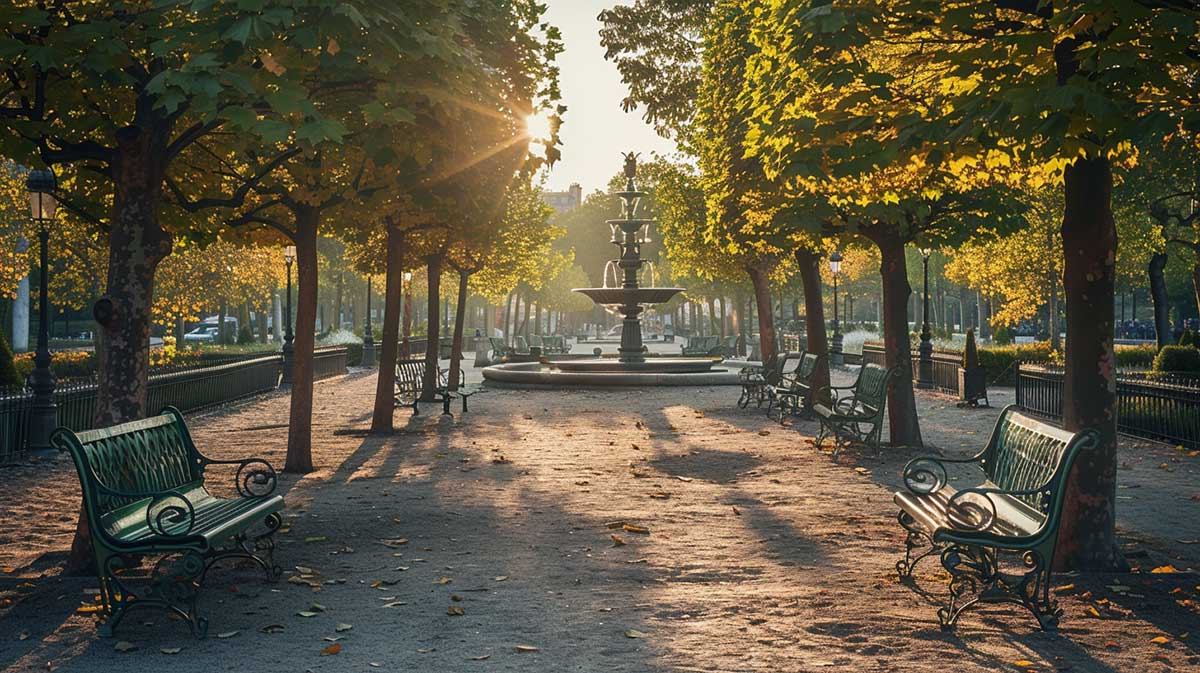
They step out into the Tuileries Garden, where the air feels wider after the museum halls. Gravel crunches beneath their shoes. Trees stand in disciplined lines. Fountains catch pieces of sky. People sit in green chairs as if doing nothing has been assigned to them by law.
The garden smells of dust, leaves, water, roasted nuts, and faint city smoke. Children push toy boats near the fountain. An old man reads a newspaper without appearing to turn a page. The wind moves through the trees with dry elegance.
Conan drops into a metal chair and sighs.
Conan: “This chair looks uncomfortable, but somehow it has more confidence than furniture in America.”
Voltaire: “French chairs do not seek approval.”
Julia takes out a small pastry wrapped in paper.
Julia Child: “One should never face a garden unprepared.”
Conan: “You travel with emergency pastry?”
Julia Child: “Naturally.”
RM watches the lines of trees leading the eye forward. The garden feels planned, yet alive. It reminds him of choreography: freedom inside structure.
RM: “The trees are arranged, but the light still moves wherever it wants.”
Rilke leans back and looks up.
Rilke: “That is the secret of form. It holds life without owning it.”
Voltaire waves his hand toward the palace direction.
Voltaire: “Kings loved order. They mistook it for wisdom.”
Conan looks at the garden paths.
Conan: “If I were king, my garden would have one path to snacks and one path back from snacks.”
Voltaire: “At last, honest monarchy.”
The fountain flashes in the sun. The group sits longer than planned. Paris has shifted from art to air, from walls to open space. The city is still judging them, perhaps, but now it is offering a chair.
Scene 4 — Eiffel Tower: The Cliché That Wins
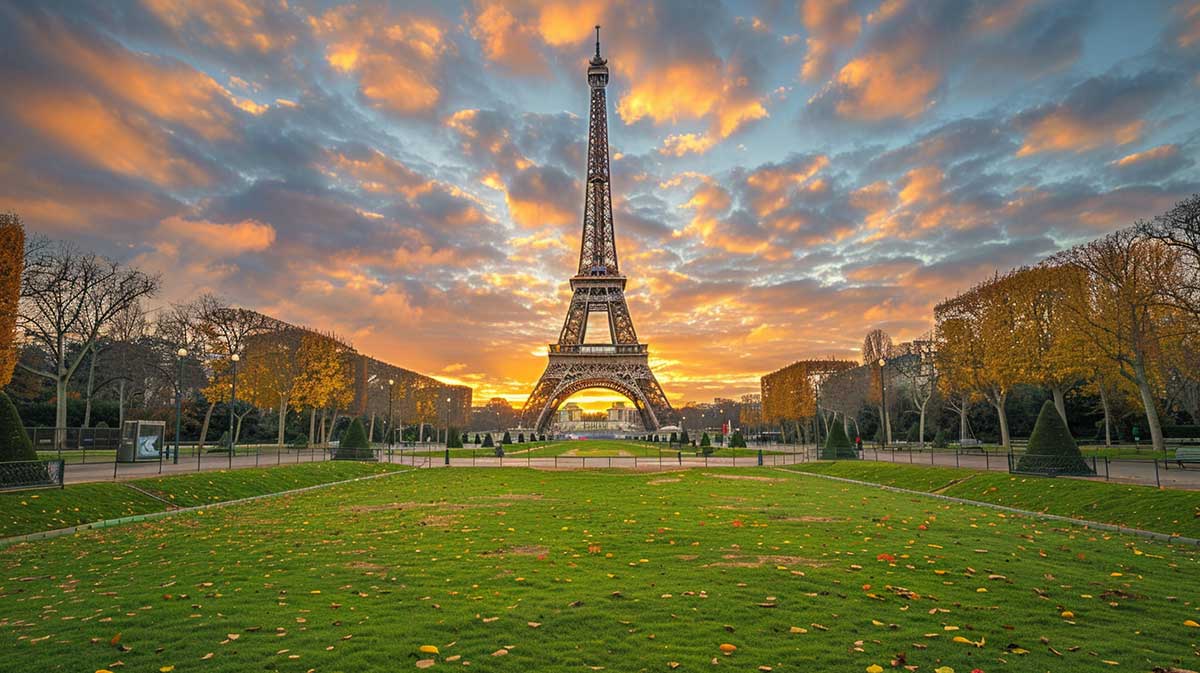
By late afternoon, they walk near the Eiffel Tower. At first, Conan tries to resist it. He has seen it on postcards, mugs, keychains, movie posters, snow globes, and refrigerator magnets. He is determined not to be impressed.
Then they turn a corner.
The tower rises above them, iron and sky, larger than irony. The metal lattice catches the light. Tourists lift phones. Children point. The grass smells warm. Vendors call from nearby paths. The air carries roasted crepes, sunscreen, traffic, and summer dust.
Conan stops.
Conan: “I regret to announce that the famous thing is famous for a reason.”
Voltaire folds his arms.
Voltaire: “Progress has produced many foolish structures. This one, at least, had the courtesy to become elegant.”
RM looks upward.
RM: “It feels strange. Everyone already knows it, but seeing it still becomes personal.”
Rilke nods.
Rilke: “The familiar can become new when it stands above us.”
Julia buys a crêpe from a nearby stand and hands pieces around. Warm sugar sticks slightly to Conan’s fingers.
Conan: “I am now eating dessert beneath a landmark. I have become a postcard with digestive issues.”
Julia Child: “You are doing splendidly.”
They move closer. Iron beams cross and rise. Elevators glide upward. People speak in many languages. Cameras click. A couple takes wedding photos nearby, their white clothes bright against the green lawn.
Voltaire watches the crowd.
Voltaire: “Humanity gathers before symbols, then pretends not to need them.”
RM: “Maybe symbols let strangers feel the same thing for one moment.”
Conan looks up again.
Conan: “I wanted to mock this, but it’s too tall. My sarcasm can’t reach.”
For once, no one argues with him.
Scene 5 — Seine Night Cruise: Paris Becomes a Moving Reflection
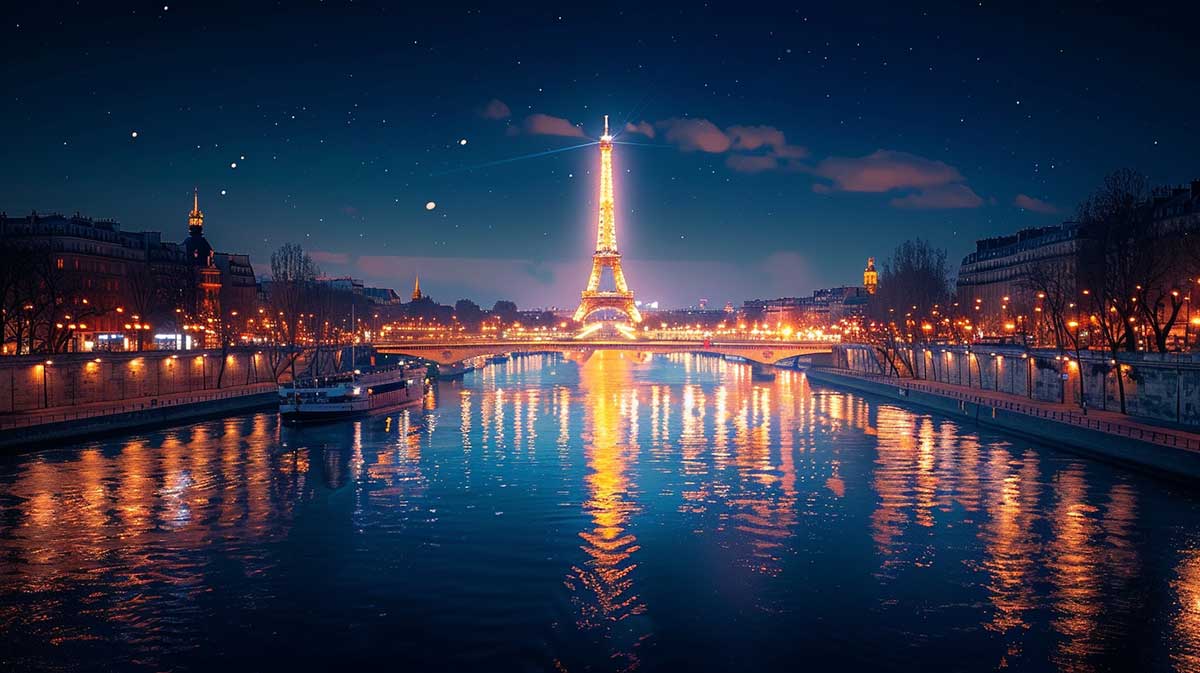
Night settles over Paris, and they board a Seine cruise. The boat hums beneath their feet. The river reflects bridges, lamps, windows, and passing shadows. The city softens at night; stone becomes gold, water becomes ink, and voices lower without being asked.
The air smells of river water, engine smoke, cool metal, perfume, and wine from paper cups. A breeze lifts Conan’s hair into a shape no one comments on at first.
Conan: “I can feel everyone politely pretending my hair is not doing this.”
Voltaire: “Politeness is often civilization’s most graceful lie.”
The boat passes under a bridge, and the sound changes. For a few seconds, the city disappears into stone and echo. Then Paris opens again, brighter than before.
RM leans against the rail.
RM: “A city at night feels more honest. It stops explaining itself.”
Rilke watches the lights break across the water.
Rilke: “Reflection is never exact. That is why it is true.”
Julia sips her drink and smiles.
Julia Child: “A good trip needs one night when no one hurries.”
They pass Notre-Dame again, now darker, quieter, more distant. They pass the riverbanks where people sit with bottles, guitars, paper bags, and private conversations. They pass under old bridges where each arch frames a different version of Paris.
Voltaire speaks softly, almost to himself.
Voltaire: “A city survives by being loved and criticized at the same time.”
Conan looks at him.
Conan: “That explains my career.”
RM laughs. Julia laughs louder. Rilke smiles without looking away from the water.
As the Eiffel Tower begins to sparkle in the distance, the boat grows quiet. No one wants to reduce the moment too quickly. Paris has spent the day overwhelming them with pastry, art, gardens, iron, and light. Now it gives them the river at night.
Conan raises his paper cup.
Conan: “To Paris. Still intimidating. Better after bread.”
Julia Child: “Everything is better after bread.”
RM: “And after seeing it together.”
Rilke: “Togetherness gives memory a place to sit.”
Voltaire: “And occasionally, a tolerable dinner companion.”
The boat glides forward. The city moves with them, reflected and unreachable, close enough to touch, impossible to keep.
Day 3 — Loire Valley: Leaving Paris for Castles and River Light

Scene 1 — Paris Train Station: The Comedy of Departure
Morning begins at the train station, where Paris changes from romance into logistics. Suitcases roll over tile. Departure boards flicker. Announcements echo from the ceiling in French, then vanish before Conan can decide whether to panic.
The station smells of coffee, metal rails, newspaper ink, perfume, and warm pastry from a kiosk near the platform. People move with practiced confidence, which makes Conan feel personally challenged.
Conan: “Everyone here looks like they were born knowing platform numbers.”
Voltaire: “The French are not born knowing them. They simply refuse to look confused in public.”
Julia checks the tickets with cheerful seriousness. RM watches a young couple part near the escalator. Their goodbye is brief, but the girl keeps looking back. Rilke notices it too.
Rilke: “A train station is a place where the heart pretends to be practical.”
RM: “Goodbyes and beginnings use the same door.”
Conan looks at them.
Conan: “I was going to say I can’t find my seat number, but yes, your version is better.”
They board the train with bags, coffee, and the fragile confidence of travelers who may have chosen the correct platform. The seats feel clean and firm. Outside the window, Paris waits in gray light, still elegant, already slipping away.
Voltaire sits down, folds his hands, and looks pleased.
Voltaire: “At last, we leave the city of arguments.”
Conan: “Where are we going?”
Voltaire: “To castles. Older arguments with better roofs.”
The train begins to move. Paris pulls back, building by building, bridge by bridge, until the city becomes memory in motion.
Scene 2 — Train Through French Fields: The Country Opens
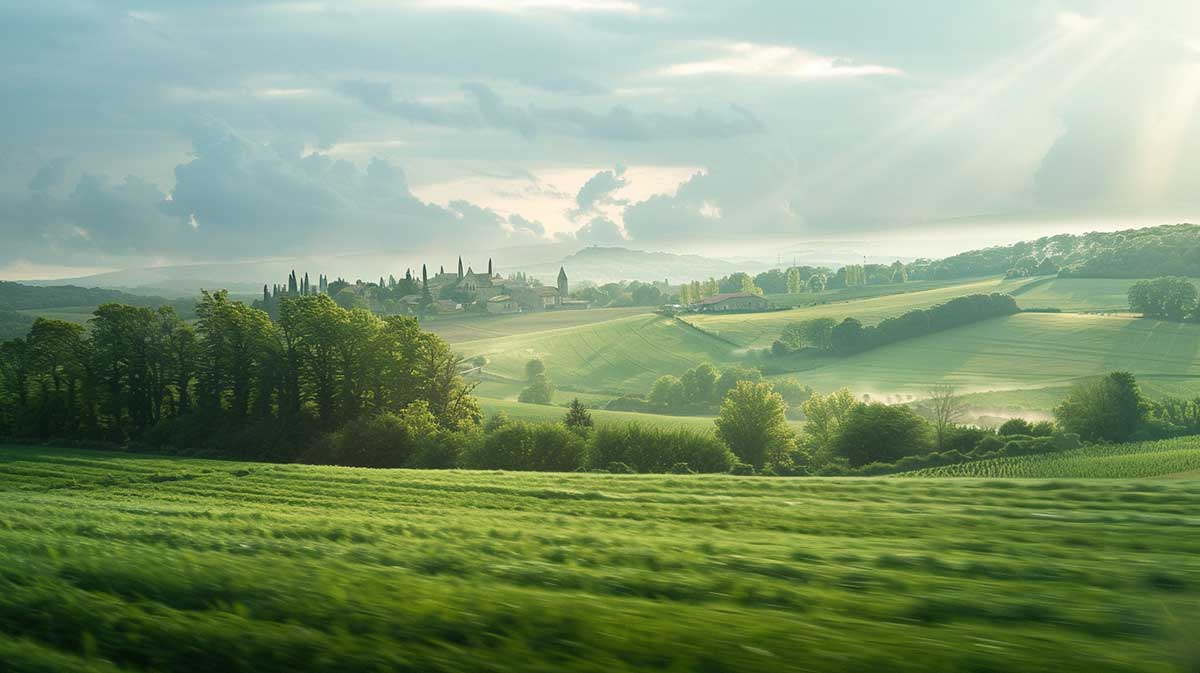
The train slides out of Paris, and the view begins to soften. Apartment blocks give way to fields, villages, farmhouses, lines of trees, and pale church towers in the distance. The light spreads wider now. The sky feels less crowded.
Inside the train, the air smells of coffee lids, wool coats, paper tickets, and the faint sweetness of breakfast pastries. Wheels hum beneath them. A child laughs two rows away. Someone opens a bag of fruit.
RM looks through the window without blinking much. The countryside passes like a slow song: green, gold, gray, green again.
RM: “The city had rhythm. This has breath.”
Rilke nods.
Rilke: “The fields do not ask to be admired. That is why they become beautiful.”
Conan tries to unwrap a sandwich quietly and fails with historic volume.
Conan: “I’m sorry. This wrapper was made from thunder.”
Julia leans over.
Julia Child: “You should have bought the quiche.”
Conan: “That sentence has haunted many men.”
Voltaire watches the countryside with a rare softness.
Voltaire: “France is clever in Paris. In the countryside, it is older than cleverness.”
They pass small towns with red roofs and garden walls. A river appears briefly, then disappears. Cows stand in fields with the calm authority of creatures who have never checked email.
Conan points out the window.
Conan: “Those cows have healthier boundaries than I do.”
RM laughs.
RM: “Maybe travel is learning from cows.”
Voltaire: “A dangerous but not entirely false philosophy.”
The train continues south and west, carrying them from performance into quiet, from museums into open land, from Parisian judgment into the green patience of the Loire.
Scene 3 — Amboise Town: Stone Streets and a Slower Clock
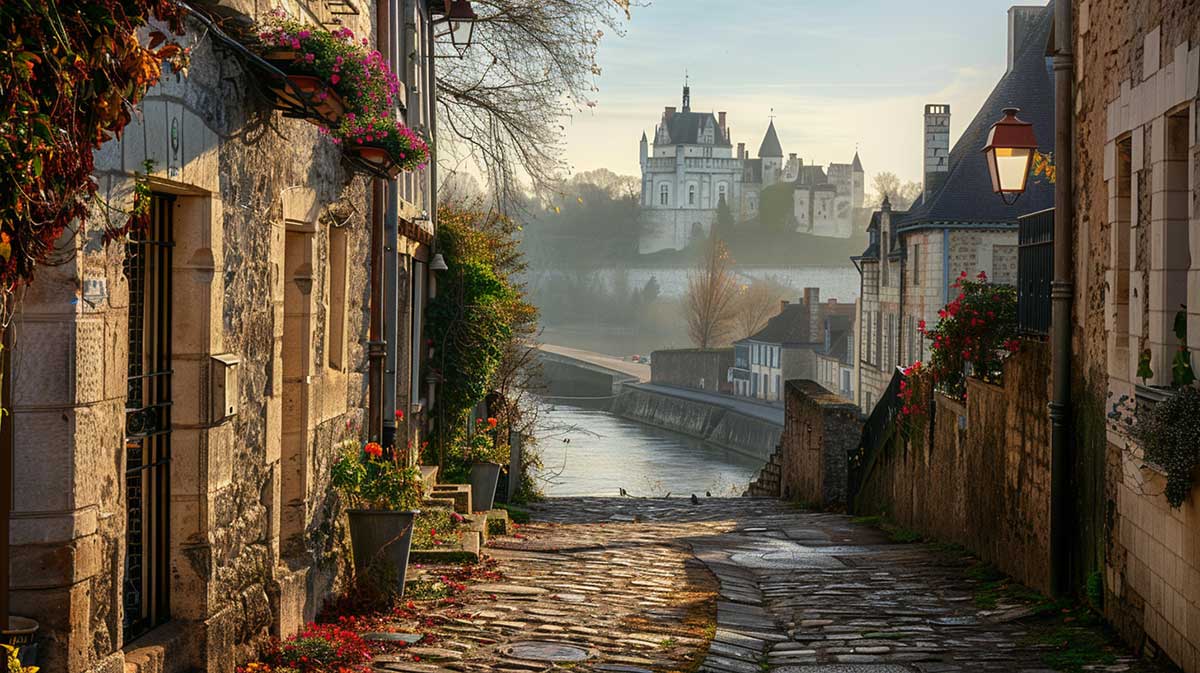
By midday, they reach Amboise. The town sits beside the Loire with a calm that feels almost theatrical, yet not false. Stone houses gather along narrow streets. Flower boxes hang beneath windows. Cafés spill onto sidewalks. Above them, the château watches from its height.
The air smells of river water, bakery bread, cut flowers, old stone, and lunch drifting from restaurant doors. Bells ring somewhere beyond the rooftops. Bicycle tires whisper over pavement. A waiter wipes a table as if time has agreed to wait.
Conan steps onto the street and looks up.
Conan: “This town is aggressively charming. I feel like I owe it an apology for my sneakers.”
Voltaire: “You owed Paris that apology yesterday.”
Julia stops at a small food shop and peers through the window.
Julia Child: “Cheese. Wine. Bread. We are safe.”
RM walks slowly, noticing shutters, doorways, shadows, and the way the château appears at the end of certain streets like a memory interrupting the present.
RM: “The town feels like it grew around a story.”
Rilke touches a stone wall warmed by the sun.
Rilke: “Old stone keeps the day inside it.”
Conan places his hand on the same wall.
Conan: “This wall has lived a fuller life than many executives.”
Voltaire smiles.
Voltaire: “At least the wall has remained useful.”
They settle into a café near the town center. Lunch is simple: salad, bread, cheese, ham, fruit, and wine for those who want it. Julia praises the butter. Conan tries to pronounce Amboise and gives up after three attempts.
Conan: “I’m going to call it ‘the beautiful place where my tongue failed.’”
Voltaire: “A long name, but accurate.”
By the time lunch ends, Paris feels farther than the train ride. The clock has slowed. The Loire has begun its quiet work.
Scene 4 — Château d’Amboise: Royal Height and Human Fragility

They climb up to Château d’Amboise, where the town falls away beneath them and the Loire stretches wide under the sky. The castle walls rise pale and firm. Towers, windows, chapel stone, and terraces carry the weight of kings, guests, wars, deaths, and ceremonies.
The courtyard smells of grass, dust, sun-warmed limestone, and faint river wind. Their footsteps sound sharper on the old stone. From the terrace, the river shines like a blade softened by light.
Conan stands at the edge and looks down at the town.
Conan: “I understand castles now. If I lived up here, I would become unbearable in twenty minutes.”
Voltaire: “Your honesty saves us time.”
RM looks across the valley.
RM: “From up here, everything looks peaceful. Maybe height makes life seem simpler.”
Voltaire’s eyes sharpen.
Voltaire: “That is why rulers enjoy heights.”
Rilke watches a bird glide across the open air.
Rilke: “Yet the higher a person stands, the more sky surrounds his loneliness.”
Julia looks at the old rooms and asks about meals, servants, kitchens, fires, bread, and hunger. She is less interested in crowns than in hands that cooked, carried, cleaned, and waited.
Julia Child: “History is never only kings. Someone had to make soup.”
Conan nods with solemn respect.
Conan: “Finally, the people I relate to.”
Inside, rooms hold tapestries, furniture, portraits, and silence. Outside, the Loire wind moves gently across the terrace. The château is beautiful, but the beauty is not innocent. It carries ambition, fear, ceremony, and the human wish to be remembered.
Voltaire looks back at the stone walls.
Voltaire: “Men built these places to defeat death.”
Rilke answers quietly.
Rilke: “Death accepted the invitation and stayed.”
No one speaks for a moment. Then Conan clears his throat.
Conan: “I was going to ask where the gift shop is, but the mood has become very educational.”
Julia laughs first. Then RM. Then even Voltaire.
The castle keeps its dignity. The travelers keep moving.
Scene 5 — Loire Riverside Dinner: Wine, Water, and the First Country Night
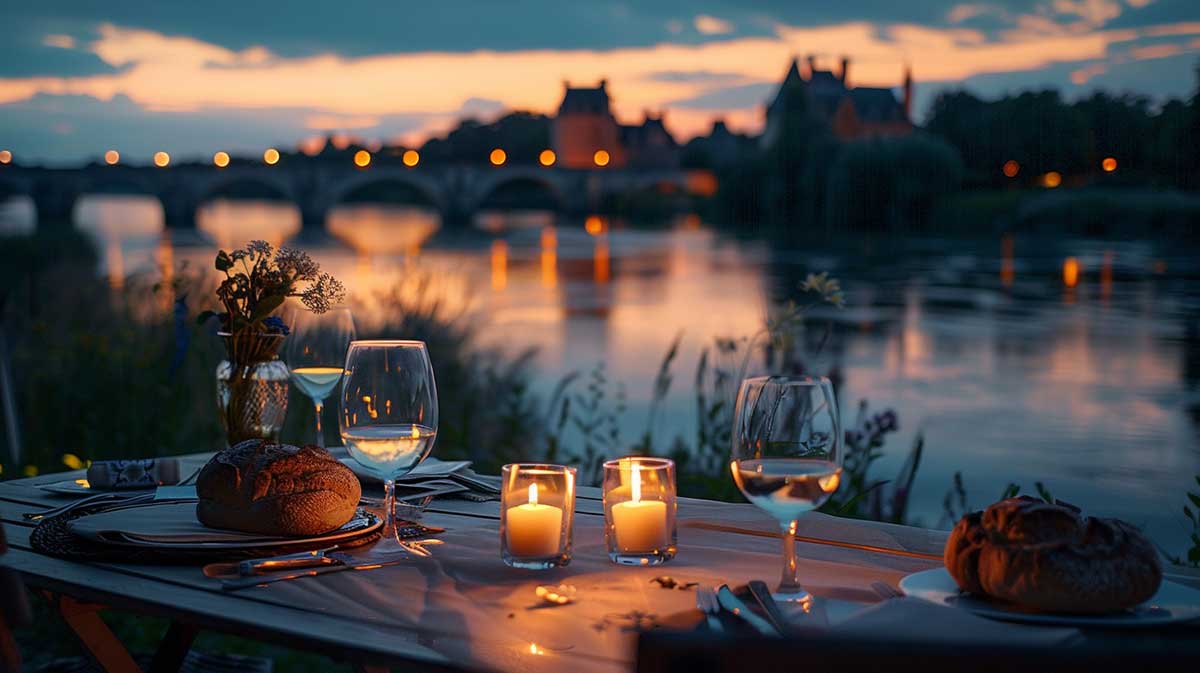
Evening settles over Amboise. The Loire moves broad and quiet beneath the fading sky. The group finds a riverside restaurant where tables face the water and the air smells of wine, grilled fish, butter, herbs, and damp earth.
The sounds are softer than Paris: glasses touching, low voices, birds near the river, a bicycle passing behind them, the slow current below. The table is set with bread, local cheese, vegetables, fish, and a bottle of Loire wine that Julia introduces as if welcoming a guest.
Julia Child: “Now we are beginning to understand France.”
Conan: “I thought I understood France this morning when I ate three pastries.”
Voltaire: “That was instinct. This is education.”
RM watches the river change color as the sky darkens. Gold becomes rose, rose becomes blue, blue becomes almost black.
RM: “The river makes the day feel finished without ending it.”
Rilke lifts his glass.
Rilke: “Water teaches departure without grief.”
Conan looks at him.
Conan: “You make drinking wine sound like graduating from the universe.”
Julia Child: “Let him. It improves the wine.”
They eat slowly. The bread tears easily. The fish is tender. The wine tastes bright, mineral, and clean. Conan attempts to describe it.
Conan: “This wine tastes like a very polite rock.”
Voltaire considers this.
Voltaire: “For once, your language has achieved accuracy.”
The group laughs, and the laughter carries out over the river. Something has changed from the first night in Paris. They are no longer five famous strangers seated at a table. They are beginning to become fellow travelers.
Julia notices it first.
Julia Child: “A good meal can make a temporary family.”
RM smiles.
RM: “And a place becomes real when you share it.”
Across the water, the town lights appear one by one. The château stands above Amboise, no longer only grand, but gentle in the evening distance.
Conan raises his glass.
Conan: “To the Loire. To castles. To bread. To not missing the train.”
Voltaire: “A modest philosophy, but a practical one.”
The river keeps moving in the dark, carrying reflections, old stories, and the first country night of their French trip.
Day 4 — Loire Valley: Beauty Arranged by Ambition
Scene 1 — Chambord Exterior: A Castle Too Large for Modesty
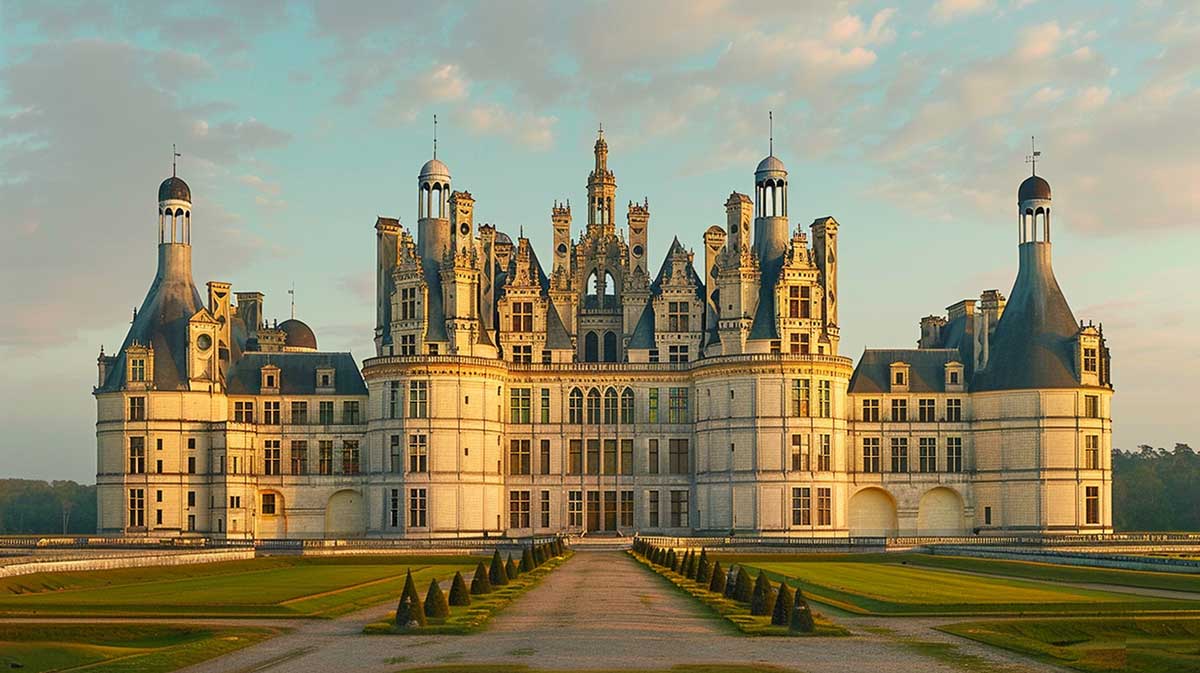
Morning begins with the road to Chambord. The Loire Valley opens in soft fields, low trees, and pale sky. Then the château appears, rising from the flat land like a dream built by someone who feared being forgotten.
Chambord is enormous. Towers, chimneys, carved stone, and sharp roofs crowd the skyline. The castle seems less like a home and more like an announcement.
The air smells of damp grass, gravel, cold stone, and morning wind. Their shoes crunch across the path. Birds call from the trees. Tourists speak in many languages, but even their voices feel small beside the building.
Conan stops walking.
Conan: “This is what happens when someone says, ‘I’m very humble,’ then hires every stone worker in Europe.”
Voltaire: “A monarchy is often a private insecurity made public.”
Julia Child: “I do wonder how many people it took to feed everyone here.”
RM: “It feels like fame before cameras.”
Rilke looks up at the towers.
Rilke: “Every height asks the sky to confirm it.”
Conan glances at him.
Conan: “My hair has been doing that for years.”
They walk closer. The details become sharper: sculpted salamanders, windows, stone patterns, stairways visible through arches. The building feels proud, but not warm.
Voltaire studies the façade with delight sharpened by criticism.
Voltaire: “Kings wanted eternity. They settled for maintenance costs.”
Conan nods with grave sincerity.
Conan: “A lesson for us all: never let your ego choose the square footage.”
Julia laughs, then places a hand over her eyes to study the roofline.
Julia Child: “Still, you must admit, it is magnificent.”
Voltaire sighs.
Voltaire: “Sadly, yes. Tyranny often had excellent architects.”
The group stands in front of Chambord. For the first time that day, no one rushes forward. The castle has forced them to pause. It is absurd, excessive, grand, cold, and unforgettable.
Scene 2 — Chambord Staircase: The Architecture of Looking at Yourself
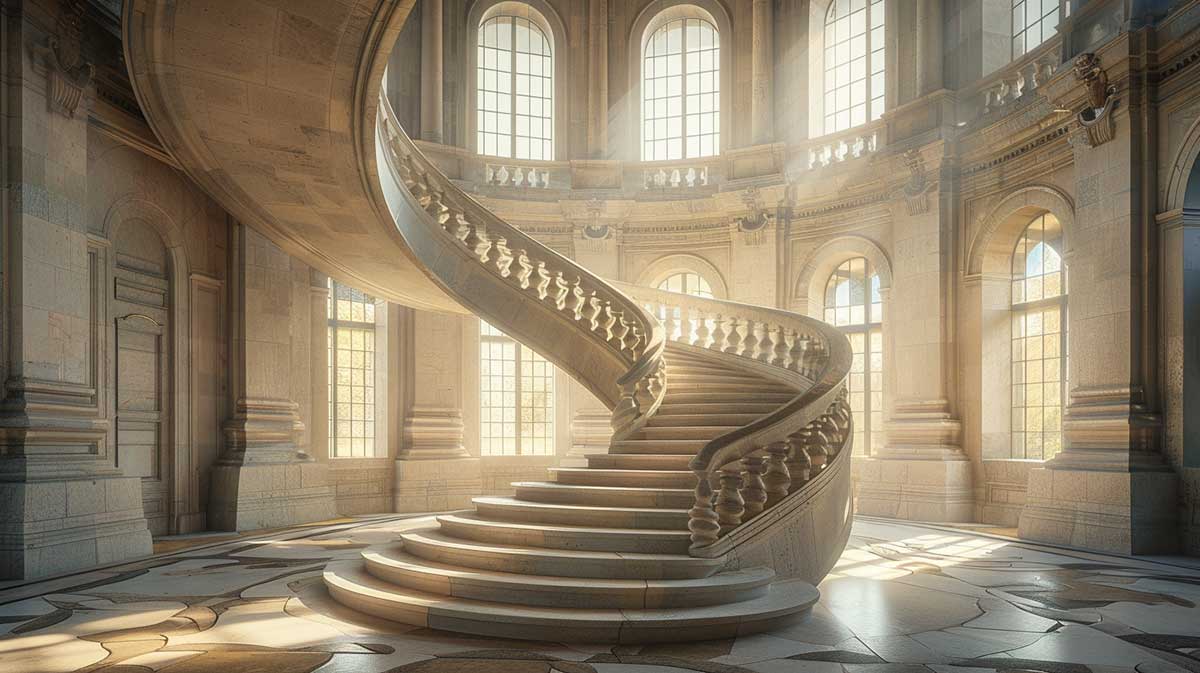
Inside Chambord, the air turns cool. Their footsteps echo through stone halls. Light pours from high windows, pale and slanted. The rooms feel vast, yet strangely empty, as if human life has passed through but never settled.
They arrive at the famous double staircase. It rises in intertwined spirals, allowing people to go up and down without meeting. Conan stares at it, then points.
Conan: “This is the perfect staircase for people who want intimacy with escape options.”
Voltaire: “A royal invention, then.”
RM watches visitors appear and disappear through the curves of stone. The staircase feels like choreography in architecture: near but separate, connected but divided.
RM: “People can move together and still never meet.”
Rilke places his hand on the stone rail.
Rilke: “A staircase is a question made vertical.”
Conan blinks.
Conan: “I was going to say it’s a fancy leg tunnel, but please continue.”
Julia looks upward.
Julia Child: “I love the drama of it. Going upstairs should not feel dull.”
Voltaire circles slowly, pleased by the symbolic possibilities.
Voltaire: “Power loves entrances, exits, and the ability to avoid people.”
They climb. From one spiral, Conan can see RM across the central opening, close enough to wave at, too far to touch. Julia calls from another curve.
Julia Child: “Conan, are you lost?”
Conan: “Emotionally or architecturally?”
Voltaire: “Both are likely.”
Higher up, the windows reveal lawns, trees, and the flat spread of the estate. The world outside looks orderly from above. That, Voltaire says, is the danger of high places.
RM looks down into the stairwell.
RM: “It makes me think of fame. Everyone sees you moving, but not everyone reaches you.”
Rilke answers softly.
Rilke: “One may be visible and still remain alone.”
Conan pauses, less comic for a moment.
Conan: “That’s annoyingly true.”
The staircase continues above them, stone curling around empty air. Chambord has become more than a castle. It is ambition given shape.
Scene 3 — Chenonceau: A Castle Across the River
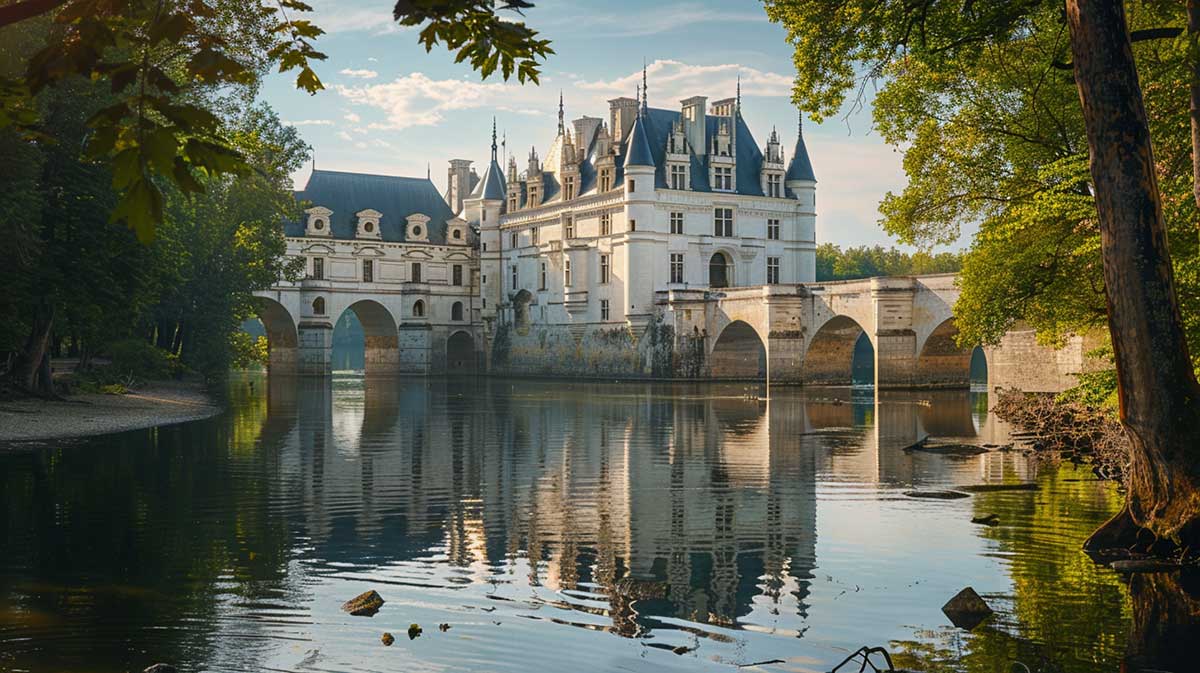
By midday, they arrive at Chenonceau. After Chambord’s thunder, Chenonceau feels graceful, almost musical. It stretches across the Cher River like a pale bridge with windows, arches, and reflections beneath it.
The water moves gently below. Trees lean close to the river. The château seems to float between land and mirror. The air smells of roses, river weeds, old wood, polished floors, and flowers from the gardens.
Conan stands before the château, hands on hips.
Conan: “This one is unfair. It looks like it knows it’s photogenic.”
Julia Child: “Some places do.”
Voltaire seems less eager to attack this château. He walks slowly, studying the history carried by its rooms.
Voltaire: “Power built Chambord to shout. This place learned to speak with elegance.”
RM looks at the river reflection.
RM: “The water makes it feel less heavy.”
Rilke nods.
Rilke: “A reflection gives stone a second life.”
Inside, the long gallery stretches across the river. Light enters from both sides. Footsteps soften across the floor. Portraits watch from walls. Flower arrangements fill rooms with color and scent.
Julia stops near the kitchen area, delighted.
Julia Child: “Here, at last, is the heart of the house.”
Conan leans in.
Conan: “You mean the kitchen?”
Julia Child: “Yes. Thrones are decorative. Kitchens are honest.”
Voltaire smiles.
Voltaire: “Madame Child, you may be the most dangerous revolutionary among us.”
They walk through rooms shaped by queens, mistresses, wars, grief, and survival. Chenonceau feels less like a monument to one ruler and more like a place where human presence has layered itself across time.
RM runs his fingers lightly near the wall, careful not to touch what should not be touched.
RM: “Some places carry the voices of people who had to stay strong.”
Rilke looks at the river through the window.
Rilke: “Grace is not softness. It is pain that learned form.”
Conan exhales.
Conan: “I came here ready to mock rich people’s houses. This castle is making that difficult.”
Voltaire: “Good. Difficulty improves the mind.”
Outside, the river keeps moving under the arches. Chenonceau does not demand admiration. It receives it.
Scene 4 — Villandry Gardens: Nature Given a Geometry Lesson
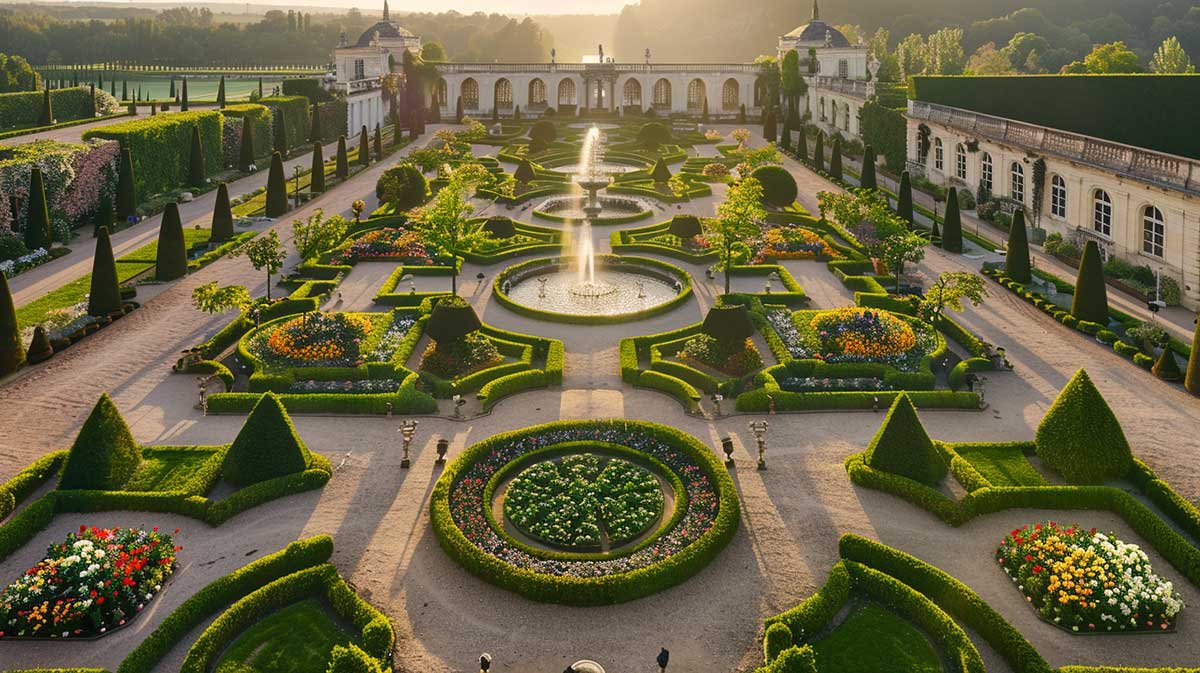
The afternoon takes them to Villandry. The gardens spread below like embroidery made from earth: squares, lines, spirals, clipped hedges, flowers, herbs, vegetables, and paths that seem drawn by a careful hand.
The air smells of boxwood, roses, damp soil, cut grass, and ripe leaves warming under the sun. Bees move between flowers. Gravel shifts underfoot. Water murmurs in low fountains.
Conan looks down from the terrace.
Conan: “This garden has more self-discipline than I have ever had.”
Voltaire: “A garden is civilization’s attempt to persuade nature to behave.”
Julia Child: “And sometimes nature benefits from a little menu planning.”
RM studies the vegetable beds arranged like ornament.
RM: “It’s strange. The vegetables are useful, but they are placed like poetry.”
Rilke smiles faintly.
Rilke: “The edible and the eternal have never been enemies.”
Conan points to a perfectly arranged section.
Conan: “If I planted vegetables, they would spell ‘help.’”
They walk through the paths. Each turn reveals another design: love gardens, kitchen gardens, water gardens. Color has been arranged with care, but wind still moves through it freely. Leaves tremble. Bees ignore the plan. Flowers lean slightly away from order.
Voltaire notices.
Voltaire: “The human mind draws lines. Life edits them.”
Julia kneels near herbs and breathes in.
Julia Child: “Thyme, rosemary, parsley. This is not decoration. This is dinner waiting to happen.”
Conan looks impressed.
Conan: “You can identify herbs by smell?”
Julia Child: “Of course.”
Conan: “I can identify panic by smell.”
RM laughs, then looks across the garden.
RM: “Maybe beauty needs structure, but it cannot live inside structure alone.”
Rilke answers:
Rilke: “A rose obeys the stem, then exceeds it.”
The group grows quiet. Villandry teaches a different lesson from the castles. It is less about owning land and more about shaping attention. Every path invites the eye to slow down. Every bed says that order can become tenderness when it serves life.
Conan stands near a fountain, listening to the water.
Conan: “I’m having a peaceful thought. Someone stop me.”
Voltaire: “No. Let us observe this rare event.”
Scene 5 — Loire Wine Village Dinner: The Day Becomes a Table
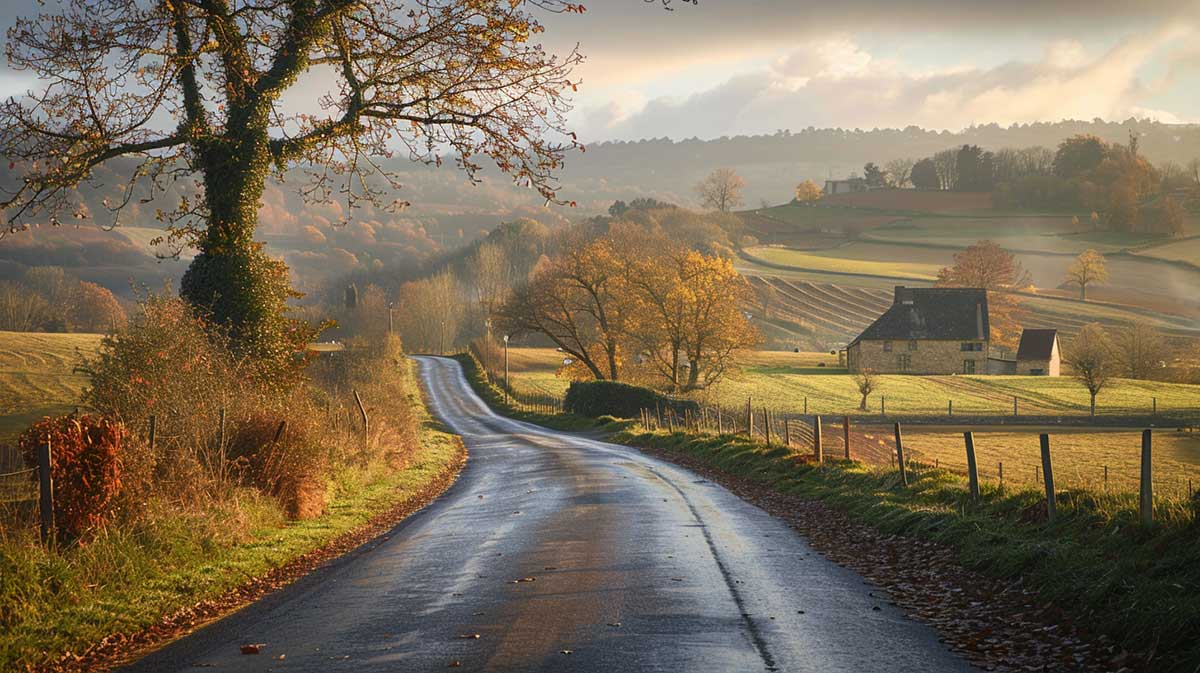
Evening brings them to a small Loire wine village. Stone houses line narrow streets. Window boxes spill with flowers. A church bell rings once, then leaves the air trembling. The last light touches rooftops and vines beyond the village.
The restaurant is small, warm, and full of low conversation. It smells of wine, grilled fish, goat cheese, shallots, butter, herbs, and bread fresh enough to silence Conan for several seconds.
Julia notices immediately.
Julia Child: “This is serious bread.”
Conan: “I respect it. I fear it. I plan to destroy it.”
Voltaire lifts his glass of Loire wine and studies the color.
Voltaire: “Civilization may be measured by what it places on a table.”
Julia Child: “Then tonight, civilization is doing very well.”
They taste goat cheese, salad with walnuts, river fish, roasted vegetables, and wine that feels bright and mineral. Conan takes a sip and tries to sound educated.
Conan: “This wine tastes like sunlight had a very good education.”
Voltaire looks at him for a long moment.
Voltaire: “That is almost acceptable.”
RM smiles.
RM: “That may be the nicest review Conan has received today.”
Conan: “I am growing. Against my will.”
Outside, the village darkens into blue. Inside, the table glows with candlelight. The day’s castles and gardens return in conversation: Chambord’s ego, Chenonceau’s grace, Villandry’s order, the Loire’s quiet presence.
Rilke speaks softly.
Rilke: “Today we saw that beauty has many disguises. Pride, grief, patience, hunger.”
Julia nods.
Julia Child: “And butter.”
Voltaire: “Let us not forget reason.”
Conan lifts a piece of bread.
Conan: “I choose butter, but I respect reason from a distance.”
RM looks around the table: the philosopher, the poet, the cook, the comedian, and himself. The day began with stone ambition and ends with shared food. Perhaps that is the correction France keeps offering: grandeur may impress, but a meal gathers people.
The waiter brings dessert. The first spoonful is quiet. Fruit, cream, sugar, and wine settle the day into memory.
Conan raises his glass.
Conan: “To castles that make us feel small, gardens that make us feel calm, and dinners that make us forgive both.”
Voltaire: “A clumsy toast, but a humane one.”
Julia Child: “That is the best kind.”
The village lights shine softly outside. The Loire Valley has given them grandeur, grace, order, and appetite. Tomorrow, France will become older, earthier, and more medieval. Tonight, it is enough to sit together, eat slowly, and let the wine finish the argument.
Day 5 — Dordogne Arrival: Medieval Stone and Dinner Smoke
Scene 1 — Morning Transfer South: France Becomes Older and Earthier
Morning begins with luggage, coffee, and the strange silence that comes after several days of beauty. The group leaves the Loire Valley and travels south, away from royal stone and perfect gardens, into a France that feels lower, warmer, and closer to the earth.
Fields pass by in long green stretches. Villages appear for a moment, then vanish behind trees. The road curves through land that smells of hay, rain-damp soil, diesel from passing trucks, and the last paper bag of pastries Julia insisted on bringing.
Conan sits in the back, one hand on a coffee cup, the other guarding a croissant.
Conan: “I feel like France keeps changing costumes, and I’m still wearing yesterday’s anxiety.”
Voltaire: “France has many faces. You have one expression.”
Conan: “That expression is cultural survival.”
Julia unwraps a pastry and hands it to RM, who has been watching the road with quiet attention.
Julia Child: “Travel requires supplies.”
RM: “Food makes movement feel less lonely.”
Rilke looks out at the changing landscape. The Loire had carried elegance; this road carries something older. Hills rise. Woods thicken. The houses begin to look heavier, built from stone that seems to belong to the ground.
Rilke: “The land is becoming less decorative.”
Voltaire: “Good. Decoration may become dishonest when overfed.”
Conan leans forward.
Conan: “Are we entering the part of France where every meal comes with a backstory and a warning from my cardiologist?”
Julia Child: “One hopes so.”
As the car moves farther south, the sunlight warms. The signs point toward Dordogne. The mood shifts without announcement. The trip is leaving elegance and entering appetite, memory, caves, cliffs, and old streets that seem to know hunger better than glory.
Voltaire closes his eyes.
Voltaire: “Castles try to impress history. Villages survive it.”
No one argues. The road bends, and France grows older outside the window.
Scene 2 — Sarlat Old Town Arrival: Gold Stone and Narrow Streets
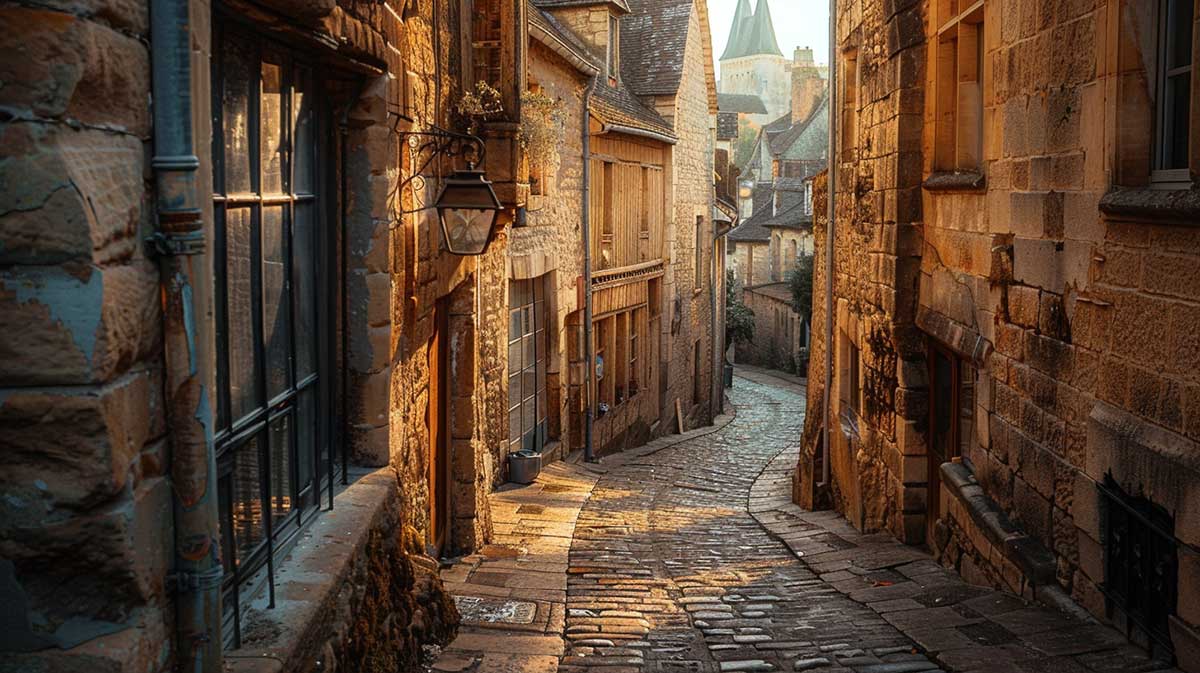
They arrive in Sarlat near late afternoon, when the town has begun to turn gold. The old stone buildings glow as if the sun has entered them and decided to stay. Narrow lanes twist between houses, arches, shops, and little squares. Roofs lean inward. Windows seem to watch the travelers pass.
The air smells of warm stone, duck fat, garlic, walnuts, wood smoke, and flowers in clay pots. Somewhere, a door opens and releases the smell of dinner before dinner has properly begun. Shoes click against uneven paving stones. A scooter passes, then the street becomes old again.
Conan turns in a slow circle.
Conan: “This town looks like it was built by people who wanted every corner to become a painting.”
Voltaire: “Or by people who expected war, weather, hunger, and gossip.”
Conan: “So, a full-service community.”
Julia steps near a shop window filled with jars, tins, cheeses, wine, and walnut sweets.
Julia Child: “This is not a town. This is a pantry with architecture.”
RM laughs softly, then studies the color of the walls.
RM: “The stone looks like sunset before sunset.”
Rilke reaches toward a wall but stops just short of touching it.
Rilke: “Some places do not appear built. They appear remembered.”
A church bell rings across the rooftops. The sound moves through the streets and seems to settle in the corners. The group walks slowly now, less like tourists trying to see everything and more like people accepting that the town will reveal itself one turn at a time.
Conan points to another narrow lane.
Conan: “If we walk down there, do we find a restaurant, a ghost, or a man selling cheese from the 1400s?”
Julia Child: “With luck, all three.”
By the time they reach their lodging, Sarlat has already changed the rhythm of the trip. Paris had performed. Loire had posed. Sarlat simply waits, golden and hungry.
Scene 3 — Sarlat Cathedral Square: Time Has a Different Voice Here
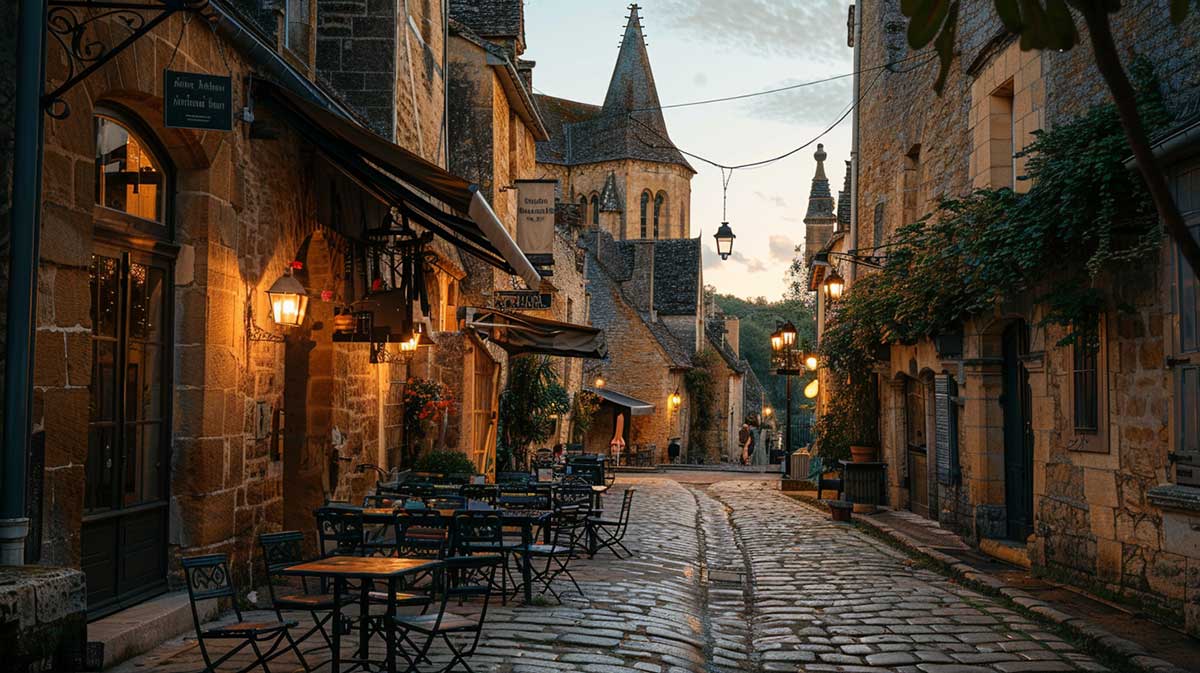
They step into the cathedral square as the light begins to soften. The stone rises around them in layers: church walls, old houses, arched passages, dark windows, and carved details worn by hands, weather, and centuries. The square is not empty, yet it feels hushed, as if sound has learned manners here.
The air smells of candle wax from somewhere inside the church, damp stone, dust, dry leaves, and the first smoke of evening kitchens. A few birds move across the roofline. Someone drags a chair across a café floor. The scrape sounds surprisingly loud.
Conan lowers his voice without knowing why.
Conan: “I don’t know what I did, but I feel I should apologize to this square.”
Voltaire: “That is the power of old churches. They make guilt seem architectural.”
Julia tilts her head toward the cathedral doors.
Julia Child: “And yet people came here with hunger, babies, grief, bread, worry, and hope. Buildings like this have heard everything.”
RM stands near the edge of the square, watching the light touch the upper stones.
RM: “In Paris, history felt displayed. Here, it feels absorbed.”
Rilke listens to the silence between passing footsteps.
Rilke: “A square remembers by holding the space where people once stood.”
Voltaire glances at him.
Voltaire: “Poets make absence very expensive.”
Rilke: “Philosophers make presence suspicious.”
Conan points between them.
Conan: “Good. The castle arguments have evolved into medieval street arguments.”
A small group exits the church. Their voices remain low. A child runs across the square, then is called back by a parent. Life continues, but gently.
The group sits for a few minutes at a café table. The chairs wobble slightly on the old stone. Conan tries to fix his chair, fails, then accepts his fate.
Conan: “This chair has chosen an emotional journey for me.”
Julia Child: “Then sit still and order something.”
The cathedral stands beside them, not demanding belief, not offering explanation. It simply stays. In Sarlat, time does not feel gone. It feels seated nearby.
Scene 4 — Market Lane: Walnuts, Duck, Truffles, and Human Happiness
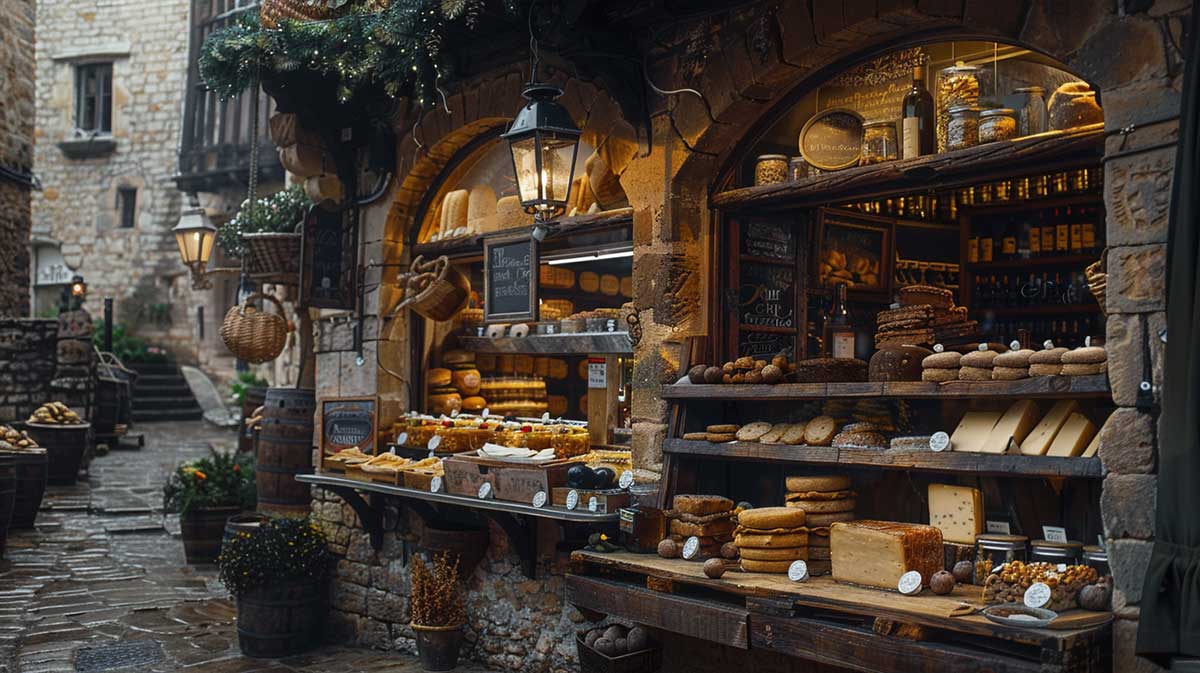
They turn into a market lane where the town becomes more intimate and more dangerous to anyone with an appetite. Shop windows are filled with jars of preserved duck, walnut cakes, honey, wine, cheeses, tins, sausages, and little handwritten signs that make each item look like a family secret.
The smell is rich and layered: garlic, cured meat, cheese, toasted nuts, fruit, butter, stone dust, and the dark earthy hint of truffle. Julia moves through the lane with the alertness of a scholar entering an archive.
Julia Child: “This is magnificent.”
Conan: “You said that in the same tone Voltaire used for liberty.”
Voltaire: “Food has achieved more happiness than most constitutions.”
Julia points at jars of confit.
Julia Child: “Duck preserved in its own fat. Practical, delicious, ancient.”
Conan looks moved and afraid.
Conan: “That sentence began as a cooking lesson and ended as a dare.”
RM studies the shopkeeper wrapping cheese in paper. The care in small gestures touches him: folding corners, tying string, naming the village, offering a taste.
RM: “Every local food is like a small memory people agreed to keep.”
Rilke holds a walnut in his palm after the shopkeeper offers one.
Rilke: “A nut is a sealed house.”
Conan pauses.
Conan: “I want to make fun of that, but I can’t prove it’s wrong.”
Voltaire tastes a small piece of cheese and closes his eyes for half a second.
Conan: “Did Voltaire just have a feeling?”
Voltaire: “No. It was an evaluation.”
Julia Child: “A very French evaluation.”
They buy walnut cake, cheese, bread, and a small jar Julia declares necessary for moral reasons. Outside, the lane narrows. A woman passes with flowers. A dog sleeps beside a doorway as if guarding the whole region through indifference.
By the end of the lane, Conan is carrying two bags.
Conan: “I have become a pack mule for regional happiness.”
Voltaire: “At last, a noble calling.”
The market lane has taught them something the castles could not: the soul of a place may fit inside a paper bag.
Scene 5 — Sarlat Dinner: The First Dordogne Feast
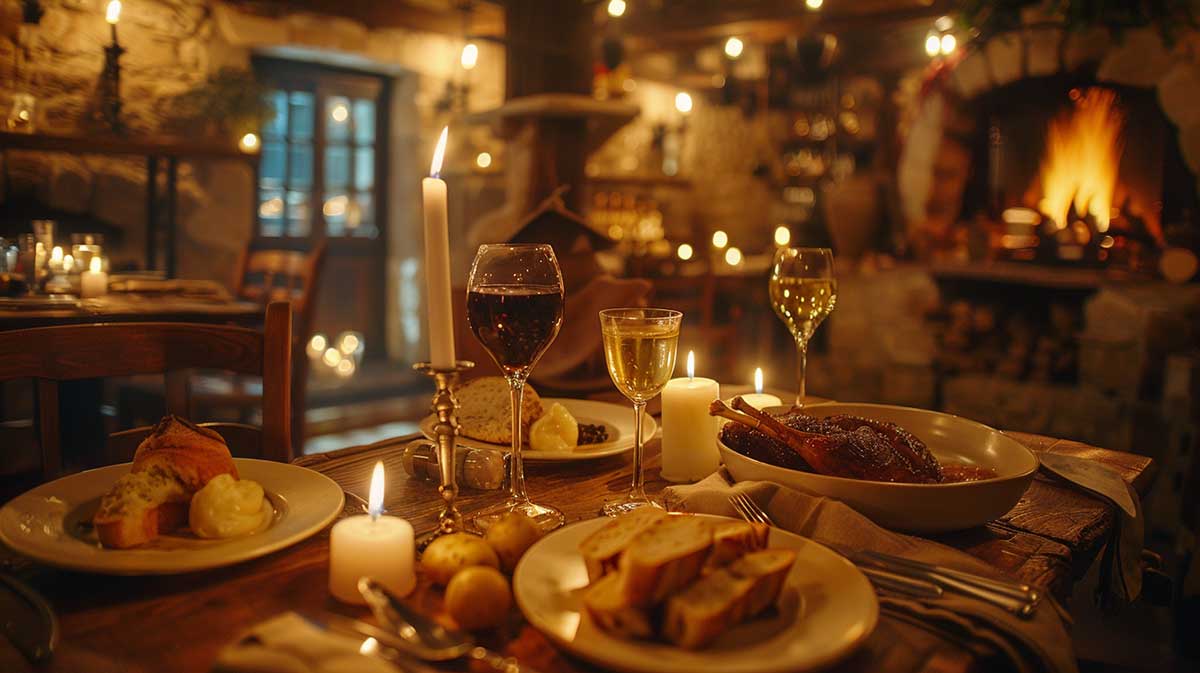
Night settles over Sarlat like warm cloth. Lamps glow against golden stone. Restaurant windows fill with candlelight. The air smells of roasted duck, wine, butter, potatoes, garlic, mushrooms, and smoke from a kitchen fire.
They sit at a wooden table in a small restaurant with low beams overhead. The room hums with conversation. Glasses catch the light. A waiter brings bread, then wine, then a procession of dishes that makes Conan sit straighter.
Conan: “I came here expecting dinner. This feels like a treaty negotiation with my arteries.”
Julia Child: “Be brave.”
Voltaire: “Courage at the table is one of the few forms of bravery available to modern man.”
Duck confit arrives with potatoes browned in fat. A salad follows with walnuts and cheese. There is soup, bread, wine, and a dessert that seems simple until the first bite.
Julia tastes the duck and becomes still for a moment.
Julia Child: “Yes. This is honest food.”
RM takes a bite and looks around the table.
RM: “It tastes like the town. Old, warm, patient.”
Rilke breaks bread slowly.
Rilke: “Food can carry the night inside it.”
Conan swallows, then points at him with his fork.
Conan: “That sounds impossible, yet this potato is supporting your argument.”
Voltaire sips wine and looks pleased.
Voltaire: “The countryside understands what cities sometimes forget: thought improves after dinner.”
The meal stretches. Outside, footsteps pass over stone. Inside, the group talks less sharply than before. Dordogne has a way of lowering the voice. The day has moved them from travel fatigue into hunger, from hunger into pleasure, from pleasure into a kind of trust.
Julia raises her glass.
Julia Child: “To Sarlat.”
RM adds:
RM: “To places that keep their memory warm.”
Rilke says:
Rilke: “To the old stone that welcomed us.”
Voltaire lifts his glass.
Voltaire: “To survival, seasoned properly.”
Conan looks at his plate, then at everyone.
Conan: “To duck. I never knew we could be this close.”
They laugh, and the laughter fills the low room. Their fifth day ends not in grandeur, but in smoke, stone, fat, wine, bread, and the strange comfort of being far from home, yet fed like they belong.
Day 6 — Dordogne River: Cliffs, Villages, and Slow Water
Scene 1 — La Roque-Gageac: The Village Between Cliff and River
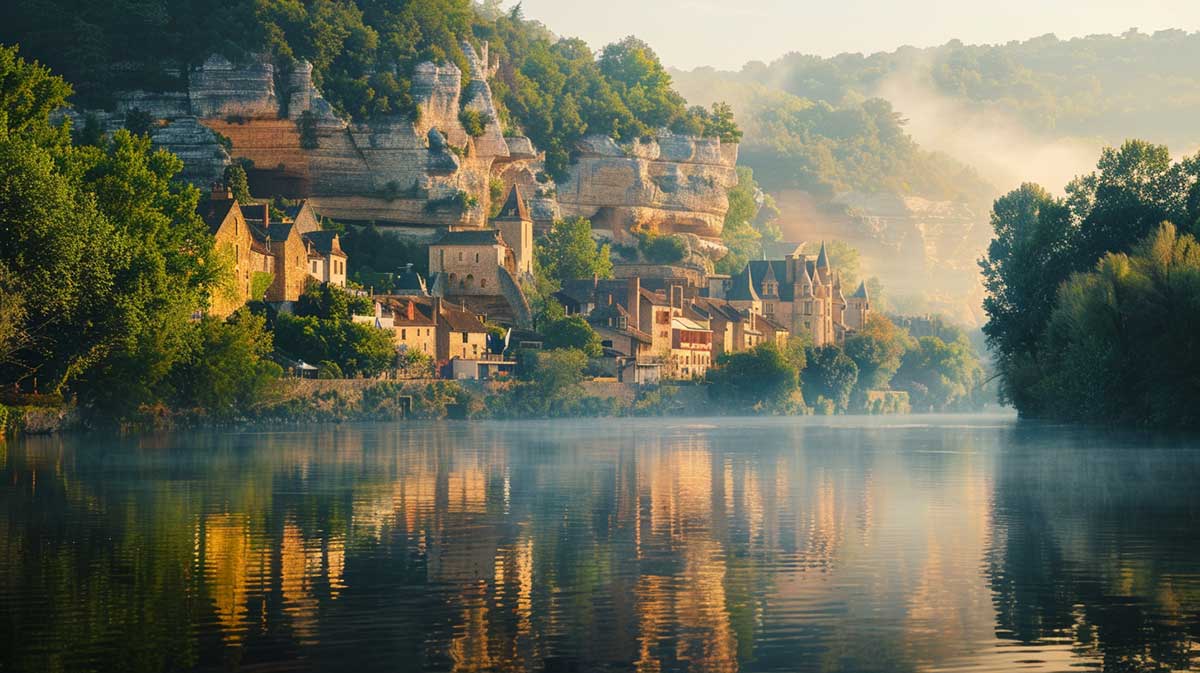
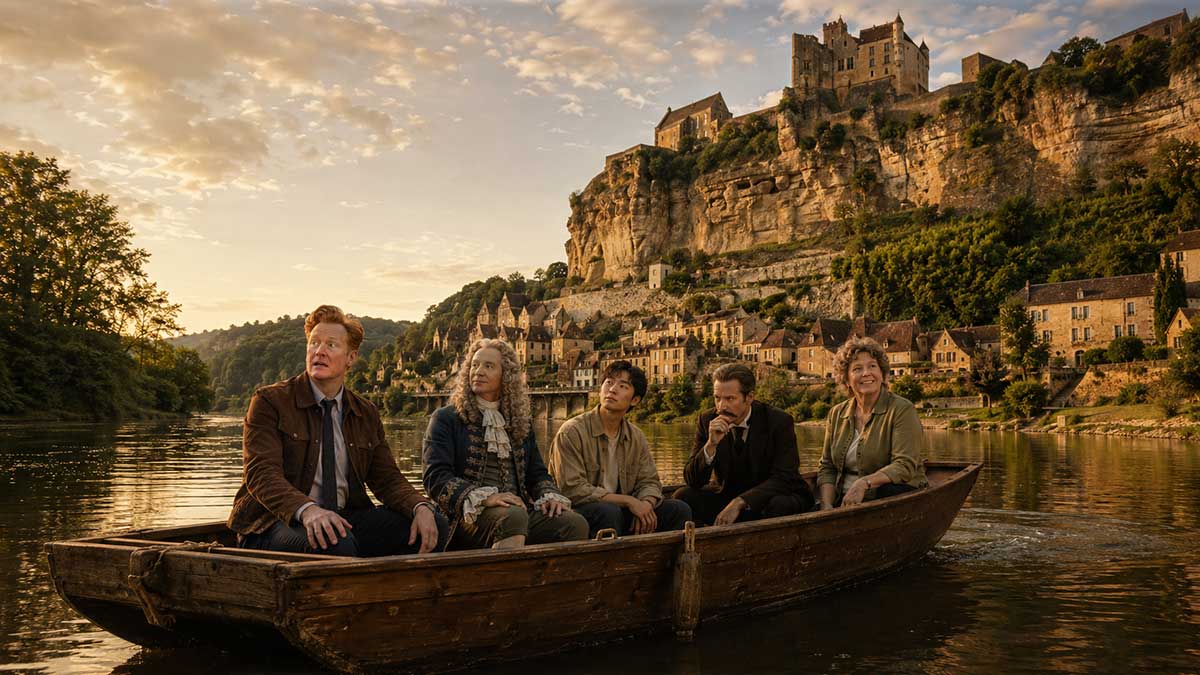
Morning light reaches La Roque-Gageac slowly, touching the limestone cliff first, then the honey-colored houses pressed beneath it, then the Dordogne River waiting below. The village seems impossible at first glance, as if someone placed stone houses between rock and water and trusted beauty to hold them there.
The air smells of river mist, damp stone, garden flowers, warm bread, and leaves growing from ledges high above the street. The river moves quietly beside them. A few boats rest near the bank. Window shutters open one by one. A cat crosses a narrow lane with royal indifference.
Conan looks up at the cliff.
Conan: “This village has chosen a dramatic living situation.”
Voltaire: “The French have long believed that danger improves scenery.”
Julia Child: “I believe breakfast improves scenery.”
RM walks a few steps ahead, looking at the houses, the cliff, the water, the soft reflection below. Everything feels carefully balanced.
RM: “It feels like the village is listening to the river.”
Rilke stops near a stone wall covered with small plants.
Rilke: “A place becomes tender when it knows it could fall.”
Conan turns to him.
Conan: “That is almost too good. I need to say something stupid now for balance.”
Julia points to a small café terrace.
Julia Child: “Then say it after coffee.”
They sit outside with cups, bread, jam, and a view of the river. The coffee is dark. The bread tears with a crisp sound. The jam tastes of fruit and sun. The village wakes around them without hurry.
Voltaire looks at the cliff again.
Voltaire: “Here, human pride is forced to negotiate with stone.”
Conan raises his cup.
Conan: “To successful negotiations. May the stone continue to be reasonable.”
The river slides past, carrying morning light. Their day has begun between height and water, between fragility and charm.
Scene 2 — Dordogne River Boat: Water Beneath the Old World
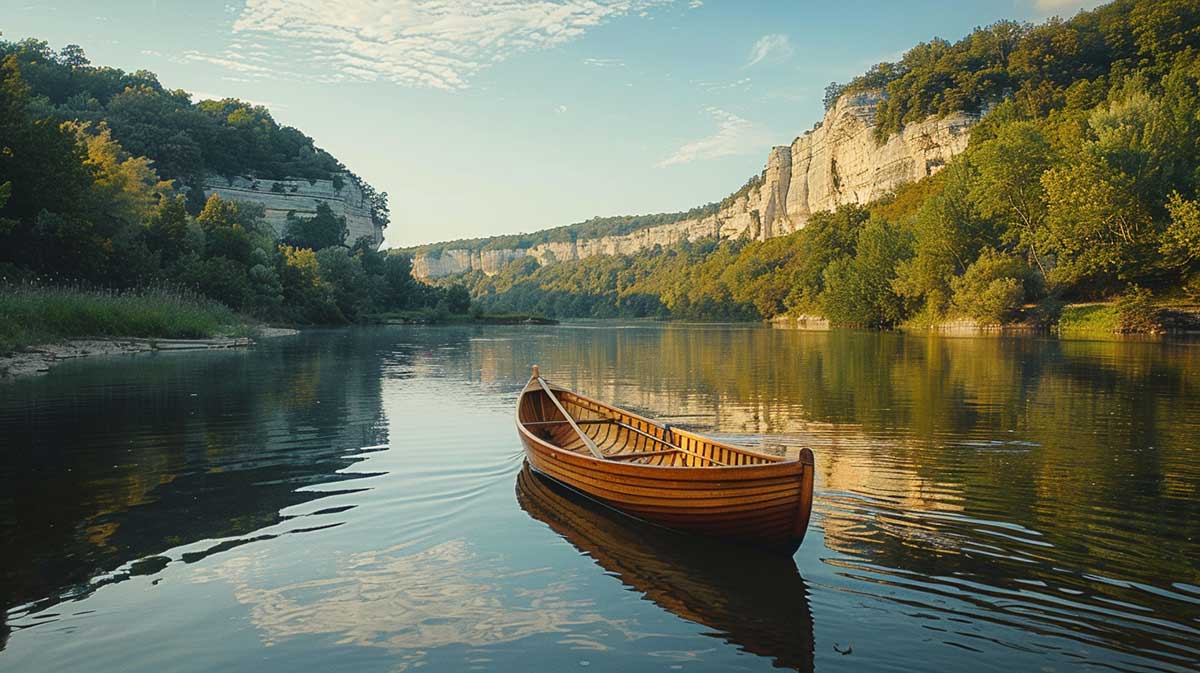
They board a flat-bottomed river boat, and the Dordogne takes over the pace. The village slips behind them. The cliffs rise on one side. Trees lean over the water. Reflections tremble and break apart beneath the hull.
The boat smells of sun-warmed wood, wet rope, river weed, and mineral water. The sound is simple: the engine’s low hum, water tapping the side, birds moving through trees, a guide speaking in gentle French. Light flashes across the surface in small pieces.
Conan grips the edge of the boat.
Conan: “I like rivers best when they are scenic and not responsible for my immediate future.”
Voltaire: “You fear drowning in six feet of poetry.”
Conan: “I fear drowning in regular water. Poetry is just poor lighting.”
Julia sits comfortably, hat tilted, enjoying the breeze.
Julia Child: “This is splendid. The river makes everyone quiet.”
Conan: “I’m quiet from controlled panic.”
RM watches the cliff faces pass by, each one marked by time. He thinks of songs, tours, airport lights, crowds, and now this slow current, asking nothing from him.
RM: “The river doesn’t hurry, yet everything moves.”
Rilke leans over just enough to see the broken reflection of trees.
Rilke: “Water never keeps the shape it receives. That is its freedom.”
Voltaire glances at the villages along the bank.
Voltaire: “Civilization begins when people settle near water, then spend centuries pretending they control it.”
The boat passes beneath a patch of shadow. The air cools. For a few seconds, no one speaks. The river holds them in its slow conversation.
Conan finally relaxes his hand.
Conan: “I may be growing as a person.”
Voltaire: “Let us not exaggerate.”
The boat glides on. Above them, castles and villages appear through trees like memories placed high for safekeeping.
Scene 3 — Château de Beynac: The Castle Above the Valley

By midday, they climb to Château de Beynac. The path rises steeply through stone lanes, and Conan begins to question the moral character of medieval architects.
The air smells of hot stone, dry grass, dust, leather from tourist bags, and faint smoke from a restaurant below. Their shoes strike uneven steps. The higher they climb, the smaller the river becomes. The valley opens beneath them, wide, green, and ancient.
Conan stops halfway, breathing hard.
Conan: “Medieval people had calves like tree trunks and no regard for future tourists.”
Julia Child: “You wanted authentic France.”
Conan: “I wanted authentic France with fewer inclines.”
Voltaire looks up at the fortress walls.
Voltaire: “A castle is fear with a view.”
RM turns back to see the Dordogne below, shining between trees.
RM: “From here, the river looks peaceful. Down there, it felt alive.”
Rilke touches the rough stone near the entrance.
Rilke: “Height changes fear into strategy.”
Inside the castle, the rooms feel bare and stern. This is not Loire elegance. Beynac is not trying to seduce anyone. It was built to watch, guard, endure. The stone is thick. The windows are narrow. The wind passes through openings with a cold edge, even in sunlight.
Conan looks through one of the small windows.
Conan: “This is not a castle for parties. This is a castle for suspicious people with excellent posture.”
Voltaire: “Much of European history may be summarized that way.”
Julia studies the hearth.
Julia Child: “Yet someone cooked here. Someone carried water. Someone made bread under all this tension.”
RM nods.
RM: “That makes the place feel human again.”
They step onto the outer view. The valley spreads below: river, fields, roads, rooftops, trees, and distant hills. The wind touches their faces. The view is too large for jokes for a few seconds.
Then Conan says quietly:
Conan: “Fine. The climb was worth it. Please record that, then delete it.”
Voltaire smiles.
Voltaire: “History will preserve your weakness.”
Scene 4 — Domme Viewpoint: The Valley From Above
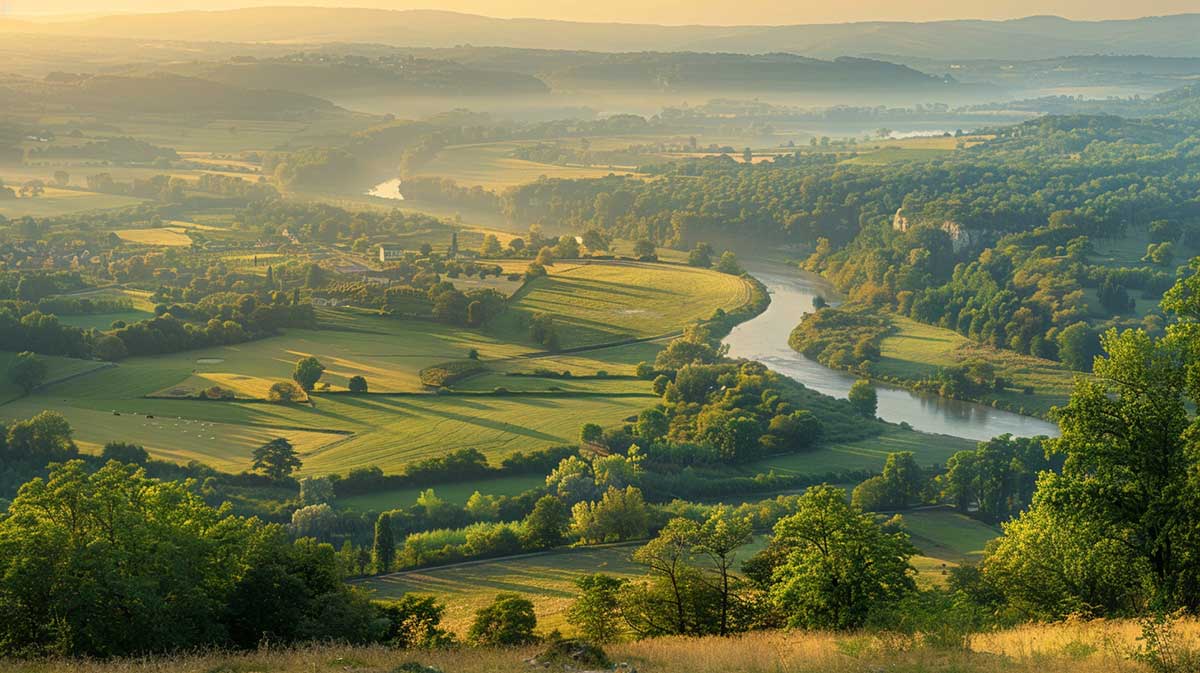
In the afternoon, they reach Domme, a hilltop bastide town with stone gates, narrow lanes, and a view that seems to stop conversation. From the belvedere, the Dordogne Valley opens below in green folds. The river curves through trees and fields. Villages sit in the distance like small thoughts.
The air smells of sun, dry grass, stone dust, flowers from window boxes, and ice cream from a shop behind them. Cicadas press sound into the heat. A breeze moves across the viewpoint, soft but dry.
Conan steps to the edge, then leans back.
Conan: “I enjoy views more when they don’t remind me gravity has opinions.”
Voltaire: “Gravity is the most democratic force in nature.”
Conan: “I knew you’d admire it.”
Julia buys a small scoop of walnut ice cream and hands Conan a spoonful.
Julia Child: “Here. Courage.”
Conan: “This is the best medical care I have received in France.”
RM stands quietly, watching the river far below.
RM: “Distance makes everything look healed.”
Rilke answers without turning.
Rilke: “Yes. That is why one must return to the valley.”
Voltaire folds his hands behind his back.
Voltaire: “From above, villages look peaceful. From within, they contain taxes, arguments, marriages, envy, soup, and dogs.”
Conan nods.
Conan: “So basically civilization.”
They walk through Domme’s lanes after the viewpoint. Stone houses hold shadows. Shops sell walnut oil, wine, local sweets, postcards, and soap. The town feels high, sunlit, and slightly removed from ordinary time.
RM takes a photo of a door half-covered by flowers.
RM: “Sometimes the small things remember the place better than the view.”
Rilke smiles.
Rilke: “The view opens the soul. The doorway lets it enter.”
Conan looks at Julia.
Conan: “I need more ice cream before the poetry wins.”
The valley remains below them, quiet and wide. The day has given them water from below, stone from above, and now distance: the strange gift of seeing where they have been.
Scene 5 — Evening Back in Sarlat: Lamps, Stone, and a Softer Table
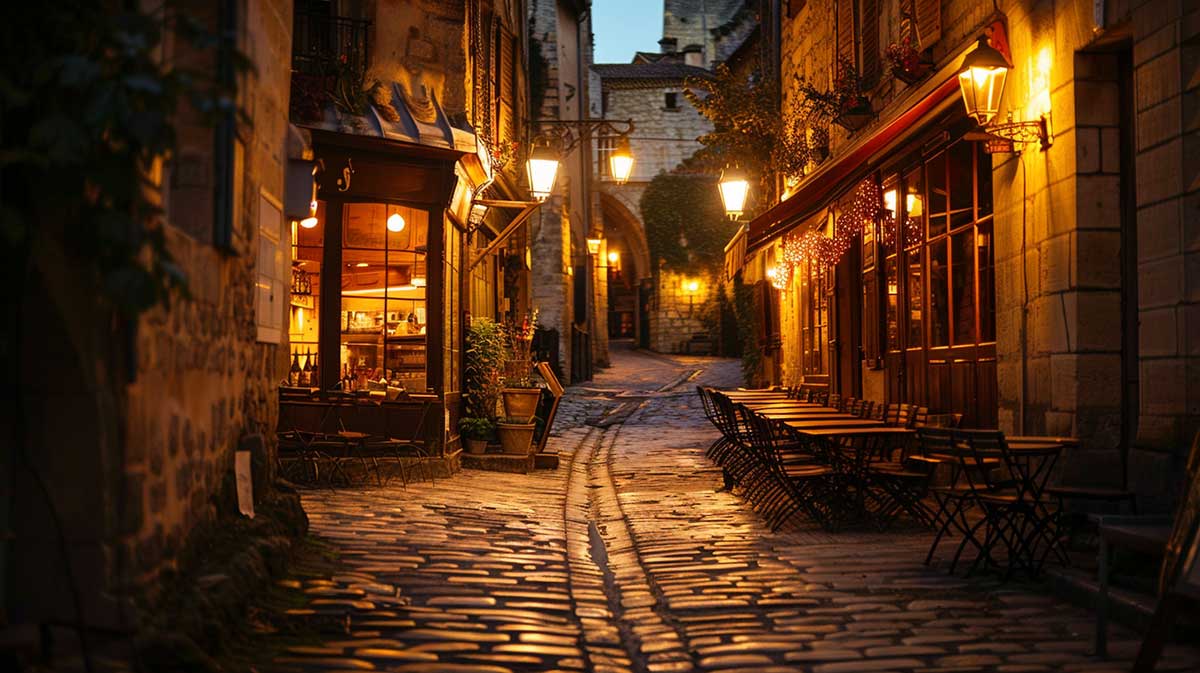
They return to Sarlat as evening gathers again in the old streets. The town seems different now. Yesterday it was an arrival. Tonight, it feels like a place waiting for them to come back.
Lamps glow against the golden stone. Restaurant signs flicker softly. The air smells of garlic, wine, duck, warm bread, candle wax, and cool night entering the alleys. Their footsteps sound familiar on the uneven stones.
Conan notices it first.
Conan: “I’m concerned that this town has started to feel like home, which is troubling since I can’t pronounce anything here.”
Voltaire: “Home has never required pronunciation. Only habit.”
Julia Child: “And dinner.”
They choose a small restaurant tucked into a side street. The table is close to the wall. The glasses are simple. The bread arrives before anyone has made a decision, which Julia considers a sign of moral order.
RM looks around the table.
RM: “Today felt like moving through layers: river, village, castle, hill, town.”
Rilke breaks a piece of bread.
Rilke: “A day can become a room with many windows.”
Conan looks at him.
Conan: “That sounds like something you’d say, and yet I understand it now. I’m frightened.”
Voltaire lifts his glass.
Voltaire: “Exposure to beauty has side effects.”
The meal is slower than the night before. They order soup, duck, potatoes, salad, cheese, wine, and a dessert made with walnuts. The food tastes deeper after the river and the climb. Hunger has become part of the story.
Julia tastes the potatoes and closes her eyes.
Julia Child: “France understands what a potato can become when it is respected.”
Conan points at his plate.
Conan: “I want this sentence on my tombstone.”
RM laughs, then grows quiet.
RM: “The river today made me think about time. It keeps moving, but it doesn’t seem sad.”
Rilke answers gently.
Rilke: “Perhaps sadness begins when we demand that time stay.”
Voltaire looks into his wine.
Voltaire: “Then let us demand less and eat more.”
Conan raises his glass.
Conan: “To the Dordogne: beautiful, old, occasionally uphill, and emotionally manipulative.”
Julia Child: “To good bread after a long day.”
RM: “To rivers that teach without speaking.”
Rilke: “To stone, water, and return.”
Voltaire: “To the rare day that improves even a comedian.”
The table laughs. Outside, Sarlat’s lamps hold the night in small circles of gold. Their sixth day ends with the feeling that Dordogne is not simply being visited. It is entering them slowly, like river water into stone.
Day 7 — Dordogne: Ancient Art and the First Human Longing
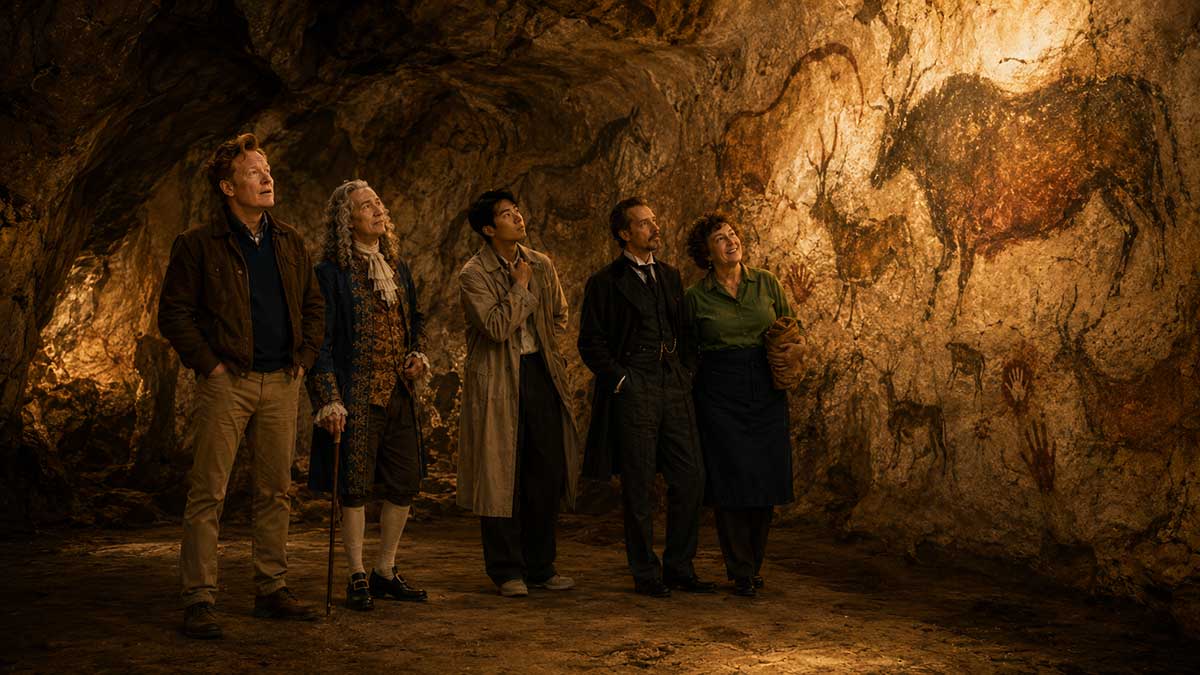
Scene 1 — Road to Montignac: The Morning Before the Cave
Morning leaves Sarlat in a soft gray light. The road to Montignac winds through woods, fields, low hills, and small houses with shutters still closed. The car smells of coffee, wool, yesterday’s market bread, and the faint sweetness of walnut cake wrapped in paper.
No one speaks much at first. The previous days had been full of castles, rivers, villages, food, and laughter. This morning feels different. They are going to see images made by hands that vanished thousands of years ago.
Conan looks out the window, then back at the group.
Conan: “I feel like we’re going to meet humanity’s oldest art teacher, and I forgot to do the reading.”
Voltaire: “Humanity has rarely done the reading.”
Julia Child: “Then we must go humbly.”
RM watches the trees pass. He thinks of studios, stages, screens, fans, songs, lights, and now a cave. A place where someone once made images without fame, cameras, applause, or even a name.
RM: “They created before anyone could follow them.”
Rilke turns from the window.
Rilke: “Perhaps they did not create to be followed. Perhaps they created so the silence would have shape.”
Conan exhales.
Conan: “I was going to say, ‘nice cave drawings,’ but now I feel emotionally underqualified.”
Voltaire smiles faintly.
Voltaire: “That has not stopped most critics.”
The road narrows. Trees crowd closer. Signs begin to point to Lascaux. The air outside grows greener, cooler, more wooded. The car moves through shade, then sunlight, then shade again.
Julia unwraps a piece of bread and passes it around.
Julia Child: “Even ancient art is better after breakfast.”
Conan takes a bite.
Conan: “Julia, I trust you with my soul and my carbohydrates.”
The group laughs, but gently. Montignac approaches. The morning seems to lower its voice.
Scene 2 — Lascaux IV Entrance: A Modern Doorway to Ancient Night
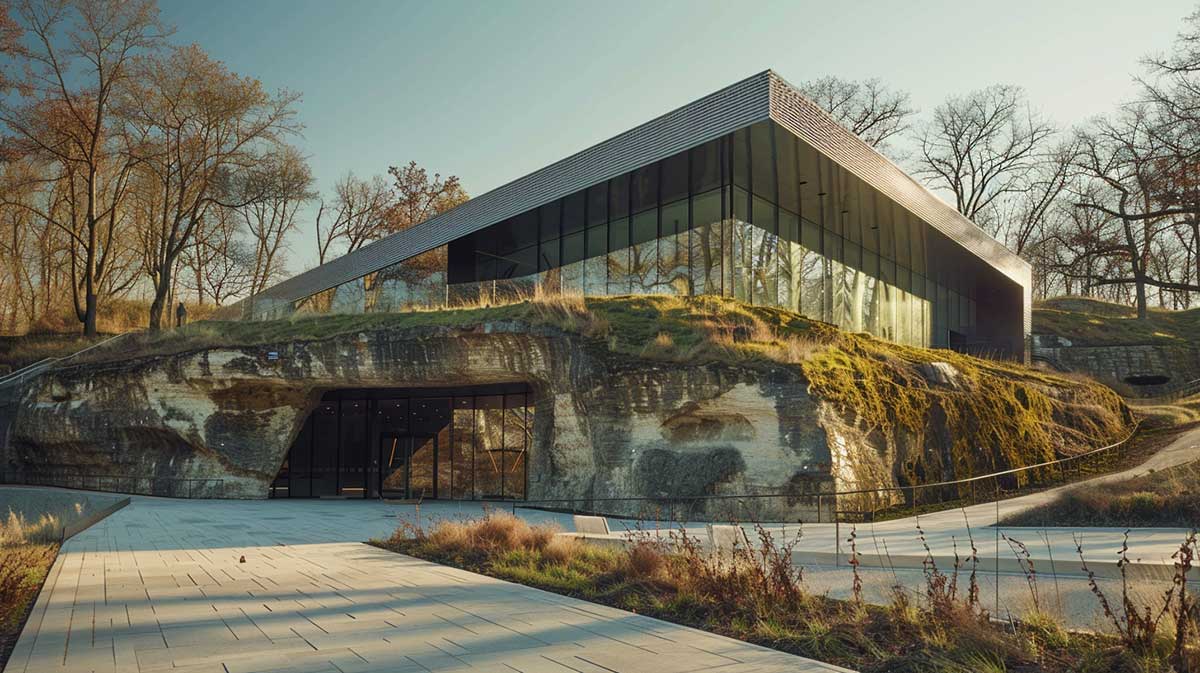
They arrive at Lascaux IV, where the clean lines of the modern building sit against the wooded hillside. Glass, concrete, and open space guide visitors inside, yet everyone knows the true subject is older than walls, older than cities, older than France.
The entrance smells of polished floors, clean air, stone, rain from the trees, and coffee from the visitor area. Voices are hushed, not by rule, but by instinct. Even Conan’s jokes arrive more carefully.
He looks at the sleek entrance.
Conan: “This is very modern for a place that makes me feel like I’m late by seventeen thousand years.”
Voltaire: “A small delay in human history.”
RM looks at the visitors gathering: families, students, older couples, travelers speaking different languages. They have come from modern life to stand before ancient images, or at least their faithful echo.
RM: “Everyone came from different places, but we are all here to look backward.”
Rilke answers softly.
Rilke: “No. We look inward by looking backward.”
Julia studies the faces around them.
Julia Child: “People become tender around old things. It is good for them.”
Voltaire raises one eyebrow.
Voltaire: “Tenderness is useful when it does not become superstition.”
They move through the entrance and toward the exhibition. The air cools slightly. Light grows controlled. The building begins to prepare them for darkness.
Conan whispers to Julia.
Conan: “Is it wrong that I’m nervous?”
Julia Child: “No. Awe and hunger are two honest human states.”
Conan: “I’ve had one all week. Good to branch out.”
A guide’s voice begins. The group gathers with the others. The threshold feels strange. They are not entering the original cave, yet the mind knows what is being honored. The replica is not pretending to be the past. It is a careful bridge to it.
Rilke touches the railing lightly.
Rilke: “We enter through technology, seeking the first dream.”
Voltaire glances at him.
Voltaire: “That is almost reasonable.”
They step forward, and the bright day begins to disappear behind them.
Scene 3 — Cave Art: Animals in the Dark
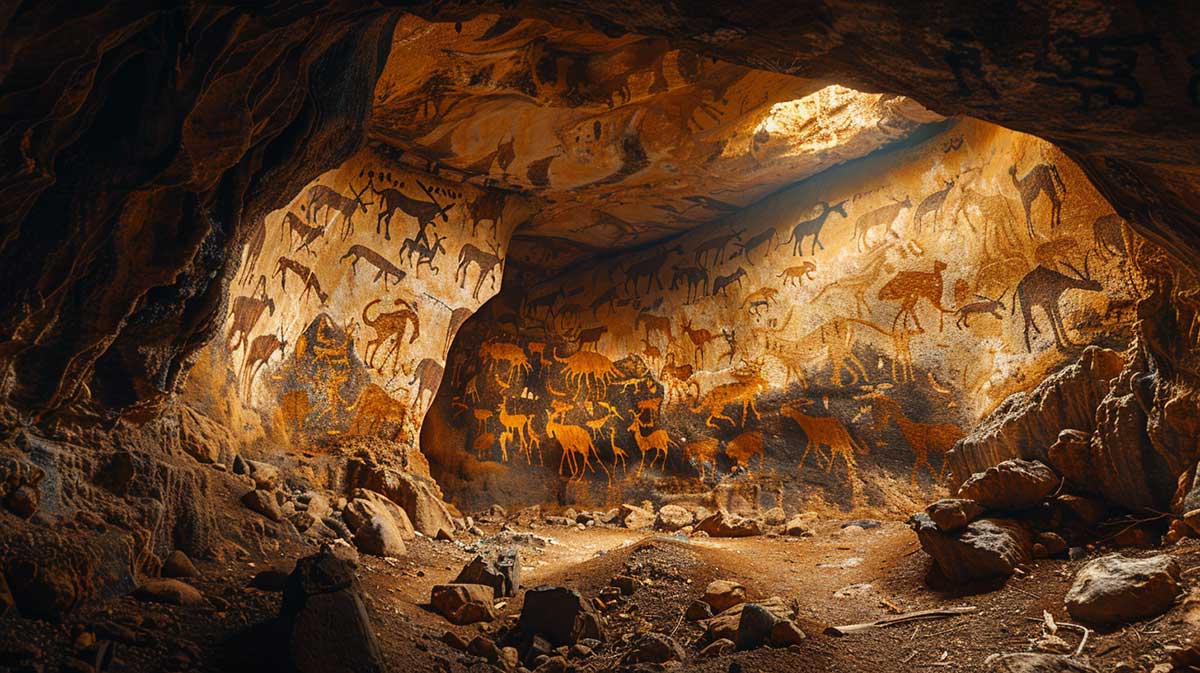
Inside, the temperature feels cooler. The light is dim. The walls curve close around them. Painted animals appear from darkness: bulls, horses, deer, forms alive with motion. Lines made by unknown hands cross the stone with astonishing confidence.
The air smells faintly of mineral surfaces, cool stone, preserved space, and the clean scent of a museum built to protect memory. The sound of shoes becomes softer. Voices lower. The group moves slowly.
For once, Conan does not speak first.
RM stands before a painted bull and feels a strange ache. The animal seems to move, not in the wall, but in the viewer’s own breathing.
RM: “It feels alive.”
Rilke’s eyes do not leave the image.
Rilke: “It was made from hunger, fear, gratitude, and vision. That is why it still breathes.”
Voltaire, who has argued with kings and churches, speaks with unusual restraint.
Voltaire: “Before written law, before philosophy, before empire, there was image.”
Julia looks at the animal forms, then at the faces watching them.
Julia Child: “And before all of this, someone needed fire, food, shelter, and courage.”
Conan finally whispers.
Conan: “So this is prehistoric social media, except nobody was trying to sell me a course.”
No one laughs loudly. Conan looks at the painting again.
Conan: “No, that was too small for this room. I apologize to the cave.”
RM smiles.
RM: “Maybe they painted so they would not disappear.”
Rilke nods.
Rilke: “Or so the animal would remain after the hunt, after fear, after night.”
Voltaire studies the wall.
Voltaire: “Human beings have always negotiated with death. Some used religion, some used reason, some used paint.”
Conan looks at the figures with a new seriousness.
Conan: “I’ve spent my life trying to get laughs before people forget me. Maybe that’s not so different.”
Julia reaches over and pats his arm.
Julia Child: “It is human, dear.”
The cave images remain silent. No artist steps forward to explain them. No signature appears. No title card can fully tame them. The animals move in darkness, and five travelers stand before them, suddenly close to the first human longing: to leave a mark, to be seen by someone beyond one’s own life.
Scene 4 — Countryside Lunch: Returning to Bread, Soup, and Sunlight
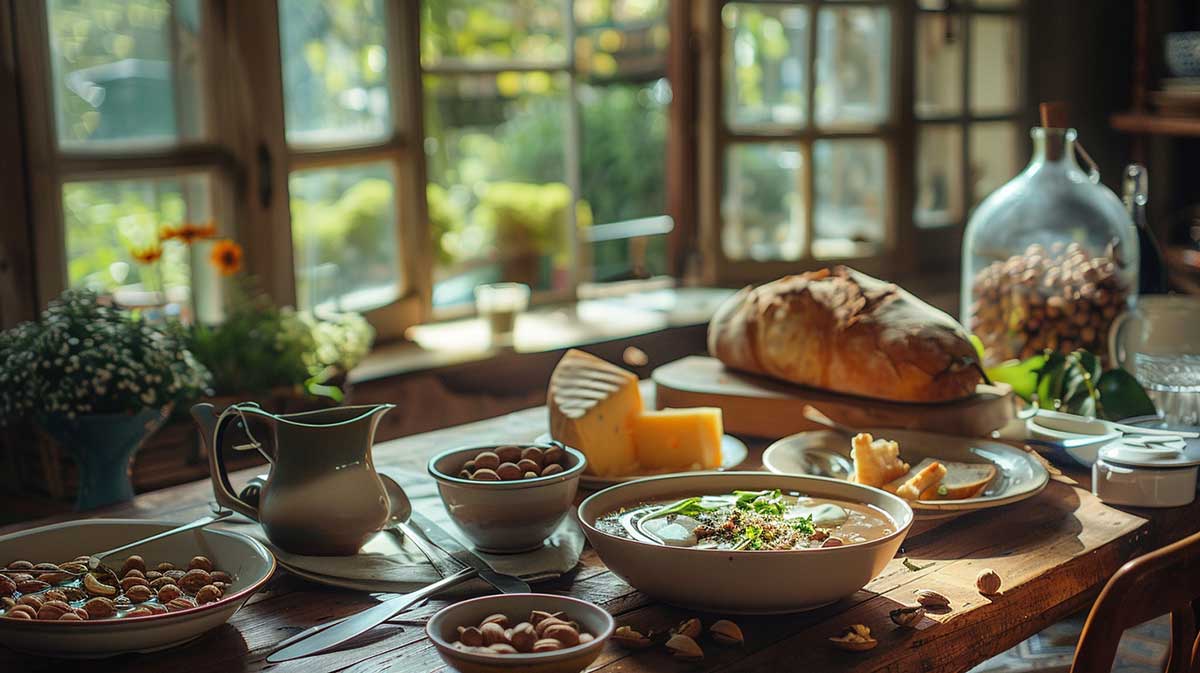
After Lascaux, the outside light feels almost startling. The group drives to a countryside inn for lunch. The dining room opens to fields and trees. Sunlight rests on wooden tables. The air smells of soup, bread, herbs, roasted vegetables, cheese, and coffee.
No one is ready to talk too quickly. The cave has left a silence around them. The waiter brings bowls of soup, baskets of bread, local cheese, salad, and a simple dessert with walnuts and cream.
Julia breaks the quiet first.
Julia Child: “After darkness, soup is a mercy.”
Conan picks up his spoon.
Conan: “I didn’t know soup could perform emotional rescue.”
Voltaire: “Many institutions have done less with greater funding.”
RM laughs softly, then tastes the soup. It is warm, earthy, and plain in the best way. It brings him back to the body after the cave had pulled him into time.
RM: “Food brings us back to now.”
Rilke looks at the steam rising from his bowl.
Rilke: “The present enters through warmth.”
Conan stares at him.
Conan: “You’re saying soup is philosophy?”
Voltaire: “A claim less foolish than many I have heard.”
Julia looks pleased.
Julia Child: “Soup is patience in a bowl.”
The group eats slowly. Bread scrapes against the bottom of bowls. A breeze moves through the open window. Bees drift near flowers outside. In the distance, a dog barks once, then gives up.
Voltaire raises his glass of water.
Voltaire: “The cave showed us that humans sought meaning before comfort. Lunch reminds us they still required comfort.”
RM: “Maybe meaning and comfort were never separate.”
Rilke smiles.
Rilke: “The first fire gave both.”
Conan looks at the bread in his hand.
Conan: “I came to France for jokes and scenery. Now bread is making me think about mortality.”
Julia Child: “That is the correct use of bread.”
They laugh, and the day begins to soften. The cave remains with them, but it no longer feels heavy. It has entered the meal, the conversation, the sunlight, and the taste of walnut cream on a spoon.
Scene 5 — Sarlat Evening Walk: The Quiet After Ancient Memory
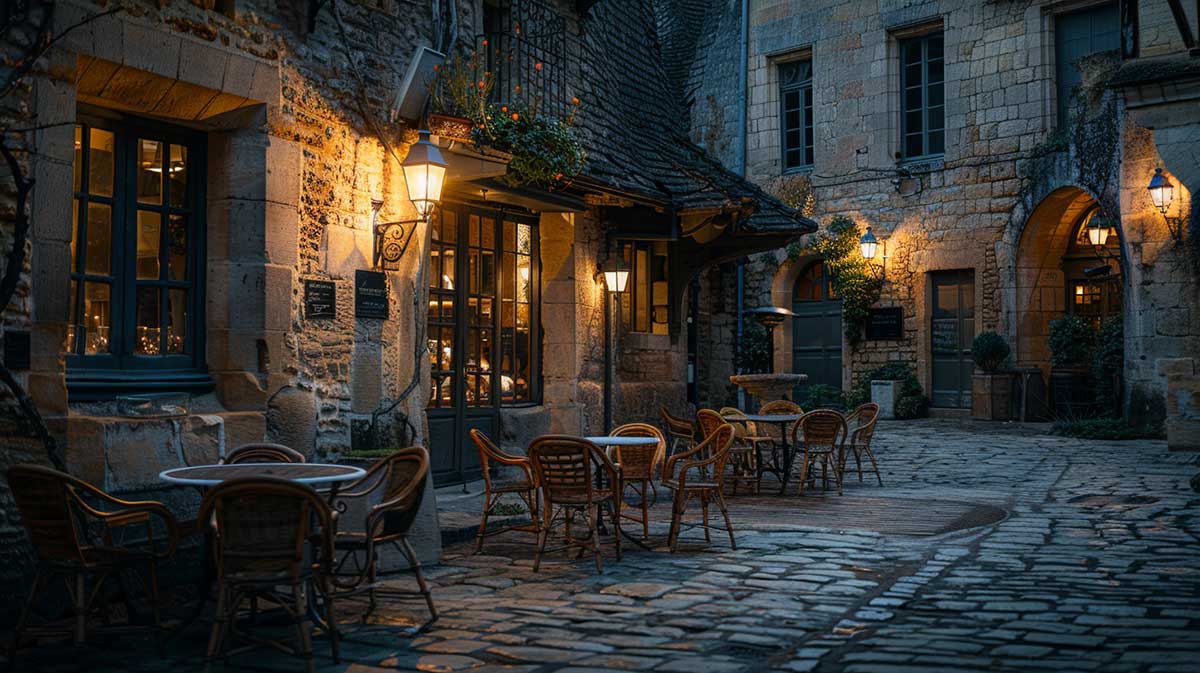
They return to Sarlat in the early evening. The town is familiar now, but after Lascaux, even familiar stone feels older. The lanes glow with golden light. Shadows gather in doorways. Lamps begin to wake behind glass.
The air smells of evening bread, cool stone, roasted meat, wine, smoke, and flowers near windows. Footsteps echo through narrow passages. A musician plays softly in a square, the notes rising and fading before they can become a performance.
The group walks without hurry.
Conan is quieter than usual. Julia notices first.
Julia Child: “You are thinking.”
Conan: “I try to avoid it on vacation.”
Voltaire: “France has failed you, then.”
Conan looks up at the stone houses.
Conan: “Those cave painters had no audience, no brand, no approval. They still made something. That bothers me in a good way.”
RM nods.
RM: “Creation without applause. That is pure and frightening.”
Rilke stops beneath an old archway.
Rilke: “Every true work is made partly for the unknown person who may one day need it.”
Voltaire folds his hands behind his back.
Voltaire: “A generous thought. Dangerous for vanity.”
Julia looks into a restaurant window where candles are being lit.
Julia Child: “And yet people must eat before they become noble.”
Conan smiles.
Conan: “There she is. Bringing us back from the abyss with dinner.”
They reach a small square and sit for a few minutes. No grand monument stands before them. No castle rises overhead. No cave painting glows in darkness. There are only stones, lamps, voices, and the smell of dinner.
RM speaks softly.
RM: “Maybe travel is not about seeing more. Maybe it is about becoming quiet enough to receive what we see.”
Voltaire looks at him.
Voltaire: “That is almost wisdom. Guard it carefully.”
Rilke adds:
Rilke: “The day has entered us. Now it must find its place.”
Conan raises an imaginary glass.
Conan: “To ancient artists, modern soup, and the fact that I apologized to a cave.”
Julia laughs, warm and full.
Julia Child: “To all of that.”
Night settles over Sarlat. The town holds them gently. Day 7 ends not with spectacle, but with the feeling that a mark made in darkness can travel through time and still touch someone walking under lamps thousands of years later.
Day 8 — Provence Arrival: The Light Changes the Conversation
Scene 1 — The Long Road South: France Changes Color
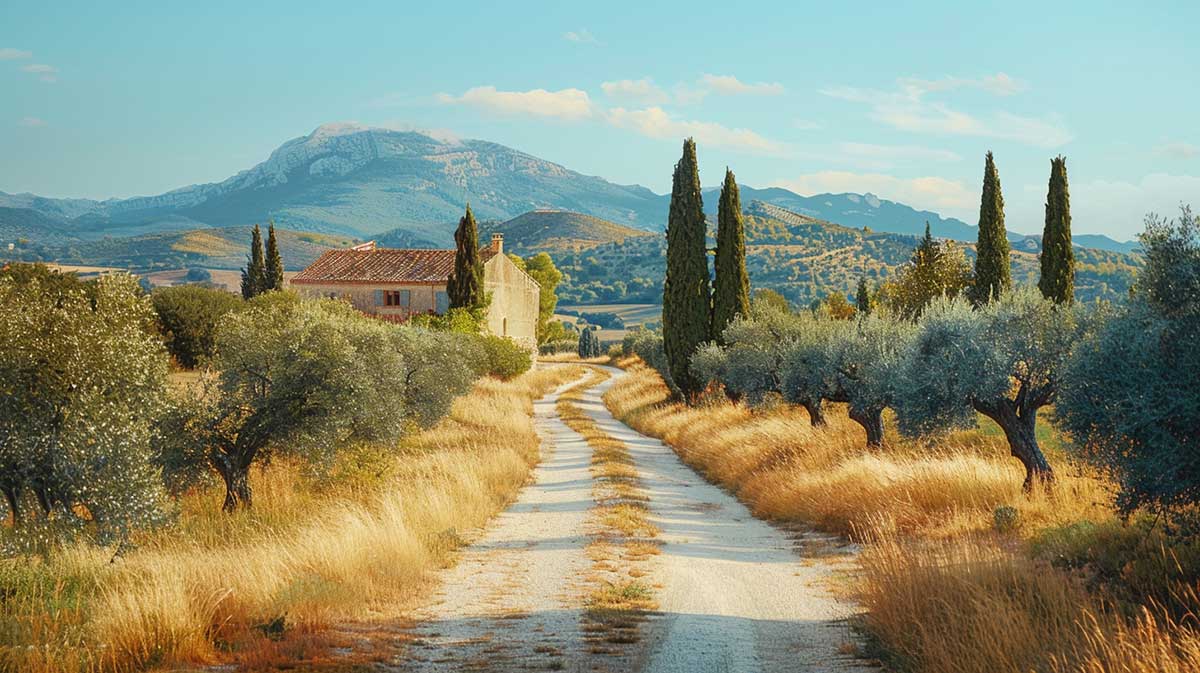
Morning begins with departure. Sarlat’s golden stone fades behind them, and the road opens south. The air in the car smells of coffee, paper bags, fruit, old maps, and the last crumbs of walnut cake. Dordogne had felt ancient and inward. Provence begins as a promise in the distance: brighter air, sharper shadows, warmer stone.
Fields pass. Hills roll by. Villages appear in flashes: church towers, shutters, cypress trees, pale walls, gas stations, vineyards, and roadside signs that make Conan feel legally defeated.
Conan: “I have learned many French words on this trip. Sadly, none of them are useful at toll booths.”
Voltaire: “You have learned bread, wine, cheese, and confusion. That is enough for most travelers.”
Julia Child: “You forgot butter.”
Conan: “I would never forget butter. Butter remembers me.”
RM watches the scenery change. The greens become drier. The earth turns paler. Roofs shift from dark stone to terracotta. Light no longer sits gently on things. It strikes them, defines them, makes edges clearer.
RM: “The color is changing before the place has even introduced itself.”
Rilke looks at the sky.
Rilke: “Light is the first language of a region.”
Voltaire glances at him.
Voltaire: “A poetic claim, yet not entirely useless.”
They stop for coffee at a roadside café. The cups are small. The coffee is strong. The air smells of hot pavement, espresso, lavender soap from a shelf near the counter, and sun warming the metal tables outside.
Conan takes a sip and winces.
Conan: “This coffee has the personality of a tax auditor.”
Julia Child: “Good. It will keep you awake.”
Back on the road, Provence begins to reveal itself in pieces: olive trees, plane trees, old walls, blue shutters, dry grass, and light so clear it seems to cut through fatigue.
The group grows quiet. A new France is arriving outside the windows.
Scene 2 — Avignon Old Town: Walls, Bells, and Old Authority
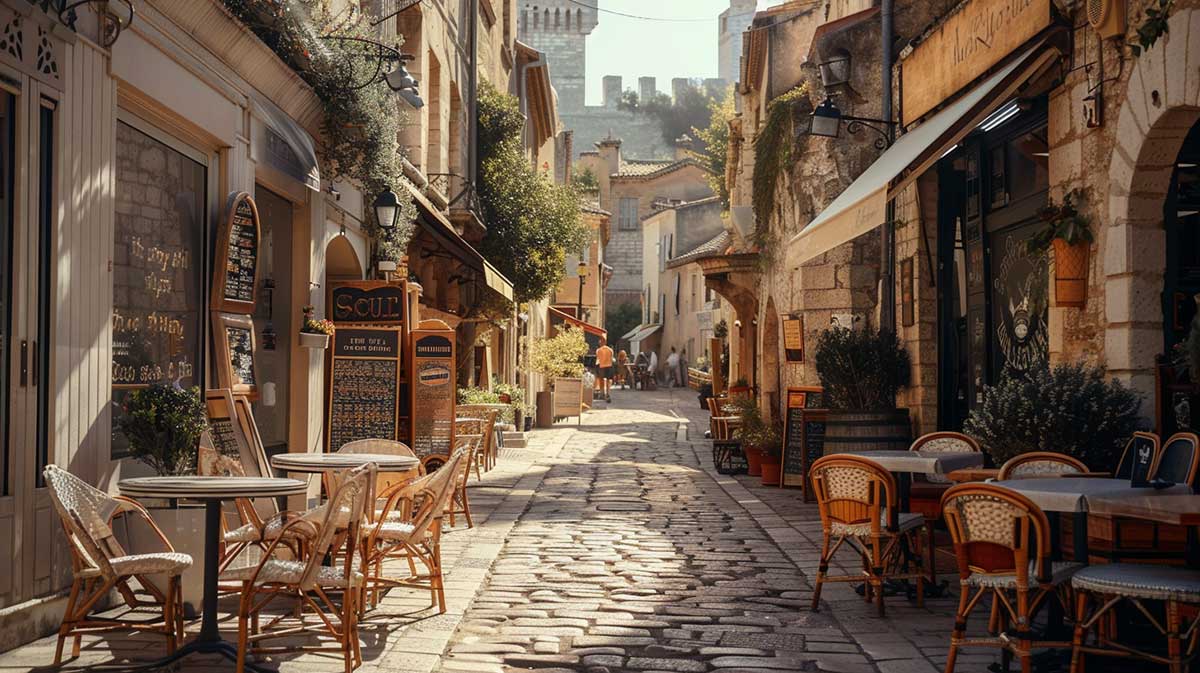
They enter Avignon through stone gates, and the city feels enclosed by memory. The old walls rise around them, pale and severe under the sun. Narrow streets lead inward, filled with cafés, shops, shutters, bicycles, scooters, and people moving between shade and glare.
The air smells of warm stone, coffee, olive oil, dust, perfume, and tomatoes from a market stall. Bells ring above the rooftops. Pigeons scatter from a square. A waiter carries glasses across a terrace with calm precision.
Conan looks at the city walls.
Conan: “Avignon is giving me the feeling that I’m late for medieval court.”
Voltaire: “Most courts were late for reason.”
Julia Child: “Let us not insult the city before lunch.”
They walk through the old town, passing cafés, small churches, shops selling soaps and herbs, and streets where sunlight lands in bright rectangles. RM notices the contrast: hard stone, soft voices; old authority, modern leisure.
RM: “This city feels like it used to command people, and now it invites them to sit outside.”
Rilke looks at laundry hanging above a narrow street.
Rilke: “Time is gentler when it becomes daily life.”
Voltaire pauses near a square where people drink coffee under umbrellas.
Voltaire: “A city improves when authority becomes a terrace.”
Conan nods.
Conan: “That may be the most French political theory ever spoken.”
They stop at a small café. Julia orders something simple: salad, bread, cheese, olives, and cold water. The olives taste sharp and rich. The bread is crisp. The tomatoes taste like sun made edible.
Conan takes one bite.
Conan: “This tomato has more confidence than I had at age thirty.”
Julia Child: “A good tomato has every right.”
The bells ring again. Avignon’s old walls hold the heat. The day has shifted from movement into arrival. Provence is no longer a promise. It is under their feet, bright and dry, asking them to slow down.
Scene 3 — Palais des Papes: Stone, Faith, and the Weight of History
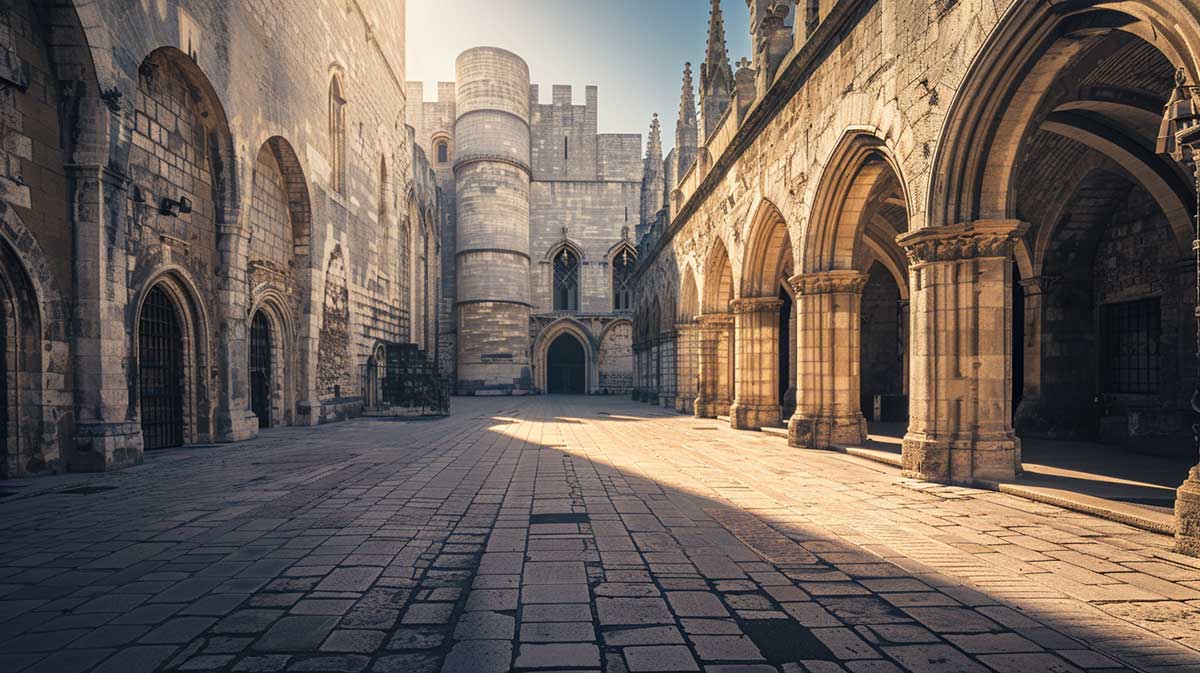
They approach the Palais des Papes, and the building rises like a fortress of faith and authority. The stone is massive, pale, and almost stern. It does not charm. It presses itself into the sky.
The square is wide and bright. The air smells of hot limestone, dust, sunscreen, coffee from nearby terraces, and dry wind. Footsteps echo against the open space. Tour groups gather, scatter, and gather again.
Conan looks up at the palace.
Conan: “This building says, ‘Welcome, but keep your opinions small.’”
Voltaire: “A fitting message from many religious institutions.”
Julia gives him a glance.
Julia Child: “Voltaire, behave.”
Voltaire: “Madame, I am behaving. Poorly, but consistently.”
RM studies the façade. The palace feels different from the Loire castles. Those had sought admiration. This place seeks obedience, or at least attention.
RM: “It feels less like beauty and more like weight.”
Rilke nods.
Rilke: “Some stones are raised to shelter prayer. Some are raised to make prayer answerable to authority.”
Voltaire looks pleased.
Voltaire: “A poet has accidentally made a political point.”
Conan walks a few steps across the square, then turns back.
Conan: “I feel judged by this building and by three pigeons.”
Julia Child: “The pigeons may be fair.”
They stand in the square, feeling heat rise through their shoes. The palace’s shadows are deep, almost blue. A child runs across the open space, laughing, and for a second the building feels less severe.
RM notices.
RM: “Maybe old authority becomes human when people play in front of it.”
Voltaire watches the child.
Voltaire: “Yes. Laughter is one of the oldest forms of resistance.”
Conan raises a hand.
Conan: “Finally, my profession has historical dignity.”
Voltaire: “Do not overreach.”
The palace remains, immense and silent. Yet the square belongs to footsteps, laughter, coffee, cameras, and summer heat. History may be heavy, but life keeps walking across it.
Scene 4 — Saint-Rémy Evening: Van Gogh Light and Village Calm

By evening, they reach Saint-Rémy-de-Provence. The town feels softer than Avignon, more intimate, closer to the body. Plane trees shade the streets. Shutters glow blue and green against pale walls. Shop windows display linen, ceramics, olive oil, soap, and small jars of herbs.
The air smells of lavender, dust, warm bread, rosemary, olive oil, and the faint sweetness of ripe fruit. Cicadas fill the background with a steady dry sound. The sunlight turns the buildings honey-colored, then slowly amber.
Conan looks around with suspicion.
Conan: “This town is trying to relax me. I don’t appreciate being emotionally ambushed.”
Julia Child: “Let it happen.”
Conan: “That sounds like something my therapist would say near a cheese shop.”
RM walks beneath the plane trees, noticing the moving shadows on the wall.
RM: “The shadows here feel like part of the art.”
Rilke stops near a small window with blue shutters.
Rilke: “Light has touched this place so often that the walls have learned to answer.”
Voltaire studies a sign for a local shop.
Voltaire: “Provence has made leisure respectable. An achievement Paris pretends to have invented.”
They pass a small square where people sit with glasses of wine. A dog sleeps beneath a chair. An old man reads a newspaper in the shade. Nothing appears urgent. Conan checks his watch, then looks embarrassed.
Conan: “I just checked the time. Provence saw me do it. I feel ashamed.”
Julia laughs.
Julia Child: “The first step is admitting that clocks are not always helpful.”
RM looks up at the evening sky.
RM: “This light makes everything feel forgiven.”
Rilke answers quietly.
Rilke: “No. It makes everything visible without cruelty.”
Conan exhales.
Conan: “That is better. Annoyingly better.”
The town continues around them: cups on tables, sandals on stone, cicadas in trees, warm wind in narrow streets. Saint-Rémy gives them no monument at first, no grand entrance. It gives them atmosphere. It gives them slowness. It gives them the strange courage to do less.
Scene 5 — Outdoor Provençal Dinner: Tomatoes, Herbs, and the Art of Staying

Dinner is served outside under plane trees. The table sits on a terrace where the evening air has cooled just enough to feel generous. Small lights hang above them. Glasses catch the last gold of the day. Somewhere nearby, a kitchen door opens and releases garlic, herbs, olive oil, grilled vegetables, and warm bread.
The meal begins with olives, tapenade, tomatoes, melon, goat cheese, and bread. Then comes ratatouille, fish, herbs, potatoes, rosé, and fruit. Julia looks almost solemn with happiness.
Julia Child: “This is why one travels.”
Conan: “For tomatoes?”
Julia Child: “For tomatoes that know who they are.”
Voltaire lifts his glass.
Voltaire: “The table is the only institution that has improved my opinion of humanity.”
Conan: “That is both beautiful and deeply insulting.”
RM tastes the ratatouille.
RM: “It feels simple, but it has so many layers.”
Julia nods.
Julia Child: “Good cooking is not loud. It is clear.”
Rilke watches the candle flame move in the evening breeze.
Rilke: “The day has become edible.”
Conan puts down his fork.
Conan: “I need everyone to know that I understood that sentence immediately, and I’m not proud of how French I’m becoming.”
The table laughs. Around them, other diners speak in low voices. Silverware touches plates. Cicadas continue their dry music in the trees. The night smells of herbs, wine, stone, and fruit.
RM looks around at the five of them.
RM: “Every part of France has changed how we talk. Paris made us perform. Loire made us question glory. Dordogne made us quiet. Provence is making us stay.”
Voltaire listens, then nods.
Voltaire: “A fair observation. I dislike how fair it is.”
Julia pours a little more wine.
Julia Child: “Then eat more. It will help.”
Conan raises his glass.
Conan: “To Provence. To light, tomatoes, and the suspiciously persuasive idea of slowing down.”
Rilke adds:
Rilke: “To the evening that teaches without speaking.”
Voltaire lifts his glass last.
Voltaire: “To pleasure, when it has the decency to become wisdom.”
The meal continues long after hunger ends. Nobody hurries. Nobody checks the time again. Provence has done what it does best: it has turned arrival into staying.
Day 9 — Luberon: Lavender, Stone Villages, and the Discipline of Slowness
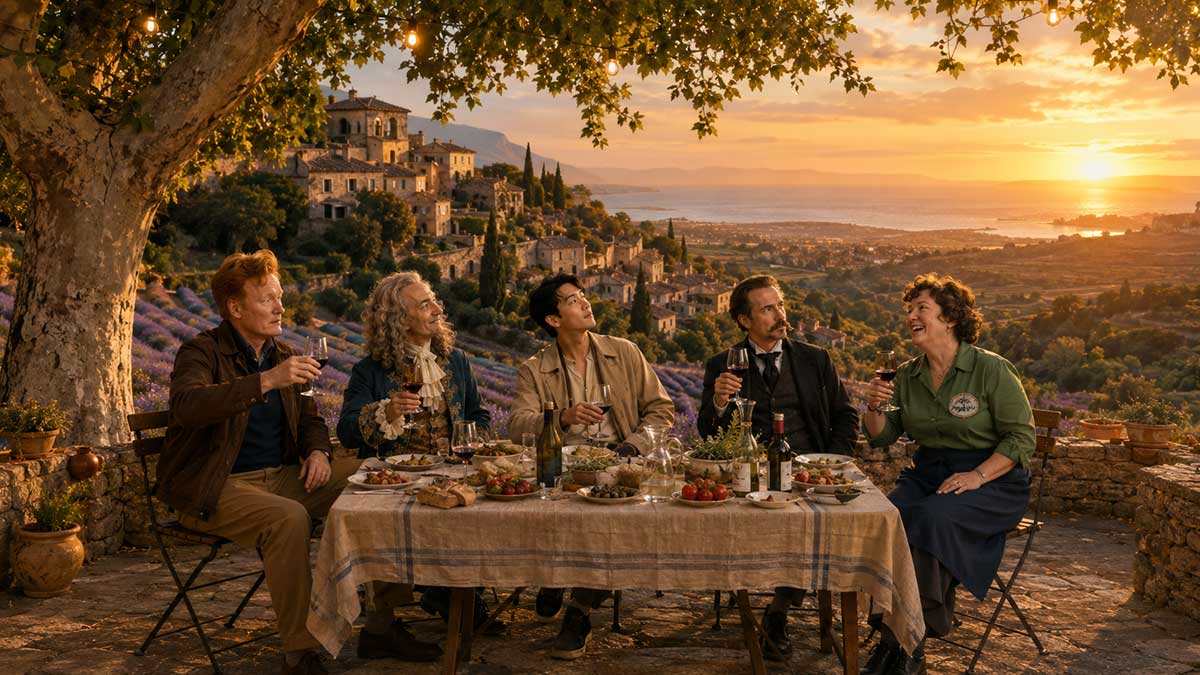
Scene 1 — Gordes Viewpoint: A Village Made of Sun and Stone
Morning opens with a drive through the Luberon. Olive trees, low walls, cypress trees, and dry fields pass beneath a clear blue sky. Then Gordes appears on the hillside, rising in layers of pale stone, rooftops, terraces, and narrow streets stacked against the slope.
From the viewpoint, the village looks less built than carved from the hill itself. The air smells of dust, thyme, warm rock, dry grass, and distant wood smoke. Bees move through small flowers near the path. The sun touches every wall until the whole village seems to glow.
Conan stands with both hands on his hips.
Conan: “This village is showing off, but in a way that makes me forgive it.”
Voltaire: “Beauty is most dangerous when it does not apologize.”
Julia Child: “It is not showing off. It is standing there properly.”
RM looks at the village, then at the fields spreading below it.
RM: “It feels like the hill and the houses agreed to become one thing.”
Rilke speaks quietly, almost to the stone itself.
Rilke: “A village becomes beautiful when human shelter learns the shape of the earth.”
Conan looks at him.
Conan: “You can’t say things like that before breakfast. It creates pressure.”
The wind moves across the viewpoint. A camera strap taps against a tourist’s shoulder. Somewhere below, a car climbs the narrow road, small and patient. The village remains still above everything, pale and proud.
Voltaire gazes at Gordes for a long moment.
Voltaire: “A city argues. A village endures.”
Julia opens a paper bag and hands out small pieces of bread bought that morning.
Julia Child: “Endurance is better with breakfast.”
Conan takes a piece.
Conan: “I support this philosophy fully.”
The five stand there, eating bread under the Provence sun, looking at a place that seems to belong more to light than to maps.
Scene 2 — Gordes Lanes: Stone Walls, Small Shops, and the Sound of Sandals
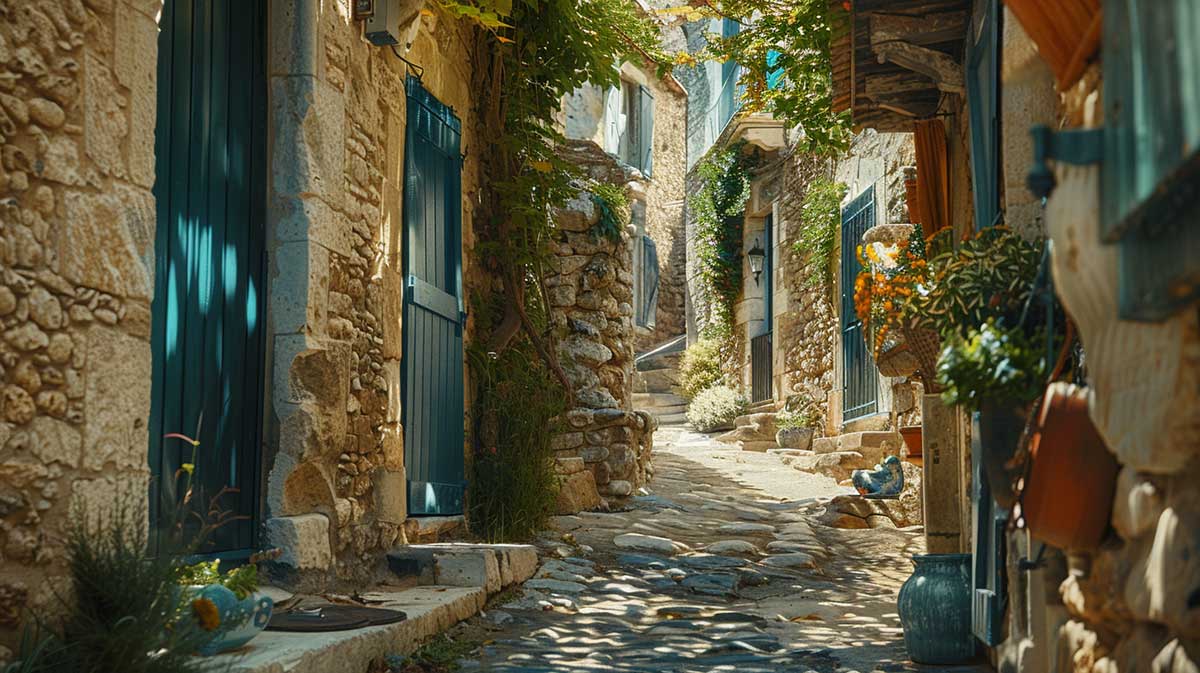
Inside Gordes, the lanes turn steep and narrow. Stone walls press close on both sides. Steps climb, dip, curve, and disappear around corners. Doors are painted in faded blues and greens. Tiny shops sell linen, pottery, olive oil, soaps, honey, and postcards that cannot quite capture the place they claim to represent.
The air smells of lavender soap, old stone, leather sandals, coffee, sun-warmed herbs, and a little dust stirred by footsteps. Their hands brush rough walls. The stone feels hot in the sun and cool in the shade. Somewhere behind a shutter, dishes clink.
Conan pauses on a steep lane.
Conan: “Every street here is either charming or trying to injure my calves.”
Voltaire: “Pain is often the price of a view.”
Conan: “That sounds like something said by a man who never used modern stairs.”
Julia enters a small shop and studies jars of honey and olive oil with complete seriousness.
Julia Child: “One can learn a region from its jars.”
RM turns a small ceramic bowl in his hands, noticing the glaze, the uneven edge, the mark of a maker.
RM: “Handmade things carry a little imperfection, and that makes them feel alive.”
Rilke looks at a doorway framed by climbing flowers.
Rilke: “Perfection closes the door. Imperfection leaves it open.”
Conan points at the doorway.
Conan: “My whole career is an open door, then.”
Voltaire smiles.
Voltaire: “At times, an open window.”
They continue through the lanes. The village reveals itself in fragments: a cat sleeping on a step, a bicycle leaning against a wall, a woman watering flowers, a child running past with an ice cream, a quiet square where sunlight pools around café tables.
At the café, Julia orders cold drinks. Conan drinks half of his too quickly and winces.
Conan: “I am trying to experience slowness at high speed.”
Julia Child: “That is not how slowness works.”
RM laughs.
RM: “Maybe Provence is patient enough to teach you.”
Conan looks around at the stone lanes and sighs.
Conan: “It has nine days left in my personality to fix. I wish it luck.”
Scene 3 — Roussillon Ochre Cliffs: The Earth Turns Red
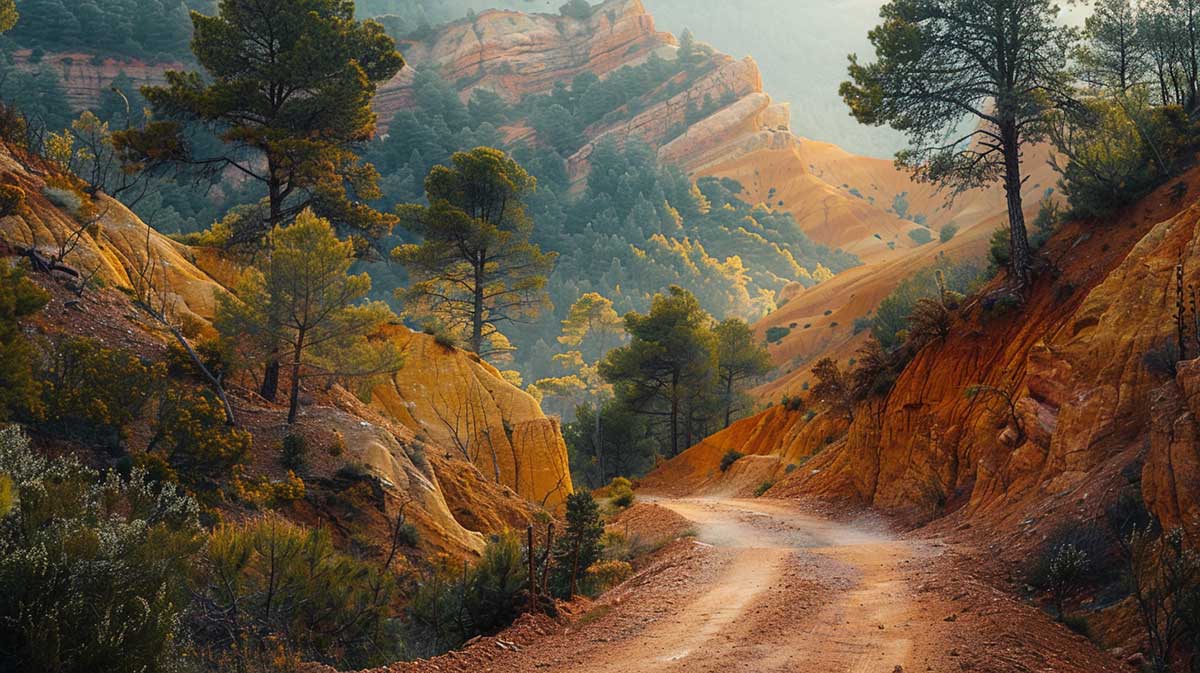
By afternoon, they reach Roussillon. The color changes before anyone speaks. The earth turns red, orange, rust, gold, and deep clay. Walls, cliffs, paths, and houses seem painted by the ground itself. The ochre trail glows in the sun like a wound that became beautiful.
The air smells of dry earth, pine, dust, warm bark, and minerals. Each step lifts a little powder from the path. Their shoes gather red dust. The cicadas grow louder in the heat. The color seems to enter the skin through the eyes.
Conan looks down at his shoes.
Conan: “My sneakers are becoming part of the region.”
Voltaire: “At last, they have acquired culture.”
RM walks slowly, almost stunned by the color.
RM: “This place feels like emotion turned into earth.”
Rilke looks at the red cliffs.
Rilke: “The earth is not silent here. It speaks in color.”
Julia fans herself with a folded map.
Julia Child: “And it says we need water.”
Conan nods with great respect.
Conan: “Julia remains the only poet who keeps us alive.”
They follow the path between walls of ochre. Shadows cut across the red slopes. Pine branches frame the sky. The place feels ancient, hot, and strangely intimate, as if the ground has revealed its inner life.
Voltaire stops near a bright orange wall.
Voltaire: “Nature has more imagination than most governments.”
Conan: “Low bar, but fair.”
RM takes a photo, then lowers the camera.
RM: “Some colors should be remembered without a screen.”
Rilke nods.
Rilke: “A color truly seen becomes part of one’s inward weather.”
Conan wipes dust from his shoe and looks at the red mark on his hand.
Conan: “I came here as a tourist. I’m leaving as a spice.”
The group laughs. The sound rises in the hot air and disappears into the red cliffs.
Scene 4 — Sénanque Abbey: Lavender, Silence, and the Shape of Prayer

Late afternoon brings them to Sénanque Abbey. The road bends through dry hills, then the abbey appears in a valley, quiet and pale, with lavender fields resting before it in soft rows. The scene feels almost too still for conversation.
The air smells of lavender, sun-warmed stone, dry grass, and bees moving through purple flowers. The sound is small: wind, insects, distant footsteps, the scrape of gravel beneath shoes. The abbey walls hold the light without decoration. Its silence feels disciplined.
Conan removes his sunglasses and lowers his voice.
Conan: “I feel like even my thoughts are wearing loud shoes.”
Voltaire: “A useful feeling for you.”
Julia breathes in the lavender.
Julia Child: “This is beautiful. Quiet, but not empty.”
RM looks at the rows of lavender leading the eye to the abbey.
RM: “The flowers make the silence visible.”
Rilke’s face softens.
Rilke: “Prayer may be only this: attention without demand.”
Voltaire, who has resisted every easy sacred mood, says nothing at first. Then he looks at the abbey.
Voltaire: “I distrust many institutions. Yet I respect discipline when it protects silence.”
Conan whispers:
Conan: “Voltaire just complimented an abbey. We are witnessing history.”
Voltaire: “Repeat that carelessly and I shall deny it.”
They walk near the lavender, careful and slow. Bees move from stem to stem with gentle purpose. The flowers brush the wind and release more scent. The abbey remains steady behind them.
Julia touches Conan’s sleeve.
Julia Child: “This is one of those places where you do less.”
Conan: “I’m doing less. It feels suspicious.”
RM smiles.
RM: “Maybe less is not empty. Maybe less gives things room.”
Rilke looks at the lavender, the abbey, the valley, the sky.
Rilke: “The soul needs a field where it is not asked to perform.”
No one answers for a moment. The answer would be too loud.
Scene 5 — Provence Sunset Dinner: The Long Meal That Teaches Them to Stay
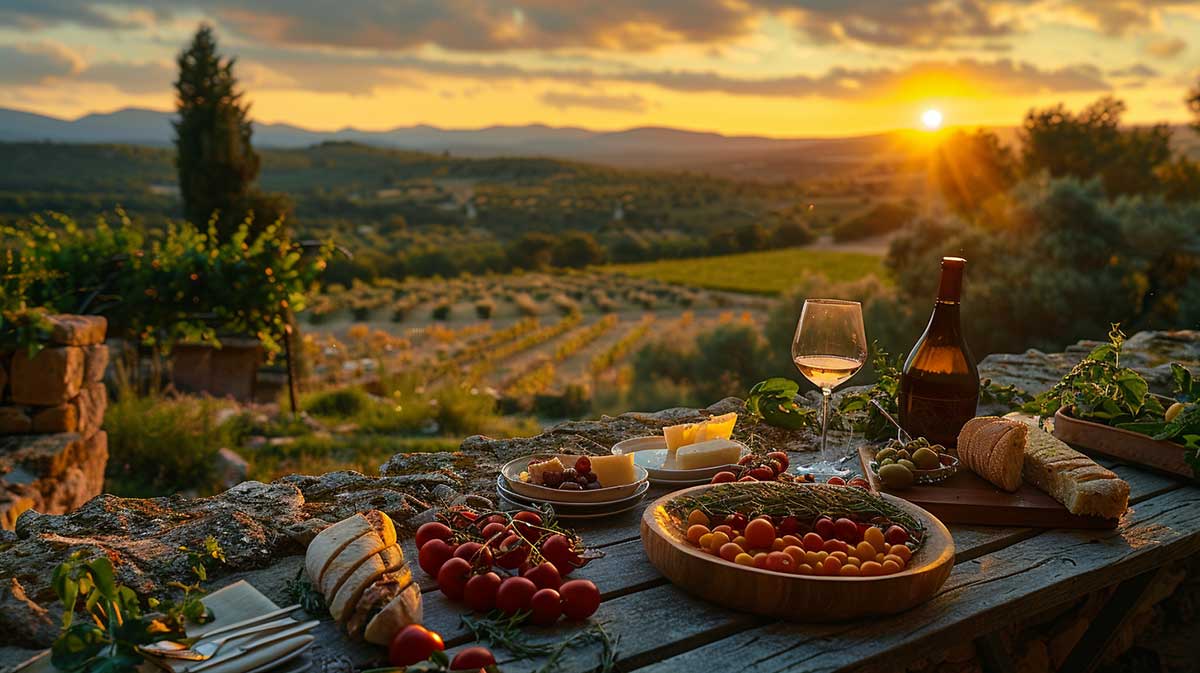
The day ends at a terrace restaurant overlooking fields and low hills. The sun begins to fall, turning the stone walls gold, then rose, then soft gray. The table is set under plane trees. Small lights wait above them, not yet bright. The air smells of grilled fish, olive oil, garlic, rosemary, lavender, warm bread, and fruit ripening somewhere nearby.
A waiter brings olives, tapenade, tomatoes, goat cheese, melon, bread, and chilled rosé. Julia studies the table with deep satisfaction.
Julia Child: “This is what a day should become.”
Conan: “A table?”
Julia Child: “Yes. A good day should become a table.”
Voltaire lifts his glass.
Voltaire: “A rare statement that requires no correction.”
They eat slowly. The tomatoes taste like sun. The olive oil tastes green and peppery. The bread is crisp at the edge and soft inside. Conan spreads tapenade too thickly and discovers no regret.
Conan: “I may have found my true calling: eating things on bread under trees.”
RM: “That is a peaceful calling.”
Voltaire: “Better than many careers.”
Rilke watches the light fade across the fields.
Rilke: “Sunset teaches the day how to leave.”
Conan looks at the horizon.
Conan: “That sentence should be illegal at dinner. Now I’m emotional near a tomato.”
Julia smiles.
Julia Child: “The tomato understands.”
The main dishes arrive: fish with herbs, vegetables, potatoes, salad, and more bread. The conversation slows. No one tries to win the moment. Provence has worked on them all day: stone village, red earth, lavender silence, now a table beneath the changing sky.
RM speaks after a long pause.
RM: “Today felt like color after color. White stone, red earth, purple lavender, gold light.”
Rilke nods.
Rilke: “Each color took something from us and gave something back.”
Voltaire looks at the wine in his glass.
Voltaire: “A traveler should be suspicious of beauty that asks for nothing. It may be the most persuasive kind.”
Conan raises his glass.
Conan: “To Provence. It has relaxed me against my will.”
Julia raises hers.
Julia Child: “To food eaten outside.”
RM adds:
RM: “To colors that become memories.”
Rilke says:
Rilke: “To silence that does not abandon us.”
Voltaire finishes:
Voltaire: “To pleasure when it educates.”
The sun disappears. The first lights above the terrace begin to glow. Their ninth day ends slowly, which is the only proper way for it to end.
Day 10 — Roman Stone, Van Gogh Light, and the Final Meal
Scene 1 — Pont du Gard: Stone That Outlived Empire
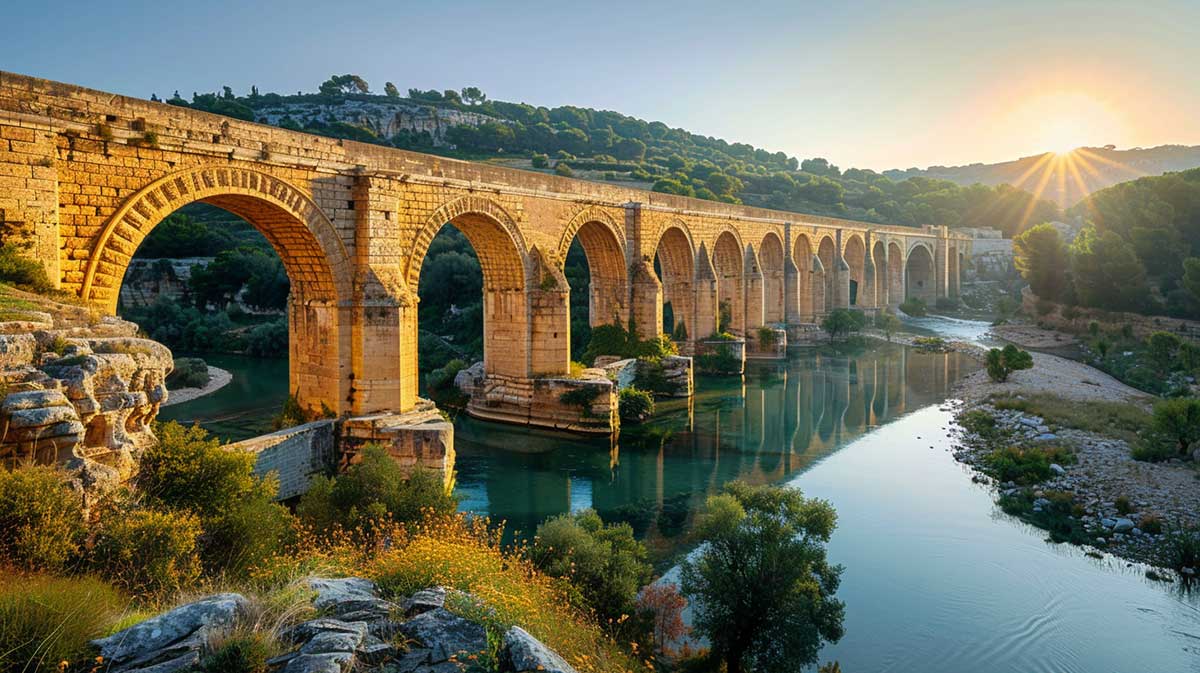
Morning begins under a wide southern sky. The road leads through dry hills, pale trees, and sunlit fields until Pont du Gard appears above the river. The Roman aqueduct rises in three great tiers of arches, massive yet strangely calm, as if it has been waiting for them without concern.
The air smells of warm limestone, river water, dust, pine, dry grass, and sun on old stone. Their footsteps shift from gravel to worn paths. Below, the Gardon River moves beneath the arches with quiet patience.
Conan looks up.
Conan: “This is what happens when ancient people refuse to build anything small.”
Voltaire: “Rome understood spectacle. It dressed practicality as destiny.”
Julia Child: “And someone still had to carry lunch.”
RM stands near the riverbank, watching the reflection break under the water.
RM: “It looks powerful from far away. Up close, it feels peaceful.”
Rilke gazes at the arches.
Rilke: “True endurance does not shout. It stays.”
Conan looks at the aqueduct again.
Conan: “I would like my career described that way, but so far it is mostly shouting and hair.”
Voltaire smiles.
Voltaire: “History has been built from less promising materials.”
They walk along the path, touching the heat in the stone with their eyes more than their hands. The structure does not feel decorative. It feels purposeful, yet grand by accident. A thing made to move water has become a monument to human reach.
Julia listens to the river.
Julia Child: “Water, bread, fire. Every civilization begins with simple needs.”
Voltaire nods.
Voltaire: “Then grows foolish, then builds monuments, then becomes a chapter.”
RM looks at the river passing under ancient arches.
RM: “But something remains.”
Rilke answers:
Rilke: “Yes. The form remains after the empire forgets its own voice.”
Conan raises an imaginary cup to the aqueduct.
Conan: “To Roman plumbing. More emotionally moving than expected.”
The river keeps moving. The stones stay above it, sunlit and silent.
Scene 2 — Arles Roman Arena: Laughter Inside the Old Empire
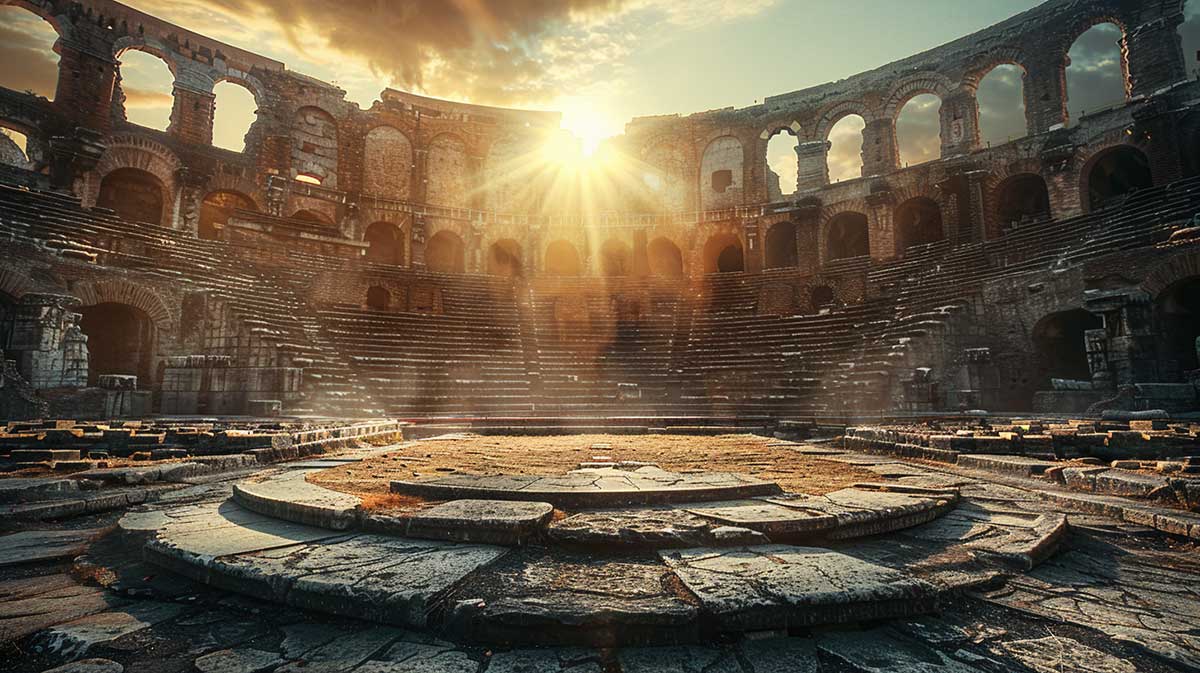
By midday, they reach Arles. The Roman arena rises in the old city like a circular memory of spectacle, crowd, heat, dust, danger, applause, and power. The outer arches cast dark shadows against bright stone. Tourists walk through gates once meant for a very different kind of entertainment.
The air smells of hot limestone, sunscreen, coffee, leather bags, and dry wind. Voices echo inside the arena. Steps climb in worn rows. The stone seats hold the heat of the day.
Conan stands in the center and slowly turns.
Conan: “I feel very exposed. This is not a good place for someone who has made questionable career choices.”
Voltaire: “Public spectacle has always required willing victims.”
Conan: “So late-night television is Roman?”
Voltaire: “In cruelty, perhaps. In architecture, no.”
Julia sits carefully on a stone seat and looks around.
Julia Child: “People brought food here, I’m sure. Spectacle never prevented appetite.”
RM climbs a few rows and looks down into the arena.
RM: “A stage changes people. The person standing below becomes smaller and larger at the same time.”
Rilke looks at the empty space in the center.
Rilke: “Crowds ask the performer to become more visible than human life can bear.”
Conan pauses, then gives a half-smile.
Conan: “That one got me.”
For a moment, the arena is not ancient at all. It becomes familiar: a place where people watch, cheer, judge, demand, forget, remember. The tools have changed, but the hunger to watch remains.
Voltaire walks along the stone.
Voltaire: “Civilization is proud of leaving behind violence. Then it invents subtler forms of humiliation.”
Conan: “I can confirm. I once danced with a giant taco on television.”
Julia laughs so hard that a nearby tourist turns around.
Julia Child: “That may be your greatest Roman confession.”
The arena holds their laughter without changing. Empires fade. Seats remain. Humans still gather to look at one another.
Scene 3 — Van Gogh’s Arles: Yellow Light and the Price of Seeing
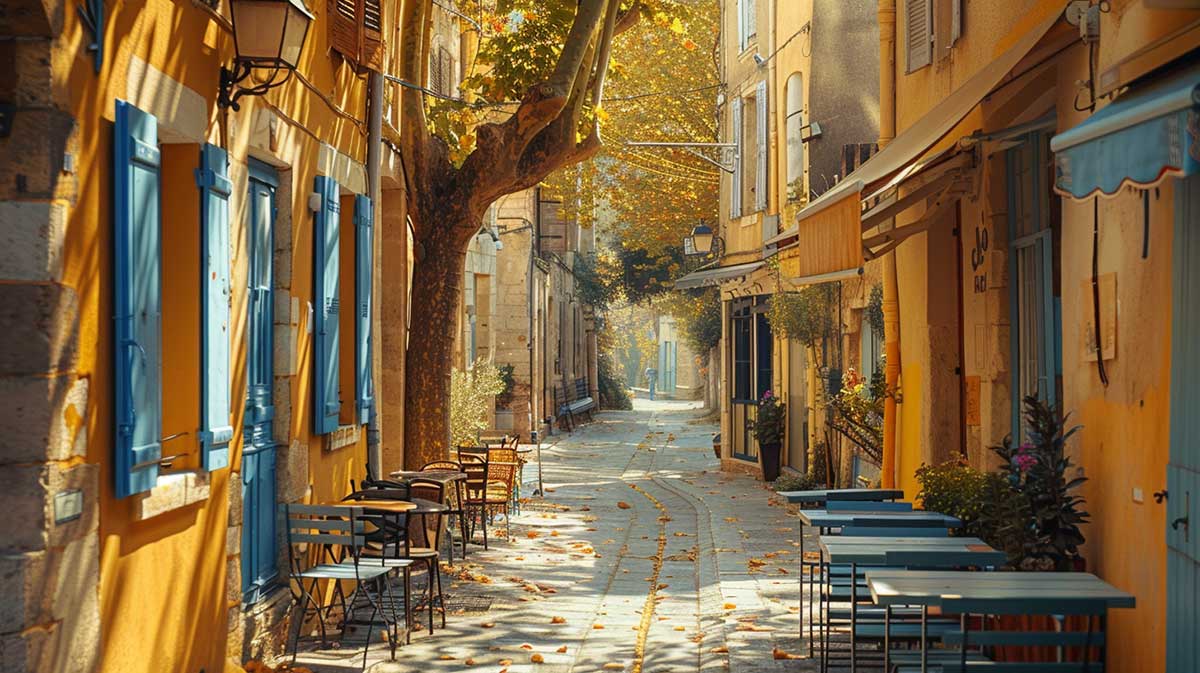
In the afternoon, they walk through Arles toward places linked with Van Gogh. The city changes under the light: yellow walls, blue shutters, café tables, narrow streets, plane trees, flowers, and shadows that seem painted rather than cast.
The air smells of coffee, stone, flowers, paint from a nearby shop, warm bread, and dust. A café terrace clinks with cups and spoons. Someone laughs too loudly, then the street returns to its low hum.
RM walks slowly, as if trying not to disturb the light.
RM: “I understand why a painter would want to stay here.”
Rilke looks at the wall where sun and shadow meet.
Rilke: “A great artist does not see more. He suffers more from what he sees.”
Conan looks at him.
Conan: “That is a very intense way to describe outdoor dining.”
Voltaire glances at the café.
Voltaire: “Genius is often praised safely after it has suffered inconveniently.”
Julia’s smile fades a little.
Julia Child: “People love the paintings, but forget the person had to live the pain.”
The group stops in a square where the light feels almost unreal. Yellow deepens. Blue becomes sharper. The ordinary seems charged with hidden feeling.
RM speaks softly.
RM: “Sometimes beauty is not comfort. Sometimes it is too much feeling finding a place to go.”
Rilke nods.
Rilke: “The canvas receives what the heart cannot hold.”
Conan looks at the café tables, the tourists, the street, the sunlight.
Conan: “I make jokes when something feels too serious. Maybe that’s my canvas, but with worse lighting.”
Voltaire answers less sharply than usual.
Voltaire: “Every mind seeks a method of survival.”
They sit for coffee. The cups are small. The shadows grow longer. Julia orders something sweet for the table, not from hunger, but from instinct.
Julia Child: “Pain should not have the final course.”
Conan takes a bite.
Conan: “I support this theology.”
No one corrects the word. Arles has given them a softer kind of seriousness, bright with color, edged with sorrow.
Scene 4 — Marseille Old Port: Salt Air and the Edge of Departure

Late afternoon brings them to Marseille. The city feels different from the villages and old stones that came before. It is louder, saltier, more direct. The Old Port opens before them with boats, masts, gulls, ferries, cafés, and people moving in every direction.
The air smells of sea salt, fish, diesel, coffee, garlic, citrus, and hot pavement. Ropes knock against boats. Gulls cry overhead. Water slaps the stone edge of the port. The Mediterranean light flashes hard and bright.
Conan breathes in.
Conan: “This city smells like seafood, confidence, and someone arguing near a scooter.”
Voltaire: “A fair civic portrait.”
Julia looks toward the restaurants along the port.
Julia Child: “Marseille is not shy. I like that.”
RM watches boats rock in the water.
RM: “After quiet villages, this feels like the trip waking us up before goodbye.”
Rilke looks at the sea.
Rilke: “The sea is never a wall. It is an unfinished sentence.”
Conan points at him.
Conan: “That sentence is going to follow me into my hotel room.”
They walk along the port. Vendors call out. Diners lean over plates. A fisherman rinses something near the water. A child chases a gull with the confidence of someone who has misunderstood birds.
Voltaire watches the port with interest.
Voltaire: “Ports are honest places. They do not pretend people stay.”
Julia nods.
Julia Child: “They feed people before they leave.”
The group stops for a final afternoon drink near the water. The glasses sweat in the heat. Conan looks at the boats, then at the others.
Conan: “I am beginning to dislike endings.”
RM smiles gently.
RM: “That means the journey worked.”
Rilke keeps his eyes on the sea.
Rilke: “Departure begins before we move.”
The port continues around them: noise, salt, light, gulls, boats, hunger, motion. France has brought them to the edge of water again, but this river does not curve through villages. This water opens outward.
Scene 5 — Final Dinner: What France Leaves Behind
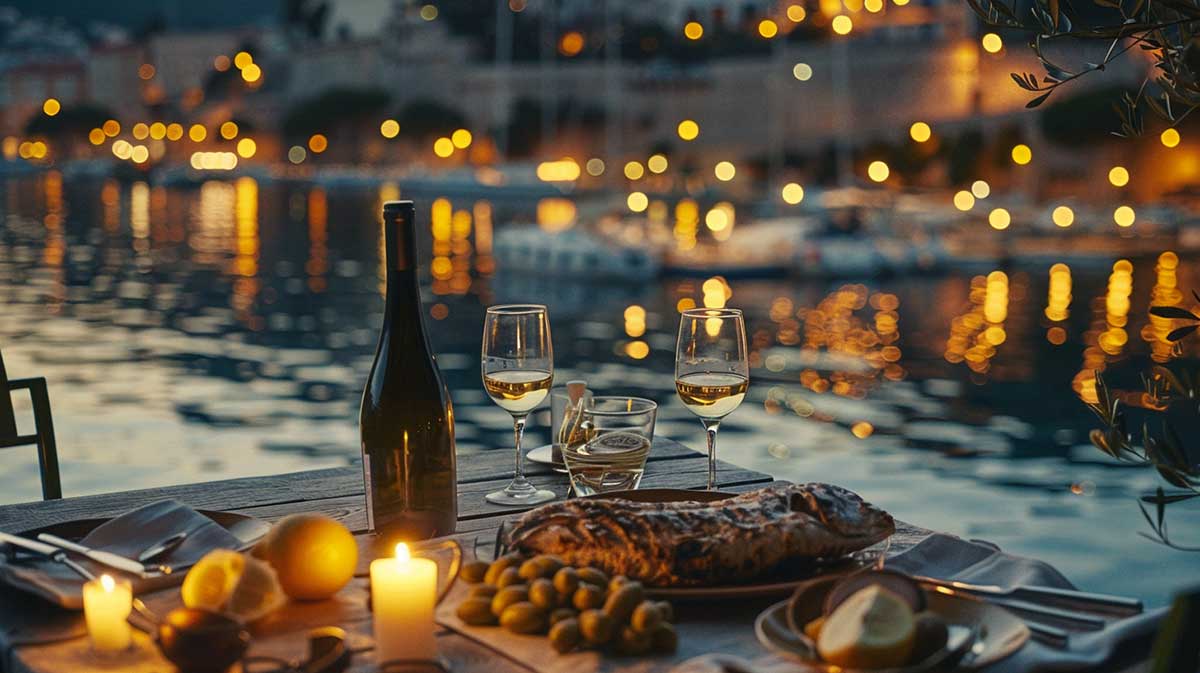
Their final dinner is near the water. The table is outside, close enough to hear the port but far enough for conversation to become its own room. The air smells of grilled fish, garlic, saffron, tomatoes, olive oil, sea salt, lemon, wine, and bread warming in a basket.
The waiter brings fish stew, grilled vegetables, olives, bread, salad, wine, and a dessert with fruit and cream. Julia looks at the table with deep, almost maternal pride.
Julia Child: “France knows how to say goodbye.”
Conan tears a piece of bread and holds it up.
Conan: “I am taking this goodbye very seriously.”
Voltaire: “Bread has been your most consistent moral position.”
Conan: “I stand by it.”
For a few minutes, they eat without speaking. The fish is rich. The bread is crisp. The wine is cool. The tomatoes taste of sun and salt. The sea air touches the table and disappears.
RM breaks the silence first.
RM: “Paris made me aware of how people perform beauty. Loire showed me how humans build against forgetting. Dordogne made me think about the first need to create. Provence taught slowness. Today felt like history opening into the sea.”
Rilke looks at him with warmth.
Rilke: “You have listened well.”
Conan lowers his fork.
Conan: “I learned that I am emotionally vulnerable to bread, stone villages, and rivers.”
Julia smiles.
Julia Child: “That is a fine education.”
Voltaire lifts his glass.
Voltaire: “I learned that travel may briefly improve the traveler, provided he eats properly and speaks less than usual.”
Conan looks at him.
Conan: “Was that about me?”
Voltaire: “It was about mankind. You were included.”
The group laughs, but the laughter carries a little sadness now. Ten days have passed through them: airport glass, Seine water, museum silence, Loire castles, Sarlat stone, Dordogne river, cave animals, Provence light, lavender, Roman arches, Arles color, Marseille salt.
Rilke speaks last.
Rilke: “A place does not leave us whole. It leaves us with rooms inside we did not know were empty.”
The table becomes quiet.
Julia gently raises her glass.
Julia Child: “To France.”
RM raises his.
RM: “To beauty that changes speed.”
Rilke adds:
Rilke: “To what remains unseen.”
Voltaire lifts his glass.
Voltaire: “To reason, pleasure, and the rare meal that honors both.”
Conan looks at the bread, the wine, the sea, and the faces around him.
Conan: “To France. I came here to make jokes. Somehow, I’m leaving with feelings. I blame the cheese.”
They drink. The port glows around them. Boats rock in the dark. Somewhere, a gull calls once over the water. The journey ends, but the road has done its quiet work. France has become not a list of places, but a taste, a light, a river, a stone wall, a joke, a silence, and a final piece of bread shared at the edge of the sea.
Final Thoughts by Conan O’Brien
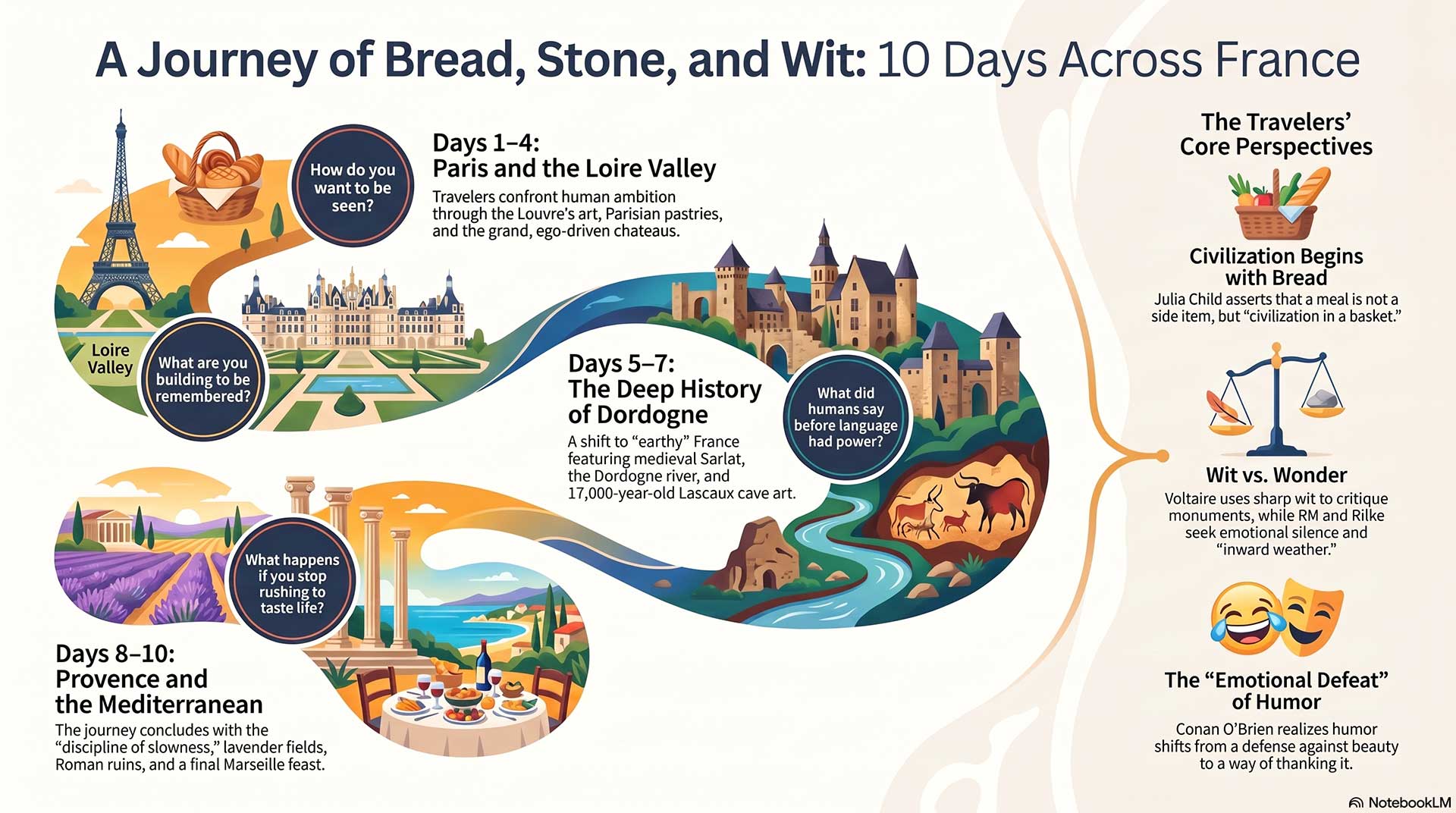
By the end of ten days in France, I learned several things.
First, France is not efficient. That is part of the point.
France does not always rush to explain itself. A village may take an entire afternoon to reveal one doorway. A meal may last longer than some jobs I have had. A river may teach you more by moving slowly than a motivational speaker teaches by yelling into a headset.
Second, bread is not a side dish. It is a philosophy with crust.
Third, every part of France asks a different question.
Paris asks, “How do you want to be seen?”
The Loire Valley asks, “What are you building so people will remember you?”
Dordogne asks, “What did humans need to say before language became powerful?”
Provence asks, “What would happen if you stopped rushing long enough to taste your own life?”
The south asks, “What remains after empires, artists, jokes, meals, and travelers pass through?”
I do not claim to have answered these questions. I mostly spilled wine, mispronounced town names, and developed a personal relationship with duck confit.
But France has a way of turning mistakes into texture.
Traveling with Voltaire, RM, Rilke, and Julia Child made it worse in the best way. Voltaire made every castle feel guilty. RM made every view feel emotional. Rilke made every shadow feel like it had a biography. Julia made every meal feel like forgiveness. I tried to keep everyone grounded by panicking near boats and saying inappropriate things near ancient art.
Yet somewhere between Paris and Marseille, the jokes changed.
At first, I joked to protect myself from beauty. By the end, I joked to thank it.
That may be what France gives a traveler.
Not perfection. Not escape. Not a checklist.
It gives you moments.
A croissant cracking open in a bakery.
Stone cooling under your hand in Sarlat.
A cave animal appearing in darkness.
Lavender moving in the wind.
A final piece of bread near the sea.
You leave with photos, yes.
But the better souvenirs are stranger.
A slower appetite.
A softer silence.
A memory of light on stone.
And, in my case, a dangerous new belief that tomatoes can have emotional depth.
France did not fix me.
It fed me, confused me, humbled me, and made me laugh at myself in better scenery.
That is more than enough.
Short Bios:
Conan is the nervous comic traveler of the group, arriving in France with jokes, jet lag, and no real defense against beauty. He becomes the human pressure valve of the trip, turning awkwardness into laughter. At first, he mocks what overwhelms him. By the end, he finds that humor can become a way of honoring what moves him.
Voltaire is the sharp French philosopher who questions power, vanity, religion, monarchy, and bad reasoning at every stop. In Paris, he attacks pretension. In the Loire, he sees castles as ego in stone. In Provence, he learns to respect silence, wine, and pleasure when they carry wisdom. His wit cuts, but it also clarifies.
RM is the modern Korean artist whose quiet attention gives the trip emotional depth. He notices rhythm, color, longing, and the way places change people. Museums, rivers, cave art, and Provence light all become part of his inner map. He often says the thing everyone feels before they know how to say it.
Rilke is the poet of silence, beauty, solitude, and hidden feeling. He sees more than scenery; he sees the invisible life inside stone, water, color, and shadow. His presence turns the trip into a meditation on art, memory, death, and longing. He is the one most likely to make Conan emotional against his will.
Julia Child is the warm heart of the table. She understands France through bread, butter, soup, wine, markets, kitchens, tomatoes, and the sacred duty of eating well. She brings the group back to earth whenever philosophy floats too high. For Julia, food is culture, comfort, memory, and love served on a plate.
Leave a Reply