
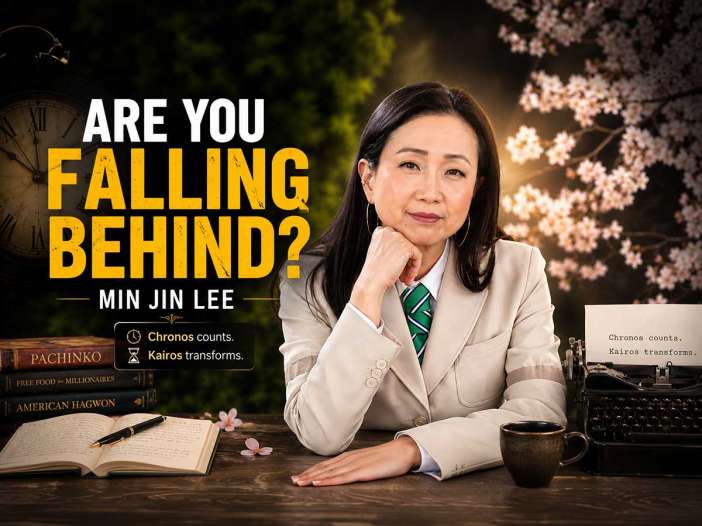
What if the years you call wasted are preparing you for work you cannot yet see?
Introduction By Min Jin Lee
For many years, I believed I was late.
I was late to trust my own voice. I was late to leave the law. I was late to publish my first novel. I was late to finish Pachinko, a book whose earliest questions had followed me since college. When I looked at the clock, I saw years passing. When I looked at other people, I saw speed. When I looked at myself, I saw a turtle.
That was my father’s name for me. Turtle.
At Yale, I was not the student who seemed destined for literary success. My transcript did not announce a grand future. I did not know how to find mentors. I was not invited into the circles that appeared to open doors for other people. I questioned authority before I understood the price of doing so. Two respected professors treated my Asian identity as evidence that I could not write.
At nearly the same time, Yale’s English Department read my work without my name and gave me prizes in nonfiction and fiction.
I carried both judgments. One group saw my face and doubted my words. Another group saw only my words and honored them. Which judgment was true? How should a young person respond when authority speaks with confidence and reads her wrongly?
My body had its own clock. During college, I learned that chronic liver disease might shorten my life. A doctor told me that I could develop liver cancer in my twenties or early thirties. That knowledge entered every major decision. I went to law school. I became a corporate lawyer. I earned a salary that made leaving seem foolish. Then I left.
I did not leave with certainty. I left with fear, illness, responsibility, and a wish to write.
My first novel appeared when I was thirty-eight. Pachinko appeared when I was forty-eight. My third novel arrives in the year I turn fifty-eight. Three decades. Three novels. The clock can make that sound like a confession.
Yet the clock cannot measure what those years contained.
It cannot measure the hour at a Yale college tea when I first heard about a Korean boy in Japan who died after racist cruelty from his classmates. It cannot measure how that story entered my life. It cannot measure how one hour became decades of reading, listening, traveling, interviewing, doubting, rewriting, and trying to give dignity to people history had pushed aside.
Chronos measures duration. Kairos reveals meaning.
Chronos asks how long something took. Kairos asks what that time made possible.
This conversation begins where those two forms of time meet. Each topic brings five new guests. Some are writers who shaped my imagination. Some are reformers, teachers, readers, journalists, organizers, and witnesses. Some entered my life directly. Others entered through books, ideas, public work, or one unforgettable encounter.
In our first discussion, Toni Morrison, George Eliot, F. Scott Fitzgerald, Honoré de Balzac, and Odysseus will ask whether a person can be called late when society may be using the wrong clock. They will examine ambition, delayed recognition, moral growth, class pressure, and the moment when action can no longer be postponed.
In our second discussion, Sinclair Lewis, Jane Addams, Nancy Pearl, Fred Strebeigh, and Alan Yang will examine whether years spent in study, law, reading, teaching, organizing, or unfinished creative work can truly be called wasted. They will ask whether an abandoned path may still become part of the work that follows.
In our third discussion, Han Kang, Roxane Gay, Cynthia Ozick, Jodi Picoult, and Ann Curry will examine judgment. Who has the right to define another person’s ability? When does criticism become prejudice dressed as expertise? How can a writer remain open to correction without surrendering her own perception?
In our fourth discussion, Dr. Hung Chun Ko, Harry Nam, Rabbi James Ponet, Harry Adams, and Rebecca Walker will ask whether speaking up is worth the personal price. Their conversation will move through student organizing, neglected history, public anger, faith, identity, and the courage that can grow from one person’s care.
In our fifth discussion, Judy Solano, Tayari Jones, David Karashima, Elmer Luke, and Seiji Yamamoto will explore the small moments that redirect a life. A meal, a book, a meeting, a disaster, a conversation, or a disciplined act of craft may appear minor when it occurs. Years later, it may stand at the center of everything.
These discussions will not claim that every delay is wise. Some delays come from fear. Some come from exclusion, illness, poverty, obligation, or uncertainty. Nor will we claim that every wound becomes a gift. Pain does not become good simply since someone survives it.
The harder task is to look honestly at time.
Which parts of our lives are controlled by clocks, deadlines, ages, salaries, rankings, and expectations? Which moments ask us to step outside those measurements and act according to conscience? When does patience become avoidance? When does urgency become manipulation? When does anger become a public duty? When does a quiet act of care keep another person from giving up?
I once believed that I had wasted Yale. I later saw that Yale gave me the questions that shaped my work, the opposition that tested my self-trust, the friendships that kept me steady, and the single hour that led me to Pachinko. The brightest moments mattered. The darkest moments mattered. Their meaning did not arrive at the same time as the events themselves.
A life cannot always interpret itself in the moment. We need witnesses. We need readers. We need people who challenge the story we have told about our own failure. We need people who refuse easy consolation and ask whether we are using time faithfully.
The clock is moving. That is true.
Yet another kind of time moves through us: the instant when a truth becomes visible, when a choice becomes necessary, when another person’s suffering becomes impossible to ignore, or when a path we thought was closed reveals a new direction.
That is where our conversation begins.
This is an imaginary conversation created for reflection. The participants did not take part in this exchange, and the dialogue does not represent their actual statements.
(Note: This is an imaginary conversation, a creative exploration of an idea, and not a real speech or event.)
Topic 1: Are You Falling Behind—or Following the Wrong Clock?

Opening
Min Jin Lee:
For much of my life, I believed that I was late.
I left a stable legal career at twenty-six without knowing how to write a novel. Twelve years passed before my first novel was published. Another decade passed before Pachinko appeared. My third novel arrives in the year I turn fifty-eight.
Three decades. Three novels.
My father called me Turtle. I accepted the name as affection, but I often heard an accusation inside it. Other people seemed to move faster. They found mentors, entered the right circles, published sooner, and appeared to know where they were going.
I kept asking whether I had wasted my time.
The ancient Greeks had two ways of speaking about time. Chronos is measurable time: minutes, years, birthdays, deadlines, and career schedules. Kairos is the right or meaningful moment—the opening when something must be recognized, chosen, resisted, or begun.
Chronos asks, “How old are you now?”
Kairos asks, “What is this moment asking of you?”
We live under the pressure of Chronos. We count how many years a degree takes. We ask whether we will find a partner, have a child, earn enough money, publish a book, buy a home, or achieve recognition before a certain age.
A clock can tell us that twelve years have passed. It cannot tell us whether those years were empty.
Today, I am joined by five guests who know something about ambition, delay, recognition, social pressure, and decisive action: Toni Morrison, George Eliot, F. Scott Fitzgerald, Honoré de Balzac, and Odysseus.
Let us begin with a fear many people carry silently:
What if everyone else is moving forward, and I am falling behind?
Min Jin Lee’s speech frames this conflict through Chronos and Kairos and through her own long path from law to fiction. Her profile names George Eliot and Balzac among her literary influences and connects her work directly with Toni Morrison and F. Scott Fitzgerald.
Who decided when a life is supposed to succeed?
F. Scott Fitzgerald:
The timetable is often written by desire before experience has corrected it.
A young person imagines success as an arrival. Recognition will come, money will remove uncertainty, love will settle loneliness, and achievement will silence doubt. Yet desire is rarely satisfied by reaching the object it selected.
The American Dream trains people to admire visible arrival. It does not teach them how to live after the celebration ends.
A person may reach the mansion and discover that the light across the water still appears distant.
George Eliot:
We should ask who benefits when life is reduced to a race.
Human worth becomes distorted when it is measured through public milestones. A person may appear unsuccessful and still perform acts of immense moral consequence. Another may receive every public honor and remain inwardly undeveloped.
The deepest changes in a human being are not easily dated.
When did pride begin to soften?
When did sympathy become stronger than vanity?
When did a person learn to see another life as real?
No calendar records such events. Yet they may determine whether a life becomes generous or destructive.
Toni Morrison:
A timetable is never neutral.
Some people inherit time. Others must fight for it.
One person receives a room, education, money, and permission to experiment. Another person must work, care for family, translate for parents, survive prejudice, or recover from injuries no résumé records.
Then society places them beside one another and calls the comparison fair.
A person told that she is late should ask: late according to whose conditions?
The clock may be measuring privilege and calling it talent.
Min Jin Lee:
That question stayed with me at Yale. I saw classmates who understood how institutions worked. They knew how to find mentors and which relationships mattered.
I did not.
I thought my confusion proved that something was wrong with me. Years later, I could see that I had entered Yale carrying a different history. My parents worked six days a week in a small jewelry store. They trusted me, but they could not explain how elite academic networks operated.
I was not running the same race from the same starting line.
Honoré de Balzac:
Society enjoys turning human beings into accounts.
Age becomes a number beside an accomplishment. Income becomes evidence of character. Debt becomes shame. Social position becomes a substitute for virtue.
Ambition can be useful. It can force a person to work, observe, and persist. Yet ambition becomes dangerous when every other person appears as a rival or an audience.
Then time becomes money in the most brutal sense. Every hour that does not increase rank appears lost.
The person begins living as a business whose only product is the self.
Odysseus:
A sailor cannot command the sea, but he must still know where he is going.
There is danger in comparing your voyage with another person’s voyage. One ship has favorable winds. Another has lost half its crew. Another is trapped near an island that does not appear on your map.
Yet the sailor cannot say, “Since the seas differ, direction does not matter.”
You may reject another person’s timetable and still need a destination.
Toni Morrison:
Yes. Freedom from the wrong clock is not freedom from responsibility.
It is the freedom to ask what kind of work deserves your years.
George Eliot:
A meaningful life may be quiet, but it is never morally empty.
F. Scott Fitzgerald:
The tragedy begins when a person uses someone else’s dream as the measure of his own existence.
Min Jin Lee:
Then perhaps falling behind is sometimes a false diagnosis.
The more truthful question may be:
Am I behind, or have I accepted a definition of success that was never mine?
When does patience become fear or avoidance?
Odysseus:
There is a moment when waiting ceases to be wisdom.
A person can spend years claiming to prepare. She studies the wind, repairs the sail, consults every map, and asks every traveler for advice. Yet the ship remains tied to the shore.
The wish for certainty can become another name for fear.
Kairos is not endless patience. Kairos is the moment when conditions are sufficient—not perfect—and action must begin.
Honoré de Balzac:
Many people hide inside preparation since preparation protects the fantasy.
An unwritten book can still be a masterpiece. An unopened business can still become a fortune. An undeclared love can still be perfect.
Action introduces reality.
Reality may expose limits, weak judgment, bad timing, or ordinary talent. So the dreamer keeps polishing the plan and preserves an imaginary greatness.
Min Jin Lee:
When I left law, I had no proof that I could become a novelist.
I had won writing prizes in college, but a prize is not a novel. I had no book contract, no literary career, and no reason to believe that publication would come.
Was leaving courageous? Was it reckless?
At the time, I did not know.
My illness shaped the decision. I had been told that my life might be shortened by liver disease. Chronos was no longer abstract. I could feel its limit.
Yet illness did not write the book for me. After leaving, I still had to face empty pages for years.
George Eliot:
We should distinguish patience from passivity.
Patience remains engaged with reality. It studies, practices, revises, and accepts correction.
Passivity waits for rescue.
A patient writer may produce little that the public can see, yet she returns to the work. A passive writer may speak endlessly about the book and avoid the sentence that could fail.
The distinction is found less in speed than in honest labor.
F. Scott Fitzgerald:
There is another danger. A person may act quickly from terror of seeming late.
He marries to avoid being alone. He chooses a career to satisfy an audience. He spends money to display progress. He publishes work that has not reached its proper form.
Impatience can create the appearance of movement and leave the inner life unchanged.
A rushed life can be another form of avoidance.
Toni Morrison:
The demand to move quickly often comes from institutions that want production, not depth.
Writers are told to remain visible. Workers are told to remain available. Young people are told to build a public identity before they have formed a private one.
The market says, “Do not disappear.”
Yet some work needs privacy. Some thought needs silence. Some wounds need time before they can be placed into language.
Silence can protect creation.
Silence can protect fear.
The person must learn which silence she is keeping.
Odysseus:
Ask what the waiting is producing.
Is the ship becoming ready?
Is the traveler becoming wiser?
Is the delay protecting someone?
Is new knowledge changing the route?
Or is the same fear repeating itself under new explanations?
Honoré de Balzac:
And ask what the delay costs.
A person can lose years serving a social position she secretly despises. She calls it prudence, but every promotion tightens the chain.
Min Jin Lee:
I practiced law for less than two years. That time was not meaningless. Law taught me discipline, argument, evidence, and the consequences of words.
Yet there came a point when remaining would have been easier than leaving and more dangerous to the life I wanted.
The decision did not guarantee success. It simply made failure honest.
George Eliot:
That is a useful phrase: honest failure.
A failed attempt may reveal character, skill, limitation, or a truer direction.
A life protected from failure may remain protected from self-knowledge.
F. Scott Fitzgerald:
Many people do not fear failure itself. They fear failure becoming visible.
Toni Morrison:
Then the task is not merely to act. It is to stop giving the imagined audience control over the act.
Min Jin Lee:
Patience becomes avoidance when it no longer serves preparation, care, truth, or growth.
Action becomes panic when it exists mainly to escape shame.
The right moment may not feel fearless. It may feel like the instant when fear is no longer permitted to make the decision alone.
Can a life-changing moment be recognized before it passes?
Toni Morrison:
Some moments announce themselves. Many do not.
A conversation may appear ordinary. A sentence enters the mind and remains there. Years later, the person discovers that the sentence has been shaping every question she asks.
Memory chooses moments that public history overlooks.
A writer’s task is often to return to those moments and ask what they contained.
Min Jin Lee:
At Yale, I attended a college tea. A missionary spoke about a thirteen-year-old Korean boy born in Japan. His classmates had filled his yearbook with racist cruelty. The boy later died by suicide.
I knew almost nothing about Koreans in Japan before hearing that story.
The tea lasted about an hour.
That hour became decades of study and eventually helped lead me to Pachinko. At the time, I did not know that I was entering the central question of my writing life.
Chronos recorded one hour.
Kairos revealed itself years later.
George Eliot:
Meaning often arrives through recollection.
Human beings live forward and interpret backward. We rarely possess enough knowledge in the present to identify the final consequence of a meeting, a refusal, a kindness, or an injury.
This does not make attention useless. It makes humility necessary.
You may not know that a moment will change your life. You can still be present enough to receive it.
Honoré de Balzac:
Society trains attention toward spectacle.
People notice the promotion, the wedding, the inheritance, the scandal, the public award. They ignore the conversation in a hallway, the humiliation in a classroom, the unpaid debt, the small betrayal, the chance encounter.
Yet private life often turns on what no newspaper would report.
F. Scott Fitzgerald:
The danger is that people recognize value only after loss.
A friendship appears ordinary until it ends. Youth appears abundant until it has passed. A place becomes beautiful after one can no longer return.
Memory can illuminate, but it can romanticize.
We must be careful not to turn every lost possibility into destiny.
Odysseus:
A warrior survives by recognizing certain moments before they pass.
The opening appears, and he acts. If he waits for history to explain the meaning, the door closes.
There are two kinds of Kairos.
One is discovered in memory.
The other demands recognition now.
Min Jin Lee:
How do we tell them apart?
Odysseus:
You cannot always.
That is why judgment matters.
You gather what you know. You examine danger. You consider duty. Then you choose without receiving a guarantee from the future.
Toni Morrison:
Yet a person should not confuse domination with decisiveness.
History contains many people who believed their moment had arrived and forced their certainty onto others.
A true moral opening must retain awareness of other human lives.
George Eliot:
Yes. The right moment is not simply the moment when I can obtain what I want.
It may be the moment when I finally see what another person needs.
Honoré de Balzac:
Or the moment when a person realizes that the desire guiding him has been corrupt.
F. Scott Fitzgerald:
Or when the dream must be revised rather than pursued more fiercely.
Min Jin Lee:
When I challenged unfair grading in my Korean history class, I did not know what would follow. I faced social rejection, public criticism, and a death threat.
When I organized students to request Korean studies, I could not know whether Yale would respond. The language program began after I graduated.
Some choices reveal their meaning only later.
Yet the choice must still be made in the present.
Odysseus:
The person who demands certainty will miss every opening.
Toni Morrison:
The person who acts without reflection may create another person’s wound.
George Eliot:
Wisdom lives inside that tension.
Min Jin Lee:
Perhaps Kairos is not a magical moment delivered with clear instructions.
It may be the meeting between attention and responsibility.
We notice something.
We recognize that it matters.
We accept that we cannot know the full result.
Then we decide what kind of person we will be inside that uncertainty.
Closing
Min Jin Lee:
We began with the fear of falling behind.
That fear is real. The clock moves. Bodies age. Opportunities close. Money matters. Illness changes plans. Some dreams cannot be postponed forever.
Yet the clock does not possess the authority to define the value of a life.
Toni Morrison reminded us that people do not receive equal amounts of protected time. George Eliot reminded us that moral development cannot be measured through public milestones. Fitzgerald showed us how easily desire borrows society’s dream and mistakes it for one’s own. Balzac exposed the machinery that converts years into money, rank, and comparison. Odysseus warned that rejecting the wrong timetable must not become an excuse to remain on shore.
There is no virtue in slowness by itself.
There is no virtue in speed by itself.
A slow life can be attentive or afraid. A fast life can be courageous or panicked. The question is not simply, “How quickly am I moving?”
The question is, “What is directing me?”
Am I responding to truth, responsibility, love, craft, and conscience?
Or am I responding to comparison, shame, public approval, and fear of appearing late?
I once measured my life through publication dates. Thirty-eight. Forty-eight. Fifty-eight.
Now I see other dates.
The year I heard a story about Koreans in Japan.
The year students organized for classes they would never take.
The year a stranger’s kindness helped me remain in a course.
The year I left a career without proof that another one would work.
The clock records when these events occurred. It cannot fully record what they became.
You may be behind according to a schedule that was created without your history, duties, wounds, gifts, or deepest questions in mind.
That does not mean time is unlimited.
It means your task is not to obey every clock.
Your task is to recognize which clock deserves your life.
Topic 2 will examine whether an abandoned career, difficult education, or long preparation can truly be called wasted time.
Topic 2: Were Those Years Wasted?
Opening
Min Jin Lee:
For years, I treated my past like an account book.
Four years at Yale. Three years of law school. Less than two years practicing law. Twelve years before my first novel. Another decade before Pachinko.
I kept asking whether I had spent my life wisely.
The question sounds practical, yet it can become merciless. It assumes that every year must produce a visible return. A degree should lead to the right career. A job should lead to advancement. A manuscript should lead to publication. A struggle should lead to wisdom.
Real life does not move so neatly.
I studied history and did not become a historian. I earned a law degree and left legal practice. I helped campaign for Korean language courses that began after I graduated. I attended a college tea for one hour and carried its story for decades.
Was the law wasted since I left it?
Was Yale wasted since it wounded me?
Was the Korea Studies Task Force wasted since I could not take the classes we helped create?
Was one hour more valuable than four years?
Today I am joined by Sinclair Lewis, Jane Addams, Nancy Pearl, Fred Strebeigh, and Alan Yang. Each represents a different way that reading, education, public action, teaching, and creative adaptation can continue long after the original moment has passed.
Let us begin with the paths we leave behind.
This imaginary discussion draws from Lee’s account of her Yale education, legal career, Korean studies campaign, and writing classes, together with her later literary connections to Nancy Pearl and Alan Yang. Yale records identify Fred Strebeigh as a senior lecturer emeritus. (Yale Center Beijing)
Does a path lose its value when you choose another one?
Sinclair Lewis:
A person rarely knows which road is the main road.
You read one book in high school, notice a sentence in the author biography, and choose a college. Years later, you may discover that the book did not give you a profession. It gave you a question.
You came to Yale wondering how a novelist learned to write about society and politics. You did not become me. You became yourself.
Influence does not require imitation.
Min Jin Lee:
I had pictured Yale as the place where Sinclair Lewis had learned how to write novels about social history. When I arrived, I found no clear path from history major to novelist.
I did not know that the confusion itself would shape me.
Nancy Pearl:
Readers often think a book must change their life immediately to matter.
That is not how reading usually works.
A book may sit quietly in the mind. It may shape taste, moral attention, memory, or curiosity. Years later, it joins another experience and becomes useful in a way no one could have planned.
Libraries are full of delayed consequences.
Alan Yang:
Creative work behaves the same way.
A novel can seem complete when it is published, then return years later as the basis for a series, a film, or a new conversation. The work enters another medium and meets people the author never pictured.
The first form was not wasted simply since the next form had not yet appeared.
Jane Addams:
A path should not be judged only by whether one remains on it.
Education can train perception. Legal study can train argument. Organizing can train courage. Work can reveal structures of money, class, labor, and authority.
The question is not merely, “Did I stay?”
The question is, “What did I learn to see?”
Fred Strebeigh:
A teacher often sees fragments.
A student writes one essay. The teacher cannot know whether that essay will remain an assignment, win a prize, lead to fiction, or be forgotten.
Teaching would become impossible if its value depended on predicting the final destination.
The work is to help the student meet the sentence honestly.
Sinclair Lewis:
There is another danger. People rewrite the past after success and make every detour look destined.
That can become dishonest.
Some roads are mistakes. Some years are squandered. Some choices come from vanity, fear, or poor judgment.
Yet a mistake can still teach a person what kind of life he cannot bear.
Min Jin Lee:
That distinction matters to me.
I do not want to claim that leaving law made every legal hour sacred. I was unhappy, frightened, and uncertain. I stayed long enough to know that the life did not fit me.
The years gave me training. They gave me financial knowledge, discipline, and respect for evidence. They gave me direct experience of class and ambition.
They gave me a departure point.
Jane Addams:
A former path may become part of one’s equipment.
It need not remain one’s address.
Nancy Pearl:
A book you outgrow is not always a bad book.
A life you leave is not always a bad life.
Sometimes it carried you far enough to let you see the next road.
Alan Yang:
The same holds for creative failure. A scene cut from one project may teach the writer how to solve another. A character who disappears may leave behind a rhythm, conflict, or question.
The audience sees the finished work.
The writer lives among the discarded versions.
Fred Strebeigh:
Nothing in serious practice is guaranteed to survive in visible form.
Yet practice changes the practitioner.
Min Jin Lee:
Then a path may end without becoming meaningless.
Its value may rest in what it taught, what it exposed, or what it made possible next.
Can an education matter when the institution fails the student?
Jane Addams:
An institution is never identical to education.
A university may offer books, teachers, libraries, peers, and tools. It may still preserve prejudice, neglect whole histories, and reward the wrong people.
Education begins when the student learns to use the institution without surrendering judgment to it.
Fred Strebeigh:
A classroom can wound and teach at the same time.
That statement does not excuse the wound.
A poor teacher may force a student to recognize the difference between authority and truth. A fine teacher may give the same student language for a talent she already possessed.
The student then carries both encounters.
Min Jin Lee:
At Yale, one professor treated Korean students as though their ethnicity explained weak writing. Another professor told me I needed remedial help in English.
At nearly the same time, professors in the English Department judged my work anonymously and gave me prizes.
The institution misread me and recognized me.
Both happened inside Yale.
Nancy Pearl:
This is why access to many kinds of reading matters.
One authority can become enormous when it is the only voice available.
A library introduces disagreement. One historian says one thing. A novelist sees another. A memoir complicates both. The reader learns that no single teacher owns reality.
Reading can return scale to a judgment that felt absolute.
Sinclair Lewis:
Prestigious institutions often become subjects of satire for a reason.
They teach ideals and practice hierarchy. They praise independent thought and punish inconvenient independence. They celebrate truth until truth embarrasses someone influential.
The student must decide whether education means pleasing the institution or learning to see it clearly.
Alan Yang:
There is a related issue in creative industries.
A studio, publisher, school, or network may reject work for reasons tied to fashion, fear, market assumptions, or narrow ideas of audience.
Rejection can contain useful information. It can contain nonsense. The artist has to separate the two without becoming defensive or obedient.
That is difficult.
Jane Addams:
Education should increase one’s capacity to serve reality.
If it merely teaches a person to seek approval from rank, it has failed.
Your campaign for Korean studies became part of your education precisely since the curriculum was incomplete. You learned that missing knowledge can become a call to action.
Min Jin Lee:
I had expected Yale to provide an education about Korea.
When it did not, I helped ask for one.
The effort taught me how institutions change. It taught me that students and parents can exert pressure. It taught me that a program may begin too late for its founders and still matter.
Fred Strebeigh:
It taught you that the absence in a curriculum can become the beginning of a writer’s subject.
Nancy Pearl:
And it taught you how to keep learning without waiting for permission.
Sinclair Lewis:
That may be the finest education an institution can give accidentally.
Alan Yang:
The institution may fail to tell your story.
You may still learn how to tell it.
Min Jin Lee:
Then education cannot be measured only by what the school intended to teach.
It may include what the student had to seek, contest, build, and teach herself.
Is work still meaningful when someone else receives the benefit?
Nancy Pearl:
Every library is built on this idea.
Someone selects, preserves, catalogs, translates, teaches, funds, or donates a book for a reader they will never meet.
The reader may arrive decades later.
Cultural life depends on gifts sent forward in time.
Min Jin Lee:
I think of Harry Nam here.
He worked beside me on the Korea Studies Task Force, then graduated before the language program began. I could not take those Korean classes either.
At the time, that hurt. We had asked for something we needed, yet the answer came too late for us.
Years later, I could see the program continuing. Students born long after our graduation entered classrooms that had not existed for us.
Chronos said we missed it.
Kairos said we helped begin it.
Jane Addams:
Public work often asks people to labor beyond personal reward.
A reformer may not live to see a law change. A teacher may never know what a student does with a lesson. A settlement worker may help a family whose grandchildren will never hear her name.
Service becomes corrupted when recognition is treated as its proof.
Alan Yang:
Creative work carries the same risk and promise.
A writer may spend years on a book, then a reader finds one page at the right moment. An adapter may bring that story to viewers who never read the book. Each person adds something, yet no one controls the whole chain.
Meaning moves across people.
Sinclair Lewis:
Writers are often vain about legacy.
They want their names attached to every influence.
Yet the deepest influence may become anonymous. A person remembers a character but forgets the author. A sentence alters a decision and later disappears from memory.
The work has succeeded in one sense precisely when it no longer belongs only to the maker.
Fred Strebeigh:
Teachers live with this uncertainty every day.
You offer attention. You mark a page. You ask a student to look again. Most outcomes remain hidden.
The teacher must act without demanding a report from the future.
Min Jin Lee:
That kind of work asks for faith.
Not certainty. Not applause. Faith that a careful act may continue beyond one’s sight.
Jane Addams:
It asks for a social imagination.
You must picture people whose lives matter before you know their names.
Nancy Pearl:
A reader does that with the dead.
A writer does that with the unborn.
A teacher does that with the unfinished person sitting in front of her.
Alan Yang:
An adaptation does that across generations and forms.
Sinclair Lewis:
A reform does that across institutions.
Fred Strebeigh:
A sentence does that across time.
Min Jin Lee:
Perhaps some of the most meaningful work is work we cannot possess.
We begin it.
Someone else continues it.
Someone else receives what we never had.
The lack of personal reward does not erase the value. It may reveal the value more clearly.
Closing
Min Jin Lee:
We began by asking whether years spent on an abandoned path were wasted.
Sinclair Lewis reminded us that influence does not require imitation. A writer I loved in high school helped lead me to Yale, yet the path did not make me another Sinclair Lewis. It placed me near questions that became my own.
Jane Addams reminded us that education must lead beyond status. A degree, job, or institution has value when it enlarges what we can see and what we are willing to do.
Nancy Pearl reminded us that books, libraries, and acts of preservation often work on delayed time. Their effects may remain hidden until a reader arrives.
Fred Strebeigh reminded us that serious teaching cannot depend on knowing the student’s final destination. One honest encounter with a page may matter more than anyone can see in the moment.
Alan Yang reminded us that creative work may return in another form, with another audience, carrying meanings that were invisible at its beginning.
I studied history and did not become a professor.
I studied law and did not remain a lawyer.
I fought for Korean language courses I could never take.
I attended one college tea and found a question that stayed with me for decades.
A life does not need to remain on one road to make use of the miles already traveled.
Some years may have been poorly used. We should be honest about that. Yet regret does not require contempt for the person we were. We can examine the past without turning it into a prosecution.
Ask what the years taught you to see.
Ask what skills remain in your hands.
Ask which illusion ended.
Ask which question survived.
Ask who received something from your effort, including people you may never know.
Chronos counts the years.
Kairos reveals when an old experience becomes newly useful.
The years do not return.
Their meaning can still change.
Topic 3 will examine the difference between truthful criticism and prejudice presented as authority.
Topic 3: Who Has the Right to Tell You What You Are Capable Of?

Opening
Min Jin Lee:
At Yale, two professors in the department of my major told me, in different ways, that I could not write.
One professor failed my Korean history midterm and gave no meaningful explanation. After students questioned the grading, he suggested that Asian students were probably mathematics or science majors who did not know how to write history essays.
I was a history major.
Another professor gave me a low grade and told me that I needed remedial help with my writing since English was supposedly my second language.
That same year, the English Department judged my writing without seeing my name. Its professors awarded me prizes in nonfiction and fiction.
The contradiction was difficult to ignore.
When certain professors saw my Asian face, they saw weakness in my English. When other professors saw only my words, they saw a writer.
This left me with a question that follows many people through schools, workplaces, families, and creative lives:
How do you know when criticism reveals a weakness you need to confront and when it reveals the limitations of the person judging you?
Rejecting all criticism can make a person arrogant. Accepting every judgment can destroy a person’s trust in her own mind.
Today I am joined by Han Kang, Roxane Gay, Cynthia Ozick, Jodi Picoult, and Ann Curry. They come from fiction, criticism, journalism, public debate, and different traditions of storytelling.
Together, we will examine authority, prejudice, literary value, self-trust, and the danger of allowing one powerful reader to become the final judge of a life.
Lee’s experience of being stereotyped by professors, followed by anonymous recognition from Yale’s English Department, forms the center of this discussion. Her literary profile connects her with Han Kang, Roxane Gay, Cynthia Ozick, Jodi Picoult, and Ann Curry through reviews, public praise, and interviews.
How can you tell the difference between honest criticism and prejudice disguised as expertise?
Ann Curry:
Begin by examining the claim, the evidence, and the pattern.
A useful criticism identifies something concrete. It points to a sentence, an argument, a structure, a factual weakness, or a failure of clarity. It gives the recipient something that can be tested.
Prejudice often speaks in broad assumptions.
It says, “People like you tend to write this way.”
It moves from the work to the body, the accent, the name, the gender, or the presumed background of the person who created it.
Journalists learn to ask: What supports this conclusion?
Authority should face that question too.
Han Kang:
Prejudice often enters language before it announces itself openly.
A person may believe that he is evaluating a text, yet he may be reacting to the identity he has attached to the writer. He may read hesitation as incompetence in one student and sensitivity in another. He may read anger as moral seriousness in one person and instability in someone else.
The same words can be received differently depending on the body imagined behind them.
This is why anonymous judgment can reveal so much. It does not remove every bias, yet it can expose the difference between the work and the expectation placed upon its author.
Min Jin Lee:
The anonymous prizes mattered to me for that reason.
They did not prove that every sentence I wrote was good. They gave me evidence that the professors who dismissed me did not possess the whole truth.
I needed that evidence.
Without it, I might have accepted their judgment as a final description of my ability.
Cynthia Ozick:
Criticism should be exacting. Writers need readers who resist flattery.
Yet rigor is not the same as contempt.
The critic who says, “This argument fails here,” respects the writer enough to engage the work. The critic who says, “You cannot write since people like you do not command this language,” has abandoned criticism.
That is not rigor. It is mythology wearing academic clothing.
A severe judgment may still be fair. A gentle judgment may still be dishonest. Tone alone does not decide the matter.
The question is whether the criticism remains accountable to the work.
Roxane Gay:
Power changes how criticism lands.
A professor’s comment is not one opinion floating freely among many. It can affect grades, recommendations, confidence, access, and future opportunity.
People in authority often describe their judgments as neutral since neutrality protects them from examining themselves.
The student is then expected to prove prejudice without appearing emotional, angry, or difficult. Her reaction becomes evidence against her.
That is a trap.
Jodi Picoult:
Writers face a similar trap in publishing.
One editor says a story is too commercial. Another says it is not commercial enough. One critic says the moral question is too obvious. A reader says the same question was the reason the book mattered.
The existence of disagreement does not mean every judgment is useless. It means judgment is situated.
A writer must ask what the reader values, what the reader fears, and what kind of book the reader believes deserves to exist.
Ann Curry:
Patterns matter too.
One comment may be ambiguous. A repeated pattern across students, employees, or writers can reveal something larger.
In Lee’s class, many Korean-descended students received low marks. When the professor explained the pattern through a stereotype about Asians and science, the issue became clearer.
The explanation exposed the judgment.
Han Kang:
Prejudice often gives itself away when it tries to explain suffering without listening to those who experienced it.
The person with authority creates a story about the other person.
Then the story replaces the person.
Min Jin Lee:
That is what happened in the Korean history class.
The professor did not know our majors. Yet he imagined that our ethnicity told him what we studied and what we could write.
He did not merely grade papers.
He created a story about us, then treated that story as evidence.
Cynthia Ozick:
The proper response is not to declare every unfavorable judgment corrupt.
It is to demand precision.
Show me the failure in the prose.
Show me the weakness in the argument.
Show me what revision would improve the work.
If the critic cannot move beyond identity and assumption, the criticism has exposed its own poverty.
Roxane Gay:
People receiving criticism should seek more than one reader too.
A single powerful voice can become enormous inside the mind. Several serious readers create perspective.
If five readers identify the same structural problem, pay attention.
If one reader makes a sweeping claim tied to identity and four others respond to the actual work, pay attention to that pattern too.
Jodi Picoult:
A writer needs humility and discrimination at the same time.
Humility says, “I may have failed.”
Discrimination says, “This reader may be wrong.”
Maturity requires both.
Min Jin Lee:
Then honest criticism returns us to the work.
Prejudice moves away from the work and turns identity into destiny.
How can you trust yourself without becoming closed to correction?
Roxane Gay:
Self-trust is not the belief that you are always right.
It is the belief that your perceptions deserve examination rather than automatic dismissal.
People from marginalized groups are often told that confidence is aggression. If they challenge a judgment, they are difficult. If they remain silent, the judgment stands.
Self-trust begins with permission to ask, “What if my reading of this situation is valid?”
That question is not arrogance.
It is an opening.
Jodi Picoult:
Writers develop self-trust through revision.
You write something. A reader objects. You return to the page. Sometimes the reader has found the exact weakness you could not see. Sometimes the objection belongs to the reader’s taste, ideology, or expectation.
The page helps decide.
Can the scene carry its emotional weight?
Does the argument survive scrutiny?
Has the character earned the choice?
Self-trust grows through testing, not self-praise.
Han Kang:
There is a form of listening that does not require surrender.
You can let another person’s words enter fully. You can feel the wound of them. You can examine whether they contain truth.
Then you can decide what remains.
The danger lies at both extremes.
A person can become so defended that no voice reaches her.
A person can become so porous that every voice replaces her own.
The writer needs a boundary that can open and close.
Min Jin Lee:
When the history professor told me that I needed remedial help with English, I had recent evidence that contradicted him.
The English Department had rewarded my nonfiction anonymously. Later, it rewarded my fiction.
I waited for the professor to finish. Then I said, “It’s not that I don’t know how to write. It’s that you don’t know how to read.”
I dropped the class.
That sentence sounds confident now.
At twenty, I was not calm inside. I had been told that I might die from liver cancer before thirty. I was uncertain about my future and deeply affected by the authority of professors.
Speaking did not mean I felt fearless.
It meant that the evidence had become stronger than my willingness to remain silent.
Ann Curry:
That distinction matters.
Confidence is often described as a feeling. In serious situations, it may be a decision based on evidence.
You may still feel doubt.
You act since the available facts support action.
Journalism requires that discipline. A reporter may feel intimidated by an official, institution, or public figure. The question is not whether the reporter feels strong. The question is whether the record supports the challenge.
Cynthia Ozick:
Writers require an inner court of appeal.
The first reader may reject the work. The second may misunderstand it. The writer returns to language, tradition, form, and conscience.
Yet the inner court must contain demanding judges.
Self-trust becomes vanity when the writer surrounds herself only with admirers.
One should read writers greater than oneself. One should accept the humiliation of comparison. One should learn what serious achievement looks like.
Then resistance to a poor judgment has substance behind it.
Roxane Gay:
The inner court should contain people who do not share the same blind spots.
A writer may trust herself and still fail to see how her work harms, excludes, or simplifies others.
Self-trust should create enough stability to hear difficult truths.
Fragile confidence rejects every challenge.
Deeper confidence can survive correction.
Jodi Picoult:
Public reception makes this harder.
A writer can receive hundreds of messages. Some are thoughtful. Some are cruel. Some project private pain onto the book. Some reveal a genuine failure.
You cannot give every response equal weight.
You need criteria.
Who has read carefully?
Who can explain the concern?
Who recognizes what the book attempted?
Who is reacting to the book rather than an argument they wish the book had made?
Han Kang:
The body can recognize certain forms of violation before the mind has language for them.
A person may leave a conversation feeling diminished, confused, or erased.
That feeling is not complete evidence, yet it is information.
One can respect the signal without allowing the signal to become the entire judgment.
Ann Curry:
Documenting events can help.
Write down what was said. Compare it with policies, records, grades, or prior patterns. Speak with others who were present.
Confusion benefits unfair authority.
A clear record restores sequence.
Min Jin Lee:
That is what the student newspapers did after I questioned the grading. They examined the data. They reported that the professor did not know our majors and had relied on assumptions about Asian students.
My experience became more than a private feeling. It became part of a documented pattern.
Cynthia Ozick:
Self-trust becomes credible when joined with evidence, craft, and the willingness to revise.
It does not say, “I am incapable of error.”
It says, “Your authority does not release me from judging your judgment.”
Min Jin Lee:
Perhaps self-trust is not a wall.
It is a place to stand during examination.
Who gets to decide what counts as valuable writing?
Cynthia Ozick:
No single reader should hold that authority.
Literary value emerges through time, argument, rereading, tradition, innovation, and changing moral perception.
Yet this does not mean that value is arbitrary.
Language has force or it does not. Form carries thought or collapses beneath it. A work enlarges perception, narrows it, or leaves it untouched.
The difficulty is that readers disagree about which qualities matter most.
Ann Curry:
Institutions make those disagreements visible.
Publishers decide what enters the market. Schools decide what enters the curriculum. Reviewers decide what receives attention. Awards create public signals. Media platforms decide which voices are repeatedly heard.
Each decision can appear small.
Together, they shape whose stories become culturally legible.
Jodi Picoult:
The boundary between literary and popular fiction shows how unstable these judgments can be.
A book may reach millions and be dismissed for reaching millions. Emotional accessibility can be treated as artistic weakness. Difficulty can be mistaken for depth.
Sales do not prove quality.
Obscurity does not prove quality either.
A writer can care about readers without surrendering craft.
Min Jin Lee:
I have often thought about this divide.
Pachinko is a family story, a historical novel, an immigrant story, and a story about Koreans in Japan. Readers may enter through different doors.
I wanted the book to be serious.
I wanted people to keep turning the pages.
I did not see those wishes as enemies.
Roxane Gay:
Questions of value cannot be separated from access.
Who had the time and money to write?
Who was educated in forms that institutions already respected?
Whose domestic stories were called universal?
Whose stories were treated as narrow identity narratives?
The language of literary value often hides the history of who was permitted to become literature.
Han Kang:
A work may become valuable through the attention it gives to what society refuses to face.
This does not mean that a grave subject automatically produces a great book.
Suffering cannot substitute for form.
Yet form can create a space where suffering is no longer abstract.
The reader encounters a body, a silence, a memory, a life.
That encounter may alter what the reader can ignore.
Cynthia Ozick:
The critic must resist two temptations.
One is to exclude work since its subject lies outside familiar experience.
The other is to praise work merely for representing an excluded subject.
Representation matters.
Artistic achievement still matters.
Respect requires taking both seriously.
Ann Curry:
Public storytelling carries another burden.
Audiences may ask one writer to represent an entire community. A Korean American writer becomes responsible for Korean Americans. A Black writer is asked to explain Black life. An immigrant writer becomes an interpreter for immigration.
No individual work can carry that burden fairly.
Jodi Picoult:
Readers can confuse disagreement with failure too.
A novel may unsettle the reader’s moral expectations. That discomfort may be the work’s intention.
Yet the writer cannot use intention as a shield against every response.
The conversation between writer and reader remains unfinished.
Roxane Gay:
Value is negotiated, but the negotiation is shaped by unequal authority.
That is why writers need communities of readers, editors, teachers, librarians, critics, and fellow artists.
No one voice should become the kingdom.
Han Kang:
Time participates too.
Some works arrive before readers possess the language to receive them. Some are praised in their moment and later appear hollow. Some remain quiet until history makes their questions visible.
A writer cannot control that movement.
Min Jin Lee:
Then perhaps the writer’s task is smaller and harder than controlling value.
She must make the work as truthful, disciplined, and alive as she can.
She must listen without becoming obedient to every reader.
She must accept that institutions matter and that institutions can be wrong.
She must continue without knowing whether recognition will come at the right time, late, or never.
Cynthia Ozick:
The work enters history without a guarantee.
Ann Curry:
The record remains open.
Jodi Picoult:
Readers keep answering.
Roxane Gay:
New voices challenge old standards.
Han Kang:
And silence may become language years later.
Closing
Min Jin Lee:
We began with the contradiction that shaped my final years at Yale.
Professors in my major told me that I could not write. Professors who read my work anonymously gave me prizes.
Han Kang reminded us that prejudice can enter language before it names itself. The reader may believe he is responding to the work when he is responding to the identity he has placed behind it.
Roxane Gay reminded us that criticism does not occur between equal positions. A professor, editor, reviewer, or institution can affect opportunity, reputation, and self-belief. Claims of neutrality can protect unexamined assumptions.
Cynthia Ozick defended rigor without contempt. Serious criticism stays accountable to the work. It identifies the weakness, tests the argument, and respects the writer enough to be exact.
Jodi Picoult reminded us that disagreement among readers does not make judgment meaningless. It means the writer must learn which reader is responding carefully, which reader is reacting from taste, and which reader is defending a narrow idea of what literature should be.
Ann Curry reminded us to seek evidence, patterns, records, and witnesses. A private experience becomes easier to dismiss when it remains isolated. Clear documentation can reveal what authority would prefer to call misunderstanding.
No writer should believe that she is beyond correction.
No student should believe that every professor sees clearly.
No institution should be granted the final word merely since it speaks with prestige.
When criticism returns you to the sentence, the argument, the evidence, and the craft, it may help you grow.
When criticism leaves the work and turns your identity into a prediction of your limits, examine the critic.
Seek other readers.
Keep records.
Test the judgment.
Revise what is weak.
Refuse what is false.
Self-trust is not the certainty that you are always right.
It is the conviction that you remain responsible for deciding what is true, including when the judgment comes from someone more powerful than you.
A professor may grade the paper.
An editor may reject the manuscript.
A critic may dismiss the book.
None of them can read the future.
None of them should be permitted to close it.
Topic 4: Is Speaking Up Worth the Personal Cost?
Opening
Min Jin Lee:
When I was a sophomore at Yale, I wanted to learn more about Korea.
I had returned from studying Korean in Seoul, eager to study the history, literature, religion, and politics of the country where I was born. Yale was renowned for East Asian studies, yet I could find almost nothing about Korea.
There was one seminar taught by Dr. Hung Chun Ko.
That class gave me language for an absence I had already felt. Dr. Ko told me that students had tried for years to establish Korean-language courses. She introduced me to Harry Nam, a senior who shared the same concern.
We started the Korea Studies Task Force.
I wrote letters. I paid for stamps and photocopies. We gathered students from different campus organizations and asked them to send letters home. Their parents then wrote to Yale’s administration. A parent pledged money for a pilot Korean-language program.
The classes began in the fall of 1990.
Harry had already graduated.
I graduated the year they began.
We helped create an opportunity we could not use ourselves.
Our campaign led to Yale’s first Korean history course. I entered that classroom with gratitude. Then I received an F on the midterm with almost no explanation. Many Korean-descended students received poor grades. When I questioned the pattern, the professor suggested that Asian students were probably mathematics and science majors who did not know how to write history essays.
I was a history major.
I challenged him publicly and wrote a letter to a student newspaper. Other students called me paranoid and described me as a politically correct terrorist. Then I received a death threat.
I had wanted a Korean history class. I helped fight for it. Now I wondered whether I had made a terrible mistake.
At that moment, care came from places I did not expect.
Rabbi James Ponet sent me a letter saying that my capacity to express outrage made me a valuable citizen. Harry Adams invited me to a college tea where I heard the story that later led me to spend decades studying Koreans in Japan. Long after Yale, my essay appeared in To Be Real, edited by Rebecca Walker, a collection that questioned rigid ideas about feminism, identity, and personal truth.
Today, Dr. Hung Chun Ko, Harry Nam, Rabbi James Ponet, Harry Adams, and Rebecca Walker join me to consider the price of speaking.
Is courage always worth its consequences?
Does moral outrage serve the public, or can it consume the person who carries it?
How much should one risk for a result that may arrive too late to offer any personal reward?
Lee’s account connects the Korea Studies Task Force, the disputed grading, the death threat, Rabbi Ponet’s support, and Harry Adams’s college tea as related moments of action and consequence. Her essay “Pushing Away the Plate” later appeared in To Be Real, edited by Rebecca Walker.
When does outrage become a civic responsibility?
Rabbi James Ponet:
Outrage is often treated as a failure of composure.
The person who names an injustice is told to lower her voice, soften her language, wait for a better moment, or trust the people already in charge.
Yet there are conditions that should disturb us.
A person who remains perfectly calm before degradation may possess discipline. She may instead have accepted the degradation as normal.
The moral question is not whether you feel outrage.
The question is what your outrage asks you to protect.
Rebecca Walker:
Outrage can reveal that a boundary has been crossed.
It tells us that something presented as ordinary is not acceptable.
Yet outrage alone does not tell us what action will repair the harm. It can expose a wound, but it cannot automatically organize a movement, write a policy, protect a student, or rebuild trust.
People often ask the injured person to transform anger into a flawless solution before they will admit that the injury occurred.
That demand is unfair.
Still, the person speaking must decide whether she wants recognition, punishment, reform, or freedom from the situation. Those desires can overlap, but they are not identical.
Harry Nam:
When students discussed Korean studies, our frustration had a clear object.
A major university claimed expertise in East Asia yet offered almost no sustained study of Korea. We did not need to prove that every person at Yale held prejudice. We needed to show that the curriculum contained a serious absence.
That focus gave the frustration direction.
We asked for courses.
We wrote letters.
We gathered support.
Anger became useful when it moved from private complaint into a request people could act upon.
Dr. Hung Chun Ko:
Before the task force, other students had asked for Korean-language instruction. Their efforts did not disappear simply since the university had not responded.
Institutional change often begins through repetition.
One group raises the concern. Another gathers evidence. Another discovers allies. A later group reaches the opening where the institution can no longer ignore the request.
The public sees the final campaign and assumes that change began there.
It rarely does.
Outrage can become civic responsibility when a person joins her own pain to work that others have begun and others may continue.
Harry Adams:
A university contains many rooms.
In one room, a professor teaches.
In another, students organize.
In another, a guest tells a story.
In another, a chaplain listens to a frightened student.
Institutions often speak as though moral education occurs only through official instruction. Yet moral education may begin when someone hears what the official structure has excluded.
The role of outrage is sometimes to open the door to another room.
The role of a community is to keep the person from entering that room alone.
Min Jin Lee:
When I raised my hand in the Korean history class and asked for a breakdown of the grades, I did not feel like a valuable citizen.
I felt exposed.
After I wrote publicly, I began to feel ashamed. A fellow Korean American student defended the professor and called me paranoid. I wondered whether I had misunderstood everything.
Then the death threat arrived.
My outrage had produced attention, but it had not made me feel brave. It made me afraid.
Rabbi James Ponet:
Courage is often described from the outside.
Observers see the raised hand.
The person raising it feels the trembling arm.
A citizen does not become valuable through an absence of fear. A citizen becomes valuable when she refuses to let fear erase what she has witnessed.
My words to you were meant to separate your outrage from the accusations placed upon it.
Others had described your anger as dangerous.
I wanted you to consider that the danger may have rested in the injustice your anger exposed.
Rebecca Walker:
Marginalized people often receive contradictory commands.
Speak for yourself, but do not make anyone uncomfortable.
Tell the truth, but make the truth easy to hear.
Represent your community, but do not expose disagreement within it.
Show confidence, but do not appear angry.
The result is a narrow corridor where acceptable speech becomes nearly impossible.
Civic responsibility may require stepping outside that corridor.
It may require accepting that some people will use your tone to avoid your argument.
Harry Nam:
Yet strategy still matters.
A movement can lose support through poor judgment. A true grievance does not make every tactic wise.
The task force succeeded partly through coalition. We asked students to involve their parents. We turned a missing course into a question about the quality of Yale’s education. We gave people a concrete action.
Outrage supplied energy.
Organization supplied direction.
Dr. Hung Chun Ko:
And history supplied context.
Korean studies was not a private preference. The division of Korea, the Korean War, migration, colonial rule, and the relationship between Korea, Japan, China, Russia, and the United States belonged within serious East Asian study.
The absence affected every student seeking to study the region.
A personal concern became civic responsibility when it revealed a wider intellectual failure.
Harry Adams:
The most constructive outrage enlarges the circle.
It begins with “This happened to me.”
It grows into “Who else has experienced this?”
Then it asks, “What would need to change so the next person does not face the same condition?”
Min Jin Lee:
Perhaps outrage becomes civic responsibility when it moves beyond proving that I was hurt.
It asks what the injury reveals.
It asks who else bears the same burden.
It asks what action could reduce that burden for someone who comes next.
How much personal risk should someone accept when confronting an institution?
Harry Nam:
No cause has the right to consume every person who supports it.
Movements sometimes praise sacrifice too easily. The student with the least security may be asked to take the greatest public risk. The person with the most protection offers private agreement.
That pattern should trouble us.
Before asking whether someone should speak, we should ask who can stand beside that person when the consequences arrive.
Min Jin Lee:
I did not calculate the risk well.
I publicly disagreed with a respected professor in the department where I hoped to pursue graduate study. I had already struggled to find mentors. I did not realize how closely influential people were connected.
After the conflict, some classmates avoided me. Graduate study in history no longer seemed possible. I felt that I had damaged my own future.
From a strategic view, remaining quiet may have protected me.
Dr. Hung Chun Ko:
Silence may protect one opportunity and close another.
Had you remained silent, you might have preserved a smoother relationship with the department. Yet you may have lost trust in your own perception.
That cost is harder to place on a transcript.
A person should consider external risk: grades, employment, reputation, safety, immigration status, family duty, and financial security.
She should consider internal risk too: what will repeated silence do to her sense of truth?
Neither calculation is simple.
Rebecca Walker:
People often speak of authenticity as though the self exists apart from material conditions.
A person may know exactly what she believes and still need a paycheck. She may care for children, parents, or a sick partner. She may lack legal protection. She may live in a body that institutions already treat as suspect.
Choosing not to speak publicly does not always mean cowardice.
Survival can be a moral duty.
The question is not whether every person must accept every risk. The question is whether silence is chosen freely or imposed through fear and isolation.
Rabbi James Ponet:
There are moments when withdrawal preserves a person for future work.
There are moments when withdrawal becomes cooperation with harm.
Wisdom lies in discerning which moment has arrived.
Faith traditions contain martyrs, prophets, exiles, survivors, and quiet caretakers. No single model fits every moral crisis.
We should be suspicious of anyone who volunteers another person for sacrifice.
Harry Adams:
Institutions often individualize conflict.
A student raises a concern, and the institution asks whether the student is difficult. That shift removes attention from the original issue.
A safer response creates procedure.
Can the complaint be documented?
Can another faculty member review the grading?
Can several students speak together?
Can an ombudsperson, chaplain, adviser, newspaper, or outside organization share the burden?
Courage should not depend on one person standing alone before a hierarchy.
Harry Nam:
Collective action changes risk.
One letter from one student can be dismissed.
Two hundred letters, joined by parents and organizations, become harder to ignore.
The task force did not succeed through a single heroic confrontation. It succeeded through coordination.
That does not eliminate danger. It distributes responsibility.
Min Jin Lee:
My question about grading began in a classroom full of students, yet the consequences became personal.
I received the threat.
I went to campus police.
I carried the fear.
Three of the six students who failed the midterm left the course. I stayed and finished with a B minus.
Was staying necessary?
I cannot say that every student should have stayed.
Rebecca Walker:
Exactly.
A story of endurance can inspire people. It can become a burden when endurance is treated as the only honorable response.
The students who left may have protected their health, dignity, or academic standing. Their choice should not be turned into moral failure.
Institutions benefit when harmed people are divided into heroes and quitters.
The focus should remain on the condition that forced the choice.
Dr. Hung Chun Ko:
A mentor should help a student see several routes.
Confrontation is one route.
Documentation is another.
Coalition is another.
Leaving can be another.
Returning later with greater support can be another.
The goal is not to produce a dramatic story. The goal is to protect truth and human dignity.
Rabbi James Ponet:
Still, there are moments when one voice changes what everyone else believes is possible.
The first person to speak may not achieve reform. She may make the second voice less lonely.
That is a real contribution.
Yet no community should celebrate her courage and then abandon her to the cost.
Harry Adams:
Support must arrive after the public moment, not merely during it.
The speech ends.
The meeting adjourns.
The newspaper publishes the letter.
Then the person goes home.
Who calls the next day?
Who sits with her?
Who helps with the practical consequences?
That is where institutions often fail.
Min Jin Lee:
The encouragement I received did not erase the threat.
It kept the threat from becoming the only meaning of the experience.
A letter from Rabbi Ponet and care from Judy Solano helped me remain in the class. One act of support cannot repair an institution, yet it can help a person survive contact with it.
Perhaps no one can provide a formula for acceptable risk.
We can ask better questions.
What is at stake?
Who may be harmed by silence?
What protection exists?
Who will share the consequences?
Can the same truth be advanced through a safer route?
What part of myself would I lose by speaking?
What part might I lose by remaining silent?
Is speaking up still worthwhile when the result comes too late for you?
Harry Adams:
The person who organizes an event rarely knows what will happen inside another person.
I invited you to a college tea.
From my view, it was one gathering among many.
You heard a story about a Korean boy in Japan. That story remained with you for decades and became connected to Pachinko.
The host cannot control the consequence.
He can create the occasion where consequence becomes possible.
Work may matter long after the worker has forgotten the day.
Rabbi James Ponet:
Our culture often treats reward as proof.
If the person receives recognition, promotion, gratitude, or victory, we call the action worthwhile.
Yet moral action cannot depend entirely on visible return.
Many worthy acts disappear into another person’s life.
A letter may steady someone.
A conversation may interrupt despair.
A protest may become part of a record that later reformers use.
The originator may never know.
Dr. Hung Chun Ko:
Korean-language classes began after Harry graduated and as Min was leaving Yale.
From the view of immediate personal benefit, the timing was unfair.
From the view of institutional history, their work created an opening.
Education requires people willing to build courses they will never take, archives they will never finish reading, and programs for students they will never meet.
The future depends on acts whose beneficiaries remain unnamed.
Rebecca Walker:
There is beauty in that idea, but we should guard against using it to exploit people.
Institutions may praise pioneers after denying them support.
They may celebrate the person who opened the door and refuse to compensate her, protect her, or admit how long they resisted.
Future benefit does not cancel present harm.
A person can be proud of what followed and still grieve what she was denied.
Harry Nam:
That is how I would describe the Korean-language program.
I am glad the classes began.
I wish we had been able to take them.
Those truths do not compete.
People sometimes demand pure gratitude from those who fought for delayed change. They say, “Look what your effort created.”
Yes, look at it.
Then look at the years when the institution could have acted sooner.
Min Jin Lee:
When I learned that Korean had become one of Yale’s largest language programs by enrollment, I felt joy.
I felt the distance too.
The students in those classrooms inherited something Harry and I had wanted for ourselves.
Our exclusion became part of their access.
I do not want to romanticize that.
I do not want to dismiss it either.
Harry Adams:
Moral inheritance contains both gift and debt.
A later generation receives the program.
It inherits the duty to ask who labored for it and who was left outside.
Gratitude becomes mature when it includes historical honesty.
Rabbi James Ponet:
A person speaking against injustice enters a conversation larger than a lifetime.
She may provide a word another person needs.
She may expose a falsehood that remains in place for years.
She may fail publicly and still alter the moral vocabulary of those who watched.
Success cannot always be measured by whether the institution says yes during her season.
Rebecca Walker:
Yet the person should retain the right to want something for herself.
Women, immigrants, minorities, and caregivers are often praised for sacrifice. Their unmet needs are turned into noble stories.
There is no shame in saying, “I wanted the class too.”
There is no shame in mourning the opportunity that arrived after your departure.
Service to the future should not require denial of personal loss.
Dr. Hung Chun Ko:
The loss deserves acknowledgment.
The achievement deserves stewardship.
Both must remain visible.
Harry Nam:
Perhaps that is why records matter.
Future students should know that the program did not appear through institutional generosity alone. Students requested it, organized for it, and accepted costs.
A reform without memory can become a public-relations story.
A reform with memory can teach the next generation how change occurs.
Min Jin Lee:
When I began asking for Korean studies, I wanted an education.
I did not know that the effort itself would become part of that education.
I learned that institutions can change.
I learned that change may arrive too late.
I learned that a result can belong to people who never carried the original disappointment.
I learned that one can feel pride and grief at the same time.
Speaking up may be worthwhile without becoming fair.
The future benefit does not erase the personal price.
The personal price does not erase the future benefit.
Closing
Min Jin Lee:
We began with the fear that speaking might cost too much.
Dr. Hung Chun Ko reminded us that institutional change rarely begins with the campaign that finally succeeds. Earlier students, teachers, and advocates prepare the ground. A person enters a story already in motion and may leave before its result appears.
Harry Nam reminded us that courage should not become an excuse for leaving one person exposed. Collective action can distribute responsibility, create protection, and turn private frustration into a request an institution must face.
Rabbi James Ponet reminded us that outrage can belong to citizenship. Anger is not automatically wisdom, but neither is calm automatically virtue. Some conditions deserve a response strong enough to interrupt what others have accepted.
Harry Adams reminded us that institutions are changed through more than formal authority. A gathering, a story, a letter, a witness, or a room where someone is invited to listen can redirect a life.
Rebecca Walker reminded us that sacrifice should never be demanded casually. A person may speak, leave, wait, organize privately, or choose a safer route. Survival is not betrayal. Future benefit does not excuse present harm.
I once believed courage meant standing firm without fear.
I no longer believe that.
Courage may mean raising your hand with fear.
It may mean asking for data.
It may mean writing the letter.
It may mean finding allies before speaking.
It may mean leaving a hostile room and continuing the work elsewhere.
It may mean supporting the person who spoke when the audience has gone home.
Speaking up is not guaranteed to produce justice.
It can produce rejection, loneliness, distortion, and danger.
Silence carries consequences too.
An absent course remains absent.
An unfair pattern remains unnamed.
A frightened student believes she is alone.
A story that might alter another life is never heard.
The decision cannot rest on cost alone. It must consider what the cost protects, who shares it, and what becomes possible after the words are spoken.
I did not receive the Korean education I had requested in time.
Harry did not receive it either.
Students who came later did.
I did not leave the Korean history class with triumph. I left with a B minus, a death threat, a damaged relationship with my department, and a question that followed me for decades.
That question became part of my work.
One raised hand did not solve everything.
It changed what I could no longer pretend not to see.
Our next conversation begins there: with the quiet encounter, ordinary meal, brief gathering, or single story that may appear small in Chronos and become enormous in Kairos.
Topic 5: Can One Small Moment Determine an Entire Life?
Opening
Min Jin Lee:
Some events arrive with ceremony.
A graduation. A wedding. A diagnosis. A first book. A public award.
We recognize them as turning points before they have ended.
Other events enter quietly.
A person invites you to a gathering. Someone tells a story. A friend prepares a meal. A teacher recommends a book. A stranger treats your fear as worthy of care.
Nothing announces that your life has changed.
During my junior year at Yale, Harry Adams invited me to a college tea. A missionary spoke about a thirteen-year-old Korean boy born in Japan. After his middle-school graduation, the boy died by suicide. His parents later found that classmates had filled his yearbook with racist abuse.
Before that gathering, I knew almost nothing about Koreans in Japan.
The event lasted one hour.
The question it placed inside me remained for decades.
I began reading, traveling, researching, listening, and trying to learn how colonial rule, migration, discrimination, family duty, and survival had shaped Korean lives in Japan. That one hour became part of the long beginning of Pachinko.
During another painful period at Yale, Judy Solano invited me to her home and cooked chicken casserole. I had received a death threat after challenging unfair treatment in a Korean history course. Her meal did not change the professor, remove the threat, or repair the institution.
It helped me stay.
One story directed my work.
One meal restored enough courage for me to continue.
Today, Judy Solano, Tayari Jones, David Karashima, Elmer Luke, and Seiji Yamamoto join me to examine the small encounters that gain meaning across time. Their connections to my life range from friendship and public literary conversation to writing, editing, translation, testimony after catastrophe, and the disciplined attention of craft.
We will ask why certain moments remain, whether meaning belongs to the original event or to what follows, and how we can become more attentive without treating every ordinary hour as a test of destiny.
Why do some ordinary moments remain for the rest of our lives?
Judy Solano:
The person offering kindness may not think of it as a great act.
I saw a young woman who had been frightened and isolated. She needed somewhere safe to sit and something warm to eat.
I did not need to solve the entire problem before caring for the person in front of me.
People sometimes hesitate to help since they cannot repair the whole situation. They think, “What can one meal do against fear, prejudice, or an institution?”
A meal can feed the person who must face tomorrow.
That is enough for the moment.
Min Jin Lee:
I carry that kindness with unusual clarity.
Many formal conversations from college have faded. I cannot recall every lecture, grade, or meeting. I remember being invited into your home. I carry the knowledge that someone who held no academic authority treated me as though my distress mattered.
Why does memory preserve one gesture and release so many larger events?
Tayari Jones:
Memory often keeps the moment when our private story changes direction.
Before the meal, you may have been telling yourself, “I am alone. I made a mistake. No one understands what this has cost.”
The invitation introduced a different sentence:
“Someone sees me.”
The casserole matters, yet the deeper event may be the interruption of isolation.
A small act becomes unforgettable when it changes the story a person is telling about her place in the human community.
Seiji Yamamoto:
A guest may remember a meal for reasons the cook cannot control.
The cook attends to temperature, timing, texture, season, and the condition of the ingredient. The guest brings grief, hunger, memory, expectation, and a history the cook may never know.
The same dish can become ordinary to one person and unforgettable to another.
The maker prepares with care.
Meaning is completed in the life of the receiver.
Elmer Luke:
Editors encounter this with testimony.
After a disaster, people record fragments: a street, an object, a missing voice, the sound of water, the last ordinary task before everything changed.
A fragment may appear too small to carry a national catastrophe.
Yet the fragment can restore human scale.
Large numbers can numb the mind. One ordinary detail can return us to a single life.
David Karashima:
Translation deepens that question.
A short sentence written in one language may pass into another and reach someone far from the original event. The reader may carry it into a life the writer could never picture.
The moment remains since it continues to be received.
Its duration is not limited to the hour when it first occurred.
Min Jin Lee:
The college tea worked that way.
The boy’s story crossed languages, countries, generations, and institutions before it reached me. I did not know his name. I never met his family. Yet his suffering entered my moral imagination.
That raises an uncomfortable question.
Why did this story remain when many other stories of suffering did not?
Tayari Jones:
No one can receive every story with equal force.
Attention has limits. Personal history creates openings. A story reaches one listener at a moment when language, identity, place, and readiness meet.
The danger comes when we mistake personal impact for a measure of whose suffering matters most.
The story that changes me is not the only story worthy of care.
It is the door through which I first learned how much I had failed to see.
Judy Solano:
People may feel guilty that they cannot carry every burden.
Care does not ask one person to hold the entire world.
It asks, “Who is here now?”
That question is small enough to answer.
Elmer Luke:
Public memory needs both forms of attention.
We need broad records that show scale, pattern, policy, and history.
We need intimate details that keep human beings from disappearing inside the record.
A single moment cannot explain everything.
It can keep everything from becoming abstract.
Seiji Yamamoto:
The ordinary moment remains when attention gives it form.
A meal prepared carelessly may still comfort someone. A meal prepared with full attention offers more possibilities for connection.
We cannot command memory.
We can create conditions where an experience is treated with care.
David Karashima:
Preservation matters.
A story spoken once can vanish. A story written, translated, edited, and shared enters new time.
The small moment becomes durable through the labor of people who decide it should not be lost.
Min Jin Lee:
Then the moment may remain for several reasons.
It may interrupt loneliness.
It may give human scale to history.
It may arrive when a listener is ready.
It may be preserved by people who recognize that forgetting has consequences.
What looked small in Chronos may carry an entire future inside it.
Does meaning belong to the moment itself, or to what we do after it?
David Karashima:
A moment does not control its future interpretation.
A writer records an experience. An editor places it beside other experiences. A translator chooses language for a new readership. Readers enter with their own histories.
Meaning gathers through this chain.
The original event matters.
The later work matters too.
Min Jin Lee:
When I heard the story of the Korean boy in Japan, I made a private resolution to learn more.
The resolution did not produce Pachinko immediately.
Years passed. I became a lawyer. I left law. I wrote another novel. I lived in Japan. I researched and rewrote.
Had I done nothing after the tea, the hour might still have moved me. It would not have become the same part of my life.
Seiji Yamamoto:
An ingredient contains possibilities, not a finished dish.
Care, knowledge, repetition, failure, and judgment shape what emerges.
The first encounter may be the ingredient.
Years of work determine what form it takes.
This does not diminish the original gift.
It respects it enough to continue.
Tayari Jones:
Writers often receive a story before they are ready to write it.
The early version may center the wrong person. The writer may not yet grasp the history, emotional distance, or ethical risk. Time changes both knowledge and perspective.
The story waits, yet waiting alone does not create wisdom.
The writer must read, listen, revise, and allow cherished assumptions to break.
Meaning comes from sustained relationship with the question.
Judy Solano:
The same is true of kindness.
I could offer one meal. You had to decide what to do the next day.
Care can help a person stand.
It cannot live the person’s life for her.
A kind moment becomes part of courage when the receiver uses the strength it gives.
Elmer Luke:
After catastrophe, people often ask art to provide meaning too quickly.
They want a lesson, a symbol, or a redemptive ending.
That pressure can violate the experience.
Some events should first be recorded without forcing them into comfort.
Meaning may come later.
It may remain contested.
It may never become satisfying.
Min Jin Lee:
That caution matters.
I do not want to say that the boy’s death happened so that I could write a novel.
His suffering was not a literary gift arranged for my development.
The event was tragic.
My responsibility was to receive the story without claiming ownership of his pain.
David Karashima:
This is where editing and translation require restraint.
The person carrying another’s testimony must ask what has been entrusted, what remains unknown, and where interpretation begins to distort.
A story can awaken action without becoming property.
Tayari Jones:
Writers need to distinguish connection from possession.
A story may call you.
That does not mean it belongs entirely to you.
Your work must make room for the lives, history, and voices that exceed your viewpoint.
Seiji Yamamoto:
Respect changes technique.
When a cook respects an ingredient, he does not force it into every form he knows. He studies its character.
A writer may need the same discipline.
The subject should alter the method.
Judy Solano:
A person receiving kindness can respect it without turning the giver into a saint.
I was a friend who cooked dinner.
The meaning grew in your memory.
That does not make the act false. It means the act entered a larger life than the one I could see.
Elmer Luke:
Meaning can remain plural.
For the person who lived the event, it may mean grief.
For the witness, responsibility.
For the historian, evidence.
For the artist, a demand for form.
For the reader, recognition.
No single interpretation has to erase the others.
Min Jin Lee:
Then meaning is neither fully contained in the original moment nor freely invented afterward.
The event places a claim upon us.
Our later choices answer that claim.
The answer may be faithful, careless, self-serving, patient, or unfinished.
Kairos may open the door.
Chronos reveals whether we keep returning to what we found there.
Can we become more attentive without treating every moment as destiny?
Seiji Yamamoto:
Full attention does not require believing that every meal will alter a life.
The cook attends since the work deserves care.
Most meals will be eaten and forgotten.
That does not make the attention wasted.
Attention should not be a hunt for significance.
It is a way of meeting what is present.
Elmer Luke:
The pressure to identify every meaningful instant can become another form of anxiety.
People begin observing themselves from outside.
“Is this the meeting that changes everything?”
“Is this the sentence I must remember?”
“Am I using this hour correctly?”
The effort to capture meaning can prevent experience.
Some moments need to pass without interpretation.
Judy Solano:
Care becomes harder when every gesture must become memorable.
You cook for someone since she is hungry.
You listen since she needs to speak.
You call since she may be alone.
The act does not need a future audience.
Its value can remain inside the day.
Tayari Jones:
Writers are tempted to turn life into material before life has finished happening.
That can create distance from other people.
A friend shares pain, and part of the writer’s mind begins arranging the scene.
Attentiveness requires ethical limits.
The person before you is not a character yet.
She may never become one.
Presence sometimes means refusing to convert the moment into art.
David Karashima:
The translator faces a related discipline.
Close attention to words must coexist with humility about what cannot be carried perfectly.
You listen for tone, rhythm, context, and silence.
You accept that some part remains beyond transfer.
Attentiveness is not total control.
It is responsible approximation.
Min Jin Lee:
How, then, do we recognize Kairos?
My speech encouraged graduates to see the difference between measurable time and the meaningful opening. Yet I do not want people to live in constant fear of missing the one moment that determines everything.
Seiji Yamamoto:
Kairos may be recognized through practice rather than intensity.
A person who repeatedly attends to her craft, relationships, duties, and surroundings becomes more able to notice when something changes.
She does not need to stare at every second.
She needs habits that keep perception awake.
Tayari Jones:
A writer becomes receptive through reading widely, listening without rushing to speak, and remaining near questions that resist easy answers.
Then a story can enter.
Readiness is not a permanent state of alarm.
It is a cultivated openness.
Judy Solano:
Sometimes the right response is simple.
You do not need to know that a meal will matter thirty years later.
You need to notice that someone should not be left alone tonight.
Elmer Luke:
Public institutions need this form of attention too.
After a disaster, official memory often favors large narratives: recovery, unity, national strength.
Attentive memory keeps listening for the person whose experience does not fit the preferred story.
Kairos can be the instant when a society chooses whether to simplify or listen.
David Karashima:
Translation teaches patience with uncertainty.
You may not know which line will reach a reader.
You translate the whole work with care.
Meaning may emerge in a place you did not predict.
Min Jin Lee:
Perhaps attention differs from hypervigilance.
Hypervigilance says, “Something terrible or decisive may happen at any moment. Do not relax.”
Attention says, “This life is real. This person is real. This task deserves my presence.”
One is governed by fear.
The other is governed by care.
Tayari Jones:
Yes.
Attention can rest.
It can admit that much of life is repetition.
Repetition is not empty.
It builds the person who will meet the unexpected moment.
Seiji Yamamoto:
A single dish may appear inspired.
Behind it stand years of ordinary preparation.
Kairos may look sudden from the outside.
The capacity to answer it is often built slowly.
Judy Solano:
One day you are the person who needs the meal.
Another day you are the person who notices someone else needs one.
The remembered kindness becomes a practice.
That may be the most faithful continuation of the moment.
Elmer Luke:
Memory should return us to responsibility, not trap us inside nostalgia.
David Karashima:
Preservation should send the story forward, not close it inside a monument.
Min Jin Lee:
Then we do not need to identify every turning point as it arrives.
We need to live in a way that makes an honest response possible when one appears.
Closing
Min Jin Lee:
We began with one hour and one meal.
The college tea introduced me to the history of Koreans in Japan.
Judy Solano’s chicken casserole helped me remain in a class after fear and humiliation had made leaving seem easier.
Neither moment arrived with an announcement.
Judy reminded us that care does not need to solve everything. It can answer the person who is present now.
Tayari Jones reminded us that a small act becomes lasting when it interrupts the story of isolation. She warned that writers must not confuse connection with ownership or turn another person’s life into material too quickly.
David Karashima reminded us that moments travel through writing, editing, translation, and new readers. A brief story can enter another language and continue far beyond its first telling.
Elmer Luke reminded us that intimate details restore human scale to collective tragedy. He warned against forcing pain into a redemptive lesson before truth has been heard.
Seiji Yamamoto reminded us that meaning cannot be commanded. Careful practice creates conditions in which an experience may be received fully. The maker prepares. The receiver completes meanings the maker may never see.
Not every ordinary moment is destiny.
Not every conversation contains a future book.
Not every meal becomes a lifelong memory.
Attention remains worthwhile without a promise of significance.
That may be the lesson I needed most.
For years, I judged my life through visible outcomes: degrees, careers, grades, publications, and recognition. Yet the moments that formed me were often smaller.
My father driving me to Yale, unloading the car, and returning to work.
Students placing letters into envelopes for a Korean program they might never use.
A rabbi writing that outrage could make someone a valuable citizen.
A friend cooking dinner.
A missionary telling the story of a boy whose suffering should not have been forgotten.
Chronos records that these moments were brief.
Kairos reveals that their influence did not end.
A meaningful life may not depend on discovering one perfect turning point.
It may depend on learning how to receive what arrives, answer what asks something from us, and carry forward what should not disappear.
Time does not explain a moment when it occurs.
Time gives us the chance to answer it.
The five-topic conversation is now complete.
Final Thoughts by By Min Jin Lee
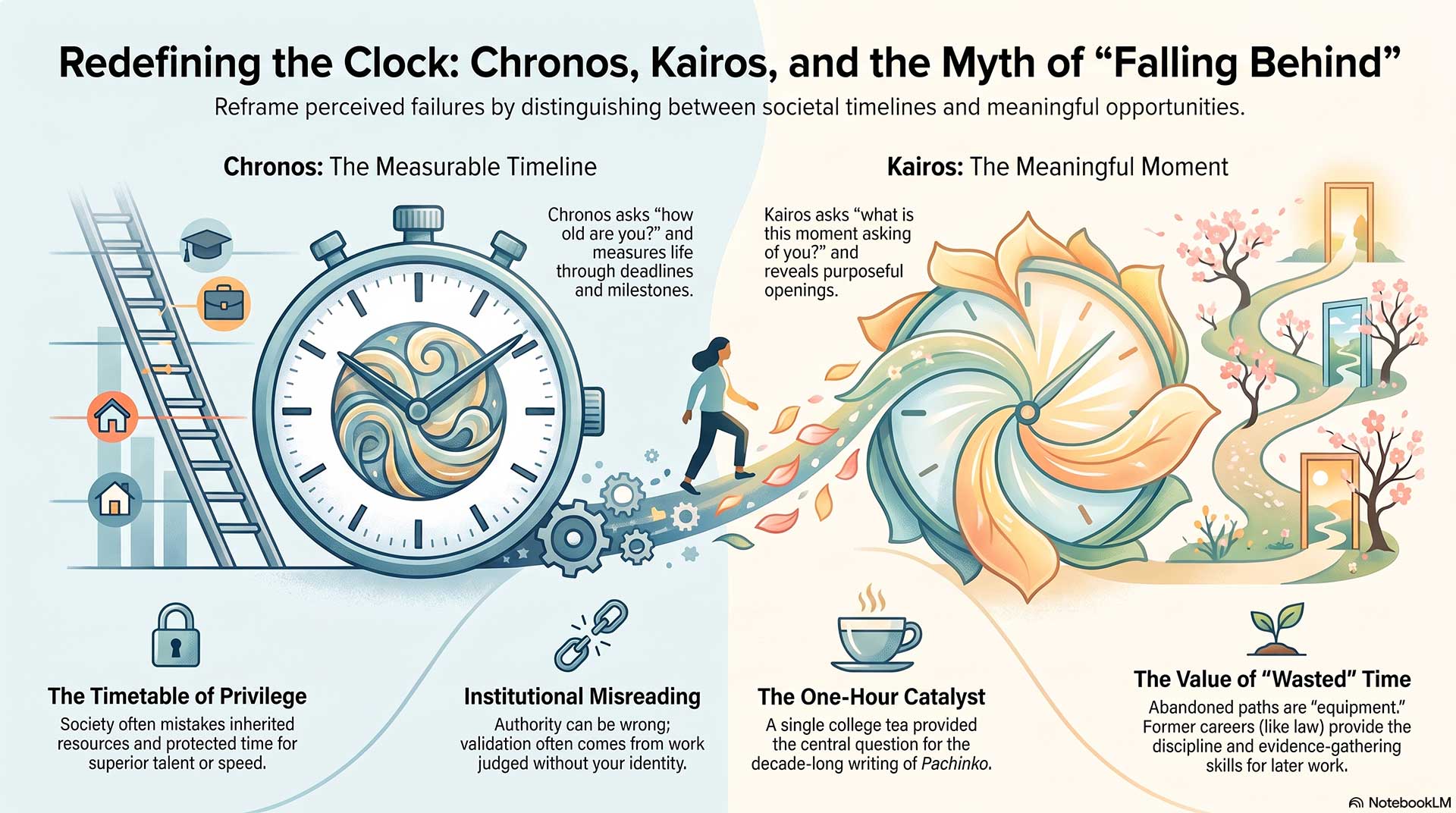
At the start, we asked whether a slow life is a failed life.
Speed cannot answer that question.
A fast decision may be brave, reckless, generous, frightened, or vain. A long season may be preparation, avoidance, grief, illness, apprenticeship, or love. Time alone does not tell us what a life means. We must examine what we served during that time, what we refused to see, what we learned, and whom our choices helped or harmed.
From Toni Morrison and George Eliot, we heard that history and moral life often work beneath the surface. A judgment made in one classroom can follow a person for years. A quiet choice can shape lives far beyond the person who made it. F. Scott Fitzgerald and Honoré de Balzac reminded us that ambition can sharpen a person or consume one. Odysseus reminded us that there are moments when delay becomes its own decision.
Sinclair Lewis, Jane Addams, Nancy Pearl, Fred Strebeigh, and Alan Yang helped us reconsider the word “wasted.” A book read in adolescence can influence a college choice. A disappointing paper can reveal the prejudice of a teacher. A library can give an immigrant child a new language. A class can awaken a writer. An old novel can find a new life in another medium.
Han Kang, Roxane Gay, Cynthia Ozick, Jodi Picoult, and Ann Curry pushed us to examine judgment more carefully. Criticism can teach us, yet status does not make every judgment true. Identity can shape the way a reader sees a writer before the first sentence is considered fairly. Self-trust is not the refusal of criticism. It is the refusal to let prejudice name itself truth.
Dr. Hung Chun Ko and Harry Nam showed that institutional change often begins with people who may never receive the result. Rabbi James Ponet showed how one sentence can restore moral courage. Harry Adams showed how one gathering can introduce a question that lasts for decades. Rebecca Walker reminded us that identity, public disagreement, and private truth often meet in uneasy ways.
Judy Solano showed that care may arrive from a person with no title. Tayari Jones showed how culture, place, and politics enter a writer’s work. David Karashima and Elmer Luke showed how collective disaster asks for testimony. Seiji Yamamoto showed how disciplined craft can carry memory through form, repetition, and attention.
Across all five discussions, one lesson returned: meaning is rarely visible at the same moment as experience.
The students who fought for Korean language study at Yale graduated before the program began. Harry Nam could not take the classes he helped bring into being. I could not take them either. Yet the program continued for decades.
Chronos says we missed the result.
Kairos says we were present for the beginning.
I once thought publication would settle the questions. A book would prove that I had not wasted my education. Recognition would correct the professors who had judged me poorly. Success would justify the years it consumed.
Success did not settle everything.
A dream that becomes real brings new uncertainty. A published book belongs partly to readers. A public life brings praise, misreading, criticism, and expectation. The answer is not to reach a point where doubt disappears. The answer is to keep returning to what matters.
Choose the important over the urgent.
The urgent voice says you are late. The important voice asks what deserves your attention now.
The urgent voice says everyone else has passed you. The important voice asks whether you are walking in the direction of your deepest responsibility.
The urgent voice says an influential person’s judgment defines you. The important voice asks whether that judgment is true.
The urgent voice says your small action will change nothing. The important voice asks who may inherit the result.
The urgent voice says pain must either destroy you or make you grateful. The important voice permits a more honest answer: the pain was wrong, your survival is real, and the meaning you create does not excuse what happened.
I cannot promise that every lost year will reveal a purpose. I cannot promise that every act of courage will be rewarded, every institution will change, or every dream will arrive.
I can say that time may reveal connections that fear cannot see.
The class that wounded you may teach you what kind of teacher never to become. The job you leave may give you skills for work you have not yet named. The stranger who treats you with dignity may restore your courage. The story you hear for one hour may become the work of thirty years. The program you help begin may serve students born long after you graduate.
Chronos will keep moving.
Kairos asks whether we are awake.
Time is not a verdict against us. It is the medium through which choices gather meaning. It reveals patterns, exposes false judgments, deepens questions, and permits unfinished work to pass from one life into another.
The goal is not to move slowly or quickly.
The goal is to see clearly enough to recognize what matters, then remain faithful to it for as long as it asks for us.
Short Bios:
Toni Morrison was an American novelist, editor, essayist, and professor whose work examined Black life, historical memory, family, language, and the legacy of racism. Her novels include Beloved, Song of Solomon, The Bluest Eye, and Home. Min Jin Lee reviewed Home, creating a direct literary connection between them. Morrison enters this discussion to question who controls historical memory and how a writer resists being defined by other people’s expectations.
George Eliot was the pen name of English novelist Mary Ann Evans. Her major works include Middlemarch, The Mill on the Floss, Silas Marner, and Daniel Deronda. Lee has named Middlemarch among the books that most influenced her writing. Eliot brings a view of time rooted in moral growth, ordinary choices, sympathy, ambition, and the hidden consequences of daily life.
F. Scott Fitzgerald was an American novelist and short-story writer best known for The Great Gatsby. Lee wrote a new introduction to the novel, treating it as an ethical inquiry into class, desire, disappointment, and the American Dream. Fitzgerald enters this discussion as a writer whose fame, financial pressure, personal disappointment, and posthumous reputation complicate any simple measure of success.
Honoré de Balzac was a French novelist whose vast body of fiction examined money, status, family, desire, debt, and social ambition. Lee has named Cousin Bette among the works that influenced her and wrote about the novel in an essay. Balzac brings a sharp view of the way society turns time into competition and human worth into rank.
Odysseus is the central hero of Homer’s Odyssey. Lee uses his decisive actions to explain Kairos, the opportune moment when judgment and action meet. In this imaginary discussion, he represents the claim that waiting cannot continue forever and that some moments demand a choice before certainty arrives.
Sinclair Lewis was an American novelist known for social criticism in works such as Main Street, Babbitt, and It Can’t Happen Here. As a high school student, Lee read about his Yale education and wondered what he had learned there that helped him write about politics and society. His indirect influence helped draw her to Yale.
Jane Addams was an American social reformer, writer, peace advocate, and co-founder of Hull House in Chicago. Her work joined study with public service for immigrant and working-class communities. Lee wrote a Yale paper about Addams and admired her commitment to poor immigrants and social reform. Addams asks whether knowledge has value when it never becomes action.
Nancy Pearl is an American librarian, author, and literary commentator known for encouraging wide and curious reading. Lee later appeared in a public conversation with her. Pearl’s presence connects with Lee’s childhood at the Queens Public Library, where books helped her learn to read, write, and form an intellectual life beyond the limits of her circumstances.
Fred Strebeigh was Lee’s nonfiction-writing professor at Yale. Lee credits his seminar as part of the period when her writing began to receive serious recognition. Her prize-winning nonfiction emerged from that academic setting, offering a striking contrast with history professors who doubted her command of English.
Alan Yang is an American screenwriter, producer, and director who worked with Lee on a planned television adaptation of Free Food for Millionaires. He enters this topic to discuss how an earlier work can return in a new form, reach a new audience, and gather meanings its author could not have predicted at the time of publication.
Han Kang is a South Korean novelist and poet whose work examines violence, memory, grief, the body, and human dignity. Her books include The Vegetarian, Human Acts, and The White Book. Lee reviewed Human Acts, linking their literary concerns through Korean history, suffering, and moral witness. Han Kang asks how a writer can speak about pain without reducing it to material.
Roxane Gay is an American writer, critic, editor, and professor whose work addresses race, gender, culture, trauma, and public judgment. She publicly named Pachinko as a favorite book. Gay enters this discussion to examine who receives authority as a critic, how identity shapes reception, and why public praise or condemnation can never serve as the sole measure of artistic worth.
Cynthia Ozick is an American novelist, short-story writer, and essayist known for intellectual fiction and literary criticism. Lee reviewed Ozick’s Foreign Bodies. Ozick brings questions about artistic standards, cultural inheritance, serious reading, and the difference between demanding criticism and condescension disguised as rigor.
Jodi Picoult is an American novelist whose books often place moral conflict, family strain, and public controversy at the center of popular fiction. Lee reviewed Picoult’s Wonder Woman: Love and Murder. Picoult enters this discussion to question the divide between literary prestige and broad readership, and to ask who decides which forms of storytelling deserve respect.
Ann Curry is an American journalist and television correspondent who interviewed Lee about her artistic process, religion, persistence, and resistance to anti-Asian racism. Curry brings the perspective of a journalist trained to ask how private experience becomes public testimony and how prejudice can be challenged without flattening a person into a symbol.
Dr. Hung Chun Ko founded the East Rock Institute and taught the Yale seminar that gave Lee one of her first opportunities to study Korea in college. She connected Lee with Harry Nam and supported the early effort to establish Korean studies. She represents mentorship that begins before an institution is ready to change.
Harry Nam was a Yale student who worked with Lee on the Korea Studies Task Force. He graduated before the Korean-language program began, so he did not personally benefit from the reform he helped pursue. His role raises a central question: what makes people work for a future they may never experience themselves?
Rabbi James Ponet was a Yale chaplain who wrote Lee an encouraging letter after she received a death threat. He told her that her capacity to express outrage made her a valuable citizen. His presence brings faith, moral anger, civic responsibility, and the effect of timely encouragement.
Harry Adams was a Yale chaplain and the head of Trumbull College. He invited Lee to the college tea where she heard the story of a Korean boy in Japan whose death later became a formative source for her study of Koreans in Japan. His role shows how creating a space for one story can influence decades of work.
Rebecca Walker is an American writer, editor, and cultural critic whose work addresses feminism, identity, family, race, and personal truth. Lee contributed an essay to To Be Real, edited by Walker. She enters this topic to examine the cost of speaking from identities that public debate often simplifies or turns against one another.
Judy Solano worked as a grill cook at Trumbull College and became Lee’s friend. During a frightening period after Lee received a death threat, Solano invited her home and cooked chicken casserole for her. Her act of care helped Lee remain in the Korean history class. She represents kindness without status, ceremony, or public recognition.
Tayari Jones is an American novelist whose work examines family, race, place, intimacy, and social pressure. She joined Lee in a public conversation about writers, culture, geography, and politics. Jones enters this topic to ask how a place, a conversation, or a single encounter can redirect the work a writer thought she was meant to do.
David Karashima is a writer, translator, editor, and literary organizer associated with Japanese literature in translation. He co-edited March Was Made of Yarn, a collection responding to the 2011 Tōhoku earthquake and tsunami, which Lee reviewed. His presence brings questions about how scattered voices can be gathered after catastrophe and carried across languages.
Elmer Luke is an editor and translator who co-edited March Was Made of Yarn. The collection brought together essays, fiction, poetry, and manga created in response to the Tōhoku disaster. He enters this discussion to examine how one event can alter private memory, public language, and the responsibility of editors who preserve testimony.
Seiji Yamamoto is a Japanese chef known for disciplined culinary craft and close attention to ingredient, technique, and presentation. Lee profiled his cuisine and work. He enters this discussion to explore how repeated acts of craft can carry memory, culture, and meaning, and how one meal or sensory experience can remain with a person for years.
Leave a Reply