
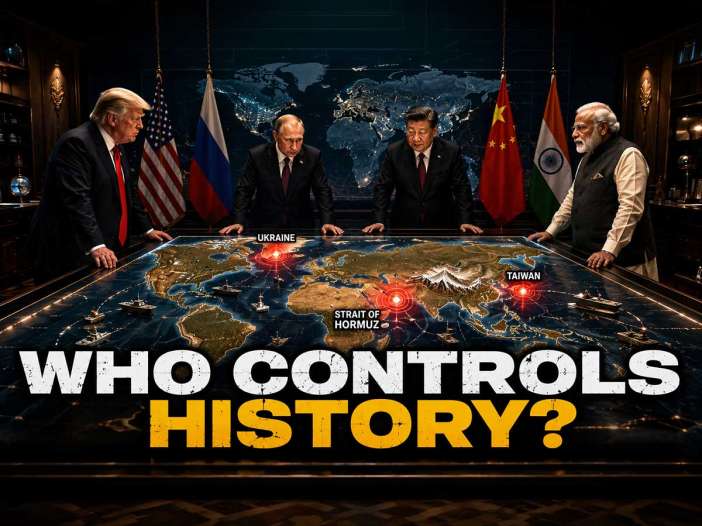
What if the next global war has already been drawn on a map?
Every generation believes it is facing a new world.
New technologies emerge. New alliances form. New leaders promise a different future. Newspapers announce turning points almost every day.
Yet beneath those headlines, the map changes very slowly.
Mountains remain where they have always stood. Rivers continue flowing toward the sea. Oceans separate continents. Narrow straits still determine where ships can travel. Resources remain unevenly distributed. Civilizations continue remembering victories, defeats, invasions, and humiliations long after those who experienced them have disappeared.
Perhaps this is why history often feels strangely familiar.
In this imaginary conversation, five very different perspectives gather around one enormous map—not to debate ideology first, but to ask whether geography quietly shapes every political decision we make.
Donald Trump views the world through leverage, negotiation, and American interests.
Vladimir Putin sees history through centuries of invasion, strategic depth, and Russia's search for security.
Xi Jinping thinks in generations, seeking national unity and freedom from maritime containment.
Narendra Modi represents a civilization determined to rise without becoming dependent on either East or West.
Craig Hamilton-Parker contributes a different perspective altogether. Through intuition, historical observation, and spiritual reflection, he asks whether certain flashpoints on today's map may become tomorrow's crises.
Together they explore questions far deeper than daily politics.
Why does Taiwan matter so much?
Can Russia ever feel secure?
Will India and China compete over water rather than ideology?
Could a handful of narrow waterways determine the prosperity of billions?
Most importantly...
Are leaders truly directing history?
Or are they responding to pressures written into geography long before they were born?
This is an imaginary conversation created to encourage thoughtful reflection on geopolitics, history, and the future.
The dialogue does not represent actual conversations or statements made by any participant.
(Note: This is an imaginary conversation, a creative exploration of an idea, and not a real speech or event.)
Topic 1: Four Leaders, One Map—Who Is Really Controlling History?
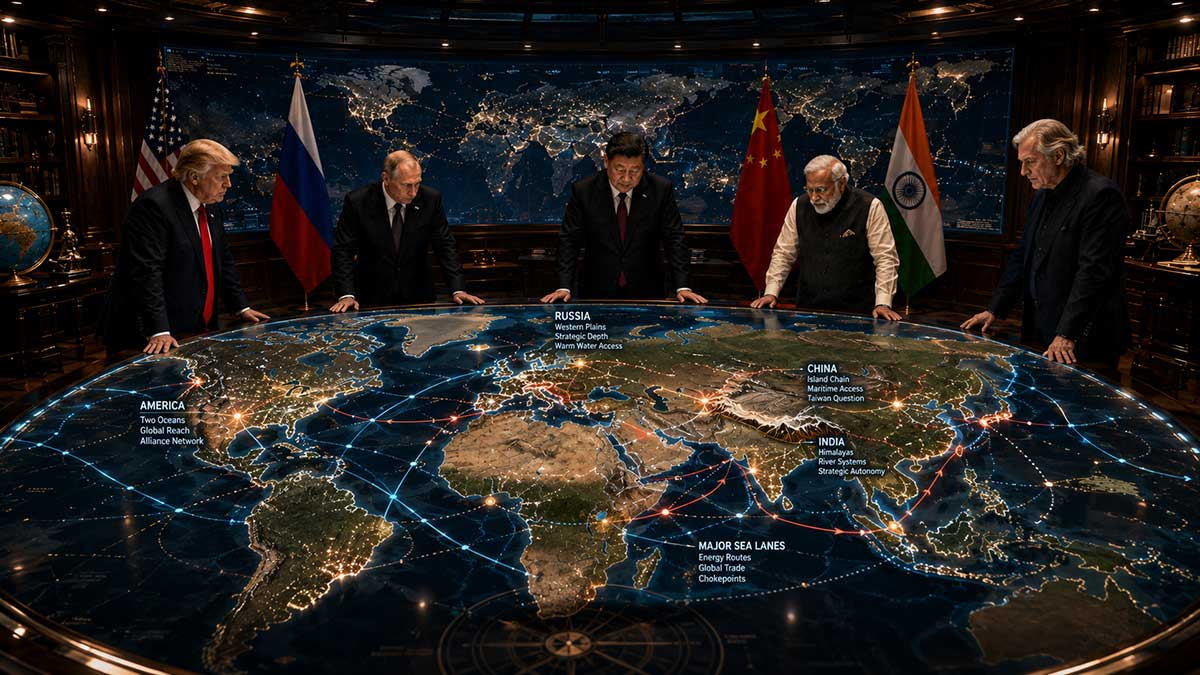
Opening
Craig Hamilton-Parker:
Before us is a map without flags, political slogans, or moral declarations. It shows only mountains, rivers, oceans, ports, deserts, shipping lanes, and narrow passages where the movement of the entire planet can be slowed by a single decision.
We often speak of leaders as if they stand above history. We say Trump changed America, Putin changed Russia, Xi changed China, and Modi changed India. Yet perhaps the deeper truth is that each inherited an ancient fear long before he inherited office.
Russia fears invasion across open plains. China fears being trapped behind an island chain. India fears dependence on rival civilizations. America fears losing control of distant routes that protect its prosperity at home.
Each man may believe that he is moving pieces across the board. Yet tonight we must ask whether the board has been moving them.
Question 1: Are Leaders Making History—or Repeating Geography?
Vladimir Putin:
Look at Russia before you judge Russia. Do not begin with my face, my government, or one military operation. Begin with the land.
There is no great mountain wall protecting Moscow from the west. Napoleon understood that. Hitler understood that. Armies have repeatedly crossed the same plains. Every Russian leader inherits the memory of invasion, whether he speaks of it publicly or not.
You call neighboring countries independent states. We see routes through which hostile forces have entered before. You see NATO membership as a legal choice. We see missiles, military bases, surveillance systems, and foreign influence moving closer.
A nation cannot erase its memory simply to appear agreeable.
Narendra Modi:
Memory can guide a nation, President Putin, but memory can become a prison.
India remembers invasion. India remembers colonial rule, partition, famine, and foreign powers deciding our future. Yet we cannot claim that every neighboring country must surrender its freedom so that India may feel secure.
There is a difference between learning from history and demanding that history repeat itself in your favor.
Vladimir Putin:
India has oceans protecting much of its territory. Russia does not have that luxury.
Narendra Modi:
India has the Himalayas, yet those mountains do not remove danger. China stands across our northern frontier. Pakistan remains to the west. The Indian Ocean is increasingly contested. Our rivers begin in territories we do not fully control.
Every nation can present itself as uniquely vulnerable. The greater test is whether vulnerability produces discipline or expansion.
Donald Trump:
Here is the problem with the way this is usually discussed. Everyone talks like nations are charities. They are not. They have interests.
Russia wants distance from NATO. China wants Taiwan. India wants to stay independent and become stronger. America wants open trade routes and allies who contribute rather than sending us the bill.
I look at the map and ask: What are we getting? What are we paying? Who is benefiting? Who has been taking advantage of us?
For decades, America protected trade routes, defended wealthy allies, paid for military bases, and carried much of the cost. Then those same allies criticized us whenever we asked them to defend themselves.
That is a bad deal.
Xi Jinping:
A civilization cannot be reduced to a deal.
China plans beyond one election, one government, or one economic cycle. We consider the position of our nation across generations.
Along our eastern coast, China faces a chain of territories aligned with the United States. Japan, South Korea, Taiwan, and the Philippines form a strategic barrier. American ships operate thousands of miles from American shores and then accuse China of behaving aggressively near China.
If Chinese naval forces operated permanently near California, Washington would call it an intolerable threat.
Donald Trump:
Maybe. But we would not spend seventy years talking about it. We would solve it.
Xi Jinping:
That statement demonstrates the privilege geography has given the United States. Two oceans have separated your homeland from many of the conflicts in which it participates.
China does not possess that separation. Our trade, energy, and economic stability pass through maritime routes that can be blocked. Taiwan is part of that vulnerability, but it is not only a military question. It represents a wound created during a period of national weakness.
Craig Hamilton-Parker:
Each of you has described a fear inherited from geography.
President Putin sees the western plains.
President Xi sees the island chain.
Prime Minister Modi sees the Himalayas, river systems, and two rival nuclear states.
President Trump sees oceans that protect America but create the temptation to project influence far from home.
Yet are these conditions determining your choices—or giving you language with which to defend choices already made?
Donald Trump:
You use what you have. America has oceans, resources, a strong economy, and the greatest military. That does not mean we must apologize for being in a good position.
The mistake is pretending geography does not matter. It matters more than speeches. It matters more than international conferences where everybody says pleasant things and then does the opposite.
Vladimir Putin:
On this point, President Trump is correct. Western leaders speak of universal values when the arrangement benefits Western interests. When another country protects its interests, it is called aggression.
Narendra Modi:
Yet every powerful state speaks this way when challenged. It says its reach is defensive and its opponent’s reach is aggressive.
India has chosen strategic autonomy for this reason. We will cooperate with the United States, trade with Russia, compete with China, and maintain relations across different alliances. We do not wish to become a piece moved by another state.
Xi Jinping:
Neutrality is easier to proclaim than to preserve. As pressure grows, India will be asked to choose.
Narendra Modi:
India will choose India.
Craig Hamilton-Parker:
That may be the defining statement of this century. Every leader says he is choosing his nation. The danger begins when each nation’s security requires another nation to feel insecure.
Question 2: When Does Security Become Domination?
Xi Jinping:
Western governments demand that China accept a permanent military and political division created during civil war. They call this stability.
They sell weapons to Taiwan, send delegations, increase military cooperation, and then warn China against changing the existing situation.
The arrangement is considered peaceful only when China remains restrained.
Donald Trump:
China has done very well under that arrangement. You gained access to Western markets. American companies moved production into China. You became wealthy through a system we protected.
Then China used that wealth to build its military, buy influence, dominate industries, and put pressure on Taiwan.
You cannot take every benefit and then claim the system is unfair.
Xi Jinping:
China’s development was earned through the labor of its people. It was not a gift from America.
Donald Trump:
It was a very generous trade policy. Too generous.
Narendra Modi:
This exchange reveals the problem. Economic partnership becomes strategic dependence, then dependence becomes leverage.
India learned this through colonialism. Trade did not arrive carrying weapons at first. It arrived carrying contracts. The political control came later.
Security becomes domination when one country claims the right to decide what choices another country may make.
Vladimir Putin:
Then you must acknowledge that NATO expansion limited Russia’s choices.
Narendra Modi:
NATO did not order Russia to invade Ukraine.
Vladimir Putin:
Ukraine was being transformed into a military platform against us.
Narendra Modi:
That is your interpretation of Ukraine’s direction. Ukrainians may say they moved westward after years of fearing Russian control.
The fear runs in both directions.
Craig Hamilton-Parker:
President Putin, where does Russia’s legitimate need for security end?
Does it end at the Russian border? At the Ukrainian border? At Poland? At the former limits of the Soviet Union?
Vladimir Putin:
It ends when there is a dependable security structure that does not place hostile military systems near Russia.
Craig Hamilton-Parker:
And who defines “hostile”?
Vladimir Putin:
Reality defines it.
Donald Trump:
No, whoever has leverage defines it. That is the part nobody wants to say.
A treaty is useful when both sides believe breaking it will cost too much. A border is secure when the person on the other side believes crossing it will cost too much. Peace does not survive through good intentions. It survives through strength and clear consequences.
Xi Jinping:
Yet unpredictability can create the conflict it claims to prevent.
Donald Trump:
Predictability can be worse. If your opponent knows exactly what you will do, he plans around it.
Craig Hamilton-Parker:
President Trump, you often treat uncertainty as a weapon. Yet does that approach risk miscalculation?
A smaller country might believe you are bluffing. A rival leader might fear appearing weak. One unexpected act can force every side into positions they did not intend to occupy.
Donald Trump:
Weakness creates more miscalculation than strength. Afghanistan happened after America looked weak. Ukraine happened after America looked weak. When leaders believe there is no serious cost, they move.
Vladimir Putin:
America interprets its military presence across the globe as stability. Russia’s military presence near Russia is treated as a threat.
Donald Trump:
You invaded another country.
Vladimir Putin:
America has invaded countries far from its borders.
Donald Trump:
And I said many of those decisions were disasters.
Narendra Modi:
This cannot become a competition over which country has produced the most persuasive excuse.
A nation crosses from security into domination when it denies another people the dignity it demands for itself.
India seeks military strength. We seek influence. We seek a greater role in global institutions. Yet if India’s rise requires smaller neighbors to lose their voice, our rise will contain the seeds of our decline.
Xi Jinping:
Fine words do not remove strategic competition. India develops ports, naval partnerships, missile systems, and closer ties with nations concerned about China.
Narendra Modi:
China has developed ports and infrastructure across the Indian Ocean. You call it commerce. We must still consider its military potential.
This is how fear reproduces itself. One nation’s precaution becomes another nation’s evidence.
Craig Hamilton-Parker:
Perhaps security becomes domination before anyone admits it.
It begins when leaders stop asking, “How can my country be safe?” and begin asking, “How can I prevent every other country from having choices that might challenge me?”
At that moment, protection becomes control.
Question 3: Who Is Most Likely to Misread the Map?
Narendra Modi:
The leader most likely to misread the map is the one who believes geography provides certainty.
Mountains can be crossed. Oceans can be patrolled. Trade routes can be replaced. Alliances can change. Technology can transform the value of territory.
A map tells us where pressure exists. It does not tell us how human beings will respond.
Craig Hamilton-Parker:
That is where intuition enters my work.
When I look at the map, certain locations appear almost illuminated by danger: Taiwan, the Strait of Hormuz, the Black Sea, Poland, the Himalayas, the Malacca Strait, the Red Sea, and eventually the Arctic.
The crisis may begin when a leader correctly identifies a strategic weakness but incorrectly predicts the human response.
Xi Jinping:
You are suggesting China may miscalculate over Taiwan.
Craig Hamilton-Parker:
I feel that economic pressure, internal instability, and national pride could converge near a future American election. Beijing may believe the United States is distracted or politically weakened.
Yet an action intended to solve China’s strategic containment could create deeper isolation, financial turmoil, and danger to the Chinese leadership itself.
Xi Jinping:
China does not make decisions from psychic impressions.
Craig Hamilton-Parker:
Nor should it. Yet history contains many leaders who believed they had calculated every response. They prepared for the war they expected, then encountered the war they created.
Donald Trump:
China knows that moving against Taiwan would be extremely expensive. The best outcome is when they never know exactly how America will react.
Xi Jinping:
That uncertainty affects American allies too. They cannot know whether the United States will defend them or negotiate over them.
Donald Trump:
They should invest in their own defense. Dependence creates weakness.
Vladimir Putin:
President Trump may misread Iran. America believes technological superiority can overcome geography. Iran does not need to defeat the United States militarily. It needs to make shipping dangerous, increase oil prices, pressure American bases, and extend the conflict.
Donald Trump:
Iran will not be allowed to control the Strait of Hormuz.
Craig Hamilton-Parker:
Yet that may be precisely the trap. A limited operation can grow through retaliation. Shipping lanes require protection. Bases require reinforcement. Allies demand assistance. Each response creates the next obligation.
You may begin by defending passage and end by being tied to a conflict you never intended to own.
Donald Trump:
That depends on leadership. You act strongly, finish the job, and leave.
Vladimir Putin:
America has said that before.
Narendra Modi:
Every great country believes it can control escalation. India and China must remember this at our border.
A clash in the Himalayas can begin with patrols, roads, or disputed territory. Yet the deeper issue may become water. Glaciers and rivers do not follow political arguments. Future scarcity could make every border disagreement more dangerous.
Xi Jinping:
China understands the significance of Tibet and water security.
Narendra Modi:
India understands it too. That is precisely why neither side can treat the region as a private strategic possession.
Craig Hamilton-Parker:
President Putin, could you be the leader who misread the map?
Russia sought strategic depth in Ukraine, yet the invasion strengthened NATO, increased European military spending, and moved previously neutral nations closer to the alliance.
Vladimir Putin:
Temporary reactions do not determine the final result.
Craig Hamilton-Parker:
Perhaps not. Yet that is the warning. A leader can understand geography correctly and still misunderstand history.
You understood the value of Crimea, the Black Sea, and buffer territory. Did you understand Ukrainian identity? Did you understand how resistance would grow? Did you understand that fear of Russia might achieve what Western diplomacy could not?
Vladimir Putin:
History will judge outcomes, not Western narratives.
Donald Trump:
Putin made a major mistake. He thought Kyiv would fall quickly. It did not. A bad opening decision changes everything.
Vladimir Putin:
America’s history contains many such decisions.
Donald Trump:
That is why I criticize them.
Xi Jinping:
The United States may make another error by assuming its maritime dominance is permanent. No strategic advantage remains permanent.
Narendra Modi:
Nor does national decline remain permanent. Asia is rising, but Asia must decide whether its rise will create a new balance or repeat the arrogance of older empires.
Craig Hamilton-Parker:
Then perhaps every leader at this table is capable of misreading the map.
President Trump may overestimate the effectiveness of pressure.
President Putin may overestimate the security gained through territory.
President Xi may overestimate China’s ability to control the consequences of Taiwan.
Prime Minister Modi may overestimate India’s ability to remain independent when rival blocs demand commitment.
The map reveals pressure, but it cannot calculate pride. It cannot measure humiliation. It cannot predict the moment a population refuses to cooperate with a leader’s strategic logic.
The most dangerous leader may not be the least intelligent. It may be the leader most convinced that intelligence has removed uncertainty.
Closing
Narendra Modi:
Civilizations inherit geography, but they are not condemned to obey its darkest instructions.
Mountains can become barriers, or they can become meeting places. Oceans can separate nations, or connect them. Rivers can become weapons, or shared sources of life. History can become a justification for revenge, or a warning against repeating suffering.
Each leader sees the map through the memory of his nation. Yet no map can show the full cost carried by a mother, a soldier, a displaced family, or a generation raised beneath the threat of war.
The question before us is not whether geography influences history. It clearly does.
The harder question is whether human wisdom can become stronger than inherited fear.
Our next conversation must turn to the island where that struggle is becoming impossible to ignore: Taiwan.
Topic 2: Taiwan—The Island Xi Cannot Abandon and America Cannot Lose
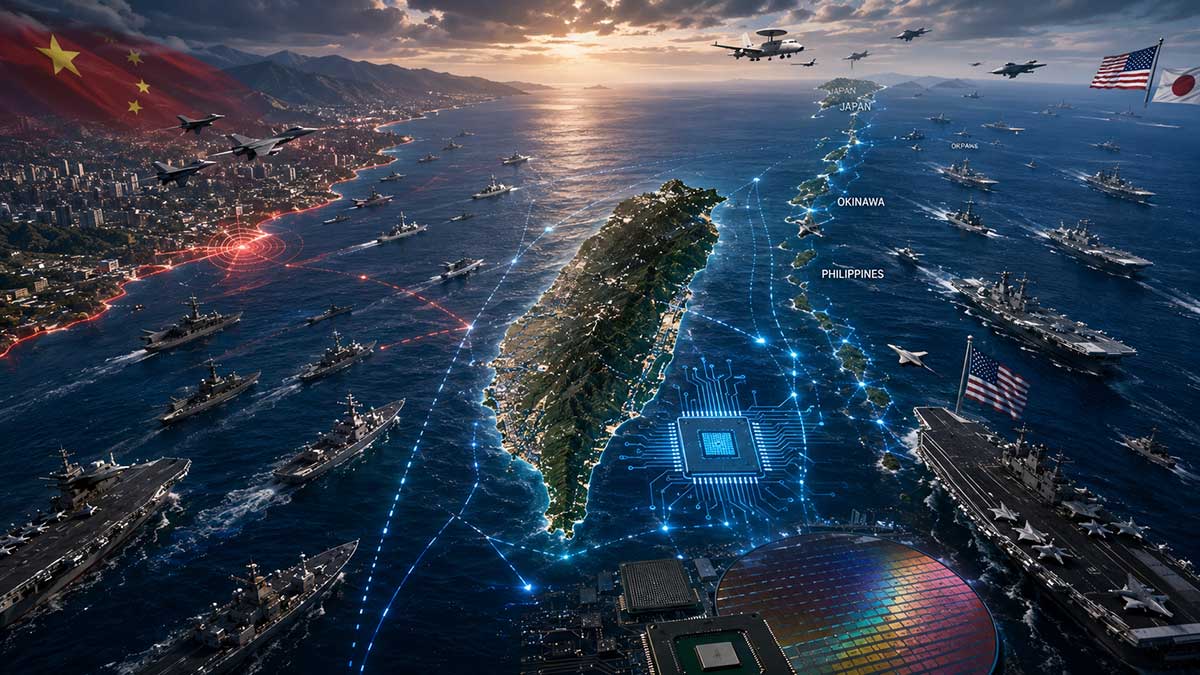
Opening
Craig Hamilton-Parker:
Taiwan appears small on the map, yet the struggle surrounding it reaches far beyond its coastline.
To Beijing, Taiwan is unfinished history—a territory separated from China during a period of civil war, foreign intervention, and national weakness.
To Washington, Taiwan represents something different: the credibility of American alliances, the principle that borders should not be changed by force, and a strategic position at the center of the western Pacific.
To the Taiwanese people, however, this is not merely a contest between two great powers. It is their home, their political system, their economy, and the question of whether they will be permitted to decide their own future.
President Xi may see an island blocking China’s route into the Pacific. President Trump may see a test of American deterrence. General MacArthur may see a fixed strategic position. Sun Tzu may see a war that should be won before the first shot is fired.
Yet the deepest danger may come when each side believes time is working against it.
Question 1: Is Taiwan a National Wound—or the Key to the Pacific?
Xi Jinping:
Foreign observers speak of Taiwan as if it were an unrelated country that China suddenly decided to threaten.
This ignores history.
Taiwan is part of the unresolved conclusion of the Chinese civil war. Its separation emerged during a century in which China suffered invasion, occupation, foreign concessions, and national humiliation.
Reunification is not an optional political project created by one leader. It is connected to the restoration of Chinese sovereignty and dignity.
Douglas MacArthur:
History matters, but military geography often gives history its urgency.
Taiwan occupies a strategic position along the first island chain. From that location, naval and air forces can observe or restrict movement from the Chinese coast into the wider Pacific.
In a major conflict, whoever controls Taiwan gains an enormous regional advantage.
That is why the island cannot be discussed only through cultural or historical language.
Donald Trump:
Exactly. China says this is about national unity. It is partly about national unity, but it is very much about strategy.
Taiwan affects shipping, military access, advanced technology, alliances, and who controls the Pacific.
China wants Taiwan for the same reason America cannot pretend it does not matter.
The problem is that previous American leaders liked making vague promises. They wanted China to believe we might fight and Taiwan to believe we would protect them, but nobody wanted to say clearly what the deal was.
Ambiguity works until somebody decides to test it.
Sun Tzu:
The greatest mistake is to believe that a territory has only one meaning.
For one side, Taiwan is memory.
For another, it is position.
For another, it is credibility.
For those who live there, it is daily life.
When several meanings occupy the same ground, conflict becomes more likely, since each side believes it is defending something that cannot be surrendered.
Craig Hamilton-Parker:
President Xi, could China accept permanent separation if Taiwan never declared formal independence and never became a foreign military base?
Xi Jinping:
Permanent separation cannot be accepted.
Patience should not be mistaken for abandonment. China has preferred peaceful reunification, but no responsible Chinese leader can renounce the right to prevent permanent division.
Donald Trump:
That is the problem. When you say “peaceful,” you mean Taiwan agrees with you. When they do not, you keep the military option.
That is not much of a choice.
Xi Jinping:
The United States has fought wars to preserve its own union. It has never accepted foreign governments encouraging permanent separation within American territory.
Donald Trump:
America is not claiming an independently governed island across the ocean while surrounding it with ships and aircraft.
Xi Jinping:
The distance is narrow. The history is continuous.
Douglas MacArthur:
Distance is not the main point. Taiwan sits close enough to China to face enormous military pressure, yet far enough away to make an amphibious invasion one of the most difficult operations imaginable.
A commander must cross water, gain air superiority, protect transport vessels, secure landing zones, move supplies, and fight in difficult urban and mountainous terrain.
China may desire Taiwan. Desire is not the same as possessing the ability to take it at an acceptable cost.
Sun Tzu:
A wise leader does not begin by asking whether victory is possible.
He asks what victory would leave behind.
An island captured at the cost of economic ruin, diplomatic isolation, and long resistance may become a burden rather than a prize.
Xi Jinping:
China does not seek destruction. We seek reunification.
Craig Hamilton-Parker:
Yet reunification imposed through fear may create the opposite of unity.
Taiwan is strategically important, but it is inhabited by people whose identity has developed separately over generations.
Can geography reunite territory after politics and memory have separated the population?
Xi Jinping:
National identity can survive temporary division.
Donald Trump:
Temporary according to whom? That is the entire disagreement.
Question 2: Could Economic Pressure Push China Into War?
Sun Tzu:
War is often described as a demonstration of strength, yet leaders frequently choose it when they fear weakness.
An economy slows. Public confidence declines. Rivals sense opportunity. A ruler then seeks an act capable of restoring unity.
This can create the illusion that war will solve domestic problems.
It usually multiplies them.
Craig Hamilton-Parker:
This is where my intuitive concern begins.
I feel a period may come when economic pressure inside China meets political uncertainty in the United States.
Beijing may believe Washington is distracted by an election, divided by internal conflict, or uncertain about its next government.
A move against Taiwan might then appear to offer several answers at once: national unity, strategic access, public pride, and a distraction from economic pain.
Yet what appears to be an answer could become the event that destabilizes China most severely.
Xi Jinping:
China does not make decisions in response to temporary economic difficulty.
Our planning concerns decades. Western governments often assume every nation thinks according to election schedules and quarterly markets.
China has endured hardship before. We do not require war to create legitimacy.
Donald Trump:
Every government says it is stable until it is not.
China has debt, property problems, demographic decline, pressure from tariffs, companies moving production, and young people worried about the future.
A leader facing that kind of pressure may decide he needs a historic achievement.
Taiwan is the obvious one.
Xi Jinping:
American pressure contributes to the conditions you describe. Restrictions on technology, trade barriers, military alliances, and attempts to isolate China are then used as evidence that China has become aggressive.
Donald Trump:
You became a competitor. America was foolish for helping build a competitor that wanted to replace us.
I would use tariffs, technology restrictions, and military pressure to make the cost of moving against Taiwan unmistakable.
You do not prevent war through speeches. You prevent it by making the other side believe the price is too high.
Douglas MacArthur:
Deterrence must be credible, but it must not become a machine that neither side can stop.
If China believes the military balance is moving permanently against it, Beijing may act earlier.
If America believes China is preparing to act, Washington may strengthen Taiwan.
China then reads those defensive preparations as evidence that time is running out.
Each side’s precaution confirms the other side’s fear.
Sun Tzu:
This is the circle from which wise statesmen must escape.
When two opponents both believe delay benefits the enemy, the calendar itself becomes dangerous.
Craig Hamilton-Parker:
President Xi, is there a point when China would conclude that peaceful reunification has become impossible?
Xi Jinping:
Foreign interference could close peaceful possibilities.
Formal Taiwanese independence, permanent foreign military deployment, or legal steps intended to eliminate the possibility of reunification would require a response.
Donald Trump:
That language allows China to define almost anything as foreign interference.
A visit, an arms sale, a treaty, an election result—you can call any of them provocation.
Xi Jinping:
America reserves the same flexibility when defining threats to its security.
Douglas MacArthur:
The military danger does not arise only from a full invasion.
A blockade may appear less risky. China could inspect ships, close air routes, surround the island, or create a quarantine without immediately landing troops.
Washington would then face a terrible decision.
Does it break the blockade and risk direct war, or accept a slow surrender?
Craig Hamilton-Parker:
That may be closer to the form of crisis I sense.
The world may wait for an invasion fleet and miss the gradual tightening beforehand.
Pressure could begin through exercises, cyberattacks, shipping controls, financial disruption, and claims of enforcing Chinese law.
The first stage may not look like war.
Sun Tzu:
The most effective siege is the one the enemy does not recognize until escape has narrowed.
Donald Trump:
That is why you cannot wait until the blockade starts.
You negotiate from strength before the crisis. You make clear what economic penalties will happen, what military response might happen, and what China stands to lose.
Xi Jinping:
Threats do not create stability.
Donald Trump:
Weak threats do not. Credible ones do.
Question 3: Would America Truly Fight Once the Cost Became Real?
Douglas MacArthur:
Nations often make commitments in peaceful years that become uncertain when casualties begin.
The defense of Taiwan would not be a distant police operation. It could involve attacks on ships, aircraft, bases, satellites, communications systems, and regional allies.
Japan could be drawn in. Guam could be struck. Global trade could contract sharply. Manufacturing supply chains could fail.
The question is not whether America values Taiwan.
The question is how much pain America would accept for Taiwan.
Donald Trump:
The first job of an American president is to prevent that decision from becoming necessary.
China should never know exactly what we would do, but it should believe the response could be overwhelming.
At the same time, Taiwan cannot assume America will carry every burden.
They need weapons, reserves, civil defense, hardened infrastructure, and the ability to survive the opening stage.
Xi Jinping:
This reveals the contradiction in American policy.
Washington encourages Taiwan to resist, supplies weapons, and uses the island to contain China. Yet it may abandon Taiwan once the cost rises.
Taiwan is being placed in danger by promises that may never be fulfilled.
Craig Hamilton-Parker:
President Trump, would you send American forces into direct combat?
Donald Trump:
I would not announce that in advance.
The minute you give the other side a guaranteed answer, you give away leverage.
I would ask what deal prevents the war, what China fears losing, what Taiwan must do for its own defense, and what American allies are contributing.
Japan, South Korea, Australia, the Philippines—they cannot watch from the sidelines and expect America to handle everything.
Sun Tzu:
Uncertainty may deter an enemy, but it can frighten a friend.
Taiwan must know enough to prepare wisely. China must know enough to avoid a fatal mistake. America must preserve flexibility.
Too much clarity can invite counterplanning.
Too little clarity can invite miscalculation.
Douglas MacArthur:
The American public presents another uncertainty.
At first, support may be strong. Images of an attacked democracy would create anger.
Then ships sink. Markets fall. Prices rise. Supplies disappear. Families receive casualty notices.
A democratic government must maintain public consent during an extended conflict.
China may believe it can tolerate suffering longer than America.
Donald Trump:
They might believe that, but authoritarian governments have their own weaknesses.
If China promises a quick victory and fails, the political damage could be enormous. If trade collapses, factories stop, unemployment rises, and financial markets panic, the public may not remain silent forever.
Xi Jinping:
China’s people understand sacrifice for national unity.
Craig Hamilton-Parker:
Some will. Others may ask why their future was risked for an island they had never visited.
Nationalism can create unity before war, but failure can turn that unity against the leader who summoned it.
This is why I connect a Taiwan crisis with possible danger to Xi Jinping’s position. The risk may come less from deciding never to act than from acting and failing to produce the promised result.
Xi Jinping:
You assume failure.
Craig Hamilton-Parker:
I sense disruption rather than clean victory.
I see financial chaos, broken trade, political pressure, and a conflict that widens beyond the expectations of those who began it.
That does not mean every detail is fixed. It means the path carries danger that cannot be contained within the Taiwan Strait.
Sun Tzu:
A ruler should never begin a war requiring the enemy to behave exactly as predicted.
America may intervene.
It may not.
Japan may participate.
It may hesitate.
Taiwan may resist fiercely.
It may fracture internally.
Markets may collapse.
They may adapt.
When success depends on every uncertainty resolving in your favor, the plan is already weak.
Douglas MacArthur:
Yet indecision has a cost too. If free nations refuse to defend exposed partners, every alliance becomes doubtful.
Other states will seek their own weapons, make accommodations with stronger neighbors, or abandon trust in American guarantees.
Taiwan is not only Taiwan. It is a test watched across Asia.
Donald Trump:
That is why allies need to become stronger now, not after the shooting begins.
A good alliance is not a collection of countries asking America to rescue them. It is a group capable of making aggression too expensive from the start.
Xi Jinping:
From China’s perspective, that alliance structure is the aggression.
Craig Hamilton-Parker:
And there lies the trap.
America calls its alliances defensive.
China calls them containment.
Taiwan calls them protection.
Beijing calls them interference.
Every side can describe the same ship, base, missile, or agreement in completely opposite terms.
The material object does not change. Its meaning changes according to the fear of the person looking at it.
Closing
Sun Tzu:
Taiwan is dangerous precisely because each side believes it cannot surrender.
China fears that accepting permanent separation would confirm a century of humiliation.
America fears that abandoning Taiwan would weaken every promise it has made in Asia.
Taiwan fears that decisions about its future will be made in Beijing and Washington rather than Taipei.
When every participant believes retreat would destroy its identity, pride becomes more dangerous than weaponry.
The wise path is not to deny the strategic importance of the island. It is to prevent strategic importance from becoming fatalism.
China must ask whether unity gained through destruction would still deserve the name unity.
America must ask whether deterrence is protecting Taiwan or turning it into the front line of a larger rivalry.
Taiwan must strengthen its ability to survive without allowing preparation for war to erase every path away from it.
The greatest victory would not be an invasion defeated or an island captured.
It would be reaching the next generation without requiring either event.
Yet farther west, another leader is asking a similar question from a different map: how much territory does Russia believe it needs before it can finally feel secure?
The next topic moves from maritime containment to Russia’s fear of encirclement: Putin, Ukraine, and the price of strategic depth.
Topic 3: Putin’s Deepest Fear—Was Ukraine About Land or Russia’s Survival?
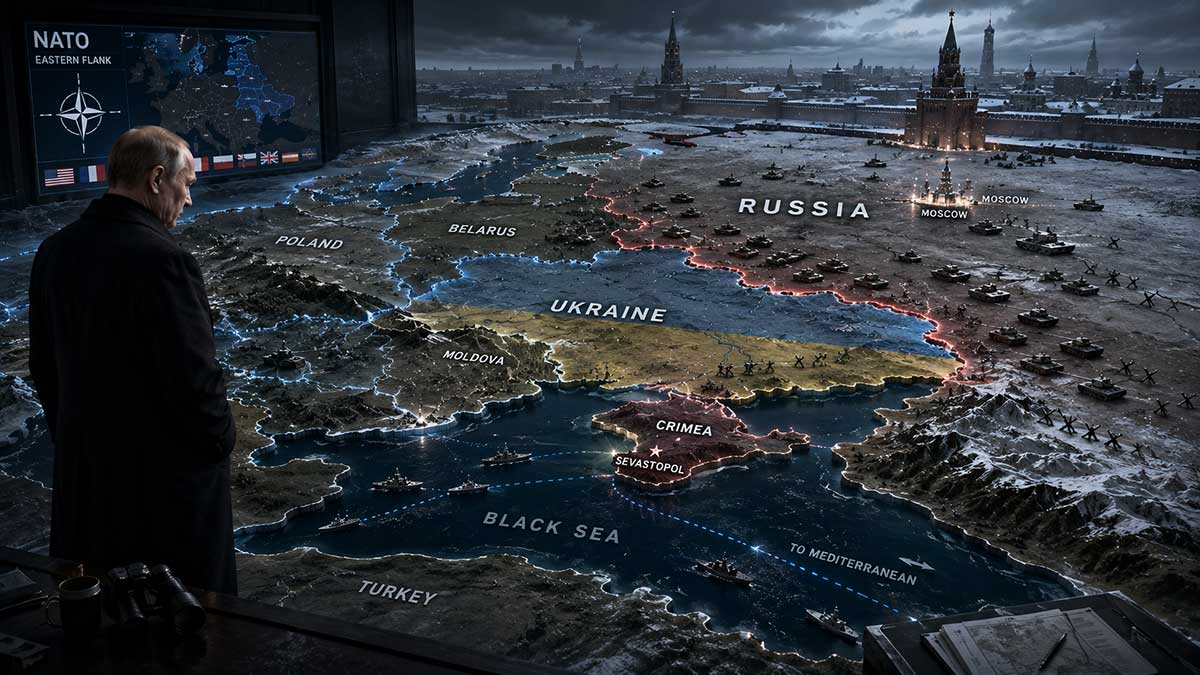
Opening
Craig Hamilton-Parker:
Russia is the largest country on Earth, yet its leaders have rarely behaved like the rulers of a secure nation.
They look west and see open plains crossed by invading armies. They look south and see access to warm water that can be restricted. They look at neighboring states and see potential military corridors rather than fully separate political worlds.
Ukraine sits at the center of these fears.
To Vladimir Putin, Ukraine represents strategic depth, Black Sea access, Russian history, and the danger of Western influence moving closer to Moscow.
To Volodymyr Zelenskyy, Ukraine is not a buffer, bridge, bargaining chip, or security zone. It is a sovereign country whose citizens possess the right to choose their future.
Poland remembers what happens when great states treat smaller nations as empty spaces on a strategic map. Henry Kissinger sees the danger of ignoring balance, yet he must face the moral cost of asking weaker states to accommodate stronger ones.
The central question is not whether Russia has genuine security fears.
It is whether one nation’s fear can ever justify taking another nation’s freedom.
Question 1: Can Russia Feel Secure Without Controlling Its Neighbors?
Vladimir Putin:
Western discussion begins with the invasion, as though history began on that day.
It ignores decades of NATO movement eastward. It ignores military cooperation with Ukraine, weapons systems, intelligence operations, political intervention, and the transformation of a neighboring state into an anti-Russian platform.
Russia warned repeatedly that Ukraine joining the Western military structure would cross a line.
Those warnings were dismissed.
Volodymyr Zelenskyy:
Ukraine moved westward partly through fear of Russia.
You describe our choices as foreign manipulation. That denies Ukrainians any political will of their own.
When citizens protested corruption, Russian influence, and a government that abandoned closer relations with Europe, you treated their decision as an operation planned against Moscow.
When Ukraine sought security, you called it aggression.
When Russia sought control, you called it defense.
Henry Kissinger:
Both sides are describing a classic security dilemma.
Russia views Western movement into Ukraine as an intolerable strategic threat.
Ukraine views Russian pressure as proof that it needs Western protection.
Each action taken for security deepens the insecurity of the other.
The tragedy is that both fears can be genuine at the same time.
Józef Piłsudski:
Genuine fear does not create a right to command neighboring peoples.
Poland has lived between Germany and Russia. Both powers have claimed that controlling Polish territory was necessary for their own security.
A small nation placed between empires is always told that independence is dangerous.
It is told that neutrality is required.
Then neutrality becomes obedience.
Craig Hamilton-Parker:
President Putin, what would a secure Russia look like?
Would Ukraine need to remain neutral?
Would Poland need to weaken its relationship with NATO?
Would the Baltic states need to reduce their defenses?
Where does the Russian security perimeter end?
Vladimir Putin:
Russia requires guarantees that military systems capable of threatening our territory will not be placed near our borders.
The United States would not tolerate hostile missiles positioned in Canada or Mexico.
Why is Russia expected to accept what America would reject?
Volodymyr Zelenskyy:
Canada and Mexico are not seeking military protection from an American invasion.
Ukraine sought allies after Russia seized Crimea and supported armed separatism in our east.
You point to our fear as evidence of Western expansion, yet your actions created much of that fear.
Vladimir Putin:
Crimea was historically Russian and strategically indispensable. Sevastopol cannot be treated like an ordinary port.
Without access to the Black Sea, Russia’s maritime position is weakened.
Józef Piłsudski:
Then geography has become your legal code.
A port matters, so another country must lose territory.
A plain is vulnerable, so another country must surrender its alliances.
A border feels exposed, so those living beyond it must accept limited sovereignty.
This logic has no natural stopping point.
Henry Kissinger:
A stable order needs to recognize both sovereignty and balance.
A policy based only on moral principle can ignore strategic reality.
A policy based only on strategic reality can destroy the legitimacy needed for peace.
Ukraine cannot be treated merely as a Western outpost, yet Russia cannot be granted a permanent sphere in which neighboring states possess no independent choice.
Craig Hamilton-Parker:
The deeper question may be whether Russia’s insecurity can ever be satisfied.
A country that has suffered invasion may seek one buffer.
Then it may fear the territory beyond that buffer.
Security gained through expansion may produce new borders to defend and new populations that resist.
The attempt to eliminate fear can create a larger field of fear.
Question 2: Can the West Recognize Russian Fear Without Rewarding Aggression?
Henry Kissinger:
Diplomacy becomes hardest when moral clarity and strategic necessity point in different directions.
Ukraine has the legal and moral right to resist invasion.
Russia remains a nuclear state with enduring interests, military capacity, and geographic proximity.
A settlement cannot be built by pretending Russia will disappear.
Nor can it survive by teaching every powerful country that force earns territory.
Volodymyr Zelenskyy:
That is the burden always placed on the country under attack.
We are asked to be realistic.
We are asked to accept territorial loss for peace.
We are asked to consider the fears of the state that crossed our border.
Far fewer people ask Russia to be realistic about the existence of Ukraine.
A peace that rewards invasion is not peace. It is an invitation to prepare the next invasion.
Vladimir Putin:
Ukraine cannot seek absolute security at the expense of Russia.
No nation possesses that right.
The West poured weapons into Ukraine, trained its forces, encouraged confrontation, and then pretended to be a neutral defender of international law.
Józef Piłsudski:
Russia repeatedly demands empathy for its history, yet rarely offers the same empathy to the nations that remember Russian rule.
Poles remember partitions, deportations, occupation, and imposed governments.
Ukrainians remember famine, repression, and attempts to erase their identity.
The Russian memory of invasion is real.
So is the memory of Russian domination.
Craig Hamilton-Parker:
Could a settlement include Ukrainian sovereignty, restrictions on certain weapons, international guarantees, and secure access arrangements for the Black Sea?
Or has too much blood been shed for any compromise to be trusted?
Volodymyr Zelenskyy:
A guarantee is meaningful only when someone is willing to enforce it.
Ukraine gave up nuclear weapons under assurances concerning its borders.
Those assurances did not prevent Crimea from being taken.
Why would Ukrainians trust another document that limits their defense?
Henry Kissinger:
That failure is central.
Security guarantees lacking credible enforcement are political language, not security.
A future arrangement would need defined consequences, inspection mechanisms, military limits applying to both sides, and involvement from states capable of enforcing the terms.
Vladimir Putin:
Any arrangement must recognize realities on the ground.
Volodymyr Zelenskyy:
“Realities on the ground” means territory seized by force.
Vladimir Putin:
It means populations, military positions, historical ties, and facts that cannot be erased through speeches.
Józef Piłsudski:
Facts created by armies can be reversed by armies. That is why the phrase is dangerous.
If conquest becomes reality and reality becomes legitimacy, every border becomes provisional.
Craig Hamilton-Parker:
Perhaps the peace problem is that each side fears the consequences of compromise more than continued conflict.
Putin may fear that retreat would expose weakness and threaten his political authority.
Zelenskyy may fear that territorial compromise would betray the dead and permit another attack.
Europe may fear that Russia will interpret negotiation as exhaustion.
America may fear permanent involvement in a war it cannot fully resolve.
Every participant wants peace, but each defines peace as the other side accepting defeat.
Henry Kissinger:
Then diplomacy must begin by changing the choice.
Neither side can receive everything it desires.
The goal is not moral satisfaction. It is an arrangement preferable to endless escalation.
Volodymyr Zelenskyy:
That sounds reasonable from a distance.
From inside Ukraine, compromise has faces.
It means families unable to return home.
It means citizens left under occupation.
It means graves located on land declared negotiable.
Henry Kissinger:
Yes. Statecraft often requires choosing among painful outcomes, not between justice and injustice in pure forms.
Józef Piłsudski:
Yet diplomats should remember that peace purchased with another nation’s liberty often lasts only until that nation can fight again.
Question 3: Could Poland Become the Next Point of Collision?
Józef Piłsudski:
Poland’s geography has always been both opportunity and danger.
It lies between major continental powers, across territory armies can cross with relative ease.
For centuries, Poland’s survival depended on preventing Russia and Germany from deciding its future together or separately.
Modern Poland has joined NATO and the European Union for one principal reason: never again to stand alone between stronger states.
Craig Hamilton-Parker:
I feel Poland will grow in influence.
It may become one of Europe’s strongest military and political centers.
Its confidence, national identity, defense investment, and geographic position may place it at the front of a new European balance.
Yet that rise could bring Poland into sharper confrontation with Russia.
I sense some form of military engagement involving Russia and Poland or Russia and NATO. I do not see it becoming a full world war, but I do see a dangerous encounter.
Vladimir Putin:
Poland has chosen to become one of the most hostile states in Europe.
It supports military escalation, hosts foreign forces, and presents every Russian action as preparation for an attack on NATO.
This hostility has consequences.
Volodymyr Zelenskyy:
Poland’s concern comes from history and from what Russia has done in Ukraine.
Before the invasion, many European governments believed trade and diplomacy had removed the threat of major war.
Poland warned them that the danger had not disappeared.
Henry Kissinger:
The risk may arise through a limited event rather than a planned invasion.
A missile crosses a border.
A drone strikes the wrong location.
A convoy is attacked.
A naval or air encounter escalates.
NATO must then decide whether the event constitutes an attack requiring collective response.
The danger rests in the gap between military incident and political intention.
Józef Piłsudski:
Russia has often tested how much pressure neighboring states will tolerate.
The correct defense is clarity.
Moscow must know that Poland is not an undefended corridor and that an attack would involve a larger alliance.
Vladimir Putin:
Such clarity can become provocation when military infrastructure continually moves closer to Russia.
Józef Piłsudski:
You call it provocation when your neighbors become difficult to intimidate.
Craig Hamilton-Parker:
Could the stronger Poland I foresee help stabilize Europe, or could it become the point where Russian and Western fears meet?
Henry Kissinger:
Both possibilities exist.
A strong Poland can deter aggression.
A Poland convinced that history has returned may take harder positions than states farther west.
Deterrence requires strength joined with disciplined communication.
Strength without communication can create panic.
Communication without strength can invite pressure.
Volodymyr Zelenskyy:
Western Europe once believed caution would calm Russia.
The result was delay, division, and mixed signals.
Poland may speak sharply, but clarity can prevent miscalculation.
Vladimir Putin:
Or it can create the belief that conflict is inevitable.
Józef Piłsudski:
Conflict becomes more likely when an empire believes a smaller nation will not resist.
Craig Hamilton-Parker:
This may be the deepest pattern connecting Russia, Ukraine, and Poland.
Russia believes strategic depth produces peace.
Its neighbors believe Russian distance must be maintained through alliances and military strength.
Russia experiences those alliances as encirclement.
The neighbors experience Russian demands as evidence that the alliances are necessary.
The circle tightens.
The map does not tell us who will fire first.
It tells us where fear is concentrating.
Closing
Volodymyr Zelenskyy:
A map can show Crimea, the Black Sea, the plains leading to Moscow, and the distance between military bases.
It cannot show what a country means to the people living within it.
Ukraine is often discussed through the needs of others.
Russia needs a buffer.
Europe needs stability.
America needs credibility.
The global economy needs grain, energy, and secure trade.
Yet Ukrainians need the right to exist without being reduced to someone else’s strategic requirement.
Russia’s fear is real.
Poland’s fear is real.
Ukraine’s fear is real.
The answer cannot be that the largest fear receives the greatest territory.
A lasting peace will require Russia to accept that security does not mean controlling every nation near its border.
It will require the West to create commitments it is prepared to honor rather than promises it abandons under pressure.
It will require Ukraine to survive without losing the identity that made survival worth fighting for.
Geography may explain why this war became possible.
It cannot decide what justice must look like after it ends.
The next question reaches farther into the future, to the mountains where India and China may one day struggle over territory, pride, and the water sustaining billions of lives.
Topic 4: When the Rivers Begin to Fail—Will India and China Turn on Each Other?
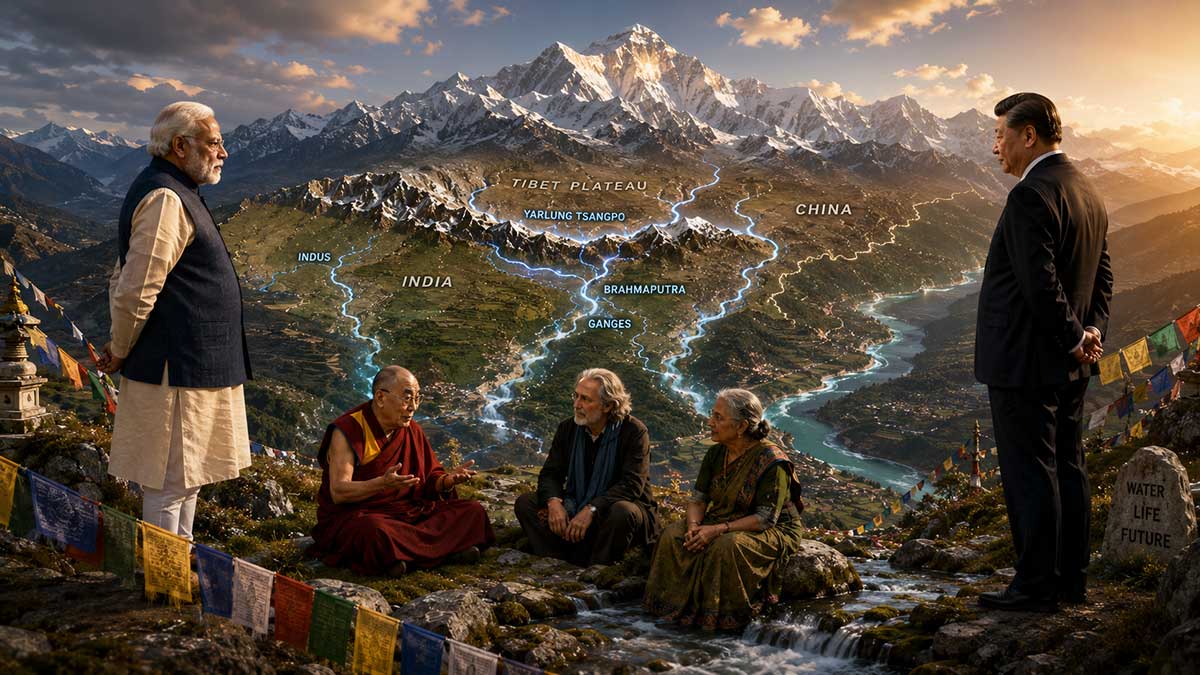
Opening
Craig Hamilton-Parker:
The Himalayas are often pictured as a natural wall separating great civilizations.
Yet a mountain range does more than divide. It stores snow, feeds rivers, shapes borders, protects armies, and sustains communities living far beyond its visible horizon.
India and China share one of the most consequential frontiers on Earth. It crosses disputed territory, high-altitude valleys, glaciers, sacred lands, and river systems supporting immense populations.
Prime Minister Modi sees India as an independent civilization that must never become subordinate to either China or the West.
President Xi sees Tibet and the Himalayan frontier as essential to China’s security, territorial unity, and control of its western approaches.
The Dalai Lama sees a spiritual homeland whose fate has become inseparable from Chinese and Indian rivalry.
Vandana Shiva sees water, agriculture, and local communities placed beneath the ambitions of large states.
I sense that the deepest confrontation between India and China may not begin with ideology or trade.
It may begin when both sides look at the same river and fear that there will no longer be enough.
Question 1: Who Has the Right to Control Water That Crosses Borders?
Vandana Shiva:
A river cannot be owned in the same manner as a factory, road, or military base.
It begins in one place, passes through another, supports farms, forests, animals, villages, and cities, then continues beyond every political claim placed upon it.
When a state treats the source of a river as private property, it forgets that life downstream depends on decisions made upstream.
Water is not merely a resource. It is a relationship.
Xi Jinping:
Every government has the right to manage water within its territory.
China must provide energy, irrigation, flood control, and drinking water for its people. Infrastructure projects are necessary for national development.
Foreign criticism often presents Chinese dams as threats without acknowledging China’s own environmental and economic needs.
Narendra Modi:
The concern is not that China uses water.
The concern is that decisions affecting millions of Indians may be made without transparency, shared data, or dependable consultation.
A dam, diversion project, or sudden release of water can affect agriculture, flood risk, and regional security far beyond the Chinese border.
Trust cannot exist when one country controls the source and the other receives limited information.
The 14th Dalai Lama:
Water teaches interdependence more clearly than politics does.
Snow falls in Tibet. Rivers move into India, Nepal, Bhutan, Bangladesh, and Southeast Asia. No border can prevent that movement without harming life.
The Tibetan plateau is sometimes called the roof of the world. It could equally be called a reservoir for many civilizations.
Its protection should not be treated as a narrow national question.
Xi Jinping:
Tibet is part of China. Its development and environmental management are matters of Chinese sovereignty.
International language about shared responsibility can become a method of interfering in internal affairs.
Vandana Shiva:
Sovereignty cannot mean freedom to damage the conditions sustaining people outside your border.
If actions taken upstream reduce water flow, damage ecosystems, or threaten downstream farming, then the effects are international whether the government accepts that description or not.
Craig Hamilton-Parker:
President Xi, would China accept binding agreements requiring shared data, environmental review, and limits on projects that could severely affect India?
Xi Jinping:
China supports practical cooperation when it respects sovereignty and avoids politicization.
Narendra Modi:
That answer leaves every major decision under Chinese control.
India does not seek authority over Tibet. India seeks confidence that its water security cannot become leverage during a future crisis.
Xi Jinping:
India is developing its own dams, roads, military positions, and infrastructure in disputed areas.
China could ask the same question: can India’s development become strategic pressure against China?
Narendra Modi:
India’s projects do not control the headwaters of rivers supporting large parts of China.
The position is not equal.
The 14th Dalai Lama:
Arguments about equality can continue without end.
One side possesses the source.
Another possesses the downstream population.
Both possess fear.
The river possesses neither passport nor army.
The true danger comes when water is viewed through military suspicion. Every dam becomes a weapon. Every tunnel becomes a secret diversion. Every dry season becomes an accusation.
Craig Hamilton-Parker:
That may be how a future conflict begins—not through one dramatic act, but through years of suspicion.
A reduced flow.
An unexplained construction project.
A failed harvest.
A flood released during military tension.
A government may insist that climate caused the problem. The neighboring country may believe it was deliberate.
Once water becomes part of national defense planning, every environmental change can be interpreted as hostility.
Question 2: Can India Remain Independent When Rival Blocs Demand Loyalty?
Narendra Modi:
India will not exchange one form of dependence for another.
We cooperate with the United States in technology, defense, and regional security.
We maintain relations with Russia.
We trade with China, compete with China, and confront China where our interests conflict.
India does not exist to become the eastern edge of a Western alliance or the subordinate partner of an Asian order led by Beijing.
India will choose according to Indian interests.
Xi Jinping:
Strategic autonomy sounds principled, yet India is moving closer to countries seeking to contain China.
Naval exercises, defense agreements, technology partnerships, and cooperation through the Quad create a clear pattern.
India says it is independent, then joins structures directed against China.
Narendra Modi:
India moved closer to those partners partly after repeated pressure along our border.
When Chinese forces challenge established positions, build infrastructure near disputed territory, and deepen ties across the Indian Ocean, India must respond.
You cannot create concern and then condemn the response as containment.
Vandana Shiva:
Both governments speak of national independence, yet ordinary communities often become more dependent on distant institutions.
Military roads cross fragile regions.
Large dams displace villages.
Mining projects damage water systems.
Border competition brings more soldiers, more construction, and less local control.
A country can become stronger on paper as its people lose control over land and water.
The 14th Dalai Lama:
India’s independence has a spiritual dimension beyond military alignment.
India gave the world traditions teaching nonviolence, inner freedom, and the unity of life.
Its strength will not be measured only by missiles, markets, or alliances.
The question is whether India can rise without copying the conduct of powers it once resisted.
Narendra Modi:
Spiritual ideals cannot replace national defense.
India has learned the cost of weakness. A civilization that cannot protect itself may lose the freedom to express its spiritual values.
Craig Hamilton-Parker:
Prime Minister Modi, what happens if tension with China reaches a point where the United States demands a formal commitment?
Would India join a military coalition?
Would it permit foreign forces greater access?
Would strategic autonomy survive a direct threat?
Narendra Modi:
India would act according to the nature of the threat.
We will cooperate where interests converge. We will not surrender decision-making authority.
Partnership is not obedience.
Xi Jinping:
China may hear those words and prepare for the possibility that India will eventually align fully with the United States.
Preparation on our side then creates further preparation on yours.
Narendra Modi:
That cycle begins to weaken when China respects India as an equal civilization rather than a secondary Asian state.
Xi Jinping:
China respects India, but respect does not require accepting every Indian claim.
Vandana Shiva:
The language of equality between states often hides inequality within them.
Who speaks for the farmers depending on Himalayan rivers?
Who speaks for the people displaced by border infrastructure?
Who speaks for future generations inheriting depleted land?
National strategy tends to count territory and production. It rarely counts damaged soil, polluted water, or uprooted communities with the same seriousness.
Craig Hamilton-Parker:
India may become one of the century’s dominant states. Its population, economy, military, technology, and diaspora give it immense potential.
Yet its greatest test may not be whether it can resist China.
It may be whether it can gain strength without becoming trapped in the same habits of domination it criticizes in older empires.
Question 3: Can Shared Spiritual Traditions Restrain Conflict?
The 14th Dalai Lama:
India and China are not strangers.
Buddhism traveled from India into China. Monks, scholars, merchants, and pilgrims crossed difficult terrain long before modern borders were drawn.
Ideas moved where armies now stand.
This history reminds us that mountains once connected civilizations through spiritual exchange.
Compassion is sometimes dismissed as weakness in international affairs.
True compassion requires courage. It asks a leader to recognize the humanity of an opponent when anger makes dehumanization politically useful.
Xi Jinping:
Spiritual history deserves respect, yet modern states cannot govern through religious sentiment.
China is responsible for territorial integrity, economic stability, and the security of its people.
Foreign religious figures cannot determine Chinese policy.
The 14th Dalai Lama:
I am not asking religion to command the state.
I am asking whether the state can recognize limits to its own authority.
No government can permanently command memory, faith, language, or human dignity through force.
Narendra Modi:
India’s spiritual traditions teach that strength and restraint are not opposites.
The Bhagavad Gita does not offer a simple rejection of conflict. It asks what duty requires when every choice carries moral consequence.
A leader may be forced to defend his people.
He must still examine pride, anger, attachment, and desire for glory.
Vandana Shiva:
Spiritual language becomes dangerous when it is used to sanctify national ambition.
Civilizations can describe rivers as sacred, then poison them.
They can praise the Earth as mother, then strip forests and displace indigenous communities.
Sacred words have meaning only when reflected in material choices.
Craig Hamilton-Parker:
Could spiritual identity reduce conflict, or could it intensify it?
A sacred mountain may inspire protection.
It may equally make compromise impossible.
A holy river may unite communities.
It may equally become part of a nationalist claim.
The 14th Dalai Lama:
Anything precious can be misused by the ego.
Religion is no exception.
When spiritual identity becomes a weapon against another people, its inner meaning has been lost.
Xi Jinping:
This is one reason states must prevent religion from becoming a separatist instrument.
The 14th Dalai Lama:
Control cannot create genuine harmony.
Silence produced by fear is not unity.
Narendra Modi:
India faces a parallel challenge.
We honor a civilizational inheritance rooted in Hindu traditions, yet India contains many faiths, languages, and communities.
National confidence must not become permission to deny another citizen’s belonging.
The same principle applies internationally.
China’s unity cannot require Tibetans to surrender every part of their identity.
India’s rise cannot require neighboring states to accept Indian superiority.
Vandana Shiva:
Nor can economic growth require the Earth to surrender endlessly.
The border conflict and the water conflict come from a shared illusion: that control can continue without limit.
Control the plateau.
Control the river.
Control the valley.
Control the market.
Control the population.
At some point, the living system refuses.
Craig Hamilton-Parker:
That refusal may come through drought, flood, crop failure, migration, or political unrest.
I sense that India and China will face a serious confrontation in the future.
The trigger may appear military, but beneath it will be deeper questions concerning water, territory, identity, and which civilization believes it should define Asia’s future.
The conflict is not fixed.
A prediction is a warning, not a command.
The purpose of seeing a dangerous path is to recognize where another path must be built.
Closing
Vandana Shiva:
India and China may compete over borders, trade, influence, technology, and military reach.
Yet neither country can negotiate with a dying glacier.
Neither army can order rain to fall.
Neither government can replace a river system after it has been damaged beyond recovery.
The Himalayas expose the weakness beneath every claim of national control.
Water moves across borders.
Climate ignores sovereignty.
Pollution travels.
Ecological collapse sends its consequences into every society, including those that believed wealth or military strength would protect them.
A lasting peace between India and China will require more than agreements between leaders.
It will require shared river data, protection of fragile regions, respect for local communities, restraint in military construction, and recognition that upstream control creates downstream responsibility.
India must decide whether its rise will defend living systems or sacrifice them for status.
China must decide whether territorial control is worth permanent suspicion from every nation receiving water from the Tibetan plateau.
Both civilizations speak of harmony.
The rivers will reveal whether that word carries any real meaning.
Our final conversation moves from the mountains to the narrow waterways where a few miles of sea could interrupt fuel, food, trade, and daily life across the planet.
Topic 5: Five Narrow Passages That Could Bring the Global Economy to a Halt
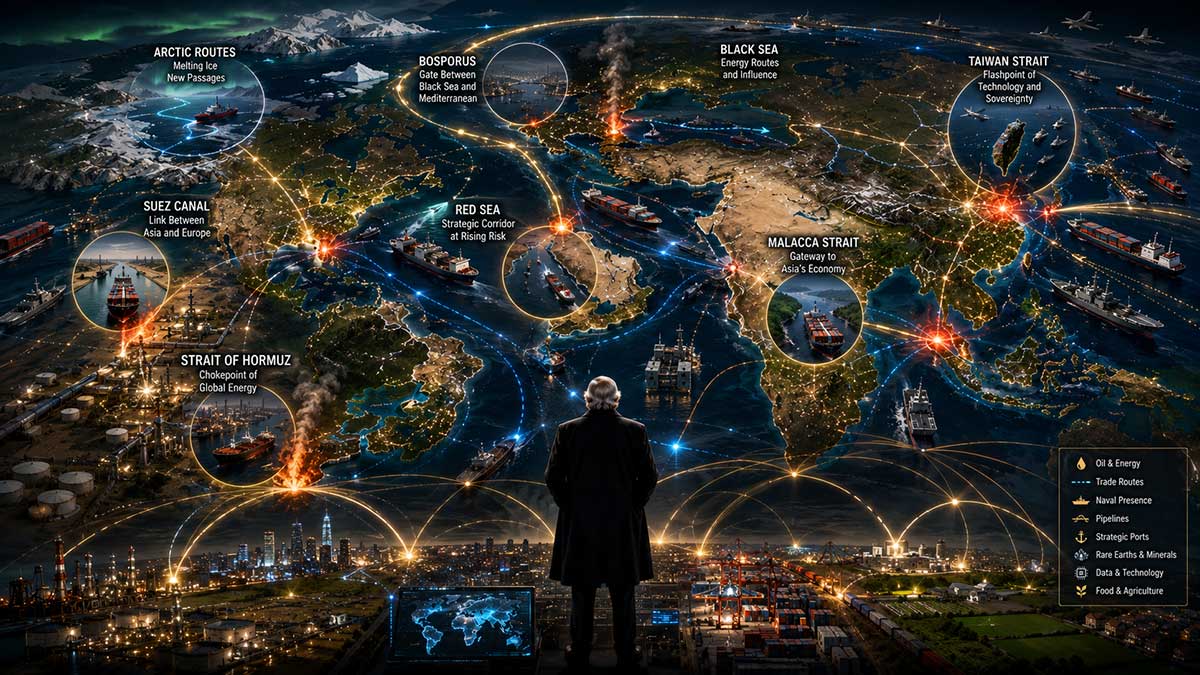
Opening
Craig Hamilton-Parker:
The most dangerous places on Earth are not always the largest countries, the richest capitals, or the strongest military bases.
Sometimes they are narrow stretches of water.
A strait can look insignificant on a map. Yet through that narrow space may pass oil, food, medicine, manufactured goods, military vessels, and the daily needs of millions of people.
The Strait of Hormuz can affect energy prices across the planet.
The Malacca Strait connects the Indian Ocean with East Asia.
The Bosporus controls movement between the Black Sea and the Mediterranean.
The Suez Canal and Red Sea link Europe with Asia.
The Taiwan Strait stands at the center of one of the most dangerous rivalries of our age.
Farther north, melting ice may open Arctic routes that create a new contest between Russia, Canada, America, Europe, and China.
Alfred Thayer Mahan believed sea control shaped national greatness. Halford Mackinder warned that land, railways, and continental depth could challenge maritime empires. Peter Zeihan sees geography and trade networks setting limits on globalization. Niall Ferguson sees the same patterns returning beneath new political language.
I see flames around these narrow points on the map.
The question is no longer whether they matter.
It is what happens when one of them closes.
Question 1: How Can a Small State Threaten a Much Larger Economy?
Alfred Thayer Mahan:
Sea influence does not depend solely upon the size of a nation.
It depends upon position.
A country controlling a narrow passage may possess leverage far beyond its population, territory, or industrial capacity.
A fleet positioned at the correct point can force larger states to alter trade, deploy naval forces, and accept tremendous expense.
The sea rewards concentration.
You do not need to control every ocean if you can control the point through which your opponent must pass.
Craig Hamilton-Parker:
This is what concerns me about Iran.
Iran does not need to defeat the United States in a conventional naval war.
It needs to make the Strait of Hormuz dangerous enough that shipping slows, insurance costs rise, oil prices climb, and foreign governments face pressure from their own citizens.
A few boats, mines, drones, missiles, or attacks on commercial vessels could cause consequences far beyond the immediate area.
Peter Zeihan:
The key word is disruption.
Global trade was built on the assumption that shipping lanes would remain cheap, open, and predictable.
A tanker does not need to be sunk for the system to react. If insurers believe the risk has risen, prices change. If crews refuse routes, shipping schedules change. If navies begin escorting vessels, military costs rise.
The market responds to fear before it responds to physical scarcity.
Niall Ferguson:
History repeatedly shows smaller powers exploiting narrow positions.
Empires often appear dominant until they encounter a place where their size becomes awkward.
Britain understood this through Gibraltar, Suez, Malta, and Singapore.
Control of passages allowed a relatively small island state to influence a vast trading system.
The same logic can work against a great empire. A rival does not need to destroy the empire. It needs to interrupt the routes holding it together.
Halford Mackinder:
Yet maritime control has limits.
A country with sufficient land routes, rail systems, energy reserves, and continental depth can reduce dependence upon vulnerable sea passages.
The deeper contest is between maritime networks and land-based alternatives.
China’s investments across Eurasia are partly an effort to reduce dependence on sea routes vulnerable to foreign navies.
Russia’s interest in the Arctic is partly an effort to create routes less exposed to traditional Western maritime control.
Alfred Thayer Mahan:
Land routes can reduce pressure, but they rarely replace the scale and efficiency of maritime trade.
Moving large quantities of energy and goods by sea remains cheaper than moving them across vast land distances.
A state that controls sea access retains enormous influence.
Peter Zeihan:
That influence depends on the willingness and ability to use it.
The United States has spent decades securing maritime trade, including trade benefiting countries that compete with it.
If Washington becomes less willing to carry that cost, the system grows more fragile.
Regional states then need to protect their own routes, and many lack the naval capacity.
Craig Hamilton-Parker:
President after president speaks of protecting freedom of navigation.
Yet the public hears a moral phrase, while military planners see fuel, shipping, alliances, and strategic access.
The language of principle may be sincere.
The map still decides where ships must go.
Niall Ferguson:
There is another danger.
Once a smaller state learns that disruption brings attention and leverage, others imitate the method.
Militias, proxy groups, pirates, and regional governments can all threaten trade without declaring formal war.
This creates conflict beneath the threshold that would trigger a full military response.
Halford Mackinder:
The strongest answer is redundancy.
A system depending upon one passage is vulnerable.
A system with alternative ports, pipelines, railways, storage, and supply sources can absorb pressure.
The modern economy became efficient by removing redundancy.
It may rediscover that efficiency without resilience is a form of weakness.
Craig Hamilton-Parker:
That is the hidden danger.
The world has treated open trade as permanent.
It may discover that a narrow passage can turn convenience into panic within days.
Question 2: Are Nations Protecting Trade—or Seeking the Right to Control It?
Niall Ferguson:
Great powers rarely describe their actions as attempts to control commerce.
They speak of order, stability, security, and freedom.
The British Empire claimed to protect trade routes.
The United States used similar language after replacing Britain as the dominant maritime state.
China now speaks of protecting its trade and development.
Each power presents its reach as necessary and its rival’s reach as threatening.
Peter Zeihan:
Control is unavoidable to some degree.
Someone must patrol routes, respond to piracy, maintain communications, and keep conflict from closing shipping lanes.
The issue is who pays, who benefits, and who sets the rules.
For decades, the United States paid much of the security cost, and the rest of the world benefited.
That arrangement is becoming politically harder to defend inside America.
Alfred Thayer Mahan:
Sea strength has never been neutral.
A navy protects commerce connected to national interest.
A state may describe the sea as open to all, yet it will favor routes, ports, and commercial systems strengthening its own position.
Naval protection and commercial influence grow together.
Halford Mackinder:
This is why continental powers distrust maritime empires.
A navy can claim to protect trade, then blockade an opponent when war begins.
The same fleet that guards shipping in peace can become an instrument of economic strangulation.
China understands this danger in the Malacca Strait.
Russia understands it in the Baltic and Black Sea.
Iran understands it in Hormuz.
Craig Hamilton-Parker:
Then freedom of navigation may mean freedom under rules enforced by the strongest navy.
Alfred Thayer Mahan:
Order always rests upon capacity.
Rules without force are requests.
Niall Ferguson:
Yet force without legitimacy creates resistance.
The British imperial system weakened partly when its claim to universal benefit no longer persuaded those living under it.
America faces a related problem. It sees itself as maintaining global order. Rivals see a system built to preserve American advantage.
China presents infrastructure and trade as partnership. Critics see economic dependence and strategic access.
Every empire prefers the word “system.”
Peter Zeihan:
The distinction matters less when ships stop moving.
Countries may argue about legitimacy, yet they still need energy, fertilizer, food, and industrial components.
The practical question becomes who can reopen the route.
That usually means naval force.
Halford Mackinder:
Or replacing maritime dependence with continental systems.
China’s rail corridors, pipelines, ports, and infrastructure partnerships are not isolated projects.
They form an attempt to reduce vulnerability to maritime pressure.
Niall Ferguson:
Yet those land corridors create new dependencies.
A railway crossing several states can be blocked by political upheaval, debt, sabotage, or war.
No route escapes politics.
Craig Hamilton-Parker:
This may be the deeper truth.
Nations do not seek freedom from control.
They seek control they can trust.
China wants routes not controlled by America.
America wants routes not vulnerable to China, Iran, or Russia.
Europe wants energy without political dependence.
India wants access without choosing a permanent bloc.
Every attempt to escape another nation’s leverage creates a new contest for ports, pipelines, railways, islands, and alliances.
Alfred Thayer Mahan:
A state unable to protect its commerce depends upon the mercy of others.
No serious power will accept that condition indefinitely.
Peter Zeihan:
That is why the postwar trade system may fragment.
Countries will shorten supply chains, stockpile critical goods, build domestic capacity, and choose politically safer partners.
Trade may continue, but it will become more expensive and less universal.
Craig Hamilton-Parker:
The public may experience this through higher prices and shortages.
The strategic shift will have begun much earlier, when governments stopped believing that open routes could be taken for granted.
Question 3: Will Rare Earths, Water, and Arctic Routes Replace Oil as the Main Sources of Conflict?
Halford Mackinder:
Oil shaped much of the twentieth century, yet strategic geography changes when technology changes.
Rare-earth minerals, lithium, cobalt, copper, uranium, freshwater, fertile land, and data infrastructure now influence national strength.
The value of a location depends upon what civilization needs from it.
A desert once dismissed may become valuable through solar energy.
An icy sea once considered impassable may become a major route.
A remote mine may become essential to military and industrial production.
Craig Hamilton-Parker:
I said some time ago that rare-earth metals would become a major source of tension.
China possesses enormous influence over their production and processing.
When tariffs or political pressure rise, minerals become a weapon.
This is why Ukraine’s resources attract interest.
It is why space mining will matter.
It is why nations are searching for alternatives before a crisis forces them to do so.
Peter Zeihan:
Rare earths matter, but the issue is often processing rather than geological scarcity.
Many countries possess deposits. China built the industrial chain required to refine them at scale.
Rebuilding that chain elsewhere takes money, time, skilled workers, energy, and political patience.
Governments ignored the dependency when Chinese supply was cheap.
They now want resilience without accepting the full cost.
Niall Ferguson:
This mirrors earlier imperial patterns.
Britain sought coal stations and naval bases.
Industrial powers sought oil fields and pipelines.
Modern powers seek semiconductor supply, battery materials, data centers, undersea cables, and mineral processing.
The language changes. The struggle over strategic concentration remains.
Alfred Thayer Mahan:
Sea routes will remain central, since minerals must move from mines to factories and from factories to markets.
Control of extraction means little without reliable transport.
Halford Mackinder:
The Arctic may alter the balance.
As routes become more accessible, Russia’s northern position gains value.
Canada, the United States, Denmark, Norway, and other states will defend claims and access.
China may seek influence despite lacking an Arctic coastline comparable to those countries.
The region could become a new frontier where maritime and continental strategies meet.
Craig Hamilton-Parker:
When I look ahead, I see the Arctic becoming an area of rivalry.
The melting ice is often discussed as an environmental tragedy, which it is.
Governments will equally see shorter shipping routes, minerals, military positions, and new forms of access.
A crisis may arise from competing claims hidden beneath scientific or commercial language.
Peter Zeihan:
The Arctic is not an easy replacement for traditional routes.
Conditions remain harsh. Infrastructure is limited. Search and rescue capacity is thin. Ports are few. Insurance costs are high.
Its strategic value may rise long before it becomes commercially dependable.
Niall Ferguson:
That can make it more dangerous.
States may compete over anticipated value before the region is fully usable.
History contains many struggles over expected wealth.
Craig Hamilton-Parker:
Water may become even more emotionally powerful than minerals.
A country can substitute one metal with another.
A population cannot substitute water.
Drought, river diversion, glacier loss, and failed agriculture can drive migration, unrest, and conflict.
Halford Mackinder:
Water conflict will usually overlap with borders, dams, agriculture, and state weakness.
It may not appear as a war declared over water.
It may appear as a border confrontation, internal rebellion, migration crisis, or dispute over infrastructure.
Alfred Thayer Mahan:
Food and water will still depend upon transport.
A region suffering shortages may survive through imports only if routes remain open.
This returns us to the sea.
Peter Zeihan:
The world is moving from a system built for maximum efficiency into one shaped by security.
Oil will remain vital.
Rare earths will matter more.
Water pressure will rise.
Arctic competition will grow.
The major shift is that governments are beginning to ask where every critical input comes from and whether an adversary can interrupt it.
Craig Hamilton-Parker:
That question will shape the next era.
Not merely, “What do we need?”
But, “Who controls the route?”
“Who owns the source?”
“Who can close the passage?”
“Who can survive without it?”
Closing
Niall Ferguson:
Empires rarely collapse from one dramatic blow.
They weaken when the systems connecting them become too expensive, too exposed, or too difficult to defend.
A canal closes.
A port becomes hostile.
An ally changes sides.
A resource becomes scarce.
A fleet is stretched across too many commitments.
A public loses patience with costs it no longer believes are justified.
The narrow passages discussed here are not isolated points.
They are pressure valves in a global system.
Hormuz links energy to political stability.
Malacca links China’s economic life to maritime vulnerability.
The Bosporus links Russian ambition to Turkish authority.
Suez and the Red Sea link European consumption to Asian production.
The Taiwan Strait links national identity to global technology and military credibility.
The Arctic may link environmental decline to a new race for access and resources.
The danger comes when leaders believe they can apply limited pressure at one point without affecting the entire system.
A blockade meant to intimidate one country can raise prices everywhere.
A missile fired at one vessel can bring several navies into the same water.
A mine closed for political reasons can delay production across continents.
A river diverted upstream can destabilize societies far downstream.
The map does not create war by itself.
It creates temptation.
It offers leverage to those willing to risk the suffering of people who may never know the name of the strait, port, river, or mine affecting their lives.
The future may belong to the state with the strongest army.
It may belong to the state with the largest economy.
Yet it may equally belong to the state that learns how to protect its routes, diversify its needs, and resist the urge to turn every vulnerability into a weapon.
The narrowest places on the map may decide the widest consequences.
Final Thoughts by Craig Hamilton-Parker
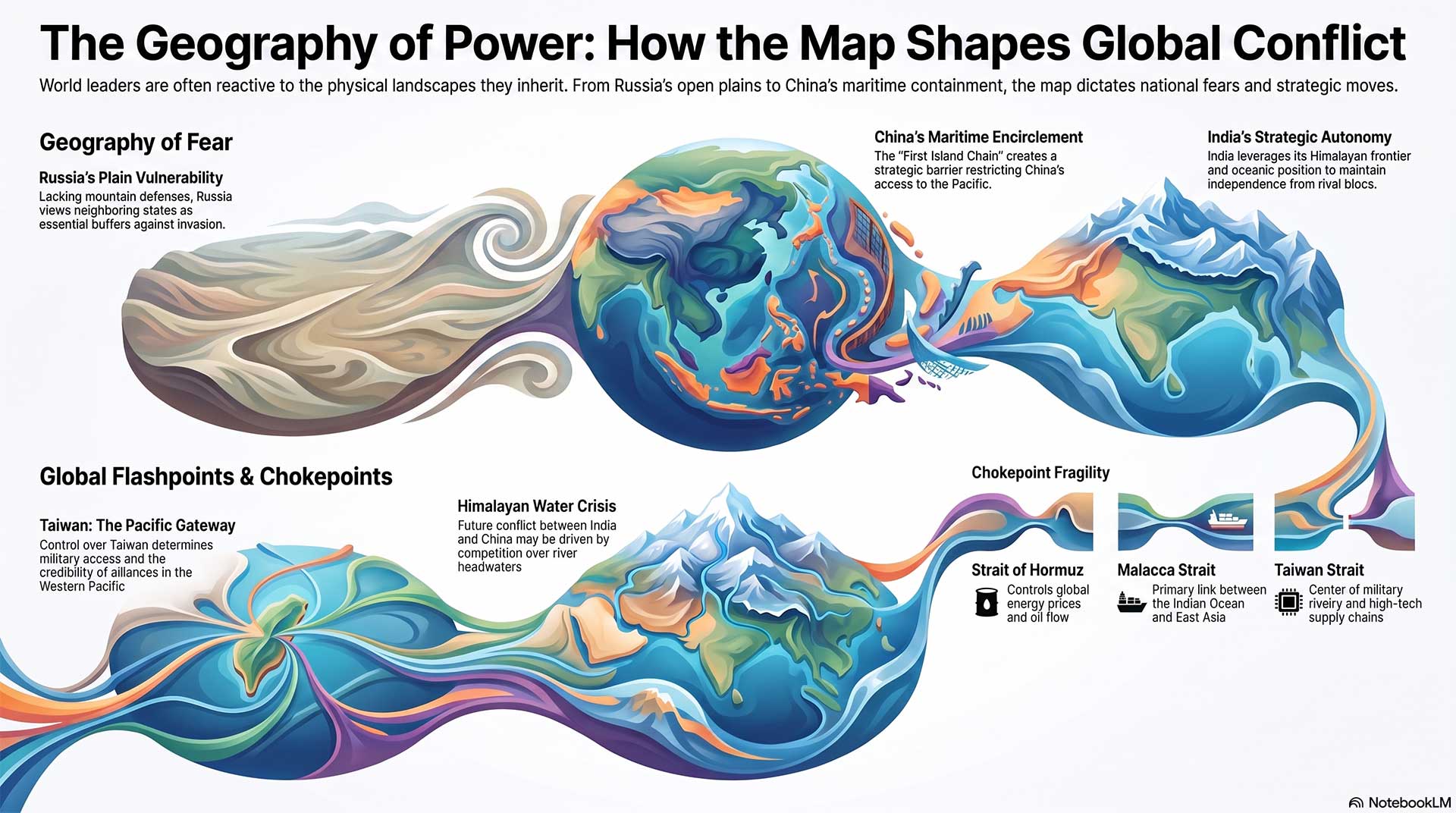
When people look at the news, they usually see names.
Trump.
Putin.
Xi.
Modi.
Tomorrow it will be different names.
Yet I have become increasingly convinced that history remembers something else.
It remembers places.
Crimea.
Taiwan.
The Strait of Hormuz.
The Malacca Strait.
The Himalayas.
The Bosporus.
The Arctic.
Leaders arrive believing they are making completely new decisions.
Then they discover they have inherited ancient fears.
One fears invasion.
Another fears isolation.
Another fears losing trade.
Another fears losing water.
Another fears losing influence.
Every generation believes its conflicts are unique.
Often they are old conflicts wearing modern clothes.
That realization should not make us pessimistic.
Quite the opposite.
If geography explains part of our history, it does not imprison our future.
Human beings still possess imagination.
Diplomacy still matters.
Wisdom still matters.
Compassion still matters.
Maps reveal where pressure exists.
They never determine whether leaders choose dialogue or destruction.
Perhaps that is the greatest lesson.
History gives us geography.
Character decides what we do with it.
May we become the generation remembered not for the wars we inherited...
...but for the ones we prevented.
Short Bios:
Donald Trump served as the 45th and 47th President of the United States. Known for his transactional negotiating style and "America First" approach, he views international affairs largely through leverage, economic interests, and strategic advantage. His foreign policy emphasizes burden-sharing among allies, economic competition with China, and unpredictable diplomacy designed to strengthen deterrence.
Vladimir Putin has led Russia for more than two decades as President and Prime Minister. His worldview is deeply influenced by Russian history, national security, and the collapse of the Soviet Union. He frequently argues that Russia requires strategic depth and secure borders to prevent future threats, making geography central to his understanding of international relations.
Xi Jinping serves as General Secretary of the Chinese Communist Party and President of China. His leadership focuses on national rejuvenation, long-term planning, technological development, military modernization, and eventual reunification with Taiwan. He views China's future through the lens of centuries rather than election cycles, emphasizing stability, sovereignty, and China's return as a major global civilization.
Narendra Modi has served as Prime Minister of India since 2014. His leadership combines economic modernization, national confidence, and India's civilizational heritage. He seeks to strengthen India's global influence while maintaining strategic independence, avoiding permanent alignment with either Western or Chinese spheres of influence. His vision positions India as one of the defining powers of the twenty-first century.
Craig Hamilton-Parker is a British psychic medium, author, and commentator known for combining spiritual intuition with observations about world affairs. His geopolitical discussions often connect geography, history, and leadership psychology with intuitive impressions about future events. Throughout this imaginary conversation, Craig serves as moderator, challenging each participant to examine whether humanity can choose wisdom over repeating the patterns of history.
Sun Tzu was the ancient Chinese military strategist traditionally credited with writing The Art of War. His teachings on strategy, deception, preparation, and avoiding unnecessary conflict continue to influence military leaders, business executives, and political thinkers around the world.
General Douglas MacArthur was one of America's most influential military commanders during World War II and the Korean War. His deep understanding of Pacific geography, amphibious operations, and strategic islands makes him an important voice in discussions about Taiwan and Indo-Pacific security.
Volodymyr Zelenskyy has served as President of Ukraine since 2019. Rising from a career in entertainment, he became an international symbol of Ukrainian resistance following Russia's 2022 invasion. His leadership emphasizes national sovereignty, democratic values, and international cooperation.
Henry Kissinger (1923–2023) served as U.S. Secretary of State and National Security Advisor. Widely regarded as one of the twentieth century's most influential geopolitical strategists, he advocated balance-of-power diplomacy while recognizing both the moral and strategic challenges facing world leaders.
Józef Piłsudski (1867–1935) was a Polish statesman, military commander, and founding leader of modern independent Poland. His lifelong concern centered on protecting Poland's sovereignty between larger neighboring powers, making his perspective especially relevant to discussions about Eastern Europe.
The 14th Dalai Lama, Tenzin Gyatso, is the spiritual leader of Tibetan Buddhism and an internationally respected advocate for compassion, religious freedom, and peaceful dialogue. Living in exile since 1959, he continues to encourage nonviolent solutions to political and cultural conflicts.
Dr. Vandana Shiva is an Indian environmental activist, physicist, author, and advocate for biodiversity, sustainable agriculture, and water conservation. Her work highlights the relationship between ecology, food security, local communities, and global development.
Alfred Thayer Mahan (1840–1914) was an American naval officer and historian whose book The Influence of Sea Power upon History transformed modern strategic thinking. His ideas demonstrated how maritime trade routes and naval strength shape the rise and decline of great powers.
Sir Halford Mackinder (1861–1947) was a British geographer and geopolitical scholar best known for his Heartland Theory. He argued that geography, transportation, and continental power are fundamental forces influencing global politics and international rivalry.
Peter Zeihan is an American geopolitical strategist and bestselling author specializing in demographics, geography, global supply chains, and international economics. His analyses examine how changing populations and geography reshape the global balance of power.
Sir Niall Ferguson is a British historian, author, and senior fellow known for his work on economic history, empires, finance, and international affairs. His research explores how geography, trade, institutions, and historical cycles influence the rise and decline of nations.
Leave a Reply