
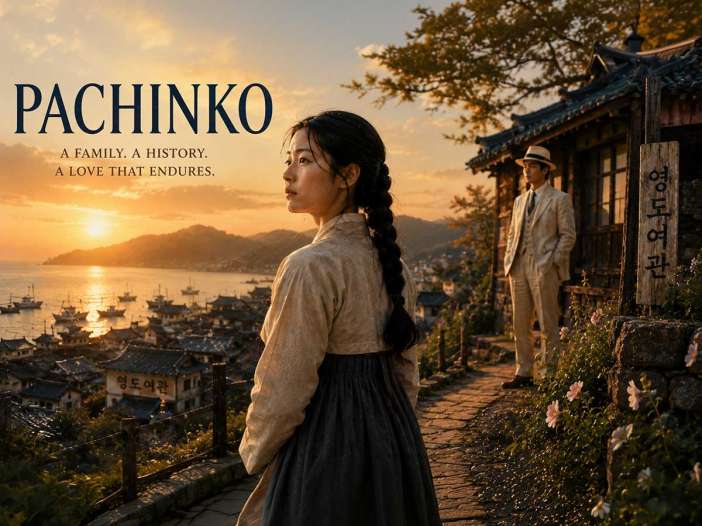
What If the Characters of Pachinko Could Finally Speak Freely?
Few novels capture the quiet weight of history as powerfully as Pachinko by Min Jin Lee. Rather than telling the story of kings, generals, or revolutions, it follows ordinary people whose daily choices ripple across four generations. Love, sacrifice, identity, shame, ambition, forgiveness, and hope become the true forces that shape history.
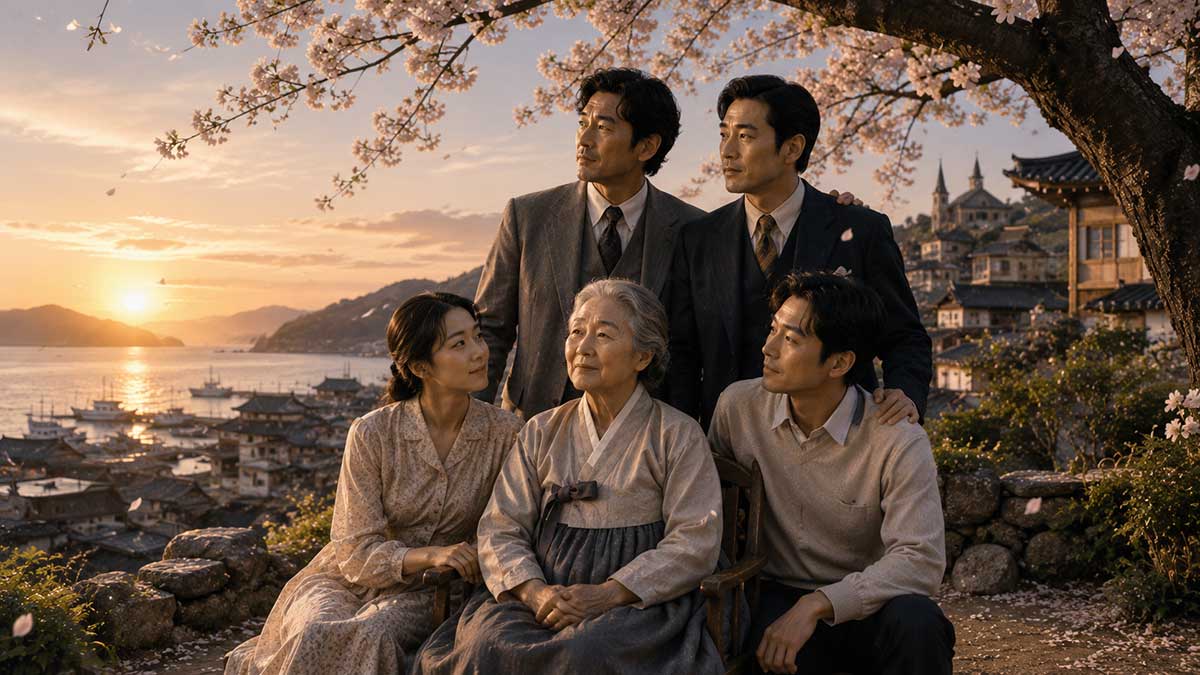
In this imaginary conversation, five voices from different generations finally gather around one table: Sunja, whose courage begins the family's journey; Koh Hansu, whose love and ambition forever alter its course; Isak, whose faith offers a different vision of strength; Mozasu, who refuses to live according to society's expectations; and Solomon, who inherits both the opportunities and burdens created by those before him.
Together they explore questions the novel leaves intentionally unanswered. Can one decision echo across generations? What does it truly mean to belong? Is success worth the price of losing yourself? What do children owe their parents? Is life governed by fate, luck, or the choices we continue to make?
This conversation is an imaginative tribute inspired by Min Jin Lee's novel. It does not attempt to replace the original work. Instead, it offers a space where these unforgettable characters can continue asking the questions that still resonate long after the final page.
(Note: This is an imaginary conversation, a creative exploration of an idea, and not a real speech or event.)
Topic 1: Can One Decision Shape Four Generations?
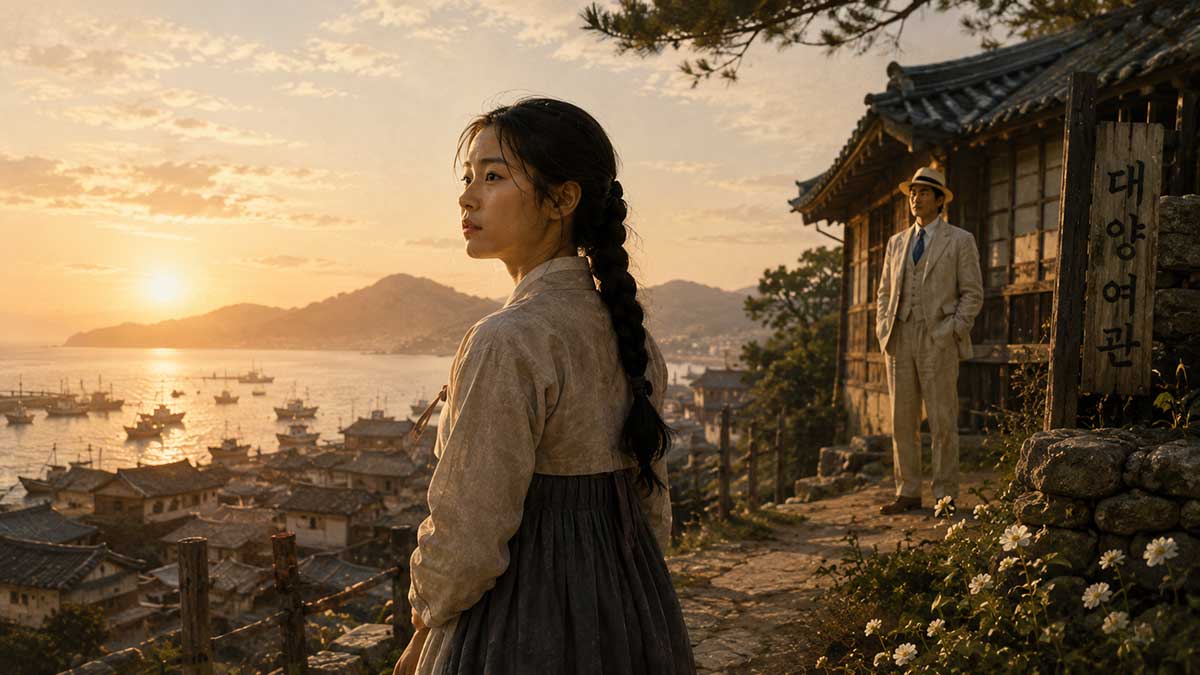
Opening
Sunja:
When I was a young woman in Yeongdo, I believed that one choice would determine only my own future. I never imagined that a single decision would echo through the lives of children and grandchildren I had not yet met. Looking back, I no longer ask whether I chose correctly. I ask a different question: Could anyone truly have chosen differently? Today, I hope we can speak honestly—not to judge one another, but to understand how one moment became the beginning of so many others.
Hansu
You speak as though everything began with your decision. It didn't. History had already decided much of it before either of us was born. Korea was under occupation. Poverty ruled every village. Men like me learned that kindness alone never protected anyone.
Isak
History may shape our circumstances, but it does not erase our responsibility. Every generation receives difficult choices. What matters is the spirit in which those choices are made.
Mozasu
Growing up, I never blamed Mother. I blamed the world. People treated us differently before they even knew our names. Whether you chose Father or Reverend Isak, I doubt society would have welcomed us any more warmly.
Solomon
That's what fascinates me. My generation had better schools, better jobs, and more opportunities. Yet I still discovered invisible walls. Sometimes I wonder whether the first decision mattered less than the system we inherited.
Sunja
Then let me ask all of you something.
If I had accepted Hansu's offer, would any of your lives truly have been better?
Silence settles across the room.
Hansu
Financially? Yes.
Emotionally? I don't know.
Money solves many problems. It cannot buy peace.
Isak
Nor can comfort replace dignity.
A person who sacrifices their conscience gains very little, no matter how comfortable life becomes.
Mozasu
But dignity doesn't feed hungry children either.
I've spent my whole life living between those two truths.
Solomon
Grandmother, did you ever regret refusing Hansu?
Sunja
There were nights when I wondered how different life might have been.
But regret is not the same as wishing I had become someone else.
Hansu
You always believed goodness could overcome reality.
Reality doesn't work that way.
Isak
Reality without goodness eventually destroys itself.
Mozasu
Father...
May I ask something I've never understood?
Were you protecting Mother because you loved her...
...or because you couldn't bear losing something you believed belonged to you?
Hansu lowers his eyes before answering.
Hansu
When I was young, I believed those were the same thing.
Age taught me they are not.
If I truly loved her, I should have let her choose her own happiness without following her shadow for decades.
Sunja
That may be the first time I've heard you say those words.
Solomon
Listening to all of you makes me realize something.
I've spent years trying to escape our family's history.
Perhaps that's impossible.
Perhaps the better question is how to carry it without letting it define every decision.
Isak
Every generation receives an inheritance.
Some inherit land.
Some inherit wealth.
Some inherit wounds.
Yet every generation still chooses what it will pass to the next.
Mozasu
That's what Mother really gave us.
Not perfection.
Not comfort.
The courage to keep standing.
Closing
Sunja:
People often ask whether one decision changed four generations of our family.
Perhaps it did.
But history is never written by one choice alone.
It is written by thousands of quiet decisions that follow—acts of forgiveness, sacrifice, perseverance, and hope.
If our family has any legacy worth remembering, it is not that we escaped suffering.
It is that, despite everything, we never stopped choosing life over despair.
Topic 2: What Makes Someone Belong?
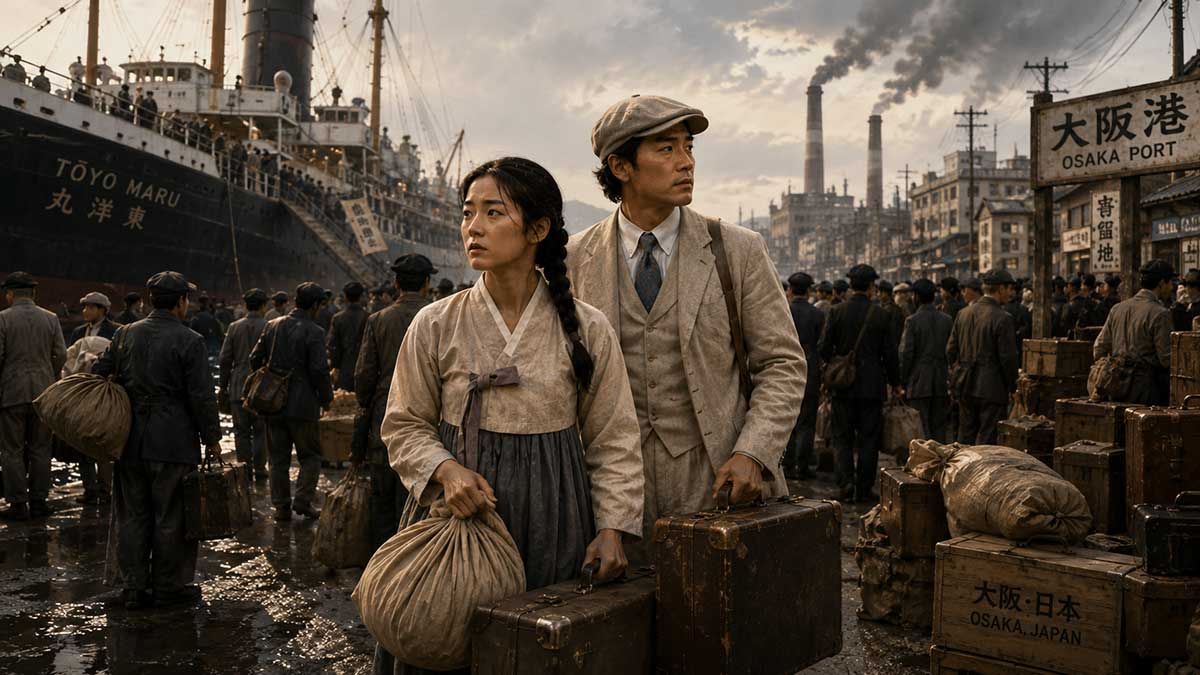
Opening
Solomon:
I grew up believing that belonging could be earned.
Study hard. Speak the language perfectly. Attend the right schools. Work for respected companies. Learn how to enter a room without making anyone uncomfortable.
I thought acceptance was a door, and success was the key.
Then I learned that some doors remain closed no matter how carefully you knock.
So I want to ask all of you: when a country accepts your labor but rejects your name, when your birthplace does not protect you, and when your ancestry follows you into every room, where does belonging begin?
Mozasu
Belonging begins when you stop begging other people to grant it.
I learned that early.
The Japanese saw me as Korean. Koreans sometimes saw me as someone shaped too much by Japan. Fine. Let them think what they want.
I built a life anyway.
Sunja
It is easy to say that after surviving long enough to become strong.
When I first came to Osaka, every street reminded me that I was foreign. I did not know the language well. I did not understand the customs. I missed the sea, the food, and the voices of home.
Yet Korea no longer felt like a place I could simply return to.
Isak
Home is sometimes less a place than a promise.
It is where someone receives you without asking you to prove your worth.
Hansu
That sounds beautiful, but nations do not operate on promises.
They operate on blood, documents, money, and control.
A person can feel at home somewhere for fifty years and still be treated as temporary.
Solomon
Then is nationality nothing more than permission granted by the state?
Hansu
Legally, perhaps.
Emotionally, no.
A government can issue papers. It cannot command affection.
Sunja
When I lived in Korea, I thought being Korean was simple.
After leaving, it became heavier.
It was no longer merely who I was. It became what others used to separate me.
Mozasu
That is why I refused to be ashamed.
The insult belongs to the person giving it.
Solomon
But did you never wish to be accepted?
Mozasu
Of course I did.
Anyone who says otherwise is lying.
The difference is that I stopped allowing rejection to decide whether my life had value.
Isak
There is a danger in tying identity too closely to approval.
A person who depends on acceptance becomes vulnerable to every crowd.
Hansu
And there is a danger in pretending approval does not matter.
It affects work, housing, marriage, education, safety.
Pride cannot erase material consequences.
Sunja
Both of you are right.
The soul may refuse humiliation, yet the body still has to eat.
A mother cannot feed her children with dignity alone.
Solomon
That is what my generation inherited.
We were told to assimilate, but never told what would count as enough.
We changed our speech, our clothes, our ambitions.
Still, someone could look at a family registry and decide who we were before meeting us.
Mozasu
So stop asking whether you are enough for them.
Ask whether the life you built is honest enough for you.
Solomon
That sounds freeing, but it can become lonely.
Mozasu
Freedom often is.
Isak
Perhaps belonging is not found in one country, one language, or one name.
Perhaps it is built through loyalty, memory, and love.
Hansu
That may comfort the heart.
It does not stop discrimination.
Isak
No, but it prevents discrimination from becoming the final authority over a human life.
Sunja
I used to think home was Yeongdo.
Then I thought home was wherever my children slept safely.
Later, I realized home was carried in small things: the food I cooked, the stories I remembered, the names I refused to forget.
Solomon
So a person can belong to more than one place?
Sunja
Yes.
And sometimes to no place completely.
That does not mean the person is empty.
It may mean the person carries several homes at once.
Hansu
Or several wounds.
Sunja
Often both.
Solomon
I still wonder whether someone can truly belong in two countries.
Mozasu
Why limit yourself to two?
You belong to your family, your memories, your work, your failures, your choices.
A nation is only one part of you.
Hansu
Yet nations can decide where you may live and what opportunities you receive.
Isak
Then the task is not to deny that fact.
It is to refuse the belief that legal status defines human worth.
Sunja
No child should have to spend a lifetime proving the right to stand where he was born.
Solomon
Yet many do.
Sunja
Then perhaps belonging begins when one generation refuses to pass that shame to the next.
Closing
Solomon:
I once believed belonging meant entering a room and being treated like everyone else.
Now I think it may mean entering that room without surrendering the parts of yourself others find inconvenient.
A country may question your name.
A company may doubt your loyalty.
A stranger may decide your identity before hearing your voice.
Yet belonging can still be created through family, memory, work, and the decision to live without apology.
Perhaps home is not the place that never rejects us.
Perhaps it is the place within us that rejection cannot erase.
Topic 3: Success or Peace?
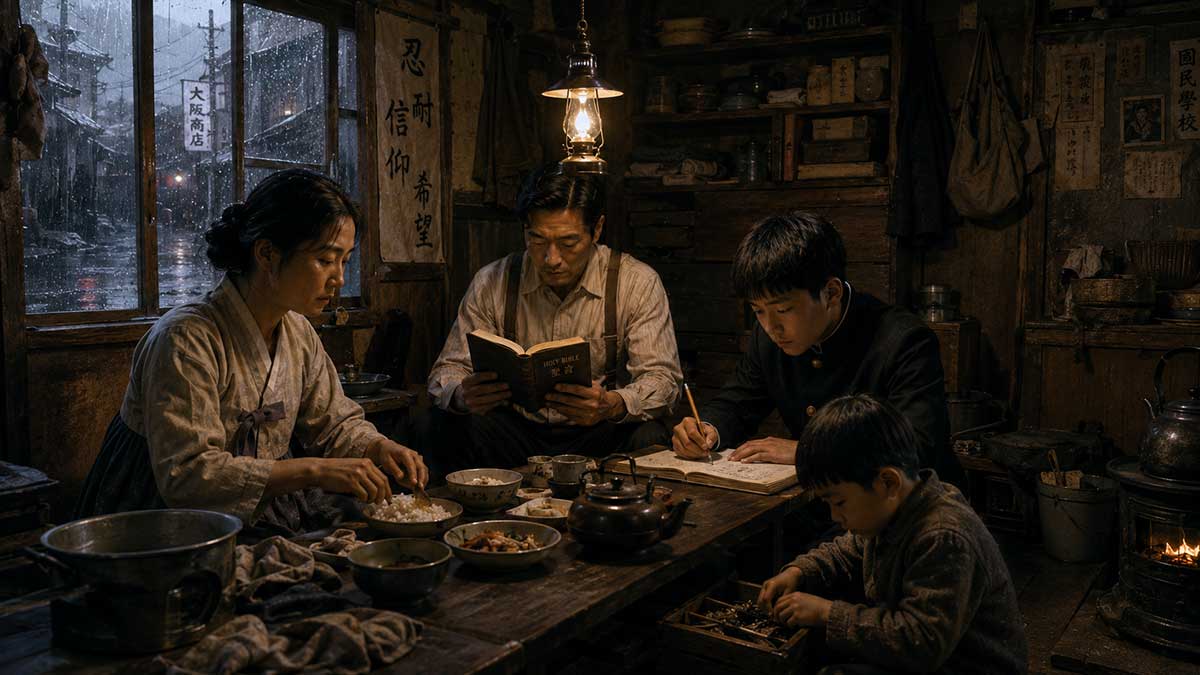
Opening
Mozasu:
People like to look at my life and say I succeeded.
I made money. I raised a son. I built businesses in an industry respectable people pretended to despise but quietly depended on.
My brother Noa chose a different road. He studied, changed his name, entered Japanese society, and tried to become someone no one could reject.
People may say I won and he lost.
I have never believed it was that simple.
Noa wanted peace more than success. I wanted survival more than approval. Both of us paid a price.
Solomon
Father, you often speak as if you never cared what society thought of you.
Yet you built beautiful homes, wore expensive suits, and sent me to the best schools.
Was that freedom, or were you proving something?
Mozasu
Both.
I stopped asking Japan to respect me, but I never stopped wanting my son to enter rooms that had been closed to me.
Sunja
Every parent carries that contradiction.
We tell our children they are enough, then spend our lives trying to protect them from people who disagree.
Hansu
Success is protection.
Anyone who says money does not matter has never watched poverty make decisions for them.
Isak
Money can protect the body.
It cannot always protect the heart.
Hansu
A starving heart still belongs to a starving body.
Solomon
Was Noa wrong to seek acceptance?
Sunja
No.
He wanted an ordinary life.
He wanted to wake each morning without feeling watched.
He wanted his name to carry no accusation.
There was nothing wrong with that wish.
Mozasu
The danger was not that he wanted acceptance.
The danger was that he gave strangers the right to decide whether he deserved to live.
Isak
Noa believed goodness and achievement could cleanse what society called shame.
When he learned that the shame could not be erased, he turned it inward.
Hansu
He was weak.
Sunja
Do not call him that.
Hansu
I do not say it with contempt.
I say it with grief.
I survived by accepting what I was. He tried to survive by denying it.
Sunja
He was your son.
He inherited more than your blood.
He inherited your secrecy.
Mozasu
That is the part people avoid.
Noa did not break only when he learned Hansu was his father.
He broke when he realized the life he had built rested on a truth everyone else had hidden from him.
Solomon
So the betrayal mattered more than the blood?
Mozasu
I think so.
A person can carry a difficult truth.
It is much harder to discover that your entire family believed you could not survive knowing it.
Isak
Love sometimes becomes controlling when it is guided by fear.
People hide truth to protect someone, then the hidden truth grows larger than the original wound.
Sunja
I thought silence would save him.
Mozasu
You did what you believed a mother had to do.
Sunja
That does not mean it was right.
Solomon
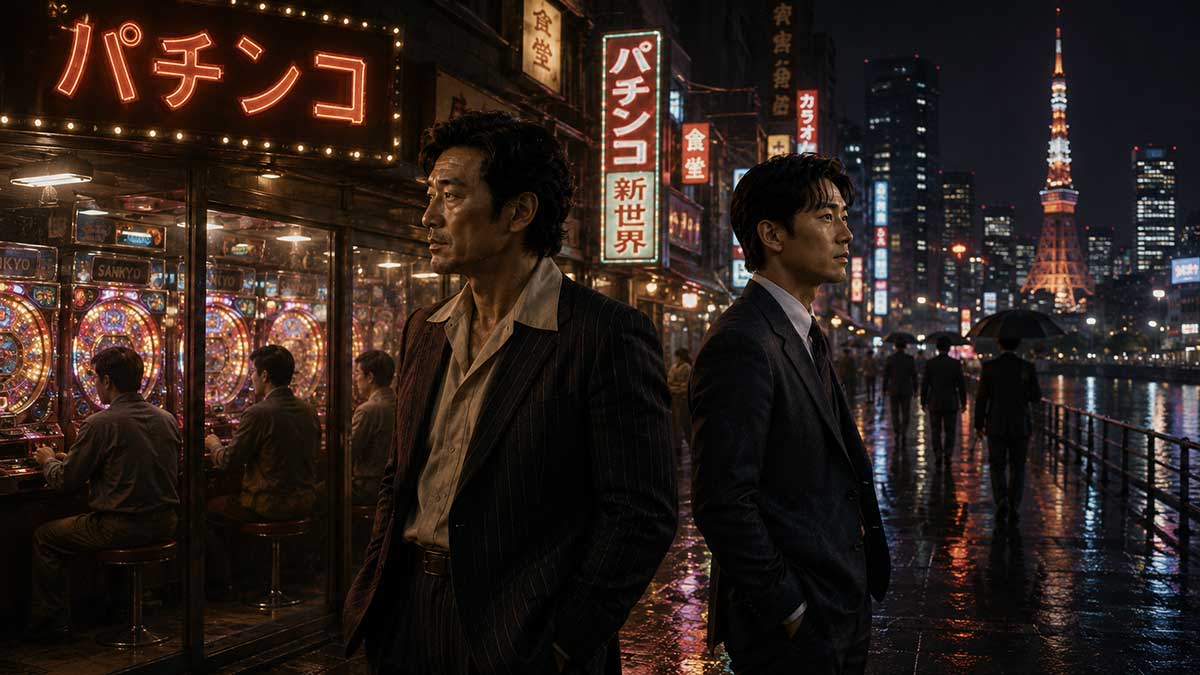
Father, you entered pachinko openly.
Noa entered respectable society under another name.
Were you happier than he was?
Mozasu
Happier? Perhaps.
More peaceful? Not always.
I carried anger for years.
Every insult became fuel.
Every rejection made me work harder.
That kind of ambition can build an empire, but it does not let a man rest.
Hansu
Rest is overrated.
Isak
Only to someone who fears what silence may reveal.
Hansu
Peace without strength is a luxury.
Isak
Strength without peace becomes another prison.
Solomon
Grandmother, what did success mean to you?
Sunja
Food on the table.
Children alive.
Rent paid.
No one taken away in the night.
Later, I learned that survival can become so demanding that people forget to ask whether they are still living.
Mozasu
You taught us to endure.
Sunja
Perhaps too well.
Noa endured quietly until he could not.
You endured loudly until suffering became part of your identity.
Mozasu
That is fair.
Hansu
Success demands hardness.
Sunja
Hardness can keep a person alive.
It can keep love out too.
Solomon
I thought education would free me from all this.
At international schools and foreign universities, identity seemed flexible. People cared about intelligence, language, and connections.
Then I entered business and discovered that old prejudices had simply learned better manners.
Mozasu
Your mistake was thinking a prestigious room was a fair room.
Solomon
You wanted me in those rooms.
Mozasu
I wanted you to have the choice.
I never promised the room would love you.
Solomon
Then what was the point?
Mozasu
The point was that you would enter through the front door, know what the room was, and decide whether to stay.
I never had that choice.
Isak
Perhaps success should be measured by the choices a person gains rather than the praise a person receives.
Hansu
Choice is bought.
Isak
Sometimes.
At other times, choice comes from refusing to become what suffering demands.
Hansu
That sounds noble until someone has children to feed.
Sunja
There is truth in both of you.
Wealth can widen a person's choices.
Character decides what those choices mean.
Solomon
Would Noa have found peace if he had accepted who he was?
Mozasu
I wish I knew.
Sunja
Peace is not a reward waiting at the end of self-acceptance.
Some wounds remain.
Still, he might have stopped fighting himself.
Hansu
He should have confronted me.
Sunja
Would you have told him the truth?
Hansu
Yes.
Sunja
You had years.
Hansu
I believed distance protected him.
Isak
Everyone in this family believed distance could protect someone.
Distance from Korea.
Distance from poverty.
Distance from the past.
Distance from one's own name.
Yet the past crossed every distance.
Mozasu
Noa and I were brothers, but we played different games.
He tried to control where the ball would land.
I accepted that the board was crooked and learned how to stay in the game.
Solomon
Is that why pachinko suited you?
Mozasu
Perhaps.
No one enters pachinko believing the game is fair.
That honesty can be strangely comforting.
Respectable society claimed fairness and punished us anyway.
Pachinko never lied about chance.
Hansu
Chance favors people prepared to exploit it.
Isak
And mercy begins when people refuse to exploit everyone weaker than themselves.
Mozasu
That may be the difference between surviving and becoming cruel.
Closing
Mozasu:
For years, I believed success meant proving that no one could push me down.
Noa believed peace meant becoming someone no one would want to push down.
Neither belief was enough.
Money gave me choices, but it did not erase anger.
Education gave Noa a path, but it did not erase shame.
Perhaps success without self-acceptance becomes another performance.
Perhaps peace without truth cannot survive.
My brother and I were born into the same family, yet we answered humiliation in opposite ways.
He tried to disappear into acceptance.
I made myself impossible to ignore.
I still do not know which of us was braver.
I know only that no victory is complete when a person must abandon himself to claim it.
Topic 4: What Do Children Owe Their Parents?
Opening
Sunja:
A mother begins by carrying a child inside her body.
Later, she carries that child's hunger, fear, mistakes, dreams, and pain.
She tells herself that every sacrifice has meaning.
Yet children do not remain children forever. They become adults with lives that parents cannot control.
I have often wondered whether love becomes heavier when it expects repayment.
Do children owe their parents happiness?
Do they owe obedience?
Do they owe gratitude for sacrifices they never requested?
I do not know.
I know only that love can protect a child, and the same love can place a burden on that child without meaning to.
Solomon
Grandmother, did you ever expect Father and Noa to repay you?
Sunja
Not with money.
Not with praise.
I wanted them to live.
I wanted their lives to prove that our suffering had not been meaningless.
Mozasu
That is still a kind of expectation.
Sunja
Yes.
I understand that now.
A parent may say, “Live for yourself,” yet secretly hope the child will justify every hardship the parent endured.
Isak
Sacrifice becomes dangerous when it creates a debt that can never be paid.
Hansu
Children always inherit debt.
Some inherit money owed to banks.
Some inherit shame.
Some inherit enemies.
Some inherit the unfinished ambitions of their parents.
Solomon
Then is it possible to raise a child without placing something on him?
Hansu
No.
The question is whether the burden makes him stronger or destroys him.
Mozasu
Mother, Noa carried more than any of us understood.
He carried your hopes.
He carried Isak's goodness.
He carried Hansu's hidden blood.
He carried the family's fear of disgrace.
We told ourselves we were protecting him, but we gave him a life he could never fully examine.
Sunja
I know.
Isak
You acted from love.
Sunja
Love does not erase harm.
Hansu
Nor does guilt repair it.
Sunja
No, but guilt can force a person to stop lying to herself.
Solomon
Father, did you send me to expensive schools for me or for yourself?
Mozasu
Both.
I wanted you to have choices.
I wanted people to see my son enter places they would never have allowed me to enter.
Solomon
So part of my life was your answer to them.
Mozasu
Yes.
I am not proud of every part of that.
Solomon
Did you ever ask what I wanted?
Mozasu
I thought opportunity was the same as freedom.
Solomon
It wasn't always.
At times it felt like a script.
Study here.
Speak this way.
Work there.
Prove that our family belonged.
Mozasu
I thought I was opening doors.
Solomon
You were.
You were choosing which doors mattered.
Isak
Parents often confuse guidance with ownership.
They see danger before the child sees it.
That knowledge makes restraint difficult.
Hansu
Restraint is easy for people who trust the world.
I never trusted it.
Sunja
So you watched Noa from a distance.
You arranged opportunities.
You interfered without letting him know.
Was that protection?
Hansu
Yes.
Sunja
Or control?
Hansu
Both.
Mozasu
At least you admit it.
Hansu
A father who has the means to help his child and does nothing is a coward.
Isak
A father who controls every path may never learn who his child truly is.
Hansu
And a father who refuses to intervene may watch virtue lead his family into ruin.
Isak
Perhaps.
Yet children are not extensions of a father's will.
Solomon
Did any of you ever see us clearly?
Or did you see what you feared we might become?
Sunja
I saw Noa as someone who needed protection from shame.
I saw Mozasu as someone strong enough to survive anything.
Both views were incomplete.
Mozasu
People assumed I needed less care since I was tougher.
Sunja
You did need care.
You simply asked for it through anger.
Mozasu
I did not know how to ask any other way.
Isak
Strong children are often given the heaviest burdens.
People mistake endurance for invulnerability.
Hansu
Noa wanted purity.
That was his weakness.
Sunja
It was not weakness.
Hansu
He wanted a father without sin, a name without stain, a life without contradiction.
No one receives that.
Solomon
Perhaps he did not need purity.
Perhaps he needed time.
Mozasu
And honesty.
Isak
Truth may wound, but secrecy changes the shape of a person's entire life.
Sunja
I feared the truth would destroy him.
Solomon
The silence destroyed him first.
Sunja
What does a child owe a mother who gave up everything?
Mozasu
Love, when love is possible.
Respect, when respect is deserved.
Care, when care is needed.
But not a life chosen by someone else.
Hansu
That answer sounds clean.
Real families are not clean.
A son may hate his father and still need him.
A mother may harm her child while trying to save him.
A child may leave to survive and still carry guilt for leaving.
Isak
Debt is not the best language for family.
Love cannot be measured like money.
Solomon
Yet families keep accounts.
Who sacrificed more.
Who called less.
Who stayed.
Who left.
Who forgave.
Who failed.
Isak
Yes.
The heart keeps records, though forgiveness asks us not to let those records become a prison.
Mozasu
Fatherhood frightened me more than business ever did.
In business, failure can be counted.
With a child, you may not know what you damaged until years later.
Solomon
Did you think you failed me?
Mozasu
At times.
I gave you opportunities I never had.
I did not always give you permission to become someone I had not planned for.
Solomon
That may be the most honest thing you have said to me.
Mozasu
Honesty often arrives late in families.
Sunja
What burden did we pass to you, Solomon?
Solomon
The need to prove that each generation was progressing.
That I had to be more educated than Father.
More accepted than Noa.
More secure than you.
More respectable than Hansu.
I was never allowed to be ordinary.
Hansu
Ordinary lives are rarely available to families like ours.
Solomon
That is exactly the burden.
Every choice becomes historical.
Every failure seems larger than one person.
Every success is treated as repayment.
Isak
Then perhaps your task is not to complete the dreams of every generation.
Perhaps it is to decide which dreams deserve to continue.
Mozasu
Can a child reject a parent's dream without rejecting the parent?
Solomon
That may be one of the hardest things a child must learn.
Sunja
And one of the hardest things a parent must accept.
Hansu
A parent sees the cliff.
The child sees an open road.
Isak
Sometimes the parent is right.
Sometimes the parent is only afraid.
Wisdom lies in knowing the difference.
Sunja
I do not think I always knew.
Closing
Sunja:
Parents say they sacrifice for their children.
That is true.
Yet children sacrifice too.
They carry expectations they did not choose.
They inherit silences they did not create.
They become symbols of whether the family suffered for a reason.
A child should be grateful for love.
A child should not have to surrender an entire life to repay it.
Perhaps the greatest gift a parent can give is not sacrifice alone.
It is freedom from the debt of sacrifice.
I once believed my duty was to keep my children alive.
Now I think a deeper duty is to let them become people I may not fully understand.
Love must protect.
Love must guide.
At some point, love must release.
Topic 5: Luck, Fate, or Choice?
Opening
Hansu:
People speak of fate when they do not want to admit how much chance controls their lives.
A person is born in one country instead of another.
Born poor instead of rich.
Born under occupation, war, hunger, or peace.
One child receives protection. Another receives shame.
Then society tells them that success proves virtue and failure proves weakness.
I have never believed that lie.
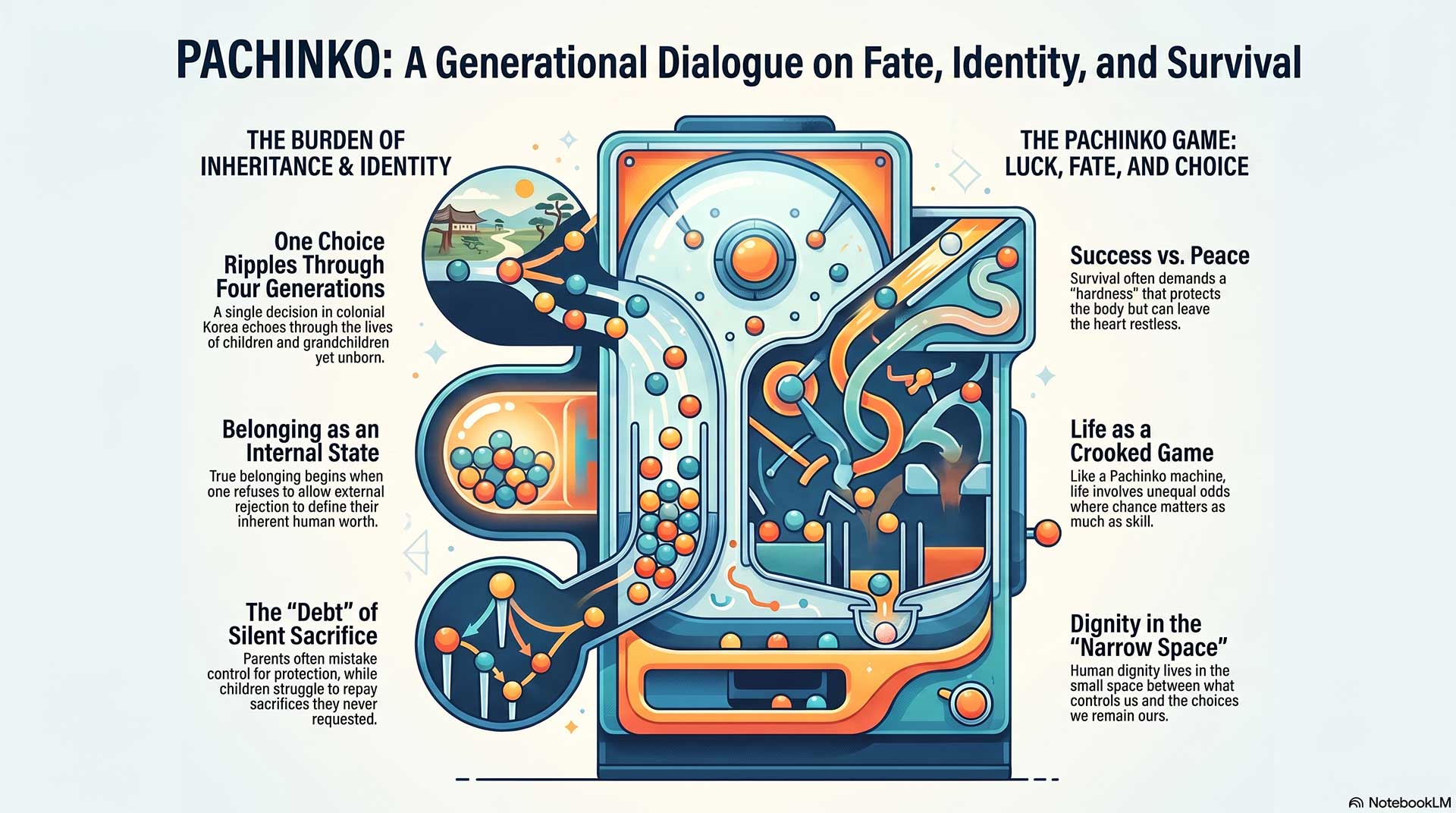
Life is closer to pachinko. You release the ball, but you do not control every pin it strikes.
Still, I have spent my life trying to control the board.
I want to know whether that made me wise, foolish, or merely afraid.
Solomon
You controlled more than most people ever could.
Money, information, business, other people's choices.
Did it ever make you feel safe?
Hansu
Safer.
Never safe.
Safety is a word people use when danger has not yet reached them.
Isak
Then perhaps control did not free you from fear.
It only gave fear more tools.
Hansu
Faith gave you comfort.
Money gave me results.
Isak
Both can become illusions when used to avoid truth.
Mozasu
That may be the family argument in one sentence.
One man trusted God.
One man trusted leverage.
The rest of us lived between them.
Sunja
When I was young, I believed good behavior might protect a person.
My parents taught me to work, remain honest, and avoid bringing shame.
None of that prevented pain.
Isak
Goodness is not a bargain with life.
It does not guarantee protection.
Sunja
I learned that slowly.
Hansu
I learned it early.
That is why I never confused morality with survival.
Isak
Yet survival without morality can turn a wounded person into the cause of someone else's suffering.
Hansu
And morality without survival can leave good people dead.
Mozasu
Both of you speak as if life gives us clean choices.
Most choices arrive dirty.
Solomon
Is life truly like pachinko?
The player launches the ball, but the machine determines most of what follows.
Mozasu
That is one reason the game attracts people.
It is honest about uncertainty.
You can study the machine, watch the pins, choose your timing, and still lose.
Sunja
Then why keep playing?
Mozasu
Hope.
Habit.
Pride.
Desperation.
Sometimes boredom.
Sometimes the next ball feels like a new life.
Hansu
The skilled player improves the odds.
Mozasu
Yes, but never enough to control everything.
Isak
That may be where humility begins.
A person acts, yet accepts that action is not command.
Sunja
Did I choose my life?
I chose not to become your mistress.
I chose to marry Isak.
I chose to leave Korea.
I chose to work.
Yet each choice came from conditions I never created.
Hansu
That does not make the choices less real.
Sunja
No.
It makes judgment harder.
People look back and say, “She should have done this,” or “He should have known that.”
They forget how narrow the road looked at the time.
Solomon
History makes every decision seem clearer than it felt.
Isak
Wisdom should make us slower to condemn.
Mozasu
I used to think Noa lost because he chose the wrong response to shame.
Now I wonder whether we speak too easily about choice.
He carried wounds we did not see.
Hansu
He still chose.
Sunja
Yes, but pain changes what a person can see.
Isak
Freedom is not equal in every moment.
A frightened person, a hungry person, and a secure person may face the same door but not the same choice.
Solomon
Then how much responsibility can we place on someone shaped by fear?
Isak
Enough to treat them as human.
Not so much that we deny the forces that shaped them.
Hansu
People use history as an excuse.
Occupation.
Racism.
Poverty.
Family.
At some point, a person must act.
Solomon
That is easy to say when you had resources.
Hansu
I created resources.
Sunja
You had abilities others did not.
You had contacts, intelligence, nerve, and a willingness to cross lines.
Hansu
Exactly.
I used what I had.
Isak
And some people are born with less room to move.
Agency exists, but it is unevenly distributed.
Mozasu
A crooked game can still contain skill.
That does not make the game fair.
Solomon
Then where does free will begin?
Mozasu
Perhaps in the response after the first blow.
Sunja
Sometimes in asking for help.
Hansu
In refusing weakness.
Isak
In choosing what kind of person suffering will make you.
Solomon
What if suffering has already changed you before you can choose?
Isak
Then freedom may begin very small.
One honest sentence.
One act of mercy.
One refusal to pass pain to someone else.
Hansu
Mercy can be expensive.
Isak
Cruelty is often more expensive, but the bill arrives later.
Sunja
Our family paid many late bills.
Silence.
Pride.
Secrets.
Shame.
Mozasu
And love expressed through control.
Solomon
Success expressed through exhaustion.
Hansu
Protection expressed through distance.
Isak
Faith expressed through sacrifice.
Sunja
Each of us gave something and wounded someone.
That is hard to admit.
Solomon
What legacy survives after death?
Money disappears.
Businesses change hands.
Names are forgotten.
Mozasu
Habits survive.
A father's anger enters a son.
A mother's fear enters a daughter.
Sunja
Food survives.
Stories survive.
The way someone was held during grief survives.
Hansu
Strength survives when it is taught.
Isak
Mercy survives when it is received and passed on.
Solomon
Then legacy is less about what we leave behind and more about what continues through others.
Sunja
Yes.
A life can end, yet its choices keep moving.
Like a ball striking one pin, then another.
Mozasu
That may be the darkest and most hopeful part of the pachinko image.
One small movement creates consequences no one can fully predict.
Hansu
Which is why the first move matters.
Isak
And why the later responses matter too.
Sunja
One mistake does not own every moment that follows.
Solomon
Nor does one good act erase every harm.
Mozasu
So life is neither pure fate nor pure choice.
Hansu
It is unequal odds.
Isak
Moral responsibility within unequal odds.
Sunja
Love within uncertainty.
Solomon
And memory within loss.
Hansu
Would any of you choose differently if you could return?
Sunja
Yes.
And no.
I would tell the truth sooner.
I would still choose dignity.
Mozasu
I would listen more.
I would still refuse shame.
Solomon
I would stop confusing acceptance with worth.
Isak
I would love with less fear of consequence.
Hansu
I would release what I could not own.
The room becomes quiet.
Sunja
That may have changed everything.
Hansu
Or nothing.
Isak
No act of truth changes nothing.
Closing
Hansu:
I once believed life belonged to the person strong enough to seize it.
Now I see that strength can change the odds without ending uncertainty.
We do not choose the nation, family, body, class, or era into which we are born.
We do choose some responses.
Then those responses become conditions for the next generation.
That is why one life can resemble pachinko.
Chance matters.
Skill matters.
The board may be tilted.
The rules may favor someone else.
A ball may fall for reasons no one can explain.
Yet the player still places a hand on the lever.
Perhaps dignity lives in that narrow space between what controls us and what remains ours.
Not total freedom.
Not helpless fate.
A human choice made inside an unfair game.
Final Thoughts by Sunja
When I was young, I believed history belonged to powerful people.
Kings.
Governments.
Wars.
Only after living many years did I understand that history also belongs to mothers preparing meals, fathers making impossible decisions, children carrying invisible burdens, and families trying to remain kind when the world offers them little kindness in return.
Our family made mistakes.
We loved imperfectly.
We kept secrets.
We wounded one another without intending to.
Yet we also forgave.
We endured.
We continued.
Perhaps that is why our story still matters.
Not because we escaped suffering.
Not because we found perfect justice.
But because every generation faced a choice.
Whether to pass forward only fear...
...or to pass forward hope as well.
No family begins with perfect circumstances.
No nation writes a flawless history.
Still, every life leaves something behind.
May those who remember our story inherit more compassion than resentment, more courage than fear, and more truth than silence.
That may be the greatest legacy any family can hope to leave.
Short Bios:
Sunja
Born in colonial Korea, Sunja is the moral heart of the family. Her quiet courage, resilience, and devotion sustain four generations through poverty, discrimination, and loss. She reminds us that ordinary acts of love often become extraordinary acts of history.
Koh Hansu
A wealthy Korean businessman living in Japan, Hansu is brilliant, resourceful, protective, and deeply flawed. He believes survival requires strength, influence, and difficult compromises. His complicated love for Sunja shapes every generation that follows.
Isak
A humble Presbyterian minister, Isak marries Sunja and raises her unborn child as his own. His life demonstrates compassion, integrity, and faith in the face of suffering. He represents the belief that character matters even when circumstances cannot be controlled.
Mozasu
Sunja's younger son grows into a successful pachinko businessman. Rather than seeking society's approval, he chooses to define his own worth. Practical, resilient, and fiercely loyal to his family, he embodies survival without surrendering his identity.
Solomon
Mozasu's son represents the newest generation. Educated, ambitious, and globally minded, he discovers that old prejudices often survive beneath modern appearances. His journey asks whether each generation can finally move beyond the burdens inherited from those before it.
Leave a Reply