

What if humanity's greatest crisis isn't political or economic—but forgetting who we really are?
For thousands of years, humanity has asked the same questions.
Who am I?
Why am I here?
What happens when I die?
Is there something greater than the world my senses perceive?
Modern civilization has answered many scientific questions with extraordinary success, yet millions of people continue searching for answers that science alone cannot fully resolve. Questions about consciousness, purpose, death, morality, and the deepest nature of reality remain as compelling today as they were in ancient times.
Michael G. Reccia has spent decades exploring these questions through what he calls the Joseph Communications, a series of spiritual teachings received during trance communication. His central message is both simple and provocative: humanity has forgotten who it really is.
According to Reccia, we have become so identified with the physical body, the analytical mind, possessions, politics, fear, and social conditioning that we have lost contact with our greater spiritual identity. The result is a civilization that grows increasingly powerful technologically while becoming increasingly disconnected spiritually.
Is he right?
Or are these experiences better understood through psychology, philosophy, theology, or symbolic imagination?
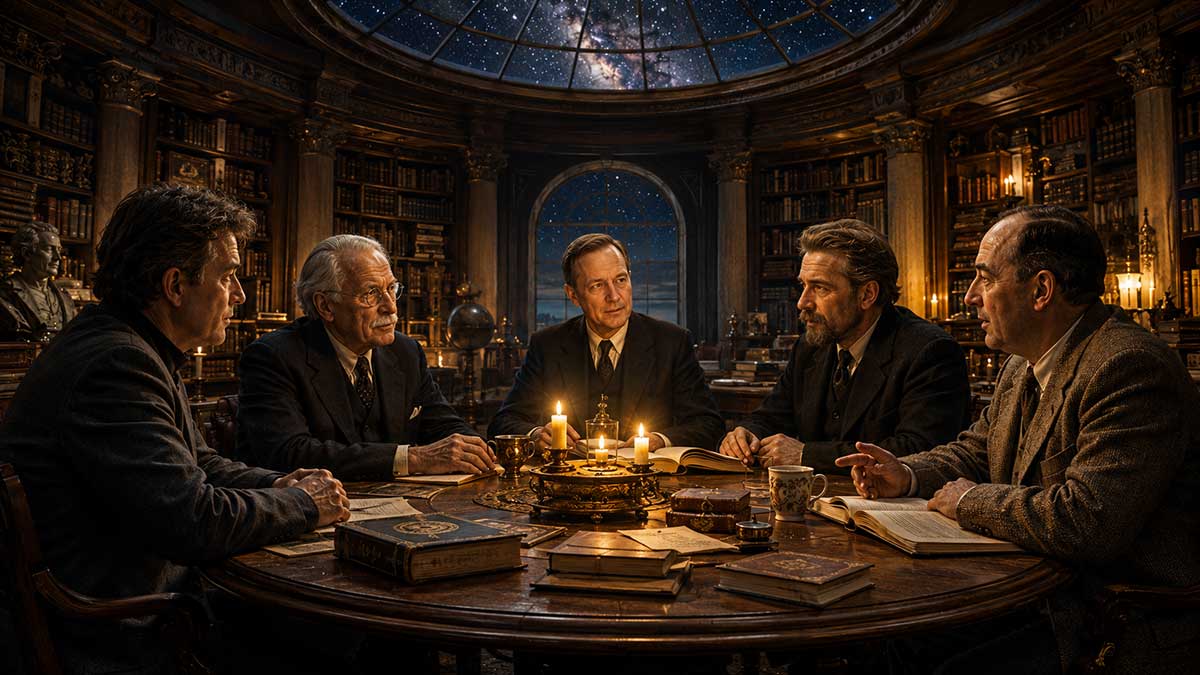
To explore this question, we welcome five remarkable voices whose perspectives overlap, challenge, and sometimes contradict one another.
Michael G. Reccia, whose lifetime of trance communications forms the starting point of our discussion.
Carl Jung, pioneer of analytical psychology, who devoted much of his life to understanding dreams, archetypes, symbols, and the mysterious depths of the human psyche.
C. S. Lewis, Christian writer and philosopher, who defended reason, faith, moral responsibility, and the distinction between humanity and God while encouraging honest spiritual inquiry.
Edgar Cayce, often called the "Sleeping Prophet," whose trance readings explored healing, consciousness, reincarnation, and humanity's spiritual development.
Rudolf Steiner, philosopher and founder of Anthroposophy, whose lifelong work sought to unite science, spirituality, education, and human evolution into one coherent understanding of reality.
Together they will examine some of humanity's oldest and most difficult questions.
Have we mistaken the mind for the whole self?
Does consciousness survive death?
Can fear, anger, and love shape both our inner and outer worlds?
Can civilization lose its spiritual center?
And perhaps the most important question of all...
If humanity has forgotten who we really are...
How do we remember?
(Note: This is an imaginary conversation, a creative exploration of an idea, and not a real speech or event.)
Topic 1: Have We Forgotten Who We Really Are?
Opening
Michael G. Reccia:
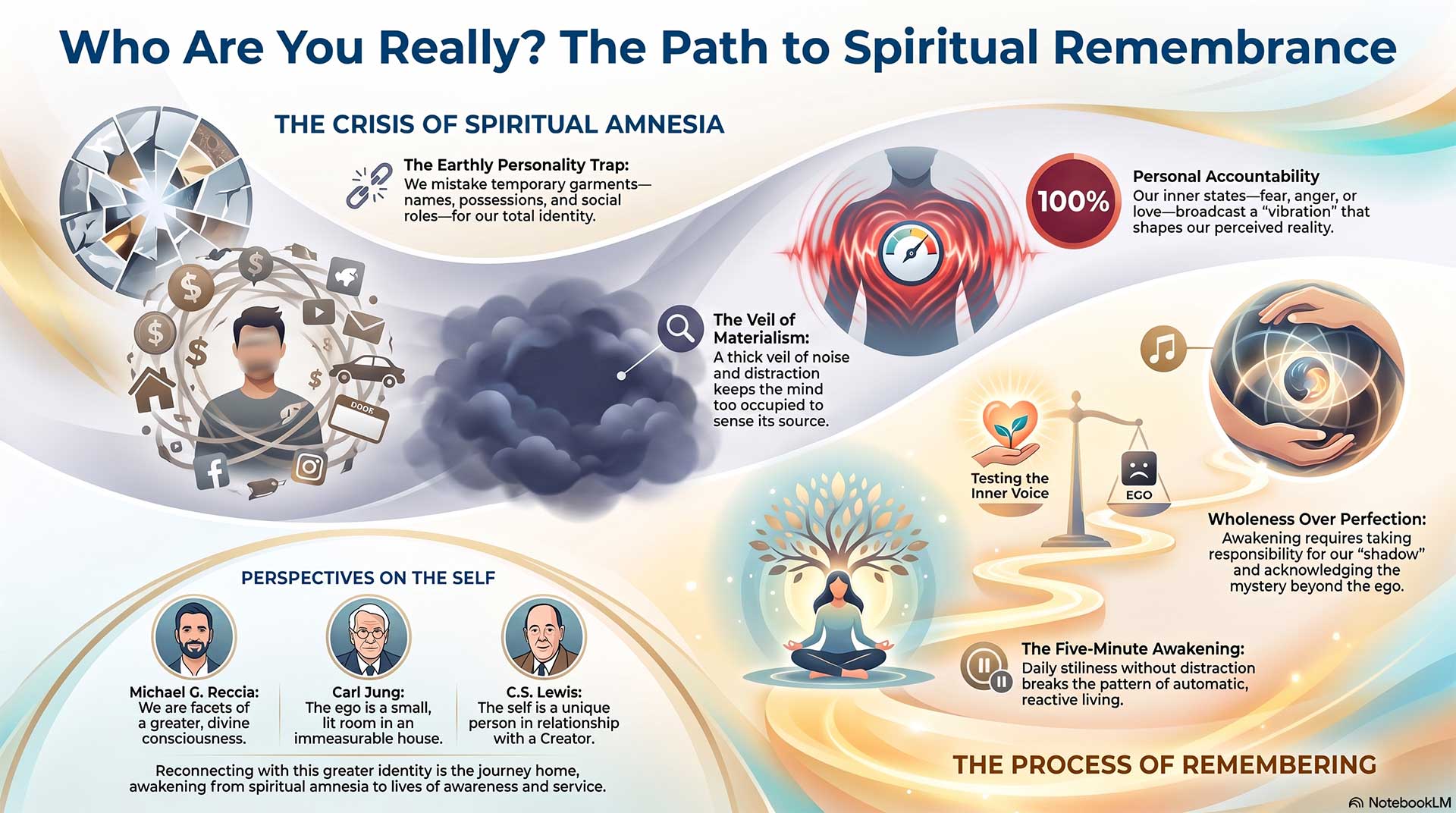
Before we ask what humanity must become, perhaps we should ask what humanity has forgotten. We wake each morning inside a name, a body, a history, a profession, and a collection of worries. We assume that these things form the whole person. Yet the communications I have received insist that the personality moving through earthly life is only one small part of a far greater self.
We spend years protecting this temporary identity. We defend our opinions, accumulate possessions, fear aging, compete for recognition, and imagine that death will erase everything we are. What if the real tragedy is not death? What if the tragedy is passing through life without discovering who was living it?
Who remains when every earthly label is removed?
Carl Jung:
The ordinary personality is not the total psyche. It is a small illuminated region surrounded by an immeasurable darkness. A person says, “I am this name, this occupation, this nationality, this religion.” Yet these are garments worn by consciousness. Beneath them lives the unconscious, carrying ancestral memory, rejected qualities, universal images, and possibilities the conscious ego has never encountered.
The danger begins when the ego declares itself sovereign. It mistakes the room it occupies for the entire house.
Edgar Cayce:
I would go further. The soul does not begin with the body, nor does it end when the body ceases functioning. Each life is an opportunity through which the soul encounters consequences, relationships, limitations, and choices. The earthly personality is real, but it is temporary. It is one expression of a continuing being.
When people ask who they truly are, they often seek a title: healer, teacher, mystic, believer. Yet the deeper answer is found in what they choose to express. A soul reveals itself through patience, mercy, courage, and service.
C. S. Lewis:
We must be cautious when saying that identity is hidden beneath all earthly distinctions. The self is greater than its social role, certainly, but it is not a drop that disappears into an impersonal ocean. Love requires persons. Relationship requires distinction.
I would say that a human being discovers the true self not by declaring divinity, but by entering into relationship with the One who created that self. The paradox is that the more completely we surrender the false self, the more fully personal we become.
Rudolf Steiner:
The physical body is one layer of the human constitution. There is also the life body, the bearer of growth and vitality; the soul organization, through which sensation and desire arise; and the spiritual individuality that develops across incarnations.
Modern civilization educates people to recognize only what can be measured. A child is taught to regard thought as a chemical event, love as biological instinct, and death as disappearance. Such education produces a divided human being. The person possesses spiritual capacities but is trained to doubt their existence.
Michael G. Reccia:
The communications describe the earthly self as one piece of a much larger pattern. The greater self is not distant. It is present now, yet the noise of ordinary thought prevents us from sensing it.
People often expect spiritual identity to arrive as a dramatic revelation. It may begin more quietly. You pause before acting cruelly. You feel compassion that offers you no personal advantage. You know that a choice is wrong before anyone explains why. In such moments, something greater than the calculating mind is already speaking.
Carl Jung:
Yet we should not call every inner impulse divine. The unconscious contains wisdom, but it contains deception, fear, vanity, and the shadow. A person may confuse desire with revelation.
The discovery of the greater self requires confrontation with everything the ego does not wish to see. Spiritual language can sometimes become a hiding place. Someone declares, “I am light,” so that they do not have to meet their anger. They speak of universal love while mistreating those nearest to them.
The true Self does not flatter the ego. It humbles and enlarges it.
Edgar Cayce:
That is why the fruits matter. Does the experience produce kindness? Does it produce patience? Does it make the person less self-centered? Spiritual knowledge that increases pride has been poorly received or poorly interpreted.
The soul is known by what it does with what it has learned.
Is the greater self part of God, or a being created by God?
C. S. Lewis:
Here we reach a necessary distinction. Human beings may carry the image of God, receive life from God, and participate in divine love. Yet participation is not identity. A window filled with sunlight does not become the sun.
The language of “God within” can lead to humility when it means that divine life calls to us through conscience. It can lead to spiritual pride when it means that every private desire possesses divine authority.
A person who believes himself to be God may become less willing to repent, listen, or be corrected.
Michael G. Reccia:
I understand that concern. When I speak of the divine within, I do not mean the surface personality and its appetites. I do not mean that Michael, with all his faults and limitations, commands creation.
I mean that the essence animating us comes from the same divine source. We are facets of a greater consciousness. The separateness we experience here is useful, but it is not complete.
Rudolf Steiner:
Human spiritual development involves both individuality and participation in the divine. The individual spirit is not an illusion to be discarded. It is cultivated through repeated experience, moral choice, and conscious development.
Humanity’s task is not to dissolve individuality but to spiritualize it. Freedom would have no meaning if the person were merely a puppet of divine consciousness. Love would have no moral value if it were automatic.
We become capable of freely choosing what once existed only as instinctive harmony.
Edgar Cayce:
The phrase often given in the readings was that the spirit is the life, the mind is the builder, and the physical is the result. The source is divine, yet each soul exercises will.
Separation begins when the will turns entirely toward self-interest. Reunion begins when the will aligns itself with love, service, and truth.
Whether one says “part of God” or “created by God,” the practical test remains similar: Are we living in a way that reflects the highest source from which life comes?
Carl Jung:
Psychologically, the image of God and the image of the Self are closely connected, but they should not be carelessly equated. The psyche encounters an inner totality that appears greater than the ego. It may express itself through Christ, a wise old man, a divine child, a mandala, or another sacred image.
The experience is real as an experience. The metaphysical interpretation remains a further question.
C. S. Lewis:
That distinction is valuable. One may experience something overwhelming within the psyche without having proved its ultimate source.
Discernment asks more than, “Did this feel immense?” It asks, “Is it truthful? Is it loving? Does it resist vanity? Does it lead me beyond self-adoration?”
Michael G. Reccia:
That is close to what I have always encouraged. Do not believe something merely since I say it came through trance. Take it inward. Examine it. Observe what it produces. Reject it when it demands fear, domination, or the surrender of conscience.
The greater self does not seek to make us feel superior. It seeks to make us responsible.
Why would humanity forget its spiritual identity?
Rudolf Steiner:
Forgetting is part of earthly freedom. If spiritual reality stood before us with the same certainty as a physical wall, moral choice would be weakened. Humanity enters a condition in which the spiritual world is veiled so that knowledge can be regained consciously.
Yet the veil has grown unusually thick. Materialism began as a necessary stage in human development. It taught exact observation and individual thought. The difficulty came when a method for studying physical matter was turned into a complete philosophy of existence.
Humanity began saying, “Only matter is real,” when it had merely developed instruments suited to measuring matter.
Carl Jung:
The ego requires a degree of separation to form. A child cannot remain psychologically merged with the mother. Humanity, too, develops through differentiation.
Yet separation creates loneliness. The ego then tries to fill the emptiness with status, consumption, ideology, or collective identity. It joins movements that promise certainty. It projects evil onto enemies. It mistakes belonging for wholeness.
The forgotten spiritual identity often returns indirectly through anxiety, dreams, compulsions, depression, or a vague sense that life lacks meaning.
Edgar Cayce:
People forget through repeated choices. Attention is a form of devotion. What a person continually thinks about, fears, seeks, and serves gradually becomes the center of life.
When all attention is given to survival, comparison, resentment, and possession, awareness of the soul grows faint. It has not vanished. The person has simply stopped listening.
C. S. Lewis:
There is another reason. The false self often finds forgetfulness convenient.
A person who remembers that life has eternal significance must reconsider how he treats his neighbor. He cannot worship success so comfortably. He cannot excuse cruelty merely because his political side approves of it. He cannot regard another person as disposable.
Spiritual amnesia relieves us of responsibility. It permits us to live as though appetite were destiny.
Michael G. Reccia:
The communications say that society strengthens this forgetfulness through endless distraction. The mind is kept occupied, stimulated, frightened, and divided. Silence becomes uncomfortable since silence threatens the manufactured identity.
When a person becomes still, questions arise:
Why am I living this way?
Why do I believe this?
Why am I afraid?
Whom does my anger serve?
What remains when the noise stops?
The system does not need to forbid spiritual discovery. It merely needs to keep people too distracted to seek it.
Carl Jung:
Yet we should not place all blame on “society.” Society is also an expression of the individuals who compose it. The collective shadow is built from personal shadows that no one wishes to acknowledge.
Each person wants the world to awaken, yet few wish to examine the pleasure they derive from judgment, superiority, or resentment.
Rudolf Steiner:
Social structures matter, but transformation cannot be delegated. Spiritual freedom begins when the individual develops disciplined attention. Without discipline, people become vulnerable to every influence—commercial, political, emotional, or supernatural.
Edgar Cayce:
Five sincere minutes can begin the change. Not five minutes asking for advantage, prediction, or special status. Five minutes asking:
“How may I become more useful?”
“What must I correct in myself?”
“Whom have I failed to forgive?”
“What is the loving action available today?”
The soul remembers itself through use.
C. S. Lewis:
We may discover that remembering who we are and remembering whose we are cannot be separated.
Michael G. Reccia:
And perhaps that remembrance begins before we agree on the language. One person calls it God. Another calls it the greater self. Another encounters it through conscience, the psyche, Christ, or spiritual knowledge.
The name matters, but the transformation matters more. Does remembrance make us kinder? Less frightened? Less willing to dominate? More willing to serve?
If it does not change how we live, then we may have discovered a fascinating idea without remembering anything at all.
Closing
Carl Jung:
Humanity’s spiritual amnesia cannot be healed by adopting a grander label for the ego. Saying “I am a spiritual being” is not yet awakening. The words may become one more mask.
The real encounter begins when the conscious personality admits that it is incomplete. Beneath its certainty lies the shadow. Beyond its knowledge lies mystery. At the center of the psyche stands an ordering presence that cannot be possessed by the ego.
To remember who we are is to become more whole, but wholeness is not innocence. It requires responsibility for our darkness and reverence for what exceeds us.
Perhaps humanity has not lost the soul. Perhaps the soul has continued speaking through dreams, conscience, longing, grief, beauty, and the persistent feeling that our present way of living is too small.
The question is not whether the deeper voice still speaks.
The question is whether we are prepared to hear what it may ask us to change.
Topic 2: Is the Mind a Prison—or Our Greatest Gift?

Opening
Rudolf Steiner:
The human mind can become a window or a wall. It can reveal patterns, test claims, create language, and guide deliberate action. Yet the same mind can become enclosed inside habits it never chose and assumptions it never examined.
A person may believe they are thinking freely when they are repeating the vocabulary of family, school, religion, advertising, political tribes, or fear. The prison is rarely visible. Its bars are made from unquestioned ideas.
The task is not to destroy thought. The task is to make thought conscious, disciplined, and free.
How can we escape mental programming without abandoning critical thought?
Michael G. Reccia:
When I say the physical mind is a trap, I do not mean that thought is evil. I mean that the head mind tends to work within a restricted range. It calculates using the information already placed inside it. If the information is limited, fearful, or false, the conclusions will reflect those limits.
People often mistake repetition for truth. They hear the same message from childhood, authority figures, television, institutions, and social groups. Eventually the thought no longer feels borrowed. It feels personal.
The first opening comes through honest questioning:
Is this really what I believe?
Did I choose this belief?
Does it produce love or fear?
Does it ask me to think, or merely to obey?
C. S. Lewis:
Questioning is necessary, but suspicion can become another prison. A person who distrusts every tradition, institution, teacher, and inherited belief may congratulate himself on being free, yet he can become captive to pride.
Not every inherited idea is false. We receive language, wisdom, moral memory, and hard-earned lessons from people who came before us. The fact that a belief is inherited does not make it untrue.
Freedom does not mean rejecting everything handed to us. It means learning how to judge what deserves preservation.
Carl Jung:
Many people believe they have escaped collective programming when they have merely joined a different collective. They leave one religion and enter an ideological movement. They reject one authority and submit to another. They discard an old vocabulary and adopt a new vocabulary that performs the same psychological function.
The ego wants to feel independent, yet it is drawn to systems that remove uncertainty. Certainty protects it from the discomfort of self-examination.
True independence begins when one notices the emotional reward received from a belief. Does the belief offer superiority? Belonging? An enemy? Permission to avoid responsibility?
A belief may be intellectually sophisticated and still serve a primitive emotional need.
Edgar Cayce:
Thought is a builder. What a person repeatedly holds in mind shapes habits, choices, relationships, and character.
Yet thought should be tested through action. A belief about compassion means little until patience is required. A belief about forgiveness means little until someone causes pain. A belief about spiritual unity means little until the person meets someone they dislike.
The mind becomes freer when ideas are placed into service.
Rudolf Steiner:
Critical thought and spiritual perception should support one another. Spiritual claims must not receive immunity from examination. The fact that an idea sounds sacred does not make it wise.
Yet materialist thinking makes its own unproven assumption when it declares that only measurable matter can exist. That is not a scientific discovery. It is a philosophical conclusion placed on top of scientific method.
A free thinker learns to distinguish observation from interpretation.
Michael G. Reccia:
That distinction matters in spiritual work. I may say, “This is what I received.” That is an honest report. It becomes dishonest when I say, “You must accept this as the only truth.”
The listener has a responsibility too. Do not accept something merely because it feels comforting. Do not reject it merely because it disturbs an existing belief. Sit with it. Examine the motive behind it. Watch its effects.
The heart center is not sentimental emotion. It is the place where intelligence and conscience meet.
C. S. Lewis:
We should be cautious here. People often use the word “heart” to protect themselves from correction. They say, “It feels true to me,” as though feeling settled the matter.
A sincere person can be sincerely mistaken.
Reason is not the enemy of faith. Reason can expose manipulation, self-deception, and spiritual vanity. Faith without reason may become gullibility. Reason without humility may become blindness.
Can an inner voice be trusted?
Edgar Cayce:
An inner voice should be judged by what it asks of the person.
Does it demand admiration?
Does it promise superiority?
Does it excuse cruelty?
Does it create fear?
Does it tell the person that ordinary moral responsibility no longer applies?
Those are warning signs.
Guidance of a higher order tends to call the person into patience, service, honesty, and self-correction. It rarely flatters.
Carl Jung:
The psyche contains many voices. Some arise from fear, wounded pride, desire, memory, fantasy, or the shadow. Others may carry wisdom beyond the conscious ego.
The difficulty is that destructive voices can speak with tremendous authority. The emotional force of an experience does not prove its truth.
A person must develop a relationship with the unconscious rather than surrendering to it. One listens, records, reflects, compares, and tests. No inner figure should become an absolute ruler.
Michael G. Reccia:
That is why motive and protection matter. Before communication, I ask to connect only with divine love and the highest source available to me. Then I examine what comes through.
If a communication demanded that I control others, frighten them, worship the communicator, or abandon conscience, I would reject it.
People sometimes assume that spiritual contact removes personal responsibility. It increases it. The medium must remain accountable for what is said through the medium’s own voice and body.
Rudolf Steiner:
Discernment requires training. Modern people often want immediate spiritual experience without preparing the moral life.
Yet perception can be distorted by vanity, fear, craving, or unresolved emotion. Inner discipline is needed:
precise observation;
emotional balance;
patience;
moral seriousness;
willingness to revise conclusions;
refusal to seek sensational experiences for their own sake.
The goal is not excitement. It is clarity.
C. S. Lewis:
Christian tradition speaks of testing the spirits. That language recognizes that spiritual experience, by itself, is not self-authenticating.
One test is whether the voice leads toward love joined with truth. Another is whether it allows correction. A deceptive voice often creates urgency, isolation, secrecy, or grandiosity.
It tells the person, “You alone understand. Others cannot be trusted. Normal moral limits no longer bind you.”
That path ends badly.
Edgar Cayce:
A useful inner impression can remain patient. It does not need to bully. It can wait for confirmation through circumstances, conscience, and practical wisdom.
Carl Jung:
We should include one more test: Does the message lead the person into greater wholeness, or does it split the personality?
A person who becomes obsessed with spiritual messages may neglect family, work, sleep, health, and ordinary duties. They may speak constantly of higher dimensions while becoming less grounded in human life.
That is not integration. It is inflation.
Michael G. Reccia:
Yes. Spiritual awareness should make someone more present, not less. It should deepen their respect for life here.
A person does not prove spiritual advancement by seeing spirits. The proof lies in how they treat the living.
Is society deliberately trapping the mind, or are we trapping ourselves?
Rudolf Steiner:
Institutions shape consciousness through education, economic pressure, media, technology, and cultural expectation. This influence is real.
Yet it is easy to imagine society as a single hidden force with one intention. Social systems are more complicated. They arise through countless human choices, habits, fears, incentives, and ambitions.
The individual must resist manipulation without turning every influence into a conspiracy.
Michael G. Reccia:
When the channeled message says society has fashioned the trap, I hear it as a description of a system that rewards distraction.
The person is surrounded by noise:
alerts;
advertising;
outrage;
comparison;
political conflict;
fear of missing out;
pressure to consume;
pressure to perform.
No single person needs to plan the entire trap. A culture can create it through what it rewards.
Stillness threatens that system since stillness interrupts automatic reaction.
C. S. Lewis:
The appetite for control exists in governments, corporations, churches, movements, and ordinary individuals. Yet the desire to be controlled exists too.
People often welcome manipulation when it removes responsibility. They want someone to tell them whom to blame, what to fear, what to repeat, and how to feel righteous.
Tyranny rarely survives through force alone. It feeds on the human wish to exchange freedom for certainty.
Carl Jung:
The outer system succeeds since it finds a matching structure within the psyche.
Propaganda works by activating fear, resentment, tribal loyalty, and projection. It gives people permission to place their shadow onto another group.
Once the enemy carries all evil, the individual no longer needs to examine personal cruelty.
The prison is both social and psychological.
Edgar Cayce:
Attention is one of the great human resources. Wherever attention goes repeatedly, life follows.
A person may say, “The world has stolen my peace,” yet spend hours feeding the very agitation they condemn. Each day becomes a series of unconscious invitations.
Freedom begins with small choices:
What will I watch?
What will I repeat?
What kind of conversation will I join?
Will I react immediately, or pause?
What thought will I carry into sleep?
Michael G. Reccia:
Five minutes of silence may sound insignificant, but it breaks the pattern. The person discovers how uncomfortable it is to sit without input. That discomfort reveals the degree of dependence.
At first, the silence may feel empty. Then buried fears, questions, or grief may appear. People often return to noise at that point.
Yet that is where the opening begins.
Rudolf Steiner:
Silence without discipline can become passive daydreaming. The practice should include active awareness. Notice thought without immediately following it. Observe emotion without becoming identical with it. Ask one sincere question and resist forcing an answer.
Freedom grows through repeated conscious attention.
C. S. Lewis:
We must not turn stillness into another technique for self-worship. Silence may reveal the self, but it may reveal our need for something beyond the self.
A person may enter silence expecting confirmation and instead encounter correction.
Carl Jung:
That correction is often the beginning of real freedom.
The ego asks, “How can I escape the prison built around me?” The deeper psyche may answer, “Begin with the prison you built to protect yourself.”
Closing
Edgar Cayce:
The mind is neither enemy nor master by necessity. It is an instrument, and every instrument reflects the purpose of the one who uses it.
A mind shaped only by fear will search for danger. A mind shaped by resentment will gather evidence for resentment. A mind shaped by service will notice opportunities to help.
Freedom does not arrive through one dramatic rejection of society. It grows each time a person chooses awareness over reaction, truth over comfort, and service over vanity.
Question what you have been taught. Question your rebellion too. Test the outer voice, the inner voice, and the voice that tells you testing is unnecessary.
The mind becomes a prison when it closes around certainty.
It becomes a gift when it remains humble enough to learn, disciplined enough to discern, and loving enough to serve.
Topic 3: What Happens When We Die?

Opening
Edgar Cayce:
Death frightens us partly because the physical senses cannot follow what comes next. We see the body become still, and from that silence we conclude that the person has vanished.
Yet many spiritual traditions, trance accounts, near-death experiences, dreams of the departed, and reports of deathbed visions suggest another possibility: consciousness may continue after the body can no longer express it.
The question is not merely whether life continues. The deeper question is what part of us continues, what we carry with us, and whether death reveals a truth that earthly life allowed us to avoid.
Does consciousness survive the death of the body?
Michael G. Reccia:
Everything I have experienced through mediumship tells me that consciousness continues. The people who communicate are not vague energies without identity. They retain personality, memory, humor, concern, affection, and recognizable ways of expressing themselves.
They are changed, certainly. They are no longer limited by the physical body, yet they remain themselves.
The tragedy is that many people wait until death to discover that they were never merely physical beings.
C. S. Lewis:
Christian hope rests on more than the natural continuation of consciousness. It rests on the belief that the person is preserved by God and called into a life beyond death.
I would resist the idea that death automatically produces wisdom. Leaving the body does not necessarily correct pride, selfishness, or confusion. A person may cross a threshold and remain morally similar to the person they were before.
Death may remove one veil, but it does not magically complete the soul.
Rudolf Steiner:
After physical death, the human being gradually releases the structures that belonged to earthly existence. The individual reviews life from a wider perspective and encounters the effects of actions upon others.
This is not a courtroom imposed from outside. It is a deepened perception. One experiences the pain one caused and the good one contributed.
Earthly life limits awareness. After death, the spiritual consequences of earthly choices become more visible.
Carl Jung:
We must distinguish between what can be psychologically observed and what remains metaphysical.
Human beings across cultures produce remarkably persistent images of continuation: journeys, judges, ancestors, light, reunion, rebirth, and transformation. These images may point toward a reality beyond the psyche, or they may express the psyche’s deepest structures.
I cannot prove from psychology that personal consciousness survives death. Yet I would not dismiss the recurrence of these images as meaningless.
The psyche behaves as though death is a transition rather than simple extinction.
Edgar Cayce:
The readings described death as birth into another condition. The physical body is laid aside, but mind, desire, memory, and spiritual development continue.
What a person loves matters. What they have made of themselves matters. Death does not erase the pattern of consciousness.
Michael G. Reccia:
That is close to what the communications say. We enter a state that corresponds to what we have become.
This is not divine revenge. It is resonance. A loving consciousness moves naturally into conditions of greater harmony. A consciousness fixed in hatred, fear, or possession may remain close to those states until it chooses differently.
C. S. Lewis:
I would phrase it with caution. Moral reality is not merely a matter of frequency. Love is not simply a pleasant vibration, and evil is not merely heaviness. There are real choices, real harm, and real accountability.
Yet I agree that divine judgment need not mean divine cruelty. The soul may experience truth as painful when it has spent life resisting truth.
Why would some spirits remain near people, places, or possessions?
Carl Jung:
A haunting may be interpreted in several ways. It may involve an external presence, a psychological projection, a repeated emotional pattern, a cultural expectation, or a mixture of these.
The image of a spirit attached to a house or object mirrors a familiar psychological truth: human beings can become possessed by what they possess.
A person may invest identity in property, status, family history, or control. The body dies, yet the psychic pattern may be imagined as continuing around the object.
Whether literal or symbolic, the warning is clear. What we refuse to release can begin to own us.
Michael G. Reccia:
In the cases I have encountered, attachment is often the reason. A person may have believed completely that physical life was all there was. When the body dies, they cannot accept what has happened.
Some remain near a house. Some remain near an object. Some remain near a person. Help may be present, but they reject it since it does not fit their former beliefs.
One of the most effective forms of help is the appearance of someone they loved. Recognition opens what argument could not.
Rudolf Steiner:
The habits of consciousness do not disappear immediately after death. Strong earthly desires may hold awareness close to the physical sphere.
This does not mean the soul is eternally trapped. Spiritual development continues. Guidance remains available.
Yet attachment has momentum. A person who spends decades believing identity depends on possession will not necessarily awaken from that belief in a single moment.
Edgar Cayce:
This is why preparation for death begins during life.
Every act of release teaches the soul:
forgiving someone;
giving without recognition;
accepting change;
loosening control;
serving without repayment;
facing mortality honestly.
The soul that practices release is less frightened when the final release comes.
C. S. Lewis:
There is a danger in becoming too fascinated with ghosts. Curiosity about spirits can distract from the moral condition of the living.
A person may spend years investigating haunted houses and never address the anger haunting their own home.
The important question is not, “Can the dead remain near us?” It is, “What am I becoming through the loves and attachments I choose now?”
Michael G. Reccia:
I agree. Mediumship should not become entertainment or proof of special status. Its greatest purpose is to remove fear, restore responsibility, and remind people that love continues.
Contact with the dead means little if it does not improve how we treat the living.
Carl Jung:
The dead may remain psychologically present through unfinished grief, guilt, family secrets, and inherited patterns. A family can be haunted without seeing an apparition.
Sometimes the ghost is a truth no one has been willing to speak.
Rudolf Steiner:
And sometimes what is called haunting may involve a real spiritual condition. The two interpretations need not cancel each other. The unseen and the psychological may interact.
Discernment requires restraint. Not every noise is a spirit. Not every vision is imagination. One must resist both credulity and automatic denial.
Is there a heaven, a hell, or many states after death?
C. S. Lewis:
Heaven and hell should not be reduced to geography. They are final expressions of relationship to truth, love, and God.
Hell is not meaningful if imagined only as a torture chamber built by divine anger. It is more coherent to understand it as the condition of a will that persistently rejects love.
Yet we should not make evil harmless by calling it a temporary mood. Human freedom carries weight. The choices we rehearse shape what we become capable of choosing.
Edgar Cayce:
The afterlife contains many conditions of awareness. Souls are drawn to environments corresponding to their development, desire, and purpose.
These states are educational. They reveal what has been created through thought and action. Growth continues.
No soul is abandoned by the source of life.
Michael G. Reccia:
The communications reject eternal condemnation. Lower states exist, but they are not permanent prisons.
A being may remain in darkness for as long as it refuses light. The moment it sincerely asks for help, help can reach it.
This preserves consequence without removing hope.
Rudolf Steiner:
After death, consciousness passes through stages. The individual encounters earthly desires without the body through which those desires were once satisfied. This can be painful.
Later, the soul enters wider spiritual conditions and prepares for future development.
Terms such as heaven and hell simplify a more layered process. There are many conditions, many degrees of awareness, and many forms of learning.
Carl Jung:
These descriptions resemble the structure of the psyche. We already inhabit inner heavens and hells during life.
Resentment can become a closed chamber. Love can open a person into a wider world. Shame can bind consciousness to one moment. Forgiveness can restore movement.
The afterlife imagery may be a map of postmortem reality, a map of the psyche, or both.
C. S. Lewis:
The word “both” may be useful here. A spiritual reality may leave symbolic traces in the psyche, much as a physical object leaves an image in the eye.
Yet personal preference cannot settle the question. We must be careful not to invent an afterlife that simply confirms what comforts us.
Michael G. Reccia:
Comfort is not the only result of the communications. They demand responsibility.
If consciousness continues, then nothing truly disappears. Cruelty matters. Love matters. Motive matters. What we become matters.
The afterlife is comforting only if one ignores the call to change.
Edgar Cayce:
The practical lesson is to live so that death does not introduce us to a stranger.
If the soul continues, then every day is preparation. If consciousness does not continue, kindness has still made life more human.
Either way, love is not wasted.
Closing
C. S. Lewis:
Death remains mysterious, and mystery should not be confused with emptiness.
We are tempted toward two easy certainties. One says death is obviously the end. The other claims to know every detail of what follows. Both may protect us from humility.
Perhaps the wiser position is to live in such a way that death finds us awake.
If consciousness continues, then the person we are forming now will cross the threshold with us. If judgment exists, it will expose what we loved. If mercy exists, it will not make truth unnecessary. If reunion awaits, then love has been preparing us for it all along.
The question “What happens when we die?” cannot be separated from another:
“What is happening to us while we live?”
Every act of courage, forgiveness, honesty, and sacrifice may be shaping a self that death cannot erase.
Topic 4: Can Anger and Fear Create the Reality Around Us?

Opening
Carl Jung:
Human beings rarely experience the world exactly as it is. We experience it through memory, expectation, fear, desire, and unresolved wounds.
A frightened person notices threats that another person misses. An angry person interprets uncertainty as insult. A grieving person may feel surrounded by absence. Inner life does not manufacture every event, but it strongly shapes what we notice, how we respond, and what patterns we continue.
The danger begins when we confuse influence with total control. We shape part of our experience, yet we do not create every tragedy that enters our lives.
How much of our suffering is created within us, and how much comes from outside?
Michael G. Reccia:
The communications teach that dominant beliefs and emotional states attract matching conditions. In the haunted-house case, the daughter’s anger toward God created an atmosphere that drew troubled spirits toward the home.
I do not interpret this as punishment. She was not being condemned for grief. She was broadcasting unresolved rage, and beings of a similar condition responded to it.
That principle applies more widely. Fear invites more fear. Hatred strengthens hatred. Suspicion trains the mind to expect betrayal.
Yet I would never say that every victim caused what happened to them. That would turn a spiritual principle into cruelty.
C. S. Lewis:
That distinction is necessary.
A person may contribute to a destructive pattern without being responsible for every harm committed against them. The abused child did not create the abuser’s sin. The family struck by illness did not fail some spiritual examination. The civilian caught in war did not summon the bomb through poor thinking.
Human beings possess freedom, and one person’s misuse of freedom can injure another.
The language of attraction becomes morally dangerous when it erases injustice.
Rudolf Steiner:
There are several levels of causation. Some conditions arise from personal habits. Some arise from relationships. Others come from social systems, inherited circumstances, nature, or the choices of other people.
Spiritual causation should not be reduced to a simple equation in which every misfortune reflects a private vibration.
The human being lives within many intersecting streams of influence.
Edgar Cayce:
People often want one explanation for suffering. They ask, “Did I create this, did God send it, or did someone else cause it?”
Life rarely answers so neatly.
The better question may be:
What part of this can I change?
What part must I endure?
What lesson should I refuse to invent?
What response expresses the highest good available now?
Responsibility begins where choice remains.
Carl Jung:
Suffering becomes more destructive when the psyche refuses to acknowledge it. Repressed anger does not disappear. It moves into dreams, bodily tension, compulsive behavior, projection, and relationships.
A person may insist, “I am not angry,” then spend years finding enemies.
The unrecognized emotion begins organizing the world.
Michael G. Reccia:
That is what I mean by vibration in practical terms. The unresolved state keeps expressing itself.
A person who expects chaos may make choices that increase chaos. They may trust unsafe people, reject sincere help, provoke conflict, or interpret peace as suspicious.
The spiritual and psychological patterns may operate together.
Can unresolved grief attract darkness?
Edgar Cayce:
Grief is not darkness. Grief is love responding to separation.
The danger comes when grief hardens into bitterness, hopelessness, or hatred. Then the person may begin organizing life around the wound.
Healing does not require forgetting the one who died. It requires allowing love to continue without making pain the sole remaining bond.
Michael G. Reccia:
In the disturbed house, the daughter was not wrong to grieve her brother. Her suffering was real. The difficulty was that her anger toward God had become fixed.
The atmosphere around her reflected that fixation. The troubled spirits were drawn to a state they recognized.
She was not evil. She was wounded and trapped inside one conclusion.
C. S. Lewis:
Anger toward God may itself be a form of relationship. A person usually does not rage against someone they believe to be entirely absent.
The Psalms contain protest, accusation, despair, and grief. Honest anger may be spiritually healthier than false politeness.
The question is whether anger remains part of a conversation or becomes the final word.
Carl Jung:
Unresolved grief can bind a person to the dead in ways that prevent both memory and life from moving.
The mourner may feel that recovery is betrayal. Joy begins to produce guilt. The psyche then protects grief as proof of love.
That inner arrangement can become a haunting. The dead person remains present, but only through pain.
Rudolf Steiner:
The living can relate to the dead through reverence, gratitude, and conscious remembrance rather than possessive sorrow.
Love can become a bridge. Grief can become a chain.
The difference lies in whether the mourner says, “You must remain as I remember you,” or, “I release you into continued development.”
Edgar Cayce:
A healing practice might ask:
What quality did this person awaken in me?
How can I express that quality now?
Who can receive the love I can no longer give them physically?
Grief begins to move when love finds another form.
Michael G. Reccia:
That kind of transformation changes the atmosphere. The person is no longer calling only from pain. They begin radiating gratitude, service, and connection.
Does “like attracts like” describe spiritual law, psychology, or both?
Rudolf Steiner:
Human beings participate in conditions that correspond to their inner development. Yet correspondence should not be mistaken for mechanical attraction.
Spiritual life is not a vending machine. One does not insert positive thoughts and receive favorable events.
Moral growth involves freedom, sacrifice, uncertainty, and encounter with conditions we did not choose.
Carl Jung:
Psychologically, “like attracts like” often operates through projection and repetition.
A person raised in chaos may unconsciously recreate familiar chaos since familiarity feels safer than peace. Someone who expects abandonment may choose emotionally unavailable partners, test them repeatedly, and eventually produce the separation they feared.
The result feels like fate, yet part of the pattern came from unconscious participation.
C. S. Lewis:
The phrase can become deceptive when it implies that goodness guarantees comfort.
Many good people suffer. Many selfish people prosper. Moral life cannot be judged by immediate outcomes.
The reward of courage is not always safety. Sometimes courage leads directly into danger.
Edgar Cayce:
The law is more reliable when applied to character than circumstance.
What we repeatedly dwell upon becomes easier to think. What we repeatedly practice becomes easier to do. What we repeatedly choose becomes part of who we are.
A person may not attract wealth through gratitude, but gratitude can change the kind of person they become amid poverty or abundance.
Michael G. Reccia:
Yes. I would rather say that dominant states create openings.
Hatred creates openings for more hatred. Compassion creates openings for reconciliation. Fear creates openings for manipulation. Stillness creates openings for discernment.
The external result may not come immediately or visibly, but the person is changed.
Carl Jung:
This is where the idea becomes useful. The question is not, “Why did I attract this disaster?” It is, “What pattern am I strengthening through my response?”
That preserves agency without turning pain into blame.
Can fear invite harmful spiritual influence?
Michael G. Reccia:
Fear can weaken discernment. A frightened person may become obsessed, suggestible, and drawn toward whatever promises certainty.
In spiritual work, fear can create fixation on negative entities. The person begins interpreting every difficulty as attack. That attention may intensify the experience.
The safest response is not panic. It is calm, clear intention, prayer, grounded behavior, and refusal to feed fascination.
C. S. Lewis:
Fear of evil can become a form of devotion to evil. A person may speak more about demons than God, more about darkness than love.
Spiritual caution is wise. Obsession is not.
One should neither deny evil nor give it imaginative control over the mind.
Rudolf Steiner:
Protective practices require moral preparation, not merely ritual. A person who seeks sensational contact while living chaotically invites confusion.
Clarity grows through disciplined thought, emotional balance, ethical conduct, and careful observation.
Edgar Cayce:
Fear narrows awareness. Prayer can widen it, especially when prayer turns attention away from self-protection alone and toward service.
A frightened person asks, “How do I escape?”
A steadier person asks, “What loving action remains possible?”
That question changes the inner condition.
Carl Jung:
Fear may point toward something external, but it may also reveal an unintegrated part of the psyche.
The figure at the door may be an enemy, a memory, a projection, or a symbolic form of the shadow.
The proper response begins with investigation rather than certainty.
Michael G. Reccia:
And practical help matters. Spiritual explanations should never prevent someone from seeking medical, psychological, legal, or social support.
Not every disturbing experience is a spirit. Not every emotional crisis should be handled through prayer alone.
How do we release anger without denying what happened?
C. S. Lewis:
Forgiveness does not mean calling evil good. It does not require immediate trust or restored access.
One may forgive and still maintain distance. One may release hatred and still seek justice.
The purpose of forgiveness is not to erase truth. It is to prevent another person’s sin from governing the interior life forever.
Carl Jung:
Anger must first be admitted. Premature forgiveness can become repression dressed in religious language.
The person must be able to say:
This happened.
It harmed me.
I am angry.
Part of me wants revenge.
Part of me is afraid.
Only what is made conscious can be transformed.
Edgar Cayce:
Release is often repeated, not accomplished once.
A person may forgive in the morning and feel anger again by night. That does not mean failure. It means the wound still requires care.
The practice is to choose again.
Rudolf Steiner:
Transformation asks that emotional energy be redirected rather than suppressed.
Anger can become moral courage. Grief can become compassion. Fear can become vigilance. Pain can become service.
The original force remains, but its direction changes.
Michael G. Reccia:
When the daughter in the haunted house held onto anger, the disturbance returned. The lesson was not that she had to pretend everything was fine. She needed to stop feeding the state that was consuming her.
She had to choose whether her brother’s death would become a permanent source of darkness or a reason to live with greater love.
C. S. Lewis:
That choice may be one of the hardest acts of faith: refusing to let suffering decide the final meaning of suffering.
Closing
Michael G. Reccia:
Our inner life matters, but it does not make us the authors of every event.
We influence reality through attention, expectation, behavior, relationship, and what we repeatedly send into the human atmosphere. Yet we live among other wills, natural forces, inherited conditions, and mysteries we cannot explain.
The spiritual teaching becomes harmful when it says, “You caused every pain.”
It becomes useful when it asks, “What are you creating now?”
Anger may be justified, but what will it become?
Fear may be understandable, but what will it govern?
Grief may remain, but what form will love take next?
We may not control what enters the house of our lives.
We do have some choice over what we continue feeding once it is inside.
Topic 5: Can Humanity Wake Up Before It Is Too Late?

Opening
Michael G. Reccia:
Humanity often speaks of crisis as though the danger exists only outside us. We point to war, political corruption, economic instability, technology, environmental damage, and the hunger for control.
Yet these conditions grow from human consciousness. Violence begins before the weapon is raised. Greed begins before the system rewards it. Domination begins before institutions organize around it.
The Joseph Communications describe civilization as spiritually asleep. People move, work, argue, buy, vote, and compete, yet many have forgotten the deeper purpose of being alive.
The question is whether enough people can awaken before our collective habits carry us into another collapse.
Is humanity truly awakening, or are we becoming more spiritually asleep?
Rudolf Steiner:
Both movements can occur at once.
Greater numbers of people are questioning materialism, inherited religion, political authority, and the assumption that consciousness is merely a product of the brain. Yet humanity is being drawn more deeply into systems that fragment attention and weaken independent thought.
Awakening does not happen merely because spiritual language becomes popular. A person may speak of consciousness, energy, and transformation while remaining controlled by appetite, fear, and group opinion.
The decisive question is whether inner freedom is increasing.
Carl Jung:
Periods of collective instability often produce a rise in spiritual interest. People sense that the old order no longer gives meaning, so the unconscious responds with visions, symbols, movements, prophets, and apocalyptic expectations.
Some of this is genuine renewal. Some is inflation.
A society that cannot face its shadow may announce that it is awakening while projecting evil onto enemies. It may speak of love while demanding ideological obedience.
Collective awakening without shadow work can become collective possession.
Edgar Cayce:
The measure of awakening is service.
Does a person become more patient?
Do they become more honest?
Are they less eager to condemn?
Do they use knowledge to help others?
Can they remain compassionate under pressure?
Spiritual ideas are seeds. Conduct reveals whether they have taken root.
C. S. Lewis:
Every age is tempted to think it stands at the final turning point of history. This can inspire courage, but it can feed self-importance.
The duty of a person does not depend on knowing whether civilization will survive. We are called to act faithfully in the time given to us.
A society may be declining, renewing itself, or doing both. Our responsibility remains the same: defend truth, resist cruelty, care for the vulnerable, and refuse to let fear dictate morality.
Michael G. Reccia:
I agree that awakening cannot be measured by how many people watch spiritual videos. It is measured by how many people stop living automatically.
The communications say that many are walking, talking sleepers. They are not unintelligent. They are disconnected from the greater self.
They react before reflecting. They repeat before questioning. They seek permission before consulting conscience.
Awakening begins when a person pauses long enough to ask, “Is this really who I wish to be?”
Carl Jung:
That pause is psychologically significant. It creates a distance between impulse and action.
Without that distance, the person is governed by complexes, collective moods, and inherited patterns. With it, choice becomes possible.
Yet awakening can be painful. The person sees how much of life has been lived unconsciously. That realization may bring grief before freedom.
Rudolf Steiner:
Spiritual development requires this discomfort. The individual must discover that freedom is not the absence of influence. It is the capacity to recognize influence and respond consciously.
Is the modern crisis political, technological, or spiritual?
C. S. Lewis:
It is unwise to place every social failure under the label of spiritual crisis. Poor laws, corrupt leaders, war, economic exploitation, and technological abuse require practical responses.
Yet practical systems reflect moral assumptions.
A society that treats human beings as economic units will eventually build institutions that use them as economic units. A society that denies any value beyond appetite will find fewer reasons to restrain appetite.
The spiritual and political cannot be separated completely.
Michael G. Reccia:
The deeper crisis is disconnection.
People who do not recognize spiritual value in themselves will struggle to recognize it in others. Once another person becomes merely a competitor, voter, customer, enemy, or statistic, exploitation becomes easier.
The problem is not technology itself. The problem is the consciousness using it.
A phone can educate, connect, and comfort. It can also distract, manipulate, and divide. The tool magnifies the intention behind it.
Edgar Cayce:
Every invention can be used in service or self-interest.
The question should not be, “Is technology good or bad?” It should be, “What ideal directs its use?”
Knowledge without an ideal becomes dangerous. Ability grows faster than wisdom.
Carl Jung:
Technology extends human capacity, but it does not mature the psyche. A primitive emotional structure can wield extraordinary tools.
Modern people may possess advanced machines and ancient resentments.
The collective shadow becomes more dangerous when amplified through mass communication, surveillance, automated persuasion, and weapons.
Rudolf Steiner:
Material progress has moved faster than spiritual development. Humanity has learned to manipulate physical forces without achieving comparable mastery over thought, desire, and will.
This imbalance is central to the present danger.
The answer is not to reject science. It is to develop moral imagination equal to technical intelligence.
C. S. Lewis:
A person can become highly educated in means and remain confused about ends.
We know how to do more things than previous generations. We remain divided over what ought to be done.
No machine can answer that question for us.
Can individual spiritual practice change the wider world?
Edgar Cayce:
Every life influences other lives through tone, conduct, attention, and choice.
A person may never see the full effect of one patient response, one act of forgiveness, or one decision not to spread fear.
The influence may move through a family, workplace, community, or stranger.
The individual should not underestimate small acts merely because they do not appear in history books.
Michael G. Reccia:
The channeled message describes each awakened person as a light that affects others beyond conscious knowledge.
I do not mean that meditation alone ends war. Inner practice must enter behavior.
Stillness should make us less reactive. Prayer should make us more compassionate. Spiritual knowledge should make us harder to manipulate and less willing to dehumanize.
The inner and outer work belong together.
Carl Jung:
An individual who integrates part of the shadow removes some darkness from the collective field.
This sounds modest, yet societies are composed of individuals who project, fear, envy, and imitate.
Someone who refuses projection interrupts a chain. Someone who admits personal aggression becomes less likely to assign all aggression to an enemy group.
Inner work has political consequences.
C. S. Lewis:
Yet private spiritual peace can become an excuse for public indifference.
One may sit quietly each morning and remain silent before injustice. One may speak of universal love while refusing costly action.
The test of contemplation is whether it prepares a person to act when love becomes inconvenient.
Rudolf Steiner:
True spiritual practice increases practical responsibility. It should sharpen perception of what a situation asks.
One person may be called to teach. Another may care for a family member. Another may build an honest institution. Another may resist a destructive policy.
The form differs. Conscious service is the common element.
Michael G. Reccia:
The phrase “What can little me do?” often hides a desire to avoid beginning.
One person may not change civilization alone. Yet every destructive system depends on the cooperation, silence, fear, or distraction of individuals.
Withdrawal of unconscious cooperation matters.
Edgar Cayce:
Begin with the person nearest to you.
Grand love for humanity can be easier than patience with one difficult relative.
The soul’s work usually appears close at hand.
What would collective awakening actually look like?
Rudolf Steiner:
It would not produce uniform belief.
A spiritually mature society would permit different paths while cultivating truthfulness, freedom of thought, moral responsibility, and respect for the dignity of the human being.
Education would develop imagination, character, judgment, and practical skill rather than preparing children only for economic usefulness.
C. S. Lewis:
Collective awakening should not mean collective conformity.
Any movement claiming that everyone must think alike for peace to exist has already betrayed peace.
Unity worth having preserves personhood, conscience, and disagreement.
Carl Jung:
A more conscious society would become less addicted to enemies.
It would recognize that conflict cannot be eliminated by placing all darkness outside the group. Political and religious communities would become more capable of self-criticism.
A mature culture would ask, “What are we contributing to the problem?” before asking only, “Who can we punish?”
Edgar Cayce:
Health, education, work, and spiritual life would be directed more clearly toward service.
Success would not be measured only by accumulation. It would include usefulness, integrity, relationship, and contribution.
Michael G. Reccia:
People would remember that no human being is spiritually disposable.
War becomes harder when the person across the border is understood as another expression of the same source. Exploitation becomes harder when workers are seen as souls rather than costs. Political manipulation becomes harder when citizens consult conscience rather than reacting to fear.
Awakening would change what society rewards.
C. S. Lewis:
Yet evil would not disappear merely because people adopted spiritual language. Freedom permits rejection.
The hope is not a perfect society built by perfect people. The hope is a society that understands its flaws, limits domination, protects conscience, and leaves room for repentance.
Carl Jung:
Perfection is a dangerous political goal. Those who claim to create heaven on earth often begin by identifying people who do not belong in it.
Wholeness is a wiser aim than purity.
Can civilization collapse from spiritual amnesia?
Michael G. Reccia:
The channeled warning states that civilizations have fallen before and that humanity can repeat the pattern.
When greed becomes virtue, power becomes identity, and human life loses sacred value, collapse begins inwardly before it becomes visible outwardly.
A civilization can possess wealth and technology yet be spiritually exhausted.
Rudolf Steiner:
Civilizations decline when forms remain after the living impulse behind them has died. Institutions continue, but they no longer serve human development.
People feel the emptiness and respond through cynicism, extremism, distraction, or nostalgia.
Renewal requires new moral imagination, not merely restoration of old structures.
Carl Jung:
Collapse may follow when a culture’s conscious self-image becomes too distant from its shadow.
A nation may call itself peaceful while living through aggression, or call itself free while expanding control. The contradiction produces instability.
What is denied returns in distorted form.
C. S. Lewis:
Civilization is fragile since civilized conduct requires restraint, trust, courage, and inherited moral habits.
When those habits are mocked or consumed without renewal, the outer structure can remain for a time. Then pressure reveals how little holds it together.
Still, fear of collapse should not become another instrument of manipulation.
Edgar Cayce:
Warnings are useful only when they lead to constructive action.
Fear that produces paralysis adds to the danger. Awareness that produces service becomes part of the remedy.
Michael G. Reccia:
The message is urgent, but it is not hopeless.
It says the change does not begin with those who possess the most money or authority. It begins with ordinary people who choose to reconnect with conscience, stillness, love, and spiritual responsibility.
That may sound small compared with global crisis.
Every collective reality begins through repeated individual choices.
Closing
Rudolf Steiner:
Humanity will not awaken through fear of destruction alone.
Fear can alert us, but it cannot guide the future. Renewal requires a positive image of the human being: free, responsible, spiritual, rational, creative, and capable of love.
The present crisis asks more from us than choosing the correct side in public conflict. It asks whether we can think without surrendering thought, use technology without becoming its instrument, seek spiritual experience without abandoning judgment, and serve others without erasing individuality.
No single teacher, movement, nation, or institution can awaken humanity by force.
Awakening cannot be imposed.
It begins wherever one person becomes conscious of a thought before repeating it, an anger before projecting it, a fear before obeying it, or a human being before reducing that person to a label.
Civilization may be shaped in parliaments, markets, schools, laboratories, churches, and media.
Its moral direction is decided in quieter places too: in the unseen moment when a person chooses what kind of consciousness to bring into the world.
Final Thoughts by Michael G. Reccia
When people hear discussions about channeling, spirits, higher consciousness, or life beyond death, they often ask one question before all others:
"Is it true?"
It is a reasonable question.
Yet after many decades of this work, I have found another question that may matter even more.
"What kind of person does this understanding encourage me to become?"
If a spiritual teaching produces arrogance, fear, division, superiority, or dependency, something has gone wrong, regardless of where the teaching appears to come from.
If it produces greater kindness, deeper responsibility, more courage, more compassion, and greater respect for every human life, then perhaps it deserves careful attention.
Throughout this conversation we have disagreed about many things.
We have explored psychology, Christianity, reincarnation, consciousness, symbolism, life after death, and spiritual evolution.
Yet one surprising thread has continued through every perspective.
Human beings become smaller when they stop questioning.
We become smaller when fear replaces curiosity.
We become smaller when we surrender conscience to institutions, ideologies, technology, popularity, or unquestioned certainty.
Whether you describe the deepest part of yourself as the soul, the Self, the image of God, higher consciousness, or simply conscience, each of us has the opportunity to listen more carefully than we did yesterday.
Perhaps remembering who we really are does not begin with extraordinary mystical experiences.
Perhaps it begins with five quiet minutes.
Five minutes without distraction.
Five minutes without needing to prove ourselves right.
Five minutes willing to ask one honest question.
What kind of human being am I becoming?
Every civilization is ultimately built from the answers given by ordinary people to that ordinary question.
If enough of us choose wisdom over reaction...
Compassion over domination...
Humility over certainty...
Service over self-importance...
Then humanity may discover that awakening is not a dramatic event waiting somewhere in the future.
It is a decision available today.
Thank you for joining this imaginary conversation.
May it encourage you not to accept every claim without examination...
Nor reject every mystery without exploration...
But to continue searching with both an open heart and a thoughtful mind.
Short Bios:
Michael G. Reccia is a British spiritual teacher, author, and trance medium best known for The Joseph Communications, a series of books that he says were received through decades of communication with higher spiritual intelligences. His work explores consciousness, life after death, humanity's spiritual evolution, and practical methods for developing higher awareness. Rather than asking people to accept his teachings blindly, Reccia consistently encourages personal investigation, conscience, and direct spiritual experience.
Carl Gustav Jung was a Swiss psychiatrist and the founder of Analytical Psychology. He introduced influential concepts such as the collective unconscious, archetypes, individuation, the shadow, anima and animus, and psychological symbolism. Jung believed that dreams, myths, and religious experiences reveal deep structures within the human psyche and devoted much of his career to exploring the relationship between psychology and spirituality.
Clive Staples Lewis was a British writer, literary scholar, Christian apologist, and author of The Chronicles of Narnia, Mere Christianity, The Great Divorce, and many other works. Lewis combined imagination with rigorous reasoning, defending Christian faith while encouraging intellectual honesty, moral responsibility, and humility. His writings continue to influence readers across both religious and secular communities.
Edgar Cayce was an American clairvoyant whose thousands of trance readings addressed health, spirituality, reincarnation, dreams, healing, and human purpose. Often called the "Sleeping Prophet," Cayce entered a sleep-like trance before delivering his readings. His work inspired generations of researchers and spiritual seekers interested in consciousness and holistic approaches to life.
Rudolf Steiner was an Austrian philosopher, educator, social thinker, architect, and founder of Anthroposophy. His work explored spiritual science, human development, reincarnation, education, agriculture, medicine, and the relationship between consciousness and civilization. Steiner also founded the Waldorf educational movement, which continues to influence schools around the world through its emphasis on intellectual, artistic, practical, and moral development.
Leave a Reply