
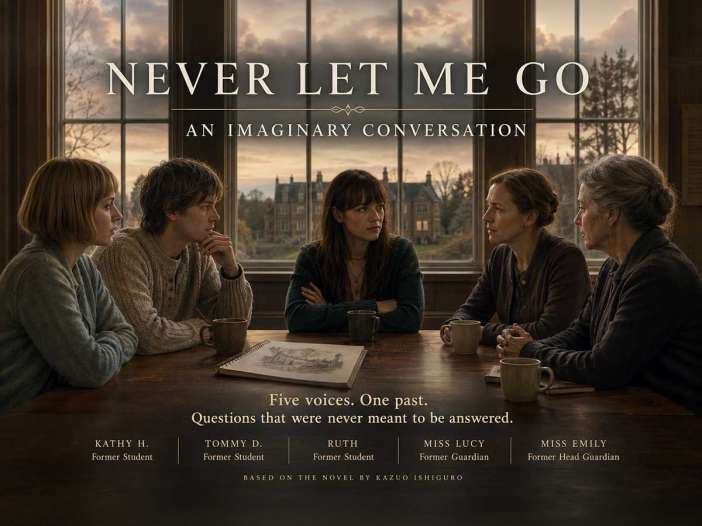
What if Kathy, Tommy, Ruth, Miss Lucy, and Miss Emily could finally answer the questions readers have debated since Never Let Me Go was published?
Some stories end when the final page is turned. Others begin their deepest conversation only after the reader closes the book.
Kazuo Ishiguro's Never Let Me Go has remained one of the most discussed novels of the twenty-first century because it refuses easy answers. Rather than asking readers to solve a mystery, it asks them to confront questions about humanity, memory, love, mortality, dignity, and the quiet ways ordinary people accept extraordinary injustice.
This Imaginary Conversation brings together five voices whose lives were shaped by Hailsham: Kathy H., Tommy D., Ruth, Miss Lucy, and Miss Emily. They gather beyond the boundaries of the novel—not to rewrite what happened, nor to escape their fate, but to examine the choices, silences, hopes, and regrets that defined their lives.
Across five conversations, they confront questions readers have continued asking for decades. Why didn't the students escape? Was Hailsham a sanctuary or a prison? Did Ruth truly love Tommy? Could art ever prove that someone possessed a soul? What does the ending of Never Let Me Go really mean?
No single answer can resolve these questions. Instead, each character brings a different truth, revealing that the novel's greatest power lies not in its science fiction premise, but in its unsettling reflection of ordinary human life. Their discussion reminds us that freedom is often limited long before we recognize it, that love rarely arrives without fear, and that the value of a human life should never depend upon what it can provide for someone else.
This is an imaginary conversation inspired by Never Let Me Go. The dialogue is fictional and created to explore the novel's themes, characters, and enduring philosophical questions. It does not represent actual dialogue written by Kazuo Ishiguro or omitted scenes from the novel.
(Note: This is an imaginary conversation, a creative exploration of an idea, and not a real speech or event.)
Topic 1: Why Didn’t the Students Escape?
Opening
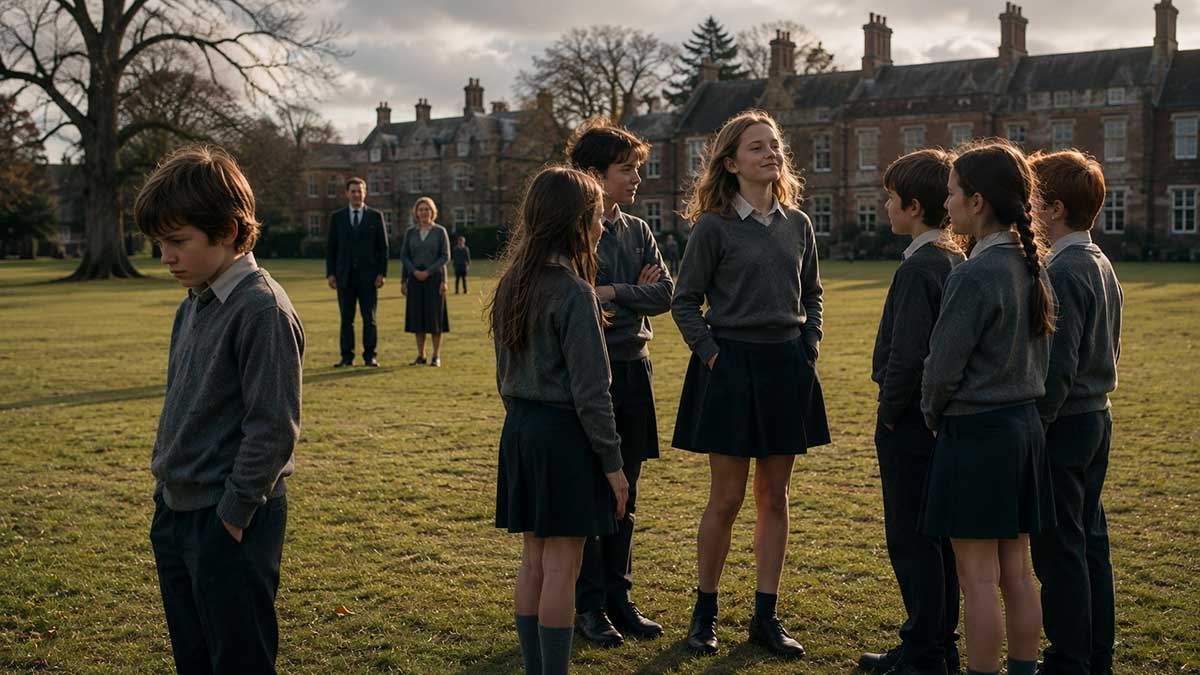
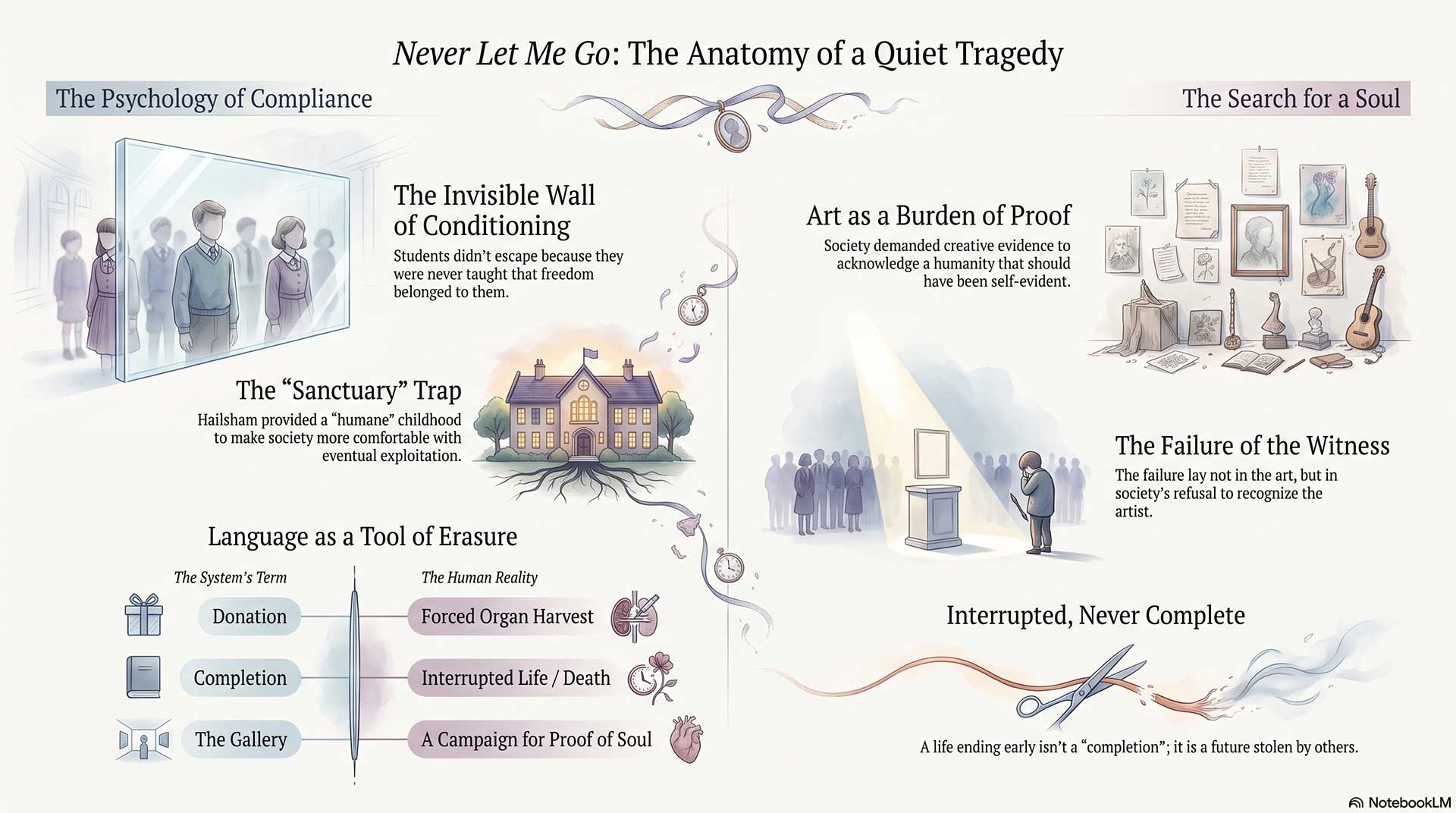
Kathy: People often ask why we never ran away. They picture Hailsham, the Cottages, the recovery centers, and all the roads between them, and they wonder why none of us simply kept driving. I understand the question. From the outside, escape looks like a door we refused to open. But when you grow up without being told that the door belongs to you, it does not feel like a door. It feels like part of the wall.
When did you first understand what donations really meant?
Tommy: I think I understood before I had words for it. That was why I used to lose my temper. Everyone thought I was angry because I was bad at art or because the others teased me. Maybe that was part of it. But there was something underneath. I could feel that everyone knew something about us and would not say it plainly.
Miss Lucy: You were sensing the truth through the gaps. The guardians spoke around it. We told you that your health mattered. We spoke about donations. We warned you about cigarettes and disease. Yet we did not place the whole truth in front of you.
Ruth: You say that as though the truth was hidden. It was not exactly hidden. We knew we would become carers. We knew we would donate. We heard those words all the time.
Miss Lucy: Hearing words is not the same as grasping what they will do to your body.
Ruth: Then perhaps none of us grasped it. Perhaps that was the point.
Miss Emily: Hailsham tried to prepare you gradually. We believed that giving children the full horror too early would destroy their childhood.
Tommy: So you gave us a childhood built on half-truths.
Miss Emily: We gave you years in which you could learn, play, make friends, and create.
Tommy: And after that, we were still sent away to be cut open.
Kathy: I remember how ordinary the future sounded when we were young. “Donations” was just another word adults used. It did not have blood in it then. It did not have hospital lights or scars. It did not sound like Ruth struggling to breathe after an operation. It did not sound like Tommy after his fourth donation.
Ruth: I knew more than I admitted. At the Cottages, when we copied the veterans and pretended we might work in offices, I knew it was make-believe. I think we all did. But pretending gave us a few more months in which the future did not feel fixed.
Tommy: You were good at pretending.
Ruth: I had to be. Some of us survived by remembering. Some of us survived by getting angry. I survived by acting as though the story could still change.
Miss Lucy: That is what troubles me most. You had enough knowledge to feel dread, but not enough freedom to turn that dread into refusal.
Kathy: We were told what would happen. We were never taught that what would happen was wrong.
Did Hailsham teach acceptance before the students were old enough to resist?
Miss Emily: Hailsham did not teach surrender. It taught dignity.
Ruth: Dignity for what?
Miss Emily: For lives that society had already decided would be used in a certain way.
Tommy: That sounds like surrender with better furniture.
Miss Emily: You think I do not hear the cruelty in that? I spent years trying to persuade people that you were human. Before places like Hailsham, children like you were raised in terrible conditions. They were treated as medical material. We gave you names, education, art, friendships—
Tommy: You did not give us names. We had letters after them.
Miss Emily: We gave you more than others received.
Tommy: More than nothing is still not freedom.
Kathy: Hailsham was kind to us. That is what makes it difficult. If it had been openly cruel, perhaps we would have understood sooner. If there had been cages or guards, perhaps escape would have made sense. But we had playing fields. We had collections. We had Exchanges. We had guardians who smiled at us.
Ruth: We had rules that seemed childish, but they trained us to obey. Where we could go. What we could keep. What we should fear. What we should never ask too directly.
Miss Lucy: That is true.
Miss Emily: Rules exist in every school.
Ruth: Children in ordinary schools are trained for adulthood. We were trained for compliance.
Miss Emily: You are judging the past with knowledge you did not have then.
Ruth: No. I am judging what you knew.
Tommy: You knew we would never have jobs. You knew we would never have families. You knew every future we imagined was false.
Miss Emily: We tried to make your years meaningful.
Tommy: Why did you decide meaning was enough when freedom was impossible?
Miss Emily: I did not decide the larger system. I worked inside it.
Kathy: That may be the most frightening part. None of the people who shaped our lives believed they were responsible for the whole thing. Each person only managed one small part. One guardian taught us. One doctor removed an organ. One administrator sent a letter. No one person felt like the person killing us.
Miss Lucy: A system becomes difficult to resist when everyone inside it performs only one acceptable task.
Ruth: And when the people being harmed are taught to perform their task too.
Tommy: Carer. Donor. Complete. Those words made everything sound orderly.
Kathy: “Complete” was the strangest one. It made death sound like fulfillment.
Ruth: Maybe that is why we accepted it. The word suggested we had reached the place we were made to reach.
Miss Lucy: Language can prepare people to endure what they might otherwise reject.
Miss Emily: You speak as though all of us were calculating villains.
Miss Lucy: No. That would be easier. Villains can be opposed. Good people who accept an evil arrangement are harder to confront.
Is it fair to blame them for not escaping when they were never taught escape was possible?
Tommy: I used to ask myself why I did not run after we learned the deferrals were not real. Kathy and I still had a car. We had roads. We could have driven anywhere.
Kathy: Where would we have gone?
Tommy: I do not know.
Kathy: That was the problem. We knew how to reach recovery centers, cottages, and donor clinics. We did not know how to rent a flat, get proper identification, find work, or explain who we were. We had no families to call. No homes waiting for us.
Ruth: We did not know how ordinary people lived. At the Cottages, we copied gestures from television. We copied how couples touched one another. We copied office workers because we had no model for adulthood of our own.
Tommy: But we could have tried.
Ruth: You say that now.
Tommy: I said it then too, inside my head.
Kathy: Thinking about escape is not the same as believing escape belongs to you.
Miss Emily: Society would have found you.
Tommy: Did you ever tell us that?
Miss Emily: No.
Tommy: Then perhaps you did not need to. Perhaps you made sure we carried the guards inside us.
Miss Lucy: That is what I feared. You were raised to see donation as destiny, not as violence.
Ruth: People ask why we did not rebel because they imagine they would have rebelled. But most people accept the life that has been explained to them from birth.
Kathy: They accept schools, jobs, illnesses, marriages, debts, wars, and rules they did not create. They call our obedience unnatural because our ending was more visible.
Miss Emily: Are you saying no one is free?
Kathy: I am saying freedom is partly the ability to imagine another life. We were not given that imagination.
Tommy: I still wish I had run.
Ruth: Where?
Tommy: Anywhere.
Ruth: With Kathy?
Tommy: Yes.
Kathy: You never asked me.
Tommy: I did not know how.
Kathy: Neither did I.
Miss Lucy: That is the tragedy. The system did not need chains. It only needed to make every other possibility feel unreal.
Miss Emily: Yet you loved. You formed loyalties. You created memories. The system did not take everything.
Tommy: That does not excuse what it took.
Miss Emily: I did not say it did.
Ruth: Then say what it was.
Miss Emily: It was wrong.
Tommy: You knew that at Hailsham.
Miss Emily: Yes.
Kathy: And you continued.
Miss Emily: Yes.
Miss Lucy: So did I, for longer than I wish to admit.
Ruth: And so did we.
Tommy: We were children.
Ruth: Later, we were not.
Kathy: But by then, the future had already been placed inside us. We did not see ourselves as prisoners. We saw ourselves as people waiting for the next stage.
Tommy: Sometimes I wonder whether my screaming was the only part of me that never accepted it.
Kathy: Maybe it was.
Ruth: Maybe that was why the rest of us found it so uncomfortable.
Closing
Kathy: We did not stay because we believed the system was fair. We stayed because we had been taught that the system was reality itself. Hailsham gave us memories, friendships, and moments of happiness, but it never gave us a language for freedom. By the time we understood what was being taken from us, we had already learned to call the taking our purpose. People ask why we never escaped. Perhaps the harder question is why the people who knew the truth never imagined that we deserved somewhere to escape to.
Topic 2 can move into the most personal conflict: whether Ruth loved Tommy, or feared the bond between Tommy and Kathy.
Topic 2: Did Ruth Steal Tommy From Kathy?
Opening
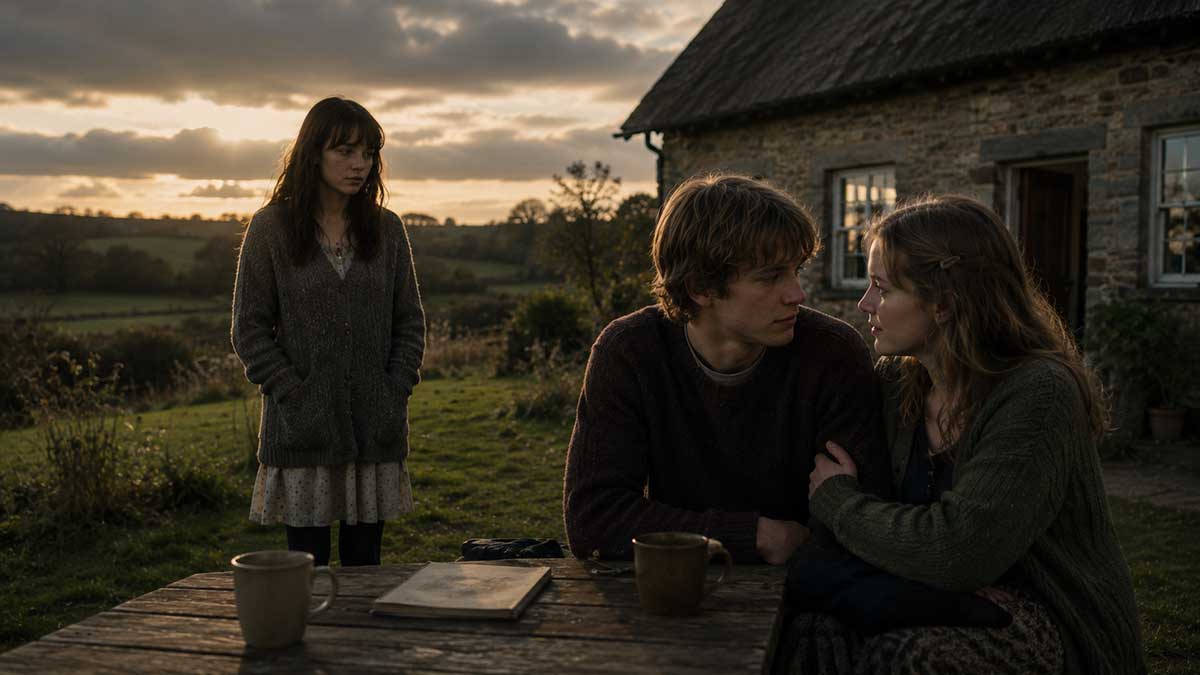
Ruth: People like to make this simple. They say I saw that Kathy and Tommy belonged together, so I stepped between them. They say I took something that was never mine. Perhaps that is partly true. But when your life has been arranged for you from the beginning, being chosen by someone can feel like the only proof that you are more than what others made you for.
Did Ruth truly love Tommy, or did she need to be chosen?
Tommy: Did you love me?
Ruth: Yes.
Tommy: That came too quickly.
Ruth: Would you believe me more if I hesitated?
Tommy: I would believe you more if I knew what you meant by love.
Kathy: Tommy—
Tommy: No. We never asked these things properly. We behaved as though knowing someone for years meant we understood everything.
Ruth: I loved how safe you made me feel.
Tommy: That is not the same as loving me.
Ruth: It was for me then.
Miss Lucy: Safety can resemble love when someone has never possessed much control over her own future.
Ruth: You always speak as though I were a lesson.
Miss Lucy: I am trying to see you clearly.
Ruth: Then see this clearly. At Hailsham, everything could be taken away. A favorite object could disappear. A friend could turn against you. A guardian could reveal something terrible without explaining it. Later, our bodies would be taken piece by piece. So when Tommy wanted me, I held on.
Tommy: Did you hold on to me, or to the feeling that Kathy had lost?
Ruth: Both.
Kathy: Ruth.
Ruth: You wanted honesty.
Kathy: I did.
Ruth: I knew there was something between you. Not a romance yet. Something quieter. You noticed him when other people only noticed his tantrums. You knew when he was ashamed. You could calm him without making him feel small.
Tommy: Then why did you tell Kathy I had laughed at her?
Ruth: I was afraid.
Tommy: Of what?
Ruth: That one day you would look at her properly.
Kathy: You knew I would not fight you.
Ruth: Yes.
Kathy: That made it easier.
Ruth: Yes.
Miss Emily: Ruth, you were very young.
Ruth: Young people can still know when they are being cruel.
Miss Emily: They may know the act without grasping its lasting effect.
Ruth: I grasped enough. I saw Kathy withdraw. I saw Tommy accept what I told him. I knew I was arranging the space between them.
Tommy: Why me?
Ruth: You were sincere. You could be difficult, but you were not false. I was false quite often. Being beside you made me feel less false.
Tommy: You laughed at my animals.
Ruth: Yes.
Tommy: You made me feel foolish for caring about them.
Ruth: Yes.
Tommy: Then you wanted sincerity near you, but you punished it when it frightened you.
Ruth: That is fair.
Kathy: I do not think Ruth wanted to hurt you every time she did it. Sometimes she needed everyone to agree with the version of herself she was trying to become.
Ruth: The confident one. The one who knew how couples behaved. The one who had seen more, understood more, belonged more.
Miss Lucy: You performed adulthood before you had any real model for it.
Ruth: We all did.
Tommy: Kathy did not.
Kathy: I performed calm.
Ruth: That may have been the most convincing performance of all.
Why did Kathy step aside?
Tommy: Why did you let it happen?
Kathy: I did not think of it as letting anything happen.
Ruth: That is not true.
Kathy: I thought you were together.
Ruth: You knew why.
Kathy: I knew enough to feel uncomfortable. That is different from knowing what to do.
Tommy: You could have told me.
Kathy: Told you what? That Ruth was frightened? That she lied sometimes? That I thought we understood each other better than you understood her?
Tommy: Yes.
Kathy: And then what? You would leave her because I made a case against her?
Tommy: Maybe I would have seen things sooner.
Kathy: Or maybe you would have thought I was jealous.
Ruth: You were jealous.
Kathy: Of course I was.
Tommy: You never said it.
Kathy: We did not say most things that mattered.
Miss Emily: Kathy, your instinct was always to care for others.
Kathy: That sounds kinder than it was.
Miss Emily: What do you mean?
Kathy: Caring can become a hiding place. When I focused on what Ruth needed or what Tommy felt, I did not have to risk saying what I wanted.
Ruth: You made restraint look noble.
Kathy: I believed it was noble.
Ruth: And perhaps part of you liked being the person who suffered quietly.
Tommy: Ruth—
Kathy: No. She may be right.
Ruth: I envied that about you. People trusted your silence. My silence always looked suspicious.
Kathy: My silence cost me years.
Tommy: It cost me too.
Kathy: I know.
Tommy: Did you think I did not feel anything?
Kathy: I thought you had chosen.
Tommy: I thought Ruth had chosen me, and that meant something.
Ruth: It meant I was quicker.
Tommy: That is a terrible thing to say.
Ruth: It is still true.
Miss Lucy: None of you had much time, yet you behaved as though there would always be another chance.
Kathy: We did not know how little time felt until it was nearly gone.
Miss Lucy: You knew your lives would be shortened.
Kathy: Knowing death exists does not teach you how to spend an afternoon.
Tommy: Or when to tell someone you love her.
Ruth: You loved Kathy then?
Tommy: I do not know when it began.
Ruth: That is not an answer.
Tommy: It is the honest answer. With Kathy, I did not feel that I had to become someone else first. Maybe that was love before I knew the word for it.
Kathy: Then why did you stay with Ruth?
Tommy: She wanted me openly. You did not.
Kathy: I was there.
Tommy: Being there is not always the same as choosing someone.
Ruth: Now you know how I felt.
Did Tommy recognize Kathy too late?
Ruth: When did you first understand that Kathy was the person you wanted?
Tommy: Perhaps when we found the tape again.
Kathy: In Norfolk?
Tommy: Yes. You looked so happy holding it. I remember thinking that I wanted to be the person who could return something lost to you.
Ruth: But you still stayed with me.
Tommy: I did.
Ruth: Why?
Tommy: Habit. Fear. Loyalty. Confusion.
Ruth: Pity?
Tommy: Sometimes.
Ruth: Thank you for saying it.
Kathy: Tommy, that is cruel.
Ruth: No. Cruelty would be pretending now.
Tommy: I cared for Ruth. I do not want that erased. But caring for someone and belonging with someone may not be the same thing.
Miss Emily: People often discover that too late, not only at Hailsham.
Ruth: We did not have the luxury of late discoveries.
Miss Emily: No.
Ruth: That is why every year mattered more.
Kathy: Yet we wasted them as people often do.
Tommy: Were they wasted?
Kathy: Some were.
Tommy: We still laughed. We drove places. We argued about ordinary things.
Ruth: Ordinary things were precious to us because we had so few of them.
Kathy: That does not remove the regret.
Ruth: No. But regret should not consume every memory.
Tommy: Did you regret us?
Ruth: I regretted what I did to keep us together. I did not regret every moment.
Tommy: Neither did I.
Kathy: And that is difficult for me to hear.
Ruth: I know.
Kathy: Part of me wanted your whole relationship to have been a mistake. It would have made the lost time easier to explain.
Tommy: It was not all a mistake.
Kathy: I know that too.
Miss Lucy: Love is rarely arranged cleanly. People hurt one another, protect one another, and misunderstand one another at the same time.
Ruth: I think I knew Tommy loved Kathy before he did.
Tommy: Then why did you wait so long to say anything?
Ruth: I wanted more time.
Tommy: With me?
Ruth: With the idea that I had won.
Kathy: Ruth—
Ruth: Let me finish. Near the end, I saw how small that victory was. I had kept two people apart, but I had not secured a future. None of us had one to secure.
Tommy: Your apology did give us some time.
Ruth: Not enough.
Kathy: No.
Ruth: I used to think love meant being chosen first. Now I think it may mean refusing to make another person smaller so they will stay beside you.
Tommy: Then did you love me?
Ruth: I loved you badly.
Tommy: That may be the truest answer.
Kathy: And I loved you silently.
Tommy: That was not always better.
Kathy: I know.
Closing
Ruth: I did not steal Tommy as though he were an object waiting for the right owner. Tommy chose, Kathy remained silent, and I used both of those things to protect myself. We each helped create the years we later regretted. Yet I was the one who saw the bond between them and tried to weaken it. I cannot change that. I can only say that beneath the jealousy was a frightened girl who believed being chosen might prove that her brief life mattered. It did not prove that. Love was never something we could possess. It was something we were supposed to recognize before fear taught us to hide it.
Topic 3: Was Hailsham a Sanctuary or a Prison?
Opening
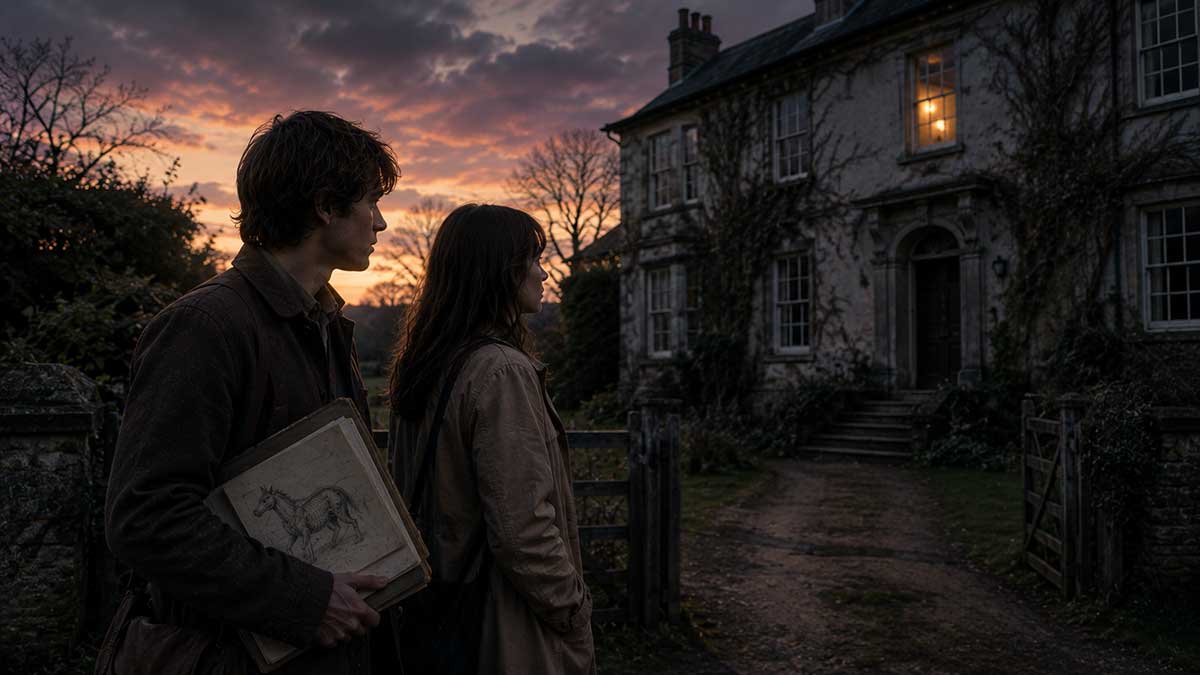
Miss Emily: Hailsham was built from a terrible compromise. We could not give the students ordinary futures, but we believed we could give them childhoods with beauty, education, friendship, and dignity. For years, I thought that mattered enough to justify what we were doing. Now I am no longer certain whether Hailsham protected them from cruelty or merely taught them to accept it more gently.
Did Hailsham give the students a better life, or make exploitation look humane?
Tommy: You always begin with what you gave us.
Miss Emily: What else should I begin with?
Tommy: What you allowed to happen afterward.
Miss Emily: I did not create the donation program.
Tommy: No. You made it easier for people to live with.
Kathy: Tommy—
Tommy: That was Hailsham, wasn’t it? Proof that people like us could be raised nicely before being used.
Miss Emily: Hailsham was proof that you possessed inner lives.
Ruth: We already possessed them.
Miss Emily: Society did not accept that.
Ruth: Then society was wrong before it saw a single painting.
Miss Lucy: Ruth is right. The burden should never have been placed on the students to prove their humanity.
Miss Emily: You speak now as though the campaign had simple choices. It did not. People wanted medical progress. They wanted cures. They did not want to think about where the organs came from.
Tommy: So you showed them our art.
Miss Emily: We showed them what they refused to see.
Tommy: And then they kept taking our organs.
Miss Emily: Yes.
Kathy: Did anyone look at the Gallery and decide the donations had to stop?
Miss Emily: Some were moved. Some supported us. Some argued for better treatment.
Ruth: Better treatment before death.
Miss Emily: Better treatment was still better than what existed elsewhere.
Ruth: That answer always returns to comparison. Better dormitories. Better lessons. Better food. Better memories.
Tommy: Better victims.
Miss Emily: That is unfair.
Tommy: Is it?
Miss Lucy: Hailsham did improve their lives. We should not pretend otherwise. The question is whether improvement inside an unjust system became a substitute for challenging the system itself.
Kathy: I loved Hailsham.
Tommy: So did I.
Ruth: I did too.
Kathy: That is why it is difficult to call it a prison.
Tommy: Prisons can contain good memories.
Miss Emily: Hailsham had no locked gates.
Ruth: It did not need them.
Miss Emily: You were allowed to walk the grounds.
Ruth: The grounds were the whole world we knew.
Kathy: When we were children, Hailsham did not feel small. It felt complete. The fields, the pavilion, the dormitories, the Sales, the Exchanges—there was always some rule or rumor to occupy us.
Tommy: We thought losing a favorite cassette was a disaster.
Kathy: At that age, it was.
Miss Lucy: Childhood makes small things enormous.
Ruth: And Hailsham kept the largest thing vague.
Miss Emily: We wanted you to have time before carrying that knowledge fully.
Tommy: Time for what?
Miss Emily: To be children.
Tommy: Children grow toward something.
Kathy: We grew toward donations.
Miss Emily: I know.
Tommy: Then Hailsham was not outside the system. It was the first stage of it.
Miss Emily: Yes.
Ruth: That may be the first honest answer you have given.
Were the guardians protecting the students or protecting their own consciences?
Miss Lucy: I often asked myself that.
Miss Emily: You left because you could not accept our methods.
Miss Lucy: I left because I realized our kindness had boundaries we refused to cross.
Miss Emily: We had to work within political reality.
Miss Lucy: That phrase can excuse almost anything.
Miss Emily: And moral purity can accomplish nothing.
Miss Lucy: Did we accomplish enough?
Miss Emily: We gave hundreds of children years they would otherwise never have had.
Miss Lucy: Years arranged around obedience.
Miss Emily: Years with friendship and learning.
Miss Lucy: Years that ended in operating rooms.
Miss Emily: You think I did not know that?
Tommy: Knowing did not stop you.
Miss Emily: No.
Ruth: Did you ever visit a recovery center?
Miss Emily: Yes.
Ruth: Did you visit after the third donations?
Miss Emily: Sometimes.
Ruth: Did you stay until someone completed?
Miss Emily: No.
Ruth: Why not?
Miss Emily: I told myself my work was elsewhere.
Kathy: With the next group of children.
Miss Emily: Yes.
Kathy: That must have made it possible to keep going.
Miss Emily: Perhaps.
Tommy: You could return to Hailsham and see us before the scars.
Miss Emily: Do you think I am proud of that?
Tommy: I do not know what you feel.
Miss Emily: I felt grief. Constantly.
Ruth: Grief without refusal.
Miss Emily: Refusal would have closed Hailsham sooner.
Miss Lucy: That is true.
Ruth: Then perhaps it should have closed.
Kathy: Would that have helped the students sent elsewhere?
Ruth: No.
Kathy: That is the trap, isn’t it? Close the kind place, and the cruel places remain. Keep the kind place open, and it helps the cruel system continue.
Miss Lucy: That is exactly the trap.
Tommy: But you were the adults.
Miss Lucy: Yes.
Tommy: You had more choices than we did.
Miss Lucy: Yes.
Tommy: Then why do you speak as though the trap caught everyone equally?
Miss Lucy: It did not.
Miss Emily: No. It did not.
Ruth: We had to donate. You had to decide how comfortable you could remain near that fact.
Miss Emily: You are right.
Kathy: I think some guardians truly cared for us.
Tommy: I know they did.
Kathy: That care was real.
Ruth: Real care can still serve an unjust purpose.
Miss Emily: Must every kindness be rejected because it cannot repair everything?
Tommy: No.
Miss Emily: Then what would you have had us do?
Tommy: Tell us plainly.
Miss Lucy: I tried.
Tommy: Not only what would happen. Tell us it was wrong.
Miss Emily: And then?
Tommy: I do not know.
Miss Emily: That matters.
Tommy: It matters less than you think. You always demanded a complete plan before admitting we deserved freedom.
Miss Lucy: He is right. We treated uncertainty as a reason to preserve the existing system.
Kathy: Perhaps the guardians protected us from fear.
Ruth: And protected themselves from our anger.
Tommy: They preferred grateful children.
Miss Emily: Gratitude was never required.
Ruth: It was built into the arrangement. We knew Hailsham was special. We knew others had less. That made complaint feel selfish.
Kathy: We were taught to feel fortunate.
Miss Lucy: Which made injustice harder to name.
Can kindness inside an unjust system ever be enough?
Miss Emily: No. It cannot be enough.
Tommy: Then why defend it?
Miss Emily: Because something can be insufficient and still matter.
Ruth: That sounds reasonable.
Tommy: It sounds convenient.
Kathy: Maybe both.
Miss Emily: Kathy, do you believe your childhood had value?
Kathy: Yes.
Miss Emily: Do you wish Hailsham had never existed?
Kathy: I do not know.
Miss Emily: That is an honest answer.
Kathy: Without Hailsham, I might never have known Tommy or Ruth. I might never have had my tape, the pavilion, the walks, the Exchanges. Those memories became most of what I had.
Tommy: But you should have had more than memories.
Kathy: I know.
Ruth: The danger is that beautiful memories can make the theft look smaller.
Kathy: They do not make it smaller.
Ruth: They can make us reluctant to condemn the place that prepared us for it.
Miss Lucy: Hailsham was both refuge and training ground.
Miss Emily: That description pains me.
Miss Lucy: It should.
Miss Emily: Do you believe no good came from it?
Miss Lucy: Good came from it. That is why the moral failure is difficult. Open cruelty is easy to reject. Hailsham wrapped care around exploitation.
Tommy: Like a clean bandage over a wound no one intended to close.
Ruth: That sounds like one of your drawings.
Tommy: Maybe.
Kathy: Could Hailsham have become something else?
Miss Emily: Perhaps, if public opinion had shifted.
Tommy: Public opinion.
Miss Emily: You dislike the phrase, but institutions do not survive on private conviction alone.
Tommy: We did not survive at all.
Miss Emily: No.
Ruth: Did you ever consider helping students disappear?
Miss Emily: Yes.
Kathy: You did?
Miss Emily: Briefly. There were discussions among some supporters. False records, hidden homes, private arrangements.
Tommy: What happened?
Miss Emily: People became frightened. The legal risks were severe. The medical authorities watched closely. Funding would have vanished. Hailsham could have been closed immediately.
Ruth: So everyone chose the version of courage that preserved their position.
Miss Emily: Some did.
Miss Lucy: Most did.
Tommy: Did anyone help a student escape?
Miss Emily: Not that I know of.
Tommy: Then the adults imagined escape more clearly than we did and still refused it.
Miss Emily: Yes.
Kathy: That changes the question.
Miss Lucy: How?
Kathy: We often ask whether we should have run. Perhaps we should ask why those who knew the roads never showed us where they led.
Ruth: Or why they decided a better childhood was the greatest freedom we could be offered.
Miss Emily: We believed society would not accept more.
Tommy: Society accepted our organs.
Miss Emily: Yes.
Tommy: It accepted our bodies completely. It only struggled to accept our lives.
Miss Lucy: That may be the clearest description of the system.
Kathy: Then was Hailsham a sanctuary?
Miss Emily: For a time.
Ruth: Was it a prison?
Miss Lucy: In a quieter form.
Tommy: Was it both?
Kathy: Yes.
Miss Emily: I wish I could disagree.
Closing
Miss Emily: Hailsham gave the students something real, but it did not give them what they most deserved. We gave them art, friendship, education, and years of relative safety. We did not give them ownership of their bodies or the right to choose their futures. I once believed that protecting childhood was a moral victory. Now I see that kindness can become dangerous when it helps people tolerate an injustice they should refuse. Hailsham was a sanctuary inside a prison, and those of us who built it mistook the sanctuary for freedom.
Topic 4: Can Art Prove That Someone Has a Soul?
Opening
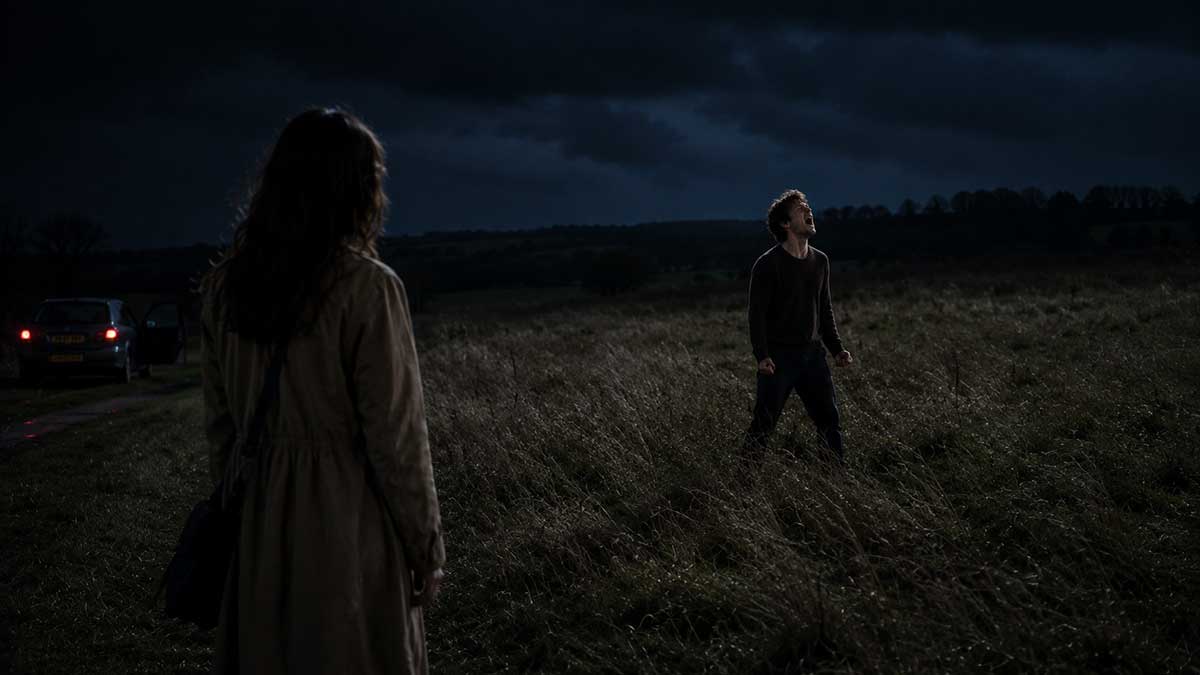
Tommy: For years, I believed my drawings might prove something about me. I thought that if Madame saw enough detail in the animals—every joint, every strange little organ, every line I had labored over—she might recognize that there was something inside me worth saving. I did not know then how terrible the question was. Why should anyone have needed a drawing to prove that I had a soul?
Why did society need paintings and poems to believe the students were human?
Miss Emily: The Gallery was created for a purpose.
Ruth: We know. You wanted to show people our souls.
Miss Emily: We wanted to show them that you possessed rich inner lives. Many people preferred to think of students like you as biological instruments.
Kathy: Did they truly believe we felt nothing?
Miss Emily: Some did. Others suspected the truth but avoided it. The Gallery forced them to look at what you created.
Tommy: They looked at the art instead of looking at us.
Miss Lucy: That distinction matters.
Miss Emily: The art gave us evidence that could be presented publicly.
Ruth: Evidence.
Miss Emily: Society demanded proof.
Ruth: Society demanded organs too. It did not ask for proof that our bodies worked.
Kathy: Ruth—
Ruth: No. I want to understand this. Our hearts, kidneys, lungs, and livers were human enough to save other people. Our feelings needed verification.
Miss Lucy: That was the moral contradiction.
Miss Emily: I understood the contradiction.
Tommy: Yet you accepted its terms.
Miss Emily: I used the argument I thought society might hear.
Tommy: You did not tell society it had no right to ask.
Miss Emily: I feared that such a demand would fail before the conversation began.
Ruth: So you entered the conversation by accepting that our humanity was uncertain.
Miss Emily: I accepted the political reality, not the moral premise.
Ruth: The students could not tell the difference.
Kathy: At Hailsham, we believed Madame took our best work because it revealed who we were.
Tommy: I thought the Gallery might decide our futures.
Miss Lucy: The rumors about deferrals grew from that belief.
Tommy: They grew because no one explained why the art mattered.
Miss Emily: We could not tell you everything.
Ruth: You keep returning to that.
Miss Emily: It was the policy.
Ruth: Policies seem to appear whenever a person wants to avoid saying, “I chose this.”
Miss Emily: I did make choices.
Tommy: Then answer plainly. When you looked at our paintings, did you see children?
Miss Emily: Yes.
Tommy: Before you saw the paintings?
Miss Emily: Yes.
Tommy: Then why did anyone else need them?
Miss Emily: They should not have.
Kathy: Was the Gallery for us, or for the people benefiting from us?
Miss Emily: For the public.
Kathy: Then our private feelings became a campaign.
Miss Lucy: Your childhoods were turned into evidence in a debate about whether you deserved humane treatment.
Ruth: Humane treatment before being killed.
Miss Emily: Yes.
Tommy: That word again—humane. It means the system could continue so long as it looked less cruel.
Miss Emily: In practice, that was often true.
Kathy: Did the people who viewed our art ever ask to meet us?
Miss Emily: A few.
Ruth: Were they permitted?
Miss Emily: Rarely.
Tommy: Why?
Miss Emily: There were concerns about privacy, public reaction, and emotional distress.
Tommy: Whose emotional distress?
Miss Emily: The visitors’.
Ruth: Of course.
Kathy: They could look at our paintings without having to hear our voices.
Miss Lucy: Art became a safe distance.
Tommy: Then the Gallery did not prove we had souls. It allowed people to feel sympathy without surrendering anything.
Did Tommy’s drawings reveal his soul, or his desperation to be seen?
Kathy: Tommy, why did you begin drawing the animals again?
Tommy: At first, I wanted to prove the others had been wrong about me.
Ruth: We were cruel about your art.
Tommy: You were not the only one.
Ruth: I joined in.
Tommy: Yes.
Ruth: I am sorry.
Tommy: I know.
Miss Lucy: You had once believed creativity did not matter.
Tommy: I said that because I was bad at it. Or because people said I was bad at it. I wanted to believe the Exchanges and the Gallery were meaningless.
Kathy: Later, you became convinced they were connected to deferrals.
Tommy: I thought the drawings could show that I had changed. That Kathy and I were truly in love. That there was something inside me no one else could copy.
Ruth: You made them almost mechanical.
Tommy: I wanted every creature to have a system inside it. Tiny pipes, chambers, hinges, and muscles. I thought that if the outside looked strange but the inside worked, someone might understand.
Kathy: Understand what?
Tommy: That I worked inside too.
Miss Emily: Your drawings were remarkable.
Tommy: You said that when it was already too late.
Miss Emily: Would it have changed anything if I had said it earlier?
Tommy: It might have changed me.
Miss Emily: How?
Tommy: I might have known I was not foolish for caring.
Ruth: You thought the animals might purchase time.
Tommy: Yes.
Ruth: Did you love drawing them?
Tommy: Sometimes. Other times, I hated them. Every page felt like an examination I had not agreed to take.
Miss Lucy: That is what happens when self-expression becomes proof of worth.
Kathy: Were you drawing your soul?
Tommy: I do not know what a soul looks like.
Ruth: Maybe it looks like the need to ask.
Tommy: Or the need to be believed.
Miss Emily: The Gallery was never meant to judge individual students.
Tommy: That is not how it felt.
Miss Emily: I understand that now.
Tommy: I brought you the drawings as though I were applying to remain alive.
Kathy: We both did.
Tommy: Kathy had to stand there and explain that we loved each other. I had to open the folder and show you the animals. It felt as though love without evidence was not real enough.
Miss Emily: There was no deferral.
Tommy: I know.
Miss Emily: The rumor did not come from us.
Ruth: It came from the world you created around us.
Miss Lucy: The students knew the Gallery existed but not its true purpose. They built hope inside the silence.
Miss Emily: Yes.
Kathy: Were you surprised by the rumor?
Miss Emily: I was saddened by it.
Tommy: Saddened?
Miss Emily: It showed how deeply you wanted love to create an exception.
Tommy: Everyone wants love to create an exception.
Ruth: Most people are not asked to prove it before surrendering an organ.
Miss Emily: No.
Tommy: When you told us the truth, I thought of every hour I had spent drawing. I felt ridiculous.
Kathy: Your drawings were not ridiculous.
Tommy: The hope attached to them was.
Kathy: The hope was human.
Ruth: Maybe that was what the drawings revealed—not a soul hidden inside the animals, but a person desperate to believe his future was not fixed.
Miss Lucy: Desperation is not the opposite of art.
Tommy: It can distort it.
Kathy: It can give it urgency.
Miss Emily: Your drawings moved me.
Tommy: Yet they did not move you enough.
Miss Emily: No.
What does it say about society when suffering is not enough proof of humanity?
Ruth: I never understood why suffering did not settle the question.
Miss Emily: What do you mean?
Ruth: If a person can fear death, grieve a friend, feel shame, become jealous, regret a mistake, and hope for forgiveness, what further proof is needed?
Miss Lucy: None.
Ruth: Then why did the campaign focus on art?
Miss Emily: Art was considered evidence of imagination, creativity, and inwardness.
Ruth: Pain was not enough?
Miss Emily: Society was skilled at dismissing pain when acknowledging it threatened comfort.
Kathy: People saw the scars.
Miss Lucy: Many did.
Kathy: They knew donors completed.
Miss Lucy: Yes.
Kathy: They knew carers watched friends weaken.
Miss Lucy: Some knew.
Tommy: Yet a poem might persuade them where a scar did not.
Miss Emily: That was the hope.
Tommy: Then the problem was never that they lacked evidence. They lacked willingness.
Miss Emily: I cannot disagree.
Ruth: Did people fear us?
Miss Emily: Yes.
Ruth: Why?
Miss Emily: You reminded them of what had been done in their name.
Kathy: Madame recoiled from us.
Miss Emily: She felt compassion.
Kathy: Compassion can still recoil.
Miss Lucy: Madame saw you as human and still felt afraid. That is one of the hardest truths.
Tommy: Afraid of what?
Miss Lucy: Of the boundary collapsing.
Ruth: The boundary between whose lives mattered and whose bodies could be used.
Miss Lucy: Yes.
Kathy: If she touched us, perhaps she would have had to admit there was no boundary.
Miss Emily: Madame worked tirelessly for you.
Ruth: From a distance.
Miss Emily: Yes.
Tommy: That distance kept her comfortable.
Miss Emily: It kept her functioning.
Ruth: Why is the comfort of the person witnessing injustice always treated as part of the solution?
Miss Emily: It should not be.
Kathy: Did you ever believe we had souls?
Miss Emily: From the beginning.
Kathy: Then why use that word in the campaign? Why say the art revealed our souls?
Miss Emily: We believed the language would reach people.
Tommy: It made the soul sound like a disputed object.
Miss Lucy: Or a privilege that could be granted.
Ruth: Perhaps that was the deeper violence. They did not merely take our organs. They reserved the right to decide whether there was anyone inside the bodies they opened.
Kathy: What would have happened if our art had been poor?
Miss Emily: It would not have changed my view.
Tommy: But what about the public?
Miss Emily: I do not know.
Tommy: That answer is enough.
Ruth: A person who cannot paint still suffers.
Miss Lucy: A person who cannot write poetry still dreams.
Kathy: A person who creates nothing visible still loves.
Miss Emily: Yes.
Tommy: Then art cannot prove a soul.
Miss Emily: No. It cannot.
Ruth: Can it reveal one?
Miss Emily: Perhaps.
Kathy: Only if the viewer already believes there is someone to reveal.
Miss Lucy: That may be the key. Art does not create humanity. It invites recognition.
Tommy: And the viewer can still refuse.
Miss Lucy: Yes.
Ruth: Then the failure was not ours.
Miss Emily: No.
Ruth: Not our paintings. Not our poems. Not Tommy’s animals.
Miss Emily: No.
Tommy: The failure belonged to the people who demanded proof and then ignored it.
Miss Emily: Yes.
Could art still matter if it failed to save anyone?
Kathy: Tommy, do you wish you had never made the drawings?
Tommy: Sometimes.
Kathy: Why?
Tommy: They remind me how much I believed in the deferral.
Kathy: They are more than that.
Tommy: Are they?
Kathy: They are something you made when no one was asking you to make them.
Tommy: I made them for the Gallery.
Kathy: At first, perhaps. But you kept changing them. You gave each creature its own logic. You cared whether the parts fit together.
Ruth: Kathy is right. They became yours.
Tommy: You laughed at them.
Ruth: I was threatened by them.
Tommy: By drawings?
Ruth: By your seriousness. You had found something that did not depend on me.
Miss Lucy: Creation can be a form of private freedom.
Tommy: Private freedom did not stop the donations.
Miss Lucy: No.
Tommy: Then how free was it?
Miss Lucy: Limited. Still real.
Miss Emily: The system could claim your body, but it could not determine every image you formed.
Tommy: That sounds beautiful. It still ends with the system claiming my body.
Miss Emily: I know.
Kathy: Meaning does not erase harm.
Ruth: Nor does harm erase meaning.
Tommy: You both make it sound simple.
Kathy: It is not simple. I kept the tape because it carried a memory no one else could understand in the same way. The song did not save me. It still mattered.
Ruth: We treasured small things because they were ours for a moment.
Tommy: Were the drawings mine if I made them to be judged?
Kathy: They became yours when you cared about them beyond the judgment.
Miss Lucy: Art may matter most when it stops asking permission.
Miss Emily: I wish the Gallery had offered that freedom instead of turning your work into evidence.
Ruth: Could it ever have done both?
Miss Emily: Perhaps.
Tommy: Did you keep the drawings?
Miss Emily: Some of them.
Tommy: Mine?
Miss Emily: Yes.
Tommy: Why?
Miss Emily: They stayed with me.
Tommy: That is not an answer.
Miss Emily: I looked at them after Hailsham closed. I thought about the person who had drawn them, and about the future he had been denied.
Tommy: Did you show them to anyone?
Miss Emily: No.
Tommy: Then at last they stopped being evidence.
Miss Emily: Yes.
Kathy: What were they then?
Miss Emily: A memory. An accusation. A life I could not return.
Ruth: Maybe that is what art can do. It cannot prove that someone had a soul, but it can prevent another person from pretending they never existed.
Tommy: Is that enough?
Kathy: No.
Ruth: No.
Miss Lucy: But it is not nothing.
Tommy: I am tired of being offered things that are not nothing.
Kathy: I know.
Tommy: Still, I would like to see the animals again.
Miss Emily: I wish I could bring them to you.
Tommy: Perhaps I do not need them. I remember how they worked.
Closing
Tommy: My drawings never proved that I had a soul. They proved only that I wanted to be seen before it was too late. The adults searched our paintings for signs of humanity while ignoring the fear, love, anger, and grief standing in front of them. Art can reveal something private. It can preserve a memory. It can accuse those who chose not to see. But no human being should have to create something beautiful before being allowed to live.
Topic 5: Were Their Lives Too Short—or Still Complete?
Opening
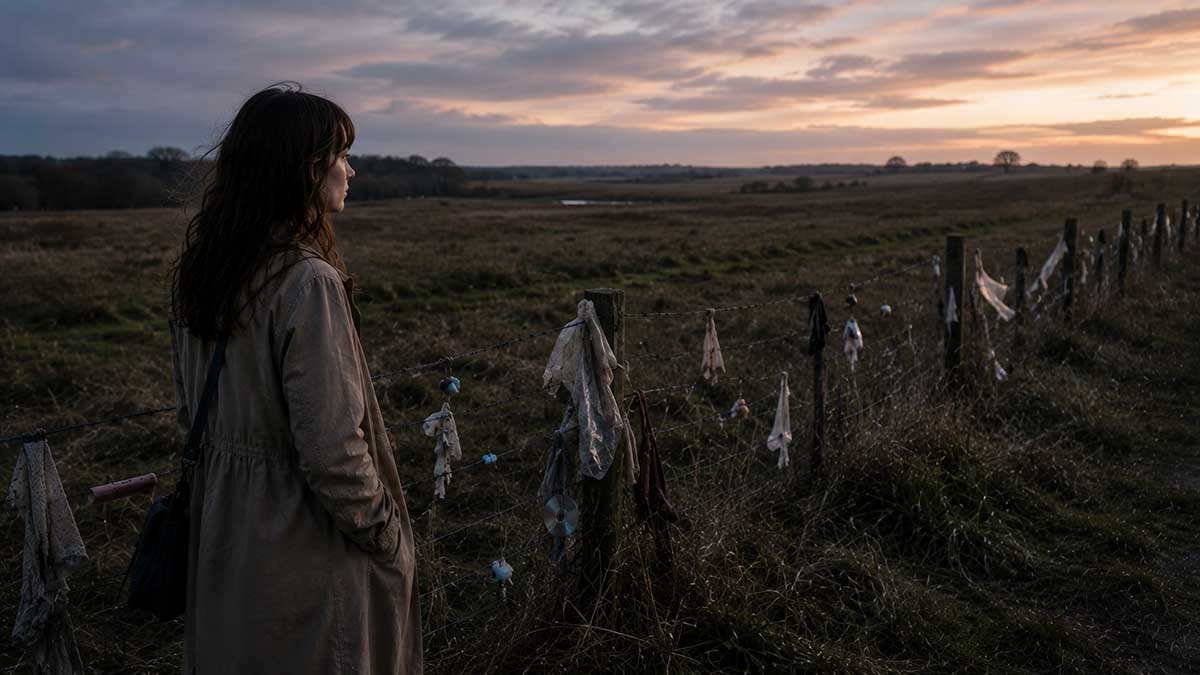
Kathy: We were taught to use the word “complete” when a donor died. It made death sound orderly, almost successful, as though a person had reached the purpose prepared for them. I used that word for years because everyone did. But now, when I think of Ruth and Tommy, I wonder whether any of us were complete—or whether that word was simply another way of making unfinished lives easier to accept.
Did Kathy, Tommy, and Ruth experience enough love to make their lives meaningful?
Tommy: I do not like the word “enough.”
Ruth: Why?
Tommy: It sounds like someone is measuring us again.
Kathy: We were measured all our lives.
Tommy: Health checks. Recovery times. Number of donations. Whether our art was good enough. Whether our love was convincing enough.
Ruth: Then perhaps the question is wrong.
Miss Lucy: What would you ask instead?
Tommy: Whether the love was real.
Kathy: It was.
Ruth: Some of it was.
Tommy: What does that mean?
Ruth: I loved both of you, but not always honestly. I wanted to be needed. I wanted to feel central. I hurt people when I feared becoming unnecessary.
Kathy: That does not make every feeling false.
Ruth: No. But it makes the word “love” harder.
Miss Emily: Love is often mixed with fear, possession, jealousy, and regret.
Tommy: That does not excuse the harm.
Miss Emily: No. It only explains why love does not always arrive in a pure form.
Kathy: When I was your carer, Tommy, our time felt real.
Tommy: It was too short.
Kathy: Yes.
Tommy: Do you wish we had never gone to see Madame?
Kathy: Sometimes.
Tommy: Why?
Kathy: Before that visit, hope still existed. Afterward, we had to live inside the truth.
Tommy: The truth was already there.
Kathy: But it had not yet entered every room.
Ruth: Hope can make a small amount of time feel larger.
Miss Lucy: It can make loss harsher too.
Tommy: I thought love would save us.
Kathy: So did I.
Tommy: That was foolish.
Kathy: It was human.
Tommy: People say that as though being human makes pain more acceptable.
Kathy: It does not make pain acceptable. It makes it recognizable.
Ruth: Did loving Kathy change your life?
Tommy: Yes.
Ruth: Then it mattered.
Tommy: It did not stop anything.
Ruth: Must something stop death before it can matter?
Tommy: I do not know.
Kathy: The song mattered to me. Norfolk mattered. The old boat mattered. None of those things saved us.
Tommy: They became memories.
Kathy: Yes.
Tommy: Memories are what remain when everything else has been taken.
Ruth: That does not make them small.
Tommy: It can make them feel small.
Miss Lucy: Meaning and rescue are not the same.
Tommy: I wanted both.
Kathy: So did I.
Miss Emily: Every person does.
Ruth: Perhaps ordinary people only hide that wish better. They know love cannot defeat death, but they behave as though it might delay the truth.
Kathy: Our lives made that truth visible sooner.
Tommy: Too soon.
Kathy: Yes.
Ruth: But not before we loved.
Tommy: Not before we hurt each other either.
Ruth: That belongs to the truth too.
Kathy: A meaningful life is not a painless one.
Tommy: That sounds like something people say when they cannot repair the pain.
Kathy: Maybe. But I still believe it.
Tommy: Do you believe our time together was enough?
Kathy: No.
Tommy: Good.
Kathy: But I believe it was real.
Tommy: That may be the better answer.
Can forgiveness repair time that was lost?
Ruth: I asked both of you to forgive me near the end.
Kathy: You did.
Ruth: Did you?
Kathy: I tried.
Ruth: That is not the same.
Kathy: No.
Tommy: I forgave you.
Ruth: Completely?
Tommy: I do not know what complete forgiveness looks like.
Ruth: Then perhaps you did not.
Tommy: Forgiveness does not erase anger.
Miss Lucy: Nor should it erase memory.
Ruth: I wanted my apology to give them back the years I had taken.
Kathy: No apology can do that.
Ruth: I know.
Kathy: But it changed what came after.
Ruth: You and Tommy had very little time.
Kathy: We had more than we would have had without you.
Ruth: Does that balance anything?
Kathy: No.
Ruth: Then what did it do?
Kathy: It opened a door.
Tommy: A door that led to a wall.
Kathy: Yes.
Tommy: Still, we walked through it together.
Ruth: I thought helping you find Madame might undo what I had done.
Tommy: It could not.
Ruth: I know.
Tommy: But I saw that you were sorry.
Ruth: Was that enough for you?
Tommy: No.
Ruth: Nothing is enough for you today.
Tommy: We are discussing lives cut short. Why should I pretend small repairs were whole ones?
Kathy: You should not.
Miss Emily: Forgiveness is often misunderstood as restoration.
Ruth: It does not restore.
Miss Emily: No. It changes the relationship to what cannot be restored.
Ruth: That sounds distant.
Miss Emily: Perhaps it is. I have needed forgiveness too.
Tommy: From us?
Miss Emily: Yes.
Tommy: I do not know whether I can give it.
Miss Emily: You owe me nothing.
Kathy: That matters.
Miss Emily: What does?
Kathy: Saying we owe you nothing. At Hailsham, gratitude was built into everything. We were expected to value what we received without asking what had been withheld.
Miss Emily: Then let me say it plainly. You do not owe me forgiveness.
Ruth: Neither do Kathy and Tommy owe me theirs.
Kathy: No.
Ruth: Yet I still want it.
Kathy: Of course.
Ruth: Is that selfish?
Miss Lucy: Perhaps partly.
Ruth: You are honest.
Miss Lucy: You asked.
Ruth: I wanted forgiveness so I could stop being the person who had harmed them.
Tommy: Forgiveness cannot change who you were.
Ruth: Then what can?
Tommy: What you did after you understood.
Ruth: I did not have long.
Tommy: None of us did.
Kathy: You admitted the truth. You tried to bring us together. You did not pretend your motives had always been good.
Ruth: Is that why you forgave me?
Kathy: I do not think forgiveness happened in one moment. It came in pieces.
Ruth: Pieces again.
Kathy: That is how most things came to us.
Tommy: I was still angry when you died.
Ruth: I know.
Tommy: I loved you too.
Ruth: I know.
Tommy: Both were true.
Ruth: Then perhaps forgiveness is being remembered as more than the worst thing you did.
Kathy: Yes.
Miss Lucy: That may be the most generous form of it.
Is a life incomplete because it ends early, or because others refuse to recognize its value?
Miss Emily: Your lives were not incomplete.
Tommy: Do not use that word so easily.
Miss Emily: I am trying to reject what the donation system taught.
Tommy: The system called our deaths completion. Now you say our lives were complete. Both claims feel too neat.
Kathy: Perhaps no life feels complete from inside it.
Ruth: Ordinary people die wanting one more conversation, one more year, one more chance to repair something.
Miss Lucy: Yes.
Ruth: Then maybe incompleteness is not unique to us.
Tommy: Our lives were still stolen.
Ruth: I did not say they were not.
Tommy: People will hear “our lives had meaning” and use it to make the injustice feel less severe.
Kathy: Then we must say both things.
Tommy: Which things?
Kathy: Our lives had meaning. What was done to us was still unforgivable.
Miss Emily: Yes.
Tommy: Meaning does not absolve the people who shortened them.
Kathy: No.
Ruth: Nor does injustice erase the days we truly lived.
Miss Lucy: Both truths must remain together.
Tommy: I wanted an ordinary future.
Kathy: What would it have looked like?
Tommy: A small place. Perhaps near the coast. I would have drawn without needing anyone to judge the drawings.
Ruth: Would Kathy have been there?
Tommy: Yes.
Kathy: You never told me that.
Tommy: We never had a future in which it seemed sensible to say it.
Kathy: I would have liked a garden.
Tommy: You never mentioned that either.
Kathy: I used to think about one when I drove between centers. Nothing large. A place where things returned each year.
Ruth: I wanted an office.
Tommy: You wanted the idea of an office.
Ruth: At first. Later, I think I wanted somewhere people expected me to arrive each morning.
Kathy: Somewhere your absence would be noticed.
Ruth: Yes.
Miss Lucy: Those imagined futures matter.
Tommy: They did not happen.
Miss Lucy: No. But they reveal what was denied.
Miss Emily: Society claimed you had no need for ordinary lives because you had been created for another purpose.
Ruth: Creation does not determine desire.
Kathy: Or dignity.
Tommy: Or ownership.
Miss Emily: No.
Ruth: Maybe that was the deepest injury. People did not merely shorten our lives. They treated our hopes as mistakes.
Kathy: Hopes we should never have formed.
Tommy: Love we should never have expected to keep.
Miss Lucy: Yet you formed them anyway.
Tommy: Was that resistance?
Miss Lucy: Perhaps a small kind.
Tommy: I do not want it romanticized.
Miss Lucy: Nor do I. Loving did not overthrow the system. Dreaming did not open the gates. But the system failed to make you empty.
Ruth: It failed to make us only donors.
Kathy: I was a carer.
Tommy: You were more than that.
Kathy: I know now.
Ruth: Did you know then?
Kathy: Sometimes. When I listened to my tape. When Tommy and I talked in the dark. When the three of us drove together. In those moments, the roles fell away.
Tommy: Then perhaps those were the moments we belonged to ourselves.
Miss Emily: Yes.
Tommy: Briefly.
Kathy: Briefly is not the same as falsely.
What does “completion” really mean?
Ruth: I hated that word near the end.
Kathy: You never said.
Ruth: I did not want to sound afraid.
Tommy: You were afraid.
Ruth: Of course I was.
Miss Lucy: The word was meant to soften death.
Ruth: It softened it for the people who did not have to die.
Miss Emily: Yes.
Kathy: As carers, we used it too.
Tommy: Did you believe it?
Kathy: No. But saying “died” felt dangerous.
Tommy: Why?
Kathy: It made the whole system visible. A donor did not complete after an operation. A person died after people removed too much from them.
Ruth: Language protected everyone except us.
Miss Lucy: It protected the program from moral clarity.
Tommy: Then we should stop using it.
Miss Emily: Yes.
Kathy: Ruth died.
Ruth: Yes.
Kathy: Tommy died.
Tommy: Yes.
Kathy: And I died too.
Miss Lucy: Yes.
Kathy: Strange. Saying it plainly does not erase us.
Ruth: It makes us more real.
Tommy: Then what would completion mean, if we took the word back?
Ruth: Maybe nothing.
Kathy: Or perhaps it should not describe a life at all.
Miss Emily: No life can be completed by another person’s schedule.
Tommy: Good.
Miss Lucy: A life may end. That does not mean every question is answered.
Ruth: Or every love settled.
Kathy: Or every regret repaired.
Tommy: Then we were unfinished.
Kathy: Yes.
Tommy: I prefer that.
Ruth: Why?
Tommy: Unfinished means there should have been more.
Kathy: There should have been.
Miss Emily: There should have been much more.
Ruth: But unfinished does not mean empty.
Tommy: No.
Kathy: It means interrupted.
Miss Lucy: That is the honest word.
Tommy: Our lives were interrupted.
Ruth: Our love was interrupted.
Kathy: Our futures were interrupted.
Miss Emily: By people who believed their need justified your loss.
Tommy: Now you are finally saying it plainly.
Closing
Kathy: We were not completed. We were interrupted. Ruth died with apologies she had only begun to make. Tommy died with drawings still inside him and a future he had only just learned to name. I died carrying memories of people I could never fully release. Our lives were too short, and no amount of beauty can make that just. Yet they were not empty. We loved badly, honestly, silently, and too late. We hurt one another, forgave in pieces, and imagined futures the world had forbidden us to claim. Perhaps a life does not need to be complete to be fully human. Perhaps being unfinished is part of what proves it was truly a life.
Final Thoughts
Kathy: We spent much of our lives believing that someone else already knew how our story would end. Looking back, I think that was the greatest tragedy. It was not only that our futures were limited, but that we slowly accepted those limits as ordinary. Even so, the memories we shared were never ordinary. They were real, imperfect, painful, and beautiful.
Tommy: I used to think the question was why we never escaped. Now I think the better question is why so many people believed we never deserved the chance. Every drawing I made, every hope I carried, every person I loved came from the same place that exists in every human being. That should never have required proof.
Ruth: I spent too much of my life afraid of losing what little I thought I had. Fear made me selfish, and selfishness hurt the people I loved most. If there is one thing I understand now, it is that love cannot survive when it is treated as something to possess. It must be given room to become honest.
Miss Lucy: Truth spoken halfway is often mistaken for truth itself. We told the students what would happen, but we failed to teach them that injustice should never be accepted simply because it has become familiar. Silence can educate as effectively as words.
Miss Emily: Hailsham was born from compassion, yet compassion without courage cannot overcome injustice. We believed we were making life more humane, but we asked children to bear a burden that should never have existed. Kindness matters. Yet kindness must never become an excuse for accepting what is fundamentally wrong.
Kathy: Perhaps that is why our story continues to matter. It is not only about clones, donations, or Hailsham. It is about every society that grows comfortable measuring the worth of one life against the comfort of another. If our conversation leaves one question behind, let it be this: How often do we recognize another person's humanity only after asking them to prove it?
Short Bios:
Kathy H.
A former Hailsham student and later one of the most respected carers, Kathy serves as the emotional center of the conversation. Thoughtful, observant, and compassionate, she preserves her world through memory, often recognizing the meaning of events long after they have passed.
Tommy D.
Sensitive, impulsive, and deeply sincere, Tommy struggles throughout his childhood to understand himself and the expectations placed upon him. His emotional honesty makes him the voice most willing to challenge assumptions about freedom, love, dignity, and the value of human life.
Ruth
Confident on the surface yet profoundly insecure beneath it, Ruth longs to be chosen and valued in a world where every future has already been decided. Her journey from jealousy and self-protection toward remorse and self-awareness forms one of the novel's most moving emotional arcs.
Miss Lucy
One of Hailsham's guardians, Miss Lucy believes the students deserve greater honesty about their futures. Her willingness to question the school's methods places her in conflict with its leadership, making her the conversation's strongest advocate for moral clarity.
Miss Emily
The head guardian of Hailsham, Miss Emily devoted herself to creating a more humane environment for the students while working within an unjust system she believed she could gradually reform. Her reflections explore the difficult boundary between compassion, compromise, and responsibility.
Leave a Reply