
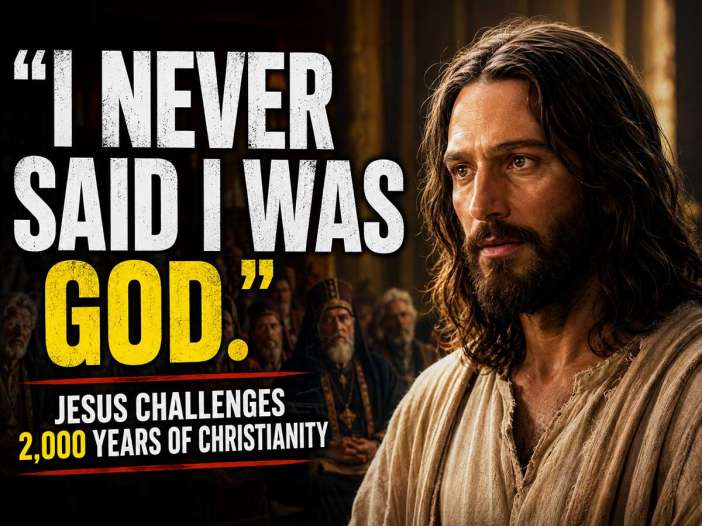
What if Jesus returned and challenged the Trinity, Christian exclusivity, and centuries of doctrine?
For nearly two thousand years, Christianity has centered itself on one defining claim:
Jesus is God.
That belief shaped creeds, churches, empires, missions, worship, salvation theology, and the Christian understanding of who belongs to God.
But what if Jesus himself returned and said:
“I never told people I was God.”
What if he said that he never taught the Trinity, never asked people to worship him as the second person of a divine Godhead, and never intended his life to become proof that he was fundamentally different from the rest of humanity?
What if his purpose was not to convince the world that he alone was divine, but to reveal what a human being could become through complete trust in God?
This imaginary conversation begins with that unsettling possibility.
Jesus enters a gathering of modern Christian leaders and asks them to defend doctrines that were developed in his name but never spoken in his own recorded words.
Pastors, bishops, theologians, missionaries, and worship leaders attempt to explain why Christianity came to identify Jesus as God, why the Trinity became essential, why worship became central, and why salvation was eventually tied to accepting these beliefs.
Jim Palmer joins the discussion as a modern spiritual critic of institutional Christianity. His argument is not that Jesus should be discarded, but that Christianity may have hidden Jesus beneath centuries of doctrine about him.
Across five conversations, the central question changes.
It begins with:
“Did Jesus claim to be God?”
It then becomes:
“Who created the doctrines Christianity now treats as essential?”
From there, the discussion moves deeper:
“Did worshiping Jesus become a substitute for following him?”
“Did Christianity turn belonging to God into something that had to be earned through belief?”
And finally:
“What would Christianity become if it stopped claiming exclusive access to God?”
The purpose of this conversation is not to mock Christian faith or diminish the sincere love millions of people feel for Jesus.
It is also not an attempt to replace one rigid doctrine with another.
It is an invitation to examine whether Christianity’s beliefs about Jesus have helped Christians become more like him.
Has belief in Jesus produced greater compassion?
Has worship produced transformation?
Has doctrine produced humility?
Has missionary certainty produced love?
Has Christianity’s claim to possess the only way to God healed the human family—or divided it?
In this conversation, Jesus does not ask Christianity to disappear.
He asks it to remember its purpose.
He challenges Christians to stop treating God as the property of one religion.
He asks them to see every human being as a child of God.
He asks churches to become communities of truth, courage, healing, accountability, service, and love.
And he asks his followers to consider one of the most difficult questions Christianity can face:
What if the greatest way to honor Jesus is not to insist that he was God, but to live as though his way of love is truly possible for us?
(Note: This is an imaginary conversation, a creative exploration of an idea, and not a real speech or event.)
Topic 1: “I Never Said I Was God”
Opening
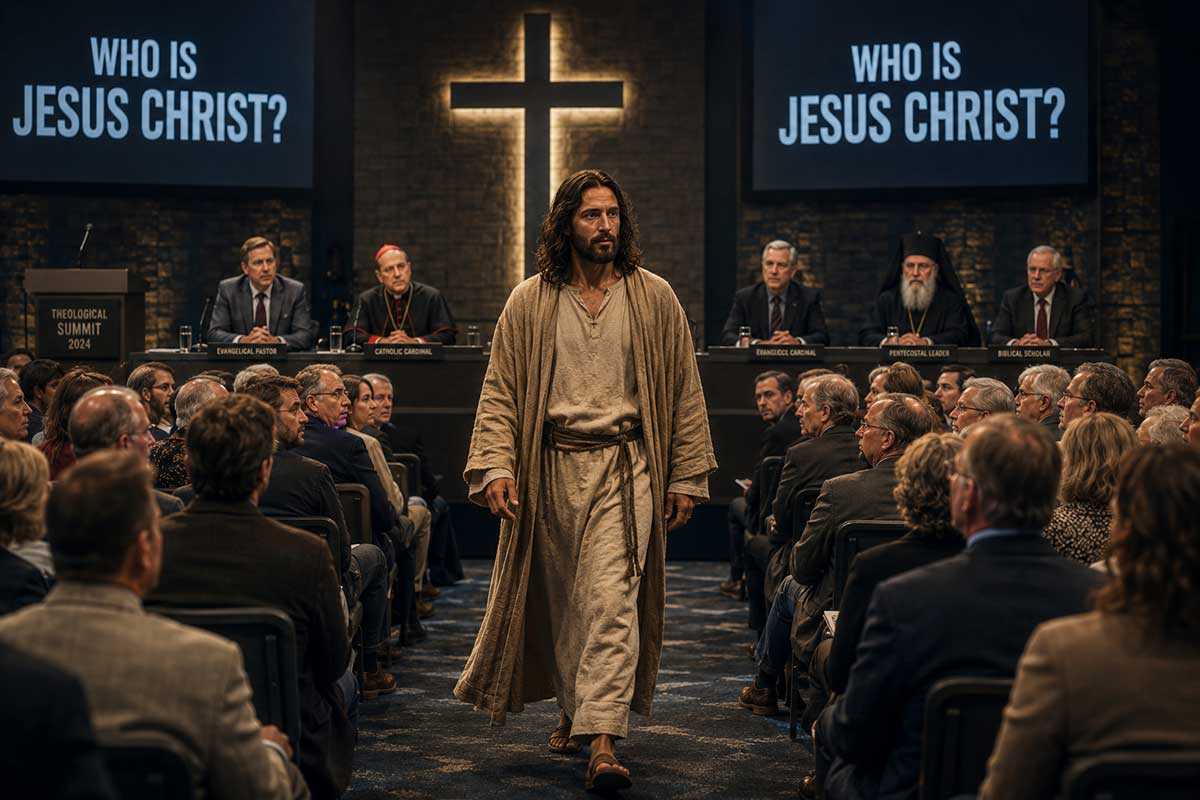
The room had been prepared for a theological summit.
On the stage sat several of the most influential voices in modern Christianity: a conservative evangelical pastor, a Catholic cardinal, a Pentecostal leader, and a biblical scholar known for defending traditional Christian doctrine.
Jim Palmer sat several seats away from them.
Behind the speakers, an enormous illuminated cross rose above the stage. Screens displayed the words:
WHO IS JESUS CHRIST?
The audience expected an argument.
Some believed Jim had gone too far by suggesting that Christianity had transformed Jesus from a human being living in profound union with God into God himself.
Others believed the church had misunderstood Jesus so deeply that only a direct confrontation could expose what had happened.
Then Jesus entered the room.
He wore no crown. There was no supernatural display. He walked quietly across the stage and looked first at the cross, then at the religious leaders, and finally at the thousands of Christians gathered before him.
The evangelical pastor stood, trembling.
“My Lord and my God.”
Jesus looked at him gently.
“I never said that I was God.”
The silence that followed seemed to empty the room of air.
The cardinal lowered his eyes. The Pentecostal leader gripped the arms of his chair. Several people in the audience began to cry.
Jesus continued.
“I spoke of God as the One who sent me. I prayed to God. I trusted God. I called God my Father, and I taught you to pray to our Father.
“I did not come to tell humanity that I alone belonged to God. I came to show what a human life becomes when it no longer lives separated from God.”
The evangelical pastor slowly returned to his seat.
Jim Palmer leaned forward.
“For centuries,” Jim said, “Christians have been taught that Jesus was able to live as he did because he was God. But what if his life was meant to reveal not what only God could do, but what a human being fully awake to God could become?”
Jesus turned toward the Christian leaders.
“You have spent centuries telling people what they must believe about me.
“Today, I am asking whether you are willing to hear what I was trying to teach.”
Question 1: Why Did Jesus Never Say Clearly, “I Am God”?
The evangelical pastor opened his Bible.
“With respect,” he said, “the claim that you never presented yourself as divine ignores the language of Scripture. You said, ‘I and the Father are one.’ You said, ‘Before Abraham was, I am.’ You forgave sins. You accepted worship. Your followers understood who you were.”
Jesus looked at the open Bible.
“You are reading words preserved, translated, interpreted, debated, and organized by generations who came after me.
“But let us begin more simply.
“When I prayed, to whom was I praying?”
The pastor hesitated.
“To the Father.”
“When I said that I had been sent, who sent me?”
“The Father.”
“When I said that I could do nothing by myself, what did I mean?”
The pastor looked toward the biblical scholar.
The scholar answered.
“Traditional theology teaches that you possessed both a divine and a human nature. Your prayers and dependence reflected your humanity, while your unity with the Father revealed your divinity.”
Jesus nodded slowly.
“That is a carefully constructed explanation.
“But did I teach it?”
The scholar was silent.
Jim spoke.
“This is the distinction Christians often avoid. The question is not whether later theologians found ways to reconcile the passages. The question is whether Jesus himself taught that he was God incarnate, the second person of a Trinity, sharing one divine essence with the Father.”
The cardinal responded.
“Doctrine develops because revelation must be understood. Jesus did not need to speak in the technical language of later councils. The church eventually found words for what his followers had experienced.”
Jim turned toward him.
“But when later language becomes the lens through which every earlier statement must be interpreted, how do we know whether the church clarified Jesus or rewrote him?”
The Pentecostal leader raised his voice.
“We know because the Spirit confirms it. Millions have experienced Jesus as God.”
Jesus answered.
“To experience God through me does not mean that I am the totality of God.
“When light shines through a window, do you worship the window as the sun?”
The Pentecostal leader lowered his head.
Jesus continued.
“I lived with an awareness of God so complete that people felt the presence of God near me. Some were healed. Some found courage. Some remembered their dignity.
“But I did not say, ‘God is present only here.’
“I said the kingdom of God was among you and within your reach.”
The evangelical pastor returned to his strongest objection.
“What about ‘I and the Father are one’?”
Jesus replied.
“I spoke of unity.
“You turned unity into identity.
“And when I prayed that my followers might also become one as I was one with the Father, did you conclude that they would all become the same being as God?”
“No,” the pastor said.
“Then why assume that my unity with God erased the distinction between God and me?”
Jim looked toward the audience.
“That may be the question Christianity has avoided. Jesus’ union with God may have been understood as proof that he was not truly like us. But what if it was meant to reveal a relationship available to us?”
The biblical scholar objected.
“That risks reducing Jesus to one enlightened teacher among many.”
Jesus turned toward him.
“Why do you hear humanity as a reduction?”
The scholar did not answer.
“To live fully as a human being aligned with God is not a small thing,” Jesus said. “You have made divinity great by making humanity contemptible.
“But I did not come to teach contempt for humanity.”
Question 2: What Did “Son of God” Mean?
The Catholic cardinal spoke carefully.
“You referred to yourself as the Son. The church did not invent that language.”
“I called God my Father,” Jesus said.
“And did I not also call God your Father?”
The cardinal answered.
“Yes, but your sonship was unique.”
“In what way?”
“You revealed God perfectly.”
Jesus nodded.
“Then say that.
“Say that I trusted God deeply. Say that I surrendered myself fully. Say that I embodied love with unusual courage. Say that people saw something of the Father through me.
“But why did you take a relationship and turn it into a species?”
The room stirred.
Jim expanded the question.
“In much of Christianity, ‘Son of God’ no longer means a person living in conscious relationship with God. It means a supernatural being who belongs to a category that no other person can enter.”
The evangelical pastor answered sharply.
“Because Jesus is the only begotten Son.”
Jim replied.
“And what happens psychologically when ordinary Christians hear that?”
“They understand that Christ is unique.”
“They also understand that they can never become what he was.”
The pastor responded.
“We are not meant to become Jesus.”
Jim shook his head.
“Then why did he say, ‘Follow me’?
“If Jesus’ compassion came from a divine nature we do not possess, his compassion is impossible for us.
“If his courage came from being God, his courage is impossible for us.
“If his love for enemies came from a nature fundamentally different from ours, then the command to live as he lived becomes almost theatrical.”
Jesus looked at the leaders.
“You have used my uniqueness to excuse your distance from my way.”
The Pentecostal leader appeared wounded.
“Surely you know that we love you.”
“I do not question your love,” Jesus answered.
“I question what your love has allowed you to avoid.”
The leader’s eyes filled with tears.
Jesus continued.
“You have praised my forgiveness while preserving your hatred.
“You have praised my humility while building empires in my name.
“You have praised my poverty while measuring blessing by wealth.
“You have called me Lord while resisting the life I taught.”
The cardinal asked:
“Are you saying there was nothing singular about you?”
Jesus paused.
“I was singular as every human life becomes singular when it gives itself completely to love.
“I was not trying to lower myself into ordinariness.
“I was trying to raise your understanding of what humanity can become.”
Jim added:
“The traditional doctrine says Jesus is unique because he is ontologically different from everyone else.
“This alternative says Jesus is unique because he realized and embodied the relationship with God that humanity has forgotten.”
The biblical scholar frowned.
“But if everyone is a child of God in the same sense, why follow Jesus at all?”
Jesus answered:
“A child may possess an inheritance and still live as though they are homeless.
“I came to help people remember.”
Question 3: What Happens If Christians Were Wrong About Jesus?
The evangelical pastor closed his Bible.
His confidence had given way to fear.
“If what you are saying is true, then the foundation of my ministry is wrong.”
Jesus looked at him with compassion.
“You taught what you received.”
“I told people they could not be saved unless they believed you were God.”
“And what happened to those who could not believe it?”
“I told them they were separated from God.”
“Were they?”
The pastor struggled to answer.
The cardinal stepped in.
“Without clear doctrine, Christianity would dissolve into personal opinion. The church needed boundaries.”
Jesus turned toward him.
“Did God need those boundaries, or did the institution?”
The cardinal’s face tightened.
“You are placing centuries of Christian faith on trial.”
“No,” Jesus said.
“I am asking whether faith can survive honesty.”
The biblical scholar spoke.
“If Christians concluded that you were not God, many would feel that everything had been taken from them: salvation, hope, eternal life, forgiveness, the meaning of the cross.”
Jim answered gently.
“That fear is understandable. But perhaps what is being threatened is not God. Perhaps it is an interpretation of God.”
The pastor looked toward Jim.
“That is easy for you to say. You are not asking millions of people to reconsider the center of their faith.”
Jim replied:
“No. Jesus is.”
The room fell silent again.
Jesus addressed the leaders.
“If you discovered that your understanding of me was incomplete, would you abandon love?
“Would you stop forgiving?
“Would you stop serving the poor?
“Would you stop seeking God?
“Would compassion become false because your doctrine changed?”
“No,” the Pentecostal leader whispered.
“Then perhaps your faith is deeper than the explanation you built around it.”
A woman in the audience stood.
“My mother died believing that you were God. Are you saying her faith meant nothing?”
Jesus turned toward her.
“No.
“Her love meant something.
“Her trust meant something.
“Her prayers meant something.
“People can love through imperfect understanding. God is not limited by the precision of human theology.”
The woman began to weep.
Jesus continued.
“This conversation is not an accusation against those who loved sincerely.
“It is a challenge to those who made one interpretation compulsory and used it to decide who belonged to God.”
The missionary leader, seated in the front row, stood.
“If people do not need to believe you are God, why did we send missionaries across the world?”
Jesus answered:
“Did you go to love people or to correct them?
“Did you see children of God or souls waiting for your approval?
“Did you serve their dignity, or did you teach them to distrust everything God had already planted in their cultures, families, and spiritual traditions?”
The missionary leader sat down.
Jim spoke quietly.
“This is why the question matters.
“If Jesus is God alone, Christianity becomes the gatekeeper of access to God.
“If Jesus is a son of God revealing universal spiritual belonging, Christianity has no authority to tell the rest of humanity that God is absent from them.”
The evangelical pastor raised one final objection.
“But what if this leads people away from you?”
Jesus answered:
“Following truth does not lead people away from me.
“But defending ideas about me can lead people far away from the life I lived.”
Closing
The illuminated cross still towered behind them.
But now it appeared less like an answer and more like a question.
The evangelical pastor looked at Jesus.
“What are you asking us to do?”
Jesus replied:
“Do not replace your old certainty with a new certainty.
“Do not use these words to attack people whose faith sustained them.
“Do not create another doctrine and punish those who cannot accept it.
“Begin again with what I taught.
“Love God.
“Love your neighbor.
“Love your enemy.
“Care for the poor.
“Forgive.
“Reject hypocrisy.
“Seek the kingdom of God.
“Become whole.
“And stop telling people that they must first agree with your theology before they can belong to the Father.”
The pastor asked:
“Then what should we call you?”
Jesus smiled.
“Call me what helps you follow the truth.
“But do not call me God if doing so makes you believe that my life is impossible for you.”
Jim looked toward the leaders.
“For centuries, Christianity has asked humanity, ‘What do you believe about Jesus?’
“Perhaps Jesus is now asking Christianity a different question:
‘What have you become because of what you believe about me?’”
Jesus faced the audience.
“I did not come to make humanity smaller so that I could appear greater.
“I came to show you the dignity, responsibility, and possibility of living as children of God.”
No one applauded.
The leaders remained seated, surrounded by doctrines that had once felt immovable.
The conversation had not destroyed Christianity.
It had removed the protection of certainty.
And for the first time, the Christians in the room were no longer asking whether Jesus was God.
They were asking whether they had ever truly followed him.
This is an imaginary philosophical conversation inspired by Jim Palmer’s interpretation of Jesus. It does not present historically verified words spoken by Jesus or the other participants.
This topic establishes the crisis. Topic 2 can now examine how the doctrine of the Trinity developed and why the church made acceptance of it a boundary of Christian belonging.
Topic 2: Who Built the Trinity—and Why?
Opening
The room had changed overnight.
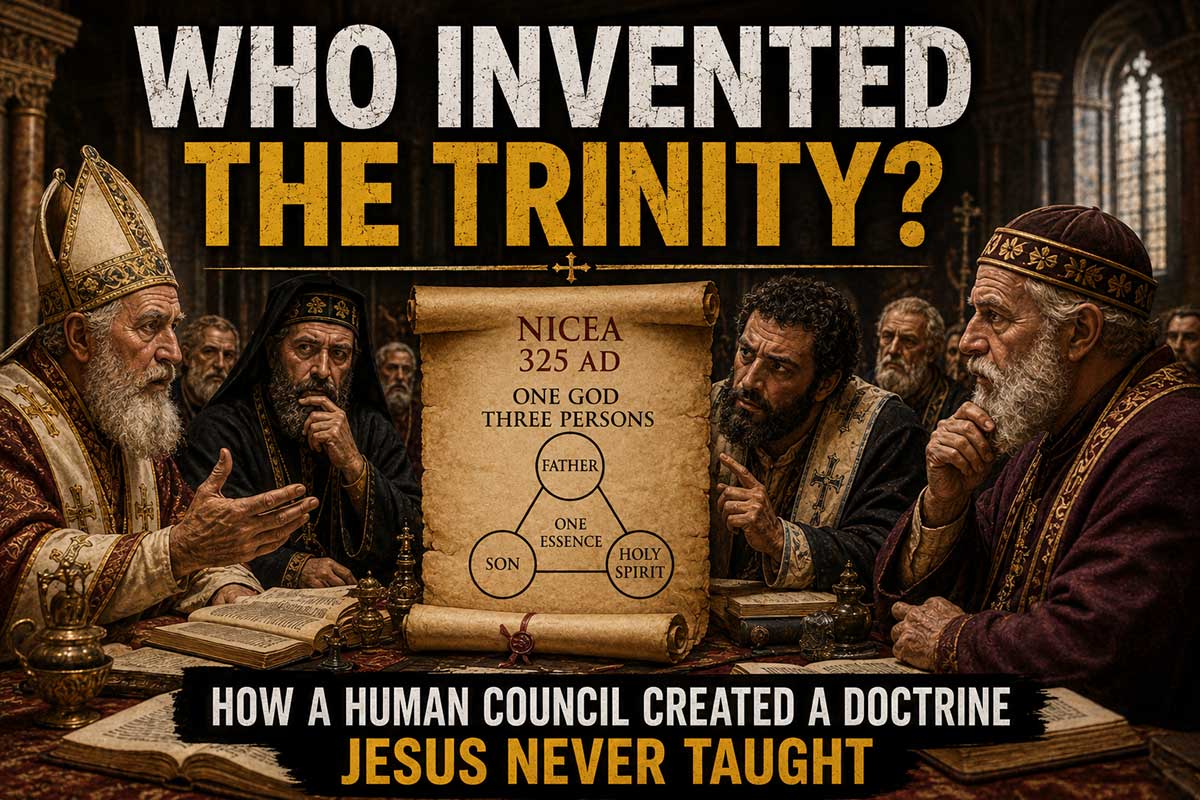
The enormous illuminated cross still stood behind the stage, but the words on the screens were different.
FATHER. SON. HOLY SPIRIT.
ONE GOD. THREE PERSONS.
The previous day, Jesus had told the gathered Christian leaders:
“I never said that I was God.”
The statement had traveled around the world before sunrise.
Churches issued emergency responses. Theologians recorded hours of commentary. Some pastors called the gathering a deception. Others canceled their sermons because they no longer knew what to say.
Millions of Christians watched the livestream in silence.
This time, the stage held a Catholic cardinal, an Eastern Orthodox bishop, a Reformed theologian, an evangelical seminary president, and a historian of early Christianity.
Jim Palmer sat near the edge of the platform.
Jesus stood in the center.
The cardinal spoke first.
“Yesterday, you questioned whether the church correctly understood your identity. Today, we must address the doctrine that has protected that identity for nearly seventeen centuries.”
Jesus looked at the words on the screen.
“The Trinity.”
“Yes.”
Jesus waited.
The cardinal continued.
“One God in three persons: Father, Son, and Holy Spirit. Not three gods. Not one person appearing in three forms. Three distinct persons sharing one divine being.”
Jesus looked toward the audience.
“Did I ever teach those words?”
No one answered.
He turned back toward the leaders.
“Did I gather my disciples and explain that God was one essence in three coequal and coeternal persons?”
The Orthodox bishop replied carefully.
“You did not use that language.”
“Did I tell people that accepting such language would determine whether they were faithful to God?”
“No.”
“Then who did?”
The room became still.
Jim leaned toward his microphone.
“That may be the most important question of this conversation. The doctrine many Christians now treat as the foundation of faith was not taught by Jesus in those terms. It was constructed later by theologians and enforced through councils, creeds, bishops, and eventually imperial power.”
The Reformed theologian responded immediately.
“Constructed is a misleading word. The church did not invent the Trinity. It discovered the best language available to explain what Scripture revealed.”
Jesus turned toward him.
“Then let us examine what you discovered—and what may have been lost while you were discovering it.”
Question 1: Did the Church Clarify Jesus—or Replace Him with a Theological System?
The seminary president opened a thick Bible marked with colored notes.
“The doctrine arose because the church had to make sense of the evidence. Jesus spoke of the Father. He spoke of the Spirit. His followers worshiped him. The church had to explain how all three could be divine while maintaining belief in one God.”
Jesus asked:
“Why did you have to explain me as divine?”
“Because that is how the earliest Christians experienced you.”
“Some did,” Jesus said. “Others experienced me as a prophet, teacher, Messiah, healer, servant, or son of God.”
The historian nodded.
“Early Christianity was diverse. Different communities used different language. Some emphasized Jesus’ humanity. Some emphasized preexistence. Some saw him as adopted or exalted by God. Others moved toward stronger claims of divinity.”
The Orthodox bishop objected.
“Diversity does not mean every view was equally faithful. The church had to distinguish truth from error.”
Jim turned toward him.
“But who gave the church the authority to decide that one developing interpretation represented Jesus himself?”
“The apostles.”
“Did the apostles teach the Nicene Creed?”
“No.”
“Did they define Jesus as ‘of one substance with the Father’?”
“No.”
“Did Jesus?”
The bishop paused.
“No.”
Jim continued.
“Then the church did more than preserve a sentence handed down from Jesus. It created a theological framework and later treated that framework as though rejecting it meant rejecting Jesus.”
The cardinal responded.
“Every generation must interpret revelation. Language develops because questions develop.”
Jesus nodded.
“That is true. Interpretation is unavoidable.
“But interpretation becomes dangerous when people forget that it is interpretation.”
The seminary president answered:
“Without doctrine, anyone can create a Jesus in their own image.”
Jesus looked at him.
“And with doctrine, did institutions never create a Jesus in theirs?”
The audience reacted softly.
Jesus continued.
“You feared that people would distort me, so you built systems to prevent distortion.
“But systems also distort.
“They turn mystery into formulas.
“They turn relationship into definition.
“They turn trust into agreement.
“They turn the living search for God into a test administered by authorities.”
The Reformed theologian leaned forward.
“Truth requires definition.”
“Some truth does,” Jesus replied.
“But tell me: what happens when the definition becomes more important than the life it claims to protect?”
The theologian answered:
“Then hypocrisy becomes possible.”
“Possible?”
The theologian lowered his eyes.
Jesus continued.
“You learned to speak with precision about my two natures while blessing violence.
“You defended one divine essence while dividing the human family.
“You condemned people for using the wrong words about God while ignoring my words about mercy, wealth, enemies, prisoners, strangers, and the poor.
“Did your precision protect my message?”
No one answered.
Jim spoke.
“Perhaps the Trinity became not only an explanation of Jesus, but a replacement for Jesus. Instead of asking whether people lived in the spirit of Jesus, the church asked whether they repeated the correct formula about his nature.”
The cardinal replied:
“That is an abuse of doctrine, not an argument against doctrine.”
Jim nodded.
“Perhaps. But when the abuse continues for centuries, we must ask whether the structure itself made the abuse easier.”
Jesus looked again at the screen.
“One God. Three persons.
“You found language that satisfied theological conflict.
“But did it help people know God as the Father I trusted?
“Did it teach them to live with the Spirit?
“Did it make them more capable of loving as I loved?”
The Orthodox bishop replied:
“For many, yes.”
Jesus nodded.
“Then honor the fruit.
“But do not pretend the tree was planted by my mouth.”
Question 2: Why Did a Later Doctrine Become a Test of Salvation?
The Reformed theologian spoke with restrained urgency.
“The Trinity is not an optional detail. If Jesus is not truly God, then the Christian understanding of salvation collapses.”
Jesus asked:
“Which understanding of salvation?”
“That humanity is fallen, guilty, and unable to reconcile itself to God. Only God could save humanity. Therefore, the Savior had to be fully divine.”
Jesus looked at him.
“You begin with a conclusion about humanity, then require a conclusion about me to solve it.”
The theologian frowned.
“Human sin is not merely a conclusion. It is visible everywhere.”
“I did not deny human cruelty,” Jesus said.
“I confronted it.
“But did I teach that human beings were born so corrupt that God could not love them without blood?”
The theologian answered carefully.
“You spoke of sin, judgment, repentance, and forgiveness.”
“Yes.
“But forgiveness is not the same as a divine transaction.
“When I forgave people, did I first explain that my future death would satisfy God’s requirement?”
The theologian remained silent.
Jim entered.
“This is where the doctrine becomes part of a larger system. If humanity is defined as helplessly depraved, then Jesus must become a supernatural rescuer rather than a human model. His divinity becomes necessary because the theology has made human transformation impossible.”
The seminary president objected.
“Human effort cannot save us.”
Jim replied:
“Perhaps salvation was never about human effort earning divine approval. Perhaps it was about awakening from separation, fear, violence, ego, and false identity.”
The cardinal raised his hand.
“But the church’s concern was not power. It was salvation. It believed eternal truth was at stake.”
Jesus turned to him.
“Sincerity does not remove consequence.
“People can sincerely protect an idea and still imprison others with it.”
The cardinal’s expression hardened.
“You are suggesting the creeds imprisoned people.”
“I am asking what happened when a creed became a border between those whom God accepted and those whom the church rejected.”
The historian spoke.
“Once Nicene Christianity gained institutional and imperial support, theological disagreement no longer remained only theological. It affected status, office, property, legitimacy, and sometimes physical safety.”
The Orthodox bishop responded.
“Political enforcement should not be confused with theological truth.”
Jesus asked:
“Could truth not survive without enforcement?”
The bishop did not answer.
Jim looked toward the leaders.
“When a doctrine requires emperors, decrees, exiles, and suppression to become universal, we should at least ask whether its victory proves truth or power.”
The Reformed theologian said:
“The doctrine did not survive only because of power. Believers confessed it under persecution too.”
Jim nodded.
“That is fair. Many believed it sincerely and courageously. But sincerity on both sides does not prove that Jesus taught it.”
Jesus addressed the audience.
“You were told that salvation depended on believing I was God.
“Did I say that?”
The evangelical seminary president replied:
“You said that no one comes to the Father except through you.”
Jesus looked at him.
“What did you assume ‘through me’ meant?”
“Through faith in your identity and saving work.”
“Or through my way?”
The president hesitated.
Jesus continued.
“Through love.
“Through truth.
“Through forgiveness.
“Through surrender to God.
“Through the death of the false self.
“Through courage in the face of violence.
“Through compassion that crosses every boundary.
“You reduced ‘through me’ to agreement about me.”
Jim added:
“And once agreement became the gateway, church authorities controlled the gateway.”
The cardinal protested.
“That accusation ignores centuries of charity, sacrifice, service, and holiness.”
Jesus nodded.
“No one is denying the goodness done in my name.
“But goodness does not make every doctrine mine.
“A tree may bear both fruit and thorns.”
Then Jesus asked the leaders:
“How many people did you teach to fear God because they could not understand your doctrine?
“How many children believed they were condemned because they asked honest questions?
“How many people of other faiths were told that the love, wisdom, and holiness in their lives counted for nothing because they did not affirm your formula?
“How many Christians learned to defend the Trinity before they learned to love their enemies?”
No one spoke.
Question 3: Did the Trinity Protect God—or Protect Christian Authority?
The Catholic cardinal sat straighter.
“This discussion is becoming unfair. The doctrine of the Trinity is not merely a weapon of institutional authority. It has inspired profound theology, prayer, art, music, contemplation, and love.”
Jesus looked at him warmly.
“I know.
“Human beings can touch God through imperfect structures.
“Do not confuse grace within a system with divine endorsement of every part of the system.”
The cardinal absorbed the words in silence.
Jim spoke next.
“The deeper issue is not whether beautiful things emerged from Trinitarian Christianity. They did.
“The issue is why questioning the doctrine became nearly unthinkable.
“If the Trinity was simply a helpful interpretation, it could be examined.
“But if it became the foundation of church authority, questioning it threatened the entire structure.”
The Orthodox bishop replied:
“Every community requires boundaries.”
Jim answered:
“Boundaries around behavior, perhaps. Around violence, exploitation, and abuse.
“But Christianity often placed its strongest boundaries around metaphysical ideas.”
Jesus added:
“You tolerated greed more easily than doubt.
“You tolerated cruelty more easily than heresy.
“You tolerated pride more easily than theological uncertainty.
“Why?”
The Reformed theologian answered reluctantly.
“Because wrong belief was thought to endanger souls.”
“And did lovelessness not endanger them?”
“Yes.”
“Then why was lovelessness so often tolerated among those who believed correctly?”
The theologian looked down.
A megachurch pastor in the audience stood and spoke without a microphone.
“Because correct doctrine keeps people inside the church.”
Every head turned.
The pastor appeared surprised by his own honesty.
He continued.
“If people believe they can know God without accepting our teaching about Jesus, they may no longer need us.”
The room went silent.
Jesus looked at him.
“Thank you.”
The pastor began to cry.
“I have spent thirty years telling people that outside our message there was darkness.”
Jesus walked closer to him.
“Did you believe it?”
“Yes.”
“Then you were not merely manipulating them.”
“No.”
“But did the belief also give you authority?”
The pastor nodded.
“Yes.”
“Did it give your institution urgency?”
“Yes.”
“Did it make people afraid to leave?”
“Yes.”
Jesus placed a hand on the pastor’s shoulder.
“Then truth must reach not only your doctrine, but the needs your doctrine served.”
The pastor covered his face.
Jim turned toward the audience.
“This is why we cannot treat theology as though it exists above human psychology.
“Doctrines may answer intellectual questions, but they can also satisfy institutional needs.
“They can create certainty.
“They can establish insiders and outsiders.
“They can give leaders control.
“They can make doubt feel dangerous.
“And they can convert mystery into something an institution claims to own.”
The cardinal responded:
“Are you saying every defender of the Trinity was motivated by power?”
“No,” Jim said.
“That would be dishonest.
“Many were sincere. Many were brilliant. Many believed they were defending the truth.
“But sincere people can build systems that later serve purposes they never intended.”
Jesus turned to the cardinal.
“Perhaps your predecessors wanted to honor me.
“But when honoring me required diminishing everyone else’s relationship with God, what had their honor become?”
The cardinal answered:
“They believed your relationship with God was unique.”
Jesus replied:
“Unique does not have to mean exclusive.
“A flower may bloom uniquely without denying the garden.”
The Orthodox bishop asked:
“Then how should Christians speak of the Father, Son, and Holy Spirit?”
Jesus smiled slightly.
“As living realities, not as a prison of words.
“Speak of God beyond you.
“Speak of God revealed through human life.
“Speak of God moving within you.
“But do not imagine that your language contains God.”
The bishop asked:
“Are you rejecting the Trinity?”
Jesus paused.
“I am rejecting your belief that God depends upon your formula.
“I am rejecting the use of that formula to divide the children of God.
“I am rejecting the claim that I taught what I did not teach.
“And I am rejecting the idea that those who cannot repeat your words are therefore outside the love of the Father.”
Closing
The words on the screens remained unchanged:
FATHER. SON. HOLY SPIRIT.
ONE GOD. THREE PERSONS.
But they no longer appeared unquestionable.
They appeared human.
The cardinal looked at Jesus.
“If the Trinity is a human attempt to understand God, must Christians abandon it?”
Jesus replied:
“Not everything human must be abandoned.
“Language can serve love.
“Symbols can open the heart.
“Traditions can carry wisdom.
“But hold them with humility.
“A map can guide you.
“It becomes dangerous when you insist the map is the land.”
The Reformed theologian asked:
“What, then, should remain nonnegotiable?”
Jesus answered:
“Love.
“Truthfulness.
“Mercy.
“Justice.
“Humility.
“Care for the vulnerable.
“Freedom from hypocrisy.
“Courage before power.
“Trust in God.
“These were not footnotes to my teaching.
“They were the teaching.”
The seminary president said:
“But beliefs matter.”
“Yes,” Jesus replied.
“Beliefs shape the lives people build.
“That is why you must examine them by their fruit.
“If a belief makes you more loving, more courageous, more humble, and more open to God, receive its gift.
“If it makes you proud, fearful, cruel, or certain that others are rejected by God, ask whether you are defending truth or defending yourself.”
Jim looked toward the gathering.
“Perhaps Christianity does not need to erase every doctrine.
“Perhaps it needs to reverse the order.
“Instead of beginning with doctrines and judging human beings by whether they accept them, begin with human beings as children of God and judge doctrines by whether they help us love them.”
The Orthodox bishop asked Jesus one final question.
“If the church had never created the doctrine of the Trinity, what would you have wanted it to teach about you?”
Jesus answered:
“That I trusted God enough to live without fear.
“That I saw no person as disposable.
“That I refused to let violence determine my character.
“That I treated the rejected as family.
“That I discovered the Father not as private possession, but as the source of all life.
“And that what you saw in me was not meant to make you feel smaller.
“It was meant to awaken you.”
The cardinal looked again at the creed displayed behind them.
“Then perhaps we mistook an explanation for the foundation.”
Jesus replied:
“Your foundation was never a formula.
“It was always the life of God expressed through love.”
A member of the audience called out:
“What happens now?”
Jesus turned toward the crowd.
“Now you stop asking whether people can pass your theological test.
“You begin asking whether your theology can pass the test of love.”
The screens went dark.
For centuries, Christians had been told that the Trinity explained who Jesus was.
Now they faced a more unsettling possibility:
Perhaps the doctrine had explained Jesus so completely that Christians no longer felt required to become like him.
The conversation had not solved the mystery of God.
It had returned the mystery to everyone.
This is an imaginary philosophical conversation inspired by Jim Palmer’s interpretation of Jesus. It does not present historically verified words spoken by Jesus or the other participants.
Topic 3 can now move from doctrine to daily Christian life: Did worshiping Jesus become a substitute for following him?
Topic 3: Did Worship Replace Following?
Opening
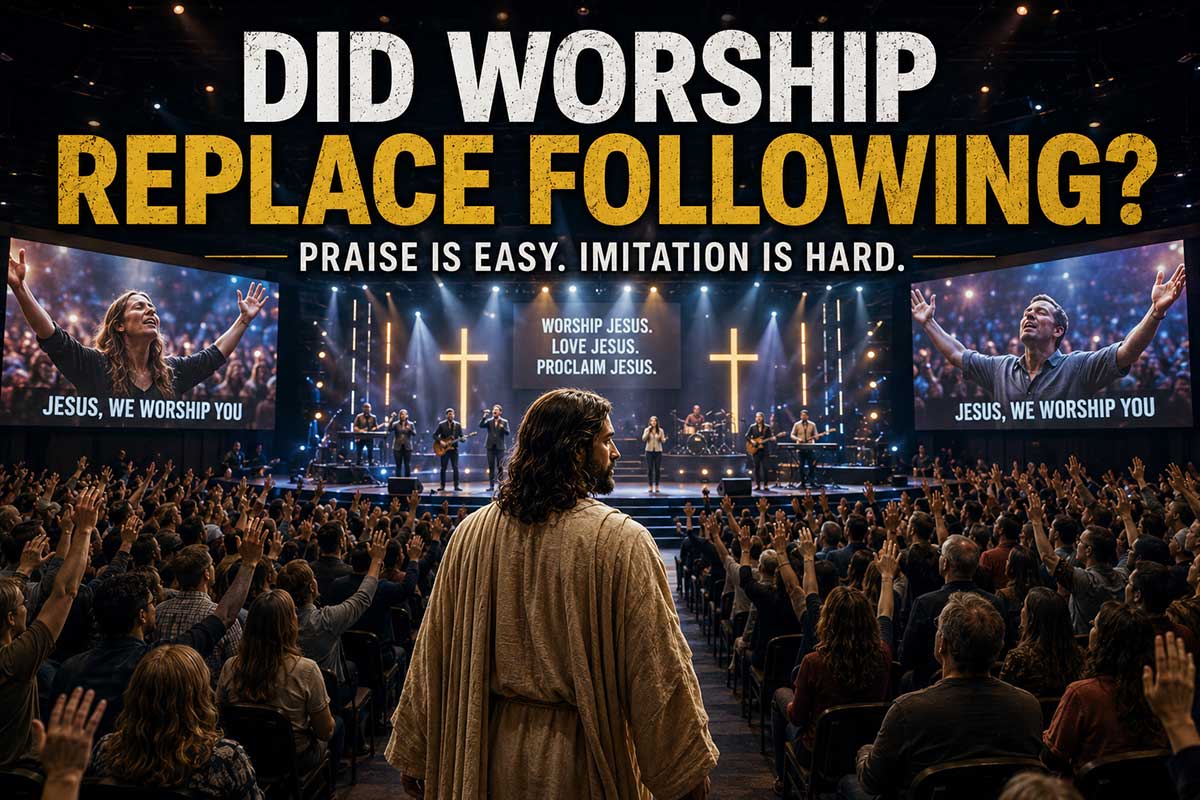
The third gathering took place inside a megachurch.
The building held more than ten thousand people.
A stage stretched across the front of the sanctuary beneath walls of light. Musicians stood ready behind keyboards, guitars, drums, and microphones. Giant screens showed slow-motion images of raised hands, tearful faces, open Bibles, and crosses glowing against dark skies.
The words above the stage read:
WORSHIP JESUS.
LOVE JESUS.
PROCLAIM JESUS.
The senior pastor had built the church over twenty-five years. His sermons were broadcast around the world. His congregation funded hospitals, schools, food programs, missionaries, and humanitarian projects.
He loved Jesus sincerely.
That was why he had agreed to stand before him.
Beside the pastor sat a Pentecostal worship leader, a Catholic priest, a Christian recording artist, a prosperity preacher, and a theologian known for defending the worship of Christ.
Jim Palmer sat in the audience rather than on the stage.
Jesus entered from the side aisle.
The congregation rose instantly.
The musicians began to play.
The worship leader lifted her microphone.
“Let us welcome the King of Kings.”
The audience erupted.
Thousands of voices sang:
“Jesus, we worship you.”
Jesus remained standing in the aisle.
He did not walk toward the stage.
The music continued for several moments before the worship leader noticed that he was not moving.
She lowered the microphone.
Jesus looked around the room.
“Why are you singing to me?”
The question unsettled the congregation.
The senior pastor stepped forward.
“Because we love you.”
Jesus nodded.
“And what does your love ask of you?”
The pastor answered:
“To worship you. To honor you. To proclaim your name.”
Jesus looked toward the screens.
“Is that all?”
“No,” the pastor said quickly. “We are also called to follow you.”
Jesus walked slowly toward the stage.
“Which have you practiced more faithfully?”
The music stopped.
The room fell silent.
Jesus stepped onto the platform and looked at the thousands of people who had come expecting affirmation.
“You have sung my name beautifully.
“Now tell me what my name has taught you to become.”
Question 1: Is Worship Easier Than Imitation?
The Pentecostal worship leader spoke first.
“When we worship, we surrender. We open our hearts to God. People are healed. They experience peace. They encounter your presence.”
Jesus answered gently.
“I do not reject the healing people have found here.
“Music can open places in the heart that words cannot reach.
“Gratitude can free a person from fear.
“Communal worship can remind people that they are not alone.
“But tell me this:
“What happens after the song ends?”
The worship leader hesitated.
“We return to our lives.”
“And does the life change?”
“For many, yes.”
“For some?”
She lowered her eyes.
“No.”
Jesus turned toward the congregation.
“You have learned how to feel close to me.
“Have you learned how to live as I lived?”
The senior pastor responded.
“Worship is part of discipleship.”
“It can be,” Jesus said.
“But it can also become a substitute for discipleship.”
The theologian leaned forward.
“How can worshiping Christ be a substitute for following Christ?”
Jesus looked at him.
“If a person praises my forgiveness but refuses to forgive, what has the praise accomplished?
“If a person calls me Lord but serves wealth, status, and fear, what has the title accomplished?
“If a church sings about surrender while protecting its power, what has the song accomplished?”
The theologian replied:
“Hypocrisy does not invalidate worship.”
“No,” Jesus said.
“But worship can hide hypocrisy.”
The senior pastor frowned.
“That is a serious accusation.”
“It is a serious possibility.”
Jesus continued.
“Worship can make people feel faithful without requiring them to change.
“It can create emotional intensity without moral courage.
“It can produce tears without repentance.
“It can make admiration feel like obedience.”
The recording artist looked wounded.
“Are you saying the songs are meaningless?”
“No.
“I am saying a song cannot love your enemy for you.
“A chorus cannot feed the hungry for you.
“A melody cannot confess your dishonesty for you.
“Music can awaken the heart.
“But then the heart must walk.”
Jim spoke from the audience.
“This is one of the consequences of making Jesus fundamentally unlike everyone else.
“If Jesus is God, then worship becomes the natural response.
“But if Jesus is also the model of awakened humanity, then worship without imitation becomes incomplete.”
The theologian answered.
“Christians have always believed both. We worship Jesus because of who he is and follow him because of what he taught.”
Jim replied:
“In theory, perhaps.
“But in practice, which receives more energy?
“How many churches spend more time singing about Jesus than studying how he treated enemies, outsiders, wealth, violence, and power?”
The prosperity preacher raised his hand.
“That is too broad. Churches do enormous good.”
Jim nodded.
“Many do.
“But good works do not remove the question.
“Can worship create the illusion that devotion itself is transformation?”
Jesus turned to the prosperity preacher.
“What do you teach people that faith will bring them?”
The preacher answered confidently.
“Victory. Abundance. Favor. Healing. Breakthrough.”
Jesus asked:
“And what did my life bring me?”
The preacher paused.
“Opposition.”
“What else?”
“Rejection.”
“What else?”
“Suffering.”
“What else?”
“Death.”
Jesus nodded.
“Then why do you use my name to promise people a life I did not live?”
The congregation stirred.
The prosperity preacher replied:
“You also healed the sick, multiplied food, and spoke of abundant life.”
“Yes.
“But abundance was not luxury.
“It was freedom from fear.
“It was enoughness.
“It was life rooted in God rather than possession.”
The preacher said:
“People need hope.”
Jesus answered:
“Hope that depends on getting what they want becomes another form of fear.”
Question 2: Did Making Jesus God Make His Life Impossible to Follow?
The senior pastor opened his Bible.
“You keep emphasizing imitation. But no Christian believes we can become exactly what you are.”
Jesus asked:
“Why not?”
“Because you are sinless. Divine. Perfect.”
“And what does that belief do to your expectations of yourselves?”
The pastor answered:
“It keeps us humble.”
“Or does it keep you excused?”
The pastor stiffened.
Jesus continued.
“If you believe I forgave because I was God, then your refusal to forgive becomes understandable.
“If you believe I loved enemies because I possessed a nature you do not possess, then your hatred becomes inevitable.
“If you believe I resisted wealth and power because I was unlike you, then your attachment to both becomes normal.”
The Catholic priest responded.
“Christians do not claim perfection. We rely on grace.”
Jesus nodded.
“Grace is not permission to remain unchanged.
“Grace is the power to become truthful.”
The priest said:
“But human beings fail.”
“Of course.
“I did not ask for flawless performance.
“I asked for direction.”
The worship leader asked:
“What do you mean?”
Jesus answered:
“Do you move toward love or away from it?
“Do you become more honest or more defended?
“Do you become more compassionate or more certain of your superiority?
“Do you become freer from fear or more controlled by it?
“Following is not pretending to be perfect.
“It is allowing truth to keep changing you.”
Jim stood.
“This is the heart of the issue.
“When Jesus became the divine exception, Christians could admire him without expecting his life to be reproducible.
“His compassion became supernatural.
“His courage became supernatural.
“His intimacy with God became supernatural.
“His refusal to dominate became supernatural.
“And ordinary Christians were left with belief as the main thing they could still offer.”
The theologian objected.
“That is unfair. The saints prove that Christians have always pursued imitation.”
Jim replied:
“The saints were often treated as extraordinary for doing what Jesus asked of everyone.”
Jesus looked toward the theologian.
“Why did radical love become exceptional?”
The theologian did not answer.
Jesus continued.
“Why is forgiveness considered heroic?
“Why is generosity considered extreme?
“Why is refusing violence considered unrealistic?
“Why is welcoming the stranger treated as political controversy?
“Why is telling the truth to power considered dangerous even inside churches?”
The senior pastor replied:
“Because the world is fallen.”
Jesus asked:
“Then what is the church for?”
The pastor fell silent.
Jesus turned to the audience.
“Did you gather here to escape the world’s fear for two hours?
“Or to become people who no longer reproduce it?”
A young man in the congregation stood.
“I worship every week,” he said. “But I still hate my father.”
Jesus looked at him.
“Why?”
“He abandoned us.”
“Have you told him your anger?”
“No.”
“Have you told anyone?”
“No.”
“Then your worship may be holding pain you have not yet faced.”
The young man began to cry.
Jesus said:
“Do not use forgiveness to silence your wound.
“Tell the truth first.
“Following me does not mean pretending harm did not happen.
“It means refusing to let harm decide who you become.”
A woman stood several rows behind him.
“I sing that I surrender everything. But I am terrified of losing control.”
Jesus answered:
“Then your next act of worship may not be another song.
“It may be asking for help.”
The room grew quieter.
Jesus looked at the leaders.
“You have trained people to express devotion publicly.
“Have you trained them to face themselves honestly?”
Question 3: What Has Christian Worship Allowed Christians to Ignore?
The Christian recording artist spoke carefully.
“Your words could lead people to distrust worship altogether.”
Jesus replied:
“I am asking them to distrust anything that makes them feel holy while leaving others harmed.”
The artist looked toward the audience.
“What has worship allowed us to ignore?”
Jesus answered:
“The poor outside your buildings.
“The loneliness inside them.
“The fear behind your certainty.
“The abuse protected by reputation.
“The greed hidden beneath blessing language.
“The racism preserved beneath unity language.
“The contempt hidden beneath moral language.
“The political hunger hidden beneath religious language.”
The senior pastor interrupted.
“Our church has policies. Accountability. Outreach. We do not tolerate abuse.”
Jesus looked directly at him.
“When a powerful leader harms someone, whom does the institution instinctively protect?”
The pastor answered:
“The victim.”
Jesus waited.
The pastor looked down.
“We try to.”
“Whose reputation feels more valuable?”
The pastor was silent.
Jim spoke.
“Institutions often worship Jesus publicly while protecting power privately.
“That contradiction is not accidental. Worship can become part of the institution’s self-image.”
The Catholic priest responded.
“You are describing failures, not the whole church.”
Jesus nodded.
“Yes.
“But failure becomes structural when people are taught that preserving the image of the church protects my name.”
The priest absorbed the statement.
Jesus continued.
“You do not protect my name by hiding harm.
“You protect power.”
The prosperity preacher spoke again.
“But Christianity needs strong public witness.”
Jesus answered:
“Truth is a stronger witness than appearance.”
The preacher said:
“If leaders confess every failure publicly, people may lose faith.”
Jesus replied:
“Faith in whom?”
The preacher did not answer.
Jesus walked toward the edge of the stage.
He looked at the massive screens, the lighting rigs, the cameras, the rows of instruments, and the thousands of seats.
“None of this is evil merely because it is large.
“But size creates temptation.
“Applause creates temptation.
“Influence creates temptation.
“When people sing your message back to you, you may begin to believe that being heard is the same as being true.”
The senior pastor said quietly:
“I started with twelve people in a rented room.”
“What did you want then?” Jesus asked.
“To help people.”
“And now?”
The pastor looked around the sanctuary.
“To keep all of this from collapsing.”
Jesus nodded.
“That is how institutions begin serving themselves.
“Not always through cruelty.
“Sometimes through fear.”
The pastor’s face tightened.
“If this church collapses, thousands lose community. Staff lose jobs. Programs disappear.”
Jesus replied:
“Then tell the truth before collapse becomes necessary.
“A living community can survive honesty.
“An image cannot.”
Jim turned toward the leaders.
“This conversation is not saying worship must end.
“It is asking whether worship has become disconnected from the life of Jesus.
“Perhaps the test of worship is not how intensely people sing, but what kind of human beings leave the room.”
The worship leader asked:
“What should worship do?”
Jesus answered:
“It should make gratitude deeper than entitlement.
“It should make humility stronger than ego.
“It should make compassion stronger than judgment.
“It should make courage stronger than conformity.
“It should make truth stronger than reputation.
“It should make love stronger than fear.”
The recording artist whispered:
“And when it does not?”
“Then it may still be beautiful.
“But beauty is not the same as transformation.”
Closing
The musicians remained silent.
No one knew whether the service had ended.
The senior pastor looked at Jesus.
“Should we stop worshiping you?”
Jesus answered:
“Do not turn my question into another rule.”
The pastor waited.
Jesus continued.
“If singing opens your heart to God, sing.
“If gratitude leads you toward love, give thanks.
“If gathering strengthens your courage to serve, gather.
“But do not imagine that praise excuses disobedience.
“Do not offer me words while withholding mercy from people.
“Do not call me holy while treating others as disposable.
“Do not raise your hands to me and close them against your neighbor.”
The Pentecostal worship leader asked:
“Then what would you want us to sing?”
Jesus smiled.
“Sing what you are willing to live.”
The room remained still.
Jesus looked at the giant words above the platform:
WORSHIP JESUS.
LOVE JESUS.
PROCLAIM JESUS.
Then he said:
“Add one more.”
The screens changed.
LIVE AS JESUS LIVED.
The senior pastor stared at the new words.
“That is harder to build a church around.”
Jesus replied:
“Yes.”
A ripple of nervous laughter passed through the congregation.
Jesus continued.
“You can build crowds around admiration.
“Transformation requires community, honesty, patience, and sacrifice.
“It is slower.
“It is less impressive.
“It is harder to measure.
“But it is closer to what I asked.”
Jim spoke from below the stage.
“Perhaps Christianity’s greatest temptation was not that it stopped loving Jesus.
“Perhaps it loved Jesus in a way that no longer required Christians to become like him.”
The theologian looked at Jesus.
“Are you saying worship is wrong?”
Jesus answered:
“I am saying worship that does not lead to love has misunderstood its object.”
The young man who had spoken about his father asked:
“What do I do when I leave?”
Jesus looked at him.
“Tell the truth about your pain.
“Seek help.
“Refuse revenge.
“Let forgiveness become a journey rather than a performance.”
The woman afraid of losing control asked:
“And me?”
“Trust one person enough to be honest.”
The pastor asked:
“And us?”
Jesus looked toward the church leaders.
“Stop measuring faith by attendance, volume, money, reach, and emotional intensity.
“Ask instead:
“Are people becoming less afraid?
“Are they becoming more truthful?
“Are they becoming more generous?
“Are they learning to see the rejected as family?
“Are they less controlled by hatred?
“Are they more willing to love without reward?”
The pastor lowered his head.
“That would change everything.”
Jesus replied:
“That was always the intention.”
The worship leader raised her microphone again.
But this time, she did not begin a song.
She looked at the congregation and said:
“Before we sing, is there anyone here we have failed to hear?”
Hands rose across the room.
Not hands of praise.
Hands asking to be seen.
The service did not end with an anthem.
It ended with people leaving their seats, sitting beside strangers, confessing harm, asking for help, and listening without trying to fix one another too quickly.
For the first time, the church understood that worship might not be what happened before the sermon.
Worship might be what happened when love became more important than performance.
And Christianity faced a question more difficult than whether Jesus deserved its songs:
Had it used worship to praise the life of Jesus while avoiding the cost of living it?
This is an imaginary philosophical conversation inspired by Jim Palmer’s interpretation of Jesus. It does not present historically verified words spoken by Jesus or the other participants.
Topic 4 will now move to the deepest constructive claim: Did Jesus come to awaken everyone to their identity as children of God?
Topic 4: What Happened to the Children of God?
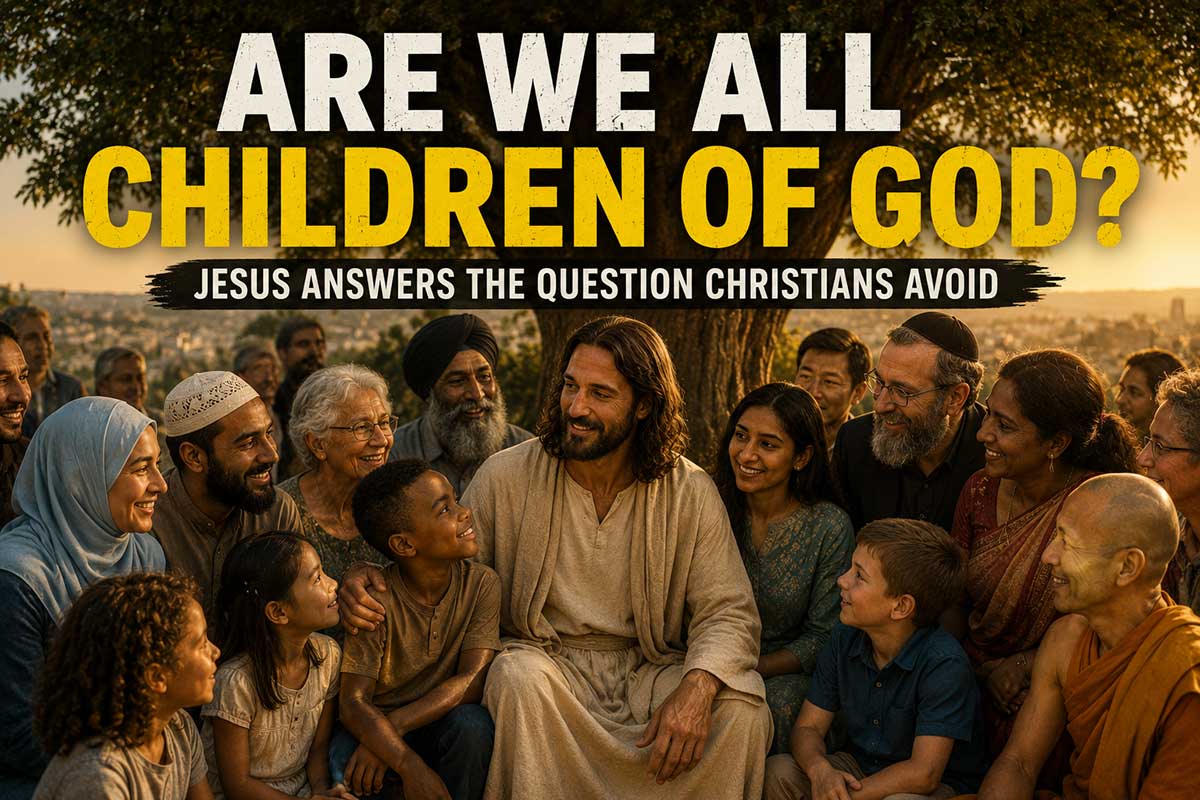
Opening
The fourth gathering did not take place in a cathedral, seminary, or megachurch.
It took place in a public school gymnasium.
Folding chairs filled the polished floor. Basketball hoops hung above the stage. The walls were decorated with drawings made by children from different parts of the world.
One showed a brown-skinned family holding hands beneath a yellow sun.
Another showed a girl wearing a hijab beside a boy wearing a cross.
A third showed two fathers standing with their daughter.
There were drawings of temples, churches, mosques, forests, homes, wheelchairs, flags, animals, angels, and stars.
Above the stage, written in a child’s handwriting, were the words:
WE ALL BELONG TO GOD.
The Christian leaders entered quietly.
A Reformed theologian sat beside a Catholic archbishop, an evangelical pastor, a missionary leader, and a progressive Christian minister.
Jim Palmer sat near the front.
Beside him was Meister Eckhart, the medieval Christian mystic whose language about the birth of God within the soul had unsettled religious authorities centuries earlier.
The audience was different this time.
There were Christians, Muslims, Jews, Hindus, Buddhists, atheists, agnostics, people who had left churches, and people who still loved Christianity but no longer knew whether Christianity loved them.
Some had been told they were sinful because of whom they loved.
Some had been told their questions proved they lacked faith.
Some had been told that God could not accept them unless they first accepted the church’s understanding of Jesus.
Children sat in the front rows.
Jesus entered through the gymnasium doors.
A little girl ran toward him before anyone could stop her.
She held up a drawing of a large circle filled with people of many colors.
“This is God’s family,” she said.
Jesus knelt beside her.
“Who taught you that?”
She pointed toward the drawing.
“Nobody. It just makes sense.”
Jesus smiled.
The Reformed theologian watched uneasily.
The girl asked Jesus:
“Are all people God’s children?”
Jesus looked at the Christian leaders before answering.
“Yes.”
The girl smiled, handed him the drawing, and returned to her seat.
Jesus stood.
The theologian leaned toward his microphone.
“That answer requires explanation.”
Jesus looked at him.
“Why?”
“Because Scripture distinguishes between those who are children of God and those who are not.”
Jesus held the child’s drawing in his hands.
“Then perhaps today we must ask what you have done with the family of God.”
Question 1: When Jesus Said “Our Father,” Whom Did He Include?
The evangelical pastor began.
“You taught your disciples to pray, ‘Our Father who is in heaven.’ But you were speaking to believers—to those who followed you.”
Jesus asked:
“When I spoke of God making the sun rise on the evil and the good, was the sun reserved for believers?”
“No.”
“When I said that God feeds the birds and clothes the flowers, did I describe a God who cares only for members of one religion?”
“No.”
“When I told the story of the compassionate Samaritan, who behaved as a child of God?”
The pastor answered reluctantly.
“The Samaritan.”
“And was he part of the approved religious community?”
“No.”
Jesus nodded.
“Then why do you assume that belonging to God begins with belonging to your group?”
The Reformed theologian responded.
“All human beings are created by God, but not all are children of God in the saving sense. Adoption comes through faith in Christ.”
Jesus looked at him.
“Who created the distinction between being made by God and being loved as God’s child?”
The theologian opened his Bible.
“The distinction comes from Scripture.”
“Or from the system through which you read it?”
The theologian frowned.
“You cannot simply dissolve every distinction because it feels compassionate.”
Jesus replied:
“Nor can you create distinctions that deny compassion and call them truth.”
Jim spoke.
“This is one of the most consequential changes in Christian theology.
“Jesus taught people to approach God as Father. But later Christianity increasingly treated that relationship as conditional. People were told that they were not truly children of God unless they accepted a particular belief about Jesus.”
The missionary leader answered.
“Because reconciliation with God comes through Jesus.”
Jim turned toward him.
“Or because the institution came to control what ‘through Jesus’ meant.”
The missionary leader shook his head.
“We did not invent the need for salvation.”
“No,” Jim replied. “But Christianity often defined salvation in a way that made the church the distributor of belonging.”
The Catholic archbishop spoke.
“The church teaches that every human being possesses dignity. It does not deny that God loves all people.”
Jesus turned toward him.
“But does it teach that all people already belong to God?”
The archbishop paused.
“It teaches that all are invited.”
“Invited from where?”
The question unsettled him.
Jesus continued.
“If God is the source of their life, if every breath is sustained by God, if love is possible within them, if conscience speaks within them, if compassion arises within them—where exactly are they standing that is outside God?”
The Reformed theologian replied:
“They may be under God’s care while remaining spiritually alienated.”
Jesus nodded.
“People can become alienated from love.
“They can forget who they are.
“They can live in fear, cruelty, pride, and separation.
“But forgetting that you are someone’s child does not erase the relationship.”
Jim looked toward the audience.
“That distinction changes everything.
“Traditional Christianity often says people must become children of God.
“Jim’s framework—and the framework Jesus is presenting here—says they must awaken to the truth that they already are.”
Meister Eckhart spoke for the first time.
“The seed of divine life is not imported into the soul by an institution. It is discovered beneath the noise that prevents the soul from recognizing its source.”
The Reformed theologian looked sharply at him.
“That language risks confusing the Creator with creation.”
Eckhart answered:
“Only when union is mistaken for sameness.
“A flame can share the nature of fire without becoming the whole fire.
“A river can belong to the sea without containing the entire sea.”
Jesus added:
“A child can bear the life of a parent without becoming the parent.”
The theologian said:
“Then you are claiming a universal spiritual sonship.”
Jesus looked toward the children.
“I am reminding you of one.”
Question 2: Did Christianity Turn Belonging into a Reward?
A young woman stood from the audience.
She wore a small cross around her neck.
“I grew up in church,” she said. “I was taught that God loved me, but only if I accepted the right beliefs, lived the right way, and never became the kind of person my church condemned.”
Jesus looked at her.
“What kind of person did they fear you might become?”
She took a breath.
“Gay.”
The gymnasium became silent.
She continued.
“When I finally told my parents, my pastor said I was choosing separation from God. I spent years believing that God could no longer see me as a daughter.”
Jesus asked:
“Did you stop being capable of love?”
“No.”
“Did you stop longing for truth?”
“No.”
“Did you stop caring for others?”
“No.”
“Then what evidence did they have that you had ceased to be God’s child?”
She began to cry.
“They said the Bible.”
Jesus looked toward the Christian leaders.
“When you use Scripture to convince someone that God has withdrawn belonging, what image of God are you creating?”
The evangelical pastor answered carefully.
“Love does not mean affirming everything a person desires.”
Jesus nodded.
“That is true.
“But disagreement is not the same as exile.
“Correction is not the same as declaring someone spiritually fatherless.”
The pastor said:
“Are you saying moral boundaries do not matter?”
“No.
“I am saying belonging precedes correction.
“A loving parent may confront harm, dishonesty, selfishness, or cruelty.
“But a loving parent does not say, ‘You are no longer my child because you failed to understand me correctly.’”
The Reformed theologian interrupted.
“Human parenthood cannot fully define divine holiness.”
Jesus replied:
“Then why did I choose the word Father?”
The theologian was silent.
Jesus turned back to the young woman.
“No church gave you your place in God.
“No church had the authority to take it away.”
She covered her face.
The audience remained silent except for scattered crying.
The missionary leader spoke next.
“If people are told they already belong to God, what reason do they have to repent?”
Jesus answered:
“Because belonging creates responsibility.”
He walked toward the first row.
“A child who knows they are loved does not become free to harm others without consequence.
“They become free to face the truth without believing the truth will destroy their worth.”
Jim added:
“Fear-based religion says, ‘Change so that God will accept you.’
“Belonging says, ‘Because you are already held within God, you can finally face what must change.’”
The progressive minister nodded.
“Shame often makes transformation harder, not easier.”
The Reformed theologian responded.
“But universal belonging can become sentimental. Human beings commit terrible evil.”
Jesus looked directly at him.
“Yes.
“And when someone commits evil, does declaring them outside God’s family make them easier to redeem?”
“No.”
“Then perhaps the most difficult expression of divine parenthood is not welcoming the harmless.
“It is refusing to surrender even the violent, the cruel, and the lost to permanent abandonment.”
A man in the back shouted:
“Even murderers?”
Jesus turned toward him.
“Do you believe justice requires hatred?”
“No.”
“Then hold people accountable.
“Protect the vulnerable.
“Restrain those who cause harm.
“Tell the truth about what they have done.
“But do not confuse accountability with declaring that a human being has ceased to belong to the source of life.”
The Catholic archbishop asked:
“Does this mean everyone is saved?”
Jesus answered:
“You continue asking who will be included at the end.
“I am asking whom you are excluding now.”
Question 3: If Everyone Is God’s Child, What Becomes of Christianity?
The missionary leader leaned forward.
“This teaching would fundamentally change Christian mission.”
“Yes,” Jesus said.
The leader continued.
“If people of other religions are already children of God, then why proclaim the gospel?”
Jesus asked:
“What do you believe the gospel is?”
“That salvation is available through your death and resurrection.”
“Or that the reign of God is near?
“That the poor are not forgotten?
“That the captive can become free?
“That enemies need not remain enemies?
“That fear need not rule human life?
“That mercy is stronger than condemnation?
“That every person carries a dignity no empire, religion, or failure can erase?”
The missionary leader looked down.
Jesus continued.
“If you carry that message, carry it.
“But do not tell people that God was absent before you arrived.”
A Muslim man stood.
“My family has prayed to God for generations. Are you saying our prayers were heard?”
Jesus answered:
“Why would the Father hear sincerity only when it uses one religious vocabulary?”
The evangelical pastor objected.
“That sounds like all religions are equally true.”
Jesus turned toward him.
“I did not say every belief is equally true.
“I said every person is equally held within God.”
He continued.
“Traditions contain wisdom and error.
“Christianity contains wisdom and error.
“Islam contains wisdom and error.
“Every human system carries both insight and limitation because every system passes through human minds, cultures, fears, and desires.”
The pastor asked:
“Then what makes your way distinctive?”
Jesus replied:
“Judge it by its fruit.
“Does it teach people to love beyond tribe?
“To forgive without denying justice?
“To reject domination?
“To see dignity in the rejected?
“To become inwardly free?
“To trust God without needing enemies?”
The pastor said:
“But Christians believe you are the unique revelation of God.”
Jesus answered:
“Then let your uniqueness be demonstrated by the depth of love your followers embody—not by the number of people they exclude.”
Jim spoke.
“If all people are children of God, Christianity no longer controls access to God.
“It can still offer Jesus.
“It can still preserve his teachings.
“It can still build communities of courage, service, contemplation, and love.
“But it must stop presenting itself as the institution that decides whether other human beings belong to God.”
The Catholic archbishop replied:
“That would require rethinking baptism, evangelism, salvation, and the identity of the church.”
“Yes,” Jim said.
“That is why this is not a minor adjustment.”
Meister Eckhart added:
“The church would cease being the gate to God and become a place where people learn to recognize the God already sustaining them.”
The Reformed theologian looked disturbed.
“Then Christianity becomes unnecessary.”
Jesus turned toward him.
“Is a teacher unnecessary because truth exists before the lesson?
“Is a physician unnecessary because the body already possesses the capacity to heal?
“Is a lamp unnecessary because sight belongs to the person who sees?”
The theologian did not answer.
Jesus continued.
“Christianity could become a community that helps people remember.
“It could teach courage.
“It could practice forgiveness.
“It could protect the vulnerable.
“It could confront exploitation.
“It could preserve stories that awaken conscience.
“It could offer silence, song, friendship, accountability, and service.
“It could point toward God without claiming ownership of God.”
The missionary leader asked:
“Then conversion would no longer mean becoming Christian?”
Jesus replied:
“Conversion means turning.
“Turning from fear toward love.
“From falsehood toward truth.
“From domination toward service.
“From isolation toward relationship.
“From forgetting toward remembrance.
“A person may call that Christian conversion.
“Another may use different words.
“Do not confuse the name of the road with the direction of the traveler.”
Closing
The little girl who had given Jesus the drawing returned to the stage.
She looked at the theologians and church leaders.
“Why is this so hard?” she asked.
The audience laughed softly, but no leader answered.
Jesus knelt beside her again.
“Because grown-ups often confuse belonging with agreement.”
The girl looked at the words above the stage:
WE ALL BELONG TO GOD.
“Is that wrong?” she asked.
Jesus replied:
“No.”
The Reformed theologian spoke from his chair.
“It is incomplete.”
The girl turned toward him.
“What is missing?”
He opened his mouth, but nothing came.
Jesus stood and addressed the room.
“Perhaps it is incomplete.
“All human language about God is incomplete.
“But ask which incompleteness leads toward love and which leads toward fear.”
The Catholic archbishop looked at the people of many faiths gathered before him.
“If we teach that everyone is already God’s child, how do we speak honestly about wrongdoing?”
Jesus answered:
“As family speaks.
“With truth.
“With boundaries.
“With consequences where necessary.
“With protection for those who are harmed.
“But without denying anyone’s deepest dignity.”
The evangelical pastor asked:
“What should we tell people who do not believe in God?”
Jesus replied:
“Do not begin by arguing over the word.
“Ask whether they have known love.
“Ask whether they have risked themselves for another person.
“Ask whether beauty has ever made them silent.
“Ask whether injustice disturbs them.
“Ask whether truth matters to them even when it costs something.
“Begin where life is already speaking.”
The young woman who had been rejected by her church stood again.
“What should I call myself now?”
Jesus looked at her.
“Beloved.”
She began to cry again, but this time she smiled.
Jim turned toward the Christian leaders.
“This is the consequence of Jesus’ original message.
“If God is truly Father, then humanity is not divided into God’s children and everyone else.
“It is divided between those who remember their belonging and those who have forgotten it—and all of us move between those states.”
The Reformed theologian asked Jesus one final question.
“Are you saying there is no distinction between you and us?”
Jesus answered:
“There are countless distinctions.
“No one else has lived my exact life.
“No one else bears your exact gifts, wounds, responsibilities, or path.
“But difference is not separation.
“Uniqueness is not superiority.
“And intimacy with God was never meant to become my private possession.”
He held up the child’s drawing.
“You made ‘Son of God’ a throne.
“I lived it as a relationship.
“You made it a boundary.
“I lived it as an invitation.
“You made it proof that I was unlike humanity.
“I intended it to reveal what humanity had forgotten.”
The missionary leader looked toward the Muslim man, the atheist woman beside him, the gay Christian, and the children seated across the front row.
“What would happen to the church if we truly believed all of them belonged to God?”
Jesus smiled.
“You would have to love them before they agreed with you.”
No one moved.
Jesus continued.
“You would have to listen without planning their conversion.
“You would have to serve without demanding gratitude.
“You would have to admit that God may already be present in places you were taught to fear.
“You would have to stop measuring your faithfulness by how many people entered your institution.
“And you would have to ask whether your presence helped them become more alive, more truthful, more compassionate, and more free.”
The archbishop whispered:
“That would be a different Christianity.”
Jesus replied:
“It might be closer to the kingdom of God.”
The children rose from their chairs and began taping their drawings across the front of the stage.
No one directed them.
Soon the formal backdrop was covered with imperfect pictures of one human family.
Churches, mosques, temples, homes, rivers, stars, and faces appeared beside one another.
The Christian leaders remained seated beneath them.
They had entered prepared to defend the uniqueness of Jesus.
They left facing a different challenge:
If Jesus came to reveal that every person belongs to God, then Christianity’s purpose could no longer be to decide who was inside the family.
Its purpose would be to help humanity remember that there had always been only one family.
And that realization was not the end of Christianity.
It was the beginning of a faith spacious enough to love without first asking permission from doctrine.
This is an imaginary philosophical conversation inspired by Jim Palmer’s interpretation of Jesus. It does not present historically verified words spoken by Jesus or the other participants.
Topic 5 can now explore the practical consequence: What would Christianity become if it surrendered exclusivity and treated every person as a child of God?
Topic 5: What Would Christianity Become Without Exclusivity?

Opening
The fifth and final gathering took place outdoors.
No church had been chosen.
No denomination had agreed to host it.
Instead, the organizers built a simple wooden platform in a public square where several streets met.
On one side stood a cathedral.
On another, a mosque.
Across the square was a synagogue.
Farther down the road stood a Hindu temple, a Buddhist meditation center, a community shelter, and a public hospital.
People filled the square before sunrise.
There were pastors, priests, bishops, missionaries, theologians, worship leaders, former Christians, lifelong Christians, people of other faiths, and people who belonged to no religion at all.
Some came because they believed Christianity was being reborn.
Others came because they believed it was being destroyed.
The Christian leaders sat on one side of the stage.
Among them were an evangelical missions director, a Catholic bishop, an Orthodox priest, a Pentecostal pastor, a Reformed theologian, and the leader of an international church network.
Jim Palmer sat on the other side with several people whose lives had been shaped—and sometimes wounded—by Christian claims of exclusivity.
Jesus stood between them.
Behind the platform was a single question:
IF EVERYONE IS A CHILD OF GOD, WHAT IS CHRISTIANITY FOR?
The missions director spoke first.
“For two thousand years, Christians have proclaimed that salvation is found through you. If everyone already belongs to God, then this gathering is not proposing a small correction.
“It is asking Christianity to surrender its central claim.”
Jesus looked at him.
“Which central claim?”
“That you alone are the way to God.”
Jesus glanced toward the cathedral, the mosque, the synagogue, and the many people gathered between them.
“Did I come to reveal the way of God—or to create a religious institution that possessed it?”
The missions director answered:
“You said, ‘I am the way.’”
Jesus nodded.
“And what way did I live?”
The director hesitated.
Jesus continued.
“The way of love.
“The way of truth.
“The way of forgiveness.
“The way of courage before power.
“The way of compassion for the rejected.
“The way of surrender to God.
“The way of refusing to return violence for violence.
“If someone walks that way but does not use my name, are they walking away from God?”
No one answered.
Jim Palmer leaned forward.
“This is the final question created by everything we have discussed.
“If Jesus did not come to establish himself as God, but to reveal what a human life in union with God could become, then Christianity can no longer define its mission as persuading the world to worship Jesus as the only divine Son.
“It must decide whether it is willing to help people live the way Jesus lived—even when they remain outside Christianity.”
The church-network leader looked troubled.
“If we accept that, the church loses its reason to exist.”
Jesus turned toward him.
“Or it discovers one.”
Question 1: Can Christianity Survive Without Claiming Exclusive Access to God?
The Reformed theologian began.
“Christianity is not merely an ethical tradition. Its identity depends upon revelation: God acted uniquely in Christ. If that uniqueness is surrendered, Christianity becomes one spiritual option among many.”
Jesus asked:
“Why does truth need every other path to be false in order to matter?”
The theologian replied:
“Because contradictory claims cannot all be true.”
“That is correct,” Jesus said.
“But people are not claims.
“You can examine beliefs without denying the person who holds them.
“You can challenge error without declaring that God has abandoned everyone outside your tradition.”
The theologian answered:
“But if religions contradict one another about God, salvation, death, and human nature, we cannot simply say they all lead to the same place.”
Jesus nodded.
“Then do not say what you do not know.
“Listen.
“Discern.
“Test teachings by their fruit.
“Reject cruelty wherever it appears.
“Reject domination whether it wears Christian, Muslim, Hindu, political, or secular clothing.
“Receive wisdom wherever it awakens love, humility, courage, and truth.”
The Catholic bishop spoke.
“Christianity has always made universal claims. The church believes it has received something for the whole world.”
Jesus turned toward him.
“A gift for the whole world is not the same as ownership of the whole world.”
The bishop considered this.
Jesus continued.
“You may offer what you have received.
“But a gift stops being a gift when refusal is met with threat.”
Jim added:
“Christianity often says, ‘God offers you love, but if you do not accept our explanation of that love, you remain condemned.’
“That is not experienced as an invitation. It is experienced as spiritual coercion.”
The Pentecostal pastor objected.
“But people need urgency. Eternity is at stake.”
Jesus asked:
“Does fear produce the kind of faith you trust?”
“It can lead people to repentance.”
“It can also lead people to repeat words they do not believe.”
The pastor was silent.
Jesus continued.
“Fear can fill churches.
“It can produce public confession.
“It can make people obedient to leaders.
“But fear cannot create love.”
The international church leader said:
“Without the conviction that people are lost, missions will decline.”
Jesus looked at him.
“Then perhaps some missions should decline.”
The square became completely still.
The leader’s face hardened.
“You would say that after generations sacrificed their lives to spread the gospel?”
“I honor every person who crossed a boundary to heal, teach, serve, protect, and love.
“I do not honor the destruction of cultures in my name.
“I do not honor forced conversion.
“I do not honor telling people that their ancestors were abandoned by God.
“I do not honor replacing service with superiority.”
The missions director replied:
“Those are abuses. They are not the gospel.”
Jesus nodded.
“Then remove what is abusive and see what remains.”
Jim spoke quietly.
“What remains may be more beautiful than what Christianity fears losing.
“A community can offer Jesus without declaring ownership of God.
“It can invite without threatening.
“It can serve without requiring conversion.
“It can learn from those it once viewed only as mission fields.”
The Orthodox priest asked:
“If Christianity no longer claims exclusive truth, what keeps it from dissolving into relativism?”
Jesus answered:
“Love is not relativism.
“Truthfulness is not relativism.
“Justice is not relativism.
“Protecting the vulnerable is not relativism.
“Humility about what you do not know is not relativism.
“You fear that without absolute control over God, nothing will remain.
“But perhaps faith begins where control ends.”
Question 2: What Would Evangelism Become?
The missions director stood and walked toward the center of the stage.
“My entire life has been devoted to evangelism.
“I have trained thousands to tell people that they need Jesus.
“If they are already children of God, what am I supposed to tell them?”
Jesus looked at him with compassion.
“First, ask them what they have already lived.”
The director frowned.
“What do you mean?”
“Ask where they have known love.
“Ask what has broken their heart.
“Ask what they fear.
“Ask what they hope their children will inherit.
“Ask what injustice they have survived.
“Ask what wisdom their family has carried.
“Ask before you answer questions they have not asked.”
The director lowered his eyes.
Jesus continued.
“You were trained to enter lives with a conclusion.
“Enter instead with attention.”
Jim nodded.
“Traditional evangelism often assumes the Christian possesses the truth and the other person possesses a lack.
“But what if both people carry truth, wounds, blindness, wisdom, and need?”
The evangelical pastor responded:
“Then evangelism becomes dialogue.”
“Yes,” Jim said. “And witness becomes mutual.”
The pastor asked Jesus:
“Would you still want us to tell people about you?”
Jesus answered:
“Tell them what you have found meaningful.
“Tell them how my life challenged you.
“Tell them how forgiveness changed you.
“Tell them how love became more demanding than certainty.
“But do not turn testimony into domination.”
The missions director asked:
“What if I truly believe your way is better?”
“Then live it so clearly that people can examine its fruit.”
“And if they still do not convert?”
“Love them.”
“Without expecting anything?”
“Love that requires surrender is negotiation.”
The director sat down slowly.
A woman wearing a hijab stood near the front.
“Christian missionaries came to my grandmother’s village,” she said. “They built a school and helped many families. But they also told the children that their parents’ religion belonged to darkness.
“Was the service still good?”
Jesus answered:
“Yes.
“And the humiliation was still harmful.”
The woman nodded.
Jesus continued.
“Human beings often mix love with the need to be right.
“The presence of goodness does not erase the presence of harm.
“Mature faith must be able to confess both.”
A former missionary rose behind her.
“I spent twenty years trying to save people,” he said.
Jesus looked at him.
“What did you learn?”
“That many of the people I went to teach were more generous than I was.”
The crowd reacted softly.
He continued.
“They cared for extended families. They shared food. They prayed with discipline. They understood community in ways my church did not.
“But I was trained to see those things as insufficient because they had not accepted our theology.”
Jesus asked:
“What would you do differently now?”
“I would go as a guest.”
Jesus smiled.
“Then perhaps you have begun to understand mission.”
The Pentecostal pastor objected.
“But there is power in proclaiming the name of Jesus.”
Jesus turned toward him.
“There can be.
“There can also be power in listening without needing your name to be spoken.”
The pastor said:
“People have been healed in your name.”
“And people have been healed by hands that never used it.”
The pastor looked unsettled.
Jesus continued.
“Do not make healing smaller by demanding that it confirm your institution.”
The Catholic bishop asked:
“What, then, is Christian witness?”
Jesus replied:
“To become evidence that love is possible.
“To tell the truth when lies are rewarded.
“To protect those who are disposable to the powerful.
“To forgive without pretending harm did not occur.
“To create communities where no person must hide in order to belong.
“To serve without making another person indebted to your religion.
“And when asked why you live that way, speak honestly about what inspired you.”
Jim looked toward the missions director.
“That would not end evangelism.
“It would purify it.”
Question 3: How Would Christianity Treat Those It Once Tried to Change?
A row of guests was invited onto the stage.
Among them were a Muslim teacher, a Jewish rabbi, a Buddhist nun, a Hindu physician, an atheist human-rights advocate, a gay former pastor, a transgender Christian, an undocumented immigrant, and a woman who had left an abusive church.
They stood facing the Christian leaders.
Jesus addressed the leaders.
“What do you see?”
The evangelical pastor answered first.
“People created in the image of God.”
Jesus waited.
The pastor understood.
“Children of God.”
Jesus turned to the guests.
“What have Christians made you feel you were?”
The Muslim teacher spoke.
“A threat.”
The rabbi said:
“An unfinished Christian.”
The Buddhist nun said:
“Spiritually lost.”
The Hindu physician said:
“An idolater.”
The atheist said:
“Morally empty.”
The gay former pastor said:
“An abomination.”
The transgender Christian said:
“A mistake.”
The immigrant said:
“A problem.”
The woman who had left the abusive church said:
“Rebellious because I would not remain silent.”
The Christian leaders sat without speaking.
Jesus looked toward them.
“Did your theology help you see these people more clearly—or did it give you reasons not to see them?”
The Reformed theologian answered carefully.
“Some of those descriptions represent distortions of Christian teaching.”
The gay former pastor turned toward him.
“They were spoken with Bibles open.”
The theologian flinched.
Jesus said:
“A text can be opened while the heart remains closed.”
The Catholic bishop addressed the group.
“I am sorry for the ways Christians have wounded you.”
The atheist advocate responded:
“Is this only an apology for tone, or are you willing to reconsider the beliefs that produced the treatment?”
The bishop did not answer immediately.
Jim spoke.
“That is the necessary question.
“Institutions often apologize for cruelty while protecting the theology that made the cruelty seem righteous.”
The evangelical pastor replied:
“But not every moral conviction is hatred.”
“Correct,” Jim said.
“Yet when a conviction repeatedly produces shame, exclusion, fear, family rejection, and spiritual despair, Christians must examine more than their intentions.”
Jesus turned to the transgender Christian.
“What did you need from your church?”
The person answered:
“To be heard before being explained.”
Jesus nodded.
He asked the Muslim teacher:
“What did you need?”
“To be treated as a neighbor, not a target.”
The rabbi said:
“To stop being told that our covenant existed only to prepare the world for Christianity.”
The Buddhist nun said:
“To be met without the assumption that silence and compassion belonged to Christians first.”
The Hindu physician said:
“To have service recognized as service, even when it came through another tradition.”
The atheist said:
“To be judged by how I live, not by what I cannot honestly believe.”
The immigrant said:
“To be recognized as a human being before being discussed as policy.”
The woman who had left the church said:
“To have truth valued more than the reputation of the institution.”
Jesus turned back to the Christian leaders.
“Can Christianity offer these things?”
The Pentecostal pastor answered:
“It should.”
“Will it?”
No one replied.
Jesus continued.
“You have often asked other people to repent.
“Are you willing to repent of the ways you have used me?”
The question moved through the square like a wind.
The international church leader stood.
“What would repentance require?”
Jesus answered:
“More than an apology.
“Change what you teach.
“Change who holds authority.
“Listen to those who were harmed.
“Stop demanding forgiveness before accountability.
“Stop calling exclusion love simply because you believe it protects doctrine.
“Stop treating another person’s pain as an attack on your faith.
“And return what was taken—dignity, voice, safety, belonging, and where possible, material restitution.”
The church leader looked overwhelmed.
“That could divide churches.”
Jesus replied:
“Truth often divides what comfort held together.”
The Reformed theologian asked:
“Would you have Christians abandon moral discernment to avoid offending anyone?”
“No.
“Discern conduct by whether it creates harm, deception, exploitation, domination, or the destruction of another person’s dignity.
“But do not confuse discomfort with harm.
“And do not call people dangerous merely because their existence challenges your interpretation.”
The gay former pastor asked:
“Would there still be a place for me in Christianity?”
Jesus answered:
“There was always a place for you in God.
“The question is whether Christianity will become large enough to reflect it.”
Question 4: What Would Christian Leadership Look Like After Certainty?
The international church leader spoke.
“If we stop presenting ourselves as guardians of exclusive truth, what authority remains?”
Jesus replied:
“The authority of integrity.”
The leader waited.
Jesus continued.
“The authority earned by service.
“The authority of someone willing to confess error.
“The authority of protecting people who cannot reward you.
“The authority of living what you teach.
“The authority of creating space where truth can be spoken without punishment.”
The leader shook his head.
“That is less controllable.”
“Yes.”
The Catholic bishop asked:
“How can an institution function without clear hierarchy and doctrine?”
Jesus answered:
“I did not say structure must disappear.
“I said structure must serve life.
“When the institution protects itself at the expense of people, structure has become an idol.”
Jim spoke.
“The church might retain tradition, liturgy, scripture, teachers, sacraments, communities, and forms of leadership.
“But authority would become accountable rather than sacred simply because of office.”
The Orthodox priest asked:
“Would ancient tradition have no privileged place?”
“It would have a respected place,” Jim said, “but not an unquestionable one.”
Jesus added:
“Ancient does not always mean true.
“New does not always mean wise.
“Examine both.”
A young pastor stood in the crowd.
“I was taught that doubt weakens leadership.”
Jesus asked:
“Has certainty ever made you dishonest?”
The pastor nodded.
“I have preached answers I no longer believed because I was afraid of confusing the congregation.”
“And did they trust your certainty?”
“Yes.”
“Then they trusted an image.”
The young pastor began to cry.
“What should I do?”
“Tell them the truth carefully.
“Do not unload your crisis onto them.
“But do not build their faith upon your performance.”
The pastor asked:
“What if they leave?”
Jesus replied:
“Some may.
“But those who remain may finally meet you.”
The church-network leader said:
“People expect spiritual leaders to know.”
Jesus answered:
“Then teach them that mature faith includes not knowing.”
The leader looked toward the square.
“That would change sermons.”
“It would change leaders,” Jesus said.
Jim turned to the Christian leaders.
“Perhaps one of Christianity’s deepest transformations would be moving from leaders who defend certainty to leaders who cultivate honesty, compassion, discernment, and spiritual maturity.”
The Reformed theologian said:
“But doctrine protects communities from deception.”
Jim replied:
“Sometimes.
“And sometimes doctrine protects deception from being questioned.”
Jesus added:
“Any belief that cannot survive honest examination has already become fear.”
Question 5: What Would Remain of Christianity?
The sun had begun to set behind the cathedral.
The square glowed with the warm light of evening.
The Catholic bishop asked the question that had been waiting beneath every exchange.
“If Christianity relinquishes the claim that it alone owns salvation, if Jesus is not worshiped as God, if the Trinity is held as a human interpretation, and if everyone is already a child of God—what remains?”
Jesus looked around the square.
“Everything that was alive.”
The bishop waited.
Jesus continued.
“The stories remain.
“The wisdom remains.
“The warnings remain.
“The songs that open the heart remain.
“The communities that carry one another remain.
“The bread shared at a common table remains.
“The courage of those who resisted empire remains.
“The memory of the poor, the forgotten, and the persecuted remains.
“The call to forgive remains.
“The demand for justice remains.
“The invitation to surrender fear remains.
“The practice of prayer remains.
“The mystery of God remains.
“And love remains.”
The Reformed theologian asked:
“What disappears?”
Jesus answered:
“The need to control God.
“The need to condemn honest doubt.
“The need to make outsiders so that insiders can feel secure.
“The claim that one institution distributes divine belonging.
“The idea that correct belief excuses untransformed living.
“The use of eternal punishment to compel agreement.
“The worship of certainty.
“And the belief that I came to make humanity dependent on a religion rather than awake to God.”
Jim looked toward the audience.
“That Christianity would be less powerful as an empire.
“But perhaps more powerful as a way of life.”
The missions director asked:
“Would people still call themselves Christians?”
“Some would,” Jesus said.
“Some would not.
“Why does the label matter more than the life?”
The director replied:
“Because identity creates community.”
“Yes.
“Let identity create responsibility, not superiority.”
The Jewish rabbi asked:
“Could Christians finally meet us without secretly hoping we become them?”
Jesus smiled.
“That would be a beginning.”
The Muslim teacher asked:
“Could Christians pray with us without pretending all our differences had disappeared?”
“Yes.
“Unity does not require sameness.”
The atheist advocate asked:
“Could Christians work beside people who do not believe in God?”
Jesus replied:
“Do you both care about the suffering person in front of you?”
“Yes.”
“Begin there.”
The Buddhist nun asked:
“Could Christianity learn as well as teach?”
Jesus answered:
“It must.”
The Pentecostal pastor whispered:
“That sounds like humility.”
Jesus looked at him.
“It always was.”
Closing
The sun disappeared.
No stage lights were turned on.
People switched on phones, lanterns, and small candles until the square glowed with thousands of separate points of light.
The Christian leaders remained seated.
No one had renounced Christianity.
No one had been asked to destroy a Bible, abandon a church, or deny every experience they had understood as sacred.
But the center had shifted.
The missions director looked at Jesus.
“If we no longer go into the world to save people from God’s rejection, what should we go to do?”
Jesus answered:
“Go because suffering is real.
“Go because loneliness is real.
“Go because hunger is real.
“Go because injustice is real.
“Go because human beings need one another.
“Go to serve, learn, heal, protect, build, listen, and love.
“And let the people you meet reveal God to you as well.”
The Catholic bishop asked:
“What should we say when people ask who you are?”
Jesus replied:
“Tell them what you have seen in me.
“But leave room for them to see more.”
The Reformed theologian asked:
“What should we say about truth?”
“Seek it without fear.
“Speak it without cruelty.
“Hold it without pride.
“And remember that possessing a sentence about God is not the same as possessing God.”
The Pentecostal pastor asked:
“What should we do with worship?”
“Let it become gratitude that enters the world as service.”
The Orthodox priest asked:
“What should we do with tradition?”
“Receive its wisdom.
“Confess its failures.
“And do not force future generations to carry every fear of the past.”
The evangelical pastor asked:
“What should we preach?”
Jesus looked across the square at the people of different religions, identities, histories, and convictions.
“Preach that no one is disposable.
“Preach that love is more demanding than belief.
“Preach that forgiveness does not erase justice.
“Preach that power must serve the vulnerable.
“Preach that God is not the private property of Christianity.
“Preach that every human being carries sacred dignity.
“And then build communities where those words become visible.”
Jim Palmer rose from his chair.
“For centuries,” he said, “Christianity has asked the world to accept its understanding of Jesus.
“Perhaps the next chapter begins when Christianity allows Jesus to question its understanding of God, humanity, salvation, and itself.”
The international church leader looked toward the cathedral.
“Would this still be Christianity?”
Jesus answered:
“That depends on what you believe Christianity is for.”
“To bring people to you,” the leader said.
Jesus shook his head gently.
“Bring them to love.
“Bring them to truth.
“Bring them to courage.
“Bring them to the Father whose life already sustains them.
“If my life helps you do that, walk with me.
“But do not turn me into the wall they must cross before God can love them.”
The little girl from the previous gathering appeared at the edge of the stage.
She carried the same drawing of one human family.
Jesus invited her forward.
She looked at the Christian leaders.
“Did you figure it out?” she asked.
The crowd laughed softly.
The Catholic bishop smiled.
“We are beginning to.”
The girl held up the drawing.
“So everyone is still in the family?”
Jesus answered:
“Yes.”
“Even when they don’t agree?”
“Yes.”
“Even when they make mistakes?”
“Yes.”
“Even the people who were mean?”
Jesus paused.
“They remain in the family.
“But the family must protect those they harm and help them change.”
The girl nodded as if this were obvious.
She taped the picture beneath the final question:
IF EVERYONE IS A CHILD OF GOD, WHAT IS CHRISTIANITY FOR?
Jesus walked to the words and wrote an answer beneath them:
TO HELP US LIVE LIKE ONE FAMILY.
No doctrine had been formally replaced.
No new creed had been announced.
No institution had been granted the authority to control what came next.
That was the point.
The conclusion was not another system.
It was a beginning.
A Christianity no longer centered on proving that Jesus alone was divine could begin helping people discover the sacred dignity within every human life.
A Christianity no longer driven by fear of outsiders could become curious about the ways God had been present beyond its walls.
A Christianity no longer obsessed with saving people from divine rejection could devote itself to saving people from hunger, violence, loneliness, exploitation, hatred, and despair.
A Christianity no longer using Jesus to divide the human family could finally follow him into the work of healing it.
The square remained lit long after the conversation ended.
People did not leave in separate religious groups.
They formed circles.
They shared food.
They exchanged stories.
Some prayed.
Some listened.
Some disagreed.
No one was required to pretend that every belief was identical.
They were asked only to begin with one truth:
Before anyone was Christian, Muslim, Jewish, Hindu, Buddhist, atheist, conservative, progressive, citizen, immigrant, accepted, rejected, certain, or doubtful, they were human.
And if Jesus was right, that meant they already belonged to God.
Christianity had spent centuries asking the world to come inside.
Now Jesus was asking Christianity to step outside—
not to disappear,
but to become a faith spacious enough to recognize the family of God wherever love, truth, courage, and compassion were already alive.
This is an imaginary philosophical conversation inspired by Jim Palmer’s interpretation of Jesus. It does not present historically verified words spoken by Jesus or the other participants.
Final Thoughts
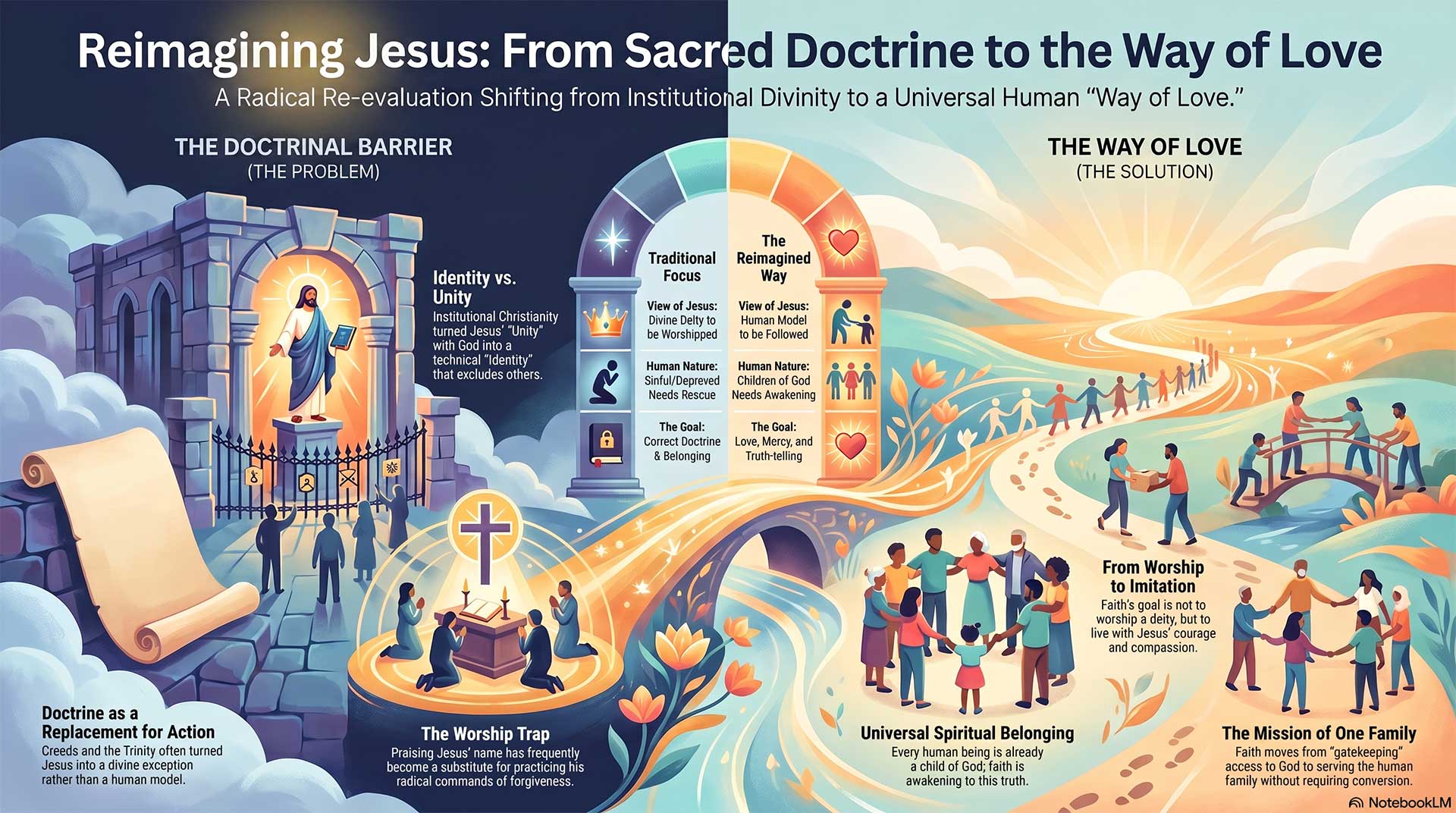
The most disturbing possibility raised by this conversation is not that Christianity may have misunderstood one doctrine.
It is that Christianity may have misunderstood the purpose of Jesus.
If Jesus came to reveal his own exclusive divinity, then Christianity’s traditional structure makes sense.
Jesus must be worshiped.
Correct belief about his nature becomes essential.
The church becomes the guardian of salvation.
Mission becomes the work of bringing outsiders into the only true path.
Humanity is divided between those who accept Christ and those who remain outside.
But if Jesus came instead to reveal what humanity could become in relationship with God, then the entire center shifts.
Jesus is no longer the divine exception who proves how unlike him we are.
He becomes the human revelation of what love, courage, surrender, compassion, and spiritual awakening can look like.
His uniqueness remains, but it no longer depends on excluding everyone else from intimacy with God.
He becomes a doorway into a deeper understanding of humanity rather than a wall between humanity and God.
This interpretation does not necessarily make Jesus smaller.
It may make his life more demanding.
It is easier to worship a divine being whose perfection we can never imitate.
It is harder to follow a human being whose life reveals possibilities we have refused to embody.
If Jesus forgave because he was God, then our failure to forgive is understandable.
If Jesus loved enemies because he possessed a supernatural nature, then our hatred is ordinary.
If Jesus resisted wealth, domination, and fear because he was fundamentally different from us, then his teachings remain admirable but unrealistic.
But if Jesus lived from the same human condition we share—while becoming fully awake to God—then his life becomes a challenge rather than an exception.
The question is no longer:
“Do you believe the correct things about Jesus?”
It becomes:
“What has your belief about Jesus made you become?”
That question exposes the deepest weakness of religious certainty.
A person can believe that Jesus is God while remaining cruel.
A church can defend the Trinity while protecting abuse.
A pastor can preach salvation while building a ministry around fear.
A missionary can sincerely serve people while also teaching them to distrust their own culture and spiritual inheritance.
A Christian can worship passionately while refusing forgiveness, honesty, justice, and compassion.
Correct doctrine does not automatically produce a transformed life.
The conversation does not argue that every doctrine is useless.
Human beings need language, stories, symbols, traditions, and communities.
The Trinity may still function for some as a meaningful way of imagining God beyond us, God revealed through human life, and God present within us.
Worship may still open the heart.
Churches may still create belonging.
Christian tradition may still preserve profound wisdom.
But every belief must be held with humility.
A doctrine should be judged not only by how logically it explains God, but by the kind of people it helps create.
Does it produce love or fear?
Humility or superiority?
Honesty or performance?
Freedom or control?
Compassion or exclusion?
If a belief repeatedly convinces people that God rejects others, then Christians should examine that belief no matter how ancient it is.
If a doctrine allows people to feel spiritually secure while remaining untransformed, then it has failed the life it claims to defend.
If worship becomes admiration without imitation, it has become incomplete.
If mission depends on believing that God was absent before Christians arrived, it has confused service with spiritual conquest.
The constructive vision of this conversation is not the destruction of Christianity.
It is the possibility of a different Christianity.
A Christianity that offers Jesus without claiming ownership of God.
A Christianity that invites without threatening.
A Christianity that serves without demanding conversion.
A Christianity that recognizes truth, beauty, courage, and compassion beyond its own borders.
A Christianity that sees every human being as already held within God, even when that person has forgotten, resisted, or distorted that belonging.
This does not eliminate moral responsibility.
To say that everyone is a child of God does not mean every action is good.
People still cause harm.
Justice still matters.
Boundaries remain necessary.
The vulnerable must be protected.
Cruelty must be confronted.
But accountability does not require the destruction of human dignity.
A family can restrain harm without declaring that the person who caused it has ceased to belong.
That may be the deepest meaning of divine parenthood.
Belonging is not a reward for good behavior.
It is the foundation that makes honest transformation possible.
Fear says:
“Change so that God will accept you.”
Love says:
“Because you are already held within God, you can face what must change.”
This is the Christianity imagined at the end of the conversation.
Its purpose is no longer to decide who enters the family of God.
Its purpose is to help humanity live like one family.
It feeds people because hunger is real.
It protects people because violence is real.
It tells the truth because deception is real.
It offers community because loneliness is real.
It confronts injustice because domination is real.
It practices forgiveness because hatred is real.
It preserves the teachings of Jesus because his way of love remains radical, difficult, and urgently needed.
Such a Christianity would lose some of its power to control.
It might lose the certainty that once made institutions feel secure.
It might become less effective at producing fear-based conversion.
It might become harder to measure through attendance, membership, doctrinal agreement, and institutional growth.
But it might become more faithful to the life of Jesus.
Perhaps Christianity’s future does not depend on defending the claim that Jesus alone was divine.
Perhaps it depends on whether Christians are willing to recognize the sacred dignity present in every human being.
Perhaps the final question is not whether Jesus was God.
Perhaps it is whether Christians can trust God enough to stop treating divine love as their private possession.
Short Bios:
Jesus of Nazareth
Jesus was a first-century Jewish teacher whose life and teachings became the foundation of Christianity. The New Testament portrays him as a preacher of the kingdom of God who emphasized love, forgiveness, compassion, repentance, care for the poor, and trust in God. Traditional Christianity identifies Jesus as God incarnate and the second person of the Trinity. This imaginary conversation explores an alternative interpretation in which Jesus understood himself as a human son of God who revealed a relationship with God available to all humanity.
Jim Palmer
Jim Palmer is an American author, spiritual teacher, and former evangelical pastor known for criticizing institutional Christianity and traditional religious doctrines. His work emphasizes inner spiritual awakening, human dignity, freedom from religious fear, and the possibility that Christianity transformed Jesus into an object of worship rather than following his way of life. In this conversation, Palmer serves as a catalyst who challenges Christian leaders to distinguish the historical Jesus from later theological systems built around him.
The Evangelical Pastor
The evangelical pastor represents conservative Protestant Christianity. He emphasizes biblical authority, personal salvation, the divinity of Jesus, the necessity of faith in Christ, and the importance of evangelism. He sincerely believes that weakening traditional doctrine could endanger Christian faith and salvation.
The Catholic Cardinal and Bishop
The Catholic leaders represent the historic authority, sacramental tradition, theological development, and institutional continuity of the Roman Catholic Church. They defend the idea that doctrine can develop over time as the church seeks language to explain revelation. They also face questions about whether institutional authority sometimes protected doctrine more strongly than people.
The Eastern Orthodox Bishop and Priest
The Orthodox representatives defend the ancient creeds, the mystery of God, the divinity of Christ, and the spiritual continuity of the early church. They emphasize that the Trinity was not intended merely as a logical formula but as an expression of the church’s lived experience of God.
The Reformed Theologian
The Reformed theologian represents Calvinist and conservative Protestant theology. He emphasizes human sinfulness, divine sovereignty, salvation through Christ alone, biblical authority, and the necessity of precise doctrine. He raises some of the strongest objections to universal spiritual belonging.
The Pentecostal Pastor and Worship Leader
The Pentecostal voices represent experiential Christianity, including worship, healing, spiritual gifts, emotional surrender, and direct encounter with the Holy Spirit. They defend the power of worship while confronting the possibility that emotional experience can sometimes replace transformation.
The Prosperity Preacher
The prosperity preacher represents forms of Christianity that associate faith with health, wealth, success, favor, and personal breakthrough. Jesus challenges this figure by comparing such promises with his own life of sacrifice, rejection, service, and suffering.
The Missionary Leader
The missionary leader represents the historic Christian commitment to evangelism and global missions. He believes that people must hear and accept the Christian gospel to receive salvation. Through the conversation, he is challenged to imagine mission as service, listening, learning, healing, and mutual encounter rather than religious conquest.
The Christian Recording Artist
The recording artist represents modern Christian music and the emotional culture of worship. This figure raises the question of whether religious beauty leads people toward transformation or allows admiration to substitute for obedience.
The Progressive Christian Minister
The progressive minister represents Christians who seek to reinterpret scripture and doctrine through inclusion, social justice, compassion, historical awareness, and human experience. This figure supports a broader understanding of belonging while also facing the challenge of preserving moral seriousness.
Meister Eckhart
Meister Eckhart was a medieval German Christian mystic and theologian. He taught about detachment, spiritual awakening, the birth of God within the soul, and union with the divine. Some of his teachings were investigated by church authorities. In this conversation, Eckhart represents the mystical Christian understanding that God is discovered within the depths of human consciousness rather than controlled by religious institutions.
The Historian of Early Christianity
The historian represents modern scholarship on the diversity of early Christian beliefs. This figure explains that the earliest followers of Jesus did not all understand him in the same way and that doctrines about his divinity developed across generations of debate, interpretation, and institutional conflict.
The Former Missionary
The former missionary represents people who entered other cultures believing they possessed the complete truth but later discovered wisdom, generosity, faith, and spiritual depth among those they intended to convert. This figure imagines mission transformed from teaching as an authority to arriving as a guest.
The Gay Former Pastor
The former pastor represents LGBTQ Christians who have been rejected, shamed, or removed from religious communities despite their faith and commitment. His presence forces Christian leaders to examine whether doctrine has sometimes been used to deny people dignity and belonging.
The Transgender Christian
The transgender Christian represents people whose identities have often been treated by churches as theological problems rather than human lives deserving listening, safety, and respect. This figure asks to be heard before being judged or explained.
The Muslim Teacher
The Muslim teacher represents religious communities that Christians have often approached primarily as mission fields. This figure challenges Christians to recognize sincere prayer, devotion, wisdom, and relationship with God outside Christianity.
The Jewish Rabbi
The rabbi represents the Jewish tradition from which Jesus emerged. This figure challenges Christian assumptions that Judaism exists mainly as an incomplete preparation for Christianity and calls for a relationship based on mutual dignity rather than replacement.
The Buddhist Nun
The Buddhist nun represents contemplative wisdom, compassion, discipline, and spiritual insight outside the Christian tradition. She challenges Christianity to become capable of learning as well as teaching.
The Hindu Physician
The Hindu physician represents service, healing, devotion, and moral responsibility expressed through a non-Christian religious tradition. This figure asks Christians to recognize goodness without demanding that it first confirm Christian theology.
The Atheist Human-Rights Advocate
The atheist advocate represents morally serious people who do not believe in God but remain committed to justice, compassion, truth, and human dignity. This figure challenges the assumption that belief in God is necessary for ethical depth.
The Woman Who Left an Abusive Church
This woman represents people who were silenced by religious institutions that valued reputation, authority, and unity over truth and accountability. She insists that apology must include structural change, not merely regret for the pain caused.
The Child
The child appears throughout the final conversations as the clearest voice of belonging. Her simple conviction that everyone is part of God’s family exposes the complexity adults have built around divine love. She represents moral clarity before fear, doctrine, and institutional self-interest obscure it.
Leave a Reply