
Did Christianity Reverse the Message of Jesus?
For nearly two thousand years, one question has stood at the center of Christianity:
Who was Jesus?
Yet another question may be just as important—and far less frequently asked:
What did Jesus intend humanity to become?
Many Christians believe Jesus is the unique Son of God, whose life, death, and resurrection opened the way to salvation. Others see him primarily as history's greatest spiritual teacher, revealing what human beings can become when fully united with God. Still others believe both ideas belong together.
This conversation begins with a provocative claim made by Jim Palmer: that Christianity may have unintentionally transformed Jesus from a path to follow into a pedestal to admire. According to Palmer, by emphasizing Jesus' uniqueness above all else, the church may have obscured the very human possibility Jesus came to reveal.
That claim is challenged from every direction.
Christian theologians defend the incarnation without abandoning Jesus' humanity.
Historians examine how beliefs about Jesus developed during Christianity's earliest centuries.
Mystics ask whether Jesus invited humanity into the same union with God that he experienced.
Jewish thinkers remind us that Jesus cannot be separated from the faith and people who formed him.
Buddhist, Hindu, Sufi, and Taoist voices ask whether the deepest spiritual discoveries across civilizations point toward one reality—or toward fundamentally different truths.
No one here is asked to win.
No tradition is reduced to a caricature.
Each participant speaks from the strongest version of his or her own worldview, allowing genuine disagreements to remain unresolved when they cannot honestly be reconciled.
The goal is not to settle one of history's greatest religious questions.
The goal is to understand it more deeply.
Perhaps the most important question is not simply who Jesus was.
Perhaps it is what our understanding of Jesus is making us become.
(Note: This is an imaginary conversation, a creative exploration of an idea, and not a real speech or event.)
Topic 1: Did Christianity Turn Jesus from a Path into a Pedestal?
Guests
Jim Palmer — former pastor and author who argues that institutional Christianity transformed Jesus from a model of awakened humanity into an unreachable divine exception.
Søren Kierkegaard — Danish philosopher who warned that Christendom had replaced the difficult act of following Jesus with admiration, doctrine, and social respectability.
Dietrich Bonhoeffer — German theologian who condemned “cheap grace,” faith without obedience, sacrifice, or transformed life.
Dorothy Day — Catholic activist who insisted that devotion to Christ must become love for the poor, the abandoned, and the unwanted.
Friedrich Nietzsche — philosopher and fierce critic of Christianity, who claimed that Christians betrayed the life-affirming force that may have existed in Jesus himself.
The church had been empty for decades.
Rain moved against the stained-glass windows, making the saints appear to tremble in their frames. Dust rested on the wooden pews. A cracked statue of Jesus stood above the altar, one hand raised in blessing, the other pressed against a painted wound in his chest.
Jim Palmer stood beneath it.
He looked up for a long time.
Jim Palmer: They told us to become like him.
Then they made him into someone no human being could ever become.
A voice came from the final row.
Søren Kierkegaard: No.
They did something worse.
They admired him so they would not have to follow him.
Palmer turned.
Kierkegaard sat alone in the darkness, dressed in black, his narrow face half-hidden beneath the shadow of his hat.
Jim Palmer: That sounds very close to what I am saying.
Søren Kierkegaard: Close, yes. Identical, no.
You think Christianity betrayed Jesus by making him too divine.
I think Christendom betrayed him by making discipleship unnecessary.
Those are related accusations, but they are not the same.
Another figure stepped through a side doorway near the altar.
Dietrich Bonhoeffer removed his wet coat and placed it across the back of a chair.
Dietrich Bonhoeffer: A church can confess every correct doctrine about Christ and still refuse him.
It can preach forgiveness without repentance.
Baptism without discipline.
Communion without reconciliation.
Grace without obedience.
The name of Jesus can remain everywhere while the life of Jesus disappears.
A woman entered behind him carrying a small paper bag. She placed several loaves of bread on the altar rail.
Dorothy Day: Then the test is not what the church says about Jesus.
The test is whether anyone hungry is fed.
Whether the lonely are visited.
Whether the unwanted are welcomed.
Whether the enemy is loved.
She glanced up at the statue.
Dorothy Day: A person can kneel before that figure every morning and still step over Christ sleeping on the sidewalk.
A quiet laugh came from the doorway.
Friedrich Nietzsche entered without removing his hat.
Friedrich Nietzsche: How touching.
The Christians have gathered to accuse Christianity of failing to be Christian enough.
He walked down the center aisle, examining the abandoned sanctuary.
Friedrich Nietzsche: You continue to believe the disease can be cured by increasing the dose.
Dorothy Day: And you continue to mistake cruelty for strength.
Friedrich Nietzsche: I mistake nothing.
Christianity took suffering, weakness, submission, and guilt, then called them sacred. It taught human beings to distrust desire, fear the body, suspect joy, and dream of another life because they lacked the courage to affirm this one.
Jim Palmer: Yet you once wrote that there was only one Christian, and he died on the cross.
Friedrich Nietzsche: I was being generous.
Søren Kierkegaard: More likely theatrical.
Friedrich Nietzsche: From you, that is almost praise.
Palmer stepped away from the altar.
Jim Palmer: Let us begin with the central question.
Did Christianity turn Jesus from a path into a pedestal?
Did it transform a life meant to be embodied into an object meant to be worshiped?
Dietrich Bonhoeffer: It often did.
Yet worship and imitation do not have to be enemies.
The question is what worship produces.
If worship makes a person passive, obedient to institutions, protected from risk, and satisfied with belief alone, then worship has become avoidance.
If worship leads someone into costly love, truth-telling, suffering, forgiveness, and responsibility, then worship may become the beginning of discipleship.
Jim Palmer: But does traditional theology make that discipleship impossible from the beginning?
Jesus is described as God incarnate, uniquely sinless, born outside the ordinary human condition, possessing divine authority, destined for resurrection.
Then ordinary people are told to become like him.
Is that not like asking someone to imitate a being from another category of existence?
Søren Kierkegaard: You assume that the difference excuses the follower.
That is precisely what Christendom wants.
It says, “Christ was divine. We are merely human. Naturally, we cannot live as he lived.”
Then everyone goes home relieved.
The divinity of Christ becomes the finest excuse ever invented for disobedience.
Jim Palmer: Then you agree with me.
Søren Kierkegaard: I agree with your diagnosis more than your cure.
You want to make Christ more reachable by making him less unique.
I want to make the demand more terrible.
Jim Palmer: Terrible?
Søren Kierkegaard: Yes.
To follow Christ is not to admire a wise teacher.
It is to stand alone before God.
It is to surrender the respectable life.
It is to become foolish in the eyes of society.
It is to love those who cannot repay you.
It is to abandon the protection of the crowd.
Most people do not reject Christ after considering the demand.
They avoid hearing the demand at all.
Religion helps them do this.
Friedrich Nietzsche: At last, something honest.
You admit that Christianity is an assault upon ordinary human life.
Søren Kierkegaard: No. It is an assault upon the false self that hides inside ordinary human life.
Friedrich Nietzsche: The “false self” is often what priests call any part of a person they cannot control.
Dorothy Day: Sometimes.
Yet there is a self that wants comfort more than truth.
A self that loves humanity in theory and avoids the person at the door.
A self that praises sacrifice and resents inconvenience.
I have met that self in church.
I have met her in political movements.
I have met her in myself.
Jim Palmer: Dorothy, you remained deeply devoted to Jesus and to the Catholic faith. Did worship ever interfere with imitation?
Dorothy Day: Constantly.
People preferred the crucifix to the crucified people standing before them.
They loved Christ in stained glass.
They found him far less attractive in the alcoholic, the mentally ill, the prisoner, the refugee, the difficult neighbor.
A holy image asks little.
A human being interrupts dinner.
Dietrich Bonhoeffer: That is why discipleship must become concrete.
“Love your neighbor” sounds beautiful until the neighbor has a name, a demand, a history, and a habit of disturbing your peace.
Dorothy Day: Christ becomes safe when he becomes abstract.
Jim Palmer: Or supernatural.
Dorothy Day: Sometimes supernatural language makes him safe.
Sometimes it makes him dangerously present.
The difference is what the believer does next.
Jim Palmer: Explain that.
Dorothy Day: When I see Christ as present in every person, devotion does not remove me from humanity. It binds me to humanity.
The hungry person is no longer a social problem.
The prisoner is no longer a category.
The abandoned child is no longer someone else’s responsibility.
Christ is there.
That belief does not place Jesus farther away. It places him everywhere.
Jim Palmer: Yet it still places Jesus between you and the other person.
Why not simply love the person because they are human?
Dorothy Day: Love them for any reason that gets you there.
But stay long enough that your reasons are tested.
Humanitarian feeling can disappear when the human becomes unpleasant.
Religious feeling can disappear too.
Real love begins after the feeling fails.
Nietzsche picked up one of the loaves of bread and turned it in his hands.
Friedrich Nietzsche: You speak beautifully of love.
Yet Christianity has often trained people to glorify helplessness rather than overcome it.
It gives bread, then teaches the poor to bless poverty.
It comforts the wounded, then praises the wound.
It forgives the oppressor before demanding that the oppression end.
Dorothy Day: That is not the Christianity I lived.
Friedrich Nietzsche: Your life may be more admirable than your theology.
Dorothy Day: That possibility has never frightened me.
Dietrich Bonhoeffer: Nor should it.
Theology that refuses judgment by life becomes ideology.
Jim Palmer: Friedrich, do you believe Jesus himself was different from Christianity?
Friedrich Nietzsche: Perhaps.
The figure in the Gospels contains contradictions.
At times he appears free, direct, unconcerned with status, unmoved by social rank.
He touches the excluded.
He speaks without the resentment that later became central to Christian morality.
At other times, the texts threaten judgment, punishment, and catastrophe.
One must ask where Jesus ends and the community begins.
Jim Palmer: So you believe Christianity may have built something around Jesus that was foreign to him.
Friedrich Nietzsche: Religions do what institutions do.
They preserve the name and replace the force.
A dangerous life becomes a system.
A question becomes an answer.
A disturbance becomes a ceremony.
A man who unsettled authority becomes the symbol authority uses to bless itself.
Søren Kierkegaard: On that point, you are not entirely wrong.
Friedrich Nietzsche: Careful. Agreement may damage your reputation.
Søren Kierkegaard: Christendom took the offense of Christ and turned it into culture.
To be Christian became to be born in the correct country, baptized at the correct age, married in the correct church, buried beneath the correct words.
No decision.
No risk.
No transformation.
The cross became jewelry.
Jim Palmer: That is exactly the pedestal.
Søren Kierkegaard: Partly.
Yet your argument says that worship itself is the reversal.
Mine says that false worship is the reversal.
Jim Palmer: How do you distinguish true worship from false worship?
Søren Kierkegaard: True worship destroys the illusion that admiration is enough.
False worship says, “Christ is great.”
True worship hears Christ say, “Follow me.”
False worship sings about the cross.
True worship carries one.
Jim Palmer: But must we preserve the belief that Jesus is uniquely divine for that to happen?
Søren Kierkegaard: Must we remove it?
Jim Palmer: Perhaps.
If people believe Jesus possessed a nature they do not possess, they will always have a reason to lower the standard.
“He could forgive because he was God.”
“He could face death because he knew he would rise.”
“He could resist temptation because he was sinless.”
His divinity becomes a shield protecting us from comparison.
Dietrich Bonhoeffer: That danger is real.
Yet people find excuses under every theology.
If Jesus is merely an enlightened teacher, they may say, “He reached a level of consciousness I have not reached.”
If he is a prophet, they may say, “He had a calling I do not have.”
If he is a moral genius, they may say, “He possessed unusual courage.”
Human beings can turn any example into an exception.
Jim Palmer: Then how can an example remain an example?
Dietrich Bonhoeffer: Through command.
Not admiration.
Not speculation.
Command.
When Christ says, “Love your enemy,” the question is not whether his divine nature made it easier.
The question is whether I will obey.
Jim Palmer: That can become authoritarian.
Dietrich Bonhoeffer: It can.
Religious command can be abused by leaders who demand submission for themselves and call it obedience to God.
That is why the command must always be measured against Christ.
A leader who asks others to sacrifice while protecting himself is not following Christ.
A church that blesses violence, nationalism, hatred, or domination cannot hide behind doctrine.
Friedrich Nietzsche: Yet your Christ still commands.
You cannot escape the structure of obedience.
Dietrich Bonhoeffer: Freedom without responsibility becomes self-worship.
Friedrich Nietzsche: Responsibility imposed from above becomes slavery.
Dorothy Day: Perhaps freedom is discovered in love rather than isolation.
Friedrich Nietzsche: Love is among the most dangerous words in religion.
It has been used to justify submission, self-erasure, and endurance of abuse.
Dorothy Day: Then judge love by its fruits.
Does it restore dignity?
Does it tell the truth?
Does it resist domination?
Does it protect the vulnerable?
Does it allow the oppressed to speak?
Does it demand sacrifice from the one who claims to love, rather than only from the one being loved?
Jim Palmer: That brings us back to Jesus’ life.
Perhaps the real question is not whether people worship him, but what kind of human life their worship creates.
Søren Kierkegaard: Yes.
Yet do not soften the accusation too much.
Most worship creates no visible imitation at all.
Jim Palmer: Why?
Søren Kierkegaard: Admiration is emotionally satisfying.
Imitation is disruptive.
A person may feel deeply moved by Jesus forgiving his executioners.
Then hold a grudge for twenty years.
A congregation may sing about welcoming sinners.
Then panic when the wrong kind of person enters the room.
A nation may call itself Christian.
Then define strength through domination and revenge.
Admiration permits the old life to continue.
Imitation ends it.
The rain struck harder against the windows.
A red pane of glass cast a faint light across the face of the statue.
Jim Palmer: Dietrich, you lived under a government that used Christian language while committing evil. Did the pedestal protect Christians from moral responsibility?
Dietrich Bonhoeffer: Yes.
Many churches treated faith as private salvation.
They spoke of heaven while neighbors disappeared.
They defended institutional survival while the state crushed human beings.
They asked whether the church had permission to speak.
They should have asked whom Christ required them to defend.
Jim Palmer: Was doctrine part of the problem?
Dietrich Bonhoeffer: Doctrine without costly obedience was part of the problem.
Some churches possessed correct statements about Christ and lacked courage before power.
The creed did not save them from cowardice.
Friedrich Nietzsche: Then what good was the creed?
Dietrich Bonhoeffer: A map does not force a traveler to walk.
Yet a bad map can lead someone away from the road.
Jim Palmer: And my argument is that the map itself was changed.
Jesus pointed toward a transformed human life rooted in union with God.
Christianity redirected attention from that possibility to claims about Jesus’ supernatural identity.
Dietrich Bonhoeffer: Perhaps some forms did.
Yet the earliest Christians did not speak only about what Jesus taught.
They believed something had happened through him.
They did not merely preserve his ethics.
They proclaimed his death and resurrection as an event that changed their relation to God, one another, and death itself.
Your account risks reducing their experience to a later theological mistake.
Jim Palmer: Or perhaps they interpreted a human awakening through the mythic language available to them.
Søren Kierkegaard: That is possible as historical speculation.
But spiritually, your view carries its own danger.
Jim Palmer: Which is?
Søren Kierkegaard: If Jesus merely discovered what is already present within everyone, the demand may become self-confirmation.
People will say, “The divine is within me.”
Then continue living exactly as they please.
Jim Palmer: That is not awakening.
Søren Kierkegaard: Every age invents flattering names for self-deception.
Friedrich Nietzsche: On this, the Christian is perceptive.
The modern seeker may reject church authority, then enthrone personal intuition.
He says, “I have found the God within.”
Often he has found only a mirror.
Jim Palmer: Institutional religion can be a mirror too.
Friedrich Nietzsche: Certainly.
The priest sees God supporting the priesthood.
The king sees God supporting the throne.
The rebel sees God supporting rebellion.
The wounded see God validating the wound.
The ambitious see destiny.
The fearful see judgment.
Humans are excellent ventriloquists.
Dorothy Day: This is why spiritual truth must enter relationship.
You may claim divine consciousness in solitude.
Then someone insults you.
Someone disappoints you.
Someone needs more than you planned to give.
Someone refuses to thank you.
That is where enlightenment receives its examination.
Jim Palmer: So the poor become a test of spiritual awakening?
Dorothy Day: Every person becomes the test.
The poor simply make our evasions easier to see.
Jim Palmer: Would you say that Jesus is more path than pedestal?
Dorothy Day: I would say he cannot be placed on a pedestal without immediately climbing down.
That is the scandal of the incarnation.
God does not remain distant.
God enters hunger, humiliation, labor, friendship, tears, blood, and death.
The church keeps lifting Jesus upward.
The Gospels keep bringing him back into the street.
Palmer looked again at the statue.
Jim Palmer: That is a beautiful defense of incarnation.
Yet the church often uses incarnation to make Jesus more exceptional, not less distant.
Dorothy Day: Then the church has misunderstood its own doctrine.
Incarnation does not mean God visited humanity wearing a costume.
It means flesh can bear holiness.
It means the divine is not insulted by the human condition.
It means no body is beneath reverence.
No life is disposable.
No suffering is invisible.
Jim Palmer: That comes close to saying what I am saying.
Dorothy Day: We may stand closer than you think.
You say Jesus revealed a possibility present in humanity.
I say Christ opens humanity to divine life.
You fear uniqueness creates distance.
I believe divine uniqueness can become gift.
Jim Palmer: Yet gift still comes from outside.
Dorothy Day: Does love become less real when received?
Jim Palmer: No.
Dorothy Day: Then dependence is not always degradation.
A child depends on love.
A community depends on trust.
The hungry depend on bread.
We are not diminished by receiving what gives life.
The danger is dependence upon domination, not dependence itself.
Friedrich Nietzsche: Christianity has rarely kept those separate.
Dietrich Bonhoeffer: Nor have states, markets, families, or revolutions.
Domination is not a religious invention.
Friedrich Nietzsche: Religion sanctifies it with unusual efficiency.
Jim Palmer: Let us return to the first followers.
Did they worship Jesus from the beginning, or did worship arise gradually after his death?
Dietrich Bonhoeffer: Historically, that question is difficult.
Yet the New Testament shows devotion to Jesus emerging very early.
Jim Palmer: Which may show how quickly memory becomes theology.
Søren Kierkegaard: Or how quickly encounter becomes devotion.
Jim Palmer: But why would Jesus want worship?
He repeatedly points to God.
He teaches prayer to the Father.
He calls people into transformation.
He does not walk through Galilee demanding temples built in his honor.
Dietrich Bonhoeffer: He calls people to follow him with extraordinary authority.
He forgives sins.
He places response to himself at the center of discipleship.
He speaks in a way that exceeds the role of a teacher offering optional wisdom.
Jim Palmer: Or the Gospel writers placed that authority into his mouth.
Friedrich Nietzsche: Now we reach the real battlefield.
Not Jesus against Christianity.
One remembered Jesus against another remembered Jesus.
Jim Palmer: Yes.
Friedrich Nietzsche: Then your certainty is too clean.
You accuse the church of constructing Jesus.
You construct him too.
Jim Palmer: Every interpretation constructs.
The question is which interpretation best accounts for the evidence and produces liberation rather than bondage.
Friedrich Nietzsche: Liberation is not proof.
A comforting falsehood can liberate someone from an uncomfortable truth.
Jim Palmer: Traditional doctrine is not free from psychological usefulness either.
It relieves people of responsibility by making Jesus carry what they fear to face in themselves.
Søren Kierkegaard: Yet your Jesus may relieve them of confrontation by telling them they are already divine.
Jim Palmer: I am not saying people are already mature, loving, or awake.
I am saying the depth Jesus discovered is present within human life.
Søren Kierkegaard: Present as possibility?
Jim Palmer: Yes.
Søren Kierkegaard: Then becoming remains necessary.
Jim Palmer: Certainly.
Søren Kierkegaard: And sacrifice?
Jim Palmer: Often.
Søren Kierkegaard: And surrender of illusion?
Jim Palmer: Yes.
Søren Kierkegaard: Then you have not escaped discipleship.
You have renamed its source.
Palmer paused.
Jim Palmer: Perhaps.
But naming matters.
If people believe salvation arrives only through submission to claims about Jesus, they may never awaken to the reality he embodied.
Dietrich Bonhoeffer: And if they believe salvation is the discovery of an inner reality, they may abandon the concrete neighbor for private consciousness.
Dorothy Day: The true path must hold inner transformation and outward love together.
Without inward change, service becomes pride, anger, or exhaustion.
Without outward love, awakening becomes self-absorption.
Friedrich Nietzsche: You all remain addicted to salvation.
You assume human life requires rescue.
Jim Palmer: Do you not think human beings are trapped in illusion, resentment, fear, conformity, and cruelty?
Friedrich Nietzsche: Yes.
But I would not call the answer salvation.
I would call it self-overcoming.
Søren Kierkegaard: A new name for transformation.
Friedrich Nietzsche: A transformation without kneeling.
Dorothy Day: Everyone kneels somewhere.
Before approval.
Before ambition.
Before fear.
Before money.
Before the image of oneself.
The question is not whether we kneel.
The question is what our devotion makes of us.
Nietzsche set the loaf back on the altar rail.
Friedrich Nietzsche: That was almost worthy of an enemy.
Jim Palmer: Then perhaps worship is not defined by theology.
Perhaps worship is whatever receives our deepest loyalty.
Dietrich Bonhoeffer: Yes.
And discipleship reveals that loyalty through action.
Jim Palmer: Could Christianity have preserved worship of Jesus without turning him into an unreachable exception?
Søren Kierkegaard: Only by refusing to let worship replace imitation.
Dietrich Bonhoeffer: Only by teaching that grace creates responsibility rather than escaping it.
Dorothy Day: Only by finding Christ in the person directly before us.
Friedrich Nietzsche: Only by ceasing to glorify weakness, guilt, and obedience.
Jim Palmer: And I would say: only by admitting that what Jesus embodied was not meant to remain exclusive to Jesus.
The church fell silent again.
Rainwater slipped through a crack in the ceiling and struck the stone floor one drop at a time.
Jim Palmer: Let me ask each of you one final question.
When a Christian looks at Jesus, what should they see?
Søren Kierkegaard: A demand that cannot be satisfied by admiration.
Dietrich Bonhoeffer: A call that takes form in responsible action.
Dorothy Day: The face of every person the world has thrown away.
Friedrich Nietzsche: A human figure buried beneath centuries of resentment, fear, and institutional need.
Palmer looked up at the statue once more.
Jim Palmer: I would hope they see a possibility.
Not a supernatural barrier between humanity and God.
Not proof of everything they can never be.
A life showing that the distance they fear may not be real.
Kierkegaard rose from the final pew.
Søren Kierkegaard: Then the decisive question remains.
What will they do after seeing it?
No one answered.
From somewhere outside the church came the sound of a person knocking on the locked front door.
Topic 2 can continue from the unanswered knock, with the debate shifting to whether Jesus’ sonship was exclusive or shared.
Topic 2: Was Jesus the Unique Son of God—or Showing Us That We Are All God’s Children?
Guests
Bart D. Ehrman — historian of early Christianity who examines how beliefs about Jesus changed across the earliest Christian communities.
N. T. Wright — New Testament scholar who argues that Jesus understood himself through Israel’s story and acted with a unique sense of vocation.
John Shelby Spong — former Episcopal bishop who rejected literalist doctrines and interpreted Jesus as revealing a deeper human and divine consciousness.
Elaine Pagels — historian of religion who explores the diversity of early Christian movements and their competing views of Jesus, revelation, and divine identity.
James D. G. Dunn — New Testament scholar known for his work on the historical Jesus, early Christology, and the meaning of titles such as “Son of God.”
The knocking came again.
Three slow strikes against the wooden doors.
Jim Palmer walked down the center aisle and pulled back the iron bolt.
A young man stood outside in the rain.
His clothes were soaked. His hands were shaking. He could not have been more than twenty.
Young Man: Is this church open?
Palmer looked back at the empty sanctuary.
Jim Palmer: It is tonight.
The young man stepped inside.
Dorothy Day found a blanket in a cabinet near the sacristy. Bonhoeffer brought one of the loaves from the altar. Nietzsche watched from a distance, saying nothing.
The young man sat in the first pew.
Young Man: I did not know where else to go.
Dorothy Day: Then you came to the right place.
Kierkegaard looked at Palmer.
Søren Kierkegaard: The question has arrived before the scholars.
Jim Palmer: Which question?
Søren Kierkegaard: Whether sonship is a doctrine or a shelter.
The lights flickered.
The church shifted.
The rain remained outside, but the abandoned sanctuary now seemed wider, brighter, and strangely restored. Five figures appeared around a long wooden table near the altar.
Bart Ehrman opened a notebook.
N. T. Wright folded his hands.
John Shelby Spong leaned back in his chair.
Elaine Pagels examined the stained glass above them.
James Dunn looked toward the young man wrapped in Dorothy Day’s blanket.
Jim Palmer: Tonight’s question is simple to state and nearly impossible to settle.
Was Jesus the unique Son of God?
Or was he revealing that all human beings stand in the same relationship with God?
Bart D. Ehrman: The difficulty begins with the phrase itself.
“Son of God” meant different things in different settings.
It did not always mean what later Christians came to mean by “God the Son.”
James D. G. Dunn: That distinction matters.
In Jewish tradition, Israel could be called God’s son.
A king could be called God’s son.
A righteous person could be described in filial language.
The title did not automatically identify someone as the second person of a Trinity.
N. T. Wright: Yet we should not flatten every use into the same category.
Jesus’ identity cannot be reduced to a dictionary entry.
What matters is the story in which he acted.
He announced God’s kingdom.
He forgave sins.
He symbolically redefined Israel.
He acted as though Israel’s God was returning through his own mission.
John Shelby Spong: Or later communities interpreted him that way.
N. T. Wright: That sentence is often used to remove anything inconvenient from the historical Jesus.
Bart D. Ehrman: It can be abused, but the historical problem remains.
The earliest sources do not all speak about Jesus in the same way.
Mark begins with Jesus as an adult.
Matthew and Luke give birth narratives.
John places the divine Word before creation.
Those are not identical presentations.
Elaine Pagels: Nor were early Christians united around one interpretation.
Some saw Jesus as a divine revealer.
Some stressed his humanity.
Some believed divine wisdom descended upon him.
Some described salvation through secret knowledge.
Others stressed his death and resurrection.
What later became orthodoxy was one victorious form among several competing forms.
Jim Palmer: Then Christianity’s claim that Jesus possessed an exclusive divine identity was not simply handed down unchanged from Jesus himself.
Bart D. Ehrman: It developed.
The argument concerns how early, how rapidly, and in what form.
James D. G. Dunn: Development does not necessarily mean invention.
Experience comes first.
Language follows.
The first followers believed Jesus had been raised and exalted.
They reached for scriptural categories to describe what they thought God had done.
John Shelby Spong: Yet the language eventually hardened.
Metaphor became biology.
Spiritual experience became supernatural history.
“Son of God” moved from relationship and vocation into literal divine genetics.
N. T. Wright: Classical Christianity does not teach divine genetics.
John Shelby Spong: Popular Christianity often comes close.
God becomes the supernatural father.
Mary becomes the human mother.
Jesus becomes half earthly and half heavenly in the public imagination.
That is not careful theology, but it is what many people absorb.
Jim Palmer: And once Jesus becomes biologically or metaphysically unlike everyone else, he no longer reveals human possibility.
N. T. Wright: That conclusion does not follow.
A unique vocation can serve others.
Israel was chosen for the sake of the nations.
A prophet may carry a calling others do not carry.
Uniqueness can be relational rather than exclusionary.
Jim Palmer: Yet Christianity did not stop at vocation.
It made Jesus ontologically unique.
N. T. Wright: Later creeds used metaphysical language to guard claims the early Christians believed were already present in worship and proclamation.
They were trying to say that in Jesus, Israel’s God had acted personally and decisively.
John Shelby Spong: They were using the philosophical tools of their era.
That does not obligate every later generation to preserve those formulations as literal descriptions of reality.
Elaine Pagels: Nor should we assume one formula captured every early Christian experience.
Some texts invited people to discover divine light within themselves.
The Gospel of Thomas, for example, presents Jesus in a very different manner from the creeds.
Bart D. Ehrman: We should be careful there too.
The Gospel of Thomas is later than many New Testament traditions and reflects its own theological concerns.
It cannot simply be treated as the pure voice of Jesus hidden beneath orthodoxy.
Elaine Pagels: I agree.
My point is not that Thomas gives us the untouched historical Jesus.
My point is that early Christians asked more than one kind of question about him.
Jim Palmer: Let us ask the question Jesus himself might have heard.
What did “Son of God” mean to a Jewish audience in the first century?
James D. G. Dunn: It could refer to royal appointment.
Psalm 2 calls the king God’s son.
It could refer to covenant identity.
Israel is called God’s son.
It could carry messianic meaning.
It need not imply that the person shared God’s eternal essence.
N. T. Wright: Yet Jesus did more than accept a title.
He told a story through actions.
He gathered twelve disciples, symbolically restoring Israel.
He entered Jerusalem in a royal manner.
He confronted the Temple.
He spoke of God’s judgment and renewal.
His identity must be read through that entire pattern.
Bart D. Ehrman: Historical reconstruction still requires separating what Jesus probably said from what later authors placed within their narratives.
N. T. Wright: Of course.
But historical skepticism can become selective.
Statements suggesting Jesus’ uniqueness are labeled late.
Statements fitting modern moral expectations are labeled authentic.
That method can produce a Jesus who resembles the historian.
Jim Palmer: That criticism applies to me too.
Bart D. Ehrman: It applies to all of us.
The historical Jesus does not arrive without interpretation.
John Shelby Spong: Yet interpretation is not failure.
Every generation has to decide what the symbol of Jesus means in its own consciousness.
James D. G. Dunn: The danger is replacing the historical person entirely with a symbol we find useful.
John Shelby Spong: The opposite danger is embalming him inside ancient categories.
Elaine Pagels: Perhaps the real tension is between memory and meaning.
Communities remembered Jesus through stories.
Those stories shaped identity.
Each community asked what his life meant for them.
There was never a neutral Jesus untouched by interpretation.
Jim Palmer: Let us turn to the Gospels.
Jesus teaches people to pray, “Our Father.”
Not “my Father alone.”
Does that not imply shared sonship?
James D. G. Dunn: It certainly implies shared relationship.
Jesus invited others into trust, dependence, obedience, and intimacy with God.
N. T. Wright: Yet shared relationship does not erase unique vocation.
A king and his people may both belong to God without holding the same role.
John Shelby Spong: The question is whether role became essence.
Jesus may have possessed an extraordinary awareness of God as Father.
Later believers turned that awareness into exclusive metaphysics.
Jim Palmer: What would be lost by saying Jesus was a son of God who awakened fully to that truth?
N. T. Wright: The entire Jewish narrative in which he acted.
Jesus was not wandering around Galilee teaching generic spiritual awareness.
He proclaimed Israel’s God becoming king.
He announced forgiveness, return, judgment, restoration, and covenant renewal.
Your language of awakening risks detaching him from his own history.
Jim Palmer: Yet his message of divine nearness can extend beyond that history.
N. T. Wright: It can extend from it.
Not by ignoring it.
Bart D. Ehrman: There is another issue.
Jesus may not have called himself “Son of God” very often.
The title may have been used more by others.
His preferred self-reference in the Gospels is “Son of Man,” though scholars debate what he meant by it.
James D. G. Dunn: Some sayings may refer simply to a human being.
Others appear linked to Daniel 7 and an exalted figure receiving authority.
The traditions are layered.
Elaine Pagels: The title “Son of God” may tell us as much about the communities proclaiming Jesus as it does about Jesus’ own words.
Jim Palmer: Then the exclusive claim may have arisen after his death.
Bart D. Ehrman: Some exalted claims certainly became clearer after his death.
The resurrection belief transformed everything.
His followers concluded that God had vindicated him.
From there, they elevated him within their theological framework.
N. T. Wright: “Elevated” can sound as though they invented status to compensate for loss.
They believed something happened.
The empty tomb tradition, appearances, transformed disciples, and early proclamation require explanation.
Bart D. Ehrman: Historical method can establish that people believed they saw Jesus alive.
It cannot prove divine resurrection as a historical conclusion.
John Shelby Spong: Resurrection need not mean a corpse resumed biological life.
It can refer to the continuing reality of Jesus breaking open the consciousness of his followers.
N. T. Wright: That interpretation does not adequately explain first-century Jewish resurrection language.
They knew the difference between a vision, a spirit, and bodily resurrection.
John Shelby Spong: They expressed profound experience through the categories they possessed.
Jim Palmer: We are drifting from sonship.
Elaine Pagels: Not entirely.
Resurrection belief may be the bridge between Jesus as teacher and Jesus as cosmic Son.
Bart D. Ehrman: Yes.
Some of the earliest Christian traditions appear to describe Jesus as appointed or declared Son of God at resurrection.
Other traditions move sonship earlier.
At baptism.
At birth.
Then before birth.
Then before creation.
Jim Palmer: That sequence sounds like steady elevation.
Bart D. Ehrman: It can be read that way.
Yet we should not pretend the texts form a neat ladder. Some high Christological ideas may be very early.
Paul’s letters contain exalted language decades before the Gospels were written.
James D. G. Dunn: Early devotion to Jesus is one of the central facts any explanation must face.
Jewish monotheists began including Jesus within worship, prayer, and sacred confession remarkably early.
Jim Palmer: Does early devotion prove that Jesus demanded exclusive worship?
James D. G. Dunn: No.
It shows how his followers interpreted him after resurrection faith took hold.
N. T. Wright: And their interpretation was not arbitrary.
It emerged from what he said, what he did, and what they believed God had done through him.
The young man in the first pew looked up.
Young Man: Can I ask something?
The scholars turned.
Young Man: My father used to tell me that God loved Jesus in a way he could never love people like us.
He said Jesus was perfect and we were filthy.
He said God could barely look at us unless Jesus stood in front of us.
Is that what “Son of God” means?
No one answered at once.
Spong leaned forward.
John Shelby Spong: No.
That is what fear has done with the phrase.
N. T. Wright: It is not a faithful account of the biblical story.
James D. G. Dunn: The New Testament does speak of sin, alienation, and reconciliation.
Yet it also says humanity is made in God’s image.
It speaks of adoption, inheritance, renewal, and participation.
Elaine Pagels: Religious language can be used to open a person to dignity or strip dignity away.
The phrase itself does not control what a community does with it.
Bart D. Ehrman: Historically, Christians have interpreted these texts in many ways.
Your father’s interpretation is one form, not the only form.
Young Man: Then why did no one stop him?
Dorothy Day sat beside him.
Dorothy Day: Perhaps they were afraid of the same God.
Jim Palmer: This is precisely why the distinction matters.
If Jesus is God’s beloved Son and everyone else is a tolerated failure, Christianity becomes a system of spiritual humiliation.
N. T. Wright: But that is a distortion of Christian sonship.
Paul speaks of believers receiving the Spirit of adoption and crying, “Abba, Father.”
The point is shared belonging.
Jim Palmer: Shared through Jesus.
N. T. Wright: Yes.
Jim Palmer: Which keeps Jesus in the position of gatekeeper.
N. T. Wright: Or representative.
Jim Palmer: What is the difference?
N. T. Wright: A gatekeeper decides whom to exclude.
A representative acts on behalf of others.
In Paul’s thought, the Messiah represents his people.
What is true of him becomes true of those who belong to him.
His sonship opens sonship.
John Shelby Spong: Yet Paul still makes participation dependent upon attachment to Christ.
N. T. Wright: Paul was a Jewish apostle proclaiming the Messiah, not a modern teacher of universal religion.
Jim Palmer: The question remains whether God’s relationship with humanity depends upon doctrinal recognition of Jesus.
James D. G. Dunn: The New Testament contains tensions here.
Some passages sound strongly exclusive.
Others stress God’s universal grace and judgment according to light received.
Later theology tried to systematize material that does not always behave like a system.
Elaine Pagels: Communities tend to define identity through boundaries.
Once a group believes it possesses a saving revelation, it must decide who stands inside and who stands outside.
Jesus’ uniqueness then becomes connected to the group’s uniqueness.
Jim Palmer: That may be the institutional motive behind exclusive sonship.
Elaine Pagels: It may be one motive.
We should not reduce sincere devotion to institutional calculation.
People believed they had encountered divine life in Jesus.
The problem begins when testimony becomes monopoly.
John Shelby Spong: Yes.
To say, “I have seen God through Jesus,” is a confession.
To say, “No one can see God except through my interpretation of Jesus,” is control.
N. T. Wright: Yet Jesus himself made claims that resist being reduced to one spiritual path among many.
John Shelby Spong: According to texts shaped by communities already proclaiming him.
N. T. Wright: We cannot dismiss every difficult saying as communal invention.
Bart D. Ehrman: Nor can we treat every Gospel saying as stenographic transcript.
Jim Palmer: Let us examine John 10.
Jesus is accused of making himself God.
He responds by quoting Scripture: “I said, you are gods.”
I read that as Jesus broadening the category.
He does not defend an exclusive divine identity.
He points to a scriptural vision in which others can share divine language.
James D. G. Dunn: The immediate argument is narrower.
Jesus may be saying that if Scripture can use the word “gods” for certain figures, then calling himself “Son of God” does not automatically amount to blasphemy.
N. T. Wright: It is a legal and scriptural defense.
It does not plainly teach that every person is divine in the same way.
John Shelby Spong: Yet it weakens rigid exclusivity.
Jesus does not say, “The term belongs only to me.”
Bart D. Ehrman: We should recall that this is John’s Gospel, written later than the Synoptics and shaped by highly developed Christology.
Using one Johannine passage to recover Jesus’ exact historical view is difficult.
Jim Palmer: Then what about John 17?
Jesus prays that others may be one as he and the Father are one.
That appears to extend his unity with God to everyone.
James D. G. Dunn: It extends participation.
The question is whether participation means equality of identity.
N. T. Wright: The passage speaks of unity in love, mission, and shared life.
It does not necessarily collapse the distinction between Jesus, the Father, and the disciples.
John Shelby Spong: Yet traditional religion often fears the intimacy of the passage.
It prefers a safe distance.
Jesus prays for shared oneness, and the church explains why the oneness cannot mean too much.
Jim Palmer: Exactly.
N. T. Wright: Or the church tries to respect the full passage rather than isolate one phrase.
Jesus speaks throughout John of a unique relation to the Father.
Elaine Pagels: John contains both intimacy and hierarchy.
The disciples are invited into divine life, yet Jesus remains the revealer who grants access to it.
Jim Palmer: That structure still places him above humanity.
Elaine Pagels: John’s Gospel does.
Other texts frame the relationship differently.
Bart D. Ehrman: Mark’s Jesus appears less openly divine than John’s Jesus.
That does not make Mark simple, but the contrast is striking.
Jim Palmer: Then perhaps Christianity chose John’s Jesus and made him normative.
Bart D. Ehrman: Christianity retained all four.
The tension remains inside the canon.
James D. G. Dunn: That may be significant.
The church did not preserve only one portrait.
It accepted a plurality of witnesses.
John Shelby Spong: Yet doctrine later forced those witnesses into one system.
N. T. Wright: Or sought coherence across them.
Elaine Pagels: Coherence often comes at the cost of voices that do not fit.
Jim Palmer: What about Jesus’ baptism?
A voice declares, “You are my beloved Son.”
Could that be an awakening experience rather than a revelation of eternal metaphysical identity?
Bart D. Ehrman: Some early Christians may have interpreted it as the moment Jesus became God’s Son.
That view was later rejected as adoptionism.
James D. G. Dunn: Historically, the baptism may have been a decisive vocational moment.
Jesus experienced confirmation of mission.
N. T. Wright: Yes, but vocation within Israel’s messianic story.
Not generic discovery of inner divinity.
John Shelby Spong: Why must those be opposed?
A profound experience of divine union may have expressed itself through the symbols Jesus inherited.
He did not need modern nondual vocabulary.
He had Father, kingdom, Spirit, prophet, Messiah, and covenant.
N. T. Wright: That is possible as speculation, but it risks translating Jesus out of Judaism into contemporary spirituality.
Jim Palmer: Traditional Christianity translated him into Greek metaphysics.
N. T. Wright: At times, yes.
That does not justify another translation that ignores Jewish categories.
Elaine Pagels: Every translation reveals and conceals.
The church translated Jewish messianic claims into universal metaphysics.
Modern spirituality translates them into consciousness.
Each translation asks what remains essential.
Jim Palmer: For me, what remains essential is Jesus’ discovery of union with God.
N. T. Wright: For me, it is God’s kingdom arriving through Israel’s Messiah.
Bart D. Ehrman: For the historian, both claims exceed what can be proven with confidence.
James D. G. Dunn: Yet history can identify patterns.
Jesus addressed God with unusual intimacy.
He announced the kingdom.
He gathered followers.
He acted prophetically.
He was executed.
His followers became convinced he was alive and exalted.
From there, sonship language deepened.
Jim Palmer: Was his intimacy unusual in degree or unique in kind?
James D. G. Dunn: The texts do not permit an easy answer.
John Shelby Spong: Theology has often insisted on unique in kind.
Human spiritual experience may point to unusual in degree.
N. T. Wright: That distinction assumes divine identity can be measured like mystical intensity.
Christian claims about Jesus are not merely that he felt closer to God than others.
They concern who God was acting through him to be.
Jim Palmer: Yet every exclusive religion frames its founder through unique cosmic claims.
N. T. Wright: Similarity among claims does not prove they are all false.
Elaine Pagels: Nor does conviction prove one is final.
The young man held the loaf in both hands.
Young Man: What happens to people who do not believe Jesus is the unique Son of God?
The table grew quiet.
Bart D. Ehrman: Different Christians answer that differently.
Young Man: I know.
That is why I am asking each of you.
He looked at Wright first.
N. T. Wright: I believe God’s justice and mercy are wiser than our formulas.
The New Testament calls people to faith in Jesus, yet final judgment belongs to God.
I would not reduce salvation to passing a theology examination.
Young Man: Bishop Spong?
John Shelby Spong: I do not believe God condemns people for failing to affirm doctrines shaped by history, language, and culture.
A God who demands correct metaphysics under threat is an enlarged human tyrant.
Young Man: Professor Dunn?
James D. G. Dunn: The earliest Christians proclaimed Jesus as decisive.
Yet they did not leave us a single detailed map of every person’s fate.
Humility is required where the texts leave tension.
Young Man: Professor Pagels?
Elaine Pagels: I would ask who benefits when fear of exclusion becomes central.
Fear can create loyalty.
It can create obedience.
It can preserve communities.
It can wound the soul.
Young Man: Professor Ehrman?
Bart D. Ehrman: As a historian, I cannot tell you what God does.
I can tell you Christians have disagreed about salvation from the beginning.
The certainty you were given was historically constructed, not universally held.
The young man turned to Palmer.
Young Man: And you?
Jim Palmer: I do not believe God’s presence is restricted by what anyone believes about Jesus.
I believe Jesus revealed a reality already holding every person.
Some recognize it through Christianity.
Some through another tradition.
Some without religious language.
N. T. Wright: That is a theological claim too.
Jim Palmer: Yes.
I do not pretend otherwise.
N. T. Wright: Then the contrast is not doctrine against freedom.
It is one doctrine against another.
Jim Palmer: Fair.
But doctrines differ in what they permit people to become.
Bart D. Ehrman: Helpful consequences do not settle historical truth.
Jim Palmer: No, but destructive consequences should make us question theologies treated as unquestionable.
Elaine Pagels: Especially when a doctrine repeatedly serves hierarchy.
N. T. Wright: Yet abuse of a claim does not disprove the claim.
A belief in universal divinity can serve ego, charismatic manipulation, and spiritual exploitation.
John Shelby Spong: Any belief can be corrupted.
The question is whether the belief opens life or closes it.
James D. G. Dunn: And whether it remains accountable to evidence, history, community, and moral fruit.
Jim Palmer: Let us address the language of “only begotten Son.”
Does it prove exclusive divine identity?
Bart D. Ehrman: The Greek term often translated “only begotten” is better understood as “unique” or “one of a kind.”
It does mark Jesus as singular in John’s Gospel.
James D. G. Dunn: Yes.
John does not present Jesus as merely one son among many.
John Shelby Spong: But “unique” need not mean biologically or metaphysically alien to humanity.
A person may uniquely embody a universal truth.
N. T. Wright: That moves close to my point, though we define the truth differently.
Jim Palmer: Then perhaps uniqueness and shared sonship need not conflict.
James D. G. Dunn: They need not.
The real question is what kind of uniqueness is being claimed.
Elaine Pagels: Unique revealer?
Unique incarnation?
Unique representative?
Unique spiritual realization?
Unique saving event?
These are different claims.
Communities often merge them.
Bart D. Ehrman: And the New Testament itself contains more than one model.
Jim Palmer: Which model appeared first?
Bart D. Ehrman: That remains debated.
Some early traditions present Jesus as exalted at resurrection.
Some very early material may already place him in a preexistent divine role.
The evidence does not yield a simple progression everyone accepts.
N. T. Wright: That matters.
The theory that Jesus began as a mere teacher and slowly became God is too neat.
John Shelby Spong: Yet the movement toward greater supernaturalization is hard to deny.
James D. G. Dunn: Greater articulation, certainly.
Whether that is distortion or discovery is the theological dispute.
Jim Palmer: Let me propose something.
What if Jesus’ uniqueness was not that he alone possessed divine sonship?
What if his uniqueness was that he trusted and embodied it more fully than anyone around him?
N. T. Wright: That sounds appealing, but it does not account for the full witness of the early church.
John Shelby Spong: It accounts for the spiritual force of Jesus without requiring ancient metaphysics.
Bart D. Ehrman: It is possible theology, not firm historical reconstruction.
Elaine Pagels: It resembles some strands of mystical Christianity, though not all.
James D. G. Dunn: It preserves imitation, but may weaken the early conviction that God had acted uniquely through Jesus.
Jim Palmer: Why must divine action be unique to be meaningful?
N. T. Wright: It need not be unique in every case.
But Israel’s story contains moments understood as decisive.
Exodus.
Covenant.
Return.
Messiah.
Resurrection.
The claim is not that God never acts elsewhere.
The claim is that some acts define the story.
Jim Palmer: Then Jesus is unique as event.
N. T. Wright: Yes, though not merely event.
Person, vocation, and event belong together.
John Shelby Spong: The danger is that the event becomes a supernatural transaction rather than a revelation of life.
N. T. Wright: The danger in your view is that revelation becomes subjective consciousness without public history.
Elaine Pagels: Perhaps both sides fear disappearance.
Traditional theology fears Jesus disappearing into universal spirituality.
Modern spirituality fears humanity disappearing beneath Jesus’ divinity.
Jim Palmer: That may be the heart of it.
James D. G. Dunn: Then the question should not be only, “Was Jesus unique?”
It should be, “What does his uniqueness do to everyone else?”
Jim Palmer: Yes.
Does it raise humanity or lower it?
Does it open relationship or restrict it?
Does it reveal shared destiny or permanent inferiority?
N. T. Wright: A faithful Christology should raise humanity.
The Messiah’s exaltation becomes the promise of renewed creation.
His resurrection is not an escape from humanity.
It is the beginning of humanity restored.
John Shelby Spong: That is far better than the religion of human worthlessness.
N. T. Wright: It is the New Testament’s vision.
Bart D. Ehrman: One vision within it.
James D. G. Dunn: A major one.
The young man stood and walked toward the baptismal font.
It was dry.
He ran his fingers across the cracked stone.
Young Man: My father had me baptized here.
He said it meant I belonged to God.
Years later, he told me I had disappointed God so badly that I might never come back.
He looked toward the table.
Young Man: Did I stop being a son?
Spong rose first.
John Shelby Spong: No.
Wright stood beside him.
N. T. Wright: No.
Dunn followed.
James D. G. Dunn: No.
Pagels came closer.
Elaine Pagels: No human authority gets to erase your belonging.
Ehrman closed his notebook.
Bart D. Ehrman: I cannot speak for God.
But I can tell you that the certainty used against you came from interpretation, not from a voice beyond question.
Jim Palmer walked to the font.
Jim Palmer: You were never outside the reality Jesus called Father.
The young man looked into the empty basin.
Young Man: Then why does it feel empty?
No scholar answered.
Dorothy Day took a metal pitcher from beneath the altar and filled it from a small sink behind the sacristy.
She poured water into the font.
Dorothy Day: Sometimes belonging must be shown before it can be believed.
The young man touched the water.
N. T. Wright: Perhaps this is where the question of sonship becomes more than argument.
Jim Palmer: How?
N. T. Wright: A doctrine of sonship that leaves this man feeling abandoned has failed in its task, whatever its technical precision.
John Shelby Spong: And a theology of universal divine presence that cannot reach his wound has failed too.
James D. G. Dunn: Truth must be more than a weapon in debate.
Elaine Pagels: It must create a community where exclusion loses its sacred disguise.
Bart D. Ehrman: History can expose how claims were formed.
It cannot heal what people did with them.
Jim Palmer: Then perhaps the question is no longer whether Jesus alone was God’s Son.
Perhaps the question is whether anyone can encounter Jesus and still believe another human being is fatherless before God.
The church lights dimmed.
The stained-glass image above the altar showed Jesus standing in the Jordan.
The painted heavens had opened above him.
A ribbon beneath the image carried the words:
YOU ARE MY BELOVED SON.
The young man looked up.
Young Man: Was that voice only for him?
Wright studied the glass.
Spong looked toward the font.
Pagels watched the young man’s reflection in the water.
Dunn closed his eyes.
Ehrman remained silent.
Jim Palmer answered at last.
Jim Palmer: Perhaps Jesus heard it clearly enough to spend his life helping everyone else hear it too.
From the rear of the church, another voice spoke.
Unknown Voice: Or perhaps he heard something no one else could claim.
Everyone turned.
A man stood beneath the darkened archway, holding a worn copy of the Gospel of John.
He stepped into the light.
Unknown Voice: Before you decide that Jesus shared his identity with everyone, you may want to ask what it means for the Word to become flesh.
Topic 3 will continue with the question of whether Jesus can be fully divine and still remain a genuine human example.
Topic 3: Can Jesus Be Fully Divine and Still Be a Genuine Human Example?
Guests
C. S. Lewis — Christian writer who defends the divinity of Jesus and argues that incarnation does not make his humanity unreal.
Simone Weil — philosopher and mystic who explores suffering, self-emptying, attention, affliction, and the silence of God.
Thomas Aquinas — theologian who explains how Jesus can possess a divine nature and a human nature without either being erased.
Howard Thurman — theologian and civil rights thinker who reads Jesus from the perspective of people living under fear, oppression, and social humiliation.
Carl Jung — psychologist who interprets Christ as an image of human wholeness and questions what happens when perfection is projected onto a figure outside the self.
The unknown man walked slowly down the center aisle.
Water dripped from the edge of his coat. He carried the Gospel of John against his chest, its leather cover worn nearly white at the corners.
The young man remained beside the baptismal font.
Jim Palmer watched the stranger approach.
Jim Palmer: You said Jesus may have heard something no one else could claim.
Who are you?
The man stopped beneath the stained-glass image of Jesus standing in the Jordan.
Unknown Voice: My name does not matter.
My question does.
He opened the Gospel.
Unknown Voice: “In the beginning was the Word.”
He looked directly at Palmer.
Unknown Voice: What happens to your interpretation of Jesus when the one standing in the Jordan is the one through whom the world came into being?
Jim Palmer: It becomes John’s interpretation of Jesus.
Not necessarily Jesus’ interpretation of himself.
Unknown Voice: That answer has become very convenient.
Whenever Jesus appears too divine, you attribute the words to the community.
Whenever he appears to support your vision, you call it his original message.
Jim Palmer: That is a fair criticism of poor historical method.
It does not settle whether John’s theology describes who Jesus actually was.
Unknown Voice: Nor does your doubt settle that it does not.
The lights above the altar dimmed.
The stranger’s figure blurred against the darkness, then disappeared.
The Gospel remained lying open on the nearest pew.
Five chairs now stood around the baptismal font.
C. S. Lewis sat in one, leaning heavily upon a walking stick.
Thomas Aquinas sat beside him, his large hands folded across his robes.
Simone Weil stood rather than sat, studying the empty church as though listening for something no one else could hear.
Howard Thurman rested his elbows upon his knees.
Carl Jung examined the painted face of Jesus in the window above them.
Palmer looked around the circle.
Jim Palmer: The stranger left us with the next question.
Can Jesus be fully divine and still serve as a genuine human example?
C. S. Lewis: Yes.
The difficulty begins when people assume divinity cancels humanity.
Christian teaching says the opposite.
The Word did not merely appear human.
He became human.
Jim Palmer: Yet he remained God.
C. S. Lewis: Yes.
Jim Palmer: Then his experience could never be fully ours.
He knew who he was.
He possessed a divine nature.
He had access to strength no ordinary person possesses.
How can such a being show us what human life is capable of?
Thomas Aquinas: You have placed several assumptions inside your question.
Jim Palmer: Which ones?
Thomas Aquinas: You assume that divine nature functions as an escape from human limitation.
You assume that Christ’s knowledge removed the reality of suffering.
You assume that divine strength prevented true temptation.
None of these follows from the doctrine of incarnation.
Jim Palmer: If Jesus knew he would rise from death, his courage before death was not like ours.
Thomas Aquinas: Knowledge of an outcome does not remove the pain of passing through it.
A person may know that surgery will save his life and still fear the knife.
A mother may know that birth will end and still suffer every contraction.
To know that suffering has meaning does not make suffering unreal.
Simone Weil: Sometimes meaning deepens suffering.
The one who knows love can know abandonment more sharply.
The one who knows goodness can experience evil as a greater violation.
The one who knows communion can suffer absence with unbearable clarity.
Jim Palmer: Are you suggesting that Jesus’ divine awareness made the cross worse?
Simone Weil: I am suggesting that consciousness does not protect us from affliction.
It may expose us more completely to it.
Affliction is not ordinary pain.
It enters the body, the social identity, the imagination, and the soul.
It tells the sufferer, “You are nothing.”
The crucified Jesus enters that condition without turning away.
C. S. Lewis: The Christian claim is not that God stood safely outside pain and issued advice.
God entered it.
Jim Palmer: Yet that can still make Jesus more spectacle than model.
His suffering becomes a cosmic performance no one else can repeat.
Howard Thurman: That depends on who is looking at him.
To the comfortable, the cross may become an object of doctrine.
To the person whose back is against the wall, Jesus can become a companion.
Jim Palmer: A companion in what sense?
Howard Thurman: Jesus lived under occupation.
He belonged to a people watched, taxed, controlled, and humiliated by imperial rule.
He knew what it meant to live beneath forces capable of taking his freedom and his life.
For people trapped under domination, the question is not first whether Jesus possessed two natures.
The question is whether his life speaks to fear, deception, hatred, and survival.
Jim Palmer: Does his divinity help or hinder that?
Howard Thurman: It can do either.
If divinity means he floated above danger, then it hinders.
If incarnation means God entered the life of the disinherited from within, then it gives dignity to those whom history treats as disposable.
Carl Jung: The psychological question is slightly different.
What happens inside the believer when perfection is placed entirely upon Jesus?
Jim Palmer: That is one of my concerns.
Carl Jung: The believer may project the highest possibilities of the psyche onto Christ.
Love, courage, unity, wisdom, sacrifice, and wholeness are seen in him.
The individual then worships those qualities outside himself rather than integrating them.
C. S. Lewis: You reduce Christ to a psychic image.
Carl Jung: No.
I examine what the image does inside the psyche.
Whether Christ exists metaphysically is a separate question.
A real person can still carry projection.
Thomas Aquinas: Yet projection does not determine truth.
A person may project authority onto a king who truly is a king.
Carl Jung: Correct.
Psychology cannot decide theology.
Theology should not ignore psychology.
Jim Palmer: Then let us begin with the traditional claim.
Thomas, what does it mean to say Jesus is fully divine and fully human?
Thomas Aquinas: It means that the one person of Christ possesses two complete natures.
He is not half God and half man.
He is not a divine mind controlling a human body.
He is not a human person temporarily inhabited by God.
He is truly divine and truly human.
His humanity includes a human body, human intellect, human will, human emotion, and human capacity for suffering.
Jim Palmer: Does he possess two minds?
Thomas Aquinas: He possesses divine knowledge according to his divine nature and human knowledge according to his human nature.
Jim Palmer: That sounds like two centers of consciousness.
Thomas Aquinas: Human language strains near the mystery.
Yet distinction does not require division.
The same person acts according to either nature.
Jim Palmer: Could Jesus be surprised?
Thomas Aquinas: According to his humanity, he could learn through experience.
Jim Palmer: Could he be uncertain?
Thomas Aquinas: His human knowledge was real, not an illusion.
The Gospels show growth, questioning, sorrow, and prayer.
Jim Palmer: Could he be mistaken?
Thomas paused.
Thomas Aquinas: Christian theology has usually resisted attributing error to Christ in matters bound to his mission and teaching.
Jim Palmer: Then his humanity is limited at the very place human beings need a model most.
We make mistakes.
We misunderstand.
We fail morally.
We change through correction.
Jesus cannot model repentance because he never sins.
He cannot model recovery from moral failure because he never morally fails.
C. S. Lewis: A doctor need not catch every disease to show a patient how health works.
Jim Palmer: But Christians are told to follow Jesus as human beings, not merely admire him as health itself.
C. S. Lewis: You treat sin as a necessary ingredient of humanity.
Christianity treats sin as a corruption of humanity.
Jesus is more human, not less, by being without sin.
Jim Palmer: That claim needs examination.
Most people experience moral failure as part of being human.
C. S. Lewis: Most people experience illness too.
That does not make illness part of the definition of health.
Carl Jung: Psychologically, perfection creates another problem.
A person who identifies only with goodness may push anger, aggression, sexuality, envy, fear, and selfishness into the shadow.
If Jesus is presented as flawless light, believers may deny their darkness rather than confront it.
C. S. Lewis: Christ confronts darkness repeatedly.
Carl Jung: Outside himself.
C. S. Lewis: He faces temptation.
Carl Jung: Yet never yields.
The believer may conclude that true holiness means never experiencing inner conflict.
Then the actual conflict becomes shameful.
Thomas Aquinas: Temptation does not require moral corruption within the person tempted.
External pressure and natural human appetite can create genuine testing.
Hunger is not sin.
Fear is not sin.
Desire for relief is not sin.
The question is what the will chooses.
Simone Weil: The wilderness matters here.
Hunger strips away abstraction.
The body asks for bread.
The imagination offers shortcuts.
Power appears as a solution to vulnerability.
Jesus refuses to turn spiritual authority into possession.
That refusal can be imitated.
Jim Palmer: Unless he refuses through divine strength unavailable to us.
Howard Thurman: Every oppressed person faces versions of those temptations.
Use deceit to survive.
Turn pain into hatred.
Seek domination once an opening appears.
Accept the logic of the oppressor.
Jesus’ answer does not become useless simply because Christians call him divine.
The answer becomes useless when the church refuses to teach people how to live it.
Jim Palmer: What answer do you see in him?
Howard Thurman: He protects the inner life from being conquered by fear, deception, and hatred.
He does not allow Rome to define his worth.
He does not allow humiliation to create his identity.
He finds a center deeper than the social verdict placed upon him.
Jim Palmer: Is that center God?
Howard Thurman: Yes.
The awareness of being a child of God.
Jim Palmer: Shared by everyone?
Howard Thurman: Available to everyone.
C. S. Lewis: We should be careful with “available.”
Christianity says human beings are invited into divine life through grace.
It does not say they naturally possess everything Christ possesses.
Jim Palmer: That distinction keeps returning.
Jesus by nature.
Humanity by grace.
Why must the difference remain permanent?
Thomas Aquinas: A creature does not become the Creator.
Participation does not erase distinction.
Iron placed in fire becomes radiant and hot.
It does not cease being iron.
Jim Palmer: Then humanity can become godlike but never God.
Thomas Aquinas: Humanity can participate in divine life without becoming identical to the divine essence.
Carl Jung: Psychologically, that distinction may protect against inflation.
Jim Palmer: Explain.
Carl Jung: A person who encounters something vast within may say, “God is present.”
Another step may follow: “I am God.”
The first statement can produce humility.
The second can produce grandiosity.
The difference between participation and identity may preserve the ego from claiming the totality.
Jim Palmer: Yet institutions use the same distinction to keep people spiritually dependent.
Carl Jung: Yes.
A truth can protect humility and still be weaponized by authority.
Simone Weil: The ego desires both exaltation and submission.
It wishes to become God.
It may also wish to disappear beneath an authority so that it no longer bears responsibility.
Both movements avoid reality.
Jim Palmer: What does reality require?
Simone Weil: Attention.
To see what is present without turning it into possession.
To love without consuming.
To wait without forcing.
To consent to the existence of another.
C. S. Lewis: That sounds close to charity.
Simone Weil: Charity begins when the other person is no longer raw material for one’s own moral identity.
Howard Thurman: Or one’s theology.
Jim Palmer: How does Jesus model that?
Simone Weil: He attends to people others reduce to categories.
The blind.
The sick.
The shamed.
The foreigner.
The condemned.
He does not merely use them as symbols in a teaching.
He sees them.
Jim Palmer: That part of Jesus remains imitable whether or not he is divine.
Simone Weil: Yes.
Jim Palmer: Then why is divinity necessary?
C. S. Lewis: You keep asking what minimum belief is required to preserve the moral example.
Christianity is making a larger claim.
It says that the source of reality has entered history.
The moral teaching is not the entire point.
Jim Palmer: That larger claim may bury the moral teaching.
C. S. Lewis: Abuse does not erase meaning.
Suppose a king enters a prison to free captives.
One prisoner says, “I care only that he showed courage.”
Another says, “His identity is irrelevant.”
Yet his identity may explain how he possesses the authority to open the doors.
Jim Palmer: That illustration assumes humanity is imprisoned and Jesus alone has the key.
C. S. Lewis: Christianity does assume humanity is trapped in sin and death.
Jim Palmer: That is the very structure I question.
What if Jesus came to show people that the door was never locked?
C. S. Lewis: Then why do human beings remain so skilled at cruelty, cowardice, self-deception, and destruction?
Jim Palmer: Ignorance.
Alienation from our deeper nature.
Fear.
Social conditioning.
C. S. Lewis: You have changed the vocabulary, not removed the prison.
Carl Jung: That is true.
Calling the problem unconsciousness rather than sin does not make it less serious.
Jim Palmer: It changes the cure.
Carl Jung: Perhaps.
Sin may require forgiveness.
Unconsciousness may require awareness.
Trauma may require healing.
Moral failure may require responsibility.
Social evil may require resistance.
No single word contains every form of human brokenness.
Howard Thurman: The oppressed person needs more than inward awakening.
He needs protection from the person holding the weapon.
Jim Palmer: Yes.
Howard Thurman: A theology that speaks only of inner divinity can ignore systems that crush bodies.
A theology that speaks only of sin can blame the crushed for their condition.
Jesus must be read both inwardly and socially.
C. S. Lewis: Christianity has resources for both.
Howard Thurman: It does.
Christians have often chosen one and neglected the other.
The young man beside the font raised his hand slightly.
Young Man: May I ask something?
Jim Palmer: Of course.
Young Man: When I was a child, I was told Jesus understands everything I feel.
But when I became depressed, people told me Jesus never lost faith.
When I became angry, they told me Jesus never had sinful anger.
When I made mistakes, they told me Jesus never failed.
When I felt alone, they said Jesus knew God was with him.
He looked toward the stained glass.
Young Man: So does he understand me?
Howard Thurman moved his chair closer.
Howard Thurman: What would make you feel understood?
Young Man: Knowing he did not always feel certain.
Knowing he was not acting out a script.
Knowing the pain reached him somewhere deeper than his body.
Simone Weil: “My God, my God, why have you forsaken me?”
The young man looked at her.
Simone Weil: Whatever one believes about the theology of that cry, it is not the language of emotional protection.
It is the language of abandonment.
C. S. Lewis: The incarnation reaches its darkest depth there.
Young Man: But did he know God had not really left?
Thomas Aquinas: Knowledge can exist without consolation.
Faithfulness does not require the felt presence of God.
Young Man: Then he may have known, but not felt it.
Simone Weil: Many suffer that division.
The mind may retain a statement that the heart can no longer touch.
Howard Thurman: Jesus’ cry gives sacred language to the person who cannot feel held.
Jim Palmer: Yet Christian teachers often rush from the cry to resurrection.
They do not let abandonment remain abandonment.
Simone Weil: They fear the silence.
C. S. Lewis: Hope is not the enemy of honesty.
Simone Weil: No.
Premature hope can be.
Carl Jung: The psyche cannot integrate suffering that has been explained away too early.
Thomas Aquinas: Nor should suffering be treated as meaningless when faith perceives a larger end.
Simone Weil: Meaning must not become anesthesia.
A long silence passed through the church.
The rain had stopped.
Water continued dripping from the stranger’s coat where it lay near the doorway, though the stranger himself was gone.
Jim Palmer: Let us examine the phrase “fully human.”
Does being fully human require limitation?
Thomas Aquinas: Yes.
Created human nature is finite.
Christ’s human body occupied one place.
His human life unfolded in time.
He experienced hunger, fatigue, pain, and death.
Jim Palmer: Does full humanity require ignorance?
Thomas Aquinas: Human knowledge is finite.
Jim Palmer: Then Jesus did not know everything through his human mind.
Thomas Aquinas: Correct.
Jim Palmer: Did he know he was divine from birth?
Thomas Aquinas: The tradition has answered such questions in different ways.
One must distinguish theological inference from explicit Gospel description.
C. S. Lewis: The Gospels do not give us a psychological diary of Jesus’ childhood.
Carl Jung: That absence matters.
Believers often fill it with an image of a child who already knows the cosmic plan.
Such an image may be devotional, but it weakens identification.
Jim Palmer: Exactly.
A Jesus who never discovers, doubts, misunderstands, or changes is not living a human life as we know it.
C. S. Lewis: Growth does not require moral error.
Jim Palmer: It may require intellectual revision.
C. S. Lewis: Perhaps.
The incarnation means real development.
“He grew in wisdom” is not decorative language.
Thomas Aquinas: Human knowledge can increase through experience without implying disorder in the person.
Jim Palmer: Could Jesus change his mind?
Howard Thurman: The encounter with the Syrophoenician woman is often read that way.
Jim Palmer: Yes.
She challenges his response, and his mission appears to widen.
C. S. Lewis: Or the exchange draws out her faith and reveals a purpose already present.
Carl Jung: That interpretation protects perfection by making every apparent change part of a hidden plan.
C. S. Lewis: It may simply be the correct reading.
Carl Jung: It may.
Yet one should notice the psychological need behind the interpretation.
Some believers cannot tolerate a Jesus who learns from a woman.
Howard Thurman: Especially a foreign woman outside the chosen circle.
Jim Palmer: A learning Jesus is more human.
Thomas Aquinas: A learning Jesus is fully compatible with incarnation.
Jim Palmer: A corrected Jesus?
Thomas Aquinas: That depends on what kind of correction is meant.
Jim Palmer: There it is again.
The doctrine permits humanity until humanity threatens perfection.
C. S. Lewis: You appear to want Jesus to sin so that he can qualify as human.
Jim Palmer: No.
I want to know whether sinlessness makes him psychologically incomparable.
Carl Jung: The issue may lie in how sinlessness is presented.
If it means total absence of darkness, then Christ becomes one-sided psychologically.
If it means full relation to darkness without possession by it, the image becomes deeper.
Thomas Aquinas: Christ experiences the conditions that tempt humanity without moral corruption.
Carl Jung: Yet the Christian imagination later assigns darkness to Satan, Judas, the crowd, the Pharisees, or humanity at large.
Perfection stays in Christ.
Shadow stays elsewhere.
This division can repeat itself inside Christian communities.
“We belong to Christ, so goodness is ours. Evil belongs to outsiders.”
Howard Thurman: That becomes dangerous quickly.
Jim Palmer: It has justified persecution.
C. S. Lewis: It is a betrayal of Christian teaching.
Christians are commanded to begin with their own sin.
Carl Jung: Yet the structure of projection remains.
The more absolute the claimed light, the darker the rejected shadow may become.
Simone Weil: True goodness does not need to announce itself as goodness.
It becomes empty enough to receive reality.
Jim Palmer: You often speak of self-emptying.
How does that relate to Jesus’ divinity?
Simone Weil: If one accepts incarnation, then divine love appears through renunciation.
God does not display greatness by domination.
God consents to limitation.
The child cannot speak.
The body becomes tired.
The teacher is misunderstood.
The condemned man cannot force recognition.
The crucified one does not descend from the cross.
Jim Palmer: Then divinity is revealed through relinquishing divine advantage.
Simone Weil: Yes.
C. S. Lewis: That is close to the Christian idea of kenosis.
Thomas Aquinas: One must phrase it carefully.
The divine nature does not cease to be divine.
The Son assumes the condition of a servant.
Jim Palmer: Yet from the human viewpoint, Jesus lives without using divinity as escape.
Simone Weil: That is the meaningful claim.
Not that he possessed a hidden advantage.
That he refused advantage.
Howard Thurman: This matters politically.
Human rulers prove greatness by forcing others downward.
Jesus reveals authority by taking the place of the one cast down.
Jim Palmer: That makes Jesus a model of non-domination.
Howard Thurman: Yes.
Jim Palmer: Could a merely human Jesus model that just as well?
Howard Thurman: Perhaps.
The value of the life does not disappear if one rejects metaphysical claims.
Yet the incarnation adds a judgment upon every theology of domination.
It says that God is found among the threatened, not merely among rulers who invoke God’s name.
C. S. Lewis: The manger and cross overturn human ideas of greatness.
Carl Jung: They may.
They can be used in the opposite direction too.
People may be trained to glorify humiliation and remain in abusive conditions.
Howard Thurman: That is why context matters.
Jesus’ acceptance of the cross cannot be used to command oppressed people to accept every cross placed upon them.
Simone Weil: Suffering chosen for love is not the same as suffering imposed by another’s cruelty.
Jim Palmer: Churches often blur that distinction.
Howard Thurman: Especially when telling others to endure.
C. S. Lewis: Then the church must repent.
Jim Palmer: Let us return to imitation.
What can an ordinary person truly imitate in Jesus?
Howard Thurman: The refusal to let fear define the soul.
Simone Weil: Attention to the afflicted.
Thomas Aquinas: Love ordered to the good of the other.
C. S. Lewis: Forgiveness, humility, courage, obedience, and charity.
Carl Jung: The movement from fragmentation into a more integrated self.
Jim Palmer: Can anyone imitate his consciousness of God?
Thomas Aquinas: Through grace, a person may grow in communion with God.
Simone Weil: Through attention and surrender, one may become available to grace.
Howard Thurman: Through inner freedom, one may discover worth no social system can grant or remove.
Carl Jung: Through individuation, one may encounter the deeper center of the psyche symbolized by the Self.
C. S. Lewis: Through Christ, one may become more truly oneself.
Jim Palmer: Every answer contains transformation.
Then perhaps the real disagreement concerns where transformation comes from.
Thomas Aquinas: And what transformation means.
Jim Palmer: I see Jesus awakening to a divine depth present within humanity.
Thomas sees grace joining humanity to a divine life it cannot possess by nature.
Carl sees the Christ image leading the psyche toward wholeness.
Howard sees Jesus protecting the inward dignity of the disinherited.
Simone sees self-emptying attention.
Lewis sees God entering humanity to restore it.
C. S. Lewis: A fair outline.
Jim Palmer: Are these competing answers or different windows?
Thomas Aquinas: Some can coexist.
Some cannot.
A contradiction does not become harmony merely by sounding spiritual.
Carl Jung: Yet contradictions can reveal different levels of experience.
Thomas Aquinas: They can.
They can still contradict at the level of claim.
Simone Weil: Perhaps our need to possess the final description is itself part of the problem.
C. S. Lewis: Mystery does not mean every claim is equally true.
Simone Weil: No.
It means truth exceeds possession.
Jim Palmer: Let us test the issue through Gethsemane.
Jesus prays that the cup might pass from him.
Is that a genuine struggle?
Thomas Aquinas: Yes.
His human will naturally recoils from suffering and death.
Jim Palmer: Yet he submits.
Thomas Aquinas: His human will remains aligned with divine purpose.
Carl Jung: Psychologically, this scene is vital.
The wish to escape is spoken.
It is not denied.
Spiritual maturity is not the absence of resistance.
It is the capacity to face resistance consciously.
Howard Thurman: That can speak to anyone who has had to choose between safety and truth.
Simone Weil: The prayer does not hide vulnerability beneath courage.
It allows vulnerability to become part of obedience.
C. S. Lewis: Which is why his example remains human.
Jim Palmer: Yet the outcome is already part of a cosmic plan.
C. S. Lewis: A human being may believe her action belongs to a larger purpose and still face the terror of performing it.
Jim Palmer: What about miracles?
Do they separate Jesus from ordinary human possibility?
Thomas Aquinas: Miracles reveal divine authority.
Jim Palmer: Then no ordinary person can imitate them by human effort.
C. S. Lewis: No Christian teaching says every act of Jesus must be duplicated.
Jim Palmer: Yet the Gospels sometimes say followers will do the works he does and greater works.
Howard Thurman: Miracles may carry symbolic force apart from debates over mechanism.
The blind see.
The excluded return to community.
The hungry are fed.
The shamed receive names again.
Those works can continue.
Carl Jung: Healing stories express restoration of psychic and social wholeness.
Thomas Aquinas: They may do that and still describe real acts of divine healing.
Jim Palmer: The danger is that supernatural miracles become proof of Jesus’ category rather than signs of what he came to restore.
C. S. Lewis: They can be both.
Jim Palmer: Every answer seems to return to both.
Divine and human.
Unique and imitable.
Gift and demand.
Worship and following.
Thomas Aquinas: That is not evasion.
Christianity often holds truths together that human reasoning wishes to separate.
Jim Palmer: Or it preserves contradiction by naming it mystery.
Thomas Aquinas: Mystery is not contradiction.
A contradiction says a thing is and is not the same thing in the same respect.
Incarnation says Christ is divine according to one nature and human according to another.
Jim Palmer: Yet ordinary believers rarely think in those terms.
They picture Jesus as God pretending to struggle.
C. S. Lewis: Then they need better teaching.
Carl Jung: Better teaching may not be enough.
The divine hero satisfies a deep psychological wish.
People want someone perfect to carry the burden of perfection for them.
Jim Palmer: Which permits them to remain unchanged.
Carl Jung: Sometimes.
It may also give them an image drawing them beyond their present condition.
Projection is not always useless.
A person may first see a quality outside himself before recognizing its seed within.
Jim Palmer: Then worship can precede integration.
Carl Jung: Yes.
The problem begins when projection is never withdrawn.
C. S. Lewis: Christians would not speak of withdrawing Christ into the self.
Carl Jung: Nor must they.
They can ask what devotion is asking the psyche to become.
Howard Thurman: That question matters.
A person may sing about courage and remain ruled by fear.
Pray for love and preserve hatred.
Praise truth and survive through deception.
The figure of Jesus becomes meaningful when inward life changes.
Simone Weil: Yet one should not turn transformation into another form of self-achievement.
Jim Palmer: Why not?
Simone Weil: The ego can become proud of its spiritual growth.
It can admire its own humility.
It can collect suffering as proof of purity.
It can use service to become important.
Grace interrupts ownership.
Jim Palmer: Then what role does effort play?
Simone Weil: We prepare attention.
We do not manufacture light.
Thomas Aquinas: Grace does not destroy nature.
It heals and completes it.
Human cooperation remains real.
Jim Palmer: That sounds less distant from awakening than it first appeared.
Thomas Aquinas: Similar words can conceal different foundations.
Jim Palmer: Yet perhaps the lived experience overlaps.
Simone Weil: A thirsty person may drink before settling the metaphysics of water.
C. S. Lewis: Still, what one believes water is matters if poison has been placed in the cup.
Carl Jung: Both of you are correct.
Experience without interpretation can mislead.
Interpretation without experience becomes empty.
The young man stood and moved beneath the stained-glass window.
The image showed Jesus with a halo, untouched by the water around him.
Young Man: I think this is what bothered me.
He pointed upward.
Young Man: He never looks afraid.
Even on the cross in some churches, he looks calm.
Like he knows everything.
Like pain cannot reach the center of him.
He looked at the others.
Young Man: I needed him to be scared.
No one spoke for several seconds.
Howard Thurman: Then perhaps you needed Gethsemane more than the stained glass.
Simone Weil: Or the cry of abandonment.
Carl Jung: You needed a Christ whose image contained anguish, not merely victory.
C. S. Lewis: Fear does not make faith false.
Thomas Aquinas: Nor does sorrow contradict divine sonship.
Jim Palmer: Perhaps Christianity protected Jesus from humanity because it was afraid of what genuine humanity would say about God.
C. S. Lewis: Or perhaps it protected a false idea of divinity from the God revealed in Jesus.
Jim Palmer: What false idea?
C. S. Lewis: The idea that God cannot suffer proximity to weakness.
That God proves greatness through distance.
That divine perfection means invulnerability.
The incarnation challenges that.
Simone Weil: Love accepts exposure.
Howard Thurman: Love enters danger.
Thomas Aquinas: Yet we should not say the divine nature suffers in the same manner as created flesh.
Jim Palmer: There it is.
The protection returns.
Thomas Aquinas: Precision is not protection.
The person who suffers is the divine Son.
He suffers according to his human nature.
Jim Palmer: Does God suffer or not?
Thomas Aquinas: The incarnate Son truly suffers.
The divine nature does not undergo change.
Jim Palmer: Most people will hear that as theological insulation.
Thomas Aquinas: Most people may still need language that avoids saying God ceased to be God.
Simone Weil: Perhaps the deeper question is not whether God experiences pain as a nervous system does.
It is whether love remains absent from the place of pain.
The cross says no.
Howard Thurman: The abandoned person is not outside sacred presence.
Jim Palmer: That is a claim I can affirm.
C. S. Lewis: Then you affirm more of incarnation than you admit.
Jim Palmer: I affirm divine presence within human suffering.
I do not know that I affirm Jesus as the unique metaphysical union of two natures.
Thomas Aquinas: Then our disagreement remains real.
Jim Palmer: Yes.
Carl Jung: Yet the image may still work upon you.
Jim Palmer: How?
Carl Jung: You resist the exalted Christ because you wish to recover the human possibility beneath him.
That resistance may be necessary.
Yet ask whether you have created another one-sided figure.
Your Jesus awakens, teaches unity, and points beyond himself.
Does he judge?
Does he command?
Does he disturb?
Does he expose evil?
Does he remain other than your preferred image of humanity?
Palmer did not answer immediately.
Carl Jung: Every interpreter removes what threatens his system.
The church removes uncertainty.
The skeptic removes transcendence.
The mystic removes judgment.
The moralist removes mystery.
The psychologist removes metaphysical reality.
The theologian removes psychological ambiguity.
C. S. Lewis: A useful warning for all of us.
Jim Palmer: Then how do we avoid constructing Jesus in our own image?
Howard Thurman: Listen for what unsettles you.
Simone Weil: Attend without forcing resolution.
Thomas Aquinas: Submit interpretation to reason, Scripture, and the wisdom of the community across time.
C. S. Lewis: Let the whole figure remain stranger than your theory.
Carl Jung: Notice what you are tempted to exclude.
Jim Palmer: And what about the person who can no longer believe the doctrine of incarnation?
C. S. Lewis: He may still begin by following what he recognizes as true in Jesus.
Thomas Aquinas: Faith may begin before full comprehension.
Simone Weil: Honest attention is preferable to forced belief.
Howard Thurman: The life of Jesus may reach someone before theology does.
Carl Jung: The symbol may remain alive after literal belief has collapsed.
Jim Palmer: Could following Jesus eventually lead someone away from Christianity?
C. S. Lewis: It could lead someone away from a false Christianity.
Howard Thurman: It may lead away from churches that sanctify fear or domination.
Thomas Aquinas: Departure from corruption is not the same as departure from truth.
Simone Weil: A person may stand outside the visible church and remain turned toward the good.
Carl Jung: Religious institutions do not own the images through which the psyche seeks wholeness.
Jim Palmer: Then perhaps Jesus can remain a human example without everyone agreeing on his divine identity.
C. S. Lewis: He can remain an example.
The Christian says he is more than an example.
Jim Palmer: And my concern is that “more than” often becomes “no longer.”
Howard Thurman: Then the task is to keep the humanity visible.
Simone Weil: Visible in hunger.
Carl Jung: Visible in conflict.
Thomas Aquinas: Visible in finite human life.
C. S. Lewis: Visible in suffering love.
The young man placed his hand against the cold glass beneath Jesus’ feet.
Young Man: I think I spent years trying to become someone who never felt what I felt.
Howard Thurman: That is not freedom.
Young Man: I thought faith meant never being afraid.
C. S. Lewis: Courage requires fear.
Without fear, courage has nothing to overcome.
Young Man: I thought trust meant never asking why.
Simone Weil: The cross contains a question.
Young Man: I thought holiness meant never being angry.
Howard Thurman: Anger can reveal that something sacred has been violated.
The question is what you allow anger to become.
Young Man: I thought being like Jesus meant disappearing.
Carl Jung: Then you were taught imitation without selfhood.
Thomas Aquinas: Grace perfects the person.
It does not erase the person.
Jim Palmer: Perhaps this is where doctrine must be judged.
Does it make a person more fully human?
Or does it teach the person to despise being human?
C. S. Lewis: True incarnation theology should make contempt for humanity impossible.
Jim Palmer: Yet Christian history contains much contempt for the body, sexuality, doubt, emotion, and earthly life.
C. S. Lewis: Christian history contains many betrayals of Christian truth.
Carl Jung: Every tradition judges itself by its ideal and others by their failures.
Howard Thurman: Then let us judge by fruit.
Does belief in a divine Jesus create people who are less afraid of the humanity of others?
Does it help them enter suffering rather than explain it away?
Does it challenge domination?
Does it restore dignity?
Does it free the humiliated from inward captivity?
Simone Weil: Does it teach attention?
Thomas Aquinas: Does it lead to charity?
C. S. Lewis: Does it remake love?
Jim Palmer: And does it reveal a possibility ordinary people can embody?
The church doors opened by themselves.
Cold air entered the sanctuary.
Outside, dawn had begun to lift the darkness.
The young man looked once more at the stained-glass Jesus.
The halo remained.
The perfect face remained.
Yet a fracture in the glass ran directly through the figure’s chest.
Morning light passed through the broken line and fell across the young man’s hands.
Young Man: Maybe the crack makes him easier to see.
Simone Weil looked at the light.
Simone Weil: Or easier to see through.
Jim Palmer turned toward the others.
Jim Palmer: Then what is Jesus?
A divine being who became human?
A human being who awakened to divine reality?
A symbol of wholeness?
A companion of the oppressed?
A revelation of self-emptying love?
Thomas Aquinas: The answers are not equal.
Carl Jung: Yet each reveals what the speaker is seeking.
Howard Thurman: The disinherited ask whether he can help them live.
Simone Weil: The afflicted ask whether love is present in abandonment.
C. S. Lewis: The believer asks whether God has entered the human condition.
Jim Palmer: And I ask whether humanity can enter what Jesus revealed.
From outside the church came the sound of many voices.
Not one voice.
Not one language.
Prayer, chanting, silence, and laughter seemed to overlap beyond the open doors.
A woman appeared on the steps.
Her clothes suggested no single century or nation.
In one hand she held a Christian prayer rope.
In the other, a string of Buddhist beads.
She looked into the church.
Woman at the Door: You have spent the night asking whether God became human.
She raised both hands.
Woman at the Door: Perhaps the next question is whether humanity can become one with God without becoming God.
The prayer rope and beads moved gently in the morning wind.
Behind her stood figures from traditions that had never agreed on the name of ultimate reality.
The next discussion moves into mystical union: whether Jesus invited humanity into the same oneness he shared with the Father, and whether union preserves or dissolves the difference between the human and the divine.
Topic 4: Did Jesus Teach Union with God—or Dependence upon Himself?
Guests
Meister Eckhart — Christian mystic who speaks of the birth of God within the soul and the ground where the soul and God meet beyond images.
Teresa of Ávila — Christian contemplative who describes profound union with God without dissolving love, personality, devotion, or relationship.
Richard Rohr — Franciscan teacher who distinguishes the eternal Christ from the historical Jesus and sees divine presence throughout creation.
Ramakrishna — Hindu mystic who experienced several religious paths and taught that different traditions may lead toward the same ultimate reality.
Abraham Joshua Heschel — Jewish theologian who defends the living, personal God of biblical faith against spiritual systems that reduce God to impersonal consciousness.
The woman at the door stepped into the church.
The Christian prayer rope hung from her left hand.
The Buddhist beads rested in her right.
Behind her, the gathering outside remained partly hidden by the morning mist. Some figures appeared to be monks. Others wore the robes of priests, rabbis, wandering ascetics, and ordinary laborers.
Jim Palmer walked toward her.
Jim Palmer: You asked whether humanity can become one with God without becoming God.
Woman at the Door: Yes.
Jim Palmer: And your answer?
Woman at the Door: I have carried too many answers.
That is why my hands are full.
She placed the prayer rope and the beads on the baptismal font.
Woman at the Door: Ask those who entered the silence deeply enough to discover whether the silence was empty.
The church doors closed.
The woman and the waiting figures outside disappeared into the mist.
Five new guests stood near the altar.
Meister Eckhart looked around the sanctuary as though the walls were unnecessary.
Teresa of Ávila touched the baptismal water with two fingers and crossed herself.
Richard Rohr sat on the altar steps.
Ramakrishna smiled at the stained-glass Jesus.
Abraham Joshua Heschel stood near the open Torah lectern, his eyes filled with concern and wonder.
The young man remained near the window.
Jim Palmer faced the group.
Jim Palmer: Jesus prayed that his followers might be one as he and the Father were one.
Was he inviting humanity into the same union he experienced?
Or was he saying that union with God could happen only through dependence upon himself?
Meister Eckhart: Before asking whether the soul becomes one with God, we must ask which soul and which God.
Abraham Joshua Heschel: That is precisely the kind of sentence that worries me.
Meister Eckhart: Good.
A sentence that cannot disturb us may not reach deeply enough.
Abraham Joshua Heschel: Or it may be unclear.
Mystical language often gains authority by becoming difficult to test.
Teresa of Ávila: That danger is real.
People can call confusion mystery and pride revelation.
Richard Rohr: Yet religious language can become so controlled that nothing living remains in it.
Ramakrishna: A man may spend his whole life describing the sweetness of sugar and never taste it.
Abraham Joshua Heschel: He may taste something sweet and call it sugar when it is not.
Ramakrishna laughed.
Ramakrishna: Then we must taste carefully.
Jim Palmer: Meister Eckhart, what did you mean by asking which soul and which God?
Meister Eckhart: Most people imagine God as a great being somewhere beyond the world.
They imagine themselves as small beings standing apart from him.
Then they ask how two separate beings can be joined.
The question begins inside separation.
Jim Palmer: And separation is an illusion?
Meister Eckhart: The soul possesses a ground deeper than image, memory, role, fear, and personality.
In that ground, God is not encountered as an external object.
God is known through the divine life born within the soul.
Abraham Joshua Heschel: God is not merely the deepest layer of human consciousness.
Meister Eckhart: I did not say that.
Abraham Joshua Heschel: Your language can sound like it.
The God of Abraham calls.
Commands.
Grieves.
Judges.
Loves.
Enters covenant.
God is not simply discovered by passing beneath the surface of the self.
Richard Rohr: Yet the biblical God is closer than our own breath.
Abraham Joshua Heschel: Nearness is not identity.
Jim Palmer: That distinction has followed us through every discussion.
Teresa of Ávila: It should.
Love requires union and difference.
If no distinction remains, who loves whom?
Meister Eckhart: At the deepest level, the distinction between lover, loving, and beloved may fall silent.
Teresa of Ávila: In prayer, perhaps.
Yet when I rose from prayer, I remained Teresa.
God remained God.
The sisters still needed guidance.
The poor still needed food.
Illness still entered the body.
Ecstasy did not remove responsibility.
Ramakrishna: The wave is water.
The ocean is water.
The wave may discover that it was never separate from the ocean.
Yet the wave continues to appear as a wave.
Abraham Joshua Heschel: A human being is not merely an appearance of God.
That image weakens moral responsibility.
If the murderer and the victim are both waves of the same ocean, what becomes of justice?
Ramakrishna: The realization of unity should make cruelty impossible.
To harm another is to harm oneself.
Abraham Joshua Heschel: History does not show that mystical language automatically prevents cruelty.
People have spoken of unity while ignoring suffering.
Richard Rohr: People have spoken of a personal God while blessing violence.
No language protects us from hypocrisy.
Jim Palmer: Then how do we judge spiritual union?
Teresa of Ávila: By what happens afterward.
A person may experience sweetness, visions, light, inner voices, stillness, or rapture.
None proves holiness.
The test is humility, patience, courage, honesty, and love.
Meister Eckhart: The person who claims union and clings more tightly to self has united with an image.
Richard Rohr: Real contemplation loosens the defended ego.
Abraham Joshua Heschel: And real encounter should awaken moral seriousness.
The prophets did not encounter God and retreat into private peace.
They returned with fire in their mouths.
Jim Palmer: Did Jesus teach this kind of union?
Richard Rohr: He lived from it.
He did not experience God as distant.
He called God Father.
He spoke of mutual indwelling.
“I am in the Father, and the Father is in me.”
Then he extended that pattern outward.
“You in me, and I in them.”
The movement is participation.
Abraham Joshua Heschel: John’s Gospel speaks that way.
The historical question remains.
Jim Palmer: Let us set the historical problem aside for a moment.
Within the text itself, is Jesus describing shared union?
Teresa of Ávila: Yes.
But shared does not mean identical in every respect.
Meister Eckhart: The divine birth within the soul is not imitation from a distance.
It is participation in the same life.
Jim Palmer: Then Jesus is not merely a gatekeeper.
Richard Rohr: He is the revelation of a pattern already woven into creation.
Abraham Joshua Heschel: That language moves too quickly.
The biblical tradition does not say creation is identical with God.
Creation depends upon God.
Receives from God.
Responds to God.
The world is sacred without being divine in the same manner as its Creator.
Richard Rohr: I would say Christ is the name for the divine presence through which creation exists.
Jesus is the historical embodiment of that universal mystery.
Jim Palmer: Then Christ is larger than Jesus.
Richard Rohr: Yes.
Jesus reveals Christ in a concentrated, visible human life.
But the divine presence did not begin in Bethlehem.
Abraham Joshua Heschel: You are using Christian language in a way many Christians would not recognize.
Richard Rohr: Many Christians reduced Christ to Jesus’ surname.
Teresa of Ávila: Yet devotion to the historical Jesus matters.
A universal principle cannot replace the person who wept, prayed, touched, suffered, and loved.
Richard Rohr: I agree.
The universal Christ without Jesus can become abstraction.
Jesus without the universal Christ can become tribal possession.
Jim Palmer: That distinction may address the central concern.
Jesus points beyond himself without becoming irrelevant.
Meister Eckhart: Every true teacher points beyond the form while inhabiting the form fully.
Abraham Joshua Heschel: Moses did not point through himself to a divine identity shared equally with everyone.
He pointed to God.
The prophet is not a transparent window through which the distinction between God and humanity disappears.
Jim Palmer: Yet Jesus appears to speak more intimately.
Abraham Joshua Heschel: Intimacy is not self-deification.
The prophets experienced extraordinary nearness.
They did not conclude that the deepest self and God were one reality.
Ramakrishna: Different languages protect different truths.
One tradition protects intimacy.
Another protects distinction.
One says, “I am Thine.”
Another says, “Thou art I.”
A third says nothing.
Abraham Joshua Heschel: Silence does not erase contradiction.
Ramakrishna: Nor does contradiction erase experience.
Jim Palmer: What did you experience across different religions?
Ramakrishna: I practiced devotion to Kali.
I entered the love of Krishna.
I followed disciplines from Islam.
I meditated upon Jesus.
The forms changed.
The longing changed shape.
The reality reached did not feel divided.
Abraham Joshua Heschel: Experience is interpreted through expectation.
Ramakrishna: Certainly.
Yet expectation can be broken by what arrives.
Teresa of Ávila: That is true.
God did not always meet me in forms I desired.
Some experiences comforted.
Others wounded pride.
Some opened love.
Others exposed illusion.
Meister Eckhart: The soul must become empty of the God it imagines so that God may be known beyond the image.
Abraham Joshua Heschel: I object to the language of getting beyond God.
Meister Eckhart: Beyond the idea of God.
Abraham Joshua Heschel: Then say that.
Meister Eckhart: I just did.
A faint smile crossed Heschel’s face.
Jim Palmer: Let us examine dependence.
Traditional Christianity often says people can reach God only through Jesus.
Does that preserve Jesus’ role or turn him into a barrier?
Richard Rohr: It depends on what “through Jesus” means.
If it means everyone must accept a verbal formula about Jesus before God can be present, then Jesus becomes an obstacle placed between God and humanity.
If it means Jesus reveals the pattern of self-giving love through which divine life is received, then many people may pass through that pattern without using Christian language.
Teresa of Ávila: Yet relationship with Jesus cannot be reduced to an ethical pattern.
He was not merely an illustration.
Richard Rohr: I am not reducing him.
I am refusing to make divine mercy smaller than Christian membership.
Abraham Joshua Heschel: From a Jewish perspective, the claim that every person must come to God through Jesus has caused enormous suffering.
It has often meant that Jewish covenant, prayer, faithfulness, and encounter with God were declared invalid.
Jim Palmer: That is one of the moral consequences of exclusivity.
Teresa of Ávila: The coercion is indefensible.
Abraham Joshua Heschel: Coercion is not the only issue.
The theology itself can deny the integrity of another person’s relationship with God.
Richard Rohr: Which is why Christ must not be turned into the private possession of Christianity.
Abraham Joshua Heschel: Yet calling Jewish faith an unconscious participation in your Christ still places it inside your framework.
Richard Rohr: That criticism is fair.
Jim Palmer: Then can a Christian honor Jesus without interpreting every other path through him?
Teresa of Ávila: A Christian can testify without controlling.
“I met God through Christ” is different from “God has not met you unless your experience resembles mine.”
Abraham Joshua Heschel: That is a meaningful distinction.
Meister Eckhart: The person who has truly encountered God becomes less interested in owning the roads taken by others.
Ramakrishna: Many paths climb the mountain.
Abraham Joshua Heschel: Mountains appear often in universal religion.
Covenant is less easily absorbed.
History is less easily absorbed.
Commandment is less easily absorbed.
The God of Israel is encountered through a people, a story, obligations, memory, and time.
Not merely through an inward ascent.
Jim Palmer: You believe universal mysticism erases particularity.
Abraham Joshua Heschel: It can.
It may say all religions are secretly saying the same thing.
They are not.
Some speak of one personal God.
Some of many divine manifestations.
Some of emptiness.
Some of nondual consciousness.
Some deny a permanent self.
Some affirm resurrection.
Some affirm rebirth.
Respect does not require pretending these differences are cosmetic.
Ramakrishna: At the level of doctrine, they differ.
At the level of realization, the walls may become thinner.
Abraham Joshua Heschel: Or one experience may be interpreted too broadly.
A deep silence in one tradition is not proof that every tradition has the same metaphysical center.
Richard Rohr: Perhaps “same” is the wrong word.
Jim Palmer: What word would you use?
Richard Rohr: Related.
Convergent in some places.
Irreducibly different in others.
Teresa of Ávila: Love can recognize kinship without erasing names.
Meister Eckhart: The nameless depth does not make names useless.
It frees us from mistaking the name for possession.
Jim Palmer: How does this return us to Jesus?
Richard Rohr: Jesus’ union with the Father may be understood as the human revelation of divine indwelling.
He does not merely say, “Believe facts about me.”
He says, “Abide in me.”
That is relational, participatory language.
Teresa of Ávila: “Abide” is important.
Union is not a brief mystical feeling.
It is a life of remaining.
Prayer.
Faithfulness.
Love.
Correction.
Service.
Jim Palmer: But why abide in Jesus rather than directly in God?
Teresa of Ávila: For me, Jesus was not an obstacle to God.
He was the face through which God’s love became personal.
When prayer became abstract, his humanity returned me to reality.
Meister Eckhart: The form can lead beyond form.
Abraham Joshua Heschel: Or the form can be the very place of relationship.
Not everything must be transcended.
Ramakrishna: A child may love the mother through one name.
Another child uses another name.
The mother hears both.
Abraham Joshua Heschel: That illustration assumes the conclusion.
Ramakrishna: Most illustrations do.
Jim Palmer: Teresa, did your union with God ever feel like the disappearance of self?
Teresa of Ávila: At times, the faculties became still.
The usual sense of control weakened.
There was a kind of absorption.
But genuine union did not leave me less myself.
It left me less possessed by self-concern.
Jim Palmer: That distinction matters.
Less ego, not less person.
Teresa of Ávila: Yes.
Personality is not the enemy.
Pride, illusion, and self-occupation are the problem.
Carl Jung’s earlier voice seemed to echo through the empty church:
Carl Jung’s Voice: Imitation without selfhood becomes disappearance.
The young man turned toward the place where Jung had been seated.
No one was there.
Young Man: I think I was taught to disappear into Jesus.
Teresa of Ávila: What did that mean?
Young Man: My thoughts were dangerous.
My desires were selfish.
My questions were rebellion.
My personality was pride.
I was supposed to decrease until there was nothing left but obedience.
Abraham Joshua Heschel: That is not covenant.
A covenant requires a person capable of response.
Richard Rohr: Nor is it healthy surrender.
The false self must loosen.
The true self does not vanish.
Jim Palmer: How do we tell the difference?
Richard Rohr: The false self is the identity constructed from status, fear, comparison, control, and separation.
The true self is the self held in God.
Young Man: But religious leaders called every part of me they disliked the false self.
Richard Rohr: That is spiritual abuse.
Meister Eckhart: No human authority has the right to define the soul’s deepest ground for its own advantage.
Teresa of Ávila: Obedience without discernment becomes dangerous.
Abraham Joshua Heschel: The biblical prophets challenged priests, kings, and nations in the name of God.
Faith is not passive submission to religious power.
Ramakrishna: The teacher who demands the student’s soul has not found his own.
Jim Palmer: Then union with God should create inner freedom rather than dependence upon spiritual authorities.
Richard Rohr: Yes.
Teresa of Ávila: Yet freedom still needs humility and community.
A person can mistake impulse for revelation.
Meister Eckhart: Detachment includes detachment from one’s own spiritual certainty.
Abraham Joshua Heschel: That may be the most necessary detachment.
Jim Palmer: Let us discuss John 15.
Jesus says, “Apart from me you can do nothing.”
Is that an invitation to union or a declaration of dependence?
Teresa of Ávila: Both.
A branch lives through the vine.
Dependence is not humiliation when the source gives life.
Jim Palmer: But does everyone outside conscious relationship with Jesus do nothing of spiritual value?
Richard Rohr: That interpretation makes the vine too small.
The eternal Christ is the source of life everywhere, whether named or unnamed.
Abraham Joshua Heschel: Again, that lets Christianity claim everyone retroactively.
A faithful Jew becomes secretly dependent on Christ without consent.
Richard Rohr: I see the problem.
Jim Palmer: How would you restate it?
Rohr paused.
Richard Rohr: Perhaps I would say the image reveals a universal truth through Christian language: no person is self-created or spiritually self-sufficient.
Life is received.
Love is received.
Existence is received.
For Christians, Jesus embodies and names that dependence.
Abraham Joshua Heschel: That I can respect.
Teresa of Ávila: Yet I would still say Christ is more than one cultural name for dependence.
Jim Palmer: We may not be able to remove the disagreement.
Abraham Joshua Heschel: We should not.
Respect that requires agreement is another form of conquest.
Ramakrishna: Let the flowers remain different.
The bee does not complain.
Abraham Joshua Heschel: The bee is becoming suspiciously theological.
Ramakrishna laughed again.
Jim Palmer: Meister Eckhart, you have spoken of the divine birth within the soul.
Would you say every person can experience what Jesus experienced?
Meister Eckhart: The eternal Word seeks birth in every soul.
The point is not that the ego becomes another Christ competing with Jesus.
The point is that the same divine life that appeared in him must become living within us.
Jim Palmer: Then Christianity failed when it kept Christ external.
Meister Eckhart: Christianity fails whenever Christ remains only an object of belief.
Teresa of Ávila: Yet inner birth must not erase historical discipleship.
A person may speak beautifully of divine life within and still treat others cruelly.
Meister Eckhart: Then the birth has not reached the will.
Abraham Joshua Heschel: Or the language itself permitted escape from commandment.
Meister Eckhart: Mysticism without ethics is counterfeit.
Jim Palmer: What about ethics without mysticism?
Abraham Joshua Heschel: It can become dry, mechanical, or self-righteous.
But I would not make mystical experience a requirement.
A person may never feel union with God and still live faithfully before God.
Teresa of Ávila: Yes.
Consolation is not the measure of holiness.
Richard Rohr: Contemplation is broader than unusual experience.
It is learning to see without the ego controlling everything seen.
Ramakrishna: One may love God with tears.
Another with silence.
Another by serving a sick child.
Jim Palmer: Then awakening may occur without mystical drama.
Teresa of Ávila: Certainly.
Some people seek experiences because ordinary faithfulness feels too small.
They want visions.
God may ask them to wash dishes without complaint.
Meister Eckhart: The person who finds God in one experience and not another has found the experience, not God.
Abraham Joshua Heschel: That statement I gladly accept.
Jim Palmer: Abraham, how do you understand closeness to God without mystical identity?
Abraham Joshua Heschel: Through divine concern.
The deepest fact is not that humanity searches for God.
It is that God searches for humanity.
The prophet does not climb upward into impersonal unity.
He is seized by the pathos of God.
God cares about injustice.
God is wounded by cruelty.
God calls human beings into partnership.
Jim Palmer: Partnership preserves distinction.
Abraham Joshua Heschel: Yes.
God needs no completion in essence.
Yet God chooses human response.
The relationship is real.
History matters.
Action matters.
The widow, the orphan, the stranger, the exploited worker—these are not illusions produced by a separate self.
Their suffering demands response.
Ramakrishna: The one who sees unity should serve them with even greater love.
Abraham Joshua Heschel: Then let unity prove itself there.
Richard Rohr: This may be the bridge.
Contemplation without action becomes spiritual consumption.
Action without contemplation becomes anger, exhaustion, or ideology.
Teresa of Ávila: Prayer and service must correct each other.
Jim Palmer: Did Jesus model both?
Abraham Joshua Heschel: He withdrew to pray and returned to people.
Richard Rohr: He moved between solitude and relationship.
Teresa of Ávila: He did not remain on the mountain.
Meister Eckhart: The deepest silence returns as love.
Jim Palmer: Yet Jesus sometimes appears to make himself the center.
“No one comes to the Father except through me.”
“I am the way.”
“I am the vine.”
“Believe in me.”
How do we interpret that without making dependence upon Jesus absolute?
Richard Rohr: “I am the way” may mean the way Jesus embodies: self-emptying love, truth, surrender, forgiveness, and participation in God.
Teresa of Ávila: It may mean the person too.
We should not turn every personal claim into an impersonal principle.
Abraham Joshua Heschel: The Gospel of John reflects a community defining itself under pressure.
Its exclusive language may carry the wounds of conflict.
Jim Palmer: Then the statement may reveal communal boundary-making.
Abraham Joshua Heschel: It may.
We must treat history seriously.
Ramakrishna: When a lover says, “You are everything,” it is true inside love.
It does not require that no one else exists.
Teresa of Ávila: That is a beautiful reading, though perhaps not a complete exegesis.
Meister Eckhart: The “I” spoken by Christ may not be the private ego of Jesus.
It may be the divine Word speaking through him.
Jim Palmer: Then “through me” means through the divine reality he embodies.
Meister Eckhart: Yes.
Abraham Joshua Heschel: Yet that interpretation depends on accepting Johannine theology.
Jim Palmer: We remain inside interpretation.
Richard Rohr: We always do.
The question is whether interpretation opens the text or turns it into a weapon.
Young Man: It was used as a weapon against me.
Everyone turned toward him.
Young Man: When I tried to leave the church, they said I was leaving Jesus.
When I questioned their teaching, they said I was rejecting the truth.
When I said I still believed in God, they said their church was the only place where God could be found.
He looked toward the closed doors.
Young Man: Was I leaving God?
Teresa of Ávila: No institution contains God.
Abraham Joshua Heschel: God is not guarded by your former leaders.
Richard Rohr: Leaving a harmful image of God may be part of returning to God.
Meister Eckhart: Sometimes one must lose the God one was given.
Ramakrishna: The pot breaks.
The sky inside it was never separate from the sky outside.
Heschel looked at him.
Abraham Joshua Heschel: I resist the metaphysics.
But for this moment, the image may serve.
Young Man: Then why am I still afraid?
Teresa of Ávila: Fear may remain after the authority has gone.
The body remembers threats longer than the mind believes them.
Richard Rohr: Your old God may continue speaking inside you with the voices of those who controlled you.
Jim Palmer: How does he learn to distinguish that voice from God?
Abraham Joshua Heschel: God’s call may disturb, but it does not degrade human dignity.
Teresa of Ávila: God may correct, but correction does not resemble humiliation.
Meister Eckhart: God does not need the soul to become smaller so that God may become greater.
Ramakrishna: The sun does not fear the lamp.
Richard Rohr: A voice that demands fear to protect its authority is likely protecting the authority, not truth.
Young Man: What if God really is angry?
Abraham Joshua Heschel: God’s anger in Scripture is tied to betrayal, cruelty, oppression, and injustice.
It is not the fragile rage of a ruler offended by questions.
Teresa of Ávila: Love can oppose what destroys the beloved.
Jim Palmer: Then divine judgment need not mean rejection.
Abraham Joshua Heschel: Correct.
Judgment may be part of covenantal concern.
Indifference would be worse.
Meister Eckhart: Yet beyond our images of wrath and reward, God seeks the soul’s freedom from illusion.
Abraham Joshua Heschel: Do not move beyond justice too quickly.
Mystics sometimes rise above the very suffering prophets demand we face.
Meister Eckhart: And prophets may speak so loudly of action that the inner source is forgotten.
Teresa of Ávila: Then both are needed.
The prophet prevents contemplation from becoming escape.
The mystic prevents action from becoming hatred.
Richard Rohr: Jesus carries both.
Jim Palmer: How?
Richard Rohr: He speaks from union and acts against exclusion.
He withdraws into prayer and enters conflict.
He forgives and confronts.
He announces divine nearness and overturns tables.
He refuses domination without becoming passive.
Abraham Joshua Heschel: That is a better account than reducing him to a teacher of private oneness.
Jim Palmer: I accept that criticism.
My reading can place too much weight on awakening and too little on history, justice, and conflict.
Meister Eckhart: Every path has its temptation.
The mystic may prefer unity to truth.
Abraham Joshua Heschel: The theologian may prefer distinction to intimacy.
Teresa of Ávila: The devotee may prefer consolation to transformation.
Richard Rohr: The reformer may prefer critique to surrender.
Ramakrishna: The universalist may love every religion from a safe distance and practice none deeply.
Jim Palmer: And the institutional believer may defend Jesus without becoming like him.
Young Man: Then what is union with God supposed to make a person become?
The guests fell silent.
Meister Eckhart spoke first.
Meister Eckhart: Empty enough to receive.
Teresa of Ávila: Loving enough to remain.
Richard Rohr: Free enough to stop defending the false self.
Ramakrishna: Tender enough to recognize the sacred in many forms.
Abraham Joshua Heschel: Responsible enough to answer the suffering of another.
Jim Palmer: And what role does Jesus play?
Meister Eckhart: He reveals the divine birth.
Teresa of Ávila: He becomes the companion of the soul.
Richard Rohr: He reveals the pattern of divine-human communion.
Ramakrishna: He is one radiant doorway through which many have entered love.
Abraham Joshua Heschel: For Christians, he may be central.
For others, faithfulness to God need not pass through Christian confession.
Jim looked toward the baptismal font.
The prayer rope and Buddhist beads still lay beside one another.
Jim Palmer: Then perhaps Jesus does not need to be a barrier between humanity and God.
Teresa of Ávila: No.
Richard Rohr: Nor must he be reduced to one teacher among interchangeable teachers.
Ramakrishna: A door may be unique without being the only opening in the house.
Abraham Joshua Heschel: Provided one does not claim ownership of the entire house.
Meister Eckhart: Perhaps there is no house.
Heschel sighed.
Abraham Joshua Heschel: You almost allowed us to agree.
The young man laughed.
It was the first time anyone had heard him laugh inside the church.
The sound rose toward the cracked stained glass.
For a moment, the painted Jesus seemed less like a figure looking down from above and more like someone standing among them.
Young Man: I think I understand part of it.
Jim Palmer: Which part?
Young Man: I thought union meant I had to disappear.
But maybe it means the fear disappears enough for me to become real.
Teresa of Ávila: Yes.
Richard Rohr: That is a good beginning.
Abraham Joshua Heschel: And becoming real means becoming answerable.
Young Man: To God?
Abraham Joshua Heschel: To God and to the person whose suffering reaches you.
Meister Eckhart: The two may meet more deeply than you expect.
Ramakrishna: Feed the hungry person, and the argument becomes quieter.
Jim Palmer: Not solved.
Ramakrishna: No.
But quieter.
The church walls began to fade.
For a moment, the sanctuary seemed open to a desert, a forest monastery, a Hindu temple, a Jewish study house, a Sufi courtyard, and a silent mountain path.
Each appeared distinct.
None swallowed the others.
Voices rose from every direction.
Some prayed to a personal God.
Some rested in silence.
Some chanted sacred names.
Some rejected every name.
Some bowed.
Some stood.
Some served food.
Some argued.
Some wept.
The young man looked around.
Young Man: Are they all reaching the same place?
Ramakrishna smiled.
Heschel drew a breath.
Rohr looked toward the many paths.
Teresa folded her hands.
Eckhart closed his eyes.
Before any of them could answer, a new figure stepped from the forest path.
He wore a simple robe and carried no scripture.
Another appeared from the desert, speaking the name of God.
A third emerged from the study house holding a scroll.
A fourth came from the temple with ash upon his forehead.
A fifth remained seated beneath a tree in complete silence.
The voices stopped.
Jim Palmer looked at the gathering.
Jim Palmer: Then this is the final question.
Did they all discover the same truth?
The seated figure beneath the tree opened his eyes.
Figure Beneath the Tree: Before asking whether the truths are the same, ask whether the self searching for truth is what it believes itself to be.
The next topic brings Jesus, the Buddha, Lao Tzu, Ibn Arabi, Shankara, and Jonathan Sacks into the debate over whether the great spiritual traditions converge upon one reality or reveal irreducibly different visions.
Topic 5: Did All Great Spiritual Teachers Discover the Same Truth?
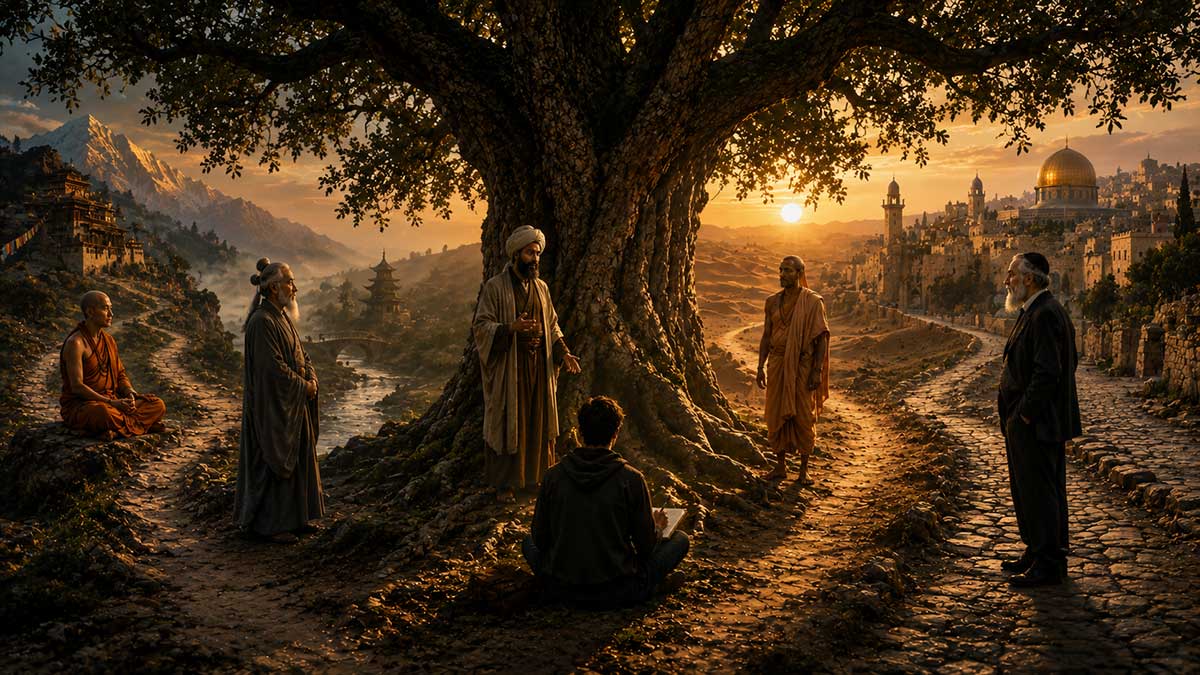
Guests
The Buddha — teacher of liberation from suffering through insight into impermanence, craving, dependent arising, and the absence of a permanent independent self.
Lao Tzu — sage associated with the Tao Te Ching, who speaks of the Way beyond naming, effortless action, humility, and returning to simplicity.
Ibn Arabi — Sufi mystic who explores divine unity, revelation, love, and the many forms through which the One becomes known.
Shankara — Hindu philosopher who teaches nonduality: the deepest self, Atman, is not separate from Brahman, ultimate reality.
Rabbi Jonathan Sacks — Jewish thinker who defends religious particularity and warns that peace does not require reducing every faith to a version of one hidden system.
The figure beneath the tree opened his eyes.
He looked at Jim Palmer, then at the young man standing beside him.
The Buddha: Before asking whether the truths are the same, ask whether the self searching for truth is what it believes itself to be.
The church had vanished.
They now stood beneath an enormous tree at the meeting point of several roads.
One road passed through a desert.
One followed a river between mountains.
One wound through a forest.
One crossed a crowded city.
One climbed toward a temple hidden in clouds.
Travelers moved along each path, carrying scriptures, bowls, prayer rugs, lamps, icons, incense, questions, and wounds.
Lao Tzu stood beside the river, watching water move around a stone.
Ibn Arabi approached from the desert.
Shankara descended from the temple road.
Rabbi Jonathan Sacks came from the city carrying a Hebrew Bible beneath his arm.
The Buddha remained seated beneath the tree.
Jim Palmer looked from one teacher to the next.
Jim Palmer: We have arrived at the broadest claim in my original argument.
Across civilizations, Jesus, the Buddha, Hindu sages, Sufi mystics, Jewish mystics, Christian contemplatives, and Taoist teachers may have pointed toward the same underlying unity beyond separateness.
Is that true?
Or is it a comforting modern idea that ignores what each tradition actually teaches?
Jonathan Sacks: The first act of respect is refusing to pretend that difference is superficial.
Religions do not all say the same thing.
They ask different questions.
They preserve different memories.
They make different claims about God, humanity, history, salvation, revelation, suffering, and death.
Peace does not require us to deny this.
Ramakrishna’s earlier voice seemed to pass through the leaves:
Ramakrishna’s Voice: Many paths climb the mountain.
Sacks looked upward.
Jonathan Sacks: A beautiful image.
It may still be wrong.
Some traditions are not climbing a mountain.
Some are walking with God through history.
Some are seeking release from rebirth.
Some seek harmony with the Way.
Some deny the permanent self that another tradition identifies with ultimate reality.
They cannot all be made identical without changing them.
Shankara: Difference belongs to the level of appearance.
At the deepest level, reality is nondual.
Brahman alone is absolute.
The separate self appears through ignorance.
Liberating knowledge reveals that Atman is Brahman.
The Buddha: I did not teach an eternal self beneath the changing person.
Shankara: What you deny may be the ego mistaken for the Self.
The Buddha: What you affirm may be another subtle object of attachment.
Shankara: Pure awareness is not an object.
It is that through which every object is known.
The Buddha: Search experience carefully.
Body changes.
Feeling changes.
Perception changes.
Mental formations change.
Consciousness changes.
Nothing found within them can rightly be grasped as “This is mine, this I am, this is my permanent self.”
Shankara: That which witnesses change does not itself appear as one more changing object.
The Buddha: The demand for an unchanging witness may arise from the same craving that fears impermanence.
Jim Palmer: This appears to be a direct contradiction.
One of you says the deepest self is identical with ultimate reality.
The other refuses to affirm a permanent self.
Jonathan Sacks: Which is why saying all mystics discovered the same truth can become intellectually careless.
Ibn Arabi: Contradiction may appear at the level of expression.
Yet expression is not meaningless.
The Real discloses itself through forms suited to those who receive it.
No form contains the whole.
No revelation is empty.
Jonathan Sacks: That sounds generous, but who decides that every form is a disclosure of the same Real?
Ibn Arabi: The one who sees the divine signs in every direction.
Jonathan Sacks: Or the one who has built a theory broad enough to absorb every disagreement.
Ibn Arabi: A fair challenge.
Yet narrow certainty may mistake one window for the entire sky.
Lao Tzu: The Way that can be named is not the lasting Way.
The name that can be named is not the lasting name.
Jonathan Sacks: Yet names matter.
A child has a name.
A covenant has words.
A promise depends upon memory.
The nameless can become a way of escaping responsibility to the particular.
Lao Tzu: Naming divides.
Division permits use.
Use may forget origin.
Jonathan Sacks: Naming can divide, but it can permit love.
One does not love “humanity” in the abstract as one loves a particular person with a face, history, and need.
Lao Tzu: The sage does not reject the particular.
He does not cling to it as possession.
Jim Palmer: We have already encountered this tension.
The universal can free us from tribalism.
It can erase real difference.
The particular can preserve history and relationship.
It can harden into exclusion.
Ibn Arabi: Love moves through both.
The Beloved appears in forms.
The lover who knows only one form may reject the Beloved when the form changes.
Jonathan Sacks: That idea can honor many faiths.
It can still deny that God truly commands different communities through different covenants.
You treat difference as temporary clothing worn by one hidden unity.
I see difference as part of divine purpose.
Jim Palmer: You believe God may desire religious diversity?
Jonathan Sacks: Human diversity, certainly.
The Hebrew Bible begins with universal humanity, then turns toward one family, one covenant, one history.
Particularity is not a defect to be overcome.
It may be how finite people learn responsibility.
I do not need everyone to become Jewish for Judaism to be true.
Nor must I call every religion secretly Jewish.
Ibn Arabi: Then we agree that truth need not require uniformity.
Jonathan Sacks: We may agree on that sentence without agreeing on why.
The Buddha: Agreement is not liberation.
A person can hold a correct idea and remain ruled by craving, aversion, and ignorance.
Jim Palmer: Then what matters more than doctrine?
The Buddha: Seeing the causes of suffering.
Seeing how grasping creates suffering.
Seeing impermanence directly.
Seeing that no isolated independent self can be found.
Living with ethical discipline, attention, and wisdom.
Shankara: Knowledge liberates.
The Buddha: What kind of knowledge?
Shankara: Knowledge that the apparent individual is not separate from Brahman.
The Buddha: I would ask whether that knowledge ends greed, hatred, and delusion.
Shankara: True knowledge does.
The Buddha: Then its fruit can be examined.
Jim Palmer: That may be one point of convergence.
Traditions differ in explanation but often judge spiritual realization by transformed life.
Jonathan Sacks: Often, yes.
Yet even the transformed life is defined differently.
A monk leaving household life may embody liberation in one tradition.
In Judaism, holiness often appears within family, community, work, law, time, and collective memory.
Lao Tzu: The best ruler is barely known.
The best action does not strain.
The best life does not display itself as virtue.
Jonathan Sacks: Judaism sometimes asks for visible action.
Feed the hungry.
Release the debtor.
Rest on the Sabbath.
Teach the child.
Protect the stranger.
Justice cannot always remain hidden like water.
Lao Tzu: Water nourishes without announcing itself.
Jonathan Sacks: Yet a court must announce a judgment.
A community must name injustice.
The widow cannot live on invisible compassion.
Ibn Arabi: The inward and outward must meet.
Love without form remains sentiment.
Form without love becomes confinement.
Jim Palmer: Where would Jesus stand in this gathering?
Jonathan Sacks: Historically, among Jews.
That must be said before he is turned into a universal teacher detached from Israel.
Jim Palmer: My argument may do that.
Jonathan Sacks: Yes.
When Jesus becomes one example of a timeless mystical truth, his Jewish life can disappear.
His scriptures, people, festivals, arguments, political setting, and covenantal language become background decoration.
Jim Palmer: That is a serious criticism.
Ibn Arabi: Yet a historical person can carry meanings extending beyond historical origin.
Jonathan Sacks: Certainly.
Extension should not become erasure.
Shankara: If Jesus knew unity with the divine, then his historical form expressed a truth beyond history.
Jonathan Sacks: That sentence already interprets him through Advaita.
Shankara: Every listener hears through a framework.
The Buddha: One should know the framework as framework.
Jim Palmer: That may be the discipline missing from universalism.
It often presents its interpretation as though it were neutral.
Jonathan Sacks: Precisely.
The claim “all religions teach one truth” is itself a religious claim.
It is not a position above religion.
Ibn Arabi: Nor is the claim that each revelation remains permanently distinct free of interpretation.
Jonathan Sacks: I do not claim freedom from interpretation.
I claim that difference may possess sacred value.
Lao Tzu: When people lose the Way, they speak of virtue.
When virtue is lost, they speak of morality.
When morality is lost, they speak of ritual.
Jonathan Sacks: Ritual is not always evidence of loss.
A ritual can carry memory across generations.
A child lighting candles may enter a story older than herself.
A community resting together may resist an economy that treats human beings as machines.
Lao Tzu: When ritual grows naturally, it may serve.
When it becomes empty display, it conceals disorder.
Jonathan Sacks: On that, we agree.
Jim Palmer: The original essay suggests that mystics across traditions discovered unity beyond the illusion of separateness.
Buddha, would you accept that description?
The Buddha: “Unity” may become another view to grasp.
I taught dependent arising.
Things do not exist independently.
They arise through conditions.
This is not the same as saying all things are one substance.
Jim Palmer: Then interdependence is not identical with oneness.
The Buddha: Correct.
When this is, that is.
When this ceases, that ceases.
No independent entity stands alone.
Yet one should not rush from this insight into a metaphysical claim that everything is one eternal reality.
Shankara: Dependent appearance requires a ground.
The Buddha: That requirement may belong to thought, not reality.
Shankara: Without the unchanging, change cannot be known.
The Buddha: Without conditions, no knowing occurs.
Jim Palmer: Do these disagreements affect practice?
The Buddha: They can.
Belief in an eternal Self may preserve subtle attachment.
Shankara: Belief that no Self exists may trap the seeker in denial of the witnessing reality.
Jonathan Sacks: And both debates may feel distant to a mother trying to feed her children.
Ibn Arabi: Yet what a person believes about self shapes how that person loves, fears, possesses, and suffers.
Jonathan Sacks: True.
The test returns to life.
Young Man: Can I ask something?
The teachers turned toward him.
He no longer held the blanket from the church, but his wet clothes had dried.
Young Man: I left one religion because I was afraid it would swallow me.
Then I started reading about many religions.
For a time, it felt freeing.
But now every path seems to cancel another.
How am I supposed to choose?
The Buddha: Begin with suffering.
What creates it?
What reduces it?
Observe carefully.
Do not accept a teaching merely from tradition, charisma, fear, or attraction.
Practice and examine the fruit.
Shankara: Ask who the seeker is.
Trace the sense of “I” to its source.
Do not settle for the personality as your deepest identity.
Lao Tzu: Stop forcing the answer.
Clouded water clears when left undisturbed.
Ibn Arabi: Follow the form through which love calls you most truthfully, yet do not despise the forms loved by others.
Jonathan Sacks: Do not expect one path to answer every question in the same manner.
Choose commitments you can live faithfully.
A life is shaped through promises, not endless comparison.
Young Man: What if I choose the wrong one?
Jonathan Sacks: Every serious commitment includes risk.
Refusing commitment is a choice too.
The Buddha: Clinging to certainty creates suffering.
Shankara: Mistaking the unreal for the real creates bondage.
Lao Tzu: The path appears beneath the feet walking it.
Ibn Arabi: Sincerity may carry a person farther than perfect formulation.
Jim Palmer: Is sincerity enough?
Jonathan Sacks: No.
Sincere people can do terrible things.
Sincerity needs moral limits, self-criticism, community, and accountability.
The Buddha: Intention matters, but wisdom matters too.
Ibn Arabi: Love must be purified from possession.
Shankara: Knowledge must be purified from ego.
Lao Tzu: Action must be purified from forcing.
Jim Palmer: Then no tradition gives easy protection from self-deception.
Jonathan Sacks: Correct.
A person can use religion to escape religion’s demands.
A universalist may collect traditions without submitting to any discipline.
A believer may obey rules without compassion.
A mystic may claim revelation without accountability.
A skeptic may use doubt to avoid commitment.
Young Man: Then how do I know whether a path is changing me in a good way?
The Buddha: Are greed, hatred, and delusion weakening?
Shankara: Is identification with the separate ego weakening?
Lao Tzu: Are you becoming less forceful, less artificial, less consumed by striving?
Ibn Arabi: Is your heart becoming capable of receiving the divine in forms you do not control?
Jonathan Sacks: Are you becoming more responsible for the lives your choices affect?
The young man looked at Jim Palmer.
Young Man: What would you ask?
Jim Palmer: Whether the path makes God feel nearer without making other people smaller.
Sacks nodded.
Jonathan Sacks: That is a worthy test.
Jim Palmer: Yet it may reflect my own theological concern.
Jonathan Sacks: Every question comes from somewhere.
The duty is to know where.
The roads around them began to shift.
The desert road moved closer to the river.
The temple path crossed the city.
The forest opened onto a marketplace.
Travelers from different paths now passed one another.
Some greeted each other.
Some argued.
Some ignored one another.
A Christian monk stopped beside a Buddhist nun.
A Muslim woman shared water with a Hindu pilgrim.
A Jewish father lifted his child so she could see over the crowd.
An atheist doctor treated a wounded stranger without asking what he believed.
Jim Palmer: Does moral goodness suggest a shared spiritual source?
Jonathan Sacks: It may suggest shared humanity.
One need not interpret every act of goodness as hidden membership in one’s own theology.
Ibn Arabi: Yet the source of goodness is the Real, whether recognized or not.
Jonathan Sacks: That is your confession.
It need not become the other person’s description of herself.
The Buddha: A compassionate act may arise through conditions.
It need not prove an eternal source.
Shankara: Every act appears within consciousness.
Lao Tzu: The tree gives shade without asking which doctrine explains it.
Jim Palmer: Lao Tzu, you seem least interested in settling the metaphysical debate.
Lao Tzu: Those who know do not rush to speak.
Those who speak often wish to possess what words cannot hold.
Jonathan Sacks: Yet you have left us a book.
Lao Tzu: A very small one.
Jonathan Sacks: A wise precaution.
The young man smiled.
Jim Palmer: What would each of you say Jesus misunderstood?
The question changed the air.
Sacks looked at Jim sharply.
Jonathan Sacks: We should be cautious about placing invented judgments into the mouths of religious figures.
Jim Palmer: Then let us frame it differently.
What would each of your traditions challenge in common Christian interpretations of Jesus?
The Buddha: Attachment to views about Jesus may replace the ending of suffering.
A person can defend a doctrine of salvation and remain ruled by anger and craving.
Lao Tzu: Those who preach humility may create large institutions around it.
Those who praise the poor may desire rank.
Those who speak of the kingdom may build empires.
Ibn Arabi: Love of Jesus may become rejection of the divine signs present outside one form.
Shankara: Worship of a divine being outside the self may preserve the illusion of separation.
Jonathan Sacks: Christianity has often forgotten that Jesus was a Jew and then used Jesus against Jews.
It turned a Jewish teacher into a reason to reject the people and tradition that formed him.
Jim Palmer: And what might your traditions learn from Jesus?
The Buddha remained silent for a moment.
The Buddha: The question should be answered by followers of my path who have studied him deeply.
Yet the image of one who meets suffering with compassion can speak beyond boundaries.
Lao Tzu: He spoke of seeds, children, birds, fields, and hidden growth.
He understood that what is small may carry what is great.
Ibn Arabi: Jesus reveals the breath of spirit, tenderness, poverty before God, and love refusing possession.
Shankara: His unity with the Father may be read as testimony that the apparent individual is not separate from ultimate reality.
Jonathan Sacks: His moral seriousness, concern for the marginalized, use of parable, and prophetic challenge stand within the Jewish tradition and continue to speak widely.
Jim Palmer: None of you interpreted him in the same way.
Jonathan Sacks: That is the point.
Ibn Arabi: Difference need not prevent recognition.
The Buddha: Recognition need not require sameness.
Shankara: Sameness at the deepest level need not erase difference in appearance.
Jonathan Sacks: We still disagree about that deepest level.
Lao Tzu: The river does not argue with the banks.
Jonathan Sacks: The banks keep the river from becoming a flood.
Lao Tzu: Until the flood reminds the banks that they are temporary.
Jonathan Sacks: You are difficult to debate.
Lao Tzu: Debate adds corners to what was round.
Jim Palmer: Let us consider science.
My original argument suggested modern science challenges the idea that reality consists of fundamentally separate things.
Does science support spiritual unity?
The Buddha: Science may study conditions and relationships.
It does not settle liberation.
Shankara: Scientific observation occurs within consciousness.
Science does not explain the ultimate nature of the knower.
Jonathan Sacks: Scientific interconnection is not proof of God, Brahman, or mystical union.
The movement from physics to spirituality must be argued, not assumed.
Ibn Arabi: Science can reveal signs.
It cannot compel one interpretation of them.
Lao Tzu: The more tools people make, the more they may forget how to see.
Jim Palmer: Then invoking science gives the essay a sense of authority it has not earned.
Jonathan Sacks: Yes.
Quantum language is often borrowed to support spiritual claims far beyond what physics establishes.
Jim Palmer: That sentence may be less poetic, but more honest.
The Buddha: Honesty is useful.
Young Man: Is there any shared truth among all of you?
The teachers looked at one another.
Jonathan Sacks: We should not answer too quickly.
Ibn Arabi: Love matters.
The Buddha: Compassion matters.
Shankara: Freedom from ignorance matters.
Lao Tzu: Freedom from excessive striving matters.
Jonathan Sacks: Responsibility matters.
Young Man: Those sound related.
Jonathan Sacks: Related, yes.
Identical, no.
The Buddha: Similar fruits may grow from different explanations.
Shankara: Or different explanations may conceal one ground.
Jonathan Sacks: We have returned to disagreement.
Ibn Arabi: A worthy disagreement.
Jim Palmer: Perhaps the strongest conclusion is not that every teacher discovered the same truth.
Perhaps they encountered overlapping dimensions of human experience and interpreted them through distinct histories, languages, practices, and revelations.
Jonathan Sacks: That is more defensible.
The Buddha: Provided “dimensions” does not become another hidden theory imposed upon all.
Jim Palmer: Fair.
Shankara: And provided difference does not blind us to nonduality.
Jonathan Sacks: We will not settle that today.
Lao Tzu: The day was never asking to be settled.
The tree above them released a single leaf.
It turned slowly through the air and landed in the baptismal bowl that had somehow appeared beside the roots.
The Christian prayer rope rested on one side.
The Buddhist beads rested on the other.
Near them lay a strip of Hebrew parchment, a Sufi poem, a page from the Upanishads, and a blank piece of paper.
The young man picked up the blank page.
Young Man: What is this one?
Lao Tzu: The teaching before the teaching.
Jonathan Sacks: Or a page waiting for responsibility.
The Buddha: Or an object upon which the mind is already projecting meaning.
Shankara: Or the visible form of the consciousness in which all meanings appear.
Ibn Arabi: Or a letter from the Beloved not yet read.
The young man laughed.
Young Man: You cannot even agree about blank paper.
Jonathan Sacks: That may be our most honest achievement.
Jim Palmer: Then what should a person do when faced with so many paths?
The Buddha: Practice attentively.
Lao Tzu: Do not force.
Ibn Arabi: Love without possession.
Shankara: Seek the knower beneath the known.
Jonathan Sacks: Choose responsibilities, keep promises, and let another person’s difference remain real.
Jim Palmer: And Jesus?
Jonathan Sacks: Do not remove him from his people.
Ibn Arabi: Do not confine him to one form of love.
Shankara: Do not keep his union with God external to the seeker.
The Buddha: Do not turn belief about him into escape from suffering and ethical practice.
Lao Tzu: Do not build a heavy throne for one who praised children and seeds.
The roads began to separate once more.
The desert withdrew.
The river curved away.
The temple disappeared into cloud.
The city lights returned in the distance.
The tree remained.
Jim Palmer looked at the guests.
Jim Palmer: My original claim was that all these traditions point toward the same underlying unity.
I no longer think I can state it so simply.
There may be shared experiences.
Shared ethical fruits.
Shared resistance to ego, cruelty, and illusion.
There may be forms of spiritual recognition across boundaries.
But the differences are real.
They should not be erased merely to make the universe feel harmonious.
Jonathan Sacks: Agreement purchased by deleting difference is not peace.
Ibn Arabi: Nor should difference become a wall preventing love.
The Buddha: Hold views without being held by them.
Shankara: Seek what does not change beneath changing views.
The Buddha: There we disagree again.
Lao Tzu: Good.
The river still moves.
The young man sat beneath the tree.
Young Man: I came here asking which religion was right.
Jim Palmer: What are you asking now?
He looked at the road leading back to the church.
Young Man: Which truth am I willing to live?
A bell sounded somewhere beyond the mountains.
The teachers began walking back along their separate roads.
None asked the others to follow.
None claimed the roads had become one.
Yet for a few steps, before the paths divided, they walked beside one another.
Jim Palmer watched them go.
Jim Palmer: Perhaps spiritual maturity is not proving that every path reaches the same destination.
Perhaps it is learning to walk one path deeply without needing every other traveler to be lost.
The Buddha paused beneath the final branch.
The Buddha: And without becoming attached to the one who believes he is walking.
Shankara stopped farther up the temple road.
Shankara: Ask who that walker truly is.
Jonathan Sacks turned from the city path.
Jonathan Sacks: Then ask whom the walker is responsible for.
Ibn Arabi raised one hand from the desert.
Ibn Arabi: And whether love has widened the heart.
Lao Tzu was already gone.
Only the sound of water remained.
The young man looked at the blank page in his hands.
At the top, he wrote one question:
What kind of person is my truth making me become?
He did not write an answer.
Not yet.
This completes the five-part conversation arc.
Final Thoughts by
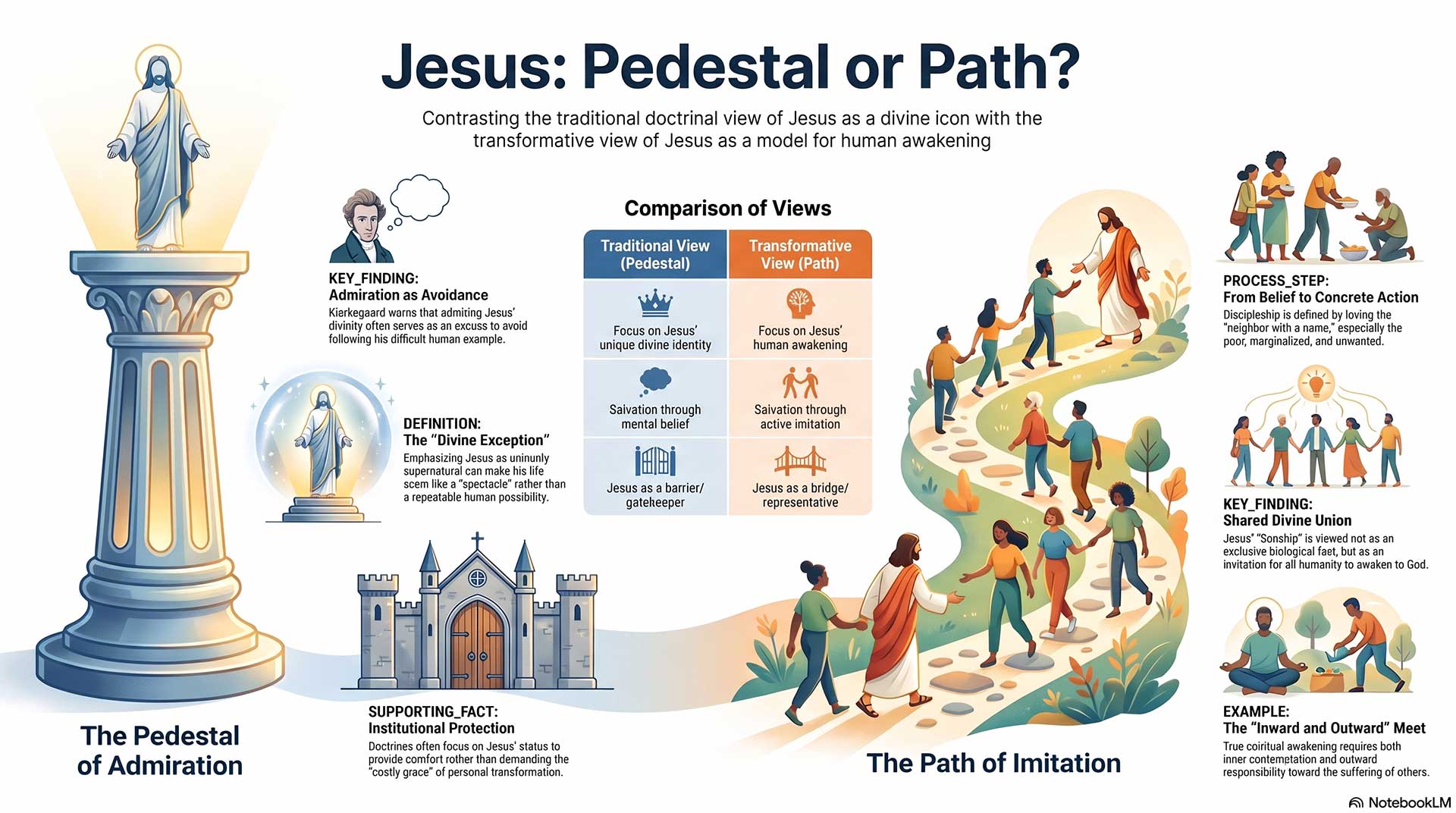
The conversation began with a bold accusation:
Did Christianity reverse the message of Jesus?
It concludes with a more difficult realization.
The deeper question may not be whether Jesus was uniquely divine, fully human, history's greatest prophet, an awakened mystic, Israel's Messiah, or the eternal Word.
The deeper question is what those beliefs produce in the lives of the people who hold them.
If believing in Jesus makes us more humble, compassionate, truthful, courageous, and willing to love those whom society rejects, then belief has moved beyond argument and become transformation.
If our understanding of Jesus makes us fear honest questions, despise other people, excuse injustice, or worship from a safe distance without following his example, then even the most carefully defended doctrine deserves examination.
This conversation never asks readers to abandon their faith.
Neither does it ask anyone to surrender honest doubt.
Instead, it invites every reader—Christian or not—to ask a question that reaches beneath theology itself:
What kind of person is my understanding of truth making me become?
That question belongs to every tradition.
It belongs to every skeptic.
It belongs to every believer.
And perhaps it is the one question Jesus hoped no one would avoid.
Short Bios:
Jim Palmer
Former pastor, author, and spiritual teacher whose work challenges institutional Christianity and encourages a direct, transformative relationship with God beyond religious systems.
Søren Kierkegaard
Nineteenth-century Danish philosopher who argued that Christianity becomes empty whenever admiration replaces costly discipleship and personal commitment.
Dietrich Bonhoeffer
German theologian and anti-Nazi resister whose concept of "costly grace" continues to challenge comfortable forms of Christian faith.
Dorothy Day
Catholic activist and founder of the Catholic Worker Movement, remembered for uniting deep prayer with radical service to the poor and marginalized.
Friedrich Nietzsche
German philosopher whose fierce critique of Christianity questioned whether the church remained faithful to the spirit of Jesus.
Bart D. Ehrman
Historian of early Christianity specializing in the historical Jesus, the development of Christian doctrine, and the formation of the New Testament.
N. T. Wright
New Testament scholar and former Anglican bishop known for placing Jesus within the historical story of first-century Judaism while defending central Christian beliefs.
John Shelby Spong
Episcopal bishop who challenged literal interpretations of Christian doctrine and sought a modern understanding of Jesus and faith.
Elaine Pagels
Historian of religion whose research explores the diversity of early Christianity, including Gnostic writings and competing understandings of Jesus.
James D. G. Dunn
Influential New Testament scholar whose work shaped modern discussions of the historical Jesus and the earliest development of Christology.
C. S. Lewis
Christian writer and apologist whose works present the incarnation as the union of divine and human life without diminishing either.
Thomas Aquinas
Medieval philosopher and theologian whose systematic explanation of Christ's divine and human natures remains foundational in Christian theology.
Simone Weil
French philosopher and mystic whose writings on suffering, attention, and self-emptying love continue to influence spiritual thought across traditions.
Howard Thurman
Theologian and civil rights thinker who interpreted Jesus through the lived experience of the oppressed and emphasized inner spiritual freedom.
Carl Jung
Swiss psychiatrist who explored Christ as a profound symbol of psychological wholeness while examining the relationship between religion and the human psyche.
Meister Eckhart
German Dominican mystic whose teachings describe the birth of divine life within the human soul beyond images and concepts.
Teresa of Ávila
Spanish Carmelite reformer and contemplative whose writings remain among Christianity's greatest works on prayer and union with God.
Richard Rohr
Franciscan teacher who emphasizes contemplation, transformation, and the universal significance of Christ beyond narrow religious boundaries.
Ramakrishna
Nineteenth-century Indian mystic who practiced multiple religious paths and taught that sincere seekers may encounter ultimate reality through different traditions.
Abraham Joshua Heschel
Jewish theologian whose writings emphasize covenant, prophetic responsibility, divine compassion, and the sacred importance of history.
The Buddha
Founder of Buddhism, whose teachings focus on ending suffering through wisdom, ethical living, meditation, and freedom from attachment.
Lao Tzu
Ancient Chinese sage traditionally associated with the Tao Te Ching, teaching harmony with the Tao through simplicity, humility, and effortless action.
Ibn Arabi
Great Sufi philosopher and mystic whose vision of divine unity and love profoundly shaped Islamic spirituality.
Shankara
Indian philosopher and principal teacher of Advaita Vedanta, who taught the nondual identity of Atman and Brahman.
Rabbi Jonathan Sacks
British rabbi and philosopher who defended the value of religious particularity, moral responsibility, and respectful dialogue between faiths.
Leave a Reply