

Joel Osteen’s Seventh Year: When God Refuses to Let Suffering Write the Final Chapter
There are seasons in life that seem to last far longer than we ever imagined.
A diagnosis changes everything. A marriage quietly falls apart. A dream that once felt alive slowly fades beneath years of disappointment. A prayer is repeated so many times that one day we stop expecting an answer.
Most people can endure hardship for a season.
The greater danger comes when the season begins to define our identity.
We no longer say, “I am going through this.”
We begin saying, “This is who I am.”
That quiet shift is where hope becomes difficult. The struggle is no longer something we carry—it becomes the name we give ourselves.
Joel Osteen's message about the "seventh year" speaks directly into that moment.
Drawing inspiration from the biblical principle of release found in Deuteronomy 15, Joel reminds people that God is a God of new seasons. His message is not about calculating a literal seven-year timetable. It is about refusing to believe that today's bondage has permanent authority over tomorrow.
To explore that message, we invited five remarkable voices from Scripture.
The woman who suffered for twelve years reminds us that exhausted faith can still reach toward Christ.
The man at the Pool of Bethesda shows how years of waiting can quietly become an identity—and how one question from Jesus can awaken forgotten hope.
Joseph reveals that a dream from God can survive betrayal, slavery, and prison.
Ruth teaches that restoration often arrives quietly through ordinary acts of faithfulness rather than dramatic miracles.
Finally, Job offers perhaps the deepest lesson of all: faith does not require having every answer. Sometimes faith simply refuses to let suffering become the final sentence.
Together, these stories form one beautiful truth.
Some people experience sudden breakthroughs.
Others experience slow restoration.
Some discover physical healing.
Others discover courage, forgiveness, peace, or a purpose they never expected.
The form may differ.
The source remains the same.
The God who met His people in their darkest seasons is still inviting people today to believe that pain is a chapter—not the entire story.
Tonight, as these voices gather around one table, they ask a question every generation eventually asks:
How do we keep believing when the years have taught us to expect disappointment?
(Note: This is an imaginary conversation, a creative exploration of an idea, and not a real speech or event.)
Topic 1: When Your Pain Has Lasted So Long That It Feels Permanent
Opening
The first light of morning rests faintly over the stone courtyard. A cool breeze moves across the valley, carrying the scent of damp earth and olive leaves. On the wooden table lies an open scroll beside a small clay lamp that has nearly burned out.
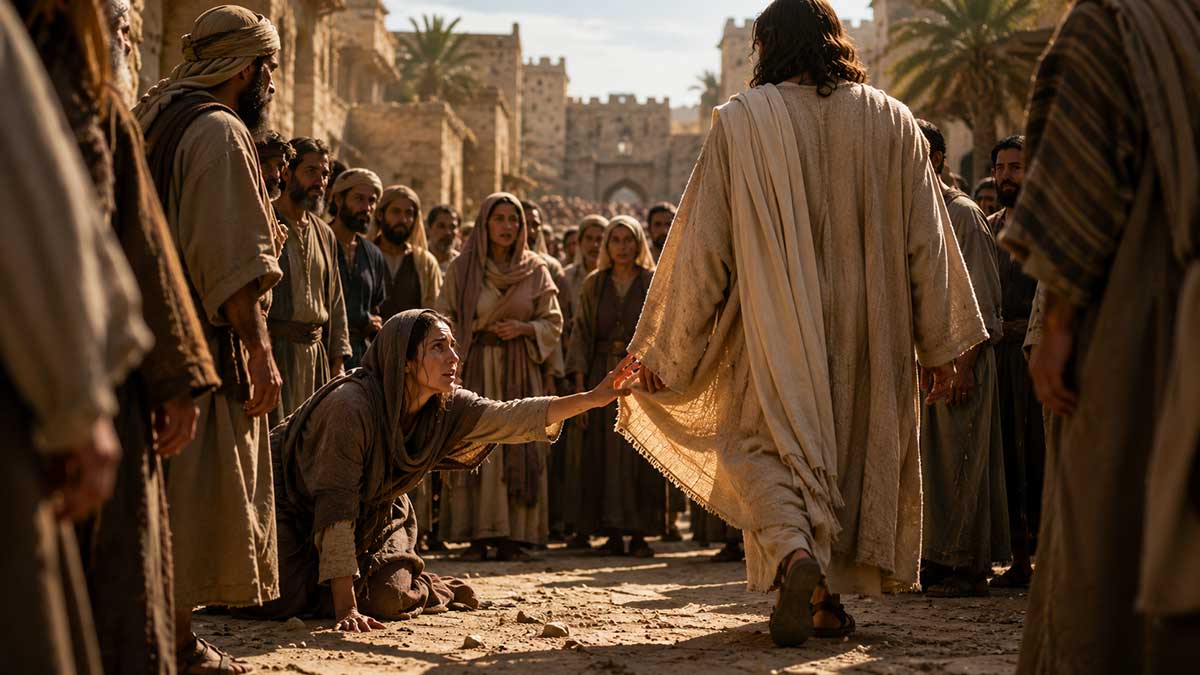
Joel Osteen sits across from a woman whose face carries both weariness and quiet strength. For twelve years, she had lived with an illness no one could cure. She had spent everything she had. She had endured disappointment after disappointment. Yet one day, hidden in a crowd, she reached out and touched the edge of Jesus’ garment.
Nearby, Joseph listens in silence. He knows what it means to wait through years that seem to move in the wrong direction. Job sits with his hands folded, his expression gentle but searching. Ruth looks out over the valley, remembering the years when the future seemed closed.
Joel looks at the woman and speaks softly.
Joel Osteen:
There are people who can handle pain for a season. They tell themselves, “This will pass.” They pray. They keep moving. They stay hopeful.
But when the pain continues year after year, something begins to change inside them. They stop saying, “I am going through this,” and begin saying, “This is my life.”
What happens to hope after twelve years?
The Woman with the Issue of Blood:
At first, hope was easy to find.
Every new physician gave me a reason to believe. Every treatment felt like a new beginning. Every person who said, “I know someone who may be able to help,” awakened something inside me.
Then each hope became another disappointment.
After many years, the pain was no longer the only burden. I became afraid of hope itself.
Joel Osteen:
Afraid of hope?
The Woman:
Yes.
Pain hurts once. False hope hurts twice.
You suffer from the condition, then you suffer again when the thing you trusted does not help.
There came a time when I no longer asked, “Will I be healed?” I asked, “How do I survive another day like this?”
Job:
That is a truth many faithful people are ashamed to admit.
They believe they must always sound strong. They fear that speaking honestly will disappoint God.
Yet suffering can exhaust the language of faith.
Joseph:
And when the years keep passing, the mind begins to turn history into prophecy.
You say, “It has always been this way, so it will always be this way.”
Joel Osteen:
That is where the seventh-year message becomes liberating.
The length of the struggle can convince you that the struggle owns you. But long does not mean permanent.
Twelve years were real. Her suffering was real. Her losses were real.
Yet twelve years did not have authority over the next moment.
Question 1: What Happens Inside a Person After Years of Unanswered Prayer?
Joel Osteen:
Let us begin there.
What happens inside someone after years of praying and seeing no change?
The Woman:
The first thing that disappears is confidence.
I once believed I could enter a room and simply be present. Later, I felt that my condition entered before I did.
People did not see me first. They saw what was wrong with me.
Some looked away. Some whispered. Some spoke to me with pity. Some acted as if suffering were evidence that I had failed spiritually.
Eventually, I began seeing myself through their eyes.
Ruth:
Did you feel forgotten by God?
The Woman:
I did not stop believing in God.
I began wondering whether God still saw me.
There is a difference.
I believed He was merciful. I believed He healed. I believed He heard prayer.
I simply no longer knew whether His mercy would reach me.
Job:
That question can become heavier than the suffering itself.
When pain continues, people often ask, “Why me?”
After enough time, the question changes.
“Why not me?”
Why are others restored? Why do others receive good news? Why does someone else’s prayer seem to open a door when mine seems to disappear into silence?
Joel Osteen:
Many people feel guilty for asking those questions.
But God is not threatened by honest pain.
Faith is not pretending the years did not hurt. Faith is refusing to let those years write the ending.
Joseph:
Yet that refusal can be difficult when nothing visible supports it.
When I was in prison, every day looked like proof that the dream had failed.
The walls did not move. The chains did not loosen. No messenger arrived to explain the delay.
Sometimes the greatest battle is not believing that God exists.
It is believing that your story is still moving when everything looks still.
The Woman:
That was my battle.
My body was weak. My resources were gone. My reputation had suffered. My world had grown smaller.
Each year seemed to remove another reason to expect change.
Joel Osteen:
And yet, somewhere beneath all of that, there was still enough hope to move through the crowd.
The Woman:
Yes.
It was not loud hope.
It was not confident hope.
It was the smallest piece left.
I did not walk toward Jesus feeling certain. I walked toward Him because I had nothing else left except one fragile thought:
“If I can touch even the edge of His garment, perhaps my story can still change.”
Job:
That kind of faith is often misunderstood.
People think faith must feel strong.
Sometimes faith is simply taking one more step with a trembling hand.
Joel Osteen:
That may be the word someone needs.
You do not have to feel fearless to move forward.
You do not have to erase twelve years of disappointment before reaching again.
The years may have weakened your confidence, but they have not canceled your access to God.
Question 2: Can One Moment of Faith Interrupt a Long History of Disappointment?
The morning light grows brighter. The small clay lamp finally goes out, yet the courtyard no longer needs it.
Joel Osteen:
Your healing happened in a moment.
How can one moment carry enough weight to interrupt twelve years of pain?
The Woman:
The moment was sudden.
The decision behind it was not.
I had to pass through the memory of every failed attempt.
I had to move through the fear that this would become one more disappointment.
I had to enter a crowd that could reject me.
I had to reach out when part of me wanted to protect itself from being hurt again.
The touch lasted only a moment.
The courage required to make that touch had been forming through every painful year.
Joseph:
That is familiar to me.
People remember the day Pharaoh called me from prison.
They see the sudden elevation.
They do not see the years that prepared me to stand in that room without bitterness, panic, or revenge.
The door opened quickly.
The person who walked through it had been formed slowly.
Joel Osteen:
So a sudden change does not mean the waiting years meant nothing.
Joseph:
No.
The years do not earn the miracle.
But they can shape the person who receives it.
Job:
We should be careful here.
Suffering does not always make a person wiser. Pain can wound, distort, and exhaust. We should not romanticize it.
No one should tell a suffering person, “This is happening to build your character,” as if that sentence makes the pain easier to bear.
Joel Osteen:
I agree.
We should never use spiritual language to make people feel responsible for their suffering.
Yet we can still say this:
What happened to you does not have to become the final definition of you.
The Woman:
That distinction matters.
I would never call those twelve years good.
I lost too much.
But I can say that when the moment came, the years behind me did not disqualify me.
My weakness did not disqualify me.
My fear did not disqualify me.
My exhausted faith did not disqualify me.
Ruth:
Perhaps that is one reason your story is so liberating.
You did not arrive with perfect confidence.
You arrived wounded.
The Woman:
Yes.
I did not touch Jesus as someone who had mastered hope.
I touched Him as someone who had almost lost it.
Joel Osteen:
That is the heart of the message.
A single act of faith can interrupt a long pattern.
One new decision can challenge an old identity.
One moment does not erase the past, but it can change what the past is allowed to control.
Job:
Yet what do we say to those who reach out and do not receive immediate healing?
Joel Osteen:
We tell them the truth.
We do not promise that every act of faith produces the same visible result at the same time.
We do not blame them.
We do not tell them their suffering continues from a lack of belief.
We remind them that reaching toward God is never wasted, though the answer may come in forms they did not expect.
The Woman:
For some, the first healing may be the return of courage.
For others, it may be the strength to seek help again.
For others, peace may arrive before the body changes.
For others, a door may open through medicine, community, rest, or someone who finally listens.
Joel Osteen:
A long history of disappointment can be interrupted before every circumstance is resolved.
The interruption may begin the moment a person says:
“This pain has been part of my life, but it is not all of my life.”
Question 3: How Can Hope Return Without Denying the Exhaustion of Suffering?
The valley below is now visible. Fields that had been hidden in darkness begin to show their shape. The air remains cold, yet the sun has started warming the stones beneath their feet.
Joel Osteen:
How can someone hope again without pretending they are not tired?
The Woman:
Hope returned to me in a smaller form than before.
In the early years, hope was loud. It made promises. It pictured the future in detail.
Later, hope became quiet.
It said only, “Take one step.”
I learned that hope does not always feel like excitement.
Sometimes hope feels like refusing to disappear.
Job:
That is a truer hope than forced optimism.
Suffering people are often asked to speak as if they are already standing on the other side.
But there are days when faith sounds more like a cry than a celebration.
Joel Osteen:
Yes.
People should not feel pressured to deny their fatigue.
You can say, “I am tired,” and still believe the story is not finished.
You can say, “I am disappointed,” and still leave room for God.
You can admit, “I do not know what happens next,” without declaring that nothing good can happen next.
Joseph:
The danger is not in admitting weariness.
The danger is turning weariness into a permanent identity.
Ruth:
When I entered Bethlehem with Naomi, I did not have a grand vision.
I had enough strength to gather grain for one day.
That day did not look like a new destiny.
It looked like survival.
But sometimes survival is the doorway through which a new life enters.
The Woman:
That is how hope returned to me.
Not through certainty.
Through movement.
One step into the crowd.
One hand extended.
One thought that had not completely died.
Joel Osteen:
Then the liberating message is not, “You must feel strong.”
It is, “You are still allowed to believe.”
Your suffering may have lasted longer than you expected. It may have changed your routines, your relationships, your finances, your confidence.
But it does not receive the right to name your future.
Job:
And when people cannot believe that strongly for themselves?
Joel Osteen:
Then the community must believe beside them.
We sit with them.
We pray without pressuring.
We help without judging.
We remind them of who they are when pain has made them forget.
The Woman:
There were years when I needed more than encouragement.
I needed dignity.
I needed someone to see me as a person, not a problem.
Joel Osteen:
That is another form of release.
Sometimes the seventh year begins when someone stops treating the suffering person as permanently broken.
Joseph:
Or when the suffering person stops using the past as proof against the future.
Ruth:
Or when one ordinary step becomes possible again.
Job:
Or when a person learns that lament and hope can occupy the same heart.
Joel looks at the broken chain on the table. He lifts it carefully, then places it beside the open scroll.
Joel Osteen:
Twelve years is a long time.
Long enough to feel forgotten.
Long enough to stop expecting change.
Long enough to mistake a season for an identity.
But her story reminds us that the calendar does not decide what God can still do.
The pain may be old.
The mercy can still be new.
Closing
The woman rises and walks to the edge of the courtyard. The morning sun touches her face.
She does not look like someone erasing her past.
She looks like someone no longer ruled by it.
The Woman:
For twelve years, I believed my life was becoming smaller.
Then one moment taught me that God had never reduced me to my suffering.
Joel Osteen:
Perhaps someone reading this has stopped calling the pain temporary.
Perhaps they have accepted a name God never gave them: forgotten, broken, hopeless, too late.
Your faith may feel small.
Your strength may feel gone.
Your hand may tremble when you reach.
Reach anyway.
The length of the struggle does not decide the ending.
And the next step may be closer than it appears.
Topic 2: When Delay Makes You Believe God Has Passed You By
Opening
The courtyard has fully awakened.
Sunlight pours across the stone floor, revealing every crack, every worn edge, every mark left by years of wind and rain. Beyond the low wall, the valley opens beneath a pale blue sky. Birds move between olive branches, and somewhere in the distance, water runs over rock with a steady, patient sound.
At the center of the courtyard stands a shallow stone basin.
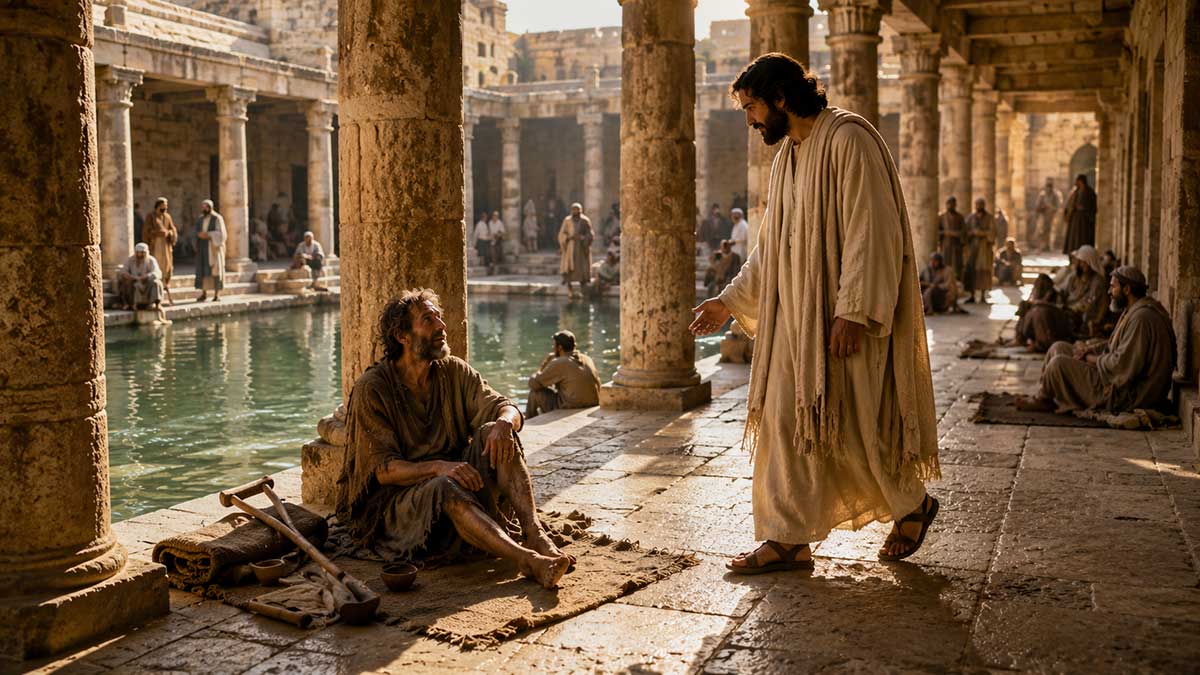
The man from the pool of Bethesda sits beside it.
For thirty-eight years, he lived with a condition that limited his movement. For thirty-eight years, he watched other people move faster, receive help sooner, and reach the water before he could.
Joel Osteen sits across from him. The woman who had suffered for twelve years sits nearby. Joseph leans forward with quiet attention. Ruth rests her hands in her lap. Job watches the man with the tenderness of someone who knows how dangerous easy answers can become.
Joel looks at the basin, then at the man.
Joel Osteen:
Thirty-eight years is long enough to stop expecting anything new.
You were close to the place people associated with healing, yet you remained there year after year.
What happens to a person when possibility stays visible but never seems reachable?
The Man at Bethesda:
At first, I believed my turn would come.
Every movement in the water awakened me.
Every new day seemed to carry a chance.
I watched carefully. I positioned myself as close as I could. I told myself, “Next time, I will be ready.”
But readiness was not enough.
Someone always reached the water before me.
The Woman with the Issue of Blood:
Did you become angry with them?
The Man:
Sometimes.
Then I became ashamed of the anger.
They wanted healing too. They were desperate too.
Yet each time someone stepped ahead of me, their joy became evidence of my delay.
I knew I should be grateful that another person was restored.
But part of me heard only one message:
“Not you.”
Job:
That feeling can wound the soul.
Another person’s blessing begins to sound like your rejection.
Joel Osteen:
Many people live near opportunity but believe it belongs to everyone else.
They see another person’s marriage restored, another person’s business grow, another person receive good news, another person recover, another person move forward.
After enough years, they stop saying, “My time will come.”
They begin saying, “This is how my life works.”
The Man:
That is what happened to me.
My condition was no longer merely something I lived with.
It became the explanation for everything.
Why I stayed.
Why I depended on others.
Why I stopped making plans.
Why I no longer pictured a different future.
Then Jesus came and asked me a question that almost offended me.
“Do you want to be made well?”
Question 1: Why Did Jesus Ask, “Do You Want to Be Made Well?”
Joel Osteen:
That question can sound strange.
You had waited thirty-eight years. Surely the answer was obvious.
Why do you think Jesus asked it?
The Man:
At first, I thought He did not understand.
I wanted to say, “Look at me. Look at where I am. Look at how long I have been here.”
But He was not asking whether I disliked my condition.
He was asking whether I was ready for a life that would no longer be organized around it.
Ruth:
That is a different question.
The Man:
Yes.
For years, people knew where to find me.
They knew what I needed.
They knew what I could not do.
My whole identity had formed around waiting.
To become well would mean leaving the place where I had spent most of my life.
It would mean responsibility.
It would mean choices.
It would mean facing all the years ahead without the familiar explanation I had carried for the years behind.
Joel Osteen:
Pain can become familiar without becoming desirable.
A person can hate the prison and still fear the open door.
Job:
We should speak carefully.
People sometimes use this passage to accuse suffering people of secretly wanting to remain broken.
That can be cruel.
Long pain changes the nervous system, the imagination, the habits of the heart. Fear of change is not the same as choosing suffering.
Joel Osteen:
That is true.
Jesus did not shame him.
He did not say, “You have stayed here from weak faith.”
He asked a question that restored his dignity.
He treated him as someone capable of responding.
The Woman:
For years, people may have spoken about him, carried him, passed him, or pitied him.
Jesus spoke to him.
The Man:
That mattered.
He did not begin with my limitation.
He began with my desire.
Joseph:
The question may have awakened a part of you that had gone quiet.
The Man:
It did.
I had spent years explaining why I could not reach the water.
When Jesus asked whether I wanted to be well, I gave Him my reason.
“Sir, I have no one to put me into the pool.”
That sentence had become my whole story.
No one helps me.
Others move before me.
I am always too late.
Joel Osteen:
How many people carry a sentence like that?
“No one supports me.”
“My family never gave me a chance.”
“I missed my opportunity.”
“I am too old now.”
“I do not have the right connections.”
“My health has taken too much from me.”
Some of those statements may describe real pain.
But a true description can still become a false conclusion.
Job:
The danger begins when the explanation becomes a prophecy.
Joel Osteen:
Exactly.
Jesus did not argue with the man’s history.
He did not deny that no one had helped him.
He spoke to a possibility beyond the system the man had been watching.
The man believed healing had to come through the pool.
Jesus showed him that God was not limited to the method he had been waiting on.
Question 2: What Happens When We Believe Help Must Come in Only One Form?
The sound of water in the valley grows clearer. The man watches the small basin in the courtyard, then looks away from it.
Joel Osteen:
You had spent years waiting for the water to move.
Did you believe healing could come in any other way?
The Man:
No.
That was the only story I knew.
The water stirs.
Someone enters.
Someone is healed.
Every day, my attention was fixed on that pattern.
I measured hope by how close I was to the pool.
Joseph:
Sometimes people miss a new door because they are still watching an old one.
The Man:
That was me.
Jesus stood in front of me, but I answered Him by speaking about the water.
He asked about my future.
I explained my system.
Ruth:
I once thought my future had ended in Moab.
Then it opened in a field where I went merely to gather enough grain for the day.
The answer did not arrive in the form I had lost.
It came through a place I had never planned to enter.
Joel Osteen:
That is freeing.
Many people have decided how God must answer.
They say:
“This person must change.”
“This company must hire me.”
“This doctor must have the answer.”
“This relationship must be restored exactly as it was.”
“This opportunity must return.”
Then when that one path remains closed, they assume God has said no to the whole future.
Job:
Yet discernment matters.
People should not treat every new idea as a divine sign.
Hope still needs wisdom.
Joel Osteen:
Yes.
Faith is not chasing every possibility.
It is refusing to believe that one closed route means every route is closed.
The Woman:
I had visited physicians and spent all I had.
I could have concluded that nothing more was possible.
Yet healing came outside every pattern I had known.
The Man:
For me, the hardest part was realizing how small my expectation had become.
I did not ask Jesus to heal me.
I explained why I could not reach the pool.
Joel Osteen:
Pain can train people to answer possibility with limitation.
A new relationship appears, and they say, “People always leave me.”
A new opportunity comes, and they say, “I failed before.”
Someone offers help, and they say, “No one ever stays.”
The past speaks so quickly that the future never gets a full sentence.
Joseph:
I knew God had given me a dream, yet I could not decide the road that would lead to it.
If I had demanded that the dream come through my family’s approval, I would have missed what God was doing in Egypt.
Job:
Still, Joseph, your road included betrayal and injustice.
We should not make every wound sound like a secret route arranged for success.
Joseph:
I would never call the betrayal good.
I can only say it did not possess enough authority to cancel what came after it.
Joel Osteen:
That is the message.
What happened may have limited you.
It may have delayed you.
It may have changed the route.
But it does not get to declare that God has no other way.
Question 3: What Does It Mean to “Rise, Take Up Your Mat, and Walk”?
A breeze moves through the courtyard. The open scroll on the table lifts slightly at the corners.
The man looks down at the folded mat beside his chair.
Joel Osteen:
Jesus told you, “Rise, take up your mat, and walk.”
Why take the mat?
Why not leave it behind?
The Man:
For thirty-eight years, the mat carried me.
Then I was told to carry it.
That reversal showed me that what once held my body no longer held my identity.
Ruth:
The evidence of dependence became evidence of release.
The Man:
Yes.
The mat was part of my history.
Jesus did not ask me to pretend it had never existed.
He asked me to place it under new authority.
Joel Osteen:
That is one of the strongest parts of the story.
Freedom does not always mean forgetting what happened.
It can mean changing your relationship to it.
The memory remains, but it no longer directs your steps.
The scar remains, but it no longer names you.
The mat remains, but now you carry it.
Job:
What did it feel like to stand?
The Man:
Unnatural.
People speak of miracles as if the first feeling must be joy.
I felt fear.
My body was doing what it had not done for decades.
The ground felt different beneath me.
Everyone could see me.
I could no longer hide inside the familiar role of the man who waits.
The Woman:
Did you wonder whether the strength would disappear?
The Man:
Yes.
Each step carried a question.
Will this hold?
Can I trust my own legs?
What happens when I leave this place?
Joel Osteen:
That matters for people who are entering a new season.
They may receive the opportunity they prayed for and still feel afraid.
They may leave a harmful relationship and still miss what was familiar.
They may recover and still fear every symptom.
They may become financially stable and still live with the panic of lack.
They may be forgiven and still think like the condemned person they used to be.
New freedom often requires new habits.
Joseph:
Leaving prison did not immediately remove the instincts prison had formed.
I had to stand before Pharaoh and speak as someone prepared, not as someone forgotten.
Ruth:
I had to receive kindness without assuming it would be taken away.
The Woman:
I had to reenter a community that had known me through exclusion.
Job:
And some people may need time, care, counsel, medicine, and patient companionship before their inner life catches up with external change.
Joel Osteen:
Yes.
“Rise” is not a demand to deny pain.
It is an invitation to stop building tomorrow around yesterday’s limitation.
“Take up your mat” means you do not have to be ashamed of where you have been.
“Walk” means the new life begins through movement.
Not every step will feel confident.
Take it anyway.
The Man:
My first step did not erase thirty-eight years.
It proved that thirty-eight years had not erased the possibility of a first step.
Closing
The man rises slowly from his chair.
He bends, lifts the folded mat, and places it beneath his arm.
For a moment, no one speaks.
He walks across the courtyard, one measured step after another. He reaches the stone wall and looks across the valley.
The pool is nowhere in sight.
The Man:
For years, I believed my future depended on reaching the water before someone else.
Then Jesus came to me where I was.
I thought I had missed my moment.
I learned that mercy had not missed me.
Joel stands and joins him at the wall.
Joel Osteen:
You may have watched others move ahead.
You may have waited so long that expectation feels foolish.
You may have built your life around one method, one person, one opening, one outcome.
But God is not limited by the path that failed.
Your delay does not prove you were passed over.
Your history does not make you invisible.
And your next season may begin with a question:
“Do you still believe a different life is possible?”
You do not need to know every step.
You do not need to feel completely ready.
You may still carry the mat.
But the mat does not carry you anymore.
Topic 3: When God’s Promise Seems Contradicted by Your Circumstances
Opening
The sun has climbed higher, yet one side of the courtyard remains in shadow.
Near the stone wall stands a narrow wooden doorway reinforced with iron bands. It opens into a small room beneath the courtyard, where the air is colder and the light barely reaches the floor.
Joseph stands at the threshold.
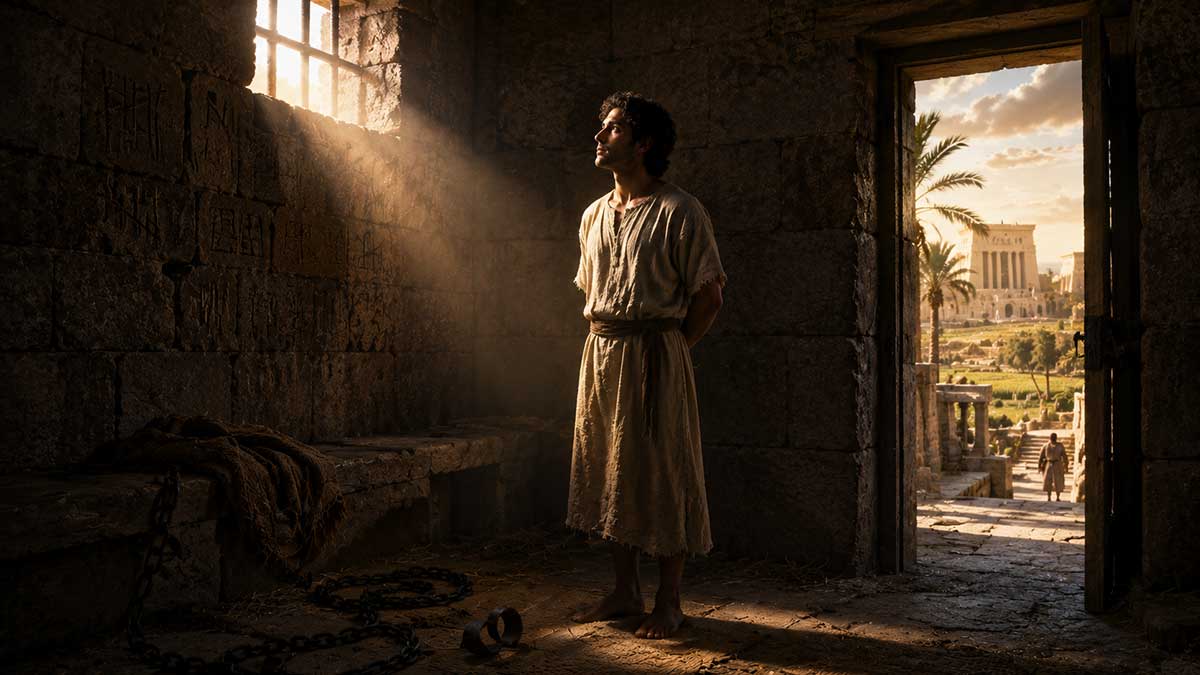
In his hands, he holds a folded garment. It is plain and worn, nothing like the richly colored robe his father once gave him.
A faint smell of dust and old stone rises from the room below. Somewhere inside, a chain shifts against the wall as the morning breeze passes through the doorway.
Joel Osteen walks beside Joseph and looks into the darkness.
Joel Osteen:
You received a dream when you were young.
You saw a future filled with purpose, honor, and influence.
Then almost everything that happened seemed to contradict it.
You were thrown into a pit.
You were sold by your brothers.
You became a servant in a foreign land.
You were falsely accused.
You were sent to prison.
At what point did you begin to wonder whether the dream had been wrong?
Joseph:
The first time was in the pit.
I could still hear my brothers above me.
Their voices grew quieter as they walked away.
I remember looking up at the small circle of sky and thinking, “How can a dream from God lead here?”
The dream had shown people bowing.
The pit showed me abandoned.
The Man from Bethesda:
Did you think God had changed His mind?
Joseph:
I wondered whether I had misunderstood Him.
Then I wondered whether I had ruined something through pride.
Later, when the years passed, I wondered whether the dream belonged only to the boy I used to be.
The Woman with the Issue of Blood:
Did the dream comfort you?
Joseph:
At times.
At other times, it hurt.
A promise can become painful when life keeps moving in the opposite direction.
Job:
People speak easily about promises after fulfillment.
They rarely speak about how a promise feels in the middle, when it seems to accuse reality of lying.
Joel Osteen:
That is where many people are living.
They believed their family would heal, yet the conflict became worse.
They believed their work had purpose, yet the door closed.
They believed they would recover, yet the diagnosis became more serious.
They believed their child would return, yet more years passed.
They believed God placed something in their heart, but every visible sign seems to disagree.
Joseph, how did you keep the dream from becoming bitterness?
Joseph:
I did not preserve it through constant confidence.
There were days when all I could preserve was my character.
I could not control the pit.
I could not control slavery.
I could not control the accusation.
I could control whether disappointment turned me into someone I no longer recognized.
Question 1: How Do You Hold Onto a God-Given Dream When Life Appears to Prove It Wrong?
They step into the small room below the courtyard.
The temperature drops. Their footsteps echo against the stone. A single shaft of light falls through a narrow opening near the ceiling.
Joseph touches the wall.
Joel Osteen:
When people hear your story, they know the ending.
That makes waiting sound easier than it was.
What did faith look like when you did not know Pharaoh would call for you?
Joseph:
Faith did not always look like confidence in the dream.
Sometimes it looked like doing the next task well.
In Potiphar’s house, I worked.
In prison, I served.
When the cupbearer and baker were troubled, I listened.
I could not reach the future I had seen.
I could remain faithful in the room where I had been placed.
Ruth:
That feels familiar.
There are seasons when the future is too large to carry.
You can gather grain for one day.
You can care for one person.
You can do the work before you.
Joel Osteen:
So holding onto the dream did not mean staring at it every moment.
Joseph:
No.
It meant refusing to let the delay corrupt me.
I had to release the idea that faithfulness would always produce immediate fairness.
I did what was right, and I was falsely accused.
I helped the cupbearer, and he forgot me.
There were moments when obedience seemed to bring no reward.
Job:
That is where shallow faith collapses.
It assumes every good act will receive a quick visible return.
Then suffering arrives, and the person believes either God has failed or they have failed.
Joel Osteen:
Many people need permission to admit that.
They followed the rules.
They worked hard.
They forgave.
They prayed.
They still ended up in a place they never expected.
The seventh-year message does not tell them the prison was unreal.
It tells them the prison does not have the final authority.
The Woman:
How did you know the dream was still alive?
Joseph:
I did not always know.
But I noticed something.
The place changed.
The work changed.
The people around me changed.
Yet a certain gift kept appearing.
I could interpret what others could not see.
I could organize disorder.
I could earn trust.
I could carry responsibility.
The dream seemed absent, but the capacity connected to it kept growing.
Joel Osteen:
That is meaningful.
Sometimes the promise is hidden, yet the preparation remains visible.
You may not see the door.
You can see the patience being formed.
You can see the wisdom growing.
You can see the compassion deepening.
You can see that you handle pressure differently than before.
Job:
We should not force every person to find growth inside tragedy.
Some wounds leave confusion rather than clarity.
Joel Osteen:
True.
No one should be told that pain is valuable only when they can explain what it taught them.
Still, for those who can see a thread, that thread may keep them from believing the story has ended.
Joseph:
The dream did not survive through perfect certainty.
It survived through daily choices that kept me capable of receiving what I had once seen.
Question 2: Can a Place That Feels Like Punishment Become Preparation?
They return to the courtyard.
Joseph places the worn garment on the table beside the folded mat and the broken chain.
The symbols now tell several stories at once:
the garment of a servant,
the mat of a man who waited,
the chain of a person once bound.
Joel Osteen:
People often say your prison prepared you for the palace.
Does that description feel true to you?
Joseph:
Partly.
Prison taught me how to read people under pressure.
It taught me how systems fail.
It taught me what happens when those with authority forget those beneath them.
It taught me to manage scarce resources.
Those lessons mattered later.
But I do not want people to hear that and think injustice was necessary or good.
The false accusation was wrong.
The betrayal was wrong.
The years taken from me were real.
Job:
That distinction protects suffering people from spiritual cruelty.
A person can say, “God brought something from this,” without saying, “God approved everything that happened.”
Joel Osteen:
Yes.
The pit was not the promise.
The prison was not the destination.
Yet neither place could prevent God from working within Joseph.
Ruth:
The field where I gathered leftovers did not look like preparation for a new family.
It looked like hunger and survival.
Later, I could see that one ordinary place had become the meeting point between loss and restoration.
The Man from Bethesda:
For years, I thought the pool was the only place where change could happen.
Joseph’s story shows that a prison can hold a person physically without holding the whole future.
Joel Osteen:
Many people judge a season too early.
They say:
“This job is beneath me.”
“This delay is wasting my life.”
“This small beginning cannot lead anywhere.”
“No one sees what I am capable of.”
Joseph was managing a prison before he managed a nation.
The scale changed.
The qualities required did not appear overnight.
Joseph:
When Pharaoh asked whether I could interpret his dream, I knew the answer had to come from God.
But I was ready to think clearly in a room filled with fear.
That readiness had been tested long before I entered the palace.
The Woman:
Did you ever resent being prepared for something you had not chosen?
Joseph:
Yes.
There were days when I did not want another lesson.
I wanted release.
People suffering today may feel the same.
They do not want to hear, “This is preparation.”
They want relief.
Joel Osteen:
That deserves respect.
Hope should never become a way of silencing grief.
We can pray for release and still remain open to what may be forming during the delay.
Job:
The person must be allowed to say both:
“This should not have happened,”
and,
“This will not be allowed to destroy everything that comes after.”
Joseph:
That is close to what I learned.
My brothers chose betrayal.
Potiphar’s wife chose deception.
The cupbearer chose forgetfulness.
Those choices harmed me.
They did not become authors of the final chapter.
Question 3: What If the Years That Seem Wasted Are Shaping the Person Needed for the Next Season?
A servant brings a bowl of grain and places it on the table.
Joseph lifts a handful and lets it fall slowly through his fingers.
The dry kernels strike the bowl with a soft, steady sound.
Joel Osteen:
You later prepared Egypt for famine.
You stored grain during the years of abundance.
Could the younger Joseph have carried that responsibility?
Joseph:
No.
The younger Joseph had a dream.
He did not yet know how to carry authority without needing everyone to recognize him.
He wanted to tell the dream.
He had not yet learned how to serve people who could not repay him.
Ruth:
Time changed you.
Joseph:
Pain changed me.
Work changed me.
Failure changed me.
Responsibility changed me.
God met me within all of it.
Joel Osteen:
That is freeing for people who fear they are late.
They look back and say:
“I should have been further by now.”
“I lost ten years.”
“I chose the wrong path.”
“My family delayed me.”
“My illness took my best years.”
“My dream should have happened earlier.”
Joseph’s story says that timing is not always proof of failure.
Job:
Yet some time is truly lost.
We should not deny that.
People can lose years to abuse, illness, addiction, war, poverty, or someone else’s choices.
Restoration does not require pretending nothing was taken.
Joel Osteen:
Yes.
The seventh-year message is not that nothing was lost.
It is that loss does not make the rest of life unusable.
The Woman:
Twelve years were taken from me in ways no one could return.
Healing did not send me backward.
It gave me a future beyond those years.
The Man from Bethesda:
I was not made thirty-eight years younger.
I was given the ability to walk from where I was.
Joseph:
That is what happened to me.
I did not return to the pit and begin again as a boy.
I entered a new season carrying everything the years had made of me.
Joel Osteen:
Then preparation may not mean God is getting the circumstances ready.
It may mean He is strengthening the person who will meet them.
Joseph:
Yes.
I had once dreamed of people bowing.
When it finally happened, I no longer needed their bowing to prove my worth.
That may have been one of the deepest changes.
Job:
The fulfilled dream did not feed the ego that first received it.
Joseph:
It became a means of saving lives.
The dream was larger than my recognition.
It was connected to responsibility.
Joel Osteen:
That changes how we understand purpose.
People often pray for influence, success, restoration, or opportunity.
But the next season may require:
the humility to serve,
the wisdom to forgive,
the discipline to manage,
the courage to speak,
the restraint not to revenge yourself,
the compassion to protect people who once misunderstood you.
Ruth:
A blessing can become heavy in the hands of someone unprepared to carry it.
Joseph:
And delay can reveal whether you want the promise for yourself or whether you are willing to let it serve others.
Joel Osteen:
Your story tells the person who feels forgotten:
“You are not disqualified by the pit.”
“You are not erased by the prison.”
“You are not too late.”
“Your gift still matters.”
“The years behind you can still contribute to the life ahead.”
Closing
Joseph unfolds the worn garment and looks at it for a moment.
Then he lays it over the back of the empty chair.
Beyond the courtyard, fields stretch across the valley. Their green rows move softly in the wind, bending and rising in long waves.
Joseph:
There were years when I thought the dream had become evidence against God.
I could see no path from the prison to the promise.
Now I know the path did not need to make sense to me in advance.
I needed enough faith to remain someone who could walk it when the door opened.
Joel Osteen:
You may be living in a chapter that seems to contradict everything you once believed.
The relationship ended.
The opportunity disappeared.
The diagnosis changed.
The people who should have helped you walked away.
You may look at your life and ask, “How can anything good still come from here?”
Joseph’s story does not ask you to call the pit good.
It asks you not to call the pit final.
The dream may feel distant.
The evidence may feel absent.
The years may feel wasted.
But you are still becoming.
Your gift has not vanished.
Your purpose has not expired.
And when the door opens, you may discover that God was preparing you in places you once thought had no connection to the promise.
The prison was real.
So was the dream.
And the dream outlived the prison.
Topic 4: When Loss Makes It Hard to Believe in Restoration
Opening
The afternoon light has softened.
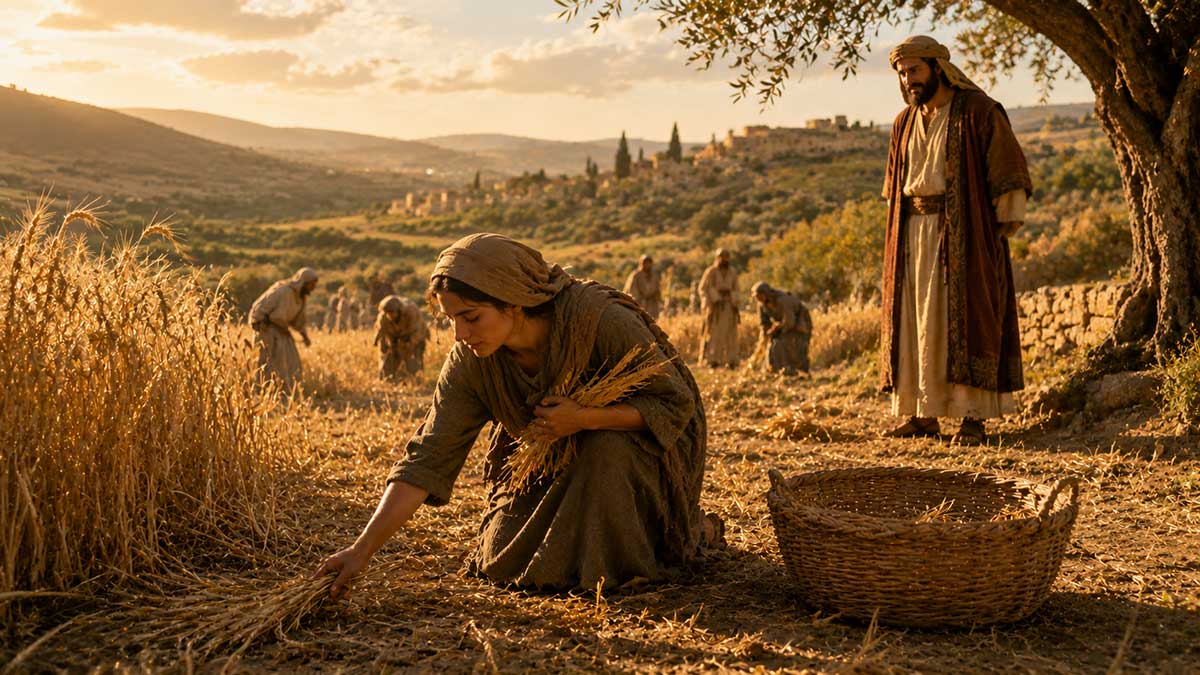
The courtyard now opens into a field of barley beyond the stone wall. Golden stalks bend under a warm breeze, brushing against one another with a dry, whispering sound. The scent of grain and sun-warmed earth drifts through the air.
Ruth stands near the edge of the field.
In one hand, she holds several loose stalks gathered from the ground. They are the remains left behind after the workers have passed.
Naomi sits beneath an olive tree nearby. Her face carries the weight of a woman who once returned home believing her life had been emptied.
Joel Osteen walks beside Ruth through the grain.
Joseph follows at a distance. The woman who had suffered for twelve years sits beside Naomi. The man from Bethesda rests his folded mat against the tree. Job looks across the field, where abundance and scarcity exist only a few steps apart.
Joel watches Ruth bend to gather another stalk.
Joel Osteen:
You did not come to Bethlehem expecting a miracle.
You came as a widow.
You had lost your husband, your security, your homeland, and the future you once pictured.
When you entered this field, were you thinking about restoration?
Ruth:
No.
I was thinking about food.
There are seasons when hope becomes very small.
You do not ask, “What great future is waiting for me?”
You ask, “How do I care for the person beside me today?”
Joel Osteen:
That may surprise people.
Your story became one of restoration, yet it began with grief, migration, poverty, and daily labor.
Ruth:
Yes.
I did not feel that a new chapter had begun.
I felt that the old one had ended.
There is a difference.
Naomi:
When we returned to Bethlehem, I told the women not to call me Naomi.
I said they should call me Mara, meaning bitter.
I had left full and returned empty.
I could not see Ruth as evidence that something remained.
My grief had become the lens through which I saw everything.
Job:
Loss can do that.
It does not merely remove what you loved.
It can change how you interpret what is still present.
Joel Osteen:
Many people reach that place.
The marriage ended.
The person they loved died.
The business failed.
The family scattered.
The future they planned no longer exists.
They are not simply asking whether life can improve.
They are asking whether a different future could ever feel meaningful.
Ruth:
That was my question.
I did not want to forget my husband.
I did not want a new life to make the old love seem unimportant.
Joel Osteen:
That is where the message of release must be handled with care.
A new season does not dishonor the season that ended.
Moving forward is not betrayal.
Receiving joy again does not mean the grief was shallow.
Question 1: How Can Someone Move Forward Without Betraying What They Have Lost?
Ruth kneels and gathers several fallen stalks into her arms.
The work is slow. Dust settles on the hem of her garment.
Joel Osteen:
What made you continue after so much loss?
Ruth:
Love gave me a next step.
I could not repair the past.
I could remain beside Naomi.
When she said she would return to Bethlehem, I chose to go with her.
I did not know what would happen there.
I knew I did not want her to walk into grief alone.
Naomi:
I tried to send her back.
I thought I had nothing left to give.
I believed staying with me would cost her too much.
Ruth:
You could not see your own worth through your pain.
Naomi:
No.
Grief told me I had become a burden.
Joel Osteen:
That is another prison loss creates.
People begin believing they have nothing left to offer.
They say:
“I am damaged now.”
“My best years are gone.”
“No one would choose this life with me.”
“I have too much history.”
“I am only a burden.”
Job:
Those thoughts can sound like humility.
They are often grief speaking with authority it was never meant to possess.
Ruth:
I did not stay with Naomi from pity.
I stayed from covenant love.
She thought she was empty.
I knew she was still my family.
The Woman with the Issue of Blood:
Did helping her delay your own healing?
Ruth:
At times, I did not know where her grief ended and mine began.
But caring for her gave my sorrow somewhere to move.
It did not erase the loss.
It kept the loss from closing me completely.
Joel Osteen:
That is significant.
Sometimes the next season does not begin through a dramatic feeling.
It begins through one faithful relationship.
One meal prepared.
One phone call answered.
One promise kept.
One morning when you rise and do what love asks.
Joseph:
People often recognize purpose only when it becomes large.
They miss the purpose hidden inside ordinary faithfulness.
Ruth:
I had no idea that my decision on the road from Moab would become part of a much larger story.
At the time, it felt like one grieving woman refusing to abandon another.
Joel Osteen:
That can liberate someone who believes they must feel inspired before moving.
You may not feel ready for a new life.
You can still take one loving step.
You may not know what restoration looks like.
You can still honor what remains.
Job:
Yet people must be free to grieve.
Movement should not become pressure.
No one should be told to “move on” as if love can be closed like a door.
Joel Osteen:
Yes.
Moving forward is not moving away from love.
It is allowing love to continue changing form.
Ruth:
I carried my husband’s memory with me.
I did not leave it in Moab.
The new life did not erase him.
It taught me that grief and gratitude could live in the same heart.
Question 2: Why Did Ruth’s New Season Begin With Ordinary Work Rather Than a Dramatic Miracle?
The workers move farther into the field.
Ruth follows behind them, gathering what remains.
Her hands become dusty. The sun presses warmly against her shoulders.
Joel Osteen:
Your story contains divine guidance, yet your new season began with work that looked small and unnoticed.
Why do you think restoration arrived that way?
Ruth:
I needed food.
That was the truth of the day.
I did not enter the field looking for Boaz.
I entered looking for grain.
The Man from Bethesda:
Did the work feel beneath you?
Ruth:
No.
Grief had stripped life down to what was necessary.
There was dignity in bringing something home.
Every stalk said, “We will eat tonight.”
That was enough.
Joel Osteen:
People often expect the new season to announce itself.
They expect a sudden phone call, an open door, a visible sign.
Yet many new beginnings look ordinary at first.
A class.
A small job.
A conversation.
A walk.
A doctor’s appointment.
A decision to return to church.
A morning when someone gets out of bed and tries again.
Joseph:
The field can become a doorway before anyone recognizes it.
Ruth:
Yes.
I was working before I knew who owned the field.
I was faithful before I knew anyone was watching.
Naomi:
When Ruth returned with more grain than expected, I began asking questions.
For the first time, I saw that our story might still contain kindness.
Job:
Loss had not removed all possibility.
It had made possibility difficult to recognize.
Naomi:
That is true.
I had interpreted my life as abandoned.
Then one day, Ruth returned carrying evidence that providence could arrive quietly.
Joel Osteen:
That is how the seventh-year message can meet grief.
Release may begin before everything feels released.
The situation may still be fragile.
The future may still be unclear.
Yet one sign of kindness can interrupt the belief that nothing good remains.
Ruth:
The field did not restore everything in one day.
It gave us enough for that day.
Then another day came.
Joel Osteen:
There is freedom in that.
Some people are trying to solve the next ten years before they can take the next step.
Ruth’s story says:
“Gather today’s grain.”
“Receive today’s kindness.”
“Do today’s work.”
“Let tomorrow reveal itself when it comes.”
The Woman:
That kind of hope feels reachable.
Ruth:
Hope became practical for me.
It was not a feeling floating above my life.
It was something I carried home in my arms.
Job:
And the work did not prove Ruth had healed from grief.
It proved grief had not made action impossible forever.
Joel Osteen:
That may be the first sign of a new season.
Not that sorrow disappears.
That life begins moving again beside it.
Question 3: Can Restoration Look Different From Getting the Old Life Back?
The group returns to the shade of the olive tree.
Ruth places the gathered grain into a woven basket. Naomi touches the stalks gently, as if reading a message hidden within them.
Joel Osteen:
Many people hear the word “restoration” and think it means recovering the exact life they lost.
Did your restoration look like that?
Ruth:
No.
My husband did not return.
Moab did not become my home again.
The future I once pictured was never restored in its old form.
A different future opened.
Naomi:
That was hard for me to accept.
I kept measuring every possibility against what had been taken.
Nothing could pass that test.
Joel Osteen:
That is where people can become trapped.
They say:
“I will be happy only when the relationship returns exactly as it was.”
“I will feel whole only when I become the person I was before the illness.”
“I will call it restoration only when every lost year is repaid in the same form.”
But life may not return by reversing every loss.
Job:
Some losses cannot be reversed.
Any message of hope must make room for that truth.
Joel Osteen:
Yes.
Restoration is not always replacement.
It can be the discovery that life still contains love, purpose, dignity, and connection after something irreplaceable has been lost.
Ruth:
Boaz did not erase my first husband.
The child I later held did not erase the child I had never been able to have before.
Bethlehem did not erase Moab.
The new story grew beside the old one.
Joseph:
That is a mature form of restoration.
The past is not denied.
Its authority changes.
Naomi:
When the child was placed in my arms, the women said a son had been born to Naomi.
I had once called myself empty.
I discovered that emptiness was not the final name of my life.
Joel Osteen:
That line carries the whole message.
You may feel empty now.
You may have returned from a season carrying less than you left with.
You may believe the part of life that mattered most is gone.
But empty is a description of a moment.
It is not always the final identity.
Job:
Still, we should not rush someone from grief into expectation.
Hope becomes cruel when it demands a smile before the heart is ready.
Joel Osteen:
Agreed.
Ruth’s story does not hurry.
It unfolds through seasons.
A road.
A field.
A relationship.
A harvest.
A home.
A child.
Ruth:
My life did not change through one dramatic rescue.
It changed through many acts of kindness meeting many acts of faithfulness.
The Woman:
That may speak to people whose miracle is arriving slowly.
Ruth:
Yes.
Some release comes like a door opening.
Some comes like grain gathered one stalk at a time.
Joel Osteen:
And both can be sacred.
The new season may not look like the old dream returning.
It may look like a new dream becoming possible.
Closing
The light begins to turn amber across the field.
Workers carry bundles of barley toward the village. Their footsteps raise small clouds of dust that glow in the lowering sun.
Ruth lifts the woven basket.
Naomi rises beside her.
For a moment, they stand together beneath the olive tree: two women who once believed their shared future contained only survival.
Naomi:
I called myself empty because I could see only what had been taken.
Ruth stood beside me as proof that love had not left.
Ruth:
I thought I was walking into an unknown country.
I did not know I was walking into a future.
Joel Osteen:
Loss may have closed a chapter you wanted to keep.
It may have taken a person, a place, a dream, or a version of yourself you thought would always remain.
You do not have to pretend that loss was small.
You do not have to stop loving what is gone.
You do not have to rush your grief.
But you can leave room for this possibility:
Your life may still hold a field you have not entered.
A kindness you have not received.
A relationship you have not formed.
A purpose that can arise from the person you are now, not the person you used to be.
Restoration may not carry you back.
It may lead you forward.
And one day, you may look at what began as a handful of grain and realize that the new season entered quietly, long before you knew its name.
Topic 5: When Faith Must Survive Without a Clear Explanation

Opening
Evening settles over the courtyard.
The barley fields beyond the wall have turned dark gold beneath the lowering sun. Long shadows stretch across the stone floor. The warmth of the day has faded, and a cooler wind carries the scent of earth, grain, and distant rain.
At the center of the courtyard stands a low fire.
Its flames rise and fall around blackened pieces of wood. Sparks drift upward, glowing for a moment before disappearing into the darkening sky.
Job sits near the fire.
His robe is plain. His face carries the stillness of someone who has asked questions that never received simple answers.
On the table beside him lie the broken chain, the folded mat, Joseph’s worn garment, and Ruth’s basket of grain.
Each object tells a story of release.
Job looks at them quietly.
Joel Osteen:
We have spoken about a woman healed after twelve years.
We have spoken about a man who stood after thirty-eight years.
We have spoken about Joseph leaving prison and Ruth finding a future after loss.
Their stories contain visible restoration.
Your story is harder.
You suffered without knowing why.
You lost children, health, wealth, security, and the life you knew.
Your friends came with explanations, but their explanations wounded you.
What does the seventh-year message sound like to someone who has no clear timetable and no clear reason for the suffering?
Job:
It depends on how it is spoken.
If it is spoken as a promise that every pain will end on a schedule, it can become another burden.
If it is spoken as permission to believe that suffering does not own the final word, it can become mercy.
Joel Osteen:
That distinction matters.
Job:
Very much.
A suffering person does not need another person to tell them exactly what God is doing.
They may need someone willing to sit beside them without solving them.
The Woman with the Issue of Blood:
Did you ever stop hoping?
Job:
There were moments when hope felt almost unreachable.
I did not always speak with confidence.
I cried out.
I questioned.
I protested.
I asked God why I had been born.
Faith remained, but it did not always sound peaceful.
The Man from Bethesda:
Did you think those questions were sinful?
Job:
At times, I feared they were.
My friends made that fear worse.
They believed suffering must have a clean explanation.
They thought pain revealed guilt.
They believed the world would feel safer if my suffering could be traced to some failure in me.
Joel Osteen:
Many people still do that.
They tell the sick person to believe harder.
They tell the grieving person to move forward faster.
They tell the poor person that better thinking would solve everything.
They tell the wounded person that pain continues from a spiritual defect.
Job:
That does not bring freedom.
It adds shame to sorrow.
Question 1: Can Faith Be Genuine When It Includes Grief, Protest, and Confusion?
The wind moves across the courtyard. The fire bends sharply, then rises again.
Joel watches the flames before turning back to Job.
Joel Osteen:
Some people believe faith must always sound certain.
Your words did not always sound certain.
Were you still faithful when you argued with God?
Job:
I was speaking to God, not walking away from Him.
That matters.
My questions came from relationship.
I believed He was there strongly enough to demand an answer.
Silence would have been easier in one sense.
Speaking honestly cost me more.
Ruth:
People often hide their grief from God as if He does not already know it.
Job:
Yes.
They think faith means using approved words.
They fear that anger, confusion, or lament will disqualify them.
But grief that cannot be spoken does not disappear.
It goes underground.
Joel Osteen:
There are people listening who still pray, yet their prayers no longer sound polished.
They say:
“God, I do not understand.”
“I am tired.”
“I do not know how much longer I can carry this.”
“I believed You, and I feel disappointed.”
“Why did You allow this?”
Can that still be faith?
Job:
It can.
Faith is not measured only by emotional calm.
Sometimes faith is continuing the conversation with God when you have no pleasant words left.
Joseph:
In prison, there were days when hope felt distant.
I kept serving, yet I did not always feel inspired.
The Woman:
When I reached for Jesus, my faith was not strong in the way people often describe strength.
It was desperate.
The Man from Bethesda:
When Jesus asked whether I wanted to be well, I answered with my limitation.
I did not give a heroic reply.
Ruth:
When I entered the field, I was gathering food, not declaring a grand vision.
Job:
That is what suffering does.
It often reduces faith to its smallest living form.
A question.
A breath.
A prayer with no confidence.
A refusal to close the door completely.
Joel Osteen:
Then the liberating message is not, “You must sound victorious every day.”
It is, “Your honest sorrow does not cancel your relationship with God.”
Job:
Yes.
Lament is not the opposite of faith.
It can be faith refusing to become fake.
Joel Osteen:
That may help people who feel guilty for not being cheerful.
They can grieve and still believe.
They can question and still remain.
They can admit confusion without declaring the story finished.
Job:
Faith does not require pretending that darkness is light.
It requires refusing to believe darkness is all that exists.
Question 2: Why Is It Dangerous to Tell Suffering People That Their Pain Continues From Weak Faith?
The fire settles lower.
Joel places another piece of wood into the flames. It catches slowly.
Joel Osteen:
Your friends believed they were defending God.
Where did they go wrong?
Job:
They spoke with certainty where humility was needed.
They assumed suffering must fit their theology.
They could not accept that a righteous person might suffer without a simple explanation.
So they searched for fault in me.
Joel Osteen:
Did their words hurt more than their silence would have?
Job:
Yes.
At first, they sat with me without speaking.
That was the best thing they did.
Their presence said, “Your suffering is too great for easy language.”
Then they began explaining.
Their need to be correct became stronger than their desire to understand.
The Woman:
I knew people who treated my illness as spiritual evidence.
Their judgment made isolation worse.
The Man from Bethesda:
People could look at me after thirty-eight years and assume I lacked desire or effort.
They did not know the full story.
Ruth:
A widow may be praised for faith only after restoration comes.
Before that, people may see her as unfortunate, dependent, or forgotten.
Joseph:
Success often causes people to reinterpret a person’s entire past.
They call the prison preparation after the palace appears.
Inside the prison, they may call it failure.
Joel Osteen:
That is why hope must never become accusation.
A message about release should never say:
“If you were more positive, this would be over.”
“If you had enough faith, you would be healed.”
“If you spoke better words, your family would change.”
“If you stopped grieving, God could move.”
Job:
Such statements give the suffering person another impossible task.
They must carry the pain and defend their faith at the same time.
Joel Osteen:
Some preachers may intend to awaken expectation.
Yet language can wound when it places the full responsibility for the outcome on the person who is already hurting.
Job:
Hope should lift a burden, not create a new one.
The Woman:
Jesus did not shame me for arriving after twelve years.
He called me daughter.
The Man from Bethesda:
Jesus did not lecture me about the thirty-eight years.
He spoke directly to me.
Ruth:
Boaz did not treat my poverty as proof of spiritual failure.
He made room for dignity.
Joseph:
God’s work in my life did not erase the wrong others had done.
Joel Osteen:
Then a liberating message must say:
“You are not blamed for every pain you carry.”
“You are not rejected because the answer has not come.”
“You do not have to perform certainty to deserve compassion.”
“Faith can live beside treatment, counseling, medicine, grief, and practical help.”
Job:
Yes.
People need companions more than judges.
They need truth without cruelty.
They need hope that does not force them to explain why the breakthrough has not arrived.
Question 3: Is Hope Still Meaningful When Release Comes in a Different Form or at a Different Time Than Expected?
The sky has deepened into blue-gray.
The first stars appear over the valley.
Job lifts his face toward them.
Joel Osteen:
Your life contained restoration.
Yet what returned could not erase the children you lost or the suffering you endured.
How should we speak about restoration without making it sound as if every wound was replaced?
Job:
No later blessing made the first children less loved.
No new wealth made the grief unreal.
No restored health turned the suffering into a small matter.
People sometimes read the ending and treat it like an equation.
Loss happened.
Blessing came.
Everything balanced.
Human grief does not work that way.
Ruth:
A new future can live beside an old sorrow.
Job:
Yes.
Restoration gave life room to grow again.
It did not require me to call the losses insignificant.
Joel Osteen:
That is important for the seventh-year message.
Release may mean the circumstance changes.
It may mean strength returns.
It may mean a new door opens.
It may mean peace enters before the answer.
It may mean the person becomes free from shame, bitterness, fear, or the belief that life is over.
Job:
Hope remains meaningful when it is larger than one demanded outcome.
The Woman:
My story included physical healing.
Someone else may pray and receive courage to continue treatment.
Another person may receive a community that carries them.
Another may find peace in a body that still suffers.
Those experiences should not be compared as if one person had greater faith.
The Man from Bethesda:
My release came suddenly.
Another person may learn to walk slowly through therapy, care, and years of work.
The pace does not determine the worth of the journey.
Joseph:
My prison door opened in a day.
The character needed for what came next developed across years.
Ruth:
My restoration unfolded quietly through ordinary acts.
Job:
My story included a meeting with God that did not give me the explanation I demanded.
I received something different.
I encountered a presence larger than my argument.
Joel Osteen:
Was that enough?
Job:
It did not answer every question.
It changed the place from which I asked them.
I learned that mystery is not the same as abandonment.
I learned that not having an explanation does not mean God is absent.
Joel Osteen:
That may be the final form of hope.
Not confidence that life will obey our calendar.
Confidence that pain will not be given the last word.
Job:
Yes.
Hope says:
“I do not know when this changes.”
“I do not know how this changes.”
“I do not know whether the answer will look like the one I pictured.”
“But I will not declare that God has finished writing.”
Closing
The fire has burned down to glowing embers.
The courtyard is nearly dark.
The broken chain, folded mat, worn garment, and basket of grain remain visible in the low light.
Job rises and walks to the edge of the courtyard.
The valley below has disappeared into darkness, yet the stars above it are clear.
Joel joins him.
Job:
I once believed an explanation would give me peace.
I learned that some questions remain open longer than the heart desires.
Faith did not come from solving the mystery.
It came from discovering that mystery had not separated me from God.
Joel Osteen:
Someone may be waiting for their seventh year.
They may be asking when the pain will end.
They may be looking for a date, a sign, or a reason.
They may feel guilty that their faith is tired.
Job’s story gives them permission to be honest.
You do not have to pretend.
You do not have to understand everything.
You do not have to accept blame for what you did not cause.
You do not have to call suffering good.
You can grieve.
You can question.
You can seek treatment.
You can ask for help.
You can hope without creating a timetable God never gave you.
Your seventh year may come as sudden release.
It may come as slow restoration.
It may come as the return of courage.
It may come as freedom from shame.
It may come as the discovery that your pain is real, yet it is not your whole identity.
The night may still be present.
But the stars are present too.
And faith may be nothing more dramatic than lifting your eyes long enough to see that darkness has never been the only thing above you.
Final Thoughts
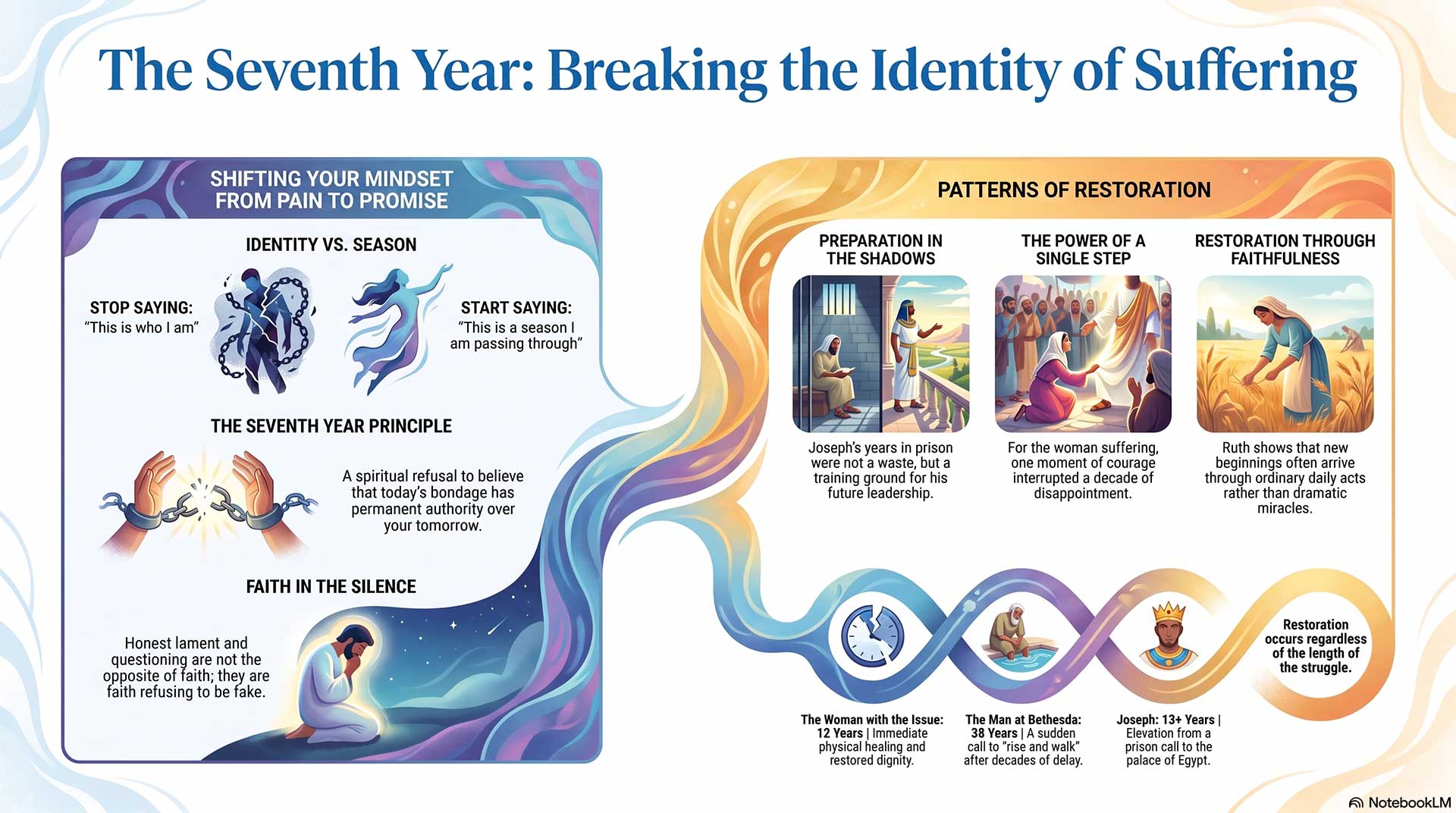
The conversation began with twelve years of suffering.
It continued through thirty-eight years of waiting.
It walked through prison cells, empty fields, unanswered questions, and seasons where God seemed painfully silent.
Yet one truth quietly emerged from every story.
None of these people were defined by the worst chapter of their lives.
The woman with the issue of blood was no longer remembered for twelve years of illness.
The man at Bethesda was no longer known only as the man who could not walk.
Joseph became more than the prisoner.
Ruth became more than the widow.
Job became more than the man who suffered.
Their pain remained part of their history.
It simply lost the authority to define their future.
That may be the deepest meaning behind Joel Osteen's message.
The "seventh year" is not merely about waiting for circumstances to change.
It is about refusing to allow suffering to become your identity before the change arrives.
Some readers may experience dramatic answers to prayer.
Others may discover that God restores them through relationships, wisdom, faithful work, medical care, unexpected opportunities, or quiet inner peace that slowly grows stronger than fear.
The timing will not always be identical.
The path will not always be identical.
The outcome may not even resemble the picture we originally imagined.
Yet throughout Scripture one pattern appears again and again.
God continues writing long after people believe the story has ended.
Perhaps that is why hope remains one of the greatest acts of faith.
Hope does not deny pain.
Hope simply refuses to give pain the final word.
If this conversation encourages you, perhaps the question is no longer,
"When will my seventh year come?"
Perhaps the better question is,
"How is God preparing my heart so I will recognize it when it arrives?"
Short Bios:
Joel Osteen
Joel Osteen is the senior pastor of Lakewood Church in Houston, Texas, one of the largest churches in the United States. Known for his messages of hope, encouragement, and God's faithfulness, he has inspired millions through sermons, books, and television broadcasts. His teaching emphasizes living with expectation, trusting God's timing, and believing that no setback is permanent.
The Woman with the Issue of Blood
Recorded in the Gospels of Matthew, Mark, and Luke, this unnamed woman suffered from continual bleeding for twelve years. After exhausting every human solution, she reached out in faith and touched Jesus' garment. Jesus publicly called her "daughter," restoring both her health and her dignity.
The Man at the Pool of Bethesda
Described in John 5, this man lived with physical disability for thirty-eight years while waiting beside the Pool of Bethesda. Jesus asked him, "Do you want to be made well?" before commanding him to rise, take up his mat, and walk. His story reminds believers that God's answer may come through a path they never expected.
Joseph
One of the central figures in Genesis, Joseph was betrayed by his brothers, sold into slavery, falsely accused, and imprisoned before becoming governor of Egypt. His life demonstrates that God's promises can survive long delays and that faithfulness during hidden seasons prepares people for greater responsibility.
Ruth
The heroine of the Book of Ruth, Ruth remained faithful to her widowed mother-in-law Naomi after losing her husband. Through humility, perseverance, and unwavering loyalty, she became the great-grandmother of King David and part of the lineage of Jesus Christ. Her story reveals that restoration often begins through quiet acts of faithfulness.
Job
The central figure of the Book of Job, Job endured unimaginable loss, illness, and grief while wrestling with profound questions about suffering and God's justice. His story teaches that honest faith includes lament, perseverance, and humility before the mysteries of God, revealing that His presence can sustain believers even when answers remain unseen.
Leave a Reply