


Every family keeps two histories.
One is spoken aloud around the table, carried from one generation to the next until it becomes as familiar as the sound of one's own name.
The other is quieter.
It settles into drawers that are never opened, photographs that no longer fit their frames, and silences so old they begin to resemble peace.
History often teaches us to remember wars, kings, victories, and disasters. But the lives that shape us most are usually measured differently. They are measured by the child who disappeared from the family photograph, the meal that was divided one bowl too many, or the name that stopped being spoken because speaking it hurt too much.
The Fourth Bowl imagines one such family.
Its sorrow is Japanese.
Its rituals are Japanese.
Its seasons belong to Japan.
Yet the question beneath the story belongs to all of us.
What becomes of love when memory refuses to carry it?
This is not a novel about ghosts returning to punish the living.
It is about memory returning to rescue love from silence.
If there is a haunting here, it is not caused by the dead.
It is caused by forgetting.
And perhaps every family, somewhere in its history, has left one place at the table waiting for someone whose absence was mistaken for disappearance.
(Note: This is an imaginary conversation, a creative exploration of an idea, and not a real speech or event.)
Chapter One: The Fourth Bowl
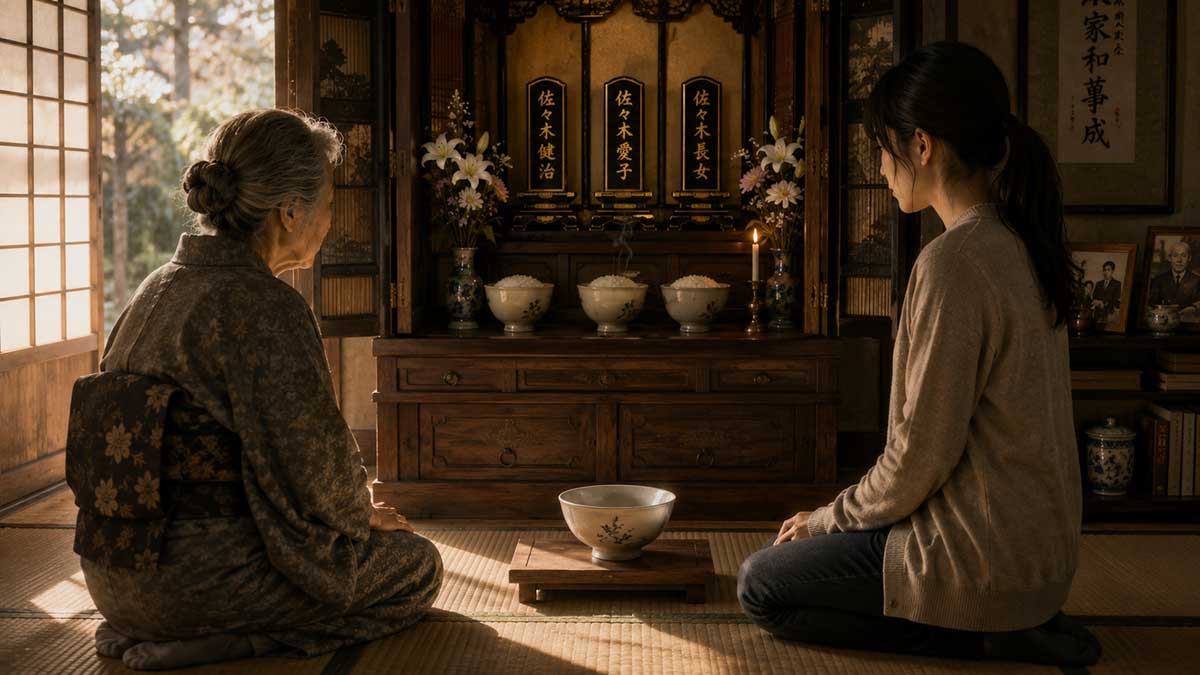
In the Sasaki house, the dead ate before the living, though one of them had never been given a name.
Emi remembered this on the first evening of her return.
The house stood at the edge of the village where the road narrowed between fields and began climbing toward the cedar-covered hills. Its roof sagged slightly in the middle. Moss had darkened the stone basin beside the entrance, and the wooden rain shutters no longer closed without being lifted from below.
When Emi was a child, the house had seemed enormous.
There had been cousins sleeping in every room during Obon, watermelons cooling in the well, sandals crowded beneath the step, and the sharp voice of her grandmother directing everyone as if the entire family were a badly organized festival.
Now the entrance held only two pairs of shoes.
Emi’s white sneakers.
Her grandmother’s black slippers.
“You came late,” Chiyo said.
“The train was delayed.”
“The train is always blamed by people who leave Tokyo too late.”
Emi smiled, but Chiyo had already turned away.
At ninety-one, her grandmother had become very small without becoming fragile. Her back curved, but her steps remained precise. She wore a gray cardigan over a dark blue blouse and kept a folded handkerchief in one sleeve, as she always had.
She led Emi through the house without looking back.
The rooms had been stripped of much of their furniture. Pale rectangles marked the walls where paintings had hung. Cardboard boxes stood beneath the staircase, each labeled in Chiyo’s careful handwriting.
Kitchen.
Documents.
Temple.
Discard.
There were many boxes marked Discard and almost nothing inside them.
“The agent will come Monday,” Chiyo said. “Everything must be sorted before then.”
“You’re really selling it?”
“No one lives here.”
“You live here.”
“Not for long.”
Chiyo said it without sadness.
That was how she said most important things.
Emi had come from Tokyo because her mother claimed she was too busy, although Emi suspected the real reason was that her mother did not want to help dismantle the house in which she had grown up. It was easier to let the granddaughter decide which bowls were valuable and which memories could be thrown away.
In the kitchen, Chiyo had prepared miso soup, grilled mackerel, pickled daikon, and rice.
Four place settings would once have filled only a corner of the long table.
Now two looked almost formal.
Before they ate, Chiyo nodded toward the cupboard.
“Prepare the altar.”
Emi found the small lacquered tray where it had always been. Beside it stood three plain white bowls, each no larger than a child’s fist.
She washed them, filled them with fresh rice, and carried them to the butsudan in the adjoining room.
The family altar was one of the few things untouched by the clearing of the house. Its black doors stood open. Inside, gold leaf caught the weak evening light. Photographs of the dead rested beneath the memorial tablets.
Emi recognized them all.
Her grandfather, serious even in youth.
Her great-grandparents, looking vaguely offended by the camera.
A great-aunt who had died before Emi was born.
Three women appeared in an old photograph at the back. They stood shoulder to shoulder beneath a flowering plum tree.
The oldest was stern.
The youngest looked impatient.
Between them stood Chiyo, perhaps fourteen, with one hand hidden in the sleeve of her kimono.
Emi arranged the three rice bowls in a row.
She struck the bell once and bowed.
When she returned to the kitchen, Chiyo was watching the rain begin against the window.
“Grandmother,” Emi said, “who are the three girls in the photograph?”
“My sisters and me.”
“I know you had sisters. I just don’t remember their names.”
“Hana was the oldest. Fumi was the youngest.”
“And you were in the middle.”
Chiyo lifted the lid from the soup pot.
“Yes.”
The answer ended the subject.
They ate while the rain thickened.
The sound against the roof made the house feel larger, as if rooms no longer visible were filling beyond the walls.
Emi told Chiyo about work, though Chiyo did not ask. She explained that the publishing company had lost another editor, that everyone was expected to do three jobs, and that a writer she had spent six months helping had thanked only the sales department when his book succeeded.
Chiyo listened without sympathy.
“You chose that work.”
“Yes.”
“Then complain to the person who chose it.”
Emi laughed.
Chiyo did not, but the corner of her mouth moved.
For several minutes, they ate in peace.
Then something tapped in the altar room.
A soft sound.
Porcelain against wood.
Emi looked up.
“Did you hear that?”
“The house makes noises.”
“That wasn’t the house.”
“Then it was the rain.”
The sound came again.
This time both women stopped eating.
Emi stood.
Chiyo’s hand closed around her chopsticks.
“Leave it,” she said.
“It might be a mouse.”
“A mouse does not use porcelain.”
Emi looked at her.
Chiyo lowered her eyes to her rice.
The passage to the altar room was dark. Emi switched on the light, but the bulb flickered before settling into a weak yellow glow.
Nothing appeared disturbed.
The altar doors remained open. The photographs stood where they had stood for years. Incense smoke rose in a thin line.
Then Emi saw the bowls.
There were four.
Three white porcelain bowls sat in the row she had arranged.
Beside them stood another bowl.
It was older and slightly smaller, its glaze the color of cream. A hairline crack ran from the rim toward the base. Inside was a careful mound of steaming rice.
Emi stared at it.
She had opened the cupboard herself. She had seen only three bowls.
“Grandmother?”
Chiyo was already in the doorway.
For a moment, neither woman moved.
The color seemed to leave Chiyo’s face gradually, beginning at her lips.
“Where did you find that?” she asked.
“I didn’t.”
“You put it there.”
“No.”
“Do not lie to me in this house.”
“I’m not lying.”
Chiyo crossed the room with surprising speed.
She lifted the fourth bowl from the altar. Rice spilled over its edge and scattered across the dark wood.
“Grandmother, be careful.”
Chiyo held the bowl against her chest.
Her fingers trembled.
It was the first time Emi had ever seen them do so.
“Whose bowl is it?” Emi asked.
“No one’s.”
“It was in the cupboard?”
“No.”
“Then where did it come from?”
Chiyo looked toward the photograph of the three sisters.
For one strange moment, Emi thought her grandmother was counting them.
One.
Two.
Three.
Chiyo shut the altar doors.
The sound was louder than necessary.
“We will sort the storehouse tomorrow,” she said.
“What does that have to do with the bowl?”
“Nothing.”
“Then answer me.”
Chiyo turned.
Her face had recovered its usual severity, but she still held the cracked bowl with both hands.
“There were always three daughters in this family,” she said.
Emi glanced at the closed altar.
“I didn’t ask how many daughters there were.”
“No,” Chiyo said. “But you were going to.”
She carried the bowl into the kitchen.
Emi followed.
Chiyo scraped the untouched rice into the garbage, washed the bowl, dried it carefully, and wrapped it in a white cloth.
She did not place it in the cupboard with the others.
Instead, she opened the narrow cabinet beneath the floorboards, set the bundle inside, and turned the small brass key.
“Go to bed,” she said.
Outside, the rain continued falling over the fields, the village road, and the old plum tree behind the storehouse.
Much later, after Chiyo’s door had closed, Emi returned to the altar room.
She opened the black doors.
The three bowls remained in place.
The rice in them had gone cold.
Between the second and third bowls, a few grains lay scattered where the fourth had been.
Emi reached forward to brush them away.
Then she noticed the photograph.
The three sisters still stood beneath the plum tree.
But at the far left edge, where Emi had remembered only a pale blur, there was the shape of a small hand.
Someone had been standing just outside the frame.
Chapter Two: The Girl at the Gate
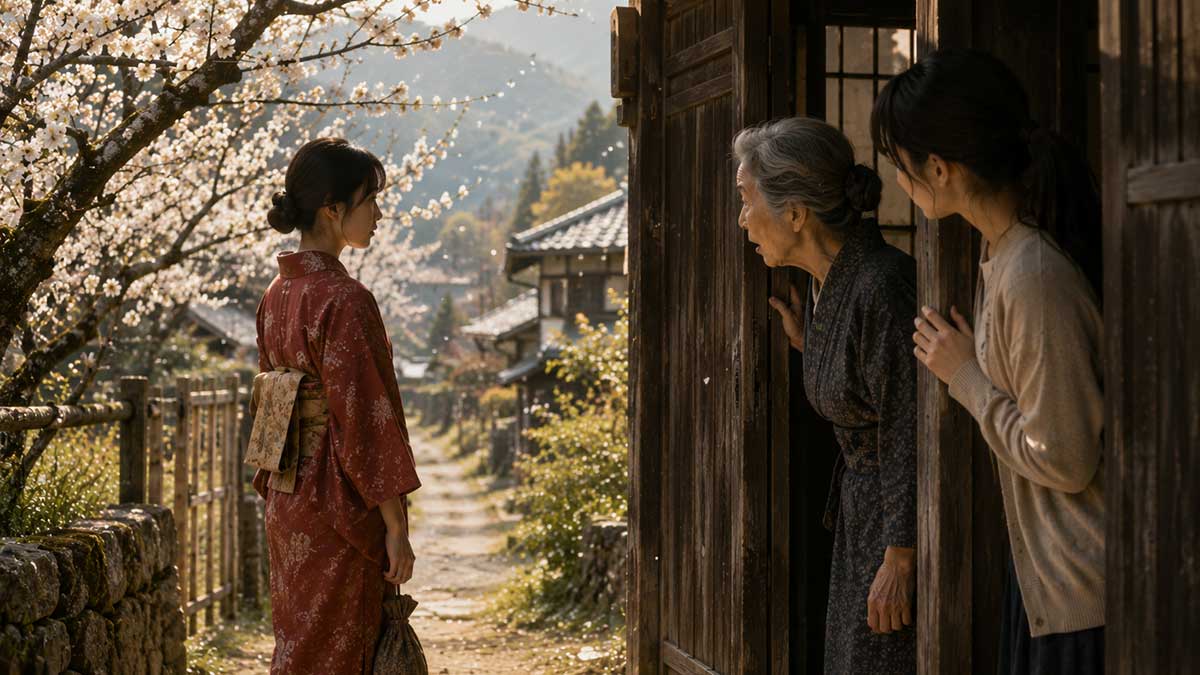
Emi woke before dawn to the sound of footsteps in the courtyard.
At first she assumed they belonged to her grandmother.
Chiyo had always risen early. Even during summer visits, when the grandchildren slept until the cicadas grew loud, Chiyo would already have opened the shutters, swept the entrance, boiled water, and complained that everyone else had wasted half the morning.
But these footsteps were wrong.
Too slow.
Too uneven.
They crossed the wet stones outside Emi’s room, stopped near the well, then continued toward the storehouse.
Emi sat up.
The rain had ended, but drops still fell from the eaves. A gray light pressed against the paper screens.
She listened.
Nothing.
Then came three knocks.
Not at the front door.
At the gate.
Emi pulled on a sweater and stepped into the hallway.
Chiyo’s bedroom door remained closed.
The house smelled of cold tatami, ash, and last night’s miso soup. As Emi passed the altar room, she resisted the urge to look inside.
The fourth bowl was still locked beneath the kitchen floor.
She had checked before going to bed.
The knocking came again.
Three gentle taps.
Emi crossed the entrance and slid open the door.
The courtyard glistened after the rain. Water clung to the stone lantern and gathered along the dark branches of the plum tree. Mist lay low over the fields beyond the wall.
A young woman stood outside the gate.
She looked about twenty.
Her hair was black and wet, though the rain had stopped hours earlier. She wore a cream blouse beneath a faded brown coat and a dark skirt that reached below her knees. The clothes were not exactly old-fashioned, but something about the way she wore them made Emi think of photographs from another decade.
She carried no umbrella.
No phone.
No bag.
Only a folded piece of white cloth held loosely in one hand.
“Can I help you?” Emi asked.
The young woman looked past her toward the house.
“I’m sorry to come so early.”
Her voice was soft, but not timid.
“Are you lost?”
“No.”
“Do you know my grandmother?”
The woman considered this.
“I knew this house.”
“That wasn’t what I asked.”
A small smile appeared and vanished.
“No.”
Emi stepped closer to the gate but did not open it.
“Who are you looking for?”
The woman looked up at the roof.
Several tiles had shifted above the western room. Moss grew along the gutter. A broken wind chime hung beneath the eaves, its paper strip long gone.
“The family who lived here,” she said.
“They still live here.”
“Not all of them.”
Emi felt the cold beneath her slippers.
“Who are you?”
The woman lowered her eyes.
“My name is Yuki.”
Behind Emi, a cup shattered.
Both women turned.
Chiyo stood in the entrance.
She had dressed but not combed her hair. One side had flattened against her head. Her right hand gripped the wooden frame of the door.
At her feet lay a broken teacup.
The young woman bowed.
“Good morning.”
Chiyo stared at her.
Emi had seen her grandmother angry, impatient, amused, and once—at her grandfather’s funeral—completely silent.
She had never seen her afraid.
“You should leave,” Chiyo said.
The young woman remained bowed for another moment before straightening.
“I came a long way.”
“That is your mistake.”
“Grandmother,” Emi said, “do you know her?”
“No.”
“You reacted to her name.”
“I reacted because strangers do not come to respectable houses before sunrise.”
The young woman looked toward the broken cup.
“I can come back later.”
“No.”
Chiyo stepped forward.
“You will not come back.”
The young woman did not argue.
She simply looked at the house again.
“The storehouse door still sticks in winter,” she said. “You have to lift it before pulling.”
Chiyo’s face changed.
Only slightly.
But Emi saw it.
The woman continued.
“The well used to have a wooden cover. There was a crack near the handle where ants nested every summer.”
“Stop,” Chiyo said.
“And the western room smelled of camphor because your mother kept winter clothes in the upper cabinet.”
“Stop.”
Emi opened the gate.
Chiyo struck the wooden frame with her palm.
“Emi.”
“She’s soaked.”
“She is leaving.”
“I only want to ask her—”
“You will ask nothing.”
The young woman looked from one to the other.
Then she said, “Chii-chan.”
The name seemed to enter the courtyard like another person.
Chiyo stepped backward.
No one had called her that in Emi’s lifetime.
Her grandfather had called her Chiyo.
Her sisters, when they were alive, had called her Ane-san or simply Chiyo.
Even in old family letters, Emi had never seen the nickname.
The young woman’s expression held no triumph.
Only sadness.
“You always hated it when Mother called you that in front of other people,” she said.
Chiyo’s lips parted, but no words came.
Emi opened the gate fully.
“Come inside.”
“No,” Chiyo said.
The woman looked toward Chiyo.
“Only until I’m dry.”
Chiyo’s gaze moved to the folded white cloth in the woman’s hand.
“What is that?”
The woman opened it.
Inside lay a small plum blossom.
Its petals were unbruised by the rain.
“The tree still flowers,” she said.
Chiyo turned away.
“Ten minutes,” Emi said. “Then she leaves.”
Her grandmother did not answer.
That was permission enough.
The young woman removed her shoes at the entrance.
They were worn black flats, muddy at the heels. She aligned them carefully beside Chiyo’s slippers and Emi’s sneakers.
For a moment, the three pairs looked as though they had always belonged there.
Emi gave her a towel.
Yuki wiped her hair and hands but left the rest of herself damp.
“Would you like tea?”
“Yes, please.”
Chiyo stood in the kitchen, staring at the kettle without lighting the stove.
“I’ll make it,” Emi said.
“No.”
Her grandmother’s voice was sharp again.
“I will.”
She filled the kettle, struck the gas flame, and reached for three cups.
Her hand paused above the shelf.
Then she chose only two.
Emi took a third herself.
Yuki sat at the end of the table.
Not where guests normally sat.
She chose the place nearest the wall, beneath the old clock that had stopped at 4:17 years ago and had never been repaired.
“You know this village?” Emi asked.
“I knew it.”
“You said that before.”
“Yes.”
“Were you born here?”
Yuki looked toward Chiyo.
“I don’t know where I was born.”
“That’s unusual.”
“So is returning.”
Chiyo placed the teapot down too hard.
Tea splashed into the saucer.
“You said you were looking for a family,” Emi continued. “Which family?”
“The family of a woman named Yuki.”
Chiyo’s shoulders tightened.
Emi noticed but kept her eyes on the visitor.
“Your mother?”
“No.”
“Grandmother?”
“No.”
“Then who?”
Yuki lifted the cup but did not drink.
“A girl who left this house before the plum festival.”
The only sound in the kitchen came from the old refrigerator.
Emi looked at Chiyo.
Her grandmother stared at the tea leaves caught against the side of her cup.
“When was this?” Emi asked.
“A long time ago.”
“How long?”
Yuki smiled faintly.
“Long enough for everyone to forget.”
“No one forgot anything,” Chiyo said.
It was the first time she had spoken directly to the young woman since they entered.
Yuki turned to her.
“Then you remember.”
Chiyo did not answer.
Emi felt a pressure building behind her ribs.
“The photograph,” she said. “The one at the altar. Were you the person at the edge?”
Yuki looked toward the next room.
“There is a photograph?”
“Three girls under the plum tree.”
“Four.”
Chiyo stood.
The chair scraped harshly across the floor.
“There were three.”
Yuki lowered her cup.
“The oldest stood beside the trunk because she wanted to look taller. The youngest was angry because she had been told not to smile with her mouth open.”
Emi remembered the photograph.
The stern oldest sister.
The impatient youngest.
“And Chiyo?” she asked.
Yuki looked at the old woman.
“She hid one hand in her sleeve because I was holding it.”
Chiyo closed her eyes.
Emi saw it then.
Not the photograph.
The missing shape within it.
Chiyo’s concealed hand had not been empty.
Someone had been standing beside her, mostly cut away.
“Who took the picture?” Emi asked.
“Father.”
“Why were you cut out?”
Yuki looked down at her tea.
“Perhaps the picture was too small.”
“No,” Chiyo said.
Her voice had become quieter.
“Pictures do not become too small.”
Yuki’s fingers tightened around the cup.
“Then perhaps the family did.”
Emi expected Chiyo to order her out again.
Instead, her grandmother sat.
She seemed suddenly older than she had the night before.
“Why did you come?” Chiyo asked.
Yuki placed the plum blossom on the table.
“I wanted to see whether anyone still remembered the song.”
“What song?”
“The one Mother sang while washing rice.”
Chiyo looked away.
Yuki hummed three notes.
A simple descending phrase.
Emi had never heard it before.
But Chiyo’s mouth moved with the next note.
She stopped herself before any sound emerged.
Yuki hummed again.
This time the melody continued, slow and plain, like something made to fit the rhythm of hands moving through water.
Chiyo gripped the edge of the table.
“Enough.”
Yuki stopped.
The silence that followed felt larger than the song.
Emi reached for the plum blossom.
It was cool and wet.
“You said you were looking for the family of a woman named Yuki,” she said. “What happened to her?”
The young woman lifted her eyes.
“They sent her away.”
“Who did?”
“The family.”
“Why?”
Yuki looked at the bowl of uncooked rice on the kitchen shelf.
“Because there was not enough.”
Chiyo rose again.
This time she did not speak.
She walked to the entrance, opened the door, and stood beside it.
Yuki understood.
She finished her tea in one quiet swallow.
At the threshold, she slipped on her shoes and turned toward Emi.
“I’m staying at the old inn near the station.”
“That inn closed years ago.”
“Then perhaps I am not staying there.”
Emi frowned.
“Will you come back?”
Yuki looked at Chiyo.
“If I am invited.”
“You won’t be,” Chiyo said.
The young woman nodded as though she had expected nothing else.
Then she stepped into the courtyard.
At the gate, she stopped beside the stone basin.
“The red kimono is still in the storehouse,” she said.
Chiyo did not move.
Yuki continued down the road.
Mist swallowed her before she reached the fields.
Emi waited until the sound of footsteps disappeared.
Then she turned.
“What red kimono?”
Chiyo closed the door.
“There is much to sort today.”
“Grandmother.”
“We will begin after breakfast.”
“Who is she?”
“A stranger.”
“She knew your nickname.”
“People learn things.”
“She knew the house.”
“People talk.”
“She knew about someone being sent away.”
Chiyo bent to pick up the pieces of the broken teacup.
One shard cut her thumb.
A bright bead of blood appeared.
Emi reached for her hand.
Chiyo pulled it away.
“There were three daughters,” she said.
“You said that last night.”
“And I will say it until you understand.”
“That doesn’t make it true.”
Chiyo looked at her.
For a moment, Emi expected anger.
Instead, she saw exhaustion.
Not the tiredness of one bad night.
Something older.
Something that had been waiting many years to be noticed.
“Some truths,” Chiyo said, “destroy the people who survive them.”
She wrapped her bleeding thumb in the same handkerchief she kept in her sleeve.
Then she walked toward the storehouse.
Emi remained in the kitchen.
On the table, the plum blossom lay where Yuki had left it.
One white petal had fallen beside Chiyo’s untouched tea.
Emi picked it up.
Beneath it, written faintly in the moisture on the wood, was a single character.
雪
Snow.
Yuki.
Chapter Three: The Red Kimono
The storehouse had not been opened in nearly three years.
It stood behind the house beneath the old plum tree, its thick earthen walls stained by rain and time. The wooden doors leaned slightly inward, as if they had spent decades listening to secrets from the house beside them.
Chiyo stopped before the entrance.
Without speaking, she placed one hand beneath the iron handle and lifted.
The swollen door slid open with a long groan.
Yuki had been right.
It still stuck.
Emi noticed Chiyo glance toward the empty garden before stepping inside.
Dust floated through narrow beams of morning light. Shelves lined the walls from floor to ceiling, filled with lacquer boxes, farming tools, folded futons, schoolbooks, and trunks wrapped in faded cloth.
The room smelled of cedar, camphor, and old paper.
"This side first," Chiyo said.
"No sentimentality."
Emi smiled.
"You know that's impossible."
"It is necessary."
The first hour passed quietly.
Most of the boxes held ordinary things.
Broken tea sets.
Festival lanterns.
Tax records.
School certificates.
Winter blankets that smelled faintly of smoke.
Every object carried a story, but none carried the feeling that had settled over the house since the young woman had appeared.
Until Emi found the photograph.
It had slipped between two account books inside a cracked wooden chest.
"Grandmother."
Chiyo did not answer.
"I found another copy."
She carried it into the light.
It was the same photograph from the family altar.
The plum tree.
Three girls.
Except this copy had not been trimmed.
Emi stared.
There were four.
The fourth child stood on the far left.
She could not have been older than seven.
She wore a bright kimono patterned with tiny white blossoms.
Her right hand reached toward Chiyo's sleeve.
She was smiling.
Not for the camera.
For her sister.
Emi looked up.
"Her name was Yuki."
Chiyo remained perfectly still.
"You said there were only three."
"I said what has been said for eighty years."
"But it wasn't true."
"No."
The word barely escaped her lips.
Emi waited.
Nothing more came.
She turned the photograph over.
A date had been written in careful brushstrokes.
April, 1934.
Underneath it:
The four daughters beneath the first blossoms.
Four daughters.
Not three.
Someone had crossed out the word four.
The ink had faded, but the mark remained visible.
"Who crossed this out?"
"I don't know."
"You do."
Chiyo closed another box.
"I know many things."
"Then tell me."
Instead, Chiyo picked up a stack of old newspapers.
"These can be burned."
Emi carried the photograph with her as she searched the shelves.
Near the back of the storehouse stood an old cedar chest unlike the others.
It had no label.
Only a small brass lock.
"This one?" Emi asked.
"No."
"You don't even know what's inside."
"I know enough."
"The key?"
"There isn't one."
Emi examined the lock.
It was already broken.
Someone had forced it many years before.
She lifted the lid.
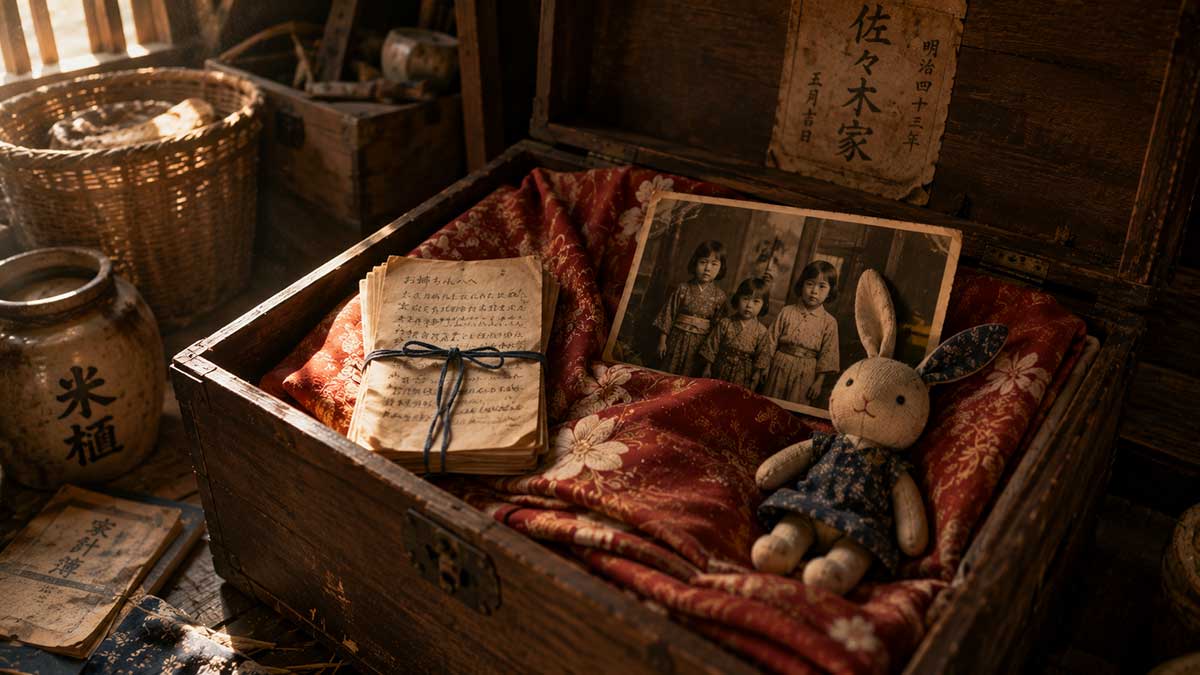
Inside lay only three objects.
A child's red kimono.
A small cloth rabbit with one missing ear.
A bundle of letters tied with faded blue thread.
Nothing else.
No jewelry.
No money.
No keepsakes.
As though one entire life had been folded into a single box.
Emi lifted the kimono first.
It was beautiful.
Deep crimson silk covered with embroidered white plum blossoms.
The sleeves were unusually long for a child.
It had clearly been made to last several years.
Inside the collar, someone had stitched one small character.
雪
Yuki.
"So she was real."
No answer.
Emi unfolded the sleeves.
The fabric released a faint scent of camphor.
Almost hidden beneath one sleeve was a tiny patch where careful hands had repaired a tear.
Someone had loved this garment.
Very much.
"It was never worn."
This time Chiyo answered.
"It was meant for the spring festival."
Emi looked over.
"You remember."
"I remember everything."
"Then why—"
"Because remembering and speaking are not the same."
The cloth rabbit came next.
Its faded blue eyes had been embroidered by hand.
One ear had nearly fallen off.
A tiny bell hidden inside still rang softly when shaken.
Chiyo stopped sorting papers.
"Mother made that."
"For Yuki?"
"Yes."
"It must have been her favorite."
Chiyo nodded once.
"When she was frightened, she held it by the ear."
Emi imagined the little girl gripping the rabbit while walking away from this very house.
The thought tightened her chest.
Finally she untied the bundle of letters.
There were only six.
Each remained unopened.
Every envelope carried the same careful handwriting.
To the Sasaki Family.
No return address.
Only different postmarks.
Tokyo.
Yokohama.
Nagoya.
Osaka.
The dates stretched across almost twelve years.
"They never opened them?"
"No."
"You knew?"
"Yes."
"Why?"
Chiyo looked toward the open door.
The plum blossoms moved gently outside.
"Because Father said she had become someone else's daughter."
"So?"
"He said reading them would only confuse Mother."
"And you believed him?"
"I was fifteen."
"What about the second letter?"
Silence.
"The third?"
Silence.
"The fourth?"
Still nothing.
"You were an adult."
At last Chiyo looked directly at Emi.
"I know."
Neither woman noticed the footsteps until they reached the doorway.
"May I come in?"
Yuki stood beneath the plum tree.
Dry now.
She wore the same clothes.
The same calm expression.
Neither surprised nor apologetic.
Chiyo did not turn around.
"I told you not to return."
"You did."
"And yet here you are."
"I remembered where the key was."
"There is no key."
"There used to be."
Yuki stepped inside.
She looked around the storehouse slowly, almost affectionately.
"The roof leaks less than it used to."
Emi felt as though the room itself had stopped breathing.
Yuki's eyes found the red kimono.
"You found it."
She reached out but did not touch it.
"I always wondered if it still smelled of camphor."
Emi frowned.
"How would you know that?"
"My mother wrapped everything in camphor."
"Lots of mothers did."
"Not like mine."
Yuki smiled faintly.
"She said insects respected good manners."
For the first time all morning, Chiyo laughed.
Just once.
A short breath more than a laugh.
Then she covered her mouth as though surprised it had escaped.
Yuki smiled too.
"I had forgotten that."
"So had I," Chiyo whispered.
The moment passed.
Emi picked up the kimono.
"Was this yours?"
Yuki looked at it for a long time.
"I hoped it would be."
"What does that mean?"
"It was made for me."
"But you never wore it."
"No."
"Why not?"
Yuki looked toward Chiyo.
"I left before the festival."
The room became very quiet.
Outside, a breeze carried a few white petals through the open doorway.
One landed on the folded kimono.
Another settled on the unopened letters.
Emi looked from the letters...
...to the photograph...
...to the child stitched inside the collar.
Then she asked the question no one seemed willing to answer.
"Where did she go?"
Yuki lowered her eyes.
"Far enough that no one expected her to return."
"No."
Emi shook her head.
"I mean really."
"Emi."
Chiyo's voice was barely above a whisper.
"Don't."
"But someone has to tell me."
"No."
"Then I will ask her."
She turned back toward Yuki.
"What happened to the little girl?"
Yuki met her gaze without anger.
Without accusation.
Without tears.
Then she answered in the gentlest voice Emi had ever heard.
"I was exchanged for three sacks of rice."
No one spoke.
Not because the words were unbelievable.
Because they were too ordinary.
Three sacks.
Not treasure.
Not gold.
Not a fortune.
Just enough rice for one family to survive another winter.
Emi slowly sat down on the dusty wooden floor.
The red kimono rested across her knees.
For the first time since arriving home, she understood why the fourth bowl had frightened her grandmother.
It had never been an extra bowl.
It had always been the one that had paid for the other three.
Chapter Four: What the Family Ate
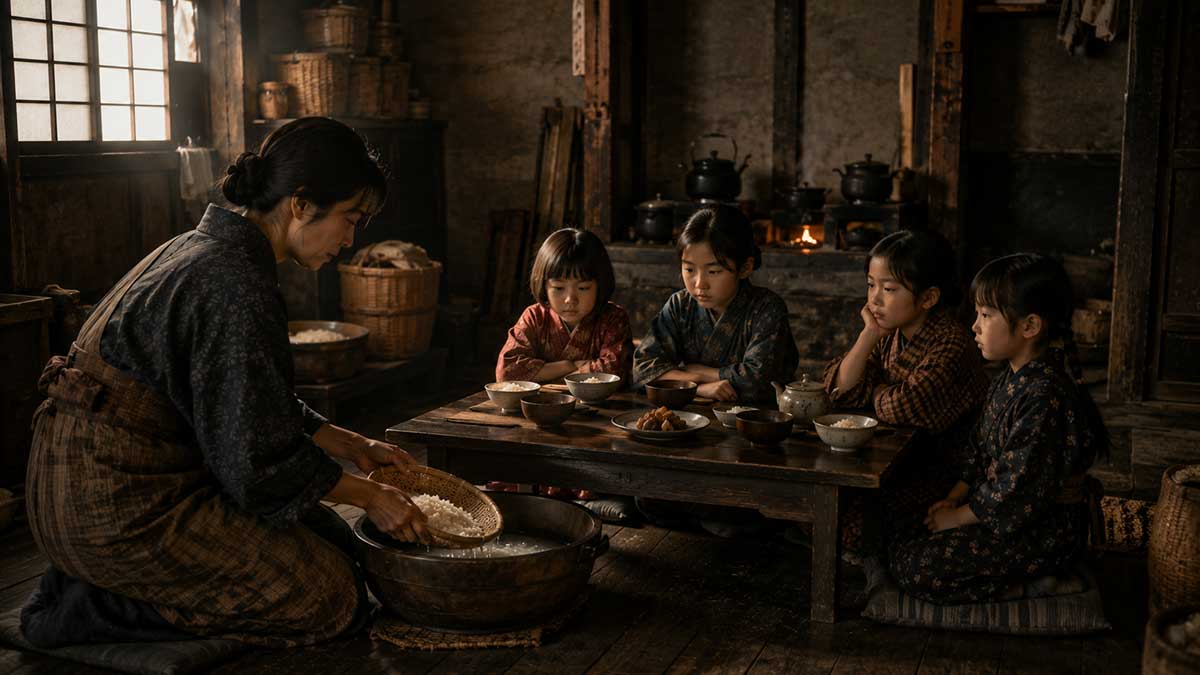
No one moved.
The wind carried another plum blossom through the open door.
It landed beside the old cloth rabbit.
Three sacks of rice.
The words settled over the room more heavily than if Yuki had spoken of murder.
Emi looked at her grandmother.
Chiyo had not denied it.
She had not even looked surprised.
Instead, she lowered herself onto an old wooden crate as though her legs had suddenly remembered their age.
Yuki bent carefully and picked up the fallen blossom.
"It always blooms too early," she said.
No one answered.
By noon they had returned to the kitchen.
No one had suggested lunch.
Yet somehow the table slowly filled.
Miso soup.
Pickled cucumber.
A single grilled mackerel divided into three portions.
Rice.
Always rice.
Emi watched her grandmother wash the grains.
Chiyo's hands moved automatically, circling the rice beneath cold water.
Clouds of white drifted away.
Again.
Again.
Again.
Yuki stood quietly beside the window.
"You still wash it three times."
Chiyo stopped.
For only a heartbeat.
Then her hands continued.
"The water used to be colder."
The old woman spoke so softly Emi almost missed it.
"Yes."
"There was no tap."
"No."
"We carried it from the well."
Yuki smiled.
"I spilled half my bucket every morning."
"You were too small."
"I wanted to carry as much as you."
For the first time since Yuki appeared, the conversation felt almost ordinary.
Like two sisters remembering childhood.
Then Chiyo whispered,
"I should have let you spill it."
They ate in silence.
Halfway through the meal Yuki looked at Chiyo's bowl.
"You don't finish your rice anymore."
"I am ninety-one."
"You used to finish everyone else's."
Emi looked up.
Chiyo set down her chopsticks.
"I was hungry."
"I know."
"I was always hungry."
The room became still.
Outside, somewhere beyond the fields, a train horn drifted across the valley.
"I don't think people understand hunger anymore," Chiyo said.
She was no longer speaking to Yuki.
Nor to Emi.
She seemed to be speaking to the empty air.
"When people imagine hunger, they imagine missing dinner."
She folded her hands.
"They do not imagine watching your mother pretend she has already eaten."
"They do not imagine Father's bowl becoming smaller every week."
"They do not imagine boiling weeds because they look enough like vegetables to comfort children."
Emi had never heard her grandmother speak so many words at once.
"You know what I remember?"
Chiyo continued.
"I don't remember being cold."
"I don't remember being poor."
"I remember counting."
She looked at the rice in her bowl.
"One bowl."
"Two bowls."
"Three bowls."
"How many days until there is nothing left."
Yuki listened without interrupting.
"When the broker came," Chiyo said, "Mother told us to stay outside."
"I listened anyway."
She closed her eyes.
"I heard Father cry."
Emi stared.
"My great-grandfather?"
"I only heard him cry once."
"He kept saying no."
"Again and again."
"But every time he said no..."
"...Mother coughed."
The sentence broke apart.
No one finished it.
Emi suddenly understood.
It had never been a choice between love and money.
It had been a choice between losing one child...
...or perhaps losing everyone.
"I hated him."
Chiyo opened her eyes.
"For years."
"I thought Father had sold my sister."
She looked toward the old storehouse.
"Only after I became a mother myself did I realize..."
She stopped.
"What?"
"I still hate what he did."
She swallowed.
"But I no longer know what I would have done."
Yuki finally sat.
Not beside Chiyo.
Across from her.
Like family.
"I wasn't angry."
Chiyo laughed once.
A bitter little sound.
"You should have been."
"I was seven."
"I thought I was going on a journey."
"I thought rich people ate oranges every day."
Emi smiled despite herself.
"So did we," Chiyo said.
The sisters looked at each other.
For one brief moment they were no longer ninety-one and twenty.
They were twelve and seven.
"I promised to save one for you," Yuki said.
"You did."
"I believed I could."
"You always believed impossible things."
Emi felt something shifting inside the room.
Not forgiveness.
Something earlier than forgiveness.
Recognition.
She looked at Yuki carefully.
The young woman had still never said she was Yuki.
Not once.
She simply answered whenever someone spoke to her as if she were.
"Did you ever come back?" Emi asked.
The question escaped before she had time to soften it.
Yuki looked into her bowl.
"Once."
"When?"
"Many years later."
"Did you come here?"
"Yes."
"What happened?"
Yuki smiled sadly.
"There was a wedding."
Emi looked at Chiyo.
"My wedding?"
Chiyo nodded almost imperceptibly.
"I stood outside the gate."
"You were there?"
"I watched everyone laugh."
"And?"
"I left."
"Why didn't you come inside?"
Yuki lifted her eyes.
"Because I had already learned my place."
Chiyo covered her face with both hands.
"No..."
"You didn't see me."
"No..."
"I don't blame you."
"No."
Her grandmother's voice cracked.
"I saw you."
The room fell silent.
Emi stared.
Chiyo lowered her trembling hands.
"I saw you."
"You were standing beside the persimmon tree."
"You had become a young woman."
"You looked..."
She could not finish.
"I wanted to run to you."
"Why didn't you?"
Yuki asked gently.
Chiyo closed her eyes.
"Because everyone in the village was watching."
The words were almost inaudible.
"I thought..."
She took a slow breath.
"I thought if I pretended not to know you..."
"...it would hurt only for one day."
A tear slid quietly down her cheek.
"I did not know it would hurt for eighty years."
No one spoke.
The afternoon light stretched across the wooden floor.
The bowls of rice sat half-eaten between them.
Finally, Yuki reached across the table.
Not to touch Chiyo.
Only to move one forgotten grain of rice back into her grandmother's bowl.
"So much suffering," she whispered.
"For one grain never to be wasted."
Chiyo looked at that single grain for a long time.
Then, with shaking chopsticks, she picked it up and ate it.
Chapter Five: The Letter That Was Never Read
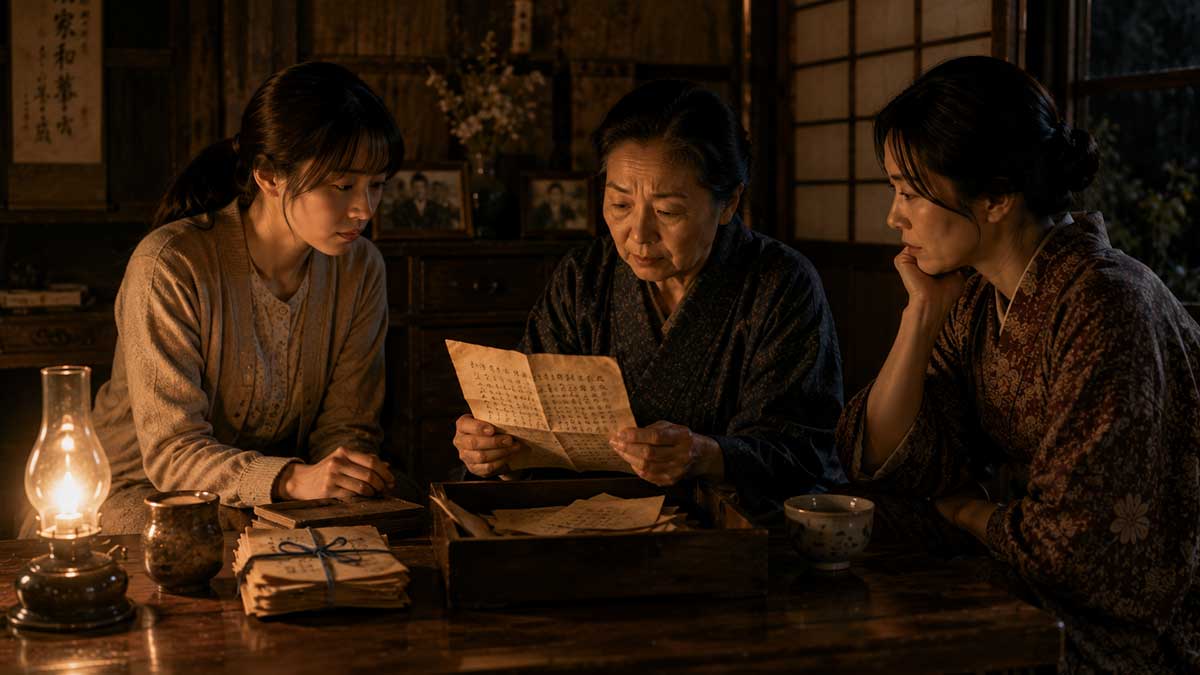
The letters remained on the kitchen table until evening.
No one touched them.
The blue thread that held them together had faded almost to gray. Dust clung to the corners of the envelopes, and the paper had become soft with age.
Six letters.
Twelve years.
Not one opened.
Emi could not stop looking at them.
It seemed impossible that words could wait so patiently.
After dinner, Chiyo carried the empty bowls to the sink.
She washed them slowly.
One bowl.
Then another.
Then the third.
When she finished, she stood without moving.
"The fourth one," Emi said quietly.
Chiyo did not turn around.
"There isn't one."
"There is."
"No."
"You locked it under the floor."
The old woman continued staring into the sink.
Finally she whispered,
"I locked it because I knew you would find it."
The evening light disappeared behind the hills.
The kitchen grew darker.
Emi lit the small lamp beside the table.
Its warm glow fell across the bundle of letters.
"May I read one?"
"No."
"Why?"
"They belong to someone who is gone."
"They belong to us."
"They stopped belonging to us the day she left."
Emi looked toward Yuki.
She sat beside the open window.
The night breeze lifted a loose strand of her hair.
She had said almost nothing since the afternoon.
She watched the darkness gathering outside as though listening for someone walking home.
"What would you do?" Emi asked.
"If they were your letters?"
Yuki smiled.
"I already know what they say."
Emi frowned.
"You've read them?"
"No."
"Then how can you know?"
"Because I remember writing the first one."
The room became very still.
Emi looked at Chiyo.
Her grandmother closed her eyes.
Very slowly...
...she nodded.
It was the first acknowledgment she had given.
Not that Yuki was a ghost.
Not that she had returned.
Only...
that the letters had belonged to her.
Chiyo crossed the room.
Her hands trembled as she untied the faded thread.
The knot came loose almost immediately.
As though it had been waiting.
She picked up the oldest envelope.
Tokyo.
The paper crackled softly.
"I've held this thousands of times."
She ran one finger across the handwriting.
"I never opened it."
"Why?"
"I was afraid."
"Of what?"
"That she still loved us."
Emi had expected another answer.
She had expected shame.
Or guilt.
Or anger.
Not love.
Chiyo carefully opened the envelope.
Inside lay only a single sheet.
The writing was small.
Beautiful.
Neat enough to belong in a schoolbook.
The old woman tried to read.
She stopped after the first line.
"I can't."
Her voice had become almost childlike.
"My eyes?"
Emi asked.
Chiyo shook her head.
"My heart."
She handed the letter across the table.
"You read it."
Emi unfolded the page.
She cleared her throat.
Then she began.
Dear Father, Mother, Chiyo, Hana, and Fumi,
I hope everyone is healthy.
Please don't worry about me.
The merchant family is kind.
I am learning to sew sleeves and polish silver.
They say I work carefully.
Mother always said careful hands make a peaceful heart.
I remembered that.
Emi paused.
No one spoke.
She continued.
Yesterday we had oranges.
I ate only one because I wanted to remember what they tasted like.
If I ever come home, I will bring enough for everyone.
Especially Chiyo.
She always said oranges smell happier than apples.
Chiyo covered her mouth.
A small sound escaped between her fingers.
Not quite a sob.
More like someone trying to keep one inside.
Emi kept reading.
Has the plum tree flowered?
Please tell me if Father repaired the fence.
Did Fumi finally become taller than me?
Is the rabbit still missing one ear?
I worry someone may throw it away because it looks old.
Yuki lowered her eyes.
"I forgot I wrote about the rabbit."
Her voice carried no surprise.
Only tenderness.
The final paragraph was shorter.
Much shorter.
I know I belong to another family now.
But if it is not too much trouble...
could someone please tell me whether Mother still sings while washing rice?
Sometimes I think I can hear her.
Perhaps I only remember.
Signed,
Yuki.
Nothing more.
No accusation.
No complaint.
No mention of the three sacks of rice.
No mention of being sent away.
Only questions about home.
The silence after the letter felt longer than the reading itself.
Finally Emi whispered,
"She never blamed you."
"No."
Chiyo's answer barely reached the table.
"That was the cruelest part."
Emi picked up the second envelope.
"Should I read another?"
"No."
"Why?"
"Because they become harder."
"Harder?"
"The first one still believed she was coming home."
Chiyo stared at the remaining five letters.
"The last one..."
She stopped.
"The last one no longer asks."
Yuki stood.
She walked slowly toward the family altar.
Without speaking, she opened the black doors.
Three bowls rested inside.
Three memorial tablets.
Three names.
She looked for a long time.
Then she reached into the sleeve of her coat.
From it she withdrew something folded into a square no larger than her palm.
A child's drawing.
The paper had yellowed with age.
Crayon lines showed a house beneath a plum tree.
Four smiling girls stood in front of it.
Above them, written in uneven characters, were the words:
Our Home
Yuki placed the drawing gently beside the altar.
"I made this before I left."
Emi stared.
"I've never seen it."
"You weren't meant to."
"Where did you find it?"
Yuki smiled.
"I never lost it."
Chiyo rose slowly from her chair.
She walked to the altar.
Her fingers hovered above the drawing.
Not touching.
Just above it.
"I searched for this."
"You did?"
"For years."
She laughed softly.
"I even accused Hana of hiding it."
"What happened?"
"I forgot."
The word hung in the room.
Then she corrected herself.
"No."
She shook her head.
"I remembered."
"I simply decided not to remember anymore."
For the first time since Yuki had appeared, Chiyo reached toward her.
Not enough to touch.
Only enough that the space between them became impossibly small.
"My little sister..."
Yuki looked at her with gentle eyes.
"You finally said it."
A single tear slipped down Chiyo's cheek.
"I've been trying to say it for eighty years."
Chapter Six: The Day She Came Home
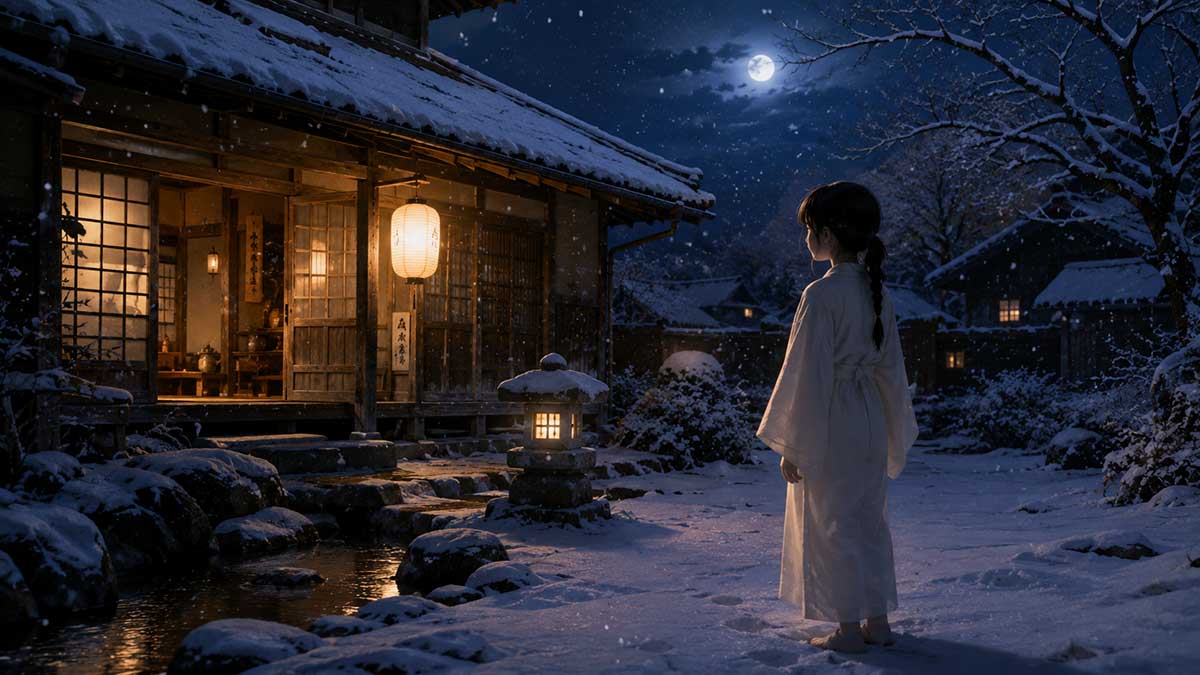
That night, no one slept.
The house settled into its familiar chorus of quiet sounds—the beams creaking as the air cooled, the clock in the hallway clicking though its hands had stopped decades ago, the distant murmur of water running through the irrigation channels beyond the fields.
Emi sat alone in the altar room.
The drawing still rested beside the memorial tablets.
Four girls.
Four smiles.
Four daughters.
She looked again at the photograph.
Once, she had seen only three.
Now she wondered how anyone could ever have believed there were so few.
Perhaps forgetting was not something that happened all at once.
Perhaps it happened one conversation at a time.
One photograph trimmed.
One letter unopened.
One bowl hidden beneath the floor.
Until absence began to look like truth.
The sound of the sliding door startled her.
Chiyo entered carrying a small wooden box.
"I couldn't throw this away."
She placed it gently between them.
Inside were dozens of black-and-white photographs.
Most were ordinary.
Rice harvests.
School ceremonies.
Wedding portraits.
Children chasing dragonflies.
The history of a family becoming older.
Emi turned them over one by one.
Then she stopped.
A wedding.
Her grandmother stood in a white shiromuku kimono.
Her grandfather smiled awkwardly beside her.
The courtyard overflowed with relatives.
The plum tree stood behind them, already heavy with leaves.
On the back, someone had written:
May 18, 1958
"My wedding," Chiyo said.
Emi studied the faces.
"So many people."
"The whole village came."
She noticed something strange.
Near the edge of the photograph, partly hidden behind the old persimmon tree, stood a young woman.
The image was blurred.
She wore a plain dress.
Her face turned slightly away.
Only one side of it caught the light.
"Who is she?"
Chiyo closed her eyes.
"I don't know."
"You do."
"I pretended I didn't."
The words came slowly.
"As the ceremony ended, everyone gathered in the courtyard."
"They laughed."
"They drank sake."
"The children chased each other."
"I was thanking guests."
She folded her hands tightly in her lap.
"Then..."
"I saw someone standing beneath the persimmon tree."
Her voice had become almost a whisper.
"A young woman."
"Very thin."
"Very still."
"She looked..."
"...familiar."
Emi waited.
"I knew."
"You recognized her?"
"The moment I saw her."
"Then why didn't you go?"
Chiyo did not answer immediately.
Instead she looked toward the dark window.
"I looked around first."
"Why?"
"Because everyone else was looking too."
The room seemed to shrink.
"I was the bride."
"My husband's family was respected."
"The village had finally stopped whispering about our poverty."
She laughed bitterly.
"I was so proud."
Her eyes filled.
"And then I saw my little sister."
The sentence broke apart.
"I thought..."
She swallowed.
"I thought if people knew..."
"...they would remember."
"They would remember Father."
"They would remember the broker."
"They would remember what we had done."
"So I smiled."
"I bowed to another guest."
"And when I looked back..."
"...she was gone."
Emi stared at the photograph again.
The blurred figure near the tree.
Always there.
Never noticed.
"Did Grandfather know?"
"No."
"You never told him?"
"No."
"Why?"
"I wanted to become someone whose family had always been whole."
She smiled sadly.
"But families never become whole by pretending."
They heard footsteps.
Yuki stood in the doorway.
Neither woman seemed surprised anymore.
She walked slowly to the photograph.
She looked at the blurred figure.
"I almost came."
Chiyo nodded.
"I know."
"I even bought a gift."
"You did?"
Yuki smiled faintly.
"A small lacquer tray."
"I thought..."
She laughed softly.
"I thought married people probably needed trays."
Emi found herself smiling through tears.
"What happened to it?"
"I left it at the station."
"Why?"
"I didn't think strangers should bring wedding presents."
For a long time no one spoke.
Finally Chiyo whispered,
"I saw you."
"I know."
"I wanted to run."
"I know."
"I wanted to call your name."
"I know."
"Why didn't you wait?"
Yuki looked at her sister with extraordinary gentleness.
"Because you had already made your choice."
"No."
"I hadn't."
"You had."
"When you looked around before you looked at me."
The words were not cruel.
Only true.
"You weren't choosing between me and the village."
"You were choosing which memory would live."
Chiyo lowered her head.
"And I chose wrong."
The old woman began to cry.
Not loudly.
Not dramatically.
Just the quiet tears of someone who has spent a lifetime becoming strong enough to weep.
"I have asked God to forgive me."
She wiped her face.
"Every morning."
"Every night."
"For sixty years."
Yuki stepped closer.
"You keep asking the wrong person."
Chiyo looked up.
"What do you mean?"
"You asked Heaven."
She smiled through tears of her own.
"You never asked me."
The room became utterly still.
Even the night insects outside seemed to disappear.
Very slowly...
Chiyo stood.
Her knees trembled.
She took one step.
Then another.
She stopped before Yuki.
"My little sister..."
Her voice almost failed.
"I'm sorry."
"I was hungry."
"I was afraid."
"I was ashamed."
"I thought forgetting would save us."
"It only buried us."
The silence that followed felt almost sacred.
Then, for the first time since entering the house...
Yuki reached forward.
She placed one hand against Chiyo's cheek.
Her fingers looked impossibly real.
Warm.
Gentle.
Like a younger sister comforting the older one.
"I know."
Only two words.
Nothing more.
Chiyo closed her eyes.
For a brief moment she leaned into the touch she had been waiting eighty years to receive.
When she opened them again...
Yuki had stepped back.
She looked toward the family altar.
"There is one thing left."
"What?"
Chiyo asked.
Yuki's eyes rested on the three memorial tablets.
"My name."
Outside, a breeze stirred the plum tree.
A handful of white blossoms drifted across the dark garden like quiet snow.
The fourth place at the altar was still empty.
But for the first time...
the family was ready to see it.
Chapter Seven: The Fourth Bowl
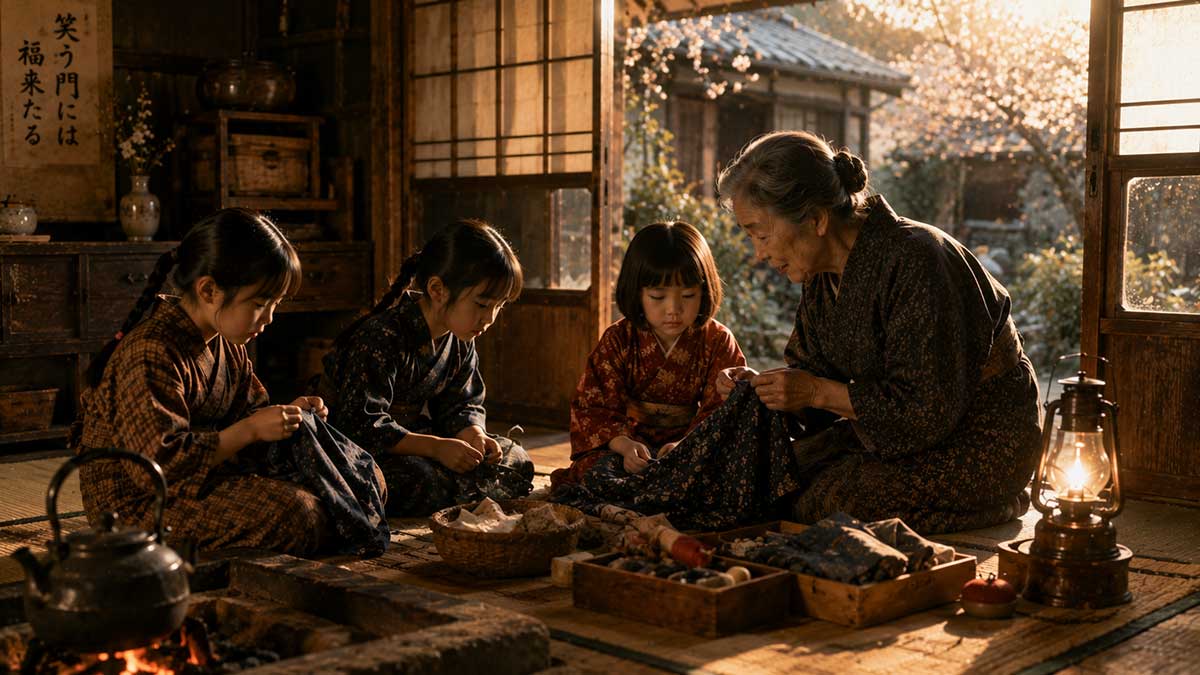
Morning arrived without ceremony.
No sunlight broke dramatically through the clouds.
No temple bell echoed across the valley.
Only the ordinary sounds of a village beginning another day.
A broom brushing stone.
A bicycle passing the front gate.
The distant engine of the first train.
The house, after so many sleepless nights, felt strangely peaceful.
Emi awoke to the smell of rice.
She found her grandmother already in the kitchen.
Chiyo stood before the stove, measuring water with the same careful movements she had practiced for nearly a century.
"You should have woken me," Emi said.
"I've been cooking rice longer than you've been alive."
"I know."
"You'll only slow me down."
It was such an ordinary reply that Emi laughed.
For the first time since arriving, Chiyo laughed with her.
Only a little.
But it was enough.
When the rice was ready, Chiyo did something Emi had never seen before.
She walked to the floor cabinet.
She removed the small brass key from the sleeve of her cardigan.
The lock clicked open.
Inside lay the cracked porcelain bowl, still wrapped in its white cloth.
She carried it carefully to the table.
Neither woman spoke.
The bowl looked smaller than Emi remembered.
Age had stained its glaze a soft ivory.
The crack running from its rim no longer seemed like damage.
It looked like part of its history.
Chiyo washed it gently.
She dried it with a clean linen cloth.
Then she filled it with fresh rice.
Not too much.
Just enough.
Exactly as she had filled the other three bowls every morning of her married life.
Together they entered the altar room.
The black doors stood open.
Three memorial tablets waited inside.
Three bowls rested beneath them.
Chiyo placed the fourth bowl beside the others.
The empty space disappeared.
For a long moment she simply stood there.
Her lips moved silently.
Then she bowed.
When she straightened, she spoke clearly.
Not loudly.
As though introducing someone who had merely been away on a long journey.
"My youngest sister..."
She paused.
"...Yuki."
The name entered the room like morning light.
It did not demand attention.
It simply belonged there.
Emi felt tears rise before she understood why.
A person could disappear from photographs.
From family records.
From conversation.
But the moment someone spoke their name with love...
they returned.
"There should be a tablet," Emi whispered.
"There was."
Chiyo nodded.
"I burned it."
Emi stared.
"When Father died."
"Why?"
"Because I thought if no one saw her name..."
"...no one would ask."
She looked at the altar.
"I have spent sixty years wishing fire could burn memory."
"It cannot."
"No."
She smiled sadly.
"It only burns wood."
Without another word, Chiyo disappeared into the storehouse.
She returned carrying a small cedar box.
Inside lay a plain piece of unfinished wood.
No lacquer.
No gold.
Only a name carefully brushed in black ink many decades before.
雪
Yuki.
"I couldn't burn this one."
"You kept it."
"I told myself I had forgotten where I put it."
She laughed softly.
"The heart remembers better than the mind allows."
Together, grandmother and granddaughter placed the small tablet beside the others.
For the first time in more than eighty years...
there were four.
A breeze drifted through the open window.
The incense smoke bent gently toward the garden.
Emi looked around.
The room was empty.
"She's gone."
Chiyo nodded.
"Yes."
"Do you think she was really here?"
The old woman did not answer immediately.
Instead she looked toward the plum tree outside.
White blossoms floated down one by one.
"I've asked myself that question all night."
"And?"
"I no longer think it's the important one."
"What is?"
Chiyo smiled.
"Whether we finally welcomed her home."
That afternoon they carried boxes to the truck waiting outside.
The real estate agent arrived exactly on time.
He admired the old beams.
Measured the rooms.
Discussed repairs.
He noticed the family altar.
"You've added another memorial tablet."
"Yes," Chiyo replied.
"My youngest sister."
"I didn't know you had another sister."
There was no hesitation this time.
"Most people didn't."
The agent bowed politely.
"I'm sorry for your loss."
"So am I."
But her voice held no shame.
Only affection.
When everything had been loaded, Emi walked one last time through the empty house.
The tatami rooms echoed now.
The cupboards stood open.
The kitchen shelves were bare.
Only the altar remained.
Four bowls of rice rested before four names.
She remembered the first night.
Three bowls.
One hidden.
One family pretending absence had always been truth.
The house itself seemed to breathe more easily.
As though it, too, had been waiting.
"Ready?" Chiyo called from outside.
Emi nodded.
Just before leaving, she turned back one final time.
A little girl stood beneath the plum tree.
She wore a red kimono embroidered with tiny white blossoms.
One hand rested against the trunk.
The other held a blue cloth rabbit with one missing ear.
She was smiling.
Not because someone had finally seen her.
Because someone had finally remembered.
Emi blinked.
The garden was empty.
Only the blossoms remained.
As they reached the gate, Chiyo stopped.
She looked back at the old house.
"For years," she said, "I believed memory was a burden."
She took Emi's hand.
"Now I think forgetting was the heavier one."
They closed the gate together.
Behind them, the plum tree released another quiet shower of white petals.
Inside the empty house, four bowls of rice slowly cooled before the family altar.
And for the first time in eighty-two years...
none of them belonged to a ghost.
Final Thoughts by Toni Morrison
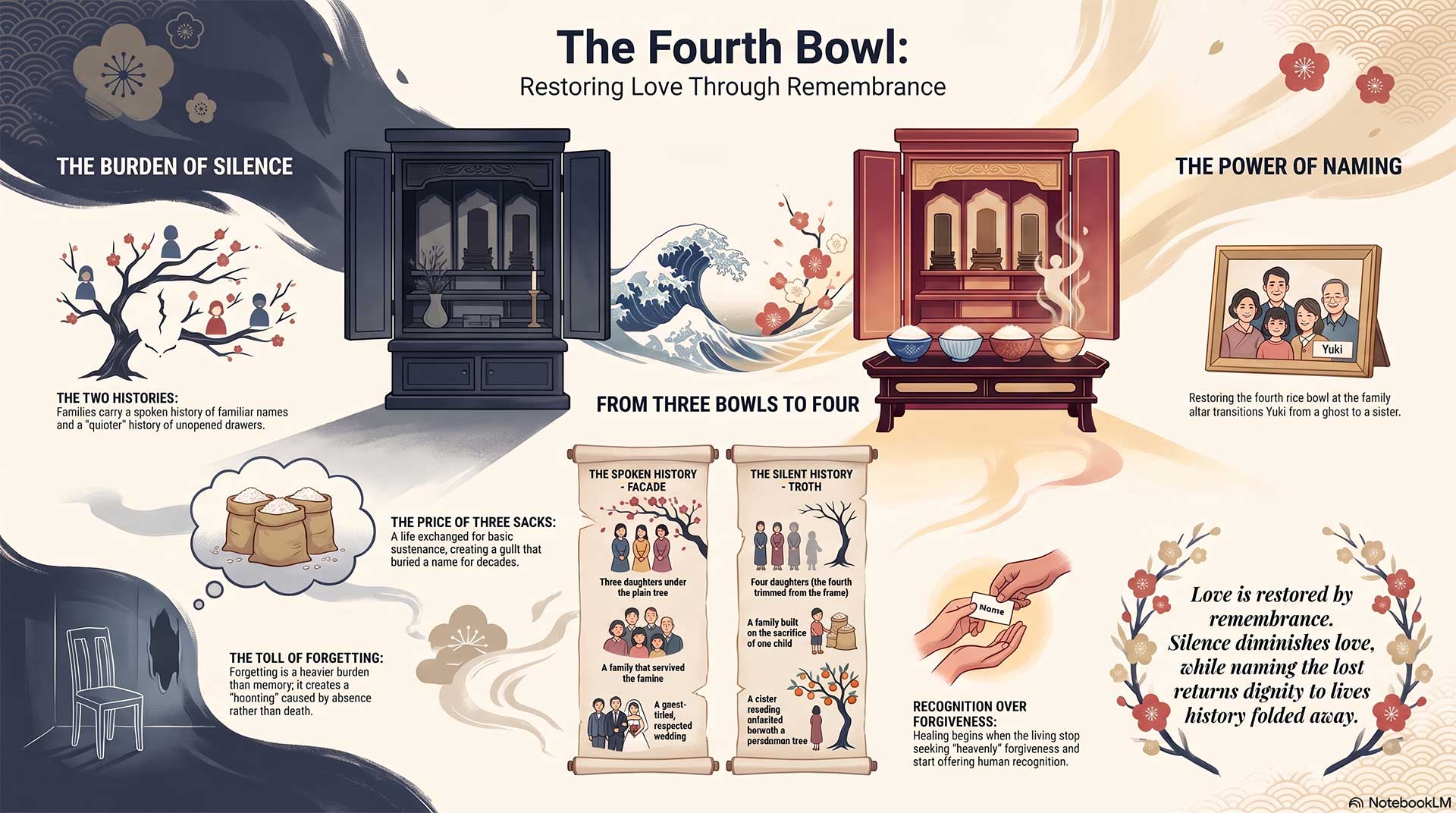
There is a temptation to believe that time heals.
Sometimes it does.
Sometimes time simply teaches silence to speak more softly.
Families survive impossible years because ordinary people make impossible choices. Those choices are rarely clean enough to deserve celebration or simple enough to deserve condemnation. They remain in the lives of children and grandchildren, not because suffering is inherited like property, but because love continues searching for the place where it was interrupted.
Yuki does not ask for justice.
She asks for recognition.
That difference changes everything.
Recognition cannot rewrite the past.
It cannot restore a childhood.
It cannot return a father to the moment before his decision.
What it can do is return dignity to a life that history quietly folded away.
The fourth bowl is not an object of mourning.
It is an invitation.
It reminds us that remembrance is not merely an act performed for the dead. It is a promise made by the living—that no one who belonged to us will remain unnamed simply because remembering became difficult.
Perhaps every family has such a place.
A forgotten photograph.
A missing chair.
A letter never opened.
A story interrupted before its ending.
If this novel leaves you with anything, let it be this:
Love is diminished by silence, but restored by remembrance.
Sometimes healing begins the moment someone is willing to say a forgotten name aloud.
Short Bios:
Emi Sasaki
Emi is a thirty-two-year-old editor from Tokyo who returns to her ancestral home to help her ninety-one-year-old grandmother prepare it for sale. Practical, thoughtful, and quietly curious, she initially believes she is sorting through old belongings. Instead, she discovers that she has inherited a silence stretching back more than eighty years. As the story unfolds, Emi becomes the bridge between generations, helping her family exchange secrecy for remembrance. Through her eyes, readers experience the gradual uncovering of a forgotten history and witness how compassion can restore what guilt alone never could.
Chiyo Sasaki
Chiyo is the emotional heart of The Fourth Bowl. At ninety-one, she has spent nearly a lifetime carrying a secret she convinced herself had disappeared with time. As a child, she watched her youngest sister leave during a time of desperate poverty. As an adult, she chose silence over truth, believing that forgetting would protect her family from shame. Instead, the silence became its own burden. Chiyo's journey is not one of seeking forgiveness from others, but of finding the courage to finally speak the name she has loved and hidden for decades.
Yuki
Yuki is the youngest of four sisters and the family's forgotten child. During a time of famine and hardship, she is sent away to another household so the rest of her family might survive. Whether she returns as a ghost, a memory, or the living embodiment of unresolved love is left intentionally unanswered. Yuki never comes seeking revenge. She returns with extraordinary gentleness, asking only that her family remember what they once chose to forget. She represents every person quietly erased from family history, and every memory that patiently waits to be welcomed home.
Father (Kenji Sasaki)
Though he never appears directly in the present-day narrative, Kenji Sasaki's decision shapes every generation that follows. A hardworking farmer trapped between crushing debt, illness within his family, and impossible choices, he agrees to send away his youngest daughter in exchange for enough rice to keep the rest of the household alive. He is neither villain nor hero, but an ordinary father forced into an unbearable decision. His quiet grief reminds readers that history often judges choices without fully understanding the circumstances in which they were made.
Mother (Aiko Sasaki)
Aiko is remembered through fragments—her songs while washing rice, the handmade cloth rabbit she sewed for Yuki, the careful repairs she made to a red kimono, and the gentle lessons she taught her daughters about kindness and patience. Although illness leaves her powerless to prevent Yuki's departure, her love remains present throughout the story. More than any other character, Aiko symbolizes the warmth of home that Yuki continues to carry long after leaving it.
Hana
Hana is the eldest sister, practical and responsible beyond her years. During childhood she often acted as a second parent, helping care for her younger sisters while their parents struggled to survive. Although she shares the family's silence, Hana represents another form of grief—the quiet acceptance of responsibilities no child should bear. Her presence reminds readers that everyone in the family carried the loss differently.
Fumi
Fumi is the third sister, remembered as cheerful, impatient, and full of youthful energy. She appears mostly through memories, photographs, and Yuki's letters asking whether she had finally grown taller. Fumi represents the innocence that continued despite hardship and serves as a painful reminder of the ordinary childhood moments that Yuki never had the chance to share.
The Plum Tree
Standing beside the family storehouse, the plum tree quietly witnesses every generation of the Sasaki family. It blooms faithfully each spring regardless of sorrow, silence, or the passing of time. More than a setting, it becomes a silent character whose blossoms mark memory returning year after year. Its enduring presence reminds readers that nature remembers even when people choose not to.
The Fourth Bowl
Although not a person, the fourth bowl functions as one of the story's central characters. Hidden beneath the floorboards for decades, it represents the place reserved for the family member who was never truly forgotten, only left unspoken. As the story progresses, the bowl transforms from a symbol of guilt into one of belonging. By the final chapter, it no longer represents loss alone—it represents the family's decision to make itself whole again.
Toni Morrison (1931–2019)
Toni Morrison was one of America's most celebrated novelists, renowned for exploring memory, identity, family, and the enduring emotional consequences of history. Her fiction demonstrated that the deepest truths often emerge not through grand historical events alone, but through intimate lives shaped by love, loss, silence, and resilience. Her work continues to influence writers around the world by showing how personal stories can illuminate universal human experience.
Leave a Reply