


What if the greatest blindness isn't losing your eyesight—but losing the ability to recognize another person's humanity?
Introduction By José Saramago
A man waits at a traffic light.
The light turns green.
He does not move.
Behind him, drivers sound their horns. They can see the signal, the road, the motionless car, and the inconvenience he has created.
What they cannot see is the terror inside him.
He has gone blind.
Not into darkness, but into an unbearable whiteness—a blindness so luminous that it appears almost pure.
Soon the blindness spreads.
Doctors cannot explain it.
Officials cannot contain it.
Soldiers fear it.
The government locks the infected inside an abandoned asylum, hoping walls can separate the healthy from the condemned.
The walls fail.
So do laws, manners, privacy, dignity, and many of the stories people once told themselves about their own goodness.
Yet something else survives.
A woman stays beside her husband.
A young woman protects a lost child.
A wife refuses to let fear decide who deserves food.
An old man listens.
A dog follows tears.
Strangers divide water when no authority requires them to share.
This conversation asks what blindness reveals when eyesight disappears.
Were people already blind before the epidemic?
Why did civilization collapse so quickly?
Can compassion survive hunger, fear, humiliation, and violence?
What does it mean to truly see another person?
And why does sight eventually return?
These are not questions for the characters alone.
They belong to every society that calls itself civilized while training its citizens to look past suffering.
They belong to every person who has confused seeing with knowing.
They belong to anyone who has waited for someone else to become responsible.
The doctor’s wife remains sighted, but her vision does not make her innocent.
It gives her fewer excuses.
She sees cruelty before others can name it.
She sees fear becoming obedience.
She sees victims becoming capable of harming other victims.
She sees that compassion is rarely pure, calm, or easy.
Sometimes it arrives tired.
Sometimes angry.
Sometimes late.
Sometimes carrying scissors.
Yet it arrives.
That may be humanity’s most fragile hope.
The epidemic does not create a new species.
It exposes the one already present.
The selfish and the generous.
The frightened and the cruel.
The person who hoards bread.
The child who divides it.
The person who hears someone crying and continues walking.
The dog who stops.
The question is not whether humanity is good or evil.
The question is what each person does after discovering the capacity for both.
Let us begin where the novel begins.
At a green light.
With a man who can no longer see—and a city that has not yet realized how blind it already is.
(Note: This is an imaginary conversation, a creative exploration of an idea, and not a real speech or event.)
Topic 1: Were We Already Blind Before the Epidemic?
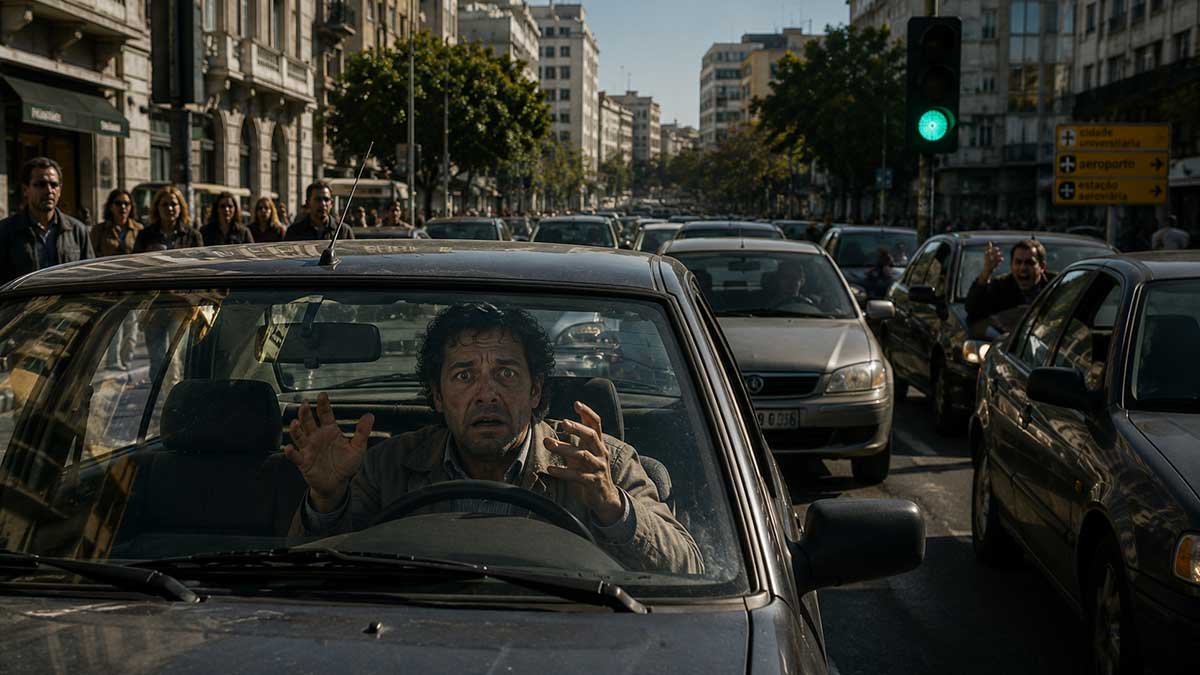
The traffic light changed from red to green.
No car moved.
Behind the first vehicle, horns began sounding—one sharp complaint, then another, then a whole impatient chorus from drivers who could see the green light but could not see the terror inside the car ahead.
The first blind man sat gripping the steering wheel.
His eyes were open.
All he could see was white.
Not darkness.
Not shadow.
A white field without distance, edge, or depth, as though he had fallen into an ocean of milk.
Years later—or perhaps only minutes later; disaster had made time unreliable—he stood at the same intersection with four others.
The city around them was empty.
Abandoned cars faced every direction. Papers moved along the pavement. A traffic light continued changing for drivers who no longer obeyed it.
The doctor’s wife stood beside her husband.
The old man with the eye patch rested one hand on his cane.
The first blind man remained nearest the stalled car.
A few steps away stood José Saramago.
He looked toward the green light.
José Saramago: It is still telling us to go.
First Blind Man: Go where?
José Saramago: That is the difficulty. We built signals before deciding whether we knew our destination.
Doctor: You speak as though the epidemic began here.
First Blind Man: It began here for me.
Doctor’s Wife: Did it?
He turned toward her voice.
First Blind Man: I lost my sight at this intersection.
Doctor’s Wife: That was not what I asked.
The green light turned yellow.
Then red.
The machinery of order continued performing its duty before an audience no longer able to trust it.
Old Man with the Eye Patch: She is asking whether blindness began when your eyes failed.
First Blind Man: What other beginning could there be?
José Saramago: The beginning before the beginning.
Doctor: That sounds like a novelist’s escape from precision.
José Saramago: And diagnosis can become a physician’s escape from meaning.
The doctor looked irritated.
His wife touched his arm, gently warning him not to turn disagreement into defense.
Doctor: I examined the first cases. Their eyes appeared healthy. The optic structures gave us no clear explanation. There was no darkness. No visible injury. No known pattern.
José Saramago: Yet you still searched for the illness inside the eye.
Doctor: Where else should an ophthalmologist search?
Doctor’s Wife: Perhaps in the city.
The doctor looked at her.
Doctor’s Wife: Before anyone lost sight, how many people at this intersection noticed the beggar near the pharmacy?
No one answered.
She pointed across the road.
A doorway stood beneath a torn awning. An old blanket lay folded beside it.
Doctor’s Wife: He slept there every night.
First Blind Man: How do you know?
Doctor’s Wife: I saw him.
Old Man with the Eye Patch: Did you speak to him?
She paused.
Doctor’s Wife: No.
The old man nodded.
Old Man with the Eye Patch: Then perhaps you saw his body but not the man.
Her face tightened.
Doctor’s Wife: Yes.
José Saramago: Sight often congratulates itself too early.
The first blind man turned toward the stalled vehicle.
First Blind Man: I had a job. A home. A wife. I paid taxes. I never hurt anyone.
José Saramago: Is that the same as seeing?
First Blind Man: I lived an ordinary life.
Old Man with the Eye Patch: Ordinary life contains many convenient blindfolds.
First Blind Man: You are judging me.
Old Man with the Eye Patch: No. I am standing beside you.
A wind moved paper beneath the cars.
The first blind man lowered his head.
First Blind Man: When I lost my sight, I called for help.
Doctor’s Wife: And someone came.
First Blind Man: He stole my car.
José Saramago: Yes.
First Blind Man: Then what are we discussing? The blindness made him cruel.
Doctor: We do not know that. He may have been cruel before.
First Blind Man: He offered help.
Old Man with the Eye Patch: Perhaps both things were true.
First Blind Man: Help and theft?
Old Man with the Eye Patch: A person can feel pity and still see an opportunity.
Doctor’s Wife: That may be one of our oldest forms of blindness.
First Blind Man: Which one?
Doctor’s Wife: Seeing another person’s weakness only in relation to what it offers us.
The light changed again.
Green.
No movement.
José Saramago: The thief saw your helplessness clearly.
First Blind Man: Then he was not blind.
José Saramago: He saw the car.
He saw the keys.
He saw that you could not identify him.
Did he see you?
The first blind man said nothing.
They began walking.
The doctor’s wife led them around abandoned vehicles, broken glass, and a delivery truck that had mounted the curb.
Her husband held her shoulder.
The first blind man followed the doctor.
The old man followed the sound of their steps.
Saramago walked apart from them, as though he trusted the ruined street to make room.
Doctor: You are turning blindness into a moral accusation.
José Saramago: Would that disturb you less if it remained a medical mystery?
Doctor: Disease is not punishment.
José Saramago: I never said it was.
Doctor: Then the epidemic did not happen to teach anyone a lesson.
José Saramago: Events need not carry lessons. People create meaning from what survives them.
Doctor’s Wife: Perhaps the epidemic did not punish our blindness.
Perhaps it exposed it.
Doctor: Exposed what?
Doctor’s Wife: How little we saw when seeing cost us something.
First Blind Man: I noticed people.
Doctor’s Wife: Which people?
First Blind Man: My wife. My colleagues. My neighbors.
Old Man with the Eye Patch: The people tied to your life.
First Blind Man: Is that a crime?
Old Man with the Eye Patch: No.
It is a boundary.
The question is whether you mistook the boundary for the whole human community.
They reached a supermarket.
Its glass doors had shattered. Empty carts lay overturned near the entrance. The smell from inside made the doctor cover his mouth.
Doctor: We should not go in.
Doctor’s Wife: There is nothing left anyway.
José Saramago: Once there were shelves of food here.
First Blind Man: I remember.
José Saramago: Did everyone in the city eat well before the epidemic?
First Blind Man: No.
José Saramago: Yet the shelves were full.
Doctor: Poverty is not blindness.
José Saramago: No.
The ability to pass hunger every day without letting it disturb one’s sense of order may be.
The doctor stopped walking.
Doctor: You could say that about any suffering.
José Saramago: Yes.
Doctor: War. Homelessness. Abuse. Isolation. Illness.
José Saramago: Yes.
Doctor: Then everyone is guilty.
Doctor’s Wife: Perhaps guilt is not the most useful word.
Old Man with the Eye Patch: Responsibility may be better.
First Blind Man: Responsibility for strangers?
Old Man with the Eye Patch: Someone was responsible for us in the asylum.
They all turned toward the doctor’s wife.
She looked away.
Doctor’s Wife: Do not make me better than I was.
Doctor: You kept us alive.
Doctor’s Wife: I hid my sight.
First Blind Man: To stay with your husband.
Doctor’s Wife: At first.
Old Man with the Eye Patch: And later?
She looked through the broken supermarket doors.
Doctor’s Wife: Later I hid it because I was afraid of what people would demand from the only person who could see.
José Saramago: That fear was justified.
Doctor’s Wife: It was still fear.
Doctor: You owed no one your sight.
Doctor’s Wife: Did I owe them warning?
When the food was taken?
When the ward became dangerous?
When the men with the gun began controlling us?
Doctor: You did what you could.
Doctor’s Wife: That sentence can comfort too quickly.
Her husband fell silent.
Doctor’s Wife: I saw everything.
That did not mean I acted at once.
I watched people step in filth before I told them where to walk.
I watched humiliation grow before I accepted that no authority was coming.
I kept hoping someone else would become responsible.
José Saramago: The sighted often wait for permission to act upon what they see.
First Blind Man: You killed the man who led the thieves.
The doctor’s wife closed her eyes.
Doctor’s Wife: Yes.
First Blind Man: Was that true sight?
Doctor’s Wife: No.
Doctor: It ended the terror.
Doctor’s Wife: It ended one man’s life.
Old Man with the Eye Patch: Both statements can stand.
Doctor’s Wife: I had wanted sight to make me innocent.
It did not.
It only made ignorance impossible.
Saramago studied her.
José Saramago: That may be the burden of sight.
Not goodness.
No one becomes good merely by seeing.
Sight removes one excuse.
They left the supermarket and entered a narrow residential street.
Laundry hung stiff beneath balconies. Doors remained open. Family photographs lay among rain-damaged papers.
The first blind man stepped on a small wooden toy.
It rolled beneath his shoe.
He bent, searching with both hands, and found it.
First Blind Man: A child lived here.
Doctor: Many children lived here.
First Blind Man: I never thought of the city this way.
Old Man with the Eye Patch: How did you think of it?
First Blind Man: Streets. Offices. Shops. Traffic.
Doctor’s Wife: Functions.
First Blind Man: Yes.
José Saramago: We see systems clearly and lives vaguely.
The first blind man held the toy.
First Blind Man: Before I went blind, I passed hundreds of apartments every day. I never wondered who was frightened inside them.
Who was caring for an aging parent.
Who had no money.
Who was being hurt.
Who had not spoken to another person in a week.
Old Man with the Eye Patch: No one can carry every unseen life.
José Saramago: True.
Old Man with the Eye Patch: Then where does responsibility end?
José Saramago: Perhaps it begins with refusing to call suffering invisible when we trained ourselves not to look.
Doctor: You make indifference sound deliberate.
Doctor’s Wife: Sometimes it is.
Sometimes it is exhaustion.
Sometimes self-protection.
Sometimes habit.
First Blind Man: Sometimes we simply do not know.
Old Man with the Eye Patch: Yet not knowing can become a shelter we defend.
They walked farther.
At the end of the street, a church door stood open.
Inside, the statues had cloth tied over their eyes.
The doctor’s wife entered first.
Dust and candle wax covered the floor. Painted saints looked down through blindfolds.
The first blind man heard the change in her breathing.
Doctor: What is it?
Doctor’s Wife: Their eyes are covered.
First Blind Man: Whose?
Doctor’s Wife: All of them.
Christ.
Mary.
The saints.
Even the angels.
Old Man with the Eye Patch: Someone feared being watched.
José Saramago: Or feared that the sacred had stopped watching.
Doctor: Does this mean God is blind too?
José Saramago: What do you think?
Doctor: I asked you.
José Saramago: Writers are often accused of giving answers after creating impossible questions.
I prefer not to prove the accusation.
The old man approached a pew and sat.
Old Man with the Eye Patch: When sight vanished, people prayed.
Then they begged.
Then cursed.
Then stopped.
First Blind Man: Did you pray?
Old Man with the Eye Patch: Yes.
First Blind Man: For sight?
Old Man with the Eye Patch: At first.
Later, for food.
Then for a clean place to sleep.
Then for one day without hearing someone cry.
My prayers became smaller as the world became worse.
Doctor’s Wife: Did you think anyone heard?
Old Man with the Eye Patch: I do not know.
But the girl with the dark glasses heard the boy with the squint crying.
She cared for him.
Perhaps that was an answer without a signature.
Doctor: Human kindness does not prove divine attention.
Old Man with the Eye Patch: No.
It proves human attention.
That is already rare.
Saramago looked at the blindfolded figures.
José Saramago: People often ask why the doctor’s wife kept her sight.
Doctor’s Wife: I asked that every day.
José Saramago: Perhaps there was no reason.
First Blind Man: That seems cruel.
José Saramago: Randomness often feels cruel when it selects us for suffering or duty.
Doctor: Then she was simply fortunate.
Doctor’s Wife: Fortunate?
Doctor: Compared with us.
She turned toward him.
Doctor’s Wife: I saw the bodies.
The filth.
The fear on faces before violence began.
I saw people recognize what was about to happen and realize they could not escape it.
You remember darkness that was white.
I remember every detail.
Her husband lowered his head.
Doctor’s Wife: Do not mistake sight for safety.
Old Man with the Eye Patch: Nor blindness for innocence.
First Blind Man: What does that mean?
Old Man with the Eye Patch: Some of us did things in blindness that we would not have done under another person’s gaze.
We stole food.
Pushed people aside.
Ignored cries.
Told ourselves confusion excused us.
First Blind Man: We were terrified.
Old Man with the Eye Patch: Yes.
Fear explains much.
It does not make every action harmless.
José Saramago: People believed blindness hid them.
Yet blindness did not remove witnesses.
It only made each person responsible for the witness inside himself.
Doctor: Conscience?
José Saramago: A word often praised after it has been ignored.
The first blind man moved closer to one of the covered statues.
First Blind Man: Before the epidemic, I thought blindness meant dependence.
I feared needing someone to cross a street.
To eat.
To find a bed.
But the worst part was not needing help.
Doctor’s Wife: What was it?
First Blind Man: Becoming a problem in other people’s minds.
He touched the cold stone base of the statue.
First Blind Man: I could hear how voices changed.
Officials spoke about us as contamination.
Soldiers spoke to us as threats.
People who were blind before the epidemic were forgotten in the panic, as though their lives had been rehearsals for our catastrophe.
Doctor: We were quarantined to protect the city.
First Blind Man: Protected from whom?
Doctor: From infection.
First Blind Man: We were the infection.
Not people carrying it.
The infection itself.
The doctor did not answer.
José Saramago: A society may reveal its blindness most clearly through the language it uses for frightened people.
Doctor’s Wife: Cases.
Numbers.
Risks.
Burden.
Crowd.
Old Man with the Eye Patch: Never names.
Doctor: We had no names in the story.
Saramago smiled faintly.
José Saramago: You noticed.
Doctor: Why did you take them from us?
José Saramago: Did I take them?
Or did catastrophe strip away the protections attached to names?
Profession.
Reputation.
Address.
Social standing.
What remained?
Doctor’s Wife: Need.
First Blind Man: Fear.
Old Man with the Eye Patch: Character.
Doctor: Instinct.
José Saramago: Relationship.
You became the doctor only because others needed one.
She became the doctor’s wife, yet she became more than that through what she carried.
The first blind man became first only through misfortune.
The old man became old through time, then wise only when others chose to listen.
Old Man with the Eye Patch: Are you calling me wise?
José Saramago: No. I am saying they sometimes listened.
The old man laughed.
The sound moved strangely beneath the blindfolded saints.
The doctor’s wife walked to the altar.
A strip of cloth covered the eyes of the crucified figure.
She reached upward, then stopped.
Doctor: Are you going to remove it?
Doctor’s Wife: I do not know.
First Blind Man: Why hesitate?
Doctor’s Wife: Perhaps I am afraid of what the eyes will ask.
José Saramago: That is why many people prefer blind gods.
Doctor: What would they ask?
Doctor’s Wife: What did you do with what you saw?
The question remained in the church.
No one moved.
First Blind Man: I used to think a good person was someone who did not commit terrible acts.
Old Man with the Eye Patch: That is a low ceiling.
First Blind Man: It seemed sufficient.
Doctor: Most ordinary life is built upon that standard.
Do no harm.
Obey the law.
Take care of your own.
José Saramago: And what happens to the people who are no one’s own?
The doctor looked toward his wife.
Doctor: Someone must care for them.
Doctor’s Wife: Someone.
That is the favorite name of responsibility when we hope it belongs elsewhere.
First Blind Man: Then what should we have done before the epidemic?
Seen every stranger?
Fed every hungry person?
Opened every door?
Old Man with the Eye Patch: No person can do everything.
José Saramago: Yet every person can refuse the lie that nothing can be done.
Doctor: That sounds noble and impractical.
Doctor’s Wife: So did caring for seven people in a ruined city.
Her husband gave a tired smile.
Doctor: You are not going to let me win this argument.
Doctor’s Wife: I saw where winning led us.
She removed the cloth from the statue’s eyes.
Dust fell through the dim light.
The painted eyes beneath it did not seem merciful or condemning.
They simply looked outward.
Doctor’s Wife: There.
First Blind Man: What do they look like?
She considered the question.
Doctor’s Wife: Tired.
José Saramago: Perhaps seeing is tiring.
Old Man with the Eye Patch: So is blindness.
First Blind Man: Then what is the advantage?
Doctor’s Wife: Choice.
They turned toward her.
Doctor’s Wife: Sight does not make us kind.
It gives us fewer places to hide from the choice.
Doctor: Yet you saw and still hesitated.
Doctor’s Wife: Yes.
Doctor: You saw and felt fear.
Doctor’s Wife: Yes.
Doctor: You saw and killed.
She held his gaze.
Doctor’s Wife: Yes.
Doctor: Then sight did not save you from becoming human.
Doctor’s Wife: No.
It made me answer for being human.
Saramago stepped closer to the altar.
José Saramago: That may be the difference.
We speak of blindness as the absence of sight.
But moral blindness is often active.
It edits.
It narrows.
It turns a person into a category.
A neighbor into an inconvenience.
A hungry child into a statistic.
A refugee into a threat.
A woman into a body.
A sick person into contamination.
First Blind Man: And ourselves?
José Saramago: Into heroes of stories we never examined closely.
They returned to the street.
Clouds had gathered above the city.
The doctor’s wife looked upward.
Doctor: Rain?
Doctor’s Wife: Soon.
Old Man with the Eye Patch: Good.
First Blind Man: Why?
Old Man with the Eye Patch: Rain makes everyone admit they need shelter.
They walked toward the doctor’s home.
The first blind man carried the child’s wooden toy.
At a corner, they heard someone crying inside a building.
A weak sound.
Almost hidden beneath the wind.
The first blind man stopped.
First Blind Man: Did you hear that?
The doctor listened.
Doctor: Yes.
Doctor’s Wife: Second floor.
José Saramago: What will you do?
The first blind man tilted his face upward.
First Blind Man: Before the epidemic, I might have assumed someone else would help.
Old Man with the Eye Patch: And now?
First Blind Man: Now I know how long a person can call before anyone comes.
The doctor’s wife led them toward the entrance.
The stairwell smelled of damp plaster. They climbed carefully.
On the second floor, they found an elderly woman seated beside an open door. Her sight had returned only moments earlier, but she was too weak to stand. She stared at the group as though people had become unbelievable.
Elderly Woman: I can see you.
No one answered at first.
She began to cry again.
Elderly Woman: I can see you.
The first blind man knelt before her.
First Blind Man: Can you see us clearly?
Elderly Woman: Yes.
He placed the child’s toy in her hands.
First Blind Man: Then help us see who lived here.
She looked at the toy.
Her face changed.
Elderly Woman: My grandson.
Doctor’s Wife: Where is he?
The woman looked down the hallway.
Elderly Woman: I do not know.
The first blind man sat beside her.
He did not say they would find the child.
He did not promise what he could not provide.
He remained there.
The others waited.
José Saramago: Is this sight?
The doctor’s wife watched the first blind man holding the old woman’s shaking hand.
Doctor’s Wife: It may be the beginning.
Rain struck the windows.
The sound washed over the silent building and the ruined street below.
The old man leaned against his cane.
Old Man with the Eye Patch: Were we already blind before the epidemic?
Doctor: Medically, no.
First Blind Man: Socially, often.
Doctor’s Wife: Morally, whenever we chose comfort over recognition.
José Saramago: Spiritually, whenever we believed seeing meant possessing the truth.
Old Man with the Eye Patch: Then did the epidemic cure us?
No one answered.
The elderly woman squeezed the first blind man’s hand.
He squeezed back.
Doctor’s Wife: No.
A cure returns what was lost.
We have not returned.
Doctor: Then what happened?
She looked through the rain-streaked window at the city.
Doctor’s Wife: We were given another chance to decide what sight is for.
Saramago moved toward the stairs.
José Saramago: And what is it for?
The doctor’s wife looked at the old woman.
At the first blind man beside her.
At her husband, waiting rather than leading.
At the old man listening.
Then at the corridor of open doors, each one containing a life they had not yet entered.
Doctor’s Wife: To notice who is still calling.
No one spoke after that.
The rain continued.
Outside, the traffic lights changed for an empty city.
Red.
Green.
Yellow.
Red again.
But inside the building, one person had finally stopped waiting for someone else to see.
Topic 2: Why Does Civilization Collapse So Quickly?
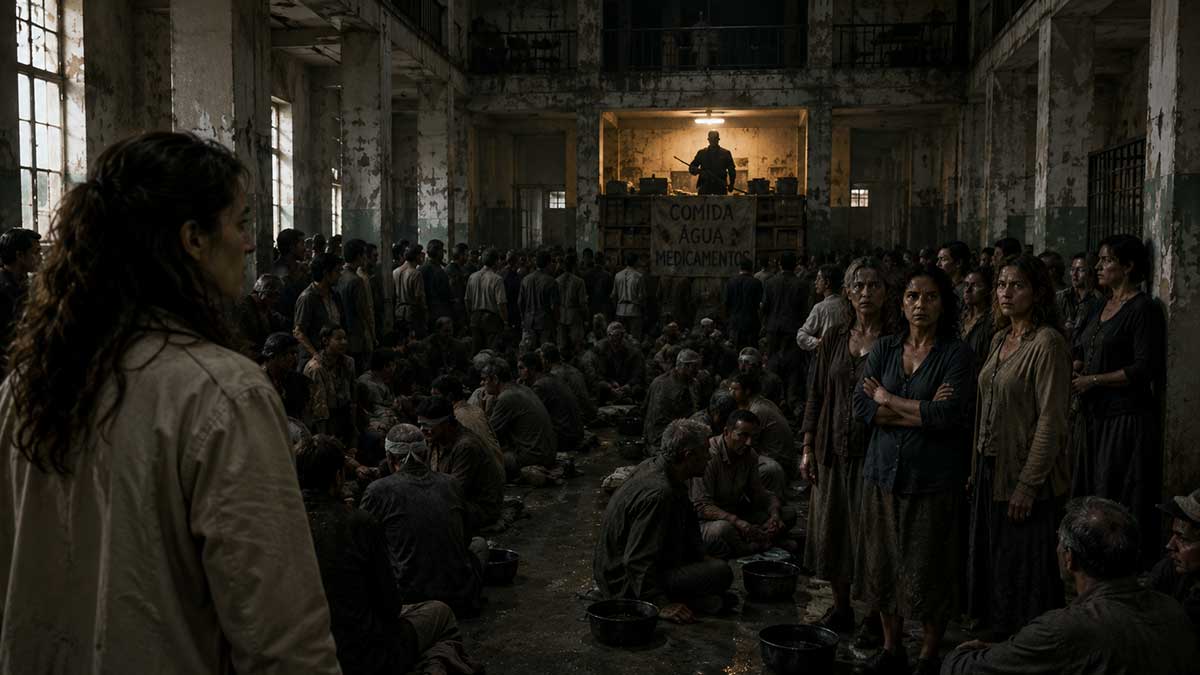
The dining hall had once belonged to patients no one expected to leave.
Now it belonged to the blind.
Metal tables stretched beneath fluorescent lights that had stopped working days earlier. The room smelled of damp clothing, spoiled food, urine, smoke, and fear.
At one end stood the doctor, his wife, the first blind man, the first blind man’s wife, and the girl with the dark glasses.
Across from them sat Hannah Arendt.
No one asked how she had entered the asylum.
By then, impossible arrivals seemed less strange than ordinary cruelty.
Somewhere beyond the locked doors, soldiers guarded the building.
Inside, people argued over bread.
Hannah Arendt: You call this collapse.
First Blind Man: What else would you call it?
Hannah Arendt: Revelation.
First Blind Man’s Wife: That sounds like a philosopher’s way of making suffering useful.
Hannah Arendt: Suffering does not become useful because we interpret it.
But interpretation may prevent us from lying about what happened.
Doctor: People were frightened.
They were hungry.
They had been abandoned.
Girl with the Dark Glasses: So were we.
We did not take food from children.
The doctor looked toward her voice.
Doctor: No.
Girl with the Dark Glasses: Then fear cannot be the whole explanation.
Doctor’s Wife: It never is.
At the far end of the hall, someone shouted.
A metal tray struck the floor.
The sound moved through the room, followed by silence.
Everyone had learned to listen for the difference between an accident and the beginning of violence.
First Blind Man: Before this, I believed rules mattered because people respected them.
Hannah Arendt: Most rules matter because consequences support them.
First Blind Man: That is a bleak view.
Hannah Arendt: It is incomplete, not bleak.
Some people obey because they believe in the rule.
Some because they fear punishment.
Some because everyone else appears to obey.
Remove law, witness, shame, and consequence, and you discover which kind of obedience you had.
First Blind Man’s Wife: And which kind did we have?
Hannah listened to the restless bodies beyond them.
Hannah Arendt: Less than you imagined.
A whistle sounded in the corridor.
Everyone stiffened.
The men in the third ward had begun using the whistle after seizing the food deliveries.
One whistle meant food had arrived.
Two meant the other wards should send representatives.
Three meant someone had resisted.
The whistle sounded again.
Twice.
Girl with the Dark Glasses: They want payment.
Doctor: We have nothing left.
First Blind Man: They took the watches.
The rings.
The money.
First Blind Man’s Wife: Money that is useless outside these walls.
Doctor’s Wife: It was never about usefulness.
Hannah Arendt: No.
It was about rule.
The doctor turned toward her.
Doctor: They are criminals taking advantage of disorder.
Hannah Arendt: Perhaps.
But criminals alone do not explain the obedience of everyone else.
First Blind Man: We obey because they have a gun.
Hannah Arendt: One gun.
How many people are in this building?
Doctor: Hundreds.
Hannah Arendt: Then why does one weapon rule hundreds?
No one answered.
Girl with the Dark Glasses: Because each person fears being the first to die.
First Blind Man’s Wife: And hopes someone else will resist.
Doctor’s Wife: That is how power grows.
Not only through what the powerful do.
Through what the frightened postpone.
The whistle sounded a third time.
A woman cried out in the corridor.
The doctor’s wife moved toward the door.
Her husband reached for her.
Doctor: Wait.
Doctor’s Wife: For what?
Doctor: We need to know what is happening.
Doctor’s Wife: Someone is crying.
Doctor: That does not tell us enough.
Girl with the Dark Glasses: It tells us someone is crying.
The doctor released his wife’s arm.
She left the hall.
The others listened to her footsteps disappear.
Hannah Arendt: Institutions often collapse before buildings do.
First Blind Man: What institution is left here?
Hannah Arendt: Responsibility.
The doctor’s wife returned with a teenage boy.
Blood ran from his nose.
He shook so badly that his teeth clicked.
Doctor: Sit him down.
The doctor examined him by touch.
Doctor: Who hit you?
The boy pointed toward the corridor.
Boy: They said I stole bread.
Girl with the Dark Glasses: Did you?
He nodded.
Boy: My mother has not eaten.
First Blind Man: Where is she?
Boy: Second ward.
Hannah Arendt: And who owned the bread?
The boy looked confused.
Boy: They did.
First Blind Man’s Wife: No.
They controlled it.
That is different.
Hannah Arendt: Civilization begins to disappear when control is mistaken for ownership.
Doctor: Civilization had already disappeared when the soldiers left us locked here.
Doctor’s Wife: They did not leave.
They stayed outside.
Girl with the Dark Glasses: Close enough to shoot anyone who approached the gate.
Far enough not to smell us.
Hannah Arendt: Administrative distance.
First Blind Man: What does that mean?
Hannah Arendt: The ability to participate in harm without experiencing oneself as cruel.
The soldiers tell themselves they are protecting the healthy.
Officials tell themselves quarantine is necessary.
Clerks count bodies.
Drivers leave food at the entrance.
Each person performs one limited task.
No one claims the whole result.
Doctor: They were trying to contain an epidemic.
Hannah Arendt: Necessary actions can still become immoral when no one remains answerable for their human consequences.
First Blind Man’s Wife: So everyone is guilty again.
Hannah Arendt: No.
Responsibility is not evenly distributed.
But it is often widely distributed.
They brought the boy to his mother.
The second ward was darker and more crowded. People lay across mattresses, blankets, cardboard, and bare floor.
The doctor’s wife guided the group between bodies.
The boy’s mother sat against a wall.
When he touched her face, she pulled him into her arms.
Mother: Where were you?
Boy: Getting food.
Mother: I told you not to go.
Boy: You told me you were not hungry.
The woman began to weep.
Girl with the Dark Glasses: Everyone says that when food is short.
The mother held out the stolen bread.
It was crushed and dirty.
She tore it in half.
One piece for the boy.
One for herself.
The boy tore his half again and passed a piece to a child beside him.
Hannah watched.
Hannah Arendt: Here civilization survives.
First Blind Man: In stolen bread?
Hannah Arendt: In division.
The men who control the food divide people by fear.
The boy divides bread by care.
Same action.
Different world.
Doctor: You make civilization sound very small.
Hannah Arendt: It is small.
That is why it can disappear quickly.
That is why it can begin again quickly too.
They returned to the dining hall.
The representatives from the wards had gathered.
A man from the third ward stood near the doorway with the gun.
No one knew whether it was loaded.
No one wanted to discover the answer.
Armed Man: Payment is finished.
Tomorrow, food costs more.
Murmurs spread across the room.
First Blind Man: We have nothing else.
Armed Man: Everyone has something.
The girl with the dark glasses went still.
The first blind man’s wife reached for her hand.
Doctor: What do you want?
The armed man smiled.
Armed Man: The women.
No one moved.
The sentence seemed to alter the air.
The doctor’s wife looked across the room at the men from the other wards.
Some lowered their heads.
Some stared toward the voice.
Some remained silent.
Girl with the Dark Glasses: Say it again.
The armed man laughed.
Armed Man: You heard me.
Girl with the Dark Glasses: I want everyone else to hear themselves not answering.
A man from another ward spoke.
Other Man: We need food.
First Blind Man’s Wife: So do the women.
Other Man: We all die if we refuse.
Girl with the Dark Glasses: And what dies if we agree?
Other Man: Dignity does not feed children.
Doctor’s Wife: Neither does surrender for long.
The armed man raised the gun.
The movement was small.
The room changed anyway.
Armed Man: Tomorrow.
He left.
No one followed.
For several minutes, the dining hall remained silent.
Then voices began.
Too many.
Too fast.
Man from First Ward: We cannot let everyone starve.
Woman from Second Ward: You mean you cannot let yourselves starve.
Older Man: Perhaps they will stop after once.
Girl with the Dark Glasses: Men who discover they can buy women with bread do not stop after once.
Doctor: We need a plan.
First Blind Man: Against a gun?
First Blind Man’s Wife: Against obedience.
Hannah Arendt: The first institution of tyranny is not the weapon.
It is the agreement that resistance is impossible.
Doctor: Resistance may get people killed.
Hannah Arendt: Submission may get people destroyed in another way.
First Blind Man: Easy to say when the gun is not pointed at you.
Hannah Arendt: It is never easy when the question becomes real.
Political thought written at a desk is cheap if it cannot survive fear.
Doctor’s Wife: Then let it survive this room.
She stood.
Doctor’s Wife: The women decide.
Not the husbands.
Not the ward leaders.
Not the men with children.
Not the men afraid of hunger.
The women.
A man near the wall protested.
Man: We are all affected.
Girl with the Dark Glasses: Our bodies are not public property simply because the food is.
First Blind Man’s Wife: Nor private payment for collective survival.
Doctor: My wife will not go.
The doctor’s wife turned toward him.
Doctor’s Wife: You do not decide that either.
He recoiled.
Doctor: I was protecting you.
Doctor’s Wife: Protection becomes possession very quickly when fear speaks through it.
The girl with the dark glasses nodded.
Girl with the Dark Glasses: That is how civilization collapses too.
Not only through open brutality.
Through people deciding for others and calling it necessity.
The women met in the first ward.
No men were invited.
The doctor’s wife, the first blind man’s wife, the girl with the dark glasses, the mother of the boy, and others sat in a circle.
Hannah remained near the wall.
Woman from Second Ward: I will go.
First Blind Man’s Wife: You do not have to.
Woman from Second Ward: My children need food.
Girl with the Dark Glasses: That does not make this a choice.
Woman from Second Ward: It is the only choice I have.
Hannah Arendt: Then it is coercion.
Woman from Second Ward: Give it any name you like.
My children will still be hungry.
The doctor’s wife knelt beside her.
Doctor’s Wife: No one will call you weak.
Woman from Second Ward: People always say that before they judge.
First Blind Man’s Wife: Then let us say something else.
You will not go alone.
The woman began to cry.
Girl with the Dark Glasses: Nor will we pretend this is sacrifice freely offered.
We will name what it is.
Hannah Arendt: Naming is a form of resistance.
Not enough by itself.
But necessary.
Doctor’s Wife: Tomorrow we go together.
The mother of the boy shook her head.
Mother: And after?
No one answered.
The doctor’s wife looked toward the corridor.
Doctor’s Wife: After, we decide whether survival without resistance is still survival.
The next day came without sunrise.
Inside the asylum, time was measured by hunger.
The women walked toward the third ward.
Men from their own wards stood along the corridor.
Some whispered encouragement.
Some remained silent.
Some wept.
The doctor tried to take his wife’s hand.
She let him hold it once.
Then released him.
Doctor: Come back.
Doctor’s Wife: Do not ask me to come back unchanged.
The girl with the dark glasses walked beside her.
Girl with the Dark Glasses: I used to think civilization meant privacy.
A door that locked.
A body that belonged to me.
A name no stranger could take.
First Blind Man’s Wife: What do you think now?
Girl with the Dark Glasses: Civilization is what other people refuse to take, even when they can.
Hannah followed behind them.
Hannah Arendt: That may be one of the clearest definitions I have heard.
They entered the ward.
The door closed.
Later, after the women returned, no one spoke for a long time.
The first blind man’s wife sat against the wall.
The girl with the dark glasses held the boy with the squint though he had not been there.
The doctor tried to approach his wife.
She raised one hand.
He stopped.
Not forever.
For that moment.
The doctor’s wife washed blood from another woman’s face.
Then another.
Then her own hands.
Doctor: I am sorry.
She looked at him.
Doctor’s Wife: For what?
He opened his mouth.
Nothing came.
Doctor’s Wife: Do not use sorrow as a substitute for knowing.
He sat beside her.
Not touching.
Doctor: I do not know how to know this.
Doctor’s Wife: Then stay until you do.
Hannah watched them.
Hannah Arendt: Civilization does not collapse once.
It collapses in permissions.
The permission to look away.
The permission to obey cruelty.
The permission to treat another body as a resource.
The permission to say necessity ended responsibility.
First Blind Man: And how does it return?
Hannah Arendt: In refusals.
Small ones first.
Then costly ones.
That night, the doctor’s wife found the scissors.
The women gathered around her.
No speech was made.
No plan was perfect.
No one believed courage would protect them from consequence.
Girl with the Dark Glasses: Are you afraid?
Doctor’s Wife: Yes.
First Blind Man’s Wife: Good.
The doctor’s wife looked at her.
First Blind Man’s Wife: People who feel no fear often confuse recklessness with courage.
Hannah Arendt: Courage is action taken in the presence of fear and uncertainty.
Not purity.
Not certainty.
Action.
The doctor’s wife closed her hand around the scissors.
Doctor’s Wife: Then tomorrow, something changes.
Girl with the Dark Glasses: Us?
Doctor’s Wife: Everything changes us.
I mean the rule.
The armed man died the following day.
The act was swift.
The consequences were not.
His death did not restore innocence.
It did not clean the wards.
It did not return the food already eaten or undo what had happened.
It broke the belief that the gun made resistance impossible.
The third ward erupted.
People fought.
The asylum burned.
Smoke entered every corridor.
The blind ran through heat, shouting names they did not possess.
The doctor’s wife led them toward the exit.
At the courtyard gate, soldiers were gone.
No one knew when they had left.
The outside world had collapsed too.
The first blind man stood beneath open sky.
First Blind Man: There is no government.
Doctor: No guards.
First Blind Man’s Wife: No food deliveries.
Girl with the Dark Glasses: No walls.
Hannah Arendt: Do not mistake the absence of walls for freedom.
Doctor’s Wife: What remains?
Hannah listened to the people gathering behind them.
Hundreds of frightened bodies.
No authority.
No map.
No promise.
Hannah Arendt: Whatever you are willing to build between yourselves.
They walked into the city.
Civilization had disappeared from the streets.
Yet an old woman shared rainwater from a bucket.
A man warned strangers about broken glass.
The girl with the dark glasses carried the boy with the squint when he could walk no farther.
The first blind man’s wife divided a piece of bread into portions too small to satisfy anyone.
The doctor treated an infected wound with torn cloth and boiled water.
His wife guided them all.
Not as ruler.
As witness.
At dusk, they sheltered beneath an apartment awning.
First Blind Man: So why did civilization collapse so quickly?
Doctor: Institutions failed.
First Blind Man’s Wife: Fear spread faster than trust.
Girl with the Dark Glasses: People discovered what they could take.
Doctor’s Wife: People waited for others to resist.
Hannah Arendt: And many had mistaken order for morality.
A functioning city had hidden that difference.
The first blind man leaned against the wall.
First Blind Man: Then was civilization ever real?
Hannah Arendt: A fragile thing is still real.
A promise is fragile.
Trust is fragile.
A child is fragile.
Their fragility does not make them false.
Doctor: It makes them dependent on care.
Hannah Arendt: Yes.
Civilization is not a machine that continues once built.
It is a relationship renewed through conduct.
Girl with the Dark Glasses: Every day?
Hannah Arendt: Every encounter.
The boy with the squint slept against her shoulder.
She adjusted his head so his neck would not ache.
Girl with the Dark Glasses: That sounds exhausting.
Doctor’s Wife: It is.
First Blind Man’s Wife: So is living among ruins.
Rain began to fall.
The doctor’s wife placed bowls, jars, and broken cups beneath the awning to collect water.
Everyone helped.
No one ordered them.
Hannah listened to the quiet movements.
Hannah Arendt: There.
First Blind Man: What?
Hannah Arendt: Civilization returning.
The first blind man laughed bitterly.
First Blind Man: In rainwater?
Hannah Arendt: In people collecting it for someone besides themselves.
The bowls slowly filled.
No law required sharing.
No soldier watched.
No punishment waited.
For that night, they divided the water anyway.
And in a city without sight, government, or certainty, that small decision became the beginning of order.
Topic 3: Can Compassion Survive Extreme Suffering?
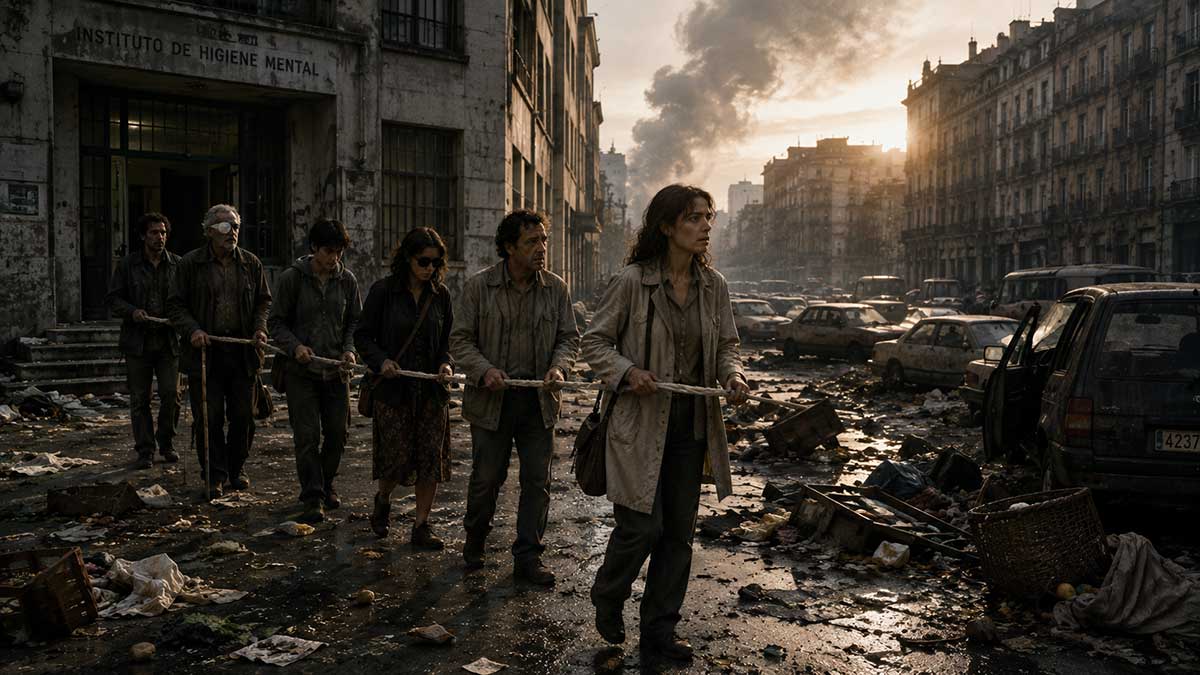
The rain had stopped before dawn.
Water still dripped from balconies, gutters, and broken signs, tapping the street with the patience of a clock that no one could see.
The group had taken shelter inside an abandoned pharmacy.
Shelves had been emptied. Medicine cartons lay crushed beneath their feet. A faded poster on the wall showed a smiling family beneath words promising health, safety, and care.
The boy with the squint slept on a pile of folded coats.
The girl with the dark glasses sat beside him.
The doctor’s wife stood near the doorway, watching the street.
At her feet lay the Dog of Tears.
He had followed her since finding her outside a house, bent beneath everything she had witnessed. He had licked the tears from her face without asking what had caused them.
Across the room sat Viktor Frankl.
He held an empty medicine bottle in one hand, turning it slowly between his fingers.
Viktor Frankl: People often speak of suffering as though it improves character.
Girl with the Dark Glasses: It did not improve everyone in the asylum.
Doctor’s Wife: It gave some people permission to become worse.
Viktor Frankl: Suffering does not automatically make anyone noble.
It can deepen a person.
It can destroy a person.
It can narrow the world until only hunger remains.
Girl with the Dark Glasses: Then why do some people still care?
Viktor Frankl: That may be the question that matters most.
The boy stirred.
His hand moved across the floor, searching.
The girl placed her fingers inside his.
He settled again.
Frankl watched.
Viktor Frankl: Perhaps the first answer is there.
Girl with the Dark Glasses: Where?
Viktor Frankl: You held his hand before deciding whether compassion was possible.
She looked down.
Girl with the Dark Glasses: He was frightened.
Viktor Frankl: Yes.
Girl with the Dark Glasses: Anyone would have done it.
The doctor’s wife turned from the doorway.
Doctor’s Wife: No.
Not anyone.
The girl’s expression tightened.
Girl with the Dark Glasses: That makes it sound heroic.
Doctor’s Wife: It was not heroic.
It was human.
That is rarer than heroism.
A sound rose from the street.
Someone calling.
Not loudly.
The voice had lost the strength for that.
The doctor’s wife stepped outside.
The Dog of Tears followed.
The girl rose, careful not to wake the boy, and joined them.
Frankl came last.
Across the road, a man sat against a wall.
His clothes were soaked. One shoe was missing. His head leaned forward as though sleep had become heavier than his body could carry.
Man: Water.
The doctor’s wife looked at the bottle in her hand.
Less than half remained.
Girl with the Dark Glasses: We need that.
Doctor’s Wife: I know.
Girl with the Dark Glasses: The boy has had almost nothing.
Doctor’s Wife: I know.
The man lifted his face.
His eyes were white with blindness.
Man: Please.
The girl tightened her grip on the bottle.
Girl with the Dark Glasses: There will always be one more person.
Viktor Frankl: Yes.
Girl with the Dark Glasses: Then how do we choose?
Viktor Frankl: Compassion is often described as feeling another person’s pain.
But pain alone does not tell us what action is right.
Doctor’s Wife: We cannot save everyone.
Viktor Frankl: No.
Girl with the Dark Glasses: Then compassion fails.
Viktor Frankl: Only if you define compassion as total rescue.
The doctor’s wife knelt beside the man.
She gave him one mouthful.
Then another.
She stopped before the bottle was empty.
Doctor’s Wife: There is a child inside.
The man nodded.
Man: Thank you.
She stood.
The girl looked at the remaining water.
Girl with the Dark Glasses: Was that enough?
Doctor’s Wife: No.
Girl with the Dark Glasses: Was it right?
Doctor’s Wife: I do not know.
Frankl placed the empty medicine bottle beside the man.
Viktor Frankl: Meaning does not always come from certainty.
Sometimes it comes from refusing to let uncertainty become an excuse for doing nothing.
They returned to the pharmacy.
The boy was awake.
Boy with the Squint: Where did you go?
Girl with the Dark Glasses: Across the street.
Boy with the Squint: Did you leave me?
Girl with the Dark Glasses: For one minute.
Boy with the Squint: You said you would stay.
She sat beside him.
Girl with the Dark Glasses: I came back.
Boy with the Squint: My mother said that too.
The room went quiet.
The girl touched his hair.
Girl with the Dark Glasses: I am not your mother.
Boy with the Squint: I know.
His voice carried the disappointment of someone who had already lost too much.
Girl with the Dark Glasses: I cannot promise that I will never leave the room.
But I will tell you when I go.
And I will try to return.
The boy considered this.
Boy with the Squint: Is trying a promise?
Viktor Frankl: It may be the most honest kind.
The boy turned his face toward the unfamiliar voice.
Boy with the Squint: Who are you?
Viktor Frankl: A man who learned that promises become precious when the future is uncertain.
Boy with the Squint: Can you see?
Viktor Frankl: In some ways.
Not in all.
The boy nodded as though that answer made sense.
Later, they searched nearby apartments for food.
The doctor’s wife entered first.
The others followed by holding a rope made from knotted sheets.
In one kitchen, they found three potatoes, a jar of salt, and a tin of sardines.
The girl with the dark glasses laughed.
Girl with the Dark Glasses: A feast.
Doctor’s Wife: For four people.
The Dog of Tears sat near the doorway.
Girl with the Dark Glasses: Five.
Doctor’s Wife: He has eaten nothing.
Girl with the Dark Glasses: Neither have we.
The boy knelt and touched the dog’s face.
The dog licked his fingers.
Boy with the Squint: He is hungry.
Girl with the Dark Glasses: Everyone is hungry.
Boy with the Squint: Then he should eat too.
The girl opened the sardines.
The smell filled the room.
She divided the fish.
One portion for the boy.
One for the doctor’s wife.
One for Frankl.
One for herself.
A smaller piece for the dog.
The dog did not eat immediately.
He sniffed it, then looked toward the boy.
Boy with the Squint: It is yours.
The dog waited.
Doctor’s Wife: He wants you to eat first.
The boy took a bite.
Only then did the dog eat.
Frankl watched them.
Viktor Frankl: Compassion does not always move downward from the strong to the weak.
Sometimes two vulnerable beings keep one another alive.
Girl with the Dark Glasses: He is only a dog.
The Dog of Tears lifted his head.
Doctor’s Wife: He may disagree.
Girl with the Dark Glasses: You know what I mean.
Doctor’s Wife: I do.
But the word “only” has caused much suffering.
Only a woman.
Only a child.
Only an old man.
Only one blind person among thousands.
Viktor Frankl: Compassion begins when “only” loses its authority.
They cooked the potatoes in a dented metal pot over a small fire.
The smell drew people from nearby rooms.
A woman appeared at the door with two children.
Behind her stood an elderly man.
Then another couple.
The girl with the dark glasses heard them gathering.
Girl with the Dark Glasses: We cannot feed all of them.
Doctor’s Wife: No.
Woman at the Door: We smelled food.
Girl with the Dark Glasses: It is almost nothing.
Woman at the Door: Almost nothing is more than nothing.
The doctor’s wife looked into the pot.
Four potatoes had become soup through water and salt.
Thin soup.
Still food.
Doctor’s Wife: Bring cups.
People returned carrying jars, bowls, cracked mugs, and one child’s toy bucket.
The girl leaned closer to the doctor’s wife.
Girl with the Dark Glasses: There will not be enough for the boy.
Doctor’s Wife: He will get some.
Girl with the Dark Glasses: How much?
Doctor’s Wife: Less than he needs.
The girl stood.
Girl with the Dark Glasses: Then close the door.
Everyone heard her.
The woman at the entrance lowered her head.
Girl with the Dark Glasses: I am sorry.
But we found this.
The boy is ours.
Doctor’s Wife: Is he?
The girl turned.
Girl with the Dark Glasses: We care for him.
Doctor’s Wife: Yes.
Girl with the Dark Glasses: Then he comes first.
Doctor’s Wife: Is that compassion?
Girl with the Dark Glasses: It is survival.
Viktor Frankl: The two are not enemies.
But neither should pretend to be the other.
The girl’s face hardened.
Girl with the Dark Glasses: What would you do?
Viktor Frankl: I would give the boy his portion first.
Then divide what remained.
Girl with the Dark Glasses: That is unfair.
Viktor Frankl: Fairness is difficult when resources cannot meet need.
Woman at the Door: We are not asking for equal portions.
Only something warm.
The boy tugged the girl’s sleeve.
Boy with the Squint: I can have less.
Girl with the Dark Glasses: No.
Boy with the Squint: Why?
Girl with the Dark Glasses: You are a child.
Boy with the Squint: So are they.
The words struck harder than accusation.
The girl covered her eyes behind the dark glasses.
Girl with the Dark Glasses: I hate this.
Doctor’s Wife: I know.
Girl with the Dark Glasses: I hate that kindness becomes arithmetic.
Viktor Frankl: Scarcity forces moral choices into numbers.
How many mouths.
How many portions.
How many hours until the next meal.
Yet the numbers do not erase the persons.
The girl removed her glasses.
Her eyes were irritated and red.
She looked toward the doorway though she could see nothing.
Girl with the Dark Glasses: Give the boy a full cup.
Then everyone else shares what remains.
The doctor’s wife nodded.
No one celebrated.
The soup was divided.
Each person received two or three warm mouthfuls.
It was not enough.
Yet the room changed as they ate.
People gave names no one would remember.
One woman laughed at how ridiculous the toy bucket looked beside the porcelain cups.
The elderly man told the children that potato skins were the finest part because kings had foolishly thrown them away.
The children believed him long enough to finish theirs.
Viktor Frankl: There is another answer.
Girl with the Dark Glasses: To what?
Viktor Frankl: How compassion survives suffering.
Through imagination.
Doctor’s Wife: Imagination cannot create food.
Viktor Frankl: No.
But it can create a human moment around insufficient food.
Girl with the Dark Glasses: Does that matter to a starving person?
The elderly man raised his empty cup.
Elderly Man: It mattered to me.
That afternoon, they heard fighting in the street.
Two men struggled over a bag.
One fell.
The other kicked him repeatedly.
The doctor’s wife ran outside.
Doctor’s Wife: Stop!
The standing man turned.
He held a sack against his chest.
Man with the Sack: Stay away.
Doctor’s Wife: You will kill him.
Man with the Sack: He tried to steal my food.
Fallen Man: It was mine.
Man with the Sack: Liar.
The girl with the dark glasses came behind the doctor’s wife.
The boy stayed inside with Frankl and the dog.
Doctor’s Wife: Open the sack.
Man with the Sack: No.
Doctor’s Wife: I can see.
The man froze.
Man with the Sack: You are lying.
Doctor’s Wife: There are two loaves inside.
Three tins.
A bottle.
The man stepped backward.
Fear moved through him.
Not fear of violence.
Fear of being witnessed.
Man with the Sack: It is mine.
Fallen Man: We found it together.
Man with the Sack: I carried it.
Fallen Man: You said we would divide it.
Girl with the Dark Glasses: Did you?
The standing man gripped the sack.
Man with the Sack: He would have taken more.
Fallen Man: You took everything.
Doctor’s Wife: Give him half.
Man with the Sack: Who made you judge?
Doctor’s Wife: No one.
Man with the Sack: Then move.
He raised one arm as though he might strike her.
The Dog of Tears appeared in the doorway and growled.
The man stopped.
Girl with the Dark Glasses: He sees you.
The man laughed nervously.
Man with the Sack: He is an animal.
Girl with the Dark Glasses: Yes.
And he knows what you are about to do.
The man lowered his arm.
He opened the sack.
He threw one loaf and one tin toward the fallen man.
Then left.
The fallen man reached for the food.
Doctor’s Wife: Are you badly hurt?
Fallen Man: Not badly enough to stop eating.
She helped him sit.
Girl with the Dark Glasses: You frightened the other man.
Doctor’s Wife: The dog did.
The Dog of Tears sniffed the fallen man’s face.
Girl with the Dark Glasses: Does compassion need fear to protect it?
Viktor Frankl: Sometimes.
He had joined them.
Girl with the Dark Glasses: That sounds contradictory.
Viktor Frankl: A boundary can protect compassion from becoming helplessness.
Doctor’s Wife: I killed a man in the asylum.
Viktor Frankl: Yes.
Doctor’s Wife: Was that compassion?
Viktor Frankl: It may have been protection.
Do not force every necessary act into one virtue.
Doctor’s Wife: I wanted to stop him.
I wanted him dead.
Both were true.
Viktor Frankl: Human motives are rarely pure.
The demand for purity can prevent moral action.
Girl with the Dark Glasses: Then anything can be justified.
Viktor Frankl: No.
Impurity of motive does not remove responsibility.
It deepens the need for honesty.
Back in the pharmacy, the boy sat with the Dog of Tears.
His arms were around the animal’s neck.
Boy with the Squint: Was someone hurt?
Girl with the Dark Glasses: Yes.
Boy with the Squint: Did you help?
Girl with the Dark Glasses: We tried.
Boy with the Squint: Did it work?
She hesitated.
Girl with the Dark Glasses: A little.
The boy nodded.
Boy with the Squint: A little is still something.
Frankl smiled.
Viktor Frankl: Children often accept incomplete goodness better than adults.
Doctor’s Wife: Adults know what remains undone.
Viktor Frankl: And sometimes use that knowledge to despise what was done.
The girl sat near the boy.
Girl with the Dark Glasses: Before all this, I did not think of myself as compassionate.
Doctor’s Wife: What did you think you were?
Girl with the Dark Glasses: Careful.
Independent.
Good at leaving before anyone expected something.
Boy with the Squint: You did not leave me.
She looked at him.
Girl with the Dark Glasses: No.
Boy with the Squint: Why?
She almost answered quickly.
Then stopped.
Girl with the Dark Glasses: At first, I felt sorry for you.
Later, I needed you to need me.
Boy with the Squint: Is that bad?
Girl with the Dark Glasses: I do not know.
Viktor Frankl: Love often begins mixed with need.
The question is whether we allow the other person to remain separate.
The girl touched the boy’s cheek.
Girl with the Dark Glasses: When your mother comes back, you will leave with her.
The boy’s mouth trembled.
Boy with the Squint: Do you want me to?
Girl with the Dark Glasses: I want you to find her.
Boy with the Squint: That is not what I asked.
She drew a breath.
Girl with the Dark Glasses: No.
I do not want you to leave.
But I would let you.
The boy leaned against her.
Viktor Frankl: There.
Girl with the Dark Glasses: What now?
Viktor Frankl: Compassion that does not become possession.
Night came early beneath the clouds.
They lit one candle.
The pharmacy windows reflected the small flame, making it appear that several candles burned outside in the darkness.
The doctor’s wife sat on the floor.
The Dog of Tears rested his head in her lap.
She stroked one ear.
Doctor’s Wife: I used to believe compassion meant staying gentle.
Viktor Frankl: And now?
Doctor’s Wife: Sometimes gentleness is impossible.
I have shouted.
Threatened.
Lied.
Killed.
Dragged people who resisted being saved.
Girl with the Dark Glasses: Yet you stayed.
Doctor’s Wife: Staying is not always compassionate.
Sometimes people stay to control.
Sometimes from guilt.
Sometimes from fear of being alone.
Viktor Frankl: Why did you stay?
She looked at her sleeping husband in the next room.
Doctor’s Wife: At first, for him.
Then for all of you.
Then because leaving would have made what I saw unbearable.
Viktor Frankl: Meaning can arise from responsibility toward another person.
Doctor’s Wife: Does meaning justify suffering?
Viktor Frankl: No.
Suffering needs no justification.
Meaning does not make cruelty acceptable.
It helps a person decide what remains possible inside conditions they did not choose.
Girl with the Dark Glasses: And what remains possible?
Viktor Frankl: A stance.
A gesture.
A refusal.
A piece of bread divided.
A hand held.
A truth spoken.
Doctor’s Wife: Small things.
Viktor Frankl: Human life is built from small things.
So is inhumanity.
The Dog of Tears lifted his head.
A sound came from outside.
A woman sobbing.
The dog stood and walked toward the door.
Girl with the Dark Glasses: He always goes to tears.
Doctor’s Wife: Perhaps he trusts them.
Viktor Frankl: Tears reveal need without argument.
The dog disappeared into the street.
They heard his paws moving over wet pavement.
Then silence.
Boy with the Squint: Will he come back?
Doctor’s Wife: He usually does.
Boy with the Squint: Usually is not a promise.
The doctor’s wife smiled sadly.
Doctor’s Wife: No.
It is hope with memory.
The dog returned after several minutes.
A woman followed him.
She held a baby against her chest.
Woman with the Baby: He found me.
The doctor’s wife stood.
The baby did not cry.
That frightened her more than crying would have.
Doctor’s Wife: Give the child to me.
The woman hesitated.
Woman with the Baby: I cannot.
Doctor’s Wife: I only need to examine her.
Woman with the Baby: She is mine.
Girl with the Dark Glasses: No one is taking her.
The woman slowly released the child.
The doctor’s wife touched the baby’s forehead.
Doctor’s Wife: Fever.
Viktor Frankl: Can we help?
Doctor’s Wife: Perhaps.
She searched the pharmacy shelves again.
Empty cartons.
Broken bottles.
Then she found a sealed packet beneath a cabinet.
She checked the label.
Doctor’s Wife: Fever medicine for infants.
The mother began to cry harder.
Woman with the Baby: Thank God.
The doctor’s wife looked at the Dog of Tears.
Doctor’s Wife: Thank him first.
The dog sat near the doorway, licking rain from one paw.
The girl gave him the last piece of sardine.
Girl with the Dark Glasses: For services rendered.
The baby’s breathing eased before midnight.
The mother slept with the child against her.
The boy slept beside the girl.
The dog lay between both families.
Frankl remained awake with the doctor’s wife.
Doctor’s Wife: Was compassion easier before the epidemic?
Viktor Frankl: It may have been cheaper.
Doctor’s Wife: Cheaper?
Viktor Frankl: A kind word when one is safe.
A donation from abundance.
Patience when rested.
These acts still matter.
But crisis reveals what care costs.
Doctor’s Wife: And if the cost is too high?
Viktor Frankl: Every person has limits.
Compassion that denies human limits may become another cruelty.
Doctor’s Wife: Then we are allowed to stop?
Viktor Frankl: We are allowed to be human.
To rest.
To fail.
To admit resentment.
To ask others to carry what we cannot.
Doctor’s Wife: There was no one else who could see.
Viktor Frankl: That was your tragedy.
Doctor’s Wife: My privilege too.
Viktor Frankl: Yes.
She looked toward the sleeping group.
Doctor’s Wife: I resented them.
All of them.
For needing me.
Then I hated myself for the resentment.
Viktor Frankl: Care without resentment is sometimes possible.
Care without exhaustion is not always possible.
Doctor’s Wife: Does resentment corrupt the care?
Viktor Frankl: Not if you refuse to let resentment decide another person’s worth.
She leaned back against the wall.
For the first time that day, she closed her eyes.
Doctor’s Wife: I want one hour in which no one needs me.
Viktor Frankl: Then sleep.
Doctor’s Wife: Who will watch?
The girl with the dark glasses spoke from the darkness.
Girl with the Dark Glasses: I will.
The doctor’s wife opened her eyes.
Girl with the Dark Glasses: I cannot see.
But I can listen.
The doctor’s wife began to protest.
The girl raised one hand.
Girl with the Dark Glasses: You taught us that seeing is more than eyes.
Do not take the lesson back when it inconveniences you.
The doctor’s wife laughed softly.
Then lay down beside the Dog of Tears.
Near dawn, she woke.
The girl remained at the doorway.
The boy slept behind her.
Doctor’s Wife: Did anything happen?
Girl with the Dark Glasses: A man passed.
Two dogs fought.
The baby cried once.
Someone sang three streets away.
Doctor’s Wife: You stayed awake all night?
Girl with the Dark Glasses: Most of it.
Doctor’s Wife: Why?
Girl with the Dark Glasses: Because you needed me.
The doctor’s wife looked away.
Her eyes filled.
The Dog of Tears stood and licked her face.
Girl with the Dark Glasses: He has terrible timing.
Doctor’s Wife: No.
He has the only timing left that I trust.
Frankl stirred.
Viktor Frankl: Then can compassion survive extreme suffering?
The girl looked toward the sleeping boy.
The doctor’s wife looked toward the mother and baby.
The dog rested between them.
Girl with the Dark Glasses: It survives badly.
Viktor Frankl: What do you mean?
Girl with the Dark Glasses: Tired.
Angry.
Afraid.
Sometimes unfair.
Sometimes late.
The doctor’s wife nodded.
Doctor’s Wife: It survives without purity.
Viktor Frankl: And is that enough?
The boy woke and reached for the girl’s hand.
The baby began crying.
The Dog of Tears stood.
The doctor’s wife rose to prepare the medicine.
No one answered Frankl immediately.
Then the girl said:
Girl with the Dark Glasses: It has to be.
Outside, the city remained ruined.
No institution had returned.
No explanation had arrived.
Hunger waited.
Fear waited.
Death had not gone anywhere.
Yet inside the abandoned pharmacy, one exhausted woman watched so another could sleep.
A child shared warmth with a dog.
A stranger’s baby received medicine saved by chance.
Compassion had not defeated suffering.
It had done something smaller.
It had prevented suffering from becoming the only truth in the room.
Topic 4: What Does It Mean to Truly See Another Person?
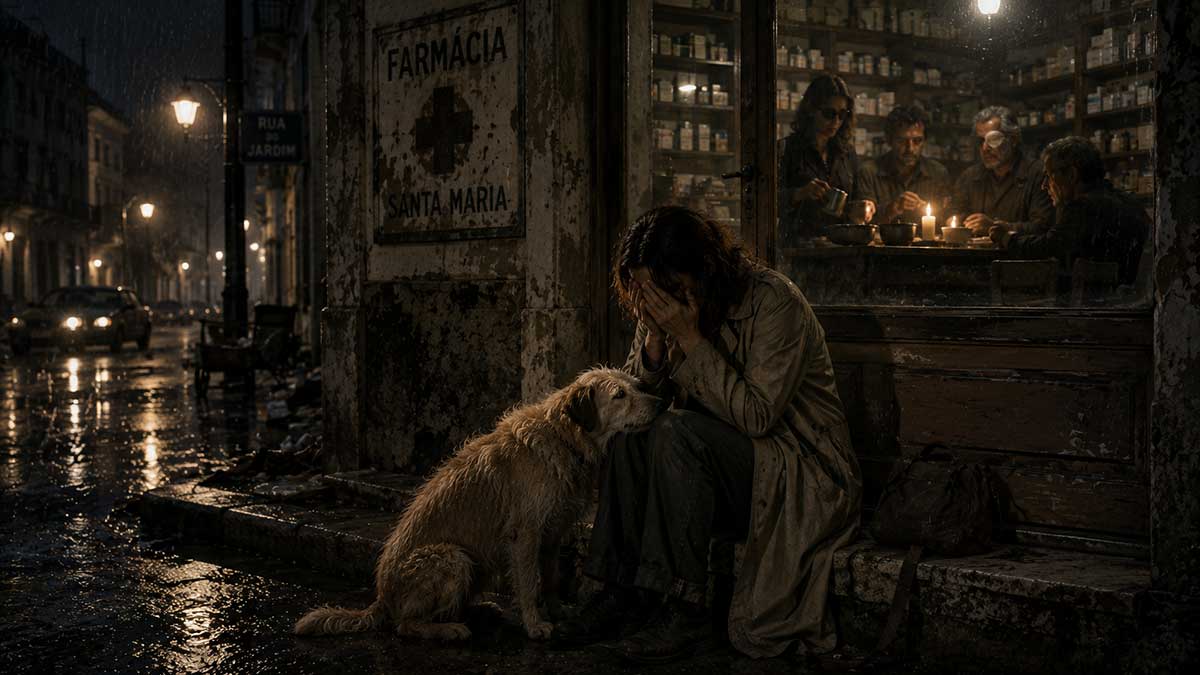
The apartment still smelled of soap.
That alone made it feel luxurious.
The doctor’s wife had found water in the building’s rooftop tank. She had filled every pot, basin, bottle, and cup she could carry. For one evening, the group washed their hands, faces, and clothes.
The doctor shaved by touch.
The old man with the eye patch trimmed his beard unevenly.
No one complained.
Afterward, they gathered in the living room.
A white curtain moved beside the open window. Beyond it, the city remained blind, hungry, and strangely quiet.
The doctor’s wife sat near the window.
Her husband sat beside her.
The old man occupied an armchair facing no particular direction.
Across from them sat Martin Buber and Simone Weil.
Between the chairs stood a small table bearing five cups of water.
No one drank at first.
Doctor: We have spent days speaking about sight as morality.
Yet I remain uneasy.
Eyes are organs.
Vision is a neurological process.
When we turn blindness into a symbol, we risk insulting people whose blindness is physical rather than moral.
Simone Weil: That risk is real.
Martin Buber: Then the distinction must remain clear.
A person who cannot see with the eyes may still meet another person fully.
A person with perfect vision may never truly meet anyone.
Old Man with the Eye Patch: I had partial sight before the epidemic.
People often spoke louder to me, as though one damaged eye had weakened my hearing.
Doctor’s Wife: Or your mind.
Old Man with the Eye Patch: Yes.
Some people looked at the patch and stopped looking for the person behind it.
Doctor: That is prejudice, not blindness.
Simone Weil: Prejudice is one form of failed attention.
Doctor: Attention.
That word appears often in moral philosophy.
What does it mean here?
Simone Weil: To look at another person without forcing them into the shape of your need, fear, pity, or judgment.
Martin Buber: To encounter a person as a “Thou,” not an “It.”
The doctor shifted in his chair.
Doctor: Explain that without philosophical language.
Martin Buber: When I treat you as an object, I ask what use you have.
What category you fit.
What danger you pose.
What role you perform.
When I meet you as a person, I accept that you exceed every description I can give.
Doctor’s Wife: Even “husband.”
Martin Buber: Especially “husband.”
The doctor looked toward her.
Doctor: Have I reduced you to “wife”?
She did not answer quickly.
Doctor’s Wife: At times.
Doctor: When?
Doctor’s Wife: In the asylum, you depended on me without knowing the full extent of what I carried.
You saw the person guiding you.
You did not always see the person becoming exhausted.
Doctor: You hid your sight.
Doctor’s Wife: Yes.
Doctor: Then how could I see what you refused to reveal?
Simone Weil: Here is the difficulty.
To see another person does not mean to know every hidden fact.
It means to remain alert to the possibility that the person before you carries more than you know.
The doctor lowered his head.
Doctor: I thought dependence had made me helpless.
I did not consider what my helplessness demanded from her.
Doctor’s Wife: I did not tell you.
Doctor: You should not have needed to tell me everything.
Martin Buber: There.
A meeting begins.
Not with complete knowledge.
With the recognition that another person has an interior life not created for your use.
A sound came from the kitchen.
A cup fell.
The doctor’s wife rose.
The old man lifted one hand.
Old Man with the Eye Patch: Leave it.
Doctor’s Wife: It may have broken.
Old Man with the Eye Patch: Then it is already broken.
Sit.
She remained standing.
Old Man with the Eye Patch: You rise every time something falls.
Doctor’s Wife: I can see where it fell.
Old Man with the Eye Patch: That does not mean you must retrieve everything.
She slowly sat again.
The old man smiled.
Old Man with the Eye Patch: I heard only one cup.
We still have four.
Doctor: Five.
Old Man with the Eye Patch: Then we are richer than I thought.
Simone Weil: Care can become a habit so complete that the caregiver disappears from her own attention.
Doctor’s Wife: Is that wrong?
Simone Weil: Self-erasure is not the same as love.
Doctor’s Wife: People needed me.
Simone Weil: Need can become endless.
If love requires one person to cease existing as a separate being, then something has gone wrong.
Martin Buber: A true relationship contains two presences.
Not one subject and one instrument.
Doctor: Did I make her an instrument?
Doctor’s Wife: Not alone.
The asylum did.
The epidemic did.
My own secrecy did.
Every person who reached for my hand without asking whether it was already holding someone else did.
Old Man with the Eye Patch: Including me.
She turned toward him.
Old Man with the Eye Patch: I listened for your steps.
When I heard them, I felt safe.
I never asked whether you were safe.
The doctor’s wife looked down at her hands.
Doctor’s Wife: I resented that.
Old Man with the Eye Patch: I know now.
Doctor’s Wife: You could not have known then.
Old Man with the Eye Patch: Perhaps not.
But I could have asked.
Martin Buber lifted his cup.
He held it near his mouth, then set it down again.
Martin Buber: Most human relationships move between two modes.
In one, the other person becomes part of our world.
Useful.
Necessary.
Familiar.
Named.
In the other, the person stands before us as a presence we cannot fully possess.
Doctor: We cannot live permanently in that second mode.
We need roles.
The doctor.
The patient.
The wife.
The stranger.
Martin Buber: Yes.
Daily life requires categories.
The danger begins when the category replaces the person.
Doctor’s Wife: In the quarantine, everyone became “the blind.”
Old Man with the Eye Patch: Not citizens.
Not parents.
Not workers.
Not old or young.
Only blind.
Simone Weil: Misfortune often strips people of social identity.
Then those who remain safe begin seeing only the misfortune.
Doctor: A patient becomes a disease.
Doctor’s Wife: A refugee becomes a border problem.
Old Man with the Eye Patch: A starving person becomes a threat to food.
Martin Buber: A woman becomes a body.
The room went silent.
No one needed to ask what he meant.
Doctor’s Wife: In the third ward, the men did not see the women.
They saw payment.
Simone Weil: They converted persons into means.
That is one of cruelty’s oldest movements.
Doctor: Yet those same men were frightened and hungry.
Simone Weil: Suffering can make a person more attentive to suffering.
It can make a person less attentive too.
Pain narrows vision.
The suffering person may begin seeing everyone else only in relation to relief.
Old Man with the Eye Patch: So victims can become cruel.
Simone Weil: Yes.
Victimhood does not grant moral purity.
Nor does wrongdoing erase every wound in the wrongdoer.
Doctor’s Wife: That is hard to accept.
Simone Weil: Reality often is.
Attention does not excuse.
It refuses simplification.
The curtain lifted again.
A child’s voice sounded from the street below.
The doctor’s wife stood.
This time no one stopped her.
She walked to the window.
A girl stood beside the building entrance, calling for her father.
Doctor’s Wife: A child is alone.
Doctor: Can you see anyone near her?
Doctor’s Wife: No.
She opened the apartment door.
Simone Weil: Go.
The doctor’s wife paused.
Simone Weil: Attention is not contemplation alone.
Sometimes it becomes movement.
They descended the stairs together.
The child stood beside a lamppost, gripping a red scarf.
She was perhaps eight years old.
Her eyes had recently regained sight.
Terror filled them.
Child: Have you seen my father?
Doctor’s Wife: What does he look like?
Child: Tall.
Gray coat.
He coughs.
The doctor knelt.
Doctor: What is his name?
The child hesitated.
Child: Father.
The old man with the eye patch smiled sadly.
Old Man with the Eye Patch: That may be enough for her.
Doctor: Where did you last see him?
Child: Near the bakery.
Then I could see again.
He could not.
I let go of his coat.
There were people.
I called.
He did not answer.
Doctor’s Wife: We will help you look.
Child: Promise?
No one answered at once.
The doctor’s wife crouched until their faces were level.
Doctor’s Wife: I promise we will look.
I cannot promise we will find him.
The child began to cry.
Child: That is not a good promise.
Martin Buber: It is a promise that respects you.
The child turned toward his voice.
Child: Who are you?
Martin Buber: Someone who believes you deserve the truth.
She wiped her face with the scarf.
Child: Then tell me if he is dead.
Doctor: We do not know.
Child: Everyone keeps saying that.
Simone Weil: Not knowing is painful.
Being lied to would make you more alone.
The girl took the doctor’s wife’s hand.
Child: Then do not leave me alone.
Doctor’s Wife: I will stay with you until we know what comes next.
They walked toward the bakery.
The child led by memory.
The doctor’s wife led by sight.
The others followed by sound and touch.
At each corner, the girl described what she remembered.
A blue door.
A broken fountain.
A fruit stand.
Most landmarks had changed.
The fruit stand had become a heap of crates.
The fountain held rainwater and paper.
The blue door had burned.
Child: Maybe this is not the right street.
Doctor’s Wife: It may be.
Child: I knew it before.
Old Man with the Eye Patch: Fear rearranges places.
Child: Were you afraid?
Old Man with the Eye Patch: Very.
Child: Did you get lost?
Old Man with the Eye Patch: Repeatedly.
Child: Did someone find you?
He thought.
Old Man with the Eye Patch: People found parts of me.
The girl frowned.
Child: What does that mean?
Old Man with the Eye Patch: One person gave me food.
Another helped me cross a room.
Another listened when I spoke.
No one could restore everything.
Together, they kept me from disappearing.
The child held the red scarf tighter.
Child: My father says people disappear only when no one remembers where they belong.
The doctor’s wife looked at the empty street.
Doctor’s Wife: Your father is wise.
Child: He is a baker.
Martin Buber: The two are not enemies.
They reached the bakery.
Its windows were broken.
Flour covered part of the floor like pale dust.
Behind the counter lay empty baskets, a wooden peel, and a ledger.
The child called.
Child: Father!
No answer.
She called again.
The old man listened.
Old Man with the Eye Patch: Someone is breathing.
They went behind the counter.
A man lay near the ovens.
He wore a gray coat.
The child ran to him.
Child: Father!
The doctor knelt.
He touched the man’s neck.
Doctor: Alive.
Weak pulse.
Dehydrated.
The man’s eyes opened.
They remained clouded with white blindness.
Father: Mika?
Child: I am here.
She placed his hand against her face.
Father: You can see?
Child: Yes.
Father: Then you found me.
Child: They found both of us.
The father turned his face toward the group.
Father: Thank you.
Doctor’s Wife: Your daughter led us.
Father: She is eight.
Child: I knew the bakery.
Father: You knew the way.
Child: Not all of it.
The doctor’s wife knew the rest.
Martin Buber: Finding often belongs to more than one person.
The father tried to sit.
The doctor supported him.
Father: I am sorry.
Doctor: For what?
Father: I lost her.
Child: I let go.
Father: I should have held tighter.
Child: I should have called louder.
Simone Weil: Misfortune makes people assign blame to themselves because blame feels more orderly than chance.
The father looked toward her voice.
Father: Someone must be responsible.
Simone Weil: Responsibility and total control are not the same.
You can be responsible for loving her.
You cannot control every crowd, every illness, every moment of panic.
Child: Are you saying no one did anything wrong?
Simone Weil: I am saying pain often asks for a culprit before it asks for truth.
They gave the father water.
The child held the cup.
He drank slowly.
The doctor watched his breathing.
Doctor: We should move him upstairs later.
He needs rest.
Father: I cannot leave the bakery.
Child: There is no bread.
Father: It is still ours.
Doctor’s Wife: Ownership matters less than safety now.
Father: Easy to say when it is not your life’s work.
The doctor’s wife accepted the rebuke.
Doctor’s Wife: You are right.
Father: I built those ovens with my brother.
My wife painted the sign.
Mika learned to count using bread rolls.
This place is not only property.
Martin Buber: Then we should not reduce it to property.
Doctor: Yet staying here may kill you.
Father: Leaving may finish what the epidemic began.
Simone Weil: To see him means seeing both facts.
His body needs safety.
His life needs continuity.
Doctor: Medicine must prioritize the body.
Simone Weil: Medicine should.
People cannot always live by medicine alone.
The doctor looked around the ruined bakery.
Doctor: We could move him for one night.
Return tomorrow.
Assess the building.
See whether the ovens can work.
The father considered this.
Father: You would return?
Doctor: Yes.
The doctor’s wife looked at him.
Doctor: I am making a promise.
Doctor’s Wife: I heard.
Doctor: Is it a good one?
Doctor’s Wife: It depends on whether you return.
They carried the father back to the apartment.
The child walked beside him, one hand on his sleeve.
The old man with the eye patch walked near her.
Child: Can you see anything?
Old Man with the Eye Patch: Light once.
Now white.
Child: Do you miss faces?
Old Man with the Eye Patch: More than buildings.
Child: Which face most?
He smiled.
Old Man with the Eye Patch: A woman I loved badly.
Child: What does that mean?
Old Man with the Eye Patch: I loved how she made me feel.
I did not always see how she felt.
Child: Did she leave?
Old Man with the Eye Patch: Yes.
Child: Did you look for her?
Old Man with the Eye Patch: Not soon enough.
The child thought about this.
Child: Grown-ups wait too long.
Old Man with the Eye Patch: Often.
Child: Why?
Old Man with the Eye Patch: Pride tells us time will remain available.
Child: Is that blindness?
The old man nodded.
Old Man with the Eye Patch: One kind.
Back upstairs, the father slept.
Mika sat beside him.
The Dog of Tears, who had returned from wandering, lay at the foot of the mattress.
The adults resumed their conversation in the next room.
Doctor: We found him because my wife could see.
Martin Buber: Partly.
Doctor: Without her sight, we might have missed the bakery.
Old Man with the Eye Patch: I heard his breathing.
Doctor: True.
Simone Weil: The child remembered the location.
You recognized his medical danger.
Each person perceived something.
Doctor’s Wife: Then seeing is distributed.
Martin Buber: Often.
One person sees the wound.
Another sees the fear.
Another sees the history.
Another sees the possibility.
Doctor: Does anyone ever see the whole person?
Martin Buber: No.
To believe we do may be another form of blindness.
Doctor’s Wife: Then what does true seeing require?
Martin Buber: Humility before the part that remains hidden.
Simone Weil: Patience.
Silence.
The refusal to fill another person’s silence with our own explanation.
Old Man with the Eye Patch: That is difficult.
Simone Weil: Yes.
We are eager to interpret.
A quiet person becomes proud.
A crying person becomes weak.
An angry person becomes dangerous.
A poor person becomes irresponsible.
A caregiver becomes strong.
A doctor becomes certain.
Doctor: I am not certain.
Doctor’s Wife: You once needed to appear so.
Doctor: Patients expect certainty.
Simone Weil: They may need honesty more.
Doctor: Honesty can frighten.
Doctor’s Wife: False certainty can betray.
The doctor walked toward the window.
Doctor: Before the epidemic, patients sat across from me.
I examined their eyes.
I looked through instruments.
Measured pressure.
Tracked movement.
Named diseases.
I believed looking closely meant seeing.
Martin Buber: You saw what your profession trained you to see.
Doctor: Is that wrong?
Martin Buber: No.
Incomplete.
Doctor: A physician cannot know every patient’s life.
Simone Weil: No.
But a physician can remember that the eye belongs to someone afraid of losing a future.
The doctor remained silent.
Doctor: A woman once came to my office.
Early cataracts.
Treatable.
She kept asking whether she would still recognize her granddaughter’s wedding dress.
I answered with percentages.
Surgical outcomes.
Recovery time.
She asked the question again.
I thought she had failed to understand.
Doctor’s Wife: Perhaps you had.
He nodded.
Doctor: She was not asking whether her vision would improve.
She was asking whether she would still belong to the life she had imagined.
Martin Buber: Now you see her.
Doctor: Too late.
Simone Weil: Attention given late is still morally meaningful.
It may alter the next encounter.
The old man leaned back.
Old Man with the Eye Patch: I have a confession.
Doctor’s Wife: Another?
Old Man with the Eye Patch: Age creates a collection.
Before the epidemic, I sat in cafés and watched people.
I thought this made me observant.
I could guess who was married unhappily.
Who lied.
Who had money.
Who wanted attention.
Martin Buber: You interpreted them.
Old Man with the Eye Patch: Constantly.
Simone Weil: Did you ever speak to them?
Old Man with the Eye Patch: Rarely.
Doctor’s Wife: Then perhaps you watched stories you invented.
Old Man with the Eye Patch: Exactly.
I mistook imagination for insight.
Martin Buber: We often prefer our idea of a person to the risk of meeting them.
Old Man with the Eye Patch: The imagined person cannot contradict us.
Doctor: Or disappoint us.
Doctor’s Wife: Or ask anything.
Simone Weil: True attention makes us vulnerable to interruption.
The other person may destroy the story we found comfortable.
Mika entered the room.
Child: My father is awake.
Doctor: I will come.
She remained in the doorway.
Child: He wants bread.
Doctor: He cannot eat much yet.
Child: He says bakers recover with bread.
Old Man with the Eye Patch: Medical doctrine has met its greatest opponent.
The doctor smiled.
Doctor: We found flour.
Perhaps we can make something thin.
Child: He says he will make it.
Doctor: He cannot stand.
Child: Then he will tell us.
The group returned to the kitchen.
The father sat propped against the wall.
He instructed them.
Mix flour with water.
Add salt.
Knead.
Rest.
The doctor followed each direction with exactness.
The doctor’s wife corrected the water amount by sight.
Mika pressed the dough.
The old man judged texture by touch.
Simone tended the small flame.
Buber listened to the father’s instructions and repeated them when his voice weakened.
The first piece of flatbread burned.
The second remained raw.
The third became edible.
Mika tore it into six pieces.
Father: Seven.
Child: The dog?
Father: The dog found me before you did.
The Dog of Tears received the smallest piece.
He ate it without protest.
The father held his portion beneath his nose.
Father: Smells wrong.
Doctor: We followed your directions.
Father: Then my directions were wrong.
Child: It tastes good.
Father: You are loyal.
Child: I am hungry.
They laughed.
The sound filled the apartment.
After the meal, Martin Buber spoke again.
Martin Buber: This may be what it means to see.
Not the possession of another person through knowledge.
Participation.
Doctor: Making bread?
Martin Buber: Entering a world another person values.
The bakery mattered to him.
The bread carried that world here.
Simone Weil: Attention gave him more than survival.
It gave him a role again.
He became baker, father, teacher.
Not merely injured man.
Doctor’s Wife: We returned part of his identity.
Old Man with the Eye Patch: And he fed us.
Doctor: So the person we helped became the person helping us.
Martin Buber: A true meeting changes both sides.
Charity can preserve distance.
Relationship alters it.
Doctor’s Wife: Does every act of care need relationship?
Simone Weil: No.
A stranger may need immediate help.
Yet care becomes more human when the receiver is not frozen into permanent dependence.
Doctor: That was my mistake with patients.
I saw myself as giver of knowledge.
Them as receivers.
Doctor’s Wife: And with me?
He faced her.
Doctor: I saw you as strength I could lean on.
Not as someone who might need to lean.
She moved closer.
Doctor’s Wife: I saw you as someone I had to protect from the truth.
Not as someone capable of carrying it.
Martin Buber: Then both of you converted love into roles.
Doctor: Husband.
Doctor’s Wife: Wife.
Martin Buber: Useful roles.
Incomplete persons.
The doctor reached for her hand.
He stopped before touching it.
Doctor: May I?
She nodded.
He held her hand.
Not for guidance.
Not for balance.
Only contact.
Night settled over the city.
Mika slept beside her father.
The old man sat near the window.
Simone Weil and Martin Buber prepared to leave, though no one had seen them arrive.
Doctor: Before you go, answer plainly.
What does it mean to truly see another person?
Simone Weil: To give attention without immediately turning the person into a problem you know how to solve.
Martin Buber: To meet someone whose existence is not reducible to your needs or ideas.
Old Man with the Eye Patch: To ask.
Doctor’s Wife: To listen after asking.
Doctor: To accept that seeing remains incomplete.
Mika spoke from the next room.
Child: And to come back when you promise.
The adults looked at one another.
Doctor: Yes.
That too.
The next morning, they returned to the bakery.
The doctor kept his promise.
The father could not walk, so they carried him on a door removed from its hinges.
At the bakery, they cleared glass.
Swept flour.
Opened the shutters.
The doctor inspected the ovens.
The old man sorted tools by touch.
Mika found a chalkboard and wrote:
BREAD TOMORROW
The doctor’s wife stood outside.
People passing through the street stopped.
Some had regained sight.
Some remained blind.
One woman offered dried yeast.
A man brought wood.
Another carried a sack containing a little flour.
No one had enough alone.
Together, they had the beginning of bread.
The father sat near the oven giving instructions.
His face had color again.
Father: More wood.
Not too much.
Let the oven breathe.
Doctor: Ovens breathe?
Father: Everything important does.
The doctor’s wife smiled.
The old man heard her.
Old Man with the Eye Patch: What do you see?
She looked around.
At Mika writing prices no one could pay.
At the doctor learning to test heat with his hand.
At strangers offering small supplies.
At the baker becoming himself again.
At the Dog of Tears asleep beneath the table.
Doctor’s Wife: People.
Old Man with the Eye Patch: Only people?
She thought.
Doctor’s Wife: No.
Lives.
The oven warmed.
The first dough rose slowly beneath a cloth.
Outside, the city remained wounded.
Inside, strangers waited for bread not yet baked.
No one asked whether they deserved it.
No one reduced them to hunger.
Each person entered carrying a story no one fully knew.
For once, that hidden part was treated not as emptiness, but as dignity.
Topic 5: Why Does Humanity Regain Its Sight?
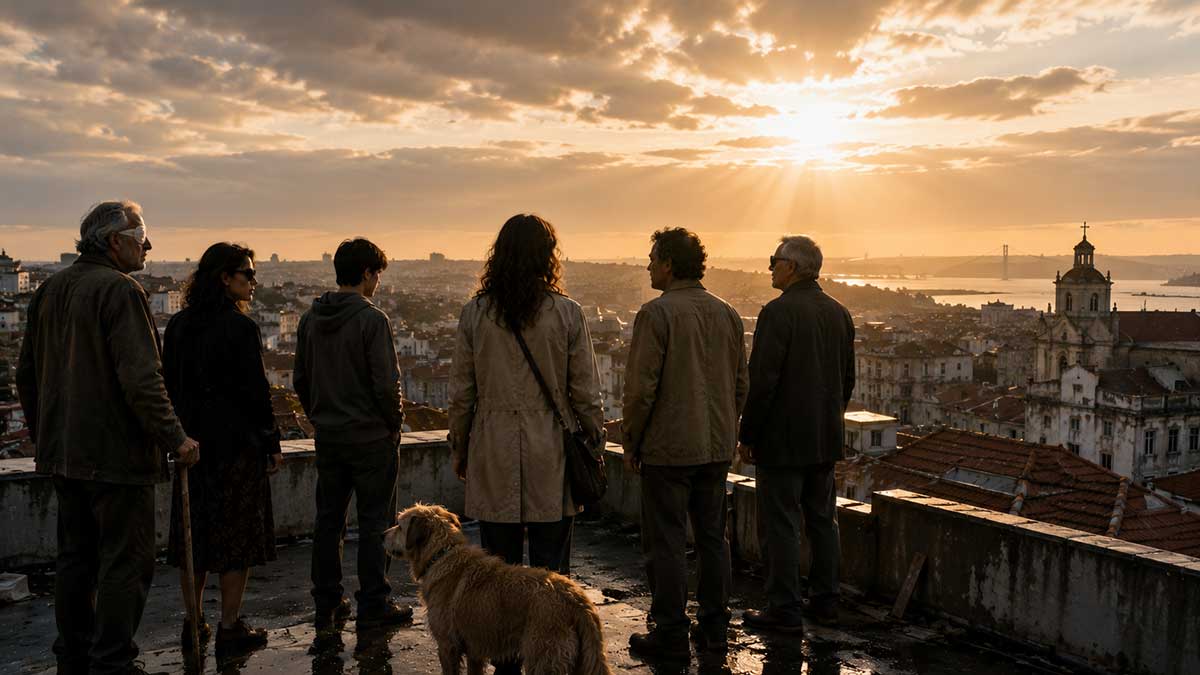
The first man to recover his sight did not celebrate.
He screamed.
The sound rose from the street below the doctor’s apartment just before dawn—one long cry, followed by frantic laughter and then another cry that sounded almost like grief.
The doctor’s wife was already awake.
She stood beside the window, watching pale morning light spread across the ruined city. Rainwater remained in the gutters. Abandoned cars blocked the intersection. Torn curtains moved from windows left open during the epidemic.
Across the street, a man clung to a lamppost.
He stared at his own hands.
Then at the buildings.
Then at the sky.
Man in the Street: I can see!
A woman nearby turned toward him.
She was still blind.
Woman in the Street: What did you say?
Man in the Street: I can see you.
He reached for her face.
She struck his hand away.
Woman in the Street: Do not lie.
Man in the Street: Your coat is blue.
You have blood on your sleeve.
There is a broken shoe beside you.
The woman touched her sleeve.
Her expression changed.
Woman in the Street: What color is the sky?
The man looked upward.
His laughter stopped.
Man in the Street: Gray.
The answer seemed to convince her more than any promise of beauty could have.
She began to weep.
Inside the apartment, the doctor joined his wife at the window.
Doctor: What is happening?
Doctor’s Wife: Someone can see.
He leaned closer to the glass, forgetting that his own eyes still gave him only whiteness.
Doctor: Are you certain?
Doctor’s Wife: He described the woman’s coat.
The doctor gripped the window frame.
Doctor: One case proves nothing.
Doctor’s Wife: You sound frightened.
Doctor: I am a physician facing an event without cause, pattern, or treatment.
Fear is appropriate.
From the room behind them came movement.
The girl with the dark glasses sat up.
The old man with the eye patch reached for his cane.
The first blind man asked whether food had arrived.
Then the doctor froze.
His breathing changed.
Doctor’s Wife: What is it?
He raised one hand before his face.
Moved it left.
Then right.
Doctor: I can see the shape.
His wife did not move.
Doctor: Your face.
Not clearly.
Wait.
He blinked several times.
The white field broke apart.
Edges returned.
Color entered slowly, as though the world were being painted from memory.
He stared at her.
Doctor: I can see you.
The doctor’s wife covered her mouth.
For weeks, she had dreamed of this moment.
In those dreams she embraced him.
She laughed.
She collapsed with relief.
Now she stood motionless.
Doctor: Say something.
Doctor’s Wife: You look older.
He laughed once, then began to cry.
She stepped into his arms.
The others gathered around them.
First Blind Man: Has his sight returned?
Doctor’s Wife: Yes.
Girl with the Dark Glasses: Why him?
No one answered.
Old Man with the Eye Patch: Perhaps he was first among us to recover.
First Blind Man: I was first to go blind.
Does that mean I am next?
Doctor: We cannot assume an order.
First Blind Man: Of course not.
Nothing had an order when it began.
Why would it have one now?
He turned away.
The doctor could see resentment on his face.
That troubled him more than the question.
Within the hour, sight returned to the girl with the dark glasses.
She was standing near the kitchen table when she suddenly removed her glasses.
Girl with the Dark Glasses: There is a crack in the wall.
The boy with the squint reached for her.
Boy with the Squint: Can you see me?
She turned.
For several seconds, she said nothing.
He became frightened.
Boy with the Squint: What is wrong?
She knelt before him.
Girl with the Dark Glasses: Nothing.
I had forgotten your face.
Boy with the Squint: You never saw it.
She touched his cheek.
Girl with the Dark Glasses: I knew it anyway.
He leaned closer.
Boy with the Squint: Do I look how you thought?
She smiled through tears.
Girl with the Dark Glasses: No.
Boy with the Squint: Worse?
Girl with the Dark Glasses: More real.
He considered this.
Boy with the Squint: Is that good?
Girl with the Dark Glasses: It is better.
She embraced him.
The Dog of Tears walked between them and pushed his head beneath her arm.
Girl with the Dark Glasses: And you are much uglier than I expected.
The dog wagged his tail.
By sunrise, the first blind man could see.
The old man with the eye patch recovered partial vision in his remaining eye.
The first blind man’s wife stood at the balcony naming colors aloud.
Red roof.
Green door.
Yellow curtain.
Gray clouds.
She repeated each word as though color might vanish if left unnamed.
The boy remained blind.
So did several people in nearby apartments.
Joy entered the city unevenly.
It created hope in one room and terror in the next.
On the street, people shouted descriptions to strangers.
Some claimed cures.
Some claimed divine intervention.
A man announced that washing the eyes with rainwater had restored him.
Another said confession had done it.
Someone began selling small bottles of cloudy water taken from a church fountain.
The doctor watched from the balcony.
Doctor: It has been less than two hours, and people are already inventing causes.
José Saramago: Explanation is one of humanity’s favorite forms of panic.
No one had heard him enter.
He stood near the doorway wearing a dark coat, looking at the city with the expression of a man who had expected less and received exactly that.
Beside him stood Carl Gustav Jung and Fyodor Dostoevsky.
The old man with the eye patch turned toward their voices.
Old Man with the Eye Patch: More visitors?
Doctor’s Wife: It seems so.
First Blind Man: Can they see?
Dostoevsky: Enough to be troubled.
Jung: Not enough to be certain.
José Saramago: A useful condition for conversation.
They climbed to the rooftop.
The city extended beneath them in wounded layers.
Smoke rose from distant blocks.
Church bells began ringing, though no one knew who had climbed the tower.
People poured into the streets.
Some embraced.
Some searched for family.
Some stared into mirrors.
Others looted shops before owners could return.
A man who had regained sight pushed aside a blind woman to reach a crate of food.
The doctor’s wife saw it.
Doctor’s Wife: There.
Doctor: What?
Doctor’s Wife: The first proof that sight has changed nothing.
Dostoevsky: Too early.
Doctor’s Wife: He could see her.
He pushed her anyway.
Dostoevsky: Sight gives information.
It does not give love.
Jung: Nor does catastrophe erase the shadow.
First Blind Man: You keep using that word.
Shadow.
Jung: The part of ourselves we reject, conceal, or refuse to recognize.
Cruelty.
Cowardice.
Greed.
Yet the shadow may contain tenderness, courage, and sacrifice that our ordinary identity never allowed us to claim.
Girl with the Dark Glasses: Then the epidemic revealed both?
Jung: It stripped away the comfortable story each person carried about who they were.
The respectable became thieves.
The frightened became tyrants.
The selfish cared for strangers.
The dependent became leaders.
Doctor’s Wife: And when sight returns?
Jung: The old identity will try to return with it.
Old Man with the Eye Patch: As if nothing happened.
Jung: Yes.
The psyche prefers familiar lies to unfamiliar truths.
The doctor faced Saramago.
Doctor: Why did sight return?
José Saramago: You ask as though I concealed a laboratory report.
Doctor: You created the epidemic.
José Saramago: I created a question.
Doctor: Readers deserve an answer.
José Saramago: Do they?
Doctor: A disease begins.
It spreads.
Then it ends.
There must be a mechanism.
José Saramago: Must there?
Doctor: In nature, yes.
José Saramago: This is a novel.
Doctor: That cannot excuse everything.
Saramago smiled.
José Saramago: Nor can medicine explain everything.
The doctor’s wife stepped between them.
Doctor’s Wife: Let him ask.
We lived inside the question.
José Saramago: Very well.
What answer would satisfy you?
A virus?
A toxin?
A neurological reaction?
Doctor: Any answer grounded in causation.
José Saramago: And if I said the blindness ended when humanity had learned enough?
Doctor: I would reject it.
José Saramago: Good.
So would I.
Dostoevsky: Suffering rarely proves that anyone learned.
Doctor’s Wife: Then the recovery was random?
José Saramago: Perhaps.
First Blind Man: That feels cruel.
José Saramago: Was the blindness less cruel when you believed it might contain meaning?
First Blind Man: At least meaning would make the suffering part of something.
Dostoevsky: That desire is understandable.
It is dangerous too.
People have justified terrible suffering by declaring it educational, purifying, or necessary.
Girl with the Dark Glasses: Then suffering teaches nothing?
Dostoevsky: It presents a person with possibilities.
One may become merciful.
Another may become bitter.
A third may become proud of having suffered.
A fourth may learn nothing and still survive.
Pain does not carry wisdom inside it like medicine inside a capsule.
A shout rose from the street below.
A woman had regained sight and recognized a man beside her.
She struck him.
Woman Below: You left me!
Man Below: I could not find you.
Woman Below: You stopped calling my name.
Their argument disappeared into the noise.
Old Man with the Eye Patch: Sight returns memory too.
Jung: Recognition can heal.
It can accuse.
Doctor’s Wife: The city is seeing what it did.
José Saramago: Or what it wishes to deny.
The first blind man leaned over the rooftop edge.
First Blind Man: I recognize the intersection where it began.
There.
The traffic light.
Doctor: How does it feel?
First Blind Man: Smaller.
José Saramago: Catastrophe often enlarges its birthplace.
First Blind Man: I sat in that car believing the worst thing that could happen was losing control of my life.
I had no idea how much of my life had depended on people I never noticed.
A driver.
A doctor.
A wife.
A stranger willing to guide me.
Doctor’s Wife: The stranger stole your car.
First Blind Man: Yes.
Dostoevsky: Humanity rarely offers clean symbols.
The same hand may guide and steal.
The same person may love and betray.
First Blind Man: Does that mean no one is good?
Dostoevsky: It means goodness is an act, not a permanent title.
The boy with the squint climbed the final stair holding the girl’s hand.
Boy with the Squint: Everyone is talking about what they see.
No one is telling me what is happening.
The girl sat beside him.
Girl with the Dark Glasses: The sun is coming through the clouds.
People are in the streets.
Some are laughing.
Some are fighting.
Boy with the Squint: So it looks like before?
She paused.
Girl with the Dark Glasses: Perhaps more than we want to admit.
Boy with the Squint: Am I the only one still blind?
Doctor: No.
Many have not recovered yet.
Boy with the Squint: Why not?
The doctor looked toward Saramago.
José Saramago: Do not hand the child to me merely because you dislike your answer.
The doctor knelt.
Doctor: I do not know.
Boy with the Squint: Will I see again?
Doctor: I hope so.
Boy with the Squint: That is not the same as knowing.
Doctor: No.
It is not.
The boy sat quietly.
Boy with the Squint: Before, everyone was blind with me.
Now I am blind alone.
No one had prepared for that sentence.
The girl took his hand.
Girl with the Dark Glasses: You are not alone.
Boy with the Squint: You can see.
Girl with the Dark Glasses: Yes.
Boy with the Squint: Then you will start walking faster.
Girl with the Dark Glasses: I will not.
Boy with the Squint: People always do when they no longer need to wait.
She moved closer.
Girl with the Dark Glasses: Then I will learn to wait when I could hurry.
Jung watched them.
Jung: Recovery creates a new moral test.
Doctor: Which one?
Jung: Whether those restored will remember those still suffering.
Across the city, bells continued ringing.
People began writing messages on walls.
I AM ALIVE.
MARIA, WAIT HERE.
FOOD AT THE SCHOOL.
MY NAME IS TOMÁS.
The doctor’s wife watched a man clean blood from a doorway.
Nearby, another man broke into an apartment.
Doctor’s Wife: We hoped sight would restore order.
Dostoevsky: Order can return faster than conscience.
Doctor: Yet order matters.
Clean water.
Food distribution.
Medical care.
José Saramago: Yes.
The mistake is believing institutions become humane merely because they function.
Doctor: Institutions prevented society from becoming this.
Doctor’s Wife: Until they locked us away.
Doctor: That was fear.
José Saramago: Institutions are made of fear, judgment, courage, laziness, mercy, ambition—the same materials as people.
Jung: Rebuilding without reflection recreates the same pattern.
First Blind Man: What should be rebuilt differently?
Doctor’s Wife: Everything.
Doctor: That is not practical.
Doctor’s Wife: Then begin with one thing.
Doctor: Which?
She looked at the blind boy.
Doctor’s Wife: No one gets left behind simply because others have recovered.
Dostoevsky moved toward the edge of the roof.
Dostoevsky: Humanity often loves resurrection more than repentance.
Girl with the Dark Glasses: What does that mean?
Dostoevsky: People celebrate being restored.
They do not wish to examine who they became in the grave.
Old Man with the Eye Patch: Some things should remain buried.
Dostoevsky: Perhaps.
Yet what is buried without confession often returns as habit.
Doctor’s Wife: Are you saying everyone must confess?
Dostoevsky: Not publicly.
Truth spoken carelessly can become spectacle.
But each person must face the private court within.
First Blind Man: And if they cannot bear it?
Dostoevsky: Then they may choose forgetting.
Many do.
José Saramago: Forgetting will be the city’s first reconstruction project.
The doctor looked offended.
Doctor: You have little faith in people.
José Saramago: I have enough faith to refuse flattery.
Doctor: People cared for each other.
José Saramago: Some did.
Doctor: People shared food.
José Saramago: Some did.
Doctor: People risked themselves.
José Saramago: Some did.
Doctor: Why insist on the worst?
José Saramago: I insist on the whole.
Hope built on denial is another blindness.
The old man removed his eye patch.
The damaged eye beneath it remained unchanged.
His other eye had recovered enough to see shapes and light.
Old Man with the Eye Patch: I expected restoration to feel complete.
It does not.
Jung: No return is complete.
Old Man with the Eye Patch: I see less than before the epidemic.
Yet perhaps I notice more.
José Saramago: That is a dangerous sentence.
Old Man with the Eye Patch: Why?
José Saramago: People enjoy claiming suffering made them superior.
Old Man with the Eye Patch: I do not feel superior.
I feel ashamed of how certain I once was.
Dostoevsky: Shame may open a door.
It may close one too.
Old Man with the Eye Patch: What decides?
Dostoevsky: Whether shame turns the self inward forever or moves it outward in mercy.
The doctor’s wife stepped away from the group.
She looked upward.
The sky had brightened.
Clouds thinned around the sun.
For one terrible instant, the light became too white.
The city disappeared.
Her stomach tightened.
She raised both hands before her face.
Doctor: What is wrong?
She did not answer.
The whiteness expanded.
Then the outlines returned.
Her husband.
The roof.
The dog.
The boy.
The city.
She lowered her hands.
Doctor: Did you lose your sight?
Doctor’s Wife: I thought I did.
Doctor: For how long?
Doctor’s Wife: A second.
Perhaps less.
Doctor: It may have been glare.
Fatigue.
Doctor’s Wife: You are diagnosing too quickly.
Doctor: I am trying to reassure you.
Doctor’s Wife: I do not want reassurance that erases the fear.
He stepped closer.
Doctor: Then tell me the fear.
She looked at him.
Doctor’s Wife: That I will become blind now that everyone else can see.
Doctor: We would care for you.
Doctor’s Wife: Would you?
Doctor: Of course.
Doctor’s Wife: For how long?
He looked hurt.
Doctor’s Wife: I am not accusing you.
I am asking the question all dependent people must ask.
How long before care becomes impatience?
How long before love begins keeping account?
How long before the person who needs help apologizes for existing?
The doctor could not answer.
Doctor’s Wife: I saw what dependence did to people.
I saw how quickly a person became a burden.
Now everyone is celebrating sight.
I am afraid blindness will become shame again.
The boy with the squint listened from behind her.
Boy with the Squint: It already has.
She turned.
He faced the sound of her voice.
Boy with the Squint: People downstairs keep saying “the ones who are still blind.”
Like we are late.
Like we failed.
The doctor’s wife knelt and held him.
Doctor’s Wife: You did not fail.
Boy with the Squint: Then why does everyone sound relieved not to be me?
No philosophy answered him.
The Dog of Tears came closer and rested against his leg.
Jung broke the silence.
Jung: The community will try to place blindness outside itself again.
Inside the remaining sufferers.
Doctor: Explain.
Jung: When everyone was blind, blindness belonged to humanity.
Now that many see, they will be tempted to say blindness belongs to them.
The unlucky.
The diseased.
The delayed.
That division protects the restored from remembering what they discovered about themselves.
José Saramago: Soon they may speak of “those people” again.
First Blind Man: Then nothing has changed.
Doctor’s Wife: Something has.
We know the division is a lie.
Dostoevsky: Knowing does not prevent betrayal.
It makes betrayal conscious.
Girl with the Dark Glasses: Is that supposed to comfort us?
Dostoevsky: No.
Comfort is not always the purpose of truth.
A man appeared on the neighboring rooftop.
He waved a white cloth.
Neighboring Man: Is there a doctor there?
The doctor answered.
Doctor: Yes.
Neighboring Man: My wife cannot see.
She has a fever.
The doctor looked toward his wife.
Doctor’s Wife: Go.
Doctor: We should stay together.
Doctor’s Wife: You asked what sight is for.
He glanced at the narrow gap between the buildings.
A wooden plank connected the rooftops.
It looked unstable.
Doctor: I may fall.
José Saramago: Responsibility has always been inconvenient.
Doctor’s Wife: We can secure the plank.
The doctor hesitated.
Then removed his coat.
The first blind man and old man held the plank steady.
The girl tied a rope around the doctor’s waist.
The doctor crossed slowly.
When he reached the other side, the neighboring man embraced him.
The doctor disappeared down the stairs.
The doctor’s wife watched.
Dostoevsky: There is your first answer.
Doctor’s Wife: To what?
Dostoevsky: Whether suffering changed him.
Doctor’s Wife: One crossing does not prove a life.
Dostoevsky: No.
A life is made of crossings.
By midday, crowds filled the streets.
People formed lines for water.
Someone organized names of missing relatives.
A group began clearing broken glass.
Another group fought over canned food.
Two policemen found old uniforms and started directing traffic even though no vehicles could move.
The first blind man laughed.
First Blind Man: The traffic lights are working again.
José Saramago: They never stopped.
First Blind Man: Then perhaps the city did not collapse.
José Saramago: Machines continued.
Meaning did not.
Old Man with the Eye Patch: Now meaning returns?
José Saramago: That depends on who gets to define it.
Jung: People will seek familiar symbols of order.
Uniforms.
Queues.
Schedules.
Rules.
Girl with the Dark Glasses: Are those bad?
Jung: No.
They become dangerous when used to avoid inner change.
Doctor’s Wife: How do we know whether change is real?
Jung: We do not know at once.
We watch repeated choices.
How the restored treat the blind.
How the fed treat the hungry.
How the safe remember the abandoned.
Dostoevsky: How the guilty use freedom after fear is gone.
The doctor returned from the neighboring building.
Doctor: The woman is alive.
Dehydrated.
Her sight has not returned.
We need water and clean cloth.
The girl gathered supplies.
The first blind man offered to help.
The doctor looked at him.
Doctor: You have only just recovered.
First Blind Man: So have you.
Doctor: You should rest.
First Blind Man: Is rest another word for letting someone else go?
The doctor nodded.
Doctor: Come.
They crossed together.
The doctor’s wife watched them disappear.
José Saramago: You look relieved.
Doctor’s Wife: I am.
José Saramago: Careful.
Hope can become another method of avoiding reality.
Doctor’s Wife: Must you challenge every hopeful moment?
José Saramago: No.
Only the ones trying to become conclusions.
The boy with the squint stood near the rooftop wall.
Boy with the Squint: What does the city look like now?
The girl joined him.
Girl with the Dark Glasses: Busy.
Confused.
Dirty.
Beautiful in places.
Boy with the Squint: Which places?
She looked.
A woman helped an old stranger down a staircase.
A man returned food he had stolen.
A group lifted a fallen street sign.
Sunlight struck wet rooftops.
Girl with the Dark Glasses: Wherever someone stops for another person.
Boy with the Squint: That is not a place.
Girl with the Dark Glasses: Perhaps it is.
He smiled.
Boy with the Squint: You are becoming philosophical.
Girl with the Dark Glasses: Hunger did strange things to all of us.
Late in the afternoon, the boy suddenly shouted.
Everyone turned.
He stared at the Dog of Tears.
Boy with the Squint: Brown.
The girl dropped the cup in her hand.
Girl with the Dark Glasses: What?
Boy with the Squint: He is brown.
The dog wagged his tail.
The boy looked around wildly.
Boy with the Squint: Your dress is dark.
The sky is bright.
There is a red roof.
His voice broke.
The girl embraced him.
Boy with the Squint: I can see.
This time celebration came.
The first blind man laughed.
The old man cried openly.
The doctor’s wife knelt beside the boy.
Doctor’s Wife: What is the first thing you want to look at?
He looked at the girl.
Boy with the Squint: Her.
The girl covered her face.
Girl with the Dark Glasses: I have not washed properly.
Boy with the Squint: You look how I knew.
She lowered her hands.
Girl with the Dark Glasses: Is that good?
Boy with the Squint: Better than real.
The Dog of Tears barked once, offended at being forgotten.
The boy hugged him.
Boy with the Squint: You are uglier than I thought.
The group laughed.
For a moment, the rooftop felt free of history.
Then Saramago spoke.
José Saramago: Do not apologize for joy.
But do not ask joy to explain the world.
Sunset approached.
The guests gathered near the rooftop edge.
Below, the city was rebuilding itself with uncertain hands.
Doctor: We began with one question.
Why did humanity regain its sight?
Jung: Psychologically, the return suggests emergence from unconsciousness.
Yet no symbol guarantees transformation.
A person may awaken and choose sleep again.
Dostoevsky: Spiritually, recovery may resemble grace.
Not reward.
Not proof of goodness.
A gift that creates responsibility.
First Blind Man: A gift we did not earn.
Dostoevsky: Many of life’s greatest gifts are not earned.
That is why gratitude and pride cannot occupy the same space for long.
Doctor’s Wife: And medically?
The doctor looked across the city.
Doctor: I have no answer.
Earlier, that would have humiliated me.
Now it feels honest.
José Saramago: Progress.
Doctor: Do not enjoy it too much.
Saramago smiled.
Doctor’s Wife: And as the author?
Why did you return their sight?
Saramago remained quiet.
The city lights began flickering on one district at a time.
José Saramago: A novel cannot remain forever inside catastrophe.
At some point, the door must open.
Not to announce that people have changed.
To ask what they will do outside.
Doctor’s Wife: So the return of sight is not the ending.
José Saramago: It is the removal of an excuse.
Old Man with the Eye Patch: Which excuse?
José Saramago: That people failed one another because they could not see.
The doctor’s wife looked down at the streets.
People were lighting fires for cooking.
Calling names.
Moving rubble.
Arguing.
Sharing.
Stealing.
Praying.
Beginning again.
Doctor’s Wife: Then humanity was not cured.
José Saramago: Eyes recovered.
Humanity remains under treatment.
Girl with the Dark Glasses: Who is the doctor?
José Saramago: Everyone who notices.
First Blind Man: That seems unreliable.
Dostoevsky: Freedom always is.
Jung: Yet without freedom, moral life becomes obedience.
Doctor: We will rebuild institutions.
Doctor’s Wife: Then build them so noticing does not depend on one woman staying awake.
The doctor looked at her.
Doctor: We will.
Doctor’s Wife: Do not promise quickly.
Doctor: Then I will say this.
I will begin.
She accepted that.
José Saramago walked toward the stairwell.
José Saramago: I should leave before you mistake me for an authority.
First Blind Man: One final answer.
Were we blind before the epidemic?
Saramago stopped.
José Saramago: Yes.
First Blind Man: Are we sighted now?
Saramago looked at the city.
José Saramago: Ask tomorrow.
He descended the stairs.
Jung followed.
Dostoevsky remained for a moment.
Dostoevsky: Do not fear that suffering taught too little.
Fear the day you stop asking what it demanded.
Then he left.
The group stayed on the rooftop.
The doctor returned from treating the neighboring woman.
The boy described every object he could see.
The girl corrected him when he confused orange with red.
The old man complained that recovered vision made everyone too interested in appearances.
The first blind man watched the traffic signal change at the distant intersection.
The Doctor’s Wife looked upward once more.
The sky remained bright.
No whiteness swallowed it.
She lowered her eyes.
That movement mattered.
Not heaven alone.
Not theories.
Not symbols.
The city.
The person beside her.
The stranger below.
The unfinished work within reach.
Her husband took her hand.
Doctor: Do you think it will happen again?
Doctor’s Wife: The blindness?
Doctor: Yes.
She looked at the crowds.
Doctor’s Wife: The physical blindness?
I do not know.
Doctor: And the other kind?
She watched a sighted man guide a blind stranger across the street.
Behind them, another person stepped around someone lying on the pavement without stopping.
Doctor’s Wife: It never left.
The doctor followed her gaze.
Doctor: Then what hope is there?
She squeezed his hand.
Doctor’s Wife: That neither did sight.
Below them, a woman called for help.
The doctor and his wife turned toward the stairs.
The others followed.
No one waited for an authority to arrive.
No one claimed the city had been redeemed.
They simply went down.
Behind them, the sun disappeared beyond the roofs.
Ahead, lamps began glowing in windows that had been dark for weeks.
Humanity had regained its eyesight.
What it would choose to see remained unwritten.
Final Thoughts by José Saramago
When sight returns, no explanation comes with it.
There is no medical triumph.
No government announcement.
No divine voice declaring that humanity has learned enough.
One person sees again.
Then another.
The white blindness retreats as mysteriously as it arrived.
Readers may ask why.
Perhaps they expect a cause because causes make disasters easier to contain. Name the disease, find the source, close the border, develop the cure, and return to life as it was.
But returning to life as it was may be the novel’s greatest danger.
The epidemic revealed that civilization was never held together by buildings, uniforms, money, or traffic lights.
Those things created order.
They did not guarantee humanity.
Humanity survived in smaller acts.
A hand guiding another hand.
Water divided among strangers.
A woman refusing to leave her husband.
A girl caring for a child who was not hers.
A doctor learning that a patient is more than a diagnosis.
An old man admitting that observation is not the same as attention.
A dog recognizing grief without needing language.
None of these acts ended the catastrophe.
They kept the catastrophe from becoming the only truth.
The doctor’s wife saw more suffering than anyone else.
She was not rewarded for it.
Sight burdened her with knowledge, fear, disgust, responsibility, and guilt. She discovered that seeing clearly does not tell a person exactly what to do.
It only removes the comfort of pretending nothing is happening.
That may be why so many people prefer moral blindness.
To see hunger is to face the question of food.
To see humiliation is to face the question of intervention.
To see loneliness is to face the possibility that presence may be required.
To see another person fully is to surrender the belief that they exist only as a role in our own story.
The doctor’s wife does not save the entire city.
She saves those within reach.
At times, she fails them.
At times, she resents them.
At times, she acts with courage.
At times, fear delays her.
Her humanity lies in none of these qualities alone.
It lies in her repeated decision to keep responding.
The novel does not promise that people become morally sighted when their eyesight returns.
They may rebuild the same institutions.
Resume the same habits.
Ignore the same suffering.
Call the same indifference normal.
Physical sight is restored freely.
Moral sight must be chosen repeatedly.
Civilization can collapse through large failures, but it often begins to fail through small permissions:
The permission to look away.
The permission to call another person a burden.
The permission to let fear decide whose dignity matters.
The permission to believe that necessity removes responsibility.
Its return may begin through equally small refusals:
Refusing to abandon a frightened child.
Refusing to convert another body into payment.
Refusing to let scarcity erase personhood.
Refusing to assume that someone else will answer the cry.
At the end, the doctor’s wife looks toward the sky and fears that she, too, may be going blind.
Then she lowers her eyes and sees the city.
Perhaps that is the final instruction.
Do not stare so long at heaven, philosophy, ideology, or explanation that you fail to see the person standing before you.
Humanity is rarely lost all at once.
Nor is it restored all at once.
It survives each time one person notices that another is still calling—and stops.
Short Bios:
José Saramago
José Saramago was a Portuguese novelist, essayist, and recipient of the 1998 Nobel Prize in Literature. His work frequently used allegory, irony, and moral inquiry to examine political authority, social conformity, faith, responsibility, and human behavior. In Blindness, he transforms an unexplained epidemic into a searching examination of how people act when familiar structures disappear.
The Doctor’s Wife
The only central character who does not lose her sight, the doctor’s wife becomes the group’s guide, witness, protector, and moral center. Her vision gives her extraordinary responsibility but no certainty or immunity from fear. She embodies the burdens of care, the cost of witnessing, and the imperfect courage required to act when institutions fail.
The Doctor
An ophthalmologist who cannot explain or cure the epidemic, the doctor experiences the collapse of professional authority and personal independence. His blindness forces him to reconsider knowledge, dependence, marriage, and the limits of medical certainty. His development reveals the difference between examining a human body and truly seeing a person.
The First Blind Man
The first known victim loses his sight while waiting at a traffic light. His sudden helplessness exposes how quickly ordinary identity can be replaced by fear, dependency, and social exclusion. Across the conversations, he becomes increasingly aware of the suffering he once passed without noticing.
The First Blind Man’s Wife
Loyal, direct, and morally grounded, she chooses to remain with her husband and later becomes an important voice against fear-driven surrender. She challenges the assumption that women’s bodies can be treated as collective resources and shows how dignity can endure without denying the pressures of survival.
The Girl with the Dark Glasses
Initially judged by others through her appearance and occupation, she becomes one of the group’s most compassionate members. Her care for the boy with the squint reveals a capacity for attachment she had once avoided. She represents compassion that is unsentimental, tired, protective, and capable of letting the person she loves remain free.
The Old Man with the Eye Patch
An observant older man who had impaired vision before the epidemic, he brings humility, humor, and perspective to the group. He distinguishes watching from seeing and recognizes how easily people confuse their interpretations of others with genuine knowledge.
The Boy with the Squint
Separated from his mother during the crisis, the boy represents vulnerability, trust, and the emotional honesty adults often avoid. His simple questions expose the inadequacy of abstract moral answers and remind the group that incomplete goodness still matters.
The Dog of Tears
The Dog of Tears finds the doctor’s wife when she is overcome by grief and licks the tears from her face. He becomes a symbol of instinctive compassion: presence without judgment, explanation, or demand. His quiet response contrasts with the complicated excuses human beings create for ignoring suffering.
Hannah Arendt
Hannah Arendt was a political thinker whose work examined authority, totalitarianism, responsibility, obedience, and the conditions that allow ordinary people to participate in harmful systems. In the imagined conversation, she helps explain how civilization collapses through fear, administrative distance, and the belief that resistance is impossible.
Viktor Frankl
Viktor Frankl was a psychiatrist, neurologist, Holocaust survivor, and founder of logotherapy. His work explored meaning, responsibility, freedom of attitude, and human dignity under extreme suffering. Here, he argues that suffering does not automatically make people noble, but meaningful action remains possible within conditions no one freely chose.
Martin Buber
Martin Buber was a Jewish philosopher best known for distinguishing relationships that treat others as objects from encounters that recognize them as complete persons. His presence helps clarify the difference between looking at someone, using someone, and meeting another human being without reducing them to a role.
Simone Weil
Simone Weil was a philosopher, activist, and spiritual thinker who wrote extensively about attention, suffering, obligation, and human dignity. In the conversation, she presents attention as the disciplined act of perceiving another person without immediately turning them into a category, judgment, or problem to solve.
Leave a Reply