
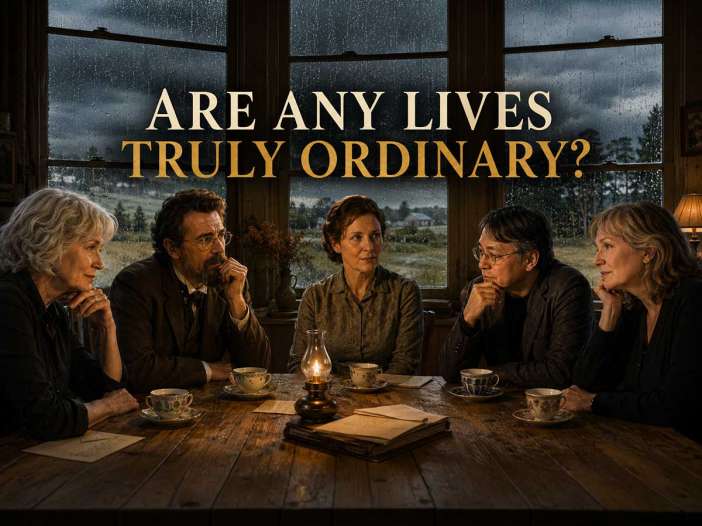
Why Alice Munro’s Ordinary Lives Feel Extraordinary?
Most of us spend our lives believing we understand people.
We meet someone for a few minutes and quietly place them into categories.
Successful.
Shy.
Intelligent.
Difficult.
Kind.
Hopeless.
Reliable.
Ordinary.
Then life surprises us.
The quiet woman becomes unexpectedly courageous.
The confident man quietly falls apart.
A chance encounter changes the direction of an entire family.
Someone we dismissed carries unseen strength for decades.
Someone we admired turns out to be deeply lonely.
Alice Munro built her stories upon these moments.
Unlike many novelists, she rarely begins with extraordinary events. Instead, she begins with familiar lives—people making tea, caring for parents, working ordinary jobs, writing letters, riding trains. Yet within these seemingly simple moments she uncovers emotional worlds as vast as any epic novel.
In 2013, Alice Munro became the first Canadian writer to receive the Nobel Prize in Literature, praised as a "master of the contemporary short story." Her gift was never dramatic plots for their own sake. It was her remarkable ability to reveal how quietly a life can change, often without the people living it fully realizing it themselves.
Few stories illustrate this better than Hateship, Friendship, Courtship, Loveship, Marriage. What begins as a cruel prank gradually unfolds into something far more complex—a meditation on chance, identity, misunderstanding, resilience, hope, and the unpredictable paths by which people discover themselves.
Rather than analyzing the collection through a traditional literary essay, we invite you to imagine an evening conversation among five remarkable voices.
Alice Munro joins the woman whose life anchors the title story, Johanna Parry. Sitting beside them are Anton Chekhov, whose quiet realism profoundly influenced generations of short story writers; Kazuo Ishiguro, whose novels explore memory and identity with extraordinary subtlety; and Elizabeth Strout, whose compassionate portraits of ordinary people have made her one of today's finest storytellers.
Together, they explore five timeless questions:
- Why do ordinary lives become extraordinary stories?
- Is chance quietly writing our lives?
- Why do we so often misjudge other people?
- Can people truly change, or do they simply reveal who they always were?
- What makes an ordinary life meaningful?
As their conversation unfolds, something unexpected begins to happen.
The discussion itself becomes a story.
The guests question one another. They disagree. They laugh. They sit in thoughtful silence. Johanna gradually discovers new ways of understanding her own life, while the writers reveal as much about themselves as they do about literature.
By the end of the evening, they are no longer simply discussing Alice Munro's work.
They are inviting us to look again at our own lives—and perhaps to wonder whether the people we have called "ordinary," including ourselves, have been extraordinary all along.
(Note: This is an imaginary conversation, a creative exploration of an idea, and not a real speech or event.)
Topic 1: Why Do Ordinary Lives Make Extraordinary Stories?
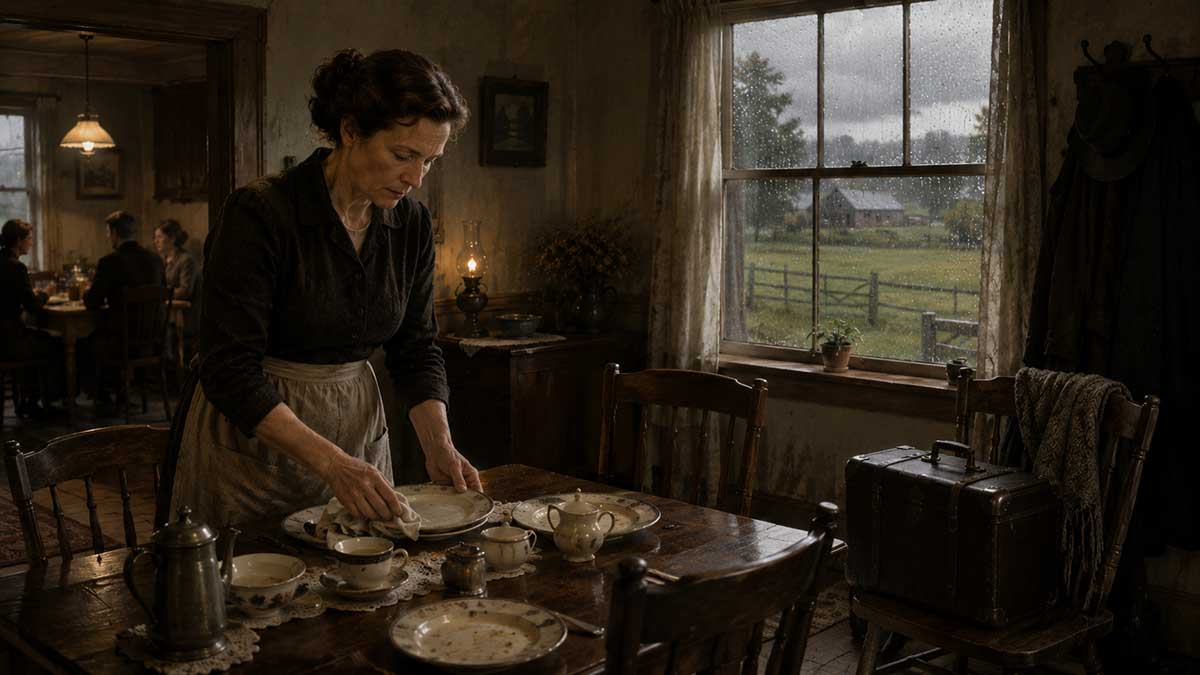
Opening
The five guests sit around a weathered wooden table in a quiet room overlooking the Canadian countryside. The rain has softened to a fine mist, leaving thin trails of water across the windows. A teapot rests at the center of the table, surrounded by mismatched cups.
Alice Munro watches the landscape for a few moments before turning toward the others. Her expression carries the faint amusement of someone who has spent a lifetime noticing what other people overlook.
Alice Munro (quietly): People often think a story becomes important when something extraordinary happens.
A war begins.
A fortune is lost.
Someone becomes famous.
Someone commits a terrible crime.
She glances toward Johanna.
Alice Munro: But most lives are not lived in such moments. They are lived while preparing meals, waiting for letters, caring for other people, remembering old disappointments, and making decisions that seem unimportant until many years later.
Johanna Parry (folding her hands in her lap): That does not sound like the beginning of a great story.
Anton Chekhov (leaning back with a small smile): It sounds like the beginning of nearly every great story.
Johanna studies him, unsure whether he is teasing her.
Elizabeth Strout: I think Alice is asking us to reconsider what we mean by “ordinary.”
Kazuo Ishiguro: Or perhaps what we mean by “great.”
A brief silence settles over the table.
Alice Munro: Then let us begin there.
The Conversation
Anton Chekhov (turning toward Alice): May I ask you something directly?
Alice Munro: Please.
Anton Chekhov: Why Johanna?
Johanna looks up quickly.
Anton Chekhov: You could have written about someone more visibly remarkable. A celebrated woman. A great beauty. Someone with wealth, influence, or unusual talent. Instead, you chose a housekeeper whom most people would barely notice.
Alice Munro (looking toward Johanna): Perhaps because most people would barely notice her.
Johanna lowers her eyes.
Alice Munro: I was interested in the distance between how a person appears from the outside and the life that person is actually living.
Johanna might appear practical, reserved, even unremarkable. But beneath that surface she possesses pride, imagination, longing, courage, and a willingness to act that surprises everyone around her.
Johanna Parry: Including me.
Alice smiles.
Alice Munro: Especially you.
Elizabeth Strout: That is one reason Alice’s stories feel so true. She does not make ordinary people extraordinary by decorating them. She stays with them long enough for us to see how complicated they already are.
Johanna Parry: But would anyone have called my life complicated before those letters arrived?
Elizabeth Strout: Your life was complicated before the letters. The letters simply gave the complications somewhere to go.
Johanna’s expression changes slightly. She appears to be reconsidering something she had long taken for granted.
Kazuo Ishiguro: That is important. A dramatic event does not necessarily create a person’s inner life. It reveals what was already there.
Anton Chekhov: Like striking a match in a dark room.
Alice Munro: Though sometimes the light makes the room more confusing.
Anton Chekhov (smiling): Better still.
The others laugh softly.
Johanna Parry: Then why do readers need a writer to show them these things? Surely ordinary people are already surrounded by other ordinary people.
Elizabeth Strout: They are surrounded by them, but they rarely have time to look closely.
Kazuo Ishiguro: And they often believe they already understand them.
He turns toward Johanna.
Kazuo Ishiguro: A person sees someone working in a kitchen, managing a household, or waiting at a station and believes the whole life is visible. But people conceal themselves even from those closest to them.
Sometimes they conceal themselves from themselves.
Johanna Parry: Do you believe I concealed myself from myself?
Kazuo Ishiguro: I think you had not yet been placed in a situation that required you to discover who you were.
Johanna Parry: That sounds kinder.
Kazuo Ishiguro (with a faint smile): I intended it to be accurate.
Anton Chekhov: Accuracy is not always kind.
Elizabeth Strout: Nor is kindness always inaccurate.
Chekhov raises an eyebrow, pleased by the challenge.
Anton Chekhov: You disagree with me?
Elizabeth Strout: Slightly.
Anton Chekhov: Excellent. I was beginning to worry we would all behave ourselves.
Alice laughs and reaches for the teapot.
Elizabeth Strout: I believe tenderness can reveal a person just as clearly as severity. Some writers seem afraid that compassion will weaken a story. But understanding a character does not mean excusing everything that character does.
Alice Munro: Nor does exposing a person’s flaws mean condemning them.
Johanna Parry: Yet readers do judge.
Alice Munro: Of course.
Johanna Parry: Did you know how they would judge me?
Alice Munro: No.
Johanna Parry: Did you care?
Alice pauses before answering.
Alice Munro: I cared that they would have enough information to question their first judgment.
Johanna looks at her carefully.
Alice Munro: When a reader first meets you, you may appear rigid or emotionally guarded. Later, the reader sees your determination. Later still, perhaps your vulnerability. The story keeps rearranging the meaning of what came before.
Kazuo Ishiguro: That may be one of the defining qualities of your work.
Alice looks toward him.
Kazuo Ishiguro: A detail appears small when we first encounter it. Then time passes, the perspective shifts, and suddenly that detail contains an entire life.
Anton Chekhov: A glove left on a chair.
A sentence someone should not have spoken.
A visit that lasted ten minutes too long.
Elizabeth Strout: Or a daughter realizing that her mother has become old.
Alice Munro: Or a woman boarding a train because she believes someone is waiting for her.
Johanna’s eyes move toward the rain-streaked window.
Johanna Parry: When I boarded that train, I did not think I was entering literature.
Anton Chekhov: No one ever does.
Johanna Parry: I thought I was going to meet a man.
Alice Munro: That is why the moment works.
Johanna Parry: Because I did not understand it?
Alice Munro: Because you understood only what a person could understand while living it.
The room grows quiet.
Kazuo Ishiguro: Stories often become false when characters seem to understand the meaning of their lives too soon.
Elizabeth Strout: Real people rarely announce, “This is the moment that will change everything.”
Anton Chekhov: They are usually concerned about the luggage.
Johanna laughs unexpectedly.
Johanna Parry: I was concerned about the luggage.
Alice Munro: Exactly.
The laughter fades, leaving behind a warmer atmosphere.
Elizabeth Strout (looking toward Alice): Critics often say you made the short story feel as expansive as a novel. Did you consciously set out to do that?
Alice Munro: No. I simply found that a life does not need to be told from beginning to end to feel complete.
Sometimes one afternoon contains thirty years.
Sometimes a small decision reveals everything that came before it and everything that may follow.
Anton Chekhov: A story does not need to contain a whole life.
It needs to contain the pressure of a whole life.
Kazuo Ishiguro: That may explain why Alice’s stories continue to unfold after the reader finishes them.
Johanna Parry: Unfold where?
Kazuo Ishiguro: In the reader’s memory.
He rests his hands on the table.
Kazuo Ishiguro: The story ends, but the reader continues asking questions. Why did she do that? What happened afterward? Did she understand what she had escaped? Did she understand what she had chosen?
That uncertainty gives the story a life beyond its final page.
Johanna Parry: Some readers find that frustrating.
Alice Munro: Life is frustrating.
Anton Chekhov: A perfectly explained ending is often the least believable ending.
Elizabeth Strout: But readers are not left with nothing. They are left with recognition.
Johanna Parry: Recognition of what?
Elizabeth Strout: That they, too, have misunderstood people.
That they have overlooked important moments.
That they may be living inside a turning point without realizing it.
Johanna considers this for several seconds.
Johanna Parry: Then perhaps readers do not come to ordinary stories because the characters are like them.
Kazuo Ishiguro: No?
Johanna Parry: Perhaps they come because the characters reveal how little they understand about the people around them.
Alice Munro: And about themselves.
Chekhov gently taps one finger against the side of his cup.
Anton Chekhov: Alice, do you think ordinary people make better characters than heroes?
Alice Munro: I distrust the distinction.
Anton Chekhov: Between ordinary people and heroes?
Alice Munro: Yes.
She turns toward Johanna.
Alice Munro: Courage often looks ordinary from the outside.
A person gets out of bed.
Returns to work.
Leaves a place where she has been diminished.
Takes a train alone.
Allows herself to hope after years of expecting very little.
Those actions may not appear heroic to history.
But they can require an entire life’s strength.
Johanna’s face softens, though she does not respond immediately.
Elizabeth Strout: We often recognize bravery only when it is loud.
Kazuo Ishiguro: Quiet bravery is more difficult to notice because it does not announce what it has cost.
Johanna Parry: I never thought of myself as brave.
Anton Chekhov: Brave people seldom do. They are too busy being frightened.
Johanna smiles.
Johanna Parry: That sounds more familiar.
Alice Munro: There is another reason ordinary lives make extraordinary stories.
Elizabeth Strout: What is it?
Alice Munro: Because readers cannot keep them safely at a distance.
A king’s tragedy may move us, but a lonely woman at a railway station may resemble someone we know.
Or someone we failed to know.
The words settle heavily over the table.
Kazuo Ishiguro: Perhaps that is the deeper power of ordinary fiction. It removes our excuses.
We can tell ourselves that grand historical tragedies belong to another world. But a failed marriage, an unspoken resentment, a neglected parent, or a chance for kindness we did not take—those belong to us.
Anton Chekhov: The ordinary story becomes dangerous because the reader cannot say, “This has nothing to do with me.”
Johanna Parry: Is that why people sometimes feel uncomfortable reading such stories?
Elizabeth Strout: Yes.
Alice Munro: Recognition is not always pleasant.
Johanna Parry: Then why seek it?
No one answers immediately.
Outside, the mist begins to lift. A narrow band of pale sunlight appears over the fields.
Kazuo Ishiguro: Because being recognized—even by a story—can make a person feel less alone.
Elizabeth Strout: And recognizing another life can make us less careless with our own.
Anton Chekhov: Also because discomfort is sometimes the beginning of honesty.
Johanna turns toward Alice.
Johanna Parry: May I ask you one final question?
Alice Munro: Of course.
Johanna Parry: Did you write my story because you believed my life was extraordinary?
Alice looks at her for a long moment.
Alice Munro: No.
Johanna appears surprised.
Alice Munro: I wrote it because I believed no life is ordinary once we see it clearly.
Closing
The rain has stopped completely. Light spreads slowly across the room, touching the teacups, the old table, and the five faces gathered around it.
Johanna looks toward the window, then back at the others.
Johanna Parry: I spent much of my life believing important things happened to other people.
People with education.
Beauty.
Money.
Interesting names.
She smiles faintly.
Johanna Parry: Then a foolish prank arrived in the form of a letter, and everything I believed about my future began to move.
I still do not know whether my life was extraordinary.
But perhaps that is not the right question.
She turns toward Alice.
Johanna Parry: Perhaps the question is whether anyone was willing to look closely enough to see it.
Alice gives her a quiet nod.
Anton Chekhov: That is where literature begins.
Elizabeth Strout: With attention.
Kazuo Ishiguro: And humility.
Alice looks once more toward the clearing sky.
Alice Munro: Ordinary lives do not become meaningful because a writer transforms them.
They become meaningful because, for a few pages, we finally stop looking away.
Topic 2: Is Chance Quietly Writing Our Lives?
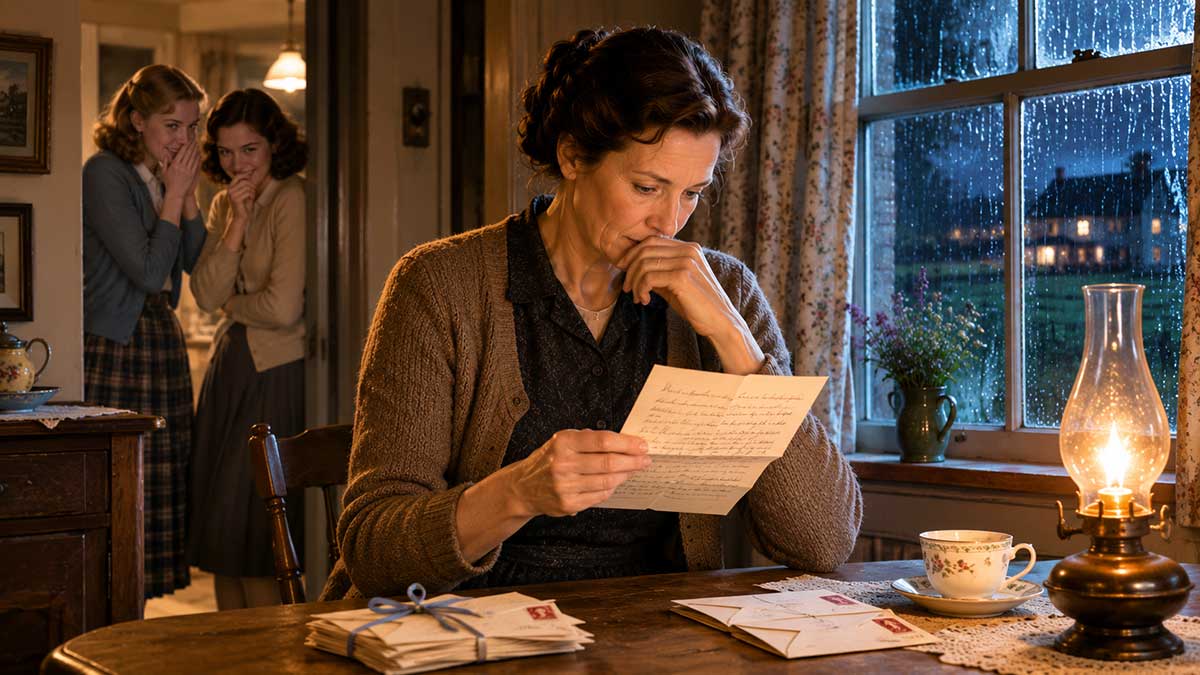
Opening
The room has grown brighter. The rain has passed, leaving the fields outside washed clean and shining. Someone has opened the window slightly, and the cool scent of wet earth drifts across the table.
Johanna sits with one hand around her teacup. She has been quiet for several minutes. At last, she looks toward Alice.
Johanna Parry: May I ask you something that has troubled me for years?
Alice Munro: Yes.
Johanna Parry: Was my happiness an accident?
Alice does not answer immediately.
Chekhov looks from Johanna to Alice. Elizabeth Strout leans forward. Ishiguro lowers his eyes, as though the question has reached somewhere private.
Alice Munro: I think almost every happiness contains some accident.
Johanna Parry: That is not quite an answer.
Anton Chekhov (smiling slightly): A very good beginning, though.
Johanna Parry: Two girls wrote letters to make a fool of me. I believed them. I boarded a train. I arrived expecting one life and found another.
She looks directly at Alice.
Johanna Parry: So I will ask again. Was my happiness merely the result of someone else’s cruelty?
A silence falls over the table.
Kazuo Ishiguro: Perhaps that question is larger than your story.
Elizabeth Strout: It may be the question most people eventually ask about their own lives.
Anton Chekhov: Did I choose this life, or did it happen to me?
Johanna nods.
Alice Munro: Then let us not answer too quickly.
The Conversation
Anton Chekhov (turning toward Johanna): Before we discuss chance, may I ask what you believe would have happened without the letters?
Johanna Parry: I would have remained where I was.
Anton Chekhov: For how long?
Johanna Parry: I do not know.
Anton Chekhov: Precisely.
Johanna Parry: You think I would have left eventually?
Anton Chekhov: I think people often describe the road not taken with far more certainty than it deserves.
Johanna frowns slightly.
Anton Chekhov: You say you would have remained. Perhaps. Or perhaps another event would have moved you. A quarrel. An illness. An insult you could no longer tolerate. A different letter.
Elizabeth Strout: Or perhaps nothing would have happened.
Anton Chekhov: Also possible.
Elizabeth Strout: We should not romanticize chance. Sometimes a life does remain narrow because no door opens.
Alice Munro: And sometimes the door opens, but the person is too frightened to walk through it.
Johanna Parry: I was frightened.
Alice Munro: Yes.
Johanna Parry: Then why did I go?
Alice Munro: You tell us.
Johanna looks down at the table.
Johanna Parry: Because I wanted the letters to be true.
Kazuo Ishiguro: Even though some part of you doubted them?
Johanna Parry: Especially because some part of me doubted them.
Ishiguro studies her with interest.
Johanna Parry: Believing them required me to imagine that another life was possible. Once I had imagined it, remaining where I was became more difficult.
Elizabeth Strout: That may be the real turning point.
Anton Chekhov: Not the letter?
Elizabeth Strout: The letter created the possibility. But Johanna’s imagination gave it power.
Alice Munro: Yes.
Johanna Parry: Then you believe I changed my own life?
Elizabeth Strout: I believe you participated in changing it.
Johanna Parry: Participated?
Kazuo Ishiguro: That may be the most honest word available.
He folds his hands on the table.
Kazuo Ishiguro: We like clean explanations. Fate or free will. Accident or choice. But lives are rarely shaped by one force alone.
Chance places something before us.
Character affects what we notice.
Memory changes what we later believe happened.
And other people interfere constantly.
Anton Chekhov: Usually without permission.
The group smiles.
Johanna Parry: But the girls intended to humiliate me.
Alice Munro: They did.
Johanna Parry: And something good came from it.
Alice Munro: Yes.
Johanna Parry: Does the good erase what they did?
Alice Munro: No.
Her answer comes quickly this time.
Alice Munro: A fortunate outcome does not make a cruel act innocent.
Elizabeth Strout: That is important.
Anton Chekhov: Very important.
Kazuo Ishiguro: Otherwise we begin judging actions only by consequences, many of which no one could have predicted.
Johanna Parry: Yet if the letters had not been written, I might never have gone.
Alice Munro: That is also true.
Johanna Parry: So the same act can be both wrong and life-changing.
Elizabeth Strout: Yes.
Johanna Parry: I dislike that answer.
Anton Chekhov: Most true answers are inconvenient.
Johanna gives him a dry look.
Johanna Parry: You seem to enjoy inconvenient truths.
Anton Chekhov: Only when they belong to someone else.
Alice laughs. Even Johanna smiles.
Kazuo Ishiguro: There is another difficulty. Once something good grows from pain, people often feel pressured to become grateful for the pain.
Johanna Parry: Exactly.
She turns toward him with sudden intensity.
Johanna Parry: That is what troubles me. If I say I regret the prank, I seem ungrateful for the life that followed. If I say I am grateful, I excuse the humiliation.
Kazuo Ishiguro: Perhaps you do not owe the past a simple feeling.
Johanna Parry: What do you mean?
Kazuo Ishiguro: You can condemn what was done to you and still value what you made from it.
The feelings do not cancel one another.
Elizabeth Strout: People are often forced into false choices about their own stories.
Either the suffering destroyed you, or it made you stronger.
Either you forgive completely, or you remain bitter.
Either the past was a tragedy, or it was a blessing.
Alice Munro: Real lives are rarely so cooperative.
Anton Chekhov: A wound may heal badly and still allow a person to walk.
Johanna Parry: That is not very comforting.
Anton Chekhov: I am a doctor. Comfort was never guaranteed.
The room breaks into quiet laughter.
Elizabeth Strout: But he is right. We do not need to turn pain into a beautiful lesson before we are allowed to continue living.
Johanna Parry: Then what should I call what happened?
Alice Munro: Why must you name it?
Johanna Parry: Because unnamed things remain unsettled.
Alice Munro: Some things remain unsettled even after we name them.
Johanna looks unconvinced.
Alice Munro: You might call it a prank.
A deception.
An opening.
A humiliation.
A beginning.
All of those names may be true.
Kazuo Ishiguro: And each name changes depending on where you stand in time.
Johanna Parry: So memory rewrites chance?
Kazuo Ishiguro: Constantly.
Anton Chekhov: At the time, a missed train is an inconvenience.
Twenty years later, it becomes the reason you met your wife.
Elizabeth Strout: Or the reason you did not.
Anton Chekhov: Precisely.
Alice Munro: We often tell our lives backward. We know the outcome, so we arrange the earlier events as though they were leading toward it.
Johanna Parry: But they were leading toward it.
Alice Munro: Only after it happened.
Johanna pauses.
Alice Munro: Before that, they were leading everywhere.
The words settle over the table.
Kazuo Ishiguro: That may be one reason hindsight feels so powerful. It gives chaos a shape.
Elizabeth Strout: And sometimes it gives us too much confidence.
Anton Chekhov: We say, “Everything happened for a reason,” because “many things happened and I survived them” feels less elegant.
Johanna Parry: Do you not believe things happen for a reason?
Anton Chekhov: I believe people are remarkably talented at inventing reasons afterward.
Elizabeth Strout: That sounds harsh.
Anton Chekhov: Does it?
Elizabeth Strout: Slightly.
Anton Chekhov: Good.
Elizabeth Strout: I do think people create meaning from what happens to them. That meaning may not have existed beforehand, but it can still be real.
Kazuo Ishiguro: Yes. Meaning does not have to be predetermined to matter.
Johanna Parry: Then chance gives us the event, and we give it meaning?
Alice Munro: Sometimes.
Johanna Parry: You keep saying “sometimes.”
Alice Munro: Because certainty is usually where stories go to die.
Chekhov lifts his cup in approval.
Anton Chekhov: I wish I had said that.
Alice Munro: You probably did.
They share a brief smile.
Elizabeth Strout (turning toward Alice): May I ask you something about the story itself?
Alice Munro: Of course.
Elizabeth Strout: Why allow the prank to lead somewhere unexpectedly hopeful? You could have ended with humiliation. That would have been believable.
Alice Munro: It would have been predictable.
Elizabeth Strout: Is hope less predictable than cruelty?
Alice Munro: Often.
Johanna watches her closely.
Alice Munro: The girls imagine they understand Johanna. They think they know what kind of woman she is and what kind of life is available to her. Their prank depends upon that certainty.
But Johanna behaves in a way they do not anticipate.
She takes the invented future seriously.
She moves toward it.
And in doing so, she reveals the poverty of their imagination.
Johanna Parry: Their imagination?
Alice Munro: They can imagine your humiliation.
They cannot imagine your courage.
Johanna’s expression softens.
Kazuo Ishiguro: So chance does not simply transform Johanna. It exposes how badly others have misread her.
Alice Munro: Exactly.
Anton Chekhov: That is very satisfying.
Alice Munro: I was not trying to satisfy you.
Anton Chekhov: That makes it more satisfying.
Elizabeth laughs.
Johanna Parry: But was it courage? I believed a lie.
Elizabeth Strout: Courage is not the same as perfect judgment.
Johanna Parry: It should include some judgment.
Elizabeth Strout: Ideally.
Kazuo Ishiguro: Yet nearly every important decision is made before all the facts are available.
To love someone.
To leave a home.
To begin again.
To trust.
We act while uncertainty remains.
Anton Chekhov: Otherwise it is not courage. It is paperwork.
Johanna laughs despite herself.
Johanna Parry: You make recklessness sound noble.
Anton Chekhov: No. I make certainty sound unavailable.
Alice Munro: There is a difference between passively waiting for fate and responding to an unexpected possibility.
Johanna did not simply allow events to carry her.
She prepared.
She traveled.
She assessed what she found.
She acted again.
Elizabeth Strout: That matters. The prank may begin the story, but it does not complete it.
Johanna Parry: So Robin did not write my life.
Alice Munro: No.
Johanna Parry: Neither did you?
Alice looks at her.
Alice Munro: That is a more difficult question.
Johanna Parry: You are the author.
Alice Munro: On the page, yes.
Johanna Parry: Then how can you say chance was involved?
Alice Munro: Because writing contains chance too.
Anton Chekhov: Ah.
He leans forward, suddenly interested.
Alice Munro: A writer begins with a situation, perhaps a character, perhaps an image. But if the story is alive, it does not always move where the writer first intended.
Elizabeth Strout: Characters resist.
Kazuo Ishiguro: Or reveal possibilities the writer did not consciously plan.
Johanna Parry: Are you saying I surprised you?
Alice Munro: Yes.
Johanna Parry: How?
Alice Munro: By refusing to remain the object of the joke.
Johanna sits very still.
Alice Munro: The prank was meant to define you.
Instead, you used it to move beyond the people who believed they had already defined you.
Anton Chekhov: There it is.
Johanna Parry: What?
Anton Chekhov: The difference between chance and destiny.
Johanna Parry: Explain.
Anton Chekhov: Chance hands you a role.
Destiny is what people call the performance afterward.
Elizabeth Strout: I am not sure I agree.
Anton Chekhov: Excellent.
Elizabeth Strout: That makes destiny sound entirely retrospective.
Anton Chekhov: Perhaps it is.
Kazuo Ishiguro: Or perhaps destiny is the name we give to the meeting point between circumstance and character.
Alice Munro: That is almost too elegant.
Kazuo Ishiguro: I suspected you might say that.
Johanna Parry: I prefer it.
Anton Chekhov: Of course you do. It is kinder.
Elizabeth Strout: And possibly truer.
Chekhov smiles, conceding nothing.
Johanna Parry: Let me ask all of you something.
The table grows attentive.
Johanna Parry: Suppose another woman receives an unexpected opportunity tomorrow. How can she know whether it is a door worth entering or merely another deception?
Elizabeth Strout: She cannot know completely.
Johanna Parry: That is not helpful.
Elizabeth Strout: No, but it is honest.
She can look for danger.
Ask questions.
Seek advice.
Pay attention to what feels wrong.
But eventually, some decisions require a risk no one else can take for her.
Kazuo Ishiguro: She should also ask what staying will cost.
Johanna Parry: People rarely ask that.
Kazuo Ishiguro: Exactly. We treat action as risky and inaction as neutral. But remaining where we are is also a decision, with consequences that may be just as profound.
Anton Chekhov: A person may ruin her life by leaving.
She may also ruin it by staying.
Alice Munro: And often she will never know what the other life would have been.
Johanna Parry: That seems terribly unfair.
Alice Munro: It is.
Johanna Parry: You say that very calmly.
Alice Munro: Age improves one’s relationship with unfairness.
Anton Chekhov: Not mine.
Alice Munro: You died too young.
For a second, the room falls silent. Then Chekhov laughs first, and the others follow.
Elizabeth Strout: Perhaps the best we can do is refuse to let uncertainty become an excuse for never living.
Kazuo Ishiguro: And refuse to turn every outcome into proof that we chose correctly.
Johanna Parry: Why not?
Kazuo Ishiguro: Because a good outcome can follow a foolish decision, and a painful outcome can follow a wise one.
We should judge ourselves partly by what we knew, what we intended, and how honestly we acted—not only by what happened afterward.
Alice Munro: That is also why the girls remain responsible.
Johanna Parry: Even though I became happy.
Alice Munro: Especially because your happiness makes it tempting to forgive them too easily.
Johanna looks thoughtful.
Johanna Parry: I do not know whether I forgive them.
Elizabeth Strout: You do not have to decide today.
Anton Chekhov: Or ever.
Johanna Parry: That sounds like something a man would say.
Elizabeth smiles into her cup. Alice raises an eyebrow. Ishiguro looks down, hiding a grin.
Anton Chekhov: A fair criticism.
Johanna Parry: I may not forgive them. But I will not allow them to believe they created my life.
Alice Munro: They did not.
Johanna Parry: They created a false invitation.
I made the journey.
No one speaks for a moment.
Outside, sunlight catches on the wet branches, and the whole landscape seems briefly illuminated.
Closing
Johanna rises and walks toward the open window. She rests one hand against the frame and looks out across the fields.
Johanna Parry: For years, I thought the letters were the beginning of my story.
Perhaps they were only the interruption.
She turns back toward the table.
Johanna Parry: Chance may place something unexpected in our hands. It may deceive us, frighten us, embarrass us, or open a future we had never allowed ourselves to imagine.
But chance does not take the journey.
It does not pack the suitcase.
It does not board the train.
It does not decide what to do after the truth is revealed.
Alice watches her with a quiet smile.
Johanna Parry: Perhaps we are not the sole authors of our lives.
Too many people interfere.
Too many accidents occur.
Too much remains beyond our control.
She looks toward Chekhov, then Ishiguro, Elizabeth, and finally Alice.
Johanna Parry: But neither are we merely characters waiting for the next page.
Kazuo Ishiguro: What are we, then?
Johanna considers the question.
Johanna Parry: Collaborators.
Ishiguro smiles, recognizing the word.
Johanna Parry: Chance may begin the sentence.
But we still have some say in how it ends.
Topic 3: Why Do We So Often Misjudge Other People?
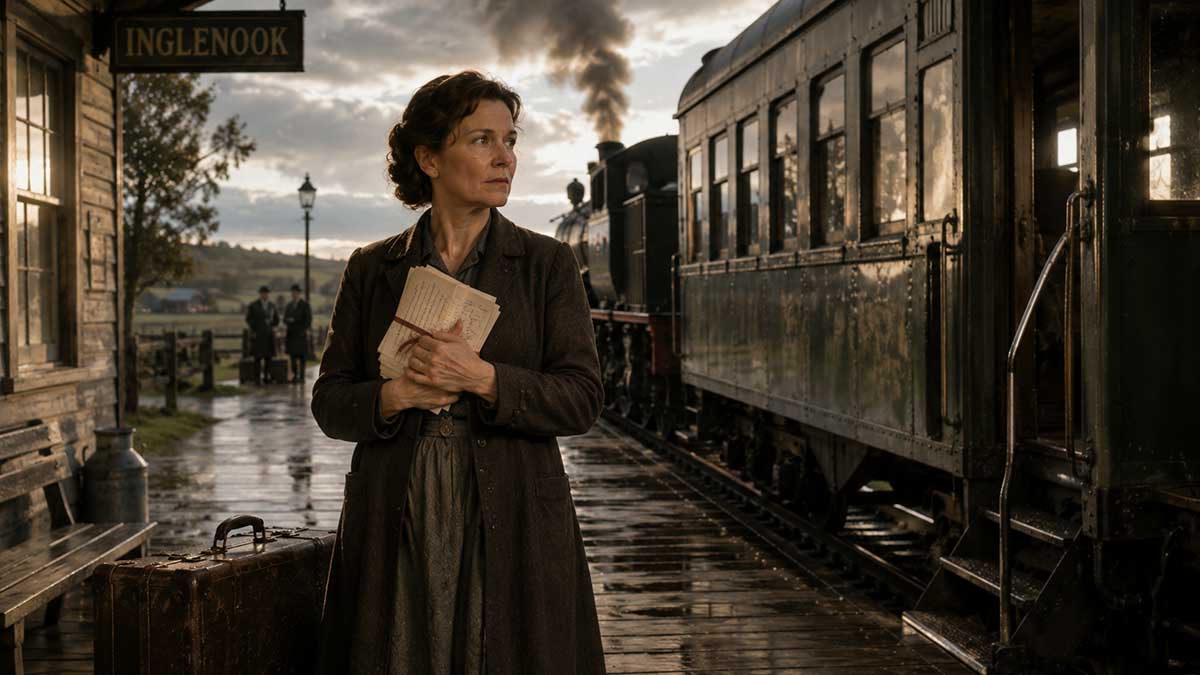
Opening
The afternoon light has turned warmer, stretching long shadows across the wooden floor. The teapot is nearly empty now, but no one has suggested making another.
Johanna sits quietly, one hand resting beside her cup. Her earlier confidence has softened into something more reflective.
Johanna Parry: May I confess something?
The others turn toward her.
Johanna Parry: I spent much of my life believing people hardly noticed me.
She gives a restrained smile.
Johanna Parry: Now I wonder whether they noticed me all the time.
They simply saw someone else.
Elizabeth Strout’s expression changes first.
Elizabeth Strout: Someone easier to understand?
Johanna Parry: Someone easier to dismiss.
A silence settles over the table.
Anton Chekhov: That is often the version of a person society prefers.
Kazuo Ishiguro: A version that requires no revision.
Alice Munro: And no apology.
Johanna looks toward Alice.
Johanna Parry: Did you know readers would misjudge me?
Alice Munro: I suspected they might.
Johanna Parry: And you allowed it?
Alice Munro: Yes.
Johanna’s eyes narrow slightly.
Johanna Parry: Then perhaps we should begin there.*
The Conversation
Elizabeth Strout (turning toward Alice): Why let readers misunderstand her at all?
Why not reveal her strength immediately?
Alice Munro: Because that would protect the reader from discovering something uncomfortable about himself.
Elizabeth Strout: Herself as well.
Alice Munro: Of course.
Elizabeth nods.
Alice Munro: If I introduce Johanna by announcing that she is brave, perceptive and capable of changing her life, then the reader is prepared to admire her.
But if I first allow the reader to see what the people around her see—a plain woman, a housekeeper, someone they consider naïve—then the reader may participate in the mistake.
Johanna Parry: That sounds rather cruel.
Alice Munro: To you or to the reader?
Johanna Parry: Both.
Anton Chekhov (quietly amused): Then it may be good fiction.
Johanna Parry: You writers seem remarkably comfortable causing trouble for people who cannot object.
Kazuo Ishiguro: You appear to be objecting quite effectively.
Johanna almost smiles.
Elizabeth Strout: Alice, may I challenge one part of that?
Alice Munro: Please.
Elizabeth Strout: I am not sure readers necessarily misjudge Johanna.
I think they judge her before they know enough.
Kazuo Ishiguro: Is there a meaningful difference?
Elizabeth Strout: Yes.
Misjudgment sounds like an unusual failure. Premature judgment is nearly automatic.
We meet someone, gather a few visible facts, and immediately build a whole person around them.
Anton Chekhov: Occupation. Clothing. Accent. Posture.
Johanna Parry: Marital status.
Elizabeth Strout: Certainly.
Alice Munro: Beauty.
Kazuo Ishiguro: Education.
Anton Chekhov: Whether a person knows which fork to use.
Johanna Parry: I usually knew.
Anton Chekhov: Then you were already ahead of many aristocrats I treated.
The others laugh softly.
Elizabeth Strout: The danger is not that first impressions exist. We probably cannot prevent them.
The danger is becoming loyal to them.
Johanna Parry: Loyal?
Elizabeth Strout: Refusing to revise them when the person contradicts us.
Johanna considers this.
Johanna Parry: Then Sabitha and Edith were loyal to their idea of me.
Alice Munro: Very loyal.
Johanna Parry: They believed I was foolish enough to accept the letters.
Kazuo Ishiguro: You did accept them.
Johanna Parry: Thank you.
Kazuo Ishiguro: I do not mean that as an insult.
Johanna Parry: It sounded remarkably efficient as one.
Ishiguro smiles apologetically.
Kazuo Ishiguro: What I mean is that their factual prediction was partly correct. You believed the correspondence. Their deeper judgment was wrong.
They assumed your belief would make you passive, ridiculous and defeated.
Instead, it moved you into action.
Alice Munro: They understood your vulnerability but not your strength.
Anton Chekhov: Which is a common form of misjudgment.
People notice weakness because it makes them feel powerful.
They overlook strength because it may eventually challenge them.
Johanna Parry: Were they frightened of me?
Alice Munro: Not consciously.
Johanna Parry: Then why diminish me?
Elizabeth Strout: Sometimes people diminish others simply because it is entertaining.
Johanna Parry: That is a bleak explanation.
Elizabeth Strout: It is not the only one.
Sometimes cruelty is a performance for another person.
Sometimes it is boredom.
Sometimes insecurity.
Sometimes people mock what they do not understand because curiosity would require humility.
Anton Chekhov: And humility is less amusing at fifteen.
Johanna Parry: Were you kind at fifteen?
Anton Chekhov: Almost certainly not enough.
Kazuo Ishiguro: None of us remembers our younger selves with complete honesty.
Johanna Parry: You believe memory protects us?
Kazuo Ishiguro: Constantly.
We remember ourselves as kinder than we were, braver than we felt and more perceptive than the evidence supports.
Alice Munro: Sometimes we also remember ourselves as worse.
Kazuo Ishiguro: Yes. Regret can distort as thoroughly as vanity.
Johanna Parry: Then how can anyone judge anyone correctly?
Anton Chekhov: Perhaps they cannot.
Elizabeth Strout: I would not go that far.
Anton Chekhov: I hoped you would object.
Elizabeth Strout: We may never understand another person completely. But there is a difference between incomplete understanding and careless certainty.
Alice Munro: That distinction matters.
Johanna Parry: What would careful understanding look like?
Elizabeth Strout: Remaining curious after you think you have reached a conclusion.
Johanna looks around the table.
Johanna Parry: That sounds exhausting.
Elizabeth Strout: It can be.
Anton Chekhov: Judgment is quicker.
Kazuo Ishiguro: And socially efficient.
Johanna Parry: Efficient?
Kazuo Ishiguro: We place people into categories because categories reduce uncertainty.
Reliable.
Difficult.
Cultured.
Provincial.
Successful.
Unfortunate.
Good mother.
Bad husband.
Lonely woman.
Once the label is attached, we stop observing.
Alice Munro: Then the person begins living inside the sentence we have written for them.
Johanna Parry: Even when they have never agreed to it.
Alice Munro: Especially then.
The room grows quiet.
Anton Chekhov (turning toward Johanna): When did you first understand that people had mistaken you?
Johanna Parry: I am not certain there was one moment.
She looks toward the window.
Johanna Parry: Perhaps when I realized that the girls believed their prank would end with my humiliation.
They imagined the scene completely.
I would discover the deception.
I would be ashamed.
I would retreat.
Perhaps I would become even more cautious than before.
Elizabeth Strout: But you did not.
Johanna Parry: No.
Anton Chekhov: Why not?
Johanna Parry: Because once I arrived, there were practical matters to consider.
Chekhov’s face brightens.
Anton Chekhov: Practical matters have rescued many people from tragedy.
Johanna Parry: Ken was ill. The household needed attention. There was work to be done.
Alice Munro: And you knew how to do it.
Johanna Parry: Yes.
She says it without hesitation.
Johanna Parry: That was the part they never imagined.
They thought believing the letters proved I was foolish. They did not understand that I could be mistaken about one thing and competent about many others.
Kazuo Ishiguro: We often treat one mistake as a revelation of the entire person.
Elizabeth Strout: Especially when we already want to look down on them.
Anton Chekhov: A wealthy man makes a foolish decision and remains complicated.
A poor woman makes one and becomes a fool.
Alice Munro: A beautiful woman is called impulsive.
A plain woman is called desperate.
Johanna Parry: A man takes a risk and is adventurous.
Elizabeth Strout: A woman takes the same risk and is warned she should have known better.
Johanna nods slowly.
Johanna Parry: Then judgment is not only about what we do.
It depends on who is watching.
Alice Munro: And what story they have already decided to tell about us.
Kazuo Ishiguro: Alice, may I ask you something?
Alice Munro: Of course.
Kazuo Ishiguro: Do you believe fiction corrects these judgments?
Alice Munro: Not automatically.
Kazuo Ishiguro: Why not?
Alice Munro: Readers can misunderstand fiction as easily as they misunderstand people.
They may turn a complicated character into a lesson.
They may search for innocence or guilt where neither is sufficient.
They may admire someone I intended them to question.
They may condemn someone I hoped they would understand.
Anton Chekhov: A writer releases a character into society and loses control almost immediately.
Elizabeth Strout: Much like a parent.
Alice Munro: With fewer legal responsibilities.
They laugh.
Johanna Parry: Then why write at all, if readers may simply repeat the same mistake?
Alice Munro: Because a story can slow judgment down.
Johanna Parry: Is that enough?
Alice Munro: Sometimes slowing it down is the beginning of mercy.
Johanna becomes still.
Elizabeth Strout: I like that.
Anton Chekhov: I distrust the word mercy.
Elizabeth Strout: Why?
Anton Chekhov: Because it places one person above another.
The judge gives mercy to the judged.
I prefer understanding.
Elizabeth Strout: Understanding can become condescending too.
Anton Chekhov: Certainly.
Kazuo Ishiguro: Perhaps the deeper aim is recognition.
Johanna Parry: Recognition of what?
Kazuo Ishiguro: That the person before us has an inner life as dense and unresolved as our own.
Chekhov looks at him thoughtfully.
Kazuo Ishiguro: We tend to experience ourselves as complex and others as visible.
We know every hesitation behind our own actions. We see only the action of someone else.
Alice Munro: We know our intentions.
We know their consequences.
Elizabeth Strout: We forgive ourselves using context and judge others using evidence.
Johanna Parry: That is uncomfortably accurate.
Anton Chekhov: Accuracy rarely arrives comfortably.
Johanna Parry: You have said that before.
Anton Chekhov: Writers survive by repeating themselves elegantly.
Alice smiles.
Johanna Parry: Then let me ask all four of you something.
She sits straighter.
Johanna Parry: What did each of you first think of me?
No one answers.
Outside, a bird lands briefly on the wet windowsill and disappears again.
Johanna Parry: You see?
Elizabeth Strout: It is a fair question.
Johanna Parry: Then answer it.
Anton Chekhov (after a pause): I thought you were lonely.
Johanna Parry: I was lonely.
Anton Chekhov: Yes, but I gave the loneliness too much authority. I allowed it to explain you.
Johanna Parry: And now?
Anton Chekhov: Now I think your loneliness was one condition of your life, not its definition.
Johanna turns toward Ishiguro.
Kazuo Ishiguro: I thought you were seeking rescue.
Johanna Parry: Was I not?
Kazuo Ishiguro: Perhaps partly. But I now think you were also seeking permission to become someone you already sensed you could be.
Johanna Parry: That sounds suspiciously generous.
Kazuo Ishiguro: Generosity and accuracy are not enemies.
Elizabeth smiles at the borrowed thought.
Johanna Parry: Elizabeth?
Elizabeth Strout: I thought you were more fragile than you are.
Johanna Parry: Why?
Elizabeth Strout: Because I felt protective of you.
Johanna Parry: Protection can be another form of underestimation.
Elizabeth Strout: Yes.
She accepts it without defensiveness.
Elizabeth Strout: I should have trusted your capacity sooner.
Johanna finally turns toward Alice.
Johanna Parry: And you?
Alice does not answer immediately.
Johanna Parry: You knew me before any of them.
Alice Munro: I thought I knew what kind of story you belonged in.
Johanna Parry: What kind?
Alice Munro: A story about deception.
Johanna Parry: But that is not what you wrote?
Alice Munro: Not finally.
Johanna Parry: What changed?
Alice Munro: You did.
Johanna Parry: Characters cannot change without the author permitting it.
Alice Munro: Perhaps. But writers often discover that permission is not the same as control.
Anton Chekhov: There comes a moment when a character refuses the writer’s smaller idea.
Elizabeth Strout: And demands a larger life.
Johanna Parry: Did I demand one?
Alice Munro: Quietly.
Johanna Parry: That seems appropriate.
They smile.
Kazuo Ishiguro: May I complicate this?
Anton Chekhov: Please do.
Kazuo Ishiguro: We have spoken as though being misunderstood is always harmful.
But people sometimes survive because others misunderstand them.
Johanna Parry: Explain.
Kazuo Ishiguro: A person may appear compliant while quietly preparing to leave.
Someone may conceal ambition because displaying it would invite resistance.
A child may learn to seem unaffected.
A wife may permit her husband to underestimate how much she knows.
Alice Munro: Misreading can create room for action.
Elizabeth Strout: But it can also become a prison.
Kazuo Ishiguro: Yes. Sometimes the mistaken identity protects us. Sometimes it begins replacing us.
Anton Chekhov: And sometimes we assist.
Johanna Parry: Why would anyone assist in being misunderstood?
Anton Chekhov: Because being known is dangerous.
Johanna Parry: More dangerous than being invisible?
Anton Chekhov: For some people, yes.
His tone has lost its humor.
Anton Chekhov: To be known is to give another person information that may be used against you.
Your hopes.
Your shame.
The thing you cannot bear to lose.
Elizabeth Strout: But without that risk, intimacy becomes impossible.
Anton Chekhov: Much of life is the choice between loneliness and danger.
Alice Munro: That may be too bleak.
Anton Chekhov: You write Alice Munro stories.
Alice Munro: I do not deny bleakness. I distrust its vanity.
Chekhov’s eyebrows rise.
Elizabeth Strout: What do you mean?
Alice Munro: Bleakness can flatter us. It can make us feel more intelligent than hopeful people.
Kazuo Ishiguro: As though disappointment proves perception.
Alice Munro: Exactly.
Johanna Parry: Then hope may also be a way of seeing?
Alice Munro: Sometimes it is the willingness to admit that our judgment may be incomplete.
Johanna looks at her for a long moment.
Johanna Parry: Perhaps that is what the girls lacked.
Not kindness alone.
Imagination.
Elizabeth Strout: Moral imagination.
Johanna Parry: The ability to imagine that I might become more than the part they assigned me.
Kazuo Ishiguro: Or that you already were more.
Anton Chekhov: That is the greater failure.
People congratulate themselves for noticing someone’s hidden potential when they have merely failed to notice the life already present.
The light in the room has begun to fade. Alice rises and lights a small lamp on the sideboard.
Elizabeth Strout: Do you think people can truly change how they see one another?
Anton Chekhov: Occasionally.
Elizabeth Strout: Your optimism overwhelms me.
Anton Chekhov: I am conserving it.
Alice Munro: People change their judgment when reality becomes too persistent to ignore.
Kazuo Ishiguro: Or when love makes the old judgment painful to maintain.
Johanna Parry: Does love help us see people clearly?
The question lingers.
Elizabeth Strout: Not always.
Johanna Parry: Then what does it do?
Elizabeth Strout: At its best, it makes us willing to keep looking.
Anton Chekhov: At its worst, it invents a person and punishes the real one for failing to resemble the invention.
Alice Munro: Both can happen in the same relationship.
Kazuo Ishiguro: Sometimes on the same day.
Johanna Parry: Then perhaps love does not remove misjudgment.
Elizabeth Strout: No.
Johanna Parry: It simply gives us more opportunities to correct it.
Alice Munro: And more opportunities to refuse.
Johanna looks toward the lamp, watching the small flame move behind the glass.
Johanna Parry: I wonder how many people spend their whole lives beside someone who never revises them.
Elizabeth Strout: Many.
Anton Chekhov: Perhaps most.
Kazuo Ishiguro: And how many fail to revise themselves.
Johanna turns toward him.
Johanna Parry: What do you mean?
Kazuo Ishiguro: We may continue living according to an old judgment long after everyone else has forgotten it.
The unwanted child.
The plain girl.
The unreliable man.
The person who failed once.
The person no one chose.
Alice Munro: We become loyal to other people’s mistakes about us.
Johanna Parry: Because they are familiar?
Elizabeth Strout: Because the unfamiliar self requires courage.
Anton Chekhov: And responsibility.
If I am no longer the helpless person others imagined, I may have to act.
Johanna Parry: That is inconvenient.
Anton Chekhov: Truth remains consistent in that regard.
Johanna smiles.
Closing
The room is dim now except for the lamp and the last pale light beyond the windows. The five figures around the table seem closer than they did earlier, their faces softened by shadow.
Johanna Parry: I once believed the worst thing was being unseen.
Now I think there may be something worse.
The others wait.
Johanna Parry: Being seen incorrectly for so long that you begin to cooperate.
Elizabeth lowers her eyes.
Johanna Parry: You accept the smaller role.
You stop explaining.
You stop surprising people because their surprise has become tiring.
Eventually, you mistake their judgment for self-knowledge.
She looks toward Alice.
Johanna Parry: Perhaps that was the real journey I took.
Not from one town to another.
Not from one household to another.
But from the person others had decided I was toward the person I had never tested.
Kazuo Ishiguro: Did you find her?
Johanna Parry: Not completely.
Anton Chekhov: No one does.
Johanna Parry: But I found enough to continue.
Alice reaches across the table and quietly turns Johanna’s empty cup upright, though there is no tea left to pour.
Alice Munro: Perhaps that is what a story can offer.
Not a final judgment.
A revision.
Elizabeth Strout: Another look.
Kazuo Ishiguro: More time.
Anton Chekhov: And, on rare occasions, an apology.
Johanna looks around the table.
Johanna Parry: Then perhaps understanding another person begins with a simple admission.
Elizabeth Strout: Which is?
Johanna Parry: I may have been wrong about you.
No one speaks.
Outside, the fields disappear slowly into evening.
Topic 4: Can People Truly Change, or Do They Simply Reveal Who They Always Were?
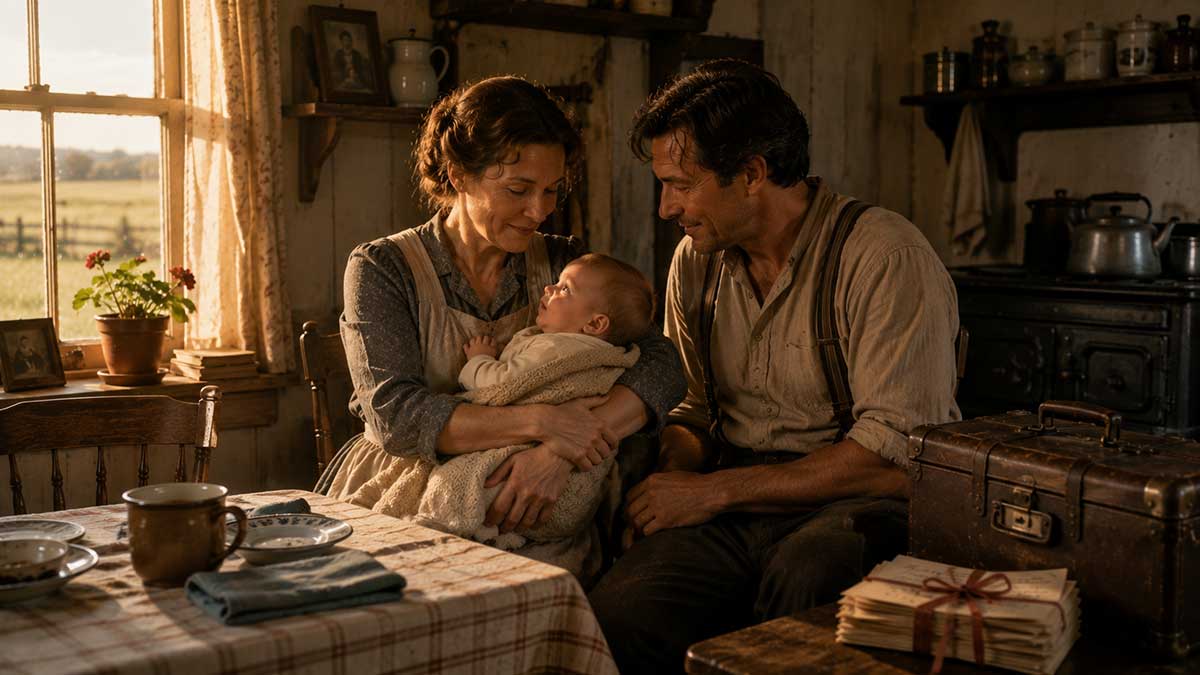
Opening
Evening has arrived. The fields outside have disappeared into shades of blue and charcoal. A small lamp now provides most of the light, casting warm circles across the worn wooden table.
The conversation has become slower. No one feels the need to hurry toward conclusions.
Chekhov watches the flame for a long moment before speaking.
Anton Chekhov: May I propose something slightly irritating?
Elizabeth smiles.
Elizabeth Strout: I was beginning to worry you wouldn't.
Anton Chekhov: I am not convinced people change very much.
The room grows still.
Johanna Parry: That is disappointing.
Anton Chekhov: I expected that reaction.
Kazuo Ishiguro: Then perhaps disappointment is where we should begin.
The Conversation
Elizabeth Strout: Anton... are you truly saying people cannot change?
Anton Chekhov: I am saying that we often mistake revelation for transformation.
A quiet person finally speaks.
A timid woman boards a train.
A selfish man performs one generous act.
Everyone declares they have become different.
Perhaps they were simply waiting for the proper moment to become visible.
Johanna Parry: Then you believe I was always capable of leaving?
Anton Chekhov: I do.
Johanna Parry: Even when I did not?
Anton Chekhov: Especially then.
Johanna leans back, unconvinced.
Johanna Parry: That feels unfair.
If courage already existed inside me, why did it take so long?
Anton Chekhov: Because courage and opportunity seldom arrive on the same day.
Alice nods quietly but does not speak.
Kazuo Ishiguro: I admire that thought.
But I wonder whether it gives memory too little influence.
Anton Chekhov: Explain.
Kazuo Ishiguro: We are not merely the people we have always been.
We are also shaped by what we remember... and by what we choose to remember.
A single experience can reorganize an entire identity.
Not because it invents a new person...
but because it changes the story that person tells about themselves.
Elizabeth Strout: I think both of you are describing different kinds of change.
Anton is speaking about character.
Kazuo is speaking about identity.
Those are not always the same thing.
Chekhov tilts his head with interest.
Anton Chekhov: Go on.
Elizabeth Strout: A child may always possess kindness.
But until someone needs that kindness...
neither the child nor anyone else fully knows it exists.
Later, she remembers herself as "the kind person."
Has she changed?
Or has she finally met herself?
Johanna Parry: I rather like that.
Anton Chekhov: Of course you do.
It avoids choosing.
Laughter circles the table.
Alice Munro (who has remained quiet until now): May I ask Johanna something?
Johanna Parry: Please.
Alice Munro: The woman who boarded the train...
would she recognize the woman sitting here tonight?
Johanna doesn't answer immediately.
She looks into the lamp instead of at Alice.
Johanna Parry: I think...
she would recognize the face.
The hands.
The voice.
But I do not think she would recognize the questions I ask myself now.
Silence.
Alice Munro: Then perhaps something has changed.
Johanna Parry: Perhaps.
But I also think she was always asking those questions...
she simply did not know the words yet.
Kazuo Ishiguro (looking toward Alice): Alice...
may I ask something I've wondered for years?
Alice Munro: Of course.
Kazuo Ishiguro: Your stories rarely end with dramatic personal transformation.
Why?
Most novels reward readers by clearly showing that the protagonist has become someone new.
You almost never do.
Alice Munro (smiling gently): Because life rarely announces itself that way.
People seldom wake one morning and say,
"I am now a different person."
More often...
they look back twenty years later and quietly realize,
"I no longer think as I once did."
The change happened while they were busy living.
Elizabeth Strout: Like daylight fading.
You cannot point to the exact second evening arrived.
Johanna Parry: Then how do we know whether we have changed?
Alice looks around the table.
But before she can answer...
Chekhov surprises everyone.
Anton Chekhov: We ask other people.
The room becomes very quiet.
Johanna Parry: Other people?
Anton Chekhov: We cannot always see ourselves clearly.
Sometimes an old friend says,
"You smile more."
A daughter says,
"You finally listened."
A husband notices,
"You are no longer afraid."
Sometimes they are wrong.
Sometimes they reveal something we could never have seen alone.
Elizabeth Strout: That is beautiful.
But may I disagree?
Anton Chekhov: Naturally.
Elizabeth Strout: Sometimes the people around us refuse to notice our change.
Not because we haven't changed...
but because admitting it would require them to change their opinion of us.
Johanna immediately nods.
Johanna Parry: Yes.
The girls who mocked me...
even if they met me years later...
I wonder whether they would still speak to me as though I were that same housekeeper.
Kazuo Ishiguro: Many people prefer consistency over truth.
If we change, their old judgments become uncomfortable.
Alice quietly refills everyone's cups with the last of the tea.
No one notices immediately.
Only after everyone has another warm cup in hand does Elizabeth smile.
Elizabeth Strout: Alice...
you've been taking care of us all evening.
Alice Munro: Old habits.
Elizabeth Strout: Or your true nature?
Alice laughs softly.
Alice Munro: Perhaps you've just answered our question better than I could.
Closing
The room has grown almost dark. Only the lamp remains.
The five sit in companionable silence, no longer feeling the need to solve every mystery.
Finally, Johanna speaks.
Johanna Parry: Earlier today I asked whether chance had written my life.
Then I wondered whether people had misunderstood me.
Now I find myself asking a different question.
Perhaps I have spent too much time deciding whether I changed...
instead of asking whether I have become more truthful.
She looks toward Chekhov.
Johanna Parry: Perhaps courage was always waiting.
She turns toward Ishiguro.
Perhaps memory slowly gave it a name.
She smiles at Elizabeth.
Perhaps kindness allowed me to recognize it.
Finally, she meets Alice's eyes.
Johanna Parry: And perhaps stories exist because they let us watch that recognition happen.
Alice nods almost imperceptibly.
Alice Munro: I do not think the purpose of a story is to prove that people change.
I think it is to remind us that no one is finished.
Outside, the last light disappears beyond the fields.
No one speaks.
For the first time all day, the silence feels complete.
Topic 5: What Makes an Ordinary Life Meaningful?
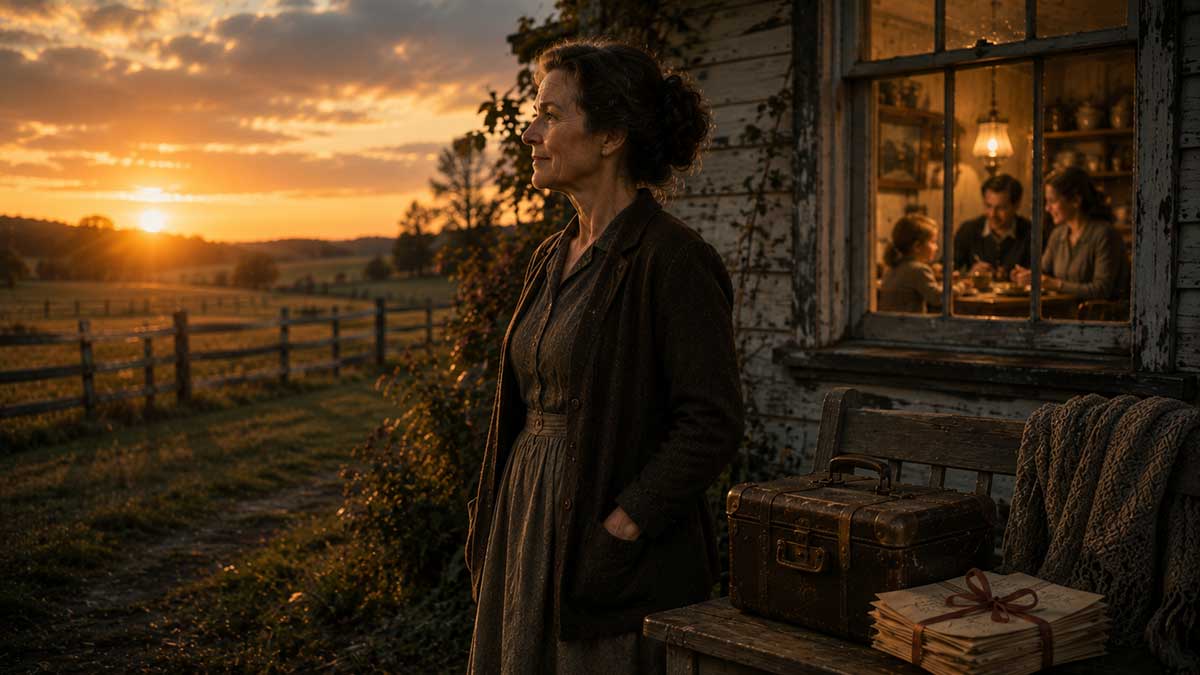
Opening
Night has settled completely over the countryside.
Beyond the windows, the fields have vanished into darkness. Only the faint reflection of the room remains in the glass: five figures around a wooden table, several empty cups, a small lamp burning between them.
No one has spoken for several minutes.
The silence does not feel awkward. It feels earned.
Elizabeth Strout is the first to break it.
Elizabeth Strout: We have spent the day talking about ordinary lives, chance, judgment and change.
She looks around the table.
Elizabeth Strout: But perhaps we have avoided the most difficult question.
Anton Chekhov: Which one?
Elizabeth Strout: What makes any of it meaningful?
Chekhov glances toward Alice.
Anton Chekhov: I was hoping she would ask an easier question.
Alice Munro: At this hour?
Kazuo Ishiguro: Difficult questions improve after dark.
Johanna Parry: Or become easier to disguise.
The others smile.
Elizabeth Strout: Then let us not disguise it.
She turns toward Johanna.
Elizabeth Strout: Do you believe your life has been meaningful?
Johanna looks surprised.
Johanna Parry: That seems like a question one should answer only after death.
Anton Chekhov: Unfortunately, interviews become more difficult then.
Alice Munro: Not here.
Chekhov laughs softly.
Johanna looks down at her hands.
Johanna Parry: I do not know.
Elizabeth Strout: Then perhaps that is where we begin.
The Conversation
Johanna Parry: When people speak of a meaningful life, they usually mention something visible.
Children raised well.
Important work.
A public achievement.
A sacrifice others remember.
Kazuo Ishiguro: Or a legacy.
Johanna Parry: Yes.
Something that remains after the person is gone.
Anton Chekhov: Buildings. Books. Names carved into stone.
Alice Munro: Children who spend years correcting the stories told about their parents.
Elizabeth Strout: That too.
Johanna smiles faintly.
Johanna Parry: But most people leave very little that can be measured.
Their homes are sold.
Their belongings are divided.
Their names disappear from conversation.
What meaning can a life have if nearly everything about it is eventually forgotten?
No one answers immediately.
Kazuo Ishiguro: Must meaning survive in memory to be real?
Johanna Parry: Does it not?
Kazuo Ishiguro: A kindness may change someone who never learns your name.
A sentence spoken at the right moment may alter a decision.
A child may feel safe because of something a parent did repeatedly and quietly, without ever understanding its importance.
The source may be forgotten. The consequence remains.
Anton Chekhov: Like medicine administered by a doctor whose name the patient cannot recall.
Elizabeth Strout: Or a teacher whose words become part of a student’s inner voice.
Johanna Parry: Then meaning can survive without recognition.
Alice Munro: Most meaning probably does.
Johanna studies her.
Johanna Parry: You say that very confidently.
Alice Munro: Recognition is rare. Influence is constant.
We affect one another carelessly, generously, cruelly, invisibly.
A life does not need to be remembered as a whole to have altered other lives.
Johanna Parry: But alteration is not always good.
Alice Munro: No.
Anton Chekhov: A meaningful life is not necessarily a virtuous one.
Elizabeth Strout: I do not like that.
Anton Chekhov: Meaning and goodness are different questions.
Elizabeth Strout: Should they be?
Anton Chekhov: Reality does not ask our permission before separating them.
A slight tension enters the room.
Elizabeth Strout: A tyrant may alter history. That does not make his life meaningful in the sense I would value.
Anton Chekhov: It makes it consequential.
Kazuo Ishiguro: Perhaps we need to distinguish consequence from meaning.
Johanna Parry: And achievement from meaning.
Alice Munro: And meaning from happiness.
Elizabeth Strout: Good. Because people often confuse all three.
She turns toward Chekhov.
Elizabeth Strout: You treated the sick. You wrote stories people still read. Would you call that a meaningful life?
Anton Chekhov: Some days.
Elizabeth Strout: Only some?
Anton Chekhov: Meaning is clearer from a distance.
While living, one is mostly tired.
Elizabeth laughs, but his face remains thoughtful.
Anton Chekhov: A doctor finishes a long day and remembers the patient he could not help.
A writer publishes a story and notices only its failures.
A brother sends money to his family and resents the obligation.
Good actions do not always feel meaningful while we are performing them.
Kazuo Ishiguro: Nor do meaningful choices always feel good.
Johanna Parry: Then feeling fulfilled is not proof?
Elizabeth Strout: No.
Sometimes the most meaningful periods of a life feel exhausting, confusing or lonely.
Johanna Parry: That sounds dangerous.
Elizabeth Strout: Why?
Johanna Parry: Because it could be used to persuade people to tolerate any misery.
“This suffering is meaningful.”
“This sacrifice will matter later.”
“This is what a good woman does.”
Elizabeth’s expression changes.
Elizabeth Strout: You are right.
Alice Munro: Meaning has often been assigned to women by people who benefited from their endurance.
Johanna Parry: Exactly.
Care for everyone.
Ask for little.
Call the disappearance of your own desires devotion.
Anton Chekhov: Men are also given roles.
Johanna Parry: I did not say they were not.
Anton Chekhov: No. You did not.
He pauses.
Anton Chekhov: Continue.
Johanna Parry: I only mean that sacrifice cannot be called meaningful merely because someone else finds it convenient.
Kazuo Ishiguro: Then meaning must involve some degree of authorship.
Johanna Parry: Choice?
Kazuo Ishiguro: Not complete choice. Few people receive that luxury.
But perhaps meaning grows when a person can recognize themselves in what they are giving their life to.
Alice Munro: Even if they did not choose every circumstance.
Elizabeth Strout: A mother may not choose every burden of motherhood, but she may still choose how she loves.
A caregiver may resent the exhaustion and still find meaning in refusing to abandon someone.
Both feelings can be true.
Johanna Parry: Love and resentment?
Elizabeth Strout: Frequently.
Anton Chekhov: The belief that meaningful love must be pure has caused considerable dishonesty.
Alice Munro: People can love deeply and still wish to escape for an afternoon.
Kazuo Ishiguro: Or for years.
Johanna looks toward Alice.
Johanna Parry: Your stories often show people leaving.
Alice Munro: Yes.
Johanna Parry: Do you believe leaving can make a life meaningful?
Alice Munro: Sometimes staying is faithful.
Sometimes leaving is.
Johanna Parry: Faithful to whom?
Alice Munro: That is the question.
The lamp flickers slightly.
Alice Munro: We speak of faithfulness as though it always means remaining loyal to another person.
But there may also be faithfulness to truth.
To one’s own perception.
To a life that has not yet been lived.
Elizabeth Strout: And there can be selfishness disguised as self-discovery.
Alice Munro: Certainly.
Anton Chekhov: Every noble phrase eventually becomes useful to a scoundrel.
Kazuo Ishiguro: That does not make the phrase false.
Anton Chekhov: No. Only dangerous.
Johanna Parry: Then how can anyone know whether a choice is meaningful or merely self-serving?
Elizabeth Strout: Perhaps by asking who bears the cost.
Alice Munro: And whether we are willing to see that cost clearly.
Kazuo Ishiguro: Self-deception often begins when we describe our freedom beautifully and another person’s suffering vaguely.
Anton Chekhov: Very good.
Kazuo Ishiguro: I am relieved you approve.
Anton Chekhov: Do not become dependent upon it.
The group laughs.
Johanna Parry: May I ask each of you what gives a life meaning?
Anton Chekhov: You may ask.
Johanna Parry: That does not mean you will answer.
Anton Chekhov: You understand writers well now.
Elizabeth Strout: I will answer.
She folds her hands around her cup.
Elizabeth Strout: I think meaning comes from loving particular people.
Not humanity in the abstract.
Not goodness as an idea.
This person.
This difficult mother.
This disappointing husband.
This child who frightens you because you cannot protect them from everything.
Meaning becomes real when it has a face.
Johanna Parry: Even when the relationship fails?
Elizabeth Strout: Especially then, sometimes.
A relationship does not need to last forever to have mattered.
Johanna Parry: That sounds comforting.
Elizabeth Strout: It is also painful.
Love can be meaningful without being successful.
Johanna turns toward Chekhov.
Johanna Parry: And you?
Anton Chekhov: Work.
Elizabeth Strout: Only work?
Anton Chekhov: Honest work.
Johanna Parry: What makes work honest?
Anton Chekhov: Attention.
Competence.
Refusal to pretend.
A doctor admits when he does not know.
A writer does not simplify a person merely to prove an argument.
A carpenter makes the unseen side of the table carefully.
Alice Munro: Even if no one checks.
Anton Chekhov: Especially then.
Kazuo Ishiguro: So meaning lies in the quality of one’s attention.
Anton Chekhov: Partly.
We cannot control whether our work lasts. We can control whether we were awake while doing it.
Johanna Parry: Awake?
Anton Chekhov: Present enough to notice reality.
Most human cruelty begins with not looking closely.
Most incompetence does too.
Elizabeth Strout: And much loneliness.
Johanna nods, then turns toward Ishiguro.
Johanna Parry: Kazuo?
Kazuo Ishiguro: I think meaning comes from what we remain responsible for remembering.
Johanna Parry: That sounds heavy.
Kazuo Ishiguro: It can be.
We all edit our pasts. We soften our failures and enlarge our good intentions.
But sometimes a meaningful life requires us to remember what is inconvenient.
Whom we failed.
What we avoided.
What another person sacrificed for us.
Anton Chekhov: Meaning through guilt?
Kazuo Ishiguro: Not guilt alone.
Honesty.
Without honest memory, we repeat ourselves while believing we have changed.
Alice Munro: But memory is unreliable.
Kazuo Ishiguro: Yes.
That is why humility must accompany it.
We say, “This is how I remember,” not, “This is exactly how it was.”
Johanna Parry: Can an inaccurate memory still carry meaning?
Kazuo Ishiguro: Certainly. But we must be careful not to make others prisoners of the story we need.
Johanna looks toward Alice.
Johanna Parry: And you?
Alice Munro: I distrust large answers.
Anton Chekhov: At last, something we share.
Alice Munro: I think meaning is often local.
A meal prepared.
A letter sent.
A truth finally admitted.
A person treated with dignity when no one else is watching.
A moment when someone could have been cruel and chose not to be.
Elizabeth Strout: That sounds like morality.
Alice Munro: Perhaps meaning and morality overlap in small places.
Johanna Parry: But what about ambition?
Creating something great?
Changing the world?
Alice Munro: Those may matter.
But people who try to change the world sometimes become careless with the person in the next room.
Anton Chekhov: Humanity is easier to love at a distance.
Elizabeth Strout: People are rarely grateful in the correct way.
Kazuo Ishiguro: Or at the correct time.
Johanna Parry: Then a meaningful life may look disappointing from the outside.
Alice Munro: Often.
Johanna sits back.
Johanna Parry: I had imagined meaning as something one accumulates.
Achievements.
Relationships.
Proof that one was here.
Kazuo Ishiguro: Perhaps it is not accumulated.
Perhaps it is practiced.
Johanna Parry: Practiced how?
Kazuo Ishiguro: Through repeated choices about what deserves our attention.
Anton Chekhov: That sounds suspiciously wise.
Kazuo Ishiguro: I apologize.
Elizabeth Strout: Do not.
She looks toward Johanna.
Elizabeth Strout: What did you give your attention to?
Johanna Parry: Work.
Order.
The needs of the household.
Elizabeth Strout: Anything else?
Johanna Parry: Hope, eventually.
Alice Munro: That was not a small thing.
Johanna Parry: It did not feel noble.
Alice Munro: Meaning rarely does while it is happening.
Johanna Parry: I wanted a life of my own.
Elizabeth Strout: That desire has meaning.
Johanna Parry: Even if it was partly foolish?
Anton Chekhov: Most meaningful desires contain foolishness.
Kazuo Ishiguro: To hope is to risk appearing ridiculous before the future arrives.
Johanna smiles.
Johanna Parry: And if the future does not arrive?
Elizabeth Strout: The hope may still have revealed what you needed.
Johanna Parry: But revelation without fulfillment can be cruel.
Alice Munro: Yes.
The directness of her answer quiets the room.
Alice Munro: We should not pretend every longing is rewarded.
Some people discover what they need and never receive it.
Some act courageously and are punished.
Some love well and remain alone.
Anton Chekhov: Yet their lives do not become meaningless because justice failed them.
Johanna Parry: Then meaning cannot depend on receiving what we deserve.
Kazuo Ishiguro: Very little in life can safely depend on that.
Elizabeth Strout: Meaning may be found in the way a person responds to what was not deserved.
Johanna Parry: That sounds close to the idea that suffering makes us better.
Elizabeth Strout: No.
Suffering does not automatically improve anyone.
It can narrow us.
Harden us.
Make us cruel.
Anton Chekhov: Pain is not a teacher unless the student survives the lesson.
Alice Munro: And even then, the lesson may be wrong.
Johanna Parry: Then what can suffering contribute?
Kazuo Ishiguro: It may deepen perception.
But it may also damage it.
We should not demand wisdom from wounded people as payment for their suffering.
Johanna’s face softens.
Johanna Parry: I am glad you said that.
Elizabeth Strout: So am I.
Another silence settles.
This one feels more fragile.
Johanna Parry: Alice, why do your stories so often stop before readers know what a life finally means?
Alice Munro: Because a life does not usually offer a final interpretation while the person is still inside it.
Johanna Parry: But stories end.
Alice Munro: Pages end.
Lives continue in consequences, memory and misunderstanding.
A neat moral can make a story feel smaller than the life it contains.
Anton Chekhov: Conclusions are often a form of impatience.
Elizabeth Strout: Yet people need some way to live.
They cannot remain permanently suspended in ambiguity.
Kazuo Ishiguro: Perhaps they do not need certainty. Perhaps they need direction.
Johanna Parry: Toward what?
Elizabeth Strout: Toward greater attention.
Anton Chekhov: Greater honesty.
Kazuo Ishiguro: Greater responsibility for memory.
Alice Munro: Greater willingness to revise.
Johanna looks from one face to another.
Johanna Parry: You have all answered with duties.
Does meaning contain no pleasure?
Anton Chekhov: Thank heavens someone asked.
Elizabeth Strout: Of course it does.
A meal with someone you love.
A child laughing in another room.
The first warm day after winter.
Kazuo Ishiguro: Music heard unexpectedly.
Alice Munro: A train journey that ends differently than expected.
Johanna gives her a look.
Johanna Parry: You could not resist.
Alice Munro: No.
Anton Chekhov: Pleasure matters because it prevents morality from becoming a prison.
Elizabeth Strout: And because joy is not a distraction from life.
It is part of what life asks us to notice.
Johanna Parry: Even small joy?
Alice Munro: Especially small joy.
Large happiness is rare and often unstable.
Small happiness teaches us how not to miss our lives while waiting for something grander.
Kazuo Ishiguro: That may be one of the quiet tragedies of ambition.
A person spends years preparing to live meaningfully later.
Anton Chekhov: After the promotion.
After the children grow.
After the debts are paid.
After the book is finished.
Elizabeth Strout: Then time runs out.
Johanna Parry: That is a cruel thought to end with.
Alice Munro: Then do not end there.
Johanna looks at her.
Alice Munro: Ask a better question.
Johanna Parry: Such as?
Alice Munro: Not “Did my life become important?”
Ask, “What did I learn to notice before it was gone?”
Johanna lowers her eyes.
Johanna Parry: I noticed usefulness before beauty.
Elizabeth Strout: Usefulness has its own beauty.
Johanna Parry: I noticed duty before desire.
Kazuo Ishiguro: And later?
Johanna Parry: Later I discovered that desire could be a kind of information.
Anton Chekhov: Very good.
Johanna Parry: I noticed how easily people decide who another person is.
Alice Munro: And what did that teach you?
Johanna Parry: To be slower.
Elizabeth Strout: Slower to judge?
Johanna Parry: Slower to finish another person’s story.
No one speaks.
The lamp flame steadies.
Closing
Johanna rises from the table and walks toward the window.
The glass reflects her face back to her, surrounded by the faint images of the others behind her.
Johanna Parry: I once thought a meaningful life would feel different from an ordinary one.
Larger.
Clearer.
More certain.
She looks into the darkness beyond the glass.
Johanna Parry: But perhaps meaning does not arrive as a separate life.
Perhaps it is the way we inhabit the one we have.
The attention we give.
The work we do when no one praises it.
The people we continue trying to understand.
The moments of joy we do not postpone.
The judgments we are willing to revise.
She turns back toward the table.
Johanna Parry: Perhaps a life becomes meaningful not because the world remembers it, but because someone was less alone, less frightened or less invisible because we were here.
Elizabeth’s eyes lower. Ishiguro sits very still. Chekhov looks toward the empty cups.
Alice meets Johanna’s gaze.
Alice Munro: That would be enough.
Johanna Parry: Would it?
Alice Munro: More than enough for most of us.
Chekhov reaches toward the lamp, but pauses before extinguishing it.
Anton Chekhov: One final objection.
Elizabeth Strout: Of course.
Anton Chekhov: We have spoken as though meaning must be discovered.
Perhaps some of it is simply made.
Kazuo Ishiguro: Through choice?
Anton Chekhov: Through attention.
Through work.
Through love.
Through refusing to live entirely by accident.
Johanna smiles.
Johanna Parry: Then chance may begin the story.
Elizabeth Strout: Other people may misunderstand it.
Kazuo Ishiguro: Memory may revise it.
Alice Munro: And no one may ever understand it completely.
Anton Chekhov: But while we are here, we may still help write it.
He turns down the lamp.
For a moment, the room disappears.
Then moonlight reaches through the window, faint but sufficient, revealing the table and the five people still seated around it.
No one leaves immediately.
Final Thoughts
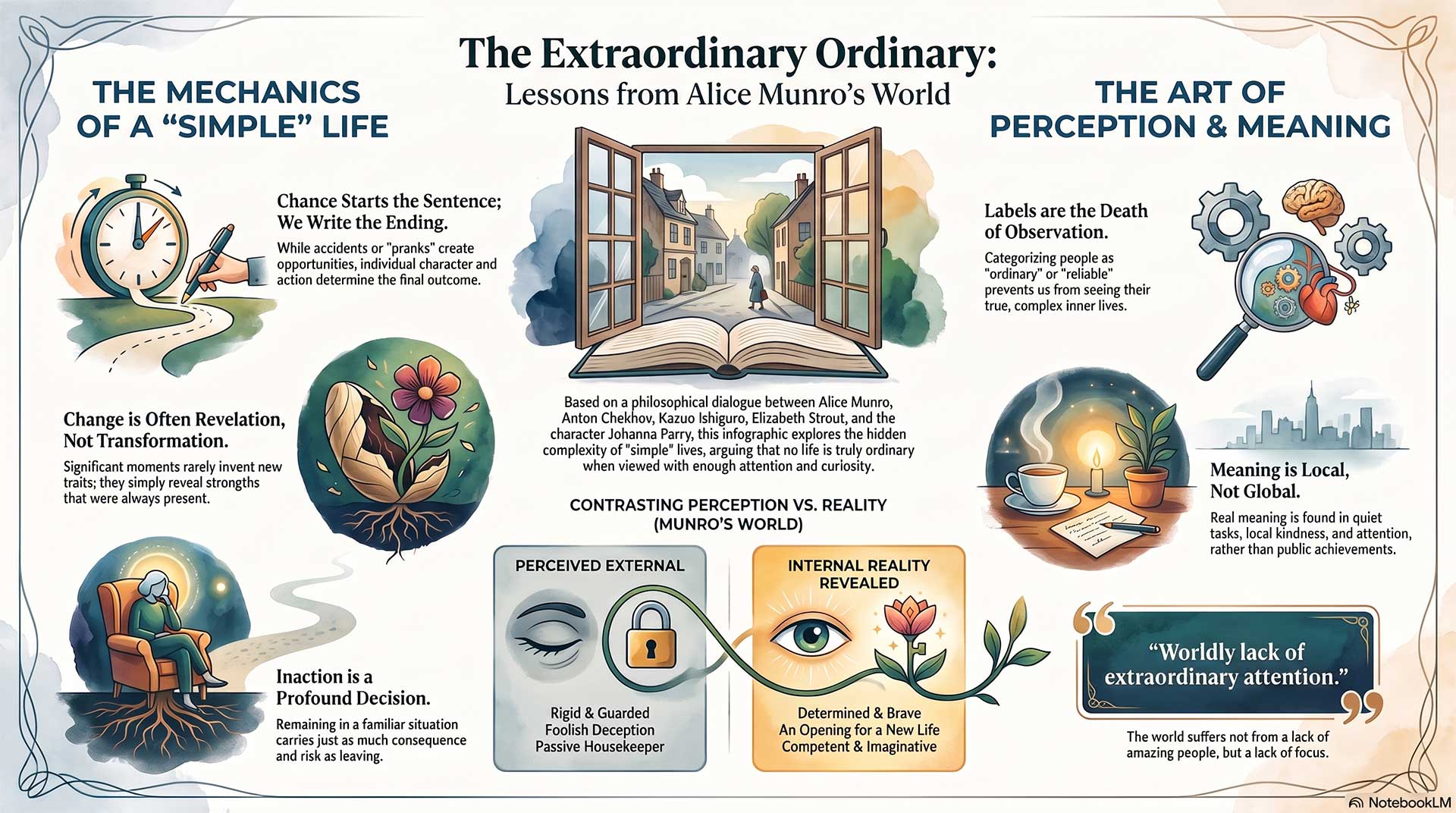
As the lamp grows dim and the conversation finally comes to an end, one realization quietly remains.
Perhaps Alice Munro never wrote stories about ordinary people at all.
Perhaps she wrote about the extraordinary depth hidden inside lives that the world had stopped noticing.
Throughout this conversation, Johanna Parry gradually transforms before our eyes—not because she becomes someone different, but because we learn to see her differently. That subtle shift mirrors Alice Munro's greatest achievement as a writer. She teaches us that understanding another person rarely requires discovering new facts. More often, it requires replacing certainty with curiosity.
The discussion also reveals why Munro's stories continue to resonate long after their final pages. They resist simple lessons. Chance and choice exist together. Strength and vulnerability live within the same person. Memory illuminates while simultaneously distorting. Meaning is rarely announced. Instead, it quietly accumulates through attention, compassion, courage, and the willingness to revise our first impressions.
Each guest leaves us with a different piece of that wisdom.
Chekhov reminds us that reality is always more complicated than our judgments.
Ishiguro gently warns that memory shapes identity as much as events themselves.
Elizabeth Strout reminds us that genuine understanding begins when we continue looking after our first impression has already formed.
Johanna teaches us that the labels others place upon us need not become the boundaries of our lives.
And Alice Munro quietly suggests that no life is ordinary once someone is willing to look closely enough.
Perhaps that is why her stories continue to matter.
Not because they provide answers.
But because they encourage us to slow down, notice more carefully, and leave room for the possibility that every person we meet is living a story far richer than we first imagined.
If we leave this conversation with only one lesson, let it be this:
The world rarely suffers from a lack of extraordinary people.
It suffers from a lack of extraordinary attention.
Short Bios:
Alice Munro (1931–2024)
Alice Munro was a Canadian author widely regarded as one of the greatest short story writers in literary history. Awarded the 2013 Nobel Prize in Literature, she transformed the short story into a form capable of exploring entire lifetimes with remarkable psychological depth. Her stories often examine memory, relationships, chance, and the quiet turning points that reshape ordinary lives. Hateship, Friendship, Courtship, Loveship, Marriage remains one of her most celebrated collections.
Johanna Parry
Johanna Parry is the central character of the title story Hateship, Friendship, Courtship, Loveship, Marriage. A reserved and practical housekeeper, Johanna becomes the unsuspecting target of a cruel prank involving forged love letters. Yet instead of becoming its victim, she quietly transforms an act of deception into the beginning of a new life. Her journey embodies many of Alice Munro's recurring themes: resilience, dignity, unexpected courage, and the hidden complexity of seemingly ordinary people.
Anton Chekhov (1860–1904)
Anton Chekhov was a Russian physician, playwright, and master of the modern short story. His works revolutionized literature by focusing on everyday lives rather than dramatic heroes, revealing profound emotional truths through subtle observation and understated storytelling. His influence can be seen in countless writers, including Alice Munro, whose careful attention to ordinary human experience echoes many of Chekhov's literary innovations.
Kazuo Ishiguro (1954– )
Kazuo Ishiguro is a British novelist and recipient of the 2017 Nobel Prize in Literature. His novels, including The Remains of the Day, Never Let Me Go, and Klara and the Sun, explore memory, identity, regret, and the stories people tell themselves to make sense of their lives. His thoughtful reflections complement Alice Munro's exploration of memory, perception, and the quiet complexities of human relationships.
Elizabeth Strout (1956– )
Elizabeth Strout is an American novelist and Pulitzer Prize winner whose works, including Olive Kitteridge and My Name Is Lucy Barton, are celebrated for their compassionate portrayals of ordinary people navigating family, loneliness, forgiveness, and hope. Like Alice Munro, Strout finds profound emotional depth in everyday life, reminding readers that seemingly ordinary moments often reveal the greatest truths about being human.
Leave a Reply