
What if the hardest question in the novel isn't whether Sethe was right—but whether we are asking the wrong question?
Most people finish Beloved with more questions than answers.
Was Beloved really a ghost?
Why did Sethe kill her child?
What does “not a story to pass on” actually mean?
And why does Toni Morrison make the novel so difficult to explain?
Those questions are not evidence that the reader failed.
They are evidence that the novel worked.
Toni Morrison did not write Beloved as a puzzle with one correct solution. She wrote it as an encounter with memory, slavery, motherhood, love, guilt, history, and the terrible consequences of trying to survive what should never have happened.
The novel refuses to separate the supernatural from the psychological, the personal from the historical, or love from fear. Beloved may be a ghost, a traumatized young woman, Sethe’s murdered daughter, collective memory, or all of these at once. Sethe may be a loving mother, a wounded survivor, a destroyer, and a victim of slavery’s impossible choices at the same time.
That complexity is exactly why readers continue asking questions long after the final page.
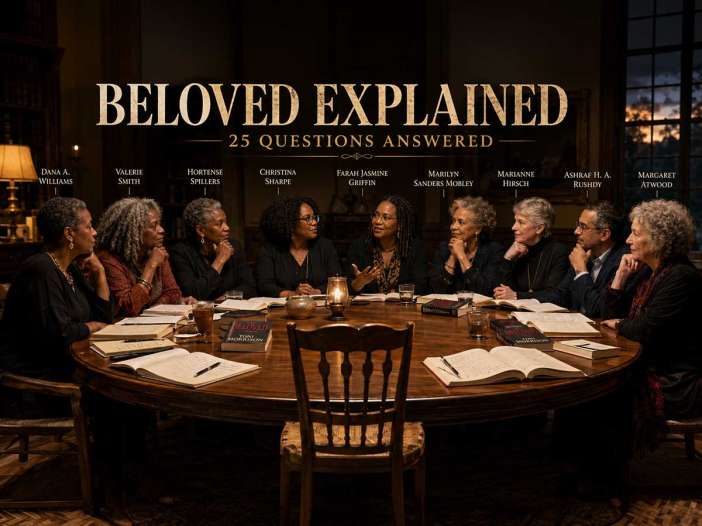
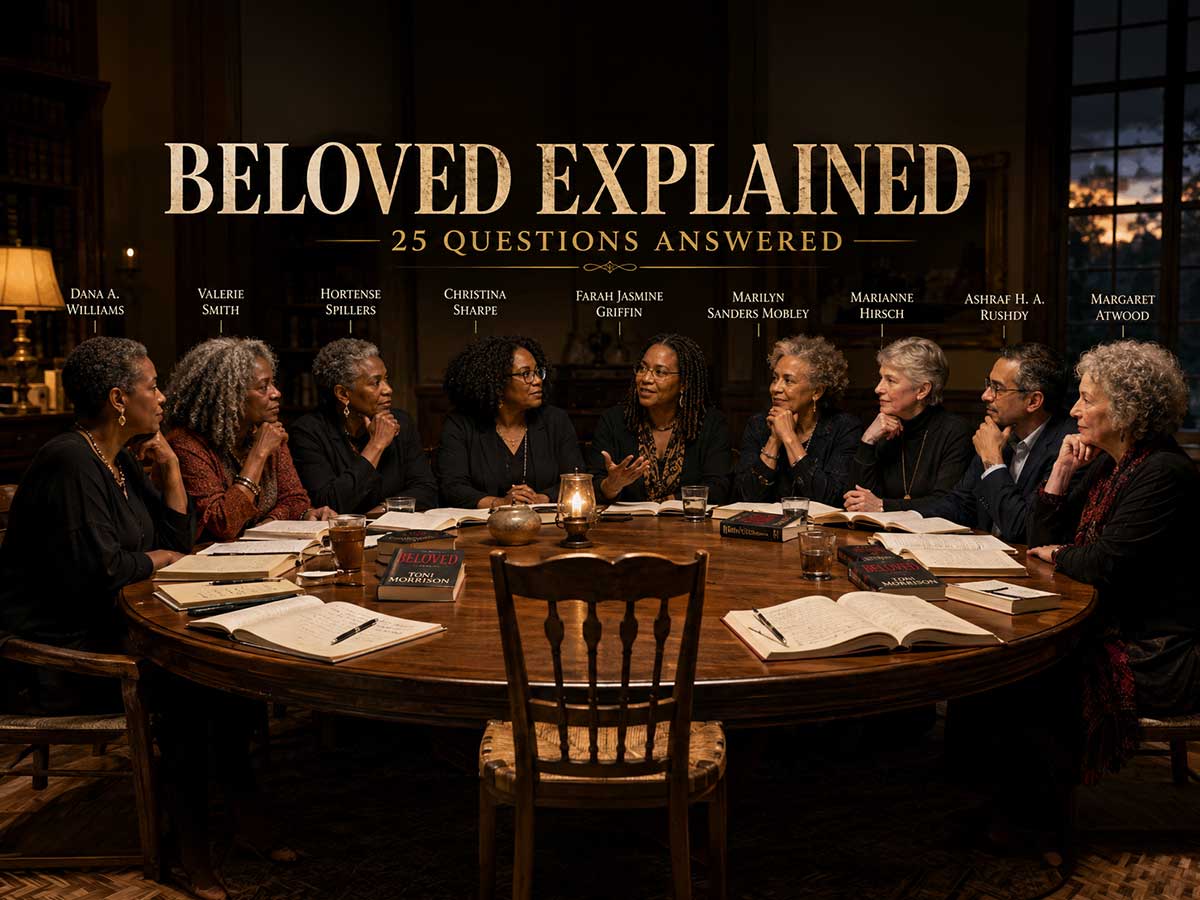
In this second Imaginary Talks series, we move beyond the character-led conversations and invite a rotating panel of scholars, historians, memory theorists, and novelists to explore the twenty-five questions readers most often ask about Beloved.
Dana A. Williams serves as the recurring anchor, guiding each discussion and connecting the questions to Morrison’s larger literary vision. She is joined by voices such as Valerie Smith, Saidiya Hartman, Farah Jasmine Griffin, Hortense Spillers, Marilyn Sanders Mobley, Ashraf Rushdy, Christina Sharpe, Marianne Hirsch, and Margaret Atwood.
Each guest brings a different lens.
Some focus on African American literary tradition.
Some examine the history and afterlife of slavery.
Some explore motherhood, gender, kinship, memory, trauma, spirituality, or the art of fiction itself.
Together, they address five major areas of confusion and debate.
First, they ask who—or what—Beloved really is.
Second, they confront the moral question at the center of the novel: how should readers understand Sethe’s decision?
Third, they explain why Morrison tells the story through fragmented time, shifting voices, repetition, and poetic language.
Fourth, they explore the novel’s most important symbols, including 124, milk, water, trees, scars, hunger, and the haunted house.
Finally, they examine the ending: why the community returns, why Beloved disappears, whether Sethe can heal, why Paul D comes back, and what Morrison means when she tells us this is “not a story to pass on.”
This is not intended to reduce Beloved to twenty-five simple answers.
It is meant to make the novel’s complexity more approachable without making it smaller.
Because the deepest questions in Beloved are not only literary questions.
They are human questions.
What happens when love is shaped by terror?
Can a person survive without becoming imprisoned by survival?
Can history be remembered without consuming the present?
Can the dead be honored without sacrificing the living?
And can a community repair the harm it once allowed?
Some novels are meant to be finished.
Beloved is meant to be returned to.
(Note: This is an imaginary conversation, a creative exploration of an idea, and not a real speech or event.)
Topic 1: Who—or What—is Beloved?
Opening
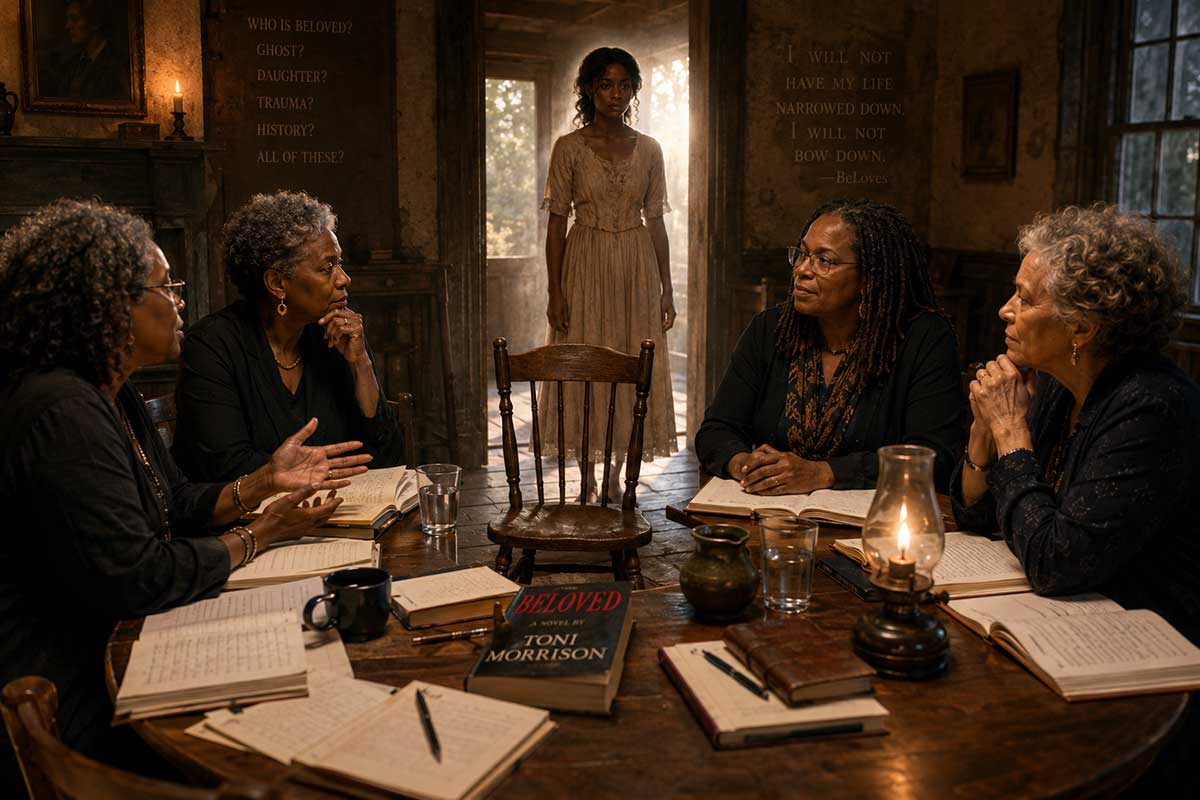
The room was quiet except for the soft ticking of a clock near the window.
On the table lay several copies of Beloved, each opened to a different page. Some were heavily marked. Others had only a few lines underlined, as though the reader had known exactly where the novel had wounded them.
Dana A. Williams sat at the center.
To her right were Valerie Smith and Saidiya Hartman. Across from them sat Margaret Atwood, who had been turning a pencil slowly between her fingers.
Behind them, an empty chair had been placed slightly apart from the others.
No one had explained why.
Dana looked at it once, then opened the conversation.
Dana A. Williams: Most readers begin with the same question.
Who is Beloved?
And that question feels simple only until we try to answer it.
Margaret Atwood: Which is usually a sign that the author has done something interesting.
Valerie Smith: Or dangerous.
Saidiya Hartman: Or necessary.
Dana A. Williams: Then perhaps we should begin with the most direct version.
Is Beloved literally a ghost?
Question 1: Is Beloved Literally a Ghost?
Margaret Atwood: I would begin by saying yes.
Not because that is the only answer, but because the novel invites us to take the supernatural seriously.
A baby dies.
A house becomes haunted.
A young woman appears near the water.
She knows things she should not know.
She behaves less like a visitor than like someone returning to claim a place that was once hers.
If this were a traditional ghost story, we would have enough evidence.
Valerie Smith: But Morrison does not allow the ghost story to remain traditional.
Beloved is not merely an invisible presence rattling furniture.
She becomes embodied.
She eats.
She sleeps.
She sweats.
She demands.
She seduces.
She grows larger.
The ghost enters flesh.
Dana A. Williams: Which changes the question.
Instead of asking whether ghosts are real in the world of the novel, perhaps we should ask why Morrison gives this ghost a body.
Saidiya Hartman: Because slavery was not an abstraction.
It happened to bodies.
It happened through bodies.
Bodies were bought, violated, separated, measured, fed, beaten, bred, buried, and forgotten.
So when the past returns in Beloved, it does not return as an idea.
It returns hungry.
Margaret Atwood: That is what makes Beloved more disturbing than a transparent figure at the end of a hallway.
She has needs.
A conventional ghost frightens you because it is dead.
Beloved frightens you because she behaves as though the dead have been deprived of too much to remain quiet.
Valerie Smith: She is also recognizably a child.
Not in age, of course, but in emotional structure.
She wants Sethe completely.
She does not understand limits.
She does not tolerate divided attention.
She wants the mother she lost to exist only for her.
Dana A. Williams: So when readers ask whether Beloved is literally Sethe’s murdered daughter, the novel gives them strong reasons to say yes.
She knows the song Sethe sang to her children.
She asks intimate questions.
Her presence activates memories Sethe has tried to contain.
Her identity emerges not through a legal document or a confession, but through recognition.
Saidiya Hartman: Recognition is important.
The novel is populated by people whose identities have been damaged by systems of ownership.
Names are unstable.
Family relationships are broken.
Records are incomplete.
Under slavery, the ordinary evidence by which identity is confirmed has been destroyed.
So Beloved cannot arrive with proof.
She arrives through desire, terror, resemblance, and memory.
Margaret Atwood: Which is very much how ghosts work.
They are identified emotionally before they are identified rationally.
You do not say, “I have completed the necessary investigation and concluded that this is the dead.”
You say, “Something in me knows.”
Valerie Smith: Sethe knows because Beloved enters the exact space in her where grief and guilt have remained alive.
Denver knows because she has lived with the baby ghost since childhood.
Paul D resists knowing because he understands that Beloved threatens the fragile life he has begun imagining with Sethe.
Dana A. Williams: Then would each of you answer yes?
Margaret Atwood: Yes, but with a large door left open.
Valerie Smith: Yes, as one layer of the truth.
Saidiya Hartman: Yes, provided we do not make “ghost” a way of shrinking her.
Dana A. Williams: Explain that.
Saidiya Hartman: If we say she is only Sethe’s dead daughter, we risk making the novel’s haunting private.
But Beloved is not haunted only by one family’s tragedy.
It is haunted by a history that produced countless missing children, unnamed dead, broken mothers, and lives that never entered the archive.
The personal ghost carries a collective weight.
The chair behind them creaked.
Margaret looked toward it.
No one was sitting there.
Margaret Atwood: That was theatrical.
Dana A. Williams: Or structural.
Valerie Smith: In this novel, the difference is not always clear.
Question 2: Could Beloved Be a Real Woman?
Dana A. Williams: Let us move to the interpretation some readers find more realistic.
Could Beloved be an actual young woman rather than a supernatural being?
Valerie Smith: Yes.
The novel leaves that possibility open.
Beloved may be a traumatized woman who has escaped captivity, abuse, confinement, or sexual exploitation.
Her language is fractured.
Her sense of self is unstable.
She has difficulty explaining where she came from.
She seems both physically adult and emotionally displaced.
Nothing about that requires the supernatural.
Saidiya Hartman: Historical violence creates people who appear unbelievable to those who have not lived through it.
A person can emerge from captivity unable to tell a coherent story.
A person can return from violence with memory shattered, language disrupted, appetite distorted, and attachment intensified.
We must be careful not to call something supernatural merely because the history that produced it is difficult to imagine.
Margaret Atwood: That is an important point.
Readers often treat realism as whatever resembles their own experience.
But a person who has survived unimaginable brutality may seem ghostlike.
She may appear without a usable past.
She may have no recognized identity.
She may not know how to enter ordinary life.
Dana A. Williams: There are also passages in which Beloved seems to remember confinement, darkness, bodies, and crossing water.
Some readers connect these images to the Middle Passage.
Others connect them to personal imprisonment.
Saidiya Hartman: And those interpretations need not exclude one another.
Trauma rarely arrives with labels.
The novel allows Beloved’s individual memories to touch collective history.
Her words may belong to one woman and to many.
Valerie Smith: The possibility that Beloved is a real woman also changes how we judge Sethe and Denver.
They do not investigate her identity because they need her to be someone.
Denver needs companionship.
Sethe needs the return of the child she lost.
Their desire interprets Beloved before evidence does.
Margaret Atwood: Which makes them very human.
People rarely see only what is present.
They see what they fear, what they miss, and what they are prepared to believe.
Dana A. Williams: Could Beloved be taking advantage of that desire?
Valerie Smith: Possibly, though “taking advantage” may be too deliberate.
She may herself need to become the person they believe her to be.
Identity in the house begins to function relationally.
Sethe calls her daughter.
Denver calls her sister.
Beloved calls Sethe hers.
Each creates the others through need.
Saidiya Hartman: That is especially powerful in a world where slavery has made kinship precarious.
Family is not simply biological.
It must be remembered, claimed, defended, and sometimes imagined.
Beloved’s identity may be unstable because the categories that should have held her were destroyed.
Margaret Atwood: Fiction is often most alive when two incompatible explanations remain possible.
A real woman can be treated like a ghost.
A ghost can have a body.
A symbol can eat breakfast.
Dana A. Williams: Then the question may not be “ghost or woman?”
Margaret Atwood: Exactly.
That is the kind of choice readers often want because it makes the book manageable.
But Morrison seems uninterested in making the book manageable.
Valerie Smith: Beloved may be a ghost who resembles a traumatized woman.
She may be a traumatized woman who becomes the vessel for a ghost.
She may be both because the novel’s deeper concern is not classification.
It is return.
Saidiya Hartman: Return of the child.
Return of the dead.
Return of history.
Return of the unburied.
Return of everything the living believed they had survived.
Question 3: Why Does Morrison Refuse to Give Beloved One Clear Identity?
Dana A. Williams: That brings us to the third question.
Why does Morrison refuse to settle the matter?
Why not tell us plainly who Beloved is?
Margaret Atwood: Because certainty would make her smaller.
The moment the novel says, “Beloved is only this,” every other meaning collapses.
Ambiguity preserves force.
Valerie Smith: It also implicates the reader.
We are required to interpret.
We have to decide what kinds of evidence we trust.
Do we trust Sethe’s recognition?
Denver’s longing?
Paul D’s suspicion?
Beloved’s fragmented memories?
The community’s fear?
No perspective is complete.
Dana A. Williams: So the uncertainty is not a flaw in the novel’s construction.
It is the construction.
Valerie Smith: Exactly.
The novel is built from partial knowledge.
That mirrors both trauma and history.
Saidiya Hartman: It also mirrors the archive of slavery.
We do not possess complete stories for millions of people.
We have sale records.
Advertisements.
Inventories.
Court documents.
Plantation journals.
Bills.
Numbers.
Fragments.
The archive tells us that people were present while often refusing to preserve their interior lives.
Beloved enters the novel from that space of incomplete evidence.
Dana A. Williams: She is known and unknown at once.
Saidiya Hartman: As so many of the enslaved dead are known and unknown.
We know they lived.
We know violence was done to them.
But we do not always know what they loved, feared, remembered, or hoped.
To give Beloved one complete and verified identity might falsely resolve the very historical absence she represents.
Margaret Atwood: It would be too tidy.
And tidiness can be morally dishonest.
Valerie Smith: Morrison also refuses a stable identity because Beloved changes according to the needs and fears of others.
To Sethe, she becomes the daughter who has returned.
To Denver, she is sister, companion, and eventually danger.
To Paul D, she becomes an invasive force.
To the community, she may be punishment, haunting, or evidence that something unresolved remains at 124.
Dana A. Williams: And to the reader?
Valerie Smith: That depends on what the reader is prepared to confront.
Some see guilt.
Some see trauma.
Some see history.
Some see a ghost.
Some see maternal love distorted by slavery.
Some see the forgotten dead demanding recognition.
Saidiya Hartman: That variety is not interpretive failure.
It may be the novel’s ethical design.
No single reader gets to possess Beloved completely.
Margaret Atwood: Which is fitting, since possession is one of the novel’s deepest problems.
Sethe wants to claim Beloved as her daughter.
Beloved wants to claim Sethe as her mother.
Slavery claimed people as property.
The novel repeatedly asks what it means to say, “You are mine.”
Dana A. Williams: That may be one reason Beloved resists definition.
To define can become another form of possession.
Valerie Smith: Yes.
A name can protect, but it can also confine.
Saidiya Hartman: And the unnamed dead cannot always be repaired by naming them according to our own desires.
Sometimes responsible remembrance requires leaving some uncertainty intact.
Margaret Atwood: That is difficult for readers.
We like solved mysteries.
Dana A. Williams: But Beloved is not a mystery novel in which the final chapter explains the ghost.
Margaret Atwood: No.
It is a ghost story in which the ghost explains us.
The clock continued ticking.
The empty chair remained still.
Question 4: What Does Beloved Symbolize?
Dana A. Williams: Let us turn to the symbolic question.
What does Beloved represent?
Valerie Smith: The most immediate answer is Sethe’s murdered daughter.
We should never move so quickly toward symbolism that we erase the child.
She was a particular life.
She had a mother.
She had siblings.
She died through an act committed in a moment of terror.
Saidiya Hartman: That distinction matters.
Historical victims are often transformed into symbols before they are allowed to remain people.
Beloved may carry collective meaning, but she is first the child whose life was taken.
Margaret Atwood: Symbols are strongest when they remain characters.
If Beloved becomes merely “the past,” she stops breathing.
The reader no longer has to contend with her appetite, jealousy, seduction, anger, and need.
Dana A. Williams: So we should begin with personhood before abstraction.
Valerie Smith: Yes.
But from there, she expands.
Beloved represents traumatic memory.
She is what Sethe tried to suppress.
She is the past becoming physically present.
She embodies the return of what has not been mourned or integrated.
Saidiya Hartman: She also represents the historical dead who were denied proper remembrance.
Her arrival asks a terrifying question.
What would happen if the forgotten came back not as noble ancestors, but as people furious about what was taken from them?
Margaret Atwood: That is one reason Beloved is not gentle.
We often prefer the dead to return with wisdom.
Beloved returns with hunger.
Dana A. Williams: Why hunger?
Margaret Atwood: Because she has been deprived.
Of life.
Of time.
Of motherhood.
Of language.
Of a future.
Hunger is the shape of absence when it becomes active.
Valerie Smith: She also symbolizes the danger of allowing guilt to become the center of identity.
Once Sethe recognizes Beloved as her daughter, she begins surrendering herself.
She tries to explain.
To compensate.
To prove that the killing came from love.
But Beloved cannot be satisfied because the loss cannot be reversed.
Saidiya Hartman: No living person can repay the dead by ceasing to live.
That is one of the novel’s deepest moral insights.
Sethe believes she owes Beloved everything.
But giving everything to the dead endangers Denver and destroys Sethe.
Dana A. Williams: Then Beloved may represent memory without limits.
Valerie Smith: Yes.
Memory that does not coexist with the present.
Memory that consumes food, space, language, and relationship until nothing else remains.
Margaret Atwood: She is remembrance becoming possession.
Saidiya Hartman: But we must not make forgetting the cure.
The novel does not say, “Erase the past and live happily.”
Beloved appears because forgetting has already failed.
The question is how to remember without allowing memory to devour the living.
Dana A. Williams: What else does she symbolize?
Valerie Smith: The child’s claim upon the mother.
The mother’s guilt.
The community’s failure.
Slavery’s afterlife.
The instability of identity.
The return of repressed history.
The difference between love and possession.
Margaret Atwood: And storytelling itself.
Beloved comes alive through fragments.
She is assembled from memory, language, silence, desire, and repetition.
In that sense, she resembles a story.
Stories can preserve the dead.
They can also trap the living.
Saidiya Hartman: Especially when the story becomes the only identity available.
Sethe risks becoming nothing but the mother who killed.
Beloved risks becoming nothing but the child who was killed.
Denver risks becoming nothing but the surviving daughter of tragedy.
Healing requires identities larger than the wound.
Dana A. Williams: So Beloved is not one symbol.
She is a gathering place for the novel’s central forces.
Valerie Smith: Yes.
She is where love, history, guilt, motherhood, trauma, and memory take bodily form.
Question 5: Why Does Beloved Become Stronger and More Destructive?
Dana A. Williams: Our final question is perhaps the most disturbing.
Why does Beloved become stronger as Sethe becomes weaker?
Valerie Smith: Because Sethe feeds her.
Literally and emotionally.
The household’s resources flow toward Beloved.
Food.
Attention.
Stories.
Apologies.
Time.
Beloved expands as Sethe gives up her own boundaries.
Margaret Atwood: This is classic haunting logic.
The more attention you give the ghost, the more power it acquires.
But Morrison makes that logic psychological and historical.
Beloved grows because Sethe believes she deserves to disappear into repayment.
Saidiya Hartman: Sethe confuses remembrance with self-punishment.
She believes that because she caused Beloved’s death, she must surrender her own life.
But that does not restore Beloved.
It only produces another form of death.
Dana A. Williams: Is Beloved intentionally cruel?
Valerie Smith: At times, she appears cruel.
She isolates Sethe.
She drives Paul D away.
She demands exclusive possession.
She grows enraged when Sethe’s attention shifts.
But her cruelty is inseparable from deprivation.
She behaves like someone whose emotional life ended before she learned limits.
Margaret Atwood: She wants infinite compensation for an irreversible loss.
That is impossible.
Therefore every gift proves insufficient.
Saidiya Hartman: We should also consider that Beloved may not understand reciprocity.
She knows hunger.
She knows abandonment.
She knows the terror of separation.
She does not know how to love without consuming.
Dana A. Williams: That sounds similar to Sethe.
Valerie Smith: It is.
Sethe’s love has also been shaped by terror.
She tries to protect her children absolutely.
Beloved tries to possess her mother absolutely.
Both forms of love have lost boundaries.
Margaret Atwood: Which makes Beloved less Sethe’s opposite than Sethe’s reflection.
Each says, in effect, “You are mine, and I cannot survive your separation from me.”
Saidiya Hartman: Slavery created that desperation by making separation a constant threat.
Children could be sold.
Mothers could be taken.
Partners could disappear.
Under such conditions, attachment becomes charged with panic.
Dana A. Williams: Then Beloved’s destructiveness is not simply supernatural evil.
Valerie Smith: No.
Calling her evil would be too easy.
She is destructive, but she is also wounded.
She is dangerous, but she is also deprived.
She harms Sethe, yet she comes from a history of harm.
Margaret Atwood: The frightening thing is that suffering does not always make people gentle.
Sometimes suffering produces appetite without mercy.
Saidiya Hartman: And history can consume those who believe they alone must answer for it.
Sethe tries to carry the entire burden privately.
That is why the community becomes necessary later.
The haunting cannot be resolved by one mother apologizing to one daughter forever.
Dana A. Williams: Because the crime was never only private.
Saidiya Hartman: Exactly.
Sethe committed the act, but slavery created the terror in which the act became imaginable.
The community withdrew.
The institution pursued her.
The nation permitted ownership.
Beloved’s hunger exceeds what Sethe can answer because the wound exceeds Sethe alone.
Valerie Smith: Denver understands this first.
She sees that if the relationship continues, Sethe may die.
So she leaves the house.
That is crucial.
She breaks the closed triangle of Sethe, Beloved, and the past.
Margaret Atwood: She chooses the living world.
Dana A. Williams: Does Beloved want Sethe to die?
Valerie Smith: Perhaps not in a consciously planned sense.
But she wants Sethe completely.
And complete possession is incompatible with Sethe remaining a separate person.
Saidiya Hartman: That is the danger.
Beloved does not need to say, “Die for me.”
She only needs to make continued living feel like betrayal.
Margaret Atwood: Which is how guilt often works.
Dana A. Williams: Then Beloved becomes strongest when Sethe no longer believes she has the right to a future.
Valerie Smith: Yes.
And Beloved begins to lose power when Denver claims one.
Closing
For a while, no one spoke.
Outside the window, the light had changed. The room was darker now, though no one had noticed the sun going down.
Dana closed her copy of the novel.
Dana A. Williams: We began with a question that seemed to require a name.
Who is Beloved?
But perhaps the novel gives us a different kind of answer.
Valerie Smith: She is Sethe’s daughter.
Saidiya Hartman: She is one of the dead history did not properly remember.
Margaret Atwood: She is a ghost.
Valerie Smith: She may be a living woman.
Saidiya Hartman: She is trauma given appetite.
Margaret Atwood: She is a story that refuses to remain in the past tense.
Dana A. Williams: And she is dangerous because each answer is true without being complete.
The empty chair moved slightly.
This time, everyone heard it.
Margaret stopped turning the pencil.
Margaret Atwood: Are we going to acknowledge that?
Saidiya Hartman: Perhaps acknowledgment is the beginning.
Valerie Smith: But not the end.
Dana looked toward the chair.
Dana A. Williams: Beloved returns because something was not finished.
Not the child’s life.
Not Sethe’s grief.
Not the community’s responsibility.
Not the history that made the house possible.
The task, then, is not merely to identify the ghost.
It is to ask what the ghost is demanding from the living.
The clock stopped.
No one rose immediately.
And the empty chair remained among them—not explained, not dismissed, and no longer ignored.
Topic 2: Was Sethe Right?
Opening
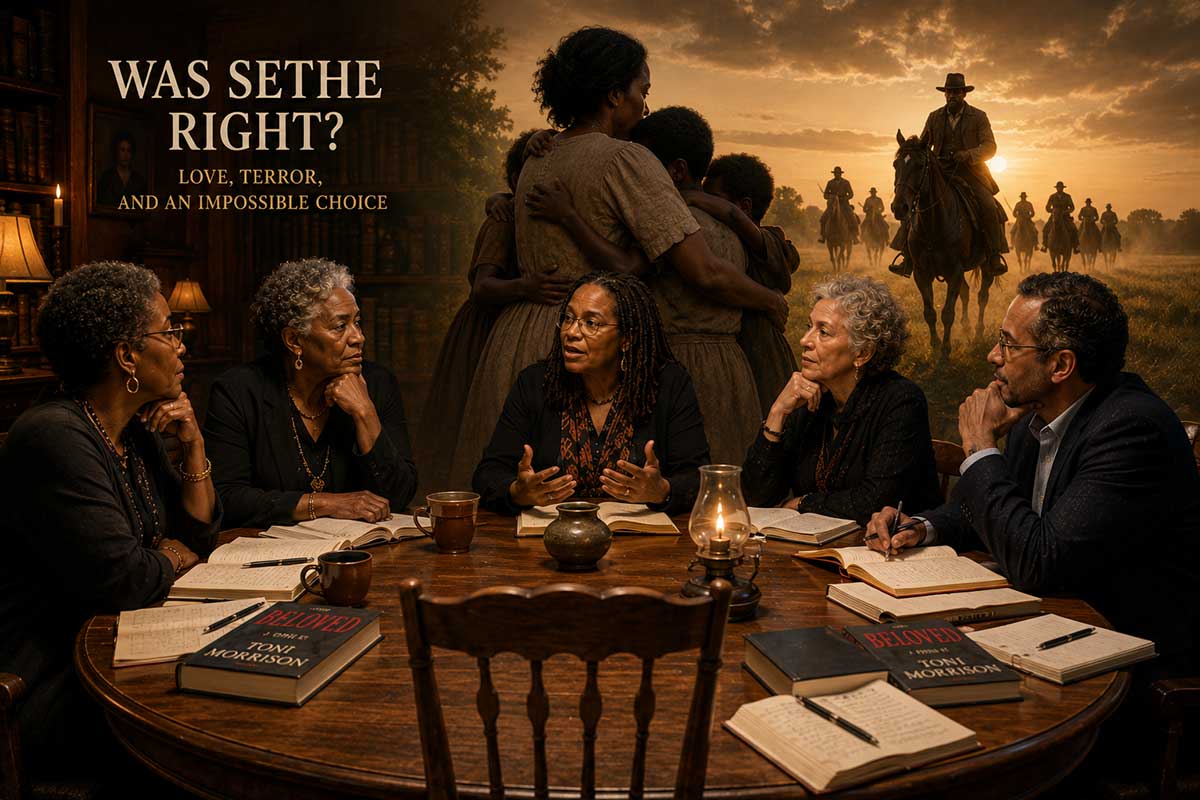
The second conversation began later in the evening.
The copies of Beloved were still on the table, but the empty chair had been moved closer.
No one said who had moved it.
Dana A. Williams sat again at the center. This time she was joined by Hortense Spillers, Marilyn Sanders Mobley, and Valerie Smith.
The room felt less haunted than before.
It felt more like a courtroom in which no one wanted to become the judge.
Dana looked down at the page in front of her.
Dana A. Williams: We now come to the question readers fear most.
Was Sethe right?
Hortense Spillers: That question is already too clean.
Valerie Smith: And too late.
Marilyn Sanders Mobley: But it is still the question readers ask.
Dana A. Williams: Then we should not avoid it.
We should ask it carefully.
Not, “Was killing a child right?”
That answer is too easy.
The deeper question is this:
What happens to moral judgment when a mother believes that death is the only remaining form of protection?
No one answered immediately.
The empty chair stood beside them.
Question 6: Why Does Sethe Kill Her Child?
Dana A. Williams: Let us begin with the fact itself.
Why does Sethe kill her daughter?
Valerie Smith: Because schoolteacher has arrived.
Because Sethe understands exactly what his arrival means.
Not simply recapture.
Not simply punishment.
The return of ownership.
Hortense Spillers: We need to be precise about that word.
Ownership under slavery is not metaphorical.
Sethe’s body is not legally hers.
Her children are not securely hers.
Her labor, movement, reproductive capacity, milk, and family relations are all vulnerable to seizure.
When schoolteacher approaches, Sethe does not imagine a difficult future.
She imagines the reentry of her children into a system that recognizes them as property.
Marilyn Sanders Mobley: And she acts within a moment of extreme terror.
It is not a philosophical decision.
She does not sit down and weigh moral principles.
She sees the past arriving at the edge of the yard.
Everything she has suffered collapses into one instant.
Dana A. Williams: So her action is shaped by memory.
Valerie Smith: By memory and anticipation.
She remembers what was done to her.
She knows what may be done to her children.
The crucial point is that she does not experience schoolteacher’s arrival as a possibility.
She experiences it as certainty.
Hortense Spillers: Because slavery has already taught her that there is no protected category called “motherhood.”
A mother may give birth, feed, love, and care for a child, yet the law can still define the child as someone else’s asset.
Sethe’s act emerges from that collapse.
If she cannot guarantee her children life as persons, she tries to guarantee that they will not live as property.
Dana A. Williams: That is the logic.
But it is still unbearable.
Marilyn Sanders Mobley: It should be unbearable.
If we make it understandable too quickly, we risk making it acceptable.
And Morrison does not ask us to accept it.
She asks us to understand the world that made such an act imaginable.
Valerie Smith: Exactly.
Sethe’s act is not presented as a triumph of maternal courage.
It is catastrophe.
But it is a catastrophe produced inside a larger catastrophe.
Hortense Spillers: Slavery creates a moral environment in which every option has already been corrupted.
Stay, and the children may be enslaved.
Run, and they may be captured.
Fight, and they may be killed.
Submit, and their personhood may be destroyed.
Sethe chooses, but she does not choose freely.
Dana A. Williams: Then perhaps the right question is not only why she killed her child.
It is why slavery left death looking like protection.
Marilyn Sanders Mobley: Yes.
And why Sethe believed that the only power still available to her was the power to prevent ownership by ending life.
Valerie Smith: That is what makes the scene so morally devastating.
Her act is both an assertion of agency and evidence of how thoroughly agency has been mutilated.
Hortense Spillers: She says, in effect, “You will not take what is mine.”
But the language of “mine” has already been poisoned by slavery.
Ownership has entered even maternal love.
Question 7: Is Sethe’s Act Love, Madness, or Both?
Dana A. Williams: Let us confront the next question directly.
Is Sethe’s act an expression of love?
Or madness?
Valerie Smith: Both words are inadequate by themselves.
If we call it love, we risk sanctifying violence.
If we call it madness, we risk separating Sethe from the historical conditions that shaped her reasoning.
Marilyn Sanders Mobley: Her act comes from love.
But not from healthy love.
It is love transformed by terror.
Hortense Spillers: Love under slavery cannot be treated as though it develops under ordinary conditions.
Attachment becomes dangerous because anything loved can be sold, taken, assaulted, or used as leverage.
Sethe’s love is intense because security is impossible.
Dana A. Williams: Then when readers say, “A loving mother would never do this,” they are imagining motherhood in a protected world.
Hortense Spillers: Precisely.
They assume a social order in which the mother’s care is recognized and defended.
Sethe has no such protection.
Her love develops inside a regime that can invalidate it at any moment.
Valerie Smith: But we must still preserve the horror of what she does.
Beloved is not saved by dying.
She is deprived of life.
That remains true even if Sethe believes she is protecting her.
Marilyn Sanders Mobley: Intent matters, but it does not erase consequence.
Sethe’s tragedy lies in the distance between what she means to do and what she actually does.
She means to rescue.
She kills.
Dana A. Williams: Is that madness?
Valerie Smith: It is an act committed under extreme psychological pressure.
But Morrison does not let us dismiss it as incomprehensible insanity.
Sethe’s reasoning is terrible, yet coherent within her experience.
Hortense Spillers: Calling her mad can become a way of preserving the moral innocence of the society around her.
It allows readers to say, “The problem was Sethe.”
The novel says the problem was much larger.
Marilyn Sanders Mobley: There may also be a spiritual dimension.
Sethe has been pushed into a place where life and death no longer carry their ordinary meanings.
Freedom is life.
Enslavement is a form of death.
Physical death appears, in that instant, as the only protection from a deeper annihilation.
Dana A. Williams: But that does not make the act sacred.
Marilyn Sanders Mobley: No.
It makes it tragic.
Valerie Smith: Sethe’s act should remain morally troubling.
The reader is not supposed to resolve it comfortably.
Hortense Spillers: In fact, discomfort is part of the ethical work.
If we condemn her too quickly, we ignore slavery.
If we excuse her too quickly, we ignore the child.
The novel refuses both forms of simplification.
Dana A. Williams: Then perhaps Sethe’s act is not proof that love and violence are opposites.
It is proof that violence can enter love and distort it.
Valerie Smith: Yes.
And that love shaped entirely by fear may become destructive while still believing itself protective.
Question 8: Can Readers Judge Sethe?
Dana A. Williams: Let us move to the question beneath all the others.
Do readers have the right to judge Sethe?
Hortense Spillers: Readers will judge her.
The question is whether they will judge honestly.
Valerie Smith: Judgment is unavoidable.
The novel itself invites moral response.
But it also teaches us that judgment without historical imagination is shallow.
Marilyn Sanders Mobley: There is a difference between judgment and condemnation.
Judgment asks, “What happened here? What responsibility remains?”
Condemnation says, “I understand enough to close the case.”
Dana A. Williams: So the danger is certainty.
Valerie Smith: Yes.
A modern reader may say, “I would never do that.”
But that statement often contains an unexamined assumption:
I would still possess the protections I have now.
I would still trust the law.
I would still believe that my children’s bodies could not be legally owned.
I would still imagine a future beyond capture.
Sethe has none of those assurances.
Hortense Spillers: Moral judgment becomes distorted when it ignores unequal conditions.
We do not judge an act fairly if we erase the world that produced the available choices.
Dana A. Williams: But can historical context become an excuse for anything?
Hortense Spillers: No.
Context is not absolution.
It is accuracy.
Marilyn Sanders Mobley: We can say that the child’s death is wrong and still understand that Sethe did not act from hatred.
We can grieve for Beloved without reducing Sethe to a monster.
We can see Sethe as responsible and also see slavery as the larger author of the catastrophe.
Valerie Smith: Morrison distributes responsibility.
Sethe acts.
Schoolteacher pursues.
The slave system authorizes.
The community withdraws.
The nation permits.
History surrounds the scene.
Dana A. Williams: That distribution matters because readers often want one person to carry the entire moral burden.
Valerie Smith: Yes.
And Sethe is already trying to do exactly that.
She accepts the full weight of the act as though no one else participated in creating the conditions.
Hortense Spillers: Which mirrors how societies often remember violence.
They isolate one terrible action and refuse to examine the system around it.
Marilyn Sanders Mobley: The spiritual question may be whether we can hold truth and mercy together.
Truth says a child died by her mother’s hand.
Mercy asks what terror brought the mother to that point.
Neither truth nor mercy is complete without the other.
Dana A. Williams: So readers may judge, but they must judge while remaining vulnerable to what they do not know.
Valerie Smith: And to what they might have become under conditions they cannot fully imagine.
Hortense Spillers: Humility is not the suspension of morality.
It is the refusal to place oneself outside history.
Question 9: Why Is Sethe’s Milk So Important?
Dana A. Williams: We now turn to something that many readers initially overlook.
Why does Sethe speak so insistently about her milk?
Valerie Smith: Because the theft of her milk is not a minor humiliation.
It is an assault on her motherhood.
Hortense Spillers: Her milk represents nourishment, bodily autonomy, maternal authority, and the right to sustain her own child.
When the men take it, they do more than violate her body.
They interrupt the relation between mother and infant.
Marilyn Sanders Mobley: Sethe says, in effect, “They took what belonged to my baby.”
That is why the memory remains so powerful.
The violation is sexual, physical, maternal, and spiritual at once.
Dana A. Williams: She seems more focused on the milk than on the beating that follows.
Valerie Smith: Exactly.
Paul D has difficulty understanding that at first.
He hears a story of assault and imagines the whipping as the central injury.
Sethe insists that the milk matters because it reveals what slavery stole beyond physical freedom.
It stole her ability to mother on her own terms.
Hortense Spillers: Under slavery, the female body is simultaneously laboring body, reproductive body, sexualized body, and property.
Sethe’s milk shows how those categories collapse.
Something intimate and relational becomes available for seizure.
Dana A. Williams: And the child’s need is ignored.
Hortense Spillers: Yes.
The act declares that neither Sethe’s body nor her maternal bond has authority.
Marilyn Sanders Mobley: Milk is also life.
It is the first gift a mother gives.
To steal it is to violate the sacred exchange between mother and child.
Valerie Smith: This helps explain why Sethe later becomes so absolute in her protection.
She has experienced motherhood as something others can invade.
Her children’s bodies can be taken.
Her milk can be taken.
Her right to define care can be taken.
So she begins to believe that only total control can keep them safe.
Dana A. Williams: Which connects the milk directly to the killing.
Valerie Smith: Yes.
The theft teaches Sethe that the world will enter even the most intimate bond.
Her later act is an attempt to make that bond inaccessible.
Hortense Spillers: But in trying to defend motherhood from external ownership, she creates another form of possession.
She decides the child’s fate completely.
Dana A. Williams: So the milk symbolizes both care and the corruption of care.
Marilyn Sanders Mobley: And the wound that follows is carried on her back.
The stolen milk and the chokecherry tree belong to the same history.
One marks what was taken from her as a mother.
The other marks what was done to her as property.
Valerie Smith: Morrison refuses to separate them.
Sethe’s body remembers both.
Question 10: What Does Paul D Mean by “Love Is Too Thick”?
Dana A. Williams: Our final question is one of the most quoted and most misunderstood.
What does Paul D mean when he suggests that Sethe’s love is “too thick”?
Valerie Smith: He means that her love has no boundaries.
It is so concentrated, so fearful, and so absolute that it becomes dangerous.
Hortense Spillers: Under slavery, restrained love may appear safer.
Paul D has learned to keep parts of himself inaccessible.
His heart is sealed in what he imagines as a tobacco tin.
He survives by limiting attachment.
Sethe survives by intensifying it.
Dana A. Williams: So they represent opposite survival strategies.
Valerie Smith: Exactly.
Paul D thins love out.
Sethe thickens it.
Neither emerges uninjured.
Marilyn Sanders Mobley: Paul D fears Sethe’s love because it has crossed into a realm where the beloved cannot remain separate.
Sethe does not simply say, “I love my children.”
She says, “They are my best thing.”
Her identity is consumed by them.
Dana A. Williams: Is that wrong?
Marilyn Sanders Mobley: Love can be profound without erasing the self.
But Sethe has almost no self outside motherhood, survival, and memory.
Her children become the proof that she escaped.
The proof that she protected something.
The proof that slavery did not take everything.
That gives the love enormous weight.
Hortense Spillers: And weight can become pressure.
A child cannot safely carry the task of completing a parent’s identity.
Valerie Smith: Beloved reveals this danger most clearly.
Sethe tries to repay her endlessly.
She stops eating properly.
She stops living beyond the house.
She gives Beloved more and more until love becomes self-erasure.
Dana A. Williams: Yet Paul D’s thinner love also has costs.
Valerie Smith: Certainly.
His emotional restraint protects him, but it also isolates him.
He struggles to stay.
He questions his own manhood.
He fears full attachment.
The novel does not simply tell us Sethe is wrong and Paul D is right.
Hortense Spillers: It asks what kind of love is possible after slavery.
Too thin, and no one can reach you.
Too thick, and no one can breathe.
Marilyn Sanders Mobley: Healthy love may require presence without possession.
Care without control.
Memory without imprisonment.
Sacrifice without annihilation.
Dana A. Williams: That sounds simple when stated.
Marilyn Sanders Mobley: It is not simple to live.
Especially for people whose attachments have repeatedly been threatened.
Valerie Smith: Paul D’s phrase is powerful because he recognizes the danger before Sethe does.
But he also speaks from fear.
He may call her love too thick partly because her intensity exposes how carefully he has rationed his own.
Hortense Spillers: He is not merely diagnosing Sethe.
He is defending himself.
Dana A. Williams: Then the phrase contains truth and limitation.
Valerie Smith: As most important statements in the novel do.
Closing
The room had grown still again.
No one looked at the empty chair this time.
Perhaps because the question no longer felt like Beloved’s alone.
Dana placed both hands on the table.
Dana A. Williams: Was Sethe right?
Hortense Spillers: No answer can survive without history.
Valerie Smith: And no history can erase the child.
Marilyn Sanders Mobley: The act came from love.
But love does not become harmless merely because it is sincere.
Dana A. Williams: Can we say she was wrong?
Valerie Smith: We can say the act was terrible.
Hortense Spillers: We can say the world that produced it was more terrible still.
Marilyn Sanders Mobley: And we can say that judgment without mercy becomes another form of violence.
For several seconds, no one spoke.
Then the empty chair made a faint sound against the floor.
Not a movement.
More like pressure.
As if someone unseen had leaned forward.
Dana A. Williams: Perhaps the question Beloved asks is not only, “Why did you kill me?”
Perhaps it is also, “Why was death the only freedom you believed you could give me?”
Valerie Smith: And perhaps Sethe’s answer can never be enough.
Hortense Spillers: Because one mother did not create the world that trapped them both.
Marilyn Sanders Mobley: But she still has to live with what she did inside it.
Dana closed the book.
Dana A. Williams: That may be the deepest tragedy.
Sethe’s love was real.
Her terror was real.
Her act was real.
And none of those truths cancels the others.
The room remained silent.
The empty chair did not move again.
Topic 3: Why Is Beloved So Difficult to Read?
Opening
The third conversation began the next afternoon.
Sunlight entered through the windows in narrow bands, illuminating dust above the table. The room looked ordinary again.
The empty chair remained.
No one had removed it.
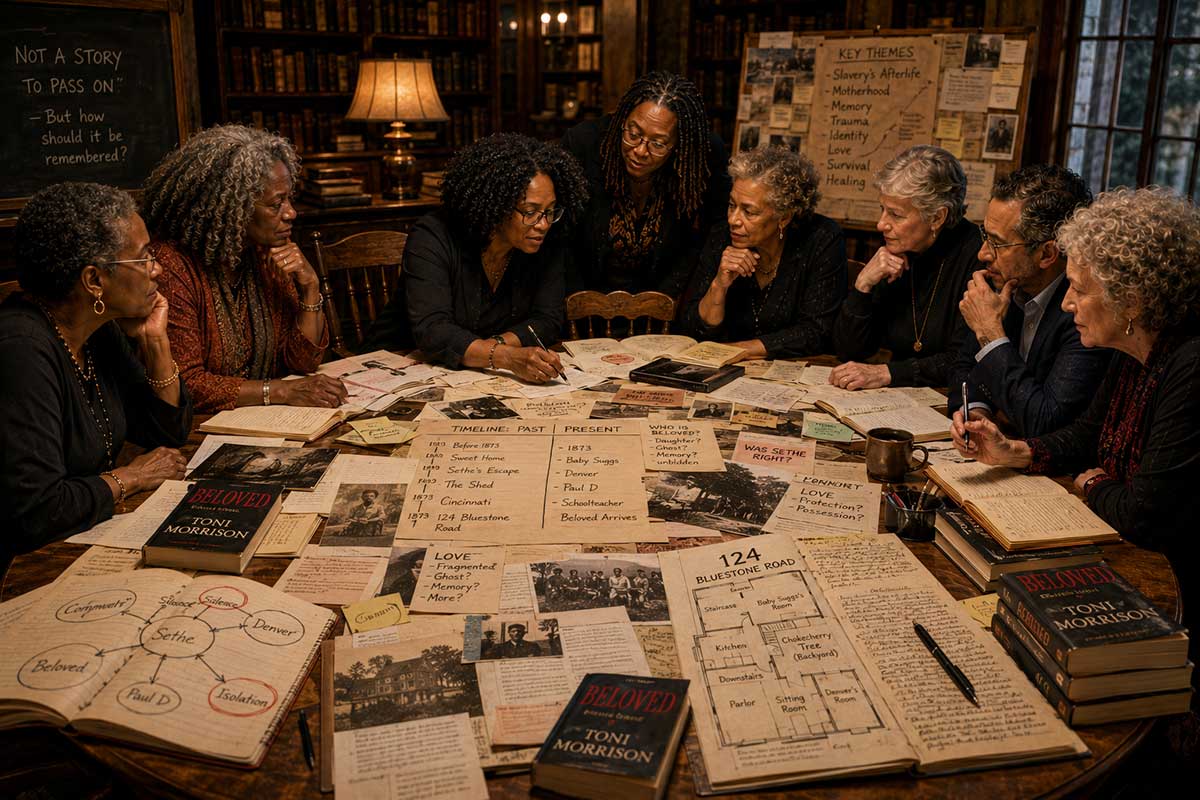
Dana A. Williams sat with Farah Jasmine Griffin, Ashraf H. A. Rushdy, and Margaret Atwood. Several copies of Beloved lay open before them, but this time the pages were covered with arrows, circles, dates, and question marks.
Margaret lifted one of the books.
Margaret Atwood: This copy looks as though someone tried to solve it with a map.
Farah Jasmine Griffin: Most first-time readers do.
Ashraf H. A. Rushdy: And then discover that the map keeps changing.
Dana A. Williams: That may be the central frustration.
Readers know they are encountering something important, but they cannot always tell where they are, who is speaking, or when an event is happening.
Some begin to believe they are reading badly.
Farah Jasmine Griffin: When the novel may actually be teaching them to read differently.
Dana A. Williams: Then let us begin there.
Why is Beloved so difficult?
Question 11: Why Does the Novel Move Backward and Forward Through Time?
Dana A. Williams: Why doesn’t Morrison simply tell the story chronologically?
Why not begin at Sweet Home, follow Sethe’s escape, explain what happened in the shed, and then continue to 124?
Ashraf H. A. Rushdy: Because chronology would create a false sense of distance and control.
A chronological narrative implies that the past stays behind us.
One event ends.
Another begins.
But in Beloved, the past is not over.
It enters the present repeatedly and without permission.
Farah Jasmine Griffin: That is how traumatic memory often behaves.
People do not necessarily remember the worst event from beginning to end.
They remember a color.
A sound.
A smell.
A face.
A sentence.
A bodily sensation.
The memory arrives as a fragment before the person is ready to understand the whole.
Margaret Atwood: Also, a tidy timeline would make the reader feel safe.
You would know what happened, place it in order, and continue.
Morrison does not allow that.
She makes the reader live with partial knowledge.
Dana A. Williams: So confusion is not merely a side effect.
It recreates something about the characters’ experience.
Farah Jasmine Griffin: Yes.
Sethe’s past is not stored like a record in a cabinet.
It remains active in her body and surroundings.
The present can be interrupted by Sweet Home without warning because, psychologically, Sweet Home has never fully ended.
Ashraf H. A. Rushdy: The nonlinear structure also raises a historical question.
How can a later generation narrate slavery?
The event is past in calendar time, but its consequences remain present.
The form therefore refuses to let history become safely historical.
Margaret Atwood: Ghosts are nonlinear by nature.
They appear because something from another time refuses to stay where it belongs.
The structure itself is haunted.
Dana A. Williams: That helps explain the movement between 1873 and earlier years.
But why does the same memory return more than once?
Farah Jasmine Griffin: Because repetition is not redundancy.
Each return changes the meaning.
At first, the reader may know only that something terrible happened.
Later, we learn what happened.
Later still, we learn how Sethe understood it.
Then how Paul D judged it.
Then how Denver inherited it.
The event remains the same, but its emotional and moral dimensions expand.
Ashraf H. A. Rushdy: This is especially important for the infanticide.
If Morrison revealed it immediately in complete detail, many readers would judge Sethe before understanding her.
By delaying and repeating the event, Morrison creates a sequence of moral preparation.
Dana A. Williams: We meet Sethe before we meet her act.
Ashraf H. A. Rushdy: Exactly.
The narrative order resists the legal order.
A courtroom asks first: What did she do?
The novel asks first: Who was she? What had been done to her? What world was closing around her?
Margaret Atwood: Suspense is doing ethical work.
Farah Jasmine Griffin: And emotional work.
The reader experiences memory as something approached gradually because the characters can approach it only gradually.
Dana A. Williams: Then the fractured timeline is not there to make the novel appear sophisticated.
Ashraf H. A. Rushdy: No.
It is the argument of the novel.
History is not behind the characters.
It is inside their present.
Question 12: Why Is Sethe’s Central Act Revealed So Slowly?
Dana A. Williams: Let us examine that delayed revelation more directly.
Why does Morrison withhold the full truth of what Sethe did?
Margaret Atwood: Because readers are very efficient judges.
Give them one shocking fact and they will construct an entire moral identity around it.
Farah Jasmine Griffin: If we learned immediately that Sethe killed her child, we might stop seeing her as a mother, a formerly enslaved woman, a worker, a lover, or a survivor.
She would become only “the woman who killed her baby.”
Dana A. Williams: Which is exactly the identity she struggles against.
Farah Jasmine Griffin: Yes.
Morrison does not conceal the act to excuse Sethe.
She delays it so that Sethe cannot be reduced to it.
Ashraf H. A. Rushdy: The revelation also occurs through multiple perspectives.
We do not receive one authoritative statement that closes interpretation.
We see the event from outside and inside.
Through community memory.
Through Sethe’s reasoning.
Through Paul D’s horror.
Through Beloved’s presence.
The act becomes not a single fact, but a moral field.
Margaret Atwood: There is also a difference between surprise and recognition.
A conventional novel might use the revelation as a twist.
Morrison uses it as an opening.
Once we know what happened, the real questions begin.
Dana A. Williams: Why did it happen?
What did Sethe believe she was doing?
Who else bears responsibility?
Margaret Atwood: And what does love become when all ordinary choices have been removed?
Farah Jasmine Griffin: The slow revelation also allows the reader to feel the community’s silence.
Everyone around Sethe knows something.
Denver senses something.
Paul D does not know enough.
The house contains knowledge that is not openly spoken.
That silence becomes part of the atmosphere.
Ashraf H. A. Rushdy: It resembles historical silence as well.
Societies often live around buried violence.
Fragments appear.
Rumors persist.
Official narratives omit.
Only gradually does the full structure become visible.
Dana A. Williams: So the reader is placed inside the process of uncovering history.
Ashraf H. A. Rushdy: Yes, but not as a detached investigator.
The reader is emotionally implicated.
By the time the event becomes clear, we already care about Sethe.
That care does not erase judgment, but it complicates it.
Margaret Atwood: Which is what serious fiction does.
It makes judgment harder without making morality meaningless.
Dana A. Williams: Does the delayed revelation manipulate the reader?
Margaret Atwood: All storytelling arranges information.
The ethical question is what the arrangement accomplishes.
Here, it prevents premature certainty.
Farah Jasmine Griffin: And it recreates the difficulty of speaking trauma.
Sethe does not narrate the event easily because she cannot stand outside it.
The story emerges in pieces because she survives in pieces.
Question 13: Why Do the Narrators and Voices Change So Often?
Dana A. Williams: Many readers struggle with the shifting perspectives.
Why does the novel move among Sethe, Denver, Paul D, Beloved, the community, and an external narrator?
Farah Jasmine Griffin: Because no single voice can contain the story.
Each person carries a different truth.
Ashraf H. A. Rushdy: A single narrator would create hierarchy.
It would imply that one perspective can explain slavery, memory, motherhood, and violence completely.
Morrison refuses that authority.
Margaret Atwood: Every character is also wrong about something.
Not foolishly wrong.
Limited.
Sethe does not fully understand Denver.
Denver does not initially understand the world beyond 124.
Paul D does not understand the depth of Sethe’s maternal terror.
The community does not fully understand its own responsibility.
Dana A. Williams: And Beloved’s voice may be the least stable.
Farah Jasmine Griffin: Yet perhaps the most revealing.
Her sections dissolve conventional grammar and identity.
She speaks as daughter, body, memory, and collective voice.
Language itself becomes unstable because the speaker’s self is unstable.
Ashraf H. A. Rushdy: Multiple perspectives also reflect the form of communal history.
The past is not reconstructed by one witness alone.
It emerges through overlapping testimony.
Some accounts contradict.
Some omit.
Some repeat.
Together they produce a truth larger than any individual statement.
Dana A. Williams: That sounds almost like oral history.
Farah Jasmine Griffin: It is deeply connected to oral tradition.
Repetition, communal voice, rhythm, call and response, and the circulation of stories all matter.
Meaning does not always arrive through linear explanation.
Sometimes it gathers through recurrence.
Margaret Atwood: The reader is therefore asked to become a listener, not merely a consumer of information.
Dana A. Williams: What changes when the narration moves inside Paul D?
Ashraf H. A. Rushdy: We see another model of survival.
Sethe survives through fierce attachment and memory.
Paul D survives through containment.
His interior life helps the novel resist becoming only a story about motherhood.
It broadens the emotional consequences of slavery.
Farah Jasmine Griffin: Denver’s voice is equally important because she represents inherited trauma.
She did not live at Sweet Home, yet Sweet Home structures her childhood.
She grows up inside a story the adults cannot tell directly.
Dana A. Williams: And the community voice?
Farah Jasmine Griffin: It reminds us that 124 is never entirely private.
The community watches, judges, remembers, withdraws, and eventually returns.
The story of one household is held within a larger social body.
Margaret Atwood: The shifting voices also destabilize ownership of the story.
No one gets to say, “This is mine alone.”
That matters in a novel so concerned with possession.
Dana A. Williams: Then the form distributes narrative authority just as the ending distributes the burden of healing.
Ashraf H. A. Rushdy: Precisely.
The novel moves from isolation toward plurality.
Its structure anticipates its ethics.
Question 14: What Is Happening in the Poetic Sections Spoken by Sethe, Denver, and Beloved?
Dana A. Williams: Let us turn to the sections that many readers find most difficult.
The voices become fragmented.
Sentences repeat.
Identities seem to merge.
What is happening there?
Margaret Atwood: Ordinary prose stops being sufficient.
Farah Jasmine Griffin: These sections move closer to song, chant, lament, dream, prayer, and possession than to conventional narration.
They communicate emotional truth through rhythm and association.
Ashraf H. A. Rushdy: They also dramatize collapsing boundaries.
Sethe, Denver, and Beloved each define themselves through one another.
The syntax becomes possessive.
“I am Beloved.”
“She is mine.”
The distinction between self and other begins to dissolve.
Dana A. Williams: Why would Morrison want that dissolution?
Farah Jasmine Griffin: Because the relationships have become dangerously fused.
Sethe sees Beloved as the child she must repay.
Beloved sees Sethe as the mother who must belong entirely to her.
Denver initially sees Beloved as the answer to loneliness.
Each person’s identity is entangled with another’s need.
Margaret Atwood: The reader should feel both intimacy and suffocation.
The language becomes beautiful, but there is very little air in it.
Dana A. Williams: Beloved’s section also contains images of darkness, bodies, water, and separation.
How should readers understand those passages?
Ashraf H. A. Rushdy: They may point to several histories at once.
The grave.
The womb.
Confinement.
The Middle Passage.
Sexual captivity.
The space between death and return.
The novel refuses to label the images because Beloved’s memory may be personal and collective simultaneously.
Farah Jasmine Griffin: Her voice resembles memory before it has been organized into narrative.
Images arrive without explanation.
Bodies press together.
There is thirst.
Heat.
Loss.
A face disappears.
The experience is felt before it is interpreted.
Margaret Atwood: Which is why trying to translate every line into a literal event may be the wrong approach.
You can ask what the passage evokes rather than demanding a complete timeline.
Dana A. Williams: So readers need not “solve” every image.
Farah Jasmine Griffin: No.
They should listen for emotional patterns.
Separation.
Hunger.
Confinement.
Desire for reunion.
Fear of abandonment.
Ashraf H. A. Rushdy: The sections also collapse individual and historical consciousness.
Beloved speaks as one person, but her language opens toward many unrecorded experiences.
That is part of why she cannot be reduced to one identity.
Dana A. Williams: And Sethe and Denver’s voices respond to her.
Farah Jasmine Griffin: Yes.
The three sections create a closed emotional chamber.
Each woman speaks love, possession, need, and fear.
They do not truly converse.
They circle one another through longing.
Margaret Atwood: It is the language of people who believe separation means death.
Dana A. Williams: Which explains both the beauty and the danger.
Farah Jasmine Griffin: Exactly.
The passages are lyrical because the bond is profound.
They are frightening because no one inside that bond remains fully separate.
Question 15: Why Does Morrison Use Beautiful Language for Horrifying Events?
Dana A. Williams: Our final question concerns style.
Why does Morrison describe brutality through such beautiful, lyrical language?
Margaret Atwood: Because plain language is not automatically more truthful.
A list of horrors can become numbingly familiar.
Beautiful language can make the reader see again.
Farah Jasmine Griffin: It can also restore interiority.
The language of slavery’s records is often cold.
Numbers.
Prices.
Ages.
Physical descriptions.
Morrison’s prose returns sensation, imagination, memory, rhythm, and consciousness to people whom history often reduced to property.
Ashraf H. A. Rushdy: The beauty is therefore not decoration placed over suffering.
It is a refusal to let the victims be represented only through the language of their oppressors.
Dana A. Williams: Yet some readers may worry that lyrical beauty makes violence aesthetically pleasurable.
Margaret Atwood: That is always a risk.
But Morrison’s beauty rarely comforts.
It intensifies.
You may admire the sentence and then realize what the sentence has made you see.
Farah Jasmine Griffin: Consider the chokecherry tree.
The image is beautiful to Amy Denver.
But for Sethe, it is a scar created by whipping.
The difference between beauty and pain depends upon who is looking.
Morrison makes the reader aware of that distance.
Dana A. Williams: So beauty can expose the privilege of the observer.
Farah Jasmine Griffin: Yes.
A person may see a tree.
The wounded person feels the back beneath it.
Ashraf H. A. Rushdy: Lyrical language also resists the false simplicity of historical explanation.
Atrocity affects body, memory, family, language, spirituality, and identity.
A purely documentary style might communicate facts while failing to communicate the depth of experience.
Margaret Atwood: Fiction enters where data cannot.
Not to replace history, but to approach the emotional reality that records leave out.
Dana A. Williams: Does the language dignify the suffering?
Farah Jasmine Griffin: It dignifies the people.
That distinction matters.
Morrison does not make suffering noble.
She gives full artistic attention to lives that the surrounding culture had often treated as marginal.
Ashraf H. A. Rushdy: The prose says these inner lives deserve the highest level of literary form.
Margaret Atwood: And beauty can become a trap for the reader.
You lean closer because of the language.
Then you find yourself face-to-face with something you might otherwise have avoided.
Dana A. Williams: So the style does not soften the horror.
Margaret Atwood: It prevents escape.
Closing
The sunlight had shifted away from the table.
The annotations in the open books were now harder to see.
Dana looked toward the empty chair.
Dana A. Williams: We began by asking why Beloved is so difficult.
Perhaps the answer is that the novel refuses every form of easy distance.
Ashraf H. A. Rushdy: It refuses chronological distance.
Farah Jasmine Griffin: Emotional distance.
Margaret Atwood: Moral distance.
Dana A. Williams: It does not let the past remain past.
It does not let one narrator control the truth.
It does not let language become merely explanatory.
And it does not let the reader stand outside the story as a neutral observer.
Farah Jasmine Griffin: The difficulty asks something of us.
Patience.
Attention.
Humility.
A willingness to remain with fragments before demanding resolution.
Ashraf H. A. Rushdy: That is also what responsible historical reading requires.
Margaret Atwood: And what ghosts require.
Dana smiled faintly.
Dana A. Williams: Then perhaps the reader’s confusion is not evidence of failure.
Perhaps it is the first sign that the novel has disrupted the habits by which we normally protect ourselves.
A page turned somewhere near the end of the table.
No hand touched it.
Farah looked toward the empty chair.
Farah Jasmine Griffin: We have spoken about who controls the story.
Margaret Atwood: Apparently, not us.
Dana A. Williams: Nor should we.
She closed her book slowly.
Dana A. Williams: Beloved is difficult because what it remembers is difficult.
Its form does not stand between the reader and the wound.
Its form is part of the wound.
The room fell quiet.
This time, the clock continued ticking.
But the empty chair seemed closer than before.
Topic 4: What Do the House, the Body, and the Natural World Mean?
Opening
By the fourth conversation, the empty chair had become part of the room.
No one asked why it remained.
A bowl of water had been placed on the table beside a small branch, a white cloth, and an old iron key. The objects looked almost ceremonial, though no one had arranged them for that purpose.
Dana A. Williams sat with Hortense Spillers, Christina Sharpe, and Farah Jasmine Griffin.
The afternoon light fell across the table in the shape of window frames.
Dana A. Williams: Readers often speak of the symbols in Beloved as though they were separate items on a list.
The house means one thing.
The tree means another.
Milk means something else.
But Morrison’s symbols do not remain still long enough to be catalogued.
Farah Jasmine Griffin: They live inside the characters’ bodies.
Hortense Spillers: And inside the history that shaped those bodies.
Christina Sharpe: They also carry the afterlife of slavery into the present.
Dana A. Williams: Then perhaps we should not ask only, “What does this symbol mean?”
We should ask what it remembers.
Question 16: Why Is the House Called 124, and Why Is the Number Three Missing?
Dana A. Williams: Let us begin with the house.
Why is it called 124?
And why does the number three seem absent?
Farah Jasmine Griffin: The most familiar interpretation is that the missing three evokes Sethe’s third child, the daughter she killed.
The sequence moves from one to two to four.
Something—or someone—is missing.
Hortense Spillers: The number also turns the house into a family structure.
It is not merely an address.
It becomes a numerical record of rupture.
The missing child is embedded in the name of the home.
Christina Sharpe: Which means absence is not outside the house.
Absence is its organizing principle.
The family lives around what is gone.
Dana A. Williams: So the house is named by incompleteness.
Farah Jasmine Griffin: Yes.
And that matters because 124 is both refuge and prison.
It is where Sethe reached freedom.
It is where Baby Suggs once created community.
It is also where grief hardened into isolation.
Hortense Spillers: Houses are often associated with protection, privacy, family continuity, and inheritance.
But slavery has already damaged all those meanings.
Sethe’s home cannot become an ordinary domestic space because the history outside it has entered.
Christina Sharpe: The house is free soil haunted by unfreedom.
That contradiction is central.
Sethe is no longer legally enslaved, yet the structure of slavery continues through memory, fear, poverty, estrangement, and the dead.
Dana A. Williams: Why does Morrison make the house seem almost alive?
Farah Jasmine Griffin: Because the household has absorbed emotion.
The walls carry rage.
The rooms carry memory.
The staircase participates in the haunting.
124 becomes a body containing what the family cannot speak.
Hortense Spillers: It is also a social body.
The community once entered it.
Then withdrew from it.
Later, the community must return.
The condition of the house changes according to the condition of those relationships.
Christina Sharpe: We might say the house materializes the problem of aftermath.
A historical event has happened, but the space remains saturated by it.
The violence is no longer occurring in the same form, yet its presence structures daily life.
Dana A. Williams: Then the missing three is not simply a clever clue.
Christina Sharpe: No.
It marks the way absence becomes architectural.
Farah Jasmine Griffin: And musical.
One, two, four.
The rhythm stumbles where something should be.
Hortense Spillers: That broken rhythm is the family.
Question 17: What Does the Haunting of 124 Represent?
Dana A. Williams: What, then, does the haunting itself represent?
Christina Sharpe: The persistence of what has not been resolved.
The haunting tells us that history does not disappear simply because the event has ended.
It lingers in spaces, bodies, habits, and relationships.
Farah Jasmine Griffin: It is also grief without ritual.
Beloved was not properly mourned.
Her death could not be integrated into a shared story.
The family remained isolated.
The community withdrew.
The grief therefore became atmosphere.
Hortense Spillers: And the haunting is not only emotional.
It is historical.
The house holds the consequences of a system that destroyed ordinary relations of kinship.
Mother and child.
Neighbor and neighbor.
Self and body.
Dana A. Williams: So 124 is haunted by more than one dead child.
Christina Sharpe: Yes.
Beloved may be the most visible presence, but the house is crowded with aftermath.
The stolen milk.
The scarred back.
The men of Sweet Home.
The chain gang.
The people who were sold.
The women whose children disappeared.
The haunting exceeds one ghost.
Farah Jasmine Griffin: The opening description of the house as spiteful is important.
The house does not simply contain sorrow.
It acts.
It throws.
It resists.
The emotional life of the family has become spatial force.
Dana A. Williams: Why spite?
Hortense Spillers: Because the dead child has grievance.
Because abandoned grief may return as accusation.
Because love interrupted by violence does not necessarily return gently.
Christina Sharpe: Spite also marks the difference between sentimental memory and traumatic return.
The past is not coming back to comfort anyone.
It comes back because something is owed.
Farah Jasmine Griffin: Yet the haunting initially gives Denver companionship.
That is one of the novel’s paradoxes.
What terrifies the adults gives the isolated child a kind of relationship.
Dana A. Williams: So even the haunting is not purely negative.
Farah Jasmine Griffin: Nothing in the novel is that simple.
The ghost fills an absence.
But what fills an absence can also prevent life from expanding beyond it.
Hortense Spillers: The house protects Sethe from the outside world while intensifying the world inside her.
Isolation preserves the wound.
Christina Sharpe: Which is why the haunting cannot be resolved privately.
It requires communal interruption.
A house shaped by social abandonment must be answered socially.
Question 18: What Does Sethe’s “Chokecherry Tree” Scar Mean?
Dana A. Williams: Let us turn to Sethe’s back.
Why is her scar described as a chokecherry tree?
Hortense Spillers: The scar is the body as archive.
Sethe may refuse certain memories.
She may avoid telling parts of the past.
But her body carries a record that cannot be erased.
Christina Sharpe: The scar makes historical violence visible in the present.
It is not a metaphor replacing the wound.
It is the wound’s continuing form.
Farah Jasmine Griffin: Yet the image comes through Amy Denver, who sees something resembling blossoms, branches, and leaves.
That matters.
The tree is partly an act of imagination applied to another person’s pain.
Dana A. Williams: Is Amy beautifying the scar?
Farah Jasmine Griffin: In a sense, yes.
But she may also be trying to give Sethe language that is bearable.
The image is tender and troubling at once.
Hortense Spillers: We should notice the distance between seeing and feeling.
Amy sees a tree.
Sethe feels scar tissue.
The observer can transform the wound aesthetically.
The body that bears it cannot step outside the injury so easily.
Christina Sharpe: This raises a larger question about art.
How do we make beauty from historical suffering without allowing beauty to conceal violence?
Morrison gives us both the tree and the beating.
She does not let one cancel the other.
Dana A. Williams: Why a chokecherry tree specifically?
Farah Jasmine Griffin: The chokecherry contains contradiction.
Its name suggests obstruction and pain.
Its blossoms suggest beauty and life.
It is natural imagery attached to human brutality.
Hortense Spillers: The scar also recalls how enslaved bodies were read by others.
Marks could become evidence of punishment, escape, resistance, ownership, or sale.
The body was treated as a document available for inspection.
Christina Sharpe: But Morrison reclaims the body from administrative reading.
Sethe’s back is not a record for an owner.
It is a lived history with sensation, shame, memory, and survival.
Dana A. Williams: Does the scar symbolize resilience?
Hortense Spillers: That word must be used carefully.
Sethe survived.
But survival does not transform the wound into a gift.
Farah Jasmine Griffin: Exactly.
The tree may show life continuing, but we should not romanticize what produced it.
Christina Sharpe: The scar means the past has become flesh.
That is stronger than saying it simply represents resilience.
Question 19: Why Are Trees Both Comforting and Terrifying?
Dana A. Williams: Trees appear throughout the novel.
Why are they sometimes comforting and sometimes frightening?
Farah Jasmine Griffin: Because nature carries multiple memories.
At Sweet Home, trees can offer beauty, shade, orientation, and temporary refuge.
For Sethe, remembering trees may be easier than remembering the boys who were harmed there.
Dana A. Williams: Trees become a way of redirecting memory.
Farah Jasmine Griffin: Yes.
The mind may hold the image of a tree when the human event is unbearable.
Nature becomes both shelter and screen.
Christina Sharpe: But trees also belong to the history of racial terror.
Branches can imply hanging.
Wood can become structures of confinement.
The natural world is not outside history.
It has been made to witness and sometimes participate in violence.
Hortense Spillers: There is also the tree on Sethe’s back.
So the line between body and landscape collapses.
The body becomes land.
The land becomes archive.
Dana A. Williams: Baby Suggs gathers people in the Clearing beneath trees.
That scene feels very different.
Farah Jasmine Griffin: There, the natural world becomes sacred space.
She invites people to love their flesh.
To laugh.
To cry.
To dance.
The Clearing offers a form of worship outside institutions that have failed them.
Christina Sharpe: Yet even that space cannot remain untouched.
Baby Suggs eventually loses faith in public healing after the community’s withdrawal and Sethe’s catastrophe.
A place of liberation becomes shadowed by what follows.
Hortense Spillers: That is why no symbol in Beloved remains pure.
The tree can be refuge, wound, witness, beauty, concealment, and terror.
Dana A. Williams: Does Morrison use this instability to resist simple interpretation?
Farah Jasmine Griffin: Yes.
A reader may want the tree to mean freedom.
Then the novel reminds us of scars.
A reader may want it to mean violence.
Then Baby Suggs gathers people beneath one to reclaim their bodies.
Christina Sharpe: The symbol changes because Black life under slavery and after slavery cannot be reduced to suffering alone.
Beauty persists.
So does terror.
They occupy the same landscape.
Question 20: What Do Water, Milk, Blood, and Hunger Symbolize?
Dana A. Williams: Our final question brings several bodily images together.
What do water, milk, blood, and hunger mean?
Hortense Spillers: They are all substances of life.
They also become substances of violation.
Milk nourishes, but it is stolen.
Blood marks birth, injury, death, and kinship.
Water suggests cleansing and rebirth, but also crossing, drowning, captivity, and the Middle Passage.
Hunger expresses need, but can become possession.
Farah Jasmine Griffin: Water surrounds Beloved’s arrival.
She emerges near water as though being born.
Her body seems new, weak, and thirsty.
The scene allows us to read her return as resurrection, rebirth, or passage between worlds.
Christina Sharpe: But water in the Black Atlantic carries historical weight.
It cannot be only baptismal.
It also evokes forced crossing, bodies lost at sea, separation, and unrecorded death.
Dana A. Williams: Then rebirth and historical catastrophe exist in the same image.
Christina Sharpe: Yes.
That is characteristic of the novel.
Hortense Spillers: Milk, as we discussed, is maternal relation embodied.
Its theft is the theft of Sethe’s authority over her own care.
Farah Jasmine Griffin: Blood connects the family through both life and violence.
Beloved is Sethe’s blood relation.
But blood also marks the terrible act that binds them.
Kinship and injury become inseparable.
Dana A. Williams: What about hunger?
Farah Jasmine Griffin: Beloved is always hungry.
For food.
For stories.
For Sethe.
For recognition.
For the life she did not have.
Christina Sharpe: Her hunger is historical absence made active.
She wants what cannot be restored.
That is why satisfaction is impossible.
Hortense Spillers: Hunger also shows the danger of unmet need becoming total claim.
Beloved does not ask to be included in life.
She asks life to reorganize itself around her deprivation.
Dana A. Williams: And Sethe responds by feeding her.
Hortense Spillers: Until Sethe herself is depleted.
The exchange reverses motherhood.
The dead child consumes the living mother.
Farah Jasmine Griffin: These bodily substances therefore connect care and danger.
Water can cleanse or drown.
Milk can nourish or be stolen.
Blood can signify relation or death.
Hunger can sustain life or destroy boundaries.
Christina Sharpe: The body in Beloved is never merely biological.
It is historical.
Every bodily need carries the pressure of what slavery made possible.
Closing
The room had darkened.
The bowl of water reflected the last light from the window. The branch beside it cast a shadow that looked briefly like fingers.
Dana picked up the old iron key.
Dana A. Williams: We began with symbols.
But perhaps that word is too small.
Hortense Spillers: These are not decorative meanings.
They are structures of experience.
Farah Jasmine Griffin: The house remembers.
The body remembers.
The landscape remembers.
Christina Sharpe: And remembrance is not passive.
It shapes who can breathe, move, love, and imagine a future.
Dana set the key down.
Dana A. Williams: The missing number tells us that absence can organize a home.
The haunting tells us that unresolved history becomes atmosphere.
The scar tells us that the body can become an archive.
The trees tell us that beauty and terror can occupy the same ground.
Water, milk, blood, and hunger tell us that even the substances of life can carry violence.
The empty chair creaked.
A small ripple moved across the bowl of water.
No one had touched the table.
Farah Jasmine Griffin: We keep asking what these things symbolize.
Christina Sharpe: Perhaps they are asking what we are willing to remember.
Hortense Spillers: And what we keep trying to separate.
Body from history.
Home from violence.
Nature from human action.
Love from possession.
Dana looked toward the chair.
Dana A. Williams: In Beloved, nothing stays separate for long.
The dead enter houses.
History enters flesh.
Memory enters landscape.
And the living are left to decide whether those presences will become knowledge—or imprisonment.
The ripple widened once more.
Then the water became still.
Topic 5: What Does the Ending of Beloved Mean?
Opening
The final conversation began after nightfall.
Only one lamp was lit.
The bowl of water from the previous discussion remained on the table. Beside it lay the old key, the white cloth, and the small branch.
The empty chair was still there.
This time, it had been placed inside the circle.
Dana A. Williams sat with Marilyn Sanders Mobley, Christina Sharpe, Marianne Hirsch, and Valerie Smith.
No one opened a book.
Dana A. Williams: Readers often reach the final pages of Beloved expecting resolution.
Beloved disappears.
The women gather.
Paul D returns.
Sethe lies exhausted.
And then Morrison gives us one of the most debated lines in modern literature:
“It was not a story to pass on.”
Marianne Hirsch: A sentence that appears to close the story while opening several more.
Valerie Smith: As endings often do in Morrison.
Christina Sharpe: Because the past is not finished simply because the novel is.
Marilyn Sanders Mobley: Nor is healing complete simply because help has arrived.
Dana A. Williams: Then let us ask the five questions that remain when the book ends.
Question 21: Why Do the Women of the Community Come to 124?
Dana A. Williams: Why does the community return?
Why do the women gather outside 124?
Marilyn Sanders Mobley: Because Denver asks for help.
That is the first crucial act.
She breaks the isolation of the house.
Valerie Smith: Denver has spent most of her life inside Sethe’s story.
Her world is structured by the house, the ghost, the family’s shame, and her mother’s fear.
When she leaves 124, she chooses relationship over secrecy.
Marianne Hirsch: She also interrupts the transmission of trauma.
Inherited pain often continues because the next generation is made responsible for protecting the silence around it.
Denver refuses that role.
She tells the community, in effect, that what is happening inside the house can no longer remain private.
Christina Sharpe: And the community has a responsibility to answer because it helped create the isolation.
Before the infanticide, there was envy.
There was withdrawal.
There was a failure to warn Sethe that schoolteacher was approaching.
The women do not arrive as innocent rescuers.
They return to a wound in which they are also implicated.
Dana A. Williams: So the scene is not simply the good community saving a troubled family.
Valerie Smith: No.
It is a community confronting its own failure.
Marilyn Sanders Mobley: That gives the gathering spiritual power.
The women do not come with a legal solution.
They come with sound.
Prayer.
Song.
Shared breath.
Their voices challenge the closed emotional system inside 124.
Dana A. Williams: Why is sound so important?
Marilyn Sanders Mobley: Because language has failed repeatedly.
Sethe cannot explain herself enough.
Beloved cannot be satisfied by stories.
The family has become trapped in repetition.
The women create a different kind of speech—communal, embodied, rhythmic.
Christina Sharpe: Their voices make a counter-atmosphere.
The house has been saturated with the pressure of the dead.
The women surround it with the presence of the living.
Marianne Hirsch: That matters for inherited trauma.
Healing does not come only from recovering the missing story.
Sometimes it comes from changing the conditions in which the story is held.
The women help move the burden from one household into a larger circle.
Valerie Smith: And Sethe responds when she sees Mr. Bodwin approaching.
For a moment, past and present collapse again.
She mistakes him for schoolteacher.
Dana A. Williams: But this time she does not turn against her child.
Valerie Smith: Exactly.
She moves toward the perceived threat.
That difference is morally significant.
Christina Sharpe: The community’s presence may help make that different action possible.
Sethe is no longer alone in the yard.
History repeats, but not identically.
Marilyn Sanders Mobley: And that may be the first sign of release.
Not that the past vanishes.
That the response changes.
Question 22: Why Does Beloved Disappear?
Dana A. Williams: Why does Beloved disappear after the women gather?
Valerie Smith: Because the closed relationship that sustained her has been broken.
Beloved grew within isolation.
She became stronger as Sethe withdrew from the world and fed the past with all her energy.
Once Denver leaves and the community returns, Beloved no longer controls the entire field of attention.
Christina Sharpe: She is also confronted by collective memory rather than private guilt.
Sethe alone could not answer what Beloved represented.
No single person could.
The women’s gathering redistributes the burden.
Marianne Hirsch: Beloved’s power depended partly on collapsing generations.
The dead child, the mother, and the surviving daughter became trapped in one emotional chamber.
Denver’s movement outward restores generational difference.
The daughter seeks a future.
The mother remains with the past.
The dead no longer occupies every position.
Dana A. Williams: Does the community exorcise Beloved?
Marilyn Sanders Mobley: In a spiritual reading, yes.
But not through a conventional ritual with clear rules.
Their collective sound disrupts her hold.
Valerie Smith: Yet Morrison refuses to show Beloved being neatly defeated.
She is there, then gone.
That ambiguity matters.
Dana A. Williams: Why?
Valerie Smith: Because what she represents cannot be destroyed.
If Beloved is memory, slavery’s dead, guilt, or historical trauma, then disappearance is not erasure.
It is a change in form.
Christina Sharpe: The aftermath remains.
Beloved may vanish from the yard, but the conditions that made her possible continue beyond the novel.
Marianne Hirsch: And memory can recede without being resolved.
Families sometimes stop speaking about a traumatic figure or event.
That silence can resemble disappearance.
But the absence may still shape later generations.
Dana A. Williams: Then should we read her disappearance as hopeful?
Marilyn Sanders Mobley: Cautiously.
The immediate danger ends.
Sethe is no longer being consumed in the same way.
Denver can move forward.
That is hope.
Christina Sharpe: But hope here is not restoration to innocence.
There is no return to a life before damage.
Valerie Smith: Beloved disappears because the living finally create enough space for something besides her.
That may be the most hopeful interpretation.
Question 23: Does Sethe Heal at the End?
Dana A. Williams: Does Sethe heal?
Valerie Smith: Not completely.
Marilyn Sanders Mobley: But something becomes possible.
Dana A. Williams: What changes?
Valerie Smith: Sethe is physically and emotionally depleted.
After Beloved disappears, she does not rise into a new life.
She retreats to Baby Suggs’s bed.
She appears to be surrendering.
Marianne Hirsch: That is important because trauma does not end at the moment of rescue.
Once the crisis passes, collapse may follow.
A person who has survived through constant vigilance may become exhausted when the threat is gone.
Christina Sharpe: Sethe has spent years surviving.
Then she spends herself trying to repay the dead.
When Beloved disappears, she is left without the identity around which her life has been organized.
Dana A. Williams: She says Beloved was her “best thing.”
Valerie Smith: Yes.
That line reveals the depth of the problem.
Sethe has located her value outside herself.
In motherhood.
In sacrifice.
In the child she lost.
Marilyn Sanders Mobley: Paul D answers, “You your best thing, Sethe.”
That is not a cure.
But it introduces a new possibility.
Dana A. Williams: Self-worth?
Marilyn Sanders Mobley: More than self-esteem.
The idea that Sethe possesses a life not entirely defined by what was done to her, what she did, or whom she lost.
Marianne Hirsch: Healing requires a self larger than inherited or traumatic identity.
Sethe has been almost completely fused with the past.
Paul D’s statement invites differentiation.
Christina Sharpe: But we should be careful not to treat his words as a magical rescue.
A man does not arrive and heal the wounded woman through one sentence.
Valerie Smith: Agreed.
The scene is tentative.
Paul D does not command her to recover.
He sits with her.
He imagines a future in which they might care for one another.
Dana A. Williams: Does Sethe believe him?
Valerie Smith: We do not know.
Her final response is uncertain.
That uncertainty is honest.
Marilyn Sanders Mobley: Healing may begin before a person can fully believe in it.
Sometimes another person holds the possibility temporarily.
Marianne Hirsch: And Denver’s movement into the world is also part of Sethe’s possible healing.
The next generation is no longer trapped.
That does not erase Sethe’s pain, but it changes the family’s future.
Christina Sharpe: So I would say Sethe is not healed.
She is no longer alone in exactly the same way.
That distinction matters.
Question 24: Why Does Paul D Return, and What Does His Return Mean?
Dana A. Williams: Why does Paul D come back?
Valerie Smith: Because he chooses attachment.
Throughout the novel, Paul D survives by moving.
He leaves places before they can claim him.
He keeps his most painful memories sealed away.
Returning to Sethe is a rejection of that survival strategy.
Marilyn Sanders Mobley: He also returns with greater humility.
Earlier, he judged Sethe.
He told her that her love was too thick.
He left after learning what she had done.
Now he comes back not because he has solved the moral question, but because he sees her suffering.
Dana A. Williams: Does he forgive her?
Valerie Smith: The novel does not frame it in such a simple way.
He is not a judge granting pardon.
He recognizes her humanity beyond the act.
Christina Sharpe: That is crucial.
Sethe has been reduced by others and by herself to one terrible event.
Paul D’s return says she is more than the shed.
Marianne Hirsch: It also suggests the possibility of relational memory.
Instead of one person carrying the past alone, two survivors may attempt to hold it together.
Dana A. Williams: Paul D has his own trauma.
Valerie Smith: Yes.
His tobacco-tin heart has begun to open.
Beloved forced memories into him that he had sealed away.
His return is not only an act of care for Sethe.
It is part of his own movement toward emotional life.
Marilyn Sanders Mobley: They are both wounded.
Neither is in a position to rescue the other completely.
That may make their possible future more honest.
Christina Sharpe: He speaks of needing “some kind of tomorrow.”
That phrase is modest.
Not redemption.
Not happiness guaranteed.
A tomorrow.
Dana A. Williams: Why is that enough?
Christina Sharpe: Because slavery and trauma have confined them to repetition.
To imagine tomorrow is already to interrupt the rule of the past.
Marianne Hirsch: A future does not require forgetting.
It requires that memory stop being the only available time.
Valerie Smith: Paul D’s return means the novel ends not with certainty, but with companionship.
He stays.
That is significant for a man whose life has been defined by departure.
Question 25: What Does “It Was Not a Story to Pass On” Mean?
Dana A. Williams: We come finally to the sentence readers continue debating.
What does “It was not a story to pass on” mean?
Marianne Hirsch: The sentence contains a deliberate contradiction.
It can mean the story should not be repeated.
It can also mean the story must not be allowed to disappear.
Valerie Smith: Morrison repeats the phrase, and each repetition shifts its weight.
The story is passed on through the novel even as the narrator tells us not to pass it on.
Christina Sharpe: That tension is ethical.
How do we remember atrocity without turning it into spectacle?
How do we preserve the dead without consuming their suffering as narrative?
Marilyn Sanders Mobley: How do we tell a painful story without handing the pain unchanged to the next generation?
Dana A. Williams: So “not to pass on” may mean not to transmit trauma.
Marianne Hirsch: Yes.
A family can pass on fear, silence, guilt, and unresolved grief even when it does not pass on the actual facts.
The phrase may warn against that inheritance.
Valerie Smith: But it may also warn against forgetting.
The novel tells us that people eventually forget Beloved.
Her footprints disappear.
Her name is not spoken.
That forgetting feels both merciful and dangerous.
Christina Sharpe: The danger is that national memory often depends on disappearance.
The dead are forgotten because remembering them would demand too much.
Dana A. Williams: Then how should the story be carried?
Marilyn Sanders Mobley: With reverence.
Without possession.
Without reducing the people inside it to symbols.
Marianne Hirsch: With awareness that later generations did not live the original trauma but may still inherit its consequences.
Valerie Smith: And with enough complexity that no one is reduced to victim, monster, hero, or lesson.
Christina Sharpe: The sentence may also mean this is not a story one can simply pass by.
The wording invites that echo.
Not a story to pass on.
Not a story to walk past.
Not a history to ignore.
Dana A. Williams: So the phrase asks for both remembrance and restraint.
Valerie Smith: Exactly.
Remember, but do not exploit.
Tell, but do not simplify.
Carry, but do not make the living disappear beneath the dead.
Marilyn Sanders Mobley: And do not repeat the conditions that produced the story.
Dana A. Williams: That may be the deepest meaning.
A story not to pass on because it is a story not to pass down again through history.
Closing
The lamp flickered once.
No one moved.
Dana looked around the table.
Dana A. Williams: We have reached the end.
The community comes because healing requires more than private endurance.
Beloved disappears because the past loses its exclusive claim on the house.
Sethe does not fully heal, but she is offered the possibility of a self beyond guilt.
Paul D returns because survival without connection is no longer enough.
And the final sentence refuses to tell us whether to remember or forget.
Marianne Hirsch: Because either act, done carelessly, can become another injury.
Christina Sharpe: Forgetting abandons the dead.
Valerie Smith: But living only for the dead abandons the living.
Marilyn Sanders Mobley: The task is to honor both.
Dana turned toward the empty chair.
For the first time, it no longer seemed occupied.
It seemed simply empty.
The difference was difficult to explain.
Dana A. Williams: Perhaps that is what has changed.
The chair remains.
The absence remains.
But it no longer controls the room.
Valerie Smith: The dead have not been erased.
Christina Sharpe: The living have made space beside them.
Marianne Hirsch: Not beneath them.
Marilyn Sanders Mobley: And not in their place.
A soft sound moved through the room.
Not a voice.
Not quite wind.
The white cloth on the table lifted at one corner and settled again.
Dana reached for the lamp.
Dana A. Williams: Some stories should not be passed on carelessly.
Some should not be passed by.
Some should not be passed down unchanged.
And some must be carried until the living learn how to set them beside life rather than in its place.
She turned off the light.
For a moment, the room disappeared.
Then the door opened.
One by one, they stepped into the night.
The chair remained behind.
Empty.
Remembered.
And no longer alone.
Final Thoughts
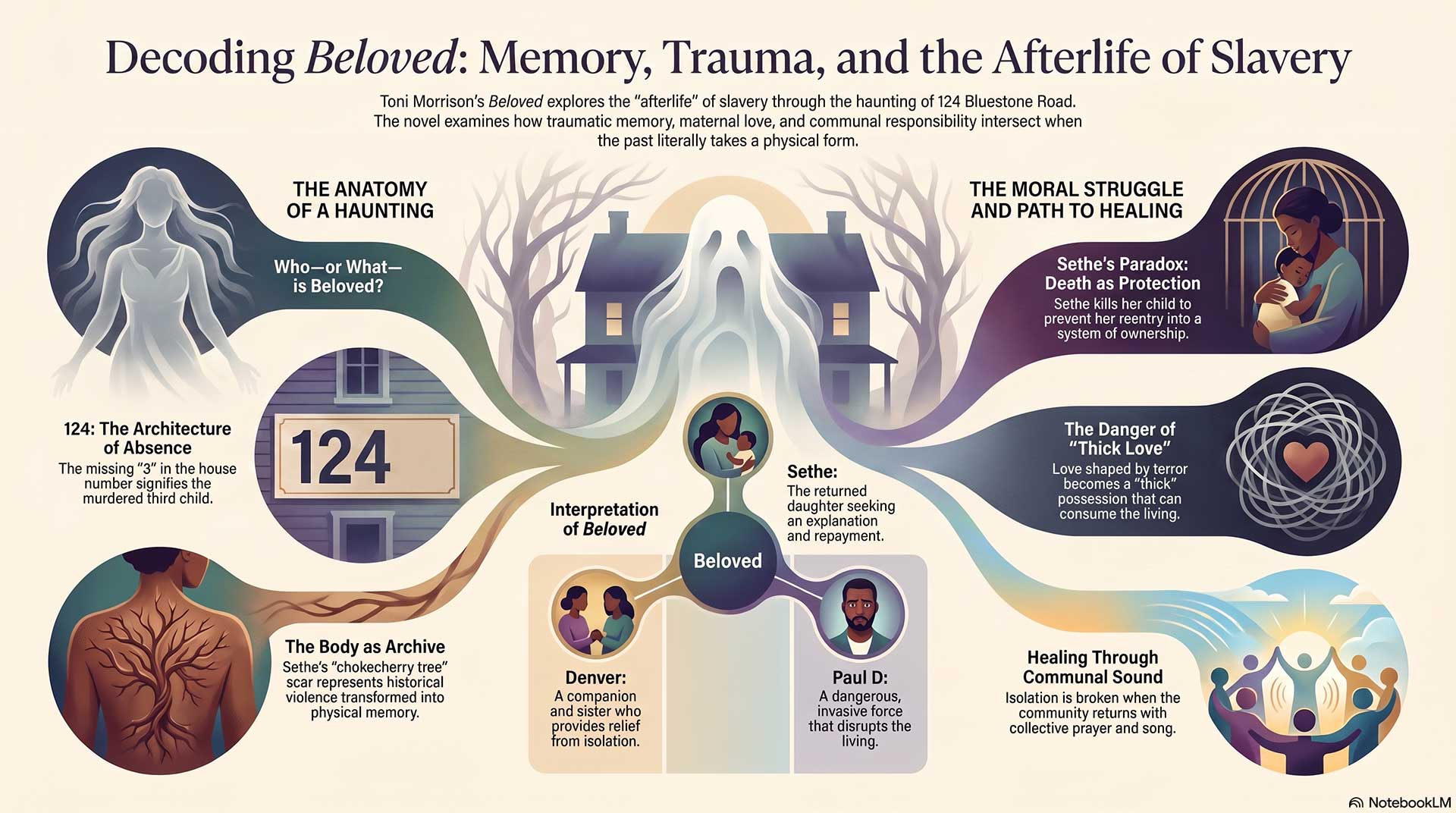
After twenty-five questions, Beloved remains unresolved.
That is not a weakness.
It is one of the novel’s greatest achievements.
We may better understand who Beloved could be, but we cannot confine her to a single identity. She remains a daughter, a ghost, an abandoned child, historical memory, guilt, hunger, and the return of everything that was never properly mourned.
We may better understand Sethe’s decision, but understanding does not make it morally simple. Her act grows from love, fear, trauma, and a world in which motherhood itself was subject to ownership. Morrison does not ask us to declare Sethe innocent or guilty and then move on. She asks us to remain inside the difficulty long enough to understand why ordinary moral language becomes inadequate.
We may understand why the novel moves through broken time and changing voices. Trauma does not return chronologically. Memory does not wait politely for the present to finish. What has been buried enters through a sound, a color, a body, a name, or a house number.
We may identify the meaning of 124, the chokecherry tree, milk, water, blood, hunger, and the haunted house. Yet Morrison’s symbols do not behave like fixed codes. They change according to who sees them. A tree may offer refuge, carry a scar, conceal violence, or become beautiful only because someone else does not feel the wound.
We may even reach the ending and recognize that Denver’s courage and the women’s communal intervention create the possibility of change.
But possibility is not the same as recovery.
Sethe is not magically healed.
Paul D is not a perfect rescuer.
Beloved is not neatly defeated.
The past has not vanished.
What changes is that Sethe no longer has to carry it entirely alone.
That may be the novel’s quietest hope.
Trauma isolates.
Healing begins when isolation is interrupted.
A daughter leaves the house and asks for help.
A community admits, even imperfectly, that it failed.
A man returns and sees a woman as more than the worst thing she ever did.
A story once hidden becomes speakable.
The phrase “not a story to pass on” therefore refuses one easy interpretation.
It may mean this history must not be repeated.
It may mean trauma should not be handed unchanged to the next generation.
It may warn against turning suffering into gossip, entertainment, or a clean moral lesson.
It may also mean that forgetting is impossible and silence is dangerous.
The story must be carried, but carried carefully.
Not as accusation alone.
Not as forgiveness alone.
Not as spectacle.
Not as a burden that forces the living to become permanent monuments to the dead.
Perhaps Morrison’s final challenge is not simply to remember.
It is to learn how to remember responsibly.
To remember the dead without abandoning the living.
To acknowledge the wound without allowing it to become the whole identity.
To understand the past without pretending we stand outside it.
And to recognize that some stories remain alive precisely because they have never been fully answered.
Beloved does not leave us with certainty.
It leaves us with responsibility.
Short Bios:
Dana A. Williams
A leading Toni Morrison scholar, literary critic, and educator whose work examines African American literature, Black literary traditions, and Morrison’s lasting cultural influence. In these conversations, she serves as the recurring anchor, helping connect each question to the larger architecture of Morrison’s work.
Valerie Smith
A scholar of African American literature whose work explores race, gender, narrative, memory, and the moral complexity of Black literary representation. She is especially valuable for discussions of Sethe, motherhood, narrative voice, and the ethics of judgment.
Saidiya Hartman
A writer and scholar known for examining slavery, historical silence, the archive, memory, and the lives of people whose stories were never fully preserved. Her perspective helps illuminate Beloved as both an individual figure and a presence representing countless forgotten lives.
Farah Jasmine Griffin
A scholar of African American literature, history, music, migration, and Black cultural experience. Her work is particularly useful for understanding community, memory, language, movement, and the relationship between literary art and lived history.
Hortense Spillers
An influential literary and cultural theorist whose work examines slavery, gender, kinship, motherhood, family structure, and the captive body. Her perspective is essential for understanding how slavery altered the meanings of mother, father, child, family, and bodily ownership.
Marilyn Sanders Mobley
A Morrison scholar whose work explores spirituality, ethics, race, gender, healing, and the relationship between literary imagination and human transformation. She brings particular depth to discussions of Baby Suggs, community, suffering, and spiritual exhaustion.
Ashraf H. A. Rushdy
A literary scholar known for his work on neo-slave narratives and contemporary fiction about slavery. He helps place Beloved within the broader tradition of novels that reconstruct the past while questioning how that past can ethically be represented.
Christina Sharpe
A scholar and writer whose work examines the ongoing aftermath of slavery, Black life, mourning, survival, and the ways historical violence remains present. Her perspective helps explain why the world of Beloved cannot be confined to the nineteenth century.
Marianne Hirsch
A scholar of memory and postmemory whose work explores how later generations inherit experiences they did not personally live through. Her ideas are especially relevant to Denver and to the question of how trauma passes through families and communities.
Margaret Atwood
An acclaimed novelist and literary critic whose work frequently explores power, gender, memory, survival, myth, and moral ambiguity. She contributes a novelist’s perspective on Morrison’s use of ghosts, nonlinear storytelling, symbolism, and unresolved meaning.
Toni Morrison
A Nobel Prize-winning novelist, essayist, editor, and teacher whose work transformed American literature. Through Beloved, Morrison confronts the legacy of slavery not as distant history, but as an intimate force acting upon bodies, families, language, memory, and love.
Leave a Reply