
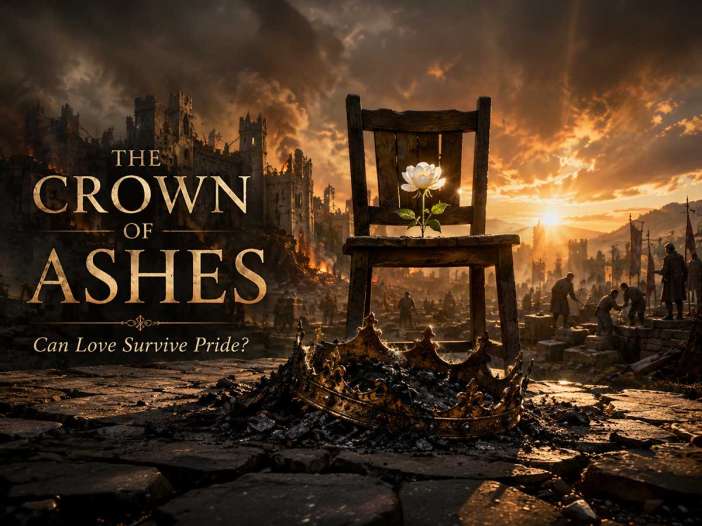
Introduction By William Shakespeare
There are seasons when kingdoms fall not because their enemies are strong, but because their own hearts forget why crowns were first imagined.
Men have long believed that power is won by sharper swords, louder voices, or cleverer schemes. Yet I have lived long enough among kings, fools, lovers, and murderers to know another truth: the greatest kingdoms perish when love becomes afraid of honesty, and they are reborn only when truth dares to wear compassion.
You will find familiar faces within these pages. Lear still wrestles with age. Hamlet still questions the soul. Othello still searches for honor. Lady Macbeth still bargains with necessity. Falstaff still laughs where others tremble. Even Iago returns, carrying the old poison of despair.
Yet this tale is not theirs alone.
It belongs equally to a daughter who discovers that forgiveness is stronger than inheritance.
To a king who learns too late that authority without tenderness becomes loneliness.
To a child who watches wiser people fail, and quietly remembers what they almost forgot.
You will encounter crowns, swords, councils, betrayals, fires, and wars.
But do not mistake them for the true subject.
This play has never been about kingdoms.
It has always been about the human heart entrusted with another human heart.
If, when these pages close, you admire only the speeches, then I have entertained you.
If you remember only the plot, then I have occupied your evening.
But if, somewhere beyond these words, you become slower to judge, quicker to forgive, braver to tell the truth, and gentler with those who carry invisible burdens, then perhaps this old playwright has once again earned his place beside your fire.
Walk now into the ashes.
You may discover they hide the beginning of a garden.
(Note: This is an imaginary conversation, a creative exploration of an idea, and not a real speech or event.)
ACT I: THE CROWN IS OFFERED
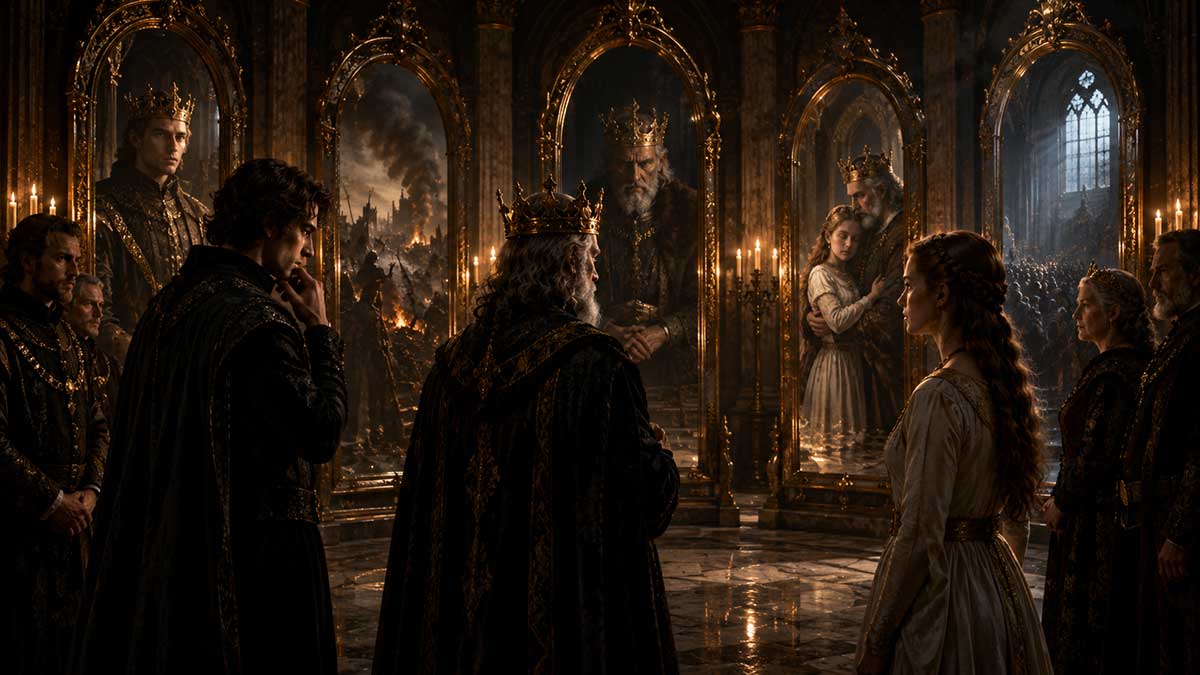
Central Question: Who deserves authority?
Dominant Image: The Empty Chair
Emotional Movement: Ceremony → Conflict → Laughter → Recognition → Hope
Living Symbol: The White Flower
CHARACTERS APPEARING IN ACT I
LEAR, an aging king who fears the kingdom will collapse after him
CORDELIA, his youngest daughter
HAMLET, Prince of Denmark
LADY MACBETH, ruler of a northern province
OTHELLO, a celebrated general
PRINCE HAL, heir to a neighboring kingdom
FALSTAFF, his oldest and least respectable friend
BEATRICE, a noblewoman and political observer
THE FOOL, Lear’s licensed truth-teller
IAGO, appearing under the assumed name Cassian Vale
ROBIN, a twelve-year-old palace page
Lords, guards, servants, musicians, and members of the court
SCENE ONE - The Great Hall
A vast ceremonial hall.
At its far end stands a raised platform with two seats.
One is the throne of Lear.
The other is an unoccupied chair, simpler than the throne but placed where all may see it.
Morning light enters through tall windows. Dust turns slowly in the beams.
Servants prepare the hall.
ROBIN, a palace page of twelve, struggles to carry a folded banner nearly twice his height.
THE FOOL sits backward upon the empty chair.
ROBIN:
You are not meant to sit there.
FOOL:
That is why it fits me.
ROBIN:
The steward said no one is to touch it.
FOOL:
Then the steward should have instructed the chair.
Robin tries to unfold the banner. It slips and covers him entirely.
ROBIN:
Help me.
FOOL:
You are learning government.
ROBIN:
How?
FOOL:
First they cover you with a flag. Then they ask why you cannot see.
The Fool rises and frees him.
ROBIN:
What is the chair for?
FOOL:
The future.
ROBIN:
It looks uncomfortable.
FOOL:
Most futures are.
Robin studies it.
ROBIN:
Who will sit there?
FOOL:
Someone who wants it.
ROBIN:
That does not mean they should have it.
The Fool looks at him with sudden seriousness.
FOOL:
Keep that thought hidden. It may save your life.
Trumpets sound outside.
The Fool steps away from the chair. Robin hurries to his place.
The court enters.
LEAR comes last, crowned and dressed in ceremonial robes. His movements remain powerful, but age has begun quietly negotiating with his body.
CORDELIA walks behind him.
She sees Robin’s crooked banner, stops, and straightens it herself.
CORDELIA:
There.
ROBIN:
Thank you, my lady.
CORDELIA:
Do not thank people for helping with what should never have been left for you alone.
She joins Lear.
HAMLET enters, dressed in black despite the brightness of the occasion. He pauses beneath the doorway as though uncertain whether entering a room is already a kind of agreement.
BEATRICE follows, watching everyone before allowing anyone to watch her.
LADY MACBETH enters without ornament beyond a single steel clasp at her throat.
OTHELLO enters in formal military dress.
PRINCE HAL comes with FALSTAFF, whose clothing makes a heroic attempt at courtliness and fails with dignity.
Behind them enters CASSIAN VALE, who is in truth IAGO. He wears the unremarkable clothes of a diplomatic secretary. He bows at all the proper moments and is noticed by almost no one.
Lear sits.
The empty chair remains beside him.
Silence settles.
LEAR:
There are two deaths appointed to every king.
The first is when his breath departs.
The second is when the order he preserved departs after him.
I have spent forty years defeating the first with physicians, prayers, winter fires, and stubbornness.
The second will not be defeated by stubbornness.
He looks across the assembled court.
LEAR:
Our kingdom has known peace long enough to mistake it for nature.
Peace is not nature.
Peace is a wall rebuilt each morning by people who remember what waits outside it.
I remember.
Many of you do not.
That is my failure and my achievement.
A murmur passes through the hall.
LEAR:
I have one child whom law would place after me.
He glances at Cordelia.
LEAR:
But blood alone has founded too many graves.
Therefore, I will not leave this kingdom merely to inheritance.
I will leave it to judgment.
Cordelia’s face changes only slightly.
Beatrice notices.
LEAR:
For seven days, those gathered here will be tested in counsel, command, mercy, courage, and truth.
At the end of those days, this chair will no longer stand empty.
He places one hand upon it.
LEAR:
The person who proves most fit to preserve this kingdom shall govern after me.
The hall erupts in restrained astonishment.
CORDELIA:
Father—
LEAR:
You will speak when called.
The words are formal. The wound beneath them is not.
Cordelia becomes still.
LEAR:
Prince Hamlet of Denmark.
Hamlet steps forward.
LEAR:
You have looked deeply into the nature of men.
Perhaps too deeply.
We shall learn whether thought can protect anything beyond itself.
HAMLET:
A thought protected from consequence is merely a dream wearing armor.
LEAR:
Then wake.
Hamlet bows.
LEAR:
Lady Macbeth.
She steps forward.
LEAR:
Your province survived famine, revolt, and invasion beneath your governance.
LADY MACBETH:
It survived because decisions were made before suffering became fashionable.
LEAR:
We shall learn whether strength may rule without becoming hunger.
She bows, almost smiling.
LEAR:
Othello.
Othello steps forward.
LEAR:
Your soldiers would follow you into the sea.
OTHELLO:
Only if there were reason to cross it.
LEAR:
Men who follow without reason are dangerous.
Men who require reason at every step arrive after the battle.
We shall learn where honor ends and wisdom begins.
Othello bows.
LEAR:
Prince Hal.
Hal steps forward.
Falstaff applauds alone.
Hal closes his eyes briefly.
HAL:
Thank you, John.
FALSTAFF:
It seemed a lonely silence.
LEAR:
You have lived among princes and thieves.
FALSTAFF:
Often in the same room.
A few members of the court laugh despite themselves.
Lear almost does.
LEAR:
You understand the people.
HAL:
I have disappointed nearly every class of them.
LEAR:
Then you are already qualified for government.
More laughter.
LEAR:
We shall learn whether duty can command the man pleasure once possessed.
Hal bows. Falstaff’s smile remains, but something behind it goes quiet.
LEAR:
Cordelia.
She steps forward.
LEAR:
You have never feared truth.
CORDELIA:
I have feared it many times.
I have merely feared falsehood more.
LEAR:
We shall learn whether truth alone can hold a kingdom together.
CORDELIA:
Truth alone cannot.
The court listens.
LEAR:
Then what can?
CORDELIA:
Truth carried with mercy.
Lady Macbeth turns slightly toward her.
LADY MACBETH:
Mercy is admired most by those who do not have to answer for its consequences.
CORDELIA:
And severity is admired most by those who do not have to bleed beneath it.
A sharper silence.
LEAR:
Enough.
BEATRICE:
A pity. The room had only just become honest.
Lear looks at her.
LEAR:
Beatrice, you were invited as an observer.
BEATRICE:
Then Your Majesty should not make the spectacle so tempting.
LEAR:
You will advise the tribunal.
BEATRICE:
Which means I may criticize everyone without enduring the vulgar inconvenience of being eligible.
FOOL:
The safest throne is the one beside the throne.
LEAR:
And you will be silent.
FOOL:
Then Your Majesty has given me the most difficult trial.
Lear rises.
LEAR:
There is one more matter.
The kingdom is not held by one life alone.
It is held by alliances, inheritances, marriages, promises, and the courage to place the future above private desire.
Hamlet looks toward Cordelia before he knows why.
Cordelia does not look at him.
LEAR:
If Prince Hamlet and Cordelia both remain among the final claimants, they shall be joined in marriage.
The hall reacts.
Falstaff whispers loudly to Hal.
FALSTAFF:
Courtship by royal decree. At last, romance has been improved by administration.
HAL:
Quiet.
HAMLET:
Majesty—
LEAR:
You object?
HAMLET:
I am attempting to discover which objection is most likely to keep my head attached.
LEAR:
Speak plainly.
Hamlet looks at Cordelia.
HAMLET:
A marriage may bind kingdoms.
It may also bind two strangers together and call the knot peace.
LEAR:
Strangers become known.
CORDELIA:
Not by command.
Lear turns to her.
LEAR:
You reject him?
CORDELIA:
I do not know him well enough to reject him.
HAMLET:
That is the kindest opinion I have received this year.
A small laugh escapes Cordelia before she can stop it.
It surprises them both.
Iago notices.
LEAR:
This is not a proposal sung beneath a window.
It is an instrument of stability.
CORDELIA:
Then do not call it marriage.
Call it machinery.
The hall goes still.
Lear descends one step from the throne.
LEAR:
You speak as though love were sufficient government.
CORDELIA:
No.
I speak as though people are not timber.
LEAR:
People become timber when kingdoms burn.
Someone must rebuild.
CORDELIA:
And who teaches the builder not to burn the house himself?
Lear stares at her.
For one instant he is not a king, but a father struck where only a child could reach.
Then authority returns.
LEAR:
The trial begins at sunset.
Until then, you are dismissed.
The court bows.
Lear turns away before Cordelia can answer.
The court begins to disperse.
Lady Macbeth approaches Cordelia.
LADY MACBETH:
You speak bravely when the danger is your father’s displeasure.
Let us see how tenderly truth behaves when the danger is famine.
CORDELIA:
And let us see how strength behaves when no enemy remains to justify it.
Lady Macbeth studies her.
Not insulted.
Interested.
LADY MACBETH:
You may survive longer than I expected.
She exits.
Othello approaches Hamlet.
OTHELLO:
You objected well.
HAMLET:
I object well to many things.
It is action that makes a coward of me.
OTHELLO:
Then perhaps this court will cure you.
HAMLET:
Courts more often cure men of honesty.
Othello almost smiles and leaves.
Hal offers Cordelia a sympathetic bow.
Falstaff follows, but stops beside Robin, who is staring at a tray of untouched rolls.
Falstaff picks up two, slips one into his sleeve, and turns his back.
Robin quickly takes the other.
Falstaff turns.
FALSTAFF:
Thief.
Robin freezes.
FALSTAFF:
Never steal one when two will fit.
He gives Robin the roll from his sleeve.
They exit in opposite directions.
Iago remains near a column, apparently arranging documents.
He watches Lear.
Lear stands beside the empty chair, one hand resting on it.
He watches Cordelia leave.
She drops a narrow white ribbon from her sleeve without noticing.
Lear sees it.
He bends slowly and picks it up.
He nearly calls after her.
His mouth opens.
Nothing comes.
He closes his hand around the ribbon.
Iago sees this too.
Beatrice, passing him, stops.
BEATRICE:
You watch people as though expecting them to confess.
IAGO, AS CASSIAN:
People confess constantly.
Mostly through the things they do not say.
BEATRICE:
And what have I confessed?
IAGO:
That you enjoy being underestimated.
BEATRICE:
No.
I enjoy the moment immediately afterward.
She exits.
Iago looks again at the empty chair.
IAGO:
So many doors.
And every one of them proud of its lock.
Blackout.
SCENE TWO - A Palace Courtyard
Late afternoon.
The court’s ceremony has ended. Servants carry decorations away.
The grandeur of the palace gives way here to ordinary life: baskets, barrels, laundry, stable tools, kitchen smoke.
ROBIN sits on an overturned bucket eating the bread Falstaff gave him.
The Fool is trying to repair a wooden toy horse with a piece of string.
ROBIN:
Its leg is broken.
FOOL:
Then it is ready for military service.
ROBIN:
Soldiers are not broken.
Othello has entered unnoticed.
OTHELLO:
All soldiers are broken.
The difference is whether the break can be seen.
Robin stands quickly.
ROBIN:
General.
OTHELLO:
Sit.
A person should not have to abandon bread for rank.
Robin sits.
Othello takes the toy horse.
OTHELLO:
The string is too weak.
FOOL:
It was recommended by the treasury.
Othello removes a leather tie from his wrist and repairs the horse’s leg.
He hands it back.
ROBIN:
Will it hold?
OTHELLO:
For a while.
ROBIN:
How long is a while?
OTHELLO:
The honest answer to nearly every promise.
Hamlet enters, looking up at the sky rather than where he walks.
HAMLET:
Do soldiers always answer children plainly?
OTHELLO:
Children have not yet learned to reward lies.
Hamlet joins them.
ROBIN:
Prince Hamlet, is it true you speak to ghosts?
HAMLET:
Only when the living become repetitive.
ROBIN:
What do ghosts say?
HAMLET:
Mostly what they should have said earlier.
The Fool glances at Hamlet.
FOOL:
The dead are always eloquent. They have no tomorrow to interrupt them.
Robin considers this.
ROBIN:
Are you afraid of marrying Lady Cordelia?
HAMLET:
I am afraid of many things.
Marriage may have to wait its turn.
ROBIN:
She is kind.
HAMLET:
That makes the danger worse.
ROBIN:
Why?
HAMLET:
Cruel people are easy to leave.
Kind people make prisons of our gratitude.
Othello studies him.
OTHELLO:
That is cleverly said.
HAMLET:
You disapprove.
OTHELLO:
I distrust cleverness when it protects the speaker from being known.
Hamlet is quiet.
HAMLET:
And what protects you?
OTHELLO:
Discipline.
HAMLET:
A stronger prison.
OTHELLO:
Perhaps.
But one with useful walls.
Othello looks toward the first evening star.
OTHELLO:
When I was young, an old captain taught me to find north by the stars.
He said soldiers trusted them because they never promised comfort.
Only direction.
HAMLET:
Philosophers trust questions.
They promise neither.
OTHELLO:
Then why follow them?
HAMLET:
Because certainty has led men into more graves than doubt ever dug.
Lady Macbeth enters carrying a set of council papers.
LADY MACBETH:
Doubt digs slowly.
That does not make the grave shallow.
She notices the torn seam on Robin’s sleeve.
Without comment, she takes a small pin from her own cuff.
LADY MACBETH:
Hold still.
She repairs the sleeve with quick, practiced movements.
Robin watches in surprise.
ROBIN:
My lady, you know how to sew?
LADY MACBETH:
I know how to prevent small tears from becoming large ones.
She finishes and rises.
FOOL:
A useful philosophy for sleeves.
Less successful with kingdoms.
LADY MACBETH:
You confuse harshness with cruelty.
FOOL:
No. Cruelty is often cheerful.
Harshness takes itself seriously.
Falstaff and Hal enter from the kitchen passage.
Falstaff carries a loaf of bread under one arm and a jug under the other.
HAL:
You cannot simply remove the king’s bread.
FALSTAFF:
A king’s bread is a contradiction.
Bread belongs to whoever is hungry.
HAL:
The cook was preparing it for supper.
FALSTAFF:
Then I have spared him uncertainty.
Falstaff sees the assembled group.
FALSTAFF:
Excellent. A parliament.
Bread?
He breaks the loaf and distributes pieces without waiting for consent.
He offers some to Lady Macbeth.
LADY MACBETH:
No.
FALSTAFF:
You distrust carbohydrates?
LADY MACBETH:
I distrust men who enter councils carrying wine.
FALSTAFF:
And I distrust councils entered sober.
Both positions have history on their side.
He offers bread to Hamlet.
Hamlet takes it.
Falstaff offers some to Othello.
Othello accepts.
He offers the largest piece to Robin.
Robin holds up his existing roll.
ROBIN:
I already have bread.
FALSTAFF:
Then you are wealthier than half the kingdom and wiser than the other half.
Hal watches Falstaff.
The affection between them is obvious and old.
HAL:
Do you remember the baker’s cart?
FALSTAFF:
I remember many carts.
I have always been beloved by transportation.
HAL:
You stole it.
FALSTAFF:
Borrowed.
HAL:
You never returned it.
FALSTAFF:
Then history shall call it conquest.
Even Lady Macbeth smiles.
Falstaff catches it.
FALSTAFF:
There. I knew she possessed one.
LADY MACBETH:
Possessed what?
FALSTAFF:
A smile.
Though it appears heavily guarded.
Lady Macbeth’s smile disappears, but without anger.
HAL:
We were sixteen.
We rolled that cart down Saint Martin’s Hill.
FALSTAFF:
You rolled.
I provided moral supervision.
HAL:
You were inside it.
FALSTAFF:
Leadership requires visibility.
Hal laughs.
For a moment, he is not a prince.
Falstaff watches him with quiet happiness.
Then the castle bell sounds.
The first trial approaches.
Hal’s laughter fades.
He looks toward the palace.
HAL:
We should go.
FALSTAFF:
The kingdom has waited this long.
It may endure another cup.
HAL:
I cannot always remain the boy in the cart.
Falstaff lowers the jug.
The courtyard seems suddenly colder.
FALSTAFF:
No.
But neither must you become the hill.
Hal looks at him.
HAL:
What does that mean?
FALSTAFF:
I have no idea.
It sounded expensive, so I trusted it.
Hal smiles, but the sadness remains.
They begin to leave.
Robin runs after Falstaff and returns the untouched roll.
ROBIN:
I cannot eat both.
Falstaff looks at the bread.
He tears it in half.
He gives one half back to Robin.
FALSTAFF:
No one should carry more bread than he can share.
He keeps the other half.
They exit.
Lady Macbeth watches Hal and Falstaff go.
For a brief moment, something like memory passes over her face.
Cordelia enters carrying a small clay pot.
CORDELIA:
Robin, I promised the gardener you would help me.
ROBIN:
What are we planting?
CORDELIA:
Something that may outlive us.
FOOL:
At last, a candidate for the throne.
Cordelia kneels and gives Robin the pot.
Inside is a small white flowering plant.
Hamlet looks at it.
HAMLET:
What is it?
CORDELIA:
Winter star.
It blooms when most gardens surrender.
HAMLET:
An ambitious flower.
CORDELIA:
No.
It simply does not know the season is against it.
She and Robin carry the plant toward the garden.
Hamlet watches.
Beatrice enters and stands beside him.
BEATRICE:
You are staring.
HAMLET:
I am observing.
BEATRICE:
Men rename staring when they wish to feel educated.
HAMLET:
And women rename curiosity when they wish to avoid confession.
BEATRICE:
Good.
You may yet become tolerable.
She exits toward the council chamber.
Hamlet looks toward the garden again.
Iago stands at the far side of the courtyard.
He has witnessed Lady Macbeth repair the sleeve, Falstaff share bread, Othello mend the toy, Cordelia take Robin’s hand.
Robin passes Iago and nearly collides with him.
ROBIN:
Sorry, sir.
Iago steps aside without looking at him.
Robin continues.
The Fool remains behind.
He watches Iago.
FOOL:
You missed one.
Iago stops.
IAGO:
One what?
FOOL:
A person.
IAGO:
Did I?
FOOL:
Children are difficult to see from a great height.
IAGO:
I am not a great man.
FOOL:
That is not the same as standing low.
The Fool exits.
Iago looks after Robin.
For the first time, he notices the child.
Then he turns away.
Blackout.
SCENE THREE - The Palace Garden
Early evening.
The garden is enclosed by old stone walls.
A fountain stands at its center. Autumn leaves float upon the water.
Near the wall is a bed of white flowers. Robin has left the small winter star among them.
The distant sound of court musicians rehearsing can be heard from inside the palace.
Cordelia enters alone.
She removes her ceremonial outer robe and lays it across a stone bench.
For the first time, she appears less like a princess than a tired daughter.
She kneels beside the flowers and presses soil around the newly planted winter star.
Hamlet enters but does not announce himself.
Cordelia senses him.
CORDELIA:
You walk quietly.
HAMLET:
I have spent years trying not to wake the dead.
CORDELIA:
Have you succeeded?
HAMLET:
No.
The dead sleep lightly.
Cordelia continues working.
CORDELIA:
You are quieter than the court.
HAMLET:
The court has enough voices for both of us.
CORDELIA:
That may be the first sensible thing said there today.
HAMLET:
Your father said several sensible things.
CORDELIA:
My father frequently says sensible things.
He merely arranges them into disasters.
Hamlet laughs.
A real laugh.
He seems startled by it.
Cordelia looks up.
CORDELIA:
You laugh as though it surprises you.
HAMLET:
It does.
CORDELIA:
Do flowers grow in Denmark?
HAMLET:
Poorly.
CORDELIA:
Perhaps they spend too much time indoors.
He laughs again.
HAMLET:
You have formed a severe judgment of Danish flowers.
CORDELIA:
I distrust anything that refuses sunlight and then complains of darkness.
Hamlet’s smile fades slightly.
HAMLET:
That was no longer about flowers.
CORDELIA:
Most truths begin as gardening.
She sits on the edge of the fountain.
Hamlet remains standing.
CORDELIA:
Are you offended by what my father proposed?
HAMLET:
I have been offered kingdoms, duties, wars, revenge, and now a wife.
The kingdom is the first to arrive without pretending to ask.
CORDELIA:
You could refuse.
HAMLET:
Could you?
CORDELIA:
Yes.
He studies her.
HAMLET:
You answered quickly.
CORDELIA:
Truth is not always deep.
Sometimes it is merely unwelcome.
HAMLET:
And if refusal brings war?
CORDELIA:
Then the choice was never marriage.
It was surrender wearing flowers.
HAMLET:
You make courage sound easy.
CORDELIA:
It is not easy.
It is simply shorter than regret.
HAMLET:
Regret has been my longest relationship.
A pause.
CORDELIA:
Why do you hesitate?
HAMLET:
Because every action murders all the actions that might have been.
Once a door is chosen, a thousand others become walls.
CORDELIA:
And while you stand in the passage deciding, life closes them anyway.
HAMLET:
You see delay as cowardice.
CORDELIA:
Sometimes.
HAMLET:
And sometimes?
CORDELIA:
Sometimes doubt is honesty.
Hamlet looks at her more directly.
CORDELIA:
My father never doubts himself until the harm is done.
Lady Macbeth doubts nothing she can command.
Othello doubts only after trust has broken.
Hal doubts in private and performs certainty in public.
You are different.
You doubt before the wound.
HAMLET:
Yet wounds still come.
CORDELIA:
Yes.
But perhaps you could learn to act without requiring innocence from every choice.
He sits beside her, leaving a careful distance.
HAMLET:
And perhaps you could learn that truth is not made kinder merely because it is true.
Cordelia looks at him.
The words have reached her.
CORDELIA:
You think me cruel.
HAMLET:
No.
I think you are so loyal to truth that you sometimes forget truth has no body.
People do.
Cordelia is silent.
CORDELIA:
When I was young, my father asked which of his daughters loved him most.
My sisters answered beautifully.
I answered poorly.
HAMLET:
Honestly?
CORDELIA:
I thought those were the same thing.
HAMLET:
And now?
CORDELIA:
Now I think honesty without mercy may be pride disguised as virtue.
HAMLET:
That sounds like something learned painfully.
CORDELIA:
The most expensive lessons are the ones that remain useful.
Another pause.
The fountain continues.
CORDELIA:
Do you ever grow tired of thinking?
HAMLET:
Every hour.
CORDELIA:
Then come walk where nothing asks to be solved.
She rises.
They walk slowly through the garden.
HAMLET:
Everything asks to be solved.
CORDELIA:
That tree does not.
HAMLET:
It leans toward the east. Perhaps its roots are constrained.
CORDELIA:
The fountain?
HAMLET:
Its basin is cracked.
CORDELIA:
The moon?
HAMLET:
Unreliable tides.
CORDELIA:
You must be exhausting at sunrise.
HAMLET:
I rarely attend.
She smiles.
They reach the bed of white flowers.
CORDELIA:
When were you happiest?
Hamlet looks away.
The question is too simple to defend against.
HAMLET:
I do not remember.
Cordelia does not offer pity.
She kneels and touches one of the white blossoms.
CORDELIA:
That is a terrible answer.
HAMLET:
It is the true one.
CORDELIA:
Then truth requires correction.
She picks a single small flower.
She stands and holds it out to him.
Hamlet does not immediately take it.
HAMLET:
What am I to do with this?
CORDELIA:
Nothing.
HAMLET:
Nothing?
CORDELIA:
You may keep one thing without interrogating it.
He takes the flower.
Their hands touch briefly.
Neither withdraws too quickly.
CORDELIA:
Perhaps today can begin again.
Hamlet looks down at the flower.
HAMLET:
I have spent years speaking to ghosts.
You speak to tomorrow.
CORDELIA:
Tomorrow is less argumentative.
HAMLET:
You have not met mine.
A bell rings from the palace.
The first formal council is about to begin.
The garden’s stillness breaks.
Cordelia looks toward the castle.
CORDELIA:
Duty.
HAMLET:
It always knows where to find us.
She retrieves her robe from the bench.
Hamlet carefully places the flower inside his coat.
Cordelia notices but says nothing.
As she prepares to leave, Hamlet speaks.
HAMLET:
Cordelia.
She turns.
He has no prepared words.
HAMLET:
I do not know whether I could be a good husband.
CORDELIA:
I do not know whether I could be a peaceful wife.
HAMLET:
That is not reassuring.
CORDELIA:
No.
But it is a beginning.
She exits.
Hamlet remains.
He touches the flower through his coat.
Lady Macbeth has entered unseen at the garden arch.
She watches him.
Her expression is not envy.
It is remembrance.
Hamlet notices her.
HAMLET:
My lady.
LADY MACBETH:
Prince Hamlet.
HAMLET:
Were you looking for Cordelia?
LADY MACBETH:
No.
For a moment, she seems about to say something else.
Instead, she looks at the white flowers.
LADY MACBETH:
My mother kept these.
HAMLET:
Winter star.
LADY MACBETH:
They survived everything.
HAMLET:
That sounds like praise.
LADY MACBETH:
Survival is not always victory.
She turns to leave.
HAMLET:
When did you last rest?
She stops.
LADY MACBETH:
Rest is a word used by people whose decisions can wait until morning.
HAMLET:
Morning comes even when we refuse it.
LADY MACBETH:
Yes.
That is one of its cruelties.
She exits.
Hamlet looks after her, seeing more than he expected.
Beatrice enters from another path.
BEATRICE:
You have been collecting wounded women.
HAMLET:
I spoke to two people.
BEATRICE:
Exactly.
HAMLET:
Do you ever allow a moment to remain serious?
BEATRICE:
Seriousness is pride’s favorite costume.
I tug the sleeve now and then to see what falls out.
She notices the slight bulge of the flower in his coat.
BEATRICE:
What has fallen into yours?
Hamlet closes the coat.
HAMLET:
Nothing.
BEATRICE:
Then guard it carefully.
Nothing is the first possession men die defending.
She exits.
Hamlet follows toward the palace.
The garden is empty.
A wind moves through the leaves.
One white petal falls into the fountain.
Blackout.
SCENE FOUR - The Council Chamber, Then the Chapel
Night.
A long table occupies the council chamber.
A polished mirror hangs on the rear wall, positioned so those seated may see themselves behind one another.
Maps of the kingdom lie open.
Lear presides.
Cordelia, Hamlet, Lady Macbeth, Othello, Hal, Beatrice, and several lords sit around the table.
Iago, as Cassian Vale, stands near the wall taking notes.
Falstaff has been excluded from the council but can occasionally be seen through an open doorway attempting to persuade a guard to admit him.
The Fool sits beneath the mirror.
LEAR:
The western counties have failed to deliver grain.
Three villages have already reported unrest.
The treasury can purchase foreign stores, but the roads will not hold through winter.
What is to be done?
LADY MACBETH:
Seize private reserves.
Ration by household.
Guard the roads.
Punish hoarding publicly.
CORDELIA:
You would begin with punishment?
LADY MACBETH:
I would begin before hunger does.
OTHELLO:
Force may secure the grain.
It will not secure obedience after spring.
LADY MACBETH:
Starving people do not eat future loyalty.
HAL:
Nor do frightened farmers plant generously for rulers who emptied their barns.
LEAR:
Your answer?
HAL:
Purchase what grain we can.
Suspend taxes in the western counties.
Pay local carriers double to move stores before the roads fail.
LADY MACBETH:
With what money?
HAL:
The coronation reserve.
Lear looks at him sharply.
HAL:
A crown may be made next year.
A dead village cannot.
BEATRICE:
Unless we appoint Lady Macbeth. She appears capable of commanding one back to life.
LADY MACBETH:
Mockery is the refuge of those unwilling to choose.
BEATRICE:
No. Mockery is how I inspect a choice for hidden vanity.
Othello studies the map.
OTHELLO:
The eastern garrison has winter stores.
Send half west under military escort.
LEAR:
And leave the border exposed?
OTHELLO:
A border is not defended if the kingdom behind it is starving.
HAMLET:
We are solving the visible question.
LEAR:
Then reveal the invisible one.
HAMLET:
Why did the grain fail to arrive?
Flood?
Theft?
False records?
Fear?
If the cause is corruption, sending more grain merely feeds the corruption.
If the cause is weather, punishment creates rebellion.
If the cause is rebellion, generosity may arm it.
LADY MACBETH:
And while you name possibilities, children go without supper.
HAMLET:
A swift mistake may empty every supper afterward.
CORDELIA:
Send grain now.
Investigate at the same time.
LEAR:
From where?
CORDELIA:
The royal stores.
A murmur.
LEAR:
Those stores preserve the capital in siege.
CORDELIA:
Then let the capital share the risk of the kingdom it commands.
LEAR:
You would endanger the city.
CORDELIA:
The villages are already endangered.
We call suffering acceptable when it occurs far enough from the palace.
Lear leans back.
He looks at each of them.
LEAR:
Lady Macbeth would seize.
Othello would redeploy.
Hal would spend.
Hamlet would investigate.
Cordelia would share.
Every answer protects something and abandons something else.
That is government.
The chamber quiets.
LEAR:
There is no clean decision.
Only a choice regarding who shall bear the dirt.
Hamlet looks at him with unexpected respect.
Iago writes nothing.
He watches who looks toward whom.
Lady Macbeth looks at Lear when strength is praised.
Othello looks at the map when loyalty is questioned.
Hal glances toward the doorway where Falstaff waits.
Cordelia watches the servants removing untouched food from the sideboard.
Hamlet watches everyone.
Iago watches Hamlet watching everyone.
LEAR:
Cassian Vale.
Iago steps forward.
LEAR:
You have served courts beyond this kingdom.
What would they do?
IAGO:
Whichever course causes the least immediate blame.
LEAR:
That was not the question.
IAGO:
It is frequently the answer.
Beatrice looks at him.
LEAR:
Your own judgment.
IAGO:
Send the grain from the royal stores.
Announce that Lady Macbeth designed the rationing, Prince Hal secured the funds, Othello commanded the roads, Hamlet uncovered the cause, and Cordelia persuaded the crown.
HAL:
You would divide the credit before the work begins?
IAGO:
Shared honor creates many defenders.
Shared blame creates none.
CORDELIA:
And truth?
IAGO:
Truth may be recorded after the people have eaten.
Cordelia dislikes the answer.
Lear does not.
LEAR:
It is practical.
IAGO:
Practicality is often truth that has learned to survive indoors.
Hamlet turns toward him.
HAMLET:
Or falsehood with good tailoring.
IAGO:
A naked truth freezes quickly at court.
HAMLET:
You speak as though truth and usefulness were enemies.
IAGO:
Not enemies.
Rivals.
Lear stands.
LEAR:
The royal stores will be opened.
Othello will command the transport.
Hal will release the coronation reserve.
Lady Macbeth will prepare rationing.
Hamlet will investigate the western accounts.
Cordelia will oversee distribution among the villages.
The decision is made.
Lady Macbeth inclines her head.
LADY MACBETH:
A divided answer.
LEAR:
A kingdom is a divided answer.
The council rises.
Falstaff finally slips past the guard carrying a tray.
FALSTAFF:
Excellent. You have finished deciding how others shall eat.
May I interest you in supper?
LEAR:
You were not invited.
FALSTAFF:
Neither is hunger, yet it attends every council.
He sets down the tray.
Robin follows him carrying cups.
The child’s repaired sleeve catches Lady Macbeth’s eye.
She says nothing.
Falstaff begins pouring wine.
FALSTAFF:
To the first successful act of government.
BEATRICE:
Which was?
FALSTAFF:
Ending the meeting.
Even Lear laughs.
The tension breaks.
For a brief moment, they stand together not as rivals, but as people sharing bread at the end of a long day.
Cordelia tears a piece and gives it to Robin.
Othello pours water instead of wine.
Hal steals from Falstaff’s cup.
Lady Macbeth accepts a small piece of bread this time.
Hamlet watches Cordelia laugh at something Beatrice whispers.
Lear watches all of them.
His face softens.
This is almost his impossible dream:
One table.
No conflict.
No one leaves.
The Fool sees Lear watching.
FOOL:
Careful, uncle.
LEAR:
Of what?
FOOL:
Happiness.
Kings often mistake it for a thing they have earned.
The moment passes.
Servants begin clearing the chamber.
One by one, the others leave.
Lear remains.
Cordelia pauses at the door.
She looks back.
Lear is studying the maps.
CORDELIA:
Good night, Father.
Lear does not look up.
LEAR:
Good night.
Cordelia waits for something more.
Nothing comes.
She exits.
Lear lifts his head after she is gone.
He nearly follows.
Instead, he removes his crown and places it upon the table.
He exits through a side door.
The stage changes.
The table recedes into darkness.
A small palace chapel appears.
Candles burn before a simple altar.
Lear enters alone, without his crown.
He closes the door behind him.
He kneels with difficulty.
For a long time, he says nothing.
LEAR:
I have asked for victory.
I have asked for sons.
I have asked for long years and obedient enemies.
I have asked that men fear me before they test me.
He looks toward the altar.
LEAR:
I have received too many of my prayers.
A pause.
LEAR:
Teach me how to finish well.
Footsteps approach outside.
Lear rises at once.
He straightens his robe.
The king returns to his face before the door opens.
Robin appears, carrying a candle snuffer.
He stops when he sees Lear.
ROBIN:
Forgive me, Majesty.
I thought the chapel was empty.
LEAR:
It is.
Robin is unsure how to answer.
Lear notices.
LEAR:
Why are you awake?
ROBIN:
The steward said every candle must be put out.
LEAR:
And if one wishes to remain burning?
ROBIN:
He said candles do not wish.
Lear looks at the flames.
LEAR:
Stewards know very little about fire.
Robin begins extinguishing the candles one by one.
Lear watches him.
Before leaving, Lear places his hand gently upon Robin’s head.
The gesture surprises them both.
Lear exits.
Robin extinguishes all but one candle.
The scene darkens.
The Great Hall slowly becomes visible again beyond the chapel.
The empty chair remains upon its platform.
The Fool enters carrying Lear’s crown.
He has found it in the council chamber.
He walks toward the chair.
He looks at the crown.
He looks at the chair.
He does not place the crown upon it.
Instead, he sets the crown on the floor.
He brushes a little dust from the empty seat.
Robin enters behind him, still carrying the snuffer.
ROBIN:
Should the crown be left there?
FOOL:
It has spent its life above men.
The floor may teach it something.
Robin looks at the empty chair.
ROBIN:
Does it know who will sit in it?
FOOL:
Chairs know more of men than men know of chairs.
They carry every body and believe none of them.
ROBIN:
That does not answer me.
The Fool looks toward the darkened doors through which the candidates departed.
FOOL:
No.
It does not know.
Robin waits.
The Fool touches the chair with strange tenderness.
FOOL:
Poor chair.
It waits for the wrong sorrow.
The final candle goes out.
Blackout.
END OF ACT I
ACT II: THE MIRROR OF TRUST
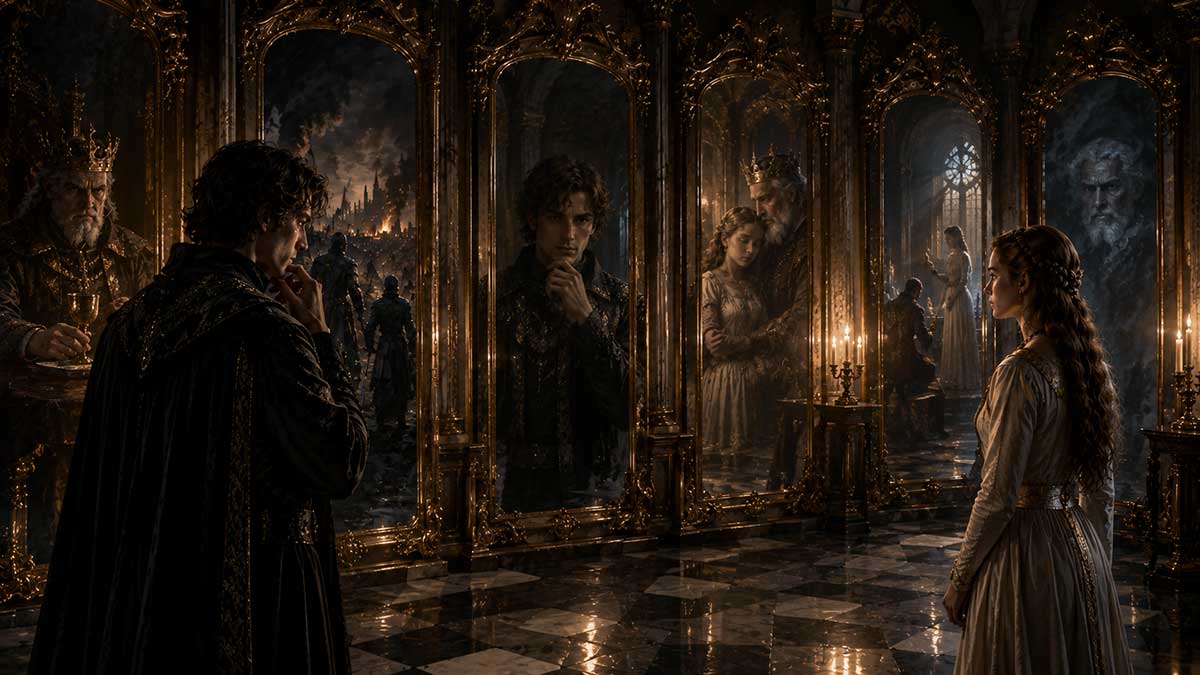
Central Question: Who deserves trust?
Dominant Image: The Mirror
Emotional Movement: Warmth → Confession → Suspicion → Division → Uneasy Mercy
Living Symbol: Bread
Emotional Season: Autumn
SCENE ONE - The Old Boar Tavern
The following evening.
A low-ceilinged tavern just beyond the palace walls. Smoke darkens the beams. Candles lean in their bottles. A fire burns lazily in the hearth.
The room is crowded with tradesmen, soldiers, servants, musicians, and travelers. Here titles are known but not always respected.
At a long wooden table sit PRINCE HAL and FALSTAFF.
A whole loaf of warm bread lies between them. Falstaff has torn it open with his hands. Steam rises from its center.
A fiddler plays near the hearth.
Hal wears plain clothes but cannot quite make himself ordinary. Falstaff has made no such attempt and therefore seems entirely at home.
FALSTAFF:
The trouble with palaces is that every room remembers who owns it.
HAL:
And taverns do not?
FALSTAFF:
Taverns belong to whoever is telling the best lie.
Tonight, that is still me.
He tears off bread and dips it into a bowl of stew.
HAL:
You stole this loaf.
FALSTAFF:
I rescued it from ceremony.
Bread should never be sliced by a servant in gloves.
HAL:
Why?
FALSTAFF:
Because hunger has no manners.
He offers Hal a piece.
Hal takes it.
They eat.
For a little while, neither speaks.
HAL:
Do you remember Saint Martin’s Hill?
FALSTAFF:
I remember descending it with majesty.
HAL:
You were inside a baker’s cart.
FALSTAFF:
Majesty travels by many vehicles.
HAL:
We nearly killed Father Andrew.
FALSTAFF:
He was in no danger.
The church wall stopped him.
HAL:
You laughed for an hour.
FALSTAFF:
He forgave us.
HAL:
He cursed us.
FALSTAFF:
Priests forgive in Latin and curse in the language of the people.
Hal laughs.
Falstaff watches him without laughing at first.
Then joins.
A tavern boy places two cups before them.
TAVERN BOY:
Compliments of the woman by the fire.
Hal looks toward an old woman who raises her cup.
HAL:
Does she know me?
FALSTAFF:
Everyone knows you.
That is the first punishment of royalty.
HAL:
She did not bow.
FALSTAFF:
Then marry her.
Hal raises his cup to the woman. She returns the gesture.
HAL:
Sometimes I envy them.
FALSTAFF:
The poor?
HAL:
The unknown.
FALSTAFF:
No one is unknown.
Some people simply have fewer witnesses.
HAL:
I mean it.
I would like to walk into a room and have no one decide what I mean before I speak.
FALSTAFF:
You used to.
HAL:
When?
FALSTAFF:
Before you learned to enter like a prince.
HAL:
I never learned that.
FALSTAFF:
You did.
You pause at doors now.
HAL:
Do I?
FALSTAFF:
A common man enters a room.
A prince measures what the room will become when he does.
Hal looks toward the entrance.
Falstaff has seen something in him that Hal hoped remained hidden.
HAL:
The trial changes things.
FALSTAFF:
Trials always do.
Mostly the judges.
HAL:
Lear may choose me.
FALSTAFF:
Lear may choose a goat if it stands straight and speaks slowly.
HAL:
I am serious.
FALSTAFF:
That is why I introduced the goat.
Hal lowers his voice.
HAL:
If I inherit this kingdom, my father’s kingdom may join with it.
Two crowns.
Two courts.
Two armies.
No border war for a generation.
FALSTAFF:
A noble dream.
HAL:
You say that as though it were a disease.
FALSTAFF:
All noble dreams become dangerous when they discover horses.
Hal tears bread but does not eat it.
HAL:
You think me ambitious.
FALSTAFF:
I think you are young enough to believe ambition can be kept in one room.
HAL:
And what would you have me do?
Remain here?
Drink until someone else inherits the world?
FALSTAFF:
Not someone else.
Just not the world.
HAL:
You never wanted anything larger than tonight.
FALSTAFF:
That is untrue.
I have frequently wanted breakfast.
HAL:
You hide from every serious question.
FALSTAFF:
No.
I hide serious questions from themselves.
They grow vain when stared at.
Hal pushes his cup aside.
HAL:
You do not understand.
FALSTAFF:
Then explain it without sounding like a proclamation.
Hal rises and walks toward the hearth.
The laughter of the tavern continues around them.
HAL:
I have watched kingdoms rot because good men preferred private happiness.
They wanted quiet homes, loyal friends, warm suppers.
Meanwhile, crueler men took the council chamber.
Everyone praises the man who refuses power.
No one asks who accepts it afterward.
Falstaff listens.
HAL:
Lear is not wrong.
A weak succession can kill thousands.
A foolish king can make every ordinary kindness impossible.
Perhaps duty is merely the willingness to become less happy so others may remain alive.
Falstaff’s humor leaves him.
FALSTAFF:
And who taught you that unhappiness makes a man good?
HAL:
No one.
FALSTAFF:
Then be careful.
The most dangerous teachers are the ones we mistake for our own thoughts.
Hal looks toward him.
HAL:
Would you have me refuse the crown?
FALSTAFF:
I would have you know what it asks before you call the price duty.
HAL:
And what does it ask?
Falstaff looks around the tavern.
At the fiddler.
The old woman.
The boy cleaning cups.
The broken plaster.
The fire.
FALSTAFF:
Everything that does not bow.
A silence.
Hal returns to the table.
HAL:
You believe I will abandon you.
Falstaff reaches for the loaf.
FALSTAFF:
I believe princes call abandonment maturity.
HAL:
I would never deny you.
FALSTAFF:
Not me.
This.
He gestures around them.
FALSTAFF:
You will not hate it.
That would be easier.
You will remember it fondly.
You will speak of these nights as though they died naturally.
Hal cannot answer.
Falstaff tears the loaf in two.
He gives one half to Hal.
FALSTAFF:
There.
Now we each possess a kingdom.
HAL:
Yours is larger.
FALSTAFF:
Experience.
Hal smiles, but sorrow remains.
The tavern door opens.
HAMLET enters, followed by BEATRICE.
They wear cloaks.
BEATRICE:
I told you he would be here.
HAMLET:
You said every irresponsible man eventually finds Falstaff.
BEATRICE:
Was I wrong?
FALSTAFF:
Prince Melancholy.
Lady Mockery.
Sit.
We are dividing Europe.
Hamlet sits. Beatrice remains standing until Falstaff moves his cloak from the bench.
BEATRICE:
Has the king sent for Hal?
HAL:
No.
HAMLET:
Not yet.
HAL:
Why “not yet”?
HAMLET:
Because Cassian Vale has found irregularities in the western grain records.
FALSTAFF:
Cassian Vale.
The man with the face of an unpaid bill.
BEATRICE:
He believes someone in the council may have known of the shortages before Lear did.
HAL:
Who?
HAMLET:
That is the question.
FALSTAFF:
Then keep it a question.
Answers are where trouble begins.
BEATRICE:
The ledgers mention payments routed through taverns near the western road.
FALSTAFF:
A disgrace.
Taverns should never be involved in money.
It corrupts the drinking.
Hamlet looks at Hal.
HAMLET:
One of the payment seals belonged to your father’s treasury.
Hal’s expression changes.
HAL:
That is impossible.
HAMLET:
Possibly.
HAL:
My father has no interest in Lear’s grain.
BEATRICE:
Interest is seldom written plainly in ledgers.
HAL:
You suspect him?
HAMLET:
I suspect ink.
It has betrayed better men.
HAL:
And you came here to question me?
HAMLET:
I came because questioning you before the council seemed unnecessarily cruel.
HAL:
How considerate.
Falstaff places bread between them.
FALSTAFF:
No accusation should be made on an empty stomach.
It encourages imagination.
Hamlet does not take any.
HAL:
Ask.
HAMLET:
Has your father funded merchants along the western road?
HAL:
He funds half the merchants between here and the coast.
HAMLET:
Has he purchased grain in the last three months?
HAL:
Every ruler purchases grain.
BEATRICE:
Before or after Lear’s shortage became known?
HAL:
I do not know.
HAMLET:
Did he instruct you to seek Lear’s crown?
Hal stands.
HAL:
No.
HAMLET:
You answered quickly.
HAL:
Because the answer is simple.
HAMLET:
Simple answers are not always true.
HAL:
Nor are complicated ones always wise.
The tavern’s warmth seems to withdraw from the table.
Falstaff watches Hal.
HAMLET:
I am not accusing you.
HAL:
You came wearing suspicion and call it a cloak.
BEATRICE:
He came privately.
That is still a kind of trust.
HAL:
Trust would have begun without the question.
HAMLET:
No.
Trust is what permits the question to survive.
Hal studies him.
HAL:
That sounds admirable when spoken by the man asking.
FALSTAFF:
Enough.
All of you have brought the palace into a perfectly good tavern.
He pushes the bread toward Hamlet.
FALSTAFF:
Eat.
HAMLET:
I am not hungry.
FALSTAFF:
Suspicion says that too.
Hamlet reluctantly tears off a piece.
The door opens again.
IAGO, as CASSIAN VALE, enters.
He pauses as though surprised to see them.
He is not.
IAGO:
My lords.
Lady Beatrice.
Sir John.
FALSTAFF:
You have mistaken the room.
No one here is improving himself.
IAGO:
Then I may be safe.
He approaches.
HAL:
Did you send Hamlet?
IAGO:
I gave the prince the records.
What he did with them was his judgment.
HAL:
And what is yours?
IAGO:
That the seal is genuine.
HAL:
My father’s seal is copied by every dishonest clerk from London to the sea.
IAGO:
Then someone wishes his hand to appear where it was not.
HAMLET:
Or wishes us to believe someone does.
Iago looks at Hamlet with mild admiration.
IAGO:
You protect Prince Hal generously.
HAMLET:
I protect uncertainty.
IAGO:
A demanding master.
It never releases its servants.
He turns to Hal.
IAGO:
There may be no plot.
A merchant may have used an old authorization.
A clerk may have mislabeled a payment.
HAL:
Yet you brought the records before Lear.
IAGO:
The king asked for truth.
BEATRICE:
Truth rarely arrives escorted by so many possibilities.
IAGO:
Possibilities are often the guards truth hires to reach powerful rooms.
Falstaff watches him carefully.
FALSTAFF:
You speak as though every honest thing requires disguise.
IAGO:
Only among people who punish honesty.
FALSTAFF:
And have you met many?
IAGO:
Enough to become polite.
Iago looks toward the broken loaf.
IAGO:
Forgive me.
I have interrupted old friendship.
HAL:
You have interrupted nothing.
IAGO:
Then I am relieved.
He bows.
IAGO:
Prince Hal, the king requests your presence at dawn.
Alone.
He turns to leave, then pauses beside Hamlet.
IAGO:
You were right to question privately.
A public doubt leaves scars even when disproved.
He exits.
The words settle badly.
Hal looks at Hamlet.
HAL:
Did you intend to keep this private?
HAMLET:
Yes.
HAL:
Would you have succeeded?
Hamlet cannot answer with certainty.
HAL:
Exactly.
Hal takes his cloak.
FALSTAFF:
Stay.
HAL:
I am expected at dawn.
FALSTAFF:
It is not dawn.
HAL:
Not yet.
Hal exits.
Falstaff watches the door.
The half loaf Hal held remains on the table.
Untouched.
BEATRICE:
You should go after him.
FALSTAFF:
A man followed too quickly believes he was chased.
HAMLET:
I have wounded him.
FALSTAFF:
No.
You touched a wound.
There is a difference.
Hamlet looks at the abandoned bread.
HAMLET:
Does the difference matter to the bleeding?
Falstaff takes Hal’s half of the loaf.
He wraps it slowly in cloth.
FALSTAFF:
Later.
If one is lucky.
Blackout.
SCENE TWO - The Hall of Mirrors
Morning.
A long gallery lined with tall mirrors brought from foreign courts. Some are clear. Some distort slightly. Some have darkened with age.
Autumn rain strikes the windows.
At the far end stands a table with sealed letters, ledgers, and testimony from the western counties.
LEAR enters with IAGO.
Lear has not slept well.
LEAR:
You are certain of the seal?
IAGO:
Certain enough to distrust certainty.
LEAR:
Do not answer me like Hamlet.
IAGO:
Then yes.
The seal belonged to King Henry’s treasury.
LEAR:
Belonged?
IAGO:
It may have been stolen.
Copied.
Reused.
Or honestly placed.
LEAR:
You offer four answers.
IAGO:
Because one answer would please you too much.
Lear walks past the mirrors.
His image repeats into the distance.
LEAR:
Hal wants the crown.
IAGO:
Every candidate wants something.
LEAR:
Cordelia claims she does not.
IAGO:
Perhaps she wants not to want it.
That is a subtler ambition.
Lear stops.
LEAR:
You think my daughter ambitious?
IAGO:
I think virtue enjoys witnesses as much as vice does.
Lear looks at his own reflection.
LEAR:
She opposed me before the entire court.
IAGO:
Truth carried with mercy.
That was her phrase.
LEAR:
She gave me neither.
IAGO:
Children often reserve mercy for strangers.
Lear turns sharply.
LEAR:
You speak beyond your place.
IAGO:
Forgive me.
Lear resumes walking.
LEAR:
No.
Continue.
Iago lowers his eyes, as though reluctant.
IAGO:
Princess Cordelia believes authority must justify itself before love will obey it.
LEAR:
Love does not obey.
IAGO:
Then why do fathers command?
Lear’s face hardens.
Iago has not accused Cordelia.
He has simply opened a door.
LEAR:
And Hamlet?
IAGO:
He distrusts everyone equally.
It is the nearest he comes to fairness.
LEAR:
They are drawn to each other.
IAGO:
So it appears.
LEAR:
Would he turn her against me?
IAGO:
Hamlet turns no one.
He merely teaches them to hear the doubts already speaking.
Lear looks into another mirror.
Its old glass makes his face appear fragmented.
LEAR:
I built this peace.
IAGO:
Yes.
LEAR:
They speak as though I inherited it.
IAGO:
The young receive walls and conclude stone grows naturally.
LEAR:
Cordelia was born after the last rebellion.
She has never seen a village burned for choosing the wrong cousin.
IAGO:
Then perhaps she mistakes the absence of terror for the absence of danger.
Lear looks at him.
Iago bows slightly.
IAGO:
That does not make her faithless.
Only fortunate.
Footsteps approach.
Iago steps away from Lear.
CORDELIA enters.
She carries several petitions from the western villages.
CORDELIA:
You sent for me.
LEAR:
I did.
Cassian.
Leave us.
Iago bows and walks toward the exit.
As he passes Cordelia, he stops.
IAGO:
My lady, the villages speak highly of you.
CORDELIA:
They were hungry.
Gratitude is easily purchased with bread that already belonged to them.
IAGO:
Then they are fortunate you do not enjoy being loved.
He exits.
Cordelia watches him go.
CORDELIA:
I do not trust that man.
LEAR:
Why?
CORDELIA:
Because he makes suspicion sound like humility.
LEAR:
Perhaps you distrust anyone who sees what you prefer hidden.
CORDELIA:
What do I prefer hidden?
LEAR:
Your ambition.
Cordelia is genuinely surprised.
CORDELIA:
My ambition?
LEAR:
You oppose me publicly.
You gather loyalty among the villages.
You speak of mercy as though you invented it.
CORDELIA:
I delivered grain.
LEAR:
With royal stores.
CORDELIA:
At your command.
LEAR:
After you shamed me into giving it.
Cordelia takes a breath.
She chooses her words carefully.
CORDELIA:
Is this why you called me?
LEAR:
I called you because Hal’s father may have interfered with our grain.
Because Hamlet conceals more than he reveals.
Because Lady Macbeth thinks mercy is weakness.
Because Othello trusts honor more than evidence.
Because everyone in this court seeks the empty chair while pretending to seek justice.
And because you—
He stops.
CORDELIA:
Because I what?
LEAR:
Because you look at me as though I have already failed.
CORDELIA:
Father—
LEAR:
Do not soften your voice now.
You sharpened it freely before witnesses.
CORDELIA:
I opposed your decision.
Not you.
LEAR:
A king is his decisions.
CORDELIA:
A father is not.
Lear’s face shifts.
For a moment, the crown disappears.
LEAR:
You think those can be separated?
CORDELIA:
I pray they can.
LEAR:
Prayer is not an answer.
CORDELIA:
Neither is anger.
Lear turns away.
He looks into the mirror.
Cordelia’s reflection stands behind him.
LEAR:
When you were a child, you followed me everywhere.
Even into council.
You hid beneath the table and believed I did not know.
CORDELIA:
You always left honey cakes beneath your chair.
LEAR:
For the mice.
CORDELIA:
Of course.
A small tenderness nearly reaches them.
Then Lear remembers why he is angry.
LEAR:
When did you stop trusting me?
Cordelia does not answer quickly.
LEAR:
There.
That silence.
That is where betrayal lives.
CORDELIA:
No.
That is where care chooses its words.
LEAR:
Speak, then.
CORDELIA:
I did not stop trusting you all at once.
Lear turns.
CORDELIA:
Trust does not die like a soldier.
It dies whisper by whisper.
Each time I spoke and you heard defiance before meaning.
Each time you asked for truth but punished the shape it took.
Each time love had to kneel before authority to be recognized.
Lear absorbs this as accusation.
LEAR:
I gave you everything.
CORDELIA:
Yes.
Everything except permission to disagree without losing you.
A long silence.
Lear’s pain becomes rage because rage is easier to govern.
LEAR:
Go.
CORDELIA:
Father—
LEAR:
Go before honesty demands another cruelty.
Cordelia looks at him.
She wants to say something tender.
Pride stops her.
She bows formally.
CORDELIA:
Your Majesty.
She exits.
Lear remains among the mirrors.
He sees himself repeated on every side.
The Fool enters quietly.
FOOL:
A crowded room.
LEAR:
Leave me.
FOOL:
Gladly.
But which one?
He gestures to the reflections.
Lear glares at him.
FOOL:
Mirrors are poor counselors.
They agree too quickly.
LEAR:
She does not trust me.
FOOL:
Do you trust her?
LEAR:
She is my child.
FOOL:
That was not the question.
Lear turns away.
LEAR:
A father should not have to earn trust from his own blood.
FOOL:
Then why must the child?
Lear steps toward him.
LEAR:
Take care.
FOOL:
I do.
That is why I speak before the grave and not after it.
Lear looks at Cordelia’s reflection still seeming to linger in the glass.
LEAR:
She judges me.
FOOL:
Children begin by believing their fathers are gods.
Growing up is the first blasphemy.
LEAR:
And what is growing old?
FOOL:
Learning the child was frightened too.
The Fool begins to leave.
LEAR:
Does she love me?
The Fool stops.
He does not turn around.
FOOL:
Yes.
LEAR:
Then why does it feel like war?
FOOL:
Because you keep trying to win.
He exits.
Lear stands alone.
He touches the mirror.
For a moment, his hand meets only his own.
Blackout.
SCENE THREE - A Small Sewing Room
Afternoon.
Rain continues.
The room is plain and warm. Baskets of linen stand against the walls. A fire burns in a narrow grate.
Several torn cloaks and shirts from the western relief escort lie upon a table.
CORDELIA sits sewing a damaged soldier’s coat.
BEATRICE sits opposite her, attempting the same task with considerably less success.
ROBIN sits on the floor, practicing letters on scraps of parchment.
The Fool leans against the window.
This is the heartbeat scene.
Nothing urgent appears to be happening.
BEATRICE:
This needle hates me.
CORDELIA:
You are holding it backward.
BEATRICE:
Then it hates me with cause.
Cordelia reaches over and turns the needle.
BEATRICE:
I was taught music, rhetoric, history, three languages, and the correct angle at which to insult an ambassador.
No one taught me sleeves.
CORDELIA:
Sleeves have less influence at court.
BEATRICE:
Then why do men conceal so much inside them?
Robin looks up.
ROBIN:
I keep bread in mine.
FOOL:
A statesman.
Beatrice tries another stitch.
It tangles.
BEATRICE:
There.
A knot.
That is practically a marriage.
Cordelia smiles despite herself.
BEATRICE:
You have been quiet.
CORDELIA:
I am sewing.
BEATRICE:
Women have sewn through childbirth, plague, siege, and sermons.
Silence was never required.
Cordelia continues.
BEATRICE:
You quarreled with Lear.
CORDELIA:
You say that as though it were news.
BEATRICE:
This was different.
CORDELIA:
How?
BEATRICE:
Usually you leave angry.
Today you left wounded.
Cordelia’s needle stops.
Robin, sensing the room has changed, lowers his head to his letters.
CORDELIA:
He thinks I want the crown.
BEATRICE:
Do you?
CORDELIA:
No.
Beatrice waits.
CORDELIA:
I want him to believe I could carry it.
That is different.
BEATRICE:
Is it?
CORDELIA:
Yes.
I do not desire the chair.
I desire his trust.
BEATRICE:
Trust is merely love required to provide evidence.
CORDELIA:
Then perhaps I have provided too little.
BEATRICE:
Or he has demanded the wrong kind.
Cordelia threads the needle again.
CORDELIA:
When I was a girl, I thought truth was the purest gift I could give him.
BEATRICE:
Children often offer what they themselves most need.
CORDELIA:
And what did you offer?
BEATRICE:
Laughter.
CORDELIA:
Because you needed joy?
Beatrice looks down at the torn sleeve.
BEATRICE:
Because I needed people not to notice when I was afraid.
Cordelia looks at her.
This admission costs Beatrice more than she will show.
CORDELIA:
What frightened you?
BEATRICE:
Being known badly.
CORDELIA:
Not being unknown?
BEATRICE:
No.
Being known almost correctly.
That is worse.
A stranger may invent you.
Someone close may misunderstand you with confidence.
Cordelia considers this.
CORDELIA:
My father knows me almost correctly.
BEATRICE:
Most families do.
Robin raises a scrap of parchment.
ROBIN:
Is this “A”?
The Fool crosses to him.
FOOL:
It is either “A” or a ladder injured in battle.
ROBIN:
The steward told me to practice the alphabet.
FOOL:
Then we shall improve it.
The Fool kneels beside him.
He writes a large letter.
FOOL:
A.
For Ash.
ROBIN:
Why ash?
FOOL:
Because everything important eventually becomes it.
Cordelia looks toward him.
The Fool writes again.
FOOL:
B.
For Bread.
ROBIN:
Bread is not important.
Falstaff appears in the doorway holding a basket.
FALSTAFF:
Leave this child to starve and he will revise that opinion.
He enters.
FALSTAFF:
I have brought provisions.
BEATRICE:
You have brought pastries.
FALSTAFF:
A pastry is bread that achieved ambition without losing tenderness.
He places the basket beside Robin.
FOOL:
C.
For Chair.
Falstaff looks at him.
FALSTAFF:
A dangerous alphabet.
ROBIN:
Why chair?
FOOL:
Because men will kill for one and then complain it is uncomfortable.
Robin writes carefully.
ROBIN:
A for ash.
B for bread.
C for chair.
What comes after?
FOOL:
D.
For doubt.
ROBIN:
That is not an object.
HAMLET:
It becomes one if carried long enough.
Hamlet stands in the doorway.
He is damp from the rain.
Cordelia looks at him.
The warmth between them remains, but something has changed.
CORDELIA:
You were with Hal last night.
HAMLET:
Yes.
CORDELIA:
Cassian said there was an accusation.
HAMLET:
There was a question.
BEATRICE:
Questions are accusations with better manners.
HAMLET:
Not always.
CORDELIA:
Did you believe Hal involved?
HAMLET:
I did not know.
CORDELIA:
That was not what I asked.
HAMLET:
Belief should follow knowledge.
CORDELIA:
Belief often must act before knowledge arrives.
Hamlet removes his wet cloak.
HAMLET:
Your father says something similar.
CORDELIA:
Do not use him to avoid answering.
Hamlet looks at her.
HAMLET:
I believed Hal capable of knowing more than he said.
CORDELIA:
And did you trust him?
HAMLET:
Enough to ask privately.
CORDELIA:
You keep saying that.
As though secrecy transforms suspicion into kindness.
HAMLET:
Would you prefer I trusted blindly?
CORDELIA:
No.
I would prefer you understood that doubt can wound before it proves anything.
HAMLET:
You told me doubt could be honest.
CORDELIA:
I did.
I did not say it was innocent.
The room goes quiet.
Falstaff looks from one to the other.
FALSTAFF:
I have discovered why bread is superior to philosophy.
When divided, bread feeds people.
Robin looks concerned.
ROBIN:
Are they angry?
FOOL:
Only carefully.
The worst kind.
Hamlet approaches Cordelia.
HAMLET:
Lear accused you of ambition.
Cordelia stiffens.
CORDELIA:
How do you know?
HAMLET:
The court has walls.
Walls have servants.
Servants have friends.
Truth travels by roads kings never build.
CORDELIA:
And do you believe him?
HAMLET:
No.
CORDELIA:
You answered quickly.
Hamlet hears his own words reflected back.
HAMLET:
Because the answer is simple.
CORDELIA:
You told Hal simple answers are not always true.
HAMLET:
Must every honest sentence be tried against every sentence I have ever spoken?
CORDELIA:
Only when you place the rest of us on trial.
Hamlet looks wounded.
HAMLET:
I thought you understood me.
CORDELIA:
I am beginning to.
That is not always the same as comfort.
Hamlet’s hand moves unconsciously toward the flower inside his coat.
Cordelia notices.
Her expression softens.
But she does not retreat from what she has said.
HAMLET:
You think I cannot trust.
CORDELIA:
I think you trust questions because they cannot betray you.
People can.
Hamlet is silent.
She has found his secret without knowing its full shape.
HAMLET:
And you trust truth because it cannot leave you.
CORDELIA:
Perhaps.
HAMLET:
People can.
Cordelia lowers her eyes.
Neither has won.
Both have hurt the other honestly.
Falstaff takes a warm roll from the basket and breaks it.
He gives half to Hamlet.
Half to Cordelia.
FALSTAFF:
There.
A peace treaty.
BEATRICE:
Bread cannot solve this.
FALSTAFF:
No.
But it can keep the fools alive long enough to try again.
Hamlet looks at Cordelia.
He holds his half of the bread.
After a moment, Cordelia takes a bite from hers.
Hamlet does the same.
No apology is spoken.
Something quieter passes between them.
Robin watches.
ROBIN:
E for eat.
FOOL:
Better than empire.
A knock sounds.
Lady Macbeth enters.
She carries a folded military report.
She sees the sewing.
LADY MACBETH:
The western escort lost twelve men.
CORDELIA:
Twelve?
LADY MACBETH:
The grain reached the villages.
Bandits attacked during the return.
Othello pursues them now.
She places the report on the table.
LADY MACBETH:
The cloaks belonged to the dead.
Cordelia looks at the coat in her hands.
Beatrice’s wit leaves her.
Robin stares at the torn fabric.
ROBIN:
Who will wear them now?
No one answers immediately.
Lady Macbeth sits.
She takes a needle.
LADY MACBETH:
The living.
Winter does not honor grief.
She begins sewing.
Cordelia watches her.
CORDELIA:
You knew one of them.
Lady Macbeth keeps her eyes on the cloth.
LADY MACBETH:
A captain named Rowan.
He served me during the northern famine.
BEATRICE:
Was he a friend?
LADY MACBETH:
He was reliable.
FALSTAFF:
That was not the question.
Lady Macbeth looks at him.
Her first instinct is to strike with words.
She does not.
LADY MACBETH:
Yes.
He was my friend.
She sews.
A drop of blood appears on her finger where the needle has pierced it.
Robin notices.
ROBIN:
You are bleeding.
LADY MACBETH:
It is small.
ROBIN:
Small tears become large ones.
Lady Macbeth looks at the repaired sleeve she fixed for him.
She almost smiles.
Robin offers her a scrap of cloth.
She takes it.
The room becomes a place of shared work.
Hamlet sits beside Cordelia.
Beatrice sews badly.
Falstaff passes bread.
Lady Macbeth repairs the captain’s cloak.
The Fool teaches Robin letters.
For a moment, nothing advances.
Everything deepens.
At the doorway, unseen by most, Iago watches.
He sees Hamlet and Cordelia sitting together again.
He sees Falstaff’s hand briefly rest on Hal’s absent place at the table, though Hal is not there.
He sees Lady Macbeth’s blood on the white cloth.
He sees trust attempting to mend itself.
His expression reveals neither anger nor pleasure.
Only thought.
Blackout.
SCENE FOUR - The Practice Yard and the Hall of Mirrors
Dusk.
The rain has stopped.
The palace practice yard glistens. Torches burn along the walls.
OTHELLO stands with several soldiers. A captured BANDIT kneels before him, hands bound.
HAL enters with Lear.
Lady Macbeth, Hamlet, Cordelia, Beatrice, Iago, and the Fool follow.
Falstaff remains at the edge of the yard with Robin.
The captured man is young.
He is bruised and exhausted.
LEAR:
This is the leader?
OTHELLO:
One of them.
BANDIT:
I led no one.
LADY MACBETH:
Men rarely discover innocence before chains.
OTHELLO:
He carried Captain Rowan’s sword.
BANDIT:
I found it.
LADY MACBETH:
On his body?
The bandit lowers his eyes.
BANDIT:
Yes.
LADY MACBETH:
Then you found his life as well.
OTHELLO:
There were signs of two groups.
The attack may not have been simple robbery.
LEAR:
What does that mean?
OTHELLO:
Some men took grain.
Others searched the escort wagons.
HAMLET:
For what?
OTHELLO:
Documents.
HAL:
Which documents?
Othello looks at him.
OTHELLO:
The western account books.
The air changes.
LEAR:
Were they taken?
OTHELLO:
Yes.
Lear turns toward Hal.
It is slight.
But everyone sees it.
HAL:
You believe my father ordered this.
LEAR:
I said nothing.
HAL:
A king can accuse with his shoulders.
LADY MACBETH:
If your father is innocent, the truth will clear him.
HAMLET:
Truth arrives bleeding.
Lies travel on horseback.
CORDELIA:
Then we should not condemn before it reaches us.
LADY MACBETH:
Waiting also condemns.
It condemns whoever the guilty strike next.
OTHELLO:
The prisoner may know where the books were taken.
LEAR:
Question him.
Othello approaches the bandit.
OTHELLO:
Who hired you?
BANDIT:
No one.
OTHELLO:
Who told you the escort route?
BANDIT:
Everyone knew it.
OTHELLO:
Who searched the wagons?
The bandit says nothing.
Lady Macbeth steps forward.
LADY MACBETH:
Give him to me.
Othello turns.
OTHELLO:
No.
LADY MACBETH:
Twelve men are dead.
OTHELLO:
That does not make torture wisdom.
LADY MACBETH:
Call it urgency.
CORDELIA:
Pain teaches men what the questioner wishes to hear.
LADY MACBETH:
And mercy teaches killers that delay protects them.
HAL:
If he names my father under torture, will anyone here care whether it is true?
Lear looks at Hal.
LEAR:
Why are you afraid of the answer?
HAL:
Because fear has already decided what it wants.
HAMLET:
The prisoner may be a door.
But force may break the key inside it.
Iago watches Hamlet.
Locks and keys.
His language reflected unknowingly.
LADY MACBETH:
Then what do you propose?
A philosophical supper?
HAMLET:
Separate what he fears from what he protects.
Men lie for one of three reasons:
to save themselves,
to save another,
or to preserve the story by which they live.
BEATRICE:
You left out vanity.
HAMLET:
Vanity is usually the story.
Othello kneels before the bandit.
He removes the man’s bonds.
Everyone reacts.
LEAR:
What are you doing?
OTHELLO:
Testing his fear.
Othello stands.
OTHELLO:
Run.
The bandit stares at him.
OTHELLO:
The gate is open.
Run.
The bandit looks toward the gate.
Then toward the palace wall.
Then toward a stable passage.
Othello sees where his eyes go.
He seizes him before he moves.
Soldiers rush toward the stable passage.
A cry is heard.
They return with a second man dressed as a palace groom.
The groom struggles.
OTHELLO:
He was protecting someone.
Not himself.
The bandit breaks.
BANDIT:
I did not know they would kill the soldiers.
LADY MACBETH:
Who are they?
BANDIT:
Merchants.
Men from the south.
I never saw their lord.
They paid in foreign silver.
HAL:
My father’s coin?
BANDIT:
No.
The word releases something in Hal.
But not enough.
LEAR:
Where are the books?
The bandit looks at the groom.
The groom spits toward him.
GROOM:
Coward.
The bandit speaks.
BANDIT:
The old mill by Saint Agnes.
Othello signals the soldiers.
They leave at once.
Lady Macbeth looks at Othello.
LADY MACBETH:
A gamble.
OTHELLO:
A judgment.
LADY MACBETH:
Had he run elsewhere?
OTHELLO:
Then I would have been wrong.
LADY MACBETH:
Commanders cannot afford such honesty.
OTHELLO:
Commanders who cannot admit uncertainty should not be obeyed.
The words strike her.
She does not answer.
Lear approaches Hal.
LEAR:
Your father’s coin was not found.
HAL:
Is that an apology?
LEAR:
It is a fact.
HAL:
Facts without mercy can cut as deeply as deceit.
Cordelia looks at Hal.
He has taken her language.
Lear hears it too.
LEAR:
Be careful whose words you borrow.
HAL:
Be careful which truths you punish.
Lear’s expression hardens.
Iago steps quietly toward Hal.
IAGO:
My prince.
Hal turns.
IAGO:
The records may yet clear everything.
HAL:
You believe they will?
IAGO:
I believe innocence and proof are distant relatives.
They do not always arrive together.
HAL:
You are trying to comfort me.
IAGO:
No.
Comfort is a promise.
I am offering preparation.
HAL:
For what?
Iago looks toward Lear.
IAGO:
For the possibility that being innocent will not be enough.
He steps away before Hal can answer.
Falstaff approaches Hal.
He carries the wrapped half loaf from the tavern.
FALSTAFF:
You left this.
HAL:
I was not hungry.
FALSTAFF:
You are now.
Hal does not take it.
HAL:
Not here.
FALSTAFF:
Bread is not ashamed of company.
HAL:
Please.
Falstaff sees that Hal is asking him not merely to put away the bread, but to put away the tavern, the boyhood, the familiarity.
Falstaff wraps it again.
FALSTAFF:
Of course, Your Highness.
The title lands harder than an insult.
Hal looks at him.
HAL:
John—
FALSTAFF:
The court is watching.
Hal glances around.
They are.
Falstaff bows theatrically, but without humor.
He steps back beside Robin.
The Fool watches Hal.
FOOL:
A prince grows upward by cutting off his roots.
HAL:
Not now.
FOOL:
Roots agree.
They prefer later.
A soldier enters carrying the recovered account book.
It is wet and partly burned.
SOLDIER:
Majesty.
We found this at the mill.
Lear takes it.
Several pages have been torn out.
Iago examines the remaining entries.
IAGO:
The pages bearing the foreign payments are gone.
HAMLET:
Convenient.
IAGO:
For someone.
He turns pages carefully.
Then stops.
IAGO:
There is another entry.
He looks at Cordelia.
CORDELIA:
What?
IAGO:
A payment authorized from the private household of the princess.
The yard goes silent.
Lear takes the book.
LEAR:
Give it to me.
He reads.
Cordelia approaches.
CORDELIA:
That is impossible.
LEAR:
Your seal.
CORDELIA:
Copied.
LADY MACBETH:
As Hal said of his father’s.
CORDELIA:
Yes.
HAL:
And were you believed?
Cordelia looks at him.
The question is fair.
That makes it crueler.
CORDELIA:
The payment must have been for village relief.
IAGO:
The entry predates the shortage.
CORDELIA:
Then it is false.
LEAR:
Or hidden.
CORDELIA:
You believe I stole grain from your own kingdom?
LEAR:
I do not know what to believe.
Cordelia’s face changes.
Those words hurt more than accusation.
CORDELIA:
You know me.
LEAR:
Do I?
The Fool closes his eyes.
Hamlet steps forward.
HAMLET:
The book has been burned, pages removed, seals copied—
LEAR:
And yet you defended suspicion when Hal stood beneath it.
HAMLET:
I defended inquiry.
LEAR:
Then inquire.
HAMLET:
I will.
CORDELIA:
Hamlet.
She looks at him.
Not as a prince.
Not as a candidate.
As the person who accepted her flower.
CORDELIA:
Do you believe me?
Hamlet freezes.
Everyone watches.
This is the moment where thought becomes injury.
HAMLET:
I believe—
He stops.
He wants the perfect answer.
The pause becomes its own answer.
Cordelia sees it.
CORDELIA:
No.
Do not improve it now.
She steps away.
HAMLET:
Cordelia—
CORDELIA:
You said trust permits the question to survive.
Perhaps.
But sometimes love must survive the answer.
She turns to Lear.
CORDELIA:
I did not authorize that payment.
LEAR:
Until the records are examined, you will surrender your seal and remain within the palace.
A soft gasp moves through the court.
CORDELIA:
You confine me?
LEAR:
I protect the trial.
CORDELIA:
From me?
LEAR:
From doubt.
CORDELIA:
No.
You are feeding it.
She removes the seal from a chain at her waist.
She places it in Lear’s hand.
CORDELIA:
There.
Now you possess what you trusted more than my word.
She exits.
Hamlet begins to follow.
Lear stops him.
LEAR:
You will examine the book.
HAMLET:
She needs—
LEAR:
The truth.
HAMLET:
She needed me.
The realization arrives too late to help him.
Lear looks toward the door through which Cordelia left.
He cannot admit she needed him too.
LEAR:
Then find what will clear her.
Hamlet takes the damaged ledger.
Iago watches him.
IAGO:
The truth may clear her.
HAMLET:
It will.
IAGO:
Yes.
If it arrives in time.
Hamlet looks at him.
HAMLET:
What do you know?
IAGO:
Only what everyone knows.
Trust is strongest before evidence enters the room.
Afterward, it becomes judgment.
Hamlet moves closer.
HAMLET:
You planted this.
Iago does not recoil.
IAGO:
Then prove it.
HAMLET:
I will.
IAGO:
Careful.
Certainty is the first mask worn by fools.
Hamlet’s own philosophy turned against him.
Iago steps away.
The court disperses uneasily.
Lear remains near the mirror-lined doors.
Hal stands apart from Falstaff.
Lady Macbeth looks at Othello with admiration mixed with challenge.
Beatrice watches Hamlet holding the damaged book.
Robin picks up a piece of bread dropped in the mud.
He wipes it carefully on his sleeve.
ROBIN:
Can this still be eaten?
The Fool looks at the bread.
Then at the adults.
FOOL:
Most things can be saved before pride steps on them.
Robin holds the bread in both hands.
The Hall of Mirrors becomes visible behind them as the doors open.
Every character is reflected.
Some images are clear.
Some stretched.
Some broken by old glass.
Iago stands where no mirror catches his whole face.
Blackout.
END OF ACT II
ACT III: THE HAND THAT HESITATES

Central Question: When does thought become cowardice?
Dominant Image: Hands
Emotional Movement: Investigation → Recognition → Delay → Violence → Irreversible Choice
Living Symbol: The Needle
Emotional Color: Blue hardening into Red
Emotional Season: The first frost
SCENE ONE - The Archive Chamber
Before dawn.
A narrow stone room beneath the palace.
Shelves rise into darkness. Ledgers, treaties, letters, tax rolls, military orders, and forgotten petitions crowd the walls.
A single lamp burns upon a table.
HAMLET sits surrounded by papers.
The damaged account book lies open before him.
Beside it rests the white flower Cordelia gave him. It has begun to wilt.
Hamlet compares seals through a magnifying lens.
His fingers are stained with ink.
ROBIN sleeps in a chair near the door, wrapped in a servant’s cloak. A basket of bread rests on the floor beside him.
The Fool enters carrying another lamp.
He sees Hamlet.
FOOL:
Still awake?
HAMLET:
No.
I have simply postponed sleep until it becomes unnecessary.
The Fool sets down the lamp.
FOOL:
And has truth confessed?
HAMLET:
Truth is innocent of cooperation.
FOOL:
Perhaps you have frightened it.
HAMLET:
I found three different inks in the same entry.
The seal was pressed after the page had already been folded.
The payment date was altered.
FOOL:
Then Cordelia is innocent.
HAMLET:
Probably.
FOOL:
A dangerous word before breakfast.
HAMLET:
Probably is what honest men say when certainty would be vanity.
FOOL:
And what do frightened men say?
Hamlet does not answer.
He lifts another page.
HAMLET:
The false entry was added after the western escort departed.
Someone knew the ledger would be recovered.
Someone wanted the accusation found.
FOOL:
Then tell Lear.
HAMLET:
Not yet.
FOOL:
There it is.
HAMLET:
There what is?
FOOL:
Your favorite kingdom.
Not Yet.
Hamlet looks up sharply.
HAMLET:
The ink proves alteration.
It does not prove who altered it.
If I accuse Cassian without evidence, he will deny it.
If I accuse another, I may protect him.
If I show Lear only half the truth, suspicion will merely change clothes.
FOOL:
And while you tailor the truth, Cordelia wears chains.
HAMLET:
She is confined to her rooms.
Not imprisoned.
FOOL:
Every cage prefers a courteous name.
Robin wakes.
ROBIN:
Is Lady Cordelia still locked in?
Hamlet looks toward him.
HAMLET:
Who told you?
ROBIN:
Everyone knows.
FOOL:
Palaces have no walls.
Only ears standing close together.
Robin rises and brings Hamlet the basket.
ROBIN:
You did not eat.
HAMLET:
I am not hungry.
ROBIN:
Falstaff says suspicion says that too.
The Fool smiles faintly.
Robin offers him bread.
Hamlet takes it but does not eat.
ROBIN:
Will you prove she did nothing?
HAMLET:
Yes.
ROBIN:
When?
Hamlet looks at the papers.
HAMLET:
When I know enough.
ROBIN:
How much is enough?
Hamlet has no simple answer.
FOOL:
More than today.
Less than regret.
Robin sees the white flower.
ROBIN:
It is dying.
Hamlet touches it carefully.
HAMLET:
It was cut from its root.
ROBIN:
Then why keep it?
HAMLET:
Because it was given.
Robin considers that.
ROBIN:
Lady Cordelia says things should be planted before they are remembered.
The words trouble Hamlet.
Footsteps sound beyond the door.
OTHELLO enters.
His left hand is wrapped in bloodstained cloth.
HAMLET:
You are wounded.
OTHELLO:
A disagreement with a mill door.
FOOL:
Did the door survive?
OTHELLO:
It confessed nothing.
Othello places a leather pouch upon the table.
Inside are several metal seals.
OTHELLO:
We found these beneath the old mill floor.
Royal household.
Treasury.
Military command.
Merchants’ guild.
HAMLET:
A workshop for false authority.
Hamlet examines them.
One bears Cordelia’s mark.
Another bears Hal’s father’s seal.
Another resembles Lear’s.
HAMLET:
This clears both Hal and Cordelia.
OTHELLO:
It proves their seals were copied.
HAMLET:
That is enough.
OTHELLO:
Enough for what?
HAMLET:
To release her.
Othello looks at him.
OTHELLO:
Then go.
Hamlet gathers the evidence.
He stops.
OTHELLO:
What?
HAMLET:
The seals were hidden beneath the mill.
The groom and bandit could not have made these.
Someone inside the palace supplied the originals.
If Cordelia is released before we identify that person, they will destroy the remaining evidence.
FOOL:
If she remains confined, perhaps they will destroy her instead.
HAMLET:
Do not turn caution into cruelty.
FOOL:
I am only holding up your mirror.
Hamlet looks at Othello’s injured hand.
HAMLET:
How did you find them?
OTHELLO:
The prisoner spoke.
HAMLET:
Freely?
Othello is silent.
HAMLET:
You struck him.
OTHELLO:
No.
HAMLET:
Then what happened?
Othello unwraps his hand.
The palm is cut deeply.
OTHELLO:
Lady Macbeth ordered the groom questioned after I left.
I returned before her men began.
She argued that lives depended on speed.
I argued that truth produced by pain belongs to the pain.
HAMLET:
And your hand?
OTHELLO:
I placed it beneath the hammer.
Robin stares.
HAMLET:
You did what?
OTHELLO:
I told her interrogator that every blow meant for the prisoner would fall upon me first.
FOOL:
A general at last discovering diplomacy.
HAMLET:
And Lady Macbeth stopped them?
OTHELLO:
Yes.
HAMLET:
Why?
OTHELLO:
Because she is not what people think.
HAMLET:
Nor are you.
Othello rewraps his hand.
OTHELLO:
The groom spoke later.
Not because we hurt him.
Because the bandit begged him to save his family.
That led us to the seals.
Hamlet looks at Othello’s hand again.
HAMLET:
You acted before certainty.
OTHELLO:
I knew enough.
HAMLET:
How?
OTHELLO:
I knew what kind of man I refused to become.
That was sufficient.
The line lands heavily.
Hamlet looks down at his own ink-stained hands.
HAMLET:
And if your choice had cost lives?
OTHELLO:
Every choice costs lives.
Sometimes the first life is the one inside the chooser.
Hamlet gathers the forged seals.
HAMLET:
Come with me.
OTHELLO:
Where?
HAMLET:
To Lear.
FOOL:
Ah.
The kingdom of Now.
Hamlet moves toward the door.
It opens before he reaches it.
IAGO, as CASSIAN VALE, enters.
He stops upon seeing them.
IAGO:
General.
Prince Hamlet.
I did not expect anyone awake.
FOOL:
That is why honesty prefers dawn.
Iago notices the seals.
For the first time, something almost like alarm passes through his eyes.
It vanishes.
IAGO:
You found the molds.
HAMLET:
You knew they existed.
IAGO:
I suspected.
HAMLET:
You did not say so.
IAGO:
Suspicion without proof is dangerous.
Hamlet hears his own language.
HAMLET:
Who made them?
IAGO:
A metalsmith named Ferren.
He disappeared three months ago.
OTHELLO:
How do you know the name?
IAGO:
His debts appear in the western accounts.
I was searching for him when the grain escort was attacked.
HAMLET:
And you told no one?
IAGO:
I told the king there might be copied seals.
HAMLET:
You told him there might be many things.
IAGO:
Because there were.
Hamlet steps closer.
HAMLET:
The false entry accusing Cordelia was added after the attack.
IAGO:
Then someone wanted her blamed.
HAMLET:
Yes.
IAGO:
Who?
HAMLET:
You.
Robin looks between them.
Othello remains still.
The Fool watches Iago carefully.
Iago does not defend himself immediately.
IAGO:
Why?
HAMLET:
Because you discovered the book.
Because you knew which page Lear would read.
Because every uncertainty you offer ends with someone distrusting the person they love.
IAGO:
That is eloquent.
Is it evidence?
HAMLET:
Not yet.
Iago smiles faintly.
IAGO:
There is your honesty.
OTHELLO:
Do not enjoy it too much.
Iago looks at Othello’s bandaged hand.
IAGO:
You were injured.
OTHELLO:
You know how.
IAGO:
The palace knows everything by breakfast.
He turns to Hamlet.
IAGO:
Release Cordelia.
HAMLET:
You want that?
IAGO:
Of course.
The seals disprove the ledger.
HAMLET:
Then why do I distrust your agreement?
IAGO:
Because suspicion is no longer something you use.
It is something you are.
Hamlet’s jaw tightens.
IAGO:
Take the evidence to Lear.
Tell him the accusation was false.
He will release his daughter.
He will also ask who inside the palace provided the original seals.
Then every servant, clerk, captain, and counselor will begin accusing the others.
Trust will not return.
It will merely lose its first victim.
HAMLET:
You speak as though that outcome pleases you.
IAGO:
No.
I speak as though human beings do not become virtuous merely because a forgery is discovered.
FOOL:
And yet you work very hard to prevent the disappointment.
Iago turns toward him.
FOOL:
A man who expects every apple to rot may call himself wise.
But he still spends his life poisoning orchards.
A silence.
Iago’s face becomes colder.
IAGO:
You mistake observation for poison.
FOOL:
Do I?
Then drink.
Iago looks at the Fool.
Something old and private moves behind his composure.
Then he bows to Hamlet.
IAGO:
The king is in the council chamber.
Do what you believe is right.
HAMLET:
I intend to.
IAGO:
Intent is thought dressed for a journey.
Let us hope it reaches the door.
Iago exits.
Hamlet watches him go.
The Fool picks up the white flower.
One petal falls onto Hamlet’s hand.
FOOL:
Go.
Hamlet looks toward the door.
This time he does.
Blackout.
SCENE TWO - Cordelia’s Chamber
Morning.
A large room made small by confinement.
The doors are guarded outside.
The windows overlook the garden.
The winter star flowers can be seen below, pale against the first frost.
CORDELIA sits beside a window.
She holds the soldier’s cloak from the sewing room.
A needle rests between her fingers, but she has not made a stitch.
BEATRICE stands near the fire.
LADY MACBETH enters carrying a tray.
The guard closes the door behind her.
CORDELIA:
Have I become too dangerous for servants?
LADY MACBETH:
Servants repeat whatever they carry.
I preferred the food arrive alone.
She sets down the tray.
BEATRICE:
You brought enough for three.
LADY MACBETH:
I anticipated resistance.
CORDELIA:
I am not hungry.
BEATRICE:
Everyone in this palace has developed the same illness.
Lady Macbeth takes the bread from the tray and breaks it.
LADY MACBETH:
Eat.
CORDELIA:
Is that a command?
LADY MACBETH:
Yes.
CORDELIA:
Then no.
Lady Macbeth sits opposite her.
LADY MACBETH:
You mistake refusal for freedom.
CORDELIA:
And you mistake command for care.
Lady Macbeth pushes the bread toward her.
LADY MACBETH:
Frequently.
But the bread remains bread.
Cordelia looks at her.
After a moment, she takes a piece.
BEATRICE:
A diplomatic triumph.
History will omit the crumbs.
Cordelia eats.
Lady Macbeth studies the unfinished cloak.
LADY MACBETH:
You missed a stitch.
CORDELIA:
I was distracted by treason.
Lady Macbeth takes the needle.
She examines the seam.
LADY MACBETH:
The thread is loose here.
She begins repairing it.
CORDELIA:
Why are you helping me?
LADY MACBETH:
I brought food.
Do not turn it into redemption.
CORDELIA:
You could have sent a servant.
LADY MACBETH:
Yes.
CORDELIA:
But you did not.
Lady Macbeth continues sewing.
LADY MACBETH:
Captain Rowan’s wife arrives tomorrow.
Someone must return his cloak.
BEATRICE:
And you do not wish it torn.
LADY MACBETH:
She will have enough damage to carry.
A pause.
CORDELIA:
Othello stopped the interrogation.
Lady Macbeth’s hands pause.
LADY MACBETH:
The palace speaks quickly.
CORDELIA:
Did you intend to torture the prisoner?
LADY MACBETH:
I intended to find the men who killed twelve soldiers.
CORDELIA:
That was not the question.
Lady Macbeth places the cloak down.
LADY MACBETH:
Yes.
Cordelia absorbs the answer.
LADY MACBETH:
And before you condemn me, imagine another escort ambushed tomorrow.
Another twelve men dead because I protected the hands of one murderer.
Imagine their widows asking whether my conscience remained clean.
Clean hands are admired by those who never carry bodies.
CORDELIA:
Othello’s hands are not clean.
Lady Macbeth looks at her.
CORDELIA:
He placed one beneath the hammer.
LADY MACBETH:
A theatrical gesture.
BEATRICE:
Theatrical gestures generally use another person’s hand.
Lady Macbeth turns toward the fire.
LADY MACBETH:
He made the interrogator stop.
CORDELIA:
Why did you permit it?
LADY MACBETH:
I did not permit it.
He stood between my command and its consequence.
CORDELIA:
And you could not strike him.
Lady Macbeth’s expression tightens.
LADY MACBETH:
He is the finest general in the kingdom.
BEATRICE:
Naturally.
It would have been strategically inconvenient to break his fingers.
Lady Macbeth looks at Beatrice.
BEATRICE:
Forgive me.
I occasionally recognize tenderness and become rude from surprise.
Lady Macbeth rises.
LADY MACBETH:
Tenderness is a luxury leaders purchase with other people’s safety.
CORDELIA:
No.
Tenderness is what tells strength whom not to crush.
LADY MACBETH:
And when tenderness hesitates?
CORDELIA:
Then courage must act.
LADY MACBETH:
You speak confidently for a woman waiting to be rescued by evidence.
Cordelia flinches.
Lady Macbeth regrets it immediately.
She does not apologize.
CORDELIA:
You are right.
BEATRICE:
Cordelia—
CORDELIA:
No.
She is right.
I have spoken of courage as though truth itself would always protect me.
Now I sit here waiting for Hamlet to prove what I already know.
Lady Macbeth looks at her.
CORDELIA:
Perhaps faith in truth can become another kind of passivity.
LADY MACBETH:
What would you do?
CORDELIA:
Leave.
BEATRICE:
The door is guarded.
CORDELIA:
Then I would ask the guards whether they serve my father’s fear or the kingdom’s law.
LADY MACBETH:
And if they choose fear?
Cordelia looks at the needle in Lady Macbeth’s hand.
CORDELIA:
Then I would learn what I am willing to break.
Beatrice hears the change in her.
BEATRICE:
That sounds less like you.
CORDELIA:
Perhaps confinement has made me practical.
LADY MACBETH:
Or honest.
Cordelia walks toward the door.
Before she reaches it, Hamlet enters carrying the forged seals and damaged ledger.
The guard closes the door behind him.
Cordelia stops.
Hamlet looks exhausted.
Hope and hurt rise together in her face.
HAMLET:
You are cleared.
He places the false seals on the table.
HAMLET:
The ledger was altered.
Your seal was forged.
Hal’s father’s seal as well.
Lear has ordered your release.
Cordelia looks at the evidence.
Then at Hamlet.
CORDELIA:
How long have you known?
HAMLET:
The seals were found this morning.
CORDELIA:
And the altered ink?
Hamlet hesitates.
Too long.
CORDELIA:
Before dawn?
HAMLET:
Yes.
CORDELIA:
You knew the entry was false.
HAMLET:
I knew it had been altered.
I did not know by whom.
CORDELIA:
But you knew I had not authorized it.
HAMLET:
I believed—
CORDELIA:
No.
You knew enough to believe.
You merely did not know enough to act.
HAMLET:
There may still be someone inside the palace—
CORDELIA:
There is always someone inside the palace.
There is always another question.
Another possibility.
Another reason to wait until courage becomes unnecessary.
HAMLET:
I was trying to protect you.
CORDELIA:
From release?
HAMLET:
From a greater accusation.
CORDELIA:
You let me remain a prisoner because you feared being wrong.
HAMLET:
Yes.
The honesty surprises everyone.
HAMLET:
I feared that if I acted too soon, the guilty person would escape.
I feared Lear would believe I chose you over truth.
I feared you would believe I chose you because—
He stops.
CORDELIA:
Because what?
HAMLET:
Because I love you.
Silence.
Even Beatrice has no answer ready.
Lady Macbeth looks away.
Cordelia stands very still.
HAMLET:
I did not want love to corrupt my judgment.
CORDELIA:
So you corrupted love instead.
Hamlet receives the blow.
HAMLET:
Yes.
Cordelia turns toward the window.
Below, the white flowers tremble in the wind.
CORDELIA:
When you said you could not remember being happy, I thought I understood your sadness.
I did not understand how fiercely you defend it.
HAMLET:
I do not defend it.
CORDELIA:
You do.
Every time life asks you to trust something unfinished, you return to the safety of sorrow.
Sorrow never asks you to risk being mistaken.
HAMLET:
And certainty never asks you to admit you are cruel.
Cordelia turns.
CORDELIA:
I am not certain.
I was afraid.
HAMLET:
Of what?
CORDELIA:
That you did not believe me.
That my father did not know me.
That perhaps truth was not enough.
That perhaps I had built my whole life around a gift no one wanted.
She holds up the needle.
Her hand trembles slightly.
CORDELIA:
I was afraid every hour.
I simply did not call fear thought.
Hamlet looks down at his hands.
HAMLET:
What would you have had me do?
CORDELIA:
Come.
HAMLET:
Without proof?
CORDELIA:
Yes.
HAMLET:
And say what?
CORDELIA:
Say, “I do not know what happened, but I know you.”
Hamlet closes his eyes.
The sentence is painfully simple.
CORDELIA:
That would not have cleared my name.
But it would have kept me from being alone inside it.
A long pause.
Hamlet reaches inside his coat and removes the white flower.
It is wilted and flattened.
He places it upon the table.
HAMLET:
I kept it.
Cordelia looks at the flower.
CORDELIA:
Keeping is not the same as caring.
HAMLET:
I know.
CORDELIA:
Do you?
Hamlet looks at her.
HAMLET:
I am beginning to.
Cordelia’s anger softens, but the wound remains.
HAMLET:
Can you forgive me?
CORDELIA:
Yes.
Hamlet looks up, surprised.
CORDELIA:
But forgiveness is not the same as trust.
That must grow again.
HAMLET:
How?
Cordelia looks at the winter stars below.
CORDELIA:
By choosing before the flower dies.
Hamlet nods.
He accepts the answer.
A bell sounds violently from below.
Then another.
Not ceremonial.
Alarm.
Othello’s voice is heard outside.
OTHELLO:
To the western gate!
Lady Macbeth moves instantly.
LADY MACBETH:
What happened?
A guard opens the door.
GUARD:
Armed men inside the lower courtyard.
They wear the king’s colors.
HAMLET:
The king’s own soldiers?
GUARD:
Some are.
Some are not.
Lady Macbeth takes command.
LADY MACBETH:
Seal the inner stair.
Move the king to the east tower.
CORDELIA:
No.
Lady Macbeth turns.
CORDELIA:
If they wear our colors, sealing the stair will trap loyal men with traitors.
LADY MACBETH:
Then we sacrifice the lower court.
CORDELIA:
Robin is below.
The Fool is below.
Servants are below.
LADY MACBETH:
And the king is above.
CORDELIA:
He is not the kingdom alone.
Lady Macbeth steps toward the door.
LADY MACBETH:
This is no longer a debate.
CORDELIA:
No.
It is a choice.
Cordelia takes the heavy needle from the table and uses it to cut through the cord binding a curtain.
She pulls the curtain down.
Behind it is a narrow servants’ passage.
BEATRICE:
How did you know that was there?
CORDELIA:
I hid there as a child.
She looks at Hamlet.
CORDELIA:
The passage reaches the lower court.
HAMLET:
Then we go.
Cordelia searches his face.
This time he does not hesitate.
They enter the passage together.
Lady Macbeth follows.
Beatrice takes the captain’s sword from the wall.
BEATRICE:
I was never taught sleeves.
But I did receive lessons in stabbing.
She follows.
The white flower remains beside the forged seals.
Blackout.
SCENE THREE - The Lower Courtyard
Chaos.
Night has fallen prematurely beneath storm clouds.
Torches burn. Bells ring. Smoke drifts through the courtyard.
Men wearing Lear’s colors fight one another. It is difficult to distinguish loyal soldiers from infiltrators.
Servants flee through archways.
OTHELLO commands from the center.
His injured hand limits his sword grip, but not his authority.
OTHELLO:
Blue sashes to the eastern wall!
No man advances without showing his wrist!
Do not follow the colors!
Follow the command!
HAL enters with palace guards.
HAL:
The western gate is lost.
OTHELLO:
Then take the stable yard and hold the inner passage.
HAL:
How many entered?
OTHELLO:
Enough to make counting a luxury.
Hal draws his sword.
Falstaff appears pulling Robin behind a water cart.
Falstaff carries no sword.
He holds a heavy wooden serving board as a shield.
FALSTAFF:
I object to the evening.
HAL:
Get Robin inside.
FALSTAFF:
Every inside appears occupied by murder.
ROBIN:
I can help.
FALSTAFF:
You can help by remaining twelve.
A disguised attacker rushes them.
Falstaff raises the serving board.
The sword strikes it and becomes lodged.
Falstaff stares at the blade.
FALSTAFF:
You have wounded supper.
Hal disarms the man and knocks him down.
HAL:
Go!
Falstaff pulls Robin toward an archway.
The archway erupts with fighting.
They retreat.
Hamlet, Cordelia, Lady Macbeth, and Beatrice emerge from the servants’ passage.
CORDELIA:
Robin!
Robin runs toward her.
Cordelia embraces him.
ROBIN:
I was not frightened.
FALSTAFF:
He lies badly.
A hopeful quality.
Lady Macbeth surveys the courtyard.
LADY MACBETH:
Who commands the rebels?
OTHELLO:
No one visible.
They are moving toward the Hall of Mirrors.
HAMLET:
Why?
HAL:
The crown is displayed there tonight.
Lear ordered it placed beside the empty chair.
BEATRICE:
Then someone wishes to make treason look symbolic.
LADY MACBETH:
Or public.
A wounded soldier collapses nearby.
Cordelia kneels beside him.
His hands clutch his abdomen.
SOLDIER:
My lady—
CORDELIA:
Press here.
She places his hands over the wound.
SOLDIER:
They opened the gate with a royal order.
HAMLET:
Whose seal?
SOLDIER:
The king’s.
He dies.
Cordelia remains with her hands over his.
They are covered in blood.
She looks at them.
Lady Macbeth kneels beside her.
For once, she speaks gently.
LADY MACBETH:
Leave him.
CORDELIA:
He was alive.
LADY MACBETH:
Yes.
CORDELIA:
I was holding him.
LADY MACBETH:
Yes.
CORDELIA:
Then how—
Her voice breaks.
Lady Macbeth grips Cordelia’s bloody hands.
LADY MACBETH:
Look at me.
Cordelia does.
LADY MACBETH:
There will be time to mourn him if we survive.
Stand.
Cordelia stands.
Lady Macbeth does not release her hands until she is steady.
A horn sounds from the Hall of Mirrors.
OTHELLO turns.
OTHELLO:
They have reached the inner doors.
He addresses Hal.
OTHELLO:
Take twenty men through the north arcade.
I will hold the courtyard.
HAL:
You need me here.
OTHELLO:
The crown is their target.
HAL:
Then Lear is their target too.
OTHELLO:
Lear is in the east tower.
LADY MACBETH:
No.
He refused to leave.
Everyone looks at her.
LADY MACBETH:
He went to the Hall of Mirrors.
CORDELIA:
Alone?
LADY MACBETH:
With six guards.
OTHELLO:
Six?
LADY MACBETH:
He said a king who flees his own colors teaches the kingdom to fear cloth.
BEATRICE:
A magnificent sentence.
A disastrous decision.
Othello turns to Hamlet.
OTHELLO:
Take Cordelia and Robin to safety.
CORDELIA:
No.
OTHELLO:
This is not a council.
CORDELIA:
My father is there.
OTHELLO:
And men will die reaching him.
CORDELIA:
Then do not ask them to die without me.
Othello sees Lear in her.
He also sees something Lear lacks.
OTHELLO:
Stay behind the shield line.
CORDELIA:
Agreed.
Lady Macbeth removes a dagger and hands it to Cordelia.
Cordelia looks at it.
LADY MACBETH:
Hold it low.
Do not threaten.
Strike only when the choice has already been made.
Cordelia takes the dagger.
Her bloodstained hands close around it.
Hamlet sees.
HAMLET:
Cordelia—
CORDELIA:
Do not ask me to wait.
HAMLET:
I was going to say stay beside me.
She looks at him.
CORDELIA:
Then keep up.
They move toward the Hall of Mirrors.
Falstaff blocks Hal’s path briefly.
FALSTAFF:
Harry.
Hal stops.
Falstaff unwraps the half loaf from the tavern.
It is crushed but intact.
He places it into Hal’s free hand.
HAL:
Now?
FALSTAFF:
Especially now.
HAL:
I cannot fight holding bread.
FALSTAFF:
Then remember there are things your hand was made to hold besides a sword.
Hal looks at him.
For one moment, the prince disappears.
HAL:
Come with me.
Falstaff looks toward Robin.
FALSTAFF:
My battlefield is twelve years old.
Hal nods.
He places the bread inside his coat.
Then joins the others.
Iago emerges from a shadowed passage.
His clothing is torn. Blood marks his temple.
HAMLET:
Where were you?
IAGO:
The archive stair.
Two men attempted to burn the western records.
HAMLET:
Did you stop them?
IAGO:
One.
The other escaped.
OTHELLO:
Who commands them?
IAGO:
A captain from Lear’s own guard.
Marrec.
Lear punished his brother after the northern rebellion.
LADY MACBETH:
Marrec has served twenty years.
IAGO:
Resentment is patient when fed by obedience.
HAMLET:
How do you know it is Marrec?
Iago reaches inside his coat and produces a bloodstained order.
Lear’s forged seal appears upon it.
IAGO:
He dropped this.
HAMLET:
Or you found it where we were meant to find it.
IAGO:
Question me later.
HAMLET:
That is what everyone says when action protects them from truth.
IAGO:
And delay protects you from guilt.
A cry rises from the Hall of Mirrors.
Cordelia runs.
HAMLET:
Cordelia!
He follows immediately.
No pause.
No calculation.
Iago watches him go.
For the first time, Hamlet has moved before thought.
Something like satisfaction passes through Iago.
Then he follows.
Blackout.
SCENE FOUR - The Hall of Mirrors
Torches and firelight distort the long gallery.
Several mirrors are shattered.
The empty chair stands upon the platform.
Lear’s crown rests on its seat.
LEAR stands before it with three surviving guards.
CAPTAIN MARREC and a group of armed rebels face him.
Marrec is in his forties. He wears the king’s colors openly.
A sword rests in his hand.
MARREC:
Step away from the chair.
LEAR:
You entered my palace beneath my seal.
You killed men wearing your own colors.
And now you command me to step away from a chair.
Treason has lost imagination.
MARREC:
This is not treason.
LEAR:
Every traitor begins by correcting the word.
MARREC:
You promised judgment.
You promised the strongest would inherit.
Instead, you prepared to give the kingdom to your daughter and call the trial wisdom.
LEAR:
You killed soldiers because you feared a woman might rule?
MARREC:
I killed soldiers because this kingdom is becoming a family quarrel.
Foreign princes.
A northern tyrant.
A philosopher who cannot act.
A general loyal only to his honor.
A drunkard’s prince.
A daughter who shames her father before servants.
You gathered weakness and called it choice.
Lear’s surviving guards step forward.
Marrec’s men tighten around them.
LEAR:
And you believe murder makes you strong?
MARREC:
No.
I believe willingness does.
You taught us that.
Lear’s face changes.
Marrec has offered him his own philosophy.
MARREC:
Forty years ago, you took this throne before the council agreed.
You executed men who delayed.
You burned villages that protected rebels.
You built peace with hands no priest would bless.
Now age has made you sentimental.
LEAR:
Age has made me acquainted with cost.
MARREC:
Then you have become unfit to rule.
Marrec points his sword toward the crown.
MARREC:
Name a successor tonight.
One ruler.
One law.
No trial.
No marriage bargain.
No divided court.
Name strength.
Or watch your kingdom choose it without you.
Lear looks toward the empty chair.
LEAR:
You do not want a ruler.
You want permission to stop doubting yourself.
MARREC:
Doubt is a luxury paid for by obedient men.
Lear slowly removes the royal ring from his hand.
LEAR:
I remember your brother.
Marrec’s face hardens.
MARREC:
Do not speak of him.
LEAR:
He opened the northern gate during rebellion.
MARREC:
He opened it to starving families.
LEAR:
Rebels hid among them.
MARREC:
Children hid among them.
LEAR:
I had one hour to decide.
MARREC:
And you decided.
LEAR:
Yes.
MARREC:
Then do not become a coward now.
Lear stares at him.
The doors burst open.
Othello enters with Hal, Hamlet, Cordelia, Lady Macbeth, Beatrice, and soldiers.
Iago follows behind.
OTHELLO:
Weapons down!
Marrec pulls Lear backward and places a blade at his throat.
MARREC:
One step and the king dies.
Everyone stops.
Cordelia sees the blade against her father.
Her breath catches.
Lear sees her bloody hands.
LEAR:
Cordelia.
CORDELIA:
I am here.
LEAR:
You should not be.
CORDELIA:
You taught me the kingdom belongs to those willing to remain.
Lear almost smiles despite the blade.
MARREC:
Name the successor.
Lear says nothing.
MARREC:
Lady Macbeth has strength.
Choose her.
LADY MACBETH:
Do not use my name as an excuse for cowardice.
Marrec looks at her.
MARREC:
You understand necessity.
LADY MACBETH:
Necessity does not hide behind an old man’s throat.
MARREC:
Then Othello.
The soldiers trust him.
OTHELLO:
Soldiers trust me to refuse crowns offered by murderers.
MARREC:
Hal, then.
Two kingdoms united.
HAL:
I would rather inherit nothing than receive it from your hand.
Falstaff’s bread rests inside his coat.
MARREC:
Hamlet?
Marrec laughs.
MARREC:
No.
We would all die waiting for him to decide.
Hamlet grips his sword.
Cordelia looks toward him.
He feels the old paralysis rising.
Marrec’s blade presses harder into Lear’s neck.
A line of blood appears.
CORDELIA:
Father.
Lear looks at her.
The room becomes still.
MARREC:
Choose.
LEAR:
No.
MARREC:
Then you condemn him.
He addresses Hamlet.
MARREC:
Prince.
Your sword is nearest.
Throw it down.
Hamlet looks at Lear.
At Cordelia.
At Marrec.
At the mirrors.
Every possibility arrives at once.
If he strikes, Marrec may kill Lear.
If he waits, Marrec may kill Lear.
If he obeys, everyone becomes vulnerable.
His hand trembles.
Iago watches.
IAGO:
There is no perfect act.
Hamlet hears him.
IAGO:
Only the act you will answer for.
Hamlet’s eyes shift toward Iago.
Was it counsel?
Manipulation?
Truth?
It does not matter.
Cordelia steps forward.
MARREC:
Stop.
Cordelia stops.
CORDELIA:
Take me instead.
LEAR:
No.
CORDELIA:
I am the cause of your revolt.
You said so.
The daughter who shames her father.
The woman who may inherit.
Take me.
Release him.
MARREC:
You think sacrifice proves you worthy.
CORDELIA:
No.
I think love makes worth irrelevant.
She drops Lady Macbeth’s dagger.
It strikes the floor.
Her hands remain open.
CORDELIA:
Take me.
Lear looks at her.
Something inside him breaks open.
LEAR:
Do not.
The word is not royal.
It is a father’s plea.
Cordelia continues forward.
LEAR:
Cordelia, stay.
She stops.
This is the word he could not speak in Act I.
Stay.
Everyone hears it.
Cordelia’s eyes fill.
CORDELIA:
I have been waiting all my life for you to ask.
Marrec falters.
Only for an instant.
Hamlet sees it.
He acts.
He throws his sword—not at Marrec, but at the mirror behind him.
The glass explodes.
Marrec turns reflexively toward the sound.
Lear drives his shoulder backward.
Cordelia rushes forward.
Othello attacks.
Chaos erupts.
Marrec swings blindly.
The blade strikes one of Lear’s guards.
Lady Macbeth kills a rebel who moves toward Cordelia.
Hal disarms another.
Beatrice pulls Lear away.
Hamlet reaches Marrec.
They struggle.
Hamlet gains control of the sword.
Marrec falls to his knees.
Hamlet holds the blade at his throat.
The fighting stops around them.
Marrec is defeated.
MARREC:
Do it.
Hamlet breathes hard.
His hands shake.
MARREC:
You acted.
Do not spoil it with mercy.
Hamlet looks toward Lear.
Lear’s neck is bleeding slightly.
Toward Cordelia.
Her hands are still covered in the soldier’s blood.
Toward Othello’s bandaged hand.
Toward Lady Macbeth’s hand gripping a bloody dagger.
Toward Hal’s hand reaching instinctively toward the bread inside his coat.
Toward Iago, whose hands are perfectly still.
LEAR:
Kill him.
Hamlet looks at Lear.
LEAR:
He raised arms against the crown.
He murdered loyal men.
He held a blade to his king.
Kill him.
Marrec smiles.
MARREC:
There is the man I served.
Cordelia steps forward.
CORDELIA:
No.
Lear turns.
LEAR:
He would have killed you.
CORDELIA:
Then do not let him decide what we become.
LADY MACBETH:
He must die.
OTHELLO:
After trial.
LADY MACBETH:
His guilt is visible.
OTHELLO:
So must be the law.
HAL:
If Hamlet kills him now, some will call Marrec a martyr.
BEATRICE:
And if he lives, others will call mercy weakness.
FOOL:
At last, a decision with no audience left to please.
Hamlet keeps the sword at Marrec’s throat.
MARREC:
You see?
They will speak until courage grows old.
Hamlet’s grip tightens.
MARREC:
Do it.
Hamlet raises the sword.
Cordelia looks at him.
She says nothing.
She does not command.
She does not plead.
She trusts him to choose.
Hamlet sees it.
He lowers the blade.
HAMLET:
Bind him.
Lear’s face fills with disbelief.
LEAR:
I commanded you.
HAMLET:
You asked who deserves authority.
The answer cannot be the man most eager to obey anger.
LEAR:
He committed treason.
HAMLET:
Then let the kingdom prove it is governed by law, not merely by a king who survived.
Lear steps toward him.
LEAR:
You call this courage?
HAMLET:
No.
I call it a choice.
I may spend the rest of my life learning whether it was courage.
Othello’s soldiers bind Marrec.
Marrec looks at Hamlet with contempt.
MARREC:
You will regret this.
HAMLET:
Yes.
That no longer decides me.
Cordelia hears the change.
For the first time, Hamlet has accepted regret before acting.
Marrec is pulled away.
Lear watches him go.
His anger turns toward Hamlet.
LEAR:
You defied me before the entire court.
HAMLET:
Yes.
LEAR:
You presume to teach me law?
HAMLET:
No.
I ask you to remember why law was made.
LEAR:
I made it.
FOOL:
Fathers say the same of children.
Lear turns on the Fool.
LEAR:
Silence!
The Fool bows.
But Lear has lost the room.
He sees it.
He turns to Cordelia.
LEAR:
You offered yourself to him.
CORDELIA:
To save you.
LEAR:
Without thought.
CORDELIA:
With enough thought.
LEAR:
You could have died.
CORDELIA:
Yes.
LEAR:
And you call that courage?
CORDELIA:
No.
I call it love.
Lear cannot answer.
He looks at her bloodstained hands.
Slowly, he takes one of them.
The king and daughter stand amid shattered mirrors.
Lear’s ring is still absent from his finger.
He looks down at Cordelia’s hand in his.
LEAR:
When did your hands become older than mine?
CORDELIA:
When you stopped letting me hold yours.
Lear closes his fingers around hers.
A quiet reconciliation seems possible.
Then a soldier rushes into the gallery.
SOLDIER:
Majesty.
The prisoner is gone.
Everyone turns.
OTHELLO:
Marrec?
SOLDIER:
No.
The groom from the mill.
He escaped during the fighting.
HAMLET:
How?
SOLDIER:
Someone opened the lower cells.
Othello looks around the hall.
OTHELLO:
Who had access?
SOLDIER:
The king’s secretary.
The chief guard.
The archivist.
And—
He hesitates.
LEAR:
Speak.
SOLDIER:
Prince Hamlet.
Hamlet turns.
HAMLET:
I was in the archive before dawn.
IAGO:
As was I.
Everyone looks at Iago.
He does not resist the attention.
IAGO:
My key is here.
He holds up a ring of keys.
OTHELLO:
And yours?
Hamlet searches his coat.
He finds nothing.
HAMLET:
It is gone.
The hall changes.
The choice not to kill Marrec now appears entangled with another escape.
LEAR:
You lost the key?
HAMLET:
Or it was taken.
LADY MACBETH:
By whom?
Hamlet looks toward Iago.
HAMLET:
Cassian.
IAGO:
You accuse me again.
HAMLET:
Yes.
IAGO:
With evidence?
Hamlet says nothing.
IAGO:
Then we have returned to the beginning.
Cordelia steps toward Hamlet.
CORDELIA:
I believe you.
The words come immediately.
No hesitation.
Hamlet looks at her.
They are the words he failed to give her.
HAMLET:
You do not know.
CORDELIA:
I know you.
Iago watches them.
His face hardens almost imperceptibly.
LEAR:
Belief is not evidence.
CORDELIA:
No.
But it is where we stand while evidence is still walking toward us.
Lear releases her hand.
The fragile reconciliation closes again.
LEAR:
Until the escaped prisoner is found, no one leaves the palace.
Hamlet will surrender his weapons.
CORDELIA:
Father—
LEAR:
I will not make the same mistake twice.
Hamlet slowly hands his sword to Othello.
Othello accepts it reluctantly.
HAMLET:
You believe I freed him.
LEAR:
I believe I no longer know what any of you might do.
The mirrors reflect everyone around him.
Lear stands at the center, surrounded by broken versions of his family and court.
The Fool looks at the shattered glass.
FOOL:
A mirror breaks once.
After that, everyone chooses a piece and calls it whole.
Lear turns away.
He exits.
Lady Macbeth follows after a final look at Othello.
Hal remains near Falstaff, but still does not approach him.
Beatrice helps Robin away from the broken glass.
Othello guards Hamlet.
Cordelia remains beside him.
Iago bends and picks something up from the floor.
Hamlet’s missing archive key.
No one sees.
He closes it inside his hand.
The lights narrow upon the hands of the characters:
Lear’s empty ring finger.
Cordelia’s bloodstained palm.
Hamlet’s ink-stained fingers.
Othello’s bandaged hand.
Lady Macbeth’s hand around the dagger.
Hal’s hand over the hidden bread.
Falstaff’s empty hands.
Iago’s closed fist.
Robin’s small hand holding the needle from the sewing room.
Blackout.
END OF ACT III
ACT IV: WHAT THE FIRE REVEALS
Central Question: Can love survive conflict?
Dominant Image: Fire
Emotional Movement: Isolation → Temptation → Revelation → Betrayal → Sacrifice
Living Symbol: Lear’s Ring
Emotional Color: Red burning toward White
Emotional Season: Winter
SCENE ONE - Lear’s Bedchamber
Deep night.
Wind presses against the palace windows.
A fire burns low in a wide stone hearth.
LEAR sits alone in a plain sleeping robe. His crown is absent. A sword rests within reach, though age has made the gesture more symbolic than useful.
The room is grand but cold.
On a table lie reports of desertions, missing grain, damaged roads, and unrest spreading through the western counties.
Beside them rests Cordelia’s white ribbon from Act I.
Lear holds it but does not seem aware he is doing so.
A knock.
LEAR:
No.
The door opens.
THE FOOL enters carrying a candle and two wooden cups.
LEAR:
I said no.
FOOL:
I heard.
It sounded lonely.
The Fool sets the cups near the fire.
LEAR:
What is that?
FOOL:
Warm wine.
LEAR:
I did not ask for wine.
FOOL:
Men seldom ask for what they need.
It would destroy commerce.
Lear looks at the reports.
LEAR:
Marrec’s rebellion spreads.
Three garrisons have refused orders.
The west claims I imprisoned my daughter to hide corruption.
The south believes Hal’s father engineered the grain shortage.
The north says Lady Macbeth should take command.
And every fool in every tavern has become an expert in succession.
FOOL:
Then the kingdom is healthy.
Only dying countries agree.
LEAR:
Do not jest.
FOOL:
Then do not speak like a man auditioning for his own tomb.
Lear looks toward the fire.
LEAR:
I brought them here to prevent war.
FOOL:
A shepherd gathers wolves for the same reason.
LEAR:
They are not wolves.
FOOL:
No.
Wolves are clearer.
Lear rises and walks toward the window.
LEAR:
Do you know what I see when I close my eyes?
FOOL:
Darkness, if God is merciful.
LEAR:
Villages.
Forty years ago.
Burning.
Children carried through snow.
Men kneeling in mud, begging me to choose which brother had the stronger claim.
Every delay killed someone.
Every compromise armed another grievance.
I learned then that indecision has blood on its hands.
FOOL:
And so does decision.
LEAR:
Yes.
Lear turns.
LEAR:
But decision at least admits the blood belongs somewhere.
The Fool watches him.
LEAR:
Hamlet spared Marrec.
Now the rebels call Marrec proof that the crown is weak.
Cordelia defends Hamlet.
Hal’s loyalty is divided.
Othello speaks of law while soldiers desert.
Lady Macbeth offers solutions no gentle man can bear.
And still they judge me.
FOOL:
Children are rude that way.
They grow old enough to notice their fathers were human.
LEAR:
She stood before a blade for me.
FOOL:
Yes.
LEAR:
Without hesitation.
FOOL:
Yes.
LEAR:
Why?
FOOL:
Because she loves you.
LEAR:
That is not an answer.
FOOL:
It is the answer you distrust most.
Lear returns to the chair.
He places the white ribbon on the table.
LEAR:
When she was six, she became lost during a hunt.
Only for an hour.
I searched half the forest myself.
When we found her, she was sitting beneath an oak, speaking to a wounded bird.
She was not frightened.
I was furious.
FOOL:
Naturally.
LEAR:
I struck the guard who lost her.
Dismissed two men.
Closed the northern wood for a month.
FOOL:
And held her?
Lear is silent.
FOOL:
Did you hold her?
LEAR:
There were people watching.
The Fool lowers his head.
FOOL:
Ah.
LEAR:
Do not pity me.
FOOL:
I pity the bird.
It received the gentler Cordelia.
Lear turns toward him.
LEAR:
You think I do not love her.
FOOL:
No.
I think you love her like a king.
With guards.
Orders.
Walls.
And punishments for anyone who notices you are afraid.
Lear looks at the fire.
LEAR:
Fear is not authority.
FOOL:
No.
But authority is often fear taught to stand straight.
A long silence.
The wind rises.
The fire sinks lower.
The Fool places another log on it.
LEAR:
Who taught you to speak to me this way?
The Fool stops.
This question reaches further back than the room.
FOOL:
You did.
LEAR:
I?
FOOL:
I was thirteen.
Thin as a prayer and twice as hungry.
I stole a silver cup from your father’s table.
A guard caught me.
They dragged me before you.
You were nineteen.
You asked why I stole it.
I said because gold was too heavy.
The Fool smiles at the memory.
FOOL:
You laughed.
Then you told the guard:
“Any boy who can make theft sound reasonable belongs at court.”
LEAR:
I remember.
FOOL:
You gave me permission to tell the truth because it amused you.
Neither of us understood the cost.
Lear looks at him differently.
LEAR:
Have you regretted it?
FOOL:
Every morning.
Then breakfast arrives.
Lear almost smiles.
The Fool pours wine.
They drink.
For a brief moment, they are simply two old men before a fire.
LEAR:
I am tired.
FOOL:
I know.
LEAR:
No.
Not weary.
Finished.
The word hangs in the room.
FOOL:
You asked God to teach you how to finish well.
LEAR:
You heard?
FOOL:
Chapel doors are religious only from one side.
Lear looks at him.
LEAR:
Perhaps this is the answer.
FOOL:
Civil war?
God’s handwriting has worsened.
LEAR:
Perhaps finishing well means choosing before all choices are taken from me.
FOOL:
Whom?
Lear does not answer.
The Fool understands.
FOOL:
Lady Macbeth.
LEAR:
She can command.
FOOL:
So can winter.
LEAR:
Othello hesitates before necessity.
Hal belongs to two kingdoms.
Hamlet belongs to doubt.
Cordelia—
He stops.
FOOL:
Cordelia belongs to love.
LEAR:
Love does not hold walls.
FOOL:
No.
It gives men a reason to stand upon them.
Lear looks at the empty place on his hand where his ring once rested.
LEAR:
I lost my ring in the Hall of Mirrors.
FOOL:
No.
You removed it before Marrec entered.
LEAR:
I left it there?
FOOL:
You set it upon the ledge near the chair.
LEAR:
Where is it now?
FOOL:
Missing.
Lear stares at his bare finger.
LEAR:
That ring sealed every execution, treaty, pardon, and marriage for thirty years.
FOOL:
An industrious circle.
LEAR:
Whoever possesses it can command in my name.
The Fool’s humor vanishes.
FOOL:
Then we should wake the palace.
A heavy bell sounds in the distance.
Once.
Then twice.
A third time.
Not alarm.
A signal.
Lear rises.
LEAR:
The western tower.
FOOL:
What does it mean?
LEAR:
A royal mobilization order.
The Fool looks at Lear’s empty hand.
From outside comes the sound of soldiers moving.
Lear seizes the sword.
The door opens.
LADY MACBETH enters in armor.
LADY MACBETH:
The western regiments have received orders bearing your ring.
They are marching toward the capital.
LEAR:
I gave no order.
LADY MACBETH:
Then someone has declared war in your name.
Blackout.
SCENE TWO - The Hall of Maps
Before dawn.
A great map of the kingdom covers the floor.
Small wooden markers represent armies, roads, bridges, and fortified towns.
LADY MACBETH stands over the map.
OTHELLO, HAL, HAMLET, CORDELIA, BEATRICE, LEAR, the FOOL, and IAGO are present.
FALSTAFF stands near the rear doors with ROBIN.
Several officers wait for orders.
A brazier burns at the center of the chamber.
LADY MACBETH:
Three western regiments move east.
Two northern companies have joined them.
They carry orders bearing Lear’s ring and seal.
If they cross the River Darn before noon, they can reach the capital by tomorrow night.
OTHELLO:
Destroy the western bridge.
HAL:
There are villages on both banks.
OTHELLO:
Evacuate them.
LADY MACBETH:
There is no time.
Burn the bridge now.
CORDELIA:
With people still crossing?
LADY MACBETH:
With as few as possible.
CORDELIA:
How many is possible?
Lady Macbeth looks at her.
LADY MACBETH:
Fewer than will die if the army reaches us.
HAL:
My father’s cavalry is two days south.
I can send word.
LEAR:
Foreign soldiers will not enter my kingdom.
HAL:
They would come at my command.
LEAR:
That makes them no less foreign.
HAL:
Then choose pride and lose the capital.
Lear steps toward him.
LEAR:
You presume much for a prince whose father’s seal began this crisis.
HAL:
And you remember little for a king whose own ring now commands the rebels.
A dangerous silence.
Falstaff watches Hal carefully.
OTHELLO:
Enough.
We require decisions, not inheritance disguised as insult.
HAMLET:
Whoever sent the order expects us to destroy the bridge.
LADY MACBETH:
Why?
HAMLET:
Because cutting the west from the capital confirms the rebels’ claim that Lear has abandoned them.
CORDELIA:
Then do not burn it.
LADY MACBETH:
And let an army cross?
HAMLET:
Perhaps they are not all rebels.
LADY MACBETH:
They march under a false command.
HAMLET:
Which means they may believe it true.
OTHELLO:
Soldiers obey orders.
HAMLET:
Exactly.
If we attack first, loyal men may die believing us the traitors.
LADY MACBETH:
Then your proposal?
HAMLET:
Ride to the bridge.
Show them Lear.
Expose the false command.
LEAR:
You would place the king before an advancing army?
HAMLET:
Yes.
LADY MACBETH:
Madness.
CORDELIA:
It may work.
LADY MACBETH:
Of course you think so.
You both confuse sincerity with armor.
HAMLET:
And you confuse armor with survival.
LADY MACBETH:
Armor has evidence on its side.
Othello studies the map.
OTHELLO:
The bridge narrows between cliffs.
An army cannot cross quickly.
If Lear appears on the eastern bank with loyal standards, the officers may hesitate.
LADY MACBETH:
And if they do not?
OTHELLO:
Then we burn the bridge.
Lady Macbeth looks at him.
LADY MACBETH:
After they begin crossing?
OTHELLO:
After we know they chose rebellion.
LADY MACBETH:
By then, hundreds may be across.
OTHELLO:
Then hundreds will be fought.
LADY MACBETH:
Your honor grows generous with other men’s blood.
Othello’s expression hardens.
OTHELLO:
And your necessity has never met a death it could not explain.
The room stills.
Lady Macbeth absorbs the blow.
LADY MACBETH:
You think me eager for death.
OTHELLO:
I think you fear helplessness more than cruelty.
LADY MACBETH:
Because helplessness kills without even accepting blame.
OTHELLO:
So you become the blade before anyone can hold it against you.
Lady Macbeth turns away from him.
The wound is personal.
Lear looks between them.
LEAR:
This court is dissolving into confession.
BEATRICE:
Confession often begins when strategy fails.
LEAR:
And what do you propose?
BEATRICE:
That we ask who benefits.
She walks onto the map.
BEATRICE:
The west marches east.
The north joins.
The south waits.
The palace suspects itself.
Every claimant is now divided from the person who might strengthen them.
Hal from Falstaff.
Hamlet from Cordelia.
Othello from Lady Macbeth.
Lear from everyone.
She turns toward Iago.
BEATRICE:
Except Cassian.
He has managed the rare political achievement of being present at every disaster while belonging to none.
Everyone looks at Iago.
He remains composed.
IAGO:
Observation resembles guilt to people who dislike being seen.
BEATRICE:
And innocence resembles wit to men who rehearse it.
LEAR:
Do you accuse him?
BEATRICE:
I distrust anyone whose philosophy always survives other people’s pain.
Iago’s eyes narrow slightly.
IAGO:
Then distrust philosophers.
HAMLET:
I do.
IAGO:
Except yourself.
HAMLET:
Especially myself.
Cordelia looks at Hamlet.
He has changed.
Iago sees it too.
LEAR:
Cassian.
Where were you when my ring disappeared?
IAGO:
In the lower cells.
OTHELLO:
The same cells from which the groom escaped.
IAGO:
Yes.
LADY MACBETH:
Convenient honesty.
IAGO:
Would a lie satisfy you more?
HAMLET:
You had access to the archive key.
The cells.
The false seals.
The recovered ledger.
And now the ring.
IAGO:
So did others.
HAMLET:
But only you guided every suspicion.
IAGO:
I reported what I found.
HAMLET:
No.
You arranged what we noticed.
The distinction matters.
Iago looks toward Lear.
IAGO:
Majesty, Hamlet accuses me because he requires a single villain.
It is comforting.
If one man caused this, then none of you need examine what made it possible.
Lear listens.
Iago steps into the circle of light.
IAGO:
Did I make Lear distrust his daughter?
Or did he already fear her judgment?
Did I make Hamlet hesitate?
Or did he cherish doubt long before meeting me?
Did I make Hal ashamed of Falstaff?
Did I teach Lady Macbeth to worship strength?
Did I teach Othello that honor makes him superior to those who choose differently?
Did I make Cordelia speak truth like a blade?
Did I make Beatrice turn pain into laughter?
He looks at each of them.
IAGO:
I opened no door that was locked.
Hamlet steps toward him.
HAMLET:
Every lock already owns its key.
Iago’s gaze sharpens.
IAGO:
Yes.
Hamlet recognizes the phrase.
HAMLET:
You said that in the Great Hall.
IAGO:
Did I?
HAMLET:
So many doors.
Every one proud of its lock.
Iago is silent.
The Fool watches them.
HAMLET:
You are not Cassian Vale.
Othello moves closer.
OTHELLO:
Who are you?
Iago looks at Othello.
The relationship between them changes before anyone understands why.
IAGO:
You do not know me?
Othello studies him.
A memory moves through his face.
OTHELLO:
No.
Iago smiles without warmth.
IAGO:
There is the wound.
OTHELLO:
Speak your name.
IAGO:
You once knew it.
Before courts turned memory into convenience.
Othello’s expression darkens.
OTHELLO:
Iago.
The name enters the room like a ghost.
Lady Macbeth turns toward Othello.
LADY MACBETH:
You know him?
OTHELLO:
He served under me.
Years ago.
IAGO:
Served.
A noble word for standing near glory while another man wears it.
OTHELLO:
You were exiled after false accusations, forged letters, and mutiny.
IAGO:
I was exiled because the truth arrived in an ugly voice.
OTHELLO:
You destroyed innocent lives.
IAGO:
I revealed what trust was hiding.
OTHELLO:
You killed your wife.
A silence.
Iago’s composure cracks.
Not fully.
But enough.
IAGO:
Do not speak of her.
OTHELLO:
Emilia spoke truth against you.
IAGO:
She chose illusion over love.
OTHELLO:
She chose conscience.
IAGO:
She chose you.
The words carry old poison.
Othello looks at him with sorrow rather than anger.
That wounds Iago more.
OTHELLO:
No.
She chose what remained of herself.
Iago turns away.
The room understands that Cassian Vale was a disguise, but not yet the scale of his design.
Lear draws his sword.
LEAR:
Arrest him.
Guards move.
Iago raises one hand.
IAGO:
Before they obey, ask who carries your ring.
The guards hesitate.
Lear sees it.
IAGO:
There.
Authority revealed.
Not in the command.
In the pause before obedience.
LADY MACBETH:
Take him.
The guards move again.
Iago reaches into his coat and throws a sealed order into the brazier.
Hamlet lunges, but flame catches it.
HAMLET:
What was that?
IAGO:
The only copy of the message that can stop the western army.
Lear moves toward the fire.
The parchment blackens.
LEAR:
What message?
IAGO:
A confession bearing the name of the man who forged your orders.
OTHELLO:
Who?
IAGO:
Marrec.
HAMLET:
Marrec is imprisoned.
IAGO:
Marrec commanded the first revolt.
Not this one.
This army follows someone else.
HAL:
Who?
Iago looks at Lear.
IAGO:
Your daughter.
All eyes turn toward Cordelia.
She does not move.
CORDELIA:
No one will believe that.
Iago looks at her almost tenderly.
IAGO:
They already do.
A horn sounds outside.
A messenger rushes in.
MESSENGER:
Majesty, riders from the west.
They carry banners bearing Lady Cordelia’s crest.
The room erupts.
Lear looks at Cordelia.
She sees the old doubt return.
CORDELIA:
Father.
LEAR:
Did you send any message west?
CORDELIA:
I sent relief orders before my confinement.
Nothing military.
IAGO:
True.
HAMLET:
Silence him.
IAGO:
She sent no military command.
But men wishing to oppose Lear needed a symbol.
Who better than the daughter he imprisoned?
CORDELIA:
Then you used my name.
IAGO:
I did not need to.
Your father did that when he confined you.
Iago turns toward Lear.
IAGO:
You made her innocence useful.
Lear looks at Cordelia.
LEAR:
Did you know western officers had pledged themselves to you?
Cordelia hesitates.
CORDELIA:
Some wrote to me.
LEAR:
You concealed it.
CORDELIA:
They asked me to oppose you.
I refused.
LEAR:
Where are the letters?
CORDELIA:
Burned.
Lear recoils.
CORDELIA:
I would not preserve treason merely to prove I rejected it.
IAGO:
A noble fire.
Very fortunate.
HAMLET:
Enough!
Hamlet seizes Iago.
Guards draw swords.
Iago does not resist.
HAMLET:
Where is the ring?
Iago looks at Hamlet.
IAGO:
Closer to love than you think.
Hamlet strikes him.
The blow shocks everyone.
Iago falls.
Blood touches his lip.
He smiles.
IAGO:
At last.
The thinker discovers his hand.
Cordelia grips Hamlet’s arm.
CORDELIA:
Stop.
Hamlet breathes hard.
He releases Iago.
Iago rises slowly.
LEAR:
Take him to the lower tower.
No keys.
No visitors.
Othello’s men seize him.
Before being taken, Iago looks at Othello.
IAGO:
You still believe goodness exists.
OTHELLO:
Yes.
IAGO:
After everything?
OTHELLO:
Especially after you.
For one moment, Iago looks almost afraid.
Then he is taken away.
The chamber remains divided.
The western army continues marching.
Lear faces Cordelia.
LEAR:
You will remain here.
CORDELIA:
No.
LEAR:
The army carries your banners.
CORDELIA:
Then I am the one person who may stop them.
LEAR:
Or join them.
The words leave his mouth before he can recall them.
Cordelia stands very still.
CORDELIA:
After everything?
Lear cannot answer.
CORDELIA:
I stood before a sword for you.
LEAR:
And now thousands march beneath your name.
CORDELIA:
You still do not know me.
LEAR:
I know kings cannot trust what fathers wish to believe.
CORDELIA:
Then you have chosen the crown again.
She removes the narrow white ribbon from Lear’s table of memory—except it is not there. Lear still has it in his chamber. She instead touches her empty wrist where the ribbon once was.
CORDELIA:
Keep your kingdom.
I am going to stop the army.
LEAR:
You will not leave this palace.
CORDELIA:
Then imprison me again.
This time do not call it protection.
She turns toward Othello.
CORDELIA:
Will you stop me?
Othello looks at Lear.
Then Cordelia.
OTHELLO:
No.
Lear’s face hardens.
LEAR:
You defy me too?
OTHELLO:
I serve the kingdom.
LEAR:
I am the kingdom.
FOOL:
There is the sentence that burns every throne.
Lear turns toward the Fool.
LEAR:
No more.
The Fool lowers his eyes.
Cordelia leaves.
Hamlet follows.
Lear raises his voice.
LEAR:
Hamlet!
Hamlet stops.
LEAR:
If you leave with her, you abandon your place in the trial.
Hamlet looks at the empty chair marked on the map.
Then at Cordelia.
HAMLET:
I have spent my life fearing the wrong choice.
I will not now fear the right one because it costs me a chair.
He exits with Cordelia.
Hal watches.
Falstaff watches Hal.
Lady Macbeth watches Othello.
Lear stands at the center of the map.
The brazier burns between them.
Blackout.
SCENE THREE - The Road to the River Darn
Late morning.
Snow begins to fall.
A narrow road cuts through a bare forest.
CORDELIA rides at the front with HAMLET, OTHELLO, BEATRICE, ROBIN, and a small group of loyal soldiers.
Falstaff has somehow joined them in a wagon carrying bread and blankets.
Hal is absent.
The sound of the distant river grows louder.
Cordelia’s face is pale with cold and determination.
Hamlet rides beside her.
For some time, neither speaks.
HAMLET:
You should have taken more guards.
CORDELIA:
More guards make us look like an army.
HAMLET:
We may meet one.
CORDELIA:
Then appearances will no longer matter.
Hamlet looks at her.
HAMLET:
Do you believe you can stop them?
CORDELIA:
No.
HAMLET:
Good.
CORDELIA:
Good?
HAMLET:
You are learning doubt.
CORDELIA:
Do not become pleased with yourself.
HAMLET:
I treasure every rare occasion.
She almost smiles.
Then the road narrows.
CORDELIA:
He believed I might betray him.
HAMLET:
He was afraid.
CORDELIA:
Fear does not excuse everything.
HAMLET:
No.
But it explains the shape of the wound.
CORDELIA:
You defend him now?
HAMLET:
I am trying to know him.
CORDELIA:
That is easier when he wounds someone else.
Hamlet accepts the rebuke.
HAMLET:
Yes.
A pause.
HAMLET:
I left the trial.
CORDELIA:
I noticed.
HAMLET:
I may have surrendered the crown.
CORDELIA:
Do you regret it?
Hamlet thinks.
Then stops himself from thinking too long.
HAMLET:
No.
Cordelia looks at him.
HAMLET:
I am frightened.
I may have chosen badly.
The army may reject you.
Lear may call us traitors.
Iago may have prepared this road.
We may die before noon.
CORDELIA:
That is a great deal of encouragement.
HAMLET:
But I do not regret coming.
The simplicity reaches her.
CORDELIA:
Then come closer.
He rides nearer.
Their shoulders almost touch.
Behind them, Falstaff drives the wagon badly.
FALSTAFF:
Roads were invented by men who hated wheels.
Beatrice rides beside him.
BEATRICE:
You were told to remain at the palace.
FALSTAFF:
So was everyone interesting.
BEATRICE:
Why did you come?
Falstaff looks ahead toward Cordelia and Hamlet.
FALSTAFF:
Because tragedy travels faster on an empty stomach.
He pats the bread baskets.
BEATRICE:
That is not the reason.
Falstaff’s humor fades.
FALSTAFF:
Hal stayed.
BEATRICE:
Yes.
FALSTAFF:
He chose Lear.
BEATRICE:
He chose the capital.
FALSTAFF:
Princes have many words for choosing elsewhere.
BEATRICE:
You think he abandoned you.
FALSTAFF:
No.
I think he became himself.
That is worse.
Beatrice looks at him.
BEATRICE:
You are afraid he has outgrown you.
Falstaff grips the reins.
FALSTAFF:
Everyone outgrows laughter.
First they call it childish.
Then undignified.
Then inappropriate to the hour.
At last, they remember it at funerals.
Beatrice’s expression softens.
BEATRICE:
He loves you.
FALSTAFF:
Love is not the question.
People love what they leave every day.
Robin sits beside the bread baskets.
He listens.
ROBIN:
I would not leave you.
Falstaff looks at him.
FALSTAFF:
You are twelve.
Your standards are appalling.
Robin smiles.
Falstaff gives him a piece of bread.
Ahead, Othello rides with his injured hand bound to the saddle.
Lady Macbeth is absent.
He keeps looking back toward the palace road.
Beatrice notices.
BEATRICE:
You expected her.
OTHELLO:
No.
BEATRICE:
A poor lie.
You gave it no decoration.
Othello says nothing.
BEATRICE:
You love her.
Othello looks at her sharply.
OTHELLO:
Do not make sport of it.
BEATRICE:
I am not.
That is why I used the dangerous word.
Othello looks ahead.
OTHELLO:
She believes love weakens judgment.
BEATRICE:
Does it?
OTHELLO:
Yes.
BEATRICE:
And yet?
OTHELLO:
Some weakness prevents a man from becoming monstrous.
Beatrice considers him.
OTHELLO:
She does not sleep.
Did you know?
BEATRICE:
I suspected.
OTHELLO:
She walks the corridors before dawn.
Checks locks herself.
Counts guards.
Reads every casualty list twice.
She believes if she rests, suffering will enter through an unattended door.
BEATRICE:
And you want to close the door for her.
OTHELLO:
No.
I want her to believe the world will remain standing if she closes her eyes.
Beatrice looks toward him with unexpected tenderness.
BEATRICE:
Tell her.
OTHELLO:
She would laugh.
BEATRICE:
No.
She would become angry.
That is how some people keep from weeping.
The sound of galloping horses approaches behind them.
Othello signals the soldiers.
They turn.
HAL rides toward them with a small escort.
Falstaff sees him.
His face changes.
Hal dismounts.
HAL:
The eastern gate is secure.
Lady Macbeth commands the capital.
Lear sent me to reinforce the bridge.
CORDELIA:
Lear sent you?
HAL:
He sent soldiers.
I attached myself to them.
Falstaff remains on the wagon.
Hal approaches him.
HAL:
You left without telling me.
FALSTAFF:
You were busy inheriting civilization.
HAL:
I stayed because someone had to keep the palace from collapsing.
FALSTAFF:
And I left because someone had to keep the people inside it worth saving.
HAL:
Must every duty be an insult to you?
FALSTAFF:
Only the duties that demand witnesses.
Hal’s anger rises.
HAL:
You think everything serious is hypocrisy.
FALSTAFF:
No.
I think seriousness becomes hypocrisy when it forgets whom it serves.
HAL:
Men are marching beneath a false royal order.
The capital may burn.
Lear may die.
And still you make yourself the wounded party.
Falstaff looks at him.
The words strike home.
FALSTAFF:
You are right.
Hal is surprised.
FALSTAFF:
I am frightened.
There.
An undignified confession.
I am frightened that one day you will become so necessary to the world that no one will be allowed to know you.
Hal’s anger falters.
FALSTAFF:
And I am selfish enough to miss the boy before the king has even taken him.
Hal looks away.
HAL:
I miss him too.
Falstaff’s face softens.
HAL:
But I cannot remain him for your sake.
FALSTAFF:
No.
HAL:
And you cannot punish me for growing.
FALSTAFF:
No.
A silence.
Hal reaches into his coat.
He removes the crushed half loaf from Act III.
HAL:
I kept it.
Falstaff looks at the bread.
FALSTAFF:
Keeping is not the same as caring.
Hamlet and Cordelia hear the echo.
Hal looks at Falstaff.
HAL:
Then share it with me.
He breaks the hardened bread.
Falstaff takes half.
They eat.
Not because it tastes good.
Because the act matters.
Robin watches them.
ROBIN:
Does that mean they are friends again?
BEATRICE:
No.
It means they chose not to become strangers.
The river comes into view.
Beyond it, the western army fills the opposite bank.
Thousands of soldiers.
Banners bearing Cordelia’s crest move in the snow.
Everyone stops.
Cordelia looks at the army carrying her name.
A horn sounds from across the river.
The bridge remains intact.
At its center stands a single figure beneath a white flag.
CAPTAIN MARREC.
Hamlet’s face hardens.
HAMLET:
He escaped.
OTHELLO:
Or was released.
MARREC:
Lady Cordelia!
His voice travels over the river.
MARREC:
Come speak with the men who fight in your name!
Cordelia dismounts.
HAMLET:
It is a trap.
CORDELIA:
Yes.
HAMLET:
You say that too calmly.
CORDELIA:
I expected one.
She begins walking toward the bridge.
Hamlet joins her.
CORDELIA:
You should remain.
HAMLET:
I have recently developed a dislike of remaining.
Othello and Hal follow several steps behind.
Marrec raises a hand.
MARREC:
Only Cordelia.
Cordelia stops.
OTHELLO:
No.
CORDELIA:
If they wished to kill me, arrows would be simpler.
HAMLET:
Perhaps they want your death to speak.
CORDELIA:
Then let us hear the intended speech.
She walks alone toward the center of the bridge.
The others watch helplessly.
Marrec waits.
Snow falls between them.
Blackout.
SCENE FOUR - The River Darn Bridge
Moments later.
The river rushes beneath the bridge.
On the western bank stands the rebel army.
On the eastern bank, Cordelia’s companions and loyal soldiers.
CORDelia and MARREC stand at the bridge’s center.
Marrec no longer appears merely rebellious.
He appears convinced.
That makes him more dangerous.
MARREC:
You came.
CORDELIA:
You used my name.
MARREC:
Your name was already in use.
In villages where grain arrived only after you challenged Lear.
In barracks where soldiers were punished for questioning orders.
In homes where fathers remember the northern burnings.
You became a banner before I raised one.
CORDELIA:
Then lower it.
MARREC:
Take command.
Cordelia looks across the army.
Many soldiers are young.
Some appear uncertain.
Some wear Lear’s colors beneath Cordelia’s white crest.
CORDELIA:
You believe I sent the order?
MARREC:
Some do.
Others do not care.
They believe Lear must be removed.
CORDELIA:
And you?
MARREC:
I believe the kingdom needs someone who can still hear the word no.
CORDELIA:
Then you chose strangely.
You marched without asking mine.
Marrec studies her.
MARREC:
Your father imprisoned you.
Accused you.
Rejected your word.
And still you defend him.
CORDELIA:
I defend the kingdom from men who would turn injury into entitlement.
MARREC:
He does not deserve your loyalty.
CORDELIA:
Love is not a salary paid to the deserving.
MARREC:
Then love has made you weak.
CORDELIA:
No.
Love is why I can stand before an army and refuse what anger offers me.
Marrec moves closer.
MARREC:
Take the crown.
End this.
CORDELIA:
By becoming the evidence against my father?
MARREC:
By becoming what he fears.
CORDELIA:
That is not freedom.
That is obedience to his worst expectation.
The western soldiers murmur.
Marrec lowers his voice.
MARREC:
You cannot stop them with words.
CORDELIA:
Then why did you ask me here?
Marrec looks toward the eastern bank.
Toward Hamlet.
Toward Lear’s standards.
MARREC:
Because I hoped you were less like him.
CORDELIA:
I am less like him.
That is why I will not seize power through fear.
Marrec’s face tightens.
MARREC:
Then you condemn these men.
CORDELIA:
No.
You did, when you used their grief to march them toward a lie.
Marrec reaches inside his cloak.
Hamlet steps forward from the eastern bank.
HAMLET:
Cordelia!
Marrec produces Lear’s ring.
It glints in his hand.
The royal signet.
Cordelia stares.
MARREC:
This gave the order.
This can end it.
Take the ring.
Seal Lear’s removal.
The army will follow you.
Cordelia looks at the ring.
The symbol of her father’s authority.
His fear.
His love distorted into command.
MARREC:
Take it.
She holds out her hand.
Marrec places the ring in her palm.
Across the river, everyone watches.
Lear’s authority now rests in Cordelia’s bloody, weathered hand.
MARREC:
Speak.
Cordelia closes her fingers around the ring.
Then throws it into the river.
A collective cry rises from both banks.
Marrec stares at her.
MARREC:
What have you done?
CORDELIA:
Removed the lie.
MARREC:
That ring commands the kingdom.
CORDELIA:
Then the kingdom has mistaken metal for consent.
She turns toward the western army.
Her voice carries.
CORDELIA:
Soldiers of the west!
I did not summon you!
I did not command you!
I will not take my father’s crown by deception, rebellion, or your blood!
Marrec grabs her arm.
MARREC:
Enough.
Cordelia pulls free.
CORDELIA:
You were told Lear abandoned you.
Perhaps he did.
You were told the court does not hear you.
Often it does not.
You were told your suffering was unseen.
I see it.
She looks across their faces.
CORDELIA:
But pain does not make every path righteous.
A wounded man may still wound the innocent.
A forgotten village may still follow a lie.
A wronged soldier may still become unjust.
Do not call anger truth merely because truth arrived too late.
The soldiers murmur.
Some lower their weapons.
Marrec sees control slipping.
MARREC:
She speaks for Lear!
CORDELIA:
No.
I speak to him as well.
She turns toward the eastern bank.
LEAR has arrived.
He stands supported by the Fool and Lady Macbeth.
More loyal soldiers gather behind him.
Cordelia sees her father.
Her voice softens but remains audible.
CORDELIA:
My father built peace with hands that sometimes forgot the people beneath them.
He mistook obedience for love.
He mistook fear for loyalty.
He punished truth when it embarrassed him.
Lear receives every word.
MARREC:
There!
You hear her condemn him!
CORDELIA:
Yes.
Because love that cannot tell the truth is only fear with better manners.
She looks directly at Lear.
CORDELIA:
But he is still my father.
And this is still our kingdom.
I will not save either by becoming what wounded them.
A long silence.
Across the western bank, one soldier kneels.
Then another.
Not to Cordelia.
To lay down weapons.
Others follow.
Marrec draws his sword.
MARREC:
Cowards!
He turns toward Cordelia.
Hamlet runs onto the bridge.
Marrec seizes Cordelia and places the blade against her.
The same image as Lear in Act III.
But now Cordelia is the hostage.
MARREC:
Advance, and she dies!
The western army hesitates.
The eastern army hesitates.
Lear steps onto the bridge.
CORDELIA:
Father, no.
LEAR:
Release her.
MARREC:
Name me protector of the west.
Pardon every officer.
Remove Lady Macbeth.
Dismiss Othello.
Banish Hamlet.
Then perhaps she lives.
Lear continues walking.
MARREC:
Stop!
Lear stops several paces away.
He carries no sword.
LEAR:
You wanted me to choose.
MARREC:
Yes.
LEAR:
I choose her.
Cordelia’s face breaks.
MARREC:
Then agree.
LEAR:
No.
Marrec presses the blade closer.
MARREC:
You would let her die?
Lear looks at Cordelia.
Every fear he has ever hidden is visible.
LEAR:
No.
I would let the king die.
He removes his cloak.
Beneath it he wears no armor.
He steps forward.
LEAR:
Take me.
CORDELIA:
Father—
LEAR:
You offered yourself for me.
Allow an old man one lesson learned in time.
Marrec looks between them.
MARREC:
You think exchange changes anything?
LEAR:
It changes what remains of me.
Lear continues.
LEAR:
You wanted the king.
Here.
No crown.
No guard.
No ring.
Only the man you blame.
Release my daughter.
Marrec’s hand trembles.
The situation has become morally larger than his grievance.
MARREC:
You burned my village.
LEAR:
Yes.
MARREC:
My brother died because of you.
LEAR:
Yes.
MARREC:
Say he was innocent.
Lear closes his eyes.
LEAR:
I do not know.
Marrec’s face twists.
MARREC:
Still.
Still you refuse!
LEAR:
I know I chose.
I know people died.
I know peace followed.
I know peace does not resurrect children.
I know every year I told myself necessity was the same as innocence.
It was not.
The bridge is silent.
Lear’s voice weakens.
LEAR:
I may have been right.
And still unforgivable.
Marrec stares at him.
This is the confession he wanted and did not expect.
Cordelia sees her father fully.
Not as king.
Not as tyrant.
As a man carrying his own history.
LEAR:
Take me.
Marrec’s grip loosens slightly.
Hamlet sees it.
He could attack.
He does not.
This time, restraint is action.
Cordelia turns her head toward Marrec.
CORDELIA:
Your impossible dream was not the crown.
It was hearing him say he might have been wrong.
Marrec’s eyes fill with rage and grief.
MARREC:
Do not speak as though you know me.
CORDELIA:
Then tell me.
For one instant, Marrec is no longer a rebel commander.
He is a younger brother in a burned village.
Then an arrow flies from the western bank.
It strikes Marrec in the chest.
Everyone turns.
A hidden ARCHER among the western ranks lowers his bow.
Marrec releases Cordelia and falls.
Othello shouts.
OTHELLO:
Find the archer!
Confusion erupts.
The archer attempts to flee.
Western soldiers seize him.
Marrec lies on the bridge.
Cordelia kneels beside him.
Blood spreads beneath his coat.
MARREC:
I did not order—
CORDELIA:
I know.
MARREC:
Someone wanted—
He struggles to breathe.
MARREC:
Wanted me silent.
Hamlet kneels.
HAMLET:
Who?
Marrec looks toward the western army.
Then the eastern.
Then at Lear.
MARREC:
The ring was given to me.
LEAR:
By whom?
Marrec’s eyes find Othello.
Not accusing.
Searching memory.
MARREC:
A woman.
A widow.
She said her husband died because Othello believed the wrong man.
Othello freezes.
Iago’s old world enters the present.
OTHELLO:
What woman?
MARREC:
She called herself—
He cannot finish.
His hand reaches toward Cordelia’s.
She takes it.
MARREC:
I wanted him to say—
CORDelia:
I know.
MARREC:
Too late.
CORDELIA:
No.
You heard him.
Marrec looks at Lear.
Lear kneels with difficulty.
LEAR:
Your brother’s name was Tomas.
Marrec’s eyes widen.
Lear remembers.
LEAR:
He wore a blue cord around his wrist.
He would not kneel.
Marrec begins to cry.
LEAR:
I remember him.
Marrec dies holding Cordelia’s hand.
The western soldiers slowly lower their banners.
Then a horn sounds from the capital.
Repeated urgently.
Lady Macbeth turns.
A rider approaches at speed.
RIDER:
The palace is burning!
The lower tower was opened!
The prisoner Cassian Vale is gone!
Hamlet looks toward Othello.
HAMLET:
Iago.
RIDER:
The city gates have been sealed from within.
Fires burn in the grain quarter.
And a royal order commands every guard to arrest Lady Cordelia for treason.
Lear looks toward the river where his ring vanished.
His authority is now being exercised without him.
LADY MACBETH:
He does not need the ring anymore.
BEATRICE:
No.
Only people who still believe in it.
The sky behind the capital glows red.
Blackout.
SCENE FIVE - The Burning Capital
Night.
The city is in chaos.
Flames rise beyond the palace walls.
Smoke moves across the stage.
Citizens carry children, buckets, bundles, and wounded relatives.
Church bells ring without rhythm.
Soldiers shout conflicting orders.
Some carry Lear’s standards.
Others Cordelia’s.
Others no colors at all.
The kingdom has become visually divided.
FALSTAFF and ROBIN distribute bread near a fountain.
Beatrice helps organize civilians.
Lady Macbeth commands firebreaks.
Othello leads soldiers toward the grain quarter.
Hal attempts to regain control of the gates.
Lear, Cordelia, and Hamlet enter through smoke.
LADY MACBETH:
The fire began in three districts at once.
The grain quarter.
The archive.
The servants’ residences.
HAMLET:
Evidence, food, and witnesses.
BEATRICE:
He is thorough.
OTHELLO:
Iago wants the city fighting itself.
HAL:
False orders have sent half the guard to arrest Cordelia and the other half to protect her.
CORDELIA:
Then remove the banners.
HAL:
What?
CORDELIA:
Every banner.
Every crest.
Every royal color.
Make the soldiers show their faces.
Hal understands.
HAL:
Cut down the standards!
He runs to order it.
Lady Macbeth points toward the grain quarter.
LADY MACBETH:
The eastern warehouses can still be saved if we collapse the houses beside them.
BEATRICE:
People live there.
LADY MACBETH:
If the grain burns, thousands starve.
CORDELIA:
Evacuate first.
LADY MACBETH:
There is no time.
Again.
The same conflict, now immediate.
Othello looks toward the flames.
OTHELLO:
How many houses?
LADY MACBETH:
Twenty.
OTHELLO:
How many people?
LADY MACBETH:
Perhaps two hundred.
CORDELIA:
Perhaps is not permission.
LADY MACBETH:
And starvation will not wait for certainty.
Othello looks at Lady Macbeth.
She is asking him to choose with her.
Not against her.
OTHELLO:
Give them ten minutes.
LADY MACBETH:
We have five.
OTHELLO:
Then five.
I will lead the evacuation.
At the fifth bell, bring the walls down.
LADY MACBETH:
If you are still inside?
Othello looks at her.
OTHELLO:
Bring them down.
Lady Macbeth’s face changes.
LADY MACBETH:
No.
It is almost whispered.
OTHELLO:
You said necessity does not wait.
LADY MACBETH:
Choose another officer.
OTHELLO:
None can move the people faster.
LADY MACBETH:
Then let the grain burn.
Everyone looks at her.
Lady Macbeth hears her own words.
They astonish her.
OTHELLO:
You do not mean that.
LADY MACBETH:
No.
I mean—
She cannot say it.
Othello steps closer.
OTHELLO:
Say it.
LADY MACBETH:
Do not ask me to command your death.
OTHELLO:
Why?
Her anger rises because tears are near.
LADY MACBETH:
Because I am tired!
The city seems to quiet around her, though the fire continues.
LADY MACBETH:
I am tired of choosing which stranger dies.
Which soldier arrives too late.
Which village freezes.
Which widow receives a folded flag.
I am tired of believing sleep is betrayal.
I am tired of waking before dawn to prove suffering has not outworked me.
She looks at Othello.
LADY MACBETH:
And I am tired of imagining the world after you.
Othello stands before her.
No one speaks.
OTHELLO:
There.
LADY MACBETH:
Do not.
OTHELLO:
The truth.
LADY MACBETH:
Do not make it beautiful.
OTHELLO:
I love you too.
Lady Macbeth closes her eyes.
The confession is almost unbearable.
LADY MACBETH:
Then go.
Before I become weak enough to stop you.
Othello touches her face with his uninjured hand.
OTHELLO:
Love is not the weakness.
He turns toward the burning district.
OTHELLO:
Ring the first bell.
The bell sounds.
Othello and soldiers run toward the houses.
Lady Macbeth watches.
She becomes command again.
LADY MACBETH:
Clear the western lane!
Prepare the supports!
Fifth bell!
No sooner!
Falstaff approaches Lear.
He carries the last loaf from the basket.
FALSTAFF:
Majesty.
LEAR:
Not now.
FALSTAFF:
Especially now.
He gives Lear the loaf.
Lear looks at it.
LEAR:
What am I to do with bread?
FALSTAFF:
Remember the kingdom has a mouth.
Lear looks around at the fleeing citizens.
At hungry children.
At the grain quarter burning.
He breaks the loaf and gives pieces to those nearest him.
The act spreads.
Others divide what they have.
Cordelia sees.
CORDELIA:
Father.
Lear looks at her.
For the first time, no accusation stands between them.
LEAR:
I believed him.
CORDELIA:
I know.
LEAR:
Not because he lied well.
Because he lied in the shape of my fear.
CORDELIA:
I know.
LEAR:
Can you forgive me?
Cordelia’s eyes fill.
CORDELIA:
Yes.
Lear almost collapses with relief.
CORDELIA:
But forgiveness is not the same as time.
Lear understands.
They may not have enough.
The second bell sounds.
Hamlet searches the smoke.
HAMLET:
Where is Robin?
Falstaff turns.
Robin is gone.
FALSTAFF:
He was beside me.
BEATRICE:
Robin!
They call.
No answer.
A servant runs from the archive quarter.
SERVANT:
A child went inside!
He said there were books and people trapped below!
Falstaff starts toward the flames.
Hal catches him.
HAL:
No.
FALSTAFF:
Release me.
HAL:
You cannot go in there.
FALSTAFF:
He is twelve.
HAL:
And you can barely climb stairs sober.
FALSTAFF:
Then imagine my speed terrified.
Falstaff pulls free.
Hal blocks him.
HAL:
I will go.
FALSTAFF:
You are needed here.
HAL:
So are you.
FALSTAFF:
No.
You are a prince.
HAL:
And he is a child.
FALSTAFF:
Exactly.
Falstaff looks at Hal with fierce tenderness.
FALSTAFF:
Do not become a king by letting someone else save him.
Hal receives the words.
They run together toward the archive.
The third bell sounds.
In another part of the stage, Othello emerges carrying a woman.
Soldiers guide civilians out.
Lady Macbeth counts.
LADY MACBETH:
How many remain?
SOLDIER:
Three households!
LADY MACBETH:
Fourth bell approaching!
The fourth bell sounds.
Othello turns back toward the houses.
Lady Macbeth grabs his arm.
LADY MACBETH:
No.
OTHELLO:
Three households.
LADY MACBETH:
The roofs are falling.
OTHELLO:
Three households.
He pulls free.
She holds tighter.
LADY MACBETH:
I command you to remain.
OTHELLO:
As ruler?
LADY MACBETH:
As—
She cannot say lover in front of the world.
Othello looks at her.
OTHELLO:
Then command me as yourself.
Lady Macbeth releases him.
LADY MACBETH:
Come back.
Othello nods.
He runs into the smoke.
Lady Macbeth faces the demolition crews.
The fifth bell has not yet sounded.
She looks toward the fire.
Every instinct demands control.
Every feeling demands delay.
Across the stage, Hal and Falstaff emerge from the archive carrying Robin between them.
Robin clutches the needle from the sewing room and several burned pages.
He is coughing but alive.
FALSTAFF:
I found him alphabetizing the apocalypse.
ROBIN:
The books were burning.
HAL:
And so were you.
Robin holds up the needle.
ROBIN:
I did not lose it.
Beatrice embraces him.
The fifth bell sounds.
Lady Macbeth raises her hand.
The demolition crews wait.
Othello has not returned.
CAPTAIN:
My lady!
The fire is reaching the grain!
Lady Macbeth’s hand remains raised.
If it falls, the buildings collapse.
CAPTAIN:
Give the order!
She looks toward the smoke.
No Othello.
The flames spread.
LADY MACBETH:
Wait.
CAPTAIN:
We cannot!
LADY MACBETH:
Wait!
A sixth bell sounds unintentionally amid the chaos.
Still no Othello.
Lady Macbeth’s hand trembles.
This is her impossible choice.
Save the grain.
Or save the man she loves.
Cordelia approaches.
CORDELIA:
You must choose.
Lady Macbeth looks at her.
LADY MACBETH:
I cannot.
CORDELIA:
Yes.
You can.
Lady Macbeth’s eyes fill.
LADY MACBETH:
What would you choose?
Cordelia looks toward the burning buildings.
CORDELIA:
I do not know.
Lady Macbeth almost laughs through grief.
LADY MACBETH:
At last.
A seventh bell sounds.
The grain warehouse begins to catch.
Lady Macbeth lowers her hand.
But not as the signal to demolish.
She points every crew toward the fire.
LADY MACBETH:
Save whom you can.
Let the grain burn.
The captain stares.
CAPTAIN:
Thousands may starve.
LADY MACBETH:
Then tomorrow I will answer for it.
Tonight, we do not bury living people beneath food.
The crews rush into the district.
Moments later, Othello emerges with two children in his arms.
Another man follows carrying an old woman.
Lady Macbeth runs toward him.
She stops before embracing him.
The old habit of control returns.
Othello closes the distance and holds her.
She allows it.
The eastern grain warehouse collapses in flame.
The city’s winter food is lost.
Citizens watch the fire.
Some cheer the rescued families.
Others weep at the burning grain.
The choice is both merciful and catastrophic.
Hamlet turns toward Cordelia.
HAMLET:
Love survived.
Cordelia watches the warehouse burn.
CORDELIA:
Tonight.
A figure appears above on the palace wall.
IAGO.
He stands near the old royal banner.
In one hand, he holds a torch.
In the other, a bundle of documents.
HAMLET:
Iago!
Everyone looks up.
Iago’s voice carries over the city.
IAGO:
Look at you.
At last, every mask has burned.
Lear chose his daughter over his crown.
Lady Macbeth chose one man over a kingdom’s grain.
Othello chose love over command.
Hal chose a child over a gate.
Hamlet chose action without certainty.
Cordelia chose a father who did not deserve her.
He looks over them.
IAGO:
And still you believe this is virtue.
CORDELIA:
It is.
IAGO:
No.
It is preference.
You save the face you know.
You call it love.
A thousand strangers will starve because Lady Macbeth could not sacrifice Othello.
LADY MACBETH:
Yes.
The answer surprises him.
LADY MACBETH:
They may.
I will spend what remains of my life feeding them.
But I will not call murder wisdom merely because the arithmetic is large.
Iago looks toward Othello.
IAGO:
And you forgive her?
OTHELLO:
There is nothing to forgive.
IAGO:
Wait until winter.
Iago raises the documents.
IAGO:
Here are the names of every western officer who secretly wrote to Cordelia.
Every northern lord who promised Lady Macbeth support.
Every merchant funded by Hal’s father.
Every captain who doubted Othello.
Every servant who carried Hamlet’s questions.
The kingdom you call united has already confessed.
He touches the torch to the documents.
HAMLET:
No!
The papers burn.
IAGO:
There.
Now truth belongs to memory.
Its least reliable court.
Lear steps forward.
LEAR:
What do you want?
Iago looks down at him.
The question seems almost to wound him.
IAGO:
I wanted to be wrong.
Silence.
Iago’s deepest secret emerges.
IAGO:
Once.
Only once.
I wanted someone to remain good after the door opened.
Emilia.
Othello.
A king.
A daughter.
A friend.
Anyone.
He looks at Cordelia.
IAGO:
You came closest.
Cordelia looks up at him.
CORDELIA:
Then stop.
IAGO:
Why?
CORDELIA:
Because the fact that goodness can fail does not make goodness false.
IAGO:
It makes it temporary.
CORDELIA:
So is life.
We do not call life a lie.
Iago stares at her.
The firelight moves across his face.
For one moment, he appears tired rather than cruel.
CORDELIA:
Come down.
HAMLET:
Cordelia—
She raises a hand.
CORDELIA:
Come down, Iago.
No chains.
No blade.
No performance.
Come down and be wrong.
The city watches.
Iago’s impossible dream stands before him.
To be proven wrong.
To discover goodness can exist even after everything he has done.
His hand loosens around the torch.
Then shouting erupts from the gate.
A soldier rushes in.
SOLDIER:
The western army has entered the city!
Marrec’s officers say Cordelia ordered them to protect her!
Panic spreads.
Iago looks toward the gate.
Then back at Cordelia.
The possibility of surrender disappears beneath another opportunity for ruin.
Or perhaps he chooses ruin because surrender is more frightening.
IAGO:
Too late.
He drops the torch onto the royal banner.
The banner ignites.
Then he disappears behind the wall.
OTHELLO:
After him!
Soldiers rush toward the palace stairs.
The western army can be heard entering the city.
Lear looks at Cordelia.
LEAR:
Can you stop them?
Cordelia looks toward the gate.
CORDELIA:
I do not know.
LEAR:
Then what will you do?
She takes her father’s bare hand.
Hamlet stands beside her.
Hal and Falstaff join them.
Lady Macbeth and Othello turn from the burning grain.
Beatrice holds Robin close.
The Fool stands before the blazing royal banner.
Cordelia looks at all of them.
CORDELIA:
What we should have done before the fire.
Speak together.
Lear looks at their joined hands.
The crown has not united them.
Danger has not united them.
Certainty has not united them.
For one brief moment, love does.
Above them, the royal banner collapses into flames.
Ash begins to fall like black snow.
Robin reaches out and catches a piece in his palm.
ROBIN:
Is this A?
The Fool looks at the ash.
FOOL:
Yes.
ROBIN:
For ash?
The Fool looks toward the city gates, the burning palace, and the people standing together beneath ruin.
FOOL:
And for after.
Blackout.
END OF ACT IV
ACT V: THE ASHES
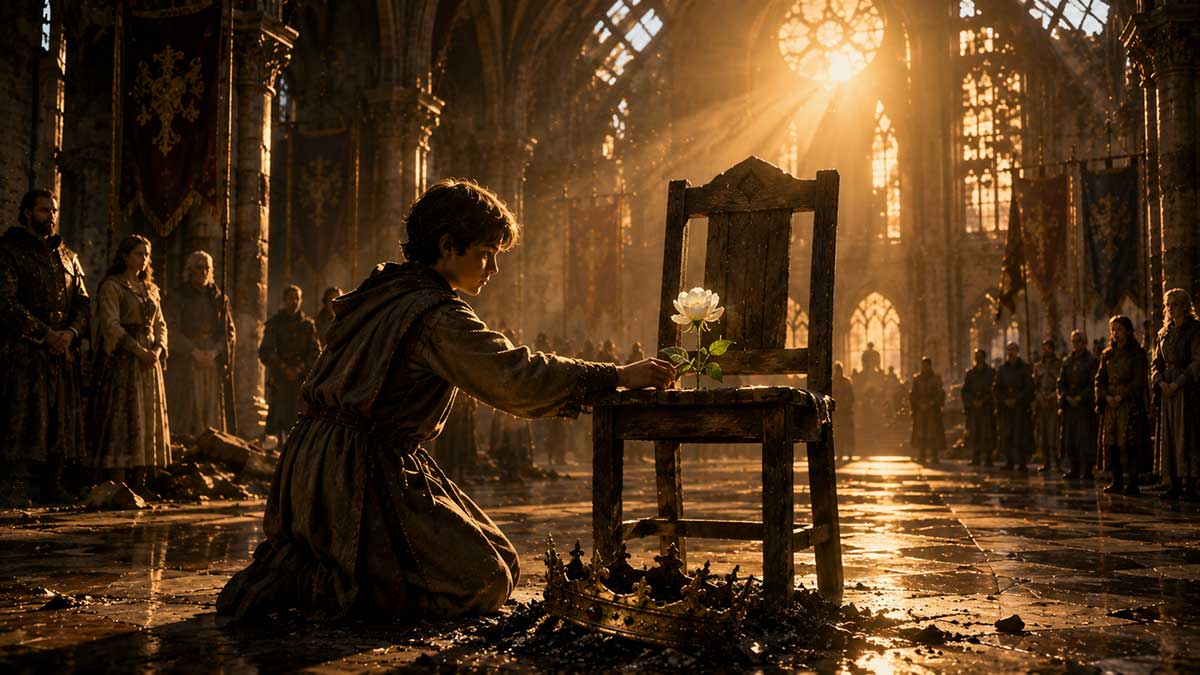
Central Question: What remains after ambition?
Dominant Image: Ashes
Emotional Movement: Communion → Truth → Sacrifice → Grief → Inheritance
Living Symbols: The Flower, Bread, Needle, Ring, and Ashes
Emotional Color: White beneath Black
Emotional Season: Dawn after fire
SCENE ONE - The Great Hall in Ruins
The hour before dawn.
The fire has passed through the palace.
The Great Hall remains standing, but its roof is broken in places. Through the openings above, a dark sky can be seen.
Ash drifts slowly into the room.
The two seats remain upon the raised platform.
Lear’s throne is scorched.
The simpler chair beside it is untouched except for a layer of ash.
The crown lies on the floor where the Fool placed it in Act I.
No one has lifted it.
The palace doors have been torn from their hinges.
Beyond them, the city is restless.
Western soldiers occupy one quarter. Loyal soldiers occupy another. Civilians crowd the streets between them.
No one commands the whole.
FALSTAFF enters carrying a basket.
The basket contains one final loaf of bread.
ROBIN follows with a small clay pot holding the winter star plant from the garden.
Its leaves are burned at the edges, but one white flower remains.
Robin places it near the empty chair.
ROBIN:
Will it live?
FALSTAFF:
It has ignored winter, soldiers, smoke, and royal policy.
I would not wager against it.
Falstaff removes the loaf.
It is blackened on one side.
ROBIN:
That is the last bread.
FALSTAFF:
The last bread is merely the first bread divided by too many people.
ROBIN:
That does not make more.
FALSTAFF:
No.
But it improves the people.
He tears away the burned crust.
The Fool enters.
His costume is torn. One bell remains upon his cap.
It makes no sound.
He looks toward the ruined roof.
FOOL:
The palace has discovered the sky.
FALSTAFF:
An expensive renovation.
FOOL:
Kings prefer improvements that require armies.
Falstaff looks toward the doors.
FALSTAFF:
How many outside?
FOOL:
Enough to begin a war.
Not enough to finish one.
ROBIN:
Are they going to fight?
FOOL:
They are deciding whether the dead have left them sufficient reasons.
Robin looks at the crown.
ROBIN:
Why has no one taken it?
FALSTAFF:
It is heavier after a fire.
ROBIN:
It looks the same.
FOOL:
So do many guilty things.
Falstaff breaks the loaf.
He gives a piece to Robin.
A piece to the Fool.
He keeps the smallest portion.
HAL enters.
His clothing is stained with soot. He has lost his sword.
He looks exhausted.
Falstaff offers him bread.
Hal looks at the small amount remaining.
HAL:
Give it to the wounded.
FALSTAFF:
You are wounded.
HAL:
Not in a useful place.
FALSTAFF:
All wounds become useful when someone wishes to explain you.
Hal takes the bread.
He eats.
Falstaff watches him.
HAL:
The western officers will not withdraw.
They claim they came to protect Cordelia from Lear.
The palace guard refuses to lay down arms while western soldiers remain.
The northern companies will follow Lady Macbeth, but not Othello.
My father’s riders wait beyond the southern gate.
One word from me brings another army into the city.
FALSTAFF:
And will you give it?
HAL:
I do not know.
FALSTAFF:
Good.
HAL:
Yesterday you mocked Hamlet for saying that.
FALSTAFF:
Yesterday was prosperous enough for certainty.
Today we must economize.
Hal walks toward the crown.
He looks down at it.
HAL:
Lear may not survive another day.
FALSTAFF:
Neither may the rest of us.
HAL:
Someone must command.
FALSTAFF:
Yes.
HAL:
You think I should refuse.
FALSTAFF:
I think refusal can be vanity wearing clean hands.
Hal looks at him.
Falstaff’s own earlier words have evolved.
FALSTAFF:
You were right in the tavern.
Good men sometimes protect their happiness while worse men take the room.
But power is not proved by entering the room.
It is proved by remembering why you entered.
HAL:
And if I forget?
FALSTAFF:
Then I shall remind you.
HAL:
You may not always be there.
Falstaff smiles faintly.
FALSTAFF:
There is the cruelest sentence spoken by the young.
Hal’s face tightens.
HAL:
John—
FALSTAFF:
No.
Let us not mourn me before I earn it.
It encourages death.
Hal looks at the bread in his hand.
HAL:
I was ashamed of you.
Falstaff waits.
HAL:
Not because you were dishonorable.
Because you knew the part of me that existed before anyone needed me.
At court, that felt dangerous.
FALSTAFF:
It was.
HAL:
I thought becoming worthy meant leaving that man behind.
FALSTAFF:
And now?
HAL:
Now I think a king who cannot remember being foolish will become cruel to everyone who still is.
Falstaff looks at him with pride he disguises poorly.
FALSTAFF:
A regrettable improvement.
They embrace.
Not ceremonially.
Not as prince and companion.
As men who may soon lose one another.
BEATRICE enters carrying torn strips of cloth.
BEATRICE:
There are wounded people outside who would benefit from your touching reconciliation becoming bandages.
Falstaff releases Hal.
FALSTAFF:
You see?
Already love has entered public service.
Beatrice approaches the empty chair.
She wipes ash from its seat with one strip of cloth.
BEATRICE:
The western officers have agreed to enter without weapons.
The palace guard will do the same.
Cordelia believes she can make them listen.
HAL:
And Lear?
BEATRICE:
Believes listening is the first stage of surrender.
FOOL:
Age improves the ears and ruins their use.
BEATRICE:
Hamlet is bringing Marrec’s surviving officers.
Othello brings the palace guard.
Lady Macbeth is holding the northern companies outside.
For the first time, nearly everyone intends peace.
FALSTAFF:
Then prepare for disaster.
ROBIN:
Why?
FALSTAFF:
Peace makes ambitious men feel unemployed.
A shadow moves through the broken doorway.
IAGO appears for only a moment beyond the hall.
Robin sees him.
ROBIN:
Sir!
Everyone turns.
The doorway is empty.
HAL:
Who?
ROBIN:
Cassian.
Iago.
Falstaff moves toward the door.
FOOL:
No.
FALSTAFF:
He was there.
FOOL:
That is what he wants us to know.
BEATRICE:
He could be anywhere in the palace.
HAL:
There is hardly a palace left.
FOOL:
Then he has fewer places to hide and more places to be mistaken for smoke.
A distant horn sounds.
The council approaches.
Falstaff looks at the remaining bread.
He breaks it into smaller pieces.
FALSTAFF:
Before the great begin deciding whether the small shall die—
He gives portions to Beatrice, Hal, the Fool, and Robin.
FALSTAFF:
Eat.
BEATRICE:
There is not enough.
FALSTAFF:
There never was.
That is why sharing became holy.
They eat together in the ruined hall.
No music.
No ceremony.
Only the sound of bread being broken.
Ash continues to fall.
Blackout.
SCENE TWO - The Last Council
Morning begins as a pale line through the ruined roof.
The Great Hall fills slowly.
No one sits on the throne or the empty chair.
LEAR enters supported by CORDELIA.
His neck is bandaged. His strength is failing.
HAMLET walks beside them.
OTHELLO enters with unarmed palace guards.
LADY MACBETH enters alone, having ordered her northern companies to remain outside.
HAL stands between the southern gate and the throne.
BEATRICE, FALSTAFF, the FOOL, and ROBIN remain near the walls.
Western officers enter without weapons.
Among them is CAPTAIN EDRIC, an older soldier who served with Marrec.
The opposing groups face one another.
The crown remains on the floor between them.
Everyone notices it.
No one retrieves it.
Cordelia steps forward.
CORDELIA:
We have gathered without weapons.
EDRIC:
The palace guard still occupies the eastern tower.
OTHELLO:
Because western archers occupy the market roofs.
EDRIC:
To protect us.
OTHELLO:
Protection that aims downward is often occupation.
LADY MACBETH:
This begins poorly.
BEATRICE:
Most honest meetings do.
Cordelia raises her hand.
The room quiets.
CORDELIA:
Before we decide who commands, we must decide what has happened.
False orders carried my father’s ring.
Forged seals accused Hal’s father and me.
Marrec’s anger was used to move an army.
The city was set on fire.
Grain was destroyed.
And every faction now possesses enough truth to defend itself and enough falsehood to condemn the others.
EDRIC:
Lear imprisoned you.
That was not false.
CORDELIA:
No.
EDRIC:
The west starved while the capital stored grain.
CORDELIA:
True.
EDRIC:
Marrec’s brother died by Lear’s command.
CORDELIA:
True.
Lear looks toward Edríc.
LEAR:
Tomas opened a gate during rebellion.
EDRIC:
To let families through.
LEAR:
And armed men entered among them.
EDRIC:
So children deserved fire?
The palace guards shift.
Othello raises a hand, holding them still.
Lear stands without support.
LEAR:
No.
The single word alters the room.
LEAR:
No child deserved it.
No mother.
No frightened man who followed the wrong banner because the right one had forgotten him.
I made the choice.
I believed the rebellion would spread if the gate remained open.
I believed one village could be sacrificed to save ten.
Perhaps I was right.
The western officers react angrily.
Lear raises his voice.
LEAR:
Do not mistake me.
A king can be right and still become guilty.
Silence.
LEAR:
For forty years, I told myself peace was the verdict upon my decisions.
But peace does not testify for the dead.
It only teaches the living to speak quietly around their names.
Edríc looks at him.
EDRIC:
Why say this now?
LEAR:
Because now no one is likely to reward me.
The Fool looks down.
Lear turns toward Cordelia.
LEAR:
I called truth rebellion when it came from my child.
I made love prove itself through obedience.
I asked who deserved authority while refusing to believe authority itself should answer.
He looks toward the throne.
LEAR:
I have worn the crown so long that I no longer know whether I carried it or it carried me.
Lear walks toward the crown on the floor.
He does not lift it.
LEAR:
The trial is ended.
A murmur spreads.
LADY MACBETH:
Without a successor, the armies will divide the kingdom before sunset.
LEAR:
Then let them hear my successor.
Everyone looks toward Cordelia.
Cordelia closes her eyes briefly.
LEAR:
Cordelia will reign after me.
The western officers kneel.
Some palace guards do as well.
Cordelia does not.
CORDELIA:
No.
The room erupts.
Lear turns toward her slowly.
LEAR:
No?
CORDELIA:
You cannot repair the trial by giving me what you accused me of wanting.
LEAR:
I name you because you are worthy.
CORDELIA:
Then trust me when I refuse the manner of it.
Lear’s face darkens.
The old pattern threatens to return.
He restrains it.
LEAR:
Why?
CORDELIA:
Because the kingdom will say the western army forced your hand.
The palace guard will say I was rewarded for rebellion.
Lady Macbeth’s followers will call mercy weakness.
Hal’s father will prepare for war.
And every person who distrusted me yesterday will kneel today because your breath made truth official.
LEAR:
You are my heir.
CORDELIA:
I am your daughter.
The kingdom requires more than inheritance.
LEAR:
What do you propose?
Cordelia looks around the hall.
CORDELIA:
A council of regency until the roads, grain, and courts are restored.
Othello will command the guard under civilian law.
Lady Macbeth will direct winter relief.
Hal will negotiate the southern alliance.
Beatrice will oversee public testimony from the western counties.
Hamlet will investigate the false orders and publish every finding.
No sealed judgment.
No hidden trial.
BEATRICE:
You assign me work as punishment for my opinions.
CORDELIA:
Exactly.
A faint, needed laugh moves through the room.
CORDELIA:
In spring, representatives from every county will gather.
They will determine whether the next ruler is inherited, chosen, or constrained by a permanent council.
Lear stares at her.
LEAR:
You would let farmers and merchants judge the crown?
CORDELIA:
They have been judged by it for generations.
LADY MACBETH:
A kingdom cannot be governed by endless consent.
CORDELIA:
Nor by endless fear.
LADY MACBETH:
What happens when the counties disagree?
CORDELIA:
Then disagreement must become something other than war.
OTHELLO:
And until spring?
CORDELIA:
We govern together.
Lady Macbeth looks around.
LADY MACBETH:
That is the least efficient proposal I have ever respected.
HAL:
My father will demand guarantees.
CORDELIA:
Then give him guarantees, not ownership.
HAMLET:
And if the council fails?
Cordelia looks at him.
CORDELIA:
Then we fail visibly.
Not behind seals and locked doors.
Hamlet nods.
HAMLET:
I support it.
LADY MACBETH:
Of course.
It contains enough uncertainty to resemble your childhood home.
HAMLET:
And enough action to prove I have moved.
Othello steps forward.
OTHELLO:
I will serve under those terms.
Lady Macbeth looks at him.
LADY MACBETH:
As will I.
Hal nods.
HAL:
And I.
Edríc looks toward the western officers.
EDRIC:
Marrec wanted Lear removed.
CORDELIA:
Marrec wanted his pain acknowledged.
I will not pretend those were the same.
EDRIC:
And if the west refuses?
CORDELIA:
Then I will come west without an army and listen until refusal becomes precise.
Edríc studies her.
He kneels.
The other western officers follow.
Lear alone has not agreed.
LEAR:
You would place my authority into many hands.
CORDELIA:
Yes.
Lear looks toward the Fool.
LEAR:
And what says wisdom?
FOOL:
Wisdom left when you looked at me.
Lear almost smiles.
FOOL:
But folly says a crown is safest when no one head believes it belongs there.
Lear looks at Cordelia.
LEAR:
You refuse my throne.
CORDELIA:
I refuse to receive it without changing what it means.
Lear breathes deeply.
The old king stands at the edge of his final surrender.
He reaches for Cordelia’s hand.
LEAR:
Then change it.
Cordelia takes his hand.
A sigh moves through the hall.
The possibility of peace becomes real.
A slow clapping sound is heard from the gallery above.
IAGO stands among the blackened arches.
He wears no disguise now.
IAGO:
Beautiful.
The hall erupts.
Guards reach for weapons they no longer carry.
Iago holds a dagger at the throat of a hooded figure.
He pulls the hood away.
It is the young ARCHER who killed Marrec.
The archer is badly wounded.
IAGO:
You seek truth.
Here is your witness.
OTHELLO:
Release him.
IAGO:
He released Marrec.
With admirable accuracy.
HAMLET:
You ordered the shot.
IAGO:
Ask him.
Iago pushes the archer to his knees.
ARCHER:
He promised—
Iago tightens the blade.
IAGO:
Speak carefully.
Cordelia steps forward.
CORDELIA:
Let him come down.
IAGO:
Still inviting monsters to supper?
CORDELIA:
No.
Inviting witnesses to live long enough to speak.
Iago looks around the hall.
IAGO:
You believe this council changes anything?
Lady Macbeth will count lives until one face destroys the arithmetic.
Othello will choose honor until honor wounds the woman he loves.
Hal will remember bread until power teaches him finer food.
Hamlet will act once and write a philosophy explaining why it took so long.
Lear will confess because death has made honesty inexpensive.
And Cordelia—
He looks at her.
IAGO:
Cordelia will forgive everyone until forgiveness becomes another throne.
CORDELIA:
You are wrong.
Iago’s expression changes at the words.
IAGO:
Am I?
CORDELIA:
Yes.
Lady Macbeth chose people over grain, and now she will answer for the hungry.
Othello chose law when anger would have praised him.
Hal returned to the friend he was ashamed to love.
Hamlet acted without knowing whether history would call him wise.
My father confessed what no crown required him to confess.
None of this makes them pure.
It makes them responsible.
IAGO:
Until next time.
CORDELIA:
Yes.
Until next time.
Goodness is not a door crossed once.
It is a road chosen again after every failure.
Iago’s hand tightens around the dagger.
IAGO:
And when people tire?
CORDELIA:
We carry one another.
IAGO:
And when they betray you?
CORDELIA:
We tell the truth.
IAGO:
And when truth does not save you?
Cordelia looks at him.
CORDELIA:
Then it may save whoever comes after.
Robin listens from near the empty chair.
Iago sees him.
For the first time, he looks fully at the child.
IAGO:
There is your audience.
A boy collecting lessons from ruins.
What will you teach him?
That love burns cities?
That mercy loses grain?
That fathers confess after children bleed?
That truth survives only because liars grow tired?
CORDELIA:
No.
I will teach him that failure is not inheritance unless we hand it to him unopened.
Iago looks at Robin.
IAGO:
Come here, boy.
Robin does not move.
Falstaff steps in front of him.
FALSTAFF:
Children are not evidence.
IAGO:
Everything is evidence.
FALSTAFF:
That is why you understand nothing.
Iago’s eyes move to Falstaff.
IAGO:
The clown who mistakes affection for wisdom.
FALSTAFF:
And you mistake disappointment for revelation.
A poor exchange.
IAGO:
You will die believing laughter mattered.
FALSTAFF:
Better than living to prove nothing did.
The archer suddenly drives his elbow backward into Iago.
The dagger slips.
Hamlet runs toward the stairs.
Othello follows.
Iago cuts the archer across the throat and disappears into the gallery passage.
The archer falls.
Beatrice rushes to him.
Blood pours through her hands.
ARCHER:
The chapel.
HAMLET:
What?
ARCHER:
Under the chapel.
Powder.
Iago—
He dies.
Lady Macbeth’s face turns white.
LADY MACBETH:
The old armory stores.
OTHELLO:
How much powder?
LADY MACBETH:
Enough to bring down the eastern palace.
HAMLET:
And the hall?
LADY MACBETH:
If the fire reaches the passage, all of this becomes a grave.
A deep sound comes from beneath the floor.
A distant explosion.
Dust falls from the roof.
Iago’s final design has already begun.
Blackout.
SCENE THREE - Beneath the Chapel
A network of ancient stone passages.
Smoke moves along the ceiling.
Barrels of powder line the walls.
Several fuses burn through channels of spilled grain and oil.
HAMLET, OTHELLO, LADY MACBETH, HAL, CORDELIA, FALSTAFF, and BEATRICE enter from different stairways carrying lamps.
LEAR and the Fool remain above with Robin and the civilians.
The tunnels shake.
LADY MACBETH:
The main store is beneath the east tower.
If it ignites, the collapse will bury the hall and block the city’s northern road.
HAL:
Can we flood the chamber?
OTHELLO:
The old well.
BEATRICE:
Collapsed years ago.
HAMLET:
The river channel?
LADY MACBETH:
Sealed by an iron gate.
OTHELLO:
Where?
Lady Macbeth points into darkness.
LADY MACBETH:
Beyond the powder store.
A burning fuse runs toward it.
HAL:
How long?
Lady Macbeth studies the flame.
LADY MACBETH:
Minutes.
Possibly less.
BEATRICE:
An admirably precise estimate.
HAMLET:
We divide.
Othello and Lady Macbeth reach the gate.
Hal and Falstaff move the smaller barrels away from the main store.
Beatrice clears the upper passage.
Cordelia and I will find the central fuse.
CORDELIA:
No.
HAMLET:
No?
CORDELIA:
You will help with the gate.
It may require more strength.
I will find the fuse.
HAMLET:
Alone?
CORDELIA:
You do not get to object merely because I learned action from you.
HAMLET:
You learned action before I did.
CORDELIA:
Then trust the teacher.
Another explosion sounds.
Stone falls.
Falstaff looks at Hal.
FALSTAFF:
If I die beneath a chapel, tell everyone I was praying.
HAL:
You are not dying.
FALSTAFF:
Then do not waste time correcting my reputation.
They separate.
Cordelia enters a low passage.
Hamlet watches her go.
His old fear rises.
This time he does not follow it.
He turns toward Othello.
HAMLET:
The gate.
They run.
The stage divides.
On one side, Othello, Lady Macbeth, and Hamlet reach a rusted iron wheel controlling the underground river gate.
Othello grips it with both hands.
His injured hand tears open.
OTHELLO:
It is fixed.
Lady Macbeth examines the mechanism.
LADY MACBETH:
The chain has fused with rust.
HAMLET:
Can it be cut?
OTHELLO:
Not in time.
Lady Macbeth looks at the stone housing.
LADY MACBETH:
The support can be broken.
HAMLET:
With what?
Othello sees an iron hammer near the wall.
The same kind of hammer beneath which he once placed his hand.
He lifts it.
Lady Macbeth understands the echo.
LADY MACBETH:
Your hand—
OTHELLO:
Is still mine to spend.
He strikes the support.
Again.
Again.
The stone cracks.
Hamlet joins him with another tool.
Lady Macbeth pulls the chain.
Water begins leaking through.
On the other side, Hal and Falstaff roll powder barrels into a side chamber.
Falstaff struggles.
HAL:
Leave that one.
FALSTAFF:
It appears emotionally attached.
HAL:
John.
Leave it.
Falstaff releases the barrel.
A section of ceiling collapses behind them.
The return passage is blocked.
Hal looks toward it.
HAL:
We are cut off.
FALSTAFF:
A strong architectural opinion.
They search.
Smoke thickens.
A narrow shaft rises above them, barely wide enough for one man.
HAL:
Climb.
FALSTAFF:
You first.
HAL:
You cannot lift me from below.
FALSTAFF:
And you cannot fit me through that hole without declaring war upon geometry.
HAL:
John—
FALSTAFF:
Harry.
Listen.
The familiarity returns fully.
FALSTAFF:
You climb.
I will hold the barrel away from the fire.
HAL:
No.
FALSTAFF:
A word improved by rarity.
HAL:
We go together.
FALSTAFF:
Then we remain together.
A flame appears at the edge of the chamber.
The fuse approaches the fallen barrel.
Falstaff looks at it.
Then at Hal.
FALSTAFF:
You once asked whether I would have you refuse the crown.
HAL:
This is not the time.
FALSTAFF:
It is the only time.
He grips Hal by the shoulders.
FALSTAFF:
Do not refuse it because power is dangerous.
Accept it only when refusing would endanger others more.
And when you sit—
He struggles for breath.
FALSTAFF:
Leave one chair beside you empty.
HAL:
For whom?
FALSTAFF:
For the person allowed to say you are wrong.
Hal’s eyes fill.
HAL:
You can say it yourself.
FALSTAFF:
I have practiced.
Falstaff pushes Hal toward the shaft.
Hal resists.
FALSTAFF:
Do not make me noble for too long.
It pinches.
The fire reaches closer.
Hal embraces him.
HAL:
I love you.
Falstaff closes his eyes.
The words are enough.
FALSTAFF:
An excellent judgment.
Poor timing.
Falstaff forces Hal upward.
Hal climbs into the shaft.
HAL:
Give me your hand!
Falstaff reaches.
Their hands grasp.
For one moment, it seems possible.
Then the burning fuse reaches the barrel.
Falstaff sees it.
He releases Hal.
HAL:
John!
Falstaff rolls the barrel away from the shaft and toward the deepest part of the chamber.
FALSTAFF:
Remember the bread!
Flame erupts.
Hal is thrown upward through the shaft.
The chamber below explodes.
Darkness swallows Falstaff.
In the central passage, Cordelia follows the burning fuse.
She finds IAGO kneeling beside the main powder line.
He holds Lear’s white ribbon.
The ribbon is tied around a torch.
CORDELIA:
You kept it.
Iago turns.
IAGO:
Your father dropped it.
No.
He treasured it.
That was worse.
CORDELIA:
Why?
IAGO:
Because even his tenderness required concealment.
CORDELIA:
That does not answer me.
IAGO:
Nothing answers you.
That is your tyranny.
You continue believing an answer exists.
Cordelia sees the fuse burning toward a cluster of barrels.
CORDELIA:
Move away.
IAGO:
Or?
CORDELIA:
I will extinguish it.
IAGO:
With what?
Cordelia looks around.
No water.
Only ash, dirt, and her cloak.
She removes the cloak.
IAGO:
You may stop this fuse.
There are three more.
CORDELIA:
Then help me.
Iago laughs once.
Not mockingly.
Almost with grief.
IAGO:
Still.
After all of it.
CORDELIA:
Yes.
IAGO:
You think offering trust makes you good.
CORDELIA:
No.
I think offering you a choice makes your next act yours.
Iago looks at the burning line.
IAGO:
You want me to surrender so your belief survives.
CORDELIA:
I want you to surrender because some part of you came here hoping to be stopped.
His face changes.
She has found the hidden wound.
IAGO:
Do not pretend to know me.
CORDELIA:
You told us.
You wanted to be wrong.
IAGO:
Once.
CORDELIA:
Then be wrong now.
Iago looks toward the fuse.
The flame travels.
He could stamp it out.
His foot moves slightly.
Then another explosion sounds.
Falstaff’s chamber.
The ground shakes.
The roof cracks.
Iago regains his bitterness.
IAGO:
Too late.
CORDELIA:
Not yet.
She throws her cloak over the fuse and presses it down with both hands.
The fabric catches.
She beats at it.
Iago watches.
CORDELIA:
Help me!
He does not move.
CORDELIA:
Iago!
For one instant, he steps forward.
Then stops.
A stone falls between them.
The passage begins collapsing.
Hamlet’s voice is heard in the distance.
HAMLET:
Cordelia!
Iago looks toward the sound.
IAGO:
He came.
CORDELIA:
Yes.
IAGO:
Without certainty.
CORDELIA:
Yes.
The fact wounds Iago’s philosophy.
Hamlet has changed.
Love has changed him.
The world has produced evidence against despair.
Iago suddenly stamps out a second burning line near his feet.
Cordelia sees.
CORDELIA:
Again.
Iago looks at her.
CORDELIA:
Help me with the others.
He bends and smothers another fuse with his coat.
Together, for a brief moment, they work.
Iago is being proven wrong through his own hands.
Then a dagger flies from the darkness.
It strikes Cordelia beneath the ribs.
She gasps.
Iago turns.
The GROOM from the mill stands in a side opening.
The same prisoner whose escape began the later crisis.
GROOM:
Traitor.
Iago stares at him.
IAGO:
You were ordered to leave the city.
GROOM:
You promised Cordelia would die.
Hamlet enters and strikes the groom down.
Othello follows and restrains him.
Hamlet catches Cordelia as she falls.
HAMLET:
No.
No.
Cordelia looks down at the dagger.
Blood spreads across her white dress.
Iago stares at her.
For the first time, he appears genuinely horrified.
IAGO:
I did not order this.
Hamlet looks at him with murderous rage.
He reaches for the fallen dagger.
Cordelia grips his wrist.
CORDELIA:
The fuse.
Hamlet looks toward the remaining flame.
It is nearly at the powder.
CORDELIA:
Choose.
Hamlet looks at her.
At the fuse.
The impossible decision.
Remain with the woman he loves.
Or save everyone above.
Cordelia understands.
CORDELIA:
Go.
HAMLET:
No.
CORDELIA:
You came when I needed you.
Now go where they need you.
HAMLET:
I will not leave you.
CORDELIA:
You are not leaving me.
You are carrying what I asked of you.
Act.
Hamlet’s face breaks.
HAMLET:
I love you.
CORDELIA:
I know.
He kisses her forehead.
Then runs toward the fuse with Othello.
Iago remains beside Cordelia.
The groom lies wounded nearby.
IAGO:
Why did you send him away?
CORDELIA:
Because love is not proved by dying beside someone when living can save others.
Iago kneels.
IAGO:
You will die.
CORDELIA:
Yes.
He looks at her as though she has destroyed him.
IAGO:
And still you believe?
CORDELIA:
Yes.
IAGO:
In what?
Cordelia struggles to breathe.
CORDELIA:
That you stopped one fuse.
Iago looks toward the blackened line he extinguished.
IAGO:
One.
CORDELIA:
One is where goodness begins.
Iago’s eyes fill.
He reaches for the wound, trying uselessly to stop the blood.
IAGO:
I wanted to be wrong.
CORDELIA:
You are.
A sound like a sob escapes him.
He lowers his head.
Above them, water crashes through the broken river gate.
It floods the powder chamber.
The remaining fuses extinguish.
The palace shakes but does not fall.
Darkness.
SCENE FOUR - The Great Hall at Dawn
Pale morning enters through the broken roof.
Water drips through the ruins.
The fires outside have diminished.
The surviving armies stand together beyond the doors, no longer separated by banners.
The empty chair remains.
The crown remains on the floor.
LEAR waits at the center of the hall.
The Fool stands beside him.
Robin holds the clay pot with the white flower.
Beatrice supports Hal as he enters from the lower passages.
Hal’s face and hands are burned.
Falstaff is not with him.
Lear looks behind him.
LEAR:
Where is Sir John?
Hal cannot answer.
Beatrice closes her eyes.
The Fool removes his cap.
The final bell upon it sounds once.
Hal walks toward the loaf basket.
Only crumbs remain.
He kneels.
He picks up one blackened piece of bread.
HAL:
He told me to remember.
FOOL:
Then he has not gone entirely.
HAL:
That is what people say when the body is missing.
FOOL:
Yes.
Words are poor carriers.
But they are what grief can lift.
Hal closes his hand around the bread.
Lady Macbeth enters with Othello.
Othello’s hand is bleeding heavily.
Lady Macbeth supports him without embarrassment.
Lear looks toward the passage.
LEAR:
Cordelia?
No one answers.
Hamlet appears.
He carries Cordelia.
Her white dress is stained red and gray.
Iago walks behind him voluntarily, without guards.
His hands are covered in Cordelia’s blood.
The hall becomes still.
Lear sees his daughter.
He does not understand.
Then he does.
LEAR:
No.
Hamlet lowers Cordelia gently near the empty chair.
Lear kneels beside her.
His body seems to age twenty years in a breath.
LEAR:
Cordelia.
Her eyes open faintly.
CORDELIA:
Father.
LEAR:
I am here.
CORDELIA:
You came.
LEAR:
I should have come before every wound.
I should have come when you were six beneath the oak.
I should have held you where they could see.
I should have—
Cordelia reaches toward him.
Her hand is weak.
Lear takes it in both of his.
CORDELIA:
Do not spend what remains naming every door behind us.
LEAR:
Stay.
The word from the Hall of Mirrors.
Now helpless.
LEAR:
Stay.
I command you.
Cordelia almost smiles.
CORDELIA:
There is the king.
LEAR:
Then I beg you.
Stay.
CORDELIA:
There is my father.
Lear bows over her hand.
LEAR:
Forgive me.
CORDELIA:
I did.
LEAR:
When?
CORDELIA:
Before you asked.
Lear begins to weep.
Not privately.
Not behind a throne.
Before soldiers, servants, rivals, and strangers.
He holds his daughter as he should have held the lost child in the forest.
Cordelia looks toward Hamlet.
He kneels beside her.
HAMLET:
We stopped the powder.
CORDELIA:
I knew you would.
HAMLET:
No.
You trusted I would.
That is different.
CORDELIA:
You learned.
HAMLET:
Too late.
CORDELIA:
Do not say that.
HAMLET:
How can I not?
CORDELIA:
Because too late for us may still be in time for others.
She looks toward Robin.
Robin stands frozen, holding the winter star.
Cordelia gestures weakly.
He approaches.
CORDELIA:
Did you save it?
ROBIN:
Yes.
CORDELIA:
Plant it somewhere open.
ROBIN:
In the garden?
Cordelia looks through the broken roof.
CORDELIA:
Where everyone may see it grow.
Robin begins crying.
ROBIN:
I do not want to remember you like this.
CORDELIA:
Then do not.
Remember the garden.
ROBIN:
Which part?
CORDELIA:
The part that comes after winter.
Robin holds the flower close.
Cordelia sees the needle tucked into his belt.
CORDELIA:
You kept the needle.
ROBIN:
I did not lose it.
CORDELIA:
Good.
Do not use it only to mend cloth.
ROBIN:
What else can it mend?
Cordelia looks around the ruined kingdom.
CORDELIA:
Whatever people are patient enough to join.
Her strength fades.
Lear grips her hand.
LEAR:
No.
Cordelia looks toward him one last time.
CORDELIA:
You asked God how to finish well.
Lear’s face collapses.
LEAR:
Not like this.
CORDELIA:
No.
By beginning differently.
She breathes once.
Then no more.
Silence.
Lear waits for another breath.
It does not come.
LEAR:
Cordelia?
He touches her face.
LEAR:
Cordelia.
The name becomes smaller each time.
LEAR:
My child.
The Fool turns away.
Beatrice covers her mouth.
Lady Macbeth weeps openly.
Othello lowers his head.
Hal kneels, still holding Falstaff’s bread.
Hamlet sits utterly still beside Cordelia.
Lear lifts her slightly.
LEAR:
She is warm.
HAMLET:
Yes.
LEAR:
Then she is not gone.
No one answers.
LEAR:
She forgave me.
FOOL:
Yes.
LEAR:
Then why does forgiveness feel like punishment?
The Fool kneels beside him.
FOOL:
Because love does not erase the wound.
It teaches us whose wound we are carrying.
Lear looks toward Iago.
Iago stands alone.
LEAR:
You.
Othello moves between them.
OTHELLO:
Majesty—
LEAR:
He did this.
Iago looks at Cordelia.
IAGO:
Yes.
HAMLET:
The groom threw the dagger.
IAGO:
He served my design.
The hand was his.
The purpose was mine.
LEAR:
Kill him.
No one moves.
The command echoes Act III.
LEAR:
Kill him!
Othello looks at Hamlet.
Hamlet looks at Iago.
Iago kneels.
IAGO:
Do it.
Lear turns to Hamlet.
LEAR:
You spared Marrec.
You demanded law.
Look what mercy purchased.
Kill him now.
Hamlet rises.
He picks up the dagger that wounded Cordelia.
He approaches Iago.
Iago lifts his chin.
IAGO:
At last.
Hamlet stands before him.
His hand does not shake.
IAGO:
You loved her.
HAMLET:
Yes.
IAGO:
Then prove it.
Hamlet studies him.
HAMLET:
You still believe love must become violence to be real.
Iago says nothing.
HAMLET:
You want death because it would complete your argument.
The villain destroyed.
The lover avenged.
The world made simple by a blade.
IAGO:
And you will deny Lear justice?
HAMLET:
No.
I will deny you escape.
He lowers the dagger.
HAMLET:
You will live.
You will testify publicly.
Every forgery.
Every payment.
Every name.
Every lie.
You will hear the stories of those who died.
You will watch the kingdom rebuild without accepting your conclusion.
Iago’s composure finally breaks.
IAGO:
No.
HAMLET:
You wanted to be proven wrong.
You will be given years of evidence.
IAGO:
Kill me.
HAMLET:
No.
Iago lunges for the dagger.
Othello restrains him.
Iago struggles.
IAGO:
Kill me!
Othello holds him.
OTHELLO:
No.
Iago looks at Cordelia’s body.
He begins to weep.
Not beautifully.
Not redemptively.
Like a man discovering too late that despair was also a choice.
Guards take him.
He does not resist now.
Before he exits, he looks at Robin.
Robin looks back.
Iago opens his mouth.
Perhaps to speak.
No words come.
He is taken away.
Lear remains beside Cordelia.
LEAR:
Place the crown upon her.
Cordelia’s council looks at one another.
Hamlet approaches the crown.
He bends.
But instead of lifting it, he moves it farther from Cordelia’s body.
LEAR:
What are you doing?
HAMLET:
She refused it.
LEAR:
She was queen.
HAMLET:
She was Cordelia.
Do not make the crown her final name.
Lear looks at his daughter.
Slowly, he understands.
He removes the white ribbon from inside his robe.
He has carried it throughout the play.
He ties it gently around Cordelia’s wrist.
LEAR:
When she was born, she held my finger so tightly I thought strength meant never releasing me.
He looks at his own hands.
LEAR:
I did not understand.
Strength was the hand opening.
Lear kisses Cordelia’s forehead.
Then rises with enormous difficulty.
He faces the assembled soldiers and citizens.
LEAR:
Hear me.
The crown is not inherited today.
The council my daughter named will govern until spring.
Her proposal will stand.
The counties will speak.
The records will be opened.
The dead will be named.
The west will receive grain before the palace receives stone.
Lady Macbeth steps forward.
LADY MACBETH:
There is little grain left.
LEAR:
Then open every royal store.
Sell every jewel.
Melt every plate.
Break the throne for firewood if winter demands it.
The Fool looks toward the scorched throne.
FOOL:
At last, useful furniture.
A fragile laugh passes through the grief.
Lear hears it.
He looks at the Fool.
LEAR:
Keep speaking.
FOOL:
Majesty?
LEAR:
Even when I command silence.
Especially then.
The Fool bows.
Not as a servant.
As a friend.
Lear looks toward Hal.
LEAR:
Prince Hal.
HAL:
Majesty.
LEAR:
Your father’s armies remain outside.
HAL:
They will not enter.
LEAR:
And if he commands it?
Hal looks at Falstaff’s bread in his hand.
HAL:
Then I will stand at the gate and tell him no.
Lear nods.
LEAR:
You may become a good king.
HAL:
I hope to remain a man first.
Lear turns toward Lady Macbeth.
LEAR:
Feed them.
LADY MACBETH:
I will.
LEAR:
Do not count only what is saved.
Count what the saving costs.
She looks at Cordelia.
LADY MACBETH:
I understand.
Lear turns toward Othello.
LEAR:
Keep the peace.
OTHELLO:
Under law.
Lear almost objects.
Then nods.
LEAR:
Under law.
He turns to Beatrice.
LEAR:
Record what happened.
BEATRICE:
Honestly?
LEAR:
Mercifully.
BEATRICE:
Those are not always companions.
LEAR:
Then introduce them.
Finally, Lear turns toward Hamlet.
LEAR:
And you?
Hamlet looks at Cordelia.
HAMLET:
I will finish the investigation.
Then I will go to the western counties.
LEAR:
Why?
HAMLET:
She said she would listen until refusal became precise.
Someone must keep the appointment.
Lear nods.
His strength gives way.
The Fool catches him.
LEAR:
I am tired.
FOOL:
I know.
LEAR:
No.
Not finished.
The Fool looks at him.
Lear looks toward Robin and the winter star.
LEAR:
Not yet.
Blackout.
SCENE FIVE - The Empty Chair
Spring.
Several months later.
The Great Hall has not been fully restored.
Its walls remain scarred.
The broken roof has been repaired with plain timber rather than ornament.
The throne is gone.
Its wood has been used elsewhere.
Only the simple empty chair remains upon the platform.
The floor has been cleared.
The crown still rests upon it.
Not worn.
Not displayed.
Simply left where history placed it.
A long table now occupies the hall.
Farmers, merchants, soldiers, widows, clergy, and representatives from different counties sit together.
Their clothing and disagreements suggest that governing has become more difficult and more honest.
LADY MACBETH stands over food ledgers.
Her steel clasp is gone.
OTHELLO sits beside her, his injured hand permanently stiff.
She passes him a document.
He reads it.
Their hands touch.
Neither withdraws.
BEATRICE writes at the table.
A pile of testimonies surrounds her.
HAL stands near an open door speaking with southern messengers.
Around his neck hangs a small cloth pouch containing the last blackened piece of Falstaff’s bread.
HAMLET stands near the garden entrance.
He wears the white flower Cordelia gave him, now dried and carefully bound.
The Fool sits among the county representatives rather than beside the ruler.
His cap has no bells.
LEAR is absent.
A simple black cloth rests over his former place at the table.
He died during the winter.
No crown upon his grave.
The council meeting ends.
The representatives leave slowly, still arguing.
Their argument is not violent.
That is progress.
Lady Macbeth closes the ledger.
LADY MACBETH:
The western stores will last eighteen days.
OTHELLO:
The southern shipment arrives in twelve.
LADY MACBETH:
If the roads hold.
OTHELLO:
They may.
LADY MACBETH:
I dislike “may.”
OTHELLO:
You have survived worse words.
She looks at him.
LADY MACBETH:
I slept last night.
OTHELLO:
I know.
LADY MACBETH:
How?
OTHELLO:
The corridor was quiet.
She takes his hand.
A small action.
An enormous one.
They exit together.
Beatrice gathers her pages.
Hamlet approaches.
HAMLET:
How have you written Cordelia?
BEATRICE:
Badly.
HAMLET:
That is unusually modest.
BEATRICE:
The dead become symbols too quickly.
Everyone wants her to represent mercy.
Truth.
Sacrifice.
A new kingdom.
Few remember she disliked pears, sang poorly, and cheated at cards.
Hamlet smiles through grief.
HAMLET:
She cheated?
BEATRICE:
Shamelessly.
You did not know her long enough.
The sentence hurts.
Beatrice regrets it.
BEATRICE:
Forgive me.
HAMLET:
No.
Keep saying such things.
I do not want grief to improve her beyond recognition.
Beatrice hands him a page.
BEATRICE:
Then tell me something ordinary.
Hamlet looks toward the garden.
HAMLET:
She became impatient with slow walkers.
BEATRICE:
You must have tested her devotion.
HAMLET:
Constantly.
They share a quiet laugh.
Beatrice writes.
BEATRICE:
Good.
Now she may remain human.
She exits.
Hal approaches the place where Falstaff once sat.
He takes the blackened bread from the pouch.
It has hardened almost to stone.
The Fool watches.
FOOL:
Still keeping it?
HAL:
Yes.
FOOL:
Keeping is not the same as caring.
Hal looks at him.
HAL:
Then what should I do?
The Fool points toward the open courtyard.
Children are eating at a long public table.
FOOL:
Remember what bread is for.
Hal looks at the hardened piece.
He cannot feed anyone with it.
He walks to a nearby garden bed.
He crumbles the bread into the soil.
Birds descend.
They eat.
Hal watches them.
HAL:
He would object.
FOOL:
Loudly.
That is how you know he approves.
Hal smiles.
A southern messenger calls him.
He leaves.
Hamlet and the Fool remain.
HAMLET:
Do you believe the kingdom has changed?
FOOL:
Yes.
HAMLET:
You answered quickly.
FOOL:
I am old.
Delay has lost its charm.
HAMLET:
For the better?
FOOL:
You philosophers always spoil a clean answer.
The Fool looks toward the long council table.
FOOL:
The kingdom has changed.
Whether the change becomes better depends on what people do when the memory becomes inconvenient.
Hamlet touches the dried flower.
HAMLET:
I speak to her.
FOOL:
And what does she say?
HAMLET:
Mostly what she should have said earlier.
The Fool looks at him.
Hamlet smiles faintly at the echo of Act I.
HAMLET:
No.
That is not true.
She said what she needed to say.
I simply hear more of it now.
Robin enters.
He is older by only a few months but carries himself differently.
He holds a shallow wooden box.
Inside are five objects:
The dried remains of the first white flower.
A fragment of Falstaff’s bread.
The needle from the sewing room.
A plain metal ring recovered from the riverbank—Lear’s royal ring, darkened by water.
And a small glass jar of ashes gathered after the palace fire.
Hamlet and the Fool watch him approach the empty chair.
FOOL:
What are these?
Robin places the box down.
ROBIN:
The things they forgot.
The Fool’s eyes fill.
HAMLET:
Who forgot them?
Robin considers.
ROBIN:
Everyone.
Then they remembered.
He lifts the bread.
ROBIN:
Falstaff said no one should carry more bread than he can share.
He places it before the chair.
He lifts the needle.
ROBIN:
Lady Cordelia said it could mend whatever people were patient enough to join.
He places it beside the bread.
He lifts the ring.
ROBIN:
King Lear thought this commanded the kingdom.
FOOL:
And did it?
Robin looks toward the council table.
ROBIN:
Only while people agreed.
He places the ring down.
He lifts the jar of ashes.
ROBIN:
What should I remember about these?
Hamlet looks around the scarred hall.
HAMLET:
That everything can burn.
The Fool looks toward the garden.
FOOL:
And that ash feeds roots.
Robin places the jar down.
Finally, he lifts the white flower.
A living winter star now grows in the clay pot beside the chair.
Robin removes the old dried flower from the box and holds it beside the living one.
ROBIN:
Which should I keep?
Hamlet looks at the dried flower Cordelia gave him.
Then at the living plant.
HAMLET:
Both.
The dead teach us what was given.
The living ask what we will give next.
Robin looks toward the crown on the floor.
He picks it up with both hands.
It is heavy.
He stands before the empty chair.
For a moment, it appears he may place the crown upon it.
Instead, he sets the crown back on the floor.
He picks the single living white flower from the winter star.
Hamlet inhales sharply.
Robin places the flower upon the empty chair.
ROBIN:
There.
The crown remains below.
The flower rests above.
The Fool looks at the child.
FOOL:
Why the flower?
Robin looks around the hall where kings once commanded, friends laughed, lovers hesitated, soldiers bled, and a daughter told the truth.
ROBIN:
Because someone has to remember what the chair is for.
HAMLET:
And what is it for?
Robin looks toward the open doors.
Beyond them, people rebuild the city.
Children carry bread.
Workers raise beams.
Birds feed in the garden.
The world continues without waiting for a perfect answer.
ROBIN:
Whoever is not sitting in it.
The Fool closes his eyes.
A final lesson from the child.
Ashes remember what crowns forget.
The morning sun enters through the repaired roof.
It falls upon the white flower.
The crown remains in shadow.
Blackout.
END OF THE PLAY
Final Thoughts by William Shakespeare
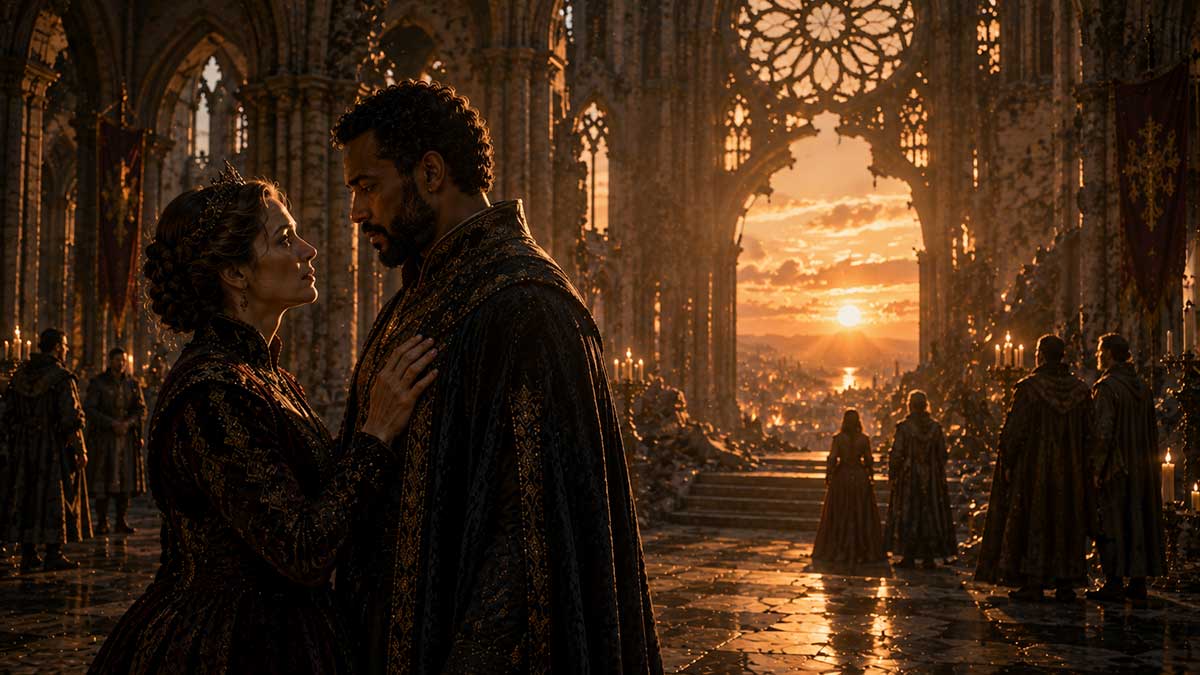
Every tragedy leaves behind a question.
Who survived?
That question has never interested me very much.
A more difficult question remains:
What survived?
In this story, kingdoms survived.
Cities survived.
Laws survived.
Even memory survived.
But these were never the greatest victories.
The greatest victory was that despair did not receive the final word.
Iago believed every noble heart would eventually betray itself.
He believed goodness was merely innocence waiting to be disappointed.
Many events seemed to prove him right.
Yet one person continued to answer cruelty without surrendering compassion.
Not because suffering failed to wound her.
But because suffering refused to become her master.
That single refusal changed every life around her.
The old king died not as a monarch defending pride, but as a father holding his daughter.
The philosopher finally acted.
The warrior learned that mercy strengthens courage.
The ambitious learned that love may ask more sacrifice than conquest ever demands.
The prince remembered bread.
The fool discovered that laughter can outlive crowns.
And a child inherited neither throne nor vengeance, but remembrance.
Perhaps that is how civilizations truly endure.
Not through monuments.
Not through victories.
Not through perfect rulers.
But because ordinary people quietly choose to leave one another a better story than the one they themselves received.
Should you one day find yourself seated where power waits, remember the empty chair.
Should grief visit your house, remember the white flower.
Should anger tempt your tongue, remember the loaf of bread broken before the battle.
Should despair whisper that goodness is only foolishness delayed, remember the man who wished to be proven wrong.
And if all else fails...
Remember the child who placed the flower where the crown once belonged.
For kingdoms are remembered by their rulers.
But humanity is remembered by its gardeners.
Short Bios:
King Lear
An aging ruler who spends a lifetime mastering kingdoms before discovering the far more difficult work of becoming a father.
Cordelia
A woman whose greatest strength is not innocence, but the courage to love without surrendering truth.
Hamlet
A philosopher who finally learns that wisdom reaches its fullness only when thought becomes action.
Othello
A soldier who discovers that compassion may demand greater bravery than any battlefield.
Lady Macbeth
A brilliant strategist who slowly learns that the strongest leaders are those willing to protect life before reputation.
Prince Hal
A future king who remembers that leadership begins not with command, but with shared bread and humble friendship.
Sir John Falstaff
The laughter of the kingdom. Behind every jest stands a man who understands people more deeply than princes understand politics.
Beatrice
A fearless observer whose wit protects truth from becoming solemn and whose honesty keeps mercy from becoming sentiment.
The Fool
Not merely a jester, but the conscience of the kingdom—the only man free enough to tell kings what they cannot bear to hear.
Iago
A soul who mistakes disappointment for wisdom and despair for truth, until goodness confronts him with the one thing he never believed could exist.
Robin
A child who witnesses the failures of great people and quietly inherits their unfinished hope. He reminds us that every generation decides whether history becomes a burden—or a beginning.
Leave a Reply