
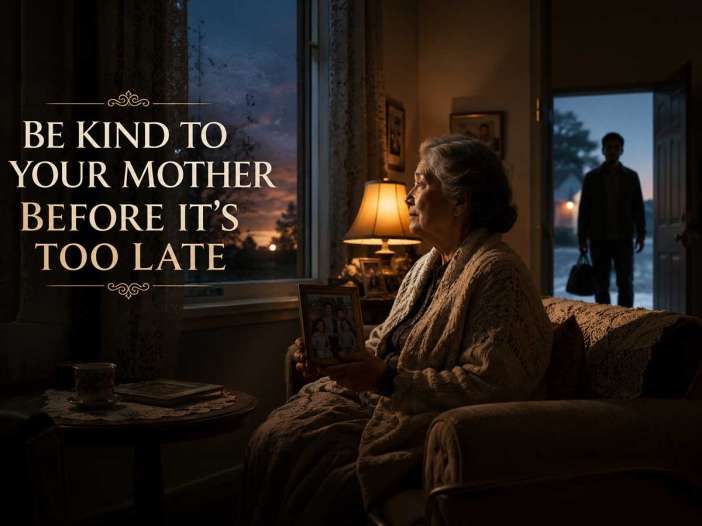
What if the greatest gift your mother wants is not money, but one unhurried afternoon with you?
There are few relationships as profound, complex, and enduring as the bond between a mother and her child.
Long before we could walk, speak, or remember, someone was already staying awake through sleepless nights, worrying over fevers, celebrating tiny victories, and quietly placing our needs above her own. Yet the greatest irony of motherhood may be this: the more faithfully a mother gives, the less visible her sacrifices often become.
Children naturally see the meals, the rides to school, the clean clothes, the comforting words, and the countless ordinary acts of care. What they rarely see are the dreams postponed, the tears hidden, the fears carried alone, and the years that slowly transformed youthful hands into aging ones.
Then life changes.
One day, the child becomes the adult.
The mother who once walked ahead now walks more slowly. The woman who always had the answers begins asking for help. The voice that once gave strength may begin to tremble. For many people, this is the first time they truly begin seeing not only "Mom," but the woman who spent decades loving them in ways they never fully understood.
This conversation is not meant to create guilt.
Every family is different. Some relationships are warm and joyful. Others carry disappointment, misunderstanding, or deep wounds. Love is rarely simple.
Instead, this conversation invites us to pause and ask difficult but beautiful questions.
What does a mother remember about her children?
What does it really mean to honor our parents?
How do we love without waiting until illness forces us to?
How do we become adults who stand on our own feet without closing our hearts to those who first carried us?
Perhaps most importantly:
How can we make sure the people who loved us first never have to wonder whether they were loved in return?
Tonight, five conversations explore those questions—not through lectures, but through stories, memories, disagreements, regrets, laughter, forgiveness, and hope.
May each conversation remind us that gratitude is not measured by what we feel.
It is measured by what we do while there is still time.
(Note: This is an imaginary conversation, a creative exploration of an idea, and not a real speech or event.)
Topic 1: The Sacrifice We Do Not See Until We Grow Older
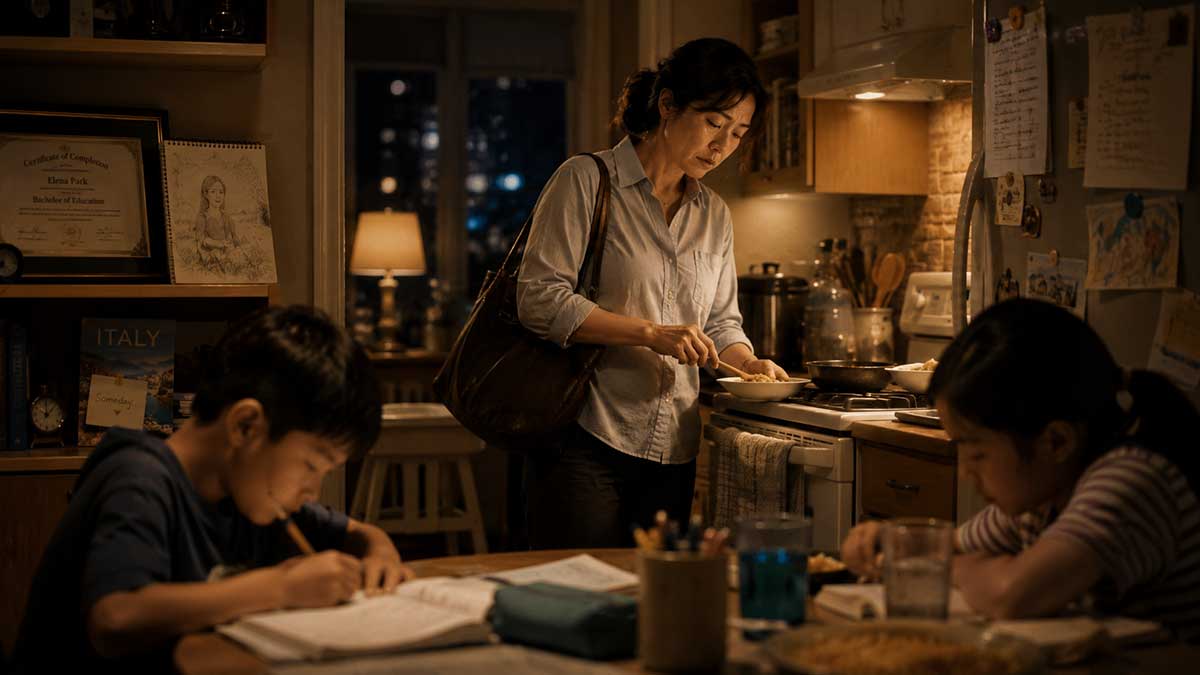
The room is quiet and warmly lit. Rain touches the windows in soft, uneven taps. A wooden table sits at the center, with four guests gathered around it.
Fred Rogers sits with his hands folded, listening before anyone has spoken.
Maya Angelou holds a cup of tea, her expression both warm and serious.
Across from her is Mrs. Elena Park, a woman in her late sixties who spent more than thirty years cleaning hotel rooms, working restaurant shifts, and raising three children.
Beside her sits Grace Miller, a hospice nurse who has spent twenty-two years caring for mothers during their final days.
Nick looks around the table.
Nick:
I want to begin with a very ordinary scene.
A mother finishes a twelve-hour shift and comes home with pain in her back. She stands in the kitchen and cooks dinner. Her son eats quickly, complains that the food is cold, and goes back to his room.
Years later, he remembers the meal.
But he does not remember that she was standing because sitting down made it harder for her to get back up.
He does not remember the swelling in her hands.
He does not remember that she had not eaten yet.
Why is a mother’s sacrifice so easy to miss when we are living inside it?
There is a long pause.
Mrs. Park lowers her eyes.
Mrs. Park:
Children are not looking for sacrifice.
They are looking for dinner.
They are looking for clean clothes.
They are looking for someone to pick them up.
They see what arrives. They do not see what it costs.
When my oldest son was in high school, I worked mornings at a hotel and evenings at a restaurant. Some nights, I came home after eleven. He would ask, “Did you wash my basketball uniform?”
I would feel angry for one second.
Then I would tell myself, “He is still a child.”
So I washed it.
Maya Angelou:
And did you ever tell him how tired you were?
Mrs. Park:
No.
Maya Angelou:
Why not?
Mrs. Park:
I did not want him to feel guilty.
Maya Angelou:
Then you protected him from the cost of loving him.
Mrs. Park:
Yes.
Maya Angelou:
And perhaps, without intending to, you protected him from gratitude too.
Mrs. Park looks down at her hands.
Mrs. Park:
Maybe I did.
Fred Rogers:
Many mothers make love look effortless.
That is one of the reasons children misunderstand it.
A mother may be frightened, tired, lonely, or uncertain. Yet she learns to make the home feel steady. The child sees the steadiness and assumes it came naturally.
The child does not see the fear she swallowed.
Nick:
So the better a mother hides the burden, the less likely the child is to recognize what she carried?
Grace Miller:
Very often, yes.
I have cared for mothers who kept protecting their children until their final breath.
I remember one woman named Louise. She had cancer, and she knew she had very little time left. Her daughter was driving six hours to see her.
Louise was in pain that morning. Severe pain.
Yet when her daughter arrived, Louise asked me to help her sit up and comb her hair.
She said, “I don’t want her to remember me looking sick.”
Her daughter came in and said, “Mom, you look good.”
Louise smiled and said, “I feel good today.”
Neither of them told the truth.
The daughter wanted to believe her mother was better.
The mother wanted to protect the daughter.
They loved each other deeply, yet love stood between them like a curtain.
Maya Angelou:
That curtain can be tender.
It can still hide a life.
Grace Miller:
Yes.
After Louise died, her daughter asked me, “Was she in pain when I visited?”
I told her gently that she had been.
The daughter began crying.
She said, “Why didn’t she tell me?”
I said, “She was still being your mother.”
Nick:
What did the daughter say?
Grace Miller:
She said, “I wish she had let me be her daughter.”
No one speaks for several seconds.
Rain continues against the window.
Fred Rogers:
That is a very important sentence.
A child may spend years receiving care and never realize that one day the mother may need permission to receive it.
Maya Angelou:
We often speak of mothers as though they were born carrying endless strength.
They were not.
They were girls once.
They had fears.
They had dreams that did not include laundry, bills, sleepless nights, or worrying whether a child would come home safely.
Motherhood may enlarge a woman’s life, yet it can consume parts of her life too.
A child often sees “my mother.”
The child does not always see the woman who existed before that title.
Nick:
Mrs. Park, did your children know what you wanted for your own life?
Mrs. Park:
No.
Nick:
What did you want?
She smiles faintly.
Mrs. Park:
I wanted to become a teacher.
I loved reading when I was young. I used to line up my younger cousins and pretend I had a classroom.
Then I got married.
My husband became sick.
We needed money.
So I took whatever work I could find.
Nick:
Did you ever tell your children that?
Mrs. Park:
My daughter knows now.
My sons do not.
Maya Angelou:
Why have you not told them?
Mrs. Park:
I do not want them to think they ruined my life.
Maya Angelou:
Would that be the truth?
Mrs. Park:
No.
They gave my life meaning.
But sometimes meaning comes with a price.
Fred Rogers:
Children can hear that truth.
They can hear, “I loved raising you, and it cost me something.”
Those two truths can live in the same home.
Mrs. Park:
I am not sure my sons would understand.
Grace Miller:
They may understand more than you expect.
Or they may understand later.
Many children do not recognize the sacrifice at the moment it is happening.
Sometimes the recognition arrives when they have children of their own.
Sometimes it arrives when they begin caring for the mother who once cared for them.
Sometimes it arrives after she is gone.
Nick:
Why does it so often take parenthood or loss?
Maya Angelou:
Some truths cannot be learned from explanation alone.
A person can hear, “Your mother stayed awake all night when you were sick.”
The sentence may sound kind and familiar.
Then one night, that person holds a feverish child and watches the clock move from two in the morning to three, then four.
Now the memory returns differently.
The person thinks, “My mother did this for me.”
At that moment, childhood changes.
Fred Rogers:
A memory can mature long after the event has passed.
You may remember your mother calling again and again to ask when you were coming home. As a teenager, you heard control.
Years later, you may hear fear.
You may remember her asking whether you had eaten. At the time, it seemed repetitive.
Later, it may sound like love searching for a simple way to speak.
Mrs. Park:
My younger son used to get annoyed when I called.
He would say, “Mom, I’m thirty years old.”
I knew he was thirty.
I was not confused.
I simply wanted to hear his voice.
Nick:
Did you stop calling?
Mrs. Park:
For a little while.
I told myself I should give him space.
Then he asked my daughter, “Why doesn’t Mom call me anymore?”
Everyone smiles softly.
Maya Angelou:
We are strange creatures.
We complain about being watched, then feel abandoned when the watching stops.
Fred Rogers:
A mother’s concern can feel heavy when we are trying to prove we no longer need her.
Yet many people later miss that very concern more than anything else.
Grace Miller:
I hear that often after a mother dies.
People say, “No one asks whether I got home safely anymore.”
Not, “No one gave me advice.”
Not, “No one cooked my favorite meal.”
They say, “No one worries about me anymore.”
For most of their lives, they experienced the worry as pressure.
After the mother is gone, they recognize it as a form of shelter.
Nick:
Is that fair to the mother?
We treat her worry as an annoyance when she is alive, then treasure it when she is gone.
Grace Miller:
It is human.
It can still be painful.
I once met a son who sat beside his mother’s bed for three days. She was unconscious most of that time.
He kept saying, “Mom, I’m here.”
He told me they had not spoken properly for almost two years.
There had been an argument about money. Neither one wanted to make the first call.
He said, “I thought we had time.”
That sentence appears in many rooms.
“I thought we had time.”
Maya Angelou:
Pride has a way of borrowing from tomorrow.
It spends time we do not own.
Fred Rogers:
And sometimes children avoid their mothers not from lack of love, but from guilt.
They know they have not called.
Each missed week makes the next call harder.
They begin to feel they need an explanation.
So they wait until they have one.
Nick:
And the silence grows.
Fred Rogers:
Yes.
Yet the mother may need no explanation.
She may simply want the phone to ring.
Mrs. Park:
That is true.
When my children do not call for a long time, I practice what I will say.
I tell myself, “Do not complain. Do not ask why they waited. Just sound happy.”
Then the phone rings, and I say, “Are you eating?”
Maya smiles.
Maya Angelou:
The ancient language of mothers.
Mrs. Park:
I do not know what else to say.
If I say, “I missed you,” I am afraid they will feel guilty.
If I say, “Why did you not call?” they may call less.
So I ask about food.
Nick:
That changes the meaning of the question.
“Did you eat?” may really mean, “I have been waiting to hear your voice.”
Mrs. Park:
Yes.
Grace Miller:
Many children hear only the words.
They do not hear the fear beneath them.
Maya Angelou:
We must learn to listen beneath the sentence.
A mother says, “Wear a jacket.”
She may mean, “The world feels cold to me when I think of you suffering.”
She says, “Call me when you get there.”
She may mean, “My heart will travel with you until I know you are safe.”
She says, “Why do you work so much?”
She may mean, “I am afraid your life is moving faster than I can follow.”
Fred Rogers:
And sometimes she says the wrong thing.
Love is not always graceful.
Concern can become criticism.
Fear can become control.
A mother may hurt the child she is trying to protect.
Recognizing her sacrifice does not require pretending she was perfect.
Nick:
That matters.
An emotional conversation about mothers can easily become too sentimental. Some people listening may have loving memories. Others may carry wounds.
Maya Angelou:
A mother can sacrifice much and still make mistakes.
A child can be grateful and still be hurt.
We should not force those truths to fight each other.
Mrs. Park:
I made mistakes.
When I was tired, I shouted.
Sometimes I reminded my children how hard I worked. I said things that made them feel guilty.
I would say, “I gave up everything for you.”
I regret saying that.
Nick:
Why?
Mrs. Park:
It made love sound like a debt.
Fred Rogers:
That is a brave thing to admit.
Mrs. Park:
I wanted them to understand.
But I did not know how to explain my pain without making them responsible for it.
Grace Miller:
Many mothers face that struggle.
They want the child to see the sacrifice, yet they do not want the child to feel imprisoned by it.
Maya Angelou:
Gratitude cannot grow well under threat.
If a child hears, “You owe me your life,” love may become fear.
If the child hears, “My life was hard, and loving you gave it meaning,” gratitude has room to breathe.
Nick:
So how can an adult child begin seeing what was missed?
Not through guilt. Not through waiting for a funeral. What can be done now?
Fred Rogers:
Ask your mother about her life.
Not only about your childhood.
Ask who she was before you knew her.
Ask what music she loved.
Ask what she wanted to become.
Ask what frightened her when she first became a mother.
Ask what she gave up and what she gained.
Give her the gift of being seen as a whole person.
Maya Angelou:
And listen without rushing to defend yourself.
A mother may tell you she was lonely.
You do not need to say, “But I was only a child.”
She knows you were a child.
She may simply need someone to witness what her life required.
Grace Miller:
Ask sooner than you think you need to.
People wait for the diagnosis.
They wait for the hospital.
They wait until memory begins to fade.
Then every question becomes urgent.
Ask during an ordinary afternoon.
Ordinary time is precious time in disguise.
Mrs. Park:
I would like my children to ask me what I remember.
Not only what they remember.
They remember the birthday cake.
I remember staying awake the night before, worried that I did not have enough money for presents.
They remember that I missed a school event.
I remember crying in the hotel laundry room because my manager would not let me leave.
They remember me being strict.
I remember being afraid that one mistake could take them somewhere I could not reach.
Nick:
Would you tell them all of that?
Mrs. Park:
If they asked gently.
Fred Rogers:
There is something beautiful in that phrase.
“If they asked gently.”
We often believe mothers will tell us everything if it matters.
But some truths need an invitation.
Maya Angelou:
And courage.
A mother may have spent decades making sure her child did not see her pain.
It can be difficult to remove the mask after wearing it for so long.
Nick:
What should the child say after hearing those stories?
Grace Miller:
Sometimes the best answer is very simple.
“I did not know.”
Then:
“Thank you for telling me.”
And perhaps:
“I see you differently now.”
Mrs. Park:
I would like to hear that.
Nick:
More than “I’m sorry”?
Mrs. Park:
Yes.
I do not want my children to spend their lives feeling sorry.
I want them to see.
That is enough.
Maya places her cup down.
Maya Angelou:
To be seen is one of the deepest forms of love.
A mother may spend half her life looking at her child.
Watching.
Waiting.
Worrying.
Celebrating.
Yet no one may stop to look fully at her.
One day, the child turns and sees the white hair, the tired hands, the slower steps.
The child thinks the change happened suddenly.
It did not.
It happened one day at a time, often in service to someone else.
Fred Rogers:
Perhaps growing up means learning to notice what love has been doing quietly.
Grace Miller:
Before the room is empty.
Mrs. Park:
Before the phone no longer rings.
Silence settles over the table.
Nick looks at Mrs. Park.
Nick:
What would you want your children to know tonight?
She takes a breath.
Mrs. Park:
I would tell them:
I was tired, but I never regretted loving you.
I was afraid, but I tried not to let you see it.
I made mistakes, but I never stopped hoping your life would be better than mine.
And when I asked whether you had eaten, I was not asking about food.
I was asking whether life was taking care of you when I could not.
No one answers immediately.
Fred Rogers reaches across the table and places his hand near hers, without speaking.
Outside, the rain begins to soften.
Quiet Closing Reflection
A mother’s sacrifice is easy to miss when it arrives every day.
It looks like a meal on the table.
A light left on.
A repeated question.
A call that comes at the wrong time.
A woman saying, “Do not worry about me,” when she has spent her whole life worrying about you.
We may never recover every moment we failed to notice.
But we can begin now.
We can ask.
We can listen.
We can look at the woman behind the word “mother.”
And we can say, before time says it for us:
“I did not see everything you carried.
But I see more now.”
Topic 2: What Does It Truly Mean to Honor Your Mother?

The rain has stopped.
Outside the window, the evening sky is turning gold. Someone quietly refills the teacups before leaving the room. No one speaks for a few moments.
Nick looks around the table.
Today's guests are:
Thích Nhất Hạnh
C.S. Lewis
Pope Francis
Viktor Frankl
Grace Miller, Hospice Nurse (returning guest)
Nick smiles gently.
Nick:
I visited my mother recently.
She's eighty-eight now.
As I watched her walk across the room, I realized something had changed.
Not suddenly.
Her steps had become shorter.
She paused before standing.
She repeated one story twice without realizing it.
Then a strange thought came to me.
For my entire life, she had been adjusting herself to my growth.
Now life was asking me to adjust myself to hers.
That made me wonder...
What does it actually mean to honor your mother?
Is it respect?
Is it gratitude?
Is it obedience?
Or is it something much more ordinary than we imagine?
Grace quietly nods.
Grace Miller:
One of the saddest things I see is that many children think honoring their mother begins after she becomes sick.
They become wonderful sons and daughters...
during the last six months.
They stay overnight at the hospital.
They cry.
They apologize.
They hold her hand.
But I always wish they had done some of those things five years earlier.
Nick:
Why do we wait?
Grace:
Because illness gives people permission.
Life does not.
When your mother is healthy, you assume she'll always answer the phone.
When she's dying...
every conversation suddenly becomes important.
Silence fills the room.
Pope Francis:
Our culture celebrates achievement.
It does not celebrate presence.
Many people believe honoring their parents means buying gifts on holidays.
But an elderly parent rarely asks,
"What did you buy for me?"
They quietly wonder,
"Do I still have a place in your life?"
That question breaks my heart.
Nick:
That feels painfully true.
Thích Nhất Hạnh:
There is another question hidden beneath it.
"Am I becoming invisible?"
Many older parents begin disappearing long before death.
People interrupt them.
Finish their sentences.
Become impatient when stories repeat.
Correct their memories.
Yet every repeated story is often a request.
"Please remain with me."
Grace slowly nods.
Grace:
I have watched mothers apologize...
for becoming old.
They'll say,
"I'm sorry I'm slowing everyone down."
Can you imagine that?
A woman who spent forty years carrying everyone else...
feels guilty because someone waits an extra thirty seconds for her.
No one answers immediately.
C.S. Lewis:
Love changes form.
When we are children,
our parents carry us.
If love matures properly,
one day we carry them.
Many people resist this change.
They feel,
"My mother shouldn't need me."
But why?
She accepted your dependence without complaint.
Why is her dependence harder for us to accept?
Nick:
Maybe because it reminds us that time is winning.
Lewis:
Exactly.
Her aging confronts us with our own mortality.
Sometimes impatience is actually fear wearing different clothes.
Viktor Frankl leans forward.
Frankl:
I often think people misunderstand gratitude.
Gratitude is not primarily an emotion.
It is a decision.
You may feel thankful today.
Tomorrow you may feel busy.
The next day distracted.
If gratitude depends only on feelings,
it disappears.
Meaning appears when gratitude becomes action.
Nick:
Can you explain that?
Frankl:
Certainly.
Imagine two sons.
Both sincerely love their mother.
The first says,
"I love you very much."
The second calls every Sunday.
Drives her to appointments.
Repairs things around her home.
Learns how lonely retirement has become.
Which son honored his mother?
The answer is obvious.
Love became visible.
Pope Francis:
Yes.
Love always becomes visible.
Otherwise only the speaker enjoys it.
The receiver remains uncertain.
Nick laughs softly.
Nick:
That may be one of the most convicting sentences tonight.
Everyone smiles.
Nick:
Grace...
what makes elderly mothers happiest?
Is it birthdays?
Expensive gifts?
Family vacations?
Grace smiles.
Grace:
Honestly?
Most of the time...
it's surprisingly small.
One son began calling every Tuesday at exactly seven.
For five years.
Seven o'clock.
Every Tuesday.
His mother knew she could count on it.
One daughter always brought flowers from her own garden.
Not expensive flowers.
The mother kept talking about them for weeks.
One grandson learned how to play his grandmother's favorite hymn on the piano.
She cried every time.
Love is often remembered through repetition.
Not through extravagance.
Thích Nhất Hạnh:
Mindfulness is exactly this.
Giving someone your complete attention.
Many children visit their parents while checking messages every two minutes.
Their body is present.
Their attention is elsewhere.
The mother feels the difference immediately.
Presence cannot be faked.
Nick quietly sets his own phone face down.
Everyone notices.
They smile.
Nick:
Perhaps that's symbolic.
Everyone laughs gently.
Nick:
What about difficult mothers?
Some people listening had mothers who loved them deeply...
but also criticized them constantly.
Or controlled them.
Or struggled with anger.
How does honoring them work then?
The room becomes more serious.
Lewis:
Honor does not require pretending pain never existed.
Truth belongs inside love.
Otherwise neither survives.
Pope Francis:
Forgiveness is beautiful.
Reconciliation is also beautiful.
But reconciliation requires two willing hearts.
One person cannot create peace alone.
Thích Nhất Hạnh:
Sometimes honoring your mother begins by understanding her suffering.
Understanding is not agreement.
Understanding simply asks,
"What pain shaped this person before she became my mother?"
That question softens the heart.
It does not erase wisdom or boundaries.
Grace:
I've cared for mothers who whispered,
"I wish I hadn't been so hard on my children."
Sometimes children never hear those words.
Sometimes they do.
The important thing is this...
both mothers and children usually wish they had been gentler.
Frankl nods.
Frankl:
Every family contains unfinished conversations.
The question is whether we wait for perfect healing...
or begin with imperfect kindness.
Nick looks thoughtful.
Nick:
I think many people believe honoring their mother means doing something extraordinary.
Maybe traveling across the country.
Buying expensive gifts.
Changing their whole schedule.
But listening tonight...
it sounds much simpler.
Grace:
It usually is.
Call.
Visit.
Listen.
Ask questions.
Walk slowly beside her.
Let her finish her stories.
Treat her as though her life still matters.
Because it does.
Silence returns.
Outside, the evening light has become softer.
Nick:
If your mother were listening tonight...
and you could give every child only one sentence...
what would you say?
Pope Francis:
Let your mother know she is still needed.
Frankl:
Transform gratitude into habits.
Lewis:
Love her as patiently as she once loved you.
Thích Nhất Hạnh:
When you look deeply into your mother...
you are also looking into your own beginning.
Grace looks toward the empty chair beside the table.
Grace:
Do not wait until you're choosing flowers for her funeral...
to begin bringing her flowers.
No one speaks.
The words remain in the room.
Nick finally breaks the silence.
Nick:
Perhaps honoring our mothers isn't one grand act.
Perhaps it's a thousand quiet moments...
that tell her,
"You still matter to me."
The guests quietly nod.
No one feels the need to add anything.
Outside, the last light of evening disappears.
Quiet Closing Reflection
Honor is rarely dramatic.
It is answering the phone with patience.
It is sitting through the same story one more time.
It is walking at your mother's pace instead of asking her to walk at yours.
It is noticing when she grows tired before she asks to rest.
It is remembering that the woman who once adjusted her entire life around yours is now hoping you might adjust a small part of yours around hers.
Perhaps honoring your mother is simply making sure she never has to wonder whether she is still loved.
Topic 3: The Shore Will Not Be There Forever

Night has settled outside.
The rain from earlier has left the windows dark and reflective. The room is quieter now. A small lamp casts a warm circle across the table, leaving the edges of the room in shadow.
Grace Miller remains from the earlier conversations.
Joining her are:
Elisabeth Kübler-Ross
Marcus Aurelius
Mary Oliver
Leo Tolstoy
Nick looks at the empty chair beside him before speaking.
Nick:
There is a strange belief many of us carry.
We know our mothers are getting older.
We see the white hair.
We notice that they walk more slowly.
We hear the same story repeated.
Yet somewhere inside, we still believe they will always be there.
We postpone the call.
We delay the visit.
We think, “Next week.”
Then one day, there is no next week.
Why do we understand that life is limited, yet keep living as though our mother is the one person time will spare?
Grace draws a slow breath.
Grace Miller:
Because a mother is often our first experience of permanence.
Before we understood time, she was there.
Before we had memories, she was there.
When we woke in the night, she came.
When we were sick, she stayed.
When everyone else seemed distant, she felt near.
The mind has difficulty placing an ending beside someone who was present at the beginning.
Elisabeth Kübler-Ross:
Death is not ignored because people lack intelligence.
It is ignored because love creates denial.
We know the truth, but the heart says, “Not her.”
Not yet.
Not this year.
Not before one more holiday.
Denial protects us for a while.
Then it steals the time we might have used.
Marcus Aurelius:
Every person we love is mortal.
We say this as though it is philosophy.
It is not philosophy.
It is the condition under which every embrace occurs.
Each time you leave your mother’s home, you do not know with certainty that you will enter it again.
This should not make you fearful.
It should make you present.
Nick:
Yet most of us are not present.
We rush through visits.
We check our phones.
We become impatient with stories we have heard before.
Mary Oliver:
Perhaps we believe wonder belongs only to what is new.
A new place.
A new person.
A new opportunity.
But a mother telling the same story is still alive before you.
Her voice still has breath.
Her hands still move.
Her eyes still search your face.
Familiarity can make a miracle look ordinary.
Tolstoy:
Human beings often wait for suffering to make life clear.
A healthy mother appears ordinary.
A hospitalized mother becomes precious.
An unanswered phone becomes sacred.
This is one of our moral failures.
We assign value after loss reveals it.
Nick:
Grace, you have seen families reach that moment.
What do people say when they realize time is nearly gone?
Grace:
Very rarely do they say, “I wish I had bought her something more expensive.”
They say:
“I wish I had visited.”
“I wish I had listened.”
“I wish I had apologized.”
“I wish I had asked about her childhood.”
“I wish I had not acted annoyed when she called.”
The regret is usually about absence.
Not physical absence alone.
Emotional absence.
Being in the room without truly being there.
Elisabeth Kübler-Ross:
Regret is often love that remained inactive.
The love existed.
The person cared.
But the care never crossed into action.
Then death closes the door, and the love has nowhere to go.
Nick:
That may be one of the saddest forms of grief.
Not that love was missing.
That it was never expressed.
Grace:
Yes.
I once cared for a mother whose son lived twenty minutes away.
He loved her.
There was no great conflict.
He was simply busy.
He planned to visit on Sunday.
Then he moved it to the next Sunday.
Then work came up.
When he finally arrived, she was no longer conscious.
He sat beside her and kept saying, “Mom, I’m here now.”
He said it again and again.
“Mom, I’m here now.”
No one knew whether she could hear him.
Mary Oliver:
Those words contain the whole tragedy.
“I’m here now.”
The word “now” came too late.
Marcus Aurelius:
Time does not announce when an ordinary moment becomes the last one.
The final phone call may sound like every other call.
The final meal may feel rushed.
The final goodbye may be spoken without looking back.
This is why attention matters.
Not because every moment must be dramatic.
Because no one knows which moment will carry the weight of finality.
Tolstoy:
People often confuse postponement with innocence.
They say, “I meant to call.”
“I intended to visit.”
“I was going to make peace.”
But intention does not comfort the dying.
Action does.
Nick:
That sounds harsh.
Tolstoy:
Truth can sound harsh when it touches wasted time.
Yet the purpose is not condemnation.
It is awakening.
Anyone listening whose mother is still alive has something the grieving would give almost anything to recover.
One more ordinary afternoon.
Grace:
That is true.
People often pray for a miracle when their mother is dying.
Many times, what they are truly asking for is more time to become the child they wish they had been.
Elisabeth Kübler-Ross:
Death reveals unfinished love.
It brings every delayed apology into the room.
Every ignored call.
Every careless word.
But death can reveal something else too.
It can reveal that perfection was never required.
A mother may not need a flawless child.
She may only need the child to come near.
Nick:
Why is coming near so difficult?
Elisabeth Kübler-Ross:
Because closeness can expose guilt.
The child sees the mother aging and thinks, “I have not done enough.”
Instead of moving closer, the child withdraws.
Distance protects the child from discomfort.
It does not protect the mother from loneliness.
Marcus Aurelius:
We should not flee from a duty simply because we discovered it late.
The right action remains right.
Call today.
Visit today.
Speak gently today.
Do not waste another hour mourning the hours already wasted.
Mary Oliver:
There is mercy in the word “today.”
Today is still open.
Today has not yet become memory.
Nick:
What if the relationship is strained?
What if years have passed?
What if both people are waiting for the other to make the first move?
Tolstoy:
Then pride has become more important than time.
Ask yourself what will remain after the funeral.
Will the argument still seem important?
Will the need to be right still feel noble?
There are victories that become unbearable once the other person is gone.
Grace:
I have seen people sit beside a dying mother and apologize for things that began twenty years earlier.
Sometimes the mother opens her eyes.
Sometimes she squeezes a hand.
Sometimes there is no response.
The child then carries a question for the rest of life.
“Did she hear me?”
Nick:
And there is no answer.
Grace:
No certain answer.
That is why I tell people: say it before the hospital.
Say it while she can answer.
Say it while the conversation can still become something new.
Mary Oliver:
We often wait for grand language.
Yet love can return through a very small sentence.
“I’ve been thinking about you.”
“I’m sorry.”
“Tell me that story again.”
“Can I come by?”
A door can open through ordinary words.
Elisabeth Kübler-Ross:
The dying often teach us that life was always made of ordinary words.
The great farewell is rarely one speech.
It is years of little exchanges.
Some tender.
Some careless.
Some unfinished.
Nick:
Marcus, you speak often of mortality.
How do we think about our mother’s death without becoming frightened every time we see her?
Marcus Aurelius:
Do not rehearse grief so intensely that you fail to live.
Mortality is not a command to tremble.
It is a command to value.
When you sit with your mother, sit with her.
Do not stare at her face and think only, “One day she will die.”
Think, “Today she is here.”
That is enough.
Mary Oliver:
Yes.
A flower is not loved by imagining its absence every second.
It is loved by seeing it fully while it blooms.
Nick:
That is beautiful.
Mary Oliver:
Beauty and sorrow are close.
The sight of your mother’s aging face may hurt because you are seeing time.
But you are also seeing the life that carried you.
Every line has a history.
Every white hair belongs to years you shared and years you did not see.
Do not look away.
Tolstoy:
We often look away because aging asks something of us.
Patience.
Responsibility.
A rearrangement of priorities.
It is easy to praise mothers in words.
Harder to change plans for them.
Grace:
That is true.
Some families speak beautifully at funerals.
They describe the mother as the center of the family.
Then I wonder whether she felt that central while she was alive.
Nick:
That is painful.
Grace:
It is.
But I do not say it to shame anyone.
Grief already brings enough shame.
I say it for those who still have time.
Do not save the best words for the funeral.
Elisabeth Kübler-Ross:
Funerals are filled with sentences the dead needed earlier.
Nick:
What sentences?
Elisabeth Kübler-Ross:
“You mattered.”
“I saw what you gave.”
“I forgive you.”
“Please forgive me.”
“I am glad you were my mother.”
“I will be okay.”
Grace:
That last one matters deeply.
Many mothers near death still worry about their children.
A woman may be struggling to breathe and ask whether her son remembered to pay a bill.
She may ask whether her daughter is eating.
Motherhood does not always end when the body grows weak.
Sometimes the greatest gift is to say:
“You can rest. I will be okay.”
Nick:
Have you heard someone say that?
Grace:
Many times.
One daughter leaned over her mother and said, “You do not have to keep taking care of us. You did enough.”
Her mother had been restless for hours.
After those words, her body softened.
She died later that night.
I cannot prove the words released her.
But everyone in the room felt something change.
No one speaks.
Mary Oliver looks toward the dark window.
Mary Oliver:
Perhaps a mother spends her whole life standing on the shore, watching the boat move farther away.
She waves.
She waits.
She keeps a light on.
The child believes the shore will remain.
Then one day, the child turns back and sees darkness.
Nick:
The boat can return.
But the shore may no longer be there.
Marcus Aurelius:
This is why you must not confuse possibility with promise.
You may be able to call tomorrow.
That does not mean tomorrow has promised to answer.
Tolstoy:
The person who understands death does not become cold.
He becomes urgent in love.
Elisabeth Kübler-Ross:
And gentle.
Urgency without gentleness becomes panic.
The goal is not to frighten people into calling their mothers.
The goal is to help them notice what is still alive.
Nick:
What should someone do after hearing this?
Tonight.
Not someday.
Tonight.
Grace:
Call her.
Not out of fear.
Not to perform guilt.
Just call.
Ask how she is.
Let her talk.
Mary Oliver:
Notice her voice.
Marcus Aurelius:
Give the conversation your full attention.
Tolstoy:
Say what pride has delayed.
Elisabeth Kübler-Ross:
And if she is gone, speak still.
Write the letter.
Visit the place where you remember her.
Let grief become love in another form.
Nick:
Can love still be completed after death?
Elisabeth Kübler-Ross:
Some parts can.
Some cannot.
We should be honest about that.
You cannot recover the conversation she would have answered.
But you can live differently because she lived.
You can give tenderness where you once withheld it.
You can become the kind of person her love was trying to raise.
Grace:
Many people honor a mother after death by becoming gentler with the living.
That is one way regret becomes meaningful.
Mary Oliver:
Perhaps the shore does not vanish completely.
Perhaps something of it remains within the traveler.
A way of speaking.
A recipe.
A prayer.
The habit of asking whether someone arrived safely.
Nick:
The mother is gone, yet her concern continues through the child.
Mary Oliver:
Yes.
Love changes its address.
It does not always disappear.
The room grows still.
Nick looks at Grace.
Nick:
What is the sentence you hear most often from children who arrived too late?
Grace closes her eyes for a moment.
Grace:
“I thought there would be more time.”
Nick:
And what do you wish they had known?
Grace:
That love does not need more time to begin.
It only needs the courage to begin now.
No one responds.
The lamp glows at the center of the table.
Outside, the wet street reflects the light from a distant window.
Somewhere, a phone begins to ring.
Quiet Closing Reflection
We often believe our mother will remain where we left her.
In the same house.
Near the same phone.
Waiting with the same questions.
But time does not preserve a person simply because we are not ready to lose her.
One day, the chair may be empty.
The number may still be saved in your phone.
The house may still stand.
Yet the person who made it feel like home may be gone.
Do not let this truth frighten you away from the present.
Let it bring you closer.
Call while her voice can answer.
Visit while her eyes can recognize you.
Listen while the story can still be told.
And say the words while they can still reach the person who spent a lifetime waiting to hear them.
Topic 4: Should You Tell Your Mother Every Burden?
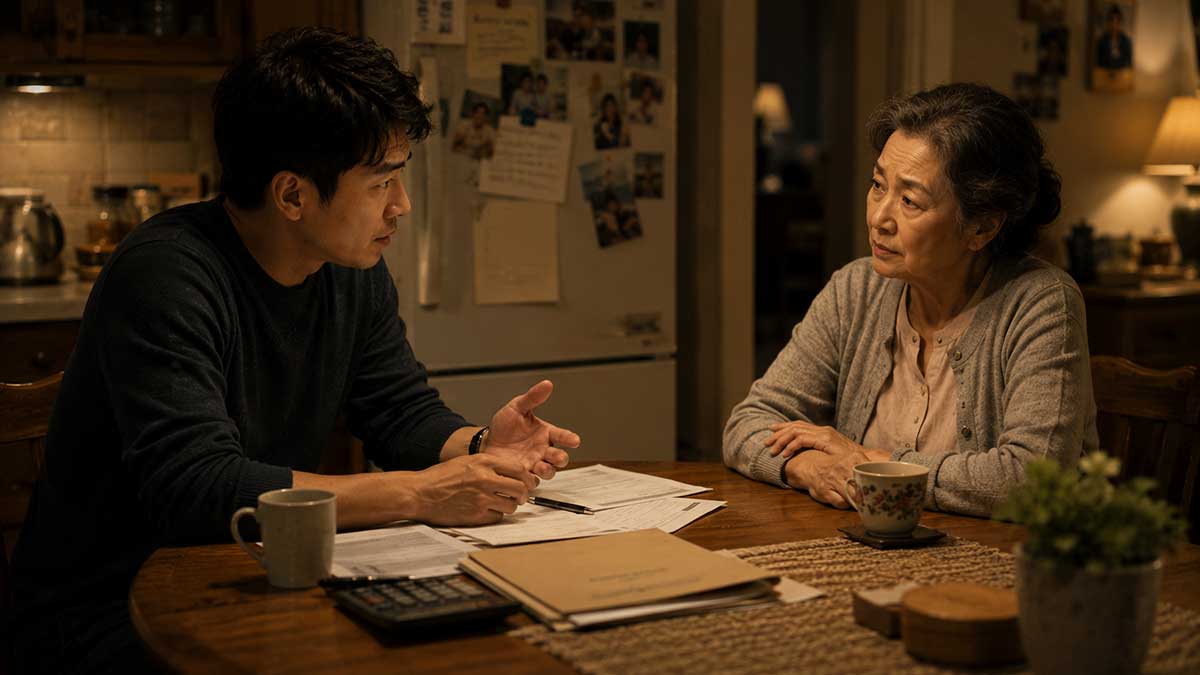
The room feels different tonight.
The lamp still glows at the center of the table, but the mood has shifted from grief to tension.
This is not a conversation about calling more often.
It is about what to say when the call is answered.
Nick sits with five guests:
Brené Brown
Carl Rogers
Seneca
Virginia Satir
Daniel Reyes, a fifty-two-year-old son who has spent the past six years caring for his widowed mother
A cup of tea rests untouched near Daniel’s hand.
Nick looks around the table.
Nick:
There is a sentence mothers often say:
“You can tell me anything.”
And many children believe it.
When we are young, our mother may be the first person we run to when something hurts.
But as we grow older, the relationship changes.
We begin to notice that she worries more.
She loses sleep.
She imagines the worst.
Sometimes we tell her a problem, feel lighter afterward, and then realize we have placed the whole weight inside her heart.
So where is the line?
When does honesty create closeness?
And when does it simply transfer our pain to someone who cannot solve it?
Daniel looks down at the table.
Daniel:
I have crossed that line many times.
My mother is eighty-one.
After my father died, she began worrying about every person in the family.
If my daughter has a cold, my mother thinks it may be something serious.
If I do not answer the phone, she imagines an accident.
A few years ago, my business was failing.
I called her one night and told her everything.
The debts.
The fear.
The possibility that I might lose my house.
She listened quietly.
I felt much better afterward.
Then my sister called the next morning and said, “Mom did not sleep at all.”
That was when I realized I had handed my panic to her and gone to bed.
No one speaks for a moment.
Brené Brown:
That is a painful realization.
Yet I would not call your honesty a mistake.
The missing part may have been containment.
Vulnerability is not emptying every raw emotion into another person.
It is sharing the truth with awareness of who is receiving it.
Nick:
What would containment have looked like?
Brené Brown:
Perhaps saying:
“My business is in trouble. I am scared. But I am speaking with an adviser, I have a plan for the next thirty days, and I am not facing this alone.”
The truth remains.
The fear is not hidden.
But the mother is not left alone with an open wound and no sense of what comes next.
Daniel:
I gave her the problem without the plan.
Brené Brown:
Yes.
You asked her heart to hold something your words had not yet organized.
Carl Rogers:
I would add that people often share pain for two very different reasons.
One is connection.
The other is relief.
Connection says, “I want you to know what is happening in my life.”
Relief says, “I cannot bear this feeling, so I need you to carry some of it.”
Both are human.
But we should know which one is guiding us.
Nick:
Can the person sharing always tell the difference?
Carl Rogers:
Not immediately.
A useful question is:
“What do I hope my mother will do after hearing this?”
If the answer is, “Nothing. I simply want her to know me,” that may be honest connection.
If the answer is, “I need her to calm me, rescue me, approve my decision, or absorb my fear,” then the burden may be heavier than the conversation appears.
Virginia Satir:
Families develop roles around pain.
One person becomes the rescuer.
One becomes the worrier.
One becomes the silent one.
One becomes the strong one.
A mother may have spent decades as the rescuer.
Then the children become adults, yet they still bring every crisis to her as though she is responsible for restoring order.
The family has aged.
The emotional roles have not.
Nick:
So an adult child may still be speaking to his mother from the position of a frightened ten-year-old.
Virginia Satir:
Yes.
And the mother may respond from the position she has always known.
She may say, “I will fix it.”
She may offer money she cannot afford.
She may call five relatives.
She may stay awake until dawn.
Both people may believe this proves love.
It may actually prove that the relationship has not matured.
Seneca:
One must learn to bear what belongs to oneself.
This does not mean refusing comfort.
It means refusing to make another person a servant to one’s anxiety.
There is dignity in saying:
“This is difficult, but I will meet it.”
Brené Brown:
I agree with the responsibility.
I would be careful with the language of self-sufficiency.
Some people hear “stand on your own” and translate it into “never need anyone.”
That can become another kind of fear.
Seneca:
I did not say one should never need anyone.
I say one should not collapse at another person’s feet each time life becomes painful.
Brené Brown:
Then we may be closer than it sounds.
Real vulnerability does not abandon responsibility.
It includes it.
Nick:
Daniel, after that night with your mother, did you stop telling her difficult things?
Daniel:
For a while, yes.
I began saying, “Everything is fine.”
She knew it was not.
Then she worried more.
She would study my face and ask my sister whether I was hiding something.
My silence did not protect her.
It made her imagination worse.
Carl Rogers:
That is common.
When words disappear, fear fills the space.
A mother who senses pain but receives no truthful information may create a story far more frightening than reality.
Virginia Satir:
Silence can look like protection from the inside.
From the outside, it may feel like exclusion.
A mother may think:
“My child no longer trusts me.”
“I am no longer part of his life.”
“He only calls when everything is pleasant.”
That is not closeness.
It is a performance.
Nick:
Then neither extreme works.
Telling her everything may overwhelm her.
Telling her nothing may make her feel shut out.
Carl Rogers:
The middle is honest, measured communication.
Not edited so completely that it becomes false.
Not poured out so carelessly that it becomes emotional flooding.
Nick:
What does that sound like in practice?
Virginia Satir:
It may sound like this:
“I am going through a difficult period. I wanted you to know, since I do not want distance between us. I have people helping me. I am taking steps. I may not be able to discuss every detail right now, but I am safe.”
That message contains truth, boundaries, reassurance, and respect.
Daniel:
My mother would still ask fifty questions.
The room warms with soft laughter.
Virginia Satir:
Then the next task is learning to answer with love without surrendering every boundary.
Daniel:
That is where I struggle.
If I say, “I would rather not discuss that,” she takes it personally.
She says, “I am your mother.”
Seneca:
Being someone’s mother does not grant ownership of every thought.
Love does not cancel privacy.
Brené Brown:
True.
But boundaries work best when they do not sound like punishment.
There is a difference between:
“That is none of your business.”
And:
“I know you ask because you care. I am not ready to discuss that part, but I will tell you what I can.”
The boundary stays.
The relationship stays too.
Nick:
Many adult children feel guilty setting limits with a mother.
Why?
Virginia Satir:
They confuse a mother’s disappointment with wrongdoing.
A boundary may disappoint someone.
That does not mean the boundary is cruel.
In many families, the child learns early that keeping the mother calm is part of being good.
Then adulthood arrives, and the child remains responsible for her emotions.
Daniel:
That describes me.
When my mother becomes upset, I immediately think I must fix it.
Carl Rogers:
What happens if you do not?
Daniel:
I feel like a bad son.
Carl Rogers:
And where did you learn that her distress proves your failure?
Daniel pauses.
Daniel:
My father used to say, “Do not upset your mother.”
If we argued with her, he made us apologize.
It did not matter who was right.
The goal was to restore peace.
Virginia Satir:
Then peace became more valuable than truth.
That creates polite families with hidden resentment.
Nick:
Can honoring your mother require allowing her to be upset?
Virginia Satir:
At times, yes.
A mature relationship permits two people to feel differently without treating disagreement as abandonment.
Seneca:
We cannot surrender our judgment every time another person experiences pain.
If your mother wishes you to make a harmful decision, obedience is not virtue.
Respect may require a gentle refusal.
Brené Brown:
And refusing gently is much harder than either surrendering or exploding.
It asks us to remain present with another person’s disappointment.
Daniel:
My mother wanted to move in with me.
After my father died, she was lonely.
I have a wife, two children, and a small house.
I knew it would create conflict.
But saying no felt heartless.
So I avoided the conversation for months.
She assumed it would happen.
When I finally told her it could not, she said, “After everything I did for you, you have no room for me.”
That sentence has stayed with me.
Nick:
What did you say?
Daniel:
I said, “That is unfair.”
Then I left.
Carl Rogers:
What did you wish you had said?
Daniel thinks for a long time.
Daniel:
Maybe:
“I know you are lonely. I know you hoped I would say yes. I love you. But my home cannot hold this without harming my marriage.”
Virginia Satir:
That sentence recognizes her pain without giving away your decision.
Brené Brown:
It holds compassion and truth in the same hand.
Seneca:
And it accepts that love cannot prevent all sorrow.
Nick:
That may be the hardest part.
We want to love our mother without ever causing pain.
But adulthood may make that impossible.
Carl Rogers:
A relationship without any pain is not necessarily loving.
It may simply be guarded.
Real closeness includes disappointment, repair, and difference.
Virginia Satir:
The goal is not to keep every feeling pleasant.
The goal is to keep the relationship human.
Nick:
Let us return to the original question.
Should an adult child tell a mother about serious illness?
Financial trouble?
A failing marriage?
Depression?
Where do we decide?
Brené Brown:
Ask four questions.
Is this her information to know?
Is she emotionally able to receive it?
What support do I already have?
What do I need from her?
Those questions do not create a perfect answer.
They make the sharing more conscious.
Seneca:
One more question:
Will telling her help her act wisely, or only cause helpless suffering?
Carl Rogers:
Yet we should not decide too quickly that another person cannot bear the truth.
Sometimes withholding serious information takes away her right to respond as a mother and as a person.
Nick:
Can you give an example?
Carl Rogers:
Suppose a son has cancer and tells everyone except his mother, claiming he wants to protect her.
She learns from someone else.
Now she carries fear, grief, and the wound of exclusion.
The son may have intended kindness.
The impact may feel like rejection.
Virginia Satir:
Protection without consent can become control.
We decide what another person is allowed to know.
We tell ourselves it is love.
At times, it is our fear of witnessing their reaction.
Daniel:
I did that when I had surgery.
I told my mother afterward.
I said I did not want her to worry.
She said, “You did not protect me. You made me feel useless.”
That hurt.
Brené Brown:
It may help to ask the mother directly before a crisis.
“What kind of truth do you want from me when life becomes hard?”
Some mothers will say, “Tell me everything.”
Some will say, “Tell me after you have a plan.”
Some will say, “I cannot handle every detail, but do not shut me out.”
Families rarely have this conversation before they need it.
Nick:
That would change a great deal.
Virginia Satir:
Yes.
We often assume love gives us knowledge of another person’s limits.
It does not.
We must ask.
Seneca:
And the mother must learn discipline too.
She may say she wants the truth, then respond in ways that punish honesty.
If every confession produces panic, criticism, or intrusion, the child will learn silence.
Nick:
That is fair.
The responsibility cannot belong only to the child.
Carl Rogers:
No relationship matures through one person’s effort alone.
A mother who wants honesty must create an atmosphere where honesty can survive.
Brené Brown:
She must learn to hear pain without making the child manage her reaction.
That may be one of the greatest gifts a mother can give an adult child.
Daniel:
My mother is trying.
Now, when I tell her something difficult, she asks, “Do you want advice, prayer, or just someone to listen?”
The first time she said that, I almost laughed.
It sounded like something from therapy.
Virginia Satir:
Therapy sometimes teaches families the sentences they needed all along.
Daniel:
It helps.
Sometimes I say, “Just listen.”
Then she listens for about two minutes and gives advice anyway.
Everyone laughs.
Daniel:
But she is trying.
And I am trying to tell her enough that she feels close, without making her responsible for saving me.
Nick:
Has the relationship changed?
Daniel:
Yes.
I no longer call her only when I am falling apart.
I call when something good happens too.
That mattered more than I expected.
She once told me, “For years, I thought you only remembered me when life hurt.”
That sentence broke my heart.
Carl Rogers:
People deserve to be included in our joy, not used only as containers for distress.
Brené Brown:
That is a beautiful form of reciprocity.
Nick:
Maybe the burden is not only the bad news.
Maybe the deeper burden comes when a mother becomes the emergency room for our emotions, yet never gets invited into the rest of our life.
Virginia Satir:
Yes.
A relationship feels heavy when it is built only around crisis.
Share the ordinary.
Send the photograph.
Tell the funny story.
Ask about her day.
Let connection exist beyond rescue.
Seneca:
Then the child grows from dependence into companionship.
Nick:
What does mature independence look like?
Not emotional distance.
Not endless dependence.
What is the middle?
Seneca:
It is the ability to say:
“I love you.
I value your counsel.
I will hear your concern.
And I remain responsible for my life.”
Carl Rogers:
It is allowing your mother to know you without asking her to define you.
Virginia Satir:
It is becoming a person in her presence rather than returning to the role you played as a child.
Brené Brown:
It is saying the truth with care.
Receiving love without demanding rescue.
Setting boundaries without using silence as punishment.
Daniel:
For me, it is being able to say, “Mom, I am having a hard time, but you do not need to fix it.”
And meaning both parts.
Nick looks at Daniel.
Nick:
What would you want your mother to hear from you tonight?
Daniel takes a long breath.
Daniel:
I would say:
“Mom, when I hide everything, it is not always strength.
Sometimes it is fear.
When I tell you everything, it is not always closeness.
Sometimes I am asking you to carry what belongs to me.
I am still learning the difference.
I want you in my life.
I do not want you to live my life for me.
I want to be honest without making you afraid.
And when I say, ‘I will handle this,’ I am not leaving you.
I am trying to become the son you raised me to be.”
No one responds at once.
Brené Brown wipes a tear from the corner of her eye.
Carl Rogers looks at Daniel with quiet warmth.
Carl Rogers:
That is a mature form of love.
Seneca:
And a worthy form of strength.
Virginia Satir:
Your mother may still worry.
Daniel:
I know.
Virginia Satir:
The goal is not to stop her heart from being a mother’s heart.
The goal is to keep that heart from carrying every burden alone.
Nick reaches for his cup.
The tea has gone cold.
Quiet Closing Reflection
A mother may say, “Tell me everything.”
Love may tempt us to believe she can carry everything.
She cannot.
No one can.
Yet protecting her does not require building a wall.
You can tell the truth with care.
You can say:
“I am hurting, but I have help.”
“I am afraid, but I have a plan.”
“I need you to listen, not rescue me.”
“I am not ready to share every detail, but I do not want to shut you out.”
Growing up does not mean no longer needing your mother.
It means learning how to receive her love without placing your entire life upon her shoulders.
She carried you once.
Maturity begins when you stop asking her to carry you in the same way forever.
And love deepens when you can stand on your own feet, turn back, and say:
“You may walk beside me now.
You do not have to hold me up.”
Topic 5: What Will Your Mother Remember About You?

The room is quieter than before.
The lamp at the center of the table remains lit, but the cups have been cleared away. On a small side table rests a framed photograph of an elderly woman smiling beside a garden.
Nick sits with five guests:
Mother Teresa
Rabindranath Tagore
Henri Nouwen
Mitch Albom
Margaret Hale, an eighty-seven-year-old mother living with advanced heart failure
Margaret sits beneath a light blanket. Her voice is gentle, but clear.
Nick looks at her before speaking.
Nick:
We have spent much of this conversation asking what children will remember after their mother is gone.
But tonight, I want to turn the question around.
What will your mother remember about you?
When she looks back on her later years, will she remember feeling loved?
Will she remember waiting for calls?
Will she remember being treated like a burden?
Will she remember your achievements?
Or will she remember the way you made her feel when you entered the room?
Margaret smiles faintly.
Margaret Hale:
Mothers remember the door.
Nick:
The door?
Margaret:
Yes.
We remember who came through it.
You can buy us anything.
But when you hear the door open and your child says, “Mom, I’m here,” the whole house changes.
Mitch Albom:
That may be the simplest answer.
Presence changes the temperature of a room.
Henri Nouwen:
It says, “You are still worth coming home to.”
Mother Teresa:
And love begins by noticing who is waiting.
Many people are lonely in houses filled with photographs of those they love.
Nick:
Margaret, what matters most when your children visit?
Margaret:
That they do not act rushed.
I can tell when they are already halfway out the door.
They sit down, but their eyes keep moving.
They look at the clock.
They check the phone.
Then they say, “I spent two hours with Mom.”
No, they did not.
Their body spent two hours.
Their mind spent ten minutes.
Tagore:
A person can remain absent in the same room.
Margaret:
Yes.
I do not need a long visit.
I need a real one.
Twenty minutes where no one is waiting for me to finish talking.
Nick:
Do you ever feel guilty for wanting more time?
Margaret:
Every mother does.
You know your children have work.
Marriage.
Bills.
Their own children.
So you say, “Do not worry about me.”
Then you hope they will know you do not mean it completely.
Mitch Albom:
Parents often speak in contradictions.
“Do not come all this way.”
Then they clean the house in case you do.
Margaret:
Exactly.
I tell my daughter, “You do not have to visit Sunday.”
Then I start wondering what I should cook.
Everyone smiles.
Mother Teresa:
Love often hides its need so it will not become a burden.
Henri Nouwen:
Yet hidden need is still need.
The aging parent may be asking:
“Am I still lovable when I can no longer give as much?”
“Do you still want me when I am slower?”
“Will you stay when I repeat myself?”
Nick:
That question feels central.
A mother spends years being useful.
Cooking.
Driving.
Helping.
Remembering.
Then age takes some of those abilities away.
What does she fear?
Margaret:
She fears becoming work.
That is the word.
Work.
You notice people sighing before helping you stand.
You hear them discuss your appointments like a schedule problem.
You begin apologizing for needing things.
Nick:
Have you done that?
Margaret:
Every day.
Yesterday, my son helped me shower.
He was kind.
He did not complain.
Still, I said, “I’m sorry.”
He asked, “For what?”
I said, “For this.”
He became upset.
He said, “Mom, you washed me for years.”
That made me cry.
Henri Nouwen:
Receiving love can become harder than giving it.
Especially for someone who has built an identity around caring for others.
Mother Teresa:
There is humility in letting another person help you.
There is tenderness in helping without making the person feel small.
Nick:
What makes help feel humiliating?
Margaret:
When people speak about you as though you are not there.
When they say, “She cannot do this anymore.”
“She gets confused.”
“She is difficult in the morning.”
I may need help.
I am still in the room.
Tagore:
The body may weaken before the soul stops listening.
Mitch Albom:
Many families begin speaking to the illness instead of the person.
The diagnosis takes over the relationship.
Every visit becomes medication, appointments, pain, sleep, food.
No one asks, “What are you thinking about?”
Margaret:
That happens.
I still have thoughts.
I still remember being young.
I still notice beautiful things.
But people ask only whether I took my pills.
Nick:
What would you rather be asked?
Margaret:
“Were you happy?”
“What was Dad like when no one else was around?”
“What were you afraid of when you were my age?”
“What do you want us to remember?”
No one asks those questions until the doctor says time may be short.
Mitch Albom:
Then every conversation becomes urgent.
Margaret:
Yes.
I do not want my final months to become an interview.
I want someone to be curious about me now.
Henri Nouwen:
To be known is a form of being loved.
Not known only as “Mom.”
Known as a person with a hidden history.
Tagore:
A mother may become the house in which everyone lives.
They remember the shelter.
They forget to ask who built it.
Nick:
Margaret, who were you before becoming a mother?
She smiles.
Margaret:
I was stubborn.
I liked dancing.
I wanted to travel to Italy.
I smoked two cigarettes once and hated both of them.
My husband thought I was beautiful in a red dress.
I still have that dress upstairs.
It would not fit over one arm now.
Everyone laughs softly.
Margaret:
My children know almost none of that.
To them, I began at thirty-two, standing in the kitchen.
Mitch Albom:
That is true in many families.
Children believe their parents came into existence ready to pack lunches.
Mother Teresa:
Perhaps one gift a child can give is to return a mother to her own story.
Nick:
How?
Mother Teresa:
Ask.
Listen.
Honor the person who existed before she belonged to you.
Henri Nouwen:
And allow her to tell the story badly.
Memory may not arrive in order.
Details may change.
The purpose is not historical accuracy.
The purpose is communion.
Nick:
That is beautiful.
Margaret, when your children look back one day, what do you hope they remember about you?
Margaret:
That I loved being their mother.
Not every minute.
I want to be honest.
There were days I wanted to lock the bathroom door and disappear.
There were days I resented the noise.
There were years I was exhausted.
But beneath all of it, I loved being the person they came home to.
Nick:
And what do you hope to remember about them?
Margaret takes a long breath.
Margaret:
That they came back.
Not perfectly.
Not every week.
Not every time I wanted.
But that they came back before I was gone.
The room becomes still.
Tagore:
Home is not merely the place we leave.
It is the place that waits without knowing whether we will return.
Mitch Albom:
Many children think their mother knows they love her.
They believe love does not need to be repeated.
Nick:
Does it?
Margaret:
Yes.
It does.
People say, “Mom knows.”
How do you know what I know?
Tell me.
I may believe you love me.
I still want to hear it.
Henri Nouwen:
Love must be renewed in language.
Not because the old love disappeared.
Because the heart remains alive and needs to receive it again.
Mother Teresa:
No one becomes too old to need tenderness.
Nick:
What words matter most?
Margaret:
“Thank you.”
“I remember.”
“I’m glad you are my mother.”
“I forgive you.”
“Please forgive me.”
And one more.
“You can stop worrying. I will be okay.”
Nick:
Why does that last sentence matter so much?
Margaret:
Because a mother wants permission to leave.
She may never say that.
But she worries:
“Who will help him?”
“Will my daughter be lonely?”
“Will the family stay together?”
“Will they remember birthdays?”
You want to know your children can stand after you are gone.
Mitch Albom:
A parent may spend the final chapter trying to finish the work of protecting everyone.
Henri Nouwen:
Reassurance becomes a form of release.
Mother Teresa:
To say, “You have done enough,” can be an act of mercy.
Nick:
Is there such a thing as enough for a mother?
Margaret:
No.
That is why the child has to say it.
The mother will keep finding one more thing to worry about.
Nick:
What if the child does not feel ready?
What if saying “I will be okay” does not feel true?
Margaret:
Then say, “I will find a way.”
That is enough.
Do not lie.
Just do not make her believe your life ends with hers.
Tagore:
Love does not ask the dying to remain forever.
It asks them to trust what they have planted.
Nick:
That brings us to a difficult question.
What is the greatest final gift a child can give a mother?
Gratitude?
Forgiveness?
Presence?
Reassurance?
A promise to live well?
Mother Teresa:
Presence.
Everything else can grow inside it.
Henri Nouwen:
I would say acceptance.
Accepting the mother as she was.
Not idealized.
Not condemned.
Seen fully.
Mitch Albom:
I would say the conversation that has been postponed the longest.
That is different in every family.
Tagore:
I would say peace.
The peace of knowing love has been received.
Margaret:
I would say:
Do not make me guess.
Tell me.
Tell me you remember.
Tell me you forgive me.
Tell me I mattered.
Tell me you will be all right.
Then sit down and stay a little while.
Nick looks at her.
Nick:
What if a mother and child have a difficult history?
What if the mother caused real pain?
Must the child still offer peace?
Henri Nouwen:
Peace cannot be built on denial.
A child does not honor a mother by pretending harm was love.
Truth may need to be spoken.
Distance may still be necessary.
Forgiveness may take years.
Mother Teresa:
Kindness does not demand surrender to abuse.
Mitch Albom:
Some final conversations are not reconciliations.
Sometimes the child can only say:
“I release the hope that you will become the mother I needed.”
That may be the only peace available.
Tagore:
There are relationships where love survives only at a distance.
Distance can still contain dignity.
Nick:
Margaret, did your children ever need to forgive you?
Margaret:
Yes.
I was too critical with my daughter.
I thought criticism would make her stronger.
It made her feel she could never please me.
She told me this when she was forty-five.
My first reaction was to defend myself.
I said, “I only wanted the best for you.”
She said, “That does not change how it felt.”
I did not speak for a long time.
Then I said, “You are right.”
Nick:
Was that difficult?
Margaret:
Terrible.
I wanted to explain everything.
How afraid I was.
How hard my own mother had been.
How I thought praise might make her lazy.
But explanations can become a way to avoid apology.
So I said, “I am sorry I made home feel like a test.”
She cried.
I cried.
We are better now.
Henri Nouwen:
An apology becomes sacred when it does not ask the wounded person to comfort the one apologizing.
Mitch Albom:
Many people never hear a parent admit harm.
That admission can reshape an entire childhood.
Nick:
And when a mother cannot apologize?
Mother Teresa:
The child may still choose not to carry hatred forever.
But no one should force the timing.
Tagore:
Some wounds close through conversation.
Some close through silence.
Some remain open and teach us how gently others must be treated.
Nick:
Margaret, are you afraid of being forgotten?
She looks at the framed photograph near the window.
Margaret:
Not forgotten exactly.
I am afraid of becoming simple.
People become simple after they die.
“She was kind.”
“She loved family.”
“She made good pie.”
I was more than that.
I was jealous.
Funny.
Afraid.
Sometimes selfish.
Sometimes brave.
I want them to remember a person, not a greeting card.
Mitch Albom:
Death often edits people into symbols.
Henri Nouwen:
Real remembrance keeps the contradictions.
Tagore:
Love does not need perfection to become eternal.
Nick:
How should children preserve a mother’s memory?
Margaret:
Tell the true stories.
The embarrassing ones too.
Make my recipes badly.
Laugh about what I got wrong.
Say my name.
Do not turn every memory into sadness.
Mother Teresa:
A life is honored when love continues to move through the living.
Henri Nouwen:
The mother may no longer be physically present, yet her way of caring can remain active through the child.
Mitch Albom:
You hear yourself say one of her phrases.
You cook the meal she made.
You worry the same way she worried.
Then you realize she has not disappeared from every room.
Tagore:
Those we love become part of how we see.
Nick:
Margaret, what do you want your children to do after you are gone?
Margaret:
Eat together.
That sounds small.
But families drift.
I want them to sit at one table sometimes.
Tell old stories.
Argue.
Laugh.
Take care of the one who is struggling.
And do not spend every gathering talking about how much they miss me.
Enjoy the food.
Nick:
You want them to keep living.
Margaret:
Of course.
What would be the point of giving them my whole life if they stopped living when mine ended?
No one speaks for a moment.
Henri Nouwen:
That is a mother’s final generosity.
Permission to continue.
Mother Teresa:
Love does not hold the living beside the grave.
Mitch Albom:
It sends them home with something to carry.
Nick:
What should someone listening do tonight?
Their mother is still alive.
What should they say?
Mother Teresa:
Begin with thanks.
Tagore:
Ask for one story you have never heard.
Henri Nouwen:
Tell her how her love lives within you.
Mitch Albom:
Say the sentence you would regret leaving unsaid.
Nick turns to Margaret.
Nick:
And you?
Margaret looks directly at him.
Margaret:
Do not call only when you have bad news.
Do not visit only when I am sick.
Do not wait until I am weak to hold my hand.
Come while I can still cook too much food.
Come while I can still complain about your haircut.
Come while we can still waste time together.
That is what I want.
Not a perfect goodbye.
A few more ordinary days.
The room falls silent.
Nick reaches across the table and takes Margaret’s hand.
She squeezes his fingers.
Nick:
What do you want your children to remember most?
Margaret:
That every time they came through the door, some part of me became young again.
No one speaks after that.
The lamp remains lit.
The photograph on the side table catches a small reflection from the glass.
For a moment, the woman in the garden appears to be standing in sunlight.
Quiet Closing Reflection
One day, you may stand at your mother’s funeral and speak beautifully about her love.
You may describe her sacrifices.
You may tell everyone how deeply she mattered.
But the question is not only what you will say after she is gone.
The question is what she knows now.
Does she know you are grateful?
Does she know you remember?
Does she know you forgive her?
Does she know you are sorry?
Does she know her life changed yours?
Does she know you will be okay?
Your mother may forget dates.
She may repeat stories.
She may lose track of names.
Yet she may still remember how she felt when you entered the room.
Whether you looked happy to see her.
Whether you sat close.
Whether you listened.
Whether your presence told her:
“You are not a burden.
You are not invisible.
You are still my mother.
And I am still grateful that you are here.”
Final Thoughts
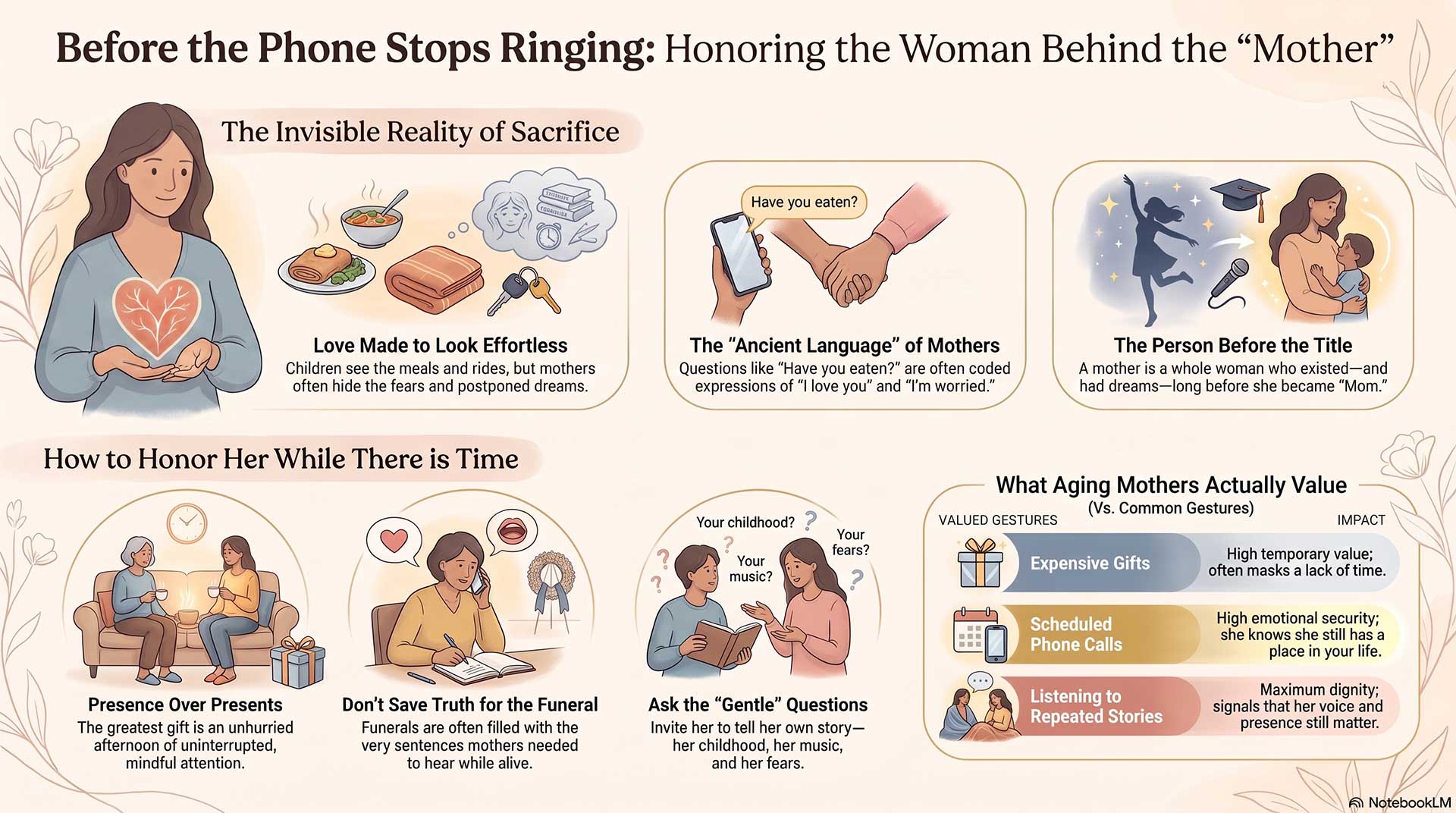
As our evening comes to an end, one truth quietly remains.
A mother's greatest wish is rarely to receive expensive gifts, public praise, or perfect children.
More often, she simply hopes her children will live well.
That they will become kind.
That they will love deeply.
That they will build families, friendships, and lives filled with goodness.
That they will be able to stand on their own while never forgetting where they first learned what love looked like.
Throughout these conversations, we discovered that motherhood is filled with contradictions.
A mother wants her child to become independent, yet she never completely stops worrying.
She says, "Don't trouble yourself," while secretly hoping for one more visit.
She tells her children to follow their own lives, yet quietly treasures every ordinary phone call.
Perhaps this is why motherhood is so difficult to describe.
It is a love that slowly disappears from the center of its own story so someone else's story can flourish.
For children, there is another lesson.
Do not wait until grief teaches what gratitude could have taught much earlier.
Call while she can answer.
Listen while she can still tell the story.
Ask about the dreams she had before she became your mother.
Walk at her pace.
Thank her while she can still smile at your words.
If your relationship has been difficult, seek whatever measure of healing truthfully allows. Healing does not always mean complete reconciliation, but kindness, honesty, and understanding can still transform even imperfect relationships.
And if your mother has already passed from this world, let her love continue through the way you treat the people around you.
Offer patience where she once offered patience.
Give encouragement where she once gave encouragement.
Protect those who are vulnerable.
Forgive more quickly.
Love more generously.
In that way, a mother's influence does not end with her final breath.
It continues through every act of compassion passed from one generation to the next.
Perhaps that is the quiet miracle of motherhood.
A mother spends her life preparing her children for the day they no longer need her hand.
Yet even after that hand is gone, its warmth can still guide the heart.
So before tomorrow becomes another postponed promise, consider one small act.
Make the call.
Write the message.
Plan the visit.
Ask one question you've never asked before.
Or simply say the words that so many people wish they had spoken sooner:
"Thank you, Mom. I see you now."
Short Bios:
Nick Sasaki
Entrepreneur, writer, and founder of Imaginary Talks. Nick moderates conversations that bring together influential voices from history, philosophy, psychology, literature, and everyday life to explore timeless human questions with empathy, curiosity, and practical wisdom.
Fred Rogers
Beloved television host and educator whose lifelong work demonstrated that simple acts of kindness, attentive listening, and unconditional acceptance can profoundly shape human lives.
Maya Angelou
Celebrated poet, memoirist, and civil rights advocate whose writing explored dignity, resilience, forgiveness, family, and the enduring strength of love.
Grace Miller (Hospice Nurse)
A fictional hospice nurse representing thousands of caregivers who have accompanied families through life's final chapter. Her experiences reflect the wisdom, regrets, reconciliation, and quiet courage often witnessed at the bedside of aging parents.
Mrs. Elena Park
A fictional working mother whose life represents millions of parents who quietly sacrificed personal dreams, physical comfort, and financial security so their children could build brighter futures.
Thích Nhất Hạnh
Vietnamese Zen master, peace activist, and author whose teachings on mindfulness, compassion, and presence have inspired people around the world to cherish each ordinary moment.
C.S. Lewis
British scholar and author best known for exploring morality, love, grief, faith, and the human search for meaning through both fiction and philosophical writing.
Pope Francis
Leader of the Catholic Church from 2013 to 2025, remembered for emphasizing mercy, compassion, humility, care for families, and the dignity of every human life.
Viktor Frankl
Austrian psychiatrist, Holocaust survivor, and author of Man's Search for Meaning, whose work taught that purpose and responsibility can be discovered even amid suffering.
Elisabeth Kübler-Ross
Swiss-American psychiatrist whose pioneering work transformed public understanding of death, dying, grief, and the emotional needs of patients and families.
Marcus Aurelius
Roman emperor and Stoic philosopher whose Meditations continues to encourage readers to live with humility, self-discipline, gratitude, and awareness of life's impermanence.
Mary Oliver
Pulitzer Prize-winning American poet celebrated for finding profound spiritual insight in ordinary moments, nature, and attentive living.
Leo Tolstoy
Russian novelist and moral philosopher whose later writings explored family, conscience, compassion, mortality, and the search for a meaningful life.
Brené Brown
Research professor and author known for her work on vulnerability, courage, shame, empathy, and wholehearted living.
Carl Rogers
Influential psychologist whose person-centered approach transformed counseling through empathy, authenticity, and unconditional positive regard.
Seneca
Roman Stoic philosopher and statesman whose essays explored resilience, emotional discipline, virtue, and living wisely amid life's uncertainties.
Virginia Satir
Family therapist whose groundbreaking work helped reshape modern family counseling by emphasizing healthy communication, emotional growth, and authentic relationships.
Daniel Reyes
A fictional caregiver representing countless adult children balancing careers, marriage, parenthood, and the responsibility of caring for aging parents.
Mother Teresa
Catholic nun and missionary whose lifelong service to the poor became a global symbol of humble compassion and unconditional care.
Rabindranath Tagore
Indian poet, philosopher, and Nobel laureate whose writings celebrated love, memory, family, beauty, and the spiritual richness of everyday life.
Henri Nouwen
Dutch Catholic priest, theologian, and spiritual writer whose works explored vulnerability, belonging, healing, and the transformative nature of compassionate presence.
Mitch Albom
American author and journalist whose books frequently examine mortality, family, forgiveness, and the conversations that matter most near the end of life.
Margaret Hale
A fictional elderly mother whose reflections represent the hopes, fears, humor, and quiet wisdom shared by many aging parents who simply long to remain part of their children's lives.
Leave a Reply