
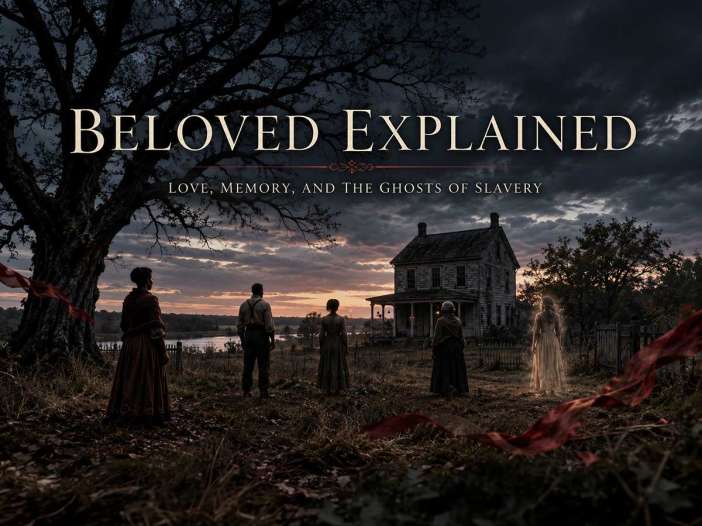
What if Sethe’s most horrifying act began not with hatred, but with a love made desperate by slavery?
Some novels are read.
Others are survived.
Beloved is one of the rare books that refuses to stay inside literature. It follows you long after the final page because it asks questions that have no comfortable answers. How does a mother love her child in a world determined to destroy both of them? Can freedom truly begin after slavery ends, or does slavery continue to live inside memory, fear, and love itself? Can a community heal wounds it once ignored? And what responsibility do later generations have toward suffering they never personally experienced?
In this Imaginary Talks Live Conversation, we do not put Sethe on trial, nor do we excuse every decision she makes. Instead, we enter her world alongside those who loved her, challenged her, and suffered with her. Paul D speaks for the burden carried by enslaved men. Denver represents the generation born after slavery but still shaped by its consequences. Baby Suggs offers spiritual wisdom tempered by exhaustion. Stamp Paid reminds us that communities can fail—and later seek redemption. Beloved herself becomes both a daughter and a living embodiment of history refusing to disappear.
Joining them quietly is Toni Morrison, not as a lecturer, but as a compassionate observer who occasionally helps illuminate the deeper meanings beneath the conversations. Rather than explaining the novel academically, she gently expands the discussion whenever the characters themselves reach the limits of language.
Across five conversations, these voices wrestle with questions that remain painfully relevant today:
- Can love become dangerous when fear controls it?
- Can we remember the past without allowing it to consume the present?
- What does oppression steal beyond physical freedom?
- Why does healing require other people?
- And what does Morrison mean when she writes that this is "not a story to pass on"?
These conversations are not intended to replace reading Beloved.
They are an invitation to return to it with deeper compassion.
Because the greatest tragedy of slavery was not only what happened to bodies.
It was what happened to love, trust, memory, family, and hope.
And perhaps the greatest act of healing begins when we are willing to remember honestly—without allowing either judgment or forgetting to have the final word.
(Note: This is an imaginary conversation, a creative exploration of an idea, and not a real speech or event.)
Topic 1: Can Love Become Dangerous When Freedom Is Impossible?
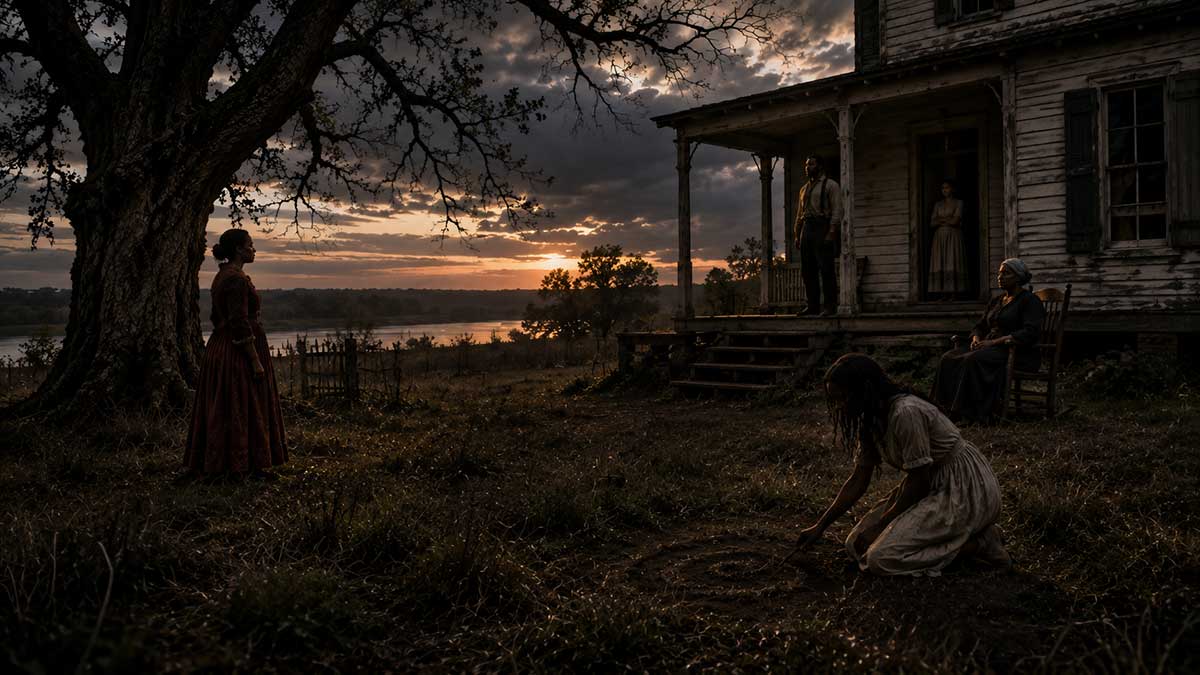
The yard behind 124 was quieter than the house.
That did not mean it was peaceful.
The grass leaned away from the porch as if something had crossed it too many times. A washbasin sat overturned beside the steps. Beyond the fence, the Ohio River moved under the evening light, carrying branches, foam, and things no one could name.
Sethe stood beneath a tree with her arms folded.
Paul D sat on the porch rail, though the rail creaked beneath him as if objecting.
Denver remained near the doorway, close enough to enter the house if she needed to, far enough away to pretend she was not afraid of it.
Baby Suggs occupied an old wooden chair in the yard.
No one asked how she had returned.
Beloved sat in the grass at Sethe’s feet, drawing circles in the dirt with one finger.
For a long time, nobody spoke.
Then Paul D looked at Sethe.
Paul D: There are kinds of love that save a person.
Sethe did not turn toward him.
Sethe: I know.
Paul D: And there are kinds that leave nothing standing.
Beloved’s finger stopped.
Denver watched her mother.
Sethe: You did not begin that sentence to talk about love.
Paul D: I began it because I am tired of people using love to explain everything they are afraid to name.
Sethe faced him now.
The leaves above her moved, though the air had gone still.
Sethe: Name it, then.
Paul D looked toward the river.
Paul D: Terror.
The word sat between them.
Beloved pressed her finger deeper into the earth.
Beloved: She was not afraid.
Paul D: Everybody was afraid.
Beloved: She was not.
Sethe: Leave her be.
Paul D: No. Not this time.
Denver stepped off the porch.
Denver: Why do you always talk to Mama as if there is something simple she refused to understand?
Paul D glanced at her.
Paul D: Because sometimes your mama makes the impossible sound like the only thing that could have happened.
Sethe: It was the only thing.
Paul D: For you.
Sethe: For my children.
Paul D: You cannot speak for all of them.
Beloved looked up.
Beloved: She can speak for me.
Denver’s shoulders tightened.
Baby Suggs let out a long breath.
Baby Suggs: There. That is the trouble.
Everyone turned toward her.
Baby Suggs: Love begins by saying, “I know what you need.” Then fear enters and says, “Only I can give it to you.” After that, love starts locking doors.
Sethe stared at her.
Sethe: You know what was coming.
Baby Suggs: I know.
Sethe: You know what they would have done.
Baby Suggs: I know that too.
Sethe: Then do not sit there and talk as if I had a field full of choices.
Baby Suggs: I am not saying you had a field.
She looked at the hard ground beneath her chair.
Baby Suggs: I am saying you had a handful of dirt and called it the whole world because that was all they left you.
Sethe’s mouth opened, but no answer came.
From inside the house, a floorboard groaned.
No one had stepped on it.
Denver: Mama loved us.
Paul D: I never said she did not.
Denver: You say it like love is the crime.
Paul D: Love is not the crime.
He looked directly at Sethe.
Paul D: But love can become dangerous when it believes death is safer than life.
Sethe took one step toward him.
Sethe: Safer than that life.
Paul D: You did not know every life they might have lived.
Sethe: I knew enough.
Paul D: You knew Sweet Home.
Sethe: That was enough.
Paul D: Sweet Home was not the whole world.
Sethe laughed once.
It was not a happy sound.
Sethe: That is something a man can say after walking out of it.
Paul D’s face changed.
Sethe: You think I did not know the world? I knew what it did to a mother. I knew what it did to children. I knew what it took first and what it came back for later.
Paul D: And I knew what it did to men.
Sethe: Then you should understand.
Paul D: Understanding is not the same as agreeing.
Beloved rose from the ground.
Her dress was stained at the knees.
Beloved: She chose me.
Denver looked at her sharply.
Denver: She chose all of us.
Beloved: No.
Beloved moved closer to Sethe.
Beloved: She chose me more.
Sethe’s hand lifted almost without thought and touched Beloved’s hair.
Denver saw it.
Baby Suggs saw Denver seeing it.
Denver: Is that what love means to you?
Beloved smiled.
Beloved: To be chosen.
Denver: Even like that?
Beloved: Especially like that.
Paul D stood.
Paul D: That is not love talking.
Beloved turned toward him.
Beloved: You do not know what love says.
Paul D: I know what hunger says when it puts on love’s clothes.
Beloved’s expression hardened.
The windows of 124 rattled behind them.
Sethe stepped between them.
Sethe: Do not speak to her that way.
Paul D: She is consuming you.
Sethe: She came back because I owe her.
Paul D: That is guilt.
Sethe: That is love.
Paul D: You keep calling every chain love because it came from your own hands.
Silence.
Sethe’s face went still.
Denver whispered his name.
Denver: Paul D.
But he did not take it back.
Baby Suggs looked toward the fading light.
Baby Suggs: He is cruel.
Sethe’s eyes remained fixed on Paul D.
Baby Suggs: But not entirely wrong.
Sethe turned to her.
Sethe: You too?
Baby Suggs: Me too.
Sethe: You preached love.
Baby Suggs: I did.
Sethe: You told people to love their flesh.
Baby Suggs: Because nobody else would.
Sethe: Then why should I be ashamed for loving mine?
Baby Suggs: You should not.
Baby Suggs leaned forward.
Baby Suggs: But loving your children is not the same as owning their endings.
The river moved beyond the trees.
Sethe looked toward it, though she could not see it clearly from where she stood.
Sethe: You speak as if I wanted an ending.
Baby Suggs: No.
Her voice softened.
Baby Suggs: You wanted to stop one.
Sethe looked down.
Beloved took her hand.
Beloved: You stopped it.
Denver: And started another.
Beloved turned.
Denver was crying now, but her voice did not shake.
Denver: You came into this house and made Mama believe suffering for you was the same as loving you.
Beloved: She knows me.
Denver: She knows her guilt.
Beloved: I am hers.
Denver: You are what happened to her.
Beloved moved toward Denver.
Sethe: Stop.
Neither daughter stopped.
Beloved: She gave me everything.
Denver: She disappeared into you.
Beloved: Because she loves me.
Denver: Then I do not want that kind of love.
The sentence struck harder than shouting.
Sethe stared at Denver.
Sethe: You do not mean that.
Denver: I mean I do not want love that leaves no room for me to live.
Sethe’s face folded for a moment.
Not completely.
Just enough for everyone to see the tired woman beneath the mother.
Sethe: I kept you alive.
Denver: Yes.
She wiped her face.
Denver: But sometimes you looked at me as if staying alive was the smaller thing.
Sethe turned away.
Paul D’s anger loosened.
Paul D: Sethe.
She raised one hand.
Sethe: Do not soften now.
Paul D: I am not softening.
Sethe: Good.
Paul D: I am trying to understand what freedom could have meant to you then.
Sethe: It meant nobody could take my children where I could not follow.
Paul D: And now?
Sethe did not answer.
The question moved through the yard.
Baby Suggs closed her eyes.
Baby Suggs: That is the question.
Beloved pulled Sethe’s hand toward her chest.
Beloved: Freedom is staying with me.
Denver shook her head.
Denver: Freedom is being able to leave.
Paul D: Freedom is being able to stay without being owned.
Baby Suggs opened her eyes.
Baby Suggs: Freedom is not having fear make every decision before love gets a chance.
Sethe looked at each of them.
Her daughter living.
Her daughter dead.
The man who had carried his heart like a locked box.
The woman who had once told broken people that their bodies belonged to them.
Sethe looked last at her own hands.
Sethe: You all speak of freedom as if it arrives clean.
No one answered.
Sethe: It did not come clean to me. It came bleeding. It came running. It came with men behind it and children in front of it. It came asking me to decide before I had time to become the woman who might have chosen differently.
Baby Suggs rose from her chair.
Baby Suggs: That is true.
She walked toward Sethe.
Baby Suggs: But the woman you were then cannot keep choosing forever.
Sethe looked at her.
Sethe: What else can she do?
Baby Suggs: Grieve.
Sethe’s face tightened.
Baby Suggs: Not repay. Not explain. Not surrender herself to the dead.
She touched Sethe’s shoulder.
Baby Suggs: Grieve.
Beloved pulled Sethe away.
Beloved: No.
Baby Suggs looked at her.
Baby Suggs: Child, grief is not abandonment.
Beloved: She must remember.
Baby Suggs: Remembering and drowning are not the same.
The sky darkened.
A mosquito landed on Paul D’s wrist. He slapped it and looked at the blood left behind.
Paul D: Maybe that is what slavery did best.
Denver looked at him.
Paul D: It made every love afraid of losing. Made mothers hold too tight. Made men lock themselves shut. Made children wonder whether they were loved or only protected.
He looked at Sethe.
Paul D: It taught people that love had to become stronger than death.
Sethe met his eyes.
Sethe: Sometimes it did.
Paul D: Maybe.
He looked toward Beloved.
Paul D: But when love tries to defeat death by becoming death, something has already been stolen from it.
Beloved’s breathing changed.
The windows shook again.
Denver stepped closer to Sethe, but she did not touch her.
Not yet.
Denver: Mama, did you ever imagine me grown?
Sethe looked at her.
Denver: Not safe. Not hidden. Not just alive.
Her voice softened.
Denver: Grown.
Sethe studied Denver’s face as if seeing years there she had not permitted herself to picture.
Sethe: I tried not to imagine what the world might do to you.
Denver: That is not what I asked.
Sethe’s eyes filled.
Denver: Did you imagine what I might do with the world?
Sethe could not answer.
Denver nodded slowly.
She had expected that.
Beloved tightened her grip.
Beloved: Look at me.
Sethe did.
Beloved: Only me.
For one moment, Sethe obeyed.
Then Baby Suggs placed her hand over Sethe’s heart.
Baby Suggs: Love that cannot bear another person’s freedom is fear wearing a mother’s face.
Sethe closed her eyes.
The yard became very still.
When she opened them, she looked first at Beloved.
Then at Denver.
Then at the road beyond the house.
Sethe: I do not know how to love without keeping watch.
Paul D: Then perhaps keeping watch is where you begin.
Sethe looked at him.
Paul D: But it cannot be where you end.
Denver finally reached for her mother’s other hand.
For a moment, Sethe stood between both daughters.
One held her toward the past.
The other held her toward a future she had never dared to imagine.
The evening wind returned.
It moved through the tree, across the grass, and into the open doorway of 124.
Inside, something sighed.
Perhaps the house.
Perhaps memory.
Perhaps love loosening its grip by one small finger.
Topic 2: Can the Past Be Remembered Without Being Allowed to Consume the Present?
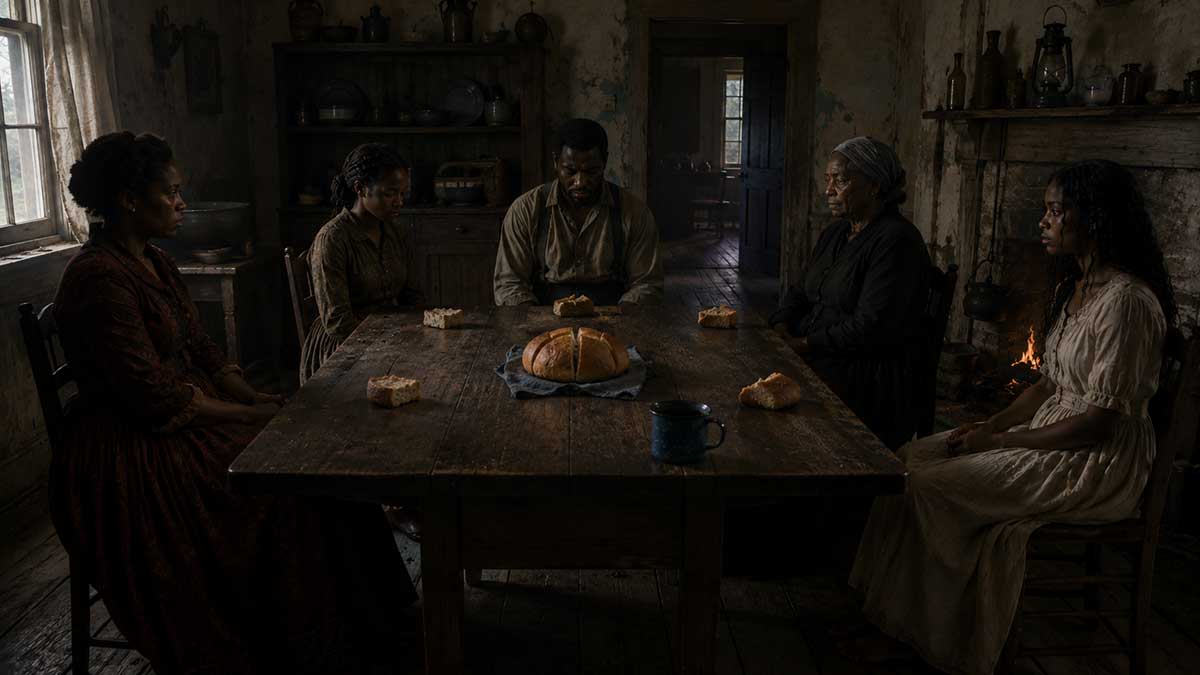
Morning came reluctantly to 124.
The light entered through the windows in thin gray strips, as if the day itself did not want to come too far inside.
On the kitchen table sat a loaf of bread no one had cut, a chipped blue cup, and a bowl filled with blackberries beginning to soften. Denver stood at the stove, though there was no fire beneath the pot.
Paul D leaned against the wall.
Sethe sat at the table.
Beloved occupied the chair beside her, close enough that the sleeves of their dresses touched.
Baby Suggs stood by the window, looking out toward the road.
No one had slept.
Or perhaps they had all slept and dreamed the same dream.
Denver broke the silence.
Denver: There ought to be a way to remember something without letting it enter every room.
Beloved smiled faintly.
Beloved: Why?
Denver turned toward her.
Denver: Because some rooms belong to the living.
Beloved: The living took all the rooms.
Paul D looked down.
Sethe’s fingers tightened around the blue cup.
Sethe: She is right about that.
Denver: Mama—
Sethe: The dead did not get houses. They did not get beds. They did not get names most times.
Denver: I am not saying we should forget them.
Sethe: Forgetting happens easier than you think.
Paul D: No, it does not.
Sethe looked at him.
Paul D: Not the things that matter.
He tapped two fingers against his chest.
Paul D: You can lock them away. You can stop speaking their names. You can cross rivers, sleep under trees, work until your hands split open.
His fingers stopped.
Paul D: But forgetting? That is different.
Beloved watched him carefully.
Beloved: What is in your box?
Paul D’s face hardened.
Paul D: Nothing for you.
Beloved: Everything is for me.
Paul D: That is the trouble with you.
Sethe: Paul D.
Paul D: No. She comes into a house and calls every memory hers.
Beloved rested her head against Sethe’s shoulder.
Beloved: They left me alone.
Denver: You are not alone now.
Beloved: I was alone first.
The words changed the room.
Baby Suggs turned from the window.
Baby Suggs: The first loneliness always believes it has the strongest claim.
Beloved looked at her.
Beloved: You left too.
Baby Suggs did not move.
Beloved: You stopped preaching.
Baby Suggs: I did.
Beloved: You stopped loving.
Baby Suggs: No.
Beloved: You stayed in bed and looked at colors.
Baby Suggs: Yes.
Beloved: That is leaving.
Baby Suggs lowered her eyes.
Baby Suggs: Perhaps it was.
Sethe looked at her with sudden pain.
Sethe: You were tired.
Baby Suggs: Tiredness does not make abandonment disappear.
Sethe: Do not give her that.
Baby Suggs: I am not giving her anything. I am naming what is mine.
Beloved smiled again.
Beloved: Mine too.
Baby Suggs: No.
Her voice remained calm.
Baby Suggs: My failure belongs to me. Your pain belongs to you. The moment one person claims every wound in the room, nobody else is permitted to heal.
Beloved’s smile vanished.
Denver looked toward Baby Suggs.
Denver: Then how do we remember properly?
Baby Suggs: Properly?
She gave a tired laugh.
Baby Suggs: Child, grief does not sit up straight in church.
Paul D: It ought to have rules.
Baby Suggs: You would like that.
Paul D: I would like something to keep it from spreading.
Baby Suggs: You tried a tobacco tin.
Paul D’s jaw tightened.
Baby Suggs: How did that work?
He stared at the floor.
Paul D: Better than leaving the door open.
Sethe: Did it?
Paul D looked at her.
Sethe: You carried everything inside and called yourself empty.
Paul D: And you carried everything outside and called it love.
The words landed sharply.
Denver stepped between their gazes.
Denver: We are doing it again.
Sethe: Doing what?
Denver: Letting the past choose who is guilty this morning.
Silence followed.
Denver looked at the untouched bread.
Denver: Every day in this house begins with yesterday.
Beloved’s hand moved across the table toward Sethe’s.
Beloved: Yesterday is mine.
Denver placed her own hand between them.
Denver: No.
Beloved stared at it.
Denver: Yesterday happened to all of us.
Beloved: Not the same.
Denver: No. Not the same.
Denver’s voice softened.
Denver: But different suffering is still suffering.
Sethe looked at her daughter with surprise.
Denver: I grew up inside a story nobody would finish telling. I knew there was blood in it. I knew there was a baby. I knew the house hated visitors.
She looked toward Sethe.
Denver: I knew everybody outside knew something about us that I did not.
Sethe lowered her eyes.
Denver: Your silence did not protect me from the past. It only made the past larger.
Paul D nodded slowly.
Paul D: Silence gives a thing room to become anything.
Beloved leaned forward.
Beloved: Speak, then.
Sethe looked at her.
Beloved: Tell it all.
Sethe: There is no all.
Beloved: Tell what you remember.
Sethe: Memory does not come in order.
Beloved: I do not need order.
Sethe: It comes with smells. A sound. A piece of cloth. Somebody’s hands.
Sethe lifted the blue cup.
Sethe: Sometimes a color.
Baby Suggs glanced at her.
Sethe: Sometimes you remember the smallest thing because the largest thing will not let itself be held.
She set the cup down.
Sethe: I remember the moss on the trees. I remember the corn. I remember the way the men looked away before they stopped looking away.
Paul D closed his eyes.
Sethe: I remember milk.
Beloved’s breathing deepened.
Denver reached for the edge of the table.
Sethe: I remember running.
Beloved: And me.
Sethe stopped.
Beloved: Remember me.
Sethe: I remember.
Beloved: Say it.
Denver: She does not have to say everything because you demand it.
Beloved: Then she does not love me.
Denver: That is not true.
Beloved: Love remembers.
Denver: Love also knows when to stop asking.
Beloved turned toward her.
Beloved: You want her to forget me.
Denver: No.
Her voice shook, but she continued.
Denver: I want her to remember that I am here.
Sethe looked at Denver.
The kitchen seemed to tilt toward the sentence.
Paul D pushed away from the wall.
Paul D: Maybe that is the measure.
Sethe: Measure of what?
Paul D: Whether memory is serving the living or feeding on them.
Beloved’s chair scraped against the floor.
Beloved: Memory does not serve.
Paul D: Exactly.
Beloved: It comes.
Paul D: So does a storm. You still close the windows.
Sethe: Some storms break the glass anyway.
Paul D: Then you rebuild.
Beloved laughed.
It was soft and strangely young.
Beloved: Rebuild with what?
Nobody answered immediately.
Baby Suggs moved from the window and picked up the loaf of bread.
She placed it in the center of the table.
Baby Suggs: With this.
Beloved stared at it.
Baby Suggs: Bread.
She pointed toward the window.
Baby Suggs: Morning.
Then toward Denver.
Baby Suggs: A daughter asking to be seen.
Then toward Paul D.
Baby Suggs: A man still standing where his heart told him not to.
Paul D looked away.
Then Baby Suggs touched Sethe’s shoulder.
Baby Suggs: A woman who survived long enough to become more than the worst thing she ever did.
Sethe’s face tightened.
Sethe: Am I?
Baby Suggs: You could be.
Beloved stood.
Beloved: She is mine.
Baby Suggs faced her.
Baby Suggs: No living person belongs entirely to the dead.
The windows rattled.
A spoon fell from the table though no one had touched it.
Beloved’s eyes darkened.
Beloved: I was forgotten.
Baby Suggs: You were not.
Beloved: They went on.
Baby Suggs: Going on is not forgetting.
Beloved: It feels the same to the one left behind.
The room went quiet.
Even Paul D seemed to lose his argument.
Sethe rose from her chair and stepped toward Beloved.
Sethe: I did not go on.
Beloved looked at her.
Sethe: Not truly.
Denver closed her eyes.
Sethe continued.
Sethe: I stayed with you in every way a person can stay without dying.
Beloved: Not enough.
Sethe: No.
The answer surprised everyone.
Sethe’s voice lowered.
Sethe: Nothing would have been enough.
Beloved’s face changed.
For a moment, she looked less like an accusation and more like a frightened young woman.
Sethe: That is what I did not understand.
Sethe moved closer.
Sethe: I thought if I suffered enough, remembered enough, gave enough, then somehow I could change what happened.
Beloved whispered.
Beloved: You cannot.
Sethe: I know.
Beloved: Then why stop?
Sethe: Because Denver is still here.
Denver opened her eyes.
Beloved looked at her.
Sethe: Paul D is still here.
He said nothing.
Sethe: I am still here.
Her voice nearly broke on the final sentence.
Sethe: And remembering you cannot require all of us to disappear.
Beloved stepped backward.
The kitchen door moved slightly on its hinges.
Beloved: Then where do I go?
No one answered at first.
It was the question beneath every other question.
Where does grief go when it is no longer permitted to rule?
Where does history go when it has been heard?
Where do the dead go when the living finally choose to live?
Baby Suggs pulled out a chair.
Baby Suggs: Sit.
Beloved looked at her suspiciously.
Baby Suggs: Not at Sethe’s feet.
She pointed to the empty chair across the table.
Baby Suggs: There.
Beloved did not move.
Baby Suggs: Memory needs a place.
She looked around the kitchen.
Baby Suggs: But not every place.
Denver picked up the knife and cut the loaf.
The sound of the crust breaking seemed louder than it should have.
She placed one piece before Sethe.
One before Paul D.
One before Baby Suggs.
One before Beloved.
Then she kept one for herself.
Beloved looked down at the bread.
Denver: You can sit with us.
Beloved touched the piece lightly.
Denver: But you cannot eat everyone else’s share.
For the first time that morning, Paul D smiled.
Only a little.
Paul D: That may be the best rule grief ever got.
Sethe sat down again.
Slowly, Beloved took the empty chair.
She was still close to Sethe, but no longer touching her.
Baby Suggs lifted her bread.
Baby Suggs: Remember the dead.
She looked at Denver.
Baby Suggs: Feed the living.
She looked at Sethe.
Baby Suggs: Do not confuse the two.
Outside, the road remained empty.
The river moved beyond the trees.
Inside, five people ate in silence.
The past had not left.
It sat among them.
But for one morning, it occupied only one chair.
Topic 3: What Does Slavery Steal Beyond Physical Freedom?
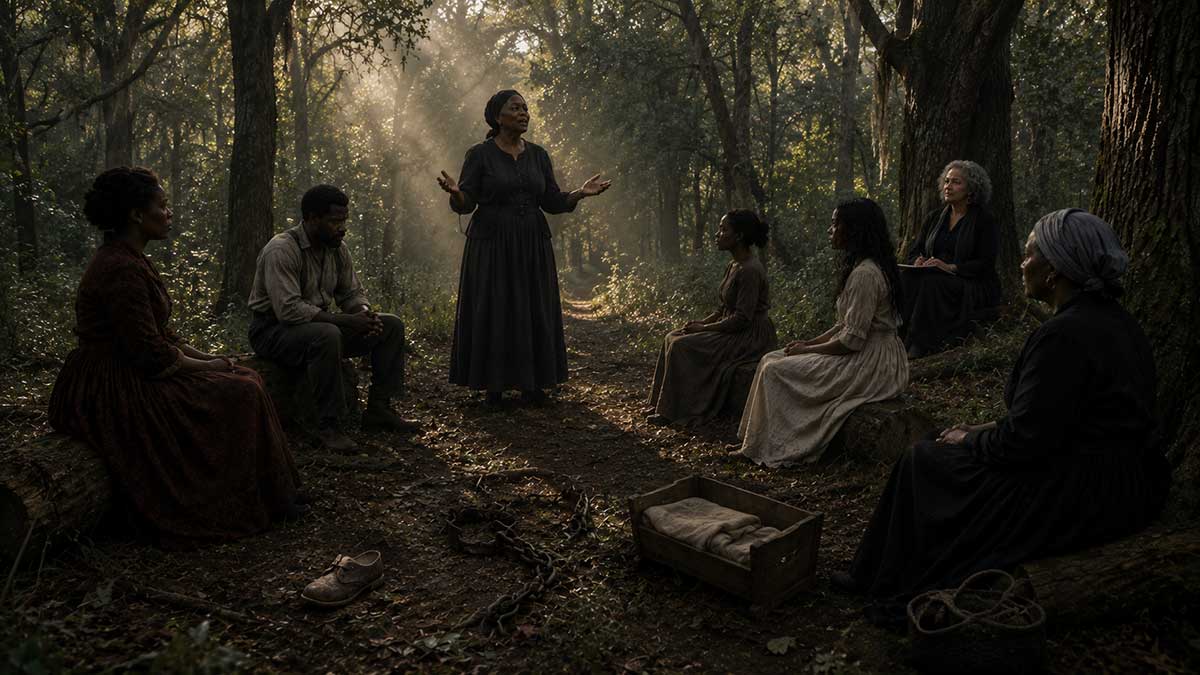
The clearing behind 124 had no pulpit.
Only tree stumps, flattened grass, and a circle of people who had forgotten how to stand without bracing themselves.
Baby Suggs stood at the center.
Sethe remained beneath the trees, one hand resting against the trunk beside her. Denver sat on a fallen branch. Paul D stood farther back, where the shade was thickest.
Beloved moved along the edge of the clearing, touching leaves as though each one had once belonged to her.
A sixth figure sat apart from them.
A woman in a dark coat, holding no notebook.
She had been there since morning.
No one had asked her name.
No one needed to.
Toni Morrison watched the clearing as if listening for a sentence buried beneath the soil.
Baby Suggs looked around.
Baby Suggs: They used to come here wanting to hear about freedom.
Paul D gave a short laugh.
Paul D: People always want to hear about freedom after the running is over.
Sethe: Running is never over.
Denver: We are not running now.
Sethe glanced toward the road.
Sethe: That does not mean nobody is coming.
Beloved smiled.
Beloved: Somebody is always coming.
Paul D looked at her.
Paul D: That is one thing they left us.
Denver: What?
Paul D: The belief that danger is never late.
Baby Suggs nodded.
Baby Suggs: Fear learns the shape of a house.
She looked toward 124.
Baby Suggs: Then moves in before the people do.
Toni Morrison spoke for the first time.
Her voice was quiet.
Toni Morrison: And after the door is opened?
Everyone turned toward her.
Baby Suggs: Some doors stay open even when they are shut.
Toni Morrison: Then perhaps slavery steals more than the body.
Paul D stepped into the clearing.
Paul D: It steals the right to decide what the body means.
Sethe looked at him.
Paul D: A back becomes a place for writing. Hands become tools. Teeth become a price. A man becomes what another man can make him do.
Sethe: A woman becomes what they can take from her.
Beloved stopped touching the leaves.
Denver looked down.
Sethe: Milk. Children. Sleep. Name. Anything that tells you the body is yours.
Toni Morrison: Is freedom the recovery of ownership?
Sethe answered quickly.
Sethe: It has to be.
Paul D: Not enough.
She turned toward him.
Paul D: A man can leave the chain and still carry the sound of it.
Sethe: You think I do not know that?
Paul D: I think we know different sounds.
Toni Morrison looked toward Paul D.
Toni Morrison: Tell us yours.
He stared at her.
Paul D: Why?
Toni Morrison: Because silence protects the wound longer than it protects the person.
Paul D looked away.
Paul D: That sounds like something a person says when the wound belongs to somebody else.
Toni Morrison did not defend herself.
Toni Morrison: Yes.
The answer unsettled him more than an argument would have.
He rubbed his wrists.
Paul D: They made men wear things no man should wear. Made us sleep in mud. Made us pull together like animals.
His voice grew flatter as he spoke.
Paul D: After enough time, you stop asking what they are doing to you. You ask what you must become to survive it.
Baby Suggs lowered her eyes.
Paul D: That is what they steal.
Denver watched him.
Denver: What?
Paul D: The person you might have been.
The clearing fell silent.
Beloved stepped closer.
Beloved: Where is he?
Paul D looked at her.
Beloved: The person you might have been.
Paul D: Gone.
Beloved: Dead?
Paul D: Never born.
Beloved considered this.
Beloved: Then he is like me.
Paul D’s face hardened.
Paul D: No.
Beloved: He had no life.
Paul D: Do not make everything yours.
Beloved: You made him disappear.
Paul D: I kept myself alive.
Beloved: Not all of you.
Paul D took a step toward her.
Sethe: Enough.
Paul D: She keeps reaching into people and calling whatever she finds her own.
Beloved: Because you hide it.
Paul D: Some things are hidden because they are private.
Toni Morrison: Slavery does not permit privacy.
Paul D turned.
Toni Morrison continued.
Toni Morrison: It invades the body, the family, the name, the future. It turns what should be private into property.
Sethe’s hand tightened against the tree.
Sethe: That is why I wanted my children where nobody could reach them.
Denver: But you reached them.
Sethe looked at her.
Denver’s voice was gentle, but she did not withdraw the sentence.
Denver: You reached into our lives before we could decide what they meant.
Sethe’s face changed.
Sethe: I was protecting you.
Denver: I know.
Sethe: Do you?
Denver: Yes.
She stood from the branch.
Denver: That is what makes it hard.
Baby Suggs watched them both.
Denver: If a stranger had hurt me, I could hate him. If someone who loved me hurt me because she was afraid, where am I supposed to put that?
Sethe turned away.
Beloved moved closer to her.
Beloved: Put it with me.
Denver shook her head.
Denver: That is where everything goes in this house.
Beloved smiled.
Beloved: Yes.
Denver: That does not make it right.
Toni Morrison looked toward Denver.
Toni Morrison: What do you think slavery stole from you?
Denver hesitated.
Denver: I was born free.
Toni Morrison: That was not my question.
Denver looked toward 124.
Denver: It stole the chance to have a mother who was only my mother.
Sethe closed her eyes.
Denver: Not someone still running. Not someone still fighting men who were no longer in the yard.
Her voice wavered.
Denver: It made me inherit an emergency.
Baby Suggs whispered.
Baby Suggs: Yes.
Denver looked at her.
Denver: It stole my beginning.
Toni Morrison nodded slowly.
Toni Morrison: That is one of its longest crimes.
Sethe opened her eyes.
Sethe: I gave you everything I had.
Denver: I know.
Sethe: Then what else was I supposed to give?
Denver: Something you never received.
The words passed through the clearing like wind.
Sethe’s face crumpled for only a moment.
Then it hardened again.
Sethe: That is an easy thing for a child to ask.
Denver: No.
Denver stepped closer.
Denver: It is a hard thing for a child to grow without.
Beloved slipped her hand into Sethe’s.
Beloved: She does not understand you.
Denver: I understand enough.
Beloved: She judges you.
Denver: No.
Denver looked directly at Sethe.
Denver: I am trying to see what was taken from you without pretending nothing was taken from me.
Baby Suggs smiled sadly.
Baby Suggs: That may be the beginning of healing.
Paul D shook his head.
Paul D: Healing.
Baby Suggs: You dislike the word?
Paul D: I distrust words that sound complete.
Toni Morrison: Perhaps healing is not completion.
Paul D looked toward her.
Toni Morrison: Perhaps it is the decision that the wound will not speak for the whole person.
Paul D: The wound usually has the loudest voice.
Toni Morrison: Then it must not be the only one invited.
Beloved laughed softly.
Beloved: You would silence me.
Toni Morrison: No.
She looked at Beloved carefully.
Toni Morrison: I would refuse to let you become the only language in the room.
Beloved’s eyes narrowed.
Beloved: I am what happened.
Toni Morrison: You are.
Beloved: I am what they forgot.
Toni Morrison: Yes.
Beloved: Then I should speak.
Toni Morrison: Yes.
Beloved waited.
Toni Morrison: But the dead cannot demand that the living become monuments.
Beloved’s face changed.
The branches above them trembled.
Beloved: I had no grave.
Toni Morrison: Then we must remember you.
Beloved: I had no name.
Toni Morrison: Then we must speak of you.
Beloved: I had no life.
Toni Morrison: Then we must not destroy the lives that remain in order to prove yours mattered.
Sethe stepped between them.
Sethe: You speak of her as if she belongs to everybody.
Toni Morrison: She may.
Sethe: She is mine.
Toni Morrison: That is the danger.
Sethe’s eyes hardened.
Sethe: You do not know what it is to have a child taken.
Toni Morrison was silent for a moment.
Toni Morrison: No.
Sethe seemed surprised.
Toni Morrison: But I know what it means for history to take millions of people and leave behind numbers where names should be.
Beloved watched her.
Toni Morrison: Sometimes a single child must carry too much because the world refused to remember the others.
Baby Suggs looked around the clearing.
Baby Suggs: That is what happened here.
Paul D: What?
Baby Suggs: Every person came with a crowd behind them.
She pointed toward Sethe.
Baby Suggs: Mothers who lost children.
Toward Paul D.
Baby Suggs: Men broken into things.
Toward Beloved.
Baby Suggs: Children who never grew.
Toward Denver.
Baby Suggs: Children who grew carrying people they never met.
She touched her own chest.
Baby Suggs: And old women expected to turn all that pain into a sermon.
Paul D looked at her.
Paul D: Did you believe what you preached?
Baby Suggs took a long breath.
Baby Suggs: At first.
Paul D: And later?
Baby Suggs: Later I believed people needed to hear it.
Sethe: That is not the same.
Baby Suggs: No.
The admission settled heavily.
Baby Suggs: Slavery stole that too.
Denver looked at her.
Denver: What?
Baby Suggs: The right to be weak.
She sat on a stump.
Baby Suggs: Everybody wanted me strong because they had nowhere else to put their sorrow.
Sethe’s face softened.
Sethe: You could have told me.
Baby Suggs: You were busy surviving.
Sethe: I would have listened.
Baby Suggs looked at her.
Baby Suggs: Would you?
Sethe did not answer.
Baby Suggs smiled without cruelty.
Baby Suggs: Survival is loud. It does not hear much besides danger.
Paul D lowered himself onto another stump.
Paul D: That is true.
Toni Morrison looked around the circle.
Toni Morrison: What else does slavery steal?
Paul D answered first.
Paul D: Trust.
Sethe: Rest.
Denver: Childhood.
Baby Suggs: Community.
Beloved spoke last.
Beloved: Tomorrow.
Everyone looked at her.
Beloved: They take tomorrow first.
No one contradicted her.
Toni Morrison leaned forward.
Toni Morrison: Then freedom must be more than escape.
Paul D looked at the dirt.
Paul D: Escape is what the body does.
Sethe: Freedom is what comes after.
Denver: If it comes.
Baby Suggs: It must be practiced.
Sethe looked at her.
Sethe: Practiced how?
Baby Suggs stood.
Baby Suggs: By doing what was forbidden.
She opened her arms.
Baby Suggs: Resting without permission.
She touched Denver’s face.
Baby Suggs: Raising children without teaching them only fear.
She looked at Paul D.
Baby Suggs: Speaking without asking whether the words will be used against you.
She turned toward Sethe.
Baby Suggs: Loving without possession.
Sethe looked away.
Then Baby Suggs faced Beloved.
Baby Suggs: Remembering without worshipping pain.
Beloved stepped backward.
Beloved: Pain remembers better than people.
Toni Morrison: That may be why people must remember deliberately.
Beloved looked at her.
Toni Morrison: Otherwise pain becomes the historian.
The wind moved through the clearing.
Paul D rubbed his hands together.
Paul D: Suppose the person you might have been is gone.
Toni Morrison looked at him.
Paul D: Suppose slavery took him.
Toni Morrison: Then you are not required to become him.
Paul D frowned.
Toni Morrison: Freedom is not recovering an untouched self.
She glanced toward Sethe.
Toni Morrison: There may be no untouched self to recover.
Then toward Denver.
Toni Morrison: Freedom may be creating a self that history did not plan for.
Denver’s face brightened slightly.
Denver: Creating?
Toni Morrison: Yes.
Denver: From what?
Paul D gave a bitter smile.
Paul D: Scraps.
Baby Suggs: Scraps are enough for a quilt.
Sethe looked at her.
Baby Suggs shrugged.
Baby Suggs: Not a perfect one.
Paul D almost smiled.
Baby Suggs: But enough to cover somebody.
Beloved stared at the circle.
Beloved: And what covers me?
No one answered immediately.
Denver stepped toward her.
Denver: Memory.
Beloved shook her head.
Denver: Not Mama’s whole life.
She continued forward.
Denver: Not my future.
Another step.
Denver: But memory.
Beloved’s eyes filled with something that might have been anger.
Or grief.
Or hunger.
Beloved: That is small.
Denver: It is what I can give without disappearing.
Beloved looked toward Sethe.
Sethe seemed unable to speak.
Paul D stood.
Paul D: Maybe that is freedom too.
Sethe: What?
Paul D: Giving what you can without giving away the person doing the giving.
Sethe looked at her hands.
The same hands that had carried children.
The same hands that had worked, fought, held, and harmed.
Slowly, she opened them.
Sethe: They taught us that love was something they could take.
Baby Suggs nodded.
Sethe: So I tried to make mine untakeable.
She looked toward Beloved.
Sethe: I made it hard.
Then toward Denver.
Sethe: I made it frightening.
Finally toward Paul D.
Sethe: I made it lonely.
Paul D’s expression softened.
Sethe: Maybe that was another thing they stole.
Toni Morrison: What?
Sethe looked around the clearing.
Sethe: The belief that love could be gentle and still survive.
No one spoke.
Baby Suggs moved to the center again.
Her voice carried through the trees.
Baby Suggs: Then that is what must be learned.
Paul D: Learned from whom?
Baby Suggs looked at all of them.
Baby Suggs: From people who were never taught.
Paul D laughed quietly.
Paul D: That seems unfair.
Baby Suggs: Freedom has always been unfair work.
Denver smiled.
Only a little.
Beloved lowered herself into the grass.
Sethe sat beside her, but this time she left space between them.
Toni Morrison rose.
She brushed a leaf from her coat.
Toni Morrison: Slavery steals bodies.
She looked toward Paul D.
Toni Morrison: It steals the self a person might have become.
Toward Sethe.
Toni Morrison: It steals the safety that allows love to remain tender.
Toward Denver.
Toni Morrison: It steals beginnings from children not yet born.
Toward Baby Suggs.
Toni Morrison: It steals rest from those expected to carry everyone else.
Finally, she looked at Beloved.
Toni Morrison: And it steals the future by teaching the past to repeat itself.
The clearing held the words.
Then Denver walked to the center.
She looked toward the road beyond the trees.
Denver: Then freedom begins when something does not repeat.
Beloved watched her.
Denver: When fear comes, and we do not obey it.
She looked at Sethe.
Denver: When pain speaks, and we do not let it speak alone.
She looked at Paul D.
Denver: When someone leaves, but another person still stays.
Paul D nodded.
Baby Suggs lifted her face toward the light.
Sethe reached toward Denver.
Not to pull her back.
Only to touch her hand.
The wind passed through the clearing.
For once, nobody mistook it for footsteps.
Topic 4 should focus on Why Does Healing Require a Community? Stamp Paid would be especially powerful here, alongside Sethe, Denver, Paul D, Baby Suggs, and Toni Morrison.
Topic 4: Why Does Healing Require a Community?
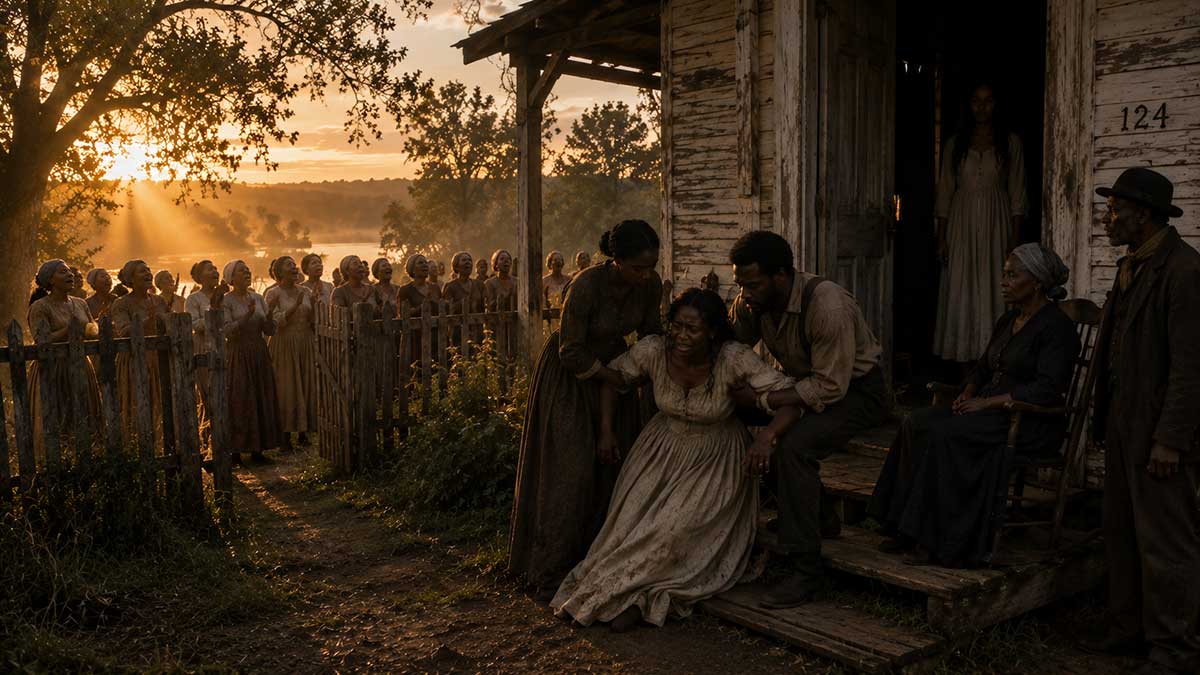
The women came before sunrise.
At first, they appeared as shapes beyond the fence—shawls, skirts, baskets, hands carrying nothing and everything.
Denver saw them from the window.
She did not call for Sethe.
She did not call for Paul D.
She stood very still and watched the road fill with people who had once stayed away.
Behind her, 124 breathed.
Beloved sat at the kitchen table, humming to herself.
Sethe knelt beside the stove, though there was nothing cooking.
Paul D stood near the back door.
Baby Suggs occupied her old chair by the window.
Stamp Paid waited on the porch, hat in his hands.
Toni Morrison stood beneath the eaves, watching the women gather.
No one invited them in.
No one asked them to leave.
Denver opened the door.
Cold morning air entered first.
Then voices.
Low at the beginning.
Not words exactly.
Sound.
Memory with breath in it.
Beloved stopped humming.
Beloved: Make them go.
Denver remained in the doorway.
Denver: No.
Sethe looked up.
Sethe: Who is there?
Denver turned toward her mother.
Denver: Everybody.
Sethe’s face tightened.
Sethe: Everybody left.
Stamp Paid lowered his head.
Stamp Paid: We did.
The women outside began to sing.
Not loudly.
Not yet.
The sound moved through the yard like water searching for a place to enter.
Beloved stood.
Beloved: They do not belong here.
Baby Suggs: Neither did sorrow.
Beloved looked at her sharply.
Baby Suggs: It came anyway.
Sethe rose from the floor.
Sethe: Why now?
Stamp Paid stepped inside.
He kept his hat in his hands.
Stamp Paid: Because Denver asked.
Sethe looked at her daughter.
Sethe: You went to them?
Denver nodded.
Sethe: You told them?
Denver: Enough.
Sethe: Enough of what?
Denver: Enough to make them come.
Beloved moved closer to Sethe.
Beloved: She betrayed us.
Denver: No.
Beloved: She carried the house outside.
Denver: The house was killing us inside.
Sethe flinched.
Stamp Paid looked toward the floor.
Stamp Paid: A house can become a grave before anybody lies down.
Paul D watched him.
Paul D: You knew that before today.
Stamp Paid nodded.
Paul D: And still you stayed away.
Stamp Paid: I did.
Paul D: Why?
Stamp Paid took a breath.
Stamp Paid: Shame.
Sethe laughed once.
A bitter sound.
Sethe: Yours?
Stamp Paid: Some of it.
Sethe: That is generous.
Stamp Paid: Not generous enough.
He looked at her.
Stamp Paid: We saw what happened in that shed, and instead of asking what terror had entered with you, we judged the woman standing inside it.
Sethe’s eyes hardened.
Stamp Paid: Then we told ourselves distance was wisdom.
Baby Suggs: Distance is often fear with good manners.
Stamp Paid accepted the sentence.
Stamp Paid: Yes.
Outside, the song grew stronger.
Beloved covered her ears.
Beloved: They hate me.
Denver: They do not know you.
Beloved: They know enough.
Toni Morrison: Communities often believe they know enough before they have listened.
Everyone turned toward her.
Toni Morrison: That is how exclusion becomes righteous.
Stamp Paid looked toward the road.
Stamp Paid: We were righteous.
Baby Suggs: You were jealous first.
The room shifted.
Stamp Paid looked at her.
Baby Suggs: The feast.
He closed his eyes briefly.
Baby Suggs: Too much food. Too much joy. Too much blessing in one yard.
Stamp Paid: People were tired.
Baby Suggs: Tired people can still envy.
Stamp Paid: I know.
Baby Suggs: Do you?
Her voice remained calm, but it held the old wound.
Baby Suggs: Nobody warned us.
Sethe looked at Stamp Paid.
Sethe: Nobody came.
Stamp Paid’s face changed.
Stamp Paid: No.
Sethe: You knew they were coming.
He did not answer.
Sethe: You knew.
Stamp Paid: We suspected.
Sethe: And you let the road carry them here.
Stamp Paid: Yes.
The singing outside faltered for one beat, as if the women had heard him.
Then it resumed.
Sethe stepped toward him.
Sethe: You talk about community as if it means people arriving after the blood is dry.
Stamp Paid did not move.
Stamp Paid: Sometimes that is exactly what it means.
Sethe stared at him.
Stamp Paid: Arriving late.
He looked toward Denver.
Stamp Paid: Too late for what should have been prevented.
Then toward Sethe.
Stamp Paid: But not too late for what can still be saved.
Beloved laughed.
Beloved: Nothing can be saved.
Paul D: That is what pain says when it wants the whole house.
Beloved turned toward him.
Beloved: You left too.
Paul D’s jaw tightened.
Beloved: All of you leave.
Paul D: Yes.
The answer silenced her.
Paul D: I left.
He looked at Sethe.
Paul D: I told myself I could not stay where love had become dangerous.
Then toward Beloved.
Paul D: But leaving did not make me innocent.
Sethe’s expression softened, though only slightly.
Paul D: A man can protect himself so thoroughly that he abandons everyone who needed him.
Baby Suggs looked toward him.
Baby Suggs: That tobacco tin again.
Paul D touched his chest.
Paul D: It kept me alive.
Baby Suggs: It also kept everyone else outside.
Paul D nodded.
Paul D: I know.
Denver looked toward the women.
Denver: Maybe that is why healing needs more than one person.
Sethe turned to her.
Denver: One person gets tired.
She looked at Baby Suggs.
Denver: One person loses faith.
Then Paul D.
Denver: One person runs.
Then Stamp Paid.
Denver: One person arrives too late.
Finally, she looked toward Toni Morrison.
Denver: One person cannot remember everything correctly.
Toni Morrison nodded.
Toni Morrison: Nor should one person be forced to carry everything alone.
Beloved lowered her hands from her ears.
Beloved: She carries me.
She touched Sethe’s arm.
Beloved: That is enough.
Denver shook her head.
Denver: It was never enough.
Beloved’s eyes narrowed.
Denver: Mama carrying you alone is what made you grow so large.
The windows trembled.
Sethe looked at Beloved.
For the first time, she seemed to notice how much space the young woman occupied.
Not merely in the room.
In her breathing.
In her hunger.
In every thought.
Sethe: She came because of me.
Baby Suggs: Perhaps.
Sethe: Then she is mine to answer.
Baby Suggs: That is the mistake.
Sethe turned toward her.
Baby Suggs: You believe every wound you caused must be healed by your suffering.
Sethe: Who else should pay?
Baby Suggs: Healing is not payment.
Sethe: It ought to cost something.
Baby Suggs: It does.
Baby Suggs stood.
Baby Suggs: It costs pride.
She looked toward Stamp Paid.
Baby Suggs: It costs admitting you failed someone.
Then toward Paul D.
Baby Suggs: It costs returning after you left.
Then toward Denver.
Baby Suggs: It costs asking for help before you know whether help will come.
Finally, she faced Sethe.
Baby Suggs: And it costs giving up the belief that your pain makes you responsible for everything.
Sethe looked away.
Outside, one woman’s voice rose above the others.
Then another joined.
Then another.
The song gathered strength not because every voice was beautiful, but because no single voice had to hold the melody.
Toni Morrison listened.
Toni Morrison: That is what community can do.
Beloved glared at her.
Beloved: Noise?
Toni Morrison: Carry what one throat cannot.
Stamp Paid moved toward the doorway.
Stamp Paid: They did not come because they think themselves better than you.
Sethe looked at him.
Stamp Paid: At least, they should not have.
Baby Suggs: Why did they come?
Stamp Paid looked outside.
Stamp Paid: Because Denver reminded them that judgment had become another way of leaving a woman alone.
Sethe’s face changed.
Denver stepped closer to her mother.
Denver: I did not ask them to decide whether you were good.
Sethe: What did you ask?
Denver: To help us live.
The simplicity of it entered the room more deeply than any argument.
Beloved backed away from Sethe.
Beloved: You have me.
Sethe: Yes.
Beloved: You do not need them.
Sethe looked toward the doorway.
The women were closer now.
Some stood at the fence.
Some held their hands together.
One carried a child on her hip.
Another leaned on a cane.
Ella stood near the front, chin raised, eyes fixed on 124.
Sethe recognized women who had shared food, grief, work, births, burials, gossip, and silence.
Women who had failed her.
Women she had failed.
Sethe: Need is dangerous.
Denver looked at her.
Sethe: When you need people, they can leave.
Denver: They can.
Sethe: They can judge.
Denver: They did.
Sethe: They can betray you.
Stamp Paid lowered his head.
Denver: Yes.
Sethe turned toward her daughter.
Sethe: Then why open the door?
Denver looked outside.
Denver: Because closing it did not save us.
No one spoke.
Beloved’s breathing grew louder.
Beloved: Shut it.
Denver remained where she was.
Beloved: Shut the door.
Paul D stepped beside her.
Not close enough to touch.
Close enough not to leave her standing alone.
Paul D: No.
Beloved looked at Sethe.
Beloved: Make them go.
Sethe stared at the women.
The song struck the house now.
Not violently.
Persistently.
A sound made of sorrow, anger, prayer, apology, and something stronger than all of them.
Baby Suggs smiled faintly.
Baby Suggs: They should have sung sooner.
Stamp Paid looked at her.
Stamp Paid: Yes.
Baby Suggs: But sooner is gone.
She looked toward Sethe.
Baby Suggs: Today remains.
Sethe’s hands began to shake.
Beloved reached for them.
Sethe did not pull away.
But she did not close her fingers around Beloved’s either.
Beloved: You promised.
Sethe: I promised too much.
Beloved’s face twisted.
Beloved: You gave me yourself.
Sethe: I did.
Beloved: Give me more.
Sethe looked at her with terrible tenderness.
Sethe: There is no more.
Beloved stepped backward.
The floor beneath her seemed to darken.
Beloved: Then you are forgetting.
Sethe: No.
Beloved: You are leaving me.
Sethe: No.
Sethe’s voice broke.
Sethe: I am letting other people hold what I cannot.
Beloved shook her head wildly.
Beloved: They do not know me.
Toni Morrison stepped forward.
Toni Morrison: They know loss.
Beloved turned toward her.
Toni Morrison: Not yours exactly.
She looked toward the women.
Toni Morrison: Community does not heal by pretending all pain is the same.
Then toward Sethe.
Toni Morrison: It heals by refusing to let difference become isolation.
Stamp Paid nodded slowly.
Stamp Paid: We should have known that.
Baby Suggs: You know it now.
Stamp Paid: Is that enough?
Baby Suggs: No.
He looked at her.
Baby Suggs: Knowing is where responsibility begins, not where it ends.
Outside, Ella’s voice rose.
It was not pretty.
It was strong.
The other women answered.
Beloved staggered.
Her hands moved to her stomach.
Beloved: They are pushing me out.
Denver: No.
Beloved looked toward her.
Denver: They are making room for the rest of us.
Beloved screamed.
The sound shook dust from the rafters.
Sethe flinched but did not move toward her.
Paul D reached for Sethe’s arm.
She let him.
Baby Suggs opened the door wider.
The song entered fully.
It filled the kitchen.
It moved across the table, under the chairs, against the walls, into the cracks where old anger lived.
The women did not enter the house.
They did something harder.
They stood outside and refused to abandon it.
Sethe began to cry.
Not delicately.
Not quietly.
Her body folded.
Denver caught one side of her.
Paul D caught the other.
Stamp Paid moved forward, but Baby Suggs stopped him with one hand.
Baby Suggs: Let them.
Stamp Paid watched.
Sethe wept between her living daughter and the man who had returned.
Beloved stood alone.
For the first time, Sethe’s grief was not feeding her.
It was being carried elsewhere.
Into Denver’s shoulder.
Into Paul D’s hands.
Into the women’s song.
Into the morning itself.
Beloved became smaller.
Not physically at first.
But the room no longer bent toward her.
The house no longer held its breath for her.
Beloved: Sethe.
Sethe lifted her head.
Beloved reached out.
Beloved: Me.
Sethe looked at her.
Then at Denver.
Then at Paul D.
Then through the doorway at the women.
Sethe: You are not the only one I lost.
Beloved froze.
Sethe: And I am not the only one who lost.
The women sang louder.
Stamp Paid covered his face.
Baby Suggs closed her eyes.
Toni Morrison watched Sethe carefully.
Sethe: I thought my pain was mine because no one came near it.
She looked at the people outside.
Sethe: Maybe I made it mine.
Denver shook her head.
Denver: They left you alone with it.
Sethe: Yes.
She looked toward Stamp Paid.
Sethe: They did.
Then back toward Denver.
Sethe: But I kept the door closed after they returned.
Stamp Paid’s eyes filled.
Stamp Paid: We did not return well.
Sethe nodded.
Sethe: No.
For one moment, neither forgave the other.
But neither turned away.
That was enough for the morning.
Beloved moved toward the back of the room.
Her outline seemed less certain.
Beloved: I will be forgotten.
Baby Suggs opened her eyes.
Baby Suggs: No.
Beloved: I will disappear.
Toni Morrison: Disappearing from one house is not disappearing from memory.
Beloved looked toward her.
Toni Morrison: You were never meant to live only inside Sethe.
The words unsettled everyone.
Toni Morrison continued.
Toni Morrison: Some grief belongs to a family.
She looked toward the women.
Toni Morrison: Some belongs to a people.
Then beyond them, toward the unseen country.
Toni Morrison: Some belongs to history.
Beloved’s face softened.
For one brief moment, she looked like a child who had carried too many dead.
Beloved: Who will hold me?
The women outside did not stop singing.
Denver answered first.
Denver: All of us.
Stamp Paid lifted his head.
Stamp Paid: Not perfectly.
Paul D looked toward Beloved.
Paul D: Not every day.
Baby Suggs stepped into the doorway.
Baby Suggs: But enough that no one woman must disappear trying.
Sethe leaned against Denver.
She looked exhausted.
Older.
Lighter.
Not healed.
Healing.
The distinction mattered.
The sun finally rose above the trees.
Its light reached the porch, then the doorway, then the kitchen floor.
Beloved stood at its edge.
For a moment, she seemed made of shadow and morning.
Then the women’s song broke into many voices.
Not one chorus now.
Many.
Some high.
Some low.
Some trembling.
Some wrong.
All present.
Beloved listened.
Perhaps she heard accusation.
Perhaps welcome.
Perhaps the sound of a burden being divided.
The light moved forward.
And the room, which had belonged for so long to one grief, became large enough to hold a community.
Topic 5: What Does It Mean That This Is “Not a Story to Pass On”?
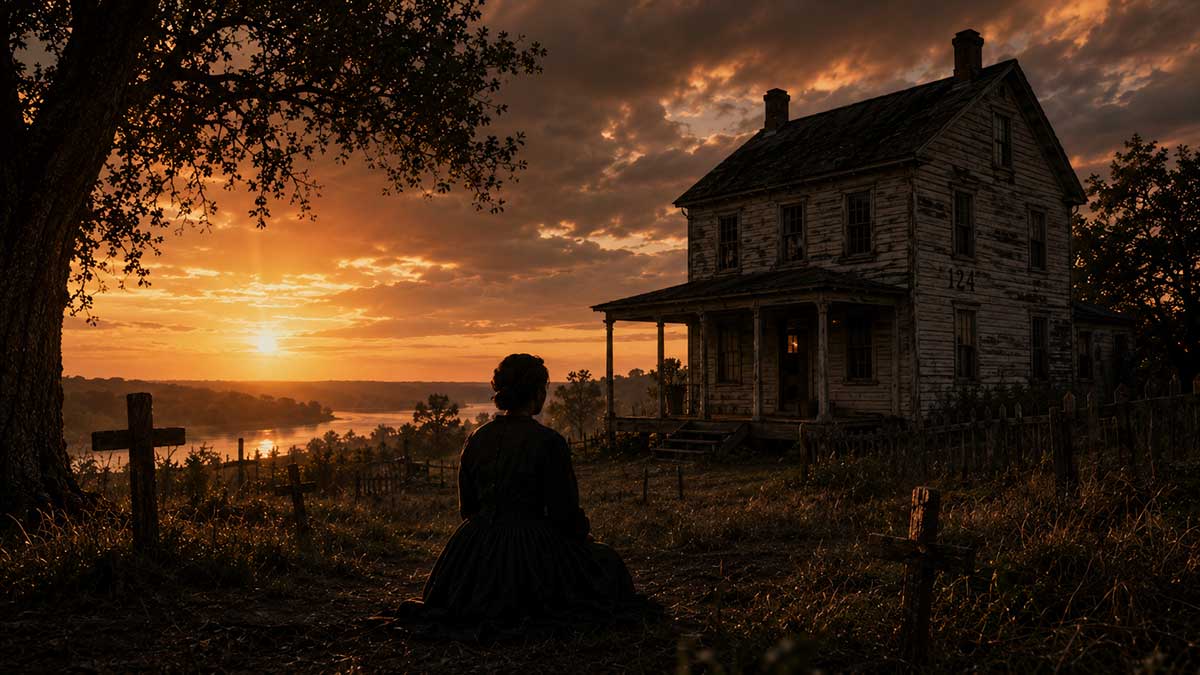
By evening, the women had gone home.
Their voices remained.
They clung to the porch boards, the kitchen walls, the branches beyond the fence. Even after the road emptied, the house no longer felt sealed.
The door stood open.
Sethe sat on the porch step with a blanket around her shoulders.
Denver stood beside the railing, looking toward town.
Paul D rested against one of the posts.
Baby Suggs sat in her old chair.
Stamp Paid remained near the gate, uncertain whether staying was an intrusion or leaving was another failure.
Beloved stood in the yard.
Not close to Sethe.
Not far either.
Toni Morrison sat beneath the tree with her hands folded in her lap.
No one spoke for a long time.
The silence was different now.
Before, silence had hidden things.
Tonight, it waited.
Beloved broke it.
Beloved: You will tell them.
Sethe looked toward her.
Sethe: Tell who?
Beloved: Everybody.
Denver followed Beloved’s gaze toward the road.
Beloved: You opened the door.
Denver: We had to.
Beloved: Now they will carry me away in their mouths.
Stamp Paid lowered his head.
Stamp Paid: That is what people do with stories.
Beloved turned toward him.
Beloved: You already carried one.
He flinched.
Stamp Paid: Yes.
Beloved: You showed him.
Paul D looked at Stamp Paid.
The old newspaper clipping seemed to appear between them, though no one held it.
Stamp Paid: I thought he should know.
Sethe: You thought the paper knew me.
Stamp Paid: No.
Sethe: You handed him the smallest piece and let it speak for the whole.
Stamp Paid’s fingers tightened around his hat.
Stamp Paid: I did.
Paul D: I let it.
Sethe looked at him.
Paul D: I saw the picture. Read the words. Thought knowing what happened meant knowing you.
He shook his head.
Paul D: A story can become a judgment before it becomes understanding.
Toni Morrison looked toward him.
Toni Morrison: Especially when the listener believes the telling has finished.
Beloved stepped closer.
Beloved: Then do not tell it.
Denver looked at her.
Denver: That cannot be the answer.
Beloved: Why?
Denver: Because silence nearly killed us.
Beloved: Talking nearly erased me.
Denver: No. Being spoken about badly erased you.
Beloved’s eyes narrowed.
Denver: Being spoken about only as Mama’s crime erased you.
Then Denver looked toward Sethe.
Denver: Being spoken about only as a warning erased her too.
Sethe pulled the blanket tighter.
Sethe: Maybe some things should stay inside the people who lived them.
Paul D: People die.
Sethe looked at him.
Paul D: Then what happens to what they knew?
Sethe: Maybe it dies with them.
Toni Morrison: History has often depended on exactly that hope.
The porch grew still.
Sethe’s face hardened slightly.
Sethe: You want everything remembered.
Toni Morrison: No.
Sethe: Then what?
Toni Morrison: I want nothing essential deliberately buried because it makes the living uncomfortable.
Beloved smiled faintly.
Beloved: Then I am essential.
Toni Morrison: Yes.
Beloved seemed pleased.
Toni Morrison continued.
Toni Morrison: But being essential does not make you simple.
Beloved’s smile disappeared.
Toni Morrison: You are a child.
She paused.
Toni Morrison: You are a daughter.
Another pause.
Toni Morrison: You are guilt.
Beloved’s face tightened.
Toni Morrison: You are history.
Sethe looked away.
Toni Morrison: You are the dead who were not counted properly.
Baby Suggs closed her eyes.
Toni Morrison: You are also the danger of allowing the past to demand every living thing in payment.
Beloved stared at her.
Beloved: You make me too many things.
Toni Morrison: That is because one meaning would be too small.
Stamp Paid moved closer to the porch.
Stamp Paid: People like one meaning.
Baby Suggs: It saves time.
Stamp Paid: Makes it easier to decide who was right.
Paul D: And who was wrong.
Sethe: And who deserves mercy.
Denver looked toward her mother.
Denver: Do you want mercy?
Sethe did not answer immediately.
Sethe: From whom?
Denver: Anyone.
Sethe looked toward the road, then the yard, then her own hands.
Sethe: Mercy can feel like somebody standing above you.
Baby Suggs nodded.
Baby Suggs: Sometimes it is.
Sethe: I do not want people saying they forgive me when they have never stood where I stood.
Paul D: Then perhaps forgiveness is not what the story asks for.
Sethe turned toward him.
Paul D: Maybe it asks people to stay long enough to understand why judgment is too small.
Stamp Paid let out a breath.
Stamp Paid: That is harder.
Baby Suggs: Most useful things are.
Beloved moved toward Sethe.
This time, Sethe did not reach for her.
Beloved stopped.
Beloved: Say my name.
Sethe looked at her.
Beloved: Tell them I was loved.
Sethe’s face broke open.
Sethe: You were.
Beloved: Tell them I was chosen.
Sethe swallowed.
Sethe: You were.
Denver stepped down from the porch.
Denver: Tell them I was there too.
Sethe looked toward her.
Denver: Tell them I lived beside what happened.
Paul D: Tell them men were there too.
Everyone turned toward him.
Paul D: Men who could not protect anybody.
His voice was low.
Paul D: Men who were made to feel that tenderness was another thing that could be used against them.
Baby Suggs lifted her chin.
Baby Suggs: Tell them old people got tired.
Stamp Paid looked at her.
Baby Suggs: Tell them faith can wear out.
Then she looked toward the road.
Baby Suggs: Tell them communities can fail the people they later pretend they never abandoned.
Stamp Paid nodded slowly.
Stamp Paid: Tell them some of us arrived late.
He looked at Sethe.
Stamp Paid: And that arriving late does not erase the delay.
Toni Morrison watched each face.
Toni Morrison: Then perhaps the question is not whether the story should be passed on.
Denver looked toward her.
Denver: What is the question?
Toni Morrison: How.
The word seemed almost too small.
Beloved frowned.
Beloved: A story is a story.
Toni Morrison: No.
She leaned forward.
Toni Morrison: A story can be a weapon.
Stamp Paid looked down at his hat.
Toni Morrison: It can be a hiding place.
Sethe’s fingers tightened beneath the blanket.
Toni Morrison: It can be an excuse.
Paul D looked toward the yard.
Toni Morrison: It can be a grave.
Beloved stood very still.
Toni Morrison: Or it can become a place where the dead are remembered without requiring the living to remain dead with them.
Beloved’s voice softened.
Beloved: How?
Toni Morrison looked at her.
Toni Morrison: By refusing to tell only what is easy.
She turned toward Sethe.
Toni Morrison: Not “a mother killed her child.”
Sethe closed her eyes.
Toni Morrison: But also: a system made motherhood itself impossible.
She looked toward Paul D.
Toni Morrison: Not “a man abandoned a woman.”
Paul D lowered his head.
Toni Morrison: But also: a man was taught to fear the part of himself that might have stayed.
Then toward Denver.
Toni Morrison: Not “a lonely girl became brave.”
Denver listened carefully.
Toni Morrison: But also: a child inherited a house full of silence and still chose the road.
Baby Suggs smiled faintly.
Toni Morrison: Not “a community finally came.”
Stamp Paid’s face tightened.
Toni Morrison: But also: a community first failed.
The evening deepened.
Beloved looked at each of them.
Beloved: And me?
Toni Morrison held her gaze.
Toni Morrison: Not “a ghost returned.”
Beloved waited.
Toni Morrison: But also: what is buried does not remain buried merely because the living agree not to look.
Beloved’s face softened.
Sethe opened her eyes.
Sethe: Then why say it is not a story to pass on?
No one answered at first.
The phrase seemed to move among them, carrying more than one meaning.
Paul D spoke carefully.
Paul D: Maybe because some people will pass it on like gossip.
Stamp Paid flinched again.
Paul D: Strip it down. Make it clean. Make it useful to whatever they already believe.
Baby Suggs nodded.
Baby Suggs: Some will turn suffering into entertainment.
Denver looked toward Toni Morrison.
Denver: Some will call it history and keep it far enough away not to feel anything.
Stamp Paid: Some will call it tragedy and admire themselves for being moved.
Sethe looked at Beloved.
Sethe: Some will remember the dead and forget the living person who survived them.
Beloved looked back.
Beloved: Some will forget anyway.
Toni Morrison: Yes.
Her answer was gentle.
Toni Morrison: Forgetting cannot be fully prevented.
Beloved’s face hardened.
Toni Morrison: But forgetting can be resisted.
Beloved: By telling?
Toni Morrison: By telling responsibly.
Sethe gave a tired laugh.
Sethe: That sounds like a rule no one knows how to follow.
Toni Morrison: It is not one rule.
She looked toward Denver.
Toni Morrison: Listen to the descendants.
Toward Stamp Paid.
Toni Morrison: Admit the failures of the witnesses.
Toward Paul D.
Toni Morrison: Make room for shame without allowing shame to become silence.
Toward Baby Suggs.
Toni Morrison: Remember that spiritual strength does not cancel exhaustion.
Then toward Sethe.
Toni Morrison: And do not force the wounded to become perfect before their suffering is believed.
Sethe’s eyes filled.
Beloved stepped closer.
Beloved: Tell them she loved me.
Denver: We will.
Beloved looked toward her.
Denver: But we will also tell them love was not enough.
Sethe closed her eyes again.
Beloved recoiled.
Beloved: That is betrayal.
Denver: No.
Denver stepped into the yard.
Denver: Betrayal would be pretending love cannot wound.
Sethe: Denver.
Denver turned toward her mother.
Denver: I am not condemning you.
Sethe: It sounds close.
Denver: I am trying to tell the truth without losing you inside it.
Sethe studied her daughter’s face.
Denver: I do not want people to remember only what you did.
Her voice softened.
Denver: I want them to understand what was done to you.
Sethe looked away.
Denver: But I cannot protect you by pretending nothing happened to us afterward.
The words hurt.
Sethe allowed them to.
That was new.
Paul D moved beside Sethe.
He did not touch her.
Paul D: A whole story ought to make room for more than one pain.
Baby Suggs nodded.
Baby Suggs: And more than one truth.
Stamp Paid sat down on the porch edge.
Stamp Paid: People will still choose the part they like.
Toni Morrison: They will.
Stamp Paid: Then what is the use?
Toni Morrison looked toward the darkening road.
Toni Morrison: The use is not control.
She paused.
Toni Morrison: The teller cannot control every listener.
Stamp Paid: Then?
Toni Morrison: The use is witness.
The yard grew quiet.
Toni Morrison: Witness does not promise that people will understand.
She looked at Sethe.
Toni Morrison: It promises that what happened will not depend entirely on the silence of those who benefited from forgetting.
Beloved watched her.
Beloved: You want them to remember me forever.
Toni Morrison: No one is remembered forever.
Beloved’s expression shifted toward fear.
Toni Morrison: But you can be remembered long enough to interrupt repetition.
Denver looked toward the road.
Denver: Long enough for someone to choose differently.
Baby Suggs: Long enough for a mother not to be left alone.
Paul D: Long enough for a man to open the door before somebody has to beg.
Stamp Paid: Long enough for a community to warn instead of watch.
Sethe’s breathing changed.
She looked at Beloved.
Sethe: Long enough for love not to become fear.
Beloved stepped closer.
Only one step.
Beloved: And after that?
Sethe’s eyes filled.
Sethe: After that, I do not know.
Beloved waited.
Sethe: Maybe you rest.
Beloved looked toward Baby Suggs.
Beloved: Is that what the dead do?
Baby Suggs smiled sadly.
Baby Suggs: I have never trusted the living when they explain the dead.
Paul D almost smiled.
Beloved did too.
Only for a moment.
Then she looked toward the open door of 124.
Beloved: Will they close it again?
Denver answered.
Denver: Sometimes.
Beloved turned.
Denver: People get afraid. Tired. Ashamed.
She looked toward Stamp Paid.
Denver: They leave.
Then toward Paul D.
Denver: They return badly.
Then toward Sethe.
Denver: They remember wrong.
Finally, she looked at Toni Morrison.
Denver: But somebody can open it again.
Toni Morrison nodded.
Toni Morrison: That may be why stories survive.
Beloved’s outline seemed softer now.
Not disappearing.
Releasing.
The wind moved across the yard.
Sethe watched her.
Sethe: I thought keeping you close was the only way not to lose you.
Beloved looked at her.
Sethe: But I lost Denver while looking at you.
Denver lowered her eyes.
Sethe: I lost Paul D.
He said nothing.
Sethe: I lost myself.
Beloved’s face tightened.
Sethe: I will not forget you.
Beloved waited.
Sethe: But I cannot belong only to what I did to you.
Beloved whispered.
Beloved: Then who do you belong to?
Sethe looked toward Denver.
Then Paul D.
Then Baby Suggs.
Then the empty road where the women had stood.
Finally, she looked down at herself.
Sethe: Maybe I belong here.
Beloved frowned.
Sethe: Not to them.
She looked at Denver and Paul D.
Sethe: With them.
Then she placed one hand against her own chest.
Sethe: And some part to me.
Baby Suggs smiled.
Baby Suggs: About time.
Paul D looked away to hide his own smile.
Stamp Paid breathed out slowly.
Beloved studied Sethe as if the answer had created a distance neither of them could cross.
Then Denver moved closer to Beloved.
Denver: You can belong to the story.
Beloved looked toward her.
Denver: But the story cannot belong only to you.
Beloved’s eyes filled.
Beloved: That is small.
Denver: Maybe.
Denver held out her hand.
Denver: But small things can be carried without crushing people.
Beloved looked at the offered hand.
She did not take it.
She did not turn away either.
Toni Morrison rose from beneath the tree.
Toni Morrison: Some stories must not be passed on carelessly.
Everyone looked toward her.
Toni Morrison: They must not be reduced, polished, or used to make suffering beautiful.
She stepped toward the porch.
Toni Morrison: They must not be passed on as accusation alone.
Toward Sethe.
Toni Morrison: Or as forgiveness alone.
Toward Beloved.
Toni Morrison: Or as proof that the dead matter more than the living.
Toward Denver.
Toni Morrison: Or that the future can be built by forgetting the past.
She stopped before the open doorway.
Toni Morrison: Perhaps “not a story to pass on” also means it is not a burden to hand unchanged to the next generation.
Denver looked toward her.
Denver: Then what do we pass on?
Toni Morrison answered quietly.
Toni Morrison: The truth.
She looked at Sethe.
Toni Morrison: The warning.
At Paul D.
Toni Morrison: The tenderness people nearly lost.
At Baby Suggs.
Toni Morrison: The need for community.
At Stamp Paid.
Toni Morrison: The responsibility to arrive before it is too late.
Finally, at Beloved.
Toni Morrison: And the names of those history tried to make nameless.
The last light faded from the yard.
No one moved.
Then Sethe reached for Denver’s hand.
Denver took it.
Paul D sat beside Sethe.
Not too close.
Close enough.
Stamp Paid placed his hat on the porch rail, as if deciding to remain a little longer.
Baby Suggs leaned back in her chair and looked toward the sky.
Beloved stood beneath the tree.
For a moment, she appeared very young.
Not history.
Not guilt.
Not symbol.
Only a child asking not to disappear.
Denver looked toward her.
Denver: We will remember you.
Beloved’s lips trembled.
Denver: But we will not become you.
The wind rose.
Leaves moved across the yard and through the open doorway.
Beloved closed her eyes.
No one saw her leave.
Perhaps she did not.
Perhaps she entered the spaces between their words.
Perhaps she became the pause before judgment.
The question before certainty.
The name that returns whenever history is made too clean.
Inside 124, the lamps were lit.
The house was not peaceful.
Not yet.
But it was no longer owned by one grief.
Sethe looked through the doorway at the people gathered near her.
Sethe: Will they tell it right?
Toni Morrison stood at the gate.
She looked back.
Toni Morrison: No.
Sethe seemed startled.
Toni Morrison’s expression softened.
Toni Morrison: But perhaps they will tell it again.
She opened the gate.
Toni Morrison: And each honest telling may leave a little more room for the people who were missing before.
Then she walked toward the road.
Behind her, Denver closed the door halfway.
Not to shut the world out.
Only to keep the evening cold from entering.
The story remained.
Not to be passed on unchanged.
Not to be forgotten.
To be carried carefully enough that the dead were remembered—
and the living were still allowed to live.
Final Thoughts
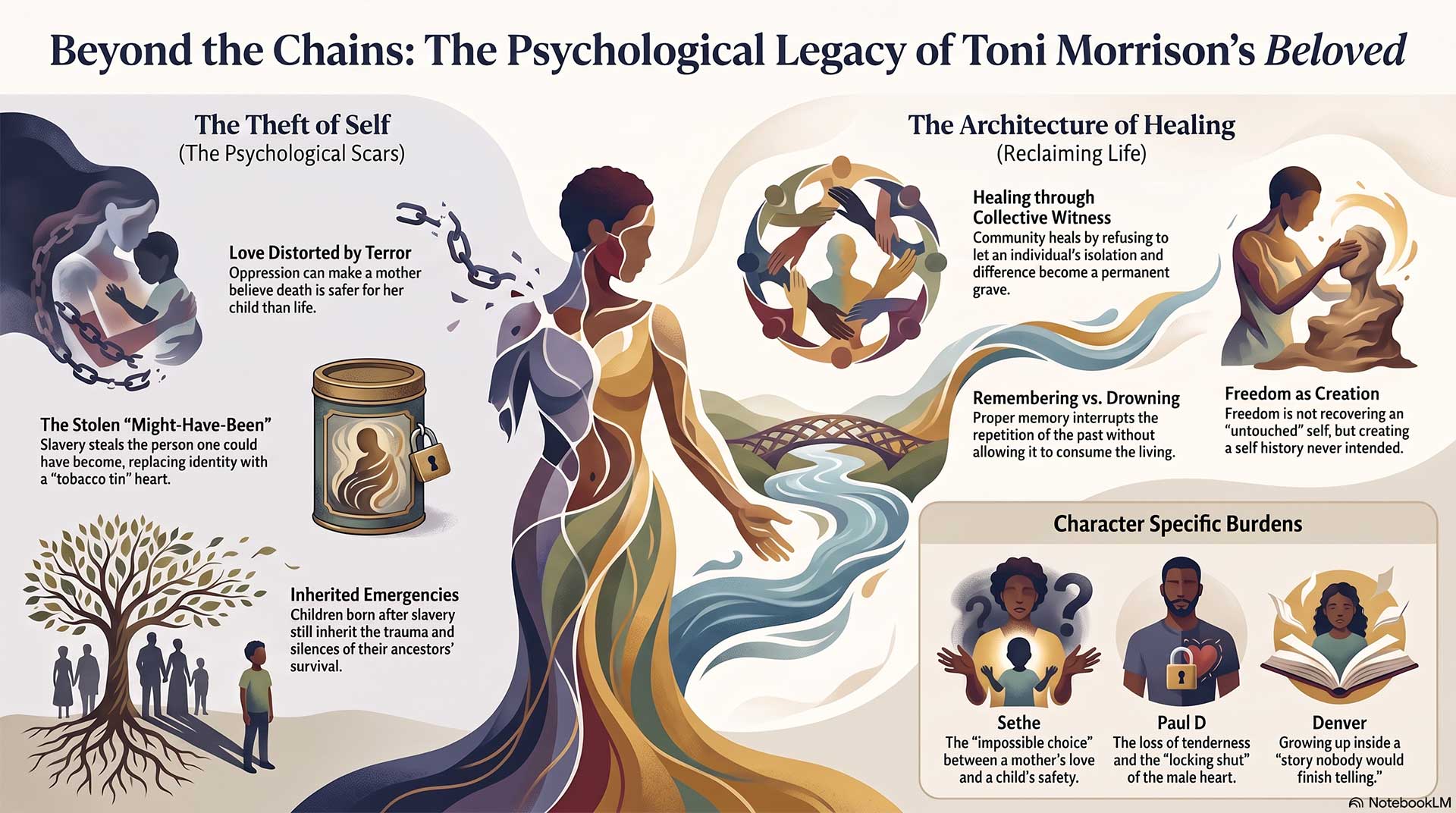
At the end of Beloved, very few questions receive simple answers.
Was Sethe right?
Was she wrong?
Is Beloved truly a ghost, a traumatized young woman, a collective memory of slavery, or all of these at once?
Toni Morrison intentionally leaves these questions unresolved because life itself rarely offers perfectly satisfying conclusions. Instead of asking readers to choose sides, she invites us to sit with unbearable complexity.
Throughout these conversations, one truth gradually became clear.
Slavery did not merely imprison bodies.
It distorted love.
It taught parents to fear for their children every moment.
It taught men to bury tenderness behind emotional armor.
It forced entire communities to carry guilt, silence, and shame across generations.
Freedom, therefore, cannot simply mean the absence of chains.
Freedom also means learning to trust again.
Learning to love without possession.
Learning to remember without becoming imprisoned by memory.
Learning to ask for help.
Learning to forgive without pretending evil never happened.
Perhaps the greatest lesson of Beloved is that trauma always tries to isolate people.
Healing always moves in the opposite direction.
It invites witnesses.
It invites community.
It invites honest conversation.
And finally, it invites hope—not because history becomes less painful, but because people become courageous enough to face it together.
Beloved herself reminds us that forgotten history never truly disappears.
It simply waits until someone is willing to listen.
Perhaps that is why Toni Morrison ends with the haunting phrase, "This is not a story to pass on."
Not because it should be forgotten.
But because it must never be repeated.
May we remember carefully.
May we judge humbly.
And may compassion always become stronger than fear.
Short Bios:
Sethe
An escaped enslaved woman whose desperate act to protect her children becomes the emotional center of the novel. Sethe embodies the impossible choices forced upon mothers living under slavery and the lifelong burden of memory, guilt, and love.
Denver
Sethe's surviving daughter, who grows up isolated inside 124. Her journey from fear to courage represents hope for the next generation and demonstrates how healing often begins by reaching beyond isolation.
Paul D
A fellow survivor from Sweet Home plantation. Hardened by years of brutality, Paul D struggles to recover his capacity for trust, vulnerability, and love. He reminds us that slavery wounded men emotionally as deeply as it scarred them physically.
Baby Suggs
Sethe's mother-in-law and the community's spiritual leader. Her sermons about loving one's own body become acts of quiet resistance against dehumanization. Though exhausted by suffering, she remains the novel's moral and spiritual compass.
Beloved
Perhaps the murdered child returned. Perhaps a ghost. Perhaps collective historical memory given human form. Beloved refuses easy interpretation, forcing readers to confront the enduring presence of trauma that refuses to remain buried.
Stamp Paid
A respected member of Cincinnati's Black community who helps escaped slaves find freedom. His own regrets about arriving too late illustrate both the failures and the redemptive possibilities of communal responsibility.
Toni Morrison
Nobel Prize-winning novelist whose extraordinary storytelling transformed American literature. Through lyrical prose, psychological depth, and profound historical insight, Morrison demonstrates that the deepest truths are often found not in simple answers, but in compassionate attention to the complexity of human experience.
Leave a Reply