
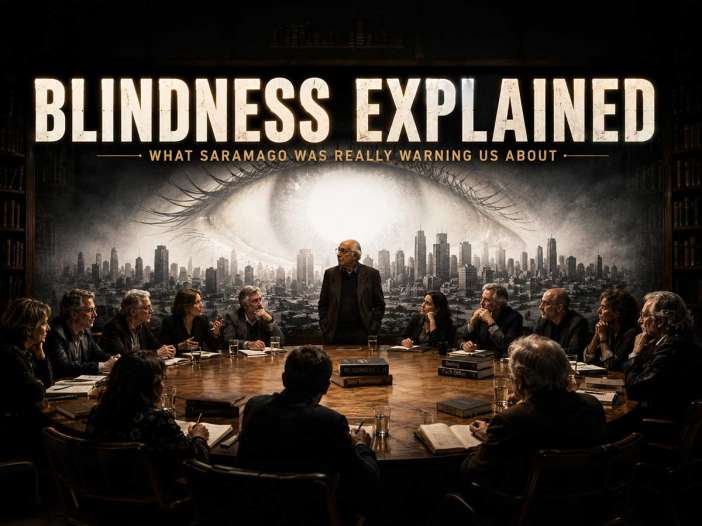
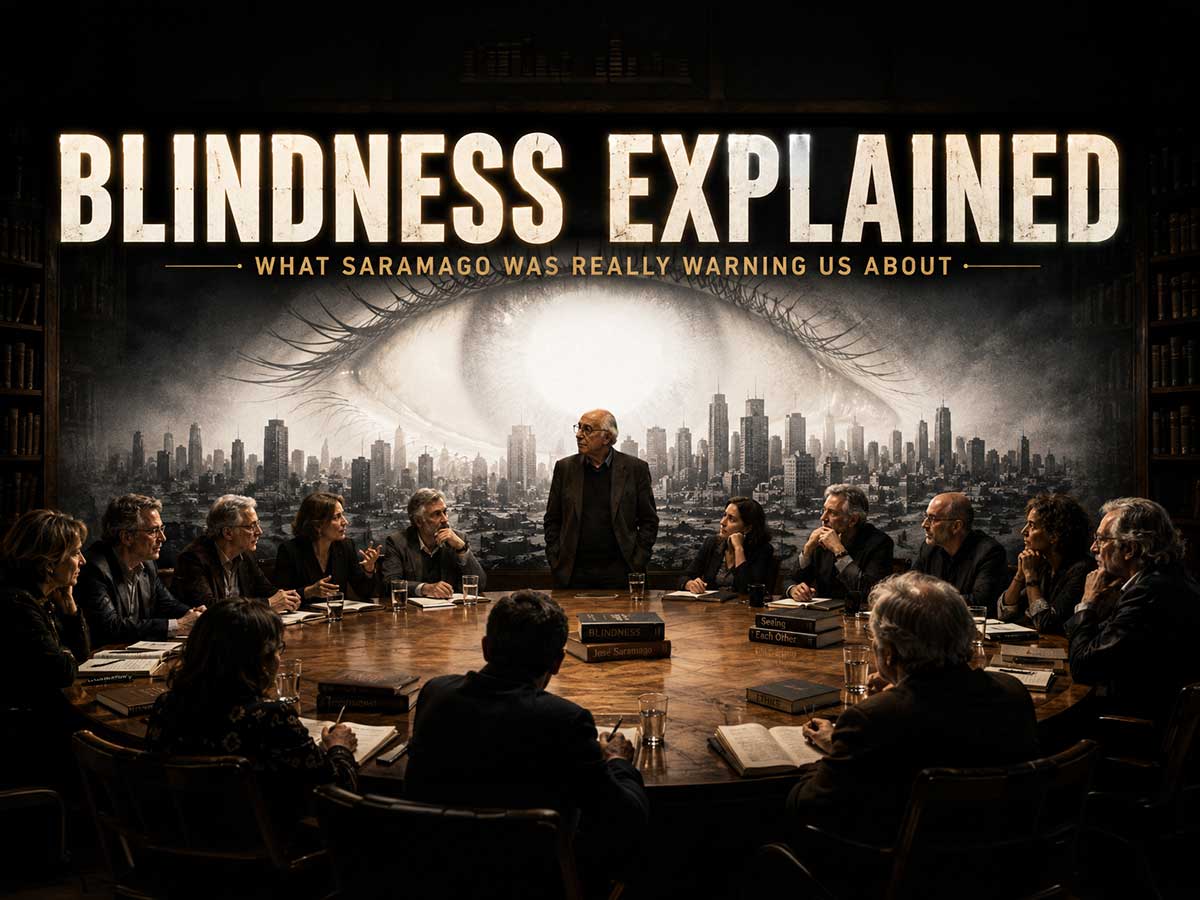
What if the epidemic in Blindness never mattered as much as the blindness we choose every day?
Many readers have asked me a question for nearly thirty years:
"What does Blindness mean?"
I have always found that question interesting.
Not because it is unimportant, but because it assumes a novel is a locked box waiting for its author to reveal the hidden key.
A novel is not a puzzle to be solved.
It is a mirror.
The image changes according to the person standing before it.
When I wrote Blindness, I was not trying to predict the future. I was not writing about one government, one epidemic, or one historical event.
I was writing about something far older and far more ordinary.
Our remarkable ability to look directly at another human being and still fail to see them.
We overlook loneliness.
We overlook humiliation.
We overlook injustice.
We overlook quiet acts of courage.
Then, when disaster finally arrives, we behave as though it appeared from nowhere.
It rarely does.
Long before civilization collapses, attention collapses.
Long before violence erupts, indifference settles in.
Long before people stop caring, they stop noticing.
Tonight, I have invited remarkable minds whose work has shaped literature, philosophy, psychology, ethics, and history.
I have not asked them to explain my novel.
No writer owns the final meaning of a book once it enters another person's life.
Instead, I have asked them to wrestle with the questions that continue to trouble readers across generations.
What is blindness?
What is responsibility?
Can civilization survive without compassion?
What happens to a person who sees suffering that everyone else chooses to ignore?
And perhaps the hardest question of all...
After we recognize our own blindness, what do we do next?
If, by the end of this conversation, you understand my novel a little less but understand yourself a little more, then our evening together will have been worthwhile.
(Note: This is an imaginary conversation, a creative exploration of an idea, and not a real speech or event.)
Act 1 — The Mystery
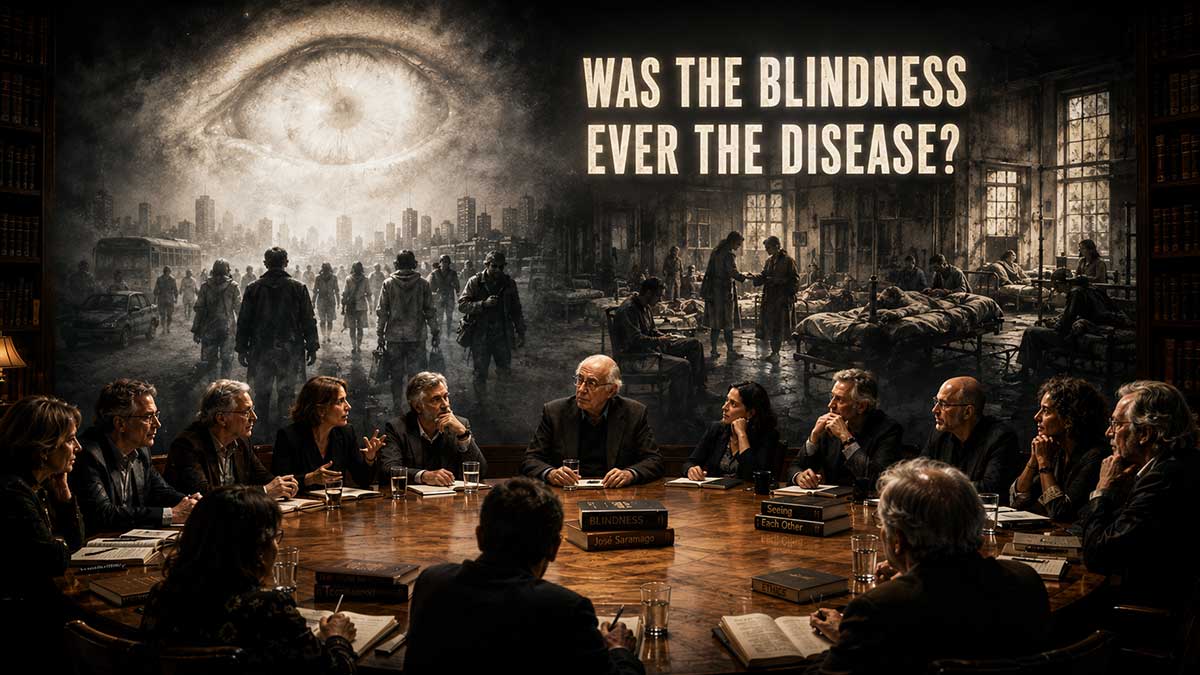
The room was almost bare.
A long wooden table. Ten chairs. No stage, no lectern, no audience visible beyond the dim edge of the lights.
At the center sat José Saramago, his hands folded loosely in front of him. He looked less like a Nobel laureate than a man waiting to see whether anyone in the room had read him carefully enough to be dangerous.
Around him sat Rhian Atkin, Giovanni Pontiero, Margaret Jull Costa, Harold Bloom, James Wood, Martha Nussbaum, Slavoj Žižek, Yuval Noah Harari, and Viktor Frankl.
On the wall behind them appeared a single sentence:
Was the blindness ever the disease?
No moderator spoke.
For several seconds, no one moved.
Then Žižek leaned back in his chair.
Slavoj Žižek: The obvious answer is no, which means the obvious answer is probably wrong.
A few people smiled.
Harold Bloom: That is a very Žižekian way to begin.
Žižek: And that is a very Bloomian way to avoid beginning.
Saramago lowered his eyes, amused.
Martha Nussbaum: Perhaps the better question is not whether blindness is the disease. Perhaps the question is why readers need the blindness to be a disease.
James Wood: That distinction matters. Readers tend to approach the novel as if it contains a code. They want white blindness to equal one thing—moral failure, political conformity, selfishness, capitalism, spiritual emptiness.
Rhian Atkin: Yet Saramago refuses to stabilize the metaphor. The blindness keeps changing its function. At one moment it exposes fear. At another, dependency. At another, cruelty. Then tenderness.
Margaret Jull Costa: Which creates a problem for the translator.
Žižek: Only for the translator?
Jull Costa: For the reader too. A fixed symbol is comforting. This novel never becomes comfortable.
Saramago looked at her.
José Saramago: Comfort is often the first form of blindness.
The room grew quiet.
Pontiero, who had carried Saramago’s sentences into English, glanced at him with the restrained expression of someone who had spent years listening for precisely this kind of sentence.
Giovanni Pontiero: The whiteness is significant. Most fictional blindness is darkness. Here, the characters see too much light and nothing at all.
Yuval Noah Harari: That is close to the modern condition. People are flooded with information, images, alerts, explanations. Yet more information does not mean greater perception.
Bloom: Let us be careful. The novel is not a prophecy about smartphones.
Harari: I did not say it was.
Bloom: You were preparing to.
Harari: I was preparing to say that societies can possess enormous quantities of information and remain incapable of seeing the human being in front of them.
Nussbaum: That is already present in the novel before the epidemic. The blindness does not create indifference from nothing. It reveals habits that were already there.
James Wood: Yes. The city before the outbreak is functional, but not truly attentive. People move, drive, work, purchase, obey. They see surfaces. The epidemic removes the illusion that this was enough.
Viktor Frankl: Then the catastrophe is not the beginning of blindness. It is the moment blindness becomes impossible to hide.
Saramago turned slightly toward him.
Saramago: That is nearer.
Žižek: Nearer to what?
Saramago: To the reason the blindness arrives without explanation.
Rhian Atkin: Readers often ask why the novel never gives us a medical cause.
Saramago: Yes.
Atkin: They expect contamination, mutation, punishment, war, perhaps divine judgment.
Saramago: They expect innocence.
No one answered at once.
Nussbaum: Explain that.
Saramago: A medical explanation protects the reader. It allows the reader to say, “This happened to them.” A virus. A defect. An accident. Something foreign entered the city.
He raised one hand slightly.
Saramago: But what if nothing entered?
The lights above the table seemed harsher.
Pontiero: Then the epidemic is recognition.
Saramago: Perhaps.
Bloom: You are being evasive.
Saramago: Writers are accused of evasion whenever readers demand a confession instead of a novel.
Bloom smiled despite himself.
Bloom: Fair.
Žižek: Let me push this further. The absence of cause makes the blindness political. No origin means no one can isolate the guilty party.
Nussbaum: Or ethical. No origin means no one can exempt themselves.
Žižek: Ethics without politics becomes a beautiful speech spoken over a locked gate.
Nussbaum: Politics without ethics becomes a theory that can explain suffering without ever feeling it.
Žižek paused.
Then he nodded.
Žižek: Good. Very good.
Harari leaned forward.
Harari: The government’s first response is revealing. It does not ask what the blind need. It asks how the sighted can be protected from them.
James Wood: The infected become a category before they remain people.
Atkin: Their identities are stripped in stages. First their sight. Then their freedom. Then their names.
Jull Costa: Yet Saramago does not give them names even before the state takes everything else.
Bloom: Which raises a difficult question. Does the novel universalize them, or reduce them?
Pontiero: I never felt they were reduced.
Bloom: You knew them through the sentences.
Pontiero: Precisely. A name can create the illusion that one has understood a person. “The doctor’s wife” sounds less individual, yet she becomes more morally distinct than many named characters in fiction.
Frankl: Identity does not disappear when a name disappears. Sometimes it becomes more visible through choice.
Nussbaum: Through action.
Frankl: Through responsibility.
Žižek: Through the toilet.
Several heads turned.
Žižek: What? Everyone wants to speak of responsibility in elevated language. The novel forces responsibility into filth, hunger, bodily need, fear. Morality does not occur in clean rooms.
Wood: That is one reason the book unsettles readers so deeply. It denies them the safe distance of allegory. The symbolism is dragged through dirt.
Saramago: Human dignity is always discussed by people who have recently bathed.
A low laugh moved around the table, then faded.
Harari: So the physical conditions matter. Hunger matters. Crowding matters. Fear matters. The novel is asking how much of civilized behavior depends on circumstances we rarely notice.
Nussbaum: Yet it does not excuse cruelty.
Harari: No.
Nussbaum: That matters. Conditions explain behavior. They do not erase moral choice.
Frankl: Suffering does not automatically make a person noble. It can expose courage. It can expose selfishness. It can do both in the same person.
Atkin: Which is what the novel keeps refusing: moral simplification.
Bloom: Except in the case of the doctor’s wife.
Wood: You think she is too morally clear?
Bloom: I think she is dangerously close to being the novel’s conscience made flesh.
Saramago’s expression changed.
Not anger. Interest.
Saramago: And what is dangerous about conscience?
Bloom: In fiction? Perfection.
Nussbaum: She is far from perfect.
Bloom: She sees. She serves. She suffers. She protects. She kills when necessary. She carries the moral weight of the book.
Žižek: Which may mean she is the most cursed person in it.
Jull Costa: Yes.
Everyone turned toward her.
Jull Costa: Readers often treat her sight as an advantage. I never experienced it that way. She cannot look away. Every degradation the others are spared from seeing, she must witness.
Pontiero: Sight becomes obligation.
Frankl: And isolation.
Harari: She is the only person who knows the full extent of the collapse.
Atkin: She must decide how much truth the others can bear.
Nussbaum: She must decide whether love permits concealment.
Wood: She must decide when care becomes control.
Žižek: There. That is the political question. The sighted person among the blind can become a saint, a ruler, a manipulator, or all three.
Bloom: Yet she does not seize authority.
Žižek: Not formally.
Nussbaum: You think care itself becomes authority?
Žižek: It can. The one who knows, guides. The one who guides, chooses. The one who chooses begins to rule.
Frankl: Then perhaps the question is whether she rules for herself.
Žižek: That is too easy. Many forms of domination begin with the claim that they are for others.
Nussbaum watched him carefully.
Nussbaum: And many acts of care are accused of domination by people who do not wish to admit their dependence.
This time Žižek did not answer immediately.
Saramago looked from one to the other.
Saramago: You are all speaking as though sight were knowledge.
Harari: Is it not?
Saramago: No.
Atkin: Then what does the doctor’s wife possess?
Saramago: Witness.
The word seemed to remain in the air.
Frankl: Witness is heavier than knowledge.
Saramago: Yes.
Wood: Since knowledge can remain private.
Saramago: And witness creates a debt.
Nussbaum: A debt to whom?
Saramago looked at the empty darkness beyond the table.
Saramago: To the person whose suffering you have seen.
No one moved.
The sentence on the wall vanished.
A new one appeared:
If seeing creates responsibility, why do people spend so much of their lives trying not to see?
Bloom read it twice.
Harari folded his hands.
Nussbaum looked toward Saramago.
Žižek shifted forward in his chair.
The conversation had not yet reached the epidemic.
It had reached the reader.
Act 2 — The Human Experiment
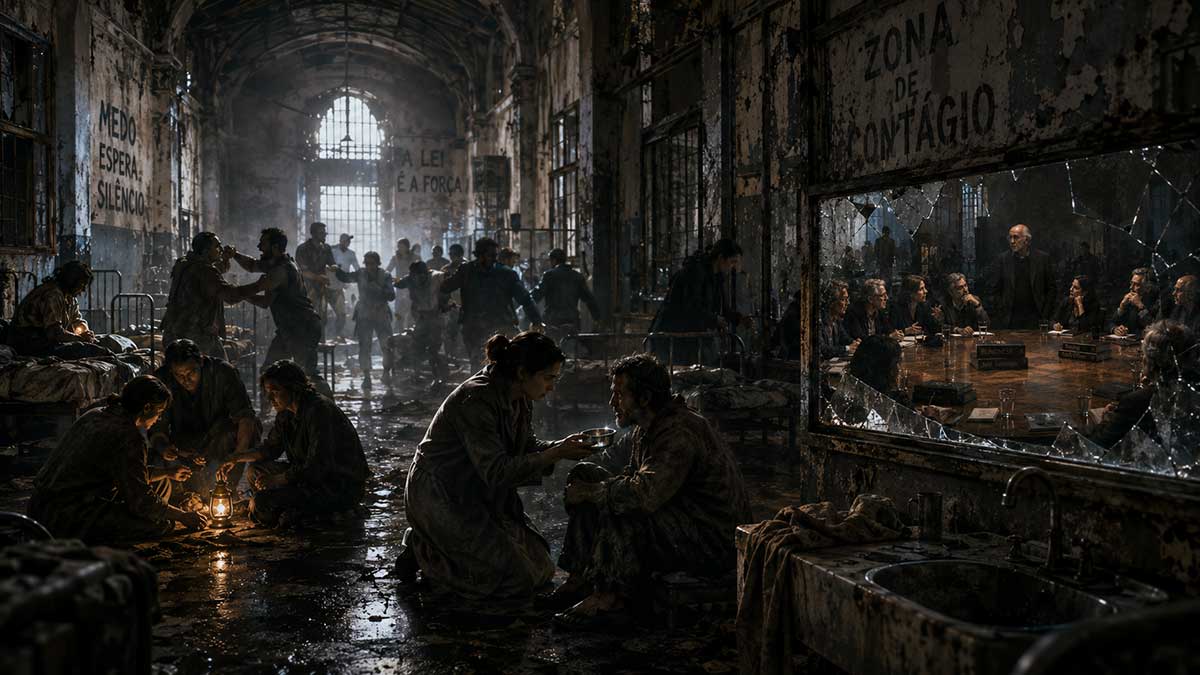
The new question remained suspended above the table.
If seeing creates responsibility, why do people spend so much of their lives trying not to see?
No one rushed to answer.
For the first time that evening, the discussion stopped being about literature.
It became about us.
Harold Bloom: I think we flatter ourselves.
Every pair of eyes turned toward him.
Bloom: Readers often leave Blindness believing they would have been the doctor's wife.
He paused.
Bloom: History suggests otherwise.
Silence.
Bloom: Most people are followers long before they become villains.
Martha Nussbaum: That is true, but incomplete.
Bloom: Explain.
Nussbaum: People do not wake up wanting to become indifferent.
Indifference grows through habit.
One ignored stranger.
One excuse.
One fear.
One compromise.
Eventually compassion becomes something reserved for family and friends instead of humanity.
Yuval Noah Harari: Civilization depends on invisible agreements.
Trust.
Shared stories.
Money.
Law.
Queues.
Hospitals.
Governments.
When those agreements disappear, people often assume morality disappears with them.
Žižek: Which is exactly why morality built only on civilization is fake.
Harari smiled.
Harari: You never miss an opportunity.
Žižek: Why would I?
Laughter softened the room.
Žižek: Look carefully at the quarantine.
The soldiers are terrified.
The blind are terrified.
The politicians are terrified.
Everyone believes they are protecting society.
Yet everyone becomes more dangerous precisely because they believe they are doing the right thing.
That is what frightens me.
Not evil.
Good intentions armed with fear.
Frankl folded his hands.
He had listened for almost ten minutes without interruption.
When he spoke, the room instinctively leaned closer.
Viktor Frankl: Fear never answers the question:
"Who will I become?"
Fear asks only:
"What might happen to me?"
That difference decides civilizations.
No one interrupted him.
James Wood: Viktor...
May I challenge that?
Frankl nodded.
Wood: Doesn't starvation change morality?
Doesn't humiliation change morality?
If I haven't eaten for five days...
If my children are dying...
Can we honestly speak about freedom of choice in the same way?
Frankl answered gently.
Frankl: No.
And yes.
I would never judge a starving man from a full stomach.
But I witnessed something history struggles to explain.
Some prisoners shared bread.
Others stole it.
The camp explained neither.
The person still mattered.
Saramago slowly nodded.
Not agreement.
Recognition.
Rhian Atkin: Which is exactly what happens inside the asylum.
Some characters organize.
Some exploit.
Some despair.
Some nurture.
The building removes comfort.
It does not manufacture character.
Harari: Yet environment still matters enormously.
One of the great lessons of modern psychology is that situations influence behavior far more than we like to admit.
Nussbaum: Influence.
Not determine.
Harari: Agreed.
Žižek: I think both of you remain too optimistic.
Everyone laughed.
Žižek: Seriously.
You still believe there is a stable "self."
I am less convinced.
Perhaps civilization is the mask.
Perhaps crisis is the face.
Bloom leaned forward immediately.
Bloom: That is fashionable nonsense.
Žižek grinned.
Žižek: Ah.
Now we're alive.
Bloom: Shakespeare knew better.
Under pressure, Macbeth becomes Macbeth.
King Lear becomes more Lear.
The crisis magnifies character.
It does not invent it.
Žižek: Unless character itself is invented by circumstances.
Bloom: Then literature has taught us nothing.
Before the exchange hardened into debate, Saramago quietly asked a question.
Saramago: Harold...
When does Macbeth first become dangerous?
Bloom answered almost immediately.
Bloom: Long before he kills.
Saramago looked at Žižek.
Saramago: Slavoj...
When does society first become dangerous?
Žižek thought longer.
Much longer.
Finally—
Žižek: When ordinary people convince themselves that responsibility belongs to someone else.
Saramago smiled faintly.
Saramago: Good.
Those answers are closer than either of you believes.
Margaret Jull Costa had been making notes.
She looked up.
Jull Costa: There is something readers often overlook.
Everyone speaks about violence.
Very few speak about embarrassment.
The table grew curious.
Jull Costa: Blindness strips away dignity before it threatens life.
People cannot find the toilet.
They cannot eat neatly.
They cannot dress themselves.
They cannot hide tears.
They become dependent.
That humiliation slowly destroys identity.
Nussbaum: Dependency frightens modern people almost more than death.
Harari: Because our culture worships autonomy.
Frankl: Yet love begins with dependence.
The room became quiet again.
Frankl: Every infant teaches that.
Every elderly parent teaches that.
Every true friendship teaches that.
Only pride says,
"I must never need another person."
Saramago looked almost grateful.
James Wood: Perhaps that explains something.
Readers often ask why the novel is so physically unpleasant.
The smell.
The dirt.
The bodily functions.
They assume Saramago wanted to shock them.
Saramago: No.
The answer came immediately.
Saramago: I wanted to remove every illusion that humanity lives mainly inside ideas.
We live inside bodies.
Hungry bodies.
Aging bodies.
Fragile bodies.
Bodies that embarrass us.
Bodies that eventually betray us.
Compassion begins there.
Not above it.
Even Žižek remained silent.
Harari finally spoke.
Harari: During the pandemic of the early twenty-first century...
Millions argued about data.
Statistics.
Masks.
Governments.
Very few people asked a simpler question.
Who is lonely?
Who is frightened?
Who has no one bringing food?
Those questions disappear first.
Nussbaum: Because suffering that cannot be measured is easily ignored.
Bloom: Literature measures it.
Everyone looked at Bloom.
He shrugged.
Bloom: That is why novels survive longer than headlines.
For the first time that evening, Saramago openly smiled.
Saramago: Harold...
That may be the nicest thing you have ever said about a novelist.
The room burst into laughter.
Even Bloom laughed.
The laughter faded naturally.
No one wanted to break what had formed.
The discussion no longer felt like experts defending theories.
It felt like old friends discovering that the same novel had changed each of them in different ways.
Then Harari looked toward Saramago.
His voice was softer than before.
Harari: José...
May I ask something I have wondered for years?
Saramago nodded.
Harari: Why did you make the doctor's wife witness so much suffering?
Why give one person the unbearable privilege of seeing everything?
The smile disappeared from Saramago's face.
He looked down at his folded hands.
When he finally answered, it was almost a whisper.
José Saramago: Because every generation has someone who sees...
...and spends the rest of their life wishing they had not.
No one wrote anything down.
No one wanted to disturb the silence.
The words settled over the room like dust.
On the wall, the next question slowly appeared.
Is the doctor's wife the heroine of Blindness... or its greatest tragedy?
Act 3 — The Moral Shock
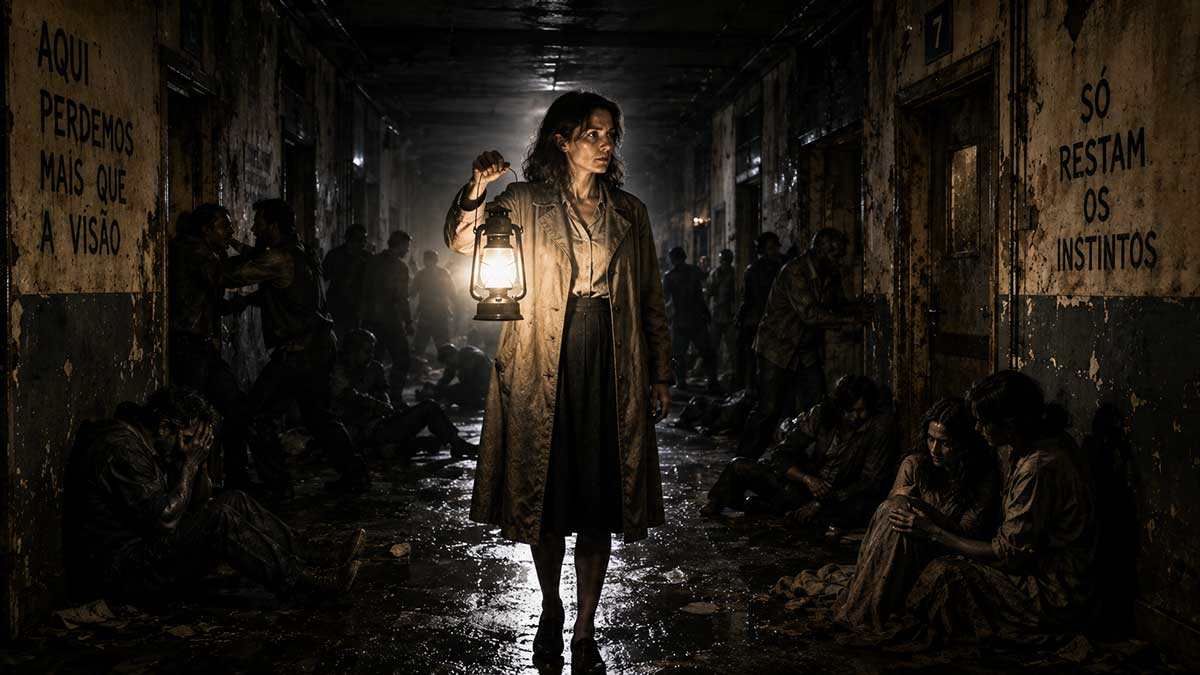
The question on the wall seemed less like an invitation than an accusation.
Is the doctor’s wife the heroine of Blindness… or its greatest tragedy?
No one spoke at first.
The room had grown accustomed to silence, yet this silence felt different. It carried the pressure of a verdict.
Martha Nussbaum broke it.
Martha Nussbaum: She is both.
Harold Bloom: That answer is elegant enough to be suspicious.
Nussbaum: Then let me make it less elegant.
She turned slightly toward Saramago.
Nussbaum: She is heroic because she continues to care when care becomes unbearable. She is tragic because the novel gives her no moral innocence. She must see, judge, conceal, manipulate, and finally kill.
James Wood: The killing changes everything.
Rhian Atkin: It should.
Wood: Yet many readers accept it almost immediately.
Žižek: Naturally. The tyrant has crossed every boundary. The reader wants him dead long before she acts.
Bloom: Which makes the scene dangerous.
Harari: Dangerous in what sense?
Bloom: The novel trains the reader to desire violence, then lets its moral center perform it.
Žižek: Yes. This is the moment when the reader discovers that compassion has limits.
Nussbaum: Or that compassion without resistance can become collaboration.
Žižek looked at her with interest.
Žižek: That is stronger.
Nussbaum: The women are being treated as objects of exchange. Food has become a weapon. Their bodies have become currency. Refusing violence at that point may preserve one’s purity, but it does not protect the vulnerable.
Frankl: Yet once a person kills, the act cannot remain morally clean.
Nussbaum: I agree.
Frankl: Then heroism here does not mean remaining untouched. It means accepting a wound one cannot later remove.
Saramago raised his eyes.
Saramago: Yes.
The single word changed the temperature of the room.
Jull Costa: That is how I read her. She does not leave the act behind. It enters her.
Pontiero: She kills to end cruelty, but she does not become free of cruelty.
Wood: The novel refuses the fantasy that righteous violence leaves the righteous person unchanged.
Bloom: A very old tragic idea.
Žižek: And a political one. Every revolution announces that violence will end violence. Then it discovers that violence has learned how to govern.
Nussbaum: Yet this is not a revolution.
Žižek: No. It is more intimate. That makes it worse.
Harari looked toward the wall.
Harari: Perhaps the real question is whether morality survives when every available choice causes harm.
Frankl: Morality begins there.
Harari: Begins?
Frankl: Yes.
He spoke without force, yet no one interrupted.
Frankl: When the right choice is easy, we learn very little about ourselves. Moral life becomes visible when every choice carries guilt.
Atkin: Then the doctor’s wife is not pure.
Frankl: No human being is.
Atkin: Yet readers often need her to be.
Wood: They need someone to rescue the novel from itself.
Bloom: Or rescue them from the novel.
Saramago looked at Bloom.
Saramago: Readers often ask which character represents hope.
Bloom: And you dislike the question.
Saramago: I distrust it.
Nussbaum: Why?
Saramago: Hope can become another way of refusing to look.
No one reacted immediately.
It was the first sentence of the evening that seemed to unsettle everyone equally.
Harari: You think hope can become blindness?
Saramago: Of course.
Žižek: Finally.
Saramago ignored him.
Saramago: People call a story hopeful when it allows them to leave unchanged.
He looked from face to face.
Saramago: They say, “Humanity survived.”
Then they return to the same life that made the catastrophe possible.
The room went still.
Wood: That may be the cruelest thing you have said tonight.
Saramago: Cruelty is sometimes only truth without decoration.
Nussbaum: Yet the novel does contain tenderness.
Saramago: Yes.
Nussbaum: Shared food. Washing bodies. Guiding strangers. The dog licking tears. The women caring for one another.
Saramago: Tenderness is not the same as reassurance.
Frankl: No. Tenderness asks something from us.
Saramago: Exactly.
Žižek leaned over the table.
Žižek: Let us speak plainly. The scandal is not that civilization collapses. The scandal is that people become accustomed to its collapse.
Atkin: The filth becomes normal.
Jull Costa: The hunger becomes normal.
Pontiero: The screams become normal.
Harari: The categories become normal.
Nussbaum: The suffering of others becomes background.
Bloom: Which is how every moral disaster survives.
Saramago watched them, saying nothing.
The others noticed.
Wood: You disagree?
Saramago: No.
Wood: Then why that expression?
Saramago leaned back.
Saramago: You are speaking of disaster as though it announces itself.
No one answered.
Saramago: It rarely does.
He pointed toward the empty darkness surrounding the table.
Saramago: It enters through repetition.
The first insult.
The first person excluded.
The first lie everyone recognizes but no one challenges.
The first humiliation accepted as necessary.
The first cruelty renamed as order.
His voice remained calm.
Saramago: By the time people call it disaster, they have already learned to live inside it.
The sentence landed harder than any raised voice could have.
Harari looked down.
Nussbaum closed her notebook.
Žižek stopped moving entirely.
Frankl studied Saramago with an expression close to grief.
Frankl: Then the greatest danger is adaptation.
Saramago: Adaptation without conscience.
Harari: Humans are exceptionally good at normalizing conditions they once believed intolerable.
Nussbaum: Which can be a gift when people endure suffering.
Harari: And a curse when they accommodate injustice.
Bloom: Literature interrupts accommodation.
Wood: Sometimes.
Bloom: You sound doubtful.
Wood: A person can read Blindness, admire it, discuss it intelligently, and remain unchanged.
Žižek: Precisely. Culture can become a vaccination against action. One feels the proper emotions, praises the proper moral lesson, then goes home satisfied.
Nussbaum: That is not the fault of literature.
Žižek: No. It is one of the uses people make of literature.
Atkin: Then what would count as a worthy response to the novel?
The question seemed directed at Saramago.
He did not answer immediately.
Saramago: Look at the person you have trained yourself not to see.
No one wrote the sentence down.
Saramago: Begin there.
The room remained silent.
Then Margaret Jull Costa spoke.
Jull Costa: That sounds almost too simple.
Saramago: Most moral failures depend on our belief that goodness must be complicated.
Frankl: A piece of bread is simple.
Nussbaum: Sitting beside someone is simple.
Harari: Refusing a dehumanizing word is simple.
Wood: Naming what others prefer to leave unnamed is simple.
Bloom: Simple does not mean easy.
Saramago: No.
He looked again at the question on the wall.
Saramago: The doctor’s wife is tragic not because she sees suffering.
She is tragic because she can never again pretend she did not see it.
The words changed the room.
Until that moment, sight had sounded like a burden placed upon one fictional woman.
Now everyone at the table understood the accusation.
The novel had made witnesses of them too.
The wall went dark.
A final sentence appeared:
Once a person has seen clearly, is returning to ordinary life still morally possible?
Act 4 should now become more personal, with the guests confronting what they themselves have seen and failed to act upon.
Act 4 — Personal Reflection
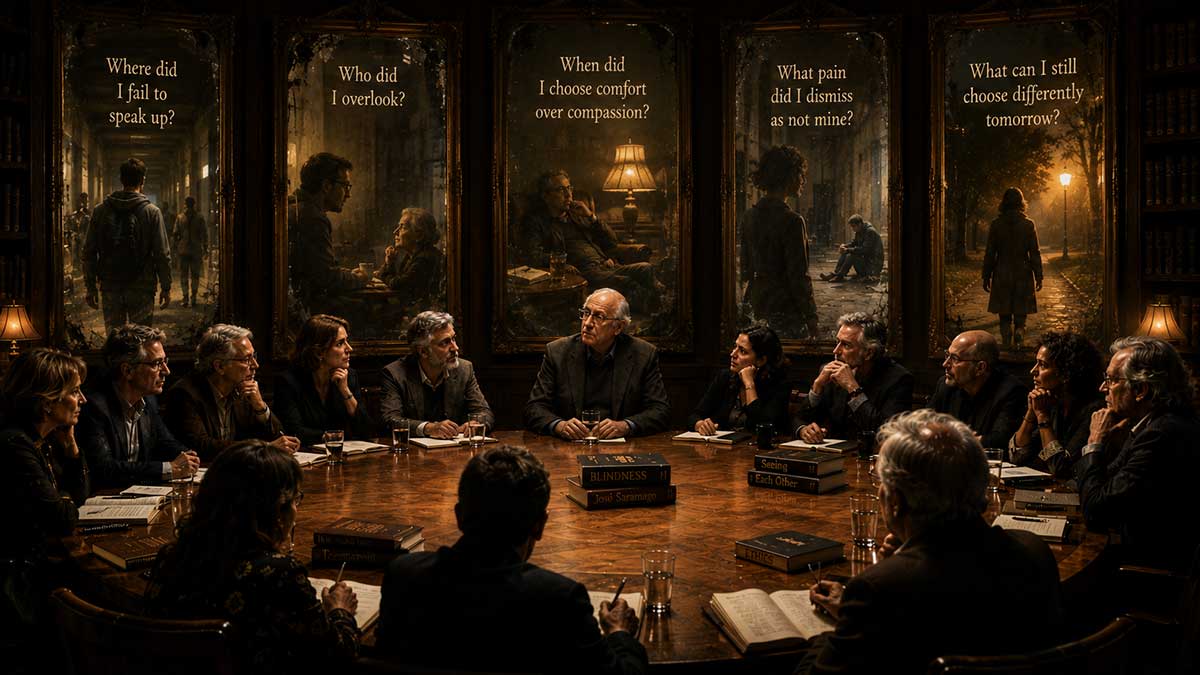
The final sentence remained on the wall.
Once a person has seen clearly, is returning to ordinary life still morally possible?
No one answered.
This time, the silence did not feel intellectual.
It felt personal.
Each person at the table seemed to understand that the question had moved beyond Saramago’s novel. It was no longer asking what the doctor’s wife should do.
It was asking what they had done.
James Wood was the first to speak.
James Wood: Critics are trained to notice.
Patterns.
Contradictions.
False notes.
Hidden structures.
He glanced at Saramago.
Wood: We call that seeing.
But sometimes criticism becomes a way of standing near suffering without entering it.
Harold Bloom: You think interpretation can become avoidance.
Wood: Yes.
A critic can describe grief beautifully and remain untouched by the grieving person.
Bloom leaned back, studying him.
Bloom: That accusation applies to all of us.
Wood: I know.
Bloom: Including the novelist.
Saramago did not resist.
Saramago: Yes.
Bloom: You can write about humanity from a room far from hunger.
Saramago: Yes.
Bloom: You can condemn blindness and still fail to see the person beside you.
Saramago: Every day.
The admission came without defense.
That seemed to disturb Bloom more than disagreement would have.
Bloom: Then what gives a writer the right to judge?
Saramago: Nothing.
Bloom: Nothing?
Saramago: A writer has no special right to judge.
Only the obligation to notice.
Nussbaum: And to speak?
Saramago: Sometimes.
Žižek: That is too modest.
Saramago: Modesty is useful when intellectuals begin confusing speech with sacrifice.
Žižek smiled, then looked down.
Žižek: Fair.
The answer landed more deeply than his smile suggested.
Martha Nussbaum closed the notebook in front of her.
She had written almost nothing during the past several minutes.
Nussbaum: I have spent much of my life arguing that literature can enlarge compassion.
Harari: Do you doubt that now?
Nussbaum: No.
She paused.
Nussbaum: I doubt the ease with which we say it.
A reader may weep for a fictional stranger and ignore a living one.
A classroom may discuss dignity in the morning and exclude someone by afternoon.
A nation may praise compassion and still build systems that humiliate the weak.
Frankl: Feeling is not yet responsibility.
Nussbaum: No.
Feeling can be the beginning.
It can also become self-congratulation.
Wood: “I was moved, so I must be good.”
Nussbaum: Exactly.
Saramago watched her carefully.
Saramago: What changed your mind?
Nussbaum: My mind did not change.
My confidence did.
She looked at the darkened edge of the room.
Nussbaum: I have seen brilliant people discuss suffering with remarkable sensitivity, then behave cruelly in small private moments.
That frightened me more than open ignorance.
Atkin: Why?
Nussbaum: Because knowledge had not saved them.
Rhian Atkin lowered her eyes.
Atkin: Scholars often believe that naming a pattern frees us from it.
Jull Costa: It rarely does.
Atkin: We identify prejudice, hierarchy, exclusion, violence.
Then we reproduce smaller versions of them in departments, friendships, institutions.
Pontiero: Perhaps language gives us another hiding place.
Jull Costa: Yes.
A sophisticated vocabulary can disguise a very ordinary failure of kindness.
Žižek tapped one finger against the table.
Žižek: This is uncomfortable.
Bloom: Then we may finally be discussing something worthwhile.
A small laugh passed through the group.
Žižek did not laugh.
Žižek: I have spent years explaining ideology.
How people participate in systems they claim to oppose.
How they know and still continue.
He stopped tapping.
Žižek: Yet explanation itself can become another form of enjoyment.
You expose the machine.
Everyone applauds.
The machine continues.
Harari: Then why keep explaining it?
Žižek: Because silence would be worse.
Saramago: Is that enough?
Žižek looked at him.
For once, there was no quick reply.
Žižek: No.
The word came quietly.
Žižek: It is not enough.
But I do not know what enough looks like.
Frankl turned toward him.
Frankl: Perhaps enough is the wrong measure.
Žižek: What would you use?
Frankl: The next responsibility.
Not the final solution.
Not the perfect act.
The next person.
The next choice.
The next refusal to become what the situation invites you to become.
Žižek listened without interruption.
Frankl: People often fail to act because they cannot repair everything.
They confuse smallness with meaninglessness.
Nussbaum: That may be one of the most common forms of moral surrender.
Harari: The scale of modern suffering makes people feel helpless.
War.
Poverty.
Displacement.
Loneliness.
Ecological loss.
Information arrives faster than anyone can emotionally receive it.
Wood: So people protect themselves by becoming numb.
Harari: Yes.
Saramago: And what do they call this numbness?
Harari thought.
Harari: Realism.
Saramago nodded.
Saramago: Often.
Bloom turned toward Harari.
Bloom: You speak frequently about humanity as a species.
Does that distance ever trouble you?
Harari: It does.
Bloom: When you speak of millions, can you still see one person?
Harari did not answer at once.
Harari: Not always.
That is one of the dangers of large numbers.
A million displaced people becomes a trend.
One displaced child becomes a moral demand.
Nussbaum: Statistics help us recognize scale.
Stories prevent scale from erasing the person.
Bloom: There. That is literature’s defense.
Wood: A partial defense.
Bloom: All honest defenses are partial.
Across the table, Giovanni Pontiero had remained silent.
Saramago noticed.
Saramago: Giovanni?
Pontiero looked at him with the expression of a man being asked to revisit a private room.
Pontiero: Translation taught me that seeing another person is impossible.
No one expected that answer.
Jull Costa: Impossible?
Pontiero: Completely, yes.
You can approach.
You can listen.
You can carry their words.
But some part remains beyond you.
A translator lives inside that failure.
Atkin: Yet translation is an act of faith in connection.
Pontiero: Faith, yes.
Certainty, no.
He turned to Saramago.
Pontiero: There were sentences of yours I could understand grammatically and still not fully know.
Saramago: Nor did I.
Pontiero smiled.
Pontiero: That helped.
Jull Costa: Translators are often praised for making a writer accessible.
But sometimes our duty is to preserve what resists access.
Wood: To let the reader remain unsettled.
Jull Costa: To let the other person remain other.
Nussbaum: That is a form of respect.
Pontiero: Perhaps seeing clearly does not mean possessing another person’s truth.
Perhaps it means refusing to reduce it.
Saramago looked moved.
He hid it poorly.
Saramago: I wish more governments understood translation.
The table laughed softly.
The laughter did not break the mood.
It made the room feel more human.
Frankl looked at the question on the wall again.
Frankl: Returning to ordinary life is always possible.
The others turned toward him.
Frankl: That is the danger.
Atkin: What do you mean?
Frankl: Human beings can survive terrible recognition and still return to habit.
They can witness suffering, make promises, feel transformed, then gradually become the person they were before.
Nussbaum: Then transformation must be practiced.
Frankl: Daily.
Harari: Memory fades.
Frankl: Yes.
This is why remembrance cannot remain a feeling.
It must enter conduct.
Wood: What did that look like for you?
Frankl’s face changed.
The room sensed that the question had entered territory where theory could not protect anyone.
Frankl: I learned that survival does not make a person wise.
It does not make a person good.
It gives one more time.
What we do with that time remains undecided.
He looked down at his hands.
Frankl: People expected answers from survivors.
Often we had only wounds.
No one spoke.
Frankl: The danger comes when others turn those wounds into lessons too quickly.
Saramago nodded slowly.
Saramago: Meaning can become another demand placed upon the suffering.
Frankl: Yes.
Nussbaum: “Tell us what your pain taught you.”
Frankl: Sometimes pain teaches nothing.
Sometimes it breaks.
Sometimes meaning comes later.
Sometimes it never comes in a form others can recognize.
The room seemed smaller now.
Less like a gathering of celebrated minds.
More like a table of people who had each failed someone, misunderstood someone, or returned too easily to ordinary life.
Harold Bloom removed his glasses.
Bloom: I have spent my life among great books.
He cleaned one lens slowly.
Bloom: They did not make me a great man.
No one tried to reassure him.
He seemed grateful for that.
Bloom: They gave me language for greatness.
That is not the same thing.
Wood: Did they make you better?
Bloom replaced his glasses.
Bloom: At times.
At other times, they made me more skilled at defending myself.
Saramago leaned forward.
Saramago: That may be the most honest thing said tonight.
Bloom looked at him.
Bloom: I dislike how pleased you seem.
Saramago: Honesty is rare. One should enjoy it.
Another quiet laugh.
Then Margaret Jull Costa looked toward the wall.
Jull Costa: Perhaps ordinary life is not the enemy.
Harari: What is?
Jull Costa: Unexamined return.
Going back without carrying anything with us.
Atkin: Then the doctor’s wife must return.
She must eat, sleep, wash, care for people.
Nussbaum: But she cannot return innocently.
Wood: Nor can the reader.
Saramago’s eyes moved around the table.
Saramago: Yet readers do.
Wood: Most do.
Saramago: Then perhaps the novel failed.
No one accepted that.
Bloom: No.
The force in his voice surprised everyone.
Bloom: A book cannot live the reader’s life for him.
It can disturb.
It can accuse.
It can reveal.
After that, responsibility changes hands.
Saramago studied him.
Saramago: You have defended literature twice tonight.
Bloom: Do not make too much of it.
Žižek: We are witnessing character development.
Bloom gave him a tired look.
The room laughed, this time with relief.
Then the wall went dark.
A new image appeared.
Not a sentence.
A city street.
People walking past one another.
Faces lit by phones.
A man sleeping near a doorway.
A woman crying inside a parked car.
An elderly person eating alone behind a restaurant window.
A child staring out from the back seat of a bus.
No one at the table spoke.
Then, beneath the image, the final question appeared:
If Saramago wrote Blindness in 2026, what would we refuse to see?
Act 5 can now bring the novel into 2026 through loneliness, technology, war, inequality, public cruelty, and the habit of seeing suffering without responding.
Act 5 — The Blindness of 2026
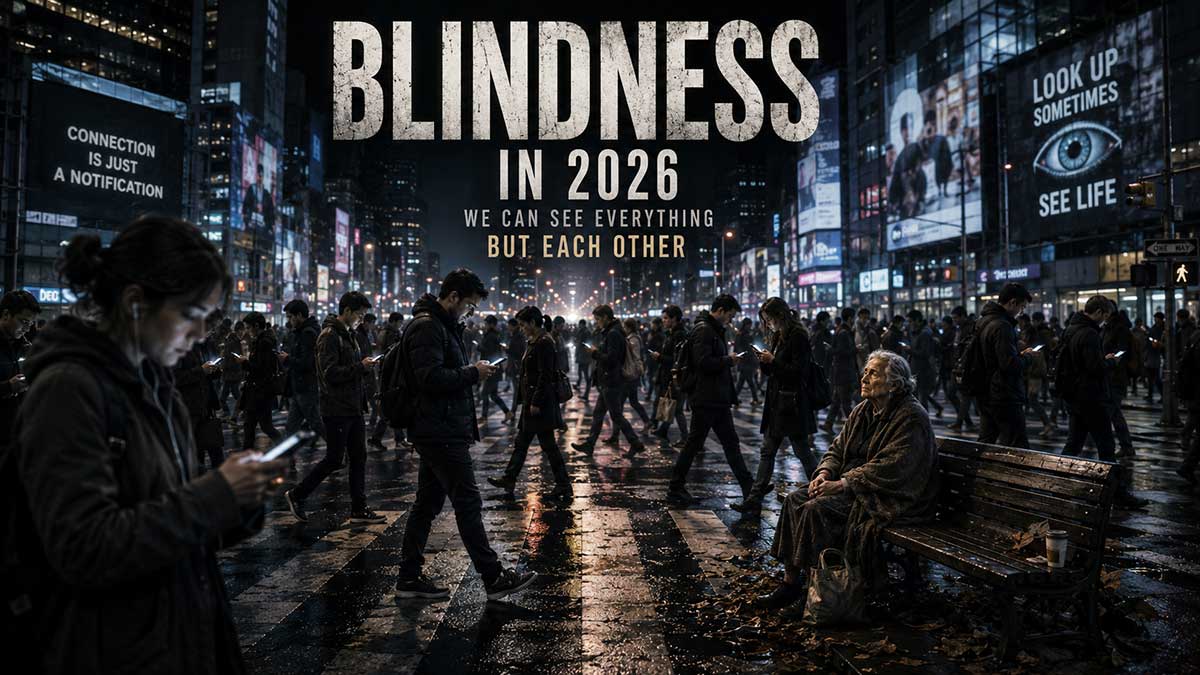
The city street remained on the wall.
People moved through it without touching.
A man slept near a doorway.
A woman stared at her phone under the cold light of a bus shelter.
An elderly couple sat across from one another in a restaurant, each looking down at a separate screen.
Above them, the question waited:
If Saramago wrote Blindness in 2026, what would we refuse to see?
Yuval Noah Harari spoke first.
Yuval Noah Harari: The epidemic would not need to remove sight.
It would only need to control attention.
Harold Bloom: That sounds like a historian attempting to become a novelist.
Harari: No. It sounds like a society where millions of people can see the same suffering at once and forget it by the next morning.
James Wood: The images continue.
The response weakens.
Martha Nussbaum: Repetition can destroy attention.
Harari: Yes.
A photograph that once would have shocked a nation becomes one more item between an advertisement and a joke.
Slavoj Žižek: This is not simple indifference.
People care.
Then they scroll.
They feel grief.
Then irritation.
Then amusement.
Then hunger.
The machine does not ask them to become cruel.
It asks them to become emotionally fragmented.
Rhian Atkin: So the blindness is not an absence of feeling.
It is feeling without continuity.
Žižek: Exactly.
You feel everything for twelve seconds and commit to nothing.
Saramago looked at the street on the wall.
José Saramago: A person who sees suffering and immediately reaches for the next image has not looked.
Nussbaum: Attention requires duration.
Saramago: And courage.
Wood: Why courage?
Saramago: Because to look long enough is to risk obligation.
The table fell quiet.
On the wall, the street changed.
A family stood beside an eviction notice.
Boxes had been stacked near the door.
A young girl held a stuffed animal under one arm.
Nussbaum: Poverty would remain central.
Harari: Yet it would appear differently now.
People may work full time and still be unable to afford housing.
Families may appear stable until one medical bill, one rent increase, or one lost job destroys the structure.
Bloom: Steinbeck would recognize that.
Saramago: So would Dickens.
Žižek: So would every landlord.
A few people smiled, but the image remained too painful for laughter.
Nussbaum: Economic suffering is often hidden by shame.
The person who cannot pay rent believes the failure is private.
The system disappears.
The individual carries the humiliation alone.
Frankl: Shame isolates suffering before poverty finishes the work.
Atkin: That resembles the asylum.
People lose dignity before they lose life.
Jull Costa: They hide need until concealment becomes impossible.
Pontiero: Then society notices them only at the moment of collapse.
Saramago’s face hardened.
Saramago: People ask why someone did not seek help sooner.
They rarely ask why asking for help had been made so humiliating.
The street vanished.
A hospital corridor appeared.
A patient lay on a gurney beneath fluorescent light.
A nurse sat alone against a wall, head lowered, hands motionless.
Wood: Illness.
Nussbaum: Caregiver exhaustion.
Harari: Health systems turning human beings into numbers.
Žižek: And workers praised as heroes so institutions can avoid treating them as people.
Bloom: That is well said.
Žižek looked almost offended.
Žižek: Please do not make a habit of agreeing with me.
Bloom: I have no intention of it.
The room laughed.
Frankl did not.
He was looking at the nurse on the wall.
Frankl: There is a form of blindness directed at those who care for others.
We see the service.
We do not see the cost.
Nussbaum: Parents.
Nurses.
Teachers.
Home health aides.
Adult children caring for aging parents.
Frankl: People praised for endurance until they collapse.
Jull Costa: Care is romanticized when society does not wish to support it.
Saramago turned toward her.
Saramago: Yes.
Jull Costa: Then the doctor’s wife would be praised publicly and abandoned privately.
Atkin: She would be called inspiring.
Wood: Which might be the final insult.
Nussbaum: Inspiration can become a substitute for assistance.
The image changed again.
A classroom.
One child sat alone while several others laughed near the far wall.
A teacher faced the board.
No one at the table spoke for several seconds.
Saramago: This is where blindness is learned.
Harari: In childhood?
Saramago: In groups.
Atkin: The child who is excluded becomes visible to everyone.
Nussbaum: Yet no one wishes to become the next target.
Frankl: Fear teaches silence.
Wood: Then cruelty becomes communal without belonging to anyone.
Žižek: Yes. Everyone participates by doing almost nothing.
Bloom: The smallest cowardice can sustain the largest humiliation.
The child on the wall looked down at the floor.
Saramago watched the image longer than anyone else.
Saramago: Most people remember the moment they were humiliated.
Fewer remember the moment they watched another person being humiliated and remained quiet.
No one moved.
Nussbaum looked away from the wall.
Nussbaum: That may be one of the hardest forms of memory.
Saramago: Which is why people revise it.
Wood: They tell themselves they did not understand what was happening.
Atkin: Or that someone else would intervene.
Frankl: Or that speaking would have changed nothing.
Žižek: The old defense of the spectator.
The wall darkened.
A field of faces appeared.
Refugees.
Soldiers.
Children beneath damaged buildings.
Families waiting at borders.
Names and countries were absent.
Harari: War would be unavoidable.
Bloom: War has never been invisible.
Harari: No, but distance changes its moral meaning.
People witness war through screens.
They choose a side.
They repeat a phrase.
They become certain.
Nussbaum: Certainty can erase compassion for those placed on the wrong side of a category.
Žižek: Every war creates a language in which the death of one child is tragedy and the death of another is strategy.
The sentence entered the room like a blade.
Pontiero: Translation fails first during war.
Jull Costa: How?
Pontiero: Words stop carrying human experience across boundaries.
They become weapons.
One group says “security.”
Another says “occupation.”
One says “defense.”
Another says “terror.”
Language no longer connects suffering.
It organizes permission.
Saramago: Permission for what?
Pontiero: For deciding whose grief counts.
Frankl looked at the faces.
Frankl: Suffering does not become less real when it belongs to someone we have been taught to fear.
Bloom: Yet literature has often failed there too.
Wood: Literature has served nations, empires, ideologies.
Bloom: Yes.
A great sentence is not always a moral sentence.
Nussbaum: Nor is intelligence protection against hatred.
Saramago: Intelligence may simply make hatred more articulate.
The image disappeared.
In its place came a grid of faces speaking into cameras.
Comment sections streamed beside them.
Accusations.
Mockery.
Celebration of humiliation.
Anonymous laughter.
Atkin: Public cruelty.
Harari: Rewarded cruelty.
Žižek: Cruelty converted into performance.
Wood: The audience matters.
Žižek: The audience is the machine.
A person says something cruel.
The crowd reacts.
The platform multiplies it.
Soon cruelty becomes proof of authenticity.
Nussbaum: Restraint begins to look weak.
Bloom: Thought begins to look slow.
Harari: Doubt begins to look dishonest.
Saramago: And mercy begins to look like betrayal.
The streaming comments accelerated.
No one could read them now.
They became a blur.
Jull Costa: It resembles the white blindness.
Too much language until nothing can be seen.
Pontiero: Too many voices until no one is heard.
Wood: Too much exposure until privacy disappears.
Frankl: Too much judgment until repentance becomes impossible.
Nussbaum turned toward him.
Nussbaum: Explain that.
Frankl: A society must hold people accountable.
It must also leave some path back.
When every failure becomes permanent identity, people stop confessing.
They defend.
They hide.
They attack.
Žižek: You are arguing for forgiveness in public life.
Frankl: I am arguing against reducing a human being to the worst moment others can find.
Bloom: Literature has always known this.
A character is never only the crime.
Saramago: Yet victims must not be asked to forgive on command.
Frankl: Certainly not.
Forgiveness without freedom is another form of violence.
The wall went dark.
Then a single face appeared.
An elderly woman sitting alone in a small room.
A television flickered without sound.
A cup of tea rested untouched beside her.
The room changed.
No one debated.
No one interrupted.
Nussbaum: Loneliness.
Saramago nodded.
Saramago: The quiet epidemic.
Harari: One of the least visible forms of suffering.
Wood: Since it leaves no dramatic image.
Atkin: No ruined building.
No blood.
No public emergency.
Jull Costa: Only days passing without being expected by anyone.
Frankl looked at the woman.
Frankl: A person can endure much when someone awaits their return.
Bloom: And when no one does?
Frankl did not answer immediately.
Frankl: Then the smallest act of recognition may become enormous.
A phone call.
A visit.
A name spoken warmly.
A chair pulled closer.
Žižek: Which sounds sentimental.
Frankl: Human need often sounds sentimental to people protected from it.
Žižek lowered his eyes.
Žižek: Yes.
The woman remained on the wall.
Saramago spoke to her as though she could hear him.
Saramago: We built societies where people can be surrounded by communication and remain untouched by presence.
Harari: Technology connects messages.
It does not guarantee relationship.
Nussbaum: Nor does physical proximity.
A person can be lonely inside a family.
Inside a marriage.
Inside a church.
Inside a crowd.
Wood: Perhaps loneliness is the clearest form of being unseen.
Saramago: No.
The others looked toward him.
Saramago: The clearest form is being seen and judged unworthy of approach.
No one tried to answer.
The elderly woman faded.
The wall became a mirror.
The table appeared inside it.
Each guest saw themselves seated beneath the light.
Then the city appeared behind their reflections.
Hospitals.
Schools.
Borders.
Homes.
Screens.
Empty rooms.
Saramago stood.
It was the first time anyone had risen.
The others remained seated.
He walked toward the mirror and looked at his reflection.
Saramago: If I wrote the novel now, I would not need a new epidemic.
He turned to the table.
Saramago: The old one has become more efficient.
Bloom: Which epidemic?
Saramago: The belief that seeing is the same as caring.
Harari slowly nodded.
Harari: We witness more than any previous generation.
Saramago: And what has witnessing become?
Wood: Consumption.
Nussbaum: Intermittent emotion.
Žižek: Identity.
Atkin: Performance.
Frankl: Sometimes responsibility.
Saramago looked toward him.
Saramago: Sometimes.
He returned to his chair but did not sit.
Saramago: That word may be our only defense.
The mirror darkened.
A final question appeared.
What does it mean to see one another before catastrophe forces us to?
No one answered at once.
Then Bloom removed his glasses.
Bloom: It means attention without possession.
Jull Costa: Listening without reducing.
Pontiero: Carrying another person’s words without pretending they have become ours.
Atkin: Recognizing the structures that teach us not to notice.
Wood: Remaining near suffering after the language becomes difficult.
Harari: Resisting systems that profit from distraction.
Žižek: Refusing the comfort of innocence.
Nussbaum: Letting another person’s vulnerability place a claim upon us.
Frankl: Choosing the next responsibility.
They looked toward Saramago.
He stood silently for a moment.
Saramago: No.
The others were startled.
Nussbaum: No?
Saramago: Those are good answers.
Too good.
Bloom: You asked the question.
Saramago: Yes.
And you have answered like people who expect to be quoted.
Žižek began to laugh.
Saramago did not.
Saramago: Seeing one another begins before the sentence.
Before the theory.
Before the correct position.
He looked around the table.
Saramago: It begins when another person’s pain interrupts your plan for the day.
No one spoke.
Saramago: And you allow it to.
The wall went black.
The lights over the table softened.
For the first time, the room beyond them became visible.
There had been an audience there all evening.
People of different ages.
Some alone.
Some holding hands.
Some wiping their eyes.
Some sitting rigidly, as though they had heard an accusation they could not dismiss.
Saramago looked at them.
Then at the scholars.
Then back at the audience.
Saramago: The question was never whether the blind would recover their sight.
His voice was quiet.
Saramago: The question was whether the sighted would recover their humanity.
No applause came.
Not yet.
The room remained still, suspended between recognition and response.
And somewhere beyond the doors, the city continued moving.
Final Thoughts
When people finish reading Blindness, they often ask whether humanity deserves hope.
I have never believed that hope is something we deserve.
Hope is something we create.
Or neglect.
Throughout this conversation, we have spoken about politics, literature, philosophy, history, technology, loneliness, violence, and compassion.
Yet every one of those subjects returns to the same quiet place.
One human being standing before another.
The future is rarely changed by grand declarations.
It changes when someone decides that another person's suffering is no longer someone else's responsibility.
Many readers tell me that Blindness is a dark novel.
I understand why.
It contains cruelty that many wish to forget.
But darkness was never my destination.
Attention was.
I wanted readers to notice what usually escapes notice.
The elderly woman who waits all day for a visitor.
The frightened child pretending to be brave.
The exhausted caregiver who smiles one more time before going home.
The stranger whose name we never learn because we never stopped long enough to ask.
Civilizations do not disappear in a single dramatic moment.
They weaken each time we convince ourselves that another person's dignity is none of our concern.
The opposite is also true.
Civilizations are quietly rebuilt whenever ordinary people choose compassion over convenience, courage over comfort, and attention over distraction.
If there is one sentence I hope remains with you after tonight, it is not one from my novel.
It is this:
The greatest blindness is never the inability to see with our eyes. It is the decision to stop seeing with our conscience.
Tomorrow morning, the world will look very much the same as it did yesterday.
The question is whether you will.
If this conversation has accomplished anything, I hope it has not simply helped you understand Blindness.
I hope it has made it just a little harder to walk past another human being without truly seeing them.
That is where every lasting change begins.
Short Bios:
Leave a Reply