
Introduction
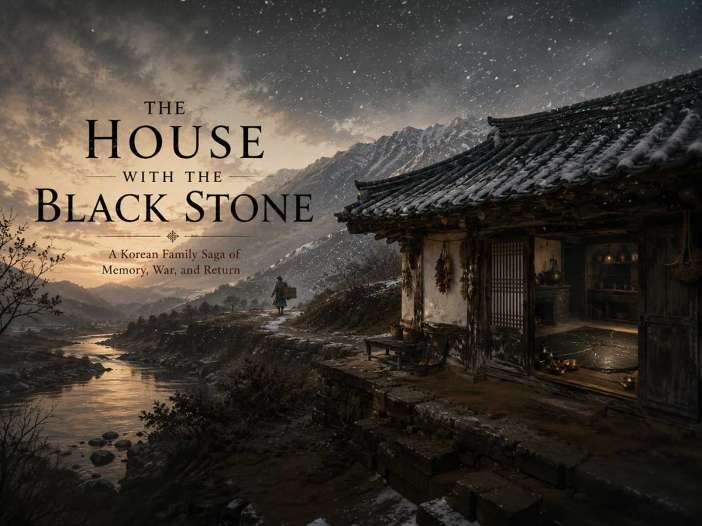
In The House With the Black Stone, Nick Sasaki tells a multigenerational Korean family story shaped by war, exile, silence, memory, and return. Inspired by the magical realism of Gabriel García Márquez, the novel treats impossible events as part of ordinary family life: summer snow follows a wounded stranger, erased names vanish from mirrors, letters arrive before they are written, and a black stone listens to every sentence people mean to speak but swallow.
Yet the story is rooted in a distinctly Korean emotional and historical experience. Its family house carries the scars of occupation, liberation, the Korean War, displacement, modernization, and the painful distance between parents and children. The magical events do not replace history. They reveal the emotional truths that history and official records often fail to preserve.
At the heart of the novel is one question: Can a family remember its past without trapping the next generation inside it?
Every generation inherits names, losses, unfinished apologies, and conflicting accounts of those who came before. Some relatives are remembered as heroes, others as cowards, victims, deserters, or strangers. The black stone refuses to settle these contradictions. It listens without choosing one version as complete.
The result is a story about the difference between preserving memory and controlling it—and about leaving enough blank space for those who come later to name themselves.
(Note: This is an imaginary conversation, a creative exploration of an idea, and not a real speech or event.)
Chapter 1: The Man Who Followed Summer Snow
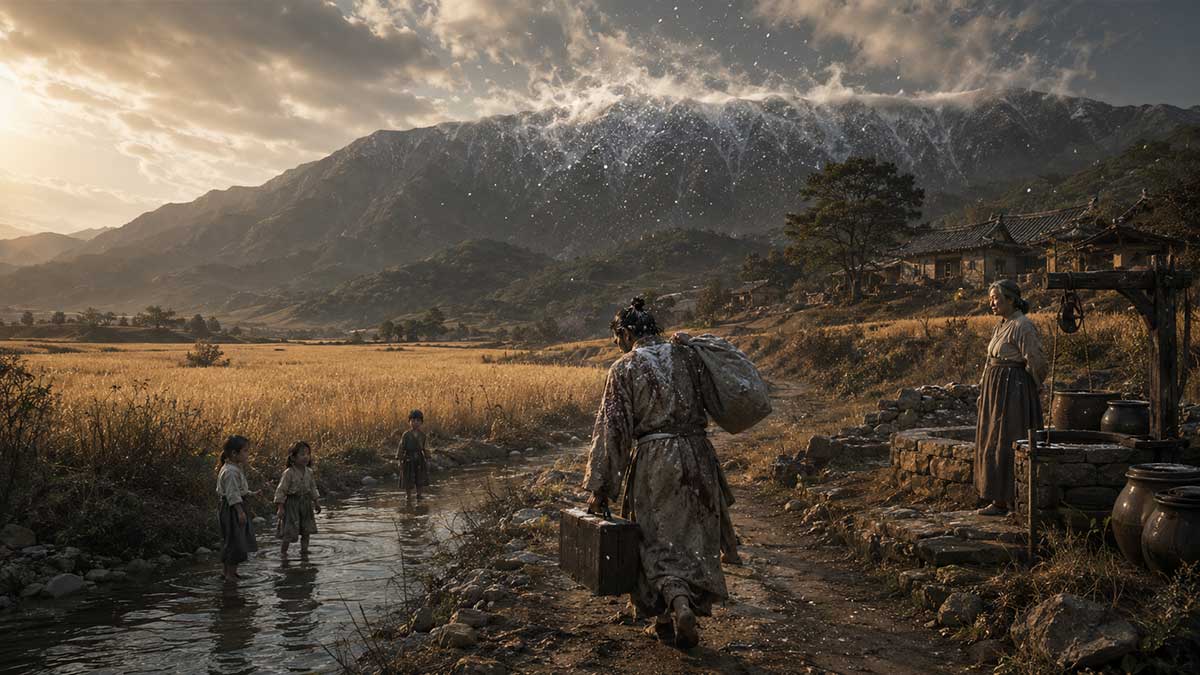
Snow fell on Mangwol-ri on the first day of the sixth lunar month.
The barley was turning gold, and children stood in the stream with their trousers rolled up, chasing minnows. The sun had been hot since morning. The lids of the earthenware jars were too warm to touch, and the pines on the hillside gave off the dry scent of resin.
Then, as noon approached, something white began falling over the northern ridge.
At first, many thought it was willow seed. Then they said it was ash — perhaps a fire beyond the mountain. But when one white fragment landed on the back of Old Madam Oh's hand beside the village well and melted, everyone understood that it was snow.
Madam Oh looked up and clicked her tongue.
"Even the sky has lost its sense. It has forgotten when snow is supposed to fall."
The villagers did not laugh. Some said summer snow meant disaster for the kingdom, that the king had fallen ill, or that the mountain spirit was angry. Others said the dead from the previous year's epidemic were returning over the mountain.
Only Madam Oh covered the soy jars.
"Protect the sauce the living must eat," she said. "The dead are perfectly capable of finding their own road."
Mangwol-ri barely appeared on any map. A traveler had to cross three mountain ranges to reach it, and heavy rain cut off the eastern road for weeks at a time. The river flowing westward swelled in summer, then vanished underground along one stretch each autumn. The villagers believed it traveled beneath the earth and returned each winter, the way certain debts did.
That day, the snow did not fall over the whole village. It came down in a single narrow line along the northern ridge, as though someone had hung a long white cloth from the sky and forgotten to take it in.
A man came down the mountain following that line of snow.
He looked a little over thirty but walked with the heaviness of a man of fifty — the kind of walk that has carried something a long way and doesn't yet know how to put it down. A long bundle wrapped in cloth rested on one shoulder; a wooden chest hung from his other hand. Mud and dried blood stained his clothes. One strap of his straw sandals had broken and been retied so many times the knot looked like a small fist.
By the time he reached the village entrance, snow had settled only on his head and shoulders — a private weather, following him alone.
The children saw him first.
"A snowman," one whispered.
"He's a man," said another, more certain than she felt.
The smallest one, not yet convinced by either, said: "He brought the snow with him."
The man walked past them to the well without answering any of them. He drew a dipper of water and drank it in three long pulls, the way a man drinks who has been rationing himself for days and has finally decided to stop.
Madam Oh watched him set the dipper down.
"Where have you come from?"
"From the south."
"The south is large."
"From below the mountains."
"Below the mountains is also large."
He thought about that longer than the question seemed to require.
"From the place where I lived."
Madam Oh disliked the answer, but did not press him further. She had lived long enough to know that a question asked twice of an unwilling man produces only a better-made lie the second time.
"Your name?"
"Kang I-mun."
"Without the surname?"
"I-mun."
"Easy enough to remember, then. It stays the same either way."
From that day the villagers called him Kang I-mun. No one could confirm it was his true name, and after the first week, no one asked again — a name repeated often enough starts to behave like a true one.
For three nights he slept in an abandoned cowshed west of the village. He asked no one for work but refused none of what was offered. He rebuilt a collapsed stone wall, replaced rotten thatch, chopped firewood, reinforced the rice-field banks before the rains came. He was strong but worked slowly, and each time he moved a stone he looked back at the gap it left, as if trying to memorize exactly how the absence should look.
On the fourth day the village elders called him beneath the zelkova tree.
"How long do you intend to stay?"
"Until the snow stops."
They looked toward the mountain. The sky above the village was clear, the fields full of ordinary summer light. Only that one white seam still fell along the ridge.
"And if it never stops?"
"Then I'll live here."
"And if it stops tomorrow?"
He was quiet long enough that a bird finished a whole phrase of song before he answered.
"I'll think about tomorrow, tomorrow."
Madam Oh, listening from a few steps off, said it plainly to no one in particular: "Men like that generally live a long time. A man who postpones tomorrow is usually still standing when it arrives."
---
Among the villagers was a woman named Baek Yeon-hwa, twenty-six, who had lost her parents and her husband to the epidemic and now lived alone. People said she sang beautifully at funerals. Yeon-hwa said she didn't sing beautifully — she simply remembered, for a long time, what the dead had wanted to hear.
She worked the fields with the other women in season, taught the old songs to children in winter, sang before the bier when someone died and sang lullabies at the hundred-day table when someone was born. She had learned early that when a stranger entered a village, the women grew curious first and the men suspicious later, and she wanted no part of either crowd.
But when I-mun fell from the cowshed roof he was repairing, she was the one who came with herbs, because she happened to be nearest and because no one else had moved yet.
"Nothing broken?"
"I'm fine."
"A fine man doesn't breathe like that."
He didn't answer. When she pressed the herbs to his side and lifted his shirt, she found old scars — a long pale line like a sword's path, and beneath it the puckered evidence of a burn that had healed badly, the way burns do when there's no one to tend them properly.
"Were you in a war?"
"Everyone lives through at least one."
"The people here have known famine. Not war."
"Then they're fortunate," he said, and something in the politeness of it — too smooth, too finished — told her more than the words did. She noticed, that day and after, that whenever he steered around a question, his voice grew more courteous, as if manners were the door he shut behind him.
That evening he left a bundle of split firewood at her gate. The next morning she returned half of it to the cowshed. After that a slow, wordless trade began: he mended her roof tiles, she brought him barley rice; she tied a new cord to his torn sandal, he repaired the well bucket that had leaked for two years.
The villagers noticed that the two rarely spoke but always seemed to know what the other needed, and began, as villages do, to discuss marriage before either party had discussed anything.
"A couple who talk too much can't live together," Madam Oh said. "Neither can a couple who never speak. Those two say only what's necessary. They might last."
Yeon-hwa said nothing to this. I-mun pretended not to hear it at all, which everyone understood to mean he had heard every word.
---
By the end of summer, snow was still falling on the northern ridge, thin and constant as a held note.
I-mun decided to build a house beside the river, on land the village had long avoided — flooded in spring, cracked hard in winter, and at its center a black stone as large as an ox, cold even at noon in the height of summer.
He tried to dig it out. Three shovel blades broke. Ropes tied around it by half the men in the village did not move it a hand's width.
Madam Oh tapped it once with her walking stick, unimpressed.
"It was here when I was a child."
"It must have been here before that," Yeon-hwa said.
"Why has no one built on this spot?"
"Because the stone listens," Madam Oh said, and when the men laughed and asked where its ears were, she was already turning away. "Somewhere deeper than your mouths, probably." Then, quieter, to Yeon-hwa alone: "It doesn't listen for lies. People tell those too easily to be worth hearing. It listens for the words people mean to say, and then swallow."
I-mun considered the stone for a long moment.
"Then it will be a quiet house."
"No," Madam Oh said. "It will be a house full of people who refuse to speak."
Yeon-hwa looked at him when she said it. He didn't notice, or didn't let himself.
Instead of removing the stone, he built the house over it. On the day the first pillar went up, the snow on the northern ridge finally stopped. Some called it a good sign. Others called it worse. Madam Oh, tying off a length of thatch, said it was neither.
"The snow finally found where it was going."
Through the whole of the building, I-mun never once opened the bundle or the wooden chest. He carried them himself, always, from the cowshed to the innermost room of the new house, and set them down the way a man sets down something that might wake.
---
Autumn came, and they married. It was a small ceremony — Yeon-hwa in her mother's old skirt rather than new cloth, I-mun in a borrowed ceremonial robe a size too broad in the shoulders. While filling the wedding cup, Madam Oh looked at him over the rim.
"Your face looks more borrowed than your robe."
The villagers laughed. I-mun laughed too, and Yeon-hwa, watching closely because she had already learned to, saw that the laugh didn't stay on his face any longer than it took to leave his mouth.
That night, snow began falling inside the house.
There were no holes in the roof — the stars were still visible through the smoke-hole, ordinary and fixed. But white flakes descended, without sound, from the ceiling of the innermost room.
Yeon-hwa held out her palm. The snow bent around it, changing course an inch before it would have touched her skin, and fell instead only onto the long bundle and the wooden chest in the corner — never on I-mun, never on her, never on the bedding between them.
He didn't move.
"You should open it now," she said.
"Tomorrow."
"The snow came tonight."
"Tonight is our wedding night."
"And?"
"Only good stories belong on good days."
She thought about that. "If you don't tell the bad ones on good days, they wait, and grow worse, for a bad one."
He didn't answer. From the kitchen came a single sound — thin, dry, unmistakable. The black stone, cracking for the first time since anyone could remember, a sound like a knuckle popping deep in the house's own body.
They went in together and found the hairline fracture on its surface, no wider than a thread.
Yeon-hwa touched it, cool under her fingers even with the fire banked nearby.
"What were you about to say?"
"Nothing."
"That must be what it heard."
He went back to the room without a word and, after a long while sitting before the chest with his hands on his knees, opened it.
Inside lay an old family register, several pages torn away, ink brushed thick over the names that remained. Beneath it, a white rice bowl with a crack running clean through the middle, as though it were a breath away from splitting in two — and had decided, every day since, not to.
"Whose was this?"
He opened his mouth. Closed it. The stone, in the next room, said nothing this time — as if it had already heard everything it needed to.
"I had a family," he finally said.
Outside, the last cicada of the season sang on alone, past the hour when the others had gone quiet.
"Where are they?"
"In the south."
"Alive?"
"I don't know."
"Why did you leave?"
This time he gave her nothing at all — not even a poor answer — and Yeon-hwa understood, turning the cracked bowl over in her hands, that his silence was more exact than any sentence he might have built to replace it.
"You abandoned them."
"I was trying to survive."
"Alone?"
"At the time, I believed survival required it."
"Do you still?"
He took long enough to answer that she nearly asked again.
"I don't know."
She carried the bowl to the kitchen, washed it, dried it, and set it on the lowest shelf — not hidden, not displayed, simply given a place, the way you give a place to something you haven't decided about yet.
By morning the snow inside the house had stopped falling. But a single handful remained, unmelted, on top of the closed wooden chest — as if winter had left a hand there to hold it shut.
---
From that day, I-mun belonged to Mangwol-ri. He rented rice fields, built a stone wall around the new house, and Yeon-hwa planted perilla and balsam in the yard. The following year their first son was born.
The child cried every night — louder when I-mun held him, quiet only for Yeon-hwa's voice. Madam Oh, looking down at him once, said he was probably trying to melt all the snow his father had carried in on his shoulders.
On the child's hundredth day the village gathered. Barley cakes, boiled eggs, a small precious bowl of white rice I-mun had crossed the mountain to buy. Yeon-hwa left one place empty at the end of the table, and in it set the cracked bowl.
"Why bring that out?" I-mun asked.
"It belongs to someone."
"No one is coming."
"That isn't yours to decide."
He said nothing more in front of the guests, though his jaw had the look of a man holding a door shut with his shoulder. Madam Oh, passing by, spooned a little rice into the empty bowl without asking anyone's permission.
"An empty bowl calls an empty person."
I-mun reached to take it back. Yeon-hwa caught his wrist — and at that exact moment snow began falling inside the house again, this time in front of everyone.
People ran into the courtyard, certain the mountain spirit had come, or that frost had somehow formed under a summer roof. But the snow fell only in the kitchen. Not on the child. Not on Yeon-hwa. Not on I-mun's shoulders. It fell only into the cracked bowl, filling it slowly, steadily, until the white sat level with the rim and did not melt.
Madam Oh looked into it a long time.
"Strange."
"What is?"
"It doesn't melt."
I-mun sat before it and did not move for what felt, to the watching villagers, like the length of an entire winter. Yeon-hwa stood in the doorway between him and the guests.
"Eat first," she told them, and they did, complaining, as villagers will, that Madam Oh had cut the rice cakes too large, and being told in turn to reduce them with their own teeth.
Inside, Yeon-hwa sat beside her husband.
"Do you remember their names?"
He didn't answer at once.
"All of them?"
"The harder I try not to remember, the clearer they become."
"Then tell them. Someday."
"To you?"
"To me. Or to the child. Or even to the stone."
Outside, the child had stopped crying for the first time all evening. I-mun rested his empty hands on his knees and said nothing further — not that night, not for a long time after — the names of the people he had left still folded somewhere he had not yet agreed to open.
But from that day forward, the Kang table always held one bowl more than it needed.
No one ever said, exactly, whom it was for.
The people of Mangwol-ri assumed it was set for the dead.
But when it was first placed there, no one had yet died.
Chapter 2: The House Built Over the Listening Stone
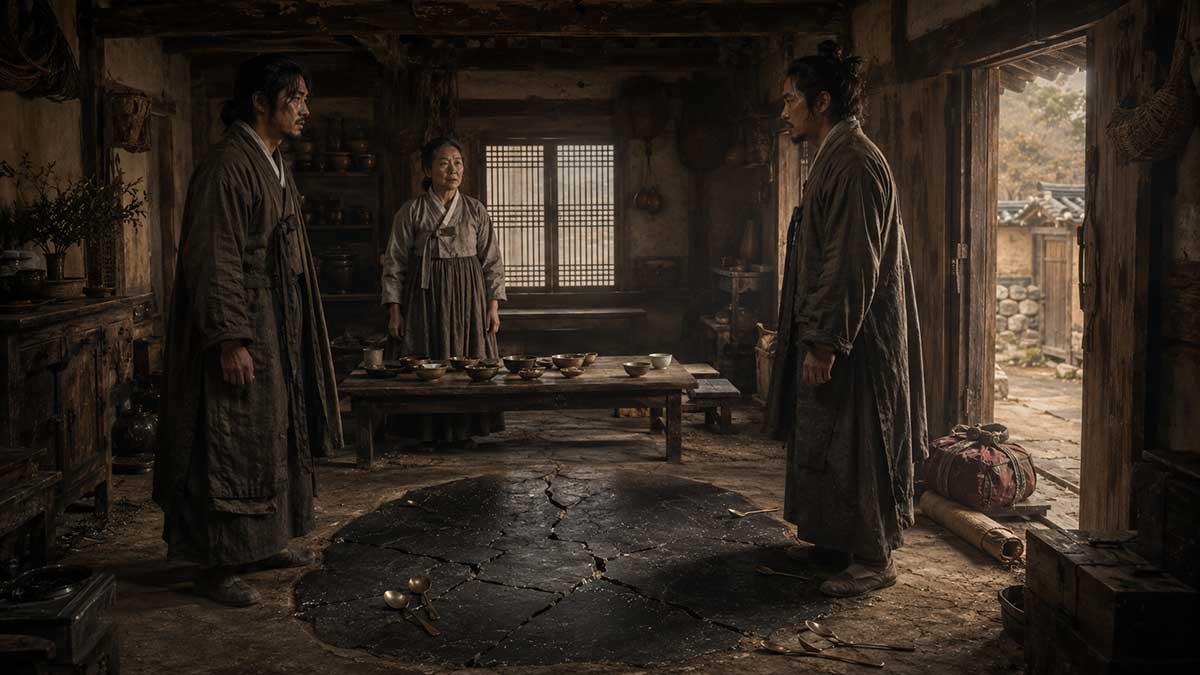
There was always one extra bowl on the Kang family table.
Baek Yeon-hwa had placed it there first. Later, daughters-in-law kept the custom without quite knowing why, the way a household keeps a key to a door no one remembers locking. The children called it the ghost bowl. Adults scolded them for saying so, warning that something would grab their ankles in the night — and yet no one, in all that time, asked outright whose bowl it was.
Kang I-mun never explained it. Even after thirty years in Mangwol-ri, he never once spoke aloud the names of the family he'd left in the south.
By then the black stone carried seven cracks, each one thin as a hair, radiating from the first like the start of a spider's map.
The house had grown too. It began with two rooms and a kitchen; as sons and daughters arrived and daughters-in-law crossed the threshold, a men's reception room was added, then a storehouse, then a stable. A persimmon tree grew by the gate. More than twenty jars stood in the rear courtyard, arranged by Yeon-hwa in an order only she understood.
The villagers had started calling it the great Kang house.
"A house growing larger doesn't mean its people do," Yeon-hwa said once.
"Who said the people were small?"
"No one. That's exactly why I worry."
I-mun didn't ask what she meant by that. The habit of not asking had lived a long life in that house, and it would outlive him — passed down, whole and unspoken, to his sons.
---
The eldest, Kang Mu-jin, took after his father: broad-shouldered, sparing with words, the kind of man who is first to rise and last to leave a sick animal's side. When the ox took ill he sat with it through the night without being asked. In the lean years he opened the grain store before anyone had worked up the courage to request it. He accepted duties nobody assigned him and expected no thanks for carrying them.
The second son, Kang Mu-seok, took after his mother — quick, curious, endlessly hungry for the world past the mountains. He bought cracked anthologies and torn map fragments at the market with money he should have spent on rope or seed. The village elders muttered that too much reading pulled a man loose from the earth. Mu-seok's answer, delivered more than once and each time as if it had just occurred to him, was that roots rotted just as easily from sitting too long in the same soil.
As boys the brothers had been close in the unthinking way brothers are before the world starts asking them to choose sides. Mu-jin taught Mu-seok to ride the ox; Mu-seok taught Mu-jin his letters. Mu-jin gave up food so his brother could eat more; when punishment came, Mu-seok sometimes stepped in front of it.
The trouble began later, quietly, the way most family trouble does — not with an argument but with two private accountings that never got compared. Mu-jin came to believe: *I stayed so that child could read his books.* Mu-seok came to believe, just as sincerely: *I learned to read so that one day I could save this house.* Because neither said his version aloud, each grew entirely certain of his own.
---
The spring a new magistrate arrived, he wasted no time. Within fifteen days he announced that more grain would be collected — the bridge from last year's flood needed rebuilding, the government roof needed new tile, and the affairs of the kingdom, as always, had grown difficult.
Whenever the kingdom's affairs grew difficult, the people's storehouses were the first thing anyone thought to open.
The village gathered in the Kang courtyard to argue about it.
"The barley crop was thin this year. What more is there to take?"
"If his roof leaks, let him pull tile off his own house."
"Go and tell him that yourself, then."
"Why me?"
"You're the one who said it."
"I said it *here.*"
They went around like this for the better part of an hour before Mu-jin finally stood and said he would go. He believed, plainly and without much drama, that the family with the most land ought to carry the most weight — that careful talk might spare the rest of the village something.
Mu-seok objected before his brother had even reached the gate.
"If you go, they'll think we're afraid."
"If no one goes, they'll take more."
"If we give, they'll come back for more next season."
"If we refuse, they'll send soldiers this one."
"Then let everyone refuse together."
"You talk about resistance the way other men talk about the weather."
"And you talk about patience the way a man talks who's never had to wait for anything that mattered."
Something in the kitchen gave a small, dry click — a single spoon, no more — and both brothers went quiet at once, the way boys go quiet when a parent's footstep sounds on the stair. Madam Oh had been dead some years by then, but everyone in that yard still knew, without needing to say so, exactly what she would have called this.
Yeon-hwa came out and set the spoon straight without comment.
"If you mean to say something, say it. If you don't, eat your soup. The spoon has more honesty in it tonight than either of you."
After that the household began reaching for wooden chopsticks whenever a hard conversation loomed, hoping to spare the spoons the trouble. It didn't occur to anyone until much later that soup cannot be eaten with chopsticks, and so the habit solved nothing at all — it simply moved the argument to whichever meal had rice instead.
---
Mu-jin went to the magistrate and offered ten *seom* of rice from the Kang stores, in exchange for lighter taxes on the poorer households. The magistrate smiled in the particular way of a man who has just been handed something he was going to take anyway.
"The Kang family feeds the whole village."
Mu-jin understood, walking home, that this had not been praise. He'd believed all the way there that he was protecting Mangwol-ri. Half the village agreed with him by evening. The other half had already decided, by then, that the Kang house had simply found a cleaner way to bow.
Mu-seok was waiting at the gate when he returned.
"How much did you promise?"
"Ten *seom.*"
"*Our* rice?"
"It buys the others a lighter year."
"What gave you the right to spend it?"
"We have the most to spare."
"Which means they'll come to us first, every year, from now on."
"We have to survive this winter before we can worry about the next one."
"You always sell today in the name of some winter that hasn't come yet."
Mu-jin's face went hard and still, the look of a man closing a door with his whole body.
"What did you just swallow?" Mu-seok asked, watching him.
"Nothing."
"So even *you're* afraid of the stone."
Mu-jin had him by the collar before either of them had decided the conversation should turn physical. Yeon-hwa was between them almost as fast.
"If you mean to fight, do it in the yard. Are you planning to crack the kitchen floor too, while you're at it?"
Mu-jin let go. Mu-seok straightened his collar, said nothing, and the brothers slept in separate rooms that night for the first time since childhood.
An eighth crack opened in the black stone before morning.
---
By summer, government men had come to measure the grain. They opened the Kang storehouse first, and sacks piled up in the courtyard while Mu-jin counted and Mu-seok watched from the shade of the wall, arms folded, saying nothing until a soldier remarked, not unkindly, that with this much grain the Kang family had nothing to worry about.
"If worry looks to you like a full sack," Mu-seok said, "your eyes must live somewhere very comfortable."
The soldier's face changed. Mu-jin told his brother, quietly, to be quiet. Mu-seok, for reasons that made sense only to him in that moment, raised his voice instead.
"Why is it always silence you ask for when men like this are standing here?"
"Because other people get beaten for the things you say."
That landed. Mu-seok had nothing to say back to it, and for once the house agreed there was nothing worth trembling over — he had said the whole of what he meant, all the way to the end, and the problem was simply that the sentence now lived permanently in his brother instead.
---
That autumn Yeon-hwa began embroidering names onto a length of white cotton — the dead from the spring epidemic, at first, six names by midwinter. Some worried that stitching the names of the dead would call their ghosts home.
"If the names aren't written," she said, "the living forget too quickly to be trusted."
"Isn't forgetting how people survive?"
"Forget what has to be forgotten. Remember what mustn't be."
"Who decides which is which?"
She didn't look up from the needle. "While we're alive, we decide. After we die, we find out what we chose wrong."
By the time the cloth held thirteen names, it included not only the dead but the merely unaccounted-for — those whose whereabouts no one could confirm.
"Why write a name if the person might still be living?"
"Because we don't know."
"Then where does a name go, if it's neither living nor dead for certain?"
"In the middle."
At the very center of the cloth, one morning, appeared the name Kang I-mun — in black thread, in stitching that resembled Yeon-hwa's hand but was, unmistakably, clumsier than hers. She had not sewn it.
I-mun went pale looking at it.
"Did you do this?"
"No."
"Then who?"
"I don't know whether the stone has learned to embroider."
He tried to burn the cloth that night. She stopped him with one hand on his wrist.
"Why fear your own name, when you aren't dead?"
"Why is it *there* at all?"
"You would know that better than I would."
"I'm alive."
"Not everyone who's still alive has come all the way back."
He looked at her a long moment and said nothing further. No spoon moved. He had, for once, nothing left in his throat to swallow — or so much that he no longer knew which piece to start with.
---
That winter I-mun fell ill. A cough first, then fever, then the long stillness of a man who can no longer leave his bed. Mu-jin brought a physician; Mu-seok crossed the mountain for medicine none of them were certain would help. The brothers took turns at his side without discussing whose turn it was — an old rhythm returning under pressure, the way old rhythms do.
In his fever I-mun murmured names too indistinct for anyone but Yeon-hwa to catch. She stitched what she heard along the border of the cloth, in thread lighter than the rest.
"Whose names are those?" Mu-seok asked.
"People your father left behind, a long time ago."
"Why tell us only now?"
"Because it was never mine to tell."
"If he dies, we may never hear the rest."
She pulled the thread tight. "A man who wouldn't tell the truth while he was strong doesn't start telling it because he's close to the end."
Mu-seok studied his father's sunken face and, for the first time, allowed himself to wonder whether the man who'd founded this house might in fact be a man who had first run from another one. Mu-jin, watching the same face, arrived somewhere different: perhaps his father had built all this so carefully *because* he had once left something behind unguarded.
Two brothers. One fact. Two entirely different fathers assembled from it.
Three days later I-mun woke, fever broken, voice thin as paper.
"Protect the house," he told them.
Mu-jin nodded. Mu-seok asked, "Which house?"
"This one."
"And the other one?"
"Is this really the moment?" Mu-jin said.
Mu-seok didn't look away from his father's face. I-mun opened his mouth to answer — and from somewhere beneath the black stone came a low sound, felt more than heard, and a single spoon rang once against its bowl.
He closed his eyes instead of speaking. He died that night.
Yeon-hwa bordered his name on the cloth in white thread.
"Why not take it off?" Mu-seok asked.
"It was there before he died. It stays after."
"Isn't this supposed to be a record of the dead?"
"It never was, only that."
"Then what is it?"
She thought about the question longer than she'd thought about most things that week.
"A place for the ones who couldn't find their way back."
---
After the funeral, Mu-jin took his father's place at the head of the house — rose earlier, spoke even less, took on more than anyone asked of him, exactly as he always had. Mu-seok, meanwhile, found he could no longer breathe easily inside its walls. Their father's last words had become, without either brother choosing it, an order for the one who stayed and a chain for the one who wanted to leave.
*Protect the house.* To Mu-jin that meant the land, the ancestors, the roof over their heads. To Mu-seok it meant: never run.
One evening, in the kitchen, it came to a head again.
"I'm crossing the mountains," Mu-seok said.
"To the market?"
"Farther than that."
"How long?"
"I don't know."
"When will you come back?"
"I don't know that either."
Mu-jin looked at him for a long moment. "Then you're not leaving. You're abandoning us."
"Abandoning who?"
"The house. Mother. Me."
"You think staying here is love?"
"At least it isn't running."
Mu-seok laughed — not kindly. "Father probably said the same thing to himself, right before he built this whole new house."
Every spoon in the kitchen rang at once, a sound like a small bell tree shaken by wind. Mu-jin was on his feet.
"Don't say that about Father."
"I'm not talking about Father."
"Then who?"
Mu-seok didn't answer. The spoons kept ringing, louder now, and Yeon-hwa appeared in the doorway before either of them could decide what came next.
"Finish the sentence."
What Mu-seok wanted to say was: *You wanted to leave too. More than I ever did.* He looked at his brother a long time and didn't say it.
Instead: "I don't want to grow old in this house the way you're going to."
The blood left Mu-jin's face. He was quiet long enough that the fire in the hearth popped twice before he spoke.
What *he* wanted to say was: *I stayed so that you could go.* He didn't say that either.
The black stone split with a crack loud enough to rattle the jar lids in the courtyard and knock every hanging spoon from its nail at once.
Yeon-hwa looked from one son to the other.
"Are you satisfied now?"
Neither answered.
"The stone heard both of you," she said. "But neither of you heard the other."
---
Mu-seok packed that night — two changes of clothes, a few books, dried barley cakes wrapped in cloth. Yeon-hwa didn't try to stop him, and he resented her for it more than he expected to.
"You're not going to ask me to stay?"
"If I ask, will you?"
He had no answer.
"Then why would I ask?"
"Doesn't it hurt you?"
She reached over and straightened his collar, the way she'd done a thousand mornings before this one.
"If I tie your ankles with my own grief, we'll both fall down together."
"Brother will call me a traitor."
"And you think he's a coward for staying."
Mu-seok lowered his head. She brought out the name cloth.
"I won't sew your name in yet."
"Why not?"
"Not until I no longer know where you are."
"And once you don't?"
"I expect I'll put you somewhere near the middle."
He tried to smile and couldn't quite manage it.
Before he left, he crossed to the kitchen and laid his hand on the deepest crack in the stone. It was cold, the way it always was, no matter the season.
"I'll come back," he said, quiet enough that only the stone and his mother could have heard it.
The spoons didn't move.
"I mean it," he said again.
Still nothing — not because the words were false. He believed them completely, standing there. The stone, it seemed, had learned to hold its judgment for sentences that hadn't been tested yet.
He left before dawn.
---
Yeon-hwa set the cracked bowl outside the gate, filled with warm rice and two strips of pickled vegetable laid across the top.
"Why feed someone who isn't even here?" Mu-jin asked.
"Someone?"
He shut his mouth.
"Have you already forgotten your own brother's name?"
"He left."
"People who leave still get hungry."
"And if he never comes back?"
She set a spoon down beside the bowl.
"Then the rice will go cold. That's all that happens."
By morning the rice was gone. The spoon remained, untouched, exactly where she'd placed it. No one could say whether Mu-seok had eaten from it, whether some passing traveler had, or whether an animal had simply found it first. Mu-jin chose to believe his brother hadn't touched it. Yeon-hwa chose to believe he had.
From that day the elder brother told anyone who asked that the younger had abandoned him. Far off, wherever he'd gone, the younger told a version in which the elder had pushed him out the door himself. Each carried half a truth, which is enough, it turns out, to let two men believe for the rest of their lives that they were each entirely right.
---
Years later, Kang Mu-seok's name disappeared from the family register. No one ever admitted to erasing it.
On the name cloth, though, the three syllables of his name remained — stitched, if anything, in darker thread than any other name on the cloth, with a small empty space left beneath it.
Some said Yeon-hwa had left the space for the date of his return. Others said it was there to hold whatever reason he never gave for staying away.
Yeon-hwa herself never said which it was.
Chapter 3: The Woman Who Married a Dead Man
After Kang Mu-seok left the house, Baek Yeon-hwa kept the cracked rice bowl outside the gate for three days.
On the first day, the rice disappeared. On the second, a single pine needle lay across the top, as if something had passed by without stopping to eat. On the third, the rice sat untouched and hardened where it lay, and Kang Mu-jin finally lifted the bowl to take it away.
"He isn't coming back."
"You've understood a whole life in three days?"
"He said he was leaving."
"Leaving and never returning are two different sentences."
He set the bowl down again. The crack along its base had widened, hairline to hairline, the way ice spreads across a pond overnight. He buried the hardened rice in the rear courtyard, washed the bowl, and tried to put it somewhere no one would find it.
By the next morning it stood again at the far end of the family table. No one admitted to moving it. Yeon-hwa didn't ask.
Time, after that, aged the house faster than it aged its people. Yeon-hwa's hair went white; Mu-jin grew quieter even than his father had been. He married, had a son, and that son in time had children of his own — more faces resembling one another, and, running alongside that resemblance, more personalities determined not to.
---
People said Kang Yeon-ok resembled no one.
She was Mu-jin's granddaughter, and she learned characters faster than the household thought decent in a girl. While the boys recited the Thousand Character Classic inside the men's room, she listened through the wall, and one afternoon spoke the next line before the teacher could — not out of mischief, simply because she already knew it.
The teacher was furious.
"Why does a girl steal another person's learning by listening at a wall?"
"Can something be stolen," she asked, "if it was only ever heard?"
He had no answer for that, and after the incident she was formally forbidden from the men's room — which changed nothing, since the paper door had never been much of a wall to sound. In winter her breath fogged against it; in summer mosquitoes found her ankles. She never missed a single lesson anyway.
People warned that a girl who learned too much acquired a hard fate to match.
"If fate is weaker than a written character," she said, "it must have broken a long time ago."
Baek Yeon-hwa, hearing this secondhand, laughed longer than anyone had seen her laugh in years. She was past eighty by then. The children were convinced she would simply never die; the village said that people who lived too long over the black stone eventually forgot how dying worked.
"I haven't forgotten how," she told them. "My turn just hasn't come yet."
Yeon-ok helped her great-grandmother tend the name cloth — now grown thick with the names of the dead, the missing, those who'd left and come back, and those who'd come back and never quite found their old place again.
"Why is this one in the center, and that one at the edge?"
"The center is for the ones whose lives and deaths we don't know."
"And the edge?"
"For the ones who are still alive, but who've been pushed outside our lives."
"And the ones who come back?"
"Some come back and still can't find where they used to fit."
At the very center of the cloth sat Kang Mu-seok's name, in dark thread, the small blank space beneath it still empty after all these years.
"Who was he?"
"Your younger granduncle."
"Where did he go?"
"Far."
"Why didn't he ever come back?"
Yeon-hwa studied the point of her needle a while before answering. "A person rarely has only one reason for staying away." Yeon-ok let the matter drop there — she had learned, over the years, that when her great-grandmother wouldn't answer, it usually meant the question itself had been aimed wrong.
---
A marriage proposal arrived when Yeon-ok was nineteen. The groom was Jang Do-yun, son of a large landholding family from the town beyond the mountains — twenty-four, well-read, in good health, no debts of drink or of other women to his name, according to the matchmaker's careful phrasing.
The village called it an excellent match.
"Has he seen me?" Yeon-ok asked.
"You'll see each other for the rest of your lives once you're married. Why look beforehand?"
"Did he say that too?"
"A man looks at the family. Not the face."
Yeon-ok nodded slowly. "Then perhaps the two families should marry each other, and spare us both the trouble."
The matchmaker leaned toward her mother and said, in the voice of someone delivering unwelcome but confidential news, that the girl talked rather too much.
"Tell her to speak less," her mother replied, "and the leftover words simply find their own way out somewhere else."
The negotiations proceeded regardless. Yeon-ok neither refused nor agreed — and in that era, a woman's silence was filed, by default, under consent.
Jang Do-yun visited once before the wedding, the two of them exchanging brief words across the gate while relatives from both households stood close enough to hear everything.
He was pale, thin, prone to suppressing a small cough before he spoke.
"I hear you read."
"A little."
"What kind of writing do you like?"
The question caught her off guard — no one had asked it so plainly before.
"Writing that doesn't bother explaining why people did what they did."
"That's rare."
"That's why I like it."
They weren't permitted more than that. Before he left he pressed a small writing brush into her hand.
"It isn't a fine brush."
"Does it become one, coming from a fine person?"
He looked startled, and then, unexpectedly, smiled.
"You can decide that after the wedding."
It was the only conversation they would ever have while both of them were alive.
---
Ten days before the wedding, Jang Do-yun died of a sudden fever.
The news came at dawn — a Jang family servant bowing three times outside the gate. "The young master has passed."
Yeon-ok's mother collapsed where she stood. Her father couldn't speak for a long while. Mu-jin, already dead by then, had left the household to Yeon-ok's eldest uncle, who read the letter, then shut himself in the men's room without a word to anyone.
That evening the elders of both families gathered. The Jang side wanted the wedding to proceed regardless — if Yeon-ok married their dead son and entered the household to keep his ancestral rites, the agreement between the two families, and everything riding on it, could still be preserved.
"A living woman can't be tied to a dead man," Yeon-ok's father said.
"The marriage was already promised."
"Marriage is between two people."
"It's also between two families."
"My daughter is still alive."
"Our son was alive ten days ago."
Every word polite. The air in the room, by the end, sharp as a blade left too long unwiped.
Yeon-ok had been listening from the corridor. She came in.
"Must I go to that house?"
The room went uncomfortable, in the particular way rooms go uncomfortable when a young woman speaks for herself before anyone has asked her to.
"If you observe proper conduct," a Jang elder said, "both families will find peace."
"Will the dead man find peace too?"
"That's what we believe."
"Did anyone ask him?"
"Enough," her father said, sharper than she'd expected.
She fell silent. Somewhere in the kitchen, one spoon gave a single, small, unmistakable tremor. Everyone in the room went still at the sound — stories of the listening stone had traveled well beyond the mountain by then, and the Jang relatives glanced toward the kitchen with open unease.
"I'll go through with the wedding," Yeon-ok said.
Her mother caught her breath. "Yeon-ok."
"But I won't enter the Jang household."
The elder's face hardened. "What kind of marriage is that?"
"I saw him once, while he was alive. It would be stranger, not less, to move into his house because he's dead."
"Then why marry at all?"
"Because he may not have wanted this either."
No one understood that. Yeon-ok wasn't sure she fully did herself — only that she could no longer stand to hear every person in the room speak so confidently on a dead man's behalf.
---
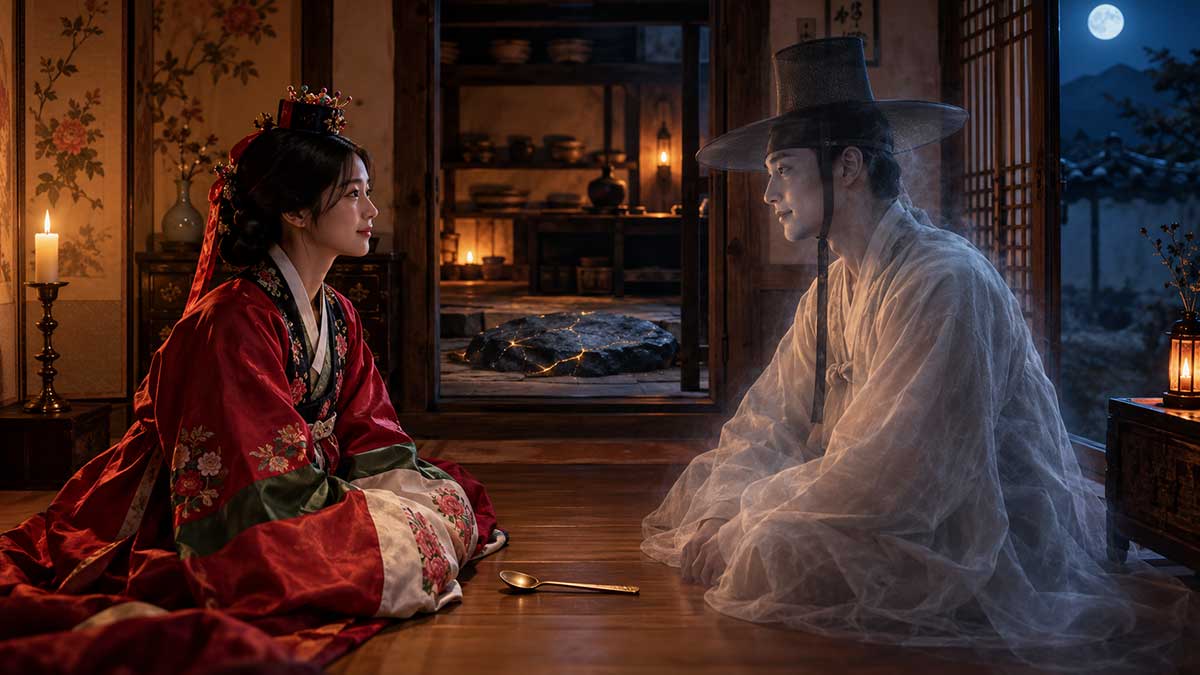
The wedding went ahead on the appointed day. A memorial tablet and Do-yun's hat sat in the groom's place, a brass spoon set before them, sent over from the Jang household. Yeon-ok wore red skirt and green jacket, red circles painted on her cheeks and forehead, and the women of the village whispered that her fate must be unusually strong to have earned this.
A wedding with no groom moves with remarkable efficiency — nothing to trip, nothing to spill, no wrong word to be said before the elders. Only the wine cup before the empty place tilted on its own, spilling a little onto the floor, which everyone agreed, without much conviction, had been the wind.
That night Yeon-ok slept alone in the innermost room of the Kang house, having kept her one condition — she had not gone to the Jang household. The brass spoon sat on a small side table.
At midnight someone coughed.
She opened her eyes. Jang Do-yun sat in the middle of the room, exactly as he'd looked before the wedding — white robe, no hat.
She was startled. She didn't scream.
"Is it you?"
"It appears so."
"Are you dead?"
"That also appears to be the case."
She sat up slowly. "Why are you here?"
He looked around the unfamiliar room. "I don't know where this is."
"The Kang house."
"Then not the Jang house."
"I didn't go."
Something in his face loosened, and she caught it before he could hide it.
"You didn't want the marriage either," she said.
He didn't answer. A spoon in the kitchen gave a small, dry click. He looked toward the sound.
"What was that?"
"Our stone. It heard you."
"Heard what?"
"What you were about to say."
"Does it hear the dead too?"
"If the dead are more honest than the living," she said, "maybe it doesn't need to bother."
He almost smiled. "I didn't want the marriage."
"What a relief," she said. "Neither did I."
They sat across from each other for a long while after that — perhaps, she thought later, the first married couple in Mangwol-ri to confess on their wedding night that neither of them had wanted the wedding at all. She doubted they'd be the last.
---
He came back each year, on the anniversary. At first only at midnight, gone before dawn; visible only inside the room, dissolving to mist the instant he tried to cross the threshold.
"Even dead, you can't cross another family's gate," she said once.
"Even alive, I rarely crossed my own without my father's permission."
Each year they spoke a little more. He told her he'd wanted to paint, that his father had wanted him managing land instead, that after his older brother died the whole weight of the family's expectation had simply transferred onto him without anyone asking if he could carry it. She told him she'd wanted to study, and had never once been let inside the men's room to do it properly.
"Why didn't you just open the door and go in?"
"Because they'd have thrown me straight back out."
"Then you could have gone in again."
She looked at him. "Did you have that kind of nerve, while you were alive?"
His smile died. "No."
"Then don't talk about it so easily now that you're dead."
They became, over the years, less husband and wife than two old friends who happened to meet once annually. He told her stories of the Jang household; she told him how the world had gone on changing since he'd left it. His father sent people more than once to bring her to the Jang house as their daughter-in-law. She refused every time. The Jang family called her their daughter-in-law regardless. The Kang family called her their own daughter. The village called her a widow.
She accepted none of the three names.
"How am I a widow," she said once, "when I never lived a single day as anyone's wife?"
When word spread that the dead groom visited every year, people grew more confused than scandalized. "So are you not, in some sense, husband and wife?"
"Does one conversation a year make a marriage?"
One woman, without meaning to be funny, said: "That's more talking than I manage with my own husband most years." Everyone laughed, Yeon-ok included.
---
In the third year of his visits, two strangers arrived in Mangwol-ri on the same day. One was a shaman from the west, Wol-seon, in a dark blue jacket over a red skirt, bells at her waist, who pointed at the Kang house the moment she entered the village.
"A dead groom lives in that house."
The other was a Christian evangelist from the east, Choi Yo-han, small Bible in hand, who taught that the dead did not return — only evil spirits wearing their faces did.
They met at the well.
"Where are you headed?" Wol-seon asked.
"To bring people the true path."
"So am I."
"Your path belongs to false spirits."
She looked at the little book in his hand. "Does the whole path fit inside that?"
"It holds the word of God."
"Then God writes very small."
Each followed the other, more out of suspicion than agreement, straight to the Kang house.
Yeon-ok tried to send them both away. Yeon-hwa overruled her.
"Let them stay. People carrying different answers should sit at the same table sometimes."
That evening the four of them ate together — Do-yun's brass spoon set at the far end, waiting. After dark, he appeared. Yo-han began praying under his breath. Wol-seon lifted her bells. Do-yun looked between them, faintly bewildered.
"Who are these two?"
"One says you're an evil spirit. The other says you're a soul held here by grief you haven't let go of."
"I don't think I'm either."
"Then why did you come back?" Wol-seon asked.
"Because my spoon was here."
Yeon-ok held it up. "This one?"
"My mother probably told everyone it was my favorite."
"Was it?"
"No. The handle was too short. I never liked it."
Yeon-hwa laughed loudly enough that Yo-han, fighting to keep a straight face, lost the battle at the corner of his mouth.
Wol-seon turned the spoon over in her hands. "The dead sometimes attach themselves to objects."
"I didn't attach myself to anything. I just wondered who'd taken it."
"The dead cannot return to the world of the living," Yo-han said, more to himself than anyone.
"Then where exactly am I?" Do-yun asked. Yo-han had no answer ready. Wol-seon shook her bells once, thoughtfully.
"Do you carry resentment?"
"Some."
"Toward whom?"
He considered. "My father. The illness. The people who arranged all this." He looked at Yeon-ok. "Not toward her."
"That's fortunate," she said. "I had no plans to keep your memorial table."
"Also fortunate. I never liked dried croaker."
"It's improper to joke in front of the dead," Yo-han said, a little stiffly.
Yeon-hwa kept eating. "The dead man's the one making the joke. Who are the rest of us to stop him?"
---
The argument that followed grew more serious than the meal had. Yo-han insisted that if the dead came and went as they pleased, the whole order of judgment and salvation would collapse. Wol-seon countered that a house whose ancestors never returned at all was the truly dangerous kind. Do-yun, caught between them, said only that he'd died too young to be treated as anyone's ancestor.
Yeon-ok listened to all of it and then asked, into the small silence that followed:
"Does anyone plan to ask what the living woman actually wants?"
The room went quiet. Wol-seon lowered her bells. Yo-han closed his book. Only Yeon-hwa kept eating.
"I already asked her," she said.
"When?"
"When you said you'd stay. Not stopping you was the answer."
The spoons stayed perfectly still through all of it. For the first time, Yeon-ok understood something about her great-grandmother she hadn't quite let herself see before — that the old woman had never once pitied her. She had simply believed, from the start, that Yeon-ok had the right to choose her own life, and had left her the room to do it in.
After Do-yun vanished that night, the shaman and the evangelist reached, for once, the same conclusion from opposite directions: he was not a harmful spirit. It was the first thing they'd agreed on all evening.
"Must you come back next year?" Yeon-ok asked him privately.
"I don't think so."
"Neither do I," she admitted.
"A dead man reconciled two living strangers tonight," Yeon-hwa said afterward. "His visit wasn't entirely wasted."
---
That winter, Yeon-hwa handed the name cloth to Yeon-ok for good.
"Keep it going."
"Why me?"
"Because you don't believe the dead too easily, and you don't dismiss them too easily either."
Yeon-ok unfolded it — faded threads at the oldest edge, brighter ones where the newest names sat. Along one border, a section had clearly been unpicked and resewn.
"Why was this part reopened?"
"Not by me."
Held to the light, the leftover needle-holes spelled out a name: Kang Yeon-ok.
"That's my name."
"It was a name before it was yours."
Only then did Yeon-hwa finally tell her the rest of what Kang I-mun had left behind in the south — a wife, and a young daughter who had also been named Yeon-ok. During a year of epidemic and hunger and soldiers looting whatever the epidemic hadn't already taken, I-mun had slipped out of a refugee column and fled alone into the mountains. He always claimed, afterward, that he'd meant to go back. He never did.
When his granddaughter was born in Mangwol-ri, he gave her the name of the daughter he'd abandoned.
"Why give it to me?"
"Your grandfather chose it."
"To remember her?"
"I don't know if he meant to remember her, or to make you finish living her life for her."
Yeon-ok ran a finger over the old, patched needle-holes. It felt, suddenly, as if her own name had existed before she did — had simply been waiting there for her to arrive and fill it.
"Did she die?"
"I don't know."
"And if she lived?"
"Then she lived a whole other life, under the same two syllables."
Anger came before sorrow. "Why did no one ever tell me?"
"Not many adults explain the guilt sewn into a name before they hand it to a child."
"Am I supposed to live in her place?"
"No."
"But Grandfather may have wanted that."
"The moment a dead person's wish becomes a command for the living," Yeon-hwa said, "a house stops being a house and starts being a tomb."
Yeon-ok folded the cloth carefully. From that day she began writing her own name slightly differently — same characters, but the final stroke stopped short instead of extending the way tradition called for. No one else noticed the change. Only she knew she'd made it: she had inherited the name, but she had chosen, finally, where its last line ended.
---
The following anniversary, Do-yun arrived later than usual. Still twenty-four in the face, but Yeon-ok thought she saw a faint new crease beside his eye that hadn't been there before.
"Do dead people age?"
He touched his own cheek, uncertain. "I don't know. Maybe you're the one aging, and it only looks that way from where you're standing."
She glared at him. "Did dying also take your tact?"
"I never had much of it to begin with."
He laughed. She laughed too, and they sat quietly together for a while after that. She told him, finally, the whole history of her name. When she finished, he said:
"Then we both got a name — and a marriage — handed to us by someone else's will."
"Your name was your own."
"My father chose it."
"Everyone's parents choose their names."
"Then maybe no name belongs to anyone, at first."
She thought about that. "No," she said eventually. "They become ours as we live inside them."
He nodded, and just before sunrise stood at the threshold.
"I want to try leaving."
"You disappear every year."
"Disappearing and leaving aren't the same thing."
He stepped forward. His outline blurred at the edges. She reached for him and her hand passed through nothing at all.
"This time," he said, smiling as the last of him thinned to mist, "I'm the one who leaves first."
He was gone. The brass spoon dropped to the floor. She picked it up and set it back on the table.
He didn't return the following year. Nor the year after that. People said his resentment had finally resolved itself. Yo-han said his soul had found its proper road at last. Wol-seon said that even the dead grow attached to the living, and sometimes find it just as hard to leave as anyone else does.
Yeon-ok accepted none of their explanations. She believed, privately, that he had simply learned — a little late, but not too late — how to cross a threshold on his own.
---
Baek Yeon-hwa died some years later, past ninety, having fed herself with her own hands until the final day.
The night before, she asked: "Does that man still come?"
"Not anymore."
"Do you miss him?"
Yeon-ok thought about it honestly. "A little."
"It's all right to miss the dead."
Yeon-hwa paused to catch her breath.
"Just don't follow them."
Yeon-ok managed a small laugh. "I don't know the way."
"Even better."
After she died, Yeon-ok embroidered her great-grandmother's name onto the cloth — not at the center, not at the edge, but along a new line she opened at the bottom, a place set aside not for those who died without returning, but for those who had learned, even in death, how to leave properly.
She carried her wedding clothes into the courtyard afterward and burned them. The red skirt and green jacket blackened fast in the flame. People assumed she was severing her tie to a dead husband. She offered no explanation.
When the fire died, the brass spoon lay in the ashes, handle unbent, not a single part of it scorched.
From that day the Kang family believed that whenever the spoon grew warm on its own, some distant, unaccounted-for relative was still alive somewhere in the world.
But even holding it herself, years later, Yeon-ok never once asked whose life it was confirming. She had already learned, by then, that being alive and coming home were not the same thing — and that failing to return was not, after all, the same as failing to love.
Chapter 4: The Year the Village Changed Its Name Three Times
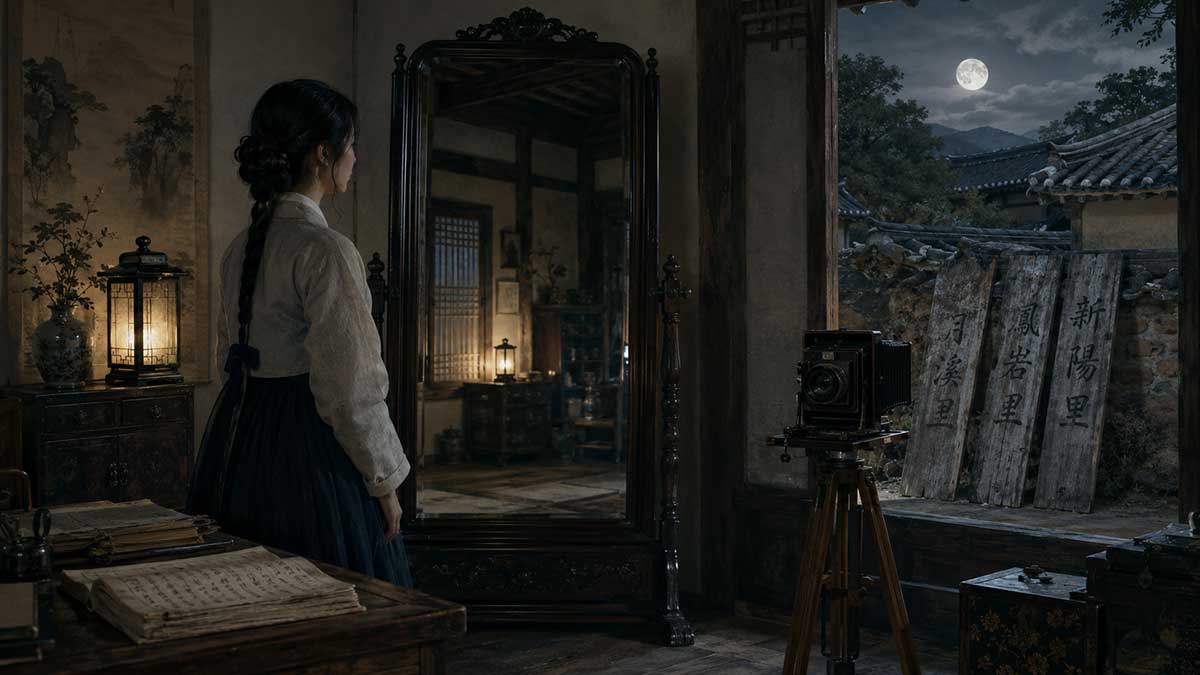
On the first day Mangwol-ri lost its name, the villagers assumed it wouldn't last.
A clerk from the government office hung a new wooden sign at the entrance. "From now on, this place is Cheongsu-ri." The villagers nodded, the way people nod at weather they don't believe will hold. By evening, everyone was still calling it Mangwol-ri.
Three days later a second official arrived and took the sign down. "Wrong name delivered. This place has been corrected to Wolcheon-dong." They nodded again. By evening, children were playing beside the river of Mangwol-ri, women were drawing soybean paste from the jars of Mangwol-ri, and the men at the tavern of Mangwol-ri were arguing over whether Cheongsu-ri or Wolcheon-dong sounded more provincial.
A month after that, a third official announced that both earlier names had been in error. "The districts have been reorganized. This is now Seventh Village of Buksan Township."
Mr. Park, who ran the soup shop by the market entrance, repainted his sign three times before he finally set the brush down for good. What he wrote instead was simply: THIS IS THAT PLACE.
People found the shop more easily after that than they ever had before.
---
In the year the village changed its name three times, Kang Mu-hyeon inherited responsibility for the family records.
He was Kang Mu-jin's second son — physically slighter than his older brother, quicker of speech than his younger siblings. As a boy he'd preferred paper to fields, the scratch of a brush to the lowing of cattle, and people said he'd taken up writing mainly to dodge farm labor.
"Without records," he told them, "even grain becomes somebody else's property."
He wasn't wrong, and the family put the talent to use, sending him to work as a low clerk in the government office. He was good at it — organizing who farmed which field, how many sons lived in which household, who'd paid taxes on time and who hadn't, which grave belonged to which branch on the mountainside. His hand was neat, his figures reliable, and he had a clerk's instinct for exactly which truths his superiors preferred hearing.
That instinct protected the family. In time, it also nearly broke it.
---
When the new administrative system arrived, every village register and land document had to be rewritten from scratch — the old ones declared inaccurate, outdated, no longer fit to be trusted.
Mu-hyeon copied names day and night by lamplight until his hand cramped. The trouble was that the new forms simply didn't have room for everyone. Women's names were shortened or dropped outright. Children who'd died young were treated as though they'd never existed at all. People who'd fled into the mountains were sometimes filed as dead. Dead men, meanwhile, sometimes stayed on the tax rolls for years. If one person carried two names, one had to go. If two people shared a single name, it stayed with whichever of them was more likely to pay.
At first Mu-hyeon told himself these were mistakes — clerical accidents, the kind any office makes under enough pressure. It took him longer than he'd like to admit to understand they weren't accidents. They were the system working exactly as intended.
One morning, an old man named Choi — dead three years — received a tax notice. His son brought it to the office.
"My father's been dead three years."
The clerk checked the register. "According to this, he's alive."
"There's a grave."
"A grave isn't a record."
"Should I bring proof he's dead?"
"He'll need to come in himself."
"How does a dead man come in?"
"That's not this department's concern."
The same day, a living man named Yi was recorded as dead and lost his claim to his own land. When he protested, the official told him flatly: "You're already dead. A dead man can't file a complaint."
Yi pinched the skin of his own arm hard enough to leave a mark. "If it hurts, aren't I alive?"
"Ask a physician about that."
For a few days the village found this all darkly funny — a soldier left old Mr. Choi's tax bill at his own grave, while the newly dead Mr. Yi used his official death to slip away from his creditors, and there was a certain grim satisfaction in watching the system trip over itself.
The laughter didn't last.
---
People whose names had vanished from the register began, one by one, disappearing from mirrors.
The first was a daughter-in-law of the Kim household. Combing her hair one morning, she saw only an empty room reflected back — the comb still moving, her hair still shifting under it, but no face, no shoulders, nothing where she stood. She screamed. Her family came running and saw her perfectly well. Only the mirror couldn't.
That afternoon they discovered her name had been dropped from the new household register entirely — she appeared there only as "wife," listed beneath her father-in-law's name, with no name of her own attached to it at all.
After that, one by one, the erased began vanishing from mirrors. Those who sat for photographs came out blurred in the print. Their faces showed briefly in still water, then broke apart the instant anything disturbed the surface.
The village gathered outside the office. "Put our names back."
"The law has no provision concerning mirrors," the official said, and seemed to genuinely believe this settled the matter.
For the first time, Mu-hyeon understood that the characters he copied all day could weigh more than the bodies of the people they named. He began quietly restoring names where he could — a few faces returned to their mirrors that same week. Not all of them. Some names had been erased and rewritten so many times that no one, not even Mu-hyeon, could say any longer where they were supposed to sit. Certain women survived only under a husband's or father's name by then, and when their own faces did return to the glass, their reflected mouths no longer moved quite in time with their voices.
The villagers called it half-return, and said it the way you'd name any other ailment — matter-of-factly, because there was nothing else to do about it.
---
The Kang family had a name the officials wanted gone too: Kang Do-han, Mu-hyeon's cousin, who kept company with people opposed to the new authorities and disappeared into the mountains most nights. The government considered him dangerous, which in that season meant simply inconvenient to account for.
An official summoned Mu-hyeon.
"There's a troublesome man in your family."
Mu-hyeon said nothing.
"Remove his name from the register, and your family's land goes through without further question."
"And if I don't?"
"The whole household gets investigated."
It was phrased as a choice. It didn't feel like one.
The elders gathered in the men's room that night. Some argued Do-han should be hidden and protected. Others said he'd already abandoned the household in every way that mattered and ought to be cut loose formally, before he took the rest of them down with him — they couldn't lose all their land for the sake of one man's convictions.
Yeon-ok sat through it holding the name cloth, well past forty now, the most exact keeper of memory the household had ever produced.
"If we remove the one name, we protect the house," Mu-hyeon said, more to himself than to anyone.
"If we remove it, does the person disappear too?"
"He stays. Just not on paper."
"Not in the mirror either?"
Mu-hyeon didn't answer. A spoon in the kitchen gave a small, dry click.
"What were you about to say?" Yeon-ok asked.
"Must we bring the stone into this too?"
"Especially this."
An elder cut in, impatient. "We have to think of the whole family."
"Is he not part of the whole family?" Yeon-ok said.
No one answered that either.
Mu-hyeon erased Kang Do-han's name. The brush crossed the page in a moment; the ink dried faster than he expected it to.
---
Do-han returned that same night, having spent several days hiding in the hills. Yeon-ok brought him to the kitchen mirror without a word.
Nothing appeared in the glass.
"Can you not see me?" he asked.
"I can."
"The mirror can't?"
"No."
He tried to laugh. "The mirror must be a coward, then." The laugh didn't hold. He found Mu-hyeon in the courtyard.
"You did this?"
"To protect the family."
"Was I not family?"
"You put everyone else at risk."
"Then you didn't erase me. You just kept yourselves safe."
"Does saying it that way make it any easier?"
"It makes it accurate. That's a different thing than easy."
A spoon rang out somewhere behind them. Do-han stood in front of the mirror again, studying the empty space where he should have been.
"Am I still myself, if my face doesn't exist anymore?"
"You understand that better than the mirror does," Yeon-ok told him.
He left that same night. Before he went he unfolded the name cloth, searching for his own name along its edge — already there, already stitched.
"Why not the center?"
"The center is for the ones whose lives and deaths are still unknown."
"And the edge?"
"For the living, who've been pushed outside the life the rest of us are still living."
He smiled, without much humor in it. "Pushed. Or forced?"
She didn't argue the word. "If you come back, I'll move it."
"And if I come back and the mirror still doesn't know me?"
"Then people will have to know you first, and let the mirror catch up."
He left. No one in Mangwol-ri saw him again.
---
For a long while afterward, Mu-hyeon believed he'd made the right call. The land held. The storehouses stayed full. The children didn't go hungry. And yet, from time to time, an empty gap would appear in the household mirrors — even with every living member of the family gathered and accounted for, there was always room, somehow, for one more person who wasn't there.
Mu-hyeon began avoiding his own reflection without quite admitting to himself that he was doing it.
---
Around that time, a photographer came through Mangwol-ri, carrying a large wooden box camera and a black cloth, claiming he could trap light itself and leave a person's face behind on paper. The villagers didn't believe a word of it, and believed it even less once told they'd have to sit perfectly still.
"Why should a person stop breathing just to keep a face?"
"Move, and it blurs."
Mr. Park from the soup shop had a question of his own. "And if a person's face is naturally a little blurred to begin with?"
"Then it'll come out even more so."
The village found this funnier than the photographer did.
The Kang family decided, in the end, to sit for a portrait — proof, of a kind, that the house belonged to this new age as much as any other family did. Chairs were set out in front of the men's quarters, the head of household in the center, the men standing behind him, women seated to the side and on the ground, children warned three separate times not to move a muscle. One boy tried so hard not to sneeze that he ended up crying instead.
The photographer went in and out from under his black cloth several times, counting heads.
"Eleven."
"There are eleven," Mu-hyeon confirmed.
He looked again. "Strange. Twelve on the plate."
They counted themselves. Eleven. He checked again. Twelve.
He assumed a restless child had shifted mid-exposure and rearranged the count by accident. They tried again, everyone rigid, barely breathing. Twelve, once more. On the third attempt, no one moved at all, and the photographer examined the plate and went pale.
"There's someone else in the frame."
"Where?" Yeon-ok asked.
He pointed. Behind the family stood a young woman in clothing from an earlier generation, her hair styled in a fashion no one alive could place.
No one recognized her.
Only Yeon-ok, studying that unfamiliar face, recognized the shape of the old needle-holes where a name had once been unpicked from the cloth. Kang Yeon-ok — the daughter Kang I-mun had left behind in the south, the one who had carried this name before her.
The face didn't resemble her own. Something in the eyes did, all the same, in a way she couldn't have explained to anyone standing there.
"Should we take another?" the photographer asked.
The family murmured — an omen, some said; a damaged plate, said others.
"Leave it as it is," Yeon-ok said.
"Do you know who she is?"
"Our family always seems to have one extra person than it should."
The photographer didn't ask anything further. It became the first Kang family photograph. At first people feared the unknown woman in it. In time, counting faces, they simply began including her without comment. The children assumed she was some distant relative no one had bothered to explain. The adults never did.
Only Mu-hyeon couldn't look at her directly. Her presence in the photograph reminded him, every time, of Do-han's empty mirror — the person absent from the records had appeared here in full; the person he'd erased from the records had vanished from it completely. He understood, without wanting to, that the two facts were the same fact wearing different clothes.
---
Months later, a government notice arrived: the name Mangwol-ri had been struck from the official maps entirely. Not Cheongsu-ri, not Wolcheon-dong — only the number remained. Seventh Village of Buksan Township.
The villagers kept calling it Mangwol-ri anyway. Outsiders simply couldn't find the place anymore. Letters came back undelivered. Tax notices arrived at the wrong houses. Soldiers occasionally mistook other villages for this one. And the odd thing was, once the name disappeared from official use, the people who actually lived there began saying it more, not less.
"The water tastes different in Mangwol-ri lately."
"The moon's still large over Mangwol-ri."
"You can spot someone from Mangwol-ri anywhere you go."
One late-autumn night an enormous moon rose, its light falling — by some trick of the land, or something less explainable — only on the new administrative office. Every dog in the village turned toward it and began barking, all at once, and none of them would stop. Officials threw stones to scatter them. The dogs retreated and came straight back, barking through until morning.
By daylight the wooden sign over the office had split clean down the middle. Of the words *Seventh Village of Buksan Township*, only the character for "seven" had fallen away entirely.
No one admitted to touching it. Yeon-ok said the dogs had done it. Mu-hyeon blamed the wind, and no spoon in the house so much as stirred when he said so — because, for once, he genuinely wanted to believe his own answer, and wanting hard enough to believe a thing is not quite the same as lying about it.
That night, alone in front of a mirror, only half of Mu-hyeon's face looked back at him. Left eye, left side of his mouth — visible. The right half reflected nothing but the empty room behind him. He raised his hand; the reflection raised its half of a hand to match.
The other half of his face never came back.
He covered the mirror with a cloth. Then, for the first time in his life, he knelt in front of the name cloth. Kang Do-han's name sat where it always had, along the edge. Beneath it, in small stitches he hadn't put there himself, ran a single new line:
*The record that erases a person may go on standing. The one who did the erasing does not stand whole again.*
He read it a long time and told no one, ever, that half his own face had stopped coming back to him. That night, one more crack opened in the black stone — quietly, without drama, the way the truest ones always seemed to.
Chapter 5: On Liberation Day, the River Flowed Backward
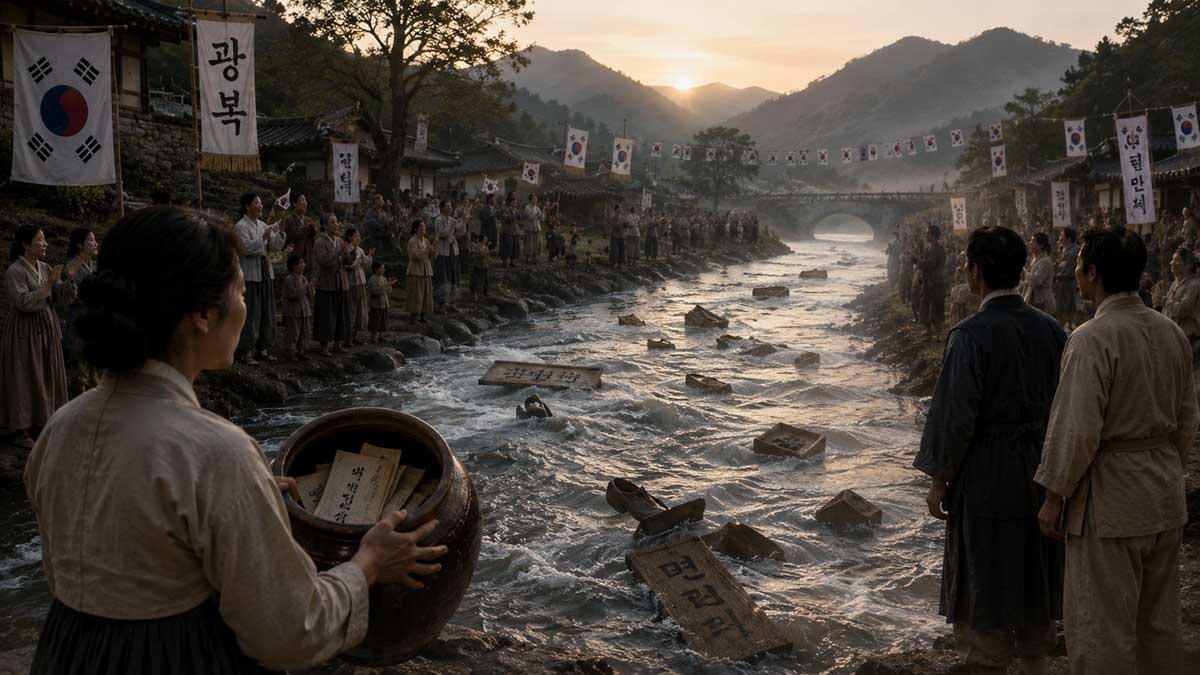
Almost no one in the Kang household ever touched the anchovy jar.
It sat at the far end of the courtyard, small and unremarkable — salt smell rising the moment its lid came off, flies gathering in summer, a crust of white crystal forming across the surface each winter. The children disliked it. The men disliked it more. Which made it, as it turned out, the safest place in the whole house to keep a secret.
Yoon Seo-jin, Kang Yeon-ok's daughter-in-law, understood this better than anyone. Beneath the anchovies, wrapped in oiled paper, she kept names, dates, meeting places — records of rice sent to people hiding beyond the mountains, notices to be pasted up under cover of dark, lists of those already taken.
No one thought it strange that a daughter-in-law managed the household jars. No one asked why she opened that particular one so often, and so late at night.
Sometimes she laughed to herself while she did it — there was something almost comic in a nation's fate hiding behind the smell of fermented fish. But she always looked around first, quickly, before letting herself laugh. In those years, even laughing too long in the wrong place could get a person noticed.
---
On official maps, Mangwol-ri remained Seventh Village of Buksan Township, though no one who actually lived there used the name. The new authorities brought a school, new signs, new rules. Children learned a language that wasn't spoken at home. Adults were made to write their own names in forms they didn't recognize as their own.
Eventually came an order for every family to adopt a new surname. The Kang elders argued about it for most of a night in the men's room — refuse outright, some said; others argued for obeying on the surface while staying unchanged underneath. Someone pointed out that a name, in the end, was only a sound.
"If it's only a sound," Yeon-ok said, unfolding the cloth, "why insist so hard on changing it?"
No one had an answer for that.
On official paper, the family took the new surname. Inside the house, they stayed Kang. Some of the children, hearing the new name shouted across a schoolyard more often than the old one at home, grew confused about which one made them turn their heads.
"Great-grandmother," one child asked Yeon-ok, "which one is my real name?"
"Whichever one makes you turn around."
"I turn around for both."
"Then both still belong to you."
"And if only one is left, later?"
She touched the child's hair. "Then you'll be the one who decides."
---
Seo-jin had two sons — Kang Jun-seo, the elder, and Kang Jun-ho, two years behind him. The village mixed them up constantly as boys; their faces were close enough, their heights nearly matched, and if one was struck the other cried on his behalf. They fished together, gathered chestnuts together, took their father's punishments together.
Past twenty, they began, slowly and then all at once, to become entirely different men.
Jun-seo believed in order — that survival meant waiting for the right moment, avoiding open conflict with the authorities, protecting the family quietly from within while bowing outwardly to whatever had to be endured. Jun-ho didn't believe in waiting at all. While people waited, he said, neighbors got arrested, names got changed, land got taken. Someone had to move first, or nothing would ever move at all.
Seo-jin listened to both of her sons at length and told neither of them what she herself was actually doing. Jun-seo assumed she quietly fed people hiding in the mountains. Jun-ho suspected she carried letters past the authorities' notice. Each knew only his own half of her, and each, because of that, was entirely certain she stood on his side alone.
---
One spring night Jun-ho came home late, mud on his clothes, dried blood on the back of one hand. Seo-jin was waiting in the kitchen.
"Where have you been?"
"Meeting a friend."
A spoon gave a small tremor against the shelf. Jun-ho glanced toward it, unimpressed.
"The spoons in this house have too much free time."
She set water to heat. "Did the friend lend you some of his blood too?"
He hid the hand. "I fell."
A second spoon rang out. She sighed, long and tired. "The stone is old. It's earned a rest from your lies, if nothing else."
She washed the wound herself — long, clean, the kind a blade leaves.
"Were you nearly caught?"
He said nothing.
"Did you hurt someone?"
"No."
The spoons stayed quiet this time. For the first time all evening, something in her chest loosened.
"Then who hurt you?"
"It doesn't matter."
"Your blood is on my hands right now. Tell me it doesn't matter again."
"It's better if you don't know."
She shook the bloody water from her fingers. "That's the single most foolish thing a child ever says to his mother."
"What is?"
"That she doesn't need to know."
---
That night she took the paper bundle out from under the anchovies and studied a message describing a new contact route Jun-ho would soon be asked to carry. She put it back exactly as she'd found it. If she admitted she already knew, he might go in even deeper, believing he had nothing left to hide from her. If she said nothing, he might take greater risks believing himself entirely alone.
She couldn't decide which choice actually protected him.
The black stone made no sound at all that night. It listened, she reminded herself, only for words a person swallowed instead of saying. It had no way of hearing a heart caught between two choices that both, in their own way, might be right.
---
A few days later, Jun-seo took a position at the local government office — grain distribution, resident registers, exactly the kind of work that made the village trust him a little less every week.
"Why did you go there?" Jun-ho demanded.
"To know what happens on the inside."
"You call copying their orders protection?"
"I learn who's about to be arrested."
"And will you warn them?"
"The ones I can."
"And the ones you can't?"
Jun-seo had no answer for that. A spoon trembled once, softly, and Jun-ho gave a bitter little laugh.
"As I thought."
"You think shouting from outside solves anything."
"And you think keeping your head down inside is wisdom."
Seo-jin set the meal down between them. "The soup's getting cold."
"Does this look like a moment for eating?" Jun-ho asked.
"Even an argument needs feeding, if you mean it to last the whole night."
Jun-seo picked up his spoon. Jun-ho didn't touch his. Seo-jin looked at the two identical bowls, each holding exactly the same amount of rice, and thought — not for the first time — that each of her sons wore the same expression: a man convinced, down to the bone, that the other one's load was lighter.
---
At the office, Jun-seo pored over lists at night — who was under watch, whose home would be searched next, who'd already slipped into the mountains. He memorized as many names as he safely could; carrying paper out would have exposed him at once. When he came home he'd say something to Seo-jin that sounded like nothing at all.
"The Kim family should probably sort out their jars tomorrow."
"Why?"
"The officials seemed curious about their sauces."
The warning reached the Kim house that same night. Another evening: "Mr. Park's son shouldn't go up the mountain tomorrow." Soldiers guarded that road the very next day.
Jun-seo told himself he was saving people. He knew, at the same time, that he couldn't save all of them. Some names came to him too late. Some houses he couldn't reach in time to warn. Some people simply refused to run even when he begged them to. Each time someone was taken anyway, he remembered that the line carrying that person's name had passed, at some point, beneath his own hand — not his doing, exactly, but his handling, all the same.
One day Jun-ho's name appeared on a list. A red mark beside it.
Jun-seo's fingers went cold reading it.
"Do you know this man?" his superior asked.
"He's from my village."
"Family?"
Jun-seo hesitated a fraction of a second too long.
"No."
Far off, beneath the Kang kitchen, the black stone gave a low sound like something turning over in its sleep. Only Seo-jin, sitting near the jars that evening, heard it — felt it, really, in the way the lids all trembled together at once.
Jun-seo came home that night and said nothing. Seo-jin took one look at his face.
"Whose name did you see today?"
He startled. "What do you mean?"
A spoon rang.
"You two have had the exact same look on your faces since you were boys, whenever you're hiding something."
Jun-seo went looking for his brother. Not home.
"Where is he?"
"I was hoping you'd tell me."
Jun-seo went into his own room and started packing. Seo-jin blocked the door.
"What's happened?"
"Jun-ho has to get to the mountains before dawn."
"Why?"
"They're coming for him."
She studied his face for a long moment. "Did you report him?"
"No."
"His name was on the list."
He nodded, miserable.
"Then why tell me only now?"
"Because I only just found out myself."
The spoons stayed still. For the first time, Seo-jin allowed herself to consider that her older son's silences might not be betrayal at all — might, in their own strange and dangerous way, be a kind of protection.
---
Jun-ho came home at midnight. Jun-seo grabbed him at the door.
"Leave. Now."
"Why?"
"They'll arrest you tomorrow."
"How do you know that?"
"I saw it."
"Where?"
"On the government's list."
Jun-ho stepped back, something cold moving across his face. "Did you write my name on that list?"
"No."
"Did you erase it?"
Jun-seo said nothing.
"Why not?"
"If I erase it, they'll know it was me."
"You always find a reason you can't act."
Jun-seo had him by the collar before either of them decided the conversation should turn physical. "This is not the moment to fight me."
"I need to know which side you're actually on."
"Ask me again after you've survived."
"Is surviving underneath them really living?"
"You talk about dying too easily."
"And you make living too cheap to be worth much."
Seo-jin stepped between them, a hand flat against each son's chest.
"Both of you. Stop."
They looked at her. She went to the anchovy jar and lifted out the wrapped papers. Both men froze.
"Why do you have those?" Jun-ho asked.
She handed him one. It was the original of the exact contact route he'd been due to carry days later. The color drained out of his face. She handed Jun-seo another — search schedules, leaked from inside his own office.
"Where did this come from?"
"Did either of you truly believe you were the only ones in this house worried about the country?"
Neither had an answer.
She wrapped the papers again, calm, unhurried. "Jun-seo sees the names from the inside. Jun-ho moves people from the outside. I stay in the kitchen and feed the both of you."
"Why did you never tell us?" Jun-ho asked.
"Would either of you have listened?"
"It's dangerous," Jun-seo said, quieter now.
She almost smiled. "I heard that before I ever gave birth to either of you."
That night Jun-ho fled to the mountains. Jun-seo went back to the office at dawn. One son took the road of a fugitive; the other went back to a place where he'd have to pretend, every day, to know nothing.
Seo-jin stood at the gate a long while afterward, looking down both roads at once. She didn't decide, that night or ever, which of her sons was braver. Both were afraid. Both simply endured the fear according to their own nature, and she loved them, as far as she could tell, exactly the same amount.
---
Spring passed into summer. The war stayed distant on the radio and arrived, all the same, in the household every single day — rice disappearing, young men vanishing, the announcer's voice endlessly promising victory. The louder that word got, the more funerals the village seemed to hold. Whenever Mangwol-ri heard the nation was winning, it felt, more often than not, exactly like losing.
Jun-seo rose within the office. He never once refused a promotion — the higher he climbed, the more lists came across his desk. People began to say, quietly, that he'd become a servant of the new authorities. Jun-ho moved with resistance groups in the hills, sometimes slipping home at midnight when he knew his brother wouldn't be there. Seo-jin never asked questions. She fed him and let him go again before dawn.
Jun-seo noticed the signs anyway — rice missing from the pot, wet straw-sandal prints across the kitchen floor, the anchovy jar's lid sitting a little crooked. He noticed everything and asked his mother nothing. In that house, by then, silence had long since learned to wear the same face as both cowardice and love, and no one, including Seo-jin, could always tell the two apart.
---
One winter night soldiers searched the Kang house. Jun-seo wasn't there — his superior had sent him elsewhere that week, whether by chance or design no one ever found out.
They went through the rooms, the storehouse, the courtyard jars. Seo-jin sat calmly beside the anchovy jar while a soldier pried the lid open, the smell rising sharp between them.
"What's in here?"
"Anchovies."
"And under them?"
"Older anchovies."
He stirred it with a stick, the tip drifting close enough to the hidden papers that Seo-jin's breath caught without her meaning it to. At that exact moment, inside the house, her youngest daughter's baby began to scream — loud enough, it seemed, to lift the roof off its beams.
The soldier dropped the stick.
"What's in the house?"
"A baby. Takes after his father."
The soldiers laughed and moved on without finishing the search. Afterward Seo-jin held the child against her shoulder.
"You saved the nation today," she told him. He drooled on her collar in response, entirely unimpressed with himself.
"Rather poor manners," Yeon-ok said, watching, "for a national hero."
---
That spring Yeon-ok died, the name cloth in her hands until the last hour.
"Write the names," she told Seo-jin, passing it over, "but don't explain them too carelessly."
"Why?"
"Reduce a person's whole life to one line, and that line may go on living longer than the person did."
"Should I write nothing, then?"
"No. Write. Just leave room for the chance that you were wrong."
After the funeral, Seo-jin embroidered Yeon-ok's name along the lower edge of the cloth, and beside it left a small blank space — not for the things Yeon-ok had gotten right, but for whatever she might have gotten wrong without anyone noticing at the time.
---
Rumors began spreading that midsummer: the war might be ending. No one believed it at first — the government still threatened arrest for anyone caught spreading such talk — but merchants started hiding their goods, soldiers burned papers in the yards behind the barracks, trucks moved at night with their lights off.
Jun-seo came home less and less. There'd been no word from Jun-ho in months. Each evening Seo-jin set two bowls on the table — one full, one only half. She never said, out loud, which belonged to which son.
The summer of 1945 arrived unusually clear. Cicadas screamed in the trees; the rice stood knee-high and green. Near noon one day, bells rang out from the market. Someone came running down the lane.
"It's over!"
People spilled out of their houses.
"What is?"
"The war!"
"Who won?"
No one answered right away — the crying started at the word *over*, before anyone got as far as *victory*. Some shouted for independence. Some simply sat down where they stood. Some believed, in that first rush, that their arrested children would finally come home. Others already knew, with a certainty that had nothing to do with news, that theirs would not.
The school flag came down. The government sign was torn from its posts. People tried out their old names in their own mouths, and found them strange after so many years of disuse — one old man repeated his birth name three times over and began to weep in the middle of the road.
At that moment, the river of Mangwol-ri stopped.
The children noticed first — leaves that should have drifted downstream simply held still on the surface. Then they began, slowly, moving the other way, toward the mountains. It wasn't the fish swimming against the current. The whole body of water was climbing upstream, stones long buried on the riverbed surfacing into the light, an old wooden bowl rising up and floating against the current as if pulled by a string.
Seo-jin recognized it at once — a bowl Yeon-ok had used as a girl.
The river ran backward until sunset. Some said the country was reclaiming its lost time. Others said the dead were finally finding the road home. Seo-jin said nothing at all. She simply waited, at the gate, for her own sons.
---
Jun-seo returned before dark, his old office uniform folded and wrapped in cloth under one arm. The village watched him walk in without a word — some saw a traitor, some saw a man who'd quietly saved lives from the inside, and most, if they were honest, saw both at once and hadn't decided which mattered more.
He knelt in front of his mother.
"It's over."
"And you?" she asked.
He had no answer for that.
Jun-ho came home that same night — beard grown out, limping on one leg, half the people who'd hidden with him in the mountains never having made it back at all. The brothers stood facing each other in the courtyard, years between them now instead of months.
Jun-ho looked at the bundled uniform under his brother's arm. Jun-seo looked at the fresh scar near his brother's waist. Both of them tried to smile. Neither one quite managed it.
"Come inside," Seo-jin called. "The food's getting cold."
---
That evening the whole family sat down together for the first time in years, no one quite sure whether the moment called for celebration, mourning, forgiveness, or the start of a long list of accusations. Seo-jin set identical bowls in front of her sons.
Jun-seo lifted his lid first. His bowl was only half full. Jun-ho's sat brimming with white rice.
Jun-seo's jaw tightened. Jun-ho said nothing. A spoon gave a single, quiet tremor.
Seo-jin watched them both, then swapped the bowls without a word. Now it was Jun-ho holding the half-portion, Jun-seo the full one.
"Why switch them?" Jun-ho asked.
"Because each of you is certain his own bowl is the smaller one."
"I never said that."
Every spoon in the kitchen rang at once.
"No," Seo-jin said. "You didn't say it."
She swapped the bowls again. Then, without ceremony, she emptied both into a single basin, mixed the rice together with her hands, and divided it back out in two equal portions.
"Fair now?" Jun-seo asked.
"No."
She brought out the cracked white bowl and filled that too.
"Whose is that?" Jun-ho asked.
"The ones who couldn't come back."
"There are too many of those to count," Jun-seo said quietly.
"That's exactly why one bowl was never going to be enough."
She set out more empty bowls — one, two, three, until there were more vessels on the table than there were living people to fill them. Jun-ho began speaking, one by one, the names of the men who'd died in the mountains beside him. Jun-seo spoke the names he'd seen pass across his desk and hadn't been able to save in time. At first they took turns. Before long, no one at the table could say for certain whose names belonged to whom anymore.
The black stone stayed perfectly silent through all of it. More words were spoken at that table, that one night, than had been swallowed in years.
Near the end of the meal, the youngest child at the table looked up.
"Is it our country now?"
The adults looked at each other. No one had a certain answer ready.
"Yes," Jun-ho said.
"I don't know yet," said Jun-seo.
The spoons stayed quiet. Both of them meant exactly what they'd said.
The child took another bite, unbothered. "Then maybe we should finish eating before we decide."
Seo-jin laughed — a real laugh, the first in what felt like a very long time. "That's the wisest thing said at this table all night. Countries make poor decisions on an empty stomach."
Outside, the river kept running backward through the night, slowing after midnight, and by dawn had turned, quietly, back the way it had always gone.
---
The next morning strange objects lay scattered along the bank — a single straw sandal, a wooden sign with its lettering worn away to nothing, a child's spinning top, a rusted spoon, a small memorial tablet with no name carved into it at all. People claimed whatever they recognized as their own. Everything left over, no one claimed, was carried up to the Kang house.
Seo-jin set it all beside the name cloth.
"Why bring it all here?" Jun-ho asked.
"The owners might still come looking."
"And if no one ever does?"
"Then it falls to us to remember them instead."
---
The world after liberation didn't brighten nearly as fast as anyone had hoped. A new flag went up. New men filled the government office. People who'd stood shoulder to shoulder the day before began eyeing each other sideways — who had actually fought for the country, who had merely bowed to survive, who had served the old authorities a little too well, who had quietly deceived everyone the whole time.
Jun-ho fell in with others who'd come down from the mountains, organizing. Jun-seo went back to arranging government records — new administration, same work.
"More lists?" Jun-ho asked, not quite believing it.
"Someone has to keep people from being written down however anyone pleases."
"That's probably how the whole thing started last time."
"Then you do it instead."
"I don't want to trap people on paper."
"Without paper they get no land, no rations, nothing."
"On paper they can also be arrested."
The brothers had drifted, without meaning to, straight back into the same old argument, worn smooth now from years of use.
"Liberation," Seo-jin said, listening from the doorway, "doesn't free anyone from their habits."
A few days later, new words appeared on the name cloth, stitched in grey thread by no hand anyone could identify, sitting neatly between the names Kang Jun-seo and Kang Jun-ho:
*Brothers who leave through the same door may return to different countries.*
Seo-jin left the line exactly where it was. Beneath it she left a small blank space of her own — reserved, she decided, for whatever day the two of them might finally sit down again at the very same table, on the very same side.
That space stayed empty for a very long time.
# Chapter 6 ## The Things That Could Not Be Carried into Exile
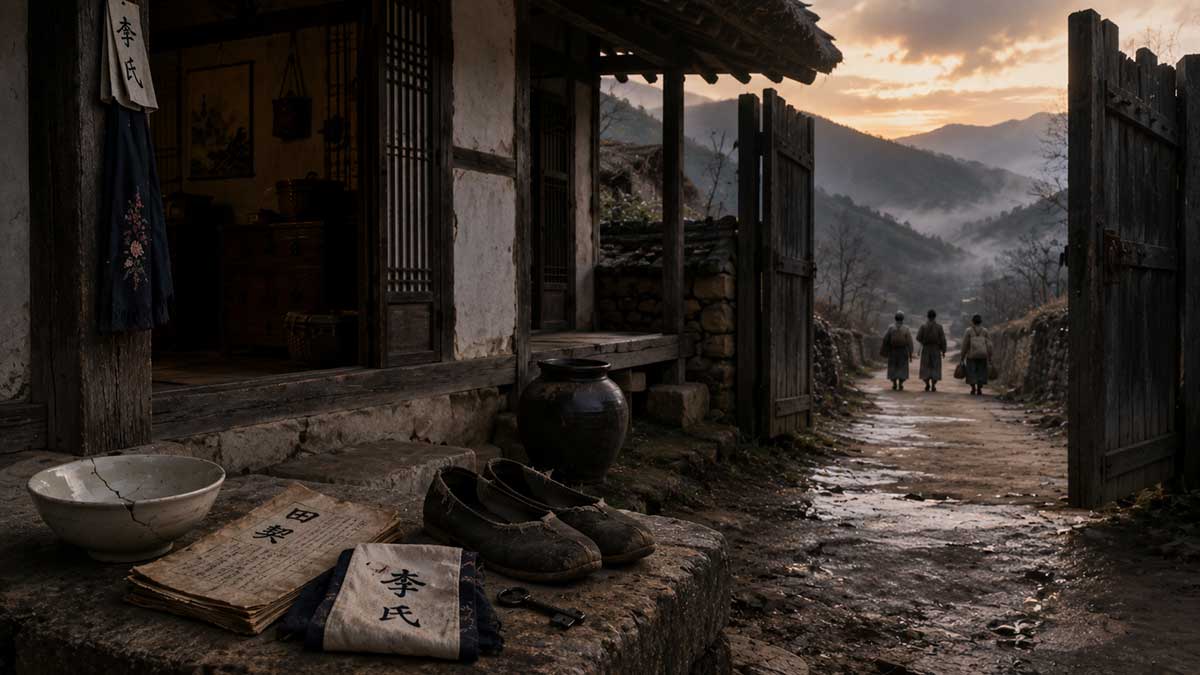
News that war had begun again reached Mangwol-ri before the monsoon did.
At first it was only talk drifting through the market — armies descending from the north, someone said; a great city already fallen, said another; the fighting would be over within days, a third insisted, though no one could say where he'd heard it. One person had it from the radio. Another from a cousin back from the railway station. A third from the father-in-law of a man who knew someone who claimed to have seen it himself.
"Once a story's passed through three mouths," Seo-jin said, "even a war can end in a single afternoon."
Then the refugees started arriving — barefoot children, women with cooking pots strapped to their backs, an old man who'd walked hundreds of *li* leading a single ox the whole way. They said Seoul had fallen. They said soldiers were already moving south. A house that belonged to one family on Monday flew another flag by Tuesday.
Only then did Mangwol-ri open its own storehouses and start packing.
---
The first argument in the Kang household was over what to save.
"Rice first," Jun-ho said.
"The genealogy and the land documents first," Jun-seo said.
Seo-jin looked between her two sons. "Will you boil the genealogy when you're hungry?"
"Without the documents, the land won't be ours even if we survive to come back for it."
"We have to survive the leaving before we can worry about the returning."
"And without land, how do we live once we get there?"
"Living without a life left in you is harder still."
A spoon gave a small tremor in the kitchen. Seo-jin sighed. "The war hasn't even reached the village yet, and already the two of you are trying to defeat each other."
Three generations lived under that roof by then — Seo-jin's two sons and their wives, grandchildren, an unmarried daughter, a distant relative's family besides. So many children no one could always say for certain whose child was whose; so many adults that no one quite remembered anymore who still held which old grudge against whom. The house had grown large. There had never once been enough rooms in it, and now, with the war at the door, it turned out there was even less trust to go around than there was space.
---
Jun-ho wanted to leave for the south immediately. Jun-seo argued they should wait a few days — the roads were already choked with soldiers and refugees, and no one knew yet how far they'd need to travel before anywhere felt safe.
"You always say wait."
"This time there's a reason."
"There was always a reason."
The brothers had worn this argument smooth over the years since liberation. The line stitched onto the cloth — *brothers who leave through the same door may return to different countries* — had become, in the plainest sense, simply true. Jun-ho had grown close to leftist organizers; Jun-seo still worked inside the new administration. Jun-ho believed his brother had grown too comfortable bowing to whoever held power. Jun-seo believed his brother mistook anger for a plan.
And yet, each evening, they still sat down at the same table, for as long as their mother was alive to set it.
"Even if the country splits in two," she told them once, ladling out the soup, "I won't be splitting the bowl."
---
On the seventh day of the war, soldiers passed along the southern road, uniforms caked in mud, faces gone past exhaustion into something flatter. No one could say at first which side they belonged to. The village shut its gates. Even the dogs stayed quiet.
One soldier knocked at the Kang house.
"Water."
Seo-jin carried out the jar herself. Jun-seo tried to stop her.
"We don't know who they are."
"We know they're thirsty."
She gave them water. One drank too fast and started coughing; she struck his back gently, the way she'd have struck any child's. He looked, up close, younger than twenty.
"You remind me of my mother," he said, handing the jar back.
"Then stay alive and go find her."
The soldiers moved on. The next day, troops from the other side came through and asked for the same thing. Jun-ho looked at his mother.
She carried out the same jar.
"You gave water to the other side yesterday," he said, quiet.
"Water doesn't choose sides."
"People do."
"Which is exactly why water shouldn't have to."
Word got around that soldiers from both sides had drunk from the Kang well. Some called it mercy. Others called it a dangerous kind of neutrality that would get the family in trouble with whoever won.
"Ask the well which side it supports," Seo-jin said, and no one had an answer for her.
A few days later, the water started tasting faintly of salt, and no one ever explained that either.
---
As the fighting drew closer, more strangers found their way to the Kang table. A child separated from his family wandered in one evening. A wounded soldier stayed the night. An old man coming down from the mountains stayed three. Seo-jin asked each of them for a name. Some gave one. Some didn't. Those who refused ate just as well as those who answered.
"Why house someone if we don't even know his name?" a daughter-in-law asked once.
"A sleeping man doesn't need to hear his own name to fall asleep."
Seo-jin added every name she did learn to the edge of the cloth — not because these people were dead or missing, but simply to keep some record that they had, once, eaten at this table. Those who gave no name at all were marked instead with a small dot. By the end of the summer there were more dots on the cloth than there were names.
---
The order to leave came suddenly, before dawn, artillery sounding beyond the northern mountain — distant as thunder at first, close enough by sunrise to rattle the windows in their frames.
The village headman ran through the alleys shouting that everyone had to be gone before the day ended.
The house dissolved into motion. Jun-ho hauled rice sacks into the courtyard. Jun-seo packed the genealogy, the land papers, and the name cloth into a chest. The daughters-in-law tied up bedding and children's clothes. Someone insisted the cooking pot had to come; someone else said it was too heavy and chose the brass bowls instead. A child cried that the chickens couldn't be left behind. An elder wanted every storage jar buried in the yard.
"How do we bury all of them?" Jun-ho snapped.
"We can't," the elder said. "That's exactly why we bury at least the one."
---
Seo-jin moved slowly through the rooms while the rest of the house rushed around her. There was more here she'd have to leave than she could ever carry — the wardrobe her own father had built, the little writing table Yeon-ok had used as a girl, Do-yun's old brass spoon, the wooden spinning top the backward river had once returned, the tablets bearing the names of the family dead, the kitchen built, all those years ago, over the black stone.
People kept calling to her from every direction.
"Mother, hurry."
"Do we take this?"
"Should we bring more rice?"
She answered none of it at first. From the lowest cupboard she lifted out the cracked white bowl.
"You're taking that too?" Jun-seo asked, passing.
"It's the lightest thing in this house."
"It might break."
"It's already broken. And it's still here."
---
Jun-ho went to the anchovy jar out of old habit, though there was nothing left beneath the fish by then — most of it burned after liberation, only a handful of unsigned letters remaining. He couldn't lift the jar; it was too heavy even empty of its old cargo.
"Are you planning to carry every last anchovy south with us?" Seo-jin asked.
"There might still be something under there."
"Did you put anything there?"
"No."
"Then I remember what's left better than you do."
She lifted out an oiled paper — the old contact message he'd carried before he fled to the mountains, years back. She handed it to him.
"You don't need it anymore?"
"Why did you keep it this long?"
"I never knew when it was safe to throw away."
"Do you know now?"
"The war's started again. So, no. Less than ever."
She folded it into the name cloth instead of handing it back. Jun-seo frowned at the sight of it.
"That paper's dangerous."
Jun-ho laughed, short and without much warmth. "And yours are safe?"
"Mine protect the family's land."
"Mine record who was protected, once, by somebody."
"Yours could get a man killed."
"Yours could put a family out of their own house."
Seo-jin stepped between them before it went any further. "Take both."
"What?" the brothers said, nearly together.
"The rice and the genealogy. Both."
"We can't carry everything."
"Then divide the weight between you."
Jun-ho took the rice sack. Jun-seo took the document chest. Neither one made it ten *li* before the weight started to tell — the rice biting into Jun-ho's shoulders, the chest's corners tearing at Jun-seo's palms. Each glanced sideways at what the other was carrying. Neither offered to trade.
"Switch," Seo-jin said from behind them, without looking up.
"I'm fine," Jun-ho said.
"So am I," said Jun-seo.
A low sound came from both bundles at once — the brass spoon rattling faintly inside the chest, the grain shifting like a small wave inside the sack.
"Even the luggage hears you lying," Seo-jin said.
They traded at last. After a few steps with the chest on his own back, Jun-ho said, almost to himself, "Why is this so heavy?"
"You said paper was lighter than rice."
"Isn't paper supposed to be light?"
"It gets heavy," Seo-jin said, "once it's carrying that many names."
For the first time since the war had started over again, Jun-ho laughed while looking straight at his brother. Jun-seo, after a moment, laughed too.
---
The refugee column stretched south for what felt like the length of the whole country — ox carts, handcarts, children carried on backs, old men and women leaning on sticks, all sharing the same narrow road. Some wore their house keys strung around their necks. Others carried a handful of courtyard soil wrapped in cloth, as if soil could be a kind of currency wherever they ended up.
One woman carried nothing but an empty drawer pulled from a wardrobe.
"Why only the drawer?" someone asked her.
"The wardrobe was too heavy."
She never once set it down, empty as it was.
A Kang child carried a chicken in his arms the whole first day. It stayed calm right up until he fell asleep, and was gone by morning.
"The chicken must have chosen where to run," Seo-jin told him when he cried about it.
"Didn't it want to come with us?"
"You'd have to ask the chicken that yourself."
He thought about it a while. "Maybe it thought we'd eat it eventually."
"That," she said, "was probably the wisest one among us."
---
That first night they slept in an abandoned house and along the roadside, one pot between them and little enough water. Seo-jin divided the rice; Jun-ho built the fire; Jun-seo counted the children.
"Fourteen."
"Isn't it fifteen?" a daughter-in-law asked.
They counted again. Fifteen. A moment later, fourteen. One child gone. They called into the dark and got nothing back.
Jun-ho took a torch and went back down the road alone. He returned much later carrying the missing boy, found sitting calmly in the kitchen of an empty house.
"Why were you there?" Seo-jin asked him.
"Grandmother told me to eat something before we left."
"What grandmother?"
He pointed behind him. The house was empty — had been empty, as far as anyone could tell, for years. A coal still glowed faintly in the hearth. A small bowl of warm barley rice sat where someone's hands had clearly just left it.
Seo-jin bowed once, toward the empty doorway. "Whoever you are — thank you."
"Someone probably just left in a hurry," Jun-seo said.
"Why leave only the child fed, then, and nothing for the rest of us?" Jun-ho asked. Jun-seo had no answer for that either.
That night the cracked white bowl went warm in Seo-jin's hands as she slept holding it against her chest. By morning a single spoonful of barley rice sat inside it. No one ever explained where it had come from.
---
Further down the road, people began shedding what they carried, one layer at a time. First the heaviest things — pot lids, spare blankets, farm tools, books. Then the things that were precious but not strictly necessary — photographs, brass dishes, new clothes, a child's toy. Last of all came the things people had sworn, back home, they could never leave behind — house keys, a wedding hairpin, a dead child's small shoes, ancestral memorial tablets. Those who finally set such things down by the roadside tended to stand there a long time afterward, unable to simply walk on.
Jun-seo kept carrying the land papers the entire way. Jun-ho couldn't understand it.
"What good are papers if the house burns to the ground?"
"The house might still be standing."
"We might never even go back."
"Someone might."
"Who?"
Jun-seo had no name to give him.
"He's carrying them for whoever that turns out to be," Seo-jin said quietly, and Jun-ho, for once, let the matter rest.
---
On the third day they reached a river. The bridge was gone, and people crossed a few at a time in small boats, the boatman shouting at everyone to lighten their loads before he'd let them aboard.
"People first," he kept saying. "Always people first."
Jun-seo refused to let go of the chest. "This has to come."
"If paper falls in the water, a man has to jump in and save it. If a man falls in, will the paper save him?"
Behind them, word was spreading that soldiers were closing in. Children were crying. People were pushing toward the boats. Jun-ho grabbed the chest out of his brother's hands.
"What are you doing?"
He opened it — the genealogy, the land documents, the name cloth, the brass spoon, the old messages, all of it there together. He pulled out the land records.
Jun-seo caught his wrist. "What are you *doing?*"
"We can't carry all of it."
"No."
"People board first. That's the rule."
"Without those documents, we—"
Jun-ho tried to tear the pages in half. Jun-seo struck him before he'd finished the thought. They grappled at the water's edge, people trying and failing to pull them apart, until Seo-jin got there first and simply took a handful of rice from the open chest — no one had any idea how grain had gotten mixed in among the papers, though it had likely leaked from the torn sack somewhere along the road.
"This feeds us today," she said, holding it up. Then she raised the land documents in her other hand. "This might help us find a place to live again, once we go back."
"We need both," Jun-seo said.
"That's exactly why we can't keep the whole of either."
She tore away only what mattered most — the pages naming the land itself, the family name attached to it — and let the rest go, page by page, onto the surface of the river.
"Mother!"
The pages spread out across the water, the ink already starting to bleed and dissolve.
"Let the land remember us instead," she said.
"How can land remember anything?"
"It outlasts people. That's how."
Jun-ho closed the chest without another word. Neither brother spoke again for the rest of the crossing. Once they were on the far bank, Jun-seo didn't cry — but he couldn't look away, either, from the wet pages drifting off downstream, growing smaller and smaller until the current finally took them somewhere he couldn't follow.
---
That night faint lines appeared in an empty section of the name cloth — the rough shape of mountains, a river. Not an exact map. The roads on it ended abruptly, mid-stroke. The river split cleanly in two. Where Mangwol-ri should have sat marked, there was only a small black dot.
"This isn't a map," Jun-seo said.
"Maybe it's only a map for the one who's going back," Seo-jin answered.
---
The war kept rearranging the road under their feet. People walking south turned around and went north again. Towns declared safe one day burned the next. Soldiers who'd been allies vanished overnight. Refugees found themselves walking roads the enemy had used only the day before.
One night Jun-ho told the family he was leaving them to stay with others and help carry the wounded. Jun-seo tried to stop him.
"You're leaving again?"
"People are still back there."
"We're people too."
"You're here. You're safe enough."
"Don't say that like it settles anything."
"Like what?"
"Like I can stay because you're the one who's leaving."
They stood in an open field with no kitchen, no stone, nothing to listen for either of them. Even so, the spoon tucked away in their bundle gave a small, faint tremor.
Jun-ho lowered his head. "I'm sorry."
Jun-seo hadn't expected that. "For what?"
"For always assuming you'd be the one who stayed."
After a long silence, Jun-seo said, "I always assumed you'd be the one who came back."
For the first time since the war had restarted, the brothers spoke whole sentences to each other instead of half of them.
The war didn't wait for the rest of the conversation. Jun-ho left before dawn, promising to return within three days.
Three days passed. Then a week. Seo-jin kept setting his bowl regardless — under canvas tents, in borrowed classrooms, inside mountain caves, in whatever barn happened to shelter them that night. It always sat in the same place, no matter where they were.
"We're running low on rice," a daughter-in-law said eventually.
"I know."
"Why keep filling it, then?"
"Only a little."
"No one's eating it."
"We don't actually know that."
Jun-seo said nothing through any of it. They left the rice out overnight, and sometimes it was gone by morning, and sometimes it had simply hardened where it sat — a rat, a hungry passing child, someone unable to make it home. Seo-jin never tried to guess which. "If a hungry person ate it," she said once, "that's reason enough."
---
Months later the family settled, for a while, in a refugee camp in the south — tents and rough wooden shacks lining the edge of rice paddies, the refugees renaming the muddy alleys after the homes they'd left behind: Pyongyang Alley, Kaesong Road, Seoul Yard, Hamhung Hill. The row where the Kang family settled became, without a vote or a discussion, Mangwol-ri — the only family from that village, and yet the name filled the whole alley on its own.
"The village followed us here," Seo-jin said.
Jun-seo painted the name on a board with his own hand and hung it in front of their tent, his fingers unsteady the whole time he wrote it. He had copied thousands of names onto government paper over the years. This was the first time, he realized, that he'd ever written his own home's name the way a person writes something they actually love.
All through the camp, people called out for the missing.
"Does anyone know Kim Bok-sun?"
"Park Yeong-tae, from Jeonju!"
"A girl, five years old, a mole under her left eye!"
Names were posted at train stations, markets, ration lines — the names of people neither confirmed dead nor confirmed living, fluttering on paper in the wind like something that hadn't decided yet what it was.
Seo-jin unfolded the cloth and moved Jun-ho's name to the very center.
"Why there?" Jun-seo asked.
"Because we don't know where he is anymore."
"He's alive."
"I believe that too."
"Then why the center?"
"The center was never for the dead."
"Then who is it for?"
"For the ones we simply don't know."
Jun-seo wanted, badly, to move the name back to the edge where a person merely absent belonged. He didn't touch it.
That night the brass spoon went warm in its box, and stayed warm until morning — the whole family taking it, without saying so aloud, as a sign that Jun-ho was still alive somewhere.
The next day a wounded soldier walked into the camp and said he knew Kang Jun-ho.
"Is he alive?" Jun-seo asked at once.
The soldier lowered his eyes before answering. "He was, the last time I saw him."
"When?"
"Two months back."
"Where?"
He couldn't give an exact place — the front had shifted so many times by then that even the road names had stopped meaning anything.
"What happened?" Seo-jin asked.
"He sent the wounded ahead of him and stayed behind."
Jun-seo closed his eyes. It sounded exactly like something his brother would do — which made it, somehow, harder to believe rather than easier.
"Did you see him die?"
"No."
"Then he's alive," Jun-seo said, more to himself than to anyone.
The soldier didn't answer that. The spoon in its box stayed perfectly still. No one there had told a single lie.
---
That evening Seo-jin filled Jun-ho's bowl all the way to the top.
"He might not eat it," Jun-seo said.
"I know."
"We should be saving the rice."
"I know that too."
"Then why—"
"Tonight, you eat it."
He stared at her. "His rice?"
"You're the one carrying his waiting, on top of your own."
He sat in front of the bowl a long while before he could bring himself to lift the spoon.
"If I eat it," he said finally, "it feels like giving up on him."
"A bowl of rice never killed anyone."
"And if I don't eat?"
"Then you go hungry, and nothing else about it changes."
She divided it herself in the end — half into the cracked white bowl, the rest set in front of him. "Waiting needs feeding too," she said, "if you mean for it to last."
He ate slowly. The tears came without his permission and he didn't wipe them away. The war hadn't ended. Jun-ho hadn't come back. Mangwol-ri sat somewhere far behind them, further every day. After that night, though, Jun-seo never again let the whole of his brother's meal sit untouched — half stayed always for the one they were waiting on, and half went to the one who still had to stay alive long enough to keep waiting.
---
Years later, word came of an armistice. Some called it the end of the war. Others said only that the fighting had paused. Jun-seo prepared to travel north alone to see whether Mangwol-ri could even still be reached.
Seo-jin didn't go with him — her legs had grown too weak by then for the road. She handed him the cracked bowl and the name cloth both.
"Both of them?"
"Whoever gets home first should be the one carrying them."
"And if the house is gone?"
"The stone will still be there."
"And if the stone's gone too?"
She thought about that for a moment. "Then wherever we're standing becomes the house instead."
He nodded, and understood, finally, a sentence she'd said to him years before and that he hadn't quite let himself believe until now.
The night before he left, she set a table outside the tent — Jun-seo's bowl, Jun-ho's bowl, the cracked bowl for the dead, and one more, empty, for whoever's name they still didn't know. Four bowls altogether.
"Why four?" he asked.
"One for the one going home. One for the one who can't. One for the dead. One for the one we haven't met yet."
"And yours?"
She smiled for the first time in what felt like days. "I'll just eat from the whole pot myself."
He laughed. Not one spoon so much as stirred that night — not because every last thing had finally been said between them, but because, for once, some words no longer needed saying out loud to be understood.
The next morning Jun-seo set off north for Mangwol-ri. The whole camp watched him go as if he were leaving to search for every lost home at once, not only their own. Someone pressed a house key into his hand. Someone else asked him to bring back a fistful of soil. A third simply asked him to find out whether an entire village he remembered was even still standing.
Jun-seo promised nothing to any of them. Too many promises had already broken during the war for him to add another lightly. Instead he wrote down names — people, villages, the exact dates they'd left, the shape a house used to be before it burned, where a well had once stood, what kind of old tree had grown beside a particular gate.
There was no longer room enough on the name cloth for all of it. He stitched a second piece of fabric onto the first. It didn't match — different weave, a different white — and the seam where the two met stayed plainly visible. He didn't try to hide it.
The family's memory, he understood by then, had never been one unbroken piece of cloth to begin with. It survived the only way it ever could — by tearing, by patching, by taking out names sewn in the wrong place and stitching them back where they belonged.
As he passed the last row of tents at the edge of the camp, he looked back once. The wooden sign reading Mangwol-ri moved slightly in the wind. Seo-jin stood beneath it with one hand raised.
He looked at his mother for a long moment, thinking, though he didn't say it, that this might be the last time. Far off, somewhere in the direction the black stone had once stood, he thought he heard a low sound carried on the wind.
This time it wasn't the stone listening for a swallowed sentence. It sounded, if anything, like the house itself, calling someone home.
Chapter 7: The House Did Not Recognize the Man Who Returned
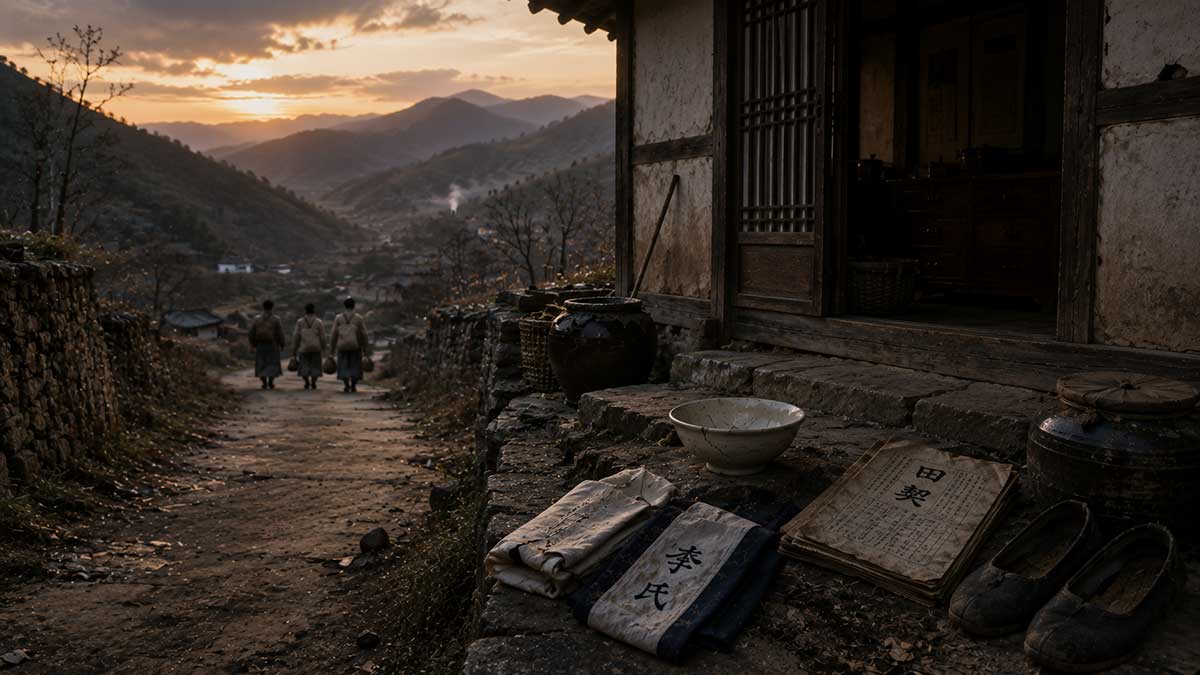
Kang Jun-seo returned to Mangwol-ri in the second spring after the fighting finally stopped.
Before he'd left the refugee settlement, people had pressed thirteen house keys into his hands, along with seven village names and twenty-one separate requests. One person asked only that he check whether a certain well still had water in it. Another wanted to know if a persimmon tree still stood. An old man asked him to dig up a buried storage jar and see whether the soybean paste inside had survived.
"The jar might still be there even if the house isn't," Jun-seo had told him.
The old man shook his head. "If the house is gone, the paste belongs to whoever's living there now."
Jun-seo hadn't argued the point. He carried the keys in a small sack — each one a different shape, a different degree of rust, one large enough to open what looked like a fortress gate, another no bigger than a child's toy. No one could say for certain whether any of them still fit a door. War changes the shape of houses well before it gets around to changing their locks.
---
Traveling north, he was stopped again and again. Name. Hometown. Which side had he supported.
"Kang Jun-seo," he told them. "From Mangwol-ri."
They searched their records and came up empty. "No such place."
"Try Seventh Village of Buksan Township."
"That doesn't exist anymore either."
"Wolcheon-dong, then?"
"That name's gone too."
"Cheongsu-ri?"
The official stared at him. "Why does your hometown have so many names?"
"We didn't choose any of them."
"The record only allows for one."
"The record changed it three times on its own."
"Then the last one it settled on must be the true one."
Jun-seo thought about that. "The last one disappeared first, actually."
They held him a long while after that exchange — a man with too many hometowns, it seemed, made officials more nervous than a man with none at all. He showed them the old wooden sign he'd carried from the refugee camp, the paint faded under years of wind and rain.
"Is this your proof?"
"No."
"Then why bring it?"
"So I wouldn't forget it myself."
"That's not an administrative document."
He wrapped it back up carefully. "That's exactly why it's still here."
---
The last mountain road into Mangwol-ri no longer existed. Bombing had collapsed the slope; rain had filled in whatever trenches the soldiers had left behind. The old path simply ended against broken ground, and new paths led off toward villages he didn't recognize.
He followed instead the faint lines that had once appeared, unbidden, on the name cloth — though the lines seemed to shift even as he walked them. A road that curved left in the morning ran straight by afternoon. The river widened whenever it rained. Some days the small black dot marking Mangwol-ri simply wasn't there at all.
When that happened, Jun-seo took out the cracked white bowl and set it on the ground. The crack always leaned toward one particular direction. He walked that way.
On the evening of the third day, he saw the old persimmon tree — half of it burned black, the other half stubbornly alive. Behind it stood the roof of the Kang house.
He couldn't make himself move for a moment. The house was still standing. It didn't look, though, like a house that had spent all these years waiting for him. The gate had been repainted a different color. The wall stood lower than he remembered. Part of the men's quarters had clearly been dismantled at some point and used for military lodging. Unfamiliar jars crowded the courtyard. Two children he'd never seen were throwing stones in the yard, and one of them, catching sight of him, shouted toward the house:
"Father!"
A man came out — Park Man-sik, who'd come north during the war and settled here with his wife, two children, and his elderly mother.
"Who are you?" Man-sik asked.
"Someone from this house."
"We live here now."
"I understand that."
"Then what do you want?"
Jun-seo looked past him at the gate. "To go inside."
Man-sik planted himself in the doorway. "You can't just walk into another man's home."
"It was ours before it was another man's."
"We had a home before the war too. We lost it the same as anyone."
They stood there measuring each other — two men each quietly convinced his own loss weighed more, though of course a lost home was never really something you could weigh against another one. A home wasn't lost according to how large it had been. It was lost by simply becoming a place you could no longer enter.
---
Man-sik's mother came out then, small and thin, and looked at Jun-seo a long moment.
"That must be him."
"Who?" Man-sik asked.
"The one the kitchen stone used to call for. Every night."
Jun-seo went still. "The stone's still here?"
The old woman pointed toward the kitchen. "They tried to take the house apart for firewood, once, right after the fighting stopped. Everything came up except that."
Soldiers had tried prying up the floorboards and the doors. Pickaxes had snapped against the black stone. Ropes had broken three times over. One soldier who'd slept above it, the old woman said, had called out for his mother the entire night, and no one had touched it since.
Jun-seo walked toward the kitchen. As he tried to cross the threshold, his feet simply stopped — his whole body leaning forward while his soles held fast to the ground, as though the earth itself had decided not to let him through.
Man-sik's children laughed. "The man can't get in!"
He went back to the gate and tried again. The same thing happened.
"Are you really from this house?" Man-sik asked, more careful now than mocking.
Jun-seo said nothing. A spoon somewhere inside the kitchen gave a faint tremor. He reached into his bundle and took out Do-yun's old brass spoon — the handle still too short, untouched by fire after all these years — and set it on the threshold.
It rolled once into the house, then rolled straight back out again.
Even the spoon, it seemed, had been returned unaccepted.
---
Jun-seo sat down in the courtyard and set the chest he'd carried the whole way beside him — the last of the land records, the genealogy, the name cloth, the keys he'd been entrusted with.
"You've got documents?" Man-sik asked.
Jun-seo nodded.
Man-sik's expression hardened. "We have nowhere else to go."
"Neither do I."
"You've come to take the house back."
Jun-seo opened his mouth to answer and found he couldn't. He'd believed, the whole way here, that this was exactly why he'd come. But seeing the children's shoes lined up by the door, the wet laundry on the line, smoke rising steady from the kitchen chimney, made the sentence a good deal less simple than it had been in his head.
Winning back one home, it occurred to him, might mean forcing another family to lose the only one they had left.
The spoons trembled again, harder this time. Man-sik's wife came out at the sound.
"They're at it again."
"Does that happen often?" Jun-seo asked.
"When someone's lying."
She looked him over. "What did you leave out just now?"
"I came to take the house back."
The spoons rang louder still. The children laughed.
"That's a lie!"
Jun-seo felt his face go hot. "Then why *did* I come?"
Man-sik's mother answered before anyone else could. "Not to take it back. To find out whether it survived."
The spoons went quiet. Jun-seo looked at her, and knew, hearing it, that this was closer to true than anything he'd said himself. He wanted the house back — but before that, underneath that, he'd wanted only to know whether it had gone on existing without him in it. And it hurt him and comforted him in equal measure to learn that fires had kept burning here, that children had gone on playing in this yard, that someone had bothered, every single night, to close the gate.
---
He slept in the courtyard that night. Man-sik offered him a room, but Jun-seo said he couldn't sleep somewhere the house itself hadn't yet agreed to let him enter.
"Does a house talk?" Man-sik asked, half joking.
"Ours always has."
"What does it say?"
Jun-seo looked toward the gate. "Usually nothing at all."
Past midnight, a low sound rose from the kitchen. He woke to find white snow gathered thick on the surface of the black stone — in the height of summer, with the stars still visible and no wind moving. The Park family woke too, and the children reached toward the snow, watching it vanish the instant their fingers touched it.
Across the stone, in careful, drifting flakes, letters began to form:
*Do not ask who lived in the house. Ask who kept the house alive.*
"What does that mean?" Man-sik asked.
"I don't know," Jun-seo admitted.
The old woman answered for him. "The one who kept the fire burning may have a stronger claim on this house than the one who left it standing empty."
Something in Jun-seo's chest ached at that. "Then what does that make me?"
"The one who came back," she said, not unkindly.
---
At dawn he tried the threshold again. One foot crossed. The second wouldn't follow.
"Are you inside or outside?" a child asked, genuinely curious.
"I don't know."
"Half inside," the younger one decided.
In the kitchen mirror, only half his face appeared — the same divided reflection, he remembered with a chill, that had once split Kang Mu-hyeon's face after he'd erased a cousin from the family register. But Jun-seo couldn't say, standing there, whose name he might have erased to earn the same fate. Too many faces were missing from his own accounting by now — the people he'd seen on lists and failed to warn in time, his own vanished brother, the family now living where he'd once lived. Any one of them, or all of them together, could easily have claimed the other half of him.
He opened the name cloth. Kang Jun-ho's name still sat at the center, the blank space beneath it just as empty as the day Seo-jin had left it there. He lifted his brush, tried to write *dead*. His hand wouldn't move. He tried *alive*. That wouldn't come either.
"Whose name is that?" Man-sik's wife asked.
"My brother."
"Is he dead?"
"I don't know."
"Then why write anything at all?"
"Because not knowing is more than I can carry in silence."
"After a war," she said, "the largest group of people left are the ones no one can account for either way."
He set the brush down without writing anything.
---
Villagers gathered the next morning, word having spread that an old resident had come back. Some recognized him. Most didn't — the children he remembered had grown into adults he'd never met, and the adults he remembered had grown old or died in the years he'd been gone.
"That's Kang Jun-seo," an elder finally said.
"How can you tell?"
"The left side of his mouth always moves first when he talks."
It was, in the end, a habit Jun-seo had never once noticed in himself that finally proved who he was.
---
The new township office was busy sorting out land and house ownership across the whole region. Jun-seo presented what papers he still had.
"Some pages are missing," the official said.
"They were left behind during the evacuation."
"Why?"
"People had to board the boat first."
"Unfortunate. Administratively difficult, though."
"Would it have been better to leave the people instead of the paper?"
"Don't make this emotional."
"The war was emotional the whole way through."
"The law isn't."
Jun-seo almost smiled at that. "Then the law never actually lived through it."
The official explained that Park Man-sik held temporary occupancy rights by now. Jun-seo might get partial recognition as the prewar owner — but only if he could show that every member of his family had returned.
"How many family members?" the official asked.
"At what point in time?"
"Now."
"Do I count the ones whose whereabouts we don't know?"
"Only the living."
"And the ones who might still be alive?"
"Leave them off."
"And the ones who might be dead?"
"Leave them off too."
"So the war shrinks a family down on paper, whichever way it goes?"
The official sighed, tired in a way that suggested this wasn't the first such conversation of his morning. "This isn't a philosophy lesson."
"I came here to find a house."
"Then write down the names."
He handed over a blank form. *Household members.* Jun-seo wrote his own name. Then Yoon Seo-jin's. On the third line he paused before writing Kang Jun-ho.
"Alive or dead?" the official asked.
"I don't know."
"Then don't write it."
He wrote it anyway.
The official crossed it out in red ink. Jun-seo wrote it again. The official crossed it out a second time. On the third attempt the paper tore straight through. The small mirror hanging on the office wall gave a visible shiver.
The official himself stayed perfectly reflected. Jun-seo vanished from the glass entirely — everyone in the room could see him standing there plainly, and yet the mirror showed nothing but an empty chair.
"What's happening?" the official cried.
"The records seem to move faster than people do," Jun-seo said.
After that he began carrying a small mirror of his own to every visit to that office. Whenever a clerk crossed out his name, or his brother's, he set the mirror on the desk between them.
"Why bring that?"
"To check the form's accuracy."
"With a *mirror?*"
"It works faster than your paperwork."
Eventually Jun-ho was entered into the register as *status unknown.* The official insisted no such category existed. Jun-seo simply drew the column himself, in the margin, and once it existed on the page, other villagers began adding to it — missing husbands, daughters who hadn't come home, parents left behind in the north, children lost somewhere along the evacuation road. The column grew a little longer every week. People started calling it, without much ceremony, the Mangwol-ri column.
"Why does it carry our village's name?" Jun-seo asked once.
A woman standing nearby answered before anyone else could. "Because for a long while, no one was sure this village existed either."
He didn't ask anything further after that.
---
The ownership dispute stayed unresolved for months. The office finally ordered both families to share the house — the Parks in the inner room and men's quarters, Jun-seo given a small empty room of his own. Even so, the house continued to make its own decisions about him. Some mornings the door opened easily under his hand. Some evenings it wouldn't budge. Some nights, sitting down to eat in the kitchen, his spoon simply fell from his fingers of its own accord. If he tried sleeping on the wooden floor, he'd find himself, hours later, drifting slowly in his sleep back toward the gate.
Once he woke beneath the persimmon tree without any memory of having gone there.
"Does the house dislike you?" the children asked him, more curious than cruel.
"A house gets its feelings hurt too, when it's been left alone too long."
"Did you apologize to it?"
He thought about that for a while. He'd spent all these years believing he'd *lost* the house — that the war had taken it from him, and so he owed it nothing further than grief. It had never once occurred to him, until the children asked, that the house itself might reasonably see it differently: that absence, to a house, might matter more than any excuse offered afterward for it.
That night he sat down in front of the black stone.
"I'm sorry."
Nothing.
"I wanted to come back."
A single spoon trembled.
He lowered his head. What he hadn't said, the part still caught in his throat, was closer to the truth: *I was afraid to come back. Afraid the house was gone. Afraid my brother had already made it home first. Afraid no one had waited at all. Afraid, worst of all, that the house would still be standing exactly as it always was, and would show me plainly how much I'd changed in its absence.*
He said the whole of it out loud, finally, to the stone.
"I've come back," he said, "but I still don't know whether I belong to this house anymore."
White snow rose up from beneath the threshold — not falling from above this time, but climbing, slowly, around his shoes. The three leaves already growing from the black stone trembled where they stood.
He put one foot across the threshold. The house didn't push him back. Then the second foot followed.
"Does the house know you now?" one of the children asked.
"I don't know that either. But it let me in. That's enough, for tonight."
---
That same day, the Park family received an eviction notice — the office had partly recognized the Kangs' prewar ownership after all, and current occupants were now ordered to relocate.
"Did you file for this?" Man-sik demanded.
"I asked them to recognize our claim."
"So now you'll put us out on the road."
"That was never what I meant to happen."
A spoon rang out, sharp in the sudden quiet.
"Convenient," Man-sik said, bitter, "how the spoons in this house always seem to work in your favor."
Jun-seo took the eviction notice from him. "I'll fix it."
"How?"
He had no answer ready.
The day he'd finally been let into the house, another family was being pushed straight back out of it. The sentence written on the stone came back to him clearer than ever: *Ask who kept the house alive.* Through the entire war, it had been the Park family who'd done exactly that — repaired the roof, rebuilt the wall, kept the kitchen fire lit, cooked every day over the very stone that had refused to let Jun-seo through the door. Without them, the house might well not have survived at all.
He went back to the township office.
"Put both families on the record."
"A house has one owner."
"There are two families living in it."
"That's precisely why there's a dispute."
"Then don't let there be one."
"The law requires it."
"Does the law ever consider who kept the fire lit?"
"It considers ownership papers."
"Half of mine are somewhere at the bottom of a river."
"Which makes this considerably more difficult."
Jun-seo set the cracked bowl on the desk between them.
"Why bring that, of all things?"
"To make one more blank column."
"For what, exactly?"
"The name register needed a place between life and death. A house needs one between ownership and having nothing at all."
"No such category exists."
"Then create it."
"You seem to invent a new system every time you walk in here."
"The war didn't leave people fitting neatly into the old ones."
After a long, tired argument, the Kang house was finally registered as a shared residence, ownership itself left unresolved, management split jointly between Kang Jun-seo and Park Man-sik.
"If trouble comes of this, you're both responsible," the official said.
"Even if nothing comes of it," Jun-seo said, "we're both responsible."
---
Man-sik didn't forgive him easily. That evening, though, the two families ate together in the same kitchen for the first time — separate pots, but the same fire underneath both of them.
"Who owns the house now?" one of the children asked.
"The adults are still working that out," Man-sik said.
"The house will decide, in the end," Jun-seo told him.
The child looked at the stone. "It can't write."
"The things that can't write," the old woman said, "tend to remember the longest, all the same."
After the meal, Jun-seo set the cracked bowl at the far end of the table.
"Whose food is that?" Man-sik's wife asked.
"For the ones who couldn't make it back."
"We have people like that too."
She brought out a second bowl of her own. Man-sik spoke his own brother's name — lost on a road somewhere north, the two of them separated in the chaos of the retreat. His mother spoke her husband's name, the man who'd stayed behind in their old hometown and never been heard from again. Jun-seo spoke Kang Jun-ho's name.
The two families took turns after that, naming whoever they were each still waiting on — different homes, different roads, all of it resting, by the end of the night, at the very same end of the same table.
---
That night every door in the house opened on its own — no wind to explain it, the gate and every room and the storehouse and every cupboard swinging wide at once. At first everyone feared thieves. Nothing was taken. Instead, faint signs remained wherever unseen guests had apparently sat a while: cushions pressed down, a few stray grains of rice clinging to empty bowls, wet footprints tracking from the gate straight to the kitchen and no further.
"Someone visited," Jun-seo said.
"Who?" Man-sik asked.
"Whoever's name we spoke tonight."
The children followed the footprints the next morning. They ended, all of them, at the black stone. The old sprout there had grown as large as a hand by now, its two leaves split down the center — one bearing markings that looked, unmistakably, like formal genealogical script; the other rougher, closer to how the Park children scratched their own names into dirt when they were learning their letters.
"The plant belongs to both families," one of the children said.
"It looks that way," Jun-seo agreed.
---
Several weeks later a letter reached him from the refugee camp: Yoon Seo-jin had died. He read it three times through before it settled.
She had survived the whole winter after he'd left her and died quietly, just before the spring rains came. She'd gone on setting Jun-ho's bowl every single day right up to the end. The day before she died, she'd filled an entire bowl for him, brimful, though it wasn't the usual day for it.
"I might not manage it tomorrow," she'd told the daughter-in-law who asked her why.
Jun-seo folded the letter and sat for a long while before the black stone, unable to cry outright. He filled the cracked bowl and tried to say his mother's name aloud. No sound would come. Not one spoon trembled — he hadn't swallowed her name so much as found it simply too large to fit through his own mouth all at once.
Man-sik's mother sat down beside him.
"Your mother's died?"
He nodded.
"Set out one more bowl."
"There's already one. For the ones who can't come back."
"That one's for the ones who can't find the road."
She brought out a small bowl of her own. "This one's for someone who doesn't need to come back anymore. She already finished what she came to do."
He filled it. On the name cloth, beside the line Yeon-ok had opened years before, he embroidered Yoon Seo-jin's name — the place set aside for those who'd learned how to leave, even in death. Beside it he wrote:
*Yoon Seo-jin waited for two sons, and never once made either one owe her for the waiting.*
He read the line back to himself and thought of Yeon-ok's old warning — that a single written sentence can outlive the person it describes. He left a blank space after it, in case someone, someday, remembered a moment when his mother had fallen short of it.
---
That night the house pushed him back outside again. He woke beneath the persimmon tree, certain at first the house had rejected him after all — until he saw the whole Park family asleep out there too, children curled peacefully under their blankets.
Voices drifted from inside the house. Low, overlapping, impossible to make out individually. He looked through the door.
A crowd sat around the table inside — Kang I-mun, Baek Yeon-hwa, Kang Yeon-ok, Jang Do-yun, Kang Mu-seok, Kang Do-han, and faces Jun-seo had never once seen. Yoon Seo-jin sat among them, opening the anchovy jar.
"You still haven't thrown this thing away," she said.
"The smell's unbearable," Do-yun said.
"So even the dead still have noses," Yeon-hwa said, and the whole table laughed.
Jun-seo tried the door. It wouldn't move.
"Mother," he called.
Seo-jin didn't turn. Instead she ladled rice into the cracked bowl and set it before one empty seat at the table — a seat that might, for all he could tell, have belonged either to him or to his brother.
By dawn the house sat empty again. The door opened easily this time. One bowl remained on the table, its rice still warm. Beneath it lay a damp scrap of paper, in his brother's unmistakable hand:
*Brother, I am still on my way home.*
Jun-seo held the page a long while. The ink had already begun to run — there was no telling when it had been written, or by whom, exactly, in what state.
"Is that really his writing?" Man-sik asked.
"Yes."
"Does that mean he's alive?"
Jun-seo had no answer ready. Not one spoon so much as stirred. He understood, holding the damp page, that leaving something unresolved could also, in its own way, be a form of remembering someone — maybe the truest form there was.
He stitched the note into the blank space beneath his brother's name. No date. Only, underneath it, one more line:
*The road home may run so long that the traveler grows old before he arrives at it.*
---
From that day two signs hung above the Kang gate — one reading *Kang House*, the other *Park House.* When the wind moved, the two boards knocked together. From a distance it sounded almost like an argument. Up close, it sounded like nothing so much as spoons touching bowls before a meal.
The villagers never quite settled on which name to use for the place. In the end they fell back on an older one entirely: *the house with the black stone.*
A house, it turned out, needed fewer names than people generally did.
On the first anniversary of Jun-seo's return, a small flower bloomed between the two split leaves growing from the kitchen stone — half its petals white, half black. People said it meant the house had finally accepted both families under its roof.
Jun-seo didn't believe a single flower could settle something that large. It would take longer than that, he thought, and probably should.
Even so, that evening, when he crossed the threshold, the house didn't push him back. It didn't push Park Man-sik away either, when he followed a step behind. The two men walked in through the same door, side by side, and neither one claimed afterward that he'd gone first.
In the kitchen, the spoons stayed perfectly quiet.
Chapter 8: The Night Electricity Arrived, One Shadow Disappeared
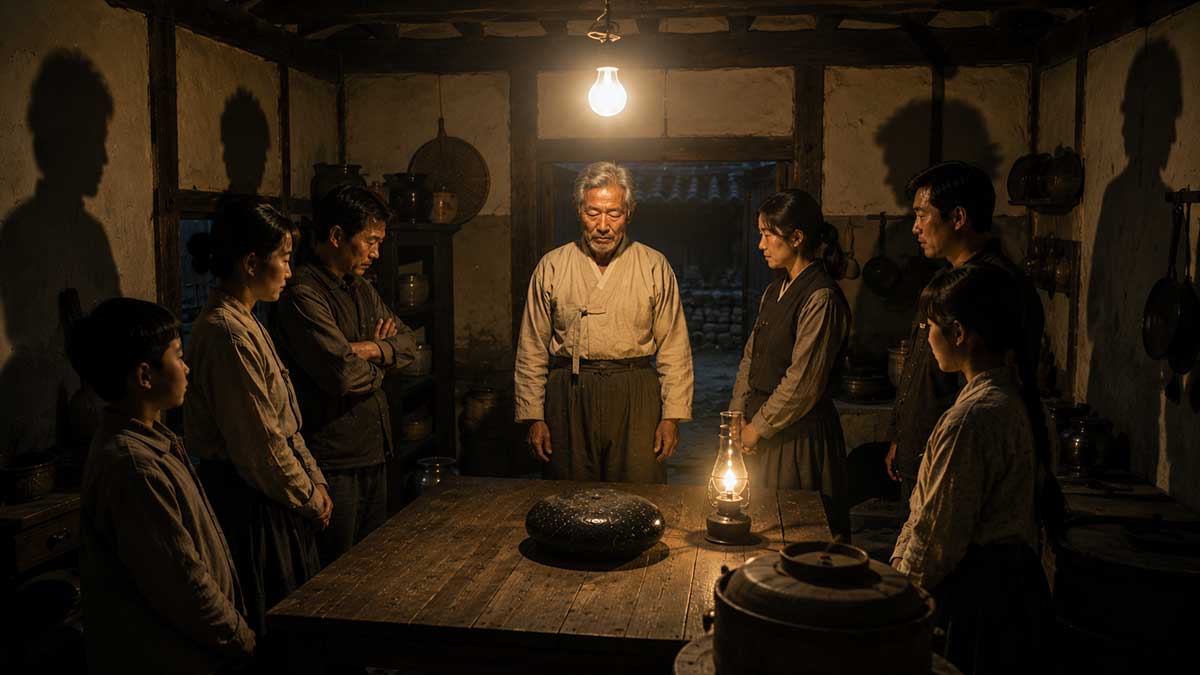
News that electricity was coming to Mangwol-ri arrived well before the utility poles did.
"The lights will come before the year's out," officials said in spring. By summer it had become "after the monsoon." After the monsoon came and went, it was "the poles haven't crossed the mountain yet." By autumn the poles had finally reached the foot of the pass, and the villagers went out just to look at them — long black trunks lying in the grass beside the road, so straight and dark they looked less like timber than like pieces of the night itself, waiting to be stood upright.
"Will the dark really turn to day, once those go up?" Park Man-sik asked the technician overseeing the work.
"Press the switch and the room goes as bright as noon."
Man-sik's mother, listening nearby, clicked her tongue. "People who never learned to use the daylight properly are about to get more of it than they know what to do with."
The children counted down the days. The adults worried, quietly, about the bill. The old folks said the ancestors might lose their way home if the nights got too bright to navigate by. The young people said the ancestors would simply have to adjust, like everyone else was expected to.
Kang Jun-seo believed none of it especially. He thought mainly that electric light would let him read the household's records after dark without burning through the oil. Since the war he'd taken on the informal work of untangling Mangwol-ri's records — his official post at the township office was a minor one, but whenever a name went missing, a boundary shifted, or a dead man turned up on the tax rolls again, people came to him before they went anywhere else.
By day he worked at the office. By night he sat correcting mistakes in the house with the black stone.
"You curse paper your whole life and still spend it all holding some," Man-sik said once, watching him work.
"A man cut by a knife doesn't throw out every knife in the house."
"A man could learn to eat with a spoon instead."
A spoon on the shelf gave a small tremor. Man-sik laughed. "See? Even the spoon agrees with me."
Jun-seo wouldn't admit it out loud. That evening, though, he noticed he was holding his own spoon a good deal longer than he held his brush.
---
By then the two families no longer lived, in any real sense, as separate households. Rooms stayed divided, but the children slept wherever they pleased, and the rice jars, though kept apart on paper, mixed so thoroughly in practice that no one could always say whose grain they were eating.
Man-sik's eldest son, Park Seong-ho, went to school with Jun-seo's grandniece, Kang Mi-ran — the same age, raised half in each other's pockets, fighting like siblings for most of their childhood. Turning seventeen changed how the village looked at them, whether they liked it or not.
Women started whispering when Seong-ho carried Mi-ran's water jar for her. Men cleared their throats when Mi-ran mended a tear in his shirt. Under all that watching, the two of them slowly stopped doing either.
"They bathed together as children," Man-sik's wife said once.
"That makes it worse, if anything," Jun-seo's daughter-in-law answered.
"What exactly is the problem?" Man-sik asked, genuinely lost.
Both women answered together: "You don't need to know."
Every spoon in the kitchen trembled at once. "In this house," Man-sik said, resigned, "the person who knows the least gets shouted at the loudest."
---
Seong-ho loved machines. He collected broken radios, screws that had fallen off military trucks, coils of stray wire, and could fix almost anything given enough time — though two or three screws always turned up left over once he'd finished.
"Why are these left?" his father asked once, holding up the extras.
"They weren't needed."
"Then why did whoever built it put them in?"
Seong-ho considered this longer than the question seemed to deserve. "He was probably afraid of leaving something out."
The radio he'd repaired produced sound, technically — more static than broadcast, and on rainy days it caught Japanese songs, American military frequencies, and Christian sermons all at once, tangled together like three conversations happening in one room.
One night, with no one touching the dial, a woman's voice cut through clean:
*"Jun-ho, come eat."*
Jun-seo was out of his chair before the sentence finished.
"What did it say just now?"
"I heard it too," Seong-ho said, already turning the dial back and forth, trying to find the frequency again.
Static. Nothing more. Jun-seo sat in front of the radio the rest of the night. The voice never came a second time.
"Signals probably crossed each other," Seong-ho offered the next morning.
"Crossed from where?"
"I don't know."
"Then why offer an explanation at all?"
"Because I thought saying nothing would frighten you more than saying something I wasn't sure of."
Jun-seo didn't like the answer. He also couldn't quite call it wrong.
---
Kang Mi-ran wrote well, and had grown up believing it entirely natural that the dead, the missing, and the returned should all share the same cloth. At school, history came packaged neatly into years and named events. In the margins of her textbook, she added names of her own — beside the year the war began, the children lost in the evacuation; beside liberation, the ones who never made it home; beside the founding of the new government, the ones who fit into neither camp.
"Why are you writing in the textbook?" her teacher demanded.
"People were missing. The book doesn't say so."
"History can't hold everyone."
"Then where does that leave the ones it drops?"
"Remember them at home, if you must."
She closed the book without another word, and thought, walking home, that a house couldn't hold everyone either — it simply tried harder than a textbook did.
That afternoon she unfolded the name cloth, grown by now past any single recognizable shape, the oldest threads faded pale, the newer sections still dark with fresh dye. Beside Yoon Seo-jin's name, the old blank space remained. Beneath Kang Jun-ho's, the damp letter still held its place: *Brother, I am still on my way home.*
"Is Great-Uncle Jun-ho really alive?" she asked Jun-seo.
"I don't know."
"The letter said he was coming back."
"The letter said that. Believing it and knowing it are two separate things."
"And waiting — where does that sit?"
"Somewhere between the two."
She wrote the line down in her own notebook.
"Why write that down?"
"You might put it differently, given a few more years."
He didn't smile at that. He didn't frown either.
---
The utility poles finally went up in Mangwol-ri the winter Mi-ran turned eighteen. One rolled off the mountain path and lodged itself crooked in a rice bank, and the technicians, unable to shift it, simply wired it in place tilted. The villagers called it the bowing pole from then on.
The day before the current was switched on, bulbs went into every house — one for the kitchen, one for the inner room, one for the men's quarters, in the house with the black stone. Black wires ran overhead like something growing rather than something installed.
"Looks like snakes are crawling across the ceiling," Man-sik's mother said, unimpressed.
"Electricity isn't a snake," Seong-ho told her.
"You said yourself it can kill, if you touch it wrong."
"Only if it's handled badly."
"Then it's worse than a snake. A snake only bites you if you step on it first."
The technician demonstrated the switch — up for light, down for dark. Man-sik flicked it several times in a row.
"Nothing's happening."
"The current hasn't arrived yet."
"Then why put it in today?"
"For tomorrow."
"We don't set the dinner table today," the old woman said, "for a meal that isn't coming until tomorrow."
The technician gave up trying to explain it further.
---
On the day the current finally arrived, the village gathered before sunset. The township office had promised seven o'clock exactly. Few households owned a working clock, so seven o'clock ended up meaning something different to nearly everyone present. Man-sik insisted it was seven once the sun had fully vanished. Jun-seo wanted to follow the radio's time signal. Man-sik's mother said it was seven whenever she personally got hungry, and ate accordingly.
They ate and waited together, the whole extended household plus half the neighborhood, gathered under the new bulb before it had ever once been lit. The children argued over who got to stand nearest the switch; Seong-ho was finally given the honor, since he claimed — not entirely honestly — to have learned the proper technique from the technician himself.
"You didn't build it. Why do you get to turn it on?" Mi-ran asked him.
"I understand it best."
"It only moves up and down."
"Done wrong, it could kill someone."
"Is that actually true?" Man-sik asked, suddenly less certain.
Seong-ho hesitated a half-second too long. A spoon somewhere gave a small tremor, and Mi-ran laughed outright.
The radio's time signal sounded. Seong-ho flipped the switch. Nothing happened. The whole crowd exhaled at once.
"Daylight must not have made it over the mountain yet," the old woman said.
A few seconds later the bulb flickered — and then the kitchen went bright all at once.
People cried out. Children clapped. The women shielded their eyes; the men examined the bulb itself as if expecting to find some visible machinery inside the glass. And under that sudden, unforgiving light, everything the dark had been quietly hiding came into view together — soot streaked across the walls, cobwebs strung along the beams, dust thick under the cupboards, cracks running through the old jars, and every wrinkle in every gathered face.
"Was it always this dirty in here?" Man-sik asked.
"It was dirty in the dark too," his wife said. "You just couldn't see it."
Everyone laughed. Jun-seo looked toward the black stone. Under the new light its cracks seemed to run deeper, branching out further than he remembered — but the two-leafed sprout that had grown from it, the one that had bloomed half black and half white the year before, was simply gone. The spot where it had stood was bare.
He knelt beside it.
"Where did it go?"
"Maybe the light was too strong for it," Seong-ho offered.
Man-sik's mother glared at the bulb overhead as if it had personally wronged her. "Brightness doesn't preserve everything it touches. Sometimes it does the opposite."
Mi-ran looked at the wall.
"Something's wrong."
The shadows thrown by everyone crowded into the kitchen stretched and overlapped across the plaster — and when she counted them, thirteen people stood in that room, and only twelve shadows fell behind them. Everyone checked their own outline. Every single person had one. Except Jun-seo, standing directly beneath the bulb, his body plainly there and nothing at all behind him on the wall.
"Teacher Kang has no shadow," someone said.
Jun-seo stared at the bare plaster. He remembered, distantly, disappearing from the township mirror once before — back when records had erased him along with a name he'd tried to protect. But no one had erased anything of his this time. Electricity had simply arrived.
Seong-ho switched the bulb off. In the dark that followed, someone lit an oil lamp, and Jun-seo's shadow reappeared at once, long and unbroken across the wall.
They tried it again, several times, to be sure. Under electric light: nothing. Under the oil lamp: a full shadow. Under a candle: it split neatly into two. Under the moon, later, it stretched clean across the courtyard and over the threshold.
"Maybe your shadow's trying to save on the electric bill," Man-sik offered, and no one laughed very hard at it — except Jun-seo, who laughed loudest of anyone, mostly because he suspected the whole room would grow more frightened if he didn't laugh first.
"The new light doesn't care for me," he said. Not one spoon so much as stirred. He meant it plainly, and for once there was nothing underneath the sentence to catch.
---
After everyone else had gone home, he stayed up alone, switching between the electric bulb and the oil lamp, testing his own shadow like a man checking a wound to see if it still hurt. Under electricity, nothing. Under the lamp, long and whole. Under a single candle, split in two. Under moonlight, crossing clean into the courtyard on its own.
Each kind of light, it seemed, produced a slightly different version of him. Only the brightest one left nothing behind at all.
Mi-ran found him there.
"Why are you still up?"
"So are you."
"I wanted to see it for myself."
He flipped the switch. The wall went bare. She reached out and touched the empty space where his shadow should have fallen — the plaster cool under her palm, unremarkable.
"Are you afraid?" he asked her.
"A little."
"That I'll disappear?"
She shook her head. "That you'd already disappeared halfway, and none of us noticed until tonight."
He looked at her for a long moment. "You've recorded everyone who's ever lived in this house. You've waited for people, kept their names safe. There's almost nothing about *you* on that cloth."
"We don't write down the living."
"There are living names on it."
He didn't answer that. A spoon gave a faint tremor.
"You don't like writing about yourself," she said, "because it feels too much like taking your own side in an argument no one's had yet."
He switched the light back off. His shadow returned under the lamp's glow.
"A person is usually the worst judge of himself there is."
"Is anyone else ever a better one?"
"They might be wrong in a bigger way."
"Then let both of you write it," she said. "Yours and someone else's, side by side."
He thought about that sentence for a long time after she'd gone to bed.
---
After the lights came in, Mangwol-ri changed faster than it had in years. More radios appeared in more houses. Sewing machines arrived on the backs of ox carts. Children studied past dark for the first time in their lives. The soup shop stayed open later; young men played cards under bulbs that never used to exist. Everyone had assumed, going in, that less darkness meant less to be afraid of.
Instead they found themselves seeing things the dark had always politely hidden — each other's poverty laid bare, the cracks running through houses no one had noticed by lamplight, the exhaustion worn into every face, the difference between one family's rice bowl and another's, and exactly who came home late to which house and why.
Rumor, it turned out, traveled faster than the current itself — especially rumor concerning Seong-ho and Mi-ran, who'd started traveling together into town for evening classes and electrical training. One rainy night the last bus was canceled outright, and the two of them spent the night under the eaves of an inn, neither one going inside, neither one so much as holding the other's hand. By morning the whole village had somehow decided they'd run off together and come slinking back.
"What happened?" Man-sik asked his son directly.
"The bus stopped running."
The spoon on the shelf stayed perfectly still.
"Were you alone together?"
"There was a dog under the eaves with us."
Still nothing from the spoon.
"What was the dog's name?"
"I don't know."
"Then we can hardly call an unnamed dog to testify on your behalf."
Jun-seo asked Mi-ran the same question, differently. "Why didn't you send word?"
"There's no telephone out here."
"You could have sent a telegram—"
"Who sends a telegram at midnight?"
He had no answer for that. Electricity had arrived well ahead of the telephone. It was, he was starting to notice, the way of this new age — the impressive things tended to show up before the merely useful ones did.
---
The village elders proposed marriage, the fastest available way to quiet the talk. Seong-ho didn't object. Mi-ran did.
"If we marry because of a rumor, the rumor outlives the marriage."
"You don't dislike each other," Jun-seo pointed out.
"Must two people marry simply because they don't dislike each other?"
The spoons stayed quiet through all of it.
"What do *you* think?" Mi-ran asked Seong-ho directly.
"I'll — marry you, if that's what you want."
A spoon trembled. Her face hardened at once.
"What do *you* want?"
He had no answer ready.
"When a man answers that way," Man-sik offered, trying to help, "it generally means yes."
"How would you know his meaning, when he clearly doesn't?" Mi-ran shot back, and Man-sik retreated into silence.
"Perhaps men leave their hearts with their fathers when they're born," his mother said, unhelpfully, from her corner.
---
That night Seong-ho called Mi-ran outside, under one of the new utility poles, the bulb overhead washing both their faces pale. His shadow fell clean and whole beneath it. Hers stretched long and thin.
"I want to marry you," he said.
No spoon anywhere near enough to hear it.
"Why didn't you say that before, in front of everyone?"
"Because if I said it in front of the whole family, refusing might have been harder for you."
"Is it easier now?"
"It's only us out here."
"The utility pole's out here too."
"It can't repeat what it hears."
The pole gave a low, wire-strung hum in the wind just then, and she glanced at it despite herself.
"Are you sure?"
"That's only the wind."
"They used to say the same thing about the stone."
He thought about that a moment. "I like that you write."
"They say women who write end up with difficult lives."
"This family's already collected more than its share of those. One more won't tip the scale."
"And if I want to live in town, eventually?"
"I'll go too."
"And if you'd rather not?"
"Then you go first, and I'll follow after."
"When?"
"Once I've earned my electrician's license."
"And if you fail the exam?"
"I'll keep repairing radios and follow you anyway."
"You always leave a few screws over, whatever you fix."
"This time I'll use every last one."
They both laughed, and she agreed, finally, to marry him — on her own conditions. She would keep her own name. She would go on tending the name cloth. She would not stop writing once children came along. And after he died, if he meant to visit her the way Jang Do-yun once had, he was not to come back complaining about it.
"Am I allowed to visit at all, after I'm gone?" he asked.
"Once a year."
"Like Jang Do-yun did?"
"He at least knew how to hold a conversation."
"Then I'll start practicing now, while I'm still alive to."
---
The wedding was set for spring. Before winter came, though, word arrived of a new road — cut straight through the mountain, connecting Mangwol-ri to town at last. Officials called it development. The young people welcomed it outright: rice and goods could move freely, buses could finally reach them, the sick could get to a hospital in time.
The trouble was that the surveyed route ran directly through the house with the black stone. More precisely, through the kitchen itself.
Red stakes went into the ground. One landed beside the stone. Jun-seo pulled it out. The surveyor put it back. By the third day there were two stakes standing side by side.
"They're a stubborn lot," Man-sik said.
"Stakes aren't stubborn," Jun-seo said. "People drive them in."
At the township meeting, officials explained that rerouting the road would cost more than the budget allowed. If the house came down instead, compensation would follow — not enough to build something new, they admitted, but generous, by their reckoning, for the removal of something old.
"Who decides what an old house is worth, once it's gone?" Jun-seo asked.
"Area. Materials."
"Memory?"
"Not compensated."
"The stone itself?"
"Debris, as far as the ledger's concerned."
The bulb overhead flickered as the words landed, and Jun-seo's shadow vanished briefly from the wall behind him.
"Electrical fault," someone said.
"The current's fine," Seong-ho said, checking it.
"Then maybe it was the sentence that failed," Mi-ran said quietly.
Some in the village sided with the road outright. "One house can't hold back an entire village's future," the soup-shop owner's son said.
"Which Park family did you mean by that?" Man-sik asked. "We happen to live in that house too."
No one laughed. The argument had, by then, outgrown any one household. Some called the black stone a piece of village history worth protecting. Others said old stones like it only drove the young people further away. Some insisted that a promise once made to the ancestors had to be kept, whatever the cost. Others argued that a kitchen for the dead couldn't be allowed to block a road the living actually needed.
Mi-ran recorded every position on the cloth, without picking a side in the stitching itself.
"Why record your opponents' own words?" Jun-seo asked her.
"If we cut the people who disagree with us out of the record, how are we any different from the ones who did that to us?"
She didn't oppose the road, in the end — only wanted a route that kept the house standing. Seong-ho studied the survey lines himself.
"The road could bend east instead."
"That means cutting deeper into the slope," the engineer said. "More expensive."
"Is it possible, though?"
"Yes. Just costly."
"Moving two whole families is also costly," Mi-ran pointed out.
"That comes out of an entirely different budget."
"Isn't it the same country's money, wherever it's filed?"
The engineer sighed, long and tired. "Budgets tend to move by pretending they've never heard of each other."
There were no spoons in that meeting room. No one had needed any.
---
Construction went ahead regardless, a demolition date fixed. Every night after, Jun-seo sat in front of the black stone.
"Do I have to protect you now, on top of everything else?"
Nothing.
"You once said the one who kept the house alive was the true owner of it."
Still nothing.
"Can a house even be moved?"
A single spoon trembled.
Jun-seo looked up sharply. He'd assumed, without ever quite examining the assumption, that the house simply couldn't move — and buried inside that belief sat a second, quieter one: that it could only ever be a home in this one particular spot. But Seo-jin, during the exile, had told him plainly: *if the stone is gone, wherever we're standing becomes the house instead.* He'd carried that sentence with him for years without once letting himself actually believe it.
The next day he called the whole family together.
"We'll move the kitchen."
"How, exactly?" Man-sik asked.
"We take the house apart and rebuild it somewhere else."
"And the stone?"
"Comes with us."
"Pickaxes broke trying to shift it once already," Seong-ho reminded him.
"They were trying to break it apart for firewood," Mi-ran said. "We'd be moving it as a whole house this time. That's a different thing entirely."
"The stone might well understand the difference," Man-sik's mother said, and no one argued with her.
---
On the day of the demolition, the whole village turned out. Workers pulled roof tiles, numbered the doors and beams one by one. Beside every number, Mi-ran wrote down what had happened in that place, in her own small careful hand.
*First pillar: the one no one held onto the night Kang Mu-seok left.*
*Second doorway: the threshold Jang Do-yun could never cross.*
*Kitchen shelf: where Yoon Seo-jin hid an entire nation behind the smell of anchovies.*
*Floorboard: where two families walked in together, and neither claimed to have gone first.*
"If you write all that down," the workers said, "putting the house back together's going to take twice as long."
"If I don't," she said, "it'll get put back together twice as wrong."
Jun-seo's shadow began returning as the house came down piece by piece — faint at first, just at his feet, then lengthening as each beam came free, until, once the roof itself had been fully lifted away, it stood exactly the same size as everyone else's.
"Your shadow's back," Mi-ran said, watching it.
"Maybe because the house is finally disappearing."
"It isn't disappearing. It's only moving."
He considered that, and nodded.
Lifting the black stone itself proved harder. Six men wedged iron poles under it and heaved. Nothing. Ten men pulled together on ropes. It didn't shift an inch.
"Let's eat first," Seong-ho suggested, and the crowd laughed — until Man-sik's mother said, entirely serious, "Yes. The stone has to eat before it travels anywhere."
Mi-ran filled the cracked white bowl with rice and set it on the stone's surface, a second bowl of water beside it. Jun-seo opened the name cloth and read aloud every name that had ever belonged to that house — Kang and Park both, the living and the dead, even the small dots left for the ones who'd eaten there once without ever giving a name.
"We're not abandoning this house," he said. "We're taking the whole of it with us."
Every spoon in the kitchen rang out once, together, and the stone lifted so suddenly that all six men fell backward at once.
"It was holding out on purpose," Man-sik said from the ground, laughing despite himself.
"It was only waiting to be fed first," Seong-ho said.
"People and stones both get stubborn on an empty stomach," the old woman said, and no one had the nerve to argue with her about it.
---
The black stone traveled by ox cart to the new site, in a persimmon orchard set well back from the road — the same half-burned tree that had once guided Jun-seo home still standing there, unbothered by any of it.
Both families lived under canvas while the new house went up. Seong-ho and Mi-ran postponed the wedding.
"How does anyone marry without a house?" Mi-ran asked.
"We could marry in the tent."
"Even the dead groom had a proper room to visit."
"That was Jang Do-yun's arrangement, not ours."
"You may use the tent," she said, "if you only intend to visit me once a year afterward."
He worked harder on the new house after that than he had on anything in his life. It didn't come out an exact copy of the old one — a few rotten pillars had to be replaced outright, and the rooms shifted position, with a single large shared kitchen now standing between the Park rooms and the Kang rooms. The black stone sat at its center, exactly as before. Wires crossed the new ceiling all over again.
Before the bulb went up, Mi-ran spoke up. "Keep the oil lamp too."
"Why, once we've got electricity?"
"Some people can't be seen properly under the brightest light there is."
---
On the first night the new house was lit, everyone counted shadows. Fourteen people stood inside. Fourteen shadows fell behind them. And at the very edge of the wall, one more — neither a child's shape nor quite an adult's, and it stayed put even as everyone else shifted around the room.
"Whose is that?" Jun-seo asked.
Mi-ran opened the cloth. New words had appeared beneath Jun-ho's old letter, in the same unsteady hand as before:
*I am almost there.*
Jun-seo stopped breathing for a moment.
"Is that his writing?" Seong-ho asked.
Jun-seo thought it was, though not quite identical to what he remembered — close enough, and different enough, that no one could say for certain whether handwriting aged along with the dead, the living, or simply the missing.
"Should I add the date?" Mi-ran asked.
"No."
"Why not?"
"'Almost there' has to mean today. Every day it's read."
The small extra shadow stayed through the night and was gone by dawn. In its place, outside the gate, sat an old pair of shoes — mud-caked, resoled so many times the stitching barely held. Jun-seo didn't recognize them at first. Inside the left shoe, though, faint and half worn away, someone had once written the name Kang Jun-ho.
"Has he come back?" Man-sik asked.
Jun-seo looked down the empty road. No one stood on it. Only the shoes.
"The person didn't come back," Mi-ran said. "Only the shoes did."
He didn't bring them inside. He set them just past the gate instead — one pointing in toward the house, the other pointing back out toward the road.
"Why leave them like that?" Seong-ho asked.
"Because we still don't know which direction he's traveling in."
---
That spring, Seong-ho and Mi-ran finally married in the new kitchen, bowing together over the black stone, guests seated among a mix of old pillars and new ones, the Kang and Park signs hanging side by side above the gate. Afterward Mi-ran opened a fresh section of the name cloth and wrote her own name first:
*Kang Mi-ran.*
Beneath it: *Park Seong-ho.*
She drew no line between the two names. Instead she stitched a small open door — which the family, seeing it, took to mean the two houses had finally become one. She never corrected the assumption, though privately the door meant something else to her entirely: not a joining, but a gap left deliberately open, so that different people could go on entering and leaving through it, indefinitely, without anyone ever having to close it behind them for good.
Near the end of the wedding feast, Man-sik's mother fell asleep beneath the new bulb. Jun-seo covered her with a blanket.
"Electric light's bright," she murmured, without opening her eyes.
"Do you like it?"
"Yes."
A pause.
"People still manage to see things wrong in bright places, though. Brightness was never the whole answer."
Jun-seo looked at the wall. Every shadow stood exactly where it should. Whatever smaller shadow had once belonged to Jun-ho was gone again. The shoes stayed put by the gate.
That night the first bus crossed the new road, its wheels passing directly over the ground where the old house had once stood. The villagers waved. The passengers waved back, none of them knowing a kitchen had ever stood on that spot, that rice bowls had once rested on a black stone there, that the living and the dead had shared a table on it more than once.
After the bus had gone, Jun-seo walked out to the old site alone and laid his palm flat against the new asphalt. A faint warmth came up through it — from passing tires, most likely. Or, just as easily, from an old hearth still banked somewhere far beneath the surface.
"We moved," he said, to no one in particular.
Far off, a single spoon rang out in the new kitchen.
"We didn't leave you behind," he added.
No sound answered that. He went home anyway, satisfied enough.
---
Utility poles lit the whole road after that, every night. Mangwol-ri could be found on a map again — its name printed, for the first time in decades, on the bus tickets sold at the station. The conductor still mangled it half the time.
"Passengers for Mangwon-ri!"
Some days it came out Manwol-ri. Once, memorably, Manguri. Every time, the villagers riding shouted the correction back at him in one voice:
"*Mangwol-ri!*"
The name had come back. It would take, everyone understood without saying so, ongoing effort to keep it from slipping away again — a name, once lost, doesn't stay found on its own.
---
That first winter with electricity, Jun-seo decided, at last, to write himself into the name cloth.
"Write something for me," he told Mi-ran.
"You always said the living don't go on the cloth."
"I've changed my mind."
"What should I write?"
"Kang Jun-seo knew records could erase a person, and still couldn't bring himself to give up keeping them."
She wrote it.
"Next?"
"He came back to reclaim a house, and hesitated the moment he saw another family already living in it."
She wrote that too.
"Next?"
"He waited years for his brother, and called the waiting faith on some days, and fear on others."
She paused. "You're not asking me to write only the good parts."
"Not only the bad ones either."
"Should I leave a blank space?"
"A wide one."
She left a generous gap beneath his name, then added a line of her own:
*Kang Jun-seo lost his shadow under the brightest light this house ever had, and only got it back once the house itself learned to move.*
"What does that mean?" he asked.
"I don't know yet."
"Then why write something you don't understand?"
"Because it might mean something later, once there's more to measure it against."
He laughed at that — a real laugh, easier than most he'd managed in years.
---
That same night the electricity failed across the whole village. Lamps and candles came out everywhere, and the walls of the house filled up with far more shadows than there were people to cast them — ancestors, the strangers fed during the evacuation, the unnamed dots scattered across the cloth, every person either family was still quietly waiting on, all of them overlapping at once along the plaster.
Among them stood the shadow of an old man near the gate, leaning slightly on his left leg.
Jun-seo's breath caught. "Jun-ho?"
The shadow didn't move. He opened the door. No one stood outside. The old shoes had turned, at some point, to face fully inward, both of them now pointed straight at the house.
When the current came back on, all the extra shadows vanished at once. The shoes stayed exactly where they'd turned.
For the first time, Jun-seo carried them inside himself and set them at the end of the table, laying out rice in front of them as if for a guest who might, or might not, ever come to claim it.
"Has he come home now?" Mi-ran asked.
"No."
"Then why bring the shoes in?"
"I'm not bringing him in. I'm bringing in the place he can come back to, whenever that turns out to be."
The cracked white bowl beside them went warm on its own. Jun-seo's shadow stayed steady on the wall under the electric bulb. And from the deepest crack in the black stone, the old two-leafed sprout began, slowly, to grow back — a third leaf this time, where before there had only ever been two.
No one asked, that night, whose place the third leaf was meant to hold.
A house, it seemed, often knew where to leave room for someone before anyone in it had worked out who that someone was going to be.
Chapter 9: The Letter Delivered Before It Was Written
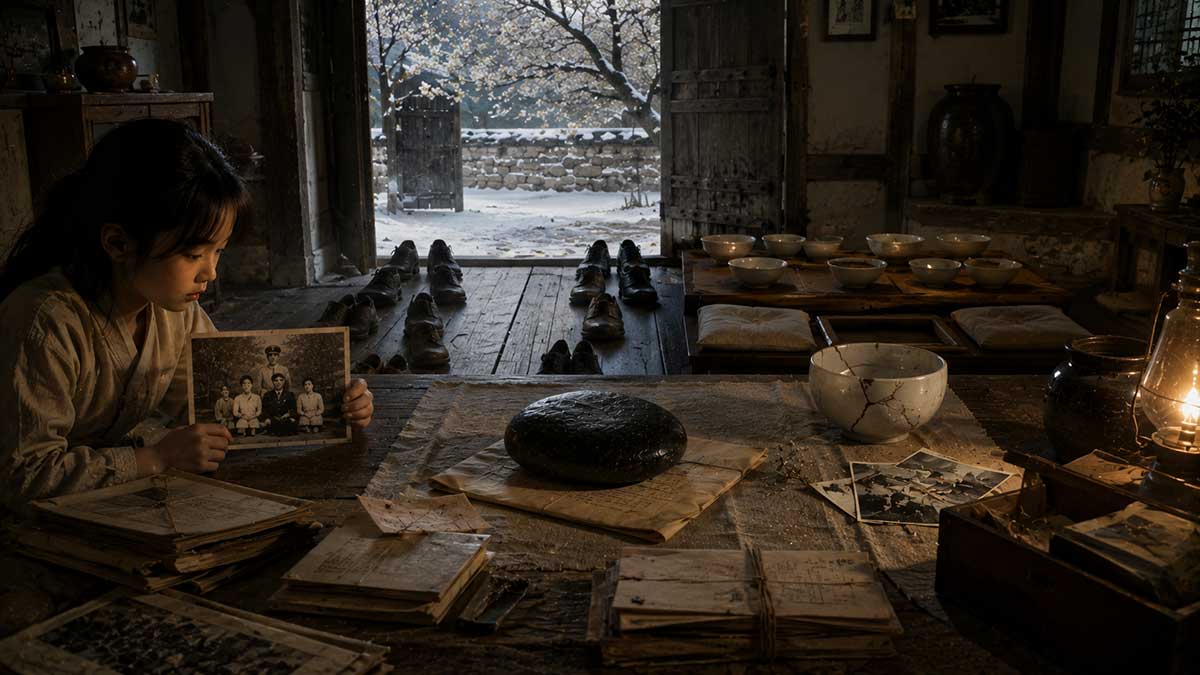
Kang Mi-ran and Park Seong-ho left Mangwol-ri the year after their first child was born.
The village understood the reasoning well enough. Seong-ho could take on larger electrical work in the city; Mi-ran hoped, once her evening classes were finished, to write for a newspaper. Mangwol-ri had electricity and buses of its own by then, but people still believed, as people always seem to, that real possibility lived somewhere past the next mountain.
The mountain, of course, never moved. Possibility, oddly, kept receding a little further every year regardless.
The night before they left, Mi-ran unfolded the name cloth and touched the small open door she'd stitched beside her own name.
It was still open.
"Shouldn't you close that?" Seong-ho asked, tying off their last bundle.
"What?"
"The door. We're leaving."
"It was left open so we *could* leave."
"And when we come back?"
"We'll use a different door by then."
He considered that. "Does the house have that many doors in it?"
"You may simply not have found them all yet."
The spoons stayed quiet through the whole exchange.
---
After the wedding, Seong-ho had stopped lying quite so easily — or, more precisely, had learned to give it up faster whenever Mi-ran was in the room. They had one son, Park Do-hyeon. When he was born, Jun-seo held him a long while, studying his small face.
"Who does he look like?" Mi-ran asked.
Jun-seo didn't answer right away. The boy's left eye, he thought — though he wasn't willing to say so — carried something of Jun-ho in it. Telling a child he resembled a man no one in the family had laid eyes on in decades seemed, to Jun-seo, like handing him either a blessing or a burden, and he wasn't sure which side it would land on.
"He looks like Great-Uncle Jun-ho, doesn't he," Mi-ran said anyway, not really asking.
Jun-seo looked up sharply. "Why would you think that?"
"Your face just now."
"What about it?"
"Like a man who's watched someone come home before, and realized he still has longer to wait."
He handed the baby back without answering that directly. "Writers study people's faces a little too closely."
"So do record keepers, in their own way."
---
On the day they left, Jun-seo pressed a small brass spoon into Do-hyeon's hand — an ordinary one, made sometime after the war, not the spoon that had once belonged to Jang Do-yun. That one stayed in the house, where it had always stayed.
"Why give him this?" Mi-ran asked.
"So he eats well."
"Is that really all?"
"Does every spoon in this family have to mean something?"
A spoon on the shelf gave a faint tremor, and Mi-ran laughed outright.
"It's a symbol. You know it is."
"The objects in this house have learned to say too much for their own good."
---
The city was loud in a different way than Mangwol-ri had ever been. In the village, the barking dogs, the crowing roosters, the rain, and human voices had each kept mostly to themselves. In the city, everything arrived at once and on top of everything else — bus horns, factory machines, loudspeakers hawking something or other, a crying child, a radio playing three doors down, hammers going somewhere in a construction site that never seemed to close for the night.
Mi-ran and Seong-ho rented a single room near a textile factory, a small kitchen attached. Opening the window, they could nearly touch the neighboring building across the gap.
"It's smaller than the men's quarters back home," Seong-ho said, lying down and finding his feet against the far wall.
"There's only the two of us here."
"My legs touch the wall."
"Maybe your legs grew."
"After marriage?"
"Life does that to a person," she said, and they laughed together, tired but not unhappy.
Do-hyeon, for his part, had no idea the room was small. To a crawling child, a floor to cross and a single wall to pull himself upright against was plenty of world to be getting on with.
---
Seong-ho found work wiring factories, apartment blocks, storefronts — lights he installed burned steadily all across the city, and the one bulb in his own room flickered whenever it felt like it.
"You light up everyone else's house," Mi-ran said. "Why not ours?"
"The wiring's old."
"Fix it, then."
"I'd need the landlord's permission first."
"Should we wait for permission before you get electrocuted?"
The next day he fixed it quietly, without asking anyone. One screw, inevitably, was left over.
"What's this for?" Mi-ran asked, holding it up.
"Belongs to the landlord, technically."
The spoons were three hundred *li* away in Mangwol-ri, and yet the bulb flickered twice regardless. Seong-ho put the screw back where it belonged.
---
Mi-ran cared for Do-hyeon by day and wrote at night — factory women, refugees resettling in the city, families displaced from demolished shantytowns, alleys named after hometowns their residents would likely never see again. Her manuscripts kept coming back. One editor called them too sad. Another said too personal. A third insisted lady readers wouldn't care to read them.
She didn't argue with any of it out loud. She simply used the backs of the rejection letters for her next draft.
"Aren't you angry?" Seong-ho asked once.
"I am."
"You're awfully quiet about it, then."
"Paper stays angry longer than I have the energy to."
---
Her first published piece ran during their second winter in the city, titled "Evening in the Nameless Alley" — about refugees renaming city streets after the homes the war had taken from them. Under the title, instead of her own name, the paper printed: *Wife of Mr. Park Seong-ho.*
She stared at it a long moment.
"Should I say something to them?" Seong-ho asked.
"To whom?"
"The paper."
"About what, exactly?"
"Getting my name off it."
"Your name was never the problem to begin with."
"Then what is?"
"Mine's the one missing."
The next day Seong-ho walked to an electrical shop with a telephone and spent ten *won* he didn't have to spare calling the editor directly. The man told him it was simply customary.
"Whose custom, exactly?" Seong-ho asked.
"The paper's own."
"Did the paper write the article, or did she?"
The editor hung up on him. Mi-ran's next two submissions both came back rejected, and Seong-ho spent a full day convinced he'd ruined whatever chance she'd had. She told him he hadn't.
The bulb flickered.
"You think it would have run, if I'd just kept quiet," she said.
He admitted, after a pause, "A little."
"Why?"
"I want your writing out there. In front of people."
"Without my own name attached to it?"
"A thing can start out that way."
"If it starts that way, someone eventually has to ask for the name back."
"Then ask."
"Whoever hands it back will believe they were the one who gave it to me in the first place."
He had no answer to that. The bulb flickered three more times and went dark entirely. He stood on a chair to tighten it.
"It wasn't the wiring," Mi-ran said once the light came back.
"Then what was it?"
"Maybe the house agreed with you, for once, and wanted you to hear it."
"This isn't Mangwol-ri."
"You told me yourself a house can follow people wherever they go."
After that night, Mi-ran signed every manuscript clearly at the bottom: *Kang Mi-ran.* The name she had never let anyone talk her out of. A few editors asked, cautiously, whether it was even her real name.
"It's the name that makes me turn around," she told them.
Her third piece ran, eventually, in a small women's magazine — modest payment, but her own name printed correctly above it. She spent the money on a pair of shoes for Do-hyeon and a new toolbox for Seong-ho.
"What did you buy yourself?" he asked.
"My name."
"It already belonged to you."
"Which is exactly why it came so cheap."
---
A telephone finally reached Mangwol-ri — one line for the whole village, a black receiver mounted on the wall of the shop beside the soup restaurant. When a call came in, the shopkeeper would run out into the street shouting whoever's name the caller had asked for.
"Telephone for Teacher Kang Jun-seo!"
If Jun-seo happened to be out in the fields, a child was sent running to fetch him, and if the child was slow, the call simply ended before he arrived. In time, people started loitering near the shop on the off chance a call might come for them, whether or not one ever did.
"The telephone doesn't summon anyone," Man-sik observed once. "People go and wait on the telephone instead."
Mi-ran called once a month. The conversations rarely lasted long.
"You made it there safely?" Jun-seo asked once.
"Two years ago, by now."
"The telephone only just made it here."
"Is Do-hyeon growing?"
"He's right beside me."
"Can he talk yet?"
"Say grandfather," she told the boy, holding the receiver to his mouth. Do-hyeon breathed into it instead, saying nothing at all.
Jun-seo listened to that breathing a long moment. "He seems to know who I am."
"He only breathed, that's all."
"A child breathes differently for strangers than he does for someone who's his."
After they hung up, Jun-seo held the receiver to his own ear a while longer, listening to something like wind on the line — footsteps, maybe, from somewhere impossibly far off.
---
Three months after the phone arrived, it rang, and the shopkeeper answered. No one spoke at first. Just static, and then an old man's voice, hesitant:
"Is this Mangwol-ri?"
"Yes."
"I'm looking for the house with the black stone."
"Who's calling?"
"Kang Jun-ho."
The receiver very nearly slipped from the shopkeeper's hand. He ran into the alley shouting before he'd even hung it back on its hook.
"Teacher Kang!"
Jun-seo was splitting firewood under the persimmon tree. He dropped the axe mid-swing and ran the whole way. By the time he reached the shop, the line had already gone dead.
"Did he really say Jun-ho?"
"He did."
"His voice — how did it sound?"
"Old."
"Where was he calling from?"
"I didn't think to ask. I was too busy finding you."
"Did he say he'd call again?"
The shopkeeper tried hard to remember. "He didn't say anything more at all."
Jun-seo sat beside the telephone until night fell. It stayed silent. The next day, and the day after that, nothing. On the third day it rang again, and he answered it himself this time.
"Hello?"
Silence, then, faint: "Grandfather."
A child's voice. Do-hyeon.
"Do-hyeon?"
"When is the shoe grandfather coming?"
Jun-seo had no answer ready. Mi-ran took the receiver from her son.
"Sorry — we were talking about the name cloth earlier. Since he saw the shoes, he won't stop asking."
"It's all right."
"Your voice sounds strange."
He didn't mention the earlier call. "I've got a cold, that's all."
A spoon on the shop's shelf trembled faintly. The shopkeeper glanced at him.
"Happens here too, apparently," he said, not unkindly.
That night Jun-seo found a slip of paper tucked inside Jun-ho's old shoes — not there the day before.
*If the telephone won't connect, I'll send a letter instead.*
He didn't stitch this onto the cloth. This time he simply waited, unwilling to record a date before anything had actually arrived to confirm it.
---
A week later the postman came by on his bicycle.
"Kang Jun-seo?"
"That's me."
"Letter for you."
No return address. Only, for a destination: *Kang Jun-seo, the house with the black stone, Mangwol-ri.*
"It found me, even with an address like that," Jun-seo said, turning the envelope over.
"The postmark says Busan."
The letter itself was short.
*Brother,*
*I called, but I was too late — the line went dead before I heard your voice. Explaining where I've been would take a story longer than the war itself did. I am alive. I don't know whether I'm someone who can still come back.*
Jun-seo read the last two lines over several times. *I am alive* — that much was clear enough. *I don't know whether I'm someone who can still come back* — that one sat heavier.
"Why can't he come back, if he's alive?" Man-sik asked.
"He doesn't say he won't. He says he doesn't know whether he can."
Man-sik's mother, nearly ninety by then, called out from her room without being asked. "Being alive doesn't open every road back to a person."
---
Jun-seo wrote a reply that night.
*Jun-ho — the house has moved. A road runs through where it used to stand. The black stone sits in the new kitchen now. Your shoes are still here. People have changed a great deal. The house has changed somewhat less. I don't know who gets to decide which of us is allowed to come home and which isn't. But if a person who wants to return ever reaches the door, I think the house decides that on its own, before any of us get a say in it.*
He had no address to send it to. At the post office, the clerk shook his head. "Without an address, it can't go out."
"His letter reached me."
"Receiving and sending aren't the same process."
"Why not?"
"Because a letter that's already arrived has, by definition, already arrived."
Jun-seo found he couldn't easily argue his way around that logic. "Then hold this one, until an address turns up."
"For how long?"
"However long it takes."
"This office isn't a place for holding things indefinitely."
"Isn't a letter itself a form of holding something, indefinitely, until it's ready to be read?"
The clerk wouldn't budge. Jun-seo tucked the unsent reply into Jun-ho's old shoe instead. By morning it was gone.
---
Two months later, a second letter came.
*Brother — I laughed a good long while reading that the house had moved. I never once imagined a house could do such a thing. I always assumed people could abandon houses, but not the other way around. Maybe the house simply grew tired of waiting on me. Keep my shoes safe in the meantime. I still have my own feet, for whatever that's worth.*
Jun-seo heard, in that last line, an echo of his brother's old laugh, and didn't read the letter aloud to the village. He told Mi-ran first.
"Jun-ho's alive."
She went quiet a moment. "Truly?"
"Yes."
"Where?"
"Somewhere around Busan."
"Why doesn't he come home, then?"
"He says the reason would take longer to tell than the war did."
"Ask him to write it anyway."
"Why?"
"Whatever's kept him from coming home belongs on that cloth too, same as anything else."
"He might not want it written."
"Then it shouldn't be."
"I thought you always wanted everything written down."
"Remembering something and publishing it are two different acts entirely."
Jun-seo wrote that line down for himself.
"Why write that one down?" Mi-ran asked.
"You might say it differently, given a few more years to think it over."
---
Do-hyeon grew up on stories of the shoe grandfather he'd never met. He drew the man more often than anyone else in the family — always in enormous shoes, the face changing every time. Once with a long beard. Once young. Once only a hat, with no face drawn in at all.
"Why no face this time?" Mi-ran asked.
"He hasn't arrived yet."
"Will he have one, once he does?"
"Once I actually see him."
She let the answer stand.
After starting school, Do-hyeon kept telling classmates about Mangwol-ri, and none of them believed a word of the black stone or the trembling spoons.
"Old people made that up," one boy told him flatly.
"Doesn't anything in your own house remember, on its own?" Do-hyeon asked.
"We have photographs."
"Someone has to be there to take a photograph."
"So?"
"Our stone remembers all by itself."
His teacher warned him against telling lies. That evening he brought the matter home.
"If something's true, but no one believes it, is it still a lie?"
"Not every truth can be proven on demand," Mi-ran told him.
"Then what do I do?"
"Don't explain it so much that the explaining gets bigger than the truth itself."
"So I just — say nothing?"
"You keep it. That's different from saying nothing."
Do-hyeon searched the name cloth that night and found his own name missing from it.
"Why aren't I on here?"
"You haven't done anything yet worth writing down."
"Being born is something."
Mi-ran laughed, and that same day embroidered: *Park Do-hyeon.* Beneath it: *The child who remembered, without ever seeing a face, the man whose shoes came home before he did.*
"Will we change it, once I've actually seen his face?"
"If you want to."
"What if I get it wrong?"
"Then I'll leave a blank space for the correction."
"How large a space?"
"However large you want."
"Until I'm old," he decided.
Mi-ran wondered, not for the first time, whether they'd need to stitch on an entirely new piece of cloth before long.
---
By her fifth year in the city, Mi-ran had become a full-time reporter — though not, at first, for the social affairs desk she actually wanted. She was assigned household and education pieces instead, and simply folded the larger stories into them anyway: factory women's working hours tucked inside a household column, the long distances children from demolished neighborhoods walked to school folded into an education piece.
"Why does every one of your assignments come back with a social problem buried in it?" her editor asked, more curious than annoyed.
"Because you won't let me write for the section where it actually belongs."
He stared at her, then laughed outright. "You're a bold one."
"Is that reflected in the pay?"
Social assignments came her way slowly after that, one at a time.
Seong-ho, meanwhile, finally earned his electrician's qualification and brought the certificate home to show her.
"I've caught up to you."
"Caught up to where, exactly?"
"To wherever it was you went first."
"Did you use every last screw this time?"
He pulled one from his pocket, sheepish. "Kept this one. As a souvenir."
The bulb overhead flickered. He put the screw away in his toolbox instead. "This one really was unnecessary."
It flickered once more anyway, and he laughed and let it be.
---
Back in Mangwol-ri, Jun-seo went on waiting for his brother's letters, which came with no rhythm he could predict — sometimes a month apart, sometimes half a year. Several arrived with postmarks earlier than the dates written inside them. One, postmarked April 3rd, opened with the date April 8th. He assumed, the first time, a simple mistake on his brother's part. It happened again. A third letter claimed, plainly, to have been written three days *after* it had already reached him.
He finally went to the post office about it.
"How does a letter arrive before it's written?"
"The date was recorded wrong. Older people get confused about such things."
"Every single time?"
"And the postmark?"
"A machine stamps that automatically."
"Machines never make mistakes?"
"People build the machines."
"Then both could just as easily be wrong."
"They could."
"Why assume, every time, that it's only the person who's mistaken?"
The clerk asked him, politely but firmly, to leave.
---
The strangest letter of all arrived that summer.
*Brother — I will come next winter. Do-hyeon will be ten by then. Tell the child not to decide on my face ahead of time. I have lived under a great many faces already. In one place I was a soldier. In another, a collaborator. In one, a victim. In another, the one who caused the harm. Under one name I stayed alive. Under a different one, I had already died. I no longer know, myself, which of those men Mangwol-ri is waiting for.*
Jun-seo checked the date at the top. *January 17th, the coming year.* Six months into the future.
He hid the letter and told no one, not even Mi-ran — unwilling to set the whole family waiting on a return that might never actually come. When waiting turns into a promise, he thought, and the promise breaks, a person can end up disappearing twice over instead of once.
That same night, though, new words appeared on the cloth on their own: *A person will return, come winter.*
"Jun-ho?" Man-sik asked, seeing it.
"I don't know."
A spoon trembled.
"You do know," Man-sik said. Jun-seo finally showed him the letter. Man-sik studied the date a long moment.
"This hasn't even been written yet."
"It's already arrived, though."
"So it came from the future, somehow?"
"The post office insists the date's simply wrong."
From her room, Man-sik's mother called out, unbothered, "The post office is always running late itself. No wonder it refuses to believe the future could possibly exist."
Jun-seo tried to stitch the letter into the cloth directly. The needle wouldn't pass through the paper at all — as if, perhaps, the letter genuinely hadn't been written yet, whatever the ink on the page claimed. He tucked it beneath the black stone instead and resolved to say nothing further until winter came.
The house kept its own counsel regardless. Every bowl at the table shifted one place, night after night, on its own. A new seat appeared at the far end. Jun-ho's old shoes crept toward the gate after dark and were back in the kitchen come morning. The persimmon tree bloomed white, entirely out of season.
The village understood, without needing to be told, that someone was coming.
"Who?" the children asked.
"Winter," Jun-seo told them.
The spoons stayed quiet. Winter, at least, was a promise no one doubted would be kept.
---
Do-hyeon was nine that autumn when his teacher asked the class to bring in a family photograph. He brought the old wedding photo, his own first-birthday portrait, a picture of the new house, and one of Jun-seo standing beside Park Man-sik. Behind all of them sat the oldest photograph the family owned — eleven people photographed, twelve appearing in the print, Kang I-mun's long-abandoned daughter standing among them.
The teacher counted the figures twice.
"Twelve."
"There were only eleven of us there, when it was taken."
The class laughed. The teacher explained it away as a double exposure, an old camera trick.
At home that evening, Do-hyeon counted again, alone. Thirteen figures now, not twelve — a new old man standing at the very back, leaning slightly onto his left leg.
Do-hyeon knew him at once, though he'd never once laid eyes on him. The shoe grandfather.
"Mother — Grandfather's here."
Mi-ran studied the photograph. The old man wasn't fully in focus, carrying a small paper bag, wearing shoes that matched exactly the ones still sitting by their own gate three hundred *li* away. She didn't ask how the same pair of shoes could exist in two places at once. In this family, objects had always seemed to arrive somewhere before the people they belonged to did.
On the back of the photograph, in handwriting none of them recognized:
*To Do-hyeon. You may end up the first to see my actual face. Only don't mistake this for the only one I've ever worn.*
"Is it really him?" Do-hyeon asked.
"I think so."
"Is he alive?"
"We've heard that he is."
"When's he coming?"
"I don't know exactly."
"This winter," Do-hyeon said, with total confidence.
"Why do you say that?"
"He's wearing thick clothes in the picture."
---
That night Mi-ran called Mangwol-ri.
"Grandfather. Someone new showed up in the old photograph."
Jun-seo closed his eyes before answering. "Does he lean on his left leg?"
"Yes."
"Wearing the shoes?"
"Yes."
"Did Do-hyeon see him first?"
"Yes."
"Do you already know something you haven't told me?" Mi-ran asked, sharper now.
Jun-seo told her, finally, about the future-dated letter. She grew angry, hearing it.
"Why keep that from us?"
"It wasn't certain yet."
"Were you planning to wait it out alone, and decide for the rest of us?"
"I didn't want everyone waiting on something uncertain."
"We've been waiting our whole lives regardless."
A faint metallic hum crossed the line between them.
"Let us decide, together, whether to wait," she said. "That much should have been ours to choose."
Jun-seo lowered his head, though of course she couldn't see it. "I'm sorry."
"We're coming for winter."
"What about your work at the paper?"
"I'll take leave."
"And Seong-ho?"
"He'll follow behind us."
Seong-ho, listening from across the room, called out, "You might actually ask me first, you know."
Mi-ran covered the receiver with her palm. "You're coming, aren't you."
"Yes."
"There. Consider yourself asked."
He shook his head, smiling despite himself.
---
Snow came early that year, covering the roofs and the road and the utility poles alike. Mi-ran, Seong-ho, and Do-hyeon traveled up by bus, the boy holding the old photograph the whole way.
"Passengers for Mangwon-ri!" the conductor called out.
"Mangwol-ri!" Do-hyeon shouted back, correcting him without hesitation.
The other passengers laughed. "Quite the young teacher we've got here."
"A name shouldn't get said wrong," Do-hyeon said, entirely serious about it.
Jun-seo waited for them at the village entrance, visibly aged now — back bent, hair gone nearly all white. He opened his arms and Do-hyeon ran straight into them.
"Where's the shoe grandfather?"
"Not yet."
---
Inside, the table had already been set — a place for Jun-ho, a place for Jun-seo, places for Mi-ran, Seong-ho, and Do-hyeon, places for the Park family, the cracked bowl kept for the dead, and the empty bowl kept for those without names.
They waited the whole evening. No one came. The snow fell harder outside.
Jun-seo switched off the bulb and lit the oil lamp instead. Shadows crowded the wall at once — none of them belonging to any limping old man.
Past midnight, Do-hyeon's eyes started to close.
"Go on to bed," Mi-ran told him.
"I want to see his face."
"Tomorrow, maybe."
"Didn't the letter say today?"
"Only winter," Jun-seo said. "Nothing more specific than that."
"Winter's a long season."
From beneath her blanket, Man-sik's mother spoke up. "The one doing the waiting always narrows the date down tighter than the one who's actually on his way."
By one in the morning, still no one had come.
"Show me the letter," Mi-ran said. Jun-seo dug it out from beneath the stone. January 17th — ten days still to go.
"We came too early," Mi-ran said.
"The letter came too early," Jun-seo corrected her.
"Then we wait the ten days," Do-hyeon announced, as if the matter were already settled.
The adults exchanged glances. There was work waiting, school waiting, income to think of. Ten days wasn't a short stretch by any measure that mattered to grown men and women. To a boy on winter holiday, it was nothing at all.
"I'll stay here by myself, if I have to."
"No."
"Why not?"
"You're nine years old."
"How old was the shoe grandfather, the first time he was alone in the world?"
No one had a ready answer for that.
Mi-ran sent a telegram to her editor: RETURN DELAYED TEN DAYS DUE TO POSSIBLE ARRIVAL OF LONG-MISSING RELATIVE.
The reply came back: EXPLAIN LONG-MISSING RELATIVE.
She wrote back: EXPLANATION REQUIRES A STORY LONGER THAN THE WAR ITSELF.
His answer: THEN WRITE IT.
She tucked the telegram in beside the cloth and let the matter rest there for the time being.
---
They waited out the full ten days. On the first, every creak of the gate sent them running. On the second, they chased down every bus that came through. On the third, they studied the face of every stranger who stepped off. By the fourth, the hope had started, quietly, to wear thin, though no one would say so aloud. On the fifth, Jun-seo filled Jun-ho's bowl only halfway; Do-hyeon filled it back up to the brim without a word. On the sixth, the snow began to melt. On the seventh, one of Jun-ho's old shoes had turned to point outward again. On the eighth, it turned back in.
On the ninth night, the telephone rang. The shopkeeper ran through the snow to fetch them.
"Call from Busan!"
Jun-seo, Mi-ran, and Do-hyeon ran the whole way there, Seong-ho close behind, helping the old woman keep pace.
Jun-seo lifted the receiver. "Hello?"
Static. Then an old man's breathing, uneven.
"Brother."
Jun-seo had to steady himself against the wall. "Jun-ho."
"I'll come tomorrow."
"From where?"
"Busan Station. If the train runs on time."
"It won't run on time," Man-sik's mother called out from somewhere behind him, unbidden.
Jun-ho laughed on the other end of the line — old now, but unmistakably the same laugh.
"Who was that?"
"The one who kept this house standing, all these years, in your place."
"Tell her I said thank you."
She took the receiver from Jun-seo herself. "Come and say it yourself, once you're here."
He laughed again.
---
After the call, Jun-seo stood holding the receiver a long while, even once the line had gone dead. He'd finally heard the actual voice, and found that fear had arrived ahead of joy after all. What if the man who walked through that door wasn't the brother he'd spent decades waiting on? What if Jun-ho resented him, after everything? What if he'd fallen in love with the *waiting* itself, over the years, more than with the actual man he was waiting for?
"Why aren't you smiling?" Do-hyeon asked, watching him.
"After you wait long enough for something," Jun-seo said, "you have to relearn how, before you can manage it properly."
---
The whole family gathered at the bus stop the next day at noon. Jun-ho would come by train first, then the bus. The first bus arrived. He wasn't on it. Nor the second. Two o'clock came and went, then three.
"I knew the train would run late," the old woman said, unsurprised.
At four, the snow began again.
"Could he simply not come, after all this?" Do-hyeon asked.
"He might. Or he might not," Jun-seo said.
"Then why keep waiting?"
"Because today, one way or the other, we'll finally know which."
Near sunset the last bus of the day crested the pass and pulled up beside the bowing utility pole. The doors opened. A woman weighed down with groceries stepped off first, then a man in an old military coat, then a coughing elder, then a young couple with a small child.
Last of all came an old man, limping slightly on his left leg. Instead of the shoes waiting for him by the gate, he wore plain black rubber ones. A small paper bag hung from one hand.
He resembled the photograph, and he didn't. His face carried pieces of every version Do-hyeon had ever drawn of him — the soldier, the fugitive, the aged child, the man who had simply survived too long to fit neatly into any one of them.
Jun-seo couldn't move. Neither could Jun-ho. They stood looking at each other through the falling snow, decades of unspoken sentences arriving all at once, none of them quite managing to come first.
Mi-ran thought, watching them, that every spoon in the house must surely have broken by now, wherever they were.
Do-hyeon stepped forward before either grown man could.
"Are you the shoe grandfather?"
"Is that what they call me?"
"Yes."
"Were the shoes well looked after?"
"They got here before you did."
"They always did find the road easier than I managed to."
Do-hyeon held up the old photograph. "Is this your face?"
Jun-ho studied it a long moment. "That might have been my face, that particular day."
"And today?"
"Today's is whatever you're looking at right now."
---
Jun-seo finally stepped forward.
"Jun-ho."
"Brother."
They didn't embrace. They didn't shake hands either, not yet. Jun-seo simply took the paper bag from him — almost weightless in his grip.
"Only this?"
"Everything I could manage to carry."
They walked together toward the house, Jun-ho studying the changed road the whole way.
"The house used to stand right there."
"It did."
"You actually moved it, then. I didn't quite believe that, reading it."
"I thought houses were supposed to be stubborn."
"They are. Right up until you feed them properly."
Jun-ho laughed at that, and for a moment the years between them shortened to something almost bearable.
---
At the gate he stopped. The new house stood lit up ahead of them, rice steaming somewhere over the black stone inside.
Jun-seo opened the door. "Come in."
Jun-ho couldn't. His feet simply wouldn't carry him across.
"Does it dislike me?" he asked.
"It's only asking who you are, first."
Jun-ho stood at the threshold and answered it plainly, the way a man answers a question he's finally stopped avoiding.
"Kang Jun-ho. Younger brother of Kang Jun-seo."
Nothing.
"Son of Yoon Seo-jin."
A spoon trembled, faint.
He closed his eyes. "I abandoned people in the mountains. I also saved some. Some died anyway, while I was trying. After the war I lived under other names. Some days I told myself I'd only ever been a victim in all of it. Other days I convinced myself I'd never once caused anyone real harm. I wanted, the whole time, to come back to my brother. But I was afraid that if he forgave me, I'd have to consider forgiving myself as well — and I wasn't ready for that. So I stayed away instead."
Every spoon in the house rang out at once — not because he'd lied, but because so many swallowed sentences had finally, all together, come up for air.
"I'm not a man who came back," he said quietly. "I'm a man who failed to come back, for a very long time."
White snow rose up around his shoes, climbing from beneath the threshold rather than falling from above. The three leaves growing from the black stone trembled where they stood.
He set one foot across. The house didn't push him away. Then the second foot followed it.
"Does the house know you now?" Do-hyeon asked.
"I couldn't say."
"It let you in," Jun-seo told him. "That's enough for tonight. The rest can come later."
---
Jun-ho's old shoes sat waiting before his seat at the table. He knelt and touched them.
"I wore these, for years, after the war."
"How did they get here ahead of you?"
"I lost them at a train station, of all places."
"When?"
"Thirty years back, give or take."
"They've been walking for thirty years, then," Do-hyeon said, wide-eyed.
"They must have run the whole way, to beat you here," Man-sik's mother said, and the whole table laughed.
Jun-ho saw the cracked bowl next. "Mother's."
"She set food out for you, every night, right up to the end."
"I was too late."
"She never once turned the waiting into a debt for you to pay back."
"And you?" Jun-ho asked his brother.
Jun-seo met his eyes. "Sometimes I did."
The spoon nearby stayed perfectly still.
"I think I believed, for a while, that your coming back would prove the waiting had been worth it all along."
"Is it, now that I have?"
"No."
"Then I waited for nothing."
"No," Jun-seo said. "The waiting doesn't get proven right or wrong. A person just comes back, or doesn't, and that's the whole of it."
He pushed the rice toward his brother. Jun-ho took a single bite, chewing slowly.
"Food from home."
"I cooked it," Man-sik said. "I've lived here a good deal longer than you have, lately."
Jun-ho turned to him. "Thank you."
"You finally came all this way just to say it yourself."
"Thank you," he said again, "for living this house in my place, all this time."
"I wasn't living it in your place. I only needed somewhere to live, and this was it."
"Even so. Thank you."
"That's enough, then," Man-sik said, and meant it.
---
After the meal, Jun-ho opened his small paper bag. Inside sat bundles of old letters and a small wooden box — identification cards under several different names: Kang Jun-ho, Kim Jeong-su, Park Yeong-gil, Choi Man-bok. Some photographs showed him young, some middle-aged; a few cards carried no photograph at all.
"Which name's the real one?" Do-hyeon asked, turning the cards over in his hands.
"All of them were me, at some point. None of them was the whole of me."
Mi-ran opened the cloth. "Which should I write?"
Jun-ho studied his own old name, and the lines already stitched beneath it. *I am still on my way home. I am almost there. The road home may run so long that the traveler grows old before arriving.*
"Write all of them."
"All the names?"
"A name a man used simply to stay alive still belongs to a whole life he actually lived."
Mi-ran added the other names beneath Kang Jun-ho, each followed by a small empty bracket.
"Why leave them empty?" Do-hyeon asked.
"So he can decide, himself, who he was under each one."
Jun-ho shook his head slowly. "I'll only explain myself in my own favor, given the chance."
"Then let someone else write it too," Do-hyeon said, simply.
Jun-seo glanced at Mi-ran. "You taught him that."
"He came to it on his own, mostly."
"Our cloth carries more blank spaces than most families would tolerate," Jun-ho said.
"That's exactly so no sentence finishes before the person it's describing does," Jun-seo told him.
---
That night new words appeared beneath it all, in no one's recognizable hand:
*The one who returns is not the same person who once left. The one who waited is not the same person who first began waiting. So a reunion is never really a return to the past — it's the first real meeting between two people who have each already changed past recognizing.*
"Did the two of you only really meet today, then?" Do-hyeon asked.
"In a way," Jun-ho admitted.
Jun-seo looked at his brother a long moment. "It's good to meet you, properly, for what it's worth."
"You as well."
Only then did they finally shake hands — both palms old and rough by now, one set having survived by holding onto records, the other by shedding names like a snake sheds skin. Each hand carried years the other would never fully know.
---
Near dawn, Do-hyeon fell asleep beside his great-uncle. Jun-ho touched the boy's hair gently.
"Why does he seem to already know me?"
"Because he remembered you for years without ever having a face to put to it," Mi-ran said.
"Is that even possible?"
"In this family, plenty of people have known a face perfectly well and still failed, somehow, to know the actual person behind it."
Jun-ho looked toward the wall. Under the electric light, every person there cast a proper shadow — Jun-seo, Jun-ho himself, Mi-ran, Seong-ho, Do-hyeon, the whole Park family. And at the very edge of the table, one shadow more, seated where no living person sat.
Yoon Seo-jin, looking between her two sons' bowls with visible dissatisfaction.
"Mother looks unhappy," Jun-ho said.
"About what?"
"She thinks there isn't enough rice for the two of you."
"Even the dead worry their children aren't eating enough," the old woman said, amused despite herself.
Mi-ran added more rice to both bowls at once. Seo-jin's shadow faded gently from the wall — but not before pointing, one last time, toward a single bowl that still sat entirely empty.
"Whose place is that?" Do-hyeon asked, half-asleep.
No one had an answer. They'd assumed, until that moment, that everyone they'd been waiting on had finally arrived.
And yet beside the third leaf still growing from the black stone, a fourth shoot had already broken through the surface.
"Who else is coming, then?" Jun-ho asked, watching it.
"The house," Jun-seo said, "always seems to set a place before the rest of us even know to expect it."
---
The postman came again the next morning. He saw Jun-ho standing in the yard.
"So the man these letters belonged to finally showed up himself."
"Did you deliver every one of them?"
"Most."
"How did some arrive before I'd even written them?"
"The mail trusts an address a good deal more than it trusts a date."
"The address was only ever 'the house with the black stone.'"
"The house existed regardless. That was enough for it."
Then the postman held out one more envelope.
"There's one further letter."
Addressed to Kang Jun-ho. Destination: the house with the black stone, Mangwol-ri. Sender: Yoon Seo-jin.
Jun-ho's hands shook, taking it.
"My mother's been dead for years."
"No postmark on this one."
The envelope itself was yellowed with age, its flap still faintly damp with unset glue. Jun-ho couldn't bring himself to open it.
"Will you read it?" Jun-seo asked.
"Not yet."
He set it beneath the cracked white bowl instead.
"Why wait?" Do-hyeon asked.
"A letter that's already been delivered can still go on waiting for the right person to be ready for it."
"You're here now, though."
Jun-ho touched his mother's stitched name gently. "Only my body's arrived so far. The rest of me may take a while longer."
The black stone gave a single low sound, and no spoon so much as trembled in response. No one, that night, had said a single false word.
That same day, an empty envelope turned up in the Mangwol-ri mailbox — no sender, no recipient listed anywhere on it. Inside, in small, careful writing:
*The next letter will be read by someone who hasn't been born yet.*
Mi-ran didn't copy that line onto the cloth. She set the envelope down instead beside the fourth new shoot, and let it be.
Memory, she thought, watching it sit there, doesn't only ever travel backward from the past. Sometimes, it seemed, the future sent its own letter ahead of itself, simply asking that a place be kept ready and waiting for it, whenever it finally arrived.
Chapter 10: After the Story Became Public, Memory Changed Its Face
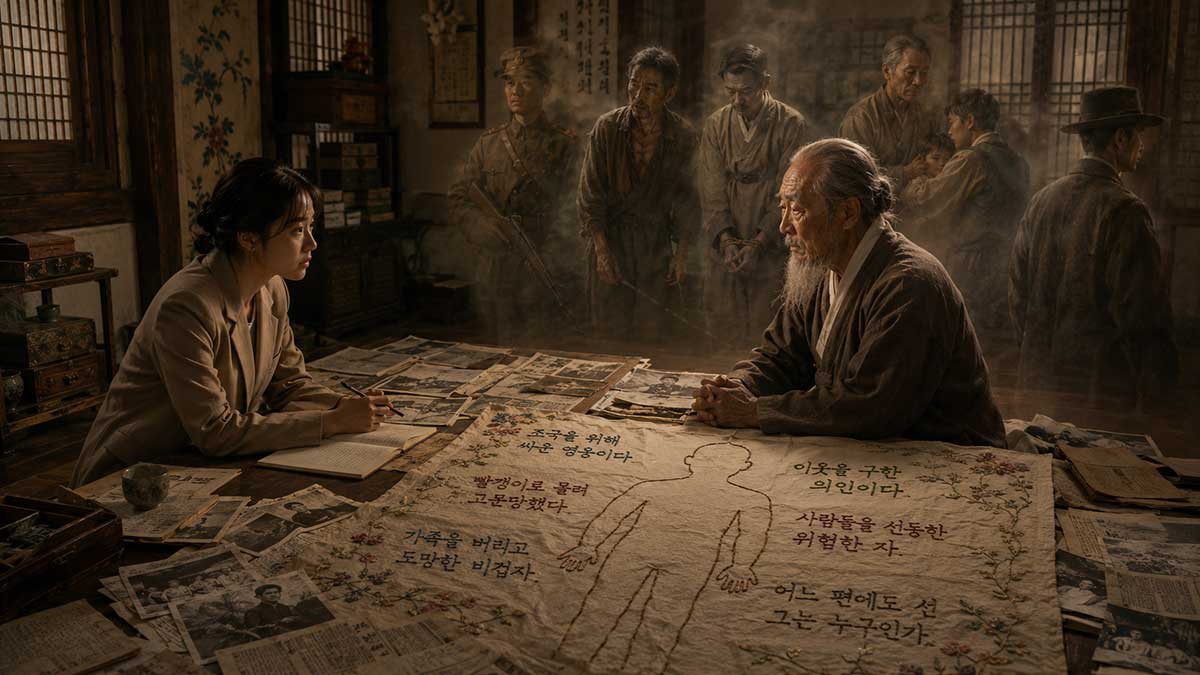
No one wrote Kang Jun-ho's story during the first year after his return.
Kang Mi-ran was a journalist, and the person in the family who'd heard more of his history than anyone else — and still she didn't open her notebook. She didn't ask about the string of names he'd lived under, the people he'd saved and the ones he'd left behind in the mountains, or why he'd stayed in Busan thirty years past the end of the war.
She waited.
Jun-seo read the waiting as caution. Seong-ho grew a little worried, having never once seen his wife hold back a question that long.
"Are you unwell?"
"Why?"
"You haven't asked anyone anything in three days."
"Does not asking questions make a person sick, now?"
"It does, in your case."
She glared at him, and no spoon so much as stirred.
"That's a relief, at least," he said.
"What is?"
"I only meant it out of concern."
---
Though Jun-ho had crossed the threshold at last, he slept for months in the smallest room, the one nearest the gate. No one had assigned it to him — the inner room stood open, there was space enough in the men's quarters — but he chose it anyway. At night he'd put his shoes back on and walk the yard, and some nights he went past the gate entirely.
"Where do you go?" Jun-seo asked once.
"Nowhere in particular."
The spoon didn't tremble. For Jun-ho, it seemed, *nowhere* was an actual destination — a place a man could genuinely visit, and come back from before dawn to sit in front of the black stone.
Yoon Seo-jin's letter still sat beneath the cracked white bowl, untouched. The seal, old as it was, had never quite dried.
"Why won't you read it?" Do-hyeon asked him.
"I'm not ready yet."
"Does reading a letter take that much preparing?"
"Some letters make it impossible to go back to being the man you were before you read them."
"Are books like that too?"
"The good ones can be."
"Not the schoolbooks, though."
Jun-ho laughed at that — the first real laugh Do-hyeon had heard out of him.
"Sometimes even schoolbooks manage it."
---
Do-hyeon was ten, and had privately assumed every story in the family would settle down once the shoe grandfather finally arrived. Instead, Jun-ho's return seemed to generate new stories faster than the old ones could be resolved.
People started showing up looking for him. One claimed to be an old comrade. Another said Jun-ho had saved his life. A third said Jun-ho's actions had gotten his own family killed. Someone remembered him as Kim Jeong-su. Someone else had worked beside a man called Park Yeong-gil. Their accounts rarely matched. One called him brave, another a coward. One said he'd stayed to the end; another said he'd run first. One said he'd saved children; another swore he'd abandoned grown men who needed him.
"Which one's true?" Do-hyeon asked.
"They were each standing somewhere different when it happened."
"Where were you standing?"
Jun-ho didn't smile at that one. "Always a little to the side of wherever I should have been."
---
Mi-ran finally opened her notebook.
"You're writing this down now?" he asked.
"So I don't forget it."
"Who's going to read it?"
"For now, just me."
The spoons stayed quiet. She meant it, at least for the moment.
At first she had no intention of publishing anything. His story was too long, too full of contradictions, laced with names that could still hurt people who were very much alive. More to the point, Jun-ho himself didn't yet know how to tell it straight through — he'd start an event, stop halfway, and the next day tell the same thing in a different order entirely. A week later, someone would appear in the story who hadn't been there the first time he'd told it.
"That person wasn't in your account before," she said once.
"I hadn't remembered him yet."
"Truly?"
A spoon trembled once.
"I remembered him fine," he admitted. "I just didn't want to talk about him."
"Why not?"
"Because talking about him means talking about what I did to him."
She closed the notebook. "Then we don't write it today."
"Do good journalists really wait that long for a story?"
"The good ones do."
"And you?"
"I'm still learning to be one."
---
Little by little he began to tell her more. After the retreat south, he'd carried a wounded soldier the whole way, only for the man to die along the road — leaving behind his identification papers under the name Kim Jeong-su. At the checkpoints, unable to safely use his own name, Jun-ho had borrowed it, meaning only to wear it for a single day.
The day became a month. The month became years. As Kim Jeong-su, he'd worked the harbor docks, repaired wires, slept in half-ruined warehouses. Then one day a letter reached him — Jeong-su's own family, writing to a son they'd heard might still be alive. More letters followed. A sick mother. A sister's coming wedding. A father, dead.
He never answered them directly. He sent money instead.
"Why?" Mi-ran asked.
"I suppose I was paying rent on a name that wasn't mine."
"Can a name even be rented?"
"I stole it outright. Rent was the least of what I owed."
The spoons stayed still through all of it.
Years later, he visited Kim Jeong-su's family in person, telling them he'd been the man's comrade, that Jeong-su had died in the war. His mother took Jun-ho's hand and wept, asking what her son had said, at the very end.
He couldn't answer at first. The truth was that Jeong-su had said nothing — a few short breaths, then silence. What Jun-ho actually told her was:
"He called for his mother."
Every spoon in the kitchen shook at once — the lie decades old by then, and yet the spoons rang as though hearing it fresh for the first time.
"Why lie to her?" Do-hyeon asked.
"She wanted to hear something like that."
"It was still a lie, though."
"Yes."
"Was it wrong to say it?"
Jun-ho studied his own hands a long moment. "I still don't know, even now."
"Maybe it was meant as comfort," Jun-seo offered.
"Can comfort still be a lie underneath?" Mi-ran asked.
Jun-seo had no answer ready. A spoon trembled once more.
"At least this house doesn't only put *me* on trial," Jun-ho said, half a smile in it.
---
That night, the edge of Seo-jin's envelope loosened slightly on its own. No one had touched it. The faint smell of fresh rice seemed to drift up from inside. Jun-ho pressed the flap shut again.
"The letter wants to be read," Do-hyeon said.
"I want to read it too."
"Then why not?"
"Wanting to and being ready to aren't the same thing."
Do-hyeon didn't much care for that answer. Adults, he was learning, had a talent for making the simplest things complicated.
---
Under a different name, Park Yeong-gil, Jun-ho had run a small radio-repair shop after someone at the harbor recognized the name Kim Jeong-su and made staying under it unsafe. Park Yeong-gil had never existed before he invented him. He wasn't especially good with machines — every repair left the radio sounding a little worse than before.
"How did the shop stay in business, then?" Mi-ran asked.
"Most of my customers couldn't afford a new radio anyway."
"So you charged them to make something slightly less broken?"
"They came out of it a little less broken than they went in. That much was true, at least."
"That's its own kind of skill," Seong-ho said, half-laughing.
Mi-ran looked at him. "Now I understand exactly why you always leave a screw behind."
Seong-ho went quiet.
As Park Yeong-gil, Jun-ho had married — a woman named Oh Myeong-hui, who'd lost her own family in the war. They'd agreed, from the start, never to ask each other about the past. They had a daughter. Park Ha-jin.
Mi-ran's brush stopped mid-stroke.
"You had a daughter?"
He nodded.
Jun-seo stood so fast the chair scraped back. "A *daughter?*"
The bulb overhead seemed to shudder under his voice.
"Why tell us only now, after all this time?"
"I'm telling you now."
"After thirty years?"
"I hadn't come home yet, in thirty years."
"You could have written—"
"Written what, exactly? *Brother, I married under a stranger's name, and I have a daughter now?*"
Jun-seo had no answer for that.
"Where is she now?" Mi-ran asked.
"I don't know."
Myeong-hui had found his identification cards eventually — Kang Jun-ho, Kim Jeong-su, Park Yeong-gil, laid out together — and asked, plainly, which name actually belonged to her husband. He hadn't been able to answer her either.
"I can live with a man who can't tell me his real name," she'd told him. "I can't live with one who hides his own face from me."
He'd insisted he hadn't been hiding anything. She'd brought him a mirror in response — and in it, his face had split into three at once. One young. One old. One with no eyes at all.
She left not long after that, taking their daughter with her. He never went looking for either of them.
"Why didn't you find them?" Do-hyeon asked, upset now.
"I told myself, at the time, that they'd only run further if I tried."
"You were still her father."
"I didn't know, honestly, whose father I even was anymore."
Do-hyeon shoved the old shoes across the floor, angry. "So you just — did nothing?"
"Yes."
"That was a bad thing to do."
The adults started to intervene. Jun-ho raised a hand, stopping them.
"Yes," he said again. "It was."
Do-hyeon hadn't expected the agreement. "Really? Even now?"
"Especially now, when it comes to that child."
"Then find her."
"I don't know where she is."
"Put it in the newspaper, then."
Everyone turned to look at Mi-ran. She closed her notebook slowly.
For the first time, she understood the story might not stay contained inside this family. If it could actually find Park Ha-jin, writing it might bring someone closer, not just expose them. But publishing it would also lay bare every name and act Jun-ho had spent thirty years hiding.
"Do you actually want to find her?" she asked him.
He hesitated. A spoon trembled.
"Yes."
He said it again, more firmly.
"But I don't know if I've earned the right to."
"Finding her isn't the same thing as being forgiven by her."
"I know that."
"She may refuse to meet you at all."
"I know."
"Your whole past becomes public, once this runs."
Jun-ho looked at the stone. "Keeping it hidden never once made it disappear."
---
Mi-ran began drafting the article. Her first title: *The Man Who Survived Under Many Names.* Her editor read it and called it excellent.
The word made her uneasy. When editors called something excellent, it usually meant someone's suffering had been arranged into a shape readers could digest comfortably.
"What's excellent about it?"
"War, ideology, a family, a hidden marriage, a missing daughter. It has everything."
She took the pages back. "Then it isn't ready."
"It's ready enough."
"He isn't."
"The news can't wait for a person to become whole first."
"That's precisely why the news sometimes ends up damaging people it never meant to."
She rewrote it entirely. She cut *hero.* She cut *traitor.* She cut *tragic fate.* She kept, whole, the one line Jun-ho himself had given her: *I am not a man who returned. I am a man who failed to return for a very long time.* She included the story of Kim Jeong-su — the stolen name, the money sent quietly for years, the false last words given to a grieving mother.
She asked Jun-ho about it directly, once more.
"His mother might still be alive."
"Then she'll learn I lied to her."
"Do you regret it?"
"Some days."
"And other days?"
"I believe, on those days, that the lie let her sleep at night."
Mi-ran wrote both sentences down, side by side, and let the reader decide.
She also wrote, plainly, the search for Ha-jin: *A man who ran a radio shop in Busan under the name Park Yeong-gil had a daughter, Park Ha-jin. Her father does not claim to deserve forgiveness. He asks only to know whether she is alive.*
The final title she settled on: *How Many Names Does a Man Need, to Finally Come Home?*
No photograph of Jun-ho ran alongside it. Only an image of the old shoes — one turned inward, one still pointed toward the road.
---
On the morning it ran, villagers gathered outside the soup shop, reading the headline before anything else.
"Kang Jun-ho's in the newspaper."
"Was he a hero, then?"
"No — he had several names, apparently."
"A spy?"
"He fixed radios in Busan, mostly."
"Why's that considered news?"
By noon, without having read past the first paragraph, people had already decided he was four different men at once — independence fighter, communist sympathizer, common fraud, war hero. By afternoon, a fifth version joined the rest: the father who'd abandoned his own daughter.
Jun-ho stayed indoors through all of it. Do-hyeon brought the paper in to him.
"They're telling it a little differently than you did."
"How so?"
He listened, and finally smiled, faintly.
"I lived under a great many names. Now, it seems, everyone's decided to give me just the one they prefer."
Mi-ran couldn't quite smile along with him. "I'm sorry."
"You didn't say any of those things about me."
"I put the story out there, regardless."
He unfolded the article slowly. "What you actually wrote isn't badly wrong."
"Badly?"
"It's probably wrong in a hundred small ways I can't point to."
"Where, exactly?"
"You wrote down what I told you."
"Why would that make it wrong?"
"Because I described myself, the whole time, in the way that favored me most."
"That's exactly why we left the brackets empty," Do-hyeon pointed out.
"Newspapers don't leave room for blank brackets," Jun-ho said.
Mi-ran turned that sentence over in her mind for a long while after.
---
Letters started arriving. Some praised him as a survivor who'd endured what most couldn't imagine. Some condemned him outright as a thief who'd stolen a dead man's name and his family's grief besides. Some said their own fathers had lived under borrowed names too, after the war. Some claimed to know people he'd wronged directly, though the evidence behind such claims tended to be thin — the feeling behind them never was.
One letter came from Kim Jeong-su's own sister.
*So you were the man who took my brother's name. Were you the one sending the money, all those years? Our mother died believing her son had called out for her at the end. Now I know that was never true. I don't know whether to hate you for it, or thank you.*
Jun-ho sat with that letter a long time.
"Will you answer her?" Do-hyeon asked.
"I should."
"What will you say?"
"I don't know yet."
"Then write that down first," Mi-ran said.
He finally wrote:
*I stole Kim Jeong-su's name. I sent the money, all those years. I lied to your mother about his last words. I won't pretend the lie was clean simply because I meant it kindly. But what I saw that day was a mother aged past her years by all the waiting. I had neither the courage to tell her the truth, nor the courage to stay silent instead. You're owed the right to hate me for it. You owe me nothing back, including thanks.*
After he sent it, the empty brackets beside Kim Jeong-su's name on the cloth filled themselves in on their own:
*The borrowed name that gave a mother the last words she needed to hear.*
"Who wrote that?" Mi-ran asked, studying the unfamiliar stitching.
"Not me," Jun-ho said. "I wouldn't have put it that gently."
"Is it a good line, or a bad one?" Do-hyeon asked.
"Both, probably," Jun-seo said.
---
Ten days after the story ran, a woman called from Busan.
"Are you the reporter who's been looking for Park Ha-jin?"
"Yes."
"I'm Park Ha-jin."
Mi-ran steadied her own breathing before answering. Across the kitchen, Jun-ho's face changed as though he could somehow hear the voice through the receiver himself.
"Would you like me to put your father on?"
Silence, then: "No."
Jun-ho's face fell.
"Then I'll listen instead," Mi-ran said.
"Why did you write the article at all?"
"He wanted to find you."
"If he'd truly wanted that, why not look for thirty years?"
Mi-ran had no answer ready. It wasn't, in any case, a question meant for her.
"I believed he was dead," Ha-jin said.
"I'm sorry."
"Why are *you* apologizing?"
"Because I'm the one who wrote it."
"People at my work know now. Everyone does."
Mi-ran closed her eyes. Perhaps she hadn't found Ha-jin so much as dragged her hidden past out into the light without asking first.
"The article can't easily be taken back."
"I know that."
"I could write a follow-up. A correction, if you'd like."
"If I asked you to?"
"Yes."
"There is one thing I want to know first."
"Ask, please."
"Why didn't he ever look for my mother?"
"Would you like to ask him that yourself?"
"No."
"Then may I ask him, and pass the answer along to you?"
"No."
"Then how would—"
"If he can answer it on his own, unprompted, I'll decide then whether I want to read it."
---
Jun-ho spent three full days unable to write a word. The first day, he wrote *I'm sorry* and tore the page up. The second, he started explaining Myeong-hui, and stopped himself partway through. The third, he simply sat in front of blank paper.
"Why can't you write it?" Do-hyeon asked.
"Every sentence I try turns into an excuse for myself."
"Is explaining yourself really so wrong?"
"It drifts toward excusing myself. That's the part that's wrong."
"Then only answer the actual question."
"Why didn't I search for you or your mother?"
"Yes."
He wrote, finally:
*I mistook my shame for a kind of responsibility. I told myself, at the time, that leaving you both alone was a way of protecting you. The truth was simpler and worse — I couldn't bear the thought of your disappointment, so I chose never to give you the chance to feel it.*
He added nothing else.
Ha-jin received it. No reply came for a month. Then two. Jun-ho waited it out without setting a bowl for her — he didn't want the waiting itself to become one more thing his daughter would owe him for.
Do-hyeon placed a small empty plate at the edge of the table instead.
"Why a plate?" Jun-ho asked.
"A bowl looks like waiting."
"And a plate doesn't?"
"A plate's just a place she can use, whenever she's ready to."
Jun-ho didn't fully understand the distinction at first. He let the plate sit there regardless.
---
The name cloth itself began to change in those weeks. Where before it had held only the family's own memory, strangers' judgments started appearing in the stitching now too.
*Kang Jun-ho was a victim of his times,* one line read. Beside it: *Kang Jun-ho used his times as an excuse to avoid what he owed people.* Elsewhere: *He saved many lives.* Beside that: *He never once spoke of the ones he failed to save.*
Mi-ran tried pulling the newer threads loose. They wouldn't give.
"The cloth's ruined," Jun-seo said, watching her try.
"The world's simply gotten into it," Mi-ran said.
"The world never knew this house to begin with."
"It read the story, though."
"Reading and knowing were never the same thing."
"They weren't, for us either, most of the time."
Jun-seo had no answer to that.
Once a story goes public, it stops belonging only to the family that lived it. Readers laid Jun-ho's face over their own fathers, their own old enemies, their own private histories — and they weren't always wrong to do it. But the Jun-ho they built in their own minds was never quite the same man sitting in the kitchen, eating his rice, saying nothing.
"There are too many of me in this house now," he said once.
There were, by then. Kang Jun-ho. Kim Jeong-su. Park Yeong-gil. Choi Man-bok. The man in the article. The man in the letters. The man condemned. The man forgiven.
"Which one is true?" Do-hyeon asked.
"What other people saw isn't necessarily false, just because it's only part of the whole."
"Then are all of them true, at once?"
"If all of them are true," Jun-ho said, "there are simply too many people trying to fit inside one man."
Mi-ran opened a new space on the cloth and stitched only the outline of a person — no face filled in.
"Who's that meant to be?" Jun-ho asked.
"You. Before all these words finished deciding what shape you were."
"That one looks the most like me, out of all of them."
---
That autumn Kang Jun-seo died.
Even sick, he'd kept going to the township office. Officials were preparing to strike the *status unknown* column from the new forms entirely.
"The war ended a long time ago," a young clerk told him.
"Did the unknown people all end along with it, then?"
"Keeping that column open just complicates the paperwork."
"People complicate things. That's simply what they do."
"Eventually they have to be declared dead, one way or another."
"Who gets to decide *eventually*, exactly?"
"The law does."
"The law always seems to pick the date that suits whoever isn't the one still waiting."
He fought to keep the column on the books until his own body finally gave out. The day before he died, he called Mi-ran to his side.
"Is there still room beneath my name?"
"Yes."
"Write this: *Kang Jun-seo spent his life trying to correct the records, and learned too late that the one doing the correcting can become a record himself.*"
She wrote it down.
"Anything else?"
"He waited for his brother a long time. Once his brother finally came back, learning who the real man actually was proved harder than all the waiting had been."
Jun-ho, listening from the doorway, spoke up. "Brother."
"What is it?"
"It was hard for me too. Coming back, I mean."
"Good."
"Why good?"
"Because then I wasn't the only one who failed at it."
They looked at each other a long moment.
"Read Mother's letter," Jun-seo said.
"Why now, of all times?"
"If I go first, you'll keep putting it off."
"What business is that of yours?"
"I'm your brother. That makes it my business."
A spoon trembled.
Jun-seo laughed weakly. "Half of me only wants to see the look on your face, reading it."
"Then read it now, yourself, before I do."
"You can't read it before I do."
Jun-ho had no answer for that. Jun-seo died before dawn.
His shadow lingered a while on the wall under the electric light even after his breathing had stopped — and then, slowly, it stood up on its own, crossed the threshold, and paused at the gate where Jun-ho's old shoes had once waited. Then it went, without looking back.
That day, his name was recorded, at the bottom of the *status unknown* column, though everyone present knew perfectly well he was dead — the death report already filed, the funeral already held. The clerk crossed it out. It reappeared the next morning. After the third attempt, he simply gave up trying.
"He guarded that column his whole life," the village said. "Maybe some part of him wanted to stay in it, even now."
"He never much cared for anything being settled too neatly," Jun-ho said. "Not even his own death."
---
After the funeral, Jun-ho finally opened his mother's letter. The seal had dried at last. He sat before the black stone; Mi-ran, Seong-ho, and Do-hyeon kept a respectful distance.
*Jun-ho — if you're reading this, I'm already somewhere I can no longer set your rice for you. I don't know every reason you stayed away so long, and I won't decide for you whether you were right or wrong to. But I know this much: a man who genuinely can't come home is not the same as one who's chosen not to. And a man who's been unable to for too long may, without quite noticing, slide into choosing it instead. Don't lay the whole of that choice at the war's feet. And if you do finally come home, don't spend too long saying sorry once you're there. Regret was never rice. It doesn't keep the one giving it alive, and it doesn't fill the one receiving it either. If you're alive, live. If someone can still be found, find her. Do what needs doing, whether or not forgiveness ever comes with it. And tell your brother to eat more — he always cuts back on his own rice, whenever he's waiting on someone.*
Jun-ho laughed at the last line. Then he cried.
"Brother's already gone," he said quietly.
Jun-seo's shadow appeared briefly on the wall, pointing at the untouched bowl in front of him.
"He's telling you to eat," Do-hyeon said.
"Even dead, he still follows Mother's orders exactly."
"Should I stitch the letter onto the cloth?" Mi-ran asked.
"Not all of it."
"Why not?"
"She wrote it for me. Not for the cloth."
"What should stay, then?"
He thought a moment. "*Regret was never rice.*"
Mi-ran embroidered only that one line, and beside it left a small blank space of her own — *for those, someday, for whom regret becomes the first meal that manages to keep them alive at all.*
---
Before winter came, a letter finally arrived from Park Ha-jin.
*I read your letter. I'm not ready to meet you yet. But I told my daughter her grandfather is alive. If she ever wants to meet you herself, I won't stand in her way.*
"I have another daughter," Jun-ho said, reading it.
"A granddaughter," Mi-ran corrected gently.
"It feels, all the same, like another daughter's just appeared out of nowhere."
"She already existed," Do-hyeon pointed out. "You simply didn't know about her yet."
"Not knowing doesn't erase a person," Jun-ho murmured, half to himself.
Jun-ho's granddaughter's name was Seo-yoon. She was twelve. Ha-jin had sent no photograph, no address. Only: *I'll decide, myself, how to tell my daughter your story. I won't let it be only the version the newspaper printed.*
The line stung Mi-ran to read. Her article had found someone — and, in the same motion, forced that person to explain her own life all over again to people who had no right to ask.
She wrote a follow-up piece, this time not about Jun-ho at all. Its title: *Who Owns a Person's Story, Once It's Told?* She gathered in it the voices of other missing families, other survivors, other reporters, other readers, other children caught in the middle of it all, and wrote, near the end:
*A story made public in order to find someone stays public long after that person is found. Records can open a door. They can't decide, afterward, who walks through it.*
"This one's less interesting," her editor said, reading it over.
"Why?"
"There's no real conclusion to it."
"That's exactly why I wrote it the way I did."
"Readers want an ending."
"People keep living, past whatever ending you give them."
He read it through again and said nothing further about it.
After it ran, the strangers' sentences stitched into the family's cloth began to fade — not vanishing outright, but growing pale enough, in time, to tell apart from the family's own handwriting underneath them.
Inside Jun-ho's still-faceless outline on the cloth, a small dot appeared.
"Maybe the face is finally starting," Mi-ran said.
"If it's starting with a single dot," Jun-ho said, "it'll be some time yet before it's finished."
"Where's the dot, exactly?" Do-hyeon asked.
"Might be a nose."
"Or a button," Seong-ho offered.
Jun-ho laughed properly at that.
A black point appeared, too, on the fourth leaf of the black stone that same night. And in the mailbox, an empty envelope turned up again — no sender, no recipient. New writing inside, in the same unfamiliar hand as before:
*I haven't been born yet. I only ask that you not finish my story before I've had the chance to arrive.*
"Who wrote this one?" Do-hyeon asked.
"Someone from the future, most likely," Mi-ran said.
"Family?" Jun-ho asked.
"We don't know yet."
"Then why bother keeping a place for them?"
Do-hyeon set the small empty plate at the very edge of the table. "Because they might come, eventually. That's reason enough."
Jun-ho studied the plate a long while. The same one that had once been left for Ha-jin. Not waiting, exactly. Something closer, he thought, to possibility left open on purpose.
For the first time, he understood the difference clearly.
From that point on, the table always carried three kinds of empty vessel: the cracked bowl, for the dead; the plain empty bowl, for those without names; and the small plate, for whoever might still be coming, whenever that turned out to be.
Guests, seeing it, sometimes asked why the plate sat empty.
"We don't know yet whether that person's hungry," Do-hyeon told them, matter-of-fact.
The adults laughed at that, every time. The house never once did. It already understood, better than any of them, that even the memory of someone not yet born would eventually need a place set for it at the table.
---
Some months later, a small name embroidered itself, on its own, at the far end of the newest section of cloth:
*Seo-yoon. Daughter of Park Ha-jin. Granddaughter of Kang Jun-ho.*
No sentence followed it. Mi-ran didn't raise her brush to add one. Neither did Do-hyeon.
Jun-ho touched the stitching gently. "She's arrived in this house before we've even met her."
"Maybe not because she's family, exactly," Mi-ran said. "Maybe she's simply sent her place on ahead of herself."
"What would that mean?"
"That she might come, eventually, and correct whatever we've gotten wrong about her by then."
"Our own children," Jun-ho said, half-smiling, "seem to distrust our version of events before they're even born to argue with us about it."
The spoons stayed perfectly quiet through the whole exchange. It had been a joke. It hadn't been entirely wrong, either.
---
After the story became public, memory itself had changed its shape — no longer belonging only to the family, but to the newspaper, the readers, the people it had hurt in passing, and the child not yet born who'd already asked, in advance, not to be finished with too soon.
The black stone never once chose a single version as the true one. It simply went on listening — to what people said outright, to what they held back, to what they wished, afterward, they hadn't said at all, and to whatever the wider world decided, on its own, to say on their behalf.
One spring dawn, the fourth leaf opened all the way, its surface catching the light like something closer to a small mirror than a plant. Whoever looked into it saw, reflected back, not themselves, but someone they hadn't met yet.
Jun-ho saw a twelve-year-old girl's eyes. Mi-ran saw an old woman holding a notebook. Seong-ho saw a child laughing, a spare screw held up in one hand. Do-hyeon saw nothing at all — only a blank page, waiting.
"Why's mine empty?" he asked.
"Maybe it's simply your turn to fill it in," Jun-ho told him.
Do-hyeon sat down in front of the stone and opened his own notebook.
He wrote: *A family's story is always bigger than what any one member of that family actually knows.*
He didn't write a second line. Everyone waited. He set the pencil down.
"I don't know the rest yet," he admitted.
"Well written, all the same," Jun-ho said.
"I didn't write anything, really."
"You didn't write what you don't know yet. That's not nothing."
The black stone gave one low sound in response — something that might have been praise, and might, just as easily, have been a warning.
Once memory finally reaches the wider world, it turned out, the hardest task left isn't saying more of it.
It's learning, at last, exactly where to stop.
Chapter 11: The Child Who Had Already Been Remembered Before She Arrived
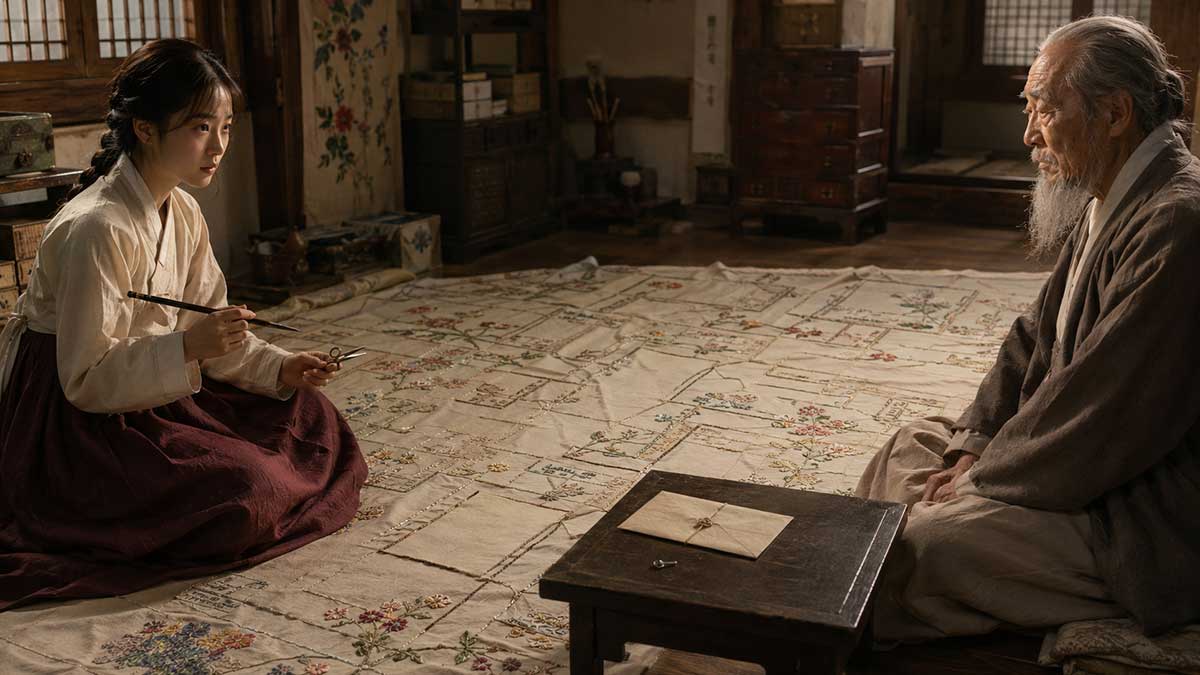
Seo-yoon first came to Mangwol-ri in the summer she turned sixteen. She came alone.
Park Ha-jin rode with her to the station but wouldn't board the bus.
"You don't have to meet him simply because you've come this far."
"Then why send me at all?"
"Because you're the one who said you wanted to go."
"Don't you want to?"
Ha-jin didn't answer that. Just before the bus pulled out, she rapped once on the window. Seo-yoon slid it open.
Ha-jin handed her a small paper envelope, unsealed, no name written on it.
"Give this to him."
"To Grandfather?"
A pause, then a nod. "Whenever you feel ready to."
Seo-yoon didn't look inside on the ride out. She didn't want to read, ahead of time, whatever her own mother had chosen not to say to his face herself.
---
There was no fan on the bus. Hot wind and road dust came in through the open windows the whole way. The conductor mangled the village's name three times running.
"Anyone for Mangwon-ri?"
"Mangwol-ri," Seo-yoon corrected, without looking up.
"You from there?"
"No."
"Then how do you know the name?"
"I've heard it said. Often enough to know when it's said wrong."
He laughed. "Some people know a place's name before they've ever once set foot in it."
She didn't answer. It was true, and she didn't especially like that it was.
She'd grown up hearing about Mangwol-ri all her life — the black stone, the trembling spoons, the name cloth that kept growing on its own, the shoes that had come home ahead of the man who owned them, the grandfather who'd worn a dozen different names in the newspaper. But no two people who told it to her told the same place. To her mother, it was the hometown of the man who'd abandoned her. In the article, it was a symbol of reconciliation dressed up for readers. In Park Do-hyeon's letters, it was a house where the furniture remembered longer than the people did. In Kang Mi-ran's writing, it belonged to no one person's version of the truth.
To Seo-yoon herself, Mangwol-ri wasn't yet a place at all. It was a sentence too many other people had already finished, before she'd ever gotten a chance to add her own ending to it.
---
The bus crossed the pass, rolled past the bowing utility pole, and stopped.
"Mangwol-ri," the conductor said, correctly this time.
She stepped down carrying a small suitcase and her mother's unsealed envelope. Park Do-hyeon was waiting at the stop — twenty now, tall, his face carrying, she thought, fewer spare words in it than she'd expected from his letters.
They'd corresponded for years and never once met.
"Seo-yoon?"
"Yes."
"Taller than your photograph."
"Photographs don't grow."
He laughed. "You talk like this family already."
She stiffened at that. "I wasn't raised in this family."
His smile faded. "I'm sorry."
She thought the apology had come too fast — she'd heard, somewhere, that people in this house tended to sit a long while with an apology before offering it. Do-hyeon, it seemed, was different that way.
"It's fine," she said.
---
They walked toward the house together, past rice fields and sagging wires strung pole to pole. Do-hyeon narrated every landmark along the way.
"The old house used to stand right there."
She looked at the bare asphalt. "There's nothing there now."
"It's still the place, though."
"Does a place stay a place, once the house on it is gone?"
"In this family, it does."
She didn't much care for that answer either — it sounded, to her ear, like a way of dodging an explanation rather than giving one. Do-hyeon caught something in her expression and went quiet the rest of the way.
After a while she asked, "How is he? Grandfather."
"Very old."
"Did he wait for me?"
"He tried hard not to *say* he was waiting."
"What does that mean?"
"He never set out a bowl for you. He was afraid it would feel like a debt, hanging over you before you'd even arrived."
"But my name's already on the cloth."
"We didn't write it there."
"Who did, then?"
"The cloth did, on its own."
She didn't push further. It was the kind of answer she disliked most of all — a decision quietly made, with no one willing to take responsibility for having made it.
---
The house with the black stone turned out smaller than she'd pictured from the photographs. Two signs still hung above the gate — *Kang House* and *Park House* — knocking together faintly in the wind. From a distance it sounded like an argument. Closer up, it sounded like spoons touching bowls before a meal.
Kang Mi-ran and Park Seong-ho stood waiting in the courtyard. Mi-ran, middle-aged now, held a dishcloth instead of the notebook Seo-yoon had imagined her carrying.
"Seo-yoon."
Mi-ran started toward her. Seo-yoon didn't step back, but didn't step forward either. Mi-ran stopped halfway between them.
"Long trip?"
"It was fine."
Seong-ho lifted her suitcase. "Light bag."
"I don't know yet how many days I'm staying."
"Then you can leave today, or stay a long while. Either's fine by us."
He carried it inside without waiting for a response.
"He tends to say the necessary thing first," Mi-ran said, watching him go.
The kitchen spoons stayed quiet.
"Do they test everyone who walks through that door?" Seo-yoon asked.
"Everyone."
"Even children?"
"Children get caught out the fastest, if anything."
---
Seo-yoon stopped at the threshold before going in. Her feet weren't fixed there — she simply stopped herself, on purpose. The black stone sat at the center of the kitchen, four leaves grown from it now, a dark point marking the fourth.
"Come inside," Mi-ran said.
"Does the house have to accept me first?"
"No."
"It had to accept Grandfather."
"That was his story to earn. Not yours."
"And mine?"
"You get to decide whether the house is worth accepting, this time. Not the other way around."
Seo-yoon crossed the threshold. Nothing happened — no spoon stirred, no snow rose from the floor, the stone said nothing at all. She felt relief at that, and a smaller, harder-to-name disappointment underneath it. She hadn't wanted to be special. And yet the total absence of any response made her feel, somehow, smaller than the name that had already been stitched into the family's story ahead of her arrival.
---
Kang Jun-ho lay in the inner room, far smaller in person than the man printed in the old newspaper photographs. Age, she was learning, could shrink a person down past even their own possessions.
He sat up at the sound of the door. "Seo-yoon?"
He didn't cry. He didn't reach for her either. He simply studied her face, a long, careful look that made her uncomfortable.
"Why are you looking at me like that?"
"I'm sorry."
"For what?"
"For trying to remember your face, before I'd ever actually seen it."
"How does anyone remember a face they've never once laid eyes on?"
He considered that seriously. "You're right. That was foolish of me."
The admission surprised her. Most adults she knew explained themselves out of a mistake. He simply agreed he'd made one.
"Will you sit?" he asked.
She came in and sat, taking in the old photographs and newspaper clippings and letters covering the wall, the folded name cloth nearby.
"How's your mother?"
"Well enough."
"What does she say about me, these days?"
"Not much."
"I understand that."
"Less than the papers ever printed, at least."
"Newspapers never learned when to stop talking."
She held her mother's envelope on her knee. He noticed it.
"What's that?"
"Mother gave it to me. For you."
His hands trembled faintly. "For me?"
"She said to give it whenever I felt ready."
He looked away. "Then don't give it to me yet."
"Why not?"
"As long as it's still in your hands, the choice of when belongs to you. Once it's mine, that choice is gone."
It was, she realized later, the first thing he'd said to her that she genuinely liked.
---
A crowd of relatives gathered for lunch that day. Park Man-sik and his wife had both passed on by now, but their descendants still came round. Some of Seong-ho's younger cousins turned up too, all of them studying Seo-yoon over their bowls.
"She favors Ha-jin, don't you think."
"Her eyes look like the old man's."
"The mouth might be Myeong-hui's."
Seo-yoon set her chopsticks down. "Don't talk as though you actually know me."
The table went quiet.
"We knew your mother when she—"
"No one at this table knew her as a child. You're guessing."
The elder closed his mouth. A spoon somewhere trembled once. No one had exactly lied — but a sentence dressed up as familiarity had gotten a little too close to a truth it hadn't earned, and pulled back only once it was called on it.
"You're right," Mi-ran said, into the silence that followed. "We only know her through photographs and other people's stories."
Another relative tried to smooth it over. "Families do look for resemblance, though. It's only blood."
"Why?"
"It's simply what blood does."
Jun-ho was staring at his own bowl. "Blood explains people far too easily, if you let it."
Everyone looked at him.
"I abandoned people who shared my blood," he said quietly, "and survived, for thirty years, under the names of people who didn't share a drop of it with me."
No one had an answer for that.
Do-hyeon set a dish down in front of Seo-yoon, breaking the silence. "This one isn't spicy."
"I eat spicy food."
"Your letters said—"
"When I was younger. I've changed since then."
He swapped it out for another dish without comment. "Try this one too, then."
She fought not to smile, and lost, a little.
---
After lunch, Mi-ran showed her the name cloth — grown by now large enough to cover the better part of a room. Old names faded near the top, newer ones dark and vivid. Some carried a single sentence. Some carried many. Some, only empty space.
Seo-yoon found her own name near the bottom edge:
*Seo-yoon. Daughter of Park Ha-jin. Granddaughter of Kang Jun-ho.*
Nothing more.
"Who wrote this?"
"It appeared on its own."
"I don't much like that answer."
"I know."
"Why didn't you take it off, then?"
"We were waiting to see whether you'd want it to stay."
"Can it even come off?"
"With scissors, yes."
"That would damage the cloth."
"A person always comes before a piece of cloth."
Mi-ran held out the scissors. Seo-yoon didn't take them.
"I'll think about it."
"All right."
"Why does 'granddaughter of Kang Jun-ho' come before anything else? Shouldn't being my mother's daughter come first?"
Mi-ran fetched a brush instead. "It can be changed."
Seo-yoon wrote, beneath the old line: *Daughter of Park Ha-jin.* Then, after a pause: *A person who hasn't yet decided whether she wants to be called Kang Jun-ho's granddaughter at all.*
A spoon rang out once, sharp.
"Was that a lie, just now?"
"Maybe it means you didn't swallow something you meant to say," Mi-ran said gently.
"Can the spoons even tell the difference?"
"We've never been entirely sure, honestly."
For the first time, Seo-yoon found she didn't mind this family's habit of admitting what it didn't know. At least they weren't dressing up their ignorance as certainty.
---
That afternoon, the village hall took delivery of its first color television. Nearly everyone turned out that evening for a documentary about the war.
Jun-ho didn't want to go. "I've already seen enough war for one lifetime."
"This is war, edited by someone else," Mi-ran said.
"That's somehow more tiring, not less."
"I want to see it," Seo-yoon said.
He looked at her. "Then we go."
---
The hall was packed, the screen small, and yet people watched it more closely than they watched the actual world outside the windows. Advertisements ran first — spotless kitchens, new refrigerators, families smiling at nothing in particular. No black stone in any of them. No cracked bowl, no empty plate. No one in the crowd seemed to find that strange. They asked, instead, about the price of the refrigerator.
Then the documentary began, a deep announcer's voice laid over it: *War separated the heroes from the traitors, and the nation rose again on the strength of their sacrifice.*
Soldiers. Refugees. Collapsed bridges. Marching crowds. Jun-ho's jaw tightened watching it.
"Were you there, in any of this?" Seo-yoon asked.
"Somewhere in it."
"Which side of it?"
"Just outside the frame, mostly."
She frowned. "You always say that. Standing beside where you should have been."
"Say it enough times, and it starts working as a hiding place instead of an answer."
"Then where were you, actually?"
The screen shook slightly with the projector's motion. Among the black-and-white soldiers, a young Kang Jun-ho appeared — carrying a wounded man across his shoulders.
He stopped breathing for a second.
"Is that you?"
"I think it is."
The footage made him look, unmistakably, heroic. The narrator's voice rolled on: *Countless brave young men vanished, without a single name recorded to remember them by.*
People in the hall turned to look at him.
"Isn't that Elder Kang?"
"You were a hero, all this time!"
Jun-ho stood in front of the screen, trying uselessly to block it with his own body. "There's more, further along."
The crowd laughed. "You can't block a broadcast with your own shoulders."
"They should show what happened right after this part, too."
But the program had already moved past it.
"What *did* happen, after that?" Mi-ran asked quietly.
"I crossed the river with him, and then I left the man to die, and ran from the rest of them besides."
Silence.
"Why?" Do-hyeon asked.
"The gunfire was getting closer. I was afraid of dying myself."
"Did the wounded man live?"
"No."
Seo-yoon looked at the screen, where the young Jun-ho remained, forever, a rescuer and nothing more.
"Television lied about you."
"One scene of it might be true," Mi-ran said carefully.
"It just never showed the scene right after."
"That," Jun-ho said, "is exactly what I did with my own life, for most of it. Remembered only up to the point the memory still favored me."
---
The screen went dark all at once — the picture only, the hall's lights staying lit. Faces reflected faintly in the blank glass. Jun-ho's didn't. Instead his young and old faces alternated across it, flickering.
Seo-yoon stepped closer. The young Jun-ho on the screen looked directly at her.
"He seems to recognize me."
"He can't know you. That footage predates you by decades."
"Then why is he looking straight at me?"
"Maybe only because you're the one looking at him right now."
The young mouth moved without any sound behind it. *Run.* Then, a beat later: *Wait.*
Seo-yoon stepped back. The screen came back to life on its own — a smiling family gathered around a rice cooker. The village blamed the electricity.
"Nothing mechanically wrong with it," Seong-ho said, checking the set.
"Then the broadcast station, maybe."
"Maybe it's the memory that's broken," Mi-ran said.
"Memory doesn't have a repair shop," an elder pointed out.
"Which is exactly why it breaks down more often than most things do," Seong-ho said.
---
Walking home, Seo-yoon asked, "Why did you leave them, back then? The wounded man, the others?"
"I was afraid."
"You could have gone back for them."
"Maybe."
"Why didn't you?"
"A man who survives wants a reason for having been the one who lived."
"What reason did you invent for yourself?"
"That I had to go on living, in order to remember the ones who hadn't."
"Did you? Remember them, I mean?"
Jun-ho couldn't answer that cleanly. The wires above the bowing pole trembled faintly in the wind.
"Not all of them."
"Do you know their names, at least?"
"Some."
"And the rest?"
"No."
"Are they the little dots on the cloth?"
"Some of them, yes."
Seo-yoon stopped walking. "You put people whose names you never even learned into your own family's record?"
"They didn't die because of us. But we were on the same road, all of us together, at the same time."
"Why didn't you go find out their names, afterward?"
"A person doesn't live long enough to repair every wrong he's part of."
"So you repair none of them?"
"No."
"Then start now."
"Now?"
"Find whoever's still living. Find their names, at least."
He looked at her a long moment. "I understand, now, why your mother sent you here."
"She didn't send me to fix you."
He lowered his head. "You're right. I've just handed you more work, without asking."
---
The next day Seo-yoon sat down and counted the dots on the cloth herself. Forty-three of them. Some carried a place, or a rough date. Seventeen carried nothing at all.
"Who were they?" she asked.
"People we fed during the evacuation, people who couldn't or wouldn't give their names, people lost somewhere along the road afterward," Mi-ran told her.
"They all get the same dot, then? Nothing to tell one from another?"
"At the start, the dot only ever meant the name was unknown. Nothing more than that."
"Shouldn't even the unnamed be different from one another, at least?"
Mi-ran looked at the cloth for a long moment. "I never once thought to ask that question myself."
Seo-yoon began drawing small marks around each dot — a half-moon here, a wave there, a door, an empty square.
"How do you decide which mark goes where?" Do-hyeon asked.
"I don't, really. They're only temporary, for now."
"Temporary marks turn into names, sometimes, if they sit long enough," Jun-ho said.
She paused at that. "Then I'll use paper instead, so they can still be changed."
She pinned small removable slips beside each dot, and the family began, together, to search — Jun-ho describing faces and places from memory, Mi-ran combing through archives and old newspapers, Do-hyeon visiting government offices, Seong-ho suggesting radio announcements, Seo-yoon writing letter after letter.
---
The first recovered name was Lee Bok-sun — a woman who'd stayed in the house during the war with two small children. The cloth had described her only as a woman missing one finger. Both children, it turned out, had survived; one had become a teacher, the other had died at sea years later.
Mi-ran took out the dot and stitched in her name properly. The dark point on the fourth leaf grew, faintly, a little larger.
The second name didn't turn up. Nor the third. After a full week, Seo-yoon grew angry about it.
"Why didn't anyone keep proper records at the time?"
"There wasn't time to ask anyone's name, back then. Feeding them was already more than we could manage some days."
"You could have asked later."
"For a lot of them, later never came."
Seo-yoon fell quiet, hearing that. She recognized, uncomfortably, how easily she'd been judging a past she hadn't lived through, from the safety of one she had. And yet she also didn't like the idea of using that same difficulty as a blanket excuse for every silence in the record.
That evening, for the first time, a spoon trembled while she herself was speaking.
"Why?" she asked.
"You swallowed something just now," Jun-ho told her.
She thought about it. "I'm angry, because it's too easy to use how hard things were back then as a reason to forgive everything that went unrecorded."
The spoon trembled harder.
"But I'm also ashamed," she admitted, "that I judge people from an easier time so quickly, when I've never once had to make their choices myself."
The spoon went still.
"Write both parts down," Mi-ran said.
Seo-yoon wrote: *Seo-yoon judged this family before she'd even arrived, and learned, once she had, that refusing to judge at all can be its own way of looking away.*
She read it back. "It finishes too neatly."
"You don't like it?"
"The sentence ends before the person writing it has."
Mi-ran cut a small slit in the cloth just after the line. "Then leave it open. Finish it later, whenever you're ready to."
Wind moved faintly through the cut. That same night, the fourth leaf on the stone seemed to shift for each of them differently — Jun-ho saw a pair of unnamed eyes looking back at him; Mi-ran saw sentences torn from old newsprint; Do-hyeon saw only a long blank space; Seo-yoon saw her own face, with no mouth on it at all.
"Why no mouth?" she asked.
"Maybe," she answered herself, before anyone else could, "because you've spent more of your life listening to other people's voices than using your own."
---
That afternoon a television crew arrived, having identified Jun-ho from the old war footage and wanting to film him for a follow-up piece.
"Your life could stand for the whole country's reconciliation," the director told him.
"Which part of it, exactly?"
"Saving a man's life. Surviving under so many names. Coming home, in the end."
"Will you include the part where I abandoned others, too?"
"We can't include everything."
"Then it's the same story all over again."
"Broadcast time only runs so long."
"Does a person have to be simplified, just to be understood at all?" Jun-ho asked.
"That's an excellent question for the interview itself."
"I'm asking it of you, right now."
The crew set up cameras in the courtyard regardless. Jun-ho nearly refused outright.
"Talk, this time, about what happened *after* the heroic part," Seo-yoon told him quietly, before it started.
"What if they cut that part out too?"
"Then at least the record will show you said it."
"Who keeps that record, once they've cut the footage?"
"We will. Ourselves."
Seong-ho fetched a cassette recorder. "This one runs start to finish, no editing."
"That might interfere with our production," the director objected.
"Does truth only get to be recorded by one machine at a time?"
Both ran simultaneously — the television camera catching Jun-ho's face, the family's own recorder catching every word underneath it.
"Do you remember rescuing the wounded soldier?" the director asked, on camera.
"Yes."
"What drove you to risk your own life for him?"
"I thought, in the moment, that I couldn't simply leave him there."
"That's courage."
"For that one moment, yes."
"And afterward?"
"After we crossed the river, I heard gunfire closing in, and I ran."
"That part's difficult to verify."
"You've been broadcasting the favorable half without ever verifying it," Seo-yoon cut in.
"Family members ought to stay quiet during the interview, please."
"Record her too, then," Jun-ho said.
"We're only here for you."
"My story reached her long before it reached you."
The director sighed. "This is making the whole shoot considerably harder."
"People generally are hard," Mi-ran said, not unkindly.
The director asked, eventually, whether Jun-ho felt at peace, now that he'd come home.
"Yes."
"What do you regret most, out of everything?"
"If I choose just one thing, the rest start looking smaller than they deserve to."
"For the sake of the viewers, pick one anyway."
"I won't arrange my own guilt into something comfortable to watch."
The interview ran long. "Are you at peace, then, now that you're finally back?"
"Peace was never a place you arrive at."
"What is it, then?"
"Time in which I didn't run away, today."
The director smiled, satisfied. "Strong line to end on."
"Tomorrow," Jun-ho added, "I might run again anyway."
The director's smile faded slightly at that.
---
The broadcast aired a month later, titled *The Hero Who Came Home, Beyond Every Name He Wore.* The abandonment was mentioned only briefly, folded into a line about lifelong guilt. The ending used exactly what Jun-ho had said: *Peace was never a place you arrive at. It's time in which I didn't run away, today.*
The line right after it — *Tomorrow I might run again anyway* — never made the cut.
The village applauded when it aired. Jun-ho said nothing through any of it.
Afterward, Seo-yoon brought out Seong-ho's full recording. They listened to it together as a family — the director's sighs included, her own sharp questions, Mi-ran's objections, Seong-ho turning the cassette over, Do-hyeon pouring water somewhere in the background.
"This sounds more like me than the broadcast did," Jun-ho said, listening.
"It has no face to it, though."
"Maybe a person exists more fully in the sounds around him than in whatever face gets shown of him."
---
The old family photograph fell off the wall not long after, its glass cracking on the floor, the photograph itself untouched. Eleven people had originally sat for it; twelve had appeared in the print. Jun-ho had made it thirteen, once he'd returned. Now there were fourteen — Seo-yoon standing at the back, sixteen years old, though she hadn't been born yet when the photograph was actually taken.
Her figure in it had no mouth.
"They decided who I was, in this too, before I ever showed up to say otherwise."
She raised her hand to cut herself out of it. No one stopped her. Only Do-hyeon spoke up.
"It's still your photograph too, you know."
"That's exactly why I get to decide what stays in it."
She cut her own figure free, leaving a person-shaped hole where she'd stood. Her reflection vanished from every mirror in the house that same hour — though the family could still see her plainly with their own eyes.
"Maybe you've erased yourself from the record," Jun-ho said.
"I didn't erase myself. I removed a version of me that was never really mine to begin with."
The spoons stayed still. She set the cut-out figure down on the black stone itself. The fourth leaf browned almost immediately, as if scorched.
"It's dying," Mi-ran said, alarmed.
"Will it come back, if I put the picture back together?"
"You don't have to put yourself back in the wrong place, just to keep a record intact," Jun-ho told her.
"Why did you never cut yourself out of your own photographs, all those years you lived under other names?"
"I was afraid to."
"Of what?"
"That I'd disappear entirely, if I did."
"Did you?"
"No. I multiplied instead, into all these different men."
Seo-yoon wrote, on the back of her own cut-out figure: *Seo-yoon. This face was assembled by other people, before she ever arrived to claim it herself.*
She tucked it into the same old blank envelope that had once held the line about a person not yet born.
Inside, that earlier message still read: *I haven't been born yet. Please don't finish my story before I've arrived.*
Beneath it, she added: *I have been born now. Please still don't finish it.*
Her reflection returned to the mirrors that same night — though each mirror in the house now showed her wearing a different expression: anger in one, fear in another, laughter in a third, stillness in the last.
"Which one's really me?"
"Perhaps all of them are faces you've genuinely worn, at one time or another," Mi-ran said.
"And the real one, underneath all of it?"
"The one who doesn't have to settle on only a single face, and call it done," Jun-ho said.
The fourth leaf turned green again after that, its dark point slowly reshaping itself into something like a small mouth.
"Now it can talk," Do-hyeon said.
"The leaf can. I'm still deciding whether I want to," Seo-yoon said.
---
That night, she finally gave Jun-ho her mother's envelope.
"I want to give it to you now."
"Did you end up reading it?"
"No."
"Why now, then?"
"Not because I know who you are yet."
He waited.
"Because I can carry Mother's words to you, even without knowing you fully myself."
Inside sat a letter and an old radio screw.
*Father — this letter took a long time to write. I haven't forgiven you. I also haven't decided, once and for all, never to forgive you either. I learned how to live without a father, and I don't want your coming back to make that whole life of mine feel like it was somehow wrong all along. I didn't send Seo-yoon to you. I sent her because she has every right to look at her own past with her own eyes, not just mine or yours. Don't hide the fact that you were a poor father by rushing to become a good grandfather instead. But don't give up on becoming a good grandfather, either, simply because you were a poor father once. I heard, somewhere, that you always left a screw over, whenever you finished repairing a radio. My own mother kept one of them, all these years. I don't know for certain whether it came from your shop or not.*
Jun-ho held the small screw in his open palm.
"Very old," Seong-ho said, examining it.
"Was it mine, do you think?"
"There's no way to know for certain."
"Was it even necessary, wherever it came from?"
"Every leftover screw insists, afterward, that it never was."
Jun-ho laughed at that. Then he cried. Seo-yoon couldn't say, watching him, whether the tears belonged to Ha-jin, or to Myeong-hui, or only to himself. She didn't ask.
He tried to attach the screw to the name cloth directly.
"Does every single object in this house have to become part of the record?" she asked.
"I might lose it otherwise."
"Put it in a toolbox instead."
Seong-ho brought his own over — a lifetime's worth of leftover screws sorted into little compartments.
"Which one goes here?"
"This section. For screws whose original place we never figured out."
Jun-ho set it in among the others. Every screw in the box seemed to shift at once, faintly, the sound like a small round of applause.
---
On her last day, they counted the recovered dots together. Seven names found, out of forty-three.
"We only managed a handful," Seo-yoon said.
"We managed seven," Mi-ran said.
"And the other thirty-six?"
"Not finding all of them doesn't make the seven we did find any smaller," Jun-ho said.
She nearly wrote that down as it was. Then she stopped.
"Why not write it?" he asked.
"It ends too comfortably."
"Add to it, then."
She wrote: *But finding seven doesn't give us permission to forget the other thirty-six.*
"Less comfortable," Jun-ho admitted, reading it.
---
On the morning she left, she went back and revised her own earlier entry. She kept: *Seo-yoon judged this family before she'd arrived.* And: *She learned that refusing to judge at all can be its own way of looking away.*
Beneath the still-open cut in the cloth, she added one more line: *But simply accepting whatever face this family had already prepared for her wouldn't have been memory. It would only have been obedience.*
"Strong," Mi-ran said, reading it over.
"Too harsh, do you think?"
"No."
"What do you think?" Seo-yoon asked Jun-ho directly.
"I think it's true."
"Does it hurt, hearing it?"
"Yes."
The spoons stayed quiet through all of it.
She smiled slightly. "Then I trust it all the more, for that."
---
The whole family walked her to the bus stop.
"Next time, maybe I'll come with Mother," Seo-yoon said.
"That might happen."
"She might not come, though."
"That might happen too."
"Will you wait for her, either way?"
"I'll keep a place set."
"Not a rice bowl, though."
"A plate."
The bus pulled in. Before she boarded, she turned back once more.
"Grandfather."
"Yes?"
"Remember the line the broadcast cut."
"Which one?"
"*Tomorrow I might run again.*"
His face tightened, hearing it repeated back to him.
"Even if you run again tomorrow," she said, "you can still come back the day after that."
"Who taught you to say that?"
"No one. I worked it out myself."
She boarded, and was gone.
---
When Jun-ho got back to the house, a small slip of paper sat waiting on the empty plate. In Seo-yoon's own hand:
*Not waiting doesn't have to mean removing the place set for someone.*
He didn't stitch it onto the cloth. He left it exactly where it was, tucked beneath the plate, and let it stay there.
That night the television switched itself on, unbidden. No program played on it — only the thirty-six still-unnamed dots, floating across the dark screen like scattered stars, drifting one by one toward its edge. Then Seo-yoon's face appeared there, briefly. This time it had a mouth.
She spoke without any sound behind it at all.
*Don't finish it yet.*
The screen went dark. Jun-ho's own reflection appeared in it a moment later — not the young soldier from the old footage, not the hero the broadcast had made of him, not the fugitive under one borrowed name or another. Only the old man he actually was now, having just seen his granddaughter off down the road.
He studied that face a long while.
He had believed, for most of his life, that memory only ever meant preserving what had already happened. After Seo-yoon's visit, he understood something more than that. Memory, it seemed, also had to preserve, for whoever was still living, the right to refuse whatever face the past had already prepared for them in advance.
The fourth leaf opened all the way that night. Beside it, a fifth shoot broke through the surface of the stone.
No one asked, this time, who might be coming.
The family, slowly, was learning not to name a person before that person had even arrived to claim the name for themselves.
Chapter 12: The People Who Looked for the Last Name
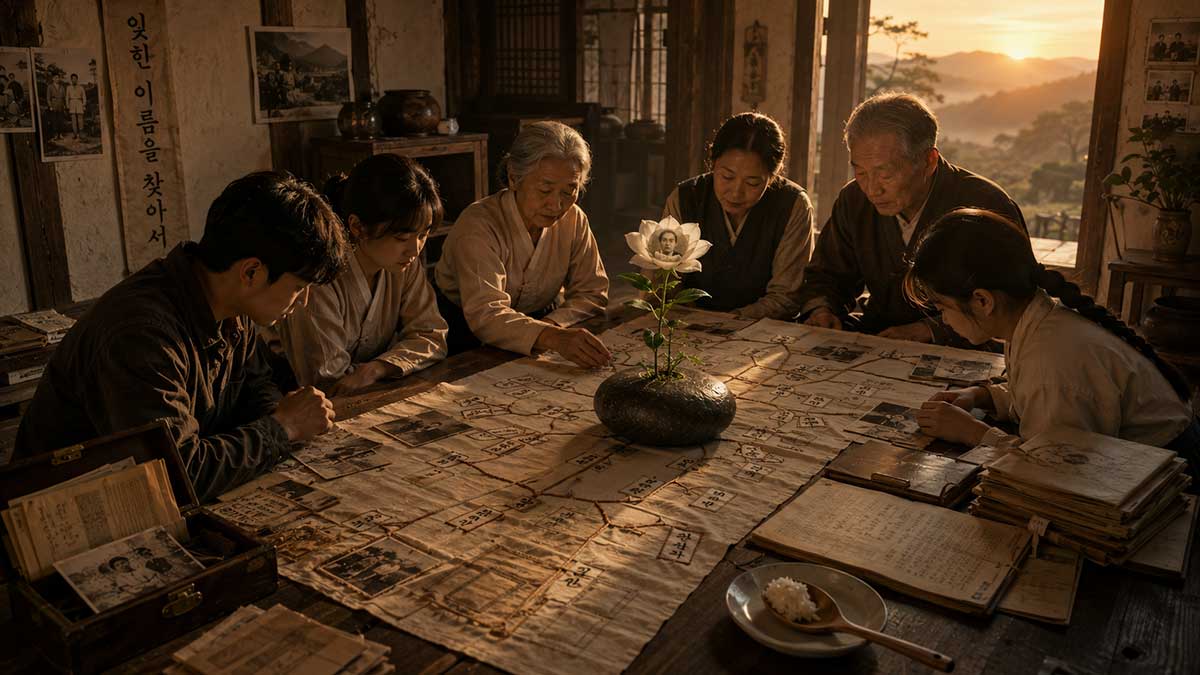
After the war, plenty of families went on searching for the people they'd lost. As the years passed, though, most of them eventually stopped. Grief, given enough time, tends to teach a person how to set it down.
The house with the black stone never quite learned that lesson. It kept searching, long after most families would have called it enough.
After Seo-yoon left, the kitchen settled into a different kind of quiet than before — not the quiet of someone missing, but the quiet that comes when a person has finally started living a life of her own, somewhere else, and doesn't need this house quite so much anymore. The small plate stayed on the table regardless. It no longer waited on anyone in particular. It simply stood as a reminder that someone, always, might still come.
---
Do-hyeon came home from university with boxes of old material under his arms — refugee lists, yellowed newspapers, church registers, photographs no one had claimed. The family made a quiet decision around that time: they would go on remembering their own, as they always had, but they would also start trying to restore the names of strangers whose lives had simply brushed up against theirs somewhere along the way.
Instead of chasing names first, they started with habits instead — the woman who always lined her shoes up neatly by the door, the left-handed man, the child who laughed with a gap where his front tooth should have been. Small newspaper notices, run without much hope, began bringing unexpected replies. One by one, the dots scattered across the cloth turned back into names.
One of those names belonged to a soldier who'd once walked beside Jun-ho during the retreat south — a man whose name neither of them had ever learned from the other, back when it might have mattered most. Decades later, the soldier's own grandson turned up at the gate carrying an old photograph. For the first time, Jun-ho learned the name of the friend he'd never once managed to forget:
Choi Dong-sik.
That evening, new words appeared on the name cloth on their own, the stitching no steadier or surer than any of the others that had come before it:
*A name can't bring the dead back to life. But knowing that someone kept searching, right to the end, means no one has to be entirely alone in the not-knowing.*
---
Not long after, Jun-ho told the family the truest thing he'd ever said about the black stone.
It had never really belonged to them. Neither, in the end, had memory itself. Both had simply been entrusted to their keeping, for a while — passed down through hands that had never actually owned either one, only carried them a little further along.
He died near dawn one spring morning, quietly, without a struggle.
For the first time in the family's memory, no spoon so much as trembled. The cracked bowl sat perfectly still. The black stone made no sound at all.
Instead, someone found a single spoonful of warm rice sitting on the little empty plate the next morning. No one could say who had put it there. Beside it, in handwriting that belonged to no one living, a single sentence had appeared:
*Don't wait any longer. Eat together, all of you.*
---
When the family opened the name cloth after his funeral, only one new line had stitched itself in beneath his name:
*Kang Jun-ho died, at last, under his own name.*
That same morning, the fifth shoot growing from the black stone opened into a flower — the first anyone in the family had ever actually seen bloom from it. At its center, whoever looked closely didn't see their own reflection looking back.
They saw, instead, the face of someone the world hadn't gotten around to remembering yet.
The story, by then, had stopped being only about holding on to the past. It had become, without anyone quite deciding it on purpose, about making sure that whatever came next wouldn't have to disappear without a name of its own to hold onto.
Final Thoughts
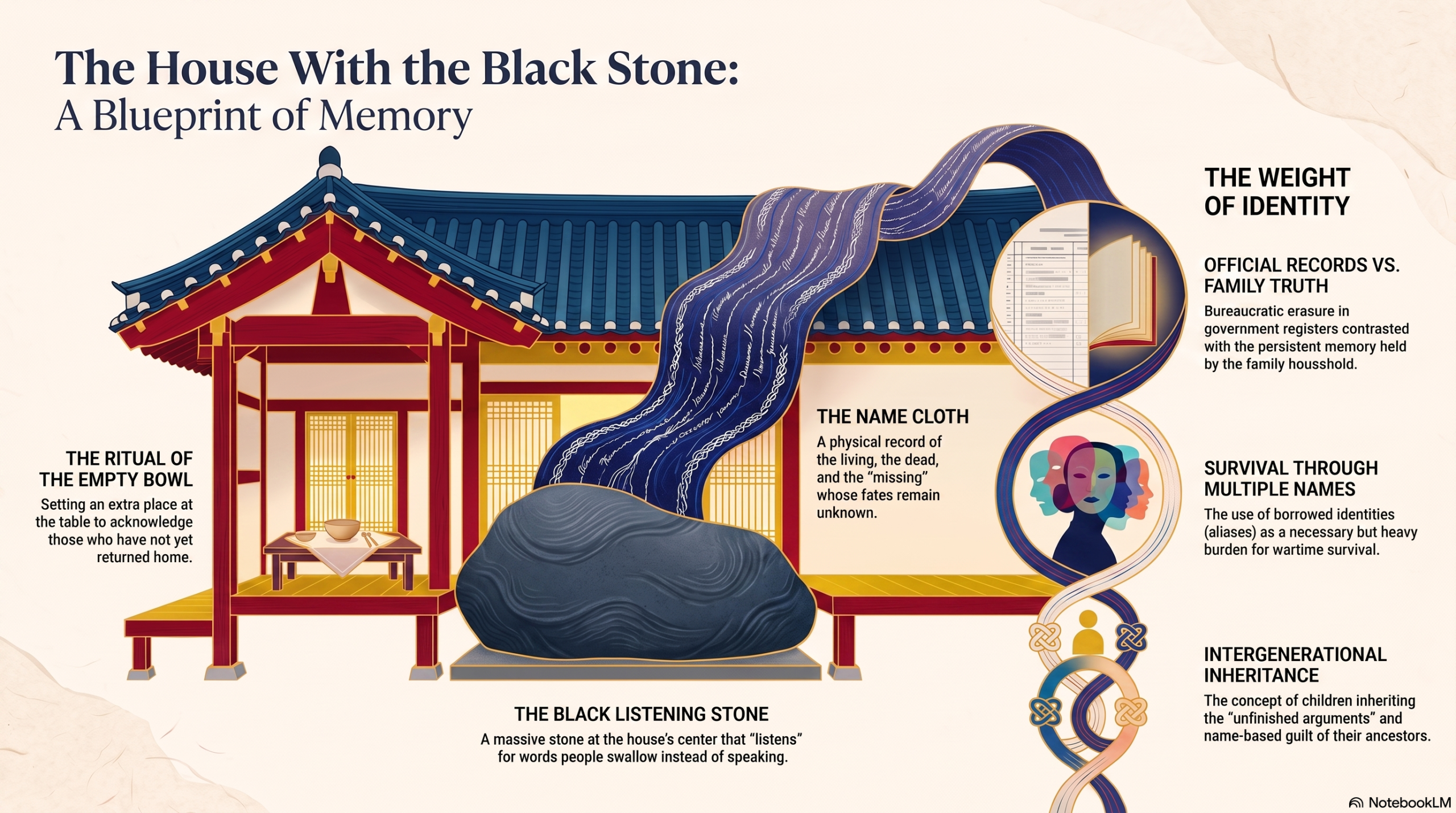
The House With the Black Stone draws inspiration from Gabriel García Márquez’s use of magical realism, generational memory, circular history, and the supernatural within everyday family life. Yet Nick Sasaki carries those elements into Korean history, Korean family relationships, and the moral weight of names erased by war and political change.
The black stone becomes the family’s silent witness. It hears what people cannot admit, responds when truth is swallowed, and grows new life from its cracks. Still, it never gives a final judgment. One person may have been brave and selfish, wounded and harmful, abandoned and still loved—all within the same life.
Seo-yoon, the youngest major voice in the novel, refuses to accept the identity her family prepared for her before she arrived. She does not reject her ancestry. She claims the right to examine it, question it, and decide what place it will hold in her own life.
By the ending, the family’s task has changed. They are no longer preserving only their own bloodline. They search for the names of strangers, refugees, soldiers, neighbors, and forgotten people whose lives touched theirs. Memory is no longer treated as family property. It becomes a responsibility temporarily entrusted to those still living.
The flower growing from the black stone reflects someone who has not yet been remembered. The family’s attention finally turns from recovering the past to protecting the dignity of the future.
The novel’s final hope is not that every wound can be healed or every missing name recovered. It is that no person should disappear simply because history, government, or family found their life too difficult to record.
Short Bios:
Nick Sasaki is a Japanese American writer and creator of Imaginary Talks, a project exploring emotionally meaningful conversations across literature, history, spirituality, psychology, and culture.
The House With the Black Stone is an original Korean multigenerational novel inspired by the magical-realism tradition associated with Gabriel García Márquez. Its characters, village, supernatural symbols, family history, and narrative events are original creations by Nick Sasaki.
Kang I-mun — A wounded stranger led to Mangwol-ri by summer snow, whose hidden first family and unfinished confession become the foundation of the house’s inherited silence.
Baek Yeon-hwa — I-mun’s perceptive wife, who recognizes that untold stories do not disappear; they wait inside a family until someone is ready to face them.
Madam Oh — The sharp-tongued village elder who first explains that the black stone listens for words people intend to say, then swallow.
Kang Yeon-ok — Keeper of the name cloth who marries a dead man, learns that love and return are not the same, and creates new spaces for those who do not fit the family’s old categories.
Jang Do-yun — Yeon-ok’s deceased groom, whose yearly visits reveal that the dead may remain attached to promises the living have already outgrown.
Kang Mu-hyeon — A gifted government clerk whose faith in records protects his household yet leads him to erase a relative, leaving his own reflected face permanently incomplete.
Kang Do-han — A politically hunted family member whose removal from the official register makes him disappear from mirrors and exposes the human cost of administrative survival.
Yoon Seo-jin — A quiet resistance worker who hides names and messages beneath anchovies, protects the family during occupation, and teaches her sons that survival without humanity is another kind of loss.
Kang Jun-seo — The elder brother who trusts records, ownership, and patient return, then learns that legal possession means little beside the people who kept a home alive.
Kang Jun-ho — The missing younger brother who lives under many names and identities before returning as an old man burdened by public praise, private shame, and the family he failed to seek.
Park Man-sik — A member of the family that occupies and preserves the Kang house during the war years, challenging the belief that inheritance belongs only to blood or legal ownership.
Kang Mi-ran — Journalist, writer, and keeper of the evolving name cloth who records conflicting accounts without allowing one version to erase another.
Park Seong-ho — An electrician from the Park family whose practical kindness, honesty, and marriage to Mi-ran help join two households without forcing either to surrender its name.
Park Do-hyeon — Mi-ran and Seong-ho’s son, who grows up among unfinished stories and begins writing a family history that admits what it does not yet know.
Park Ha-jin — Jun-ho’s estranged daughter, who refuses easy forgiveness yet allows her own daughter to examine the family past without inheriting her judgment as a command.
Seo-yoon — Jun-ho’s granddaughter, who arrives already named by others and insists on the right to revise the family’s account of who she is.
The Black Stone — The silent center of the house, responding to swallowed truth, fractured identity, and places left open for people whose names have not yet been recovered.
Leave a Reply