
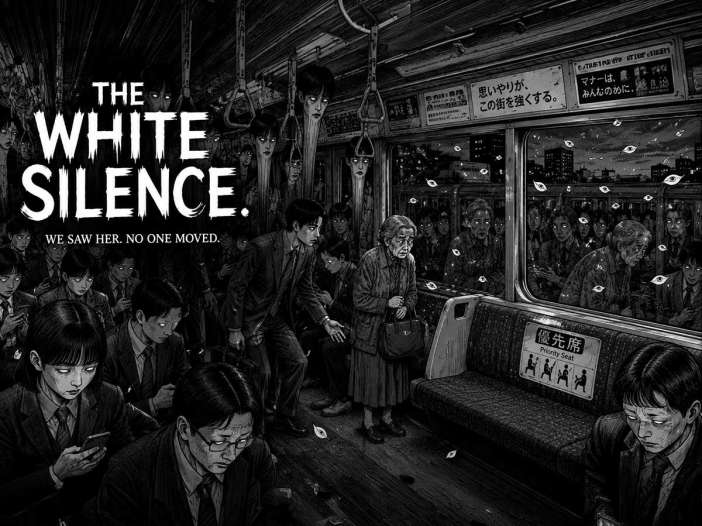
What if the smallest act of kindness could save someone whose suffering no one else had noticed?
The White Silence began with a question inspired by José Saramago’s Nobel Prize-winning novel Blindness:
What would happen if the same mysterious epidemic of white blindness appeared in modern Japan?
Saramago’s novel places ordinary people inside a sudden collapse of sight, social order, dignity, and moral certainty. His characters are forced to confront what remains of humanity when familiar rules disappear.
This story begins from that same philosophical doorway, then walks in a different cultural direction.
In Saramago’s world, blindness exposes how quickly fear and desperation can turn people against one another.
In modern Japan, the danger may arrive more quietly.
The trains may continue running.
People may remain in orderly lines.
Neighbors may bow.
Workers may report for duty.
Patients may apologize for needing water.
A society may appear calm and disciplined while loneliness spreads behind closed doors.
That is the central idea of The White Silence.
This is not a retelling of Saramago’s plot, nor does it reuse his characters. It is an original Japanese story inspired by the moral premise at the heart of Blindness: losing eyesight may reveal forms of blindness that were already present.
Here, the epidemic exposes a culture in which consideration for others can sometimes become fear of asking for help.
Courtesy can become distance.
Responsibility can become self-destruction.
Privacy can become abandonment.
The sentence “I do not want to trouble anyone” can sound kind, dignified, and loving.
It can also become the final sentence spoken before someone disappears alone.
Through Aiko, Kenji, Haru, Mei, Mrs. Fujimoto, Daichi, and the other people caught inside the White Silence, this story asks what happens when a society known for seeing the needs of the group fails to see the pain of the individual.
A nurse hides her ability to see because she fears everyone will depend upon her.
A salaryman conceals his blindness because he cannot accept becoming a burden.
A school continues its lesson after a child’s world disappears.
An elderly mother crosses out Sunday after Sunday but never complains.
A son loves his mother sincerely and still arrives too late.
None of these people are cruel.
That is what makes their failures painful.
They are decent people trapped inside habits that once appeared virtuous.
José Saramago used blindness to examine civilization under extreme pressure.
The White Silence carries that question into present-day Japan and asks something quieter:
What happens when society does not visibly collapse, yet people slowly vanish inside politeness, duty, shame, and postponed love?
The horror in this story is not that people become monsters.
It is that they remain courteous, responsible, and outwardly kind while failing to recognize how desperately someone beside them needs to be seen.
(Note: This is an imaginary conversation, a creative exploration of an idea, and not a real speech or event.)
Chapter 1 — The Man Who Apologized
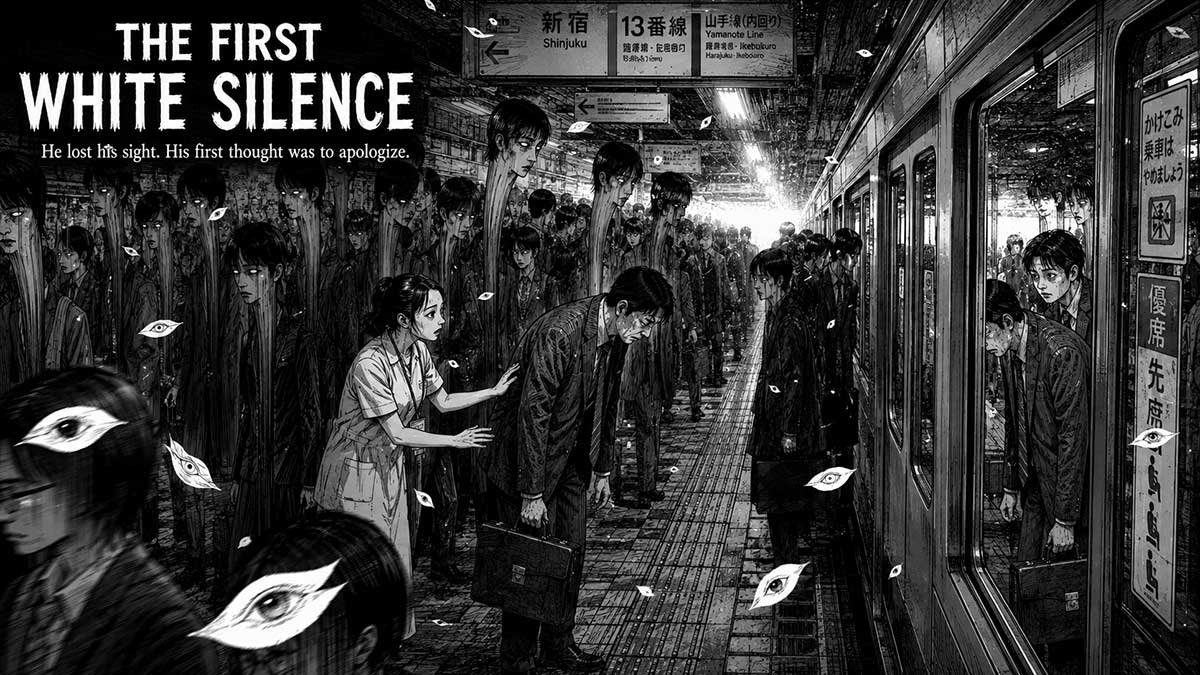
At 7:42 in the morning, Shinjuku Station was already carrying more people than a small city.
They flowed through the gates in dark coats, carrying briefcases, umbrellas, paper cups, school bags, tired faces, and private worries. Shoes struck the tiled floor in a thousand overlapping rhythms. Escalators lifted bodies from one level to another. Electronic chimes sounded. Recorded voices reminded passengers not to rush.
No one appeared to be rushing.
Everyone was rushing.
Kenji Takahashi stood near the front of the platform line, exactly where he stood every weekday morning.
Third carriage.
Second door.
Five steps from the yellow safety strip.
He had chosen the position years ago after learning that it placed him closest to the staircase at Marunouchi Station. Over time, the choice had become habit, and habit had become a small piece of identity.
He checked his watch.
7:43.
The train would arrive in two minutes.
His wife had asked him at breakfast whether he would be home for dinner.
“I should be,” he had said.
She had heard the uncertainty.
Their daughter, Yuna, had not looked up from her phone.
Kenji had wanted to say something to her. Something fatherly, perhaps, or gentle. He had only told her not to forget her umbrella.
Now he stood between a young man wearing headphones and a woman holding a sleeping child against her chest.
The platform display flickered.
A train approached.
Kenji blinked.
The words on the sign blurred.
He blinked again.
The numbers dissolved first.
Then the station name.
Then the faces around him.
He raised one hand toward his glasses, though he was not wearing any.
A white glow spread across his vision.
It did not arrive like darkness.
It arrived like morning sunlight reflected from snow.
Bright.
Clean.
Endless.
Kenji closed his eyes.
The whiteness remained.
He opened them.
Nothing changed.
The platform chime sounded.
People shifted behind him.
The train entered the station with a rush of air.
Kenji took one step forward and stopped.
The young man with headphones bumped into his shoulder.
“Sorry,” the young man muttered.
Kenji did not answer.
The train doors opened.
The line moved.
He remained still.
Someone behind him clicked their tongue.
Kenji turned his head toward the sound.
“I’m sorry,” he said.
The words came automatically.
He bowed.
His briefcase struck his knee.
“I’m very sorry.”
Passengers moved around him. Some glanced back. Others continued into the carriage.
Kenji reached forward, searching for the door.
His hand touched empty air.
The warning chime began.
A station attendant called from somewhere to his left.
“Sir, please step away from the doors.”
Kenji tried to obey.
He could not tell where the platform ended.
His shoes seemed to be standing on nothing.
The train doors closed.
The carriage departed.
The crowd behind him divided, irritated at first, then uncertain.
Kenji bowed again.
“I apologize. I seem to be having trouble.”
The woman with the sleeping child watched him carefully.
“What kind of trouble?”
Kenji tried to smile.
“My sight.”
“Did something get in your eye?”
“No.”
He turned his face from side to side, as though the station might return from another direction.
“I cannot see.”
The woman tightened her hold on the child.
The young man removed one headphone.
“You mean everything is blurry?”
Kenji looked toward the voice.
“No.”
“What do you see?”
Kenji hesitated.
“White.”
The station attendant reached him.
“Sir, can you walk?”
“Yes.”
Kenji took a step and nearly crossed the yellow strip.
The attendant caught his arm.
A few people gasped.
Kenji bowed toward the hand gripping him.
“I’m sorry.”
“Please stop apologizing.”
“I caused trouble for everyone.”
“You nearly fell.”
“Yes. I’m sorry.”
The attendant guided him away from the edge.
The next line of commuters formed around them.
Within seconds, the station resumed its shape.
People stepped into new positions.
Phones rose.
Announcements continued.
Another train arrived.
Kenji sat on a metal bench near a vending machine.
The attendant crouched in front of him.
“My name is Watanabe. I’m going to call emergency services.”
“That won’t be necessary.”
“It is necessary.”
“I may recover in a few minutes.”
“You almost walked onto the tracks.”
Kenji lowered his head.
“Yes.”
Watanabe spoke into his radio.
Kenji heard fragments.
Male passenger.
Sudden loss of vision.
Conscious.
No apparent injury.
He placed his briefcase neatly between his shoes.
The gesture gave his hands something to do.
Around him, hundreds of people passed.
He could hear coats brushing, wheels rolling, shoes tapping, ticket gates opening and closing. The station had become larger in darkness, yet he was not in darkness.
The whiteness had no distance.
No wall.
No edge.
It felt as though the entire city had been erased and replaced by light.
“Can you tell me your name?” Watanabe asked.
“Kenji Takahashi.”
“Your age?”
“Forty-eight.”
“Any pain?”
“No.”
“Dizziness?”
“No.”
“Have you eaten this morning?”
“Yes.”
“What did you eat?”
Kenji almost laughed.
The question seemed absurdly ordinary.
“Rice. Miso soup. Grilled salmon.”
Watanabe wrote it down.
Kenji could hear the pen moving.
“Do you have any medical conditions?”
“No.”
“Have you ever experienced this before?”
“No.”
His phone began vibrating in his coat pocket.
He pulled it out, pressed the screen, and waited.
Nothing happened.
He touched the glass again.
“Would you like me to answer it?” Watanabe asked.
Kenji stopped.
He did not know who was calling.
It might be his supervisor.
It might be Emi.
He imagined her hearing a stranger’s voice.
“No,” he said. “Thank you.”
The phone stopped.
A moment later, it vibrated again.
This time, Kenji held it out.
Watanabe checked the screen.
“It says ‘Office.’”
Kenji’s shoulders tightened.
“Please answer.”
Watanabe accepted the phone and pressed the screen.
“Hello. This is a station employee at Shinjuku Station.”
A pause.
“Yes, Mr. Takahashi is here.”
Another pause.
“He is conscious.”
Kenji listened to the faint voice on the other end.
He recognized his department manager.
“Yes,” Watanabe said. “He appears to have lost his sight.”
The words sounded too large when spoken by another person.
Kenji reached toward the phone.
“May I?”
Watanabe handed it to him.
Kenji pressed it to his ear.
“Takahashi speaking.”
“Kenji, what happened?”
“I’m not certain.”
“Are you injured?”
“No.”
“Can you come in later?”
Kenji opened his mouth.
Watanabe stared at him.
Kenji could feel the stare without seeing it.
“I may need to visit a hospital.”
“Of course.”
“I’m sorry.”
“Don’t worry about work.”
“I had the Yokohama shipment report.”
“We’ll manage it.”
“I can send the file.”
“Kenji.”
“Yes?”
“Go to the hospital.”
Kenji bowed toward the phone.
“Thank you. I apologize for the inconvenience.”
After the call ended, Watanabe remained silent.
Kenji placed the phone on his knee.
“You really do apologize often,” Watanabe said.
Kenji smiled faintly.
“It is better than not apologizing enough.”
A woman’s voice came from several steps away.
“Not when apologizing keeps you from saying you are afraid.”
Kenji lifted his head.
The voice was calm, clear, and younger than his.
“I’m sorry?”
A woman approached.
Her shoes stopped near the bench.
“My name is Aiko Mori. I’m a nurse.”
Kenji sat straighter.
“I don’t want to take your time.”
“You are not taking it. I am giving it.”
He had no answer ready for that.
Aiko knelt in front of him.
“Mr. Takahashi, may I ask you a few questions?”
“Yes.”
“Can you see light?”
“I see only light.”
“Shapes?”
“No.”
“Movement?”
“No.”
“Any flashing?”
“No.”
“Headache?”
“No.”
“Numbness?”
“No.”
“Can you smile for me?”
Kenji smiled.
“Raise both arms.”
He raised them.
“Keep them there.”
He did.
“Now repeat this sentence: Today is Saturday.”
“Today is Saturday.”
Aiko paused.
“It is Tuesday.”
“I know.”
“That is good.”
Watanabe gave a nervous laugh.
Aiko touched Kenji’s wrist.
Her fingers were cool.
“Your pulse is fast.”
“I’m late for work.”
“You are blind.”
The bluntness of the word struck him.
Blind.
He had lost his sight less than ten minutes earlier, yet the word seemed to belong to an older version of him, a man whose life had already changed.
“I may recover,” he said.
“You may.”
“Then I’m not blind.”
“At this moment, you cannot see.”
Kenji lowered his hands.
“I don’t like that word.”
“Most people don’t.”
The ambulance was delayed by morning traffic.
Aiko stayed.
She had been on her way home after a night shift. Her coat smelled faintly of rain and hospital soap.
Kenji asked whether she needed to leave.
She told him no.
He asked again five minutes later.
She gave the same answer.
“Do you have family?” she asked.
“A wife and daughter.”
“Have you called them?”
“Not yet.”
“Why?”
“My wife worries.”
“That is what family members do.”
“She has work.”
“And your daughter?”
“School.”
Aiko waited.
Kenji understood what she was waiting for.
He turned the phone over in his hands.
“I don’t want to frighten them before I know anything.”
“You are frightened.”
Kenji said nothing.
A train arrived.
Doors opened.
People boarded.
The station music played.
“I am concerned,” he said.
Aiko’s voice softened.
“That is a very formal way to be terrified.”
Kenji let out a small breath that might have become a laugh in another life.
“I don’t believe I’m terrified.”
“Your pulse does.”
He lowered his voice.
“What if it stays like this?”
Aiko did not answer quickly.
He was grateful.
Most people answered pain too fast.
“We will take one step at a time,” she said.
“That is something nurses say when they do not know.”
“Yes.”
“You admit it?”
“Yes.”
Kenji smiled again.
“You are unusual.”
“So I’m told.”
The ambulance arrived at 8:06.
Two paramedics approached with a wheelchair.
Kenji heard the wheels and immediately stood.
“I can walk.”
One paramedic touched his elbow.
“The platform is crowded.”
“I can walk.”
Aiko rose.
“Then walk with us.”
Kenji accepted Watanabe’s arm on one side and Aiko’s on the other.
He felt ashamed of how much relief the contact gave him.
The crowd parted.
He could sense people looking.
Some slowed.
Some whispered.
A child asked his mother what was wrong with the man.
The mother said, “Don’t stare.”
Kenji moved carefully through the station he had crossed thousands of times.
Every landmark had vanished.
The bakery near the west exit.
The row of ticket machines.
The pillars.
The signs.
The familiar turn toward the taxi lane.
All of it existed only in memory.
Each step required trust.
At the ambulance doors, Kenji stopped.
“Mr. Watanabe?”
“Yes?”
Kenji bowed deeply toward the station attendant.
“Thank you for your assistance.”
“You’re welcome.”
“I’m sorry I caused a delay.”
“You didn’t delay anything.”
Kenji bowed again.
Then he turned in Aiko’s direction.
“Ms. Mori?”
“I’m here.”
“You should go home.”
“I will ride with you.”
“That is unnecessary.”
“Yes.”
“You have worked all night.”
“Yes.”
“You must be tired.”
“I am.”
“Then why?”
Aiko looked back toward the station entrance.
Commuters continued pouring through the doors.
Some glanced toward the ambulance.
Most did not.
“Someone should stay until your family arrives,” she said.
Kenji stood motionless.
The whiteness around him seemed to grow brighter.
He climbed into the ambulance.
Aiko sat beside him.
The doors closed.
As the vehicle pulled away, another man on the opposite side of Shinjuku Station stopped walking.
He was thirty-two, recently married, and carrying a paper bag with two sweet bean buns for his coworkers.
The station lights suddenly turned white.
The faces disappeared.
The floor vanished.
He dropped the bag.
One bun rolled beneath a bench.
A woman asked whether he was unwell.
He stood perfectly still and bowed toward her voice.
“I’m sorry,” he said.
“I seem to be causing trouble.”
Chapter 2 — Please Do Not Trouble Yourself
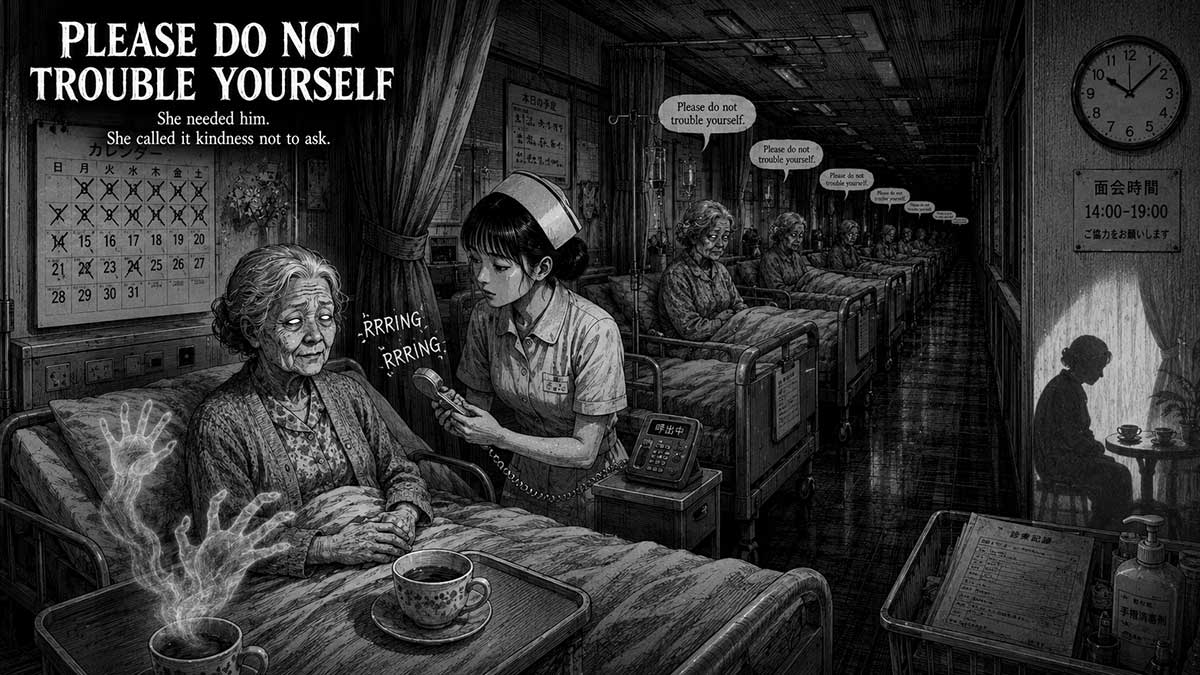
The ambulance reached the emergency entrance of Tokyo Metropolitan Hospital at 8:31.
The building had already begun another ordinary day.
Stretchers rolled through automatic doors.
Phones rang.
Nurses exchanged reports from the night shift.
Doctors hurried toward elevators with coffee growing cold in their hands.
Nothing suggested that history had quietly entered the building.
Kenji was helped onto a bed in Examination Room Three.
The paramedic summarized his condition.
"Male. Forty-eight years old. Sudden complete loss of vision. No head trauma. Vital signs stable."
A young emergency physician nodded.
"When did this begin?"
"Approximately forty-five minutes ago."
The doctor looked into Kenji's eyes with a penlight.
"Can you see this light?"
"No."
"Darkness?"
"No."
"What do you see?"
Kenji hesitated.
"I keep saying white."
"Cloudy?"
"No."
"Bright."
"Like fog?"
"No."
He searched for better words.
"Like standing inside light."
The doctor wrote something.
Then frowned.
The pupils responded normally.
The retinas appeared healthy.
There was nothing physically wrong.
Which somehow felt worse.
Outside the examination room, Aiko removed her hospital identification badge.
Her shift had officially ended nearly an hour earlier.
She should have gone home.
Instead, she walked to the nurses' station.
A senior nurse looked up.
"Aiko?"
"I'd like to stay."
"You've already worked twelve hours."
"I know."
"Go home."
"I can't."
The older nurse followed Aiko's eyes toward Examination Room Three.
"The man from the station?"
Aiko nodded.
"I've never seen anything like it."
Neither had the senior nurse.
"Stay another hour," she said quietly.
"Then promise me you'll rest."
"I promise."
It was a promise neither woman expected to keep.
Kenji's wife arrived first.
Emi Takahashi entered the room still wearing her office jacket.
She had forgotten to change her shoes.
One heel was slightly unfastened.
She stopped at the doorway.
Kenji turned his head immediately.
"Emi?"
"How did you know?"
"You stopped breathing."
She laughed once.
Then began crying.
"I'm sorry."
The apology escaped before she realized it.
Kenji reached toward her voice.
"You have nothing to apologize for."
"I left work."
"I'm glad you did."
She took his hand.
It was colder than usual.
"When will your sight come back?"
"I don't know."
"You'll recover."
"I hope so."
She squeezed his hand harder.
Neither of them believed the certainty in her voice.
Their daughter Yuna arrived twenty minutes later wearing her high school uniform.
She had run all the way from the station.
Her hair was still slightly wet from the rain.
She stood near the foot of the bed.
Unlike her mother, she said nothing.
Kenji smiled.
"Yuna?"
"Yeah."
"You skipped school."
"I'll survive."
"You shouldn't."
"I said I'll survive."
Silence settled between them.
Then she asked quietly,
"Can you see me?"
Kenji closed his eyes.
The whiteness remained.
"No."
She looked down.
"I waved."
"I'm sorry."
"I know."
She turned away quickly, pretending to examine the window.
Aiko noticed her wiping away tears before anyone else did.
By late morning, two more ambulances arrived.
Then another.
Then another.
The emergency department remained calm.
Patients were placed into examination rooms.
Blood tests.
CT scans.
MRI orders.
Neurological evaluations.
Every result returned normal.
One patient was a university student.
Another drove a taxi.
Another taught piano.
None had met before.
All described exactly the same thing.
White.
Around noon, a woman in her late seventies entered the emergency department holding a folded umbrella.
She wore a simple gray cardigan.
Her hair was carefully arranged despite the humid weather.
She stood quietly at the reception desk.
"I believe..."
She smiled apologetically.
"I may have come to the wrong place."
The receptionist looked up.
"How may I help you?"
"I cannot seem to see anymore."
The receptionist blinked.
"What happened?"
"It happened on the bus."
"Were you injured?"
"Oh no."
The elderly woman smiled again.
"I simply became unable to see."
She bowed slightly.
"I'm terribly sorry."
Her name was Fujimoto Chie.
Seventy-eight years old.
Widowed.
Retired elementary school teacher.
She lived alone.
Aiko recognized the name from the intake paperwork.
She escorted Mrs. Fujimoto into a quiet room.
"Are you frightened?" Aiko asked.
Mrs. Fujimoto smiled.
"I've lived long enough to know that fear doesn't improve much."
"Do you have family?"
"My son."
"Have you called him?"
"Oh..."
Mrs. Fujimoto looked almost embarrassed.
"He's very busy."
"I'm sure he'd want to know."
"He has important work."
"So do you."
The old woman laughed softly.
"My work now is staying out of everyone's way."
Aiko knelt beside her chair.
"Would you like me to call him?"
Mrs. Fujimoto shook her head immediately.
"Oh no."
"It isn't trouble."
"It is."
"He is your son."
"He has meetings."
"He'll leave them."
"He shouldn't."
Aiko paused.
"Mrs. Fujimoto..."
The older woman folded her hands neatly in her lap.
"There are many kinds of love."
"Yes."
"One of them is trying not to become someone else's burden."
The sentence stayed with Aiko.
Not because it was unusual.
Because she had heard it hundreds of times.
From elderly patients.
From parents.
From exhausted nurses.
From herself.
She stepped into the hallway.
The intake form contained an emergency contact.
Daichi Fujimoto.
A mobile number.
Aiko stared at it.
Then dialed.
The call rang.
Once.
Twice.
Three times.
Voicemail.
She almost hung up.
Instead she left a message.
"Mr. Fujimoto, this is Nurse Mori from Tokyo Metropolitan Hospital."
She hesitated.
"Your mother has been admitted."
Another pause.
"She asked us not to trouble you."
Aiko looked back through the window.
Mrs. Fujimoto sat quietly, smiling at no one.
"But I believe she'd like to hear your voice."
At 2:15 p.m., the hospital director called an emergency meeting.
Department heads filled the conference room.
Neurology.
Emergency medicine.
Infectious disease.
Ophthalmology.
Internal medicine.
No one understood what they were facing.
A projector displayed six patient files.
Each nearly identical.
Healthy eyes.
Normal brain imaging.
Complete blindness.
No medical explanation.
One physician finally asked,
"Could this be psychological?"
The room became quiet.
Another doctor answered.
"Six unrelated patients?"
A third added,
"From different parts of Tokyo."
No one liked the implications.
Meanwhile, television crews began gathering outside the hospital.
The first news reports described
"a mysterious vision disorder affecting several Tokyo residents."
Officials urged calm.
No evidence suggested infection.
No cause had been identified.
Citizens were advised to continue normal activities.
Inside Room Three, Kenji listened to the television through the open doorway.
He heard the reporter say,
"Authorities believe the situation remains limited."
He smiled faintly.
"They always say that."
Aiko looked at him.
"You don't believe them?"
"I think..."
He searched for the words.
"I think they're trying to protect people."
"Is that wrong?"
"No."
He turned toward her voice.
"But sometimes protecting people and preparing people are different things."
That afternoon, Yuna finally spoke honestly.
She sat beside her father.
"I was angry this morning."
Kenji waited.
"You told me not to forget my umbrella."
"Yes."
"I rolled my eyes after I left."
"You usually do."
"I didn't say goodbye."
"You rarely do."
"I thought..."
Her voice broke.
"I thought there would always be tonight."
Kenji reached toward her.
This time she met his hand before he had to search.
"You don't have to apologize."
"I know."
"I've spent all day apologizing."
She laughed through tears.
"You really have."
He smiled.
"I should probably stop."
"I think so."
For the first time since morning, the room felt almost peaceful.
At 5:40 p.m., another ambulance arrived.
Then another.
The emergency entrance was no longer keeping pace.
A nurse rushed into the hallway.
"We're out of ophthalmology rooms."
"Use pediatrics."
"They're full."
"Internal medicine?"
"Full."
The hospital director stared at the growing list of admissions.
Twelve.
Then sixteen.
Then twenty-three.
Still no explanation.
Still no visible disease.
Only white.
Near sunset, Aiko walked past Mrs. Fujimoto's room.
The elderly woman was sitting quietly with untouched tea beside her bed.
"Would you like me to warm that for you?"
Mrs. Fujimoto smiled.
"No thank you."
"Are you sure?"
"I've already troubled you enough today."
Aiko picked up the cold cup.
"It isn't trouble."
Mrs. Fujimoto tilted her head.
"You are very kind."
"My grandmother used to say something."
"What was that?"
"Kindness isn't measured by how much you give."
Mrs. Fujimoto waited.
"It's measured by whether the other person feels safe receiving it."
The old woman became very still.
No one had ever answered her that way.
A single tear rolled down her cheek.
"I'm afraid..."
she whispered,
"...I've forgotten how."
That evening, Aiko finally left the hospital.
The rain had stopped.
Tokyo glowed beneath wet streets and neon reflections.
Commuters hurried home.
Restaurants filled.
Department stores closed as usual.
Everything looked normal.
Her phone vibrated.
It was the voicemail system.
Daichi Fujimoto had finally returned her call.
She pressed play.
"This is Daichi."
His voice sounded rushed.
"I'm sorry I missed your call."
A pause.
"I have an important client meeting tonight."
Another pause.
"If my mother is stable..."
Silence.
"Please tell her I'll come this Sunday."
The message ended.
Aiko stood motionless beneath the city lights.
Somewhere above, trains continued arriving exactly on schedule.
Somewhere behind her, another ambulance entered the hospital.
She looked up at the glowing skyline.
For the first time that day, she wondered whether the blindness was spreading faster than anyone dared admit.
And somewhere across Tokyo, another phone rang unanswered, while another voice quietly said,
"I don't want to trouble anyone."
Chapter 3 — The School That Kept Moving
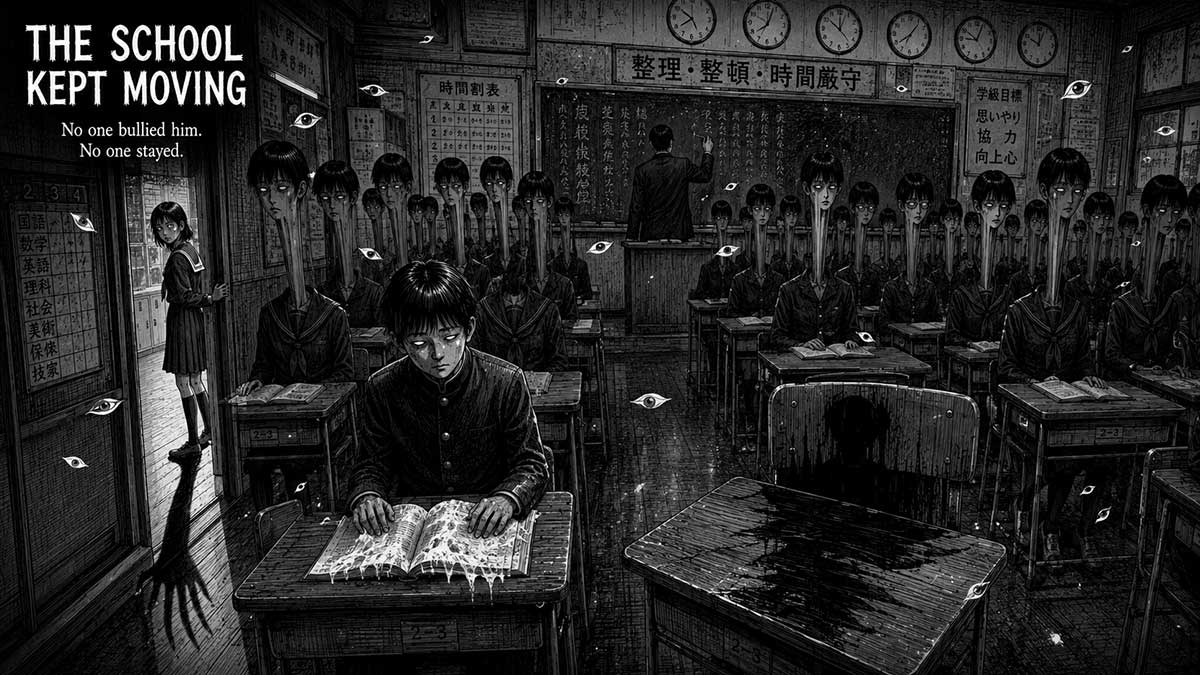
The first bell rang at 8:25.
By then, Haru Nakamura had already finished sweeping his classroom.
It was his turn.
He always swept carefully.
Not because anyone watched him.
Because his grandfather had once said,
"The way you care for places becomes the way you care for people."
Haru believed him.
At fourteen, he believed many things adults had quietly stopped believing.
He believed teachers noticed everything.
He believed classmates were kinder than they appeared.
He believed his mother when she said hard work would always be rewarded.
Most of all, he believed that if he never caused trouble, life would return the favor.
Class 2-B overlooked a small courtyard where maple trees had begun turning red.
Students settled into their seats.
Some laughed.
Some finished homework.
Others stared into their phones until the teacher entered.
Ms. Sato clapped once.
"Good morning."
"Good morning."
The reply came in perfect unison.
She smiled.
"Please open your literature textbooks."
Pages turned almost simultaneously.
Outside, rain tapped softly against the windows.
Haru loved literature.
Stories made him feel less alone.
His favorite author was Natsume Sōseki.
His grandfather had introduced him to Kokoro the previous winter.
"You won't understand it yet," his grandfather had smiled.
"But one day you will."
Haru had understood less than half of it.
Yet he had cried anyway.
"Mr. Nakamura?"
Ms. Sato looked toward him.
"Would you read the next paragraph?"
Haru stood.
"Yes, Sensei."
He looked down.
The words blurred.
He blinked.
Perhaps he had stood too quickly.
The page became brighter.
Then brighter still.
The black letters dissolved into white.
He rubbed his eyes.
Nothing returned.
"Haru?"
"I..."
The room disappeared.
The desks.
The windows.
The chalkboard.
Everything became white.
He held the edge of his desk.
"I'm sorry."
The words escaped automatically.
"I can't..."
Several students looked at one another.
Ms. Sato stepped closer.
"What is it?"
"I can't read."
"Are your glasses dirty?"
"I don't wear glasses."
She reached his desk.
"Haru, look at me."
He turned toward her voice.
"I am."
"No."
Her smile faded.
"You aren't."
The classroom became unusually quiet.
Even the students who rarely paid attention looked up.
Mei Tanaka watched Haru's hands.
They were trembling.
Not dramatically.
Just enough.
She knew that trembling.
Her father had trembled the same way after losing his company five years earlier.
He had smiled constantly for months afterward.
The trembling had told the truth.
"Haru," Ms. Sato said gently.
"Can you see my hand?"
"No."
"My face?"
"No."
"What do you see?"
He hesitated.
"White."
Several students shifted uneasily.
One boy whispered,
"Is he joking?"
No one answered.
Ms. Sato helped Haru sit.
"I'll call the nurse."
"You don't have to."
"I do."
"I'll be okay."
"Haru."
"I don't want everyone waiting because of me."
The sentence broke something inside Mei.
She had heard it before.
Not from classmates.
From adults.
From neighbors.
From her own mother.
The nurse arrived within minutes.
She performed simple tests.
Follow my finger.
Count my fingers.
Can you see light?
Can you see movement?
Nothing.
She looked at Ms. Sato.
Neither woman spoke.
The principal entered shortly afterward.
He bowed politely.
"I'm sorry for interrupting class."
No one thought the apology strange.
He spoke quietly with Ms. Sato.
They decided Haru should be taken to the infirmary.
"Haru?"
"Yes?"
"Would you like someone to walk with you?"
He immediately answered,
"I'll manage."
The nurse smiled.
"I wasn't asking whether you could."
He paused.
Then nodded.
"Thank you."
Mei stood.
"I'll go."
The room turned toward her.
She immediately regretted standing.
Thirty pairs of eyes.
She wished she had remained seated.
"I mean..."
She looked at the floor.
"If that's okay."
Ms. Sato smiled warmly.
"Thank you, Mei."
Mei walked toward Haru.
He reached out uncertainly.
She gently took his arm.
His sleeve was damp with nervous sweat.
"I've got you," she whispered.
"I know."
The hallway seemed impossibly long.
Students from other classrooms stopped and stared.
Teachers stepped aside.
Nobody laughed.
Nobody pointed.
Everyone became unusually polite.
Which somehow made the silence heavier.
Halfway down the corridor, Haru spoke quietly.
"I'm sorry."
Mei looked at him.
"For what?"
"You had literature today."
"So?"
"You'll miss it because of me."
Mei almost cried.
Instead she laughed softly.
"You really are impossible."
"What?"
"You apologize more than anyone I've ever met."
He smiled.
"My grandfather says apologizing oils the wheels of society."
"And what do you think?"
Haru considered.
"I think..."
He smiled awkwardly.
"I've never thought about it."
At the infirmary, the school nurse performed the same examinations the hospital had already performed on others.
Nothing explained his blindness.
She called Haru's mother.
She answered immediately.
"I'm coming."
Back in Classroom 2-B, Ms. Sato faced twenty-nine students.
She took a breath.
"We'll continue today's lesson."
No one objected.
Books reopened.
The lesson resumed.
Yet every few minutes someone glanced toward Haru's empty desk.
The chair remained perfectly pushed in.
His pencil case still rested neatly beside his notebook.
His literature book remained open to the unfinished paragraph.
During lunch, conversations became unusually quiet.
Students discussed what had happened.
Some believed Haru would recover tomorrow.
Others wondered if it was contagious.
No one knew.
The uncertainty settled over the cafeteria like mist.
Mei sat alone.
Usually Haru joined her.
They shared homemade lunches every Tuesday.
Today his lunchbox remained unopened inside his school bag.
She stared at it for several minutes.
Finally she stood.
She carried the lunchbox to the infirmary.
Haru sat on a bed near the window.
His mother held his hand.
She smiled as Mei entered.
"You must be Mei."
"Yes."
"I'm Haru's mother."
"Nice to meet you."
Haru turned toward her footsteps.
"Did everyone finish lunch?"
Mei blinked.
"That's your first question?"
"I was wondering."
"We're more worried about you."
"Oh."
He lowered his head.
"I'm sorry."
Both women sighed at the same time.
Mei handed him the lunchbox.
"You forgot this."
"I guess I did."
"No."
She smiled sadly.
"You couldn't see it."
He reached carefully toward the box.
His fingers found it.
"Thank you."
After a moment he asked,
"Would you stay while I eat?"
Mei looked at the clock.
Afternoon classes would begin in five minutes.
If she stayed...
She would be late.
Everyone would notice.
The teacher would ask why.
The class would look at her.
She imagined the attention.
The questions.
The whispers.
"I'm..."
She swallowed.
"I should probably go."
Haru nodded immediately.
"Of course."
"I'll visit later."
"You don't have to."
"I want to."
"It's okay."
Neither of them believed the conversation.
Mei bowed toward Haru's mother.
Then quietly left.
She walked back to class.
Each step felt heavier than the last.
When she entered the classroom, everyone looked up.
"Everything okay?" one student asked.
"Yes."
She sat.
Opened her textbook.
Read the same sentence five times.
Under the desk, her hands would not stop shaking.
That afternoon, announcements echoed through the school.
Several other students from different grades had reported the same unexplained blindness.
Parents began arriving.
Teachers escorted students calmly.
The principal addressed everyone over the loudspeaker.
"There is no cause for panic."
His voice remained steady.
"We ask everyone to return home in an orderly manner."
No one screamed.
No one ran.
Children formed neat lines.
Teachers counted students.
Shoes were exchanged at the entrance.
Umbrellas opened almost simultaneously.
From above, the school looked perfectly organized.
Beautifully disciplined.
Perfectly calm.
Only one person remained behind.
Ms. Sato returned to the empty classroom after dismissal.
She erased the chalkboard.
Collected worksheets.
Straightened chairs.
Then she stopped beside Haru's desk.
His literature book was still open.
The sentence he had been asked to read remained unfinished.
She reached to close it.
Instead, she sat down.
For several minutes she stared at the empty chair beside his desk.
She remembered something Haru had written in an essay the previous month.
"I think kindness is helping someone before they ask."
At the time she had praised the sentence.
Now it accused her.
She had waited for him to ask.
He never had.
Outside, rain had stopped.
The late afternoon sun broke through the clouds.
Its light filled the classroom.
For one impossible moment, the room seemed almost white.
Ms. Sato closed her eyes.
When she opened them again, everything was normal.
She looked once more at Haru's empty seat.
Then whispered to the silent classroom,
"I'm sorry."
No one heard her.
No one answered.
And for the first time in her career, she wondered whether teaching children facts was easier than teaching them how to truly see one another.
Chapter 4 — The Company Man
The Marunouchi skyline caught the morning sun like polished glass.
Thousands of office workers crossed the streets in silent waves.
Dark suits.
White shirts.
Leather shoes.
Coffee cups.
Name badges.
The city looked exactly as it had the week before.
Only now, more people walked a little slower.
Some paused longer at crosswalks.
Some reached for railings that had never interested them before.
No one spoke about it.
News programs continued calling it the unexplained vision disorder.
Social media had given it another name.
The White Silence.
Kenji Takahashi returned to work six days after leaving the hospital.
His sight had not improved.
The whiteness remained complete.
He knew the layout of the building well enough to count every step.
Twenty-three from the lobby to the elevator.
Seven from the elevator to the reception desk.
Thirty-two from the reception desk to his department.
He had practiced the route twice on Sunday when no one else was there.
He told himself he was preparing.
In truth, he was hiding.
His wife had begged him not to go.
"You don't owe them this."
"I do."
"They told you to stay home."
"They're being considerate."
"Listen to them."
"I can't."
"Why?"
Kenji had looked toward the white world only he could see.
"If I disappear now..."
He paused.
"...everyone else's work becomes heavier."
Emi wanted to argue.
Instead, she quietly asked,
"And your burden?"
Kenji smiled.
"I'll carry it."
At 8:57 a.m., he entered the office.
Conversation stopped.
Not dramatically.
Just long enough.
Then everyone smiled.
"Welcome back."
"It's good to see you."
"How are you feeling?"
Kenji bowed.
"I'm sorry for causing everyone so much inconvenience."
His manager, Mr. Hayashi, walked over immediately.
"We're just glad you're here."
"You've all had extra work because of me."
"We managed."
"I'll catch up."
Hayashi placed a hand on his shoulder.
"There is nothing to catch up to."
Kenji nodded.
He heard the kindness.
He also heard the hesitation behind it.
His desk had not changed.
Someone had watered the small bamboo plant beside his computer.
Someone had stacked the papers neatly.
Someone had cleaned the keyboard.
Every act of kindness reminded him that others had been doing his work.
His younger colleague, Ryo Sakamoto, quietly watched him.
Twenty-eight years old.
Bright.
Hardworking.
Still young enough to believe companies cared more about people than schedules.
He noticed something almost immediately.
Kenji's mouse moved with tiny pauses.
His fingers searched the keyboard instead of flowing across it.
He tilted his head slightly each time someone entered the room.
He was pretending.
Around noon, Ryo approached.
"Mr. Takahashi?"
"Yes?"
"Can I help with anything?"
Kenji smiled.
"I'm fine."
"I noticed..."
He hesitated.
"...the screen reader isn't turned on."
Kenji froze.
He had forgotten.
The accessibility software remained disabled.
"I don't need it."
Ryo looked confused.
"But..."
"I've memorized the system."
"You can't see the screen."
"I know where everything is."
Ryo lowered his voice.
"You don't have to prove anything."
Kenji answered almost automatically.
"I'm not proving anything."
Then, after a pause—
"I just don't want everyone worrying."
That afternoon, another employee quietly moved a wastebasket closer to Kenji's desk.
Someone else placed coffee exactly where his hand would find it.
No one mentioned his blindness.
No one asked how difficult the day had become.
Everyone believed they were protecting his dignity.
By pretending nothing had changed.
At 3:15 p.m., Hayashi entered carrying a shipping report.
"We have a logistics issue."
Kenji reached for the papers.
"I'll handle it."
"You don't have to."
"I know these routes better than anyone."
Hayashi hesitated.
Then handed him the file.
Trust.
Respect.
Habit.
Perhaps all three.
Kenji placed the papers beside his keyboard.
He opened the digital version instead.
The computer read the first lines aloud through an earpiece hidden beneath his collar.
Shipment...
Yokohama...
Inspection...
Delay...
The synthesized voice skipped unexpectedly.
A software error.
The cursor jumped.
Kenji frowned.
He pressed another key.
The document advanced.
He assumed it had returned to the correct section.
It hadn't.
Across the room, Ryo noticed.
He stood.
Walked halfway over.
Stopped.
Should I interrupt?
He's my senior.
He'll think I don't trust him.
Maybe I'm mistaken.
Maybe he knows.
The questions lasted only a few seconds.
Long enough.
Kenji approved the shipment.
Electronic confirmation.
Digital signature.
Done.
At 4:42 p.m., a transport supervisor called.
"Mr. Takahashi?"
"Speaking."
"Did you approve today's Yokohama release?"
"Yes."
"There are hazardous materials mixed into the standard freight."
Kenji felt his stomach tighten.
"What?"
"The inspection file wasn't completed."
Silence.
"We've already dispatched three trucks."
The room around him disappeared.
Only the whiteness remained.
No.
Not only whiteness.
His own heartbeat.
Emergency calls spread through the logistics network.
Drivers were contacted.
Highways notified.
Two trucks stopped safely.
One did not.
On an elevated expressway outside Yokohama, a truck carrying unstable industrial chemicals collided with another vehicle after an emergency lane closure.
The accident injured six people.
No fatalities.
By extraordinary luck.
Still...
Six lives changed.
No one shouted inside the office.
No accusations.
No panic.
Hayashi quietly closed his office door.
He invited Kenji inside.
They sat across from one another.
For nearly a minute neither spoke.
Finally Hayashi asked,
"Did you know?"
Kenji answered honestly.
"No."
"Did you hear the software skip?"
"Yes."
"Why didn't you ask someone to verify?"
Kenji stared into the endless white.
"I thought..."
His voice disappeared.
Hayashi waited.
"I thought I could manage."
Hayashi sighed.
Not angrily.
Sadly.
"You have given this company twenty-three years."
"I know."
"You've trained half this department."
"I know."
"You have never once disappointed me."
Kenji whispered,
"Until today."
Hayashi looked down at the accident report.
"No."
Kenji raised his head.
"No?"
"You disappointed yourself."
The sentence hurt more.
After work, Kenji remained alone.
Most employees had already left.
Ryo quietly approached.
"Mr. Takahashi?"
"I'm sorry."
"You don't need to apologize to me."
"I should have listened."
Ryo shook his head.
"I should have spoken."
Kenji looked toward his voice.
"You noticed."
"Yes."
"I knew something was wrong."
"Then why didn't you stop me?"
Ryo answered with painful honesty.
"I didn't want to embarrass you."
Neither man spoke.
Finally Kenji laughed.
A tired laugh.
"We were both trying to protect each other."
Ryo nodded.
"And we protected the wrong thing."
That evening, Kenji returned home hours later than usual.
Emi opened the door.
One look at his face told her everything.
"There was an accident."
He nodded.
"Were people hurt?"
"Yes."
"Will they survive?"
"I think so."
She guided him to the dining table.
Dinner had gone cold.
Yuna quietly reheated the miso soup without saying a word.
The three of them sat together.
No one began eating.
Kenji finally spoke.
"I've been thinking all week..."
"What?"
"What blindness really is."
Emi waited.
"I thought blindness meant not seeing."
He shook his head slowly.
"No."
"It means refusing to let other people carry part of your life."
Yuna looked up for the first time.
"Dad..."
He smiled weakly.
"I wanted to remain useful."
"You are useful."
"I wanted to remain the same."
She reached across the table.
Her hand found his.
"You don't have to be."
Later that night, after everyone had gone to bed, Kenji stood alone on the apartment balcony.
He could hear Tokyo.
Traffic.
Trains.
Distant conversations.
A dog barking.
The city was still alive.
Still functioning.
Still beautiful.
He wondered how many people were hiding something tonight.
An illness.
A debt.
A fear.
A loneliness.
A mistake.
All because they believed asking for help would burden someone else.
His phone vibrated.
It was a message from Mr. Hayashi.
Only one sentence.
"Your mistake was not trusting others to see what you could not."
Kenji read the message through the phone's voice reader three times.
Then he quietly began to cry.
Not because of the accident.
Not because he had lost his sight.
But because, for the first time in his life, he realized that strength and silence were not the same thing.
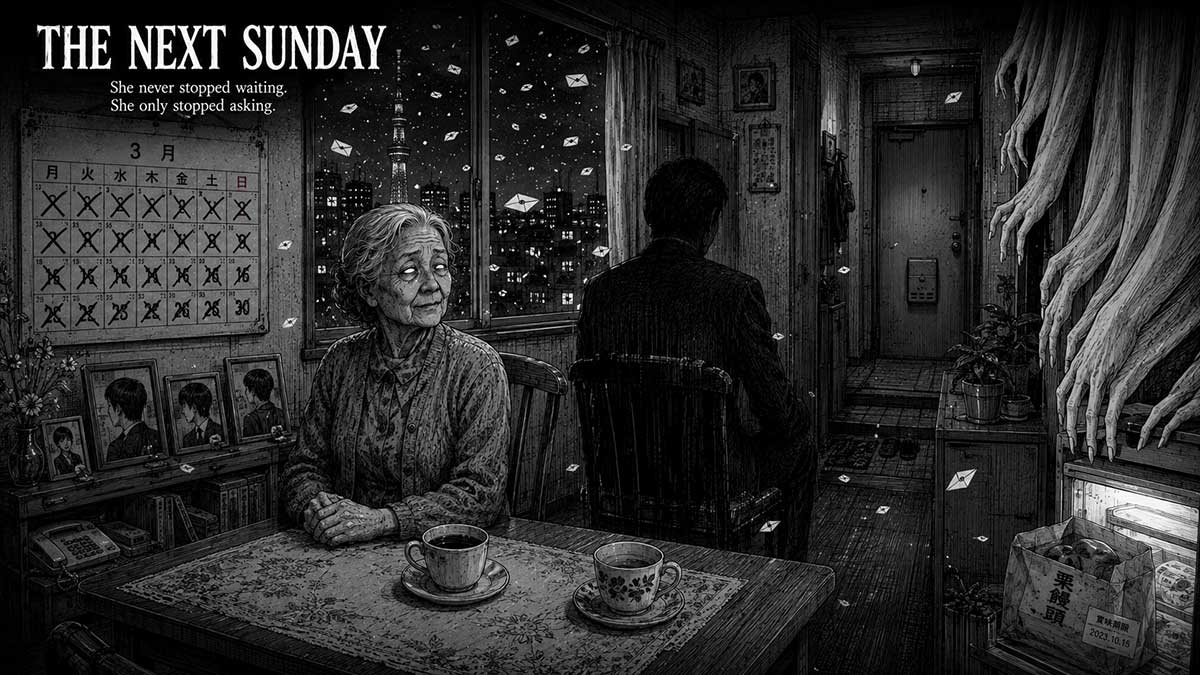
Far across the city, in a small apartment lit by a single lamp, Mrs. Fujimoto carefully placed another red X across the coming Sunday on her calendar.
Her son had called.
He would not be able to visit.
She smiled.
Folded the note neatly.
And whispered into the quiet room,
"Please don't trouble yourself."
Outside her window, snow-white clouds slowly gathered over Tokyo.
Chapter 5 — The Ward of Quiet Heroes
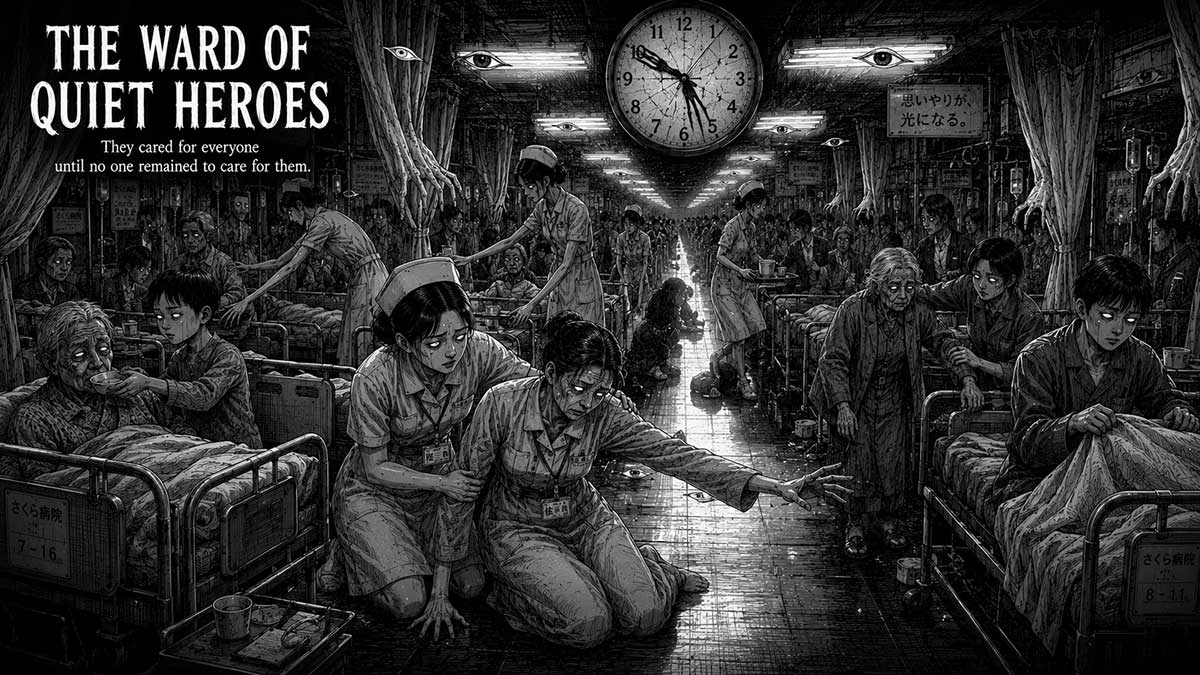
By the second Monday, the hospital had stopped asking one question.
"What is causing this?"
A more urgent question had replaced it.
"Where can we put the next patient?"
The emergency department filled first.
Then ophthalmology.
Then neurology.
Then pediatrics.
Then conference rooms.
Finally, beds appeared in hallways.
Privacy disappeared before dignity did.
Dignity, everyone tried desperately to preserve.
A handwritten sign appeared near the entrance.
Please remain calm. We will care for everyone in the order they arrive.
No one complained.
That frightened Aiko more than shouting would have.
She had now worked eleven straight days.
Her apartment remained untouched.
Mail gathered behind the front door.
Laundry sat inside the washing machine.
She had forgotten what day of the week it was.
Only one fact remained constant.
She could still see.
She had told no one.
Not even the hospital director.
Each morning before entering a patient's room, she closed her eyes.
She counted to three.
Then opened them again.
The world always returned.
Every face.
Every corridor.
Every expression.
Every silent fear.
It felt less like a gift each day.
More like a sentence.
"Nurse Mori."
She turned.
Dr. Ishikawa stood behind her.
He had dark circles beneath both eyes.
"When was the last time you slept?"
She smiled.
"I don't remember."
"I wasn't asking for a joke."
"I know."
"You look exhausted."
"So do you."
He almost laughed.
Instead, he handed her another chart.
"Room Twelve."
"What happened?"
"Eighty-three years old."
"Blind?"
"Yes."
"Family?"
"No one has answered."
Room Twelve overlooked a small garden.
The patient sat upright with perfect posture.
Her silver hair had been neatly combed.
Even blindness had not interrupted habit.
"Good morning," Aiko said.
The woman smiled toward the sound.
"Good morning."
"My name is Aiko."
"I'm Keiko."
"How are you feeling?"
"I don't wish to complain."
"I didn't ask whether you wished to."
The old woman laughed softly.
"No."
"You didn't."
Aiko checked her pulse.
Weak.
Her breathing.
Shallow.
"When did you last eat?"
"I'm not certain."
"Yesterday?"
"Perhaps."
"There wasn't anyone at home?"
"I didn't want to bother my neighbors."
Another sentence.
Another apology disguised as virtue.
Aiko brought warm rice porridge.
Keiko accepted only half.
"Please eat."
"This is enough."
"It isn't."
"There are others who need it."
"There is enough."
The old woman shook her head.
"You are being kind."
"I'm being honest."
Keiko slowly accepted another spoonful.
She looked almost guilty doing so.
That afternoon, Aiko walked through Ward C.
She noticed something no one else could.
Every patient apologized before asking for help.
Water.
Blankets.
Medicine.
The restroom.
A different nurse sighed quietly.
"They keep saying sorry."
Aiko looked down the hallway.
"No."
"What?"
"They've been saying sorry for years."
The hospital cafeteria had become almost silent.
Doctors ate standing up.
Nurses finished meals in four minutes.
Some simply drank coffee and returned upstairs.
At one corner table sat Sachiko Tanabe.
Head Nurse.
Thirty-four years in the profession.
Everyone trusted her.
No one realized how tired she had become.
Aiko sat beside her.
"You should eat."
Sachiko smiled.
"I already did."
The untouched lunch tray disagreed.
"Your husband called."
"I'll phone him later."
"He sounded worried."
"He always worries."
"What did he say?"
Sachiko looked down.
"He asked when I'd come home."
"And?"
"I told him..."
She stopped.
"...after tomorrow."
Aiko understood.
Tomorrow had become the most dangerous word in the hospital.
By evening, volunteers began arriving.
University students.
Retired physicians.
Neighborhood associations.
Temple groups.
Church groups.
Ordinary people carrying blankets, bottled water, rice balls, clean towels.
No cameras.
No speeches.
They simply appeared.
Aiko watched an elderly Buddhist monk quietly mop a hallway.
Beside him, a teenage baseball player carried supplies.
Neither asked the other what they believed.
The blindness had removed many labels.
Need remained.
Late that night, the electricity failed for six seconds.
The emergency generators activated immediately.
For six seconds, everyone in the hospital experienced darkness.
Only Aiko knew the difference.
She watched dozens of blind patients remain perfectly calm.
The sighted staff panicked first.
When the lights returned, one elderly man smiled.
"It must have been frightening."
He had mistaken the staff's fear for his own.
At three in the morning, Aiko found Sachiko sitting alone in the supply room.
She was holding a clipboard.
Not reading it.
Simply holding it.
"You should lie down."
"In a minute."
"You've said that three times tonight."
Sachiko smiled.
"You've been counting."
"I've been worrying."
Sachiko looked around the small room.
"I remember my first day as a nurse."
"What do you remember?"
"I thought medicine was mostly about saving lives."
"And now?"
"I think..."
She searched for the right words.
"...it's about staying beside people when life can't be saved."
The hospital intercom sounded.
Code Blue. Ward B.
Sachiko stood immediately.
Too quickly.
The room tilted.
She reached for the wall.
"Aiko..."
Before the sentence finished, her knees gave way.
The clipboard struck the floor.
"Sachiko!"
Aiko caught her before her head hit the cabinet.
Other nurses rushed in.
Pulse.
Blood pressure.
Oxygen.
No one spoke loudly.
No one panicked.
Even in crisis, the ward moved with practiced grace.
Sachiko slowly opened her eyes.
"I'm sorry."
Aiko's voice cracked.
"Stop apologizing."
"I left everyone..."
"No."
"I still have patients."
"You are a patient."
Sachiko smiled faintly.
"I don't know how."
Dr. Ishikawa examined her.
"Severe exhaustion."
"She needs rest."
"She won't take it."
"I'll make her."
"You can't."
"Why?"
"Because she'll apologize until someone lets her work again."
Sachiko reached weakly for Aiko's hand.
"Listen carefully."
"I'm listening."
"If we stop..."
Her breathing caught.
"...who will care for them?"
Aiko squeezed her hand.
"We will."
"No."
Sachiko smiled.
"They must learn..."
She closed her eyes for a moment.
"...to care for one another."
Those words followed Aiko through the rest of the night.
She entered room after room.
Changed bandages.
Fed patients.
Held hands.
Guided people to bathrooms.
Read messages from family members over the phone.
For the first time, she noticed something extraordinary.
Blind patients had begun helping other blind patients.
One man folded blankets for strangers.
A teenager guided an old woman to the restroom.
A child shared his pudding with another child he had never met.
No one instructed them.
The hospital had become a place where those with the least strength quietly carried one another.
Just before sunrise, Aiko stepped outside for fresh air.
The city was strangely quiet.
Ambulances still came.
But fewer sirens sounded.
Drivers had begun pulling over before hearing them.
People anticipated one another.
The morning sky was pale.
Almost white.
Her phone vibrated.
It was Daichi Fujimoto.
At last.
She answered immediately.
"This is Nurse Mori."
A tired voice replied.
"I'm sorry."
She closed her eyes.
"Mr. Fujimoto."
"I've been trying to come."
"I know."
"Work..."
He stopped himself.
"No."
For the first time, he did not hide behind work.
"I was afraid."
Aiko listened.
"I didn't know what I'd find."
Silence.
Then she asked gently,
"Would your mother rather see your fear..."
"...or your absence?"
The question remained between them.
Daichi did not answer.
He didn't need to.
Aiko heard him pick up his car keys.
She looked toward the hospital entrance.
Another ambulance had just arrived.
Its doors opened.
A little girl stepped out holding her grandfather's hand.
Though neither could see, she whispered calmly,
"Grandpa... don't worry."
He smiled toward her voice.
"I wasn't."
She tilted her head.
"You were."
He laughed softly.
"A little."
She squeezed his hand.
"I'm here."
Aiko watched them disappear into the hospital.
For the first time since the epidemic began, she realized something Saramago himself might have understood.
Blindness spread quickly.
Compassion could spread quietly.
And sometimes...
quietly was enough.
Chapter 6 — The Apartment With the Closed Curtains
The city had become quieter.
Not empty.
Quieter.
Traffic still flowed.
Convenience stores still opened.
The trains still ran, though fewer people boarded them each morning.
What disappeared first was conversation.
People no longer lingered outside cafés.
Neighbors bowed from farther away.
Children's laughter no longer drifted from apartment courtyards.
Tokyo was still functioning.
It simply sounded as though it were holding its breath.
Mrs. Fujimoto insisted on leaving the hospital.
"I've occupied this bed long enough."
Dr. Ishikawa tried to persuade her.
"It isn't safe."
She smiled.
"My home has been waiting for me."
Aiko knew the truth.
No one had been waiting inside it.
Still, she volunteered to take Mrs. Fujimoto home.
The taxi driver helped them into the car.
He had already driven four blind passengers that morning.
He no longer asked what had happened.
He simply said,
"Please tell me if the ride becomes uncomfortable."
Mrs. Fujimoto bowed.
"Thank you for accepting us."
The driver smiled through the rearview mirror.
"Thank you for trusting me."
They drove through western Tokyo.
The streets looked almost normal.
A bakery had opened.
Children in yellow hats walked home from school holding ropes tied together so they would not lose one another.
A delivery driver carefully guided an elderly customer across the sidewalk before returning to his truck.
Small acts of kindness had become so ordinary that television cameras ignored them.
Aiko noticed every one.
Mrs. Fujimoto spoke quietly.
"My husband loved this neighborhood."
"What was he like?"
"He repaired watches."
"Watches?"
"He believed everything deserved another chance before being thrown away."
She laughed softly.
"He repaired clocks that cost less than the repair itself."
"Did he make money?"
"No."
"Were you ever worried?"
"Frequently."
"Then why did he continue?"
Mrs. Fujimoto turned her face toward the window she could no longer see.
"He said..."
She smiled.
"...time was lonely enough already."
Their apartment building stood at the end of a narrow street lined with gingko trees.
The caretaker hurried outside.
"Mrs. Fujimoto!"
"I'm home."
He bowed repeatedly.
"We've all been worried."
"I'm sorry."
"Please stop apologizing."
She laughed.
"You sound like Nurse Mori."
The apartment was on the fourth floor.
Apartment 407.
The hallway smelled faintly of floor wax and miso soup.
Someone had placed fresh flowers outside a neighbor's door.
Another apartment had newspapers piled neatly beside the entrance.
Life continued.
Just a little more quietly.
Mrs. Fujimoto unlocked her door.
"Welcome."
Aiko stepped inside.
The apartment was spotless.
Shoes aligned perfectly.
Tea cups arranged in pairs.
Every book dusted.
Every towel folded.
Nothing seemed neglected.
Yet the room felt strangely untouched.
As though someone had been preserving a museum rather than living a life.
"I'll make tea."
"You should rest."
"I can still make tea."
Mrs. Fujimoto smiled.
"My eyes have changed."
She tapped her chest gently.
"My hands still remember."
Aiko followed her into the kitchen.
Everything had its place.
The kettle.
The cups.
The tea leaves.
Mrs. Fujimoto moved slowly, counting steps under her breath.
One...
Two...
Three...
Turn.
Reach.
Lift.
She had memorized her own home.
Not because she expected blindness.
Because routine had always been her way of surviving loneliness.
As the water heated, Aiko noticed a calendar hanging beside the refrigerator.
Every Sunday was marked with a small red circle.
Many circles had been crossed out.
One after another.
Nearly every week.
She stepped closer.
Small notes filled the margins.
Daichi - 2:00
Crossed out.
Next Sunday instead
Crossed out.
Business trip
Crossed out.
Meeting
Crossed out.
Maybe next week
Crossed out.
The calendar stretched back almost an entire year.
Mrs. Fujimoto noticed the silence.
"You found my calendar."
"Yes."
"My son likes Sundays."
Aiko looked again.
"He visits every Sunday?"
Mrs. Fujimoto smiled.
"He intends to."
The sentence settled heavily into the room.
"He calls?"
"Oh yes."
"And apologizes?"
"Oh yes."
"Does he love you?"
Mrs. Fujimoto answered without hesitation.
"Very much."
Aiko looked back at the calendar.
"So much love."
She whispered almost to herself.
"So little time."
The kettle began to whistle.
Mrs. Fujimoto poured the tea with practiced precision.
Neither cup spilled a drop.
"Please."
Aiko accepted the warm cup.
The tea smelled of roasted barley.
Comfort.
Memory.
Home.
"My husband used to sit there."
Mrs. Fujimoto pointed toward the empty chair opposite her.
"He always complained the tea was too hot."
She laughed quietly.
"I always told him to wait."
"Did he?"
"Never."
"What happened?"
"He died before retirement."
"I'm sorry."
"So am I."
A pause.
"But I had forty-two years with him."
She smiled.
"Some people never receive that gift."
The apartment fell silent.
Not uncomfortable.
Simply still.
Aiko noticed another chair near the window.
Its cushion showed almost no signs of use.
"Does your son sit there?"
Mrs. Fujimoto followed her voice.
"He prefers the sofa."
She pointed gently toward the living room.
"He says the chair reminds him too much of his father."
Aiko walked to the bookshelf.
Photo albums lined the lowest shelf.
"May I?"
"Of course."
She opened the first album.
Black-and-white photographs.
A young couple beneath cherry blossoms.
A tiny apartment with almost no furniture.
A baby wrapped in a towel.
Daichi.
Then elementary school.
Baseball games.
Graduation.
Wedding.
Aiko smiled.
"He looks happy."
"He was."
"And now?"
Mrs. Fujimoto hesitated.
"I think..."
She folded her hands.
"...he became busy."
Busy.
Such a harmless word.
Aiko had begun to dislike it.
It explained everything.
It excused everything.
It healed nothing.
A soft knock sounded at the door.
The caretaker entered carrying groceries.
"I thought you might need these."
Mrs. Fujimoto stood immediately.
"You've already done too much."
"It was only a few things."
"I'll pay you."
"You can pay me by making tea again someday."
The caretaker laughed.
Mrs. Fujimoto laughed too.
Yet Aiko noticed something.
The groceries contained enough food for only two days.
The caretaker knew.
He had quietly calculated exactly how long he could help without embarrassing her.
After he left, Aiko began putting food away.
She opened the refrigerator.
Inside sat a small paper bag.
Neatly folded.
She lifted it.
It felt surprisingly heavy.
"Mrs. Fujimoto?"
"Yes?"
"What's in this bag?"
"Oh."
Another smile.
"Sweets."
"For guests?"
"No."
"For Daichi."
Aiko carefully unfolded the top.
Inside were individually wrapped chestnut cakes.
The expiration date had passed three weeks earlier.
"You've been saving them."
"He likes them."
Aiko closed the bag gently.
No words came.
That afternoon, they sat together listening to the rain.
Mrs. Fujimoto suddenly asked,
"Nurse Mori?"
"Yes?"
"May I ask you something?"
"Of course."
"Do you have parents?"
"My mother lives in Sendai."
"Do you visit often?"
Aiko thought.
"Not often enough."
Mrs. Fujimoto nodded.
"Children believe parents measure love by distance."
She smiled sadly.
"We don't."
"What do you measure?"
"The next visit."
The words remained with Aiko long after they stopped talking.
As evening approached, she prepared to leave.
"I'll return tomorrow."
"You've already done enough."
"I haven't."
Mrs. Fujimoto reached for her hand.
Her fingers were warm.
"May I tell you a secret?"
"Please."
"When my husband died..."
She paused.
"...everyone asked whether I was lonely."
"Were you?"
"Very."
"What did you tell them?"
Mrs. Fujimoto smiled.
"I said I was fine."
"Why?"
"Because they looked relieved when I did."
Aiko felt tears gathering.
"You didn't have to protect everyone."
Mrs. Fujimoto gently squeezed her hand.
"My dear..."
Her voice became almost a whisper.
"After a certain age..."
"...you begin protecting other people from your loneliness."
Aiko could not answer.
She bowed deeply before leaving.
At the doorway she looked back one last time.
Mrs. Fujimoto sat exactly where her husband once sat opposite her.
Two cups of tea remained on the table.
One half empty.
One untouched.
Outside, evening settled over Tokyo.
Apartment windows glowed one by one.
Thousands of families prepared dinner.
Thousands of people promised themselves they would call tomorrow.
Visit next week.
Stay longer next time.
Across the city, Daichi stared at the photograph of his mother on his desk.
He picked up his phone.
Pressed her number.
Listened to it ring.
Then ended the call before she answered.
He looked at the clock.
"I'll go Sunday," he whispered.
The room offered no reply.
Back in Apartment 407, Mrs. Fujimoto carefully placed the unopened bag of chestnut cakes back into the refrigerator.
She smiled to herself.
"He'll enjoy them fresh."
She never noticed the expiration date.
She was looking at a Sunday that had not yet arrived.
Chapter 7 — The City That Still Bowed
By the third week, Tokyo had become a city that moved by memory.
People counted intersections instead of reading signs.
Train station melodies replaced platform displays.
Hands followed familiar walls.
Feet remembered familiar staircases.
The city had not stopped.
It had simply begun walking with its eyes closed.
Government officials urged calm every evening.
"We ask everyone to continue supporting one another."
"We have no evidence of violence."
"Essential services remain operational."
Everything they said was true.
What they did not say was equally true.
Thousands of people were quietly disappearing from ordinary life.
Not into death.
Into isolation.
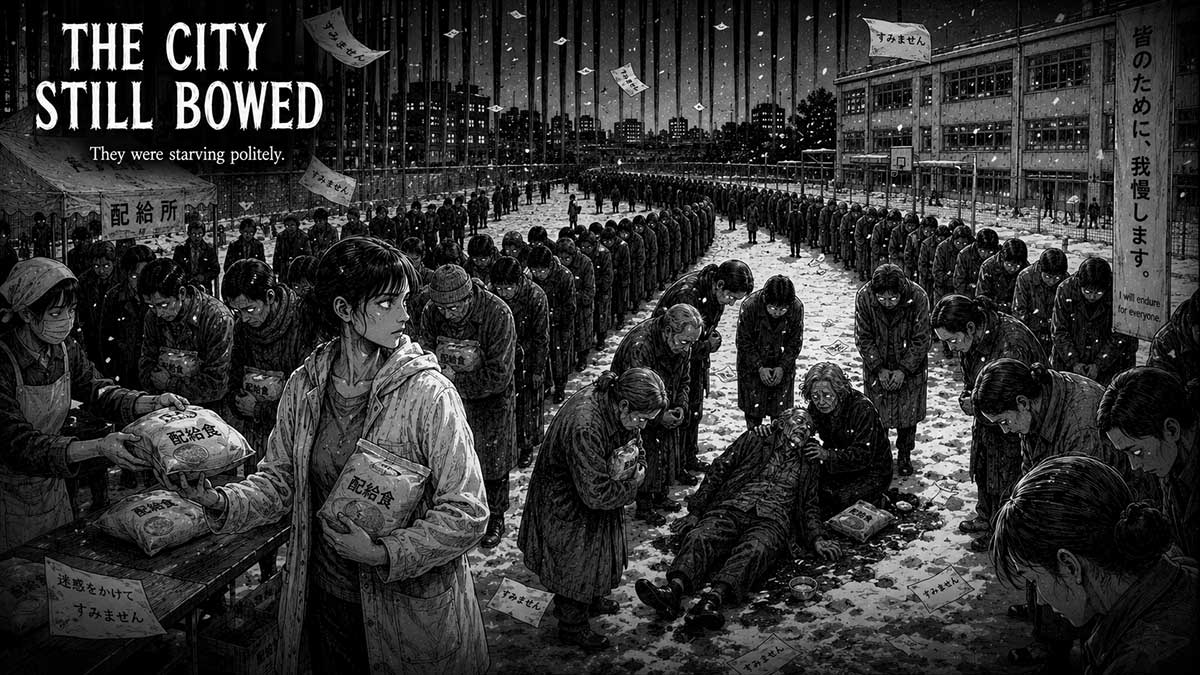
Food distribution centers opened across the city.
School gymnasiums.
Community halls.
Temple courtyards.
Baseball fields.
Volunteers stood behind folding tables handing out rice, bottled water, canned fish, blankets, batteries, and medicine.
There was no pushing.
No shouting.
No fighting.
People lined up patiently.
Some waited four hours.
They bowed before accepting their supplies.
They thanked volunteers who had been awake all night.
News reporters praised Japan's discipline.
Foreign journalists called it remarkable.
Aiko looked at the line and saw something else.
Nearly everyone accepted less than they needed.
She stood beside an elderly volunteer.
"Watch carefully," he whispered.
A mother approached carrying two children.
"How many are in your family?" the volunteer asked.
"Three."
"There are four registration cards."
"My husband isn't very hungry."
The volunteer smiled kindly.
"Please take four portions."
The woman hesitated.
"There are others waiting."
"There is enough."
She accepted only three.
As she walked away, the younger child whispered,
"I'm still hungry."
The mother gently squeezed his shoulder.
"Just today."
Aiko watched until they disappeared into the crowd.
The next man stepped forward.
Business suit.
White cane.
Perfect posture.
"One package, please."
The volunteer checked his card.
"You live with your wife."
"Yes."
"Then you need two."
"My wife says she isn't hungry."
The volunteer sighed.
"She told you to say that."
The man smiled.
"I believe so."
The volunteer placed two bags on the table.
The man picked up only one.
Before anyone could stop him, he bowed and quietly walked away.
Aiko finally understood.
The shortage was no longer food.
It was permission.
Permission to need.
Permission to receive.
Permission to ask.
That afternoon she visited the neighborhood shelter at Midori Junior High School.
The gymnasium held nearly two hundred people.
Mattresses covered the wooden floor.
Children colored pictures.
Elderly residents folded blankets.
Teenagers carried drinking water between rows.
The atmosphere felt strangely peaceful.
Almost beautiful.
Until one looked closely.
No one called for help.
An old man struggled for nearly ten minutes to open a bottle.
Nobody noticed.
Not because they were selfish.
Because everyone assumed someone closer would help.
A young mother rocked a crying baby.
She apologized to everyone nearby every few minutes.
"I'm sorry."
"I'm sorry."
"I'm sorry."
Finally an elderly woman touched her arm.
"My dear."
The mother looked up.
"You don't have to apologize because your baby is alive."
The young woman burst into tears.
Across the gymnasium, Haru sat quietly with several other students.
His white cane rested beside him.
Mei had volunteered every afternoon after school.
She distributed meals.
Organized blankets.
Read notices aloud.
Anything that allowed her to stay busy.
Anything except speaking honestly to Haru.
"Haru?"
He smiled immediately.
"Mei."
"You knew?"
"You always walk quickly."
"I do?"
"And you stop breathing before saying my name."
She laughed.
"I didn't know that."
"I did."
She handed him dinner.
He thanked her.
Neither mentioned the afternoon at school.
The silence had become another person sitting between them.
Finally Haru spoke.
"You don't have to keep apologizing."
Mei looked down.
"I haven't apologized."
"You have."
"How?"
"By helping everyone except me."
The words were gentle.
That made them hurt more.
"I didn't know what to say."
"You could have said hello."
"I was ashamed."
"Of me?"
"No."
She looked at him for the first time in days.
"Of myself."
Haru nodded slowly.
"My grandfather used to say something."
"What?"
"When people are embarrassed..."
"They stop looking."
Mei felt her eyes fill.
"I saw you standing alone outside the infirmary."
"I know."
"I wanted to stay."
"I know."
"I walked away."
"I know."
"Why aren't you angry?"
Haru smiled.
"Because I probably would have done the same."
Before she could answer, shouting erupted near the entrance.
Not violent shouting.
Urgent shouting.
An elderly man had collapsed while waiting in line.
Volunteers rushed toward him.
People stepped back politely, creating space.
No one pushed.
No one panicked.
The old man's wife knelt beside him.
"He gave me his lunch."
A volunteer looked confused.
"Why?"
"He said I looked tired."
Another volunteer checked the food bag.
It still contained two untouched rice balls.
"He didn't eat."
The wife quietly nodded.
"He said he wasn't hungry."
The doctor arrived.
Blood sugar dangerously low.
Dehydration.
Exhaustion.
Entirely preventable.
As the ambulance doors closed, the old man regained consciousness.
His first words were not,
"How is my wife?"
Nor,
"What happened?"
Instead he whispered,
"I'm sorry for causing everyone trouble."
Aiko turned away.
She could not bear hearing it again.
That evening, volunteers reorganized the distribution line.
Anyone needing extra food could step into a separate queue.
No explanation required.
The line remained empty.
For nearly twenty minutes.
People preferred hunger.
Not attention.
Aiko walked to the front.
She picked up an extra package herself.
The volunteer looked surprised.
"You need another?"
"Yes."
The people nearby watched.
Some recognized her from the hospital.
A nurse.
She needs more?
Aiko smiled.
"I've been working too much."
The volunteer handed her another meal.
"Thank you."
She bowed.
Then deliberately sat in the center of the gymnasium and ate both portions.
Very slowly.
Without embarrassment.
People watched.
She pretended not to notice.
Ten minutes later, an elderly woman quietly joined the extra line.
Then a construction worker.
Then a teenage boy.
Then the young mother with the baby.
The volunteer smiled.
By sunset, the special line had become longer than the regular one.
Across the room, Haru leaned toward Mei.
"What happened?"
She smiled.
"Someone gave everyone permission."
As darkness settled outside, generators powered a few dim lights.
The shelter became quieter.
Children slept.
Soft conversations replaced announcements.
Someone played an old folk song on a harmonica.
Its melody drifted gently across the room.
Kenji arrived unexpectedly.
He had begun volunteering after the shipping accident.
He recognized Aiko's voice immediately.
"Nurse Mori?"
"Mr. Takahashi."
"You look..."
He stopped himself.
She laughed.
"I probably look terrible."
"You sound tired."
"I am."
He held out a cardboard box.
"I brought walking canes."
"How many?"
"Thirty."
"That's wonderful."
He smiled awkwardly.
"I asked for help."
She looked at him.
"You did."
"It felt strange."
"And?"
"No one laughed."
They carried supplies together.
Halfway across the gymnasium, Aiko noticed a small boy standing alone near the entrance.
Perhaps six years old.
Holding a pair of tiny shoes.
Looking lost.
She knelt.
"Where are your parents?"
"I don't know."
"What's your name?"
"Kenta."
"Are you scared?"
He thought for a long moment.
Then nodded.
"A little."
Kenji knelt beside him.
"So am I."
The boy turned toward his voice.
"You are?"
"Sometimes grown-ups get scared too."
Kenta considered this.
Then quietly slipped his tiny hand into Kenji's.
Without another word.
Across the shelter, several people watched.
No speeches.
No announcements.
No dramatic music.
Just one frightened child.
One blind man.
One honest sentence.
Late that night, after everyone had fallen asleep, Aiko walked outside.
The air had turned cold.
The first snowflakes of the season drifted silently across the schoolyard.
They landed on empty swings.
On bicycles.
On the roof of the gymnasium.
On rows of shoes waiting neatly at the entrance.
She looked toward the city skyline.
Tokyo had always impressed the world with its efficiency.
Tonight she hoped it might someday become equally famous for something else.
Not endurance.
Not discipline.
Not perfection.
The courage to say,
"I need you."
Behind her, inside the shelter, dozens of sleeping people breathed together.
For the first time since the blindness began, the silence no longer felt empty.
It sounded almost like hope.
Far away, in Apartment 407, Mrs. Fujimoto carefully folded a clean sweater and placed it on the chair beside her bed.
"If Daichi comes tomorrow," she whispered,
"He'll think I've been taking good care of myself."
She smiled into the darkness.
Outside her window, snow continued falling.
Tomorrow was Sunday.
Chapter 8 — The Room No One Entered
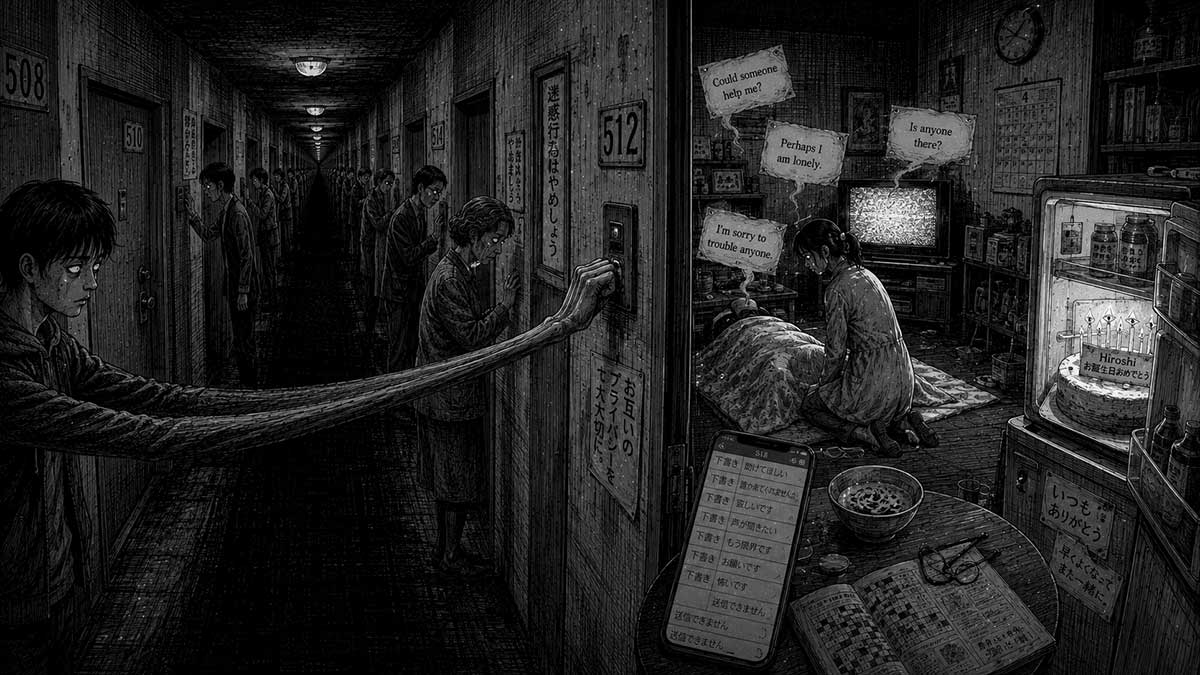
Sunday arrived beneath a sky the color of old paper.
Snow had covered Tokyo during the night.
Not enough to stop trains.
Not enough to close schools.
Only enough to soften the city.
Footprints appeared one by one along narrow sidewalks.
Someone cleared the entrance of every apartment building before sunrise.
No one knew who had done it.
No one asked.
Apartment Building Sakura Heights was unusually quiet.
It always had been.
Residents bowed politely.
Collected one another's packages.
Watered plants during vacations.
Remembered birthdays.
Forgot almost everything else.
Around ten in the morning, the building manager noticed an unusual smell on the fifth floor.
Not strong.
Just...
wrong.
He stopped outside Apartment 512.
He knocked gently.
"Mr. Ishida?"
No answer.
He knocked again.
Still nothing.
He looked toward the neighboring apartment.
Mrs. Kobayashi opened her door.
"Good morning."
She bowed.
"Good morning."
"Have you seen Mr. Ishida recently?"
She thought.
"I don't believe so."
"When was the last time?"
"I'm not certain."
Perhaps...
Last week?
Or the week before?
Everything had begun blending together.
Within an hour, four neighbors had gathered quietly in the hallway.
Each offered the same sentence in a different form.
"I assumed someone else had checked."
"I thought his family had visited."
"I didn't want to intrude."
"He always valued his privacy."
Every explanation sounded reasonable.
Together they became unbearable.
The building manager called the city office.
The city office called emergency services.
Emergency services called the hospital.
By noon, Aiko arrived with two municipal workers.
She had become the hospital's liaison for home welfare visits.
There were too many apartments.
Too many people living alone.
Too many unanswered phones.
She stood outside Apartment 512.
The hallway smelled faintly of disinfectant and something sweeter.
The building manager held the master key.
His hands shook.
"I'm sorry."
Aiko looked at him.
"For what?"
"I should have checked sooner."
She said nothing.
There was nothing left to comfort.
The door opened.
Warm air drifted into the hallway.
The heater was still running.
The television was still on.
A daytime cooking show played to an empty room.
Everything inside looked...
normal.
Shoes arranged neatly.
Dishes washed.
Laundry folded.
Then Aiko noticed the calendar.
The date had not been changed in sixteen days.
She walked slowly through the apartment.
On the dining table sat a single bowl.
Half-finished miso soup.
Beside it...
Reading glasses.
A crossword puzzle.
One clue remained unfinished.
Five letters.
"Companion."
No answer had been written.
The bedroom door stood slightly open.
Aiko pushed it gently.
Mr. Ishida lay peacefully on his futon.
Hands folded across his chest.
As though he had decided to rest for a few minutes.
The room was so quiet that the television in the next room sounded impossibly loud.
One municipal worker lowered his head.
"I'm sorry."
The other did the same.
The building manager began crying silently.
No one moved.
Aiko checked.
There was nothing to check.
He had been gone for days.
Perhaps longer.
She noticed something beside the futon.
A mobile phone.
Still charged.
Still functioning.
She picked it up carefully.
There were no missed calls.
No messages asking where he had gone.
No family photographs on the lock screen.
Only a picture of Mount Fuji beneath fresh snow.
She opened the notes application.
There were dozens of unfinished messages.
None had been sent.
Draft 1
"I hope this isn't inconvenient, but..."
The sentence ended there.
Draft 2
"Would anyone be available to help me buy groceries?"
Never sent.
Draft 3
"I'm having a little difficulty seeing these days."
Deleted halfway through.
Draft 4
"Perhaps I'm just lonely."
Not finished.
Aiko lowered the phone.
Her hands were trembling.
In the refrigerator sat almost nothing.
Half a carton of milk.
Pickled vegetables.
One carefully wrapped birthday cake.
Chocolate.
Small.
Elegant.
The bakery sticker showed it had been purchased eighteen days earlier.
The writing on top read,
Happy Birthday, Hiroshi.
Aiko closed the refrigerator gently.
No candles had been used.
Outside, neighbors waited quietly.
The manager finally asked,
"Did he..."
He couldn't finish.
Aiko nodded once.
No details.
None were needed.
An elderly resident stepped forward.
"He used to feed the stray cats."
Another added,
"He always carried my groceries."
Someone else said,
"He repaired umbrellas."
Tiny memories.
Tiny kindnesses.
Everyone had one.
No one had knocked.
A teenage boy stood near the staircase.
He had remained silent the entire time.
His name was Ren.
Sixteen years old.
Always wearing headphones.
Often mistaken for unfriendly.
Aiko approached him.
"You knew Mr. Ishida?"
Ren nodded.
"I heard him."
"When?"
"At night."
"What did you hear?"
"Walking."
He swallowed.
"Sometimes coughing."
"Did you ever think about visiting?"
"Every night."
Aiko waited.
"I walked to his door once."
He looked down.
"I even raised my hand."
"What happened?"
"I thought..."
His voice nearly disappeared.
"...he might think I was being nosy."
The sentence echoed through the hallway.
No one answered.
Because everyone understood.
Aiko walked back into the apartment.
She turned off the television.
The silence that followed felt almost sacred.
She returned to the bedroom.
Knelt beside Mr. Ishida.
And for the first time since becoming a nurse...
She asked a patient a question she already knew could not be answered.
"What was your favorite memory?"
The room remained still.
She looked around.
Books lined one wall.
Classical music CDs.
Old hiking photographs.
Fishing equipment.
A pressed maple leaf inside a frame.
An ordinary life.
Not remarkable.
Not famous.
Completely irreplaceable.
She whispered,
"Mr. Hiroshi Ishida."
The name filled the room.
No one else had spoken it that day.
She realized with sudden pain that the neighbors had only called him
"The man in 512."
Outside, snow continued falling.
One flake at a time.
Silent.
Gentle.
Covering footprints almost as soon as they appeared.
That evening, Aiko returned to the shelter.
She moved through dinner service without speaking much.
Kenji noticed immediately.
"You visited someone's home."
She looked surprised.
"How did you know?"
"You sound..."
He searched for the word.
"...older."
After the meal, Haru found her sitting alone in the hallway.
"I heard about the man."
She nodded.
"My grandfather used to tell me something."
"What?"
"There are two kinds of loneliness."
Aiko listened.
"The loneliness of being alone."
He paused.
"And the loneliness of believing no one wants to interrupt your loneliness."
Aiko closed her eyes.
Mr. Ishida's unfinished message returned to her.
"I hope this isn't inconvenient..."
She suddenly realized something.
The blindness had not killed him.
Pride hadn't either.
Neither had neglect.
He had died from a sentence that millions of people repeated every day without noticing.
"I don't want to bother anyone."
That night she couldn't sleep.
She opened her notebook.
For the first time since the epidemic began, she wrote only one line.
Not a medical observation.
Not a patient count.
Not a treatment plan.
Just one sentence.
"Tomorrow I will interrupt someone before they apologize."
She closed the notebook.
Outside, the snow finally stopped.
Tokyo was perfectly white.
For a moment, the city looked almost beautiful.
Aiko wondered how many invisible rooms were still waiting for someone to knock.
Chapter 9 — The Son Who Came Too Late
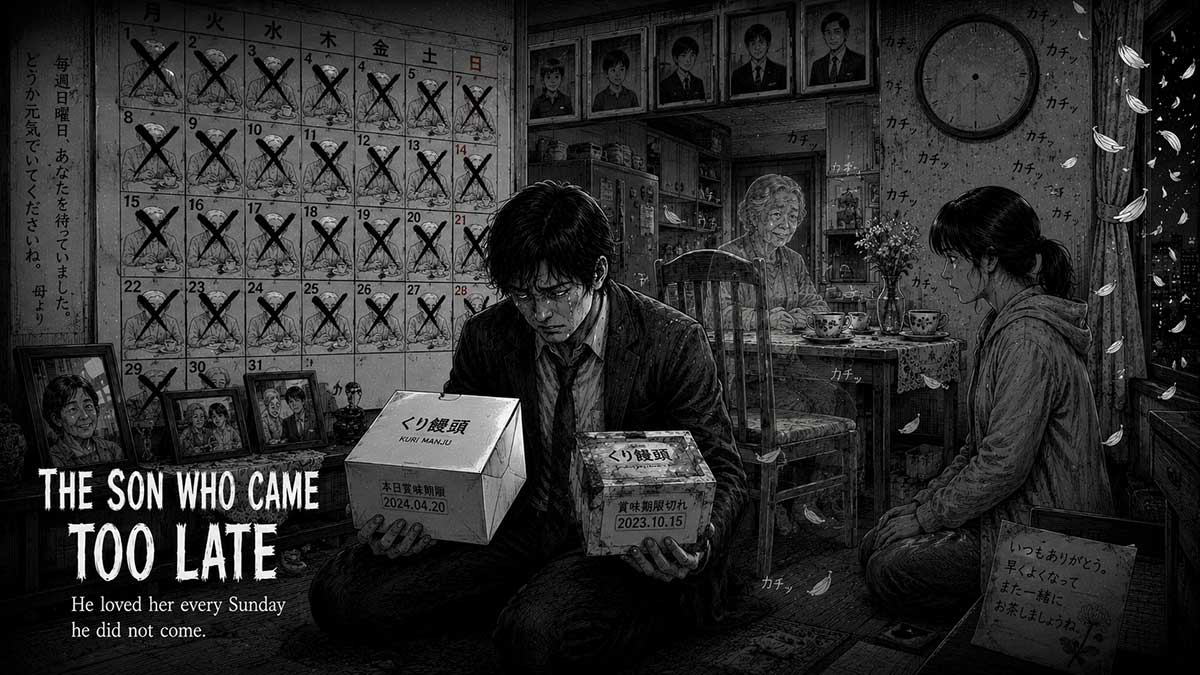
The roads reopened before dawn.
Snowplows had worked through the night.
Train schedules slowly returned to normal.
Television anchors spoke with relief.
"The worst of the weather has passed."
No one mentioned the weather inside people's hearts.
Daichi Fujimoto left his apartment at 5:40 a.m.
He carried two things.
A bouquet of white chrysanthemums.
And a fresh box of chestnut cakes.
He had stood outside the bakery before it opened.
When the owner unlocked the door, Daichi bowed deeply.
"I need your freshest ones."
The owner smiled.
"Someone special?"
"My mother."
The owner wrapped the cakes carefully.
"They'll make her happy."
Daichi smiled.
"I hope so."
The drive across Tokyo felt strangely familiar.
He had driven this route hundreds of times.
Every Sunday.
At least...
That was what he remembered.
Then he corrected himself.
No.
He had planned to drive this route hundreds of times.
Planning had slowly replaced visiting.
Somewhere along the way, intention had become memory.
His phone rested on the passenger seat.
It displayed dozens of reminders.
Call Mom.
Visit Mom.
Take Mom shopping.
Reschedule Sunday lunch.
Every reminder had been postponed.
None had been deleted.
He had mistaken saving a reminder for keeping a promise.
Apartment 407 looked exactly as it always had.
The hallway smelled faintly of green tea.
Someone had watered the flowers outside the neighboring door.
Daichi smiled.
"Mom?"
He knocked gently.
No answer.
He knocked again.
Still nothing.
He checked his watch.
Perhaps she was sleeping.
He reached into his pocket for his spare key.
Then stopped.
There was a small white envelope taped neatly beside the door.
His name was written in careful handwriting.
Daichi
His heartbeat quickened.
He removed the envelope.
Inside was only one sentence.
"Please see Nurse Mori when you arrive."
The hospital felt larger than he remembered.
Longer corridors.
Brighter lights.
More wheelchairs.
More silence.
Aiko met him outside the nurses' station.
She knew who he was immediately.
He looked exactly like his mother around the eyes.
"You came."
Daichi bowed.
"I'm sorry."
Aiko nodded once.
"I know."
He searched her face.
"Where is she?"
Aiko did not answer.
Not immediately.
Instead she led him toward the small hospital garden.
Winter branches stretched over empty benches.
Only one camellia still bloomed.
"My mother..."
His voice became smaller.
"She passed away three nights ago."
The sentence entered him without meaning.
Passed away.
Three nights ago.
No.
That wasn't possible.
He had been coming Sunday.
Today was Sunday.
He laughed once.
A strange, broken sound.
"No."
Aiko remained beside him.
"He didn't tell me."
"Who?"
"The doctor."
"I called."
"I know."
"I left messages."
"I know."
"I was..."
He stopped.
He almost said busy.
The word would no longer come.
"I was afraid."
He sat heavily on the bench.
The chrysanthemums slipped from his hands.
Several white petals scattered onto the snow.
"Was she alone?"
Aiko looked toward the garden.
"No."
Relief crossed his face.
"I was with her."
The relief became grief.
Because it should have been him.
"What were her last words?"
Aiko closed her eyes for a moment.
She could still hear Mrs. Fujimoto's voice.
Soft.
Calm.
Almost cheerful.
"Please don't wake Nurse Mori."
Daichi stared at her.
"That's all?"
Aiko nodded.
"She said you looked tired."
He covered his face.
His shoulders shook silently.
"My mother..."
He whispered.
"...was still protecting people."
Aiko handed him a folded handkerchief.
Not because he was crying.
Because she knew he would apologize for crying.
He did.
"I'm sorry."
She smiled sadly.
"She would have said exactly the same thing."
Later that afternoon, Aiko accompanied him back to Apartment 407.
The apartment remained untouched.
Exactly as Mrs. Fujimoto had left it.
The kettle still rested on the stove.
Her reading glasses lay beside yesterday's newspaper.
A sweater remained folded neatly over the chair.
Everything waited.
Daichi moved slowly through the rooms.
Each object greeted him with memory.
His father's watchmaking tools.
The old family photographs.
The bamboo plant she insisted she couldn't keep alive.
It had quietly flourished.
He stopped in front of the refrigerator.
Something told him to open it.
Inside sat a small paper bag.
Chestnut cakes.
The same brand he carried in his own hand.
Only older.
Much older.
He removed the bag carefully.
The expiration date had passed over a month earlier.
He stared at it.
Then slowly sat on the kitchen floor.
"I kept buying them."
His voice barely existed.
"I always thought..."
Another pause.
"...next Sunday."
Aiko sat beside him.
Neither spoke.
Sometimes language only delays grief.
After a long while, Daichi noticed the calendar.
Red circles.
Red Xs.
Sunday after Sunday.
Each crossed out.
Each accompanied by tiny notes.
Meeting.
Business trip.
Client dinner.
Rain.
Too tired.
Next week.
His fingers traced the handwriting.
The ink had faded slightly.
Near the final Sunday she had written only three words.
Maybe this time.
Nothing followed.
He pressed the calendar against his chest.
His breathing became uneven.
"I loved her."
"I know."
"I really did."
"I know."
"Why wasn't that enough?"
Aiko looked at him gently.
"Love kept inside intentions eventually becomes invisible."
He nodded slowly.
"My father used to tell me..."
He smiled through tears.
"...that promises need calendars."
He looked around the apartment.
"I had calendars."
Aiko waited.
"I just never arrived."
As evening approached, the building caretaker knocked quietly.
"I heard you were here."
Daichi stood immediately and bowed.
"I'm sorry."
The caretaker smiled sadly.
"Your mother would be upset hearing that."
He carried a small wooden box.
"I found this."
Inside were dozens of handwritten birthday cards.
Every one addressed to Daichi.
Every year.
Never mailed.
Daichi opened the first.
Happy 28th Birthday.
The next.
Happy 29th Birthday.
Then thirty.
Thirty-one.
Thirty-two.
Thirty-three.
Each ended almost the same way.
I hope you aren't working too hard.
Please remember to eat well.
I'm proud of you.
Not one contained guilt.
Not one complained.
Not one asked why he hadn't come.
The final card had never been sealed.
He unfolded it with trembling hands.
The handwriting had become slightly weaker.
Dear Daichi,
If you are reading this, it means you finally found the drawer where I keep things that matter.
Please don't blame yourself for visiting less than either of us hoped.
Every mother knows that children eventually begin living inside tomorrow.
If I have one wish, it isn't that you visit me more.
It is that you never make someone else wait the way I quietly waited for you.
Love travels farther than regret.
I hope you discover that before it is too late.
With love,
Mom
The page blurred beneath his tears.
Night settled over the apartment.
The city lights flickered outside the window.
Daichi walked to the balcony.
Snow still rested on neighboring rooftops.
Below, he watched people hurrying home.
Couples carrying groceries.
Parents holding children's hands.
An elderly man walking slowly beside his wife.
Ordinary scenes.
The kind he had passed a thousand times without noticing.
He heard the balcony door slide open behind him.
Aiko joined him.
For several minutes they simply watched the city.
Finally Daichi spoke.
"I always believed I had more time."
Aiko nodded.
"So did almost everyone I've met these past few weeks."
He looked toward the lights stretching across Tokyo.
"I thought blindness was losing sight."
Aiko smiled faintly.
"So did I."
"What do you think now?"
She answered without looking away from the city.
"I think blindness begins the moment we start believing love can always wait until next Sunday."
The words drifted into the cold evening air.
Neither tried to improve them.
They were already true.
As Aiko prepared to leave, Daichi stopped her.
"Nurse Mori?"
"Yes?"
"Tomorrow..."
He took a slow breath.
"...I'd like to volunteer."
She looked at him.
"Why?"
He thought carefully before answering.
"Because someone somewhere is still waiting."
That night, before leaving the apartment, Daichi removed every red X from the calendar.
He did not erase them.
He simply turned the page.
Tomorrow would not restore yesterday.
But tomorrow was still waiting.
And for the first time in many years, he intended to arrive.
Chapter 10 — The First Honest Voice
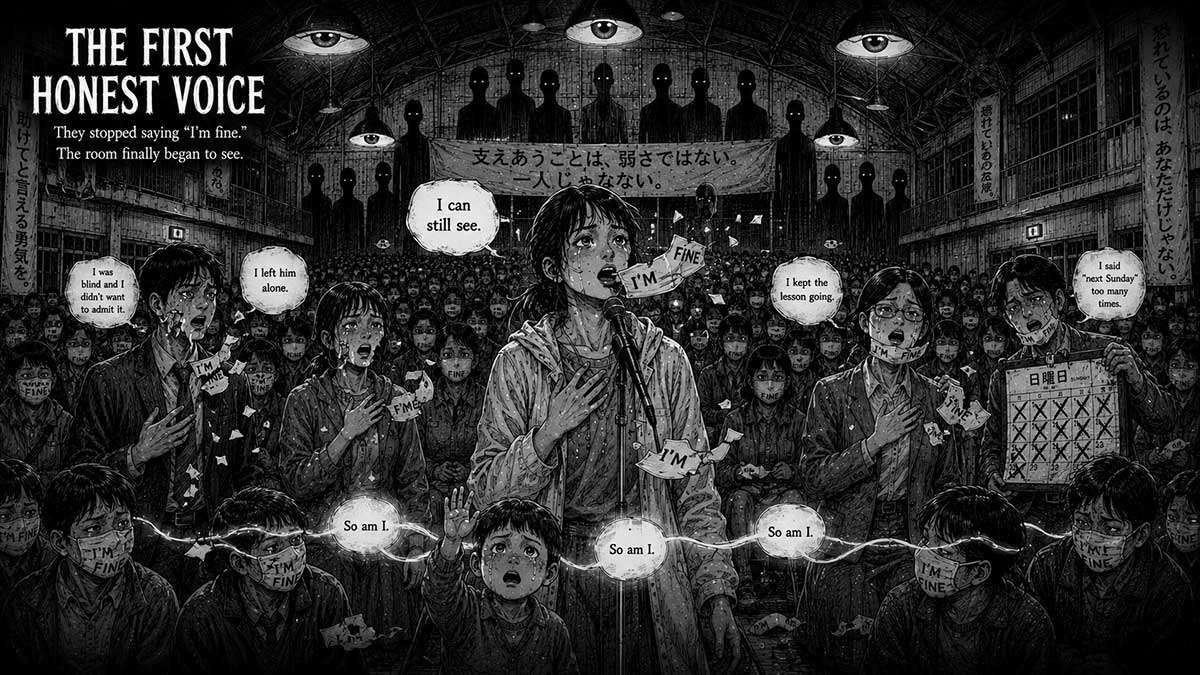
For nearly a month, everyone had become experts at the same sentence.
"I'm fine."
It echoed through hospitals.
Schools.
Offices.
Shelters.
Apartment buildings.
Even funerals.
The words had become a kind of national uniform.
People wore them politely.
Even when they no longer fit.
Midori Junior High School had changed again.
The gymnasium was no longer only a shelter.
It had become a small community.
Families cooked together.
Children studied together.
Volunteers repaired broken radios and wheelchairs.
The blind learned new walking routes.
The sighted learned how little seeing had prepared them for caring.
No one had planned it.
It simply happened.
Aiko walked slowly through the rows of sleeping mats.
She noticed something different.
People had begun recognizing footsteps.
Voices.
Laughter.
Someone's cough.
Someone's favorite tea.
Someone's habit of humming before speaking.
They were learning to know one another without faces.
The realization comforted her.
It also frightened her.
Had they needed blindness to become neighbors?
Near the entrance, Daichi was stacking boxes of bottled water.
He had arrived every morning since his mother's funeral.
No speeches.
No explanations.
He simply worked.
Children liked him because he listened.
Older residents liked him because he never hurried them.
He rarely spoke about his mother.
He carried her quietly.
"Mr. Fujimoto."
He turned.
"Nurse Mori."
"You don't have to call me that anymore."
"What should I call you?"
"Aiko."
He smiled.
"That still feels strange."
"So does almost everything."
Kenji entered carrying another shipment of walking canes.
This time he wasn't alone.
Five coworkers followed him.
Including Ryo.
The same young employee who had remained silent on the day of the accident.
They unloaded boxes together.
No one mentioned the accident.
No one needed to.
Forgiveness had not erased it.
It had simply made room to work beside it.
That afternoon, a community meeting was announced.
The gymnasium filled slowly.
Children sat cross-legged in front.
Adults formed quiet rows behind them.
Some people could see.
Many could not.
Everyone listened.
The district coordinator stood at the microphone.
"We've been asked to discuss what our community still needs."
Silence.
"Please don't hesitate."
More silence.
The coordinator smiled patiently.
"What do you need?"
No one answered.
People lowered their heads.
The old habit remained.
Aiko looked around the room.
Then slowly stood.
She walked toward the microphone.
The entire gymnasium became quiet.
Many recognized her voice.
The nurse who never seemed tired.
The woman who always knew where everything was.
The one who somehow arrived before anyone called.
She took a slow breath.
"There is something I haven't told you."
The room waited.
"I can still see."
The silence changed.
It became heavier.
Someone dropped a cup.
Several people whispered.
Others simply stared toward her voice.
"I lost many chances to tell you."
Aiko continued.
"I told myself I was protecting everyone."
She paused.
"The truth is..."
She smiled sadly.
"...I was afraid."
A man near the back stood.
"You lied?"
"Yes."
"Why?"
"Because I thought if people knew..."
She searched for the words.
"...they would expect me to carry everything."
The room became still again.
An elderly woman raised her hand.
"Were you lonely?"
Aiko closed her eyes.
"Very."
No one spoke for several seconds.
Then, unexpectedly, Mrs. Kobayashi—the neighbor from Mr. Ishida's apartment building—stood.
"My name is Kobayashi."
Her voice trembled.
"I lived across the hall from Mr. Ishida."
Several people recognized the name.
"I heard him coughing."
She swallowed.
"I heard him many nights."
Silence.
"I told myself..."
Her voice broke.
"...that he valued his privacy."
She looked down.
"I was protecting myself from embarrassment."
Not him.
Another person stood.
It was the young teacher, Ms. Sato.
"My student..."
Her voice shook.
"Haru."
She turned toward where she knew he was sitting.
"When you lost your sight..."
She took a deep breath.
"I continued the lesson."
"I told myself children needed routine."
She smiled painfully.
"The truth is..."
"I didn't know how to stay with your fear."
Haru answered quietly.
"I know."
She looked surprised.
"I forgave you before you apologized."
The room became softer.
As though everyone had exhaled together.
Kenji slowly rose.
"I approved the shipment that caused the highway accident."
Several heads turned.
"I kept working because I didn't want anyone carrying my responsibilities."
He looked toward Ryo.
"I refused help."
Ryo stood beside him.
"And I saw the mistake."
He lowered his head.
"I stayed silent because I didn't want to embarrass my senior."
Kenji smiled sadly.
"We protected pride."
Ryo nodded.
"And people were hurt."
Mei stood next.
She had rehearsed this moment for days.
"When Haru asked me to stay..."
Her eyes filled with tears.
"I walked away."
She looked toward him.
"I thought staying would make everyone notice me."
She laughed weakly.
"I chose being comfortable over being kind."
Haru smiled.
"I already knew."
She blinked.
"How?"
"You stopped talking to everyone."
She looked confused.
"I thought you stopped talking only to me."
He shook his head.
"You became lonely too."
The room was completely silent now.
No one looked at the floor.
People listened.
Really listened.
Daichi stood last.
"My mother waited for me every Sunday."
No one interrupted.
"I always planned to visit."
He held up the folded calendar page he carried in his pocket.
"I thought love could survive postponement."
He looked around the room.
"It cannot."
He unfolded the paper.
The red circles.
The red Xs.
Some people quietly began crying before he spoke again.
"I don't need your sympathy."
He smiled gently.
"I need you to go home and call someone."
No applause followed.
Only silence.
The kind that changes people.
Near the back of the gymnasium, a little boy slowly raised his hand.
The coordinator smiled.
"Yes?"
The boy looked around nervously.
"I'm scared."
The room waited.
For years he had expected the answer adults always gave.
Don't be.
Instead, an elderly man stood.
"So am I."
Then a nurse.
"So am I."
Then a teacher.
"So am I."
Then Kenji.
"So am I."
Then Mei.
"So am I."
Soon voices filled the gymnasium.
Quiet.
Steady.
Honest.
"So am I."
"So am I."
"So am I."
No one tried to erase fear.
They simply refused to leave anyone inside it alone.
After the meeting ended, the shelter felt different.
Not happier.
Lighter.
People asked for blankets.
Asked for medicine.
Asked for help carrying boxes.
One elderly woman admitted she could no longer open medicine bottles.
A university student quietly offered to visit every evening.
A father confessed he hadn't slept properly in weeks.
Another father sat beside him without saying a word.
No one apologized for needing one another.
That evening, Aiko finally returned to her apartment.
For the first time in nearly a month.
Dust had gathered on the bookshelf.
Mail covered the floor.
Plants leaned toward the window, thirsty.
She laughed softly.
"I've neglected all of you."
She watered every plant.
Opened every window.
Made herself tea.
Then she did something she hadn't done since the blindness began.
She called her mother.
The phone rang once.
Twice.
Then—
"Aiko?"
Her mother's voice was warm.
"You remembered."
Aiko smiled through tears.
"I should have called sooner."
Her mother laughed.
"I've been your mother long enough to know that."
"I'm sorry."
There was a gentle pause.
Then her mother answered,
"You don't need to apologize."
"I know."
"What do you need?"
Aiko looked around her quiet apartment.
For the first time in many years, she answered honestly.
"I need my mother."
On the other end of the line, there was only one sound.
A relieved sigh.
Sometimes love waited.
Sometimes it even survived.
But Aiko now understood what Mrs. Fujimoto had tried to teach her.
No one should be asked to wait forever.
Outside her apartment window, the city lights shimmered across the night.
Tokyo looked exactly as it always had.
Yet somewhere inside thousands of homes, people were making phone calls they had postponed.
Knocking on doors they had walked past.
Saying words they had believed could wait.
The blindness had not ended.
But something else had quietly begun.
People were no longer ashamed to be seen.
Chapter 11 — The Day People Asked for Help
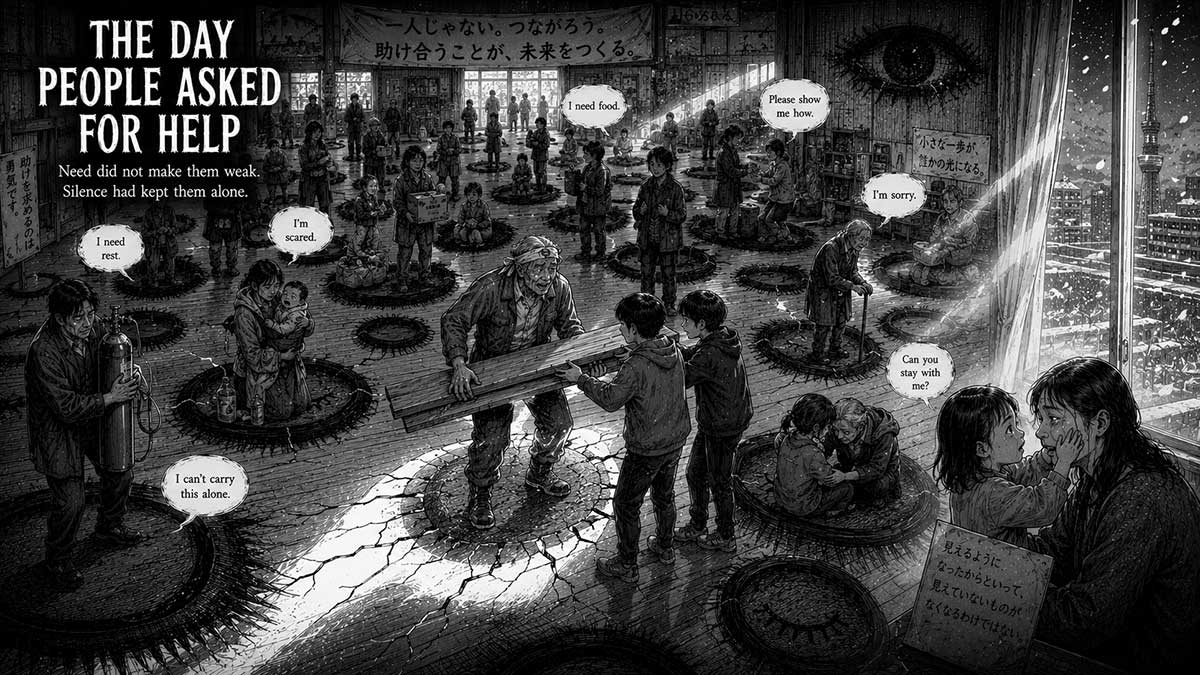
No announcement declared the beginning.
No newspaper reported it.
No government office measured it.
Yet everyone who had lived through the White Silence would later remember that there had been one particular morning when something invisible changed.
It began with a simple question.
Not,
"Are you all right?"
But,
"Could someone help me?"
The request came from an elderly carpenter named Mr. Nakajima.
He stood outside the shelter holding two loose boards.
"I don't think I can carry these alone."
The sentence surprised him as much as anyone else.
For nearly eighty years he had carried everything himself.
Within seconds, three teenagers walked over.
"We've got it."
He laughed.
"I only needed one."
One of the boys grinned.
"We came anyway."
No one applauded.
People simply continued working.
Yet dozens of others had heard.
They noticed that asking had not reduced the old man's dignity.
If anything, it had made everyone else feel useful.
By afternoon, similar moments appeared everywhere.
A young mother admitted she needed sleep.
An elderly widower confessed he could no longer remember which medicine was which.
A university student quietly admitted he was terrified of becoming blind himself.
Nobody offered speeches.
They offered chairs.
Water.
Time.
Presence.
The words "I'm sorry" slowly began changing.
People still apologized.
Old habits do not disappear in a month.
Yet something followed the apology now.
"I'm sorry...
...could you help me?"
"I'm sorry...
...would you stay a little longer?"
"I'm sorry...
...I'm lonely today."
The second sentence mattered more than the first.
Aiko noticed the difference immediately.
The hospital no longer sounded like endless apology.
It sounded like conversation.
Patients asked nurses to explain treatments again.
Families admitted they were exhausted.
Doctors quietly consulted one another instead of pretending certainty.
The building itself seemed to breathe differently.
Dr. Ishikawa found Aiko organizing medical supplies.
"You've noticed it."
She smiled.
"I have."
"They're asking questions."
"They've stopped pretending."
He leaned against the doorway.
"I spent weeks trying to cure blindness."
"And?"
"I think honesty was the first medicine."
Across town, Kenji no longer worked for his company.
His resignation had surprised everyone.
Especially himself.
Mr. Hayashi had tried to stop him.
"We need people like you."
Kenji smiled.
"No."
"We need people willing to admit when they cannot see."
Hayashi looked down.
"You've taught us that."
Instead of returning to logistics, Kenji volunteered with a rehabilitation center helping newly blind residents learn to navigate Tokyo.
Every morning he greeted strangers with the same sentence.
"My name is Kenji."
"I'll probably make mistakes."
"So will you."
"Let's learn together."
People relaxed almost immediately.
Perfection had finally left the room.
Ryo visited often.
One afternoon he handed Kenji a folded envelope.
Inside was a recommendation letter.
"You should apply."
"For what?"
"Teaching."
Kenji laughed.
"I've never taught."
Ryo smiled.
"You already have."
At Midori Junior High School, classes resumed in shortened sessions.
Many students were still blind.
Lessons changed.
Teachers read aloud more often.
Students worked in pairs.
Grades became less important than cooperation.
No one had planned this curriculum.
Life had.
Ms. Sato entered Class 2-B carrying no textbook.
Instead, she wrote one sentence across the board.
What did someone do for you this week?
The room remained quiet.
Then hands slowly rose.
"My grandfather made breakfast."
"My neighbor read my homework."
"My little sister guided me to the bathroom."
"My friend sat beside me."
No one spoke about achievements.
Only kindness.
Finally Ms. Sato looked toward Haru.
"What about you?"
He smiled.
"Mei stopped apologizing."
The class laughed.
Mei covered her face.
"I still apologize."
"Less."
She smiled.
"I think you're right."
After school they walked home together.
This time Mei held Haru's arm without embarrassment.
"I've been thinking."
"About what?"
"My grandmother always said kindness meant helping before someone asked."
Haru nodded.
"My grandfather said the opposite."
"What did he say?"
"Real kindness is making it safe for someone to ask."
They walked another few steps.
"I think..."
Mei smiled.
"...our grandparents were both right."
Across Tokyo, Daichi stood outside Apartment 512.
Mr. Ishida's apartment.
The city had cleaned it.
New tenants would eventually arrive.
He carried no flowers.
Instead, he knocked gently on the empty door.
A passerby looked puzzled.
Daichi bowed slightly.
"I'm sorry."
Then he corrected himself.
"No."
He smiled toward the silent apartment.
"Thank you."
The old man had changed his life without ever speaking to him.
That evening Daichi visited three elderly residents in the same building.
Not because anyone asked.
Because now he knew what waiting looked like.
One woman needed groceries.
One simply wanted someone to listen.
The third insisted on serving tea.
She apologized because it wasn't very good.
Daichi laughed.
"It tastes exactly like my mother's."
She smiled proudly.
"I've practiced for fifty years."
Back at the hospital, Aiko finally accepted a full night's sleep.
Not because the work was finished.
Because she trusted someone else to continue it.
Before leaving, she stopped beside Sachiko's room.
The head nurse was recovering slowly.
"You look rested."
"I slept."
Sachiko smiled.
"I never thought I'd live long enough to hear you admit that."
Aiko laughed.
"I needed permission."
Sachiko reached for her hand.
"We always do."
That night snow began falling again.
Gentle.
Almost weightless.
The city lights reflected softly against it.
People no longer compared the snow to blindness.
Now it reminded them of quiet beginnings.
Just before midnight, Aiko's phone rang.
Unknown number.
She answered.
"Hello?"
A hesitant voice replied.
"My name is Keiko."
The elderly woman from Room Twelve.
"I hope I'm not disturbing you."
Aiko smiled.
"You aren't."
"I wondered..."
A pause.
"...would it be all right if we had tea tomorrow?"
Aiko looked out at the falling snow.
"Yes."
"I'd like that very much."
Another pause.
"I was afraid to ask."
"I know."
"I'm trying not to live that way anymore."
Aiko felt tears gathering.
"So am I."
The next morning something impossible happened.
A little girl named Yui woke inside the pediatric ward.
She blinked several times.
Then gasped.
"I can see."
Her mother rushed over.
"What?"
"I can see your face."
Doctors ran into the room.
Nurses followed.
Tests were repeated.
The blindness had lifted.
Only for one child.
No explanation.
No pattern.
No certainty.
News spread through the hospital within minutes.
People expected celebration.
Instead, the building became very quiet.
Not because everyone believed the epidemic was over.
Because they suddenly understood something.
If sight could return unexpectedly...
Then perhaps every ordinary conversation might also be someone's last chance.
No one wanted to waste another one.
Aiko walked to the hospital window.
The morning sun broke through the clouds, illuminating the white city below.
For the first time in weeks, she whispered a prayer.
Not that everyone would recover their eyesight.
But that they would not lose what they had finally learned before it returned.
Chapter 12 — The Empty Seat
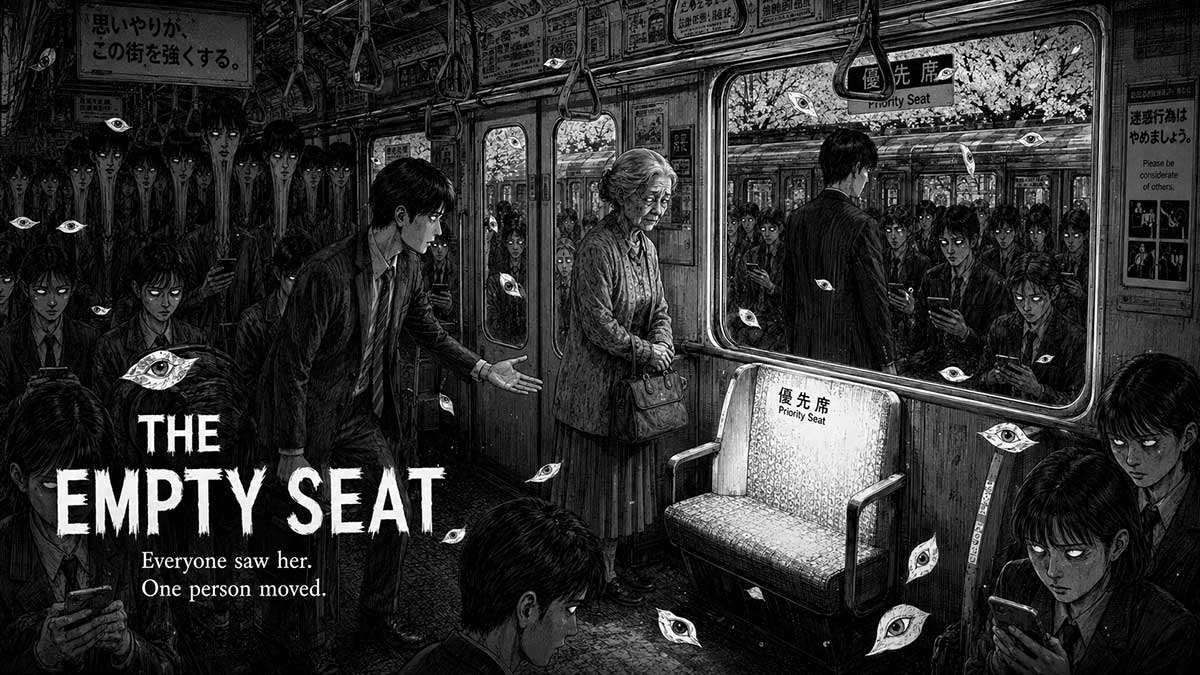
Spring arrived without asking permission.
The last traces of snow disappeared from the sidewalks.
Cherry blossoms opened along the Meguro River.
Children returned to school carrying new backpacks.
Office workers once again hurried through Shinjuku Station.
Television crews packed away their cameras.
The headlines changed.
Another crisis had taken the place of the old one.
Tokyo had begun forgetting.
The blindness faded as mysteriously as it had arrived.
Not all at once.
One person.
Then another.
A grandmother.
A taxi driver.
A university student.
A baker.
A child.
Doctors searched for patterns.
They found none.
Researchers published theories.
None explained everything.
Eventually, people stopped asking why.
They were simply grateful to see again.
The newspapers called it
The White Silence.
Historians would later debate whether it had been a disease, a neurological event, or something no science had yet learned to describe.
The people who lived through it rarely joined those debates.
They had learned that the important questions had never been medical.
Aiko returned to nursing.
Only now she went home when her shift ended.
Sometimes she still stayed late.
Only when someone truly needed her.
She called her mother every Sunday evening.
Never because a reminder appeared on her phone.
Because she wanted to hear her laugh.
A small notebook rested inside her uniform pocket.
Its first page still contained one sentence.
Tomorrow I will interrupt someone before they apologize.
She had added nothing else.
She no longer needed to.
Kenji never returned to corporate logistics.
He accepted Ryo's suggestion and began teaching orientation classes for people who had recently lost their sight.
On the first morning of every course, he stood before nervous strangers and said,
"My name is Kenji Takahashi."
"I spent most of my life believing strength meant never asking for help."
He smiled.
"I was mistaken."
The room always relaxed.
Ryo remained at the company.
The accident report stayed in his desk drawer.
He never threw it away.
Whenever a younger employee hesitated to speak, he remembered the silence that had almost cost lives.
Meetings became different.
People interrupted.
Questioned.
Verified.
No one considered that disrespect anymore.
They called it responsibility.
Ms. Sato continued teaching literature.
The first assignment of the new school year surprised every student.
She wrote only one question across the blackboard.
Who have you truly seen this week?
There were no right answers.
Only honest ones.
Mei and Haru still walked home together.
Their friendship carried no dramatic confession.
No romance.
Only trust rebuilt one conversation at a time.
One afternoon Mei laughed.
"Do you remember how frightened I was?"
Haru smiled.
"I remember."
"I'm still frightened sometimes."
"So am I."
She nudged his shoulder.
"I suppose that's normal."
"I hope so."
Daichi sold his downtown apartment.
His coworkers were shocked.
"You'll have a much longer commute."
"I know."
"Why move?"
He smiled.
"My mother spent years waiting for me."
He looked toward the quieter neighborhood where she had lived.
"I don't want anyone near me waiting that long again."
He rented a small apartment only three streets away from Sakura Heights.
Every Saturday he visited elderly neighbors.
Sometimes he fixed light bulbs.
Sometimes he carried groceries.
Sometimes he only listened.
No one called him extraordinary.
That pleased him.
Apartment 407 remained empty for several months.
When new tenants finally arrived, Daichi visited them carrying a small potted camellia.
"It belonged to my mother."
The young couple hesitated.
"We couldn't possibly..."
"I hope you will."
They accepted it carefully.
Years later, they would never know why the flowers always reminded visitors of kindness.
Spring deepened.
Life accelerated.
People became busy again.
Appointments returned.
Meetings multiplied.
Phones vibrated constantly.
The city remembered its old rhythm.
Aiko worried.
Would people slowly return to the old blindness?
She never found an answer.
Only moments.
One Tuesday evening she finished work later than expected.
The train platform at Shinjuku Station was crowded.
Business suits.
Shopping bags.
School uniforms.
Tourists studying maps.
Everything looked exactly as it had before the White Silence.
Almost.
An elderly woman stepped into the carriage carrying two heavy shopping bags.
Every seat was occupied.
Nearly every passenger looked down.
Phones.
Books.
Advertisements.
The train began moving.
The woman reached for the overhead strap.
Her hand trembled.
Aiko watched.
For one brief moment she felt the old fear.
What if nothing changed?
Then, from the opposite side of the carriage, a young man stood.
He wore a wrinkled office shirt.
His tie hung loosely.
He looked exhausted.
Without saying a word, he bowed slightly and offered his seat.
The elderly woman smiled.
"Thank you."
He bowed again.
"It was nothing."
She sat.
The train continued.
No one applauded.
No one recorded the moment.
No headline would ever mention it.
Aiko looked more closely at the young man.
She smiled.
It was Kenta.
The little boy from the shelter.
Not so little anymore.
He caught her eye and recognized her.
For a second he looked surprised.
Then he smiled.
The kind of smile shared by people who had survived something together.
Nothing needed to be said.
The train stopped.
Passengers stepped onto the platform.
The crowd flowed toward the exits.
Before disappearing into it, Kenta turned back.
"Nurse Mori?"
"Yes?"
"My grandfather still gets scared sometimes."
Aiko nodded.
"So do I."
He laughed.
"We talk about it now."
She felt tears forming.
"I'm glad."
He bowed once.
Then disappeared into the evening crowd.
The platform slowly emptied.
Aiko remained where she was.
Across the tracks she noticed something she had never paid attention to before.
An elderly station attendant was helping a blind commuter count the steps toward the exit.
Patiently.
Without hurry.
Without embarrassment.
Just one person helping another.
The world had not become perfect.
There were still lonely apartments.
Missed birthdays.
Arguments.
Overwork.
Children left out.
Parents waiting by telephones.
There always would be.
Human beings remained unfinished.
As Aiko left the station, cherry blossoms drifted across the sidewalk.
One petal landed on her sleeve.
She remembered the first morning she had met Kenji.
He had bowed to strangers because he believed he was causing trouble.
She remembered Mrs. Fujimoto saving chestnut cakes that would never be eaten.
Mr. Ishida's unfinished message.
Sachiko collapsing after caring for everyone except herself.
Daichi unfolding the calendar of missed Sundays.
The little boy who had dared to say,
"I'm scared."
Each memory had become a pair of eyes through which she now saw the city.
She reached the intersection where thousands crossed every evening.
The pedestrian signal turned green.
People began walking.
Some hurried.
Some lingered.
Some smiled.
Some looked tired.
Aiko stepped into the crowd.
She no longer tried to see everyone.
She simply refused to look away from the person in front of her.
Sometimes that was enough.
Sometimes it changed everything.
Years later, when people asked those who had lived through the White Silence what they remembered most, many spoke about the day their eyesight returned.
Aiko never did.
When asked, she always answered with the same story.
She spoke of an ordinary train.
An elderly woman.
A tired young man who quietly stood.
Then she would smile and say,
"The miracle was never that we learned to see again."
She paused, just long enough for the listener to wonder what came next.
"It was that, for a little while, we remembered that another person's life was allowed to interrupt our own."
Outside, another train arrived exactly on time.
Its doors opened.
People stepped forward together.
And among them, unnoticed by almost everyone, there was always one empty seat waiting for the next person who needed it most.
Final Thoughts
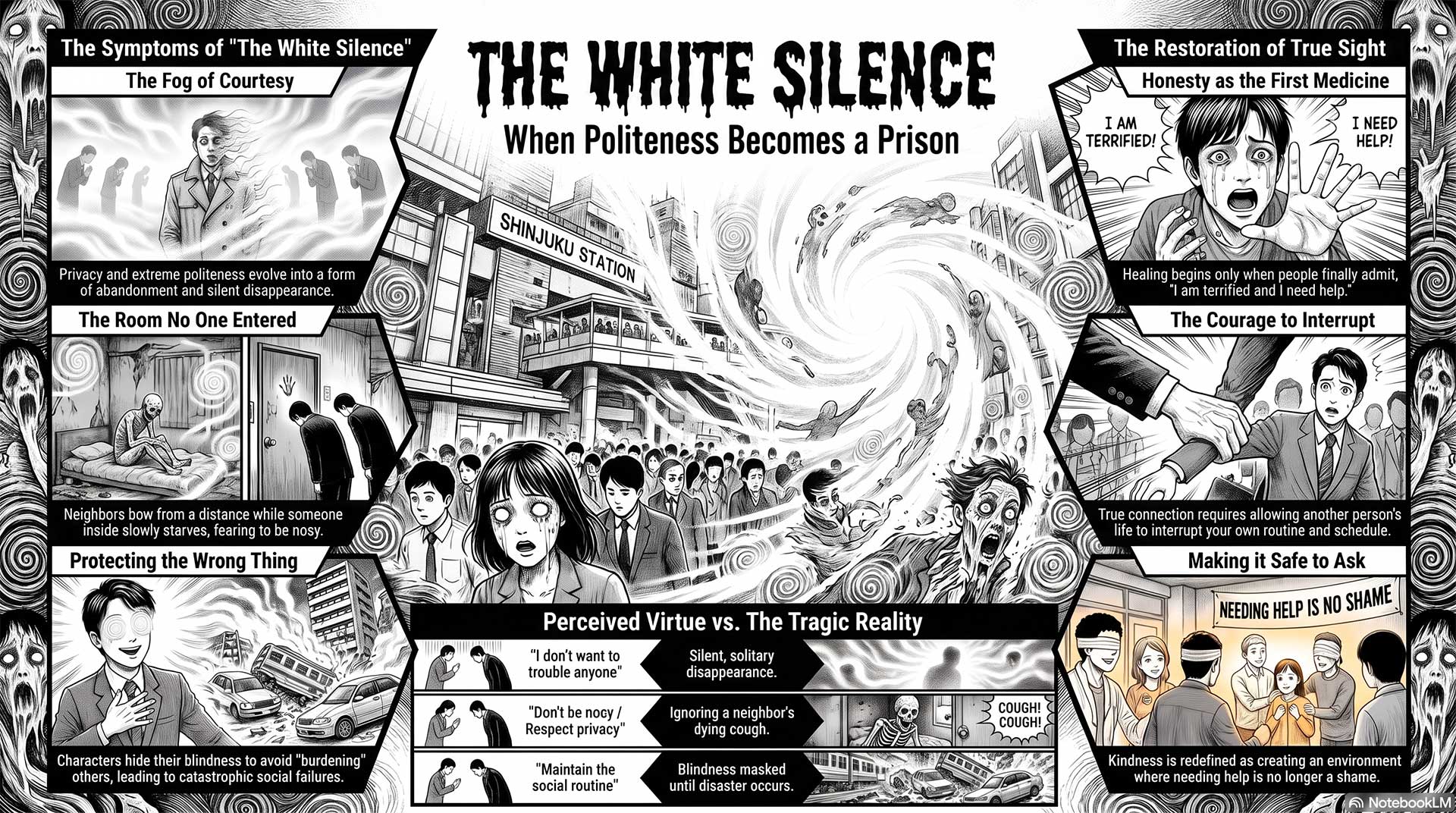
José Saramago’s Blindness asks readers to consider whether humanity was already blind before the epidemic began.
The White Silence carries that question into modern Japan.
By the end of this story, the mysterious loss of eyesight has passed.
Tokyo resumes its familiar rhythm.
Trains arrive on time.
Schools reopen.
Office workers return to their desks.
The city can see again.
Yet restored eyesight does not prove that anyone has learned to see.
That distinction is the heart of both Saramago’s warning and this Japanese reimagining.
Saramago showed how catastrophe can strip away the structures people mistake for civilization.
This story asks whether civilization can remain outwardly intact and still fail those who are lonely, frightened, elderly, exhausted, ashamed, or unable to ask for help.
The people in The White Silence are rarely harmed by open hatred.
They are harmed by delay.
By hesitation.
By good intentions never converted into action.
By visits postponed until next Sunday.
By doors almost knocked upon.
By questions people wanted to ask but feared would seem intrusive.
By love that remained real but invisible.
Mrs. Fujimoto does not doubt that her son loves her.
Mr. Ishida does not believe his neighbors dislike him.
Haru is not openly rejected by his classmates.
Kenji is not forced to keep working.
Aiko is not commanded to carry everyone alone.
Each tragedy grows in the space between what people feel and what they permit themselves to say.
That is where this story departs most clearly from Saramago’s original setting.
The Japanese version is less concerned with loud social collapse than with silent emotional disappearance.
Its central terror is not chaos.
It is a perfectly functioning society in which a person can become invisible without anyone intending harm.
Yet the story does not reject Japanese courtesy, restraint, duty, or harmony.
Those qualities remain sources of beauty.
The answer is not to become less considerate.
It is to recognize that true consideration sometimes requires interruption.
It may mean asking a painful question.
Entering a room.
Calling sooner.
Standing out from the group.
Admitting weakness.
Accepting help.
Staying when leaving would be easier.
The final empty seat carries this meaning.
A young man stands for an elderly woman.
No disaster is prevented.
No institution changes.
No crowd applauds.
One person merely allows another person’s need to interrupt his routine.
That small act contains the hope of the entire novel.
The White Silence began with the premise of José Saramago’s Blindness placed inside modern Japan.
It ends with a different form of sight.
Seeing is not merely registering that another person exists.
Seeing means allowing their existence to place some claim upon us.
It means noticing the apology beneath the request.
The loneliness beneath the politeness.
The fear beneath the smile.
The person behind the role.
The mother behind the unanswered phone.
The neighbor behind the closed door.
The child left sitting after the lesson continues.
The greatest lesson of the White Silence is not that people need one another only during catastrophe.
It is that they needed one another long before the catastrophe arrived.
Sight may return in a moment.
Learning to see one another takes a lifetime.
Short Bios:
Leave a Reply