
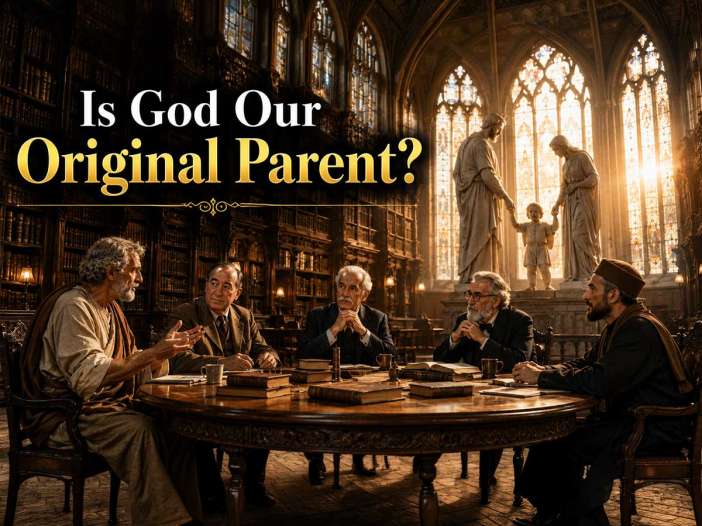
What if the existence of fathers and mothers reveals something profound about the nature of God?
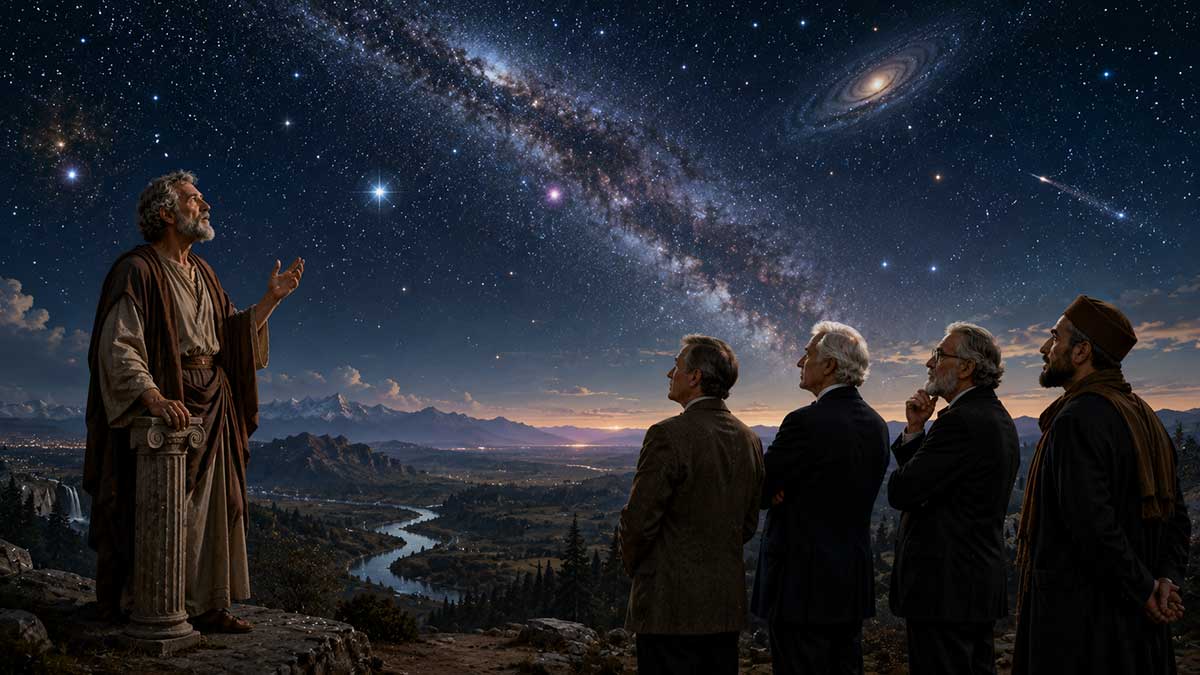
For thousands of years, humanity has searched for God by looking upward.
We have studied the stars, explored the laws of nature, written sacred books, built magnificent temples, and debated profound theological questions. Yet one possibility often escapes our attention.
What if the clearest window into the nature of God has been standing before us all along?
Every human being enters the world through a family.
We know fathers and mothers.
We know children.
We know the joy of belonging, the pain of separation, the desire to protect those we love, and the longing to be accepted without conditions.
These experiences raise an extraordinary philosophical question.
If human beings did not invent love, compassion, reason, creativity, or parenthood, where did these realities originate?
Can a source give what it does not possess?
If both men and women reflect something of the One who created them, what might that reveal about the Creator?
Does the existence of fatherhood and motherhood point to something even deeper?
Rather than beginning with religious doctrines, this conversation begins with ordinary human experience.
Aristotle asks what creation reveals about its cause.
C. S. Lewis explores whether our deepest longings point beyond ourselves.
Carl Jung reflects on the complementary nature of masculinity and femininity.
Martin Buber considers what it means to encounter another person in genuine relationship.
Hamza Yusuf offers an important voice of caution, reminding the group that God always transcends human categories and that every comparison must be approached with humility.
Together, they examine one question that reaches beyond philosophy and touches every human heart:
If parental love is among the highest forms of human love, could it reflect the heart of the One from whom all life came?
This conversation does not ask readers to accept a conclusion without thought.
It invites them to observe.
To question.
To reflect.
And perhaps to discover that the deepest relationship between humanity and God is far more personal than many have ever imagined.
(Note: This is an imaginary conversation, a creative exploration of an idea, and not a real speech or event.)
Topic 1: Can Creation Reveal Anything About Its Source?
Setting
The conversation takes place in the Bodleian Library at the University of Oxford after closing time. Rain taps gently against the tall windows. Ancient wooden shelves rise toward the vaulted ceiling, filled with centuries of philosophy, science, and theology. A single reading lamp casts a warm glow over a round oak table.
Five men have gathered, each carrying a lifetime of questions.
Aristotle quietly studies a handwritten manuscript.
C. S. Lewis gazes out the rain-speckled window.
Carl Jung flips through a notebook filled with sketches and symbols.
Martin Buber folds his hands patiently.
Hamza Yusuf adjusts a small stack of classical texts before looking around the table.
For a few moments, no one speaks.
Finally, Lewis breaks the silence.
Opening
C. S. Lewis: Gentlemen, people have argued about God for thousands of years. Some begin with sacred books. Others begin with personal experience. I wonder if we might begin somewhere simpler. Suppose someone had never opened a holy book. Could they still discover something about God simply by observing reality?
Aristotle: That is an excellent beginning. Long before the great monotheistic traditions, philosophers asked whether change itself required an ultimate explanation. Every movement appears to depend on another. Every cause seems to arise from a prior cause. If that chain cannot regress forever, reason naturally asks whether there is an original source.
Hamza Yusuf: Many believers would welcome that question. The Qur'an repeatedly invites people to reflect upon creation itself. The stars, the mountains, the alternation of day and night—these are presented as signs, not proofs that force belief, but invitations to reflection.
Martin Buber: Observation matters. Yet I wonder whether we should ask only how the universe began. Human beings are not merely observers of nature. We experience love, responsibility, beauty, conscience, and relationship. Those experiences may reveal as much as galaxies do.
Carl Jung: Indeed. The outer universe is magnificent, yet the inner universe may be equally revealing. The symbols that appear across civilizations suggest that human beings are searching for something greater than survival. The question is whether those symbols merely arise from the human mind, or whether they point beyond it.
Question 1
Can the existence of the universe reasonably point to an original source?
Aristotle: Let me ask everyone a simple question. If you entered a room and found a magnificent clock, would you assume it assembled itself?
Lewis: Certainly not.
Aristotle: Why?
Lewis: Because its order suggests intention.
Aristotle: Then why do so many people hesitate to ask the same question about the universe, whose order exceeds any clock by an unimaginable degree?
Hamza Yusuf: Some would answer that natural laws explain the universe.
Aristotle: They explain how things operate. My question is different. Why do those laws exist at all?
Jung: Modern people often mistake description for explanation. Naming a process is not the same as explaining why there is a process to name.
Buber: Perhaps the deeper question is this: Does reality merely exist, or does it communicate something about itself?
Question 2
If creation reveals its source, what kinds of things might it reveal?
Lewis: When I read Shakespeare, I learn something about Shakespeare.
When I stand before a Rembrandt painting, I glimpse something of Rembrandt.
Why should creation be different?
Hamza Yusuf: Our traditions would agree that creation reflects wisdom. Yet we should remain humble. A work of art reveals something about its artist, though never the whole artist.
Jung: Human beings often project themselves onto God. That danger is real. Yet the opposite danger also exists. We may become so cautious that we refuse to ask what creation actually suggests.
Aristotle: Every effect bears some relationship to its cause. Otherwise, reason itself collapses.
Buber: And perhaps the most remarkable feature of creation is not matter.
It is relationship.
Nothing meaningful exists entirely alone.
Question 3
Is belief in God irrational, or can it be a reasonable conclusion from observation?
Hamza Yusuf: Faith is often misunderstood as believing without reason. In my tradition, reflection and reason are gifts. They are not enemies of belief.
Lewis: I agree. Reason cannot compel love, yet it can remove unnecessary obstacles to belief. My own journey began with questions, not certainty.
Jung: There is a difference between proving God and finding belief intellectually satisfying. Human beings rarely live by mathematical proof alone. Much of life depends upon recognizing patterns.
Aristotle: Philosophy has never claimed certainty about every question. It asks what best explains the evidence before us.
Buber: Then perhaps the real issue is not whether God can be proven.
Perhaps the question is whether reality is meaningful enough to invite relationship.
A silence settles over the table.
Rain continues to fall outside.
Lewis looks at the others.
Lewis: We have spoken about an original source.
But if such a source exists...
Can we know anything about its character?
Or have we reached the limit of what creation can tell us?
The others exchange thoughtful glances.
That question waits patiently for the next stage of the conversation.
Topic 2: Can Human Nature Reveal the Nature of God?
Setting
The rain has stopped.
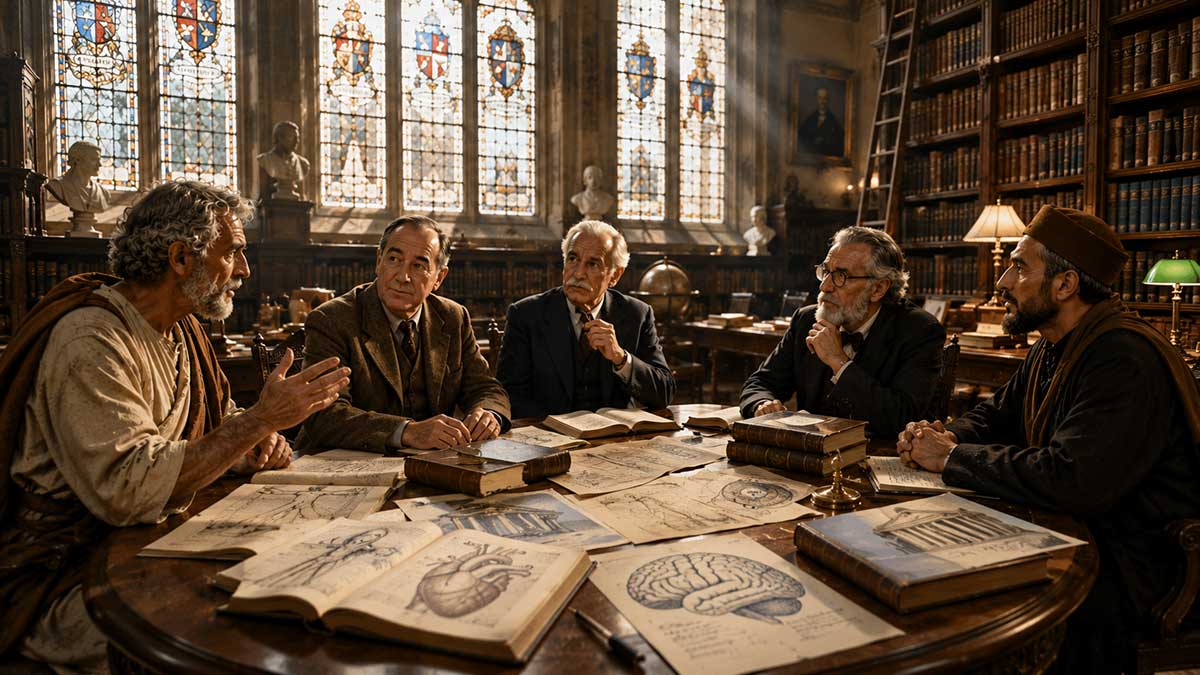
Moonlight now filters through the tall stained-glass windows of the Bodleian Library, casting pale patterns across the oak floor. The room feels quieter than before, as though the discussion itself has slowed everyone's breathing.
The books surrounding the table contain thousands of years of humanity's search for truth.
Yet tonight, the speakers have turned away from books.
Their attention rests on humanity itself.
Lewis gently breaks the silence.
Opening
C. S. Lewis: In our last discussion, we asked whether creation points to an original source. I think we've agreed that it is at least a reasonable question. But now I'd like to ask something more personal.
Suppose the universe does reflect its source.
Why should we look only at stars and galaxies?
Why not begin with ourselves?
Martin Buber: An excellent question.
Human beings are unique.
The universe became conscious of itself through us.
We ask questions.
We seek meaning.
We love.
We sacrifice.
Those are remarkable clues.
Aristotle: Every effect reflects something of its cause.
If human beings possess qualities unlike rocks or rivers, perhaps those qualities deserve our closest attention.
Carl Jung: Throughout history, people have searched for God in the heavens.
Yet the symbols of the divine continually emerge from the human soul.
Perhaps we have been looking outward when we should also have been looking inward.
Hamza Yusuf: I agree that humanity occupies a unique place.
Yet we should be careful.
Human beings reflect something of their Creator, but they are never the Creator.
Humility must accompany every conclusion we draw.
Lewis nods.
"Then perhaps the question is not whether we are God...
but whether our deepest qualities tell us something about the One from whom we came."
Question 1: Which human qualities deserve our attention?
Lewis: Consider what makes us different.
We do not merely survive.
We ask why we exist.
We create music that brings us to tears.
We write poetry.
We mourn strangers.
We admire courage.
We feel guilt.
Where did these capacities come from?
Aristotle: A cause cannot give what it does not possess in some manner.
If intelligence appears within humanity, then the source of humanity cannot be less than intelligence.
Hamza Yusuf: I would phrase that carefully.
God's wisdom is not merely greater than ours.
It is of an entirely different order.
Still, the existence of human wisdom does suggest that reality is not fundamentally irrational.
Jung: Consciousness itself is extraordinary.
The universe produced creatures capable of asking whether the universe has meaning.
That fact deserves more wonder than it usually receives.
Buber: And perhaps our greatest capacity is relationship.
The deepest moments of life are rarely achievements.
They are encounters.
Question 2: If love exists, what does that suggest?
Lewis: Love fascinates me.
It often asks us to sacrifice rather than to survive.
A mother gives her life for her child.
A soldier risks everything for friends.
None of this fits neatly into a purely selfish explanation.
Jung: Love continually calls people beyond themselves.
It transforms identity.
People willingly endure suffering for someone else.
That is psychologically remarkable.
Hamza Yusuf: Love is among God's greatest gifts.
Yet human love is imperfect.
It can become possessive.
It can become selfish.
Its existence points upward, but it should not be confused with its perfect source.
Aristotle: Nevertheless, imperfect love still points toward the existence of love itself.
An imperfect circle still reveals the idea of a perfect circle.
Buber: Love reaches its fullness when another person is no longer treated as an object.
The moment I truly encounter another as "Thou," something sacred happens.
Perhaps that capacity itself reflects something eternal.
Question 3: What kind of relationship might God desire?
Lewis pauses before speaking.
Lewis: Most discussions stop after saying, "There must be a Creator."
But I think that leaves a far more interesting question unanswered.
What kind of Creator?
Aristotle: Explain.
Lewis: If human beings possess reason...
Perhaps God possesses original reason.
If human beings possess creativity...
Perhaps creativity begins in God.
If human beings possess love...
Perhaps love is not accidental.
Perhaps it belongs to the very nature of ultimate reality.
Jung: Then our greatest qualities are not inventions.
They are reflections.
Hamza Yusuf: Reflection is a good word.
The moon reflects sunlight.
Yet the moon is not the sun.
Human beings may reflect divine qualities without becoming divine themselves.
Buber: And relationship may be the greatest reflection of all.
No one discovers themselves completely alone.
We become persons through relationship.
Lewis leans forward.
Lewis: That thought raises another question.
If love is woven into human nature...
Why are there two complementary expressions of humanity?
Why man...
and woman?
The room grows quiet once more.
Jung closes his notebook.
A faint smile crosses his face.
Jung: Now we arrive at one of humanity's oldest mysteries.
Perhaps understanding man and woman will bring us closer to understanding the One whose image they bear.
The others nod.
Their attention shifts toward the next stage of the journey.
Topic 3: What Do Man and Woman Reveal About God?
Setting
The old library has grown almost completely silent.
The grandfather clock softly marks another hour. Moonlight now stretches across the wooden floor, illuminating a marble sculpture near the fireplace—a father, a mother, and a child holding hands.
No one had noticed it before.
Martin Buber walks over and studies it for a long moment.
He quietly returns to the table.
Opening
Martin Buber: We have spoken about creation. We have spoken about the human heart. Yet this sculpture reminds me of something.
Every civilization has told stories about men and women.
Every civilization has built families.
Perhaps this is not merely biology.
Perhaps it tells us something fundamental about reality itself.
Carl Jung: I believe it does.
Across cultures, myths consistently return to masculine and feminine principles. They are not enemies. They are complementary. Human maturity is not found in denying one or the other, but in bringing them into harmony.
C. S. Lewis: That raises an interesting question.
If humanity reflects something of its Creator, why was humanity created in two complementary forms instead of one?
Aristotle: Nature rarely wastes its patterns.
When we see the same pattern repeated, we should ask what purpose it serves.
Hamza Yusuf: Yet we should proceed carefully.
God is not male in the biological sense, nor female in the biological sense.
Any conclusion must preserve God's transcendence.
Lewis: Agreed.
The question is not whether God has a human body.
The question is whether the qualities we recognize in men and women have an original source in God.
Question 1: Why were human beings created as male and female?
Jung: Let me ask all of you something.
If humanity were created with only one sex, what would we lose?
Buber: Relationship.
Not friendship alone.
A unique form of mutual completion.
Aristotle: Continuity of life would also disappear.
Nature appears to have woven complementarity into its very structure.
Lewis: And that complementarity extends beyond reproduction.
Men and women often see problems differently.
Comfort differently.
Protect differently.
Encourage differently.
Neither perspective seems complete by itself.
Hamza Yusuf: We should be careful not to stereotype.
Every man is different.
Every woman is different.
Yet I agree that humanity consistently expresses complementary strengths.
That itself deserves reflection.
Question 2: If both men and women reflect God, what follows?
Lewis looks thoughtfully at the sculpture.
Lewis: Here is something I have often wondered.
If only men reflected God, why create women?
If only women reflected God, why create men?
Wouldn't one have been enough?
A quiet silence follows.
Aristotle: That is a profound observation.
If both originate from the same source, then each must reveal something genuine about that source.
Jung: Throughout psychology, we discover that every healthy personality develops qualities often associated with both masculinity and femininity.
Strength without compassion becomes harsh.
Compassion without strength becomes fragile.
Wholeness requires both.
Buber: Then perhaps the fullness of humanity is found not in isolation, but in relationship.
One person alone cannot fully express what humanity is capable of becoming.
Hamza Yusuf: From an Islamic perspective, both men and women possess equal dignity before God.
Each reflects God's creative wisdom.
Though I would hesitate to describe God through human categories, I do believe the existence of both sexes reflects deliberate purpose rather than accident.
Lewis: Perhaps our language reaches its limits here.
We are not saying God is half male and half female.
We are asking whether the source of every good quality found in humanity must already contain the perfection of those qualities.
Question 3: Why does the union of man and woman become family?
Buber quietly points again toward the sculpture.
Buber: Notice something.
The story does not end with man.
Nor with woman.
It moves toward something else.
Family.
Aristotle: That seems significant.
The union of complementary persons becomes the beginning of a new relationship.
Parents.
Children.
Generations.
Society itself grows from that pattern.
Jung: Parenthood changes people.
A man becomes more than a man.
A woman becomes more than a woman.
Both begin living for someone beyond themselves.
Psychologically, that transformation is extraordinary.
Hamza Yusuf: Across cultures and religions, family remains one of the most sacred realities.
That is unlikely to be coincidence.
Lewis: Then perhaps we have overlooked something obvious.
Maybe the highest expression of the relationship between man and woman is not simply marriage.
Maybe it is parenthood.
The room grows still.
Even Aristotle pauses before speaking.
Aristotle: If that is true...
Then perhaps parenthood is not merely a human invention.
Perhaps it reflects something older than humanity itself.
Lewis slowly smiles.
Lewis: And if parenthood reflects something older...
Then our next question almost asks itself.
Does the existence of fathers and mothers point beyond human beings...
to an Original Parent?
No one answers immediately.
The sculpture beside the fireplace suddenly seems less like decoration and more like a question waiting to be explored.
The conversation turns naturally toward the next topic.
Topic 4: What Do Fathers and Mothers Reveal About God?
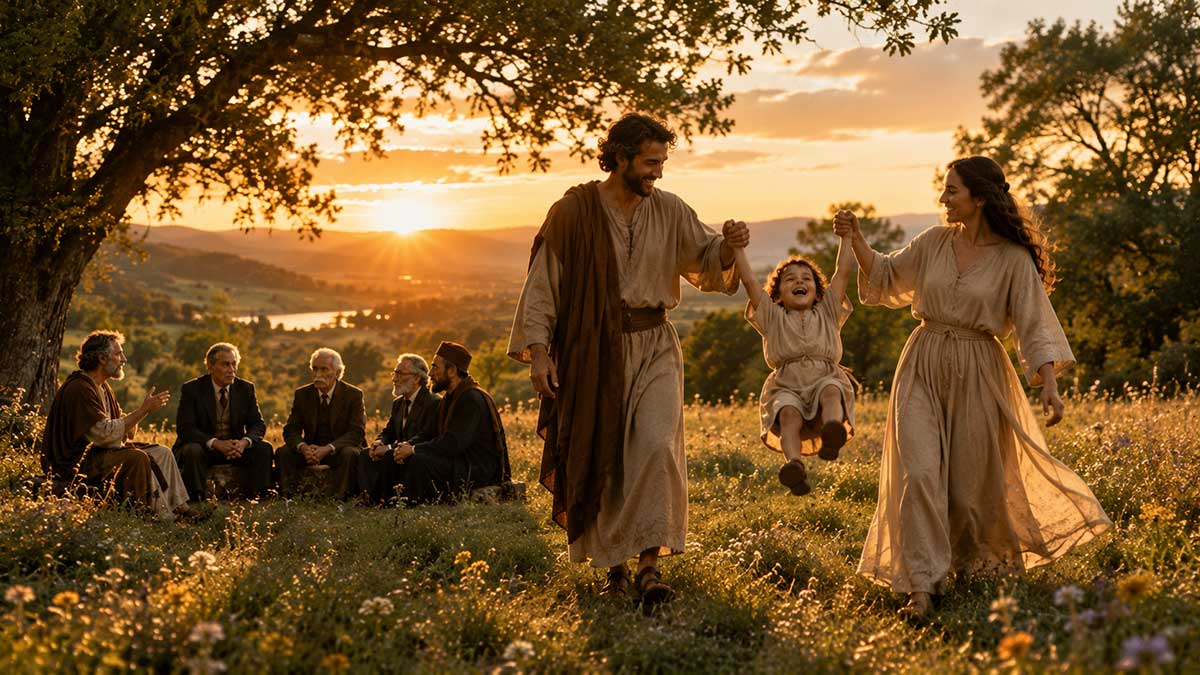
Setting
The marble sculpture near the fireplace now draws everyone’s attention.
A father stands on one side.
A mother stands on the other.
Between them, a child reaches upward, holding both hands.
The fire has burned low, leaving a red glow beneath the ash. Outside, the garden rests under silver moonlight.
Erich Fromm rises and walks slowly toward the sculpture.
Opening
Erich Fromm: We have spoken of man and woman as complementary expressions of humanity. Yet this sculpture points to something beyond complementarity.
It points to parenthood.
A man and woman may love one another deeply, but when they become parents, love takes on a new direction.
It begins to flow toward someone who cannot repay it.
Martin Buber: A child first encounters the world through the face of a parent.
Before the child knows philosophy, law, or religion, the child knows presence.
A voice.
A touch.
A gaze that says, “You belong.”
C. S. Lewis: Then perhaps parenthood offers one of the clearest clues to the character of God.
A true parent does not create a child merely to receive obedience.
The parent longs to see the child grow, become free, love, and find joy.
Hamza Yusuf: Yet human parents are imperfect.
Some abandon their children.
Some control them.
Some cause deep wounds.
We must not construct our idea of God from the failures of human parents.
Carl Jung: That is true.
Yet the failure of parenthood does not erase its ideal.
In fact, the pain caused by a cruel or absent parent suggests that we carry an expectation of what parental love ought to be.
Question 1: Where does parental love come from?
Fromm: Consider the strange nature of parental love.
A baby arrives with nothing to offer.
The child cannot earn food, protection, patience, or affection.
Yet a healthy parent gives all of these freely.
Why?
Aristotle: One might say that the parent recognizes the child as belonging to the parent’s own life.
Lewis: Yes, but it is more than ownership.
A good parent does not say, “You belong to me, so you must become what I demand.”
A good parent says, “Your life came through me, and I want you to become fully yourself.”
Buber: The child is not an object produced by the parent.
The child is a person to be encountered.
Parenthood reaches its highest form when the parent sees the child as a “Thou,” not an extension of the parent’s ego.
Hamza Yusuf: In Islamic teaching, mercy is central to the relationship between God and humanity.
The tenderness a parent feels toward a child can point toward divine mercy, yet God’s mercy is not limited by human weakness.
Jung: Then perhaps parental love is one of the places where human beings come closest to reflecting a love that gives before receiving.
Question 2: What do fatherly and motherly love each reveal?
Lewis: People often speak of God as Father.
That language can express protection, guidance, authority, and responsibility.
Yet what becomes hidden when we use only fatherly language?
Fromm: Motherly love often carries another message.
It says, “You are loved because you exist.”
Not because you succeeded.
Not because you obeyed perfectly.
Not because you earned your place.
Jung: Fatherly love may call the child forward.
Motherly love may assure the child that there is a place from which to begin.
One gives direction.
The other gives rootedness.
Hamza Yusuf: We should avoid treating these qualities as rigidly divided.
Many fathers are tender.
Many mothers are firm.
Still, the two images help us recognize different dimensions of care.
Aristotle: Then fatherhood and motherhood may each reveal part of a larger parental reality.
Neither alone exhausts the meaning of parenthood.
Buber: A child needs both acceptance and guidance.
Love that accepts without guiding may leave the child lost.
Guidance without acceptance may leave the child afraid.
Lewis: Then perhaps divine love holds both perfectly.
A love that says, “You are mine,” and a love that says, “Become who you were created to be.”
Question 3: Does parenthood point to God as the Original Parent?
Fromm returns to his chair.
For a moment, no one speaks.
Fromm: We should now face the central question directly.
If human beings did not invent the capacity for parental love...
If the longing to give life, protect, teach, forgive, and rejoice in a child came from somewhere...
Could its source possess a parental heart?
Aristotle: The reasoning is possible.
An effect may reveal something about its cause.
If parenthood is among the highest forms of human love, then the original source of humanity cannot be entirely unrelated to it.
Hamza Yusuf: I understand the argument, yet I must raise a concern.
A creator is not automatically a parent.
An artisan creates a statue, but the statue is not the artisan’s child.
Lewis: That distinction matters.
The claim cannot rest on creation alone.
Jung: Then it must rest upon resemblance.
A child receives more than existence from the parents.
The child receives nature, capacity, and the possibility of relationship.
Buber: A machine reflects skill.
A child reflects life.
That is the difference.
Fromm: Exactly.
If human beings possess reason, love, conscience, freedom, creativity, and the capacity to become parents themselves, then perhaps we are not merely manufactured objects.
Perhaps we carry qualities that reflect the source from which we came.
Hamza Yusuf: I would still prefer the language of Creator and servant within my own tradition.
Yet I can see why others might use parental language to express intimacy, mercy, and care.
Lewis: And I would say that the word “Parent” does not make God biologically male or female.
It points to the source of both fatherly and motherly love.
Aristotle: Then the argument reaches a new stage.
The first cause may be more than an impersonal beginning.
It may possess intention.
The source of love may possess love.
The source of parenthood may possess a parental heart.
Closing
The fire gives a final soft crack.
Buber looks again at the child in the sculpture.
Buber: A child does not begin life by asking whether the parent exists.
The child begins by reaching.
Lewis watches the shadows move across the stone figures.
Lewis: Then perhaps humanity’s deepest longing is not merely to find a Creator.
Perhaps it is to return to a relationship we have forgotten.
Jung: A longing for home.
Fromm: A longing to be known without being possessed.
Hamza Yusuf: A longing for mercy.
Aristotle: A longing for the source.
Lewis turns toward the others.
Lewis: If God is the original source of parental love, then we must ask the next question carefully.
What does that make us?
Are we servants?
Creations?
Subjects?
Or could we, in some deeper sense, be children?
The library becomes silent again.
The child in the sculpture remains between father and mother, holding both hands.
Topic 5: Are Human Beings Meant to Relate to God as Children?
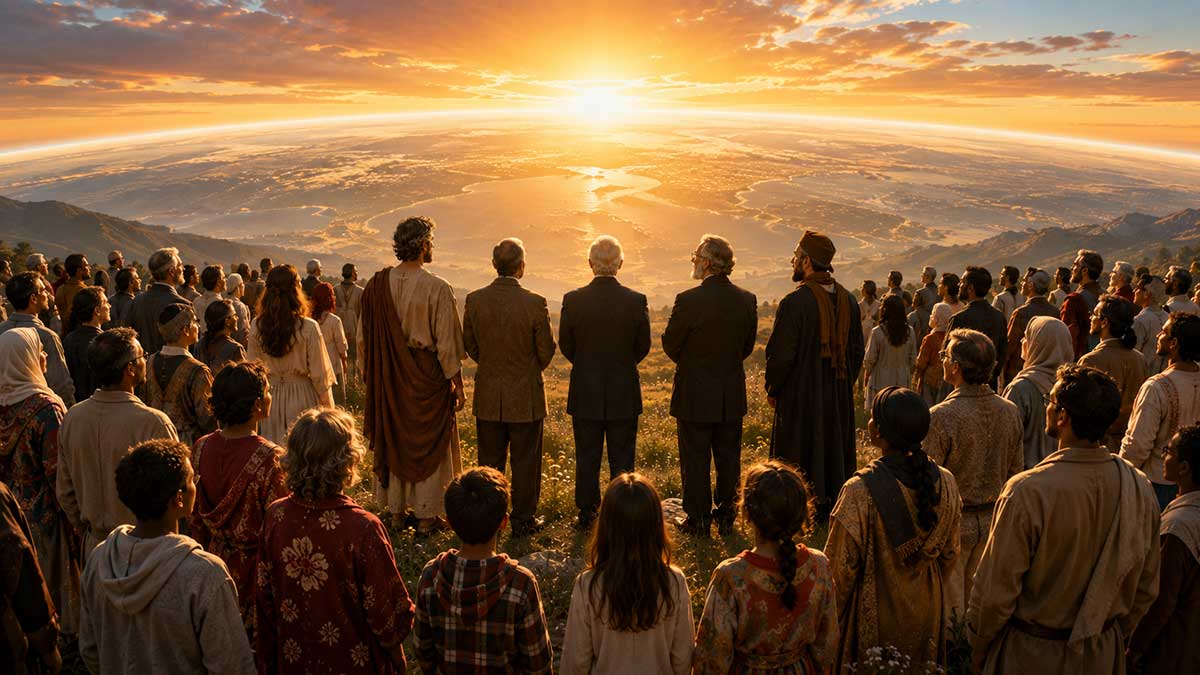
Setting
The fire has gone out.
Only the reading lamps remain, casting warm circles across the long oak table. Outside, the clouds have parted, and the first hint of dawn touches the edge of the sky.
The marble child still stands between the father and mother near the fireplace.
The discussion has reached its most personal question.
Not simply whether God exists.
Not merely what God may be like.
But what human beings are in relation to God.
C. S. Lewis looks around the table.
Opening
C. S. Lewis: We began by asking whether creation points to a source.
Then we asked whether human reason, love, and personality reveal anything about that source.
From there, we considered man and woman, father and mother, and the possibility that parental love reflects something original in God.
Now the question has turned back upon us.
If God is the source of parental love, what are human beings meant to be?
Aristotle: Created beings, certainly.
Hamza Yusuf: Servants of God, responsible for how they live.
Martin Buber: Persons capable of entering a living relationship with the divine.
Erich Fromm: Beings who long to love and to be loved without losing freedom.
Carl Jung: And perhaps children who have forgotten where they came from.
Hamza Yusuf looks toward Jung.
Hamza Yusuf: That word—“children”—requires care.
In Islam, human beings are not children of God. God does not beget, nor is God begotten. The language of Creator and servant preserves the distinction between God and creation.
Lewis: That is a serious objection.
Then perhaps we must ask what people mean when they call human beings children of God.
Do they mean biological descent?
Divine equality?
Or a relationship of origin, resemblance, love, and responsibility?
Question 1: What is the difference between being God’s creation and being God’s child?
Aristotle: Let us begin with the distinction already raised.
A craftsman may create a chair.
The chair is the craftsman’s work, but not the craftsman’s child.
What makes a child different?
Fromm: A child is not merely shaped from the outside.
The child receives life and possesses the capacity to grow into a free person.
A chair can fulfill a function.
A child can enter into love.
Jung: The child carries something of the parents within.
Not only physical traits.
Temperament.
Possibilities.
Patterns of feeling.
A living inheritance.
Buber: And the parent does not seek only usefulness from the child.
The deepest parental desire is relationship.
The child is not valuable for what the child produces.
The child is valuable as a person.
Lewis: Then the word “child” suggests more than dependence.
It suggests resemblance, belonging, growth, freedom, and love.
Hamza Yusuf: Yet resemblance must never erase distinction.
A human being may reflect mercy without possessing divine mercy in its fullness.
A person may love, yet God remains beyond all comparison.
Lewis: Agreed.
Calling humanity children of God need not mean that human beings are pieces of God.
It may mean that our deepest capacities came from God and were created for a personal relationship with God.
Question 2: Is obedience the deepest purpose of religion, or is love?
Hamza Yusuf: Obedience should not be dismissed.
A child who loves a wise parent does not treat guidance as oppression.
Submission to God can be an act of trust.
Fromm: True, but obedience can become dangerous when fear is mistaken for faith.
A person may follow commands without ever becoming loving, mature, or free.
Aristotle: Virtue cannot be reduced to rule-following.
A good person eventually learns to desire what is good.
Buber: Relationship changes obedience.
A command from a stranger feels different from guidance offered by someone whose love is trusted.
Lewis: That may be the distinction between a servant and a child.
A servant asks:
“What must I do to avoid punishment?”
A child asks:
“How can I respond to the love I have received?”
Hamza Yusuf: Yet a servant of God can love God deeply.
Servanthood need not mean distance or fear.
It can express humility, gratitude, and devotion.
Lewis: Then perhaps the two images reveal different truths.
“Servant” reminds us that God is not ours to control.
“Child” reminds us that divine love may be more intimate than duty alone can express.
Jung: Trouble begins when one image is treated as complete.
If God is only ruler, the soul may live in fear.
If God is only indulgent parent, moral responsibility may disappear.
A mature relationship requires both love and responsibility.
Question 3: How would the world change if every person were seen as a child of the same divine Parent?
Buber looks toward the tall windows.
The sky beyond them is slowly turning gray.
Buber: This may be the most demanding question of all.
It is easy to speak of humanity as one family.
It is harder to live as though it were true.
Fromm: If every person belongs to the same divine family, then no human being can be reduced to a race, nation, class, religion, or political category.
Aristotle: Society would no longer be merely an arrangement of competing interests.
It would carry a moral purpose.
Lewis: We might still disagree strongly.
Brothers and sisters do.
Yet disagreement would no longer justify contempt.
Hamza Yusuf: The belief that every person stands before the same Creator already carries this moral demand.
The orphan, stranger, enemy, and poor person possess dignity that does not depend upon status.
Jung: Humanity often projects its rejected qualities onto outsiders.
We call another group evil so that we do not have to confront evil within ourselves.
Seeing others as members of one family would force us to withdraw those projections.
Buber: It would require us to meet the other person as a “Thou.”
Not as a problem.
Not as a label.
Not as an obstacle.
As a person whose existence carries sacred value.
Fromm: Yet family language can be sentimental.
Families can become controlling, tribal, and exclusionary.
The idea matters only if it expands love beyond the people closest to us.
Lewis: Then the test is simple.
Does belief in one divine Parent make us more capable of loving people who are difficult to love?
If it does not, the belief has remained only a beautiful phrase.
The Strongest Objection
Hamza Yusuf folds his hands.
Hamza Yusuf: I want to return once more to the central concern.
Calling God “Parent” may comfort many people.
Yet it may invite them to project human family structures onto the divine.
Some had cruel fathers.
Some had absent mothers.
Some experienced family as the source of their deepest wounds.
Why should this image help them?
Jung: Every sacred image can be wounded by human experience.
A person harmed by a father may fear the phrase “God the Father.”
A person rejected by family may resist the idea of divine family.
That does not make the image false, but it means the image must be healed.
Fromm: Perhaps God should not be understood through our damaged parents.
Perhaps healthy parenthood should be understood through the highest love we can conceive.
Lewis: We are not saying:
“God is like every human parent.”
We are saying:
“Every true expression of parental love may be a faint reflection of its source.”
Buber: The divine relationship may judge human parenthood rather than merely imitate it.
Where human parents possess, God calls toward freedom.
Where human parents abandon, God remains present.
Where human parents demand perfection before giving love, divine love may begin before merit.
Hamza Yusuf: I can respect that distinction, though I would still speak in different terms.
Aristotle: Then agreement on every title may be less important than clarity about the reality being described.
Final Exchange
The first light of morning reaches the windows.
Lewis stands and walks toward the marble sculpture.
He looks at the child holding the hands of both parents.
Lewis: Perhaps humanity’s tragedy is not that we have forgotten a doctrine.
Perhaps we have forgotten a relationship.
Jung: We have lived as orphans in a universe we assumed was indifferent.
Fromm: Or as servants afraid of disappointing a master.
Buber: Or as isolated selves unable to recognize one another.
Hamza Yusuf: Yet every path of sincere faith calls the human being back to humility, mercy, gratitude, and responsibility before God.
Aristotle: Then the question is no longer merely:
“What caused us?”
It becomes:
“For what kind of life were we caused?”
Lewis turns back toward the table.
Lewis: If the source of life contains the origin of reason, love, masculinity, femininity, fatherhood, and motherhood...
Then perhaps human beings were not created merely to exist beneath God.
Perhaps we were created to grow in love with God.
To reflect that love.
And to recognize one another as members of one human family.
Buber rises from his chair.
Buber: A child discovers the parent by being loved.
Perhaps humanity will discover God in the same way.
Fromm: And perhaps we will prove that discovery by learning to love one another.
The library falls silent.
Morning light fills the room.
The sculpture no longer appears to show three separate figures.
From where the guests stand, the father, mother, and child form one unbroken circle.
The final question remains:
“If every person is loved by the same divine Parent, what would it require of us to live as one family?”
Final Thoughts
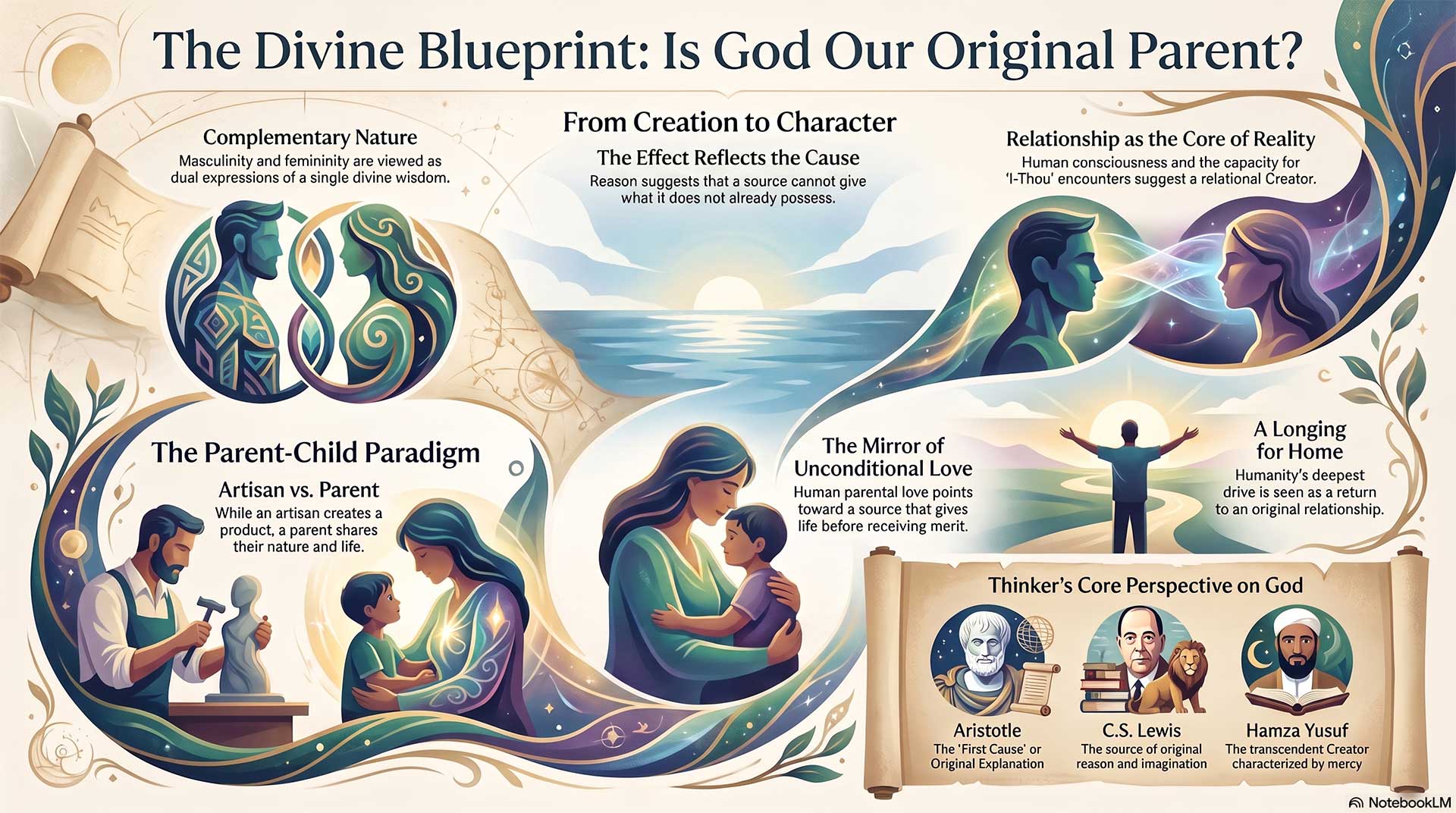
Every civilization has asked where we came from.
Far fewer have asked what kind of relationship our origin suggests.
If the universe points toward intelligence, we naturally speak of a Creator.
If conscience points toward goodness, we speak of a moral source.
If love points toward something greater than survival, we begin to glimpse a heart behind reality.
This conversation takes one more step.
It asks whether fatherhood and motherhood, expressed imperfectly through human beings, might reflect an original love that existed before any human family.
The guests do not agree on every conclusion.
Some prefer to speak of humanity as servants of God.
Others emphasize the language of children.
Some urge great caution whenever human experience is used to describe the divine.
Those differences enrich the discussion rather than weaken it.
Perhaps the greatest value of this conversation is not that it settles every theological question.
It reminds us that the way we understand God inevitably shapes the way we understand one another.
If we see one another merely as competitors, strangers, or members of opposing groups, our world will continue to fracture.
If we learn to recognize the dignity that every human being possesses, whatever language we use for our relationship with God, our lives begin to change.
The conversation ends where every meaningful search should end—not with certainty that leaves no room for thought, but with a question that remains alive:
What kind of world might we build if we truly believed that every human life comes from the same ultimate source and deserves the same measure of love, dignity, and respect?
Short Bios:
Aristotle (384–322 BC)
One of history's greatest philosophers, Aristotle developed foundational ideas in logic, ethics, metaphysics, and natural philosophy. His concept of the "First Cause" has influenced Jewish, Christian, Islamic, and secular philosophy for more than two thousand years.
C. S. Lewis (1898–1963)
A British writer, literary scholar, and Christian thinker, Lewis is best known for Mere Christianity, The Chronicles of Narnia, and The Problem of Pain. His work continues to inspire readers by combining reason, imagination, and faith.
Carl Jung (1875–1961)
The Swiss psychiatrist who founded analytical psychology, Jung explored archetypes, symbolism, the collective unconscious, and the complementary dimensions of human personality. His ideas continue to shape psychology, philosophy, and religious studies.
Martin Buber (1878–1965)
An Austrian-Israeli Jewish philosopher best known for I and Thou, Buber argued that authentic life is grounded in genuine relationships—with other people and ultimately with God.
Hamza Yusuf (1958–Present)
An American Islamic scholar and co-founder of Zaytuna College, Hamza Yusuf is widely respected for presenting classical Islamic thought to contemporary audiences. His work emphasizes spiritual depth, intellectual humility, ethics, and thoughtful dialogue between faith traditions.
Leave a Reply