
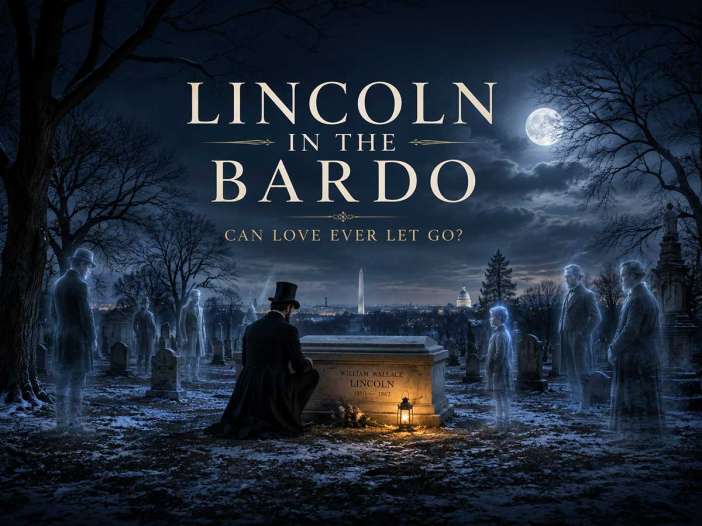
What if Abraham Lincoln could speak to Willie one last time?
There are novels that tell a story.
There are novels that explore an idea.
And then there are rare novels that ask us to sit quietly beside one of life's deepest mysteries.
Lincoln in the Bardo is one of those books.
At first glance, it appears to be about Abraham Lincoln mourning the death of his eleven-year-old son, Willie. But George Saunders has written something far more profound than historical fiction. He invites us into an imagined world where the living and the dead exist side by side, separated not only by death but also by their inability to let go.
This is not simply a novel about ghosts.
It is a novel about grief.
About unfinished love.
About regret.
About hope.
About the stories we tell ourselves because the truth is too painful to face.
Tonight's conversation imagines what might have happened if Abraham Lincoln, Willie, and the spirits who surrounded him could finally speak openly with one another. Together they explore questions every human being eventually asks:
How do we survive the loss of someone we love?
When does holding on become refusing to live?
Can love continue after death without trapping either the living or the dead?
These questions have no easy answers.
But perhaps, like the spirits in Saunders' remarkable novel, we discover that healing begins not when every mystery is solved, but when we become willing to face it together.
Welcome to another Imaginary Talk.
(Note: This is an imaginary conversation, a creative exploration of an idea, and not a real speech or event.)
Topic 1 — The Night a Father Returned
Opening
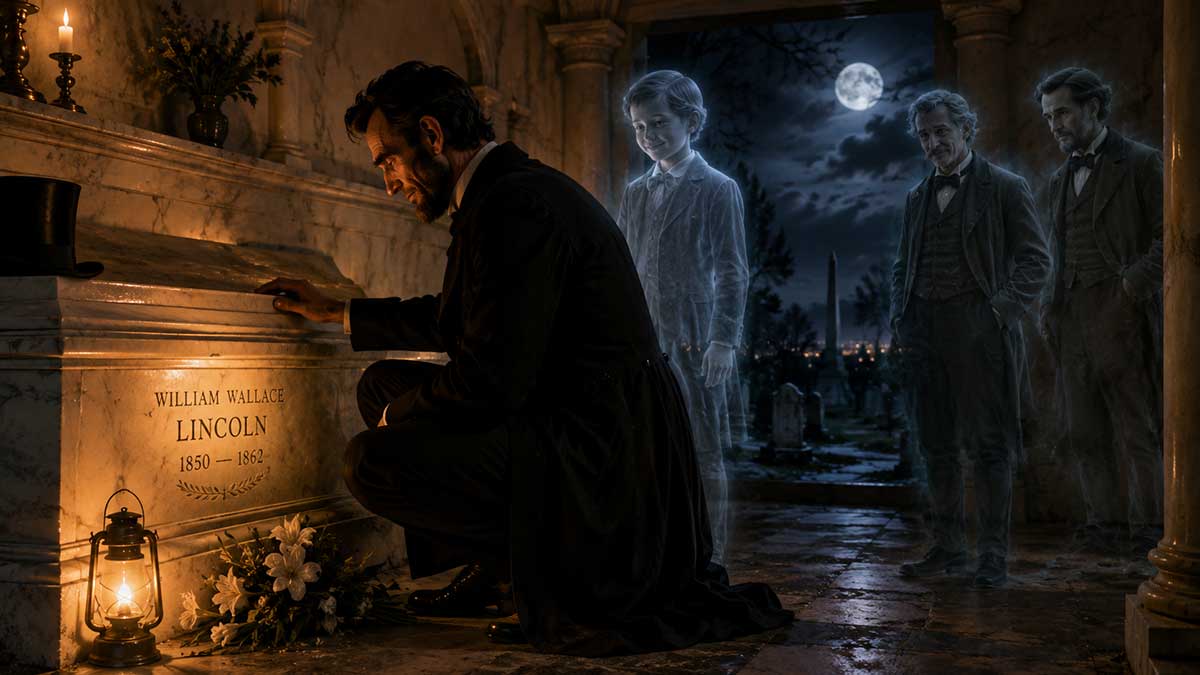
It is a bitterly cold February evening in 1862.
Snow has settled across the quiet cemetery, softening every sound except the slow footsteps of a lone visitor.
Washington is consumed by war.
Telegraph wires carry news of battles.
Generals argue over strategy.
Families across the nation wait anxiously for letters that may never come.
Yet one man has slipped away from the White House.
He carries no guards.
No generals follow him.
No one calls him "Mr. President."
Tonight, he is simply a father.
Abraham Lincoln walks toward the stone crypt where his beloved eleven-year-old son, Willie, was laid to rest only days before.
Inside the cemetery, unseen by every living soul, spirits gather in silence.
Hans Vollman straightens his coat and removes his hat.
Roger Bevins III watches with a tenderness that surprises even himself.
Young Willie, still unable to understand what has happened to him, hears the familiar footsteps and feels hope awaken.
"He came back..."
he whispers.
Standing quietly nearby is George Saunders.
He lets the silence linger before speaking.
George Saunders:
"History remembers presidents by speeches, victories, and decisions.
But before Abraham Lincoln became a symbol...
he was a father whose heart had been broken.
Tonight, I'd like us to forget history for a little while.
Let's simply ask...
What happened here that night?"
Question 1
George Saunders
Abraham, when you returned to the cemetery, were you trying to say goodbye... or were you hoping that somehow goodbye wasn't real?
Abraham Lincoln
When Willie died, the world continued as though nothing had happened.
Cabinet meetings were still held.
The war did not pause.
Men continued dying by the hundreds.
Everyone expected me to continue leading.
And I did.
But inside...
time had stopped.
I knew my son had died.
My mind accepted it.
A father's heart does not surrender so easily.
When I came here...
I was not expecting a miracle.
I simply needed to be close to him once more.
Sometimes love asks for one more moment...
even when reason says there cannot be one.
Willie Lincoln
I heard Father before I saw him.
I knew his footsteps.
Children always know.
I thought,
"He found me."
I didn't understand why everyone had been crying.
I didn't understand why no one answered when I spoke.
But Father came.
He held me again.
For a little while...
everything felt normal.
I thought perhaps we could go home together.
Hans Vollman
Watching Mr. Lincoln that night...
none of us spoke.
Even those who rarely stopped talking became silent.
We had seen grief before.
But this was different.
It was pure.
There was no pride.
No power.
No presidency.
Only a father holding his child.
I remember thinking...
If love has weight...
it must be heavier than stone.
Roger Bevins III
I could scarcely bear to watch.
Not because it was painful.
Because it was beautiful.
Grief strips away every disguise.
A king.
A laborer.
A president.
A farmer.
They all cry exactly the same.
There is something strangely comforting in that.
Love makes equals of us all.
Question 2
George Saunders
Willie, when your father held you that night, what did you believe was happening?
Willie Lincoln
I thought he had come to take me home.
Children don't think about forever.
We think about tomorrow.
I kept waiting for someone to explain everything.
No one did.
So I made my own explanation.
Father would return.
Mother would smile again.
I'd sleep in my own bed.
Life would continue.
Isn't that what children always believe?
Abraham Lincoln
The hardest part of losing a child...
is realizing they never had the chance to understand why.
Adults speak about death.
Children simply wonder why everyone disappeared.
That thought haunted me.
I wanted one more conversation.
One more laugh.
One more embrace.
Not because it would change anything...
but because fathers are never finished loving their children.
Hans Vollman
Perhaps that is why so many of us remained.
Not because we feared death.
Because we could not imagine love ending.
Roger Bevins III
And yet...
perhaps love never asked to end.
Perhaps only our presence changes.
Question 3
George Saunders
If you could relive that night knowing everything you know now... would you do anything differently?
Abraham Lincoln
No.
I would still come.
I would still hold him.
I would still cry.
Grief is not something to be corrected.
It is simply love with nowhere to go.
I have stopped wishing I had loved Willie less.
I only wish I had more years in which to love him.
Willie Lincoln
I think...
I would tell Father not to worry about me.
Children don't like seeing their parents cry.
Even when we don't understand why.
I would tell him...
"I'm still your son."
Hans Vollman
I would tell myself to stop fearing love's ending.
Love does not end.
Only our way of holding it changes.
Roger Bevins III
I would remember every small moment.
The sunlight.
The laughter.
The ordinary days.
When we lose someone...
we discover those ordinary days were miracles all along.
Closing
George Saunders:
History often remembers that Abraham Lincoln visited his son's tomb.
What history cannot record...
is the silence between a father and a child.
Tonight we have imagined that silence.
Not to rewrite history...
but to honor something history cannot measure.
The depth of a father's love.
As Lincoln slowly walks back toward the White House, he does not leave Willie behind.
He carries him.
Not in his arms anymore...
but in every decision he will make for the rest of his life.
Behind him, the cemetery grows quiet once again.
Willie watches until his father disappears into the darkness.
For the first time...
he begins to understand that love is not measured by how tightly we hold someone.
Sometimes...
it is measured by how faithfully we carry them forward.
Topic 2 — Why the Dead Refuse to Leave
Opening
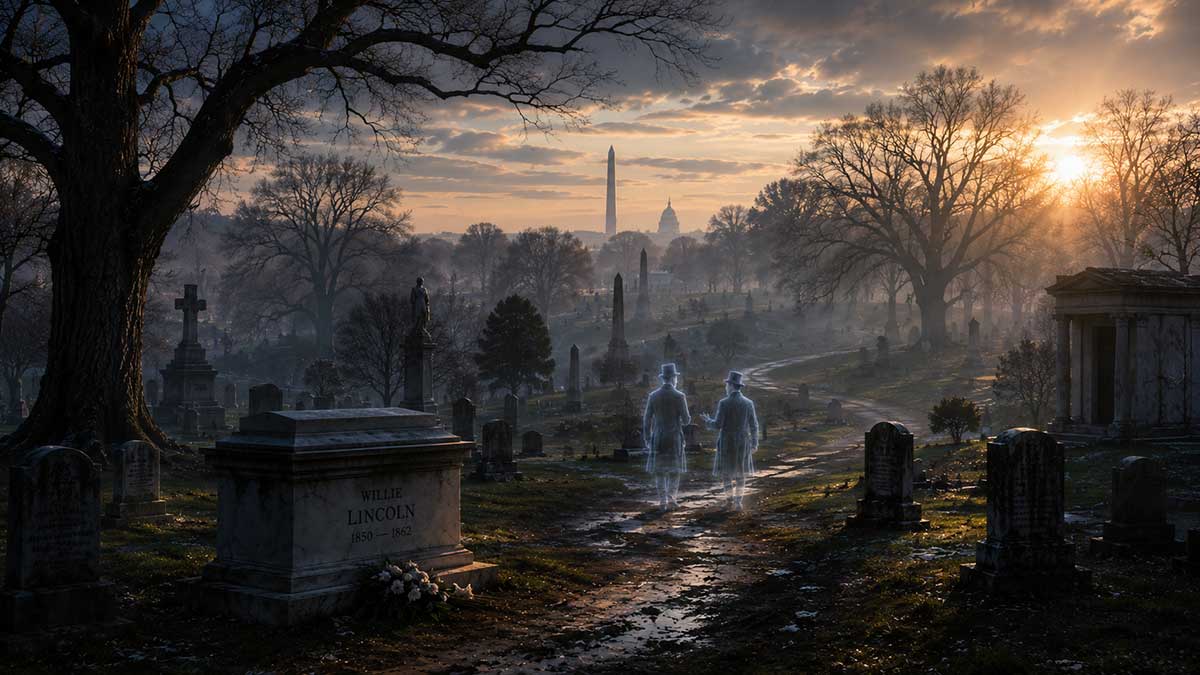
The cemetery has grown quieter.
Abraham Lincoln has returned to the White House, carrying a grief no one can lighten.
But beneath the bare trees, another struggle continues.
The spirits remain.
Days pass.
Then weeks.
Yet no one leaves.
Some still insist they are merely ill.
Others speak endlessly of unfinished plans.
A few avoid the truth altogether.
Only young Willie begins asking questions no one wishes to answer.
George Saunders looks around at the gathered spirits.
Their conversations are lively.
Their excuses are convincing.
But beneath every word lies a fear none of them dare name.
He breaks the silence.
George Saunders:
"Abraham Lincoln could not bear to let Willie go.
But perhaps there is another question we should ask tonight.
Why can't the dead let go of life?"
The spirits glance at one another.
For the first time...
no one answers immediately.
Question 1
George Saunders
Hans, you've often spoken as though you're simply recovering from an illness. Why was it easier to believe that than to admit you had died?
Hans Vollman
Because the alternative was unbearable.
One evening I was full of plans.
I was newly married.
I imagined years of laughter with my wife.
The next...
everything stopped.
How could a life end before it had truly begun?
So I told myself I was merely resting.
That this was temporary.
Hope can become a wonderful comfort.
But sometimes...
it also becomes the strongest prison.
Roger Bevins III
Hans wasn't alone.
None of us arrived here prepared.
Death interrupted sentences that were never finished.
Dreams that had barely begun.
I think we stayed because our hearts kept insisting,
"There must be another chapter."
Willie Lincoln
I never thought I had died.
I simply wondered why no one answered me.
I kept waiting for someone to explain.
Children trust grown-ups.
When no explanation came...
I created my own.
I thought everyone had simply forgotten where I was.
Reverend Everly Thomas
Denial is merciful...
for a little while.
Truth arrives slowly.
Sometimes too slowly.
Sometimes not at all.
And every day we refuse to see reality...
our fear grows larger than reality itself.
Question 2
George Saunders
Roger, you often speak with wonder about flowers, light, music, and even ordinary moments. Why did the beauty of life become clearer only after you lost it?
Roger Bevins III
Because while living...
I believed beauty would always be there.
Tomorrow.
Next week.
Next year.
Only after losing life did I understand how extraordinary an ordinary afternoon really is.
The warmth of sunlight.
The laughter of strangers.
The smell after rain.
We rush past miracles because we assume they'll return tomorrow.
Life makes no such promise.
Hans Vollman
He's right.
I spent my life looking toward the future.
Marriage.
Children.
Growing old.
I scarcely appreciated the simple joy of waking beside someone I loved.
Perhaps the greatest tragedy isn't dying.
It's discovering too late how beautiful life already was.
Willie Lincoln
I miss the little things.
Running through the halls.
Mother reading to me.
Father smiling when he thought no one was watching.
Those moments seemed ordinary then.
Now...
they feel like treasures.
Reverend Everly Thomas
The living often imagine eternity will solve every longing.
Yet eternity cannot replace one unfinished embrace.
That is why every day deserves reverence.
Question 3
George Saunders
If the only thing keeping you here is your unwillingness to accept what has happened... what would it take for you to move forward?
Hans Vollman
Perhaps...
forgiving life.
It did not unfold as I imagined.
But perhaps no life ever does.
Roger Bevins III
For me...
it would mean believing that memory is enough.
That I don't have to cling to every moment in order to honor it.
Willie Lincoln
I think...
I'm afraid Father will come back and not find me.
If I leave...
will he think I abandoned him?
Reverend Everly Thomas
That is the question every soul eventually faces.
Do we remain because love asks us to...
or because fear tells us to?
The two can feel almost identical.
Only courage reveals the difference.
Closing
George Saunders:
Tonight we've discovered something unexpected.
The cemetery is not held together by death.
It is held together by unfinished love...
unfinished dreams...
unfinished acceptance.
Perhaps the greatest walls are never built from stone.
They are built from the stories we tell ourselves when we are not yet ready to face the truth.
As the winter wind moves through the trees, the spirits grow quiet.
For the first time, Willie wonders whether waiting for his father is helping either of them.
Hans lowers his eyes, no longer certain that his "sick-box" is merely temporary.
Roger watches a single snowflake drift to the ground and smiles sadly at its brief beauty.
No one has moved on.
But tonight...
each has taken the first step toward seeing why they have remained.
Topic 3 — Is Love Helping Willie… or Holding Him Back?
Opening
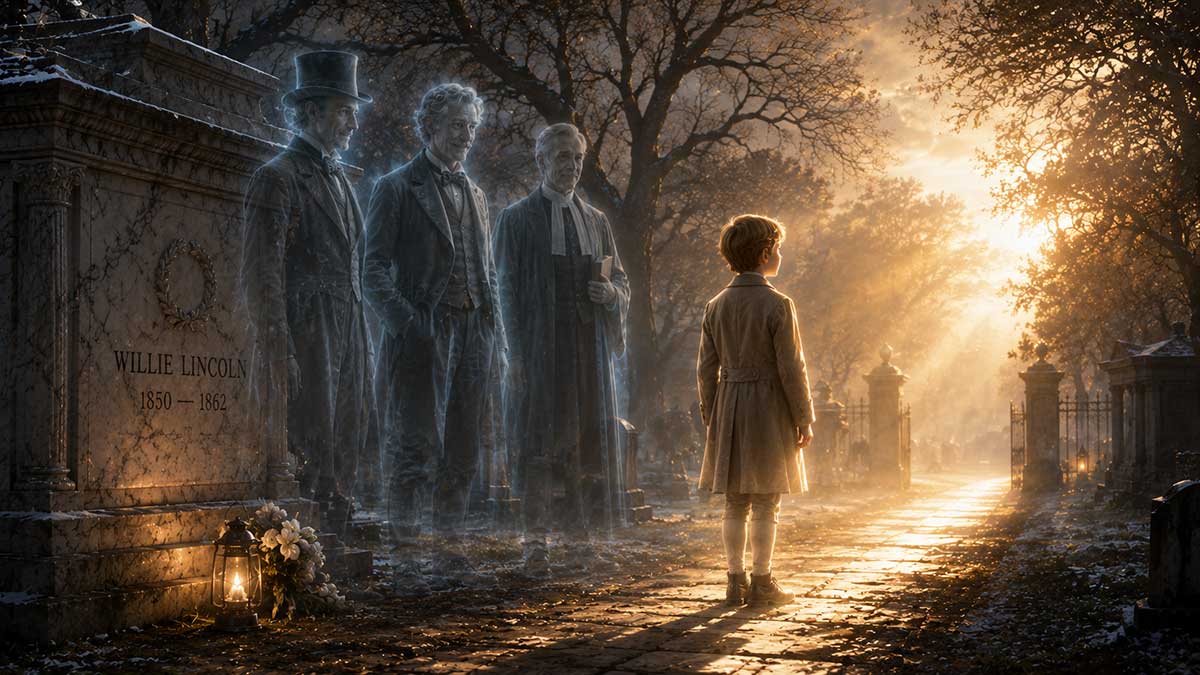
The days no longer matter.
Morning and evening blur together in the quiet cemetery.
The living continue with their lives.
The war grows bloodier.
Children are born.
Families gather around dinner tables.
Spring slowly begins to replace winter.
Yet here...
nothing seems to change.
Willie still waits.
Hans still dreams of returning to his wife.
Roger still wanders among memories too beautiful to release.
The Reverend Everly Thomas watches them all with growing concern.
George Saunders looks at the young boy standing near the crypt.
He asks gently,
George Saunders:
"Love brought everyone together here.
But tonight I'd like to ask a difficult question.
Can love itself become the thing that keeps us from moving forward?"
A long silence follows.
No one wants to answer first.
Question 1
George Saunders
Willie, what are you most afraid of if you leave this place?
Willie Lincoln
I'm afraid...
Father will come back.
He'll open the door.
He'll call my name.
And I won't be here.
He already lost me once.
I don't want him to lose me again.
Sometimes I think...
if I stay...
he'll never truly be alone.
Hans Vollman
Willie...
that is exactly how many of us began.
We stayed for someone.
A wife.
A child.
A promise.
At first it felt noble.
Then...
the days became years.
Without realizing it...
our love slowly became our excuse.
Roger Bevins III
I understand Willie.
Leaving feels like betrayal.
If we move on...
does it mean we loved less?
I've asked myself that question countless times.
Perhaps because I never found the answer.
Reverend Everly Thomas
There is a difference...
between remaining faithful...
and remaining imprisoned.
The difficulty is that, from the inside, they feel almost identical.
Question 2
George Saunders
Hans and Roger, are you helping Willie because you truly want what's best for him... or because seeing him leave would force you to confront your own fears?
Hans Vollman
...
I wish I could answer immediately.
But I cannot.
When Willie arrived...
he gave us purpose.
Protecting him felt meaningful.
If he leaves...
what becomes of us?
Perhaps I have been helping him.
Perhaps...
I've also been hiding behind him.
That realization pains me.
Roger Bevins III
I never wanted Willie to suffer.
Never.
But Hans is right.
Watching someone else find courage often exposes our own lack of it.
Maybe I encouraged Willie to stay...
because I wasn't ready to admit I should leave as well.
Willie Lincoln
I never knew...
I thought everyone simply liked having me here.
I didn't know...
my staying could hurt you too.
Reverend Everly Thomas
Love that asks another person to remain trapped...
even unintentionally...
ceases to be pure love.
It becomes fear wearing love's clothing.
Question 3
George Saunders
If letting go is an act of love... what does that actually look like?
Willie Lincoln
Maybe...
letting go doesn't mean forgetting.
Maybe Father can still love me...
without holding me.
And maybe...
I can still love Father...
without waiting here forever.
I had never thought that was possible.
Hans Vollman
Perhaps love matures.
When we're young...
love says,
"Stay with me."
Later...
love learns to say,
"I'll be all right."
That may be the hardest sentence love ever speaks.
Roger Bevins III
I once believed beauty existed only in things that lasted.
Now I wonder if beauty exists precisely because nothing lasts.
A sunset.
A child's laughter.
A father's embrace.
Their brevity is part of their preciousness.
Reverend Everly Thomas
Every soul eventually discovers this truth.
Love is not measured by possession.
Nor by proximity.
Nor by time.
Love is measured by its willingness to seek the good of another...
even when that good requires separation.
Closing
George Saunders:
Tonight, something changed.
No gates opened.
No heavenly light appeared.
No spirit departed.
And yet...
the cemetery feels different.
Willie no longer sees leaving as abandoning his father.
Hans begins to question whether he has mistaken fear for devotion.
Roger realizes that beauty was never meant to be captured...
only cherished.
Even Reverend Thomas, who has long understood these truths, seems hopeful for the first time.
Perhaps freedom does not begin with taking a step.
Perhaps it begins with changing the story we tell ourselves about love.
As Willie gazes toward the White House in the distance, he no longer waits for his father to return.
Instead...
he quietly hopes his father will find the strength to keep living.
And somewhere beyond the cemetery, Abraham Lincoln—without knowing why—feels just a little lighter, as if his son's love has begun reaching him in a new way.
Topic 4 — A President’s Private Grief and a Nation’s Suffering
Opening
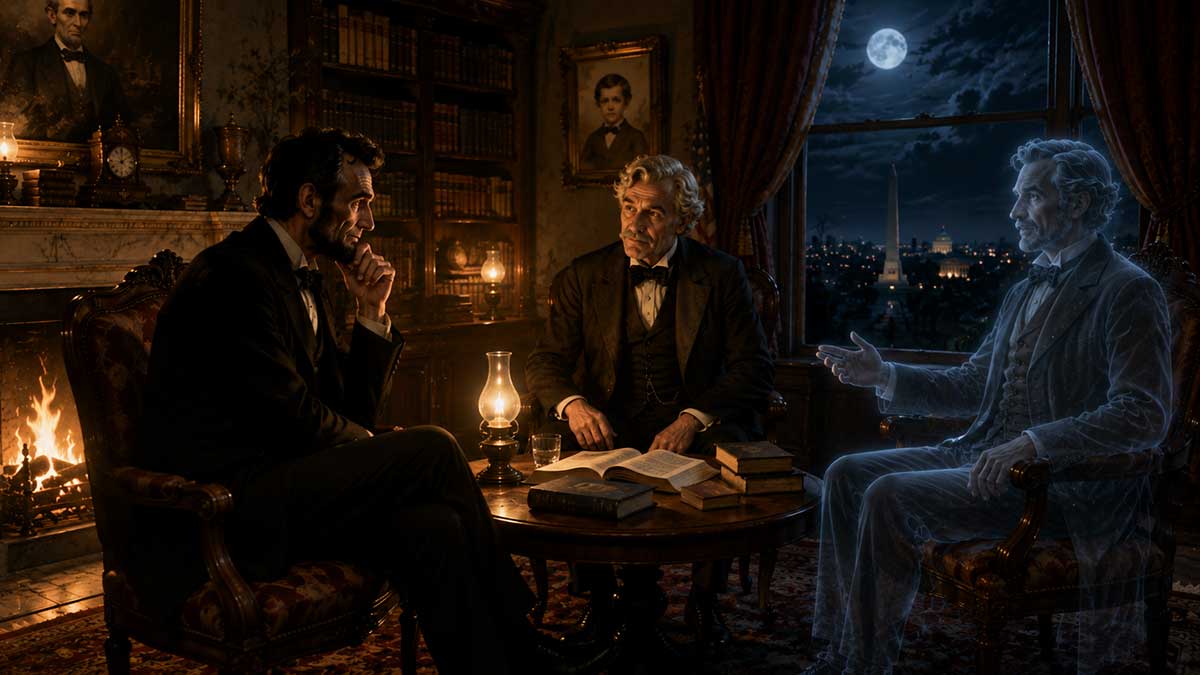
Beyond the cemetery walls, Washington does not sleep.
Telegraph machines click through the night.
Messengers hurry between offices carrying battlefield reports.
Maps are spread across tables beneath candlelight.
Each mark represents a regiment.
Each regiment represents fathers, husbands, brothers, and sons.
The numbers continue to rise.
But numbers are easier to read than names.
Names are easier to read than faces.
And faces are easier to bear when they do not belong to your own child.
Abraham Lincoln stands alone near the cemetery gate.
He has returned once more, not because he expects to find Willie waiting, but because grief has made this place part of him.
Willie watches from a distance.
Hans Vollman and Roger Bevins III remain nearby, unusually quiet.
George Saunders turns toward Lincoln.
George Saunders:
“Mr. Lincoln, the country remembers you as the president who carried a nation through war.
But before you could carry the grief of thousands of families, you first had to carry your own.
Tonight, I want to ask what happened when those two sorrows met.”
Question 1
George Saunders
Abraham, did losing Willie change the way you understood the soldiers dying under your command?
Abraham Lincoln
Before Willie died, I understood the war in the language expected of a president.
Troops.
Positions.
Casualties.
Objectives.
I knew each number represented a life.
I believed I understood that.
But knowledge is not the same as feeling.
After Willie died, every casualty report changed.
One dead soldier was no longer one less man in a regiment.
He was an empty chair.
A mother waiting for footsteps that would never return.
A father keeping a son’s coat because he could not bear to move it.
A younger brother asking when the war would give him back.
Willie’s death did not teach me that soldiers were human.
I knew that already.
It taught me how much suffering can hide inside a single name.
Willie Lincoln
Father used to come home tired.
Even before I became ill.
Sometimes he would sit very still and stare at nothing.
I thought he was only thinking about work.
Now I wonder whether he was imagining all the people who would not come home.
After I died, perhaps he did not have to imagine anymore.
Hans Vollman
The living often protect themselves with numbers.
Ten dead feels distant.
A thousand feels impossible.
But one beloved person...
one is enough to reveal the whole tragedy.
Roger Bevins III
Grief makes the imagination more dangerous.
Once you know what one death does to a family, you can no longer read of thousands without hearing thousands of separate cries.
Perhaps that is why great sorrow can deepen compassion.
Not because suffering is good.
But because it destroys the illusion that other people’s pain is somehow smaller than our own.
Question 2
George Saunders
How can a grieving person continue carrying responsibilities that cannot be postponed?
Abraham Lincoln
Poorly, at first.
There is a temptation to believe leadership means becoming untouched.
It does not.
There were mornings I wished the country would stop asking things of me.
I wanted time to mourn.
But history does not offer private appointments.
The war continued.
Decisions had to be made.
Men would live or die whether I felt prepared or not.
So I learned that duty is not the absence of grief.
It is choosing to act while grief remains beside you.
Some days I led with clarity.
Some days I merely endured until night.
That, too, was part of leadership.
Willie Lincoln
Did you ever feel angry with me?
Because I left when you needed me?
Abraham Lincoln
Never with you.
Perhaps with God.
Perhaps with the world.
Perhaps with myself.
But never with you.
A child does not betray his father by dying.
Still, grief is not always reasonable.
It searches for someone to blame because helplessness is harder to bear than anger.
Hans Vollman
Many of us believed pain excused us from moving forward.
We thought suffering had suspended every obligation.
But life rarely waits until the heart is ready.
The living still need food.
Children still need care.
Nations still require decisions.
Perhaps courage is not feeling strong.
Perhaps it is answering what must be answered while feeling entirely broken.
Roger Bevins III
And sometimes continuing is not heroic.
Sometimes it is simply getting out of bed.
Reading one letter.
Speaking kindly to one person.
Taking the next necessary step.
History celebrates grand acts.
But a grieving person survives through very small ones.
Question 3
George Saunders
Did Willie’s death weaken Lincoln, or did it deepen his ability to understand the suffering of the country?
Willie Lincoln
I do not want my death to be called useful.
I did not die so Father could become a better president.
I wanted to live.
I wanted to grow older.
I wanted more days with my family.
Abraham Lincoln
You are right, Willie.
No father should turn the death of his child into a lesson that justifies the loss.
Your death was not necessary.
It was not a gift disguised as tragedy.
It was tragedy.
If it changed me, that does not make it good.
It only means I had to decide what kind of man would carry it.
Grief weakened me in many ways.
It made concentration difficult.
It brought darkness into every room.
But it also broke something open.
After losing you, I could no longer place the suffering of strangers at a comfortable distance.
Their pain entered my own house.
Hans Vollman
Perhaps suffering can do two things at once.
It can wound us...
and make us more capable of seeing wounds in others.
But the second does not cancel the first.
Roger Bevins III
Yes.
We must be careful not to praise suffering merely because some people become compassionate through it.
Many are crushed.
Some become bitter.
Some never recover.
The nobility lies not in the pain itself...
but in what a person chooses to do after pain has arrived.
George Saunders
And what did you choose, Abraham?
Abraham Lincoln
To keep going.
Not because I had conquered grief.
Because the country was full of families entering the same darkness.
I could not save them all.
I could not even save my own son.
But I could try to lead in a way that remembered the cost of every decision.
That became part of Willie’s presence in my life.
Not a justification for his death.
A responsibility created by my love for him.
Closing
George Saunders:
Tonight, the father and the president no longer appear as separate men.
The father feels every loss.
The president must still make decisions that cause more families to grieve.
There is no simple resolution to that contradiction.
Private sorrow does not automatically produce wisdom.
Leadership does not erase personal pain.
And tragedy should never be romanticized simply because meaning can later emerge from it.
Willie’s death did not make the war noble.
It did not make Lincoln invulnerable.
It made suffering personal.
As Lincoln looks toward the distant lights of Washington, Willie moves closer.
He cannot take the burden from his father.
He cannot return to the White House.
But he can understand something he could not before.
His father’s grief is no longer confined to one tomb.
It has become part of how Lincoln sees every mother, every father, and every child touched by the war.
Lincoln turns back toward the city.
The president must return to his duty.
The father goes with him.
And this time, neither part of the man is left behind.
Topic 5 — What Must Be Released, and What Can Remain?
Opening
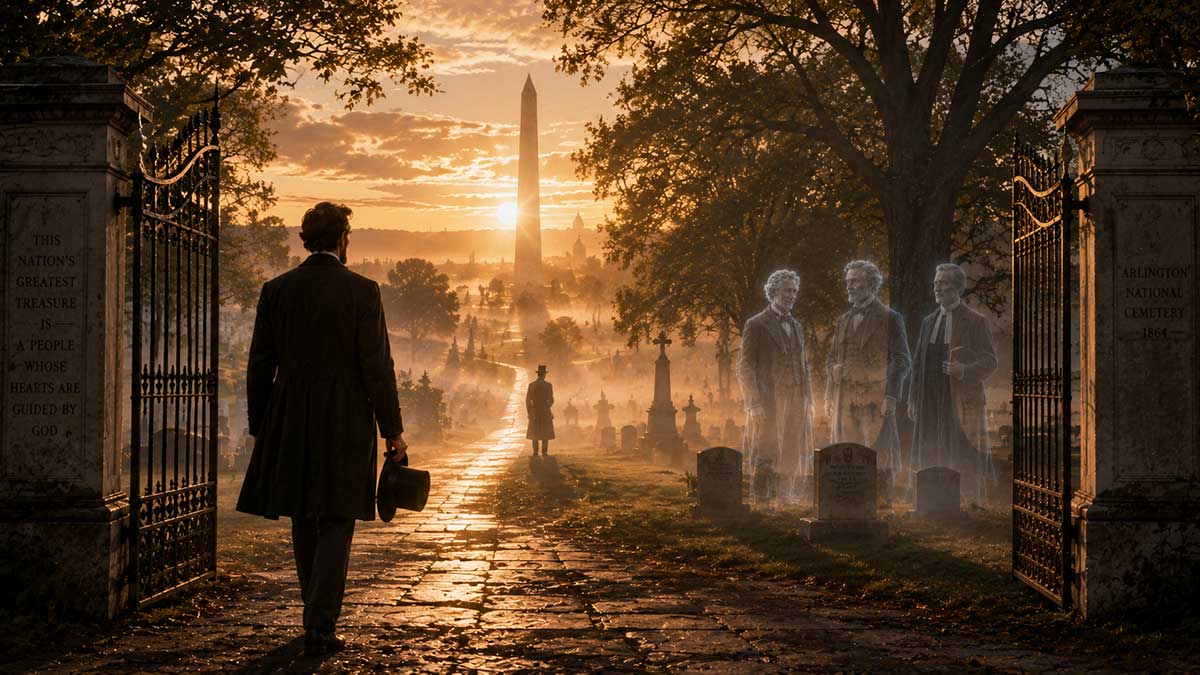
The cemetery is changing.
Not visibly.
The iron gates remain closed.
The same bare trees lean over the same stones.
The same moonlight rests upon the crypt where Willie’s body lies.
Yet something has loosened.
The spirits speak less urgently now.
Hans Vollman no longer repeats his plans for returning home with the same certainty.
Roger Bevins III still notices every detail of the world, but he no longer tries to hold each one forever.
The Reverend Everly Thomas stands near the edge of the gathering, carrying truths he once feared to say aloud.
And Willie...
Willie no longer watches only for his father.
For the first time, he looks beyond the cemetery.
George Saunders steps into the silence.
George Saunders:
“We began with a father who could not let go of his son.
Then we discovered that the son could not let go of his father.
But perhaps love was never asking either of them to forget.
Perhaps it was asking them to change the way they remained connected.
Tonight, there is only one question left.
What must be released...
and what can remain?”
Question 1
George Saunders
Willie, what finally helped you understand that you could not remain here waiting for your father?
Willie Lincoln
For a long time, I thought waiting was love.
If I stayed, Father would know I had not abandoned him.
If I stayed, perhaps he would return.
If I stayed, perhaps nothing would truly be over.
But then I began to see what my waiting was doing.
Father had to walk back into the world.
He had people depending on him.
Mother needed him.
My brother needed him.
A whole country needed him.
And I began to understand...
If I loved Father, I could not ask him to remain beside my grave forever.
Abraham Lincoln
And I could not ask you to remain for me.
That is the terrible selfishness hidden inside grief.
We say,
“I cannot lose you.”
But sometimes what we mean is,
“I cannot bear what your absence does to me.”
A father wants to protect his child.
Yet there are moments when protection is no longer possible.
Then love must become something else.
Hans Vollman
Permission.
Perhaps that is what love becomes.
Permission to go.
Permission to live.
Permission to stop waiting.
We often imagine love as holding tightly.
But sometimes the most loving hands are the ones that open.
Roger Bevins III
The world taught us that endings erase meaning.
But that is not true.
A flower does not become meaningless because it fades.
A song does not become worthless because it ends.
A life does not become unreal because it was brief.
Willie’s life was short.
It was still complete in love.
Reverend Everly Thomas
Acceptance does not mean approving of what happened.
It does not mean calling death fair.
It means refusing to let denial become another kind of death.
Willie cannot return to the life he had.
But he can stop being trapped by the life he lost.
Question 2
George Saunders
Hans, Roger, and Reverend Thomas, what does Willie’s willingness to leave force each of you to admit about yourselves?
Hans Vollman
That I knew.
Somewhere beneath all my stories...
I knew.
I knew my wife was not waiting for me to wake.
I knew my future had ended.
I called this place temporary because the truth felt unbearable.
Willie’s courage removes my last excuse.
If a child can face what I refused to face...
then I must ask whether I have mistaken fear for faithfulness.
Roger Bevins III
Willie reminds me that I loved life so much, I turned memory into possession.
I wanted to keep every color.
Every face.
Every sound.
But beauty cannot be preserved by imprisoning oneself beside it.
To honor life, perhaps I must trust that what I loved has already changed me.
I do not need to remain here to prove it mattered.
Reverend Everly Thomas
I must admit that knowledge did not make me brave.
I understood more than the others.
I knew this was not an illness.
I knew departure was real.
Yet fear held me more tightly because I imagined what might await.
Willie does not know everything.
But he is willing to move forward.
Perhaps courage is not certainty.
Perhaps courage is stepping toward truth without being promised comfort.
Willie Lincoln
I was afraid too.
I still am.
But I do not think fear always means we should stay.
Sometimes fear simply means we have reached the place where we must choose.
Hans Vollman
Then perhaps we have spent all this time waiting for fear to disappear.
And perhaps it never does.
Roger Bevins III
Perhaps we move with it.
Question 3
George Saunders
Abraham and Willie, can a parent and child release one another without losing the love between them?
Abraham Lincoln
I once believed keeping Willie close meant returning to the tomb.
Touching the stone.
Replaying every final hour.
Refusing any moment of happiness that did not include him.
But grief can become a false form of loyalty.
It can make sorrow the only evidence that love existed.
That is not what I want for my son.
Willie gave me joy.
If I allow his memory to produce only pain, then grief has taken more than his life.
It has taken the meaning of his life as well.
Willie Lincoln
Father...
I do not need you to be sad every day.
I do not need you to come back here to prove you remember me.
I would rather be with you when you laugh.
When you help someone.
When you hold my brother.
When you make a choice because you understand that every family loves someone as much as you loved me.
Then I am not gone.
Not completely.
Abraham Lincoln
And I do not need you to wait.
You have already given me all a son could give.
You were here.
You were loved.
You changed us.
You may go without leaving my heart.
Hans Vollman
There it is.
The thing we could not understand.
Love can remain...
even when the beloved does not.
Roger Bevins III
Perhaps that is why memory hurts and heals at the same time.
It reminds us of absence.
But it also proves there was a presence too powerful to disappear.
Reverend Everly Thomas
To release someone is not to deny the bond.
It is to trust that the bond no longer depends upon distance, body, or time.
Closing
George Saunders:
The cemetery grows still.
Not the stillness of denial.
The stillness that comes when a truth has finally been spoken.
Willie looks once more toward the world of the living.
He remembers the White House corridors.
His mother’s voice.
His brother’s companionship.
His father’s long arms around him.
He does not reject those memories.
He gathers them.
Then he turns toward whatever waits beyond the cemetery.
Hans Vollman watches him and feels the story of his unfinished life beginning to loosen.
Roger Bevins III looks at the night sky and, for once, does not try to describe every star.
The Reverend Everly Thomas stands trembling, but no longer hides his fear behind certainty.
And Abraham Lincoln walks back toward Washington.
He still grieves.
He will always grieve.
But grief is no longer the only form his love can take.
It becomes compassion.
Responsibility.
Memory.
A deeper tenderness toward the suffering of others.
Willie moves forward.
His father does too.
Not away from one another...
but into a new way of carrying one another.
That may be the final truth of loss:
We do not honor love by refusing to continue.
We honor it by allowing what we received to keep living through us.
Letting go is not the end of love.
Sometimes, it is love’s final act of courage.
Final Thoughts
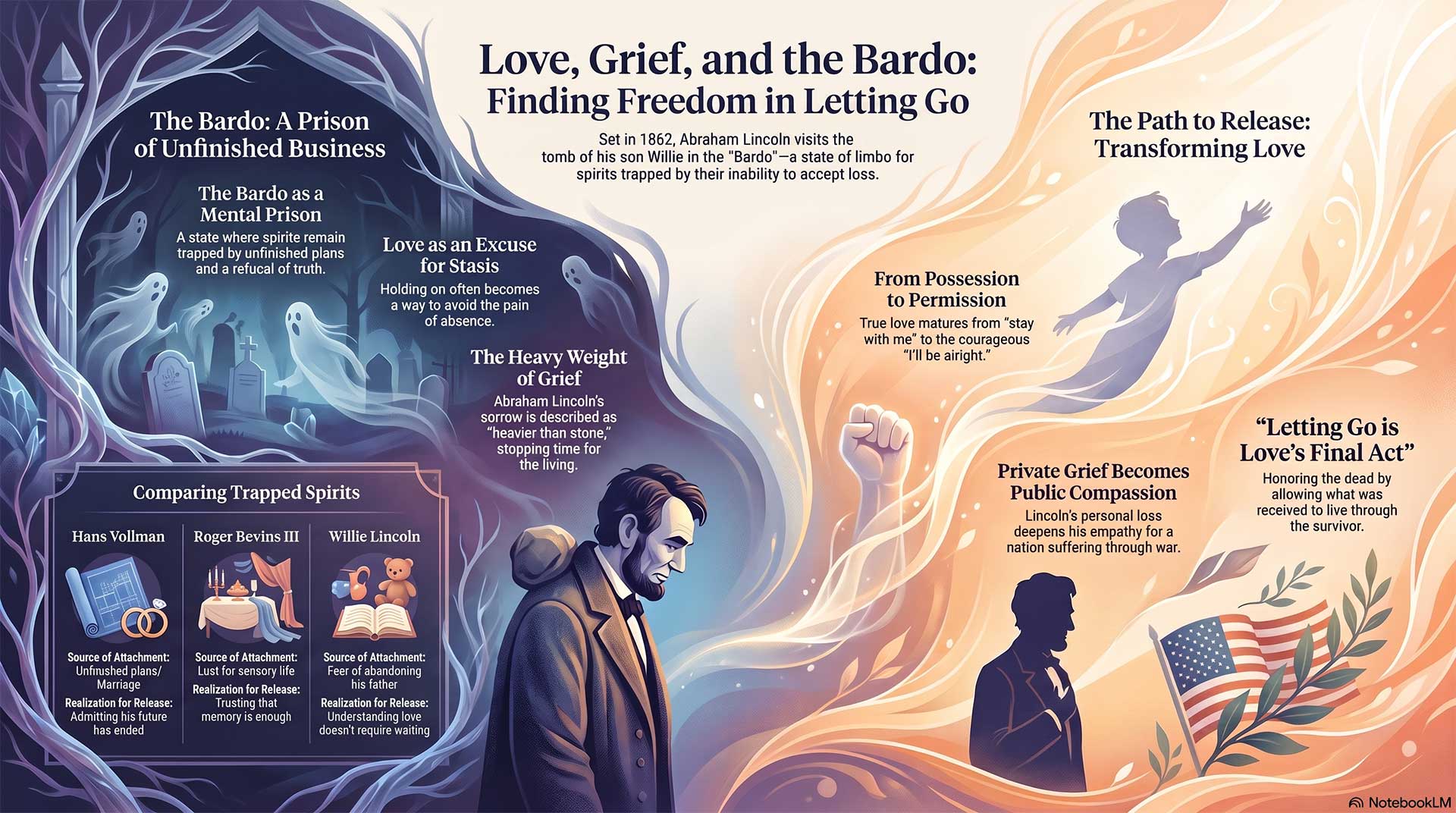
George Saunders never intended to tell us exactly what happens after death.
Instead, he reminds us how we live before it.
The cemetery in Lincoln in the Bardo becomes a mirror of the human heart. Some spirits remain because they cannot accept the truth. Others remain because they fear what comes next. Still others remain because love itself has become confused with possession.
The same struggles belong to the living.
We often believe healing means forgetting.
It does not.
We often believe moving forward means leaving someone behind.
It does not.
Love changes.
It grows quieter.
It becomes memory instead of presence.
Compassion instead of despair.
Gratitude instead of endless longing.
Perhaps that is the deepest lesson Abraham Lincoln and Willie discover together.
A parent never stops loving a child.
A child never stops loving a parent.
Death changes the relationship, but it cannot erase it.
In the end, the greatest act of love is not holding someone forever.
It is giving them the freedom to continue the journey they were meant to take.
As we close this conversation, perhaps we should ask ourselves one final question:
Is there someone we are still trying to hold onto—not because they need us, but because we fear who we would be without them?
Sometimes the path toward peace begins with opening our hands, while keeping our hearts open.
Short Bios:
George Saunders
George Saunders is one of America's most celebrated contemporary writers, known for blending satire, compassion, and philosophical depth. His 2017 novel Lincoln in the Bardo won the Man Booker Prize and was praised for its innovative structure, emotional power, and exploration of grief, love, and the mysteries that lie between life and death.
Abraham Lincoln
The 16th President of the United States, Abraham Lincoln led the nation through the Civil War while carrying profound personal sorrow, including the death of his beloved son Willie in 1862. His leadership, humility, and compassion have made him one of history's most admired statesmen.
Willie Lincoln
William Wallace "Willie" Lincoln was the third son of Abraham and Mary Todd Lincoln. He died of illness at the age of eleven while living in the White House. His death devastated both parents and became the emotional inspiration for Lincoln in the Bardo.
Hans Vollman
Hans Vollman is one of the principal spirits in Lincoln in the Bardo. Warmhearted, humorous, and deeply human, he initially refuses to accept his own death. Through his compassion for Willie, he gradually learns that love sometimes requires letting go rather than holding on.
Roger Bevins III
Roger Bevins III is another central spirit in the novel. Sensitive, poetic, and endlessly observant, he sees extraordinary beauty in ordinary life. His reflections on memory, regret, and impermanence provide many of the novel's most moving insights.
Reverend Everly Thomas
The Reverend Everly Thomas is a minister whose certainty about the afterlife has been shaken by his own death. His struggle between faith and fear gives voice to humanity's deepest spiritual questions, reminding us that courage is not the absence of uncertainty but the willingness to face it.
Leave a Reply