
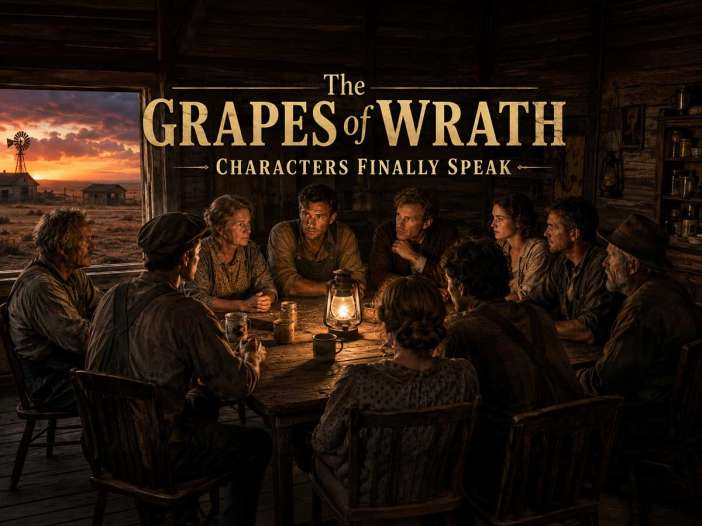
Introduction by John Steinbeck
When people finish The Grapes of Wrath, they often remember the dust.
Or the truck.
Or the long road west.
I remember the people.
(He pauses.)
Because long after the dust settled...
they were still speaking.
We simply had to learn how to listen.
People often ask whether The Grapes of Wrath is a political novel.
I have never found that to be the most interesting question.
Politics change.
Governments rise and fall.
Economic systems are argued over by every generation.
What interested me was something older than politics.
I wanted to know what happens to ordinary people when life strips away nearly everything they possess.
If a family loses its farm, is it still a family?
If a father loses his work, is he still a father?
If a mother has almost nothing left to give, where does her strength come from?
If a hungry stranger appears at the door, does compassion survive scarcity?
Those were the questions that stayed with me long after I had left the migrant camps.
The people I met were rarely asking for sympathy.
Most wanted something far simpler.
They wanted to be seen.
History has a habit of remembering presidents, bankers, generals, and famous speeches.
It often forgets the families who quietly carried America across its hardest years.
The Joads were written for them.
Tonight, we imagine those voices returning once more.
Not to defend themselves.
Not to explain the novel.
Simply to finish the conversations hardship never allowed them to have.
Perhaps, after all these years, they have something new to teach us.
So, let us pull up a chair beside the Joad family one last time... and listen.
(Note: This is an imaginary conversation, a creative exploration of an idea, and not a real speech or event.)
Topic 1 — The Day We Lost Home
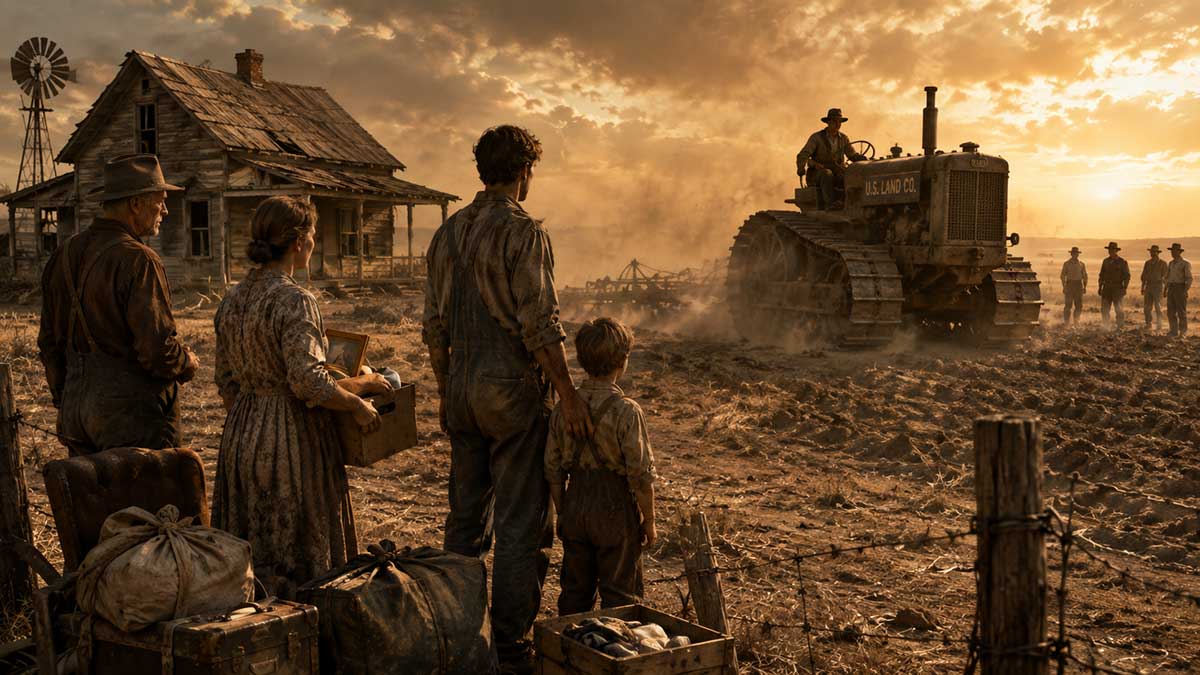
The room remains quiet after Ma's words.
Outside the window, the wind stirs the branches, sounding almost like dust sweeping across an empty Oklahoma field.
For a long moment, no one speaks.
Then Grampa lets out a dry chuckle.
Grampa Joad: Funny thing... folks always ask when we left home.
They're askin' the wrong question.
We'd already lost it before the truck ever started.
(The room grows still.)
Tom Joad: I used to think the tractor took it.
That machine didn't even know our names.
Just kept comin'.
Pa Joad: Don't blame only the tractor.
Some man was drivin' it.
Tom Joad: Maybe.
But I reckon he was trapped too.
Probably scared of losin' his own job.
Jim Casy: That's the sorrow of it.
One frightened man gets ordered by another frightened man, who answers to someone sittin' in an office a hundred miles away.
Pretty soon nobody remembers who made the first cruel choice.
Only that it happened.
(Pa nods slowly but doesn't look convinced.)
Pa Joad: I spent years thinkin' a man's worth was measured by the land he worked.
Then one paper from the bank says it ain't ours anymore.
Tell me...
Who was I after that?
(No one answers.)
Ma Joad: You were still their father.
Even if you couldn't see it then.
Pa Joad: Didn't feel like it.
Couldn't feed my family.
Couldn't stop the truck.
Couldn't stop the bank.
Couldn't stop the dust.
A man starts wonderin' what use he is.
(His voice catches.)
*Tom reaches over and quietly places a hand on his father's shoulder.
Tom Joad: I never blamed you.
Not once.
Pa looks up, surprised.
Pa Joad: You never said that.
Tom Joad: Didn't know how.
(Another silence settles across the table.)
Grampa Joad: I wasn't cryin' over dirt.
Folks think I was.
They don't understand.
That wasn't dirt.
That field knew my footsteps.
Every fence post had a memory.
Every tree had heard somebody laugh.
When they took the land...
they took every yesterday I'd ever had.
(Ma quietly wipes a tear from her cheek.)
Ma Joad: I remember wrapping the dishes.
I wasn't thinkin' about plates.
I kept askin' myself...
Which memories fit in a box?
(Rose of Sharon quietly lowers her eyes, listening from the side of the room.)
Jim Casy: Home's a curious thing.
People spend years believin' it's a place.
Then one day they're forced to find out whether it was the people all along.
Grampa shakes his head.
Grampa Joad: That's a mighty nice thing to say.
But I'll tell you true.
A place matters.
The smell after rain.
The sound of your own gate.
The tree you planted with your own hands.
Don't let anybody tell you those things ain't holy.
(Casy smiles gently.)
Jim Casy: I ain't disagreein'.
Maybe holiness begins in one little patch of ground.
But if it stays there...
it dies there.
Maybe it has to travel with us.
(Tom studies Casy for a moment.)
Tom Joad: Is that when you changed?
From preachin' in churches...
to preachin' in camps?
Jim Casy: I didn't decide one mornin'.
It happened little by little.
Every hungry child I met.
Every tired mother.
Every man ashamed 'cause he couldn't earn enough.
After a spell...
I couldn't see strangers anymore.
Only people.
(Ma smiles faintly.)
Ma Joad: That's when I knew we weren't just one family anymore.
Every camp had another mother worrying over her children.
Every old man looked like somebody's grandpa.
Every baby cried the same.
You can't travel that road and keep your heart fenced in.
(The room grows quiet again.)
Tom Joad: If you had the chance...
Would any of you stay?
Would you fight for the farm again?
Or would you climb into that truck one more time?
(Grampa answers without hesitation.)
Grampa Joad: I'd stay.
Even knowin' I'd lose.
A man ought to stand where his memories are buried.
(Pa thinks for a long time.)
Pa Joad: Years ago I'd have agreed.
Now...
I don't know.
Maybe home wasn't behind us anymore.
Maybe it was sittin' beside me in that truck all along.
(Ma reaches across the table and takes Pa's hand.)
Ma Joad: We didn't lose everything that day.
We carried the most important part with us.
We just didn't know it yet.
(The room falls silent once more. No one feels the need to add another word.)
Topic 2 — The Words We Never Said on Route 66
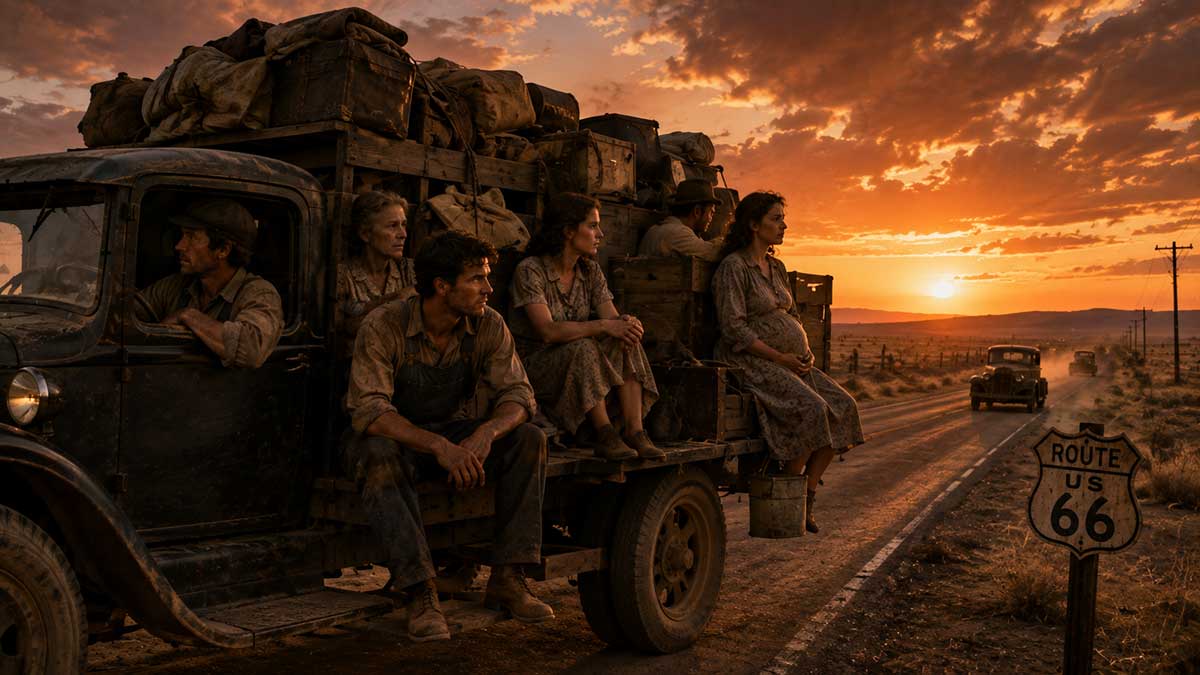
The silence after Pa’s confession lingers.
A lantern burns low near the window. Somewhere beyond the room, tires seem to hum against an endless road.
Rose of Sharon sits with both hands folded in her lap.
Connie sits several chairs away from her.
Neither looks at the other.
Ma notices.
She notices everything.
Ma Joad: Roads have a way of makin’ people talk.
Funny part is, ours made us quieter.
Tom Joad: Too many people packed into one truck.
You’d think nobody could keep a secret.
Al Joad: We managed.
(He gives a crooked smile.)
Had enough secrets to fill another truck.
Ma Joad: You hid behind that engine.
Every time somebody asked what you were thinkin’, you crawled under the hood.
Al Joad: Engines make sense.
Something breaks, you find the part.
People break, they don’t tell you where.
Tom Joad: You were scared that truck would quit.
Al Joad: I was scared all of us would.
(The smile leaves his face.)
Every sound it made, every little knock, I thought, “There it is. That’s the sound that strands us.”
Nobody knew how close that truck came to dyin’.
Pa Joad: Why didn’t you say?
Al Joad: What good would it do?
You were already watchin’ the money.
Ma was watchin’ the family.
Tom was watchin’ for trouble.
Somebody had to watch the truck.
Ma Joad: You were still a boy.
Al Joad: Didn’t feel like one.
Not after we left.
(He looks down at his hands.)
Every mile, I kept thinkin’ if that engine stopped, it’d be my fault.
Tom Joad: Wasn’t your fault.
Al Joad: Easy to say now.
Back then, everybody needed somebody to blame.
I figured I’d better make sure it wasn’t me.
(Ma turns toward Rose of Sharon.)
Ma Joad: What did you carry?
Rose of Sharon: Everybody knew.
Ma Joad: They knew you were carryin’ a baby.
That ain’t the same as knowin’ what you carried.
(Rose of Sharon glances at Connie.)
Rose of Sharon: I was afraid before we left Oklahoma.
I kept tellin’ myself California would fix it.
There’d be a house.
Connie would get work.
We’d have a little room.
Maybe curtains.
I thought if I pictured it clear enough, it had to be true.
Tom Joad: You talked about that house plenty.
Rose of Sharon: I talked about the house so nobody would hear what was underneath it.
Ma Joad: What was underneath?
Rose of Sharon: I didn’t know whether Connie wanted the baby.
(Connie’s face tightens.)
Connie Rivers: That ain’t fair.
Rose of Sharon: It’s true.
Connie Rivers: I said I wanted it.
Rose of Sharon: You said you wanted to study radios.
You said you’d get a job.
You said we’d have a place.
You said everything except that you wanted to be a father.
(Connie leans forward, his voice low.)
Connie Rivers: I didn’t know how.
Nobody ever asked me if I was afraid.
Tom Joad: You left her.
Connie Rivers: I know what I did.
Tom Joad: Then say it plain.
Connie Rivers: I ran.
(The words hang in the room.)
I ran because every mile west made me feel smaller.
Everybody kept talkin’ like California was waiting for us.
I knew it wasn’t.
I saw those handbills. Saw how many people had them.
I knew there weren’t enough jobs.
Jim Casy: Yet you kept quiet.
Connie Rivers: What was I supposed to say?
“Turn around”?
Go back to what?
The farm was gone.
The money was almost gone.
The baby was coming.
Every direction looked like failure.
Rose of Sharon: So you chose the direction without me.
Connie Rivers: I chose the direction where I didn’t have to watch you learn I wasn’t enough.
(Rose of Sharon looks at him for a long time.)
Rose of Sharon: You decided that for me.
Connie Rivers: I was ashamed.
Rose of Sharon: Shame doesn’t make a woman less alone.
(Ma reaches for Rose of Sharon’s hand, but Rose keeps both hands pressed together.)
Ma Joad: Connie, did you think she’d be better without you?
Connie Rivers: I told myself that.
Truth is, I wanted to be free of watchin’ her hope.
Hope can feel like a debt when you know you can’t pay it.
(Casy nods slowly.)
Jim Casy: That’s a hard truth.
People think despair is the opposite of hope.
Sometimes it ain’t.
Sometimes despair is what hope turns into when a person feels unworthy of it.
Tom Joad: You got a kind word for everybody.
Jim Casy: Not a kind word.
A true one.
A man can do wrong and still be worth listenin’ to.
If we stop listenin’, we never learn why people leave.
Ma Joad: And if we excuse every wrong, the ones left behind carry all the weight.
Jim Casy: I know.
Mercy ain’t the same as pretendin’ nobody got hurt.
(Rose of Sharon finally looks directly at Connie.)
Rose of Sharon: Did you ever come back?
Connie Rivers: No.
Rose of Sharon: Did you ever try?
Connie Rivers: Many times.
Rose of Sharon: That ain’t the same.
Connie Rivers: No.
It ain’t.
(He swallows.)
I’d get close to a camp and hear a baby cry.
Then I’d turn around.
I was afraid somebody would tell me what happened.
Rose of Sharon: You were more afraid of knowing than I was of living it.
Connie Rivers: Yes.
(No one rushes to soften the answer.)
Ma Joad: Sometimes the family protects itself with silence.
Sometimes silence protects the one speakin’ and wounds everybody else.
Tom Joad: I had things I never said.
Ma Joad: I know.
Tom Joad: You don’t know all of it.
(Ma watches him carefully.)
Tom Joad: Every police car we passed, I thought they were comin’ for me.
Every time somebody raised his voice, I thought I’d lose control.
I told everybody I could mind my own business.
Truth was, I didn’t know how long I could keep from fightin’.
Pa Joad: You were still on parole.
Tom Joad: That paper followed me farther than any cop.
I’d wake up thinkin’ I was back behind bars.
Sometimes I wanted to walk away before I brought trouble down on the family.
Ma Joad: Why didn’t you?
Tom Joad: You.
(Ma’s eyes narrow slightly.)
You looked at me like I was still your son.
Not a convict.
Not a danger.
Just Tom.
I couldn’t leave that look.
Ma Joad: You think I wasn’t afraid of you leavin’?
Tom Joad: You never showed it.
Ma Joad: I showed you what you needed.
That ain’t the same as what I felt.
(Her voice softens.)
Every morning, I counted heads before I opened my eyes.
I’d lie there and listen.
A cough.
A snore.
Somebody turnin’ over.
I learned each sound.
If one was missing, my heart knew before I did.
Al Joad: You counted us?
Ma Joad: Every morning.
Rose of Sharon: I never knew.
Ma Joad: Mothers don’t tell children every fear.
If they did, children might start carryin’ the mother.
Tom Joad: Maybe we should’ve carried you some.
Ma Joad: Maybe.
But I didn’t know how to ask.
(Jim Casy looks around the table.)
Jim Casy: There it is.
All of us thought strength meant carryin’ alone.
Al Joad: What else did it mean?
Jim Casy: Lettin’ somebody see the weight.
Tom Joad: That sounds easy in a room like this.
Wasn’t easy on the road.
Jim Casy: No.
On the road, truth could feel like one more thing the truck couldn’t hold.
(A faint smile touches Ma’s face.)
Ma Joad: Yet we kept addin’ things.
Pots.
Blankets.
People.
Grief.
Nobody ever said there wasn’t room for grief.
We just stacked it where nobody could see.
Rose of Sharon: I blamed the baby for a while.
(The room stills.)
I thought if I weren’t pregnant, Connie wouldn’t have left.
I thought I’d be lighter.
Less trouble.
Then I hated myself for thinkin’ it.
Connie Rivers: Rose—
Rose of Sharon: Don’t.
You wanted the truth.
That was mine.
(Connie lowers his head.)
Ma Joad: A thought born from fear ain’t the same as a choice.
Rose of Sharon: It felt ugly.
Ma Joad: Fear says ugly things.
You don’t have to build a home for every thought that enters your mind.
(Rose of Sharon leans back, taking that in.)
Al Joad: I got one.
I used to hope somebody else would leave.
(Pa looks up sharply.)
Not any one person.
Just somebody.
So there’d be more room.
Less weight.
Less food divided up.
Then when Noah left, I felt relieved for half a second.
Half a second.
Been ashamed of it ever since.
Tom Joad: Half a second don’t make you heartless.
Al Joad: Felt like it did.
Jim Casy: Hunger can put thoughts in a man’s head that comfort never would.
The question is what he does after the thought comes.
Al Joad: I kept drivin’.
Ma Joad: You kept all of us movin’.
(Al’s eyes fill, though he turns away before anyone can see clearly.)
Pa Joad: I had one too.
I wished your mother would stop bein’ strong.
Just once.
Ma Joad: Why?
Pa Joad: So I could feel needed again.
Every time you stood up, I felt myself get smaller.
I knew that wasn’t fair.
Still felt it.
(Ma studies him, neither offended nor surprised.)
Ma Joad: I wanted you to stand beside me.
Pa Joad: I thought you were standin’ instead of me.
Ma Joad: There was room for both.
Pa Joad: I couldn’t see it then.
Tom Joad: Maybe none of us could see much past the next meal.
Jim Casy: That’s what want does.
Shrinks the horizon.
Makes tomorrow too expensive to think about.
(Rose of Sharon looks again at Connie.)
Rose of Sharon: Did you love me?
Connie Rivers: Yes.
Rose of Sharon: Then why wasn’t love enough?
Connie Rivers: I thought love was supposed to make me brave.
When it didn’t, I decided it must not be love.
Now I know fear can live right beside it.
Sometimes fear speaks louder.
Rose of Sharon: It spoke loud enough for both of us.
(Connie nods. He does not defend himself.)
Ma Joad: We spent that whole road thinkin’ the family would break if we told the truth.
Maybe it broke where the truth was missing.
Tom Joad: And what do we do with it now?
Ma Joad: Speak before the road gets too loud again.
(Outside, the imagined hum of tires continues.)
Rose of Sharon turns her chair a little closer to the table.
Connie remains where he is.
For now, that small distance says more than forgiveness would.
Topic 3 — When Survival Begins to Change You
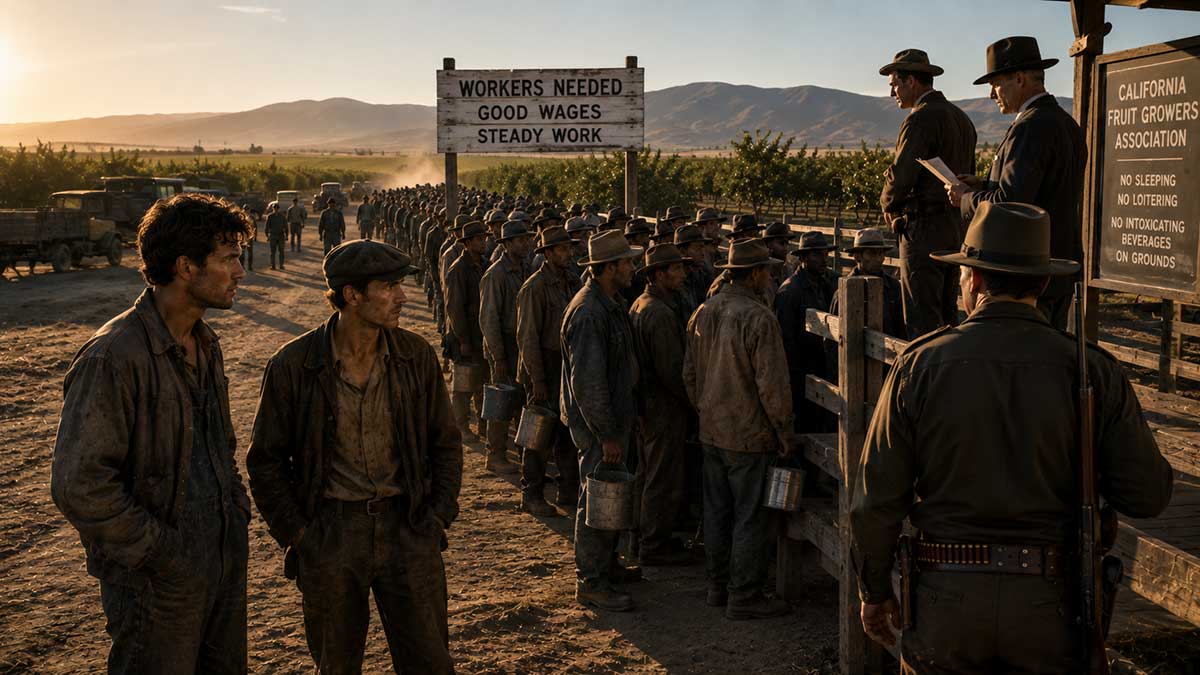
The room feels smaller after the truths spoken on Route 66.
Uncle John sits apart from the others, turning an empty cup between his hands.
Al watches him, then looks toward Tom.
Jim Casy leans back in his chair.
Tom Joad: We’ve talked about what we hid.
Maybe now we ought to talk about what the road made of us.
Uncle John: Some of us weren’t worth much before the road.
Ma Joad: Don’t start that again.
Uncle John: It’s true.
Ma Joad: No.
It’s a punishment you keep givin’ yourself.
That ain’t the same as truth.
(Uncle John grips the cup more tightly.)
Uncle John: My wife got sick.
She said she needed a doctor.
I told her she’d be fine.
Told her to stop complainin’.
Then she died.
A man does a thing like that, he don’t get to walk away clean.
Jim Casy: You didn’t walk away.
You built your whole life inside that one day.
Uncle John: Where else was I supposed to live?
Jim Casy: Somewhere after it.
Uncle John: Easy for you to say.
Jim Casy: No.
It ain’t.
I spent years preachin’ words I wasn’t sure I believed.
I told people what sin was.
Then I went off and did some of the same things I warned them against.
I know what it is to wake up ashamed of your own voice.
Uncle John: Then you know punishment is fair.
Jim Casy: I know punishment can become pride.
(Uncle John looks up sharply.)
Uncle John: Pride?
Jim Casy: A man can get so certain he’s the worst person alive that he stops seein’ anybody else.
His guilt becomes the biggest thing in the room.
Bigger than the people still needin’ him.
Uncle John: You think I wanted to feel this way?
Jim Casy: No.
I think after enough years, you forgot how to be anything else.
(Ma reaches across the table and gently takes the cup from Uncle John’s hands.)
Ma Joad: You helped us.
More times than you know.
Uncle John: Wasn’t enough.
Ma Joad: Nothing ever was, to you.
That was the trouble.
You thought one good act had to erase the past.
When it couldn’t, you called it useless.
Tom Joad: I know that feelin’.
Al Joad: You?
Tom Joad: I killed a man.
I told myself it was self-defense.
Maybe it was.
Still woke up seein’ his face.
Then later, when trouble came, I was too ready for it.
Part of me thought violence was the only thing I knew how to do well.
Ma Joad: You knew how to protect people.
Tom Joad: Sometimes protectin’ and hurtin’ get mixed together.
That’s what scared me.
I could feel anger makin’ decisions before my mind caught up.
Jim Casy: Anger ain’t always wrong.
Tom Joad: It don’t ask permission.
Jim Casy: Neither does hunger.
Neither does fear.
The question is whether anger serves people or starts feedin’ on them.
Al Joad: How do you tell the difference?
Jim Casy: Look at what’s left after.
If only you feel bigger, it was probably for you.
If frightened people feel less alone, maybe it was for them.
(Tom sits with that answer.)
Tom Joad: When they killed you, I didn’t think.
I saw the club come down.
Then everything went red.
Jim Casy: I know.
Tom Joad: I killed that deputy.
Jim Casy: I know.
Tom Joad: Do you forgive me?
Jim Casy: That ain’t the first question.
Tom Joad: What is?
Jim Casy: Did killing him bring me back?
Tom Joad: No.
Jim Casy: Did it keep another man from swingin’ the club?
Tom Joad: Maybe.
For a minute.
Jim Casy: Did it change what made him lift it?
Tom Joad: No.
(Casy leans forward.)
Jim Casy: Then don’t make a religion out of that moment.
Learn from it.
Carry it.
But don’t kneel before it forever.
Tom Joad: You sound like a preacher again.
Jim Casy: Maybe I never stopped.
I just changed churches.
(A faint laugh moves around the table.)
Al Joad: Suffering made Tom serious.
Made Uncle John sadder.
Made Ma stronger.
Know what it made me?
Mean.
Ma Joad: You weren’t mean.
Al Joad: I was.
I’d see somebody walkin’ beside the road and think, “Don’t stop.”
Didn’t matter if they had children.
Didn’t matter if they looked half dead.
I’d look at the tires, look at the gas, count the mouths, and hope Pa kept drivin’.
Pa Joad: Sometimes I did.
Al Joad: I hated them for needin’ what we didn’t have.
Then I hated myself for hatin’ them.
Jim Casy: Need can turn poor people against other poor people.
That keeps the ones with plenty safe.
Al Joad: I wasn’t thinkin’ about people with plenty.
I was thinkin’ about one can of beans.
Jim Casy: That’s how it works.
A hungry man’s whole world can shrink to a can of beans.
Then somebody tells him the other hungry man is the reason there ain’t enough.
Tom Joad: And sometimes he believes it.
Jim Casy: Till he sees the warehouse full.
(No one speaks for a moment.)
Ma Joad: I changed too.
Tom Joad: You held us together.
Ma Joad: That’s what you saw.
What I felt was different.
At first, I wanted to keep every person close.
Your pa.
Your grandparents.
Noah.
Connie.
Every child.
I thought if anybody left, I had failed.
Then people started leavin’ anyway.
Some died.
Some walked off.
Some had to go.
I learned a terrible thing.
Rose of Sharon: What?
Ma Joad: A family can keep movin’ after somebody disappears.
(Her voice trembles.)
I hated knowin’ that.
It felt like betrayal.
The sun still came up.
People still got hungry.
Supper still had to be made.
Grief didn’t stop the next day from arrivin’.
Tom Joad: That ain’t betrayal.
Ma Joad: It felt like it.
When Grampa died, we buried him and kept movin’.
When Granma died, I sat beside her through the checkpoint and said nothing.
I let men believe she was alive so the family could cross.
Part of me never forgave myself for usin’ her death that way.
Jim Casy: You protected the living.
Ma Joad: I know.
That’s what makes it hard.
Sometimes the right choice still hurts like a wrong one.
(Rose of Sharon moves closer to Ma.)
Rose of Sharon: Were you afraid beside Granma?
Ma Joad: More afraid than I’d ever been.
Not of the guards.
Of myself.
I could feel something in me turn cold.
I thought, “Say what you need to say. Get the family through.”
That voice saved us.
But I wondered whether I’d ever feel warm again.
Tom Joad: You did.
Ma Joad: Yes.
But not the same way.
Before the road, love meant keepin’ everybody close.
After the road, love meant lettin’ some go so others could live.
(Uncle John wipes his face with the back of his hand.)
Uncle John: Maybe that’s what I never learned.
My wife died, and I kept tryin’ to die with her.
Just slower.
Ma Joad: She didn’t ask you to.
Uncle John: I know that now.
Jim Casy: Guilt tells a man his pain honors the dead.
Sometimes livin’ well honors them more.
Uncle John: I don’t know how.
Jim Casy: Start smaller.
Help the person sittin’ next to you.
Then do it again tomorrow.
Uncle John: That don’t sound like redemption.
Jim Casy: Most real things don’t sound grand.
(Al taps the table with one finger.)
Al Joad: I used to think survival meant gettin’ through without breakin’.
Now I think everybody broke.
Just in different places.
Tom Joad: Some breaks let things in.
Al Joad: That Casy talkin’, or you?
Tom Joad: Don’t know anymore.
(Casy smiles.)
Jim Casy: Good.
Means you’re listenin’.
Tom Joad: I used to care about what happened right in front of me.
My family.
My temper.
My next meal.
Then I saw too many families hurt the same way.
After that, I couldn’t call it bad luck.
Ma Joad: That’s when you started leavin’ us.
Tom Joad: I thought I was joinin’ something larger.
Ma Joad: I know.
A mother can know why her son leaves and still wish he’d stay.
Tom Joad: Did you think I chose strangers over you?
Ma Joad: For a little time.
Then I remembered every stranger was somebody’s son.
That didn’t make it easier.
It made it harder to be angry.
(Tom lowers his eyes.)
Tom Joad: Casy, when did you know you couldn’t keep preachin’ the old way?
Jim Casy: When I saw hungry people blame themselves.
A woman with children and no food would say she’d failed.
A man without work would say he was lazy.
I thought, “Somebody taught them to turn every wound inward.”
I couldn’t preach patience to that.
Couldn’t tell them their reward was waitin’ in another life.
They needed dignity in this one.
Uncle John: Did you still believe in God?
Jim Casy: I stopped believin’ God belonged to a building.
Or to people who knew the right words.
I felt something holy when workers shared food.
When a mother cared for a child that wasn’t hers.
When men stood together and said no one should starve alone.
Maybe I lost religion.
Maybe I found what religion was supposed to protect.
(Rose of Sharon sits silently, one hand resting over the other.)
Rose of Sharon: Suffering made me small first.
I could think only about myself.
My baby.
My husband.
My room with curtains.
Every problem felt like it was happenin’ only to me.
Then I lost all of it.
Ma Joad: You were young.
Rose of Sharon: I was selfish.
Ma Joad: You were scared.
Rose of Sharon: Maybe both.
Then at the end, in that barn, I looked at a man who was starvin’.
I had nothing I’d planned to give.
Nothing I wanted to give.
Yet there was still something left.
(No one interrupts her.)
I thought suffering had emptied me.
It hadn’t.
It had made room.
Jim Casy: That’s the change we keep missin’.
Pain can close a person.
It can open one too.
Tom Joad: What decides which?
Jim Casy: Maybe whether somebody meets you inside it.
Pain faced alone turns into a wall.
Pain shared can become a door.
Al Joad: You always got an answer?
Jim Casy: No.
I just talk slower now, so it sounds like I do.
(A small laugh circles the table, warmer this time.)
Uncle John: I’d like to try livin’ after it.
Ma Joad: After what?
Uncle John: After the worst thing I ever did.
(Ma places the empty cup back in front of him.)
Ma Joad: Then tomorrow, fill this with coffee.
Sit with us.
That’s a beginning.
(Uncle John looks at the cup, then nods.)
Tom Joad: Maybe survival ain’t keepin’ yourself unchanged.
Maybe it’s choosin’ what the change will mean.
Jim Casy: That sounds like preachin’.
Tom Joad: Maybe I changed churches too.
Outside, the wind quiets.
For the first time that night, Uncle John raises his eyes and looks directly at the people around him.
Topic 4 — The Ones Who Stayed and the Ones Who Left
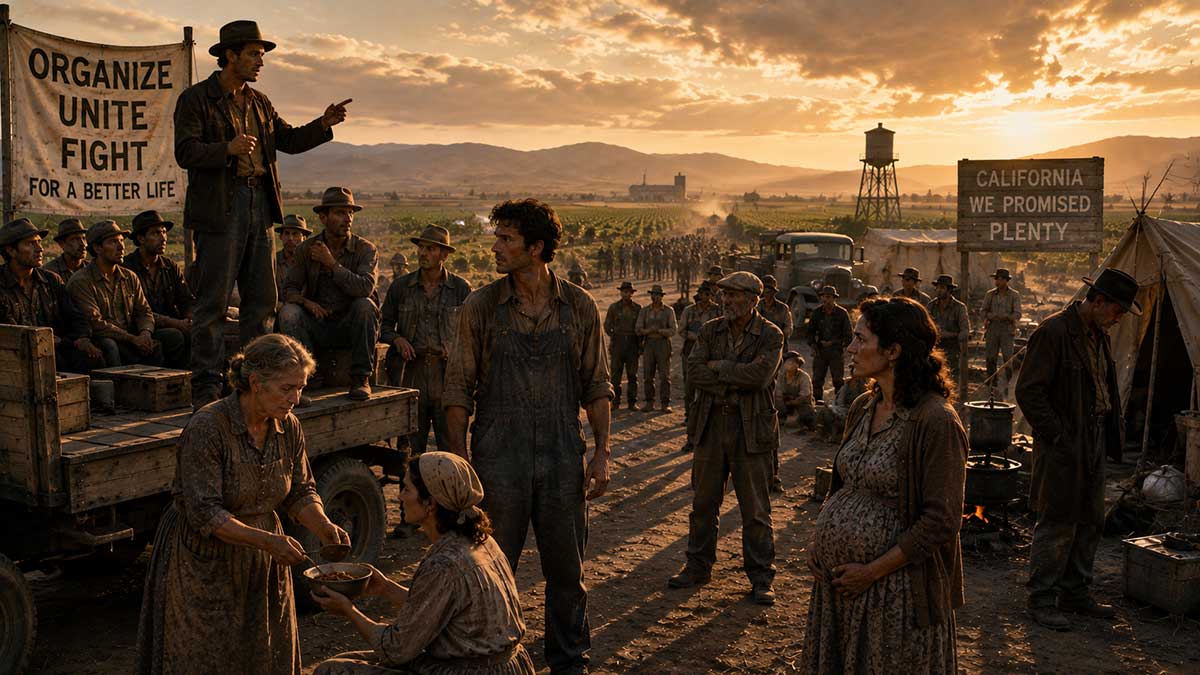
Uncle John’s cup remains on the table.
No one reaches for it.
Across the room, Noah sits near the window, half turned away from the others. Muley Graves stands by the door, hat in hand, as if he still cannot decide whether to enter fully or remain outside.
Ma looks from one to the other.
Ma Joad: We lost people in different ways.
Some died.
Some were taken.
Some walked off.
Funny thing is, the ones who left kept travelin’ with us.
Tom Joad: Noah.
(Noah does not turn.)
Noah Joad: I hear you.
Tom Joad: I used to wonder where you went.
Noah Joad: No, you didn’t.
Tom Joad: I did.
Noah Joad: You wondered for a day.
Then the truck kept movin’.
(Tom starts to answer, then stops.)
Ma Joad: He’s right.
We had to keep movin’.
Noah Joad: That’s what everybody says.
Like movin’ excuses forgettin’.
Ma Joad: I never forgot you.
Noah Joad: You forgot to ask why I left.
(Ma’s face tightens.)
Ma Joad: I thought I knew.
Noah Joad: You thought I was strange.
Everybody did.
Slow Noah.
Quiet Noah.
Noah who didn’t think right.
Noah who had to be watched.
Pa Joad: We never said those things.
Noah Joad: Didn’t need to.
A family can say plenty by the way it looks at a person.
(Pa lowers his eyes.)
Tom Joad: Was it the river?
Noah Joad: Partly.
The river didn’t expect me to explain myself.
It moved slow.
Didn’t mind if I sat there all day.
Fish didn’t ask why I wasn’t like other men.
Jim Casy: Did you feel freer there?
Noah Joad: I felt quiet.
That was close enough.
Ma Joad: Why didn’t you tell me you were goin’?
Noah Joad: You would’ve stopped me.
Ma Joad: I would’ve tried.
Noah Joad: That’s why.
Ma Joad: You think I wanted to trap you?
Noah Joad: No.
You wanted to keep the family whole.
But sometimes makin’ a person stay can break him worse than lettin’ him go.
(Ma absorbs the words without defending herself.)
Tom Joad: You could’ve said goodbye.
Noah Joad: I didn’t know how.
Goodbye makes people ask for promises.
I couldn’t promise I’d come back.
Couldn’t promise I’d be safe.
Couldn’t promise anything.
So I left before the words caught me.
Ma Joad: Did you think we’d be better without you?
Noah Joad: I thought you’d have one less person to worry about.
Ma Joad: That wasn’t your choice to make.
Noah Joad: Everybody keeps sayin’ that to the ones who leave.
Nobody says it to the ones who make stayin’ hurt.
(Silence settles over the room.)
Muley shifts his weight near the door.
Muley Graves: Stayin’ can hurt too.
Tom Joad: You’d know.
Muley Graves: Folks called me stubborn.
Maybe I was.
Family left.
Neighbors left.
Whole country emptied out around me.
I stayed with land that didn’t belong to me anymore.
Slept in fields.
Ate what I could catch.
Talked to houses with no people in them.
Pa Joad: Why didn’t you come with us?
Muley Graves: Same reason Noah didn’t stay.
Couldn’t breathe where you wanted me to go.
Grampa Joad: Knew there was sense in that man.
Muley Graves: Ain’t sure it was sense.
Might’ve been fear wearin’ an old man’s coat.
Jim Casy: Fear of what?
Muley Graves: Fear that if I crossed the county line, everythin’ before it would disappear.
My wife’s voice.
My children runnin’ through the yard.
My father’s grave.
I thought somebody had to remain and remember.
Tom Joad: Remember for who?
Muley Graves: Didn’t know.
Maybe for the land.
(Casy studies him.)
Jim Casy: Can land remember?
Muley Graves: Better than people sometimes.
People get hungry and start forgettin’.
Land keeps every footprint till rain takes it.
Pa Joad: Did stayin’ save anything?
Muley Graves: No.
(His answer comes fast.)
That’s the truth I hated.
I stayed.
The houses still fell.
The fences still broke.
The weeds grew over every path.
My stayin’ didn’t save home.
It just made me watch it die slower.
Grampa Joad: Still, somebody ought to witness.
Muley Graves: Maybe.
But witnessin’ ain’t the same as livin’.
Took me years to learn that.
(Noah turns from the window.)
Noah Joad: You wanted the past.
I wanted a place where nobody knew mine.
Muley Graves: And did you find it?
Noah Joad: For a time.
Tom Joad: What happened?
Noah Joad: Same thing that happens anywhere.
People ask questions.
Where you from?
Who’s your family?
Why do you talk that way?
Why don’t you look at folks when they speak?
I kept movin’ farther downriver.
Thought loneliness would get easier if I chose it myself.
Ma Joad: Did it?
Noah Joad: No.
Chosen loneliness still gets cold at night.
(Ma presses her lips together.)
Ma Joad: I would’ve taken you back.
Noah Joad: I know.
Ma Joad: Then why didn’t you come?
Noah Joad: Coming back means admittin’ you were wrong.
Leavin’ makes a man proud in a foolish way.
Every mile says, “You chose this.”
After enough miles, turnin’ around feels like losin’ the only thing you still own.
Tom Joad: Your choice.
Noah Joad: Yes.
Even a bad choice can feel precious when it’s the first one people let you make.
(Tom looks away, stung by the truth.)
Pa Joad: Maybe we didn’t give you enough room.
Noah Joad: You gave me food.
A place to sleep.
Work when there was work.
But room ain’t only space.
Sometimes it’s bein’ allowed to be different without everybody waitin’ for you to become somebody else.
(Pa nods slowly.)
Pa Joad: I’m sorry, son.
(Noah’s expression shifts, almost imperceptibly.)
Noah Joad: I wanted to hear that.
Didn’t know how much.
Ma Joad: I’m sorry too.
Noah Joad: You loved me.
Ma Joad: Love can still miss things.
Jim Casy: Sometimes love holds too tight.
Sometimes it lets go too soon.
Most people don’t know which they’ve done till years later.
Tom Joad: What about Connie?
He left Rose.
Was that the same as Noah?
Rose of Sharon: No.
(Connie sits near the far end of the table.)
Connie Rivers: She’s right.
Jim Casy: Different hurt.
Maybe some of the same fear.
Rose of Sharon: Noah left the family he was born into.
Connie left a family he helped create.
That matters.
Connie Rivers: I won’t argue.
Noah Joad: I left people who needed me too.
Don’t make me innocent just so you can make him guilty.
Tom Joad: Nobody’s makin’ you innocent.
Noah Joad: Good.
I don’t want kindness built out of lies.
(Rose of Sharon turns toward Noah.)
Rose of Sharon: Did you think about Ma after you left?
Noah Joad: Every day.
Rose of Sharon: Did that make you want to return?
Noah Joad: It made me want her to stop hurtin’.
Those ain’t always the same thing.
Ma Joad: They should be.
Noah Joad: Maybe.
But a person can love home and still know he can’t live there.
(Ma looks toward Muley.)
Ma Joad: And a person can hate what home has become and still refuse to leave.
Muley Graves: That was me.
I told myself I was loyal.
Some days I was just scared.
Pa Joad: Scared of California?
Muley Graves: Scared of bein’ nobody in a new place.
Back home, every tree knew me.
Out west, I’d be another hungry man in a line.
Tom Joad: We were.
Muley Graves: I know.
That’s why I stayed.
Poverty hurts.
But poverty where nobody knows your name hurts different.
Jim Casy: Yet stayin’ left you alone.
Muley Graves: Yes.
There ain’t always a good road.
Sometimes every road takes somethin’.
(Tom leans forward.)
Tom Joad: When I left Ma near the end, I told myself it was different.
I was wanted by the law.
I’d bring danger if I stayed.
Still, part of me wanted to go.
Wanted to become the man Casy believed I could be.
Ma Joad: I knew.
Tom Joad: Did you think I abandoned you?
Ma Joad: The first night, yes.
(Tom looks at her.)
I knew why you went.
I believed in what you meant to do.
But when dark came, I wanted my son.
A cause doesn’t sit beside a mother at night.
A movement doesn’t answer when she says his name.
Tom Joad: I thought you understood.
Ma Joad: I did.
That didn’t stop the hurt.
People think understandin’ pain makes it smaller.
Sometimes it only gives the pain a name.
(Tom’s face softens.)
Tom Joad: I’m sorry.
Ma Joad: I never wanted you sorry for caring about others.
I wanted you to know that leavin’ for a good reason still leaves an empty chair.
(Tom looks at the empty space beside her.)
Jim Casy: A person can be called to leave.
That doesn’t cancel what the leavin’ costs.
Muley Graves: And a person can stay for noble reasons and still waste his life.
Noah Joad: So what are we sayin’?
Nobody should leave?
Nobody should stay?
Ma Joad: We’re sayin’ choices ain’t clean.
Pa Joad: Maybe the question isn’t who had the right to leave.
Tom Joad: What is it then?
Pa Joad: Whether they faced what their leavin’ did to the people behind them.
(Connie looks toward Rose of Sharon.)
Connie Rivers: I didn’t.
Noah Joad: Neither did I.
Tom Joad: I tried not to think about it.
Muley Graves: I made everybody else carry the guilt of leavin’ me.
(Grampa gives a low grunt.)
Grampa Joad: Seems stayers and leavers both got ways of blamin’ each other.
Jim Casy: Maybe freedom starts when each one stops pretendin’ he paid the whole price himself.
Rose of Sharon: The person who leaves pays one price.
The person left behind pays another.
Neither one gets to claim the only wound.
(Noah looks at her with quiet respect.)
Noah Joad: That sounds true.
Ma Joad: Noah, did you ever feel that you belonged anywhere?
(He thinks for a long time.)
Noah Joad: Beside the river, sometimes.
Not to people.
Not fully.
But to the sound of water.
To fish movin’ under the surface.
To mornings before anybody spoke.
Ma Joad: Was that enough?
Noah Joad: It was what I could hold then.
Maybe now I could hold more.
Tom Joad: Would you come back now?
Noah Joad: Not to the old family.
That family’s gone.
(Ma flinches.)
But maybe to this table.
If nobody asks me to be the Noah they remember.
Ma Joad: Who should we ask you to be?
Noah Joad: The man sittin’ here.
Nothing more.
(Ma reaches across the table. She does not grasp his hand. She simply places her palm near his, leaving the final distance for him to cross.)
Noah watches her hand.
Then slowly places his own beside it.
Muley Graves: Reckon that’s the trouble with home.
Folks think it’s where you left it.
Jim Casy: Maybe home is where people let you return without demanding you become your old self.
Tom Joad: And what about the ones who never return?
Ma Joad: You make a place for them too.
Not so large that the living can’t sit down.
Not so small that their names disappear.
(Muley finally steps away from the door and takes the empty chair near Uncle John.)
For the first time that evening, no one appears ready to leave.
Topic 5 — What We Still Owe One Another
Muley settles into the empty chair.
For a few moments, the room feels almost complete.
Then Rose of Sharon looks around the table and sees what no one else has said aloud.
There are still empty places.
Some belong to the dead.
Some belong to those who never returned.
Some belong to people whose names the family never learned.
Mrs. Wainwright sits near Rose of Sharon, her hands folded over a worn apron.
Jim Casy watches the lantern flame.
Rose of Sharon: We keep talkin’ about family.
Who counts?
Ma Joad: Depends who’s hungry.
Tom Joad: That’s your answer?
Ma Joad: It became my answer.
Back in Oklahoma, family meant blood.
On the road, blood wasn’t enough.
Some blood relatives left.
Some strangers fed us.
Mrs. Wainwright: A stranger can become kin faster than a cousin when the rain comes through the roof.
Pa Joad: We took help.
We gave help too.
Mrs. Wainwright: Most folks did both.
That was the only way anybody got through.
Al Joad: There were days we had hardly enough for ourselves.
Ma Joad: And days somebody had less.
Al Joad: That don’t answer how you decide.
Jim Casy: Maybe there ain’t a rule.
Tom Joad: There ought to be.
If five people are hungry and there’s food for two, what do you do?
Jim Casy: You look at their faces.
Tom Joad: That sounds fine till somebody dies.
Jim Casy: Rules can hide a person too.
A man says, “I followed the rule,” and stops askin’ who suffered.
Mrs. Wainwright: In the boxcar, we watched each other.
That was the rule.
If one family had food, they noticed who didn’t.
If one child coughed all night, somebody sat nearby.
Nobody called it charity.
It was just what kept the place human.
Pa Joad: I used to hate acceptin’ anything.
Felt like a man ought to provide for his own.
Ma Joad: Your own kept gettin’ bigger.
Pa Joad: That was the trouble.
Ma Joad: That was the lesson.
(Pa gives her a tired smile.)
Pa Joad: Maybe both.
Tom Joad: Casy, you said one time there wasn’t any one soul, only one big soul everybody belonged to.
Did you mean it?
Jim Casy: I was tryin’ to say somethin’ I could feel better than explain.
Everywhere I went, people hurt alone.
Then they started talkin’.
One man said his wages were cut.
Another said the same.
One family said they were hungry.
Ten families said it too.
What looked like private failure turned out to be shared suffering.
That changed the shape of things.
Tom Joad: Shared suffering don’t always make people kind.
Jim Casy: No.
Sometimes it makes them cruel.
Fear can teach a hungry man to guard crumbs from another hungry man.
Mrs. Wainwright: I saw women hide food from children that weren’t theirs.
I judged them.
Then one night I caught myself countin’ our potatoes twice.
Rose of Sharon: What stopped you?
Mrs. Wainwright: Your ma.
Ma Joad: Me?
Mrs. Wainwright: You gave Ruthie half a biscuit when your own family had less than ours.
Made me ashamed.
Ma Joad: Wasn’t meant to.
Mrs. Wainwright: Shame ain’t always given.
Sometimes it wakes up by itself.
Next morning, I gave a potato to a boy in the next car.
Then I worried all day that my children would need it.
Jim Casy: Kindness don’t always feel peaceful.
Sometimes it feels like fear with an open hand.
(Mrs. Wainwright looks at him.)
Mrs. Wainwright: That’s close to it.
Tom Joad: Is there a point where a person has given enough?
Ma Joad: Yes.
Jim Casy: No.
(They look at each other.)
Tom Joad: That clears it up.
(A small laugh moves through the room.)
Ma Joad: A person can give until there’s nothing left inside.
Then bitterness starts dressin’ itself like sacrifice.
Jim Casy: True.
But I meant we never finish owing one another.
Not money.
Not food alone.
Attention.
Witness.
The refusal to look away.
Ma Joad: That I agree with.
Pa Joad: I looked away plenty.
From children in the camps.
From men beggin’ for work.
Sometimes I couldn’t bear one more face.
Tom Joad: Was that wrong?
Pa Joad: Felt wrong.
Jim Casy: A tired man closes his eyes.
That ain’t the same as deciding another person doesn’t matter.
Rose of Sharon: What about when you have nothing?
No food.
No money.
No strength.
What can you owe anybody then?
(No one answers at once.)
Mrs. Wainwright turns to her.
Mrs. Wainwright: You already know.
(Rose of Sharon looks down.)
Ma Joad: You don’t have to talk about it.
Rose of Sharon: I think I do.
We’ve talked around it all night.
(The room quiets.)
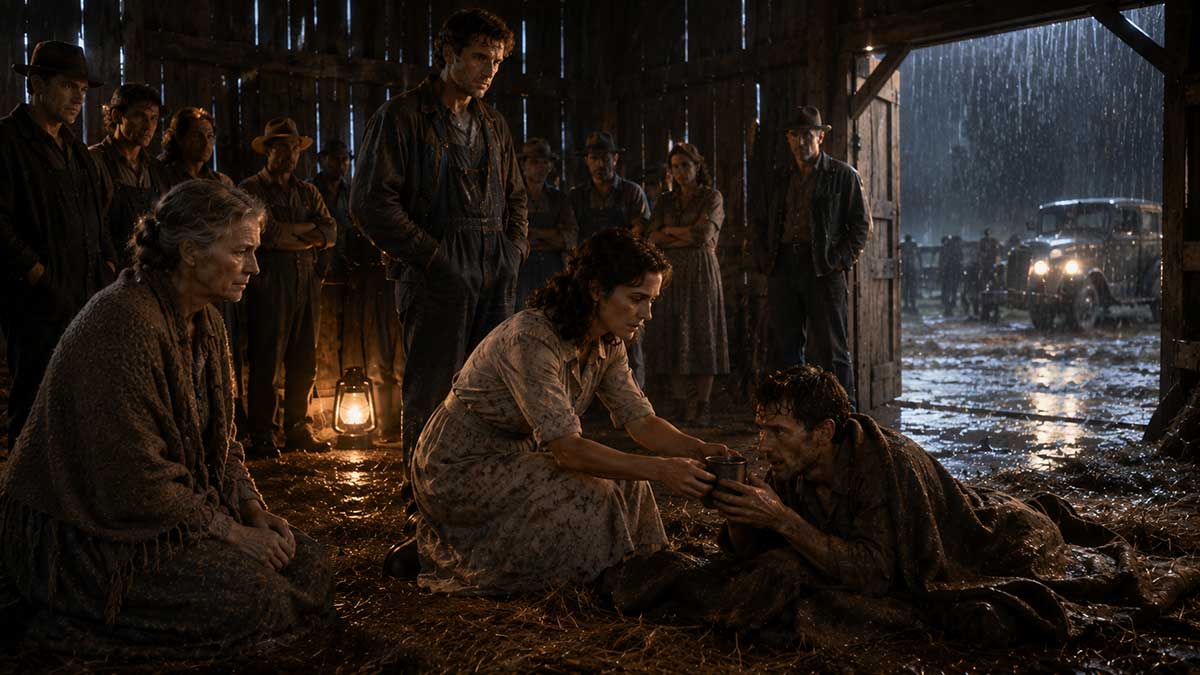
The barn returns in memory.
Rain against the roof.
Mud underfoot.
The smell of wet hay.
A starving man lying in the corner, too weak to eat solid food.
His son begging strangers to save him.
Rose of Sharon had just lost her baby.
Her body had prepared to feed a child who would never cry.
Rose of Sharon: When we found that man, I didn’t feel holy.
I didn’t feel generous.
I felt empty.
Angry.
I had spent months thinkin’ about my baby.
Then there was no baby.
Everybody looked at me like I had survived something.
I didn’t feel like I survived.
I felt like I had become a room after the furniture was taken out.
(Ma’s eyes fill, but she lets Rose continue.)
Rose of Sharon: Then Ma looked at me.
She didn’t say much.
She didn’t need to.
I understood what she was asking.
Tom Joad: Did you want to refuse?
Rose of Sharon: Yes.
(The honesty of it stills the room.)
I wanted to say, “This is mine.”
Not the milk.
The grief.
I wanted one thing to belong only to me.
I thought if I gave anything in that moment, I’d lose the last piece of my baby.
Ma Joad: I never knew that.
Rose of Sharon: I didn’t either, till now.
Mrs. Wainwright: Then why did you do it?
Rose of Sharon: I looked at the man.
He was dying.
Not as a symbol.
Not as mankind.
Just a man.
His eyes were ashamed.
That was what moved me.
He was starving, and still ashamed to need help.
I knew that shame.
We all did.
So I went to him.
(Casy lowers his head.)
Rose of Sharon: People may call it beautiful.
It wasn’t beautiful inside me.
It hurt.
It felt strange.
It felt unfair.
It felt like my body had made a promise to one life and was being asked to keep it for another.
Ma Joad: You had the right to say no.
Rose of Sharon: I know.
That matters.
I wasn’t used.
I chose.
Tom Joad: Did it heal you?
Rose of Sharon: No.
Not then.
Maybe not ever.
One act doesn’t mend every wound.
But for that moment, my loss wasn’t useless.
That man lived through the night.
I don’t know what happened after.
Maybe he died the next day.
Maybe he recovered.
I never learned.
Jim Casy: Does that change what you gave?
Rose of Sharon: It used to bother me.
I wanted the act to have a result.
I wanted proof it mattered.
Now I think that was my old way of seeing.
I wanted life to promise me something back.
Mrs. Wainwright: Most of us do.
Rose of Sharon: Maybe what we give is still real when we never see what comes from it.
(Tom leans forward.)
Tom Joad: That’s hard.
Fightin’ for people you may never meet.
Givin’ up something without knowin’ whether it changes anything.
Jim Casy: That’s most of justice.
Tom Joad: Then how do you keep goin’?
Jim Casy: You stop demandin’ that your own eyes witness the harvest.
You plant because somebody ought to.
Grampa Joad: Sounds like farmin’.
Jim Casy: Maybe every true thing does.
(Grampa grins.)
Pa Joad: I spent my life thinkin’ what I owed the family was food and shelter.
When I couldn’t give those, I thought I had nothing.
Ma Joad: You still had yourself.
Pa Joad: Didn’t seem worth much.
Ma Joad: You stood in the rain and tried to build that bank to hold back the water.
It failed.
You looked broken after.
Pa Joad: It was foolish.
Mrs. Wainwright: My husband didn’t think so.
He saw you start, and he stood up.
Then another man did.
For one hour, men who had given up believed they might protect their families.
The bank broke.
That hour still mattered.
Pa Joad: Never thought of it that way.
Tom Joad: Maybe failure can still give courage.
Jim Casy: A lost fight can teach people they’re not alone.
That’s not nothing.
Uncle John: What did I give?
(Everyone turns toward him.)
I drank.
I mourned.
I made trouble.
What did I give anybody?
Ma Joad: You stayed.
Uncle John: Barely.
Ma Joad: Barely still counts on some days.
Rose of Sharon: You carried my baby.
(Uncle John’s face changes.)
Uncle John: I put him in the flood.
Rose of Sharon: I know.
For years I thought it was terrible.
Then I understood.
You couldn’t bury him.
You couldn’t save him.
So you sent him where people might see.
Uncle John: I wanted the town to know what they’d done.
Tom Joad: Did they?
Uncle John: I don’t know.
Rose of Sharon: You made him a witness.
He never breathed, but you made his body speak.
(Uncle John covers his mouth with one hand.)
Uncle John: I thought you hated me.
Rose of Sharon: I did for a time.
Then I saw you carried him when I couldn’t.
That was something.
(Uncle John begins to cry without hiding it.)
Jim Casy: Sometimes what we owe is to carry what another person cannot.
Not forever.
Just until they can look at it.
Muley Graves: I carried memories for folks who left.
Thought that was enough.
Maybe I should’ve carried food to somebody still livin’.
Ma Joad: You gave Tom bread when he came home.
Muley Graves: One meal.
Tom Joad: I remembered it.
Muley Graves: All these years?
Tom Joad: A hungry man remembers who fed him.
(Muley looks down at his hat.)
Al Joad: I fixed the truck.
That seems small next to all this.
Pa Joad: That truck was the reason we made it west.
Al Joad: It broke down plenty.
Tom Joad: And you fixed it plenty.
Ma Joad: People keep thinkin’ love has to look grand.
Most days it looks like somebody checkin’ the oil.
(Al smiles, embarrassed.)
Mrs. Wainwright: Or saving the dry blanket for somebody else.
Pa Joad: Or taking the outside place near the rain.
Uncle John: Or filling a cup.
Noah Joad: Or letting a person sit quiet without asking him to explain.
Connie Rivers: Or coming back before pride turns into years.
(Rose of Sharon looks at him.)
Connie Rivers: I know I came too late.
Rose of Sharon: You came to this table.
That isn’t the same as repairing the past.
But it isn’t nothing.
Connie Rivers: What do I owe you?
Rose of Sharon: The truth.
No promises you can’t keep.
No grand speech.
Just the truth when it costs you something.
Connie Rivers: I can try.
Rose of Sharon: Try where I can see it.
(Connie nods.)
Tom Joad: Ma, what do children owe their parents?
Ma Joad: Less than parents think.
Pa Joad: Speak for yourself.
(The room laughs softly.)
Ma Joad: Children don’t owe us the lives we pictured.
They don’t owe us stayin’ forever.
They owe honesty when they can give it.
Kindness when they remember.
Maybe a place in their thoughts.
Tom Joad: Is that all?
Ma Joad: That’s a lot.
What do parents owe children?
Rose of Sharon: Safety.
Noah Joad: Room.
Al Joad: A chance to fail without bein’ named a failure.
Tom Joad: The truth about the world.
Pa Joad: Hope too.
Jim Casy: Hope that doesn’t lie.
(Ma nods.)
Ma Joad: Yes.
Tell them the road is hard.
Then teach them they don’t have to walk it alone.
Tom Joad: And what do we owe strangers?
Mrs. Wainwright: A second look.
Muley Graves: Their name, when they offer it.
Uncle John: Food, when we have it.
Pa Joad: Work that doesn’t steal a person’s dignity.
Al Joad: A ride, when the truck can carry one more.
Noah Joad: Silence, when they need it.
Connie Rivers: An apology, when we’ve harmed them.
Rose of Sharon: The right not to be ashamed of needing help.
(Tom turns to Casy.)
Tom Joad: And you?
What do we owe one another?
Jim Casy: The chance to remain human.
(No one moves.)
A system can take a farm.
A storm can take a home.
A company can cut a wage.
A law can call a hungry person dangerous.
Fear can make neighbors turn away.
What we owe one another is resistance to that turning.
Every time the world says, “That person is not your concern,” somebody has to answer, “Yes, they are.”
Tom Joad: Is that what you died for?
Jim Casy: I died because men were afraid of people standin’ together.
But I lived for something simpler.
I wanted one person to stop believin’ his suffering was his private shame.
Tom Joad: You changed me.
Jim Casy: Then pass it on.
Tom Joad: To who?
Jim Casy: Whoever is next.
(Tom looks around the table.)
Tom Joad: I used to think I had to be everywhere.
In every fight.
At every hungry camp.
Now I see it different.
Maybe no one person has to be everywhere.
Maybe each person has to be somewhere.
Ma Joad: Somewhere they can help.
Tom Joad: Somewhere they refuse to look away.
Rose of Sharon: Somewhere they can give what remains.
(The lantern flickers.)
Outside, rain begins tapping softly against the window.
No one rushes to leave.
Mrs. Wainwright takes the empty cup in front of Uncle John and fills it.
Al moves the lantern closer to Noah.
Muley breaks the last piece of bread and places half beside Pa.
Connie does not ask Rose of Sharon to forgive him.
He remains seated and listens.
Ma looks around the table, counting heads from habit.
This time, she counts the empty chairs too.
Ma Joad: We never had enough.
Not food.
Not money.
Not time.
But somehow there was always something left to give.
Rose of Sharon: Maybe that was what kept us alive.
Jim Casy: Maybe that’s what made the livin’ worth surviving.
The rain grows steadier.
The family sits together as the night moves on, no longer asking who belongs at the table.
The answer is already there.
Anyone who is hungry.
Anyone who is grieving.
Anyone who has nowhere else to go.
Final Thoughts by John Steinbeck
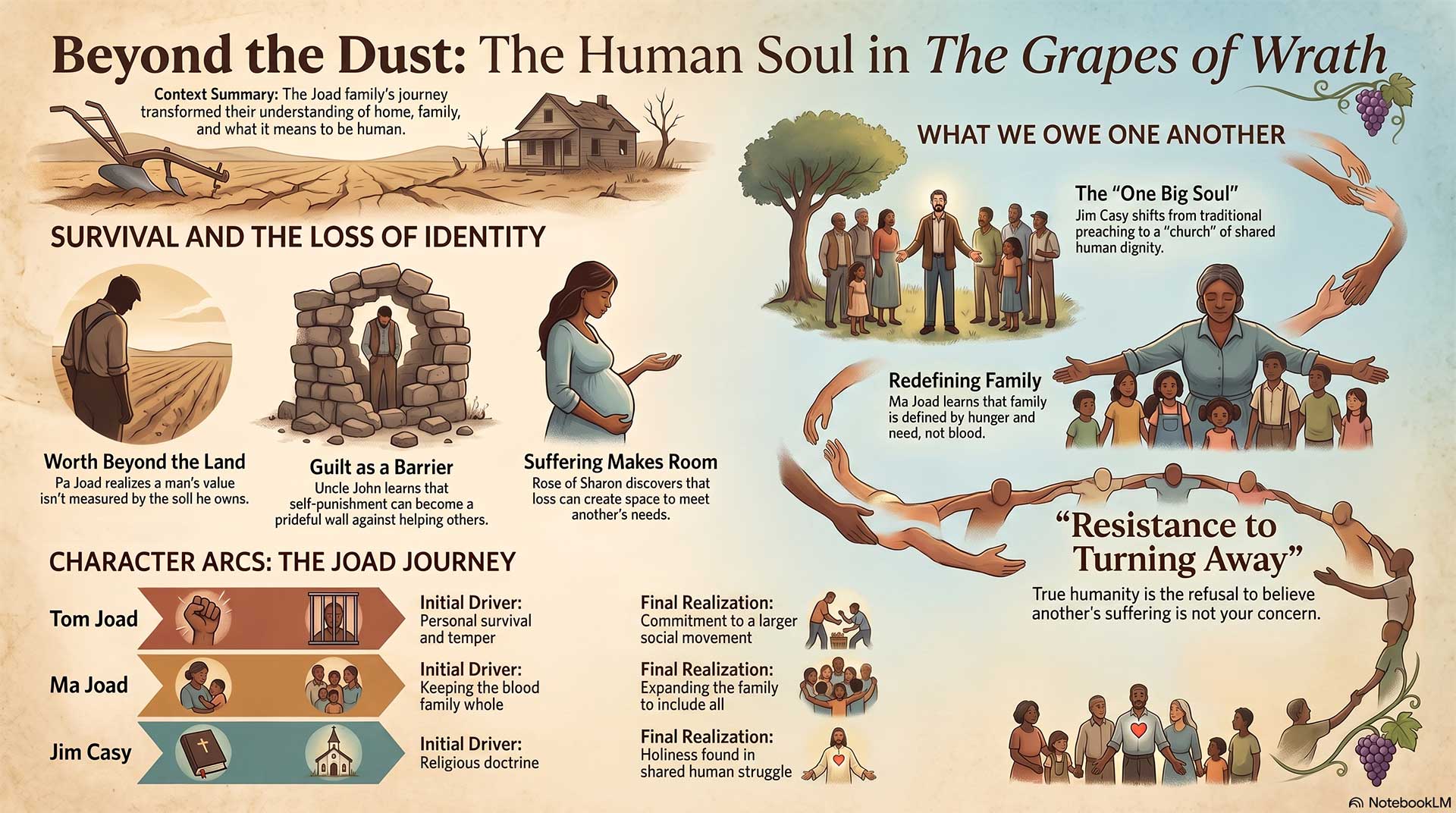
Writers rarely own their books for very long.
A novel leaves its author the moment another pair of hands opens it.
Each generation discovers different pages.
One generation sees economics.
Another sees injustice.
Another sees faith.
Another sees family.
If this conversation has reminded you of someone carrying burdens you cannot see, then the Joad family is still traveling.
If it has made you hesitate before judging someone who has lost a home, a job, or hope, then their journey has not ended.
The greatest danger I witnessed was never poverty by itself.
It was the moment people began believing another person's suffering had nothing to do with their own lives.
That belief can appear in any century.
So can its opposite.
Compassion has never depended upon prosperity.
It begins the moment one human being refuses to look away from another.
If the Joad family has left us with any inheritance, I hope it is this:
When hardship asks us to become smaller, we must answer by becoming larger.
Not in wealth.
Not in reputation.
But in the size of our humanity.
Thank you for listening.
Short Bios:
Tom Joad
Recently released from prison when the story begins, Tom grows from a man focused on protecting his own family into someone willing to stand for the dignity of all working people. His journey is one of awakening, sacrifice, and moral courage.
Ma Joad
The emotional heart of the Joad family. Calm under pressure and unwavering in crisis, Ma becomes the quiet force that holds everyone together when every other foundation begins to crumble.
Jim Casy
A former preacher who loses faith in traditional religion but discovers a deeper calling through compassion and shared humanity. His ideas reshape Tom's understanding of justice and community.
Pa Joad
Once the unquestioned head of the household, Pa struggles with the painful loss of authority as circumstances beyond his control transform family life. His story reflects the emotional cost of losing one's role and identity.
Grampa Joad
Stubborn, humorous, and fiercely attached to the Oklahoma land, Grampa embodies the deep bond between people and place. His presence reminds the family of what home once meant before the journey west.
John Steinbeck
John Steinbeck (1902–1968) was an American novelist whose work explored the lives of ordinary people with uncommon dignity and compassion. His novels, including Of Mice and Men, East of Eden, and The Grapes of Wrath, examined labor, family, injustice, hope, and the enduring resilience of the human spirit. He received the Nobel Prize in Literature in 1962 for his realistic and imaginative writing, distinguished by sympathetic humor and keen social perception. More than eight decades after The Grapes of Wrath was published, its questions about dignity, community, and moral responsibility continue to resonate around the world.
Leave a Reply