

What if The Grapes of Wrath unfolded in America today instead of the 1930s?
Introduction by Nick Sasaki
We listened to the people who lived The Grapes of Wrath. We listened to the scholars who explained it. But one question remained: What would John Steinbeck write if he were alive today?
Welcome to the final chapter of our The Grapes of Wrath Trilogy.
The first Imaginary Talk allowed the novel's characters to speak for themselves. We heard Tom Joad, Ma Joad, Jim Casy, Rose of Sharon, and others wrestle with suffering, hope, family, and survival from inside the story.
The second Imaginary Talk brought together leading Steinbeck scholars and literary experts. They explored the novel's symbolism, historical context, political meaning, spiritual themes, and the questions readers have been asking for decades.
Yet after both conversations, I realized something was still missing.
The characters showed us what happened.
The scholars explained why it mattered.
But neither could answer the question facing millions of people today:
If the same moral crisis unfolded in twenty-first-century America, what would it look like?
That question inspired The Last Affordable Road.
This is not a remake of The Grapes of Wrath.
It is not fan fiction.
It is an original story built upon Steinbeck's deepest ideas.
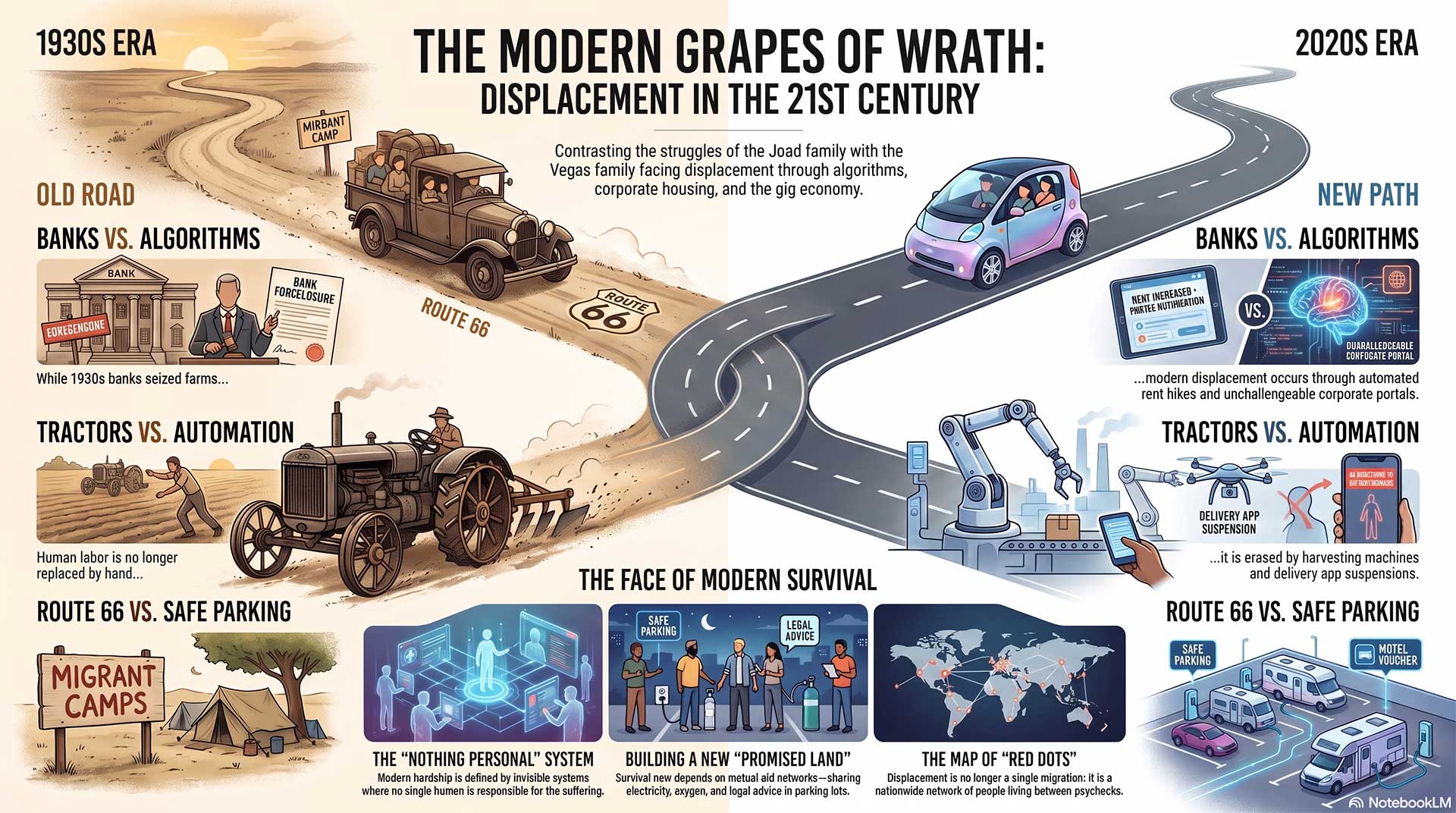
Instead of banks taking farms, families lose homes through rising rents, corporate ownership, automated decisions, and invisible systems that seem impossible to challenge.
Instead of Route 66, the road is lined with warehouses, delivery apps, safe-parking lots, and temporary jobs.
Instead of asking where the promised land is, this story asks whether ordinary people must build it themselves.
More importantly, this final story attempts to answer several questions left intentionally open in the first two conversations.
- Is there still a villain when no single person is responsible?
- Can hard work still guarantee dignity?
- Is survival simply staying alive?
- Does compassion still matter when systems seem too large to change?
- What does "family" mean when everyone is forced onto a different road?
This story is my humble attempt to continue the conversation John Steinbeck began nearly ninety years ago.
Not by copying his masterpiece—
—but by asking what truths still remain unchanged.
(Note: This is an imaginary conversation, a creative exploration of an idea, and not a real speech or event.)
1. The Notice
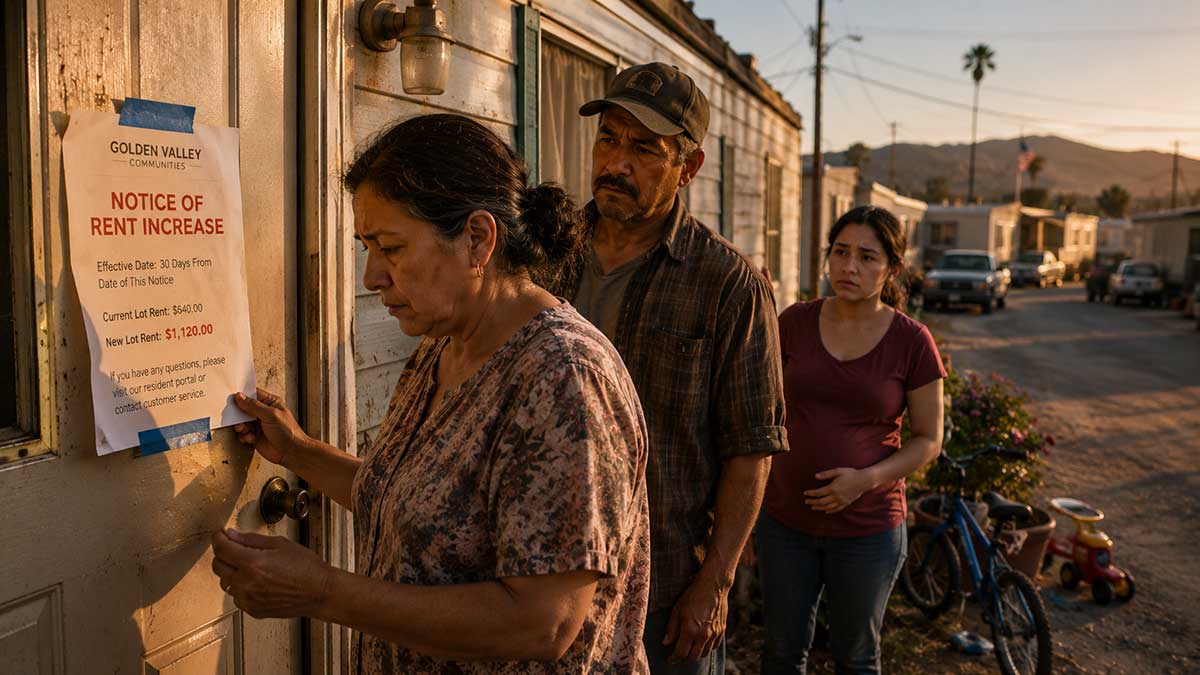
Elena Vega found the paper taped to the front door when she came home from Rosa’s apartment.
The afternoon wind had folded one corner back and forth until the crease looked ready to tear. At first, Elena assumed it was another warning about parking, weeds, or the cracked step Rafael had promised to replace.
Then she saw the number.
She stood beneath the aluminum awning and read it twice.
The company name at the top was unfamiliar. Under it, in smaller letters, appeared a sentence explaining that Golden Valley Communities had recently acquired the property and remained committed to improving the quality of life for all residents.
The lot rent would rise from six hundred and forty dollars to eleven hundred and twenty.
The increase would begin in thirty days.
Elena kept reading, searching for the line that said elderly residents would be protected, longtime families would receive more time, or someone had made a mistake.
There was no such line.
A strip of blue painter’s tape hung from the page. It fluttered against the door like a small tongue.
Inside, Sofia sat on the floor with a measuring tape stretched from the wall to the edge of the couch.
“What are you doing?” Elena asked.
Sofia looked up and smiled. At seven months pregnant, she had begun moving carefully, as though every turn required permission from the child inside her.
“I think the crib could fit here if we move the lamp.”
Elena placed her purse on the table.
“What crib?”
“The used one Mateo found online. It’s missing one rail, but Rafael said he could fix it.”
“You bought it?”
“Not yet.”
Elena handed her the notice.
Sofia read the first half standing. By the end, she had lowered herself onto the couch.
“That can’t be right.”
“It is printed very clearly.”
“They can’t nearly double it.”
“They already did.”
Rafael came in through the back door carrying a sack of work clothes darkened with dust and sweat. He had worked the fields around Bakersfield for thirty-seven years, long enough to know by smell whether a crop had been irrigated too late.
“What happened?” he asked.
Sofia passed him the paper.
He read it without removing his hat.
“We can take more hours,” he said.
Elena looked at him.
“They cut your hours last week.”
“They may bring them back.”
“They may not.”
“We can talk to the office.”
“There is no office anymore. It says questions must be submitted online.”
Rafael read the bottom of the page.
“There’s a phone number.”
“I called it. A recording told me to use the website.”
Mateo entered a few minutes later, carrying a paper bag with four tacos and one bottle of orange soda. He looked younger than thirty-one when he smiled and much older when he stopped.
He listened without eating.
“How much do we have saved?” he asked.
“Not enough,” Elena said.
“We could move the trailer.”
Rafael sat down.
“The frame won’t pass inspection.”
“We can fix it.”
“The axles are too old.”
“Then we replace the axles.”
“With what money?”
Mateo walked to the window and looked out at the mobile homes lined along the narrow road. Some were painted pale green or yellow. Others had roofs held down with tires. Near the entrance, children rode bicycles in circles around a speed bump.
“What happens if we don’t pay?”
Elena tapped the paper.
“They can remove us.”
Sofia looked around the room.
“But the home belongs to us.”
“The home does,” Elena said. “The ground does not.”
Rafael placed both hands flat on the table, as if steadying something beneath it.
For years, he had spoken of the trailer as temporary. One more good season. One more raise. One more year without a medical bill. Then they would find a small house with a patch of yard.
The years had accumulated quietly.
Now the trailer was twenty-eight years old, the roof leaked over the hallway, and the steps groaned when someone climbed them. It was still the first place Elena had ever signed papers to own.
“We bought the walls,” she said. “Somebody else bought the right to decide where they stand.”
No one spoke.
Sofia folded the notice and placed it beside the measuring tape.
The corner she had chosen for the crib remained exactly thirty-seven inches wide.
2. Nothing Personal
The harvesting machine arrived two days later.
Rafael heard it before he saw it.
The sound was lower than a tractor, steadier, with none of the pauses made by a human driver deciding where to turn. It moved down the rows under white morning light, shaking branches and collecting fruit with a speed that made the workers standing nearby look unnecessary.
The supervisor gathered the crew beside a truck.
“We’re reducing teams through the end of the month,” he said. “Some of you may be called back.”
The men watched the machine continue without them.
Rafael had known the supervisor for twelve years. His name was Dan, and he had once driven Rafael to urgent care after a ladder slipped beneath him.
Dan would not meet his eyes.
“How many hours?” Rafael asked.
“Maybe ten a week. Maybe less.”
“I need forty.”
“I know.”
“You said the machines were only for the far rows.”
“That was the plan.”
“Whose plan changed?”
Dan took off his cap and wiped his forehead.
“It came from corporate.”
Rafael waited.
Dan put his cap back on.
“It’s nothing personal.”
Rafael looked past him at the machine.
“Nothing personal,” he said, “is what they call it when everybody’s life changes.”
At home that afternoon, Elena received her own message.
Rosa Alvarez had been her client for four years.
Rosa was seventy-two and suffered from lung disease that made ordinary tasks feel like climbing. Elena shopped for her, helped with bathing, organized medications, cooked soft rice with chicken, and sat beside her during the hours when fear made breathing harder.
That morning, Rosa’s daughter had called from Seattle. Rosa was being transferred to temporary assisted care under a new plan. Elena’s visits would stop immediately.
The agency sent a text:
THANK YOU FOR YOUR COMMITMENT TO EXCELLENT CLIENT CARE. NO FURTHER SHIFTS ARE AVAILABLE AT THIS TIME.
Elena read it standing in the kitchen.
No person called.
No one asked whether she needed another client.
No one said goodbye.
Mateo arrived after dark and placed his phone face down on the table.
“You’re late,” Rafael said.
“I was out.”
“Working?”
Mateo opened the refrigerator and stared into it.
Elena watched him.
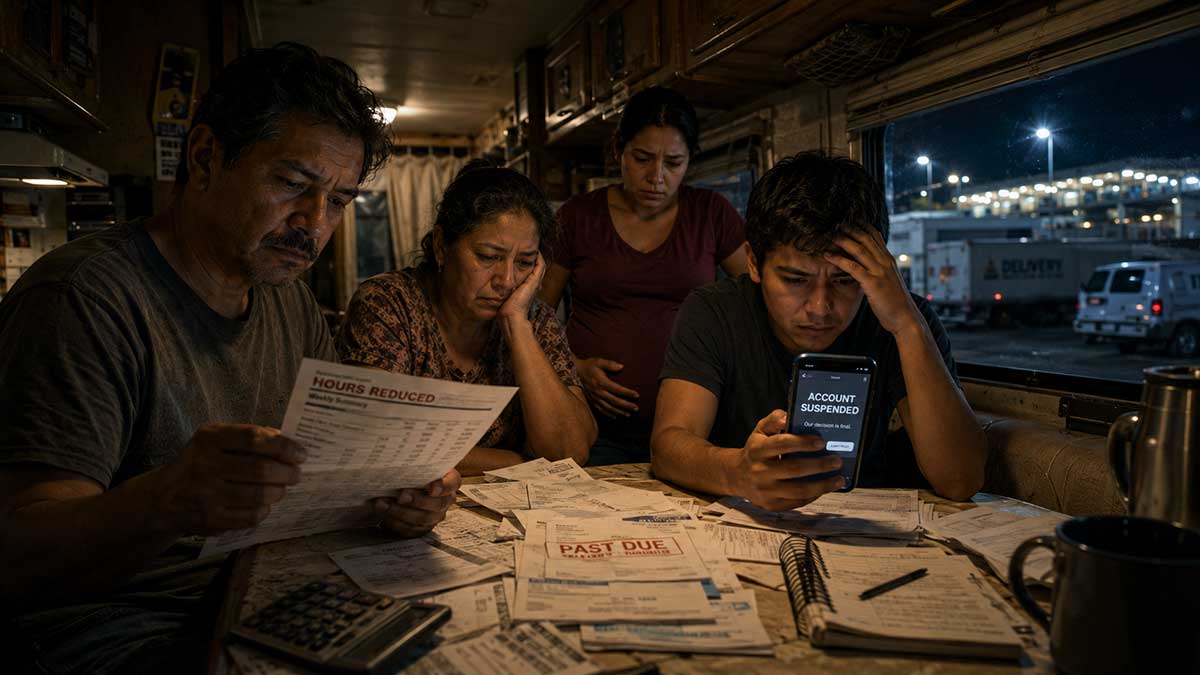
“For how long has your account been suspended?”
His hand froze on the door.
Rafael looked up.
“What account?”
Mateo closed the refrigerator.
“Three days.”
“What happened?”
“They said suspicious activity.”
“What activity?”
“I don’t know.”
“You must have done something.”
“I completed a delivery. Then the screen went red.”
“Did you call?”
“There is no number.”
“Then appeal.”
“I did.”
“What did they say?”
Mateo picked up his phone and read from the screen.
“Your case has been reviewed. The decision is final.”
Rafael frowned.
“Reviewed by who?”
“That’s the question.”
Sofia sat near the window, one hand beneath her stomach.
“Can they do that?”
“They did.”
“You made more than four thousand deliveries.”
“Four thousand, two hundred and eleven.”
“Doesn’t that matter?”
“The screen doesn’t know.”
Elena looked from Rafael’s dusty boots to Mateo’s dark phone, then at the agency message still open on her own device.
A machine had reduced Rafael’s work.
A program had erased Mateo’s.
A company portal had raised the rent.
A text message had ended hers.
No one had cursed them.
No one had shouted.
No one had even needed to look at them.
“Nobody hates us,” Elena said.
Rafael gave a bitter laugh.
“That should make us feel better.”
“It doesn’t,” she said. “That may be the worst part.”
Three weeks later, they sold Rafael’s tools, Elena’s gold bracelet, the old television, and the extra refrigerator that had not worked in years. Mateo found a used recreational vehicle outside Delano.
The seller said it had plenty of road left.
The roof sagged near the back. The air conditioner worked only when connected to an outside outlet. One tire had been replaced with a different size.
They bought it.
The unfinished crib, missing one rail, was tied to the roof.
3. The First Night
They left before sunrise.
Elena stood in the doorway of the trailer for the last time and touched the wall beside the kitchen light switch.
There were marks there measuring Mateo and Sofia as children. Mateo’s first line had been drawn when he was four. Sofia’s highest mark came from the year she turned sixteen and decided she had stopped growing.
Rafael had painted over the marks twice, yet the pencil still showed faintly beneath the white.
“Hurry,” he called from outside.
Elena did not answer.
She touched each line, then closed the door.
The road out of the park passed the office, which was dark. A camera above the gate turned slowly as they drove beneath it.
By noon, the RV began overheating.
Rafael pulled onto the shoulder and opened the hood. Steam rose in front of his face.
Sofia sat on the step, fanning herself with an envelope. Mateo paced beside the road, refreshing the delivery app despite the suspension.
Elena watched trucks pass.
Their lives now fit into one vehicle with curtains that smelled of mildew.
They reached a rest area after dark.
The parking lot was half full. Rafael chose a spot beneath a tree near the edge. Elena heated beans on the small stove. They ate from paper bowls.
For twenty minutes, the RV felt almost like a home.
Then a flashlight struck the window.
A security guard stood outside.
“You can’t stay overnight.”
Rafael opened the door.
“We’re too tired to drive.”
“Two-hour limit.”
“The sign says parking.”
“Not camping.”
“We’re not camping.”
The guard looked at the crib tied to the roof.
“You’re sleeping here.”
“Yes.”
“That makes it camping.”
Sofia appeared behind Rafael.
“I’m pregnant.”
The guard lowered the flashlight.
“I don’t make the rules.”
“Who does?” Mateo asked.
The guard looked toward him.
“You need to leave.”
The van parked three spaces away started its engine.
A man leaned out the driver’s window.
“Follow me.”
His name was Malik Johnson.
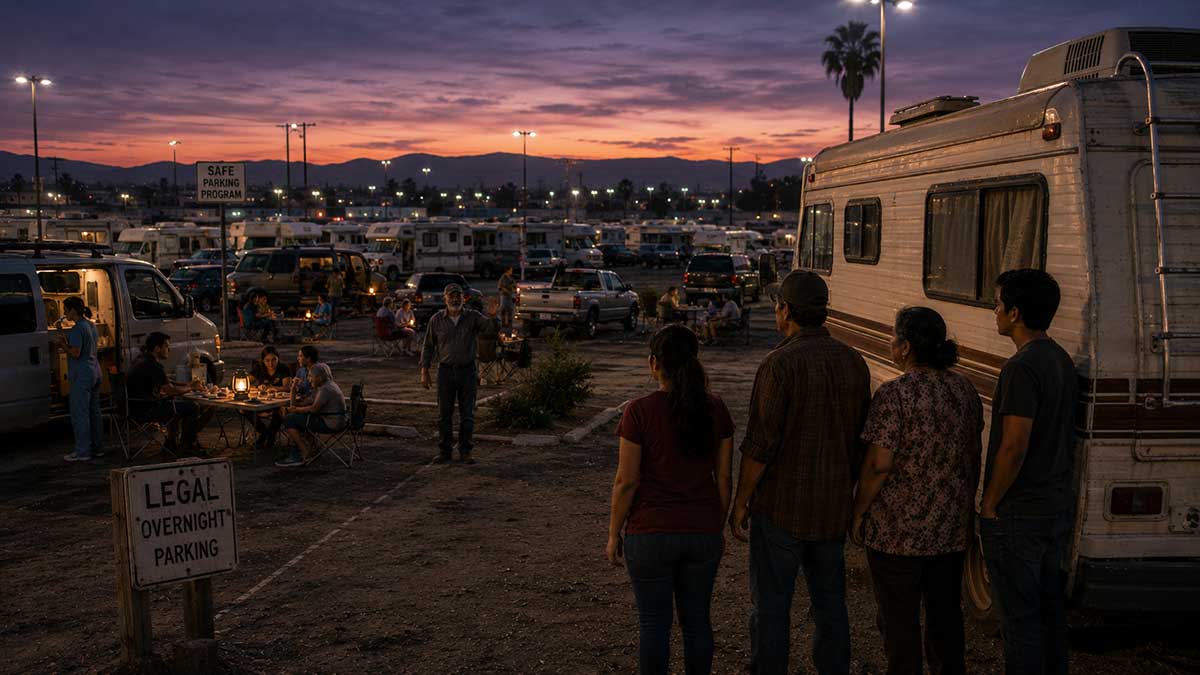
He drove twenty minutes through dark industrial roads to the parking lot of a closed church. Twelve vehicles were already there: vans, pickup trucks with camper shells, sedans with towels covering the windows, an old school bus painted gray.
A handwritten sign at the entrance read SAFE PARKING — REGISTER BY 9 P.M.
“You’re late,” Malik said, “but they know me.”
A volunteer took their names and license plate number.
“Bathrooms are behind the fellowship hall,” she said. “No cooking outside. Leave by seven.”
The lot was quiet.
A woman in hospital scrubs brushed her teeth beside a water jug. A warehouse worker folded his uniform on the hood of his car. An elderly couple slept in separate front seats with a small fan plugged into the dashboard.
Elena lowered her voice.
“They all live here?”
“Most work,” Malik said.
Rafael looked at him.
“You live in the van?”
“Fourteen months.”
“What happened?”
“Later.”
Mateo sat with Malik on the curb.
Under the yellow parking-lot lights, Malik told him about his trucking job. He had driven regional routes for eleven years. Then chest pain sent him to a hospital. The bills arrived before he could return to work. His employer replaced him. His apartment was gone three months later.
“Didn’t you have insurance?” Mateo asked.
“I had insurance. I didn’t have enough insurance.”
“You couldn’t appeal?”
“I appealed.”
“What happened?”
“A letter said no.”
“Who signed it?”
“No one.”
Mateo looked down at his phone.
Malik noticed.
“What did your screen do to you?”
“Suspended me.”
“Why?”
“It won’t say.”
Malik nodded.
“A system stays safe when every person thinks he failed alone.”
Mateo looked around the lot.
A substitute teacher slept in a minivan.
A farmworker washed his shirt in a plastic basin.
A woman wearing a grocery-store badge arranged schoolbooks beside two children sleeping in the back seat.
Mateo had imagined homelessness as a final condition, a visible border separating one kind of person from another.
Here, everyone seemed to be between things.
Between paychecks.
Between leases.
Between illnesses.
Between promises.
“What happens in the morning?” he asked.
Malik stood.
“They go to work.”
4. The Road Narrows
The family followed job listings north first.
In Fresno, Rafael found temporary harvesting work advertised at twenty-two dollars an hour.
At the end of the week, deductions appeared for transportation, safety equipment, processing, and crew placement.
He brought home less than eleven dollars an hour.
Elena found a caregiving position outside Sacramento. The family expected twelve-hour availability but offered payment for five.
“They said I could sleep there,” she told Sofia.
“Would you?”
“If they paid me.”
“They want you always ready.”
“They called it companionship.”
Sofia shook her head.
“They want a servant they can describe kindly.”
Mateo joined an online group for drivers whose accounts had been suspended. At first, he entered only to search for a loophole.
There were thousands of members.
People posted screenshots identical to his.
A woman with eight years of deliveries lost access after a customer claimed an order never arrived. A man was flagged for operating in two cities after moving. Another driver had died, and his family was still receiving warnings about acceptance rates.
Mateo began answering messages.
He showed people how to request records, how to document appeals, how to contact labor offices. Most attempts failed. A few accounts were restored.
The first time someone thanked him, he read the message three times.
The RV moved south again when temperatures rose.
By the time they reached Phoenix, heat pressed against the windows before sunrise. The air conditioner required outside electricity they rarely had.
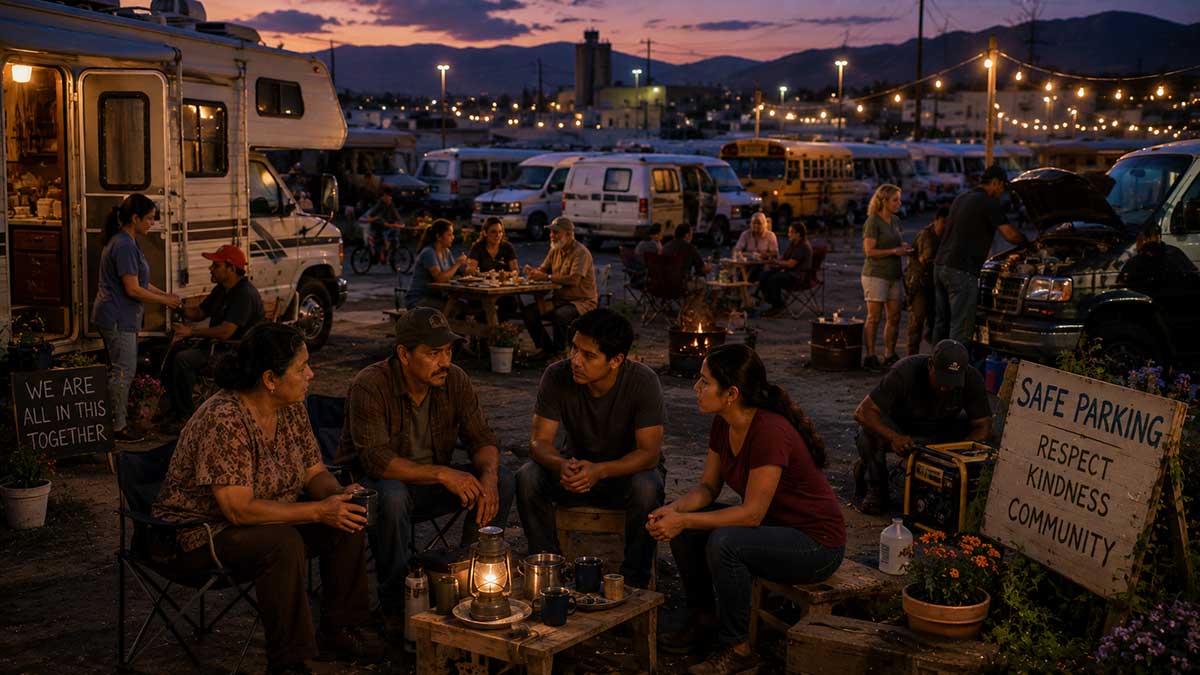
Elena began helping people in the safe-parking lot.
She checked blood pressure, organized pills, sat with an older man during panic attacks, and helped a woman clean an infected foot.
Sofia watched her cross the lot one afternoon carrying a bowl of soup.
“You need to rest,” she said.
“El señor can’t stand long enough to cook.”
“Neither can you.”
“I can.”
“You fainted yesterday.”
“I got dizzy.”
“You keep giving everything away.”
Elena stopped.
The soup trembled slightly in her hands.
“What should I do? Sit in the RV and count what we lost?”
“You should save something for us.”
“I am trying.”
“No. You are trying to feel useful.”
Elena’s face hardened.
“And what is wrong with that?”
“You make everyone need you, then you get angry that everyone needs you.”
The words landed between them.
Sofia looked frightened by what she had said.
Elena walked past her.
That evening, the temperature remained above one hundred degrees after sunset.
Rafael and Mateo argued about where to park. Sofia sat near the open door, breathing slowly.
Elena returned from helping a woman in another vehicle and reached for the step.
Her knees failed.
She fell before anyone could catch her.
When she opened her eyes, she was lying on a mattress inside Malik’s van. A wet cloth covered her forehead.
Rafael sat beside her.
Mateo held a bottle of water.
Sofia stood near the door, crying.
Elena tried to rise.
“No,” Rafael said.
“There are people waiting.”
“They can wait.”
“I promised—”
“You almost stopped breathing.”
Elena looked toward Sofia.
Her daughter wiped her face.
“I’m sorry.”
Elena closed her eyes.
“No. You were right.”
No one spoke.
For years, Elena had believed her strength was a room everyone could enter.
She had never asked who repaired it afterward.
“I thought love meant carrying all of you,” she said. “I never asked what happened when my back gave out.”
Rafael took the cloth from her forehead and dipped it in water.
Mateo opened a nutrition bar and placed half in her hand.
Sofia sat beside her and removed Elena’s shoes.
It was the first evening in years when Elena did nothing for anyone.
The family survived it.
5. The Last Room
The voucher came through on a Thursday.
One motel room for one night.
A housing coordinator had told them it might lead to three more nights, then perhaps placement in transitional housing.
No promises.
Still, the family celebrated.
Sofia wanted a shower.
Rafael wanted to sleep with the door locked.
Mateo wanted to charge every device at once.
Elena wanted to lie beneath clean sheets and hear no engine cooling beside her.
They were forty minutes from the motel when Rosa called.
Elena almost did not answer. The number was unfamiliar.
“Hello?”
“Elena?”
Rosa’s voice was thin.
“Rosa? Where are you?”
“Outside a clinic.”
“What happened?”
“They discharged me.”
“From the care center?”
“The money ended.”
“Where is your daughter?”
“She is trying to find a place.”
Elena heard traffic and wind through the phone.
“Are you alone?”
“Yes.”
“Do you have oxygen?”
“Some.”
“How much?”
“The battery light is red.”
Elena told Rafael to turn around.
He kept driving.
“Rafael.”
“We have a check-in time.”
“She is outside.”
“We will call an ambulance.”
“She was discharged from a clinic.”
“Call her daughter.”
“She is in Seattle.”
“We cannot lose the room.”
Sofia leaned forward.
“Who is it?”
“Rosa.”
Mateo looked at Elena’s face and understood.
Rafael gripped the wheel.
“We have one chance,” he said.
“One night,” Elena replied.
“One night can become housing.”
“And she may not survive one night outside.”
“We cannot save everyone.”
Elena stared through the windshield.
The road shimmered under the late-afternoon heat.
For years, she had cared for Rosa in a small apartment with blue curtains. Rosa collected ceramic birds and watched game shows with the volume too high. On bad days, she panicked when Elena left the room.
The clinic appeared ahead.
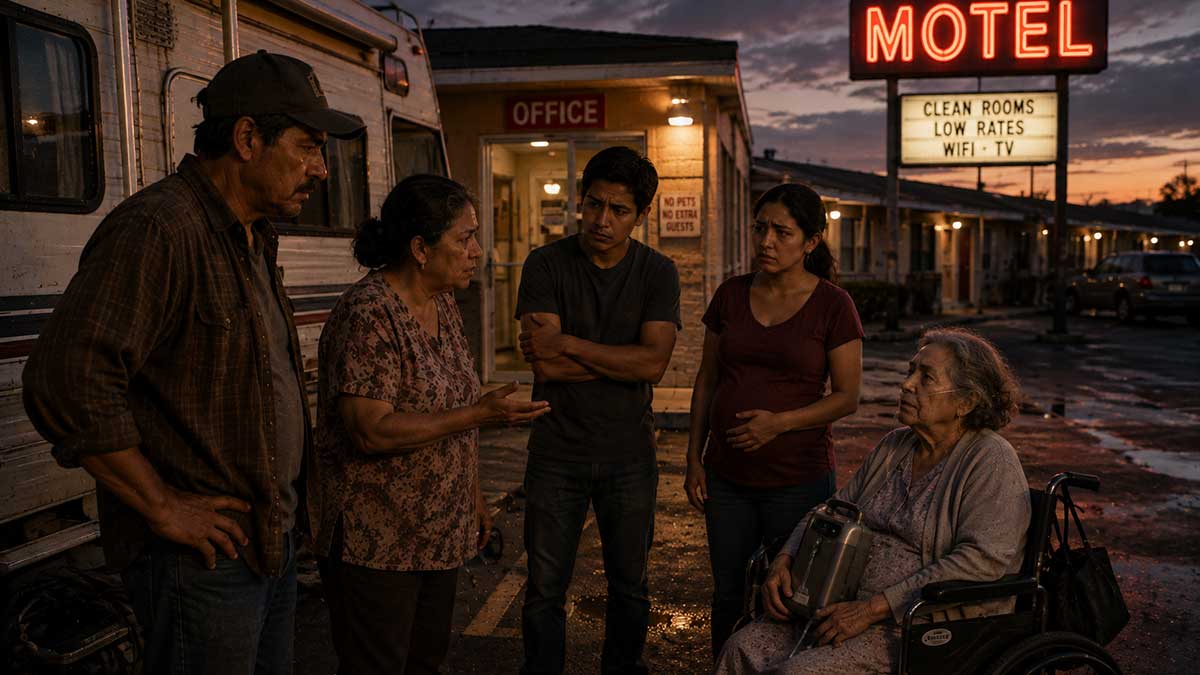
Rosa sat in a wheelchair beneath a narrow strip of shade. A plastic bag hung from one handle. The oxygen machine rested on her lap.
Rafael pulled over.
“This could cost us everything,” he said.
Mateo opened the door.
“So could leaving her.”
They lifted Rosa into the RV.
Her lips were pale.
At the motel, the clerk looked at the registration.
“Four guests,” he said.
“Five now,” Rafael replied.
“The voucher covers four.”
“She needs electricity for medical equipment,” Elena said.
The clerk lowered his voice.
“I can’t authorize an extra guest.”
“Then call someone who can.”
“There is no one here.”
“Then you decide.”
“I could lose my job.”
Rafael looked at Elena.
There it was again.
The chain.
The person at the desk.
The manager at home.
The coordinator unreachable.
The policy written elsewhere.
Each person afraid to become the place where responsibility stopped moving.
Sofia stepped forward.
“If the room only saves us by teaching us to leave her outside, what exactly is it saving?”
The clerk looked toward Rosa.
Her machine beeped.
He swiped a key card.
“One night,” he said. “I didn’t see the fifth person.”
The room smelled of bleach and old carpet.
Sofia stood under the shower until the hot water cooled. Rafael sat on the edge of one bed, staring at the locked door. Mateo connected Rosa’s oxygen machine beside the television.
Elena helped Rosa lie down.
“You should not have come,” Rosa whispered.
“You called me.”
“I did not know who else.”
“That is why I came.”
Near midnight, someone knocked.
The motel manager stood outside with the clerk behind him.
“We have a problem,” the manager said.
6. Morning
The manager explained that the voucher could be canceled for violating occupancy rules.
Rafael apologized.
Mateo did not.
“She needed electricity to breathe.”
“That isn’t the issue.”
“It is the only issue.”
“The program has requirements.”
“Who wrote them?”
The manager’s face tightened.
“I am trying to help you.”
“Then help us.”
“I cannot make exceptions.”
Malik arrived before dawn.
Mateo had messaged the suspension group and the safe-parking network. He had written only the facts: one family, one room, one elderly woman, one oxygen machine, one rule.
By sunrise, six vehicles were parked outside the motel.
A housing advocate came from a local nonprofit. A reporter arrived with a phone and small microphone. Two caregivers who knew Elena stood near the entrance. One of Mateo’s online contacts brought printed copies of the motel program rules and marked a section allowing emergency medical discretion.
The manager disappeared into the office.
The clerk brought Rosa coffee.
No miracle followed.
No wealthy stranger appeared.
No permanent apartment opened.
The voucher extension was denied.
Rosa received emergency placement in a medical respite center after the advocate called three agencies and refused to hang up.
The Vega family was offered two weeks at a legal vehicle site on the edge of Phoenix.
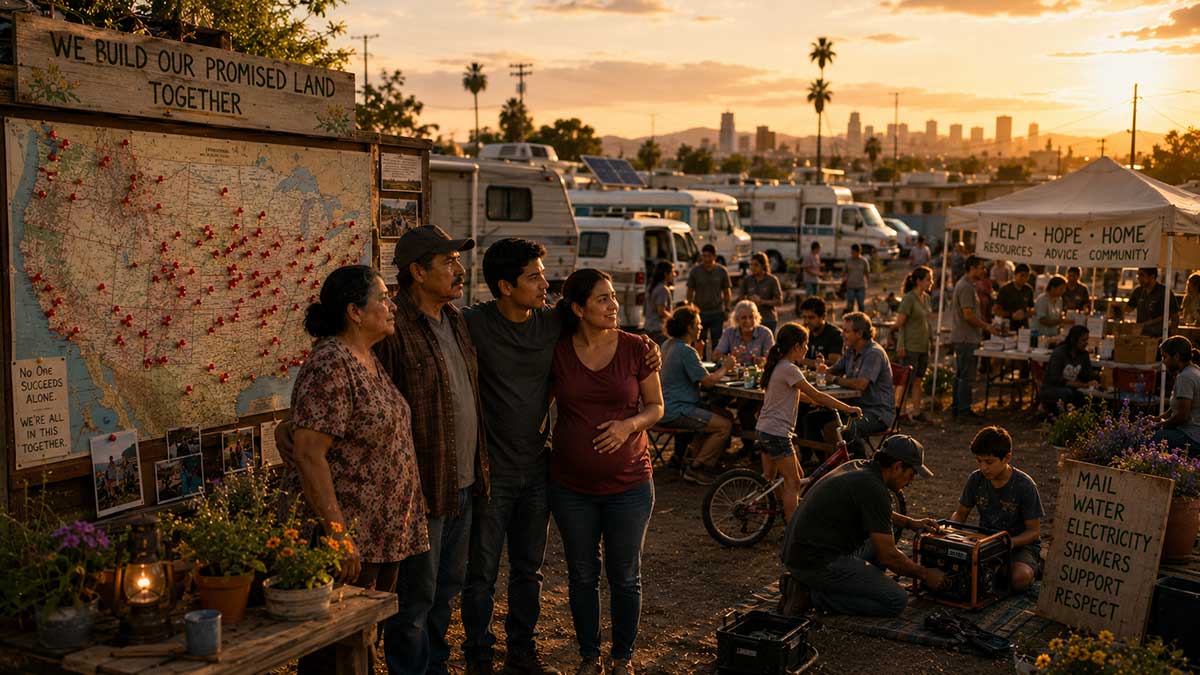
The site had electrical hookups, water, mailboxes, and a trailer where volunteers helped residents appeal benefit denials, rental screenings, and app suspensions.
Mateo began working there three afternoons a week.
Rafael repaired generators, air conditioners, and damaged ramps. People paid him when they could. When they could not, they brought food.
Sofia placed the unfinished crib beside the RV and sanded the missing rail.
Elena returned to caregiving, but only three days a week.
The first time someone asked whether she could cover a fourth, she said no.
It frightened her.
Then it freed her.
A month later, Mateo pinned a paper map to the wall of the appeal trailer.
He marked Bakersfield.
Fresno.
Sacramento.
Phoenix.
Others began adding their own marks.
A nurse from Nevada.
A warehouse worker from San Bernardino.
A retired couple from New Mexico.
A mother who had slept behind a grocery store outside Tucson.
Soon the map was crowded with red dots.
Elena stood before it one evening.
Outside, people connected extension cords, repaired a leaking water line, traded canned food, and wrote names on a sign-up sheet.
“We kept thinking the road would end somewhere,” Mateo said.
Elena looked at the map.
“Maybe it does.”
“Where?”
She watched Rafael showing a young man how to replace a fuse. Sofia sat beneath the awning, fitting the crib rail into place. Malik carried a folding table across the lot.
Elena thought about the trailer they had lost.
The walls they owned.
The ground they did not.
She thought about Rosa outside the clinic, Mateo outside his account, Rafael outside his work, and the family outside every place where sleeping had become against the rules.
“Where people stop waiting for permission to make room,” she said.
That night, the temperature fell enough for everyone to sit outside.
Someone cooked rice.
Someone played cards.
A baby cried in a nearby van.
No one had reached a promised land.
No one mistook the parking site for one.
The gates could close.
The funding could end.
The road could begin again.
Yet for the first time, the Vega family was not waiting alone for someone else to decide whether they were allowed to remain.
The red dots on the map did not look like failures anymore.
They looked like people finding one another.
Final Thoughts by Nick Sasaki
Completing this trilogy changed the way I think about The Grapes of Wrath.
The first conversation reminded us that behind every historical event are real families trying to protect one another.
The second conversation showed that Steinbeck was writing about much more than the Dust Bowl. He was asking timeless questions about dignity, justice, power, community, and what people owe one another.
This final story asks whether those same questions have truly disappeared.
My conclusion is that they have not.
The names have changed.
The technology has changed.
The roads have changed.
But the human heart has changed very little.
People still long for security.
Parents still worry about their children.
Workers still hope that honest labor will provide a decent life.
Communities still face the choice between protecting only themselves or making room for someone else.
That is why The Grapes of Wrath continues to speak to each new generation.
It is not only a novel about the 1930s.
It is a mirror held up to every era that must decide whether success belongs only to the strongest or whether hope grows when people refuse to let others stand alone.
If this trilogy has accomplished anything, I hope it has shown that great literature is never trapped in the century in which it was written.
A great novel keeps asking new questions.
Our task is to keep answering them.
Thank you for joining me through all three conversations. I hope they inspire you to return to Steinbeck's original work with fresh eyes—and perhaps to look at today's world a little differently as well.
Short Bios:
Leave a Reply