
What if the greatest threat to modern society isn't death, but millions of people quietly living without truly feeling alive?
When most people hear the word survival, they think of one thing:
Staying alive.
Finding food.
Escaping danger.
Recovering from illness.
Enduring another difficult day.
From biology to medicine, survival has traditionally referred to the continuation of life itself.
Yet during the past several decades, psychology, sociology, neuroscience, epidemiology, and public health have quietly raised a deeper question.
Is continued existence enough?
Can a person be physically healthy, financially secure, professionally successful, and free from diagnosable mental illness—yet still fail to flourish?
Researchers have increasingly recognized that the absence of disease is not the same as the presence of well-being.
A person may function efficiently while feeling emotionally empty.
They may perform successfully while losing curiosity.
They may remain productive while becoming disconnected from purpose, community, and hope.
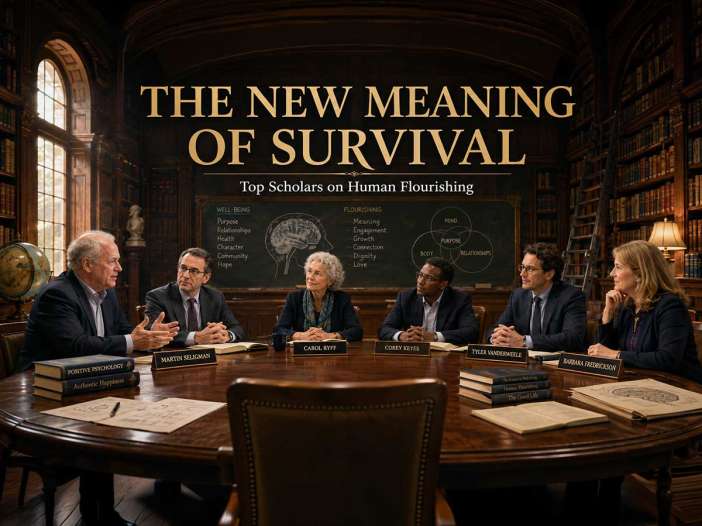
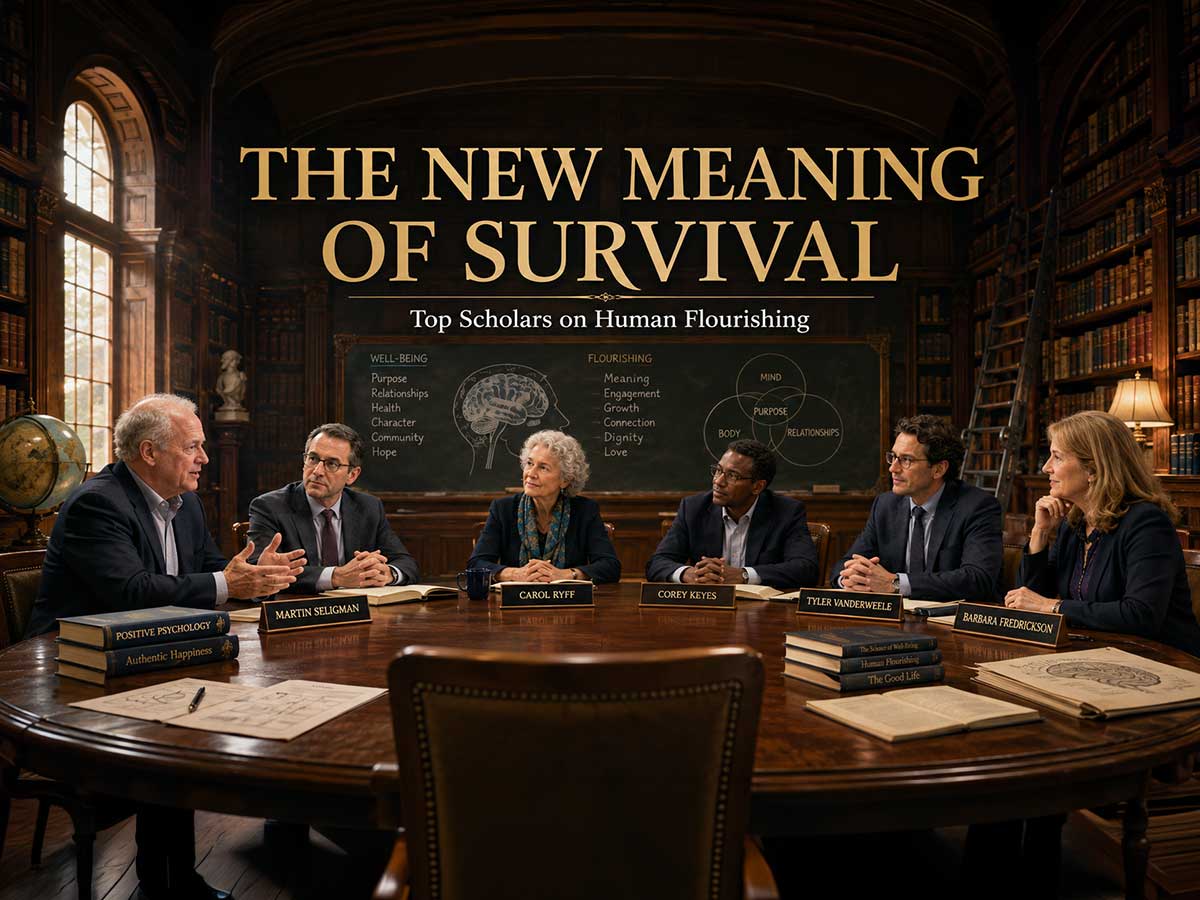
This scholarly conversation brings together five of the world's leading researchers whose work has reshaped how we think about mental health, human flourishing, positive emotion, purpose, and psychological well-being.
Together they explore questions that modern society is only beginning to ask.
Where is the line between surviving and flourishing?
Is happiness really the goal of life?
Can suffering coexist with a meaningful existence?
How much of well-being depends on personal responsibility, and how much depends on families, workplaces, communities, and public institutions?
Most importantly:
What conditions must be preserved for a human life to remain deeply, meaningfully alive?
This conversation is not an attempt to replace the traditional definition of survival.
Rather, it asks whether biological survival should be understood as only the first layer of a much larger human reality.
(Note: This is an imaginary conversation, a creative exploration of an idea, and not a real speech or event.)
Topic 1: Survival, Functioning, Languishing, and Flourishing—Where Is the Line?
Nick Sasaki:
Welcome, everyone.
In our previous Imaginary Talk, we explored a provocative idea:
What if survival should mean more than simply staying alive?
Our guests argued that a person may continue breathing without feeling fully alive.
That conversation was personal.
Today’s conversation is different.
We are putting that idea under scholarly examination.
Can psychology, sociology, and public health support a broader meaning of survival?
Or are we stretching the word beyond recognition?
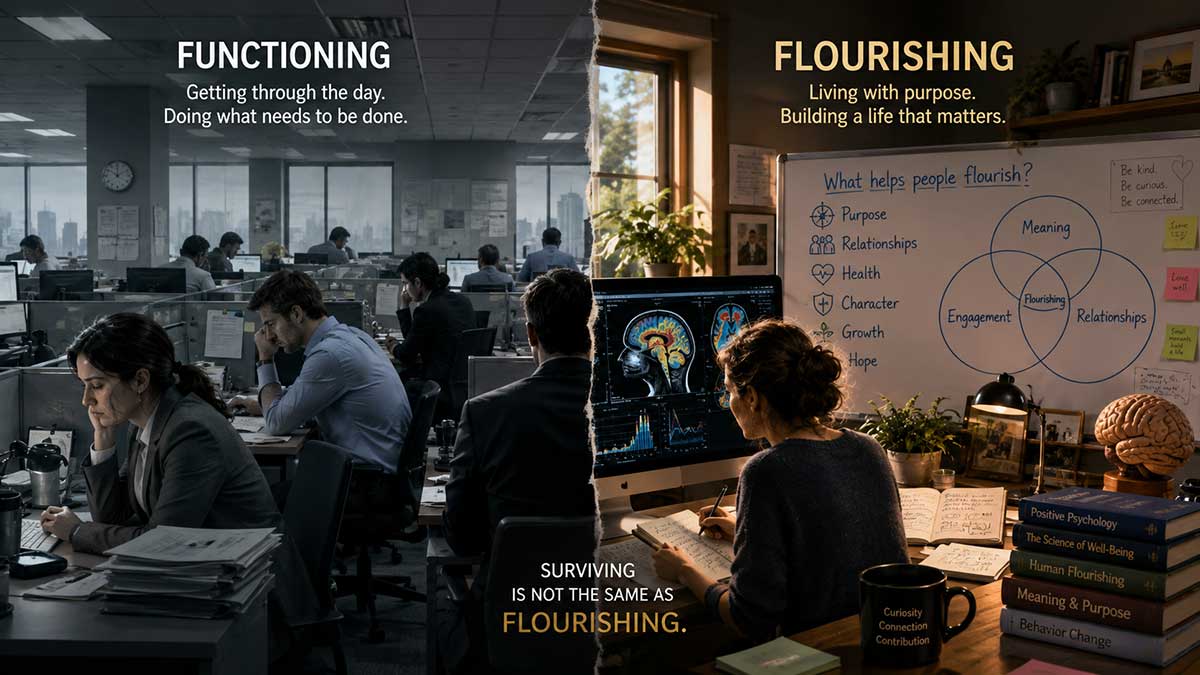
Imagine two people.
The first has a stable job, pays the bills, has no diagnosed mental illness, and appears successful.
The second looks almost identical from the outside.
Yet inside, one feels deeply alive.
The other feels emotionally absent.
Both are surviving.
Or are they?
Why Did Psychology Need the Word “Languishing”?
Nick Sasaki:
Corey, your work introduced millions of people to a word many had never heard before: languishing.
Why did that idea become necessary?
Corey Keyes:
For a long time, psychology divided people into two groups.
Either you were mentally ill or mentally healthy.
That framework missed something important.
Many people were not depressed.
They were not anxious enough to receive a diagnosis.
They functioned.
They worked.
They raised families.
Yet they described life as flat.
Colorless.
Empty.
We needed another word.
So I called that condition languishing.
Languishing is not the presence of illness.
It is the absence of flourishing.
Does Society Mistake Functioning for Health?
Nick Sasaki:
That distinction seems surprisingly common today.
Do you think society mistakes functioning for health?
Corey Keyes:
Constantly.
Functioning answers one question:
“Can this person perform?”
Flourishing asks another:
“Can this person experience life deeply?”
Those are completely different questions.
Someone may meet every deadline while feeling disconnected from purpose, relationships, curiosity, or hope.
Our culture often rewards the first and ignores the second.
What Makes a Life Psychologically Well Lived?
Nick Sasaki:
Carol, does Corey’s idea fit your own research?
Carol Ryff:
Very much.
What struck me was that happiness alone could not explain a well-lived life.
Some people feel good because everything is easy.
Others feel fulfilled while caring for a sick spouse, raising children, building a difficult career, or standing for justice.
Those lives may not feel pleasant every day.
Yet they possess remarkable depth.
That led me to ask:
What qualities allow a person to say, “My life is meaningful, even when it is difficult?”
Nick Sasaki:
And what did you discover?
Carol Ryff:
Six qualities appeared repeatedly.
People flourish when they continue growing.
When they accept themselves.
When they maintain meaningful relationships.
When they live according to their own values.
When they navigate life competently.
When they believe their life has purpose.
Notice what is missing.
Constant happiness.
Is Flourishing More Than Happiness?
Martin Seligman:
Carol and I have been having this conversation for decades.
Nick Sasaki:
Martin, where do you agree or disagree?
Martin Seligman:
I agree with almost everything Carol said.
Where we sometimes differ is emphasis.
People often hear “happiness” and think of pleasure.
I do not define flourishing that way.
My PERMA framework includes positive emotion, engagement, relationships, meaning, and accomplishment.
No single element is enough.
Someone may have accomplishment without meaning.
Meaning without relationships.
Relationships without engagement.
A flourishing life is multidimensional.
Carol Ryff:
Martin, may I challenge one point?
Martin Seligman:
Please do.
Carol Ryff:
I have always wondered whether flourishing can really be separated into independent pieces.
Suppose someone has achievement, positive emotion, and success, but has never truly accepted themselves.
Can we honestly say they are flourishing?
Or have they simply become highly effective?
Martin Seligman:
That is a fair criticism.
I would answer that flourishing is not perfection.
Human lives are uneven.
Someone may be thriving in one dimension while struggling in another.
The framework describes a pattern.
It does not demand symmetry.
Can Human Flourishing Be Measured?
Nick Sasaki:
Tyler, your work at Harvard attempts to measure flourishing across entire populations.
That sounds almost impossible.
How do you measure something so personal?
Tyler VanderWeele:
With humility.
No single survey can capture a human life.
But we can ask meaningful questions.
Does the person experience purpose?
Do they have close relationships?
Physical health?
Mental health?
Financial stability?
Character?
Hope?
When many of those areas consistently collapse together, people usually describe life as diminished.
When they improve together, people often describe life as flourishing.
Has Modern Society Reduced Survival to Biological Functioning?
Nick Sasaki:
You are all describing flourishing as something much larger than emotion.
Would it be fair to say that modern society has reduced survival to biological functioning?
Tyler VanderWeele:
I think that is exactly what happened.
Medicine became extraordinarily successful.
Public health extended life expectancy.
Those achievements deserve celebration.
But once people survive physically, another question emerges.
“What is all this extra life for?”
Science became very good at helping people live longer.
We are still learning how to help people live better.
Why Should Employers Care About Flourishing?
Nick Sasaki:
Let me ask something uncomfortable.
Suppose an employer says:
“My employees show up every day. Productivity is high. Why should I care whether they feel fulfilled?”
Corey?
Corey Keyes:
Productivity is a poor measure of human well-being.
People can produce excellent work while quietly losing hope.
Sometimes the highest-performing people are the ones closest to emotional collapse.
Languishing often hides behind competence.
Martin Seligman:
Organizations eventually pay for neglected well-being.
Creativity falls.
Relationships weaken.
Trust disappears.
People stop taking healthy risks.
The work may continue.
Innovation often does not.
Carol Ryff:
There is another cost.
When people define themselves entirely through productivity, they begin believing they have value only when producing.
That belief is psychologically fragile.
Retirement.
Illness.
Job loss.
Suddenly the identity collapses.
Tyler VanderWeele:
Which reminds us that flourishing is not merely an individual issue.
Families suffer.
Communities suffer.
Institutions suffer.
The consequences extend far beyond one person’s emotional life.
Is Flourishing a Luxury?
Nick Sasaki:
Some viewers may be thinking:
“This conversation sounds wonderful, but I am trying to pay rent. I am raising children. I am caring for elderly parents. Who has time to flourish?”
What would you say?
Carol Ryff:
Flourishing should never become another burden.
It is not one more task on a to-do list.
Many people flourish while living difficult lives.
Purpose does not require wealth.
Growth does not require comfort.
Love does not require free time.
The question is not whether life is difficult.
The question is whether difficulty is the whole story.
Corey Keyes:
Someone can endure hardship without languishing.
Likewise, someone can possess enormous privilege and still languish deeply.
Material conditions matter enormously.
They simply do not explain everything.
Tyler VanderWeele:
Financial stability supports flourishing.
It does not guarantee it.
Relationships support flourishing.
They do not guarantee it.
Purpose supports flourishing.
It does not eliminate grief.
Human life resists simple formulas.
Martin Seligman:
Perhaps that is why flourishing remains such an interesting scientific question.
We are studying whole human beings.
Not machines.
When Does Human Survival Become Fully Meaningful?
Nick Sasaki:
I would like each of you to complete this sentence:
Human survival becomes fully meaningful when...
Corey?
Corey Keyes:
When people remain psychologically engaged with life rather than merely functioning inside it.
Carol Ryff:
When they continue growing into the person they are capable of becoming.
Tyler VanderWeele:
When health, relationships, purpose, character, and hope are protected together rather than one at a time.
Martin Seligman:
When people build lives containing enough positive emotion, engagement, meaning, accomplishment, and relationships that life becomes something worth participating in.
Closing
Nick Sasaki:
When we began today, I asked whether two people could appear identical from the outside yet be living entirely different lives.
Our scholars answered yes.
One may simply function.
The other may flourish.
Corey Keyes reminded us that the absence of illness does not automatically create well-being.
Carol Ryff showed us that flourishing asks far more of life than feeling happy.
Martin Seligman argued that a meaningful life contains many dimensions, each contributing something essential.
Tyler VanderWeele reminded us that flourishing is never just private emotion. It includes health, relationships, purpose, character, hope, and the conditions that allow human beings to grow.
Perhaps the most surprising conclusion is this:
A society can become exceptionally good at helping people survive physically while becoming far less skilled at helping them remain fully alive.
In our next conversation, we will examine one of the biggest misconceptions surrounding flourishing.
Is happiness really the goal of life, or is it only one part of something much larger?
This format should now match your usual article structure.
Topic 2: Is Happiness the Goal—or Only One Part of Being Fully Alive?
Nick Sasaki:
In our first scholarly conversation, we drew a line between functioning and flourishing.
A person can work, perform, pay bills, and appear stable while still feeling detached from life.
Today we move into a question that sounds simple but becomes difficult very quickly:
Is happiness the goal of life?
Modern culture often treats happiness as the final measure.
We ask whether a job makes us happy.
Whether a relationship makes us happy.
Whether a city, habit, purchase, or lifestyle makes us happy.
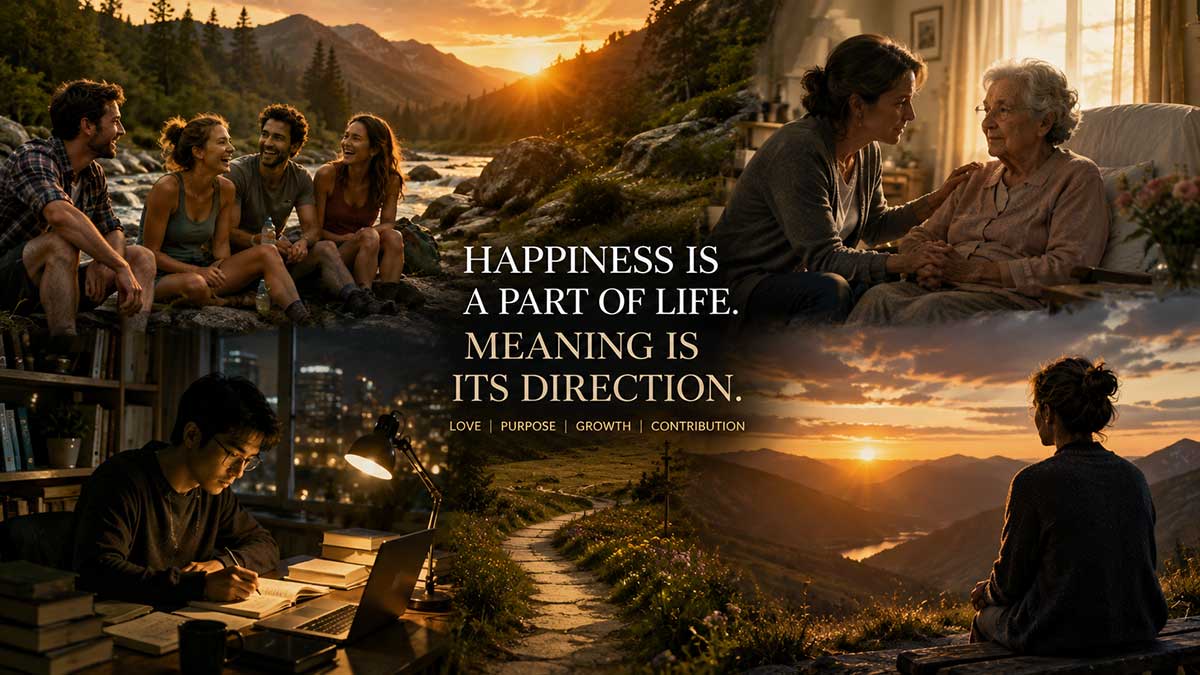
Yet many of the most meaningful parts of life are difficult.
Parenthood can be exhausting.
Marriage can demand sacrifice.
Caregiving can be painful.
Creative work can involve frustration.
Moral courage can make life less comfortable.
What Role Does Positive Emotion Play in a Good Life?
Nick Sasaki:
Barbara, let me begin with you.
What role does positive emotion actually play in a good life?
Barbara Fredrickson:
Positive emotion matters greatly, but perhaps not in the way people assume.
Joy, gratitude, interest, love, and hope do more than make a moment pleasant.
They broaden attention.
They expand the range of actions a person can envision.
They make people more open, creative, curious, and socially connected.
Over time, those moments can help build lasting resources.
Relationships.
Knowledge.
Coping abilities.
Physical habits.
A wider sense of possibility.
So I would never call joy trivial.
But I would not call it the entire purpose of life either.
Nick Sasaki:
So joy is less like a prize and more like a capacity-builder.
Barbara Fredrickson:
Yes.
A positive emotion may last only a few moments.
Its effects can continue much longer.
A moment of interest may lead someone to learn.
A moment of warmth may deepen a friendship.
A moment of hope may keep a person engaged long enough to find a path forward.
Positive emotion can widen the life that becomes possible.
Is Well-Being Larger Than Happiness?
Martin Seligman:
That fits closely with my own view.
One reason I moved away from using happiness as the central word was that it became too vague.
People heard happiness and thought pleasure.
Feeling good.
Smiling.
Comfort.
But well-being is larger.
Positive emotion matters.
So do engagement, relationships, meaning, and accomplishment.
A person can build a worthy life without feeling cheerful every hour.
Can Difficult Emotions Belong to a Good Life?
Carol Ryff:
I agree, though I would go further.
A fixation on happiness can become psychologically shallow.
People may begin treating every unpleasant emotion as evidence that something is wrong.
Yet grief may be the right response to loss.
Anger may be the right response to injustice.
Anxiety may appear when a person faces a responsibility they care deeply about.
A mature life does not eliminate difficult emotion.
It gives those emotions a meaningful place.
Corey Keyes:
This is where the distinction between feeling good and functioning well becomes useful.
Flourishing includes positive emotion, but it includes positive psychological and social functioning too.
Someone may feel happy because they are entertained.
That tells us little about whether they feel useful, connected, purposeful, or capable of growth.
Can Someone Flourish Without Feeling Happy?
Nick Sasaki:
Let me put the question directly.
Can someone flourish during a period when they do not feel happy?
Carol Ryff:
Certainly.
Consider a person caring for a dying parent.
They may feel sorrow, fatigue, fear, and anticipatory grief.
Yet they may experience purpose, intimacy, self-respect, and a deep sense that they are living according to their values.
I would hesitate to describe that person as happy.
I would not hesitate to say that part of their life may be psychologically rich.
Martin Seligman:
Meaning often involves serving something larger than the self.
That service can be difficult.
People may sacrifice comfort for family, science, faith, justice, art, or community.
The experience is not always pleasant.
Yet it may be deeply fulfilling.
Barbara Fredrickson:
Positive emotions can still appear inside painful periods.
Not as denial.
Not as a correction to grief.
They may appear alongside it.
A shared laugh in a hospital room.
Gratitude for one more conversation.
Tenderness while helping someone eat.
Those moments do not erase sorrow.
They create emotional complexity.
Corey Keyes:
That complexity matters.
We often think of mental states as switches.
Happy or sad.
Healthy or ill.
Flourishing or suffering.
Real life is less tidy.
A person can grieve and remain connected.
They can be frightened and still possess purpose.
They can suffer in one domain and remain strong in others.
Nick Sasaki:
Then perhaps flourishing is not the absence of pain.
Carol Ryff:
Correct.
It is closer to the continued presence of depth, direction, relationship, and growth.
Can the Pursuit of Happiness Make People Less Happy?
Nick Sasaki:
Many people actively pursue happiness.
They read books, change routines, take vacations, buy things, or leave relationships in search of it.
Can the pursuit itself make happiness harder to reach?
Martin Seligman:
Yes, particularly when happiness becomes a demand.
When someone believes, “I must feel happy now,” every difficult emotion becomes a failure.
That creates self-monitoring.
Am I happy enough?
Why am I not happier?
What am I doing wrong?
The person becomes less engaged with life and more occupied with measuring their reaction to it.
Barbara Fredrickson:
Positive emotion often emerges indirectly.
People experience joy while absorbed in something.
Learning.
Creating.
Helping.
Playing.
Connecting.
When joy becomes the object under constant inspection, spontaneity disappears.
It is similar to trying to force sleep.
The effort can interfere with the experience.
Carol Ryff:
The pursuit can become especially damaging when people believe a good life should feel good most of the time.
That belief encourages avoidance.
Avoid difficult conversations.
Avoid responsibility.
Avoid commitments that demand patience.
Avoid relationships that reveal one’s limitations.
A life built around emotional comfort may become smaller.
Corey Keyes:
And socially disconnected.
Meaningful social life requires inconvenience.
Compromise.
Listening.
Repair.
Patience.
If personal happiness is the sole criterion, other people begin to look like instruments.
We keep them while they improve our mood and discard them when they do not.
That is not flourishing.
Is Joy Necessary for Human Flourishing?
Nick Sasaki:
Let us return to joy.
The first Imaginary Talk asked whether joy is a luxury or evidence that we are truly alive.
From a scholarly perspective, is joy necessary?
Barbara Fredrickson:
I would say recurring positive emotion is an important part of healthy human life.
Not constant joy.
Not compulsory optimism.
But moments of interest, amusement, gratitude, serenity, hope, pride, inspiration, awe, and love can help people build resources and remain engaged.
A life stripped of every positive emotion becomes narrower.
Attention contracts.
Possibility contracts.
Social openness often contracts.
Corey Keyes:
This is one place where languishing becomes visible.
People may continue functioning but report little interest, little vitality, and little sense of connection.
Life becomes emotionally flat.
The issue is not that they fail to smile enough.
The issue is that very little seems to call them into participation.
Martin Seligman:
Positive emotion is one element.
It deserves protection, but it cannot carry the whole structure.
A person may have pleasure without meaning.
Excitement without relationship.
Satisfaction without character.
The fuller question is whether the life contains several forms of well-being.
Carol Ryff:
And we should not make joy a moral duty.
People in grief, depression, poverty, danger, or severe illness should not be told that their lack of joy reflects a failure to live correctly.
Joy can be cultivated.
It cannot always be commanded.
Does Happiness Need Meaning?
Nick Sasaki:
Can happiness without meaning still count as a good life?
Martin Seligman:
It can count as one good element within a life.
Pleasure is real.
Enjoyment matters.
But by itself, it is unstable.
Meaning connects the self to something larger.
It gives continuity across changing emotional states.
Without that, happiness can become episodic.
A series of pleasant moments without a coherent direction.
Carol Ryff:
I would ask whether the person is becoming someone they respect.
That question is often absent from popular discussions of happiness.
Are they growing?
Do they accept themselves honestly?
Do they have genuine relationships?
Can they make choices according to their values?
Do they contribute to anything beyond immediate gratification?
These questions give happiness moral and developmental context.
Corey Keyes:
Social functioning matters too.
A person may feel satisfied while being isolated, exploitative, or indifferent to the common good.
A private sense of happiness cannot be the only standard.
Flourishing has a social dimension.
Do you feel that your life contributes?
Do you feel connected to a community?
Do you believe society makes sense and that you have a place within it?
Barbara Fredrickson:
Positive emotion itself can become more enduring when linked to meaning and connection.
Joy shared with another person differs from stimulation consumed alone.
Love may be the clearest example.
It includes positive emotion, but it includes investment, attention, vulnerability, and care too.
Is Unhappiness Always a Problem to Solve?
Nick Sasaki:
Is unhappiness always a problem to solve?
Carol Ryff:
No.
Sometimes unhappiness carries information.
Dissatisfaction may reveal that a person is living against their values.
Loneliness may reveal the absence of real connection.
Anger may reveal violated boundaries.
Grief may reveal love.
The goal is not to worship painful emotion.
It is to listen before trying to erase it.
Martin Seligman:
Negative emotions evolved for reasons.
Fear detects threat.
Sadness can draw attention to loss.
Anger can mobilize action.
The problem arises when an emotion becomes chronic, disproportionate, or detached from useful response.
Well-being does not require emotional uniformity.
Barbara Fredrickson:
Positive and negative emotions can work together.
Negative emotion narrows attention, which can be useful during immediate danger.
Positive emotion broadens attention, which becomes useful for exploration, recovery, and rebuilding.
Human survival requires both systems.
Corey Keyes:
That point changes the conversation.
A fully alive person is not someone who feels good all the time.
It is someone whose emotional life remains responsive.
They can feel pain when pain is called for.
They can still experience interest, hope, connection, or purpose when circumstances permit.
Emotional aliveness is not the same as permanent positivity.
Has Modern Culture Turned Happiness Into a Product?
Nick Sasaki:
Do you think modern culture has turned happiness into a product?
Martin Seligman:
Certainly.
Happiness is marketed through travel, wellness, consumption, productivity systems, and personal branding.
Some of those things can contribute to well-being.
The trouble comes when happiness is presented as something one can purchase without changing how one relates, works, serves, or lives.
Barbara Fredrickson:
Consumer happiness often depends on novelty.
Novelty fades.
Human beings adapt.
A more enduring positive life grows through repeated practices of attention, connection, gratitude, curiosity, and participation.
These are less glamorous.
They are often more effective.
Carol Ryff:
The marketplace prefers simple promises.
A full account of well-being is harder to sell.
It includes struggle.
Limits.
Responsibility.
Aging.
Loss.
Self-confrontation.
No advertisement wants to say, “A meaningful life may ask more of you than you expected.”
Yet that may be true.
Corey Keyes:
And when happiness becomes a personal product, structural problems disappear from view.
If someone is miserable at work, socially isolated, financially unstable, or living in an unsafe community, we tell them to optimize their morning routine.
That response is insufficient.
Some unhappiness requires personal change.
Some requires social change.
What Is a Better Goal Than Happiness?
Nick Sasaki:
If happiness is not the final goal, what should people aim for instead?
Martin Seligman:
Well-being.
A life containing positive emotion, engagement, relationships, meaning, and accomplishment.
Not all in equal measure.
Not every day.
But present enough that the person can participate in life with depth.
Carol Ryff:
Wholeness.
A life where difficult emotions are not denied, values guide action, relationships are real, and growth remains possible.
Corey Keyes:
Flourishing.
Feeling good enough to remain engaged and functioning well enough to live with purpose, connection, and contribution.
Barbara Fredrickson:
Openness to life.
The capacity to feel, connect, explore, recover, and build.
Joy belongs there.
So do grief, courage, and love.
Closing
Nick Sasaki:
Today our scholars did not dismiss happiness.
They placed it inside a larger picture.
Barbara Fredrickson showed us that positive emotions can widen attention and help build lasting psychological and social resources.
Martin Seligman reminded us that well-being contains more than pleasure. It includes engagement, relationships, meaning, and accomplishment.
Carol Ryff argued that a mature life may contain sorrow, responsibility, sacrifice, and struggle without becoming a failed life.
Corey Keyes showed us that feeling good is not enough if a person has no purpose, contribution, connection, or positive functioning.
Perhaps happiness is not the destination.
Perhaps it is one form of evidence.
Evidence that attention has opened.
That connection is present.
That life still contains possibility.
But the absence of happiness in a painful chapter does not mean the absence of a good life.
A person can grieve and remain deeply alive.
They can sacrifice and remain fulfilled.
They can struggle and still retain meaning.
The fuller goal may not be to feel good all the time.
It may be to remain capable of feeling the full truth of life without losing our connection to purpose, relationship, growth, and hope.
In our next conversation, we will test this idea under its greatest pressure:
Can a person flourish through suffering without turning suffering into something good?
Topic 3: Can We Flourish Through Suffering Without Calling Suffering Good?

Nick Sasaki:
In our last conversation, we asked whether happiness is the goal of life.
Our scholars argued that a good life can include grief, sacrifice, fear, and responsibility.
Today we face the harder test.
Can a person flourish while suffering?
At first, the question may sound offensive.
A person living with illness, bereavement, poverty, trauma, disability, or uncertainty may not want to hear that suffering is an opportunity.
That language can become cruel very quickly.
It can imply that pain is secretly beneficial.
It can place another burden on the suffering person:
“Now that this has happened, you must grow from it.”
So I want to establish one boundary before we begin.
We are not asking whether suffering is good.
We are asking whether suffering can exist inside a life that still contains meaning, love, dignity, character, growth, and hope.
Can a Person Suffer in One Area and Still Flourish in Others?
Nick Sasaki:
Tyler, your model treats flourishing as a collection of life domains rather than a single emotional condition.
Does that mean a person can suffer greatly in one part of life and still flourish in others?
Tyler VanderWeele:
Yes, though the answer requires care.
Human lives are rarely uniformly good or uniformly bad.
A person may experience severe physical illness while retaining close relationships, purpose, faith, character, and gratitude.
Another person may be physically healthy yet isolated, hopeless, and without direction.
Flourishing does not mean every domain is untouched.
It means the whole life cannot be reduced to the wounded domain.
That said, severe suffering can damage many areas at once.
We should never speak as though meaning automatically compensates for pain.
It does not.
Nick Sasaki:
So flourishing and suffering can coexist, but flourishing should not be used to minimize the suffering.
Tyler VanderWeele:
Exactly.
The presence of purpose does not make pain less real.
The presence of love does not remove loss.
The presence of character does not turn injustice into something acceptable.
It means only that human life can remain larger than what has happened to it.
Does Hardship Automatically Produce Growth?
Carol Ryff:
That distinction is central.
Some of the richest human lives contain hardship.
But hardship does not produce richness by itself.
A person may grow through suffering.
Another may be crushed by it.
A third may simply endure.
We should resist any formula that predicts moral or psychological improvement from pain.
Barbara Fredrickson:
And we should resist the pressure to produce an inspiring story.
People often become uncomfortable with another person’s suffering.
They want movement.
A lesson.
A transformation.
A hopeful ending.
Sometimes the most compassionate response is to remain with the fact that something terrible happened.
Corey Keyes:
There is a cultural hunger for recovery narratives.
People prefer:
“I suffered, then I became stronger.”
That story is easier to hear than:
“I suffered, and part of me is still damaged.”
But the second story may be more honest.
Flourishing must make room for unfinished pain.
Must Pain Have Meaning Before Healing Can Begin?
Nick Sasaki:
This brings us to one of the strongest questions in the series.
Must pain have meaning before healing can begin?
Carol Ryff:
No.
Meaning is not a requirement for legitimate suffering.
A person does not need to explain a loss before they are permitted to grieve it.
Meaning may emerge later.
It may emerge partially.
It may never emerge in a satisfying form.
Psychological maturity includes the ability to live with some unanswered questions.
Tyler VanderWeele:
I agree.
Meaning can take several forms.
It may answer:
“Why did this happen?”
But often that answer is unavailable.
A different form of meaning asks:
“How will I live now?”
“What remains worth loving?”
“What responsibilities remain?”
“What kind of person do I want to be in response?”
That does not explain the suffering.
It gives direction after it.
Barbara Fredrickson:
Sometimes meaning is too large a word at first.
In acute suffering, the mind may need something smaller.
One person who stays.
One routine.
One meal.
One moment of beauty.
One task that remains possible.
People do not always rebuild life through grand purpose.
Sometimes they rebuild it through tiny experiences that reopen attention.
Corey Keyes:
For someone who is languishing, even those small openings matter.
Languishing narrows the future.
The person begins to feel that nothing will change and nothing matters.
A single experience of connection or usefulness can interrupt that sense of emptiness.
It may not create flourishing.
But it can reopen participation.
Can Positive Emotion Exist Inside Grief?
Nick Sasaki:
Barbara, your research is often misunderstood as an argument for positivity.
What role can positive emotion play during suffering without becoming denial?
Barbara Fredrickson:
Positive emotion does not need to replace negative emotion.
They can coexist.
A grieving person may feel profound sadness and still experience gratitude, tenderness, amusement, awe, or love.
Those moments do not betray the person who was lost.
They do not prove that grief is finished.
They give the mind brief access to a wider field.
Negative emotion narrows attention toward threat or loss.
That narrowing can be useful.
Positive emotion can temporarily broaden attention again.
It may help a person see support, possibility, or continuity.
Nick Sasaki:
So a laugh at a funeral is not necessarily avoidance.
Barbara Fredrickson:
No.
It may be love appearing in another form.
Families often laugh while telling stories about someone who died.
The grief remains.
The laughter reveals that the relationship contained more than the death.
Carol Ryff:
That is psychologically important.
A person should not have to choose between honoring pain and remaining open to life.
Mature grief contains both.
Corey Keyes:
Yet we need to remember that not everyone can access those positive moments at the same pace.
Some people feel emotionally numb.
That should not be judged as failure.
The capacity may return slowly.
Does Trauma Make People Stronger?
Nick Sasaki:
Let us address the phrase “post-traumatic growth.”
Does suffering really make people stronger?
Tyler VanderWeele:
Research suggests that some people report positive changes after trauma.
They may describe deeper relationships, altered priorities, spiritual change, greater appreciation, or a stronger sense of purpose.
But reporting growth does not mean the trauma was beneficial.
Nor does it mean the person no longer suffers.
Growth and distress can remain present together.
Carol Ryff:
Perceived growth should be examined carefully.
Sometimes people genuinely change.
Sometimes they create a story that helps them endure.
Both may have psychological value.
But we should not assume that every declaration of growth reflects complete transformation.
Human beings use narrative to organize disruption.
That narrative can be protective.
Corey Keyes:
The danger is turning a possibility into an expectation.
Once society learns that growth can follow trauma, it begins asking why every survivor has not grown.
That is unfair.
No one owes us wisdom, productivity, or inspiration in exchange for what happened to them.
Barbara Fredrickson:
I would put it this way:
Suffering may create an opening.
It does not decide what enters.
Support matters.
Resources matter.
Safety matters.
Time matters.
The person’s history matters.
The social response matters.
Growth is not generated by pain alone.
What Is the Difference Between Endurance and Flourishing?
Nick Sasaki:
How can we distinguish genuine flourishing from mere endurance during hardship?
Corey Keyes:
Endurance says:
“I am still here.”
That matters.
Sometimes it is a remarkable achievement.
Flourishing adds:
“I remain connected to life in some meaningful way.”
There may be purpose.
Belonging.
Growth.
Contribution.
Hope.
The person may still be suffering intensely.
But the suffering has not erased every form of engagement.
Carol Ryff:
I would add self-direction.
A person in hardship may retain the ability to make choices consistent with their values.
Perhaps the choices are small.
They decide how to care for someone.
How to speak honestly.
How to use limited energy.
How to preserve dignity.
Autonomy can survive inside constrained circumstances.
Tyler VanderWeele:
Close relationships are another marker.
People often endure when they are accompanied.
Flourishing becomes more plausible when the person remains known, valued, and connected.
This is why social abandonment can deepen suffering so dramatically.
Barbara Fredrickson:
And openness.
Does the person retain any capacity to notice, respond, connect, or envision?
When suffering closes every door, life becomes smaller.
Small positive experiences can help reopen one door at a time.
When Does Resilience Become a Harmful Demand?
Nick Sasaki:
We often praise resilience.
When does resilience become a harmful expectation?
Corey Keyes:
When it shifts responsibility away from the conditions causing the suffering.
A workplace creates chronic exhaustion.
Then employees are offered resilience training.
A community lacks safety.
Then residents are told to practice optimism.
A family remains abusive.
Then one member is praised for endurance.
That is not enough.
Carol Ryff:
Resilience should not mean adapting indefinitely to what should be changed.
Sometimes well-being requires resistance.
Leaving.
Setting boundaries.
Seeking justice.
Refusing a role.
A person may appear less resilient in the short term because they stop tolerating something harmful.
That decision may protect their deeper well-being.
Tyler VanderWeele:
This is where personal and social flourishing meet.
Individual practices matter.
Relationships matter.
Meaning matters.
Yet material and institutional conditions matter too.
Financial instability, discrimination, violence, and lack of care impose real limits.
We should not use flourishing language to hide those realities.
Barbara Fredrickson:
Nor should we assume that all stress is growth-promoting.
Stress can mobilize.
It can overwhelm too.
The question is not whether a person has the right mindset.
The question is whether the demands exceed their resources and whether support is present.
Can Someone Flourish in Poverty, Illness, or Disability?
Nick Sasaki:
Here is a difficult question.
Can someone flourish in poverty, serious illness, or disability?
Tyler VanderWeele:
Yes, but that answer should never become an excuse for neglect.
People can possess meaning, love, character, faith, and purpose under harsh conditions.
Human beings often display remarkable dignity.
But the fact that flourishing remains possible does not make deprivation acceptable.
We should improve conditions rather than romanticize adaptation.
Carol Ryff:
Exactly.
Someone may demonstrate extraordinary inner strength in poverty.
That does not mean poverty supports well-being.
Someone may develop purpose through illness.
That does not make illness desirable.
We must distinguish human capacity from social responsibility.
Corey Keyes:
There is another risk.
Society may celebrate exceptional survivors and ignore the many people damaged by the same conditions.
We point to one person who overcame everything and use that story to judge those who did not.
That is poor science and poor compassion.
Barbara Fredrickson:
The exceptional story can inspire.
It should not become the standard against which everyone else is measured.
What Happens When Suffering Becomes Identity?
Nick Sasaki:
What happens when suffering becomes the center of someone’s identity?
Carol Ryff:
The person may begin to experience the self as identical with the wound.
Not:
“I experienced betrayal.”
But:
“I am the betrayed person.”
Not:
“I live with illness.”
But:
“I am only this illness.”
The task is not to deny the wound.
It is to restore complexity to the self.
Corey Keyes:
Languishing often involves this narrowing.
The future feels closed.
The identity feels fixed.
The person cannot envision roles beyond the pain.
Flourishing reintroduces multiple dimensions.
Friend.
Parent.
Worker.
Creator.
Neighbor.
Believer.
Learner.
The wounded identity remains real, but it is no longer the only identity.
Tyler VanderWeele:
Relationships can help preserve those other identities.
A good friend does not interact only with the suffering.
They remember the whole person.
Their humor.
Their history.
Their abilities.
Their preferences.
Their contributions.
That kind of recognition is deeply protective.
Barbara Fredrickson:
Positive emotion can play a quiet role here too.
A moment of interest or affection reminds the person:
“There is still a part of me that can respond.”
That moment may be brief.
It matters.
What Should We Say to Someone Who Is Suffering?
Nick Sasaki:
Scholars are often asked for advice.
But advice can be dangerous in moments of pain.
What should we say to someone who is suffering?
Barbara Fredrickson:
Begin with presence.
Not interpretation.
Not correction.
Not forced hope.
Presence says:
“I am here.”
“You do not have to make this easier for me.”
Corey Keyes:
Do not ask them to prove resilience.
Ask what support would reduce the burden.
Carol Ryff:
Respect the person’s agency.
Do not take over their story.
Ask what they need, what they value, and what they want protected.
Tyler VanderWeele:
Remain attentive over time.
Support often arrives immediately after a crisis and disappears months later.
Flourishing is rarely restored in a single conversation.
Faithful presence matters.
Does the Expanded Meaning of Survival Hold Under Suffering?
Nick Sasaki:
We began this scholarly series by asking whether survival could mean more than biological continuation.
Does that expanded definition still hold when life becomes painful?
Tyler VanderWeele:
Yes.
Perhaps it becomes clearer.
Biological survival preserves life.
Human survival preserves enough of the person that life remains connected to meaning, relationship, dignity, and hope.
Carol Ryff:
I would say human survival preserves the possibility of continued development.
The person is wounded, but not finished.
Corey Keyes:
It preserves participation.
The person may not feel well.
They may not function at their previous level.
Yet some pathway back into life remains open.
Barbara Fredrickson:
And it preserves responsiveness.
The ability, however small, to feel love, interest, gratitude, courage, or connection without denying sorrow.
Closing
Nick Sasaki:
Today our scholars rejected two easy stories.
The first says suffering destroys every possibility of flourishing.
The second says suffering automatically creates wisdom.
Neither is true.
Tyler VanderWeele showed us that a life can be wounded in one domain and remain meaningful in others.
Carol Ryff reminded us that hardship does not produce growth by itself and that some questions remain unanswered.
Barbara Fredrickson explained how moments of love, gratitude, interest, or tenderness can widen life without erasing grief.
Corey Keyes warned us not to turn resilience into another demand placed upon people who are already carrying too much.
Perhaps flourishing through suffering does not mean becoming grateful for pain.
It does not mean finding a lesson quickly.
It does not mean returning to the person we were before.
It may mean something quieter.
The wound is real.
The loss remains.
The life has changed.
Yet the person is still more than what happened.
They can still be known.
Still choose.
Still love.
Still contribute.
Still encounter moments that call them back into participation.
Suffering may become part of the story.
It does not have to become the whole story.
In our next scholarly conversation, we will move from the individual to the society surrounding them.
Is flourishing a personal achievement, or is it something families, workplaces, communities, and governments either make possible or quietly prevent?
Topic 4: Is Flourishing a Personal Achievement—or a Social Possibility?
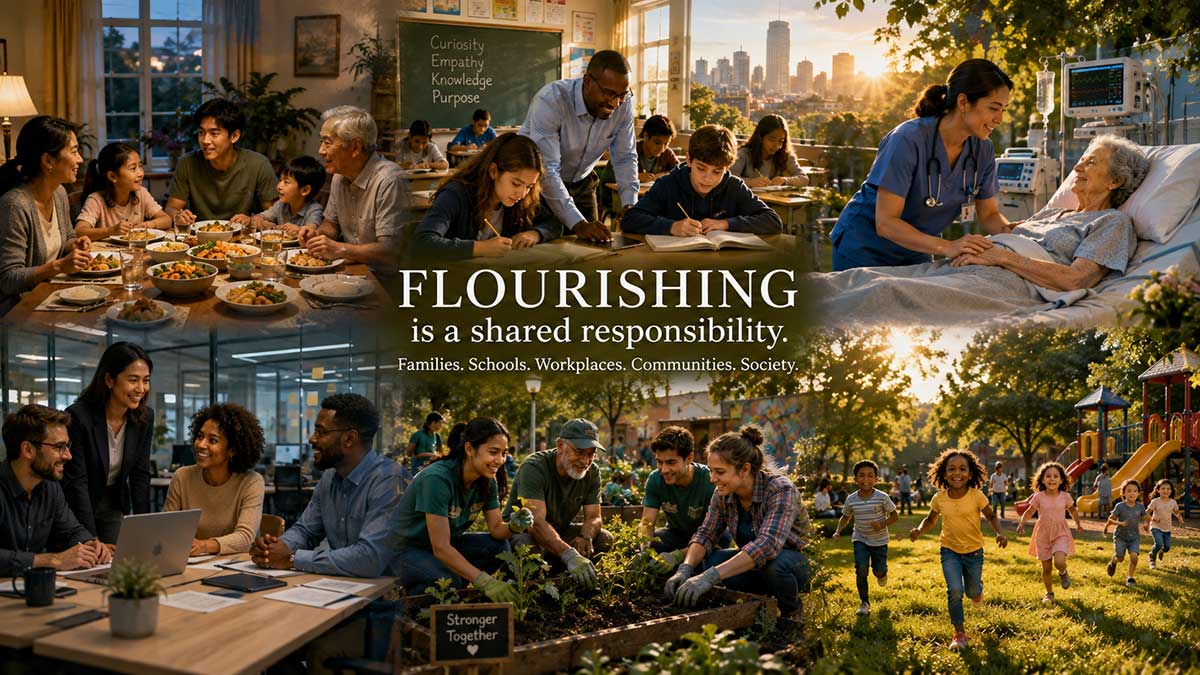
Nick Sasaki:
In our previous conversation, we asked whether people can flourish through suffering without calling suffering good.
One conclusion became impossible to ignore.
People do not suffer in isolation.
They suffer inside families.
Inside workplaces.
Inside neighborhoods.
Inside economies.
Inside institutions.
Yet much of modern self-help places the burden entirely on the individual.
Think differently.
Wake up earlier.
Practice gratitude.
Build better habits.
Manage stress.
Set goals.
Those practices may help.
But what happens when the environment keeps producing the wound?
Can a person flourish inside a workplace that drains them, a family that silences them, a neighborhood without safety, or an economy that leaves no room to breathe?
Today we ask:
Is flourishing a personal achievement—or a social possibility?
Does Flourishing Include Our Relationship with Society?
Nick Sasaki:
Corey, your work includes social well-being, not just private emotion.
Why is that distinction necessary?
Corey Keyes:
A person does not exist as an isolated psychological unit.
People need to feel that they belong to society.
That they contribute.
That the social world makes some sense.
That they have a place within it.
Someone may feel personally competent yet socially disconnected.
They may have goals but believe their community is collapsing.
They may be productive but feel useless to anyone beyond their job.
That person may function well in one sense and languish in another.
Nick Sasaki:
So flourishing includes a relationship with society itself.
Corey Keyes:
Yes.
We often ask:
"Do you feel good?"
"Are you coping?"
"Are you productive?"
We ask far less often:
"Do you feel that you matter to something larger?"
"Do you believe your contribution is valued?"
"Do you trust the society around you?"
Those are not decorative questions.
They determine whether life feels inhabitable.
Can Psychological Well-Being Exist Without Opportunity?
Nick Sasaki:
Carol, your research focuses on personal growth and autonomy.
How much of that depends on the world around us?
Carol Ryff:
Much more than many people realize.
Personal growth requires opportunity.
Autonomy requires room to make meaningful choices.
Environmental mastery requires an environment that is not constantly overwhelming.
Positive relationships require time, safety, and trust.
Purpose often requires enough stability to look beyond immediate crisis.
Psychological well-being belongs to the individual.
The conditions supporting it belong partly to society.
Can Mindset Alone Create Flourishing?
Nick Sasaki:
Tyler, many self-help books suggest that everything begins with mindset.
Does your research support that?
Tyler VanderWeele:
Mindset matters.
It simply does not explain everything.
Our work examines health, relationships, purpose, character, and material stability.
Someone who fears eviction, cannot access medical care, works unpredictable hours, and lacks childcare faces obstacles that no gratitude exercise can remove.
Human flourishing is always shaped by both personal choices and surrounding conditions.
How Does Chronic Insecurity Affect the Human Mind?
Nick Sasaki:
Barbara, your research looks closely at positive emotion.
What happens psychologically when people live under constant stress?
Barbara Fredrickson:
Chronic threat changes attention.
When people live under sustained insecurity, the mind naturally narrows.
You focus on the urgent bill.
The unsafe neighborhood.
The unpredictable supervisor.
The family emergency.
That narrowing helps people survive immediate danger.
But it leaves little room for curiosity.
Creativity.
Play.
Exploration.
Connection.
We should not call that a failure of positive thinking.
It is an understandable human response.
When Does Self-Help Become a Way of Avoiding Social Responsibility?
Nick Sasaki:
Let us examine self-help directly.
When does useful personal advice become a way of avoiding social responsibility?
Corey Keyes:
When it ignores the source of the problem.
Suppose employees are exhausted because staffing is inadequate and expectations are unreasonable.
The organization offers mindfulness training.
Mindfulness may help.
But it does not correct the workload.
The intervention becomes a way of helping people tolerate what should be changed.
Carol Ryff:
The same thing happens inside families.
One person is told to become stronger.
Yet the family continues rewarding silence, overwork, or emotional suppression.
The individual is expected to adapt to dysfunction.
Sometimes psychological health begins with refusing unhealthy systems.
Tyler VanderWeele:
Personal practices and structural reform should never be treated as opposites.
People need tools for coping today.
They also need healthier environments tomorrow.
Compassion belongs at both levels.
Barbara Fredrickson:
Exactly.
Small positive practices may help calm the nervous system.
They should never become excuses for leaving harmful systems unchanged.
Is Burnout a Personal Problem or a Social Problem?
Nick Sasaki:
Burnout has become one of the defining words of modern work.
Is burnout mainly a problem inside the individual or inside the workplace?
Carol Ryff:
Often inside the environment.
Burnout develops when demands remain high, control remains low, recognition disappears, values are violated, and relationships deteriorate.
Telling someone to manage time better may completely miss the point.
They may already be managing an impossible situation.
Corey Keyes:
Burnout also resembles languishing.
Energy fades.
Purpose disappears.
People withdraw socially.
Organizations often interpret this as laziness.
In reality, the environment may have repeatedly taught the person that effort changes nothing.
Tyler VanderWeele:
Work can become one of the greatest sources of flourishing.
It can also undermine nearly every part of flourishing.
The question is not whether someone has a job.
The question is whether the work supports dignity, contribution, relationships, and life beyond employment.
Barbara Fredrickson:
Organizations often try to manufacture positivity.
Decorations.
Celebrations.
Free snacks.
But trust, fairness, recognition, psychological safety, and genuine connection influence well-being much more deeply than forced enthusiasm.
Can Anyone Truly Flourish Alone?
Nick Sasaki:
The first Imaginary Talk asked whether anyone can flourish alone.
What does the research suggest?
Tyler VanderWeele:
Relationships appear consistently across almost every measure of well-being.
They provide support.
Identity.
Care.
Meaning.
Accountability.
Achievement and comfort cannot fully replace trusted relationships.
Corey Keyes:
Belonging is essential.
People need more than contact.
They need integration.
They need to feel that they genuinely belong somewhere.
A person can interact with hundreds of people and remain profoundly lonely.
Carol Ryff:
Healthy relationships allow mutual growth.
They make room for both dependence and autonomy.
Care and honesty.
Belonging and individuality.
Barbara Fredrickson:
Positive emotions become stronger when shared.
Joy.
Gratitude.
Wonder.
Love.
These experiences strengthen relationships, and relationships create more opportunities for those emotions.
That upward cycle becomes one of humanity's greatest resources.
Does Recognizing Social Influence Remove Personal Responsibility?
Nick Sasaki:
Some viewers may worry that this conversation removes personal responsibility.
If society shapes flourishing, does the individual still bear responsibility?
Carol Ryff:
Certainly.
Social influence never erases agency.
People still choose.
Relationships.
Habits.
Boundaries.
Commitments.
Responses.
The important point is that not everyone begins from the same circumstances.
Tyler VanderWeele:
Responsibility becomes healthier when joined with compassion.
Some people need encouragement.
Others first need safety.
Resources.
Medical care.
Support.
One formula cannot fit every life.
Corey Keyes:
We should distinguish responsibility from blame.
Responsibility asks:
"What can I do now?"
Blame says:
"This happened because you failed."
One restores agency.
The other increases shame.
Barbara Fredrickson:
Agency grows inside supportive environments.
People become more creative and courageous when they believe exploration is safe.
The social world either expands or contracts what people believe is possible.
What Kind of Family Helps People Flourish?
Nick Sasaki:
Let us bring the conversation closer to home.
What kind of family best supports flourishing?
Carol Ryff:
Recognition.
Each person should be seen as more than a role.
Not only mother.
Father.
Provider.
Caregiver.
Families flourish when members continue growing throughout life.
Corey Keyes:
Contribution matters too.
Everyone should feel useful without feeling exploited.
Children.
Parents.
Grandparents.
Every generation needs opportunities to matter.
Tyler VanderWeele:
Shared practices are remarkably powerful.
Meals together.
Celebrations.
Service.
Conversation.
Family traditions.
Faith for some families.
These practices create identity.
They quietly answer the question:
"This is who we are."
Barbara Fredrickson:
Emotional climate matters just as much.
Can people express grief without being rushed?
Joy without embarrassment?
Fear without shame?
Excitement without criticism?
Emotional openness creates healthier families.
What Should Schools Teach Beyond Academic Success?
Nick Sasaki:
What about education?
Do schools teach children to flourish, or mainly to perform?
Corey Keyes:
Many schools measure what is easiest to count.
Attendance.
Grades.
Test scores.
Completion.
Those metrics matter.
They tell us very little about belonging, purpose, hope, or contribution.
A student may excel academically while quietly languishing.
Carol Ryff:
Education should cultivate curiosity.
Autonomy.
Competence.
Relationships.
Growth.
Students should learn how to become fully developed human beings, not merely successful test takers.
Tyler VanderWeele:
Schools become places of flourishing when learning connects with purpose, character, service, and community.
Barbara Fredrickson:
Curiosity itself is a positive emotion.
Fear may create short-term compliance.
Curiosity creates lifelong learning.
Should Governments Care About Human Flourishing?
Nick Sasaki:
Should governments concern themselves with flourishing?
Or is that too personal?
Tyler VanderWeele:
Governments should never define one official version of the good life.
Yet they already shape many conditions that influence flourishing.
Health care.
Education.
Housing.
Public safety.
Employment.
Family policy.
Public spaces.
The question is not whether governments influence flourishing.
They already do.
The question is how wisely.
Corey Keyes:
Public health has traditionally focused on preventing illness and premature death.
That work remains essential.
But populations may live longer while becoming lonelier, more isolated, and less hopeful.
Reducing illness is not identical with creating well-being.
Carol Ryff:
Society should protect opportunities.
Not dictate meaning.
People require freedom to pursue different forms of meaningful life.
Barbara Fredrickson:
Public spaces matter greatly.
Libraries.
Parks.
Community centers.
Places where strangers naturally become neighbors.
Those environments quietly encourage connection and shared positive experience.
Can an Entire Society Languish?
Nick Sasaki:
Corey, can an entire society languish?
Corey Keyes:
Yes.
A society may experience widespread distrust.
Withdrawal.
Meaninglessness.
Low civic participation.
People stop believing institutions work.
They stop believing the future can improve.
That is more than individual unhappiness.
It becomes collective languishing.
Nick Sasaki:
Then what would collective flourishing look like?
Corey Keyes:
People would feel they belong.
That they contribute.
That institutions remain understandable.
That progress remains possible.
That differences do not destroy membership.
Tyler VanderWeele:
It would include healthy families.
Meaningful work.
Community.
Material stability.
Trustworthy institutions.
Purpose.
Health.
Service.
Carol Ryff:
It would also recognize that personal development continues throughout life.
People never stop growing.
Barbara Fredrickson:
And it would provide countless opportunities for trust, cooperation, celebration, curiosity, and care.
What Must Society Protect Beyond Physical Survival?
Nick Sasaki:
I would like each of you to name one thing every institution should protect beyond physical survival.
Corey Keyes:
Belonging.
Carol Ryff:
Agency.
Tyler VanderWeele:
Human dignity across the whole of life.
Barbara Fredrickson:
The capacity for openness.
Closing
Nick Sasaki:
Today our scholars challenged one of the most common assumptions in modern life:
That flourishing is simply a private project.
Corey Keyes reminded us that well-being includes belonging, contribution, and trust in society.
Carol Ryff showed us that autonomy, purpose, and growth require environments where people have genuine opportunities.
Tyler VanderWeele demonstrated that health, relationships, character, purpose, and material stability cannot be separated when examining a whole human life.
Barbara Fredrickson explained how trust and safety reopen the mind to curiosity, creativity, and connection.
Personal responsibility still matters.
But responsibility without opportunity becomes accusation.
Resilience without reform becomes permission for unhealthy systems to continue.
Perhaps flourishing is neither purely personal nor purely social.
It grows where individual choices meet communities that protect human dignity.
In our final conversation, we will gather everything we have learned and ask one final question:
What must be preserved for a life to remain truly worth living?
Topic 5: What Must Be Preserved for a Life to Remain Worth Living?

Nick Sasaki:
We began this scholarly series with a question about language.
Can survival mean more than avoiding death?
Across our conversations, we have drawn several distinctions.
Functioning is not necessarily flourishing.
Happiness matters, but it is not the whole of a good life.
Suffering can coexist with meaning, love, and dignity without becoming good in itself.
Flourishing depends partly on personal choices and partly on the conditions created by families, workplaces, communities, and institutions.
Now we arrive at the final test.
If we expand survival beyond biological continuation, what exactly must survive?
The body?
The mind?
Autonomy?
Relationships?
Purpose?
Character?
Hope?
The ability to experience joy?
And if we place all these ideas inside the word survival, do we deepen its meaning—or make it so broad that it loses precision?
What Separates a Life That Continues From a Life Worth Participating In?
Nick Sasaki:
Martin, I would like to begin with you.
From your perspective, what separates a life that continues from a life worth participating in?
Martin Seligman:
A life worth participating in contains several forms of well-being.
Positive emotion matters.
Engagement matters.
Relationships matter.
Meaning matters.
Accomplishment matters.
No one element can carry the entire life.
A person may experience pleasure without belonging.
Achievement without meaning.
Purpose without rest.
Relationships without autonomy.
Human well-being is plural.
That is why I resist reducing life to one final measure.
Should Flourishing Become Part of the Definition of Survival?
Nick Sasaki:
Would you place all five PERMA elements inside a new definition of survival?
Martin Seligman:
I would be cautious.
Words have jobs.
Survival already refers clearly to continued existence.
Flourishing describes something beyond that.
My concern is that if survival means everything good in life, we may lose the distinction between someone fighting to stay alive and someone seeking deeper fulfillment.
Both matter.
They are not the same condition.
Corey Keyes:
I agree that the distinction matters.
But I understand why people want to expand the word.
A person can be alive and still experience life as empty, disconnected, and directionless.
Biological language does not capture that.
The danger is not merely that survival becomes too broad.
The danger is that our current definition becomes too narrow for human beings.
Do We Need Different Levels of Survival?
Nick Sasaki:
Carol, is there a way to preserve the traditional meaning without losing the broader human question?
Carol Ryff:
Perhaps the issue is not whether we should replace the biological definition.
Perhaps we need levels.
Biological survival concerns the continuation of the organism.
Psychological survival concerns the preservation of agency, identity, purpose, relationships, and growth.
Social survival concerns belonging, contribution, recognition, and participation.
These levels interact.
They should not be confused.
Tyler VanderWeele:
That layered approach may be the most useful.
A person is embodied.
Psychological life depends partly on physical health.
Relationships affect mental and physical health.
Material stability shapes opportunity.
Purpose shapes how suffering is interpreted.
Character shapes how people respond to others.
No single domain fully explains the person.
A complete account must look across domains without pretending they are identical.
Is Life Automatically Worth Living Simply Because It Exists?
Nick Sasaki:
Let us approach the question directly.
Is life automatically worth living simply because it exists?
Carol Ryff:
That question belongs partly to philosophy, religion, and personal conviction.
Psychology can tell us which conditions tend to support meaning, health, connection, and development.
It cannot issue a final verdict on the value of existence itself.
We should remain humble about that boundary.
Tyler VanderWeele:
Research can examine how people evaluate their lives.
We can study hope, purpose, relationships, suffering, and life satisfaction.
But the value of a human life should never depend only on a score.
Someone with severe illness, disability, grief, or depression does not become less worthy because they report low well-being.
Human worth and present flourishing are different questions.
Corey Keyes:
That distinction is essential.
Languishing does not mean a person’s life lacks value.
It means they may lack access to experiences and forms of functioning associated with mental health.
The category should invite care.
It should never become judgment.
Martin Seligman:
A flourishing scale describes conditions.
It should not rank human dignity.
The least happy person in the room possesses no less human worth than the happiest.
Is “A Life Worth Living” the Right Phrase?
Nick Sasaki:
Then perhaps the phrase “a life worth living” needs care.
It could sound as though someone must meet certain requirements before their life earns value.
Carol Ryff:
Yes.
A better question might be:
“What conditions help a person experience life as worth continuing and participating in?”
That keeps the focus on support rather than judgment.
What Must Be Preserved for a Person to Remain Connected to Life?
Nick Sasaki:
Let us build that answer carefully.
What must be preserved for a person to remain connected to life?
Corey?
Corey Keyes:
Participation.
A person needs some sense that they are involved in life rather than merely carried through it.
They need opportunities to contribute, belong, and experience their presence as meaningful.
Languishing often feels like disappearance without physical absence.
The person is present but no longer feels engaged.
Carol Ryff:
I would say agency.
People need some ability to make choices consistent with their values.
The available choices may be limited by illness, poverty, caregiving, age, or social conditions.
Yet some degree of self-direction remains vital.
Without agency, a person can begin to feel like an object inside their own life.
Tyler VanderWeele:
I would name several interconnected domains.
Physical and mental health.
Meaning and purpose.
Close relationships.
Character and virtue.
Material stability.
Hope.
These do not need to be perfect.
But when too many collapse at once, life becomes extremely difficult to sustain.
Martin Seligman:
Engagement belongs there too.
People need something that draws them beyond constant self-observation.
Work.
Art.
Learning.
Service.
Family.
Faith.
Nature.
A task worthy of attention.
Without engagement, the person may spend life watching themselves live.
Does Emotional Responsiveness Belong in Human Survival?
Nick Sasaki:
Barbara, what would you add?
Barbara Fredrickson:
Responsiveness.
A person needs some remaining capacity to respond to beauty, love, interest, humor, gratitude, hope, or awe.
That response may be faint.
It may appear only briefly.
Yet it signals that life can still reach the person.
A fully human definition of survival should protect that openness where possible.
Must Character and Virtue Be Part of Flourishing?
Nick Sasaki:
Tyler mentioned character and virtue.
Can someone flourish if they feel happy, successful, healthy, and connected, yet treat other people badly?
Tyler VanderWeele:
I do not think personal satisfaction is enough.
A person may feel excellent while exploiting others.
That should not count as complete flourishing.
Character matters because human lives are relational and moral.
How we live affects the good of others.
Martin Seligman:
My framework includes relationships and meaning, but critics have fairly asked whether virtue needs more direct attention.
A person can achieve, engage, and feel positive emotion in destructive pursuits.
Well-being needs a moral context.
Carol Ryff:
This is one reason I focus on maturity and self-realization rather than pleasure alone.
A psychologically developed life requires honest self-examination.
It requires seeing other people as subjects, not tools.
It requires growth beyond immediate self-interest.
Corey Keyes:
Social well-being includes contribution and integration.
A person cannot fully flourish by withdrawing concern from everyone else.
Private well-being detached from social responsibility is incomplete.
Who Gets to Define Virtue?
Nick Sasaki:
But who defines virtue?
Cultures disagree.
Religions disagree.
Political traditions disagree.
Tyler VanderWeele:
That is a genuine challenge.
No measure should pretend those disagreements do not exist.
Yet certain qualities appear across many traditions.
Honesty.
Justice.
Compassion.
Courage.
Self-control.
Responsibility.
Care for others.
The expressions differ.
The underlying concerns are widely shared.
Carol Ryff:
Pluralism does not require moral emptiness.
We can recognize cultural variation without concluding that every way of treating people equally supports human well-being.
What Happens When Autonomy Conflicts With Belonging?
Nick Sasaki:
Carol, your model includes autonomy.
Corey, yours gives great weight to social integration.
What happens when personal choice conflicts with belonging?
Carol Ryff:
That conflict is unavoidable.
A person may need to leave a group to remain psychologically honest.
Family, community, workplace, or religious membership can provide belonging.
It can impose roles that suppress development too.
Flourishing requires connection without disappearance of the self.
Corey Keyes:
I agree.
Belonging purchased through self-erasure is unstable.
Social integration should not mean unquestioning conformity.
A healthy society permits people to contribute without pretending difference does not exist.
Martin Seligman:
This is where relationships and meaning can conflict.
A person may derive meaning from a group but feel constrained by it.
A framework does not remove the tension.
It helps reveal it.
Tyler VanderWeele:
Flourishing is not a state where every good is perfectly aligned.
Real lives contain tradeoffs.
Caregiving may limit autonomy but deepen love and purpose.
Leaving a harmful community may protect agency but create loneliness.
The goal is not a life without conflict.
It is wise navigation among goods that sometimes compete.
Can Flourishing Be Measured Objectively?
Nick Sasaki:
We have used the word flourishing throughout this series.
Can scholars truly measure it?
Tyler VanderWeele:
We can measure parts of it.
We can ask people about health, relationships, meaning, character, financial stability, and life satisfaction.
We can study outcomes over time.
We can examine patterns across populations.
But no measure captures the full depth of a human life.
Measurement can inform judgment.
It should not replace judgment.
Carol Ryff:
Self-report is useful, but people do not always know themselves completely.
A person may report high satisfaction because they have adapted to a narrow life.
Another may report dissatisfaction because they possess high moral or creative aspirations.
Numbers require interpretation.
Corey Keyes:
Categories help identify patterns.
They show that mental health is more than the absence of mental illness.
But categories should remain tools.
A person is never identical to a label such as flourishing, moderately healthy, or languishing.
Martin Seligman:
Measurement becomes dangerous when the score becomes the mission.
Schools may attempt to maximize student well-being scores.
Companies may try to raise employee happiness metrics.
Governments may chase national indicators.
People can learn to perform flourishing just as they perform productivity.
Nick Sasaki:
So society could create pressure to look fulfilled.
Martin Seligman:
Certainly.
The command “Be happy” can become as oppressive as the command “Work harder.”
Barbara Fredrickson:
Positive emotion changes when it is demanded.
Joy cannot become a compliance metric.
Love cannot be produced by instruction.
The conditions can be supported.
The emotion cannot be ordered.
What Should a Humane Society Protect Beyond Physical Survival?
Nick Sasaki:
Let us widen the question.
What should a humane society protect beyond physical survival?
Corey Keyes:
Belonging and participation.
People need meaningful places in families, communities, and civic life.
Social abandonment damages health, even when basic needs are met.
Carol Ryff:
Opportunity for development.
Education should not end with job preparation.
People need chances to learn, create, care, reflect, and grow across the lifespan.
Tyler VanderWeele:
Health.
Family.
Meaningful work.
Community.
Material stability.
Freedom of conscience.
Opportunities for service.
Public policy cannot make people flourish.
It can avoid making flourishing needlessly difficult.
Martin Seligman:
Institutions should protect the possibility of engagement and accomplishment without turning life into permanent competition.
Work should permit contribution.
Schools should preserve curiosity.
Communities should support relationships.
Barbara Fredrickson:
Society should protect spaces where people can encounter one another outside commerce.
Parks.
Libraries.
Community centers.
Places of worship.
Public celebrations.
Shared natural spaces.
People need environments where positive connection can arise without being purchased.
Should Survival and Flourishing Remain Separate Ideas?
Nick Sasaki:
We are ready to return to the central question.
Should survival include all of this?
Or should we preserve a clear difference between survival and flourishing?
Martin Seligman:
I would preserve the distinction.
Survival is necessary.
Flourishing is the richer aspiration.
The distinction gives us language for both urgency and possibility.
A person fighting for food, shelter, safety, or medical care should not be told that survival is insufficient.
At that moment, survival may be heroic.
Corey Keyes:
I agree, but people can become trapped in survival mode long after an immediate threat has passed.
The expanded phrase may help them notice that continued functioning is not the final destination.
I would speak of human survival or psychological survival, rather than changing the biological definition completely.
Carol Ryff:
A layered vocabulary remains preferable.
Surviving.
Recovering.
Functioning.
Languishing.
Thriving.
Flourishing.
These words identify different human states.
We lose insight when we collapse them into one.
Tyler VanderWeele:
Perhaps the strongest formulation is this:
Biological survival keeps a human life going.
Human flourishing concerns whether the major domains of that life are good.
Human survival, in a broader sense, may mean preserving the capacities and conditions from which flourishing can still grow.
Barbara Fredrickson:
That last phrase matters.
A person does not need to be flourishing today for life to remain open.
Perhaps what must survive is the possibility of return.
The ability to reconnect.
To feel.
To trust.
To care.
To become interested again.
To receive love.
To offer it.
Has a Society Succeeded If It Preserves Bodies but Loses Aliveness?
Nick Sasaki:
Suppose a future society becomes excellent at keeping people alive.
Medical technology extends life.
Machines provide food and shelter.
People remain physically safe.
Yet they have little autonomy, weak relationships, no meaningful work, no shared community, and no reason to believe their choices matter.
Has that society succeeded at survival?
Corey Keyes:
Biologically, yes.
Socially and psychologically, no.
It has preserved bodies while allowing participation and belonging to collapse.
Carol Ryff:
It has protected continuation without protecting development.
People remain alive but lose opportunities to become.
Martin Seligman:
It has met necessary conditions and neglected the conditions that make continued life desirable.
Tyler VanderWeele:
It has treated human beings as organisms rather than persons.
Barbara Fredrickson:
It has preserved existence but narrowed aliveness.
What Are the Minimum Conditions for Human Aliveness?
Nick Sasaki:
Then what are the minimum conditions that allow aliveness to remain possible?
Carol Ryff:
Some degree of agency.
Corey Keyes:
Some genuine belonging.
Martin Seligman:
Something worthy of engagement.
Tyler VanderWeele:
Health, relationship, purpose, dignity, and material sufficiency.
Barbara Fredrickson:
Moments in which life can still reach us emotionally.
How Do We Avoid Shaming People Who Are Simply Surviving?
Nick Sasaki:
Before we close, we need to protect one group from the language we are creating.
Some people are in immediate crisis.
Their goal today is to get through the hour.
Eat something.
Stay safe.
Care for a child.
Reach tomorrow.
Could our celebration of flourishing make those people feel that merely surviving is a failure?
Carol Ryff:
It could, unless we speak carefully.
Survival is never something to belittle.
There are periods when endurance requires every available resource.
No one should feel ashamed because growth, purpose, or joy are not accessible at that moment.
Corey Keyes:
Flourishing should be an invitation, not a demand.
The language should widen hope.
It should not deepen inadequacy.
Tyler VanderWeele:
We must distinguish a person’s current condition from their worth and future.
Someone may be unable to flourish now.
That does not make their life less valuable.
It does not mean flourishing will never return.
Martin Seligman:
Survival may be the first victory.
Recovery may be the next.
Flourishing may come later.
Human lives move through seasons.
Barbara Fredrickson:
Sometimes the smallest positive moment is enough.
Not happiness.
Not transformation.
A little relief.
A brief connection.
A moment when the future opens by one inch.
That can preserve life.
What Is the New Meaning of Human Survival?
Nick Sasaki:
I would like each of you to complete this statement:
The new meaning of human survival is...
Martin?
Martin Seligman:
Preserving life long enough and well enough that engagement, relationship, meaning, accomplishment, and positive experience remain possible.
Tyler VanderWeele:
Protecting the health, dignity, relationships, purpose, character, and material conditions through which a person can pursue a good life.
Carol Ryff:
Maintaining enough agency, selfhood, connection, and possibility for development that the person is not reduced to mere continuation.
Corey Keyes:
Keeping the pathways between the individual and life open—pathways of belonging, contribution, hope, and participation.
Barbara Fredrickson:
Preserving the capacity to be reached by life and to reach back through love, curiosity, courage, gratitude, and care.
Closing
Nick Sasaki:
We began by asking whether survival had become too small a word.
Our scholars have given us a more careful answer than a slogan.
Martin Seligman warned that survival and flourishing should not become identical.
Biological survival is necessary, urgent, and sometimes heroic.
Tyler VanderWeele showed us that a whole human life includes health, relationships, purpose, character, dignity, and material stability.
Carol Ryff argued that continued existence is incomplete when agency, growth, selfhood, and meaningful relationships disappear.
Corey Keyes reminded us that the absence of mental illness is not the presence of mental health, and that people can remain productive while quietly vanishing from participation.
Barbara Fredrickson gave us perhaps the most delicate idea of the series:
What must survive is the capacity to be reached by life.
A society may preserve breathing without preserving belonging.
It may extend years without protecting purpose.
It may provide comfort without creating meaning.
It may keep people safe while leaving them emotionally untouched.
Yet we must never insult the dignity of basic survival.
There are days when staying alive is enough.
There are seasons when endurance is the achievement.
Flourishing should never become another standard used to shame the exhausted, grieving, poor, ill, or overwhelmed.
Perhaps the new meaning of survival is not that every person must live beautifully every day.
It is that every person deserves access to the conditions from which a fuller life can grow.
Safety.
Dignity.
Agency.
Belonging.
Purpose.
Care.
Hope.
The possibility of joy.
Biological survival keeps the story from ending.
Human survival keeps the person from disappearing inside the story.
Flourishing begins when the person can enter the story again—not merely as someone who remains alive, but as someone whose presence, choices, relationships, and love still matter.
Final Thoughts by Nick Sasaki
At the beginning of this series, I thought we were discussing psychology.
By the end, I realized we were discussing civilization.
Our scholars repeatedly challenged an assumption that many of us rarely question.
That survival is simply the opposite of death.
Instead, they revealed several different layers of human existence.
Martin Seligman reminded us that well-being cannot be reduced to happiness alone.
Carol Ryff showed us that a mature life includes purpose, growth, autonomy, and meaningful relationships, even during difficult seasons.
Corey Keyes demonstrated that a person can function remarkably well while quietly languishing inside.
Tyler VanderWeele reminded us that flourishing is never merely private. It is shaped by health, family, community, work, character, and material conditions.
Barbara Fredrickson showed us that even brief moments of love, gratitude, curiosity, hope, or awe help preserve our capacity to remain engaged with life.
Perhaps the most surprising discovery was not that flourishing matters.
It was that flourishing cannot simply be demanded.
People cannot meditate away injustice.
Communities cannot solve loneliness with productivity.
Organizations cannot replace dignity with motivational slogans.
Governments cannot measure well-being without protecting the conditions that allow it to grow.
At the same time, individuals are not powerless.
Every meaningful life still contains choices.
The choice to love.
The choice to forgive.
The choice to remain curious.
The choice to continue participating in life after disappointment.
The choice to help another person survive a difficult chapter.
Perhaps survival itself has not changed.
Perhaps what has changed is our understanding of what a human being requires after survival has been secured.
Food keeps us alive.
Medicine extends our years.
Safety protects our bodies.
But purpose gives direction.
Belonging gives identity.
Hope gives tomorrow.
Love gives significance.
And together they allow existence to become a life.
If this scholarly conversation has offered one lasting insight, I hope it is this:
The goal is not simply to ask how long human beings can survive.
The greater question is how fully human beings can remain while they are alive.
Short Bios:
Martin Seligman is Professor of Psychology at the University of Pennsylvania and widely regarded as the founder of Positive Psychology. His PERMA model transformed research on well-being by expanding the study of psychology beyond illness and pathology to include positive emotion, engagement, relationships, meaning, and accomplishment.
Carol Ryff is Professor of Psychology at the University of Wisconsin–Madison and creator of one of the most influential models of Psychological Well-Being. Her research has shown that flourishing involves purpose, personal growth, autonomy, self-acceptance, environmental mastery, and meaningful relationships rather than happiness alone.
Corey Keyes is Professor Emeritus of Sociology at Emory University. He introduced the concept of languishing, demonstrating that the absence of mental illness does not necessarily indicate mental health. His work has reshaped how researchers understand flourishing, social well-being, and positive mental health.
Tyler VanderWeele is Director of Harvard University's Human Flourishing Program and Professor of Epidemiology at the Harvard T.H. Chan School of Public Health. His interdisciplinary research explores the measurable conditions that allow individuals, families, and societies to flourish across health, relationships, purpose, character, and material well-being.
Barbara Fredrickson is Professor of Psychology and Neuroscience at the University of North Carolina at Chapel Hill. Her broaden-and-build theory of positive emotions demonstrated that experiences such as joy, gratitude, love, curiosity, and hope expand human thinking and gradually build enduring psychological, social, and physical resources.
Leave a Reply