
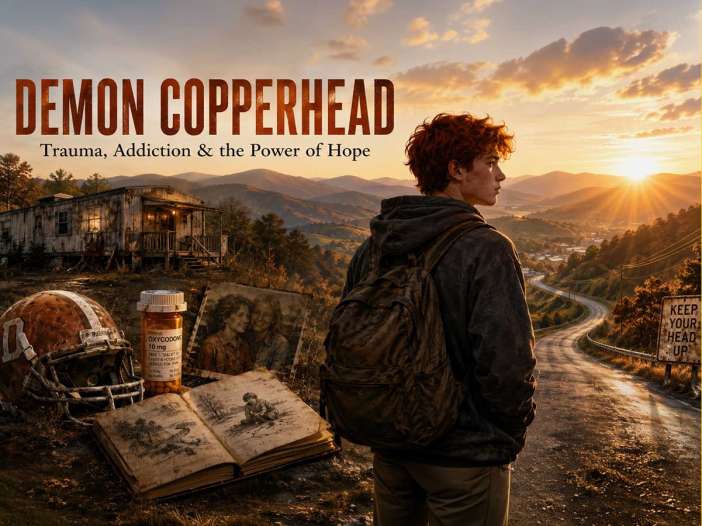
What if every child had at least one adult who never gave up on them?
Some novels entertain us.
Some educate us.
And a rare few quietly change the way we look at other people.
Demon Copperhead is one of those rare books.
Winner of the 2023 Pulitzer Prize for Fiction, Barbara Kingsolver's modern retelling of Charles Dickens' David Copperfield transports readers to the mountains of southern Appalachia, where one young boy grows up surrounded by poverty, addiction, broken families, and a foster care system that too often fails the very children it was meant to protect.
Yet this is not simply a novel about hardship.
It is a novel about resilience.
About dignity.
About the invisible strength required to keep believing life can become better, even after disappointment has become familiar.
Today, Barbara Kingsolver is joined by Demon Copperhead himself, Charles Dickens, Dr. Gabor Maté, and Fred Rogers to explore the deeper questions behind one of the most important novels of our time.
Together, they'll discuss five questions:
- What does a child truly need to survive?
- When does trauma become part of our identity?
- Can we understand addiction without removing responsibility?
- Who is responsible for protecting vulnerable children?
- And after everything life takes from us, can hope be learned again?
Whether you've already read Demon Copperhead or are discovering it for the first time, this conversation invites us to look beyond easy judgments and see the humanity behind every story.
Welcome to another Imaginary Talk.
(Note: This is an imaginary conversation, a creative exploration of an idea, and not a real speech or event.)
Topic 1: What Does a Child Need to Survive?
Opening
Some children are born into homes filled with security. Others enter the world carrying burdens they never chose. Demon Copperhead begins with a boy who loses almost everything before he has the chance to understand what "normal" even looks like. Yet somehow, he keeps moving forward.
Today, we'll explore a question that reaches far beyond one novel:
What does a child truly need—not just to stay alive, but to grow into a healthy human being?
Barbara Kingsolver: When I wrote Demon, I didn't want readers to pity him. I wanted them to understand him. Children don't choose the families they're born into, the economy they inherit, or the adults who surround them. Yet we often judge them as though they started life on equal ground.
Demon Copperhead: Folks always say kids are resilient. Maybe that's true. But resilience ain't some superpower. Sometimes it's just waking up one more morning because there ain't another option.
Charles Dickens: That sentiment has echoed through centuries. When I wrote David Copperfield, I wished readers would see neglected children not as unfortunate exceptions, but as evidence of society's responsibilities. It appears that lesson still requires repeating.
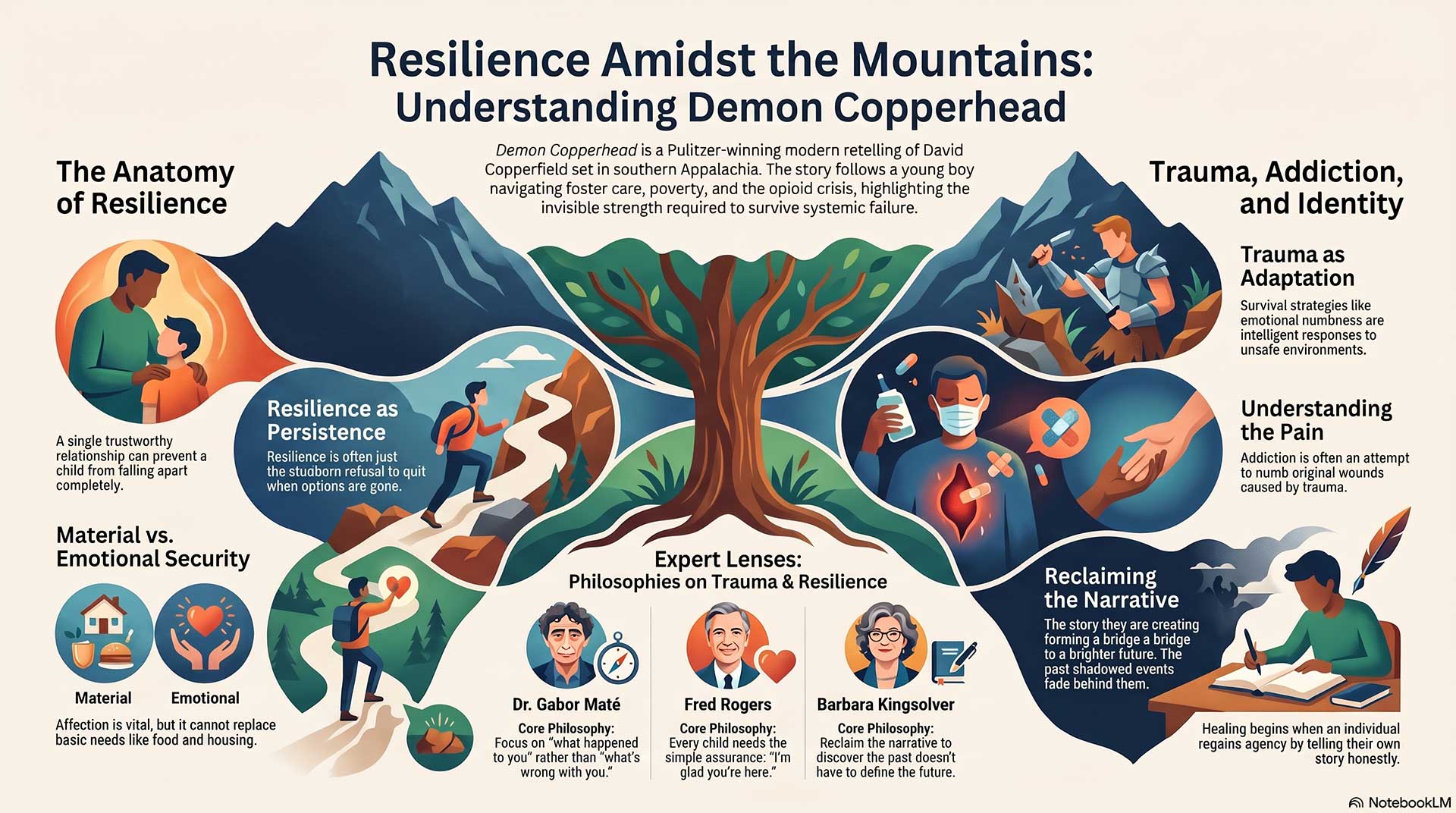
Dr. Gabor Maté: We often ask, "What's wrong with this child?" A better question is, "What happened to this child?" Human development begins in relationship. When safety, love, and stability are absent, the brain adapts for survival rather than flourishing.
Fred Rogers: Every child longs for one simple assurance: "I'm glad you're here." Before children need success, achievement, or discipline, they need to know that their lives matter to someone.
Question 1: Is One Loving Adult Enough to Change a Child's Life?
Barbara Kingsolver: Throughout the novel, small acts of kindness matter enormously. One teacher, one coach, one neighbor—sometimes a single caring adult becomes the thread preventing a child from falling completely apart. While no one person can erase trauma, one trustworthy relationship can begin healing.
Demon Copperhead: Looking back, I don't remember every place I stayed. I remember the people who treated me like I wasn't disposable. Funny how one person believing in you can stick around longer than a hundred people giving up on you.
Charles Dickens: Society often imagines salvation arrives through institutions. More often, it begins with individual compassion. History changes because ordinary people decide another human being is worth noticing.
Dr. Gabor Maté: Neuroscience supports this. Secure attachment with even one reliable adult can significantly influence emotional development. Healing doesn't require perfection. It requires consistent presence.
Fred Rogers: Children don't keep score of how many people loved them. They remember whether someone truly saw them. Sometimes one person saying, "I believe in you," becomes a lifelong source of strength.
Question 2: Can Love Compensate for Poverty?
Barbara Kingsolver: Love cannot replace food, safe housing, healthcare, or education. We shouldn't romanticize poverty by suggesting affection alone solves structural problems. Yet material support without love leaves a different kind of emptiness. Children deserve both.
Demon Copperhead: I would've liked a full refrigerator. I would've liked folks who stayed sober. I would've liked somebody telling me things were gonna be okay and actually meaning it. Turns out, wanting all that ain't asking too much.
Charles Dickens: We must avoid choosing between charity and justice. Compassion eases suffering; justice addresses its causes. A civilized society should pursue both.
Dr. Gabor Maté: Chronic stress from poverty alters children's development. Financial hardship isn't simply about lacking money; it often creates constant uncertainty. Emotional security and material security work together, not separately.
Fred Rogers: Children don't need perfect lives. They need dependable love within a community that values them enough to meet their basic needs. Kindness and justice belong together.
Question 3: Why Are Some Children Able to Keep Hoping While Others Give Up?
Barbara Kingsolver: Every child has a different combination of temperament, opportunity, relationships, and chance. We should be careful about comparing survivors with those who struggle. Survival isn't proof of greater character.
Demon Copperhead: There were days I kept going mostly because quitting would've made somebody else right about me. Maybe hope ain't always a bright light. Sometimes it's just stubbornness refusing to lose.
Charles Dickens: Hope often appears quietly. It lives in friendship, purpose, work, humor, and unexpected acts of generosity. Even the darkest stories contain moments where another path becomes possible.
Dr. Gabor Maté: Human beings are remarkably adaptable. What appears as resilience often grows from connection, meaning, and the chance to tell one's own story honestly. Healing begins when pain no longer has to remain hidden.
Fred Rogers: Hope grows where children feel safe enough to be themselves. When someone communicates, "You are lovable exactly as you are," a child begins imagining a future worth living.
Closing
Children do not choose where they begin.
They do not choose their parents, their neighborhoods, or the burdens placed upon them before they can speak.
Yet throughout history, countless children have survived because someone offered what every child deserves: safety, dignity, and the assurance that their life has value.
Perhaps Demon Copperhead reminds us that the greatest question is not whether children are resilient enough to endure hardship.
It is whether adults are willing to build a world where they no longer have to.
Topic 2: When Does Trauma Become Identity?

Opening
Children don't simply remember what happened to them.
Those experiences become part of how they see themselves.
Some grow up believing they're worthy of love.
Others quietly assume they must earn it.
In Demon Copperhead, trauma isn't presented as a single tragic event. It's a series of disappointments, betrayals, losses, and moments that slowly shape how a young boy understands the world—and himself.
Today we ask:
At what point does trauma stop being something that happened to us... and begin becoming part of who we believe we are?
Barbara Kingsolver: Trauma rarely arrives all at once. More often, it accumulates. A child adapts to survive, and eventually those survival strategies begin to feel like personality. That's why healing isn't about forgetting the past. It's about discovering that the past doesn't have to define your future.
Demon Copperhead: After enough folks leave, you start figuring they're all gonna leave sooner or later. You quit getting surprised. That's not because you stop caring. It's because expecting less hurts less.
Charles Dickens: Children possess extraordinary imaginations. Sadly, those imaginations often turn suffering into identity. Instead of thinking, "I was abandoned," they begin believing, "I must be someone worth abandoning."
Dr. Gabor Maté: The developing brain constantly asks one question: "What must I become to survive here?" The answer may be people-pleasing, emotional numbness, perfectionism, anger, or withdrawal. These adaptations are intelligent responses to difficult environments, but later they can imprison the very person they once protected.
Fred Rogers: I have always believed that children are not their circumstances. Beneath every frightened child remains someone longing to be known, accepted, and loved. That person never completely disappears.
Question 1: How Do Childhood Wounds Shape Adult Relationships?
Barbara Kingsolver: Children learn what love looks like from the people raising them. If love is inconsistent, frightening, or conditional, they often carry those expectations into adulthood without realizing it. They may push people away, cling too tightly, or struggle to trust genuine kindness.
Demon Copperhead: Somebody treating you good can feel almost suspicious when you ain't used to it. Sometimes the hardest thing ain't surviving bad people. It's believing the good ones are real.
Charles Dickens: We often imagine adulthood frees us from childhood. Yet many adults continue acting out stories written long before they understood the words.
Dr. Gabor Maté: Our earliest relationships become the blueprint for future relationships. The encouraging news is that blueprints can be revised. Healthy relationships themselves become part of the healing process.
Fred Rogers: Love invites trust, but trust grows slowly. We shouldn't ask wounded people, "Why don't you trust?" We should ask how we can become trustworthy.
Question 2: Can People Rewrite the Story They Tell Themselves?
Barbara Kingsolver: One reason Demon tells his own story is because reclaiming the narrative is itself an act of healing. As long as others define us by our worst moments, we remain trapped. When we begin telling the truth about our lives—including our resilience—we regain agency.
Demon Copperhead: Folks had plenty of names for me before I ever got to choose one. Troublemaker. Poor kid. Addict. Foster kid. Turns out the hardest label to change was the one inside my own head.
Charles Dickens: Literature has always offered this possibility. Stories allow readers to imagine that their past need not dictate their ending. Every great novel is, in some sense, an argument against hopelessness.
Dr. Gabor Maté: Healing doesn't erase memory. It changes meaning. The question shifts from "What's wrong with me?" to "Given what happened to me, how else could I have adapted?" That shift replaces shame with understanding.
Fred Rogers: Every person deserves to hear a new story about themselves—one that begins not with failure, but with inherent worth.
Question 3: Is Healing About Forgetting the Past or Learning to Live With It?
Barbara Kingsolver: Demon doesn't become healthy because his past disappears. He becomes healthier because the past no longer controls every decision. Healing isn't erasing scars. It's learning they don't have to determine tomorrow.
Demon Copperhead: I ain't looking to pretend none of it happened. Those things made me who I am. I just don't want them deciding who I gotta be from here on out.
Charles Dickens: Memory is not our enemy. Despair is. When suffering becomes wisdom instead of imprisonment, the past finally serves life rather than dominating it.
Dr. Gabor Maté: Trauma is not the painful event itself. Trauma is what remains inside us after the event has passed. Healing begins when our nervous system no longer has to live as though the danger is still present.
Fred Rogers: I once said that anything human is mentionable, and anything mentionable can become more manageable. When we speak honestly about our pain, we begin loosening its grip on our lives.
Closing
Trauma has a quiet voice.
It whispers:
"This is who you are."
Healing answers:
"This is what happened to you—but it is not the whole story."
Perhaps that is one of Demon Copperhead's greatest gifts.
It reminds us that while childhood shapes us profoundly, it does not have the final word.
The past may explain us.
It does not have to imprison us.
Topic 3: Understanding Addiction Without Excusing It

Opening
Few issues generate stronger opinions than addiction.
Some see it primarily as a series of bad choices.
Others see it as an illness.
Still others believe it's the inevitable result of trauma, poverty, and hopelessness.
In Demon Copperhead, Barbara Kingsolver refuses to reduce addiction to a single explanation. She doesn't excuse the damage addiction causes, but she also refuses to strip addicted people of their humanity.
Today we ask:
Can we understand addiction deeply without removing personal responsibility?
Barbara Kingsolver: One of my goals was to challenge simple narratives. Addiction devastates families and communities, but the people trapped inside it are not simply villains or victims. They're human beings living at the intersection of pain, biology, circumstance, and choice.
Demon Copperhead: Nobody wakes up thinking, "Today's the day I ruin my life." Most folks just want the hurting to stop. That's the part people don't always see.
Charles Dickens: Every era has judged those who suffer differently. In Victorian England, poverty was often viewed as moral failure. Today, addiction frequently receives similar treatment. Society is quick to condemn what it has not taken time to understand.
Dr. Gabor Maté: Addiction is not best understood by asking, "Why the addiction?" The more important question is, "Why the pain?" Drugs rarely create the original wound. More often, they temporarily numb it.
Fred Rogers: Every person struggling with addiction is someone's child. If we remember that simple truth, our conversations become less about condemnation and more about compassion—without ignoring accountability.
Question 1: Is Addiction a Choice, a Disease, or Both?
Barbara Kingsolver: The first decision may involve choice. But repeated exposure changes the brain in ways that make later choices profoundly more difficult. If we insist it's only choice, we ignore science. If we insist it's only disease, we risk denying personal agency. The truth is more complicated.
Demon Copperhead: At first, I figured I was in control. Then one day I realized the pills weren't fitting into my life anymore. My life was fitting around the pills.
Charles Dickens: Human beings often mistake the beginning of a story for its ending. One decision may be voluntary, while everything afterward becomes increasingly constrained. Wisdom requires seeing the entire journey.
Dr. Gabor Maté: Addiction involves altered brain chemistry, emotional pain, learned coping strategies, and environmental influences. Responsibility still exists—but recovery begins with understanding reality rather than simplifying it.
Fred Rogers: Accountability is most effective when it grows from hope instead of shame. Shame rarely transforms people. Love combined with honesty often does.
Question 2: Why Did the Opioid Crisis Become So Widespread?
Barbara Kingsolver: This wasn't simply thousands of isolated personal failures. Pharmaceutical marketing, aggressive prescribing practices, economic decline, chronic pain, and limited healthcare all played significant roles. Entire communities became vulnerable long before many individuals became addicted.
Demon Copperhead: Where I grew up, getting hurt wasn't unusual. Working hard wasn't unusual either. When pills showed up promising to fix everything, nobody was talking much about what they might take away.
Charles Dickens: Every generation develops new forms of suffering, yet society often repeats the same mistake: blaming individuals while ignoring the conditions that made widespread tragedy possible.
Dr. Gabor Maté: Despair creates fertile ground for addiction. Communities facing unemployment, isolation, hopelessness, and unresolved trauma naturally experience higher rates of substance abuse. We cannot separate personal health from community health.
Fred Rogers: Healthy communities help raise healthy children. When neighborhoods lose stability, everyone becomes more vulnerable. Caring for one another is not sentimental; it is practical.
Question 3: What Gives Someone the Strength to Recover?
Barbara Kingsolver: Recovery rarely begins with willpower alone. It often begins when someone believes life can become meaningful again. Hope is not a reward for recovery. Hope is frequently the first step toward it.
Demon Copperhead: I used to think recovery meant waking up one morning fixed. Turns out it's a whole bunch of ordinary days where you keep choosing not to quit. Some days you win big. Some days you just survive. Both count.
Charles Dickens: Redemption has always fascinated readers because it reflects our deepest hope—that people are more than the worst chapter of their lives. Every meaningful recovery story reminds us that endings are never fully written.
Dr. Gabor Maté: Lasting recovery usually involves more than stopping the substance. It requires rebuilding relationships, finding purpose, learning emotional regulation, and creating a life where the need to escape gradually diminishes.
Fred Rogers: Healing becomes possible when people discover they are valued not because they are perfect, but because they are human. That truth gives many people the courage to begin again.
Closing
Addiction is neither a simple moral failure nor an excuse to avoid responsibility.
It is a deeply human struggle shaped by biology, experience, relationships, environment, and choice.
Demon Copperhead invites us to replace easy judgments with deeper understanding—not to excuse destructive behavior, but to ask better questions about why people suffer and how they heal.
Perhaps the opposite of addiction is not merely sobriety.
Perhaps it is connection.
Connection to purpose.
Connection to community.
And the quiet belief that no matter how far someone has fallen, their story is not over.
Topic 4: Who Is Responsible for a Child's Future?

Opening
When a child struggles, our first instinct is often to look at the parents.
Sometimes that's appropriate.
But Demon Copperhead asks a much larger question.
What happens when parents themselves are overwhelmed by addiction, poverty, trauma, or hopelessness?
And if every institution surrounding that child—from foster care to schools, healthcare, businesses, and government—also falls short...
Who, ultimately, is responsible for giving that child a chance?
Barbara Kingsolver: One child rarely fails because of one person. More often, multiple systems fail at the same time. Demon isn't simply the story of one neglected boy. He's the story of what happens when a community gradually loses its ability to protect its most vulnerable children.
Demon Copperhead: Folks were always trying to figure out whose fault I was. Truth is, by the time everybody finished pointing fingers, nobody was left helping much.
Charles Dickens: The measure of any civilization is found in how it treats those who possess the least power. Children cannot vote. They cannot hire lawyers. They cannot choose better parents. Their future rests almost entirely in the hands of adults.
Dr. Gabor Maté: We often individualize problems that are deeply social. When thousands of children experience similar suffering, we should ask not only what happened within families, but what happened within society.
Fred Rogers: Every child belongs not only to a family but also to a neighborhood, a school, and a community. Children flourish when many adults quietly decide, "This child matters to us."
Question 1: Where Does Personal Responsibility End and Society's Responsibility Begin?
Barbara Kingsolver: Parents bear enormous responsibility, but they don't raise children in isolation. If families lack affordable healthcare, stable employment, safe housing, quality schools, or effective addiction treatment, expecting parents alone to overcome every obstacle becomes unrealistic. Healthy societies strengthen families instead of abandoning them.
Demon Copperhead: I don't remember needing perfect people. I just needed grown-ups who actually showed up when they said they would.
Charles Dickens: We should resist choosing between individual responsibility and social responsibility. Both are essential. A society that blames only individuals grows cold. One that ignores personal choices loses accountability. Wisdom requires both truths at once.
Dr. Gabor Maté: Human development is relational. Children are shaped by families, but families themselves are shaped by economics, education, healthcare, culture, and public policy. These layers cannot be separated.
Fred Rogers: One of the greatest gifts adults can offer children is reliability. Trust grows when children discover there are people who consistently care—not because they're obligated, but because they choose to.
Question 2: What Role Should Communities Play?
Barbara Kingsolver: Strong communities often notice struggling children before institutions do. Teachers, coaches, neighbors, pastors, relatives, employers—these ordinary relationships frequently become lifelines. Communities cannot solve every problem, but they can prevent many children from feeling invisible.
Demon Copperhead: Funny thing is, I can remember folks who probably didn't think they'd done much for me. A ride somewhere. A meal. Somebody asking how I was doing and actually waiting for the answer. You don't forget those people.
Charles Dickens: History celebrates famous reformers, but civilizations are sustained by ordinary citizens performing quiet acts of compassion. Communities survive because countless people choose kindness when no one is watching.
Dr. Gabor Maté: Isolation magnifies trauma. Belonging helps regulate the nervous system. Communities are not merely social conveniences—they are part of human biology.
Fred Rogers: We often ask children to become better citizens. Perhaps adults should first become better neighbors.
Question 3: If You Could Change One Thing to Give Children a Better Future, What Would It Be?
Barbara Kingsolver: I would invest early—before crisis becomes catastrophe. Healthy childhoods are not only morally right; they're among the wisest investments any society can make.
Demon Copperhead: I'd make sure every kid had at least one place where they knew they were safe. You can fight a whole lot of battles if you've got one place you don't have to fight.
Charles Dickens: I would ask adults to remember that today's neglected child often becomes tomorrow's struggling adult. Compassion delayed is often compassion denied.
Dr. Gabor Maté: I would teach trauma awareness everywhere—schools, healthcare, workplaces, courts, and homes. When we understand human development better, our responses become wiser and more humane.
Fred Rogers: I would tell every child, early and often: "You are valuable simply because you are you." A society built on that truth would make very different decisions.
Closing
Every child begins life completely dependent on others.
That dependence is not weakness.
It is part of being human.
Demon Copperhead reminds us that children do not fail alone.
When they thrive, many hands have quietly lifted them.
When they struggle, many opportunities to help may have been missed.
Perhaps the question is not simply:
"Who is responsible?"
Perhaps the better question is:
"What kind of adults do we choose to become when a child needs us?"
Because the future of every society is written first in the lives of its children.
Topic 5: Can Hope Be Learned Again?

Opening
For much of Demon Copperhead, hope feels fragile.
Every time life begins improving, another setback arrives.
Readers may find themselves wondering not whether Demon can become successful, but whether he can still believe life is worth trusting.
In the end, the novel leaves us with a question that reaches beyond Appalachia, beyond addiction, and beyond one young man's story.
After everything life takes from us, is it possible to learn hope again?
Barbara Kingsolver: Hope isn't optimism. Optimism assumes things will work out. Hope is choosing to keep walking even when you cannot yet see where the road leads. Demon survives because, despite everything, a small part of him refuses to believe that suffering is the only future available.
Demon Copperhead: People think hope feels big. Most days it don't. Most days it's just getting out of bed, doing what's in front of you, and believing tomorrow might suck a little less than yesterday.
Charles Dickens: My novels have often been called hopeful, but hope was never meant to ignore suffering. Rather, it declares that suffering should not have the final word. Humanity endures because we continue imagining better endings than the ones before us.
Dr. Gabor Maté: Healing doesn't mean becoming the person you might have been if nothing painful had happened. Healing means becoming whole with your history rather than forever fighting against it.
Fred Rogers: One of the greatest gifts we can offer another person is hope—not empty promises, but our faithful presence. Sometimes hope is borrowed from someone who believes in us before we can believe in ourselves.
Question 1: What Ultimately Saved Demon?
Barbara Kingsolver: There isn't a single turning point. Recovery comes through many small moments—relationships, self-awareness, opportunity, honesty, and the gradual decision to stop letting pain make every choice. Real transformation is usually quiet before it becomes visible.
Demon Copperhead: Folks always ask what saved me. Truth is, it wasn't one thing. It was enough little things stacking up until I finally believed my life might be worth hanging onto.
Charles Dickens: We often search for dramatic miracles, yet redemption usually unfolds through ordinary acts repeated faithfully over time. Character is rebuilt one decision after another.
Dr. Gabor Maté: Recovery begins when survival is no longer the only goal. Human beings need purpose, belonging, and meaning. Without those, simply removing addiction often leaves an empty space.
Fred Rogers: Every person needs someone who sees not only who they are today, but also who they might become. Hope often grows because another person refuses to give up first.
Question 2: Can Pain Become a Gift Without Glorifying Suffering?
Barbara Kingsolver: I would never call suffering a gift. Too much pain destroys lives unnecessarily. Yet many people eventually discover compassion, wisdom, or strength because of what they've survived. The gift is not the suffering itself. The gift is what love and courage can still build afterward.
Demon Copperhead: I wouldn't wish my life on anybody. But if somebody who's hurting hears my story and figures they're not alone, maybe none of it was completely wasted.
Charles Dickens: Great literature does not celebrate suffering. It reveals the dignity that can survive within it. Those are two very different things.
Dr. Gabor Maté: Trauma often increases empathy when healing occurs. People who have suffered deeply sometimes become the safest companions for others because they understand pain without judgment.
Fred Rogers: Scars can become places where compassion grows. Not because suffering is good, but because love has the remarkable ability to bring goodness even after suffering.
Question 3: What Do You Hope Readers Carry With Them After Closing the Book?
Barbara Kingsolver: I hope readers leave with greater compassion. Before judging another person's life, we should ask what invisible battles they may have been fighting long before we met them.
Demon Copperhead: Don't look at folks and think you know their whole story. Everybody's carrying something. Some of us just got better at hiding it.
Charles Dickens: I hope readers remember that societies are judged not by the comfort of the fortunate, but by the opportunities offered to those born with the least advantage.
Dr. Gabor Maté: I hope people become more curious than judgmental. Curiosity opens the door to healing. Judgment usually closes it.
Fred Rogers: I hope every reader remembers this simple truth: every child, every adult, every person they meet has an invisible story. When we treat people with kindness, we honor that story—even if we never hear it.
Closing
At first glance, Demon Copperhead is a novel about one boy growing up in the mountains of Virginia.
But its deeper message reaches far beyond one place or one generation.
It reminds us that people are rarely defined by the worst thing that has happened to them.
They are shaped by the people who believe in them.
By the choices they continue making.
And by the courage to imagine that tomorrow does not have to repeat yesterday.
Perhaps hope is not something we either possess or lose forever.
Perhaps hope is something we learn again—
through compassion,
through connection,
and through the quiet decision to keep moving forward, even when the road ahead is uncertain.
That may be Barbara Kingsolver's greatest gift to her readers.
Not the promise that life will become easy.
But the reminder that even after profound loss, a human life can still grow toward the light.
Final Thoughts
When I began writing Demon Copperhead, I wasn't trying to write a novel about addiction alone, or poverty alone, or Appalachia alone. I wanted readers to meet one human being so completely that they could no longer look away from the millions of real people whose stories are rarely told.
It's easy to judge people from a distance. It's much harder to judge them after you've walked beside them through every disappointment, every small victory, and every impossible choice.
If there's one hope I have for readers, it's that they leave this story with greater compassion—not because compassion ignores responsibility, but because true understanding always comes before wise judgment.
Every child enters this world with possibilities.
Whether those possibilities flourish or fade depends not only on that child, but on the families, neighbors, schools, communities, and institutions that surround them.
Perhaps the greatest lesson of Demon Copperhead is that no one succeeds entirely alone, and no one struggles entirely alone, either.
We belong to one another more than we often realize.
If this conversation encourages us to notice the overlooked, to listen before we assume, and to offer hope where someone has only known hardship, then perhaps we've honored not only Demon's story, but the countless real lives that inspired it.
Thank you for joining us in this Imaginary Talk. May we all leave with a little more understanding, a little more compassion, and a renewed commitment to see the humanity in every person's story.
Short Bios:
Barbara Kingsolver
Barbara Kingsolver is an American novelist, essayist, and poet whose work often explores social justice, environmental issues, and the resilience of ordinary people. Her novel Demon Copperhead won the 2023 Pulitzer Prize for Fiction and became one of the defining American novels of the twenty-first century. Through unforgettable storytelling, she invites readers to see dignity and humanity in those society too often overlooks.
Demon Copperhead
Demon Copperhead is the fictional narrator and protagonist of Barbara Kingsolver's Pulitzer Prize-winning novel. Born into poverty in Appalachia, he survives childhood neglect, foster care, addiction, and profound loss while refusing to lose his wit, honesty, and determination. His story represents countless children whose struggles often remain invisible.
Charles Dickens
Charles Dickens (1812–1870) was one of England's greatest novelists and the author of classics including David Copperfield, Oliver Twist, Great Expectations, and A Tale of Two Cities. His vivid portrayals of poverty, injustice, and childhood hardship inspired generations of writers, including Barbara Kingsolver's modern reimagining in Demon Copperhead.
Dr. Gabor Maté
Dr. Gabor Maté is a Canadian physician, bestselling author, and internationally respected expert on trauma, addiction, and human development. His work emphasizes understanding the roots of emotional pain rather than simply treating symptoms, making his perspective especially relevant to the themes explored in Demon Copperhead.
Fred Rogers
Fred Rogers (1928–2003), beloved host of Mister Rogers' Neighborhood, dedicated his life to helping children understand their emotions and recognize their inherent worth. His message of kindness, acceptance, and unconditional love continues to inspire parents, educators, and communities around the world, offering a hopeful counterpoint to the hardships portrayed in Demon Copperhead.
Leave a Reply