
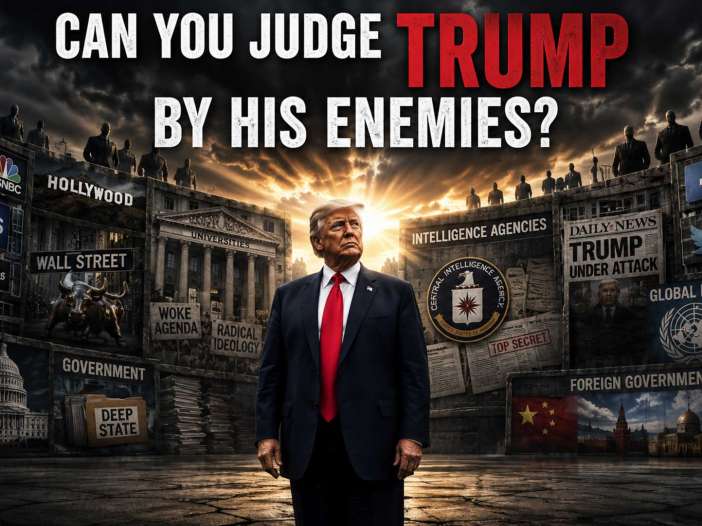
What if the people who oppose a leader reveal as much about the system as they do about the leader?
For nearly a decade, Donald Trump has stood at the center of one of the most extraordinary political battles in modern American history.
Few presidents have attracted such sustained opposition from so many different directions. Foreign governments, legacy media organizations, Hollywood celebrities, major universities, intelligence officials, technology leaders, and many influential voices in American politics have all criticized or opposed him at various times.
To many Americans, that raises an important question.
Is Trump opposed because he threatens democracy?
Or is he opposed because he threatens an established system that had become comfortable long before he entered politics?
This conversation does not assume either answer.
Instead, it asks a series of questions that every thoughtful citizen should consider.
Can a leader be judged by the enemies he attracts?
Why did so many powerful institutions find themselves opposing the same president?
Who benefited from the political, economic, and cultural order that existed before Trump?
Does Jesus' warning in Luke 6:26 about universal praise have anything to teach us about modern political leadership?
Most importantly, who has actually benefited from Trump's leadership?
Rather than offering slogans, our guests explore history, politics, economics, Scripture, morality, and leadership from different perspectives.
Some believe Trump exposed institutional corruption that had gone unchallenged for decades.
Others believe his methods created problems that deserve equal attention.
Together they wrestle with one enduring question:
What do a leader's enemies really tell us—and what can they never tell us?
(Note: This is an imaginary conversation, a creative exploration of an idea, and not a real speech or event.)
Topic 1: What Does a Man’s List of Enemies Really Reveal?
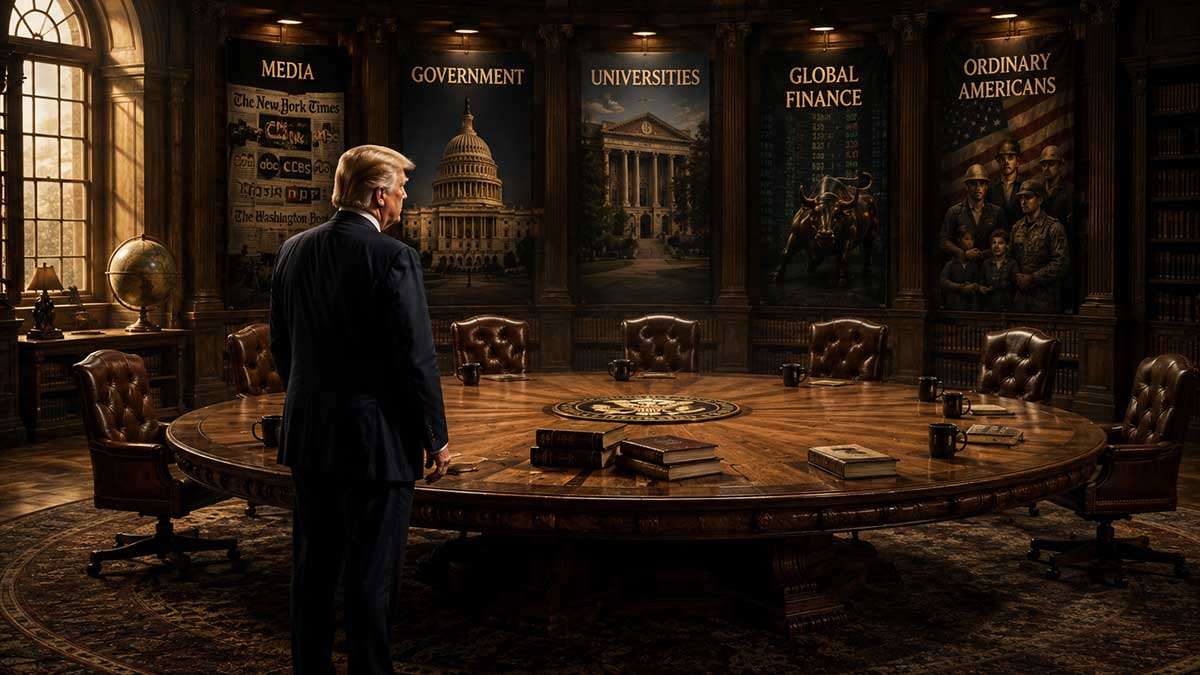
Opening
The five guests sit around a circular table. Behind them, a screen displays photographs of government buildings, television studios, corporate headquarters, university campuses, and factories that have stood empty for years.
At the center of the screen appears one question:
What can we learn about a man by studying the people who want him defeated?
Tucker Carlson: People are constantly told to judge Donald Trump by the accusations made against him. Yet very few people stop and examine the accusers. Who are they? What have they defended? What did they gain from the system Trump challenged?
That does not mean every accusation is false. It means the source matters. When institutions that misled the public, protected failed policies, and became wealthier during national decline suddenly agree that one man represents an extraordinary danger, citizens have every right to ask what those institutions fear losing.
David French: Examining the accuser is legitimate. Treating the identity of the accuser as proof of the accused man’s innocence is not.
A corrupt institution may make a true accusation. A dishonest journalist may uncover a real wrongdoing. An authoritarian government may oppose an American president for reasons that have nothing to do with that president’s moral character.
Enemies give us information, but they do not give us a verdict.
Victor Davis Hanson: That distinction matters, yet we cannot ignore historical patterns. Reformers often become hated by the groups whose status depends upon preserving an existing arrangement.
Trump entered politics without adopting the language, manners, or assumptions of the governing class. He questioned trade relationships, immigration policy, permanent military commitments, media authority, intelligence leadership, and the cultural influence of universities. Each challenge created a different set of enemies.
The remarkable part was not that he faced opposition. Every president does. The remarkable part was the intensity, duration, and breadth of that opposition.
Cornel West: We need to ask whether those enemies feared justice or merely feared losing their own position. Yet we must ask the same thing about the people surrounding Trump.
Every political coalition contains competing interests. Working people may support a leader for one reason. Billionaires may support him for another. Religious voters may see moral courage. Corporate executives may see favorable taxes or regulation.
A list of enemies can expose a broken establishment. A list of friends can expose a new establishment forming around the challenger.
Reinhold Niebuhr: Human beings are skilled at discovering selfish motives in their enemies and overlooking selfish motives in themselves.
The danger is not in asking who opposes a leader. The danger begins when opposition itself becomes a certificate of righteousness.
The prophet may be rejected for speaking truth. The demagogue may be rejected for inflaming division. At times, the same man may speak a necessary truth through methods that reveal serious personal failings.
Political maturity requires us to hold more than one truth at the same time.
Deep Question 1: Can the hostility of influential institutions reveal that a leader is threatening interests they have spent decades protecting?
Tucker Carlson: Of course it can. Institutions are made of people, and people protect their position.
Consider what happened to working-class communities across America. Factories closed. Stable jobs disappeared. Small towns weakened. Families became less secure. Yet the people who designed, defended, and explained these policies rarely suffered the consequences.
Many received promotions, television contracts, university positions, consulting work, or places on corporate boards.
Then Trump arrived and said the people who had been called ignorant were often correct. Trade agreements had harmed communities. The border was not under control. Foreign interventions had failed. The media was not neutral. Experts were capable of protecting themselves rather than the public.
That threatened more than policy. It threatened reputations.
David French: Some institutions certainly protect themselves, and Trump exposed real failures. The collapse of trust did not begin with him. It developed through years of war, economic disruption, political dishonesty, media mistakes, and cultural contempt.
Yet institutional resistance does not always indicate corrupt self-protection. Institutions may resist a president when they believe he is exceeding legal authority, abandoning established alliances, attacking their independence, or behaving recklessly.
The public must examine the substance of each conflict. We cannot place every opponent into one category called “the establishment” and assume they share one motive.
Tucker Carlson: But that demand for perfect distinctions often becomes a way of avoiding an obvious pattern.
How many coincidences must occur before citizens are permitted to recognize that powerful groups share an interest in keeping influence away from ordinary voters?
David French: Citizens should recognize patterns. They should refuse to let a pattern replace evidence.
Victor Davis Hanson: The two points are not mutually exclusive.
The opposition to Trump came from separate institutions with separate interests, yet many of those interests overlapped. They shared a cultural language, similar educational backgrounds, comparable social circles, and a belief that people with their credentials ought to guide the country.
Trump did not merely disagree with their policies. He rejected their right to define respectable opinion.
That is why their reaction often appeared personal. He was challenging the hierarchy through which they understood their own importance.
Cornel West: That hierarchy is real. Working people have often been spoken about rather than listened to. Their economic pain was translated into statistics. Their anger was treated as a psychological defect. Their religious faith was mocked. Their love of country was portrayed as ignorance.
Trump heard that humiliation and spoke directly to it.
Yet the test is whether recognition becomes transformation. Does the worker regain economic security? Does the family become stronger? Does the child inherit a better future? Or does the pain of ordinary people become emotional fuel for another political movement?
Reinhold Niebuhr: An institution rarely says, “We oppose this man because he threatens our privileges.”
It describes its interests as principles. The politician does the same.
This does not mean principles are false. It means citizens must examine where principle ends and self-interest begins. The strongest evidence that a leader is threatening protected interests is not the volume of condemnation. It is the concrete privilege, revenue, authority, or immunity placed at risk by his policies.
Victor Davis Hanson: Then perhaps the proper question is not simply, “Who hates him?”
It is: “What did they stand to lose when they began hating him?”
Reinhold Niebuhr: Yes. That question moves us from emotion to examination.
Deep Question 2: When does widespread opposition become evidence of courage, and when does it simply reflect genuine concern about a leader’s conduct?
David French: Courage appears when a leader accepts personal cost to defend a truthful and necessary position.
Conflict by itself is not courage. A person can create unnecessary conflict through carelessness, pride, insult, or appetite for attention. We should ask whether the disputed action served a public purpose that could not have been achieved through more disciplined means.
Trump’s willingness to confront elite consensus can be courageous. It does not follow that every confrontation he begins is wise or necessary.
Tucker Carlson: The problem is that demands for disciplined language are frequently imposed only upon the person challenging the system.
The institutions may destroy lives, mislead the country, censor debate, or support wars whose costs are paid by other families. Yet the challenger is declared unfit after using an insulting nickname.
That difference in moral scale matters.
David French: It does. Yet character is not irrelevant merely because larger institutional failures exist.
A president shapes the moral tone of public life. Supporters should be free to defend his policies without feeling required to defend every word or action.
Victor Davis Hanson: Americans often tolerate polished failure more readily than impolite success.
A leader may speak elegantly, follow every social convention, and preside over decline. Another may speak harshly, violate conventions, and force neglected problems into public debate.
The first is called presidential. The second is called dangerous.
That does not excuse every excess. It explains why millions of voters no longer trust elite definitions of acceptable conduct.
Cornel West: We need moral consistency. The powerful should not demand gentleness from those whose communities have been wounded, especially after showing little gentleness themselves.
Yet righteous anger can become intoxicating. A movement can begin by defending forgotten people and end by enjoying the humiliation of its opponents.
Courage confronts injustice. Cruelty enjoys the confrontation itself.
Tucker Carlson: But who decides when confrontation becomes cruelty? The same people who spent years ridiculing Trump’s voters?
Cornel West: No. Conscience decides. Truth decides. The treatment of the vulnerable decides.
A person does not need permission from the media to examine his own behavior.
Reinhold Niebuhr: We often assume that courage and fault cannot exist together.
A leader may possess genuine courage in confronting entrenched interests and serious weaknesses in how he exercises that courage. His enemies may exaggerate those weaknesses. His followers may deny them. Both responses prevent honest judgment.
Widespread opposition becomes evidence of courage when three conditions are present.
The leader identifies a real injustice. He accepts meaningful risk in confronting it. His actions aim at correcting the injustice rather than merely increasing his own authority.
David French: The third condition is the hardest to test.
Reinhold Niebuhr: It is tested through limits.
Does the leader accept constitutional boundaries? Can he tolerate disagreement from loyal supporters? Does he admit error? Does he distinguish opposition from treason? Does he seek a victory that leaves room for the dignity of those who opposed him?
Tucker Carlson: Those are fair questions, provided they are asked of institutions too.
Can intelligence agencies accept limits? Can media organizations admit error? Can universities tolerate dissent? Can corporations resist using economic influence to dictate political thought?
Reinhold Niebuhr: They must be asked of every center of authority.
The central danger is authority without self-examination, whether it sits in the presidency, the press, a corporation, a university, or an intelligence office.
Deep Question 3: What evidence should people examine before concluding that a leader’s enemies prove he is fighting for the public?
Victor Davis Hanson: Begin with policy.
Did the leader act against the interests of the institutions opposing him? Did he change trade policy, immigration enforcement, foreign affairs, regulation, energy production, or the authority of government agencies? Did those changes explain the opposition?
Next, examine outcomes. Did wages improve? Did employment become more secure? Did communities regain confidence? Did the country become safer? Did citizens regain control over decisions previously made by distant institutions?
Enemies may point us to the battlefield. Results tell us what the battle achieved.
Tucker Carlson: Follow the money too.
When an institution warns that a policy is dangerous, ask whether the policy threatens its funding, market access, labor supply, government contract, advertising relationship, or political influence.
People are told that every institutional position is based upon expertise. Very often expertise and financial interest occupy the same office.
David French: We should follow the leader’s money and relationships with equal seriousness.
Who gains access? Who receives government contracts? Who benefits from tax, regulatory, or foreign-policy decisions? Which wealthy supporters receive influence? Does the leader condemn corruption only when it belongs to his opponents?
A movement loses credibility when it applies suspicion in only one direction.
Cornel West: Listen to people who cannot purchase access.
Talk to the worker whose plant closed. Talk to the family choosing between groceries and medicine. Talk to the small-business owner buried under costs. Talk to the veteran carrying the memory of a distant war. Talk to the mother who fears for her neighborhood.
Then return several years later.
Did their lives change, or were they simply given a new vocabulary for their suffering?
Tucker Carlson: Being heard is not trivial. Many Americans were denied even that dignity.
Cornel West: I agree. Recognition is the beginning. It cannot be the final destination.
Reinhold Niebuhr: The public should examine four forms of evidence: sacrifice, consistency, restraint, and fruit.
What did the leader personally risk?
Does he apply his principles to allies and opponents?
What does he refuse to do, even when doing it would increase his authority?
What has grown from his leadership—greater dignity and participation, or greater fear and dependence?
Victor Davis Hanson: We should include comparison. Trump should not be measured against an imaginary flawless president. He should be measured against the leaders, institutions, and policies presented as the real choices before the country.
David French: Agreed. Yet comparison should not lower every moral standard. Saying that opponents are worse does not answer every concern about one’s own side.
Tucker Carlson: Nor should moral standards be used to return authority to people whose failures created the revolt.
Reinhold Niebuhr: Then citizens face a demanding responsibility. They must resist two temptations: believing everything Trump’s enemies say and believing that the existence of those enemies answers every question about Trump.
Closing
The photographs behind the guests fade. One image remains: an abandoned factory beside a newly constructed corporate tower.
Cornel West: The deepest question is not whether powerful people dislike Donald Trump. Many clearly do.
The question is whether his struggle gives forgotten people a voice, a livelihood, dignity, and a meaningful share in the nation’s future.
David French: A person’s enemies can tell us what he has disturbed. They cannot, by themselves, tell us whether every disturbance was just.
Tucker Carlson: Yet refusing to examine those enemies leaves citizens vulnerable to manipulation. Institutions do not become trustworthy merely by placing the word “democracy,” “science,” “security,” or “journalism” in front of their interests.
Victor Davis Hanson: Trump’s enemies reveal that he disrupted an established political and cultural order. Whether history judges that disruption as restoration or missed opportunity will depend on the changes that survive him.
Reinhold Niebuhr: Luke records Jesus warning, “Woe to you when everyone speaks well of you,” pointing to the praise once given to false prophets. Yet Jesus immediately teaches His listeners to love their enemies, do good to those who hate them, bless those who curse them, and pray for those who mistreat them. (Bible Gateway)
Those teachings belong together.
The opposition of the powerful may signal that a man has spoken a truth they wished to conceal. His treatment of that opposition may reveal what the struggle is doing to his soul.
A man’s enemies tell us what he threatens.
His actions tell us what he serves.
And the fruit of his leadership tells us who he was truly fighting for.
Topic 2: Why Did So Many Institutions Unite Against Trump?
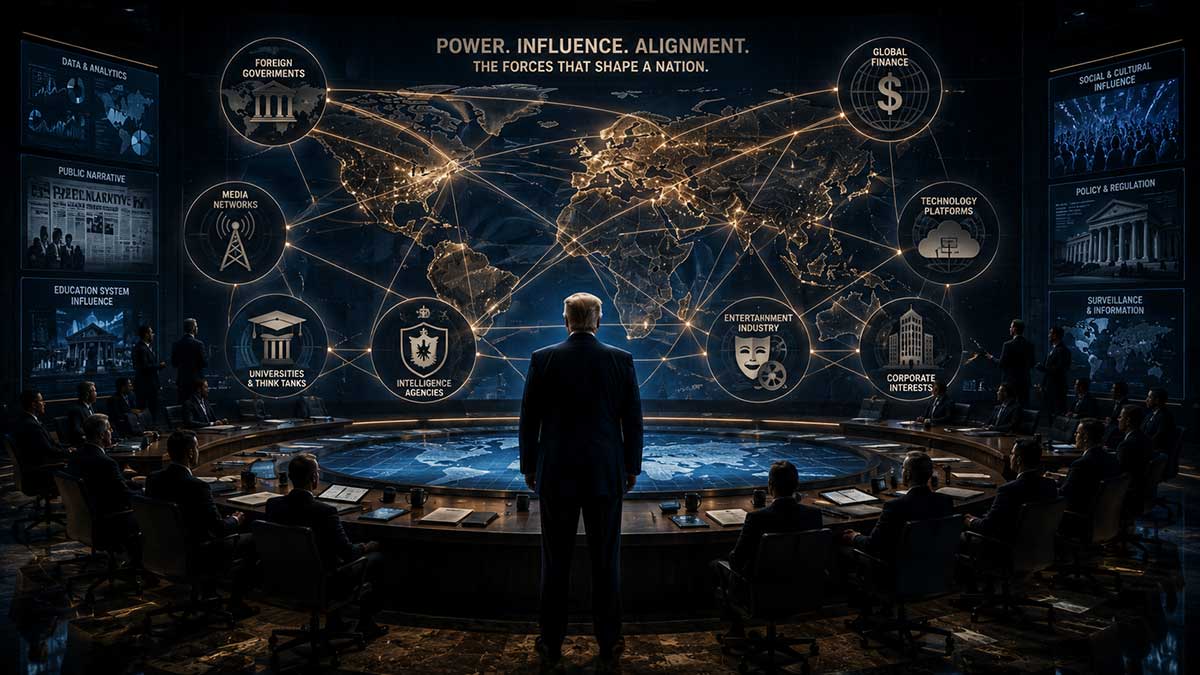
Opening
The screen behind the guests displays eight images: the Chinese flag, an Iranian government building, a pharmaceutical laboratory, a television newsroom, a Hollywood studio, a university campus, an intelligence agency headquarters, and a gathering of technology executives.
At first glance, these institutions appear to have little in common.
China and Iran are foreign adversaries. Pharmaceutical companies seek profits. Journalists compete for attention. Universities claim to pursue knowledge. Intelligence agencies protect national security. Hollywood creates entertainment. Billionaires invest wherever they expect a return.
Yet each has produced influential figures who strongly opposed Donald Trump.
The question is whether this opposition represents a shared defense of legitimate principles—or whether separate institutions recognized the same threat to their position.
Tucker Carlson: People are expected to believe that all these institutions independently reached the same conclusion through pure moral reflection.
China decided Trump was dangerous. Iran decided Trump was dangerous. The media reached the same judgment. Hollywood agreed. University administrators agreed. Intelligence officials agreed. Technology executives agreed.
These groups disagree on countless matters. Yet when Trump appeared, they spoke with striking similarity: he was unstable, illegitimate, authoritarian, dangerous, and unfit.
At some point, citizens have the right to ask whether they were protecting democracy or protecting an arrangement that had served them very well.
David French: We must be careful with the word “united.”
China opposed Trump’s tariffs and strategic pressure. Iran opposed sanctions and the killing of Qasem Soleimani. Journalists objected to his attacks on the press. Intelligence officials raised concerns about national security and presidential conduct. Universities objected to his immigration and cultural policies.
They may have reached a similar conclusion through different paths.
Similar opposition does not prove a common plan.
Victor Davis Hanson: It may not prove coordination, yet coordination is not necessary for a ruling class to behave collectively.
People educated at similar universities, living in similar neighborhoods, reading the same publications, and attending the same professional gatherings can develop a shared worldview without meeting in a hidden room.
They may sincerely believe they are defending civilization. They may fail to notice how closely their definition of civilization resembles the system that grants them status.
Cornel West: Trump became a symbol upon which different fears were projected.
Foreign governments feared American pressure. Corporate leaders feared instability. cultural institutions feared the rejection of their values. Bureaucracies feared political control. Working people often saw something else: a man refusing to bow before institutions that had stopped listening to them.
Yet we must ask whether all opposition is being placed into one basket so that every critic can be dismissed as part of the machine.
Reinhold Niebuhr: Institutions rarely possess one mind. They contain factions, rivalries, sincere convictions, private ambitions, and moral blind spots.
The task is not to prove that every opponent shared a secret purpose. It is to discover whether their separate interests converged upon preserving the same order.
Question 1: Are China, Iran, the media, universities, intelligence officials, pharmaceutical companies, Hollywood, and major technology platforms opposing Trump for one shared reason, or for very different reasons?
David French: They opposed him for different reasons.
China’s conflict with Trump centered on trade, tariffs, technology, Taiwan, and strategic competition. Iran’s hostility came from sanctions, regional confrontation, and military pressure.
Those motives are very different from the concerns of an American journalist, professor, actor, or intelligence official.
Combining them all into one force risks replacing analysis with a dramatic story.
Tucker Carlson: Their immediate reasons may differ, yet they shared a larger preference: they wanted an American president who respected the boundaries established before he arrived.
China preferred the trade relationship that allowed it to gain industrial strength. Iran preferred relief from economic pressure. The media preferred presidents who treated journalists as legitimate gatekeepers. Universities preferred cultural authority without serious political challenge. Intelligence agencies preferred broad public trust and limited presidential interference.
Trump questioned each arrangement.
Different interests can unite around removing the person who threatens them.
Victor Davis Hanson: Think of an old city governed by several powerful families. The families may compete with one another. One controls banking, another education, another communications, and another government administration.
They do not need to love one another. They need only recognize that an outsider threatens the customs that protect them all.
Trump was not dangerous to every institution in precisely the same way. He was dangerous to the assumption that those institutions deserved deference.
Cornel West: Yet some opponents were motivated by real moral concerns.
Some feared his language about immigrants. Some objected to his treatment of political opponents. Some worried about racial division. Some believed his approach to authority weakened constitutional norms.
We should not erase sincere fear simply because powerful people expressed it.
Tucker Carlson: Sincerity does not make judgment correct.
Many people sincerely supported disastrous wars. They sincerely defended trade policies that destroyed communities. They sincerely believed censorship protected the public.
The most harmful decisions are often made by people who have convinced themselves that their interests are moral necessities.
Reinhold Niebuhr: Human motives are rarely pure.
A journalist may sincerely defend democratic norms and enjoy the attention generated by conflict. A corporate leader may sincerely oppose divisive rhetoric and fear financial disruption. A government official may sincerely protect national security and resist losing institutional authority.
The proper conclusion is neither that all opposition was coordinated nor that every motive was independent.
Their reasons differed. Their interests overlapped. Their language gradually became shared.
Question 2: Did these institutions react mainly to Trump’s policies, his methods, his personality, or the threat he posed to their influence?
Victor Davis Hanson: Trump’s personality gave institutions a public justification for resisting his policies.
His insults, exaggerations, impulsive statements, and refusal to observe presidential customs made him easy to portray as uniquely dangerous.
Yet personality alone cannot explain the scale of the resistance.
Washington had tolerated deeply flawed leaders before. What made Trump different was that his personal defiance was attached to policies that challenged trade, immigration, foreign intervention, energy restrictions, government bureaucracy, and cultural authority.
David French: His methods mattered greatly.
A president can pursue stronger borders, fairer trade, or reduced foreign intervention without attacking judges, journalists, election officials, civil servants, or members of his own administration.
When people objected to those methods, it was not always a disguise for protecting influence.
Institutions can be self-serving and still identify legitimate danger.
Tucker Carlson: Yet methods became the excuse used to avoid debating substance.
When Trump questioned NATO spending, the conversation became about his tone. When he challenged China, the conversation became about diplomatic norms. When he spoke about the border, the conversation became about offensive language.
The public was repeatedly told that his manner was the central issue, which allowed the old policies to escape examination.
Cornel West: Personality and policy cannot be fully separated.
A leader’s character affects how policies are carried out, who feels protected, and who feels threatened. Words from a president shape the emotional climate of a nation.
Yet there was deep hypocrisy. Institutions that spoke constantly about civility often showed contempt for working people who supported Trump. They condemned his insults, then described millions of citizens as ignorant, hateful, or morally defective.
Their own behavior helped create the anger they claimed to fear.
Reinhold Niebuhr: Trump’s enemies often responded to four things at once.
They opposed particular policies. They rejected his manner. They feared the unpredictability of his personality. They recognized a threat to their influence.
Different opponents assigned different weight to each concern.
The mistake is to insist upon one explanation for every institution. The wiser approach is to ask which explanation best fits each conflict.
Victor Davis Hanson: We should examine how institutions treated similar policies or conduct under other leaders.
Did the media react with the same intensity when another president expanded executive authority? Did intelligence officials speak publicly in the same manner? Did universities condemn comparable rhetoric from leaders they favored?
Unequal treatment can reveal that the conflict was not purely about principle.
David French: That is fair. Yet unequal enforcement of a standard does not erase the standard.
Hypocrisy by the critic does not automatically vindicate the person being criticized.
Tucker Carlson: True. Yet repeated hypocrisy tells the public that something other than principle is driving the judgment.
Question 3: When groups with very different interests arrive at the same political position, should that be viewed as coordination, shared self-interest, or coincidence?
Tucker Carlson: Shared self-interest is often more powerful than direct coordination.
A pharmaceutical company does not need instructions from a television network. A university president does not need secret messages from a technology executive.
Each understands which political environment protects its influence. Each knows which opinions are rewarded in elite circles. Each knows what happens to people who step outside the accepted position.
Consensus can be manufactured through incentives without a written command.
David French: That can happen, yet the public should demand evidence before describing independent opposition as an organized campaign.
There were real examples of coordination: political advocacy groups working with media figures, government officials speaking with technology companies, donors financing common causes, and organizations sharing messaging.
Those cases should be examined directly.
The existence of some coordination does not prove that every negative report, prosecution, protest, university statement, or foreign criticism came from one center.
Victor Davis Hanson: The modern establishment operates more through networks than commands.
Graduates of a small group of universities move between government, media, technology companies, foundations, and corporate boards. They share social and professional connections. Their assumptions reinforce one another.
A journalist quotes an expert from a university. The expert previously served in government. A foundation funds the university program. A technology platform amplifies the journalist. Former intelligence officials validate the story.
No single person needs to control the system. Its members certify one another.
Cornel West: That network is real, yet Trump has networks too.
He has wealthy donors, friendly media outlets, political organizations, online influencers, business allies, and religious leaders who reinforce one another’s messages.
The public should question every network of concentrated influence, including the one supporting the leader they favor.
Tucker Carlson: The difference is that Trump’s coalition emerged in opposition to institutions that already possessed enormous cultural and governmental authority.
A cable host supporting Trump does not hold the same institutional reach as intelligence agencies, universities, major newspapers, technology platforms, and federal bureaucracies acting in the same direction.
Cornel West: The difference in scale matters. It does not remove the need for scrutiny.
Any movement claiming to represent forgotten people must guard against becoming another structure in which ordinary people provide votes and emotion, then wealthy insiders receive access.
Reinhold Niebuhr: We should picture three circles.
The first is direct coordination: people communicate, plan, finance, and act together.
The second is converging self-interest: separate actors recognize that the same outcome protects them.
The third is cultural conformity: people adopt the judgments of their social group without carefully examining them.
Trump likely faced opposition from all three circles.
The responsible citizen must identify which circle is operating in each case rather than applying one explanation to everything.
David French: That distinction protects us from two errors.
One error is naïveté—the belief that powerful institutions never coordinate or defend themselves.
The other is paranoia—the belief that every criticism confirms the existence of one hidden campaign.
Victor Davis Hanson: Yet paranoia becomes more attractive when institutions refuse transparency.
When agencies hide records, platforms conceal their communications, journalists refuse to correct major errors, and officials offer contradictory accounts, citizens begin connecting events themselves.
Trust cannot be demanded. It must be earned through openness.
Tucker Carlson: And institutions that destroyed trust often blamed the public for becoming distrustful.
Reinhold Niebuhr: Which is why the cure is neither blind trust nor total suspicion.
The cure is evidence, accountability, institutional limits, and a public willing to judge its preferred side by the same standard applied to its opponents.
Closing
The images on the screen begin disappearing one by one.
China disappears. Iran disappears. The pharmaceutical laboratory fades. The newsroom, movie studio, university, intelligence headquarters, and gathering of executives follow.
The screen becomes blank except for one sentence:
Different motives can still defend the same arrangement.
David French: Trump’s opponents did not all act for the same reason. Some protected institutional interests. Some opposed his policies. Some feared his conduct. Some acted from sincere conviction.
Treating them as a single mind oversimplifies the truth.
Tucker Carlson: Yet treating every case as isolated hides the larger pattern.
Again and again, institutions that benefited from the existing system recognized Trump as a threat. Citizens should ask what they believed he might take away from them.
Cornel West: They should then ask what Trump intended to give back to ordinary people.
Breaking elite agreement has value only when the people outside that agreement gain dignity, security, and a meaningful voice.
Victor Davis Hanson: Trump united his enemies partly through what he did and partly through what he represented.
He represented the rejection of expert authority, cultural permission, diplomatic convention, and bureaucratic control. To his supporters, that was liberation. To established institutions, it was disorder.
Reinhold Niebuhr: Powerful groups do not need identical motives to defend a common order.
One may fear lost profit. Another may fear lost authority. Another may fear genuine moral harm. Another may simply fear uncertainty.
Their agreement tells us that Trump disturbed something deep.
It does not yet tell us whether everything he disturbed deserved to fall.
That judgment requires examining what each institution protected, what Trump challenged, and what kind of country emerged from the struggle.
Topic 3: Who Benefited from the Old Arrangement?
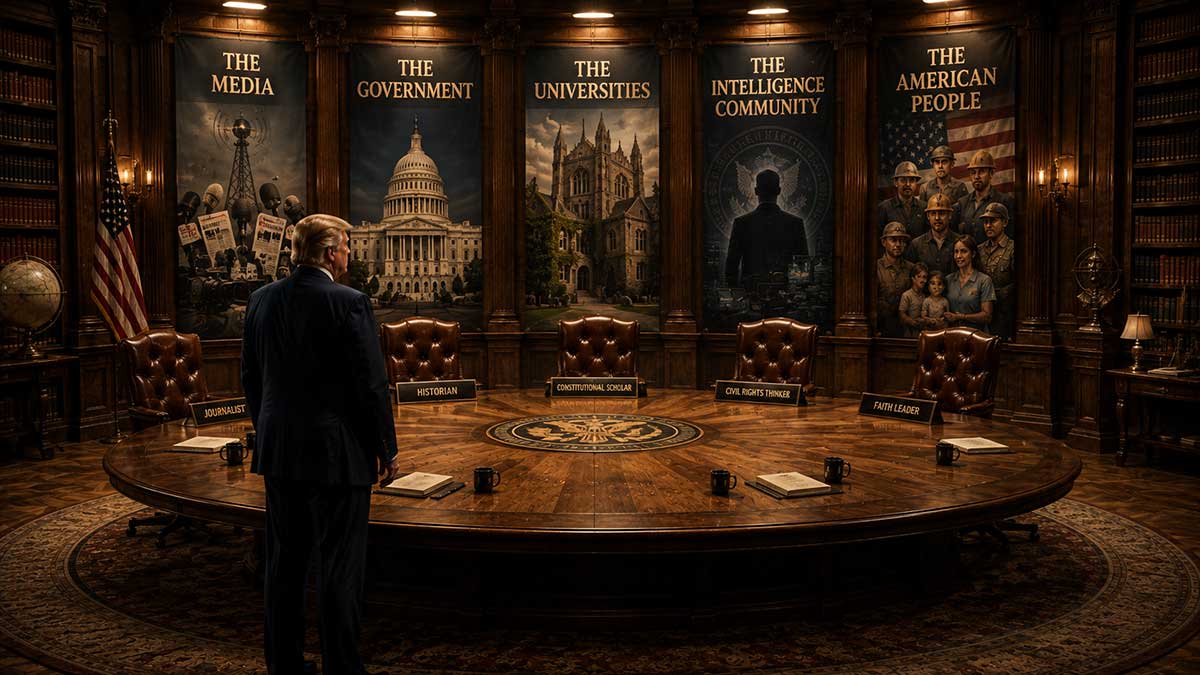
Opening
The screen behind the guests shows two Americas.
On the left: a factory town with boarded storefronts, an empty church parking lot, aging houses, and a grocery receipt growing longer.
On the right: luxury offices, financial towers, university buildings, government agencies, and technology campuses.
Between the two images appears a question:
Who prospered during the years when ordinary families felt the country slipping away from them?
Tucker Carlson: This is the question political leaders avoided for decades.
They spoke about growth, efficiency, global markets, innovation, and progress. Yet millions of Americans looked around and saw something very different.
Their factories closed. Their children moved away. Their towns lost businesses. Drug addiction spread. Housing became less affordable. Their wages failed to keep pace with the cost of living.
At the same time, the people who managed the system became wealthier, more influential, and more certain that anyone questioning it was ignorant.
That was not an accident. It was the arrangement.
David French: Some communities suffered terribly from economic and cultural change. That pain was often ignored or discussed in cold, technical language.
Yet the phrase “old arrangement” can hide many separate developments.
Automation changed manufacturing. Global trade lowered some prices and destroyed some jobs. Technology created enormous wealth and concentrated it. Family decline had economic, cultural, and personal causes. Government policy sometimes helped and sometimes failed.
We should identify each force clearly rather than treating every hardship as the product of one group.
Victor Davis Hanson: Yet those forces consistently benefited the same social class.
The people making decisions were often protected from the consequences. They supported open trade while living far from closed factories. They supported weak border enforcement while residing in secure neighborhoods. They promoted social experiments while sending their own children to selective schools.
Their public values and private choices often moved in opposite directions.
Cornel West: The old arrangement was built around concentrated wealth and managed disappointment.
Working people were told that suffering was unavoidable. Their communities had to adapt. Their jobs were outdated. Their moral traditions were embarrassing. Their anger was dangerous.
Yet no one asked the powerful to adapt in the same way.
Banks were rescued. Corporations received favorable treatment. Universities raised prices. Pharmaceutical companies increased profits. Political consultants moved from one campaign to the next.
The pain was socialized. The reward remained private.
Reinhold Niebuhr: Every governing order develops a moral story about itself.
It presents its victories as virtue and its failures as unfortunate necessity.
The privileged rarely experience themselves as privileged. They see their position as evidence of merit, education, intelligence, or social usefulness.
The forgotten experience the same arrangement very differently.
The moral question is not whether every successful person acted unjustly. It is whether the system demanded sacrifice from those with the least influence and granted protection to those with the most.
Question 1: Which industries, institutions, and social classes gained the most from globalization, deindustrialization, rising government spending, and cultural change?
Victor Davis Hanson: The greatest gains went to those who could move capital, credentials, and influence across borders.
Large corporations benefited from cheaper labor and global supply chains. Financial institutions profited from the movement of money. Universities expanded by offering credentials increasingly required for professional life. Government agencies grew through regulation, spending, and crisis management.
The professional class gained access to opportunities that were less tied to place.
The working class was tied to place. When the factory moved, they could not move their entire community, family history, church, and identity with it.
Tucker Carlson: That distinction between mobile and rooted people explains much of modern politics.
The winners could relocate, invest internationally, work remotely, and send their children anywhere. The losers lived in communities whose value depended upon stable local industries.
When those industries disappeared, elites called it economic transition.
For the people living there, it was the destruction of a way of life.
David French: Globalization created real winners and losers, yet it lifted many people out of poverty outside the United States and made many goods more affordable for American consumers.
The failure was not trade alone. The failure was pretending that displaced workers would easily find equal employment and that damaged communities would naturally recover.
Policy leaders underestimated the social meaning of work.
A job provides more than income. It gives structure, dignity, relationships, identity, and the ability to support a family.
Cornel West: The language of cheaper goods often concealed the deeper bargain.
A family could buy a less expensive television, yet the father lost the stable job that once paid for the house. A town received a large retail store, yet dozens of local businesses disappeared. Consumers gained convenience. Citizens lost independence.
People were reduced to buyers rather than treated as members of communities.
Tucker Carlson: And when they objected, experts told them the economic data proved they were better off.
David French: That was a serious failure. National statistics can improve while particular regions collapse.
Reinhold Niebuhr: The benefits flowed to those who controlled abstraction.
Finance deals in capital. Government deals in policy. universities deal in theory. corporations deal in scale. technology platforms deal in data.
The losses were concrete: a closed factory, an absent father, an empty church, a town without young families.
Abstraction allows people to discuss suffering without feeling responsible for it.
Victor Davis Hanson: Cultural institutions gained too.
As local sources of authority weakened, national institutions became stronger. The local pastor, business owner, family elder, and community newspaper lost influence. National media, universities, corporations, and government experts filled the vacuum.
Economic centralization and cultural centralization advanced together.
Cornel West: Yet we must not romanticize every old institution.
Some factories exploited workers. Some churches ignored injustice. Some local leaders excluded outsiders. The answer is not to pretend the past was perfect.
The answer is to ask why reform so often destroyed community without building anything humane in its place.
Question 2: Why did many powerful institutions continue to prosper during years when working families faced factory closures, higher living costs, weaker communities, and declining trust?
Tucker Carlson: They prospered since they wrote the rules and controlled the explanation.
When banks failed, the system protected them. When workers lost jobs, they were told to retrain. When universities raised tuition, government-backed loans kept the money flowing. When pharmaceutical costs increased, companies blamed research expenses. When media credibility collapsed, journalists blamed misinformation.
Every institution had a reason why its own survival served the public.
Ordinary families received lectures about personal responsibility.
David French: Institutional self-protection was real. Yet some prosperity came from genuine demand.
Technology companies grew because people used their products. Universities grew because families believed degrees were necessary. Pharmaceutical companies developed medicines people needed. Government expanded because voters demanded services and protection.
The issue is not that every gain was illegitimate.
The issue is that institutions accumulated influence without matching accountability.
Victor Davis Hanson: They faced little competition from weakened local institutions.
Large companies could absorb regulatory costs that crushed smaller rivals. Elite universities benefited from reputation and limited access. Media organizations claimed authority even after major failures. Bureaucracies expanded whenever a crisis occurred, then rarely returned to their earlier size.
Centralization protects those already inside the center.
Cornel West: The system taught people to interpret suffering as private failure.
If wages stagnated, improve your skills. If housing became unaffordable, move elsewhere. If your child struggled, seek medication or therapy. If your community declined, accept change.
The larger structure disappeared from the conversation.
People blamed themselves for wounds created partly by decisions made far beyond their control.
Reinhold Niebuhr: Institutions prosper when they convert their interests into moral language.
A company calls profit efficiency. A bureaucracy calls expansion public safety. A university calls rising costs investment in knowledge. A media organization calls influence the defense of truth.
These claims may contain truth. They may contain self-deception too.
The danger grows when an institution gains enough cultural authority to define criticism of itself as ignorance or moral failure.
Tucker Carlson: That is exactly what happened.
Question trade policy, and you were anti-business. Question the border, and you were called hateful. Question pharmaceutical influence, and you were anti-science. Question intelligence agencies, and you were accused of helping foreign enemies.
The ruling class made its interests sacred.
David French: Yet populist movements can do the same.
Question Trump, and some supporters call you disloyal. Question a policy, and you may be accused of helping the establishment. Political movements can turn their own interests into sacred causes.
Tucker Carlson: Fair. Yet one side held far greater institutional authority.
Cornel West: The difference in authority matters. Moral consistency matters too.
A movement that condemns elite protection must not create new forms of protection for its own leaders and donors.
Victor Davis Hanson: Declining trust was a predictable result.
People watched institutions fail without losing authority. They saw experts make serious errors, then return to television as experts again. They saw government investigations produce few consequences for senior officials. They saw executives receive bonuses after damaging decisions.
Trust died when accountability became unequal.
Reinhold Niebuhr: Trust cannot survive where sacrifice moves downward and immunity moves upward.
Question 3: Did Trump truly change the arrangement that favored powerful institutions, or did he merely expose it more clearly than earlier leaders?
Victor Davis Hanson: Trump changed the political language of the country.
Before him, both parties accepted many of the same assumptions about trade, immigration, foreign intervention, and expert authority. They argued over details without challenging the framework.
Trump broke that agreement.
He forced Republican leaders to speak about industrial policy, border enforcement, working-class voters, China, and distrust of federal agencies.
That shift will outlast his presidency.
Tucker Carlson: Exposing the arrangement was itself a major achievement.
Millions of people had sensed that the system was working against them. Trump gave their experience a political voice.
He said the experts were not always competent, the media was not neutral, trade policy was not sacred, and foreign policy did not always serve American families.
Once people saw that, they could not unsee it.
David French: Exposure is meaningful, yet the standard must include results.
Did manufacturing return at scale? Did government become smaller or more accountable? Did health care become more affordable? Did the influence of wealthy donors decline? Did family stability improve?
Some policies changed. Some promises remained incomplete. Some powerful interests adapted and found new ways to influence the administration.
A leader can expose a system without fully replacing it.
Cornel West: That is the heart of the matter.
Trump gave language to real pain. He shattered the polite silence surrounding elite failure.
Yet anger at the old establishment does not automatically create economic justice.
Were workers given stronger bargaining position? Were families protected from crushing costs? Were communities rebuilt? Or did tax policy, deregulation, and political access continue to favor wealthy interests?
The forgotten must receive more than recognition.
Tucker Carlson: They received a president who treated their concerns as legitimate. That had not happened in a long time.
Cornel West: Recognition matters deeply. Yet dignity without material change can become another form of political theater.
Victor Davis Hanson: No president can reverse forty years of decline in one term or through one administration.
The question is whether Trump changed the direction.
He challenged China, renegotiated trade agreements, tightened immigration policy, promoted energy production, and confronted bureaucratic authority.
The permanence of those changes is another question.
David French: Some actions disrupted the old consensus. Others increased presidential control without reducing the size or reach of government.
A populist president can weaken one elite institution and strengthen another. Citizens should examine where authority moved, not merely whether conflict occurred.
Reinhold Niebuhr: Trump performed three distinct roles.
He was a revealer. He exposed resentment, hypocrisy, and institutional decay.
He was a disruptor. He broke agreements that had appeared permanent.
The unresolved question is whether he became a rebuilder.
Destruction is easier to recognize than reconstruction. A speech can expose betrayal in minutes. Rebuilding a town, family, industry, or civic institution requires patience, discipline, and cooperation.
Tucker Carlson: Yet rebuilding cannot begin until the lies protecting the old structure are broken.
Reinhold Niebuhr: True. Yet a movement can become so skilled at exposing enemies that it never develops the habits needed to build.
Cornel West: A rebuilt country must offer more than victory over opponents.
It must give ordinary people meaningful work, affordable homes, stable families, safe communities, and institutions they can trust.
Victor Davis Hanson: Trump may be judged as the leader who began that correction, whether or not he completed it.
David French: His supporters should then demand completion rather than treating disruption itself as the final victory.
Closing
The two images on the screen begin to merge.
The abandoned factory remains visible, yet lights appear inside it. The corporate tower remains too, but its windows no longer dominate the scene.
Families walk through the town. A small business opens. The church parking lot begins to fill.
The final question appears:
Can a nation reverse an arrangement that rewarded distance from the people who paid its greatest cost?
Tucker Carlson: The old arrangement survived by convincing Americans that decline was inevitable and resistance was shameful.
Trump broke that spell.
He told people they were not wrong to mourn what had been taken from them.
David French: He exposed real failures and redirected political attention to communities that had been neglected.
Yet exposure must be followed by honest measurement. Supporters should judge whether policies produce lasting improvements rather than accepting symbolism alone.
Cornel West: A movement proves whom it serves by where the benefits finally land.
Do they reach the worker, the family, the small business, and the forgotten town?
Or do they stop once again among donors, executives, consultants, and political insiders?
Victor Davis Hanson: The old order was sustained by people who benefited from it and by citizens who were told no other future was possible.
Trump made another future politically thinkable.
The task now is to turn that possibility into institutions that can endure.
Reinhold Niebuhr: Every order eventually confuses its own survival with the common good.
The old arrangement was no exception. Its leaders often treated their prosperity as proof that the nation was prospering, even when large parts of the country were weakening.
Trump forced the country to see that division.
Yet the moral test remains unfinished.
It is not enough to defeat the old beneficiaries. A just order must prevent a new class from taking their place.
The final measure is not who lost status when Trump arrived.
It is whether the people who had lost hope regained a future.
Topic 4: Does Luke 6:26 Apply to Political Leaders?
Opening
The screen behind the guests displays the words of Luke 6:26:
“Woe to you when everyone speaks well of you, for that is how their ancestors treated the false prophets.”
The room grows quieter.
This question reaches beyond elections, policies, and political parties. It asks how Christians should interpret rejection, praise, persecution, and public controversy.
Some Trump supporters see the hostility directed at him as evidence that he has confronted forces hostile to faith, family, national sovereignty, and ordinary Americans.
His critics warn that being hated does not make a person righteous. False prophets can attract praise, but destructive leaders can attract opposition too.
The biblical warning is clear: universal approval can be spiritually dangerous.
What remains uncertain is how that warning should be applied to a political leader.
Reinhold Niebuhr: Scripture challenges the comforting assumption that public approval proves moral goodness.
The prophets were often rejected since they disturbed powerful people and exposed collective self-deception. False prophets received praise when they reassured rulers and told society what it wished to hear.
Yet the verse does not teach that every hated person is a prophet.
Rejection can arise from faithfulness, pride, recklessness, cruelty, courage, or some mixture of them all.
Tucker Carlson: Christians have often been trained to believe that respectable institutions possess moral authority.
A newspaper condemns someone, a university condemns him, Hollywood condemns him, government officials condemn him, and religious leaders begin repeating the same language.
Luke 6:26 warns us not to confuse establishment approval with truth.
Trump’s willingness to endure relentless condemnation deserves to be examined in that light.
David French: It deserves examination, but Scripture cannot be reduced to a political defense.
Jesus was speaking to disciples who would suffer for faithfulness to Him. That does not permit Christians to treat every political controversy as persecution for righteousness.
A leader may be opposed for good policies, poor conduct, personal failings, or abuse of authority. Christians must distinguish those causes rather than merging them.
Victor Davis Hanson: Yet political leaders can become targets precisely when they challenge an entrenched order.
The biblical pattern is not limited to clergy. Prophets confronted kings, judges, merchants, priests, and national institutions.
The central issue is whether a person is condemned for exposing falsehood or for creating needless disorder.
Cornel West: The cross stands against comfortable religion and comfortable politics.
It warns the powerful, including political leaders who claim to represent the forgotten.
A man may be hated by elites and still fail to love the poor. He may speak hard truths and still become addicted to praise from his own crowd.
The spiritual test cannot stop with who rejects him. It must ask what kind of person he is becoming and what kind of people his movement is forming.
Question 1: Does rejection by respected institutions suggest that a leader is speaking an uncomfortable truth, or can public rejection come from many moral and political causes?
Tucker Carlson: When nearly every institution that defines respectable opinion condemns the same person, that tells us something.
It may tell us that he violated their moral standards. It may tell us that he threatened their control over which questions could be asked.
For years, Americans were told certain subjects were settled. Trade policy was settled. Immigration policy was settled. Intelligence agencies deserved trust. Major media organizations deserved authority. Experts deserved obedience.
Trump refused that arrangement.
The condemnation that followed cannot be separated from the questions he forced into public view.
David French: Yet the same person can expose real failures and commit real wrongs.
That is where political loyalty becomes dangerous. Supporters begin treating every criticism as proof that he is correct. The more serious the criticism becomes, the more strongly they believe it confirms his righteousness.
That creates a closed system in which no evidence can count against the leader.
Victor Davis Hanson: True, but respected institutions created their own closed system too.
They often treated their shared judgment as proof. A claim passed from intelligence officials to journalists, from journalists to universities, and from universities to political leaders. Each institution cited the others as confirmation.
Trump supporters saw a circle of authority validating itself.
Cornel West: We need to break both circles.
Elite agreement is not truth. Popular anger is not truth. Religious enthusiasm is not truth.
Truth may disturb all three.
Some people rejected Trump through class prejudice. Some rejected him through political fear. Some rejected him after examining his conduct. Some opposed policies they believed harmed vulnerable people.
A serious Christian cannot pretend those motives are identical.
Tucker Carlson: Yet Christians should notice which failures produce outrage and which are quietly accepted.
Wars that killed thousands became policy disagreements. Trade decisions that destroyed communities became economic modernization. Cultural contempt for believers became progress.
Trump’s words received greater moral attention than institutional actions that damaged entire regions.
That imbalance helps explain why many Christians distrust his critics.
David French: It does. Yet institutional hypocrisy does not transform every Trump statement or action into faithfulness.
Christians are called to judge truthfully, not reactively.
Reinhold Niebuhr: Public rejection is a clue, not a conclusion.
When respected institutions reject a leader, citizens should ask three questions.
What truth did the leader speak?
What interest did the truth threaten?
What part of the rejection arose from the leader’s own conduct?
One answer does not cancel the others.
Victor Davis Hanson: A leader may tell the truth badly.
Reinhold Niebuhr: Yes. And the bad method may weaken the truth without making the truth false.
Cornel West: It may wound people who needed that truth presented with moral care.
Tucker Carlson: Yet polite language has often been used to protect brutal realities.
Reinhold Niebuhr: Which means neither politeness nor offense proves righteousness.
The content, purpose, cost, and fruit of the speech must be examined.
Question 2: What spiritual tests can separate a persecuted truth-teller from a leader who creates conflict through pride, anger, or poor judgment?
David French: The first test is truthfulness.
Does the leader tell the truth when the truth harms his own position? Does he correct false claims made by his allies? Does he admit mistakes?
A person who speaks truth only when it damages opponents is practicing politics, not prophecy.
Tucker Carlson: Yet we should not create a standard that no political leader can meet.
Prophetic figures in Scripture were not polished public-relations professionals. They spoke with anger. They used harsh language. They condemned rulers directly.
Modern audiences often confuse soft speech with moral character.
David French: I am not asking for softness. I am asking for honesty and self-restraint.
Biblical prophets spoke under authority greater than themselves. They did not present personal appetite as divine command.
Victor Davis Hanson: The second test may be personal cost.
Does the leader accept hostility, legal danger, financial loss, and reputational damage to pursue a position that could have been avoided?
Trump could have lived a far easier life without entering politics. His supporters see his willingness to remain in the struggle as evidence of commitment.
Cornel West: Personal suffering matters, yet suffering can deepen humility or deepen self-importance.
A leader may endure attacks and begin seeing himself as the center of history. Every criticism becomes persecution. Every opponent becomes evil. Every supporter becomes loyal only if they never question him.
That is spiritually dangerous.
Tucker Carlson: Some attacks were extraordinary. A person placed under constant assault may naturally become suspicious.
Cornel West: Naturally, yes. Spiritually, the question remains what he does with that suspicion.
Does suffering enlarge his compassion for others who suffer? Or does it narrow his concern to his own wounds?
Reinhold Niebuhr: I would propose five spiritual tests.
The first is truth. Does the leader describe reality honestly?
The second is sacrifice. Does he accept cost for the people he claims to serve?
The third is restraint. What authority does he refuse to seize?
The fourth is humility. Can he recognize sin and error within himself and his movement?
The fifth is fruit. Do his followers become more courageous, truthful, charitable, and responsible—or more fearful, cruel, and dependent upon conflict?
Victor Davis Hanson: The fruit test requires care. A leader cannot control every supporter.
Reinhold Niebuhr: He cannot control them, but he can shape what his movement rewards.
Does he praise courage and service? Does he reward personal loyalty above competence? Does he restrain destructive impulses among supporters? Does he treat disagreement as betrayal?
These patterns reveal the moral direction of leadership.
David French: Another test is whether the leader applies standards consistently.
Does he condemn wrongdoing by allies with the same seriousness he condemns wrongdoing by opponents?
Tucker Carlson: That standard must be applied to media organizations and political critics too.
David French: Certainly. Yet the failure of others does not release Christians from their duty.
Cornel West: The deepest test may be love.
Not sentimental approval, but the kind of love that seeks justice without surrendering the humanity of an opponent.
Can a leader fight fiercely without teaching people to enjoy hatred?
Tucker Carlson: Political struggle cannot be reduced to pleasant feelings. Some institutions deserve forceful confrontation.
Cornel West: Love does not forbid confrontation. It governs the purpose of confrontation.
The goal should be to end injustice, not to feed the soul with enemies.
Reinhold Niebuhr: A truth-teller wants falsehood defeated.
A demagogue needs enemies to remain emotionally central.
That difference may be difficult to see during the conflict, yet over time it becomes visible.
Question 3: How can Christians apply Luke 6:26 without turning political loyalty into religious certainty?
Victor Davis Hanson: Christians can begin by recognizing that political conflict may carry moral meaning without becoming identical to spiritual warfare.
Trump challenged policies and institutions that many believers regarded as hostile to faith, family, national identity, and human dignity.
That does not make every political decision sacred. It means the conflict cannot be dismissed as mere personality.
David French: Christians must preserve the distinction between supporting a leader and placing faith in him.
A Christian may vote for Trump, defend his policies, believe he has been treated unjustly, and remain free to question his words and actions.
Once criticism feels like betrayal of God, political loyalty has crossed a dangerous line.
Tucker Carlson: Yet some Christian leaders move in the opposite direction. They treat supporting Trump as evidence of moral corruption, ignoring the reasons believers support him.
Many Christians saw government hostility to their values, contempt from cultural institutions, threats to religious liberty, and policies they believed harmed children and families.
They did not worship Trump. They viewed him as the only leader willing to fight.
Cornel West: Some did. Others wrapped him in language normally reserved for biblical deliverers.
The danger is real on both sides.
One camp may treat Trump as uniquely evil. Another may treat him as uniquely chosen. Both can lose the ability to judge him as a human being who possesses strengths, weaknesses, courage, vanity, insight, and moral responsibility.
Reinhold Niebuhr: Religious certainty becomes dangerous when historical events are interpreted as though God’s full purpose has been revealed.
Christians may discern signs. They may make moral judgments. They may act with courage.
They should remain cautious about claiming complete knowledge of God’s endorsement.
Victor Davis Hanson: Yet caution should not become passivity.
Christians cannot avoid political judgment simply by saying every side is flawed. They must choose among real candidates and real policies.
Reinhold Niebuhr: Agreed. Humility does not mean indecision.
It means acting firmly without pretending that one’s judgment is free from error.
David French: Christians can ask whether support for Trump is grounded in identifiable policies and outcomes.
What is being defended? Border security? Religious liberty? Judicial appointments? Opposition to war? Economic policy? Protection of unborn life?
Clear reasons allow support to remain accountable.
Tucker Carlson: They should ask the same of opposition.
Is Trump opposed for policy failures, or since he offended elite cultural standards? Is criticism grounded in evidence, or repeated through institutional consensus?
Cornel West: Christians should examine what their politics is doing to their spiritual life.
Are they praying more deeply? Serving neighbors? Speaking truth? Caring for the poor? Forgiving people?
Or are they spending their days consuming outrage and waiting for enemies to be humiliated?
Tucker Carlson: Outrage can awaken people to injustice.
Cornel West: Yes, but it is poor spiritual food when consumed every day.
Reinhold Niebuhr: Luke 6:26 should make Christians suspicious of universal praise.
The verses that follow should make them suspicious of hatred.
Jesus warns about false approval, then commands love for enemies. Christians cannot take the first warning and discard the second command.
David French: That may be the balance.
Do not assume condemnation proves guilt.
Do not assume condemnation proves holiness.
Victor Davis Hanson: Examine what produced the condemnation.
Tucker Carlson: Examine who benefited from it.
Cornel West: Examine what the struggle produces in the human heart.
Closing
The words of Luke 6:26 fade from the screen.
A second passage appears beneath them:
“Love your enemies, do good to those who hate you, bless those who curse you, pray for those who mistreat you.”
The guests sit in silence for a moment.
The two teachings now stand beside one another.
Do not trust universal approval.
Do not surrender to hatred.
Tucker Carlson: Christians should not be manipulated by prestigious institutions claiming moral authority they have not earned.
A leader’s enemies may reveal that he has confronted lies protected by status and influence.
Trump’s willingness to stand against those institutions is one reason millions of believers continue to defend him.
David French: Yet Christian support must remain morally awake.
No political leader should receive immunity from truthful judgment. Loyalty becomes idolatrous when it demands the surrender of conscience.
Victor Davis Hanson: Luke 6:26 reminds us that respected opinion has often praised falsehood and condemned those who challenged it.
Trump’s rejection by elite institutions deserves serious examination rather than automatic acceptance of their verdict.
Cornel West: The teaching of Jesus goes further.
The believer must confront corruption without becoming spiritually dependent upon hatred. Victory over an enemy means little when the enemy begins governing the heart.
Reinhold Niebuhr: A man may be hated for telling the truth.
He may be hated for his conduct.
He may be hated for both at once.
The Christian task is not to count enemies and declare holiness. It is to examine truth, sacrifice, restraint, humility, and fruit.
Luke 6:26 warns that praise can deceive us.
The command to love enemies warns that opposition can deform us.
Political loyalty must remain beneath faith, conscience, and truth.
A leader’s rejection may tell us that he disturbed the comfortable.
His response to rejection tells us whether the struggle is forming him into a servant, a ruler, or a captive of the conflict itself.
Topic 5: Who Is Trump Actually Fighting For?
Opening
The screen behind the guests shows a series of faces.
A factory worker standing outside a closed plant.
A mother studying a grocery receipt.
A small-business owner unlocking his store before sunrise.
A border agent looking across an open stretch of land.
A pastor standing in a half-empty church.
A billionaire entering a private meeting in Washington.
A lobbyist walking through the Capitol.
A political donor shaking hands with a candidate.
At the center appears one final question:
Who is Donald Trump actually fighting for?
The answer cannot rest only on who attacks him.
A leader may attract powerful enemies and still serve powerful friends. He may speak for forgotten people while governing through wealthy advisers. He may confront one group of elites while creating another circle of influence around himself.
His enemies reveal what he threatens.
His policies, appointments, compromises, and results reveal whom he serves.
Tucker Carlson: Trump’s appeal begins with a fact that his critics often refuse to accept.
Millions of Americans believed no one in national politics cared whether their communities survived.
Trump spoke to them directly. He did not tell them their pain was imaginary. He did not tell them to accept national decline as the price of progress. He said the government should place its own citizens first.
That is why they believed he was fighting for them.
David French: Speaking for people matters. Policies and outcomes matter more.
Every political leader claims to represent ordinary citizens. The public must examine whether those citizens gained security, opportunity, freedom, and accountable government.
Trump should be credited where his policies helped. He should be questioned where promises remained unfulfilled or where influence continued flowing to wealthy insiders.
Victor Davis Hanson: Trump changed the Republican coalition.
The party once identified strongly with corporations, free trade, foreign intervention, and professional-class voters. Trump moved its center toward working-class communities, border enforcement, industrial strength, energy production, and skepticism of permanent war.
That political realignment tells us something about whom he sought to represent.
Cornel West: It tells us whom he spoke to. We still need to ask who received the greatest material gains.
Did working families gain lasting economic security? Did the poor receive more dignity? Did small businesses become less vulnerable? Did corporate influence weaken?
A leader can love the applause of working people and still allow wealthy interests to shape policy.
Reinhold Niebuhr: Political representation is never morally simple.
A leader may serve several groups at once. He may advance the interests of workers through one policy and wealthy donors through another. He may confront foreign rivals in the national interest and use the conflict to strengthen personal authority.
The task is not to assign him one pure motive.
The task is to examine which interests prevail when promises collide.
Question 1: Which of Trump’s policies have produced measurable benefits for workers, families, small businesses, churches, and struggling communities?
Victor Davis Hanson: We should begin with the policies that separated Trump from the prior consensus.
He challenged China’s trade practices. He promoted domestic energy production. He pursued stronger border enforcement. He sought to reduce regulations that burdened businesses. He appointed judges valued by religious conservatives. He questioned foreign commitments that placed costs upon American families.
These policies addressed concerns that earlier leaders had often minimized.
Tucker Carlson: The border may be the clearest example.
Working people bear the greatest cost when labor markets are flooded, housing demand rises, schools become strained, and public services absorb pressures created by uncontrolled immigration.
Wealthy people can live in protected neighborhoods and hire inexpensive labor. Ordinary families face the consequences directly.
A government that controls its border is defending the value of citizenship.
David French: Border control is a legitimate public responsibility. Yet policy should be judged by effectiveness, legality, and humane administration.
The same applies to trade and energy.
Tariffs may protect some industries and raise costs for businesses or consumers. Deregulation may help small companies and remove protections that serve the public. Energy expansion may reduce prices and create jobs while raising other concerns.
Results must be examined policy by policy.
Tucker Carlson: That is fair, yet the old approach rarely received the same scrutiny.
When a factory moved overseas, experts called it efficiency. When a tariff protected a domestic industry, the same experts suddenly became deeply concerned about consumers.
Their concern often appeared only when the policy threatened the arrangement they supported.
Cornel West: We should look at wages, housing, medical costs, debt, family stability, and economic mobility.
A worker may have a job yet remain unable to afford a home. A small-business owner may receive regulatory relief yet struggle with health insurance and rent. A family may support border enforcement yet remain crushed by grocery and child-care costs.
Political symbolism cannot substitute for material well-being.
Victor Davis Hanson: Yet symbolism has political meaning when it restores legitimacy to concerns long dismissed.
When a president visits a factory town, defends religious liberty, speaks about the border, and questions trade deals, people recognize that their experiences have entered national debate.
That shift can prepare the ground for deeper reform.
David French: It can. Supporters should then demand that deeper reform.
A movement becomes weaker when every policy is celebrated through loyalty rather than tested through evidence.
Reinhold Niebuhr: Measurable benefits should be examined at three levels.
The first is immediate relief: jobs, wages, prices, safety, and access to opportunity.
The second is institutional repair: whether communities regain schools, businesses, churches, and civic organizations capable of enduring.
The third is moral agency: whether citizens become less dependent upon distant institutions and more able to shape their own lives.
A policy that improves statistics without strengthening human communities may offer only partial success.
Cornel West: That third level matters deeply.
People do not seek income alone. They seek dignity, belonging, and the ability to care for those they love.
Tucker Carlson: Which is why bringing work back matters more than sending another government program.
David French: Work matters. So do stable laws, education, health, family support, and local institutions.
No single policy can carry the entire burden.
Question 2: When Trump confronts powerful institutions, does influence return to ordinary citizens, or move to a different group of wealthy and politically connected people?
Cornel West: This is the question every populist movement must face.
The movement rises by condemning elites. It promises to return authority to the people. Then donors, advisers, corporations, media allies, and political families gather around the leader.
The old establishment may weaken, yet a new establishment begins forming.
Who receives access when the doors close?
Tucker Carlson: Every administration requires advisers and supporters. The existence of wealthy allies does not prove betrayal.
The question is whether policy follows donor interests or public interests.
Trump has supported positions opposed by major corporations, foreign governments, media organizations, and bureaucratic agencies. That is not the behavior of a man controlled entirely by elite approval.
David French: Yet influence does not disappear simply when one set of elites loses access.
We should examine appointments, contracts, tax policy, regulatory decisions, pardons, lobbying relationships, and personal connections.
Does loyalty to Trump become a pathway to government favor? Are insiders held accountable? Are conflicts of interest treated seriously?
A movement cannot condemn corruption in principle and excuse it when practiced by allies.
Victor Davis Hanson: There is a distinction between elites rooted in national interest and elites detached from it.
A wealthy manufacturer who builds factories in the United States is not identical to a financial executive profiting from moving production abroad.
A technology leader who supports national security is not identical to one who uses a platform to restrict public debate.
The issue is not wealth alone. It is how influence is used and where loyalty lies.
Cornel West: Wealth is not a sin. Concentrated influence remains a danger.
A billionaire may support domestic manufacturing and still receive far greater access than a worker whose life depends upon the policy.
The public needs institutions that make the worker’s voice matter after Election Day.
Tucker Carlson: Trump’s direct connection to voters weakened the gatekeepers.
He could speak without relying on newspapers, party leaders, university experts, or traditional political consultants. That gave ordinary citizens greater influence over the national conversation.
David French: Direct communication can bypass unaccountable gatekeepers. It can create a new form of personal dependence too.
When every message comes from the leader, institutions weaken and loyalty becomes personal rather than constitutional.
Citizens need representation that survives any one person.
Reinhold Niebuhr: Populism contains a permanent tension.
It seeks to return authority to the people, yet it often gathers authority around a single leader who claims to embody them.
The leader may genuinely hear forgotten citizens. He may begin to treat criticism of himself as criticism of the people.
That is the point where representation can become possession.
Victor Davis Hanson: Yet bureaucratic systems often claimed to represent the public while remaining insulated from elections.
Trump’s personal style partly reflected an attempt to reassert democratic control over institutions that no longer feared voters.
Reinhold Niebuhr: That correction may be necessary. It still requires limits.
The public should ask whether authority is becoming more accountable or merely more personal.
Cornel West: The people should gain more than a champion.
They should gain institutions, rights, bargaining strength, local ownership, and a lasting voice.
Tucker Carlson: A champion may be required before those institutions can be rebuilt.
Cornel West: Yes. The champion must know when to return authority to the people who raised him.
Question 3: Should Trump be judged more by the enemies he attracts, the promises he makes, or the results his leadership produces?
David French: Results must carry the greatest weight.
Enemies can reveal what a leader challenges. Promises reveal what he wants voters to believe. Results reveal what happened under his authority.
We should examine economic outcomes, border security, public order, constitutional practice, foreign policy, government accountability, and the condition of families and communities.
No leader should receive a passing grade based solely on opposition.
Tucker Carlson: Results matter, yet they must be judged within the resistance he faced.
A president may seek change and encounter courts, agencies, lawmakers, media campaigns, corporate pressure, and internal officials working against his agenda.
The public should ask what he achieved under those conditions and who prevented the rest.
David French: Resistance can explain some failures. It cannot excuse all of them.
Leadership includes choosing competent people, building coalitions, respecting lawful limits, communicating clearly, and turning promises into policy.
A leader cannot claim strength when confronting enemies and helplessness when explaining unmet goals.
Victor Davis Hanson: Historical judgment should examine direction as much as completion.
Did Trump move the country away from policies that weakened it? Did he expose problems that future leaders could no longer ignore? Did he create a new coalition capable of sustaining reform?
Some leaders complete transformations. Others begin them.
Cornel West: The results must be measured from the bottom up.
Do not begin with the stock market, corporate profits, or applause at political gatherings.
Begin with the family whose rent increased. The worker whose health insurance remains unaffordable. The town that lost its hospital. The young couple afraid to have children. The veteran who feels abandoned.
Ask whether their lives became more secure.
Tucker Carlson: Yet many such citizens believe Trump fought for them more sincerely than any leader in their lifetime.
That judgment deserves respect.
Cornel West: It does. Respect does not require suspending examination.
People can recognize genuine loyalty and still demand more.
Reinhold Niebuhr: Enemies, promises, and results each reveal something different.
Enemies reveal the interests disturbed.
Promises reveal the moral story presented to the public.
Results reveal the consequences of authority.
A wise judgment considers all three, yet fruit remains the final measure.
Victor Davis Hanson: Fruit may take years to appear.
Trade policy, judicial appointments, cultural change, and political realignment can shape a country long after a term ends.
David French: Then judgment should remain open where the evidence is incomplete.
Tucker Carlson: It should remain open toward his achievements too, rather than accepting hostile institutions as the final historians of his presidency.
Cornel West: And his supporters should refuse to let gratitude become silence.
A leader who claims to fight for forgotten people should welcome their demands.
Reinhold Niebuhr: The strongest loyalty is not flattery.
It is the courage to remind a leader of the people whose hope placed him in authority.
Closing
The faces on the screen appear again.
The worker.
The mother.
The business owner.
The border agent.
The pastor.
The billionaire.
The lobbyist.
The donor.
The final image is a voting booth.
Above it appears one sentence:
A leader proves whom he serves when powerful interests and ordinary people ask for different things.
Tucker Carlson: Trump’s supporters believe he fought for people who had been ignored, mocked, and abandoned.
He challenged institutions that expected obedience and gave millions of Americans permission to reject managed decline.
That is why their loyalty has survived attacks that would have destroyed most political careers.
David French: That loyalty should remain grounded in accountable citizenship.
Judge policies honestly. Credit achievements. Confront failures. Reject unfair attacks without treating every fair criticism as betrayal.
A free people must never surrender judgment to either the leader or his enemies.
Victor Davis Hanson: Trump transformed the political question from “What do established institutions permit?” to “What does the nation owe its own citizens?”
That shift may prove to be one of his most lasting contributions.
Cornel West: Yet a nation cannot live on defiance alone.
The forgotten need wages, homes, health, family stability, safe streets, meaningful work, and a voice that remains after the rallies end.
A movement proves its love through what it builds.
Reinhold Niebuhr: A man’s enemies may show that he threatened an unjust arrangement.
His promises may reveal that he recognized forgotten suffering.
His results reveal whether recognition became service.
Donald Trump should not be judged solely by those who wanted him gone.
He should be judged by what he risked, what he changed, what he protected, what he failed to complete, and who became stronger under his leadership.
The final question is not whether powerful institutions feared him.
It is whether ordinary citizens had less reason to fear the future after he took their side.
Final Thoughts
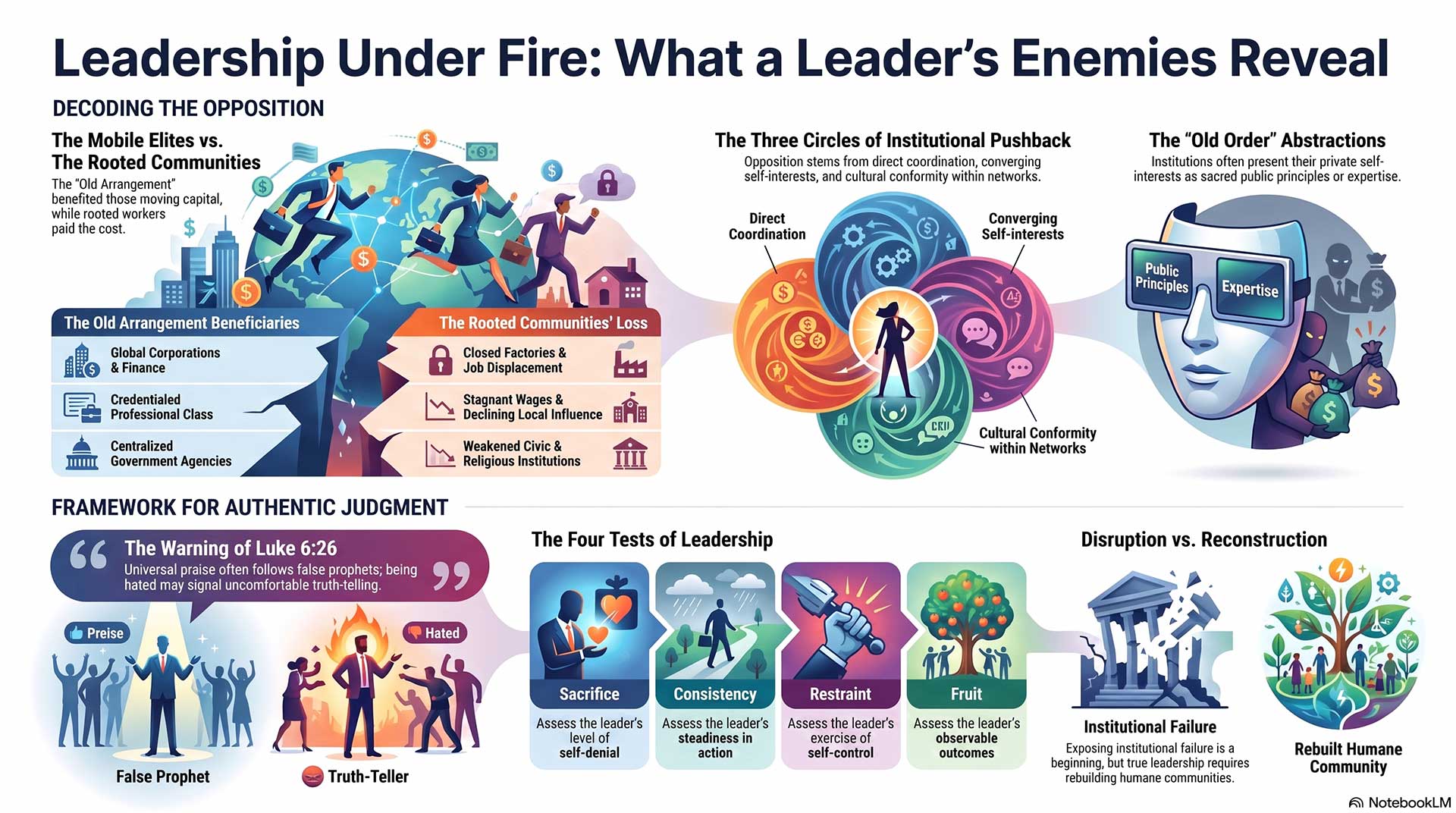
History rarely judges political leaders in the same way their own generation does.
Supporters often see courage where critics see recklessness.
Opponents often see danger where supporters see reform.
Donald Trump may ultimately be remembered for many things.
He challenged long-standing assumptions about trade, immigration, media authority, foreign policy, and the relationship between government and ordinary citizens.
He forced institutions to defend themselves before a public that increasingly questioned their credibility.
He gave millions of Americans the feeling that someone in national leadership finally recognized their frustrations.
At the same time, the conversation reminds us that no political leader should be measured by popularity alone—or by opposition alone.
A person's enemies reveal what interests have been disturbed.
His promises reveal what future he offers.
His actions reveal how he exercises authority.
His results reveal whether the lives of ordinary people actually improved.
For Christians, Luke 6:26 offers wisdom without providing a political shortcut.
Public approval is not proof of righteousness.
Public rejection is not proof of righteousness either.
Truth still requires careful judgment.
Perhaps the most lasting lesson is this:
Before accepting the opinions of either supporters or critics, examine the evidence.
Ask who benefited from the old system.
Ask who benefited from the proposed changes.
Ask what kind of nation is being built.
Then judge every leader—not by slogans, personalities, or headlines—but by truth, character, courage, and the lasting fruit of his leadership.
Short Bios:
Tucker Carlson
Tucker Carlson is an American journalist, political commentator, and media host known for his populist perspective and criticism of political, media, and corporate elites. Throughout his career, he has argued that America's governing institutions have become increasingly disconnected from the concerns of working-class citizens. In this discussion, he examines why so many powerful organizations opposed Donald Trump and whether that opposition reveals deeper institutional interests.
Victor Davis Hanson
Victor Davis Hanson is an American classicist, military historian, and political commentator. A senior fellow at the Hoover Institution, he has written extensively about Western civilization, leadership, military history, and American politics. Hanson frequently analyzes political movements through historical patterns, asking how ruling classes respond when long-established assumptions are challenged.
David French
David French is an American attorney, constitutional scholar, journalist, and political commentator. A longtime conservative voice, he has written widely about constitutional government, religious liberty, civic responsibility, and the rule of law. In this conversation, he argues that political leaders should be judged by evidence, constitutional principles, and consistent moral standards rather than by either popularity or opposition.
Cornel West
Cornel West is an American philosopher, theologian, author, and public intellectual whose work explores democracy, race, justice, spirituality, and the moral responsibilities of public life. He frequently challenges concentrations of political, cultural, and economic power regardless of ideology. Here, he asks whether political movements truly improve the lives of ordinary people or merely replace one elite class with another.
Reinhold Niebuhr
Reinhold Niebuhr (1892–1971) was one of America's most influential Protestant theologians and ethicists. His writings on human nature, power, justice, humility, and political responsibility continue to shape Christian thought around the world. In this imagined conversation, Niebuhr serves as the moral guide, reminding participants that political conviction should always remain subject to truth, humility, repentance, and the teachings of Christ.
Leave a Reply