

What if the Buendía family is not trapped by fate, but by patterns no one learns to recognize?
Few novels have changed the way readers understand family, history, memory, and reality as profoundly as Gabriel García Márquez’s One Hundred Years of Solitude.
The novel begins in Macondo, a remote village surrounded by mystery, invention, and possibility. Over the course of a century, the Buendía family builds a world, loses it, rebuilds it, and repeats many of the same desires, mistakes, ambitions, and silences.
Names return.
Wars return.
Love returns in altered forms.
Old wounds pass quietly from one generation to another.
The dead remain near the living, miracles enter ordinary life without explanation, and history repeatedly disguises itself as something new.
This is one reason One Hundred Years of Solitude can feel difficult to summarize. It is not simply the story of a family. It is also a meditation on Colombia, Latin America, political violence, modernization, foreign power, memory, storytelling, and the human tendency to repeat what has never been understood.
In this imaginary conversation, Gabriel García Márquez is joined by some of the most important scholars and interpreters of his life and work.
Rather than examining the novel through a rigid academic discussion, they meet inside the world of Macondo itself.
They sit beneath the chestnut tree, listen to the rain, watch trains arrive, observe laundry rise into the sky, and speak as the town begins to disappear around them.
Their conversation moves through five central questions.
Why do families keep repeating the same mistakes?
What does solitude really mean?
Why can magical realism sometimes feel more truthful than ordinary realism?
What does Macondo represent?
And why has One Hundred Years of Solitude remained one of the most influential novels in modern literature?
The answers do not arrive through formal lectures.
They emerge through disagreement, humor, memory, silence, and the occasional yellow butterfly.
Gabriel García Márquez defends the emotional truth of storytelling while the scholars challenge, expand, and sometimes complicate his explanations. Together, they reveal a novel that is not trapped in the past.
The Buendías’ struggle to understand their inheritance resembles the struggle of many modern families.
Macondo’s encounter with war, industry, political denial, and foreign capital resembles the experience of communities across the world.
The insomnia plague resembles societies that preserve endless information while losing the meaning of what happened.
The novel’s solitude resembles the strange loneliness of people who can communicate constantly yet still remain unknown to one another.
This conversation is therefore not only about how to interpret a famous book.
It is about what the book may reveal about us.
Perhaps every family has a name that repeats.
Every nation has a history it prefers not to remember.
Every person has a private room where love, fear, pride, and memory have become difficult to separate.
And perhaps every generation eventually faces the same choice: repeat the story it inherited, or finally learn how to read it.
(Note: This is an imaginary conversation, a creative exploration of an idea, and not a real speech or event.)
Topic 1 — Why Do Families Keep Repeating the Same Mistakes?
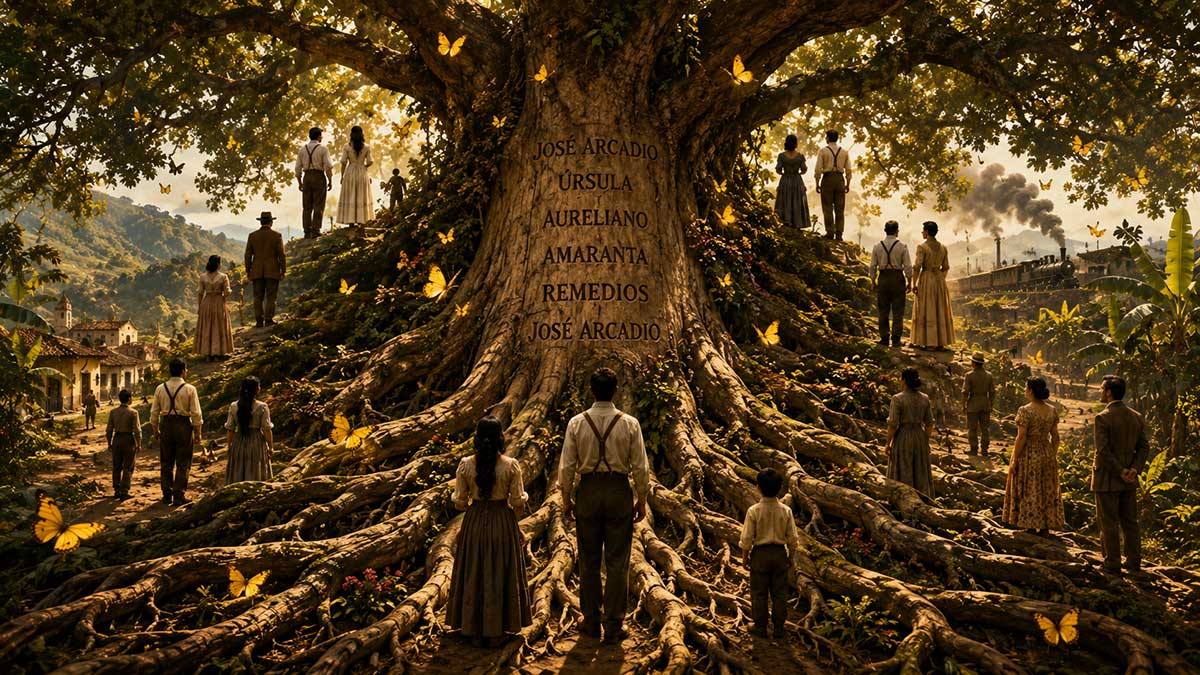
The afternoon has settled heavily over Macondo.
Heat shimmers above the road beyond the chestnut tree, where six chairs surround a broad wooden table worn pale by rain and years. A folded map of the town lies beneath a ceramic bowl of oranges. Beside it rests a family tree drawn across several sheets of paper and joined together with strips of yellowing tape.
The document is so large that one end hangs over the table.
Gerald Martin lifts it from the ground.
Gerald Martin: This family tree may be the most intimidating object in modern literature.
Gabriel García Márquez does not look up from the orange he is peeling.
Gabriel García Márquez: More intimidating than the novel?
Gerald Martin: For some readers, yes.
Gene H. Bell-Villada: Especially once they realize the same five names have been rearranged for a hundred years.
Gabriel García Márquez: That is an exaggeration.
Regina Janes leans across the table.
Regina Janes: How many Aurelianos are there?
Gabriel pauses.
Gabriel García Márquez: Enough.
Jean Franco laughs.
Jean Franco: That sounds like the answer of a man who knows he is guilty.
Gabriel García Márquez: I am guilty of many things. Repeating names is among the least serious.
A yellow butterfly drifts beneath the branches and settles near the name José Arcadio Buendía.
Gerald flattens one corner of the family tree. The opposite corner immediately curls upward.
Gene places his coffee cup on it.
Gene H. Bell-Villada: There. Literary criticism has finally become useful.
Gabriel points at the cup.
Gabriel García Márquez: Be careful. If you spill coffee on that family tree, three generations will disappear.
Regina Janes: They may return later under the same names.
The table breaks into laughter.
Beyond the tree, someone strikes a hammer against metal. A dog barks once and then seems to reconsider.
Jean studies the family tree.
Jean Franco: Readers often treat these repeating names as a puzzle they are supposed to solve.
Gerald Martin: Many of them keep notes.
Gabriel García Márquez: That is already a mistake.
Gerald Martin: Why?
Gabriel García Márquez: Because the confusion is part of the experience.
Regina Janes: So you did intend to confuse them.
Gabriel García Márquez: No. I intended to tell the truth.
Regina smiles.
Regina Janes: Those are not mutually exclusive.
Gabriel finishes peeling the orange and separates it carefully into sections.
Gabriel García Márquez: In the families I knew, names repeated naturally. A grandfather gave his name to a son. The son gave it to another child. Sometimes the name was an honor. Sometimes it was a burden. Nobody discussed which.
He offers the plate around the table.
Only Gerald takes a piece.
Gabriel García Márquez: But names were not the only things that returned.
The humor at the table quiets slightly.
Gabriel García Márquez: A certain kind of pride returned. A certain kind of silence. One man would spend his life trying to escape his father, only to become him in a different hat.
Gerald Martin: That is very close to what happened in your own family history.
Gabriel glances at him.
Gabriel García Márquez: You biographers always arrive carrying evidence.
Gerald Martin: It is an occupational weakness.
Gabriel García Márquez: No. It is an occupational threat.
Gerald laughs, but he does not retreat.
Gerald Martin: You grew up surrounded by family stories. Your grandfather’s wars, your grandmother’s supernatural tales, the memory of Aracataca, the banana company, the old house. You inherited a world before you invented one.
Gabriel nods slowly.
Gabriel García Márquez: Yes. But inheritance is not obedience.
Jean Franco: Sometimes it is.
Gabriel looks toward her.
Jean Franco: Families do not merely inherit stories. They inherit arrangements of power. They inherit who is allowed to speak, who must endure, who is forgiven, and who is remembered only after dying.
Gene H. Bell-Villada: And yet the Buendías repeatedly behave as though every crisis is appearing for the first time.
Regina Janes: That may be the most human thing about them.
She traces a line on the family tree with one finger.
Regina Janes: Each generation receives the past, but it does not experience the past as past. It experiences only itself. That is why repetition can feel like originality from the inside.
Gerald Martin: Nobody says, “I am about to make my grandfather’s mistake.”
Jean Franco: They say, “This time it is different.”
Gabriel raises one orange section in agreement.
Gabriel García Márquez: Humanity’s favorite sentence.
A cart rattles down the road. The sound approaches, passes behind the tree, and fades.
Gene leans back in his chair.
Gene H. Bell-Villada: I think the novel makes repetition larger than the family. The Buendías repeat themselves, but so does Macondo. Political idealism becomes violence. Prosperity becomes exploitation. Progress becomes amnesia.
Gerald Martin: Which raises the question of whether this is truly a family tragedy at all.
Jean Franco: Of course it is not only a family tragedy.
Regina Janes: Nothing in Macondo is ever only one thing.
Gabriel García Márquez: Except perhaps the heat.
Everyone looks toward the white road trembling beyond the shade.
Jean Franco: Even the heat probably represents imperialism.
Gabriel García Márquez: That is why I am grateful I wrote novels instead of criticism.
Jean smiles.
Jean Franco: You wrote the evidence. We merely found the crimes.
Gabriel laughs so sharply that a bird startles from the branches above them.
For a few moments, the conversation loosens. Gerald reaches for another orange section. Regina attempts to follow one branch of the family tree, loses it, and begins again. Gene lifts his cup to free the corner and the paper curls back at once.
Then Gabriel presses it flat with his palm.
Gabriel García Márquez: There is something cruel in the idea that families repeat themselves because they are foolish.
The others turn toward him.
Gabriel García Márquez: Often they repeat themselves because they are trying to survive with the only tools they were given.
Jean’s expression softens, though her voice remains firm.
Jean Franco: Survival can still injure the next generation.
Gabriel García Márquez: Of course.
Jean Franco: A woman survives by becoming emotionally hard. Her daughter learns that tenderness is dangerous. A man survives humiliation by controlling his household. His son grows up believing control is strength.
Regina Janes: And because the original wound is no longer visible, the pattern begins to look like personality.
Gerald Martin: Or tradition.
Gene H. Bell-Villada: Or destiny.
Gabriel removes his hand from the paper.
The corner stays flat this time.
Gabriel García Márquez: I never trusted destiny very much.
Regina Janes: Your novel appears to.
Gabriel García Márquez: My novel distrusts people who confuse repetition with destiny.
Gerald Martin: Yet the ending is written before the family reaches it.
Gabriel García Márquez: Being written is not the same as being unavoidable.
Regina watches him carefully.
Regina Janes: That is a dangerous distinction.
Gabriel García Márquez: The best distinctions are.
A long silence follows.
The butterfly near José Arcadio Buendía moves its wings but remains on the page.
Gene breaks the silence.
Gene H. Bell-Villada: Let us take memory, then. The insomnia plague is one of the clearest images in the novel. People begin forgetting the names of ordinary objects. They label everything because language itself is slipping away.
Gerald Martin: “This is the cow.”
Jean Franco: But naming the cow does not restore the world.
Regina Janes: It only preserves the outline of it.
Gabriel García Márquez: Exactly.
He points toward the ceramic coffee pot.
Gabriel García Márquez: Suppose we write, “This is coffee.” That does not help the person who has forgotten what coffee does, why it matters, or whom they once drank it with.
Gerald lifts his cup.
Gerald Martin: It is still better than forgetting where the coffee is.
Jean Franco: You have reduced collective memory to breakfast.
Gerald Martin: Civilization has been reduced to less.
Gabriel smiles, but Jean remains focused.
Jean Franco: The danger is that societies often remember facts while forgetting responsibility. A massacre can remain in the record and still be erased from public meaning.
The air at the table changes.
Macondo’s distant noises suddenly seem farther away.
Jean Franco: The people who suffered remember one history. Those who benefited preserve another. Then a generation is born into the silence between them.
Gene H. Bell-Villada: That silence is central to the novel. The banana massacre is not merely forgotten. It is denied.
Gerald Martin: Which reflects a broader Colombian history of political violence and selective memory.
Gabriel looks down at the family tree.
Gabriel García Márquez: What frightened me was not that people could forget.
He pauses.
Gabriel García Márquez: It was that they could be persuaded that what they remembered had never happened.
No one interrupts him.
A gust of wind moves through the branches. Several leaves spiral down onto the table.
Regina lifts one from the paper.
Regina Janes: Then perhaps the Buendías are not trapped because they lack memory. Perhaps they are trapped because memory never becomes understanding.
Gerald Martin: Explain that.
Regina Janes: They remember fragments. Names, stories, grievances, desires. But they rarely interpret them together. They do not ask what the pattern means.
She places the leaf beside the name Aureliano.
Regina Janes: Memory without interpretation can become repetition with better documentation.
Gene nods.
Gene H. Bell-Villada: That may be true of nations as much as families.
Jean Franco: Especially nations.
Gabriel García Márquez: And critics.
Regina laughs.
Regina Janes: We were becoming too serious.
Gabriel García Márquez: Macondo punishes seriousness if it lasts too long.
Gerald points at the family tree.
Gerald Martin: Then let us make this practical. Suppose the Buendías lived today.
Gabriel’s face brightens.
Gabriel García Márquez: They would be unbearable online.
Gene H. Bell-Villada: José Arcadio Buendía would watch videos about perpetual-motion machines until dawn.
Regina Janes: Aureliano would create an anonymous account and post one sentence every six months.
Jean Franco: The family group chat would be controlled by Úrsula.
Gerald Martin: Naturally.
Gabriel García Márquez: Everyone would mute it and then complain that nobody told them anything.
Laughter rolls across the table.
Gene H. Bell-Villada: They would have genealogy websites, digital archives, cloud storage, family photographs, voice recordings—
Jean Franco: And still hide the most important truths.
Regina Janes: Because technology preserves information, not courage.
Gerald Martin: They might finally keep the names straight.
Gabriel looks genuinely doubtful.
Gabriel García Márquez: Have you ever seen a family group chat?
Gerald concedes the point with a small bow.
The laughter fades naturally rather than suddenly.
For a while they listen to the insects in the grass.
Then Jean turns the family tree so that the youngest names face her.
Jean Franco: We have spoken a great deal about fathers and sons. But the family would have collapsed much sooner without the women.
Gabriel García Márquez: Much sooner.
Jean Franco: The men repeatedly disappear into wars, inventions, obsessions, ambitions, and solitude. The women preserve the household, the memory, the food, the continuity.
Gene H. Bell-Villada: Especially Úrsula.
Jean Franco: Yes, but we should be careful not to romanticize her endurance. Praising women for holding everything together can become another way of expecting them to do so forever.
Gabriel studies her.
Gabriel García Márquez: You believe Úrsula should have walked away?
Jean Franco: I believe readers should ask why she was required to remain strong while the men were permitted to become magnificent disasters.
Gerald gives a quiet laugh.
Gerald Martin: “Magnificent disasters” may be the best description of the Buendía men.
Regina Janes: And perhaps of many literary men.
Gabriel García Márquez: Careful. There are several of us at this table.
Jean Franco: I had noticed.
Again, laughter.
Yet the question remains in the space between them.
Gabriel runs one finger along the table’s worn grain.
Gabriel García Márquez: Úrsula understood the family better than anyone.
Jean Franco: Understanding did not free her from it.
Gabriel García Márquez: No.
He says it without defense.
Gabriel García Márquez: Love rarely frees people as neatly as literature promises.
The butterfly lifts from the family tree and circles once above the table.
Regina follows it with her eyes.
Regina Janes: Perhaps that is why repetition is so difficult to break. The pattern is often carried by love.
Gerald Martin: By loyalty.
Jean Franco: By fear of betrayal.
Gene H. Bell-Villada: By the belief that preserving the family requires preserving everything about it.
Gabriel García Márquez: Even what is destroying it.
A church bell sounds somewhere in town.
One strike.
Then another.
The light has begun to change. What had been white and oppressive is now amber at the edge of the leaves.
Gerald folds his arms.
Gerald Martin: So what would allow a family to escape?
Gabriel García Márquez: Escape is a strong word.
Regina Janes: Break the pattern, then.
Gabriel looks at each of them before answering.
Gabriel García Márquez: Someone must become curious about what everyone else has accepted.
Jean Franco: Curiosity alone is not enough.
Gabriel García Márquez: No. But it is where disobedience begins.
Gene H. Bell-Villada: They must remember.
Regina Janes: And interpret.
Gerald Martin: And speak.
Jean Franco: And be willing to disappoint the dead.
The sentence lands heavily.
Even Gabriel does not answer immediately.
A second butterfly joins the first. Then a third.
They move together through the dimming light.
Gerald Martin: Disappoint the dead?
Jean keeps her eyes on the family tree.
Jean Franco: Every family carries invisible instructions from people who are no longer alive. Continue this name. Preserve this silence. Forgive this behavior. Never mention that event. Become the person we needed you to be.
She looks up.
Jean Franco: Sometimes ending a cycle requires refusing an obligation no living person remembers choosing.
Gabriel leans back.
Gabriel García Márquez: That belongs in a novel.
Jean Franco: It is already in yours.
He smiles, conceding the point.
Regina carefully begins folding the family tree.
This time, no one stops her.
Regina Janes: Perhaps readers are not supposed to master all these names.
Gabriel García Márquez: I have been saying that for years.
Regina Janes: Perhaps they are supposed to become tired of the repetition.
Gene H. Bell-Villada: Tired enough to recognize it elsewhere.
Gerald Martin: In history.
Jean Franco: In institutions.
Gabriel García Márquez: In themselves.
The last fold is made.
The enormous family tree has become a small, uneven square at the center of the table.
It seems impossible that so many lives could fit inside it.
Gabriel places one hand on top of it.
Gabriel García Márquez: Families do not repeat themselves because they lack love.
Nobody moves.
Gabriel García Márquez: Sometimes they repeat themselves because love has been tied to memory, fear, duty, pride, and silence so tightly that no one knows which thread to cut.
The train whistle sounds beyond the banana fields.
It is distant, almost mournful.
Gerald looks toward the road.
Gerald Martin: And if nobody cuts it?
Gabriel watches the butterflies disappear into the gold above Macondo.
Gabriel García Márquez: Then the youngest child grows up believing the knot is a family heirloom.
The table falls silent.
Not the silence of people who have nothing more to say.
The silence of people who have recognized something.
Night gathers slowly beneath the chestnut tree.
Topic 2 — What Is Solitude Really?
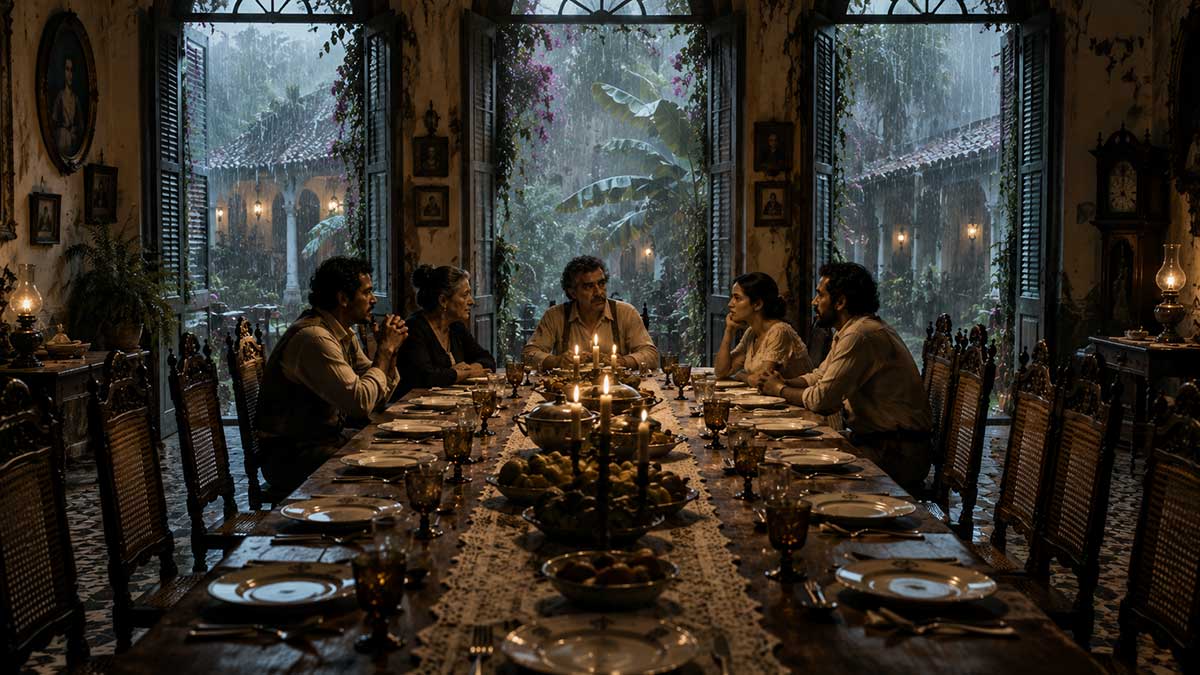
Rain has been falling over Macondo since before dawn.
Not heavily.
Not dramatically.
It comes down with the patience of something that believes it has nowhere else to be.
Water runs from the roof of the old house in silver threads. The courtyard tiles shine dark beneath the gray afternoon, and the air smells of wet earth, coffee, and the faint sweetness of flowers beaten down by rain.
Five chairs have been gathered around a long dining table near the open veranda.
The table is set for more people than are present.
There are twelve plates.
Twelve cups.
Twelve folded napkins.
Only five chairs are occupied.
Gabriel García Márquez sits at one end, watching the rain.
Michael Wood has chosen the chair nearest the veranda. Philip Swanson sits across from him with a notebook closed beside his plate. Regina Janes studies the empty settings. Stephen M. Hart is trying to decide whether the extra chairs are part of the conversation or merely part of the house.
Gabriel notices.
Gabriel García Márquez: You are wondering why the table is set for twelve.
Stephen M. Hart: I was trying not to ask too quickly.
Michael Wood: Scholars are trained to wait until an object becomes symbolic.
Philip Swanson: And then announce that it was symbolic all along.
Regina Janes: Perhaps the others are late.
Gabriel looks down the length of the table.
Gabriel García Márquez: In Macondo, that does not mean they will not arrive.
A soft knock sounds somewhere inside the house.
No one moves.
Stephen looks toward the hallway.
Stephen M. Hart: Was that—
Gabriel García Márquez: Probably the wood.
Another knock.
Michael lifts his coffee.
Michael Wood: Very literate wood.
Gabriel smiles.
Rain drifts through the open veranda and dots the edge of the table. Regina moves one of the empty plates away from the damp.
Regina Janes: This is already beginning to feel like the novel.
Philip Swanson: How so?
Regina Janes: Everyone is expected.
No one is fully present.
Michael turns toward her.
Michael Wood: That may be the most economical definition of solitude we will hear today.
Gabriel looks amused.
Gabriel García Márquez: We have only just poured the coffee.
Michael Wood: Good definitions often arrive before people are ready for them.
The rain thickens briefly, then relaxes.
A woman passes silently through the room behind them carrying a folded white sheet. She does not look toward the table. By the time Stephen glances back, she has disappeared through another doorway.
Stephen M. Hart: Is this house occupied?
Gabriel García Márquez: Very.
Stephen M. Hart: By whom?
Gabriel considers the question.
Gabriel García Márquez: That depends on who remembers it.
Philip opens his notebook, then closes it again.
Philip Swanson: I think that is where readers often misunderstand the title.
Michael Wood: They assume solitude means physical isolation.
Philip Swanson: Yes. They imagine a person alone in a room.
He gestures toward the empty chairs.
Philip Swanson: But the novel is full of people who are never physically alone.
They live in crowded houses.
They marry.
They have children.
They go to war.
They conduct business.
They receive visitors.
And yet many of them remain unreachable.
Regina Janes: Or unwilling to be reached.
Stephen M. Hart: Is that distinction important?
Regina Janes: Very.
There is solitude imposed by abandonment.
There is solitude created by grief.
There is solitude chosen as protection.
And then there is the solitude of people who want intimacy but cannot tolerate what intimacy requires.
Gabriel reaches for the coffee pot.
Gabriel García Márquez: Which is usually being known.
He pours slowly.
Michael Wood: Or being corrected.
Gabriel laughs.
Gabriel García Márquez: That too.
Michael looks toward the rain.
Michael Wood: The great trick of the novel is that it rarely asks us to pity solitude in a simple way.
It can be tragic.
It can also be vain.
It can be erotic.
It can be comic.
It can become a private kingdom.
Philip Swanson: Especially for the men.
Regina Janes: Not only the men.
Philip Swanson: No, but the men often turn solitude into an identity.
The workshop.
The laboratory.
The war.
The locked room.
The endless project.
They retreat into some obsession and then describe the retreat as destiny.
Gabriel García Márquez: Men are very skilled at giving poetry to avoidance.
Regina smiles.
Regina Janes: Women are often denied that luxury.
The rain drums harder against the roof.
For several seconds, they have to raise their voices.
Regina Janes: The women remain in the house, among children, meals, deaths, births, debts, visitors, and memories.
They may be surrounded constantly.
That does not mean they are less alone.
Stephen M. Hart: In fact, being needed by everyone can become its own form of isolation.
Regina Janes: Exactly.
If everyone knows what you provide but nobody asks what you feel, you are visible and invisible at the same time.
Gabriel looks down at the empty plate beside him.
Gabriel García Márquez: Úrsula understood nearly everyone.
Very few people understood Úrsula.
Philip Swanson: She becomes the emotional infrastructure of the family.
Michael Wood: Which is a dangerous phrase.
Philip Swanson: Why?
Michael Wood: Infrastructure is noticed mainly when it fails.
Nobody wakes in the morning grateful that the bridge is still standing.
They simply cross it.
Regina nods.
Regina Janes: That is how many families treat their strongest member.
Gabriel taps one finger against the table.
Gabriel García Márquez: Strength is one of the loneliest reputations a person can acquire.
The words settle into the room.
Rainwater gathers along the veranda and spills over the edge.
Stephen leans forward.
Stephen M. Hart: Then solitude in the novel is not simply absence.
It is failed recognition.
Michael Wood: Yes, though I would sharpen it.
It is the distance between being seen and being understood.
Philip Swanson: Or between being loved and being known.
Regina Janes: Or between being needed and being loved.
Gabriel looks from one to another.
Gabriel García Márquez: Critics enjoy improving one another’s sadness.
Michael Wood: We are building precision.
Gabriel García Márquez: You are building a very expensive rainstorm.
A laugh moves around the table.
The tension breaks, though not completely.
From inside the house comes the faint sound of dishes being stacked.
Gabriel turns slightly, as if listening for a particular person.
No one appears.
Philip Swanson: Did solitude begin for you as a philosophical idea?
Gabriel shakes his head.
Gabriel García Márquez: No.
It began as a family atmosphere.
Stephen M. Hart: What do you mean by atmosphere?
Gabriel García Márquez: In some houses, people say everything.
In others, they say almost nothing.
But even silence has a shape.
A child can feel which questions are forbidden long before anyone explains why.
He lifts his cup but does not drink.
Gabriel García Márquez: I grew up among stories, but stories are not the same as confession.
People told marvelous things.
They did not necessarily reveal themselves.
Michael Wood: That distinction is everywhere in the book.
The characters narrate events.
They rarely articulate their inner lives directly.
Regina Janes: And the narrator does not rescue them by explaining everything for us.
Michael Wood: Precisely.
The tone remains calm.
A death, a miracle, a disappointment, a war, a joke—they can all be delivered with the same grammatical composure.
That restraint creates emotional distance.
But it also creates enormous emotional pressure.
Philip Swanson: Because the reader must feel what the characters cannot say.
Michael Wood: Yes.
The novel is full of withheld emotion.
Not absent emotion.
Withheld emotion.
Gabriel finally drinks his coffee.
Gabriel García Márquez: In my family, extraordinary stories were told with serious faces.
Perhaps sadness learned the same style.
Stephen M. Hart: Is that why the magical events do not destroy the realism?
Gabriel García Márquez: They belong to the same voice.
A person who says, “She rose into the sky,” with complete certainty is not asking permission from reality.
Michael Wood: Nor from the reader.
Gabriel García Márquez: Especially not from the reader.
Regina runs one finger around the rim of her cup.
Regina Janes: But the title gives the reader a warning.
One hundred years.
Not one moment.
Not one person.
Solitude accumulates.
Philip Swanson: It becomes generational.
Regina Janes: Yes.
One person’s inability to speak becomes another person’s emotional inheritance.
One failed love becomes a family caution.
One betrayal becomes a tradition of suspicion.
One silence becomes the language of the house.
Stephen glances down the length of the table again.
Stephen M. Hart: So the empty chairs are not empty.
Gabriel García Márquez: You see? The furniture has finally become symbolic.
Michael gives Stephen a sympathetic look.
Michael Wood: It happens to all of us eventually.
Gabriel reaches for a piece of bread.
Gabriel García Márquez: The dead remain in families because the living keep arranging places for them.
The others are quiet.
Outside, a branch bends under the weight of water and releases a shower of droplets into the courtyard.
Philip Swanson: Is memory a cure for solitude in the novel?
Gabriel García Márquez: Sometimes memory makes solitude worse.
Philip Swanson: Because?
Gabriel García Márquez: Because the person you remember is no longer available to contradict you.
Michael turns toward him.
Michael Wood: That is severe.
Gabriel García Márquez: It is also convenient.
The dead become very cooperative.
They agree with our regrets.
They understand what the living refused to understand.
They become ideal companions.
Regina Janes: And impossible companions.
Gabriel García Márquez: Those are often the most attractive kind.
The rain softens to a whisper.
For the first time, a bird can be heard outside.
Stephen opens his notebook now.
Stephen M. Hart: I want to ask about love.
The title encourages readers to expect loneliness, but the novel is filled with desire.
Sexual desire.
Romantic desire.
Maternal love.
Friendship.
Longing.
Why does so much love fail to overcome solitude?
Gabriel looks toward the hallway.
Gabriel García Márquez: Because desire often wants possession more than understanding.
Philip Swanson: That is especially true in the novel’s romantic relationships.
People fall in love with an image.
With beauty.
With memory.
With forbiddenness.
With what another person represents.
Michael Wood: They do not necessarily fall in love with another consciousness.
Regina Janes: And when the real person appears, they experience it as disappointment.
Gabriel tears the bread in half.
Gabriel García Márquez: Love is full of imagination.
That is its beauty.
It is also its danger.
Stephen M. Hart: Then is solitude inevitable?
Gabriel García Márquez: Nothing important is solved by inevitability.
Michael Wood: That sounds like an author refusing to answer.
Gabriel García Márquez: It is an author refusing a lazy question.
Michael raises his cup in surrender.
Gabriel García Márquez: Solitude may be unavoidable as an experience.
That does not mean it must become a home.
Regina Janes: Some of your characters decorate it.
Gabriel smiles.
Gabriel García Márquez: Beautifully.
Regina Janes: They build rituals around it.
Philip Swanson: Colonel Aureliano Buendía especially.
The gold fishes.
The workshop.
The repetitive labor.
The retreat from intimacy.
Michael Wood: The gold fishes are extraordinary because they are both productive and circular.
He makes them.
He melts them.
He makes them again.
Stephen M. Hart: A perfect image of solitude as repetition.
Regina Janes: And control.
The outside world is unpredictable.
Relationships are unpredictable.
History is unpredictable.
The fish can be remade exactly.
Gabriel García Márquez: Until even exactness becomes a prison.
Philip looks at Gabriel.
Philip Swanson: Do you see the colonel as lonely because of the war, or at war because he is lonely?
Gabriel sits back.
Gabriel García Márquez: Both answers flatter him too much.
The others laugh softly.
Gabriel García Márquez: He is drawn to war because war turns inner confusion into outer purpose.
It gives him enemies.
Orders.
Maps.
Titles.
A man can avoid himself for many years if history keeps him busy.
Michael Wood: And afterward?
Gabriel García Márquez: History leaves.
He remains.
No one speaks for a moment.
A cup rattles faintly in another room.
This time, nobody looks.
Regina Janes: That may be the cruelest moment of solitude.
When the role disappears.
The parent whose children leave.
The leader whose cause ends.
The beautiful person who grows old.
The provider who is no longer needed.
The family member known only through one function.
Philip Swanson: Then they must discover whether anyone loved the person beneath the role.
Michael Wood: Including themselves.
Gabriel’s gaze moves toward the rain-darkened courtyard.
Gabriel García Márquez: Many people are strangers to themselves because they have spent their whole lives performing usefulness.
Stephen writes something down.
Stephen M. Hart: That feels remarkably modern.
Michael Wood: The novel has always been modern.
It merely refuses modern furniture.
Gabriel García Márquez: There is furniture.
Michael Wood: Ancient furniture.
Gabriel García Márquez: Better furniture.
A burst of laughter rises around the table.
Even the house seems to respond: somewhere above them, a door swings shut.
The rain begins again with renewed force.
Philip waits for the sound to settle.
Philip Swanson: Today, people can communicate constantly.
Messages.
Calls.
Photographs.
Video.
They can maintain contact across continents.
Would that change the solitude of the Buendías?
Gabriel does not hesitate.
Gabriel García Márquez: They would send more messages and reveal less.
Regina Janes: That is unfair.
Gabriel García Márquez: Is it?
Regina Janes: Perhaps not entirely.
Michael Wood: Digital communication can create the illusion that access equals intimacy.
Stephen M. Hart: We know where someone is.
What they ate.
What they watched.
What they purchased.
What they celebrated.
But we may not know what they fear.
Philip Swanson: Or what they cannot say.
Gabriel García Márquez: A person can now disappear while posting every day.
The rain seems louder after that.
Michael turns his cup slowly between his hands.
Michael Wood: There is another kind of solitude in the novel that we have not discussed.
The solitude of being unbelievable.
Regina looks up.
Regina Janes: Explain.
Michael Wood: To experience something that others deny.
To remember an event that the town insists did not happen.
To carry knowledge without social confirmation.
That is not simply loneliness.
It is epistemological isolation.
Gabriel smiles.
Gabriel García Márquez: Only a critic would make solitude longer by adding another word.
Michael Wood: The word earns its keep.
Jean Franco: She is not here to stop you.
Michael Wood: Then I shall continue safely.
They laugh.
Michael leans forward.
Michael Wood: José Arcadio Segundo survives the massacre.
He knows what happened.
But the official world rejects his knowledge.
His solitude is not created by silence alone.
It is created because truth has lost its audience.
Regina Janes: And because collective denial makes the witness appear mad.
Philip Swanson: That connects private solitude to political power.
A person may be isolated not because they cannot communicate, but because others are invested in not understanding.
Stephen M. Hart: Which makes witnessing a lonely act.
Gabriel nods.
Gabriel García Márquez: Sometimes the truth arrives and finds no chair prepared for it.
The group looks at the empty settings.
A coldness enters the scene that has nothing to do with the rain.
Regina lifts one of the unused cups and sets it more firmly before the empty chair beside her.
Regina Janes: Then perhaps listening is the opposite of solitude.
Michael Wood: Not merely hearing?
Regina Janes: No.
Listening that allows another person’s experience to alter your own understanding.
Philip Swanson: That is demanding.
Regina Janes: Intimacy is demanding.
Gabriel García Márquez: Which is why people prefer advice.
Stephen M. Hart: Advice lets the listener remain unchanged.
Gabriel points toward him.
Gabriel García Márquez: Exactly.
Tell someone what to do and you may never have to feel what they feel.
Michael watches the rain streaming from the roof.
Michael Wood: That could explain why the characters so often fail one another.
They interpret too quickly.
They categorize.
They desire.
They command.
They endure.
But they do not often remain present long enough to be changed by another person.
Philip Swanson: Is that what love should do?
Gabriel García Márquez: At its best.
Regina Janes: And at its most frightening.
A flash of pale light appears beyond the courtyard.
Thunder follows several seconds later.
Stephen closes his notebook.
Stephen M. Hart: Let me make this more personal.
Did writing the novel reduce your own solitude?
Gabriel looks at him for a long time.
The question seems to alter the room.
Gabriel García Márquez: Writing gives solitude a form.
That is not the same as ending it.
Stephen M. Hart: But it allows others to enter.
Gabriel García Márquez: Yes.
Years later.
In other countries.
Sometimes after you are dead.
He gestures toward the empty chairs.
Gabriel García Márquez: Literature is a very slow form of company.
Michael smiles.
Michael Wood: But unusually durable.
Gabriel García Márquez: If fortunate.
Philip Swanson: Millions of readers have recognized themselves in this novel.
Does that recognition challenge solitude?
Gabriel looks toward the veranda, where the rain has begun to thin again.
Gabriel García Márquez: A reader alone with a book is a strange kind of gathering.
The author is absent.
The characters do not exist.
The room may be empty.
Yet something passes between minds.
He places his hand flat on the table.
Gabriel García Márquez: Perhaps that does not cure solitude.
But it proves solitude is not sealed.
The others remain still.
The woman with the white sheet appears again in the hallway.
This time, she pauses.
She looks toward the empty place at the table, then toward Gabriel.
No one speaks.
She drapes the sheet over the back of an unused chair and walks away.
Stephen watches until she disappears.
Stephen M. Hart: Should we ask who she is?
Gabriel García Márquez: It is better to ask why you need to know.
Michael laughs under his breath.
Michael Wood: We have been corrected by the house.
Regina Janes: Perhaps the house is tired of criticism.
Philip Swanson: Or tired of being misunderstood.
Gabriel looks pleased.
The rain has nearly stopped.
Water continues to fall from the leaves in slow, separate drops. In the courtyard, a patch of brightness appears where the clouds are beginning to open.
Regina looks again at the twelve place settings.
Regina Janes: I think solitude may be most painful when a person has a place but no presence.
Philip Swanson: Meaning?
Regina Janes: The chair is theirs.
The family knows their name.
Their duties are recognized.
Their history is recorded.
But nobody encounters them as a living mystery.
Michael nods slowly.
Michael Wood: They are known as a category.
Mother.
Father.
Colonel.
Beauty.
Widow.
Madman.
Saint.
Failure.
Stephen M. Hart: And once the label becomes complete, curiosity ends.
Gabriel García Márquez: That is when solitude begins to harden.
Philip folds his hands.
Philip Swanson: Then what keeps it from hardening?
Gabriel does not answer immediately.
Outside, a child runs across the wet courtyard and disappears beyond the gate. The child’s laughter remains for a second after the child is gone.
Gabriel García Márquez: Someone must ask a question and be willing to lose the answer they expected.
Regina smiles faintly.
Regina Janes: Curiosity again.
Gabriel García Márquez: Curiosity is one of love’s less celebrated forms.
Michael Wood: Because it admits the other person is not finished.
Stephen M. Hart: Or not fully knowable.
Philip Swanson: Does that not preserve a certain solitude?
Gabriel nods.
Gabriel García Márquez: Of course.
No person enters another completely.
That would not be love.
It would be conquest.
The room becomes quiet.
One by one, the gray clouds break apart over Macondo.
A thin shaft of sunlight enters the veranda and falls across the table, illuminating the empty cups, the untouched plates, and the white sheet resting over the unused chair.
Michael looks toward Gabriel.
Michael Wood: So solitude is not simply the failure to merge with another person.
Gabriel García Márquez: No.
It is the failure to meet them across the distance.
Regina Janes: The distance remains.
Gabriel García Márquez: It must.
Stephen M. Hart: But it can be crossed.
Gabriel García Márquez: For a moment.
Sometimes a moment is enough.
The first yellow butterfly enters through the veranda.
Then another.
They circle above the table, bright against the dim room.
Philip watches them move toward the empty chairs.
Philip Swanson: And when the moment passes?
Gabriel follows the butterflies with his eyes.
Gabriel García Márquez: You remember that crossing was possible.
No one speaks after that.
The rain has ended, but the house continues dripping around them.
Five people sit at a table set for twelve.
For the first time, the empty chairs do not feel abandoned.
They feel expectant.
Topic 3 — Why Does Magical Realism Feel More True Than Reality?
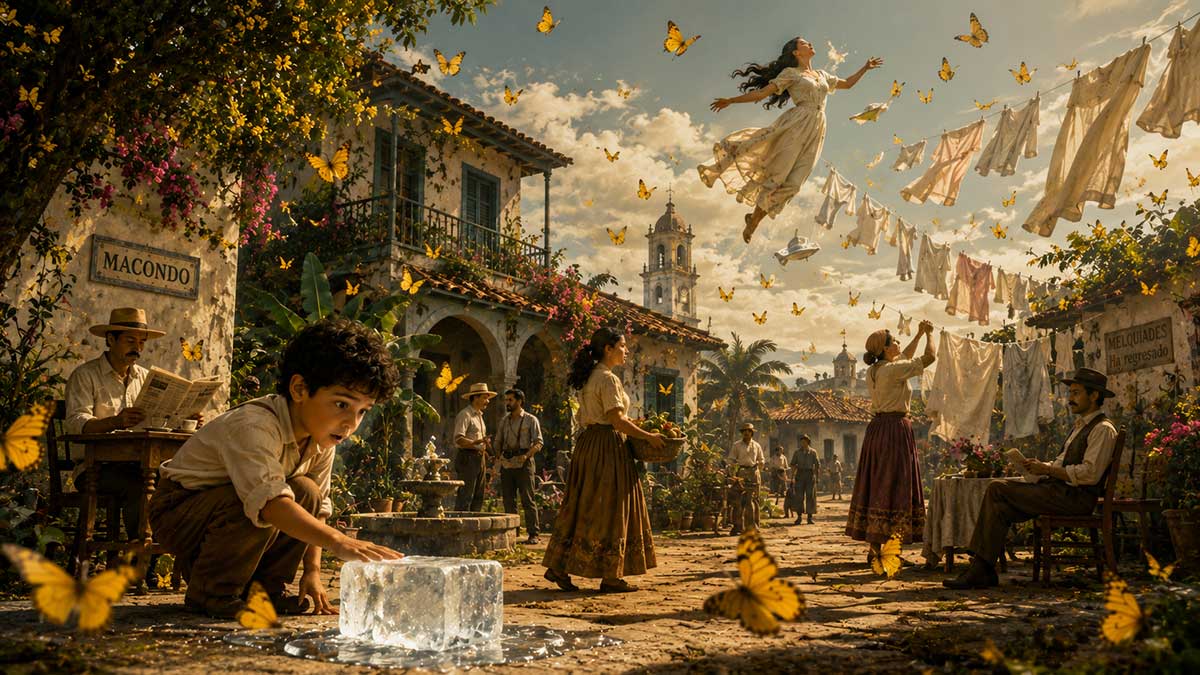
By morning, Macondo has dried.
The rain has left everything brighter than before: the red tiles, the banana leaves, the pale walls of the houses, the rusted metal roofs shining under a hard blue sky.
A long clothesline stretches across the courtyard.
White sheets move in the breeze.
At first, there is nothing unusual about them.
Then one of the sheets rises several feet above the line.
No one at the table comments.
Gabriel García Márquez sits beneath the veranda with Gene H. Bell-Villada, Michael Wood, Juan Moreno Blanco, and Stephen M. Hart. Between them rests a bowl of guavas, a brass bell, three notebooks, and a small glass jar filled with yellow butterflies that nobody remembers bringing.
The floating sheet drifts slowly toward the roof.
Stephen watches it.
Stephen M. Hart: Are we going to discuss that?
Gabriel follows his gaze.
Gabriel García Márquez: Discuss what?
The sheet rises higher.
Michael Wood turns in his chair and looks at it.
Michael Wood: I think Stephen is referring to the laundry.
Gabriel García Márquez: It is drying.
Stephen M. Hart: In the air.
Gabriel García Márquez: The air is where laundry usually dries.
Gene laughs.
Juan does not.
He looks from the sheet to Gabriel.
Juan Moreno Blanco: This is precisely the problem.
Michael Wood: The laundry?
Juan Moreno Blanco: No. The word “problem.”
Gabriel reaches for a guava.
Juan Moreno Blanco: The moment something does not fit the habits of European realism, readers call it impossible.
Stephen M. Hart: Are we beginning with Europe already?
Juan Moreno Blanco: Europe began without asking us.
Michael smiles.
Michael Wood: That is an efficient opening argument.
The sheet clears the roofline and disappears.
A woman enters the courtyard carrying a basket of clothespins. She looks up, notices one sheet is missing, shrugs, and continues working.
Stephen watches her.
Stephen M. Hart: She did not seem surprised.
Gabriel García Márquez: Why should she be?
Stephen M. Hart: Because her sheet just flew away.
Gabriel García Márquez: Then she needs fewer sheets.
Gene leans back, laughing.
Gene H. Bell-Villada: This is why the term magical realism can be misleading.
It encourages readers to divide the sentence into two parts.
Magic.
Reality.
Then they ask how one entered the other.
But in Gabriel’s fiction, they were never separated so neatly.
Michael Wood: The prose does not announce a violation.
That matters.
A woman ascends.
A ghost returns.
A plague erases memory.
Yellow flowers fall from the sky.
The narrative voice presents all of this with the same calm authority it uses to describe breakfast.
Gabriel García Márquez: Breakfast is often stranger.
Michael Wood: In England, perhaps.
Gabriel García Márquez: Especially in England.
Stephen glances at Michael.
Stephen M. Hart: You have been insulted by a Nobel laureate.
Michael Wood: I am trying to determine whether the insult was magical or realistic.
The brass bell on the table rings by itself.
Everyone stops.
Gabriel looks at it.
Gabriel García Márquez: Realistic.
The laughter comes easily.
A butterfly escapes from the jar, though the lid remains closed.
It crosses the table and disappears into the sunlight.
Juan watches it go.
Juan Moreno Blanco: What readers often call magical is sometimes simply the survival of another way of knowing.
Stephen M. Hart: Explain what you mean.
Juan Moreno Blanco: Caribbean experience was formed by collision.
Indigenous cosmologies.
African spiritual traditions.
European religion.
Colonial violence.
Oral storytelling.
Catholic miracles.
Family legends.
Historical trauma.
All these ways of understanding the world existed together.
Not peacefully.
But together.
Gene H. Bell-Villada: And in the Caribbean household, stories could contain the dead without becoming ghost stories.
Gabriel García Márquez: My grandmother never altered her expression.
She could tell the most extraordinary thing as though she were reporting the price of bread.
Michael Wood: That composure became one of the great technical secrets of your prose.
Gabriel García Márquez: It was not a secret.
It was her face.
Michael Wood: Literary history is full of techniques that began as someone’s face.
Gabriel bites into the guava.
Stephen M. Hart: Did you ever think of yourself as inventing magical realism?
Gabriel looks almost offended.
Gabriel García Márquez: No.
Stephen M. Hart: Not even refining it?
Gabriel García Márquez: Also no.
Gene H. Bell-Villada: Gabriel has always resisted the idea that the strange elements were inventions detached from lived reality.
Gabriel García Márquez: Because many of them were not invented.
They were rearranged.
He gestures toward the courtyard.
Gabriel García Márquez: A relative said she saw a ghost.
A neighbor believed a child had been born with a pig’s tail.
Someone disappeared.
Someone returned after being declared dead.
A company denied a massacre.
Which of these is magical?
The group quiets.
Michael folds his hands.
Michael Wood: The last one may be the least believable.
Juan Moreno Blanco: And yet it belongs to official history.
Stephen M. Hart: So reality itself becomes unstable.
Gabriel García Márquez: Reality has always been unstable.
Literature merely stopped pretending otherwise.
A cart passes beyond the courtyard wall.
Its wheels squeak rhythmically.
A flock of small birds follows it, though the cart carries no grain.
Gene H. Bell-Villada: There is also a political dimension here.
Realism often claims to describe the world objectively.
But whose world?
Whose sense of probability?
Whose experience is considered credible?
Juan Moreno Blanco: Exactly.
When a colonized people describe visions, spirits, ancestral memory, or impossible survival, the dominant culture may call it superstition.
When an empire invents legal language to erase violence, it calls that fact.
Michael Wood: That may be one reason magical realism feels truthful.
It reveals that official reality is already constructed.
Stephen M. Hart: Then magical realism is not an escape from politics.
Gene H. Bell-Villada: Often it is the opposite.
It can expose how absurd political reality has become.
Gabriel places the half-eaten guava back on the plate.
Gabriel García Márquez: A massacre denied by everyone in authority is more fantastic than a woman rising into heaven.
Michael Wood: Yet readers accept the denial because institutions speak in familiar language.
Juan Moreno Blanco: Power controls tone.
That is important.
A government says something impossible in a formal voice, and people call it truth.
A grandmother says something impossible in a kitchen, and people call it magic.
Gabriel taps the table.
Gabriel García Márquez: There is your whole discussion.
Stephen M. Hart: Then we can leave?
Gabriel García Márquez: You may.
No one moves.
A second butterfly appears outside the jar.
Then a third.
Michael watches them gather around the brass bell.
Michael Wood: I would still insist on technique.
Cultural explanation alone does not account for the effect.
Many people inherit extraordinary stories.
Few write them with this particular precision.
Gene H. Bell-Villada: Agreed.
Juan Moreno Blanco: I did not deny technique.
Michael Wood: No, but I want to protect the sentences from becoming sociology.
Gabriel smiles.
Gabriel García Márquez: Sentences appreciate protection.
Michael Wood: The central achievement is tonal.
The narrator never winks.
Never says, “You will not believe this.”
Never makes the extraordinary event beg for attention.
The sentence remains composed.
Because the voice believes, the reader is invited to believe.
Stephen M. Hart: Or at least to suspend disbelief.
Michael shakes his head.
Michael Wood: I think it is more radical than that.
Suspending disbelief means the reader temporarily tolerates something known to be false.
Here, the categories themselves become uncertain.
The reader begins wondering whether ordinary realism was too narrow.
Gabriel points at Michael with approval.
Gabriel García Márquez: Better.
Stephen M. Hart: Better than what?
Gabriel García Márquez: Than “suspending disbelief.”
That phrase always sounds like hanging a coat.
Gene laughs.
Gene H. Bell-Villada: There is also accumulation.
One impossible event may seem decorative.
But in the novel, marvels become part of the world’s grammar.
The first ghost surprises.
The fifth teaches the reader how to live in Macondo.
Juan Moreno Blanco: And once the reader adapts, the truly shocking moments are often historical.
War.
Exploitation.
Mass death.
Forgetting.
Michael Wood: Yes.
The magical becomes ordinary.
The ordinary becomes monstrous.
Stephen turns this over.
Stephen M. Hart: So the novel reverses the reader’s expectations.
Gabriel García Márquez: A useful novel should rearrange what the reader considers normal.
A man enters the courtyard carrying a block of ice wrapped in cloth.
He places it on a nearby bench, wipes his forehead, and leaves without explanation.
Water begins dripping through the fabric.
Stephen looks at Gabriel.
Stephen M. Hart: Is that for us?
Gabriel García Márquez: It may be a scientific discovery.
Gene H. Bell-Villada: We are near the beginning of the novel now.
Michael Wood: Then we should charge admission.
Juan walks over and touches the cloth.
Juan Moreno Blanco: The ice matters because wonder is not limited to the supernatural.
For the people of early Macondo, technology itself is magical.
Magnets.
Magnifying glasses.
Trains.
Cinema.
Ice.
Stephen M. Hart: Which complicates the label again.
What a modern reader calls ordinary may be miraculous to the characters.
Gene H. Bell-Villada: And what the characters accept as ordinary may seem miraculous to us.
Michael Wood: The novel is constantly moving the border.
Gabriel rises and walks toward the bench.
He unwraps one corner of the cloth.
A perfect blue block of ice gleams beneath it.
Gabriel García Márquez: The first time a child sees ice, realism is insufficient.
Stephen M. Hart: Because the feeling exceeds the object?
Gabriel García Márquez: Because the world has become larger in one second.
They gather around the bench.
Sunlight passes through the ice and casts a trembling blue light across Gabriel’s hand.
For a moment, no one speaks.
The block cracks softly from within.
Michael Wood: That may be the essence of wonder.
Not that reality is broken.
That reality is suddenly more than we believed.
Gabriel covers the ice again.
Gabriel García Márquez: You see?
Critics can be useful near frozen objects.
They return to the table.
The jar now appears to contain more butterflies than before.
Gene notices first.
Gene H. Bell-Villada: Were there this many?
Stephen M. Hart: No.
Gabriel García Márquez: Butterflies reproduce quickly in scholarship.
Juan Moreno Blanco: Only when trapped in definitions.
Michael reaches toward the lid, then stops.
Michael Wood: We should perhaps discuss the danger of turning magical realism into a brand.
Stephen M. Hart: Especially after the novel’s success.
Gene H. Bell-Villada: Yes.
The term became globally marketable.
Publishers began expecting Latin American writers to provide ghosts, tropical heat, family curses, and levitating relatives.
Juan Moreno Blanco: Which can become another form of confinement.
The literary world celebrates a style, then demands that an entire region continue performing it.
Michael Wood: Success creates imitation.
Imitation creates cliché.
Gabriel García Márquez: And cliché is magic after it has been explained too many times.
Stephen M. Hart: Do you dislike the label?
Gabriel thinks.
Gabriel García Márquez: I dislike labels when they arrive before reading.
If someone sees “magical realism” and expects decoration, they may miss the sadness.
If they expect fantasy, they may miss the history.
If they expect Latin America, they may miss themselves.
Gene H. Bell-Villada: Yet the label has helped readers enter the work.
Gabriel García Márquez: Doors are useful.
They should not become rooms.
Juan nods.
Juan Moreno Blanco: Nor borders.
The woman with the clothespins returns.
She carries only three sheets now.
She hangs them on the line.
One immediately begins drifting upward.
This time Stephen says nothing.
Gabriel notices his silence.
Gabriel García Márquez: You are learning.
Stephen M. Hart: I am adapting to the grammar.
Michael Wood: That is how colonization begins.
Everyone laughs.
Juan Moreno Blanco: Or decolonization.
Michael Wood: Then I withdraw the remark.
The sheet floats over the wall and disappears.
The woman continues hanging laundry.
Stephen M. Hart: I have a question about belief.
Does magical realism require the author to believe in the events?
Gabriel narrows his eyes.
Gabriel García Márquez: Believe in what sense?
Stephen M. Hart: Believe they could literally happen.
Gabriel García Márquez: Literal belief is overrated.
Michael Wood: That sounds evasive.
Gabriel García Márquez: It is precise.
A story may be factually impossible and emotionally exact.
A factual event may be emotionally false.
Gene H. Bell-Villada: This is where the novel’s exaggeration becomes important.
The rain lasts for years.
A man is followed by butterflies.
Beauty ascends.
These images enlarge emotional experience.
Juan Moreno Blanco: They also recover realities that conventional language cannot carry.
How do you describe prolonged violence?
Collective trauma?
A family haunted by the unburied past?
Sometimes a ghost is more accurate than a diagnosis.
Michael Wood: And more memorable.
Stephen M. Hart: Then metaphor becomes event.
Gabriel García Márquez: In a novel, metaphor should occasionally refuse to behave.
A faint melody begins somewhere beyond the wall.
No instrument is visible.
It sounds like an accordion played from several streets away.
Gene tilts his head.
Gene H. Bell-Villada: There is also joy in this form.
We tend to discuss trauma, colonialism, and political violence, all rightly.
But magical realism is also playful.
Michael Wood: Absolutely.
The novel enjoys abundance.
Excess.
Lists.
Hyperbole.
The pleasure of saying one impossible thing after another with a straight face.
Juan Moreno Blanco: Caribbean storytelling is not only a response to suffering.
It is also invention, humor, rhythm, performance.
Gabriel García Márquez: People in difficult places still tell funny stories.
Otherwise the difficult places win.
Stephen smiles.
Stephen M. Hart: That may explain why the novel never feels like a thesis.
Michael Wood: It is too alive to remain obedient to an interpretation.
Gene H. Bell-Villada: And too comic to become solemn for long.
Gabriel opens the jar.
The butterflies do not fly out.
Instead, one yellow flower falls in.
Everyone looks at it.
Stephen M. Hart: Was that already there?
Gabriel García Márquez: You are asking the wrong question again.
Stephen M. Hart: What is the right question?
Gabriel closes the lid.
Gabriel García Márquez: Whether it belongs.
Michael leans toward the jar.
Michael Wood: It does.
Gabriel García Márquez: Then literature has done its work.
A warm breeze moves through the courtyard.
The three remaining sheets lift together, but the clothespins hold them down.
For several moments they billow like sails.
Juan watches them.
Juan Moreno Blanco: Belonging may be the key.
The magical event feels true because it belongs to the emotional, cultural, and narrative world.
It is not random.
Gene H. Bell-Villada: Exactly.
The marvel is integrated.
A ghost returns because the past has not been resolved.
Flowers fall because grief exceeds ordinary weather.
The insomnia plague appears because forgetting threatens the community.
Stephen M. Hart: So the magic has structure.
Michael Wood: More structure than many realistic novels.
Gabriel García Márquez: Reality also has structure.
It simply hides the author.
The accordion music grows louder, then abruptly stops.
A child’s voice from beyond the wall shouts that a fish has fallen from the sky.
No one at the table turns.
Stephen waits.
Stephen M. Hart: We are not going to investigate?
Gabriel García Márquez: If every impossible thing interrupted lunch, nothing would ever be eaten.
A woman arrives carrying five bowls of soup.
She places one before each of them.
The soup is steaming despite the heat.
Michael looks into his bowl.
Michael Wood: What kind is it?
Gabriel García Márquez: Realistic.
Michael tastes it.
Michael Wood: Disappointing.
Gabriel laughs.
They begin eating.
For a while, the discussion becomes fragmented by spoons and bread.
Then Stephen looks toward the ice melting beneath its cloth.
Stephen M. Hart: Why do readers around the world recognize themselves in a form rooted so deeply in Latin America and the Caribbean?
Juan answers first.
Juan Moreno Blanco: Because universality does not require removing local specificity.
Often the more fully a work inhabits one place, the more clearly readers recognize the structures of their own lives.
Family mythology.
Political forgetting.
Ancestors who remain present.
The blending of faith and daily life.
Every culture has its own Macondo, though not every culture names it.
Gene H. Bell-Villada: The novel’s historical setting is specific, but its patterns travel.
Modernization arrives.
Capital arrives.
War arrives.
Foreign companies arrive.
Official forgetting follows.
Michael Wood: And beneath all of that is the human appetite for stories that make chaos intelligible.
Gabriel García Márquez: Or at least beautiful enough to endure.
Stephen M. Hart: Is beauty dangerous here?
Gabriel places down his spoon.
Gabriel García Márquez: It can be.
Stephen M. Hart: Because it makes suffering attractive?
Gabriel García Márquez: Because readers may admire the butterflies and forget the blood.
The others become still.
Gene H. Bell-Villada: That is a genuine risk in the reception of magical realism.
The aesthetic surface can be so seductive that political violence becomes scenery.
Juan Moreno Blanco: Which is why context matters.
Macondo is not a dream floating outside history.
It is penetrated by colonialism, civil war, labor exploitation, racism, foreign capital, and state denial.
Michael Wood: Yet the novel refuses to stop being beautiful.
Gabriel García Márquez: Beauty should not belong only to peaceful histories.
Juan looks toward him.
Juan Moreno Blanco: But it should not excuse violent ones.
Gabriel García Márquez: No.
It should make them impossible to forget.
A long pause follows.
The soup continues steaming.
Outside, the block of ice has nearly disappeared. Water runs from beneath the cloth and moves in a thin line across the courtyard.
Michael watches it.
Michael Wood: Perhaps magical realism does something ordinary realism often cannot.
It preserves contradiction.
Beauty and horror.
Faith and doubt.
History and myth.
Comedy and grief.
The living and the dead.
It does not force one to cancel the other.
Stephen M. Hart: That may be why it feels more like memory.
Memory is rarely organized by genre.
Gene H. Bell-Villada: Nor by probability.
Juan Moreno Blanco: Nor by official permission.
Gabriel nods.
Gabriel García Márquez: A childhood memory may contain a dead relative, a smell, a lie, a political event, a joke, and a fear.
All at once.
Why should a novel be less truthful than memory?
The woman with the clothespins crosses the courtyard one last time.
She stops beneath the line.
The three sheets rise, pulling against the pins.
One pin snaps.
A sheet sails upward.
The woman watches it go.
Then she looks toward the table.
Woman: That one always wanted to leave.
She gathers the empty basket and walks into the house.
No one laughs.
Not because the remark is sad.
Because it makes perfect sense.
Stephen looks at Gabriel.
Stephen M. Hart: I think I understand now.
Gabriel García Márquez: That is unfortunate.
Stephen M. Hart: Why?
Gabriel García Márquez: Understanding is often the beginning of explanation.
Michael Wood: And explanation is the enemy?
Gabriel García Márquez: Not the enemy.
A dangerous relative.
One who visits, rearranges the furniture, and tells everyone why the house was built.
Gene smiles.
Gene H. Bell-Villada: Then what should readers do?
Gabriel looks around the courtyard.
At the melting ice.
At the butterflies inside the jar.
At the single yellow flower among them.
At the empty clothesline.
Gabriel García Márquez: Believe the story long enough to discover what reality had trained them not to see.
No one responds.
The brass bell rings once.
A cloud passes across the sun, and for a moment the courtyard turns silver.
When the light returns, the jar is empty.
The butterflies are gone.
The flower remains.
Michael lifts the jar and studies it.
Michael Wood: Where did they go?
Gabriel reaches for another guava.
Gabriel García Márquez: Somewhere realistic, I imagine.
Beyond the courtyard wall, the child shouts again.
This time everyone turns.
High above Macondo, a silver fish crosses the sky.
No one asks how.
Topic 4 — What Does Macondo Really Represent?
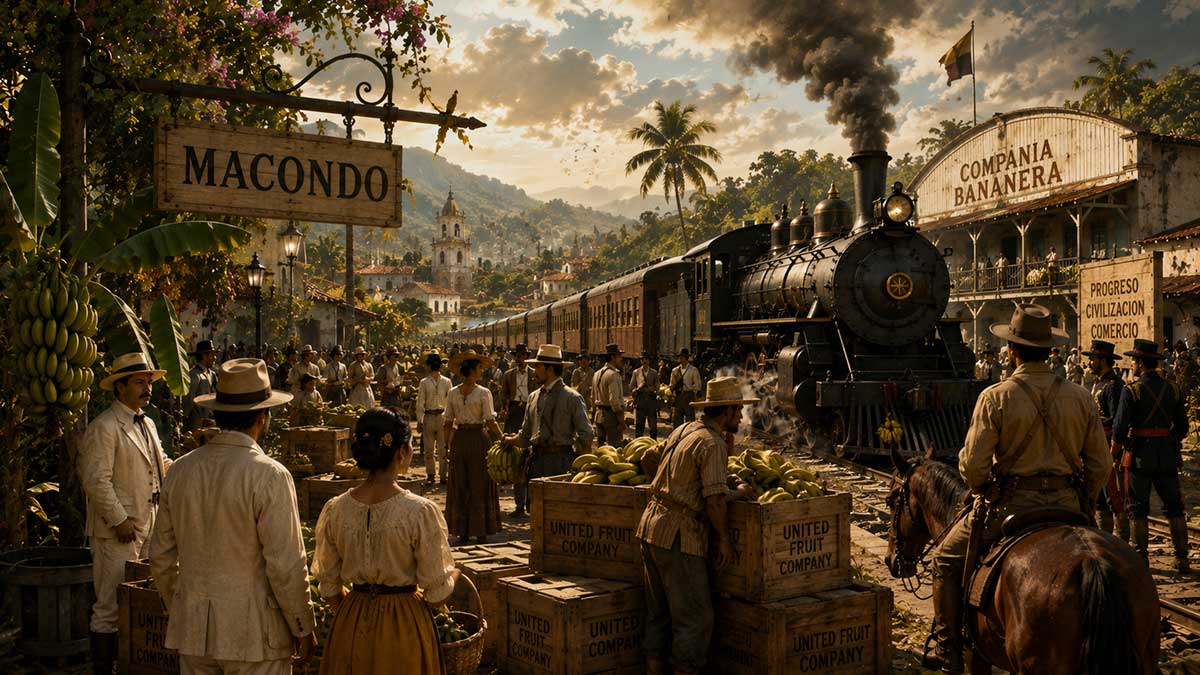
The train arrives before sunrise.
Its whistle crosses the sleeping town like a warning no one has agreed to understand.
By the time the first light reaches Macondo, the platform is crowded with crates, chickens, baskets, soldiers, merchants, children, and men carrying objects whose purposes are not immediately clear. Steam gathers beneath the iron roof. Porters shout. A woman argues over the price of bananas. Somewhere in the confusion, a gramophone begins playing a cheerful song.
At the far end of the platform, beneath a faded sign bearing the town’s name, a table has been set with five cups of coffee.
Gabriel García Márquez sits with Gerald Martin, Jean Franco, Raymond Leslie Williams, and Álvaro Santana-Acuña.
The table trembles each time a crate is dropped nearby.
Gerald looks toward the station clock.
It has no hands.
Gerald Martin: Is that deliberate?
Gabriel follows his gaze.
Gabriel García Márquez: The train is here. Why do you need to know the time?
Raymond Leslie Williams: Because history usually claims to arrive on schedule.
Jean Franco: And leaves before anyone can complain.
Álvaro studies the crowd.
Álvaro Santana-Acuña: This is not how readers first imagine Macondo.
Gerald Martin: No. They remember the isolated village.
Mud houses.
Clear water.
A world so new that objects still require naming.
Gabriel García Márquez: Isolation is attractive mainly to people who know it will end.
A porter passes carrying a wooden crate marked MACHINERY.
Something inside it knocks three times.
No one comments.
Raymond Leslie Williams: The opening Macondo is often treated as a lost paradise.
Jean Franco: It is not a paradise.
Gerald Martin: It is peaceful.
Jean Franco: Peaceful for whom?
Gerald smiles faintly.
Gerald Martin: We have begun early.
Jean Franco: The train did.
Gabriel lifts his coffee.
Gabriel García Márquez: Macondo was never innocent.
Only unfinished.
A locomotive releases a blast of steam. For several seconds, the five figures disappear inside a white cloud.
When the air clears, a sixth chair has appeared at the table.
It is empty.
Álvaro looks at it, then at Gabriel.
Álvaro Santana-Acuña: Was that there before?
Gabriel García Márquez: Towns grow quickly.
Jean moves the chair slightly so a porter can pass.
Jean Franco: The question is whether Macondo represents a particular place or whether it represents everything.
Raymond Leslie Williams: Those possibilities are not opposites.
Gerald Martin: Macondo is rooted in Aracataca.
That cannot be ignored.
The geography.
The banana economy.
The heat.
The wars.
The railroad.
The memory of the United Fruit Company.
The architecture of your childhood.
He looks toward Gabriel.
Gerald Martin: You built it from a real landscape.
Gabriel García Márquez: I built it from memory.
Gerald Martin: Which began in a real landscape.
Gabriel García Márquez: Memory is not a surveyor.
Álvaro Santana-Acuña: But the specificity is essential.
Macondo became universal because it was not designed as a universal symbol.
It began as a place with dust, weather, family histories, political wounds, and local speech.
Jean Franco: And with structures of power.
Let us not make universality sound innocent.
The town is not merely humanity in miniature.
It is a Latin American town shaped by colonial inheritance, civil conflict, foreign capital, racial hierarchy, patriarchy, and state violence.
Raymond Leslie Williams: Yet readers in India, Turkey, Nigeria, Korea, or the American South often recognize it immediately.
Jean Franco: Recognition does not erase history.
Raymond Leslie Williams: I did not say it did.
A boy runs along the platform dragging a toy train behind him.
The toy has no wheels.
It moves anyway.
Gabriel watches him pass.
Gabriel García Márquez: Macondo is local enough to have weather and large enough to have history.
Gerald Martin: That sounds suspiciously rehearsed.
Gabriel García Márquez: Everything sounds rehearsed after a biographer writes it down.
Álvaro laughs.
Álvaro Santana-Acuña: There is another question here.
Did Macondo become symbolic because of what is inside the novel, or because the world turned the novel into a global classic?
Raymond Leslie Williams: You mean its meaning expanded through reception.
Álvaro Santana-Acuña: Exactly.
Macondo was not born as an inevitable symbol of Latin America.
It became one through translation, criticism, publishing, teaching, political reading, tourism, and repetition.
Readers learned to say “Macondo” as shorthand for an entire region.
Jean Franco: Which can be flattering and dangerous.
Gerald Martin: Dangerous in what sense?
Jean Franco: A continent becomes a literary village.
Its differences disappear.
Its cities, modernities, political movements, racial histories, and competing traditions are folded into one magical tropical image.
Gabriel García Márquez: I wrote one town.
Publishers discovered a continent.
Raymond Leslie Williams: And then asked other writers to live there.
Gabriel smiles.
Gabriel García Márquez: Rent was expensive.
The gramophone nearby stops mid-song.
A soldier strikes it with his palm.
The music resumes from the beginning.
Gerald Martin: Still, Macondo clearly operates beyond Aracataca.
It follows a civilizational arc.
Foundation.
Discovery.
Expansion.
War.
Industrialization.
Foreign intervention.
Massacre.
Decline.
Erasure.
Raymond Leslie Williams: That is why the town feels almost biblical.
It begins with creation and ends with apocalypse.
Jean Franco: Except the apocalypse is not divine.
It is historical.
Raymond Leslie Williams: Partly.
Jean Franco: Mostly.
Gabriel García Márquez: History enjoys dressing as fate.
The station clock gives a single chime despite having no hands.
No train departs.
Álvaro Santana-Acuña: Readers often ask what Macondo represents, as though there must be one answer.
Latin America.
Colombia.
Childhood.
Modernity.
Civilization.
Memory.
Isolation.
Gerald Martin: You left out family.
Álvaro Santana-Acuña: And capitalism.
Jean Franco: Never leave out capitalism at a railway station.
Gabriel looks at the tracks.
Gabriel García Márquez: Especially when the bananas are listening.
Behind them, several bunches of bananas are stacked against the station wall.
Each bears a blue company seal.
Jean turns toward them.
Jean Franco: The arrival of the banana company changes the scale of the novel.
Before that, Macondo’s errors are largely its own.
Afterward, it becomes integrated into a larger economic system.
Raymond Leslie Williams: Progress arrives.
Jean Franco: That is what it calls itself.
Gerald Martin: There are also real benefits.
Electricity.
Transportation.
New commerce.
Contact with the outside world.
Jean Franco: And labor discipline, imported authority, exploitation, segregation, and violence.
Gerald Martin: I am not denying that.
Jean Franco: Progress is most persuasive when it distributes conveniences before revealing its price.
Álvaro watches workers unload another crate.
Álvaro Santana-Acuña: The company does not simply enter Macondo.
It changes what Macondo believes is possible.
That is crucial.
People begin measuring life by outside standards.
Efficiency.
Profit.
Production.
Modernity.
The town becomes visible to the world, but less recognizable to itself.
Gabriel García Márquez: Every place wishes to be discovered until discovery begins making improvements.
Raymond looks down the tracks disappearing into heat.
Raymond Leslie Williams: The railroad is one of the novel’s great ambivalent symbols.
It brings connection.
It also brings penetration.
Jean Franco: Penetration is the polite word.
Gerald Martin: Jean has rejected the railway timetable and the vocabulary.
Jean Franco: Both were imported.
Gabriel laughs.
The sixth chair creaks.
No one is sitting in it.
Álvaro glances toward it again.
Álvaro Santana-Acuña: Perhaps Macondo represents what happens when a place loses control over its own story.
Raymond Leslie Williams: Through foreign power?
Álvaro Santana-Acuña: Through many powers.
Government.
Corporations.
Historians.
Journalists.
Publishers.
Tourists.
Even readers.
Every group names Macondo differently.
Eventually the town becomes famous for meanings its inhabitants did not choose.
Gerald Martin: That happened to Aracataca as well.
Gabriel looks toward him.
Gerald Martin: Your fame transformed the town.
People arrived looking for Macondo.
The birthplace became part biography, part literary shrine, part economic opportunity.
Gabriel García Márquez: They searched for a town that had never existed exactly where they were standing.
Jean Franco: Tourism is very good at converting memory into merchandise.
Raymond Leslie Williams: But pilgrimage can also be sincere.
Readers want to touch the world that formed the book.
Jean Franco: Sincerity and commerce are frequent traveling companions.
A vendor approaches the table holding five small wooden signs.
Each reads: WELCOME TO THE REAL MACONDO.
Vendor: Souvenir?
Gabriel examines one.
Gabriel García Márquez: Which real Macondo?
Vendor: This one.
Gabriel García Márquez: We are already in Macondo.
The vendor looks around.
Vendor: Then you need two.
Gabriel buys one.
Jean stares at him.
Jean Franco: You have rewarded the argument.
Gabriel García Márquez: He understood capitalism better than all of us.
The vendor leaves.
Gerald turns the sign over.
On the back, in smaller letters, it reads MADE ELSEWHERE.
Gerald Martin: Perfect.
Raymond Leslie Williams: Almost too perfect.
Gabriel García Márquez: Reality occasionally overedits.
A bell rings near the luggage office. Passengers begin moving toward a newly arrived carriage, though no announcement has been made.
Álvaro watches the flow of bodies.
Álvaro Santana-Acuña: Macondo’s isolation is often misunderstood.
It is never completely outside the world.
Gypsies arrive.
Ideas arrive.
Technologies arrive.
Wars arrive.
The government arrives.
Capital arrives.
The tragedy is not that history fails to reach Macondo.
The tragedy is that history reaches it in distorted forms.
Gerald Martin: As spectacle first.
The magnets.
The ice.
The flying carpet.
Raymond Leslie Williams: Then as administration.
Magistrates.
Soldiers.
Political parties.
Jean Franco: Then as extraction.
Railways.
Plantations.
Company law.
Gabriel García Márquez: History arrives smiling before it begins taking inventory.
A man in a white suit walks past carrying a clipboard.
He pauses at the empty sixth chair and writes something down.
Man with Clipboard: Unoccupied asset.
Jean looks up sharply.
Jean Franco: It is a chair.
Man with Clipboard: Temporarily.
He walks away.
Gabriel watches him disappear into the crowd.
Gabriel García Márquez: That may be the whole history of development.
Raymond laughs, but Jean does not.
Jean Franco: Macondo becomes legible to power.
That is when it becomes vulnerable.
Gerald Martin: Explain.
Jean Franco: A remote town may be ignored.
Once it can be mapped, counted, taxed, governed, transported through, and made profitable, it enters systems that do not understand it except as a resource.
Álvaro Santana-Acuña: Visibility becomes extraction.
Raymond Leslie Williams: Yet isolation is not desirable either.
The early Macondo contains ignorance, incestuous fear, limited knowledge, and dependence on rumor.
Jean Franco: I did not romanticize isolation.
Raymond Leslie Williams: I know.
But the novel does not offer a simple choice between untouched purity and corrupt modernity.
Gabriel García Márquez: Purity is usually invented after corruption.
The group falls quiet for a moment.
A porter rolls a barrel across the platform. On its side is painted FUTURE.
The barrel leaks.
Gerald Martin: So Macondo is not destroyed merely because outsiders arrive.
Gabriel García Márquez: No.
Gerald Martin: It is already carrying its own weaknesses.
Raymond Leslie Williams: Repetition.
Solitude.
Amnesia.
Pride.
Political fanaticism.
Jean Franco: And social inequality.
Álvaro Santana-Acuña: Outsiders exploit vulnerabilities they did not create but know how to use.
Gabriel García Márquez: A town can prepare its own wound and still blame the knife.
The train lets out another whistle.
Several birds rise from the roof and vanish into the morning glare.
Gerald unfolds a map of Colombia.
Gerald Martin: Where exactly is Macondo?
Gabriel glances at the map.
Gabriel García Márquez: There.
He points to the center.
Gerald looks.
Gerald Martin: That is not the Caribbean coast.
Gabriel García Márquez: Then the map is wrong.
Raymond Leslie Williams: It is tempting to search for coordinates because readers want the symbolic town to become geographically stable.
Álvaro Santana-Acuña: But Macondo changes even within the novel.
It is not one place across one hundred years.
Its population changes.
Its architecture changes.
Its relationship to the outside world changes.
Its memories change.
Jean Franco: Its ruling narratives change.
Gabriel García Márquez: A town is not land.
It is an agreement among people about what happened there.
Gerald folds the map.
Gerald Martin: And when they no longer agree?
Gabriel García Márquez: Then history begins.
Jean Franco: Or propaganda.
Raymond Leslie Williams: Usually both.
At the luggage office, an argument breaks out between a railway official and an old man holding a cage with no bird inside.
Their voices rise, then disappear beneath the sound of steam.
Álvaro Santana-Acuña: Macondo also represents a struggle over scale.
Inside the town, events feel unique.
A family feud.
A political betrayal.
A strike.
A flood.
But from outside, those events belong to larger patterns.
Civil war.
Imperial capitalism.
State repression.
Environmental change.
Raymond Leslie Williams: Literature allows both scales to remain visible.
Jean Franco: At its best.
Too often, the larger pattern swallows the individual.
Statistics replace names.
Gabriel García Márquez: That is why the massacre needs José Arcadio Segundo.
History counts the dead.
A novel gives one survivor insomnia.
The empty chair creaks again.
This time, a railway worker sits in it without asking.
His shirt is stained dark with sweat. His hands are cut and wrapped in cloth.
He takes Gabriel’s untouched cup and drinks.
No one objects.
Railway Worker: Are you discussing the town?
Gerald Martin: We are trying.
Railway Worker: Does it help?
Jean Franco: Rarely.
The worker nods as though this confirms something.
Railway Worker: The company says the town is growing.
Raymond Leslie Williams: Do you agree?
Railway Worker: My hours are growing.
The price of food is growing.
The cemetery is growing.
He finishes the coffee.
Railway Worker: Perhaps that is what they mean.
He stands and returns to the platform.
The sixth chair remains slightly pulled away from the table.
No one immediately speaks.
Jean looks toward Gabriel.
Jean Franco: That is why symbolism can become dangerous.
A real worker becomes an example of “modernity.”
A massacre becomes a metaphor for forgetting.
Suffering is elevated into literary meaning and may lose its material reality.
Gabriel García Márquez: Unless the metaphor carries the body with it.
Jean Franco: Does it?
Gabriel García Márquez: It must.
Her expression remains skeptical.
Gabriel García Márquez: I did not write the massacre so readers could admire the symbolism.
I wrote it because forgetting was already becoming official.
Gerald Martin: And because the event drew from the 1928 banana workers’ massacre.
Jean Franco: Yes.
Which means Macondo is never merely imaginary.
Its fictional freedom depends upon historical responsibility.
Álvaro nods.
Álvaro Santana-Acuña: That tension helped the novel travel.
Readers could encounter Macondo as myth while critics and historians connected it to specific events.
The book functioned differently in different places.
Raymond Leslie Williams: In Latin America, some readers recognized history.
Elsewhere, many first recognized myth.
Gerald Martin: Then later learned the history.
Jean Franco: Sometimes.
Others kept only the butterflies.
Gabriel looks toward the bunches of bananas.
Gabriel García Márquez: Butterflies travel better than labor disputes.
A young couple stands near the edge of the platform taking photographs beneath the MACONDO sign.
They carefully position themselves so the workers are outside the frame.
Jean watches.
Jean Franco: Exactly.
Gerald follows her gaze.
Gerald Martin: That may not be fair.
They are only taking a photograph.
Jean Franco: Frames are never only frames.
Raymond shifts in his chair.
Raymond Leslie Williams: Still, Macondo’s reach cannot be reduced to misreading.
The town has offered readers a language for experiences their own cultures failed to name.
Boom towns.
Company towns.
Plantation economies.
Civil conflict.
Family memory.
Political denial.
Communities transformed by distant powers.
Álvaro Santana-Acuña: Its universality is relational.
Readers do not conclude, “We are all Latin American.”
They conclude, “Something in our history behaves like Macondo.”
Gabriel García Márquez: Every country has a place it remembers incorrectly.
Gerald Martin: Only one?
Gabriel smiles.
Gabriel García Márquez: I was being generous.
The station clock suddenly acquires hands.
Both point backward.
Stephen is not present to ask about it, and the others pretend not to notice.
Raymond Leslie Williams: There is also the question of time.
Macondo does not develop in a straight line.
It circles.
Repeats.
Accelerates.
Stalls.
Forgets.
Álvaro Santana-Acuña: Which challenges conventional narratives of modernization.
The standard story says societies move from primitive to modern, isolation to connection, superstition to reason.
Macondo gains technology but not wisdom.
It gains history but loses memory.
Jean Franco: It gains productivity and loses workers.
Gerald Martin: It gains institutions and loses truth.
Gabriel García Márquez: Progress is very good at bringing luggage and forgetting passengers.
The train shudders.
A conductor walks along the platform calling destinations.
Each time he names a city, a different passenger hears a different place.
Some board.
Some remain.
One woman begins crying because she believes the train is returning somewhere it has never been.
Gerald Martin: Is Macondo doomed from the beginning?
Gabriel looks toward the tracks.
Gabriel García Márquez: A place is not doomed because it ends.
Gerald Martin: It is erased by the wind.
Gabriel García Márquez: Many places survive physically and disappear more completely.
Raymond Leslie Williams: Because no one remembers what they were?
Gabriel García Márquez: Or because everyone remembers only what they became useful for.
Jean looks at the banana crates.
Jean Franco: That is a colonial fate.
A place becomes known by what can be extracted from it.
Gold.
Sugar.
Rubber.
Bananas.
Oil.
Labor.
Álvaro Santana-Acuña: Or stories.
Jean turns to him.
Jean Franco: Yes.
Even literature can extract.
Gerald Martin: How?
Jean Franco: Readers take the enchantment and leave the history.
Publishers take the aesthetic and leave the politics.
Tourism takes the name and leaves the people.
Academia takes the symbol and leaves the weather.
Gabriel glances upward at the blazing sky.
Gabriel García Márquez: The weather usually survives.
Raymond Leslie Williams: Barely.
A hot wind moves along the platform.
The gramophone begins playing again, though no one has touched it.
This time the cheerful song sounds slightly slower.
Álvaro Santana-Acuña: Yet the novel itself resists extraction because Macondo cannot be reduced.
Every explanation leaves something behind.
It is a town and a family memory.
A region and a world.
A historical archive and a myth.
A place of beauty and exploitation.
A beginning and a repetition.
Gerald Martin: A real place and an invented one.
Gabriel García Márquez: All real places are partly invented by the people who remember them.
The railway worker returns.
He does not sit.
He places a small metal object on the table.
It is a numbered company token.
Railway Worker: They say this proves I was here.
Jean Franco: Does it?
Railway Worker: They say so.
Gabriel García Márquez: What do you say?
The worker looks toward the tracks.
Railway Worker: I say the train was late.
He leaves again.
Gabriel picks up the token.
The number has already begun fading.
Raymond Leslie Williams: There it is.
The struggle between record and memory.
Gerald Martin: Between what institutions preserve and what people know.
Jean Franco: Institutions preserve what protects institutions.
Álvaro Santana-Acuña: Novels preserve differently.
Not necessarily more accurately in a factual sense.
But sometimes more effectively in public memory.
Gabriel García Márquez: A fact can be buried in an archive.
A story refuses to remain seated.
The empty sixth chair slides back toward the table by itself.
Jean places her hand on it to stop it.
Jean Franco: Then perhaps Macondo represents the people history repeatedly tries to move out of the frame.
Raymond Leslie Williams: That is part of it.
Gerald Martin: But not all.
Jean Franco: I did not say all.
Álvaro Santana-Acuña: Macondo also represents the human desire to believe that our town, our family, our nation is unique.
Then history arrives and reveals the pattern.
Gabriel García Márquez: Uniqueness is one of the ways repetition disguises itself.
The train doors slam shut.
Passengers lean from windows to wave at people they may never see again.
The conductor raises his flag but does not lower it.
Gerald Martin: If Macondo existed today, what would it look like?
Gabriel scans the platform.
Gabriel García Márquez: It would advertise itself as authentic.
Jean Franco: While depending on foreign investment.
Álvaro Santana-Acuña: Its residents would argue online about whether the town had been better before the tourists.
Raymond Leslie Williams: A technology company would promise to preserve its memory in the cloud.
Gerald Martin: And then lose the password.
Gabriel laughs.
Jean Franco: The company would still own the memories.
Álvaro Santana-Acuña: There would be a Macondo Heritage District.
Raymond Leslie Williams: Built after demolishing the original houses.
Gabriel García Márquez: With excellent parking.
Their laughter is interrupted by the train whistle.
The sound is louder now.
Urgent.
The conductor lowers the flag.
The locomotive begins to move.
Slowly at first.
Then with growing force.
The couple beneath the Macondo sign take one final photograph. The vendor sells the last souvenir. Workers jump from the platform onto the moving cars.
The sixth chair remains empty.
As the train pulls away, the station becomes quieter in sections.
First the shouting disappears.
Then the machinery.
Then the music.
Finally, only the retreating wheels remain, repeating the same rhythm against the tracks.
Jean watches until the final carriage is gone.
Jean Franco: It always looks like departure.
Gabriel García Márquez: Sometimes it is removal.
Gerald picks up the souvenir sign.
Gerald Martin: So what does Macondo represent?
Gabriel looks toward the platform now littered with rope, paper, fruit skins, and one abandoned shoe.
Gabriel García Márquez: It represents what happens when people believe history is something arriving from somewhere else.
Raymond turns toward him.
Raymond Leslie Williams: Because history is already inside them?
Gabriel García Márquez: In their names.
Their silences.
Their ambitions.
Their debts.
Their memories.
Their willingness to forget.
Álvaro places the fading worker’s token beside the souvenir sign.
Álvaro Santana-Acuña: And what happens when the outside world finally arrives?
Gabriel looks down the empty tracks.
Heat is already bending them into the distance.
Gabriel García Márquez: It finds a town that has been waiting for it without knowing what it invited.
The station clock begins ticking backward.
Jean removes her hand from the sixth chair.
It does not move.
Jean Franco: Then Macondo is not merely a warning about foreign powers.
Gabriel García Márquez: No.
Gerald Martin: Nor merely about Latin American history.
Gabriel García Márquez: No.
Raymond Leslie Williams: Nor simply about civilization.
Gabriel lifts the small wooden sign.
WELCOME TO THE REAL MACONDO.
He studies it for a moment, then places it face down on the table.
Gabriel García Márquez: Macondo is any place that mistakes being remembered for understanding itself.
A gust of wind crosses the platform.
The company token disappears first.
Then the map.
Then the napkins.
The five coffee cups remain.
Far down the line, the train whistle sounds once more.
This time, no one can tell whether it is leaving or returning.
Topic 5 — Why Has One Hundred Years of Solitude Remained Timeless?
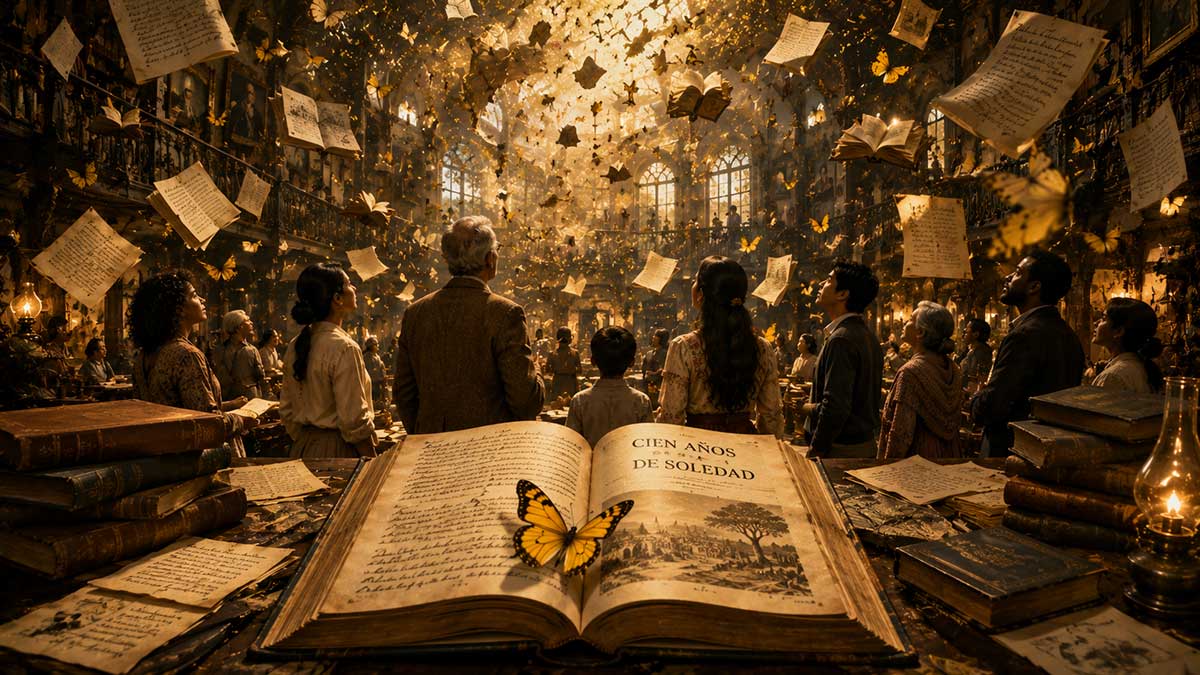
The wind begins before dawn.
It moves first through the almond trees, then along the roofs, then through the narrow streets of Macondo, lifting dust from places that have not been disturbed in years.
By sunrise, loose pages are traveling through the town.
Some are handwritten.
Some are typed.
Some carry family names.
Some contain recipes, debts, military orders, love letters, railway schedules, prophecies, and sentences copied from books no one remembers owning.
A page catches on the church bell.
Another wraps itself around a sleeping dog.
Three more circle the square like pale birds.
At the center of the town, the old reading room has been opened.
Its windows are tall, its shelves uneven, and its ceiling fans turn without electricity. A round table stands beneath a cracked skylight.
Gabriel García Márquez sits there with Álvaro Santana-Acuña, Gene H. Bell-Villada, Philip Swanson, and Michael Wood.
On the table lies a copy of One Hundred Years of Solitude.
It is open to the first page.
The last page is also visible.
No one comments on this.
A loose sheet enters through the window and lands in Gabriel’s coffee.
He lifts it out.
Gabriel García Márquez: This is why writers should never trust the weather.
Michael Wood: What does it say?
Gabriel reads the page.
Gabriel García Márquez: “The future was already written, but nobody had purchased the paperback.”
Gene laughs.
Gene H. Bell-Villada: Then it is a publishing prophecy.
Álvaro Santana-Acuña: Those are usually more dangerous than political ones.
Philip reaches across the table and turns the wet page over.
Philip Swanson: Blank on the other side.
Gabriel García Márquez: The future often is.
Michael looks toward the copy of the novel.
Michael Wood: We have spent a great deal of time asking what the book means.
Perhaps the final question should be simpler.
Why are people still reading it?
Gabriel García Márquez: Because they keep losing the family tree.
Gene H. Bell-Villada: That certainly guarantees rereading.
Philip Swanson: Confusion as literary durability.
Álvaro Santana-Acuña: An underappreciated strategy.
The ceiling fans accelerate.
Several pages on a nearby desk lift, rearrange themselves, and settle into a different order.
Michael watches them.
Michael Wood: Timelessness is a suspicious word.
Philip Swanson: Why?
Michael Wood: Because no book exists outside time.
A book becomes classic through history, not by escaping it.
It is published in a particular moment.
Translated by particular people.
Promoted by publishers.
Taught in schools.
Reviewed.
Debated.
Adapted.
Inherited.
Álvaro Santana-Acuña: Exactly.
Books do not simply remain alive because they possess eternal qualities.
Institutions help keep them alive.
Critics.
Teachers.
Libraries.
Universities.
Book clubs.
Families.
Publishers.
Translators.
Gabriel García Márquez: You are making immortality sound administrative.
Álvaro Santana-Acuña: It often is.
Gene H. Bell-Villada: He is right.
Readers like to imagine that a masterpiece rises naturally above all others.
But many excellent books disappear because the networks around them fail.
Philip Swanson: While other books become unavoidable because every generation is told that it must encounter them.
Gabriel turns toward Álvaro.
Gabriel García Márquez: Then perhaps I owe my afterlife to librarians.
Álvaro Santana-Acuña: More than to most presidents.
Gabriel García Márquez: That is reassuring.
A shelf behind them gives a soft groan.
Every book on it leans left.
Then right.
Then stands upright again.
Gene looks toward it.
Gene H. Bell-Villada: Still, institutional support cannot explain everything.
Many books are taught for decades and remain unloved.
This one continues to create intense personal attachment.
Readers do not merely respect it.
They remember where they were when they first entered Macondo.
Philip Swanson: Some feel as though the book describes their own family, even when their family has nothing visibly in common with the Buendías.
Michael Wood: That is one of its great mysteries.
The novel is culturally specific and structurally universal without flattening either.
Gabriel García Márquez: Be careful with “universal.”
It is a word that often means Europeans recognized themselves.
Álvaro smiles.
Álvaro Santana-Acuña: In this case, recognition came from many directions.
Readers in Asia, Africa, Europe, the Middle East, and the Americas found something familiar in the cycles of family, memory, violence, ambition, and forgetting.
Gene H. Bell-Villada: And in the coexistence of the modern and the traditional.
Many societies know what it means for old beliefs, new technologies, foreign capital, religion, politics, and family memory to occupy the same room.
Philip Swanson: The novel does not ask readers to choose between those worlds.
It shows them colliding.
Michael Wood: Often at dinner.
Gabriel García Márquez: Civilization reveals itself most honestly near food.
A plate of small pastries appears on the table.
No one saw who brought them.
Michael takes one.
Michael Wood: Then I shall conduct field research.
He bites into it.
A folded slip of paper is inside.
Michael Wood: There is a sentence in the pastry.
Gabriel García Márquez: Literature has become very aggressive.
Michael unfolds the paper.
Michael Wood: “You will misinterpret the final chapter.”
Philip Swanson: Accurate.
Gene H. Bell-Villada: For everyone?
Michael Wood: Especially for critics.
They laugh.
Outside, the wind gathers another cluster of pages and presses them against the reading-room windows.
For a moment, the glass is covered with fragments of text.
Then the pages scatter again.
Philip Swanson: I think one reason the novel survives is that it operates at several levels at once.
A reader can enjoy the family story.
Another can focus on Colombian history.
Another on myth.
Another on politics.
Another on narrative technique.
Another simply remembers the images.
Gene H. Bell-Villada: That richness allows the book to change as the reader changes.
At sixteen, someone may remember the magic.
At thirty, the marriages.
At fifty, the repetitions.
At seventy, the forgetting.
Gabriel nods.
Gabriel García Márquez: A book should age differently from its reader.
Michael Wood: That is beautifully put.
Gabriel García Márquez: Write it down quickly before I improve it.
Michael reaches for a pen.
It rolls away from him.
Álvaro Santana-Acuña: Rereadability is essential to classic status.
A book that reveals everything in one encounter may impress, but it rarely becomes a lifelong companion.
Philip Swanson: This novel resists completion.
Even after the ending, readers want to return to the beginning.
Michael Wood: Because the ending alters the beginning.
The first sentence is not the same after the last page.
Gene H. Bell-Villada: The circular structure makes rereading feel almost required.
Gabriel García Márquez: I prefer to call it voluntary captivity.
The skylight rattles.
A yellow butterfly enters, lands on the open book, and remains over the first sentence.
Philip looks at it.
Philip Swanson: The novel has also remained alive because its images are unforgettable.
Ice.
Yellow flowers.
The insomnia plague.
The gold fishes.
The train.
The ascension.
The rain.
The manuscripts.
Michael Wood: Images that are easy to remember and difficult to exhaust.
Gene H. Bell-Villada: They travel well across languages.
Álvaro Santana-Acuña: That matters enormously.
The global career of the novel depended on translation, but vivid images can survive linguistic transformation more easily than subtle wordplay.
Gabriel García Márquez: “More easily” is not the same as easily.
Álvaro Santana-Acuña: No.
Translation remains an act of interpretation.
Philip Swanson: And sometimes reinvention.
Michael Wood: Gregory Rabassa’s English translation was especially important.
Many English-language readers encountered not only your novel, but his version of your novel.
Gabriel looks toward the shelves.
Gabriel García Márquez: Every translation is another Macondo.
The streets are the same.
The weather changes.
Gene H. Bell-Villada: Yet the voice survived remarkably well.
That calm authority.
The long sentences.
The refusal to separate the marvelous from the historical.
Michael Wood: Tone may be one of the hardest things to transport, and one of the most essential here.
Philip Swanson: Without that tone, the novel could become whimsical.
Or sentimental.
Or merely strange.
Gabriel García Márquez: Whimsy is often magic after it has lost its dead.
The room quiets.
The butterfly moves from the first page to the last.
Álvaro watches it.
Álvaro Santana-Acuña: There is another reason the novel endures.
It became larger than literature.
It entered political discourse, cultural identity, tourism, education, and public memory.
Macondo became a concept.
Gene H. Bell-Villada: Sometimes too broad a concept.
Álvaro Santana-Acuña: Certainly.
But that broadness increased circulation.
People who had never read the novel knew the name.
Philip Swanson: Which creates a strange situation.
A book can become famous before it is read.
Michael Wood: Like a person with an exaggerated reputation.
Gabriel García Márquez: Most authors prefer that arrangement.
Gene H. Bell-Villada: Until readers discover the book is more difficult than the reputation suggests.
Gabriel García Márquez: Then the author blames education.
A page flutters down from the ceiling.
It contains a list of countries.
The names continue off the bottom edge.
Álvaro picks it up.
Álvaro Santana-Acuña: The global success was not immediate everywhere.
It spread through networks.
Spanish-language publishing.
The Latin American Boom.
European interest.
Translations.
Reviews.
Academic adoption.
Celebrity.
Political visibility.
Michael Wood: You make it sound almost strategic.
Álvaro Santana-Acuña: Not entirely strategic.
Contingent.
There is always contingency in literary success.
The right translator.
The right publisher.
The right critical moment.
The right readers.
Gabriel García Márquez: Luck prefers to be called history after it succeeds.
Philip Swanson: But the book also arrived when readers were ready for it.
Gene H. Bell-Villada: Ready for a new image of Latin American literature.
Álvaro Santana-Acuña: Yes, though “ready” can be misleading.
Publishers and critics helped create that readiness.
The Boom was not merely discovered.
It was produced through circulation, branding, alliances, and cultural appetite.
Michael Wood: And perhaps through Cold War politics.
Gene H. Bell-Villada: Certainly.
Latin America was being watched politically and culturally.
Revolution, dictatorship, development, dependency, liberation—all of this shaped how literature from the region was received.
Gabriel García Márquez: Writers are always being asked to explain the continent while trying to finish a sentence.
Philip Swanson: Did that burden bother you?
Gabriel García Márquez: Only when the sentence was going well.
A clock on the wall strikes thirteen times.
No one counts aloud.
Michael Wood: I want to return to the emotional life of the book.
Political and institutional explanations tell us how the novel traveled.
They do not fully explain why it remains beloved.
Philip Swanson: Family may be the strongest answer.
Every generation inherits affection and damage.
Most readers understand what it means to love people who are also difficult, secretive, repetitive, proud, wounded, or unreachable.
Gene H. Bell-Villada: The Buendías are extreme, but not alien.
Gabriel García Márquez: Extremity is often ordinary life without embarrassment.
Michael Wood: The novel permits us to see family patterns at mythic scale.
A small domestic silence becomes a century.
A repeated name becomes fate.
A private obsession becomes history.
Philip Swanson: Readers recognize the enlargement.
They may not have civil wars in the kitchen, but they know how one unresolved conflict can outlive the people who began it.
Álvaro Santana-Acuña: That may be especially powerful now, when family history is more accessible than ever.
Genealogy websites.
DNA tests.
Digital photographs.
Archived messages.
People can recover enormous amounts of information.
Gene H. Bell-Villada: Yet information does not guarantee understanding.
Gabriel García Márquez: We established that several generations ago.
Michael Wood: The novel feels contemporary because we remain surrounded by data and vulnerable to amnesia.
Philip Swanson: We document everything.
Then lose the meaning.
Álvaro Santana-Acuña: Or allow platforms and institutions to organize memory for us.
The wind strikes the windows again.
This time, several pages force their way through a gap in the frame.
They swirl above the table.
One carries a printed family photograph.
Another displays a social-media feed.
A third contains a military casualty list.
A fourth is blank except for the words TERMS UPDATED.
Jean Franco would have enjoyed it.
Gabriel catches the last page.
Gabriel García Márquez: Modernity has finally written its novel.
Michael Wood: Is it any good?
Gabriel García Márquez: Nobody has read the terms.
Gene picks up the family photograph.
The faces are blurred.
Gene H. Bell-Villada: The novel’s concern with forgetting may be even more relevant now.
Not because we remember less information.
Because we outsource memory.
Philip Swanson: Photographs remember appearances.
Platforms remember behavior.
Governments remember records.
Families remember stories.
None of those forms is neutral.
Álvaro Santana-Acuña: And abundance creates its own erasure.
When everything is preserved, attention becomes scarce.
Michael Wood: A digital insomnia plague.
People can name everything and understand nothing.
Gabriel looks toward him.
Gabriel García Márquez: You have been saving that phrase.
Michael Wood: Since breakfast.
The butterfly takes flight.
It circles the ceiling fan without being struck.
Philip Swanson: Does modern technology weaken the novel’s magical effect?
Readers today encounter impossible images constantly.
Film.
Animation.
Virtual reality.
Generated images.
Digital worlds.
Michael Wood: Spectacle is easier to create now.
Wonder may be harder.
Gene H. Bell-Villada: That is an important distinction.
A visually impossible event no longer surprises by itself.
But the novel’s power never depended only on spectacle.
It depended on emotional placement.
Álvaro Santana-Acuña: A woman rising into the sky matters not because the image is technically impossible.
It matters because of who she is, how others respond, and how naturally the event belongs to the world.
Gabriel García Márquez: Technology can show anything.
That does not mean it knows why anything should happen.
A child appears at the reading-room door.
He carries a tablet in one hand and a magnifying glass in the other.
Child: Is this the place with the old books?
Gabriel García Márquez: All books are old after they are written.
The child approaches the table and looks at the open novel.
Child: Is it long?
Michael Wood: Moderately.
Child: Does it have a video?
Philip Swanson: Several adaptations are possible.
Gabriel closes the book.
Gabriel García Márquez: It has weather.
The child considers this.
Child: Good weather?
Gabriel García Márquez: Too much of it.
The child notices the butterfly circling above.
Child: Is that part of the book?
Gabriel García Márquez: It depends on whether you remember it later.
The child sets the tablet on the table and opens the magnifying glass over the first page.
Child: Why do they all have the same names?
Everyone at the table laughs.
The child does not.
Child: That seems confusing.
Gabriel García Márquez: It is.
Child: Why not change them?
Gabriel studies him.
Gabriel García Márquez: Because families rarely do what is easiest for readers.
The child thinks again.
Child: Does anyone learn anything?
No one laughs this time.
Michael leans back.
Michael Wood: That may be the question the book continues asking every generation.
Child: What is the answer?
Gabriel opens the novel again.
Gabriel García Márquez: Read until the wind.
The child takes one pastry from the plate, pockets it, and leaves with the tablet and magnifying glass.
Gene watches him go.
Gene H. Bell-Villada: That may be the future readership.
Álvaro Santana-Acuña: Shorter attention span, different media habits, endless alternatives.
Philip Swanson: Do you think the novel can continue to reach them?
Michael Wood: Great books do not survive by remaining unchanged in the world.
They survive because new contexts create new readings.
Gene H. Bell-Villada: But access matters.
Teaching matters.
Translation matters.
Adaptation matters.
A difficult classic can disappear from ordinary reading even while remaining academically prestigious.
Álvaro Santana-Acuña: The canon is not permanent.
No book is guaranteed a future.
Gabriel looks pleased by this.
Gabriel García Márquez: Good.
Immortality makes writers careless.
Philip Swanson: Yet this book has already survived major cultural shifts.
Álvaro Santana-Acuña: Yes, but survival should not be confused with inevitability.
Each generation must decide whether the book still speaks.
Michael Wood: And whether it speaks beyond its reputation.
Gene H. Bell-Villada: The challenge is to present it as alive, not as homework.
The ceiling fans stop.
Instantly, every loose page in the room falls to the floor.
The silence is sudden and complete.
Gabriel looks around at the paper covering the tiles.
Gabriel García Márquez: There.
The canon.
Michael looks down.
Michael Wood: Untidy.
Gabriel García Márquez: Mostly unread.
They begin picking up the pages.
Each page seems to belong to a different era.
A telegram.
A school essay.
A love letter.
A newspaper clipping.
A digital printout.
A handwritten family secret.
Philip lifts one carrying a reader’s note in the margin.
Philip Swanson: “I do not understand why this makes me miss people I never knew.”
He looks at the others.
Philip Swanson: That may explain more than we have.
Michael Wood: The book creates nostalgia for an invented place.
Gene H. Bell-Villada: But the emotion attaches to real losses.
Childhood.
Family homes.
Dead relatives.
Languages fading.
Towns transformed.
Álvaro Santana-Acuña: Readers borrow Macondo to mourn their own vanished worlds.
Gabriel takes the note from Philip.
Gabriel García Márquez: Fiction gives people memories they can use.
Michael Wood: Even when the events never happened?
Gabriel García Márquez: Especially then.
A real memory belongs to one life.
An invented memory can belong to millions.
The wall clock begins running backward.
Outside, the wind grows stronger.
The almond trees bend.
Shutters bang open along the street.
The copy of the novel flips through its pages by itself.
Beginning.
Middle.
End.
Beginning again.
Gene H. Bell-Villada: The book also endures because it understands historical recurrence.
Wars repeat.
Promises of progress repeat.
Foreign powers arrive with new language.
Violence is denied.
Families repeat themselves.
Philip Swanson: That gives it renewed relevance whenever readers feel history returning.
Michael Wood: Which is frequently.
Álvaro Santana-Acuña: But we should resist using the novel as a prediction machine.
Every crisis is not Macondo.
Every political leader is not an Aureliano.
Every company is not the banana company.
Gabriel García Márquez: Thank you.
The world has enough bad analogies.
Gene H. Bell-Villada: Still, literature helps readers perceive patterns.
Álvaro Santana-Acuña: Yes.
Patterns, not exact repetitions.
Michael Wood: The novel teaches suspicion toward claims that history is finished.
Philip Swanson: And toward claims that progress has removed the old dangers.
Gabriel García Márquez: The future often arrives wearing the clothes of the past and expecting compliments.
A shutter tears free from a nearby building and sails across the square.
No one at the table moves.
The skylight darkens with dust.
Michael places a hand over the open book.
Michael Wood: We may be approaching the wind.
Gabriel García Márquez: The child was warned.
Philip Swanson: Does the ending make the novel feel timeless?
Michael Wood: Yes, partly.
The act of reading becomes part of the destruction.
Aureliano reads the manuscripts at the exact moment the town is being erased.
Understanding and ending coincide.
Gene H. Bell-Villada: The reader experiences the same structure.
We finish the book as Macondo finishes.
Álvaro Santana-Acuña: Yet every new reader recreates it by beginning again.
Gabriel looks toward him.
Gabriel García Márquez: That is the only resurrection literature offers.
Not continuation.
Repetition with a new witness.
The wind forces the reading-room doors open.
Pages rise from the floor.
Books pull halfway from the shelves.
The five men remain at the table.
The novel’s pages turn faster.
Philip Swanson: Then perhaps the book survives because it contains its own disappearance.
Michael Wood: Explain.
Philip Swanson: It knows that families vanish.
Towns vanish.
Political truths vanish.
Memories vanish.
Even languages and nations can be transformed beyond recognition.
The novel does not promise permanence.
It dramatizes loss so completely that readers feel compelled to remember.
Gene H. Bell-Villada: It turns disappearance into an act of memory.
Álvaro Santana-Acuña: And each reading renews that act.
Gabriel presses one hand onto the book.
The pages continue turning beneath his palm.
Gabriel García Márquez: A story does not defeat oblivion.
It negotiates.
A loose page strikes Michael in the shoulder and wraps around his arm.
He removes it.
Michael Wood: What are the terms?
Gabriel García Márquez: Temporary recognition.
No guarantees.
Everyone laughs, though the room is now shaking.
A shelf collapses.
The books do not fall.
They remain suspended in the air, open at different pages.
Hundreds of sentences surround the table.
Some are in Spanish.
Some in English.
Some in French, Arabic, Japanese, Korean, Portuguese, and languages no one present can identify.
Álvaro stands slowly.
Álvaro Santana-Acuña: There is the real afterlife.
Not one permanent text.
Many acts of transmission.
Gene H. Bell-Villada: Many readers.
Philip Swanson: Many Macondos.
Michael Wood: Many misunderstandings.
Gabriel García Márquez: Essential for survival.
The roof groans.
Sunlight appears through a new crack.
Outside, the sign above the reading room tears loose and disappears down the street.
The open books continue floating.
Michael Wood: Then let us answer plainly.
Why has One Hundred Years of Solitude remained timeless?
Gene H. Bell-Villada: Because it makes history intimate.
Philip Swanson: Because it makes family life mythic without making it unrecognizable.
Álvaro Santana-Acuña: Because translation, teaching, publishing, and global circulation continually introduced it to new readers.
Michael Wood: Because its language transforms impossible events into emotional truth.
They turn toward Gabriel.
The wind tears the final page from the novel.
Gabriel catches it before it can escape.
He reads silently.
Gabriel García Márquez: Those are all respectable answers.
Michael Wood: And yours?
Gabriel folds the page once.
Then again.
He places it inside his shirt pocket.
Gabriel García Márquez: Because people continue building things they believe will last.
Families.
Towns.
Nations.
Companies.
Reputations.
Archives.
He looks toward the doorway, where pages and dust are spiraling into the square.
Gabriel García Márquez: And they continue discovering that nothing lasts unless someone remembers what it cost.
The suspended books begin closing.
One after another.
The sound travels through the room like distant thunder.
Philip Swanson: Is that what makes the novel timeless?
Gabriel García Márquez: No book is timeless.
He stands.
Gabriel García Márquez: But some books keep finding the wound each age has renamed.
The roof lifts several inches.
Daylight floods the room.
The round table begins sliding toward the door.
Gene grabs the edge.
Michael secures the coffee pot.
Philip gathers the loose notes.
Álvaro reaches for the open novel, but Gabriel stops him.
Gabriel García Márquez: Leave it.
Álvaro Santana-Acuña: Why?
Gabriel García Márquez: Someone has to find the first page.
The table breaks free and moves across the room.
The five men step away.
The copy of One Hundred Years of Solitude remains alone beneath the skylight.
The wind turns its pages backward.
Last.
Middle.
First.
The butterfly returns and lands on the opening sentence.
For one impossible moment, the entire town becomes silent.
No wind.
No bells.
No train.
No voices.
Only the sound of a child outside opening a book.
Then Macondo begins again.
Final Thoughts

At the end of One Hundred Years of Solitude, Macondo is not merely destroyed.
It is read.
Aureliano reaches the final lines of Melquíades’ manuscripts at the exact moment the town reaches its end. The act of understanding arrives too late to save the Buendías, yet it allows their complete history to become visible for the first time.
That may be the novel’s final warning.
A family can possess memories without understanding its patterns.
A nation can preserve documents while denying its history.
A person can live among others while remaining emotionally unreachable.
A society can call itself modern while repeating very old forms of violence, exploitation, pride, and forgetting.
The Buendías are not destroyed because they lack intelligence, ambition, passion, or love.
They are destroyed because those qualities repeatedly fail to become self-knowledge.
Their names return, but their understanding does not.
Their desires return, but their wisdom does not.
Their history returns, but each generation experiences it as though it were new.
Through magical realism, García Márquez makes these repetitions visible.
Ghosts show that the past has not left.
Falling flowers show that grief exceeds ordinary language.
The insomnia plague shows that memory can disappear even while objects remain.
The repeated gold fishes show how routine can become both protection and imprisonment.
The endless rain shows how sorrow can alter the weather of an entire life.
Macondo itself becomes the largest image of all.
It is a town built through imagination, ambition, isolation, discovery, conflict, and hope. It welcomes invention, politics, commerce, and progress, yet it never fully learns how to interpret what these forces are doing to it.
Its tragedy is not simply that the outside world arrives.
Its tragedy is that the people of Macondo often recognize history only after history has already changed the meaning of their lives.
Yet the novel is not only tragic.
It is also playful, generous, sensual, absurd, and alive.
Its humor prevents sorrow from becoming lifeless.
Its beauty prevents history from becoming abstraction.
Its strange events remind us that reality is often much larger than the categories we use to explain it.
This may be why readers continue returning to the book.
We recognize our families in its repetitions.
We recognize our societies in its forgotten violence.
We recognize our loneliness in its crowded rooms.
We recognize our hope in its constant rebuilding.
Every new reader creates Macondo again.
The houses rise.
The gypsies return.
The ice is discovered.
The wars begin.
The train arrives.
The rain falls.
The names repeat.
And for several hundred pages, the town is saved from disappearance because someone is paying attention.
Perhaps that is the responsibility the novel ultimately gives us.
Not to believe that memory alone will save us.
Not to assume that love automatically ends harmful patterns.
Not to confuse technological progress with wisdom.
Not to treat history as something that happened only to other people.
The task is to notice the pattern while there is still time to interrupt it.
To ask why the same silence keeps returning.
To listen before another person becomes a role instead of a mystery.
To preserve not only the facts of suffering, but their meaning.
To recognize that what appears to be fate may sometimes be repetition that no one has yet found the courage to question.
Macondo disappears in the final wind.
But the reader remains.
And that may be the novel’s quietest hope.
We are not required to repeat the story simply because we have inherited it.
Short Bios:
Gabriel García Márquez was a Colombian novelist, journalist, and short-story writer, widely regarded as one of the most important authors of the twentieth century. He received the Nobel Prize in Literature in 1982. His most celebrated novel, One Hundred Years of Solitude, helped bring global attention to Latin American literature and became one of the defining works associated with magical realism. His writing combined family memory, political history, oral storytelling, myth, humor, and the extraordinary textures of Caribbean life.
Gene H. Bell-Villada is a literary critic, scholar, and author known for his extensive work on Gabriel García Márquez and Latin American literature. His book García Márquez: The Man and His Work has been an influential introduction to the author’s fiction, politics, historical context, and literary development. Bell-Villada has helped readers understand the relationship between García Márquez’s imaginative style and the social realities of Latin America.
Gerald Martin is a British scholar, literary critic, and biographer specializing in Latin American literature. He wrote Gabriel García Márquez: A Life, one of the most comprehensive biographies of the Colombian author. Martin’s research connects García Márquez’s fiction to his childhood, family history, journalism, political relationships, literary career, and the historical experiences that shaped his imagination.
Philip Swanson is a scholar of Hispanic and Latin American literature whose work has explored Gabriel García Márquez, magical realism, popular culture, and the international reception of Latin American fiction. He has written accessible and influential studies of García Márquez’s novels, examining how the author combines political history, emotional experience, mythology, sexuality, and narrative experimentation.
Michael Wood is a literary critic, author, and scholar known for his writing on world literature, film, and modern fiction. He has written extensively about Gabriel García Márquez and the narrative qualities that give his work its distinctive power. Wood’s criticism often emphasizes language, tone, irony, memory, and the subtle ways fiction makes impossible events feel emotionally convincing.
Regina Janes is a literary scholar whose work on One Hundred Years of Solitude has offered detailed analysis of the novel’s structure, history, symbolism, family patterns, and political dimensions. Her criticism has helped readers understand how García Márquez combines intimate domestic life with larger questions of national identity, memory, colonialism, and historical repetition.
Jean Franco was a major scholar of Latin American literature and culture. Her work examined literature through the lenses of politics, gender, colonialism, revolution, state power, and cultural memory. Franco’s criticism challenged readers to consider who carries the burdens of history, whose voices are excluded, and how literary beauty can both reveal and potentially obscure material suffering.
Raymond Leslie Williams is a scholar of Latin American literature, particularly the Colombian novel. His work has examined García Márquez within the broader development of Colombian and Latin American fiction. Williams has explored the relationship between regional identity, literary innovation, history, modernity, and the changing cultural landscapes represented in works such as One Hundred Years of Solitude.
Juan Moreno Blanco is a Colombian scholar and critic whose work has explored Caribbean culture, African and Indigenous influences, oral tradition, identity, and the cultural foundations of García Márquez’s fiction. His perspective emphasizes that magical realism should not be separated from the diverse histories, beliefs, and forms of knowledge that shaped the Caribbean and Latin American world.
Stephen M. Hart is a scholar of Latin American literature and film who has written extensively on magical realism, Gabriel García Márquez, and the global influence of Latin American storytelling. His work examines the techniques, traditions, historical forces, and cultural encounters that helped magical realism become one of the most recognizable literary forms of the modern era.
Álvaro Santana-Acuña is a sociologist and scholar known for his research on how One Hundred Years of Solitude became a global classic. His work examines the networks of publishers, translators, critics, intellectuals, institutions, and readers that helped the novel achieve worldwide influence. He shows that literary classics do not become timeless through artistic quality alone, but also through circulation, interpretation, cultural timing, and sustained public attention.
Leave a Reply