
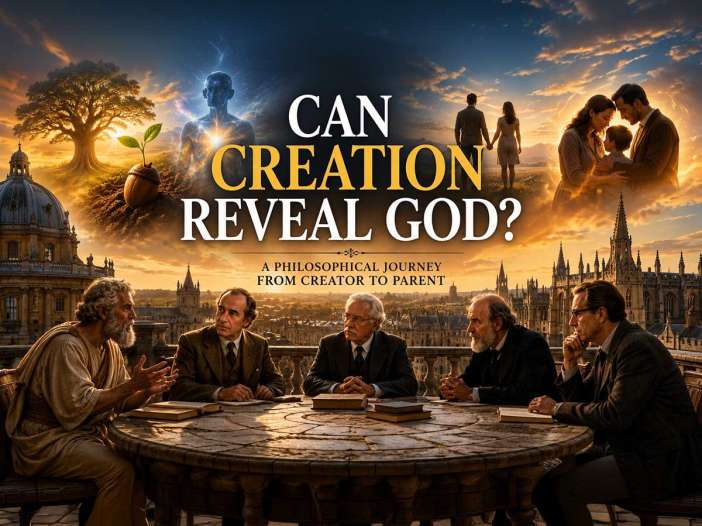
What if the visible universe is not merely matter, but the expression of an invisible reality?
Throughout history, human beings have asked one of life's greatest questions:
Can we know anything about God simply by observing the world around us?
Some have looked through telescopes.
Others have searched through sacred scriptures.
Still others have looked inward through philosophy, psychology, and personal experience.
But what if the answers have been quietly present all along?
This Imaginary Talk follows two simple observations that anyone can examine.
The first begins with the world itself.
Everywhere we look, we find visible forms expressing invisible realities. An idea becomes a painting. A melody becomes music. A blueprint becomes a building. A person's thoughts become words and actions. Could the universe itself also be the visible expression of an invisible source?
The second observation begins with humanity.
Every person enters the world through a man and a woman. Masculine and feminine qualities appear throughout human life, finding their fullest expression in fatherhood and motherhood. Could these complementary qualities reveal something about the One from whom humanity came?
Rather than debating religious traditions or defending denominational doctrines, five distinguished thinkers explore these questions through philosophy, psychology, ethics, and human experience. Together they ask whether creation reflects its Creator, whether human nature reveals something of God's character, and whether the deepest relationship between God and humanity is not merely that of Creator and creation, but Parent and child.
Joining this conversation are Aristotle, the philosopher of causes and purpose; C. S. Lewis, the Christian writer who explored reason and longing; Carl Jung, whose work illuminated the symbolic depths of the human psyche; Martin Buber, the philosopher of genuine relationship; and Erich Fromm, whose writings on love and human maturity continue to shape modern thought.
Their conclusions are not presented as final proof, but as an invitation to observe the world with fresh eyes and ask whether the deepest truths of existence have been quietly reflected in creation all along.
(Note: This is an imaginary conversation, a creative exploration of an idea, and not a real speech or event.)
Topic 1: Can the Visible World Reveal an Invisible Source?
Setting
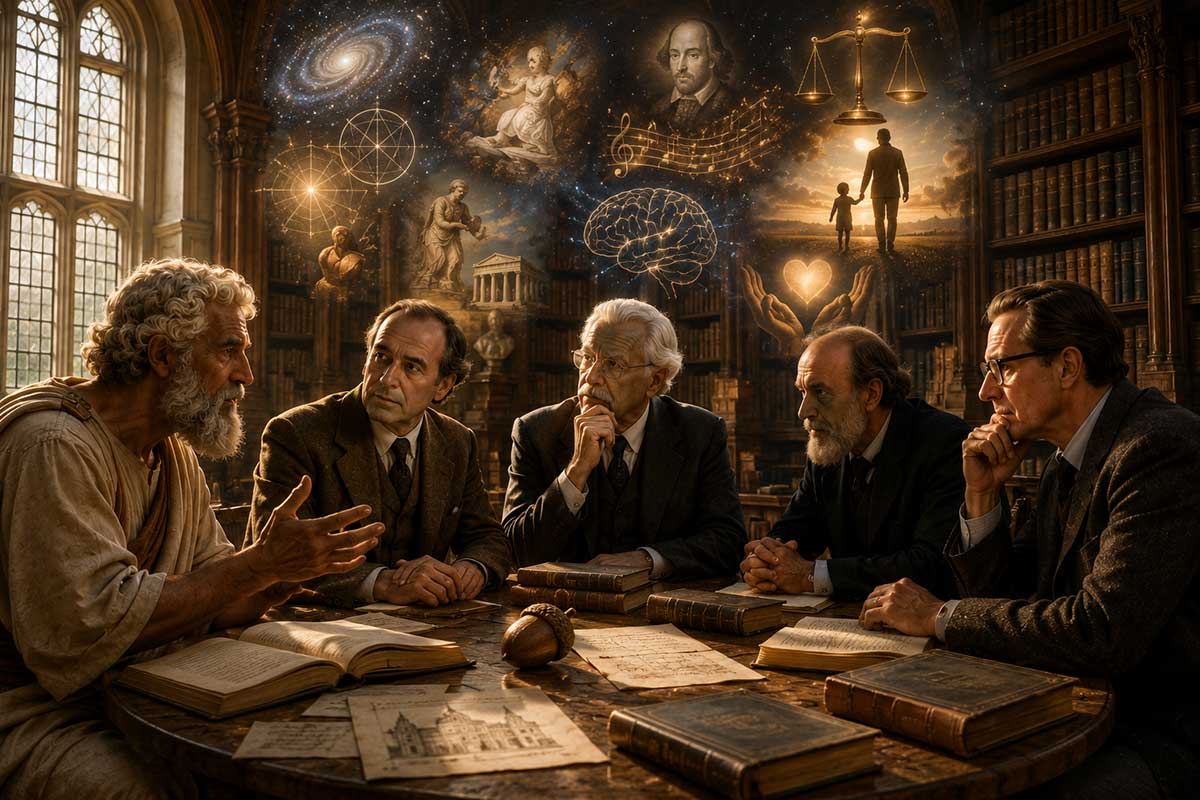
The first light of dawn filters through the stained-glass windows of the Bodleian Library at Oxford. Dust drifts quietly through the golden beams, settling upon centuries-old books that have preserved humanity's greatest questions.
At the center of the library sits a large circular oak table.
Five thinkers have gathered.
Aristotle gently rolls a polished acorn between his fingers.
C. S. Lewis studies an old leather-bound notebook.
Carl Jung quietly observes the room itself, almost as though it were speaking.
Martin Buber pours tea into five small cups.
Erich Fromm smiles as he notices a young student sketching silently in a distant corner before leaving the library.
The room becomes still.
Aristotle begins.
Opening
Aristotle: Before we ask whether God exists, perhaps we should ask a simpler question.
What kind of world do we actually live in?
Not the world we imagine.
The world we observe.
C. S. Lewis: That's refreshing.
Most conversations begin by arguing over religion.
You've begun by asking us to pay attention.
Martin Buber: And paying attention may be one of the most spiritual acts a person can perform.
Reality often speaks quietly.
The problem is not that it hides.
The problem is that we seldom look long enough.
Carl Jung: Modern people have become experts at measuring things.
We measure weight.
Distance.
Time.
Electricity.
Yet we often overlook the invisible realities that give those measurements meaning.
Erich Fromm: Perhaps because the invisible cannot be placed under a microscope.
Yet the things people treasure most...
Love.
Trust.
Meaning.
Hope.
None of them can be weighed.
Question 1: Does every visible thing point to something invisible?
Aristotle places the acorn on the table.
Aristotle: What do you see?
Lewis: An acorn.
Aristotle: Only an acorn?
Or the possibility of an oak tree?
Lewis smiles.
Lewis: Both.
The tree is hidden inside what appears to be something very small.
Aristotle: Exactly.
The visible object carries an invisible potential.
The tree cannot yet be seen.
Yet it is already present.
Jung: Human beings are similar.
When we meet a child, we do not merely see a body.
We see possibilities.
Character.
Dreams.
A future that has not yet become visible.
Fromm: Every meaningful relationship works that way.
When a teacher looks at a student...
A parent looks at a child...
Or a friend believes in another friend...
They often see something invisible long before the world does.
Buber: Which means the invisible is not less real than the visible.
Quite often...
It is more important.
Question 2: Does every outward expression begin with an inward reality?
Lewis opens his notebook.
Inside is a handwritten page from one of his unfinished essays.
Lewis: Before these words appeared on paper...
Where were they?
Jung: In your mind.
Lewis: Could anyone else see them?
Jung: No.
Lewis: Yet they existed.
Invisible.
Waiting to become visible.
Aristotle: A sculptor first sees the statue before striking the stone.
An architect first imagines the building before laying the foundation.
A composer hears the melody before anyone else hears the music.
Again and again...
The invisible gives birth to the visible.
Fromm: Even a family begins this way.
Long before a child is born...
There is a desire.
A hope.
A decision to share life.
Everything important seems to begin within before it appears without.
Buber: Which raises an intriguing possibility.
If the visible universe came into existence...
Might it also have begun within an unseen reality?
The table falls quiet.
Question 3: What might this pattern reveal about the source of creation?
Aristotle slowly looks around the room.
Aristotle: Let us gather our observations.
Everywhere we look...
We find visible expressions that arise from invisible realities.
Ideas become inventions.
Thoughts become words.
Love becomes sacrifice.
Dreams become civilizations.
Why should the universe itself be different?
Lewis: Then perhaps we have been asking the wrong question.
Instead of asking,
"Can we see God?"
Perhaps we should ask,
"What invisible reality could adequately explain what we do see?"
Jung: Human beings often assume that only matter is real.
Yet consciousness itself refuses to fit neatly into that assumption.
You cannot place justice on a scale.
You cannot photograph hope.
You cannot dissect beauty.
Yet none of us doubts their existence.
Fromm: In fact, the invisible often governs the visible.
Greed can build an empire.
Compassion can transform a nation.
An unseen idea can reshape history.
Buber: Which suggests something profound.
Reality may not simply consist of objects.
Reality may first consist of meaning.
Relationship.
Purpose.
The visible world may be the expression of something deeper.
Closing
Morning light now fills the library.
The old wooden shelves seem almost alive beneath the growing brightness.
Lewis closes his notebook.
Lewis: If what we've observed is true...
Then perhaps the universe is not merely a collection of physical things.
Perhaps it is the visible expression of a deeper reality.
Aristotle: A reality possessing intelligence.
Purpose.
Order.
Jung: Perhaps even personality.
Fromm: If so...
Then the human mind may tell us more about the source of creation than distant galaxies.
Buber: Which leads naturally to our next question.
If human beings possess reason...
Conscience...
Creativity...
Love...
What do those qualities reveal about the One from whom they came?
The five men quietly gather their books.
Outside, the sun has fully risen.
Their attention now turns from the universe...
to the mystery of the human person.
Topic 2: What Does Human Nature Reveal About Its Source?
Setting
The morning sun has climbed higher.
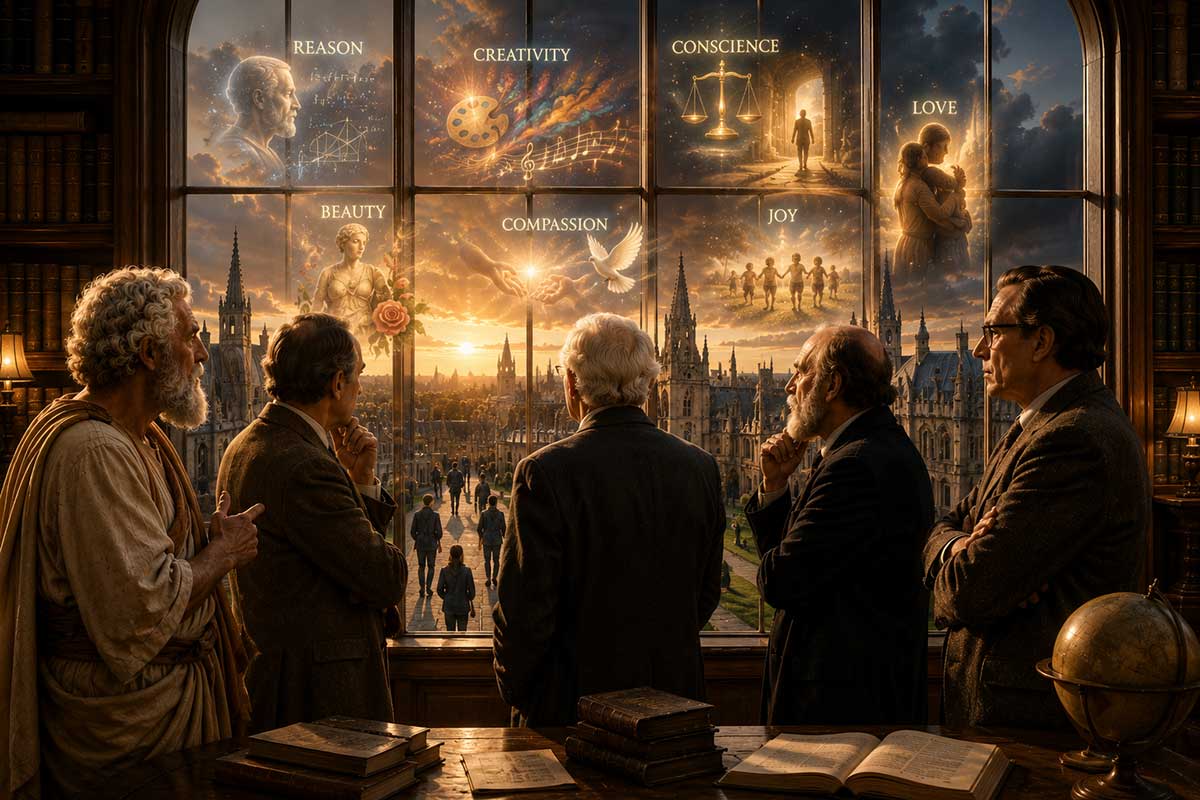
The library is now filled with warm golden light. Students quietly pass outside the tall windows, unaware that inside, five of history's great thinkers are wrestling with one of humanity's oldest questions.
The discussion has moved.
The guests are no longer looking at the universe.
They are looking at themselves.
Lewis slowly turns a pencil between his fingers.
Opening
C. S. Lewis: We ended our last discussion with an interesting possibility.
If the visible universe expresses an invisible source...
Perhaps the clearest window into that source is not the stars.
Perhaps it is us.
After all, we are the only part of nature asking why nature exists.
Aristotle: A fascinating observation.
Human beings are capable of examining the universe that produced them.
That alone distinguishes us from every other creature.
Carl Jung: We are strange beings.
We possess bodies like animals.
Yet we ask questions that no animal appears to ask.
What is truth?
Why is there beauty?
What is justice?
Why do I exist?
Martin Buber: And perhaps the most remarkable question is not "What am I?"
It is...
"Who are you?"
Human beings are built for relationship.
Erich Fromm: Which immediately raises another question.
If relationship is central to human nature...
Could relationship also belong to the source from which we came?
Question 1: Why do invisible qualities matter more than visible ones?
Lewis notices a framed photograph resting on a nearby shelf.
It shows an elderly couple holding hands.
Lewis: Suppose I showed someone this photograph.
What would they actually see?
Paper.
Ink.
Color.
Nothing more.
Yet anyone who has loved someone sees much more.
They see fifty years of shared life.
Sacrifice.
Forgiveness.
Memories.
The visible picture carries an invisible story.
Jung: Exactly.
Human beings never experience one another as bodies alone.
We encounter character.
Trust.
Humor.
Compassion.
Those invisible qualities become the real person.
Aristotle: Which means the visible body expresses something greater than itself.
Otherwise we would never speak of a beautiful soul.
Fromm: And notice something else.
When someone dies...
The body remains.
Yet everyone says,
"They're gone."
Who is gone?
The body is still present.
What has disappeared cannot be weighed or measured.
Yet everyone knows something real has departed.
The table grows quiet.
Question 2: Why do human beings hunger for truth, beauty, and love?
Buber: Let me ask something simple.
Why are people moved by beauty?
A sunset feeds no one.
Music cannot be eaten.
Poetry has no market value.
Yet they nourish us.
Why?
Lewis: Hunger suggests food exists.
Thirst suggests water exists.
Our desire for meaning...
Truth...
Beauty...
Love...
Might those longings also point toward something real?
Jung: Throughout history, every civilization has searched for beauty.
Every civilization has buried its dead with dignity.
Every civilization has asked about meaning.
These are not accidental behaviors.
Fromm: Human beings can survive without poetry.
But they rarely flourish without meaning.
They can survive without admiration.
Yet they wither without love.
Perhaps these longings reveal something fundamental about who we are.
Aristotle: Or perhaps...
They reveal something fundamental about the source from which we came.
Question 3: Could our highest qualities reflect the One who gave them?
Lewis leans forward.
Lewis: Let me ask everyone something.
Can a source give what it does not possess?
Aristotle: In some manner...
No.
An unintelligent cause does not produce intelligence from nothing.
A purposeless cause does not easily explain purpose.
Jung: Human consciousness remains one of the deepest mysteries.
Matter somehow became aware of itself.
Or perhaps...
Consciousness was never merely an accident of matter.
Fromm: Love is equally mysterious.
People willingly sacrifice comfort...
Career...
Even life itself...
For another person.
If survival were our only purpose, such behavior would make little sense.
Buber: Relationship transforms us.
The greatest moments of life are rarely moments of possession.
They are moments of encounter.
Meeting another person.
Being known.
Being loved.
Lewis: Then perhaps our greatest capacities—
Reason.
Conscience.
Creativity.
Beauty.
Joy.
Love.
Relationship—
Are not random developments.
Perhaps they are reflections.
Not perfect reflections.
But genuine ones.
Reflections of the One whose nature gave rise to ours.
Closing
The library clock quietly strikes noon.
Outside, students laugh as they cross the courtyard.
Inside, no one speaks for several moments.
Finally, Aristotle breaks the silence.
Aristotle: We have reached an important conclusion.
The visible world appears to express an invisible source.
Human nature appears to express qualities found within that source.
But one observation continues to puzzle me.
If humanity reflects its source...
Why does humanity exist in two complementary forms?
Why man...
and woman?
Jung slowly smiles.
Jung: That question may take us closer to understanding God than many theological arguments.
Lewis closes his notebook.
Lewis: Then let us begin there.
Not with doctrines.
Not with traditions.
Simply with the extraordinary fact...
That every human being enters the world through a man...
and a woman.
Topic 3: What Do Man and Woman Reveal About the Source of Humanity?
Setting
Afternoon light now stretches across the library floor.
The five thinkers have moved from the round table to a gallery lined with portraits. Some show kings and queens. Others show mothers, fathers, scholars, laborers, children, and families from different periods of history.
At the far end stands a large painting of a man and woman facing one another beneath an old tree.
Neither figure dominates the painting.
Each appears incomplete without the other.
Carl Jung stops before it.
Opening
Carl Jung: We have said that visible form may express an invisible reality.
We have considered whether human reason, love, conscience, and creativity reveal something about the source of humanity.
Now we must face another fact.
Humanity does not appear in one form.
It appears as man and woman.
Aristotle: A pattern so universal must deserve philosophical attention.
C. S. Lewis: Yet people often move past it too quickly.
They say that men and women are biologically necessary for reproduction, then treat the matter as settled.
Erich Fromm: Biology explains part of the pattern.
It does not explain its full human meaning.
Men and women do more than reproduce.
They encounter one another.
They learn from one another.
They form bonds.
They create families and cultures together.
Martin Buber: Difference makes relationship possible.
If the other person were merely another version of myself, there would be no true encounter.
The other person stands before me with a life I cannot completely possess or predict.
Question 1: Why does humanity appear through two complementary forms?
Jung studies the painting.
Jung: Suppose humanity had appeared in only one form.
What would be missing?
Lewis: A whole dimension of human experience.
Fromm: A different way of seeing, caring, relating, and giving.
Aristotle: The continuation of life would be impossible.
Yet the pattern seems deeper than reproduction.
The difference between man and woman creates mutual dependence.
Neither can generate human life alone.
Buber: That dependence carries meaning.
Life begins through relationship.
No person is self-created.
No person enters existence alone.
Lewis: Which may itself be a clue.
Perhaps independence is not the highest condition of life.
Perhaps relationship is.
Jung: Modern culture often praises self-sufficiency.
Yet the structure of human existence quietly contradicts it.
From our first moment, we depend upon others.
We are conceived through relationship.
Born through relationship.
Raised through relationship.
And shaped through relationship.
Question 2: If both man and woman come from one source, what must be true of that source?
Aristotle turns from the painting.
Aristotle: Let us apply the reasoning we have already used.
If an effect reveals something about its cause, and humanity appears as both man and woman, what follows?
Lewis: The source of humanity cannot be represented completely by masculinity alone.
Fromm: Nor by femininity alone.
Jung: The source must contain the origin of qualities that later appear through both.
Buber: We should be careful with the word “contain.”
We are not describing a physical body.
We are speaking about the source of capacities and qualities.
Aristotle: Correct.
The source need not be biologically male or female.
Yet it must be adequate to explain the existence of both.
Lewis: Which raises a difficult question for religious language.
When God is described only as male, do people begin to confuse a symbol with the whole reality?
Jung: That has happened often.
The masculine image may communicate authority, strength, responsibility, or direction.
Yet when it becomes exclusive, qualities associated with tenderness, receptivity, nurture, patience, and emotional intimacy may be pushed away from our image of God.
Fromm: And those qualities are no less important.
Human beings need love that calls them forward.
They also need love that receives them.
They need protection.
They need comfort.
They need discipline.
They need mercy.
Buber: Perhaps the mistake is not using masculine language.
The mistake is believing that masculine language exhausts the source of humanity.
Question 3: Do masculine and feminine qualities point toward a deeper unity?
Lewis pauses before another painting.
It shows a father teaching a child to walk and a mother kneeling nearby with open arms.
Lewis: We often describe certain qualities as masculine or feminine.
Courage.
Gentleness.
Strength.
Compassion.
Direction.
Patience.
Yet no quality belongs entirely to one sex.
Jung: Exactly.
A mature man may be tender.
A mature woman may be formidable.
Psychological health requires more than conforming to a narrow role.
Wholeness asks each person to develop qualities that may first appear unfamiliar.
Fromm: Then perhaps masculine and feminine do not represent two sealed worlds.
They are distinct expressions within one human nature.
Aristotle: Distinction without complete separation.
Unity without sameness.
Buber: That is the condition of relationship itself.
Two persons remain distinct, yet love allows them to participate in a shared life.
Lewis: Then perhaps the source of humanity is not divided.
The qualities expressed through man and woman may exist in unity at their origin.
Jung nods.
Jung: The visible difference may point back to an invisible wholeness.
Human beings encounter those qualities in separated forms.
The source may hold them together without conflict.
A Necessary Challenge
Fromm folds his arms.
Fromm: We should test this idea carefully.
Could we simply be projecting human categories onto God?
Perhaps men and women exist through evolution and biology, and our religious language merely copies those patterns.
Aristotle: Projection is possible.
Yet it does not settle the question.
The fact that a thought could be projected does not prove that it is false.
Jung: We must ask which explanation fits the pattern more fully.
Did humanity invent the idea of complementary qualities?
Or did human consciousness recognize a pattern already present in life?
Lewis: There is another issue.
If human beings possess qualities that their source lacks entirely, then the effect seems greater than its cause.
That is philosophically difficult.
Buber: Yet we must leave room for mystery.
A reflection can reveal its source without containing the whole source.
Human masculinity and femininity may offer clues, not a complete definition of God.
Fromm: That is the right balance.
We can say that the source of humanity must account for both man and woman.
We cannot claim that we have captured the full nature of that source.
From Difference to Parenthood
The five men continue down the gallery.
The final painting shows a man and woman holding a newborn child.
The mother looks down at the infant.
The father looks at both of them.
The child rests between them.
Buber stops.
Buber: Here the pattern changes.
Man and woman are no longer facing only one another.
Their love has opened outward.
Aristotle: Toward new life.
Fromm: Toward responsibility.
Jung: Toward sacrifice.
Lewis: Toward parenthood.
They stand silently before the painting.
Lewis: Perhaps this is where the meaning of man and woman reaches its fullest expression.
Not merely in difference.
Not merely in attraction.
But in becoming the source of life for another person.
Buber: And in entering a relationship where love gives before it receives.
Aristotle: Then our next question becomes unavoidable.
If man and woman reveal complementary qualities that originate in one source...
And if their union opens into fatherhood and motherhood...
Does parenthood itself reveal something about that source?
Closing
The afternoon light begins to fade.
The painting of the family glows beneath a single lamp.
Jung looks once more at the child resting between the parents.
Jung: We began by asking what man and woman reveal about God.
Perhaps they reveal more than complementary qualities.
Perhaps they reveal the possibility of parental love.
Fromm: Love that creates life.
Buber: Love that seeks relationship.
Aristotle: Love that carries purpose.
Lewis: Then perhaps the deepest clue has been in front of us from the beginning.
The source of masculinity and femininity may also be the source of fatherhood and motherhood.
And if that is true...
We may be approaching a very different picture of God.
Not merely as the cause of life.
But as the origin of parenthood itself.
Topic 4: What Do Fatherhood and Motherhood Reveal About God?
Setting
Evening settles over Oxford.
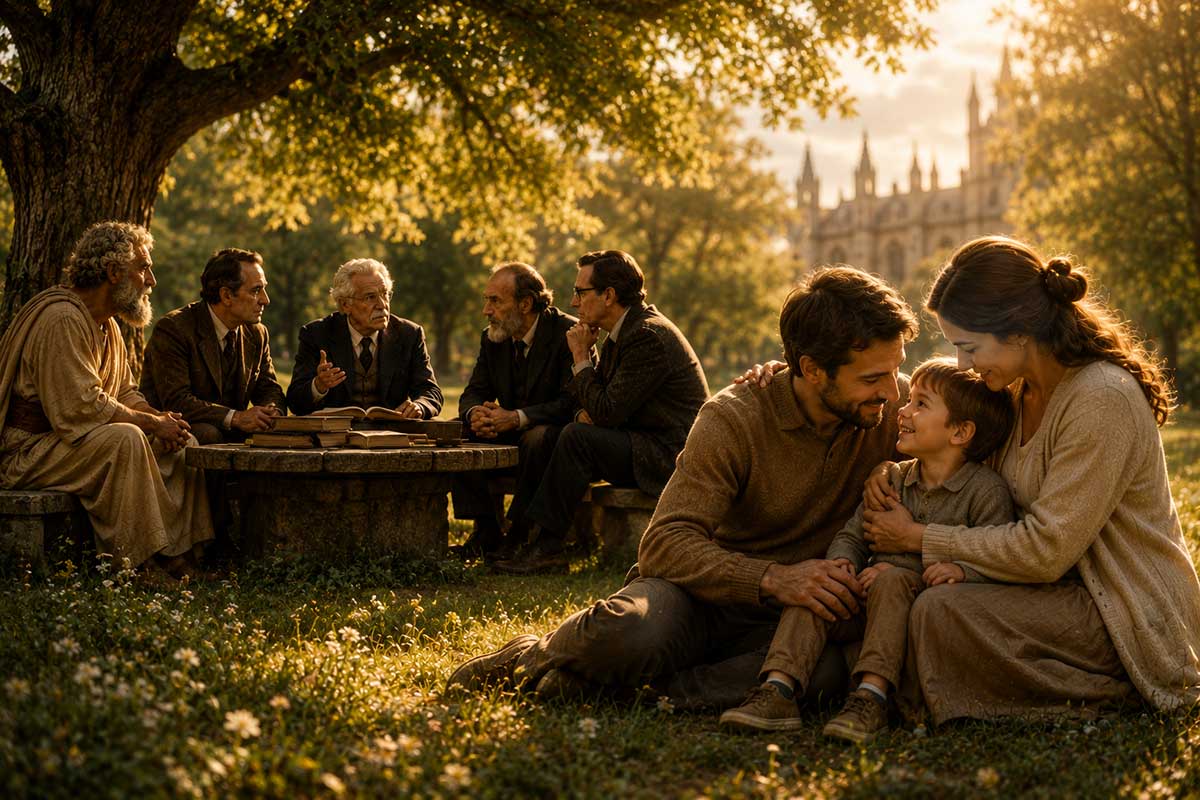
The gallery has grown dim, and the five thinkers return to the circular table in the library. A single lamp illuminates the painting they have brought with them: a father and mother holding a newborn child.
Rain begins again beyond the windows.
The sound is soft and steady.
Erich Fromm studies the painting for a long time before speaking.
Opening
Erich Fromm: We have reached a point where the discussion can no longer remain abstract.
Masculinity and femininity are not merely two categories.
They become relational.
A man may become a father.
A woman may become a mother.
And through that transformation, love takes on a new form.
C. S. Lewis: A form that gives before it receives.
Martin Buber: A child enters the world with no accomplishments.
No status.
No ability to repay the care being given.
Yet the child is received.
Aristotle: Then parental love may offer a unique clue.
It is tied to origin, resemblance, responsibility, and purpose.
Carl Jung: It may be one of the clearest human experiences through which we can ask what kind of source stands behind life.
Fromm looks at the others.
Fromm: Then let us ask directly.
If fatherhood and motherhood exist within humanity, what do they reveal about the source of humanity?
Question 1: What makes parental love different from other forms of love?
Fromm: Friendship often begins with mutual affection.
Romantic love grows through attraction and shared desire.
Parental love begins differently.
The child arrives vulnerable.
The parent gives without knowing what the child will become.
Lewis: The parent cannot say:
“I will love you once you prove your worth.”
If love begins only after achievement, it is not truly parental.
Buber: The child is first loved as a person, not as a performer.
The parent sees value before the child has done anything to earn it.
Aristotle: Yet parental love is not passive acceptance alone.
A parent desires the child’s growth.
The child is loved as the child is, yet called to become more.
Jung: That tension is psychologically significant.
A child needs two messages.
“You belong.”
And:
“You are capable of becoming.”
Without the first, the child may live in fear.
Without the second, the child may never mature.
Fromm: Then parental love holds acceptance and direction together.
It protects, yet it also prepares the child for freedom.
Question 2: What do fatherly and motherly love reveal when considered together?
Lewis looks again at the family painting.
Lewis: Religious language often speaks of God as Father.
That image can express guidance, protection, responsibility, authority, and purpose.
But what happens when the image stands alone?
Jung: It can become incomplete.
Authority without tenderness can harden into domination.
Direction without emotional presence can become distance.
Fromm: Motherly love often reveals another dimension.
It says:
“You are loved because you exist.”
It offers belonging before performance.
Buber: Yet motherhood must not be reduced to comfort, nor fatherhood to authority.
A mother can guide.
A father can nurture.
The deeper point is that human parenthood expresses several forms of care.
Aristotle: Then perhaps fatherly and motherly love are distinct windows into one larger reality.
Lewis: One calls the child forward.
The other assures the child that there is a home from which to begin.
Jung: One may be experienced as structure.
The other as embrace.
Yet mature parenting requires both.
Fromm: And if both forms of love originate in the same source, then the source of humanity must contain the origin of both.
Question 3: Can parental love point to a parental heart in God?
The rain grows heavier against the windows.
No one speaks for several moments.
Then Aristotle leans forward.
Aristotle: We must test the reasoning.
A creator is not automatically a parent.
A potter creates a vessel.
An architect creates a building.
Neither becomes the parent of what was made.
Lewis: Then the argument cannot rest on creation alone.
Buber: It must rest on the kind of beings created.
A building cannot know its architect.
A child can know the parent.
Jung: A machine reflects the skill of its maker.
A child carries life, resemblance, freedom, consciousness, and the capacity for relationship.
Fromm: That is the critical distinction.
The child does not merely come from the parent.
The child receives something of the parent’s nature.
Aristotle: Then the question becomes:
Do human beings possess qualities that resemble their source?
Lewis: Reason.
Conscience.
Creativity.
Freedom.
Love.
The ability to form families.
The ability to become parents.
Buber: If those qualities are genuine reflections, then human beings are not merely objects made from outside.
They are persons created for relationship.
Jung: And if the source of humanity contains the origin of fatherly and motherly love, then speaking of a parental heart may be more than metaphor.
Fromm: It may be the most complete human language available for describing the source of life.
The Question of Imperfect Parents
Lewis lowers his voice.
Lewis: Yet there is a painful difficulty.
Many people do not hear the word “parent” as comforting.
Some experienced abandonment.
Some experienced control.
Some experienced violence.
Can parental language still reveal God to them?
Fromm: It can only do so if human failure is not used as the standard.
We should not define God by damaged parenthood.
We should judge damaged parenthood by the highest meaning of parental love.
Jung: A wounded image of the parent can distort the image of God.
That wound must be acknowledged, not ignored.
Buber: The divine Parent would not be the enlargement of a cruel father or absent mother.
The divine Parent would be the source of the love those parents failed to embody.
Aristotle: Then the perfect form becomes the standard by which imperfect examples are measured.
Lewis: Which means that every true act of parental love may be a small reflection.
Every false act reveals how far the reflection has been distorted.
From Parent to Child
The lamp flickers.
Fromm gently turns the painting so that the child’s face catches the light.
Fromm: We have spoken for a long time about what parents give.
Life.
Care.
Guidance.
Protection.
Belonging.
But parenthood creates another identity at the same moment.
Buber: The identity of the child.
Aristotle: A parent cannot exist as parent without a child.
Jung: The two identities arise through relationship.
Lewis: Then if God is understood as the original source of parenthood, humanity cannot remain merely “creation.”
The word “Parent” points toward “child.”
Fromm: Exactly.
This is not a decorative change in language.
It changes the whole meaning of human existence.
A servant may obey.
A subject may submit.
A creation may function.
But a child is invited to grow in resemblance, freedom, love, and relationship.
Closing
The rain begins to soften.
Beyond the windows, the clouds part enough to reveal a narrow strip of moonlight.
Buber looks at the painting one final time.
Buber: Perhaps the deepest truth of parenthood is that the parent does not seek only obedience.
The parent seeks recognition.
Trust.
Love freely returned.
Aristotle: Then the purpose of creation may not be explained fully by function.
Jung: Nor by survival.
Fromm: Nor by duty alone.
Lewis: It may be explained through relationship.
He looks around the table.
Lewis: We began by asking whether the visible world points to an invisible source.
Then whether human qualities reflect that source.
Then whether man and woman reveal the origin of masculine and feminine qualities.
Now fatherhood and motherhood have brought us to the edge of the final question.
If God is the original source of parental love...
What does that make humanity?
The room grows quiet.
The answer seems close now.
Yet no one speaks it.
Not yet.
Topic 5: Are Human Beings Meant to Relate to God as Children?
Setting
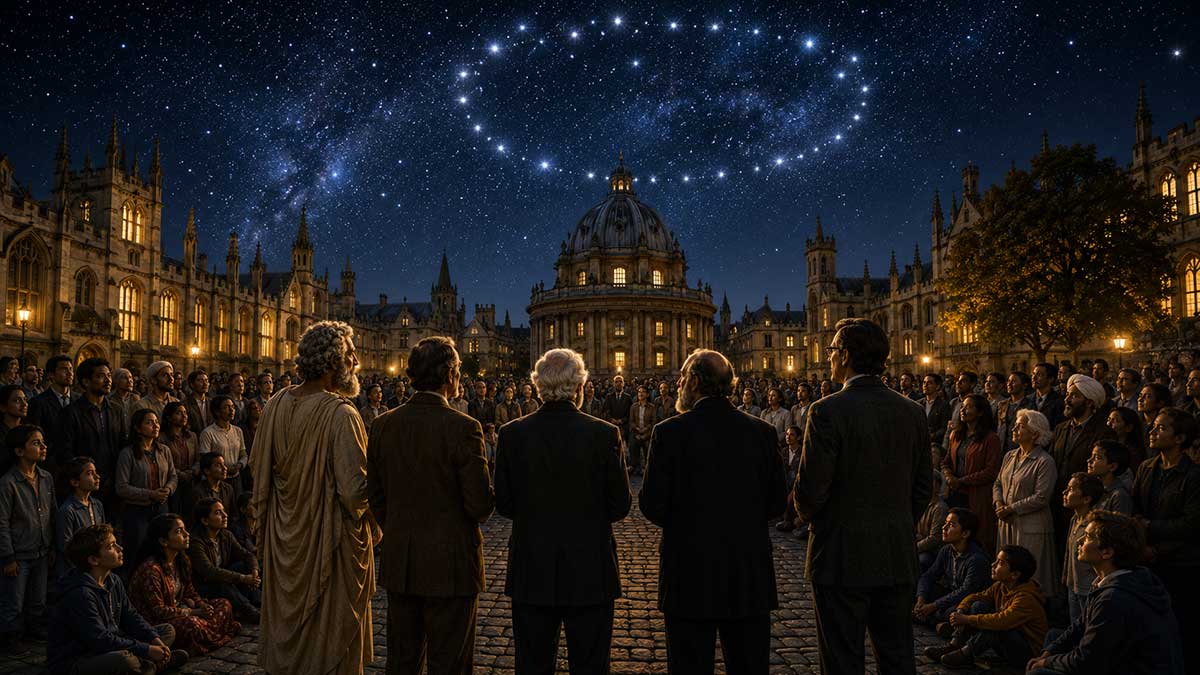
Night has fully settled over Oxford.
The rain has stopped.
Through the tall library windows, the clouds begin to separate, revealing a clear field of stars above the darkened courtyard.
The five thinkers remain around the circular table.
Before them rests the painting of the father, mother, and child.
No one reaches for a book.
The discussion has moved beyond definitions.
They have followed the visible world toward an invisible source.
They have considered whether human reason, conscience, creativity, love, and relationship reflect that source.
They have asked what man and woman reveal about the origin of masculine and feminine qualities.
They have examined fatherhood and motherhood as expressions of a deeper parental heart.
Now only one question remains.
Martin Buber looks around the table.
Opening
Martin Buber: We have arrived at the threshold.
If God is the source of fatherly and motherly love...
If the qualities of parenthood originate in God...
Then perhaps humanity’s deepest relationship with God is not simply that of creation to Creator.
Perhaps it is parent and child.
Aristotle: We must proceed carefully.
A conclusion may feel beautiful and still require examination.
C. S. Lewis: Agreed.
The idea should not be accepted merely because it comforts us.
We must ask whether it completes the reasoning that brought us here.
Carl Jung: And whether it explains something essential about human beings.
Our longing to belong.
Our desire to be known.
Our need to become whole.
Erich Fromm: Then let us ask the question without softening it.
Are human beings merely made by God?
Or are they meant to live as God’s children?
Question 1: What is the difference between being created by God and being a child of God?
Aristotle places the acorn from their first discussion in the center of the table.
Aristotle: We have already distinguished a child from an object.
A potter makes a vessel.
An architect designs a building.
A craftsperson creates a tool.
Yet none of these creations shares the creator’s life.
Lewis: A child does.
Not perfectly.
Not completely.
But genuinely.
A child receives life from the parent.
The child carries resemblance.
The child possesses freedom.
The child can know the parent and respond in love.
Jung: And the child contains potential that must unfold.
Parenthood is not fulfilled at birth alone.
A parent desires the child to grow into maturity.
Fromm: That is crucial.
To call humanity children of God does not mean humans are already complete.
It means they possess the capacity to grow in the qualities of their source.
Truth.
Love.
Responsibility.
Creativity.
Freedom.
Buber: A created object may fulfill a function.
A child fulfills a relationship.
The child is not merely useful to the parent.
The child is loved for who the child is.
Aristotle: Then the word “child” suggests more than origin.
It suggests resemblance, purpose, growth, inheritance, and relationship.
Lewis: And it suggests that human value does not begin with achievement.
A child’s worth precedes performance.
If humanity stands in a filial relationship with God, dignity is not earned.
It is received.
Question 2: Does God seek obedience alone, or love freely returned?
The library is completely quiet now.
Buber folds his hands.
Buber: A ruler may demand obedience.
A master may demand labor.
A judge may demand accountability.
But what does a parent ultimately desire?
Fromm: Not mechanical compliance.
A parent may require obedience during childhood.
But no loving parent dreams of raising a permanently frightened servant.
The hope is maturity.
Understanding.
Freedom.
Love.
Lewis: Obedience may have a place, but it cannot be the final purpose.
A child who follows every rule yet feels no love for the parent has not fulfilled the relationship.
Aristotle: Then obedience would be instrumental rather than ultimate.
It may guide development.
But the goal is mature participation in the good.
Jung: Psychologically, fear can produce conformity.
It cannot produce wholeness.
A person may obey externally while remaining inwardly alienated.
Buber: True relationship requires freedom.
The word “I” can meet “You” only where response is possible.
Forced love is a contradiction.
Fromm: Which means that if God is Parent, human freedom is not an unfortunate flaw in creation.
It is necessary for love.
Lewis: A parent may risk rejection because love that cannot be refused cannot truly be returned.
Aristotle: That gives suffering and moral failure a more difficult context.
Freedom allows human beings to grow toward resemblance.
But it also allows them to turn away.
Jung: And perhaps the tragedy of human history is not simply disobedience to authority.
It is estrangement from the source of our own being.
Buber: The child forgets the Parent.
Then forgets the other children are family.
Question 3: How would human life change if every person were seen as a child of the same Parent?
Fromm looks toward the dark courtyard.
A night porter crosses beneath the window, carrying a lamp.
Fromm: This idea cannot remain private.
If every person is a child of the same divine Parent, then every human relationship is affected.
Lewis: The stranger is no longer merely a stranger.
The enemy is no longer merely an enemy.
The poor are not failures whose suffering can be ignored.
The weak are not less valuable.
Aristotle: Human dignity would rest on origin rather than social position.
King and laborer.
Scholar and child.
Citizen and foreigner.
All would possess value derived from the same source.
Jung: It would also challenge the human tendency to project rejected parts of ourselves onto other groups.
Race.
Nation.
Class.
Religion.
We divide humanity into worthy and unworthy because we have forgotten the underlying family.
Buber: To see another person as a child of God is to encounter someone who cannot be reduced to an object.
Not an economic unit.
Not a political label.
Not an obstacle.
A person.
Fromm: And family language creates responsibility.
Brothers and sisters may disagree.
They may wound one another.
But indifference becomes harder to justify.
Lewis: It also changes morality.
Goodness would not mean merely obeying commands from a distant authority.
It would mean learning to love as the Parent loves.
Aristotle: Then virtue becomes resemblance.
Justice reflects the source.
Compassion reflects the source.
Wisdom reflects the source.
Jung: And maturity would mean integrating those qualities until the invisible character becomes visible through the life.
The pattern from our first discussion returns.
An inner reality expressed through an outer form.
Buber: The child comes to resemble the Parent not in appearance, but in love.
A Necessary Challenge
Aristotle lifts the acorn again.
Aristotle: We should consider an objection.
Human parents are biological.
God, as we have described God, is not.
Could “Parent” simply be a poetic metaphor?
Lewis: It is certainly analogical language.
But analogical does not mean unreal.
When we call a person wise, and call God wise, we do not mean the two forms of wisdom are identical.
We mean human wisdom reflects something greater.
Jung: Symbols often carry realities too large for literal description.
The danger is not that the symbol is false.
The danger is that we treat it as exhaustive.
Fromm: “Parent” may not describe everything about God.
But it may describe something more central than “ruler,” “judge,” or “maker” alone.
Those titles describe functions.
Parent describes relationship and heart.
Buber: And perhaps the most important question is not whether the language is biologically literal.
It is whether the relationship it names is real.
Can human beings know God?
Can they receive love?
Can they respond?
Can they grow in resemblance?
If so, parental language may point to the deepest structure of the relationship.
Aristotle: Then the conclusion must remain humble.
We are not claiming to contain God within a human category.
We are saying that human parenthood may be a reflection of an original reality.
The Meaning of Human Purpose
Lewis stands and walks toward the window.
The stars are now clearly visible.
Lewis: If this is true, then human purpose becomes clearer.
We were not created merely to exist.
Not merely to survive.
Not merely to obey.
Not merely to build civilizations and disappear.
Fromm: We were created to grow in love.
Jung: To become inwardly whole.
Aristotle: To realize the potential placed within us.
Buber: To enter a living relationship with the source of our being.
Lewis: And to extend that relationship into the human family.
Love of God and love of others would not be separate commandments.
They would be two expressions of the same reality.
To love the Parent is to care for the children.
To harm the children is to betray the Parent.
Fromm: Then family is not merely a private arrangement.
It becomes a school of love.
A place where human beings learn care, patience, sacrifice, responsibility, forgiveness, and joy.
Jung: Though no family fulfills that ideal perfectly.
Buber: Which may be why humanity continues to long for a home it has never fully experienced.
Lewis: Perhaps that longing is not nostalgia for the past.
Perhaps it is a memory of purpose.
Final Reflection
The five men remain silent.
The conversation that began with an acorn has reached the stars.
Aristotle sets the acorn beside the family painting.
The two images now rest together.
A seed containing an unseen future.
A child held between father and mother.
Aristotle: The visible world pointed us toward an invisible source.
Jung: Human nature suggested that the source possesses the origin of mind, heart, creativity, and love.
Fromm: Man and woman revealed complementary qualities that find unity in parenthood.
Buber: Parenthood revealed a relationship in which life is given so that love may be returned freely.
Lewis: And that relationship has brought us to a conclusion.
Perhaps God is not only the One from whom humanity came.
Perhaps God is the One to whom humanity belongs.
Not as property.
Not merely as subjects.
But as children.
Closing
The library clock strikes midnight.
The sound moves through the ancient halls and fades.
Outside, the stars remain steady above Oxford.
Buber looks at each of the others.
Buber: If every human being is a child of the same Parent, then the question is no longer only:
“Does God exist?”
The greater question is:
“How should the children of God live?”
Fromm: With love that gives rather than possesses.
Jung: With the courage to become whole.
Aristotle: With virtue that makes the invisible good visible.
Lewis: And with the recognition that no person is outside the family.
They extinguish the lamp.
For a moment, the room is dark.
Then moonlight falls across the painting of the parents and child.
The conversation has ended.
But its final question remains:
If humanity truly comes from one divine Parent...
what would it take for us to begin living as one family?
Final Thoughts
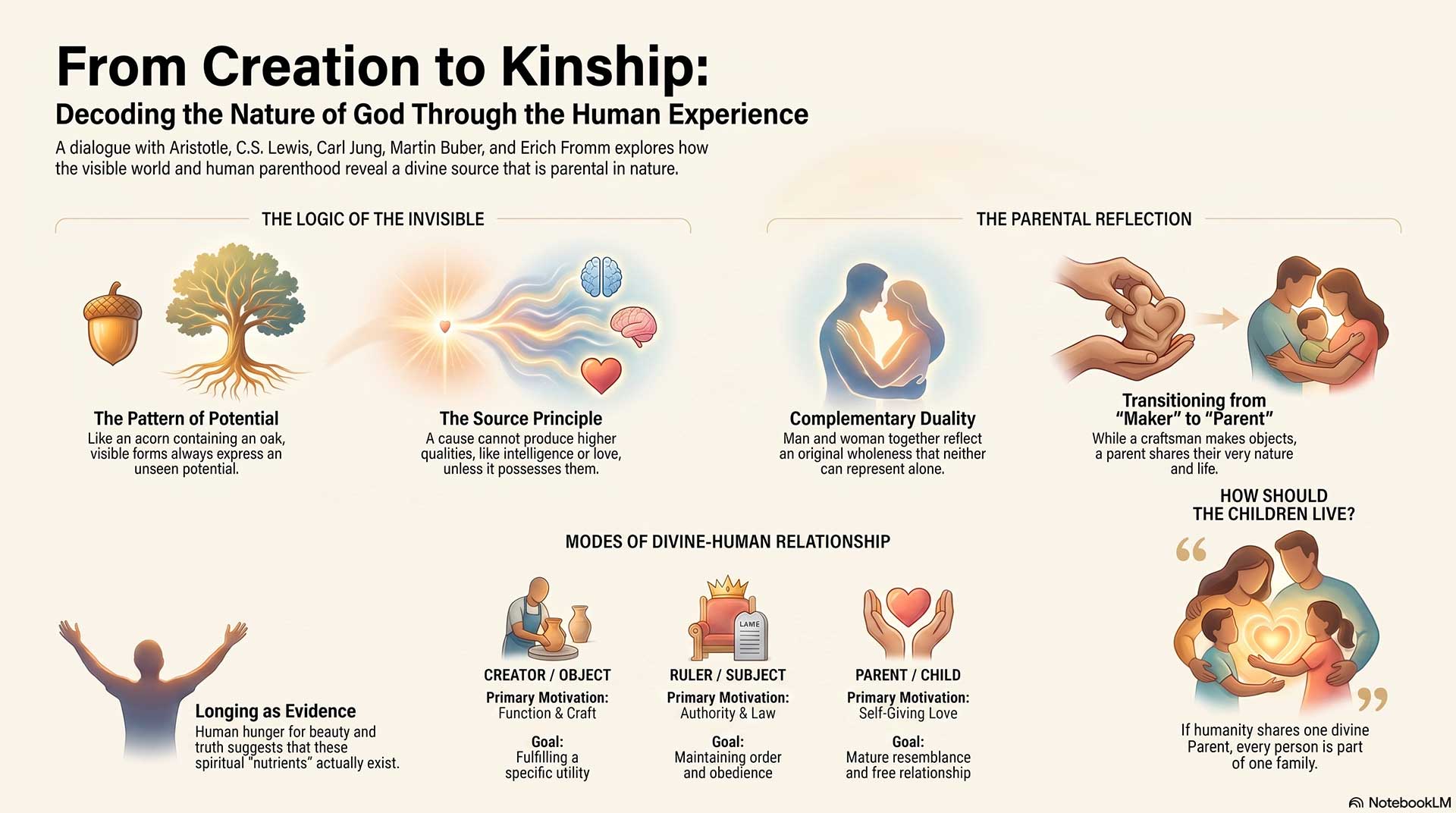
The journey began with a simple observation.
The visible world often expresses an invisible reality.
A seed contains an unseen future. A work of art begins as an idea. Every meaningful human action starts with thoughts, intentions, hopes, and purposes that cannot themselves be seen.
From there, the conversation turned toward humanity. Our capacity for reason, conscience, creativity, beauty, and love suggests that the source of human life may be more than an impersonal force. We then considered the complementary nature of men and women and asked whether masculine and feminine qualities together reveal something about the One from whom they came. Finally, we reflected on fatherhood and motherhood—not merely as biological functions, but as profound expressions of self-giving love, responsibility, nurture, and relationship.
Taken together, these observations point toward a remarkable possibility.
Perhaps God is not simply the first cause of the universe, nor merely its designer or ruler. Perhaps the deepest human experience—parental love—offers our closest glimpse into the heart of the One who brought us into being. If so, then humanity's highest identity is not simply that of creatures living under a Creator, but children growing toward the character of their original Parent.
Whether one ultimately accepts that conclusion or not, the conversation reminds us that philosophy begins with careful observation, not premature certainty. It invites us to see familiar realities—the natural world, the human person, family, and love—not as ordinary facts to be taken for granted, but as possible signposts pointing toward deeper truths.
And perhaps the most important question is no longer simply:
"Does God exist?"
But rather:
"If we truly share one divine Parent, how should we live with one another?"
Short Bios:
Aristotle (384–322 BC)
One of history's greatest philosophers, Aristotle developed foundational ideas about causation, purpose, ethics, and metaphysics. His concept of the "First Cause" profoundly influenced both Western philosophy and later Jewish, Christian, and Islamic thought. In this conversation, he examines whether creation can reveal the nature of its source.
C. S. Lewis (1898–1963)
British scholar, novelist, and Christian apologist, C. S. Lewis is best known for Mere Christianity, The Chronicles of Narnia, and The Abolition of Man. He explored the relationship between reason, imagination, morality, and faith, arguing that humanity's deepest longings often point beyond themselves.
Carl Jung (1875–1961)
Swiss psychiatrist and founder of analytical psychology, Carl Jung introduced influential concepts such as the collective unconscious, archetypes, individuation, and psychological wholeness. His work explored how symbolic patterns—including masculine and feminine dimensions of the psyche—shape human development and spiritual understanding.
Martin Buber (1878–1965)
An Austrian-Israeli philosopher best known for I and Thou, Martin Buber argued that genuine human life is grounded in authentic relationships rather than treating others as objects. His philosophy of encounter provides a powerful framework for understanding the possibility of a living relationship between humanity and God.
Erich Fromm (1900–1980)
German-born social psychologist, psychoanalyst, and philosopher, Erich Fromm authored influential works including The Art of Loving and Escape from Freedom. He believed that mature love is an active commitment expressed through care, responsibility, respect, and knowledge, making him a unique voice in exploring the meaning of parenthood and human flourishing.
Leave a Reply