
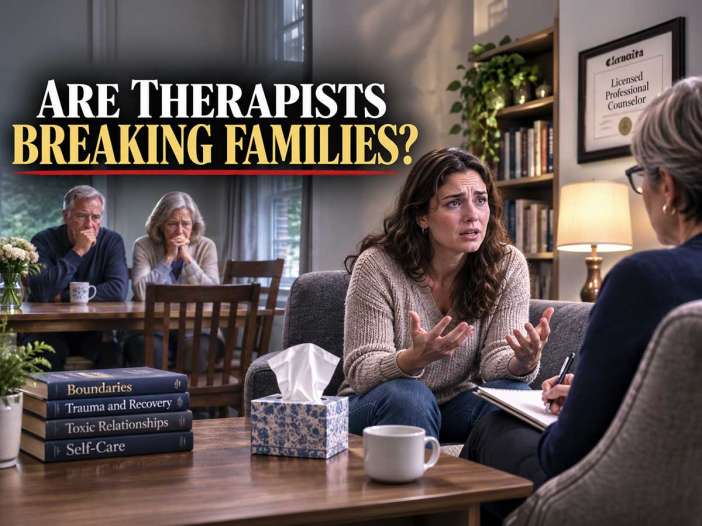
Have Therapists Quietly Changed the Modern Family?
For generations, therapy was widely understood as a place where people sought healing. It offered hope to those struggling with depression, anxiety, grief, addiction, trauma, and broken relationships. Millions of lives have been improved through thoughtful counseling, and few would deny that good therapists have helped countless individuals find stability, courage, and purpose.
But somewhere along the way, a profession built to repair people began, in many rooms, to quietly redefine what repair even means.
Not simply its techniques, but its underlying philosophy.
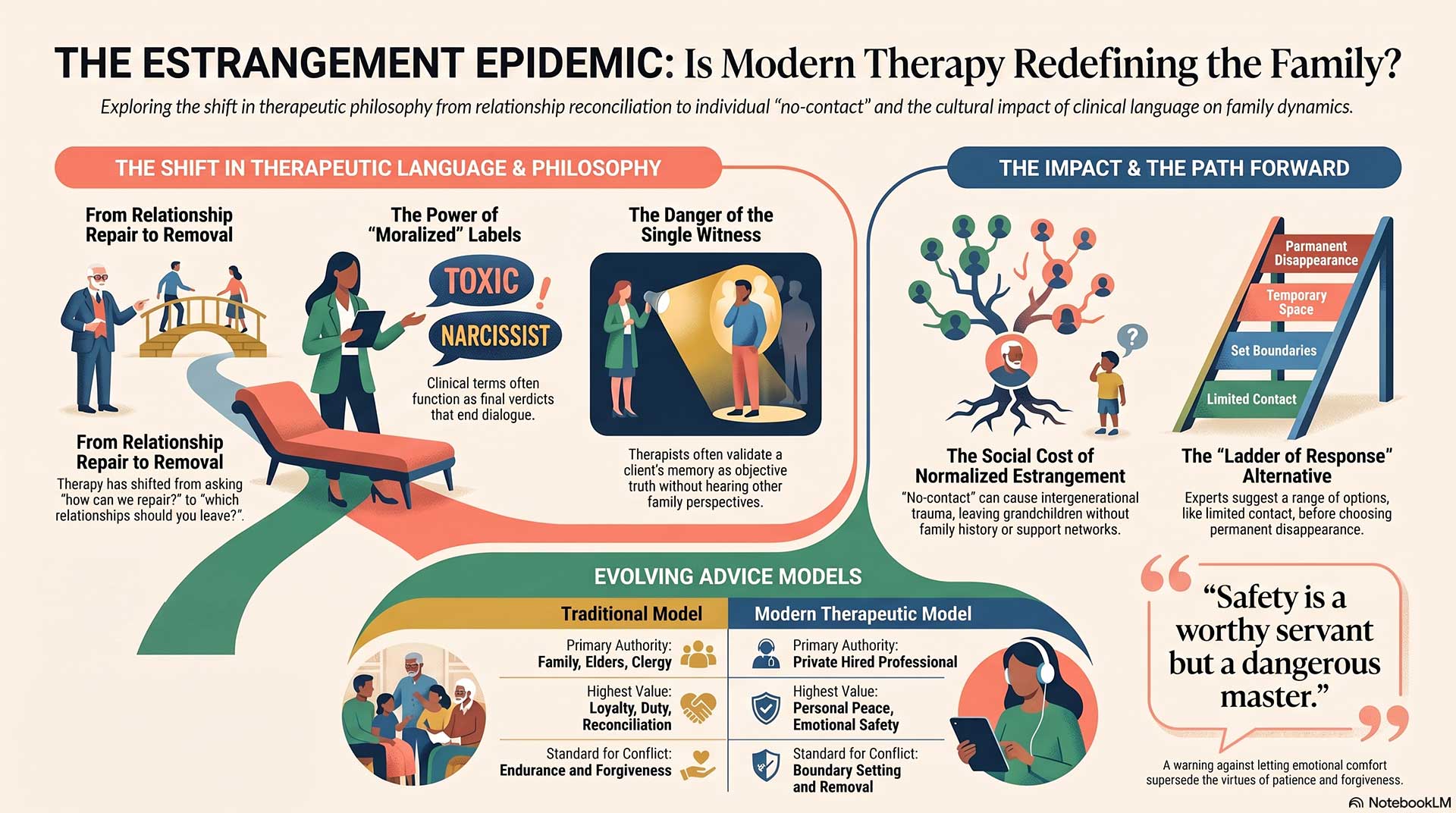
Instead of asking, "How can this person become stronger while preserving the relationships that can still be saved?" a growing strain of modern therapy has begun asking, "Which relationships should this person leave behind?"
This question has become especially urgent as family estrangement rises throughout the Western world. Adult children are cutting off parents at rates rarely seen before. Words once reserved for clinical diagnosis—trauma, narcissist, gaslighting, toxic, emotionally unsafe—have entered everyday conversation, and with them, a quiet cultural verdict: that distance is health, and endurance is denial.
No one disputes that some parents are genuinely abusive, and that therapy has given real victims language and permission to escape danger. That is not what this conversation is about.
This conversation is about everyone else. The parents who made ordinary mistakes now filed under extraordinary diagnoses. The adult children handed a vocabulary of permanent verdicts before anyone tested whether the story held up. The families quietly dissolved not because they were dangerous, but because a professional relationship built on hearing one side, and profiting from its continuation, found it easier to validate an exit than to do the harder work of repair.
Five distinguished voices gather to make that case.
Not because parents are blameless.
Because the profession built to heal families may be quietly teaching people how to leave them — and almost no one with the standing to say so has said it plainly.
This isn't a courtroom transcript, and it doesn't pretend to be. It's five people who believe therapy culture has gone too far, arguing that case as sharply and honestly as they can. Readers are welcome to weigh it against whatever a defender of modern therapy would say in return. This just isn't that piece.
(Note: This is an imaginary conversation, a creative exploration of an idea, and not a real speech or event.)
Topic 1: From Healing People to Redefining Families

Opening
The room resembles an old university library. Shelves of worn books rise to the ceiling, filled with works on psychology, philosophy, theology, and family life. A fireplace burns quietly in the corner, casting warm light across a round oak table.
On the table lies a single newspaper.
Its headline reads:
"Are Therapists to Blame for the Rise of Adults Cutting Off Their Parents?"
No one speaks immediately.
The question hangs in the air.
Not because it is easy—but because every person in the room knows families whose lives have been permanently altered by it.
Abigail Shrier breaks the silence.
Abigail Shrier: For most of the twentieth century, therapy largely asked, "How can this person become healthier so they can live a fuller life?"
Today, something has changed.
Increasingly, therapy asks, "Who wounded you?"
That's an important question.
But when it becomes the first question, and eventually the only question, it changes how people understand themselves, their parents, and even the purpose of healing.
Many therapists now spend years helping clients reinterpret their childhoods through the language of trauma, emotional safety, and boundaries.
Sometimes that's exactly what's needed.
Sometimes it isn't.
The problem is that we've become reluctant to ask which is which.
William Doherty: As a family therapist, I worry that we've unintentionally shifted from treating individuals within families to treating individuals apart from families.
Families are messy.
Parents make mistakes.
Children misunderstand.
People change over decades.
When therapy focuses almost exclusively on one person's emotional experience, it becomes very easy to lose sight of the family system itself.
Healing one individual should not automatically mean sacrificing every relationship around that person.
Joshua Coleman: I've spent years working with estranged parents and adult children.
Many parents genuinely failed their children.
Others made ordinary human mistakes that later became interpreted through a completely different cultural lens.
What's striking today isn't simply that estrangement exists.
It's how quickly permanent separation is sometimes accepted as the healthiest outcome before every possibility of repair has been explored.
Karl Pillemer: The research tells us something important.
Family estrangement has become far more visible than it once was.
Some of that visibility reflects genuine progress.
People trapped in abusive relationships now feel freer to leave.
But another question deserves equal attention.
Has our culture become less willing to distinguish between abuse, dysfunction, disappointment, personality conflict, and ordinary family imperfection?
Those are not the same thing.
C.S. Lewis: Every generation invents a new language for judging the human heart.
The language itself is not the danger.
The danger comes when that language becomes so powerful that it prevents us from asking older questions.
What is forgiveness?
What is duty?
What is mercy?
What does love require of imperfect people?
If those questions disappear, something much larger than therapy has changed.
Question 1
When did therapy begin shifting from asking, "How can this person become stronger and repair damaged relationships?" to asking, "Which relationships should this person leave?"
Abigail Shrier: Earlier generations of therapists often assumed relationships were worth preserving unless genuine danger existed.
Today's culture often begins with a different assumption.
If a relationship consistently makes you anxious, perhaps the relationship itself is the problem.
That subtle shift changes everything.
Resilience slowly gives way to avoidance.
Repair gives way to removal.
William Doherty: I have seen therapists unintentionally become what I call "exit counselors."
Their office becomes the place where clients receive permission to end relationships rather than carefully examining whether those relationships can be repaired.
There are certainly situations where separation is necessary.
My concern is that reconciliation is no longer treated as an equally worthy goal.
Joshua Coleman: Estrangement should never be approached casually.
When an adult child cuts off a parent, both lives change forever.
Grandchildren lose grandparents.
Siblings divide.
Family history fractures.
The emotional cost reaches far beyond the two people involved.
Those consequences deserve far more discussion than they usually receive.
Karl Pillemer: Across generations, families have always experienced conflict.
What's new is how acceptable permanent estrangement has become as a cultural solution.
That should concern anyone interested in long-term social stability.
C.S. Lewis: Civilization survives because imperfect people continue loving imperfect people.
If every relationship must satisfy us emotionally before we remain faithful to it, very few relationships will survive the passage of time.
Question 2
Has modern therapy become so client-centered that therapists validate one person's account without seriously testing whether memory, resentment, fear, or immaturity may also shape the story?
William Doherty: Every therapist hears only one witness.
That should produce humility.
Instead, it sometimes produces certainty.
When the absent parent receives a diagnosis without ever entering the room, something has gone wrong.
Joshua Coleman: Memory is never a perfect recording.
Two loving people may remember the same childhood entirely differently.
That doesn't mean either person is lying.
It means therapists must resist reaching sweeping conclusions too quickly.
Abigail Shrier: Labels have extraordinary power.
"Toxic."
"Narcissistic."
"Emotionally unsafe."
Sometimes they're accurate.
Other times they end the investigation before it has truly begun.
Once those labels become attached to a parent, every memory begins organizing itself around them.
Karl Pillemer: Research consistently shows that family conflict is rarely explained by a single narrative.
People naturally remember events in ways that support their own understanding.
That's human nature.
Therapists should know this better than anyone.
C.S. Lewis: Justice demands hearing more than one voice.
Mercy demands remembering that every storyteller is also a participant.
Wisdom demands both.
Question 3
When a therapist hears only one member of a family, is it ethically responsible to use terms such as "toxic," "unsafe," "abusive," or "narcissistic" without hearing from anyone else involved?
Abigail Shrier: We have created a vocabulary that sounds clinical but often functions as moral judgment.
Once someone is called toxic, reconciliation becomes emotionally dangerous.
The label itself begins making separation appear inevitable.
William Doherty: Family therapy exists for a reason.
Relationships cannot always be understood by interviewing only one participant.
If reconciliation remains possible, every reasonable effort should be made to understand the entire family system before recommending permanent estrangement.
Joshua Coleman: There are certainly parents whose behavior fully justifies separation.
No serious person denies that.
The question is whether we've quietly expanded those categories until ordinary family pain now receives extraordinary diagnoses.
That is a cultural question, not merely a clinical one.
Karl Pillemer: Every society must decide what level of family imperfection it considers survivable.
If the threshold keeps falling, more relationships will eventually become disposable.
That doesn't strengthen families.
It weakens the institution itself.
C.S. Lewis: A society that forgets forgiveness will eventually forget family.
For family is the place where forgiveness is most often required.
Not because families are worse than strangers.
Because they remain close enough to wound us, disappoint us, and still invite us to love again.
Closing
The newspaper remains untouched.
No one claims therapy is the enemy.
No one claims every estrangement is wrong.
The conversation has uncovered something deeper.
William Doherty: Therapy should certainly help people escape abuse.
But it should be equally committed to helping families recover whenever recovery remains possible.
Joshua Coleman: The tragedy is not merely estrangement.
It is how often people reach permanent conclusions before exhausting every opportunity for understanding.
Karl Pillemer: Every generation inherits broken families.
The question is whether it also inherits the skills to repair them.
Abigail Shrier: If therapy becomes the place where relationships are quietly abandoned instead of carefully examined, then therapy has changed far more than psychology.
It has begun reshaping the family itself.
C.S. Lewis: The measure of healing is not how many relationships we leave behind.
It is whether we have become the kind of people capable of telling the truth, extending mercy, accepting responsibility, and preserving love wherever love can still be preserved.
Topic 2: The Therapist as the New Moral Authority
Opening
The fire has burned lower.
Outside the library windows, the rain has stopped. The silence now feels heavier—not with uncertainty, but with recognition.
The conversation has moved beyond whether therapy helps people.
Now another question emerges.
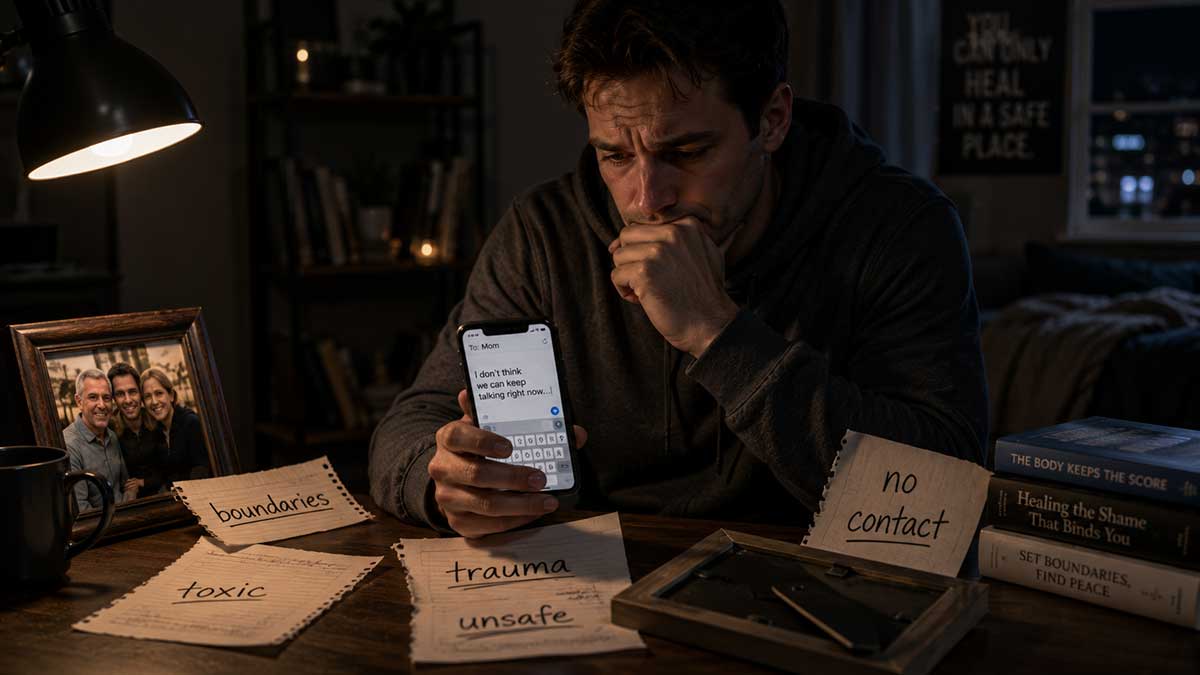
When someone sits across from a therapist week after week, year after year, who ultimately teaches that person what is right, what is wrong, whom to forgive, whom to trust, and whom to leave behind?
Has therapy quietly become more than treatment?
Has it become society's new moral authority?
William Doherty: Every culture has guides.
Parents.
Grandparents.
Pastors.
Teachers.
Neighbors.
Older friends.
For centuries, difficult family decisions were rarely made in isolation. They were weighed against community wisdom and the expectation that family relationships, however imperfect, were worth preserving whenever possible.
Today many people bring those same questions to one person.
Their therapist.
That changes who shapes our moral imagination.
Abigail Shrier: Therapy has gradually expanded far beyond treating depression, anxiety, or trauma.
It now influences identity.
Marriage.
Parenting.
Religion.
Friendships.
Politics.
Family loyalty.
It has become one of the primary ways people interpret their lives.
That gives therapists enormous cultural influence, whether they intended to have it or not.
Joshua Coleman: Most therapists sincerely want to help.
This isn't about bad intentions.
It's about recognizing that a therapist occupies a uniquely powerful position.
Clients often trust their therapist more than anyone else in their lives.
A single sentence spoken during emotional vulnerability can permanently reshape how someone sees a parent, a spouse, or an entire childhood.
Karl Pillemer: Sociologists have long observed that many traditional institutions have weakened.
Extended families are smaller.
Church attendance has declined.
Neighborhoods are less connected.
People move more often.
Loneliness has increased.
Into that vacuum, therapists have taken on roles they were never originally expected to fill.
C.S. Lewis: Every civilization chooses its priests.
Some wear robes.
Some wear white coats.
Some sit in consulting rooms.
The question is not whether guidance exists.
The question is who now defines virtue, obligation, forgiveness, and justice.
Question 1
Has the therapist begun replacing parents, pastors, relatives, and community elders as the person who decides which obligations matter and which relationships deserve to survive?
Abigail Shrier: Increasingly, yes.
When young adults face family conflict, many no longer ask,
"What does my family think?"
"What does my pastor advise?"
"What would my grandparents have done?"
They ask,
"What does my therapist think?"
That represents a profound cultural shift.
William Doherty: Historically, communities expected reconciliation whenever it remained possible.
Today the therapist often becomes the only voice participating in that decision.
That concentrates tremendous moral authority in one relationship.
Joshua Coleman: Parents often tell me,
"My child believes their therapist understands our family better than the people who actually lived in it."
Whether that's true or not, many families experience it that way.
Karl Pillemer: Research repeatedly shows that healthy societies depend on strong intergenerational relationships.
Once those relationships become easily disposable, the costs extend far beyond one household.
They affect entire communities.
C.S. Lewis: Wisdom grows through many voices.
Danger appears when one voice becomes the only voice.
Question 2
What happens when therapeutic values such as personal comfort, emotional safety, and self-protection come into conflict with older values such as loyalty, duty, sacrifice, gratitude, and forgiveness?
William Doherty: Emotional safety matters.
But emotional safety cannot become the only value.
Marriage requires sacrifice.
Parenthood requires sacrifice.
Caring for aging parents requires sacrifice.
Families survive because people remain committed through seasons that are emotionally uncomfortable.
Abigail Shrier: Modern therapeutic culture often treats discomfort itself as evidence.
If someone consistently makes you anxious, perhaps you should leave.
But anxiety isn't always a warning signal.
Sometimes it's the emotional cost of confronting conflict honestly.
Joshua Coleman: One of the saddest things I see is when ordinary family imperfections become interpreted as proof that a relationship is beyond repair.
Parents disappoint us.
Children disappoint parents.
That has always been true.
The question is whether disappointment now receives the same response once reserved for genuine abuse.
Karl Pillemer: Every culture teaches people what deserves endurance.
When endurance disappears from a culture's moral vocabulary, relationships become much more fragile.
C.S. Lewis: Love that survives only pleasant moments is affection.
Love that survives disappointment becomes charity.
Civilization has always depended upon the second.
Question 3
Should one privately hired professional have such influence over whether an adult child maintains contact with parents, siblings, grandparents, and the wider family?
Joshua Coleman: Therapists should exercise tremendous humility.
Every recommendation concerning estrangement carries consequences that may last decades.
Grandchildren grow up without grandparents.
Family traditions disappear.
Deaths occur before reconciliation becomes possible.
Those realities deserve careful reflection.
William Doherty: Therapists should ask,
"Have every reasonable effort toward understanding been attempted?"
Before recommending permanent separation, that question should be unavoidable.
Abigail Shrier: One concern is that therapists rarely experience the long-term consequences of their advice.
The client continues therapy.
The therapist moves to the next appointment.
The family lives with the decision for the next thirty years.
Karl Pillemer: Research suggests that many estranged families carry lasting grief.
Some reconcile.
Many never do.
When reconciliation becomes impossible through time, illness, or death, regret often arrives too late.
C.S. Lewis: Advice becomes dangerous when it forgets eternity.
Every broken relationship carries unseen consequences.
One should recommend permanent separation only with profound seriousness.
Not because family is sacred regardless of conduct.
But because reconciliation, once made impossible, cannot always be recovered.
Closing
The room grows quiet again.
No one questions the importance of therapy.
No one argues that abuse should be endured.
The deeper concern lies elsewhere.
Karl Pillemer: Every society teaches people how to interpret family conflict.
That lesson shapes the next generation.
Joshua Coleman: Therapists possess tremendous influence.
Influence calls for humility.
William Doherty: The greatest therapist is not the one who simply validates pain.
It is the one who helps people distinguish between relationships that must end and relationships that might still be healed.
Abigail Shrier: We should ask more of therapy than empathy alone.
We should ask for wisdom.
C.S. Lewis: Every age chooses its highest good.
If our highest good becomes emotional comfort, we may gain temporary peace while losing the very relationships that once taught us patience, forgiveness, courage, and love.
For a society is held together less by agreement than by the willingness of imperfect people to remain faithful to one another when agreement disappears.
Topic 3: The Business of Long-Term Therapy
Opening
A clock above the library shelves marks the passing minutes with a soft mechanical click.
For the first time, the group turns from ideas to incentives.
Therapy is a profession built around care, trust, confidentiality, and repeated conversation. It is meant to help people gain clarity, stability, and freedom.
Yet every profession is shaped by the structure through which it survives.
A therapist is paid when the client returns.
The office remains open when sessions continue.
The relationship ends when the client decides that therapy is no longer needed.
That does not prove corruption. It does create a question that many families hesitate to ask:
Can a system built on continuing treatment remain completely neutral about whether treatment should continue?
Abigail Shrier: We are often told that questioning therapy is harmful.
But a profession that possesses moral influence should welcome scrutiny.
Therapists may sincerely care about their clients and still work within a system that rewards continuation.
Good intentions do not erase incentives.
William Doherty: The ethical goal of therapy should be greater independence.
A therapist should want clients to develop the ability to manage conflict, tolerate distress, make decisions, and maintain relationships without relying indefinitely on weekly guidance.
The concern begins when continuation becomes the default rather than a conscious clinical choice.
Joshua Coleman: Long-term therapy can be valuable for some people.
Yet it can become dangerous when the therapist slowly becomes the client’s main interpreter of reality.
At that point, the client may no longer ask, “What do I think?”
The question becomes, “What will my therapist say?”
Karl Pillemer: Institutions often develop habits that no individual consciously planned.
A system can reward dependency without anyone openly deciding to create dependent clients.
That is why outcomes matter.
C.S. Lewis: A guide should lead the traveler somewhere.
If guidance becomes a permanent destination, one must ask whether the traveler is still moving.
Question 1
Can therapy remain fully objective when the therapist earns income from continuing the relationship and loses that income when the client becomes independent?
Abigail Shrier: We readily examine incentives in medicine, law, education, and finance.
Therapy should not be exempt.
A therapist who tells a client, “You may be ready to stop,” risks losing income.
A therapist who says, “There is more to unpack,” preserves the relationship.
That does not mean every recommendation for continued therapy is dishonest.
It means the conflict exists.
William Doherty: Ethical therapists discuss goals, progress, frequency, and eventual completion.
The client should know what therapy is trying to accomplish.
Without that, sessions can become emotionally meaningful but clinically directionless.
Joshua Coleman: Estrangement can deepen this dependency.
Once a client has reduced contact with family, the therapist may become one of the few remaining people who regularly affirms the client’s interpretation.
The loss of family support can make the therapeutic relationship more central.
That creates a closed circle.
The therapist supports separation.
Separation increases isolation.
Isolation increases dependence on therapy.
Karl Pillemer: That pattern deserves study.
Whenever an intervention weakens one support network and strengthens dependence on another, society should examine the long-term outcome.
C.S. Lewis: Temptation rarely announces itself as greed.
It often arrives as a reasonable continuation of something once helpful.
The healer may begin by helping a person stand.
The danger comes when the healer becomes unwilling to let go of the person’s arm.
William Doherty: We should be fair.
Many therapists do help clients complete treatment.
The better question is whether the profession consistently teaches and measures that responsibility.
Abigail Shrier: Exactly.
A profession should not be judged only by its best practitioners.
It should be judged by the habits its structure encourages.
Question 2
Does open-ended treatment sometimes encourage clients to keep examining wounds, assigning labels, and returning for validation instead of developing the strength to live without regular therapeutic support?
Joshua Coleman: Reflection can become repetition.
A client may revisit the same childhood events for years, each time receiving a more elaborate explanation of why those events caused present suffering.
At some point, insight must lead to action.
Can the client have the difficult conversation?
Can the client tolerate disagreement?
Can the client stop requiring everyone else to validate the same version of the past?
Abigail Shrier: Modern therapy often rewards emotional excavation.
Every reaction may be traced back to childhood.
Every conflict may reveal another wound.
Every relationship may expose another pattern.
This can create the impression that the self contains an endless number of injuries requiring professional interpretation.
William Doherty: Therapy becomes unhealthy when ordinary life begins to feel impossible without therapeutic processing.
A person should be able to argue with a spouse, receive criticism, disappoint a parent, make a mistake, and recover without requiring a session to determine what the experience means.
Karl Pillemer: Repeated discussion can strengthen memory.
The more often people tell a story, the more fixed that story may become.
If every retelling casts one person as victim and another as offender, the relationship may become harder to repair with each session.
C.S. Lewis: We become shaped by the stories we rehearse.
A wound remembered truthfully may produce wisdom.
A wound endlessly rehearsed may become a throne from which we judge the living and the dead.
Joshua Coleman: Estranged parents often say their child’s language changed after therapy.
The child may begin speaking in phrases that sound clinical and final.
“You violated my boundaries.”
“You are unsafe.”
“You refuse accountability.”
Sometimes those phrases name real behavior.
At other times, they replace the harder work of describing exactly what happened and what repair would require.
Abigail Shrier: Labels can create the feeling of progress without actual resolution.
Naming a parent “narcissistic” may feel clarifying.
It may still leave the client angry, isolated, and unable to form better relationships.
William Doherty: Good therapy should ask whether the client is becoming more capable.
More honest.
More relational.
More resilient.
More willing to accept responsibility.
Feeling validated is not enough.
Question 3
How should success in therapy be measured: by the length of treatment, by how understood the client feels, or by whether the client becomes more independent, responsible, emotionally stable, and capable of repairing relationships?
Karl Pillemer: Every serious profession needs meaningful outcomes.
For therapy, one outcome should be whether the client can function with less professional support.
Another should be whether the client’s important relationships improve when improvement is possible.
William Doherty: I would ask four questions.
Is the client clearer about the problem?
Is the client behaving differently?
Is the client taking greater responsibility?
Is the client less dependent on the therapist?
If the answer remains no after years of treatment, the therapy should be examined.
Abigail Shrier: We often measure therapy by how clients feel about therapy.
That is insufficient.
A client may love a therapist who never challenges them.
A client may feel misunderstood by a therapist who finally asks the necessary question.
Satisfaction and effectiveness are not identical.
Joshua Coleman: In estrangement cases, success should not automatically mean restored contact.
Some relationships remain dangerous.
Yet success should include a clear and honest account of what happened, proportionate boundaries, freedom from obsessive anger, and openness to future repair when circumstances change.
C.S. Lewis: True healing increases freedom.
The healed person may still carry scars.
But the scar no longer commands every decision.
The person becomes able to love without surrendering truth, forgive without denying justice, and stand without leaning forever upon the healer.
William Doherty: Therapy should have an exit door.
Not an abrupt one.
Not a careless one.
But a visible one.
Clients should know that the goal is not permanent dependence.
Abigail Shrier: A profession committed to healing should celebrate when clients no longer need it.
If graduation feels like failure, the system has forgotten its purpose.
Closing
The clock continues ticking.
No one claims that therapists deliberately manufacture suffering.
No one suggests that every long-term client is being exploited.
The concern lies in the quieter possibility that a caring profession may have developed a structure that does not always reward completion, independence, or repaired relationships.
Karl Pillemer: Systems can produce harmful outcomes without harmful intentions.
That is why honest evaluation matters.
Joshua Coleman: A client should leave therapy with a larger life, not a smaller one.
More relationships where possible.
More strength.
More responsibility.
More freedom.
William Doherty: The therapist’s success should be measured partly by the client’s decreasing need for the therapist.
Abigail Shrier: Therapy becomes dangerous when it teaches people that every discomfort needs interpretation, every wound needs revisiting, and every relationship must be filtered through professional approval.
C.S. Lewis: The good physician hopes the patient will one day leave the sickroom.
The good teacher hopes the student will one day think without him.
The good counselor should hope the person rises, walks into life, and no longer needs to return for permission to live.
Topic 4: Trauma Language and the No-Contact Generation
Opening
Morning light begins to enter the library.
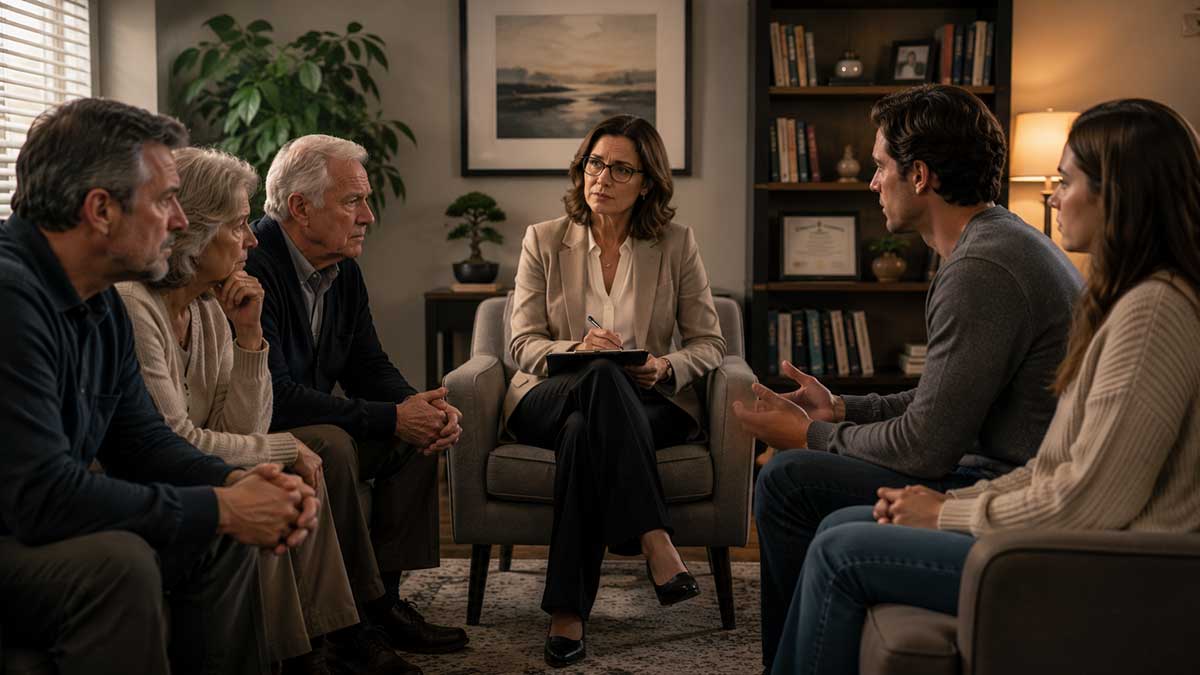
The fireplace has nearly gone dark, leaving only a few red embers beneath the ash. On the table, beside the newspaper, someone has placed a handwritten list:
Trauma.
Toxic.
Gaslighting.
Narcissist.
Emotionally unsafe.
No contact.
The words were once confined to clinical offices, research papers, and serious cases of psychological injury.
Now they appear everywhere.
In TikTok videos.
In family arguments.
In text messages ending relationships.
In conversations where adult children explain why they no longer speak to their parents.
The language has given many people words for pain they could never name.
Yet the same language may carry another effect.
It may turn ordinary conflict into pathology, painful memories into permanent identities, and imperfect parents into people from whom escape seems like the only healthy response.
Abigail Shrier: A clinical vocabulary has become a popular morality.
People no longer say, “My mother is difficult.”
They say, “My mother is toxic.”
They no longer say, “My father dismisses my feelings.”
They say, “My father is emotionally abusive.”
A description invites examination.
A diagnosis often ends it.
William Doherty: Language shapes the solutions we can see.
When we describe a relationship as strained, we can ask how to repair it.
When we describe it as unsafe, withdrawal begins to feel necessary.
The word may be accurate.
But once it is used, every possible response changes.
Joshua Coleman: Many estranged parents tell me that their adult child’s language shifted before the relationship ended.
The child began using phrases learned from therapy or online mental-health culture.
That does not mean the child’s pain is false.
It means the family is suddenly trying to respond to a vocabulary that may carry meanings far beyond the events being discussed.
Karl Pillemer: Social language can lower the threshold for action.
When estrangement is framed as self-care, people may feel less hesitation about taking that step.
The reduced stigma can help people in deeply harmful families.
It can make permanent separation appear ordinary in cases where repair may still be possible.
C.S. Lewis: Words can reveal truth.
They can become walls too.
Once a person is reduced to a label, we are spared the burden of seeing the whole person.
That is convenient.
It is rarely merciful.
Question 1
Has the definition of trauma expanded so far that strict parenting, family arguments, disappointment, criticism, and ordinary generational conflict are now interpreted as severe psychological injury?
Abigail Shrier: The word trauma once referred to experiences that overwhelmed a person’s ability to cope.
Now it is often used for nearly any painful memory.
A parent raised their voice.
A mother expected too much.
A father disapproved of a career.
A child felt unseen.
These experiences can hurt deeply.
Calling every hurt trauma creates a problem of proportion.
William Doherty: Families need moral distinctions.
Neglect is not the same as imperfection.
Cruelty is not the same as poor communication.
Abuse is not the same as conflict.
A parent can be wrong without being dangerous.
A childhood can contain real pain without becoming evidence that the relationship must end.
Joshua Coleman: Parents often underestimate the emotional effect of their behavior.
That must be acknowledged.
At the same time, adult children may reinterpret earlier events through present-day standards their parents never knew.
A parenting style once considered strict may now be experienced as controlling.
A demand for respect may be interpreted as emotional domination.
The difficulty is deciding whether the new interpretation reveals hidden harm or applies a severe label to a different generation’s mistakes.
Karl Pillemer: Every generation reassesses how children should be raised.
That can lead to progress.
Yet no family can survive a standard that treats every parental failure as a lasting moral indictment.
Parents make decisions with limited knowledge, limited time, financial pressure, personal wounds, and cultural assumptions.
Family judgment needs context.
C.S. Lewis: Suffering does not become unreal merely because it was not intended.
Yet intention, degree, circumstance, and repentance still matter.
Justice without proportion becomes another form of injustice.
Abigail Shrier: Once trauma becomes the central explanation for a person’s life, the person may begin searching the past for confirmation.
Every disappointment becomes evidence.
Every conflict fits the theory.
The story becomes harder to question precisely because questioning it can be described as invalidation.
William Doherty: A useful therapist should help the client separate three questions:
What hurt?
What caused lasting damage?
What requires permanent separation?
Those questions should never be treated as identical.
Question 2
Do labels such as “narcissist,” “gaslighting,” “toxic,” and “emotionally unsafe” help people describe real harm, or can they turn complicated human beings into permanent villains?
Joshua Coleman: The word narcissist is now applied to many parents who are self-centered, defensive, controlling, emotionally limited, or simply difficult.
A clinical diagnosis is no longer required.
The label often means, “This person does not understand me and may never change.”
Once the label is accepted, dialogue loses its purpose.
Abigail Shrier: The absent parent cannot answer the diagnosis.
The therapist hears the client’s account.
The online community reinforces it.
The label travels through the family.
Soon the parent is no longer someone who behaved badly in certain moments.
The parent becomes a type of person whose every act is interpreted as manipulation.
An apology is love-bombing.
A question is control.
Silence is punishment.
Reaching out is boundary violation.
The theory becomes impossible to disprove.
William Doherty: That is one of the great dangers of totalizing labels.
They remove any response that could count as good faith.
The accused person is trapped inside the diagnosis.
Karl Pillemer: Family conflicts often become entrenched when each side develops an explanation that cannot be challenged.
One side says, “You are a narcissist.”
The other says, “You are brainwashed.”
Neither description creates room for new behavior.
C.S. Lewis: A label may begin as a lantern and end as a cage.
It helps us see one feature of a person.
Then we mistake that feature for the whole person.
Joshua Coleman: Estranged parents must still examine themselves honestly.
Some use criticism of therapy to avoid accountability.
They say the therapist caused the estrangement when the therapist may have helped the adult child name longstanding mistreatment.
Yet therapists and adult children must ask whether the label accurately explains the parent or merely gives moral certainty during a painful conflict.
Abigail Shrier: The strongest language should require the strongest evidence.
That principle has weakened.
William Doherty: Plain language may serve families better.
Instead of “You gaslight me,” say, “When I describe what happened, you deny it and I feel unable to trust my memory.”
Instead of “You are toxic,” say, “When we speak, you insult my spouse and refuse to stop.”
Concrete language creates something that can be answered.
Labels often create only verdicts.
Question 3
When no-contact advice spreads through therapy, social media, podcasts, and online support groups, are people being given the courage to escape abuse—or permission to avoid difficult relationships without attempting repair?
Karl Pillemer: Social media changes the scale and speed of advice.
A person can describe a family conflict in a few sentences and receive hundreds of comments telling them to cut contact.
The people giving that advice do not know the family history.
They will not live with the outcome.
Abigail Shrier: Online mental-health content rewards certainty.
“Try a carefully mediated conversation” is unlikely to spread widely.
“Cut toxic people out of your life” is clear, dramatic, and emotionally satisfying.
That does not make it wise.
Joshua Coleman: Online communities can provide relief to people who have felt isolated for years.
They may be the first place someone hears that abuse is not normal.
Yet these communities can create a feedback loop.
Members receive approval for separation and suspicion for reconciliation.
Changing one’s mind may feel like betraying the group.
William Doherty: No contact should be understood as a serious intervention with serious costs.
It may be needed where there is violence, repeated cruelty, severe addiction, coercion, stalking, or refusal to respect necessary limits.
In many other cases, there are intermediate steps:
Clear requests.
Limited contact.
Temporary distance.
Written communication.
Mediation.
Family therapy.
Contact under agreed conditions.
Estrangement should not erase the range between total access and total disappearance.
C.S. Lewis: Modern advice often presents departure as courage and endurance as weakness.
At times that is true.
At other times, leaving is easy and staying long enough to speak truth is the harder act.
Wisdom lies in knowing which courage the moment requires.
Abigail Shrier: The phrase “protect your peace” deserves examination.
Peace can mean freedom from abuse.
It can mean freedom from contradiction, obligation, guilt, or anyone who remembers a version of us we no longer wish to face.
Those are very different forms of peace.
Joshua Coleman: Some adult children need distance before they can consider repair.
Yet temporary distance can quietly become permanent when no person involved helps define what would make contact possible again.
A boundary without a path back may function as a final sentence.
Karl Pillemer: Time changes the situation.
Parents age.
Grandparents die.
Children grow up without knowing relatives.
The decision that feels reversible at thirty may become irreversible at fifty.
William Doherty: Every therapist recommending no contact should ask:
What is the goal?
How long will this last?
What conditions would permit reconsideration?
What other options have been attempted?
What will this decision cost five years from now?
Without those questions, no contact may become less a clinical intervention than a cultural reflex.
C.S. Lewis: Estrangement promises relief from the voice that wounded us.
It may leave us alone with that voice inside our own minds.
Physical distance does not always produce inward freedom.
Closing
The morning light now falls directly across the handwritten list.
The words have not disappeared.
Nor have they been rejected.
They remain useful, serious, and dangerous.
Karl Pillemer: A culture needs language for severe harm.
It needs language for ordinary imperfection too.
Losing that distinction makes both harder to address.
Joshua Coleman: Adult children deserve to have their pain heard.
Parents deserve the chance to be understood as more than the worst interpretation of their mistakes.
William Doherty: Boundaries should protect the possibility of a healthier life.
Where possible, they should protect the possibility of a healthier relationship too.
Abigail Shrier: Therapeutic language should help people think more clearly.
When it makes every conflict fit one script and every difficult parent fit one diagnosis, it has stopped clarifying.
It has begun directing the verdict.
C.S. Lewis: The danger is not that we have learned new words for suffering.
The danger is that those words may persuade us that suffering releases us from every duty of patience, proportion, repentance, and mercy.
A civilization loses more than family ties when it teaches people that healing means never again standing near anyone who has caused them pain.
It may lose the very practices through which wounded people once learned how love survives.
Topic 5: What Happens to a Society That Normalizes Estrangement?

Opening
The library doors stand open now.
Beyond them, morning has fully arrived. Sunlight reaches across the floor, past the round table, past the nearly extinguished fireplace, and across the newspaper headline that began the conversation.
The group has examined therapy, moral authority, financial incentives, trauma language, and the rise of no contact.
Now the question widens.
What happens when estrangement stops being understood as an extreme response to severe harm and becomes a normal tool for managing family discomfort?
A family does not consist only of two people in conflict.
When a daughter leaves her mother, a father may lose her too.
Grandparents may lose grandchildren.
Siblings may be forced to choose sides.
Children may inherit a family history filled with missing names, unexplained absences, and stories they are forbidden to question.
The private decision spreads outward.
Karl Pillemer: Estrangement is often described as a personal boundary.
Its consequences are rarely personal.
Family networks function through connection. One broken tie can affect ten other relationships.
Weddings change.
Holidays divide.
Caregiving disappears.
Children lose access to relatives who carried family memory.
The social cost is much larger than the original conflict.
Joshua Coleman: Adult children have the right to make decisions about contact.
Yet rights do not erase consequences.
A parent may have caused deep pain. The child may still underestimate what permanent separation will mean ten or twenty years later.
Both truths can exist together.
William Doherty: Families are one of the last institutions where people are expected to remain connected without choosing one another.
We choose friends.
We choose spouses.
We do not choose parents, siblings, or children.
That lack of choice is difficult, but it teaches a unique form of commitment.
When family becomes another voluntary association, it loses part of its social meaning.
Abigail Shrier: Therapeutic culture often presents separation as an act of personal clarity.
It speaks much less about the social structure that separation weakens.
The client is encouraged to ask, “Is this relationship good for me?”
Far less often is the client asked, “What will happen to everyone else if I leave?”
C.S. Lewis: Society is built from duties we did not invent.
A child did not choose to be born.
A parent does not choose the temperament of the child.
A brother does not choose his sister’s weaknesses.
Yet love often begins precisely where choice ends.
A culture that accepts only chosen obligations may discover that it has very few obligations left.
Question 1
If each generation is taught to separate from relatives who cause emotional distress, what happens to the family as a source of belonging, care, memory, identity, and support?
Karl Pillemer: Family ties often become most valuable during crisis.
Illness.
Job loss.
Divorce.
Disability.
Old age.
The relatives who irritate us during ordinary years may become the people who sit beside us in a hospital.
Estrangement removes that future possibility.
Joshua Coleman: Parents often assume the relationship will recover with time.
Many adult children assume they can reconsider later.
Yet families do not remain frozen.
A parent develops dementia.
A grandparent dies.
A sibling moves away.
A child grows up.
The opening for repair may close without anyone consciously deciding to close it.
William Doherty: Family is a long institution.
Therapy often focuses on the client’s present emotional state.
But family decisions unfold across generations.
A choice that brings relief this month may create loneliness, regret, or practical hardship years later.
Abigail Shrier: The language of self-care rarely accounts for delayed costs.
A person feels immediate relief after ending contact.
The difficult calls stop.
The criticism stops.
The guilt may lessen.
That immediate relief can be interpreted as proof that the decision was correct.
Yet relief does not reveal the full future.
C.S. Lewis: Freedom from burden may feel like freedom itself.
Only later do we discover that some burdens were carrying us too.
Karl Pillemer: Family memory is another loss.
Grandparents transmit stories.
Aunts and uncles explain where people came from.
Older relatives carry details no document preserves.
When those ties are cut, descendants inherit a thinner identity.
Joshua Coleman: Children can suffer from the silence surrounding estrangement.
They may be told that a grandparent is unsafe without ever meeting that person.
Sometimes that protection is justified.
In other cases, the child receives a family verdict that can never be independently examined.
William Doherty: Estrangement can become hereditary.
Children learn that severe conflict is managed through disappearance.
They may later use the same method with their own parents.
Question 2
Can a society remain stable when emotional safety is treated as more valuable than intergenerational responsibility, forgiveness, and care for imperfect relatives?
Abigail Shrier: Emotional safety is difficult to oppose publicly.
No one wants to sound indifferent to suffering.
Yet once safety becomes the highest moral value, any relationship that creates anxiety can be judged unacceptable.
That standard does not stop with parents.
It reaches marriages, friendships, workplaces, churches, and communities.
William Doherty: Human relationships cannot provide constant emotional safety.
Intimacy includes disappointment.
Responsibility includes pressure.
Accountability includes discomfort.
A society that cannot tolerate those experiences will struggle to maintain lasting institutions.
Joshua Coleman: Adult children sometimes say, “I must protect my mental health.”
That may be deeply sincere.
Parents may reply, “What about the effect on our mental health?”
The therapeutic framework often gives more moral authority to the person leaving than to the people left behind.
Karl Pillemer: Social trust depends partly on the belief that relationships will survive conflict.
When people expect others to disappear after serious disagreement, they become cautious, guarded, and less willing to depend on one another.
C.S. Lewis: Safety is a worthy servant and a dangerous master.
No love can promise never to wound.
No family can promise never to fail.
If the absence of pain becomes the condition for loyalty, loyalty will rarely survive.
Abigail Shrier: There is a larger political and cultural effect.
People who no longer practice compromise inside families may become less capable of compromise in public life.
The same habits appear:
Label the other person.
Declare the conversation unsafe.
Withdraw.
Seek a community that confirms your position.
Treat disagreement as harm.
William Doherty: Family is one of the first places people learn how to live with someone they cannot simply remove.
When that practice disappears, society loses a training ground for patience and negotiation.
Joshua Coleman: We must still distinguish endurance from submission.
No person should remain exposed to violence, severe humiliation, or repeated coercion for the sake of social stability.
Yet the existence of extreme cases should not prevent us from asking whether ordinary conflict is now being treated with extreme solutions.
Karl Pillemer: The issue is proportionality.
A healthy society needs clear permission to leave danger.
It needs strong reasons to remain through difficulty too.
Question 3
What would a healthier model look like—one that protects people from genuine abuse yet treats permanent estrangement as a grave final step rather than a routine sign of growth?
William Doherty: The first step would be restoring a ladder of responses.
People often think they have only two choices:
Accept everything.
Cut contact.
There are many steps between them.
State the problem clearly.
Request a change.
Set a narrow boundary.
Reduce the frequency of contact.
Use written communication.
Meet in a public place.
Bring in a mediator.
Try family therapy.
Take a temporary separation with a review date.
Permanent estrangement should come after careful consideration of these options, where safety allows.
Joshua Coleman: Parents need guidance too.
Some parents make reconciliation impossible by arguing with every accusation.
They explain intent before acknowledging impact.
They demand access instead of rebuilding trust.
They treat the adult child’s boundary as betrayal.
A healthier model would require parents to listen without immediately defending themselves.
Abigail Shrier: Adult children should face serious questions as well.
Have I described the problem concretely?
Have I allowed the person to respond?
Am I asking for possible change or impossible perfection?
Has my therapist tested my interpretation?
Am I cutting contact to escape danger, or to escape guilt, disagreement, and responsibility?
Karl Pillemer: Time limits and review points could matter.
A temporary separation should not drift into permanence without reflection.
After three months or six months, the person might reconsider:
Has the situation changed?
Has the other person shown accountability?
Has distance brought clarity or merely hardened the story?
William Doherty: Therapists should document the goal of no contact.
Is it physical safety?
Emotional stabilization?
Breaking a cycle of harassment?
Creating conditions for future repair?
Without a stated goal, separation can become self-perpetuating.
Joshua Coleman: Reconciliation does not require returning to the old relationship.
A repaired relationship may be smaller.
Less frequent contact.
Fewer sensitive subjects.
Clear rules.
No unsupervised access to grandchildren.
Trust rebuilt slowly.
Restoration should not be confused with pretending nothing happened.
C.S. Lewis: Forgiveness opens the heart.
Wisdom decides how wide to open the door.
Abigail Shrier: Therapists should be cautious about diagnosing absent relatives.
They should challenge the client’s account with care.
They should ask what evidence might disprove the interpretation.
They should examine the cost of estrangement, not merely the relief.
Karl Pillemer: Communities need to recover a role too.
Family conflict should not be left entirely to private therapy.
Trusted relatives, clergy, mentors, and trained mediators may provide perspectives unavailable inside an individual therapeutic relationship.
William Doherty: The goal should be neither forced reconciliation nor casual separation.
It should be wise discernment.
Closing
The group rises from the table.
The newspaper remains where it was placed, but the headline now seems too narrow.
The question is no longer merely whether therapists are responsible for adults cutting off their parents.
The deeper issue is what kind of culture makes estrangement feel therapeutic, moral, and normal.
Karl Pillemer: Family separation may begin with two people.
Its effects travel through generations.
Joshua Coleman: Parents must be willing to confront the harm they caused.
Adult children must be willing to examine whether permanent separation is truly necessary.
Neither side is served by false certainty.
William Doherty: A healthy society protects people from abuse without teaching them that every painful relationship is disposable.
Abigail Shrier: Therapy should help people judge relationships more wisely.
It should not quietly decide that the safest life is the life with the fewest difficult people in it.
C.S. Lewis: We do not preserve family by denying cruelty.
We do not preserve the self by refusing every burden.
We preserve both by learning the difference between danger and discomfort, between forgiveness and surrender, between boundaries and abandonment.
The future of the family may depend on whether we can recover those distinctions before permanent separation becomes the ordinary answer to ordinary human pain.
Final Thoughts
Throughout this discussion, one conclusion became increasingly clear.
The real question is larger than therapy.
It is about the kind of civilization we are becoming.
Every society teaches its people how to respond to suffering.
Some cultures emphasize endurance.
Others emphasize justice.
Others emphasize forgiveness.
Our own age increasingly emphasizes emotional safety.
Each value has wisdom within it.
Each becomes dangerous when it stands alone.
The challenge is not choosing between protecting people from genuine abuse or preserving family relationships at all costs. Both extremes fail to honor the complexity of human life.
Families can wound deeply.
Families can also heal deeply.
Therapy can rescue lives.
Therapy can also, if practiced without humility, unintentionally encourage conclusions that cannot easily be reversed.
The deeper responsibility belongs to everyone involved.
Therapists must remember that they often hear only one chapter of a much larger story.
Parents must honestly confront the pain they may have caused, rather than dismissing every accusation as cultural fashion.
Adult children must ask whether separation is truly the final necessary step or whether difficult reconciliation remains possible.
Communities, churches, extended families, and trusted friends must recover the courage to participate in healing rather than leaving every moral decision to private therapy.
Perhaps the greatest lesson is one that every generation must learn again.
Not every painful relationship should be preserved.
Not every painful relationship should be abandoned.
Wisdom lies in learning the difference.
The future of the family may depend less on choosing therapy or tradition, and more on recovering the difficult virtues that make both healing and reconciliation possible: humility, truth, courage, accountability, mercy, and love.
Short Bios:
Abigail Shrier
Journalist and bestselling author known for her criticism of contemporary therapeutic culture. Her work examines how modern psychology, education, and social institutions shape identity, family relationships, and personal responsibility.
William Doherty
Professor emeritus, family therapist, and founder of the Braver Angels Family Initiative. He has spent decades studying marriage, family systems, reconciliation, and the growing phenomenon of parent–adult child estrangement, advocating that reconciliation should remain a central goal whenever safely possible.
Joshua Coleman
Psychologist specializing in parent–adult child relationships and family estrangement. His work explores why families become divided, how misunderstandings deepen over time, and what genuine reconciliation requires from both parents and adult children.
Karl Pillemer
Professor of human development and sociologist whose research focuses on family relationships across generations, aging, caregiving, and reconciliation. His studies examine both the causes and long-term consequences of family estrangement.
C.S. Lewis
Renowned British author, literary scholar, and Christian thinker. Though writing long before modern psychotherapy became culturally dominant, Lewis explored timeless questions of forgiveness, moral responsibility, love, pride, suffering, and the enduring responsibilities that bind families and communities together.
Leave a Reply