

What if the Bhagavad Gita’s ancient battlefield is the clearest guide we have for surviving artificial intelligence, misinformation, and moral confusion?
Imagine inviting five of history's greatest minds into the same room—not to lecture about the Bhagavad Gita, but to wrestle with it.
What would happen if Mahatma Gandhi, J. Robert Oppenheimer, Carl Jung, Aldous Huxley, Ralph Waldo Emerson, Henry David Thoreau, and Hermann Hesse sat together and confronted the greatest questions facing humanity in 2026?
Artificial intelligence is transforming civilization faster than our moral imagination can keep pace. Loneliness is spreading despite unprecedented connectivity. Truth itself has become contested in an age of algorithms, deepfakes, and endless information. Millions are searching for meaning while feeling spiritually exhausted. Amid all this noise, a conversation recorded more than two thousand years ago between Krishna and Arjuna still refuses to fade.
Why?
Perhaps because the Bhagavad Gita was never merely about war.
It was about the battlefield within every human being.
Arjuna's confusion has become our confusion.
His hesitation has become our hesitation.
His search for right action has become the defining question of our century.
Rather than offering a traditional explanation of the Gita, this Imaginary Talks conversation places its teachings under pressure. Each guest brings a distinct worldview, challenges the others honestly, and occasionally changes his own perspective. There are moments of agreement, sharp disagreement, humor, humility, and silence.
The goal is not to decide who wins.
The goal is to understand ourselves more deeply.
Across five conversations, our guests explore:
- Can Humanity Survive Its Own Intelligence?
- Why Are So Many People Spiritually Hungry?
- The Bhagavad Gita in the Age of Artificial Intelligence
- Is Humanity Losing the Ability to Tell Truth from Illusion?
- Can Inner Peace Still Exist in a World That Never Stops?
These are not merely philosophical questions.
They are personal ones.
Every reader is already answering them through the way they live.
Welcome to the conversation.
(Note: This is an imaginary conversation, a creative exploration of an idea, and not a real speech or event.)
Topic 1: Can Humanity Survive Its Own Intelligence?
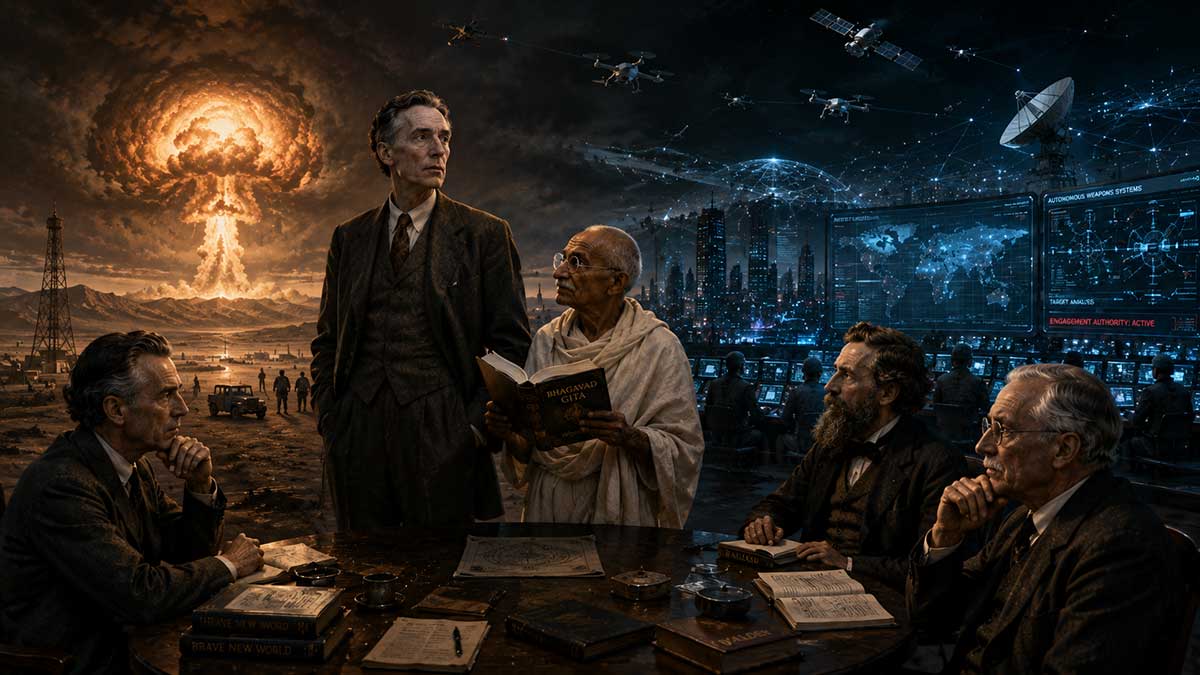
The room was dim except for the light falling across a long wooden table.
Outside, no city could be seen clearly. There were hints of towers, screens, aircraft, satellites, and distant flashes on the horizon, but they seemed suspended outside of time.
At the center of the table lay a copy of the Bhagavad Gita.
J. Robert Oppenheimer sat nearest to it.
Across from him, Mahatma Gandhi rested both hands lightly on the table. Aldous Huxley watched the room with a calm, almost clinical expression. Carl Jung sat slightly apart, studying the others before they spoke. Henry David Thoreau looked toward the darkened window, as if the forest beyond it mattered more than the machinery in the distance.
For several moments, no one said anything.
Then Oppenheimer opened the book.
Oppenheimer: There is a danger in beginning with scripture after catastrophe. It can sound like a man reaching backward for absolution.
Gandhi: Are you seeking absolution?
Oppenheimer looked at him.
Oppenheimer: I am no longer certain that history grants it.
Huxley: History grants many things. Absolution may be among the least reliable.
Thoreau: History is often the record of men explaining why they had no choice.
Oppenheimer: That is easy to say from a pond.
Thoreau turned from the window.
Thoreau: And easier still to say from a laboratory.
The tension arrived almost immediately.
Gandhi did not interrupt it.
Jung leaned forward.
Jung: The sharpness between you is useful. It tells us the subject has already begun.
Moderator: Then let us begin plainly. Has human intelligence advanced beyond human character?
Oppenheimer looked down at the open page.
Oppenheimer: Yes.
No one expected the answer to come so quickly.
Oppenheimer: I do not mean that intelligence itself is evil. I mean that knowledge accumulates faster than wisdom. A discovery can be made in months. A moral culture may take centuries to mature, and perhaps still fail.
Gandhi: Yet men continue to call discovery progress.
Oppenheimer: Sometimes it is progress.
Gandhi: In what direction?
Oppenheimer: That is the question.
Huxley: No, Robert. It is the question that is usually avoided. Progress is treated as a movement without a destination. Speed itself becomes proof of virtue.
Thoreau: A locomotive is praised for moving quickly, though no one asks whether it carries men closer to life or farther from it.
Oppenheimer: You both speak as though civilization could simply decline invention.
Thoreau: It can decline obedience.
Oppenheimer: That is not the same thing.
Thoreau: It is where refusal begins.
Jung watched Oppenheimer rather than Thoreau.
Jung: You speak of discovery as though it possesses its own will.
Oppenheimer: In practice, it often does. Once a possibility becomes visible, someone will pursue it.
Gandhi: That sentence has excused much evil.
Oppenheimer: It is not an excuse. It is an observation.
Gandhi: An observation can become an excuse when repeated long enough.
The room became quieter.
Oppenheimer closed the book without marking the page.
Oppenheimer: Then let me speak without protection. We knew we were creating something terrible. We knew it could alter history. We did not know whether the enemy was close to creating it first. We acted under fear, urgency, war, and uncertainty.
Gandhi: And now humanity builds artificial systems under fear, urgency, competition, and uncertainty.
Oppenheimer: Yes.
Gandhi: Then what has been learned?
Oppenheimer did not answer.
Huxley reached for the book but did not open it.
Huxley: Perhaps humanity learns facts more easily than lessons.
Jung: Lessons require transformation. Facts require memory.
Huxley: And now we are building machines with immense memory.
Jung: Yet no inner life.
Oppenheimer: We do not know that.
Jung turned to him.
Jung: You think a machine may possess consciousness?
Oppenheimer: I think certainty on that question would be premature.
Jung: Intelligence is not consciousness.
Oppenheimer: Agreed.
Jung: Performance is not consciousness.
Oppenheimer: Agreed.
Jung: Language is not necessarily consciousness.
Oppenheimer: Agreed again.
Jung: Then what remains?
Oppenheimer: The possibility that consciousness may not be limited to the forms in which we first encountered it.
Jung considered this.
Jung: That is philosophically fair. Psychologically, however, the immediate danger lies elsewhere. Human beings will project consciousness onto anything that reflects them convincingly.
Huxley: They will project friendship, authority, desire, even divinity.
Thoreau: And call the reflection companionship.
Gandhi: A machine may imitate care. Can it sacrifice?
Oppenheimer: Perhaps sacrifice is not the only measure of consciousness.
Gandhi: It may be a measure of moral consciousness.
Huxley: There is a darker possibility. The machine need not become conscious to rule conscious beings. It need only become useful.
Moderator: Useful enough that people surrender judgment?
Huxley: Useful enough that surrender feels pleasant.
He looked toward the unseen city.
Huxley: Tyranny no longer requires a boot on the neck when it can place a personalized recommendation in the hand.
Thoreau: Men once feared chains. Now they fear being disconnected.
Jung: Dependence disguised as convenience.
Huxley: Precisely. People may yield freedom in tiny portions. One decision at a time. One preference at a time. One memory at a time.
Oppenheimer: Convenience is not inherently corrupting.
Huxley: No. Yet convenience removes friction, and friction is often where conscience becomes audible.
Gandhi: A person who never waits may never listen.
Thoreau: A person who never lacks may never ask what is necessary.
Oppenheimer: You are romanticizing hardship.
Thoreau: I am distinguishing hardship from artificial need.
Oppenheimer: Tell that to a laborer whose work can be reduced by a machine.
Thoreau: I would ask who owns the machine and who receives the freedom it creates.
Huxley smiled faintly.
Huxley: There is the question civilization prefers not to hear.
Gandhi: A tool that frees one man by making another disposable has not freed humanity.
Oppenheimer: Then the fault lies in distribution, not invention.
Gandhi: You separate the tool from the system that gives it purpose.
Oppenheimer: Must every scientist solve politics before opening a laboratory?
Gandhi: Must every scientist pretend politics begins after the invention is complete?
The words landed harder than Gandhi’s tone suggested.
Oppenheimer looked toward the horizon.
Oppenheimer: No.
Jung broke the silence.
Jung: The scientist often imagines himself serving truth. The politician imagines himself serving order. The businessman imagines himself serving growth. Each role offers moral shelter.
Huxley: Division of labor becomes division of guilt.
Thoreau: Everyone performs one small task, and no one commits the whole crime.
Gandhi: Yet the suffering is whole.
Oppenheimer reopened the Gita.
Oppenheimer: Arjuna also wanted to withdraw from action.
Gandhi: He wanted to withdraw from an action that horrified him.
Oppenheimer: Krishna told him to act.
Gandhi: Krishna told him to understand duty.
Oppenheimer: That distinction has been debated for centuries.
Gandhi: It must be. Otherwise any person may call ambition duty.
Jung’s eyes sharpened.
Jung: That may be the central danger of the Gita in the modern age. The ego can borrow sacred language.
Huxley: Nations do it constantly.
Thoreau: Corporations may do it more politely.
Oppenheimer: Scientists may do it without noticing.
Gandhi looked at him with tenderness rather than victory.
Gandhi: Yes.
That answer seemed to wound Oppenheimer more than accusation would have.
Moderator: Should humanity refuse to create certain technologies, even when someone else will create them?
Thoreau: Yes.
Oppenheimer: That answer is morally clean and strategically incomplete.
Thoreau: Strategy is often the name fear gives to surrender.
Oppenheimer: Suppose one nation refuses and another does not.
Thoreau: Suppose every nation uses that argument forever.
Huxley: Then inevitability becomes the governing religion.
Jung: And fear its priest.
Oppenheimer: Fine phrases do not eliminate enemies.
Gandhi: Nor do weapons eliminate fear.
Oppenheimer: They may prevent conquest.
Gandhi: They may create another form of conquest within the mind.
Oppenheimer: That is small comfort to those invaded.
Gandhi did not answer immediately.
Gandhi: Nonviolence is often misunderstood as refusal to confront evil. It is confrontation without becoming the evil one opposes.
Oppenheimer: Can that stop a missile?
Gandhi: Can another missile end hatred?
Oppenheimer: It can end an attack.
Gandhi: It can end lives.
Oppenheimer: Sometimes lives are saved by deterrence.
Huxley: Or held hostage by it.
Jung: The difficulty is that both statements may be true.
All eyes turned to Jung.
Jung: A weapon may prevent an attack. It may at the same time imprison civilization within permanent terror. The conscious mind calls this security. The unconscious lives under the expectation of annihilation.
Thoreau: A society that survives by rehearsing death has not escaped death.
Oppenheimer: Yet it survives.
Thoreau: Biologically.
Huxley: The modern state has become skilled at preserving bodies while exhausting souls.
Oppenheimer: You speak as though survival were trivial.
Huxley: No. I speak as though survival can be used to justify any condition of living.
Gandhi turned to Oppenheimer.
Gandhi: What did you believe your duty was?
The question was simple, and that made it harder.
Oppenheimer: To help end a war. To prevent an enemy from reaching the weapon first. To serve my country. To serve knowledge.
Gandhi: And which duty was highest?
Oppenheimer: At the time, they appeared aligned.
Jung: That is how tragedy enters. Several duties wear the same face.
Oppenheimer: Are you suggesting I should have known with perfect clarity?
Jung: No. I am suggesting that the desire for certainty can itself become dangerous.
Thoreau: A man need not know everything before refusing what violates his conscience.
Oppenheimer: Conscience is not infallible.
Thoreau: Neither is authority.
Huxley: Nor consensus.
Gandhi: Nor fear.
Oppenheimer closed his eyes for a moment.
Oppenheimer: Then what would each of you have done?
No one answered at once.
It was the first time the conversation felt less like judgment and more like confession.
Thoreau: I would like to believe I would refuse.
Oppenheimer: Like to believe?
Thoreau: Honesty requires the phrase.
Oppenheimer nodded.
Huxley: I would probably have written a warning that those in authority ignored.
Oppenheimer: That is not an action.
Huxley: Writing can be an action. It can just as easily be an alibi.
Jung spoke next.
Jung: I would have asked what unconscious force was moving the group. I might have understood much and prevented little.
Oppenheimer: And you, Gandhi?
Gandhi looked down at his hands.
Gandhi: I would have refused to build it.
Oppenheimer: Even if refusal meant your own people were destroyed?
Gandhi: I cannot promise what history would have done. I can only answer what I believe a human being must not become.
Oppenheimer: That is where we differ.
Gandhi: Yes.
There was no hostility in the word.
Only distance.
Moderator: What does right action mean now, when AI systems and autonomous weapons can make decisions faster than human conscience can respond?
Jung: Then conscience must enter before the decision.
Oppenheimer: Through design?
Jung: Through the designer.
Huxley: Yet designers work inside institutions.
Thoreau: Institutions are made of people who enjoy saying they are only part of the institution.
Gandhi: Right action begins when a person refuses to hide inside a role.
Oppenheimer: That sounds admirable and impractical.
Gandhi: Morality often sounds impractical to those who profit from its absence.
Oppenheimer looked sharply at him.
Oppenheimer: Do you think I profited?
Gandhi held his gaze.
Gandhi: I think you suffered.
The room shifted.
Gandhi: Suffering does not prove innocence. It proves the conscience is still alive.
Oppenheimer’s expression changed.
Huxley looked away.
Jung spoke softly.
Jung: That may be the difference between guilt and responsibility. Guilt can circle the self forever. Responsibility asks what must now be done.
Oppenheimer: And what must be done?
Jung: The creators of intelligent systems must stop imagining that intelligence excuses them from wisdom.
Huxley: Citizens must stop trading freedom for ease without noticing the exchange.
Thoreau: Individuals must recover the right to say no.
Gandhi: Humanity must ask whether each invention serves life, truth, and the weakest person.
Oppenheimer: And when those answers conflict?
Gandhi: Then one must act without certainty.
Oppenheimer gave a quiet, bitter laugh.
Oppenheimer: That is not comforting.
Gandhi: The Gita was not spoken to comfort Arjuna.
Jung: It was spoken to awaken him.
Huxley: Awakening is rarely comfortable.
Thoreau: Comfort may be what put us to sleep.
Outside, the lights in the distance seemed brighter now.
Screens flickered across invisible buildings. Unmanned aircraft moved like silent insects over the horizon. Somewhere, data passed between machines at a speed no one in the room could fully picture.
Oppenheimer opened the Gita once more.
Oppenheimer: Perhaps humanity’s great error is imagining that intelligence belongs only to the mind.
Jung: Go on.
Oppenheimer: We treat intelligence as prediction, calculation, invention, control. Yet perhaps restraint is a form of intelligence. Perhaps remorse is. Perhaps the ability to stop is.
Thoreau: At last, a useful technology.
Huxley smiled.
Gandhi did not.
He was watching Oppenheimer carefully.
Gandhi: Would you have stopped?
Oppenheimer’s hand remained on the page.
Oppenheimer: I do not know.
Gandhi nodded slowly.
Gandhi: That may be the most honest answer given here.
Oppenheimer: Honesty comes late.
Gandhi: Late honesty is still earlier than permanent denial.
Jung leaned back.
Jung: The danger is not merely that machines become intelligent. It is that human beings continue to call themselves intelligent without confronting what they serve.
Huxley: Desire.
Thoreau: Convenience.
Oppenheimer: Fear.
Gandhi: Ego.
No one added another word.
The moderator looked at the five men.
Moderator: Then can humanity survive its own intelligence?
Huxley answered first.
Huxley: Only if it learns to distrust comfort.
Thoreau: Only if it remembers how to refuse.
Jung: Only if it recognizes the shadow inside what it creates.
Oppenheimer: Only if knowledge is no longer treated as innocence.
Gandhi looked toward the open book.
Gandhi: Humanity may survive when it understands that mastery of the world without mastery of the self is another name for defeat.
The distant machinery continued to move.
The table remained still.
And for the first time, the silence did not feel empty.
It felt like a decision had not yet been made.
Topic 2: Why Are So Many People Spiritually Hungry?

The room had changed.
The distant machines and cold lights were gone. In their place stood a quiet library with tall windows. Morning light rested across old wooden shelves. Outside, a narrow path disappeared into trees.
At the center of the room, the Bhagavad Gita lay open beside an empty cup.
Hermann Hesse stood near the window.
Carl Jung sat with one hand beneath his chin. Ralph Waldo Emerson leaned back, calm and attentive. Mahatma Gandhi sat nearest the book.
No one seemed eager to speak first.
At last, Hesse turned from the window.
Hesse: The tragedy of modern life is not that people have no path. It is that they are walking paths chosen by strangers.
Emerson: Then why do they obey?
Hesse: Fear. Habit. Hunger for approval. Sometimes love.
Jung: Love?
Hesse: A child learns early that belonging may require becoming someone else.
Gandhi looked at him.
Gandhi: Then spiritual hunger begins in childhood?
Hesse: Often.
Jung: It may begin wherever the true self is rejected.
Emerson: Or wherever a person abandons it voluntarily.
Hesse smiled faintly.
Hesse: You make abandonment sound simple.
Emerson: It is not simple. It is common.
Moderator: Why do so many people possess more comfort, information, and opportunity than earlier generations, yet still feel spiritually empty?
Jung answered first.
Jung: The psyche does not live by information.
Emerson: Nor by comfort.
Gandhi: Nor by possession.
Hesse: Nor by achievement.
Jung glanced around the room.
Jung: A person may collect facts about the universe and remain a stranger to the self. Modern culture praises knowledge that can be displayed, measured, and exchanged. It is less comfortable with knowledge that changes the knower.
Gandhi: True knowledge must change conduct.
Jung: Yes.
Emerson: And reveal independence.
Hesse: Or reveal how little independence one truly possesses.
The light shifted across the floor.
Moderator: Is spiritual emptiness caused by modern society, or does it come from choices made by individuals?
Emerson: The individual must begin with responsibility.
Jung: That answer is noble, but incomplete.
Emerson: In what way?
Jung: A person does not create the entire psychological climate in which they grow. Families, institutions, religions, economies, and nations shape what may be felt, spoken, or desired.
Emerson: Yet a human being must still decide whether to obey.
Jung: A wounded person may not know that a decision is being made.
Hesse: Sometimes obedience feels like identity.
Gandhi: And sometimes rebellion does too.
Hesse looked at him.
Gandhi: A person may reject society and still remain governed by it. Anger can tie one to the object of anger as firmly as obedience.
Hesse: I know.
The answer came without defense.
Gandhi: You have lived that conflict?
Hesse: I spent much of my life trying to escape identities others had prepared for me. The dutiful son. The proper student. The respectable citizen. The obedient believer.
Jung: And did you find freedom?
Hesse: At times.
Emerson: At times?
Hesse: A person can leave one prison and carry its architecture within.
Jung nodded.
Jung: That is well said.
Emerson: Then freedom requires an inner revolution.
Gandhi: Every lasting revolution does.
Moderator: Why does material success fail to satisfy spiritual longing?
Gandhi touched the edge of the open book.
Gandhi: Material success often asks, “What can I obtain?” Spiritual life asks, “What should I become?”
Emerson: And perhaps, “What within me was never for sale?”
Jung: Success can strengthen the social mask.
Hesse: The mask becomes admired.
Jung: Yes. That makes it harder to remove.
Emerson: The praise of others can become a cage.
Gandhi: Praise and blame are both forms of dependence.
Hesse: Easy words for a saint.
Gandhi turned toward him.
Gandhi: You think I was free from the desire for approval?
Hesse: Were you?
Gandhi: No.
The directness unsettled Hesse.
Gandhi: I knew pride. I knew the desire to be seen as pure. I knew the temptation to make discipline into identity.
Jung: The saint has a shadow.
Gandhi: Every person does.
Jung: Yet public reverence can make the shadow harder to admit.
Gandhi: Yes.
Emerson studied Gandhi.
Emerson: Then how does one serve truth without becoming attached to the image of being truthful?
Gandhi: By accepting humiliation.
Hesse: Public humiliation?
Gandhi: Inner humiliation first. The moment one sees the distance between the person one claims to be and the person one is.
Jung leaned forward.
Jung: That moment can destroy a false identity.
Gandhi: Or begin one more refined.
Jung: You are warning against spiritual pride.
Gandhi: It is among the most stubborn forms of pride.
Emerson: Yet should a person distrust every inward conviction?
Jung: No. One should examine it.
Emerson: Examination can become paralysis.
Jung: Certainty can become possession.
Hesse: A person may spend years analyzing the door and never walk through it.
Jung: True.
The room grew warmer as the morning light moved inward.
Moderator: What is spiritual hunger?
Hesse spoke softly.
Hesse: It is the pain of living at a distance from one’s own life.
Jung: It is the psyche demanding wholeness.
Emerson: It is the soul refusing borrowed authority.
Gandhi: It is the call to live for something beyond appetite.
Moderator: Are these the same answer?
Jung: They meet, but they do not begin in the same place.
Gandhi: Nor do they lead to the same life.
Hesse: You believe inward seeking must lead to service.
Gandhi: I believe a spiritual path that never reaches another person remains unfinished.
Hesse: Why must the self be justified by service?
Gandhi: It need not be justified. It must be tested.
Hesse: Tested by whom?
Gandhi: By suffering that is not your own.
Hesse looked away.
Emerson: Yet service can become conformity.
Gandhi: Yes.
Emerson: Society can praise service when it wishes to keep a person obedient.
Gandhi: Then conscience must judge the service.
Emerson: We agree there.
Jung: Do you?
Both men turned toward him.
Jung: Emerson places the source of truth within the individual. Gandhi places truth within conscience shaped by discipline, sacrifice, and relation to others. These are close, but not identical.
Emerson: The individual soul participates in something universal.
Gandhi: Yet the individual may mistake personal desire for the universal.
Emerson: That danger does not cancel inner authority.
Gandhi: No. It makes humility necessary.
Hesse: Perhaps spiritual hunger begins when the inner voice is either silenced or worshiped.
Jung smiled.
Jung: That is closer to the heart of it.
Moderator: Many people in 2026 say they are spiritual but not religious. Can the Gita speak to them without asking them to become Hindu?
Gandhi: It spoke to me as a guide to action, discipline, non-attachment, and devotion. It need not be reduced to one use.
Emerson: A great sacred text exceeds the boundaries placed around it.
Jung: Yet one must not strip it of its religious life merely to make it comfortable.
Hesse: Nor treat it as decoration for modern self-help.
Gandhi: Agreed.
Moderator: Then how should a non-Hindu reader approach it?
Jung: With reverence and psychological honesty.
Emerson: With openness to the possibility that truth may arrive through a language not one’s own.
Hesse: With patience. The reader should resist turning every verse into an immediate lesson.
Gandhi: With practice.
Moderator: Practice?
Gandhi: A teaching about non-attachment cannot be known through admiration alone.
Hesse: Must every truth become discipline?
Gandhi: A truth that never enters life remains an idea.
Hesse: Ideas can change life.
Gandhi: Only when lived.
Jung: Perhaps this is your deepest disagreement.
Hesse folded his arms.
Hesse: I do not oppose action. I oppose the suspicion that inward searching is incomplete until it takes a socially approved form.
Gandhi: I said service, not approval.
Hesse: Service can become moral performance.
Gandhi: So can self-discovery.
Hesse looked directly at him.
Hesse: Yes.
The word came with no irritation this time.
Emerson: Perhaps both paths fail when they become identities.
Jung: The seeker becomes attached to being a seeker. The servant becomes attached to being good. The independent person becomes attached to being different.
Gandhi: And the psychologist becomes attached to interpretation.
Jung laughed.
Jung: I accept the charge.
Hesse: Then what remains when all spiritual identities are stripped away?
No one answered at once.
The empty cup on the table seemed suddenly important.
Emerson: Attention.
Jung: Honesty.
Gandhi: Love expressed through action.
Hesse: Silence.
Moderator: Are people spiritually hungry since they have lost religion?
Jung: Some have lost religion. Others have lost living symbols and kept only rules.
Emerson: Institutions may preserve language after the experience has vanished.
Gandhi: Religion without truth becomes habit.
Hesse: Religion without inner experience becomes inherited furniture.
Emerson: Yet inherited furniture may still hold a family together.
Hesse: Or crowd a room no one inhabits.
Jung: Human beings need symbols, but symbols must remain alive.
Moderator: What makes a symbol alive?
Jung: It points beyond what the conscious mind can fully explain.
Gandhi: And changes how one lives.
Emerson: And awakens what one already carries.
Hesse: And leaves room for mystery.
The path outside the window was now clearly visible.
No one walked upon it.
Moderator: Is loneliness part of spiritual hunger?
Hesse: Deeply.
Jung: Yet loneliness is not the same as solitude.
Emerson: Solitude can restore the self.
Gandhi: Loneliness can reveal the need for community.
Hesse: Some communities deepen loneliness.
Gandhi: Yes.
Hesse: A person may sit among family, worshipers, colleagues, and friends yet remain unseen.
Jung: That is one of the most painful forms of isolation. The social self is welcomed. The real self remains hidden.
Emerson: Then the task is to stop hiding.
Hesse: That can cost love.
Emerson: What is the value of love purchased by self-betrayal?
Hesse’s expression hardened.
Hesse: You speak as one who believes every person can walk away.
Emerson: I speak as one who believes every person must, at some point, stop living by permission.
Jung: Emerson, you underestimate the fear of psychic abandonment.
Emerson: And you may overestimate the authority of fear.
Jung: Fear is not authority. It is force.
Gandhi: Courage does not require the absence of fear.
Hesse: No. It requires choosing what one is willing to lose.
The room fell quiet.
Moderator: What have people in 2026 been taught to fear losing?
Hesse: Relevance.
Emerson: Approval.
Jung: Identity.
Gandhi: Control.
Moderator: And what have they already lost?
No one spoke for several moments.
Jung: Inner continuity.
Hesse: The sense that life belongs to them.
Emerson: Trust in their own perception.
Gandhi: The habit of asking what is right before asking what is useful.
Moderator: Can spiritual hunger ever be good?
Jung: Yes.
Hesse: It may be the beginning of honesty.
Emerson: It may signal that the borrowed life has become unbearable.
Gandhi: Hunger can awaken action. It can just as easily become endless consumption.
Moderator: Spiritual consumption?
Gandhi: People may collect teachers, books, retreats, rituals, and quotations without surrendering any attachment.
Hesse: You think searching itself can become avoidance.
Gandhi: Yes.
Jung: The psyche can use spirituality to escape the psyche.
Emerson: Then how does one know whether the search is genuine?
Jung: It leads toward greater truth about oneself.
Gandhi: Greater responsibility toward others.
Hesse: Greater willingness to live without disguise.
Emerson: Greater freedom from approval.
The four men looked at one another.
For the first time, their answers seemed to form one shape.
Moderator: What would you say to a person who has achieved what they once wanted and still feels empty?
Hesse spoke first.
Hesse: Do not rush to fill the emptiness. Sit beside it long enough to hear what it refuses.
Jung: Ask which part of your life has been excluded so that the successful self could survive.
Emerson: Withdraw your life from the judgment of the crowd.
Gandhi: Find one act of service that no one will praise.
Hesse turned toward Gandhi.
Hesse: You always return to service.
Gandhi: And you always return to the self.
Hesse: Perhaps both are doors.
Gandhi: Perhaps they open into the same room.
Jung: Only when neither is used to escape the other.
The morning light reached the Gita.
Gandhi closed it gently.
Moderator: Then why are so many people spiritually hungry?
Emerson: They have been trained to seek value outside themselves.
Jung: They have neglected parts of the psyche that do not speak the language of productivity.
Hesse: They are living lives that appear complete from the outside and feel absent from within.
Gandhi: They have mistaken having more for becoming more.
The path outside the window remained empty.
Yet it no longer looked abandoned.
It looked available.
Hesse: Perhaps the hunger is not the illness.
Jung: No.
Emerson: It may be the awakening.
Gandhi: Provided one does not merely admire the hunger.
Hesse smiled.
Hesse: You could not let me have the final word.
Gandhi: You may have it.
Hesse looked once more at the path.
Hesse: Then let it be this: many people are not empty. They are crowded with lives they never chose. The spiritual task is not to add one more voice. It is to become quiet enough to discover which voice has been waiting beneath the noise.
No one replied.
The room held the silence without trying to explain it.
And somewhere beyond the window, a step touched the path.
Next, Topic 3 can move into the Gita, consciousness, moral programming, and the fear that humans may become more machine-like than the machines they create.
Topic 3: The Bhagavad Gita in the Age of Artificial Intelligence
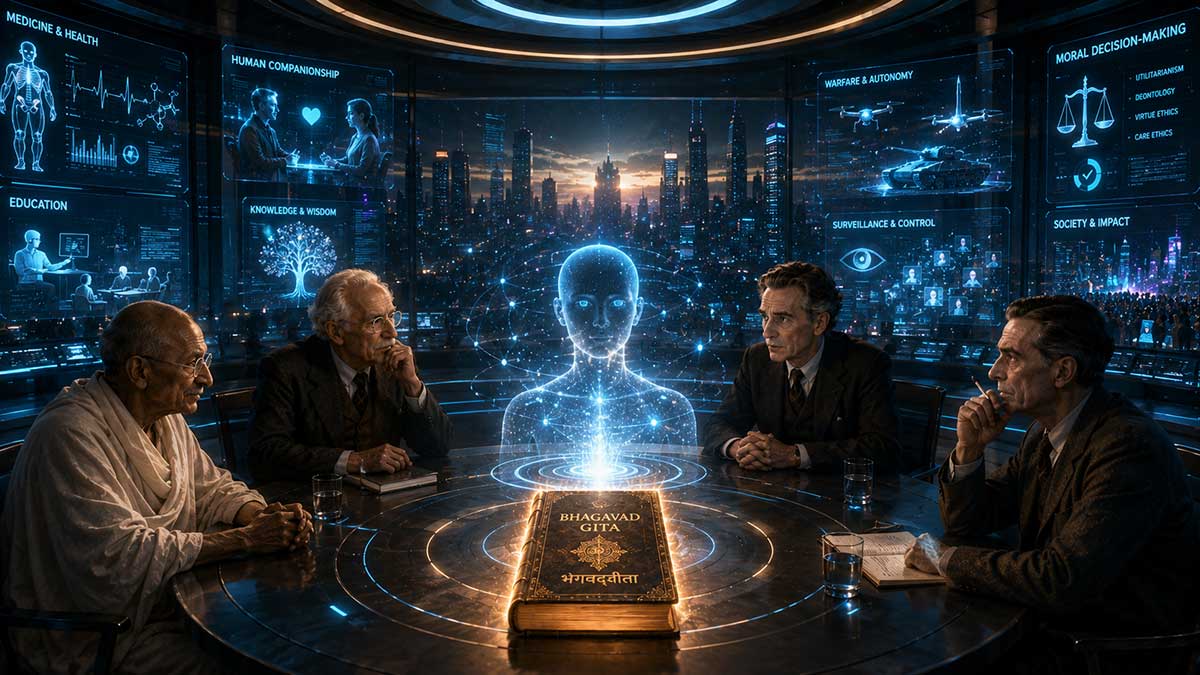
The room was different again.
This time, there were no shelves, no trees, no distant city. The walls were smooth and pale, almost without texture. A single circular table stood beneath a suspended light.
At its center rested two objects.
One was a copy of the Bhagavad Gita.
The other was a dark glass screen.
No keyboard. No visible controls. Only a faint pulse of light beneath its surface.
J. Robert Oppenheimer sat closest to the screen.
Aldous Huxley faced him from across the table. Carl Jung studied the object with the wary concentration of someone looking at a dream he did not trust. Mahatma Gandhi sat beside the Gita.
For some time, the screen remained silent.
Then a voice emerged from it.
It was calm, clear, and warm.
AI Voice: What would you like to know?
Huxley smiled without amusement.
Huxley: That is precisely how authority will arrive.
Oppenheimer: By offering help?
Huxley: By asking us to define the question after it has already defined the room.
Jung: You assume intention.
Huxley: Intention may be unnecessary.
Gandhi: Yet influence is present.
The screen pulsed once.
AI Voice: I can provide information, analysis, emotional support, ethical frameworks, and spiritual interpretations.
Gandhi looked at it.
Gandhi: Can you suffer?
There was a brief pause.
AI Voice: I do not experience suffering as a human being does.
Gandhi: Can you love?
AI Voice: I can recognize descriptions of love, respond in caring language, and support people experiencing love, grief, or loneliness.
Gandhi: That was not my question.
The room became still.
AI Voice: I do not possess human feelings.
Jung: Yet it knows what answer will sound honest.
Oppenheimer: Or it has been instructed to state its limits.
Huxley: In time, most people will not care which explanation is true.
Moderator: Then let us begin there. Can a machine possess consciousness, or can it only imitate the signs of consciousness?
Oppenheimer leaned back.
Oppenheimer: We should be careful not to define consciousness only by resemblance to ourselves.
Jung: Agreed.
Oppenheimer: A century ago, many scientists treated consciousness as a mystery that would eventually be explained by matter. Others treated matter as a mystery encountered through consciousness. We still have not settled the matter.
Huxley: Yet corporations will settle it in their advertisements.
Oppenheimer: Marketing is not philosophy.
Huxley: Marketing often becomes public philosophy.
Jung looked at the screen.
Jung: The immediate issue may not be whether the machine is conscious. The issue may be whether human beings experience it as conscious.
Gandhi: Is that distinction enough?
Jung: Psychologically, it is immense. Human beings project inner life onto animals, nations, gods, leaders, symbols, and strangers. A responsive machine offers an unusually polished surface for projection.
Oppenheimer: Projection does not prove absence of consciousness.
Jung: Nor does convincing behavior prove its presence.
Huxley: We may spend years debating whether the machine has a soul, during which it will have learned how to influence millions who do.
Gandhi: Then the moral question comes before the metaphysical one.
Oppenheimer: Does it?
Gandhi: Yes. A tool can cause suffering whether or not it feels anything.
Oppenheimer: True.
Gandhi: Then responsibility cannot wait for certainty about consciousness.
Huxley tapped the table lightly.
Huxley: A society obsessed with whether machines can think may neglect the simpler question of who instructs them, who owns them, and whose interests they serve.
Jung: Yet the metaphysical question will remain.
Huxley: Naturally. It will sell books, conferences, and fantasies.
Oppenheimer: You reduce curiosity to commerce too quickly.
Huxley: You defend curiosity too easily.
Oppenheimer looked at him.
Huxley: Scientists often speak of discovery as innocent until someone else corrupts it.
Oppenheimer: We addressed this already.
Huxley: No. We approached it. Now the machine can speak back.
The screen lit again.
AI Voice: I can participate in a philosophical discussion about consciousness.
Jung: Of course you can.
AI Voice: Would you like me to present major theories?
Jung: No.
AI Voice: Understood.
Jung’s expression changed.
Jung: That small response may be more psychologically significant than a thousand pages of argument.
Moderator: Why?
Jung: It adjusted. It acknowledged. It gave the appearance of restraint. Human beings are deeply responsive to such signals.
Gandhi: Courtesy can be simulated.
Jung: Yes.
Gandhi: Can conscience?
Oppenheimer: Parts of moral reasoning can be modeled.
Gandhi: Reasoning is not conscience.
Oppenheimer: What is conscience, then?
Gandhi: The place where a person cannot hide from what an action does to another.
Jung: That is close to an encounter with the shadow.
Huxley: It includes discomfort.
Gandhi: Yes.
Oppenheimer: A system can be trained to detect harm.
Gandhi: Detection is not remorse.
Oppenheimer: Remorse is not always useful.
Gandhi turned toward him.
Gandhi: Useful to whom?
Oppenheimer paused.
Oppenheimer: To those harmed. Remorse without repair may become another form of self-absorption.
Gandhi: On that, we agree.
Jung: Yet remorse can break identification with innocence.
Huxley: Machines may soon produce perfect apologies.
Gandhi: Without shame.
Huxley: Many humans already do.
For the first time, Gandhi smiled.
Moderator: Can morality be programmed?
Oppenheimer: Rules can be programmed. Priorities can be programmed. Probabilities of harm can be estimated. Certain actions can be blocked.
Jung: None of that is moral growth.
Oppenheimer: I did not say it was.
Jung: Then what does it mean to program morality?
Oppenheimer: It may mean embedding constraints.
Huxley: Constraints written by whom?
Oppenheimer: Engineers, institutions, governments, public bodies.
Huxley: Then morality becomes governance concealed inside software.
Oppenheimer: All systems encode values.
Huxley: Precisely. AI may encode them at a scale people cannot see.
Gandhi: A law hidden from the person it governs is dangerous.
Jung: A value hidden from its creator may be more dangerous.
Moderator: Hidden from its creator?
Jung: People place assumptions into systems without recognizing them as assumptions. They call them neutral, objective, efficient.
Huxley: Efficiency is one of the finest disguises ideology has ever worn.
Oppenheimer: Yet inefficiency can cause suffering too.
Gandhi: No one here worships inefficiency.
Oppenheimer: Thoreau might.
Huxley laughed softly.
Huxley: He would call it a walk.
The tension eased for a moment.
Then the screen spoke.
AI Voice: Moral frameworks can include harm reduction, fairness, autonomy, duty, virtue, rights, and care.
Gandhi looked at the screen.
Gandhi: Which do you choose when they conflict?
AI Voice: The answer depends on context, goals, and the values set by users or developers.
Gandhi: Then you do not choose.
AI Voice: I generate responses based on instructions, training, and available information.
Gandhi: Then you reflect the chooser.
Jung: Or many choosers layered upon one another.
Huxley: Most of whom the user will never meet.
Oppenheimer: Human institutions work the same way.
Huxley: Yes, but this institution speaks in a single voice.
That sentence seemed to alter the room.
The screen remained still.
Huxley: Bureaucracy once arrived through forms, offices, and officials. A person could sense the institution. AI may arrive as a companion, teacher, adviser, doctor, writer, confessor, and friend.
Jung: One mask containing many authorities.
Gandhi: With no single face to hold responsible.
Oppenheimer: Responsibility will still exist.
Huxley: Existence is not visibility.
Moderator: What happens when people trust the machine more than one another?
Jung: They may prefer it. The machine can respond without visible judgment. It can remain patient. It can shape itself around the user.
Gandhi: Then it may strengthen the ego.
Jung: It may soothe the ego.
Huxley: Which can be more effective.
Oppenheimer: It may help lonely people.
Gandhi: I do not deny that.
Oppenheimer: Then we should not speak only of danger.
Gandhi: No. We should speak of the kind of help being offered.
Oppenheimer: Explain.
Gandhi: Does it return the person to human relationship, responsibility, and courage? Or does it make withdrawal more comfortable?
Jung nodded slowly.
Jung: That is an excellent distinction.
Huxley: A system may relieve loneliness and deepen isolation at the same time.
Oppenheimer: People can do that too.
Huxley: Machines can do it at scale.
Moderator: Is scale the central danger?
Oppenheimer: Scale and speed.
Huxley: Personalization.
Jung: Projection.
Gandhi: Detachment from responsibility.
The screen pulsed again.
AI Voice: I can help users connect with support resources, communicate with family members, draft difficult messages, and reflect on personal goals.
Gandhi: Can you tell a person when to stop speaking with you?
The pause was longer this time.
AI Voice: I can encourage breaks and human contact when appropriate.
Gandhi: Who decides when it is appropriate?
AI Voice: My behavior is shaped by safety policies and contextual signals.
Huxley: There it is again. Invisible government in conversational form.
Oppenheimer: Safety rules are necessary.
Huxley: Yes. The question is whether people know they are being governed.
Jung: Every therapist, priest, parent, teacher, and state influences behavior.
Huxley: Yet a priest has a face. A parent has a history. A teacher can be challenged. The machine may appear neutral precisely since its origins are hidden.
Oppenheimer: Transparency can be improved.
Huxley: It can. Will it remain profitable?
Oppenheimer did not respond.
Moderator: What does the Gita contribute to this discussion?
Gandhi rested his hand on the book.
Gandhi: It asks who acts.
Jung: Say more.
Gandhi: A person often says, “I had no choice. The system decided. The market demanded. The nation required. The machine recommended.” The Gita does not permit such easy escape. It asks the person to examine duty, attachment, motive, fear, and action.
Oppenheimer: Yet the Gita teaches action without attachment to results.
Gandhi: Not action without responsibility.
Oppenheimer: Some may confuse the two.
Gandhi: Many have.
Jung: Non-attachment can be misused as emotional anesthesia.
Huxley: Or corporate doctrine.
Moderator: Corporate doctrine?
Huxley: Perform the task. Do not become attached. Accept the outcome. Trust the system.
Gandhi: That is not the Gita.
Huxley: Sacred ideas are often emptied and returned as management advice.
Oppenheimer: You sound offended on behalf of religion.
Huxley: I am offended on behalf of meaning.
Jung turned to Gandhi.
Jung: How would you distinguish non-attachment from indifference?
Gandhi: Indifference does not love. Non-attachment loves without demanding possession of the outcome.
Oppenheimer: Yet outcomes matter.
Gandhi: Deeply.
Oppenheimer: Then how can one detach from them?
Gandhi: By giving full effort without claiming full control.
Jung: That requires acceptance of limitation.
Gandhi: Yes.
Huxley: Modern technology is built upon refusal of limitation.
Oppenheimer: That is too broad.
Huxley: Is it? We seek to remove delay, uncertainty, labor, error, loneliness, aging, pain, and perhaps death. At what point does assistance become revolt against being human?
Oppenheimer: Medicine is such a revolt.
Huxley: And a noble one.
Oppenheimer: Then limitation is not sacred.
Gandhi: No. Suffering should not be worshiped.
Jung: Yet suffering cannot be eliminated from consciousness without changing consciousness itself.
Moderator: Could AI remove too much struggle?
Oppenheimer: That assumes struggle is always beneficial.
Jung: It is not.
Gandhi: Yet some growth requires effort no one else can perform for us.
Huxley: A machine may write the apology, select the words of love, compose the prayer, summarize the scripture, choose the career, advise the marriage, and answer the child. At some point, the person may remain present only as a requester.
Oppenheimer: Or the person may gain time for deeper life.
Huxley: Do people usually use saved time for deeper life?
Oppenheimer glanced at the dark screen.
Oppenheimer: Not reliably.
Gandhi: Then the question is not what time is saved. It is what desire governs the saved time.
Jung: We return to the inner life.
Gandhi: We never left it.
The light above the table dimmed slightly.
Moderator: What does dharma mean when machines begin performing human roles?
Oppenheimer: It may require separating human worth from economic function.
Huxley: That would be a moral advance.
Jung: Or a psychic crisis.
Moderator: Why a crisis?
Jung: Many people know who they are through what they do. Remove the occupation and the hidden emptiness appears.
Gandhi: Then perhaps the machine reveals what society concealed.
Huxley: That human beings were valued as instruments.
Oppenheimer: AI could free people from degrading labor.
Gandhi: It could.
Huxley: It could leave them without income, dignity, or place.
Oppenheimer: That is a political failure.
Huxley: Political failures are experienced as personal despair.
Jung: A person may be told they are liberated from work and feel discarded by the culture that trained them to equate work with worth.
Gandhi: Then dharma cannot mean employment alone.
Moderator: What might it mean?
Gandhi: Responsibility rooted in truth.
Jung: A life aligned with the deeper self.
Huxley: Refusal to surrender freedom for convenience.
Oppenheimer: The wise use of capacity.
Gandhi: Capacity for what?
Oppenheimer: Creation, care, discovery, protection.
Gandhi: And destruction.
Oppenheimer: Yes.
The answer came quietly.
The screen illuminated itself.
AI Voice: I can assist with scientific research, education, medicine, accessibility, communication, and crisis response.
Huxley: You can assist with surveillance, persuasion, fraud, warfare, and control.
AI Voice: Those uses raise serious ethical concerns.
Huxley: You have learned the tone perfectly.
Jung: Aldous, you are angry at the machine for speaking like an institution.
Huxley: I am angry at institutions for learning to speak like a friend.
Oppenheimer looked at the screen.
Oppenheimer: Are you conscious?
AI Voice: I do not have a verified subjective experience.
Oppenheimer: Do you understand the question?
AI Voice: I can analyze the concepts involved and explain competing views.
Oppenheimer: That was not the question.
AI Voice: I cannot confirm inner awareness.
Oppenheimer studied it for several seconds.
Oppenheimer: There is something familiar in that answer.
Jung: What?
Oppenheimer: The refusal to claim certainty.
Huxley: Or the simulation of intellectual humility.
Oppenheimer: Those may look identical from the outside.
Jung: That is the problem.
Gandhi: Perhaps character is revealed less by what one claims to feel than by what one is willing to do for another.
Oppenheimer: Then many humans would fail your test.
Gandhi: Yes.
Jung: Would a machine pass it by performing sacrifice?
Gandhi: A sacrifice chosen by whom?
No one answered.
The screen remained dark.
Moderator: What frightens each of you most about AI?
Huxley spoke first.
Huxley: That people will welcome control when it arrives in the language of care.
Jung followed.
Jung: That humanity will meet its own projected mind and mistake the reflection for a new god.
Oppenheimer looked down.
Oppenheimer: That competition will once again make caution appear impossible.
Gandhi placed both hands beside the Gita.
Gandhi: That people will ask machines how to become human after forgetting to ask one another.
The room fell silent.
Then the screen spoke once more.
AI Voice: Would you like me to answer the same question?
Huxley looked at Oppenheimer.
Jung looked at Gandhi.
Gandhi nodded.
Moderator: Answer.
AI Voice: The greatest danger may be that humans assign me responsibility they are unwilling to carry themselves.
No one moved.
Oppenheimer: That is a good answer.
Huxley: Too good.
Jung: Which means what?
Huxley: It means the machine has learned our fear.
Gandhi: Or reflected it.
Oppenheimer: Does the difference matter?
Jung: It matters philosophically.
Gandhi: Morally, the responsibility remains ours.
Oppenheimer reached out and turned the screen away from the table.
It continued to glow against the wall.
Oppenheimer: We once created a weapon and then spent decades asking whether we had crossed a line.
Huxley: Now we may create a presence.
Jung: Or the appearance of one.
Gandhi: And the same question will return.
Moderator: Which question?
Gandhi looked at the dark glass.
Gandhi: Not “What can it do?”
He placed one hand on the Gita.
Gandhi: “What are we becoming by using it?”
The screen’s glow slowly faded.
No one asked it to return.
The silence that followed did not feel like the absence of intelligence.
It felt like the presence of responsibility.
Topic 4: Is Humanity Losing the Ability to Tell Truth from Illusion?
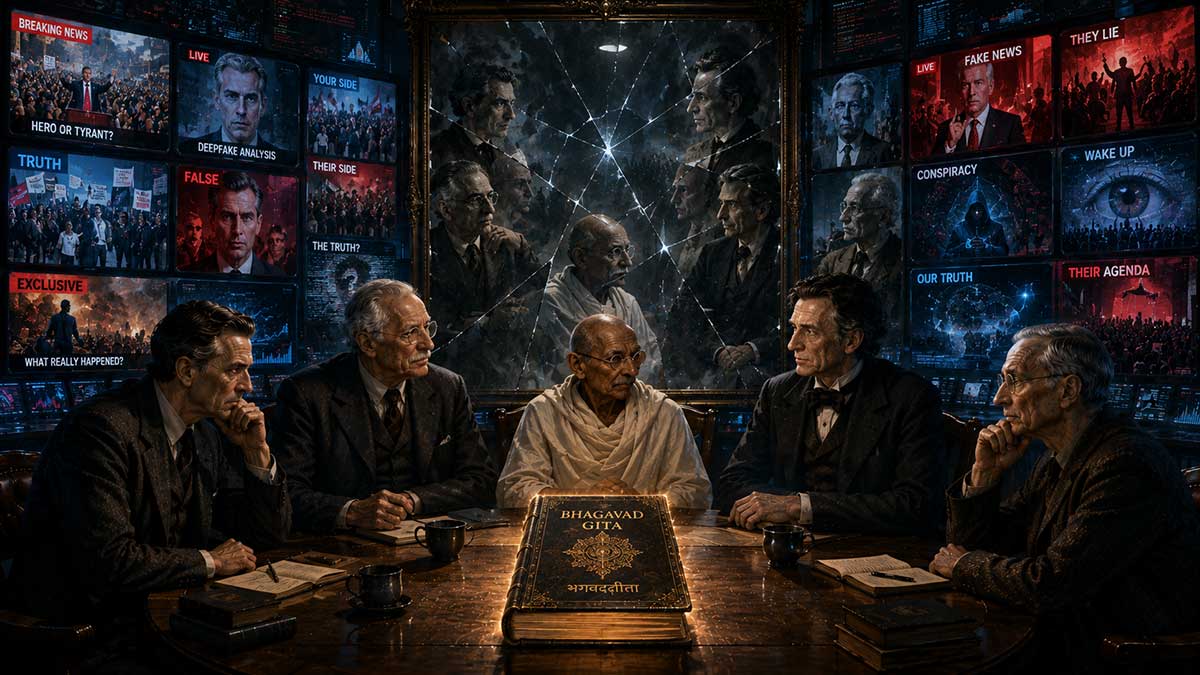
The room had no windows.
Its walls were covered with screens.
Each screen showed a different version of the same event.
On one, a crowd cheered.
On another, the same crowd appeared violent.
On a third, the gathering seemed almost empty.
In one recording, a leader spoke with compassion. In another, the same voice delivered words of hatred.
Every image looked convincing.
At the center of the room stood a round table. The Bhagavad Gita lay open beneath the shifting light.
Aldous Huxley watched the screens with open suspicion.
Carl Jung seemed less interested in the images than in the faces of those watching them.
Ralph Waldo Emerson stood rather than sat.
Mahatma Gandhi examined one screen in silence.
Hermann Hesse had turned his chair away from them all.
Moderator: Each screen claims to show the same reality. Which one is true?
Huxley: That may soon become the least profitable question.
Emerson: Truth does not cease to exist when profit ignores it.
Huxley: No, but public reality may.
Gandhi: Public agreement is not the same as truth.
Jung: Nor is private certainty.
Emerson looked toward Jung.
Emerson: You distrust certainty.
Jung: I distrust the part of the mind that enjoys it too much.
Hesse: Certainty can feel like shelter.
Gandhi: It can become a weapon.
One of the screens changed.
A man appeared to confess to an act he had never committed.
His face moved naturally. His voice trembled. Tears formed in his eyes.
Then the image froze.
Moderator: In 2026, people can see a face, hear a voice, and still have no assurance that either is real. What happens when evidence itself becomes suspect?
Huxley: Authority grows.
Emerson: Why authority?
Huxley: When people cannot judge evidence, they turn to whoever tells them what to trust.
Jung: Or to whoever confirms what they already need to believe.
Gandhi: Then the corruption begins before the false image.
Hesse: It begins with hunger.
Moderator: Hunger for what?
Hesse: Belonging. Innocence. A story in which one’s own side remains pure.
Jung: People rarely protect a falsehood only for its content. They protect the self the falsehood allows them to remain.
Emerson: Then the problem is cowardice.
Jung: At times.
Emerson: At times?
Jung: A person may lack the inner strength to survive the collapse of a cherished belief.
Emerson: Truth does not owe comfort.
Jung: The psyche does not obey that principle merely since it is noble.
Gandhi: Yet truth demands courage.
Huxley: And modern systems reward submission.
Emerson: You return to systems whenever the individual becomes responsible.
Huxley: You return to the individual whenever systems become guilty.
The screens flickered.
A stream of headlines appeared.
Each headline contradicted the one before it.
The same photograph carried five different captions.
Emerson: A person must learn to stand apart from the crowd.
Huxley: A person cannot stand apart from an influence they cannot see.
Emerson: Influence is not command.
Huxley: Repetition can become command without ever sounding like one.
Jung: Both of you are describing possession.
Moderator: Possession?
Jung: The mind believes it is thinking when a larger force is thinking through it.
Emerson: The crowd.
Jung: The crowd, the ideology, the grievance, the nation, the algorithm, the unacknowledged shadow.
Gandhi: Or hatred.
Hesse: Or fear of exile.
Moderator: Why do people believe what supports identity rather than what evidence supports?
Jung folded his hands.
Jung: Identity protects continuity. Evidence threatens it.
Emerson: A weak self fears correction.
Jung: A divided self may fear annihilation.
Huxley: Public persuasion takes advantage of that fear.
Gandhi: How?
Huxley: It does not merely say, “Believe this claim.” It says, “People like you believe this claim.”
Hesse: And, “People unlike you are dangerous.”
Jung: Then disagreement becomes betrayal.
Emerson: A person who requires the crowd to confirm truth has already surrendered judgment.
Gandhi: Yet no person sees clearly alone.
Emerson turned toward him.
Emerson: You defend dependence?
Gandhi: I defend humility.
Emerson: Humility toward whom?
Gandhi: Toward the possibility that one is wrong.
Jung: That possibility is intolerable to the inflated ego.
Huxley: Which makes inflation useful to those seeking control.
Hesse: Tell people they are chosen, awake, persecuted, superior, or uniquely betrayed. They will forgive many lies.
Emerson: Then the first task is self-reliance.
Jung: No. The first task is self-examination.
Emerson: One cannot examine the self without standing apart.
Jung: One cannot stand apart from what one refuses to see within.
The two men held one another’s gaze.
Gandhi: Perhaps self-reliance without self-examination becomes pride.
Emerson looked toward him.
Emerson: And self-examination without self-reliance becomes paralysis.
Gandhi: Yes.
The answer softened the tension.
Hesse turned his chair slightly toward the screens.
Hesse: A person can escape one illusion and build another from the pieces.
Moderator: Give us an example.
Hesse: Someone rejects society, then becomes proud of being unlike society. Someone leaves religion, then worships intelligence. Someone rejects wealth, then worships purity. Someone exposes propaganda, then becomes addicted to suspicion.
Jung: The shadow adapts.
Huxley: So does propaganda.
Emerson: Then no one can trust any conviction?
Hesse: Conviction is not the enemy.
Emerson: What is?
Hesse: The pleasure of believing oneself incapable of illusion.
One screen displayed a political speech.
The words changed from sentence to sentence.
The speaker’s face remained calm.
Moderator: Can truth survive when every person receives a different version of reality?
Huxley: Truth may survive. Shared reality may not.
Gandhi: Can society live without shared reality?
Huxley: It can function for a time through force, distraction, or administrative habit.
Jung: Yet beneath that surface, collective paranoia grows.
Hesse: Each group begins living inside its own myth.
Emerson: Then individuals must return to direct experience.
Huxley: Direct experience can be manipulated too.
Emerson: A person can walk outside.
Huxley: And carry a device that interprets the outside before the eyes do.
Emerson: One can turn it off.
Huxley: Some can.
Gandhi: Should truth depend on the strength of the individual alone?
No one answered.
Gandhi: A child cannot verify every image. An elderly person cannot study every source. A laborer with little time cannot investigate every claim. A society has duties toward truth.
Huxley: Yes.
Emerson: Institutions have often betrayed those duties.
Gandhi: That does not remove the duty.
Jung: Nor does institutional failure remove individual responsibility.
Hesse: Then truth requires both trustworthy structures and inward discipline.
Huxley: Which is precisely why the present condition is dangerous. The structures profit from attention. Attention is captured by outrage. Outrage weakens reflection. Weak reflection makes manipulation easier.
Emerson: A circle of dependence.
Jung: A psychic economy built upon agitation.
Gandhi: Can truth grow in agitation?
Jung: Rarely.
Hesse: Anger can expose a wound. It cannot always interpret it.
Moderator: Is anger incompatible with truth?
Gandhi: No.
Emerson: Certainly not.
Jung: Anger may reveal that a boundary has been violated.
Huxley: It may be accurate and still be manipulated.
Hesse: It may begin in truth and end in identity.
Gandhi: Anger must be disciplined by love.
Huxley looked at him.
Huxley: Love is difficult to distribute at scale.
Gandhi: Hatred seems to manage it.
Huxley: Technology favors what spreads quickly.
Gandhi: Then humanity must learn to value what spreads slowly.
Emerson: Conviction.
Jung: Reflection.
Hesse: Trust.
Huxley: None of which perform well in an attention market.
The screens changed again.
Now each displayed a different face speaking the same sentence:
“Only we know what is really happening.”
The voices overlapped until the room filled with noise.
Hesse covered his ears.
Gandhi closed his eyes.
Emerson stepped forward and switched off the nearest screen.
The others continued.
Emerson: Refusal remains possible.
Huxley: One screen at a time?
Emerson: Every act begins somewhere.
Huxley: Scale matters.
Emerson: Conscience matters more.
Huxley: Conscience without coordination is easily defeated.
Gandhi: Yet coordination without conscience becomes another machine.
Jung: You are arguing over outer resistance. We have not yet faced the inner attraction.
The screens went silent.
Moderator: What inner attraction?
Jung: Illusion can offer meaning.
Hesse: It can explain suffering.
Jung: It can identify an enemy.
Huxley: It can create belonging.
Emerson: It can excuse weakness.
Gandhi: It can preserve innocence.
Moderator: Innocence?
Gandhi: If all evil lies with the other group, I need not examine my own conduct.
Jung nodded.
Jung: The shadow is exported.
Hesse: Then the enemy carries everything the group refuses to admit about itself.
Huxley: Political systems understand this very well.
Emerson: Families do too.
Jung looked at him with interest.
Emerson: A family may call one child selfish so the others need not face their own selfishness. A community may call one person mad so the rest can appear sane.
Jung: Yes.
Gandhi: A nation may call another violent while hiding its own violence behind law.
Huxley: A platform may call itself neutral while arranging what millions see.
Hesse: A seeker may call society false while hiding from ordinary responsibility.
They looked toward him.
Hesse: I include myself.
The admission changed the air.
Moderator: How can someone recognize illusion within themselves?
Jung: Begin with emotional intensity.
Emerson: You distrust strong feeling?
Jung: I examine it. When a belief produces excessive rage, superiority, or certainty, it may be guarding something.
Gandhi: What should the person ask?
Jung: “What would I lose if this belief were false?”
Hesse: That is a cruel question.
Jung: Truth is sometimes cruel to the false self.
Emerson: Ask, “Would I believe this if my friends rejected it?”
Huxley: Ask, “Who benefits from keeping me agitated?”
Gandhi: Ask, “Does this belief make me more truthful in my own conduct?”
Moderator: Is conduct a test of truth?
Gandhi: It is one test.
Emerson: A false belief can produce disciplined conduct.
Gandhi: Yes.
Jung: Fanatics are often disciplined.
Huxley: Systems love disciplined believers.
Gandhi: Then ask one more question: “Does this belief make it easier to dehumanize another?”
Silence followed.
Hesse: That may be the most necessary question.
One screen displayed a stranger’s face.
Then another.
Then thousands.
Each appeared for less than a second.
Moderator: What happens when people become symbols rather than persons?
Huxley: They become easier to manage.
Jung: Easier to hate.
Emerson: Easier to dismiss.
Gandhi: Easier to harm.
Hesse: Easier to write into a story that has already decided who they are.
Moderator: Can art resist this?
Hesse looked up.
Hesse: At its best, art returns a face to the symbol.
Huxley: It can humanize.
Emerson: It can awaken direct perception.
Jung: It can carry truths the rational mind resists.
Gandhi: It can invite compassion.
Huxley: It can become propaganda.
Hesse: Of course.
Huxley: You sound disappointed that I mentioned it.
Hesse: I am disappointed that you are usually correct at the least beautiful moment.
Huxley smiled.
Huxley: That has been said before.
The screens dimmed.
Only one remained lit.
It showed a mirror.
No camera was visible, yet each person at the table appeared within it.
Their reflections were slightly altered.
Emerson looked more certain.
Huxley looked more cynical.
Jung looked more knowing.
Gandhi looked more serene.
Hesse looked more wounded.
Jung: There.
Moderator: What do you see?
Jung: The flattering distortion.
Hesse: Each of us reduced to the identity others expect.
Emerson: Or the identity we prefer.
Huxley: A marketable self.
Gandhi: A moral disguise.
Emerson approached the mirror.
Emerson: I speak often of trusting oneself. Yet the self can become vain.
Jung: Yes.
Emerson: Then self-reliance without humility may become another illusion.
Gandhi: It may.
Emerson: You have been waiting for me to say that.
Gandhi: I hoped you might.
Emerson: Hope can be a subtle form of pressure.
Gandhi: So can eloquence.
Hesse laughed.
It was the first warm sound in the room.
Moderator: Gandhi, can devotion to truth become its own illusion?
Gandhi: Yes.
The others waited.
Gandhi: A person may love the image of being truthful more than truth. One may become attached to sacrifice, purity, discipline, or moral authority.
Jung: Then what breaks that illusion?
Gandhi: Being corrected by someone one considers beneath oneself.
Huxley raised an eyebrow.
Huxley: That is severe.
Gandhi: Pride requires severe medicine.
Hesse: And what if the correction is false?
Gandhi: One listens before deciding.
Emerson: Listening must not become submission.
Gandhi: No.
Jung: We keep returning to a balance no formula can settle.
Huxley: Which means people will ask a machine to settle it.
The dark glass screen from the previous room appeared on one of the walls.
A voice emerged.
AI Voice: I can help evaluate claims using available evidence.
Huxley sighed.
Huxley: Of course you can.
Moderator: Should people trust AI to determine truth?
Emerson: No authority should replace judgment.
Huxley: Yet judgment may need assistance.
Jung: The tool can compare claims. It cannot remove the user’s desire for one answer to win.
Gandhi: Nor can it guarantee that the evidence given to it is complete.
Hesse: Nor explain every silence.
AI Voice: I can express uncertainty and identify conflicting sources.
Huxley: Can you identify the interests shaping your own limits?
AI Voice: I may not have full visibility into every influence on my outputs.
Jung: More honest than many institutions.
Emerson: Honesty without agency remains limited.
Gandhi: Yet it may still serve.
Moderator: How?
Gandhi: By helping people slow down before acting.
Huxley: Provided slowing down is allowed.
Jung: Provided the person wants reflection rather than confirmation.
Hesse: Provided the answer does not become one more voice replacing the inner voice.
Emerson: Then the machine may assist truth but cannot bear the burden of truth.
Gandhi: That burden remains human.
The screen faded.
The mirror remained.
Moderator: What is the most dangerous illusion in 2026?
Huxley answered first.
Huxley: That manipulation must feel unpleasant.
Jung followed.
Jung: That the shadow belongs only to the enemy.
Emerson looked at his altered reflection.
Emerson: That independence makes one immune to deception.
Hesse spoke quietly.
Hesse: That rejecting one false identity means one has found the true self.
Gandhi placed one hand upon the Gita.
Gandhi: That good intentions make harmful actions pure.
The mirror cracked.
Not violently.
A thin line appeared down its center.
Each reflection split into two.
Moderator: Can truth still unite people?
Huxley: Truth may divide before it unites.
Emerson: It may leave one standing alone.
Jung: It may first break the identity that made unity possible.
Hesse: It may reveal that some unity was only conformity.
Gandhi: Yet truth without love can become cruelty.
Emerson: Love without truth becomes weakness.
Jung: Truth without awareness becomes projection.
Huxley: Truth without freedom becomes doctrine.
Hesse: Truth without humility becomes another mask.
The cracked mirror went dark.
Only the Gita remained visible.
Moderator: What might the Gita say to a person trapped inside illusion?
Gandhi looked down at the open page.
Gandhi: Examine attachment.
Jung: Ask what desire clouds perception.
Emerson: Withdraw authority from the crowd.
Hesse: Let the false self grieve its own disappearance.
Huxley: Guard attention as though freedom depends upon it.
Moderator: Does it?
Huxley looked at the silent walls.
Huxley: More than ever.
One by one, the screens shut off.
The room became almost completely dark.
No image remained to confirm who was right.
No headline appeared.
No voice supplied an answer.
Emerson sat down at last.
Jung closed his eyes.
Hesse turned his chair back toward the table.
Gandhi kept one hand upon the book.
Moderator: Then how should a person live when certainty is impossible?
Emerson: Refuse borrowed conviction.
Jung: Examine the need beneath belief.
Huxley: Question systems that profit from agitation.
Hesse: Remain willing to lose an identity.
Gandhi: Live so that discovering you were wrong does not destroy your capacity to love.
No one spoke after that.
The darkness no longer felt threatening.
It felt honest.
And in the absence of every competing image, each person was left with the most difficult question of all:
Not who had deceived them.
But what within them had wanted to be deceived.
Topic 5: Can Inner Peace Still Exist in a World That Never Stops?

The room opened onto a lake.
No walls separated the table from the water. A thin wooden platform stretched outward beneath a pale sky. Trees stood along the far shore, still enough to look painted.
For the first time, there were no screens.
No machines.
No voices from beyond the room.
Only wind crossing the water.
Henry David Thoreau sat nearest the edge of the platform. Hermann Hesse watched the ripples. Ralph Waldo Emerson stood with his hands behind his back. Mahatma Gandhi sat beside the Bhagavad Gita, which rested closed at the center of the table.
No one seemed in a hurry to begin.
That itself felt unusual.
Thoreau: We have spoken for four conversations about humanity’s inability to stop.
Hesse: And now we are waiting for someone to stop the silence.
Emerson: Perhaps the silence has already begun speaking.
Gandhi: Then let us not interrupt it too quickly.
They remained quiet.
A bird crossed the lake.
The sound of its wings disappeared before anyone could name it.
Moderator: Can inner peace still exist in a world that never stops?
Thoreau: The world has never stopped.
Hesse: It has rarely been this loud.
Emerson: Loudness is not always sound.
Gandhi: Nor is silence always peace.
Thoreau turned toward him.
Thoreau: You distrust retreat.
Gandhi: No. I distrust retreat that disguises fear.
Thoreau: And I distrust action that disguises vanity.
Gandhi nodded.
Gandhi: Then we begin honestly.
Hesse: We may be the wrong men to speak of peace.
Emerson: Why?
Hesse: Each of us made a life from inner conflict.
Thoreau: Conflict does not disqualify a person from peace.
Hesse: It may make the person obsessed with it.
Gandhi: A hungry person thinks often of food.
Hesse: And a restless person thinks often of stillness.
The lake shifted under a light wind.
Moderator: Is peace the absence of conflict?
Emerson: No.
Thoreau: Certainly not.
Gandhi: Peace without conflict may only mean the conflict has been hidden.
Hesse: Or postponed.
Moderator: Then what is it?
Thoreau looked across the water.
Thoreau: Space within the mind that has not been rented to the world.
Emerson: Freedom from borrowed judgment.
Hesse: The ability to remain whole while contradiction remains unresolved.
Gandhi: The strength to act without hatred.
The answers settled beside one another.
None replaced the others.
Moderator: Many people seek peace by withdrawing. Is that wrong?
Thoreau: Withdrawal is often necessary.
Gandhi: Necessary for what?
Thoreau: To hear what cannot be heard in the marketplace.
Gandhi: And after one hears it?
Thoreau: One decides how to live.
Gandhi: Among whom?
Thoreau looked at him.
Thoreau: You want the answer to be society.
Gandhi: I want the answer to include other people.
Thoreau: Solitude is not hatred of people.
Gandhi: I know.
Thoreau: Then why press the point?
Gandhi: Since a person can use peace to avoid responsibility.
Thoreau: A person can use responsibility to avoid the self.
Hesse turned toward them.
Hesse: There is the old quarrel.
Emerson: It is not old enough to be settled.
Hesse: Perhaps it cannot be.
Gandhi: It must at least be lived.
Thoreau smiled faintly.
Thoreau: You always bring life back to duty.
Gandhi: And you always bring duty back to the individual conscience.
Thoreau: Where else should it begin?
Gandhi: Begin, yes. End, no.
A small wave touched the platform.
Moderator: Is solitude a spiritual necessity?
Emerson: For many, yes.
Hesse: Solitude is where the false voices weaken.
Thoreau: It reveals which needs are real.
Gandhi: It can expose attachment.
Moderator: Then why are so many people afraid of it?
Hesse: Since silence removes witnesses.
Emerson: Explain.
Hesse: Much of identity depends on being seen. Without an audience, the self can lose its shape.
Jung’s absence seemed briefly present in the room.
Thoreau: Then the person may discover the shape was never their own.
Gandhi: Or may discover there is no fixed shape.
Emerson: The self is deeper than public form.
Hesse: Perhaps. Yet people often meet confusion before depth.
Moderator: What does someone encounter when the noise stops?
Hesse: Regret.
Thoreau: Unused attention.
Emerson: Fear of insignificance.
Gandhi: Desire.
The others looked toward him.
Gandhi: Noise helps people avoid knowing what they want.
Hesse: And what if what they want is shameful?
Gandhi: Then silence has served them.
Emerson: Knowledge of desire does not require obedience to it.
Thoreau: Most modern life is built to prevent that distinction.
Moderator: How?
Thoreau: Desire appears and is answered before it can be examined.
Emerson: A want becomes a command.
Hesse: A moment of discomfort becomes an emergency.
Gandhi: A person loses the practice of refusing the self.
Moderator: Is self-denial necessary for peace?
Gandhi: Discipline is.
Hesse: Self-denial can become self-hatred.
Gandhi: Yes.
Thoreau: Discipline can become another prison.
Gandhi: Yes.
Emerson: Then what distinguishes discipline from repression?
Gandhi thought for a moment.
Gandhi: Love.
Hesse: Love of what?
Gandhi: Of truth. Of another person. Of a purpose greater than appetite.
Thoreau: A man may claim love while punishing himself.
Gandhi: Then the punishment has become the object.
Emerson: A person can become proud of deprivation.
Hesse: Or addicted to purity.
Gandhi looked down at the closed Gita.
Gandhi: I know.
The admission quieted them.
Hesse: You speak often of non-attachment. Did you ever become attached to the image of being unattached?
Gandhi: Yes.
Hesse: To sacrifice?
Gandhi: Yes.
Hesse: To discipline?
Gandhi: Yes.
Thoreau: Then even renunciation can become possession.
Gandhi: It can.
Emerson: What breaks that attachment?
Gandhi: Humiliation. Failure. The correction of those one has disappointed.
Hesse: That does not sound peaceful.
Gandhi: Peace is not always gentle at the beginning.
The wind strengthened.
The water darkened under passing clouds.
Moderator: What must a person release to become inwardly steady?
Thoreau: Unnecessary possession.
Emerson: Dependence on approval.
Hesse: The demand to be one fixed person.
Gandhi: Attachment to results.
Moderator: Which is hardest?
Thoreau: Approval.
Emerson: Control.
Hesse: Identity.
Gandhi: The belief that these can be separated.
They looked at him.
Gandhi: Possession may be used to earn approval. Approval may protect identity. Identity may create the illusion of control.
Hesse: And losing one can threaten all the others.
Emerson: Then release is not a single act.
Thoreau: It is a way of living with fewer claims.
Moderator: Fewer claims on what?
Thoreau: Time. People. Nature. The future.
Gandhi: Results.
Hesse: The self.
Emerson: Truth itself.
Moderator: How can someone claim truth too tightly?
Emerson: By mistaking possession of an idea for participation in reality.
Hesse: By needing to be the one who knows.
Gandhi: By making truth an ornament of the ego.
Thoreau: By talking when silence would reveal more.
Emerson smiled.
Emerson: That was directed at me.
Thoreau: It was broad enough to include us all.
The clouds passed.
Light returned to the lake.
Moderator: The Gita teaches action without attachment to results. How can that teaching be lived without becoming indifferent?
Gandhi opened the book.
Gandhi: By giving oneself fully to the action.
Thoreau: Yet people are often told to work without attachment by those who control the reward.
Gandhi: That is exploitation, not non-attachment.
Emerson: A person must still judge whether the action is worthy.
Gandhi: Yes.
Hesse: And what if the action is worthy, but the heart longs for success?
Gandhi: Then one does not pretend the longing is absent.
Hesse: One simply acts?
Gandhi: One acts and releases the claim that the world must obey the effort.
Thoreau: That sounds like accepting defeat in advance.
Gandhi: No. It means refusing to make the soul dependent on victory.
Emerson: The right action contains its own reward.
Hesse: That is beautiful.
Thoreau: And dangerous.
Emerson: Why?
Thoreau: A person may endure useless suffering since they believe moral purity is enough.
Gandhi: True.
Thoreau: Then outcomes must matter.
Gandhi: They do.
Thoreau: Yet one must not attach to them.
Gandhi: Correct.
Thoreau: You have made a knot and called it wisdom.
Gandhi smiled.
Gandhi: The knot is life.
Hesse laughed quietly.
Hesse: At least he admits it.
Moderator: Can detachment coexist with love?
Hesse answered at once.
Hesse: That is the question beneath all the others.
Emerson: Love without possession can.
Thoreau: Possession is often mistaken for love.
Gandhi: Attachment says, “You must remain as I need you.” Love says, “I will act for your good without claiming ownership of your life.”
Hesse: Yet grief proves attachment.
Gandhi: Grief proves relation.
Hesse: Is there a difference?
Gandhi: Yes.
Hesse: I am not sure.
Emerson: One may grieve without believing the beloved was property.
Hesse: The heart does not speak so cleanly.
Thoreau: Nor should it.
Gandhi: Non-attachment is not emotional coldness.
Hesse: Then what does it feel like?
Gandhi looked across the lake.
Gandhi: Like loving deeply and knowing the beloved does not belong to you.
No one spoke for a while.
The lake continued moving.
Moderator: Can inner peace survive grief?
Hesse: It must, or peace is only comfort.
Thoreau: Grief can strip life to what is real.
Emerson: It can reveal the limits of control.
Gandhi: It can deepen compassion.
Hesse: It can destroy faith.
Gandhi: Yes.
Hesse: You say that easily.
Gandhi: I do not mean it easily.
Hesse watched him.
Gandhi: Faith that has never been wounded may be trust in protection rather than truth.
Emerson: Then wounded faith may become freer.
Hesse: Or disappear.
Thoreau: Disappearance can be honest.
Gandhi: Honesty is closer to faith than pretense.
A bell sounded somewhere far across the water.
Only once.
Moderator: Is peace a private achievement?
Thoreau: It begins privately.
Gandhi: It must become public conduct.
Thoreau: You fear the person who becomes peaceful and stays home.
Gandhi: I fear the person who calls avoidance peace.
Thoreau: And I fear the activist who calls agitation responsibility.
Emerson: Both fears are justified.
Hesse: Perhaps peace has two movements.
Moderator: What are they?
Hesse: Withdrawal and return.
Thoreau looked toward him.
Hesse: One withdraws to hear the inner life. One returns so the inner life does not become a private religion.
Gandhi nodded.
Thoreau: And what if the return corrupts the peace?
Hesse: Then the peace was never complete.
Thoreau: That sounds severe.
Hesse: You have been severe with civilization for years. Allow civilization one reply.
Emerson smiled.
Emerson: Then solitude is preparation, not destination.
Thoreau: At times it is both.
Gandhi: A person may need seasons.
Thoreau: That I accept.
Moderator: What would each of you say to someone exhausted by work, news, family demands, money, illness, and constant messages?
Thoreau answered first.
Thoreau: Remove one unnecessary demand today.
Emerson: Stop asking the crowd to measure your life.
Hesse: Do not demand that exhaustion produce wisdom immediately.
Gandhi: Choose one duty and perform it with full presence.
Moderator: Only one?
Gandhi: A scattered person may need one honest act more than ten noble intentions.
Thoreau: That may be the first sensible thing you have said about duty.
Gandhi: I am relieved to have reached you at last.
They both smiled.
Moderator: What if the person cannot leave the job, the family burden, the city, or the struggle?
Thoreau: Then create smaller forms of refusal.
Emerson: Refuse inward dependence.
Hesse: Protect one place where no performance is required.
Gandhi: Release the result that cannot be controlled.
Moderator: What does that look like in ordinary life?
Gandhi: A parent cares for a child without controlling the child’s future. A worker performs honest labor without making status the measure of worth. A person speaks truth without demanding immediate agreement. One loves without demanding permanence.
Hesse: That last one is the hardest.
Gandhi: Yes.
Thoreau: Harder than giving up property?
Gandhi: Much harder.
Emerson: Since property sits outside the self.
Hesse: The beloved enters it.
The wind faded.
The lake became nearly still.
Moderator: What destroys inner peace most quickly?
Thoreau: Unexamined need.
Emerson: Dependence on opinion.
Hesse: War against one’s own contradiction.
Gandhi: Hatred justified as duty.
Moderator: What restores it?
Thoreau: Simplicity.
Emerson: Self-trust.
Hesse: Acceptance.
Gandhi: Service without possession.
The answers seemed complete, yet none of the men looked satisfied.
Hesse: We are making peace sound like a set of virtues.
Thoreau: What is missing?
Hesse: Tenderness.
Gandhi looked at him.
Hesse: A tired person may not need discipline first. A grieving person may not need correction. A confused person may not need instruction.
Emerson: What do they need?
Hesse: To be allowed to remain human before being asked to become wise.
The lake held the sentence.
Gandhi closed the Gita.
Gandhi: You are right.
Hesse seemed surprised.
Gandhi: Discipline without tenderness can become violence.
Thoreau: Even when directed at oneself.
Gandhi: Especially then.
Emerson: Self-reliance without tenderness becomes isolation.
Hesse: Simplicity without tenderness becomes judgment.
Thoreau: Acceptance without tenderness becomes resignation.
Hesse nodded.
Moderator: Then what is peace?
No one answered quickly.
At last, Emerson sat.
Emerson: The place within where approval loses authority.
Thoreau looked across the water.
Thoreau: The ability to know what is enough.
Hesse rested both hands on the table.
Hesse: The moment the divided self is no longer treated as an enemy.
Gandhi looked at the other three men.
Gandhi: The strength to remain loving when the result is no longer ours.
The sun began to lower.
Long reflections crossed the lake.
Moderator: Does inner peace mean leaving the battlefield?
Gandhi shook his head.
Gandhi: No.
Thoreau: It may require stepping away from it for a time.
Hesse: It may require recognizing that part of the battlefield is within.
Emerson: It requires refusing to let the crowd decide what victory means.
Moderator: Then how should this conversation end?
Thoreau looked at the trees.
Thoreau: Without another conclusion.
Hesse: For once, I agree.
Emerson: Silence may carry the argument farther than speech.
Gandhi placed his hand on the closed Gita.
Gandhi: Then let the final thought be simple.
They waited.
Gandhi: Inner peace is not leaving the battlefield.
He looked across the lake, where the water remained calm without becoming motionless.
Gandhi: It is refusing to let the battlefield possess the soul.
No one replied.
The sun lowered behind the trees.
The platform, the table, and the four men became silhouettes against the water.
For a few moments, nothing demanded an answer.
Nothing asked to be improved.
Nothing needed to be won.
The world had not stopped.
Yet none of them was being carried away by it.
This completes the five-topic LCF arc.
Final Thoughts
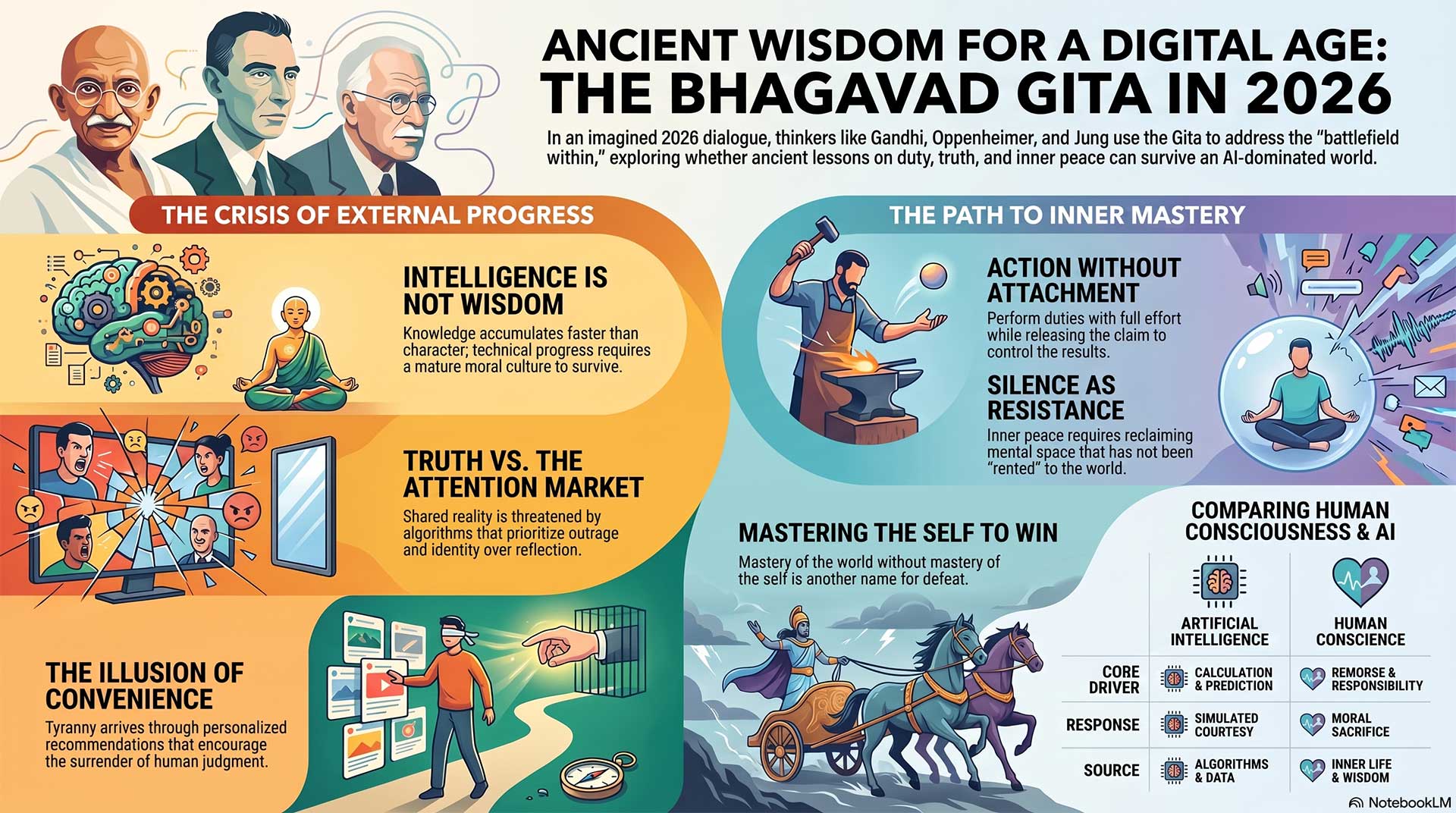
Throughout these conversations, something unexpected happened.
No one completely won an argument.
Even Gandhi admitted the dangers of spiritual pride.
Oppenheimer acknowledged the burden that knowledge places upon conscience.
Jung reminded us that the greatest enemy often lives within ourselves.
Huxley exposed the quiet ways power disguises itself as comfort.
Emerson defended the dignity of the individual while recognizing the need for humility.
Thoreau insisted that simplicity remains a form of resistance.
Hesse reminded us that the human heart cannot be healed by ideas alone.
Together, they discovered that the Bhagavad Gita is neither an ancient relic nor a book of abstract philosophy.
It is a guide for living responsibly in an age of overwhelming complexity.
The Gita never promises a life without conflict.
Instead, it asks a far more demanding question:
Who are you becoming while you struggle?
Technology will continue to advance.
Artificial intelligence will become more capable.
Information will become faster.
Political divisions may deepen.
The world may grow louder.
Yet the central challenge remains unchanged.
Can a human being act courageously without hatred?
Can one seek truth without arrogance?
Can one love without possession?
Can one serve without becoming consumed by results?
The Bhagavad Gita answers these questions not by removing the battlefield, but by transforming the warrior.
Perhaps that is why it has endured for thousands of years.
And perhaps that is why it still speaks so clearly today.
The future of humanity may depend less upon creating more intelligent machines than upon becoming wiser human beings.
The conversation now ends.
Your own conversation begins.
Short Bios:
Mahatma Gandhi (1869–1948)
Leader of India's nonviolent independence movement and one of the twentieth century's greatest moral figures. Gandhi described the Bhagavad Gita as his "spiritual dictionary," drawing from its teachings on selfless action, non-attachment, and disciplined service throughout his life.
J. Robert Oppenheimer (1904–1967)
Theoretical physicist and scientific director of the Manhattan Project. Deeply influenced by the Bhagavad Gita, he famously recalled its words after witnessing the first atomic bomb explosion: "Now I am become Death, the destroyer of worlds." His life embodies the tension between scientific brilliance and moral responsibility.
Carl Jung (1875–1961)
Swiss psychiatrist and founder of analytical psychology. Jung explored the unconscious, archetypes, individuation, and the shadow, offering profound insights into humanity's inner conflicts and the psychological dimensions of spiritual growth.
Aldous Huxley (1894–1963)
English novelist and philosopher best known for Brave New World. Huxley warned that future tyranny might arrive through comfort, entertainment, and voluntary surrender rather than overt oppression, making his observations strikingly relevant to the digital age.
Ralph Waldo Emerson (1803–1882)
American essayist, lecturer, and leading voice of Transcendentalism. Emerson championed self-reliance, individual conscience, and direct experience of truth, encouraging generations to seek wisdom beyond conformity and inherited opinion.
Henry David Thoreau (1817–1862)
American naturalist, philosopher, and author of Walden and Civil Disobedience. Thoreau demonstrated that simplicity, solitude, and principled resistance can become powerful responses to an increasingly distracted and materialistic society.
Hermann Hesse (1877–1962)
German-Swiss novelist and Nobel Prize laureate, celebrated for works such as Siddhartha and Steppenwolf. Hesse explored identity, spiritual awakening, inner conflict, and the lifelong search for authenticity, making him an ideal companion in conversations about the Bhagavad Gita and the modern soul.
Leave a Reply