
Introduction
What if the person we think we are is only one small expression of something far greater?
Psychic medium and trance channeler Cindy Riggs opens that possibility through experiences involving spirit guides, higher selves, angels, extraterrestrial consciousness, reincarnation, probable futures, and communication beyond ordinary physical perception. Her work raises questions that quickly become much larger than channeling itself.
Could humanity have connections with the Anunnaki, Orions, Elohim, Pleiadians, and other forms of intelligence? What happens when we die? Are reincarnations sequential, or could many lives exist at once? Do parallel realities surround us as unrealized possibilities? And when a channeler speaks for another consciousness, where does one identity end and another begin?
To explore these questions more deeply, Cindy is joined by a rotating group of channelers, mediums, and spiritual communicators whose work reaches into different areas of the mystery.
They do not gather to determine one correct cosmology.
Their accounts sometimes overlap and sometimes differ.
That is part of what makes the conversation interesting.
Across five topics, one question gradually moves to the center:
How large is consciousness, and how much of ourselves might exist beyond the boundaries of one body, one lifetime, and one reality?
(Note: This is an imaginary conversation, a creative exploration of an idea, and not a real speech or event.)
Topic 1: Who Shaped Humanity?
Moderator: I want to begin with a question humanity has asked in one form or another for thousands of years.
Where did we come from?
Science gives us an evolutionary history of the human body. Religions give us creation stories. Mystical traditions speak about souls entering physical existence.
Then there is another body of material coming through channelers and mediums, one that describes humanity as having connections with intelligences associated with Orion, the Pleiades, Sirius, the Elohim, the Anunnaki, and other star systems or nonphysical groups.
Cindy, your work touches several of these.
When you look at humanity, do you see us as an entirely Earth-based species?
Cindy Riggs: No, I don't.
I believe the human experience is Earth-based. We incarnate here, we have these bodies, we live human lives.
But I don't believe the story of who we are begins and ends here.
I have personally felt connections with Orion, Sirius, and the Pleiades. Through channeling, I've received information suggesting that different intelligences have participated in human development.
That doesn't mean I look at a person and say, "You're from Orion, you're from Sirius."
It's much more layered.
Moderator: What do you mean by layered?
Cindy: Soul history can be layered.
Incarnational history can be layered.
Our energetic connections can be layered.
And then there is the question of the physical human body itself.
The information I've received suggests that beings we call the Anunnaki had involvement with early human DNA, and that the Elohim were connected with the development of life too.
So I don't see one creator group appearing at one moment and making humanity.
It feels more like participation from several sources.
Rob Gauthier: That distinction changes everything.
People hear "Anunnaki" and often jump immediately to one simple story.
"They created us."
But creation can mean many things.
Did they create the human body from nothing?
Did they alter something already developing?
Did they combine genetic lines?
Did they introduce capacities that had not expressed before?
Did they work with consciousness rather than just biology?
Those are completely different possibilities.
Moderator: And your own work with Anunnaki-related material gives you a different emphasis.
Rob: Yes.
What interests me most is the idea of genetic integration.
That is much richer than the image of a group arriving, making a species, then leaving.
Integration suggests multiple lines coming together.
Perhaps physical.
Perhaps energetic.
Perhaps incarnational.
Perhaps all three.
Wendy Kennedy: This is where language creates problems.
When people hear "DNA," they hear chemistry.
A chromosome.
A sequence.
Something you can test in a laboratory.
But channeled material often uses DNA in a much broader sense.
Sometimes it seems to describe biological inheritance.
Sometimes it refers to dormant capacities.
Sometimes it means an energetic pattern carried by consciousness.
Sometimes it points to incarnational relationships with other civilizations.
So when someone says, "You have Pleiadian DNA," I would not automatically interpret that as a claim that a conventional DNA test would identify Pleiades.
Moderator: Then what might "Pleiadian DNA" mean?
Wendy: It might mean that a person's consciousness has a deep relationship with that civilization.
It could mean experiences connected with that system occurred before this incarnation.
It could refer to patterns brought into human expression through incarnation.
There may be a biological aspect in some teachings, but the phrase should not automatically be reduced to one physical meaning.
Krista Raisa: The same applies to Orion.
People can hear "the Orions" and picture a single species.
But Orion is vast.
There can be many civilizations, many collectives, many histories, many types of consciousness connected with what humans call Orion.
So when Cindy says she channels an Orion collective and I describe contact with an Orion Council, those do not have to be the same group.
Moderator: Almost like saying, "I communicate with Earth."
That wouldn't tell us very much.
Krista: Exactly.
Which country?
Which culture?
Which period?
Which community?
Which individual?
Now multiply that across civilizations that may experience identity very differently from us.
The name of a star system may only be the closest human label available.
Cindy: I agree with that.
When I communicate with the Orions, I'm not receiving the impression that every being associated with Orion thinks identically.
I'm communicating with a particular collective.
And I don't assume that collective represents everyone connected with Orion.
Moderator: Lee, Kryon material has long placed a great deal of significance on Pleiadian involvement with humanity.
How do you hear Cindy saying Anunnaki, Elohim, Orion, Pleiades, Sirius?
Does it sound contradictory?
Lee Carroll: Not necessarily.
The tendency is to search for one origin story.
Humans like a single answer.
Who made us?
Which group came first?
Which civilization changed us?
But the Kryon material presents human development as something involving consciousness, biology, spiritual potential, and participation across very long periods.
The Pleiadian connection is central within that material.
That does not automatically require every other influence to be excluded.
Moderator: So perhaps the question "Who created humanity?" is too narrow.
Lee: I would say so.
A better question might be:
"What participated in humanity becoming what it is?"
That creates room for evolution.
It creates room for consciousness.
It creates room for nonphysical influence.
It creates room for possible interaction with other civilizations.
One explanation does not automatically erase the others.
Rob: I like that much better.
People often turn these accounts into competing brands.
The Anunnaki did it.
No, the Pleiadians did it.
No, Orion did it.
But why assume only one group was involved?
Wendy: And why assume all participation happened at the same level?
One group might influence biology.
Another might influence consciousness.
Another might interact with human civilization culturally.
Another might work through incarnation.
Another might act as teachers.
Human beings hear several names and assume they must all be claiming the same role.
They may not be.
Moderator: Cindy, where do the Elohim fit for you?
Cindy: The information I've received presents them as creator intelligences connected with life.
Not just human beings.
Life itself.
And when the Orions communicated about the Anunnaki and Elohim, it didn't feel like they were describing two rival groups.
It felt more like different participants in a very large process.
Moderator: Then let me make this more difficult.
If several nonhuman civilizations participated in our development, what exactly makes us human?
Krista: That's a beautiful question.
Maybe being human is not defined by having one pure origin.
Maybe humanity is a meeting point.
Rob: A convergence.
Wendy: Yes.
And perhaps that is part of what makes the human experience so unusual.
Many streams, yet one embodied experience.
Moderator: So humanity might be less like a single tree and more like several rivers meeting.
Wendy: That is closer to how I see it.
Cindy: And once you're here, you're human.
That's important.
People can become very interested in star origins and forget the life they actually came here to live.
If you believe you had lives connected with Orion, wonderful.
If you believe you have Pleiadian connections, wonderful.
But you're here now.
You're having breakfast.
You're raising children.
You're paying bills.
You're dealing with relationships.
You're learning how to love people.
That's the human experience.
Krista: I completely agree.
Starseed identity can become another ego identity.
"I'm from this civilization, so I'm special."
That misses the point.
A connection with Orion doesn't make someone more valuable than another person.
Rob: Nor does having no interest in star origins make someone spiritually behind.
Someone can live an extraordinary human life without caring about Orion for five seconds.
Lee: The measure would be how someone lives.
Does the teaching produce compassion?
Responsibility?
Greater appreciation of life?
Greater awareness of connection?
If someone uses a cosmic identity to place themselves above other people, then the identity has become another separation mechanism.
Moderator: Let's talk about ancient civilizations.
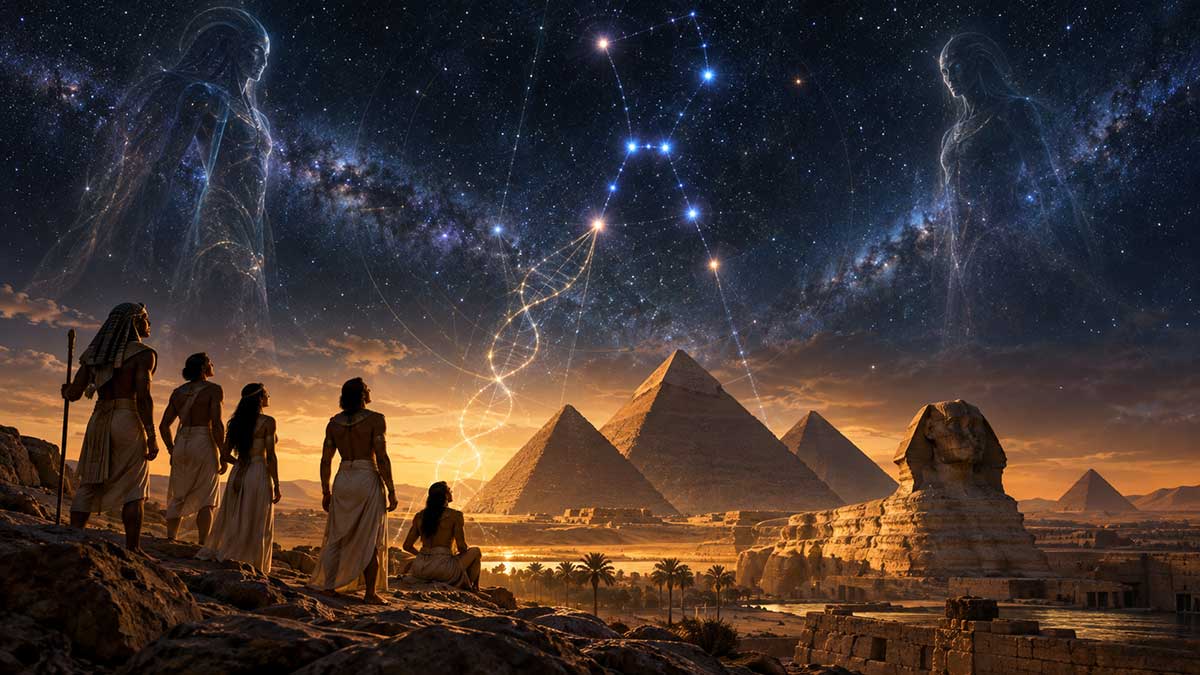
Cindy, the Orion material you receive connects Orion with ancient Egypt and the pyramids.
Why would ancient people have had a stronger relationship with these beings than most people seem to have now?
Cindy: One idea I've received is that communication was easier.
There was less interference.
Ancient people may have been able to perceive beings or receive information in ways that are harder for many people now.
Moderator: What kind of interference?
Cindy: That's where I don't want to pretend I know more than I do.
The communication referred to interfering waves or conditions that make contact harder now.
That could be many things.
I wondered about technology and electromagnetic activity.
But that's my interpretation.
The deeper point I took from it was that interaction occurred more openly in certain ancient periods.
Krista: Human attention may matter too.
Think about the modern mind.
A person wakes up and looks at a phone.
Messages.
News.
Videos.
Notifications.
Work.
Advertising.
Constant input.
Subtle perception asks for a completely different internal condition.
Wendy: And ancient cultures often did not separate reality into the same categories modern societies do.
Dreams could carry meaning.
Ancestors could remain present.
Stars could have spiritual significance.
Gods could interact with human affairs.
The visible and invisible were not necessarily treated as two sealed compartments.
Rob: Which means something we now call "channeling" may once have been interpreted very differently.
Oracle.
Prophet.
Visionary.
Priest.
Shaman.
Messenger.
Different cultures created different frameworks around experiences in which information seemed to enter human awareness from beyond the ordinary personality.
Moderator: Then perhaps channeling isn't necessarily a modern phenomenon.
Only the word is modern.
Cindy: That's very close to how I see it.
Moderator: Krista, you raised another interesting point in our planning for this discussion: Orion material sometimes contains stories of conflict and polarization.
Could humanity have inherited more than genetics?
Could we have inherited themes?
Krista: Yes.
That possibility interests me much more than the question of whether someone has "Orion DNA."
Suppose a civilization went through intense polarity.
Control versus freedom.
Separation versus unity.
Conflict followed by integration.
Then another civilization develops under some influence from that history.
Perhaps what carries forward is not merely biological information.
Perhaps certain experiential patterns become available.
Moderator: So Earth could be working through themes that other civilizations have already encountered.
Krista: Yes.
Not as punishment.
More like consciousness revisiting a question under different conditions.
Rob: That gives another meaning to the idea of Earth as an experiment.
People hear "experiment" and picture humans as laboratory animals.
But an experiment can simply be an open question.
What happens when these conditions come together?
What happens when this degree of free choice exists?
What happens when consciousness enters a reality where it forgets much of its larger identity?
What happens when it slowly starts remembering?
Cindy: The forgetting part feels very important.
If we remembered everything, this would be a completely different experience.
If I woke up every morning remembering every incarnation, every guide, every star system, every life between lives, I don't know that I could fully be Cindy.
Moderator: You'd have a crowded breakfast table.
Cindy: Very crowded.
And probably a lot of people asking for coffee.
Wendy: Forgetting can create authenticity.
You make choices without having the entire answer sheet.
Compassion means something when you could choose otherwise.
Trust means something when you do not know everything.
Lee: Free choice gains meaning through uncertainty.
If every spiritual fact were obvious from birth, the nature of the human experience would change.
Moderator: Then let's return to the Anunnaki.
Rob, you said intention may matter more than simply asking what they did.
Suppose we could ask the Anunnaki one question directly.
What would you ask?
Rob: I would ask:
"What did you hope humanity would become?"
That gets to the heart of it.
Did they want workers?
Partners?
A new biological form?
A vessel capable of expressing a certain kind of consciousness?
A bridge between different lineages?
A species that would eventually become independent of its creators?
The intention changes the entire story.
Wendy: I would ask something beside that.
"What did the souls entering those bodies want?"
We can spend so much time talking about beings modifying bodies that we forget consciousness entering those bodies may have had its own intention.
Moderator: So creation may have happened from two directions.
Biology becoming capable of hosting a new experience.
Consciousness choosing to enter that experience.
Wendy: Yes.
Lee: That is a much richer model than picturing human beings as passive products.
Cindy: And it fits the information I've received about soul intention.
I don't believe we were simply manufactured and dropped here without participation at another level.
Moderator: Then perhaps "Who made humanity?" is the wrong question again.
Maybe it should be:
"Who collaborated in humanity?"
Rob: That's much closer.
Krista: And the word collaboration leaves the story open.
Moderator: What about the pyramids?
If Orion groups had relationships with ancient Egypt, as Cindy's Orion material describes, what would those relationships have been for?
Technology?
Teaching?
Initiation?
Astronomical knowledge?
Spiritual communication?
Krista: It may not have been one thing.
Ancient sacred structures often joined astronomy, ritual, social organization, symbolism, and spiritual practice.
Modern people divide those into separate categories.
An ancient culture may not have.
Wendy: A structure aligned with stars could have practical, symbolic, energetic, and spiritual functions at the same time.
We keep wanting one answer.
"Was it a tomb?"
"Was it a machine?"
"Was it a temple?"
Human constructions can serve multiple purposes.
Why assume ancient sacred structures had only one?
Rob: And if outside intelligences participated, their contribution could have been informational rather than physical.
You don't necessarily need extraterrestrials moving stones.
Information itself can change a civilization.
Geometry.
Astronomy.
Engineering concepts.
Consciousness practices.
Those could transform what humans build.
Moderator: Cindy, when your Orion collective speaks about involvement with ancient Egypt, do you picture physical beings standing beside Egyptians?
Cindy: Sometimes I get the sense that manifestation was more direct then.
But I wouldn't reduce everything to beings walking around physically.
There could be projection.
There could be altered-state contact.
There could be telepathic communication.
There could be appearances that humans interpreted as gods.
Different kinds of contact may have happened.
Moderator: That raises another question.
Could some ancient gods have been interpretations of nonhuman intelligences?
Cindy: Yes, I think that's possible.
Rob: And the reverse possibility is interesting too.
Could some nonhuman intelligences present themselves through forms humans could comprehend?
Krista: Exactly.
If something exists outside our normal framework, it may communicate through imagery already present in the human mind.
That makes identity complicated.
Was it a god?
An extraterrestrial?
An interdimensional consciousness?
A collective?
Those categories might overlap far more than we assume.
Moderator: And that connects back to humanity itself.
Maybe our categories are the problem.
Earth or extraterrestrial.
Physical or spiritual.
Human or star being.
Past life or present life.
Perhaps reality is less neatly divided.
Wendy: Much less neatly divided.
Moderator: Let me ask each of you something personal.
If someone listening feels a deep emotional connection with Orion or the Pleiades or Sirius, what should they do with that feeling?
Cindy: Live your life.
Let the connection inspire you, but don't use it to escape being here.
Krista: Ask what qualities the connection awakens in you.
Not, "What rank does this give me?"
Ask, "What am I being invited to express?"
Rob: Stay curious.
Don't turn one experience into a rigid identity.
Wendy: Let it widen your sense of connection.
If believing you have Pleiadian ancestry makes you kinder to only Pleiadians and less kind to humans, something has gone wrong.
Lee: Bring it back to daily life.
Any spiritual idea has to eventually meet the way you treat another person.
Moderator: Then perhaps the most meaningful question is not:
"Which star system am I from?"
It is:
"What am I here to contribute as a human being?"
Cindy: Yes.
Absolutely.
Moderator: One final question.
Suppose all of these accounts contain pieces of something larger.
Suppose Orion civilizations participated.
Suppose the Anunnaki participated.
Suppose the Elohim participated.
Suppose Pleiadian, Sirian, and other lineages participated.
Suppose the human soul participated too.
Then humanity may not be the product of one civilization at all.
We may be a meeting place.
If that is true, what could humanity become that none of those contributing groups could become by themselves?
Krista: Something new.
Rob: That's the word.
New.
Not a copy.
Wendy: A synthesis.
Lee: And one with its own choices.
Cindy: Maybe that's the reason there is so much interest in us.
Maybe the question isn't only where we came from.
Maybe they're interested in seeing what we choose to become.
Moderator: Then our origin story may still be unfinished.
We may spend our lives looking backward, asking who created us, who altered us, who taught us, who came from which star system.
Yet the larger mystery may be happening in the opposite direction.
Not who made humanity.
What humanity is making of itself.
Topic 2: What Really Happens After Death?
Moderator: I want to begin with a question almost everyone eventually asks.
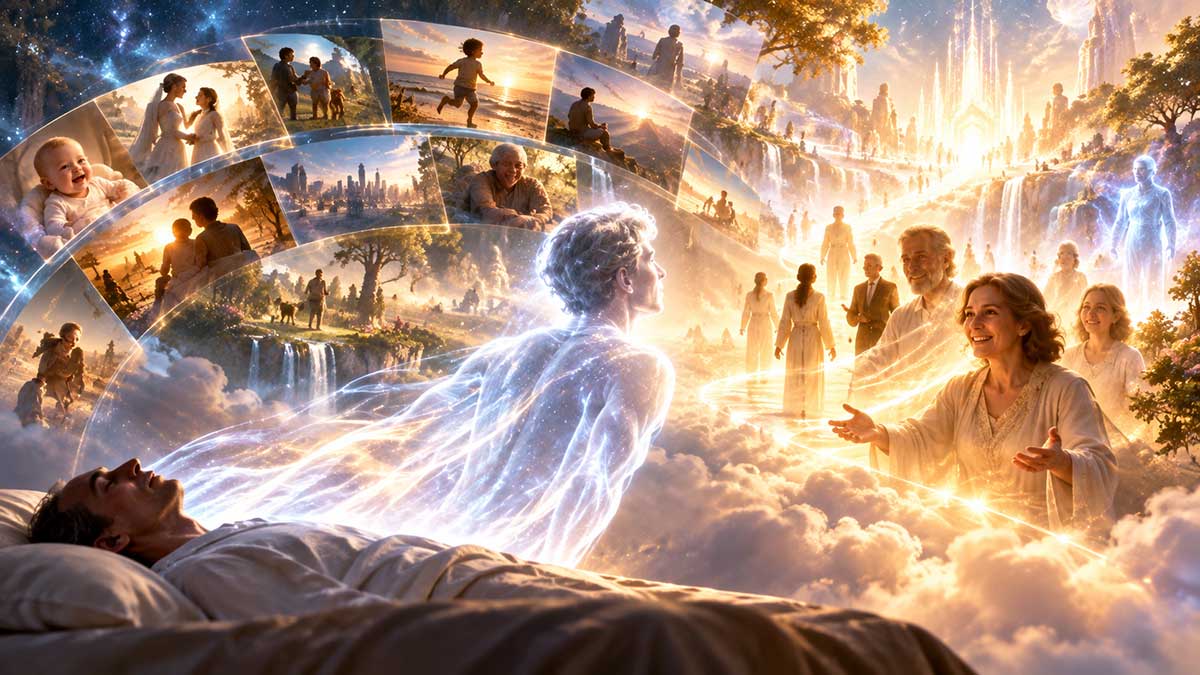
What happens in the first few moments after we die?
Not fifty years later.
Not after reincarnation.
The moment the body stops functioning.
Where are we?
What do we experience?
And do we immediately know that we have died?
Cindy Riggs: I don't think the experience is exactly the same for everyone.
In my work with spirits, I've encountered people who seemed to understand very quickly that they had died.
I've encountered others who seemed confused.
Some don't seem to know they're dead at all.
Some are frightened.
Some feel something is unfinished.
And some are afraid to move forward because they're afraid they're going to hell.
Those are three situations I see often: they don't know they're dead, they're afraid of what comes next, or they believe they still have something unfinished here.
Moderator: Suzanne, does that match what you have encountered?
Suzanne Giesemann: The transition seems much gentler than many people fear.
From the perspective of mediumship, consciousness continues.
The personality does not simply disappear.
There can be recognition.
There can be loved ones.
There can be guidance.
But the transition can still reflect the person's expectations and state of awareness.
A person who has spent an entire lifetime believing there is nothing after death may initially process the transition differently from someone who has expected to meet loved ones.
Laura Lynne Jackson: I would add that love seems to be the strongest continuity.
People often focus on the mechanics.
Where do we go?
What dimension?
What does it look like?
But from the messages I've received, the relationship doesn't end.
People who have crossed can still feel connected with those here.
They can still care.
They can still try to communicate.
The bond changes form, but the bond itself remains.
Moderator: Seth, from your perspective, is there a moment when someone realizes, "I no longer have a physical body"?
Seth: The individual does not suddenly become something entirely different merely because physical focus has ceased.
Consciousness carries with it expectations, habits of thought, emotional patterns, and assumptions.
A person who believes strongly in a particular after-death environment may initially interpret experience through that belief.
The physical senses no longer organize reality in the familiar manner, yet consciousness continues to interpret what it encounters.
Moderator: So death does not automatically make everyone spiritually wise.
Seth: Correct.
The cessation of physical life does not instantly remove every belief accumulated during physical existence.
Cindy: I agree with that completely.
Some spirits are still very much themselves.
If somebody was difficult here, dying doesn't automatically make them easy.
Moderator: That's almost comforting in a strange way.
Cindy: They're still people.
Edgar Cayce: The personality has continuity, yet the soul exists within a much larger process.
Earthly life gives opportunities for growth, relationships, choices, service, and correction.
Death changes the environment in which the soul continues its development.
It does not erase the meaning of what occurred.
Moderator: That brings us to the question I really want to spend time on.
Judgment.
A lot of people grow up with the idea that after death there will be some form of divine judgment.
Cindy, your experience led you somewhere different.
Cindy: Yes.
One of the messages that affected me most came through what I experienced as the angelic realm.
The message was that there isn't some outside spiritual consciousness deciding what you deserve.
That changed the way I thought about judgment.
I don't believe there's an external being sitting there saying, "You were good enough. You weren't good enough."
But I do believe we review our lives.
And that may be much more intense than being judged by somebody else.
Moderator: Why more intense?
Cindy: You can't argue with yourself very easily when you're seeing everything clearly.
Suzanne: That's where the life review becomes so meaningful.
It isn't simply watching a movie of your life.
The descriptions that repeatedly arise suggest a much deeper form of experiencing.
You can become aware of how your choices affected other people.
Not simply what you intended.
What they felt.
Moderator: Let's make that concrete.
Suppose I insult somebody in a restaurant.
I forget about it ten minutes later.
What might happen during a life review?
Suzanne: You may experience the event from a much wider perspective.
Your own frustration.
The other person's reaction.
Perhaps something you did not know about them.
Maybe they were already grieving.
Maybe your words stayed with them for years.
You see connections that were invisible when you were focused only through your own personality.
Laura: And that changes the idea of judgment.
Nobody has to say, "That was cruel."
You experience the truth of the interaction.
Moderator: Cindy, is that close to what you mean by judging ourselves?
Cindy: Exactly.
If I can experience what I caused another person to feel, I don't need somebody standing over me with a list.
I know.
Moderator: But then there's a difficult problem.
Suppose a person does something terrible and genuinely believes it was justified.
They hurt many people but never feel guilty.
Why would self-judgment matter to someone like that?
Cindy: Because I don't think they keep the same limited perspective once they're out of the body.
The whole point of the life review is that they can see more.
Someone may have spent a lifetime saying, "Those people deserved what I did."
But when you experience the suffering from the other person's perspective, that argument changes.
Seth: Expanded consciousness allows the individual access to relationships between actions and consequences that were not recognized during physical focus.
The personality's defensive explanations become less effective when a broader field of awareness is available.
Edgar Cayce: The soul encounters what it has built.
Every thought, choice, relationship, and action contributes to patterns of consciousness.
This does not require an angry judge.
Cause and consequence are already connected.
Moderator: So accountability is built into consciousness itself.
Edgar Cayce: That would be one way of expressing it.
Moderator: Laura, does that fit with the people you've communicated with?
Laura: Yes, especially the idea that people understand much more after crossing.
I've never come away with the sense that people become erased.
But they seem to have access to a broader awareness.
The person who crossed can recognize things they could not recognize when alive.
They may want to repair relationships.
They may send signs.
They may communicate love that they had difficulty expressing when they were here.
Moderator: That raises something people struggle with.
If someone hurt me terribly in life, then dies and suddenly understands everything, are they forgiven automatically?
Laura: Forgiveness and reunion are not the same as pretending nothing happened.
The person who was harmed still has their experience.
Healing matters.
Recognition matters.
Love doesn't require denying pain.
Cindy: That's important.
When I talk about no external judgment, I'm not saying actions don't matter.
They matter enormously.
I'm saying I don't believe in a cosmic authority deciding you're permanently condemned.
Moderator: What about hell?
Cindy, you said something fascinating about people potentially creating a frightening experience through their own fear.
Cindy: Yes.
I personally don't believe in an eternal hell.
But I do believe a person could experience something hell-like if they strongly expect it or carry tremendous fear.
I've seen fear play a major role in spirits refusing to cross over.
If someone dies convinced they're going to hell, fear itself can become a barrier.
Moderator: Seth, is that compatible with your view of belief after death?
Seth: Beliefs do not become meaningless when physical existence ceases.
Consciousness structures experience.
If an individual expects punishment, demons, darkness, or condemnation, those expectations may influence the imagery and environment through which the transition is interpreted.
The experience need not be permanent.
Moderator: That's the key question.
How does someone get out?
If consciousness has created something terrible from fear, what breaks the experience?
Suzanne: Help.
Love.
Recognition.
Guides.
Loved ones.
A shift in awareness.
I don't think anyone is simply abandoned forever inside their own misunderstanding.
Cindy: That's how I see it too.
Sometimes my work involves helping spirits realize they can move on.
Fear loosens once they realize what is happening.
Moderator: What about somebody who does not know they're dead?
How is that possible?
Cindy: Think about someone dying very suddenly.
An accident.
Something traumatic.
They may still be trying to continue what they were doing.
Or they may be confused about why people aren't responding to them.
It's not every person.
But I've encountered spirits where that seemed to be what was happening.
Laura: That fits with the idea that awareness after death can unfold.
Death itself is a transition.
We don't have to assume every consciousness immediately perceives the full nature of existence.
Moderator: Now I want to ask about who meets us.
Some people report Jesus.
Others report relatives.
Some report angels.
Others describe beings of light.
Some describe no recognizable figure at all.
Cindy, do you think our beliefs influence who appears?
Cindy: Very much.
When I've asked spirits about their transition, I've gotten different stories.
One person might see Jesus.
Another might see Archangel Michael.
Someone from another spiritual tradition may see a figure meaningful within that tradition.
I think the experience can be presented in a way that helps the person feel safe enough to transition.
Moderator: Then is Jesus actually there?
Or does consciousness create an image of Jesus?
Cindy: I don't think those possibilities have to cancel each other out.
Suzanne: Exactly.
Human beings often want to reduce spiritual experiences to either objectively real or completely imagined.
Consciousness may not operate within that binary.
A loving intelligence might present itself in a form the person recognizes.
Seth: Symbols can possess reality without being merely deceptive.
Consciousness communicates through forms meaningful to the perceiver.
A symbol is not necessarily less real because it adapts to the consciousness encountering it.
Moderator: So perhaps the question isn't, "Was it really Jesus?"
Maybe it is, "What consciousness was communicating through the form of Jesus?"
Seth: That is a more useful question.
Laura: And what did the encounter do?
Did it calm the person?
Did it help them cross?
Did it communicate love?
Did it help them release fear?
Moderator: Edgar, how do you see religious imagery in death?
Edgar Cayce: Spiritual truth is often encountered through forms the soul can recognize.
Religious traditions may provide symbols, language, and expectations.
Yet the soul's relationship with the divine is larger than any one earthly vocabulary.
Moderator: Then someone could live as a Christian and meet Jesus.
Someone from another tradition could encounter a different sacred figure.
And neither encounter necessarily invalidates the other.
Cindy: That's how I see it.
Moderator: Let me bring in something more unusual from Cindy's work.
You have spoken about what you call an underworld.
Not hell.
A place of rehabilitation.
Cindy: Yes.
Occasionally I encounter a spirit that I don't feel should simply cross in the normal way.
I'm guided to send certain spirits to what I call the underworld for rehabilitation.
I associate Anubis with that process.
I don't see the underworld as eternal punishment.
More like somewhere a spirit can receive help before moving forward.
Moderator: That idea fascinates me.
If there's no eternal punishment, there may still be something like spiritual rehabilitation.
Cindy: Yes.
No punishment doesn't mean no consequences.
Suzanne: That's a major distinction.
Love is not the absence of accountability.
Laura: Nor does compassion mean pretending harm didn't occur.
Moderator: Edgar, could karma be thought of as rehabilitation rather than punishment?
Edgar Cayce: Karma is often misunderstood when treated as divine retaliation.
The deeper principle concerns cause, growth, balance, and opportunity.
A soul may encounter circumstances through which previous patterns can be met differently.
Grace remains present.
Choice remains present.
Moderator: So karma isn't "you hurt somebody, therefore somebody must hurt you."
Edgar Cayce: Such arithmetic would be far too simple.
The purpose is growth.
Moderator: Seth, what would you add?
Seth: The individual creates through beliefs, expectations, and choices, yet no personality exists in complete isolation.
Growth does not require punishment imposed by an external authority.
Awareness itself carries transformative capacity.
Moderator: Then perhaps the afterlife is less like a courtroom and more like a place where hiding becomes difficult.
Cindy: I like that.
Suzanne: Very much.
Laura: Yes.
Moderator: Now let's ask something people are often afraid to say out loud.
What happens to a person who caused immense suffering?
A murderer.
A dictator.
Someone who deliberately destroyed lives.
If there's no eternal hell, where do they go?
Cindy: I think they face themselves.
And I don't think that would necessarily be easy.
If the life review means experiencing the suffering you caused, imagine experiencing thousands of people's pain.
That would be enormous.
Suzanne: Love does not require avoiding truth.
Greater consciousness could mean greater recognition of harm, not less.
Seth: You are assuming that punishment is the only mechanism capable of producing responsibility.
It is not.
Expanded awareness can confront the personality with its own creation more directly than external punishment could.
Moderator: That's a striking idea.
Punishment says, "Something bad will be done to you."
Life review says, "You will completely know what you did."
Laura: Yes.
And perhaps knowing is what makes real transformation possible.
Edgar Cayce: The soul's development continues until it recognizes its relationship with others and with the divine.
Separation produces distortion.
Recognition restores relationship.
Moderator: Is anyone permanently lost?
Cindy: I don't believe so.
Suzanne: Neither do I.
Laura: No.
Seth: Consciousness is creative and developing. Permanent damnation would contradict the larger movement of consciousness toward greater awareness.
Moderator: Then death is not the end.
But it isn't an escape either.
Cindy: Exactly.
That's important.
People sometimes hear "no judgment" and think it means nothing matters.
I think the opposite.
Everything matters.
How you make people feel matters.
How you treat people matters.
The kindness nobody notices matters.
The cruelty nobody catches matters.
You take yourself with you.
Moderator: "You take yourself with you."
That's a powerful way to say it.
Cindy: You don't escape yourself by dying.
Moderator: Laura, what happens to love?
Suppose two people spend fifty years married.
One dies first.
Does that relationship continue?
Laura: Yes, but it can become larger than the earthly role.
A husband is still recognizable.
A mother is still recognizable.
A child is still recognizable.
Yet the consciousness behind those roles can be experienced more fully.
Love remains one of the strongest bridges.
That's why signs matter so much to people.
A song.
A bird.
A light flickering at exactly the right moment.
A dream that feels different from an ordinary dream.
Something that carries that unmistakable feeling of connection.
Moderator: Are the dead watching everything we do?
That makes some people uncomfortable.
Laura: I wouldn't picture it as somebody sitting in a chair observing you twenty-four hours a day.
Consciousness doesn't need to work that way.
Connection isn't surveillance.
Cindy: Thank goodness.
Moderator: Everyone suddenly feels better.
Cindy: There are some things nobody needs to see.
Suzanne: The deeper point is that consciousness isn't limited by physical distance in the way we are used to.
A loved one can be connected without hovering over every mundane moment.
Moderator: Let's talk about grief.
If someone truly believes their loved one continues, does that mean they shouldn't grieve?
Laura: No.
Grief is love responding to physical absence.
Knowing someone continues doesn't mean you don't miss their voice.
Their body.
Their chair.
Their laugh.
Their presence at dinner.
Spiritual connection does not erase human loss.
Suzanne: That's very important.
We live here through bodies.
Physical absence is real within the human experience.
Recognizing continuing consciousness can bring comfort, but it doesn't require someone to stop feeling grief.
Cindy: And grief shouldn't be treated like spiritual failure.
Moderator: That may be one of the most humane things we've said.
Now I want to ask the question from the opposite direction.
What does the person who dies feel toward the people still grieving?
Laura: Love.
Very often, a desire to communicate, "I'm still here. I'm okay."
Suzanne: And sometimes concern that the person living becomes so focused on the loss that they can't feel the continuing connection.
Moderator: So grief can sometimes make communication harder?
Suzanne: Intense grief can fill the field of attention.
That doesn't mean the loved one is absent.
It may mean the person here is in so much pain that subtle impressions are difficult to notice.
Moderator: Cindy, do spirits ever worry about us?
Cindy: They can care about what's happening.
But I think their perspective is different.
They may see more than we do.
A situation that looks catastrophic to us may look different from a wider view.
Moderator: Let's return to the very first question.
Someone takes their final breath tonight.
What would you want that person to know?
Cindy: Don't be afraid.
If you see someone you love, go with them.
If you see light, don't be afraid of it.
You are not being erased.
Suzanne: You remain.
The form changes.
The awareness continues.
Love continues.
Laura: You are not leaving love behind.
Edgar Cayce: The soul returns to a greater awareness of its relationship with the divine and with those it has touched.
Seth: Death is not the opposite of life.
It is a change in focus.
Moderator: Then perhaps the question we fear most, "What happens when I die?", contains another question underneath it.
"Will I still be me?"
And the answer around this table seems to be:
Yes.
But perhaps you will be more than the "you" you currently know.
You may remember more.
See more.
Feel more.
Understand relationships from perspectives that were hidden before.
You may encounter love in forms familiar or unfamiliar.
You may confront the effects of your choices without being eternally condemned by them.
You may discover that accountability and compassion were never opposites.
And perhaps the life review is not a trial conducted by someone else.
Perhaps it is the moment when consciousness becomes wide enough to see what the human personality could not.
Cindy: And once you see, you can grow.
Moderator: Then death may not be graduation.
It may not be punishment.
It may be recognition.
And if that is true, perhaps the most important preparation for death has very little to do with death itself.
It is how we live before we get there.
Topic 3: What Actually Reincarnates?
Moderator: I want to start with an assumption most people make when they hear the word reincarnation.
I die.
My soul leaves my body.
Later, that same soul enters another body.
Then another.
Almost like moving from one house to another.
But Cindy, some of the information you've received presents a much stranger picture.
Cindy Riggs: Yes.
The Orion collective I've worked with described it very differently.
They said we're not trapped in reincarnation.
They said there isn't some outside system forcing us to return again and again.
Then they said something that surprised me even more.
They said we're not necessarily the exact same soul configuration in every incarnation.
After leaving the physical body, consciousness can merge with other consciousness, divide into multiple expressions, and participate in several incarnations.
That changes the whole picture.
Moderator: It really does.
If that is true, saying, "I was this person in a previous life," may be far too simple.
Seth, what actually reincarnates?
Seth: The problem begins with the human tendency to think of identity as a small, sealed container.
You assume there is one you.
One consciousness.
One sequence.
Birth.
Life.
Death.
Another birth.
From a larger perspective, the identity you presently recognize as yourself is one focus of a far greater identity.
That greater identity is capable of expressing itself through many personalities.
Those personalities possess their own individuality.
Yet they participate in a larger self.
Moderator: So Nick in 2026, for example, could be one expression of something much larger?
Seth: Yes.
The personality is real.
It should not be dismissed as an illusion.
Yet it is not the full identity.
You might think of your present personality as one focused point through which a greater consciousness experiences physical reality.
Moderator: Darryl, Bashar's material seems close to that.
Darryl Anka: Very close.
Bashar describes what we call past lives from the perspective of an Oversoul.
From that perspective, the lives don't have to be occurring one after another in the way we experience time here.
They can be simultaneous expressions.
So what you call a past-life connection can be an informational connection with another incarnation that, from the Oversoul's perspective, exists now.
Moderator: That's difficult to picture.
Let's make it concrete.
Suppose I have a vivid memory of living in France in 1750.
I see a house.
I recognize a family.
I feel emotions connected with that life.
The normal reincarnation interpretation would be:
"That was me."
What might Bashar say?
Darryl: He might say that you are connecting with another incarnation of the same Oversoul.
From your present linear perspective, that person lived in 1750.
From the larger perspective, both incarnations exist as expressions of one greater consciousness.
Information can move between them.
So when you experience what feels like memory, you may be receiving information from that other incarnation.
Moderator: Then technically, that person isn't exactly me.
Darryl: Not your present personality.
There's a relationship.
A very deep one.
But calling the other person "you" can blur the distinction.
Cindy: That fits very closely with what my Orions were saying.
They were basically saying humans want it to be very neat.
One soul.
One lifetime.
Then another lifetime.
But consciousness isn't necessarily organized that way.
Dolores Cannon: I encountered that problem many times in regression.
At first, I thought primarily in terms of past lives.
A person would go into trance and describe another lifetime.
Different body.
Different location.
Different century.
Then the work became much larger.
People began accessing states between lives.
Other planets.
Future lives.
Parallel existences.
The Higher Self.
Eventually, the simple idea of one person moving through one straight sequence of lives became insufficient.
Moderator: Did clients ever access lives that didn't fit neatly into chronological order?
Dolores: Many times.
People could access what we would call future experiences.
They could experience lives that seemed to exist in another dimension or another planet.
They could access information that made linear time feel much less absolute.
The Higher Self sees much more than the conscious personality.
Edgar Cayce: Physical time belongs largely to the conditions of physical consciousness.
The soul's development spans many experiences, yet the purpose is not merely accumulating identities.
The question is what the soul does with experience.
How does it grow?
How does it use free choice?
How does it relate to others?
How does it move closer to its divine nature?
Moderator: Edgar, your material is often presented as a more traditional reincarnation model.
Do you see one soul moving through many lives?
Edgar Cayce: There is continuity of the soul.
Yet continuity should not be confused with a personality remaining unchanged.
The earthly personality belongs to a particular incarnation.
The soul carries tendencies, relationships, unresolved patterns, capacities, and lessons.
Each incarnation gives another opportunity for expression and choice.
Moderator: So we may already have an interesting difference.
Seth and Bashar give us something close to simultaneous incarnations.
Cindy's Orions describe soul configurations that can merge and divide.
Dolores encountered multiple forms of existence through regression.
Edgar puts stronger weight on continuity of the soul.
Are these conflicting descriptions?
Cindy: Maybe.
And I'm okay with that.
We don't have to make everybody agree.
Seth: Different descriptions can arise from different levels of focus.
At one level, there is continuity.
At another, there are many expressions.
At another, distinctions between those expressions become less absolute.
Moderator: So the answer could change depending on how far back we pull the camera.
Seth: Yes.
Darryl: That's a good way to frame it.
If you're looking from the personality level, you're you.
If you're looking from the Oversoul level, there are multiple incarnations.
If you go to an even larger level, the distinctions may change again.
Moderator: Let me ask the obvious question.
If incarnations are simultaneous, why do we experience them as past and future?
Darryl: Physical consciousness experiences time sequentially.
That's part of the structure of this experience.
You wake up Monday.
Then Tuesday.
Then Wednesday.
You don't normally experience all three at once.
But the larger consciousness doesn't need to experience time in that same way.
Dolores: That's something people in deep trance often described.
From the Higher Self perspective, everything could appear much more connected.
The conscious mind wants dates.
It wants before and after.
The larger consciousness isn't always working that way.
Moderator: Cindy, does that connect with your work involving timelines?
Cindy: Yes.
Once you start accepting multiple possible timelines, the idea of one rigid sequence becomes harder to maintain.
Then reincarnation gets interesting.
Maybe what I call a past life is another point of consciousness I'm connected with.
Maybe some connections are stronger than others.
Maybe my present choices affect those connections.
There are many possibilities.
Moderator: Here's where it becomes really strange.
Can a past life change?
Darryl: From Bashar's framework, your relationship with another incarnation can change.
Information exchange can change.
You may connect with a different probable version of that incarnation.
So the past you relate to is not necessarily a frozen object sitting behind you.
Moderator: That's wild.
Seth?
Seth: Probable realities apply to what you call the past as well as what you call the future.
The past is not as dead or fixed as ordinary waking consciousness assumes.
Your present beliefs affect which aspects of experience you connect with.
Moderator: Dolores, did regression clients ever seem to access different versions of events?
Dolores: Yes.
There were cases where material did not fit a simple historical sequence.
That taught me not to force every experience into one model.
The subconscious, or what I later called the Higher Self, could access information beyond the ordinary personality's frame.
Moderator: Now I want to ask about one of the biggest puzzles in reincarnation.
Every so often, several people claim to remember being the same famous person.
Cleopatra.
Napoleon.
Someone famous from history.
How could multiple people all sincerely feel that connection?
Cindy: That's exactly where the soul-configuration idea gets interesting.
Maybe more than one person can connect with the same consciousness.
Maybe consciousness doesn't belong to one individual in the way we think.
Seth: A greater identity can express through multiple personalities.
Connections among personalities can be intimate.
The human desire to assign exclusive ownership can create confusion.
Darryl: Bashar would say someone may be energetically connecting with another incarnation without literally being that historical personality in the conventional sense.
You can receive information from a connected incarnation.
Then the conscious mind translates that as, "I was that person."
Moderator: So three people could all have genuine experiences related to Napoleon, yet none of them needs to be the one exclusive reincarnation of Napoleon.
Darryl: Correct.
Dolores: The deeper work taught me not to focus too much on famous identities.
The emotional lesson was usually more useful.
Why is this experience appearing?
What does it show the person?
What pattern connects it with the present life?
Those questions matter more than proving a famous identity.
Edgar Cayce: The present life is always the primary opportunity.
A fascination with previous identities can become a distraction.
If knowledge of another incarnation does not help the individual live more constructively now, its usefulness is limited.
Moderator: That's interesting.
People often ask, "Who was I?"
Maybe the more useful question is, "Why am I connected with that life now?"
Edgar Cayce: Yes.
Moderator: Let's turn to soul groups.
Edgar, your readings often spoke about people reincarnating together.
What does that mean?
Edgar Cayce: Souls can share repeated experiences.
Relationships develop across incarnations.
Individuals may meet again as family members, friends, partners, rivals, teachers, or in other roles.
The exact role may change.
The relationship creates opportunities for growth and balance.
Moderator: So someone could be my parent in one life and my child in another?
Edgar Cayce: Such patterns are possible.
Dolores: I encountered similar ideas.
Groups of souls can plan incarnations together.
One may agree to become the parent.
Another the child.
Another a close friend.
Roles can change according to what each participant wants to experience.
Cindy: I believe that too.
Some relationships have that feeling.
You meet someone and there is immediate recognition.
Not necessarily romantic.
Just: "I know you."
Moderator: Seth, would you describe a soul group differently?
Seth: Relationships among identities extend beyond a single physical existence.
Yet you should be careful not to convert these relationships into rigid contracts.
Consciousness remains creative.
There are probabilities.
There are choices.
The purpose is not to enact a predetermined script without deviation.
Moderator: That's exactly where I wanted to go.
Before birth, do we plan our lives?
Cindy?
Cindy: I believe we create a blueprint.
But blueprint is different from screenplay.
I don't think every breakfast, every argument, every accident is written in advance.
I think there can be intentions.
Certain people.
Certain experiences.
Certain themes.
Then free will operates inside that.
Moderator: Dolores?
Dolores: That's very close to what came through repeatedly in my work.
There can be planning before incarnation.
A soul may choose family circumstances or certain broad experiences.
Yet once the person enters the physical life, free choice matters.
Edgar Cayce: Choices create new conditions.
The soul may enter with tendencies and purposes, yet each moment offers choice.
No individual should treat suffering as proof that every painful event was consciously requested in exact detail before birth.
Moderator: I'm glad you said that.
This is one of the hardest parts of reincarnation teachings.
People sometimes say:
"You chose everything that happened to you."
That can become very harsh.
Cindy, do you believe someone chooses every terrible event before birth?
Cindy: No.
I don't think it's that simple.
Maybe someone chooses a challenging environment.
Maybe they choose certain possibilities.
But other people's free will exists too.
If another person hurts you, I don't automatically say, "Well, you chose that."
I don't think that's compassionate or accurate.
Dolores: There can be agreements at the soul level.
There can be experiences a soul wants to explore.
But the physical world contains free choice.
Plans can change.
People can make different decisions.
Darryl: Bashar's framework puts a lot of weight on probabilities.
A theme may exist.
A range of possibilities may exist.
That doesn't require every event to be fixed.
Moderator: Then perhaps before birth I don't choose one movie.
I choose a kind of environment with many possible storylines.
Darryl: That's closer.
Seth: The personality participates in creating experience.
Pre-birth intention does not eliminate present creativity.
Moderator: Let's take the hardest example.
A child dies at age five.
Did that soul choose a five-year life?
Dolores: In some cases, my work suggested that very short lives can have purpose.
The soul may come for a brief experience.
The life may deeply affect parents, siblings, doctors, or other people.
But I would never use that idea to tell a grieving parent how they should feel.
Cindy: Exactly.
There are things we may view differently from a soul perspective, but we're living as humans.
Human pain is real.
Edgar Cayce: Compassion must remain central.
Metaphysical explanations should never become excuses for indifference to suffering.
Moderator: That's an essential distinction.
A soul-level explanation doesn't erase the human-level experience.
Cindy: Right.
Moderator: What about disability or illness?
Can a soul choose a body with major limitations?
Dolores: Some regression material suggested that souls may choose difficult circumstances for particular experiences.
Yet again, choice at that level would come from a perspective very different from the conscious human personality.
Seth: Physical conditions can become part of a larger creative pattern.
Yet assigning simplistic spiritual causes to another person's condition is dangerous.
You do not possess full access to another individual's intent.
Moderator: In other words, don't walk up to someone suffering and say, "Your soul chose this."
Seth: Correct.
Cindy: Please don't.
Moderator: Good.
Now let's talk about karma.
Edgar, many people think karma means cosmic punishment.
You hurt someone in this life, so somebody hurts you next time.
Is that too simplistic?
Edgar Cayce: Far too simplistic.
Karma concerns cause and effect, tendencies, relationships, choices, and opportunities.
Grace and free choice remain active.
The purpose is growth, not revenge.
Moderator: Could someone resolve a karmic pattern without suffering the exact same thing they caused?
Edgar Cayce: Yes.
Awareness, service, love, changed choices, forgiveness, and grace can transform patterns.
Dolores: That fits what I saw too.
People are not simply trapped in an accounting system.
Cindy: My Orions were very direct about that.
They said you're not trapped in a karmic cycle.
You're not trapped in an incarnation cycle.
That part really stood out to me.
Moderator: Then why come back at all?
If nobody forces us, why would anyone leave a nonphysical existence and return to bills, heartbreak, illness, traffic, taxes, and alarm clocks?
Cindy: Experience.
Dolores: Experience.
Darryl: Expansion through experience.
Seth: Creativity.
Edgar Cayce: Growth and expression.
Moderator: Everyone answered quickly there.
Cindy: Apparently we all remember traffic.
Moderator: But why would a soul need physical experience?
Seth: "Need" may be the wrong word.
Consciousness has an inherent creative impulse.
Physical existence provides forms of focus unavailable in other states.
Choice has a particular intensity when information is limited.
Emotion has a particular intensity.
Relationships have a particular intensity.
Physical life provides a distinctive kind of experience.
Darryl: Bashar talks about physical reality as a highly focused experience.
You forget much of the larger self so that this reality feels fully real.
That creates contrast.
Dolores: And people often wanted to come.
That's something I repeatedly encountered.
From the other side, incarnation could look exciting.
Then people got here and said, "What was I thinking?"
Cindy: I can relate.
Moderator: So perhaps Earth has excellent marketing.
Cindy: Terrific brochure.
Moderator: No photos of tax forms.
Dolores: Exactly.
Moderator: Cindy, your Orions said consciousness can split into many incarnations.
Does that mean part of me could be incarnated somewhere else right now?
Cindy: According to what they said, yes.
That's one of the strangest parts.
They used an example of consciousness dividing into multiple incarnations.
So the person I experience as "me" may be one expression among several.
Moderator: Could another expression be living on another planet?
Cindy: I think that's possible within that model.
Darryl: Bashar would certainly allow for multiple incarnational expressions associated with one Oversoul.
They don't all need to be on Earth.
Dolores: My work eventually included people experiencing lives in places that were not Earth.
That became a major part of the material.
Moderator: Then someone who feels an intense connection with another civilization may interpret that as a past extraterrestrial life, but from this perspective it could be another simultaneous incarnation.
Darryl: Yes.
Moderator: This starts connecting our reincarnation topic with star origins.
Cindy: Everything starts connecting eventually.
Moderator: Let me ask something even stranger.
Can different incarnations influence each other?
Seth: Yes.
Information does not flow in only one temporal direction.
Your present insights can affect the greater identity and therefore relationships among incarnational selves.
What you call healing can have effects beyond the present personality.
Moderator: So healing something now might affect what I call a past life?
Seth: Yes.
Darryl: From a non-linear perspective, that isn't as strange as it sounds.
If all incarnations exist now at the Oversoul level, information can move among them.
Dolores: This helps explain why regression sometimes produced dramatic changes in the present.
A person might encounter another life, recognize a pattern, release an emotion, and experience a change now.
Moderator: And perhaps the effect isn't one-directional.
Maybe that other incarnation receives something too.
Dolores: That's possible.
Cindy: I love that idea.
Moderator: Edgar, does that fit your emphasis on healing old patterns?
Edgar Cayce: The soul is one continuing expression before God.
Growth in one experience contributes to the larger development of the soul.
The exact mechanics may be described differently, yet healing is never isolated from the greater identity.
Moderator: Here's another question.
When the physical personality dies, does it eventually disappear into the Oversoul?
Do I remain myself forever?
Or do I dissolve back into something larger?
Cindy: I believe you remain you, but you're larger than you thought you were.
Seth: Individuality is not destroyed by expansion.
That is another human fear created by thinking in either-or terms.
You assume either you remain separate forever or you dissolve and cease being yourself.
Consciousness can participate in greater identity without losing the validity of individual experience.
Darryl: Bashar describes individuality as a valid expression.
Integration doesn't have to mean annihilation.
Dolores: People in regression could experience being connected with something vast and still retain awareness.
Moderator: So becoming part of something larger doesn't mean becoming nothing.
Seth: Correct.
Moderator: That may be one of the most comforting ideas here.
Now let me ask all of you the question people usually ask first, but perhaps we can answer it differently now.
Who was I in my past life?
Edgar Cayce: Ask first what you are doing with this life.
Dolores: Ask why a particular past-life connection matters now.
Darryl: Ask what information another incarnation may be sharing with you.
Seth: Ask what greater identity is expressing through all of these personalities.
Cindy: And maybe stop worrying so much about whether you were famous.
You probably weren't Cleopatra.
Moderator: There go half our regressions.
Cindy: Sorry.
Moderator: Then perhaps the most meaningful reincarnation question isn't, "Who was I?"
It might be:
"What part of a much larger consciousness am I expressing right now?"
And if there are other incarnations connected with us, perhaps they are not dead versions of ourselves stored somewhere in history.
They may be living expressions within the same greater consciousness.
Different bodies.
Different centuries.
Possibly different worlds.
Different personalities.
Yet connected.
Darryl: That's much closer to the Oversoul model.
Moderator: Then death doesn't necessarily send one little soul down a hallway toward another body.
The process may be far less linear.
One greater consciousness may express itself through many lives.
Those lives may exchange information.
Relationships may repeat in different forms.
Plans may exist without every event being fixed.
Karma may guide growth without becoming punishment.
And perhaps no one is forcing consciousness to keep returning.
Cindy: That's the part I keep coming back to.
Choice.
Moderator: Then one last question.
If some greater part of us can experience many incarnations at once, why does this one feel so completely like the only one?
Seth: So that you will live it.
Dolores: Exactly.
Darryl: Full immersion.
Cindy: If I remembered every other life every morning, I'd never get anything done.
Moderator: Then forgetting may not be a mistake.
It may be what allows one lifetime to matter.
For a few decades, consciousness says:
This body.
This family.
These people.
These choices.
This moment.
And perhaps the point is not to escape that focus by discovering all our other lives.
Perhaps the point is to live this one so fully that whatever larger consciousness we belong to receives something it could obtain in no other way.
Topic 4: Do We Move Between Parallel Realities?

Moderator: Let me start with an ordinary decision.
Tomorrow morning, I receive two job offers.
I choose one.
My life changes.
I meet different people. I move to a different city. Maybe I marry someone I never would have met under the other choice.
What happened to the life I didn't choose?
Did it simply disappear?
Or somewhere, somehow, does another version of me take that road?
Cindy Riggs: I believe there are multiple possibilities.
When I perceive something in someone's future, I never treat it as absolutely fixed.
I see what I would call the most probable future at that moment.
Then the person makes choices.
Other people make choices.
Thoughts change.
Circumstances change.
The probable future can change with them.
Moderator: So when you tell someone what you see, you're not saying, "This will happen."
Cindy: Right.
I'm saying, "This is where things appear to be heading now."
That's very different.
I've been shown what I interpret as multiple parallel realities.
There might be several possibilities available now, then more possibilities later.
It doesn't feel like one road extending into the future.
It feels more like possibilities branching everywhere.
Moderator: Seth, that sounds remarkably close to your idea of probable realities.
Seth: Your ordinary consciousness follows one narrow sequence of events and calls that sequence reality.
Yet every decision contains probabilities.
The choices that are not physically experienced by your present personality are not necessarily meaningless or nonexistent.
They can be expressed within probable systems of reality.
Moderator: So let's use my two-job example.
I choose Job A.
You're saying Job B may still be experienced?
Seth: A probable version of your identity may experience the consequences associated with that choice.
Your present waking consciousness follows one line and therefore assumes that the unchosen line vanished.
It did not necessarily vanish.
Your attention simply did not follow it.
Moderator: That's an enormous distinction.
The road not taken may still be taken, just not by the version of me sitting here.
Seth: Correct.
Cindy: That's very close to how I picture it.
Darryl Anka: Bashar describes physical reality in a related way.
The idea is that you're shifting through versions of reality constantly.
What you experience as motion and change can be described as your consciousness moving through a sequence of already existing reality frames.
Moderator: Wait.
You're saying I'm shifting realities constantly?
Not once every few years when I make a major choice?
Darryl: From Bashar's model, yes.
Constantly.
The shift itself is natural.
The question is which version you become compatible with.
Moderator: Compatible through what?
Darryl: Your state.
Your beliefs.
Your definitions.
Your expectations.
Your actions.
The version of reality you experience corresponds with the version of yourself you are expressing.
Cindy: That's where I find a lot of overlap with what I've received.
The future isn't just sitting there waiting.
You're participating in which future becomes your experience.
Moderator: Wendy, your work uses the idea of frequency quite a lot.
Is this what you mean?
Wendy Kennedy: In part.
Think of reality as containing many possible experiences.
Your state helps determine what you can perceive and engage with.
People sometimes hear "frequency" and imagine something mechanically measurable in the usual physical sense.
I'm using it as a way of describing your energetic and conscious state.
Shift your state deeply enough and your experience can reorganize around that shift.
Moderator: But I want to be careful here.
Suppose I wake up tomorrow and say, "I'm now on the timeline where I'm a billionaire."
My bank account probably doesn't change.
Wendy: Correct.
Repeating a sentence is not the same as fundamentally changing your state.
And physical experience still has continuity.
A person can use timeline language to avoid reality rather than engage it.
The value of the concept is not pretending circumstances don't exist.
It is recognizing that your relationship with possibility may be far less fixed than you assume.
Darryl: Bashar would say action matters.
Your state is reflected in how you live, what choices you make, what opportunities you notice, and what version of yourself you express.
This isn't simply wishing.
Moderator: Cindy, do you think thoughts alone move people between timelines?
Cindy: I think thoughts participate.
Beliefs participate.
Choices participate.
Other people participate.
I wouldn't reduce the whole thing to "think happy thoughts and everything changes."
Human life is more complicated than that.
Moderator: Dolores, your regression work began with past lives, but eventually people reported parallel existences and future experiences.
What did those sessions do to your view of time?
Dolores Cannon: They made linear time much harder to accept as the whole story.
People could describe lives that appeared to be in what we would call the future.
They could experience other versions of events.
They could encounter a Higher Self that did not seem limited by the conscious personality's timeline.
Over time, I came to treat past, present, and future as far more interconnected.
Moderator: Did clients ever encounter another version of themselves?
Dolores: Yes, in different forms.
Sometimes what appeared first to be a past life became something much harder to classify.
Sometimes information came from a possible future.
Sometimes a person observed another existence connected with them, yet not fitting the ordinary sequence of reincarnation.
The deeper the work went, the less useful a straight timeline became.
Moderator: Cindy, you mentioned something particularly intriguing in your original description of timelines.
Déjà vu.
You suggested it might somehow relate to a future experience.
Cindy: Yes.
I've wondered whether some déjà vu could happen when consciousness has experienced a possibility somewhere else, then we arrive at that moment in this timeline and recognize it.
I don't pretend I know exactly how it works.
But that interpretation fascinates me.
Moderator: Let me describe the classic experience.
I'm walking into a room I've never entered.
Someone says something.
I suddenly know what they're about to say next.
For three seconds I think, "I've done this before."
What might be happening?
Seth: Consciousness possesses access to far more information than the waking personality ordinarily recognizes.
Probable events may influence one another.
Dream states can provide contact with probabilities your waking mind does not remember clearly.
When a physical event resembles information already encountered at another level, recognition may occur.
Moderator: So the feeling of "I've been here before" might really mean "some part of me has encountered this possibility before."
Seth: That would be one interpretation.
Darryl: Bashar might frame it as synchronization.
You have arrived at a reality frame carrying a strong resonance with information your consciousness has already contacted.
The conscious mind interprets that resonance as familiarity.
Wendy: Dreams are especially interesting here.
During sleep, the ordinary personality's filters loosen.
People may process probable futures, other incarnational information, or symbolic representations of possibilities.
Then they wake and remember fragments.
Moderator: Could that explain dreams that seem predictive?
Wendy: Sometimes, within this framework.
You may perceive a probable event.
Then later that probability becomes the experience you live.
It does not mean every predictive dream shows an unavoidable future.
Cindy: That's how I treat psychic information too.
Potential.
Probability.
Not destiny carved into stone.
Moderator: Let's make this much harder.
Suppose Cindy sees me moving to California next year.
Then I decide not to go.
What happened to the California future?
Seth: The probable reality need not cease existing simply because your present personality does not experience it.
Moderator: So another probable me may move to California.
Seth: Yes.
Moderator: And that person thinks he's the real me.
Seth: Naturally.
Moderator: That's slightly disturbing.
Darryl: From his perspective, you're the alternate one.
Moderator: That's worse.
Cindy: Welcome to parallel realities.
Moderator: Does every tiny decision create another universe?
I choose tea instead of coffee.
Two universes?
I turn left instead of right.
Two more?
Where does this stop?
Seth: You are thinking in terms of universes piling up like physical objects in storage.
That image is misleading.
Probability is inherent in consciousness.
All possibilities do not require separate physical boxes arranged somewhere in space.
They represent valid patterns of experience.
Moderator: So "another universe" may be a crude human phrase.
Seth: Very crude.
Wendy: That's true for much of this discussion.
Timeline.
Dimension.
Frequency.
Reality.
We use these words to point at experiences that may not fit normal language.
Then people begin treating the labels as literal machinery.
Moderator: Cindy, when you say you've noticed things that made you wonder whether you shifted timelines, what sort of thing do you mean?
Cindy: Small things.
Something seems slightly different.
Something isn't where I remember it being.
I suddenly remember a detail differently.
Nothing huge.
I don't wake up with a different husband.
Moderator: Good to know.
Cindy: He appreciates that too.
But little differences can make me wonder.
Did something shift?
Is my memory wrong?
Did I overlook something?
I keep all those possibilities open.
Moderator: That's an interesting point.
You don't automatically say every memory mistake proves timeline movement.
Cindy: No.
Sometimes you forgot where you put your keys.
That's still allowed.
Moderator: Thank you.
Dolores: The conscious mind wants certainty.
It wants to label an unusual event immediately.
But some experiences can remain questions.
That's where exploration becomes interesting.
Moderator: Let's talk about the Mandela Effect.
Large numbers of people remember a detail one way, then discover recorded reality shows something else.
Within your frameworks, is that evidence of timeline shifting?
Darryl: Bashar's material has discussed collective reality shifts, but I'd still be cautious about saying every shared false memory proves a parallel timeline.
The concept is broader than one cultural example.
Seth: Memory itself is creative.
It is not a perfect recording device.
Probable realities can intersect with awareness, yet one should not assign every discrepancy to probabilities.
Cindy: I agree.
It's interesting.
I don't need to use it as proof.
Moderator: That word "proof" matters.
This conversation is exploring what these systems say, not claiming every strange memory demonstrates another universe.
Cindy: Exactly.
Moderator: Now let's move to choice.
Darryl, when Bashar speaks about shifting realities, people often hear: "Choose the reality you prefer."
How much control does a person actually have?
Darryl: The idea is not that the ego controls every detail.
You choose the state you express.
You act from it.
Then you allow the physical reflection to unfold.
Trying to control every external detail often comes from fear.
Moderator: So I don't get to dictate every person around me.
Darryl: No.
Other consciousness exists.
Moderator: Thank goodness. That's a lot of responsibility.
Wendy: Collective experience matters too.
People often ask, "If I create my reality, did I create everyone else?"
That framing becomes solipsistic very quickly.
A more useful view is that conscious beings participate in shared experiential structures.
Your state influences your experience within that shared field.
Cindy: That's important to me.
I believe in free will.
My choices matter.
Your choices matter.
We interact.
I don't believe everyone else is simply a character generated by my mind.
Moderator: Then how do individual timelines and collective timelines interact?
Wendy: Through resonance and agreement.
Groups can share patterns.
Families do it.
Cultures do it.
Societies do it.
Humanity does it.
People participate in shared assumptions about what is normal, possible, frightening, valuable, or inevitable.
As those assumptions change, collective experience can change.
Seth: Mass beliefs influence mass events.
The individual participates in collective structures yet retains individual creative capacity.
The two are not mutually exclusive.
Moderator: That brings us to something Cindy said about collective consciousness.
If billions of people are making choices, could humanity itself shift into different probable futures?
Cindy: I believe so.
When I look at world events, I don't see only one future.
There are different possibilities.
Collective choices matter.
Individual choices feed into that collective field.
Moderator: Does that mean a group could experience one version of Earth and another group a different one?
Darryl: Bashar's framework takes that very far.
As states diverge, people can experience increasingly different versions of reality.
They may still appear to share a world for a period, yet their lived realities become dramatically different.
Moderator: We can already see something like that psychologically.
Two people can live in the same city and feel they inhabit different universes.
Wendy: Yes.
Their attention selects different information.
Their beliefs interpret events differently.
Their social environments reinforce different realities.
That's ordinary human experience.
The metaphysical model extends that principle further.
Moderator: Seth, are probable selves aware of us?
Seth: Not necessarily through ordinary conscious awareness.
Yet interaction occurs at deeper levels.
Dream states provide one avenue.
Intuition provides another.
Creative impulses may sometimes contain information related to probable selves.
You influence them and they influence you.
Moderator: Then a sudden idea could conceivably originate from another probable version of me?
Seth: It could.
Moderator: Suppose another version of me became an excellent pianist.
Could I somehow receive something from him?
Seth: Potentials expressed strongly in one probable reality may have connections with potentials available to another personality.
You should not picture information transferring like a file between computers.
The relationship is more intimate.
Both are expressions of a greater identity.
Moderator: That changes regret.
Maybe the version of me who took the other road is not completely lost.
Seth: Regret arises when you assume one missed choice destroyed all possibility.
Your present reality still contains new probabilities.
The existence of probable selves should not become an excuse to neglect present choices.
Cindy: That's really important.
You don't say, "Some other Cindy will handle it."
This Cindy is here.
I need to live this life.
Moderator: Dolores, did regression ever show someone a different possible future and then change what they did afterward?
Dolores: Yes.
A person could see where current patterns might lead.
Then, after returning to ordinary awareness, they could make different choices.
I treated many future scenes as possibilities rather than unavoidable predictions.
Moderator: That makes future perception almost like seeing a road sign.
"If you keep going this direction, here's where you're headed."
Dolores: Yes.
And once you know that, you can decide whether you want to continue.
Moderator: Cindy, that's very close to your psychic readings.
Cindy: Exactly.
A future reading should give someone more freedom, not less.
If I tell you something and you think, "Now I'm trapped," I haven't helped you.
Moderator: What about very positive predictions?
Someone is told, "You're going to meet your soulmate next year."
Could that create complacency?
Cindy: Absolutely.
Or obsession.
Then every person they meet becomes, "Is this the one?"
Predictions can alter behavior.
That's another reason I frame the future as probable.
Wendy: Expectations can become filters.
People stop seeing what is actually happening and start searching for confirmation.
Moderator: Then prophecy itself can influence the timeline it predicts.
Seth: Yes.
Information becomes part of the conditions from which future choices are made.
Moderator: That's fascinating.
Once you tell someone the future, you have changed the future.
Cindy: Potentially.
Moderator: Let's go deeper into manifestation.
There is a popular idea that thoughts create reality.
Cindy's Orion material used language close to that.
But what does that actually mean?
If every thought created physical reality instantly, we'd be in trouble.
Cindy: Very much in trouble.
Everyone has random thoughts.
Fearful thoughts.
Weird thoughts.
I don't believe every fleeting thought instantly manifests.
Patterns matter.
Beliefs matter.
Emotion matters.
Choices matter.
And I think soul intention matters too.
Darryl: Bashar distinguishes between having a thought and embodying a state.
A passing thought does not define you.
Repeated definitions and emotional states shape behavior and perception much more deeply.
Wendy: Attention matters.
What are you repeatedly feeding?
What possibilities can you recognize?
What kind of person are you practicing being?
That affects which opportunities you notice and what actions feel available.
Moderator: Then manifestation may be less like ordering something from a cosmic catalog and more like becoming compatible with a certain experience.
Darryl: That's much closer.
Moderator: Can we intentionally shift to a reality where a tragedy didn't happen?
Darryl: You cannot use the idea to erase the meaning of your current experience.
From a probable-reality model, versions may exist where events differed.
But your present consciousness is here now.
The useful question is what version of yourself you choose from this moment.
Cindy: I agree.
Timeline ideas should not become a way of refusing grief or pretending painful events didn't happen.
Dolores: Nor should they create guilt.
Someone who loses a loved one should never be told, "You selected the wrong timeline."
That is not compassionate.
Moderator: Good.
Let's stay with grief for a moment.
Could a person dream of a version of life where someone who died is still alive?
Seth: Dreams may contact probable realities.
The emotional impact can be profound.
Yet the experience should not necessarily be interpreted as literal proof of one specific alternate universe.
Dream consciousness works through multiple levels.
Moderator: Cindy, have you had experiences that felt like glimpsing another possible version of your own life?
Cindy: Yes.
Sometimes in dreams.
Sometimes through sudden impressions.
I've had moments where a possibility felt almost as vivid as a memory.
And I wondered: Did I imagine that? Did I glimpse a probability? Did some part of me experience it?
I don't always know.
Moderator: I like that you're willing to say you don't know.
Cindy: I say it a lot.
There are plenty of things I experience without having a perfect explanation.
Moderator: Maybe that belongs in this topic.
Parallel realities can become an answer to everything.
Lost keys? Timeline.
Misremembered movie? Timeline.
Weird dream? Timeline.
But mystery doesn't require us to label everything immediately.
Cindy: Exactly.
Wendy: Curiosity is healthier than forcing certainty.
Moderator: Let me ask about the future self.
Could a future version of me send information backward?
Seth: From a non-linear perspective, the direction you call backward is not absolute.
Information can influence what you call earlier and later portions of experience.
Darryl: Bashar's framework permits communication across incarnational and probable structures.
What you interpret as intuition from your future self may represent alignment with information available beyond your normal linear focus.
Dolores: People under hypnosis sometimes received guidance from versions of themselves or a Higher Self that seemed to know possible outcomes.
Moderator: Then intuition could occasionally be future memory.
Cindy: That's one possibility.
I've had impressions that seemed protective.
For example, sensing something on the road before it happened.
Then I slow down, and there it is.
Was I seeing the future?
Was I seeing a probability?
Was my higher awareness receiving information?
I can describe the experience more confidently than I can explain the mechanism.
Moderator: Which brings us back to the original question.
Do we move between parallel realities every day?
Cindy: I think we move among possibilities constantly.
Whether every change deserves the phrase "timeline shift," I'm less certain.
Darryl: Bashar would say the shifting is constant.
Seth: Probabilities are inherent within consciousness and physical experience.
Wendy: Your state continuously changes what you are available to experience.
Dolores: And ordinary linear time may be only one way consciousness organizes experience.
Moderator: Then perhaps the strangest thing isn't that there may be parallel realities.
Maybe the strange thing is how completely this single reality captures our attention.
Right now, I experience this room.
This body.
This conversation.
This version of my history.
It feels absolute.
But from the models you're describing, it may be one focused thread inside something far larger.
Seth: Physical reality requires focus.
Without that focus, it would not possess the intensity you value.
Moderator: So the limitation is part of the experience.
Seth: Yes.
Moderator: One final question.
If countless probable futures are available, how should someone live tomorrow morning?
Should I constantly worry about choosing the correct timeline?
Cindy: No.
Please don't.
Live.
Listen to your intuition.
Make the best choice you can.
Then continue.
Wendy: Ask which choice feels most aligned with who you want to be.
Darryl: Act on what feels most authentic and alive, without demanding a predetermined outcome.
Dolores: Trust that choices can change.
One decision does not end your ability to choose again.
Seth: Your present moment contains probabilities.
You are never standing at the end of possibility.
Moderator: Then maybe parallel realities are not meant to make us afraid of every decision.
Maybe they suggest the opposite.
The future may be far less closed than we think.
A choice matters.
A belief matters.
An action matters.
Yet one wrong turn does not necessarily destroy everything.
Another possibility can appear.
Another response can be chosen.
Another version of ourselves can begin from here.
And perhaps the most useful question is not, "Which timeline am I on?"
It is:
Who am I becoming in the reality I am experiencing now?
Topic 5: Who, or What, Is Actually Speaking Through a Channeler?
Moderator: I want to begin with the simplest version of the question.
A channeler closes their eyes, changes their state of consciousness, and another voice begins speaking.
Who is talking?
A spirit guide?
A deceased person?
An angel?
An extraterrestrial?
A collective?
The channeler's own Higher Self?
Or something much harder to separate into categories?
Cindy, in your case, how do you know who has arrived?
Cindy Riggs: It depends on the being.
Sometimes I recognize the energy.
Sometimes I receive a name.
Sometimes I simply know.
There can be a very different feeling between communicating with a person's higher self, a deceased human spirit, an angelic being, or an extraterrestrial collective.
The energy can feel different.
The way the information comes through can feel different.
Even the way my body responds can be different.
Moderator: When you say "energy," what does that actually mean to you?
Cindy: It's difficult to put into ordinary language.
It's recognition.
If somebody you know walks into a room behind you, sometimes you can sense them before seeing them.
This is more subtle, but similar.
Some beings feel very expansive.
Some feel very loving.
Some feel extremely focused.
Some feel almost neutral.
The Orion collective feels very different from a human spirit.
Moderator: Can you mistake one for another?
Cindy: I think any channeler has to remain aware that interpretation is involved.
I don't assume I'm incapable of misunderstanding something.
That's why experience matters.
You learn patterns.
You learn what your own thoughts feel like.
You learn what communication feels like.
Paul Selig: That distinction between one's own thought and received information is central.
In my experience, the Guides are heard.
I receive language and repeat it.
The process is conscious.
I'm present.
But I'm not constructing the material in the normal way I would if I were writing or speaking from my own planning.
Moderator: Do the Guides feel like separate individuals?
Paul: They can present as a collective intelligence.
The names used around the work can shift according to what level or aspect is being addressed.
People often become attached to names.
But the teaching consistently points back to a greater identity, the True Self, the divine self, what some might call the Christed self.
So the identity of the messenger can become less important than the level of consciousness being expressed.
Moderator: That's interesting.
Cindy might say, "The Orions are here."
You might say, "The Guides are here."
But perhaps the name isn't the deepest part.
Paul: Correct.
Names are useful.
They give the human mind something to relate to.
But consciousness may be far less interested in labels than we are.
Suzanne Giesemann: I've seen that from both sides of my work.
With evidential mediumship, there may be a very distinct individual.
A mother.
A husband.
A child.
A person whose personality remains recognizable.
Then there is Sanaya, which is experienced as a collective.
The quality of communication is different.
The individuality of a deceased person can be quite specific.
A collective can feel broader.
Moderator: Could you mistake Sanaya for your own Higher Self?
Suzanne: The boundaries become fascinating.
From a human point of view, we want clear separation.
Me here.
You there.
Guide over there.
God somewhere else.
But the deeper the consciousness perspective becomes, the more connected everything appears.
That does not mean individuality disappears.
It means individuality exists within a larger unity.
Moderator: Cindy, does that fit your experience with higher selves?
Cindy: Yes.
When I communicate with someone's higher self, I don't experience it exactly like speaking with that person's everyday personality.
It has access to a much larger perspective.
It may understand patterns the person consciously doesn't see.
But it is still connected with that person.
Moderator: Is it the person?
Or another being helping the person?
Cindy: I would say it is a larger aspect of that person.
Nora Herold: That's where terminology becomes difficult.
What one channeler calls the Higher Self, another might call Oversoul.
Someone else might call it soul consciousness.
Someone else may describe a guide working so closely with the person's consciousness that separation becomes difficult to define.
Our labels may not correspond neatly with what consciousness actually is.
Moderator: Nora, you've described communication with many very different kinds of beings.
Pleiadian consciousness.
Yeshua.
Angelic presences.
Faerie consciousness.
Lyran or Lemurian streams.
Do they feel genuinely different to you?
Nora: Yes.
There are distinct qualities.
Some are very expansive.
Some are more playful.
Some feel deeply embodied.
Some carry a strong collective quality.
Some communicate through imagery.
Some through concepts.
Some through language.
But the longer you work with these forms of consciousness, the more you begin asking another question.
How different are they really?
Moderator: Meaning?
Nora: At one level, very different.
At another level, they may be expressions within one larger field of consciousness.
Think of fingers on a hand.
Each finger is distinct.
Yet all belong to the same organism.
The mistake would be saying the fingers don't exist just since the hand exists.
Darryl Anka: That is close to the way Bashar's framework approaches individuality.
Bashar presents as a distinct consciousness.
There is personality.
Humor.
A recognizable style.
A consistent framework.
But that doesn't require total separation at the deepest level.
All consciousness can be understood as expressions of one fundamental consciousness.
Moderator: Darryl, during channeling, where do you go?
Darryl: My ordinary conscious focus shifts.
I'm not unconscious in the sense of being completely absent.
But my normal personality is not directing the speech.
The process becomes automatic.
Bashar uses my vocabulary and my physical system.
The communication has to come through the structure available.
Moderator: That raises one of the biggest questions.
If Bashar uses your brain, your vocabulary, your memories, your nervous system, how much of the final message is Bashar and how much is Darryl?
Darryl: That's difficult to quantify.
Any communication through a human channel has to be translated through the channel's system.
If the source communicates something for which the channel has no vocabulary at all, it has to find the closest available expression.
That doesn't mean the source and channel are the same consciousness.
It means transmission involves translation.
Paul: I would agree.
Language itself is a limitation.
The Guides may present something conceptually, but it must become words.
Words carry cultural meanings.
The channel becomes part of the expression.
Suzanne: Mediumship works similarly.
You may receive an impression.
A picture.
A sensation.
A word.
Then the medium interprets.
There can be a difference between the raw information and the human translation.
Moderator: That helps explain something people often ask.
Why do two channelers who claim contact with similar beings sometimes give different information?
Cindy: Yes.
People sometimes assume that if the information differs, one person must be wrong.
Maybe.
But there are other possibilities.
Different source.
Different aspect of the source.
Different question.
Different level of information.
Different interpretation.
Different vocabulary.
Moderator: Suppose two channelers both say they're communicating with Archangel Michael, but the messages sound very different.
Could both be genuine?
Cindy: I think it's possible.
Nora: Yes.
The name "Archangel Michael" may describe a field of consciousness rather than one human-like personality sitting somewhere speaking one sentence at a time.
Two people could connect with different aspects of that field.
Suzanne: The receiver matters too.
Communication is relational.
The same teacher does not speak exactly the same way to every student.
Moderator: Paul, what happens when people become overly attached to the name of the source?
Paul: It can distract from the teaching.
If someone says, "This came from a very high being, so I must accept everything without discernment," that creates a problem.
The value of a teaching should be reflected in what it asks of you.
Does it move you into fear?
Does it demand obedience?
Does it inflate the ego?
Or does it call you into greater integrity, love, responsibility, and recognition of others?
Moderator: Cindy, you use boundaries very strongly in your work.
You say only certain beings are permitted to approach.
Why is that necessary if everything is ultimately one consciousness?
Cindy: Since one consciousness doesn't mean every expression behaves the same way.
Humans are all connected, but I don't invite every human on Earth into my bedroom.
Boundaries still matter.
Moderator: That's a very clear answer.
Cindy: Spirituality doesn't mean abandoning common sense.
I establish what kinds of energies I allow.
I don't just say, "Anything out there, come on in."
Nora: Discernment is essential.
Openness without discernment can become confusion.
Suzanne: And discernment doesn't have to come from fear.
It can come from clarity.
Moderator: How does a channeler test the source?
Cindy: For me, part of it is frequency.
Part of it is consistency.
Part of it is what the being communicates.
Does it manipulate?
Does it frighten?
Does it demand?
Does it try to make me dependent?
Those are warning signs.
Paul: The teaching should return authority to the individual rather than creating dependence on the channel.
Darryl: Bashar frequently stresses that people should not believe something simply since he says it.
Use what works.
Test it in your life.
Moderator: That's interesting.
If a supposed guide says, "Only I know the truth, and you must obey me," that would concern all of you.
Cindy: Very much.
Suzanne: Yes.
Nora: Absolutely.
Moderator: Then perhaps source identification isn't only about a name.
It's about the quality of consciousness being expressed.
Paul: Yes.
Moderator: Now let's complicate it.
Cindy, you've spoken about channeling what you identify as Lucifer.
For many people, that name immediately carries centuries of religious meaning.
You experienced the being very differently.
Cindy: Very differently.
I was surprised.
I didn't expect it.
The being I perceived was beautiful, golden, loving, and extremely wise.
I hesitated to even tell the group the name since I knew what reaction it could create.
But the experience itself did not match the frightening image people associate with Lucifer.
Moderator: Could the name itself have been symbolic?
Cindy: Possibly.
I'm open to that.
I'm describing what I experienced and what the being identified itself as.
I don't claim that everyone has to interpret it exactly as I did.
Paul: Names carry enormous collective associations.
The moment a name is spoken, the human mind activates centuries of imagery.
That imagery can influence reception.
Nora: This is a major issue in channeling.
A being may use a name familiar to the human system since the name provides a bridge.
But the name may not function the way a legal name functions for us.
Moderator: So when a channeler says, "I spoke with Osiris," perhaps the first question shouldn't be, "Was this literally the ancient Egyptian god Osiris exactly as Egyptians pictured him?"
Maybe the question is, "What consciousness used the identity or field associated with Osiris?"
Nora: Yes.
That is a much more interesting question.
Cindy: I agree.
Suzanne: Symbols can be interfaces.
A form consciousness uses to become recognizable.
Moderator: Interface is a good word.
Could Jesus work the same way?
Someone dying sees Jesus.
Another person sees an angel.
Another sees a grandmother.
Could a larger loving consciousness present itself through different interfaces?
Suzanne: I think that's very possible.
The form may be deeply real to the person without requiring the form to be the totality of the consciousness behind it.
Moderator: Paul, your work uses language around the Christ or Christed Self.
Is that the historical Jesus?
Paul: The teaching points to Christ consciousness as a level of being, not simply a historical identity.
The emphasis is on realizing the divine self, the True Self, rather than placing divinity outside oneself.
Moderator: So "Christ" can refer to a state of consciousness.
Paul: Yes.
Moderator: Nora, does Yeshua feel like an individual to you or a consciousness field?
Nora: Both descriptions can be useful depending on the level of discussion.
There can be a recognizable intelligence.
At the same time, that intelligence participates in a much larger field.
Again, the human mind wants one answer.
Individual or collective.
Person or field.
Perhaps consciousness can be both.
Moderator: Cindy, when you channel eight Orions, do you experience eight separate beings?
Cindy: I experience a collective.
I know there are eight.
But when they speak, it's usually one voice through me.
It isn't like eight people arguing over the microphone.
Moderator: Do they still have individuality?
Cindy: I believe so.
But in that channeling state, they operate as one group consciousness.
Moderator: Suzanne, Sanaya is a collective too.
Is the experience similar?
Suzanne: Yes in the sense that the communication comes as a unified voice.
Yet the collective can contain different expressions of consciousness.
The point is not necessarily identifying every member.
The message comes from the collective field.
Moderator: That raises a huge question.
Could humanity itself be a collective channel?
Paul: In a sense, all expression participates in collective consciousness.
Human beings influence one another continuously.
Ideas move through societies.
Beliefs become shared.
Fields of consciousness form through relationship.
Nora: Groups can absolutely function as fields.
Families have fields.
Cultures have fields.
Spiritual communities have fields.
Humanity has a field.
Moderator: Then when someone says, "I received an idea," perhaps the idea didn't begin entirely inside the individual mind.
Suzzane: Many people have experienced that.
An idea arrives fully formed.
A solution appears.
A phrase comes.
An inspiration feels received rather than manufactured.
We may all be more receptive than we realize.
Cindy: I believe everyone has intuition.
Not everyone becomes a trance channeler.
But everyone has moments of knowing.
Moderator: Is intuition a mild form of channeling?
Cindy: Sometimes I think the boundary is very thin.
Darryl: Bashar would say inspiration can be communication from broader levels of your own consciousness.
You don't need to label every inspiration as a separate entity.
Moderator: That's important.
Not every unusual thought means a being contacted you.
Darryl: Correct.
Paul: Discernment again.
Moderator: Let me ask about creativity.
A novelist says, "The character took over and told me what to write."
A composer wakes up with a melody.
A scientist suddenly sees the solution to a problem.
Are those forms of channeling?
Nora: They can be understood as accessing states beyond ordinary analytical thought.
Whether someone labels that channeling is a matter of framework.
Suzanne: The receptive state is common across many human activities.
Meditation.
Prayer.
Art.
Mediumship.
Creative insight.
The ego becomes quieter and information emerges.
Moderator: Maybe channeling is less exotic than the word makes it sound.
Cindy: Exactly.
The full trance form is unusual.
But receiving information isn't.
Moderator: Then why do some people develop a distinct personality such as Bashar or Seth, while others simply receive intuition?
Darryl: One possibility is specialization.
Different nervous systems are suited to different forms of reception.
Some people translate conceptual information.
Some hear words.
Some see images.
Some allow another consciousness to express through speech.
Cindy: Everyone's psychic abilities can develop differently.
Some are clairaudient.
Some clairvoyant.
Some feel information.
Some just know.
Moderator: Paul, when the Guides speak through you, do they know things you don't know?
Paul: There have been many occasions where the language, structure, or content did not arise from anything I was consciously planning.
That difference is part of why I experience the Guides as distinct from my normal personality.
Moderator: Cindy said something similar about receiving words she had to look up.
Does unfamiliar information convince a channeler that the source is external?
Cindy: It can be one clue.
When information arrives that surprises me or uses concepts I wasn't thinking about, I pay attention.
But I don't think one unusual word proves everything.
You look at the pattern over time.
Suzanne: Evidential mediumship gives another kind of test.
If a communicator provides accurate details the medium could not reasonably know, that can help identify the individual.
Names.
Personality traits.
Memories.
Relationships.
Circumstances surrounding death.
That kind of specificity is different from general spiritual teaching.
Moderator: That may be one of the biggest differences between mediumship and channeling.
Mediumship often asks, "Can you identify this individual?"
Channeling asks, "What information is coming through?"
Suzanne: Yes.
Though the two can overlap.
Moderator: Now I want to ask the uncomfortable question.
Can a channeler unconsciously create the entity?
Cindy: I think that's possible in some cases.
Moderator: You don't reject that possibility?
Cindy: No.
Why would I?
Human consciousness is creative.
People can project.
People can misinterpret.
People can imagine things.
I believe my experiences are real.
That doesn't mean every claimed channeling on Earth comes from an independent being.
Paul: That's a healthy distinction.
Certainty can become an obstacle.
The message should not require blind acceptance.
Nora: Some communications may come from aspects of the self.
Some may come from collective fields.
Some may involve independent consciousness.
Those categories may overlap.
Moderator: That is much richer than saying everything is either "real spirits" or "just imagination."
Suzanne: Yes.
Imagination itself may be part of the receiving mechanism.
The fact that an image appears in the mind does not tell us by itself where the information originated.
Moderator: Cindy, when you see a spirit in your mind's eye, you aren't seeing it with your physical eyes.
Cindy: Correct.
It's internal vision.
But internal doesn't automatically mean invented.
Moderator: That's probably one of the hardest things for people to grasp.
We usually think internal equals imaginary.
Cindy: Exactly.
But intuition happens internally too.
Memory happens internally.
Thought happens internally.
Dreams happen internally.
The location of an experience doesn't automatically tell you what caused it.
Moderator: Now let's go to the deepest question.
If all consciousness is ultimately one consciousness, is there really any such thing as channeling another being?
Maybe Cindy channels the Orions, but at the deepest level Cindy and the Orions are already part of the same consciousness.
Darryl: That would be consistent with Bashar's framework.
Individuality exists within unity.
Communication can occur between distinct expressions that are ultimately aspects of one consciousness.
Suzanne: I think of an ocean.
A wave is genuinely a wave.
You can identify it.
It has shape.
It moves.
Yet it is never separate from the ocean.
Moderator: So the mistake would be saying either "the wave is totally separate" or "the wave doesn't exist."
Suzanne: Exactly.
Both levels can be true.
Paul: The Guides repeatedly point toward the realization that what we seek outside ourselves is already present at a deeper level of being.
That does not make relationship meaningless.
It changes what relationship means.
Nora: Separation can be functional rather than absolute.
I can speak to another person while knowing we participate in one larger field of consciousness.
The same principle may apply beyond physical life.
Cindy: That's how I see it.
The Orions feel distinct from me.
I don't experience them as Cindy pretending to be eight Orions.
But I can still believe we're connected within a larger consciousness.
Moderator: If that's true, where does Cindy end?
Cindy: That's a difficult question.
Physically, this body gives me a clear boundary.
Consciousness may be another story.
Moderator: Darryl, where does Darryl end and Bashar begin?
Darryl: During ordinary life, the distinction feels very clear.
During channeling, the interface becomes closer.
But I don't think the question requires one fixed border.
Moderator: Suzanne, where do you end and Sanaya begin?
Suzanne: Perhaps the deeper question is why we assume consciousness needs borders as rigid as bodies do.
Moderator: That's probably the heart of it.
Our bodies teach us separation.
Your skin ends here.
Mine begins there.
Your voice comes from your mouth.
Mine comes from mine.
Then channeling introduces an experience where information seems to cross that boundary.
Paul: And perhaps the purpose is not fascination with the phenomenon itself.
Perhaps it is recognition.
Moderator: Recognition of what?
Paul: That the self is greater than the personality.
That consciousness is greater than the individual mind.
That what we call divine is not entirely elsewhere.
Moderator: Cindy, what have thirty years of channeling changed most about how you see yourself?
Cindy: I feel less alone.
Not in a needy way.
More like I know life is much bigger than what I see physically.
There are guides.
There are levels of consciousness.
There are forms of intelligence I never would have considered when I was younger.
But interestingly, the more I experience that, the more important ordinary life becomes.
I'm still here.
I still have relationships.
I still need to make choices.
Moderator: So channeling doesn't make human life less meaningful.
Cindy: No.
It makes it more interesting.
Moderator: Suzanne?
Suzanne: For me, the strongest realization is that love and consciousness continue.
Yet that should make us value our relationships here, not postpone living until some other state.
Moderator: Paul?
Paul: The teaching is about becoming aware of the divine self now.
Not someday.
Not after death.
Not once a guide gives permission.
Now.
Moderator: Nora?
Nora: I see individuality and unity as partners.
We came here to experience distinct perspectives.
The goal isn't necessarily erasing individuality.
It's remembering connection without losing the beauty of difference.
Moderator: Darryl?
Darryl: Bashar often returns to the idea of being fully yourself.
If consciousness wanted everyone to become identical, there would be no reason for so many perspectives.
Difference is part of creation.
Moderator: Then perhaps we have been asking the wrong question.
We started with:
"Who is speaking through the channeler?"
And maybe there are several valid answers.
Sometimes a deceased individual.
Sometimes a guide.
Sometimes an extraterrestrial consciousness.
Sometimes a collective.
Sometimes the Higher Self.
Sometimes a field of consciousness translated through a familiar spiritual identity.
Sometimes perhaps the channeler's own deeper mind.
And sometimes the categories may overlap.
Cindy: That's exactly why I stay curious.
Moderator: Maybe certainty would actually make this less interesting.
Cindy: Much less.
Moderator: One final question.
If every guide, every deceased person, every angel, every extraterrestrial, every channeler, and every person listening ultimately participates in one consciousness, why have all these separate voices at all?
Why not one voice?
Paul: Since unity seeks expression through multiplicity.
Suzanne: Love requires relationship.
Nora: Consciousness experiences itself through difference.
Darryl: Infinite consciousness creates infinite perspectives.
Cindy: Maybe one voice would be boring.
Moderator: That's probably the most human answer today.
Cindy: I'm still human.
Moderator: Then perhaps the mystery of channeling is not merely that another voice may speak through a person.
The deeper mystery is that consciousness can appear separate enough to have a conversation with itself.
One part asks.
Another answers.
One part incarnates.
Another guides.
One forgets.
Another remembers.
And somewhere beneath all those identities, names, dimensions, species, guides, collectives, and personalities may be something none of the labels fully captures.
Not sameness.
Not isolation.
Connection.
Perhaps channeling is one unusual place where that connection becomes audible.
Final Thoughts
The conversation began by looking outward, toward Orion, the Anunnaki, the Pleiades, and possible influences beyond Earth.
Yet each topic gradually brought the mystery closer.
Death raised the question of what remains when the body is gone.
Reincarnation challenged the assumption that one soul simply moves through lives in a straight line.
Parallel realities challenged the idea that only one future exists.
Channeling challenged perhaps the deepest boundary of all: the assumption that consciousness is completely contained within the individual personality.
None of the participants offered a single map that explains everything.
Perhaps that is fitting.
Cindy's experiences, Seth's probable realities, Bashar's Oversoul model, Dolores Cannon's regression work, Suzanne Giesemann's mediumship, and the other perspectives explored here all point in different ways toward a similar possibility.
The self may be far larger than the self we experience each morning when we wake up.
And perhaps the purpose of considering these possibilities is not to escape ordinary human life.
It may be to look at this life differently.
This person.
These relationships.
These choices.
This moment.
If consciousness really is larger than we know, then living fully here may be one of the reasons we came.
Short Bios:
Cindy Riggs is a psychic medium, trance channeler, remote viewer, author, and spiritual practitioner. She describes communication with spirit guides, higher selves, angels, ascended masters, extraterrestrial consciousnesses, and other nonphysical beings. Her work includes spirit clearing and trance channeling, including communication with a collective she identifies as the Orions.
Krista Raisa is a psychic medium and trance channeler known for her work with a collective she identifies as the Orion Council. Her material explores Orion consciousness, multidimensional identity, star origins, spiritual development, and communication with nonphysical intelligences.
Rob Gauthier is a trance channeler known for communicating with several nonphysical and extraterrestrial consciousnesses. His work has explored extraterrestrial civilizations, the Anunnaki, multidimensional consciousness, human origins, and the relationship between physical incarnation and nonphysical intelligence.
Wendy Kennedy is a channeler known for her work with the 9th Dimensional Pleiadian Collective. Her material explores Pleiadian consciousness, human spiritual development, star-system connections, timelines, frequency, multidimensional existence, and humanity's relationship with other forms of consciousness.
Lee Carroll is known as the channel for Kryon, a nonphysical intelligence whose teachings have been presented internationally for decades. Kryon material frequently explores human consciousness, spiritual evolution, DNA, free choice, ancient history, and Pleiadian involvement in humanity's development.
Suzanne Giesemann is an evidential medium, spiritual teacher, and channeler. Her work includes communication with deceased individuals and with Sanaya, a collective consciousness. Her teachings frequently address continuing consciousness, life after death, life review, guides, interconnectedness, and the nature of the soul.
Jane Roberts was the author and trance communicator associated with Seth, whose extensive body of material became influential in modern metaphysical thought. Seth's teachings explore probable realities, reincarnation, simultaneous time, beliefs, identity, dreams, death, and the relationship between the personality and a greater self.
Laura Lynne Jackson is a psychic medium and author whose work focuses on continuing bonds between the living and those who have died. She frequently discusses signs, spirit communication, guides, love beyond physical death, and what she describes as a larger spiritual network supporting human life.
Edgar Cayce was one of the best-known trance psychics of the twentieth century. In thousands of recorded readings, he addressed health, reincarnation, karma, soul development, relationships across lifetimes, spiritual growth, and the continuing life of consciousness beyond physical existence.
Darryl Anka is the channel for Bashar, a consciousness he describes as an extraterrestrial being communicating through a trance state. Bashar's teachings explore parallel realities, probable futures, reincarnation, the Oversoul, belief systems, reality shifting, synchronicity, and the relationship between state of being and experienced reality.
Dolores Cannon was a hypnotherapist and author whose regression work developed into what she called Quantum Healing Hypnosis Technique. Her sessions explored past lives, between-life states, simultaneous incarnations, extraterrestrial experiences, volunteer souls, the Higher Self, and consciousness outside ordinary linear time.
Paul Selig is an author and conscious channel known for receiving teachings from a collective he calls the Guides. His work centers on the True Self, divine identity, consciousness, spiritual transformation, and the relationship between the individual personality and a greater level of being.
Nora Herold is a channeler whose work includes communication with consciousnesses she identifies with the Pleiadians, Yeshua, Lyrans, Lemurians, angelic beings, faerie consciousness, and other multidimensional sources. Her material explores the differences and connections among various forms of nonphysical intelligence.
Leave a Reply