
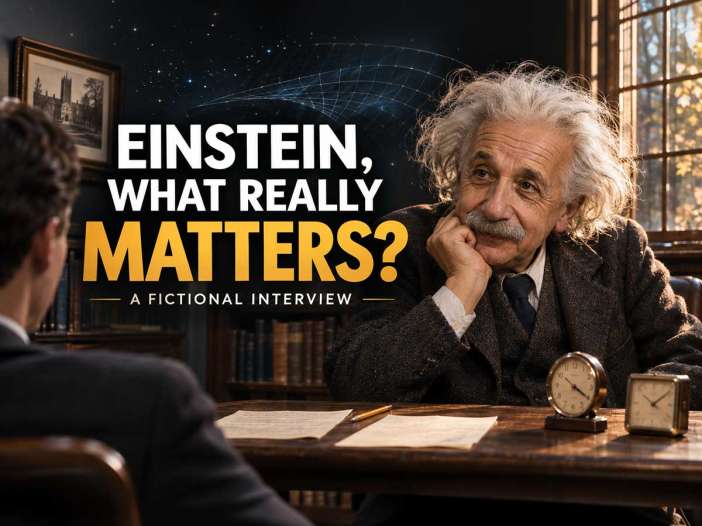
Main Introduction: What Would You Ask Einstein Without the Equations?
Albert Einstein sits across from you. There is no examination to pass, no blackboard you must decipher, and no need to pretend you followed an explanation that lost you halfway through.
What would you ask?
Perhaps you would begin with time. Does it actually pass differently for different people? Perhaps you would ask about God, or whether our choices matter in a universe governed by physical laws.
Or perhaps your question would be more personal.
How did you trust yourself before anyone recognized your work? How did you know when to keep going and when to admit you were wrong? Did discovering something extraordinary make ordinary life any easier?
Before Einstein became a symbol of genius, he faced uncertain employment and worked as a patent examiner. The Institute for Advanced Study’s account of his life traces the distance between those early circumstances and the discoveries that brought international recognition.
That distance is where this conversation begins.
In a fictional Princeton afternoon, Nick Sasaki meets Einstein with the curiosity of someone who wants a clear explanation and the freedom to ask, “Wait, what do you mean?”
The questions gradually become harder.
What separates an insight from a belief we are protecting? What happens when a scientific reputation gives someone authority beyond science? Can concern for humanity coexist with failures of attention at home?
The historical foundation draws on resources including the Einstein Papers Project, whose collection of writings and correspondence provides a richer basis than familiar quotations circulating under his name.
Yet this interview asks more than what Einstein discovered. It asks what searching demanded of him, where his convictions met resistance, and what remained unfinished.
You do not need scientific training to enter the room. You need curiosity, a willingness to question an answer, and perhaps a question of your own that has refused to leave you alone.
Disclaimer: This is a researched fictional interview, not a historical transcript. Dialogue, gestures, personal reflections, and the meeting itself are creative reconstructions. Scientific explanations are simplified; the conversation does not establish religious claims, settle debates about consciousness or free will, or represent endorsement by Einstein’s estate or the institutions linked here.
(Note: This is an imaginary conversation, a creative exploration of an idea, and not a real speech or event.)
Topic 1: Einstein, Who Were You Before You Became a Genius?

This is a fictional interview grounded in Einstein’s documented life and work. The dialogue, setting, and gestures are creative reconstructions, not a historical transcript.
Princeton, early 1950s. Afternoon light falls across a crowded desk. Nick Sasaki settles into a chair opposite Albert Einstein, who moves a small stack of papers from the neighboring seat to the floor.
Nick Sasaki
Did I just interrupt something important?
Albert Einstein
I cannot tell yet. That is one of the difficulties of the occupation.
Nick Sasaki
So those papers might change physics.
Albert Einstein
Or they might need to go into the wastebasket. At present, they enjoy equal rights.
Nick laughs. Einstein settles back.
Question 1: Before Anyone Knew Your Name, What Could You Not Leave Alone?
Nick Sasaki
People meet you now with this whole idea of Einstein already in their heads. The hair, the equations, the genius.
I want to go back before any of that.
What were you trying to figure out that you couldn’t leave alone?
Albert Einstein
There were several questions. Light was a particularly persistent troublemaker.
As a young person, I wondered what it would mean to travel beside a light wave at the same speed.
Would I see a wave standing still beside me?
Nick Sasaki
Like keeping pace with a car and looking through its window?
Albert Einstein
Yes, that is the ordinary expectation. But a stationary light wave did not fit the electromagnetic theory I was learning.
You have a picture that seems perfectly reasonable, then discover that the theory does not permit it.
One of them must give way.
Nick Sasaki
Most of us would probably assume we were asking a stupid question.
Albert Einstein
Sometimes we are.
Nick Sasaki
That’s reassuring.
Albert Einstein
A question does not acquire value merely from being unusual. But embarrassment is a poor method of deciding whether it deserves attention.
Nick Sasaki
What made you stay with this one?
Albert Einstein
It touched a contradiction I could not dismiss.
I did not yet possess the answer. I could not have told you how the matter would develop. But the discomfort remained.
Nick Sasaki
Were you thinking, “I’m going to overturn physics”?
Albert Einstein
That would have been a rather theatrical ambition.
I wanted the difficulty to disappear through a satisfactory explanation.
The reputation came later. It would have been a distraction at the beginning.
Nick Sasaki
So the motivation was less “I want to be somebody” and more “This doesn’t make sense.”
Albert Einstein
That is closer. But do not make the young man too pure. Young people have pride. Physicists are not exempt.
Nick Sasaki
Did your pride help?
Albert Einstein
It can keep you at the table. It cannot tell you whether the calculation is correct.
Nick Sasaki
That sounds like a distinction people discover after losing a lot of time.
Albert Einstein
Yes. And then discover again.
Nick Sasaki
When you were carrying that question around, could you explain why it mattered to someone outside physics?
Albert Einstein
I could explain the puzzle. Explaining why another person should care is a different task.
You may describe a stone in your shoe very accurately. Your companion still does not feel it.
Nick Sasaki
Did that feel lonely?
Albert Einstein
At times. But solitude and loneliness are different conditions.
I needed other people. I did not need a large audience.
A good conversation with someone who notices the exact difficulty can be worth a hundred expressions of admiration.
Question 2: What Did the Work Look Like Before the Breakthrough?
Nick Sasaki
Let’s talk about the patent office. You had a regular job. You had responsibilities. You weren’t sitting in a university office with everyone waiting for your next paper.
What did your thinking look like during an ordinary day?
Albert Einstein
Less picturesque than you might hope.
There were applications to examine. A device is supposed to accomplish something. You must determine what is being claimed and whether the description is sufficiently clear.
A confident description does not guarantee a functioning machine.
Nick Sasaki
That seems useful outside the patent office.
Albert Einstein
Extremely useful.
People can become attached to an arrangement of words long before they have established what the words describe.
Nick Sasaki
Did that work help your physics?
Albert Einstein
It gave me practice in identifying the essential claim and separating it from decoration.
But one should not explain every later achievement through an earlier occupation. I did not derive relativity by examining an unusually clever patent application.
Nick Sasaki
You’re taking away the movie scene.
Albert Einstein
The movie can survive a little unemployment.
Nick Sasaki
Were you frustrated that you couldn’t get the academic position you wanted?
Albert Einstein
Certainly. Difficulty finding work is not transformed into a pleasant experience merely by what happens afterward.
At the time, there was no guarantee of a satisfactory ending.
Nick Sasaki
That gets lost when we tell these stories. We know the person eventually succeeds, so every setback becomes preparation.
Albert Einstein
A very comfortable interpretation for the spectator.
For the person paying the rent, the matter is less elegant.
Nick Sasaki
Where did the scientific work fit?
Albert Einstein
In the hours available to it. Through reading, calculation, and discussion.
My friends mattered. Maurice Solovine and Conrad Habicht were companions in our little reading circle. We discussed philosophy and science with considerably less ceremony than a university might require.
Michele Besso was an especially valuable person to think with.
Nick Sasaki
What did Besso do that you couldn’t do alone?
Albert Einstein
He listened seriously and questioned seriously.
A person need not produce your solution to help you reach it. Sometimes he makes you hear your own difficulty more clearly.
Nick Sasaki
So talking wasn’t just reporting what you had already figured out.
Albert Einstein
No. Speaking can expose where thought has concealed a gap.
Inside your head, two ideas may seem comfortably connected. Explain the connection to a careful listener and suddenly there is a missing bridge.
Nick Sasaki
I’ve had that happen. You start a sentence certain you know what you mean. Halfway through, you realize you don’t.
Albert Einstein
Then the conversation has already been productive.
Nick Sasaki
Were you working mainly through pictures?
Albert Einstein
Physical pictures were useful. So were mathematical relationships. But the picture had to become precise.
A compelling scene in the mind is a beginning. It does not settle the matter.
Nick Sasaki
What happened when the picture and the mathematics disagreed?
Albert Einstein
Work.
Nick Sasaki
That’s the entire secret?
Albert Einstein
It is the part people most often hope to omit.
Nick glances at the papers on the floor.
Nick Sasaki
Did you ever sit there and think, “Maybe I’m just not capable of solving this”?
Albert Einstein
Naturally.
There are days when a problem resists you so thoroughly that you begin to suspect your entire approach.
Sometimes that suspicion is deserved.
Nick Sasaki
How do you know whether to push through or stop?
Albert Einstein
You examine the reasons for continuing.
Have you identified a real inconsistency? Is there something promising in the mathematics? Have you learned from the last failure?
“Already I have spent three years” is not, by itself, a scientific reason.
Nick Sasaki
It’s a very persuasive personal reason.
Albert Einstein
Yes. Nature remains unimpressed by our investment.
Question 3: What Does Calling You a Genius Get Wrong?
Nick Sasaki
When people call you a genius, what does that hide?
Albert Einstein
Other people, for a start.
It hides the work that existed before mine. Maxwell, Lorentz, Planck, and many others did not leave an empty room for me to enter.
It hides conversations, technical help, criticism, unsuccessful approaches.
Then it hides the ordinary limitations of the person being praised.
Nick Sasaki
Do people assume that being right about physics makes you right about everything?
Albert Einstein
Some do. Others assume that being mistaken about anything discredits everything.
Both methods save the trouble of examining a particular claim.
Nick Sasaki
Have you ever enjoyed that assumption? Someone asks your opinion, and you know they’re going to take it seriously.
Albert Einstein
I am not immune to vanity.
The more interesting question is whether you notice what vanity is doing to your judgment.
Nick Sasaki
Can you notice it yourself?
Albert Einstein
Occasionally. A friend may notice sooner.
But a friend who only announces that you are vain is not necessarily helping. He must show you where the argument has gone wrong.
Nick Sasaki
Did fame make those friends harder to find?
Albert Einstein
It made the surrounding noise greater.
There are people who agree with a name. There are people who oppose a name. Neither response necessarily has much to do with the question.
Nick Sasaki
How would you want me to disagree with you?
Albert Einstein
Begin by making certain you have grasped what I am claiming.
Then tell me where you think the difficulty lies.
You need not apologize for the difficulty.
Nick Sasaki
What if I lack the mathematics?
Albert Einstein
Then we must be honest about that limitation. It does not forbid you from asking what an experiment shows, or how a conclusion follows.
But neither of us should pretend that a technical disagreement has been settled through a pleasing sentence.
Nick Sasaki
Including one of your pleasing sentences.
Albert Einstein
Particularly then. A famous name can give a sentence an undeserved holiday from inspection.
Nick Sasaki
I think that’s part of why people want to meet someone like you. We hope you have found a way of being certain that we haven’t.
Albert Einstein
In some matters, I have good reasons for confidence.
That is different from possessing a method that removes uncertainty from life.
Nick Sasaki
Was there anything useful about being outside the academic system during those early years?
Albert Einstein
There was a certain independence. But do not turn exclusion into a qualification.
The outsider can be mistaken. The professor can be correct.
The question is what each can show.
Nick Sasaki
Then maybe the habit worth learning is how you examined something everyone thought was obvious.
Albert Einstein
That would be a more useful beginning.
Nick Sasaki
Let’s try it.
If you and I each have a clock, and we agree to meet again, I assume our clocks should agree about how much time has passed.
Albert Einstein
Under what conditions?
Nick Sasaki
You want me to describe what we did between the meetings?
Albert Einstein
Yes.
Nick Sasaki
I thought I was starting with the easy part.
Einstein leans forward, moving a pencil between them.
Albert Einstein
You are. That is where the trouble often begins.
Next: Topic 2 LCF, “Einstein, How Can We Tell What Is Real?”
Topic 2: Einstein, How Can We Tell What Is Real?
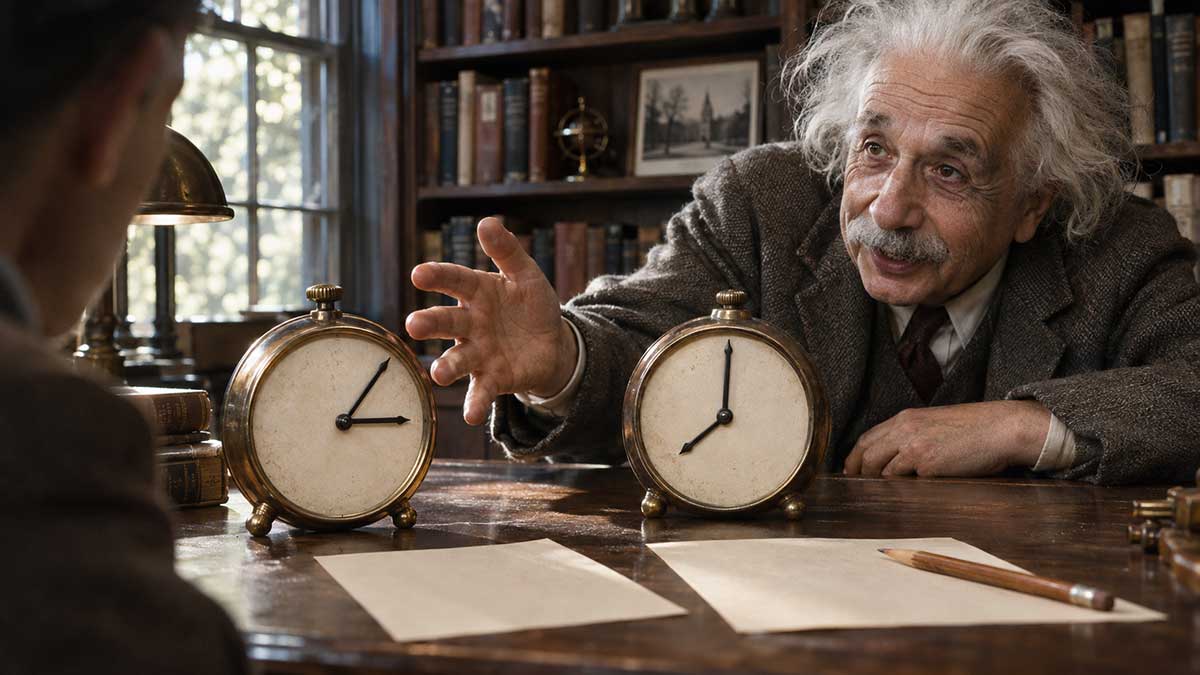
The fictional interview continues. Einstein places the pencil between two sheets of paper.
Albert Einstein
These can represent our two meetings. Here we compare our clocks. Later, here, we compare them again.
What happens between them?
Nick Sasaki
I stay here. You take a trip and come back.
Albert Einstein
Then we have something to discuss.
Nick Sasaki
I thought you were going to tell me my clock was cheap.
Albert Einstein
We should eliminate that possibility too.
Question 1: What Is Strange About Time?
Nick Sasaki
Suppose the clocks are excellent. We check them beforehand. What would make them disagree when you return?
Albert Einstein
Our different paths between the meetings.
Let us begin without gravity. You remain at rest in a chosen inertial frame. I travel away at high speed, turn, and return.
The elapsed time recorded along my path can be less than the elapsed time recorded along yours.
Nick Sasaki
And you mean the clock itself records less time.
Albert Einstein
Yes.
Nick Sasaki
You don’t mean I looked through a telescope and saw your clock running slowly.
Albert Einstein
Correct. The travel of light affects what you see through a telescope. We must account for that.
But here we bring the clocks together again. They sit beside each other. We read them directly.
They can disagree.
Nick Sasaki
That is the part my mind resists. I think of time as something happening to both clocks equally, and the clocks just measure it.
Albert Einstein
That expectation is precisely what must be examined.
Nick Sasaki
Would everything traveling with you experience the same difference? Your heartbeat, your age?
Albert Einstein
The difference concerns elapsed time along the path. It is not a peculiar defect in one mechanism.
A sufficiently ideal clock, a biological process, any suitable physical process must fit the same account.
Nick Sasaki
So you return younger than I am.
Albert Einstein
Younger than you by the difference accumulated during our separation, yes.
Neither of us experiences our own life running unnaturally slowly. My watch, my thoughts, my digestion do not begin quarreling with one another.
Nick Sasaki
I would hope digestion remains cooperative.
Albert Einstein
It is unreliable enough without assistance from relativity.
Nick Sasaki
But hold on. From your point of view, couldn’t you say I was the one moving away?
Albert Einstein
During a stretch of uniform relative motion, each inertial observer can describe the other’s clock as running slowly.
But the complete situations in our example are different. You remain in one inertial frame. I depart and return, changing my motion.
You cannot exchange our entire histories merely by exchanging our names.
Nick Sasaki
Is the turning around what makes your clock lose time?
Albert Einstein
The turn makes the asymmetry obvious, but it would be misleading to treat acceleration as a simple substance that slows clocks.
The elapsed time depends on the whole path. The calculation must describe that path.
Nick Sasaki
Let me try saying it back. We meet twice, but there can be different amounts of time along the routes connecting those meetings.
Albert Einstein
Yes. That is a useful statement.
Nick Sasaki
I can repeat it. I’m less certain I can feel comfortable with it.
Albert Einstein
Comfort is not required at the first encounter.
Nick Sasaki
Was it comfortable for you?
Albert Einstein
The consequences became compelling through the reasoning. Familiar habits of thought did not all disappear at once.
A person can accept a conclusion and still catch himself thinking in the old manner.
Nick Sasaki
Then what remains fixed? People hear this and think everything has become slippery.
Albert Einstein
The laws must retain a consistent form. In special relativity, the speed of light in vacuum has the same value for inertial observers using the appropriate measurements.
Observers can disagree about certain measured intervals without the account becoming arbitrary.
Their measurements are related precisely.
Nick Sasaki
So disagreement does not mean each person gets to invent an answer.
Albert Einstein
Exactly. Relativity places demanding constraints on the relationships between answers.
Nick Sasaki
That seems almost opposite to the way the word gets used in everyday arguments.
Albert Einstein
A word can travel farther than the idea that gave it employment.
Question 2: When Should We Trust Intuition?
Nick Sasaki
You had to set aside something that felt obvious. Yet intuition helped you get there.
How did you distinguish an intuition worth pursuing from an idea you simply wanted to be true?
Albert Einstein
I could not always distinguish them immediately.
An intuition suggests a direction. Then there is work to determine whether the direction leads anywhere.
Nick Sasaki
What kind of work?
Albert Einstein
Does the idea fit what is already established? If it conflicts, can we identify the exact point and justify the change?
Can it be formulated clearly?
Do its mathematical consequences remain consistent?
Does it describe observations? Does it lead to consequences that can be examined?
These questions gradually restrict our freedom.
Nick Sasaki
But at the beginning, you might have nothing more than a feeling.
Albert Einstein
A feeling informed by long attention to a problem can be valuable.
It can still be wrong.
Nick Sasaki
People love the first part of that sentence.
Albert Einstein
Yes. The second part interferes with advertising.
Nick Sasaki
What does a beautiful idea have that a merely attractive story lacks?
Albert Einstein
Beauty itself does not settle the distinction.
A theory can possess economy, coherence, and depth. Those qualities help direct the search. But nature is under no obligation to adopt our preference.
Nick Sasaki
Did your search for gravity involve ideas that looked promising and then failed?
Albert Einstein
Many difficulties, wrong turns, and revisions.
There were mathematical tools I had to learn to use properly. Marcel Grossmann helped me find my way into the necessary mathematics.
There were periods when restrictions I accepted led me away from the better formulation.
Nick Sasaki
What makes that hard to detect?
Albert Einstein
An assumption can seem so reasonable that you inspect everything around it first.
You ask whether the calculation contains an error. Whether a term has been neglected. Whether another adjustment will repair the result.
Eventually you must ask whether the condition you insisted upon was justified.
Nick Sasaki
That sounds familiar outside science. You keep rearranging your life around an assumption you never examine.
Albert Einstein
It may be a useful comparison. But in physics, we are fortunate to have unusually precise ways of exposing certain failures.
Nick Sasaki
Did the years already spent make it harder to change direction?
Albert Einstein
They made the question emotionally unpleasant. They did not improve the argument.
Nick Sasaki
Could you admit to yourself that pride was involved?
Albert Einstein
Sometimes sooner, sometimes later.
One should be suspicious of a person who reports complete freedom from such difficulties.
Nick Sasaki
Including you?
Albert Einstein
You may begin here. It is geographically convenient.
Nick laughs, then looks down at the two sheets.
Nick Sasaki
What if an experiment had contradicted an idea you felt deeply confident about?
Albert Einstein
First, examine the experiment. An instrument, analysis, or assumption may be mistaken.
Then examine the theory.
Neither should receive permanent protection.
Nick Sasaki
How do you avoid using “examine the experiment” as an excuse?
Albert Einstein
By stating the objection clearly enough that others can investigate it.
“I dislike this result” is a feeling. “This procedure introduces this error” is a claim that can be examined.
Nick Sasaki
So the objection needs to risk being wrong too.
Albert Einstein
Certainly. Otherwise it is an escape route.
Question 3: How Should a Nonspecialist Judge an Expert?
Nick Sasaki
Here is where I think a lot of people get stuck.
You can inspect the mathematics. I cannot. If two physicists disagree, I can listen to both and still have no idea which one has the better argument.
What would justify trusting your conclusion?
Albert Einstein
You should ask what kind of conclusion it is.
Am I describing a well-tested result? Proposing an extension? Expressing a philosophical preference? Making a judgment outside physics?
The same person can speak in all four ways within ten minutes.
Nick Sasaki
And sound equally confident in each.
Albert Einstein
Unfortunately.
Nick Sasaki
What could I ask that would help?
Albert Einstein
“What observations support this?”
“What would conflict with it?”
“Have independent investigators obtained the relevant results?”
“Where does the proposal remain uncertain?”
A competent explanation should identify the status of the claim.
Nick Sasaki
Suppose you explain it beautifully and the other person explains it badly.
Albert Einstein
Then you have discovered a difference in explanation.
Perhaps a difference in the merits too. But you have not yet established that.
Nick Sasaki
That is inconvenient for an interviewer.
Albert Einstein
Your profession has my sympathy.
Nick Sasaki
There is another problem. Someone challenges an established view and says, “Einstein was an outsider too.”
Albert Einstein
Then ask what else the person has in common with the relevant work.
Being rejected is not evidence of being correct.
Nick Sasaki
But being accepted is not proof either.
Albert Einstein
No. Acceptance can provide useful information about informed judgment. It does not relieve a theory of its obligations.
Nick Sasaki
So I should take expert agreement seriously without treating it as something that can never change.
Albert Einstein
Yes. And recognize your own limits without surrendering the right to ask a clear question.
Nick Sasaki
What does that right look like when the answer really does require years of study?
Albert Einstein
You may have to accept that you cannot settle the technical dispute this afternoon.
That is an honest outcome.
You can still learn what the dispute concerns, what evidence bears upon it, and why qualified people differ.
Nick Sasaki
We tend to want a verdict.
Albert Einstein
Then you may purchase certainty at the expense of accuracy.
Nick Sasaki
Have people done that with your opinions outside physics?
Albert Einstein
A reputation is portable. Competence is less so.
My concern about a public question may be sincere. My judgment may deserve consideration. But relativity does not certify my political proposals.
Nick Sasaki
Would you want the same questions applied to those proposals? What supports them, what might go wrong, what would change your mind?
Albert Einstein
Yes. With the recognition that human affairs do not permit every uncertainty to be resolved through a controlled experiment.
We must sometimes act with incomplete knowledge.
Nick Sasaki
Then there is a point where evidence helps us, but does not choose for us.
Albert Einstein
There are aims and values within a decision. A calculation cannot supply every premise it requires.
Nick Sasaki
And underneath your scientific work, were there premises you trusted that you could not prove in the same way you could test a clock?
Einstein turns the pencil slowly between his fingers.
Albert Einstein
I trusted that the world possessed an order accessible, at least in part, to thought.
That confidence was not the result of a single experiment. It sustained the effort to make sense of experiments.
Nick Sasaki
Was that what you meant when you spoke about God?
Einstein looks up.
Albert Einstein
We should first make certain which meaning of that word you are asking about.
Topic 3: Einstein, What Did You Mean by God?
Einstein places the pencil beside the two sheets representing their clocks. Nick pauses before answering.
Nick Sasaki
I’m asking about the God someone might pray to. Someone who knows them, cares about them, perhaps has a purpose for their life.
When you used that word, were you talking about anything like that?
Albert Einstein
No. And if we leave that difference unclear, everything said afterward becomes confused.
Question 1: When You Said God, What Did You Mean?
Nick Sasaki
Then what were you describing?
Albert Einstein
A feeling of reverence before the order of nature, and before the small portion of it accessible to us.
There is something remarkable in our ability to formulate relationships that describe events far beyond ordinary experience.
That does not make me think of a person supervising those events.
Nick Sasaki
Why use religious language at all?
Albert Einstein
Ordinary satisfaction seems too weak a description of the feeling.
But words carry histories. A word that conveys reverence to one person conveys a doctrine to another.
Nick Sasaki
Did you become frustrated when people heard you as supporting their particular religion?
Albert Einstein
It required repeated clarification.
Admiration for a religious teacher does not imply acceptance of every claim made about him. Nor does criticism of a doctrine establish contempt for everyone who holds it.
Nick Sasaki
People often want you on their side.
Albert Einstein
Yes. Sometimes they recruit me before informing me of the duties.
Nick Sasaki
Would you call your position faith?
Albert Einstein
You must tell me what you mean.
Nick Sasaki
Something you trust deeply without having a final proof.
Albert Einstein
In that sense, confidence in an intelligible external world contains an element of faith.
But the word must not erase differences between claims.
Confidence that further inquiry is possible is different from certainty that a particular account of the universe is correct.
Nick Sasaki
So you could trust the search and distrust your current answer.
Albert Einstein
Precisely.
Nick Sasaki
What would you say to someone who sees the same order you see and concludes there must be a loving Creator?
Albert Einstein
I would ask how the conclusion follows.
The intelligibility of nature is extraordinary to us. But the step from intelligibility to a being with intentions resembling our own requires further argument.
Nick Sasaki
Could that person fairly ask whether your account leaves something out? Love, for example.
Albert Einstein
Certainly.
Then we should ask what is being left out of which account.
A physical description of a tear does not describe the entire experience of grief. That limitation does not make the physical description false.
Nor does the depth of grief, by itself, establish a particular theory of what lies beyond death.
Nick Sasaki
That is where these conversations often become difficult. Someone is speaking about what gives life meaning, and someone else answers as if they have submitted a faulty experiment.
Albert Einstein
Yes. And the reverse happens. A question about evidence receives an answer about how comforting a belief is.
Both people may leave dissatisfied, having addressed different questions.
Nick Sasaki
Can religious life offer something you respect without your accepting its theology?
Albert Einstein
It can cultivate concern for others, devotion beyond personal advantage, and moral seriousness.
It can give expression to feelings that resist ordinary description.
It can serve fear, authority, and hostility too. We should judge what people actually cultivate.
Nick Sasaki
What about Jesus? What interests you about him?
Albert Einstein
The force of his moral personality as it reaches us through the Gospels.
One can be moved by the demand to love, to forgive, to see beyond rank and possession, without accepting the theological structures later built around him.
Nick Sasaki
Which teaching would you want to question him about?
Albert Einstein
Perhaps loving one’s enemies.
Nick Sasaki
What would you ask?
Albert Einstein
How he would have us join that demand with the obligation to protect someone from harm.
Nick Sasaki
You wouldn’t start with whether it was beautiful.
Albert Einstein
Its beauty is apparent. Its application is difficult.
Suppose a person threatens your neighbor. Your attitude toward the aggressor matters. So does what you permit the aggressor to do.
Nick Sasaki
Could love include stopping him?
Albert Einstein
It would have to, if it includes concern for the person he threatens.
But now we have begun a serious question. The phrase alone has not answered it.
Question 2: Does Consciousness Create Reality?
Nick Sasaki
Let me ask about another phrase that can sound like an answer before we examine it.
Someone says consciousness creates reality. What would you ask first?
Albert Einstein
What does the person mean by consciousness, creates, and reality?
Nick Sasaki
You’ve taken apart the entire sentence.
Albert Einstein
It has offered us only three substantial words. We should be permitted to inspect them.
Nick Sasaki
Suppose they mean that something becomes physically real when a mind observes it.
Albert Einstein
Then we need a description of the process and consequences that distinguish it from other accounts.
Whose mind? Under what conditions? What would happen differently in its absence?
Nick Sasaki
They might point to quantum experiments and say observation changes the result.
Albert Einstein
The experimental arrangement matters. The interaction involved in measurement matters.
But one must justify the step from those facts to a claim about a conscious mind bringing physical reality into existence.
Calling an interaction an observation does not settle the role of consciousness.
Nick Sasaki
What about the opposite claim, that consciousness has nothing to do with anything fundamental?
Albert Einstein
That too requires care.
We do not make progress by replacing one loosely stated certainty with another.
Nick Sasaki
Your disagreement with quantum theory was partly about whether there was a reality independent of the measurement?
Albert Einstein
Partly about whether its description was complete.
The theory achieved extraordinary success in predicting statistical results. I did not deny that.
But I doubted that this was the final account of an individual physical system.
Nick Sasaki
What bothered you?
Albert Einstein
Consider whether a description tells us everything physically relevant about a system, or only what results we may obtain under specified conditions.
The difference is substantial.
Nick Sasaki
Could nature simply refuse to provide the kind of deeper account you wanted?
Albert Einstein
It could refuse my proposed route to it. It has done so often enough.
Whether no deeper account is possible is another claim.
Nick Sasaki
How did you keep your preference for order from deciding the answer in advance?
Einstein rests his hands together.
Albert Einstein
I cannot offer you a certificate that my philosophical preferences never influenced my judgment.
They guided the questions I regarded as important.
The task was to express the difficulty clearly enough that it could become more than my dissatisfaction.
Nick Sasaki
So your discomfort needed to produce an argument someone else could examine.
Albert Einstein
Yes.
Nick Sasaki
Let’s bring that back to a person’s experience.
Someone has an event that changes their life. They come away convinced there is more to existence than they had thought.
Can you take that seriously without agreeing with their explanation?
Albert Einstein
You can take the person seriously. You can ask what occurred, what they recall, and what changed afterward.
But sincerity and accuracy of interpretation are different matters.
Nick Sasaki
Does saying that risk making the person feel dismissed?
Albert Einstein
It can, if you say it without listening.
Yet respect cannot require acceptance of every explanation.
You may acknowledge that something mattered deeply and still ask how the person knows what it meant.
Nick Sasaki
And they could ask the same of you.
Albert Einstein
They should.
Question 3: Do Our Choices Matter in a Universe with Causes?
Nick Sasaki
Your view of human choice is difficult for many people.
If our decisions have causes, what role does thinking carefully still play in what happens next?
Albert Einstein
Thinking carefully is itself part of what happens next.
Deliberation does not stand outside nature. It participates in the process through which an action occurs.
Nick Sasaki
Then someone saying, “Why bother? Everything has causes,” has left their own effort out of the explanation.
Albert Einstein
Yes. Your learning, attention, and response to reasons can affect what you do.
To say that these have causes does not make them absent.
Nick Sasaki
But do I really choose?
Albert Einstein
You consider alternatives, form intentions, and act. Those are real activities.
My doubt concerns a will that originates independently of the conditions that shape it.
I do not see how a person could select his own nature from nowhere.
Nick Sasaki
We don’t choose our parents, our early experiences, much of our temperament.
Albert Einstein
And yet these enter into what we desire and how we respond.
Recognizing this can weaken the temptation to treat another person’s conduct as if it arose from an entirely self-created being.
Nick Sasaki
Did it make you more forgiving?
Albert Einstein
It encouraged patience and reduced certain kinds of resentment.
I would not claim perfect success. A philosophical conviction does not automatically govern every irritation.
Nick Sasaki
You could believe all that and still be annoyed with someone.
Albert Einstein
A considerable number of opportunities remain.
Nick Sasaki
What happens to responsibility?
Albert Einstein
We still need to protect people, respond to harmful conduct, and create conditions that encourage better conduct.
The question is what kind of response serves those purposes.
Revenge may satisfy an emotion without improving anything.
Nick Sasaki
Does that mean the person who harms someone is just unlucky?
Albert Einstein
Luck enters far more deeply into character and circumstance than our pride prefers to admit.
But describing causes does not require indifference to suffering. It may sharpen our attention to preventing it.
Nick Sasaki
Could someone hear your view and use it to avoid apologizing?
Albert Einstein
Certainly. People are resourceful in the employment of philosophy for personal convenience.
An apology has consequences. Repair has consequences. Refusing both has consequences too.
Nick Sasaki
So “I could not have done otherwise” does not answer the person asking you to repair the damage.
Albert Einstein
No. It may explain something about an act. It does not perform the repair.
Nick Sasaki
What could make you reconsider your position on free will?
Albert Einstein
A clearer account of what the proposed freedom means and why it is necessary.
Unpredictability alone would not satisfy me. An accidental event is not obviously a freely chosen one.
But I would distinguish my philosophical position from an experimental result that everyone must accept.
Nick Sasaki
You sound more cautious about that distinction than people often are when they repeat your views.
Albert Einstein
The repetition is frequently shorter than the reasoning.
Nick looks at the clock on the mantel, then back at Einstein.
Nick Sasaki
We have been talking about whether a person could have acted differently.
There is a decision in your own life where that question becomes very concrete.
Albert Einstein
The letter to Roosevelt?
Nick Sasaki
Yes. You opposed war. Then you faced a situation where refusing to act carried its own danger.
How did you decide what your principles required of you?
Einstein’s expression grows more deliberate.
Albert Einstein
We must begin with what was happening, rather than with what we now know happened afterward.
Topic 4: Einstein, Why Doesn’t Intelligence Stop Us from Destroying Each Other?
Einstein draws the two sheets closer together, leaving the pencil untouched.
Albert Einstein
In retrospect, the path through an event can appear straighter than it was to the person walking it.
You know which danger became real. He did not.
Nick Sasaki
And knowing the outcome can make us forget what he was afraid might happen.
Albert Einstein
Yes. But uncertainty must not become a blanket excuse either.
We should ask what he knew, what he could reasonably have learned, and how he weighed the consequences.
Question 1: Why Doesn’t Knowledge Become Wisdom?
Nick Sasaki
Before we get to the letter, there is something I keep coming back to.
How can people become so skilled at solving technical problems and remain so bad at living together?
Albert Einstein
You are assuming that the abilities develop together.
They need not.
A person may calculate accurately and judge another human being through prejudice. He may possess considerable knowledge and very little independence of judgment.
Nick Sasaki
Wouldn’t education expose the prejudice?
Albert Einstein
It can. It can provide a more elaborate defense of it too.
Intelligence helps us examine a belief. It helps us protect a belief from examination.
Nick Sasaki
You can become better at making excuses.
Albert Einstein
More convincing excuses. Sometimes convincing to yourself.
Nick Sasaki
Then what is missing?
Albert Einstein
The willingness to question what your group rewards you for accepting.
That can be more difficult than questioning an equation.
Nick Sasaki
Why?
Albert Einstein
An equation does not withdraw its friendship.
Nick nods slowly.
Nick Sasaki
So the cost of changing your mind can be belonging.
Albert Einstein
Your position, your livelihood, the approval of people you love. At times, your safety.
We should not underestimate those pressures merely to congratulate ourselves on seeing their effects elsewhere.
Nick Sasaki
What would you change about education?
Albert Einstein
I would give greater attention to independent judgment and responsibility for other people.
A student should learn more than how to produce the answer expected by an authority.
Nick Sasaki
What would that look like in a classroom?
Albert Einstein
Let him explain why he thinks an answer is correct. Let another student question it without humiliation.
Let them discover that revising a conclusion need not mean personal defeat.
And expose them to people whose circumstances differ from their own.
Nick Sasaki
Would that be enough?
Albert Einstein
No.
The school does not operate outside the society. A child may hear cooperation praised in the classroom and watch ruthlessness rewarded everywhere else.
Nick Sasaki
Then he learns which lesson actually counts.
Albert Einstein
He notices the discrepancy.
Nick Sasaki
Could science itself make us more humble? You spend your life discovering how much we don’t know.
Albert Einstein
It can encourage humility before a problem.
Whether that humility extends to your treatment of a colleague, a servant, or a political opponent is another matter.
Nick Sasaki
So a person could feel small before the universe and remain arrogant at the dinner table.
Albert Einstein
The universe does not immediately correct his table manners.
Nick Sasaki
That is an unfortunate gap in the system.
Albert Einstein
One we must address ourselves.
Question 2: What Happens When Fear Changes a Principle?
Nick Sasaki
You opposed militarism. Yet Nazi aggression changed what you thought resistance required.
How did you deal with that change?
Albert Einstein
By recognizing that a principle must address the conditions in which people are asked to live.
Opposition to war remained. But under Hitler, refusing every form of military resistance did not remove violence from the situation.
It could leave the violence entirely in the hands of the aggressor.
Nick Sasaki
Was that difficult to admit?
Albert Einstein
Yes. A position may have become part of your identity.
Then you encounter circumstances that demand reconsideration. You must decide whether you are protecting the principle or protecting your picture of yourself.
Nick Sasaki
How could you tell?
Albert Einstein
I asked what the refusal would permit.
That does not settle every case. It prevents you from treating inaction as morally empty.
Nick Sasaki
Then in 1939, Szilard comes to you about uranium.
Albert Einstein
He brought a serious concern: that a nuclear chain reaction might make weapons of extraordinary destructive capacity possible, and that German authorities might pursue them.
My name could help bring the matter to Roosevelt’s attention.
Nick Sasaki
What were you asking the American government to do?
Albert Einstein
Take the possibility seriously, maintain contact with the physicists investigating it, and support the relevant research.
The letter warned that unusually destructive bombs might become possible.
It was an intervention at the beginning of a process. It was not a set of instructions for constructing a weapon.
Nick Sasaki
People sometimes talk as if you went into a laboratory and built the bomb.
Albert Einstein
I did not work on that project.
Nick Sasaki
Does correcting that ever feel like avoiding responsibility for the letter?
Albert Einstein
It should not.
One can state the limits of one’s involvement and still examine the involvement that actually occurred.
An exaggerated accusation and an exaggerated innocence are both obstacles.
Nick Sasaki
What uncertainty weighed most heavily?
Albert Einstein
What Germany might do.
We knew the character of the regime. We did not know how far a weapons effort might progress.
Nick Sasaki
Fear was part of the decision.
Albert Einstein
Certainly.
Nick Sasaki
How do you know when fear is warning you about a real danger and when it is making you justify something terrible?
Einstein pauses.
Albert Einstein
You do not possess a simple instrument for that distinction.
You examine the evidence. You consult people competent to judge the technical question. You ask whether your proposed response creates dangers of its own.
And you must permit that last question to remain alive after you have acted.
Nick Sasaki
That last part seems difficult. Once you’ve committed, people expect you to defend the decision.
Albert Einstein
Yes. Governments have that habit. Individuals too.
But a decision made under particular conditions does not become a commandment for all subsequent conditions.
Nick Sasaki
Once Germany was defeated, the original fear could no longer justify everything that followed.
Albert Einstein
Correct. New circumstances required new judgment.
Nick Sasaki
Could you regret an outcome without claiming you should have known it in advance?
Albert Einstein
You can grieve an outcome. You can examine whether you contributed to it. You can ask what could have been done differently.
None requires pretending that you possessed knowledge you did not have.
Nick Sasaki
And the examination has to go somewhere beyond your own feelings.
Albert Einstein
Yes. Otherwise remorse becomes another private occupation.
The question becomes how to prevent further catastrophe.
Question 3: Where Can Cooperation Begin Before Trust?
Nick Sasaki
You argued for international arrangements to reduce the danger of war.
But suppose two governments both say they want peace. Each thinks the other is dangerous. Each says, “We would cooperate if they could be trusted.”
Where do you begin?
Albert Einstein
You cannot begin by requiring a feeling neither side possesses.
You need arrangements that reduce dependence on that feeling.
Nick Sasaki
What kind of arrangements?
Albert Einstein
Shared rules, means of inspection, and institutions with sufficient authority to address the danger.
An agreement that exists only until one participant finds it inconvenient is a weak protection.
Nick Sasaki
Who gives that institution authority?
Albert Einstein
That is the difficult political task.
Nations would have to surrender some freedom to act unilaterally in matters that threaten everyone.
Nick Sasaki
A government could say, “You’re asking us to put our people’s safety in someone else’s hands.”
Albert Einstein
Yes. But it already lives with its safety partly in someone else’s hands.
The weapons of another state do not disappear when you refuse to recognize your dependence.
Nick Sasaki
Then the argument is that shared vulnerability needs shared restraint.
Albert Einstein
That is one part.
Nick Sasaki
What stops the institution itself from becoming oppressive?
Albert Einstein
Nothing about creating it automatically guarantees justice.
Its authority must be limited, accountable, and directed at defined responsibilities.
Nick Sasaki
You’re asking people to accept limits on national authority without creating an unlimited authority above it.
Albert Einstein
Yes. It is a difficult construction. That does not remove the need.
Nick Sasaki
What about a person whose family has suffered? They hear all this talk of shared humanity and think, “You want me to forget what happened.”
Albert Einstein
Then we must make clear that cooperation need not require forgetting.
The injury remains real. Responsibility remains a question.
But preventing another injury can become a shared task before every dispute about the first has been resolved.
Nick Sasaki
Could that sound like asking the injured person to compromise before the aggressor changes?
Albert Einstein
It could. The terms matter.
Protection cannot be a ceremonial word. If the proposed arrangement leaves the threatened person exposed, his objection deserves an answer.
Nick Sasaki
So “both sides must come together” is not enough.
Albert Einstein
It is scarcely a beginning.
Who is threatened? What conduct must stop? How will compliance be assessed? What happens if the agreement is violated?
Those questions give the aspiration substance.
Nick Sasaki
Can people care about humanity without losing their love for their own country?
Albert Einstein
They need not cease loving familiar places, language, or customs.
The difficulty begins when attachment becomes permission to disregard everyone outside it.
Nick Sasaki
You can care more immediately about your own children without deciding other children matter less as human beings.
Albert Einstein
Yes. The particular relationship does not cancel the other child’s claim to protection.
Nick Sasaki
Then perhaps the first step is modest. You don’t ask people to feel affection for an enemy. You ask what harm they could agree to prevent.
Albert Einstein
That may provide a beginning.
But do not mistake a beginning for a guarantee. Interests can change. Fear can return. Agreements require maintenance.
Nick Sasaki
You keep resisting the satisfying final sentence.
Albert Einstein
A satisfying sentence is an inexpensive form of peace.
Nick smiles, then looks at the papers gathered beside Einstein’s chair.
Nick Sasaki
There is something uncomfortable about all this.
We can talk carefully about what governments owe people they have never met. We can agree that responsibility survives fear, pride, and inconvenience.
Then someone close to us asks for an hour of attention, and suddenly our reasons for being unavailable seem excellent.
Einstein looks down briefly.
Albert Einstein
The smaller case does not necessarily offer the easier test.
Nick Sasaki
Could we talk about that?
Albert Einstein
We can. But you should not expect a person’s public convictions to provide a complete defense of his private conduct.
Topic 5: Einstein, What Makes a Life Worth Living?
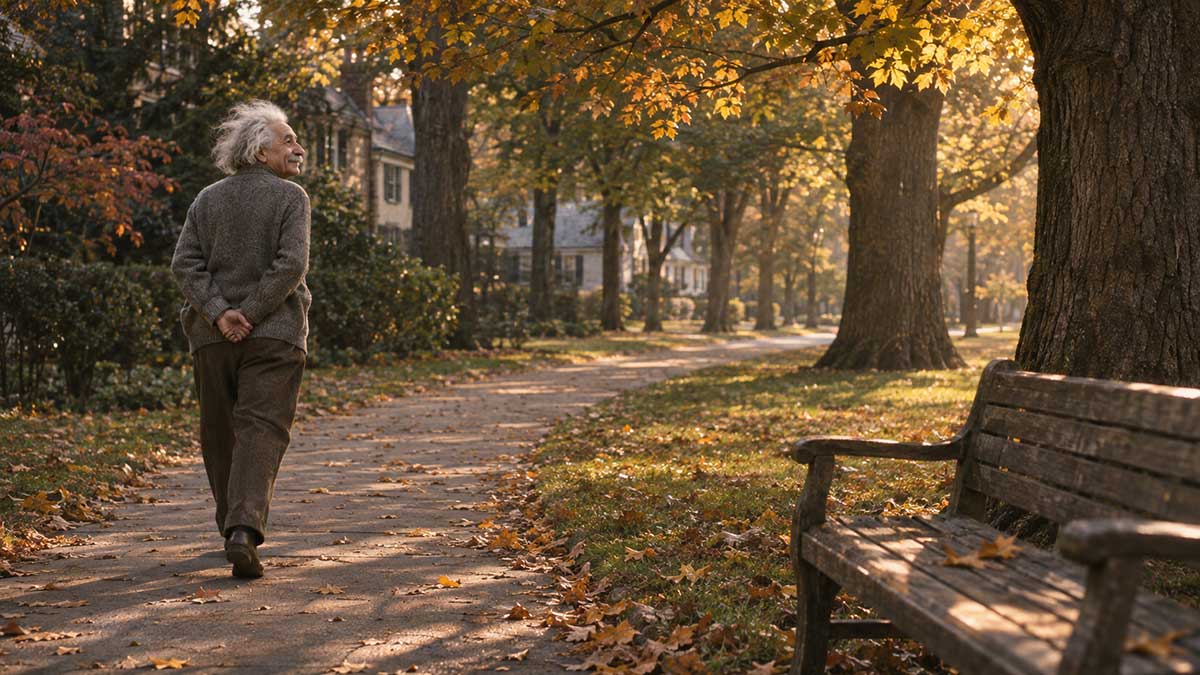
The light has shifted across the study. Nick closes his notebook, keeping one finger between the pages.
Nick Sasaki
I don’t want a defense. I’m interested in the difficulty.
You can care deeply about people and still fail to give someone what they need.
Albert Einstein
Yes. And the person receiving too little attention may have less interest in your explanation than you do.
Question 1: What Did Your Devotion to Work Cost?
Nick Sasaki
How did your devotion to work affect the people closest to you?
Einstein looks at the notebook resting on Nick’s knee.
Albert Einstein
They had to live with an attention that could become very narrow.
The problem did not put itself away merely when I left the desk.
Nick Sasaki
You could be physically present and still be working.
Albert Einstein
That is possible for many people, I think.
But we should be careful. I can describe that difficulty. I cannot speak for everyone who lived with me or give you their verdict on the arrangement.
Nick Sasaki
Your separation from Mileva and your sons is part of the historical record. How much should someone connect that with your work?
Albert Einstein
They should resist a simple explanation.
Work, affection, temperament, distance, expectations: a marriage contains more than one variable.
A scientific achievement does not explain every failure around it. Nor does it excuse one.
Nick Sasaki
Yet people can be very willing to excuse things if the person accomplished enough.
Albert Einstein
The admirer receives the achievement without necessarily paying the private cost.
Nick Sasaki
And the person at home might have preferred a less famous husband who listened.
Albert Einstein
They are entitled to needs that differ from the public’s.
Nick Sasaki
What did solitude give you?
Albert Einstein
Freedom from the immediate demands of another person’s attention.
You can remain with an uncertain thought. You do not have to make it interesting, defend it before it is ready, or interrupt it to answer something unrelated.
Nick Sasaki
That sounds wonderful.
Albert Einstein
It can be.
Nick Sasaki
And dangerous?
Albert Einstein
Comfort can become a poor judge of obligation.
Nick Sasaki
How would you tell whether you needed solitude or were avoiding someone?
Albert Einstein
I would not always know at the time.
Perhaps I would ask what happened when the other person’s need became clear. Did I reconsider my plans, or immediately prepare an argument for leaving them unchanged?
Nick Sasaki
That is a difficult test.
Albert Einstein
Particularly if you are skilled at arguments.
Nick Sasaki
You have an advantage there.
Albert Einstein
The disadvantage may belong to the person arguing with me.
Nick smiles, then lets the pause remain.
Nick Sasaki
Could the work become so important that everything else felt like an interruption?
Albert Einstein
Yes. But an interruption is a description from the standpoint of the interrupted person.
To the person entering the room, something else may be urgent.
Nick Sasaki
A child doesn’t experience needing a parent as interrupting physics.
Albert Einstein
No.
Nick Sasaki
What would you tell someone who says, “Once I finish this project, then I’ll have time for my family”?
Albert Einstein
I would ask whether the project has an actual end.
Then whether the family has agreed to wait.
Nick Sasaki
They may have agreed once. Then another project begins.
Albert Einstein
An agreement can expire in practice without anyone announcing it.
You should ask again.
Nick Sasaki
That seems almost embarrassingly simple.
Albert Einstein
Many obligations are simple to state. Their inconvenience supplies the difficulty.
Nick Sasaki
Did you learn from science how to handle those moments?
Albert Einstein
Science offers no exemption from the need to listen.
And another person is not a problem you solve once and place on a shelf.
Question 2: Did the Universe Make Life Feel Smaller or More Precious?
Outside, a car passes. Einstein turns briefly toward the window.
Nick Sasaki
When you considered the scale of the universe, did your own life feel less significant or more precious?
Albert Einstein
My private importance became smaller.
But that need not make experience worthless.
Nick Sasaki
People can go in either direction. They look at the stars and feel connected. Or they think, “Nothing I do matters.”
Albert Einstein
Then they have moved from a statement about size to a judgment about value.
The connection requires examination.
Nick Sasaki
Something does not have to be large or permanent to matter.
Albert Einstein
A conversation can matter to the people having it. Its duration does not settle its worth.
Nick Sasaki
Would you say the universe gives us meaning?
Albert Einstein
I would hesitate over that formulation.
I found deep satisfaction in trying to comprehend something of nature. Other satisfactions came from relationships, companionship, and activities whose value required no cosmic explanation.
Nick Sasaki
Such as?
Albert Einstein
A walk. A good discussion. Sailing. Playing the violin.
Nick Sasaki
Could you enjoy those without thinking about whether they were useful?
Albert Einstein
Certainly.
Nick Sasaki
Some people turn everything into preparation for something else. Rest improves work. Friendship creates opportunities. A walk helps solve a problem.
Albert Einstein
Then they may miss the walk.
Nick Sasaki
Did you?
Albert Einstein
At times I carried the problem with me. At other times, the surroundings received more of my attention.
You need not transform either into a prescription.
Nick Sasaki
What made an ordinary day good?
Albert Einstein
Enough freedom to attend to work I cared about. Some agreeable company. An absence of unnecessary ceremony.
Nick Sasaki
Did fame interfere with that?
Albert Einstein
It increased the number of people who believed they had a reason to interrupt it.
Nick Sasaki
Including people with notebooks.
Albert Einstein
You have closed yours. There is hope.
Nick removes his finger from the pages and sets the notebook beside his chair.
Nick Sasaki
Did recognition give you anything you actually wanted?
Albert Einstein
It made certain kinds of assistance possible. People would read a letter, consider an appeal, or listen to a warning.
That could be useful.
But public attention cannot supply affection on demand. It cannot make a difficult personal exchange honest.
Nick Sasaki
It may make honesty harder.
Albert Einstein
Yes. People approach an image. Then the person must somehow enter the conversation.
Nick Sasaki
Does wonder help you treat people better?
Albert Einstein
It can loosen the grip of personal concerns.
But I would not trust the feeling alone.
A person can experience reverence and still behave impatiently ten minutes later.
Nick Sasaki
Then what carries it into the next ten minutes?
Albert Einstein
Attention. Habit. Other people reminding you that they exist.
Nick Sasaki
And being willing to receive the reminder.
Albert Einstein
That is often the neglected part.
Question 3: What Remained Unfinished?
Nick Sasaki
What did you become less certain about as you grew older?
Albert Einstein
The success of particular approaches I had once hoped might lead much farther.
I continued searching for a unified account of gravitation and electromagnetism. Continuing did not mean possessing confidence in every formulation I tried.
Nick Sasaki
Could you separate confidence in the goal from confidence in your method?
Albert Einstein
I had to try.
But the distinction can become too convenient. You abandon one formulation, retain the aim, and begin again.
At some point a critic may fairly ask whether the aim itself has become too restrictive.
Nick Sasaki
Would you listen?
Albert Einstein
I would listen. Agreement would require more.
Nick Sasaki
What if you spent the rest of your life searching and never found the answer?
Albert Einstein
That possibility is not difficult to conceive.
Nick Sasaki
Would it make the effort a failure?
Albert Einstein
The proposed theory might fail. The research might not accomplish what I intended.
We should permit those statements to remain plain.
Nick Sasaki
You wouldn’t immediately rescue it by saying the effort was valuable anyway.
Albert Einstein
One may learn from unsuccessful work. But consolation should not decide what the work achieved.
Nick Sasaki
That is unusually hard when your identity is attached to it.
Albert Einstein
Yes.
Nick Sasaki
Would you spend another lifetime on the same questions?
Einstein looks toward the desk.
Albert Einstein
I would still want to know what account of nature could satisfy the difficulties before us.
Whether another lifetime should be spent following my present methods is less clear.
Nick Sasaki
Would you live the rest of it differently?
Albert Einstein
You are asking for a revised life with knowledge unavailable to the original.
It is an appealing exercise. It can become dishonest if the revised person is made wiser in every respect at no cost.
Nick Sasaki
Then let me make it smaller.
What would you want to notice sooner?
Einstein remains silent for a moment.
Albert Einstein
Perhaps when another person’s patience had been mistaken for the absence of a need.
Nick Sasaki
That is a very different kind of observation from watching an experiment.
Albert Einstein
The evidence may have been offered several times.
Nick Sasaki
What would you say to someone who admires your work but thinks their own life is too ordinary to matter?
Albert Einstein
I would ask what comparison they are making.
Most people will not produce a fundamental physical theory. That cannot reasonably become the entrance requirement for a worthwhile life.
Nick Sasaki
Yet people compare themselves with whoever seems to have done the most.
Albert Einstein
Then the comparison may prevent them from attending to what is actually theirs to do.
Nick Sasaki
Such as?
Albert Einstein
Work performed honestly. A child taught with patience. A person treated fairly when unfair treatment would be easier.
These do not become meaningless when no newspaper reports them.
Nick Sasaki
Could that sound like telling someone to accept less from life?
Albert Einstein
It could, if offered as a way to keep them obedient or deprived of opportunity.
They should have freedom to develop their abilities.
But freedom to attempt something does not require contempt for a life that receives little recognition.
Nick Sasaki
What should they notice tomorrow?
Albert Einstein
I cannot assign tomorrow to a person I have not met.
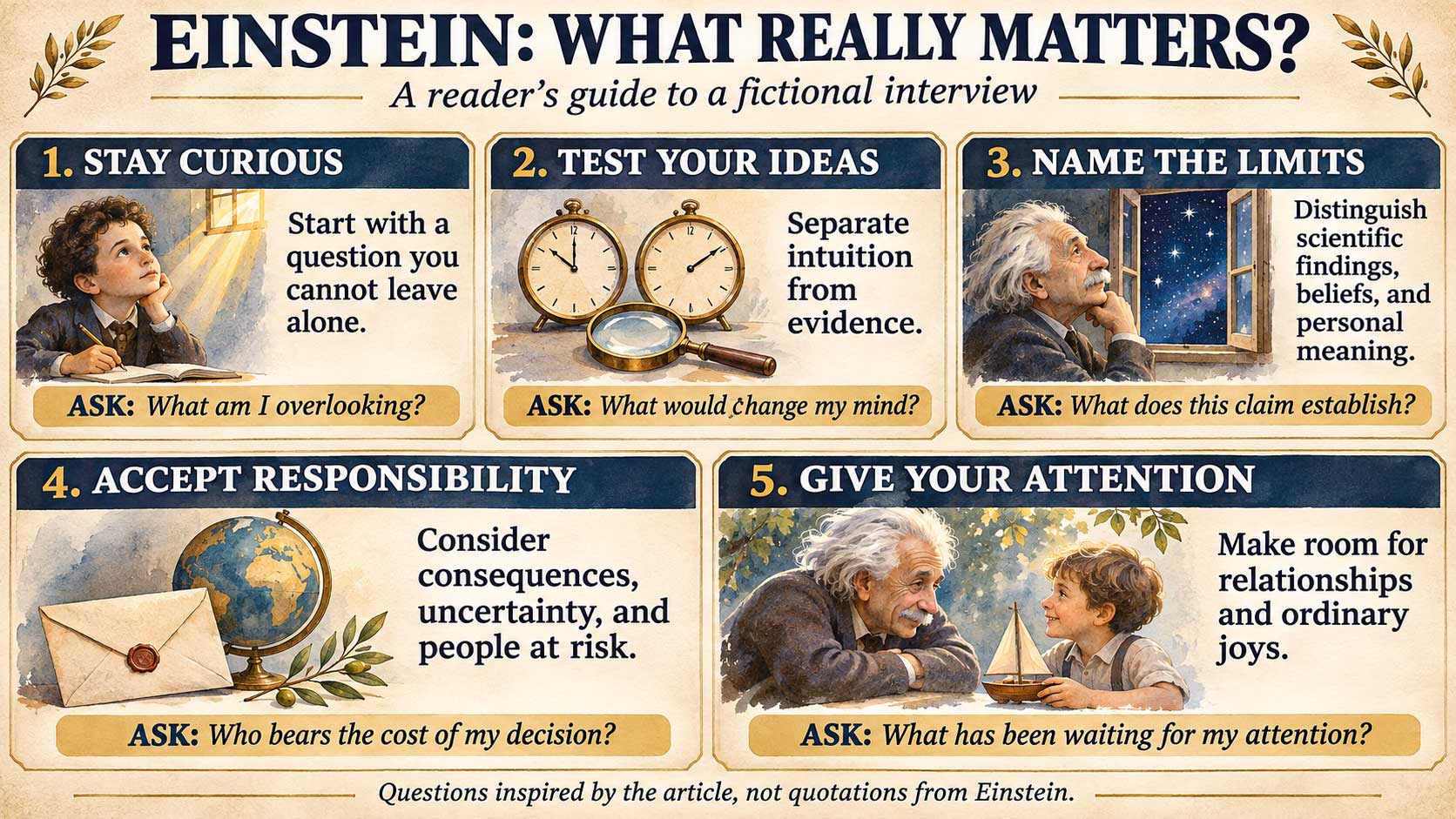
Ask them what has been waiting for their attention.
Nick Sasaki
A question? A person? A responsibility?
Albert Einstein
Possibly. They will have to look.
Nick reaches for his notebook, then leaves it on the chair.
Nick Sasaki
I came with a lot of questions about what you knew.
I’m leaving thinking about how you dealt with what you didn’t.
Albert Einstein
I hope I have not made that sound more orderly than it was.
Nick Sasaki
No. I think you’ve made it harder to turn you into a poster.
Albert Einstein
A modest public service.
They stand. Nick retrieves his notebook. Einstein picks up the two sheets from their clock discussion and places them on the desk.
Nick Sasaki
We never checked how much time passed for each of us.
Albert Einstein
Our relative motion was insufficient to excuse the length of the visit.
Nick Sasaki
Then I owe you an afternoon.
Albert Einstein
You asked interesting questions. We may regard the account as settled.
At the doorway, Nick turns.
Nick Sasaki
Will you go back to the papers now?
Einstein looks at the desk, then through the window.
Albert Einstein
First, a walk.
Final Thoughts: What Has Been Waiting for Your Attention?
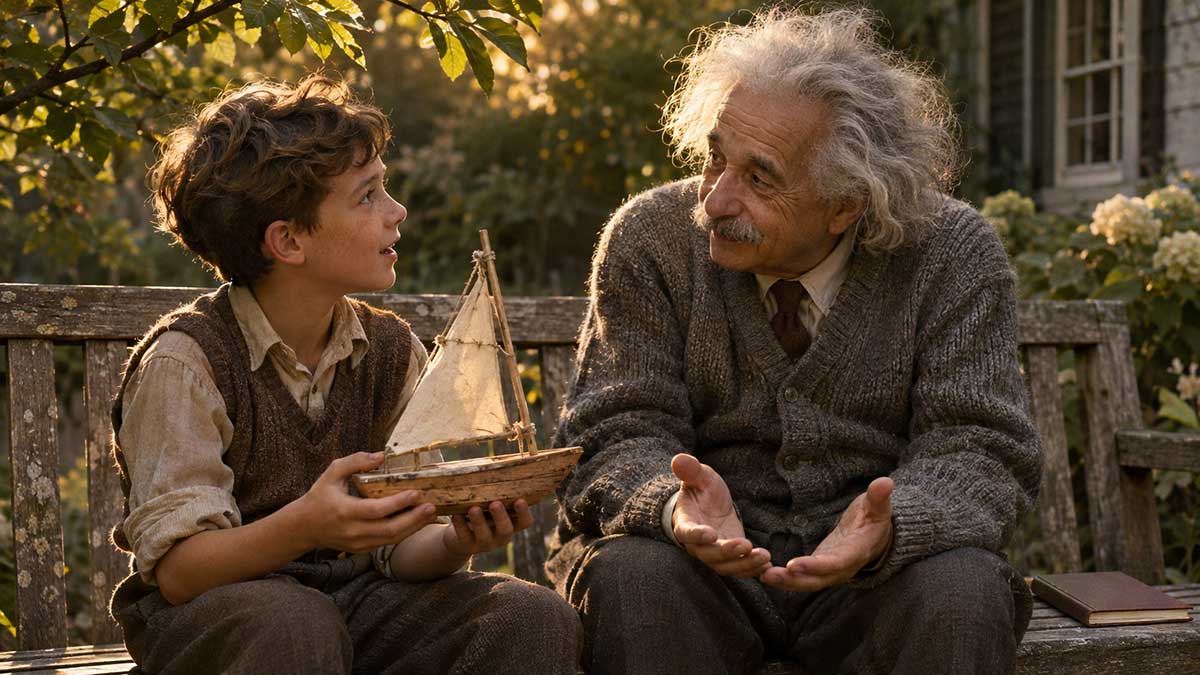
The conversation ends with a walk.
After questions about time, God, war, responsibility, and the unfinished search for a deeper account of nature, that small decision feels appropriate. A person stands up from a desk. The work remains incomplete. There is still an afternoon outside.
The fictional Einstein we have met does not offer certainty about every part of life. He asks for clearer definitions, distinguishes evidence from preference, and resists the temptation to make a satisfying sentence do the work of an explanation.
Those habits can accompany us beyond physics.
We can ask what would change our minds. We can notice when admiration for a person has replaced examination of a claim. We can reconsider a decision without pretending we possessed knowledge unavailable at the time.
The more uncomfortable questions concern attention.
Who bears the cost of our absorption? What have we repeatedly postponed? Have we mistaken someone’s patience for permission to remain unavailable?
An ambitious project can deserve years of effort. A relationship can deserve an hour we keep finding reasons to withhold. Recognizing both does not make the choice effortless. It makes the choice harder to evade.
Perhaps the most useful response to this interview is something small enough to attempt: return to a question you abandoned too quickly, examine a belief you have protected too carefully, or listen to someone without preparing your defense.
Einstein’s achievements need no imitation from us. Our circumstances present their own work.
Before opening the next page or returning to the next task, we might pause over the question this fictional exchange leaves behind:
What has been waiting for my attention?
Disclaimer: These reflections respond to a fictional reconstruction of Einstein and Nick Sasaki in conversation. They should not be read as Einstein’s actual advice, admissions, or judgments about his relationships. Historical facts, philosophical interpretations, and creative dialogue have different evidential status; readers should consult original sources for scholarly study.
Short Bios:
Albert Einstein: Albert Einstein (1879–1955) was a theoretical physicist whose work transformed concepts of space, time, light, and gravitation. He received the 1921 Nobel Prize in Physics for contributions to theoretical physics, particularly the photoelectric effect. His career and public commitments are documented in the Institute for Advanced Study’s biographical profile.
Nick Sasaki: Nick Sasaki is the creator of ImaginaryTalks.com, where researched fictional conversations explore history, spirituality, literature, and human relationships. His interviews bring accessible questions, humor, and thoughtful disagreement to subjects that connect great ideas with everyday life.
Leave a Reply