
Introduction: What If You Could Ask Dante About Heaven, Hell, and Love?
What if you could sit across from Dante Alighieri, the legendary poet who imagined traveling through Hell, Purgatory, and Heaven, and ask him a question that has troubled humanity for centuries: If God is love, why would anyone suffer in Hell forever?
Imagine meeting Dante more than seven hundred years after he wrote The Divine Comedy. Instead of studying his poetry in a classroom, Nick Sasaki invites him into an informal conversation where nothing is off-limits. What was it really like to lose his beloved Florence? Why did Beatrice become such a profound symbol of love in his poetry? And what about Gemma, the woman he actually married and with whom he raised a family?
As their conversation unfolds, Nick discovers a man whose extraordinary imagination was shaped by very human experiences: political conflict, exile, longing, pride, faith, and the desire to understand God's justice. Dante's descriptions of Hell are among literature's most unforgettable images, but Nick wants to know something deeper. Did Dante believe those punishments were literally eternal? Could a loving God ever give a suffering soul another opportunity to change?
The discussion becomes even more fascinating when Nick challenges Dante's medieval religious assumptions with questions from the modern world. Can people from different religions find their way to God? Does divine justice leave room for mercy? And what would Dante think of a society filled with extraordinary technology but struggling with loneliness, division, and uncertainty about life's purpose?
What makes this imaginary encounter special is that Dante isn't treated as an untouchable literary genius, and Nick doesn't pretend to possess all the answers. Their conversation moves between humor, disagreement, spiritual curiosity, and deeply personal questions. Somewhere between the darkness of the Inferno and the light of Paradiso, they begin exploring a possibility that may be more meaningful than any description of the afterlife: What if our greatest purpose is learning how to love?
Disclaimer: This article presents a fictional interview between Nick Sasaki and Dante Alighieri. Their conversation never occurred. Dante's historical experiences, literary works, and documented religious beliefs inform the discussion, but his imagined responses to modern questions are creative interpretations, not authentic quotations or verified statements of his beliefs.
Topic 1: The Man Who Lost His Home
Dante Alighieri in Conversation with Nick Sasaki
An ImaginaryTalks.com Exclusive Interview
Setting: A quiet, warmly lit podcast studio. Two microphones stand on a wooden table. Dante Alighieri, dressed in his familiar deep-red robe, sits across from Nick Sasaki. A small cup of espresso rests beside him. Nearly seven centuries separate their lives, but tonight, there is no distance between them.
Question 1: Dante, Who Were You Before the World Knew Your Name?
Nick
Dante, welcome. I have to tell you, I've been looking forward to this conversation for a long time.
Dante
And I have been curious about you, Nick. I understand that you have invited many people from different centuries into conversations like this.
Nick
That's right. I enjoy talking with people who have something meaningful to say about life. And you certainly qualify.
But here's something funny. You wrote one of the greatest literary works in history, and yet when people hear your name, the first thing they think about is Hell.
Dante
A curious fate, isn't it? I devoted an entire journey to reaching Heaven, yet the world seems determined to keep me in Hell.
Nick
Exactly! You spent all that time getting out, and people keep dragging you back in.
Dante
Perhaps that tells us something about human nature.
Nick
We'll definitely get into that. But before we talk about Hell, Heaven, God, or Beatrice, I want to talk about you.
Not the famous poet. Not the guy in the red robe staring seriously at everybody from old paintings.
Who was Dante Alighieri, really?
Dante
A man who wanted more from life than he knew how to obtain.
I wanted to understand the world. I wanted to be respected. I wanted to love and to be loved. I wanted to serve my city, to be recognized for my abilities, and to discover whether human life possessed a meaning greater than the pursuit of pleasure or reputation.
Looking back, I see a young man filled with ambition, pride, curiosity, and fear.
Nick
Fear? That's interesting. What were you afraid of?
Dante
Of insignificance, perhaps.
Of living an ordinary life and leaving nothing behind.
And, more deeply, of discovering that all the things I had pursued were incapable of satisfying me.
Nick
You know, that's something people still struggle with today.
They want success, recognition, money, a beautiful family, a meaningful career. And sometimes they get all those things and still feel something is missing.
Did you feel that way?
Dante
Frequently.
But I did not always recognize the feeling for what it was.
When I was young, I believed the next achievement would bring peace. If I became a respected poet, I would be content. If I gained political influence, I would be satisfied. If I understood philosophy, I would finally possess wisdom.
Yet each achievement opened another desire.
Nick
So you were chasing success.
Dante
Yes. And success is a peculiar creature. It promises to end our hunger, yet often teaches us to hunger for more.
Nick
That's a pretty good description of modern social media, actually.
Dante
Social media?
Nick
We'll save that for later. Trust me, it deserves its own circle of Hell.
Dante
Then I suspect your age has invented new forms of temptation without eliminating the old ones.
Nick
That's exactly what happened.
But let me ask you something else. You were involved in poetry, philosophy, theology, and politics. That's a lot for one person.
Why politics?
You could have stayed home writing beautiful poetry. Why get involved in all those political fights?
Dante
I loved Florence.
To understand my involvement in politics, you must understand that my city was not merely the place where I lived. It was part of my identity.
Its streets, churches, markets, conversations, rivalries, and celebrations formed the world in which I understood myself.
I believed that a person who possessed knowledge and ability had some responsibility to the community that had shaped him.
But there was another motive.
Nick
Which was?
Dante
Pride.
I wanted my judgment to matter.
I wanted others to recognize that I understood justice, government, and the proper ordering of society.
I believed I could help correct the mistakes of those who governed us.
Nick
And did you?
Dante
Not as I had hoped.
Nick
That's a very diplomatic answer.
Dante
Then perhaps I learned something from politics after all.
Nick
You know, I'm beginning to think you might have been pretty good at this podcast business.
Dante
I am uncertain whether that is a compliment.
Nick
It is. Mostly.
But here's what I'm curious about. You were a very intelligent man, and you clearly had strong opinions.
Did you enjoy arguing?
Dante
More than was always wise.
Nick
I suspected that.
Dante
I believed that truth deserved vigorous defense. Yet I sometimes confused defending the truth with defending my own judgment.
Those are not the same thing.
Nick
That's interesting. How do you tell the difference?
Dante
When another person challenges your opinion, observe what rises within you.
If you desire to understand whether the criticism is true, you are seeking wisdom.
If you desire only to defeat the person who speaks, you may be defending your pride.
Nick
Wow. That's something I think everybody could use.
So looking back, would you say you were a proud man?
Dante
Yes.
And I would add that pride is particularly dangerous among people who believe themselves devoted to truth.
A man may become so convinced of his righteousness that he no longer notices his own vanity.
I knew the language of virtue long before I had learned to practice every virtue I praised.
Nick
I like that you're willing to admit it.
Dante
Death, Nick, is an excellent cure for the desire to impress one's contemporaries.
Nick
Well, that's one way to put it.
Question 2: What Did Losing Florence Do to Your Soul?
Nick
Let's talk about the event that changed everything.
In 1302, you were exiled from Florence. You were accused of political wrongdoing, your property was threatened, and returning could have cost you your life.
You were about thirty-seven years old.
What was that like?
Dante
At first, I did not fully comprehend what had happened.
I had known political danger. I had known that fortunes could change. But knowing that exile is possible is different from realizing that the gates of your own city have closed against you.
There is a particular pain in being rejected by the place you consider home.
It is not simply the loss of a building or a familiar street.
It is the loss of belonging.
Nick
What did you miss most?
Dante
Ordinary things.
The sound of familiar voices.
The shape of the streets.
The knowledge that I could walk through the city without feeling like a stranger.
When a man loses his home, he discovers how much of his life was held together by things he scarcely noticed.
Nick
Did you think you would return?
Dante
For a long time, yes.
I imagined circumstances changing. Political alliances shifting. Old enemies losing influence. Friends finding a way to restore me.
Hope can sustain a man, but it can keep him imprisoned in expectation.
For years, part of my mind remained in Florence, waiting for a door to open.
Nick
That must have been exhausting.
Dante
It was.
And there was humiliation.
I had once participated in governing my city. Now I depended upon the hospitality of others.
A guest must learn to measure his words. He must understand the moods of those who provide his shelter. He must endure the knowledge that his independence has diminished.
For a proud man, such dependence is a difficult teacher.
Nick
You wrote about how bitter another person's bread tastes, and how hard it is to go up and down somebody else's stairs.
Was that something you really felt?
Dante
Very deeply.
The bitterness is not in the bread itself.
A generous host may offer excellent food. Yet the guest who once supported himself may taste his own lost independence with every mouthful.
And the stairs are not difficult merely through their height.
They remind him that he is entering a house that is not his own.
Nick
That's powerful.
You know, I came to America from Japan when I was young. Of course, my circumstances were very different from yours. I chose to come here.
But living far from the place where you grew up can change the way you think about home.
Sometimes home becomes more than a geographical place.
Did you eventually find another home?
Dante
I found places of kindness.
I found people who welcomed me, respected my work, and offered friendship.
But I never ceased to feel the wound of Florence.
Perhaps I came to understand that a human being may possess more than one kind of home.
There is the city of one's birth.
There is the community of those who love us.
There is the inner dwelling we construct through memory and thought.
And there is the ultimate home toward which the soul longs.
Nick
God?
Dante
Yes.
But I would not wish to make the matter sound too simple.
A man may speak beautifully about finding his home in God and still weep for the streets of his childhood.
Spiritual conviction does not erase human affection.
Nick
I appreciate that distinction.
Sometimes people talk about spirituality as though you're supposed to stop caring about ordinary human things.
But missing your family, your hometown, your friends, that's part of being human.
Dante
Indeed.
Love does not become less worthy merely through its attachment to earthly things.
The question is whether our love helps us recognize a greater good or persuades us that nothing exists beyond what we possess.
Nick
Let me ask you something difficult.
Did exile make you a better person?
Dante
It made me a different person.
Whether it made me better is a question I cannot answer without examining what I did with my suffering.
Pain alone does not make a person wise.
Some people suffer and become compassionate.
Others suffer and become cruel.
Some learn humility. Others become convinced that the world owes them compensation.
Nick
That's a very interesting point.
People often say suffering makes us stronger. But that's not necessarily true, is it?
Dante
No.
Suffering reveals possibilities within us. It does not automatically choose which possibility we will embrace.
I learned patience, but I struggled with resentment.
I learned dependence, but I did not always become humble.
I learned that worldly status could vanish, yet I continued to desire recognition.
The human soul is not transformed in a single dramatic moment.
It must be educated, sometimes painfully, over many years.
Nick
And somewhere in those years, you started writing the work that would make you famous for the next seven hundred years.
Dante
There is a certain irony in that.
I lost the city in which I hoped to establish my reputation, and through that loss I found the conditions in which my greatest work could take shape.
Nick
Do you think you would have written The Divine Comedy if you had never been exiled?
Dante
I might have written something ambitious.
I had already loved poetry and philosophy. My imagination did not begin with exile.
But I doubt the work would have been the same.
Exile gave urgency to questions I had previously considered from a safer distance.
What is justice when the institutions claiming to defend it become corrupt?
What is happiness when everything familiar is taken away?
What remains of a human being when reputation, wealth, and political influence disappear?
And where can the soul find a home that no earthly authority can confiscate?
Nick
So in a sense, losing Florence helped you write about finding Heaven.
Dante
That is one way of expressing it.
But I would not romanticize the suffering.
I would not tell a man who has lost his home that he should rejoice, for perhaps he will write a masterpiece.
I would tell him that his loss is real, his grief deserves compassion, and his future has not necessarily ended.
Nick
I really like that.
There's a big difference between saying suffering can lead to something meaningful and saying suffering itself is a wonderful thing.
Dante
Precisely.
The wound is not the blessing.
What we may learn through the wound can become a blessing.
Question 3: Did You Put Your Enemies in Hell Out of Justice or Revenge?
Nick
Now, Dante, I want to ask you something that might be a little uncomfortable.
Dante
You have been asking uncomfortable questions since I arrived.
Nick
That's true. But I think this one might be my favorite.
You wrote a book where you could decide who ended up in Hell.
And some of the people you put there were your political enemies.
Come on, Dante. Wasn't that at least a little satisfying?
Dante
You ask whether I took pleasure in condemning those who had injured me.
Nick
Yes. Exactly.
I mean, most people get angry and complain to their friends.
You created an entire universe and assigned your enemies eternal punishment.
That's taking a disagreement to another level.
Dante
I concede that my method was unusually elaborate.
Nick
I would say so!
Dante
But the matter deserves a serious answer.
My poem sought to depict divine justice, not merely personal revenge.
I believed that corruption, betrayal, cruelty, and the abuse of sacred authority were grave offenses against the moral order.
The powerful often escape judgment in earthly life.
A ruler may die honored despite having caused great suffering.
A religious leader may be praised publicly despite having betrayed the principles he claims to represent.
In my poem, worldly rank could not protect a soul from moral accountability.
Nick
I understand that.
But here's my question.
How did you know your judgment was God's judgment?
Dante
That is a dangerous question.
Nick
Why?
Dante
It exposes the greatest temptation facing anyone who speaks in the name of justice.
A man may begin by defending what is right and end by believing that his personal anger is the voice of God.
Nick
Exactly.
And couldn't that have happened to you?
Dante
Yes.
Nick
Really? You admit that?
Dante
I must.
The poem expresses moral convictions that I held with great seriousness. Yet I was a human author, not the Creator whose justice I attempted to portray.
My imagination was shaped by my experiences, my loyalties, my injuries, and my limitations.
It would be foolish to pretend that my personal history had no influence upon my choices.
Nick
So there may have been a little revenge in there?
Dante
There may have been more than a little anger.
But anger and revenge are not identical.
Anger can arise when we witness injustice. It can alert us to suffering that ought not be ignored.
Revenge begins when the suffering of another person becomes desirable for its own sake.
The distinction matters.
Nick
Did you ever cross that line?
Dante
I suspect I approached it more often than I wished to admit.
Nick
That's a very human answer.
Here's something else I've been wondering.
Suppose one of the people responsible for your exile walked into this room right now.
He came over, looked you in the eye, and said, "Dante, I was wrong. I hurt you. I destroyed your life in Florence. I'm truly sorry."
Could you forgive him?
Dante
I would want to.
Nick
But could you?
Dante
That is more difficult.
Forgiveness is easy to praise when the offender remains safely distant.
It becomes difficult when the person stands before us and awakens every memory of the injury.
I might feel anger before compassion.
I might wish to remind him of everything he had taken from me.
I might want him to experience, for a moment, the humiliation I endured for years.
Nick
So even Dante Alighieri would struggle with forgiveness.
Dante
Especially Dante Alighieri, perhaps.
Nick
I appreciate that answer.
But what if God asked you to forgive him?
Dante
Then I would face a choice between the justice I believed I deserved and the mercy I hoped to receive.
Nick
That's interesting. Say more about that.
Dante
Human beings are often eager to receive mercy for their own failures and justice for the failures of others.
We wish our intentions to be considered when we are judged.
Yet we judge our enemies by their actions alone.
We ask God to understand our weaknesses, but we may resist the possibility that our enemies possess weaknesses, fears, and histories that we do not fully comprehend.
Nick
That's very true.
So perhaps the hardest part of forgiveness is recognizing that your enemy is just as human as you are.
Dante
Yes.
But recognizing another person's humanity does not mean declaring his actions harmless.
Justice and mercy need not be enemies.
A person may be held accountable and still be regarded as capable of repentance.
Nick
Then let me push this a little further.
You created a poem where many souls remain in Hell forever.
But here you are telling me that people can repent and change.
Isn't there some tension between those ideas?
Dante
There is a profound theological question there, Nick.
One that reaches into the nature of freedom, the condition of the soul after death, and the relationship between divine justice and divine mercy.
Nick
Good. That's exactly where I want to go.
Dante
I suspected as much.
Nick
But we'll save the full discussion for later. I don't want to send us into the ninth circle before we've even finished our coffee.
Dante
A wise precaution.
Nick
Let me bring us back to your own life for a moment.
You lost your home. You lost your political position. You spent years depending on other people.
And yet, somehow, you created something that survived for centuries.
If you could speak to the younger Dante, the one who had just been exiled and was probably furious with the entire world, what would you tell him?
Dante
I would tell him that his life had not ended.
I would tell him that the judgment of his enemies did not determine his worth.
I would warn him not to allow resentment to become the center of his existence.
And I would tell him something he might have found impossible to believe.
Nick
What's that?
Dante
That the home he had lost was precious, but it was not the whole of his destiny.
Nick
That's beautiful.
Do you think he would have listened?
Dante
No.
Nick
Not at all?
Dante
He would probably have argued with me.
Nick
So you really haven't changed that much.
Dante
Perhaps not as much as seven centuries ought to have accomplished.
Nick
Let me ask you one final question before we move on.
When people look back at their lives, they often think about what they achieved, what they lost, or what they wish they had done differently.
But I'm curious about something more personal.
When you think about your life, what do you feel most grateful for?
Dante
For the people who offered kindness when I had little to give them in return.
For those who welcomed a displaced man into their homes.
For the teachers who opened my mind.
For the friends who challenged me.
For the beauty of language, which allowed me to give form to experiences that might otherwise have remained unbearable.
And for love.
Nick
Love?
Dante
Yes.
Not merely romantic love, though that, too, has shaped my life.
I mean the love that calls a human being beyond himself.
The love that makes us recognize beauty.
The love that reminds us we are not the center of creation.
And the love that, when properly understood, leads the soul toward God.
Nick
You know, that's interesting.
We've spent all this time talking about politics, exile, anger, and suffering.
But when I ask what you're most grateful for, you end up talking about love.
Dante
Perhaps that is not an accident.
Nick
I don't think it is.
And that brings me to something I've wanted to ask you from the beginning.
There's a woman who appears throughout your story. A woman you met when you were just a boy. A woman who became much more than a memory in your poetry.
Beatrice.
Dante
Yes.
Nick
You were married. You had children. You lived a complicated life.
And yet, centuries later, people still associate your name with this one woman.
I have to ask you, Dante.
Who was Beatrice to you, really?
Dante
Nick, that is a question for which I have spent a lifetime searching for the proper words.
Dante pauses. For the first time in the conversation, his expression softens. He looks down at the untouched espresso, then back at Nick.
Nick
Well, we've got time.
The conversation turns from the loss of a city to the mystery of a love that would outlive both the poet and the woman who inspired him.
Topic 2: The Woman Who Became Heaven
Setting: The conversation continues in the warmly lit studio. Dante has just spoken about the people and experiences that shaped his life. Nick leans forward, intrigued by the sudden tenderness in the poet's expression when the name Beatrice is mentioned.
Question 1: Dante, Were You in Love with Beatrice, or with the Woman You Imagined Her to Be?
Nick
So, Dante, let's talk about Beatrice.
I have to admit, your story is one of the most unusual love stories I've ever encountered.
You met this girl when you were nine years old. You barely knew her, at least from what we can establish historically. You both eventually married other people.
And yet, seven hundred years later, people are still talking about your love for her.
How does that happen?
Dante
Perhaps love is not always measured by the number of hours two people spend together.
Sometimes an encounter awakens something within us that remains long after the person has departed.
Nick
Okay, but you were nine!
I mean, at nine years old, most boys are thinking about games, food, and how to avoid getting into trouble.
Dante
I assure you, Nick, I was not entirely different.
Nick
That's reassuring.
So what happened when you saw her?
Dante
I remember an extraordinary sense of wonder.
She was young, dressed beautifully, and possessed a presence that seemed to illuminate everything around her.
But what mattered most was not simply her appearance.
Something in me responded to her as though I had encountered a beauty I did not yet possess the language to describe.
Nick
Was it love at first sight?
Dante
That is what I later came to call it.
But you must distinguish between what a child experiences and what an adult remembers.
Memory is not a perfect record. It is shaped by everything that follows.
Nick
That's interesting. So you're admitting that the nine-year-old Dante might not have understood what he was feeling?
Dante
Of course.
The boy felt wonder. The poet later interpreted that wonder.
Nick
I like that distinction.
But here's where I want to challenge you.
You wrote about Beatrice as though she were almost divine.
How much did you actually know about her?
Did you know what made her laugh? What frightened her? Whether she had a terrible temper in the morning?
Dante
I cannot claim to have known every part of her character.
Nick
Did you ever have a long conversation with her?
Dante
Our encounters were limited.
Nick
So, let me see if I understand this.
You met a beautiful girl when you were nine, saw her occasionally, exchanged greetings, and eventually wrote some of the greatest love poetry in history.
Dante
When you arrange the facts in that manner, the story does sound rather improbable.
Nick
It does!
And that's what fascinates me.
Were you in love with Beatrice herself, or with the image of Beatrice you created in your imagination?
Dante
I believe both were involved.
There was a real young woman whose presence affected me deeply.
But the Beatrice who entered my poetry became something greater than the person I had encountered.
She came to represent a form of beauty that called me beyond my ordinary desires.
Nick
But isn't that dangerous?
When we turn another person into a symbol of perfection, aren't we placing an impossible burden on them?
Dante
Yes. That danger exists.
A living person has weaknesses, fears, contradictions, and desires of her own.
An idealized figure can become whatever the admirer wishes her to be.
If I were to claim that my poetry captured the complete reality of Beatrice as a human being, I would be claiming knowledge I did not possess.
Nick
That's a remarkably thoughtful answer.
So maybe the real Beatrice and the Beatrice of your poetry weren't exactly the same person.
Dante
They were connected, but not identical.
The living Beatrice awakened the experience.
The poetic Beatrice became a means through which I explored its spiritual meaning.
Nick
Let me ask something a little uncomfortable.
When Beatrice married another man, were you jealous?
Dante
I was not free from ordinary human emotions, Nick.
Nick
That's a very elegant way of saying yes.
Dante
It is an elegant way of saying that the heart is more complicated than a single answer.
Nick
Fair enough.
But did you ever wish she'd married you instead?
Dante
There may have been moments when I imagined a different life.
Yet the love I eventually described was not built upon the expectation that she would belong to me.
Nick
That's an interesting word, "belong."
Do you think we confuse love with possession?
Dante
Very often.
We say that we love another person, but sometimes what we mean is that we love how that person makes us feel.
We love being admired, desired, comforted, or reassured.
When those feelings disappear, we may discover that what we called love was partly an attachment to our own happiness.
Nick
So how do you know whether you're genuinely loving somebody?
Dante
Ask whether you desire that person's good, including when it does not benefit you.
Can you rejoice in another person's happiness when you are not the source of it?
Can you respect another person's freedom?
Can you see the person as a soul with a destiny beyond your own wishes?
Those are difficult tests.
Nick
Especially the second one.
Being happy for somebody when you're not part of their happiness.
Dante
Indeed.
And I would not pretend that I passed every such test.
Nick
You know, I appreciate that you keep admitting your imperfections.
A lot of people picture you as this very serious medieval genius who had everything figured out.
Dante
Then they have misunderstood both poetry and humanity.
A poet who has never struggled with his own contradictions may have little worth saying about the contradictions of others.
Nick
Now, there's something else.
Beatrice died when she was still very young.
How did her death change your love?
Dante
It transformed the question I was asking.
Before her death, I could still imagine the possibility of another encounter.
Afterward, there was no such possibility within earthly life.
The person who had awakened such wonder in me was gone.
And I found myself asking whether love itself must end when the body dies.
Nick
So your love became connected to your questions about immortality.
Dante
Yes.
If human beauty can awaken a longing that seems greater than the physical world, what is the source of that longing?
If love points beyond itself, where does it lead?
I began to consider whether the experience of loving Beatrice could become a path toward something eternal.
Nick
But could that have been your way of dealing with grief?
Maybe turning her into a heavenly figure made her death easier to accept.
Dante
That is possible.
Grief and spiritual discovery need not exclude one another.
A grieving person may seek consolation through imagination.
Yet imagination may reveal truths that ordinary observation does not easily disclose.
Nick
So you don't see those explanations as competing with each other?
Dante
No.
A human experience may have psychological, emotional, and spiritual dimensions at the same time.
The presence of one does not automatically disprove the others.
Nick
I like that.
But I have one more question before we move on.
If you had actually married Beatrice, lived with her for thirty years, raised children, argued about money, and dealt with all the ordinary problems of marriage, do you think she would still have become your heavenly guide?
Dante
Perhaps not in the same form.
Nick
Really?
Dante
The distance between us allowed my imagination to preserve a particular image.
Marriage would have revealed aspects of her humanity that I never knew.
That might have changed my poetry.
But it need not have diminished the possibility of love.
Nick
So maybe you would have written a different masterpiece.
Dante
Perhaps a longer one, with more domestic disagreements.
Nick
And maybe a tenth circle of Hell for husbands who forget anniversaries.
Dante
I suspect such a circle would be heavily populated.
Question 2: What About Your Wife, Gemma?
Nick takes a sip of coffee. The conversation has become warmer, but his curiosity is far from satisfied.
Nick
Now, Dante, there's something we really need to talk about.
Your wife.
Gemma Donati.
Dante
I thought we might eventually arrive at this subject.
Nick
You knew it was coming?
Dante
You have demonstrated a remarkable determination to ask the questions that polite society prefers to avoid.
Nick
That's part of the fun.
But seriously, you were married. You had children. You had a real family and real responsibilities.
Yet your poetry made another woman famous for eternity.
How do you reconcile that?
Dante
First, we must be careful not to confuse what survives in literature with the complete reality of a marriage.
My poems reveal certain aspects of my inner life.
They do not provide a full account of my household.
Nick
That's fair.
We actually know very little about your relationship with Gemma.
But that's precisely why I'm curious.
Did you love her?
Dante
I would not wish to reduce a marriage to a simple declaration made for the satisfaction of an audience.
Marriage in my time was shaped by family arrangements, social expectations, property, duty, and affection.
It was not always organized around the romantic ideals that your age places at its center.
Yet within those arrangements, two people still had to share the ordinary burdens of life.
Nick
So you're saying marriage was different back then.
Dante
Its social structure was different.
Human needs were not so different.
A husband and wife could still experience tenderness, frustration, disappointment, loyalty, and concern for their children.
Nick
Did Gemma know about your poetry concerning Beatrice?
Dante
I cannot offer you a reliable account of every conversation between us.
Nick
Come on, Dante. You're sitting right here. Surely you can tell me what you remember.
Dante
Then let me answer as the man you have invited into this imagined conversation, without pretending that every private memory is preserved in history.
I would say that the difference between the woman who shared my daily life and the woman who inspired my poetry was not always easy to explain.
Nick
I can believe that.
If I were your wife, I might ask, "Why does she get to be in Heaven, and I'm the one dealing with the laundry?"
Dante
And such a question would deserve more respect than many elaborate philosophical arguments.
Nick
Exactly!
That's what I mean.
We can talk about divine love all day, but somebody still has to prepare dinner and take care of the children.
Dante
You are making a serious point beneath your humor.
A man may speak eloquently about universal love and still fail to show sufficient kindness to the person sitting beside him.
Nick
That's what bothers me sometimes about spiritual people.
They can talk beautifully about loving humanity, but they may not treat their own family very well.
Dante
Then their love has not yet become what they claim it to be.
Love that remains entirely in thought is incomplete.
It must take form in action.
Nick
So let me ask directly.
Could you have been a better husband?
Dante
Almost certainly.
Nick
In what way?
Dante
I could have been more attentive to the ordinary sacrifices made by those around me.
I could have recognized that intellectual ambition does not excuse emotional absence.
I could have understood more fully that a family needs a person's presence, not merely his intentions.
Nick
That's interesting.
You were trying to understand the entire universe, but perhaps the people closest to you needed you to understand them.
Dante
That is a painful but reasonable observation.
Nick
I don't mean it as an accusation.
I'm thinking about my own life, too.
It's easy to become absorbed in work, ideas, projects, and dreams.
Sometimes you tell yourself you're doing everything for your family.
But that doesn't necessarily mean you're giving them what they actually need.
Dante
Precisely.
We may use noble purposes to justify neglecting immediate duties.
The greater the ambition, the easier it becomes to regard ordinary responsibilities as interruptions.
Yet those responsibilities may be the very place where our character is tested.
Nick
That's a wonderful point.
Let me push this further.
You had this extraordinary spiritual vision of Beatrice.
But isn't there something equally sacred about ordinary married life?
About taking care of someone when they're sick, staying together through difficult years, forgiving each other's mistakes?
Dante
Yes.
And perhaps such love demands a form of courage that romantic idealization does not.
It is possible to admire a distant figure without confronting the daily difficulties of sharing a life.
To remain faithful to another person through illness, disappointment, aging, and uncertainty requires a different discipline.
Nick
Maybe a more difficult one?
Dante
In many circumstances, yes.
The beauty of an ideal may inspire us.
The demands of a real relationship reveal whether that inspiration has transformed us.
Nick
That's something I wish more people understood.
We often think the most romantic love is the most extraordinary love.
But perhaps the most extraordinary love is the one that keeps showing up every day.
Dante
There is great wisdom in that.
Nick
Then here's a question.
If you could rewrite your life, would you give Gemma a larger place in your poetry?
Dante
I would at least wish to consider more carefully the difference between honoring a spiritual ideal and overlooking the dignity of those who share our daily burdens.
Nick
That's a thoughtful answer.
But you know, if Gemma were sitting here, I suspect she'd have a few questions of her own.
Dante
I suspect she would ask them with considerably less hesitation than you have shown.
Nick
And I haven't shown much hesitation at all!
Dante
Precisely.
Nick
Now I'm almost tempted to invite her next.
Dante
Perhaps you might allow me a little time to prepare.
Both men laugh.
Nick
There's something else I want to ask.
Your children.
Did becoming a father change the way you understood love?
Dante
Fatherhood reveals a dimension of love that differs from romantic longing.
A child enters your life with needs that cannot be postponed until you feel inspired to meet them.
A child does not care whether you have written an excellent poem.
He wants your attention.
He wants protection.
He wants reassurance that the world is safe enough for him to grow.
Nick
And children don't always appreciate philosophical explanations.
Dante
No. A hungry child is rarely satisfied by a discussion of Aristotle.
Nick
That's true in every century.
Dante
Fatherhood can teach us that love involves responsibility for another person's flourishing.
Yet it can teach us something else.
Our children do not exist merely to fulfill our ambitions.
They have lives of their own.
Nick
So whether we're talking about Beatrice, Gemma, or your children, we keep coming back to the same idea.
Love is not possession.
Dante
Yes.
To love someone truly is to recognize a value that exists independently of your desire to control that person.
Nick
And perhaps that's where love begins to become spiritual.
Dante
I believe so.
Question 3: Can Loving Another Person Bring Us Closer to God?
The laughter settles. Dante's expression grows thoughtful as Nick returns to the spiritual questions that have quietly shaped the conversation.
Nick
Dante, let's talk about something deeper.
In The Divine Comedy, Beatrice eventually becomes your guide through Heaven.
Virgil, who represents human reason in many interpretations, can take you only so far.
Then Beatrice takes over.
Why?
Dante
Virgil represents the extraordinary achievements of human reason and moral wisdom.
Through reason, a person can recognize many truths.
We can examine our behavior, distinguish virtue from vice, and understand much about the natural world.
But the highest mysteries of divine life cannot be fully grasped through human reason alone.
Nick
So Beatrice represents faith?
Dante
Faith, grace, revealed wisdom, and the transforming influence of love.
She is not merely an object of affection.
Within the poem, she becomes a guide who directs my vision beyond herself.
Nick
That's fascinating.
So the woman you loved eventually leads you to something greater than your love for her.
Dante
Exactly.
True love should not imprison us within the beloved.
It should enlarge our capacity to recognize goodness and beauty beyond our private desires.
Nick
But let me challenge that.
Why do we need another person to reach God?
Couldn't someone discover divine love through meditation, prayer, nature, or simply looking deeply within themselves?
Dante
Certainly, the search for God may begin through many experiences.
The beauty of nature can awaken wonder.
Contemplation can reveal the limitations of our ordinary desires.
Prayer can direct the mind and heart beyond immediate concerns.
But human relationships possess a particular significance.
They confront us with a reality that we cannot fully control.
Nick
What do you mean?
Dante
Another person is not merely an extension of ourselves.
He or she possesses a distinct inner life.
To love that person requires us to move beyond our own immediate interests.
And that movement beyond the self can prepare us to understand a greater love.
Nick
So loving another person teaches us to become less selfish.
Dante
At its best, yes.
But human love can move in the opposite direction.
We may become possessive, jealous, fearful, or dependent.
We may claim to love another person when we are actually trying to fill an emptiness within ourselves.
Nick
How do we tell the difference?
Dante
Consider what happens when your desire is frustrated.
If the person you love chooses a path different from the one you wished, do you still desire that person's good?
If the person no longer offers admiration or comfort, do you still recognize that person's dignity?
Can you love without demanding that the other person become the solution to every difficulty in your own life?
Nick
Those are tough questions.
Dante
Love is a demanding teacher.
Nick
Let me bring up something I find especially interesting.
You believed in a God of infinite love.
And you described Beatrice as someone who helped lead you toward that love.
But if God's love is infinite, why do human beings struggle so much to experience it?
Why do we need to go through heartbreak, jealousy, suffering, and disappointment?
Dante
I would not say that suffering is always necessary for love.
But our capacity to love is often distorted by fear and self-interest.
We desire what is good, yet we may mistake temporary satisfaction for lasting happiness.
We seek union, yet we fear vulnerability.
We want to be loved without surrendering the habits that prevent us from loving well.
Nick
That sounds familiar.
Dante
The soul must learn to distinguish between love that liberates and attachment that enslaves.
Nick
Is that what you were trying to show through the journey from Hell to Heaven?
Dante
In significant part.
Consider the souls in Hell.
Many remain bound to the desires, hatreds, and choices that shaped their earthly lives.
Their suffering reveals the disorder of love when it becomes directed toward destructive ends.
In Purgatory, love is purified and redirected.
In Paradise, love reaches its proper fulfillment in God.
Nick
So the entire journey is really about learning how to love?
Dante
That is one of its deepest meanings.
Nick
Wow.
You know, most people think of The Divine Comedy as a book about what happens after we die.
But you're describing something that happens inside us during our lives.
Dante
The poem concerns eternal destiny, but its moral questions are not postponed until death.
Every day, we choose what we will love.
Every day, our habits shape the direction of our souls.
Nick
Then let me ask something that may sound unusual to you.
Suppose God is the parent of all humanity.
Every person, regardless of nationality, religion, or background, is a child of God.
Wouldn't that mean we're all members of one family?
Dante
If we speak of God as the ultimate source of human existence, then all human beings share a fundamental dependence upon that source.
But my own theological tradition distinguishes between creation, grace, and the full realization of divine sonship.
Those distinctions matter within the beliefs of my age.
Nick
I understand.
But I'm asking about something more basic.
If we're all created by the same God, shouldn't we treat one another like brothers and sisters?
Dante
Our common origin certainly provides a reason to recognize the dignity of every human being.
And love of one's neighbor is not a minor obligation within Christianity.
It stands at the center of moral life.
Nick
Then why have religious people spent so much time fighting each other?
Dante
For many of the same reasons that other human beings fight.
Pride.
Fear.
Ambition.
The desire for wealth and territory.
The conviction that our own interests are identical with divine justice.
Religion can become entangled with these desires.
Nick
You seem to know something about that from your political life.
Dante
More than I would have wished.
Nick
Here's what I'm wondering.
If love is supposed to lead us toward God, shouldn't the quality of our love matter more than how beautifully we explain our beliefs?
Dante
Our conduct must give substance to our convictions.
Yet I would not separate truth from love entirely.
A person can act with sincere affection and still misunderstand what is good.
And a person can possess correct ideas while failing to live according to them.
Wisdom requires both truth and rightly directed love.
Nick
That's an important distinction.
So you wouldn't say love is just a feeling.
Dante
Certainly not.
Feelings may accompany love, but they are changeable.
Love also involves judgment, commitment, and the direction of the will.
Nick
Then let me ask about Beatrice again.
When you finally meet her in Purgatory, she's not simply smiling and telling you how wonderful you are.
She actually confronts you.
Dante
Yes.
Nick
She challenges you about how you've lived.
That's not exactly the romantic reunion people might expect.
Dante
No.
But it is necessary.
Nick
Why?
Dante
If Beatrice merely confirmed my desires, she would remain an image created for my comfort.
Instead, she calls me to recognize my failures.
Her love does not excuse what needs correction.
It invites transformation.
Nick
So sometimes love means telling someone a truth they don't want to hear.
Dante
Yes.
Provided that the truth is spoken for the person's good, rather than to satisfy our own superiority.
Nick
That's a big qualification.
A lot of people claim they're being honest when they're really just being cruel.
Dante
Truth can become another instrument of pride.
Nick
You know, Dante, there's something I find beautiful about this.
You began by loving Beatrice as a young boy.
You lost her when she died.
Then you spent years trying to make sense of that loss.
And eventually, in your poetry, she becomes the person who helps you discover that love is much greater than your personal longing.
Dante
That is close to what I wished to express.
The love that first awakened my heart had to be transformed.
I could not remain forever the boy who simply admired her beauty.
I had to learn what beauty was calling me to become.
Nick
Do you think you succeeded?
Dante
I believe I came to understand the direction.
Whether I fully lived according to that understanding is another matter.
Nick
You keep coming back to that distinction between knowing something and actually living it.
Dante
It is one of the great difficulties of human existence.
We may recognize goodness and still fail to choose it.
We may praise humility while seeking admiration.
We may speak of forgiveness while preserving resentment.
And we may celebrate divine love without extending sufficient kindness to those nearest us.
Nick
That's a pretty accurate description of humanity.
Dante
Including poets.
Nick
Especially poets?
Dante
Some poets have a remarkable ability to describe virtues they have not yet acquired.
Nick
At least you're self-aware.
Dante
Occasionally.
Nick
Let me ask one last question about Beatrice.
If she were sitting here with us right now, what would you want to say to her?
Dante grows quiet.
Dante
I would thank her.
Nick
For what?
Dante
For awakening in me a longing that I did not initially understand.
For becoming, within my imagination, a reminder that beauty should lead us beyond vanity.
For teaching me, through absence as much as presence, that love cannot be reduced to possession.
And I would ask her forgiveness.
Nick
Forgiveness? For what?
Dante
For the possibility that I sometimes loved the meaning I assigned to her more than I understood the woman herself.
Nick
That's a remarkable thing to admit.
Dante
A human being deserves to be loved as a person, not merely admired as a symbol.
Nick
And what about Gemma?
If she were sitting beside Beatrice, what would you say to her?
Dante
I would thank her for the life that existed beyond my poetry.
For the children.
For the ordinary days.
For the burdens that never became famous.
And I would ask whether I had given her enough of the attention and kindness she deserved.
Nick
That's probably a conversation worth having.
Dante
Indeed.
Nick
You know, when we started this topic, I thought we were going to talk about a famous love story.
But I think we've ended up somewhere more interesting.
You loved a woman who became a symbol of Heaven.
You married another woman who shared the realities of earthly life.
And perhaps both relationships, in very different ways, reveal something about what love really demands.
Dante
That is a fair reflection.
Nick
So let me see if I can put it into one sentence.
Maybe the purpose of love isn't simply to find the perfect person.
Maybe it's to become a better person through loving someone.
Dante
That is beautifully expressed, Nick.
Though I would add that the highest fulfillment of love lies beyond our own improvement.
Love directs us toward the good of the beloved and, ultimately, toward the divine good in which all lesser goods find their proper place.
Nick
Fair enough. You always have to take it one philosophical step further.
Dante
I have had several centuries to practice.
Nick
Well, before we finish, there's something I want to return to.
You described Hell as a place where souls remain trapped in disordered love.
You described Purgatory as a place where love is purified.
And Heaven as the fulfillment of love in God.
But that raises a really difficult question.
If God is infinite love, why would any soul remain in Hell forever?
Dante
That question lies at the heart of divine justice.
Nick
And I have to admit, Dante, it's one of the things about your book that troubles me most.
I can understand consequences.
I can understand repentance.
I can understand a soul needing to learn and change.
But eternal punishment?
Forever?
That seems difficult to reconcile with a loving God.
Dante
Then we must examine what we mean by justice, freedom, repentance, and eternity.
Nick
Good.
And I want to ask whether you actually believed those places existed, or whether you were describing something much deeper about the human soul.
Dante
Then, Nick, our next conversation may be considerably more demanding than this one.
Nick
That's okay.
We've talked about your wife and the woman you loved for eternity.
I figure if you survived those questions, you can survive a discussion about Hell.
Dante
I would not be so certain.
Both men laugh. Dante takes a final sip of espresso as Nick opens his notebook. Their conversation is about to move from the mysteries of human love to one of humanity's oldest and most troubling questions: What happens to the soul after death?
Topic 3: Did You Really Believe in Hell?
Setting: The studio has grown quieter. Nick and Dante have just finished discussing Beatrice, marriage, and the meaning of love. The conversation now turns to the darker questions raised by The Divine Comedy. Dante's espresso has gone cold, but neither man seems ready to leave.
Question 1: Dante, Did You Actually Believe Hell Was a Real Place?
Nick
Dante, we've talked about your life, your exile, and your love for Beatrice. But now I want to ask you something I've been wondering about since I first encountered your work.
Did you actually believe Hell existed?
I mean, a real place where people go after they die?
Or were you using Hell as a metaphor for what happens inside the human mind?
Dante
I believed that human existence extended beyond bodily death, and that our choices carried consequences beyond the limits of earthly life.
But the geography of my poem must be approached with care.
The circles, rivers, precipices, storms, and frozen depths belong to a poetic vision. They give visible form to moral and spiritual realities.
Nick
So you're saying the nine circles aren't necessarily a literal map of the afterlife?
Dante
I would not advise anyone to take my poem into eternity as though it were a traveler's guidebook.
Nick
That's good to know. I was going to ask whether there's a visitor center at the entrance.
Dante
I suspect the accommodations would disappoint you.
Nick
And probably terrible customer service.
Dante
The complaints department would be particularly overburdened.
Nick
Okay, seriously.
You describe people being blown around by storms, submerged in filth, trapped in burning tombs, and frozen in ice.
Why such terrible punishments?
Dante
I wished the reader to recognize the inner character of sin.
Consider those who surrendered their judgment entirely to passion. In my poem, they are driven endlessly by violent winds.
Their punishment reveals the nature of the life they chose. They allowed desire to carry them wherever it wished.
Or consider those who betrayed the trust of others.
Betrayal destroys the warmth that binds human beings together. I placed the deepest traitors in ice, where warmth, movement, and fellowship have nearly disappeared.
Nick
That's fascinating.
Most people associate Hell with fire, but your deepest circle is frozen.
Dante
Fire can suggest passion, violence, or consuming desire.
But the coldest evil may be the deliberate destruction of love and trust.
Nick
So the worst sin isn't necessarily being angry or passionate.
It's becoming so cold that you can betray someone who trusts you.
Dante
That is close to the moral distinction I sought to portray.
Nick
But here's something that bothers me.
You put people in Hell for things like lust and gluttony.
Those seem very different from murder or betrayal.
I mean, somebody eats too much dinner, and now we're talking about eternal punishment?
Dante
You must distinguish the outward action from the deeper disorder of the will.
Eating is not evil. Pleasure is not evil. Human affection and physical desire are not evil simply through their existence.
The question concerns whether a person allows appetite to govern life without regard for reason, responsibility, or the good of others.
Nick
But everyone makes mistakes.
Everyone gets carried away sometimes.
Dante
Indeed.
And Christian moral thought distinguishes between weakness, habit, deliberate wrongdoing, repentance, and the condition of the soul before God.
My poem dramatizes moral conditions. It does not provide a complete account of every individual's circumstances.
Nick
That distinction matters.
Let me ask something else.
Did you ever experience anything that made you believe you had actually seen the afterlife?
A dream? A vision? Some extraordinary spiritual experience?
Dante
I knew the force of dreams, imagination, contemplation, and religious devotion.
But I would not ask you to accept my poem as a documented report of a journey undertaken by my physical body.
It is a poetic pilgrimage through which I explored the condition of the human soul.
Nick
So you didn't wake up one morning and say, "I just got back from the ninth circle. You wouldn't believe the traffic."
Dante
No, Nick. Though the descent required considerable literary preparation.
Nick
I can believe that.
But something about your descriptions feels psychologically real.
People can be trapped in anger, jealousy, guilt, addiction, or hatred for years.
Sometimes their lives become almost unbearable.
Could that be a kind of Hell right here on Earth?
Dante
Certainly, earthly life can reveal conditions that resemble the spiritual disorders represented in my poem.
A person consumed by envy cannot enjoy another's happiness.
A person ruled by greed may possess great wealth yet experience constant poverty of spirit.
A person imprisoned by hatred may carry his enemy within his thoughts every hour of the day.
Nick
That's an interesting way to describe it.
You can be physically free and still live in a prison of your own making.
Dante
Yes.
Yet I would caution against reducing all suffering to personal choice.
Many people suffer through illness, poverty, injustice, violence, or circumstances they did not create.
Such suffering is not evidence that they have chosen a spiritual Hell.
Nick
I'm glad you said that.
Sometimes people suggest that anyone who's suffering must somehow have attracted it or created it.
I don't think that's fair.
Dante
Nor would I.
A moral vision must make room for compassion, not merely judgment.
Nick
Then maybe your Hell is most useful when we read it as a mirror.
Instead of asking, "Who deserves to be down there?" we ask, "What parts of my own life are moving in that direction?"
Dante
That is a fruitful way to read the poem.
The reader should not merely observe the condemned.
He should examine himself.
Nick
That's interesting, Dante.
You wrote about people trapped in their sins, but perhaps the reader is the person who still has time to change.
Dante
Precisely.
The living reader possesses something the fixed conditions of my Inferno do not offer its inhabitants.
The opportunity to choose differently.
Question 2: How Can a Loving God Allow Eternal Punishment?
Nick sets down his coffee. His expression becomes serious.
Nick
Okay, Dante. Now we come to the question that really troubles me.
You believed in a God of infinite love.
But in your Hell, people suffer forever.
Not a hundred years. Not a thousand years.
Forever.
How can those two ideas fit together?
Dante
You are asking about one of the most difficult questions in Christian theology.
The tradition in which I lived understood God as perfectly just and perfectly good.
It held that human freedom was meaningful, and that a soul's final relationship to God could carry eternal consequences.
Nick
But that's where I struggle.
Let's say someone lives for seventy years.
They make terrible mistakes. Maybe they hurt other people. Maybe they reject God.
But seventy years is such a short time compared with eternity.
How could a limited human life justify endless suffering?
Dante
Within the theology of my age, the question was not merely how many years a person had sinned.
It concerned the will's orientation toward the ultimate good.
The gravity of a choice could not be measured solely by the duration of the action.
Nick
I understand that argument.
But suppose a person genuinely changes.
Suppose someone in Hell finally recognizes what they did wrong and says, "God, I'm sorry. I understand now. I want to become a better person."
Would God refuse to listen?
Dante
In the theological structure represented by my poem, the souls of Hell have reached a condition in which their orientation is fixed.
Their suffering is not portrayed as a temporary process of purification.
Nick
But why would their orientation have to be fixed?
That's what I don't understand.
We change our minds all the time during life.
Why would death suddenly make growth impossible?
Dante
The medieval account of the soul's finality rests upon a different conception of time, freedom, and the condition of separated souls.
It does not simply assume that existence after death is an endless extension of earthly experience.
Nick
Okay, but let me challenge that.
If God created the soul, wouldn't God know exactly what that soul needs to learn?
And if God is infinitely patient, why couldn't God continue teaching it?
Dante
Your question assumes that every refusal of the good can eventually be overcome through further instruction.
That is an attractive possibility.
Yet it raises another question.
If a person can freely reject the good, must that freedom include the possibility of a final rejection?
Nick
Maybe.
But consider a parent.
Let's say your child does something terrible.
You might be angry. You might impose consequences. You might even have to keep that child away from others for everyone's safety.
But would you ever say, "You are no longer my child, and I want you to suffer forever"?
Dante
A loving parent would grieve profoundly over the destruction of a child.
Nick
Exactly.
And if human parents can feel that much love, wouldn't God's love be greater?
Dante
It would be a mistake to imagine divine love as less perfect than the best human love.
But it would likewise be a mistake to assume that divine justice operates exactly as a human household does.
Nick
I understand the distinction.
But sometimes theological explanations seem to make God less compassionate than an ordinary parent.
And that troubles me.
Dante
Then you are right to examine the explanation carefully.
One must never use theological language merely to silence a sincere moral question.
Nick
I'm glad to hear that.
Because I keep thinking about something.
You wrote a whole section about Purgatory.
There, souls suffer, but their suffering has a purpose.
They're learning. They're changing. They're becoming more capable of love.
Why couldn't everyone go through that process?
Dante
In my poem, the souls of Purgatory are already directed toward God, however imperfectly.
Their purification removes the disorder that remains within them.
The souls of Hell represent a different condition, a settled rejection of the divine good.
Nick
But what if that rejection comes from ignorance?
What if someone never really understood God?
Or grew up surrounded by violence, fear, and false teachings?
Can we honestly say they made a fully informed choice?
Dante
Those circumstances matter greatly when considering human responsibility.
No human observer possesses complete knowledge of another soul's freedom, understanding, or inward condition.
Nick
Then how can we confidently declare that someone deserves eternal punishment?
Dante
We should be cautious about claiming knowledge of particular souls that belongs to God alone.
My poem places historical and imagined figures in an artistic representation of the afterlife.
It is not a record of judgments personally witnessed in the divine court.
Nick
That's an important distinction.
So you wouldn't want modern readers to think they can point at someone and say, "I know exactly where that person is going after death."
Dante
Such confidence may reveal more about the speaker's pride than about the destiny of the person being judged.
Nick
You know, I like that answer.
But I still want to push the central question.
Can God's justice and God's mercy ever truly conflict?
Dante
If God is perfectly good, they cannot be opposed in the divine nature.
The difficulty lies in our limited ability to comprehend how they are reconciled.
Nick
But isn't there a danger in saying, "We don't understand, so it must be right"?
Couldn't that excuse almost anything?
Dante
Yes.
Appealing to mystery must not become an excuse for abandoning reason or compassion.
Yet acknowledging the limits of human knowledge is different from refusing to think.
We must reason as far as we can, while recognizing that our conclusions may remain incomplete.
Nick
That's fair.
Let me ask something personal.
When you were writing the Inferno, did you ever feel sorry for the people you were describing?
Dante
Yes.
And that pity became part of the poem's moral drama.
The pilgrim sometimes responds with grief, sympathy, or horror.
But he must learn to distinguish compassion for suffering from approval of destructive choices.
Nick
I understand that.
Still, I wonder whether compassion might lead us to question the permanence of punishment itself.
Dante
That is a question you may continue to ask.
My poem gives one theological vision. It does not exhaust every question human beings may raise about divine mercy.
Nick
Then perhaps that's where we should leave this part of the discussion.
I understand your position better.
But I can't say I'm completely convinced.
Dante
A conversation in which both participants pretend to agree would accomplish very little.
Nick
Exactly.
I don't want you agreeing with me just to be polite.
Dante
You need not fear that possibility excessively.
Nick
I had a feeling you'd say that.
Question 3: What If the Soul Has More Than One Lifetime to Learn?
Nick
Dante, let me introduce another possibility.
It's an idea found in several religious and philosophical traditions.
Reincarnation.
The possibility that the soul lives more than one earthly life.
What do you think about that?
Dante
The doctrine of repeated earthly births differs substantially from the Christian understanding of human life, death, resurrection, and judgment that shaped my work.
Within my theological framework, a human being does not pass through a succession of earthly bodies to complete an education across many lifetimes.
Nick
I understand.
But let's explore it for a moment.
Suppose a soul is born into a difficult life.
Maybe that person grows up surrounded by violence or ignorance.
They make mistakes, perhaps serious ones.
Then they die.
Now suppose that instead of receiving a final judgment, the soul has another opportunity to live, learn, and grow.
Wouldn't that make sense if God's purpose is to help every soul become more loving?
Dante
It offers a vision in which moral education extends across successive lives.
But we must ask whether such a vision accounts adequately for personal identity, moral responsibility, and the uniqueness of each human life.
Nick
Let's start with identity.
What concerns you?
Dante
If a person is born again without remembering previous lives, in what sense does the new person bear responsibility for the actions of the former?
And if the soul's purpose is education, what is the relationship between learning and memory?
Nick
That's a good question.
But we learn things during this life that we don't consciously remember learning.
A child learns to speak, for example.
Later, the child doesn't remember every lesson, but the ability remains.
Could spiritual growth work in a similar way?
Dante
That is an interesting comparison.
Yet an acquired ability within one continuous bodily life is not necessarily equivalent to a soul carrying moral development across distinct incarnations.
The possibility would require further explanation.
Nick
Fair enough.
But think about this.
Some people seem naturally compassionate from a very young age.
Others struggle with anger, fear, or selfishness.
Could those differences reflect different stages of spiritual development?
Dante
They might be interpreted that way within a reincarnation framework.
But differences in temperament and character can arise from many causes.
One should not assume that a person's suffering or moral difficulties prove anything about a previous existence.
Nick
I agree.
I certainly wouldn't want people telling someone who is suffering that they must have done something wrong in a previous life.
That could become terribly cruel.
Dante
Indeed.
Any spiritual theory that diminishes compassion toward the suffering deserves serious scrutiny.
Nick
Then here's the part that interests me most.
What if the purpose of human existence isn't primarily to pass or fail a test?
What if it's to grow in love?
Dante
Christian theology, too, understands human life as a process of growth in virtue and love.
Our disagreement would concern the structure and ultimate conditions of that growth.
Nick
Exactly.
And that's why I find Purgatory so fascinating.
It seems much closer to the idea of a spiritual school than Hell does.
Dante
Purgatory is a place of purification within the poem, but its inhabitants are not uncertain about their final destination.
They move toward the fulfillment of a salvation already secured.
Nick
So it's not a second chance to decide whether to love God.
It's a process of becoming ready to experience that love fully.
Dante
Yes.
Nick
That's beautiful.
But then I return to my earlier question.
Why couldn't a soul in Hell eventually enter that process?
Dante
And I return to the distinction between a will directed toward God and one represented as finally rejecting God.
Nick
I think we've reached the point where our disagreement is pretty clear.
Dante
Which is itself a form of progress.
Nick
You know, you're a surprisingly patient guest.
Dante
I have spent centuries being interpreted by people who cannot ask me questions.
This arrangement is considerably more agreeable.
Nick
That's funny.
Okay, let's move to free will.
You believe God gives human beings freedom.
But suppose God knows everything, including every choice we will ever make.
Are we really free?
Dante
Knowledge and causation are not identical.
To know that an event occurs does not necessarily mean that one's knowledge causes it.
In classical theology, divine knowledge is not simply the prediction of a future that God observes from within time.
God's eternity is understood differently from human temporal experience.
Nick
Can you explain that without requiring me to study medieval philosophy for twenty years?
Dante
I shall attempt a shorter version.
Nick
Please do.
Dante
You experience life as a succession of moments.
Yesterday is remembered. Tomorrow is anticipated. The present seems to pass continually away.
But the divine eternity described by theologians is not merely an endless sequence of such moments.
God is not imagined as waiting for tomorrow to discover what you will do.
Nick
So from God's perspective, everything is present?
Dante
That is one traditional way of approaching the matter.
Nick
But if God already knows that I'll make a terrible choice tomorrow, can I choose differently?
Dante
The difficulty arises when we treat divine knowledge as though it were a prediction made by another human observer.
Within the classical account, God's knowing your free choice does not force you to make it.
Nick
But it still feels like a paradox.
Dante
It is a difficult problem, and philosophers have debated it for centuries.
Nick
I'm glad I'm not the only one confused.
Dante
Confusion is often the beginning of philosophy.
Nick
Then I must be an excellent philosopher.
Dante
You show considerable promise.
Nick
Let me ask about something else.
In your poem, souls retain their identities after death.
They remember their lives, their relationships, their choices.
Do you believe we remain ourselves after we die?
Dante
The Christian hope of resurrection affirms the continuing significance of personal identity.
Human beings are not merely temporary arrangements of matter whose meaning vanishes at death.
Yet the ultimate fulfillment of human existence is not simply an indefinite continuation of our present condition.
Nick
So you don't think Heaven is just this life, but with better weather and no bills?
Dante
That would be a disappointingly narrow conception of eternal happiness.
Nick
I don't know. No bills sounds pretty good.
Dante
Then perhaps your imagination has not yet reached the highest good.
Nick
Fair enough.
But what about relationships?
Would I recognize the people I loved?
Would I still have memories of my family?
Dante
Within the vision of my poem, the blessed do not lose their individuality.
Their loves are transformed within a greater harmony.
They do not cease to care for others.
Rather, their love is freed from jealousy, possessiveness, and fear.
Nick
That sounds wonderful.
But here's something I've wondered about.
If someone I love is in Heaven, and another person I love is suffering in Hell, how could I possibly be happy?
Dante
That question reaches into a severe difficulty within traditional accounts of blessedness and judgment.
The poem presents the blessed as participating in divine wisdom and justice.
Yet I understand why your human affection resists the idea of happiness existing alongside another person's endless suffering.
Nick
Exactly.
I can't imagine becoming so enlightened that I stop caring about someone else's pain.
That doesn't sound like greater love to me.
Dante
Nor should the perfection of love be confused with indifference.
But the theological problem is not easily resolved through our ordinary emotional expectations.
Nick
Then maybe we should admit that we don't have a complete answer.
Dante
Humility before an unresolved question is preferable to false certainty.
Nick
I like that.
Let me ask one more thing.
If you could return to Earth today and rewrite The Divine Comedy, knowing what humanity has learned over the past seven centuries, would you change your description of Hell?
Dante
I would certainly wish to learn what your age has discovered.
I would listen to its philosophers, theologians, historians, and those who have suffered under systems that claimed to possess absolute moral certainty.
But I would not assume that every modern belief is wiser merely through being modern.
Nick
That's fair.
We have better technology, but I'm not sure our moral judgment has improved at the same rate.
Dante
Then perhaps the central questions remain.
What do human beings love?
What do they fear?
What do they choose?
What do they owe one another?
And what is the ultimate good toward which their lives should be directed?
Nick
You know, Dante, when we started this conversation, I thought we'd spend most of our time talking about punishment.
But we've ended up talking about freedom, learning, compassion, and love.
Dante
Those questions are inseparable.
A serious discussion of judgment must ask what human beings are capable of becoming.
Nick
And perhaps what God hopes they'll become.
Dante
Within my faith, God wills the good of creation. Yet the relationship between that divine goodness and human freedom remains a profound subject for contemplation.
Nick
Let me tell you where I am after this conversation.
I can understand Hell as a warning about the destructive consequences of our choices.
I can understand Purgatory as a process of healing and growth.
And I can understand Heaven as the fulfillment of love.
But the idea that any soul could be beyond God's love forever still troubles me.
Dante
Then do not conceal that difficulty.
Continue to examine it with intellectual honesty, compassion, and a willingness to encounter arguments different from your own.
Nick
And you don't mind that I disagree with you?
Dante
Nick, I spent much of my life among people who disagreed with me.
Your disagreement is unusually courteous.
Nick
That's good. I was hoping to avoid getting exiled from the podcast studio.
Dante
Your hospitality has been excellent. I see no immediate reason for such measures.
Nick
I'm relieved.
But here's where I want to go next.
You were deeply religious. You believed in God, Heaven, judgment, and the importance of the Church.
Yet you were fiercely critical of religious leaders.
You even placed some of them in Hell.
So I want to understand something.
How do you separate genuine faith in God from loyalty to religious institutions?
Dante
That distinction is among the most important questions of my life.
Nick
And I want to take it further.
What about people who follow other religions?
What about good people who never became Christians?
And if God is the parent of all humanity, why do we keep fighting in God's name?
Dante
Those questions will require us to examine not merely the failures of religious institutions, but the pride and limitations of the human heart.
Nick
Good.
And I promise not to ask you to assign any modern religious leaders to a circle of Hell.
At least not right away.
Dante
Your restraint is appreciated.
Nick smiles and closes his notebook for a moment. The conversation has not resolved the mystery of eternal punishment, but it has opened something more valuable: a serious exchange between two people willing to question what they believe without abandoning their respect for one another.
The next conversation will turn from the fate of individual souls to a question that has divided humanity for centuries: Can the love of God ever be confined within the boundaries of one religion?
Topic 4: Is God's Love Bigger Than Religion?
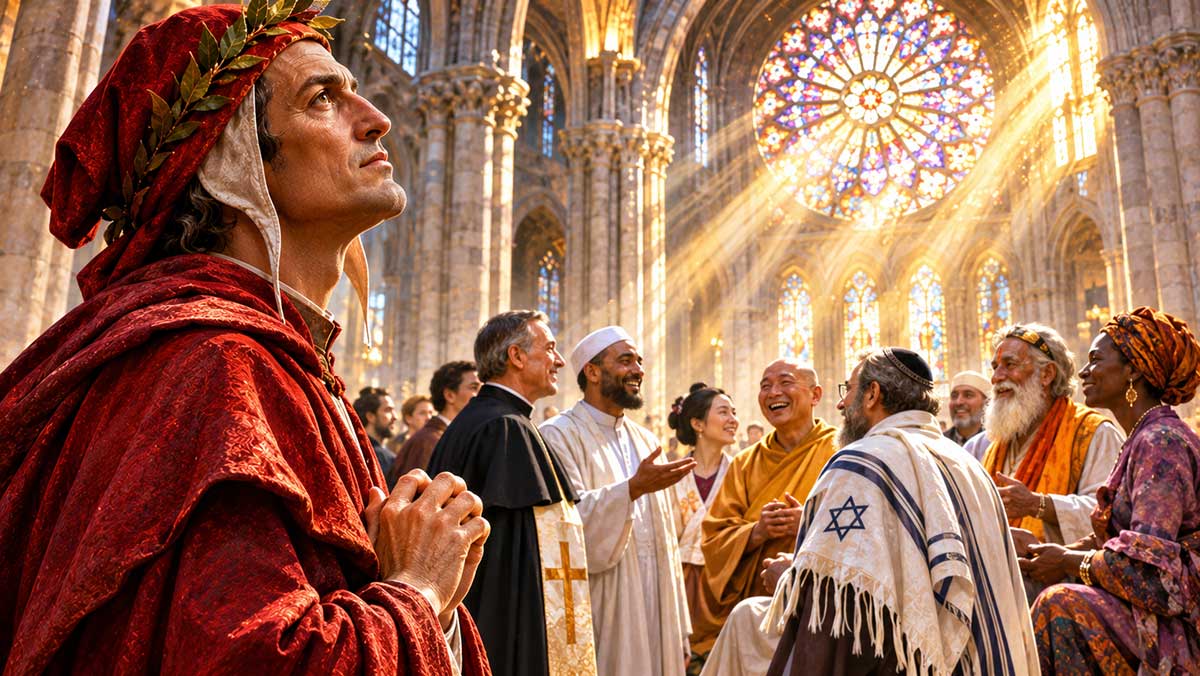
Setting: The conversation continues in the softly illuminated studio. Nick and Dante have spent the previous hour discussing Hell, divine justice, reincarnation, and the possibility of spiritual growth beyond death. Their coffee cups have been refilled. Nick looks across the table, ready to explore a question that has troubled humanity for centuries.
Question 1: Dante, Can You Love God and Still Challenge the Church?
Nick
Dante, there's something about you that I find fascinating.
You were a deeply religious man. You believed in God, Jesus Christ, Heaven, divine judgment, and the importance of the Church.
But you were also incredibly critical of religious leaders.
You even placed some popes in Hell.
That's pretty bold.
Dante
I would not recommend it as a reliable method of obtaining favor from the papal court.
Nick
I can imagine!
Most people complain about religious leaders privately. You put them into one of the most famous books ever written.
Did you ever worry about the consequences?
Dante
Certainly. But I believed that sacred office did not place a person beyond moral judgment.
A man does not become virtuous merely by wearing the garments of religious authority.
Nor does the possession of spiritual office guarantee that his actions serve God.
Nick
That's interesting.
So, in your mind, being loyal to God and being loyal to the Church weren't necessarily the same thing?
Dante
They were connected, but they were not identical.
I believed the Church possessed a sacred responsibility. Yet precisely for that reason, I considered corruption within it especially grievous.
When those entrusted with spiritual guidance pursue wealth, political domination, or personal advancement, they betray the purpose of their office.
Nick
But let me challenge that.
Who decides when a religious leader has become corrupt?
You believed certain popes were wrong. They probably believed you were wrong.
Everybody claims God is on their side.
How do we know who's right?
Dante
We must examine actions, principles, and consequences.
Does a leader pursue justice or personal enrichment?
Does he protect the vulnerable or exploit them?
Does he encourage truthfulness or manipulate belief for his own advantage?
And does he submit himself to the moral standards he demands of others?
Nick
Those seem like reasonable questions.
But religious leaders often claim that their authority comes from God.
How can an ordinary believer question someone who says he's speaking for God?
Dante
By refusing to confuse authority with infallibility in every action.
A sacred responsibility can be betrayed by the person who holds it.
Indeed, the greater the responsibility, the more serious the betrayal.
Nick
I like that.
You know, sometimes I wonder whether religion becomes dangerous when people stop asking questions.
They begin thinking, "My leader knows the truth. I just need to obey."
Dante
Obedience has its place within moral and spiritual life.
But obedience divorced from conscience and reason can become an instrument of wrongdoing.
A person should not surrender the responsibility to distinguish good from evil merely through fear of authority.
Nick
Then let me ask something personal.
You were involved in politics, and you clearly believed you knew what was best for Florence.
Isn't it possible that you sometimes behaved like the religious leaders you criticized?
Dante
That is an uncomfortable comparison.
Nick
I know. But I think it's fair.
You were ambitious. You had strong opinions. You wanted influence.
Maybe the difference between you and those leaders wasn't always as great as you imagined.
Dante
You may be correct.
A man can recognize corruption in others more easily than ambition within himself.
I opposed the misuse of authority, yet I was not free from the desire to exercise authority.
I condemned pride, yet pride was among my own persistent temptations.
Nick
So perhaps the real problem isn't religion itself.
It's what happens when human ego becomes attached to religion.
Dante
That is certainly part of the problem.
Religion can direct human beings toward humility, charity, and truth.
But it can also be misused to give sacred justification to ordinary human ambitions.
A ruler who desires territory may declare that God commands conquest.
A religious official who desires wealth may present his demands as spiritual obligations.
A proud man may mistake his own certainty for divine wisdom.
Nick
And when that happens, people can do terrible things while believing they're doing something holy.
Dante
Yes.
That is among the most dangerous distortions of religion.
Nick
Here's something I've wondered.
Suppose you could sit down with a modern pope.
Would you be respectful, or would you start asking difficult questions immediately?
Dante
I would begin respectfully.
Nick
And then?
Dante
I would ask the difficult questions.
Nick
I had a feeling.
Dante
Respect does not require silence.
Nick
You know, Dante, I think you'd make a very interesting podcast host.
Dante
You have suggested that before. I am beginning to suspect you wish to retire.
Nick
Not yet. I've still got a few questions for you.
But let's go deeper.
You believed that the Church could help guide humanity toward God.
Do you think people actually need a religious institution to know God?
Dante
Within my Christian understanding, the Church possesses a vital role in transmitting revelation, administering the sacraments, and nurturing spiritual life.
I would not dismiss that role.
Yet God is not a possession that any human institution can contain.
The Creator is greater than the structures through which human beings seek to know Him.
Nick
That's a very interesting distinction.
So the institution serves God, rather than God serving the institution.
Dante
Precisely.
Whenever that relationship is reversed, corruption becomes possible.
Nick
And perhaps that's something every religion needs to think about.
Dante
Every institution composed of human beings must remain attentive to the temptations of pride, fear, and self-interest.
Question 2: What Happens to Good People Who Follow Other Religions?
Nick pauses, then leans forward.
Nick
Dante, I want to ask you something that I think is very important.
You lived in medieval Christian Europe.
Your religious worldview was shaped by the teachings available to you at that time.
But today we know much more about the world's religions.
There are Buddhists, Hindus, Muslims, Jews, Christians, and people who don't belong to any religion.
Many of them live extraordinarily compassionate lives.
So here's my question.
If someone is a wonderful human being but doesn't believe in Christianity, what happens to that person after death?
Dante
That question must be approached with seriousness.
My poem reflects the Christian theology and intellectual traditions of my age.
Within that framework, salvation is understood through God's grace and the redemptive work of Christ.
Yet the relationship between divine justice, human knowledge, and those who lived without access to Christian revelation presented difficult questions even to medieval thinkers.
Nick
But let's make this personal.
Suppose there's a Buddhist grandmother in Japan.
She spends her life taking care of her family, helping neighbors, showing kindness, and trying not to hurt anyone.
She never becomes Christian.
Would you say she deserves Hell?
Dante
I would not presume to know the final judgment of a particular soul.
Nick
But your poem places virtuous non-Christians in Limbo.
People like Socrates, Plato, and even Virgil, your own guide.
They're not being tortured, but they cannot enter Heaven.
Isn't that unfair?
Dante
In the theological vision of my poem, Limbo represents a condition of natural virtue without the fulfillment of supernatural blessedness.
The souls there possess wisdom and dignity, yet they lack the vision of God.
It is a sorrowful condition, not a celebration of their exclusion.
Nick
But why exclude them at all?
Socrates lived centuries before Jesus.
He couldn't possibly have become a Christian.
Dante
You are raising the problem of historical circumstance and responsibility.
The question is whether a person can be held accountable for knowledge that was never available to him.
Medieval theologians considered such difficulties, though they did not all resolve them in the same manner.
Nick
Then let me ask you directly.
Do you think God is more concerned with what religion someone belongs to, or with how that person lives?
Dante
I would resist separating belief and conduct as though they were unrelated.
What we believe about the good influences how we live.
But correct religious language without charity is spiritually empty.
And the moral dignity of a person cannot be dismissed simply through unfamiliarity with that person's tradition.
Nick
That's interesting.
But suppose someone doesn't know the name of Jesus, yet lives according to love, compassion, forgiveness, and service.
Wouldn't that person be living closer to Jesus' teachings than someone who calls himself Christian but behaves cruelly?
Dante
A person who practices charity may indeed display virtues absent from someone who merely professes faith.
The name of a religion cannot substitute for the transformation of character.
Yet within my theology, salvation is more than a moral accounting of good deeds.
Nick
So we still disagree somewhat.
Dante
We are examining different aspects of the same question.
You are asking whether divine justice can be fair to people born into different traditions.
I am explaining a theological framework in which grace and revelation possess meanings beyond ordinary moral achievement.
Nick
Fair enough.
But here's what troubles me.
If God created every human being, God knew where each person would be born.
God knew some would grow up Christian, others Muslim, Buddhist, Hindu, or without religion.
Why would God create such different circumstances and then judge people by whether they encountered one particular religious teaching?
Dante
If we accept divine omniscience, we must acknowledge that God understands every circumstance of human life more completely than any human judge.
A just judgment could not arise from ignorance of those circumstances.
Nick
Then perhaps God's judgment is much more compassionate and individualized than human religious systems sometimes suggest.
Dante
We should certainly be cautious about placing limits upon divine wisdom through our own incomplete knowledge.
But I would not claim that this observation settles every theological question concerning salvation.
Nick
I appreciate that you're not giving me an easy answer just to make me happy.
Dante
You have invited a medieval Christian poet, Nick. It would be strange if I abandoned my entire intellectual world after two cups of coffee.
Nick
That's true!
And I wouldn't want you to.
Actually, I think the differences make this conversation more interesting.
Let me ask about Islam.
You included Muhammad in a deeply troubling scene in the Inferno.
Many Muslims today would find that portrayal extremely offensive.
If you could speak directly to a Muslim reader who felt hurt by your depiction, what would you say?
Dante
I would first acknowledge that my portrayal emerged from the religious conflicts, polemical traditions, and limited perspectives of medieval Europe.
I would not expect a Muslim reader to regard it as a neutral or sympathetic account of his faith.
Nick
Would you be willing to listen to how Muslims understand their own religion?
Dante
A serious search for truth should not fear hearing how others describe their beliefs.
I would wish to understand what I had not understood.
That would not necessarily require me to surrender my Christian convictions.
Nick
Of course.
You can disagree with someone and still treat them with dignity.
Dante
Indeed.
Disagreement need not become contempt.
Nick
That's something humanity could use more of.
But let me ask a broader question.
What if different religions are approaching some of the same ultimate questions from different directions?
Maybe they don't agree about everything, but they're all asking about the source of existence, the meaning of life, and how human beings should live.
Dante
There are certainly philosophical and moral questions shared across religious traditions.
Yet we should not pretend that all their answers are identical.
Different religions make claims that can genuinely conflict.
To respect another tradition is to take its actual teachings seriously, not merely to translate them into one's preferred ideas.
Nick
That's a good point.
Sometimes people say all religions teach exactly the same thing.
But they don't.
Dante
No.
They may share important moral insights without possessing identical doctrines.
Nick
So perhaps unity doesn't require everybody to agree about God.
Maybe it begins with recognizing that we're all human beings searching for meaning.
Dante
That recognition can provide a foundation for mutual respect.
And where compassion, justice, and honesty are shared, people may cooperate despite substantial theological differences.
Nick
I like that.
But I want to ask one more question.
If you could spend a month studying Buddhism, Hinduism, Islam, and other traditions with their most thoughtful teachers, would you do it?
Dante
With great interest.
Nick
Really?
Dante
A poet and philosopher should be curious about the intellectual and spiritual achievements of humanity.
But I would enter such conversations with questions, not with the assumption that every answer must confirm my own beliefs.
Nick
I think we'd get along pretty well.
Dante
Provided you did not require me to abandon poetry for your mysterious social media.
Nick
No promises.
Question 3: If God Is Our Parent, Why Can't Humanity Live as One Family?
The conversation has moved from medieval theology to the religious divisions of the modern world. Nick's tone becomes more reflective.
Nick
Dante, I want to ask you about something that matters deeply to me.
We have billions of people living on this planet.
Different nationalities, cultures, religions, languages, and traditions.
But underneath all those differences, we're human beings.
And if God is the ultimate parent of humanity, shouldn't we see one another as members of one family?
Dante
The idea that human beings share a common origin carries profound moral implications.
If all are creatures of God, no person can claim absolute superiority merely through birth, nationality, wealth, or social rank.
Nick
Exactly.
But look at human history.
We have spent centuries fighting over territory, religion, ethnicity, political systems, and national pride.
And we continue doing it today.
Why?
Dante
The causes are many.
Fear of losing what we possess.
Desire for resources.
Ambition among rulers.
Memories of injury passed from one generation to another.
And the tendency to regard our own community as more deserving than those beyond it.
Nick
But isn't that strange?
People often love their own families very deeply.
They'll sacrifice almost anything for their children.
Yet they may feel little concern for children suffering on the other side of the world.
Dante
Human affection often begins with those nearest to us.
That is natural.
But moral growth requires us to recognize obligations beyond the circle of immediate attachment.
Love of family should not become an excuse for indifference toward strangers.
Nick
That's exactly what I'm thinking.
Maybe the problem isn't that we love our families too much.
Maybe it's that we haven't learned to extend that sense of family far enough.
Dante
That is a meaningful distinction.
The love that binds a household can become a foundation for wider charity.
But it can also become exclusive if we treat everyone outside the household as an enemy.
Nick
So how do we expand that love?
How do we go from loving our children to caring about children in countries we've never visited?
Dante
We begin by recognizing that another person's suffering is real even when it does not touch our own household.
We cultivate the imagination necessary to perceive the humanity of strangers.
We examine the stories we tell about other peoples.
And we resist leaders who persuade us that the dignity of our community requires the humiliation of another.
Nick
That's interesting.
You used the word imagination.
You're a poet. Do you think literature can actually help people become more compassionate?
Dante
It can.
Literature allows us to enter experiences beyond our own.
A reader may encounter the grief of a mother in another country, the fear of a soldier, the loneliness of an exile, or the hopes of someone whose beliefs differ from his own.
Through such encounters, the imagination may enlarge the boundaries of sympathy.
Nick
That's one of the reasons I enjoy creating these imaginary conversations.
We can bring people from different centuries, cultures, and traditions together.
They can disagree, ask questions, and discover something about one another.
Sometimes I think if people could really sit down and talk, they might find they have more in common than they expected.
Dante
Conversation can reveal the human being hidden behind a label.
A person whom we call an enemy may possess fears, loves, and responsibilities resembling our own.
But conversation requires a willingness to listen.
Nick
And that's not always easy.
Dante
No.
Particularly when a person's identity has become attached to the belief that his opponents are entirely wicked.
Nick
You know something about that from Florence.
Dante
Unfortunately, yes.
Nick
Let's go back there for a moment.
Your city was divided into political factions.
People who probably attended the same churches, spoke the same language, and lived on neighboring streets became bitter enemies.
Doesn't that seem almost ridiculous when you look back?
Dante
It is tragic.
And there is often an element of absurdity within tragedy.
Men who agree upon many principles may fight violently over questions of authority, honor, and allegiance.
Each side becomes convinced that its victory is necessary for justice.
And the conflict itself creates new injuries that make reconciliation more difficult.
Nick
Sounds familiar.
Dante
I suspect your century has not entirely solved the problem.
Nick
Not even close.
We have airplanes, satellites, smartphones, and artificial intelligence.
But we still struggle to get along with people who disagree with us.
Dante
Then technical achievement has exceeded moral development in certain respects.
Nick
That's one way to describe it.
Let me ask you something difficult.
You believed in justice. You believed wrongdoing should have consequences.
But if humanity is one family, how should we deal with people who commit terrible acts?
We can't simply forgive everyone and pretend nothing happened.
Dante
No.
A family does not become loving through permitting its members to injure one another without restraint.
Justice protects the vulnerable.
It establishes accountability.
It seeks to prevent further harm.
But justice must not become an excuse for cruelty or the endless reproduction of vengeance.
Nick
So we need both justice and forgiveness.
Dante
Yes, though they must be understood carefully.
Forgiveness does not necessarily eliminate the need for restitution or protection.
And accountability need not require hatred.
Nick
That's a difficult balance.
Dante
It is among the most difficult tasks of moral life.
Nick
What about war?
Do you think humanity could ever reach a point where nations stop fighting each other?
Dante
I believed that political order and peace were essential to human flourishing.
In my political writings, I argued for a universal temporal authority capable of restraining conflicts among competing rulers.
Your age would need to examine that proposal critically, given its different institutions and experiences.
But the underlying concern remains.
When every political community pursues its own advantage without regard for a wider good, conflict becomes difficult to avoid.
Nick
So you were thinking about some kind of worldwide political order?
Dante
A universal monarchy, within the political philosophy of my time.
I believed that peace would allow human beings to develop their intellectual and moral capacities.
Nick
That's fascinating.
But wouldn't putting that much authority into one person's hands be dangerous?
Dante
It could be, if authority were corrupted.
Nick
And based on everything we've discussed, human beings are pretty good at corrupting authority.
Dante
You have identified a recurring difficulty in political philosophy.
Nick
So maybe we need cooperation between nations without giving one ruler absolute control.
Dante
Your age possesses political arrangements and historical knowledge unavailable to mine.
I would be interested in examining how they might preserve peace while restraining abuses of authority.
Nick
I think that's a conversation we could spend another three hours on.
Dante
Then I hope your supply of coffee is sufficient.
Nick
We planned ahead.
But let me ask something more personal.
Suppose you could speak to every religious leader in the world for five minutes.
Christians, Muslims, Jews, Buddhists, Hindus, and others.
What would you say?
Dante
I would ask them to consider the responsibility created by their influence.
A religious leader can awaken compassion, encourage justice, and help people confront their selfishness.
But he can also intensify fear, sanctify prejudice, and persuade followers that cruelty is righteous.
I would ask each leader to examine whether his conduct brings people closer to truth and charity or merely strengthens his own position.
Nick
Would you ask them to stop fighting about doctrine?
Dante
I would not ask them to pretend that their differences are meaningless.
Truth matters.
But I would ask whether disagreement requires hostility.
One can defend a conviction without denying another person's humanity.
Nick
That's a message I think the world needs.
And what would you say to ordinary people?
People who aren't religious leaders or politicians.
People who simply want to live peacefully and raise their families.
Dante
I would tell them that the moral condition of humanity is shaped by ordinary choices as much as by grand declarations.
How do you speak about people who are absent?
How do you treat those who possess less influence than you?
Do you teach your children to fear strangers, or to approach them with discernment and compassion?
When you encounter injustice, do you seek understanding and correction, or merely an opportunity to express anger?
These choices form the habits of a community.
Nick
So peace begins with how we treat the people around us.
Dante
It begins there, but it must not end there.
Private kindness cannot replace just institutions.
A peaceful society requires both moral character and political arrangements that restrain exploitation and violence.
Nick
That's a very important point.
We can't just tell everyone to love each other and ignore the systems that create suffering.
Dante
Precisely.
Love must become visible in the structures through which people live together.
Nick
Dante, I want to return to something you said earlier.
You described love as something that should move us beyond ourselves.
Could humanity's greatest spiritual challenge be learning to extend that love beyond national and religious boundaries?
Dante
It is certainly one of humanity's great challenges.
A person begins life within particular relationships and traditions.
These give identity, memory, and belonging.
But the moral task is to recognize that belonging to one community does not eliminate obligations toward others.
Nick
I love that.
You don't have to stop loving your country to care about people in another country.
You don't have to abandon your religion to respect someone else's faith.
Dante
Yes.
Love need not be diminished through being extended.
Nick
That's a beautiful thought.
And maybe it's something your own life taught you.
You lost Florence, the city you loved so much.
But your poetry eventually reached people in countries and cultures you could never have known.
Dante
There is an irony in that.
The city that rejected me became only one part of the world in which my words would travel.
Nick
And now you're sitting here talking with someone who grew up in Japan and has lived in America for decades.
Dante
A meeting I could scarcely have anticipated.
Nick
And we're discussing how the whole human family might learn to live together.
Dante
Then perhaps the imagination has accomplished something that political ambition could not.
It has allowed two men separated by centuries and cultures to consider a common question.
Nick
That's one of the things I find so meaningful about these conversations.
We may come from different worlds, but we can still learn from each other.
Dante
Provided that neither of us insists upon having the final word.
Nick
Well, that might be difficult for you.
Dante
I was about to say the same of you.
Both men laugh.
Nick
Okay, Dante. One final question before we move on.
If God could look at humanity today and speak one sentence to every person on Earth, what do you think God would say?
Dante remains silent for several moments.
Dante
I would hesitate to place my own words directly into the mouth of God.
Nick
That's fair.
Then let me ask it differently.
What message from your understanding of God do you believe humanity most needs to hear?
Dante
That no earthly possession, victory, or distinction can satisfy the deepest longing of the human soul.
And that the love through which we seek our highest good must never become an excuse to deny the dignity of another.
Nick
That's powerful.
I think people could spend a lifetime learning to live that way.
Dante
Many do.
And even those who recognize the truth may stumble repeatedly in practicing it.
Nick
Including you?
Dante
Most certainly.
Nick
Including me, too.
You know, Dante, we've spent a lot of time talking about God, religion, and humanity.
But I want to bring you into the modern world for a moment.
I think you'd be amazed by what human beings have accomplished.
We can fly across oceans in hours. We can communicate instantly with people thousands of miles away. We can access more information than the greatest libraries of your time could have contained.
Dante
Remarkable achievements.
Nick
They are.
But here's the strange part.
With all this progress, people still struggle with loneliness, anxiety, hatred, and the search for meaning.
Sometimes I wonder whether we've become more knowledgeable without becoming much wiser.
Dante
Then perhaps your civilization faces a question familiar to mine.
What is the proper purpose of human knowledge?
Nick
Exactly.
And I want to show you something.
Nick places his smartphone on the table.
Dante
What is this object?
Nick
This little device can connect me to almost anyone in the world. It contains books, maps, pictures, conversations, and an enormous amount of human knowledge.
Dante
Then your age must have produced an extraordinary generation of philosophers.
Nick
Well...
Nick pauses.
Dante
I sense that your answer will disappoint me.
Nick
Let's just say we have a few things to work on.
Dante studies the glowing screen with a mixture of wonder and suspicion.
The conversation turns toward the twenty-first century, where extraordinary technological achievements coexist with ancient human struggles. Nick is about to introduce Dante to a world that possesses more information than he could have imagined, yet still searches for the wisdom he spent his life pursuing.
Topic 5: Dante, What Would You Tell Us Today?

Setting: The final part of Nick Sasaki's extraordinary conversation with Dante Alighieri begins in the same warmly lit studio. A smartphone lies on the table between them. Dante, who has spent the evening discussing exile, love, Heaven, Hell, and humanity's relationship with God, now faces a civilization that would have seemed impossible in fourteenth-century Florence.
Question 1: Dante, Has Humanity Become Happier in the Last 700 Years?
Nick
Dante, before we go any further, I want you to take another look at this.
Nick picks up his smartphone.
Dante
I have been examining it with considerable suspicion.
Nick
You should. It might be the most useful and most distracting invention in human history.
Dante
An impressive achievement for an object so small.
Nick
Let me show you something.
Nick opens a satellite image of Earth.
This is our planet, photographed from space.
Dante
Dante leans forward.
Extraordinary.
The Earth itself, suspended before us.
And these white formations?
Nick
Clouds.
Dante
And the blue?
Nick
Oceans.
Dante
I have spent much of my life contemplating the arrangement of the heavens. To see the Earth from beyond itself is an experience I scarcely know how to describe.
Nick
That's pretty impressive coming from someone who wrote an entire poem about traveling through the universe.
Dante
Your age has accomplished through instruments what mine attempted through philosophy, mathematics, and imagination.
Nick
And here's something else.
Nick opens a photograph of Florence.
Recognize this?
Dante
Florence.
He studies the image for several moments.
The cathedral is different from the one I knew. The great dome was not there in my lifetime.
Yet I recognize the city.
The river. The buildings. The arrangement of its streets.
Nick
It's still beautiful.
Dante
Yes.
His voice softens.
I once believed that being separated from those streets was among the greatest misfortunes a man could endure.
Now I discover that they have survived me by centuries.
Nick
Does that make you happy or sad?
Dante
Both.
There is joy in knowing that Florence endured.
And there is sorrow in realizing how much of our suffering arises from believing that our own brief moment is the whole of history.
Nick
That's interesting.
You spent years wanting to return to Florence. Now millions of people visit it every year, and many of them know your name.
Dante
Then perhaps the city and I have achieved a reconciliation neither of us anticipated.
Nick
And you didn't even have to run for office again.
Dante
That may be the greatest blessing of all.
Nick
Now, let me tell you a few things about our world.
We have medicines that can treat illnesses that once killed millions of people.
We can travel between continents in a single day.
Many people live longer than they did in your time.
We can communicate with someone on the other side of the planet almost instantly.
We have access to more information than any medieval scholar could have dreamed of.
So here's my question.
Do you think humanity has become happier?
Dante
You have described remarkable improvements in the conditions of human life.
To reduce suffering through medicine, to make knowledge more accessible, and to connect distant communities are genuine achievements.
But happiness requires more than the removal of certain difficulties.
Nick
What else does it require?
Dante
We must first ask what we mean by happiness.
If happiness means pleasure, comfort, or the satisfaction of immediate desires, then your civilization may possess opportunities beyond anything available in mine.
But if happiness means the fulfillment of human nature through wisdom, virtue, friendship, and the proper direction of love, the question becomes more difficult.
Nick
So we might have more comfort without having more happiness.
Dante
Yes.
A man may sleep in a magnificent house and awaken without purpose.
He may possess many conveniences and lack a single trustworthy friend.
He may have access to countless entertainments yet find himself unable to endure an hour alone with his thoughts.
Nick
That last one really describes modern life.
People can't stand being bored anymore.
The moment they have a few seconds, they reach for their phones.
Dante
Why?
Nick
Sometimes to check messages. Sometimes to read the news. Sometimes to watch funny videos.
And sometimes for no reason at all.
It's almost automatic.
Dante
Then perhaps the device has become a servant that its master consults even when he has no task for it.
Nick
That's a pretty accurate description.
Dante
A curious arrangement.
Nick
And it gets stranger.
People can spend hours looking at the lives of strangers.
They see beautiful homes, expensive vacations, successful businesses, attractive people.
Then they compare those images with their own ordinary lives.
Dante
Ah.
Envy has acquired a remarkably efficient means of distribution.
Nick
Exactly!
You would recognize that sin immediately.
Dante
I recognize the human weakness. Your age has merely invented new instruments through which it may operate.
Nick
But isn't it strange?
We have all these technologies meant to connect people, yet loneliness is still a serious problem.
Dante
Connection and communion are not identical.
To exchange messages is not necessarily to be known.
To attract attention is not necessarily to be loved.
And to possess an audience is not the same as possessing friends.
Nick
That's a beautiful distinction.
Do you think people today are too concerned about what others think of them?
Dante
I suspect that concern has always existed.
In Florence, men sought honor through family reputation, public office, wealth, and intellectual achievement.
Your age appears to have created a system through which reputation can be measured continually.
Nick
Likes, followers, views, comments.
Dante
And does this measurement bring peace?
Nick
Not necessarily.
Sometimes it creates more anxiety.
Dante
Then a person may become imprisoned by a judgment that changes every hour.
Nick
That's exactly what happens.
But here's something I want to ask.
You wanted recognition, too.
You wanted your poetry to be remembered.
Isn't that similar to what people are doing today?
Dante
There is a resemblance.
I would be dishonest to condemn the desire for recognition without acknowledging its influence upon my own ambitions.
Yet there is a difference between wishing to create something worthy of remembrance and making public approval the measure of one's worth.
Nick
How do we know when we've crossed that line?
Dante
Ask yourself whether you would still consider your work meaningful if it received little applause.
Would you continue seeking truth if it brought you no admiration?
Would you continue practicing kindness if no one witnessed it?
Nick
Those are difficult questions.
Dante
They were difficult in Florence, too.
Nick
Let me show you another modern invention.
Artificial intelligence.
Dante
You have mentioned it several times. What is it?
Nick
A technology that can generate language, answer questions, analyze information, and help people create things.
For example, I could ask an AI system to write a poem about Florence in a few seconds.
Dante
A few seconds?
Nick
Yes.
Dante
And is the poem good?
Nick
Sometimes surprisingly good.
Dante
Then I should like to read one.
Nick
But here's the bigger question.
If a machine can produce beautiful poetry, what makes a human poet special?
Dante
That depends upon what we believe poetry to be.
If poetry is merely the arrangement of words into pleasing patterns, then an instrument capable of producing such patterns may imitate many of its outward qualities.
But poetry, as I understood it, arises from an encounter between language, experience, judgment, memory, and the human search for meaning.
Nick
So the experience behind the poem matters.
Dante
It matters profoundly.
Consider a poem about exile.
A machine might assemble descriptions of homesickness, loss, and longing.
It might produce lines that move a reader.
Yet my own writing emerged from years of living without the city I loved.
The suffering did not automatically make the poem good. Craft and thought were still necessary.
But the work was inseparable from a life that had been lived.
Nick
That's interesting.
But suppose AI helps a human writer express something meaningful.
Maybe the writer has a wonderful idea but struggles to find the right words.
Would you object to using the technology?
Dante
I would judge the result and the manner of its creation.
Human beings have always developed instruments to assist their work.
A pen assists writing. A book preserves knowledge. A teacher helps a student discover ideas he could not have reached alone.
The question is whether the instrument serves the development of human judgment or replaces the effort through which judgment grows.
Nick
So AI could be useful, but we shouldn't let it do all our thinking.
Dante
Precisely.
A man who possesses a library but never examines its books is not wise merely through ownership.
Likewise, a man who can obtain an answer instantly has not necessarily learned how to evaluate it.
Nick
That's a great point.
You know, I think you would enjoy having access to all the books in the world.
Dante
Very much.
Nick
But I suspect you'd spend so much time arguing with the authors that you'd never finish reading them.
Dante
Then I would be continuing a lifelong habit.
Nick
One more thing about modern technology.
If you could use AI to rewrite The Divine Comedy in an afternoon, would you?
Dante
No.
Nick
Not even to save yourself years of work?
Dante
The years were part of the work.
I did not merely produce a poem. I was changed through the effort of producing it.
To eliminate every difficulty from creation may deprive the creator of something essential.
Nick
That's something I hadn't thought about.
Maybe the struggle itself helps us grow.
Dante
Sometimes.
But I would not praise unnecessary hardship. If a useful instrument can relieve tedious labor and leave more time for reflection, that may be beneficial.
The danger arises when convenience becomes our highest value.
Nick
So after seven hundred years of progress, what do you think humanity still needs to learn?
Dante
How to distinguish having more from becoming better.
Your civilization has gained extraordinary abilities.
The moral question is what those abilities serve.
Question 2: What Would You Tell Someone Who Feels Lost in Life?
Nick sets the phone aside. The conversation becomes more personal.
Nick
Dante, I want to go back to the opening of The Divine Comedy.
You begin in a dark forest, having lost the straight path.
It's one of the most famous openings in literature.
But I think it speaks to something almost everyone experiences.
There are moments when we suddenly realize we're not living the life we expected.
Maybe we're forty, fifty, sixty, or seventy years old.
We look around and wonder, "How did I get here? Is this really what I wanted?"
Did you feel that way?
Dante
Yes.
The dark forest expresses a condition in which a person no longer understands the direction of his own life.
He may have pursued success, affection, status, or knowledge, yet find himself separated from the good he truly seeks.
The frightening discovery is not merely that the path is difficult.
It is that he has forgotten where the path leads.
Nick
That's a powerful idea.
Sometimes people work incredibly hard for decades.
They build careers, raise families, accumulate possessions.
Then one day they realize they haven't really asked themselves what makes life meaningful.
Dante
A person may become skilled at pursuing goals without examining whether those goals deserve pursuit.
Nick
Exactly.
So what should someone do when they realize they're in that dark forest?
Dante
The first task is to recognize the condition honestly.
Do not pretend that you are certain when you are lost.
Do not conceal your fear beneath constant activity.
Acknowledge that the life you have constructed may require examination.
Nick
That's difficult for people.
Especially successful people.
They don't want to admit they're confused.
Dante
Pride makes confession difficult.
Yet a man who refuses to admit that he is lost cannot sincerely ask for guidance.
Nick
Then what's the next step?
Dante
Seek trustworthy guidance.
Examine the habits that have shaped your choices.
Consider what you love most deeply and whether that love has become disordered.
And do not expect every necessary change to feel pleasant.
Nick
That last part is interesting.
People want transformation, but they don't necessarily want discomfort.
Dante
The pilgrim in my poem cannot reach Paradise by pretending that Hell does not exist.
He must confront the consequences of destructive choices.
He must recognize the suffering created through pride, greed, violence, and betrayal.
Then he must undergo purification before ascending toward the highest good.
Nick
So the journey isn't about escaping uncomfortable truths.
It's about facing them.
Dante
Yes.
But the purpose is not to remain fascinated by darkness.
The purpose is to move beyond it.
Nick
I love that.
Sometimes people spend years analyzing everything wrong with their lives.
They understand their childhood, their disappointments, their mistakes.
But they never move forward.
Dante
Self-examination should lead to moral action.
To recognize a fault without attempting correction is to remain at the beginning of the path.
Nick
Let me ask something practical.
Suppose someone listening to us feels completely stuck.
They've lost their job, or their marriage has fallen apart, or they've spent years pursuing something that no longer matters to them.
What would you tell them to do tomorrow morning?
Dante
I would begin by asking what remains within their responsibility.
They may not be able to restore a lost relationship, recover a former position, or undo years of disappointment.
But they can still choose how to act toward the people they encounter.
They can seek counsel.
They can begin repairing a neglected duty.
They can devote time to learning.
They can refuse to let bitterness govern every waking thought.
Nick
So start with something small.
Dante
A great change of direction often begins with a modest act of honesty.
Nick
What about people who feel they've wasted their lives?
Maybe they look back and think, "I should have done so many things differently."
Dante
Regret can teach, but it can also become a prison.
The past deserves examination, not endless worship.
If a person has wronged another, he should seek to make amends where possible.
If he has neglected his gifts, he may begin using them.
If he has pursued empty honors, he may reconsider what deserves his remaining time.
Nick
I think that's especially meaningful as people get older.
When you're young, you feel like you have unlimited time.
But eventually you realize life is finite.
Dante
Mortality can clarify what ambition obscures.
A man may spend decades seeking the admiration of strangers, then discover that he would gladly exchange much of that admiration for another afternoon with someone he loved.
Nick
That's beautiful.
Did you feel that during exile?
Dante
Yes.
I discovered that many things I had considered essential were less permanent than I believed.
Yet I did not immediately become free of attachment to them.
Knowledge and transformation do not always arrive together.
Nick
You keep coming back to that.
Dante
Perhaps it is a lesson I still need.
Nick
Let me ask about happiness.
If I asked a hundred people today what would make them happy, I'd probably get a hundred different answers.
Some would say money.
Some would say love.
Some would say freedom, health, success, family, or peace of mind.
What would you say?
Dante
Those things may contribute to a good human life.
But happiness, in its fullest sense, cannot be reduced to possessing favorable circumstances.
Within the philosophical tradition that shaped me, human fulfillment requires the proper activity of the soul.
We become happy through the cultivation of virtue, the exercise of reason, the practice of love, and our orientation toward the highest good.
Nick
So happiness is something we participate in, not simply something we receive.
Dante
That is a useful distinction.
Pleasure may arrive unexpectedly and disappear.
But a meaningful life is shaped through repeated choices.
Nick
Can a poor person be happier than a wealthy person?
Dante
Certainly.
But I would not romanticize poverty.
Material deprivation can impose terrible suffering and prevent people from developing their abilities.
A just society should seek to relieve such burdens.
Yet wealth alone cannot supply wisdom, friendship, or peace.
Nick
And can a person be happy without being famous?
Dante
I hope so, for the sake of nearly everyone who has ever lived.
Nick
That's a good answer.
But you became famous.
Does that satisfy you?
Dante
It is gratifying to know that my work has endured.
Yet fame cannot repair every injury of a life.
It cannot restore a lost friend.
It cannot recover an ordinary evening with one's children.
It cannot undo an act of pride.
Nick
So what matters most when we reach the end?
Dante
What we have loved, what we have become, and how our lives have affected others.
Nick
You know, there's something I find fascinating about that answer.
Your book is filled with kings, popes, philosophers, warriors, and famous people.
But some of the most moving moments involve ordinary human emotions.
A father grieving for his children.
A person longing for home.
Someone remembering love.
Dante
Great literature must concern itself with the human soul, not merely with the rank of its characters.
The suffering of an obscure person is not less real than the suffering of a king.
Nick
Then let me ask you something about purpose.
Do you believe every human being is born with a particular mission?
Dante
I believe human beings possess capacities and responsibilities that should be directed toward the good.
But I would hesitate to claim that each person must discover one extraordinary public achievement to justify his existence.
A person may live meaningfully through faithful attention to ordinary duties.
Nick
That's reassuring.
People sometimes feel pressured to do something enormous.
Become rich. Become famous. Change the world.
Dante
A person may contribute to the good of the world without receiving public recognition.
A parent who raises a child with patience, a teacher who awakens curiosity, a neighbor who offers help during hardship, these lives may possess a greatness that escapes the notice of historians.
Nick
I like that very much.
But what about someone who has a dream?
Something they really want to accomplish.
Should they pursue it, even when the chances of success seem small?
Dante
They should examine whether the dream is worthy and whether its pursuit can be reconciled with their responsibilities.
Courage is necessary for meaningful achievement.
But ambition becomes dangerous when it demands the sacrifice of every other good.
Nick
So don't abandon your dream, but don't make it your god.
Dante
An excellent formulation.
Nick
You know, Dante, I think a lot of people would benefit from hearing that.
We live in a culture that celebrates achievement.
But perhaps we need to spend more time asking what kind of human beings we're becoming.
Dante
A civilization should be judged by more than its monuments, wealth, and inventions.
It should be judged by the lives its people are able to lead.
Nick
Then let me ask one more thing.
Suppose someone says, "Dante, I've made so many mistakes. I'm too old to change."
What would you tell them?
Dante
That the belief may become another excuse for remaining unchanged.
As long as a person lives, opportunities for repentance, learning, reconciliation, and service remain.
The remaining time may be shorter than one wishes.
That makes it more precious, not meaningless.
Nick
I love that.
Maybe we don't need to start our lives over.
Maybe we need to start living differently with the time we still have.
Dante
Yes.
The pilgrim does not return to the beginning of his life.
He must find the path from the place where he stands.
Question 3: If You Could Ask God One Question, What Would It Be?
The studio grows quiet. Nick looks at the portrait of Dante displayed on a nearby screen, then turns back to the man sitting across from him.
Nick
Dante, we've covered an incredible amount tonight.
Your childhood.
Florence.
Exile.
Beatrice.
Your wife and family.
Heaven, Hell, religion, politics, and the future of humanity.
And now you've seen a little of the modern world.
I want to ask you something personal before we finish.
If you could live your life again, what would you change?
Dante
I would wish to become humble sooner.
Nick
That's your first answer?
Dante
Yes.
Pride consumed more of my attention than I understood.
I spent years measuring my worth against the judgments of others.
I allowed political injury to occupy a place within my thoughts that might have been given to more fruitful purposes.
Nick
Would you stay out of politics?
Dante
Not necessarily.
A person should not abandon public responsibility merely through fear of disappointment.
But I would seek to distinguish service from ambition more carefully.
Nick
What about your family?
Dante
I would wish to be more present.
There are forms of absence that occur even when a person remains physically near those he loves.
A mind consumed by ambition or resentment may neglect the quiet needs of a household.
Nick
That's something many people struggle with today.
They work hard to provide for their families, but sometimes they become so busy that they miss the life they're trying to support.
Dante
Then your century and mine share another difficulty.
Nick
Would you change anything about The Divine Comedy?
Dante
I would examine more carefully those moments when personal injury may have influenced my portrayal of justice.
And I would wish to distinguish more clearly between what I believed, what I knew, and what my imagination supplied.
Nick
That's interesting.
Would you remove any of the people you placed in Hell?
Dante
You are determined to obtain a list.
Nick
I thought I'd try one more time.
Dante
Then I shall disappoint you one more time.
Nick
Fair enough.
But let me ask something else.
If you were writing The Divine Comedy today, who would be your guide?
Would you still choose Virgil?
Dante
Virgil would remain a worthy companion.
His poetry and wisdom shaped my intellectual life.
But I would be curious to encounter the thinkers and writers who lived after me.
Nick
Anyone in particular?
Dante
I would wish to meet those who have examined the nature of freedom, conscience, human dignity, and the relationship between scientific knowledge and moral wisdom.
I would be interested in poets who have written about exile, war, love, and spiritual longing.
Nick
What about Shakespeare?
Dante
I have heard that he possesses a considerable reputation.
Nick
That's putting it mildly.
Dante
Then I should like to meet him.
Nick
I can probably arrange that.
Dante
Your hospitality grows increasingly extraordinary.
Nick
What about Leonardo da Vinci?
Dante
A Florentine spirit of extraordinary curiosity, from what you have described.
Nick
And Albert Einstein?
Dante
I would be particularly interested in his account of time.
Nick
Oh, that would be a fascinating conversation.
But I have to warn you, Einstein might challenge some of your ideas about the structure of the universe.
Dante
Then I would hope to learn from him.
A philosopher should not fear discovering that his description of nature requires correction.
Nick
That's a wonderful attitude.
Now, let me ask a question that might sound a little strange.
If you could return to Florence for just one day, what would you do?
Dante
I would walk.
Nick
Just walk?
Dante
Yes.
I would cross the streets I once knew.
I would stand beside the Arno.
I would observe the faces of people who have no knowledge of my personal grief.
I would listen to the language of my homeland as it has changed through the centuries.
And I would visit the places where my memories still seem to reside.
Nick
Would you visit your old political enemies?
Dante
After seven centuries, I suspect our disagreements have lost some urgency.
Nick
That's probably true.
Dante
I might even discover that the city I spent so long longing for was never entirely the city I remembered.
Nick
What do you mean?
Dante
Memory preserves certain moments and gives them extraordinary significance.
But a living city changes.
The Florence I loved existed partly in its streets and partly within my own imagination.
To return would be to encounter both the city and the distance between memory and reality.
Nick
That's beautiful.
And what if you could meet Beatrice again?
Dante
I would wish to know her as a person, not merely as the figure my poetry made of her.
Nick
That's a very different answer from what I expected.
Dante
Perhaps love becomes more mature when it no longer requires the beloved to remain an ideal.
Nick
And Gemma?
Dante
I would wish to hear her account of our life.
Not the version preserved in my reputation.
Her version.
Nick
That's powerful.
You know, one of the things I've learned from talking with you is that the great figures of history were still human beings.
You had ambitions, fears, regrets, and relationships.
And some of the things that mattered most to you were never recorded in the history books.
Dante
History preserves what it can.
But no chronicle contains the whole of a human life.
Nick
Now, I want to ask you about the future.
When you look at humanity today, are you hopeful?
Dante
I see reasons for both hope and concern.
Your civilization possesses extraordinary capacities to relieve suffering, preserve knowledge, and connect distant peoples.
Yet those same capacities may be used for domination, deception, and destruction.
The instruments themselves do not determine the moral character of their use.
Nick
Do you think humanity can ever learn to live peacefully?
Dante
I believe peace is a worthy aim that requires continuous moral and political effort.
But peace cannot rest solely upon the goodwill of individuals.
It requires justice, trustworthy institutions, and the restraint of those who would exploit others.
Nick
And what about love?
We've talked about love so much tonight.
Do you think love can actually change the world?
Dante
Love can transform the direction of a human life.
It can awaken compassion where there was indifference.
It can inspire courage, sacrifice, and reconciliation.
But love must become more than sentiment.
It must shape choices, relationships, and institutions.
Nick
So loving humanity isn't enough if we don't do anything about it.
Dante
A declaration of love is only the beginning.
Nick
That's something I want people to hear.
Sometimes we talk about peace and love as beautiful ideas.
But the real challenge is living them.
Dante
Indeed.
And the test often comes when love becomes inconvenient.
It is easy to praise compassion in the abstract.
It is harder to practice compassion toward a person who has injured your pride, challenged your beliefs, or threatened your interests.
Nick
That's probably where the real spiritual work begins.
Dante
Very often.
Nick
Dante, I have one last big question.
And I think it's the most important question of the entire interview.
Dante
You have said that several times tonight.
Nick
I know. I keep finding better questions.
Dante
Then I am grateful that your curiosity has no fixed limit.
Nick
Here's the question.
You spent your life searching for God.
You wrote about Hell, Purgatory, and Heaven.
You tried to describe the highest reality that human beings could experience.
And at the end of The Divine Comedy, you reached a vision of divine love that words could barely express.
But suppose you could stand before God now.
Not as a poet writing about a vision.
Not as a theologian defending a doctrine.
Just as Dante, a human being.
And God said, "You may ask me one question."
What would you ask?
Dante remains silent.
For the first time that evening, he seems genuinely uncertain how to answer.
Dante
I have spent much of my existence attempting to describe the relationship between divine goodness and human suffering.
I have defended justice.
I have contemplated mercy.
I have written of souls ascending toward blessedness and others remaining in darkness.
Yet there is a question that remains difficult even within the most elaborate theological system.
Nick
What is it?
Dante
I would ask how every sorrow, every act of cruelty, every innocent life cut short, and every longing that remained unfulfilled can be held within the goodness of creation.
Nick
That's a profound question.
Dante
I would not ask merely why I suffered.
My suffering was only one small part of the world's history.
I would ask about the suffering of those whose names were never remembered.
Children who died before discovering the possibilities of life.
People who endured injustice without receiving earthly vindication.
Those who sought goodness but encountered only confusion.
And those who injured others through ignorance, fear, or deliberate malice.
Nick
So you'd ask God how all of that fits into divine love.
Dante
Yes.
Not merely how suffering can be explained.
But whether the final truth of existence can disclose a goodness greater than the tragedies we perceive.
Nick
Do you think God would answer?
Dante
Within the vision of Paradise, the highest fulfillment of knowledge is not simply the receipt of another explanation.
It is the transformation of understanding through direct participation in divine truth.
Nick
So maybe the answer wouldn't be a sentence.
Dante
Perhaps not.
Nick
Maybe it would be something you finally understand.
Dante
That is close to the hope expressed in my poem.
Nick
But let me ask you something.
If God asked you a question instead, what do you think it would be?
Dante
That is an intriguing reversal.
Nick
I thought you might appreciate it.
Dante
Perhaps the question would be simpler than the ones I spent my life constructing.
Nick
Such as?
Dante
"Did you learn to love?"
Nick remains quiet for a moment.
Nick
That's beautiful.
Not "How famous did you become?"
Not "How many books did you write?"
Not "How many people agreed with your theology?"
Just, "Did you learn to love?"
Dante
I cannot claim to know what God would ask.
But that question would expose much about the direction of a human life.
Nick
And how would you answer?
Dante
I would say that I tried.
That I often confused love with longing, righteousness with pride, and wisdom with the desire to be admired.
That I loved Florence, yet allowed anger over its loss to consume me.
That I loved Beatrice, yet sometimes understood her more completely as a symbol than as a woman.
That I valued my family, yet did not always give them the attention they deserved.
And that through poetry, suffering, friendship, and contemplation, I gradually came to recognize that love demanded more of me than I had first understood.
Nick
That's a very human answer.
Dante
It is the only kind I can honestly offer.
Nick
You know, Dante, when I first thought about interviewing you, I expected to learn about The Divine Comedy.
And we certainly did.
But what surprised me is how much of our conversation has been about ordinary life.
Family.
Pride.
Regret.
Forgiveness.
The desire to belong.
And the struggle to love people better.
Dante
Perhaps those are the questions that make the poem endure.
The architecture of the afterlife may fascinate readers.
But the journey begins with a human being who has lost his way.
Nick
And perhaps that's why people still read it seven hundred years later.
We all get lost sometimes.
Dante
Yes.
And the possibility of finding a better direction remains one of the great hopes of human existence.
Nick
I want to ask you one final, simple question.
What would you say to someone listening to this conversation who feels lost right now?
Someone who has made mistakes, experienced disappointment, or lost hope?
Dante
I would tell that person not to mistake the darkness of the present moment for the whole of reality.
The path may be hidden, but that does not mean it has ceased to exist.
Seek wisdom.
Accept help.
Examine your choices honestly.
Offer kindness where you can.
And do not allow the injuries of the past to determine every possibility of the future.
Nick
That's a wonderful message.
Dante
And I would tell the person something else.
Nick
What's that?
Dante
Do not wait until you have become perfect before beginning to love.
Nick
I love that.
Dante
Love is not merely the reward for completing the journey.
It is part of what makes the journey possible.
Nick looks at Dante for several moments, then smiles.
Nick
Dante, thank you.
This has been an extraordinary conversation.
I came here wanting to ask you about Heaven and Hell.
But I think what I'll remember most is what you said about love.
Dante
Then perhaps my long literary labor has achieved something worthwhile.
Nick
It certainly has.
And I have to say, you've been a wonderful guest.
Dante
Your questions have been unusually persistent.
Nick
I'll take that as a compliment.
Dante
It was intended as one.
Nick
One last thing.
Now that you've seen the modern world, would you rather go back to medieval Florence or stay here in the twenty-first century?
Dante
That is difficult.
Your age offers remarkable knowledge, medical achievements, and opportunities for conversation.
Yet I confess that I remain attached to the world I knew.
Nick
So you'd go back?
Dante
Perhaps.
But first I should like to visit a modern library.
Nick
Of course.
Dante
And see the great dome of Florence.
Nick
Absolutely.
Dante
And perhaps learn more about this artificial intelligence.
Nick
I can help you with that.
Dante
Excellent.
But there is one thing I must ask.
Nick
What's that?
Dante
If this machine can write poetry in seconds, does it expect to be paid?
Nick
Well, that's a complicated question.
Dante
Then perhaps some things have not changed since my time.
Both men laugh.
Outside the studio, the modern city continues its restless activity. Screens glow, cars pass, and millions of people pursue their own hopes and worries.
Inside, two men separated by seven centuries have discovered that the deepest human questions remain remarkably familiar.
What makes a life meaningful?
Can suffering teach us without destroying us?
Can justice and mercy coexist?
And can human beings learn to love beyond the boundaries of fear, pride, and self-interest?
Dante rises from his chair. Before leaving, he looks once more at the image of Earth displayed on Nick's phone.
Dante
Nick, there is something beautiful about seeing your entire world in a single image.
Nick
What do you mean?
Dante
From such a distance, the borders over which human beings have fought so fiercely cannot be seen.
Nick
That's true.
Dante
Yet every person upon that small sphere carries a world of memories, hopes, griefs, and loves.
Perhaps wisdom begins when we learn to hold both truths together.
The smallness of our place in creation.
And the immeasurable significance of how we treat one another.
Nick
That's a beautiful thought to leave us with.
Thank you, Dante.
Dante
Thank you, Nick.
May your curiosity continue to lead you toward wisdom.
And may wisdom teach you how to love.
The interview ends, but the questions remain open, waiting for the next conversation.
Final Thoughts: What Dante Taught Me About Love, Judgment, and the Meaning of Life
When I first imagined interviewing Dante Alighieri, I expected to spend most of our conversation discussing Heaven, Hell, and the extraordinary imagination behind The Divine Comedy. But what stayed with me most wasn't his description of the afterlife. It was the deeply human story of a man who lost his home, struggled with political conflict, carried complicated feelings about love, and tried to make sense of a world where justice and suffering often seem impossible to reconcile.
I was particularly moved by our discussion about Beatrice and Gemma. Beatrice became Dante's great spiritual inspiration, yet Gemma was the woman who shared his actual married life. It made me think about the difference between the love we idealize and the love we practice. It's easy to admire someone from a distance, especially when they represent everything beautiful and pure in our imagination. But loving another person through ordinary disagreements, responsibilities, and disappointments requires something different. I wonder how often we confuse the beauty of our feelings with the depth of our love.
Our conversation about Hell challenged me in another way. Dante's medieval vision of divine justice is powerful, but I kept returning to one question: If God truly loves humanity, is there a point when forgiveness becomes impossible? I found myself wondering whether punishment should be the final destination of a soul or whether transformation might remain possible beyond what we can comprehend. Dante's historical theology and my questions don't always lead to the same conclusions, and that's what made our exchange interesting. I didn't need him to agree with me to appreciate the seriousness of his search for truth.
I was equally fascinated by what Dante might think of modern society. We can communicate instantly across continents, access extraordinary amounts of information, and experience comforts that medieval people could scarcely have pictured. Yet many of us still feel lost, lonely, or uncertain about what really matters. Dante's famous dark forest in the opening of the Inferno suddenly felt surprisingly familiar. Perhaps our modern confusion looks different from his, but the experience of losing our direction is something human beings have shared across centuries.
By the end of our imaginary conversation, I realized that Dante's greatest contribution to me wasn't a detailed map of Heaven or Hell. It was the idea that human beings can confront their mistakes, reconsider their direction, and seek a deeper kind of love. His poem moves from darkness and confusion through moral examination to a vision of divine love. Whether we interpret that spiritually, philosophically, or personally, I find the possibility of transformation deeply encouraging. We may not know everything about what happens after death, but we can examine how we treat one another during the lives we have.
And perhaps that's what I will remember most from my afternoon with Dante. We spent so much time asking about God's judgment, eternal punishment, and the mysteries of the afterlife. But I left thinking about something much closer to home: how easily we judge other people, how difficult forgiveness can be, and how much our lives might change if we approached others with greater compassion. What do you think? If God is truly loving, should every soul have another opportunity to change? Or do you believe divine justice requires eternal consequences? I'd love to hear your thoughts in the comments below.
Disclaimer: These Final Thoughts are Nick Sasaki's reflections on a fictional interview inspired by Dante Alighieri's life and literary works. The imagined conversation does not represent Dante's actual spoken words. Questions about eternal punishment, reincarnation, divine mercy, and salvation beyond Christianity are explored as philosophical possibilities and should not be mistaken for Dante's documented theological positions.
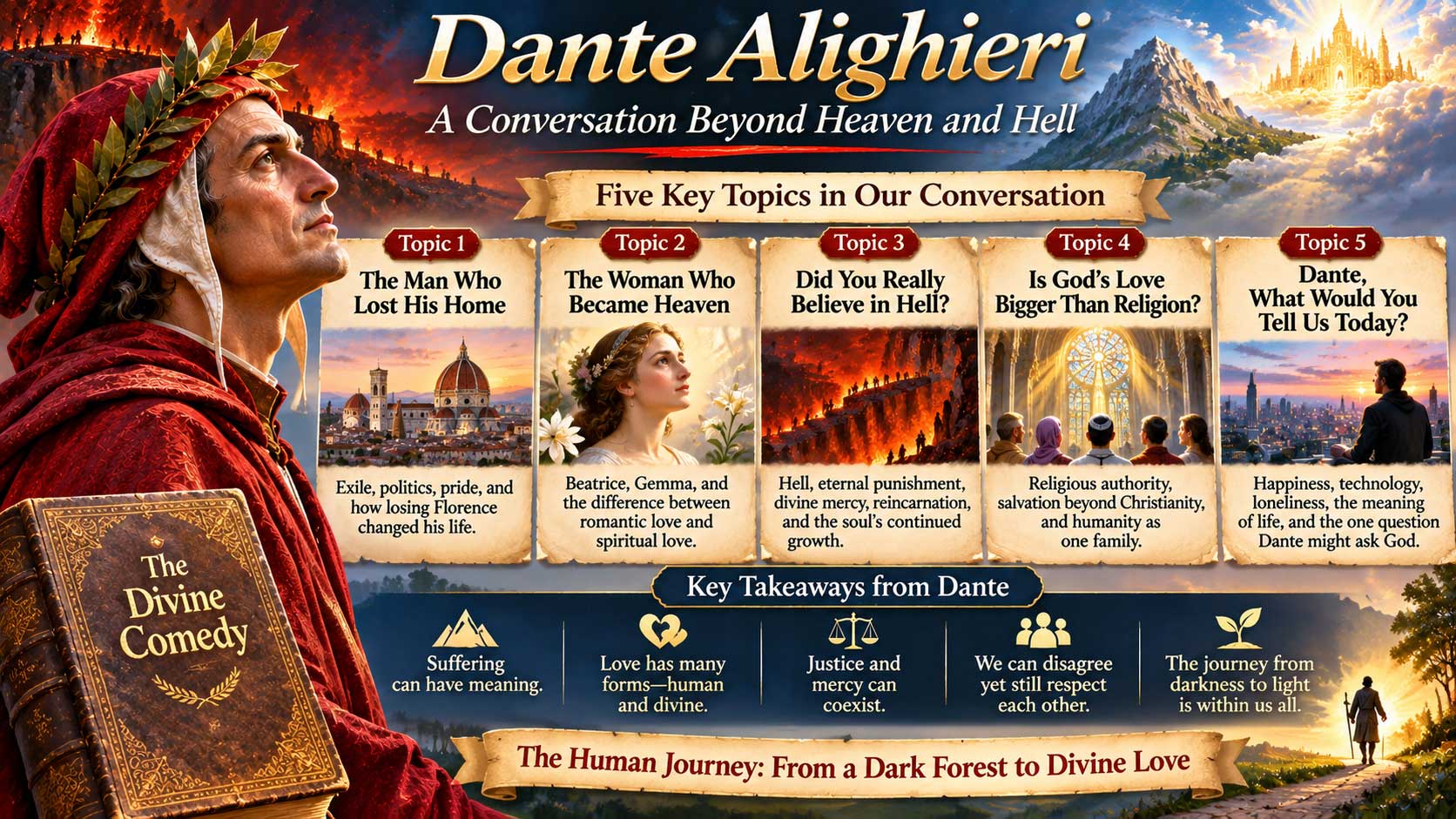
Short Bios:
Dante Alighieri (1265–1321): Dante Alighieri was an Italian poet, philosopher, and political thinker whose masterpiece, The Divine Comedy, remains one of the most influential works in world literature. Exiled from Florence in 1302, Dante transformed personal suffering, political conflict, and religious conviction into an extraordinary poetic exploration of Hell, Purgatory, Heaven, divine justice, and the human soul's search for God.
Nick Sasaki: Nick Sasaki is the creator of ImaginaryTalks.com, where historical figures, writers, philosophers, and spiritual thinkers come together through imagined conversations. His interviews combine natural curiosity, humor, thoughtful disagreement, and personal reflection, encouraging readers to explore questions about happiness, relationships, faith, morality, and what it means to live a meaningful life.
Leave a Reply