


PROLOGUE: Of Fates Foretold and Paths Unchosen
Spoken by Horatio
The stage is dark. A single light reveals HORATIO standing between two distant images: the cold battlements of Elsinore and the sunlit towers of Verona. He carries a small, leather-bound book.
HORATIO
There are stories we inherit.
Stories of kings who murder brothers, of sons commanded to avenge their fathers, of lovers divided by names they did not choose.
We have heard them so often that we believe we know where they must end.
A prince must answer blood with blood.
Two young lovers must perish before their families learn the cost of hatred.
And the living must stand beside their graves, discovering wisdom when it is too late to save those they loved.
But I have often wondered whether tragedy is written in the stars, or whether men, mistaking their anger for destiny, write it with their own hands.
I knew a prince named Hamlet.
He was a man of uncommon intelligence, fierce affection, and a sorrow that followed him even into daylight. His father's death had opened a wound that neither time nor the consolations of friends could close.
He believed a terrible wrong had been committed. He feared that justice might demand an equally terrible answer.
And I knew two young lovers, Romeo and Juliet, whose hearts had recognized one another before their families could teach them why they should be enemies.
Their love was not without danger. Their courage was not without foolishness. They were young enough to believe that a promise might change the world, and old enough to discover that the world does not readily surrender its prejudices.
By all the familiar reckonings of tragedy, their paths should never have crossed.
Denmark was far from Verona. The troubles of a royal court seemed to have little kinship with the quarrels of two Italian households.
Yet grief recognizes grief across every border.
And sometimes a stranger sees more clearly the danger that familiarity has taught us to accept.
What happens when a prince who has contemplated revenge encounters a young man about to surrender himself to it?
What happens when a daughter refuses to believe that obedience is the highest expression of love?
What happens when friendship asks more courage of us than vengeance ever could?
These are the questions that brought us together.
I shall not tell you that we were wise from the beginning.
We made mistakes. We misjudged one another. We mistook silence for safety and anger for strength.
There were moments when a single word might have prevented suffering, and moments when no words were sufficient.
I shall tell you what I witnessed, including those things that still trouble my conscience.
For a story faithfully told must make room for human weakness, not merely noble deeds.
And if, as you listen, you begin to recognize the roads these young people might have taken, I ask you to consider another possibility.
Perhaps the deepest tragedy is not that death awaits us all.
Perhaps it is that we sometimes surrender the living to the dead before their lives are finished.
HORATIO opens the book.
HORATIO
Come, then, to Elsinore, where a son hears a command from beyond the grave.
And afterward to Verona, where two young hearts shall discover that love, too, can demand a courage greater than either has imagined.
Our story begins in darkness.
But darkness need not have the final word.
HORATIO closes the book. The light fades, and the distant sound of a castle bell announces the beginning of Act I.
ACT I: Where Two Tragedies Meet

ACT I, SCENE ONE
The Ghost's Command
Setting: The battlements of Elsinore Castle, Denmark.
Time: A winter's night, shortly before dawn.
Characters: HAMLET, HORATIO, MARCELLUS, THE GHOST OF KING HAMLET.
[A bitter wind sweeps across the battlements. Beyond the castle walls, the sea lies dark beneath a moon half-veiled by clouds. A bell tolls the hour. MARCELLUS stands watch with HORATIO.]
MARCELLUS
The night grows old, yet will not yield to morn.
The very stars seem frozen in their courses.
HORATIO
'Tis but the winter's breath upon thy bones.
The heavens heed not how a soldier shivers.
MARCELLUS
Would that the heavens heeded Denmark's grief.
Since our late king was laid beneath the stone,
No cock hath crowed without some fearful sound,
Nor moon arisen free of bloody clouds.
HORATIO
Grief makes strange prophets of us all, good friend.
Yet I confess, these walls have lost their peace.
[HAMLET enters, wrapped in a dark cloak.]
HAMLET
What peace may dwell where truth is buried deep?
Good even, gentlemen. Hath he appeared?
MARCELLUS
Not yet, my lord.
HAMLET
Then must we wait.
HORATIO
My prince, I pray thee, give thyself some rest.
Three nights hast thou pursued this wandering shade,
And three days passed without a wholesome sleep.
HAMLET
Sleep?
When kings are murdered, sleep becomes a thief
That steals the hours appointed unto truth.
HORATIO
Thou knowest not thy father was thus slain.
HAMLET
My heart knows what my reason dare not name.
HORATIO
Then let thy reason question what thy heart
Hath fashioned from the bitterness of loss.
HAMLET
Wouldst thou have me believe my father's death
Was but the common ending of a life?
A serpent's bite, so say the court physicians.
A sudden venom coursing through his blood,
And all the kingdom satisfied with tears.
HORATIO
I would have thee distinguish proof from fear.
HAMLET
And I would have a world wherein the two
Were not so oft mistaken for each other.
[A sudden gust extinguishes one of the torches. MARCELLUS draws back.]
MARCELLUS
My lord!
[At the far end of the battlements, THE GHOST appears, clad in the armor of the late King Hamlet. A pale light surrounds him.]
HORATIO
Heaven defend us!
HAMLET
Father?
[The Ghost raises one hand.]
GHOST
Hamlet.
HAMLET
O voice that death itself could not imprison!
If thou art he whose name I bear in sorrow,
Speak, and thy son shall hear thee.
GHOST
Come apart.
The ears of living men are frail with fear.
HORATIO
My lord, I beg thee, follow not the shade.
HAMLET
If he be false, I shall discover falsehood.
If true, what son could turn from such a call?
[HAMLET approaches the Ghost. HORATIO and MARCELLUS remain at a distance.]
GHOST
My hour is brief. Attend me well, my son.
The tale that Denmark tells concerning me
Is but a garment stitched to hide a wound.
HAMLET
Then speak the wound.
GHOST
'Twas not a serpent
That stole the breath from out my sleeping breast.
HAMLET
Who, then?
GHOST
The serpent wears my crown.
[HAMLET stands motionless.]
HAMLET
Claudius.
GHOST
Thy father's brother.
He came upon me in the orchard's shade,
Where I had laid my weary head to rest.
He poured a poison in mine unguarded ear,
And with that draught did steal my life, my throne,
And all the days that yet were mine to live.
HAMLET
O monstrous deed!
GHOST
A brother's hand
Hath made a widow of thy mother, son,
And placed a murderer upon Denmark's seat.
HAMLET
Then by the stars that witness this dark hour,
His blood shall answer for thy stolen blood!
GHOST
Beware, my son.
HAMLET
Beware? Wouldst thou have mercy
Upon the hand that struck thee into dust?
GHOST
I charge thee, seek the truth and bring it forth.
Let not my murder sleep beneath his crown.
HAMLET
And when the truth is found?
GHOST
Then shall thy soul
Be weighed against the deed that thou dost choose.
HAMLET
I understand thee not.
GHOST
Nor canst thou yet.
For grief speaks loudly in a young man's breast,
And vengeance wears the countenance of justice.
HAMLET
Art thou come back to counsel me in riddles?
GHOST
I come to bid thee wake.
HAMLET
Then give me proof!
GHOST
Beyond the mountains, southward past the Alps,
In Italy, where merchant princes thrive,
There lies a thread that leads unto my grave.
HAMLET
What thread?
GHOST
A payment made in secret.
A physician hired beneath a borrowed name.
A merchant's seal concealed among the books
Of those who trade with Denmark's royal house.
HAMLET
Where shall I seek these men?
GHOST
In fair Verona,
Where ancient households nourish ancient hate,
The path begins.
HAMLET
Verona?
GHOST
There thou shalt meet
A youth whose heart shall mirror thine in fire,
Yet burn for love where thine doth burn for wrong.
HAMLET
What youth is this?
GHOST
His name is Romeo.
HAMLET
And what hath Romeo to do with Denmark?
GHOST
More than thou knowest, more than he suspects.
[The first faint suggestion of dawn touches the eastern sky. The Ghost begins to withdraw.]
HAMLET
Stay, father! Tell me how to find the proof!
Tell me what fate awaits this Romeo!
GHOST
The living write what ghosts cannot foretell.
HAMLET
One word more!
GHOST
When thou dost stand
Between the sword of wrath and one man's life,
Bethink thee what thy father loved in thee
Before the grave made vengeance seem thy birthright.
HAMLET
Father!
GHOST
Farewell.
[The Ghost vanishes. A distant cock crows.]
[HAMLET remains staring into the empty darkness. HORATIO approaches slowly.]
HORATIO
My lord?
HAMLET
He hath spoken.
HORATIO
What hath he told thee?
HAMLET
That Denmark wears a lie upon its brow,
And I must seek the truth beyond its shores.
HORATIO
Where wouldst thou go?
HAMLET
To Italy.
HORATIO
For what?
HAMLET
A merchant's record, and a physician's name.
Perchance the proof of murder.
HORATIO
Then I shall go with thee.
HAMLET
Thou knowest not the peril.
HORATIO
Nor dost thou.
Yet friendship that attends a man in sunlight
And leaves him when the darkness gathers round
Deserves no better name than fair-weather acquaintance.
HAMLET
Thou art a better friend than I deserve.
HORATIO
Then prove me worthy by preserving reason
When anger counsels otherwise.
HAMLET
I fear mine anger hath already crowned itself.
HORATIO
A crown may yet be cast aside.
[HAMLET looks toward the eastern horizon.]
HAMLET
My father bids me seek the hidden truth.
My heart demands the life of Claudius.
Between those voices stands a narrow road,
And I know not whereon my feet shall fall.
HORATIO
Then walk it not alone.
[A long silence.]
HAMLET
Come, Horatio.
We leave for Verona ere another moon
Hath risen o'er these battlements.
[The castle bell sounds again. The first pale light of morning falls across the stone. HAMLET and HORATIO depart together.]
END OF ACT I, SCENE ONE
ACT II: The Bitter Price of Vengeance

ACT II, SCENE ONE
The Balcony and the Shadow
Setting: The Capulet orchard and gardens, Verona.
Time: Shortly after midnight, following the masked ball.
Characters: ROMEO, JULIET, HAMLET, HORATIO, MERCUTIO, THE ROYAL ENVOY, TWO ARMED SERVANTS.
[A moonlit orchard enclosed by high stone walls. Cypress trees rise beyond the garden, and pale roses climb the pillars beneath Juliet's balcony. The distant music of the Capulet feast has faded into silence.]
[ROMEO enters quietly, having climbed the orchard wall. His cloak catches upon a thorn, and he pauses to free it.]
ROMEO
What care I for the thorns that catch my cloak,
When love hath set a thousand in my breast?
These walls were built to keep out enemies,
Yet none can bar a heart that knows its home.
[He looks upward toward Juliet's balcony.]
ROMEO
O gentle night, conceal my foolish steps,
And let thy stars bear witness to my hope.
[A light appears above. JULIET steps onto the balcony, unaware that ROMEO stands below.]
JULIET
O weary heart, why wilt thou not be still?
One evening's dance hath turned my world awry.
Romeo.
A name my father taught me to despise,
Yet on my tongue it tastes of something sweet.
[ROMEO moves forward.]
ROMEO
Then speak it once again, and make me blessed.
JULIET
Who speaks?
ROMEO
A fool who hath returned
To hear his name pronounced by fairest lips.
JULIET
Romeo!
Art thou bereft of reason?
If any kinsman find thee in this garden,
Thy life is worth less than a broken cup.
ROMEO
Then let them break their cups upon the stones.
I came not here to quarrel with thy house.
JULIET
Yet thou hast entered where their swords command.
ROMEO
A sword may wound the flesh, but cannot reach
The place where thou hast made thy dwelling.
JULIET
Thy tongue is bold, but steel is bolder still.
ROMEO
Then teach me caution, if thou wilt.
I am a willing scholar.
JULIET
Would that thy scholarship began
With learning how to leave.
ROMEO
And wouldst thou have me go?
[JULIET hesitates.]
JULIET
I would have thee live.
ROMEO
Then give me cause.
JULIET
Hast thou so little cause already?
ROMEO
Until tonight, I knew not how much life
A single moment might contain.
JULIET
Thou speakest as though we had known each other
Since the first dawn awakened all the earth.
ROMEO
Perhaps our hearts are older than our names.
JULIET
Or perhaps our hearts are young and foolish,
And would persuade us that the world is kind.
ROMEO
Then let us make it kinder.
[JULIET leans upon the balcony rail.]
JULIET
Romeo, I fear not love itself.
I fear the hands that seek to govern it.
My father sees a daughter as a promise
Made long before she learned to speak her mind.
Thy father sees a Capulet and thinks
Of wounds that time hath failed to close.
What hope have we against such ancient pride?
ROMEO
The hope that two may choose another road.
JULIET
And if that road be barred?
ROMEO
We seek another.
JULIET
And if all roads be barred?
ROMEO
Then must we learn to build a bridge.
[She smiles despite herself.]
JULIET
Thou hast an answer for each question.
ROMEO
Save one.
JULIET
And what is that?
ROMEO
Wilt thou permit me to love thee?
[A long silence.]
JULIET
I cannot command what thou dost feel.
ROMEO
Nor would I have thee.
JULIET
Yet I may answer what I feel myself.
[She places her hand upon her heart.]
JULIET
I know thee scarcely, Romeo.
And still, when thou didst leave the hall,
The candles seemed to lose their warmth.
ROMEO
Then I shall count that answer precious.
JULIET
Count it carefully.
I would not have thee spend it recklessly.
ROMEO
I shall keep it near my heart.
JULIET
And keep thy heart within thy breast.
I have no wish to mourn thee.
[They gaze upon one another.]
The Watchers Beyond the Wall
[Outside the orchard wall, HAMLET and HORATIO pass along a narrow lane. HAMLET carries a hooded lantern.]
HORATIO
The merchant's agent hath departed Verona.
His servants say he travels east at dawn.
HAMLET
Then he hath business he would keep concealed.
HORATIO
We must send word to Padua before him.
If Bellandi's books be seized, our proof is lost.
HAMLET
I have written to a scholar there,
A man who once attended Wittenberg.
He knows the merchant's eldest clerk.
HORATIO
Then we may yet obtain a faithful copy.
HAMLET
A copy witnessed by another hand,
That none may call it forgery when we return.
[A faint sound of footsteps comes from the opposite end of the lane. HAMLET extinguishes his lantern.]
HAMLET
Stand close.
[THE ROYAL ENVOY enters with TWO ARMED SERVANTS.]
ROYAL ENVOY
Search every lodging near the western gate.
The paper must be found before the morning.
FIRST SERVANT
And if the thief hath fled?
ROYAL ENVOY
Then follow him.
SECOND SERVANT
We have no warrant from Verona's prince.
ROYAL ENVOY
A warrant?
[He laughs quietly.]
ROYAL ENVOY
The King of Denmark sends his warrant
Wherever Danish gold hath purchased silence.
FIRST SERVANT
And if the stranger resist?
ROYAL ENVOY
Let him resist no more.
[The servants depart. The ENVOY remains beneath a tree, examining a letter.]
HORATIO [whispering]
He seeks the receipt.
HAMLET
Aye.
HORATIO
We must depart.
HAMLET
Not yet.
[HAMLET watches the Envoy carefully.]
ROYAL ENVOY
The apprentice, the ledger, and the missing receipt.
Three loose threads, and each may strangle us.
[He folds the letter and moves away.]
HORATIO
Didst thou hear? The apprentice lives.
HAMLET
And the Envoy fears him more than any sword.
HORATIO
Then let us follow the man.
HAMLET
Nay. We know not where his servants wait.
A rash pursuit may cost us all.
HORATIO
Thou growest cautious.
HAMLET
I grow weary of seeing folly dressed as courage.
[A voice calls softly from above the garden wall.]
ROMEO
Hamlet?
[HAMLET looks upward. ROMEO has climbed to the top of the wall.]
HAMLET
Romeo!
What mischief hath carried thee so high?
ROMEO
The same that brought thee into Verona.
A matter of the heart.
HAMLET
Then thine hath chosen a dangerous lodging.
ROMEO
I have found Juliet.
HAMLET
So I perceive.
HORATIO
Good youth, descend before the watchmen come.
ROMEO
I would, but she hath promised me
Another word before we part.
HAMLET
Then take thy word, and keep thy life.
For both are worth preserving.
[ROMEO drops lightly to the lane beside them.]
ROMEO
Thou art a strange counselor in love.
HAMLET
I have been called far worse.
ROMEO
Thou speakest always of life and danger.
Hast thou never loved beyond all caution?
HAMLET
I have loved a father beyond the grave,
And near forgot the living for his sake.
[ROMEO grows serious.]
ROMEO
Then thy grief is deeper than I knew.
HAMLET
And thy joy more fragile than thou thinkest.
ROMEO
Wouldst thou have me abandon Juliet?
HAMLET
Nay.
I would have thee love her in such fashion
That she may live to bless thee for it.
ROMEO
Thou makest love sound like a duty.
HAMLET
The truest love bears duty in its heart.
'Tis easy to swear death for one beloved.
The harder oath is living faithfully
When all the world commands thee otherwise.
[ROMEO considers this.]
ROMEO
Then I shall live, and love her still.
HAMLET
A better vow than any made upon a tomb.
[A sound of approaching footsteps.]
HORATIO
Someone comes.
[MERCUTIO enters, searching the lane.]
MERCUTIO
Romeo!
By all the saints, I thought thee stolen
By fairies, thieves, or some enchanted maid.
[He notices HAMLET and HORATIO.]
MERCUTIO
Ah! Thou hast found two solemn guardians.
One looks as though he hath buried joy,
The other as though he keeps the graveyard books.
HORATIO
And thou, sir, speakest enough for three.
MERCUTIO
A most economical arrangement.
ROMEO
Peace, Mercutio. These are friends.
MERCUTIO
Then I must ask their pardon.
I have mistaken friendship for a funeral.
HAMLET
And I have mistaken thy tongue for a bell
That knows not when to cease its ringing.
[MERCUTIO bursts into laughter.]
MERCUTIO
A worthy stroke!
Romeo, where hast thou hidden this northern wit?
I would have him at our table every night.
HAMLET
I fear thy table would not survive us both.
MERCUTIO
Then we must dine upon the ruins.
[The men laugh.]
The First Warning
[A distant shout is heard. The ROYAL ENVOY reappears at the far end of the lane with one servant. He stops upon seeing HAMLET.]
ROYAL ENVOY
Good even, gentlemen.
[HAMLET turns slowly.]
HAMLET
And to thee, sir.
ROYAL ENVOY
Thy face is known to me.
HAMLET
Then thy memory serves thee better
Than thy manners.
ROYAL ENVOY
I have seen thee in a northern court.
HAMLET
Many men have traveled north.
ROYAL ENVOY
Few bear themselves like princes.
[HORATIO steps forward.]
HORATIO
My companion is a scholar,
And we have business with the merchants of Padua.
ROYAL ENVOY
Indeed?
Then perhaps he hath found a paper
Belonging to one of my associates.
HAMLET
What paper?
ROYAL ENVOY
A receipt.
HAMLET
Verona is full of receipts.
Her merchants would sell the moon
If they could find a clerk to measure it.
ROYAL ENVOY
Take care, young sir.
Some papers carry dangerous knowledge.
HAMLET
Then their owners should guard them well.
[A tense silence.]
ROYAL ENVOY
We shall meet again.
HAMLET
I doubt it not.
[The Envoy departs with his servant.]
MERCUTIO
A charming fellow.
I should trust him with neither purse nor sister.
HORATIO
Nor with a secret.
ROMEO
Who is he?
HAMLET
A man whose master hath good reason
To fear the truth.
ROMEO
Then thou art in danger.
HAMLET
As art thou, Romeo.
Though our dangers wear different faces.
ROMEO
If thou needest aid, command me.
HAMLET
Thou knowest not what thou offerest.
ROMEO
I offer friendship.
Must friendship first inquire the price?
[HAMLET studies him.]
HAMLET
Nay.
And I thank thee.
The Promise Beneath the Stars
[From the balcony, JULIET appears once more.]
JULIET
Romeo?
[ROMEO turns immediately.]
ROMEO
My lady!
JULIET
The house is quiet now.
Yet I must beg thee leave before the dawn.
ROMEO
I go, though every step shall carry me
Farther from that which gives my journey meaning.
JULIET
Then let tomorrow bring thee safely back.
ROMEO
It shall, if heaven grant me breath.
HAMLET
Heaven favors those who guard the breath
Already granted them.
[JULIET looks down at HAMLET.]
JULIET
Good Hamlet, wilt thou keep him from his folly?
HAMLET
I shall attempt it, lady.
Yet I fear the task may outlive us all.
ROMEO
I stand accused by all my friends.
MERCUTIO
Aye, and by thy beloved.
Thou art thoroughly defeated.
[JULIET laughs softly.]
JULIET
Farewell, Romeo.
ROMEO
Farewell, sweet Juliet.
[She withdraws from the balcony.]
[ROMEO watches until her light is extinguished.]
HORATIO
The hour grows late.
MERCUTIO
Then let us depart before Verona wakes
And discovers all her young men missing.
[MERCUTIO leads ROMEO away. ROMEO turns once to wave to HAMLET.]
ROMEO
Until tomorrow, friend!
HAMLET
Until tomorrow.
[ROMEO and MERCUTIO depart. HAMLET and HORATIO remain beneath the orchard wall.]
HORATIO
Thou hast taken that youth into thy confidence.
HAMLET
Not yet.
But there is honesty within him,
Though folly keeps it company.
HORATIO
And thou?
HAMLET
I have honesty enough to know
That folly walks beside me too.
[He looks toward the darkened balcony.]
HAMLET
He loves a maiden whose family hates his name.
I seek a king whose crown conceals a crime.
Both roads are marked with danger.
HORATIO
Yet neither need be walked in hatred.
HAMLET
So said my father's shade, though not in words
I understood upon that bitter night.
[HAMLET draws the folded receipt from his doublet.]
HAMLET
Tomorrow we must find the merchant's records.
Then seek the apprentice ere the Envoy's men
Can silence him.
HORATIO
And if the proof condemns thy uncle?
[HAMLET looks toward the distant stars.]
HAMLET
Then must I learn whether justice
May be served without becoming vengeance.
[A distant bell tolls.]
[The two men depart along the moonlit lane. Above them, Juliet's balcony remains dark, its roses stirring gently in the night wind.]
CURTAIN.
END OF ACT II, SCENE ONE
ACT II, SCENE TWO
The Price of Honor
Setting: A public square in Verona, near the market fountain.
Time: The following afternoon.
Characters: HAMLET, HORATIO, ROMEO, MERCUTIO, BENVOLIO, TYBALT, FRIAR LAWRENCE, THE ROYAL ENVOY, CITIZENS, and GUARDS.
[The square of Verona. Merchants call beneath striped awnings. A fountain spills clear water into a stone basin. Children run between the stalls. The afternoon sun beats upon the cobblestones.]
[MERCUTIO and BENVOLIO enter, followed by ROMEO.]
MERCUTIO
By heaven, this sun would roast a saint alive!
I swear the very stones have learned to sweat.
BENVOLIO
Then let us seek the shade, good Mercutio.
The streets are full of Capulets today,
And heat hath made men's tempers quick to rise.
MERCUTIO
Thou speakest as though the sun itself
Were sworn unto the house of Capulet.
BENVOLIO
I speak of men whose swords are quicker
Than the wisdom that should govern them.
MERCUTIO
Then wisdom is a sluggish servant indeed.
It never comes when called.
ROMEO
Peace, both of you.
I have no stomach for another quarrel.
MERCUTIO
Thou hast no stomach for aught but love.
Since yesternight, thy feet scarce touch the ground.
ROMEO
And thine scarce leave it without mischief.
MERCUTIO
A most unkind accusation.
I am the very picture of restraint.
BENVOLIO
A picture drawn by a drunken painter.
[They laugh.]
[HAMLET and HORATIO enter from the opposite street, carrying a sealed letter.]
HORATIO
The clerk in Padua hath answered us.
Bellandi's books remain within his keeping,
Yet strangers have demanded their surrender.
HAMLET
And hath he promised us a copy?
HORATIO
He hath. His master's seal and signature
Shall witness every entry that concerns
The Danish treasury.
HAMLET
Then we have gained a little ground.
HORATIO
The clerk writes further of the apprentice.
He was seen in Mantua three days past,
And lodged beneath the name of Matteo.
HAMLET
A borrowed name to save a borrowed life.
HORATIO
We must reach him before the Envoy's men.
[ROMEO notices them.]
ROMEO
Hamlet! Horatio!
HAMLET
Good Romeo.
MERCUTIO
Behold the northern gentlemen!
Come, Denmark, tell us whether all thy countrymen
Are born with winter lodged within their brows.
HAMLET
Nay, sir. Some are born with summer in their tongues
And spend their lives exhausting it.
MERCUTIO
A hit! A most excellent hit!
I begin to think thou art a poet
Who hath mistaken mourning for a profession.
HAMLET
And thou a philosopher
Who hath mistaken noise for wisdom.
MERCUTIO
Then let us exchange professions.
Thou shalt make merry, and I shall brood.
[MERCUTIO attempts a solemn expression.]
MERCUTIO
Alas, poor world! Thy cheese is full of holes,
Thy wine runs dry, thy women love another!
[ROMEO laughs.]
ROMEO
Thou wouldst make a merry ghost.
MERCUTIO
Aye, and haunt the kitchens of the rich.
[HAMLET smiles.]
HAMLET
Would that all spirits bore thy cheerful nature.
[A brief silence passes over HAMLET's face. HORATIO notices but says nothing.]
Tybalt's Challenge
[From a side street, TYBALT enters with two CAPULET KINSMEN. He sees ROMEO.]
TYBALT
Romeo!
[The laughter ceases.]
ROMEO
Good day, Tybalt.
TYBALT
Good day? Thou hast the boldness
To offer courtesy after last night's insult?
ROMEO
I meant no insult to thy house.
TYBALT
Thou camest masked among our guests,
And dared to dance beneath my uncle's roof.
ROMEO
I came in peace.
TYBALT
Then peace hath made thee insolent.
MERCUTIO
Take heed, Tybalt. Peace is a gentle lady.
She may grow weary of thy company.
TYBALT
I speak not unto thee.
MERCUTIO
Yet thou hast found me ready to reply.
BENVOLIO
Good gentlemen, I pray you, end this quarrel.
The square is full of witnesses.
TYBALT
Let them witness.
[TYBALT draws his sword halfway from its sheath.]
TYBALT
Romeo, thou art a villain.
ROMEO
Tybalt, I bear thee no such hatred
As thou dost bear to me.
TYBALT
Then draw, and prove thy courage.
ROMEO
I will not fight thee.
TYBALT
Coward!
ROMEO
Call me what thou wilt.
I have no wish to stain this day with blood.
MERCUTIO
Romeo, wilt thou endure such shame?
ROMEO
There is no shame in refusing needless violence.
TYBALT
Then hide behind thy pretty speeches.
MERCUTIO
If Romeo will not answer thee,
I shall.
[MERCUTIO draws his sword.]
ROMEO
Mercutio, no!
MERCUTIO
Come, Tybalt.
Let us see whether thy blade be sharper
Than thy tongue.
TYBALT
Gladly.
[They draw fully and begin to fight. Citizens retreat from the square.]
The Duel
[TYBALT and MERCUTIO circle one another. Their swords clash.]
MERCUTIO
Come, sir! Thou strikest like a dancing master
Who fears to tear his stockings!
TYBALT
Thy jesting shall not save thee.
MERCUTIO
Nor shall thy frowning make thee handsome.
[They exchange blows. BENVOLIO attempts to intervene but is driven back.]
BENVOLIO
Part them! Part them!
ROMEO
Mercutio, put thy sword away!
MERCUTIO
A moment, Romeo!
I have scarce begun to teach him manners!
[HAMLET steps forward.]
HAMLET
Hold, gentlemen!
[Neither combatant listens.]
HAMLET
I command you, cease!
[MERCUTIO turns briefly at the sound of HAMLET's voice. TYBALT thrusts. The blade strikes MERCUTIO beneath the ribs.]
[MERCUTIO staggers backward.]
MERCUTIO
A scratch.
A most discourteous scratch.
[He looks down at the wound.]
ROMEO
Mercutio!
[ROMEO catches him as he falls.]
MERCUTIO
Why lookest thou so pale, sweet Romeo?
'Tis I who have been wounded.
ROMEO
Fetch a physician!
BENVOLIO
Make way! Make way!
[BENVOLIO runs for help.]
MERCUTIO
I fear this jest hath gone too far.
[He tries to laugh but winces.]
ROMEO
Speak not. Save thy strength.
MERCUTIO
I had meant to grow old, thou knowest.
A gray-bearded fool, still chasing pretty faces
And cheating death at dice.
ROMEO
Thou shalt yet grow old.
MERCUTIO
Nay, friend.
I think death hath won the throw.
[ROMEO presses his hand against the wound.]
ROMEO
Stay with me.
MERCUTIO
I would, if I could.
[MERCUTIO looks toward TYBALT, who stands motionless, his sword lowered.]
MERCUTIO
A plague upon your houses both.
Not for the blood that spills this day alone,
But for the thousand hearts ye teach to hate
Before they learn the reason.
[He turns back to ROMEO.]
MERCUTIO
Promise me one thing.
ROMEO
Anything.
MERCUTIO
When thou dost tell this tale,
Let them remember that I laughed.
[His hand falls. He dies.]
[ROMEO bows his head over MERCUTIO's body. The square falls silent.]
The Sword of Vengeance
[TYBALT takes one step backward.]
TYBALT
I meant not...
[ROMEO rises slowly.]
ROMEO
Thou meantest not?
[He looks at MERCUTIO, then at TYBALT.]
ROMEO
He lies upon the stones,
And thou wouldst mend the world with three poor words?
TYBALT
He drew upon me first.
ROMEO
And thou hast answered with his life!
[ROMEO draws his sword.]
ROMEO
Come, Tybalt!
Let steel pronounce what words cannot!
TYBALT
Then have thy will!
[TYBALT raises his sword. Before they can strike, HAMLET steps between them and draws his own blade.]
HAMLET
Stand back!
ROMEO
Hamlet, leave me!
HAMLET
I will not.
ROMEO
He hath slain my friend!
HAMLET
I have eyes, Romeo.
ROMEO
Then see what justice asks of me!
HAMLET
Justice asks thee first to know thyself.
ROMEO
I know my grief!
HAMLET
And grief would make thee murderer.
ROMEO
He deserves to die!
HAMLET
Perchance.
Yet art thou fit to judge him now,
When rage hath seized the throne of reason?
ROMEO
Wouldst thou spare him?
HAMLET
I would spare thee.
[ROMEO hesitates.]
HAMLET
Look upon thy friend.
Wouldst thou make his dying breath
The first commandment of another war?
ROMEO
He was my brother in all but blood.
HAMLET
Then honor him by being more than wrath.
ROMEO
Thou askest what no man could bear.
HAMLET
I know.
[HAMLET lowers his voice.]
HAMLET
For I have heard the selfsame voice
That bids thee strike.
It speaks within my breast each waking hour,
And calls its hunger justice.
Yet if we feed it all the lives it asks,
What shall remain of those we love?
[ROMEO looks at TYBALT, then at MERCUTIO. His sword trembles.]
ROMEO
I cannot forgive him.
HAMLET
Then do not.
Not this day.
But lay thy sword aside,
And let tomorrow find thee living.
[A long silence. ROMEO slowly lowers his blade.]
ROMEO
For Mercutio's sake,
I shall not make another grave.
[TYBALT retreats, shaken.]
TYBALT
I sought a quarrel, not this end.
HAMLET
Then look well upon the end thou hast made.
[TYBALT cannot meet his gaze.]
The Law Arrives
[GUARDS enter, followed by FRIAR LAWRENCE, who has been summoned by BENVOLIO.]
FIRST GUARD
Who hath drawn steel within the public square?
BENVOLIO
Tybalt of Capulet hath slain Mercutio.
TYBALT
He challenged me.
HAMLET
And thou didst answer him with death.
FIRST GUARD
Lay down thy sword.
[TYBALT obeys. The Guards seize him.]
TYBALT
I shall answer before the Prince.
FIRST GUARD
Aye, and before the law.
[The Guards lead TYBALT away.]
[FRIAR LAWRENCE kneels beside MERCUTIO and examines him.]
FRIAR LAWRENCE
His earthly troubles are at rest.
ROMEO
And ours begin anew.
FRIAR LAWRENCE
My son, what happened here?
ROMEO
Hatred found a sword,
And friendship paid its price.
[The Friar closes MERCUTIO's eyes.]
FRIAR LAWRENCE
Then let the living learn what death hath taught.
[HAMLET turns away, troubled.]
The Envoy's Opportunity
[At the far side of the square, the ROYAL ENVOY has watched the final moments of the confrontation. He approaches one of his servants.]
ROYAL ENVOY
The Danish prince hath made himself
A friend unto the Montagues.
SERVANT
Shall we inform the King?
ROYAL ENVOY
Aye.
And write that Hamlet bears a paper
Taken from our keeping.
SERVANT
What of the merchant's books?
ROYAL ENVOY
Our men depart for Padua tonight.
If Bellandi will not surrender them,
His countinghouse must suffer an accident.
SERVANT
And the apprentice?
ROYAL ENVOY
Find him before Hamlet does.
[The Envoy departs.]
After the Bloodshed
[The square has emptied. MERCUTIO's body has been carried away. ROMEO sits beside the fountain, his hands stained with blood. HAMLET stands nearby.]
ROMEO
I heard his laughter this morning.
He spoke of growing old,
Of wine and women, foolish dreams.
And now...
[He cannot continue.]
HAMLET
Grief hath no language equal to its weight.
ROMEO
I thought love had made me brave.
Yet when my friend lay dying,
I knew no courage but to kill.
HAMLET
Thou didst possess another courage.
ROMEO
I felt none.
HAMLET
Thou laidst down thy sword.
ROMEO
Only at thy command.
HAMLET
Nay, Romeo.
I stood between thee and thy enemy,
Yet thine own hand chose not to strike.
[ROMEO looks at him.]
ROMEO
And what of thee?
If the man who slew thy father
Stood before thee with no sword to guard him,
Wouldst thou spare his life?
[HAMLET is silent.]
ROMEO
Thou canst not answer.
HAMLET
Not yet.
ROMEO
Then we are brothers in our weakness.
HAMLET
Perhaps.
Or brothers in the hope
That weakness need not govern what we do.
[FRIAR LAWRENCE approaches.]
FRIAR LAWRENCE
Romeo, the Prince shall hear this matter.
Thy refusal to fight may spare thee punishment,
Yet the quarrel shall not end so easily.
ROMEO
What becomes of Tybalt?
FRIAR LAWRENCE
The law must judge him.
ROMEO
And if the law should fail?
FRIAR LAWRENCE
Then let not thy soul become its substitute.
[The Friar departs.]
ROMEO
Juliet is Tybalt's kin.
HAMLET
I know.
ROMEO
How shall I look upon her now?
HAMLET
As thou didst before:
Not as the daughter of a house,
But as the woman whom thou lovest.
ROMEO
Her family hath taken Mercutio from me.
HAMLET
One man hath taken him.
Do not condemn her for his deed.
[ROMEO bows his head.]
ROMEO
I fear tomorrow.
HAMLET
So do I.
[A distant bell tolls.]
ROMEO
What shall we do?
HAMLET
We shall bury thy friend,
And seek the truth that may yet save the living.
[ROMEO rises.]
ROMEO
Then let us begin with him.
[The two men depart together, walking slowly through the silent square.]
[Above the fountain, the afternoon sun begins to fade.]
CURTAIN.
END OF ACT II, SCENE TWO
ACT II, SCENE THREE
The Weight of Two Houses
Setting: The Capulet residence, a chapel in Verona, and the courtyard of a merchant's lodging.
Time: The evening following Mercutio's death, continuing into the next morning.
Characters: JULIET, ROMEO, HAMLET, HORATIO, OPHELIA, FRIAR LAWRENCE, LORD CAPULET, LADY CAPULET, THE NURSE, LORENZO, A PADUAN CLERK, and SERVANTS.
The House of Mourning
[A chamber within the Capulet residence. Evening shadows stretch across the walls. JULIET stands beside an open window, looking down upon the city. The NURSE enters hurriedly, carrying a folded shawl.]
NURSE
O lady, lady, what a dreadful day!
The streets are full of grief, the bells of sorrow,
And every tongue hath found a tale to tell.
JULIET
What news hath set thee trembling so?
NURSE
Young Mercutio is dead.
JULIET
Mercutio?
NURSE
Romeo's dear companion.
Tybalt struck him in the market square.
JULIET
Tybalt?
NURSE
Aye, thy cousin.
[JULIET grips the windowsill.]
JULIET
O cruel hour!
What madness hath possessed our house?
NURSE
They say the men drew swords,
And Romeo stood between them.
JULIET
Romeo?
NURSE
He lives, sweet lady.
JULIET
Thank heaven.
[She closes her eyes briefly.]
JULIET
And Tybalt?
NURSE
Taken by the city guards.
The Prince must judge his deed.
JULIET
Then one young man lies dead,
Another waits beneath the law,
And every house shall count itself the injured one.
NURSE
Thy father rages like a winter storm.
JULIET
He mourns the shame upon our name,
Yet who shall mourn the mother
Whose son returns no more?
NURSE
Thou speakest strangely of a Montague's friend.
JULIET
Was Mercutio less a man
For loving those my father hates?
[LORD CAPULET enters, followed by LADY CAPULET.]
LORD CAPULET
Juliet, thou hast heard the news?
JULIET
I have, my lord.
LORD CAPULET
Our house is shamed before Verona.
Tybalt hath let his temper master him,
And now the Prince demands an accounting.
LADY CAPULET
The Montagues provoked him.
JULIET
Did they command his sword to strike?
LADY CAPULET
Juliet!
JULIET
Forgive me, mother.
Yet blood once spilled cannot be gathered up
By naming who began the quarrel.
LORD CAPULET
Thou art too young to judge such matters.
JULIET
Then am I old enough to grieve?
[LORD CAPULET looks at her sharply.]
LORD CAPULET
Thou wilt grieve for thine own kin.
JULIET
I grieve for all who suffer.
LORD CAPULET
There speaks the innocence of youth.
The world is not so gentle as thy heart.
JULIET
Then must my heart grow cruel
To prove that I have learned the world?
[A silence.]
LORD CAPULET
Enough.
The Prince may yet show mercy unto Tybalt,
Yet our standing hath been wounded sorely.
We must restore the honor of this house.
LADY CAPULET
Count Paris hath renewed his suit.
A marriage would bring steadiness
Where scandal now hath shaken us.
JULIET
Marriage?
LORD CAPULET
Aye.
We shall speak further when this grief hath passed.
[LORD and LADY CAPULET depart.]
[JULIET remains motionless.]
JULIET
They speak of marriage as men speak of walls,
A thing to raise against approaching danger.
NURSE
My lamb, thy father means to guard thee.
JULIET
Yet what becomes of the bird
Whose cage is fashioned out of love?
[She turns toward the window.]
JULIET
Romeo, where art thou now?
The Chapel of Saint Francis
[A small chapel lit by candles. MERCUTIO's body rests beneath a plain white covering, awaiting burial. FRIAR LAWRENCE stands beside it. ROMEO kneels at the foot of the bier.]
ROMEO
I cannot think him silent.
All my life his tongue outran the morning,
And laughter followed where his footsteps fell.
Now death hath taken both his words and breath,
And left the world too quiet for my heart.
FRIAR LAWRENCE
The Lord receives what earth cannot retain.
ROMEO
Yet earth retains the wound.
FRIAR LAWRENCE
Aye, my son.
And those who live must tend it.
[HAMLET enters quietly.]
HAMLET
Romeo.
ROMEO
Thou hast come.
HAMLET
I could not leave thee here alone.
ROMEO
I keep recalling how he laughed
When first he saw thee.
He named thee Denmark's prince of melancholy,
Though he knew not thou wert prince at all.
HAMLET
He had a gift for finding truth
Beneath a jest.
ROMEO
And now his jesting ends.
[HAMLET stands beside the bier.]
HAMLET
Good Mercutio,
Thou didst spend thy laughter freely,
As though the world had endless need of it.
Perchance it did.
[A pause.]
ROMEO
I dreamt this afternoon
That I had slain Tybalt.
In dreams the sword obeys the heart,
And every blow seems righteous.
Yet when I woke, my hands were empty,
And I was glad.
Then came the shame of gladness.
HAMLET
Why shame?
ROMEO
My friend lies dead.
His killer lives.
HAMLET
And would thy friend's return
Be purchased by another death?
ROMEO
Nay.
HAMLET
Then thou hast lost no honor.
ROMEO
The city shall call me coward.
HAMLET
Let it.
A thousand tongues may call a man a fool,
Yet none can make him one
Unless he lends them judgment over his soul.
ROMEO
Thou speakest with certainty.
HAMLET
I speak what I would fain believe.
[FRIAR LAWRENCE approaches.]
FRIAR LAWRENCE
My sons, the Prince hath ordered Tybalt held
Until the witnesses have spoken.
No sentence shall be given this night.
ROMEO
Then may the law prove wiser than our fathers.
FRIAR LAWRENCE
Amen.
[The Friar departs to tend the candles.]
ROMEO
I fear for Juliet.
HAMLET
Her house hath suffered shame,
Yet she bears none of Tybalt's guilt.
ROMEO
Her father may forbid our meeting.
HAMLET
Then speak with care, and seek no rash escape.
ROMEO
What wouldst thou have me do?
HAMLET
First, bury thy friend.
Then give thy grief the dignity of time.
Love need not perish for one day's sorrow,
Nor prove itself by courting death.
[ROMEO takes HAMLET's hand.]
ROMEO
Thou hast become a brother to me.
HAMLET
Then let me prove a faithful one.
The Arrival from Denmark
[The following morning. A courtyard outside a merchant's lodging. HORATIO waits beside a fountain, examining a folded letter. A carriage enters. OPHELIA steps down, dressed in pale blue traveling garments.]
HORATIO
Lady Ophelia!
OPHELIA
Good Horatio.
HORATIO
By what strange fortune art thou come to Verona?
OPHELIA
No fortune brought me, but concern.
I heard that Hamlet crossed the Alps
In search of secrets none would name.
HORATIO
The road was long, and full of peril.
OPHELIA
Then I have crossed it nonetheless.
HORATIO
Doth thy father know?
OPHELIA
He knows I sought leave to visit kin in Italy.
He knows not yet how far my purpose reaches.
HORATIO
Polonius will be sore displeased.
OPHELIA
My father finds displeasure
In most things I decide without his counsel.
[HAMLET enters from the lodging. He stops upon seeing her.]
HAMLET
Ophelia?
OPHELIA
My lord.
HAMLET
What star hath guided thee so far from Denmark?
OPHELIA
The same that guides all travelers
Who fear for one they love.
[HAMLET approaches her.]
HAMLET
Thou shouldst not have come.
OPHELIA
And yet I stand before thee.
HAMLET
The road is dangerous.
OPHELIA
I have found it so.
HAMLET
Then why hazard thyself?
OPHELIA
Wouldst thou have me sit at Elsinore,
Count every hour, and wonder
Whether silence meant thy death?
[HAMLET has no immediate answer.]
OPHELIA
I am weary of being told
That love is proven best by waiting.
HAMLET
Thou knowest not the danger here.
OPHELIA
Then tell me.
HAMLET
My father's death was no accident.
[OPHELIA studies him.]
OPHELIA
Thou hast found proof?
HAMLET
The beginning of it.
OPHELIA
Then I would see what thou hast found.
HAMLET
These are affairs of kings and murderers.
OPHELIA
And do kings possess some special right
To truth that women lack?
[HORATIO lowers his eyes to conceal a smile.]
HAMLET
Thou hast brought a sharper tongue
Than when we parted.
OPHELIA
Nay, Hamlet.
I have merely ceased to hide it.
[A silence, then HAMLET smiles faintly.]
HAMLET
Come, then.
There is much to tell.
The Merchant's Evidence
[Inside the lodging. A table bears maps, letters, and the receipt recovered at the Capulet feast. A PADUAN CLERK stands before HAMLET, HORATIO, and OPHELIA.]
PADUAN CLERK
My master Bellandi sends these copies,
Each witnessed by his seal and mine.
[He places a bound packet upon the table.]
HORATIO
And the originals?
PADUAN CLERK
Remain in Padua, hidden from those
Who came demanding their surrender.
HAMLET
What do these entries show?
PADUAN CLERK
A payment made through an intermediary
For certain medicinal preparations
Delivered unto Elsinore.
HAMLET
By whose command?
PADUAN CLERK
The written order bears the treasury's seal.
The name of him who gave it is concealed
Beneath a cipher known to royal clerks.
HORATIO
Then we must find the key.
PADUAN CLERK
There is another matter.
[He turns a page.]
PADUAN CLERK
The physician, Master Pietro Velluti,
Received instructions that no record
Of the preparation should remain.
HAMLET
Who gave those instructions?
PADUAN CLERK
A northern gentleman,
Bearing a silver falcon upon his ring.
HORATIO
The Envoy.
HAMLET
And the apprentice?
PADUAN CLERK
He copied part of the formula
Before his master destroyed the original.
When he learned the preparation was sent
To a royal household, he grew afraid.
OPHELIA
Afraid of what?
PADUAN CLERK
That what he had prepared as medicine
Might have been used as poison.
[HAMLET closes his eyes.]
HAMLET
My father's death.
HORATIO
The suspicion grows stronger,
Yet we need the apprentice's testimony
And proof of who commanded the delivery.
HAMLET
Aye.
[OPHELIA examines the copied ledger.]
OPHELIA
What is this mark beside the payment?
PADUAN CLERK
A merchant's notation.
OPHELIA
It appears upon three separate entries,
Yet each names a different house.
PADUAN CLERK
I had not marked the likeness.
OPHELIA
Here is the same cipher,
Once beside the Danish treasury,
Once beside a Veronese merchant,
And once beside an account in Mantua.
HORATIO
A chain of payments?
OPHELIA
Perchance.
Yet the sums are divided
As though one debt were paid through several hands.
HAMLET
To hide the source.
OPHELIA
Or to hide the purpose.
We must learn which.
[HAMLET regards her with admiration.]
HAMLET
Thou hast seen in moments
What I overlooked through many hours.
OPHELIA
Then let us waste no more.
Juliet and Ophelia
[Later that afternoon. A quiet garden adjoining the Capulet residence. JULIET sits beneath an olive tree, a book unopened in her lap. OPHELIA enters, accompanied by the NURSE.]
NURSE
My lady, a gentlewoman from Denmark
Requests the pleasure of thy company.
JULIET
Then she is welcome.
[The NURSE withdraws.]
OPHELIA
Lady Juliet, I thank thee for receiving me.
JULIET
Thou art far from home.
OPHELIA
Farther than I had meant to travel,
Yet perhaps nearer where I ought to be.
JULIET
Thou speakest like one who hath followed her heart
Against the counsel of wiser heads.
OPHELIA
And thou like one who knows the road.
[They smile.]
JULIET
I hear thou art acquainted with Hamlet.
OPHELIA
Since our youth.
JULIET
Romeo speaks highly of him.
OPHELIA
Then Romeo hath judged him kindly.
JULIET
He stood between Romeo and Tybalt,
And spared my cousin from another death.
OPHELIA
That sounds like Hamlet.
[She pauses.]
OPHELIA
Or like the man he may yet become.
JULIET
Is he not always thus?
OPHELIA
Grief hath divided his heart.
He seeks justice for his father,
Yet fears the anger that accompanies it.
JULIET
Then he and Romeo are not so different.
OPHELIA
Perhaps that is why they have become friends.
[JULIET looks toward the city walls.]
JULIET
My father would have me marry Paris.
OPHELIA
And dost thou love him?
JULIET
Nay.
OPHELIA
Then why consent?
JULIET
I have not.
Yet in this house, a daughter's silence
Is oft mistaken for obedience.
OPHELIA
Then speak.
JULIET
I have spoken.
My words return to me unanswered.
OPHELIA
Then speak again, and find allies
Who will not turn away.
[JULIET studies her.]
JULIET
Thou art bold, Lady Ophelia.
OPHELIA
I have spent too many years
Mistaking quietness for virtue.
JULIET
Then we may have much to learn
From one another.
[They clasp hands.]
OPHELIA
I hope so.
[From the house, a servant calls JULIET's name.]
JULIET
My father summons me.
OPHELIA
Then I shall leave thee to thy duties.
JULIET
Wilt thou come again?
OPHELIA
Gladly.
JULIET
Then let us meet tomorrow.
I have a mind to show thee the old accounts
My father's steward keeps beneath the gallery.
OPHELIA
Accounts?
JULIET
Aye. He complains of them so often
That I have grown curious.
[OPHELIA pauses, recalling the merchant's ledger.]
OPHELIA
Then perhaps thy curiosity
May serve us both.
[They exchange a knowing look.]
The Unfinished Choice
[Evening. HAMLET stands alone in the courtyard of the lodging. The merchant's packet lies upon the table beside him. OPHELIA enters.]
OPHELIA
Thou hast not eaten.
HAMLET
My thoughts have made a poor supper.
OPHELIA
Then let them starve a little.
Thy body hath its claims upon thee.
HAMLET
Thou soundest like Horatio.
OPHELIA
Then he and I possess one wisdom
Thou hast not yet acquired.
[She places bread beside him.]
HAMLET
Ophelia, if these papers prove
My uncle ordered my father's murder,
What wouldst thou have me do?
OPHELIA
Bring the truth before those
Who may judge him openly.
HAMLET
And if the law kneels before his crown?
OPHELIA
Then seek those who will stand.
HAMLET
And if none stand?
[OPHELIA looks directly at him.]
OPHELIA
Then thou must decide
Whether thou wouldst punish a murderer
Or become one.
[HAMLET turns away.]
HAMLET
Thou askest more than I can promise.
OPHELIA
I ask thee not for promises.
I ask thee to keep thy heart alive
Until the hour of choosing comes.
[A long silence.]
HAMLET
My father spoke much the same
Upon the battlements of Elsinore.
OPHELIA
Then perhaps the dead and living
Are agreed upon one thing.
HAMLET
And what is that?
OPHELIA
That thy life is worth more
Than the vengeance thou wouldst purchase with it.
[HAMLET takes her hand.]
HAMLET
Stay near me, Ophelia.
OPHELIA
I came for no other purpose.
[Beyond the courtyard, the bells of Verona begin to toll. HAMLET looks toward the distant towers of the Capulet residence.]
HAMLET
The truth draws nearer.
OPHELIA
Then let us meet it together.
[They remain beneath the fading light as the curtain falls.]
CURTAIN.
END OF ACT II, SCENE THREE
ACT III: The Judgment of Verona

ACT III, SCENE ONE
The Judgment of Verona
Setting: The Prince's Hall of Justice in Verona, followed by the Capulet residence.
Time: Two days after Mercutio's death.
Characters: HAMLET, HORATIO, ROMEO, JULIET, OPHELIA, TYBALT, LORD CAPULET, LADY CAPULET, COUNT PARIS, PRINCE ESCALUS, BENVOLIO, LORENZO, THE ROYAL ENVOY, GUARDS, and CITIZENS.
The Hall of Justice
[A great stone chamber within the palace of Prince Escalus. Tall windows admit the morning light. The banners of Verona hang above a raised judgment seat. Citizens gather in anxious silence.]
[PRINCE ESCALUS enters, followed by GUARDS. TYBALT stands before him, unarmed and under guard. LORD CAPULET and LADY CAPULET sit to one side. ROMEO and BENVOLIO stand opposite them. HAMLET, HORATIO, and OPHELIA observe from the rear of the hall.]
PRINCE ESCALUS
How long must Verona bury sons
Before her fathers learn to bury hatred?
Each quarrel breeds another,
Each insult calls a sword,
And every grave becomes a banner
For the next fool eager to die.
Tybalt of Capulet, thou standest charged
With taking Mercutio's life
Within the peace of this city.
What answer dost thou make?
TYBALT
He drew upon me first, my lord.
PRINCE ESCALUS
And didst thou seek to end the quarrel?
TYBALT
I defended mine honor.
PRINCE ESCALUS
Thine honor?
[The Prince rises.]
PRINCE ESCALUS
Is honor such a fragile thing
That it must drink a young man's blood
To prove itself alive?
TYBALT
I meant not death.
PRINCE ESCALUS
Yet death hath come.
LORD CAPULET
My prince, I beg thee,
Consider that Mercutio challenged him.
PRINCE ESCALUS
I have considered it.
Mercutio bears his portion of the blame,
Yet he lies beyond the reach of earthly law.
The living must answer for the living.
[The Prince turns to ROMEO.]
PRINCE ESCALUS
Romeo Montague, thou wert present.
Speak what thou didst witness.
ROMEO
My lord, Tybalt sought a quarrel with me.
I refused his challenge.
Mercutio drew his sword,
And Tybalt answered.
I sought to part them,
Yet before my hand could reach their blades,
Mercutio fell.
PRINCE ESCALUS
And what didst thou then?
ROMEO
I drew upon Tybalt.
PRINCE ESCALUS
Yet no second death followed.
ROMEO
Hamlet of Denmark stood between us.
[The Prince looks toward HAMLET.]
PRINCE ESCALUS
Come forward, stranger.
[HAMLET approaches the judgment seat.]
PRINCE ESCALUS
Art thou Hamlet, son of Denmark's late king?
HAMLET
I am, my lord.
PRINCE ESCALUS
Then Verona owes thee thanks
For preventing further bloodshed.
HAMLET
I did but stand where another sword
Would have made two sorrows out of one.
PRINCE ESCALUS
And what moved thee to intervene?
HAMLET
I have known grief, my lord.
And grief, when given steel,
May strike before the heart hath learned
What cannot afterward be mended.
[The Prince considers him.]
PRINCE ESCALUS
Thy words are wisely spoken.
[He turns to TYBALT.]
PRINCE ESCALUS
Tybalt, thou hast slain a man
Within the bounds of Verona's peace.
Yet the witnesses agree
That Mercutio first drew upon thee,
And that thy deed was not contrived
As murder in cold blood.
I therefore spare thee death.
[LADY CAPULET exhales in relief.]
PRINCE ESCALUS
But mercy is no pardon for thy pride.
Thou art banished from Verona
For the space of three years.
Shouldst thou return before that term,
Thy life lies forfeit to the law.
TYBALT
Three years?
PRINCE ESCALUS
Three years to learn
What one moment of anger hath cost thee.
LORD CAPULET
My prince, the sentence is severe.
PRINCE ESCALUS
Less severe than Mercutio's grave.
[TYBALT bows his head.]
TYBALT
I submit.
PRINCE ESCALUS
Then depart before tomorrow's sunset.
And hear me, all of Verona:
The next man who draws steel
To satisfy this ancient feud
Shall find no shelter in his family name.
[The Prince strikes the arm of his judgment seat.]
PRINCE ESCALUS
This court is ended.
[The GUARDS escort TYBALT away. The citizens begin to disperse.]
The Cousin and the Enemy
[Outside the Hall of Justice. TYBALT stands beneath an arch, awaiting his escort. JULIET approaches him.]
JULIET
Cousin.
TYBALT
Juliet.
JULIET
I came to bid thee farewell.
TYBALT
Then bid it quickly.
I have brought enough sorrow upon this house.
JULIET
Thou hast brought sorrow upon more than one.
TYBALT
Thou speakest of Mercutio.
JULIET
Aye.
TYBALT
He challenged me.
JULIET
And thou acceptedst.
[TYBALT turns away.]
TYBALT
Thou soundest like the Prince.
JULIET
Then perhaps the Prince hath spoken truth.
TYBALT
Wouldst thou condemn thine own blood?
JULIET
I would have mine own blood learn
That kinship cannot make a wrong deed right.
[TYBALT looks at her, wounded by her words.]
TYBALT
I thought to defend our house.
JULIET
Then defend it now
By becoming better than the hatred
That hath ruled it.
[A long silence.]
TYBALT
Thou hast grown strange to me, Juliet.
JULIET
Perchance I have begun to grow.
[TYBALT looks toward the departing citizens.]
TYBALT
When Mercutio fell,
I saw his face.
I had struck men before,
Yet never watched the light depart their eyes.
[He struggles to continue.]
TYBALT
I hear his voice when all grows quiet.
JULIET
Then do not silence it.
Let it teach thee what his death hath cost.
[The escort calls for TYBALT.]
TYBALT
Farewell, cousin.
JULIET
Farewell.
And return one day
With gentler hands than those that leave us now.
[TYBALT departs. JULIET watches him go.]
The Marriage Command
[A chamber within the Capulet residence. LORD CAPULET stands beside a table covered with letters. LADY CAPULET and COUNT PARIS are present. JULIET enters.]
LORD CAPULET
Come hither, daughter.
JULIET
My lord.
LORD CAPULET
Our house hath endured a grievous shame.
Tybalt's banishment hath stirred the city,
And tongues that once praised our family
Now delight in speaking ill of it.
Yet good fortune offers us a remedy.
[He gestures toward PARIS.]
LORD CAPULET
Count Paris hath renewed his honorable suit.
PARIS
Fair Juliet, I have long admired thee,
And would account myself most fortunate
To join my house with thine.
JULIET
My lord, I thank thee for thy courtesy.
LORD CAPULET
Then let us speak no further of delay.
The marriage shall be celebrated
Before another week hath passed.
[JULIET stiffens.]
JULIET
Before another week?
LORD CAPULET
Aye.
JULIET
My father, I am not prepared.
LORD CAPULET
Preparation is a luxury
That fortune seldom grants.
JULIET
Yet marriage binds two lives,
And should not be commanded
As one commands a servant to the market.
LORD CAPULET
Take heed, Juliet.
JULIET
I mean no disrespect.
LORD CAPULET
Then show obedience.
JULIET
Wouldst thou have obedience
Where love should dwell?
LORD CAPULET
Love may follow duty.
JULIET
And if it never comes?
LORD CAPULET
Then duty remains.
[PARIS steps forward.]
PARIS
My lord, I would not have the lady distressed.
If time would ease her heart,
I am content to wait.
LORD CAPULET
Thou art generous, Count,
Yet my daughter mistakes kindness for weakness.
[He turns to JULIET.]
LORD CAPULET
The wedding shall proceed.
[JULIET looks toward her mother.]
JULIET
Mother?
LADY CAPULET
Thy father hath chosen wisely.
Thou wilt thank him in years to come.
JULIET
Then I must pray those years
Teach me what this hour cannot.
[She exits.]
[PARIS watches her departure with concern.]
PARIS
I would rather win her willing heart
Than take her hand against her wish.
LORD CAPULET
A young heart is a restless thing.
It learns contentment when the world grows steady.
[The scene darkens.]
The Women and the Ledger
[A small gallery adjoining the Capulet library. OPHELIA and JULIET sit at a table where several household account books have been laid open. Afternoon light filters through narrow windows.]
OPHELIA
Thy father's steward hath kept these records
With uncommon care.
JULIET
Master Lorenzo loves his ledgers
More faithfully than most husbands love their wives.
OPHELIA
Then let us hope his devotion
Hath preserved what others sought to hide.
[She examines a page.]
OPHELIA
Here is the same mark
I found upon Bellandi's copies.
JULIET
The little falcon?
OPHELIA
Aye.
And beside it, a payment
Entered through a merchant in Mantua.
JULIET
What hath Mantua to do with Denmark?
OPHELIA
That is what we must discover.
[JULIET turns another page.]
JULIET
Here is a second payment,
Entered three days after the first.
OPHELIA
And a third, concealed beneath
The purchase of imported oils.
JULIET
The sums are divided.
OPHELIA
Yet their total answers exactly
To the amount in Bellandi's ledger.
JULIET
Then the same debt appears
In three separate accounts.
OPHELIA
A debt disguised to conceal its master.
[They exchange a glance.]
JULIET
Could these payments concern Hamlet's father?
OPHELIA
They may.
Yet we must find what was purchased,
And who commanded the purchase.
JULIET
Then we must speak with Lorenzo.
OPHELIA
Carefully.
He may be innocent,
Or he may know more than he hath told.
[Footsteps sound beyond the gallery. The women close the books. LORENZO enters.]
LORENZO
My lady Juliet, I had not known
Thou wert interested in household accounts.
JULIET
I seek to learn the business of our house.
LORENZO
A commendable pursuit.
[He notices the open ledger.]
LORENZO
Yet some entries concern matters
Better left to those who manage them.
OPHELIA
Master Lorenzo, what merchant
Uses the mark of a silver falcon?
[LORENZO grows pale.]
LORENZO
Where hast thou seen that sign?
OPHELIA
In these books.
LORENZO
Then close them.
JULIET
Why?
LORENZO
For thy safety, lady.
OPHELIA
Whose safety is threatened by a ledger?
LORENZO
Those who know too much.
[He moves toward the door and listens.]
LORENZO
The man who bears that falcon
Hath visited this house in secret.
He demanded the destruction
Of certain records.
JULIET
And didst thou obey?
LORENZO
I preserved copies.
OPHELIA
Where?
LORENZO
Hidden beyond his reach.
[He looks directly at OPHELIA.]
LORENZO
If thou seekest the truth,
Come tomorrow to the old chapel
Beside the eastern gate.
Bring no servant, and speak of this to none
Save those whose loyalty thou knowest.
JULIET
Why not give us the papers now?
LORENZO
The Envoy hath men within this house.
I dare not carry the records openly.
[He departs.]
[JULIET turns to OPHELIA.]
JULIET
Dost thou trust him?
OPHELIA
I trust his fear.
Whether I may trust his courage
Remains to be seen.
The Warning
[Evening. A private chamber at the merchant's lodging. HAMLET and HORATIO examine a map of northern Italy. OPHELIA enters with JULIET.]
HAMLET
Juliet?
JULIET
I come upon a matter
That concerns thy search for justice.
[OPHELIA places a copied page upon the table.]
OPHELIA
We have found the falcon's mark
Within the Capulet accounts.
HORATIO
Then the payments passed through Verona.
HAMLET
And Lorenzo?
JULIET
He hath promised further papers
At the old chapel tomorrow.
HAMLET
A dangerous meeting.
OPHELIA
A necessary one.
HAMLET
Thou must not go alone.
OPHELIA
I had not intended to.
[HAMLET studies the page.]
HAMLET
These entries match the sums
Recorded by Bellandi's clerk.
HORATIO
Then we have two independent accounts
Of the same concealed transaction.
HAMLET
Yet still no witness to the poison.
OPHELIA
Then the apprentice remains our hope.
HORATIO
Our messenger hath gone to Mantua.
If the young man be found,
He may reach us within three days.
[HAMLET looks at JULIET.]
HAMLET
Thou hast risked much in helping us.
JULIET
I have done what any honest soul
Should do when truth lies buried.
HAMLET
Not every soul possesses such courage.
JULIET
Then perhaps courage grows
When one ceases to wait for permission.
[OPHELIA smiles.]
OPHELIA
We have found that lesson useful.
[A sudden knock at the door. HORATIO opens it. A SERVANT enters, carrying a sealed message.]
SERVANT
For Prince Hamlet of Denmark.
[HAMLET breaks the seal and reads.]
HORATIO
What news?
HAMLET
A warning.
[He reads aloud.]
HAMLET
"Seek no further in the affairs of Denmark.
The dead are beyond thy reach,
And the living may soon follow."
[A silence.]
JULIET
Who sent it?
HAMLET
A man who fears what we may find.
OPHELIA
Then we have come nearer to the truth.
HORATIO
Or nearer to a trap.
HAMLET
Both, perchance.
[HAMLET places the letter beside the ledgers.]
HAMLET
Tomorrow we go to the chapel.
OPHELIA
Together.
HAMLET
Together.
[Outside, the bells of Verona begin to toll. In a distant corridor, an unseen figure pauses near the door, listens, and slips away into darkness.]
CURTAIN.
END OF ACT III, SCENE ONE
ACT IV: Betwixt Life and Death
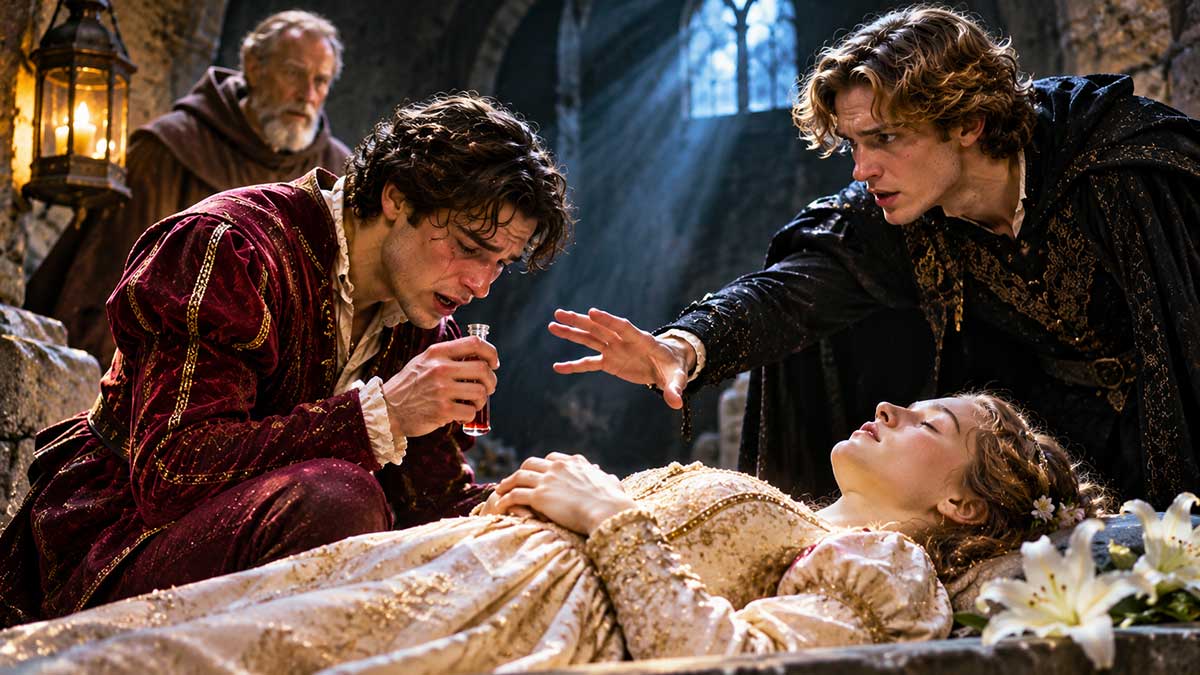
ACT IV, SCENE ONE
The Night of False Death
Setting: Friar Lawrence's cell, the Capulet residence, and the streets of Verona.
Time: Wednesday, the day before Juliet's proposed wedding to Count Paris, continuing through the night.
Characters: JULIET, ROMEO, HAMLET, HORATIO, OPHELIA, FRIAR LAWRENCE, LORD CAPULET, LADY CAPULET, THE NURSE, COUNT PARIS, THE ROYAL ENVOY, and SERVANTS.
The Silence of the Prince
[Morning. Friar Lawrence's cell. A candle burns low beside a table of herbs and parchment. HAMLET stands near the window. HORATIO enters, his cloak damp from the morning mist.]
HAMLET
What word from Prince Escalus?
HORATIO
None.
HAMLET
None?
HORATIO
I waited at his outer gate
Until the guards changed watch.
The clerk affirmed our petition was received,
Yet knew not why no answer had arrived.
HAMLET
A curious silence.
HORATIO
More curious still, the messenger
Sent from the palace yesternight
Hath not returned unto his post.
HAMLET
Then something hath delayed him.
HORATIO
Or someone.
[FRIAR LAWRENCE enters carrying a small sealed vessel.]
FRIAR LAWRENCE
The wedding stands for tomorrow.
Lord Capulet hath ordered every bell
To ring before the morning service.
HAMLET
Then we must seek the Prince ourselves.
HORATIO
His court is closed until noon.
The guards refuse all private audience.
HAMLET
A royal door may close against a petitioner,
Yet not against the truth.
FRIAR LAWRENCE
Take heed, Hamlet.
The Envoy hath men upon the streets.
If thou art seized before the witness comes,
Our cause may perish with thy freedom.
HAMLET
And if we wait, Juliet's freedom perishes.
[OPHELIA enters with JULIET.]
OPHELIA
The Capulet household prepares the wedding.
Juliet hath been commanded
To receive Count Paris this afternoon.
JULIET
My father hath ordered the bridal garments laid
Upon my bed.
He speaks of my future
As though I had no voice within it.
HAMLET
We have not abandoned thy petition.
JULIET
Yet the Prince hath given no reply.
HORATIO
None hath reached us.
JULIET
Then I must choose before the day is spent.
[Her gaze falls upon the sealed vessel in the Friar's hand.]
JULIET
Father, is that the draught?
FRIAR LAWRENCE
It is.
OPHELIA
Juliet...
JULIET
I know the danger.
FRIAR LAWRENCE
Thou knowest but a portion of it.
The body may appear dead,
Yet the mind may wake before the limbs obey.
There may be darkness, cold, and fearful dreams.
JULIET
I fear them all.
HAMLET
Then do not mistake fear for cowardice.
No honor is lost by refusing such a trial.
JULIET
And no freedom is gained
By surrendering my life unto another's will.
[She turns to the Friar.]
JULIET
If I take the draught,
How long before I wake?
FRIAR LAWRENCE
Near two days from the hour it is swallowed.
Yet I cannot promise the exact minute.
HORATIO
Then we must reckon every hour
And place trustworthy watchers near the tomb.
OPHELIA
I shall remain with her
Until the household retires.
HAMLET
Romeo must be told in person.
JULIET
He would forbid me.
HAMLET
He would fear for thee.
There is a difference.
[JULIET lowers her eyes.]
JULIET
Then tell him truly.
HAMLET
I will.
The Lovers' Last Meeting Before the Sleep
[Afternoon. A secluded courtyard beside the monastery. ROMEO enters hurriedly. JULIET waits beneath a fig tree, accompanied by OPHELIA. HAMLET stands at a distance.]
ROMEO
Juliet!
[He takes her hands.]
ROMEO
Hamlet hath told me of thy purpose.
I beg thee, choose another course.
JULIET
What course remains?
ROMEO
We may depart Verona together.
My kin have friends beyond the mountains.
JULIET
And my father would pursue us.
The Prince's law would be drawn
Into our families' quarrel.
ROMEO
Then let it be drawn.
I would rather face the anger of a hundred men
Than see thee carried to a tomb.
JULIET
And I would rather wake from a brief sleep
Than live a lifetime as another man's possession.
ROMEO
Thou speakest as though the draught were certain.
JULIET
Nothing is certain.
Not love, nor law, nor the kindness of fathers.
Yet I must choose the danger
I can bear with mine own conscience.
[ROMEO turns toward HAMLET.]
ROMEO
Thou hast counseled me against rashness.
Wilt thou now permit her this?
HAMLET
I would prevent it if a safer road lay open.
ROMEO
Then find one.
HAMLET
We have petitioned the Prince.
His answer hath been lost or withheld.
We shall seek him again before nightfall.
ROMEO
And if no answer comes?
[HAMLET is silent.]
JULIET
Then the choice is mine.
[ROMEO looks at her for a long moment.]
ROMEO
I love thee too deeply
To make my fear another chain about thy wrists.
Yet promise me this:
If thou dost drink, let no man keep me ignorant
Of where thou liest and when thou wakest.
JULIET
I promise.
ROMEO
And I promise thee
That no report of death shall turn my hand
Against the life thou wouldst return to.
[HAMLET looks sharply at him.]
HAMLET
Hold fast to that oath.
ROMEO
I will.
[ROMEO draws JULIET close.]
ROMEO
When thou wakest,
Let the first face thou beholdest be mine.
JULIET
Then be there.
[They embrace.]
The Two Letters
[Evening. Friar Lawrence's cell. HORATIO writes at a table. HAMLET stands beside him.]
HORATIO
One letter for Romeo,
One for the chapel keeper,
And a third for Prince Escalus.
HAMLET
Write plainly.
No riddle, no poetic turn.
The hour of the draught,
The place of her burial,
And the hour we expect her waking.
HORATIO
I have done so.
HAMLET
Then seal them separately.
[FRIAR LAWRENCE enters.]
FRIAR LAWRENCE
My brother John shall carry one
Unto Romeo's lodging.
HAMLET
And the others?
HORATIO
I shall deliver the Prince's copy myself.
The chapel keeper shall receive his
Before the household funeral.
HAMLET
Good.
[A knock sounds. A SERVANT enters.]
SERVANT
My lord, a message from Padua.
[HAMLET takes the letter.]
HAMLET
The apprentice hath departed Mantua
Under escort of the Prince's men.
He may reach Verona tomorrow.
HORATIO
Then our witness comes at last.
HAMLET
And Claudius's agent knows it.
[He folds the letter.]
HAMLET
I must meet the escort beyond the eastern gate.
If the Envoy hath laid an ambush,
The witness must not enter unguarded.
HORATIO
Then I go with thee.
HAMLET
Nay. Remain here.
Juliet's safety rests upon these letters.
[HAMLET turns to the Friar.]
HAMLET
Guard her well.
FRIAR LAWRENCE
With all the care my conscience owes her.
[HAMLET departs.]
The Bridal Chamber
[Night. JULIET's chamber in the Capulet residence. A wedding gown hangs beside the bed. The NURSE folds linen garments. JULIET stands at the window.]
NURSE
My lady, thy father hath ordered
That thou rest before the wedding.
JULIET
Then leave me to my rest.
NURSE
Thou art pale.
JULIET
I have had little sleep.
NURSE
Wouldst thou have me remain?
JULIET
Nay, dear Nurse.
Thou hast watched over me since childhood.
Let this night be mine alone.
[The NURSE embraces her.]
NURSE
God keep thee, my sweet child.
[She departs.]
[JULIET waits until the footsteps fade. She removes the small vessel from beneath her cloak and places it upon the table.]
JULIET
A little glass,
And in thy narrow compass lies
The semblance of a grave.
What if the Friar hath misjudged his art?
What if I wake beneath the stone
Before my friends can reach me?
[She takes a breath.]
JULIET
What if the darkness hath no ending?
[She looks toward the wedding gown.]
JULIET
Yet what is life,
If every day must be surrendered
To another's command?
[She lifts the vessel.]
JULIET
Romeo, I do not drink for death.
I drink that we may live.
[She drinks.]
[For a moment nothing happens. She places the empty vessel beneath a folded cloth and moves toward the bed. Her steps grow uncertain.]
JULIET
The room grows strange.
[She sinks onto the bed.]
JULIET
Romeo...
[Her eyes close. The candle burns beside her motionless form.]
The Hidden Poison
[A passage outside Juliet's chamber. THE ROYAL ENVOY stands with a SERVANT.]
SERVANT
The household sleeps.
ROYAL ENVOY
And the lady?
SERVANT
She hath taken the Friar's draught.
ROYAL ENVOY
Then the play begins.
[He produces a small glass vial, wrapped in dark silk.]
ROYAL ENVOY
Place this within her chamber,
Beneath the folded burial linen
Prepared for the household rites.
SERVANT
Why there?
ROYAL ENVOY
The women who dress her for the tomb
Will carry her chosen garments and tokens.
Let this pass with them unnoticed.
SERVANT
And if it be discovered?
ROYAL ENVOY
Then it may be taken for a physician's medicine.
No one need know its true purpose.
[The servant hesitates.]
SERVANT
My lord, the lady is innocent.
ROYAL ENVOY
Innocence hath never stayed the hand
Of those who govern kingdoms.
[He presses the vial into the servant's hand.]
ROYAL ENVOY
Do as thou art commanded.
[The servant enters Juliet's chamber.]
[The Envoy remains in the passage, listening.]
ROYAL ENVOY
Hamlet seeks a witness.
Romeo seeks a bride.
Let each find a grave instead.
The Morning Cry
[Before dawn. JULIET's chamber. The NURSE enters carrying a candle.]
NURSE
My lady?
[She approaches the bed.]
NURSE
Juliet, the morning comes.
[She touches JULIET's hand.]
NURSE
O heaven!
[She draws back.]
NURSE
My child!
My sweet child!
[LADY CAPULET rushes in, followed by LORD CAPULET and SERVANTS.]
LADY CAPULET
What cries are these?
NURSE
She wakes not!
[LADY CAPULET kneels beside JULIET.]
LADY CAPULET
Juliet?
[She feels for breath.]
LADY CAPULET
No...
[LORD CAPULET approaches slowly.]
LORD CAPULET
Daughter?
[He takes her hand.]
LORD CAPULET
Speak to me.
[Silence.]
LORD CAPULET
I commanded thee to marry,
Yet never meant to lose thee.
[He falls to his knees.]
LORD CAPULET
O cruel father,
Who thought obedience dearer than thy smile.
[LADY CAPULET weeps. The NURSE embraces JULIET's motionless body.]
[The chapel bells begin to toll.]
The False Report
[A street near Romeo's lodging. THE ROYAL ENVOY speaks with a young MESSENGER.]
ROYAL ENVOY
Take this word to Romeo Montague.
MESSENGER
What word, my lord?
ROYAL ENVOY
That Juliet Capulet was found dead
Within her chamber at the break of day.
MESSENGER
Is it true?
ROYAL ENVOY
The household mourns.
The bells proclaim it.
MESSENGER
Then I shall go.
ROYAL ENVOY
Speak of no sleeping draught.
Speak only what the city believes.
[The Messenger departs.]
[The Envoy watches him disappear.]
ROYAL ENVOY
And let grief complete
What deception hath begun.
[He turns toward the distant towers of Verona.]
ROYAL ENVOY
The Prince of Denmark may gather all his proofs,
Yet truth is slow,
And sorrow runs before it.
[The bells continue to toll as the stage darkens.]
CURTAIN.
END OF ACT IV, SCENE ONE
ACT V: The Prince's Final Reckoning
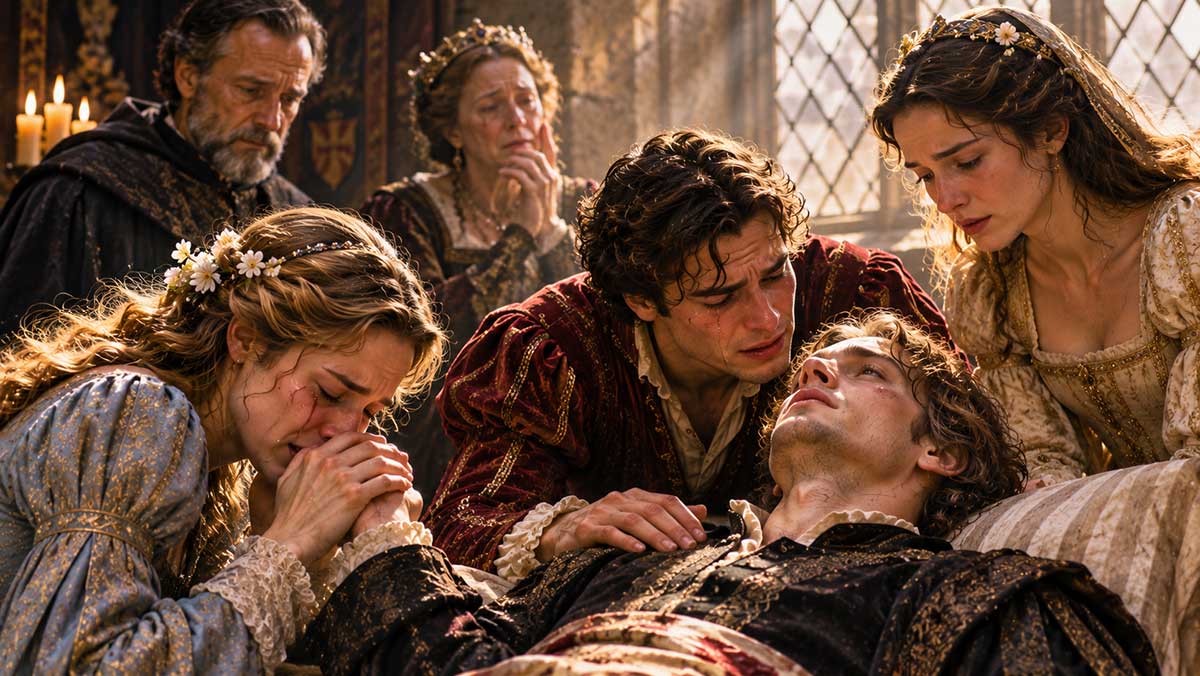
ACT V, SCENE ONE
The Trial of the King
Setting: The Great Council Chamber at Elsinore Castle, Denmark.
Time: The morning following Hamlet's return.
Characters: HAMLET, CLAUDIUS, GERTRUDE, HORATIO, OPHELIA, ROMEO, JULIET, LAERTES, POLONIUS, THE ROYAL ENVOY, THE CHANCELLOR, A COURT CLERK, A MASTER OF ARMS, and GUARDS.
The Council Assembles
[The Great Council Chamber. Tall windows admit the pale morning light. The royal throne stands upon a raised platform. Beneath it, a long table has been prepared for the Chancellor and members of the Council.]
[CLAUDIUS sits upon the throne. GERTRUDE stands beside him. POLONIUS and LAERTES occupy places near the court. The ROYAL ENVOY waits beneath a shadowed arch.]
[The CHANCELLOR rises.]
CHANCELLOR
Let every man within this chamber
Remember where he stands.
Here accusation shall be heard,
And answer given in its turn.
Neither royal birth nor private grievance
May determine what is true.
[The doors open. HAMLET enters with HORATIO, OPHELIA, ROMEO, and JULIET.]
CLAUDIUS
Welcome home, dear nephew.
Thy travels have been long,
And thy return hath stirred
More wonder than rejoicing.
HAMLET
I come not seeking wonder, uncle.
I come seeking judgment.
CLAUDIUS
Upon whom?
HAMLET
Upon the man who murdered my father.
[A murmur passes through the chamber.]
CHANCELLOR
Prince Hamlet, thy accusation
Is grave beyond ordinary measure.
Wilt thou submit thy evidence
To the examination of this Council?
HAMLET
I will.
CHANCELLOR
Then lay aside thy sword.
[HAMLET removes his sword and gives it to a guard.]
HAMLET
Gladly.
[CLAUDIUS watches the gesture with guarded suspicion.]
The Papers of Verona
[HORATIO approaches the Council table and places several sealed documents before the CHANCELLOR.]
HORATIO
These are certified copies
Of the merchant records examined in Verona,
Attested by Prince Escalus and his officers.
The original accounts remain
Under the protection of that court.
CHANCELLOR
What do they establish?
HORATIO
That money from the household
Of Denmark's Prince Regent
Passed through Bellandi's merchants
Unto the physician Pietro Velluti.
A vessel was thereafter conveyed
From Italy to Elsinore,
Three days before King Hamlet's death.
CLAUDIUS
A payment from the royal household
Proves no murder.
Medicines are purchased
For princes and servants alike.
HORATIO
That is true.
CLAUDIUS
Then why is it spoken here
As though it were a confession?
HAMLET
It is spoken as evidence,
Not confession.
CLAUDIUS
A distinction thy friends
Would do well to observe.
CHANCELLOR
And this cipher?
HORATIO
It joins the divided payments
To the Privy Household of the Prince Regent.
CLAUDIUS
An office employing many clerks,
Couriers, and physicians.
Wouldst thou accuse every man
Who once received my wages?
HAMLET
Nay.
I accuse the man who gave the order.
CLAUDIUS
Then produce that order.
[A silence.]
HAMLET
We have reason to believe
That an instruction bearing the royal seal
Was retained by thy Envoy.
[The Envoy stiffens.]
CLAUDIUS
Reason to believe?
HAMLET
The steward Lorenzo saw its fold and seal.
He heard the Envoy speak
Of instructions kept from ordinary clerks.
CLAUDIUS
A steward's recollection of folded parchment
Is a frail foundation for treason.
CHANCELLOR
The objection is entered.
The Council will require
The Envoy's account of that instruction.
The Envoy's Defense
CHANCELLOR
Step forward.
[THE ROYAL ENVOY approaches.]
CHANCELLOR
Didst thou commission a preparation
From Pietro Velluti?
ROYAL ENVOY
I carried a request for medicine.
CHANCELLOR
For whom?
ROYAL ENVOY
For the royal household.
CHANCELLOR
And the substance killed
A creature during its preparation?
ROYAL ENVOY
So the apprentice claims.
I did not observe the trial
Of which he speaks.
HORATIO
He identified thee before Prince Escalus.
ROYAL ENVOY
A frightened apprentice,
Coached by men who seek my master's ruin.
JULIET
And who coached the servant
Who placed another vial
Within my burial garments?
[The Envoy turns toward her.]
ROYAL ENVOY
I know nothing of thy garments.
JULIET
The vessel bore thy falcon.
It was found sealed among my funeral possessions,
And examined under Verona's law.
ROYAL ENVOY
Many craftsmen employ such devices.
JULIET
Then let the Council compare its mark
With the seal thou carriest.
[The CHANCELLOR gestures to a guard.]
CHANCELLOR
The Envoy's ring.
[The Envoy hesitates, then removes it. A clerk makes an impression in wax beside the certified drawing of the vial's seal.]
COURT CLERK
The device agrees in form,
Though its use upon the vessel
Cannot be established by likeness alone.
CHANCELLOR
So recorded.
CLAUDIUS
A falcon upon wax!
Will Denmark condemn her king
Upon the ornament of a servant's ring?
JULIET
Nay, Your Majesty.
But neither should Denmark
Refuse to examine what that ring may signify.
[GERTRUDE studies JULIET with growing respect.]
The Queen's Question
GERTRUDE
My lord husband,
I would ask thee something.
CLAUDIUS
Before the Council?
GERTRUDE
Aye.
When my former husband fell ill,
Thou didst attend him
In the hours before his death.
Didst thou know of this vessel
Delivered from Italy?
CLAUDIUS
I knew medicines were obtained.
GERTRUDE
Didst thou order them?
CLAUDIUS
I authorized the household
To procure whatever might be needed.
GERTRUDE
That is not what I asked.
[CLAUDIUS looks sharply at her.]
GERTRUDE
Didst thou command the purchase
From Pietro Velluti?
CLAUDIUS
I recall no such command.
GERTRUDE
Then let the accounts be opened,
And every servant questioned.
If thou art innocent,
The truth may defend thee better
Than anger at those who seek it.
[CLAUDIUS rises.]
CLAUDIUS
Am I now to be examined
By mine own queen?
GERTRUDE
Thou art being examined
By the kingdom thou hast sworn to serve.
[A tense silence.]
Ophelia's Testimony
CHANCELLOR
Lady Ophelia, step forward.
[OPHELIA approaches. POLONIUS watches anxiously.]
CHANCELLOR
Thou didst accompany Prince Hamlet
Through Italy and into Denmark?
OPHELIA
I did.
CHANCELLOR
Of thine own will?
OPHELIA
Entirely.
POLONIUS
My daughter, thou needst not answer
Every question placed before thee.
OPHELIA
Father, I have come to speak.
I would not have another man
Choose which words are mine.
[POLONIUS falls silent.]
CHANCELLOR
What didst thou discover?
OPHELIA
The divided payments shared
A repeating cipher.
Their sums appeared unrelated
Until the merchant's key was applied.
I examined the entries
Before we knew their final meaning.
CHANCELLOR
Did Hamlet direct thee
What conclusion to reach?
OPHELIA
Nay.
He questioned my conclusion
Until the records answered for themselves.
CLAUDIUS
A touching account
Of the Prince's devotion to truth.
Yet affection may blind
The cleverest of witnesses.
OPHELIA
It may.
That is why I ask the Council
To examine the papers,
Not merely to believe my words.
[LAERTES steps forward.]
LAERTES
My sister's testimony is her own.
I have spoken with her
Concerning her journey.
She neither seeks reward
Nor acts beneath Hamlet's command.
CLAUDIUS
Thou wouldst defend Hamlet now?
LAERTES
I defend her right
To tell what she hath seen.
The King's Countercharge
[CLAUDIUS descends from the throne and faces the Council.]
CLAUDIUS
Hear me, lords of Denmark.
My brother died,
And I mourned him.
The kingdom stood uncertain.
Foreign enemies watched our borders,
And the court required a steady hand.
I took the crown
When duty placed it before me.
Now my nephew returns
From foreign lands with strangers,
Merchant accounts, and tales of poison.
He asks you to believe
That I murdered the brother I loved
And stole the throne I was called to guard.
What proof hath he given
That my hand commanded death?
[The chamber remains silent.]
CLAUDIUS
None.
He hath given suspicion,
And called it certainty.
HAMLET
I have not called it certainty.
CLAUDIUS
Then withdraw thy charge.
HAMLET
I cannot.
CLAUDIUS
Thou wouldst stain my name
Without proof enough to condemn me?
HAMLET
I would submit the evidence
To men whose duty is to judge it.
CLAUDIUS
And if they find me innocent?
HAMLET
Then I must bear their judgment,
Though my heart resist it.
[CLAUDIUS is momentarily unsettled by the answer.]
HAMLET
But if they find thee guilty,
Thou must bear it too.
The Chancellor's Order
[The CHANCELLOR rises.]
CHANCELLOR
The Council hath heard sufficient
To require further inquiry.
The accounts of the royal household
Will be examined.
The Envoy's movements and correspondence
Will be placed before the court.
The certified evidence from Verona
Will be preserved,
And the original records requested
Should any dispute require their inspection.
[He turns to the Envoy.]
CHANCELLOR
Thou art forbidden to depart Elsinore
Until the inquiry is complete.
Thy private correspondence
And any documents concerning the Italian mission
Must be surrendered to the court.
ROYAL ENVOY
My lord, I serve the King.
CHANCELLOR
Then thou hast every reason
To assist his vindication.
[The Envoy bows reluctantly.]
CHANCELLOR
No verdict is rendered this day.
The Crown remains in the King's keeping
Under the laws of Denmark.
Yet no royal command may obstruct
The Council's examination.
[CLAUDIUS returns slowly to the throne.]
CLAUDIUS
I welcome the inquiry.
Let every hidden accusation
Be brought into the light.
The Friendly Contest
[A moment passes. CLAUDIUS changes his manner.]
CLAUDIUS
Yet Denmark must not be governed
By suspicion alone.
Prince Hamlet, Laertes,
You were once companions in youth.
Would it not serve the court
To see you meet in honorable sport,
And show that disagreement
Need not become a feud?
LAERTES
I bear Hamlet no private hatred.
HAMLET
Nor I thee.
CLAUDIUS
Then let a fencing contest
Be held tomorrow in the great hall.
A friendly trial of skill,
With blunted blades
And the Master of Arms attending.
CHANCELLOR
Provided the weapons be examined,
And no man be compelled to participate,
The Council raises no objection.
HAMLET
I will meet Laertes.
LAERTES
And I will meet thee fairly.
[The MASTER OF ARMS bows.]
MASTER OF ARMS
I shall inspect the weapons myself.
[CLAUDIUS smiles.]
CLAUDIUS
Then let the court remember
That Denmark is yet capable of peace.
A Warning After Judgment
[The Council disperses. HAMLET stands with HORATIO, ROMEO, JULIET, and OPHELIA near the chamber doors.]
HORATIO
The Chancellor hath acted wisely.
The evidence remains under lawful protection.
ROMEO
Yet the King hath turned accusation
Into a public contest.
JULIET
He seeks to make tomorrow
Appear a celebration.
OPHELIA
And the Envoy remains within his reach.
HAMLET
Then we must watch both.
HORATIO
I shall speak with the Master of Arms
Before the contest begins.
ROMEO
And I will stand near the weapons.
JULIET
I will watch the Envoy.
[HAMLET looks at them.]
HAMLET
You have risked enough for me.
ROMEO
Thou didst stand beside me
When grief made me dangerous to myself.
Do not now deny me
The right to stand beside thee.
[HAMLET clasps his hand.]
HAMLET
Then we stand together.
[Across the chamber, CLAUDIUS speaks quietly to the ROYAL ENVOY.]
CLAUDIUS
The Council seeks thy papers.
ROYAL ENVOY
They shall find none.
CLAUDIUS
See that they do not.
And tomorrow,
When the court looks upon a friendly contest,
Let one blade carry
What accusation could not accomplish.
[The Envoy looks toward HAMLET.]
ROYAL ENVOY
Laertes hath refused thy counsel.
CLAUDIUS
Then Laertes need know nothing.
[The King turns away.]
[At the far end of the chamber, HAMLET and his companions depart together.]
CURTAIN.
END OF ACT V, SCENE ONE
EPILOGUE: Where Hope Doth Bloom Anew

Spoken by Horatio
Six years after Hamlet's death. The garden beside the school in Verona. The children have gone inside, and the afternoon light rests upon the memorial to HAMLET, PRINCE OF DENMARK.
HORATIO remains alone beside the fountain, holding the book he has written.
HORATIO
And so the story returns to a garden.
Not the garden where a young man climbed a wall to speak with the woman he loved.
Not the garden of Elsinore, where a king's death concealed a terrible crime.
This is a different garden.
Here, children play beneath the names that once divided their fathers.
Here, a daughter of Romeo and Juliet may ask why two families hated one another, and receive an answer that no longer demands she inherit their quarrel.
Here stands a memorial to a prince who never lived to see what his choices made possible.
Hamlet is buried in Denmark.
Yet I sometimes think a portion of him remains in this place.
I hear him in the questions the children ask.
I see him in the patience of a teacher who allows a frightened pupil to speak.
I recognize him in the difficult silence between two men who have every reason to remember an injury, yet choose not to pass it to their children.
He would have been surprised to find himself remembered in such ways.
For much of his life, Hamlet believed that the greatest task before him was to discover the truth about his father's death.
He pursued that truth across countries, through ledgers and testimonies, through threats and deception.
He was right to seek it.
A murdered king deserved justice. A kingdom deserved to know whether its ruler had betrayed the trust placed in him.
But the search taught Hamlet something he had not expected.
Justice and vengeance are not the same.
The first asks what is true, what is owed, and what may be done to protect the living.
The second may begin with those same questions, yet can become so consumed by punishment that it forgets everyone it was meant to defend.
Hamlet struggled to distinguish them.
I watched him struggle.
I saw anger return to him when he believed he had overcome it. I heard him question whether restraint was courage or merely fear.
He was not a man without darkness.
He was a man who tried, again and again, to prevent that darkness from deciding everything.
In the end, he gave his life to save Romeo.
He did not know whether his father's murderer would be convicted. He did not know whether Denmark would change. He did not know whether the lovers whose friendship he treasured would live to grow old together.
He saw a blade approaching a friend.
And he chose.
There are those who might call such an ending another tragedy.
They would not be wrong.
Ophelia lost the future she had hoped to share with him.
His mother buried a son.
I lost the friend whose thoughts had accompanied my own since youth.
No school, no garden, no monument can give those years back to us.
We must never pretend that a noble death erases the sorrow it leaves behind.
Yet neither should we forget the lives that continued.
Romeo and Juliet lived.
Their love grew beyond the fever of its beginning. They learned the ordinary, demanding tenderness of marriage, parenthood, forgiveness, and shared responsibility.
Tybalt returned from exile bearing the name of the man he had killed, not as a trophy of victory, but as a burden he had finally learned to acknowledge.
The Capulets and Montagues discovered that peace required more than ending their quarrel. It required teaching their children a different way to live.
Ophelia built the school Hamlet had asked her to build.
And I wrote this book.
Not to make him flawless.
Not to persuade you that suffering always produces wisdom, or that every injustice can be repaired.
I wrote it so that those who come after us might recognize the moment before anger becomes action.
The moment before pride becomes a sentence.
The moment before a family teaches its children to hate.
And the moment when one person, uncertain and afraid, may still choose differently.
HORATIO looks toward the schoolhouse. Children's laughter is heard through the open windows.
HORATIO
I once believed my duty was to preserve the story of a prince.
Now I think my duty is to preserve the questions he left us.
What do we owe the dead?
What do we owe the living?
How may we seek justice without surrendering ourselves to cruelty?
And when love asks us to be brave, will we choose the courage to live for one another, rather than the glory of dying?
I cannot answer these questions for every generation.
Perhaps no one can.
But I have seen a child place a flower upon a stranger's memorial.
I have seen former enemies kneel together to set a stone beside a fountain.
I have seen two lovers, once surrounded by hatred, walk hand in hand into a school built for children who shall never be required to continue their fathers' quarrel.
These things are small when measured against the history of kingdoms.
Yet I have come to believe that the future is often changed by such small things.
HORATIO places his book beneath the memorial.
HORATIO
Good night, sweet friend.
I have told thy story as faithfully as memory allows.
There is much I wish I could ask thee.
Whether thou wouldst approve of these pages.
Whether thou wouldst laugh at the solemnity of thy memorial.
Whether thou wouldst find some fault in the lessons we have drawn from thy life.
I suspect thou wouldst question us all.
And I hope we would have the wisdom to listen.
He turns toward the audience.
HORATIO
The curtain falls upon this story.
Beyond it, children are beginning another.
May they inherit our knowledge without our hatred.
May they question the commands that would make cruelty a duty.
And may they learn, sooner than we did, that the courage to preserve a life can be greater than the courage to take one.
HORATIO walks slowly toward the open schoolhouse door.
The garden remains in the light. The fountain continues to flow.
CURTAIN.
END OF THE PLAY
Short Bios:
William Shakespeare (1564–1616): English playwright, poet, and actor, widely regarded as one of the most influential writers in literary history. His tragedies Hamlet and Romeo and Juliet explore revenge, love, family conflict, mortality, and the consequences of human choices. This imagined crossover brings characters from both plays together in a new story about justice, forgiveness, and the possibility of changing a tragic fate.
Hamlet: Prince of Denmark and the central character of Shakespeare's Hamlet. Intelligent, philosophical, and deeply troubled by his father's death, Hamlet struggles with the demands of revenge and the uncertainty of human judgment. In this reimagining, his encounter with Romeo and Juliet challenges him to seek justice without surrendering to vengeance.
Romeo Montague: A passionate young nobleman from Verona and one of the two central lovers in Shakespeare's Romeo and Juliet. His impulsiveness and intense devotion place him at the center of a deadly family feud. In this story, Hamlet's friendship encourages Romeo to discover a more patient and enduring form of love.
Juliet Capulet: A courageous young woman whose love for Romeo defies the bitter rivalry between their families. Shakespeare portrays her as emotionally perceptive, determined, and increasingly independent. In this adaptation, Juliet takes an active role in protecting her future and helping uncover the truth behind a royal murder.
Ophelia: Daughter of Polonius and a central figure in Shakespeare's Hamlet. In the original tragedy, she suffers under conflicting demands from her father, brother, and Hamlet. Here, Ophelia becomes an independent investigator and educator, demonstrating intellectual courage and a commitment to helping others.
Horatio: Hamlet's loyal friend and trusted confidant. In Shakespeare's original play, he survives to tell the prince's story. In this adaptation, Horatio serves as a witness, investigator, and narrator, giving voice to the Prologue and Epilogue.
King Claudius: Hamlet's uncle and the King of Denmark, whose secret murder of his brother sets Shakespeare's tragedy in motion. In this crossover, his guilt is investigated through financial records, witnesses, and a formal royal inquiry.
Queen Gertrude: Hamlet's mother and Queen of Denmark. Her marriage to Claudius creates a painful conflict with her son. This adaptation gives her a more active role in questioning the truth and supporting the search for justice.
Tybalt Capulet: Juliet's fiery cousin, fiercely devoted to his family's honor. His confrontation with Mercutio becomes a turning point in the story. Here, Tybalt is given an opportunity to confront the consequences of his violence and seek reconciliation.
Mercutio: Romeo's witty, outspoken friend, remembered for his humor, imagination, and sharp tongue. His death in Shakespeare's original tragedy helps propel Romeo toward revenge. In this adaptation, his memory becomes a lasting lesson about the cost of anger.
Laertes: Ophelia's brother and the son of Polonius. In Shakespeare's Hamlet, his desire to avenge his father parallels Hamlet's struggle. This version portrays him as a man learning to distinguish family loyalty from unquestioning obedience.
Polonius: A senior counselor in the Danish royal court and father of Ophelia and Laertes. Known for his elaborate advice and political caution, he represents the tension between parental authority and the independence of younger generations.
Friar Lawrence: A Franciscan friar in Verona who secretly assists Romeo and Juliet. His well-intentioned but dangerous plans play a central role in Shakespeare's original tragedy. In this adaptation, he remains a spiritual adviser whose decisions carry serious consequences.
Prince Escalus: The ruler of Verona, responsible for maintaining peace between the feuding Montague and Capulet families. In this story, he becomes a central figure in the effort to replace private revenge with lawful judgment.
Count Paris: A nobleman who seeks Juliet's hand in marriage. In Shakespeare's original play, he is a respectable suitor caught in circumstances he cannot fully comprehend. Here, he is portrayed with greater sympathy and concern for Juliet's wishes.
Lord and Lady Capulet: Juliet's parents and leading members of one of Verona's rival households. Their expectations place enormous pressure upon their daughter. Their eventual reconciliation with the Montagues reflects the possibility of changing deeply rooted family traditions.
Lord and Lady Montague: Romeo's parents and members of the family opposed to the Capulets. Their concern for their son and participation in the longstanding feud reveal how inherited conflicts can shape the lives of younger generations.
The Royal Envoy: An original character created for this adaptation. Serving Claudius, he becomes involved in the secret transactions surrounding King Hamlet's death and the attempts to conceal the evidence.
Lucia Montague: An original character created for this adaptation, the young daughter of Romeo and Juliet. Appearing in the final scene, Lucia represents a generation free to question the prejudices and rivalries of its ancestors.
About This Imaginary Adaptation
Hamlet, Romeo & Juliet: A Tragedy in Five Acts is an original fictional crossover inspired by characters and themes from William Shakespeare's Hamlet and Romeo and Juliet. The events, encounters, revised character destinies, and newly introduced characters are imaginative creations. This work is not an original Shakespeare play, a historical account, or a reconstruction of Shakespeare's intended story.
Leave a Reply