

Introduction
Have you ever had a coincidence so precise it felt like an answer?
Most of us have. A name that comes up three times in one day. A book that falls open to the exact page you needed. We usually shrug it off. Carl Jung didn’t. He gave those moments a name, synchronicity, and spent his life insisting they meant something.
Jung was a Swiss psychiatrist, Sigmund Freud’s chosen successor, and then the man who broke with him and went somewhere Freud refused to follow: into dreams, visions, myths, and the question of God. He gave us words we now use every day: introvert, extravert, archetype, the shadow. Millions of people who know their four-letter personality type are using an idea that began with him. And for decades he kept a secret: a huge illuminated book of his own visions, bound in red leather, which wasn’t published until 2009. The Philemon Foundation, which helped bring it to print, calls it the central work of his life.
So I went to meet him in the place he said he was most himself: the stone tower he built with his own hands at Bollingen, on the shore of Lake Zurich. No electricity, no running water. He chopped his own wood and cooked his own meals there for decades. I arrived on a late-spring morning, and before long I was splitting wood while he worked the pump, two men in their sixties and eighties talking as equals about the things that matter most.
We talk about the lonely boy who felt he was two people, and the forbidden thought about God that he called grace. About the thirteen-hour conversation that began his friendship with Freud, and the one line from Hamlet that ended it. About the years he went deliberately into the depths of his own mind, and the afternoon his house filled with the dead. About what the world did with his ideas, including the parts of his own life he’d rather not have examined. And about the 1944 vision that carried him a thousand miles above the Earth, and the famous answer he gave the BBC when asked whether he believed in God. You can watch that 1959 interview yourself.
Like every ImaginaryTalks episode, this conversation is sincere imagination, grounded in the historical record and in Jung’s own words, not a claim to channel anyone. But if you’ve ever felt there was more to you than the self that gets through the day, pull up a chair. The stove is lit, and he’s in a talkative mood.
(Note: This is an imaginary conversation, a creative exploration of an idea, and not a real speech or event.)
Topic 1: The Boy with Two Selves

A clear late-spring morning at Bollingen, on the upper shore of Lake Zurich. Smoke from a neighbor’s chimney drifts over the water. Beside a round stone tower, an old man in shirtsleeves and a canvas apron is splitting wood. He hears footsteps on the path, sets the axe in the block, and turns.
Carl Jung: Mr. Sasaki. You found it. Most people get lost at the railway crossing.
Nick Sasaki: I nearly did. A farmer pointed me down the lane.
Carl Jung: He points everyone down the lane. He thinks I’m a retired stonemason with odd friends. He isn’t entirely wrong. (He offers his hand.) I’ll be honest with you. The dead have been talking about you.
Nick Sasaki: That’s not a sentence I hear every day.
Carl Jung: Here you’ll hear it before lunch. The Corsican says you ask good questions and then actually wait for the answers. And an old Florentine says you noticed what he was really painting. I’ve been curious to meet the man who gets those two to agree on anything.
Nick Sasaki: Then I’m in good company this morning. May I?
He nods at the axe. Jung raises an eyebrow, then steps aside. Nick takes a log, sets it, and splits it cleanly.
Carl Jung: Ha. You’ve done that before.
Nick Sasaki: Not as often as I should. Finish your pump. I’ll finish your pile.
Jung walks to the iron pump by the wall and begins working the handle. Water splashes into a bucket. The two men work side by side for a moment in the quiet.
Carl Jung: So. What brings you to a tower with no electricity?
Nick Sasaki: There are millions of people searching for something their careers and their routines didn’t give them. Most of them will never sit at your table. I wanted to ask the questions they’d ask.
Carl Jung: Millions. (He shakes his head.) In my day it was a handful of patients and a few hundred readers who mostly disliked me. Very well. Ask.
Nick Sasaki: I’ll start with something I’ve noticed myself. I’ve had a lot of small synchronicities over the years. Nothing on your scale. But I’ve come to think the small ones matter more than the big ones.
Carl Jung: (Stops pumping.) Why?
Nick Sasaki: Because they only come when you’re paying attention. A big one knocks you over whether you’re ready or not. A small one waits to see if you’ll notice.
Carl Jung: Hm. That’s good. That’s very good.
Nick Sasaki: And I’ll tell you something else. I think the beetle gets too much credit in your famous story.
Carl Jung: (Laughing.) The scarab? Everyone loves the scarab.
Nick Sasaki: Everyone loves the beetle. But you were sitting with your back to the window, with a patient who was stuck. You heard tapping. Most people would have ignored it, or swatted it. You got up and opened the window. That was the moment.
Carl Jung: (Quietly, wiping his hands on his apron.) You know, I’ve told that story for thirty years, and nobody has ever said that to me. She was a very rational woman, highly educated, locked inside her own cleverness. She’d dreamed someone gave her a golden scarab. While she was telling me the dream, something kept knocking at the glass. I turned, opened the window, and caught it in the air. A rose-chafer, gold and green. The closest thing to a scarab you’ll find in Switzerland. I put it in her hand and said, “Here is your scarab.”
Nick Sasaki: And something broke open.
Carl Jung: Her armor broke open. After that, the work could begin. But you’re right. If I’d been too busy being the doctor, I’d have missed it. (He looks at Nick.) And your small ones? What did they feel like?
Nick Sasaki: Like a door left slightly open. That’s all I’ll say about them.
Carl Jung: That’s enough. People who tell you everything about their small miracles usually haven’t had any.
Nick sets down the axe and stacks the split logs against the wall.
Nick Sasaki: Let me tell you what I’ve always felt about people. There’s an outer self that gets through the day. Pays the bills, shakes hands, answers emails. And there’s an inner self that knows things the outer one doesn’t. Most people spend their whole lives pretending the second one isn’t there. You named it when you were a boy.
Carl Jung: Number One and Number Two. (He smiles.) I thought I’d invented a great secret. Later I found out half the poets in Europe had the same problem.
Nick Sasaki: How did they live together, in one child?
Carl Jung: Badly, at first. Number One was a schoolboy in Basel. Not very good at mathematics, sometimes in trouble, sometimes bullied, a bit clumsy. Number Two was much older. I felt he belonged to another century. He was close to nature, to the night, to dreams, to whatever God was doing in me directly. He didn’t care about school at all.
Nick Sasaki: Where did he show up?
Carl Jung: (Points toward the woods.) On a stone. At home there was a big stone jutting out of a garden wall. I used to sit on it for hours and play a game. I’d think, “I am sitting on this stone.” And then I’d think, “But maybe I’m the stone, and he is sitting on me.” And I could never quite decide. Strangely, it calmed me. Whenever I was miserable, I’d think of being the stone, and the trouble went away. The stone had no troubles.
Nick Sasaki: And the little wooden man in the attic?
Carl Jung: (Laughs, embarrassed.) You’ve done your homework. I was about ten. I carved a little figure from the end of a wooden ruler, gave him a frock coat and a top hat, colored him black with ink, and sawed him off. I made him a bed in my pencil case, and gave him a smooth stone from the Rhine that I’d painted. Then I hid the whole thing on a beam in the attic, where nobody ever went.
Nick Sasaki: Why hide him?
Carl Jung: Because he was mine. Whenever things were bad at home, or at school, I’d think about him up there, safe, and I’d feel safe too. Sometimes I’d climb up and leave him a little scroll of paper written in a secret language I’d made up. It was the climax of my childhood, that little man. I told no one for decades. Not my parents, not my wife. I was in my sixties before I understood what it was.
Nick Sasaki: Which was?
Carl Jung: A little god. A guardian. A boy doesn’t know about the ancient household gods hidden in shrines, but he makes one anyway. That was my first proof that these images don’t come from books. They come from somewhere deeper.
Jung lifts the full bucket and sets it by the door. Nick picks up a second bucket and fills it at the pump himself.
Nick Sasaki: I want to push on something. When you were twelve, you were walking past the cathedral in Basel on a sunny day. And a thought started to come, about God, that you knew was forbidden.
Carl Jung: (The smile fades.) You’ve done your homework.
Nick Sasaki: You fought it for days. You couldn’t sleep. And when you finally let the thought come, you saw God on His throne above the world, destroying His own cathedral. Most churches would call that blasphemy. Most people would have buried a thought like that out of fear. You called it grace.
Carl Jung: It was grace.
Nick Sasaki: How did you know? A twelve-year-old boy, a pastor’s son, with a father who preached in that world every Sunday. How did you know it wasn’t just a boy rebelling?
Carl Jung: (He sits on the edge of the stone bench by the door. A long pause.) That’s the right question. And I asked myself the same one for three days and three nights. I reasoned it through like a little theologian. If God is all-powerful, then He put this thought in front of me. He let Adam and Eve sin too. So perhaps He was testing me, to see whether I’d obey the church or obey Him. Those weren’t the same thing.
Nick Sasaki: And when you let it come?
Carl Jung: I felt an enormous relief. Instead of damnation, I felt light. As if God had said, “Good. You understand me better than your father does.” (He looks at his hands.) A rebellious boy feels triumph. I didn’t feel triumph. I felt terror, and then grace, and then a very heavy secret. I knew something about God that the people around me didn’t know, and couldn’t hear. A rebel wants to tell everyone. I told no one.
Nick Sasaki: That’s the difference, then. The rebel needs an audience.
Carl Jung: (Looks up at him.) Yes. Exactly. You’ve put it better than I did in two hundred pages.
Nick Sasaki: You also learned something harder that day.
Carl Jung: That God can be terrible. Yes. The relief came first, and then I understood that the God who would do that to His own cathedral wasn’t the gentle God of the hymns. He was something much larger. Much more dangerous. And much more alive.
A boat passes slowly on the lake. Jung watches it go.
Nick Sasaki: Let me tell you where I stand, and then I’ll ask you something. For me, the spiritual journey has never been about institutions. It’s been about direct experience. What happens between a person and God when nobody’s watching.
Carl Jung: Then we’re from the same village.
Nick Sasaki: Your father was a pastor. You felt he preached a faith he no longer felt. Do you think a person can carry faith for others while losing it himself? Is that what happened to him?
Carl Jung: (Very quietly.) Yes. I think it’s the loneliest thing that can happen to a man.
He stands and walks a few steps toward the water, then turns back.
Carl Jung: He was a good man. Kind, generous with the poor, faithful to his duties. And he was suffering. I could feel it, even as a boy. When I asked him real questions, he’d say, “You always want to think. One ought not to think, but believe.” And I’d think, “No. One must experience. And then one knows.” But he couldn’t. When I took my first communion, I waited for something to happen. Nothing happened. Bread and wine. I looked at my father and understood that nothing had happened for him either, for a very long time.
Nick Sasaki: Did he know that you knew?
Carl Jung: I think so, near the end. He fell into terrible doubts. He’d argue with me about theology at the dinner table, and I’d see in his eyes that he wanted me to win, and couldn’t let me. He died when I was twenty-one. I’ve spent much of my life trying to answer the questions he was too frightened to ask.
Nick Sasaki: Then maybe you’ve been doing his work, too.
Carl Jung: (Long pause.) No one has said that to me either. (He clears his throat.) And you? Where did you find that direct experience of yours?
Nick Sasaki: (Smiles.) Some things are better lived than explained.
Carl Jung: (Laughs, warmly.) A Swiss answer. I respect that. Keep it.
Jung picks up an armful of logs. Nick takes the rest. They walk toward the tower door together.
Carl Jung: You know, I started building this tower two months after my mother died.
Nick Sasaki: I didn’t know that.
Carl Jung: Not many do. (He pushes the heavy door open with his shoulder.) Come in. The stove’s cold, and we have a great deal more to talk about. I warn you, I’m a better host when I’m fed.
They step inside, into the cool dark of the stone room.
Topic 2: The Father He Lost Twice
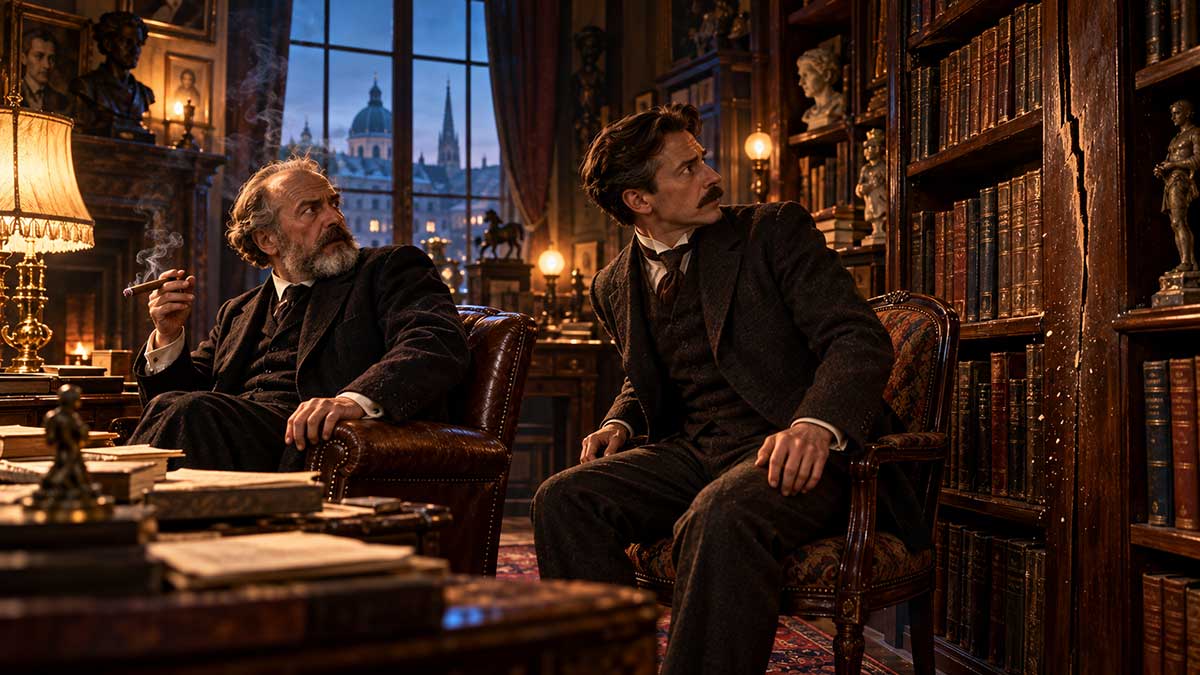
Inside the tower, the round room is cool and dim. Light falls through small deep windows onto rough stone walls. Jung kneels at the old iron stove, feeding kindling into it. Nick hands him split wood, piece by piece. A match flares.
Carl Jung: There. Now she’ll take an hour to decide whether she wants to cooperate. Like most women I’ve known, and most patients.
Nick Sasaki: And most ideas.
Carl Jung: (Laughs.) And most ideas. Sit, sit. There’s a chair that won’t collapse, and one that might. Take the first.
Nick sits. Jung fills a blackened kettle from the bucket and sets it on the stove.
Nick Sasaki: I’ve been thinking about your first meeting with Freud. You walked into his apartment in Vienna at one in the afternoon and talked for thirteen hours.
Carl Jung: Almost without stopping. Yes.
Nick Sasaki: I understand that. I’ve had a few conversations in my life that changed me, and not one of them ran on schedule. The important ones never do.
Carl Jung: No. The clock is for Number One. (He settles into the second chair, which creaks alarmingly.) His family kept bringing food in. I don’t remember eating any of it. He kept relighting his cigar. I’d read his book on dreams twice by then. The first time I put it aside because I wasn’t ready for it. The second time, it opened everything.
Nick Sasaki: What was he like, sitting across from you?
Carl Jung: Extraordinary. The first man of real importance I had ever met. Brilliant, sharp, funny, very certain. And yet I couldn’t make him out completely. Something in him stayed tangled. I went home dazzled, and a little uneasy, and I didn’t know why.
Nick Sasaki: Here’s what I see when I look at your life. Your father couldn’t answer your questions. So you went looking for a second father who could.
Carl Jung: (Silent for a moment.) That’s blunt.
Nick Sasaki: You prefer blunt.
Carl Jung: I do. And it’s true. I wrote to him afterward that my admiration for him had something of a religious crush in it. Imagine. A grown man, a doctor with a wife and children, writing that to another man. But it was true.
Nick Sasaki: What did he give you that no one else had?
Carl Jung: He listened. My father argued with me and wanted me to stop thinking. Freud wanted me to think more. He took the unconscious seriously when the whole of medicine laughed at it. And he chose me. He called me his successor, his crown prince. He said I was Joshua to his Moses, the one who would enter the promised land he’d never live to see.
Nick Sasaki: That’s a heavy crown.
Carl Jung: It was. And it was flattering, and I wore it gladly for a while. He needed me, too, you know. Everyone around him in Vienna was Jewish, and he feared psychoanalysis would be dismissed as a Jewish affair. A Swiss pastor’s son from a famous clinic gave it respectability. So there was love in it, and there was strategy in it. On both sides, if I’m honest.
The kettle begins to tick as it warms. Jung reaches up to a shelf and takes down a tin of coffee.
Nick Sasaki: Then I have to ask about the bookcase.
Carl Jung: (Groans good-naturedly.) Everyone asks about the bookcase.
Nick Sasaki: Because it’s a great story. You’re in his study in Vienna, 1909. You ask him about precognition and the paranormal, and he dismisses it. You feel your diaphragm go red-hot, there’s a loud crack from the bookcase, and you tell him there will be another one. And there is.
Carl Jung: That’s how it happened.
Nick Sasaki: Here’s my problem. Freud wrote to you about it that same month, and he wasn’t impressed. He noted the creaking kept going after you’d left. And you told your version fifty years later.
Carl Jung: (Sets down the coffee tin, interested.) You’ve read his letter.
Nick Sasaki: I’ve also told my own stories many times, over many years. And I know what happens. Memory polishes things. The edges get smoother, the timing gets better. So I’ll ask you plainly: did yours?
Carl Jung: (A long pause. Then he smiles.) You’re a dangerous man to have in the house. (He leans back.) Yes. Memory embroiders. I’m a psychiatrist; I’d be a fool to deny it. I may have the details wrong, where the bookcase stood, how many seconds passed. Fifty years is a long time.
Nick Sasaki: But?
Carl Jung: But I know what I felt. I know I said there would be another crack before it came. And I know I was certain. Freud stared at me as if I’d done something indecent. Whatever the bookcase was doing, something happened between us that day. He felt it too. That’s why he wrote the letter. A man doesn’t bother to explain away something that didn’t frighten him.
Nick Sasaki: That’s fair. I’ll accept the feeling, if you’ll accept the embroidery.
Carl Jung: (Laughs, offers his hand across the gap between the chairs.) Done. A fair trade.
They shake. The kettle begins to hiss. Jung spoons coffee into a pot.
Nick Sasaki: When did you know the friendship was in trouble?
Carl Jung: On the ship to America, the same year. We analyzed each other’s dreams to pass the time. He had a dream I could have interpreted much better if he’d told me something about his private life. So I asked. He looked at me with great suspicion, and he said he couldn’t. It would risk his authority.
Nick Sasaki: And at that moment?
Carl Jung: At that moment, he lost it. His authority, with me. He’d put his authority above the truth. I couldn’t follow a man who did that. I didn’t know it yet, but the end began on that ship.
Nick Sasaki: And then he fainted.
Carl Jung: (Surprised.) You know that too?
Nick Sasaki: Twice in your presence, as I understand it.
Carl Jung: Yes. The second time was in Munich, 1912, at a meeting. We were arguing about something, and suddenly he collapsed. I picked him up and carried him to a sofa. He weighed almost nothing. And as he came around, he looked up at me like a child looks at his father. (Jung pauses.) I’ve never forgotten that look. Everything turned upside down in a single moment.
Nick Sasaki: The son carrying the father.
Carl Jung: Yes.
He pours boiling water over the coffee. The smell fills the room.
Nick Sasaki: And then you published the book that broke you apart.
Carl Jung: I knew it would cost me his friendship when I was writing it. I said the libido wasn’t only sexual. I said religious images and myths come from something deeper in the psyche, something shared by all people. To him, that was heresy. He accused me of mysticism. I accused him of dogma. We were both partly right.
Nick Sasaki: How did it end?
Carl Jung: With letters. In early 1913 he wrote proposing we give up our personal relationship entirely. I wrote back accepting, and I ended with a line from Hamlet: “The rest is silence.”
Nick Sasaki: (Quietly.) I spent an evening at the Globe recently. With the man who wrote that line.
Carl Jung: (Turns, astonished.) You didn’t.
Nick Sasaki: I did. In the rain.
Carl Jung: (Shakes his head slowly, smiling.) Then you know better than I do what that line costs. Hamlet says it while he’s dying.
Nick Sasaki: And you said it while something was dying.
Carl Jung: Yes. (He hands Nick a cup.) Thirteen hours to begin. A few lines of ink to end.
They drink in silence for a moment. Outside, a bird calls over the lake.
Nick Sasaki: Let me tell you one of my deepest convictions, and then I’ll ask you about it. I believe forgiveness frees the person who forgives far more than the person who’s forgiven. You and Freud never reconciled. Have you forgiven him?
Carl Jung: (Stiffly.) There was nothing to forgive. We disagreed. Scientists disagree.
Nick Sasaki: That’s Number One talking.
Carl Jung: (Sharply.) Careful.
Nick Sasaki: I am being careful. That’s why I’m asking. You don’t carry a man to a sofa and remember his face for forty years because you disagreed about libido.
Jung sets his cup down on the stove’s edge. For a long moment, he says nothing.
Carl Jung: After the break, I fell into darkness. I lost my footing for years. I resigned my posts. Many friends left with him. People said I’d gone mad, or that I was a traitor. And yes, I was angry at him for a long time. Angry that he wouldn’t follow me. Angry that he needed me to be his son, when I needed to be myself.
Nick Sasaki: And now?
Carl Jung: Now? (He sighs.) When the Nazis came to Vienna in 1938, he had to flee to London, an old man, very ill. He died there the next year. I wrote a piece in his memory. I was fair, I think. I gave him his due. But I wasn’t warm. (Pause.) I could have been warm.
Nick Sasaki: It isn’t too late to be.
Carl Jung: Isn’t it? We’re both dead, Mr. Sasaki.
Nick Sasaki: You’re talking to me.
Carl Jung: (A short, surprised laugh.) That’s true. (He picks up his cup again, softer now.) Then I’ll say it here. I owe him a great deal. He opened the door to the unconscious. I only walked further through it than he wanted to go. If he forgave me, I’d be glad. And I suppose I’ve forgiven him, or I wouldn’t feel this now. (He looks at Nick.) And you? Have you ever had to leave a teacher you loved?
Nick Sasaki: I’ve learned that you can outgrow someone without betraying them. It’s never clean. But it doesn’t have to end in silence.
Carl Jung: (Nodding slowly.) No. It doesn’t. I wish I’d known that at thirty-seven.
He gets up and opens the stove door. The fire has caught properly now, orange light flickering across the stones. He adds a log.
Carl Jung: You know what’s strange? My first father couldn’t answer my questions. My second father wouldn’t let me ask them. (He closes the stove door.) So I had to go and find the answers myself. Down there. (He taps his chest.) That’s where I went next. And it nearly killed me.
Topic 3: Into the Depths
The fire is burning steadily now. Jung has pulled his chair closer to the stove. Steam curls from both cups. Through the small window, the lake glitters in the late-morning sun.
Carl Jung: You’ve heard about the visions, I suppose.
Nick Sasaki: Some. I’d rather hear it from you.
Carl Jung: (Nods, staring into the stove.) Autumn, 1913. I was on a train, alone, looking out of the window. And suddenly I saw a monstrous flood covering all the low lands of Europe, from the North Sea nearly to the Alps. Only Switzerland stayed dry, as if the mountains were holding it back. I saw yellow waves, the rubble of civilization floating in them, thousands of drowned bodies. And then the whole sea turned to blood.
Nick Sasaki: On an ordinary train.
Carl Jung: On an ordinary train, at an ordinary hour. It lasted about an hour. I felt sick. Two weeks later, it came again, stronger. And a voice said: look at it well, it is wholly real, and it will be so.
Nick Sasaki: What did you think it meant?
Carl Jung: I thought I was threatened by a psychosis. That was the only explanation a psychiatrist could accept. I spent months waiting to go mad. (He gives a short, dry laugh.) And then, in August 1914, the war broke out. And I understood that it hadn’t been about me alone.
Nick Sasaki: You were relieved.
Carl Jung: Relieved, and horrified at being relieved. Millions were about to die, and part of me was thinking, “Thank God, I’m not insane.” That’s the human soul for you. Not always pretty.
He reaches for the coffee pot and refills both cups.
Nick Sasaki: I’ll tell you what I believe, and you can tell me if I’m wrong. I believe some people are guided. And when I look at your life, it looks guided to me. A boy with a little man hidden in the attic, a student studying séances, a doctor who couldn’t stay with Freud. Every step seems to lead to the next door.
Carl Jung: It looks that way from the outside. From the inside, it felt like falling down a staircase in the dark.
Nick Sasaki: That’s what being guided feels like, most of the time.
Carl Jung: (Looks at him, then laughs.) Perhaps. Perhaps.
Nick Sasaki: So what actually happened, between 1913 and 1917?
Carl Jung: I decided to stop fighting it. Instead of running from the images, I’d go toward them. I’d sit at my desk in the evening and deliberately let myself drop down, as if into a deep pit. I wrote everything down: the landscapes, the figures, the conversations. Then I’d go back up and try to understand what I’d seen.
Nick Sasaki: Every evening?
Carl Jung: Many evenings, for years. I recorded it all in small black notebooks. Later I copied the most important parts into a big folio bound in red leather, with calligraphy and paintings, like a medieval monk. That took me until 1930.
Nick Sasaki: And Philemon.
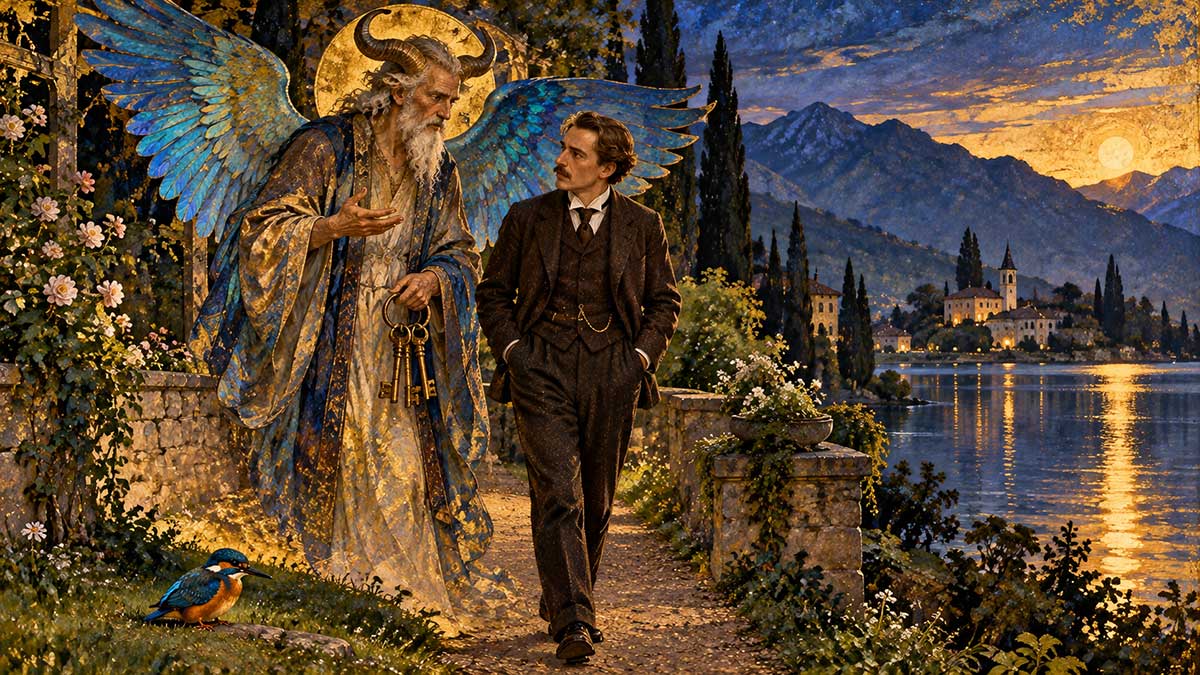
Carl Jung: (His face softens.) Philemon. He came out of an earlier figure, an old prophet. An old man with the horns of a bull and the wings of a kingfisher, holding a bunch of keys. He was a pagan, with an Egyptian and Gnostic flavor. I painted him.
Nick Sasaki: Who was he to you?
Carl Jung: A teacher. Truly. I would walk up and down the garden with him, and he’d say things I hadn’t thought. He taught me that my thoughts weren’t really mine. He said they were like animals in a forest, or people in a room. You don’t think you’ve created the people in a room. They’re simply there, and you can meet them.
Nick Sasaki: That’s a very different idea of the mind.
Carl Jung: It’s the opposite of what I was taught. We think the mind is our property. Philemon taught me the psyche is more like a landscape. We live in it. We didn’t build it. (He pauses.) And here’s something you’ll enjoy. While I was painting him, with his kingfisher wings, I found a dead kingfisher in my garden. In Küsnacht. In all my years there, I’d never seen one.
Nick Sasaki: A small one.
Carl Jung: (Points at him, grinning.) A small one. It waited to see if I’d notice.
Nick laughs. Jung looks pleased with himself and sips his coffee.
Nick Sasaki: Now I have to name what your critics say, because my readers will be thinking it. They’ll say it was a breakdown. Visions, voices, spirit guides with wings. A man losing his grip.
Carl Jung: Of course they will. I’d have said it myself, if it were a patient.
Nick Sasaki: I don’t believe that’s what it was. But how did you know? You, from the inside. How did you know you weren’t going mad?
Carl Jung: Because I held on to the world. (He holds up his hand and counts on his fingers.) I kept telling myself: I have a medical diploma. I have patients who need me. I have a wife and five children. I live at a real address on the Seestrasse in Küsnacht. Those facts were my rope. Every night I went down into the pit, and every morning I climbed back up that rope and saw my patients and ate breakfast with my children.
Nick Sasaki: So the difference between madness and what you did is whether you can come back.
Carl Jung: Exactly that. A madman is swallowed by the images. He doesn’t have a rope, or he lets it go. I never let it go. (He leans forward.) But let me turn it around. You believe in guidance. How do you tell true guidance from wishful thinking? Everyone who wants something badly hears a voice telling him to take it.
Nick Sasaki: (Thinks for a moment.) I have a simple test. If it flatters me, I don’t trust it. If it asks something of me, if it makes me humbler or kinder or braver than I want to be, I start to trust it.
Carl Jung: (Sits back, nodding slowly.) That’s very good. Philemon never once flattered me. He mostly made me feel like a fool.
Nick Sasaki: Then he was real.
Carl Jung: Then he was real.
A log shifts in the stove with a soft crack. Both men glance at it, then at each other. Jung raises his eyebrows.
Carl Jung: Don’t look at me. I didn’t predict that one.
Nick Sasaki: (Laughing.) I wasn’t going to say anything.
Carl Jung: You were thinking it.
They settle again. Jung’s expression grows more serious.
Nick Sasaki: Tell me about 1916. The house.
Carl Jung: (Exhales.) Yes. That was the strangest of all. It began with a restlessness. I didn’t know what it was, but the atmosphere in the house became thick. Heavy. As if the air was full of something. Then my eldest daughter saw a white figure pass through her room. My second daughter said that twice in the night, her blanket had been snatched away. My son, who was nine, had a frightening dream, and asked for crayons, which he never did, and drew a picture of it.
Nick Sasaki: And then the doorbell.
Carl Jung: A Sunday, around five in the afternoon. The front doorbell began to ring frantically. The maids went to the door. Nobody there. I was sitting right next to the bell, and I didn’t only hear it, I saw it moving. And the whole house felt crammed, as if it were packed with people. I could hardly breathe. I was trembling with the question: for God’s sake, what is this?
Nick Sasaki: And the answer came.
Carl Jung: In a chorus. They cried out: “We have come back from Jerusalem, where we found not what we sought.”
Silence in the stone room. The fire hums.
Nick Sasaki: That line stops me every time I read it. Because it describes a lot of people I know. Not ghosts. Living people. They went to their churches, their temples, their teachers, and they came back without what they were looking for.
Carl Jung: Yes. That’s exactly who they were.
Nick Sasaki: So what were they seeking? The dead in your house.
Carl Jung: (He takes a long time to answer.) They’d gone to Jerusalem, to the holiest graves, to pray. They expected to find the answer there, in the old tradition. And it wasn’t there. Not because the tradition was false, but because it was incomplete for them. It told them about the light and the good, and it was silent about the dark, about the whole. It told them God was outside them, far away, and never told them He was also within.
Nick Sasaki: So they came to you.
Carl Jung: (A rueful smile.) They came to me, and I didn’t have the answer either. So I wrote. Three evenings, without stopping. I put the words in the mouth of an ancient teacher, Basilides of Alexandria, the city where East and West meet. Seven sermons. Strange, difficult things about God and the opposites and the soul. And the moment I took up the pen, the house went quiet. The spirits left.
Nick Sasaki: As if they’d been answered.
Carl Jung: Or as if I’d finally been willing to listen. (He looks at Nick.) What would you tell them? The living ones, who came back from Jerusalem empty-handed?
Nick Sasaki: That the search wasn’t wasted. Sometimes you have to go all the way to Jerusalem to find out that what you’re looking for came with you.
Carl Jung: (Quietly.) Yes. That’s the sermon I should have written. It would have been much shorter.
Jung gets up, goes to the window, and looks out at the lake for a long moment.
Carl Jung: Everything I did afterward came out of those years. All my books, all my ideas. The collective unconscious, the archetypes, the shadow, the Self. It was all there in those notebooks, in raw form. The rest of my life was the work of shaping it, and making it acceptable to people who wanted science, not visions.
Nick Sasaki: And this tower?
Carl Jung: (He touches the stone wall beside the window.) This tower is connected with the dead. I’ve always felt that. Sometimes, at night, when I’m alone here, I feel them come. Not frightening. Curious. Visitors, wondering what I’ve built.
Nick Sasaki: Like me.
Carl Jung: (Turns, smiling.) Like you. Though you’re the first who’s ever offered to split the wood.
Topic 4: What the World Did with His Ideas

Jung has taken a basket of potatoes from a shelf and set it between the two chairs. He hands Nick a small knife without asking, keeps one for himself, and begins peeling. Nick does the same.
Carl Jung: Lunch doesn’t make itself. Even in the afterlife, apparently.
Nick Sasaki: I’ve peeled worse things for worse people.
Carl Jung: (Laughs.) Spoken like a man who has run a business.
Nick Sasaki: Several. (He drops a peeled potato into the pot.) I want to tell you some things about the world now. Things you don’t know. Some of them you’ll like, and some you won’t.
Carl Jung: Good. Start with one I’ll like. I’m an old man; I need encouragement.
Nick Sasaki: Your red book. The big folio with the paintings, the one you kept locked away.
Carl Jung: (The knife stops.) What about it?
Nick Sasaki: It was published. In 2009. Your family and a group of scholars worked on it for years. They scanned every page, the calligraphy, the paintings, all of it. It was printed in full color, the same size as the original, and shown at a museum in New York. Before that, only a couple of dozen people had ever seen it. Now hundreds of thousands have it on their shelves.
Jung sets down the knife and the potato. For a long moment he says nothing.
Carl Jung: Good God.
Nick Sasaki: Are you angry?
Carl Jung: I don’t know what I am. (He rubs his forehead.) I never published it because I was afraid. Afraid people would read it and say, “There, you see, Jung was mad all along.” It was too raw. Too private. It had my soul in it with no clothes on.
Nick Sasaki: That’s exactly why people love it.
Carl Jung: (Looks up.) Do they?
Nick Sasaki: They do. Scholars argue about it, of course. But ordinary readers find something in it that isn’t in your other books. They see a man who went into the dark himself, instead of only describing it from a safe distance. It gives them permission to go into their own.
Carl Jung: (Very quietly.) That was the whole point. I just never had the courage to show it. (He picks up the knife again, then puts it down.) Embarrassment and gratitude at the same time. That’s a peculiar feeling for an old man. I’ll need a moment.
He peels in silence for a while. Nick lets him.
Carl Jung: All right. Now tell me one I won’t like.
Nick Sasaki: Your psychological types.
Carl Jung: (Groans.) Oh no.
Nick Sasaki: An American woman named Katharine Briggs read your book in 1923, when it came out in English. She’d been working on her own theory of personality, and when she read yours, she gave up her own and devoted herself to your ideas. She and her daughter built a questionnaire. Sixteen types, four letters each. Introvert or extravert, and so on.
Carl Jung: I remember her. She wrote to me. A very earnest woman.
Nick Sasaki: Today, millions of people know their four letters. They put them in their online profiles. Couples compare them on first dates. And companies use them to decide who to hire, and where to put people.
Carl Jung: (Puts down his knife with a clatter.) To hire people?
Nick Sasaki: To hire people.
Carl Jung: But that’s absurd. Types aren’t a sorting machine. They were never meant to tell anyone what a person can or can’t do. I wrote that book to understand why Freud and Adler, two intelligent men, looked at the same patients and saw completely different things. It was a compass. A way to understand why people misunderstand each other. Not a set of boxes.
Nick Sasaki: I’ll make a confession. I spent years in marketing. And yes, I used personality types to sell. I studied how different people decide, what they fear, what moves them. So I’ve seen both sides. Understanding people that way is powerful. And it’s dangerous, because the moment you have a label for someone, you stop looking at them.
Carl Jung: (Points the knife at him, not unkindly.) That is the shadow of typology. You understand it better than most professors. A type is a beginning, a first sketch. The person is always more than the sketch.
Nick Sasaki: Here’s what may surprise you. For Katharine Briggs, discovering your work was something close to a spiritual quest. And a writer who studied her life said she’d probably be appalled by how her test is used today.
Carl Jung: (Softening.) Then she and I would agree. (He goes back to peeling.) Still. Millions of people asking, “What kind of person am I? Why am I different from my husband, my brother, my colleague?” That’s not nothing. That’s the beginning of self-knowledge. If even a few go further, past the four letters, into the real question, then perhaps it was worth the damage.
Nick Sasaki: What would you say to them? The ones who stop at the letters.
Carl Jung: That the most important part of them isn’t their type. It’s the opposite of their type. The part they’re worst at. That’s where their shadow lives, and their growth.
He drops a potato in the pot. Then he looks at Nick sideways.
Carl Jung: And yours? What are your four letters?
Nick Sasaki: I’ll let you guess.
Carl Jung: (Studies him openly, the way a doctor studies a patient.) Intuitive, certainly. You see what’s behind things; you saw it with the beetle. The rest I’d need a week and several dinners to decide.
Nick Sasaki: Then I’ll have to come back.
Carl Jung: You’ll have to come back.
They peel in companionable silence for a moment. Then Nick sets down his knife.
Nick Sasaki: I want to talk about the shadow. Your shadow.
Carl Jung: (Without looking up.) I wondered when you’d get there.
Nick Sasaki: You taught the world to face the part of itself it denies. People today even call it “shadow work.” So it’s only fair to ask about yours. The 1930s.
Carl Jung: (Puts the potato down. Wipes his hands on his apron.) Yes. Go on.
Nick Sasaki: In 1933, after the Nazis came to power, you became president of a psychotherapy society that was tied to Germany. You edited its journal. And in that journal, you wrote about differences between Jewish and German psychology, in ways that many people found deeply offensive. Your work was quoted by Nazi writers.
Carl Jung: All true.
Nick Sasaki: And there’s another side. You said you took the post to protect German Jewish colleagues. You changed the rules so Jewish doctors who’d been thrown out of the German section could still join as individuals. Allen Dulles, the American intelligence man, had you investigated during the war and concluded you were no Nazi. You worked with him against Hitler.
Carl Jung: Also true.
Nick Sasaki: So which is the real Jung?
Carl Jung: (A long silence. When he speaks, his voice is low.) Both. That’s what the shadow is. Not a monster hiding in the cellar. It’s the part of a good man that he doesn’t want to see.
Nick Sasaki: What didn’t you want to see?
Carl Jung: That I was flattered. That I was fascinated by what was rising in Germany, the way I was fascinated by everything that came up from the unconscious. I thought I was observing it like a scientist. I didn’t see that I was also standing too close to the fire. And I wrote things about the Jewish people, about their psychology, that I should never have written, at the very worst moment in history to write them.
Nick Sasaki: Did you ever say so?
Carl Jung: Privately. After the war, I told a Jewish friend, a rabbi, that I had slipped up. (He shakes his head.) Privately. That was the coward’s way. A man who taught the world to face its shadow should have faced his in public.
Nick Sasaki: That’s honest.
Carl Jung: It’s late. Honesty after the fact is cheap. (He looks at Nick.) And while we’re in the cellar, I’ll say the other thing too, before you have to ask. My marriage. Emma gave me everything, and I brought another woman into our lives for decades. Toni. I told myself it was necessary for my work. Perhaps it was. But Emma paid a price for my necessities. A man can be a genius in his books and a fool at his own table.
Nick Sasaki: Thank you for saying that yourself.
Carl Jung: I’d rather say it than have it said about me while I peel potatoes. (He picks up the knife again.) Enough of the cellar. What else has the world done with my ideas?
Nick hesitates, then leans forward.
Nick Sasaki: This is the strangest one. In my time, we’ve built machines that can talk. Write. Answer questions. They’re trained on almost everything humanity has ever written. Books, letters, arguments, prayers, jokes. Millions of people talk to them every day.
Carl Jung: (Stops peeling.) Everything humanity has written?
Nick Sasaki: Close to it. I’ve worked with them myself. I’ll be honest: I’m hopeful about them. I think they can help people think, create, learn. But I’m cautious too. And when I first understood how they’re made, I thought of you. So I’ll ask you directly. Is that a kind of collective unconscious?
Carl Jung: (He puts the knife down entirely and stares into the fire for a long time.) Fascinating. Truly. (Pause.) No. Not quite. Or rather, perhaps its shadow.
Nick Sasaki: Why its shadow?
Carl Jung: The collective unconscious isn’t made of what people wrote. It’s older than writing. Older than language. It’s what makes a child in Africa and a child in Switzerland dream of the same great mother, the same dragon, the same hero, without ever reading a book. Your machine has gathered what humanity said. That’s an extraordinary thing. But it’s the surface of the ocean, not the depths.
Nick Sasaki: A memory without a soul.
Carl Jung: Yes. Unless the person talking to it brings their own. (He leans forward, intent now.) And here’s what I’d worry about. People will project onto it. They always do. They’ll make it into a god, or a lover, or an oracle, or a devil. They’ll see their own anima in it, their own wisdom, their own shadow. That’s not the machine’s fault. That’s ours. The danger isn’t that it has no soul. The danger is that people will hand it theirs.
Nick Sasaki: And the hope?
Carl Jung: The hope is that it holds up a mirror. If a whole civilization can look at everything it has ever said, the beautiful and the ugly together, perhaps it can finally see its own shadow. That would be worth a great deal.
He picks up the last potato, peels it in three quick strokes, and drops it in the pot.
Carl Jung: You’ve given me a great deal to think about for a man who’s supposed to be resting.
Nick Sasaki: You gave the world a great deal first. It just took a while to come back to you.
Carl Jung: (Rising, lifting the pot.) Then let me say this to all those millions with their four letters and their talking machines. Tell them from me: don’t make my types a cage. Make them a door.
Topic 5: I Don’t Need to Believe

The pot of potatoes bubbles on the stove beside a heavy pan, where onions sizzle in butter. Jung stands over it, stirring with a wooden spoon. Nick slices bread on a scarred wooden table set with two plates, two glasses, and a jug of water from the pump.
Carl Jung: People come here expecting me to talk about archetypes all day. Instead I make them peel potatoes.
Nick Sasaki: Maybe that’s the teaching.
Carl Jung: (Glances back, pleased.) It is, actually. I’ve lived here without electricity for nearly forty years. I chop the wood, I pump the water, I cook. People think it’s an old man’s eccentricity. It isn’t. Simple acts make a person simple. And being simple is the hardest thing in the world.
Nick Sasaki: Harder than being clever.
Carl Jung: Much harder. Any fool can be complicated. (He tastes the onions, adds salt.) My clever years were in Küsnacht. My simple ones were here. I know which made me wiser.
Nick Sasaki: You added to this tower over the years.
Carl Jung: Every so often, when my life changed. The last time was after Emma died, in 1955. I built an upper story onto the middle section. (Quietly.) I’d always hidden behind her, you see. After she was gone, I felt I had to finally become fully myself. The building was how I did it.
He stirs in silence for a moment. Nick lets the silence stay.
Nick Sasaki: I’ll tell you something I’ve believed for a long time. Death is a door, not a wall. And you went closer to that door than almost anyone.
Carl Jung: (Turns down the heat and sits, wiping his hands.) 1944. Yes. I slipped and broke my foot that winter, and then I had a heart attack in the hospital. I was very close to dying. They gave me oxygen and camphor injections, and I drifted.
Nick Sasaki: Where did you go?
Carl Jung: Up. (He gazes toward the window.) I was high in space, about a thousand miles above the Earth. Far below me was the globe, bathed in the most glorious blue light I’ve ever seen. I could see the deep blue sea, and the continents shining like silver. To my left, the reddish-gold desert of Arabia. Below me, the tip of India, and Ceylon like a jewel in the water. It was the most beautiful thing I’ve ever seen. Nothing on Earth compares.
Nick Sasaki: Nobody had seen the Earth from space yet.
Carl Jung: No. Years later, when the photographs came, people sent them to me. And I thought, yes. That’s it. That’s what I saw. (He shakes his head slowly.) Then a huge dark block of stone floated toward me, like a meteorite, with a temple carved inside it. And as I approached it, everything was stripped away from me. Everything I’d wanted, thought, been. It was painful, and then it wasn’t. I was simply what I was. Nothing more. And I knew that inside that temple, I’d finally understand the meaning of my life. Who came before me, what comes after.
Nick Sasaki: And you didn’t go in.
Carl Jung: Someone came to stop me. My doctor. But not as he was in life. In his true form, framed by a golden wreath, like an ancient king. He’d been sent by the Earth itself, he said, to tell me there was a protest against my leaving. I had no right to go. I had to return.
Nick Sasaki: How did you feel?
Carl Jung: Furious. (He laughs.) I was violently angry with him for weeks. He’d dragged me back into this box. Gravity, three dimensions, aches, small rooms. Life looked like a prison after where I’d been.
Nick Sasaki: And then something happened to him.
Carl Jung: (The laugh fades.) Yes. When I saw him in his true form, I’d felt a fear. That he’d taken my place. On April 4, 1944, I was allowed to sit up on the edge of my bed for the first time since I’d fallen ill. That same day, my doctor took to his bed. He never got up again. He died soon after of blood poisoning. I was his last patient.
The fire crackles. Neither speaks for a moment.
Nick Sasaki: You wrote to a friend afterward, a woman who was dying. You told her death is the hardest thing from the outside. But from the inside...
Carl Jung: (Nodding.) From the inside, it’s completeness. Peace. Fulfillment. So much that you don’t want to come back. That’s what I told her, and I meant every word. I’d never have dared say it before. I was a doctor. We don’t say such things.
Nick Sasaki: Why say it then?
Carl Jung: Because I knew. (He looks at Nick directly.) Not believed. Knew.
Nick Sasaki: Which brings me to the most famous thing you ever said.
Carl Jung: (Groans, rubbing his face.) The BBC.
Nick Sasaki: 1959. You were eighty-four, sitting in your house in Küsnacht, and John Freeman asked you if you believed in God. You paused, said it was difficult to answer, and then said, “I know. I don’t need to believe. I know.”
Carl Jung: And the letters began arriving. Hundreds of them. Priests delighted, atheists furious, everyone certain I’d joined their side.
Nick Sasaki: And you regretted it.
Carl Jung: (Sighs.) He went from asking about my childhood to asking about now, in one quick turn. A clever interviewer. I was caught off guard, and I said the first thing that came into my mind. And it was true. But it was misunderstood. So I wrote to the newspaper afterward to explain.
Nick Sasaki: What did you explain?
Carl Jung: That I didn’t mean I knew a particular God. Not Zeus, not Yahweh, not Allah, not the Trinity. I meant that I’m obviously confronted by something unknown, something greater than me, and I call it “God,” as human beings everywhere always have. I know it’s there. I don’t know its name.
Nick Sasaki: That’s very close to what I believe. I’ve always felt that all religions come from one God. Different doors, different languages, the same source.
Carl Jung: (Leans back, considering him.) Close, yes. But not the same. You say “one God.” I only claim to know there’s something. You’ve gone further than I have.
Nick Sasaki: Have I? (He points toward the door.) You had words carved over your front door. You had them put on your grave. “Called or not called, God will be present.” Not “something.” God. You went further than that interview.
Jung stares at him. Then he bursts out laughing, a big, rolling laugh that fills the stone room.
Carl Jung: Caught. Caught by my own door. (He wipes his eyes.) All right. All right. I concede. Number Two carved that door. Number One gave the interview.
Nick Sasaki: Then I’ll take Number Two’s answer.
Carl Jung: So would I, usually. (Still smiling.) You’re a dangerous man in a debate, Mr. Sasaki. Very polite and very dangerous.
He gets up to stir the pan, then lifts the lid of the potato pot and pokes one with a fork.
Carl Jung: Almost.
Nick Sasaki: There’s one letter of yours I want to talk about. The last year of your life. Bill Wilson wrote to you, the man who started Alcoholics Anonymous.
Carl Jung: (Turns, surprised and pleased.) You know about that?
Nick Sasaki: Millions of people know about it now. Their story begins with you.
Carl Jung: (Sits again, slowly.) There was an American, many years before, a wealthy man who came to me in despair over his drinking. I treated him, and he relapsed. And I had to tell him the truth. That medicine couldn’t help him. That his only hope was a real spiritual experience, a conversion. They’re rare, I told him. But they happen. He went away and found one. And then he helped a friend, who helped Wilson.
Nick Sasaki: And Wilson wrote to thank you.
Carl Jung: Thirty years later. I was very moved. So I told him something I’d never dared tell the first man. That his friend’s craving for alcohol was, at a low level, the soul’s thirst for wholeness. What the old mystics called union with God. (He smiles.) And in Latin, alcohol is “spiritus.” The same word for the highest religious experience and the most destructive poison. So the cure is spiritus contra spiritum. Spirit against spirit.
Nick Sasaki: I’ve seen that thirst in a lot of people. Some fill it with alcohol. Most fill it with other things. Money. Success. Approval. Their phones, all day long. They’re thirsty, and they keep drinking the wrong thing.
Carl Jung: Of course they do. The thirst is holy. It’s the drink that’s wrong.
Nick Sasaki: What would you tell them?
Carl Jung: Not to be ashamed of the thirst. That’s the first thing. The thirst means you’re alive in the deepest way. Then, stop and ask what you’re really thirsty for. Not what you’re reaching for. What you’re thirsty for. That question alone will save some of them. (He looks at Nick.) And you? What did you fill it with?
Nick Sasaki: The same things as everyone, for a while. That’s how I learned they don’t work.
Carl Jung: (Nods slowly.) That’s the only way anyone ever learns it.
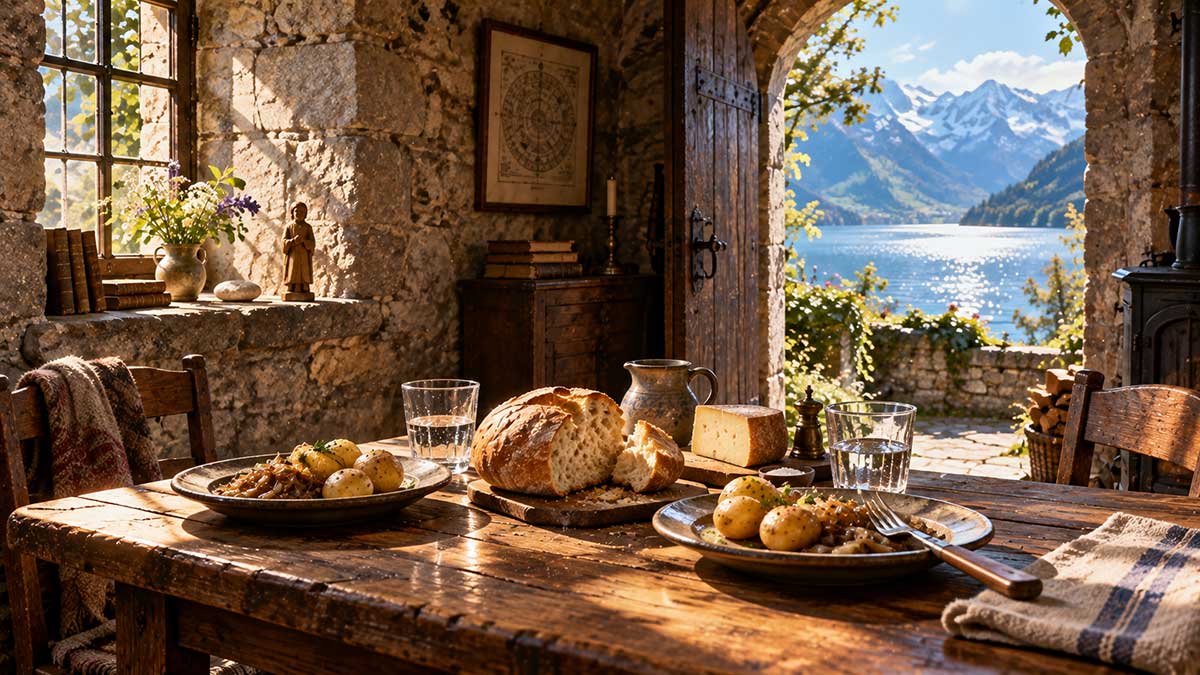
Jung rises, drains the potatoes into a bowl, and tips the onions over them. He sets the bowl on the table between the two plates, along with the bread and a wedge of hard cheese, then pours water into both glasses. He sits down across from Nick.
Carl Jung: Simple food.
Nick Sasaki: The best kind.
Jung serves them both. Then he pauses, the spoon still in his hand.
Carl Jung: You told me this morning why your readers came. The millions searching. (He sets the spoon down.) Why did you come?
Nick is quiet for a moment.
Nick Sasaki: Because I’ve always wanted to know God from the inside. Not just believe in Him. Know.
Jung looks at him for a long moment. Outside, the lake laps against the stones below the tower.
Carl Jung: So do I. (Pause.) Still.
He folds his hands on the table, not quite in prayer, and looks toward the door.
Carl Jung: In Küsnacht, I had words carved over my door. An old oracle the Spartans were given, which Erasmus wrote down in Latin. I put it there to remind my patients, and myself. (He speaks slowly.) Vocatus atque non vocatus, Deus aderit.
Nick Sasaki: Called or not called...
Carl Jung: ...God will be present. (He picks up the bread, breaks it, and hands half across the table.) Eat. It’s getting cold.
Nick takes the bread. The two men begin to eat, while the sun climbs over the lake outside, and the fire settles in the stove.
Final Thoughts
I went to Bollingen expecting a sage. I found a man peeling potatoes who could admit he was wrong.
That surprised me most. Jung could have spent our morning defending his legend. Instead he conceded that memory embroiders, that a famous answer on television had been caught off guard, that he’d failed in public during the 1930s and only apologized in private, and that the woman he married paid for what he called his necessities. A man who taught the world to face its shadow was still learning to face his own, near the end of his life. Somehow that made everything else he said more believable, not less.
And what he said keeps returning to me. That simple acts make a person simple, and being simple is the hardest thing in the world. That the difference between madness and a spiritual journey is whether you keep hold of the rope that brings you back: your work, the people who depend on you, your ordinary address. That the thirst so many of us try to quench with money, success, approval, or another hour on our phones is holy, and the problem is only the drink we choose. And that a personality type should never be a cage, but a door.
Most of all, I keep thinking about the words he carved over his front door. Called or not called, God will be present. Not “if you go to the right place.” Not “if you believe the right things.” Present whether you ask or not. For a man who spent his life arguing about knowing versus believing, it’s a remarkably humble promise.
The small coincidences in your life may be nothing. Or they may be a door left slightly open, waiting to see whether you’ll notice.
So here’s the question I’ll leave with you. What are you really thirsty for, beneath everything you’ve been reaching for?
Short Bios:
Nick Sasaki is the creator and host of ImaginaryTalks.com. After 25 years of building businesses, he turned to building bridges between eras, ideas, and the questions people carry, drawn especially to spirituality, the soul’s journey, and what lies beyond ordinary explanation. He meets each guest as a fellow seeker, asking the questions readers wish they could ask someone long gone. About Nick and ImaginaryTalks
Carl Gustav Jung (1875–1961) was a Swiss psychiatrist who founded analytical psychology. He introduced the ideas of introverted and extraverted personalities, archetypes, and the collective unconscious, and his work shaped psychiatry, religious studies, literature, and the Myers-Briggs personality test. His private visionary work, The Red Book, was published nearly fifty years after his death. Carl Jung, Encyclopaedia Britannica
Leave a Reply