
Introduction
On October 14, 1926, A. A. Milne introduced readers to a little bear named Winnie-the-Pooh. One hundred years later, Pooh and his friends continue to remind us of something surprisingly easy to forget: happiness may have less to do with what we accomplish than with the people we share our lives with.
In the Hundred Acre Wood, nobody is perfect. Pooh is forgetful, Piglet is frightened, Rabbit wants everything organized, and Eeyore rarely expects good news. Yet they remain friends.
What makes these stories extraordinary is not that the characters always agree or behave wisely. It is that they continue to care for one another, imperfections included.
For this centennial imaginary conversation, we bring Pooh, Piglet, Eeyore, Rabbit, Owl, and an imagined adult Christopher Robin together again.
Their reunion begins with a simple question: Could a bear of very little brain know something about happiness that our increasingly sophisticated world has forgotten?
Through three conversations about wisdom, friendship, and modern loneliness, the animals explore what it means to accept one another, disagree without hatred, and make time for the people who matter.
And somewhere between an empty honey pot, a forgotten birthday, and a telephone call that should have been made long ago, Christopher Robin begins to rediscover something he once knew.
(Note: This is an imaginary conversation, a creative exploration of an idea, and not a real speech or event.)
Topic 1: Is Pooh Really a Bear of Very Little Brain, or Does He Know Something We Have Forgotten?

Christopher Robin had barely settled onto the grass when Rabbit produced a notebook.
"I think," Rabbit announced, "that before we begin discussing wisdom, we ought to establish what wisdom actually is."
"An excellent suggestion," said Owl. "Wisdom, from the ancient Greek, is a matter of considerable philosophical importance."
"Is it?" asked Pooh.
"Certainly."
"Does it take long?"
"Does what take long?"
"Being wise."
Owl blinked. "Well, that depends."
"Only I was thinking," Pooh continued, "that if it takes until lunchtime, perhaps we ought to have lunch first."
Rabbit closed his eyes.
"Pooh, this is exactly the problem. You cannot think about food every time someone raises an important question."
"Can't I?"
"No!"
Pooh looked troubled.
"I've been doing it for years."
Christopher Robin laughed.
"Rabbit, perhaps that's where we should begin. What makes someone intelligent? And is that the same thing as being wise?"
"Of course not," Owl replied. "Intelligence is the capacity to acquire knowledge, whereas wisdom involves the judicious application of that knowledge."
"Very good," said Rabbit.
"Thank you."
Pooh raised his paw.
"Yes, Pooh?" asked Christopher Robin.
"If someone knows where the honey is, that's intelligence?"
"I suppose so."
"And if he eats it, that's wisdom?"
"Not necessarily," said Rabbit.
"Even when he's hungry?"
"Especially when he's already eaten three pots!"
Pooh looked down at his stomach.
"I don't think I've ever eaten three pots all at once."
"You ate enough honey at my house to become part of the doorway!"
"Ah," said Pooh. "I remember that."
"You were stuck for a week!"
"Yes. It was rather uncomfortable."
"And what did you learn?"
Pooh thought.
"That your doorway is smaller than it looks from the inside."
Piglet covered his mouth.
Rabbit stared at Pooh.
"That is not the lesson!"
"It was the one I learned."
Christopher Robin began laughing so hard that he had to put down his book.
"Rabbit, I think Pooh has made an interesting point."
"He has made an observation about the size of my doorway!"
"Yes, but he learned from experience."
Rabbit opened his notebook again.
"Then perhaps he could learn not to eat so much next time."
Pooh considered this.
"That would be a different lesson."
Eeyore, who had been standing a short distance away, sighed.
"Some of us learn lessons. Some of us become lessons. Some of us get stuck in doorways. A very educational forest."
"Thank you, Eeyore," said Rabbit.
"Don't mention it. Nobody usually does."
Christopher Robin turned to Pooh.
"Do you ever wish you were cleverer?"
Pooh looked surprised.
"Cleverer than whom?"
"Than you are now."
"Oh."
He thought for a moment.
"Would I still be me?"
"Of course."
"And would I still like honey?"
"Yes."
"And Piglet?"
"Certainly."
Pooh nodded.
"Then I suppose it would be all right. But I don't know what I'd do with the extra cleverness."
"You could avoid mistakes," said Owl.
"All of them?"
"Well, perhaps not all."
"Would I know when Piglet was frightened?"
Piglet looked up.
Owl hesitated.
"That isn't quite the same sort of intelligence."
"Oh," said Pooh. "Then I should like some of that instead."
Piglet smiled, but Rabbit shook his head.
"Pooh, you cannot simply choose whichever kind of intelligence sounds nicest."
"Why not?"
"That's not how intelligence works!"
"Perhaps that's why I haven't got much of it."
Christopher Robin leaned back against the tree.
"When I was little, I thought clever people knew everything. Then I grew up and met people who knew an extraordinary amount about one subject and almost nothing about how to treat other people."
"Such as?" asked Rabbit.
"People who could run enormous companies but couldn't apologize to their own children. People who could explain complicated theories but couldn't listen to someone who disagreed with them."
Owl adjusted his feathers.
"Surely the solution is better education."
"Education helps," Christopher Robin said. "But I don't think knowing something and living by it are always the same."
"Quite right," said Eeyore. "Everyone knows it's polite to ask how someone is feeling. Most people seem rather disappointed when you tell them."
Piglet turned to him.
"How are you feeling, Eeyore?"
"About as expected."
"Would you like to sit with us?"
Eeyore glanced at the grass.
"Is there room?"
"Of course," said Piglet.
"Then I suppose things are looking up. Temporarily."
Eeyore settled beside them.
Christopher Robin watched him for a moment.
"That's interesting. We were talking about intelligence, and Piglet just did something kind."
"Was it intelligent?" Piglet asked nervously.
"It was thoughtful."
"Oh. That's better. I was afraid I'd have to explain it."
Rabbit tapped his notebook.
"We are getting distracted. Intelligence is important. If everyone behaved like Pooh, nothing would ever get done."
"Would that be bad?" asked Pooh.
"Of course it would!"
"Even on Sundays?"
Rabbit hesitated.
"Sunday is different."
"What about Saturdays?"
"Pooh!"
Christopher Robin smiled.
"Rabbit does have a point. Hospitals need competent doctors. Bridges need careful engineers. Farmers need to know how to grow food. We cannot solve serious problems by simply being pleasant."
"Thank you!" Rabbit exclaimed.
"And Pooh," Christopher Robin continued, "your adventures have not always been harmless. You got stuck in Rabbit's doorway. You and Piglet frightened yourselves following your own footprints. Your honey schemes sometimes caused trouble for other people."
Pooh lowered his head.
"Yes. I suppose they did."
Piglet moved closer to him.
"But you helped rescue me when the water came," Piglet said.
"That was different," Pooh replied.
"How?"
"You needed help."
Christopher Robin looked at him.
"And why did you help?"
Pooh seemed puzzled.
"Well, because Piglet needed help."
"But you might have been frightened."
"I was rather busy."
"Busy doing what?"
"Helping Piglet."
There was a brief silence.
Rabbit looked at Pooh, then at his notebook.
"That was certainly useful," he admitted.
"Thank you, Rabbit."
"But usefulness is not the same as wisdom."
"Perhaps not," Christopher Robin said. "Still, I wonder how often we make kindness unnecessarily complicated."
Owl cleared his throat.
"Kindness without foresight can be dangerous. Suppose Pooh had attempted the rescue without considering the risks?"
"Then perhaps he would have needed rescuing himself," said Rabbit.
"Which has happened before," Eeyore added.
Pooh nodded.
"Yes. It's very nice when somebody knows how to rescue you."
Christopher Robin smiled, then grew thoughtful.
"You know, the world outside has become very good at measuring things."
"How big?" asked Pooh.
"Almost everything. How much money we earn. How many people admire us. How many things we've accomplished. How many people follow us on the internet."
"Follow you?" Piglet repeated, looking alarmed.
"Not through the woods, Piglet. On a screen."
"That's a relief. I thought it sounded rather like the Woozles."
"It sometimes feels that way," Christopher Robin admitted.
Rabbit leaned forward.
"Measuring things is perfectly sensible. How else would you know whether you're making progress?"
"That's what I've been asking myself," Christopher Robin said.
"And?"
"I've made quite a lot of progress in my life. At least, according to the usual measurements."
"Congratulations," said Owl.
"Thank you. But there were years when I was so busy trying to reach the next goal that I barely noticed the people beside me."
Pooh frowned.
"Did they walk very quietly?"
Christopher Robin laughed softly.
"No, Pooh. I wasn't paying attention."
"Ah."
"I kept thinking that when I finished one more project, earned a little more, or solved one more problem, I'd finally have time for everything that mattered."
"And did you?" asked Piglet.
Christopher Robin looked at him.
"Not often."
Rabbit was unusually quiet.
Pooh examined the honey pot beside him.
"Christopher Robin?"
"Yes?"
"Do you remember when I was trying to get honey from the bees?"
"Very well."
"I had a balloon."
"A blue one."
"And I thought the bees might think I was a cloud."
"Yes."
"But they didn't."
"No, Pooh."
Pooh nodded.
"I wanted the honey very much."
"I know."
"And I didn't get any."
Christopher Robin smiled.
"No."
Pooh looked into his pot.
"Well, this morning I wanted some honey, and I had some. That was much easier."
Rabbit sighed.
"Pooh, you are comparing an elaborate honey-gathering operation with breakfast."
"Yes."
"And?"
"I think breakfast was better."
Christopher Robin laughed.
Then he stopped laughing.
"Perhaps I've spent a great deal of my life climbing trees when breakfast was already waiting."
Eeyore lifted his head.
"That's a nice thought. Unless somebody else has eaten your breakfast."
Pooh looked concerned.
"Has somebody eaten yours, Eeyore?"
"No. But it's the sort of thing that happens."
"Would you like some of mine?"
Eeyore looked at the honey pot.
"Donkeys don't usually eat honey."
"Oh," said Pooh. "Then perhaps I could find you something else."
Eeyore studied him.
"You're a peculiar bear."
"Yes," said Pooh.
"I suppose that's something."
Rabbit leaned forward.
"Now wait just a moment. Are we suggesting that ambition is foolish? That people shouldn't work hard or try to improve their lives?"
"No," Christopher Robin replied. "I don't think so."
"Good. Otherwise I should have to object rather strongly."
"I think ambition can be wonderful. It can help us build, discover, and serve others. But perhaps it becomes a problem when we begin treating everything as a competition."
"Everything?" asked Piglet.
"Even happiness. People compare their holidays, their houses, their children's accomplishments, sometimes even how peaceful their lives appear to be."
Owl nodded solemnly.
"A most unfortunate social phenomenon."
"Would you say," asked Christopher Robin, "that you are happier than Rabbit, Owl?"
Owl drew himself up.
"That would require a comprehensive assessment."
"Which you would undoubtedly win," Eeyore murmured.
"I beg your pardon?"
"Nothing. Carry on."
Christopher Robin turned to Pooh.
"Do you ever compare your life with Rabbit's?"
Pooh looked at Rabbit.
"Rabbit has a very nice garden."
"Thank you," said Rabbit.
"And many relations."
"Yes."
"And a good house."
"Indeed."
Pooh thought for another moment.
"But I don't think I'd like to be Rabbit."
Rabbit looked offended.
"Why ever not?"
"Then who would be Pooh?"
Piglet laughed.
Rabbit opened his mouth, closed it, and looked at Christopher Robin.
"That is a completely unreasonable answer."
"Possibly," Christopher Robin said, smiling.
"There's no possible argument against it!"
"Perhaps that's what makes it interesting."
Pooh seemed pleased that the matter had been settled.
But Owl was not finished.
"I must point out that contentment can become an excuse for laziness. If everyone were perfectly satisfied with their circumstances, civilization would make very little progress."
Christopher Robin nodded.
"That's a fair objection."
"And," Rabbit added, "some things genuinely need changing. If Piglet's house were unsafe, we shouldn't simply tell him to be content with it."
"Certainly not," said Piglet.
"If someone were hungry," Rabbit continued, "we should help them find food."
"Certainly," said Pooh, with unusual enthusiasm.
"And if Eeyore's house fell down, we'd need to rebuild it."
"Assuming anyone noticed," said Eeyore.
"We would notice!" Rabbit snapped.
Eeyore looked at him.
Rabbit's ears turned slightly pink.
"Well, of course we would."
Christopher Robin watched them.
"Perhaps the question isn't whether we should want more or less. Perhaps it's whether we know what we're wanting more for."
Pooh considered this.
"I usually know."
"Do you?"
"Yes. Honey is for eating."
"And friendship?"
Pooh looked at Piglet.
"That's for when Piglet comes to visit."
Piglet smiled.
"And when he doesn't?"
Pooh looked surprised.
"Then I can visit him."
Christopher Robin was silent.
For years he had thought of friendship as something that needed to fit into his schedule, after the important things were finished.
Pooh appeared to think of visiting a friend as one of the important things.
Rabbit broke the silence.
"Well, I still maintain that planning is necessary."
"Of course," Christopher Robin replied.
"And being clever is useful."
"Very."
"And one cannot run an entire forest on honey and good intentions."
"Probably not."
Rabbit looked satisfied.
Pooh raised his paw again.
"Yes, Pooh?"
"Could you run it on honey and very good intentions?"
"No!"
"Ah."
Piglet giggled.
Christopher Robin looked around the clearing.
"Then perhaps we have an answer to my first question. Being clever helps us work out how to do things. Wisdom might help us decide which things are worth doing."
Owl nodded approvingly.
"An acceptable distinction."
Rabbit made a note.
Pooh looked thoughtful.
"Christopher Robin?"
"Yes?"
"Is deciding to have lunch a wise thing?"
"It can be."
"And deciding to share it?"
"That too."
Pooh smiled.
"Then perhaps I'm getting better at it."
He opened his honey pot and offered it around.
Owl declined politely. Rabbit said he had already eaten. Piglet accepted a little, mostly to keep Pooh company.
Eeyore watched the proceedings.
"Interesting," he said.
"What is?" asked Christopher Robin.
"Here we are, celebrating a hundred years of a bear who gets stuck in doorways, mistakes his own footprints for monsters, and can't spell half the words he uses."
"Yes?"
"And people all over the world apparently love him."
Pooh looked at Eeyore.
"Do they?"
"So I'm told."
"That's very nice."
Eeyore lowered his head.
"Some of us have spent a hundred years being perfectly sensible and haven't had nearly so much attention."
Rabbit stared at him.
"Eeyore, you have never been perfectly sensible!"
"Well, there you are. A hundred years wasted."
Everyone laughed, including Eeyore, though he tried not to show it.
Then Piglet, who had been unusually quiet, looked at Christopher Robin.
"May I ask something?"
"Of course, Piglet."
"You said people outside the forest are always trying to become better at things."
"Yes."
"Does that mean they sometimes think they're not good enough as they are?"
Christopher Robin's smile faded a little.
"Yes, Piglet. I think many people feel that way."
Piglet examined his small paws.
"I sometimes wish I were bigger."
"I know."
"And braver."
"Yes."
"And that I didn't get frightened by things that turn out not to be frightening at all."
Pooh moved closer to him.
"But if you were very big," Pooh said, "you might not fit through your front door."
Piglet smiled.
"I suppose not."
"And if you were never frightened, perhaps you wouldn't need me to come with you."
Piglet looked at him.
"But I would still want you to come with me."
Pooh thought about that.
"Then I think being brave would be all right."
Christopher Robin watched the two friends.
He had returned to the forest wondering whether Pooh possessed some hidden wisdom.
Now he was beginning to suspect that he had asked the wrong question.
Pooh was not wise every moment. He made mistakes, misunderstood things, and sometimes thought of his stomach before anything else.
Yet when Piglet felt small, Pooh did not ask him to become somebody different before offering his friendship.
He simply moved closer.
Christopher Robin glanced at the old book lying on the grass.
"A hundred years," he said quietly.
"Yes," said Pooh.
"And people are still reading about you."
"That's nice."
"Doesn't it make you feel important?"
Pooh considered this for a long moment.
"Would it make the honey taste different?"
"No."
"Would Piglet still come to visit?"
"Of course."
"Would you?"
Christopher Robin looked at him.
"Yes, Pooh."
"Then," said Pooh, taking another small spoonful of honey, "I think I'd rather just be Pooh."
Eeyore gave a low sigh.
"Well, that settles it. A hundred years of human civilization, and the bear has decided to remain a bear."
Rabbit shook his head.
Owl appeared to be searching for a suitable philosophical term.
But Christopher Robin was smiling.
For the first time in a long while, he wasn't thinking about what he needed to become next.
He was thinking about the people he had missed.
And beside him, Piglet was still turning something over in his mind.
"Pooh?"
"Yes, Piglet?"
"If someone doesn't think they're good enough, how do you help them believe they are?"
Pooh lowered his spoon.
He looked at Piglet, then at Eeyore sitting alone beneath the tree.
"I don't know," he admitted.
And after a moment, he got up and went to sit beside Eeyore.
End of Topic 1.
Topic 2: Why Do Pooh's Friends Love One Another Without Trying to Change One Another?
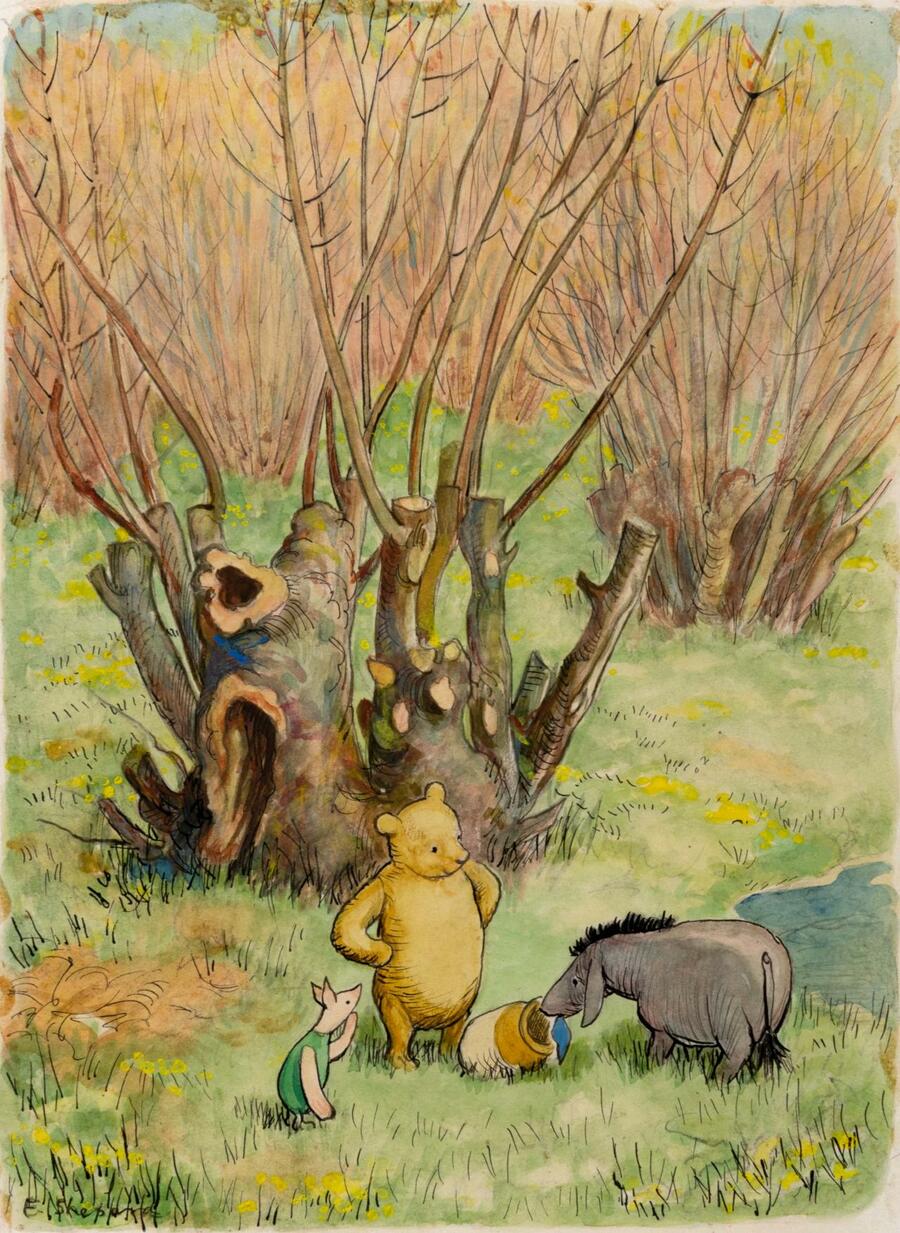
Eeyore watched Pooh settle beside him.
"Something wrong with your usual spot?"
"No," said Pooh.
"Ants?"
"No."
"Ground too hard?"
"No."
"Then I suppose you've come to see whether I'm enjoying the celebration."
"Are you?"
"Immensely. I've been standing under this tree for an hour watching other people eat things."
Pooh looked down at his honey pot.
"Would you like some?"
"No, thank you. I'm not particularly fond of honey."
"Oh."
Pooh thought for a moment.
"Would you like me to go away?"
Eeyore considered this.
"Not particularly fond of that either."
"Then I'll stay."
"Suit yourself."
And for a little time, neither spoke.
Christopher Robin watched them from across the clearing.
It was such a small thing, Pooh sitting beside Eeyore. Yet something about it troubled him.
He had spent years trying to find the right words when people were unhappy. He offered advice, suggested solutions, recommended books, and occasionally became frustrated when nothing seemed to work.
Pooh had simply sat down.
"May I ask you something, Eeyore?" Christopher Robin said.
"People usually do."
"Do you wish you were happier?"
Eeyore raised his head.
"Is this one of those questions where there's a correct answer?"
"No."
"Then yes. I wouldn't object to being happier. I simply haven't found much reason to make a habit of it."
Rabbit approached, carrying a plate.
"Well, you might begin by noticing the things people do for you."
Eeyore looked at the plate.
"Are those for me?"
"No. I'm collecting them."
"Then I shall begin noticing immediately."
Rabbit sighed.
"Eeyore, people make an effort. We invite you to parties. We visit you. We help when something goes wrong. Yet you behave as though nobody cares."
"Do I?"
"Yes!"
"Perhaps I haven't expressed my appreciation properly."
"That would be a start."
"Thank you for collecting the plates, Rabbit. A magnificent contribution to the festivities."
Piglet covered his mouth.
Rabbit's ears stiffened.
"That's not what I meant."
"I thought it might not be."
Christopher Robin stepped closer.
"Rabbit, I think you're saying something important. Friendship can be difficult when one person always seems dissatisfied."
"Exactly!"
"And Eeyore," Christopher Robin continued, "I think you're saying that being invited to a party doesn't necessarily mean you feel included."
Eeyore looked at him.
"Well. Somebody's been listening."
Rabbit placed the plates on a tree stump.
"Of course you're included! You're here, aren't you?"
"Physically, yes."
"What more do you want?"
Eeyore was silent for a moment.
Then he looked at Pooh.
"Do you remember my birthday?"
Pooh brightened.
"Yes! I brought you a pot."
"An empty pot."
"Yes."
"Which had originally contained honey."
"Yes."
"Which you ate."
Pooh lowered his head.
"I'm afraid I did."
"And Piglet brought me a balloon."
Piglet's ears turned pink.
"A broken balloon," he whispered.
"Quite."
Rabbit spread his paws.
"Well, there you are! A perfect example of why people should plan properly."
Eeyore looked at him.
"Perhaps."
Then he turned back to Pooh.
"Do you know what I liked about that pot?"
Pooh thought carefully.
"It had a lid?"
"No."
"It was a nice shape?"
"Not especially."
"You could put things in it?"
"That's closer."
Eeyore glanced at Piglet.
"And the balloon fitted inside."
Piglet smiled.
"Yes. It did."
"I could put it in," Eeyore continued, "and take it out again. Nobody had thought of that. Not even the people who brought it."
Pooh looked pleased.
"I hadn't thought of it at all."
"That was fairly obvious."
Eeyore paused.
"But I remember that day."
Christopher Robin sat down in the grass.
"Why?"
Eeyore lowered his head.
"Someone came."
The clearing grew quiet.
"That's all?" Rabbit asked.
Eeyore looked at him.
"Not much of an answer, is it?"
"No, I didn't mean..."
"People came to see me. They brought things. Rather unfortunate things, admittedly. But they came."
Piglet moved closer.
"I was terribly upset when the balloon burst."
"I know."
"I thought you'd be disappointed."
"I often am."
Piglet's face fell.
"But not that day," Eeyore added.
Pooh smiled.
"That's good."
"Don't make too much of it."
Christopher Robin looked down at his hands.
"I think I understand something."
"Careful," Eeyore said. "It's been a very long morning. You don't want to overdo it."
Christopher Robin laughed.
"I was remembering a friend of mine. Someone I knew for years. He became ill, and I kept meaning to visit him."
Piglet looked up.
"Did you?"
"Once."
"Was he pleased?"
"Very. We talked for nearly two hours."
"That sounds nice."
"It was. I promised I'd come again."
Christopher Robin stopped.
Pooh looked at him.
"And did you?"
"No."
The word was quiet.
"I kept thinking I'd go when I had more time. I sent messages. I called occasionally. But I didn't visit."
"Perhaps you were busy," Rabbit offered.
"I was."
"Then there you are."
Christopher Robin shook his head.
"That doesn't make it better."
"Is he still ill?" Piglet asked.
Christopher Robin looked away.
"He died last year."
Piglet's ears drooped.
"Oh."
For a moment, nobody knew what to say.
Owl, who had been listening from a branch above them, cleared his throat.
"One must recognize that modern life imposes numerous obligations. It is impossible to attend to every personal relationship with equal frequency."
"That's true," Christopher Robin said.
"And guilt," Owl continued, "is not always a productive emotional response."
"That's true too."
"Then perhaps you ought not to blame yourself."
Christopher Robin looked at him.
"I'm not blaming myself for everything. I know I couldn't have prevented his death. I just wish I'd spent another afternoon with him."
Owl folded his wings.
"Ah."
Eeyore shifted slightly.
"People don't always need an explanation, Owl."
"No," Owl admitted.
"Sometimes they've already thought of all the explanations themselves."
Pooh looked at Christopher Robin.
"Did your friend like honey?"
Christopher Robin smiled sadly.
"I don't think so."
"What did he like?"
"Gardening. He grew roses."
Pooh considered this.
"Then perhaps you could plant one."
Christopher Robin looked at him.
"A rose?"
"For your friend."
Christopher Robin was silent.
Then he nodded.
"I think I will."
Rabbit picked up his notebook.
"Roses require proper soil, regular watering, and careful pruning. If you like, I could prepare a schedule."
"Thank you, Rabbit."
"And you'll need to choose the right location."
"Yes."
"And not too much water."
"Rabbit," Eeyore interrupted.
"What?"
"He's going to plant a rose, not establish an agricultural department."
Rabbit looked offended.
"Somebody has to think about these things."
"Indeed. A terrible burden."
Piglet giggled.
Christopher Robin smiled.
"Actually, Rabbit, I'd appreciate your advice. My friend cared a great deal about his garden. I'd like to get it right."
Rabbit's expression softened.
"Well. In that case, I'd be happy to help."
Eeyore watched him.
"Look at that. Somebody appreciates your planning."
"Thank you, Eeyore."
"Don't get used to it."
Pooh had been thinking.
"Christopher Robin?"
"Yes?"
"When you visit someone, do you have to make them happy?"
Christopher Robin considered the question.
"No. I don't suppose you do."
"That's good."
"Why?"
"Only Eeyore isn't always happy when I visit him."
"An understatement," said Eeyore.
"And sometimes he isn't happy when I leave."
"Another understatement."
"So I wasn't sure whether I was doing it properly."
Christopher Robin smiled.
"Perhaps friendship isn't always about making someone feel better."
"Then what is it about?"
"Sometimes it's about being there."
Pooh nodded.
"That's easier."
"Not always," Christopher Robin said.
Pooh looked puzzled.
"Why not?"
"People can be difficult. They can complain, refuse help, or say things that hurt us."
Rabbit folded his arms.
"At last! That's what I've been trying to explain."
Christopher Robin turned to him.
"Tell me, Rabbit. Do you ever wish Pooh were different?"
Rabbit looked at Pooh.
"Well..."
Pooh looked back at him.
"It's all right, Rabbit."
"Since you ask, yes. Occasionally."
"Only occasionally?" Eeyore murmured.
Rabbit ignored him.
"I wish Pooh would think before acting. I wish he wouldn't eat everything offered to him. I wish he understood that plans exist for a reason."
Pooh listened carefully.
"Would you still like me if I did all those things?"
Rabbit hesitated.
"Of course."
"Then perhaps I could try."
Piglet looked surprised.
"Really, Pooh?"
"Yes. Though I might forget."
Rabbit sighed.
"That's precisely the problem."
"But Rabbit," Christopher Robin said, "you also need to remember that Pooh isn't going to become you."
"Good heavens, I should hope not. One of me is quite sufficient."
"Quite," said Eeyore.
Christopher Robin continued.
"Perhaps loving someone means accepting who they are without pretending everything they do is right."
Rabbit considered this.
"I could agree with that."
"And perhaps helping someone improve doesn't require making them feel that they're a disappointment."
Rabbit glanced at Pooh.
Pooh was examining a small spot of honey on his paw.
"Pooh?"
"Yes, Rabbit?"
"I don't actually want you to be different in every way."
"That's good."
"I just wish you'd be a little more careful."
Pooh nodded.
"I shall try."
Rabbit smiled faintly.
"And I suppose I could be a little less impatient."
Pooh looked pleased.
"Then we shall both be trying."
Eeyore shook his head.
"An ambitious program. I give it until Thursday."
Christopher Robin laughed.
Then Piglet raised his paw.
"May I say something?"
"Of course," said Christopher Robin.
"I think there's another difficulty."
"What is it?"
"Sometimes when someone is unhappy, you begin to think it must be your fault."
Eeyore looked at him.
Piglet continued, his voice growing smaller.
"If I visit Eeyore and he's still sad, I wonder whether I said the wrong thing. And if Rabbit is upset, I wonder whether I've disappointed him. And if Pooh is quiet, I wonder whether he's unhappy with me."
Pooh looked startled.
"I'm usually thinking."
"Yes, Pooh."
"Or hungry."
"I know."
"Or sometimes both."
Piglet smiled.
"But I don't always know that."
Christopher Robin nodded.
"That's a very important distinction, Piglet. Other people's feelings aren't always your responsibility."
"But shouldn't I try to help?"
"Of course. You can care about someone without believing you must control how they feel."
Eeyore looked at Piglet.
"Have I made you feel that way?"
Piglet hesitated.
"Sometimes."
Eeyore stared at the grass.
"Well. That's unfortunate."
"It's all right," Piglet said quickly.
"No, it isn't entirely."
Piglet looked surprised.
Eeyore continued.
"I don't mean to make you responsible for my disposition. It's quite a substantial disposition. Far too large for a small animal to carry around."
Piglet smiled.
"I don't mind sitting with you."
"I know."
"And I don't mind when you're sad."
"I know that too."
"I just don't want you to think nobody cares."
Eeyore looked at him for a long moment.
"Perhaps," he said, "I could try to remember that."
Rabbit smiled.
"Excellent. Then we're all agreeing to improve ourselves."
"Don't get carried away," said Eeyore.
Christopher Robin laughed.
But Owl, who had been unusually quiet, suddenly spoke.
"There is another matter. We have been discussing accepting friends as they are. Yet surely there must be limits."
Christopher Robin nodded.
"Yes."
"Suppose a friend repeatedly behaves cruelly. Or refuses to respect others. Must we continue accepting everything?"
"No," Christopher Robin replied. "Caring about someone doesn't mean allowing them to hurt us without consequence."
Rabbit nodded vigorously.
"Exactly!"
"Friendship requires responsibility from everyone."
Pooh looked concerned.
"Even me?"
"Yes, Pooh."
"Oh."
"Being loved doesn't mean you never need to apologize."
Pooh thought about Rabbit's doorway.
"I'm sorry I got stuck in your house, Rabbit."
Rabbit blinked.
"Well, Pooh, that was a very long time ago."
"Yes. But I don't think I said it properly."
Rabbit looked at him.
Then he smiled.
"Thank you, Pooh."
"And I'm sorry I ate so much honey."
"Yes."
"And condensed milk."
"Yes."
"And that you couldn't use your doorway."
"Yes, Pooh."
"And that Christopher Robin had to read to me for a week."
"Pooh, I think that's quite enough."
"Oh. All right."
Eeyore nodded solemnly.
"A historic moment. A bear has apologized for lunch."
Everyone laughed.
Christopher Robin looked at Owl.
"You're right about limits. But I think there's a difference between asking someone to take responsibility for their actions and demanding that they become a completely different person."
"An important distinction," Owl agreed.
"Perhaps the difficulty is knowing which is which," Piglet said.
Christopher Robin nodded.
"Yes. It can be very difficult."
Rabbit looked toward the path.
"Do you remember when Kanga and Roo first arrived?"
Pooh nodded.
"Yes. Roo was very small."
"And you," Eeyore said to Rabbit, "were very suspicious."
Rabbit looked uncomfortable.
"Well, we didn't know them."
"Precisely. A dangerous condition. Not knowing someone."
Rabbit sighed.
"I admit I handled that badly."
"You tried to take Roo away from his mother," Christopher Robin reminded him gently.
Rabbit looked down.
"Yes."
Piglet shivered.
"I still remember being put in Kanga's pouch."
"And being given a bath," Pooh added.
"A very thorough bath," Piglet whispered.
Rabbit rubbed his forehead.
"I thought I was protecting the forest."
"From a mother and her child?" asked Eeyore.
Rabbit winced.
"When you put it that way..."
Christopher Robin looked at him.
"Why were you frightened of them?"
"I wasn't frightened."
Piglet raised his eyebrows.
"Well," Rabbit admitted, "perhaps I was uncomfortable. Things were changing. We already had a perfectly good arrangement, and suddenly there were strangers."
"Did they turn out to be dangerous?" Christopher Robin asked.
"No."
"Did they make the forest worse?"
Rabbit hesitated.
"No. Roo is rather delightful, actually."
"And Kanga?"
"Very kind."
Eeyore tilted his head.
"Even to Piglet, after the kidnapping."
Rabbit looked at him.
"Must you call it that?"
"What would you prefer?"
Rabbit had no answer.
Christopher Robin leaned forward.
"Rabbit, I think what happened matters. Sometimes we say we want people to belong, but only if they behave exactly as we expect."
Rabbit nodded slowly.
"I suppose I wanted the forest to stay the same."
"Yet now you wouldn't want Kanga and Roo to leave."
"No," Rabbit said firmly. "Certainly not."
Pooh smiled.
"That's nice."
Piglet looked thoughtful.
"Christopher Robin?"
"Yes?"
"Do people outside the forest sometimes behave like Rabbit did?"
Christopher Robin looked toward the trees.
"Yes, Piglet. Sometimes people are suspicious of newcomers, especially when they seem different."
"Do they get to know them?"
"Sometimes."
"And sometimes they don't?"
"That's right."
Piglet looked troubled.
"That must be rather lonely."
"It can be."
Rabbit sighed.
"I wish we could stop discussing my worst ideas."
Christopher Robin smiled.
"Then perhaps we should remember one of your better ones."
Rabbit brightened.
"Which one?"
"You've spent all morning making certain everyone has somewhere to sit and something to eat."
"Well, naturally."
"You noticed that Piglet needed a smaller chair."
"Of course."
"And you made sure Eeyore's place was beneath the tree where he likes to stand."
Eeyore looked up.
"Did you?"
Rabbit seemed embarrassed.
"Well, you don't care for too much sun."
Eeyore glanced at the patch of shade above him.
"No. I don't."
He was quiet for a moment.
"Thank you, Rabbit."
Rabbit adjusted his notebook.
"You're welcome."
Pooh looked delighted.
"Rabbit, you're very good at being Rabbit."
Rabbit stared at him.
"Thank you, Pooh. I think."
"And Piglet is very good at being Piglet."
Piglet smiled.
"And Eeyore is very good at being Eeyore."
"A dubious achievement," Eeyore said.
"And Owl is very good at being Owl."
Owl nodded with satisfaction.
"Indeed."
Pooh looked at Christopher Robin.
"And you're very good at being Christopher Robin."
Christopher Robin smiled.
"Am I?"
"Yes."
"How do you know?"
Pooh thought for a moment.
"Well, when you come here, I always know it's you."
Christopher Robin laughed.
"That's a rather simple test."
"Is it?"
"Yes."
Pooh looked worried.
"Would you like a harder one?"
"No, Pooh."
Christopher Robin reached out and gently touched the bear's shoulder.
"I think that's quite enough."
For a moment, the clearing was quiet.
Then Eeyore spoke.
"There's something I don't understand."
Everyone turned.
"We've spent the afternoon discussing why we should accept one another as we are."
"Yes," Christopher Robin said.
"And yet everyone keeps talking about becoming better."
"That's true."
"So which is it? Are we good enough already, or are we all supposed to improve?"
Rabbit opened his mouth.
Then closed it.
Owl looked toward the sky.
Piglet frowned.
Pooh examined the question with considerable seriousness.
Finally, he said, "Perhaps both."
Eeyore looked at him.
"Both?"
"Yes."
"Care to explain?"
Pooh thought.
"Well, Piglet is my friend."
"Yes."
"And sometimes he's frightened."
"Frequently," Eeyore said.
"And sometimes I wish he wasn't frightened, because then we could do things without worrying."
Piglet lowered his head.
"But," Pooh continued, "I wouldn't want to wait until he stopped being frightened before we did things together."
Piglet looked up.
Pooh smiled at him.
"Otherwise we might miss a great many afternoons."
Nobody spoke for a moment.
Then Christopher Robin said quietly, "I think that's the difference."
"What difference?" asked Rabbit.
"Helping someone grow and making them earn our affection."
Eeyore considered this.
"So we don't have to become perfect before somebody sits beside us."
"No," Christopher Robin said.
"Or cheerful."
"No."
"Or particularly clever."
Pooh smiled.
"That's good."
Eeyore lowered his head.
"Well. I suppose that's something worth knowing."
Piglet moved closer to him.
"Would you like to come and sit with us tomorrow, Eeyore?"
Eeyore glanced at the others.
"Will there be another discussion about my personality?"
"I don't think so," Piglet said.
"Then perhaps."
Pooh brightened.
"We could have lunch."
"Naturally," said Eeyore. "There it is."
Christopher Robin laughed.
But then Piglet noticed something.
"Christopher Robin?"
"Yes?"
"You've been very quiet."
"Have I?"
"Yes. Are you thinking about your friend again?"
Christopher Robin nodded.
"A little."
Piglet hesitated.
"Are you sad?"
"Yes."
Piglet looked toward Pooh, then Eeyore, then back at Christopher Robin.
He seemed to be trying to remember everything they had discussed about helping people who were unhappy.
Finally, he reached out his small paw.
Christopher Robin took it.
They sat together without speaking.
After a little time, Pooh came and sat on Christopher Robin's other side.
Eeyore remained beneath the tree, but he moved close enough to be part of their small circle.
Rabbit quietly gathered the plates.
Owl folded his wings.
No one offered another explanation.
And Christopher Robin, who had spent so many years trying to find the right thing to say to people, found that for once he didn't need to say anything.
The afternoon was growing late.
From somewhere beyond the trees came the distant sound of a bird calling.
Christopher Robin looked at the friends gathered around him.
"You know," he said, "there are people in the world who can speak to thousands of others every day, and still go home feeling that nobody really knows them."
Piglet looked puzzled.
"Thousands?"
"Sometimes millions."
Pooh looked astonished.
"That's a great many friends."
Christopher Robin shook his head.
"Not necessarily, Pooh."
Pooh looked around the little circle.
"Then what are they?"
Christopher Robin opened his mouth.
But he found he didn't have an easy answer.
And that, he realized, was another question he had brought back to the Hundred Acre Wood.
End of Topic 2.
Topic 3: A Hundred Years Later, What Has the World Forgotten About Friendship and Happiness?
"Millions?" Pooh repeated.
"Sometimes," said Christopher Robin.
"And they aren't friends?"
"Not necessarily."
Pooh looked troubled.
"Then why do they follow one another?"
Christopher Robin smiled.
"It's a little difficult to explain. People have small machines they carry in their pockets. They can send messages, show photographs, and speak to people almost anywhere in the world."
"How extraordinary," said Owl. "A remarkable advancement in telecommunications."
"Can you put honey in them?" Pooh asked.
"No."
"Can you put a sandwich in them?"
"No."
Pooh considered this.
"Rather small pockets, then."
Rabbit sighed.
"Pooh, the machines aren't for carrying food."
"Then what are they for?"
"Communication," said Owl grandly. "The instantaneous transmission of information across considerable distances."
Pooh turned to Christopher Robin.
"Does that mean saying hello?"
"Sometimes."
"Then why not just say hello?"
"Well, Pooh, the person might be very far away."
"Oh."
Pooh thought about this.
"Then I suppose it's a good machine."
"It can be," Christopher Robin replied.
"But you don't seem very happy about it."
Christopher Robin looked at the little bear.
"That's what troubles me. We have invented wonderful ways to reach one another, but sometimes we seem to have forgotten what to say when we do."
Eeyore lifted his head.
"That shouldn't be difficult. People usually begin by explaining why everyone else is wrong."
Rabbit folded his arms.
"Surely that's an exaggeration."
"Naturally. Everything is an exaggeration until somebody agrees with it."
Christopher Robin laughed.
"Actually, Eeyore, you're closer to the truth than you might think."
"How unfortunate. I try not to make a habit of it."
Christopher Robin took a small rectangular object from his pocket.
"This is a phone."
Piglet moved behind Pooh.
"Does it bite?"
"No."
"Does it make noises?"
"Quite a few."
"Then I think I'll stay here."
Christopher Robin touched the screen. A photograph appeared.
It showed a family sitting around a dinner table.
"These people are having dinner together."
Pooh leaned forward.
"That looks nice."
"Yes. But look closely."
Rabbit peered at the photograph.
"Everyone appears to be looking down."
"At their phones," Christopher Robin explained.
"While they're eating?" Pooh asked.
"Yes."
"Is the food very bad?"
Christopher Robin laughed.
"No, Pooh."
"Then why aren't they looking at it?"
"Perhaps they're more interested in what other people are doing."
Pooh frowned.
"But they're already with people."
"Yes."
"And the other people are somewhere else?"
"Yes."
Pooh looked at Piglet.
"If I came to your house for tea, Piglet, and spent the whole time wondering what Rabbit was having for tea, would that be polite?"
Piglet thought carefully.
"Well, I suppose you could wonder a little."
"Could I?"
"Yes. But if you wondered the whole time, I might feel rather lonely."
Pooh nodded.
"Then I should try not to wonder too much."
Christopher Robin put the phone away.
"That's a good way of describing it, Piglet. Sometimes people are physically together, but their attention is somewhere else."
Rabbit looked thoughtful.
"Well, perhaps the solution is to establish rules. No telephones during meals. Designated conversation periods. A proper schedule for visiting friends."
"That might help," Christopher Robin said.
"Of course it would."
Eeyore sighed.
"Nothing brings people closer together like being ordered to enjoy themselves between three and four."
Rabbit bristled.
"Somebody has to make an effort!"
"And somebody has to point out when the effort becomes exhausting."
Christopher Robin smiled.
"Actually, I think you're both right. We need to make time for people, but friendship cannot become another obligation on a list."
Rabbit looked offended.
"Lists are extremely useful."
"Yes, Rabbit."
"Without lists, people forget things."
"That's true."
"Birthdays, appointments, important responsibilities..."
"Friends," Piglet said quietly.
Rabbit stopped.
Piglet looked down.
"Sometimes people forget friends."
The others fell silent.
Christopher Robin nodded.
"Yes, Piglet. Sometimes they do."
Pooh reached for his honey pot.
"Then perhaps friends ought to be at the top of the list."
Rabbit looked at him.
"Above everything?"
"Well, perhaps not above breakfast."
"Pooh!"
"But certainly before the things that aren't very important."
Christopher Robin laughed.
"How would you know which things aren't important?"
Pooh thought.
"I suppose I'd ask whether I'd miss them if they went away."
Christopher Robin looked at him.
"And would you miss honey?"
"Very much."
"Would you miss your house?"
"Yes."
"Would you miss Piglet?"
Pooh turned toward his friend.
"Oh, yes."
Piglet smiled.
"Would you miss being famous?" Christopher Robin asked.
Pooh looked puzzled.
"Am I famous?"
"Very."
"Oh."
"Would you miss it?"
Pooh considered the question.
"I don't think I would notice if it went away."
Eeyore nodded.
"Well, there you are. The bear has discovered the secret of fame. Don't notice it."
Owl cleared his throat.
"Fame can serve important purposes. It allows individuals to influence society, spread knowledge, and inspire others."
"That's true," Christopher Robin said.
"But it can become a poor substitute for being known by someone who actually cares about you."
Piglet looked at Pooh.
"I think I'd rather have one friend who knows when I'm frightened than a thousand people who think I'm brave."
Pooh smiled.
"I know when you're frightened."
"Yes, Pooh."
"Usually."
"Yes."
"Sometimes you're frightened before I know what we're frightened of."
Piglet laughed.
"That's true too."
Rabbit approached the table.
"Well, I still maintain that the modern world sounds extraordinary. Think of all the things you could accomplish with these machines!"
"We have accomplished extraordinary things," Christopher Robin replied. "Medicine, communication, transportation, scientific discoveries. Many people live longer and healthier lives than they once did."
"Then why are you so worried?" Rabbit asked.
"Because our inventions have advanced faster than some of our habits of treating one another."
Owl nodded.
"A most interesting observation."
Christopher Robin continued.
"People can now argue with strangers on the other side of the world without ever meeting them. They can form opinions about someone from a few words or a photograph. Sometimes they decide that anyone who disagrees with them must be a bad person."
Rabbit looked startled.
"Surely people don't really believe that."
"Some do."
"Over a disagreement?"
"Yes."
Rabbit shook his head.
"That's ridiculous. People disagree with me all the time."
"Indeed," said Eeyore.
"And I don't consider them bad people."
"How generous."
Rabbit looked at him.
"Eeyore, must you always be difficult?"
"Only when there's an opportunity."
Christopher Robin smiled.
"Rabbit, suppose someone came to the forest and said your way of organizing things was completely wrong."
Rabbit straightened.
"Well, naturally I'd explain why they were mistaken."
"And suppose they didn't agree?"
"I'd explain more carefully."
"And if they still didn't agree?"
Rabbit frowned.
"I'd begin to suspect they weren't listening."
Eeyore raised his head.
"There it is."
"What?"
"The beginning."
"The beginning of what?"
"Deciding that somebody who disagrees with you must have something wrong with them."
Rabbit opened his mouth, then closed it.
"Well," he said finally, "I suppose I might become impatient."
Christopher Robin nodded.
"We all can."
Pooh had been listening carefully.
"Christopher Robin?"
"Yes?"
"What happens when two people both think they're right?"
"Sometimes they argue."
"And if they keep arguing?"
"They may become angry."
"And if they become very angry?"
"Sometimes they stop speaking to each other."
Pooh looked distressed.
"Even when they're friends?"
"Yes, Pooh. Sometimes especially when they're friends."
"Why?"
Christopher Robin considered this.
"Perhaps disagreements hurt more when we care deeply about the person."
Pooh looked at Rabbit.
"Rabbit and I disagree about a great many things."
"Indeed we do," Rabbit said.
"Especially honey."
"And planning."
"And how much honey is enough."
"Precisely."
Pooh thought.
"But I still like Rabbit."
Rabbit's expression softened.
"Well, I like you too, Pooh."
"Even when I'm wrong?"
"Yes."
"And when you're wrong?"
Rabbit blinked.
"When I'm what?"
Eeyore lowered his head.
"This should be interesting."
Christopher Robin laughed.
"Rabbit, perhaps that's the difficulty. Everyone finds it easy to forgive someone else's mistakes when they are certain they're right."
Rabbit looked uncomfortable.
"I am not always right."
"Of course not."
"Occasionally I make mistakes."
"Yes."
"Very occasionally."
Eeyore sighed.
"Progress. Slow, but measurable."
Piglet raised his paw.
"May I ask something?"
"Of course," Christopher Robin said.
"What if two friends disagree about something very important? Something that could hurt somebody?"
Christopher Robin nodded slowly.
"That's harder."
"Would they still have to be friends?"
"No, Piglet. Friendship doesn't mean pretending serious harm doesn't matter."
Rabbit looked relieved.
"Exactly! There must be principles."
"Yes," Christopher Robin said. "There are times when we must stand up for what is right, protect others, or set boundaries."
"Then how do we know when to disagree and when to forgive?" Piglet asked.
Christopher Robin was silent for a moment.
"I don't think there's one simple rule."
Owl looked disappointed.
"Surely there must be a general principle."
"Perhaps," Christopher Robin replied, "we can begin by asking whether we're trying to solve a problem or simply trying to defeat someone."
Rabbit looked down at his notebook.
Eeyore considered this.
"Most people prefer defeating someone. It's easier to tell when you've finished."
Christopher Robin laughed.
"Sometimes."
Pooh looked puzzled.
"But if you defeat your friend, is he still your friend?"
"That depends," Christopher Robin said.
"On what?"
"On how you treated each other."
Pooh thought for a moment.
"Then perhaps it's better not to defeat Piglet."
Piglet smiled.
"I should be grateful."
"And perhaps Piglet shouldn't defeat me."
"I don't think I could."
"You might," said Pooh. "You're very good at hiding."
Piglet laughed.
Rabbit shook his head.
"Pooh, you cannot solve disagreements by refusing to compete."
"Can't I?"
"No. Sometimes there are important decisions to make."
"Like what?"
"Suppose we had only enough food for one of us."
Pooh looked alarmed.
"Only one?"
"Yes."
"Not even a little extra?"
"No."
Pooh thought.
"Then perhaps we should find some more food."
Rabbit sighed.
"That is avoiding the question!"
"Is it?"
"Yes!"
Christopher Robin smiled.
"Actually, Pooh may be suggesting something useful. Sometimes people argue over how to divide what they have without asking whether there's another way to solve the problem."
Rabbit considered this.
"Well, yes. But sometimes there isn't."
"That's true," Christopher Robin said. "And then we have to make difficult choices."
Eeyore nodded.
"At last, a sensible admission. Not every problem can be solved by finding another pot of honey."
Pooh looked disappointed.
"That's a pity."
Christopher Robin glanced toward the old book on the table.
"Do you remember the flood?"
Piglet shivered.
"Very well."
"You were trapped in your house."
"Yes."
"And you sent a message asking for help."
"I did."
"Pooh found it."
Pooh nodded.
"In a bottle."
"And he brought it to me."
"Yes."
"And we came to rescue you."
Piglet smiled.
"I was very glad."
Christopher Robin looked around the circle.
"None of us could have done everything alone. Piglet knew he needed help. Pooh found the message. I could read it, and together we found a way to reach him."
Rabbit nodded.
"A fine example of cooperation."
"Exactly."
Owl spread his wings.
"And the effective distribution of responsibilities."
"Yes," Christopher Robin said.
Pooh looked at Piglet.
"I didn't know what your message said."
"I know."
"But I thought it must be important."
"It was."
"And Christopher Robin knew how to read it."
"Yes."
Pooh smiled.
"That was lucky."
Christopher Robin shook his head.
"It was more than luck, Pooh. You knew something mattered to your friend, and you acted."
Pooh looked surprised.
"Well, of course."
Eeyore sighed.
"Another extraordinary achievement. Someone noticed that a friend needed help."
Christopher Robin looked at him.
"You sound unimpressed."
"I'm not unimpressed. I'm simply wondering why the world has become so complicated that ordinary kindness now requires a hundredth-anniversary celebration."
Nobody answered immediately.
The wind moved gently through the trees.
Christopher Robin looked at Eeyore.
"That's a fair question."
Eeyore lowered his head.
"I have them occasionally."
Christopher Robin took his phone out again.
"There are people in the world who spend hours arguing with strangers about things they cannot control, yet haven't spoken to their own parents in months."
Piglet looked troubled.
"Are their parents very far away?"
"Sometimes. Sometimes they're only a short drive away."
"And they don't visit?"
"Not often."
"Why?"
"Work. Responsibilities. Disagreements. Sometimes they simply keep putting it off."
Pooh looked at Christopher Robin.
"Like you did with your friend?"
Christopher Robin nodded.
"Yes, Pooh. Like I did."
Rabbit shifted uncomfortably.
"Well, people do have responsibilities."
"They do," Christopher Robin agreed. "And some family relationships are painful or unsafe. Visiting isn't always the right answer."
Piglet nodded.
"But when people do love each other," he said, "perhaps they shouldn't wait until they have nothing else to do."
Christopher Robin smiled sadly.
"No. Perhaps they shouldn't."
Pooh looked down at his honey pot.
"Christopher Robin?"
"Yes?"
"Is there someone you would like to visit?"
Christopher Robin hesitated.
"My mother."
Piglet looked up.
"Is she far away?"
"Not terribly."
"Do you miss her?"
"Yes."
"Does she miss you?"
Christopher Robin looked toward the path.
"I think she does."
Pooh nodded.
"Then perhaps you could visit her."
Christopher Robin smiled.
"Yes, Pooh. I could."
Rabbit opened his notebook.
"When?"
Christopher Robin laughed.
"I don't know yet."
Rabbit frowned.
"Then it won't happen."
"Rabbit!"
"No, I'm serious. People keep saying they'll do things. If something matters, they should make a plan."
Christopher Robin looked at him.
Then he nodded.
"You're right."
Rabbit blinked.
"I am?"
"Yes."
Christopher Robin took out his phone and opened his calendar.
"Sunday afternoon."
Rabbit looked satisfied.
"Excellent."
Eeyore sighed.
"Well, there's a first. Rabbit has organized a family reunion."
"Not a reunion," Christopher Robin said. "Just a visit."
"Sometimes," Piglet whispered, "that's enough."
Christopher Robin put his phone away.
He looked around at the friends who had gathered beneath the tree.
"Do you know what surprises me most about coming back here?"
"That we're all still here?" asked Eeyore.
"That too."
"Some of us are surprised ourselves."
Christopher Robin smiled.
"I thought I'd come here and remember what it felt like to be a child. But instead, I keep remembering what it means to be a person."
Owl nodded solemnly.
"A profound distinction."
Rabbit looked thoughtful.
Piglet leaned against Pooh.
And Pooh, who had been examining the bottom of his honey pot, suddenly spoke.
"Christopher Robin?"
"Yes, Pooh?"
"Are people outside the forest very unhappy?"
Christopher Robin considered the question.
"Some are. Some are happy. Most are a little of both."
"Like Eeyore?"
Eeyore raised his head.
"Careful."
Christopher Robin smiled.
"Perhaps."
Pooh looked toward the trees.
"Then why don't they visit one another more often?"
"Sometimes they're afraid."
"Of what?"
"Being rejected. Being misunderstood. Saying the wrong thing."
Piglet nodded vigorously.
"I know about that."
"Sometimes they're angry," Christopher Robin continued. "Sometimes they think the other person should make the first move."
Rabbit folded his arms.
"Well, if the other person caused the disagreement, perhaps they should."
Eeyore sighed.
"And so both parties wait. Very efficient."
Christopher Robin nodded.
"Yes. Sometimes years pass that way."
Pooh looked puzzled.
"But what if both people want to be friends again?"
"Then one of them has to begin."
"How?"
Christopher Robin smiled.
"Perhaps by saying hello."
Pooh considered this.
"That's not very difficult."
"It can feel difficult."
"Oh."
Pooh thought for a moment.
"Would it help if they brought honey?"
Piglet laughed.
"It might."
Rabbit shook his head.
"Not everyone likes honey, Pooh."
"Then perhaps something else."
"Such as?"
Pooh looked around.
"A flower. Or a little cake. Or perhaps nothing at all."
"Nothing?" Rabbit repeated.
"Well, if you've come to see someone, you don't have to bring something every time."
Christopher Robin smiled.
"No, Pooh. You don't."
Pooh nodded.
"Then I think I'd just go."
Eeyore looked at him.
"Without knowing whether they'd be pleased to see you?"
Pooh hesitated.
"Well, I suppose I might be worried."
Piglet looked surprised.
"You, Pooh?"
"Yes."
"About what?"
"That they might not want me there."
Piglet moved closer.
"What would you do?"
Pooh thought.
"I suppose I'd knock."
"And if they didn't answer?"
"I'd wait a little."
"And if they still didn't answer?"
Pooh looked at Christopher Robin.
"Perhaps I'd come back another day."
Christopher Robin nodded.
"That sounds sensible."
Eeyore lowered his head.
"Provided they haven't moved away."
Pooh looked alarmed.
"Do people do that?"
"Frequently."
"Without telling their friends?"
"Sometimes."
Pooh became quiet.
Then he said, "That would be rather sad."
Christopher Robin looked at the little bear.
"Yes, Pooh. It would."
For a time, nobody spoke.
The afternoon sun had begun to sink behind the trees, casting long shadows across the clearing.
Rabbit checked his watch.
"Well, according to my schedule, we should have concluded this discussion twenty minutes ago."
Owl cleared his throat.
"I had prepared a centennial address."
"How long is it?" asked Pooh.
"Approximately forty-five minutes."
Eeyore sighed.
"Splendid. We may reach the second century before it's finished."
Piglet giggled.
Owl looked offended.
"It contains several important historical observations."
"Perhaps you could give us the short version," Christopher Robin suggested.
Owl considered this.
"Very well."
He straightened his feathers.
"One hundred years ago, a bear of limited intellectual capacity entered the literary consciousness of the civilized world and achieved extraordinary cultural significance."
Pooh looked at Christopher Robin.
"Is he talking about me?"
"Yes, Pooh."
"Oh."
Owl continued.
"His adventures have endured through generations, demonstrating the universal appeal of innocence, companionship, and the imaginative capacities of childhood."
"Very nice," said Rabbit.
"Thank you."
Pooh raised his paw.
"Yes, Pooh?"
"Does that mean people like us?"
Owl sighed.
"Yes, Pooh."
"That's nice."
Eeyore looked at Owl.
"Forty-five minutes reduced to two words. Remarkable."
Everyone laughed.
Christopher Robin picked up the old book.
He ran his fingers over its worn cover.
"One hundred years," he said softly.
Piglet looked at him.
"Is that a very long time?"
"For a book, it's quite an achievement."
"For a friendship?" Piglet asked.
Christopher Robin smiled.
"I don't know. Perhaps friendships aren't measured the same way."
"How are they measured?" Rabbit asked.
Christopher Robin looked around.
"I suppose by what people do for one another."
"How often?" asked Rabbit.
"Not always."
"How much?" asked Owl.
"Not necessarily."
"Then how?" asked Piglet.
Christopher Robin hesitated.
He had spent much of his adult life measuring things. Time, money, accomplishments, progress.
But he couldn't think of a useful measurement for what he was feeling now.
Pooh looked up.
"Christopher Robin?"
"Yes?"
"Do we have to measure it?"
Christopher Robin looked at him.
"Perhaps not."
"That's good," said Pooh. "I haven't brought a ruler."
Piglet laughed.
Rabbit shook his head.
Eeyore gave a small sigh.
And Christopher Robin closed the book.
"I think I ought to be going soon."
Pooh looked up immediately.
"Already?"
"I'm afraid so."
"But we haven't had supper."
Rabbit checked his watch.
"Actually, according to the schedule, supper was supposed to begin ten minutes ago."
Pooh brightened.
"Then we're late!"
"Yes, Pooh."
"Should we hurry?"
Rabbit looked at the little bear.
Then at Christopher Robin.
Then at the friends gathered around the table.
For once, he closed his notebook.
"No," Rabbit said. "I don't think we need to hurry."
Pooh smiled.
"That's good."
Piglet reached for a plate.
Eeyore moved a little closer to the table.
Owl began explaining the historical origins of supper, but stopped when nobody appeared particularly interested.
Christopher Robin sat down again.
His phone remained in his pocket.
There would be messages waiting for him. Work to finish. Decisions to make.
But for the moment, he was sitting beneath an old tree with friends who had known him before he had accomplished anything at all.
And he found that he was in no particular hurry to leave.
A little later, as Pooh passed him a plate, Christopher Robin noticed Piglet looking at the path.
"Are you expecting someone?" he asked.
Piglet shook his head.
"No. I was just thinking."
"About what?"
"About all those people outside the forest who are waiting for someone else to say hello."
Christopher Robin nodded.
Piglet looked down at his paws.
"Do you suppose some of them are waiting for the same person?"
Christopher Robin smiled.
"I expect quite a few are."
Piglet thought about that.
Then he turned to Pooh.
"Perhaps tomorrow we could visit someone we haven't seen for a while."
Pooh looked pleased.
"That's a very good idea."
"Who should we visit?"
Pooh considered the question.
Then he looked at Eeyore.
"Eeyore, is there anyone you haven't seen for a long time?"
Eeyore raised his head.
"Several people, I imagine. Most of them have probably forgotten I exist."
Pooh thought.
"Then perhaps we should begin with them."
Eeyore looked at him.
For a moment, he seemed ready with one of his usual remarks.
But instead, he said, "Perhaps."
Christopher Robin watched them.
He wondered how many people in the human world were waiting for a visit, a letter, a telephone call, or simply a sign that someone remembered them.
Then he thought of his mother.
Sunday afternoon.
He had already put it on his calendar.
But suddenly, Sunday seemed rather far away.
He reached into his pocket and took out his phone.
Rabbit glanced at him.
"I thought we were having supper."
"We are."
"Then what are you doing?"
Christopher Robin smiled.
"Something I should have done a long time ago."
He pressed a name on the screen.
A moment later, someone answered.
"Hello?"
Christopher Robin's expression changed.
"Hello, Mum."
He listened.
Then he smiled.
"Yes. I'm fine."
A pause.
"No, nothing's wrong."
Another pause.
"I just wanted to hear your voice."
Pooh watched with great interest.
"Is that your mother?" he whispered.
Christopher Robin nodded.
"Does she sound pleased?"
Christopher Robin smiled.
"Very."
Pooh settled back beside Piglet.
"That's good."
Eeyore looked toward the darkening trees.
"Well," he murmured, "at least one person won't have to wait until Sunday."
And nobody tried to turn the moment into a lesson.
They simply continued passing the plates, talking quietly, and making room for one another around the table.
End of Topic 3.
Final Thoughts by Nick Sasaki
When I think about Winnie-the-Pooh turning 100, what strikes me most is how little human nature has changed.
We have made extraordinary progress since 1926. We can communicate across the world instantly, access almost unlimited information, and accomplish things that would have seemed impossible a century ago.
Yet many of us still struggle with the simplest things: listening without judging, forgiving someone who has disappointed us, or finding time to visit a friend.
I think that's why Pooh remains so lovable.
He doesn't have all the answers. In fact, he often doesn't understand the questions.
But when Piglet is frightened, Pooh stays close. When Eeyore feels forgotten, Pooh remembers him. And when Christopher Robin returns after many years, Pooh doesn't ask what he has accomplished.
He simply wants to know whether he'll stay for lunch.
Perhaps we spend too much of our lives trying to become more successful, more knowledgeable, or more important, forgetting that the people who truly love us rarely measure us that way.
One moment from our imaginary conversation particularly stays with me.
Christopher Robin realizes that he has been so busy with life that he has neglected people he loves. And rather than waiting for another convenient day, he finally calls his mother.
I find that deeply moving.
Sometimes we think changing the world requires something extraordinary. But perhaps changing someone's world can begin with something very small.
A phone call.
A visit.
An apology.
Or simply sitting beside someone who is having a difficult day.
Of course, kindness alone cannot solve every problem. And the Hundred Acre Wood is not a perfect society. Its inhabitants misunderstand one another, become impatient, and occasionally behave selfishly.
But they keep finding their way back to one another.
Maybe that's what we need to rediscover in 2026: We don't have to agree about everything to care about one another.
A hundred years from now, technology will undoubtedly be different. Our homes, jobs, and daily lives may be almost unrecognizable.
But I suspect people will still want the same things.
To be remembered.
To be accepted.
To know that someone is glad they're here.
Happy 100th birthday, Winnie-the-Pooh.
And thank you, A. A. Milne, for giving us a little bear whose greatest gift may be reminding us how to be human.
Short Bios:
A. A. Milne (1882-1956)
British author, playwright, and humorist best known for Winnie-the-Pooh (1926) and The House at Pooh Corner (1928). Inspired by his son Christopher Robin's childhood toys and family experiences, Milne created one of children's literature's most enduring fictional communities.
E. H. Shepard (1879-1976)
English illustrator whose drawings helped establish the visual identity of Pooh and his companions. His gentle, expressive illustrations remain inseparable from the original stories.
Winnie-the-Pooh
A honey-loving bear of very little brain whose curiosity, loyalty, and frequent misunderstandings have delighted readers for a century. His adventures reveal how kindness and friendship can matter more than appearing clever.
Piglet
Pooh's small, often anxious friend. Piglet represents the quiet courage of someone who feels afraid but continues to care deeply for others.
Eeyore
A pessimistic donkey whose dry humor and sensitivity make him one of Milne's most recognizable characters. Beneath his gloomy observations lies a desire to be remembered and included.
Rabbit
The forest's practical organizer, frequently frustrated by his friends' unpredictable behavior. Rabbit represents both the benefits of responsibility and the limitations of trying to control everyone.
Owl
A self-assured resident of the Hundred Acre Wood who enjoys offering elaborate explanations. His confidence sometimes exceeds his knowledge, making him a source of gentle intellectual comedy.
Christopher Robin
Inspired by Milne's real son, Christopher Robin Milne (1920-1996), this beloved character serves as a trusted companion to Pooh and the other animals. In our centennial conversation, an imagined adult Christopher Robin returns to the forest to reflect on friendship, growing older, and the world beyond childhood.
Leave a Reply