
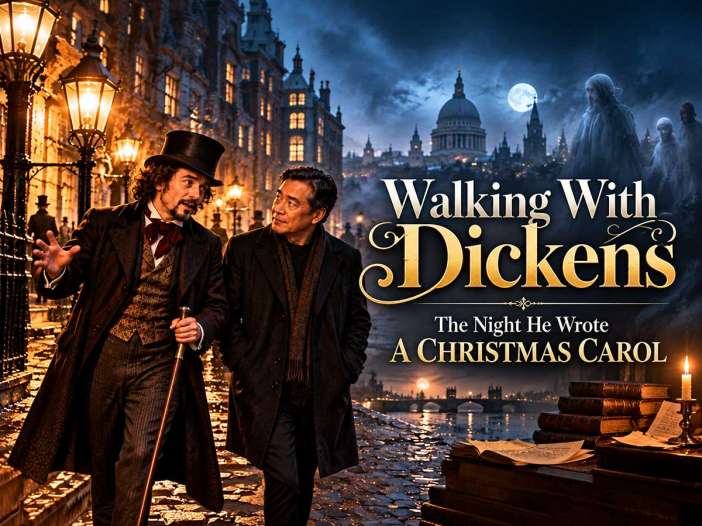
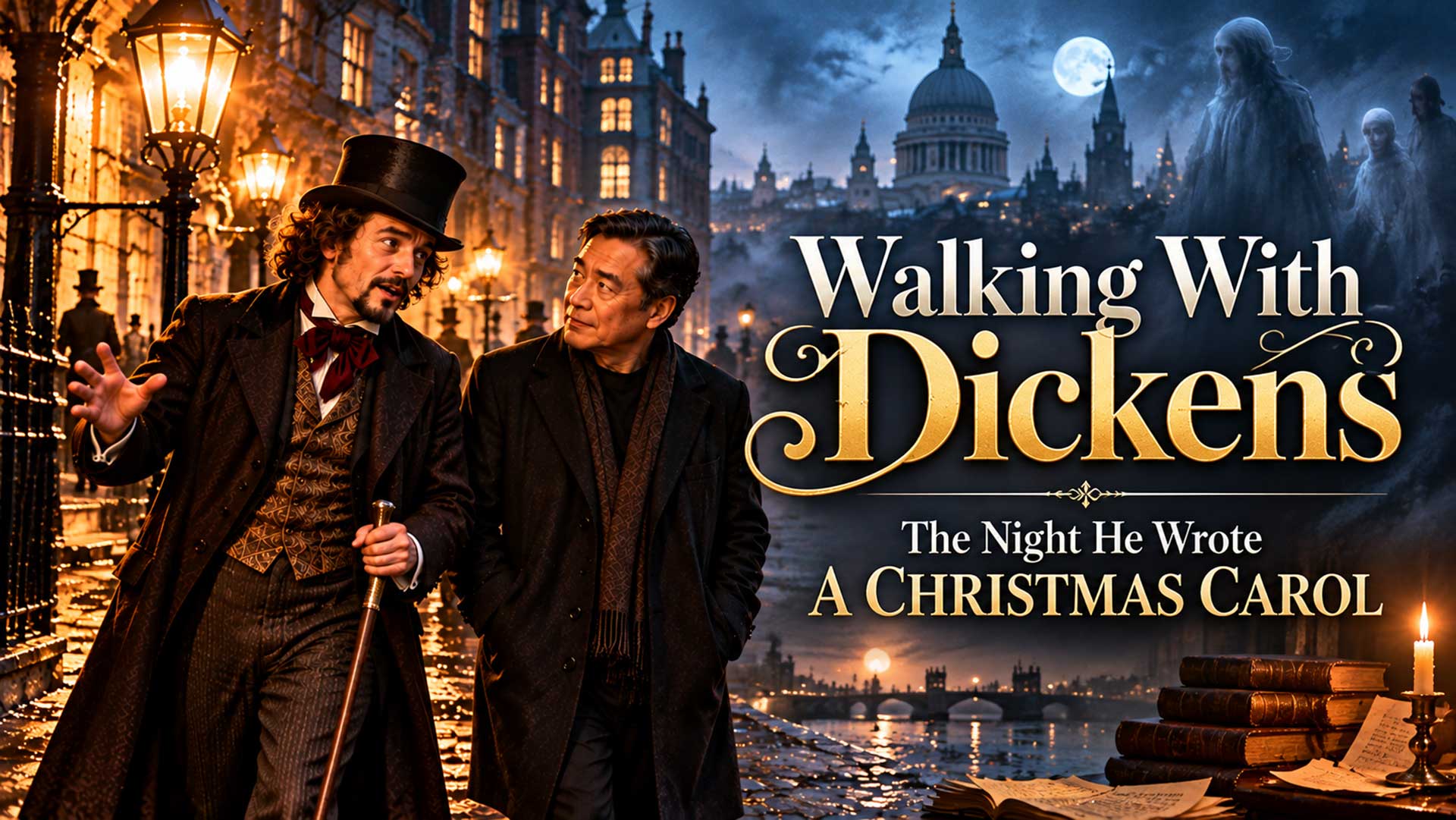
Introduction
In the autumn of 1843, the most famous writer in England was nearly broke.
Charles Dickens was 31. His latest novel was selling badly, his publishers were threatening to cut his pay, his father was draining his bank account, and his wife was expecting their fifth child. That year he had also read government reports on children working in mines and factories, eight-year-olds sitting alone in the dark underground, and he couldn’t stop thinking about them. He decided that a pamphlet wouldn’t move anyone. A story might.
So he wrote A Christmas Carol in about six weeks. And by his own account, he composed much of it on foot, walking the black streets of London fifteen and twenty miles many a night, after all the sober folks had gone to bed. You can learn more about how the book came to be from Penguin’s history of A Christmas Carol, and about his life at the Charles Dickens Museum, in the London house where he wrote Oliver Twist.
One of those nights, I walked with him.
He thought I might be a spirit, which seemed only fair, since he was busy inventing three of them. We went from Regent’s Park down to the river, where a boy of twelve once tied string around pots of boot polish in a rat-infested warehouse, a secret Dickens kept from almost everyone for the rest of his life. We walked through the slums of St Giles and the quiet squares of Bloomsbury. We talked about poverty, ghosts, his sister-in-law Mary, and a miser named Ebenezer who wasn’t talking yet. And at the end, I told him something about his own future that no one should have to hear.
Dickens was a showman, a reformer, a comic genius, and a deeply contradictory man. I didn’t try to settle his contradictions. I just wanted to walk beside him for a night and listen.
This is an imaginary conversation. The historical facts have been checked; where the record is uncertain, it’s treated as uncertain. Everything else, the fog, the conversation, what Dickens felt, is imagined, as faithfully to the man as I could manage.
(Note: This is an imaginary conversation, a creative exploration of an idea, and not a real speech or event.)
Topic 1: The Man Who Walks All Night
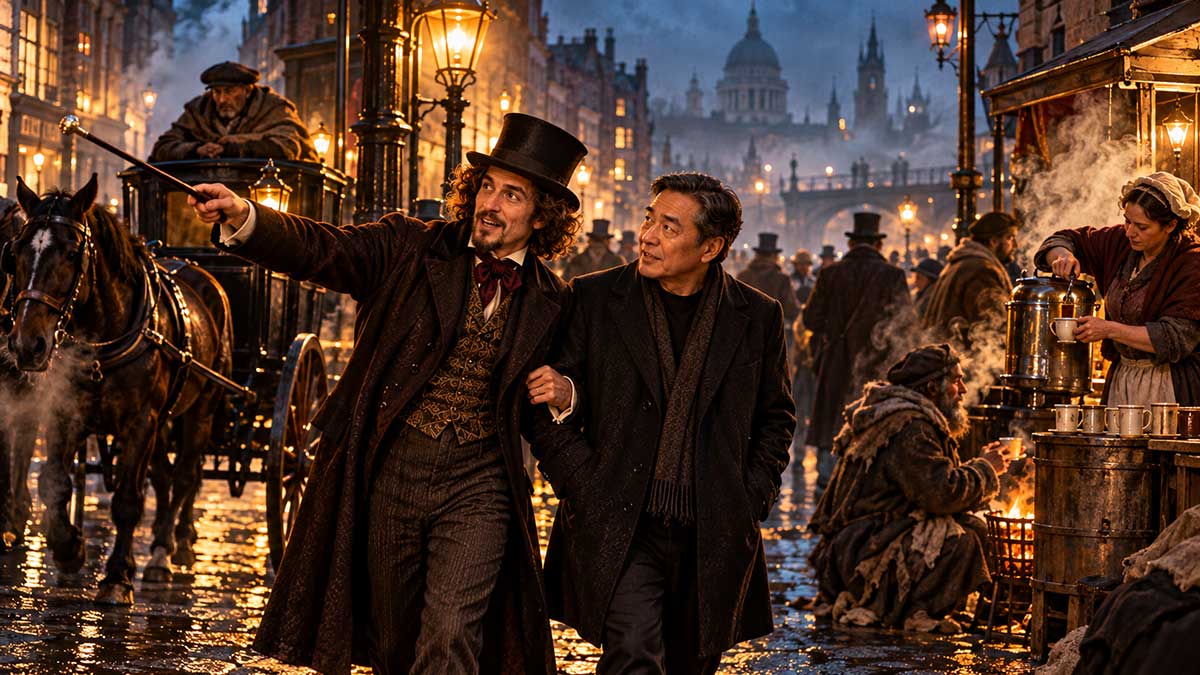
London, early November 1843. Fog lies along the edge of Regent's Park, yellow under the gas lamps. A slight man in a loose coat and a tall hat is walking very fast down the Marylebone Road, swinging a stick and talking to no one.
Charles Dickens: "Out upon merry Christmas!" No. No, softer. He wouldn't shout it. He'd say it the way you'd step on a beetle. "Out upon merry Christmas." Better.
He nearly collides with Nick, who has been trying to keep pace beside him for half a block.
Charles Dickens: I beg your pardon. I'm a menace on the pavement. My wife says I should carry a lantern and ring a bell, like a leper.
Nick Sasaki: I've been trying to catch up with you for two streets. You walk like the city's on fire.
Charles Dickens: The city's always on fire. It's only that most people can't see the smoke. You followed me? From my door? Nobody follows me at this hour. My friends are asleep, the bailiffs are asleep, even the critics are asleep, and they never sleep.
He stops under a lamp and looks at Nick properly: the face, the coat, the shoes.
Charles Dickens: You're not from London.
Nick Sasaki: No. A long way from here.
Charles Dickens: Your clothes are wrong. Not badly wrong, interestingly wrong. And you appeared out of the fog, at midnight, beside a man who is at this moment writing a story about spirits who appear out of the dark beside a man. So I have to ask, you understand, as a matter of professional courtesy. Are you a spirit?
Nick Sasaki: Would it disappoint you if I said no?
Charles Dickens: Terribly. Say "not exactly." It'll keep me happy for a mile.
Nick Sasaki: Not exactly.
Charles Dickens: Splendid. Walk with me, Not Exactly. I can't stop, I'm afraid. If I stop, the story stops.
They set off again. Dickens's pace doesn't slow.
Nick Sasaki: I think best walking too, but I've never done twenty miles in a night. Is that really how you write?
Charles Dickens: Twenty on a good night, fifteen on a bad one. The writing happens at the desk, in the morning, with ink. But the book happens here. I walk until the people in it start talking without me. Tonight I've got an old man who won't talk. Mean, cold, rich, and bored with his own meanness, which is the most dangerous kind. I can see him perfectly. I can see the shape of his nose. I can't get him to open his mouth properly.
Nick Sasaki: When I caught up with you, you were muttering something about Christmas in an old man's voice.
Charles Dickens: Was I? Then he was talking and I didn't notice. That's how it goes. You chase them for a week, and then they speak while your back's turned.
He stops dead, grips Nick's arm, and points with his stick across the road at a cab driver huddled on his box under a sack, his horse steaming in the cold.
Charles Dickens: Look at him. No, don't stare, he'll charge you a fare for it. Look at his hands.
Nick Sasaki: They're wrapped in rags.
Charles Dickens: Three layers. The inside layer's a woman's stocking. Somebody at home gave it to him. A wife, a daughter, a landlady with a soft heart. He's thinking about her right now, or about his supper, or about how much he hates the gentleman who just got out without paying the full fare. All three, probably. I'll never know which. And that's the joy of it. I get to decide.
Nick Sasaki: To me he's just a stranger in a cab.
Charles Dickens: There are no strangers in London, my friend. There are only people whose stories nobody's bothered to make up yet. That woman at the coffee stall on the corner, see her? She's been pouring the same bad coffee for thirty years, and she knows the name of every policeman in the parish, and the names of their children, and which of them are going to come to grief. You could put her in a book and she'd steal it from the hero.
Nick Sasaki: Is she in one?
Charles Dickens: She's in all of them. That's my secret. I never invent a single person. I just take one nose from here and a laugh from there and a dreadful habit of saying "as it were" from my Uncle Somebody, and I sew them together under a lamp. Like a tailor. A tailor of people.
He laughs at his own phrase, then frowns.
Charles Dickens: That's too pleased with itself. Forget I said it.
Nick Sasaki: Too late. I'm keeping it.
Charles Dickens: Thief. All my friends are thieves. It's the price of being amusing at dinner.
They cross Oxford Street. Even at this hour there are people: a drunk singing, two women in shawls hurrying home, a boy curled in a doorway. Dickens's eyes go to the boy and stay there a beat too long. Then he walks on.
Nick Sasaki: Can I ask what the story's for? You're famous. Everyone in this city knows your name.
Charles Dickens: Everyone in this city knows my name, and very few of them are buying my current novel. Martin Chuzzlewit. A masterpiece, by the way, and you may quote me. The public disagrees. My publishers have threatened to reduce my salary, which is a wonderfully polite phrase for "we may let you starve." I've got a house too big for my income, four children and another on the way, and a father who regards my bank account as a family amenity. So the story is for money. Mostly.
Nick Sasaki: Mostly.
Charles Dickens: You're very good at repeating the one word I hoped you'd miss.
Nick Sasaki: It's the only trick I've got.
Charles Dickens: It's a dangerous one. It's the trick confessors use. Fine. It's for money. And it's for something I read this year that I can't stop thinking about. We'll come to that. I'm not drunk enough yet, and I never drink on these walks, so we may be a while.
Nick Sasaki: Then tell me about your old man. The one who won't talk.
Charles Dickens: Ah. Ebenezer. A counting-house man. A squeezing, wrenching, grasping, scraping, clutching, covetous old sinner. You see? When I'm angry with him, he comes out in a list. He lives in rooms that used to belong to his dead partner. He keeps his clerk's fire so small the poor fellow warms himself at a candle. He thinks the poor should go to the workhouse and, if they'd rather die, they should do it and decrease the surplus population.
Nick Sasaki: That's brutal.
Charles Dickens: That's a Member of Parliament. I've heard men say it over port and walnuts. I've only put it in Ebenezer's mouth so they can hear how it sounds.
Nick Sasaki: When I hear him, he sounds like a man who decided a long time ago never to be poor or hurt again. Like the money is a wall.
Dickens stops. For the first time all night, he's silent for more than a breath.
Charles Dickens: Say that again.
Nick Sasaki: The money is a wall. He built it so nothing could get in.
Charles Dickens: Yes. That's it. That's what I've been missing. I've been writing him as a man who loves money. He doesn't love it. Nobody loves money, not really, not the coins. He's frightened of being without it. Somewhere back there, a long time ago, something happened to him. He was left alone somewhere. Some cold schoolroom at Christmas, with all the other boys gone home. And he decided, never again.
He starts walking again, faster than ever, talking almost to himself.
Charles Dickens: So the spirits don't scold him. That's been my mistake. A scolding just thickens a wall. They take him back. They show him the boy. They make him look at the boy until he can't stand not to love him.
Nick Sasaki: You're going to show a miser his own childhood.
Charles Dickens: I'm going to make a miser cry over his own childhood, and every reader in England is going to cry with him and not know why. Good God. Not Exactly, you're worth the walk.
Nick Sasaki: You figured it out. I just said a sentence.
Charles Dickens: Most of literature is somebody saying the right sentence to the wrong man at midnight. Where did you get it? The wall?
Nick Sasaki: Maybe from watching people. A lot of them. People who are very successful and still afraid.
Charles Dickens: Hm. You say that as if you know the type from the inside.
Nick Sasaki: I could say the same about you.
Dickens gives him a sharp sideways look, then laughs, but it's a shorter laugh than before.
Charles Dickens: Oh, you're a dangerous sort of spirit. Come on. I know where this walk is going now. I didn't, ten minutes ago. I'm going to take you down to the river.
Nick Sasaki: What's at the river?
Charles Dickens: Nothing. A building that isn't there anymore. Walk faster, my friend. It's cold, and I've got a boy in a schoolroom to find.
Topic 2: The Boy at Hungerford Stairs
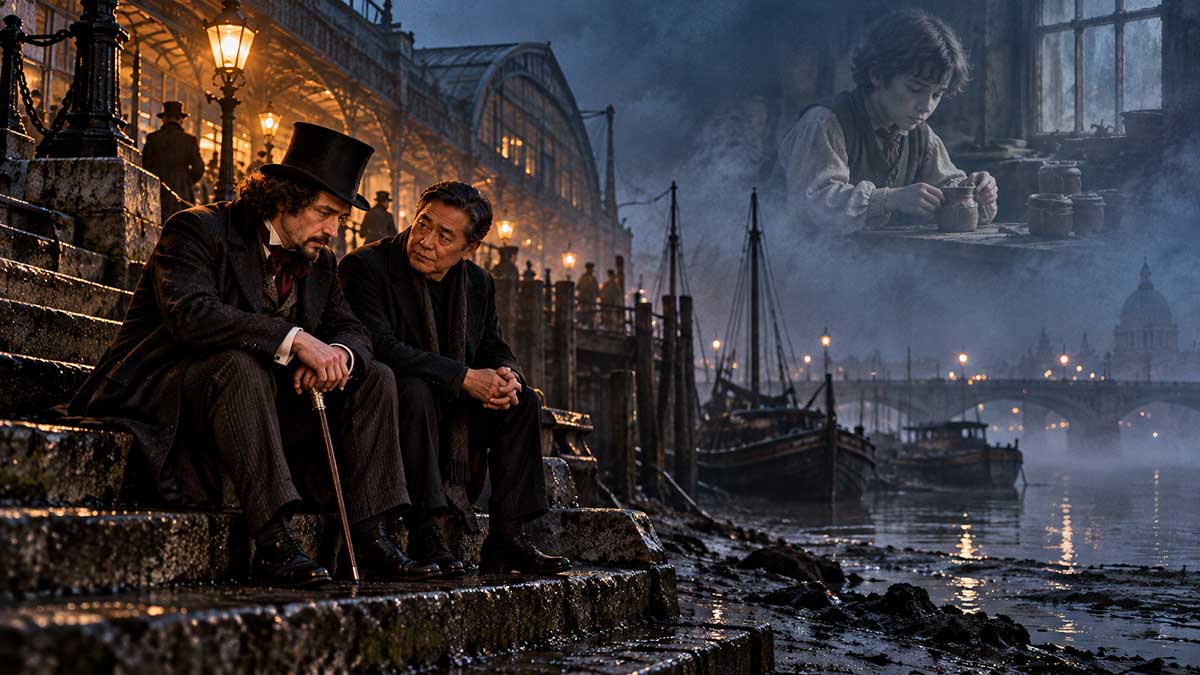
They come down through the narrow streets off the Strand toward the Thames. The fog is thicker by the water. The tide is out, and the mud smells of coal smoke and rot. A new market hall stands where the old riverside houses used to be. Dickens stops at the top of a flight of stone steps leading down to the river and doesn't go any further.
Nick Sasaki: You've gone quiet. And you've walked us straight to the river.
Charles Dickens: I told you. A building that isn't there anymore.
Nick Sasaki: Something happened to you here.
Charles Dickens: They've pulled it down. They built that great respectable market on top of it, and now ladies buy fish where the rats used to be. London's very good at that. It builds a nice new floor over everything and calls it improvement.
He taps the step with his stick, once, twice.
Nick Sasaki: You don't have to tell me. But I'd like to hear it.
Charles Dickens: I've never said it out loud. Do you understand? Not to Catherine. Not to my children. One friend knows a little. I've thought it a thousand times on this walk, and I've never once said it.
Nick Sasaki: Then maybe a stranger in the fog is the right person.
Charles Dickens: A spirit, you mean. Not exactly. Yes. Perhaps that's why I brought you here.
He sits down on the top step, heavily, in his good coat. After a moment Nick sits beside him.
Charles Dickens: There was a house here. A crazy, tumbledown old house, right on the river, with rotten floors and rotten stairs, and the rats swarming in the cellar. You could hear them squeaking and scuffling up the staircase at all hours. It was a warehouse for blacking. Boot polish. And when I was twelve years old, I went to work in it.
Nick Sasaki: Twelve.
Charles Dickens: Twelve. Ten hours a day. They sat me at a table by a window, with a pile of pots, and my job was to cover each pot with a piece of oiled paper, and then a piece of blue paper, and tie it round with string, and clip it neat, and paste on a printed label. Over and over and over. Hundreds of them. I got quite good at it. I was proud of how quickly I could do it, and I hated myself for being proud.
Nick Sasaki: Why were you there?
Charles Dickens: Because my father couldn't pay his debts. A relative of ours worked at the place and offered a job for the boy. My parents said yes. I'd been at school. I'd been clever. I'd had books, and I'd dreamed of being a learned man, a distinguished man. And then one Monday morning I was a little laboring boy in a rat-house by the river. I worked beside a boy called Bob Fagin, who was kind to me in his way.
Nick Sasaki: Fagin. That's the name of your villain in Oliver Twist.
Charles Dickens: You've read it. Then you know what I did with his name. Make of that what you like. I don't know what to make of it myself.
Nick Sasaki: And your father?
Charles Dickens: Soon afterwards, he was arrested for debt and put into the Marshalsea prison, over there, across the river, in Southwark. My mother and the little ones went in with him. That's how it worked. A family could live inside the prison with the debtor. So they were all in prison, together, and I was outside, alone, in a lodging, walking to the warehouse every morning and walking back every night. On Sundays I'd visit them.
Nick Sasaki: You were the only one on the outside.
Charles Dickens: Free, technically. I'd have traded with them in a minute. At least they had each other. I had the rats and the pots.
The river slaps against the steps below them. Somewhere a boatman calls.
Nick Sasaki: How long did it last?
Charles Dickens: I don't know. Isn't that strange? I remember the color of the paper. I remember the smell of the paste. I remember the exact tone of a man's voice who called me "the young gentleman," mocking. But I have no idea how long it lasted. A year? Months? It felt like the whole of my life, and then it was over, and the whole thing was folded up and put away.
Nick Sasaki: How did it end?
Charles Dickens: My father came into a little money. An inheritance. He got out of prison, and after a while he took me out of the warehouse and sent me back to school. My father, who was hopeless with money and hopeless at most practical things, and who I love, did that one right thing.
Nick Sasaki: And your mother?
Dickens doesn't answer for a long time.
Charles Dickens: My mother wanted me sent back.
Nick Sasaki: Back to the factory?
Charles Dickens: She went to see about it. To smooth things over, so that I could go back to work. She was warm for it. That's the only word I have for it. Warm. I don't blame her for much. She taught me to read. She taught me my first Latin. She's a funny woman, actually, very lively, you'd like her at a dinner. But I never forgot it, and I never shall forget it, and I never can forget it, that she was warm for my being sent back.
Nick Sasaki: You've written so openly about other people's suffering. Orphans, workhouses, cruel schools. Why keep yours buried?
Charles Dickens: Because it's mine. Because I'm Charles Dickens, and people stop me in the street, and duchesses ask me to dinner. And underneath all of that is a little boy tying string around pots of blacking, and I'm terrified that if anyone sees him, they'll see that the rest of it's a costume. That I'm a laborer who learned to talk.
Nick Sasaki: Do you think that's what people would see?
Charles Dickens: I think it's what I'd see, if I let myself look. My parents never spoke of it again. Never once. They were struck dumb about it, as if it had never happened. So I learned from them. You don't speak of it. You build the nice new market over the top.
Nick Sasaki: Can I tell you what I think, gently? I believe at some point we have to see our parents as frightened, imperfect people, not just as the ones who hurt us. Your family was desperate. You said it yourself, that job brought in money. Is it possible your mother wasn't throwing you away? That she was just terrified of the bills?
Charles Dickens: You think I haven't told myself that?
Nick Sasaki: I'm sure you have.
Charles Dickens: I've told myself she had small children and a husband in prison. I've told myself a few shillings a week was bread. I've told myself she was a practical woman in an impractical family, and somebody had to count the coins. All of that's true. I believe every word of it.
Nick Sasaki: But.
Charles Dickens: But I was twelve. A twelve-year-old doesn't know about bread and shillings. He knows that his mother looked at him and decided he could go back to the rats. You can understand a thing perfectly well and still not be able to forgive it. I can see her as a frightened woman. I've done that. It doesn't reach the boy. He's still sitting at that table.
Nick Sasaki: That's honest.
Charles Dickens: It's not noble. I know what you're hoping I'll say. That I've made peace with it, that I've forgiven her, that I write all these books full of forgiveness because I've got it in my heart. I don't. Not about this. I write forgiveness because I want to believe in it. Perhaps that's not the same.
Nick Sasaki: Maybe it's where it starts.
Charles Dickens: Maybe. You're an optimist. I'm a sentimentalist, which is an optimist who's been knocked down and keeps crying about it.
He laughs, and this time it almost works. He stands, brushes the damp off his coat, and looks down at the black water.
Charles Dickens: Do you know what I've just realized? Ebenezer. The boy alone in the schoolroom at Christmas, with everyone else gone home. I told you I'd found him on the walk. I didn't find him on the walk. I found him here. I've been sitting at this table for twenty years.
Nick Sasaki: Will you give him what you never got? Someone coming for him?
Charles Dickens: His sister. A little girl who comes running in and says Father's kinder now, and you're to come home. Yes. I'll give him that. I'll give him every bit of it.
He turns away from the river abruptly.
Charles Dickens: Enough. Enough of the rat-house. I've told a spirit my one secret and I feel like a man who's been sick in the street. Come on. There's something worse than my story in this city, and I want you to see it. My story ended. There are children here tonight whose stories won't.
Topic 3: A Sledgehammer Blow
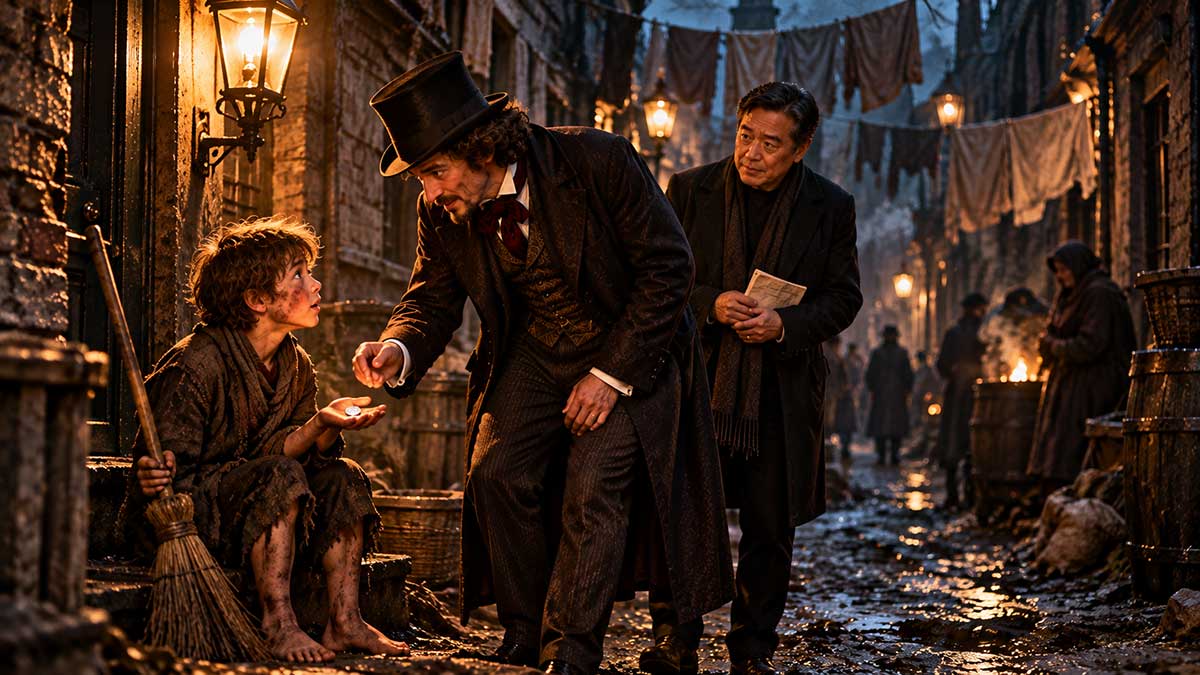
They walk north from the river, up through Covent Garden, where the market carts are already arriving in the dark, and on into the tangled lanes of St Giles. Here the gas lamps thin out. The houses lean together. Laundry hangs across the alleys like flags. Somewhere a baby is crying and a man is shouting, and neither stops.
At a muddy crossing, a small boy with a broom darts out in front of them and begins sweeping a path through the filth, his bare feet black to the ankle.
Crossing-Sweeper: Sweep it for you, sir? Clean all the way over, sir? Mind the horse muck, sir.
Charles Dickens: You're out late, young man.
Crossing-Sweeper: Gentlemen comes out of the theatres late, sir. Gentlemen gives more when they've had a drink.
Charles Dickens: An economist. What's your name?
Crossing-Sweeper: Jo, sir.
Charles Dickens: Well, Jo, you've swept the finest crossing in London, and you deserve to be paid like a man of business.
He presses a coin into the boy's hand. The boy looks at it, looks up at Dickens, and his whole face changes. Then he's gone, running, as if afraid the gentleman will change his mind.
Nick Sasaki: You gave him a coin and his own name back, and he lit up like you'd given him a crown.
Charles Dickens: It was a shilling. He'll eat tomorrow, and probably the day after. And on Thursday he'll be back at that crossing, and on Thursday I won't be there.
Nick Sasaki: You can't save every one of them. How do you live with that?
Charles Dickens: Badly. I give money. I go home. I eat a good dinner and feel ashamed of it and eat it anyway. I write. I tell myself that if I write well enough, a thousand people will give a shilling instead of one. And then I come back here and there are just as many Jos as there were before. There are more every year.
Nick Sasaki: You said there was something you read this year you couldn't stop thinking about.
Charles Dickens: The commissioners' reports. Parliament sent men out to the mines and the factories to ask the children what their lives were like, and the children told them, and the men wrote it all down, and it was printed in great blue volumes that nobody reads. I read them. All of it. I wish I hadn't, and I'm glad I did.
Nick Sasaki: I brought one with me. Can I read you a piece?
Charles Dickens: You brought a parliamentary report on a walk at midnight? You really aren't from here.
Nick takes out a folded sheet and reads under a lamp at the corner.
Nick Sasaki: It's a girl named Sarah Gooder. Eight years old. "I'm a trapper in the Gawber pit. It does not tire me, but I have to trap without a light and I'm scared." She goes down at four in the morning, sometimes half past three, and comes up at five or half past in the evening. She never sleeps down there. She sings, she says, when she has a light, but not in the dark. She dares not sing in the dark. And she doesn't like being in the pit.
Dickens has stopped walking. He stands very still, hands on his stick.
Charles Dickens: I remember her. I remember that line. "I dare not sing then." Do you know what a trapper does?
Nick Sasaki: Opens and closes the doors underground, so the air moves through the tunnels.
Charles Dickens: In the dark. Alone. For twelve or thirteen hours. A little girl sitting in a hole in the earth, waiting for the coal carts to come rumbling through so she can pull a string and open a door. And she says it doesn't tire her. That's what kills me. "It does not tire me." She's being brave for the gentleman with the notebook.
Nick Sasaki: You were going to write a pamphlet about these reports.
Charles Dickens: I was. I'd half planned it. An appeal to the people of England on behalf of the poor man's child. Very stern, very well argued. Statistics and outrage. And then I thought: who reads pamphlets? The people who already agree with them. The others use them to light the fire. I wanted to hit them with something they couldn't put down. A sledgehammer. Twenty times the force of anything I could argue.
Nick Sasaki: So you're writing a ghost story.
Charles Dickens: I'm writing a ghost story because a man who would never read a word about Sarah Gooder will sit by the fire at Christmas with his children and read about a crippled little boy whose father carries him home from church on his shoulder. And he'll cry. And when he's done crying, perhaps he'll look at his own clerk, and his clerk's children, a little differently.
Nick Sasaki: The crippled boy. Is he real?
Charles Dickens: Real enough. My sister Fanny has a little boy. Henry. He's sickly and he's lame, and he's the sweetest-natured child you ever met. I saw him in Manchester last month, when I went up to give a speech about education. I went to talk about schools for working men, and the thing I came home with was a little boy on a crutch.
Nick Sasaki: Does he have a name in the story yet?
Charles Dickens: I keep changing it. I had him as Fred, but that's my brother's name, and I want it for somebody else. He's small, and he's Tim, so he's... Tiny Tim. Too sweet? It might be too sweet.
Nick Sasaki: It works. Trust me on that one.
Charles Dickens: You say that like you know.
Nick Sasaki: I might.
Charles Dickens: Spirits. Never a straight answer.
They walk on. A woman in a doorway watches them pass with flat, tired eyes.
Charles Dickens: There's another thing I want in it. I've been thinking about it all week, and I haven't told anyone. One of the spirits, the generous one, the one who's all feasting and abundance, opens his great robe, and underneath, clinging to his legs, are two children. Wretched, yellow, wolfish things. A boy and a girl. And Scrooge asks whose they are, and the spirit says they're Man's. The boy is Ignorance. The girl is Want. And beware them both, but most of all the boy.
Nick Sasaki: Why the boy most of all?
Charles Dickens: Because Want you can feed. Ignorance grows up. Ignorance becomes a man with no school and no work and no hope, and one day he picks up a torch. I've seen a ragged school this year, a room full of boys like Jo, filthy, half of them thieves, and a few good people trying to teach them their letters by candlelight. Nobody gives them money because they're not respectable. They're the most important room in London.
Nick Sasaki: I believe a story can reach a heart that an argument never will. But I'll be honest about what worries me. It can also let a reader cry over Tiny Tim, close the book, feel wonderful, and walk straight past the real Jo on the corner.
Charles Dickens: Ha. You've found my nightmare.
Nick Sasaki: Do you worry about it?
Charles Dickens: Every day. The critics will say I'm a sentimental fool, that I make people weep instead of think. And they'll be partly right. Some readers will have a lovely cry and do nothing. Some ladies will weep over my orphans and then scold their own maids for breaking a cup.
Nick Sasaki: So why believe in it?
Charles Dickens: Because the alternative is believing in nothing. Look, I'm not a fool. I know a story doesn't pass laws. But laws are passed by men, and men have hearts, and hearts are moved by stories before they're moved by anything else. You don't get a single law without first making a lot of comfortable people uncomfortable. That's my work. Not to fix it. To make it impossible to look away.
Nick Sasaki: You don't think that's enough on its own.
Charles Dickens: Of course it's not enough. Nothing's enough. But you asked why I write instead of preach. That's why. I'll leave enough to the parsons and the politicians. I'll do the haunting.
He stops at the corner of a wider street, where the lamps come back, and looks back into the dark lanes they've just walked through.
Charles Dickens: You know, there's a ghost in every one of those houses. Children who died in them. Mothers. Nobody remembers their names. Sometimes, walking through here at night, I'd swear I can feel them. And then I tell myself I'm a writer with an overheated imagination who's walked twelve miles without supper.
Nick Sasaki: Which do you believe?
Charles Dickens: That, my dear spirit, is a much longer walk. Come. We'll cut up through Bloomsbury. It's quieter there, and I can't talk about ghosts with a baby crying.
Topic 4: A Hankering After Ghosts
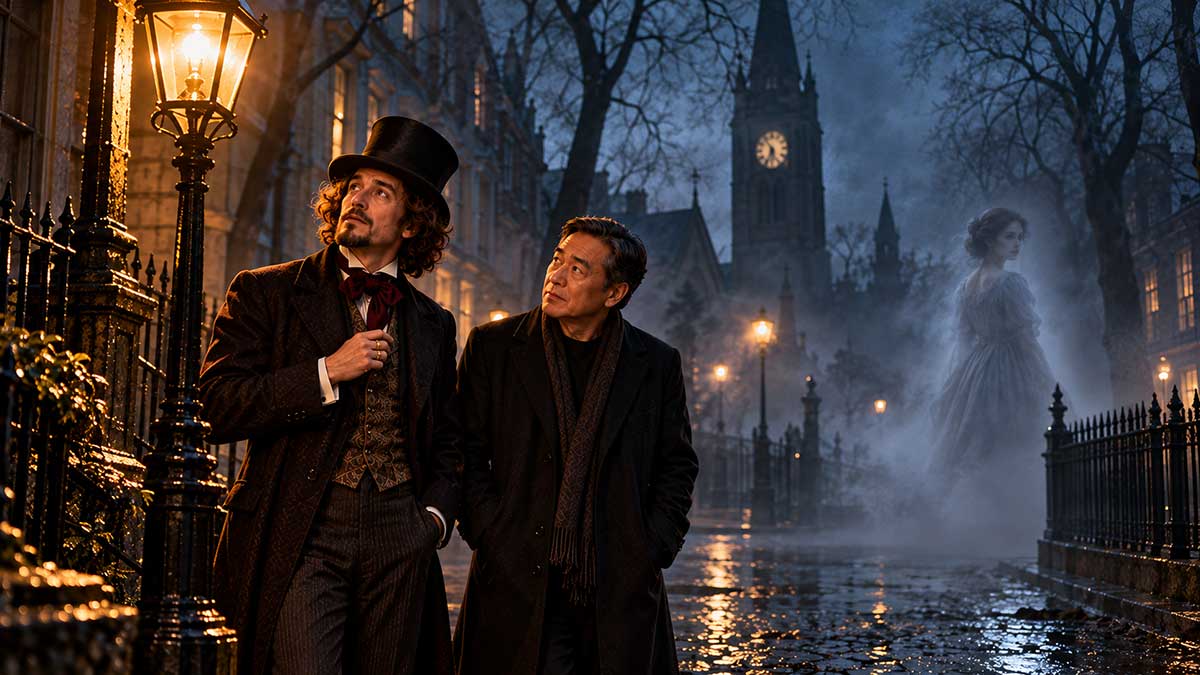
Bloomsbury is quiet. Long, dark squares of tall houses, railings, bare plane trees dripping in the fog. A night watchman's lantern swings at the far end of a street. Dickens walks more slowly now, hands deep in his pockets.
Nick Sasaki: You write ghosts as if you've met one.
Charles Dickens: Everyone says that. Do you know why? Because I write them as if they're embarrassed. A real ghost would be embarrassed. Imagine coming all that way, through death and darkness and eternity, to stand at the foot of some fellow's bed in Camden Town, and he says, "You're a bit of undigested beef." That's in my story, by the way. Scrooge says it to his dead partner. "There's more of gravy than of grave about you."
Nick Sasaki laughs out loud.
Nick Sasaki: That's terrible.
Charles Dickens: It's wonderful. It's the worst joke I've ever written and I'm keeping it. You have to let a man joke when he's frightened. Otherwise he can't stand there long enough to be haunted.
Nick Sasaki: People say you've done more than write about it. That you've practiced mesmerism. Putting people into trances.
Charles Dickens: Who told you that? It's true. My friend Dr. Elliotson taught me. A brilliant man, and they threw him out of his hospital for it, the cowards. I tried it first on Catherine, last year, in America, in a hotel in Pittsburgh. I made a few passes with my hands, the way he showed me, and within six minutes she was in hysterics and then fast asleep.
Nick Sasaki: Your wife let you practice on her?
Charles Dickens: My wife is a woman of extraordinary patience. Or extraordinary suggestibility. Either way, a perfect subject. I've done it since on a few friends. You'd be amazed what happens. People go somewhere. Their faces change. Things come out of them they didn't know they knew.
Nick Sasaki: What have you seen with your own eyes that you can't explain?
Charles Dickens: That. A mind going somewhere and coming back. But I don't call it spirits. I call it a power in us we don't understand yet. Like electricity. A hundred years ago, nobody understood lightning; now we put it in wires. Mesmerism's the same. It's not a door into heaven. It's a door further into ourselves.
Nick Sasaki: That's a careful answer.
Charles Dickens: I'm a careful man about that one subject, and careless about everything else. There are a great many swindlers in London who'll take a widow's last guinea to tell her that her husband is happy and wants her to buy a new bonnet. I despise them. I'd put them in a book and set the dogs on them.
They pass a church. Its tower is black against the fog. Dickens glances up at it and walks on.
Nick Sasaki: Can I ask something more personal?
Charles Dickens: You've already had my blacking factory. You might as well have the rest.
Nick Sasaki: Mary Hogarth.
He doesn't answer at first. His hand goes to his other hand, to a ring on his finger.
Charles Dickens: Six years ago. She was Catherine's younger sister. She lived with us. Seventeen. The brightest, gentlest creature. We'd all been to the theatre that night, the three of us, laughing all the way home. She went up to bed, and she cried out, and by the next afternoon she was dead. In my arms. Just like that.
Nick Sasaki: I'm sorry.
Charles Dickens: I took this ring off her finger. I've never taken it off mine. I asked to be buried next to her. I still want that. Do you know, I've never written anything since without her somewhere in it. Every good, young, dying girl in my books. Little Nell. People wrote to me from all over the country begging me not to let Nell die. They didn't know I'd already watched it happen once.
Nick Sasaki: Have you ever felt her near you since?
Charles Dickens: For a long time, she came to me in my sleep. Every night. Not as a horror. Just Mary, the way she was. I'd wake and for half a moment I'd think she was in the next room.
Nick Sasaki: Did you believe it was really her?
Charles Dickens: I wanted to. God, I wanted to. And then I'd get up and shave, and look at my face in the glass, and tell it: you grieve, and your mind gives you what you want. That's all a dream is. The heart writing a story at night.
Nick Sasaki: I'll tell you what I believe, and you can do what you like with it. I believe there's more to us than the body. I believe the people we love who've gone before us aren't entirely gone, and that love doesn't just stop at the grave. I can't prove it. But I've lived long enough that I'd be lying if I said I didn't believe it.
Charles Dickens: You say that very simply.
Nick Sasaki: It is simple to me.
Charles Dickens: That's what I envy. Not the belief, the simplicity. I'm a believer by temperament and a doubter by trade. I make things up for a living. I know exactly how easily a mind invents a ghost. I invent four a week.
Nick Sasaki: So what stops you?
Charles Dickens: The fear of being comforted by a lie. That's it, really. If I let myself believe Mary's near me because I want her near me, then I've used her. I've turned her into one of my characters. I'd rather miss her honestly than enjoy a ghost I wrote myself.
Nick Sasaki: Maybe both can be true. The longing and the presence.
Charles Dickens: Maybe. I'll give you that. I'll give you maybe, and not one inch more. I'm sorry, my friend. I'd like to give you more.
Nick Sasaki: You don't have to. I didn't come here to convince you.
Charles Dickens: No, you didn't, did you? That's the odd thing. Everyone who talks to me about the spirit world wants something. Money, or my name in a pamphlet, or my soul for their chapel. You haven't asked for a thing.
He stops under a lamp and looks at Nick closely, the way he looked at the cab driver hours ago.
Charles Dickens: So here's my difficulty. I don't believe in ghosts. And I've walked five hours tonight with a man whose clothes are wrong, who reads me parliamentary reports by lamplight, who knows things about Oliver Twist and Little Nell, and who finished my Scrooge for me in a single sentence. Who knew to ask about Mary.
Nick Sasaki: People know about your books.
Charles Dickens: People do. People don't know about the rat-house. I told you that tonight because I felt like telling it. But you weren't surprised. Not once. You looked as if you'd already read it somewhere.
Far off, a church clock begins to strike. One. Then nothing. Just the drip of the trees.
Charles Dickens: One o'clock. You know what happens in my book at one o'clock?
Nick Sasaki: The first spirit comes.
Charles Dickens: Yes. It does. And there you are again, knowing the end before I've written it.
He grips his stick with both hands.
Charles Dickens: So I'll ask you once more, and this time no "not exactly." I'm a grown man and I can stand it. Where are you from?
Nick Sasaki: A long way ahead. Not a place. A time.
Charles Dickens: How far ahead?
Nick Sasaki: Far enough to know how things turn out.
Dickens laughs, short and nervous, and doesn't take his eyes off Nick.
Charles Dickens: Then you'd better walk me home, spirit. Because if you're going to show me what's coming, I'd like to be close to my own front door when you do it.
—
One fact to verify before MFS: that Mary Hogarth appeared in Dickens's dreams nightly for a long period after her death. I'm fairly confident it's documented in his letters, but I added it from memory.
Topic 5: The Ghost of Christmas Yet to Come
They walk north again, out of Bloomsbury, up toward the edge of Regent's Park. The fog is thinning. Above the rooftops, a few stars show. Dickens walks fast, then slow, then fast again, like a man arguing with himself.
Charles Dickens: All right. I've decided. I'm going to treat you as a spirit, because it's more interesting than treating you as a lunatic, and because you haven't tried to sell me anything. Tell me the good news first. A man should be allowed to hear the good news first.
Nick Sasaki: You asked me at the start if I was a spirit. This is the best answer I can give. I'm from a long way ahead. And your little book, the one you're walking around in tonight, will be read every Christmas for nearly two hundred years.
Charles Dickens stops.
Charles Dickens: Two hundred.
Nick Sasaki: So far. Every year. Plays in every city. Children acting it in schools, with paper top hats and cotton-wool beards. Films, which are like plays made of moving pictures, dozens of them. People who've never read a word you wrote know who Scrooge is. Calling someone a Scrooge is part of the language. And "Bah! Humbug!"
Charles Dickens: I haven't even decided if he says "Bah! Humbug!"
Nick Sasaki: He does.
Charles Dickens: He does. Of course he does. It's good, isn't it? It's got a bark in it.
He starts walking again, quickly, almost laughing.
Charles Dickens: And it'll help? The children? Jo, the girl in the pit?
Nick Sasaki: People say it helped change how the world keeps Christmas. Family, generosity, remembering the poor. You won't fix the mines with it. But people will give, and keep giving, because of it. For a very long time.
Charles Dickens: And I'll be rich.
Nick Sasaki: Not from the book. You'll hope for a thousand pounds and you'll make about two hundred and thirty.
Charles Dickens: Two hundred and thirty! Two hundred years of immortality and I can't pay the butcher! That's the most English thing I've ever heard.
Nick Sasaki: But you'll read it aloud yourself, on stage, to huge crowds, for years. In England and in America. You'll do all the voices. People will weep and cheer. That will make you a great deal of money.
Charles Dickens: Me? On a stage? Reading my own books to strangers? That's... Well. That's exactly the sort of thing I'd do, isn't it. I'd love that. God help me, I'd love that more than anything.
He's quiet for a few steps.
Charles Dickens: You said good news first. That means there's other news.
Nick Sasaki: There is. And I think you'd want to hear it. I wouldn't tell you if I didn't think so.
Charles Dickens: Go on.
Nick Sasaki: In fifteen years, you'll leave Catherine. You'll fall in love with a young actress, and you'll separate from your wife. And you won't do it quietly. You'll put a statement in the newspapers about your marriage. And you'll write a letter, which will leak and be printed everywhere, saying she never loved your children. That she has some kind of mental disorder. You'll keep the actress hidden from the world for the rest of your life.
Charles Dickens doesn't stop walking. He walks faster.
Charles Dickens: No.
Nick Sasaki: I'm not here to judge you.
Charles Dickens: You're not here to judge me. You're just here to tell me I'm going to become a monster.
Nick Sasaki: I didn't say monster.
Charles Dickens: Catherine. Catherine, who's carrying our fifth child at this moment. Who sat up with me the night Mary died. Who let me make passes at her in a hotel in Pittsburgh. Who laughs at my jokes when they're not funny, which is more often than you'd think. I'm going to tell the whole of England she doesn't love her children?
Nick Sasaki: That's what's written.
Charles Dickens: Written by whom?
Nick Sasaki: By you.
That stops him. He stands at the edge of the park, gripping the railings, breathing hard.
Charles Dickens: I don't believe it.
Nick Sasaki: I understand.
Charles Dickens: You don't understand. You've no idea. I love her.
Nick Sasaki: I believe you love her tonight.
Charles Dickens turns, sharp, ready to snap something back. Then he doesn't.
Charles Dickens: That's a cruel thing to say.
Nick Sasaki: It's not meant to be. I just wondered, hearing it, whether you recognize that man at all. Even a little.
He's silent for a long time.
Charles Dickens: I'll tell you something I've never told her. Some evenings, I come home from these walks, and the house is full of noise and children and Catherine half asleep on the sofa, and I stand in the hall and I feel... a want. A great restless want of something. I don't know what. Something I missed. Something I was meant to have and didn't. And I go upstairs and write till it goes away. It always goes away.
Nick Sasaki: Does it?
Charles Dickens: You're doing the word trick again.
Nick Sasaki: I know.
Charles Dickens: It doesn't always go away. Damn you. There. I recognize him a little. The man who wants more than he's got. I've known him since the rat-house. I didn't know he was dangerous.
Nick Sasaki: I've come to believe you can love someone without trying to make them into what you need. But it's very hard when you feel something is missing.
Charles Dickens: You think I'll blame her. For the want.
Nick Sasaki: I think that's what people do.
Charles Dickens: Yes. It's what Ebenezer did. Blamed the whole world for being cold, when he was the one who'd built the wall.
He looks up at the dark trees in the park.
Charles Dickens: Tell me one more thing. How do I die?
Nick Sasaki: I'm not going to tell you that.
Charles Dickens: Why not? You've told me everything else.
Nick Sasaki: Because you'd carry it every day. And it wouldn't help anyone. I told you about Catherine because you can still do something with it.
Charles Dickens: Can I? Your Scrooge sees his future, your spirit says, and he wakes up on Christmas morning a new man. Buys the biggest turkey in the shop. Raises Bob Cratchit's salary. That's my plan, anyway. It's a lovely plan. It's a fairy story.
Nick Sasaki: You're the one writing it. Your Scrooge sees his future and changes. You've heard yours tonight. Will you?
Dickens takes a long breath and lets it out in a cloud.
Charles Dickens: I'll tell you what Scrooge asks. I've had it in my head for a week and didn't know what it was for. He stands in the churchyard in front of his own grave, and he says to the last spirit: "Are these the shadows of the things that Will be, or are they shadows of things that May be, only?"
Nick Sasaki: What's the answer?
Charles Dickens: The spirit never says. It just points. That's the whole terror of it, and the whole hope. Nobody tells you. You have to wake up and find out.
He turns and walks on, along the park, toward a tall house with one lighted window.
Charles Dickens: So I won't promise you anything, spirit. I'm not going to stand here at two in the morning and swear to change, like a drunk swearing off gin. I've seen too many men do it. I'll tell you this much: I heard you.
Nick Sasaki: That's enough.
Charles Dickens: It isn't, and you know it isn't. But it's what I've got.
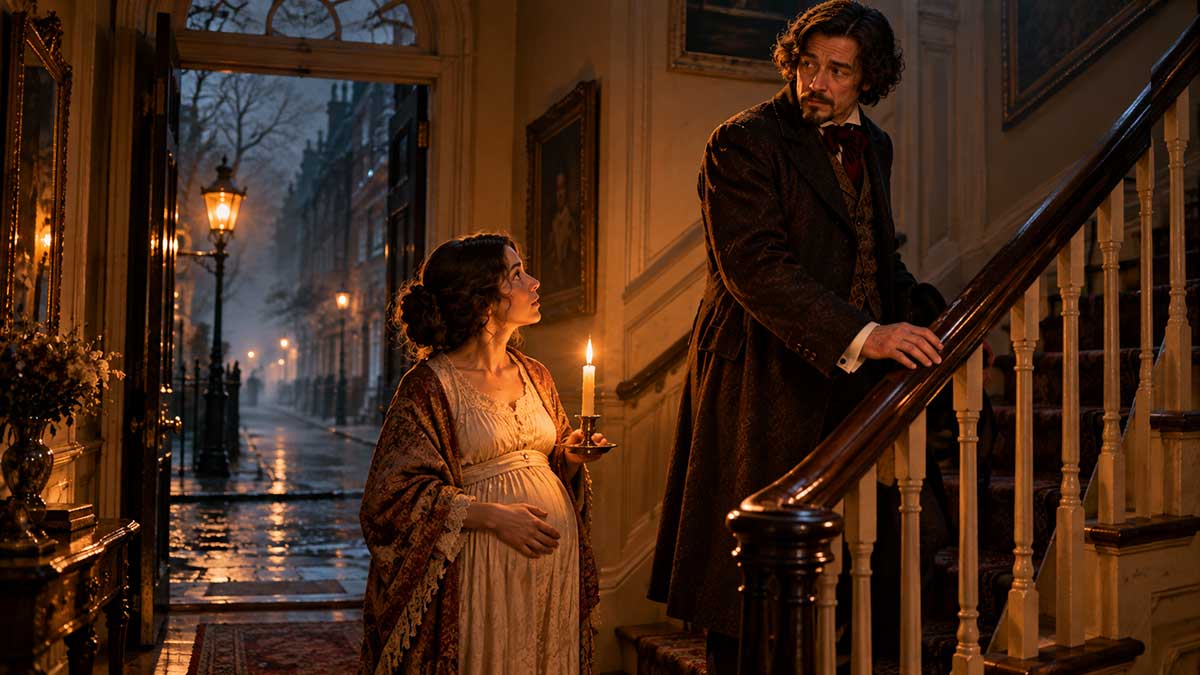
They reach the house. 1 Devonshire Terrace. Before Dickens can find his key, the door opens. A young woman stands in the doorway with a candle, in a dressing gown, a shawl around her shoulders, heavily pregnant, her hair coming down from its pins.
Catherine Dickens: There you are. I heard the gate. Charles, it's two in the morning. Have you walked to Scotland and back?
Charles Dickens: Very nearly. Kate. You shouldn't be up.
Catherine Dickens: I couldn't sleep. The baby kicks whenever you're not in the house. He takes after you. Restless. Who's your friend?
She lifts the candle toward the street. The pavement is empty. Only the fog, and the iron railings, and the lamp at the corner.
Catherine Dickens: I thought I heard you talking to someone.
Charles Dickens: I was. I was talking to myself. I always do.
He steps into the hall. She reaches to take his wet coat, and for a moment he stands quite still, looking at her face in the candlelight as if he's never seen it before. He seems about to say something.
Catherine Dickens: What? What is it? You've got that look. You've had an idea.
Charles Dickens: I've had... yes. An idea.
He kisses her quickly on the forehead, hands her his hat, and turns to the stairs.
Charles Dickens: Go to bed, my dear. I have to write something down before I lose it.
Catherine Dickens: Now?
Charles Dickens: Now.
He takes the stairs two at a time. Halfway up, he stops, one hand on the banister, and looks back down at her, standing alone in the hall with the candle.
Then he goes on up, and the study door closes, and after a moment, she hears the scratch of his pen.
—
Fact note: the scene has Catherine call him "Charles" and him call her "Kate," his known nickname for her, and Francis Dickens, the fifth child, was born in January 1844, which fits. I'll confirm both, plus the Mary Hogarth dreams, before MFS.
Final Thoughts
Dickens wrote that a man could be shown his past, his present, and his future in a single night, and wake up changed. Most of us, I suspect, half believe it and half don’t. We know people can change. We’ve also watched the same people make the same mistakes for decades.
What struck me most, walking beside him, was how clearly he saw other people’s walls and how hard it was to see his own. He understood Scrooge perfectly: a man so frightened of being poor and abandoned again that he built his life into a fortress. He understood it because he’d lived it, at twelve, at a table by a river. And yet the restlessness that wound left in him, that sense of something missing, would one day turn against the woman who sat up with him through his grief.
Fifteen years after that night, Dickens did leave Catherine, and did it publicly, in ways that still hurt to read. When she was dying, in 1879, she gave her letters from him to their daughter Kate and asked her to give them to the British Museum, so the world would know he had loved her once. I find that one of the saddest and most dignified requests I know. She didn’t ask to be defended. She only asked to be remembered as loved.
I don’t think Dickens’s story proves that people can’t change. I think it shows how much courage change takes, especially for someone who’s very good at helping everyone else see the light. It’s easier to write the redemption than to live it.
But the book survived him, and it keeps doing what he hoped it would. Every December, somewhere, someone reads about a lonely old man, a crippled child, and two ragged children hiding under a spirit’s robe, and gives a little more than they planned to. Dickens couldn’t always change himself. He changed a great many of us anyway.
And maybe that’s the question he leaves each of us with, the same one Scrooge asks in the churchyard: are these the shadows of things that will be, or only of things that may be? Nobody answers it for us. We have to wake up and find out.
Short Bios:
Charles Dickens (1812–1870) was the most popular English novelist of the Victorian era, the author of Oliver Twist, A Christmas Carol, David Copperfield, Bleak House, Great Expectations, and many others. A childhood spent working in a blacking factory while his father was in debtors’ prison shaped his lifelong campaign against poverty and the mistreatment of children. He died at Gad’s Hill Place in Kent in 1870, leaving his last novel, The Mystery of Edwin Drood, unfinished, and was buried in Westminster Abbey.
Catherine Dickens (1815–1879), born Catherine Hogarth, married Charles Dickens in 1836 and bore him ten children. The couple separated in 1858, and Dickens publicly blamed her for the breakdown of their marriage. Before her death, she entrusted his letters to their daughter Kate, asking that they be given to the British Museum so the world would know he had once loved her.
Nick Sasaki is a writer and the creator and host of ImaginaryTalks.com, where he invites history’s great minds into conversations about the questions that shape a human life. Like Dickens, he believes a story can reach a heart that an argument never will, and that how we see the people who hurt us, especially our own parents, can change the rest of our lives. He walked with Dickens through the London night with curiosity and respect, wondering whether a man who could show the world its conscience could also face his own.
Note: the crossing-sweeper boy is a fictional character, so he has no bio.
Leave a Reply