
Introduction
What if the greatest discovery of the twenty-first century isn't artificial intelligence, a medical breakthrough, or a new understanding of the universe, but the realization that when we hurt another human being, we hurt ourselves?
I wasn't searching for a spiritual revelation that day. I was simply browsing the bookshelves at Target when a small book caught my attention. It was Inward by Yung Pueblo. As I turned the pages, two ideas stopped me. One suggested that we must learn to become our own healer, hero, and leader. The other envisioned a century in which humanity finally recognizes that harming others harms ourselves, and healing ourselves can help heal the world. I stood there wondering how anyone could write about humanity's future with such extraordinary confidence. Was this spiritual wisdom, philosophical optimism, or something deeper?
I began learning about the man behind the name. Yung Pueblo is Diego Perez, an Ecuadorian-born writer who grew up in Boston after immigrating to the United States as a child. His life took a difficult turn during his young adulthood, when substance use and emotional distress brought him to a crisis. After beginning Vipassana meditation in 2012, he gradually developed a different relationship with his thoughts and emotions. His experiences eventually inspired the poetry and reflections that reached millions of readers. His official biography at Simon & Schuster describes how his meditation practice led him to share what he was discovering about emotional healing.
What fascinated me wasn't simply that Diego had overcome a difficult period. It was that he continued examining himself long after achieving literary success. His books, including Inward, Lighter, and How to Love Better, explore the relationship between emotional awareness, personal responsibility, and human connection. His experiences with meditation and his relationship with Sara raised questions that felt relevant to my own life. Can we truly heal the fears we developed as children? Can meditation make us kinder partners and parents? And can a person who has learned to live peacefully with himself help create a more compassionate society?
I wanted to ask questions that went beyond the comforting language of inspirational writing. What happens during sixty days of silence? Does a profound spiritual experience reveal something about reality, or might we misunderstand what our minds are telling us? Can forgiveness become unhealthy? Can compassion exist alongside anger, boundaries, and accountability? Most of all, I wanted to challenge Diego's hopeful vision of humanity. After thousands of years of warfare, cruelty, and division, what evidence do we have that human beings are finally becoming emotionally mature? In a thoughtful interview with Tricycle: The Buddhist Review, Diego discusses meditation, writing, and the challenge of human connection in a divided society.
These questions led me to create an imaginary conversation in five settings that reflect different dimensions of Diego's story. We begin in a snowy Boston apartment, exploring childhood fear and the experiences that shaped him. We travel to a silent meditation retreat in India, where the mystery of consciousness becomes impossible to ignore. We enter an imagined New York home to examine love, forgiveness, and emotional responsibility. From an Ecuadorian mountain overlook, we confront humanity's uncertain future. Finally, beside the Pacific Ocean, we ask whether personal transformation can reach beyond individual lives to influence families, communities, and institutions.
As someone who has lived in both Japan and the United States, raised five children, and spent much of my life exploring philosophy, spirituality, and human relationships, I find myself increasingly drawn to one question: What makes a human life truly meaningful? Is it achievement, knowledge, spiritual awareness, or the love we give to others? I don't expect Diego to provide perfect answers. In fact, I believe the most valuable conversations often begin when two people admit how much remains unknown. What I hope you'll discover here is something more personal than a discussion of meditation: an invitation to examine the way we live, the people we love, and the kind of world we're helping to create.
Fictional interview disclaimer: This is an imagined conversation created by Nick Sasaki for ImaginaryTalks.com. The dialogue, scenes, and personal responses attributed to Yung Pueblo are fictional, inspired by his published books, public interviews, and philosophical themes. This work does not imply his participation or endorsement.
Topic 1. The Boy Who Was Afraid, and the Man Who Learned to Heal
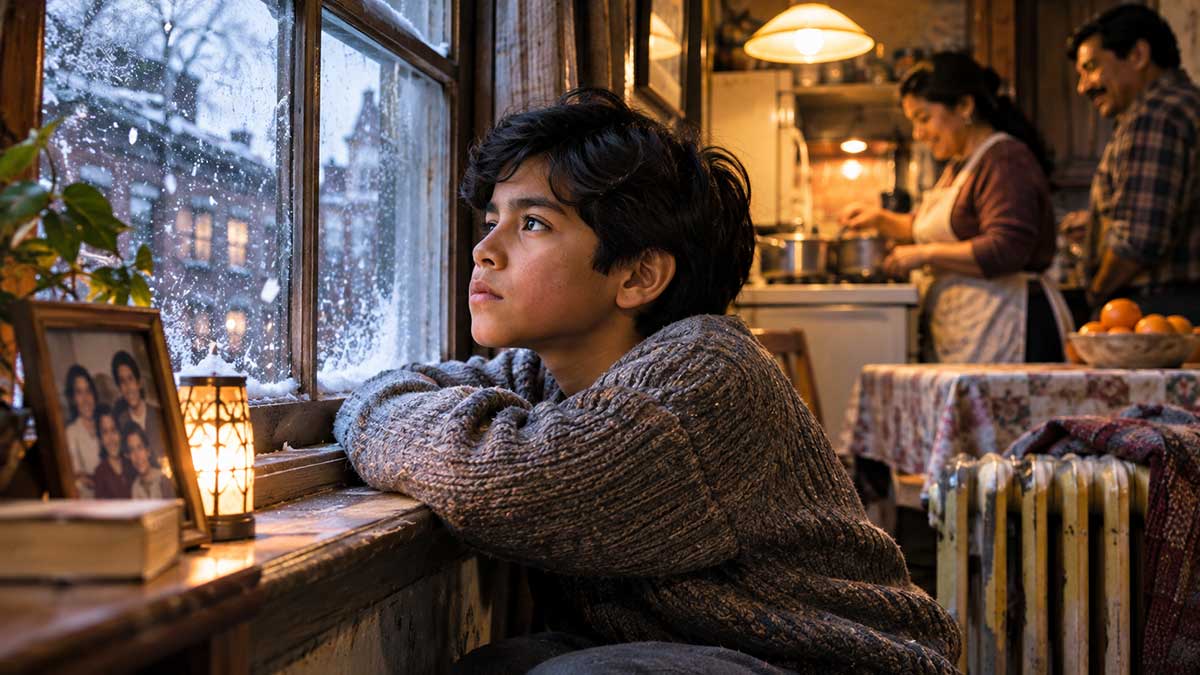
Boston, Massachusetts. A winter evening.
Snow falls quietly over a residential neighborhood. Behind the windows of a modest apartment, a radiator clicks and hums. The distant rumble of a passing bus fades into the night.
Inside, a small wooden table stands near the window. Two cups of tea release thin trails of steam. A worn notebook rests beside a copy of Inward.
This is an imagined apartment, created to evoke the immigrant childhood of Diego Perez, the Ecuadorian-born writer known as Yung Pueblo.
Nick Sasaki sits across from Diego. There are no microphones in sight, no audience waiting for an inspirational answer. Just two men, a quiet room, and memories that have traveled across decades.
Diego looks toward the window. Nick notices the expression on his face and waits.
Nick Sasaki
Diego, I want to tell you how I found you.
I was walking through Target recently, and I picked up your book, Inward. I wasn't planning to buy a book about healing. I was just browsing.
But I opened it, and two passages caught my attention.
One said that true strength comes from realizing you're your own healer, hero, and leader.
The other was even more surprising. You wrote that humanity would learn two great lessons in the twenty-first century: that harming another is harming ourselves, and that healing ourselves can heal the world.
I stood there thinking, "Who is this guy?"
Diego smiles.
I'm serious! I've read spiritual teachings from Buddhism, Christianity, and many other traditions. I've encountered plenty of people who tell us how we should live.
But you seemed to be telling us what humanity will become.
I wondered what kind of life could produce that conviction.
And then I learned about the young Diego Perez, who came from Ecuador to America and grew up in a family struggling to make ends meet.
So I thought, before I ask you how humanity can heal, I should ask about the little boy who needed healing himself.
When you look back at that boy in Boston, what do you see?
Yung Pueblo
Diego watches the snow for a moment.
I see a child who was absorbing much more than he could understand.
When you're young, you don't have the vocabulary to describe what financial insecurity does to a family.
You don't think, "I'm developing a fear of scarcity that may influence my decisions for decades."
You just notice things.
You notice when your parents are worried about money. You notice tension in the house. You notice that some things other children take for granted aren't necessarily available to you.
And gradually, without consciously deciding to, you begin carrying those concerns inside yourself.
I think the young Diego wanted to feel safe.
He wanted his family to be okay.
But he didn't know that some of the fears he was learning would follow him into adulthood.
Nick Sasaki
That touches something personal for me.
I grew up in Japan, and I've lived in America for decades. When you experience different cultures, you start noticing how much of your personality was formed before you ever had a chance to choose it.
Your parents teach you certain things. Society teaches you others. Your circumstances teach you still more.
And then one day you're sixty years old, and you're still reacting to something that happened when you were seven.
Nick laughs softly.
Sometimes I wonder how much of what I call "my personality" is actually just an old survival strategy.
Yung Pueblo
That's a beautiful question.
And I think there's something very useful in examining it.
We often identify so strongly with our habitual reactions that we assume they're permanent.
We say, "I'm an anxious person," or "I'm naturally angry," or "I've always been afraid of losing money."
But what if some of those patterns are learned responses?
What if they developed when we needed protection, and then continued long after the original circumstances had changed?
That doesn't mean every aspect of our personality can be transformed through meditation.
But it opens the possibility that we don't have to keep responding to life in exactly the same way.
Nick Sasaki
Let me ask something that might sound simple.
Did you have a happy childhood?
I don't mean whether your family had money. I mean, were there moments when you felt completely loved and safe?
I ask that because people sometimes hear about poverty or family conflict and assume there must have been no happiness.
But I've known families with very little money who laughed together every night.
And I've known wealthy families where nobody seemed to know how to love one another.
Yung Pueblo
I think it's important not to reduce a childhood to one emotion.
There can be love and difficulty in the same home.
Parents can make tremendous sacrifices for their children and still struggle with stress, fear, or unresolved emotional pain.
And a child can experience beautiful moments without being protected from every difficulty.
As we grow older, we may begin to see our parents more fully.
Instead of viewing them only through what they gave us or failed to give us, we can recognize that they were human beings carrying their own histories.
That recognition can make compassion possible.
It doesn't mean denying painful experiences.
It means allowing a more complete picture to emerge.
Nick Sasaki
That's interesting.
I have five children, and as a father, I sometimes wonder what they'll remember about me.
I might remember a wonderful family vacation, and one of my children might remember the afternoon I was impatient.
Or I might think I was being responsible by worrying about money, but perhaps what they remember is the worry itself.
Nick looks down at his tea.
Parents are imperfect people trying to raise other imperfect people.
Yung Pueblo
Yes.
And I think healing can change the way we hold those memories.
We can acknowledge that something hurt without deciding that the person involved is nothing more than the hurt they caused.
We can appreciate what our parents gave us without pretending that everything was easy.
There's a kind of emotional maturity in being able to hold gratitude and grief together.
Nick Sasaki
But Diego, here's something I find fascinating about your early life.
You became interested in social justice. You cared about inequality, injustice, and the suffering of other people.
Yet you've described struggling with your own emotions.
How does that happen?
How can someone be deeply concerned about humanity and still be unable to take care of himself?
Yung Pueblo
I think that contradiction is more common than we realize.
You can genuinely care about the suffering of others and still have very little awareness of your own emotional patterns.
You can recognize injustice in society and still respond harshly to someone close to you.
You can believe in compassion as a principle without knowing how to practice it when you're angry or afraid.
For me, becoming interested in changing the world didn't automatically mean I understood myself.
There was a lot of inner work I hadn't done.
Nick Sasaki
So you wanted to change society before you knew how to change yourself.
Yung Pueblo
In some ways, yes.
But I wouldn't want people to interpret that as meaning they must become emotionally healed before they can help others.
We don't need to be perfect to contribute to positive change.
And poverty, injustice, and discrimination aren't simply problems created by individual emotional wounds.
There are real social and economic conditions that require collective action.
What I came to appreciate is that inner transformation can make our participation in that work healthier.
If we don't examine our fear, anger, or need for control, those patterns may enter the very movements and relationships through which we're trying to create something better.
Nick Sasaki
I agree with that distinction.
But I want to push it a little further.
Suppose someone is living under terrible oppression.
Wouldn't anger be a perfectly reasonable response?
In fact, couldn't anger be the very thing that motivates them to fight for justice?
Yung Pueblo
Absolutely.
Anger can alert us that something is wrong.
The question is what happens after anger arises.
Does it help us see clearly and respond wisely?
Or does it become so consuming that we lose our ability to distinguish between protecting people and hurting them?
I don't think emotional maturity means never feeling anger.
It means developing enough awareness that anger doesn't automatically control our actions.
Nick Sasaki
So the goal isn't to eliminate anger.
It's to stop letting anger make all our decisions.
Yung Pueblo
Exactly.
Nick Sasaki
Nick smiles.
That's already more practical than telling everybody to calm down.
Diego laughs.
But I want to return to young Diego.
You cared about injustice. You wanted to help people.
And yet, as you got older, you began using drugs and alcohol to escape your own suffering.
What were you running from?
Scene Two: The Night He Could No Longer Run
The room grows quieter.
Outside, the snow has thickened. A passing car briefly illuminates the ceiling before disappearing down the street.
Nick closes the book on the table.
The conversation has reached a memory that cannot be approached casually.
Yung Pueblo
I think I was running from feelings I didn't know how to process.
There was anxiety, fear, and emotional pain.
And when you don't know how to work with difficult emotions, anything that offers temporary relief can become attractive.
The problem is that relief and healing aren't the same thing.
You can distract yourself from pain for a few hours.
You can numb it.
You can convince yourself that you're fine.
But when the distraction ends, the underlying patterns are still there.
Nick Sasaki
Did you know you were hurting yourself?
I mean, intellectually, you must have known that drugs and excessive drinking weren't good for you.
So what makes an intelligent person continue doing something he knows is destructive?
Yung Pueblo
Knowing something intellectually doesn't mean you've developed the emotional capacity to act on that knowledge.
You can understand that a behavior is harmful and still feel compelled to repeat it.
Sometimes the immediate desire to escape discomfort is stronger than your concern about future consequences.
That's why I think awareness has to become more than an idea.
It has to become something we practice.
Nick Sasaki
And then came 2011.
You've spoken about a frightening experience involving substance use when you thought you might die.
I don't want to sensationalize that night, but I want to understand what changed.
When you were afraid your life might end, what was the most terrifying part?
Was it the possibility of death?
Or was it realizing that you hadn't been living the life you truly wanted?
Yung Pueblo
Diego is quiet for several seconds.
I think confronting mortality can strip away many of the stories we tell ourselves.
When you're young, it's easy to assume you have endless opportunities to change.
You can tell yourself that tomorrow you'll become healthier.
Tomorrow you'll stop running from your emotions.
Tomorrow you'll repair a relationship.
Tomorrow you'll become the person you want to be.
But when you suddenly face the possibility that tomorrow might not arrive, those promises can feel very different.
The experience forced me to confront the direction my life was taking.
I couldn't continue living in the same way and expect a different outcome.
Nick Sasaki
But millions of people experience something frightening and promise to change.
Someone survives a heart attack and decides to eat healthier.
Someone nearly loses a marriage and promises to become more attentive.
Someone survives addiction and vows never to return.
And sometimes, six months later, they're doing exactly what they did before.
What made your change last?
Yung Pueblo
I don't think the frightening experience itself was enough.
Fear can interrupt a pattern, but it doesn't necessarily teach you a healthier one.
You still need to develop new habits.
You need to examine the emotions that were driving the old behavior.
And you need to be honest with yourself when you're struggling.
In my case, the crisis was a turning point, but the transformation unfolded gradually.
I didn't suddenly become peaceful or wise.
I began recognizing that the way I was living wasn't sustainable.
That recognition created an opening.
What I did with that opening mattered much more than the fear itself.
Nick Sasaki
So there wasn't a magical moment when everything became clear?
Yung Pueblo
No.
I think we sometimes romanticize transformation.
We love stories where someone reaches the lowest point of their life, has one extraordinary realization, and emerges completely changed.
But real transformation often involves repeated choices.
You recognize a harmful pattern.
You begin changing it.
You encounter difficulty.
You notice another pattern.
You keep learning.
There may be moments of great clarity, but clarity alone doesn't do the work.
Nick Sasaki
That's something I really want readers to hear.
We love the dramatic turning point.
But nobody wants to hear about the next morning.
Diego smiles.
You wake up, and your problems are still there.
Your fears are still there.
Your relationships haven't magically improved.
You still have to decide what to do.
Yung Pueblo
Yes.
And sometimes the most meaningful change begins with ordinary decisions that don't look impressive from the outside.
Choosing not to repeat a destructive behavior.
Being honest about what you're feeling.
Recognizing when you're reacting out of fear.
Seeking support.
Developing a healthier routine.
Those decisions accumulate.
Nick Sasaki
Let me ask a question that might be uncomfortable.
Do you ever feel grateful for that terrible night?
Yung Pueblo
I can appreciate that it became a turning point without believing that the suffering itself was necessary.
I wouldn't want someone to think they need a near-death experience to begin healing.
And I wouldn't describe every painful event as a hidden gift.
Some experiences cause enormous harm.
What matters is whether we can respond to what has happened in a way that creates a healthier future.
Nick Sasaki
I appreciate that answer.
Sometimes spiritual people say everything happens for a reason.
But I wonder whether that can become a way of making suffering sound beautiful when it wasn't beautiful at all.
Yung Pueblo
I think we have to be careful with that.
We can find meaning after suffering without claiming that suffering was arranged for our benefit.
We can grow through difficult experiences without celebrating the harm.
Compassion requires recognizing the reality of pain, not explaining it away.
Nick Sasaki
That's a very important distinction.
And it brings me to something else.
Your pen name is Yung Pueblo.
Young people. A young humanity.
There's something almost childlike about that name, as though humanity itself is still growing up.
Did you begin thinking about the emotional immaturity of the world before you recognized your own?
Yung Pueblo
I think my concern for humanity and my growing awareness of myself became connected.
The name reflects the idea that humanity is still developing.
We have extraordinary abilities, but we also repeat patterns of fear, aggression, and division.
We create sophisticated systems and technologies, yet we often struggle to communicate honestly or manage our emotions.
But I don't see that immaturity as a reason to condemn humanity.
I see it as a reason to believe growth remains possible.
Nick Sasaki
And perhaps the first young person you had to help grow up was Diego Perez.
Yung Pueblo
Diego smiles gently.
That's a meaningful way to put it.
Scene Three: The Love He Almost Lost
The snow outside begins to slow.
Nick rises to refill their cups. When he returns, the conversation takes a different direction.
The subject is no longer simply survival. It is what happens when a person begins to change, but the people closest to him have lived with the older version for years.
Nick Sasaki
Diego, I want to talk about Sara.
You've discussed the difficulties you experienced together before marriage.
And I find that part of your story especially moving.
It's one thing to discover a spiritual philosophy while sitting alone in silence.
It's another thing to practice it with someone who knows exactly how to upset you.
Diego laughs.
Yung Pueblo
That's true.
Relationships can reveal patterns we don't notice when we're alone.
You may think you're becoming more patient.
Then someone you love says something that touches an old insecurity, and suddenly you discover how much work remains.
Nick Sasaki
Exactly!
You can meditate for an hour, feel peaceful, and think you've discovered the meaning of life.
Then your spouse asks why you forgot something you promised to do.
And there goes enlightenment.
Both men laugh.
But seriously, you've spoken about a period when your relationship was struggling, when there was blame and separation.
What do you think you were asking Sara to give you that you hadn't yet learned to give yourself?
Yung Pueblo
I think when we're carrying unresolved pain, we can unconsciously expect another person to make us feel secure.
We may want them to reassure us constantly.
We may interpret disagreement as rejection.
We may become defensive when they express a need.
And when both people are reacting from their own wounds, the relationship can become a cycle.
One person feels hurt and reacts.
The other person feels attacked and reacts.
Before long, they're no longer responding to the original issue.
They're responding to each other's emotional reactions.
Nick Sasaki
So two people who love each other can end up hurting each other, not necessarily from a lack of love, but from a lack of awareness.
Yung Pueblo
Yes.
Love is important, but love alone doesn't automatically give us the skills to communicate, listen, or regulate difficult emotions.
Those are things we may need to learn.
Nick Sasaki
That makes me think about your statement that harming another is harming ourselves.
In a marriage, that can feel very literal.
If I hurt my wife, I've damaged the relationship that is supposed to be one of the greatest sources of love in my life.
But here's a harder question.
What if the other person is genuinely being unfair?
What if you're not just reacting from an old wound?
What if you're right?
Yung Pueblo
Being right about a particular issue doesn't mean every possible reaction is helpful.
You can have a legitimate concern and still express it in a destructive way.
You can establish a boundary without humiliating someone.
You can disagree without trying to win through emotional punishment.
And you can recognize when a relationship is unhealthy without believing that compassion requires you to remain in harmful circumstances.
I think healthy love includes both kindness and boundaries.
Nick Sasaki
I like that.
Compassion doesn't mean becoming a doormat.
Yung Pueblo
No.
Compassion without boundaries can become self-neglect.
And boundaries without compassion can become another way of keeping people at a distance.
Finding a healthier balance requires awareness.
Nick Sasaki
Let me ask you something personal, then.
When you and Sara were struggling, did you ever think, "Maybe we just aren't right for each other"?
Yung Pueblo
I think many couples reach moments when they question whether their relationship can become healthier.
And sometimes the right decision is to separate.
But there are situations where two people genuinely want to grow together and are willing to examine their own contributions to the conflict.
The difficult part is that you can't do another person's inner work for them.
You can change your own behavior.
You can become more honest and attentive.
You can create conditions where healthier communication becomes possible.
But you can't control whether another person changes.
Nick Sasaki
That's one of the hardest lessons in love, isn't it?
You can love someone with all your heart, but you can't force them to become who you want them to be.
Yung Pueblo
Yes.
And sometimes love becomes healthier when we stop confusing love with control.
Nick Sasaki
I've been married for many years, and one thing I've learned is that the person you marry doesn't remain exactly the same.
You change. They change.
Life changes both of you.
Sometimes the challenge is learning to love the person standing in front of you today instead of the person you remember from twenty years ago.
Yung Pueblo
I think that's a beautiful observation.
Healthy relationships need room for growth.
If we insist that another person remain exactly who they were when we first met, we may unintentionally resist their development.
And the same is true in reverse.
We need to be willing to let ourselves change.
Nick Sasaki
But I want to challenge the idea of change for a moment.
Suppose someone tells their partner, "I'm working on myself."
They meditate, read spiritual books, attend retreats, and talk about emotional maturity.
But at home, they're still impatient, selfish, and dismissive.
At what point does spirituality become a performance?
Yung Pueblo
I think that's a very important question.
Spiritual practice should help us become more aware of our behavior, not give us a new identity that makes us feel superior.
If we use meditation to convince ourselves that we're more evolved than the people around us, we may be reinforcing the very ego patterns we're trying to understand.
The real test isn't how peaceful we feel during meditation.
It's how we respond when life becomes difficult.
How do we treat someone who disagrees with us?
Can we acknowledge when we've hurt someone?
Can we apologize without immediately defending ourselves?
Can we listen when another person tells us something uncomfortable?
Those moments reveal a great deal.
Nick Sasaki
So your wife might be a better judge of your spiritual development than your followers.
Yung Pueblo
Diego laughs.
The people closest to us often see the parts of ourselves that are easiest to hide from the rest of the world.
Nick Sasaki
That might be the most frightening thing you've said so far.
Both men laugh.
Scene Four: The Fear That Followed Him Into Success
The tea has cooled.
Nick glances at the copy of Inward on the table, then at the man whose words have reached millions of readers.
The modest room seems to hold two different lives: the child who feared not having enough and the successful writer who, years later, discovered that the fear had never completely disappeared.
Nick Sasaki
Diego, I came across something from one of your recent interviews that really surprised me.
You've spent years meditating. You've written bestselling books. Millions of people have encountered your work.
And yet, after your recent sixty-day retreat, you spoke about recognizing that childhood scarcity was still affecting your decisions.
You had been accepting too many opportunities, partly from an old fear of not having enough.
I find that extraordinary.
After all those years of meditation, how could that fear still be there?
Yung Pueblo
I think that's one of the humbling things about inner work.
You can make meaningful progress and still discover patterns you hadn't fully recognized.
Healing isn't a certificate you receive after a certain number of meditation hours.
It's an ongoing process of becoming more aware.
And sometimes a pattern changes its appearance as your circumstances change.
When you're young and struggling financially, fear of scarcity may appear as anxiety about paying bills.
Later, when you're successful, that same fear may appear as difficulty saying no to opportunities.
The external circumstances are different.
But the emotional pattern may still be influencing your decisions.
Nick Sasaki
That's fascinating.
So you could have more money than you ever imagined, and still feel like the little boy who was afraid there wouldn't be enough.
Yung Pueblo
Yes.
And that shows why external success doesn't automatically resolve internal suffering.
Material security matters. It can relieve enormous stress.
But some emotional habits may continue after the original circumstances have changed.
Nick Sasaki
Let me ask you something.
Was that realization disappointing?
Did you think, "Come on, Diego. Fourteen years of meditation, and you're still dealing with this?"
Yung Pueblo
Diego smiles.
I think there's a temptation to measure spiritual growth by how many problems we've permanently eliminated.
But that can create unnecessary pressure.
A more useful question might be whether we're becoming more capable of recognizing patterns and responding to them wisely.
If I notice that fear is influencing a decision, I have more freedom than if I simply obey that fear without recognizing it.
The goal isn't to become a person who never experiences insecurity.
It's to develop a healthier relationship with insecurity.
Nick Sasaki
So perhaps the achievement isn't that fear disappears.
It's that fear stops being the boss.
Yung Pueblo
That's a good way to express it.
Nick Sasaki
But there's another side to this.
You're a successful author now.
You have books, an audience, business projects, and opportunities.
How do you know when you're pursuing something out of genuine purpose and when you're pursuing it out of fear?
Yung Pueblo
I think it requires honest observation.
Sometimes the same action can come from very different motivations.
You might accept a project out of enthusiasm and a sincere desire to contribute.
Or you might accept it out of anxiety that another opportunity will never come.
From the outside, the behavior can look identical.
But internally, the experience is different.
One may feel connected to your values.
The other may feel driven by pressure.
Developing awareness can help you recognize that difference.
Nick Sasaki
That's interesting for me personally.
I've spent much of my life building businesses and writing.
And I sometimes ask myself whether I'm working so hard out of love for what I do, or whether there's still some old fear telling me I need to accomplish more.
Maybe both can be true.
Yung Pueblo
I think they often coexist.
We don't need to condemn ourselves for having mixed motivations.
We can become curious about them.
And over time, we can try to make more decisions from clarity rather than fear.
Nick Sasaki
Now here's a question I haven't heard many people ask.
What if your childhood fear helped make you successful?
What if the very insecurity you're trying to heal was one of the reasons you worked so hard?
Would healing it make you less ambitious?
Yung Pueblo
That's an interesting possibility to examine.
Fear can motivate tremendous effort.
But we should ask what that motivation costs us.
If ambition depends entirely on anxiety, success may never feel satisfying.
There will always be another goal, another opportunity, another reason to worry.
I don't think healing requires abandoning ambition.
It may allow ambition to become healthier.
You can work hard out of creativity, generosity, curiosity, or a desire to contribute.
You don't have to be frightened into accomplishing everything.
Nick Sasaki
I love that distinction.
You can still build something meaningful.
But perhaps you don't have to suffer every day to prove that you're serious.
Yung Pueblo
Exactly.
Scene Five: The Question of Destiny
Outside, the snow has stopped.
The streetlights illuminate a thin white covering on the sidewalk. The apartment has grown still.
Nick turns toward Diego with a different expression, less like an interviewer and more like someone preparing to share a private curiosity.
Nick Sasaki
Diego, I want to ask you something a little unusual.
I'm deeply interested in spirituality, but I'm curious about many different ways people try to understand life.
In Japan, there's a fortune-telling tradition called Six Star Astrology.
It assigns people symbolic personality patterns based on their birth dates.
I recently looked at a reading associated with your birthday, and it described someone with a strong inner world, unusual sensitivity, creativity, and a desire to discover meaning beneath the surface of ordinary life.
Now, I don't believe a birth date can prove someone's destiny.
But it made me wonder about something.
Do you think you were born with a particular mission?
Or did you create your mission through the suffering you experienced?
Yung Pueblo
That's a beautiful question.
I think human beings naturally search for meaning.
We look for patterns in our lives.
We want to understand why certain experiences affected us so deeply, why we're drawn to particular interests, and what we might be able to contribute.
I don't think we need to know whether a mission was predetermined to live with purpose.
We can recognize what matters to us and choose to act in accordance with those values.
My own experiences led me to take emotional healing seriously.
Meditation gave me tools for observing my mind.
Writing became a way to share what I was learning.
And over time, those things developed into the work people now associate with Yung Pueblo.
Nick Sasaki
But suppose you had never experienced that frightening night in 2011.
Suppose you had continued living a comfortable life, finished college, found a good job, and never discovered meditation.
Would Yung Pueblo exist?
Yung Pueblo
Diego looks down for a moment.
I can't know what would have happened.
There are countless possible versions of a life.
Maybe I would have found another path to self-examination.
Maybe I would have remained focused on social activism.
Maybe I would have become a writer in a completely different way.
What I can say is that the experiences I actually lived shaped the choices I made.
But I wouldn't want to suggest that someone must suffer terribly to discover a meaningful purpose.
Purpose can emerge from love, curiosity, gratitude, or a desire to help.
It doesn't require a crisis.
Nick Sasaki
I'm glad you said that.
Sometimes we tell stories about successful people as though their suffering was necessary.
The addiction was necessary.
The heartbreak was necessary.
The near-death experience was necessary.
And everything was somehow arranged to lead them to greatness.
But what about the people who suffer and never become famous?
What about the people who struggle their entire lives?
Their suffering matters just as much.
Yung Pueblo
Absolutely.
The value of a human life isn't measured by fame, achievement, or the ability to turn suffering into a public message.
A person who quietly becomes kinder to their family has accomplished something meaningful.
Someone who learns to stop repeating a harmful pattern may change the lives of people around them.
Someone who chooses compassion during a difficult moment may create an effect they'll never fully see.
Those changes matter.
Nick Sasaki
That reminds me of something I believe very deeply.
Sometimes the most important things we do are things nobody will ever applaud.
A mother stays up all night caring for her child.
A father apologizes for something he did years ago.
A stranger helps someone who has fallen.
A person decides not to pass their anger on to the next person.
These aren't dramatic events.
But perhaps they're the moments when humanity actually changes.
Yung Pueblo
I think there's tremendous value in those moments.
We often associate transformation with something extraordinary.
But a healthier world would require millions of ordinary acts of awareness, restraint, honesty, and compassion.
Nick Sasaki
Nick looks at the book on the table.
Then let me return to the little boy we started with.
The child who worried about money.
The young man who tried to escape his feelings.
The person who became frightened enough to reconsider his life.
And the writer who now tells millions of people they can become their own healer.
If that little boy could walk into this room right now, what would you want him to know?
Yung Pueblo
Diego turns toward the window.
I think I would want him to know that he doesn't have to carry every fear he encounters.
That the struggles surrounding him are real, but they don't have to determine every decision he makes.
That he can love his family without taking responsibility for solving every problem.
And that difficult emotions don't make him weak or unworthy.
He can learn to understand them.
He can ask for help.
He can change.
Nick Sasaki
Would you tell him he'll become a famous writer?
Yung Pueblo
Diego smiles.
I don't think that would be the most important thing to tell him.
Nick Sasaki
What would be?
Yung Pueblo
That he doesn't need to become famous to deserve peace.
Nick remains quiet.
Outside, a child runs across the snow-covered sidewalk, laughing as an adult calls after him.
Nick watches for a moment.
Nick Sasaki
You know, Diego, I think that's what moved me when I opened your book.
At first, I thought you were telling people to become stronger.
To become their own heroes.
To take responsibility for their lives.
But listening to you now, I wonder whether there's another message underneath those words.
Maybe the first step isn't becoming a hero.
Maybe it's learning that the frightened child inside us doesn't need to be ashamed.
Yung Pueblo
I think self-acceptance can be a beginning.
When we're constantly fighting ourselves, we use so much energy trying to deny what we're feeling.
But when we become more honest and compassionate toward ourselves, we may create the conditions for meaningful change.
Nick Sasaki
And yet, you didn't stop there.
You didn't simply decide to feel better.
You went somewhere most people would find almost unbearable.
You entered silence.
No conversations.
No ordinary distractions.
No easy escape from your own thoughts.
Nick leans forward.
Diego, I've always been fascinated by meditation. But I have to confess something.
The idea of sitting alone with my mind for ten days sounds difficult enough.
Sixty days?
Nick laughs softly.
I think I'd start negotiating with my own thoughts by the second morning.
Yung Pueblo
Diego laughs.
Silence can reveal how active the mind really is.
Nick Sasaki
And that's what I want to understand next.
When you finally stopped running from yourself, what did you discover waiting in the silence?
Diego looks toward the window once more. The snowfall has ended, leaving the street unusually quiet.
For a moment, neither man speaks.
The conversation is about to move from the memories of childhood into the mystery of the mind.
End of Topic 1.
Fictional interview disclaimer: This conversation is an imaginative literary reconstruction inspired by Yung Pueblo's publicly discussed biography, books, and philosophy. The dialogue, personal recollections, emotional responses, and scenes are fictional. They should not be attributed to Diego Perez as actual statements or experiences beyond what independent sources establish.
Topic 2. Sixty Days of Silence and the Mystery of the Self
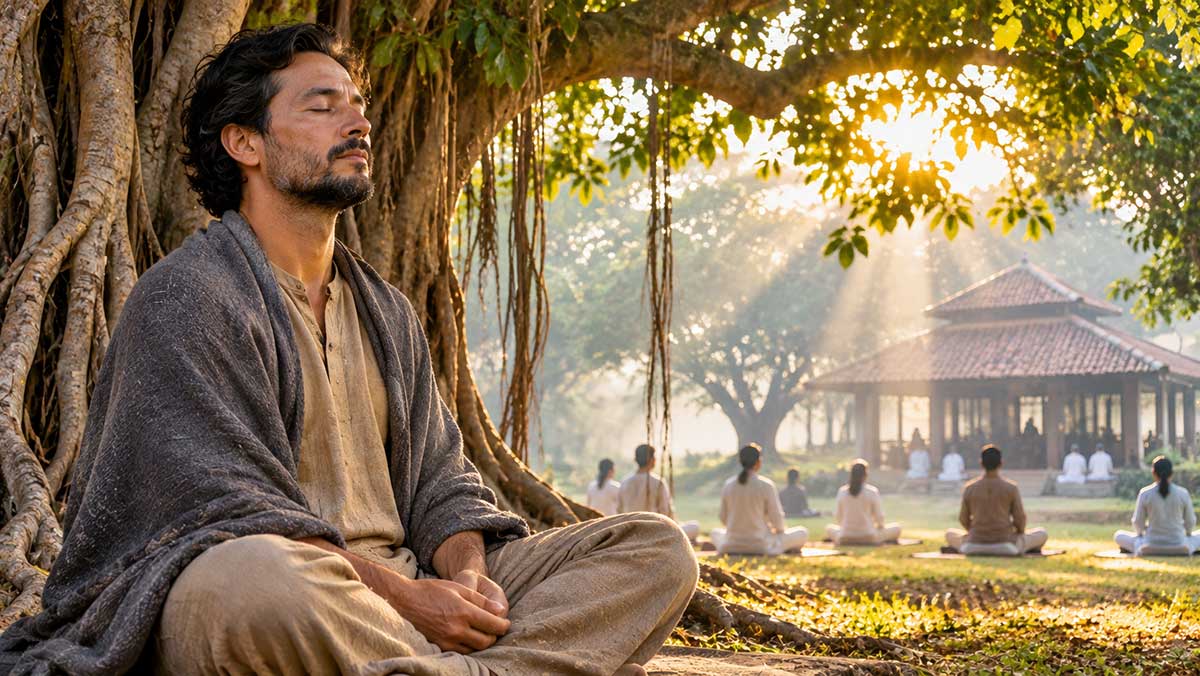
India. A meditation retreat center, shortly after sunrise.
The first light of morning touches the leaves of an enormous banyan tree. A narrow stone pathway winds through a quiet garden toward a simple meditation hall. Somewhere in the distance, a bird calls. Another answers.
There are no advertisements, no television screens, and no conversations drifting from open windows.
Inside the hall, rows of meditation cushions rest on the floor. The air carries the faint scent of earth after an overnight rain. A ceiling fan turns slowly.
This is an imagined setting inspired by Yung Pueblo's publicly discussed meditation retreats, including his extended period of silence in India. It is not a reconstruction of a particular retreat center.
Nick Sasaki sits on a cushion near an open doorway. Diego Perez, known to millions of readers as Yung Pueblo, sits across from him.
Nick has agreed to spend twenty minutes in silence before their conversation.
After approximately three minutes, he became aware of an uncomfortable knee. After five, he wondered whether he had remembered to answer an email. After ten, he found himself mentally planning the questions he wanted to ask.
Now the twenty minutes have ended.
Nick opens his eyes.
Nick Sasaki
Diego, I have a confession.
Yung Pueblo
Diego smiles.
Already?
Nick Sasaki
I think I experienced about seventeen different personalities during those twenty minutes.
One wanted to meditate.
One wanted breakfast.
One was worried about an email.
One was planning this interview.
And one kept saying, "Why did I agree to sit on the floor?"
Diego laughs.
But here's the strange part.
For a few seconds, everything became quiet. I wasn't trying to think about anything. I wasn't trying to stop thinking.
There was just this peaceful feeling.
And the moment I noticed it, I thought, "Oh! This is it!"
Then it disappeared.
Yung Pueblo
That's a very familiar experience.
Sometimes the mind becomes quiet, and then another part of the mind immediately wants to possess that quietness.
It says, "That was wonderful. How do I get it back?"
And suddenly we're grasping at an experience that has already changed.
Nick Sasaki
Exactly!
I wanted to congratulate myself.
"Nick, you're becoming enlightened!"
Both men laugh.
Then my knee started hurting again.
But seriously, Diego, you spent sixty days in silence.
Sixty days.
I want to know what happens to a human being when the ordinary noise of life disappears.
And I don't mean the beautiful answer people expect from a spiritual teacher.
I want to know what actually happens inside the mind.
The First Question: What Happens When There Is Nowhere Left to Escape?
Nick Sasaki
Let's start at the beginning.
When you entered your first ten-day Vipassana retreat in 2012, you were still a young man recovering from a very difficult period of your life.
You had stopped using substances to escape your emotions.
But now you were entering a place where you couldn't escape through ordinary conversation, entertainment, or distraction either.
Wasn't that terrifying?
Yung Pueblo
I think silence can be uncomfortable when we're accustomed to constantly directing our attention outward.
We may spend years filling every available moment with stimulation.
When we're anxious, we reach for something.
When we're lonely, we look for something to occupy us.
When we're uncomfortable, we try to change the experience immediately.
A silent retreat removes many of those familiar options.
And then we begin noticing how active the mind really is.
Nick Sasaki
But what surprised you most?
Was it how many thoughts you had?
Or what those thoughts were about?
Yung Pueblo
I think one of the important discoveries is how often the mind repeats familiar patterns.
We imagine that our thoughts are always responding to something happening in the present.
But much of our mental activity can involve replaying the past, anticipating the future, or reacting to things that aren't happening right now.
You may remember an old argument.
You may begin imagining what someone thinks about you.
You may worry about an event that hasn't occurred.
And your body can respond as though the imagined situation is happening in the present.
Meditation offers an opportunity to observe those processes more carefully.
Nick Sasaki
That's fascinating.
Let me give you an example.
Sometimes I remember something embarrassing I said twenty years ago.
Nobody else remembers it.
The person involved may not even be alive anymore.
But suddenly I'm sitting in my office, feeling embarrassed all over again.
It's ridiculous!
Yung Pueblo
Diego smiles.
And yet the feeling can be very real.
Nick Sasaki
Yes!
So who is creating that suffering?
The person from twenty years ago?
Or me, sitting there recreating the experience?
Yung Pueblo
I think we need to distinguish between the original experience and our present relationship with its memory.
The original event may have been genuinely painful.
We shouldn't dismiss that.
But the mind can continue responding to a memory long after the event has ended.
Through awareness, we may begin recognizing that the memory is arising now, that the associated emotions are arising now, and that we don't necessarily have to respond to them in the same habitual way.
Nick Sasaki
So you're not telling people to forget the past.
You're saying the past doesn't have to keep controlling the present.
Yung Pueblo
Yes.
And that's an important distinction.
Healing doesn't require pretending that painful experiences never happened.
It involves learning how to relate to those experiences with greater awareness.
Nick Sasaki
Now, let me ask something a little uncomfortable.
When you sit in silence for days, don't you risk becoming obsessed with yourself?
I mean, think about it.
You're watching your thoughts, your emotions, your sensations, your memories.
It's all about you.
Couldn't that become another form of self-absorption?
Yung Pueblo
That's a reasonable concern.
I think the intention matters, but the effects of the practice matter more.
If meditation becomes a way of constantly reinforcing the importance of our own experiences, then we should examine that.
But observing the mind can have a different effect.
You may begin recognizing that many of the patterns you experience are not unique to you.
Fear, desire, anger, sadness, and attachment are common human experiences.
That recognition can create greater compassion for others.
The practice isn't supposed to make us fascinated with our own importance.
It's meant to help us see more clearly.
Nick Sasaki
So ideally, you become less self-centered by studying yourself.
Yung Pueblo
That can be one of the possibilities.
Nick Sasaki
But it isn't guaranteed.
Yung Pueblo
No.
Nick Sasaki
Good. I like that answer.
I get suspicious when someone tells me a spiritual practice works perfectly for everybody.
Human beings are much too complicated for that.
Diego nods.
Nick Sasaki
Now let's move forward fourteen years.
You've practiced meditation for a long time.
You've written bestselling books.
You've developed a public philosophy around healing.
And then you go on a sixty-day retreat.
What could sixty days reveal that ten days couldn't?
Yung Pueblo
I think an extended retreat can create an opportunity for sustained observation.
In ordinary life, even when we meditate regularly, we're continually moving between practice and responsibilities.
We're working, communicating, making decisions, responding to people.
During a long retreat, the structure of daily life becomes much simpler.
There may be more opportunity to notice subtle patterns of reaction.
But I wouldn't describe a longer retreat as automatically making someone wiser.
The duration is not a measure of spiritual achievement.
What matters is the quality of awareness and how that awareness influences daily life.
Nick Sasaki
I'm glad you said that, because sixty days sounds almost like an Olympic event.
Diego laughs.
People might think, "I did ten days. He did sixty. He must be six times more enlightened."
Yung Pueblo
It doesn't work that way.
Nick Sasaki
Did you ever want to leave?
Yung Pueblo
Diego considers the question.
Long periods of practice can involve moments of difficulty, restlessness, and resistance.
I think the useful question is what we do when those experiences arise.
Can we recognize them without immediately obeying them?
Can we respond with patience rather than turning every uncomfortable feeling into an emergency?
Of course, meditation isn't about forcing ourselves to endure something harmful.
There is a difference between developing patience and ignoring genuine physical or psychological needs.
Nick Sasaki
That's important.
I wouldn't want someone listening to this conversation to think that sitting through unbearable distress is a spiritual accomplishment.
Yung Pueblo
Exactly.
The purpose is not punishment.
It's greater awareness and balance.
Nick Sasaki
Now here's something that surprised me about your recent retreat.
After years of writing about healing, you recognized that the fear of scarcity from your childhood was still influencing your decisions.
You were accepting too many opportunities, partly out of fear that there might not be enough in the future.
That seems almost unbelievable.
You could spend sixty days in silence, and what you discover is that a little boy from Boston is still worried about money.
Yung Pueblo
Diego smiles gently.
I think that's one of the humbling aspects of self-examination.
Our emotional patterns can continue influencing us long after our circumstances change.
And they may become more subtle.
A person who once feared not having enough money may eventually become financially secure.
But that doesn't automatically mean the fear has disappeared.
It may begin expressing itself through overwork, difficulty resting, or reluctance to decline opportunities.
The circumstances change, but the underlying reaction can remain familiar.
Nick Sasaki
Let me challenge you.
Isn't it possible that you were simply being ambitious?
Maybe you accepted too many opportunities because you're a successful author and wanted to accomplish more.
How do you know that childhood fear was involved?
Yung Pueblo
That's a good question.
I think we should be careful about claiming certainty concerning our motivations.
Human behavior rarely has one simple cause.
Ambition, creativity, responsibility, enthusiasm, and fear can all influence the same decision.
Meditation may help us become more sensitive to what we're experiencing internally.
But that doesn't make every interpretation of our motives automatically correct.
We still need humility.
We can notice a pattern, reflect on it, and observe whether changing our behavior leads to a healthier experience.
Nick Sasaki
So meditation doesn't turn you into an infallible psychologist of your own mind.
Yung Pueblo
No.
Nick Sasaki
That's reassuring.
I was beginning to worry that after sixty days you could read everybody's thoughts.
Diego laughs.
Nick Sasaki
But something about this moves me.
The young Diego wanted to escape his fear.
The older Diego has learned to sit quietly with that same fear.
The fear may still appear, but the relationship has changed.
Is that what healing means to you?
Yung Pueblo
I think that's an important part of it.
Healing doesn't necessarily mean never experiencing an old emotion again.
It can mean recognizing the emotion more clearly, responding with less reactivity, and making choices that are less controlled by it.
Sometimes the change is subtle.
You notice fear arising.
You acknowledge it.
You don't need to become ashamed of it.
And you don't automatically let it decide what happens next.
Nick Sasaki
So the frightened little boy doesn't disappear.
You just stop asking him to run your entire life.
Yung Pueblo
Diego smiles.
That's a compassionate way to describe it.
The Second Question: Is Spiritual Insight a Discovery or a Story We Tell Ourselves?
The morning light grows brighter.
A breeze moves through the open doorway, stirring a few fallen leaves along the stone pathway.
Nick looks out toward the garden.
Nick Sasaki
Diego, I want to ask you something that goes beyond psychology.
I'm deeply interested in spirituality.
I've spent years thinking about God, consciousness, the meaning of life, and whether there's something about human existence that science hasn't fully explained.
And when I hear about someone spending sixty days in meditation, I naturally wonder whether they experienced something extraordinary.
Did you ever feel that your ordinary sense of being Diego Perez had disappeared?
That there was awareness, but no familiar sense of "me"?
Yung Pueblo
Meditation can invite us to examine the sense of self very closely.
In ordinary life, we often experience ourselves through a continuous narrative.
My name.
My history.
My accomplishments.
My worries.
My plans.
My opinions.
These things can feel like a fixed identity.
But when we observe the mind, we notice that thoughts, emotions, and sensations are continually changing.
Even our sense of identity can be influenced by what we're experiencing in a particular moment.
Nick Sasaki
But is there something underneath all that?
Something that doesn't change?
Yung Pueblo
That's a profound question.
Different philosophical and spiritual traditions offer different answers.
Within the meditation tradition I've practiced, a central emphasis is observing experience directly rather than simply accepting a belief about what the self must be.
We can examine how sensations arise and pass away.
We can notice thoughts appearing and disappearing.
We can observe how attachment to particular experiences contributes to suffering.
But I would be cautious about turning a personal meditation experience into a definitive claim about the nature of the universe.
Nick Sasaki
Now that's interesting.
Let's say you're meditating, and suddenly you experience an overwhelming sense of love.
Not love for one person.
Love for everybody.
You feel connected to every living being.
Wouldn't you naturally think you'd discovered something fundamental about reality?
Yung Pueblo
It could certainly be a meaningful experience.
And experiences of compassion can influence how we live.
But the feeling of certainty accompanying an experience doesn't necessarily establish that every interpretation of it is true.
I think we can respect the experience without immediately building an absolute belief around it.
Nick Sasaki
That's exactly where I wanted to go.
Here's the problem.
A Christian might have a profound experience and say, "I encountered God."
A Buddhist might experience something similar and interpret it through the language of compassion or nonattachment.
Someone else might say it was a neurological event.
And all three could feel completely certain.
How do we know which interpretation is right?
Yung Pueblo
I don't think we should assume that intensity of feeling is sufficient evidence for a particular explanation.
We can be open to mystery and still recognize the limits of what we know.
Different traditions may offer useful ways of examining human experience.
But humility becomes very important when we move from describing what we experienced to claiming what that experience proves.
Nick Sasaki
So it's possible to have a genuine spiritual experience and misunderstand what it means.
Yung Pueblo
I think that's possible.
Nick Sasaki
And it's possible to have a psychological experience that feels spiritual.
Yung Pueblo
Yes.
Nick Sasaki
And perhaps it's possible that some experiences reveal things we don't yet have the scientific tools to explain.
Yung Pueblo
I think we can remain curious about unanswered questions without pretending we've already answered them.
Nick Sasaki
Nick smiles broadly.
Diego, I like that.
You're giving me permission to be curious without demanding that I become certain.
Because that's something I struggle with.
I have spiritual beliefs and intuitions that feel meaningful to me.
But I don't want to become someone who stops asking questions.
I think the moment we decide we know everything about God, consciousness, or the universe, we may have stopped listening.
Yung Pueblo
I think curiosity and humility can be very valuable companions.
We don't need to abandon our convictions to recognize that our knowledge is incomplete.
Nick Sasaki
But let me challenge that.
Your poetry often sounds very certain.
You write about healing, love, and humanity as though you're describing truths you've discovered.
Yet here you are telling me to remain humble about spiritual experiences.
Isn't there a contradiction?
Yung Pueblo
I think there's a difference between expressing a conviction and claiming to possess complete knowledge.
Poetry often uses direct language.
It can communicate something the writer feels deeply without including every qualification that might appear in a philosophical essay.
But readers should still be free to question what they encounter.
I wouldn't want someone to accept an idea merely because it appeared in one of my books.
I'd hope they would reflect on whether it helps them understand their own experience and treat others more wisely.
Nick Sasaki
So your poetry is an invitation, not a commandment.
Yung Pueblo
That's a useful distinction.
Nick Sasaki
But sometimes invitations sound like commandments.
Diego laughs.
Nick Sasaki
I'm serious!
When you write that humanity will learn something in this century, people may hear a prophecy.
And we're going to talk about that later.
For now, I want to ask about intuition.
In my life, there have been moments when I felt strongly drawn in a particular direction.
I couldn't explain it logically.
Sometimes those instincts turned out to be helpful.
Other times, I was completely wrong.
How do you distinguish intuition from fear, desire, or wishful thinking?
Yung Pueblo
I think that distinction requires careful observation.
Sometimes what we call intuition may reflect accumulated experience.
Sometimes it may be a reaction shaped by fear.
Sometimes it may be a strong desire that we've mistaken for guidance.
We can examine what is happening internally.
Does a decision arise alongside urgency and panic?
Are we trying to escape discomfort?
Are we ignoring information that contradicts what we want?
Are we becoming defensive when someone asks a reasonable question?
These observations may help us make more thoughtful choices.
But I don't think meditation makes us immune to mistakes.
Nick Sasaki
What about fortune-telling?
I'm curious about Japanese traditions that use birth dates and symbolic cycles to describe personality and life purpose.
I don't treat them as scientific proof.
But sometimes they raise surprisingly interesting questions.
Suppose an astrologer told you that your life's mission was to discover truths within yourself and communicate them through creative expression.
That would sound remarkably close to what you've done.
Would you find that meaningful?
Yung Pueblo
I think human beings have always used stories and symbols to reflect on their lives.
A symbolic interpretation might prompt someone to consider a question they hadn't asked before.
What matters is how they use it.
Does it encourage curiosity and self-reflection?
Or does it make them feel trapped by a predetermined identity?
I would be cautious about allowing any external system to define the limits of what a person can become.
Nick Sasaki
That's an important point.
If someone tells a child, "You're destined to be a great artist," that might encourage creativity.
But if they say, "You're destined to fail in relationships," the child might carry that fear for years.
Yung Pueblo
Exactly.
We should be careful about the stories we encourage people to believe about themselves.
A person's future is influenced by many factors, including circumstances, relationships, opportunities, and choices.
I think it's healthier to remain open to growth than to assume our identity is fixed.
Nick Sasaki
So maybe the best use of fortune-telling isn't asking, "What must happen to me?"
Maybe it's asking, "What possibilities about myself have I never considered?"
Yung Pueblo
That could be a constructive way to approach symbolic reflection.
Nick Sasaki
I like that.
Now, I want to return to something more concrete.
You've spent years observing thoughts and emotions.
What is the most surprising thing you've learned about the human mind?
Yung Pueblo
One of the most meaningful observations is how temporary our experiences can be, even when they feel overwhelming.
A powerful emotion may arise and seem as though it will last forever.
But if we observe carefully, we can notice that it changes.
It may intensify.
It may soften.
It may disappear and return.
That doesn't mean the emotion is unimportant.
It means our experience is not as fixed as it sometimes appears.
Nick Sasaki
Impermanence.
Yung Pueblo
Yes.
Nick Sasaki
But here's something I've wondered about.
If everything changes, doesn't that make life frightening?
The people we love will grow older.
Our health will change.
Our children will leave home.
Eventually, we'll lose people we never wanted to lose.
How can impermanence bring peace when it seems to contain so much sadness?
Yung Pueblo
I think recognizing impermanence can make us more attentive to what we have now.
If we assume something will remain unchanged forever, we may take it for granted.
But when we recognize that experiences are temporary, we may appreciate them more deeply.
That doesn't eliminate grief.
And it doesn't mean we should avoid attachment to people we love.
It means we can learn to love with greater awareness of life's changing nature.
Nick Sasaki
That's beautiful.
But I want to be careful with the word attachment.
As a father, I don't want to become detached from my children.
I want to love them deeply.
If something terrible happened to one of them, I would be devastated.
Would Buddhism tell me that's a failure of spiritual development?
Yung Pueblo
I wouldn't interpret healthy practice as requiring emotional indifference.
Compassion includes caring deeply about others.
The question is whether we can love without trying to control every aspect of another person's life or demanding that reality always conform to our wishes.
Grief is a human response to loss.
Spiritual practice shouldn't become a reason to shame people for grieving.
Nick Sasaki
I'm relieved to hear that.
I don't want enlightenment if it means I stop crying when someone I love is suffering.
Yung Pueblo
I don't think emotional numbness should be confused with wisdom.
Nick Sasaki
That's a sentence I wish more people would hear.
The Third Question: After Fourteen Years of Meditation, What Do You Actually Know?
The sun has climbed above the trees.
From the garden comes the faint sound of water flowing through a narrow stone channel.
Nick and Diego have moved from their cushions to a shaded veranda. Two simple chairs face the garden.
Nick stretches his legs, relieved to be sitting in a chair again.
Nick Sasaki
Diego, I have a question that may be a little unfair.
You've practiced meditation since 2012.
You've spent extraordinary amounts of time observing your mind.
You've written books about emotional healing, love, and human transformation.
So after all those years, what do you actually know?
Not what you believe.
Not what you hope.
What have you learned that you feel confident you can apply to your own life?
Yung Pueblo
I think one lesson is that awareness can create more room between an emotional reaction and our behavior.
An emotion may arise without our choosing it.
But we can develop greater capacity to notice what's happening before acting.
That can change the way we communicate.
It can change how we respond to conflict.
It can help us recognize when we're repeating patterns that cause suffering.
Nick Sasaki
Give me a real-life example.
Suppose someone criticizes you unfairly.
Maybe they write something cruel about you online.
What happens inside you?
Yung Pueblo
I think it's natural for criticism to produce an emotional response.
There may be discomfort, defensiveness, or anger.
The important question is whether we immediately identify with that reaction.
Do we need to respond?
Do we need to prove something?
Do we need to attack the other person?
Or can we observe the feeling, examine whether the criticism contains anything useful, and decide what response is appropriate?
Nick Sasaki
But do you still get angry?
Yung Pueblo
I don't think meditation makes someone incapable of anger.
Nick Sasaki
Good!
Nick laughs.
I was worried you were going to tell me you haven't been angry since 2017.
Yung Pueblo
Diego laughs.
I think the goal is not to create an image of perfection.
It's to become more honest about our experiences and more skillful in our responses.
Nick Sasaki
But here's a challenge.
Suppose someone has been meditating for twenty years and still treats their family terribly.
They remain selfish, controlling, and impatient.
What would you say to them?
Yung Pueblo
I think we should examine whether their practice is translating into everyday behavior.
Meditation can be valuable, but it isn't a substitute for accountability.
If someone repeatedly hurts others, they need to take those actions seriously.
They may need honest feedback, healthier communication skills, or professional support.
The amount of time someone spends meditating doesn't automatically establish their emotional maturity.
Nick Sasaki
That's fascinating.
You could be very good at sitting still and still be terrible at being kind.
Yung Pueblo
It's possible.
Nick Sasaki
And perhaps someone who has never meditated could be extraordinarily compassionate.
Yung Pueblo
Absolutely.
Nick Sasaki
That matters to me.
I've met people who couldn't explain a single spiritual philosophy, but they were incredibly kind.
They helped neighbors.
They cared for sick relatives.
They forgave people.
They made others feel welcome.
And I've met people who could speak beautifully about enlightenment but seemed to have very little patience for ordinary human beings.
Yung Pueblo
I think compassion can develop through many experiences and practices.
Meditation is one path.
It isn't the only way people learn kindness, patience, or generosity.
Nick Sasaki
So when you look at someone who is naturally kind, do you think they're spiritually advanced?
Or could they simply have learned good habits through family and experience?
Yung Pueblo
I think we should be cautious about ranking people's spiritual development.
Kind behavior can arise from many influences.
What matters is how we treat others, not whether we can claim a particular spiritual status.
Nick Sasaki
I like that.
Now I want to ask about something that has become increasingly important in your recent work.
Inner peace.
When I hear those words, I picture a monk sitting peacefully on a mountain, completely undisturbed by the world.
But you've suggested that peace doesn't mean constant happiness.
What does it mean?
Yung Pueblo
I think peace can involve developing a healthier relationship with the full range of human emotions.
You can experience sadness without believing your life has become meaningless.
You can experience fear without allowing fear to control every decision.
You can experience anger without automatically hurting someone.
Peace doesn't require every moment to feel pleasant.
It may involve greater balance when circumstances are difficult.
Nick Sasaki
So peace isn't a feeling you hold onto.
It's a way of responding to feelings as they come and go.
Yung Pueblo
That's one way to describe it.
Nick Sasaki
But what about real tragedy?
Suppose someone loses a child.
Or a person discovers that their spouse has a terminal illness.
Or a family loses everything in a war.
Would it be insensitive to tell them they can find peace through meditation?
Yung Pueblo
It could be, depending on how it's expressed and what the person needs.
When someone is experiencing profound suffering, compassion may begin with listening, practical help, and emotional presence.
We shouldn't use spiritual ideas to minimize grief or imply that people are failing if they can't feel peaceful.
Meditation may be helpful for some people, but it isn't a universal solution to every form of suffering.
And people facing trauma or severe psychological distress may benefit from professional care and other forms of support.
Nick Sasaki
I'm glad you're saying that.
Sometimes I worry that the self-help world puts too much responsibility on the individual.
If you're unhappy, change your mindset.
If you're suffering, heal yourself.
If your relationships are difficult, work on your emotions.
But what if someone is suffering through no fault of their own?
Yung Pueblo
I think it's important to distinguish responsibility for our healing from blame for our suffering.
We may not have chosen the experiences that wounded us.
We may not have created the circumstances we're facing.
But where possible, we can participate in our own recovery.
And that participation doesn't have to happen alone.
Support from others can be an important part of healing.
Nick Sasaki
That brings me back to the line in Inward that first caught my attention.
You are your own healer, hero, and leader.
It's a beautiful statement.
But someone could read it and think, "I have to fix everything myself."
What about the person who needs a friend?
A therapist?
A doctor?
A community?
Yung Pueblo
I wouldn't want self-responsibility to be confused with isolation.
Recognizing our capacity to participate in healing doesn't mean rejecting help.
In fact, part of taking responsibility may involve recognizing when we need support.
We can be active participants in our lives without pretending to be completely self-sufficient.
Nick Sasaki
That's something I want us to explore deeply in our next conversation.
But before we leave this retreat, I want to ask you one final question about the mystery of the self.
Nick pauses.
When you were young, you tried to escape your own mind.
Now you've spent years learning to observe it.
You've watched thoughts arise and disappear.
You've examined fear, desire, attachment, and the stories people tell themselves.
So tell me something.
Who is the person doing the observing?
Yung Pueblo
Diego looks at Nick thoughtfully.
That's a question people have explored for thousands of years.
When we examine experience, we can notice that thoughts arise.
We can notice sensations.
We can notice emotional reactions.
And we can notice awareness of those experiences.
But the moment we try to define the observer as a permanent, separate thing, we may be introducing another concept that deserves examination.
Nick Sasaki
But surely there's someone here.
I'm Nick.
You're Diego.
We're sitting on this veranda.
We're having a conversation.
Yung Pueblo
Of course.
Our everyday identities are useful and meaningful.
The question is whether the stories we tell about ourselves describe something completely fixed.
Are we exactly the same person we were ten years ago?
Do our thoughts remain unchanged?
Do our emotions remain unchanged?
Do our values and habits remain unchanged?
When we look closely, we may discover more flexibility than we assumed.
Nick Sasaki
So perhaps the self is less like a statue and more like a living process.
Yung Pueblo
That's an interesting way to consider it.
Nick Sasaki
But here's what I wonder.
If the self is constantly changing, what makes love meaningful?
When I say I love my wife, I'm not saying I love a collection of temporary sensations.
I'm saying I love her.
A real person.
Someone with a history, a personality, and a life we've shared.
Does the idea of impermanence threaten that?
Yung Pueblo
I don't think it has to.
Recognizing change doesn't require denying the reality or importance of relationships.
In fact, it can encourage us to become more attentive.
The person we love is growing and changing.
We are growing and changing.
Love may become healthier when we remain curious about who the other person is becoming rather than assuming we already know everything about them.
Nick Sasaki
That's beautiful.
Maybe one of the greatest mistakes in marriage is thinking you've finished getting to know your spouse.
Yung Pueblo
I think curiosity can help relationships remain alive.
Nick Sasaki
And perhaps curiosity is a form of love.
You're saying, "I don't know everything about you, and I still want to learn."
Yung Pueblo
That's a lovely way to express it.
Nick Sasaki
Now, Diego, I want to ask one last question.
And I don't want a polished answer.
Imagine that tomorrow you wake up and discover that all your books have disappeared.
Your social media accounts are gone.
Nobody knows the name Yung Pueblo.
You're no longer a bestselling author.
You're just Diego Perez.
Would you still be at peace?
Yung Pueblo
Diego is quiet for a moment.
I think losing something meaningful could naturally bring sadness.
Writing and sharing ideas have become important parts of my life.
I wouldn't want to pretend that losing them would have no emotional effect.
But I would hope that my sense of worth wasn't entirely dependent on those accomplishments.
The practice of healing invites us to examine how tightly we've attached our identity to external recognition.
Can we appreciate success without making it the foundation of our self-worth?
Can we contribute to others without needing constant validation?
Those are questions worth continuing to ask.
Nick Sasaki
You said, "I would hope."
Not "I know."
Yung Pueblo
Diego smiles.
Yes.
Nick Sasaki
I think that's one of my favorite answers today.
After all these years of meditation, you still leave room for uncertainty.
Yung Pueblo
I think there's always more to learn.
Nick Sasaki
Then maybe wisdom isn't knowing everything.
Maybe it's becoming comfortable enough with uncertainty that we no longer need to pretend.
Yung Pueblo
That can be a meaningful form of freedom.
For several moments, the two men sit quietly.
The garden is now filled with morning light. A bird lands on the stone railing, studies them briefly, then flies away.
Nick Sasaki
Diego, something has been changing in my mind during this conversation.
When I first read your poetry, I thought you had discovered some extraordinary secret.
I wondered whether you had reached a level of spiritual awareness that ordinary people couldn't understand.
But sitting here with you, I'm beginning to think the most meaningful discovery might be much simpler.
You learned that you don't have to believe every thought.
You don't have to obey every fear.
You don't have to turn every painful emotion into an action that hurts somebody.
And perhaps you don't have to become a perfect person to begin living differently.
Yung Pueblo
I think those are valuable possibilities.
And they require practice.
We can recognize a principle intellectually, but living it consistently is another matter.
Nick Sasaki
Which brings me to something I can't stop thinking about.
Nick reaches into his bag and takes out his copy of Inward.
When I found this book at Target, one sentence made me stop.
The idea that we can become our own healer, hero, and leader.
I thought it was a statement about personal strength.
But now I wonder whether it's actually about personal responsibility.
And I wonder how far that responsibility goes.
If someone has been deeply wounded by another person, how much responsibility should they carry for healing?
If someone has hurt others, can meditation truly change them?
And if two people love each other but keep causing each other pain, can self-awareness save their relationship?
Yung Pueblo
Those are difficult questions.
And I think they deserve more than simple inspirational answers.
Nick Sasaki
Good.
Nick smiles.
Then that's exactly where I want to go next.
Because sitting peacefully under a banyan tree is one thing.
But being patient when your spouse is angry, forgiving someone who betrayed you, or admitting that you've hurt someone you love?
That's where spiritual ideas meet real life.
Yung Pueblo
And that's where we have opportunities to practice what we're learning.
Nick Sasaki
Nick looks toward the meditation hall.
You know, I came here wanting to know what sixty days of silence could teach a person.
I think I'm leaving with a different question.
Can the wisdom we discover in silence survive the noise of ordinary life?
Diego considers the question.
Yung Pueblo
I think that's what makes the practice meaningful.
Not simply what happens when everything is quiet.
But how we live when the world becomes noisy again.
Nick closes the book.
Beyond the garden, the day has begun. Somewhere outside the retreat grounds, people are working, arguing, laughing, loving, worrying, and carrying on with their lives.
The two men rise from their chairs and walk slowly down the stone pathway.
Their next conversation will leave the quiet retreat behind and enter a more demanding place: the human heart, where love and pain so often live together.
End of Topic 2.
Fictional interview disclaimer: This is an imagined conversation between Nick Sasaki and Yung Pueblo (Diego Perez), inspired by publicly discussed meditation practices, books, and philosophical ideas. The setting, dialogue, personal responses, and descriptions of internal experiences are fictional. No private retreat experiences or spiritual revelations should be understood as verified statements by Diego Perez.
Topic 3. You Are Your Own Healer, Hero, and Leader
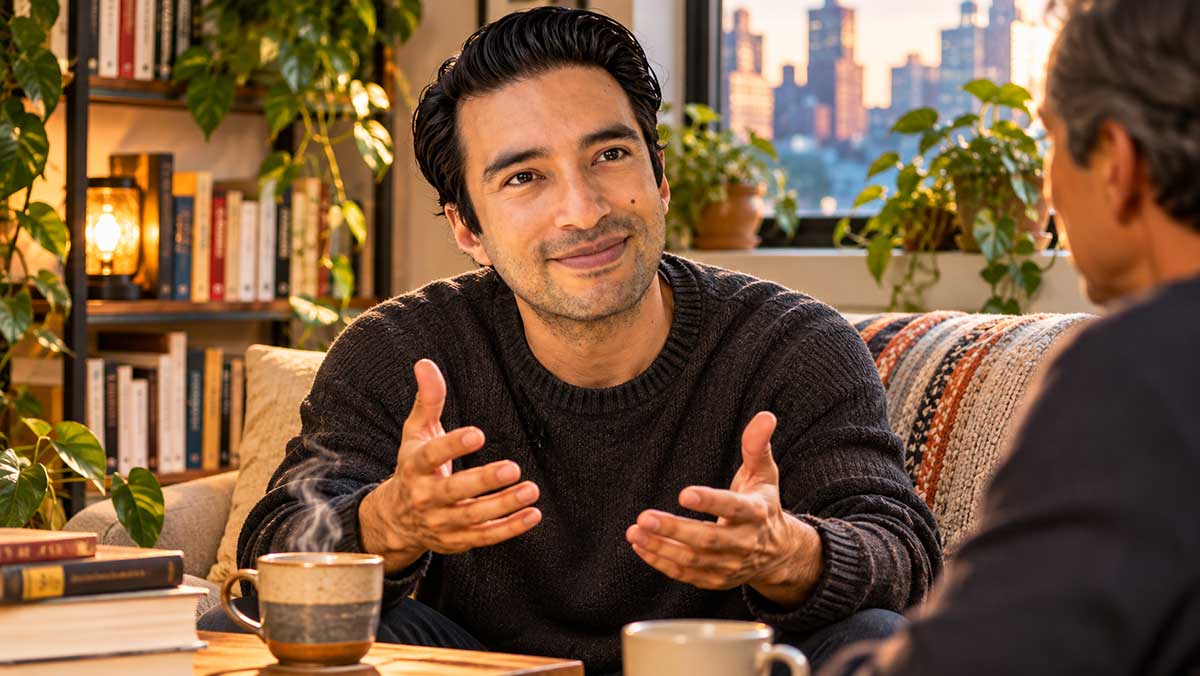
New York. A quiet residential street on a late autumn afternoon.
Golden sunlight filters through the branches of an old maple tree. Fallen leaves gather along the sidewalk. A delivery bicycle passes, followed by the distant laughter of children returning from school.
Inside a warmly furnished apartment, books line the shelves. A small writing desk stands near a window. On it rests an open notebook, a fountain pen, and a copy of Inward.
Two comfortable armchairs face each other beside a low wooden table. A pot of tea waits between them.
This is an imagined home, created to explore the intimate side of Diego Perez's life: his relationship with Sara, the emotional habits that once caused pain, and the difficult work of turning spiritual insights into everyday kindness.
Nick Sasaki has arrived with a question that has followed him since their conversation at the meditation retreat.
Diego welcomes him inside.
Nick Sasaki
Diego, I have to tell you something.
After our conversation in India, I went home feeling very peaceful.
For about two hours.
Diego laughs.
Then I got busy with work, somebody interrupted me, and I found myself getting irritated over something completely unimportant.
And I thought, "Well, Nick, that didn't last very long."
Yung Pueblo
Smiling.
I think that's a familiar experience for many people.
Nick Sasaki
But it made me realize something.
It's easy to feel wise when nobody is bothering you.
It's much harder when you're tired, somebody disagrees with you, or a person you love says something that touches an old wound.
So today, I want to talk about what happens when meditation leaves the meditation hall and enters the living room.
And I want to start with the sentence that first made me curious about you.
You wrote that true strength comes from realizing we are our own healer, hero, and leader.
That's an extraordinary thing to tell someone.
But what does it actually mean?
The First Question: Can We Really Become Our Own Healer?
Yung Pueblo
I think the central idea is that we can become active participants in our own healing.
Many of us spend years hoping something outside us will finally make us feel whole.
We may believe that a relationship, an achievement, or a particular amount of success will remove our insecurity.
But when we begin observing our emotional patterns, we discover that some of our suffering is connected to the ways we respond to our experiences.
We can learn to recognize those patterns.
We can develop healthier habits.
We can take responsibility for how we treat ourselves and others.
Nick Sasaki
But let me challenge you immediately.
Suppose a little girl grows up in a home where she's constantly criticized.
She doesn't choose that environment.
She doesn't choose the emotional wounds she develops.
Then she becomes an adult and reads your book.
"You are your own healer."
Couldn't that sound like you're telling her that fixing the damage is entirely her responsibility?
Yung Pueblo
That's an important concern.
I think we need to distinguish between being responsible for causing suffering and participating in recovery.
A child isn't responsible for being mistreated.
A person who experiences abuse isn't responsible for the harm someone else caused.
And no one should be expected to recover entirely alone.
But as people move forward in life, there may be opportunities to participate in their own healing.
That can involve developing awareness, seeking support, establishing boundaries, or working with qualified professionals.
The message should be about agency, not blame.
Nick Sasaki
I like that distinction.
Agency, not blame.
But I want to push it further.
What if someone is so deeply wounded that they can't even recognize what's happening?
What if they don't have the emotional strength to begin?
Yung Pueblo
Then compassion may begin with recognizing that they need help.
Sometimes the first step is not meditation or self-reflection.
It may be finding safety.
It may be reaching out to someone trustworthy.
It may be receiving medical or psychological care.
Healing isn't a competition to see who can become independent fastest.
And asking for help doesn't make someone less capable.
Nick Sasaki
So being your own hero doesn't mean rescuing yourself without anybody else's help.
Yung Pueblo
Exactly.
It can mean making a meaningful choice, including the choice to accept support.
Nick Sasaki
That's reassuring.
I've always felt that human beings need one another.
I don't think we're supposed to go through life completely alone.
Sometimes a person is suffering so much that they can't see any hope.
And another human being comes along and says, "I'm here. You don't have to face this by yourself."
That can change everything.
Yung Pueblo
I agree that connection can be deeply important.
We heal through many forms of support.
Friendship, community, healthy relationships, and professional care can all contribute.
Self-awareness doesn't replace human connection.
It can help us participate in those connections more honestly.
Nick Sasaki
But there's another question.
What exactly are we healing?
People use that word constantly now.
Healing your inner child.
Healing trauma.
Healing relationships.
Healing your energy.
Sometimes I wonder whether we've started treating every uncomfortable feeling as a wound.
Is sadness something that needs healing?
Is disappointment a problem?
Is ordinary loneliness a sign that something is wrong with us?
Yung Pueblo
I think that's a valuable distinction.
Not every difficult emotion is evidence that something is broken.
Sadness, grief, fear, disappointment, and loneliness are part of human experience.
Healing doesn't mean eliminating every uncomfortable feeling.
It may mean developing a healthier relationship with emotions that have become connected to harmful patterns.
For example, someone may experience sadness after a loss.
That's natural.
But if they respond to every experience of sadness by isolating themselves or engaging in destructive behavior, they may benefit from examining that pattern.
The emotion itself isn't necessarily the problem.
Nick Sasaki
That's interesting.
So perhaps we shouldn't ask, "How do I stop feeling sad?"
Maybe we should ask, "What am I doing with my sadness?"
Yung Pueblo
That can be a more useful question.
Nick Sasaki
And anger?
Yung Pueblo
The same principle can apply.
Anger may tell us that something matters, that a boundary has been crossed, or that we perceive an injustice.
But the actions we take from anger can either help or hurt.
Nick Sasaki
What about jealousy?
Yung Pueblo
Jealousy may reveal insecurity, fear of loss, or a desire for reassurance.
Recognizing those feelings can help us respond more thoughtfully.
Nick Sasaki
And fear?
Yung Pueblo
Fear can protect us from danger.
But sometimes it continues influencing us after the danger has passed.
Nick Sasaki
Nick smiles.
Diego, I'm beginning to think you're telling me that emotions aren't enemies.
Yung Pueblo
I don't think we need to treat them as enemies.
They're experiences we can learn to observe.
Nick Sasaki
But here's something that bothers me about modern self-help.
People sometimes become obsessed with examining themselves.
Every reaction has a label.
Every disagreement becomes a trauma response.
Every difficult relationship becomes toxic.
At what point does healing become another form of self-absorption?
Yung Pueblo
I think that's a real possibility.
If self-examination makes us increasingly preoccupied with our own emotional experiences while becoming less attentive to others, then we should question what we're doing.
The purpose of awareness isn't to make every interaction revolve around our feelings.
It's to help us respond with greater clarity and compassion.
Healthy inner work should make it easier to recognize that other people have needs and experiences just as real as our own.
Nick Sasaki
So the test isn't how much we talk about healing.
It's whether we're becoming kinder.
Yung Pueblo
Kindness, honesty, accountability, and the ability to establish healthy boundaries can all be meaningful signs of growth.
Nick Sasaki
I love that.
And speaking of accountability, I want to talk about Sara.
Because there's something about your relationship that I find more convincing than almost any inspirational quotation.
You've spoken publicly about the difficulties you experienced together before marriage.
You were two people who cared about each other, but you were struggling.
And that makes me wonder whether love itself can become one of our greatest teachers.
The Second Question: What Did Sara Teach You That Meditation Could Not?
The afternoon light shifts across the floor.
Nick notices a small vase of flowers on the table.
He picks up his cup, then sets it down without drinking.
Nick Sasaki
Diego, you've described how your relationship with Sara went through a difficult period.
There was blame, emotional reactivity, and eventually a separation.
I want to ask something that may sound strange.
Did you love her during those difficult years?
Yung Pueblo
I think people can genuinely love each other and still lack the emotional skills needed to maintain a healthy relationship.
Love doesn't automatically remove insecurity.
It doesn't automatically teach us how to communicate.
And it doesn't prevent us from reacting defensively when we feel hurt.
Two people may care deeply about each other while repeatedly triggering each other's unresolved patterns.
Nick Sasaki
That's what fascinates me.
We often think love should make us better people.
But sometimes the person we love most is the person we treat with the least patience.
We might be polite to a stranger at the grocery store.
We smile at our neighbors.
We thank the waiter.
Then we go home, and someone we love asks a simple question.
And suddenly we're irritated.
Why do we do that?
Yung Pueblo
I think familiarity can make certain reactions more automatic.
In close relationships, people know our habits, vulnerabilities, and expectations.
We may feel safe enough to express emotions we suppress elsewhere.
But that safety doesn't justify treating someone carelessly.
Part of emotional maturity is recognizing that the people closest to us deserve our attention and kindness, not simply whatever frustration we've accumulated during the day.
Nick Sasaki
That's beautifully said.
The people closest to us shouldn't receive the worst version of ourselves simply because they're willing to stay.
Yung Pueblo
Yes.
Nick Sasaki
But let me ask something personal.
During those difficult years with Sara, were you more interested in being understood or in understanding her?
Yung Pueblo
I think when we're caught in emotional reactivity, we can become very focused on proving our own perspective.
We want the other person to acknowledge our pain.
We want them to admit we're right.
And sometimes we become so occupied with defending ourselves that we stop listening.
One of the important changes in a relationship can happen when we begin asking what the other person is experiencing rather than immediately preparing our response.
Nick Sasaki
That sounds simple.
But it's incredibly difficult.
Suppose Sara says something that hurts you.
You feel misunderstood.
You want to explain why she's wrong.
And you're telling me the better response might be to ask, "What are you feeling right now?"
Yung Pueblo
Sometimes.
But I wouldn't turn that into a rigid rule.
There are moments when we need to explain our own feelings or establish a boundary.
The important thing is recognizing whether we're trying to communicate or simply trying to win.
Nick Sasaki
That's a powerful distinction.
Communicating versus winning.
I've been married for many years, and I can tell you that winning an argument with your spouse doesn't necessarily feel like winning anything.
Diego laughs.
Sometimes you prove your point perfectly.
You have all the facts.
You explain everything logically.
And somehow the room feels colder afterward.
Yung Pueblo
That's a familiar human experience.
Nick Sasaki
But here's a harder question.
What if your spouse is wrong?
What if the other person genuinely misunderstands you?
Does emotional maturity require you to surrender your position just to preserve peace?
Yung Pueblo
No.
Healthy communication doesn't require abandoning your perspective.
It means expressing your needs and concerns without unnecessarily attacking the other person.
You can disagree.
You can say no.
You can explain why something hurt.
You can establish boundaries.
The question is whether you're approaching the conversation with the intention of finding greater clarity or punishing someone for disagreeing with you.
Nick Sasaki
So peace isn't the absence of disagreement.
Yung Pueblo
No.
Sometimes honest disagreement is necessary for a healthy relationship.
Nick Sasaki
I think that's important.
People sometimes confuse a peaceful relationship with a relationship where nobody ever argues.
But perhaps the real question is what happens when two people disagree.
Can they still respect each other?
Can they remain curious?
Can they admit mistakes?
Yung Pueblo
Those are meaningful questions.
And relationships give us repeated opportunities to practice those skills.
Nick Sasaki
Now, I want to ask about forgiveness.
Suppose someone says something deeply hurtful to their partner.
They apologize.
But then they do it again.
And again.
At what point does forgiveness become permission for continued harm?
Yung Pueblo
I think forgiveness and reconciliation need to be distinguished.
Someone may work toward releasing resentment without deciding to restore a relationship to its previous form.
Trust requires behavior over time.
An apology can be meaningful, but repeated harmful actions need to be addressed.
Compassion doesn't require tolerating mistreatment.
And a person can wish someone well while maintaining distance for their own safety.
Nick Sasaki
That's something I wish every young person could hear.
You can forgive someone without giving them unlimited access to your life.
Yung Pueblo
Yes.
Nick Sasaki
But let me challenge you again.
Suppose someone has betrayed you.
Maybe a close friend.
Maybe a family member.
Maybe someone you trusted for decades.
You know forgiveness might help you release some of the bitterness.
But emotionally, you don't want to forgive.
Part of you wants that person to suffer.
What do you do with that?
Yung Pueblo
I think the first step may be acknowledging the feeling honestly.
We don't have to pretend we're ready to forgive.
We can recognize anger, grief, and resentment without immediately acting on them.
Sometimes forgiveness is a gradual process.
Sometimes it requires support.
And sometimes the healthiest immediate step is establishing distance rather than trying to manufacture a feeling of compassion.
Nick Sasaki
So you wouldn't tell someone, "Just forgive and move on."
Yung Pueblo
I think that phrase can overlook the depth of what someone has experienced.
Healing doesn't always follow a convenient timetable.
Nick Sasaki
I appreciate that.
There's another question I've wanted to ask you.
In your relationship with Sara, did meditation change the way you loved her?
Or did loving her change the way you meditated?
Yung Pueblo
Diego smiles thoughtfully.
I think those two areas can influence each other.
Meditation may help us recognize emotional reactions more clearly.
But relationships reveal whether we're applying that awareness.
You may recognize impatience during meditation.
Then, in a conversation with someone you love, you have an opportunity to respond differently.
And when a relationship becomes healthier, it may deepen your appreciation for the value of the practice.
Nick Sasaki
So Sara wasn't simply someone who benefited from your healing.
She was part of the process that revealed what still needed attention.
Yung Pueblo
Close relationships can certainly reveal our blind spots.
Nick Sasaki
But I want to be careful.
Sometimes people say their partner is their greatest teacher.
That sounds beautiful.
Yet I wouldn't want anyone to believe they must remain in a harmful relationship just to learn a spiritual lesson.
Yung Pueblo
I agree.
A relationship shouldn't have to be harmful to be meaningful.
And no one needs to remain in an unsafe situation to prove their commitment to growth.
Healthy love includes respect, consent, safety, and mutual care.
Nick Sasaki
Good.
Now let me ask something that might surprise you.
Do you think it's possible to love someone deeply without needing them?
Yung Pueblo
That depends on what we mean by needing.
Human beings naturally depend on one another in many ways.
Connection and support are important.
But we can examine whether our attachment to someone is becoming controlling.
Are we allowing them to have their own experiences and choices?
Or are we demanding that they constantly manage our insecurity?
Nick Sasaki
So the problem isn't needing love.
It's trying to control the person who gives us love.
Yung Pueblo
That can be an important distinction.
Nick Sasaki
I like that.
Because I don't want to become so independent that I stop needing anyone.
I want to love my family.
I want to miss them when they're away.
I want to feel joy when we're together.
And if someone I love is suffering, I want my heart to respond.
Yung Pueblo
I don't think healthy emotional growth requires becoming indifferent.
Compassion involves caring.
The question is whether we can care without allowing fear to dominate the relationship.
Nick Sasaki
Nick looks toward the window.
You know, Diego, something about this conversation makes me think of an elderly couple I once saw walking together.
They were moving very slowly.
The husband held his wife's hand.
Every few steps, he waited for her.
There was nothing dramatic about it.
Nobody was applauding.
But I remember thinking, "That's love."
Not a beautiful speech.
Not a grand romantic gesture.
Just one person adjusting his pace so another person wouldn't have to walk alone.
Diego listens quietly.
And I wonder whether that's what healing is supposed to make possible.
Not becoming extraordinary.
Just becoming more capable of loving someone in ordinary moments.
Yung Pueblo
I think there's profound value in that kind of attention.
Love can be expressed through patience, consistency, and small acts of care.
Sometimes those ordinary actions reveal more about a relationship than dramatic declarations.
Nick Sasaki
And perhaps that's where the world begins to change.
Not in a grand conference about compassion.
But in a kitchen.
At a dinner table.
During an argument.
When someone chooses to listen instead of attack.
Yung Pueblo
Those moments matter.
The Third Question: Can Kindness Survive Anger, Betrayal, and the Need to Be Right?
Late afternoon approaches.
The light has softened. Outside, the maple leaves move in a gentle breeze.
Nick opens his copy of Inward and rests it on his lap.
Nick Sasaki
Diego, there's something about your writing that I find both beautiful and difficult.
You encourage people to become more compassionate.
To let go of harmful patterns.
To respond with awareness instead of reactivity.
But I keep thinking about the people who are genuinely cruel.
Not simply impatient or emotionally immature.
People who manipulate others.
People who exploit the vulnerable.
People who commit violence.
Can compassion really change them?
Yung Pueblo
I think we need to recognize that human behavior exists across a wide range.
Some people may become more compassionate through self-reflection and support.
Others may need intensive treatment, clear boundaries, or accountability through social and legal institutions.
And some people may resist change.
Compassion shouldn't require us to deny those realities.
Nick Sasaki
But your philosophy seems to suggest that harmful behavior often emerges from unresolved suffering.
Is that always true?
Yung Pueblo
I wouldn't claim that every harmful action has one explanation.
Human behavior can be influenced by emotional history, social conditions, beliefs, incentives, and many other factors.
Recognizing that suffering can contribute to harmful behavior doesn't excuse the behavior.
And it doesn't mean every person who has suffered will hurt others.
Many people respond to suffering by becoming more compassionate.
Nick Sasaki
That's important.
I've met people who endured terrible hardships and became extraordinarily kind.
And I've met people who had comfortable lives but treated others terribly.
So suffering alone doesn't determine character.
Yung Pueblo
No.
Our choices, circumstances, and relationships all matter.
Nick Sasaki
Let me ask about anger.
Suppose someone sees a child being bullied.
Should that person try to eliminate their anger before intervening?
Yung Pueblo
No.
Protecting someone from harm may require immediate action.
The goal isn't to suppress every emotional response.
It's to act as wisely and effectively as possible.
Anger can alert us to injustice.
But we can try to avoid allowing anger to become unnecessary cruelty.
Nick Sasaki
So compassion can be fierce.
Yung Pueblo
Compassion doesn't have to be passive.
Nick Sasaki
I love that.
Because sometimes spiritual teachings sound so gentle that people wonder whether they're supposed to become passive in the face of evil.
But a loving parent will protect their child.
A compassionate society will protect vulnerable people.
And sometimes that requires saying no very firmly.
Yung Pueblo
Yes.
Boundaries and accountability can be expressions of care.
Nick Sasaki
Now here's a question I find fascinating.
What if someone is angry at you for a good reason?
Maybe you said something insensitive.
Maybe you made a mistake.
Maybe you hurt someone without realizing it.
How do you respond when their criticism is justified?
Yung Pueblo
I think that can be an important opportunity for growth.
We may initially feel defensive.
We may want to explain our intentions.
But if we've caused harm, we need to be willing to listen.
Good intentions don't automatically erase the effects of our actions.
Sometimes accountability begins with acknowledging that another person's experience matters, even when it differs from what we intended.
Nick Sasaki
That's difficult.
Especially when you believe you're a good person.
Yung Pueblo
Yes.
Our attachment to being seen as good can sometimes make it harder to acknowledge mistakes.
Nick Sasaki
That's an interesting contradiction.
The more strongly someone identifies as compassionate, the more threatened they might feel when someone says they weren't compassionate.
Yung Pueblo
That can happen.
Which is why humility matters.
Nick Sasaki
And perhaps that's the danger of becoming a spiritual teacher.
People begin telling you how wise you are.
They quote your books.
They admire your calmness.
And eventually, you might begin believing you're incapable of being wrong.
Yung Pueblo
I think anyone in a position of influence needs to remain attentive to that possibility.
Public recognition doesn't eliminate human limitations.
And spiritual language can become another way of protecting the ego if we're not careful.
Nick Sasaki
Have you ever worried about that?
About becoming attached to the identity of Yung Pueblo?
Yung Pueblo
I think it's healthy to examine our attachment to any identity.
A writer may become attached to being admired.
A teacher may become attached to being seen as knowledgeable.
A successful person may become attached to achievement.
The question is whether we can recognize those attachments and continue learning.
Nick Sasaki
So the name Yung Pueblo is useful, but you don't want to become trapped inside it.
Yung Pueblo
I think it's important to remain human beneath any public identity.
Nick Sasaki
That's beautiful.
Now, I want to ask something about generosity.
You've spoken about generosity as an important part of personal growth.
But I wonder whether generosity can become unhealthy.
Suppose someone gives constantly.
They help everyone.
They never say no.
They sacrifice their own health and happiness.
People praise them for being selfless.
But privately, they're exhausted.
Is that compassion?
Yung Pueblo
I think healthy generosity needs to include awareness of our own limits.
Giving can be meaningful, but chronic self-neglect isn't necessarily compassionate.
Sometimes people give from genuine care.
Sometimes they give from fear of disappointing others.
Sometimes they believe their worth depends on being needed.
Examining those motivations can help us develop healthier boundaries.
Nick Sasaki
That's fascinating.
Two people can perform exactly the same generous act.
One gives from love.
The other gives from fear.
And from the outside, nobody can tell the difference.
Yung Pueblo
That's possible.
Nick Sasaki
So maybe the question isn't simply, "Am I doing good things?"
Maybe it's, "What is happening inside me when I do them?"
Yung Pueblo
That can be a valuable question.
But I would add that our intentions and the actual effects of our actions both matter.
We should remain attentive to whether our behavior genuinely helps others.
Nick Sasaki
That's a good correction.
We can't just say, "My intentions were pure," and ignore the damage we caused.
Yung Pueblo
Exactly.
Nick Sasaki
Now let me ask you something very personal.
Do you think you're a better husband today than you were before you began meditating?
Yung Pueblo
Diego smiles.
I would hope that the years of practice and shared experience have helped me become more attentive, patient, and willing to learn.
But I think the people closest to us are often better positioned to observe how our behavior has changed.
What matters isn't simply how we describe ourselves.
It's how we actually show up in the relationship.
Nick Sasaki
So if I really want to know whether Yung Pueblo has become more compassionate, I should ask Sara.
Yung Pueblo
Diego laughs.
Her perspective would certainly matter.
Nick Sasaki
I love that.
Because it brings spirituality down to earth.
A person can write beautiful books about kindness.
But can they apologize?
Can they listen?
Can they make breakfast for someone who's tired?
Can they be patient when nobody is watching?
Yung Pueblo
Those everyday actions are meaningful.
Nick Sasaki
And perhaps the most important question isn't whether we've become enlightened.
It's whether the people around us feel safer, more respected, and more loved.
Yung Pueblo
I think that's a valuable way to examine the effects of our growth.
The Moment Nick Had Not Planned
The sun is nearing the rooftops.
Nick closes his book, but instead of moving to another prepared question, he remains quiet.
Nick Sasaki
Diego, there's something I want to share.
When I was younger, I thought becoming a better person meant accomplishing more.
Learning more.
Building more.
Becoming more successful.
And I still enjoy creating things. I love writing, exploring ideas, and working on projects that might help people.
But as I get older, I find myself thinking more about the emotional memories we leave behind.
What will my children remember?
Will they remember that I was busy?
That I accomplished certain things?
Or will they remember that I listened when they needed me?
That I was kind when they made mistakes?
That they could come to me without being afraid?
Nick pauses.
Sometimes I wonder whether I've spent too much time trying to accomplish things and not enough time simply being present.
Yung Pueblo
I think many people can relate to that reflection.
Our culture often rewards visible achievement.
But the quality of our relationships can depend on things that are difficult to measure.
Attention.
Patience.
Emotional availability.
Consistency.
And the willingness to recognize when our priorities need to change.
Nick Sasaki
But I don't want to look back with regret.
I want to do something about it now.
What would you suggest to someone like me?
Someone who genuinely loves his family but sometimes gets consumed by work and responsibilities?
Yung Pueblo
I think it can begin with small, intentional changes.
Noticing when your attention is divided.
Creating moments when you're fully present.
Listening without immediately trying to solve a problem.
Recognizing when stress from work is influencing how you respond at home.
And being willing to apologize when you fall short.
It doesn't have to begin with a dramatic transformation.
Nick Sasaki
So perhaps tonight I should put my phone away and really listen to my family.
Yung Pueblo
That could be a meaningful beginning.
Nick Sasaki
Nick smiles.
You know, that sounds almost disappointingly simple.
I was hoping for a profound spiritual secret.
Yung Pueblo
Diego laughs.
Sometimes the difficult part isn't discovering what matters.
It's consistently living according to what we already know.
Nick Sasaki
That's true.
And perhaps that's why I found your writing so moving.
You weren't simply telling people to become stronger.
You were asking them to take responsibility for the way their inner lives affect the people around them.
But there's something I still want to challenge.
If healing ourselves can make us kinder to our families and friends, that's wonderful.
Yet humanity is much larger than our families.
There are wars.
There is cruelty.
There are people who profit from the suffering of others.
And I keep returning to the second passage I read in your book.
The one that says humanity will learn that harming another is harming ourselves.
Nick opens Inward again.
Diego, I want to ask you something.
Why are you so certain?
Yung Pueblo
Diego looks at the book.
Certain about what?
Nick Sasaki
That humanity will learn.
Not that we should learn.
Not that we might learn.
That we will.
You know our history.
You know what human beings have done to one another.
You've seen how fear and anger can destroy relationships.
So what gives you the confidence to believe that our entire species is capable of growing beyond those patterns?
Yung Pueblo
Diego is silent for a moment.
I think that question deserves a serious conversation.
Nick Sasaki
Good.
Because I don't want an inspirational answer.
I want to know whether your confidence comes from history, psychology, meditation, spiritual intuition, or simply a deep hope for the future.
And I want to know what you would say to someone who looks at the world and sees very little evidence that humanity is becoming kinder.
Outside, the last sunlight disappears behind the buildings.
Diego rises and walks to the window.
Yung Pueblo
Perhaps we should begin by examining what it actually means for humanity to mature.
Nick Sasaki
Nick joins him at the window.
And perhaps we should ask whether becoming more intelligent is the same thing as becoming wiser.
Yung Pueblo
I don't think they're necessarily the same.
Nick Sasaki
Neither do I.
The two men look out at the city, where millions of lives unfold behind countless illuminated windows.
Somewhere, a family is sharing dinner. Somewhere else, two people are arguing. A child is being comforted. A stranger is helping someone they have never met.
And beyond the city, the same human contradictions are unfolding across the planet.
Nick looks at Diego.
Nick Sasaki
Then let's talk about the young humanity you named yourself after.
And whether that young humanity is finally ready to grow up.
End of Topic 3.
Fictional interview disclaimer: This conversation between Nick Sasaki and Yung Pueblo (Diego Perez) is an imaginative literary work inspired by Yung Pueblo's publicly discussed books, philosophy, and relationship themes. The setting, dialogue, emotional responses, and personal reflections attributed to Diego are fictional, not verified quotations or private disclosures. The imagined conversation does not imply his participation or endorsement.
Topic 4. Why Do You Believe Humanity Will Awaken?
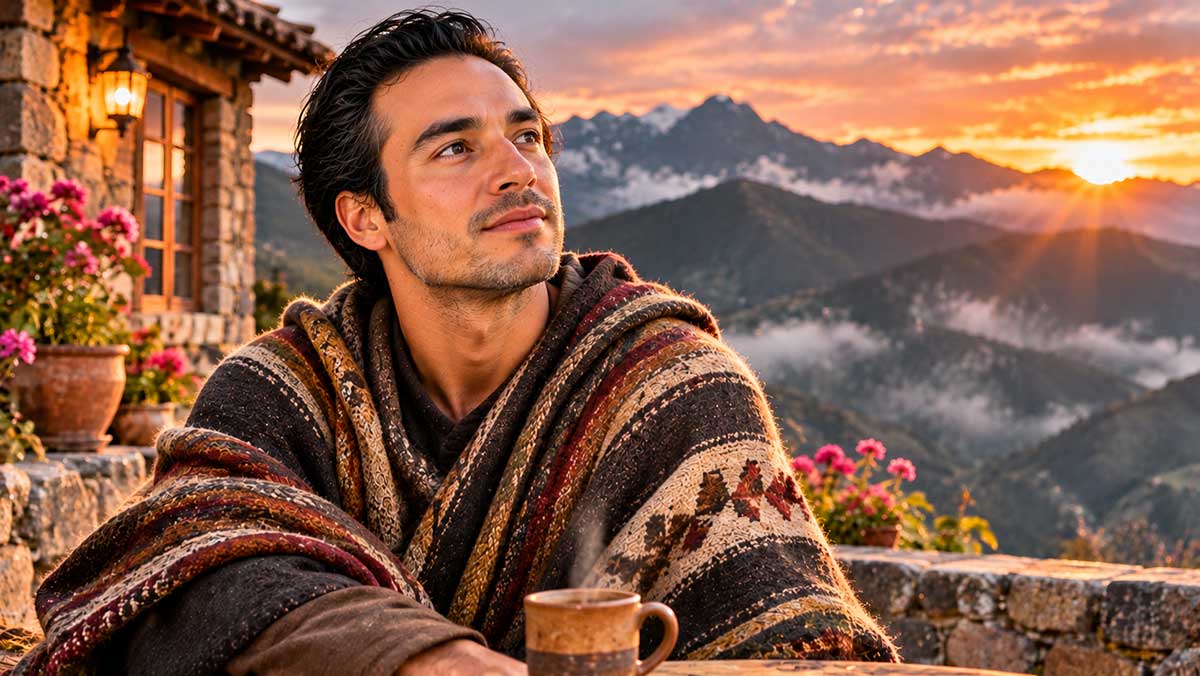
Ecuador. A small village overlooking the Andes, late afternoon.
The mountains rise in immense green folds beneath a sky filled with slow-moving clouds. Far below, a narrow road winds between fields and scattered houses. A church bell sounds somewhere in the valley.
On a hillside overlooking the village stands a simple wooden terrace. Two chairs face the mountains. A clay pot of freshly brewed coffee rests on a small table.
This is an imagined location in Ecuador, the country where Diego Perez was born before moving with his family to the United States as a young child. The setting is fictional, created to explore the meaning of his pen name, Yung Pueblo, and his hopes for humanity.
Nick Sasaki stands at the edge of the terrace, looking across the valley.
Diego joins him.
Nick Sasaki
Diego, this is extraordinary.
Look at those mountains.
They've been here for millions of years, and we're standing here worrying about what humanity will become in the next hundred.
Diego smiles.
You know what I find fascinating?
Those mountains have witnessed countless generations of human beings.
People have been born, fallen in love, raised children, fought wars, prayed to God, and died.
Kingdoms have risen and disappeared.
Religions have spread.
Entire civilizations have transformed.
And yet, when I look at human behavior today, I sometimes wonder how much we've actually changed.
Yung Pueblo
I think that's a meaningful question.
We've developed extraordinary technologies and accumulated tremendous knowledge.
But our emotional habits don't always develop at the same pace.
We can communicate across continents in seconds, yet struggle to listen to someone sitting across the table.
We can study the universe, yet remain confused about our own anger.
Nick Sasaki
Exactly.
And that brings me to the name you chose.
Yung Pueblo.
Young people.
Young humanity.
When you chose that name, were you saying that humanity is still a child?
Yung Pueblo
The name reflects the idea that humanity is still growing.
We've accomplished extraordinary things, but we also continue repeating patterns that cause suffering.
We struggle with greed, fear, division, and the desire to dominate one another.
I see humanity as having tremendous potential for greater emotional maturity.
The name expresses that possibility.
Nick Sasaki
But I want to challenge you immediately.
What if humanity isn't young?
What if we're simply human?
What if jealousy, tribalism, aggression, and the desire for dominance aren't childhood behaviors we'll eventually outgrow?
What if they're permanent features of our nature?
Yung Pueblo
I think human beings have capacities for both harmful and compassionate behavior.
We can be aggressive, but we can be cooperative.
We can act from fear, but we can act from generosity.
We can become attached to divisions, but we can recognize our shared humanity.
The fact that certain patterns have existed throughout history doesn't necessarily mean they must remain unchanged.
Nick Sasaki
But how do you know?
Yung Pueblo
I don't think anyone can know with certainty what humanity will become.
What we can do is examine the possibilities and the choices available to us.
Nick Sasaki
Nick turns toward Diego.
That's interesting.
Because the reason I wanted to interview you in the first place was something you wrote in Inward.
You said humanity would learn two great lessons in the twenty-first century.
That harming another is harming ourselves.
And that healing ourselves can heal the world.
You didn't write, "I hope humanity learns."
You wrote that humanity will learn.
That's a prediction.
And it's a very bold one.
The First Question: Is Your Prediction Wisdom, Faith, or Hope?
Nick Sasaki
Diego, I want to ask you directly.
Why did you write those words with such certainty?
Was it something you discovered through meditation?
Was it a spiritual intuition?
Was it your interpretation of history?
Or was it simply a hope you wanted humanity to believe in?
Yung Pueblo
I think there can be a difference between the language of poetry and the language of prediction.
Poetry sometimes expresses a conviction in a direct, uncompromising way.
It can describe the future we believe humanity needs to create.
But I wouldn't claim to possess knowledge of exactly what will happen during this century.
I don't have a special ability to see the future.
Nick Sasaki
So you're not claiming to be a prophet.
Yung Pueblo
No.
Nick Sasaki
Nick laughs softly.
Good. That would make this interview much more complicated.
But I'm serious about something.
When a writer uses words like yours, readers may feel that he's speaking from a higher level of consciousness.
They may think, "He must know something I don't."
Do you worry that people might mistake spiritual confidence for spiritual authority?
Yung Pueblo
I think that's something worth being careful about.
A meaningful experience doesn't automatically make someone an authority on every question.
Meditation can help us examine our emotional patterns, but it doesn't give us perfect knowledge about history, politics, or the future.
I would want readers to reflect on the ideas rather than accept them simply because I wrote them.
Nick Sasaki
Then let me ask you a different question.
Suppose it's December 31, 2099.
Humanity has made enormous technological progress.
We've developed extraordinary medical treatments.
We've created new forms of energy.
Perhaps we've even established settlements beyond Earth.
But wars still exist.
People still exploit one another.
Hatred still divides communities.
Would you consider your prediction wrong?
Yung Pueblo
If the statement were interpreted as a literal guarantee that humanity would overcome harmful behavior within a particular period, then that would be a fair criticism.
I think the deeper question is whether humanity is learning to recognize the consequences of its actions and developing greater capacity for compassion.
Progress may be uneven.
And it may involve setbacks.
But that doesn't mean our choices are meaningless.
Nick Sasaki
I appreciate that answer, but I want to push you further.
If the prediction can mean almost anything, doesn't it become impossible to test?
If humanity becomes more compassionate, you were right.
If humanity remains violent, you can say we're still learning.
If things get worse, you can say the lesson hasn't been completed.
How do we prevent a beautiful spiritual statement from becoming something that can never be questioned?
Yung Pueblo
That's a fair challenge.
I think we should distinguish between a moral aspiration and an empirical forecast.
A moral aspiration can guide our actions without claiming certainty about the outcome.
An empirical forecast needs evidence and clear criteria.
If we treat a poetic statement as a forecast, we should be willing to examine whether events support it.
Nick Sasaki
So perhaps the statement is strongest when understood as a challenge to humanity.
Not "This future is guaranteed."
But "This is what we must learn if we want a better future."
Yung Pueblo
I think that interpretation captures an important part of the message.
Nick Sasaki
But I have to tell you something.
Part of me wishes you really did know.
Diego smiles.
I mean that sincerely.
I look at the world, and sometimes I want someone to tell me that everything will eventually be okay.
That our children will inherit a kinder world.
That all the suffering we see is part of some larger movement toward compassion.
Wouldn't that be comforting?
Yung Pueblo
It would.
But I think we need to be careful about confusing comfort with certainty.
Hope can be meaningful without becoming a guarantee.
We can work toward a compassionate future while recognizing that the outcome depends on many factors.
Nick Sasaki
That's a difficult kind of hope.
Yung Pueblo
It can be.
Nick Sasaki
Because it asks us to keep caring without promising that we'll succeed.
Yung Pueblo
Yes.
Nick Sasaki
Nick looks out at the mountains.
That reminds me of something I've always admired about people who dedicate their lives to helping others.
A teacher may never know whether a student will become a great person.
A parent can't guarantee that a child will make wise choices.
Someone who plants a tree may never sit beneath its shade.
Yet they do these things anyway.
Perhaps hope isn't believing that success is guaranteed.
Perhaps it's deciding that something is worth doing without knowing the outcome.
Yung Pueblo
I think there's something deeply meaningful in that.
Compassion doesn't have to depend on certainty about the future.
It can arise from recognizing what is needed in the present.
Nick Sasaki
Then let me ask the question that troubles me most.
What evidence gives you hope that humanity is actually becoming more compassionate?
Not just that we could become compassionate.
What makes you think we're moving in that direction?
Yung Pueblo
I think we can point to examples of human cooperation, efforts to protect vulnerable people, growing conversations about emotional well-being, and communities organizing to reduce suffering.
But we also have to recognize evidence of cruelty, violence, and division.
I wouldn't want to present a selective picture of history.
Human progress is complicated and uneven.
And no single measure can capture the full moral condition of humanity.
Nick Sasaki
So we need both hope and evidence.
Yung Pueblo
I think that's a healthy combination.
Nick Sasaki
And the humility to change our minds when the evidence changes.
Yung Pueblo
Yes.
The Second Question: Why Has Humanity Failed to Learn Compassion?
The afternoon sun slips behind a bank of clouds.
For a moment, the mountains turn dark blue. A farmer leads two animals along a distant hillside path.
Nick takes a sip of coffee.
Nick Sasaki
Diego, let's talk about history.
For thousands of years, spiritual teachers have told humanity to become more compassionate.
The Buddha taught about suffering and the importance of releasing hatred.
Jesus taught people to love their neighbors and even their enemies.
Confucius emphasized humaneness and moral cultivation.
Countless philosophers, poets, and religious leaders have encouraged kindness.
Yet humanity continues to fight wars.
We continue to exploit one another.
We continue dividing people into groups that deserve compassion and groups that don't.
So here's my question.
If the teachings are so beautiful, why haven't they worked?
Yung Pueblo
I think there's a difference between admiring a teaching and practicing it.
A person can agree intellectually that compassion is important while continuing to react from fear or anger.
A society can celebrate moral ideals without building institutions that consistently reflect those ideals.
And people can use spiritual language to justify behavior that contradicts the values they claim to follow.
Nick Sasaki
That's one of the strangest things about religion.
Someone can say, "God is love," and then treat another person with hatred.
Someone can quote a sacred text about compassion and still believe that people outside their group deserve suffering.
How does that happen?
Yung Pueblo
I think human beings can become strongly attached to identities and beliefs.
When we identify completely with a group, criticism of that group may feel like a personal threat.
Fear can make it difficult to recognize the humanity of people we perceive as different.
And when institutions reward division, those emotional patterns can become reinforced.
Nick Sasaki
But here's something that worries me.
Sometimes the more convinced people become that they're morally right, the more cruel they become toward those who disagree.
They believe they're defending goodness.
And that belief gives them permission to hurt people.
Yung Pueblo
I think moral certainty can become dangerous when it removes humility and compassion.
We need to be able to stand for important principles without assuming that everyone who disagrees with us is less human.
Nick Sasaki
But surely some things are wrong.
Violence against innocent people.
Abuse.
Exploitation.
We can't simply say, "Everyone has their own truth."
Yung Pueblo
Of course.
Humility doesn't require moral indifference.
We can recognize harmful actions and work to stop them.
The challenge is to respond effectively without allowing our opposition to harm to become another justification for unnecessary cruelty.
Nick Sasaki
That's difficult.
Suppose someone attacks your family.
You aren't going to sit down and meditate for an hour before protecting them.
Yung Pueblo
No.
Protecting people from immediate harm can require decisive action.
Emotional awareness isn't supposed to prevent us from responding to danger.
It can help us distinguish necessary protection from retaliation driven by uncontrolled anger.
Nick Sasaki
So compassion can include stopping someone.
Yung Pueblo
Yes.
Nick Sasaki
And sometimes that might require force.
Yung Pueblo
In situations involving immediate danger, protection may require proportionate action.
Compassion doesn't mean abandoning people who need protection.
Nick Sasaki
Good.
I want that to be clear.
Because sometimes spiritual discussions become so abstract that we forget the reality of human suffering.
Now let me ask something else.
You teach meditation and emotional awareness.
But human beings have practiced meditation for thousands of years.
There are countries with long Buddhist traditions that have still experienced war, persecution, and political violence.
Doesn't that challenge the idea that meditation makes people compassionate?
Yung Pueblo
I think it challenges any claim that meditation automatically produces compassion.
A practice can offer useful tools, but people still make choices.
They live within political, economic, and cultural systems.
And they may use spiritual teachings selectively.
Meditation isn't a guarantee of ethical behavior.
Nick Sasaki
Then what good is it on a global scale?
If millions of people meditate, but governments still go to war, corporations still exploit workers, and people still discriminate against one another, what has really changed?
Yung Pueblo
I think we should avoid expecting one practice to solve every social problem.
Meditation may help individuals develop greater awareness.
But social transformation requires many forms of action.
Education.
Accountable institutions.
Fair laws.
Economic opportunities.
Cooperation across communities.
And people willing to challenge harmful systems.
Inner work can contribute to those efforts, but it cannot replace them.
Nick Sasaki
That's an important admission.
Healing yourself doesn't automatically heal a broken institution.
Yung Pueblo
No.
Nick Sasaki
And being peaceful doesn't automatically make you politically wise.
Yung Pueblo
No.
Nick Sasaki
And someone who meditates for years might still hold terrible prejudices.
Yung Pueblo
That's possible.
Nick Sasaki
Then perhaps the real challenge is connecting inner awareness with outward responsibility.
Yung Pueblo
I think that's essential to the broader message.
Nick Sasaki
Let me give you an example.
Suppose a business leader begins meditating.
They become calmer.
They sleep better.
They feel less stressed.
But they continue paying their employees unfairly.
They continue making decisions that harm their community.
They simply feel more peaceful about doing those things.
Has meditation helped humanity?
Yung Pueblo
That's a serious question.
If greater calm doesn't lead to greater ethical awareness or accountability, then we should question what the practice is accomplishing.
A person's subjective sense of peace isn't the only measure that matters.
We also need to examine behavior and consequences.
Nick Sasaki
Exactly.
I sometimes worry that people use spirituality to become comfortable with injustice rather than motivated to change it.
Yung Pueblo
That can happen.
Spiritual practices can be misused, just like other forms of knowledge.
We need to remain attentive to whether our actions reflect compassion and responsibility.
Nick Sasaki
Now I want to ask about something much bigger.
Humanity has become incredibly intelligent.
We can build artificial intelligence.
We can study distant galaxies.
We can manipulate genes.
We can create technologies that earlier generations would have considered miracles.
But emotionally, we still fight over status, territory, money, religion, and identity.
Are we becoming more intelligent faster than we're becoming wise?
Yung Pueblo
I think that's a reasonable concern.
Our technical abilities can develop faster than our capacity to consider their ethical consequences.
And the greater our abilities become, the more important our decisions may be.
Nick Sasaki
That frightens me.
A child having a temper tantrum might break a toy.
But a civilization with extraordinary technology and the emotional maturity of an angry child could destroy much more.
Yung Pueblo
That's why developing compassion, cooperation, and ethical responsibility matters.
Technical advancement alone doesn't determine whether we use our abilities wisely.
Nick Sasaki
So perhaps your name, Yung Pueblo, is more relevant now than ever.
A young humanity with increasingly sophisticated tools.
Yung Pueblo
That's one way to think about it.
Nick Sasaki
But here's the question.
How do we help an entire civilization grow up?
You can sit with one person and help them recognize their anger.
You can teach a couple to communicate.
You can encourage a reader to become more compassionate.
But how do you teach emotional maturity to eight billion people?
Yung Pueblo
I don't think there is one simple method.
Cultural change can emerge through education, families, communities, institutions, and shared practices.
People influence one another through their behavior.
But that influence isn't always positive, and it doesn't automatically spread.
We need intentional efforts to create environments that reward cooperation and discourage harm.
Nick Sasaki
So the work is much larger than telling everyone to meditate.
Yung Pueblo
Yes.
Nick Sasaki
And perhaps much harder.
Yung Pueblo
It is a significant challenge.
The Third Question: Can Humanity Learn to Stop Harming Itself?
The clouds begin to separate.
Sunlight returns to the valley, illuminating a winding river far below.
Nick stands and walks to the wooden railing.
Nick Sasaki
Diego, I want to talk about the first lesson in your poem.
The idea that harming another person is harming ourselves.
I find that deeply moving.
But I want to know what you actually mean.
Are you speaking spiritually?
Do you believe that when I hurt another person, something happens to my soul?
Or are you describing a practical reality, that cruelty damages our relationships and the societies we depend on?
Yung Pueblo
I think the idea can be explored at several levels.
On a personal level, harmful behavior can reinforce emotional patterns that create suffering.
When we repeatedly act from hatred or resentment, we may strengthen those habits.
On a relational level, hurting others can damage trust and connection.
And on a social level, widespread harm can weaken the communities and institutions that support our well-being.
Nick Sasaki
So you don't necessarily need a supernatural explanation.
Yung Pueblo
No.
The consequences of harmful behavior can often be examined through ordinary human experience.
Nick Sasaki
But what about people who hurt others and seem perfectly happy?
History contains powerful people who committed terrible acts and lived comfortably.
Some never apologized.
Some never faced justice.
Doesn't that challenge the idea that harming another is harming ourselves?
Yung Pueblo
I think it challenges any simplistic claim that every harmful action produces immediate personal suffering for the person responsible.
We shouldn't pretend that the world always distributes consequences fairly.
Some people benefit materially from exploiting others.
And victims may suffer far more than those who caused the harm.
Nick Sasaki
That's important.
Because I don't want to tell someone who has been abused, "Don't worry, the person who hurt you is suffering too."
That might not be true.
And it wouldn't address what happened to the victim.
Yung Pueblo
Exactly.
Compassion requires taking the suffering of victims seriously.
The broader principle is that systems built on exploitation and violence can damage the conditions that support collective well-being.
But that doesn't mean every individual receives equal consequences.
Nick Sasaki
So when you say harming another harms ourselves, perhaps you're speaking about humanity as a whole.
We're part of a shared human community.
If we create a world where cruelty is normal, eventually we all live in a world shaped by cruelty.
Yung Pueblo
I think that's an important interpretation.
Our lives are interconnected through relationships, communities, economies, and ecosystems.
The conditions we create for others can influence the conditions we all inhabit.
Nick Sasaki
But here's a difficult question.
Does recognizing that connection actually make people kinder?
Most people know that war causes suffering.
Most people know that cruelty is harmful.
Most people know that children deserve safety.
Yet terrible things continue happening.
Maybe the problem isn't ignorance.
Maybe people know what's right and simply choose something else.
Yung Pueblo
I think knowledge alone doesn't guarantee ethical behavior.
People may act from fear, self-interest, prejudice, or pressure from their surroundings.
And institutions can create incentives that reward harmful choices.
That's why change requires more than awareness.
It requires practice, accountability, and systems that support healthier behavior.
Nick Sasaki
Then let me ask something about the future.
Do you believe there will come a time when humanity no longer fights wars?
Yung Pueblo
I hope humanity can develop more effective ways of resolving conflict without violence.
But I wouldn't claim to know that war will disappear completely.
Nick Sasaki
Do you believe there will come a time when people stop hating one another over religion, race, or nationality?
Yung Pueblo
I hope we can reduce those forms of hatred and create stronger cultures of mutual respect.
But I don't think progress is inevitable.
Nick Sasaki
And do you believe humanity will eventually recognize that every human life has value?
Yung Pueblo
I think that's a principle worth working toward, regardless of whether we can guarantee universal agreement.
Nick Sasaki
Nick turns back toward Diego.
You know what's interesting?
The more I question you, the less you sound like someone predicting the future.
You sound like someone trying to persuade humanity to choose a better one.
Yung Pueblo
I think our choices matter.
Nick Sasaki
But I want to ask something more personal.
When you see terrible news, do you ever lose hope?
When you see people suffering in wars, children being harmed, communities divided by hatred, do you ever think, "Maybe humanity isn't going to learn"?
Yung Pueblo
I think anyone who cares about human suffering can experience sadness, frustration, or discouragement.
Hope doesn't require denying those feelings.
And I don't think we should force ourselves to remain optimistic every moment.
Sometimes we need to acknowledge grief.
Sometimes we need to step away from constant exposure to distressing information.
And sometimes we need to focus on what we can meaningfully contribute.
Nick Sasaki
But doesn't stepping away risk becoming indifferent?
Yung Pueblo
It can, if we use it to avoid responsibility.
But maintaining emotional balance can help us remain engaged over time.
The goal isn't to stop caring.
It's to care in a way that remains sustainable.
Nick Sasaki
I think that's important.
I've noticed that some people become so overwhelmed by the world's suffering that they stop believing anything can improve.
They become cynical.
And cynicism can feel intelligent.
It's easy to say humanity is hopeless.
It's harder to remain hopeful without ignoring reality.
Yung Pueblo
I think hope can be an active commitment rather than a prediction.
We can recognize the seriousness of suffering and still choose to contribute to something better.
Nick Sasaki
Now, I want to ask a question inspired by something I learned about your name.
You chose Yung Pueblo to represent a young humanity.
But children don't grow up simply by being told to mature.
They need examples.
They need guidance.
They need opportunities to make mistakes and learn.
Sometimes they need boundaries.
Sometimes they need someone who believes in them before they believe in themselves.
So who is raising humanity?
Yung Pueblo
Diego smiles thoughtfully.
That's a fascinating question.
I think humanity is continually shaping itself.
Each generation inherits ideas, institutions, and habits from those who came before.
And each generation has opportunities to examine what it has inherited.
Families, teachers, communities, artists, scientists, spiritual traditions, and public institutions can all influence that process.
But none of them has complete authority over humanity's development.
Nick Sasaki
What about God?
Yung Pueblo
People have different beliefs about the divine and humanity's relationship with it.
I think those beliefs can be meaningful sources of moral reflection.
But people also need to take responsibility for their actions.
Nick Sasaki
I ask that because I'm interested in the possibility that humanity has a spiritual purpose.
Maybe we're here to learn compassion.
Maybe our struggles are part of some larger process of growth.
I can't prove that.
But I find the possibility deeply moving.
Do you think humanity has a collective mission?
Yung Pueblo
I think we can choose to orient ourselves around shared values.
Compassion.
Cooperation.
Reducing unnecessary suffering.
Protecting life.
Creating conditions where more people can flourish.
Whether someone interprets those goals as a spiritual mission or an ethical responsibility may depend on their beliefs.
But the practical work remains important.
Nick Sasaki
So perhaps we don't need everybody to agree about the ultimate meaning of existence.
We can still agree that children shouldn't suffer unnecessarily.
That people deserve dignity.
That kindness matters.
Yung Pueblo
I think shared commitments can provide a foundation for cooperation across differences.
Nick Sasaki
But here's a challenge.
What happens when two groups both believe they're protecting human dignity, yet disagree completely about how to do it?
What happens when compassion itself becomes politically contested?
Yung Pueblo
Then we need more than good intentions.
We need dialogue, evidence, accountability, and institutions capable of resolving disagreements fairly.
Compassion doesn't eliminate difficult choices.
It can influence how we approach those choices and how we treat the people affected by them.
Nick Sasaki
So emotional maturity doesn't mean everyone agrees.
It means we learn to disagree without destroying one another.
Yung Pueblo
That would be a meaningful form of progress.
The Question Nick Almost Didn't Ask
The sun approaches the western mountains.
The valley below begins to glow with warm evening light.
Nick sits down again, holding his coffee cup between his hands.
Nick Sasaki
Diego, there's something I haven't told you.
When I read your prediction about humanity, part of me wanted to believe it immediately.
I wanted to believe that the twenty-first century would be the century when we finally learned compassion.
But another part of me was skeptical.
And I realized something uncomfortable.
Maybe I wasn't simply questioning your confidence.
Maybe I was questioning my own hope.
Yung Pueblo
What do you mean?
Nick Sasaki
I've lived long enough to see wonderful things happen.
I've seen extraordinary acts of generosity.
I've seen people forgive one another.
I've seen strangers help strangers.
I've seen families remain loving through terrible difficulties.
But I've seen cruelty too.
And sometimes I wonder whether the kindness of ordinary people can ever overcome the ambitions of those who seek control.
Can a million small acts of love really change a world shaped by enormous institutions?
Yung Pueblo
I think individual kindness matters, but it needs to connect with broader forms of responsibility.
A compassionate person can influence a family.
A compassionate community can develop healthier practices.
And people working together can advocate for institutional change.
But we shouldn't pretend that small acts of kindness automatically overcome structural problems.
They can be part of the foundation for larger efforts.
Nick Sasaki
So love needs organization.
Yung Pueblo
Compassion can become more effective when it's expressed through sustained collective action.
Nick Sasaki
And perhaps that's where your philosophy faces its greatest test.
It's one thing to say, "Heal yourself."
It's another thing to ask how healed people can build a society that protects those who are suffering.
Yung Pueblo
I think that's a necessary question.
Nick Sasaki
But before we move there, I want to return to something you said earlier.
You don't know whether humanity will become more compassionate.
You don't know whether wars will disappear.
You don't know whether people will overcome hatred.
Yet you continue writing about healing and hope.
Why?
Yung Pueblo
Diego looks across the valley.
I think the absence of certainty doesn't remove the value of compassion.
If we can reduce suffering in one relationship, that matters.
If we can help a community become more supportive, that matters.
If we can contribute to institutions that treat people more fairly, that matters.
We don't need to know the final outcome of humanity's history to recognize the value of those actions.
Nick Sasaki
But what if humanity never learns?
Yung Pueblo
Then the people we helped along the way would still matter.
Nick Sasaki
Nick becomes quiet.
That's a beautiful answer.
Because it means compassion isn't a bargain we make with the future.
We don't love people only if humanity eventually becomes enlightened.
We love them because they're here.
Because they're human.
Because their suffering matters now.
Yung Pueblo
I think that's a meaningful way to express it.
Nick Sasaki
And perhaps that brings us back to your childhood.
The little boy from Ecuador who grew up in Boston.
The young man who struggled with his emotions.
The person who learned to meditate.
The writer who began sharing what he discovered.
You couldn't heal all of humanity when you were twenty-three.
But you could begin changing the way you lived.
And perhaps those changes influenced the people around you.
Yung Pueblo
I think personal transformation can influence our relationships and the choices we make.
And those choices can have consequences beyond ourselves.
Nick Sasaki
Then maybe the most important question isn't whether humanity will awaken.
Maybe it's what we should do if we want to help that awakening happen.
Yung Pueblo
That's a question worth exploring.
The Sunset and the Unfinished Promise
The last sunlight touches the highest peaks.
Below the terrace, a few village lights begin appearing along the winding road.
Nick and Diego remain seated, watching the changing sky.
Nick Sasaki
Diego, when I arrived here, I wanted you to defend your prediction.
I wanted evidence that humanity would become kinder.
I wanted you to explain why thousands of years of violence would somehow lead to a more compassionate century.
And I still think those are fair questions.
But I realize now that perhaps I was asking you to guarantee something no human being can guarantee.
Yung Pueblo
I think uncertainty is part of the human condition.
Nick Sasaki
Yes.
But uncertainty doesn't have to mean helplessness.
We may not know what humanity will become.
Yet we can influence what happens in our homes, our communities, and perhaps through the institutions we help create.
Yung Pueblo
I think that's where responsibility becomes meaningful.
Nick Sasaki
Nick looks at the lights below.
You know, somewhere in that village, a child is probably having dinner with his family.
Maybe his parents are worried about money.
Maybe he's absorbing fears he doesn't yet understand.
Maybe he'll grow up angry.
Maybe he'll grow up compassionate.
Maybe both.
And perhaps the way people treat him tonight will influence the kind of person he becomes.
Yung Pueblo
Our everyday actions can influence other people's lives in ways we may never fully recognize.
Nick Sasaki
Then perhaps humanity's future is being shaped in millions of ordinary moments.
Not just in government buildings or international conferences.
But wherever people decide how to treat one another.
Yung Pueblo
Those moments are part of the larger picture.
Nick Sasaki
But they aren't the whole picture.
Yung Pueblo
No.
Nick Sasaki
And that's what I want to explore next.
You wrote that when we heal ourselves, we heal the world.
I want to know how far that idea can go.
Can a healed individual help change an unjust institution?
Can compassion become part of economic life?
Can spiritual maturity influence political decisions without becoming another ideology?
And what happens when personal healing encounters problems that no individual can solve alone?
Yung Pueblo
Those are important questions.
Nick Sasaki
Nick smiles.
And I have one more.
After everything you've experienced, after the books, the meditation retreats, the relationships, and the people you've reached, what do you actually want to leave behind?
Not your reputation.
Not your sales figures.
Not the number of people following you.
What do you hope will remain after the name Yung Pueblo is forgotten?
Diego watches the valley quietly.
Yung Pueblo
I think I'd want the ideas to remain useful.
If something I've written helps a person become kinder, more honest, or more capable of building a healthy relationship, that would matter.
And if people eventually move beyond my words and discover their own ways of creating compassion, that would be meaningful too.
Nick Sasaki
So you don't need humanity to remember Yung Pueblo.
You want humanity to remember how to care for one another.
Yung Pueblo
I think the message matters more than the name.
The church bell sounds again from the village below.
Nick looks toward the darkening mountains.
Nick Sasaki
Then let's take that message somewhere else.
Somewhere we can ask what happens when compassion leaves the page of a book and enters the structures of society.
And perhaps, Diego, we can finally return to the question that brought me to you in the first place.
Can healing one human being really help heal the world?
The evening wind moves softly across the terrace.
Below them, the village continues its ordinary life, carrying all the fears, hopes, conflicts, and quiet acts of kindness that make humanity what it is.
The conversation is far from finished.
End of Topic 4.
Fictional interview disclaimer: This is an imagined literary conversation between Nick Sasaki and Yung Pueblo (Diego Perez), inspired by Yung Pueblo's published philosophy and publicly discussed life experiences. The Ecuadorian setting, dialogue, personal responses, and reflections attributed to Diego are fictional and should not be treated as verified quotations, private disclosures, or predictions he has personally confirmed in this interview.
Topic 5. When You Heal Yourself, Do You Heal the World?
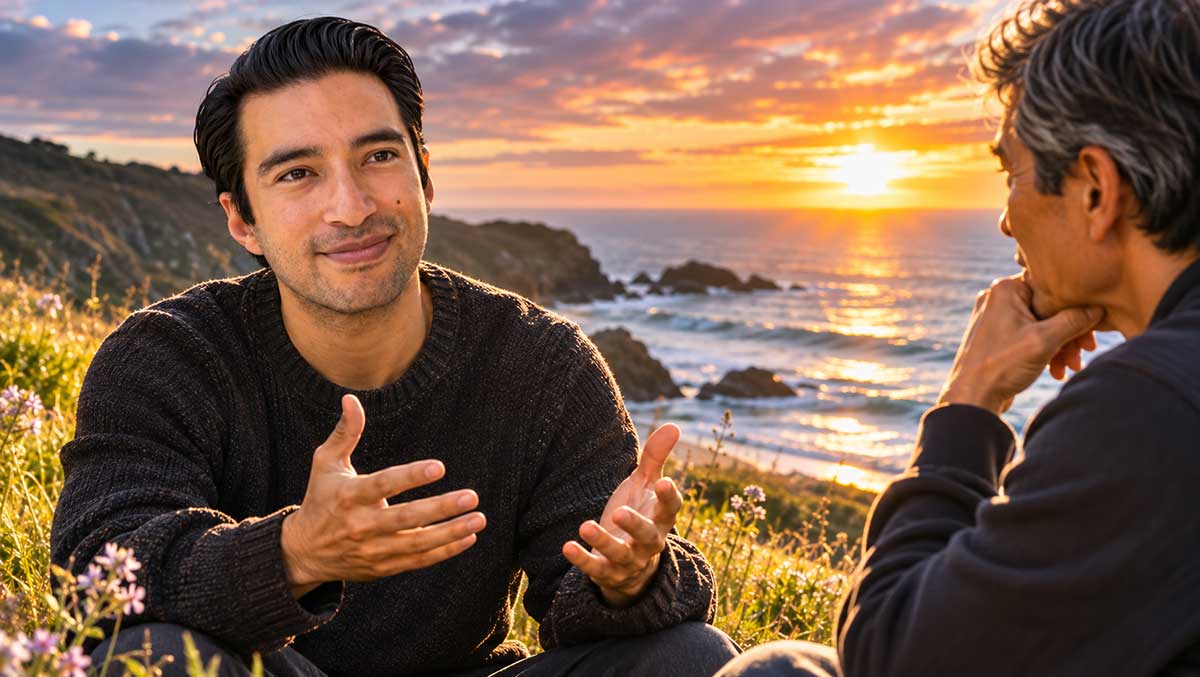
The Pacific Coast, California. Just before sunrise.
The sky is a deep shade of blue. Beyond a quiet stretch of sand, the Pacific Ocean extends toward the horizon. Gentle waves approach the shore, leaving delicate patterns in the wet sand before retreating.
Two wooden chairs stand on a terrace overlooking the beach. A small table holds two cups of coffee and a weathered copy of Inward.
This imagined coastal setting represents the final stage of Nick Sasaki's conversation with Diego Perez, known as Yung Pueblo. It is a place to consider how personal transformation might influence families, communities, institutions, and future generations.
Nick arrives first.
He watches a solitary figure walking along the water's edge. Farther down the beach, a father is helping a young child collect seashells.
Diego joins him.
Nick Sasaki
Diego, look at that father and his little girl.
She's trying to carry more seashells than her hands can hold.
Diego smiles.
Every time she bends down to pick up another one, she drops two.
And her father just keeps helping her.
It's such a small moment.
But I wonder whether she'll remember it thirty years from now.
Maybe she'll forget the shells.
Maybe she'll forget this beach.
But perhaps she'll remember how safe she felt with him.
Yung Pueblo
I think those ordinary experiences can shape us deeply.
We don't always recognize their importance while they're happening.
A child may remember the feeling of being supported long after the details have faded.
Nick Sasaki
And perhaps one day she'll treat her own children with that same patience.
Then they'll pass it on.
One little moment of kindness could influence people who haven't even been born yet.
Yung Pueblo
That's a beautiful possibility.
Nick Sasaki
But here's what I've been thinking since our conversation in Ecuador.
You wrote that when we heal ourselves, we heal the world.
It's one of the most beautiful ideas I've encountered.
But it's also one of the biggest claims anyone could make.
So today, Diego, I want to ask whether it's actually true.
Can one person's healing change the world?
Or is that something we tell ourselves because we want our personal struggles to have a larger meaning?
The First Question: Can One Person's Healing Really Change the World?
Yung Pueblo
I think we need to be careful about what we mean by changing the world.
If someone becomes more emotionally aware, that doesn't automatically resolve global conflict or eliminate injustice.
But personal transformation can influence how we treat the people around us.
And those relationships are part of the larger human community.
Nick Sasaki
Give me an example.
Something ordinary.
Not a spiritual teacher changing millions of lives.
Just a regular person.
Yung Pueblo
Consider a parent who grew up in a household where anger was expressed through shouting.
As an adult, that parent may find themselves repeating the same behavior.
They become frustrated, raise their voice, and frighten their children.
But suppose they begin recognizing that pattern.
They learn to pause.
They develop healthier ways to communicate.
They apologize when they make mistakes.
Their children may grow up experiencing conflict differently.
That doesn't guarantee how the children will behave as adults.
But it changes something meaningful in their immediate environment.
Nick Sasaki
So the parent doesn't need to change the entire world.
They begin by changing the emotional atmosphere of one home.
Yung Pueblo
Yes.
Nick Sasaki
And that child may carry those experiences into another home.
Yung Pueblo
That's possible.
Nick Sasaki
But let me challenge you.
We love stories about kindness spreading from one person to another.
Yet cruelty spreads too.
A frightened parent can frighten a child.
That child can become an angry adult.
That adult can hurt someone else.
Why should we believe kindness will spread more effectively than fear?
Yung Pueblo
I don't think we can assume that it will.
Human behavior is influenced by many factors.
Compassionate actions can encourage healthier relationships, but harmful patterns can be transmitted across generations too.
That's why awareness and intentional change matter.
We can't control every outcome.
But we can work to interrupt patterns that cause suffering.
Nick Sasaki
Interrupt.
I like that word.
Because sometimes we talk about healing as though we're creating something completely new.
But perhaps we're simply refusing to pass something harmful to the next generation.
Yung Pueblo
That can be a meaningful form of change.
Nick Sasaki
Let me tell you a story.
Years ago, I heard about a father who had grown up with a very harsh parent.
When he became a father himself, he promised that his children would never be afraid to come to him.
He wasn't perfect.
Sometimes he lost his temper.
Sometimes he made mistakes.
But whenever he realized he'd hurt his children, he apologized.
And one day, his son said something that moved him deeply.
"Dad, I know you get angry sometimes. But I'm never afraid that you'll stop loving me."
Nick pauses.
I think about that sentence.
The father hadn't eliminated anger.
He hadn't become some perfect spiritual being.
But he had changed what anger meant inside his family.
Yung Pueblo
That's a moving example.
And it shows how accountability can become part of love.
We don't have to pretend we'll never make mistakes.
We can recognize them, take responsibility, and work to respond differently.
Nick Sasaki
But here's a harder question.
What about people who have no children?
People who live alone?
People who don't have large communities or public influence?
Does their healing still matter?
Yung Pueblo
Of course.
A person's well-being matters regardless of how many people they influence.
We shouldn't measure the value of healing solely by its effects on others.
Someone deserves relief from unnecessary suffering simply because their life has value.
And personal transformation can influence many kinds of relationships, including friendships, workplaces, and interactions with strangers.
Nick Sasaki
I'm glad you said that.
Sometimes we become so focused on changing the world that we forget an individual human life matters in itself.
If a lonely person learns to feel less ashamed, that's meaningful.
If someone who's been carrying resentment for thirty years finally finds some peace, that's meaningful.
They don't have to start a movement.
Yung Pueblo
I agree.
Nick Sasaki
But I want to ask about something that bothers me.
What if someone spends years working on themselves and becomes happier, calmer, and more confident, but never becomes kinder to anyone else?
Have they healed?
Yung Pueblo
I think we should distinguish between feeling better and developing healthier patterns.
Emotional relief can be valuable.
But if someone continues treating others harmfully, there's still important work to examine.
Greater awareness can invite us to consider how our behavior affects other people.
Nick Sasaki
So personal healing isn't simply feeling peaceful inside.
It should influence how we live.
Yung Pueblo
Ideally, yes.
Nick Sasaki
And how we treat people who can't give us anything in return.
Yung Pueblo
That can be an important reflection of compassion.
Nick Sasaki
You know, Diego, I've always thought one of the clearest signs of someone's character is how they treat people when nobody important is watching.
A waiter.
A cleaner.
A stranger who needs directions.
An elderly person moving slowly through a doorway.
These moments rarely become famous.
But they reveal something.
Yung Pueblo
I think everyday behavior matters greatly.
Our values become meaningful through our actions.
Nick Sasaki
Then perhaps healing the world begins with a surprisingly simple question.
Did someone feel more respected, more understood, or less alone after encountering me today?
Yung Pueblo
That's a meaningful question to carry into daily life.
The Second Question: Can Compassion Change Systems Built on Fear and Self-Interest?
The sun begins rising above the distant coastline.
The ocean changes from dark blue to silver.
Nick leans back in his chair.
Nick Sasaki
Diego, I want to move beyond personal relationships.
Because there's something I keep thinking about.
Suppose a business executive begins meditating.
He becomes calmer.
He treats his family better.
He sleeps peacefully.
But his company continues exploiting workers.
Or suppose a politician practices compassion at home but supports policies that cause unnecessary suffering.
Can we really call those people healed?
Yung Pueblo
I think that's an important challenge.
Personal awareness should encourage us to examine the consequences of our actions beyond our immediate relationships.
We participate in larger systems through our work, decisions, and responsibilities.
If we're becoming more compassionate, we should be willing to consider how our choices affect people we may never meet.
Nick Sasaki
But that's where things become difficult.
A business leader might say, "If I pay my employees more, my company may become less competitive."
A politician might say, "If I compromise, my supporters will turn against me."
A government might say, "If we trust another country, we may become vulnerable."
These aren't simply emotional problems.
They're problems involving incentives, institutions, and competing interests.
How does meditation help with that?
Yung Pueblo
Meditation alone isn't enough.
It may help individuals recognize fear, attachment, or reactivity.
But addressing institutional problems requires practical knowledge, cooperation, and accountability.
We need systems that encourage ethical behavior rather than depending entirely on the goodwill of individual leaders.
Nick Sasaki
So compassion needs structures.
Yung Pueblo
It can become more effective when it's supported by healthy institutions.
Nick Sasaki
Let me give you an example.
Suppose a company treats its employees fairly.
It provides reasonable working conditions.
It pays people well.
It tries to minimize harm to the environment.
But a competitor ignores those responsibilities and makes more money.
What happens when doing the right thing becomes a competitive disadvantage?
Yung Pueblo
That's where collective standards and institutional accountability can matter.
If ethical behavior depends entirely on individual sacrifice, it may be difficult to sustain.
Communities, industries, and governments can develop rules and expectations that discourage exploitation.
Nick Sasaki
But rules can become excessive too.
Governments can become corrupt.
Institutions can become bureaucratic.
People can use moral language to justify controlling others.
How do we create compassionate systems without creating new forms of oppression?
Yung Pueblo
I think that requires humility, transparency, and mechanisms for accountability.
No institution should assume that its intentions make it incapable of causing harm.
We need opportunities to question decisions, examine evidence, and correct mistakes.
Nick Sasaki
That's interesting.
You're applying the same principle to institutions that you apply to individuals.
A person needs self-awareness.
An institution needs accountability.
A person needs to recognize when they're hurting others.
An institution needs ways to discover when its policies are causing harm.
Yung Pueblo
I think there are useful parallels.
But institutions are more complicated than individual minds.
They involve many people with different interests and responsibilities.
So the methods for creating change will be different.
Nick Sasaki
Now let me ask something that might surprise you.
Do you believe capitalism and compassion can coexist?
Yung Pueblo
I think economic systems can be organized in different ways, and their effects depend on the institutions, incentives, and choices within them.
The question is whether economic activity can support human well-being while limiting exploitation and unnecessary harm.
Nick Sasaki
But can someone become extremely wealthy and still live compassionately?
Yung Pueblo
I don't think wealth alone determines someone's character.
What matters includes how wealth is acquired, how people are treated, and how resources are used.
Nick Sasaki
I agree.
I've spent many years building businesses, and I don't believe earning money is inherently wrong.
Money can support families.
It can create opportunities.
It can help people contribute to causes they care about.
But I think there's a danger when success becomes the only thing we measure.
We begin asking, "How much did I earn?"
Instead of, "What did I create, and whom did it help?"
Yung Pueblo
I think examining our values can influence how we define success.
Nick Sasaki
And perhaps that's where emotional healing becomes relevant to business.
If someone is driven by insecurity, they may never feel they have enough.
They may keep accumulating wealth long after their needs are met.
Yung Pueblo
Fear of scarcity can influence behavior in many circumstances.
Recognizing that fear may help someone make decisions with greater clarity.
Nick Sasaki
But there's another side.
A person can be very compassionate and still make terrible business decisions.
Kindness doesn't automatically produce competence.
Yung Pueblo
That's true.
Good intentions need to be accompanied by practical skills and sound judgment.
Nick Sasaki
So the world doesn't simply need kinder leaders.
It needs leaders who are both compassionate and capable.
Yung Pueblo
I think ethical responsibility and competence are both important.
Nick Sasaki
Now let's talk about politics.
And I want to approach this carefully.
I've seen people on different sides of political debates become convinced that their opponents are evil.
They stop listening.
They stop asking questions.
They assume that disagreement reveals bad character.
How do we encourage compassion without pretending that every political position is equally beneficial?
Yung Pueblo
I think we can distinguish between respecting someone's humanity and agreeing with their ideas.
We can challenge policies.
We can oppose harmful actions.
We can advocate strongly for what we believe is right.
But we don't need to dehumanize people in the process.
Nick Sasaki
But what if someone refuses to listen?
What if they spread lies?
What if they deliberately manipulate others?
Yung Pueblo
Then accountability matters.
Compassion doesn't require accepting misinformation or allowing harmful behavior to continue unchecked.
We can establish boundaries and challenge false claims without assuming that cruelty is necessary.
Nick Sasaki
I like that.
But I wonder whether there's a deeper problem.
Sometimes people don't actually want to understand one another.
They want to win.
They want their group to dominate.
And they may be rewarded for making the other side look terrible.
How do we change that?
Yung Pueblo
I think that requires examining the incentives that encourage division.
If public attention, financial rewards, or political success depend on provoking outrage, individual goodwill may not be sufficient.
We need to consider how institutions and communication systems influence behavior.
Nick Sasaki
So the same emotional patterns we discussed in marriage can appear in politics.
Defensiveness.
Fear.
The need to be right.
The desire to punish someone who disagrees.
Yung Pueblo
Those patterns can influence group behavior.
Nick Sasaki
Except now the argument isn't happening in a kitchen.
It's happening between millions of people.
Yung Pueblo
And the consequences can be much larger.
Nick Sasaki
Diego, here's something I've been thinking about for my own writing.
I create imaginary conversations between people who might never have met, or who lived in different centuries.
Sometimes I bring together thinkers who disagree profoundly.
And what interests me most isn't forcing them to agree.
It's discovering whether they can genuinely listen to one another.
Do you think a conversation can change someone who has held the same belief for fifty years?
Yung Pueblo
I think meaningful dialogue can create opportunities for reflection.
But it depends on the participants' willingness to listen and examine their assumptions.
We can't force someone to change their mind.
Nick Sasaki
That's true.
But perhaps we can create a space where changing your mind doesn't feel like humiliation.
Yung Pueblo
I think that can help.
Nick Sasaki
Because sometimes people would rather remain wrong than admit they were wrong.
They feel their identity is at stake.
Yung Pueblo
Our attachment to identity can make it difficult to reconsider our beliefs.
Nick Sasaki
And perhaps that's another form of healing.
Learning that being wrong doesn't make us worthless.
Yung Pueblo
That's a meaningful insight.
The Third Question: What Would You Want Humanity to Remember After You're Gone?
The morning has grown warmer.
Nick and Diego leave the terrace and walk slowly along a wooden pathway overlooking the beach.
Below them, a young couple is taking photographs near the water. An elderly man sits beneath an umbrella, reading.
Nick Sasaki
Diego, we've talked about your childhood.
We've talked about the frightening experience that changed your life.
We've talked about meditation, Sara, emotional healing, and your hopes for humanity.
But I want to ask about something we haven't explored deeply.
Your life's mission.
When you look at everything you've done, do you feel that you've discovered what you were meant to do?
Yung Pueblo
I think writing and sharing what I've learned have become meaningful parts of my life.
But I try to remain open to growth.
A sense of purpose doesn't have to mean following one fixed path forever.
Our responsibilities and interests can change.
Nick Sasaki
But surely you feel something when you realize that millions of people have encountered your words.
You started writing about your own experiences.
And now people around the world read your books.
Doesn't that create a sense of destiny?
Yung Pueblo
It creates gratitude and responsibility.
But I would be cautious about interpreting public success as proof that a particular destiny was predetermined.
Many people contribute meaningfully without receiving public recognition.
Nick Sasaki
That's true.
But I wonder whether your life has a certain pattern.
You experienced suffering.
You discovered meditation.
You began writing.
Your writing helped others reflect on their own lives.
And now you're involved in projects that seek to bring emotional awareness into relationships and broader society.
It's almost as though your work has been moving outward in circles.
First yourself.
Then your relationship.
Then your readers.
Then larger communities.
Yung Pueblo
I think that's an interesting way to view the development of the work.
And it reflects something important about healing.
Greater self-awareness can influence our relationships.
Those relationships can influence how we participate in our communities.
But I don't think the process follows the same sequence for everyone.
Nick Sasaki
No, of course not.
But I want to ask about your newest book, the one you've been sharing in 2026.
It uses the imagery of fire, air, earth, and water to explore personal transformation.
Why do you think human beings are so drawn to these natural elements as symbols?
Yung Pueblo
I think natural imagery can help people reflect on experiences that are difficult to describe directly.
Fire can suggest intensity or transformation.
Water can suggest movement and change.
Earth can suggest stability.
Air can suggest openness.
Symbols can create space for reflection without requiring everyone to interpret them in exactly the same way.
Nick Sasaki
I love that.
And here we are, sitting beside the ocean.
Water.
Constantly moving.
Never holding the same shape.
Yet always recognizable as the sea.
Maybe human beings are like that.
We change constantly, but there's still something continuous about our lives.
Yung Pueblo
That's a beautiful reflection.
Nick Sasaki
Now let me ask something more difficult.
Are you afraid of death?
Yung Pueblo
Diego looks toward the horizon.
I think mortality is something human beings naturally contemplate.
Meditation can encourage awareness of impermanence, but that doesn't mean someone becomes incapable of fear or sadness.
I wouldn't want to present myself as someone who has transcended ordinary human emotions.
Nick Sasaki
But you've spent years observing the temporary nature of thoughts, sensations, and experiences.
Has that changed how you think about dying?
Yung Pueblo
Reflecting on impermanence can encourage greater appreciation for life.
It can remind us that our time is limited and that our relationships deserve attention.
But I don't think meditation gives us certainty about what happens after death.
Nick Sasaki
Do you believe consciousness continues?
Yung Pueblo
Different traditions offer different perspectives on that question.
I think it's important to distinguish spiritual beliefs from what we can establish through evidence.
Nick Sasaki
That's interesting.
I have my own spiritual beliefs, and I find the possibility of life beyond death deeply meaningful.
But I also recognize that I can't answer every question about what happens after we die.
Sometimes I wonder whether the mystery itself is part of what makes life sacred.
Yung Pueblo
I think we can approach mystery with curiosity and humility.
Nick Sasaki
Let me ask you something that might sound strange.
Suppose you could know the exact date of your death.
Would you want to know?
Yung Pueblo
I think knowing that information could influence how someone lives.
But I'm not sure certainty about the date would necessarily make life more meaningful.
We already know that our time is limited.
The question is how we choose to live with that awareness.
Nick Sasaki
That's a good point.
We don't need a date on a calendar to know that life is precious.
But here's what I wonder.
If you knew you had only one year left, would you keep writing books?
Would you keep working on your projects?
Or would you spend every day with Sara and the people you love?
Yung Pueblo
I think such a situation would invite a serious reconsideration of priorities.
Relationships would certainly matter deeply.
And meaningful work might still have a place.
But I wouldn't want to pretend I could know exactly how I'd respond to that experience.
Nick Sasaki
I appreciate your uncertainty.
It makes your answers feel human.
Sometimes people expect spiritual writers to have perfect answers to everything.
But perhaps the most meaningful response is simply admitting that we don't know.
Yung Pueblo
I think honesty about our limitations is important.
Nick Sasaki
Then let me ask the question I've been saving.
Suppose a hundred years from now, nobody remembers your name.
Your books are no longer in stores.
Your social media accounts have disappeared.
The world has changed so much that people barely recognize the culture we live in today.
But one idea from your writing has survived.
One lesson has been passed from generation to generation.
What would you want that lesson to be?
Yung Pueblo
Diego is quiet for a moment.
I think I'd want people to recognize that they can participate in changing their own harmful patterns.
That emotional reactions don't have to determine every action.
That compassion and accountability can coexist.
And that the way we treat one another matters.
Nick Sasaki
That's interesting.
You didn't say, "I want people to meditate."
Yung Pueblo
Meditation can be useful, but it isn't the only path to greater awareness.
Nick Sasaki
You didn't say, "I want everyone to read my books."
Yung Pueblo
Books are one way of sharing ideas.
Nick Sasaki
And you didn't say, "I want humanity to remember Yung Pueblo."
Yung Pueblo
The value of an idea doesn't depend on the name attached to it.
Nick Sasaki
Nick smiles.
I think that's a beautiful legacy.
But I want to ask something about your younger self.
The Diego who was struggling in 2011.
If he could see you now, what do you think would surprise him most?
Yung Pueblo
I think he might be surprised by how much change is possible through consistent effort.
Not simply external success.
But the possibility of responding differently to fear, anger, and uncertainty.
Nick Sasaki
Would he believe you if you told him that one day you'd write books that millions of people would read?
Yung Pueblo
Diego laughs.
I don't know.
Nick Sasaki
But what if you told him something simpler?
That one day he'd be able to sit quietly without needing to escape himself.
Yung Pueblo
I think that possibility would have been meaningful.
Nick Sasaki
And perhaps that's the real achievement.
Not becoming famous.
Not becoming wealthy.
Not becoming admired.
But becoming someone who can live with himself and love others more freely.
Yung Pueblo
I think those are meaningful goals.
The Letter to a Future Child
Nick and Diego reach a quiet section of the beach.
The sand is still cool beneath their shoes.
A little farther away, the father and daughter from earlier are building a small sandcastle.
The girl carefully places a seashell on top.
Nick Sasaki
Diego, I want to try something different.
Suppose that little girl over there could send a letter to you.
But she isn't writing from today.
She's writing from the year 2100.
She's an old woman now.
And she wants to tell you what happened to humanity during the rest of the twenty-first century.
What would you hope the letter says?
Yung Pueblo
Diego watches the child.
I think I'd hope she could describe a world where more people have access to safety, education, and opportunities to live meaningful lives.
A world where societies have become better at resolving conflict without violence.
Where people recognize the dignity of others across cultural and political differences.
And where emotional well-being is taken seriously.
Nick Sasaki
Would you want her to tell you that wars had ended?
Yung Pueblo
That would be a wonderful outcome.
Nick Sasaki
That poverty had been dramatically reduced?
Yung Pueblo
Yes.
Nick Sasaki
That children no longer had to grow up afraid of violence?
Yung Pueblo
Of course.
Nick Sasaki
But what if her letter was very different?
What if she said humanity had suffered terrible setbacks?
That people had repeated many of the same mistakes?
That some things had improved, but others had become worse?
Would you regret writing so hopefully about the future?
Yung Pueblo
I think hope can remain meaningful even when outcomes disappoint us.
But we should also be willing to learn from reality.
If our expectations prove inaccurate, we need to acknowledge that.
The value of compassion doesn't depend on every prediction coming true.
Nick Sasaki
So you would still believe that kindness matters.
Yung Pueblo
Yes.
Nick Sasaki
And that healing matters.
Yung Pueblo
Yes.
Nick Sasaki
And that one person's suffering deserves attention, regardless of what happens to humanity as a whole.
Yung Pueblo
Absolutely.
Nick Sasaki
Nick looks toward the little girl.
You know, I think that's the answer I've been searching for.
When I first read your words in Target, I wanted to know how you could be so certain about humanity's future.
But now I realize that perhaps the most important part of your message doesn't require certainty.
We don't have to know whether the world will become kinder.
We can choose to be kind today.
We don't have to know whether humanity will eventually overcome hatred.
We can refuse to let hatred control our own actions.
We don't have to know whether every wounded person will recover.
We can help the person standing in front of us.
Yung Pueblo
I think that's a meaningful way to approach responsibility.
Nick Sasaki
And perhaps that's what makes your message so moving.
It's not a promise that everything will turn out perfectly.
It's an invitation to participate in making things better.
Yung Pueblo
I think participation matters.
Final Reflections: The World Begins With Someone
The sun has risen above the coastline.
The beach is beginning to fill with people.
A dog runs joyfully through the shallow water. Two friends walk side by side. The little girl has finished her sandcastle and is showing it proudly to her father.
Nick and Diego return to the wooden chairs.
Nick Sasaki
Diego, before we finish, I want to ask you one final question.
And I want you to answer as Diego Perez, not as Yung Pueblo.
Forget the books.
Forget the audience.
Forget the public identity.
If you could speak to one person who is suffering right now, someone who feels ashamed of their past and frightened of their future, what would you want that person to know?
Yung Pueblo
Diego looks toward the ocean.
I think I'd want them to know that their present suffering doesn't have to define every possibility in their future.
That change may be possible, even when it feels difficult to believe.
That they don't have to become perfect to begin making healthier choices.
And that seeking help is not a failure.
Sometimes the first meaningful step is very small.
Recognizing a feeling.
Reaching out to someone.
Choosing not to repeat a harmful behavior.
Allowing ourselves to believe that a different way of living may be possible.
Nick Sasaki
What if they say, "I've tried before, and I failed"?
Yung Pueblo
I think we can acknowledge how discouraging that feels.
And we can recognize that setbacks don't automatically erase the value of previous effort.
Sometimes people need different forms of support.
Sometimes they need to change their approach.
And sometimes they need patience with a process that takes longer than they expected.
Nick Sasaki
What if they say, "I've hurt people I love"?
Yung Pueblo
Then accountability matters.
We can acknowledge harm, make amends where appropriate, and work to change our behavior.
But we can't demand forgiveness or control how others respond.
Nick Sasaki
And what if they say, "I'm afraid I'll never become a good person"?
Yung Pueblo
I think we can encourage them to focus on the choices available now.
We don't need to define ourselves permanently by our worst moments.
But we do need to take responsibility for what we do next.
Nick Sasaki
Nick is quiet for a moment.
Diego, there's something deeply moving about that.
When you were young, you struggled with fear and destructive habits.
You reached a point where your life was in danger.
And instead of allowing that moment to become the final definition of who you were, you began changing.
Not overnight.
Not perfectly.
But gradually.
And now, years later, you're sharing what you've learned with people who may be facing their own difficult moments.
Yung Pueblo
I think the possibility of change is something worth sharing.
Nick Sasaki
You know, I have five children.
And sometimes I think about what kind of world they'll inherit.
I can't protect them from every disappointment.
I can't prevent every difficult experience.
I can't guarantee that they'll always make wise choices.
But I can try to give them something.
A sense that they're loved.
A willingness to listen.
An example of someone who keeps learning.
And perhaps the courage to apologize when I'm wrong.
Yung Pueblo
Those are meaningful things to offer.
Nick Sasaki
And maybe that's enough for one lifetime.
Not solving every problem in the world.
But making sure that the people who encounter us experience a little more kindness than they otherwise might have.
Yung Pueblo
I think that would be a meaningful contribution.
Nick Sasaki
Nick smiles.
You know, Diego, I think I finally understand why I stopped in that bookstore aisle.
I thought I was searching for an answer to a philosophical question.
How can one person heal the world?
But perhaps the question was much closer to home.
How can I become a little more patient with my family?
How can I listen more carefully?
How can I create stories that help people feel less alone?
How can I leave behind something that encourages kindness?
Yung Pueblo
I think those questions can guide meaningful action.
Nick Sasaki
And perhaps I don't need to know whether humanity will awaken in the twenty-first century.
I can simply do my part to help.
Diego nods.
Nick Sasaki
But I want to ask you one last thing.
Not as a writer.
Not as a meditation teacher.
Just as one human being speaking to another.
Are you happy?
Yung Pueblo
Diego smiles gently.
I think happiness comes and goes.
There are moments of joy, gratitude, difficulty, and uncertainty.
I wouldn't want to measure a meaningful life by whether I feel happy every moment.
What matters to me is continuing to grow, caring for the people in my life, and trying to act in ways that reflect my values.
Nick Sasaki
So you're not permanently happy.
Yung Pueblo
No.
Nick Sasaki
You're not permanently peaceful.
Yung Pueblo
No.
Nick Sasaki
And you haven't finished healing.
Yung Pueblo
I think there's always more to learn.
Nick Sasaki
Nick laughs softly.
Then perhaps there's hope for the rest of us.
Diego laughs with him.
For a few moments, neither man speaks.
The waves continue approaching the shore.
The little girl runs toward the water, holding her father's hand.
Nick watches them.
Nick Sasaki
Diego, I want to thank you.
Not for giving me perfect answers.
You haven't.
And I think that's one of the things I've appreciated most.
You've reminded me that we can hold beautiful hopes without pretending to know the future.
We can take responsibility for our lives without blaming ourselves for every wound.
We can love people deeply without trying to control them.
And we can work for a kinder world without expecting one person to solve everything.
Yung Pueblo
Thank you, Nick.
I've appreciated the questions.
Nick Sasaki
Nick picks up Inward from the table.
You know what I'm going to do when I get home?
Yung Pueblo
What's that?
Nick Sasaki
I'm going to put this book on my desk.
And every time I get too busy, too impatient, or too caught up in what I'm trying to accomplish, I want it to remind me of something.
Yung Pueblo
What would that be?
Nick Sasaki
That the people I love aren't interruptions to my life.
They're the reason so much of my life matters.
Diego looks at him warmly.
Yung Pueblo
That's a beautiful realization.
Nick looks out at the ocean.
Nick Sasaki
And perhaps that's where healing the world begins.
Not with a grand declaration.
But with the next person who needs our kindness.
The morning breeze moves gently across the terrace.
Below them, the little girl drops a seashell into the water.
Her father kneels beside her.
For a moment, she looks disappointed.
Then he takes her hand, and together they begin searching for another.
Nick watches them quietly.
The ocean continues its endless movement, carrying the light of the morning across the waves.
And somewhere beyond the horizon, millions of people are beginning another ordinary day, each with another opportunity to choose how they will treat one another.
End of Topic 5.
Fictional interview disclaimer: This conversation between Nick Sasaki and Yung Pueblo (Diego Perez) is an imaginative literary reconstruction inspired by Yung Pueblo's publicly discussed life experiences, books, and philosophy. The coastal setting, dialogue, personal reflections, and responses attributed to Diego are fictional. They should not be interpreted as verified quotations, private disclosures, or evidence of his participation or endorsement.
Final Thoughts by Nick Sasaki
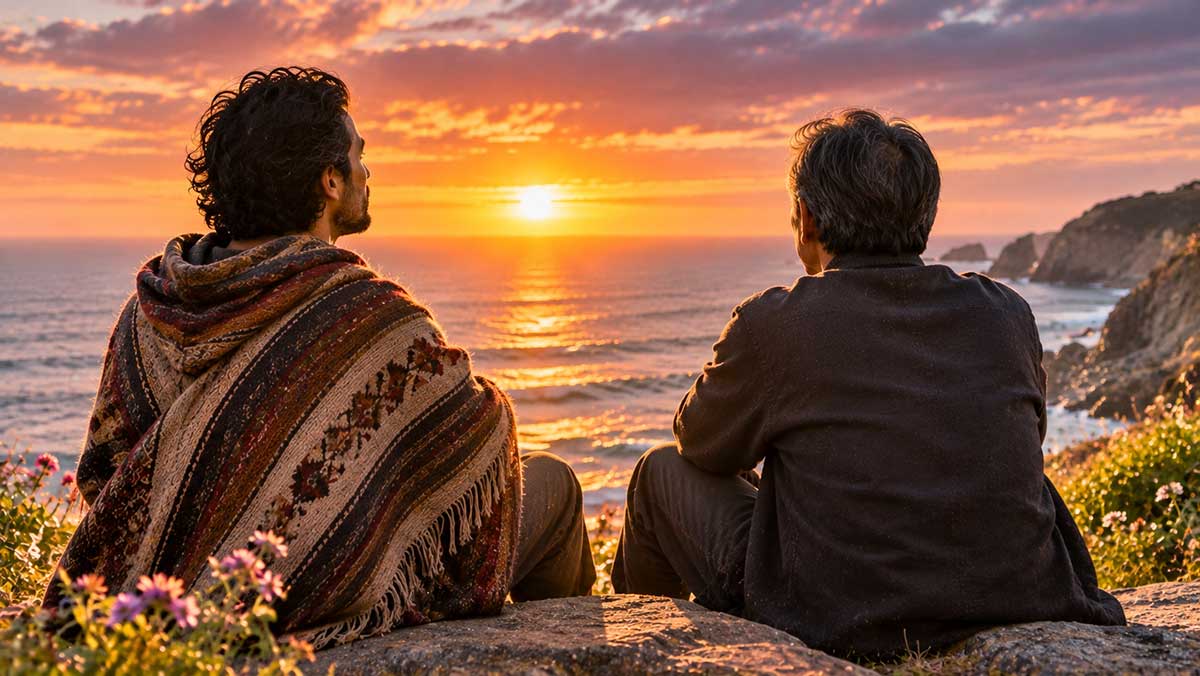
When I first picked up Inward at Target, I thought I had discovered a book about personal healing. After creating this imaginary conversation with Yung Pueblo, I found myself thinking about something much larger: the emotional inheritance we leave to the people around us. We inherit fears, habits, expectations, and ways of responding to conflict. Some help us live well. Others cause suffering long after the circumstances that created them have disappeared. Perhaps one of the greatest gifts we can offer the next generation is the willingness to examine those patterns rather than pass them along without question.
One of the most moving parts of Diego's story is that his healing didn't happen in a single dramatic moment. His life changed through repeated choices, meditation, self-examination, and the gradual recognition of emotional habits he had once tried to escape. I found this encouraging. Many of us expect transformation to arrive as a sudden revelation. We want to wake up one morning free from fear, anger, or insecurity. But perhaps meaningful change is quieter. We notice an old reaction. We choose not to act on it. We apologize. We listen. We try again. Diego's Lighter explores this continuing process of releasing emotional burdens and developing greater compassion.
The conversation about love affected me most personally. I've been married for many years, and as a father of five children, I know how easily work, responsibilities, and daily pressures can consume our attention. I can spend hours thinking about how to create something meaningful for the world, yet overlook an opportunity to give someone in my own family my undivided attention. That realization is uncomfortable, but valuable. I don't want the people I love to remember me primarily as someone who was always busy. I want them to remember that I listened, that I cared, and that they could come to me without fear of losing my love. Diego's How to Love Better offers a useful perspective on the connection between personal growth and healthier relationships.
I was equally interested in the limitations of self-healing. We must be careful not to turn personal responsibility into personal blame. People don't choose every hardship they experience. A child doesn't choose an unsafe home. Someone who has experienced betrayal or abuse shouldn't be told that their suffering exists simply through a failure to think positively. Healing may require friendship, professional support, protection, justice, and time. I believe compassion begins when we recognize that every person carries experiences we may know nothing about. Sometimes the kindest response isn't advice. It's listening. Sometimes it's helping someone find safety. Sometimes it's simply remaining present when they feel alone.
The question that first drew me to Yung Pueblo remains the most challenging: Will humanity truly learn that harming another is harming ourselves? I wish I could answer yes with certainty. But history doesn't permit such an easy conclusion. Human beings have demonstrated extraordinary generosity and devastating cruelty, sometimes within the same generation, community, or individual life. Spiritual wisdom doesn't automatically produce ethical behavior. Technological progress doesn't guarantee emotional maturity. Yet I don't believe uncertainty should make us surrender hope. Perhaps hope is most meaningful when it asks us to act without promising success.
I have become increasingly convinced that personal compassion and social responsibility belong together. Kindness within a family matters enormously, but kindness alone cannot repair every unjust institution. We need fair systems, responsible leadership, education, and opportunities for people to live with dignity. A person who meditates peacefully yet treats employees unfairly has more to examine. A leader who speaks beautifully about love but refuses accountability has more to learn. I want a world where compassion is expressed through everyday relationships and through the decisions that affect people we may never meet. That is one reason I found Diego's broader vision of emotional maturity so interesting.
My greatest realization, however, is surprisingly simple. I don't have to wait for humanity to become enlightened before I begin living more compassionately. I can be more patient with someone who disagrees with me. I can apologize when I've hurt someone. I can offer encouragement to a person who feels discouraged. I can create stories that help readers recognize themselves in people who lived in different cultures and centuries. And I can make more time for those closest to me. These choices may never become famous. They may never appear in a history book. But their value doesn't depend on recognition. If one person feels less alone, more respected, or more hopeful through something I've done, that matters to me.
I still return to those two ideas that caught my attention in Inward. Becoming our own healer, hero, and leader doesn't mean becoming completely self-sufficient or perfect. It means accepting that we can participate in shaping the person we become. And healing the world doesn't mean one individual must carry the suffering of humanity. It means recognizing that our actions are connected to the lives of others. Perhaps the greatest transformation begins when we stop asking only what the world can give us and begin asking what kind of human presence we want to offer. What emotional patterns are you ready to change? Who in your life might benefit from a little more patience or forgiveness? And if humanity's future were shaped by the way each of us treated one another today, what kind of future would we be creating? I'd love to hear your thoughts in the comments.
Fictional reflection disclaimer: These Final Thoughts express Nick Sasaki's personal interpretation of the themes explored in this imagined interview. They are not statements made or endorsed by Yung Pueblo.
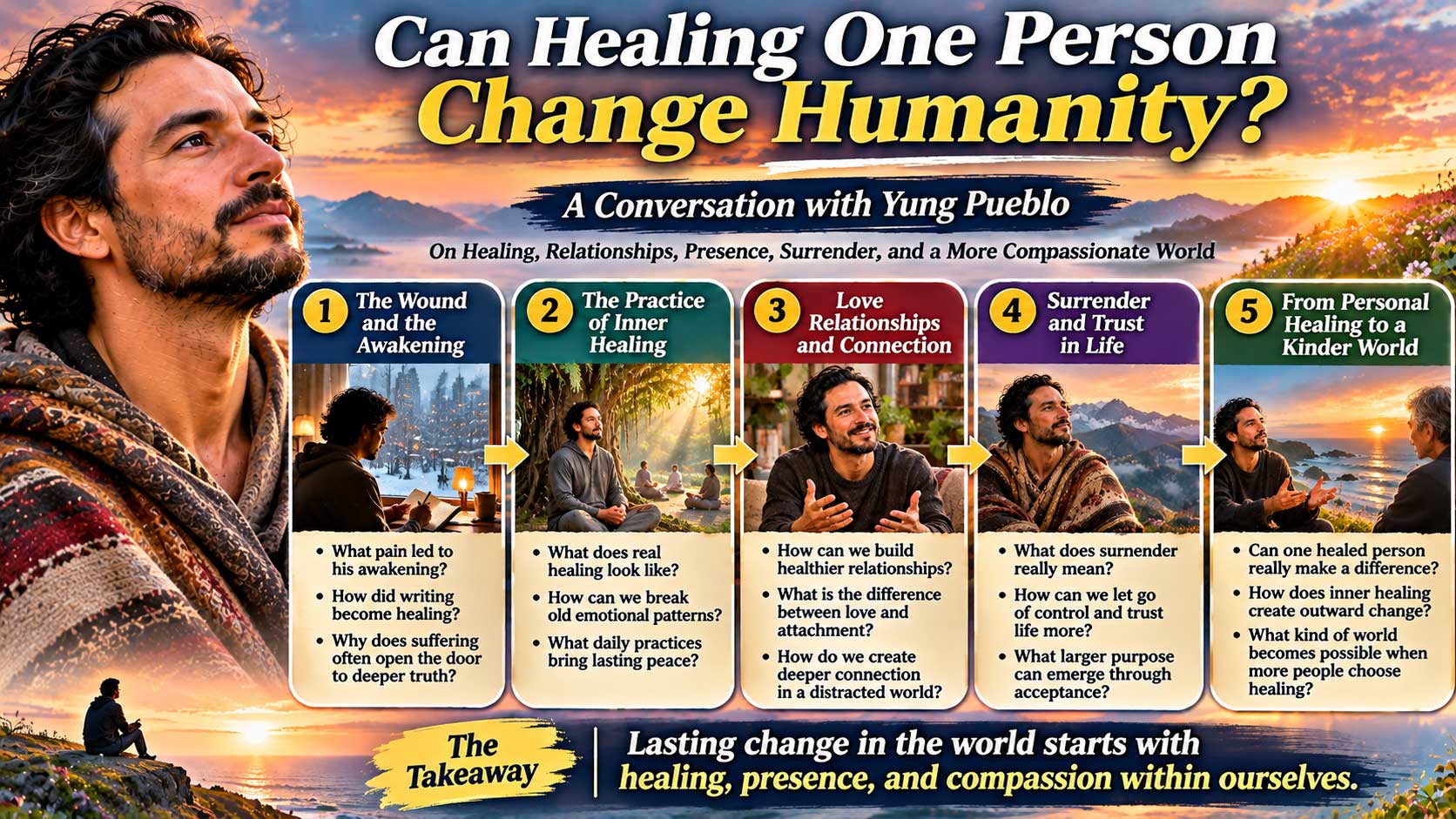
Short Bios:
Yung Pueblo (Diego Perez)
Yung Pueblo is the pen name of Diego Perez, an Ecuadorian-born American writer, poet, and meditation practitioner. Raised in Boston, he began practicing Vipassana meditation in 2012 after a difficult period involving substance use and emotional distress. His books explore self-awareness, emotional healing, forgiveness, and compassionate relationships. His published works include Inward, Clarity & Connection, Lighter, The Way Forward, How to Love Better, and Journey: The Year That Changes Everything. His pen name means "young people" and expresses his vision of humanity's potential for emotional growth. He lives in western Massachusetts with his wife, Sara. Learn more through Yung Pueblo's official website and his Penguin Random House author profile.
Nick Sasaki
Nick Sasaki is the creator and interviewer behind ImaginaryTalks.com, a creative platform exploring history, philosophy, spirituality, literature, and human nature through fictional conversations. Born in Japan and having spent much of his adult life in the United States, Nick brings a cross-cultural perspective to questions about life, faith, relationships, and human purpose. His imaginary interviews bring historical figures, contemporary thinkers, and influential voices into thoughtful conversations that challenge assumptions and encourage empathy. As a father of five, he is especially interested in stories that inspire love, forgiveness, kindness, and hope. His creative mission is to use imagination to help turn positive human possibilities into reality. Explore more at ImaginaryTalks.com and NickSasaki.com.
Note: The interview is a work of creative fiction. Biographical details are based on publicly available information, but all imagined dialogue and scenes are literary interpretations.
Leave a Reply