
Introduction
What if one of the most remarkable gifts of the twentieth century belonged to a quiet farm boy with an eighth-grade education?
Edgar Cayce never wanted to be famous. He sold books, took portraits of brides, and taught Sunday school. But when he lay down, loosened his tie, and closed his eyes, something extraordinary happened. Over forty-three years, he gave more than 14,000 readings for thousands of people, describing illnesses, remedies, past lives, dreams, and the future. Journalists called him the “Sleeping Prophet.” The Psi Encyclopedia describes him as one of the most influential psychics of his century, and his life readings helped bring ideas like karma, reincarnation, and the Akashic Records into modern spiritual life.
I’ve wanted to sit down with him for a long time. Partly because his story begins so close to home for me: the man who first asked him about past lives was a printer from Dayton, Ohio. And partly because Cayce lived through the same question I’ve carried through several churches in my own life. What do you do when your experience doesn’t fit what you were taught?
So I traveled to Virginia Beach, to the building near the ocean where he built his hospital, for one long evening with him. For once, he stays awake for the whole conversation. Like every ImaginaryTalks episode, this is sincere imagination, not channeling, grounded in the record of his life and the history of his work.
We begin with a boy and his Bible in a playhouse in the Kentucky woods, and the visitor who changed his life. We talk about what it felt like to wake up from a reading with no memory of what he’d said, and the little girl who convinced him not to quit. We talk about how a devoted Christian made peace with past lives. We talk about the readings on the future, and what he might say to us in 2026. And finally, we talk about the part of his story people rarely hear: what all that giving cost him, and the woman who stood beside him through every bit of it.
If you’ve ever felt a calling you didn’t understand, wondered whether you’ve lived before, or given so much to others that you forgot to save anything for yourself, this conversation is for you.
(Note: This is an imaginary conversation, a creative exploration of an idea, and not a real speech or event.)
Topic 1: The Boy in the Woods

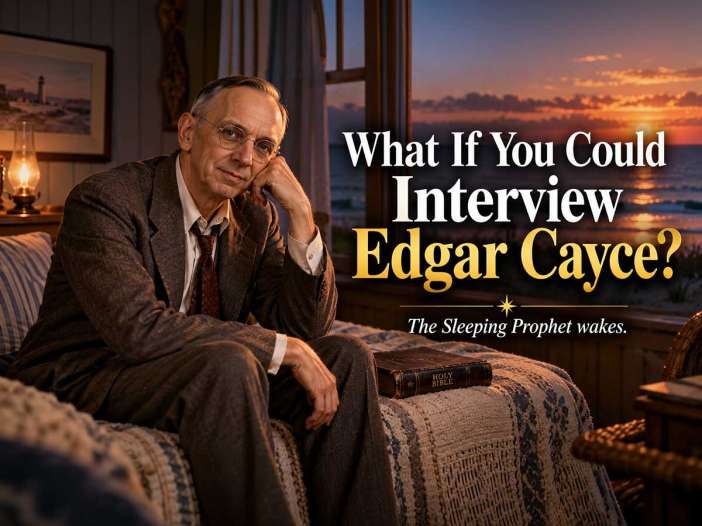
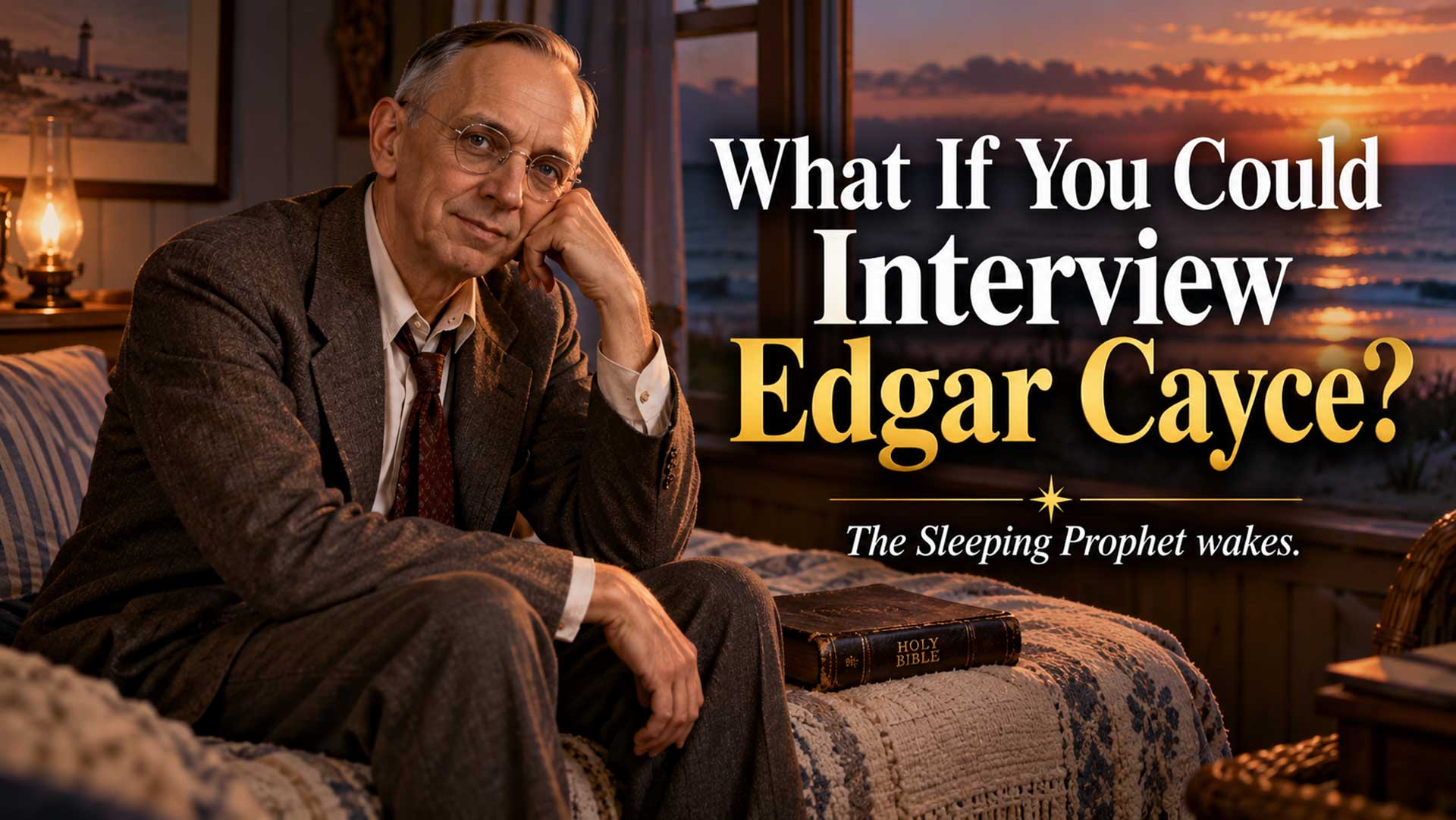
Virginia Beach, early evening. The windows face the ocean, and the light is going soft. Edgar Cayce sits on the edge of a plain daybed, his tie already loosened, his hands resting on his knees.
Nick Sasaki: You've loosened your tie.
Edgar Cayce: Habit. For forty years, whenever somebody sat down across from me, I loosened my tie, took off my shoes, and lay down. I'm not lying down tonight, though. Gertrude would say it's about time I stayed awake for a conversation.
Nick Sasaki: I'm glad you are. I drove a long way for this one. I live in Ohio.
Edgar Cayce: Ohio. (He smiles.) I owe a good deal to Ohio.
Nick Sasaki: Arthur Lammers. From Dayton.
Edgar Cayce: You've done your homework. Mr. Lammers came all the way to Selma to ask me questions I didn't understand. What's the difference between the spirit and the soul? Why is one child born with music in his hands and another with none? I was a photographer. I took portraits of brides. I had no business answering questions like that.
Nick Sasaki: But you did.
Edgar Cayce: Something did. We'll get to him. You didn't drive all the way from Ohio to start in the middle.
Nick Sasaki: No. I want to start with a boy in Kentucky. Take me back to that hut in the woods. What was it like out there?
Edgar Cayce: (He leans back, and his voice slows.) Oh, it wasn't much of a hut. A little playhouse we'd built back in the trees, above a creek. Boards, a roof that leaked when it rained. But it was mine.
I'd take my Bible out there and read until the light went. I'd made a promise, you see. I wanted to read it through once for every year I'd been alive. Most boys my age wanted a pony. I wanted to catch up on Leviticus.
Nick Sasaki: (laughing) That's not a sentence I hear very often.
Edgar Cayce: No, sir. The other boys thought I was peculiar, and they weren't wrong. But I loved those stories. Samuel hearing his name called in the night. Elijah in the cave, and the still small voice. I'd sit out there and think, if God spoke to boys back then, why wouldn't He now? I just wanted to be close enough to hear.
Nick Sasaki: I was about that age when I joined the Catholic church. I remember that feeling. Wanting something to be real so badly.
Edgar Cayce: Then you know. It's a kind of hunger. Grown folks forget it. Children don't.
Nick Sasaki: And then the angel came.
Edgar Cayce is quiet for a moment. He looks toward the window.
Edgar Cayce: It was spring. Late in the afternoon. I'd been reading about Manoah's wife, whom an angel visited, and I'd just finished praying. I'd asked the Lord to let me be useful. To let me help people. Sick children especially. I'd seen so many of them, back then, and nobody could do a thing.
And then the light changed in that little playhouse. I thought the sun had come out of a cloud. I looked up, and there was a woman standing there.
Nick Sasaki: What did she look like?
Edgar Cayce: I've been asked that a thousand times, and I've never answered it well. She seemed to be made of the light itself, and she had what I can only call wings. But it wasn't her looks I remember. It was how kind she was. Like she'd known me a long time and was glad I'd finally asked.
She said my prayers had been heard. And she asked me what I wanted most.
Nick Sasaki: Were you scared?
Edgar Cayce: Terrified. Afterward. In the moment, no. In the moment I felt the way you feel when your mother walks into a dark room. It's only later, walking home, that your knees start to shake.
Nick Sasaki: What did you tell her?
Edgar Cayce: That I wanted to help people. Especially children.
Nick Sasaki: That's a big wish for a boy.
Edgar Cayce: It's a boy's wish. A grown man would have asked for something more sensible. (He chuckles.) I didn't know what I was asking for. You never do, when you ask God for something real.
Nick Sasaki: Did anything change right away?
Edgar Cayce: Not the way you'd think. The next day at school, I couldn't spell a word. Some simple word, I don't even remember it now. The teacher kept me after, and my father was ashamed of me. He sat me down that night with the spelling book and drilled me till I could hardly see.
I was so tired I asked him to let me rest a minute. I put my head down on the book and slept. And when I woke up, I knew every word in it. Every word, and where it sat on the page.
Nick Sasaki: Just by sleeping on it.
Edgar Cayce: My father thought I'd been fooling him all along. He was angrier than ever. It took a long time for anyone, including me, to understand what had happened. I didn't learn things the way other people did. Something in me took them in while I slept.
Nick Sasaki: Did you ever wonder why it was you? A farm boy in Kentucky, with the angels and everything?
Edgar Cayce: (He smiles slowly.) Every day of my life.
You know, I was never a very smart man when I was awake. I left school after the eighth grade. I worked in a bookstore, sold insurance, took photographs. If you'd asked anyone in Hopkinsville who'd be remembered a hundred years later, nobody would have said Edgar.
I've come to think that might have been the point.
Nick Sasaki: How so?
Edgar Cayce: If it had been a learned man, he'd have taken the credit. He'd have said, look at my great mind. I couldn't. Everyone knew I didn't have one. (He laughs softly.) So when the readings said something wise, there was no question where it came from. It wasn't from me.
The Lord likes to choose the ones nobody would pick. Look at the shepherd boys in the Bible. Look at the fishermen.
Nick Sasaki: That's a humble way to see it.
Edgar Cayce: It's an honest way. Humility is mostly just honesty about what you didn't do.
Nick Sasaki: I wonder if a lot of people listening tonight have had a moment like yours. Not an angel, necessarily. But a time when they asked for something with their whole heart and felt, for a second, that someone heard.
Edgar Cayce: Oh, I'd wager most of them have. They just talked themselves out of it by supper.
Nick Sasaki: What would you say to them?
Edgar Cayce: Don't talk yourself out of it so fast. You don't have to tell anyone. You don't have to build a church around it. But don't throw it away. Keep it the way you'd keep a letter from someone you love. Take it out now and then.
And be careful what you ask for. Not because God is cruel. Because He's generous. He'll give you exactly what you asked for, and then you'll spend your whole life growing into it.
He looks down at his hands, then out at the darkening water.
Edgar Cayce: I asked to help people. Especially children. I was twelve years old. I thought it would feel like Christmas.
Nick Sasaki: And did it?
Edgar Cayce: Some days. (A long pause.) Some days it felt like carrying the whole sky on your back. But I'd still ask for it again.
That's what nobody tells you about a prayer that's answered. It doesn't end the story.
It starts one.
Topic 2: The Sleeping Doctor
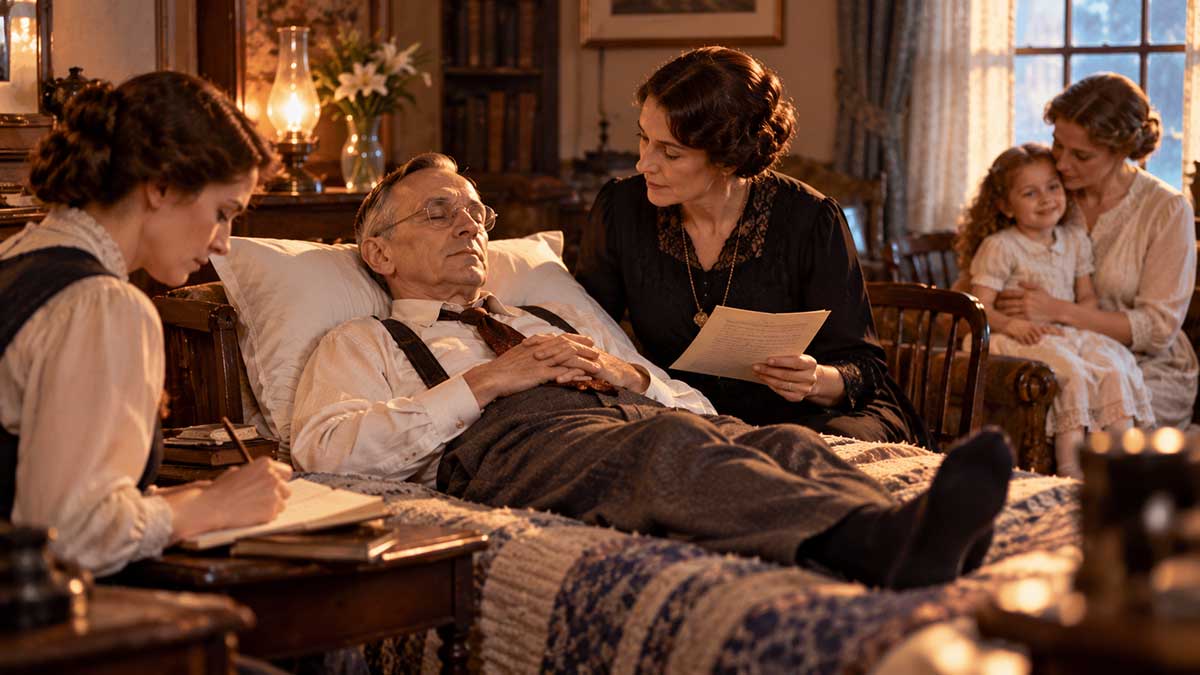
The light outside has turned gold. Edgar Cayce has taken off his shoes and set them neatly beside the daybed. He notices Nick Sasaki watching and laughs.
Edgar Cayce: Don't worry. I'm not going anywhere. My feet just think it's time to work.
Nick Sasaki: Forty years of habit.
Edgar Cayce: Forty years of habit.
Nick Sasaki: I want to read you something. October 1910. The New York Times ran a story about you. The headline said, "Illiterate Man Becomes a Doctor When Hypnotized."
Edgar Cayce: (He winces, then smiles.) Illiterate. I could read, you know. I'd read the Bible more times than most preachers.
Nick Sasaki: So the headline hurt?
Edgar Cayce: It stung my pride a little, and I suppose that was good for me. But it also filled our mailbox. Letters from all over the country. People who'd tried everything. Mothers mostly. That headline brought me more sick children than I'd ever seen.
Nick Sasaki: So it was the answer to your prayer in the woods.
Edgar Cayce: (He's quiet a moment.) I hadn't thought of it that way. The Lord has a sense of humor. He answered a farm boy's prayer with a newspaper calling him illiterate.
Nick Sasaki: How did it start? The readings.
Edgar Cayce: With losing my voice. I was a young man, selling books, and one day I couldn't speak above a whisper. Not for a week. For the better part of a year. Doctors looked at it. Nothing helped. I thought my life was over. A salesman who can't talk.
Then a fellow in Hopkinsville named Al Layne, who'd studied a little hypnotism and osteopathy, asked if he could try something. He put me under, and while I was asleep, he asked me what was wrong with my throat.
Nick Sasaki: And you answered.
Edgar Cayce: In a clear voice, they tell me. I said the muscles in my throat had gone weak from poor circulation, and that if he told my body to increase the blood to that area, it would mend. So he did. And my chest and throat turned red as a beet, and when I woke up, I could talk.
Nick Sasaki: You don't remember any of it?
Edgar Cayce: Not a word. That's the strange part. People always ask what it feels like. I tell them it feels like nothing at all. I lay down, I said my prayer, I loosened my tie, and the next thing I knew, Gertrude or Gladys was handing me a page of words I'd supposedly spoken.
Nick Sasaki: That must have been unsettling, reading your own words like they belonged to a stranger.
Edgar Cayce: It was frightening at first. Who was talking? Was it me? Was it something else? I'd lie awake afterward wondering if I'd said something that would hurt somebody. I didn't know a thing about medicine. I could have killed a man with a wrong word and never known I'd said it.
Nick Sasaki: What gave you the courage to keep going?
Edgar Cayce: A little girl.
He looks down at his folded hands.
Edgar Cayce: Her name was Aime Dietrich. Five years old. Since she was two, she'd been having convulsions. Twenty a day, some days. Her mind had stopped growing. The specialists had given up. Her parents had nowhere else to go, so they came to me.
I went under, and the reading said that before she got sick, she'd hurt her spine. That she'd slipped getting out of a carriage and struck her back, and that the illness that came after had settled right there, where she'd been hurt.
Her mother turned white. She remembered the fall. Nobody had ever connected it.
Nick Sasaki: What happened to her?
Edgar Cayce: Mr. Layne gave her the adjustments the reading described, and we kept checking in with more readings as she went along. And little by little, the convulsions stopped. Her mind started coming back. She started acting like a little girl again.
His voice catches, just slightly.
Edgar Cayce: I'd asked to help children. That was the first time I knew, really knew, that the prayer had been answered.
Nick Sasaki: That's a beautiful story. And it explains why you couldn't walk away.
Edgar Cayce: How could I? I tried, you know. More than once. I'd go back to my photography and tell myself I'd live a normal life. Then another letter would come.
Nick Sasaki: Did you charge people, back then?
Edgar Cayce: Not for a long time. It didn't seem right. It wasn't mine to sell. Later, when the work grew and there were secretaries and a hospital to pay for, we had to ask for something. But I never turned anyone away for being poor. Gertrude would scold me about the bills. I'd say, the Lord will provide. And she'd say, the Lord would appreciate a little help from you.
They both laugh.
Nick Sasaki: People today are really hungry for what you were doing. Healing that treats the whole person. Body, mind, spirit. A lot of them feel like medicine sees them as a chart, not a human being.
Edgar Cayce: I understand that. I've seen it. But I'll tell you something that may surprise you.
Nick Sasaki: Please.
Edgar Cayce: The readings never told anyone to throw their doctor away. Never. They told people to work with doctors. Osteopaths, physicians, surgeons when surgery was needed. Some of my dearest friends were doctors. The readings would say, here's what's happening in the body, now go to someone who can help you treat it.
I was never meant to replace anybody. I was meant to help people see the whole picture.
Nick Sasaki: What did the whole picture look like?
Edgar Cayce: (He thinks.) Simple things, mostly. People expected miracles, and the readings would tell them to eat more vegetables and take a walk.
Nick Sasaki: (laughing) That's not what they wanted to hear.
Edgar Cayce: No, sir. They wanted a magic potion. The readings gave them castor oil packs and almonds and a good massage. And patience. Most of all, patience. The body wants to heal. It's built to heal. Most of the time it just needs us to stop getting in its way.
And there was one thing the readings said again and again, almost every time.
Nick Sasaki: What was that?
Edgar Cayce: The spirit is the life. The mind is the builder. The physical is the result.
Nick Sasaki: The mind is the builder.
Edgar Cayce: Whatever you dwell on, you build. Resentment builds something. Fear builds something. Gratitude builds something too. People would come to me with stomachs tied in knots, and the reading would ask them who they hadn't forgiven.
Nick Sasaki: That's a hard question to hear from a doctor.
Edgar Cayce: That's why it came from a sleeping one. (He smiles.) Nobody could argue with me. I wasn't there.
Nick Sasaki: If someone listening right now is sick and scared, and feels like nobody sees the whole of them, what would you tell them?
Edgar Cayce: First, don't give up on your doctors. Find one who'll listen. They're out there. But don't give up on yourself either. Your body isn't your enemy. It's been trying to take care of you your whole life.
Be gentle with it. Feed it well. Rest it. Pray if you pray. And look honestly at what you're carrying in your mind, because the body carries it too.
He picks up one of his shoes and turns it over in his hands, absently.
Edgar Cayce: You know, people called me a healer. I never once thought of myself that way. I was just the fellow lying down. The healing came from somewhere else.
And from the people willing to do the work afterward. Aime's mother, rubbing her back every night. That was the miracle.
All I did was fall asleep.
Topic 3: A Christian Who Saw Past Lives

Dusk now. Someone has lit a lamp in the corner. Edgar Cayce has his Bible on his knee, an old one, its cover soft and worn at the edges.
Nick Sasaki: You brought your Bible.
Edgar Cayce: I always do. I don't feel properly dressed without it.
Nick Sasaki: I'd like to come back to Ohio. To Arthur Lammers.
Edgar Cayce: I thought you might. (He rests his hand on the cover.) You know, he wasn't a preacher or a professor. He was a printer. A businessman. But he'd read everything. Theosophy, astrology, Eastern religion, philosophy. He came to Selma with a head full of questions and asked me to come to Dayton.
Nick Sasaki: And you went.
Edgar Cayce: I had misgivings. Gertrude had more than misgivings. But he was paying, the studio was struggling, and I told myself, it's only questions. What harm can a question do?
Nick Sasaki: Famous last words.
Edgar Cayce: (He laughs.) Famous last words. He asked for a reading on his horoscope. Simple enough. I went under, and the reading talked about the planets and his character, and then, right at the end, it said one more thing.
Nick Sasaki: What was it?
Edgar Cayce: "He was once a monk."
He lets the words sit.
Edgar Cayce: That's all. Five words. When I woke up and they read them back to me, I felt the floor tilt.
Nick Sasaki: What went through your mind?
Edgar Cayce: That I'd been deceived. That everything I'd done for twenty years had come from the devil. I'd taught Sunday school. I'd recruited missionaries. I'd read this book cover to cover once for every year of my life. And now something was coming out of my own mouth saying a man had lived before.
I went home and couldn't eat. I couldn't sleep. Gertrude said, Edgar, you have to stop this. And I thought she was right.
Nick Sasaki: But you didn't stop.
Edgar Cayce: Mr. Lammers wouldn't let me. (He smiles.) He was a patient man. He said, don't decide tonight. Ask more questions. Let's see whether what comes through makes people better or worse. Judge the tree by its fruit.
Nick Sasaki: That's scripture.
Edgar Cayce: That's scripture. He knew exactly where to hit me.
So we kept going. And I'll tell you what I did, because I suppose it's what any Sunday school teacher would do. I went back to the Bible. I read it again, looking for this thing, half hoping I wouldn't find it.
Nick Sasaki: Did you?
Edgar Cayce: I found more than I expected. (He opens the Bible, not quite reading, just touching the pages.) The disciples asking Jesus whether the man born blind had sinned before he was born. How could he sin before he was born? Jesus telling them John the Baptist was Elijah, who was to come. Nicodemus, told he must be born again.
Now, I'm not a theologian. I won't tell you those verses prove anything. Learned men argue about them still. But I'd read them a hundred times and never really seen them. Suddenly they were looking back at me.
Nick Sasaki: That feeling of reading something familiar and seeing it for the first time.
Edgar Cayce: Exactly so.
Nick Sasaki: I know that feeling. When I was a teenager, I joined the Mormon church. They taught that we lived before this life, as spirits, with God, before we were ever born. I remember how strange that sounded at first, and then how natural.
Edgar Cayce: (He leans forward, interested.) Did they? Before we were born.
Nick Sasaki: That we chose to come here. To learn.
Edgar Cayce: Well, now. (He shakes his head slowly, smiling.) You see, that's just what the readings would say. That the soul isn't a new thing that starts at birth and ends in the ground. It's older than that. It comes here to grow. And it keeps coming until it's learned what it came to learn.
Nick Sasaki: And karma?
Edgar Cayce: People hear that word and think of punishment. The readings didn't speak of it that way. It's more like a schoolroom. If you didn't learn your lesson, you sit for the test again. Not because the teacher's cruel. Because the teacher wants you to pass.
What you sow, you reap. That's not Eastern. That's Galatians.
Nick Sasaki: So how did you make peace with it? Between what you'd been taught and what came through you?
Edgar Cayce: (He's quiet for a long time.) Slowly. Over years. And not all at once.
I watched the life readings help people. A woman who couldn't stand to be near water, terrified of it all her life, and the reading would describe a drowning long ago. And somehow, just knowing it, she'd find peace. A father and son who couldn't stop fighting, and the reading would say they'd been rivals before. And they'd look at each other differently. They'd soften.
The fruit was good. That's the only test I knew how to apply.
Nick Sasaki: Did you ever stop being a Christian?
Edgar Cayce: Never. Not for one day.
I came to believe Christ was the pattern. The soul that had walked the whole road and shown the rest of us the way home. Reincarnation didn't take Him away from me. It made Him bigger. It meant God was more patient than I'd been taught. That He'd give us as many chances as it took.
I taught Sunday school until the end, you know. Presbyterian, here in Virginia Beach. I just came to believe God's classroom was larger than one lifetime.
Nick Sasaki: I've come to believe something like that too. I've been Catholic, Mormon, part of the Unification Church. People sometimes think that means I couldn't make up my mind.
Edgar Cayce: And what do you think it means?
Nick Sasaki: That each one taught me something true. I've come to believe all religions come from one God.
Edgar Cayce: (He closes the Bible gently and rests both hands on it.) There's a reading that says something close to that. That there's one God, one law, and that every soul is on its way back to Him by whatever road it's able to walk.
You and I took different roads, Mr. Sasaki. But I don't think we're walking toward different places.
Nick Sasaki: What would you say to someone listening who's afraid of that? Whose own experience doesn't fit what they were raised to believe, and who feels like they're betraying something?
Edgar Cayce: I'd tell them I know that fear better than they might think. I lived inside it for years.
And I'd tell them this. Don't throw away what you were given. It held you when you were small. It taught you how to pray. Honor it.
But don't be afraid of a bigger room, either. If something comes to you that makes you kinder, more patient, more loving toward people, it isn't leading you away from God.
The devil doesn't make people more loving. That's how you'll know.
He sets the Bible beside him on the daybed. The lamp flickers. Outside, the first stars are showing over the water.
Edgar Cayce: Mr. Lammers asked me once what the soul was for. I didn't have an answer. I was only a photographer.
Nick Sasaki: Do you have one now?
Edgar Cayce: (He smiles.) I think it's for coming home. However long it takes.
Topic 4: Seeing the Future
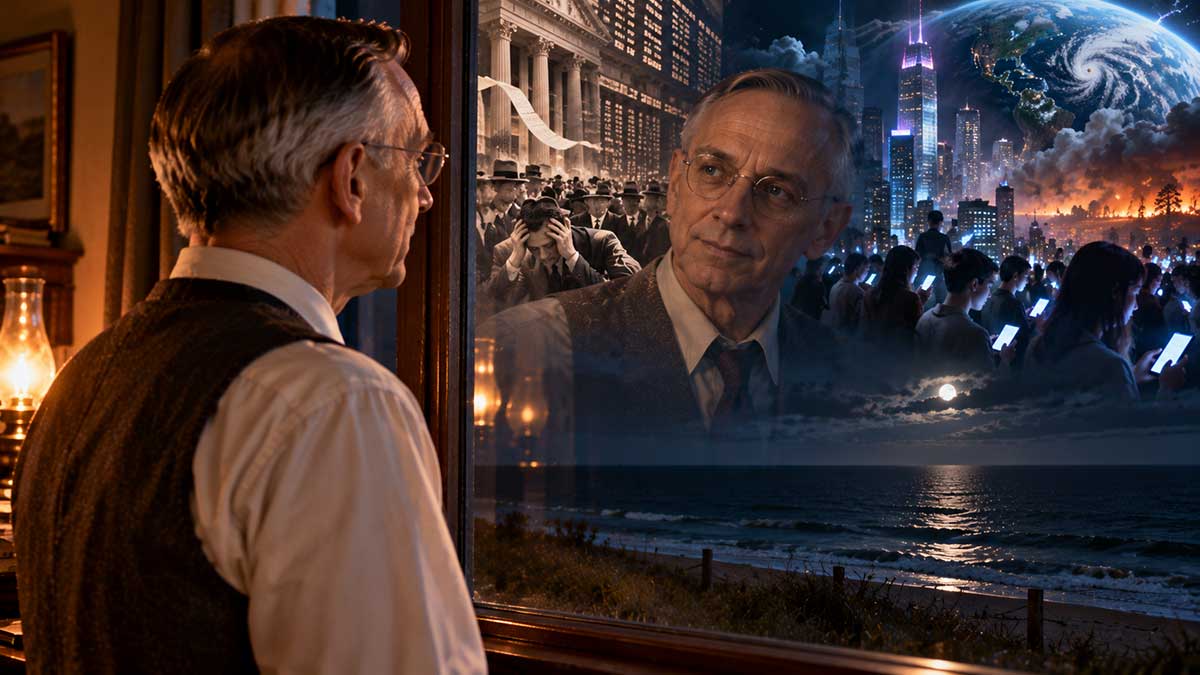
Full dark now. The ocean is only a sound. Edgar Cayce has moved to a chair by the window, and his reflection sits faintly in the glass beside the night.
Nick Sasaki: I want to ask you about the future.
Edgar Cayce: (He laughs.) Everybody does, eventually. People would come for their back trouble and leave asking about the stock market.
Nick Sasaki: Funny you'd say that. People still talk about 1929.
Edgar Cayce: Ah. Yes.
Nick Sasaki: Months before the crash, there were readings that warned of a great disturbance in financial circles. Some of the men around you were stockbrokers.
Edgar Cayce: Mr. Blumenthal, mostly. He'd helped build the hospital. He'd ask the readings about the market, and for a while they gave him good advice, and he did very well. Then the readings began to warn him. Get out. Something's coming.
Nick Sasaki: What was that like, knowing before everyone else?
Edgar Cayce: (He's quiet for a moment.) You'd think it would feel powerful. It didn't. It felt lonely.
I'd walk down Atlantic Avenue and see men laughing outside the bank, shopkeepers putting their savings into stocks because everyone said it couldn't go down. And I knew what the readings had said. I couldn't stand on a street corner and shout it. Who'd listen to a sleeping photographer from Kentucky?
Nick Sasaki: Did it come true for you, too? The crash?
Edgar Cayce: Oh, it came for all of us. The hospital closed not long after. Mr. Blumenthal had overextended himself, and when the money went, so did the building I'd dreamed about my whole life.
Nick Sasaki: So you saw it coming and it still took your hospital.
Edgar Cayce: (He nods slowly.) That taught me something. Seeing the storm doesn't mean you won't get wet. It only means you might find something to hold on to.
Nick Sasaki: There were other readings about the future that people still debate. Some seemed to happen exactly the way you said. And some didn't happen the way people expected. Atlantis rising in the late sixties, for instance. How do you think about that?
Edgar Cayce: (He smiles, without any defensiveness.) I've had a long time to think about it.
Now, some folks will tell you that in 1968 divers found a line of great stones under the water off Bimini, just where the readings pointed, and they'll say that was Atlantis showing itself. Others will tell you they're only rocks. I'll let them argue. I was asleep for all of it.
But here's what I believe. The readings never said the future was a railroad track. They said again and again that nothing was fixed. That people have free will. That what they saw was a direction. A tendency. The way a doctor might say, if you keep eating like this, here's where you'll be in ten years. He's not cursing you. He's warning you. And if you change, he's glad to be wrong.
Nick Sasaki: So a reading about the future was more like a warning than a timetable.
Edgar Cayce: That's just it. People wanted dates. They'd circle them on calendars. And I suppose I understand why. When you're frightened, a date feels like something solid to hold.
But I've come to think the readings cared far less about dates than about hearts. They'd describe a time of great change, and then they'd always turn it back on the person asking. What will you do? How will you treat your neighbor? Will you be afraid, or will you be useful?
Nick Sasaki: Can I tell you something a little strange?
Edgar Cayce: After forty years in my line of work, I'd be disappointed if you didn't.
Nick Sasaki: In 2026, we have machines that answer questions. Any question. You type it in, and in a few seconds, they answer. About health, history, the future. People ask them everything.
Edgar Cayce: (He turns from the window, genuinely astonished.) A machine that answers questions?
Nick Sasaki: We call it artificial intelligence.
Edgar Cayce: Well, now. (He laughs, delighted.) So you've built yourselves a sleeping prophet out of wires.
Nick Sasaki: (laughing) I never thought of it that way.
Edgar Cayce: Does it ever get tired?
Nick Sasaki: No.
Edgar Cayce: Then it's already got one thing on me. (He grows thoughtful.) And does it love the people who ask it questions?
Nick Sasaki: That's what people argue about.
Edgar Cayce: That would be my question. Because I'll tell you what made the readings worth anything. It wasn't the information. Information is cheap. It was that every reading began with a prayer that the work be done in love. For the good of the one asking.
Knowing a thing is never the hard part. Doing something loving with it is.
Nick Sasaki: I'll be honest with you. I use these machines to help me imagine conversations like this one.
Edgar Cayce: (He raises his eyebrows, then smiles warmly.) So a machine is helping you talk to the dead.
Nick Sasaki: To imagine. Not to talk. I'm careful about that.
Edgar Cayce: Good. Keep that line clear. People will want you to blur it. Don't.
And use it the way the readings were meant to be used. To help somebody. If what you make tonight helps one person feel less afraid, then the Lord can use wires as well as He used a sleeping photographer.
Nick Sasaki: If you gave a reading for the world in 2026, what do you think it would say?
Edgar Cayce: (He looks out at the dark water for a long time before answering.) I think it would say you're living in one of those times of great change. Faster than anything I saw. The ground under your feet is moving. Old ways of living are breaking apart. Many people are afraid, and many of them are angry, and some are using that fear to divide you from each other.
I think it would speak about the earth. That you've asked a great deal of her, and she's starting to answer.
And I think it would speak about these machines of yours. That they'll become a mirror. Whatever is in the hearts of the people who build them and use them, the machines will show back, only larger.
Nick Sasaki: That sounds frightening.
Edgar Cayce: Does it? I don't think the readings would mean it to be.
Because I'm sure of one more thing it would say, since it's what every reading came back to in the end. That the future isn't something that happens to you. It's something you're building. Every day. With every thought. The mind is the builder, remember. Not only in one body. In a whole world.
Nick Sasaki: So what should someone listening actually do?
Edgar Cayce: Something small. Tomorrow morning.
Be kind to the person in front of you. The cashier. Your brother you haven't called. The neighbor whose politics you can't stand. That's not a small thing. That's the whole thing.
People came to me for forty years wanting to know what the future held. And if I could give one reading to all of them now, I think it would only say this.
He turns back to the glass, where his faint reflection sits beside the dark.
Edgar Cayce: The future is in your hands. It always was. That's not a prophecy.
It's a responsibility.
Topic 5: The Cost of Helping
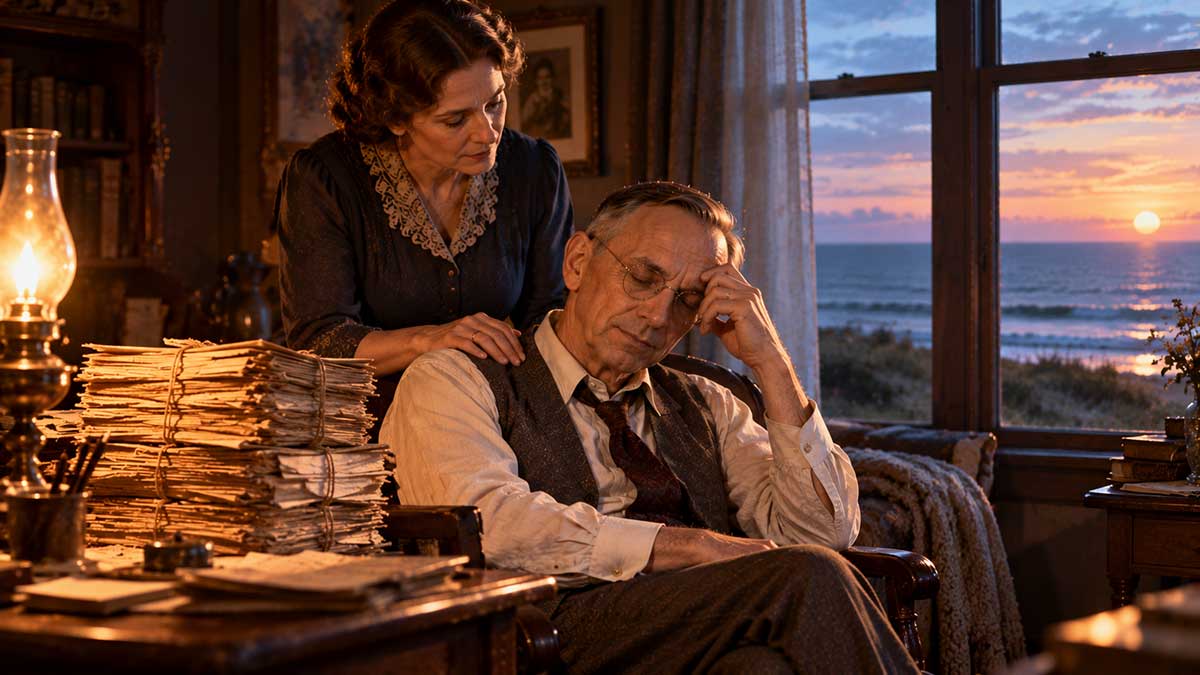
Late night. The lamp has burned low. On a table beside Edgar Cayce sits a stack of old letters tied with string, the envelopes yellowed and soft from handling.
Nick Sasaki: Are those what I think they are?
Edgar Cayce: Some of them. Gladys kept everything. She was my secretary for twenty-two years, and she never threw away a single piece of paper. These are from 1943.
Nick Sasaki: After the book came out.
Edgar Cayce: After Mr. Sugrue's book, yes. And then a magazine called me the Miracle Man of Virginia Beach, and that was the end of any quiet I'd ever known.
He unties the string and takes out one envelope, holding it without opening it.
Edgar Cayce: They came by the sackful. The mailman used to apologize. Thousands of them. And so many were from mothers with sons in the war. Is my boy alive? Is he hurt? Will he come home?
Nick Sasaki: What was it like trying to answer them all?
Edgar Cayce: (He's quiet for a while.) How could I not? My own boys were in uniform. I knew exactly what those mothers felt when the telegram boy came up the street. I'd read one of these and think of Gertrude at the window.
The readings themselves had told me, years before, to give no more than two a day. That the work drew from my body, and my body had limits. By then I was giving eight. Sometimes more.
Nick Sasaki: Eight. You knew it was hurting you.
Edgar Cayce: I knew. And every night, Gladys would bring me the stack of letters still waiting, and it would be taller than the one we'd answered. How do you go to sleep with that on the table? How do you tell a mother, I'm sorry, I'm tired, your son will have to wait?
Nick Sasaki: A lot of people listening know that feeling. Nurses. Caregivers. Parents looking after a sick child or an aging mother. People who can't stop giving because the need never stops.
Edgar Cayce: Then tell them from me, I was wrong.
He sets the letter back on the pile.
Edgar Cayce: I thought saying no was selfish. I thought if I rested, someone would suffer for it. But I didn't save anyone by working myself into the ground. In the summer of 1944, I had a stroke. They took me to the mountains to rest, and by then it was too late. I came home in November. And in January, I was gone. Every letter still waiting on that table stayed waiting.
If I'd given two a day, I might have given them for ten more years.
Nick Sasaki: That's hard to hear.
Edgar Cayce: It was harder to learn.
Nick Sasaki: I want to ask about Gertrude. She was with you through all of it.
Edgar Cayce: (His face changes. Something softens in it.) Gertrude.
She was fifteen when I met her. I was a clumsy boy who worked in a bookstore. She was the prettiest girl in Hopkinsville, and smart as a whip, and I never understood what she saw in me.
She didn't like the readings at first. Did you know that? For years she wanted me to stop. She wanted a normal husband. A man who came home at night and talked about ordinary things.
Nick Sasaki: What changed her mind?
Edgar Cayce: (He looks down.) 1911.
That was the year she fell sick with tuberculosis. The doctors gave up on her. They told me to make arrangements. So I did the only thing I knew how to do. I lay down and asked.
And the reading told us what to do, and we did it, every bit of it, for weeks. And she lived. She lived thirty-four more years.
Nick Sasaki: That was the same year as Milton.
A long silence. Edgar Cayce doesn't look up.
Edgar Cayce: Yes. Our second boy. Milton Porter. He lived less than two months.
Nick Sasaki: I'm sorry. I don't ask to test you. I just want to understand. How do you carry that? Being able to help your wife, and not your son?
Edgar Cayce: (Very quietly.) People have asked me that, in one way or another, my whole life. If the readings could save Gertrude, why not Milton? If they could help strangers' children, why not my own?
I don't have a good answer. I never did. I only know I asked, and I was given what I was given, and the rest belonged to God.
I'll tell you what I learned from it, though. That the gift was never mine to command. I thought, for a while, that I could make it do what I wanted. Milton taught me otherwise. After that I only ever asked. I never demanded.
The lamp flickers. A woman's voice speaks softly from across the room.
Gertrude Cayce: He still can't talk about Milton without looking at his shoes.
Gertrude Cayce stands near the doorway, small and straight-backed, her hair pinned up neatly. Edgar Cayce looks up, and for a moment he can't speak.
Edgar Cayce: Gertrude.
Gertrude Cayce: Don't get up. You never did know when to rest. (She turns to Nick Sasaki.) You're the one from Ohio.
Nick Sasaki: Yes, ma'am.
Gertrude Cayce: He's been telling you I didn't like the readings.
Nick Sasaki: He has.
Gertrude Cayce: It's true. I was frightened of them. I'd watch him lie down and go somewhere I couldn't follow, and speak in that voice that wasn't quite his. I thought it would take him from me.
And then, after I was well, I started sitting beside him and asking the questions. I conducted the readings for years. I'd hold the paper and read out the name of some poor soul in Ohio or Texas, and I'd watch his face while he answered.
Nick Sasaki: What did you see?
Gertrude Cayce: A man giving himself away. A piece at a time. To people he'd never meet.
I'd say, Edgar, you're tired. And he'd say, just one more, Gertrude. There's a child. There was always a child.
She crosses the room and rests a hand on her husband's shoulder.
Gertrude Cayce: It wasn't the readings that took him from me, in the end. It was the letters.
I followed him three months later. I suppose I didn't see much point in staying.
Edgar Cayce reaches up and covers her hand with his.
Edgar Cayce: You never told me you were sick.
Gertrude Cayce: You never asked for a reading for yourself. Not once, those last years. You'd do eight for strangers and none for your own wife and your own heart.
She smiles at him, and then she is gone. Her hand is gone from his shoulder. He keeps his own hand there a while longer.
Nick Sasaki: (gently) I don't want to rush this.
Edgar Cayce: (He clears his throat.) No. Go on. You came a long way.
Nick Sasaki: You spoke about the other side for forty years. Now that you've been there, what's it really like?
Edgar Cayce: (He lets out a long breath, almost a laugh.) You'd think I'd have a grand answer, after all those readings.
It's like waking up. That's the closest I can come. All my life, I'd lie down and go somewhere, and then wake up and not remember. This time I woke up and remembered everything.
Every person I'd ever read for. Every letter. I knew them. Not the way you know a name. The way you know family.
Nick Sasaki: Was there judgment?
Edgar Cayce: Not the way I was afraid of. Nobody asked how many readings I'd given. Nobody counted the letters.
The only question was whether I'd loved. And I had. Clumsily, and too much, and without enough sense. But I had.
And I was told, gently, that I could have loved myself a little too. That the body I'd been given was also one of God's children, and I'd worn it out like a coat I didn't care about.
Nick Sasaki: So what would you say to someone listening who's giving and giving, the way you did?
Edgar Cayce: That a gift isn't meant to be spent all at once.
He ties the string around the stack of letters again, carefully, the way you'd tie up something you mean to keep.
Edgar Cayce: I thought loving people meant never saying no. But a lamp that burns all its oil in one night doesn't light the house any longer. It just goes out sooner.
Rest is not selfish. Rest is how you keep showing up.
Nick Sasaki: That might be the reading a lot of people need tonight.
Edgar Cayce: (He smiles.) Then maybe I'm still working after all. Gertrude won't be pleased.
He looks out toward the dark ocean, where the first gray of morning is beginning to show at the edge of the water.
Edgar Cayce: You asked me at the beginning why it was me. A farm boy in Kentucky.
I think every soul gets a gift, Mr. Sasaki. Most just aren't as strange as mine. A good laugh. A steady hand. A way of listening that makes people feel less alone.
The question isn't whether you have one.
It's what you're here to give. And how you'll give it without losing yourself along the way.
The lamp goes out. The window holds the faint light of dawn. The daybed is empty, a pair of shoes set neatly beside it.
Final Thoughts

I went to Virginia Beach expecting to meet a prophet. I met a humble man who still couldn’t quite believe the gift had been given to him.
What stays with me most isn’t the readings themselves. It’s how Edgar Cayce held them. He never took credit. He said again and again that the healing came from somewhere else, and from the people willing to do the patient work afterward. A mother rubbing her daughter’s back every night. Simple food. Rest. Forgiveness. The mind is the builder, he kept saying, and whatever we dwell on, we build.
I was moved by how gently he made room for a bigger faith without letting go of the one that raised him. He never stopped being a Christian. He just came to believe God was more patient than he’d been taught. That if something makes us kinder, it isn’t leading us away from God. I’ve walked a road with several churches on it, and I found real comfort in that.
And I keep thinking about the stack of letters. A man who could not say no, giving eight readings a day when his own readings had told him two. He loved people so completely that he forgot he was one of them. His body gave out, and every letter still waiting on the table stayed waiting.
So many of us live some version of that. Caring for a parent, a child, a patient, a whole family, until there’s nothing left. We call it love, and it is. But Cayce’s last lesson was that rest is not selfish. It’s how we keep showing up.
He believed every soul arrives with a gift. Most aren’t as strange as his. A good laugh. A steady hand. A way of listening that makes someone feel less alone.
So here’s the question I’ll carry with me, and I hope you will too.
What are you here to give, and how will you give it without losing yourself?
Short Bios:
Nick Sasaki is the creator and host of ImaginaryTalks.com. After 25 years of building businesses, he turned to building bridges between eras, ideas, and the questions people carry, drawn especially to spirituality, the soul’s journey, and what lies beyond ordinary explanation. He hosts as a seeker rather than an expert, asking the questions readers wish they could ask someone long gone. About Nick and ImaginaryTalks
Edgar Cayce (1877–1945), known as the “Sleeping Prophet,” was born on a Kentucky farm and became one of the most documented psychics in history, giving more than 14,000 trance readings on health, past lives, dreams, and the future. In 1931 he founded the Association for Research and Enlightenment in Virginia Beach, which still preserves his readings today. A lifelong Sunday school teacher, he spent his life trying to reconcile his gift with his Christian faith. Edgar Cayce’s A.R.E.
Gertrude Evans Cayce (1880–1945) married Edgar Cayce in 1903 and stood beside him through four decades of his work. At first she distrusted the readings, until she recovered from severe tuberculosis with the help of treatments they recommended. She went on to conduct many of his readings herself, and she died less than three months after he did. Edgar Cayce in the Dictionary of Virginia Biography
Leave a Reply