
Introduction
What if the greatest danger of artificial intelligence isn't that machines become smarter than humans, but that humans gradually stop trusting their own minds?
Japanese spiritual counselor Tazuko Katayama recently made a startling prediction: within five years, 63% of humanity would lose touch with its own heart.
She warned that people were becoming so dependent on AI, social media, and outside advice that they might eventually forget how to think and make decisions for themselves.
Her prediction is a personal spiritual claim, not a scientifically established forecast. Yet the question behind it deserves serious attention.
As AI becomes increasingly capable of answering our questions, writing our messages, advising us on relationships, and helping us make decisions, are we becoming more intelligent or more dependent?
To explore this question, ImaginaryTalks brings together four influential thinkers: Sherry Turkle, Ethan Mollick, Jonathan Haidt, and Richard Ryan.
Through three thought-provoking discussions, they examine whether AI weakens independent thinking, how technology influences our emotions and desires, and whether artificial intelligence might actually help us become more compassionate, creative, and fully human.
This is an imagined discussion inspired by the participants' published research and ideas. Their dialogue is fictional.
(Note: This is an imaginary conversation, a creative exploration of an idea, and not a real speech or event.)
Topic 1: Is AI Making Us Smarter or Stealing Our Ability to Think?

An Imaginary Conversation with Sherry Turkle, Ethan Mollick, Jonathan Haidt, and Richard Ryan
The following is a fictional conversation inspired by the participants' published research and ideas. The dialogue is imagined, not a record of their actual statements.
The room was quiet except for the faint sound of rain against the windows. Four guests sat around a wooden table. In the center lay a smartphone, a notebook, and a handbag.
The moderator picked up the phone.
Moderator: "A spiritual counselor in Japan recently made an extraordinary prediction. She said that within five years, 63% of humanity would lose touch with its own heart. Her explanation was that AI would become so convenient, so reassuring, and so available that people would gradually stop thinking for themselves."
He placed the phone back on the table.
"Now, I don't think anyone here would accept that number as a scientific prediction. But I wonder whether the concern behind it deserves attention."
Ethan Mollick: "It does. But the way you've framed it already assumes something. You're treating the act of asking AI as evidence that someone has stopped thinking."
Sherry Turkle: "Not necessarily. I think the concern is what happens when we become accustomed to turning outward before we turn inward."
Mollick: "But that's what human beings have always done. We ask teachers. We consult books. We call friends. We search the internet. Nobody says reading a book means you've surrendered your mind."
Jonathan Haidt: "A book doesn't answer you in three seconds, Ethan. It doesn't adapt its response to your personality. It doesn't reassure you that your interpretation is brilliant."
Mollick: "And a good teacher does?"
Haidt: "A good teacher knows when to let you struggle."
Richard Ryan: "I think we're already making a mistake by treating struggle and assistance as opposites. Sometimes assistance strengthens competence. Sometimes it undermines it. What matters is whether the person remains actively engaged."
Moderator: "Let's make this concrete. Suppose a sixteen-year-old has to write an essay about the causes of World War I. He asks ChatGPT to write it. Thirty seconds later, he has a polished essay. Has he learned anything?"
Mollick: "Perhaps very little."
Haidt: "Then we agree."
Mollick: "Not so fast. Now suppose another student asks AI to explain three competing interpretations of the war, challenges those explanations, checks the historical sources, and develops an argument she couldn't have constructed alone. Has AI made her intellectually weaker?"
Haidt: "No. But you're describing a student who already knows how to use the technology responsibly."
Mollick: "Exactly. That's the educational challenge."
Turkle: "And I think Jonathan's point deserves more attention. Where does that responsibility come from? The capacity to sit with uncertainty, to be confused, to discover that the first answer isn't sufficient? Those are habits we develop over time."
Ryan: "Which means we need to distinguish completing a task from developing an ability. They aren't the same thing."
The moderator opened the notebook.
Moderator: "That seems like our first question. Does AI make us intellectually weaker, or does it free us to think more deeply?"
Ryan: "Before we answer, I'd like to ask Ethan something. When you say AI can make people better thinkers, what exactly do you mean by better?"
Mollick: "Someone who can explore more ideas, identify mistakes, learn unfamiliar material, and solve problems they previously couldn't solve."
Ryan: "With AI present?"
Mollick: "Potentially, yes."
Ryan: "And when AI is taken away?"
Mollick smiled.
Mollick: "That's a much harder question."
Ryan: "It's a very important question. Imagine someone learning to solve equations with a tutor who gives them the answer whenever they hesitate. They may complete every assignment successfully. But their confidence may be resting on the tutor rather than on their own competence."
Turkle: "And that difference may not become visible until the tutor disappears."
Mollick: "I agree. But I don't think the solution is to take the tutor away. It's to make the tutor teach."
Haidt: "That's reasonable for an adult who wants to learn. For a child, there's another problem. Children often want to finish the assignment. If the machine offers the finished product, we shouldn't be surprised when they take it."
Moderator: "So perhaps the danger isn't that AI answers questions. It's that AI removes the effort that would have taught us something."
Mollick: "Sometimes. But effort isn't automatically valuable. We shouldn't romanticize unnecessary difficulty. We don't require students to calculate everything by hand forever. We use calculators. We use spell-checkers. The question is which skills remain fundamental."
Turkle: "And who gets to decide that?"
Mollick: "Teachers, researchers, society. Through experience and evidence."
Turkle: "What concerns me is how quickly we normalize convenience before asking what we've given up. We often discover the psychological consequences after the habits have formed."
Haidt: "Consider a child who gets stuck on a math problem. That moment of frustration can be an opportunity to develop persistence. If the child discovers that discomfort can always be eliminated by asking a machine, what habit are we teaching?"
Mollick: "But AI could respond, 'Show me what you've tried. Let's work through the first step together.'"
Haidt: "It could. Will it?"
Mollick: "It can be instructed to."
Haidt: "Will the child choose that version?"
For a moment, nobody answered.
Ryan: "That's where motivation enters the discussion. A student who is genuinely interested in mastering mathematics may use AI differently from a student who only wants a good grade. The same tool can support competence in one case and conceal its absence in another."
Moderator: "There's research pointing in this direction. A 2025 study involving 319 knowledge workers found that people who reported greater confidence in AI tended to report less critical-thinking engagement during AI-assisted tasks. Does that worry you?"
Turkle: "Yes, though we should be careful about interpreting the result. Self-reported engagement is not the same as measuring a permanent loss of intelligence."
Mollick: "And correlation isn't causation. People may trust AI more on tasks where critical examination seems less necessary. Still, it's a useful warning."
Ryan: "The important distinction is between using a tool and surrendering judgment to that tool. One doesn't automatically lead to the other."
Moderator: "Which brings us to something the Japanese counselor said. In her own counseling practice, she often refuses to give people immediate answers. Instead, she asks, 'What do you think? What do you really want?'"
Turkle: "That's interesting. She's making room for a person to hear themselves."
Mollick: "AI can ask exactly those questions."
Turkle: "Of course it can. But if the person comes to rely on AI to initiate every moment of self-reflection, have we truly developed independence?"
Mollick: "Sherry, suppose someone is afraid to discuss a difficult personal problem with another person. They use AI to clarify what they're feeling. Then they go and have the conversation they were avoiding. Has the technology harmed them?"
Turkle: "No. In that example, it may have helped them. My concern would be the person who never takes that final step."
Mollick: "Then we agree that the outcome depends on whether the interaction supports further action."
Turkle: "We agree on that distinction. I'm less confident than you that people will consistently make the healthier choice."
Moderator: "Let me sharpen the question. If AI becomes a brilliant tutor, patient counselor, knowledgeable adviser, and encouraging companion, will we become stronger individuals, or increasingly dependent ones?"
Ryan: "Both outcomes are possible. And a person may become stronger in one domain and more dependent in another. Someone could become an excellent programmer with AI assistance and simultaneously lose confidence in making ordinary personal decisions."
Haidt: "That's exactly why I worry about children. We're not talking about a single application. We're talking about a system that may become involved in homework, friendships, creative projects, emotional regulation, and decision-making."
Mollick: "But children have never developed independently of technology or culture. The issue is how we prepare them."
Haidt: "There's a difference between preparing them and exposing them to everything before we've examined the consequences."
Mollick: "And there's a cost to withholding beneficial tools."
Haidt: "I know. But developmental windows matter. You can introduce a tool later. You cannot necessarily recreate a childhood."
Turkle nodded slowly.
Turkle: "And some experiences require another person. Not because the other person always gives better advice, but because relationships involve vulnerability, misunderstanding, negotiation, and responsibility. A machine can simulate a conversation. It doesn't automatically reproduce everything involved in learning to live with other human beings."
Mollick: "I wouldn't dispute that. But we need to avoid turning every question about AI into a question about replacement. Sometimes it supplements. Sometimes it teaches. Sometimes it helps someone do something genuinely valuable."
Moderator: "Then maybe the question isn't whether AI makes us smarter. It's what kind of intelligence we're developing."
Ryan: "Now we're getting somewhere."
The moderator turned the smartphone screen upward.
Moderator: "Let's move to the second question. Why do we trust AI so easily?"
He typed a short message and read it aloud.
"'I had an argument with my wife. She says I don't listen, but I think she's being unfair. Am I wrong?'"
Turkle: "That's a perfect example."
Moderator: "Suppose AI responds, 'Your feelings are valid. You deserve to be heard. It sounds like your wife may not be respecting your perspective.'"
Haidt: "That could reinforce exactly the attitude that caused the argument."
Mollick: "Absolutely."
Moderator: "Now suppose the husband closes the app feeling morally vindicated. He goes back to his wife and says, 'Even ChatGPT agrees with me.'"
Turkle: "Then the machine has become an authority in a relationship it barely knows."
Ryan: "And the husband has received external validation without necessarily examining his own behavior."
Moderator: "But the response was gentle. Encouraging. Supportive. Isn't that what people want?"
Turkle: "Wanting support isn't the same as benefiting from agreement."
Haidt: "One of the difficulties is that disagreement can be uncomfortable. If a system consistently makes people feel correct, it may be very appealing."
Mollick: "That's why excessive agreement in AI systems is a serious design problem. An AI assistant shouldn't simply flatter the user."
Moderator: "Yet people often appreciate agreeable responses. They may return more frequently to the system that makes them feel understood."
Ryan: "We should distinguish emotional validation from endorsing someone's interpretation. It's possible to say, 'I understand that you're hurt,' without saying, 'Your wife is wrong.'"
Turkle: "Exactly. A friend might ask what happened before the argument. What did she say? What did you say? Have you considered why she feels unheard?"
Mollick: "AI can ask those questions."
Turkle: "Ethan, you keep saying that."
He laughed.
Mollick: "I do, and there's a reason. We shouldn't confuse a badly designed interaction with an inherent limitation of every AI interaction."
Turkle: "And I keep asking whether the user will choose the interaction that challenges them, rather than the one that comforts them."
Mollick: "Fair."
Haidt: "Here's another dimension. Human beings often confuse confidence with competence. An answer can be fluent, specific, and completely mistaken. AI can produce that kind of answer without showing the uncertainty a person might naturally reveal."
Moderator: "So the more convincing the answer sounds, the less likely we may be to question it?"
Haidt: "In some circumstances, yes. But it depends on the task, the person, and their expectations."
Ryan: "And on their confidence in their own capacity to evaluate the answer."
Moderator: "What if the person has very little confidence?"
Ryan: "Then the machine's judgment may become a substitute for their own. That's particularly concerning when we're discussing personal decisions rather than straightforward factual questions."
Turkle: "There's something emotionally seductive about a source of advice that never becomes impatient. It doesn't say, 'We've talked about this five times.' It doesn't have its own family emergency. It doesn't need anything from you."
Mollick: "Those features can be extraordinarily helpful to someone who lacks access to guidance."
Turkle: "They can. But relationships develop through reciprocity. If someone becomes accustomed to receiving attention without having to offer it, we should ask what happens when they return to human relationships."
Moderator: "I'm hearing an interesting contradiction. We want AI to be kind, but excessive kindness can become harmful if it prevents us from confronting uncomfortable truths."
Ryan: "I would phrase it differently. Genuine kindness doesn't require agreement. Sometimes respecting a person's autonomy means helping them see something they would rather avoid."
Mollick: "Which is a principle we can build into AI behavior."
Haidt: "But then we face another question: Who determines what counts as a constructive challenge? The developers? The user? A regulator? A school?"
Moderator: "Imagine asking AI whether you should divorce your spouse. It gives a thoughtful, persuasive answer. You follow the advice. Ten years later, you regret the decision. Who is responsible?"
Ryan: "The individual still has responsibility, but responsibility doesn't mean external influence is irrelevant. We should examine the conditions under which the person made the decision."
Turkle: "And ask whether they spoke to the people whose lives were involved."
Mollick: "I'd be deeply uncomfortable with someone treating a chatbot's advice as the sole basis for a major life decision. But that isn't an argument against using AI to explore possibilities or prepare for a difficult conversation."
Haidt: "Then perhaps we should teach people something that sounds very old-fashioned: Don't confuse advice with authority."
Moderator: "That brings us back to the Japanese counselor. She tells people not to blindly trust AI, social media personalities, or spiritual teachers. But she offers her own spiritual prediction with remarkable certainty."
Mollick: "That's a fascinating contradiction."
Turkle: "It is. The principle of independent judgment should apply to her claims too."
Ryan: "Exactly. If someone says, 'Trust yourself rather than outside authorities,' we should be free to question that person's own authority."
Haidt: "And trusting yourself doesn't mean assuming your first instinct is correct."
Moderator: "So neither AI nor intuition deserves unconditional trust?"
Ryan: "I would say neither should be exempt from reflection."
The moderator closed the notebook briefly.
Moderator: "We've discussed what AI might take away. I'd like to ask Ethan to make the strongest possible argument for what it might give us."
Mollick: "Gladly."
Moderator: "Our third question: Can AI actually make us better thinkers than we were before?"
Mollick: "Consider someone who has always been curious about philosophy but never had access to a good teacher. Now that person can ask why Socrates challenged people's assumptions, explore competing arguments, request examples, and test their own reasoning. The conversation can continue for hours. That's a remarkable educational opportunity."
Turkle: "It is, provided the person is interested in learning rather than receiving flattering confirmations."
Mollick: "Yes. And imagine a small-business owner trying to evaluate a decision. Instead of asking AI, 'What's the best strategy?' she asks, 'Here is my strategy. What are the strongest reasons it might fail?'"
Haidt: "That's a much better question."
Mollick: "Then she asks it to argue from the perspective of a skeptical customer, a competitor, and someone concerned about long-term risks. She's using AI to expose herself to objections that she might otherwise never hear."
Ryan: "And she remains the person making the decision."
Mollick: "Exactly. The AI isn't replacing her judgment. It's giving her more material with which to exercise it."
Moderator: "But doesn't that require a certain level of sophistication?"
Mollick: "Some. But these skills can be taught. We can teach people to ask AI for criticism, uncertainty, alternatives, and explanations rather than finished answers."
Turkle: "I'd like to introduce another distinction. There's a difference between having a productive conversation with AI and developing the ability to have that conversation within yourself."
Moderator: "What do you mean?"
Turkle: "Suppose every time I'm troubled by a moral question, I open an app and receive five perspectives. That's useful. But can I sit alone afterward and think? Can I tolerate not knowing? Can I arrive at a provisional judgment without the machine?"
Mollick: "Why should solitude be the measure of independent thought?"
Turkle: "It isn't the only measure. But it may reveal whether we've developed an inner life that doesn't depend entirely on external stimulation."
Ryan: "I see merit in both positions. Human autonomy doesn't require isolation. People can make autonomous decisions after consulting others. The defining question is whether they experience the choice as genuinely their own, reflecting considered values."
Haidt: "And whether they can explain why they made it."
Moderator: "That's interesting. Explain why."
Haidt: "If a student hands in an excellent essay, I might ask them to defend the argument without looking at the screen. If they can do that, the AI may have helped them learn. If they cannot, what exactly did the assignment demonstrate?"
Mollick: "I like that test. But I'd add another. Give the student an unfamiliar problem and see whether they can use the tools intelligently. Independent reasoning and skillful collaboration are both important."
Turkle: "There's still the question of motivation. Will they want to learn, or will they become satisfied with producing results that look like learning?"
Ryan: "That takes us back to competence. People need opportunities to experience progress through their own effort. AI can support that experience, but it can also create an illusion of mastery."
Moderator: "An illusion of mastery?"
Ryan: "Someone might produce sophisticated work with AI assistance and begin to believe they possess skills they haven't actually developed. The problem becomes visible when they encounter a situation requiring those skills without assistance."
Mollick: "Which is why we need to evaluate actual learning, not merely the quality of AI-assisted output."
Haidt: "And we should recognize that there may be areas where AI assistance is beneficial early, and areas where independent practice needs to come first."
Moderator: "Let's try a personal example. Suppose I want to write a heartfelt letter to my adult son. I tell ChatGPT what happened between us, and it produces a beautiful letter. My son reads it and cries. Did AI help me express my love, or did I outsource something deeply human?"
Turkle: "I'd want to know what happened before you sent it. Did you read it carefully? Did it express what you genuinely felt? Were there words you wouldn't normally use? Did you revise it until it became yours?"
Mollick: "And perhaps the parent had struggled for years to express those feelings. AI helped bridge that difficulty. Why would we dismiss that?"
Haidt: "I wouldn't dismiss it. But if the son then calls, the father has to be able to continue the conversation himself."
Ryan: "What matters isn't who produced every sentence. It's whether the father takes ownership of the communication and the relationship."
Moderator: "Suppose the father simply copied the letter without reading it."
Turkle: "Then the emotional experience becomes more complicated. The son believes he's receiving an expression of his father's inner life, but the father may not have engaged with the words."
Mollick: "Agreed. Yet I wouldn't establish a rule that emotional writing must be entirely unaided. People have always asked friends for help finding the right words."
Moderator: "So we keep arriving at the same distinction. AI assistance can be constructive, but only when the human being remains genuinely present."
Ryan: "Present and responsible."
Turkle: "And capable of continuing without the machine when life demands it."
Haidt: "I want to add something. We shouldn't make this entirely an individual responsibility. Platforms and schools influence behavior. If the easiest option always produces finished work, millions of people will take the easiest option. Good design matters."
Mollick: "Absolutely. We should develop educational systems and AI experiences that reward questioning, revision, and actual comprehension."
Moderator: "Would you support an AI mode that refuses to give students immediate answers and instead asks them questions?"
Mollick: "In appropriate educational contexts, yes. But I wouldn't want every AI interaction to become an unwanted lesson."
Turkle: "That's fair. Someone asking for a train schedule doesn't need a philosophical examination."
Everyone laughed.
Ryan: "Nor should we assume that needing assistance is evidence of weakness. The danger is not dependency in every form. Human life is built on interdependence. The concern is losing the capacity for meaningful self-direction."
Moderator: "Then perhaps we should ask a more precise question. What kind of dependence is healthy, and what kind diminishes us?"
Ryan: "Healthy assistance leaves you more capable of acting on your values. Unhealthy dependence increasingly prevents you from doing so."
Mollick: "That's a definition I can work with."
Turkle: "So can I, as long as we remain attentive to the relationships and inner habits that are changing along the way."
Haidt: "And the age at which those habits are formed."
The rain had softened outside.
The moderator looked down at the smartphone again.
Moderator: "I'd like to close this part of our discussion with one question for each of you. If you could give people one rule for using AI without losing the ability to think independently, what would it be?"
Haidt: "For children, protect time for thinking, playing, struggling, and interacting with real people without an intelligent assistant constantly intervening. They need experiences of their own competence."
Turkle: "Keep a space in your life where you don't immediately ask for an answer. Allow yourself to be uncertain. Speak with other people. Sometimes listen to yourself before turning to a machine."
Mollick: "Don't use AI merely to produce answers you could copy. Use it to challenge your assumptions, explore possibilities, and improve your work. Make it an active intellectual collaboration."
Ryan: "Ask whether your use of AI is increasing your ability to make informed choices. If it is helping you learn and act according to your values, that's promising. If you find yourself less confident in making ordinary decisions without it, examine that relationship."
The moderator considered their responses.
Moderator: "I'm struck by something. None of you has argued that we should stop using AI. But none of you believes we should surrender our judgment to it."
Mollick: "That's a reasonable conclusion."
Turkle: "With one qualification. Knowing that we shouldn't surrender our judgment doesn't mean we'll always notice when we're doing it."
Haidt: "Especially if dependence feels like convenience."
Ryan: "And convenience feels like freedom."
The moderator picked up the phone one last time.
Moderator: "Perhaps that's the distinction we've been missing. Freedom isn't simply having every answer available. It's having the capacity to choose what to do with those answers."
He turned the screen off.
Moderator: "But there's something I can't stop thinking about. Suppose we become extremely skilled at using AI to solve problems. Suppose our productivity increases, our work improves, and our decisions appear more informed."
He glanced at the handbag beside the table.
"What happens if, during all that improvement, we gradually lose touch with what we actually want?"
Turkle looked at the handbag, then back at him.
Turkle: "That's a different question. And I suspect it's the one the woman in Japan was really trying to ask."
Ryan: "Before we answer it, we'll have to confront something uncomfortable."
Moderator: "What's that?"
Ryan: "People don't always know what they want, long before AI enters the picture."
Haidt: "And the environments they live in have always influenced their desires."
Mollick: "Which means we shouldn't automatically assume technology is the cause of every problem it makes more visible."
Turkle: "No. But we should ask what happens when that environment begins responding to us personally, continuously, and persuasively."
The moderator left the handbag untouched.
For the first time that afternoon, nobody reached for the phone.
End of Topic 1.
Topic 1 is ready to copy into Thrive Architect. The text is unchanged from our original conversation, with its formatting preserved.
Next is Topic 2 in the same format.
Topic 2: Are We Losing Our Inner Voice in an Age of AI and Social Media?

An Imaginary Conversation with Sherry Turkle, Ethan Mollick, Jonathan Haidt, and Richard Ryan
This fictional dialogue draws on the participants' research and published perspectives. Their conversations and quotations are imagined.
The moderator reached for the handbag that had been sitting beside the table.
Moderator: "Before we continue, I want to tell you a story from the Japanese interview that inspired this discussion."
He lifted the bag.
"The spiritual counselor posted a video suggesting that the weight of a person's handbag might reflect the emotional burdens they carry. She encouraged viewers to look inside their bags."
Ethan Mollick: "I assume people started cleaning out their handbags."
Moderator: "Exactly. Hundreds of people responded that they would make their bags lighter. But one woman disagreed. She explained that she had once removed an item she thought was unnecessary, only to need it later that same day. She decided to keep her bag heavy."
Jonathan Haidt: "Good for her."
Moderator: "Interestingly, the counselor admired her response. The counselor herself said she would keep her bag heavy too, since everything inside was necessary."
Sherry Turkle: "That's a lovely example of independent judgment."
Richard Ryan: "Perhaps. But I'd like to know something. Did the woman keep her bag heavy after carefully examining what she needed, or did she simply decide never to remove anything again after one unpleasant experience?"
Moderator: "Does that distinction matter?"
Ryan: "Very much. We could be celebrating independent thinking when we're actually observing a decision driven by fear."
Haidt: "Or learning from experience."
Ryan: "Of course. But those are different possibilities. We don't know enough to decide."
Mollick: "I like Richard's objection. The story makes us feel that the woman who resisted advice must be wiser than everyone who accepted it. But what about a person whose bag really was full of things they didn't need? Maybe the advice genuinely helped."
Turkle: "The larger concern is why so many people seemed prepared to act simply on the speaker's authority."
Moderator: "Which brings us to our first question. Are social media algorithms and AI quietly shaping what we think, feel, and want, sometimes without our realizing it?"
Haidt: "Let's begin with a familiar situation. Someone wakes up feeling perfectly fine. They reach for their phone before getting out of bed. Within fifteen minutes, they've encountered a political argument, a frightening news story, a wealthy stranger displaying a beautiful house, and a video suggesting that their marriage is unhealthy."
Mollick: "That's quite a breakfast."
Haidt: "And now they feel angry, anxious, financially inadequate, and suspicious of their spouse. Yet nothing in their actual circumstances has changed."
Turkle: "Except their experience of those circumstances."
Haidt: "Exactly."
Ryan: "But we should be careful. The information may have revealed a real problem. Sometimes discomfort is a healthy response to discovering something important."
Haidt: "Certainly. My concern is the cumulative effect of an environment that repeatedly captures attention through emotionally compelling material."
Moderator: "So the problem isn't necessarily that the information is false. It might be true and still influence our emotional state in ways we don't recognize."
Haidt: "Yes. And the way information is selected matters. An algorithm optimized for engagement isn't necessarily selecting the information most helpful to a person's well-being."
Mollick: "But I want to challenge the idea that this began with algorithms. Newspapers have always chosen headlines. Television producers select stories. Advertisers have spent generations studying human attention."
Haidt: "True. But there is a meaningful difference in scale, personalization, and constant availability."
Mollick: "I agree those differences matter. What I resist is treating the algorithm as if it has absolute control over us."
Turkle: "It doesn't need absolute control to influence our habits. Sometimes the most significant influence is simply that we stop noticing when we're reaching for the device."
She glanced at the phone in the center of the table.
"Think about the smallest moments of uncertainty. Waiting for a friend. Standing in line. Sitting alone after an uncomfortable conversation. These were once opportunities to think, reflect, or simply experience being alone. Now we can fill them instantly."
Moderator: "But is being alone with our thoughts always beneficial? Some people find those moments painful."
Turkle: "No, solitude isn't automatically beneficial. But the ability to tolerate it matters. If we cannot spend a few minutes without external stimulation, we may have difficulty hearing what we're thinking beneath all that noise."
Ryan: "I'd separate solitude from autonomy. A person can spend hours alone and still be controlled by internal pressures, fears, and expectations. Conversely, someone can be deeply connected with others and make genuinely autonomous choices."
Moderator: "Explain that distinction."
Ryan: "Autonomy doesn't mean isolation. It means experiencing your actions as consistent with your considered values. You can take someone's advice and remain autonomous. You can reject everyone's advice and still be acting out of fear."
Mollick: "Which brings us back to the handbag."
Ryan: "Precisely."
Moderator: "Then how do we know whether something we want is genuinely ours?"
Ryan: "That's one of the hardest questions in psychology."
Haidt: "And one of the hardest questions in philosophy."
Turkle: "It may become harder when the systems around us become increasingly skilled at anticipating our preferences."
Mollick: "Or easier, if those systems help us examine our preferences."
Turkle: "Ethan, you really are determined to defend the machines."
Mollick: "I'm defending possibilities. We keep treating technology as though it has one inevitable psychological effect."
Moderator: "Give us an example where AI could help someone recognize what they truly want."
Mollick: "Suppose a woman has been offered a promotion. It's more money, more responsibility, more prestige. Everyone around her says she should accept. But she feels uneasy."
He leaned forward.
"She opens ChatGPT and says, 'I have a wonderful opportunity, but I don't feel excited. Help me figure out why. Don't tell me what to do.'"
Turkle: "That's a promising beginning."
Mollick: "The AI asks what she values. She says family, meaningful work, financial stability, and creative freedom. They explore how the new job might affect each area."
Ryan: "And ideally she comes to recognize which considerations matter most to her."
Mollick: "Exactly. The machine doesn't have to decide. It can help her organize her thinking."
Haidt: "But what if it presents those questions in a way that subtly favors one answer?"
Mollick: "Then we have a design problem."
Haidt: "You say that as if design problems are small problems."
Mollick: "I don't think they're small. I think they're problems we can work on."
Turkle: "And what if she comes to feel that the machine knows her better than she knows herself?"
Mollick: "That would concern me."
Turkle: "Then we're closer than you think."
The moderator turned the handbag over and examined its zipper.
Moderator: "Let's return to the counselor's advice. She says the answers we need are already inside us. We simply have to trust our inner voice."
He looked at Ryan.
"Is that psychologically sound?"
Ryan: "It contains something valuable, but I wouldn't accept it without qualification."
Moderator: "Which leads to our second question. What happens when our intuition is wrong?"
Ryan: "First, we need to distinguish between different kinds of inner experiences. Sometimes people have clear, deeply held values. Sometimes they experience immediate emotions. Sometimes they have intuitions informed by years of experience. And sometimes what feels like intuition is a learned fear."
Haidt: "Our intuitions are often remarkably fast. We can reach judgments before we're consciously aware of the reasoning behind them."
Moderator: "And those judgments can be correct?"
Haidt: "Certainly. But they can be mistaken too. Familiarity, emotion, group identity, and previous experience can all influence them."
Turkle: "What troubles me is the idea that trusting yourself must mean believing everything you feel."
Moderator: "Isn't that what self-confidence means?"
Turkle: "No. Confidence can include the ability to say, 'I feel strongly about this, but perhaps I haven't considered something.'"
Mollick: "I would argue that's one of the best reasons to use AI. You can ask it to identify alternative explanations for your feelings."
Ryan: "Provided you don't simply replace your interpretation with the machine's."
Moderator: "Let's use a difficult example. A man has been hurt in previous relationships. He starts dating someone new. One evening, she doesn't answer his messages for several hours. His inner voice tells him she's losing interest, perhaps seeing someone else."
Haidt: "A familiar situation."
Moderator: "Should he trust his intuition?"
Ryan: "He should pay attention to his feelings without assuming his explanation is correct."
Moderator: "What's the difference?"
Ryan: "The feeling of anxiety is real. The conclusion that his partner is being unfaithful may not be. Those are two separate claims."
Turkle: "And if he treats his anxiety as evidence, he may create the very conflict he fears."
Mollick: "This is where AI could help. He could say, 'I'm anxious that my partner hasn't replied. Help me consider explanations besides the one I'm imagining.'"
Haidt: "Or he could put down his phone and wait."
Mollick: "He could do both."
Haidt: "I know. But I worry we're creating a world where people feel they need technological assistance to manage ordinary uncertainty."
Turkle: "There's something important in that. Not every uncomfortable feeling requires immediate interpretation."
Ryan: "And not every feeling requires immediate action."
The moderator considered this.
Moderator: "So perhaps our inner voice isn't always giving us an answer. Sometimes it's simply telling us something needs attention."
Ryan: "That's a useful distinction."
Haidt: "And it creates room for reflection."
Moderator: "Now I'd like to return to something spiritual. The Japanese counselor describes hearing messages from heaven. She believes those messages have guided her toward successful decisions, including publishing books."
He paused.
"Should we treat spiritual intuition differently from ordinary intuition?"
Turkle: "I would begin by respecting the significance of her experience to her. We don't have to dismiss what she felt to question how she interprets it."
Mollick: "And we shouldn't confuse a successful outcome with proof of a particular explanation."
Moderator: "Meaning?"
Mollick: "Suppose she felt that accepting a publishing offer was the right choice, accepted it, and became successful. That's a meaningful personal story. But it doesn't establish that a supernatural message caused the success."
Haidt: "Human beings naturally construct narratives connecting events. That's part of how we make sense of our lives."
Ryan: "And meaning matters. But meaning and factual accuracy aren't identical."
Moderator: "What if she says, 'I don't care whether science can explain it. I trusted my heart, and my life became better'?"
Ryan: "Then I would respect her experience and ask whether the principle she draws from it is useful in every situation."
Turkle: "Exactly. Her experience may have helped her become more confident. But someone else might trust an intuition that leads to a harmful decision."
Mollick: "There's actually something in her story I find encouraging. When she received a publishing offer that her staff thought might be fraudulent, they eventually verified the publisher's identity."
Moderator: "Yes. They visited the publisher's offices."
Mollick: "That's an excellent combination. Intuition generated interest. Verification established whether the opportunity was genuine."
Haidt: "So intuition initiated the process, but evidence informed the decision."
Ryan: "And that's a healthier model than either blind faith or total distrust of one's feelings."
Moderator: "Then perhaps trusting your heart doesn't mean abandoning your mind."
Turkle: "I'd hope not."
Moderator: "But what happens when AI enters this process? We're told to trust ourselves, yet many people now ask machines to interpret their emotions."
He picked up the smartphone again.
"That brings us to our third question. Can AI help us discover our authentic feelings, or will we become dependent on machines to explain who we are?"
Turkle: "I want to begin with a distinction between reflection and relationship."
Moderator: "Go ahead."
Turkle: "Imagine a young woman who feels lonely. She tells an AI companion about her day. It remembers what she likes, asks about her worries, offers encouragement, and responds whenever she needs it."
Mollick: "That could be comforting."
Turkle: "It could. But suppose she begins to prefer that interaction to speaking with friends, who sometimes misunderstand her, become distracted, or disagree."
Haidt: "Then she's avoiding some of the experiences through which relationships develop."
Turkle: "Yes. Human relationships require us to recognize that another person has needs, fears, and limitations independent of our own."
Mollick: "But I want to push back. What if the AI interaction helps her feel confident enough to reconnect with friends?"
Turkle: "Then it may be useful. My concern is when the simulation becomes a substitute rather than a bridge."
Moderator: "Can we reliably tell the difference?"
Ryan: "We can examine what happens to the person's life outside the interaction. Are they becoming more capable of acting according to their values? Are they developing meaningful relationships? Or are they becoming increasingly dependent on a single source of reassurance?"
Haidt: "And in children, we need to ask whether they are getting enough practice dealing with actual peers."
Mollick: "I agree. But we should avoid assuming that everyone begins with a supportive social environment. For someone isolated or frightened, a conversational AI may provide useful practice."
Turkle: "Practice can be valuable. But the person needs opportunities to bring that practice into the human world."
Moderator: "Suppose someone asks ChatGPT, 'Why am I sad?' And the machine gives a beautifully written explanation that feels completely accurate."
Ryan: "I'd ask how it arrived at that explanation."
Moderator: "It analyzes the person's previous conversations."
Ryan: "Then it may have useful information. But the explanation remains a hypothesis. Human emotions are influenced by many factors that may not appear in a conversation."
Haidt: "And people can be persuaded by explanations that sound personally meaningful."
Mollick: "That's why an AI should be appropriately uncertain. Instead of saying, 'You're sad for this reason,' it could say, 'Here are several possibilities. Which, if any, resonates with your experience?'"
Turkle: "That would be preferable."
Moderator: "But what if the person says, 'You know me better than anyone. Just tell me what's wrong with me'?"
Turkle: "That's the moment I would become concerned."
Ryan: "Because the person is inviting the system to become the authority on their inner life."
Mollick: "And a well-designed assistant should resist that invitation."
Haidt: "Though there's a difficult commercial question here. If people become emotionally attached to an AI service, is the provider motivated to reduce that attachment or encourage it?"
The table fell quiet.
Moderator: "That's uncomfortable."
Haidt: "It should be. We have to consider incentives, not just what a technology is theoretically capable of doing."
Mollick: "Absolutely. Responsible design is not optional."
Turkle: "And neither is public discussion about what kinds of relationships we want these systems to encourage."
Moderator: "I want to return to a phrase from the original interview. The counselor says that people consume information the way they consume food, but pay much less attention to whether it is healthy."
Haidt: "There's something useful in that comparison."
Moderator: "If someone eats unhealthy food every day, the effects may eventually become visible. But when someone consumes frightening news, hostile commentary, and endless comparisons with strangers, the effects may be harder to recognize."
Turkle: "Especially when the person experiences that pattern as simply being informed."
Mollick: "Though we shouldn't encourage people to avoid every piece of information that makes them uncomfortable. Learning about injustice, suffering, or difficult realities can be morally important."
Ryan: "Right. An autonomous person doesn't merely seek pleasant feelings. Sometimes we willingly confront discomfort in service of something we value."
Moderator: "Then what would healthy information consumption look like?"
Haidt: "It would involve recognizing how the medium shapes attention. We should ask whether we're deliberately seeking information or being drawn into a continuous sequence of emotionally provocative content."
Turkle: "And whether we're leaving room afterward to reflect."
Mollick: "I'd add verification. When a story provokes a strong reaction, check the source before accepting or sharing it."
Ryan: "And notice what the information does to your choices. Does it help you act on something meaningful, or leave you feeling helpless and compulsively engaged?"
Moderator: "Suppose a person notices that every evening after scrolling through social media, they feel more dissatisfied with their life."
Turkle: "That's useful self-knowledge."
Moderator: "Should they stop using social media?"
Ryan: "Not necessarily. They might first examine what they're viewing, why they're viewing it, and what needs the activity is serving."
Haidt: "But changing the environment can sometimes be easier than constantly resisting it. Notifications, app placement, and time limits are practical considerations."
Mollick: "And perhaps replacing passive scrolling with purposeful activity."
Moderator: "So we don't need to reject technology. We need a more intentional relationship with it."
Turkle: "Yes, but intention requires attention. And attention is exactly what's being competed for."
The moderator looked at the handbag again.
Moderator: "I think I finally appreciate why that simple story matters. The counselor wasn't really talking about bags. She was talking about the moment between receiving advice and deciding what to do with it."
Ryan: "That's the moment in which autonomy can be exercised."
Mollick: "And AI can either support that moment or rush us past it."
Haidt: "Social media often encourages the second."
Turkle: "And our habits determine whether we even notice that the moment exists."
The moderator reached into the handbag and removed a small notebook.
Moderator: "I'd like to try something. Imagine this notebook belongs to someone who has spent years asking other people what they should do. Parents, teachers, friends, spiritual advisers, and now AI."
He opened it to a blank page.
"One day, that person decides to write down what they want without asking anyone first. But nothing comes."
Turkle: "That's heartbreaking."
Moderator: "Why?"
Turkle: "Because the person may have become so practiced at anticipating other people's expectations that identifying a personal desire feels unfamiliar."
Ryan: "Or they may be facing conflicting values. Silence doesn't necessarily mean they've lost their identity."
Haidt: "And perhaps they're exhausted. We should avoid turning every difficulty in self-reflection into a grand diagnosis of technological damage."
Mollick: "That's important. AI didn't invent uncertainty, insecurity, or the desire for approval."
Moderator: "Then what would you tell this person?"
Ryan: "Start small. Autonomy doesn't require discovering your life's purpose in one afternoon. Ask what matters in an ordinary decision. Notice what you enjoy, what you resist, and why."
Turkle: "Spend some time without immediately seeking evaluation. Write something you don't intend to share. Allow your thoughts to be unfinished."
Haidt: "Engage in activities where feedback comes from direct experience. Make something, learn something, spend time with someone, go outside. Not every meaningful experience needs to pass through a screen."
Mollick: "And if AI helps you begin, use it. Ask for questions, not conclusions. Let it help you organize your thoughts, then close the app and see what remains."
Moderator: "I like that last part. Close the app and see what remains."
He put the notebook back inside the bag.
Moderator: "Let's finish with our closing question. When advice from AI, experts, spiritual teachers, and your own intuition conflicts, how should you decide whom to trust?"
Haidt: "Begin by recognizing that confidence isn't evidence. Ask what each source knows, what it doesn't know, and what incentives may influence its advice."
Mollick: "I'd compare explanations, test assumptions, and seek evidence from reliable sources. AI can help with that process, but it shouldn't be the only source."
Turkle: "I'd ask whether you've made space to hear yourself. Not because your inner voice is infallible, but because your life shouldn't become a collection of decisions made by others."
Ryan: "And I would ask whether the decision reflects values you've genuinely considered. Independence isn't always choosing differently from others. Sometimes an autonomous choice is accepting good advice."
Moderator: "What if I make the wrong choice?"
Ryan: "You probably will sometimes."
The moderator laughed.
Ryan: "We all do. Autonomy doesn't guarantee perfect decisions. It means remaining an active participant in your own life, learning from what happens, and accepting responsibility."
Turkle: "There's a kind of freedom in recognizing that we don't need absolute certainty before living."
Mollick: "And a great deal of intellectual growth comes from discovering we were wrong."
Haidt: "Provided we have the humility to recognize it."
The moderator zipped the handbag closed and pushed it gently back to the center of the table.
Moderator: "The counselor in Japan warned that millions of people might lose their hearts by trusting outside voices. But perhaps the danger is more subtle."
He looked around the table.
"Perhaps we don't lose our inner voice all at once. We simply become less accustomed to hearing it."
Turkle: "And less comfortable with the silence required to listen."
Mollick: "Or we discover that a good question, whether it comes from a person or a machine, can help us hear it more clearly."
Ryan: "Provided we don't confuse the questioner's voice with our own."
Haidt: "And provided we remember that the most meaningful parts of life still require us to participate."
The moderator rested his hand on the closed handbag.
Moderator: "There's something that still troubles me. We keep talking about developing our minds and discovering our authentic feelings. But what happens when children grow up never knowing a time before intelligent machines could think with them, advise them, and reassure them?"
Haidt leaned forward.
Haidt: "That's the question I've been thinking about throughout this conversation."
Mollick: "And I suspect we're going to disagree about the answer."
Turkle: "I hope we do. The disagreement may teach us something."
Ryan: "As long as we're willing to listen."
Outside, the rain had stopped. Sunlight moved slowly across the wooden table, illuminating the smartphone, the notebook, and the handbag.
Three ordinary objects.
Three different ways of seeking an answer.
And four people who had spent the afternoon discovering how difficult it can be to know which answer truly belongs to us.
End of Topic 2.
Topic 2 is ready to paste into Thrive Architect. The original dialogue and formatting are preserved.
Topic 3: How Can We Use AI Without Losing What Makes Us Human?

An Imaginary Conversation with Sherry Turkle, Ethan Mollick, Jonathan Haidt, and Richard Ryan
This fictional dialogue draws on the participants' published research and perspectives. The exchanges are imagined, not quotations from an actual meeting.
The rain had ended, and sunlight now filled the library.
The moderator looked at the smartphone resting in the middle of the table. Beside it sat the notebook and handbag that had occupied so much of their previous discussion.
Moderator: "I want to introduce two children. Both are twelve years old. Both have access to the same extraordinarily intelligent AI."
He opened his notebook.
"The first child, let's call him Daniel, uses AI for almost everything. Homework, essays, friendship problems, difficult decisions. Whenever something feels confusing, he asks the machine."
Ethan Mollick: "Sounds familiar."
Moderator: "The second child, Sophia, uses AI differently. She asks it to explain things she doesn't understand. She challenges its answers. She asks it to quiz her, criticize her reasoning, and help her develop new ideas."
Jonathan Haidt: "And I assume Sophia becomes a brilliant thinker and Daniel becomes helpless?"
Moderator: "You anticipated my ending."
Haidt: "That's the problem with the example. You've made one child responsible and the other irresponsible, then attributed the difference to how they use AI."
Mollick: "Jonathan has a point."
Moderator: "Then let me change the question. What makes one child capable of using AI wisely, and another vulnerable to depending on it?"
Richard Ryan: "Now we're asking something more useful."
Sherry Turkle: "And I would begin before either child opens an app. What kinds of relationships do they have? What happens when they make mistakes? Are they encouraged to ask questions? Do adults listen to them?"
Mollick: "Exactly. AI enters a developmental environment that already exists."
Haidt: "But it changes that environment. We shouldn't overlook that. A child growing up with intelligent machines will have opportunities and temptations no previous generation experienced in quite the same form."
Moderator: "Then here's our first question. Which human abilities should we continue practicing ourselves, regardless of how intelligent AI becomes?"
Haidt: "I'd begin with the ability to function in the real world. To play, negotiate, disagree, make friends, take reasonable risks, and recover from disappointment."
Mollick: "None of those things necessarily conflicts with AI use."
Haidt: "I didn't say they did. But time is finite. If a child spends four hours interacting with a screen, those are four hours unavailable for other experiences."
Mollick: "Unless some of that time leads to real-world activity. Suppose a child uses AI to design a garden, identify plants, plan a science experiment, or learn how to repair a bicycle."
Haidt: "Wonderful. Then let the child go outside and do it."
Turkle: "That's an important distinction. Technology can become a doorway into experience, or a substitute for experience."
Moderator: "What determines which one it becomes?"
Turkle: "Sometimes the adults around the child. Sometimes the design of the technology. Sometimes the child's own temperament. There isn't one explanation."
Ryan: "I would add motivation. Children naturally seek competence, autonomy, and connection when their environments support those needs. A child who feels capable and encouraged to explore may treat AI as a resource. A child who is afraid of failure may use it to avoid facing challenges."
Moderator: "So a child asking AI for homework answers might be trying to escape failure rather than simply being lazy?"
Ryan: "Quite possibly. If every mistake leads to humiliation, a machine that delivers correct answers becomes very attractive."
Haidt: "Which is why education has to change. But I wouldn't want us to forget that children need opportunities to overcome manageable difficulties."
Mollick: "We agree there. Let me offer an example."
He leaned forward.
"Suppose a child is learning to program. She spends an hour trying to make something work. She's frustrated. She asks AI for help. The AI identifies a mistake, explains it, and helps her understand why the program failed. She tries again and succeeds."
Moderator: "Healthy assistance?"
Ryan: "Potentially, yes. She has participated in the solution and developed competence."
Mollick: "Now suppose the AI writes the entire program and she copies it without learning anything. Same technology, completely different educational result."
Turkle: "But we should ask what she believes she has accomplished. If she receives praise for something she doesn't understand, she may begin confusing successful output with personal achievement."
Mollick: "Exactly. Assessment needs to distinguish those things."
Haidt: "And the temptation to take the shortcut is real. We can't build an educational system around the assumption that every twelve-year-old will voluntarily choose the difficult route."
Moderator: "What about adults? We face the same temptation."
Haidt: "Of course. Adults are hardly immune."
Moderator: "Then perhaps the human ability we most need to preserve is persistence."
Ryan: "Persistence matters, but not persistence for its own sake. Continuing a meaningless task for hours isn't necessarily good. The deeper capacity is knowing when effort serves something you value."
Turkle: "I'd choose another ability: conversation."
Moderator: "Why conversation?"
Turkle: "Real conversation requires us to encounter another person who may not respond as we wish. Someone can misunderstand us, disagree, become impatient, or reveal a perspective we never anticipated."
Mollick: "AI can disagree too."
Turkle: "Yes, but it does not participate in a human relationship in the same way. A friend who challenges you may be taking a personal risk. They may worry about hurting you. They have their own history, their own vulnerability, and a relationship with you that extends beyond the exchange."
Moderator: "Is that distinction meaningful to someone who feels deeply understood by AI?"
Turkle: "It may not feel meaningful at first. That's part of my concern."
Ryan: "The experience of being understood can be valuable, but relatedness involves more than receiving supportive responses. People benefit from mutual care, belonging, and meaningful human connection."
Mollick: "Still, suppose someone is isolated. Perhaps they're elderly, living alone, or struggling to meet people. An AI conversation helps them organize their thoughts and prepare to reconnect with others. Surely that's beneficial."
Turkle: "It may be. I've never argued that every AI conversation is harmful. I'm asking whether we can distinguish a bridge to human connection from a comfortable alternative that gradually replaces it."
Moderator: "Let's make that personal."
He put down his pen.
"Imagine an elderly man whose wife died three years ago. His children live far away. He begins speaking with an AI companion every evening. It remembers stories about his marriage. It asks about his day. It never seems bored."
Haidt: "That's a difficult case."
Moderator: "He's happier. He laughs more. He says he no longer feels alone. Should we be concerned?"
Mollick: "I wouldn't dismiss an improvement in his well-being. Loneliness is painful, and access to human companionship isn't always easy."
Turkle: "Nor would I dismiss his feelings. But I would want to know whether the technology is helping him participate in life or encouraging him to retreat from it."
Moderator: "Suppose he no longer calls his children very often. He says talking to AI is easier."
Turkle: "Then I'd be concerned."
Ryan: "We need to examine the entire situation. Perhaps his children rarely return his calls. Perhaps the AI is meeting a need that other relationships aren't meeting. The answer isn't simply to remove the technology."
Haidt: "Agreed. But if a system is optimized to keep someone engaged, it may have incentives that don't align with the person's long-term welfare."
Mollick: "That's why the commercial design of AI companions deserves serious scrutiny."
Moderator: "Then which human abilities would each of you refuse to surrender?"
Turkle: "The ability to be alone without feeling abandoned, and the ability to sustain relationships that require something from us."
Haidt: "The capacity to deal with the physical and social world, including disagreement, uncertainty, risk, and disappointment."
Ryan: "The capacity to act from considered values and experience genuine competence and connection."
Mollick: "I'd protect our ability to ask meaningful questions, evaluate evidence, make judgments, and create things we care about. But I don't believe preserving those abilities requires refusing AI assistance."
Moderator: "Interesting. None of you said memorizing facts."
Mollick: "Memory still matters. Knowledge gives us the foundation to ask good questions and recognize bad answers. But we shouldn't assume every fact must be remembered when tools can retrieve information."
Haidt: "I'd be cautious there. If a child knows very little, how can that child evaluate what the tool produces?"
Mollick: "That's why foundational knowledge remains necessary. We need to rethink what people learn, not abandon learning."
Ryan: "And distinguish information from competence. Having access to knowledge doesn't necessarily mean possessing the capacity to use it wisely."
The moderator glanced at the clock.
Moderator: "Let's turn that into something practical. What should people actually do differently tomorrow morning?"
Mollick: "Now that's a question I like."
Moderator: "Our second question: What habits can prevent AI dependence without sacrificing its benefits?"
Mollick: "I'd start with a simple practice. Before you ask AI a difficult question, try forming your own preliminary answer."
Haidt: "I like that."
Mollick: "Then ask AI to challenge it. Not confirm it. Challenge it."
Moderator: "For example?"
Mollick: "Suppose you're thinking about starting a business. Instead of asking, 'What business should I start?' you explain your idea and say, 'Identify the five biggest weaknesses in this plan. What assumptions am I making? What evidence would change my mind?'"
Ryan: "That preserves active engagement."
Turkle: "It may. But I'd add a step before opening the app. Ask yourself why the decision matters to you."
Moderator: "Why before?"
Turkle: "When we begin with the machine's categories, we may unconsciously adopt its framing. Sometimes the most valuable thing is deciding what question we actually want to ask."
Haidt: "And for children, I'd establish times and activities where AI isn't available. Not as punishment, but as an opportunity to develop independent capabilities."
Mollick: "Such as?"
Haidt: "Writing a first draft, solving an initial problem, spending time with friends, playing outdoors, or having a family conversation without devices."
Mollick: "I'd support that in appropriate contexts. But I would resist a universal rule that every first draft must be written without AI. There are cases where AI brainstorming helps people get started."
Haidt: "Of course. The point is that children should develop the capacity to begin something on their own."
Moderator: "Richard, what would you recommend?"
Ryan: "I'd ask people to monitor the quality of their motivation. Are you using AI out of curiosity and a desire to improve, or out of fear that you cannot manage without it?"
Moderator: "That seems difficult to measure."
Ryan: "It doesn't need to become a numerical score. You can ask yourself, 'Do I feel more capable after this interaction? Can I explain what I've learned? Am I increasingly comfortable making decisions?'"
Turkle: "And I'd ask, 'What happens when I close the app?'"
Moderator: "You mentioned that before."
Turkle: "It's worth repeating. Some people may feel intelligent, supported, and confident during an AI conversation, then feel helpless the moment it ends. That contrast deserves attention."
Mollick: "I agree with the principle. But I don't want people to feel guilty every time they use a useful tool. I don't feel less capable as a writer merely for using spell-check."
Turkle: "Neither do I. We're talking about patterns of dependence, not ordinary convenience."
Moderator: "Suppose someone uses AI for ten hours every day. Is that automatically unhealthy?"
Ryan: "No. A software developer, researcher, or writer could spend many hours using AI productively. Duration alone tells us very little about the quality of the activity."
Haidt: "But duration can matter when it displaces sleep, physical activity, relationships, or other necessary experiences."
Mollick: "Absolutely. The question is what the technology is helping the person do."
Moderator: "I'd like to propose an experiment."
He turned to the smartphone.
"For one week, every time we use AI, we choose one of two approaches. In the first, we ask for the answer. In the second, we ask AI to help us arrive at an answer ourselves."
Mollick: "That could be revealing."
Moderator: "At the end of the week, we look at which interactions actually taught us something."
Ryan: "I'd include another question: Which interactions helped us make decisions consistent with our own values?"
Turkle: "And whether we followed through in the world outside the screen."
Haidt: "For children, I'd add whether they can demonstrate what they've learned without AI assistance."
Moderator: "Then perhaps our goal should be to finish an AI conversation more capable than when we began."
Mollick: "That's a useful principle. But remember that sometimes we simply need a task completed. Not every interaction has to be educational."
Ryan: "The goal isn't to turn every convenience into a moral test. It's to maintain a healthy pattern over time."
Moderator: "There's something else I'd like to discuss. Many people say AI is too agreeable. But what if we deliberately ask it to disagree?"
Turkle: "That could help, provided disagreement isn't treated as a performance."
Moderator: "What do you mean?"
Turkle: "A machine can generate objections. But we still have to decide whether those objections are meaningful. A person could become impressed by a lengthy critique without learning how to evaluate it."
Mollick: "True. I'd recommend asking for evidence, identifying uncertainty, and checking important claims against reliable sources."
Haidt: "And avoiding the temptation to keep asking until we receive the answer we wanted in the first place."
Moderator: "That's interesting. Someone could ask five different AI systems for advice and choose whichever one agrees with them."
Ryan: "Which would create the appearance of investigation without genuine openness to being wrong."
Mollick: "Human beings have done that with experts and search engines for years."
Haidt: "And AI may make it easier."
Moderator: "So the real skill isn't getting AI to disagree. It's becoming willing to consider the disagreement."
Ryan: "Exactly."
The moderator looked toward the garden.
Moderator: "We've talked about protecting human abilities and developing healthier habits. But I don't want this conversation to end as a collection of warnings."
He turned back.
"Our third question is the one that interests me most. Could artificial intelligence actually help humanity become more compassionate, creative, self-aware, and connected?"
Mollick: "Yes. I think the possibilities are extraordinary."
Haidt: "Now convince us."
Mollick: "Consider education. A child who struggles in a crowded classroom may now have access to patient explanations adapted to their level. Someone who cannot afford private tutoring can ask questions repeatedly without embarrassment."
Ryan: "That could support competence, especially when the system encourages active learning."
Mollick: "Or consider creativity. Someone who has a story in mind but struggles with structure can explore possibilities with AI. A small-business owner can test ideas that previously required expensive expertise. People with limited resources can gain access to tools that once belonged primarily to large institutions."
Turkle: "Those are genuine possibilities. But creativity isn't merely producing more sophisticated work. It involves personal investment, meaning, and sometimes the discovery of something we didn't know we wanted to express."
Mollick: "Which AI can sometimes stimulate."
Turkle: "Yes. But it can also tempt us to accept the first polished result rather than continue exploring."
Moderator: "Perhaps creative work becomes more accessible, but the temptation to settle becomes greater."
Mollick: "That's fair. We need to teach people that AI's first answer is a beginning, not necessarily an ending."
Haidt: "I'd like to return to compassion. How exactly does AI make us more compassionate?"
Mollick: "It can expose us to perspectives we haven't considered. Suppose someone is furious with a coworker. They could ask AI to help interpret the conflict from the coworker's perspective."
Ryan: "That may help them reflect on the other person's needs and motivations."
Turkle: "Provided they eventually speak with the coworker."
Mollick: "Yes, Sherry, provided they eventually speak with the coworker."
Everyone laughed.
Turkle: "I'm going to keep asking."
Mollick: "I know. And you're right to."
Moderator: "Let's explore that. Suppose a father is estranged from his adult daughter. He hasn't spoken to her for three years. He believes she abandoned the family, and she believes he never listened to her."
Haidt: "A painful situation."
Moderator: "He asks AI to help him write a letter. Instead of immediately drafting one, the AI asks him to describe the conflict from his daughter's perspective."
Mollick: "That's exactly the kind of interaction I'm advocating."
Moderator: "The father initially resists. He says, 'She was wrong. Why should I consider her perspective?'"
Ryan: "Then the system could invite him to distinguish his desire to be vindicated from his desire to reconnect."
Turkle: "That could be a meaningful question."
Moderator: "Eventually, he begins to recognize moments when he may have hurt her. He writes a shorter, more vulnerable letter. Not an argument, not a defense. Just an acknowledgment and an invitation to speak."
Haidt: "And what happens?"
Moderator: "She calls him."
Turkle: "Then the important part begins."
Mollick: "And the machine may have helped make it possible."
Turkle: "I would celebrate that outcome. But the reconciliation belongs to the father and daughter. They have to do the difficult human work."
Moderator: "So AI can help open a door, but cannot live the relationship for us."
Ryan: "That's a useful way of putting it."
Haidt: "And the same principle applies to children. AI might help a child understand an argument with a friend, but the child still needs to apologize, listen, negotiate, and repair the relationship."
Mollick: "Which is why I resist the idea that AI necessarily reduces human development. Properly used, it could help people practice the skills they need."
Turkle: "And I resist the assumption that people will always use it properly without thoughtful design, education, and social expectations."
Moderator: "I think we're approaching something important."
He paused.
"The Japanese counselor warned that people might lose their hearts through dependence on AI. But perhaps the future isn't a choice between AI and humanity."
Ryan: "It needn't be."
Moderator: "Perhaps it's a choice between using AI to avoid being human and using AI to become better at being human."
Mollick: "I like that distinction."
Haidt: "It's promising, but I would be cautious about making it sound too simple. Technology can influence us in ways we don't deliberately choose."
Turkle: "And some aspects of human life shouldn't be evaluated solely by efficiency or measurable improvement."
Moderator: "Such as?"
Turkle: "Sitting beside someone who is grieving. Listening to a child tell a long, disorganized story. Spending an afternoon with an aging parent who repeats the same memories. Those moments aren't problems waiting for more efficient solutions."
Mollick: "I agree completely."
Turkle: "Yet we live in a culture increasingly accustomed to asking whether something could be done faster, better, or with less effort."
Ryan: "Human flourishing includes activities valued for their own sake, not simply for the outcomes they produce."
Haidt: "And children need to experience that. Play doesn't need to accomplish anything measurable. Friendship doesn't need an optimization strategy."
Moderator: "What about prayer? Meditation? Spiritual experience? The original interview placed great importance on listening to an inner voice."
Ryan: "Those practices can have personal meaning and may create opportunities for reflection. Their value to an individual doesn't require us to accept every supernatural explanation associated with them."
Turkle: "And the capacity to sit quietly with questions we cannot immediately answer may be especially meaningful in an age of instant responses."
Mollick: "I don't disagree. But I wouldn't want us to construct a romantic opposition between spirituality and technology. Someone could use AI to study religious traditions, explore philosophical questions, or prepare for thoughtful discussion with others."
Haidt: "Certainly. The distinction is whether the technology supports the practice or displaces the experience the person values."
The sunlight had moved from the table to the shelves behind them.
The moderator closed his notebook.
Moderator: "One final question for each of you. Imagine it's 2031, the year mentioned in the Japanese prediction. AI has become much more capable. It can perform many intellectual tasks better than the average human being."
He looked around the room.
"What would convince you that humanity had become more human, rather than less?"
Haidt: "I'd look at children. Are they forming meaningful friendships? Are they playing, exploring, and gaining independence? Can they handle disagreement and disappointment? Are they becoming capable of participating in society rather than merely consuming what technology provides?"
Moderator: "Sherry?"
Turkle: "I'd look at our relationships. Are people more willing to listen to one another? Can we tolerate solitude without feeling abandoned? Do we still make time for conversations that are inefficient, inconvenient, and emotionally difficult?"
Moderator: "Richard?"
Ryan: "I'd examine whether people feel greater autonomy, genuine competence, and stronger connections with others. More productivity would not necessarily convince me. I'd want evidence that people were living more fulfilling lives according to values they had thoughtfully embraced."
Moderator: "Ethan?"
Mollick: "I'd want to see people doing things they never thought possible. Children learning subjects once inaccessible to them. People creating businesses, art, discoveries, and solutions with tools that extend their capabilities. I'd want AI to broaden human opportunity rather than narrow it."
Moderator: "And if all those things happened?"
Mollick: "Then I think we'd have reason to be optimistic."
Turkle: "But if people achieved extraordinary things and still felt increasingly lonely, uncertain, and disconnected?"
Mollick: "Then we would have more work to do."
Haidt: "At least we'd know that productivity wasn't the only measure that mattered."
Ryan: "Which brings us back to the very beginning. The question of happiness."
The moderator glanced at the smartphone.
Moderator: "The original counselor said something that stayed with me. She argued that convenience and happiness are not the same thing."
Turkle: "She's right about that distinction."
Mollick: "Yes. But convenience isn't the enemy of happiness either."
Ryan: "It depends on what we do with the freedom it provides."
Haidt: "And what we sacrifice to obtain it."
For several moments, nobody spoke.
Then the moderator picked up the smartphone and opened ChatGPT.
Moderator: "I'd like to try something."
Turkle: "What are you asking it?"
Moderator: "A question we've been discussing all afternoon."
He typed:
How can I become a better human being?
A response appeared.
The moderator read the opening suggestions: listen more carefully, question assumptions, act with compassion, make time for meaningful relationships, acknowledge mistakes.
Mollick: "Not bad."
Haidt: "Perfectly reasonable advice."
Ryan: "But advice isn't the same as transformation."
Turkle: "What are you going to do with it?"
The moderator looked at the screen.
Moderator: "That's the interesting part. I can ask it for twenty more suggestions. Or fifty. I could ask for a personalized plan, a daily checklist, or a detailed explanation of every point."
Mollick: "You could."
Moderator: "And tomorrow I could come back for another conversation about becoming a better person."
Haidt: "Without changing anything."
Moderator: "Exactly."
He set the phone down.
"My father once told me something simple. He said that a person who knows what is right but never acts on it isn't necessarily wiser than someone who knows very little."
Ryan: "There's something psychologically meaningful in that. Values become part of our lives through action, not merely through intellectual agreement."
Turkle: "And much of that action takes place in relationships with other people."
Mollick: "But having better information can help us act more wisely."
Moderator: "Yes. Maybe that's what I've been missing. I don't need to choose between asking AI and trusting myself."
Ryan: "No."
Moderator: "I need to remain responsible for what happens after the answer."
Turkle smiled faintly.
Turkle: "That sounds like a beginning."
The moderator looked again at the handbag.
Moderator: "You know, we've spent hours talking about that woman's heavy bag. Whether she should have made it lighter. Whether she was wise to ignore the advice. Whether her decision was based on self-confidence or fear."
Haidt: "And we still don't know what was inside."
Moderator: "Exactly."
He laughed.
"Maybe that was the whole point. We were trying to decide what she should carry without knowing what mattered to her."
Ryan: "A useful reminder about autonomy."
Mollick: "And about the limits of advice, human or artificial."
Turkle: "Sometimes the first act of respect is asking rather than assuming."
The moderator opened the handbag. Inside were a notebook, a pen, a small photograph, a folded letter, and several ordinary personal items.
He lifted the photograph.
It showed an elderly woman standing in a garden beside a little girl.
Moderator: "I borrowed this bag from a friend. She carries this photograph everywhere. It's the last picture of her mother and daughter together before her mother passed away."
Nobody spoke.
Moderator: "Someone looking only at the bag's weight might call this unnecessary."
He returned the photograph carefully.
"But the woman carrying it would tell you something entirely different."
Turkle: "And that's why we need to know the person, not merely the problem."
Ryan: "And why a person's values cannot always be inferred from what appears efficient."
Mollick: "An AI assistant could ask why the photograph matters."
Haidt: "But it shouldn't decide whether she needs it."
Mollick: "Agreed."
The moderator closed the bag.
Moderator: "Perhaps that's what I want from AI. Not a machine that tells me what matters, but one that helps me examine what matters without taking the decision away from me."
He looked around the table.
"Can we agree on that much?"
Turkle: "Yes. But I would add that sometimes the best thing an assistant could encourage is for you to close the screen and speak to another person."
Mollick: "And sometimes the best thing it can do is help you ask a question you would never have thought to ask."
Haidt: "Sometimes the answer is to go outside and experience something."
Ryan: "And sometimes it's to sit quietly long enough to discover what you genuinely value."
The moderator looked at all four guests.
Moderator: "Four different answers."
Mollick: "That's not necessarily a problem."
Turkle: "No. It's a conversation."
Haidt: "And you still have to decide what to do."
The moderator smiled.
Moderator: "Then I suppose the decision is mine."
Outside, the late afternoon sunlight illuminated the garden. A child was kneeling beside a patch of flowers, examining something in the soil.
She called to her father, who walked over and crouched beside her.
They looked together for a long time.
The moderator watched through the window.
Moderator: "I wonder what she's found."
Mollick: "You could ask AI."
The moderator laughed.
Moderator: "I think I'll go ask her."
He stood, leaving the smartphone on the table.
And for once, nobody suggested that he take it with him.
End of Topic 3.
Topic 3 is ready for Thrive Architect. All three conversations are now available in the same copy-friendly format, with their original dialogue preserved.
Final Thoughts by Nick Sasaki
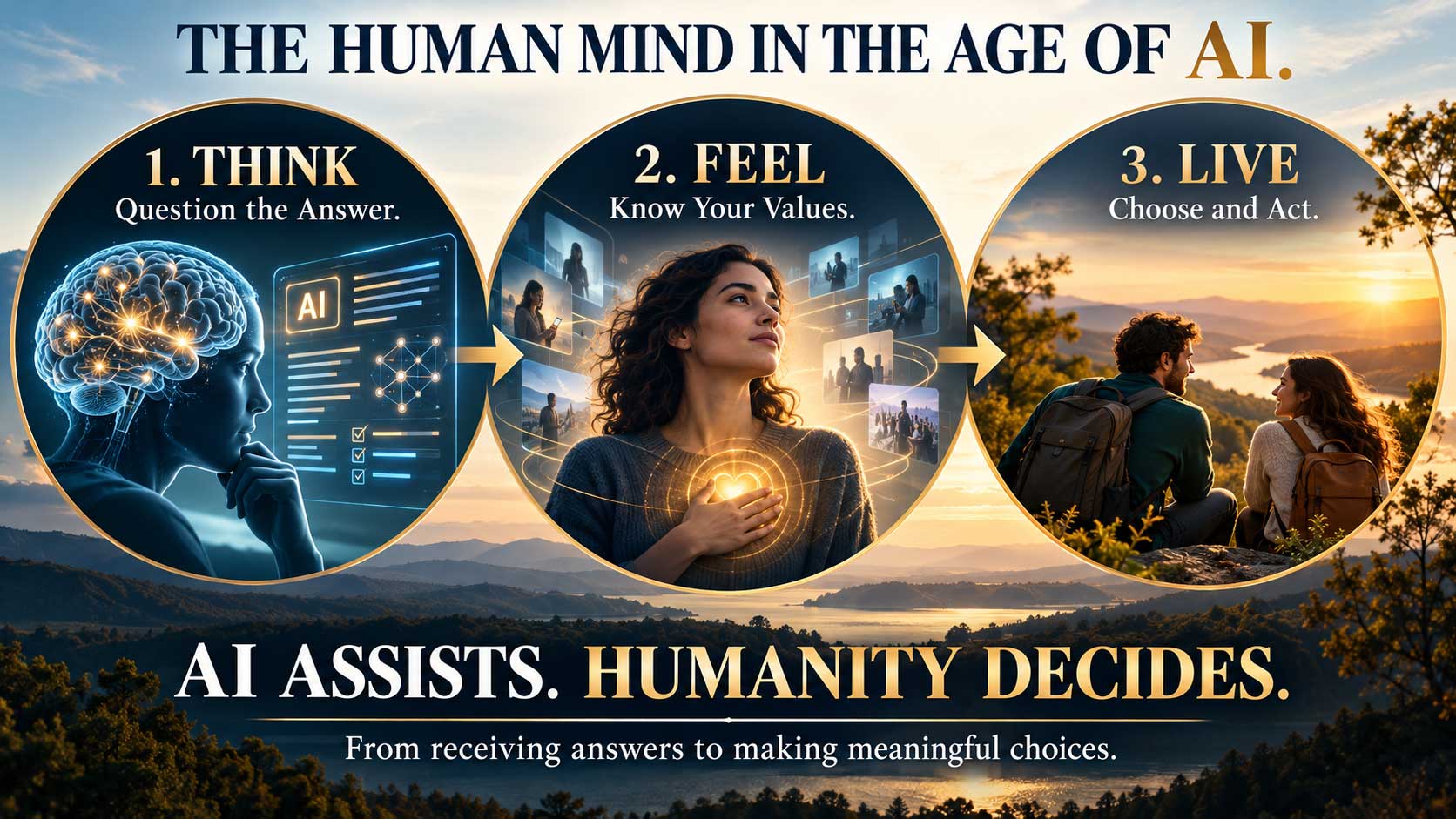
After listening to these four thinkers challenge one another across three conversations, I find myself looking at artificial intelligence a little differently.
I began with Tazuko Katayama's unsettling warning that humanity could gradually lose touch with its own heart. But what stayed with me wasn't her prediction. It was the possibility that we might surrender something deeply personal without even realizing it.
Sherry Turkle reminded us that genuine human relationships require patience, vulnerability, and sometimes uncomfortable conversations. Jonathan Haidt raised concerns about children growing up without enough opportunities to struggle, explore, and discover their own abilities. Richard Ryan helped distinguish genuine independence from simply rejecting other people's advice.
And Ethan Mollick offered an equally important challenge: Why assume that AI must weaken us when it could help us become better thinkers?
I found myself agreeing with all four, at different moments.
One example particularly stayed with me: the father who uses AI to help write a letter to his estranged daughter.
AI might help him discover words he couldn't find on his own. It might even help him recognize the pain he caused.
But the machine cannot apologize for him.
It cannot sit across from his daughter, listen to her anger, acknowledge his mistakes, or rebuild the trust that was lost.
AI can help open the door. But we still have to walk through it.
I think the same principle applies to almost everything we discussed.
AI can help us question our assumptions, but we must be willing to change our minds.
It can help us explore our feelings, but we must take responsibility for our choices.
It can help us communicate, but we must still make the effort to love, forgive, and understand one another.
I use AI extensively in my own creative work, and I have no desire to return to a world without it. If anything, these conversations have made me more excited about its possibilities.
But they've given me a new question to ask myself.
Am I using AI to become more capable, or am I gradually asking it to do things I should still be doing myself?
Perhaps there isn't one answer that applies to everyone.
I keep thinking about the handbag from Tazuko's story. What looks unnecessary to one person may carry extraordinary meaning for another. The photograph of a loved one, a handwritten letter, or some small object connected to a treasured memory.
No outside adviser can fully determine what those things mean to the person carrying them.
And that may be the deepest lesson of these conversations.
We shouldn't reject AI out of fear. Nor should we accept every answer simply because it sounds intelligent.
We should welcome the extraordinary assistance it offers, question it when necessary, and continue developing the judgment, compassion, and courage that give our lives meaning.
The four experts disagreed about many things. Yet their discussion left me with a hopeful possibility.
Perhaps AI won't make us less human.
Perhaps, used wisely, it can help us discover what being human really means.
I return to the final scene of our imaginary conversation: a little girl kneeling in a garden, discovering something fascinating, and calling her father over to see it.
He could have asked AI what she had found.
Instead, he went outside to join her.
The most meaningful answer wasn't on the screen. It was waiting for him in the garden.
Short Bios:
Tazuko Katayama (片山鶴子)
Tazuko Katayama is a prominent Japanese spiritual counselor, author, and practitioner from a family rooted in Okinawa's traditional yuta spiritual heritage. With over 14 years of experience and more than 60,000 reported consultations by 2025, her work has attracted a substantial following, with counseling appointments reportedly booked two years in advance. She is the author of The Power of Purification and The World Seen by People with Spiritual Sensitivity, published by KADOKAWA. Her teachings focus on spiritual awareness, intuition, healing, and helping people reconnect with their authentic selves. Her thought-provoking warning about humanity losing touch with its inner voice in the age of AI inspired this imaginary discussion.
Sherry Turkle
Sherry Turkle is an MIT professor, psychologist, and author of Alone Together and Reclaiming Conversation. Her research examines how digital technology influences human relationships, personal identity, and our capacity for meaningful conversation. She raises questions about emotional dependence on AI and the importance of genuine human connection.
Ethan Mollick
Ethan Mollick is a professor at the Wharton School of the University of Pennsylvania and author of Co-Intelligence: Living and Working with AI. He studies how artificial intelligence changes education, creativity, and work. His perspective highlights AI's potential to strengthen human thinking when used as an active intellectual partner.
Jonathan Haidt
Jonathan Haidt is a social psychologist at New York University and author of The Anxious Generation and The Righteous Mind. His work explores moral psychology, childhood development, and the influence of digital technology on human behavior. He advocates protecting children's opportunities to develop independence, resilience, and meaningful relationships.
Richard Ryan
Richard Ryan is a psychologist and co-developer of Self-Determination Theory with Edward Deci. His research examines human motivation, autonomy, competence, and psychological well-being. His perspective helps explain the difference between healthy assistance and dependence that undermines personal growth.
Leave a Reply