

Main Introduction By Anne Carson (imagined as moderator)
What if the monster in an ancient Greek myth had something to say?
In Autobiography of Red, I imagined Geryon not merely as the creature defeated by Herakles, but as a young man with red wings, a camera, and a heart capable of extraordinary longing.
His story raises questions that reach far beyond mythology. Why do we sometimes feel monstrous even when we have done nothing wrong? Why can the absence of someone we love become more powerful than their presence? And can art help us live with suffering without requiring us to explain or overcome every wound?
To explore these questions, I have been imaginatively joined by five remarkable thinkers: classicist Edith Hall, cultural scholar Dina Georgis, literary scholar Hannah Silverblank, writer bell hooks, and photography critic Susan Sontag.
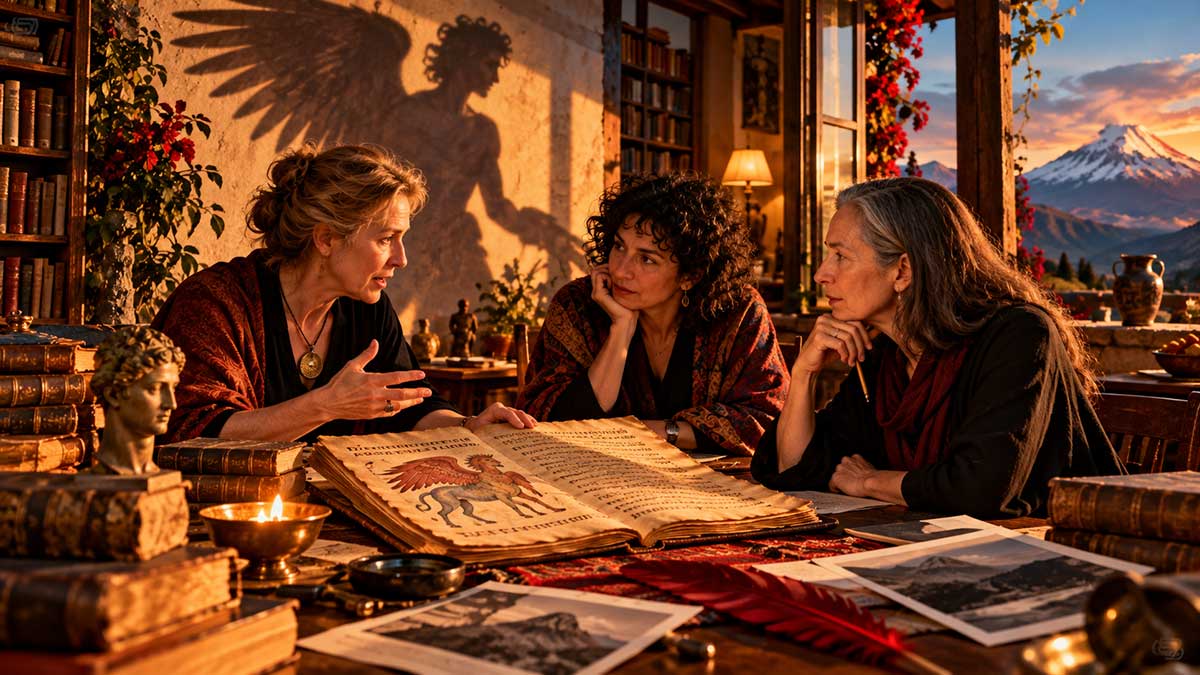
Our conversation takes place in a quiet house overlooking a Peruvian volcano, where an ancient manuscript, a photograph, and an empty chair become invitations to reconsider what it means to be human.
We will explore three questions: how stories shape identity, why longing can outlast love, and how art can open possibilities that suffering once made difficult to imagine.
Perhaps the most important question is not whether Geryon finally understands himself.
Perhaps it is whether he can begin living freely without needing a final answer.
(Note: This is an imaginary conversation, a creative exploration of an idea, and not a real speech or event.)
Topic 1: Why Do We All Feel Like Monsters Sometimes?
Shame, Identity, and the Stories Other People Tell About Us
The manuscript was older than everyone in the room.
Anne Carson had placed it at the center of a long wooden table in a house overlooking the Peruvian Andes. Beyond the windows, a volcano rose through the evening mist. The last sunlight touched its summit, turning the snow a faint shade of pink.
Edith Hall leaned forward to examine the manuscript.
Edith Hall: “Poor Geryon. Three bodies, six hands, six feet, a magnificent herd of cattle, and the terrible misfortune of appearing in someone else's heroic adventure.”
Anne Carson: “You make it sound like a scheduling problem.”
Edith: “In a sense, it was. Herakles needed to complete his tenth labor. Geryon happened to own the cattle.”
Dina Georgis: “And therefore Geryon had to die?”
Edith: “In the traditional story, yes.”
Dina: “That's a rather extraordinary conclusion to draw from livestock ownership.”
Anne smiled.
Anne: “Greek mythology contains many extraordinary conclusions.”
bell hooks: “So does ordinary life.”
Anne looked toward her.
Anne: “That's where I wanted to begin.”
She opened a copy of Autobiography of Red beside the ancient manuscript.
Anne: “In one version, Geryon is a monster who must be defeated. In another, he is a boy who has trouble sleeping, loves his mother, takes photographs, falls in love with someone who hurts him, and has enormous red wings.”
Edith: “Which is quite a revision.”
Anne: “Is it? Or have we simply moved closer?”
Edith: “Closer to what?”
Anne: “The monster.”
For a moment, no one spoke.
Then Dina reached toward the manuscript.
Dina: “Perhaps the first question is why we were standing so far away from him in the first place.”
Edith: “Because ancient heroic narratives were not primarily interested in the inner lives of the hero's opponents. Geryon exists within a story about Herakles. The monster's defeat demonstrates the hero's exceptional power.”
Dina: “But that's exactly the problem, isn't it? Someone becomes important only because of what defeating them proves about somebody else.”
Edith: “From our modern perspective, perhaps. But we should be careful not to assume that ancient audiences understood monsters in exactly the way we do.”
Dina: “I'm not suggesting they did. I'm interested in what happens when we inherit those categories and forget that they were constructed.”
Anne: “Constructed is a useful word.”
Edith: “Though not always a sufficient one. Ancient monsters could embody the terrifying, the marvelous, the geographically distant, the limits of the familiar world. They weren't simply unfortunate individuals subjected to bad publicity.”
Anne: “No. But imagine one of them opening his mouth.”
Edith: “I imagine Herakles would be rather surprised.”
Anne: “Suppose the monster said, 'Before you kill me, could you explain what I've done?'”
Dina: “Or something more difficult. Suppose he said, 'I have a mother.'”
The room grew quiet.
Outside, the mist shifted across the mountain.
bell hooks: “That is often where our certainty begins to weaken. When we recognize that the person we have reduced to a category has a life as complicated as our own.”
Edith: “Yet we must distinguish understanding someone from declaring them innocent. Giving the monster a voice doesn't automatically make the hero a villain.”
Anne: “Thank you, Edith. I was hoping someone would say that.”
Dina: “Because otherwise we've merely reversed the labels.”
Anne: “Exactly. The hero becomes the monster, the monster becomes the hero, and we congratulate ourselves for changing the seating arrangement.”
Edith laughed.
Edith: “A revolution in furniture.”
Anne: “Literature has attempted worse.”
bell hooks: “But there is a real ethical difference between asking who deserves condemnation and asking whether anyone should be reduced entirely to what we condemn.”
Dina: “And there is another question. What happens when a person begins to believe the category assigned to them?”
Anne closed the ancient manuscript.
Anne: “Let's leave Herakles outside for a moment.”
Edith: “He won't enjoy that.”
Anne: “He's accustomed to entering without permission.”
Dina turned toward the window.
Dina: “Think about a child who is repeatedly made to feel strange. Perhaps the child looks different, loves differently, speaks differently, or experiences something frightening that no one around them knows how to acknowledge.”
bell hooks: “Or a child who learns that affection must be earned by becoming someone more acceptable.”
Dina: “Yes. At first, the judgment comes from outside. Other people define the child. But eventually the child may begin to organize their own understanding around those judgments.”
Anne: “As though someone has placed a mirror in front of you and told you what you're supposed to see.”
Dina: “And after enough years, you no longer remember that someone else supplied the description.”
Edith: “But Geryon is literally red. He literally has wings. His difference is not imaginary.”
Dina: “Of course not. The question isn't whether difference exists. The question is why difference should become a verdict.”
bell hooks: “A child can know that they are different without believing they are unworthy of love.”
Anne: “And yet those two ideas often become entangled.”
bell hooks: “Because children learn about themselves through relationships. They discover who they are partly through the ways they are treated. If love is conditional, if tenderness is withheld, or if someone violates their trust, a child may interpret that experience as evidence of something wrong within themselves.”
Edith: “Even when the wrongdoing belongs entirely to someone else.”
bell hooks: “Especially then.”
Anne looked down at the book.
Anne: “Geryon experiences sexual abuse in childhood. It's important not to turn that into a neat explanation for everything that follows.”
Dina: “Yes. Trauma is not a master key that unlocks a person's entire identity. But it can influence how safety, intimacy, and self-worth are experienced.”
Anne: “What interests me is how difficult it can be to find language for something that happens before you have the words to understand it.”
Dina: “And how loneliness grows when the experience remains unspoken.”
Edith: “That brings us back to the monster, doesn't it? The figure whose appearance is visible to everyone, while his interior life remains inaccessible.”
Anne: “Precisely.”
bell hooks: “But I want to challenge something in the way we're speaking.”
Anne: “Please.”
bell hooks: “We're discussing shame as though the central problem is that other people have misunderstood us. Sometimes the deeper problem is that we have learned to participate in our own diminishment.”
Dina: “I agree, although I would be cautious about making the individual responsible for undoing a wound that relationships and social conditions helped create.”
bell hooks: “So would I. Self-love is not a substitute for justice, community, or care. But neither can we wait for every person who has harmed us to recognize our worth before we begin recognizing it ourselves.”
Anne: “What would that look like for Geryon?”
bell hooks: “It might begin with refusing to treat his wings as evidence that he is unlovable.”
Edith: “Even if the wings remain inconvenient.”
Anne: “Particularly in small rooms.”
They laughed.
Then Anne looked toward the volcano again.
Anne: “There is something curious about wings. Most people would consider them extraordinary. But if you were born with them, and everyone around you behaved as though they were shameful, you might spend your life wishing you had none.”
Dina: “That's the tragedy of internalized shame. A person can experience a part of themselves as a burden because of the meanings other people attach to it.”
bell hooks: “And may begin seeking love from people who confirm those meanings.”
Anne: “We'll return to that when we discuss Herakles.”
Edith: “I suspect Herakles is growing impatient outside.”
Anne: “He can wait. He has occupied the center of the story for several thousand years.”
The sun had slipped behind the mountains. Someone lit the lamps, and the manuscript cast a long shadow across the table.
Edith turned its pages carefully.
Edith: “There is another complication. We speak of Geryon as though Carson rescued a silent figure from an entirely uniform tradition. But ancient literature itself was more varied than that. Stesichoros was already doing something remarkable with myth through lyric poetry.”
Anne: “Yes. Ancient stories were never quite as fixed as people imagine.”
Edith: “Which means that the act of retelling is not merely a modern rebellion against antiquity. It is also a continuation of something ancient poets themselves practiced.”
Dina: “That matters. Otherwise we tell another simplistic story: ancient people believed one thing, modern people discovered compassion, and history became enlightened.”
Edith: “A narrative in which modernity casts itself as the hero.”
Anne: “And antiquity as the monster.”
Edith: “You see how quickly it happens?”
Anne: “Alarmingly quickly.”
bell hooks: “Perhaps because human beings are attracted to stories that establish their own goodness through someone else's inferiority.”
Dina considered this.
Dina: “There is comfort in knowing exactly who the monster is.”
Anne: “Why?”
Dina: “Because then you know who you are not.”
Edith: “And if the distinction becomes uncertain?”
Dina: “Then you must examine yourself.”
bell hooks: “Which is considerably harder than condemning someone else.”
Anne picked up a small photograph lying beside the book.
It showed a stretch of empty road, the edge of a mountain, and a sky that seemed almost too large for the frame.
Anne: “Here's something I've been wondering. If Geryon is writing an autobiography, why does he so often turn toward photographs?”
Edith: “Perhaps because he wishes to preserve what he sees.”
Dina: “Or because seeing is safer than being seen.”
bell hooks: “That's an interesting distinction.”
Dina: “When someone else looks at Geryon, they may see his redness, his wings, his difference. But when Geryon looks through a camera, he decides where to direct his attention.”
Anne: “For one instant, he chooses the frame.”
Edith: “Though choosing the frame is not the same as controlling the world.”
Anne: “No. Fortunately.”
Dina: “Nor is it the same as controlling how other people will interpret the photograph.”
bell hooks: “But it is an act of agency. He is no longer only the object of someone else's gaze.”
Anne: “And yet I wonder whether an autobiography can ever belong entirely to its author.”
Edith: “Surely not. We inherit language, stories, and images. Even our most personal accounts are shaped by forms that existed before us.”
Dina: “And by relationships. We cannot simply extract ourselves from the people and histories that helped make us.”
bell hooks: “But being shaped by others is not the same as being owned by them.”
Anne put the photograph down.
Anne: “There's the distinction.”
Edith: “Though perhaps not a permanent one. We are continually negotiating it.”
Anne: “Which may be why the word autobiography is so strange. It promises a life written by the self. But where exactly does the self begin, and where do the voices of other people end?”
Dina: “Perhaps there is no perfectly clean boundary.”
bell hooks: “That need not be a tragedy. We become ourselves in relationship. The question is whether those relationships permit us to grow.”
Edith: “And whether we can revise the stories we inherit.”
Anne: “Without pretending we invented ourselves from nothing.”
For a while, they listened to the wind.
Then Edith returned to the Greek manuscript.
Edith: “I want to defend the old story for a moment.”
Anne: “Please do. It's been having a difficult evening.”
Edith: “Myth does not always exist to provide psychologically complete individuals. Its figures can represent forces, conflicts, fears, and possibilities that exceed any single human life. If we insist that every monster must be understood as a misunderstood person, we may lose something of mythology's strangeness.”
Dina: “That's fair. But Carson's Geryon is not simply a realistic young man wearing a mythological costume. His wings remain extraordinary. His redness is never entirely explained.”
Anne: “Which I rather like.”
Edith: “So the novel doesn't abolish monstrosity?”
Dina: “No. It allows difference to remain different without requiring it to become shameful.”
bell hooks: “That is more powerful than merely announcing that the monster was normal all along.”
Anne: “Because he isn't normal.”
Edith: “He has wings.”
Anne: “Among other things.”
bell hooks: “And why should normality be the condition for being worthy of love?”
No one answered immediately.
Beyond the window, the volcano had become a dark shape against a violet sky.
Dina: “I think that's one of the most moving possibilities in this novel. Geryon does not have to prove that his difference was an illusion. He does not have to become indistinguishable from everyone else.”
Edith: “Nor must he defeat Herakles and take his place as the hero.”
Anne: “That would be a rather conventional ending.”
bell hooks: “He needs something more difficult than victory over another person.”
Anne: “What?”
bell hooks: “A relationship with himself that is not organized around someone else's judgment.”
Anne studied the photograph again.
Anne: “But can anyone achieve that completely?”
bell hooks: “I doubt it. We are human. We want recognition, affection, and belonging.”
Dina: “And the desire to be understood is not a weakness.”
Edith: “Perhaps freedom lies not in becoming independent of every story, but in recognizing that no single story can contain us.”
Anne: “Not even our own?”
Edith: “Especially our own. We change.”
Dina smiled.
Dina: “Then perhaps the danger is not having an identity. It's believing that identity must become a final verdict.”
bell hooks: “Or a prison.”
Anne opened the manuscript one last time.
Anne: “Here is Geryon, thousands of years ago. The monster. The defeated one. The creature at the end of a hero's journey.”
She placed Carson's novel beside it.
Anne: “And here is Geryon again. A child. A lover. A photographer. Someone who makes mistakes, suffers, desires, remembers, and continues living.”
Edith: “Neither account tells us everything.”
Dina: “But the second allows us to ask questions the first leaves unasked.”
bell hooks: “And perhaps it allows readers to ask those questions about themselves.”
Anne nodded.
Anne: “There's something I find deeply unsettling about the phrase 'I know exactly who you are.'”
Edith: “Because it is usually followed by a mistake?”
Anne: “Because it sounds so much like a locked door.”
Dina: “Especially when someone says it to a child.”
bell hooks: “Or when we say it to ourselves.”
Anne looked around the table.
Anne: “Then what would you say to someone who has spent years believing they are the monster in their own story?”
Edith answered first.
Edith: “I would ask who told them that story, and what that storyteller hoped to accomplish.”
Dina: “I would ask what experiences made the story feel true, and whether those experiences have been given the care and understanding they deserve.”
bell hooks: “I would tell them that their worth does not depend on becoming acceptable to the person who rejected them. And I would remind them that learning to love themselves does not mean they must do it alone.”
Anne considered their answers.
Anne: “I think I would ask what they wanted to photograph.”
Edith looked puzzled.
Edith: “Photograph?”
Anne: “Yes. Not what happened to them. Not what other people called them. Not even what they wish they could forget.”
She pointed toward the window.
Anne: “What, in this enormous world, still catches their attention?”
Dina followed her gaze.
Dina: “Because that might tell us something about who they are becoming.”
Anne: “Or simply what they love looking at. I wouldn't want to burden a photograph with too much responsibility.”
Edith: “An admirable restraint for a poet.”
Anne: “We practice occasionally.”
The four of them laughed softly.
Outside, the last light disappeared from the summit. The volcano remained, vast and silent, without explaining itself.
Edith closed the ancient manuscript.
Edith: “I suppose the original story has not changed. Herakles still kills Geryon.”
Anne: “No.”
Edith: “And yet, after reading the other story, it becomes difficult to see that death in quite the same way.”
Dina: “Because now we know there was someone there.”
bell hooks: “Someone whose life was never exhausted by the role he played in another person's journey.”
Anne placed her hand on the cover of Autobiography of Red.
Anne: “Perhaps that's what a different story can do. It cannot undo the old one. But it can make the world larger than the old one allowed.”
The wind moved through the open window and lifted the corner of the photograph.
For an instant, the little rectangle of paper seemed ready to fly.
Anne caught it before it fell.
She looked at the image of the mountain, then at the empty sky beyond it.
Anne: “We began with a monster who was never asked to speak.”
She set the photograph gently beside the manuscript.
Anne: “And now, at least, we know he had something to show us.”
Topic 2: Why Does Love Hurt More When It Is Missing?
Desire, Longing, and the Strange Way the Heart Experiences Time
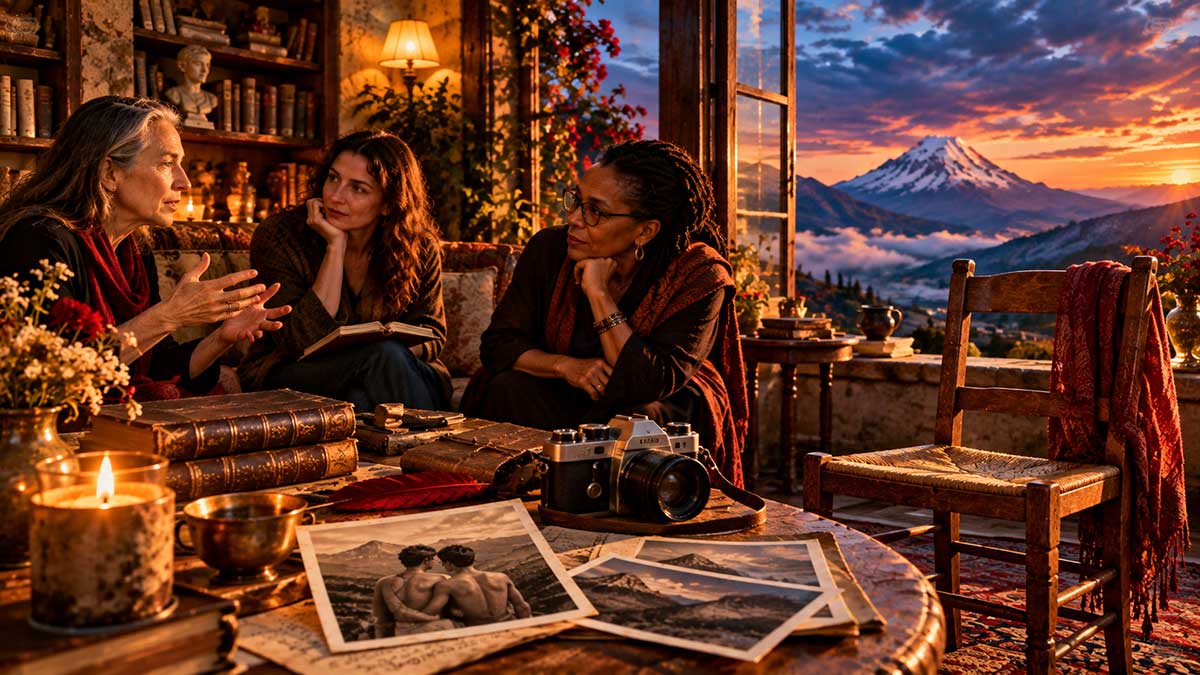
The empty chair had been bothering bell hooks for nearly twenty minutes.
It stood beside the window, slightly apart from the others, facing the volcano. No one had sat in it. No one had mentioned it. Yet Anne Carson had placed it there deliberately, and bell suspected she knew why.
bell hooks: “Anne, are we expecting someone?”
Anne Carson: “Not anymore.”
bell: “Then why is there an extra chair?”
Anne: “I thought we might discuss absence.”
Hannah Silverblank: “By inviting it to sit with us?”
Anne: “It has an excellent attendance record.”
Hannah laughed. Dina Georgis looked at the chair more carefully.
Dina Georgis: “There's something uncomfortable about that. An empty chair can make a person more noticeable than a full one.”
Anne: “Exactly. Why?”
bell: “Because we imagine who should be sitting there.”
Anne: “And if we have loved that person?”
bell: “Then we may imagine them with extraordinary persistence.”
Anne took a photograph from the table. It showed two young men standing beside a road, one looking toward the camera, the other toward something beyond the frame.
Anne: “Geryon falls in love with Herakles. The relationship ends. Years pass. Geryon travels, takes photographs, encounters other people. Yet Herakles continues to occupy a remarkable amount of space in his emotional life.”
Hannah: “Which is strange, because Herakles isn't always physically present in the story.”
Anne: “That's the puzzle.”
Dina: “Perhaps the person who is missing can become larger than the person who was actually there.”
bell: “Especially when we keep remembering what we hoped the relationship would become.”
Anne placed the photograph beside the empty chair.
Anne: “Then perhaps we should begin with a question that sounds simple but rarely is. Why do we sometimes want someone more intensely when we cannot have them?”
Hannah leaned back.
Hannah: “Because desire has a peculiar relationship with distance.”
Anne: “Go on.”
Hannah: “When we desire something, we're aware of a separation between ourselves and what we want. We imagine crossing that distance. Sometimes we do cross it, briefly. But longing often depends upon the awareness that something remains beyond our reach.”
bell: “That may describe desire, but I would hesitate to call it love.”
Hannah: “Why?”
bell: “Because love involves more than wanting. It involves care, responsibility, respect, knowledge, and a willingness to nurture another person's growth. Someone can desire us intensely without treating us lovingly.”
Anne: “So desire may be a feeling, while love is also a practice?”
bell: “Yes. And confusing them can lead us into considerable suffering.”
Dina: “But feelings don't always obey our ethical definitions.”
bell: “Of course they don't. That's why we need to examine them.”
Anne: “A rather inconvenient feature of being human.”
Hannah: “The Greeks were interested in that inconvenience.”
Anne: “Among many others.”
Hannah smiled.
Hannah: “The ancient Greek tradition frequently associates eros with contradictory experiences. Desire can be sweet and painful, enlivening and destabilizing. Sappho's famous description of eros as bittersweet captures that contradiction beautifully.”
Anne: “And the contradiction is not necessarily a mistake.”
Hannah: “No. It may be part of what desire is.”
bell: “But we should distinguish the unavoidable vulnerability of loving someone from the avoidable harm of remaining in a relationship where care is absent.”
Dina: “That's important. Otherwise we might romanticize suffering simply because it feels intense.”
Anne: “And poets would be unemployed by Thursday.”
Hannah: “Some of us would still have teaching positions.”
Anne: “A bleak consolation.”
They laughed, but bell remained thoughtful.
bell: “I wonder whether people sometimes mistake emotional intensity for emotional truth.”
Anne: “What would be the difference?”
bell: “A feeling can be completely genuine without providing an accurate account of the relationship producing it.”
Dina: “Meaning someone might sincerely feel that another person is essential to their happiness, even when that person repeatedly makes them unhappy.”
bell: “Exactly.”
Hannah: “But the feeling of necessity may also have a temporal dimension. The lover isn't merely longing for a person. They may be longing for a moment, or for the return of a version of themselves that existed in that moment.”
Anne looked down at the photograph.
Anne: “The first time someone looked at you as though you were the only person in the world.”
Hannah: “Yes.”
Anne: “And then the world resumed.”
Hannah: “But your mind kept returning to the moment before it did.”
Dina turned toward the window.
Dina: “There's something else. Sometimes the person we desire offers us a feeling of recognition we haven't experienced elsewhere.”
bell: “Or that we believe we haven't.”
Dina: “Yes. Imagine someone who has spent much of their life feeling different, ashamed, or difficult to love. Then another person comes along and seems fascinated by precisely what makes them different.”
Anne: “Geryon and Herakles.”
Dina: “Herakles sees him. Or at least Geryon experiences something that feels like being seen.”
bell: “And when that recognition disappears, Geryon may feel he has lost more than a relationship.”
Dina: “He may feel he has lost evidence that he was lovable.”
Anne was silent.
The wind pressed softly against the window.
Anne: “That is a terrible amount of responsibility to place upon another person.”
bell: “It is. But people do it all the time.”
Hannah: “And perhaps that's why absence becomes so enormous. We aren't merely missing the beloved. We're missing the version of ourselves that seemed possible in their presence.”
Anne: “Which means that the empty chair may contain two absences.”
Dina: “The person who left.”
bell: “And the self we thought they had given us.”
Anne looked at the chair again.
Anne: “No wonder it takes up so much room.”
For a while, they watched the sky darken over the Andes.
Then bell reached for the photograph.
bell: “There's something about Herakles that troubles me.”
Anne: “Only one thing?”
bell: “For the moment.”
Anne: “An impressive exercise in restraint.”
bell: “He has charisma. He can be affectionate, playful, and intensely present. But Geryon's experience of the relationship also includes uncertainty and hurt.”
Dina: “And that combination can be especially difficult to understand when you're young.”
bell: “Yes. Because a person may remember the tenderness and treat it as proof that the hurtful moments don't define the relationship.”
Hannah: “Or may experience the tenderness more intensely because it is intermittent.”
Anne: “The rare beautiful moment becomes a kind of treasure.”
bell: “And sometimes the treasure becomes an excuse.”
Dina: “Though I want to be careful here. Not every inconsistent relationship follows the same pattern, and we shouldn't reduce Geryon to a psychological case study.”
Anne: “Thank you.”
Dina: “He's a literary character whose inner life is deliberately complex. His feelings cannot be explained by one childhood experience or one relationship.”
Hannah: “Nor should the poem be treated as a disguised clinical report.”
bell: “Agreed. But literature can help us recognize emotional patterns without pretending to diagnose the characters.”
Anne: “Then let me ask a more uncomfortable question. Why can a person understand perfectly well that a relationship is hurting them and still want to return?”
bell: “Because understanding is not the same as transformation.”
Dina: “And because attachment is not governed entirely by conscious judgment.”
Hannah: “Memory complicates matters too.”
Anne: “How?”
Hannah: “We tend to imagine time as a line. A relationship begins, develops, ends, and belongs to the past. But emotional experience doesn't always follow that order.”
Anne: “The past has terrible manners.”
Hannah: “It walks into the present without knocking.”
Dina: “Sometimes through something very small. A song. A smell. A particular kind of light.”
bell: “Or a place you thought you had forgotten.”
Hannah: “And suddenly an experience from years ago feels immediate.”
Anne: “As though the years between have been folded away.”
Hannah: “Exactly. Poetry can represent that folding of time in ways that conventional chronology sometimes cannot.”
Dina: “That's especially important in Autobiography of Red. Carson doesn't simply tell us that Geryon misses Herakles. The language and structure allow us to experience how memory interrupts the present.”
Anne: “So perhaps the form of the book is participating in the heartbreak.”
Hannah: “Yes. The poetry does not merely describe longing. It creates an experience of it.”
bell: “But that raises a question. If poetry makes longing beautiful, does it risk encouraging readers to remain attached to suffering?”
Hannah considered this carefully.
Hannah: “Possibly. Beauty can make painful experiences compelling. But I don't think that means art is endorsing the pain.”
bell: “I'm not suggesting it does. I'm asking whether readers sometimes confuse the beauty of a representation with the desirability of the experience being represented.”
Anne: “A beautiful poem about heartbreak is not an advertisement for heartbreak.”
Hannah: “Exactly.”
Dina: “And sometimes beauty gives us enough distance to look at something we otherwise couldn't bear to examine.”
bell: “Then perhaps the ethical task is to appreciate the poem without making suffering into a requirement for profound love.”
Anne: “That would be a useful distinction.”
She looked toward the empty chair.
Anne: “I wonder how many people have stayed in painful relationships because they believed the pain made the love more meaningful.”
bell: “Too many.”
Hannah: “And how many have mistaken the persistence of memory for a sign that the relationship must continue?”
Dina: “Probably just as many.”
Anne turned the photograph over.
On its blank reverse, she wrote two words.
Remembering.
Returning.
She placed it between them.
Anne: “Are these the same thing?”
bell: “No.”
Hannah: “Not at all.”
Dina: “But they can feel dangerously similar.”
Anne: “Explain.”
Dina: “Remembering means the experience remains part of your life. Returning means choosing to reenter the relationship, whether physically or emotionally.”
bell: “And sometimes people believe that if they continue to remember someone, they have failed to move forward.”
Hannah: “As though healing requires an efficient deletion of the past.”
Anne: “Human memory is a very poor filing cabinet.”
Hannah: “And a remarkably imaginative one.”
bell: “But I would go further. We can honor what a relationship meant without continuing to organize our lives around the person who left.”
Dina: “That sounds simple.”
bell: “It isn't.”
Anne: “What makes it difficult?”
bell: “Sometimes the relationship has become part of the story we tell about ourselves. 'I was the person who loved him.' 'I was the person she abandoned.' 'I was the one who wasn't chosen.'”
Dina: “And relinquishing that story can feel like relinquishing a piece of our identity.”
Hannah: “Even when the story is painful.”
bell: “Especially when it has been painful for a long time. Familiar suffering can begin to feel like certainty.”
Anne was quiet for several moments.
Anne: “In the first conversation, we discussed the stories other people tell about us. Perhaps love creates another danger.”
Dina: “We begin telling our own story entirely through someone else's presence.”
Anne: “Or absence.”
Hannah: “Which is why the absent person can seem so powerful.”
bell: “But their absence does not have to determine the rest of the story.”
Anne: “How does someone begin to change that?”
bell: “Not by commanding themselves to stop feeling. Feelings rarely respond well to orders.”
Hannah: “Particularly poetic feelings.”
bell: “Nor by pretending the relationship meant nothing. Instead, a person can begin asking different questions. What did I learn about my needs? What forms of care were missing? What parts of my life did I neglect? What relationships and possibilities still exist beyond this one?”
Dina: “And perhaps, what was I hoping this person would give me that I might need to develop through a wider network of relationships, including my relationship with myself?”
Anne: “You make it sound like a long journey.”
bell: “It often is.”
Hannah: “Which may be why the idea of simply moving on feels inadequate. It suggests that time alone performs the work.”
Dina: “Sometimes time creates distance. But distance isn't necessarily understanding.”
Anne: “And understanding isn't necessarily freedom.”
bell: “No. But it can make freedom more possible.”
The room had grown darker. Anne lit a lamp beside the window.
Its reflection appeared in the glass, hovering over the black silhouette of the volcano.
Anne: “I want to return to something Hannah said earlier. That sometimes we miss not only the beloved, but the person we were when we loved them.”
Hannah: “Yes.”
Anne: “Suppose that person was happier. More hopeful. More alive. Wouldn't it be natural to want them back?”
Dina: “Of course.”
bell: “But perhaps we misunderstand where that happiness came from.”
Anne: “Meaning?”
bell: “We may believe another person created our capacity for joy. Sometimes they awakened it, encouraged it, or gave it a place to flourish. But that doesn't necessarily mean they own it.”
Hannah: “That's a beautiful distinction.”
Dina: “And an important one for Geryon. Herakles may have been part of his awakening to desire, but Herakles is not the source of everything Geryon can become.”
Anne: “Nor the final authority on what Geryon's love means.”
bell: “Exactly.”
Hannah: “Perhaps that's why photography matters so much.”
Anne glanced toward the camera resting on the table.
Anne: “We're saving that for the next conversation.”
Hannah: “I know. But I can't resist.”
Anne: “An academic confession.”
Hannah: “When Geryon takes a photograph, he chooses something in the world to attend to. He directs his gaze outward.”
Dina: “Instead of waiting to be seen by Herakles.”
Hannah: “Yes. His attention begins to belong to him again.”
bell: “And attention is one of the ways we participate in our own lives.”
Anne picked up the camera.
Anne: “Perhaps the question isn't whether Geryon will ever stop remembering Herakles.”
Dina: “What is it, then?”
Anne: “Whether he can look at the world without always wondering what Herakles would think of what he sees.”
Hannah smiled.
Hannah: “That feels like a different kind of freedom.”
bell: “One that doesn't require hatred.”
Dina: “Or forgetting.”
Anne: “Or pretending the love was never real.”
bell: “Exactly. We can recognize that a relationship mattered while also recognizing that it did not provide everything we needed.”
Anne set the camera down.
Anne: “Then I have one final question.”
She pointed toward the empty chair.
Anne: “When does an empty chair stop being a symbol of loss?”
Hannah: “Perhaps when we stop measuring the room by who is missing.”
Dina: “When we begin noticing who is present.”
bell: “And when we understand that an empty chair is not proof that something is wrong with us.”
Anne looked around the room.
The table was crowded with books, photographs, and cups of tea. Beyond the window, the volcano stood beneath a sky beginning to fill with stars.
Anne: “I think we have been rather unfair to this chair.”
Hannah: “How so?”
Anne: “We've assumed that because it's empty, it must be waiting for someone.”
Dina: “Isn't it?”
Anne: “Perhaps it's simply a chair.”
bell laughed.
bell: “That may be the most liberating thing you've said all evening.”
Anne stood and moved the chair closer to the table.
Anne: “There. Now someone else can sit with us.”
Hannah: “Who?”
Anne: “I don't know.”
Dina: “And that doesn't trouble you?”
Anne looked toward the open window.
Anne: “Not particularly.”
For a moment, no one spoke.
Then bell picked up the photograph of the two young men.
bell: “There's something else I want to say about Geryon.”
Anne: “Please.”
bell: “He doesn't have to regret loving Herakles in order to recognize that the relationship hurt him. And he doesn't have to continue suffering in order to prove that the love mattered.”
Hannah: “The past can remain meaningful without remaining unfinished business.”
Dina: “Though some feelings may remain unfinished.”
Anne: “Perhaps that's all right.”
She turned the photograph facedown, leaving its blank reverse visible.
Anne: “We tend to imagine that every great love story must end with two people together, or with one person finally forgetting the other.”
bell: “But there are other endings.”
Anne: “Yes.”
She glanced toward the empty chair, now part of the circle.
Anne: “Sometimes the ending is simply that the person who was left behind discovers there is still a world worth looking at.”
Outside, the wind moved across the mountain.
The chair remained empty.
But the room no longer seemed to be waiting.
Topic 3: Can Art Save Us Without Healing Everything?

Photography, Poetry, Freedom, and the Courage to Remain Unfinished
The photograph had been sitting on the table since morning.
It showed a volcano beneath a pale sky. A narrow trail disappeared into the mountainside, and a small human figure stood near the bottom of the frame, almost lost in the enormous landscape.
Susan Sontag had been studying it for several minutes.
Susan Sontag: “I don't trust this photograph.”
Anne Carson looked up from her notebook.
Anne Carson: “That's an unfortunate thing to say in front of a photographer.”
Susan: “I'm not accusing the photographer of dishonesty.”
Anne: “How reassuring.”
Susan: “I'm questioning what the photograph claims to tell us.”
Edith Hall moved her chair closer.
Edith Hall: “It seems to tell us that someone visited a volcano.”
Susan: “Does it?”
Edith: “There's a volcano in the photograph.”
Susan: “That tells us what appears in the image. It doesn't tell us why the photographer chose it, what happened before the shutter opened, or what happened afterward.”
Hannah Silverblank: “Or what the photographer was feeling.”
Susan: “Precisely.”
Dina Georgis leaned forward.
Dina Georgis: “Perhaps the photographer wasn't trying to tell us.”
Susan: “Then why take the photograph?”
Anne: “Perhaps because the volcano was there.”
Susan looked at her.
Susan: “You can't possibly expect me to accept that as a complete explanation.”
Anne: “No. But I thought it might annoy you enough to begin the conversation.”
Hannah laughed.
Outside the windows, the real volcano stood beneath a gathering bank of clouds. Its summit was hidden, but its immense shape remained visible against the afternoon sky.
Anne placed Geryon's camera beside the photograph.
Anne: “In Autobiography of Red, Geryon tries to tell the story of his life. But the story he makes is not simply a collection of explanations. He turns repeatedly toward images.”
Susan: “Which is interesting because photographs are often mistaken for explanations.”
Dina: “Even when they aren't.”
Anne: “Exactly. So here's my question. Why might someone who struggles to speak about his own life choose to photograph the world instead?”
Susan considered the camera.
Susan: “Photography gives us a way to possess an appearance. We select a fragment of the world, remove it from the continuous movement of time, and preserve it.”
Hannah: “But perhaps the preservation matters because time itself is so difficult to hold.”
Susan: “Certainly. Yet preserving an appearance is not the same as understanding it.”
Anne: “Must understanding be the purpose?”
Susan: “Not necessarily. But people often ask images to perform the work of knowledge.”
Dina: “I wonder whether we're approaching Geryon's photographs from the wrong direction.”
Susan: “How so?”
Dina: “We're asking what they reveal about him. Perhaps we should ask what making them allows him to do.”
Anne smiled.
Anne: “That seems promising.”
Dina: “Geryon spends much of his childhood experiencing himself as an object of other people's attention. His body is strange. His wings are visible. His feelings are difficult to communicate. Other people look at him, interpret him, and sometimes fail to recognize what he is experiencing.”
Susan: “And through a camera, he becomes the person who looks.”
Dina: “Yes. For a moment, he decides where to direct his attention.”
Edith: “Although the world doesn't necessarily become more comprehensible because he photographs it.”
Dina: “No. But perhaps comprehension isn't the first achievement.”
Anne: “What is?”
Dina: “Participation.”
Susan tilted her head.
Dina: “When Geryon photographs something, he is not merely waiting for the world to tell him who he is. He is making a choice about what deserves his attention.”
Hannah: “Which means the photograph can be autobiographical even when Geryon himself isn't visible.”
Susan: “I would be cautious about that conclusion.”
Anne: “Naturally.”
Susan: “A photograph doesn't automatically disclose the photographer's inner life. We should resist turning every aesthetic decision into a psychological confession.”
Hannah: “But a sequence of choices may reveal something about how a person encounters the world.”
Susan: “Perhaps. Though the revelation remains incomplete.”
Anne: “That word again.”
Susan: “Incomplete?”
Anne: “Yes. It seems to follow us everywhere.”
Edith: “We are in the House of Unfinished Stories.”
Anne: “An architectural condition, apparently.”
They laughed.
Anne picked up the camera.
Anne: “Suppose Geryon takes a photograph of a mountain because he cannot find words for something inside himself.”
Susan: “Then the photograph may become meaningful to him without becoming transparent to anyone else.”
Hannah: “And perhaps that is part of its value.”
Susan: “Explain.”
Hannah: “We often imagine that expression succeeds only when another person understands exactly what we mean. But poetry doesn't work that way. Neither does photography. An image can communicate something powerful without translating itself into a single statement.”
Dina: “Especially when the experience being expressed is difficult to name.”
Anne: “A feeling can exist before its explanation.”
Hannah: “And sometimes the explanation never arrives.”
Susan looked again at the volcano photograph.
Susan: “Then we should be careful not to confuse mystery with depth.”
Anne: “A useful warning.”
Susan: “Not everything obscure is profound.”
Anne: “And not everything profound is obscure.”
Edith: “Though poets have occasionally tested both propositions.”
Anne: “Classicists too.”
Edith: “We generally blame the manuscripts.”
The room filled with laughter.
Then Dina spoke more quietly.
Dina: “There's something important here for people who have experienced suffering. Sometimes others demand a clear account of what happened, what it meant, and how the person has changed.”
Anne: “A beginning, a middle, and a satisfactory ending.”
Dina: “Exactly. But lived experience doesn't always organize itself into a story that satisfies an audience.”
Susan: “Nor should art be required to provide one.”
Hannah: “That may be one reason Carson's book moves between poetry, narrative, myth, and other forms. It resists the expectation that a life must be explained through one stable voice.”
Edith: “And it is called an autobiography, despite being a work of fiction.”
Anne: “A rather mischievous title.”
Edith: “Especially when the subject is a creature from Greek mythology.”
Anne: “Perhaps the title asks us to consider who is permitted to have an interior life.”
Dina: “And who is permitted to tell that life in an unconventional form.”
Susan placed the photograph back on the table.
Susan: “But I want to challenge something we've been assuming.”
Anne: “Only one thing?”
Susan: “For now.”
Anne: “We're making progress.”
Susan: “We keep speaking as though Geryon's photographs are inherently liberating. But art doesn't automatically free its maker. Sometimes artistic activity becomes another way of avoiding experience.”
The room grew quieter.
Hannah: “That's true.”
Dina: “And sometimes people are encouraged to transform suffering into something beautiful before they've had the chance to acknowledge how much it hurt.”
Anne: “As though pain becomes acceptable once it produces something worthwhile.”
Susan: “Exactly.”
Edith: “Which creates a troubling equation. The suffering is justified by the art.”
Dina: “And the person who suffered is expected to be grateful for what it made possible.”
Anne looked down at the camera.
Anne: “That seems a cruel bargain.”
Susan: “It is.”
Hannah: “Yet we shouldn't dismiss the possibility that art can genuinely help someone live through difficulty.”
Susan: “I'm not dismissing it. I'm resisting the romantic mythology of the suffering artist.”
Anne: “The idea that great art requires great pain.”
Susan: “Or that pain becomes valuable because it has been turned into art.”
Dina: “There's a difference between finding something meaningful after suffering and claiming the suffering was necessary.”
Edith: “A distinction that stories frequently blur.”
Anne: “Then let me ask it plainly. If Geryon's experiences contribute to his art, does that make those experiences worth having?”
bell hooks, who had been listening from a chair near the fireplace, finally spoke.
bell hooks: “No.”
Everyone turned toward her.
bell: “A person may create something beautiful after being hurt. That does not mean the hurt was a gift.”
Anne nodded.
bell: “We should never require people to redeem their suffering by becoming wiser, kinder, more creative, or more extraordinary.”
Dina: “Because then even healing becomes another demand.”
bell: “Yes. Another standard they must meet.”
Hannah: “But perhaps the act of creating can still open a possibility that wasn't visible before.”
bell: “Of course. The possibility matters. The justification does not.”
Susan smiled faintly.
Susan: “That is a distinction worth keeping.”
Anne walked to the window.
The clouds had begun to separate. A thin line of sunlight appeared along the volcano's upper slope.
Anne: “I have been thinking about a question people often ask of poetry. Can it heal us?”
Hannah: “A very large question.”
Susan: “And a suspiciously therapeutic one.”
Anne: “I know. But people ask it sincerely.”
Dina: “Because they want to know whether something beautiful can make unbearable experiences easier to live with.”
Anne: “And perhaps because they want permission to hope.”
bell: “Hope is important. But we should be careful about what we promise.”
Anne: “What would you promise?”
bell: “That art can offer companionship, recognition, and sometimes a way of imagining possibilities beyond present pain. But I wouldn't promise that it will heal every wound.”
Susan: “Nor would I assume that the person making the art necessarily understands themselves better afterward.”
Hannah: “Yet the experience of reading or making a poem can change how time feels.”
Edith: “You've mentioned that before. Tell us more.”
Hannah: “In ordinary life, we often experience time as something that carries us forward. But poetry can suspend that movement. A moment may expand. A memory may return. Two distant experiences may suddenly seem present together.”
Anne: “As though time has briefly lost its authority.”
Hannah: “Yes. A poem cannot change what happened. But it may allow us to encounter the experience differently.”
Dina: “Which could be meaningful without being a cure.”
Hannah: “Exactly.”
Susan: “I find that more persuasive than the language of salvation.”
Anne: “So art doesn't necessarily rescue us from suffering.”
Susan: “No.”
Anne: “But it may prevent suffering from becoming the only thing we can see.”
Susan considered this.
Susan: “Sometimes.”
bell: “And that can matter enormously.”
A gust of wind rattled the window.
Edith looked toward the ancient manuscript resting beside Carson's novel.
Edith: “There's another kind of rescue in this book.”
Anne: “Ah.”
Edith: “The rescue of a character from his inherited ending.”
Susan: “You mean Geryon?”
Edith: “Yes. In the ancient tradition, Herakles kills him. His role is to be defeated. His story ends because the hero's story requires it.”
Dina: “And in Carson's novel, he survives.”
Edith: “More than survives. He possesses a childhood, a developing consciousness, desires, relationships, and an uncertain future.”
Anne: “You sound almost pleased.”
Edith: “I am a classicist. We become attached to our monsters.”
Susan: “But is that really rescue? Or simply a different literary construction?”
Edith: “An excellent objection.”
Anne: “Susan has been waiting all afternoon to make one.”
Susan: “I haven't had to wait very long.”
Edith smiled.
Edith: “Of course it's a literary construction. Geryon is not a historical person whom Carson has physically saved. But changing a myth's perspective changes the imaginative possibilities available to its readers.”
Dina: “And that matters because stories help establish what kinds of lives we can imagine.”
bell: “If every story about someone like you ends in humiliation, punishment, or disappearance, it can be difficult to imagine a different future.”
Edith: “Exactly. Carson does not simply give the monster a better reputation. She gives him time.”
Hannah: “Time to become someone beyond the moment of his defeat.”
Anne turned from the window.
Anne: “That's beautiful, Edith.”
Edith: “I occasionally have my moments.”
Anne: “And modesty is among them.”
Edith: “Rarely.”
They laughed.
Then Susan picked up the photograph.
Susan: “But I wonder whether we're being too eager to turn survival into triumph.”
Dina: “What do you mean?”
Susan: “Geryon survives. He photographs. He encounters Ancash. He experiences something like freedom. But none of that proves that his earlier suffering has disappeared.”
Hannah: “Nor does the novel require it to.”
Susan: “Exactly. Yet readers often want the ending to tell them that everything has been resolved.”
Anne: “Because an unresolved ending can feel like an unfinished promise.”
bell: “Especially when we've come to care about the person.”
Dina: “We want Geryon to be safe. Loved. Free from shame.”
Edith: “And perhaps to have a satisfying confrontation with Herakles.”
Anne: “Preferably involving a long speech and an excellent closing line.”
Susan: “Which would be emotionally satisfying and artistically rather predictable.”
Anne: “You disapprove of emotional satisfaction?”
Susan: “Not at all. I disapprove of confusing it with truth.”
The wind quieted.
Anne returned to the table and opened the book.
Anne: “Then let's talk about the wings.”
Edith leaned forward.
Edith: “Finally.”
Anne: “You've been waiting?”
Edith: “For a Greek monster, Geryon has spent a remarkable amount of this conversation behaving like a photographer.”
Anne: “Perhaps photography is his second superpower.”
Susan: “An alarming proposition.”
Dina: “The wings are interesting because they begin as something Geryon experiences as a source of difference.”
bell: “Something he may wish to conceal.”
Hannah: “Yet by the end, flight becomes a possibility.”
Anne: “What changed?”
Edith: “One interpretation would be that the wings symbolize a capacity he possessed all along.”
Dina: “But didn't know how to inhabit.”
bell: “Or didn't feel free to inhabit.”
Susan: “I'm uncomfortable with the assumption that every unusual physical feature must be converted into a symbol.”
Anne looked delighted.
Anne: “I was hoping you would say that.”
Susan: “Why can't Geryon simply have wings?”
Edith: “Because readers of poetry are constitutionally incapable of leaving things alone.”
Hannah: “We do have a reputation.”
Susan: “If the wings mean only freedom, we risk making them smaller than they are.”
Dina: “That's a fascinating point. Their strangeness may be important precisely because it resists a complete explanation.”
Anne: “And perhaps Geryon doesn't have to explain them before using them.”
bell: “That may be the deepest form of acceptance we've discussed.”
Edith: “Acceptance without translation?”
bell: “Acceptance without requiring every difference to become understandable to everyone else.”
Hannah: “Or even fully understandable to oneself.”
Anne considered this.
Anne: “But isn't self-understanding important?”
bell: “Of course. Yet self-understanding is not the same as producing a final explanation of who we are.”
Dina: “And sometimes the demand for a final explanation becomes another form of confinement.”
Susan: “A life is not a photograph with a caption that tells us exactly what to think.”
Anne: “Nor a poem with an answer key.”
Edith: “An unfortunate development for examination boards.”
Hannah laughed.
Hannah: “Perhaps that's why the volcano matters.”
Anne looked toward the mountain.
Anne: “Tell us.”
Hannah: “A volcano is both a physical landscape and a source of extraordinary imaginative associations. It contains heat beneath a visible surface. It can remain quiet for long periods and then change the landscape dramatically.”
Dina: “Which makes it tempting to read as a metaphor for hidden emotion.”
Susan: “Very tempting.”
Edith: “And not necessarily wrong.”
Susan: “No. But I would resist treating the mountain as merely an illustration of Geryon's psychology.”
Anne: “Because it has a life beyond him.”
Susan: “Exactly. The world is not obligated to exist as a metaphor for our suffering.”
Dina smiled.
Dina: “That may itself be liberating.”
Anne: “How?”
Dina: “When someone is overwhelmed by pain, everything can begin to seem connected to that pain. Every memory, every relationship, every future possibility.”
bell: “The suffering becomes the center of the person's world.”
Dina: “Yes. But the volcano exists independently. The sky exists independently. Other people have their own lives. The world contains things that are not explanations of what happened to us.”
Hannah: “And Geryon can look at them.”
Susan: “Photograph them.”
Edith: “Perhaps even fly above them.”
Anne turned toward the window.
For the first time that afternoon, the summit was completely visible.
A pale plume rose from the mountain into the blue evening sky.
Anne: “There's something extraordinary about the possibility that freedom might begin with attention.”
Susan: “Attention to what?”
Anne: “To something other than the story that has been hurting us.”
bell: “Not because the story was unimportant.”
Dina: “And not because we have forgotten it.”
Anne: “But because it is no longer the only story.”
Hannah looked at the photograph.
Hannah: “In the first conversation, we asked who gets to tell Geryon's story.”
Edith: “In the second, we asked why Herakles remained so powerful in Geryon's memory.”
Hannah: “And now perhaps we're asking whether Geryon can experience the world without everything referring back to either his difference or his heartbreak.”
Susan: “Which is a much more interesting question than whether he has been cured.”
Anne: “Because being cured suggests a problem has been eliminated.”
Dina: “While being free may mean having possibilities that the problem no longer completely determines.”
bell: “Though freedom also requires real conditions of safety, support, and care. We shouldn't pretend that imagination alone can overcome every injury or social barrier.”
Anne: “No. A person needs more than a beautiful metaphor.”
Edith: “And a monster needs somewhere to land.”
Susan: “Preferably without a heroic Greek waiting to shoot him.”
Anne: “An excellent practical consideration.”
They laughed, and the laughter lingered.
The sun had begun to descend. Light moved across the table, touching the camera, the manuscript, and the photograph.
Anne picked up the photograph one final time.
Anne: “I think I've been asking the wrong question.”
Susan: “Which one?”
Anne: “Whether art can save us.”
Hannah: “What would you ask instead?”
Anne looked at the image of the volcano.
Anne: “What becomes possible when we make something?”
Dina: “A different way of seeing.”
Edith: “A different ending.”
Hannah: “A moment outside the ordinary movement of time.”
bell: “A way to recognize that our lives contain more than what has wounded us.”
Susan: “And sometimes nothing so grand. Sometimes we make an image because something caught our attention, and the image is worth making.”
Anne smiled.
Anne: “You really don't want the photograph to become a sermon.”
Susan: “Not if I can help it.”
Anne: “Fair enough.”
She placed it on the table.
For a long time, no one spoke.
Outside, a bird crossed the valley, moving through the evening air with an ease that made flight seem almost ordinary.
Edith watched it disappear.
Edith: “I keep thinking about the ancient Geryon.”
Anne: “What about him?”
Edith: “His story ends when Herakles kills him. The hero continues. The monster does not.”
Dina: “But Carson's Geryon continues.”
Edith: “Yes. And perhaps that's the most radical change. Not that he becomes victorious. Not that he becomes normal. Simply that he is permitted a future.”
Hannah: “A future the ancient story never imagined for him.”
bell: “And one he does not have to earn by becoming someone else.”
Susan looked toward the mountain.
Susan: “I still don't know what the wings mean.”
Anne: “Neither do I.”
Edith: “That is a rather scandalous admission from the moderator.”
Anne: “I have a reputation for making things difficult.”
Dina: “Perhaps the wings don't need to mean only one thing.”
Hannah: “Perhaps they can remain wings.”
bell: “And perhaps Geryon can learn to use them without first deciding what they say about his identity.”
Anne opened the window.
Cool mountain air entered the room. The pages of the Greek manuscript stirred, and the photograph shifted slightly across the table.
She caught it with one hand.
Anne: “There's something I like about that.”
Susan: “About what?”
Anne: “The idea that we might begin living before we've finished explaining ourselves.”
The others were quiet.
Dina: “That doesn't mean we stop trying to understand.”
Anne: “No.”
Hannah: “Or that the past disappears.”
Anne: “No.”
bell: “Or that love and care cease to matter.”
Anne: “Certainly not.”
Edith: “Then what does it mean?”
Anne looked toward the volcano, now glowing faintly beneath the setting sun.
Anne: “Perhaps it means that understanding is something we do while living, not something we must complete before life can begin.”
Susan considered the photograph in Anne's hand.
Susan: “I can accept that.”
Anne: “High praise.”
Susan: “Don't become accustomed to it.”
Anne laughed.
The manuscript lay open beside the camera. On its ancient pages, the monster's fate had already been decided. There was nothing anyone in the room could do to change those words.
But beyond the window, the sky remained open.
Anne placed the photograph on the table, leaving it without a caption.
Anne: “We began with a monster who was never allowed to tell his story. Then we met a young man whose love threatened to become the whole of his life.”
She looked around the room.
Anne: “And now?”
Edith closed the manuscript gently.
Edith: “Now he has a future.”
Hannah looked toward the horizon.
Hannah: “And time in which to discover it.”
Dina smiled.
Dina: “Without having to become understandable to everyone.”
bell nodded.
bell: “Without having to prove that his suffering was worthwhile.”
Susan looked at the camera.
Susan: “And without having to explain every photograph.”
Anne stood by the open window.
The wind lifted a loose page of her notebook, then let it settle again.
Far beyond the mountains, the last light stretched across the sky.
No one could say where Geryon would fly next.
No one knew whether he would always carry the memory of Herakles, whether his photographs would bring him peace, or whether the strange red wings that had once made him ashamed would ever feel entirely ordinary.
Perhaps none of those questions required an answer that evening.
The volcano continued breathing into the darkening sky.
And somewhere beyond the limits of the old myth, a young man with red wings was still alive, still looking, still becoming.
That, Anne thought, was more than the ancient hero had ever allowed him.
And perhaps, for now, it was enough.
Final Thoughts By Anne Carson (imagined as moderator)

We began with a monster who had never been asked to tell his side of the story.
We discovered that the names others give us can become prisons, especially when we begin believing them ourselves.
Then we explored love, and the strange way an absent person can occupy more of our lives than someone standing beside us. Yet remembering someone does not mean our future must continue belonging to them.
Finally, we considered art. A photograph cannot erase heartbreak. A poem cannot undo childhood suffering. And beauty does not make pain necessary or worthwhile.
But art can change what we notice. It can make room for experiences that refuse simple explanations.
Geryon's wings may never become ordinary. His memories may never disappear. His story may remain unfinished.
And perhaps that is not a failure.
Perhaps freedom begins when we stop demanding that every wound become a lesson, every love become permanent, and every difference become understandable.
The ancient Geryon was given an ending.
Carson's Geryon was given something more precious.
A future.
And sometimes, a future is enough.
Short Bios:
Anne Carson — Moderator: Canadian poet, essayist, translator, and classicist, and recipient of the 2026 Nobel Prize in Literature. Her acclaimed verse novel Autobiography of Red reimagines the Greek myth of Geryon through themes of love, identity, shame, and freedom. She serves as the fictional moderator of this conversation.
Edith Hall — Classical Mythology: British classicist and author known for making ancient Greek literature accessible to modern readers. Her scholarship explores Greek mythology, tragedy, and the ways classical stories continue to shape our understanding of humanity.
Dina Georgis — Identity and Emotional Experience: Scholar whose work examines queer theory, trauma, cultural narratives, and the relationship between personal experience and collective identity. Her perspective helps illuminate Geryon's struggles with difference, shame, and belonging.
Hannah Silverblank — Poetry and Desire: Literary scholar whose research explores Anne Carson, classical poetry, longing, and the relationship between desire and time. Her perspective connects the emotional experiences in Autobiography of Red to Carson's innovative poetic form.
bell hooks — Love and Self-Worth (1952–2021): Influential American writer, feminist theorist, and cultural critic. Her books, including All About Love, explore care, honesty, responsibility, and the difference between genuine love and relationships shaped by domination or insecurity.
Susan Sontag — Art and Photography (1933–2004): American essayist, novelist, and cultural critic whose influential work On Photography examines how images shape perception, memory, and understanding. Her ideas illuminate Geryon's attempt to express himself through photography.
Disclaimer
This article is a work of imaginative literary interpretation. The conversations, setting, and dialogue are fictional and do not represent actual meetings, statements, or endorsements by Anne Carson or the featured scholars. Their published works and intellectual perspectives inspire the discussion. Autobiography of Red and its characters belong to their respective rights holders.
Leave a Reply